EP1411032A1 - HIGH PURITY QUARTZ POWDER AND METHOD FOR PRODUCTION THEREOF, AND FORMED GLASS ARTICLE FROM THE POWDER - Google Patents
HIGH PURITY QUARTZ POWDER AND METHOD FOR PRODUCTION THEREOF, AND FORMED GLASS ARTICLE FROM THE POWDER Download PDFInfo
- Publication number
- EP1411032A1 EP1411032A1 EP02747689A EP02747689A EP1411032A1 EP 1411032 A1 EP1411032 A1 EP 1411032A1 EP 02747689 A EP02747689 A EP 02747689A EP 02747689 A EP02747689 A EP 02747689A EP 1411032 A1 EP1411032 A1 EP 1411032A1
- Authority
- EP
- European Patent Office
- Prior art keywords
- quartz powder
- powder
- helium
- synthetic quartz
- gel
- Prior art date
- Legal status (The legal status is an assumption and is not a legal conclusion. Google has not performed a legal analysis and makes no representation as to the accuracy of the status listed.)
- Granted
Links
Images
Classifications
-
- C—CHEMISTRY; METALLURGY
- C03—GLASS; MINERAL OR SLAG WOOL
- C03C—CHEMICAL COMPOSITION OF GLASSES, GLAZES OR VITREOUS ENAMELS; SURFACE TREATMENT OF GLASS; SURFACE TREATMENT OF FIBRES OR FILAMENTS MADE FROM GLASS, MINERALS OR SLAGS; JOINING GLASS TO GLASS OR OTHER MATERIALS
- C03C1/00—Ingredients generally applicable to manufacture of glasses, glazes, or vitreous enamels
- C03C1/006—Ingredients generally applicable to manufacture of glasses, glazes, or vitreous enamels to produce glass through wet route
-
- C—CHEMISTRY; METALLURGY
- C03—GLASS; MINERAL OR SLAG WOOL
- C03B—MANUFACTURE, SHAPING, OR SUPPLEMENTARY PROCESSES
- C03B19/00—Other methods of shaping glass
- C03B19/01—Other methods of shaping glass by progressive fusion or sintering of powdered glass onto a shaping substrate, i.e. accretion, e.g. plasma oxidation deposition
-
- C—CHEMISTRY; METALLURGY
- C03—GLASS; MINERAL OR SLAG WOOL
- C03B—MANUFACTURE, SHAPING, OR SUPPLEMENTARY PROCESSES
- C03B19/00—Other methods of shaping glass
- C03B19/09—Other methods of shaping glass by fusing powdered glass in a shaping mould
-
- C—CHEMISTRY; METALLURGY
- C03—GLASS; MINERAL OR SLAG WOOL
- C03B—MANUFACTURE, SHAPING, OR SUPPLEMENTARY PROCESSES
- C03B19/00—Other methods of shaping glass
- C03B19/10—Forming beads
- C03B19/1005—Forming solid beads
- C03B19/106—Forming solid beads by chemical vapour deposition; by liquid phase reaction
- C03B19/1065—Forming solid beads by chemical vapour deposition; by liquid phase reaction by liquid phase reactions, e.g. by means of a gel phase
-
- C—CHEMISTRY; METALLURGY
- C03—GLASS; MINERAL OR SLAG WOOL
- C03B—MANUFACTURE, SHAPING, OR SUPPLEMENTARY PROCESSES
- C03B19/00—Other methods of shaping glass
- C03B19/10—Forming beads
- C03B19/1095—Thermal after-treatment of beads, e.g. tempering, crystallisation, annealing
-
- C—CHEMISTRY; METALLURGY
- C03—GLASS; MINERAL OR SLAG WOOL
- C03C—CHEMICAL COMPOSITION OF GLASSES, GLAZES OR VITREOUS ENAMELS; SURFACE TREATMENT OF GLASS; SURFACE TREATMENT OF FIBRES OR FILAMENTS MADE FROM GLASS, MINERALS OR SLAGS; JOINING GLASS TO GLASS OR OTHER MATERIALS
- C03C12/00—Powdered glass; Bead compositions
-
- C—CHEMISTRY; METALLURGY
- C03—GLASS; MINERAL OR SLAG WOOL
- C03C—CHEMICAL COMPOSITION OF GLASSES, GLAZES OR VITREOUS ENAMELS; SURFACE TREATMENT OF GLASS; SURFACE TREATMENT OF FIBRES OR FILAMENTS MADE FROM GLASS, MINERALS OR SLAGS; JOINING GLASS TO GLASS OR OTHER MATERIALS
- C03C3/00—Glass compositions
- C03C3/04—Glass compositions containing silica
- C03C3/06—Glass compositions containing silica with more than 90% silica by weight, e.g. quartz
-
- C—CHEMISTRY; METALLURGY
- C03—GLASS; MINERAL OR SLAG WOOL
- C03B—MANUFACTURE, SHAPING, OR SUPPLEMENTARY PROCESSES
- C03B2201/00—Type of glass produced
- C03B2201/02—Pure silica glass, e.g. pure fused quartz
- C03B2201/03—Impurity concentration specified
-
- C—CHEMISTRY; METALLURGY
- C03—GLASS; MINERAL OR SLAG WOOL
- C03C—CHEMICAL COMPOSITION OF GLASSES, GLAZES OR VITREOUS ENAMELS; SURFACE TREATMENT OF GLASS; SURFACE TREATMENT OF FIBRES OR FILAMENTS MADE FROM GLASS, MINERALS OR SLAGS; JOINING GLASS TO GLASS OR OTHER MATERIALS
- C03C2201/00—Glass compositions
- C03C2201/02—Pure silica glass, e.g. pure fused quartz
-
- C—CHEMISTRY; METALLURGY
- C03—GLASS; MINERAL OR SLAG WOOL
- C03C—CHEMICAL COMPOSITION OF GLASSES, GLAZES OR VITREOUS ENAMELS; SURFACE TREATMENT OF GLASS; SURFACE TREATMENT OF FIBRES OR FILAMENTS MADE FROM GLASS, MINERALS OR SLAGS; JOINING GLASS TO GLASS OR OTHER MATERIALS
- C03C2203/00—Production processes
- C03C2203/20—Wet processes, e.g. sol-gel process
- C03C2203/26—Wet processes, e.g. sol-gel process using alkoxides
Definitions
- the present invention relates to a quartz powder having a high purity and high quality, a process for producing the same, and a glass molding formed by melting and molding the powder and extremely reduced in bubble inclusion.
- Such high-purity glasses are mainly produced by the known method (1) in which a sandy natural quartz powder obtained by pulverizing natural quartz (this powder is generally called "sand") is used as a raw material.
- Methods usable in the case where a glass having a higher purity is desired include: (2) the oxyhydrogen flame method which comprises decomposing silicon tetrachloride in an oxyhydrogen flame, depositing the resultant fume on a substrate to grow a fume deposit, and using this fume deposit as a raw material; and (3) a method in which a synthetic quartz powder obtained by the so-called sol-gel method from a gel formed from an organometallic compound such as, e.g., a metal alkoxide, is used as a raw material.
- the oxyhydrogen flame method which comprises decomposing silicon tetrachloride in an oxyhydrogen flame, depositing the resultant fume on a substrate to grow a fume deposit, and using this fume deposit as a raw material
- a synthetic quartz powder obtained by the so-called sol-gel method from a gel formed from an organometallic compound such as, e.g., a metal alkoxide
- the raw materials, intermediate, and product necessarily contact with the production apparatus and impurities come into these due to contacts with the apparatus, although the product can be mass-produced.
- the particles (sol or gel) and wet gel yielded by reactions of the organometallic compound as a raw material with an alkoxide and water come into contact with the inner wall of the apparatus and repeatedly undergo deposition, peeling, and shedding, during which abnormal particles (scaling debris) come into the product.
- the apparatus in which such scaling debris generate include a series of synthetic-quartz production apparatus and individual devices for these which each have a part coming into contact with at least the reaction liquid, wet gel, or dry gel. Specific examples thereof include the reactor, pulverizer, dryer, piping, and the like. It has been extremely difficult to separate and remove the scaling debris from the product.
- Another method is known for heightening the purity of a synthetic quartz powder produced by the sol-gel method.
- This method comprises sufficiently supplying air in a burning step in order to reduce the amount of the scaling debris which are thought to have come into the powder due to contacts with the production apparatus and which may come into the product and to prevent the scaling debris which have come into the powder from remaining as unburned carbon. It has been known that this technique is effective in obtaining a glass molding reduced in bubble inclusion. However, even this technique cannot satisfy recent requirements for a higher purity, and there has been a desire for a synthetic quartz powder effective in inhibiting bubble inclusion in a high degree.
- a method in which heat treatment is conducted under vacuum has also been proposed. However, this method has had a problem that industrial use thereof is difficult, for example, because to industrially realize vacuum conditions necessitates a high cost.
- the present inventors made intensive investigations in order to eliminate the problems described above. As a result, they have found that when a quartz powder, in particular a synthetic quartz powder produced by a sol-gel reaction, is one which, upon heating from room temperature to 1,700°C, generates gases in which the amount of CO is 300 nl/g or smaller and the amount of CO 2 is 30 nl/g or smaller, then this quartz powder is the desired quartz powder having a high purity. They have further found that a glass molding extremely reduced in bubble inclusion can be obtained from a melt of this quartz powder.
- this quartz powder is obtained as a synthetic quartz powder by hydrolyzing an alkoxysilane to obtain a silica gel having an average particle diameter of from 10 to 500 ⁇ m and bringing the silica gel into contact with helium and/or hydrogen gas at a temperature of from 400°C to 1,300°C.
- the invention has been thus completed.
- An essential point of the invention resides in a quartz powder which, upon heating from room temperature to 1,700°C, generates gases in which the amount of CO is 300 nl/g or smaller and the amount of CO 2 is 30 nl/g or smaller.
- Another essential point of the invention resides in a process for producing a synthetic quartz powder which comprises hydrolyzing an alkoxysilane to obtain a silica gel having an average particle diameter of from 10 to 500 ⁇ m and bringing the silica gel into contact with helium and/or hydrogen gas at a temperature of from 400°C to 1,300°C.
- a still other essential point of the invention resides in a glass molding obtained by melting and molding a quartz powder which, upon heating from room temperature to 1,700°C, generates gases in which the amount of CO is 300 nl/g or smaller and the amount of CO 2 is 30 nl/g or smaller.
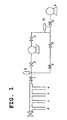
- Fig. 1 is a diagrammatic view of an apparatus for producing vacuum glass ampuls.
- numeral 1 denotes a connection valve, 2 a full evacuation valve, 3 a back pressure valve, 4 a leak valve, 5 a rough evacuation valve, 6 a leak valve, 7 a diffusion pump, 8 a rotary pump, 9 an ionization vacuum gauge, and 10 a Geissler's tube, and symbols a, b, c, and d are glass ampul connection ports.
- the quartz powder of the invention is a high-purity quartz powder which, upon heating from room temperature to 1,700°C, generates gases, in all of which CO amounts to 300 nl/g or smaller and CO 2 amounts to 30 nl/g or smaller.
- the quartz powder preferably is one which, upon heating from room temperature to 1,700°C, generates gases, in all of which N 2 amounts to 50 nl/g or smaller and H 2 amounts to 150 nl/g or smaller.
- any desired technique among generally known ones can be used. Preferred of these is a technique with which even a gas generated in an exceedingly small amount can be detected and analysis is possible under high-temperature conditions. Examples thereof include TPD-MS (temperature programmed desorption-mass spectroscopy).
- the gases generated are determined in the following manner.
- the quartz powder to be analyzed (sample) is placed in a sealed vacuum glass ampul. This ample is heated from room temperature to 1,700°C, and the gases generated during this heating are determined.
- the specific procedure is as follows. A quartz powder sample is placed in an ampul made of glass, and the pressure inside the ampul is temporarily regulated to 1.3 ⁇ 10 -3 to 1.3 ⁇ 10 -4 Pa. Subsequently, the sample is heated at 200°C for 10 minutes and then allowed to stand for 1 hour in order to removed adsorbates including water at an increased rate. After the degree of vacuum in the ampul is ascertained to be kept stable at 1.3 ⁇ 10 -3 to 1.3 ⁇ 10 -4 Pa, the tip is melted to seal the ampul. Thus, a vacuum ampul is produced.
- the quartz powder of the invention is characterized in that when the quartz powder is heated from room temperature to 1,700°C, it generates gases, in all of which CO amounts to 300 nl/g or smaller and CO 2 amounts to 30 nl/g or smaller. These temperature conditions are preferred because gases can be generated in the maximum amounts while preventing the particles of the quartz powder from sintering.
- the quartz powder of the invention have a bulk density of from 1.3 to 1.7 g/cm 3 and a metal impurity content of 500 ppb or lower, because this quartz powder gives a glass molding having a further reduced bubble content.
- the bulk density preferably is 1.3 g/cm 3 or higher, too low values thereof may result in a large volume contraction and reduced dimensional stability in melting/molding the quartz powder. On the other hand, there are cases where quartz powders having a bulk density exceeding 1.7 g/cm 3 are difficult to produce.
- metal impurity content as used for the quartz powder of the invention means the content of allmetal impurities, which include alkali metals, alkaline earth metals, aluminum, iron, and copper. For determining the content thereof, any desired technique may be used.
- the content of metal impurities in the quartz powder of the invention is preferably 200 ppb or lower, especially 100 ppb or lower.
- any desired method may be used.
- the average particle diameter of the silica gel to be brought into contact with helium and/or hydrogen gas is preferably from 10 to 500 ⁇ m, especially from 100 to 500 ⁇ m.
- gas adsorption or the like is apt to occur because of the increased surface area of the particles.
- the gas adsorption is causative of bubbles in glass moldings.
- too large average particle diameters may also be causative of bubbles in glass moldings because the efficiency of impurity removal from such particles is low.
- the temperature at which the silica gel is contacted with helium and/or hydrogen gas is preferably from 600°C to 1,300°C, especially preferably from 800°C to 1,300°C.
- the helium and/or hydrogen gas with which the silica gel is contacted preferably is a helium/hydrogen mixed gas containing up to 4% hydrogen. Especially preferably, the silica gel is contacted with pure helium gas. Any desired method may be used for contacting with helium and/or hydrogen gas. Examples thereof include a method in which the gas is passed through the synthetic quartz powder and a method in which the powder is enclosed in a container together with helium and/or hydrogen gas and held therein in an atmosphere of helium and/or hydrogen gas at ordinary or an elevated pressure.
- the contacting of helium and/or hydrogen gas with the silica gel having an average diameter of from 10 to 500 ⁇ m can be conducted at any desired time.
- use may be made of a method in which the silica gel which has been cooled to room temperature is reheated and contacted with helium and/or hydrogen gas at a temperature of from 400°C to 1,300°C or a method in which a silica gel burning step is partly or wholly conducted in a helium and/or hydrogen gas atmosphere.
- a synthetic quartz powder obtained as a product through burning is subjected to a heat treatment again, this powder may be contacted with helium and/or hydrogen gas.
- the temperature for this heating is preferably not lower than the vitrification temperature, especially preferably not lower than 1,200°C.
- the time period of this heat treatment conducted under such temperature conditions is preferably from 20 to 40 hours, especially preferably from 25 to 35 hours.
- Examples of methods for the heat treatment in an oxygen-containing atmosphere include a method in which the heat treatment is conducted while passing dry air.
- the time period which should be taken to heat to the heat treatment temperature is not limited. However, the heating rate is generally from 50 to 200 °C/hr, preferably from 70 to 150 °C/hr.
- the above-described heat treatment of the silica gel in an oxygen-containing atmosphere and the contact treatment thereof with helium and/or hydrogen gas at from 400°C to 1,300°C may be conducted in any order. It is, however, preferred to conduct the heat treatment in an oxygen-containing atmosphere before the contact treatment with helium and/or hydrogen gas is performed.
- the two treatments may be alternately conducted in portions each.
- a silica gel obtainedby the sol-gel method is heated to around 800°C in a dry air stream and then heated to 1,700°C in a stream of helium and/or hydrogen gas in place of the dry air.
- the stream is changed to dry air again.
- the heat treatment is then wholly carried out at the final temperature.
- the stream is changed to helium and/or hydrogen gas again. Thereafter, the stream may be changed to dry air once more.
- the quartz powder of the invention e.g., the synthetic quartz powder obtained in the manner described above
- gases including CO, CO 2 , H 2 , and N 2 in reduced amounts.
- Molecules of a small size such as helium and hydrogen, sufficiently dissolve in the quartz particles and have a high diffusion velocity. These molecules hence expel gases which have a large molecular size and are especially less apt to diffuse in the particles, e.g., CO, CO 2 , and N 2 , from the particles to thereby bring about the reduced gas generation.
- the production conditions may be suitably selected as long as a silica gel having an average particle diameter of from 10 to 500 ⁇ m obtained by the hydrolysis of an alkoxysilane is brought into contact with helium and/or hydrogen gas at 400°C to 1,300°C as described above.
- a specific procedure is, for example, as follows.
- An alkoxysilane and highly pure water are introduced into a reactor.
- the amount of the pure water to be introduced is from 1 to 10 equivalents to the alkoxysilane.
- a sol-gel reaction is conducted. Thereafter, the reaction product (wet gel) is pulverized to an average particle diameter of from 10 to 500 ⁇ m and dried to obtain a silica gel (dry gel) as a silica precursor .
- the alkoxysilane can be used any desired alkoxysilane capable of giving an alkoxysilane oligomer through a hydrolytic polycondensation reaction, such as tetramethoxysilane, tetraethoxysilane, or the like. Tetraalkoxysilanes are preferred and tetramethoxysilane is especially preferred.
- An organic solvent compatible with water such as an alcohol or ether, may be mixed as a solvent in the hydrolytic condensation reaction.
- a catalyst such as an acid or alkali may be used in order to accelerate this reaction. Preferred are catalysts containing no metal.
- an organic acid, ammonia water, or the like is preferred.
- the reactor may be heated or cooled in order to control the gelation of the hydrolyzate.
- the wet gel obtained by this reaction is pulverized so as to have a regulated particle size.
- the particle size distribution obtained by this pulverization governs the particle size distribution of the synthetic quartz powder as the final product. It is important that the optimal particle size of the wet gel be determined from the target particle size distribution of the product while taking account of the particle contraction to be caused by drying and burning.
- the silica gel after drying (dry gel) preferably has an average particle diameter of generally from 10 to 500 ⁇ m, preferably from 90 to 500 ⁇ m, especially from 100 to 500 ⁇ m.
- the degree of drying of the gel is generally from 1 to 30% by weight in terms of water content. Such drying is generally accomplished by heating to 100 to 200°C at a reduced pressure or in an inert gas atmosphere.
- the dry gel thus produced is brought into contact with helium and/or hydrogen gas at a temperature of from 400°C to 1,300°C to obtain a high-purity synthetic quartz powder.
- the resultant powder is further burned usually for from 10 to 100 hours at varied temperatures in the range of from 400°C to 1,250°C to make the powder particles non-porous.
- a high-purity synthetic quartz powder is obtained.
- a fusion test was conducted in order to ascertain bubble inclusion in a glass molding. Quartz powders are melted by the method of fusion with an oxyhydrogen flame, i.e., Verneuil's method. The bubbles present in each ingot produced are counted. Based on the counts, the powders can be compared in the tendency to generate bubbles.
- One kilogram of the dry gel powder thus obtained was introduced into a lidded container made of quartz glass. This container was set in an electric furnace, and a gas introduction nozzle was inserted into a hole formed in the lid. While dry air was kept being passed, the powder was heated to 1,200°C at a heating rate of 100 °C/hr and held at 1,200°C for 30 hours to thereby burn the powder. The passing of dry air was continued until the powder cooled sufficiently. Thus, a synthetic quartz powder was obtained.
- a 500-g portion of the high-purity synthetic quartz powder obtained was introduced into a lidded container made of quartz glass. This container was set in an electric furnace, and a gas introduction nozzle was inserted into a hole formed in the lid. While helium gas was kept being passed, the powder was heated to 1,200°C at a heating rate of 400 °C/hr and held at 1,200°C for 10 hours to thereby burn the powder. The passing of helium gas was continued until the powder cooled sufficiently.
- a 100-g portion of the helium gas-treated synthetic quartz powder thus obtained was placed in a 100-ml measuring cylinder made of glass to measure the bulk density (tap density) thereof. As a result, the density was found to be 1.34 g/cm 3 .
- This synthetic quartz powder was further examined for total metal impurity content. The method of measurement was as follows. First, the synthetic quartz powder was dissolved in high-purity hydrofluoric acid and this solution was heated and evaporated to dryness. Subsequently, this dry solid was dissolved in a 10:1 (by volume) liquid mixture of high-purity dilute nitric acid and high-purity dilute sulfuric acid. The solution thus obtained was examined for metal impurity content by ICP-MASS.
- the metal impurity content was found to be about 57 ppb.
- the content of each metal is shown in Table 2.
- Test tube type enclosures (eight test tube type enclosures: made of quartz; inner diameter, about 8 mm, thickness, about 1 mm; length, about 130 mm) were washed with a neutral detergent and distilled water. Thereafter, the enclosure tubes were subjected to acetone displacement and dried with nitrogen introduction. A 1.02-g portion was weighed out of the synthetic quartz powder sample obtained by the method described above, and placed in each enclosure tube. The enclosure tube was thinned, with heating with a burner, in a part thereof located about 5 cm apart from the bottom. Thereafter, these enclosure tubes were connected by welding to the glass ports a to d of a vacuum apparatus (MODEL EH-2A, manufactured by TOKUDA) and evacuated.
- a vacuum apparatus MODEL EH-2A, manufactured by TOKUDA
- FIG. 1 A diagrammatic view of the vacuum melting apparatus is shown in Fig. 1 (ampuls are not shown).
- MODEL HFT-4 manufactured by TOKUDA.
- the ampuls connected to the glass ports a and b shown in Fig. 1 contained the synthetic quartz powder and the ampuls connected to the glass ports c and d contained nothing so as to serve as blanks.
- the rotary pump 8 was operated to reduce the pressure in the system. After the Geissler's tube 10 was ascertained to hardly luminesce, the back pressure valve 3 was opened. At about 15 minutes after the opening of the back pressure valve 3, the diffusion pump 7 began to be operated and an operation for elevating the degree of vacuum was initiated so as to further elevate the degree of vacuum in the system. At 10 minutes after initiation of the operation of the further elevation of the degree of vacuum, the degree of vacuum as measured with the ionization vacuum gauge 9 (TOKUDA MODEL HFT-4) was 5.3 ⁇ 10 -3 Pa.
- the ampuls were heated at 200°C for 10 minutes in order to remove adsorbates including water at an increased rate.
- the degree of vacuum was stable at 2.7 ⁇ 10 -3 Pa.
- the connection valve 1 was closed and the degree of vacuum in the vacuum apparatus system only was ascertained. As a result, no change was observed.
- the connection valve 1 was opened, and the opening of each ampul was heated with a burner and sealed. These ampuls were separated from the glass ports to produce vacuum glass ampuls. During this operation, the degree of vacuum in the system was stable at 2.7 ⁇ 10 -3 Pa and no change was observed.
- a small vacuum/pressurizing furnace (Type: FVPHP-R-5, FRET-35) manufactured by Fuji Denpa Kogyo K.K. and a crucible made of carbon were used.
- this crucible were placed the quartz glass ampuls produced by the method described above. These ampuls were heated to 1,700°C at a rate of 20 °C/min and a degree of vacuum of 40 Pa and kept being heated for 20 minutes. After the glass ampuls were cooled and the pressure was returned to ordinary pressure, the ampuls were taken out.
- the ampuls were set in a fracture vessel which had openings connected to an evacuation pump and a mass spectrometer and the system in which was sealable.
- the vessel was evacuated with the evacuation pump. Thereafter, the valve disposed at the gate to the mass spectrometer (AGS7000, manufactured by Anerupa K.K.) attached to the fracture vessel was opened. The degree of vacuum in the vessel was further elevated (to 1.3x10 -3 Pa) and this vacuum was maintained for 1 hour or more.
- the mass spectrometer was operated at a detector voltage of 2,600 V, and the ampuls were fractured while monitoring m/z of 2 (hydrogen), 4 (helium) , 18 (water) , 28 (nitrogen and CO), 30 (NO), 32 (oxygen), and 44 (carbon dioxide).
- Gases are discharged from the ampuls to give peaks.
- the gases generated were determined from the areas of the resultant peaks based on the relative sensitivities to the relative sensitivity ratios to the peaks for standard substances or standard gases.
- the helium gas-treated synthetic quartz powder obtained by the method described above was used to produce an ingot having a diameter of 12 mm and a height of 60 mm using a Verneuil's-method melting apparatus employing an oxyhydrogen flame. In a dark room, this ingot was illuminated by a flashlight, and the bubbles were visually counted through a magnifying lens. As a result, the number of bubbles was as small as 3.
- a synthetic quartz powder was obtained in the same manner as in Example 1, except that the treatment with helium gas was omitted.
- the amounts of the CO, CO 2 , and other gases generated were determined in the same manner as in Example 1. The results are shown in Table 1.
- this synthetic quartz powder was used to produce an ingot in the same manner as in Example 1. This ingot was illuminated by a flashlight in a dark room and the bubbles were counted. As a result, the number of bubbles was as large as 42. It was hence apparent that the quartz powder poses a problem when formed into a glass molding, e.g., a crucible.
- a synthetic quartz powder was obtained in the same manner as in Example 1, except that a heat treatment at 1,150°C was conducted at a degree of vacuum of from 30 to 100 Pa for 8 hours in place of the treatment with helium gas.
- the amounts of the CO, CO 2 , and other gases generated were determined in the same manner as in Example 1. The results are shown in Table 1.
- Table 1 shows the following.
- the amounts of the gases generated could be reduced as in the case of the helium gas-treated synthetic quartz powder.
- this method was unsuitable for industrial use because not only the treatment required much time but also it was necessary to keep the inside of the heat treatment apparatus under vacuum conditions.
- a high-quality synthetic quartz powder reduced in bubble generation upon melting and a glass molding can be obtained.
- the glass molding obtained from a melt of the synthetic quartz powder of the invention has high quality with considerably reduced bubble inclusion. The reasons for this are thought to be probably as follows.
Landscapes
- Chemical & Material Sciences (AREA)
- Engineering & Computer Science (AREA)
- Materials Engineering (AREA)
- Organic Chemistry (AREA)
- Manufacturing & Machinery (AREA)
- Chemical Kinetics & Catalysis (AREA)
- General Chemical & Material Sciences (AREA)
- Geochemistry & Mineralogy (AREA)
- Life Sciences & Earth Sciences (AREA)
- Physics & Mathematics (AREA)
- Plasma & Fusion (AREA)
- Dispersion Chemistry (AREA)
- Thermal Sciences (AREA)
- Glass Compositions (AREA)
- Silicon Compounds (AREA)
- Glass Melting And Manufacturing (AREA)
Abstract
Description
| Kind of metal | Content (ppb) |
| Na | 10 |
| | 2 |
| | 5 |
| Al | 1 |
| Fe | 20 |
| Cu | <0.5 |
| Mn | <0.5 |
| Ti | <1 |
| | 5 |
| As | 0 |
| B | 3 |
| Ge | 9 |
| U | <0.06 |
| Th | <0.3 |
| Volume of ampul after heating (cc) | Kind/amount of gas generated (nl/g) | |||||||
| H2 | H2O | N2 | CO | O2 | CO2 | Total | ||
| Comparative Example 1 | 7.2 | 177 | 1 | 79 | 388 | 0 | 26 | 670 |
| Example 1-1 | 4.2 | 100 | - | 10 | 160 | 0 | 1 | 271 |
| Example 1-2 | 4.2 | 53 | - | 10 | 133 | 0 | 2 | 198 |
| Comparative Example 2 | 4.1 | 77 | 1 | 16 | 177 | 0 | 4 | 274 |
Claims (6)
- A quartz powder which, upon heating from room temperature to 1,700°C, generates gases in which the amount of CO is 300 nl/g or smaller and the amount of CO2 is 30 nl/g or smaller.
- The quartz powder of claim 1, which has a bulk density of from 1.3 to 1.7 g/cm3 and a metal impurity content of 500 ppb or lower.
- The quartz powder of claim 1, characterized by being a synthetic quartz powder produced by the sol-gel method.
- A process for producing a synthetic quartz powder which comprises hydrolyzing an alkoxysilane to obtain a silica gel having an average particle diameter of from 10 to 500 µm and bringing the silica gel into contact with at least one of helium and hydrogen gas at a temperature of from 400°C to 1,300°C.
- The process of claim 4, characterized in that before or after the contacting with at least one of helium and hydrogen gas, the silica gel is heat-treated at a temperature of 1,000°C or higher for from 10 to 50 hours in an oxygen-containing atmosphere.
- A glass molding characterized by being obtained by melting and molding the quartz powder of claim 1.
Applications Claiming Priority (3)
| Application Number | Priority Date | Filing Date | Title |
|---|---|---|---|
| JP2001218997 | 2001-07-19 | ||
| JP2001218997 | 2001-07-19 | ||
| PCT/JP2002/007322 WO2003008332A1 (en) | 2001-07-19 | 2002-07-18 | High purity quartz powder and method for production thereof, and formed glass article from the powder |
Publications (3)
| Publication Number | Publication Date |
|---|---|
| EP1411032A1 true EP1411032A1 (en) | 2004-04-21 |
| EP1411032A4 EP1411032A4 (en) | 2009-04-29 |
| EP1411032B1 EP1411032B1 (en) | 2016-12-28 |
Family
ID=19053078
Family Applications (1)
| Application Number | Title | Priority Date | Filing Date |
|---|---|---|---|
| EP02747689.4A Expired - Lifetime EP1411032B1 (en) | 2001-07-19 | 2002-07-18 | Process for producing a high purity powder |
Country Status (4)
| Country | Link |
|---|---|
| US (2) | US7063826B2 (en) |
| EP (1) | EP1411032B1 (en) |
| JP (1) | JP2009114058A (en) |
| WO (1) | WO2003008332A1 (en) |
Cited By (7)
| Publication number | Priority date | Publication date | Assignee | Title |
|---|---|---|---|---|
| WO2016160507A1 (en) * | 2015-04-01 | 2016-10-06 | Owens-Brockway Glass Container Inc. | Glass precursor gel |
| WO2017103153A1 (en) | 2015-12-18 | 2017-06-22 | Heraeus Quarzglas Gmbh & Co. Kg | Glass fibers and preforms made of quartz glass having low oh, cl, and al content |
| CN106976885A (en) * | 2016-01-15 | 2017-07-25 | 苏州电器科学研究院股份有限公司 | Molten-salt growth method prepares silicon-dioxide powdery |
| US10364176B1 (en) | 2016-10-03 | 2019-07-30 | Owens-Brockway Glass Container Inc. | Glass precursor gel and methods to treat with microwave energy |
| US10427970B1 (en) | 2016-10-03 | 2019-10-01 | Owens-Brockway Glass Container Inc. | Glass coatings and methods to deposit same |
| US10479717B1 (en) | 2016-10-03 | 2019-11-19 | Owens-Brockway Glass Container Inc. | Glass foam |
| CN112110637A (en) * | 2020-09-07 | 2020-12-22 | 齐鲁工业大学 | A kind of quartz mineral powder impurity removal system and impurity removal process |
Families Citing this family (21)
| Publication number | Priority date | Publication date | Assignee | Title |
|---|---|---|---|---|
| EP1411032B1 (en) * | 2001-07-19 | 2016-12-28 | Mitsubishi Chemical Corporation | Process for producing a high purity powder |
| DE10211958A1 (en) * | 2002-03-18 | 2003-10-16 | Wacker Chemie Gmbh | High-purity silica powder, process and device for its production |
| DE10342828A1 (en) * | 2003-09-17 | 2005-04-14 | Degussa Ag | High purity pyrogenic silica |
| US20110130265A1 (en) * | 2005-03-01 | 2011-06-02 | Masafumi Mizuguchi | Synthetic silica glass molded body, method of molding the same, and method of inspecting synthetic silica glass molded body |
| EP1700832A1 (en) * | 2005-03-09 | 2006-09-13 | Degussa AG | A method of producing glass of optical quality |
| US9249028B2 (en) | 2010-02-08 | 2016-02-02 | Momentive Performance Materials Inc. | Method for making high purity metal oxide particles and materials made thereof |
| US8197782B2 (en) * | 2010-02-08 | 2012-06-12 | Momentive Performance Materials | Method for making high purity metal oxide particles and materials made thereof |
| EA034094B1 (en) * | 2013-03-25 | 2019-12-26 | Велинге Инновейшн Аб | Method for producing a mechanical locking system at edges of floorboards and combination of floorboards with a mechanical locking system |
| WO2015048770A2 (en) | 2013-09-30 | 2015-04-02 | Beth Israel Deaconess Medical Center, Inc. | Antibody therapies for human immunodeficiency virus (hiv) |
| US11299417B2 (en) | 2015-12-18 | 2022-04-12 | Heraeus Quarzglas Gmbh & Co. Kg | Preparation of a quartz glass body in a melting crucible of refractory metal |
| KR20180095619A (en) | 2015-12-18 | 2018-08-27 | 헤래우스 크바르츠글라스 게엠베하 & 컴파니 케이지 | Increase in silicon content during silica glass production |
| TWI808933B (en) | 2015-12-18 | 2023-07-21 | 德商何瑞斯廓格拉斯公司 | Quartz glass body, silicon dioxide granulate, light guide, illuminant, and formed body, and process for preparing the same |
| KR20180095880A (en) | 2015-12-18 | 2018-08-28 | 헤래우스 크바르츠글라스 게엠베하 & 컴파니 케이지 | Manufacture of synthetic quartz glass grain |
| CN108698892A (en) | 2015-12-18 | 2018-10-23 | 贺利氏石英玻璃有限两合公司 | Preparation of quartz glass bodies from silica particles |
| TWI733723B (en) | 2015-12-18 | 2021-07-21 | 德商何瑞斯廓格拉斯公司 | Preparation of an opaque quartz glass body |
| CN108698888A (en) | 2015-12-18 | 2018-10-23 | 贺利氏石英玻璃有限两合公司 | Production of carbon-doped silica particles as intermediate in the production of quartz glass |
| CN108698894A (en) | 2015-12-18 | 2018-10-23 | 贺利氏石英玻璃有限两合公司 | Preparation of quartz glass bodies in a multi-chamber oven |
| CN108698890A (en) | 2015-12-18 | 2018-10-23 | 贺利氏石英玻璃有限两合公司 | Quartz glass body is prepared using the dew point monitoring in melting baking oven |
| EP3797118A4 (en) | 2018-05-22 | 2022-06-29 | Beth Israel Deaconess Medical Center, Inc. | Antibody therapies for human immunodeficiency virus (hiv) |
| EP3883962A4 (en) | 2018-11-21 | 2023-04-12 | Beth Israel Deaconess Medical Center, Inc. | ANTIBODY TREATMENTS FOR HUMAN IMMUNODEFICIENCY VIRUS (HIV) |
| JP2021170084A (en) * | 2020-04-16 | 2021-10-28 | Tdk株式会社 | Photosensitive conductive paste, laminated electronic component, and method of manufacturing the same |
Family Cites Families (19)
| Publication number | Priority date | Publication date | Assignee | Title |
|---|---|---|---|---|
| JPS5858292B2 (en) * | 1980-01-21 | 1983-12-24 | 株式会社日立製作所 | Silica glass manufacturing method |
| JPS599497B2 (en) * | 1980-04-28 | 1984-03-02 | 株式会社日立製作所 | Optical glass manufacturing method |
| FR2529110B1 (en) | 1982-06-23 | 1985-08-23 | Valeo | METHOD FOR MOUNTING AT LEAST ONE TUBE ON A PLATE, TOOLS FOR CARRYING OUT THIS METHOD AND THE RADIATORS, PARTICULARLY FOR MOTOR VEHICLES OBTAINED BY THIS PROCESS, AND OTHER APPLICATIONS |
| JP2926348B2 (en) * | 1989-02-20 | 1999-07-28 | 三菱レイヨン株式会社 | Method for producing low silanol silica |
| JPH04154613A (en) * | 1990-10-18 | 1992-05-27 | Mitsubishi Materials Corp | Synthetic silica powder having high purity |
| EP0486004B1 (en) * | 1990-11-16 | 1996-09-11 | Mitsubishi Chemical Corporation | Method for producing a high-purity silica glass powder |
| JPH04342412A (en) * | 1991-05-16 | 1992-11-27 | Shin Etsu Chem Co Ltd | Production of synthetic silica powder for vacuum sintering |
| JPH0517122A (en) * | 1991-07-12 | 1993-01-26 | Shin Etsu Chem Co Ltd | Method for producing synthetic silica powder |
| JP3413873B2 (en) * | 1993-05-27 | 2003-06-09 | 三菱化学株式会社 | Synthetic quartz glass powder |
| JPH072513A (en) * | 1993-06-15 | 1995-01-06 | Kimmon Mfg Co Ltd | Method for producing synthetic quartz glass powder |
| JPH07206422A (en) * | 1994-01-06 | 1995-08-08 | Mitsubishi Chem Corp | Method for producing synthetic quartz glass powder |
| DE69518669T2 (en) * | 1994-12-26 | 2001-04-12 | Mitsubishi Chemical Corp., Tokio/Tokyo | METHOD FOR PRODUCING A SYNTHETIC QUARTZ POWDER |
| JP3931351B2 (en) * | 1994-12-27 | 2007-06-13 | 東ソー株式会社 | Method for producing high-purity, high-heat-resistant silica glass |
| US6129899A (en) * | 1995-04-28 | 2000-10-10 | Mitsubishi Chemical Corporation | Processes for producing synthetic quartz powder and producing shaped quartz glass |
| JPH11139835A (en) * | 1997-11-05 | 1999-05-25 | Mitsubishi Chemical Corp | Manufacturing method of synthetic quartz |
| JP2001261353A (en) * | 2000-03-17 | 2001-09-26 | Toshiba Ceramics Co Ltd | Synthetic silica glass powder for quartz glass crucible, method for producing the same, and method for producing quartz glass crucible using synthetic silica glass powder |
| US6826927B2 (en) * | 2000-06-28 | 2004-12-07 | Mitsubishi Materials Quartz Corporation | Synthetic quartz powder, its production process, and synthetic quartz crucible |
| EP1411032B1 (en) * | 2001-07-19 | 2016-12-28 | Mitsubishi Chemical Corporation | Process for producing a high purity powder |
| JP4771643B2 (en) * | 2001-07-19 | 2011-09-14 | 三菱化学株式会社 | High-purity quartz powder, method for producing the same, and glass molding |
-
2002
- 2002-07-18 EP EP02747689.4A patent/EP1411032B1/en not_active Expired - Lifetime
- 2002-07-18 WO PCT/JP2002/007322 patent/WO2003008332A1/en not_active Ceased
-
2004
- 2004-01-16 US US10/758,395 patent/US7063826B2/en not_active Expired - Lifetime
-
2006
- 2006-04-18 US US11/405,584 patent/US7427387B2/en not_active Expired - Lifetime
-
2008
- 2008-12-26 JP JP2008331742A patent/JP2009114058A/en active Pending
Cited By (10)
| Publication number | Priority date | Publication date | Assignee | Title |
|---|---|---|---|---|
| WO2016160507A1 (en) * | 2015-04-01 | 2016-10-06 | Owens-Brockway Glass Container Inc. | Glass precursor gel |
| US9890072B2 (en) | 2015-04-01 | 2018-02-13 | Owens-Brockway Glass Container Inc. | Glass precursor gel |
| US10590025B2 (en) | 2015-04-01 | 2020-03-17 | Owens-Brockway Glass Container Inc. | Glass precursor gel |
| WO2017103153A1 (en) | 2015-12-18 | 2017-06-22 | Heraeus Quarzglas Gmbh & Co. Kg | Glass fibers and preforms made of quartz glass having low oh, cl, and al content |
| CN106976885A (en) * | 2016-01-15 | 2017-07-25 | 苏州电器科学研究院股份有限公司 | Molten-salt growth method prepares silicon-dioxide powdery |
| US10364176B1 (en) | 2016-10-03 | 2019-07-30 | Owens-Brockway Glass Container Inc. | Glass precursor gel and methods to treat with microwave energy |
| US10427970B1 (en) | 2016-10-03 | 2019-10-01 | Owens-Brockway Glass Container Inc. | Glass coatings and methods to deposit same |
| US10479717B1 (en) | 2016-10-03 | 2019-11-19 | Owens-Brockway Glass Container Inc. | Glass foam |
| CN112110637A (en) * | 2020-09-07 | 2020-12-22 | 齐鲁工业大学 | A kind of quartz mineral powder impurity removal system and impurity removal process |
| CN112110637B (en) * | 2020-09-07 | 2021-04-16 | 齐鲁工业大学 | A kind of quartz mineral powder impurity removal system and impurity removal process |
Also Published As
| Publication number | Publication date |
|---|---|
| US20060183624A1 (en) | 2006-08-17 |
| EP1411032B1 (en) | 2016-12-28 |
| US7427387B2 (en) | 2008-09-23 |
| US20040161375A1 (en) | 2004-08-19 |
| EP1411032A4 (en) | 2009-04-29 |
| WO2003008332A1 (en) | 2003-01-30 |
| JP2009114058A (en) | 2009-05-28 |
| US7063826B2 (en) | 2006-06-20 |
Similar Documents
| Publication | Publication Date | Title |
|---|---|---|
| US7063826B2 (en) | High-purity quartz powder, process for producing the same, and glass molding | |
| EP2070883B2 (en) | Fused quartz glass and process for producing the same | |
| US8915096B2 (en) | Silica container and method for producing the same | |
| US20110183138A1 (en) | Method for producing quartz glass doped with nitrogen and quartz glass grains suitable for carrying out the method | |
| EP2463246A1 (en) | Silica vessel and process for producing same | |
| JP3040315B2 (en) | High viscosity synthetic quartz glass member and method for producing the same | |
| KR20180095878A (en) | Preparation of quartz glass articles from silica powder | |
| KR20180095615A (en) | Quartz glass made from pyrogenic silicon dioxide granules having low OH, Cl, and Al contents | |
| JP2019502632A (en) | Preparation of quartz glass body in an upright sintering crucible | |
| JP3128451B2 (en) | Manufacturing method of synthetic quartz glass | |
| JPH10287416A (en) | Method for producing synthetic quartz powder | |
| JPH072513A (en) | Method for producing synthetic quartz glass powder | |
| AU684167B2 (en) | Synthetic silica glass powder | |
| JP3152410B2 (en) | Manufacturing method of synthetic quartz glass member | |
| JP3672592B2 (en) | Method for producing synthetic quartz glass member | |
| US6225245B1 (en) | Silica gel, synthetic quartz glass powder and shaped product of quartz glass | |
| JP2001220158A (en) | Sintered silica glass compact | |
| JPH03275527A (en) | Porous silica glass powder | |
| JPH0840735A (en) | Production of synthetic quartz glass crucible | |
| JP3617153B2 (en) | Method for producing synthetic quartz powder | |
| Torikai et al. | Comparison of high-purity H2/O2 and LPG/O2 flame-fused silica glasses from sol-gel silica powder | |
| JP4771643B2 (en) | High-purity quartz powder, method for producing the same, and glass molding | |
| JP3859303B2 (en) | Method for producing synthetic quartz glass powder and quartz glass molded body | |
| JPH10203821A (en) | Method for producing synthetic quartz glass powder and quartz glass compact | |
| JP3875735B2 (en) | Method for producing synthetic quartz powder |
Legal Events
| Date | Code | Title | Description |
|---|---|---|---|
| PUAI | Public reference made under article 153(3) epc to a published international application that has entered the european phase |
Free format text: ORIGINAL CODE: 0009012 |
|
| 17P | Request for examination filed |
Effective date: 20040212 |
|
| AK | Designated contracting states |
Kind code of ref document: A1 Designated state(s): AT BE BG CH CY CZ DE DK EE ES FI FR GB GR IE IT LI LU MC NL PT SE SK TR |
|
| AX | Request for extension of the european patent |
Extension state: AL LT LV MK RO SI |
|
| RAP1 | Party data changed (applicant data changed or rights of an application transferred) |
Owner name: MITSUBISHI CHEMICAL CORPORATION |
|
| RAP1 | Party data changed (applicant data changed or rights of an application transferred) |
Owner name: MITSUBISHI CHEMICAL CORPORATION |
|
| A4 | Supplementary search report drawn up and despatched |
Effective date: 20090330 |
|
| RIC1 | Information provided on ipc code assigned before grant |
Ipc: C03C 12/00 20060101ALI20090320BHEP Ipc: C03B 20/00 20060101AFI20090320BHEP Ipc: C03B 8/02 20060101ALI20090320BHEP Ipc: C03C 1/00 20060101ALI20090320BHEP Ipc: C03B 19/10 20060101ALI20090320BHEP Ipc: C01B 33/18 20060101ALI20090320BHEP |
|
| 17Q | First examination report despatched |
Effective date: 20091008 |
|
| RAP1 | Party data changed (applicant data changed or rights of an application transferred) |
Owner name: MITSUBISHI CHEMICAL CORPORATION |
|
| REG | Reference to a national code |
Ref country code: DE Ref legal event code: R079 Ref document number: 60248591 Country of ref document: DE Free format text: PREVIOUS MAIN CLASS: C01B0033180000 Ipc: C03B0020000000 |
|
| GRAP | Despatch of communication of intention to grant a patent |
Free format text: ORIGINAL CODE: EPIDOSNIGR1 |
|
| RIC1 | Information provided on ipc code assigned before grant |
Ipc: C03C 12/00 20060101ALI20160503BHEP Ipc: C03C 1/00 20060101ALI20160503BHEP Ipc: C03B 8/02 20060101ALI20160503BHEP Ipc: C03B 20/00 20060101AFI20160503BHEP Ipc: C03C 3/06 20060101ALI20160503BHEP Ipc: C03B 19/10 20060101ALI20160503BHEP Ipc: C01B 33/18 20060101ALI20160503BHEP Ipc: C03B 19/01 20060101ALI20160503BHEP Ipc: C03B 19/09 20060101ALI20160503BHEP |
|
| INTG | Intention to grant announced |
Effective date: 20160603 |
|
| GRAS | Grant fee paid |
Free format text: ORIGINAL CODE: EPIDOSNIGR3 |
|
| GRAA | (expected) grant |
Free format text: ORIGINAL CODE: 0009210 |
|
| AK | Designated contracting states |
Kind code of ref document: B1 Designated state(s): DE |
|
| REG | Reference to a national code |
Ref country code: DE Ref legal event code: R081 Ref document number: 60248591 Country of ref document: DE Owner name: MITSUBISHI CHEMICAL CORPORATION, JP Free format text: FORMER OWNER: MITSUBISHI CHEMICAL CORP., TOKIO/TOKYO, JP |
|
| REG | Reference to a national code |
Ref country code: DE Ref legal event code: R096 Ref document number: 60248591 Country of ref document: DE |
|
| RAP2 | Party data changed (patent owner data changed or rights of a patent transferred) |
Owner name: MITSUBISHI CHEMICAL CORPORATION |
|
| REG | Reference to a national code |
Ref country code: DE Ref legal event code: R097 Ref document number: 60248591 Country of ref document: DE |
|
| PLBE | No opposition filed within time limit |
Free format text: ORIGINAL CODE: 0009261 |
|
| STAA | Information on the status of an ep patent application or granted ep patent |
Free format text: STATUS: NO OPPOSITION FILED WITHIN TIME LIMIT |
|
| REG | Reference to a national code |
Ref country code: DE Ref legal event code: R082 Ref document number: 60248591 Country of ref document: DE Representative=s name: VOSSIUS & PARTNER PATENTANWAELTE RECHTSANWAELT, DE Ref country code: DE Ref legal event code: R081 Ref document number: 60248591 Country of ref document: DE Owner name: MITSUBISHI CHEMICAL CORPORATION, JP Free format text: FORMER OWNER: MITSUBISHI CHEMICAL CORPORATION, TOKYO, CHIYODA-KU, JP |
|
| 26N | No opposition filed |
Effective date: 20170929 |
|
| PGFP | Annual fee paid to national office [announced via postgrant information from national office to epo] |
Ref country code: DE Payment date: 20200707 Year of fee payment: 19 |
|
| REG | Reference to a national code |
Ref country code: DE Ref legal event code: R119 Ref document number: 60248591 Country of ref document: DE |
|
| PG25 | Lapsed in a contracting state [announced via postgrant information from national office to epo] |
Ref country code: DE Free format text: LAPSE BECAUSE OF NON-PAYMENT OF DUE FEES Effective date: 20220201 |