EP1404362B1 - Signal-1/signal-2 bifunctional peptide inhibitors - Google Patents
Signal-1/signal-2 bifunctional peptide inhibitors Download PDFInfo
- Publication number
- EP1404362B1 EP1404362B1 EP01991168A EP01991168A EP1404362B1 EP 1404362 B1 EP1404362 B1 EP 1404362B1 EP 01991168 A EP01991168 A EP 01991168A EP 01991168 A EP01991168 A EP 01991168A EP 1404362 B1 EP1404362 B1 EP 1404362B1
- Authority
- EP
- European Patent Office
- Prior art keywords
- peptide
- bpi
- signal
- cells
- sequence
- Prior art date
- Legal status (The legal status is an assumption and is not a legal conclusion. Google has not performed a legal analysis and makes no representation as to the accuracy of the status listed.)
- Expired - Lifetime
Links
- 108090000765 processed proteins & peptides Proteins 0.000 title claims abstract description 263
- 230000001588 bifunctional effect Effects 0.000 title description 4
- 239000003112 inhibitor Substances 0.000 title description 4
- 210000000612 antigen-presenting cell Anatomy 0.000 claims abstract description 66
- 230000028993 immune response Effects 0.000 claims abstract description 52
- 125000000539 amino acid group Chemical group 0.000 claims abstract description 24
- 230000029069 type 2 immune response Effects 0.000 claims abstract description 4
- 210000001744 T-lymphocyte Anatomy 0.000 claims description 116
- 102000016266 T-Cell Antigen Receptors Human genes 0.000 claims description 80
- 238000000034 method Methods 0.000 claims description 48
- SLXKOJJOQWFEFD-UHFFFAOYSA-N 6-aminohexanoic acid Chemical compound NCCCCCC(O)=O SLXKOJJOQWFEFD-UHFFFAOYSA-N 0.000 claims description 45
- 239000003446 ligand Substances 0.000 claims description 35
- 229960002684 aminocaproic acid Drugs 0.000 claims description 31
- 230000004044 response Effects 0.000 claims description 30
- 201000010099 disease Diseases 0.000 claims description 27
- 208000037265 diseases, disorders, signs and symptoms Diseases 0.000 claims description 27
- 206010067584 Type 1 diabetes mellitus Diseases 0.000 claims description 14
- UCMIRNVEIXFBKS-UHFFFAOYSA-N beta-alanine Chemical compound NCCC(O)=O UCMIRNVEIXFBKS-UHFFFAOYSA-N 0.000 claims description 14
- 230000015572 biosynthetic process Effects 0.000 claims description 13
- 238000011282 treatment Methods 0.000 claims description 10
- 108091008874 T cell receptors Proteins 0.000 claims description 9
- 230000000903 blocking effect Effects 0.000 claims description 9
- 125000003630 glycyl group Chemical group [H]N([H])C([H])([H])C(*)=O 0.000 claims description 9
- DHMQDGOQFOQNFH-UHFFFAOYSA-N Glycine Natural products NCC(O)=O DHMQDGOQFOQNFH-UHFFFAOYSA-N 0.000 claims description 7
- 238000000338 in vitro Methods 0.000 claims description 7
- 238000004519 manufacturing process Methods 0.000 claims description 7
- 229940000635 beta-alanine Drugs 0.000 claims description 6
- 239000004471 Glycine Substances 0.000 claims description 5
- 239000003814 drug Substances 0.000 claims description 4
- 239000002253 acid Substances 0.000 claims description 2
- 239000000816 peptidomimetic Substances 0.000 abstract description 19
- 210000004027 cell Anatomy 0.000 description 80
- 108010092262 T-Cell Antigen Receptors Proteins 0.000 description 72
- 102000004196 processed proteins & peptides Human genes 0.000 description 69
- 241000699670 Mus sp. Species 0.000 description 51
- 241000282414 Homo sapiens Species 0.000 description 47
- 108010064593 Intercellular Adhesion Molecule-1 Proteins 0.000 description 42
- 102000015271 Intercellular Adhesion Molecule-1 Human genes 0.000 description 42
- 230000036039 immunity Effects 0.000 description 42
- 102000005962 receptors Human genes 0.000 description 40
- 108020003175 receptors Proteins 0.000 description 40
- 235000001014 amino acid Nutrition 0.000 description 38
- 150000001413 amino acids Chemical class 0.000 description 31
- 102100022339 Integrin alpha-L Human genes 0.000 description 26
- 108010064548 Lymphocyte Function-Associated Antigen-1 Proteins 0.000 description 26
- 206010012601 diabetes mellitus Diseases 0.000 description 26
- 239000000427 antigen Substances 0.000 description 25
- 108091007433 antigens Proteins 0.000 description 25
- 102000036639 antigens Human genes 0.000 description 25
- 230000004069 differentiation Effects 0.000 description 24
- 102000004127 Cytokines Human genes 0.000 description 23
- 108090000695 Cytokines Proteins 0.000 description 23
- 102100035857 Glutamate decarboxylase 2 Human genes 0.000 description 23
- 101000873786 Homo sapiens Glutamate decarboxylase 2 Proteins 0.000 description 23
- 238000002474 experimental method Methods 0.000 description 23
- 239000002773 nucleotide Substances 0.000 description 21
- 125000003729 nucleotide group Chemical group 0.000 description 21
- 102000004388 Interleukin-4 Human genes 0.000 description 20
- 108090000978 Interleukin-4 Proteins 0.000 description 20
- 241000699666 Mus <mouse, genus> Species 0.000 description 20
- 238000011161 development Methods 0.000 description 19
- 230000018109 developmental process Effects 0.000 description 19
- 108010002350 Interleukin-2 Proteins 0.000 description 18
- 102000000588 Interleukin-2 Human genes 0.000 description 18
- 230000004913 activation Effects 0.000 description 18
- 238000004458 analytical method Methods 0.000 description 18
- 229940028885 interleukin-4 Drugs 0.000 description 18
- 108010029697 CD40 Ligand Proteins 0.000 description 17
- 102100039498 Cytotoxic T-lymphocyte protein 4 Human genes 0.000 description 17
- 101000889276 Homo sapiens Cytotoxic T-lymphocyte protein 4 Proteins 0.000 description 17
- 206010020751 Hypersensitivity Diseases 0.000 description 17
- 210000000225 synapse Anatomy 0.000 description 17
- 241000699660 Mus musculus Species 0.000 description 16
- FAPWRFPIFSIZLT-UHFFFAOYSA-M Sodium chloride Chemical compound [Na+].[Cl-] FAPWRFPIFSIZLT-UHFFFAOYSA-M 0.000 description 16
- 230000000694 effects Effects 0.000 description 16
- 108090000623 proteins and genes Proteins 0.000 description 16
- 239000011780 sodium chloride Substances 0.000 description 16
- 102100032937 CD40 ligand Human genes 0.000 description 15
- 102100031988 Tumor necrosis factor ligand superfamily member 6 Human genes 0.000 description 15
- 238000012360 testing method Methods 0.000 description 15
- 101000914514 Homo sapiens T-cell-specific surface glycoprotein CD28 Proteins 0.000 description 14
- 102100027213 T-cell-specific surface glycoprotein CD28 Human genes 0.000 description 14
- 238000006467 substitution reaction Methods 0.000 description 14
- 102000013462 Interleukin-12 Human genes 0.000 description 13
- 108010065805 Interleukin-12 Proteins 0.000 description 13
- 239000013566 allergen Substances 0.000 description 13
- 230000007815 allergy Effects 0.000 description 13
- 238000003114 enzyme-linked immunosorbent spot assay Methods 0.000 description 13
- 210000001151 cytotoxic T lymphocyte Anatomy 0.000 description 12
- 229940117681 interleukin-12 Drugs 0.000 description 12
- 230000003278 mimic effect Effects 0.000 description 12
- 239000000758 substrate Substances 0.000 description 12
- 238000012546 transfer Methods 0.000 description 12
- 208000023275 Autoimmune disease Diseases 0.000 description 11
- 108010074328 Interferon-gamma Proteins 0.000 description 11
- 208000026935 allergic disease Diseases 0.000 description 11
- 125000003275 alpha amino acid group Chemical group 0.000 description 11
- 230000003993 interaction Effects 0.000 description 11
- 230000004048 modification Effects 0.000 description 11
- 238000012986 modification Methods 0.000 description 11
- 235000018102 proteins Nutrition 0.000 description 11
- 102000004169 proteins and genes Human genes 0.000 description 11
- 108091022930 Glutamate decarboxylase Proteins 0.000 description 10
- 102100035902 Glutamate decarboxylase 1 Human genes 0.000 description 10
- 238000001727 in vivo Methods 0.000 description 10
- 230000008595 infiltration Effects 0.000 description 10
- 238000001764 infiltration Methods 0.000 description 10
- 239000000463 material Substances 0.000 description 10
- 230000007246 mechanism Effects 0.000 description 10
- 210000004989 spleen cell Anatomy 0.000 description 10
- 102100037904 CD9 antigen Human genes 0.000 description 9
- 108010039471 Fas Ligand Protein Proteins 0.000 description 9
- 241000713772 Human immunodeficiency virus 1 Species 0.000 description 9
- OKKJLVBELUTLKV-UHFFFAOYSA-N Methanol Chemical compound OC OKKJLVBELUTLKV-UHFFFAOYSA-N 0.000 description 9
- 230000000890 antigenic effect Effects 0.000 description 9
- 230000006870 function Effects 0.000 description 9
- 238000002347 injection Methods 0.000 description 9
- 239000007924 injection Substances 0.000 description 9
- QUBNFZFTFXTLKH-UHFFFAOYSA-N 2-aminododecanoic acid Chemical compound CCCCCCCCCCC(N)C(O)=O QUBNFZFTFXTLKH-UHFFFAOYSA-N 0.000 description 8
- 241001465754 Metazoa Species 0.000 description 8
- 206010028980 Neoplasm Diseases 0.000 description 8
- 210000003719 b-lymphocyte Anatomy 0.000 description 8
- -1 chlorotrityl Chemical group 0.000 description 8
- 238000000684 flow cytometry Methods 0.000 description 8
- 239000012678 infectious agent Substances 0.000 description 8
- 239000012528 membrane Substances 0.000 description 8
- 108091033319 polynucleotide Proteins 0.000 description 8
- 102000040430 polynucleotide Human genes 0.000 description 8
- 239000002157 polynucleotide Substances 0.000 description 8
- 229920001184 polypeptide Polymers 0.000 description 8
- 230000003827 upregulation Effects 0.000 description 8
- 102100037850 Interferon gamma Human genes 0.000 description 7
- 108050002568 Tumor necrosis factor ligand superfamily member 6 Proteins 0.000 description 7
- 238000003556 assay Methods 0.000 description 7
- 210000002443 helper t lymphocyte Anatomy 0.000 description 7
- 230000002401 inhibitory effect Effects 0.000 description 7
- 210000004698 lymphocyte Anatomy 0.000 description 7
- 230000035772 mutation Effects 0.000 description 7
- PBLZLIFKVPJDCO-UHFFFAOYSA-N omega-Aminododecanoic acid Natural products NCCCCCCCCCCCC(O)=O PBLZLIFKVPJDCO-UHFFFAOYSA-N 0.000 description 7
- 230000011664 signaling Effects 0.000 description 7
- WEVYAHXRMPXWCK-UHFFFAOYSA-N Acetonitrile Chemical compound CC#N WEVYAHXRMPXWCK-UHFFFAOYSA-N 0.000 description 6
- 108700028369 Alleles Proteins 0.000 description 6
- 241000701806 Human papillomavirus Species 0.000 description 6
- 230000006044 T cell activation Effects 0.000 description 6
- 230000004075 alteration Effects 0.000 description 6
- 208000006673 asthma Diseases 0.000 description 6
- 230000000295 complement effect Effects 0.000 description 6
- 210000000987 immune system Anatomy 0.000 description 6
- 210000000428 immunological synapse Anatomy 0.000 description 6
- 230000005764 inhibitory process Effects 0.000 description 6
- 210000002540 macrophage Anatomy 0.000 description 6
- 210000005087 mononuclear cell Anatomy 0.000 description 6
- 230000037361 pathway Effects 0.000 description 6
- 230000008569 process Effects 0.000 description 6
- 208000030507 AIDS Diseases 0.000 description 5
- 206010008342 Cervix carcinoma Diseases 0.000 description 5
- 102000008186 Collagen Human genes 0.000 description 5
- 108010035532 Collagen Proteins 0.000 description 5
- 208000035473 Communicable disease Diseases 0.000 description 5
- 241000282412 Homo Species 0.000 description 5
- 108010090804 Streptavidin Proteins 0.000 description 5
- 208000006105 Uterine Cervical Neoplasms Diseases 0.000 description 5
- 239000008280 blood Substances 0.000 description 5
- 201000010881 cervical cancer Diseases 0.000 description 5
- 239000003153 chemical reaction reagent Substances 0.000 description 5
- 229920001436 collagen Polymers 0.000 description 5
- 239000012636 effector Substances 0.000 description 5
- 230000036541 health Effects 0.000 description 5
- 230000001404 mediated effect Effects 0.000 description 5
- 238000010172 mouse model Methods 0.000 description 5
- 210000004296 naive t lymphocyte Anatomy 0.000 description 5
- 244000052769 pathogen Species 0.000 description 5
- 238000010647 peptide synthesis reaction Methods 0.000 description 5
- 125000002924 primary amino group Chemical group [H]N([H])* 0.000 description 5
- 230000001681 protective effect Effects 0.000 description 5
- 210000003289 regulatory T cell Anatomy 0.000 description 5
- 239000011347 resin Substances 0.000 description 5
- 229920005989 resin Polymers 0.000 description 5
- 239000000243 solution Substances 0.000 description 5
- KISWVXRQTGLFGD-UHFFFAOYSA-N 2-[[2-[[6-amino-2-[[2-[[2-[[5-amino-2-[[2-[[1-[2-[[6-amino-2-[(2,5-diamino-5-oxopentanoyl)amino]hexanoyl]amino]-5-(diaminomethylideneamino)pentanoyl]pyrrolidine-2-carbonyl]amino]-3-hydroxypropanoyl]amino]-5-oxopentanoyl]amino]-5-(diaminomethylideneamino)p Chemical compound C1CCN(C(=O)C(CCCN=C(N)N)NC(=O)C(CCCCN)NC(=O)C(N)CCC(N)=O)C1C(=O)NC(CO)C(=O)NC(CCC(N)=O)C(=O)NC(CCCN=C(N)N)C(=O)NC(CO)C(=O)NC(CCCCN)C(=O)NC(C(=O)NC(CC(C)C)C(O)=O)CC1=CC=C(O)C=C1 KISWVXRQTGLFGD-UHFFFAOYSA-N 0.000 description 4
- IJGRMHOSHXDMSA-UHFFFAOYSA-N Atomic nitrogen Chemical compound N#N IJGRMHOSHXDMSA-UHFFFAOYSA-N 0.000 description 4
- 240000005109 Cryptomeria japonica Species 0.000 description 4
- RTZKZFJDLAIYFH-UHFFFAOYSA-N Diethyl ether Chemical compound CCOCC RTZKZFJDLAIYFH-UHFFFAOYSA-N 0.000 description 4
- WSFSSNUMVMOOMR-UHFFFAOYSA-N Formaldehyde Chemical compound O=C WSFSSNUMVMOOMR-UHFFFAOYSA-N 0.000 description 4
- 241000711549 Hepacivirus C Species 0.000 description 4
- 101001057504 Homo sapiens Interferon-stimulated gene 20 kDa protein Proteins 0.000 description 4
- 101001055144 Homo sapiens Interleukin-2 receptor subunit alpha Proteins 0.000 description 4
- 102100027268 Interferon-stimulated gene 20 kDa protein Human genes 0.000 description 4
- 230000005867 T cell response Effects 0.000 description 4
- 206010053613 Type IV hypersensitivity reaction Diseases 0.000 description 4
- RDOXTESZEPMUJZ-UHFFFAOYSA-N anisole Chemical compound COC1=CC=CC=C1 RDOXTESZEPMUJZ-UHFFFAOYSA-N 0.000 description 4
- 210000004369 blood Anatomy 0.000 description 4
- 230000015556 catabolic process Effects 0.000 description 4
- 230000001684 chronic effect Effects 0.000 description 4
- 150000001875 compounds Chemical class 0.000 description 4
- 230000000875 corresponding effect Effects 0.000 description 4
- 239000013078 crystal Substances 0.000 description 4
- 210000004443 dendritic cell Anatomy 0.000 description 4
- 230000030609 dephosphorylation Effects 0.000 description 4
- 238000006209 dephosphorylation reaction Methods 0.000 description 4
- 238000013461 design Methods 0.000 description 4
- 239000003999 initiator Substances 0.000 description 4
- 230000003834 intracellular effect Effects 0.000 description 4
- 239000006249 magnetic particle Substances 0.000 description 4
- 230000026731 phosphorylation Effects 0.000 description 4
- 238000006366 phosphorylation reaction Methods 0.000 description 4
- 230000035755 proliferation Effects 0.000 description 4
- 230000001105 regulatory effect Effects 0.000 description 4
- 206010039073 rheumatoid arthritis Diseases 0.000 description 4
- 230000007781 signaling event Effects 0.000 description 4
- 238000003786 synthesis reaction Methods 0.000 description 4
- 210000001519 tissue Anatomy 0.000 description 4
- 230000005951 type IV hypersensitivity Effects 0.000 description 4
- 208000027930 type IV hypersensitivity disease Diseases 0.000 description 4
- OKTJSMMVPCPJKN-UHFFFAOYSA-N Carbon Chemical compound [C] OKTJSMMVPCPJKN-UHFFFAOYSA-N 0.000 description 3
- KCXVZYZYPLLWCC-UHFFFAOYSA-N EDTA Chemical compound OC(=O)CN(CC(O)=O)CCN(CC(O)=O)CC(O)=O KCXVZYZYPLLWCC-UHFFFAOYSA-N 0.000 description 3
- 208000009386 Experimental Arthritis Diseases 0.000 description 3
- WQZGKKKJIJFFOK-GASJEMHNSA-N Glucose Natural products OC[C@H]1OC(O)[C@H](O)[C@@H](O)[C@@H]1O WQZGKKKJIJFFOK-GASJEMHNSA-N 0.000 description 3
- 101000979342 Homo sapiens Nuclear factor NF-kappa-B p105 subunit Proteins 0.000 description 3
- 241000725303 Human immunodeficiency virus Species 0.000 description 3
- 206010062049 Lymphocytic infiltration Diseases 0.000 description 3
- 102000018697 Membrane Proteins Human genes 0.000 description 3
- 108010052285 Membrane Proteins Proteins 0.000 description 3
- 102000047918 Myelin Basic Human genes 0.000 description 3
- 101710107068 Myelin basic protein Proteins 0.000 description 3
- ZMXDDKWLCZADIW-UHFFFAOYSA-N N,N-Dimethylformamide Chemical compound CN(C)C=O ZMXDDKWLCZADIW-UHFFFAOYSA-N 0.000 description 3
- 108091005804 Peptidases Proteins 0.000 description 3
- 102000004160 Phosphoric Monoester Hydrolases Human genes 0.000 description 3
- 108090000608 Phosphoric Monoester Hydrolases Proteins 0.000 description 3
- 239000004365 Protease Substances 0.000 description 3
- 101710149951 Protein Tat Proteins 0.000 description 3
- 102100037486 Reverse transcriptase/ribonuclease H Human genes 0.000 description 3
- 241000713311 Simian immunodeficiency virus Species 0.000 description 3
- 230000029662 T-helper 1 type immune response Effects 0.000 description 3
- 230000001363 autoimmune Effects 0.000 description 3
- 229910052799 carbon Inorganic materials 0.000 description 3
- 125000003178 carboxy group Chemical group [H]OC(*)=O 0.000 description 3
- 230000001413 cellular effect Effects 0.000 description 3
- 238000006243 chemical reaction Methods 0.000 description 3
- 238000000432 density-gradient centrifugation Methods 0.000 description 3
- 238000002050 diffraction method Methods 0.000 description 3
- 229960001484 edetic acid Drugs 0.000 description 3
- 239000008103 glucose Substances 0.000 description 3
- 201000001421 hyperglycemia Diseases 0.000 description 3
- 210000002865 immune cell Anatomy 0.000 description 3
- 230000002163 immunogen Effects 0.000 description 3
- 208000015181 infectious disease Diseases 0.000 description 3
- 230000002757 inflammatory effect Effects 0.000 description 3
- 238000010253 intravenous injection Methods 0.000 description 3
- 238000004949 mass spectrometry Methods 0.000 description 3
- 201000001441 melanoma Diseases 0.000 description 3
- 239000000203 mixture Substances 0.000 description 3
- 238000003032 molecular docking Methods 0.000 description 3
- 238000000302 molecular modelling Methods 0.000 description 3
- 210000000056 organ Anatomy 0.000 description 3
- 238000002360 preparation method Methods 0.000 description 3
- 150000003839 salts Chemical class 0.000 description 3
- 230000005945 translocation Effects 0.000 description 3
- 125000003088 (fluoren-9-ylmethoxy)carbonyl group Chemical group 0.000 description 2
- NHBKXEKEPDILRR-UHFFFAOYSA-N 2,3-bis(butanoylsulfanyl)propyl butanoate Chemical compound CCCC(=O)OCC(SC(=O)CCC)CSC(=O)CCC NHBKXEKEPDILRR-UHFFFAOYSA-N 0.000 description 2
- 241000208841 Ambrosia trifida Species 0.000 description 2
- 241000256844 Apis mellifera Species 0.000 description 2
- 206010003645 Atopy Diseases 0.000 description 2
- 241000894006 Bacteria Species 0.000 description 2
- 210000004366 CD4-positive T-lymphocyte Anatomy 0.000 description 2
- 101150013553 CD40 gene Proteins 0.000 description 2
- 241000218645 Cedrus Species 0.000 description 2
- 102000000989 Complement System Proteins Human genes 0.000 description 2
- 108010069112 Complement System Proteins Proteins 0.000 description 2
- 108010069514 Cyclic Peptides Proteins 0.000 description 2
- 102000001189 Cyclic Peptides Human genes 0.000 description 2
- 241000238740 Dermatophagoides pteronyssinus Species 0.000 description 2
- 238000011510 Elispot assay Methods 0.000 description 2
- 241000282326 Felis catus Species 0.000 description 2
- 241000282321 Felis sp. Species 0.000 description 2
- 102000013446 GTP Phosphohydrolases Human genes 0.000 description 2
- 108091006109 GTPases Proteins 0.000 description 2
- 101001066288 Gallus gallus GATA-binding factor 3 Proteins 0.000 description 2
- 102000016285 Guanine Nucleotide Exchange Factors Human genes 0.000 description 2
- 108010067218 Guanine Nucleotide Exchange Factors Proteins 0.000 description 2
- WZUVPPKBWHMQCE-UHFFFAOYSA-N Haematoxylin Chemical compound C12=CC(O)=C(O)C=C2CC2(O)C1C1=CC=C(O)C(O)=C1OC2 WZUVPPKBWHMQCE-UHFFFAOYSA-N 0.000 description 2
- 108010027412 Histocompatibility Antigens Class II Proteins 0.000 description 2
- 102000018713 Histocompatibility Antigens Class II Human genes 0.000 description 2
- 101001018097 Homo sapiens L-selectin Proteins 0.000 description 2
- 101000611023 Homo sapiens Tumor necrosis factor receptor superfamily member 6 Proteins 0.000 description 2
- 208000001718 Immediate Hypersensitivity Diseases 0.000 description 2
- 206010061218 Inflammation Diseases 0.000 description 2
- 102000008070 Interferon-gamma Human genes 0.000 description 2
- 102000004560 Interleukin-12 Receptors Human genes 0.000 description 2
- 108010017515 Interleukin-12 Receptors Proteins 0.000 description 2
- 102100033467 L-selectin Human genes 0.000 description 2
- OUYCCCASQSFEME-QMMMGPOBSA-N L-tyrosine Chemical compound OC(=O)[C@@H](N)CC1=CC=C(O)C=C1 OUYCCCASQSFEME-QMMMGPOBSA-N 0.000 description 2
- 239000000232 Lipid Bilayer Substances 0.000 description 2
- 108700018351 Major Histocompatibility Complex Proteins 0.000 description 2
- 108091000080 Phosphotransferase Proteins 0.000 description 2
- 241000725643 Respiratory syncytial virus Species 0.000 description 2
- 206010048908 Seasonal allergy Diseases 0.000 description 2
- 238000012300 Sequence Analysis Methods 0.000 description 2
- MTCFGRXMJLQNBG-UHFFFAOYSA-N Serine Natural products OCC(N)C(O)=O MTCFGRXMJLQNBG-UHFFFAOYSA-N 0.000 description 2
- XUIMIQQOPSSXEZ-UHFFFAOYSA-N Silicon Chemical compound [Si] XUIMIQQOPSSXEZ-UHFFFAOYSA-N 0.000 description 2
- 230000024932 T cell mediated immunity Effects 0.000 description 2
- AYFVYJQAPQTCCC-UHFFFAOYSA-N Threonine Natural products CC(O)C(N)C(O)=O AYFVYJQAPQTCCC-UHFFFAOYSA-N 0.000 description 2
- 239000004473 Threonine Substances 0.000 description 2
- 108091023040 Transcription factor Proteins 0.000 description 2
- 102000040945 Transcription factor Human genes 0.000 description 2
- 102100040245 Tumor necrosis factor receptor superfamily member 5 Human genes 0.000 description 2
- 102100040403 Tumor necrosis factor receptor superfamily member 6 Human genes 0.000 description 2
- 206010045240 Type I hypersensitivity Diseases 0.000 description 2
- 241000700605 Viruses Species 0.000 description 2
- 241000607447 Yersinia enterocolitica Species 0.000 description 2
- 108091005764 adaptor proteins Proteins 0.000 description 2
- 102000035181 adaptor proteins Human genes 0.000 description 2
- 238000010171 animal model Methods 0.000 description 2
- 238000013459 approach Methods 0.000 description 2
- QVGXLLKOCUKJST-UHFFFAOYSA-N atomic oxygen Chemical compound [O] QVGXLLKOCUKJST-UHFFFAOYSA-N 0.000 description 2
- 208000010216 atopic IgE responsiveness Diseases 0.000 description 2
- 230000006472 autoimmune response Effects 0.000 description 2
- 230000003185 calcium uptake Effects 0.000 description 2
- 230000011712 cell development Effects 0.000 description 2
- 230000011748 cell maturation Effects 0.000 description 2
- 230000008859 change Effects 0.000 description 2
- 230000006957 competitive inhibition Effects 0.000 description 2
- 230000021615 conjugation Effects 0.000 description 2
- 238000010276 construction Methods 0.000 description 2
- 238000007796 conventional method Methods 0.000 description 2
- 235000018417 cysteine Nutrition 0.000 description 2
- XUJNEKJLAYXESH-UHFFFAOYSA-N cysteine Natural products SCC(N)C(O)=O XUJNEKJLAYXESH-UHFFFAOYSA-N 0.000 description 2
- 230000009089 cytolysis Effects 0.000 description 2
- 230000001461 cytolytic effect Effects 0.000 description 2
- 230000007423 decrease Effects 0.000 description 2
- 238000012217 deletion Methods 0.000 description 2
- 230000037430 deletion Effects 0.000 description 2
- 238000001212 derivatisation Methods 0.000 description 2
- 238000001514 detection method Methods 0.000 description 2
- 238000010790 dilution Methods 0.000 description 2
- 239000012895 dilution Substances 0.000 description 2
- 230000008278 dynamic mechanism Effects 0.000 description 2
- 201000002491 encephalomyelitis Diseases 0.000 description 2
- 238000004108 freeze drying Methods 0.000 description 2
- 230000004727 humoral immunity Effects 0.000 description 2
- 125000001165 hydrophobic group Chemical group 0.000 description 2
- 230000009610 hypersensitivity Effects 0.000 description 2
- 230000004957 immunoregulator effect Effects 0.000 description 2
- 230000006698 induction Effects 0.000 description 2
- 230000004054 inflammatory process Effects 0.000 description 2
- 230000000977 initiatory effect Effects 0.000 description 2
- NOESYZHRGYRDHS-UHFFFAOYSA-N insulin Chemical compound N1C(=O)C(NC(=O)C(CCC(N)=O)NC(=O)C(CCC(O)=O)NC(=O)C(C(C)C)NC(=O)C(NC(=O)CN)C(C)CC)CSSCC(C(NC(CO)C(=O)NC(CC(C)C)C(=O)NC(CC=2C=CC(O)=CC=2)C(=O)NC(CCC(N)=O)C(=O)NC(CC(C)C)C(=O)NC(CCC(O)=O)C(=O)NC(CC(N)=O)C(=O)NC(CC=2C=CC(O)=CC=2)C(=O)NC(CSSCC(NC(=O)C(C(C)C)NC(=O)C(CC(C)C)NC(=O)C(CC=2C=CC(O)=CC=2)NC(=O)C(CC(C)C)NC(=O)C(C)NC(=O)C(CCC(O)=O)NC(=O)C(C(C)C)NC(=O)C(CC(C)C)NC(=O)C(CC=2NC=NC=2)NC(=O)C(CO)NC(=O)CNC2=O)C(=O)NCC(=O)NC(CCC(O)=O)C(=O)NC(CCCNC(N)=N)C(=O)NCC(=O)NC(CC=3C=CC=CC=3)C(=O)NC(CC=3C=CC=CC=3)C(=O)NC(CC=3C=CC(O)=CC=3)C(=O)NC(C(C)O)C(=O)N3C(CCC3)C(=O)NC(CCCCN)C(=O)NC(C)C(O)=O)C(=O)NC(CC(N)=O)C(O)=O)=O)NC(=O)C(C(C)CC)NC(=O)C(CO)NC(=O)C(C(C)O)NC(=O)C1CSSCC2NC(=O)C(CC(C)C)NC(=O)C(NC(=O)C(CCC(N)=O)NC(=O)C(CC(N)=O)NC(=O)C(NC(=O)C(N)CC=1C=CC=CC=1)C(C)C)CC1=CN=CN1 NOESYZHRGYRDHS-UHFFFAOYSA-N 0.000 description 2
- 229960003130 interferon gamma Drugs 0.000 description 2
- 230000017307 interleukin-4 production Effects 0.000 description 2
- 238000001990 intravenous administration Methods 0.000 description 2
- 230000009545 invasion Effects 0.000 description 2
- 210000004153 islets of langerhan Anatomy 0.000 description 2
- 230000000670 limiting effect Effects 0.000 description 2
- 210000001165 lymph node Anatomy 0.000 description 2
- UZKWTJUDCOPSNM-UHFFFAOYSA-N methoxybenzene Substances CCCCOC=C UZKWTJUDCOPSNM-UHFFFAOYSA-N 0.000 description 2
- 238000012737 microarray-based gene expression Methods 0.000 description 2
- 238000000329 molecular dynamics simulation Methods 0.000 description 2
- 201000006417 multiple sclerosis Diseases 0.000 description 2
- 238000012243 multiplex automated genomic engineering Methods 0.000 description 2
- 239000013642 negative control Substances 0.000 description 2
- 230000003472 neutralizing effect Effects 0.000 description 2
- 229910052757 nitrogen Inorganic materials 0.000 description 2
- 229910052760 oxygen Inorganic materials 0.000 description 2
- 239000001301 oxygen Substances 0.000 description 2
- 210000000496 pancreas Anatomy 0.000 description 2
- 239000012188 paraffin wax Substances 0.000 description 2
- 244000045947 parasite Species 0.000 description 2
- 210000003819 peripheral blood mononuclear cell Anatomy 0.000 description 2
- 102000020233 phosphotransferase Human genes 0.000 description 2
- 230000003389 potentiating effect Effects 0.000 description 2
- 238000002953 preparative HPLC Methods 0.000 description 2
- 238000004007 reversed phase HPLC Methods 0.000 description 2
- 229910052710 silicon Inorganic materials 0.000 description 2
- 239000010703 silicon Substances 0.000 description 2
- 239000007787 solid Substances 0.000 description 2
- 241000894007 species Species 0.000 description 2
- 239000000126 substance Substances 0.000 description 2
- 230000020382 suppression by virus of host antigen processing and presentation of peptide antigen via MHC class I Effects 0.000 description 2
- HNKJADCVZUBCPG-UHFFFAOYSA-N thioanisole Chemical compound CSC1=CC=CC=C1 HNKJADCVZUBCPG-UHFFFAOYSA-N 0.000 description 2
- 238000004448 titration Methods 0.000 description 2
- 238000013518 transcription Methods 0.000 description 2
- 230000035897 transcription Effects 0.000 description 2
- OUYCCCASQSFEME-UHFFFAOYSA-N tyrosine Natural products OC(=O)C(N)CC1=CC=C(O)C=C1 OUYCCCASQSFEME-UHFFFAOYSA-N 0.000 description 2
- 238000012795 verification Methods 0.000 description 2
- 230000003612 virological effect Effects 0.000 description 2
- 229940098232 yersinia enterocolitica Drugs 0.000 description 2
- YMXHPSHLTSZXKH-RVBZMBCESA-N (2,5-dioxopyrrolidin-1-yl) 5-[(3as,4s,6ar)-2-oxo-1,3,3a,4,6,6a-hexahydrothieno[3,4-d]imidazol-4-yl]pentanoate Chemical compound C([C@H]1[C@H]2NC(=O)N[C@H]2CS1)CCCC(=O)ON1C(=O)CCC1=O YMXHPSHLTSZXKH-RVBZMBCESA-N 0.000 description 1
- LJRDOKAZOAKLDU-UDXJMMFXSA-N (2s,3s,4r,5r,6r)-5-amino-2-(aminomethyl)-6-[(2r,3s,4r,5s)-5-[(1r,2r,3s,5r,6s)-3,5-diamino-2-[(2s,3r,4r,5s,6r)-3-amino-4,5-dihydroxy-6-(hydroxymethyl)oxan-2-yl]oxy-6-hydroxycyclohexyl]oxy-4-hydroxy-2-(hydroxymethyl)oxolan-3-yl]oxyoxane-3,4-diol;sulfuric ac Chemical compound OS(O)(=O)=O.N[C@@H]1[C@@H](O)[C@H](O)[C@H](CN)O[C@@H]1O[C@H]1[C@@H](O)[C@H](O[C@H]2[C@@H]([C@@H](N)C[C@@H](N)[C@@H]2O)O[C@@H]2[C@@H]([C@@H](O)[C@H](O)[C@@H](CO)O2)N)O[C@@H]1CO LJRDOKAZOAKLDU-UDXJMMFXSA-N 0.000 description 1
- XHXRVPVNPLMWGI-UHFFFAOYSA-N 2-hydrazinylhexanoic acid Chemical group CCCCC(NN)C(O)=O XHXRVPVNPLMWGI-UHFFFAOYSA-N 0.000 description 1
- OEBIVOHKFYSBPE-UHFFFAOYSA-N 4-Benzyloxybenzyl alcohol Chemical compound C1=CC(CO)=CC=C1OCC1=CC=CC=C1 OEBIVOHKFYSBPE-UHFFFAOYSA-N 0.000 description 1
- QRXMUCSWCMTJGU-UHFFFAOYSA-N 5-bromo-4-chloro-3-indolyl phosphate Chemical compound C1=C(Br)C(Cl)=C2C(OP(O)(=O)O)=CNC2=C1 QRXMUCSWCMTJGU-UHFFFAOYSA-N 0.000 description 1
- 241000238876 Acari Species 0.000 description 1
- 102000002260 Alkaline Phosphatase Human genes 0.000 description 1
- 108020004774 Alkaline Phosphatase Proteins 0.000 description 1
- 206010027654 Allergic conditions Diseases 0.000 description 1
- 244000036975 Ambrosia artemisiifolia Species 0.000 description 1
- 235000003133 Ambrosia artemisiifolia Nutrition 0.000 description 1
- 206010003267 Arthritis reactive Diseases 0.000 description 1
- 208000032116 Autoimmune Experimental Encephalomyelitis Diseases 0.000 description 1
- 108010037234 BPI peptide Proteins 0.000 description 1
- 206010006448 Bronchiolitis Diseases 0.000 description 1
- 210000001266 CD8-positive T-lymphocyte Anatomy 0.000 description 1
- 102000000844 Cell Surface Receptors Human genes 0.000 description 1
- 108010001857 Cell Surface Receptors Proteins 0.000 description 1
- 244000281762 Chenopodium ambrosioides Species 0.000 description 1
- 235000000509 Chenopodium ambrosioides Nutrition 0.000 description 1
- 235000005490 Chenopodium botrys Nutrition 0.000 description 1
- 108010062580 Concanavalin A Proteins 0.000 description 1
- QNAYBMKLOCPYGJ-UHFFFAOYSA-N D-alpha-Ala Natural products CC([NH3+])C([O-])=O QNAYBMKLOCPYGJ-UHFFFAOYSA-N 0.000 description 1
- 108020004414 DNA Proteins 0.000 description 1
- 108010061629 Dermatophagoides pteronyssinus antigen p 1 Proteins 0.000 description 1
- 108010009900 Endothelial Protein C Receptor Proteins 0.000 description 1
- 102100030024 Endothelial protein C receptor Human genes 0.000 description 1
- 101150014889 Gad1 gene Proteins 0.000 description 1
- 102000008214 Glutamate decarboxylase Human genes 0.000 description 1
- 108010046732 HLA-DR4 Antigen Proteins 0.000 description 1
- 208000005176 Hepatitis C Diseases 0.000 description 1
- 244000043261 Hevea brasiliensis Species 0.000 description 1
- 101001002657 Homo sapiens Interleukin-2 Proteins 0.000 description 1
- 102000004877 Insulin Human genes 0.000 description 1
- 108090001061 Insulin Proteins 0.000 description 1
- QNAYBMKLOCPYGJ-REOHCLBHSA-N L-alanine Chemical compound C[C@H](N)C(O)=O QNAYBMKLOCPYGJ-REOHCLBHSA-N 0.000 description 1
- 101001044384 Mus musculus Interferon gamma Proteins 0.000 description 1
- 101001002703 Mus musculus Interleukin-4 Proteins 0.000 description 1
- 102000006386 Myelin Proteins Human genes 0.000 description 1
- 108010083674 Myelin Proteins Proteins 0.000 description 1
- 238000005481 NMR spectroscopy Methods 0.000 description 1
- 102100023050 Nuclear factor NF-kappa-B p105 subunit Human genes 0.000 description 1
- 108091028043 Nucleic acid sequence Proteins 0.000 description 1
- 241000283973 Oryctolagus cuniculus Species 0.000 description 1
- 229920001213 Polysorbate 20 Polymers 0.000 description 1
- 239000004793 Polystyrene Substances 0.000 description 1
- 108020004511 Recombinant DNA Proteins 0.000 description 1
- 238000000692 Student's t-test Methods 0.000 description 1
- 230000006052 T cell proliferation Effects 0.000 description 1
- 206010052779 Transplant rejections Diseases 0.000 description 1
- 241000379547 Trifolium medium Species 0.000 description 1
- 239000003875 Wang resin Substances 0.000 description 1
- 241000607734 Yersinia <bacteria> Species 0.000 description 1
- NERFNHBZJXXFGY-UHFFFAOYSA-N [4-[(4-methylphenyl)methoxy]phenyl]methanol Chemical compound C1=CC(C)=CC=C1COC1=CC=C(CO)C=C1 NERFNHBZJXXFGY-UHFFFAOYSA-N 0.000 description 1
- 238000009825 accumulation Methods 0.000 description 1
- 125000002777 acetyl group Chemical group [H]C([H])([H])C(*)=O 0.000 description 1
- 108010042591 activated protein C receptor Proteins 0.000 description 1
- 230000003213 activating effect Effects 0.000 description 1
- 235000004279 alanine Nutrition 0.000 description 1
- 230000002009 allergenic effect Effects 0.000 description 1
- 230000000172 allergic effect Effects 0.000 description 1
- 125000003368 amide group Chemical group 0.000 description 1
- 230000006229 amino acid addition Effects 0.000 description 1
- 230000003321 amplification Effects 0.000 description 1
- 238000000540 analysis of variance Methods 0.000 description 1
- 239000005557 antagonist Substances 0.000 description 1
- 230000030741 antigen processing and presentation Effects 0.000 description 1
- 208000010668 atopic eczema Diseases 0.000 description 1
- 230000004888 barrier function Effects 0.000 description 1
- 210000000227 basophil cell of anterior lobe of hypophysis Anatomy 0.000 description 1
- 230000008901 benefit Effects 0.000 description 1
- 230000033228 biological regulation Effects 0.000 description 1
- YBJHBAHKTGYVGT-ZKWXMUAHSA-N biotin Natural products N1C(=O)N[C@@H]2[C@H](CCCCC(=O)O)SC[C@@H]21 YBJHBAHKTGYVGT-ZKWXMUAHSA-N 0.000 description 1
- 210000003969 blast cell Anatomy 0.000 description 1
- 210000000601 blood cell Anatomy 0.000 description 1
- 230000030833 cell death Effects 0.000 description 1
- 239000002771 cell marker Substances 0.000 description 1
- 239000006285 cell suspension Substances 0.000 description 1
- 238000012512 characterization method Methods 0.000 description 1
- 125000003636 chemical group Chemical group 0.000 description 1
- 238000007385 chemical modification Methods 0.000 description 1
- 239000003795 chemical substances by application Substances 0.000 description 1
- 238000010367 cloning Methods 0.000 description 1
- 230000001010 compromised effect Effects 0.000 description 1
- 238000004590 computer program Methods 0.000 description 1
- 230000002596 correlated effect Effects 0.000 description 1
- 230000004940 costimulation Effects 0.000 description 1
- 230000000139 costimulatory effect Effects 0.000 description 1
- 238000002447 crystallographic data Methods 0.000 description 1
- 238000012258 culturing Methods 0.000 description 1
- 230000001186 cumulative effect Effects 0.000 description 1
- 230000016396 cytokine production Effects 0.000 description 1
- 230000006378 damage Effects 0.000 description 1
- 125000001295 dansyl group Chemical group [H]C1=C([H])C(N(C([H])([H])[H])C([H])([H])[H])=C2C([H])=C([H])C([H])=C(C2=C1[H])S(*)(=O)=O 0.000 description 1
- 230000003247 decreasing effect Effects 0.000 description 1
- 238000006731 degradation reaction Methods 0.000 description 1
- 238000000586 desensitisation Methods 0.000 description 1
- 235000012489 doughnuts Nutrition 0.000 description 1
- 229940079593 drug Drugs 0.000 description 1
- 230000009977 dual effect Effects 0.000 description 1
- 239000000428 dust Substances 0.000 description 1
- 210000003162 effector t lymphocyte Anatomy 0.000 description 1
- 238000002330 electrospray ionisation mass spectrometry Methods 0.000 description 1
- 230000007613 environmental effect Effects 0.000 description 1
- YQGOJNYOYNNSMM-UHFFFAOYSA-N eosin Chemical compound [Na+].OC(=O)C1=CC=CC=C1C1=C2C=C(Br)C(=O)C(Br)=C2OC2=C(Br)C(O)=C(Br)C=C21 YQGOJNYOYNNSMM-UHFFFAOYSA-N 0.000 description 1
- 150000002148 esters Chemical class 0.000 description 1
- 238000013213 extrapolation Methods 0.000 description 1
- 238000005206 flow analysis Methods 0.000 description 1
- 238000000799 fluorescence microscopy Methods 0.000 description 1
- 238000012757 fluorescence staining Methods 0.000 description 1
- 235000013305 food Nutrition 0.000 description 1
- 239000012634 fragment Substances 0.000 description 1
- 230000002068 genetic effect Effects 0.000 description 1
- 230000002641 glycemic effect Effects 0.000 description 1
- 208000010710 hepatitis C virus infection Diseases 0.000 description 1
- 230000013632 homeostatic process Effects 0.000 description 1
- 244000052637 human pathogen Species 0.000 description 1
- 238000010191 image analysis Methods 0.000 description 1
- 230000002519 immonomodulatory effect Effects 0.000 description 1
- 230000008088 immune pathway Effects 0.000 description 1
- 230000008105 immune reaction Effects 0.000 description 1
- 230000002134 immunopathologic effect Effects 0.000 description 1
- 230000001024 immunotherapeutic effect Effects 0.000 description 1
- 238000009169 immunotherapy Methods 0.000 description 1
- 238000005462 in vivo assay Methods 0.000 description 1
- 238000010348 incorporation Methods 0.000 description 1
- 238000011534 incubation Methods 0.000 description 1
- 239000000411 inducer Substances 0.000 description 1
- 238000003780 insertion Methods 0.000 description 1
- 230000037431 insertion Effects 0.000 description 1
- 229940125396 insulin Drugs 0.000 description 1
- 230000019734 interleukin-12 production Effects 0.000 description 1
- 239000004816 latex Substances 0.000 description 1
- 229920000126 latex Polymers 0.000 description 1
- 210000000265 leukocyte Anatomy 0.000 description 1
- 230000007774 longterm Effects 0.000 description 1
- 210000004072 lung Anatomy 0.000 description 1
- 238000001840 matrix-assisted laser desorption--ionisation time-of-flight mass spectrometry Methods 0.000 description 1
- 238000000386 microscopy Methods 0.000 description 1
- 239000003226 mitogen Substances 0.000 description 1
- 239000003607 modifier Substances 0.000 description 1
- 238000010369 molecular cloning Methods 0.000 description 1
- 238000012544 monitoring process Methods 0.000 description 1
- 210000005012 myelin Anatomy 0.000 description 1
- 210000000653 nervous system Anatomy 0.000 description 1
- 230000007935 neutral effect Effects 0.000 description 1
- 238000003199 nucleic acid amplification method Methods 0.000 description 1
- 102000039446 nucleic acids Human genes 0.000 description 1
- 108020004707 nucleic acids Proteins 0.000 description 1
- 150000007523 nucleic acids Chemical class 0.000 description 1
- TVMXDCGIABBOFY-UHFFFAOYSA-N octane Chemical compound CCCCCCCC TVMXDCGIABBOFY-UHFFFAOYSA-N 0.000 description 1
- 230000008621 organismal health Effects 0.000 description 1
- 230000036961 partial effect Effects 0.000 description 1
- 230000001575 pathological effect Effects 0.000 description 1
- 229960001639 penicillamine Drugs 0.000 description 1
- 210000005105 peripheral blood lymphocyte Anatomy 0.000 description 1
- 235000010486 polyoxyethylene sorbitan monolaurate Nutrition 0.000 description 1
- 239000000256 polyoxyethylene sorbitan monolaurate Substances 0.000 description 1
- 229920000136 polysorbate Polymers 0.000 description 1
- 229920002223 polystyrene Polymers 0.000 description 1
- 239000013641 positive control Substances 0.000 description 1
- 239000002243 precursor Substances 0.000 description 1
- 230000037452 priming Effects 0.000 description 1
- 230000006916 protein interaction Effects 0.000 description 1
- 230000017854 proteolysis Effects 0.000 description 1
- 230000002797 proteolythic effect Effects 0.000 description 1
- 208000002574 reactive arthritis Diseases 0.000 description 1
- 230000008707 rearrangement Effects 0.000 description 1
- 230000002829 reductive effect Effects 0.000 description 1
- 238000011160 research Methods 0.000 description 1
- 230000000241 respiratory effect Effects 0.000 description 1
- 102220065853 rs559756386 Human genes 0.000 description 1
- 238000010187 selection method Methods 0.000 description 1
- DUIOPKIIICUYRZ-UHFFFAOYSA-N semicarbazide Chemical compound NNC(N)=O DUIOPKIIICUYRZ-UHFFFAOYSA-N 0.000 description 1
- 238000000926 separation method Methods 0.000 description 1
- 238000004088 simulation Methods 0.000 description 1
- 239000011343 solid material Substances 0.000 description 1
- 239000012453 solvate Substances 0.000 description 1
- 210000000952 spleen Anatomy 0.000 description 1
- 230000002269 spontaneous effect Effects 0.000 description 1
- 238000010186 staining Methods 0.000 description 1
- 238000010561 standard procedure Methods 0.000 description 1
- 238000010254 subcutaneous injection Methods 0.000 description 1
- 230000001629 suppression Effects 0.000 description 1
- 230000002194 synthesizing effect Effects 0.000 description 1
- 230000008685 targeting Effects 0.000 description 1
- 230000009258 tissue cross reactivity Effects 0.000 description 1
- 239000003104 tissue culture media Substances 0.000 description 1
- 230000009261 transgenic effect Effects 0.000 description 1
- 238000011830 transgenic mouse model Methods 0.000 description 1
- 208000035408 type 1 diabetes mellitus 1 Diseases 0.000 description 1
- XLYOFNOQVPJJNP-UHFFFAOYSA-N water Substances O XLYOFNOQVPJJNP-UHFFFAOYSA-N 0.000 description 1
- 230000003442 weekly effect Effects 0.000 description 1
Images







Classifications
-
- A—HUMAN NECESSITIES
- A61—MEDICAL OR VETERINARY SCIENCE; HYGIENE
- A61K—PREPARATIONS FOR MEDICAL, DENTAL OR TOILETRY PURPOSES
- A61K39/00—Medicinal preparations containing antigens or antibodies
- A61K39/0005—Vertebrate antigens
- A61K39/001—Preparations to induce tolerance to non-self, e.g. prior to transplantation
-
- A—HUMAN NECESSITIES
- A61—MEDICAL OR VETERINARY SCIENCE; HYGIENE
- A61P—SPECIFIC THERAPEUTIC ACTIVITY OF CHEMICAL COMPOUNDS OR MEDICINAL PREPARATIONS
- A61P37/00—Drugs for immunological or allergic disorders
- A61P37/02—Immunomodulators
-
- C—CHEMISTRY; METALLURGY
- C07—ORGANIC CHEMISTRY
- C07K—PEPTIDES
- C07K14/00—Peptides having more than 20 amino acids; Gastrins; Somatostatins; Melanotropins; Derivatives thereof
- C07K14/435—Peptides having more than 20 amino acids; Gastrins; Somatostatins; Melanotropins; Derivatives thereof from animals; from humans
- C07K14/705—Receptors; Cell surface antigens; Cell surface determinants
- C07K14/70546—Integrin superfamily
- C07K14/70553—Integrin beta2-subunit-containing molecules, e.g. CD11, CD18
-
- C—CHEMISTRY; METALLURGY
- C07—ORGANIC CHEMISTRY
- C07K—PEPTIDES
- C07K16/00—Immunoglobulins [IGs], e.g. monoclonal or polyclonal antibodies
- C07K16/18—Immunoglobulins [IGs], e.g. monoclonal or polyclonal antibodies against material from animals or humans
- C07K16/28—Immunoglobulins [IGs], e.g. monoclonal or polyclonal antibodies against material from animals or humans against receptors, cell surface antigens or cell surface determinants
- C07K16/2803—Immunoglobulins [IGs], e.g. monoclonal or polyclonal antibodies against material from animals or humans against receptors, cell surface antigens or cell surface determinants against the immunoglobulin superfamily
- C07K16/2821—Immunoglobulins [IGs], e.g. monoclonal or polyclonal antibodies against material from animals or humans against receptors, cell surface antigens or cell surface determinants against the immunoglobulin superfamily against ICAM molecules, e.g. CD50, CD54, CD102
-
- C—CHEMISTRY; METALLURGY
- C07—ORGANIC CHEMISTRY
- C07K—PEPTIDES
- C07K16/00—Immunoglobulins [IGs], e.g. monoclonal or polyclonal antibodies
- C07K16/18—Immunoglobulins [IGs], e.g. monoclonal or polyclonal antibodies against material from animals or humans
- C07K16/28—Immunoglobulins [IGs], e.g. monoclonal or polyclonal antibodies against material from animals or humans against receptors, cell surface antigens or cell surface determinants
- C07K16/2803—Immunoglobulins [IGs], e.g. monoclonal or polyclonal antibodies against material from animals or humans against receptors, cell surface antigens or cell surface determinants against the immunoglobulin superfamily
- C07K16/2833—Immunoglobulins [IGs], e.g. monoclonal or polyclonal antibodies against material from animals or humans against receptors, cell surface antigens or cell surface determinants against the immunoglobulin superfamily against MHC-molecules, e.g. HLA-molecules
-
- C—CHEMISTRY; METALLURGY
- C12—BIOCHEMISTRY; BEER; SPIRITS; WINE; VINEGAR; MICROBIOLOGY; ENZYMOLOGY; MUTATION OR GENETIC ENGINEERING
- C12N—MICROORGANISMS OR ENZYMES; COMPOSITIONS THEREOF; PROPAGATING, PRESERVING, OR MAINTAINING MICROORGANISMS; MUTATION OR GENETIC ENGINEERING; CULTURE MEDIA
- C12N9/00—Enzymes; Proenzymes; Compositions thereof; Processes for preparing, activating, inhibiting, separating or purifying enzymes
- C12N9/88—Lyases (4.)
-
- A—HUMAN NECESSITIES
- A61—MEDICAL OR VETERINARY SCIENCE; HYGIENE
- A61K—PREPARATIONS FOR MEDICAL, DENTAL OR TOILETRY PURPOSES
- A61K39/00—Medicinal preparations containing antigens or antibodies
- A61K2039/57—Medicinal preparations containing antigens or antibodies characterised by the type of response, e.g. Th1, Th2
-
- C—CHEMISTRY; METALLURGY
- C07—ORGANIC CHEMISTRY
- C07K—PEPTIDES
- C07K2319/00—Fusion polypeptide
Definitions
- the present invention concerns immune responses initiated by the recognition of a peptide:MHC complex on the surface of antigen presenting cells by T-cells.
- the present invention also concerns immune responses initiated by the binding of a Signal-2 moiety to its complement protein on the surface of an antigen presenting cell. More particularly, the present invention concerns the immune responses initiated by the recognition of the peptide:MHC by the T-cell and by the binding of a Signal-2 moiety to its complement protein. Still more particularly, the present invention concerns the modification of the typical immune response generated by a particular individual in response to this binding.
- the present invention concerns the conjugation of peptides derived from the peptide portion of the peptide:MHC complex to the preferred Signal-2 moiety in order to modify or shift a given immune response from type-1 to type-2 or from type-2 to type-1.
- This may include specific phenotypes of regulatory T-cells including suppressor T-cells.
- T-cells Autoimmune diseases are characterized by the activation of T-cells against self-antigens. These T-cells then destroy cells presenting these antigens.
- IDDM insulin-dependent diabetes mellitus
- IDL insulin-dependent diabetes mellitus
- T-cells characterized by the activation ofT-cells against the insulin-producing cells of the pancreas and their subsequent destruction by these T-cells.
- MHC major histocompatability complex
- MHC molecules bind fragments (peptides) of proteins from infectious agents, allergens, and self proteins, and this MHC:peptide complex is the structure that T-cells recognize with their receptor (called the T-cell receptor, or TCR).
- TCR T-cell receptor
- the MHC:peptide complex is displayed on the surfaces of other cells of the immune system (i.e., B cells, dendritic cells and macrophages) which are called antigen presenting cells (APC).
- B cells i.e., B cells, dendritic cells and macrophages
- APC antigen presenting cells
- the major regulatory cell of the immune system the undifferentiated T-cell, must be presented with small breakdown products (peptides) of the foreign invader. This presentation occurs on the surface of the APC.
- the T-cell must then interact with the APC, and this interaction stimulates the T-cell to divide and differentiate to produce molecules that attack, either directly or indirectly, cells displaying the same or highly similar MHC:peptide complex.
- MHC MHC:peptide complex
- the genes that encode the MHC molecules are extremely variable within the species, and the different MHC alleles prefer to bind some peptides over others.
- the existence of different MHC alleles helps to explain why some members of a species develop conditions such as autoimmune diseases, allergies, asthma, and even certain infectious diseases, while others remain seemingly unaffected, or immune, to the same substances. Other differences arise because cell surface proteins distinct from the peptide:MHC complex must also bind to specific receptors on the T-cell.
- Signal-2 a costimulatory signal
- Signal-1 the signal generated by the TCR recognition of the MHC:peptide complex
- a defining stage of the immune response is the differentiation of CD4 + T-cells into either type-1 helper T-cells (T H 1 cells) or type-2 helper T-cells (T H 2 cells) as a result of the two signals.
- T H 1 cells type-1 helper T-cells
- T H 2 cells type-2 helper T-cells
- T H 1 cells type-1 helper T-cells
- T H 2 cells type-2 helper T-cells
- Interleukin-12 a cytokine produced by immune cells known as macrophages and dendritic cells.
- Interleukin-12 induces or stimulates the naive T-cell (CD4 + T-cells) to produce interferon- ⁇ (IFN- ⁇ ) and interleukin-2 (IL-2).
- IFN- ⁇ interferon- ⁇
- IL-2 and IFN- ⁇ are involved in classic cell-mediated functions such as clonal expansion of cytotoxic T-lymphocytes (CTLs), macrophage activation, and class switching to IgG isotypes that mediate complement lysis of sensitized cells.
- T H 1 immune response is enhanced by the presence of IFN- ⁇ which up-regulates expression of the interleukin-12 (IL-12) receptor while inhibiting the development of T H 2 cells.
- T H 2 immunity results from the production of interleukin-4 (IL-4) by the naive T-cell.
- IL-4 induces T H 2 development and the subsequent production of interleukins-4 (IL-4), -5 (IL-5), -10 (IL-10), and -13 (IL-13).
- IL-4 also operates to down-regulate expression of the IL-12 receptor on developing cells, thereby inhibiting T H 1 development and helping undifferentiated T-cells to commit to T H 2 cell development.
- IL-4 and IL-5 are known to activate B cells and switch to neutralizing antibody (IgG1 in the mouse) and IgE, the initiator of immediate hypersensitivity.
- S-1 occurs when the T-cell antigen receptor (TCR) recognizes the peptide:MHC-II complex on the surface of an antigen presenting cell (APC).
- TCR T-cell antigen receptor
- APC antigen presenting cell
- This first signal passes through the T-cell receptor and initiates a cascade of tyrosine phosphorylation/dephosphorylation events mediated by kinases and phosphatases and leads to the activation of Ca ++ flux, nuclear factor of activated T cells (NF-AT) and NF ⁇ B transcription factors. These factors enter the nucleus of the T-cell and bind to promoters of genes responsible for effector functions.
- NF-AT nuclear factor of activated T cells
- Signal-2 arises from the binding of Signal-2 receptors to their ligands on the surface of an APC.
- Signal-2 receptors include CD28 and its ligand B7 as well as LFA-1 and its ligand ICAM-1.
- a series of signaling events occur. These events include serine/threonine phosphorylation/dephosphory-lation and activation of guanine nucleotide exchange factors that activate adapter proteins with GTPase activity. These signaling events activate a separate set of transcription factors.
- the signal delivered through the CD28:B7 complex is distinct from that delivered from the ICAM-1:LFA-1 complex, particularly with respect to the differentiation of CD4 + T-cells into T H 1 versus T H 2 effector populations.
- the CD4 + T-cell differentiation favors T H 1 cells which are abundant producers of IL-2 and IFN ⁇ , the preeminent initiators of inflammatory immune responses including delayed-type hypersensitivity (DTH), immunity to intracellular pathogens, and several autoimmune diseases.
- DTH delayed-type hypersensitivity
- the CD4 + T-cells differentiate into T H 2 cells.
- T H 2 cells In contrast to T H 1 cells, T H 2 cells do not produce abundant IL-2 or IFN ⁇ cytokines, but instead release the mediators of immediate-type hypersensitivity such as allergy and asthma, i.e., IL-4, IL-5, IL-10, and IL-13.
- the ability to manipulate the relative contribution of the complex providing the second signal has a profound effect on the type of immune response that is elicited against a given self-tissue antigen.
- the associations between the TCR and APC occur at a specialized junction or interface between the TCR and the APC called the immunological synapse.
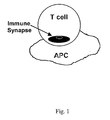
- An immune synapse is depicted schematically in Fig. 1 .
- This immune synapse can be defined as the organized structure of activation molecules that assemble at the interface between the T-cell and the APC.
- the immune synapse is a close association between cellular membranes.
- the undifferentiated T-cell must be presented with small breakdown products (peptides) of the foreign invader.
- TCR and adhesion molecules are dispersed randomly on the T-cell membrane.
- the formation of the immunological synapse is an active and dynamic mechanism that allows T-cells to distinguish potential antigenic ligands.
- the immunological synapse consists of a central cluster of T-cell receptors surrounded by a ring of adhesion molecules.
- adhesion molecules such as LFA-1 and the peptide-recognition receptor (TCR) to form a doughnut-like structure with the TCR on the inside and LFA-1 on the outside.
- the TCR and LFA-1 molecules pass by each other within the T-cell lipid bilayer during the formation of the doughnut-like structure (this process is called translocation). If these molecules do not translocate within the immune synapse then the T-cell signal is not fully received and a different program of gene activity may ensue within the T-cell. This can drastically effect the immune response, especially if the T helper cell deviates from a gene program that would lead to IFN ⁇ release (T H 1 cells and type-1 immunity) to a program that ultimately activates IL-4 production (i.e., T H 2 cells and type-2 immunity).
- the TCR recognizes the peptide:MHC-II complex and sends Signal-1 to the T-cell. Additionally, LFA-1 binds to ICAM-1, and these molecules, along with the peptide:MHC-II complex, translocate to form the end-stage immune synapse. This leads to the effective expression of the CD40 ligand (CD154) by the uncommited T H cell. CD40 interaction (expressed on the antigen presenting cell) with its ligand generates NF ⁇ B up-regulation of the inflammatory cytokine, IL-12.
- CD40 ligand CD154
- IL-12 then binds to its receptor on the undifferentiated T H cell and initiates the T H 1 program, including the up-regulation of the transcription regulators, Stat4 and Tbet.
- the TCR can recognize the same peptide:MHC-II complex, thereby sending Signal-1.
- a weaker strength of Signal-1 and/or altered or blocked binding between Signal-2 moieties leads to an altered form of the end-stage immune synapse.
- this lower strength of Signal-1 or distinct participation of the LFA-1 second signal leads to this different result, i.e., dominant T H 2 differentiation.
- the altered immune synapse can dictate that the CD40 ligand is not expressed and IL-12 is therefore not released by the APC.
- This pathway is schematically represented in Fig. 2 .
- IL-4 appears to accumulate, thereby leading to the up-regulation of Stat6 and GATA-3 within the T-cell and hence commitment to a T H 2 pattern of differentiation.
- T H 1-dominant immunity e.g., as seen in autoimmune diseases and transplant rejection
- T H 2 responses against these same tissue antigens In other cases, it would be extremely valuable to replace weak T H 2 immunity with T H 1 dominance leading to strong T-cell proliferation and the effective generation of cytotoxic T-cells (CTL).
- CTL cytotoxic T-cells
- These cases may include chronic viral illnesses, like hepatitis-C and AIDS; and could include certain cancers like melanoma. Accordingly, what is needed in the art is modifiers of these immune responses so that type-2 immunity can be replaced with type-1 immunity or type-1 immunity can be replaced with type-2 immunity, as desired in order to combat different human disease states or health conditions.
- the present invention solves the problems found in the prior art and provides a distinct advance in the state of the art.
- the present invention embraces a peptide which includes a first portion comprising a sequence having at least 70% sequence identity to SEQ ID No 1 and a second portion having at least 70% sequence identity to SEQ ID No 30 at the other end. These two ends can be directly connected to each other or connected via a flexible, non-substrate linker. This conjugation of the peptide portions directly and via a linker into a continuous peptide chain produces peptides belonging to a new class of immunotherapeutic peptides termed bifunctional peptide inhibitors (BPI).
- BPI bifunctional peptide inhibitors
- the present invention provides peptides and compositions capable of modulating T-cells and subsequent immunity in a very specified manner such that only specific disease-associated populations of these cells are targeted by the products of the present invention.
- the present invention leaves necessary components of the intact immune system to operate in their nominal protective manner.
- the present invention describes constructing a peptide sequence comprising a sequence having at least 70% sequence identity to SEQ ID No 1, corresponding to a TCR epitope of interest (a Signal-1 moiety), at one end and a peptide comprising a sequence having at least 70% sequence identity to SEQ ID No. 30, which is derived from the protein:protein interaction (the Signal-2 moiety) which generates Signal-2.
- These two peptide sequences can be connected via a flexible linker which couples the Signal-1 moiety to the Signal-2 moiety or can be directly linked together. In some cases, the linkage between the two peptides sequences may include flanking residues from each portion.
- the combination of the Signal-1 moiety coupled with the Signal-2 moiety constitutes a BPI. Accordingly, once a TCR epitope of interest is identified and the desired immune response (type-1 or type-2) determined, a BPI can be generated.
- T H 1 cells type-1 helper T-cells
- T H 2 cells type-2 helper T-cells
- T H 1 cells Differentiation into T H 1 cells results in predominantly cell-mediated immunity while differentiation into T H 2 cells results in predominantly humoral immunity.
- T H 1 cells protect the body against intracellular pathogens such as bacteria, and are also implicated in organ-specific autoimmune diseases.
- T H 2 cells are important for protection against extracellular parasites as well as allergic reactions. Development of T H 1 cells is driven by a cytokine called interleukin-12, which is produced by immune cells known as macrophages and dendritic cells.
- Interleukin-12 induces or stimulates the naive T-cell to produce interferon- ⁇ (IFN- ⁇ ) and interleukin-2 (IL-2).
- IFN- ⁇ interferon- ⁇
- IL-2 and IFN- ⁇ are involved in classic cell-mediated functions such as clonal expansion of cytotoxic T-lymphocytes (CTLs), macrophage activation, and class switching to IgG isotypes that mediate complement lysis of sensitized cells.
- CTLs cytotoxic T-lymphocytes
- macrophage activation cytotoxic T-lymphocytes
- class switching to IgG isotypes that mediate complement lysis of sensitized cells.
- Commitment to a T H 1 immune response is enhanced by the presence of IFN- ⁇ which up-regulates expression of the interleukin-12 (IL-12) receptor while inhibiting the development of T H 2 cells. This pathway is shown schematically in Fig. 3 .
- T H 2 immunity results from the production ofinterleukin-4 (IL-4) by the naive T-cell.
- IL-4 induces T H 2 development and the subsequent production ofinterleukins 4 (IL-4), 5 (IL-5) and 13 (IL-13), through activation of the transcription regulator Stat6.
- IL-4 also operates to down-regulate expression of the IL-12 receptor on developing cells, thereby inhibiting T H 1 development and helping undifferentiated T-cells to commit to T H 2 cell development.
- IL-4 and IL-5 are known to activate B cells and switch to neutralizing antibody (IgG 1 in the mouse) and IgE, the initiator of immediate hypersensitivity. Again, a schematic representation of this process is depicted in Fig. 2 .
- Signal-1 occurs when the T-cell antigen receptor (TCR) recognizes or engages the peptide:MHC-II complex on the surface of an antigen presenting cell (APC).
- TCR T-cell antigen receptor
- APC antigen presenting cell
- This first signal is transmitted through the T-cell receptor and initiates a cascade of tyrosine phosphorylation/dephosphorylation events mediated by kinases and phosphatases and leads to the activation of Ca ++ flux, NF-AT and NF ⁇ B transcription factors. These factors enter the nucleus of the T-cell and bind to promoters of genes responsible for effector functions.
- Signal-2 arises from the binding of a Signal-2 receptor on the T-cell to its protein ligand on the APC.
- Signal-2 receptors include CD28 and its ligand B7 as well as LFA-1 and its ligand ICAM-1.
- a Signal-2 receptor and its ligand form a complex at the interface between the T-cell and APC membranes, a series of signaling events occurs including serine/threonine phosphorylation/dephosphorylation along with actuation of guanine nucleotide exchange factors that activate adapter proteins with GTPase activity. These signaling events activate a separate set of transcription factors.
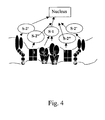
- the signal delivered through the CD28:B7 complex is distinct from that delivered from the ICAM-1:LFA-1 complex, particularly with respect to the differentiation of CD4 + T-cells into T H 1 versus T H 2 effector populations.
- FIG. 4 A schematic representation of this signaling is provided herein as Fig. 4 .
- the CD4 + T-cells differentiate into T H 1 cells.
- the CD4 + T-cells of the T H 1 differentiation state are abundant producers of IL-2 and IFN ⁇ , two cytokines that are the preeminent initiators of inflammatory immune responses, such as delayed-type hypersensitivity (DTH), immunity to intracellular pathogens, and several autoimmune diseases.
- DTH delayed-type hypersensitivity
- the CD4 + T-cells differentiate into T H 2 cells.
- T H 2 cells In contrast to T H 1 cells, T H 2 cells do not produce IL-2 and IFN ⁇ cytokines, but instead release the mediators of immediate-type hypersensitivity such as allergy and asthma, i.e., IL-4, IL-5, IL-10, and IL-13.
- IL-4, IL-5, IL-10, and IL-13 the mediators of immediate-type hypersensitivity
- IL-13 the mediators of immediate-type hypersensitivity
- the associations between the TCR and APC occur at a specialized junction called the immunological synapse (shown in Fig. 1 ).
- the immunological synapse In order for the immune response to proceed, the undifferentiated T H cell, must be presented with peptides of the foreign invader on the surface of the APC.
- TCR and adhesion molecules In an unactivated T-cell, TCR and adhesion molecules are dispersed randomly on the T-cell membrane.
- the formation of the immunological synapse is an active and dynamic mechanism that allows T-cells to distinguish potential antigenic ligands.
- the immunological synapse consists of a central cluster of T-cell receptors surrounded by a ring of adhesion molecules. This arrangement is depicted schematically in Fig. 1 .
- the TCR:peptide:MHC-II complex is in the center of the dark circle which represents the protein:protein pair constituting the Signal-2 receptor and the Signal-2 ligand.
- adhesion molecules such as LFA-1 and the peptide-recognition receptor (TCR) to form a doughnut-like structure with the TCR on the inside and LFA-1 on the outside.
- TCR and LFA-1 molecules actually translocate past one another within the T-cell lipid bilayer. If these molecules do not translocate within the immune synapse then the T-cell signal is not fully received and a different program of gene activity may occur within the T-cell.
- T helper cell T H
- T H T helper cell
- Fig. 2 an interpretation of the BPI mechanism suggests that BPI bind to both the MHC-II and second signal ligands. This effectively tethers the MHC-II:peptide and ICAM-1 moecules thereby preventing the translocation step of immune synapse formation.
- peptides having at least 70% sequence identity to a known TCR epitopes are used as the first peptide portion of the BPL.
- minimal peptide sequences that are potent immunogens are utilized.
- These minimal peptide sequences e.g. antigenic peptides
- effectively engage the TCR involved in immune responses of interest i.e. autoimmune diseases, infectious diseases, allergies, cancers, etc.
- TCR epitopes of interest i.e. autoimmune diseases, infectious diseases, allergies, cancers, etc.
- the TCR epitope of interest has been identified so that the first portion of the BPI can be synthesized.
- these dominant TCR epitopes have been so determined by previous art and the sequences are available in the literature.
- the peptide to which a given T-cell response is focused upon, (e.g., the response against the diabetes-associated antigen GAD65) is identified by the fact that most effector T-cells respond to this portion of the antigen and not other portions.
- animals are immunized with the whole protein antigen.
- T-cells are removed after the antigen has primed the immune system. These T-cells are placed separately in cultures with short overlapping peptides of the antigen.
- T-cells are first cloned from patients. These cloned T-cells are placed separately in cultures with overlapping peptides (again, representing individual portions of the antigen involved, e.g., HIV-1, p24 (SEQ ID No. 8)). Again, the peptide to which most T-cell clones respond is the dominant TCR epitope.
- overlapping peptides representing individual portions of the antigen involved, e.g., HIV-1, p24 (SEQ ID No. 8).
- the peptide to which most T-cell clones respond is the dominant TCR epitope.
- the foregoing is described by Schountz et al., MHC Genotype Controls the Capacity of Ligand Density to Switch T Helper (Th)-1/Th-2 Priming In Vivo, 157 The Journal of Immunology 3893-3901 (1996 ).
- peptides comprising a sequence having at least about 70% sequence identity to SEQ ID No 30, derived from a Signal-2 receptor are used to alter interactions between the nominal receptors on T-cells and their complementary ligands on the APC surface.
- Table 3 includes a representative list of some known Signal-2 receptor moieties. Of course, those of ordinary skill in the art will be able to identify other Signal-2 moieties not listed therein, as this list is representative and not all-inclusive.
- Another aspect of the present invention is the linking of the first portion, corresponding to the TCR epitope (i.e. the Signal-1 moiety) to the second portion, corresponding to the Signal-2 receptor peptide mimic (i.e., the Signal-2 moiety) in order to modify the resultant immune response.
- This linkage can be between the Signal-1 moiety and the Signal-2 moiety directly, or through flanking residues.
- this linking can be done via a linker which is positioned between the Signal-1 moiety and the Signal-2 moiety.
- the linker could be any amino acid including naturally occurring or chemically synthesized amino acids.
- non-substrate amino acids will be used due to their resistance to protease attack.
- the linker will comprise a non-substrate amino acid alternating with a small or hydrophilic amino acid. Even more preferably, the linker is synthesizable as one continuous sequence along with the Signal-1 and Signal-2 moieties, which flank the linker at each respective end. Still more preferably, the linker has the general formula (A,B) x , wherein A and B are amino acid residues, and the A amino acid residue is individually and respectively selected from the group consisting of aminocaproic acid, aminohexanoic acid, aminododecanoic acid, and ⁇ -alanine, and the B amino acid residue is a small or hydrophilic amino acid. In this formula, X can range from 1 to 100.
- a particularly representative B residue is glycine.
- a linker could potentially have aminocaproic acid (Ac), aminohexanoic acid (Ahx), aminododecanoic acid (Ado), and ⁇ -alanine ( ⁇ A) alternating with glycine residues (G) (e.g., Ac-G-Ahx-G-Ado-G- ⁇ A).
- the choice of the residues used to construct the linker can be based upon the desired length of the linker as well as steric hindrance considerations.
- One preferred linker comprises alternating Ac and G residues. This linker can be lengthened or shortened by the inclusion of the other amino acid residue choices (Ahx, Ado, ⁇ A).
- Some representative linkers are included in Table 2 as SEQ ID Nos. 26-29.
- TCR tumor antigens and the myriad of allergenic substances in the environment.
- TCR epitope of a given BPI we direct the immunomodulating capacity of the BPI to a select group of TCR.
- the selection of a TCR epitope to incorporate into the BPI targets T-cells that are involved in a particular human disease in a highly specific fashion.
- incorporating the GAD65 epitope into a BPI targets autoaggressive T-cells involved in the induction of type-1 diabetes.
- BPI offer the possibility to specifically modulate T-cell immunity to one antigen while leaving intact the T-cell repertoire necessary for protective immunity to infectious agents and developing cancers.
- the Signal-1 moieties of the present invention are preferably derived from a TCR epitope and a list of representative known epitopes is provided in Table 1 wherein these known epitopes are presented as SEQ ID Nos. 1-25.
- the TCR epitope selected will be correlated with a known health condition or disease state.
- the peptide will have at least 70% sequence homology with SEQ ID No 1.
- the peptide will have at least about 95% sequence homology with SEQ ID No 1.
- the peptidomimetic will be a mimetic of a peptide SEQ ID No. 1.
- the Signal-1 moiety will be a derivative of a TCR epitope or a peptide of SEQ ID No. 1.
- this first portion of the BPI (or the portion responsible for initiating the first signal) be capable of binding with a major histocompatability complex (MHC) on an antigen presenting cell (APC). Furthermore, it is preferred that this resulting peptide:MHC complex be capable of engaging important TCR and initiating some form of the signal to the T-cell.
- MHC major histocompatability complex
- API antigen presenting cell
- the peptides used on the side of the linker opposite the Signal-1 moiety are preferably derived from Signal-2 receptors.
- This second portion of the BPI is connected to the first portion either directly or via the linker.
- the second portion peptide has at least about 70% sequence homology with the sequence of SEQ ID No. 30.
- the second portion peptide includes a sequence having at least about 95% sequence homology with the sequence of SEQ ID No. 30.
- peptidomimetics can be used in place of all or some of the amino acid residues of the second portion.
- the peptidomimetic of the second portion will be a mimic of a peptide of SEQ ID No. 30.
- the second portion of the BPI will comprise a derivative of a peptide of SEQ ID No. 30. Similar to the first portion, the second portion is capable of binding with a complementary ligand (e.g. the Signal-2 ligand) on an antigen presenting cell.
- a complementary ligand e.g. the Signal-2 ligand
- the immune response involves a two signal mechanism and the purpose of the present invention is to modify a given immune response, e.g., from type-1 immunity to type-2 immunity or from type-2 immunity to type-1 immunity.
- This modification or shifting of immune response phenotype is brought about by BPI according to the present invention. It is preferred in some cases for the BPI to modify an immune response from a T H 1 dominated or cytolytic immune response to a T H 2 dominated response; and, in other cases, it is preferred for the BPI to modify an immune response from a T H 2 dominated response to a T H 1 or cytolytic dominated response.
- BPI may operate via the activation of very specific T-cell phenotypes, e.g., peptide-specific suppressor T-cells.
- T-cell phenotypes e.g., peptide-specific suppressor T-cells.
- the response generated when a BPI similar to the GAD 65-CD11a BPI is introduced into the immune synapse is quite different and operates to shift the response from type-1 to type-2. This situation is depicted schematically in Fig. 2 .
- a BPI comprising a Signal-1 moiety, a flexible, non-substrate linker, and a Signal-2 moiety is formed and introduced into the immune synapse.
- the TCR recognizes the peptide:MHC complex on the APC and initiates the first signal.
- the second portion of the BPI blocks the typical Signal-2 interaction occurring between LFA-I/ICAM-1, and the translocation of the TCR into the central cluster.
- the signal will be altered in a different direction of differentiation.
- an important aspect of the present invention is that tethering a specific TCR epitope to a Signal-2 receptor peptide mimic leads to alteration of T-cell differentiation involving T-cells bearing only these receptors and/or T-cell populations indirectly linked to these peptide specific subsets.
- the ability to block or alter T-cell responses to a given immunodominant peptide antigen would offer extremely precise treatments for immunopathological conditions.
- a major drawback to current immunotherapies is that broad specificities of T-cells are affected leaving the host more susceptible to infections and cancers.
- the BPI of the present invention should block and/or alter only the desired T-cell population and subsequent responses that depend on these initial T-cells. Also, BPI will target a specific TCR-bearing population for activation toward a desired effector function.
- the relative strength of signal generated by the T-cell-APC interaction has an affect on whether the ultimate immune response is a type-1 or a type-2 response.
- the teachings of Murray in How the MHC Selects TH1/TH2 Immunity, 19 Immunology Today 157-163 (1998 ) are hereby incorporated by reference.
- An immune response can be modified by contacting an APC with a peptide of the present invention and causing an altered signal to be transmitted to the T-cell.
- the immune response is deviated from the immune response generally associated with the immunogenic peptide and its corresponding antigen (i.e., infectious agent, self protein, or allergen).
- the peptide of the present invention has the general formula AXB.
- the A, X, and B represent a chain of amino acid residues wherein the A chain comprises a sequence having at least 70% sequence identity to SEQ ID No 1, the B chain comprises a sequence having at least about 70% sequence identity to SEQ ID No. 30, and the X chain is a linker.
- the linker could be any amino acid including naturally occurring or chemically synthesized amino acids.
- the X chain has at least one residue. It is possible to link A to B directly without X as well, although a linker of some size is preferred in order to span the distance between the MHC-II and second signal ligands on the APC surface.
- non-substrate amino acids will be used due to their resistance to protease attack.
- the linker wilt comprise a non-substrate amino acid alternating with a small or hydrophilic amino acid.
- the linker is synthesizable as one continuous sequence along with the Signal-1 and Signal-2 moieties, which flank the linker at each respective end.
- the linker has the general formula (A,B) x , wherein A and B are amino acid residues, and the A amino acid residue is individually and respectively selected from the group consisting of aminocaproic acid, aminohexanoic acid, aminododecanoic acid, and ⁇ -alanine, and the B amino acid residue is a small or hydrophilic amino acid.
- X can range from 1 to 100.
- a particularly representative B residue is glycine.
- a linker could potentially have aminocaproic acid (Ac), aminohexanoic acid (Ahx), aminododecanoic acid (Ado), and ⁇ -alanine ( ⁇ A) alternating with glycine residues (G) (e.g., Ac-G-Ahx-G-Ado-G- ⁇ A).
- the choice of the residues used to construct the linker can be based upon the desired length of the linker as well as steric hindrance considerations, hydrophobicity, charge, etc.
- One preferred linker comprises alternating Ac and G residues. This linker can be lengthened or shortened by the inclusion of the other amino acid residue choices (Ahx, Ado, ⁇ A).
- the X chain is positioned between the A chain and the B chain and the entire peptide can be synthesized as one continuous sequence.
- the peptide is capable of shifting a type-1 response to a type-2 response.
- peptidomimetics may be synthesized to mimic any part of the BPI, including the linker.
- the A chain binds to the MHC on an APC to form a peptide:MHC complex. This complex is capable of engaging the TCR on critical T-cell populations.
- the B chain is capable of binding to a Signal-2 ligand on the APC at the same time as the formation of the peptide:MHC complex.
- This combined binding to the APC should be capable of altering the signal delivered to the T-cell.
- the combination of the first signal and the second signal are capable of fully activating a T-cell and by selecting the peptide used for the A chain and the peptide used for the B chain, the immune response can be deviated from its normal progression.
- the response can be altered to give a type-2 response leading to the up-regulation of T H 2 cells.
- the response can be altered to give a type-1 response leading to the up-regulation of T H 1 cells.
- the A chain can be chosen based on the health condition normally associated with the sequence (for example, see Table 4).
- a method for preparing a peptide for modulating immune responses comprises the steps of selecting a first peptide sequence which has at least about 10% sequence homology with a sequence derived from a TCR epitope, selecting a second peptide sequence which has at least about 10% sequence homology with a sequence derived from a Signal-2 receptor moiety, selecting a third peptide sequence which is a flexible, non-substrate linker, and synthesizing the peptides as a continuous peptide chain.
- the linker may be flanked on one end with the peptide derived from the TCR epitope and flanked on the other end with the peptide derived from the Signal-2 moiety.
- the first peptide sequence should be associated with a known health condition and be capable of binding with an MHC on an APC. Similarly, it is preferred that the second peptide sequence be capable of binding with a Signal-2 ligand moiety on the APC.
- the method can further comprise the step of contacting the nominal peptide immunogen with the TCR, thereby binding the first peptide sequence to the MHC and the second peptide sequence to the Signal-2 ligand, thereby generating APC bearing potent first and altered/blocked second signal ligands which activate a desired immune response.
- Inherent in the BPI design is the antigen-specific moiety that a given T-cell population is activated to respond against (i.e., the TCR epitope), ultimately leading to the cascade of immune reactions that generate protective or in some cases pathologic immune responses.
- TCR epitope major histocompatibility complex
- APC antigen presenting cell
- T-cell clones to possible peptide epitopes were generated and tested for binding to the immunodominant TCR of a response and specifically stimulate T-cell functions in vitro by the ELISPOT assay. Because modifications in the peptide residues that actually contact the TCR are part of the BPI development, it is also preferable that known crystallographic structures of the epitope bound to MHC molecules are available. This allows for precise three-dimensional predictions of how a particular amino acid substitution or mimetic will affect the actual structure encountered by the developing T-cells. However, in the absence of known crystal structures, it is possible to predict the shape of a hypothetical peptide:MHC structure based upon the available coordinates of other peptide:MHC structures.
- TCR contact positions It is important to identify (or at least predict) these TCR contact positions. It is well-known that certain alterations to TCR-contact positions can change the functional differentiation of T-cells into the T H 1 or T H 2 types that can determine the course of immunity (see Murray, et al., Major Histocompatibility Complex (MHC) Class II Molecules Direct TCR-Specificity for Opposite Ends of the Same Immunogenic Peptide in T H 1 or T H 2 responses (unpublished manuscript, 2000); and Murray; 19 Immunology Today 157-163 (1998 ).
- MHC Major Histocompatibility Complex
- spleen cell density-gradient fractions from mice
- PBL from PBL
- APC lines from humans
- Avidin-FITC was incubated with the cells on ice for 30 minutes, followed by biotinylated anti-Avidin for 1 hour, then again with Avidin-FITC.
- Unlabeled peptide was used in a competition assay to derive the relative affinity of the BPI for the APC and the ability of the BPI to crosslink the MHC and ICAM molecules on the APC was examined by cocapping ICAM with an anti-MHC mAb.
- cells were incubated with the BPI.
- an anti-MHC mAb was added. After 30 minutes at 37°C, the cells were transferred to ice and stained with PE-labeled anti-ICAM ( Fig. 7 ).
- T-cell clones were generated for determination of TCR epitopes for later use in BPI. These experiments utilized CD4+ or CD8+ T-cell clones from humans or mice immunized against predicted TCR epitopes using previously described methods ( Murray et al., 24 Eur. J. Immunol. 2337-2344 (1994 ); Murray; 19 Immunology Today 157-163 ; and Schountz et al., 157 The Journal of Immunology 3893-3901 (1996 )). These clones were maintained by biweekly restimulation with irradiated histocompatible lymphocytes, the peptide, and recombinant IL2.
- ELISPOT assay To determine if a given TCR-epitope is effective for the activation to cytokine synthesis, an ELISPOT assay was used. Of course, other cytokine assays could also be used.
- BPI that have been substituted at predicted TCR-contact positions will be used to determine which of these BPI variants are most effective in the inhibition of proliferation and cytokine release from individual clones as analyzed above. Predicted positions will be scanned with different amino acids or mimetics to alter the interaction with the TCR in the structures generated by molecular modeling.
- MDEM Molecular Dynamics/Energy Minimizations
- the second stage in the BPI process is selection of peptide mimics of established second signal receptor molecules involved in the functional differentiation of T-cells.
- crystallographic structures and available models ofthe second signal receptors bound to their physiological ligands will be used to predict the regions of the receptors that make contact with the ligand. This approach was used to design the EGAD-BPI which can be depicted as
- BPI are tested for binding to isolated MHC and second signal ligands, and NMR, molecular modeling and crystallography are used to determine their exact 3D structures. Finally, it was determined whether a given BPI was biologically active in vivo. Mice were treated with the BPI and immune cells isolated and tested for cytokine production by ELISPOT (see Figs. 9 & 10 ). Of course other cytokine assays will be well known to those of ordinary skill in the art and can be used in place of ELISPOT.
- T-cells 15 million disease-linked lymphocytes (i.e., patient T-cells, or T-cell populations linked to the disease process) were injected with or without T-cells that received the BPI compound (in vivo or in vitro) and were expanded for 24 hours in recombinant IL-2.
- Some experiments will deplete specific subsets of the T-cells using mAb to CD154, CD25, CD62L, CD152, etc. and magnetic particles prior to adoptive transfer.
- T-cells (from mice or humans) treated with the individual moieties of the BPI will be used as negative controls along with CD4+ cells from mice treated with saline alone ( Fig. 9 ).
- mice For blocking spontaneous diabetes, five groups of ten female NOD mice (12 weeks of age) were used and monitored for nondiabetic blood glucose levels with a standard glucometer (AccuChek-complete, Roche Diagnostic). Each mouse was labeled and individually monitored for blood glucose levels weekly for the course of the experiment.
- the five groups received either (a) intravenous (i.v.) injection of the BPI (100 ⁇ g in 100 ⁇ l endotoxin-free saline/injection) at 8 weeks of age, (b) same dose GAD65 (208-217) epitope alone, (c) same dose CD11a (237-247) peptide alone, or (d) saline alone.
- similar treatment groups involving the different Signal-1 and Signal-2 peptides and BPI will be used. Mice will be tested by challenging with the appropriate infectious agent or antigen depending upon the particular BPI in question.
- spleen, pancreas, or other target organs e.g., the CNS for the MBP peptide BPI, or lung for the RSV peptide BPI
- target organs e.g., the CNS for the MBP peptide BPI, or lung for the RSV peptide BPI
- biotinylated mAb to various cell surface antigens will be incubated individually with the Cryostat sections (2 hours), followed by avidin-alkaline phosphatase (Vector laboratories).
- cell subsets will be phenotyped by standard flow cytometry methods as described in Murray et al., 24 Eur. J. Immunol. 2337-2344 (1994 ); Murray; 19 Immunology Today 157-163 ; and Schountz et al., 157 The Journal of Immunology 3893-3901 (1996 ).
- the students t-test or ANOVA will be used to estimate the statistical significance of differences observed between groups and individual mice.
- a few representative assembled BPI consisting of a Signal-1 moiety and a Signal-2 receptor moiety joined together via a linker are provided in Table 4 as SEQ ID Nos. 42-46. These representative BPI are operable for shifting specific immune responses from a type-1 to a type-2 response and vice-versa.
- other immune responses to other antigenic peptides will be preferably unaffected.
- Sequence Identity refers to a relationship between two or more polypeptide sequences or two or more polynucleotide sequences, namely a reference sequence and a given sequence to be compared with the reference sequence. Sequence identity is determined by comparing the given sequence to the reference sequence after the sequences have been optimally aligned to produce the highest degree of sequence similarity, as determined by the match between strings of such sequences. Upon such alignment, sequence identity is ascertained on a position-by-position basis, e.g., the sequences are "identical” at a particular position if at that position, the nucleotides or amino acid residues are identical.
- Sequence identity can be readily calculated by known methods, including but not limited to, those described in Computational Molecular Biology, Lesk, A. N., ed., Oxford University Press, New York (1988 ), Biocomputing: Informatics and Genome Projects, Smith, D.W., ed., Academic Press, New York (1993 ); Computer Analysis of Sequence Data, Part I, Griffin, A.M., and Griffin, H.
- Examples of such programs include, but are not limited to, the GCG program package ( Devereux, J., et al., Nucleic Acids Research, 12(1):387 (1984 )), BLASTP, BLASTN and FASTA ( Altschul, S. F. et al., J. Molec. Biol., 215:403-410 (1990 ).
- the BLASTX program is publicly available from NCBI and other sources ( BLAST Manual, Altschul, S. et al., NCVI NLM NIH Bethesda, MD 20894 , Altschul, S. F. et al., J. Molec. Biol., 215:403-410 (1990 ).
- sequence identity As an illustration, by a polynucleotide having a nucleotide sequence having at least, for example, 95% "sequence identity" to a reference nucleotide sequence, it is intended that the nucleotide sequence of the given polynucleotide is identical to the reference sequence except that the given polynucleotide sequence may include up to 5 point mutations per each 100 nucleotides of the reference nucleotide sequence.
- a polynucleotide having a nucleotide sequence having at least 95% identity relative to the reference nucleotide sequence up to 5% of the nucleotides in the reference sequence may be deleted or substituted with another nucleotide, or a number of nucleotides up to 5% of the total nucleotides in the reference sequence may be inserted into the reference sequence.
- These mutations of the reference sequence may occur at the 5' or 3' terminal positions of the reference nucleotide sequence or anywhere between those terminal positions, interspersed either individually among nucleotides in the reference sequence or in one or more contiguous groups within the reference sequence.
- a polypeptide having a given amino acid sequence having at least, for example, 95% sequence identity to a reference amino acid sequence it is intended that the given amino acid sequence of the polypeptide is identical to the reference sequence except that the given polypeptide sequence mayinclude up to 5 amino acid alterations per each 100 amino acids of the reference amino acid sequence.
- up to 5% of the amino acid residues in the reference sequence may be deleted or substituted with another amino acid, or a number of amino acids up to 5% of the total number of amino acid residues in the reference sequence may be inserted into the reference sequence.
- alterations ofthe reference sequence may occur at the amino or the carboxy terminal positions of the reference amino acid sequence or anywhere between those terminal positions, interspersed either individually amongresidues in the reference sequence orin the one or more contiguous groups within the reference sequence.
- residue positions which are not identical differ by conservative amino acid substitution. However, conservative substitutions are not included as a match when determining sequence identity.
- sequence homology also refers to a method of determining the relatedness of two sequences. To determine sequence homology, two or more sequences are optimally aligned as described above, and gaps are introduced if necessary. However, in contrast to “sequence identity”, conservative amino acid substitutions are counted as a match when determining sequence homology.
- 95% of the amino acid residues or nucleotides in the reference sequence must match or comprise a conservative substitution with another amino acid or nucleotide, or a number of amino acids or nucleotides up to 5% of the total amino acid residues or nucleotides, not including conservative substitutions, in the reference sequence may be inserted into the reference sequence.
- a “conservative substitution” refers to the substitution of an amino acid residue or nucleotide with another amino acid residue or nucleotide having similar characteristics or properties including size, charge, hydrophobicity, etc., such that the overall functionality does not change significantly.
- isolated means altered “by the hand of man” from its natural state., i.e., if it occurs in nature, it has been changed or removed from its original environment, or both.
- a polynucleotide or polypeptide naturally present in a living organism is not “isolated,” but the same polynucleotide or polypeptide separated from the coexisting materials of its natural state is “isolated”, as the term is employed herein.
- Sequences including or having a sequence which has at least about at least about 70% sequence identity to SEQ ID No 1 and including or having at least about 70% sequence identity to SEQ ID No. 30, and most preferably at least about 95% sequence identity are within the scope of the invention. Additionally, sequences which differ from any one of SEQ ID Nos. 1 or 30 due to a mutation event, a series of mutation events, or chemical derivatization but which still exhibit desired properties are also embraced in the present invention. Such mutation events or derivatizations include but are not limited to point mutations, deletions, insertions, rearrangements, peptidomimetics, and other chemical modifications.
- a “linker” is defined as any amino acid including naturally occurring or chemically synthesized amino acids.
- a “linker” is a flexible, non-substrate sequence of amino acid residues resistant to proteolytic degradation which can be used to conjugate and/or couple a Signal-1 moiety to a Signal-2 moiety.
- a “Signal-1 moiety” is defined as a peptide epitope, i.e., the peptide portion of an antigen and/or mimetics of these antigenic peptides to which important TCRs bind.
- a “Signal-2 moiety” or a “Signal-2 receptor moiety” is defined as a peptide portion of a second signal receptor known to bind to and/or affect binding of the receptor to its complimentary ligand on the APC. This can include peptide mimics and mimetics of the receptor/ligand structure of interest.
- a “Signal-2 ligand” is the complementary protein of the Signal-2 receptor moiety on the APC to which the receptorportion and/or the Signal-2 receptor moiety has significant affinity and binds.
- derivative with respect to peptides refers to changes produced by amino acid addition, deletion, replacement, substitution, and/or modification; mutants produced by recombinant and/or DNA shuffling; and salts, solvates, and other chemically synthesized/modified forms of the peptide that retain in part the activity of the isolated native peptide.
- BPI were generated using automated peptide synthesis by a robotic multiple peptide synthesizer employing Fmoc amino acid chemistry by standard methods.
- Wang resin p- benzyloxybenzyl alcohol polystyrene
- Peptides were characterized by reversed-phase HPLC and electrospray mass-spectrometry. This synthesis, referred to as Merrifield peptide synthesis, utilizes traditional organic chemical reactions carried out on a solid material so that the peptide chain is lengthened while attached to the support structure. The peptides will be cleaved from the resin using TFA, and purified by reverse-phase HPLC and analyzed by mass spectroscopy.
- these reactions can be carried out in solution when larger amounts of the peptides are desired.
- the peptides of the invention may be synthesized or prepared by a number of techniques which are well known in the art. See, for example, Creighton, 1983, Proteins: Structures and Molecular Principles, W. H. Freeman and Co., New York , which is incorporated herein by reference in its entirety. Short peptides, for example, can be synthesized on a solid support or in solution. Longer peptides may be made using recombinant DNA techniques.
- nucleotide sequences encoding the peptides of the invention may be synthesized, and/or cloned, and expressed according to techniques well known to those of ordinary skill in the art. See, for example, Sambrook, et al., 1989, Molecular Cloning, A is Laboratory Manual, Vols. 1-3, Cold Spring Harbor Press, New York .
- the peptides of the invention may be synthesized such that one or more of the bonds which link the amino acid residues of the peptides are non-peptide bonds.
- These alternative non-peptide bonds may be formed by utilizing reactions well known to those in the art, and may include, but are not limited to amino, ester, hydrazide, semicarbazide, and azo bonds, to name but a few.
- peptides comprising the sequences described above may be synthesized with additional chemical groups present at their amino and/or carboxy termini, such that, for example, the stability, bioavailability, and/or inhibitory activity of the peptides is enhanced.
- hydrophobic groups such as carbobenzoxyl, dansyl, or t-butyloxycarbonyl groups, may be added to the peptides' amino termini.
- an acetyl group or a 9-fluorenylmethoxy-carbonyl group may be placed at the peptides' amino termini.
- the hydrophobic group, t-butyloxycarbonyl, or an amido group may be added to the peptides' carboxy termini.
- peptide mimetic compounds may be synthesized in place of the peptide moieties and linked by the same chemistry.
- the design of peptidomimetics is an established technique and known correlates of key amino acids of the peptide can be synthesized by previously published methods.
- peptidomimetics may be developed which have the same modulation properties as the preferred peptides detailed herein. As these peptidomimetics require no more than routine skill in the art to produce, such peptidomimetics are embraced within the present application.
- the side chains of these peptidomimetics will be very similar in structure to the side chains of the preferred peptides herein, however, their peptide backbone may be very different or even entirely dissimilar.
- the peptides of the present invention could be cyclized by any well known method.
- One such method adds Penicillamine (Pen) and cysteine (Cys) residues to the N- and C-termini to form cyclic peptides via a disulfide bond between the Pen and Cys residues.
- Pen Penicillamine
- Cys cysteine residues
- the formation of this cyclic peptide restricts the peptide conformation to produce a conformational stability, thereby providing better selectivity for cell surface receptors than its linear counterpart.
- linker The portion of the BPI which spans between the Signal-1 moiety and the Signal-2 moiety is referred to as a linker.
- the linker is not essential in forming a BPI.
- the linker can be any naturally occurring or chemically synthesized amino acid.
- the linker is a non-substrate amino acid residue chain which helps to prevent protease attack.
- a particularly preferred linker is a repeating chain of the non-natural amino acid, aminocaproic acid (Ac), and the amino acid glycine (G) (e.g. Ac-G-Ac-G-Ac).
- beta-alanine residues ( ⁇ Ala) could be substituted for one or more of the Ac residues.
- amino-dodecanoic acid residues (Adod) could be substituted for one or more of the Ac residues.
- peptide mimetics of these linker amino acids may also be synthesized and inserted into the BPI structure.
- This example describes the methods used to generate the BPI.
- Synthesis of peptides was via Fmoc on chlorotrity resins. Protected amino acids were double coupled at 8-fold excess for one hour. Resins were dimethylforamide (DMF) and methanol (MeOH) washed and cleaved in Reagent R: trifluorolacetic acid (TFA), ethylene diamine tetraacetic acid (EDTA), Thioanisole, Anisole. The TFA mixture containing the peptide in solution is precipitated in ether and washed extensively. Preparative HPLC ofpeptides was accomplished by a gradient of 0-80% acetonitrile in 0.1% TFA. Lyophilization of the various fractions and verification by mass spectroscopy yielded the synthetic peptides as a TFA salt. Modeling, crystallography and binding studies are as described above.
- the peptides produced in this example are provided in Table 1 and are also listed as SEQ ID Nos. 1- 46. These peptides include the Signal-1 moiety, the Signal-2 moiety and the non-substrate linker between the two moieties.
- any Signal-1 moiety could be linked with any Signal-2 moiety via any linker using the peptide synthesis described above.
- the BPI are generated as one continuous peptide chain comprising a Signal-1 peptide sequence followed by a linker sequence followed by a Signal-2 peptide sequence. Additionally, some representative BPI were generated for later use in the experiments. These BPI are included herein in Table 4.
- the entire BPI can be synthesized using the above-described methods.
- an appropriate linker could be selected and the other portion of the BPI, i.e., the second signal moiety, can be chosen.
- BPI can be designed using the peptide sequences themselves, peptidomimetics, or combinations of the two. Construction of appropriate peptidomimetics is detailed by Falcioni, et al, 17 Nature Biotechnology, 562-567 (1999 ).
- Fig. 8 illustrates the structure of the GAD65 (208-217), TCR epitope linked to the CD 11 a (237-247) second signal moiety produced by the present methods. It is shown bound to the groove of I-A g7 and the D1 domain of ICAM-1.
- ICAM-1 ICAM-1 domain structure
- For modeling the I-A g7 :GAD65 peptide structure docking studies were performed on a Silicon Graphic Ocatane work station using InSight II software (MSI/Biosym). The LFA-1 peptide:ICAM-1 domain structure is based on the docking model of Edwards, C.P. et al. J. Biol. Chem. 273:28937 (1998 ).
- the alpha carbon ribbon of I-A g7 is shown in pink; D1 of ICAM-1 is in light-blue; the BPI is shown by atom, carbon in green, oxygen in red, and nitrogen in blue.
- This structure can be denominated as GAD65 (208-217) - [Ac-G-Ac-G-Ac] - CD11a (237-247).
- the length of the linker may be modified as needed or as indicated by any experimental data obtained in order to span between the Signal-1 and Signal-2 moieties at an optimum length.
- the linker used has the sequence -[Ac-G-Ac-G-Ac]-.
- Ac aminocaproic acid
- beta-2 alanine can be used as a substitute for aminocaproic acid.
- This example uses biotinylated BPI to test for competitive inhibition of BPI binding by unlabeled peptides or monoclonal antibodies to MHC-II and ICAM-1 on live APC, and to veri fy antigenic peptide binding to live APC. Additionally, it was shown that monoclonal antibodies to MHC-II or ICAM-1 effectively block binding of the diabetes BPI (GAD65 (208-217) - [Ac-G-Ac-G-Ac] - CD11a (237-247)) (hereinafter referred to as EGAD-BPI) to NOD spleenocytes.
- diabetes BPI GID65 (208-217) - [Ac-G-Ac-G-Ac] - CD11a (237-247)
- the synthesized EGAD BPI was biotinylated with NHS-Biotin as described in Murray et al., 24 Eur. J. Immunol. 2337-2344 (1994 ). Spleen cell density-gradient fractions from normal (unimmunized) NOD, BALB/c and other MHC congenic strains were incubated in round bottom 96-well plates with increasing concentrations of individual biotinylated peptides at 37°C, 5% CO 2 for 16 hours.
- mAb RA3-6B2 CD45R B-cell marker
- anti-MHC class U KH74 or 10-3.62 mAb
- anti-ICAM-1 3E2 mAb
- Bound peptide was detected with avidin-FITC/biotinylated anti-avidin/avidin-FITC on live cells gated by forward/side scatter analysis. Controls contained all detecting reagents in absence of the biotinylated peptide; 20,000 events were analyzed for each histogram with a FACScan (Becton-Dickinson) flow cytometer.
- the experimental wells contained various unlabeled peptides (e.g., antigenic peptides or LFA-1 peptides), and/or monoclonal antibody (e.g., anti-MHC-II or anti-ICAM-1 mAb) inhibitors.
- unlabeled peptides e.g., antigenic peptides or LFA-1 peptides
- monoclonal antibody e.g., anti-MHC-II or anti-ICAM-1 mAb
- Negative selection methods with monoclonal antibodies conjugated to magnetic particles were used to enrich the spleen cell fractions for B cells, macrophages, or dendritic cells as well as to examine differences in BPI binding to these different populations. These methods are detailed in Schountz et al., 157 The Journal of Immunology 3893-3901 (1996 ).
- initial EGAD-BPI were screened for selective binding to NOD (I-A g7 ) APC and assayed for simultaneous binding using monoclonal antibodies against either MHC-II or ICAM-1 by flow cytometry methods using live APC ( Murray et al., 24 Eur. J. Immunol. 2337-2344 (1994 ); Murray; 19 Immunology Today 157-163 ; and Schountz et al., 157 The Journal of Immunology 3893-3901 (1996 )).
- biotinylated-BPI, -CD11a(237-247) or -GAD65(208-217) peptide were incubated overnight with spleenocytes from each inbred strain. Bound peptide was detected with amplification of avidin-FITC fluorescence by the use of a biotinylated anti-avidin reagent, followed by a second round of avidin-FITC binding. Biotinylated peptide was incubated with 10 6 viable cells at a peptide concentrations of 50 ⁇ M. Bound peptide was detected with avidin-FITC/biotinylated anti-avidin-FITC.
- M2 median channel fluorescence
- NOD spleen cells bind the diabetes BPI (EGAD-BPI) at a higher density than spleenocytes identically purified from BALB/c, A.SW, or A.BY.
- B cells are the major antigenic peptide binding cells in these spleen cell preparations isolated by lymphocyte separation media (LSM) density gradient centrifugation ( Murray et al., 24 Eur. J. Immunol. 2337-2344 (1994 ); Murray; 19 Immunology Today 157-163 ; and Schountz et al., 157 The Journal of Immunology 3893-3901 (1996 )).
- LSM lymphocyte separation media
- Fig. 5b illustrates direct binding of biotinylated LFA-1 (CD11a 237-247) peptide to the same spleenocyte preparations as those shown in Fig. 5a . Note that this Signal-2 moiety bound similarly to all strain spleenocytes.
- Fig. 5b illustrates direct binding of biotinylated LFA-1 (CD11a 237-247) peptide to the same spleenocyte preparations as those shown in Fig. 5a . Note that this Signal-2 moiety bound similarly to all strain spleenocytes.
- FIG. 5c illustrates direct binding of biotinylated GAD65 (208-217) peptide to the same spleenocyte preparations as those depicted in Figs. 5a and 5b .
- BPI could be engineered to fit particular MHC peptide binding motifs as discussed by Corper et al. in A Structural Framework for Deciphering the Link Between I-Ag7 and Autoimmune Diabetes, 288 Science 505-511 (2000 ), and by Dessen et al. in X-ray Crystal Structure of HLA-DR4 (DRA*0101, DRB*0401) Complexed With a Peptide From Human Collagen II, 7 Immunity 473-481 (1997 ).
- This example utilizes co-capping experiments to demonstrate simultaneous binding of the BPI to MHC-II and ICAM-1 molecules.
- Antibody-bound cells are then incubated with streptavidin (37 C x 15 min.) to cap the MHC-II molecules on the APC surface.
- streptavidin 37 C x 15 min.
- the cells were transferred to ice and labeled with a fluorescent (PE) monoclonal antibody to ICAM-1 (3E2).
- PE fluorescent
- the cells are plated and observed for evidence that a given BPI links ICAM-1 into the MHC-II cap, i.e., by standard fluorescence microscopy and image analysis.
- T-depleted spleenocytes from mice treated 16 hours previously with EGAD-BPI i.v.
- T-depleted spleenocytes from mice treated 16 hours previously with saline only did not exhibit co-capping.
- the results for these experiments are given in Fig. 7 .
- Fig. 7 illustrate the results from the T-depleted spleenocytes from mice treated 16 hours previously with EGAD-BPI (i.v.), wherein ICAM-1 was co-capped with MHC-II in the presence of bio-10-3.62/streptavidin.
- the bottom panels of Fig. 7 illustrate the results from the mice treated with saline only wherein co-capping is not exhibited. This is evidenced by having ICAM-1 remain dispersed on the B-cell membranes.
- BPI have the capacity to bind simultaneously to MHC-II and ICAM-1 structures on the surface of live APC and therefore may provide signal alterations involving pathways necessary for T H 1/T H 2 differentiation.
- T-cells from mice injected with EGAD-BPI were examined for cytokine analysis.
- This example used an ELISPOT to determine T H 1/T H 2 frequency as altered by BPI injection.
- mice Groups of 3-5 NOD mice were immunized subcutaneously (s.c.) with the GAD 65 peptide in CFA (40 nanomoles/mouse) at the tail base.
- Different groups received either the EGAD-BPI, its single TCR epitope (Signal-1 moiety), or its CD11a peptide (Signal-2 moiety) i.v. (all 40 nanomoles/mouse).
- the EGAD-BPI its single TCR epitope
- CD11a peptide Signal-2 moiety
- lymph nodes draining the site of the s.c. injection were made into single cell suspensions for culture. Identical primary cultures were incubated for 96 hours; then, viable T-cells were recovered by density gradient centrifugation.
- mice were combined in nitrocellulose-bottomed 96-well plates (Millititer-HA, Millipore, Bedford, MA), previously coated (50 ⁇ l/well) with mAb to either mouse IFN ⁇ (clone R4-6A2), or mouse IL-4 (clone BVD4-1D11) at a concentration of 10 ⁇ g/ml in PBS.
- Groups of triplicate cultures were incubated with either Concanavalin-A (2 ⁇ g/ml), or the Signal-1 peptide moiety plus 20 U/ml recombinant IL2 (R & D Systems). After 72-96 hours of culture at 37°C and 5% CO 2 , plates were washed three times with PBS-0.05% Tween-20.
- biotinylated anti-IFN ⁇ (clone XMG1.2) or biotinylated anti-IL-4 (clone BVD6-24G2) at a concentration of 1 ⁇ g/ml and incubated for 1 hour at room temperature.
- Positive control wells receive known T H 1 or T H 2 clones in place of normal T-cells.
- MAb pairs to IL12, EL10, and IL2 are also available and will be used to test for these cytokines in the same assay. All mAb and recombinant controls are purchased from PharMingen (San Diego, CA).
- CD4+ T-cell clones from NOD mice immunized with the GAD65(208-217) peptide by our previously described methods can be used in the same assay.
- the clones were generated using the methods described in Murray et al., 24 Eur. J. Immunol. 2337-2344 (1994 ). These clones will be maintained by biweekly restimulation with irradiated NOD lymphocytes, the GAD peptide, and recombinant IL-2.
- BPI that have been substituted at predicted TCR-contact positions will be used to determine which of these BPI variants are most effective in the inhibition of proliferation and cytokine release from individual clones as analyzed above.
- Predicted positions that will be scanned with all amino acids except cysteine are amino acids 208, 213, and 216. These residues point toward the TCR in the recently solved crystal structure of the GAD65 peptide bound to I-A g7 ( Corper et al., 288 Science 505-511 (2000 ) and see Fig. 8 ).
- this example shows the ability of a given BPI to modulate a functional immune response. It can be seen that mice treated with the BPI produce abundant IL-4, whereas the control mice did not produce this cytokine (illustrated in Figs. 9a and 9c ). Since IL-4 is the signature cytokine of type-2 immunity, this example shows that the BPI have the capacity to switch dominant type-1 immunity toward T H 2 differentiation and a type-2 response. Moreover, we have developed this in vivo assay system to provide a relatively quick examination of a given BPI's immunoregulatory efficacy. Once T H 1/T H 2 modulation is confirmed as in the present example, studies can then move on to the more stringent tests of BPI efficacy using adoptive transfer experiments as described below.
- IL-4 production increases by approximately 10-fold when T-cells are from the BPI treated animals stimulated in vitro with mitogen.
- IFN- ⁇ production also increased, although to a lesser extent (see Figs. 9b and 9d ).
- This example tested the capacity of the BPI to inhibit lymphocytic infiltration of pancreatic islets in NOD mice. Lymphocytic infiltration is a hallmark of insulitis and the development of type-1 diabetes.
- pancreata were removed to 10% PBS-buffered formalin, embedded in paraffin, and five-micron serial sections were examined histologically for mononuclear cell infiltration as previously described by Yoon, et al., Control of Autoimmune Diabetes in NOD Mice by GAD Expression or Suppression in ⁇ Cells, 284 Science 1183-1187 (1999 ).
- Fig. 11 represents the cumulative data of this analysis wherein the severity of islet infiltration is scored and plotted as the percentage of islets examined. Over 100 islets from each group in greater than 5 tissue sections were analyzed by three independent observers. As shown in Fig. 11 , there was a clear inhibitory effect of the EGAD-BPI treatment on mononuclear cell infiltration (insulitis). Over 95% of the islets from the BPI treated animals were intact and did not show infiltration (i.e., grade-0 islets). All of the other groups showed some signs of insulitis even at this early stage of the disease.
- the GAD peptide treated animals showed the most insulitis (grade-0 islets reduced to 62% and 37.5% of islets scored grade 2 or above. This compared with 66.7% normal islets in the CD11a peptide treated group and 71.4% normal islets in PBS treated animals.
- EGAD-BPI treatment provided an 84% inhibition of insulitis [calc. as: % islets @grade 1-4 (PBS Rx) minus % islets @grade 1-4 (EGAD-BPI Rx) divided by % islets @grade 1-4 (PBS Rx) multiplied by 100]. Representative islets from each group of the experiment are shown below in Figs.
- This example tested BPI blocking of diabetes development in the well described intact immune system of immunologically reconstituted NOD.Scid mice to study diabetes progression.
- NOD.Scid adoptive transfer model wherein CD25-depleted NOD spleen cells have been observed to induce diabetes as early as 2-4 weeks post adoptive transfer was used for this purpose.
- NOD.Scid adoptive transfers were performed by a modification of a protocol described by Solomon et al. in B7/CD28 Costimulation is Essential for the Homeostasis of the CD4+ CD25 Immunoregulatory T-cells That Control Autoimmune Diabetes, 12 Immunity 431-440 (2000 ).
- NOD spleen cells from 8 week (non-diabetic) females were used to enrich a CD25-/CTLA4-depleted population by treatment with purified monoclonal antibody (mAb 7D4, PharMingen) followed by low-tox rabbit complement (Cedarlane) (80% depletion of CTLA4+ cells by flow analysis with PE-Iabeled UC10-4F10-11 mAb; not shown).
- mAb 7D4, PharMingen purified monoclonal antibody
- Cedarlane low-tox rabbit complement
- inducer cells (15 x 10 6 per mouse) were injected (i.v.) into 6 week NOD.Scid females (Jackson Labs) together with 3 x 10 6 CD4+ T-cells from mice either treated with the EGAD-BPI or treated identically except with PBS in place of the EGAD-BPI.
- In vitro clonal expansion was with either recombinant IL-2 (R&D systems), or ConA, as described for the ELISPOT experiments. All manipulations of animals and cells were performed in laminar flow hoods, and animals were maintained continuously behind laminar flow barriers on autoclaved food and water in microisolator cages.
- CD4+ cells from mice treated with the individual moieties of the BPI can be used as negative controls along with CD4+ cells from mice treated with saline alone.
- Co-transfer of CD4+ T-cells enriched from matched NOD mice treated with a given BPI demonstrates that BPI treatment leads to regulatory T-cells capable of delaying the onset of diabetes.
- other diseases listed in Table 1 can be tested in this same manner (i.e., by adoptive transfer of regulatory T-cells).
- BPI for other autoimmune diseases
- BPI containing immunodominant TCR epitopes for collagen-induced arthritis (CIA) and myelin basic protein-induced experimental allergic encephalomyelitis (EAE) will be discussed.
- CD40L peptide mimic is predicted to favor T H 2 immunity, as blocking the CD40 signal would be expected to decrease IL12 production ( Ruedl, et al., The Antigen Dose Determines T Helper Subset Development by Regulation of CD40 Ligand, 30 Eur. J. Immunol. 2056-2064 (2000 )).
- the minimal immunodominant collagen-II epitope is listed above, and modifications to the BPI will be based upon the x-ray structure of this complex ( Dessen et al., 7 Immunity 473-481 (1997 ).
- EAE the disease is induced by the method of Murray et al., 24 Eur. J. Immunol. 2337-2344 (1994 ).
- This method also uses a single peptide (the myelin basic protein (MBP) peptide, 85-101) injection in CFA, by methods analogous to those described in our NOD system.
- MBP myelin basic protein
- This example describes predicted BPI for infectious diseases and certain cancers. Specifically, a general protocol for the testing of a given BPI containing immunodominant TCR epitopes of a specific human pathogen will be described using the example of HIV-1 p24 epitope ( Harcourt, et. al., HIV-1 Variation Diminishes CD4 T Lymphocyte Recognition, 188 J. Exp. Med., 1785-1793 (1998 )) (SEQ ID No. 8).
- peripheral blood mononuclear cells PBMCs
- CD8+ cells removed by the negative selection protocol with magnetic particles.
- PBMCs peripheral blood mononuclear cells
- These cells are grown in tissue culture medium at 4 x 10 6 cells in 1 ml for 6 days in the presence of 20 ⁇ M of the p24 peptide, and blast cells isolated by density gradient centrifugation. Secondary cultures of these cells contained recombinant human IL-2 (20 U/ml) and are continued for a maximum of 10-14 days.
- Clones were prepared by limiting dilution cloning in fresh plates containing irradiated APC, peptide and IL-2 (50 U/ml) ( Murray et al., 24 Eur. J. Immunol. 2337-2344 (1994 ); Murray; 19 Immunology Today 157-163 ; and Schountz et al., 157 The Journal of Immunology 3893-3901 (1996 )).
- BPI will be tested for their ability to inhibit the proliferation and cytokine release of these established lines of human T-cells by our detailed methods described in Schountz et al., Unique T Cell Antagonist Properties of the Exact Self-Correlate of a Peptide Antigen Revealed by Self-Substitution of Non-Self-Positions in the Peptide Sequence, 168 Cellular Immunology 193-200 (1996 ).
- peptides changed by amino acid substitutions at key TCR-contact residues alter the proliferation and cytokine release of cloned T-cells.
- the Scid-human mouse model in which human tissues are adoptively transferred to the Scid mouse could be used to examine protective immunity to HIV ( Jenkins, et al., Blood (1998) 8:2672 , hepatitis-C virus (HCV) ( Bronowicki, J., et al. Hepatology (1998)28:211 ), human pappiloma virus (HPV) ( Tewari, et al. Gynecol. Oncol. (2000)77:137 , and respiratory syncitial virus (RSV) ( Nadal, et al. Clin. Exp. Immuno1.85:358 ) infections.
- HCV hepatitis-C virus
- HPV human pappiloma virus
- RSV respiratory syncitial virus
- CD95 also called Fas
- FasL CD95-ligand
- BPI with the peptide mimic of the FasL which is from the Y218 loop of FasL, predicted to interact with Fas at the T-cell:APC interface, will be used to favor T H 1 activation and CTL responses against chronic T H 2-dominated diseases.
- mice offer the advantage of having the human MHC molecules and thus, BPI binding will be very similar in this model as in the human allergic condition. If a given BPI blocks T H 2 activation in these mice against the native allergen, then adoptive transfer studies with human Scid mice (similar to those used in Example 8) can be used as a precursor to human clinical trials.
- Blocking the CTLA4/CD28 pathway in preference for LFA-1 signaling will favor T H 1 differentiation against these allergens in the presence of the BPI.
- BPI with the FasL moiety should favor type-1 immunity. It has been a long-held practice to "desensitize" atopic patients with allergens given by injection and desensitization is thought to operate via a shift toward T H 1 responses to the specific allergens ( Holt, et al., Nature (1999) 402:6760 suppl:B12-17 ).
Landscapes
- Health & Medical Sciences (AREA)
- Chemical & Material Sciences (AREA)
- Life Sciences & Earth Sciences (AREA)
- Immunology (AREA)
- Organic Chemistry (AREA)
- Medicinal Chemistry (AREA)
- General Health & Medical Sciences (AREA)
- Genetics & Genomics (AREA)
- Molecular Biology (AREA)
- Biochemistry (AREA)
- Proteomics, Peptides & Aminoacids (AREA)
- Zoology (AREA)
- Biophysics (AREA)
- Engineering & Computer Science (AREA)
- Bioinformatics & Cheminformatics (AREA)
- Microbiology (AREA)
- Wood Science & Technology (AREA)
- Public Health (AREA)
- Animal Behavior & Ethology (AREA)
- Pharmacology & Pharmacy (AREA)
- Veterinary Medicine (AREA)
- Transplantation (AREA)
- Epidemiology (AREA)
- Gastroenterology & Hepatology (AREA)
- Cell Biology (AREA)
- Mycology (AREA)
- Biomedical Technology (AREA)
- Biotechnology (AREA)
- Toxicology (AREA)
- General Engineering & Computer Science (AREA)
- Chemical Kinetics & Catalysis (AREA)
- General Chemical & Material Sciences (AREA)
- Nuclear Medicine, Radiotherapy & Molecular Imaging (AREA)
- Peptides Or Proteins (AREA)
- Medicines That Contain Protein Lipid Enzymes And Other Medicines (AREA)
Priority Applications (1)
| Application Number | Priority Date | Filing Date | Title |
|---|---|---|---|
| EP07014573A EP1932539A3 (en) | 2000-12-18 | 2001-12-17 | Signal-1/Signal-2 bifunctional peptide inhibitors |
Applications Claiming Priority (3)
| Application Number | Priority Date | Filing Date | Title |
|---|---|---|---|
| US09/739,466 US7786257B2 (en) | 2000-12-18 | 2000-12-18 | Signal-1/signal-2 bifunctional peptide inhibitors |
| US739466 | 2000-12-18 | ||
| PCT/US2001/048632 WO2002050250A2 (en) | 2000-12-18 | 2001-12-17 | Signal-1/signal-2 bifunctional peptide inhibitors |
Related Child Applications (1)
| Application Number | Title | Priority Date | Filing Date |
|---|---|---|---|
| EP07014573A Division EP1932539A3 (en) | 2000-12-18 | 2001-12-17 | Signal-1/Signal-2 bifunctional peptide inhibitors |
Publications (3)
| Publication Number | Publication Date |
|---|---|
| EP1404362A2 EP1404362A2 (en) | 2004-04-07 |
| EP1404362A4 EP1404362A4 (en) | 2005-06-01 |
| EP1404362B1 true EP1404362B1 (en) | 2008-07-09 |
Family
ID=24972431
Family Applications (2)
| Application Number | Title | Priority Date | Filing Date |
|---|---|---|---|
| EP01991168A Expired - Lifetime EP1404362B1 (en) | 2000-12-18 | 2001-12-17 | Signal-1/signal-2 bifunctional peptide inhibitors |
| EP07014573A Withdrawn EP1932539A3 (en) | 2000-12-18 | 2001-12-17 | Signal-1/Signal-2 bifunctional peptide inhibitors |
Family Applications After (1)
| Application Number | Title | Priority Date | Filing Date |
|---|---|---|---|
| EP07014573A Withdrawn EP1932539A3 (en) | 2000-12-18 | 2001-12-17 | Signal-1/Signal-2 bifunctional peptide inhibitors |
Country Status (8)
| Country | Link |
|---|---|
| US (1) | US7786257B2 (enExample) |
| EP (2) | EP1404362B1 (enExample) |
| JP (1) | JP2004536783A (enExample) |
| AT (1) | ATE400293T1 (enExample) |
| AU (1) | AU2002230911A1 (enExample) |
| CA (1) | CA2432767A1 (enExample) |
| DE (1) | DE60134791D1 (enExample) |
| WO (1) | WO2002050250A2 (enExample) |
Families Citing this family (11)
| Publication number | Priority date | Publication date | Assignee | Title |
|---|---|---|---|---|
| US8188218B2 (en) | 2006-10-27 | 2012-05-29 | University Of Kansas | Bi-functional peptides for multiple sclerosis treatment and diagnosis |
| US8735154B2 (en) | 2006-10-30 | 2014-05-27 | The University Of Kansas | Templated islet cells and small islet cell clusters for diabetes treatment |
| US8016856B2 (en) * | 2006-11-30 | 2011-09-13 | Cook Medical Technologies Llc | Removable handle for medical device |
| GB0710529D0 (en) | 2007-06-01 | 2007-07-11 | Circassia Ltd | Vaccine |
| ES2402956T3 (es) | 2007-08-15 | 2013-05-10 | Circassia Limited | Péptido con formación de dímeros reducida |
| EP2211889B1 (en) * | 2007-10-25 | 2014-08-20 | The Scripps Research Institute | Antibody-mediated disruption of quorum sensing in bacteria |
| DE102009040716B4 (de) * | 2009-09-10 | 2011-07-14 | Miltenyi Biotec GmbH, 51429 | Verwendung von CD154 zur Identifizierung und Abtrennung von nicht-regulatorischen T-Zellen aus einem Gemisch mit regulatorischen T-Zellen |
| WO2011163568A1 (en) | 2010-06-24 | 2011-12-29 | University Of Kansas | Conjugates comprising an n-oxime bond and associated methods |
| WO2013016544A2 (en) | 2011-07-27 | 2013-01-31 | University Of Kansas | Templated islet cells and small islet cell clusters for diabetes treatment |
| CN105708834A (zh) * | 2011-10-18 | 2016-06-29 | 株式会社爱茉莉太平洋 | 包含丁香脂素的sirt1活化剂 |
| US11919939B2 (en) * | 2017-05-23 | 2024-03-05 | Université De Genève | Beta-2-glycoprotein 1 derived peptide and use thereof for treating antiphospholipid syndrome |
Family Cites Families (5)
| Publication number | Priority date | Publication date | Assignee | Title |
|---|---|---|---|---|
| US5844095A (en) * | 1991-06-27 | 1998-12-01 | Bristol-Myers Squibb Company | CTLA4 Ig fusion proteins |
| EP0576842B1 (de) * | 1992-06-11 | 2002-10-16 | MERCK PATENT GmbH | Verfahren und Mittel zum Nachweis von Listerien |
| US5540926A (en) | 1992-09-04 | 1996-07-30 | Bristol-Myers Squibb Company | Soluble and its use in B cell stimulation |
| ATE417112T1 (de) | 1997-03-27 | 2008-12-15 | Csl Ltd | Steigerung der immunantwort unter verwendung von zielgerichteten molekülen |
| US7118751B1 (en) * | 1999-10-14 | 2006-10-10 | Trubion Pharmaceuticals, Inc. | DNA vaccines encoding antigen linked to a domain that binds CD40 |
-
2000
- 2000-12-18 US US09/739,466 patent/US7786257B2/en not_active Expired - Fee Related
-
2001
- 2001-12-17 EP EP01991168A patent/EP1404362B1/en not_active Expired - Lifetime
- 2001-12-17 AU AU2002230911A patent/AU2002230911A1/en not_active Abandoned
- 2001-12-17 DE DE60134791T patent/DE60134791D1/de not_active Expired - Fee Related
- 2001-12-17 EP EP07014573A patent/EP1932539A3/en not_active Withdrawn
- 2001-12-17 AT AT01991168T patent/ATE400293T1/de not_active IP Right Cessation
- 2001-12-17 WO PCT/US2001/048632 patent/WO2002050250A2/en not_active Ceased
- 2001-12-17 CA CA002432767A patent/CA2432767A1/en not_active Abandoned
- 2001-12-17 JP JP2002552127A patent/JP2004536783A/ja active Pending
Also Published As
| Publication number | Publication date |
|---|---|
| EP1404362A2 (en) | 2004-04-07 |
| EP1404362A4 (en) | 2005-06-01 |
| ATE400293T1 (de) | 2008-07-15 |
| WO2002050250A2 (en) | 2002-06-27 |
| WO2002050250A3 (en) | 2004-01-08 |
| DE60134791D1 (de) | 2008-08-21 |
| EP1932539A2 (en) | 2008-06-18 |
| CA2432767A1 (en) | 2002-06-27 |
| EP1932539A3 (en) | 2008-10-29 |
| US7786257B2 (en) | 2010-08-31 |
| AU2002230911A1 (en) | 2002-07-01 |
| JP2004536783A (ja) | 2004-12-09 |
| US20050107585A1 (en) | 2005-05-19 |
Similar Documents
| Publication | Publication Date | Title |
|---|---|---|
| Rodgers et al. | MHC class Ib molecules bridge innate and acquired immunity | |
| US6984625B2 (en) | Methods and compositions for modulating autoimmunity | |
| Smith et al. | Peptide-independent recognition by alloreactive cytotoxic T lymphocytes (CTL) | |
| US7553811B2 (en) | Methods and compositions for modulating immunity | |
| US8349320B2 (en) | Compositions and methods for modulating responses mediated or associated with BTLA activity | |
| CA2250166A1 (en) | Soluble divalent and multivalent heterodimeric analogs of proteins | |
| RU2598719C2 (ru) | Средства для лечения заболевания | |
| EP1404362B1 (en) | Signal-1/signal-2 bifunctional peptide inhibitors | |
| JPH04506061A (ja) | Cd8に基づく製剤 | |
| JPH10501791A (ja) | クラスimhcペプチドによる細胞傷害性t細胞リンパ球(「ctl」)活性の調節 | |
| JP2021503276A (ja) | 制御性t細胞エピトープ | |
| EP1223963A2 (en) | T-cells and molecules involved in immune regulation | |
| Miloro | Deciphering the role of the death receptor Fas/CD95 in T cell co-stimulation | |
| US20100279401A1 (en) | T Cell Hybridomas And Related Compositions And Methods For Assaying And Modulating T Cell Receptor-Mediated Immune Responses | |
| Wall | Structural and biophysical characterisation of T-cell receptor cross-reactivity in health and disease | |
| GB2640828A (en) | Methods and products for the generation and identification of T cells and TCRs | |
| JP2024537353A (ja) | 改変された結合タンパク質及びその治療上の使用 | |
| Pino-Lagos et al. | Searching for Immune Tolerance Manipulating New Molecules and Exploiting New Concepts on Lymphocyte Biology | |
| KR20220160640A (ko) | 조절 t-세포 에피토프 | |
| Jangalwe | Regulation of Alloreactive CD8 T Cell Responses by Costimulation and Inflammation | |
| Clement | The role of the CD8 co-receptor in CD8+ T-cell activation | |
| Pearson | Analysis of the repertoire of insulin-reactive CD8+ T cells | |
| Chen et al. | Specific tolerance induction of allo-Kb-skin grafts by FK506 in the CD8-depleted H-2k recipients required low amounts of Kb-antigen | |
| Chlewicki | Structure, function and engineering of peptide-MHC binding receptors | |
| Sullivan | Selection and maintenance of a Qa-1-restricted T cell with specificity for insulin |
Legal Events
| Date | Code | Title | Description |
|---|---|---|---|
| PUAI | Public reference made under article 153(3) epc to a published international application that has entered the european phase |
Free format text: ORIGINAL CODE: 0009012 |
|
| 17P | Request for examination filed |
Effective date: 20030718 |
|
| AK | Designated contracting states |
Kind code of ref document: A2 Designated state(s): AT BE CH CY DE DK ES FI FR GB GR IE IT LI LU MC NL PT SE TR |
|
| AX | Request for extension of the european patent |
Extension state: AL LT LV MK RO SI |
|
| A4 | Supplementary search report drawn up and despatched |
Effective date: 20050419 |
|
| RIC1 | Information provided on ipc code assigned before grant |
Ipc: 7A 61K 39/00 A Ipc: 7C 07K 14/705 B Ipc: 7C 07K 16/28 B |
|
| 17Q | First examination report despatched |
Effective date: 20051107 |
|
| GRAP | Despatch of communication of intention to grant a patent |
Free format text: ORIGINAL CODE: EPIDOSNIGR1 |
|
| DAX | Request for extension of the european patent (deleted) | ||
| GRAS | Grant fee paid |
Free format text: ORIGINAL CODE: EPIDOSNIGR3 |
|
| GRAA | (expected) grant |
Free format text: ORIGINAL CODE: 0009210 |
|
| AK | Designated contracting states |
Kind code of ref document: B1 Designated state(s): AT BE CH CY DE DK ES FI FR GB GR IE IT LI LU MC NL PT SE TR |
|
| REG | Reference to a national code |
Ref country code: GB Ref legal event code: FG4D |
|
| REG | Reference to a national code |
Ref country code: CH Ref legal event code: EP |
|
| REF | Corresponds to: |
Ref document number: 60134791 Country of ref document: DE Date of ref document: 20080821 Kind code of ref document: P |
|
| REG | Reference to a national code |
Ref country code: IE Ref legal event code: FG4D |
|
| NLV1 | Nl: lapsed or annulled due to failure to fulfill the requirements of art. 29p and 29m of the patents act | ||
| PG25 | Lapsed in a contracting state [announced via postgrant information from national office to epo] |
Ref country code: NL Free format text: LAPSE BECAUSE OF FAILURE TO SUBMIT A TRANSLATION OF THE DESCRIPTION OR TO PAY THE FEE WITHIN THE PRESCRIBED TIME-LIMIT Effective date: 20080709 Ref country code: PT Free format text: LAPSE BECAUSE OF FAILURE TO SUBMIT A TRANSLATION OF THE DESCRIPTION OR TO PAY THE FEE WITHIN THE PRESCRIBED TIME-LIMIT Effective date: 20081209 Ref country code: ES Free format text: LAPSE BECAUSE OF FAILURE TO SUBMIT A TRANSLATION OF THE DESCRIPTION OR TO PAY THE FEE WITHIN THE PRESCRIBED TIME-LIMIT Effective date: 20081020 |
|
| PG25 | Lapsed in a contracting state [announced via postgrant information from national office to epo] |
Ref country code: AT Free format text: LAPSE BECAUSE OF FAILURE TO SUBMIT A TRANSLATION OF THE DESCRIPTION OR TO PAY THE FEE WITHIN THE PRESCRIBED TIME-LIMIT Effective date: 20080709 Ref country code: FI Free format text: LAPSE BECAUSE OF FAILURE TO SUBMIT A TRANSLATION OF THE DESCRIPTION OR TO PAY THE FEE WITHIN THE PRESCRIBED TIME-LIMIT Effective date: 20080709 |
|
| PG25 | Lapsed in a contracting state [announced via postgrant information from national office to epo] |
Ref country code: BE Free format text: LAPSE BECAUSE OF FAILURE TO SUBMIT A TRANSLATION OF THE DESCRIPTION OR TO PAY THE FEE WITHIN THE PRESCRIBED TIME-LIMIT Effective date: 20080709 |
|
| PG25 | Lapsed in a contracting state [announced via postgrant information from national office to epo] |
Ref country code: DK Free format text: LAPSE BECAUSE OF FAILURE TO SUBMIT A TRANSLATION OF THE DESCRIPTION OR TO PAY THE FEE WITHIN THE PRESCRIBED TIME-LIMIT Effective date: 20080709 |
|
| PLBE | No opposition filed within time limit |
Free format text: ORIGINAL CODE: 0009261 |
|
| STAA | Information on the status of an ep patent application or granted ep patent |
Free format text: STATUS: NO OPPOSITION FILED WITHIN TIME LIMIT |
|
| PGFP | Annual fee paid to national office [announced via postgrant information from national office to epo] |
Ref country code: DE Payment date: 20090202 Year of fee payment: 8 |
|
| 26N | No opposition filed |
Effective date: 20090414 |
|
| PGFP | Annual fee paid to national office [announced via postgrant information from national office to epo] |
Ref country code: GB Payment date: 20081229 Year of fee payment: 8 |
|
| PG25 | Lapsed in a contracting state [announced via postgrant information from national office to epo] |
Ref country code: MC Free format text: LAPSE BECAUSE OF NON-PAYMENT OF DUE FEES Effective date: 20081231 |
|
| REG | Reference to a national code |
Ref country code: CH Ref legal event code: PL |
|
| PG25 | Lapsed in a contracting state [announced via postgrant information from national office to epo] |
Ref country code: IT Free format text: LAPSE BECAUSE OF FAILURE TO SUBMIT A TRANSLATION OF THE DESCRIPTION OR TO PAY THE FEE WITHIN THE PRESCRIBED TIME-LIMIT Effective date: 20080709 |
|
| REG | Reference to a national code |
Ref country code: IE Ref legal event code: MM4A |
|
| PG25 | Lapsed in a contracting state [announced via postgrant information from national office to epo] |
Ref country code: CH Free format text: LAPSE BECAUSE OF NON-PAYMENT OF DUE FEES Effective date: 20081231 Ref country code: LI Free format text: LAPSE BECAUSE OF NON-PAYMENT OF DUE FEES Effective date: 20081231 Ref country code: IE Free format text: LAPSE BECAUSE OF NON-PAYMENT OF DUE FEES Effective date: 20081217 |
|
| PGFP | Annual fee paid to national office [announced via postgrant information from national office to epo] |
Ref country code: FR Payment date: 20081217 Year of fee payment: 8 |
|
| PG25 | Lapsed in a contracting state [announced via postgrant information from national office to epo] |
Ref country code: SE Free format text: LAPSE BECAUSE OF FAILURE TO SUBMIT A TRANSLATION OF THE DESCRIPTION OR TO PAY THE FEE WITHIN THE PRESCRIBED TIME-LIMIT Effective date: 20081009 |
|
| PG25 | Lapsed in a contracting state [announced via postgrant information from national office to epo] |
Ref country code: LU Free format text: LAPSE BECAUSE OF NON-PAYMENT OF DUE FEES Effective date: 20081217 Ref country code: CY Free format text: LAPSE BECAUSE OF FAILURE TO SUBMIT A TRANSLATION OF THE DESCRIPTION OR TO PAY THE FEE WITHIN THE PRESCRIBED TIME-LIMIT Effective date: 20080709 |
|
| GBPC | Gb: european patent ceased through non-payment of renewal fee |
Effective date: 20091217 |
|
| PG25 | Lapsed in a contracting state [announced via postgrant information from national office to epo] |
Ref country code: TR Free format text: LAPSE BECAUSE OF FAILURE TO SUBMIT A TRANSLATION OF THE DESCRIPTION OR TO PAY THE FEE WITHIN THE PRESCRIBED TIME-LIMIT Effective date: 20080709 |
|
| REG | Reference to a national code |
Ref country code: FR Ref legal event code: ST Effective date: 20100831 |
|
| PG25 | Lapsed in a contracting state [announced via postgrant information from national office to epo] |
Ref country code: FR Free format text: LAPSE BECAUSE OF NON-PAYMENT OF DUE FEES Effective date: 20091231 Ref country code: GR Free format text: LAPSE BECAUSE OF FAILURE TO SUBMIT A TRANSLATION OF THE DESCRIPTION OR TO PAY THE FEE WITHIN THE PRESCRIBED TIME-LIMIT Effective date: 20081010 |
|
| PG25 | Lapsed in a contracting state [announced via postgrant information from national office to epo] |
Ref country code: DE Free format text: LAPSE BECAUSE OF NON-PAYMENT OF DUE FEES Effective date: 20100701 |
|
| PG25 | Lapsed in a contracting state [announced via postgrant information from national office to epo] |
Ref country code: GB Free format text: LAPSE BECAUSE OF NON-PAYMENT OF DUE FEES Effective date: 20091217 |