EP1393799A2 - Mikroreaktor - Google Patents
Mikroreaktor Download PDFInfo
- Publication number
- EP1393799A2 EP1393799A2 EP03090234A EP03090234A EP1393799A2 EP 1393799 A2 EP1393799 A2 EP 1393799A2 EP 03090234 A EP03090234 A EP 03090234A EP 03090234 A EP03090234 A EP 03090234A EP 1393799 A2 EP1393799 A2 EP 1393799A2
- Authority
- EP
- European Patent Office
- Prior art keywords
- reaction
- microreactor
- catalyst particles
- partners
- coupling
- Prior art date
- Legal status (The legal status is an assumption and is not a legal conclusion. Google has not performed a legal analysis and makes no representation as to the accuracy of the status listed.)
- Withdrawn
Links
Images

Classifications
-
- C—CHEMISTRY; METALLURGY
- C40—COMBINATORIAL TECHNOLOGY
- C40B—COMBINATORIAL CHEMISTRY; LIBRARIES, e.g. CHEMICAL LIBRARIES
- C40B40/00—Libraries per se, e.g. arrays, mixtures
- C40B40/04—Libraries containing only organic compounds
- C40B40/06—Libraries containing nucleotides or polynucleotides, or derivatives thereof
-
- B—PERFORMING OPERATIONS; TRANSPORTING
- B01—PHYSICAL OR CHEMICAL PROCESSES OR APPARATUS IN GENERAL
- B01J—CHEMICAL OR PHYSICAL PROCESSES, e.g. CATALYSIS OR COLLOID CHEMISTRY; THEIR RELEVANT APPARATUS
- B01J19/00—Chemical, physical or physico-chemical processes in general; Their relevant apparatus
- B01J19/0046—Sequential or parallel reactions, e.g. for the synthesis of polypeptides or polynucleotides; Apparatus and devices for combinatorial chemistry or for making molecular arrays
-
- B—PERFORMING OPERATIONS; TRANSPORTING
- B01—PHYSICAL OR CHEMICAL PROCESSES OR APPARATUS IN GENERAL
- B01J—CHEMICAL OR PHYSICAL PROCESSES, e.g. CATALYSIS OR COLLOID CHEMISTRY; THEIR RELEVANT APPARATUS
- B01J19/00—Chemical, physical or physico-chemical processes in general; Their relevant apparatus
- B01J19/0093—Microreactors, e.g. miniaturised or microfabricated reactors
-
- C—CHEMISTRY; METALLURGY
- C40—COMBINATORIAL TECHNOLOGY
- C40B—COMBINATORIAL CHEMISTRY; LIBRARIES, e.g. CHEMICAL LIBRARIES
- C40B60/00—Apparatus specially adapted for use in combinatorial chemistry or with libraries
- C40B60/14—Apparatus specially adapted for use in combinatorial chemistry or with libraries for creating libraries
-
- B—PERFORMING OPERATIONS; TRANSPORTING
- B01—PHYSICAL OR CHEMICAL PROCESSES OR APPARATUS IN GENERAL
- B01J—CHEMICAL OR PHYSICAL PROCESSES, e.g. CATALYSIS OR COLLOID CHEMISTRY; THEIR RELEVANT APPARATUS
- B01J2219/00—Chemical, physical or physico-chemical processes in general; Their relevant apparatus
- B01J2219/00274—Sequential or parallel reactions; Apparatus and devices for combinatorial chemistry or for making arrays; Chemical library technology
- B01J2219/00277—Apparatus
- B01J2219/00279—Features relating to reactor vessels
- B01J2219/00281—Individual reactor vessels
- B01J2219/00286—Reactor vessels with top and bottom openings
-
- B—PERFORMING OPERATIONS; TRANSPORTING
- B01—PHYSICAL OR CHEMICAL PROCESSES OR APPARATUS IN GENERAL
- B01J—CHEMICAL OR PHYSICAL PROCESSES, e.g. CATALYSIS OR COLLOID CHEMISTRY; THEIR RELEVANT APPARATUS
- B01J2219/00—Chemical, physical or physico-chemical processes in general; Their relevant apparatus
- B01J2219/00274—Sequential or parallel reactions; Apparatus and devices for combinatorial chemistry or for making arrays; Chemical library technology
- B01J2219/00277—Apparatus
- B01J2219/00351—Means for dispensing and evacuation of reagents
- B01J2219/00353—Pumps
-
- B—PERFORMING OPERATIONS; TRANSPORTING
- B01—PHYSICAL OR CHEMICAL PROCESSES OR APPARATUS IN GENERAL
- B01J—CHEMICAL OR PHYSICAL PROCESSES, e.g. CATALYSIS OR COLLOID CHEMISTRY; THEIR RELEVANT APPARATUS
- B01J2219/00—Chemical, physical or physico-chemical processes in general; Their relevant apparatus
- B01J2219/00274—Sequential or parallel reactions; Apparatus and devices for combinatorial chemistry or for making arrays; Chemical library technology
- B01J2219/00277—Apparatus
- B01J2219/00497—Features relating to the solid phase supports
-
- B—PERFORMING OPERATIONS; TRANSPORTING
- B01—PHYSICAL OR CHEMICAL PROCESSES OR APPARATUS IN GENERAL
- B01J—CHEMICAL OR PHYSICAL PROCESSES, e.g. CATALYSIS OR COLLOID CHEMISTRY; THEIR RELEVANT APPARATUS
- B01J2219/00—Chemical, physical or physico-chemical processes in general; Their relevant apparatus
- B01J2219/00274—Sequential or parallel reactions; Apparatus and devices for combinatorial chemistry or for making arrays; Chemical library technology
- B01J2219/00277—Apparatus
- B01J2219/00497—Features relating to the solid phase supports
- B01J2219/00511—Walls of reactor vessels
-
- B—PERFORMING OPERATIONS; TRANSPORTING
- B01—PHYSICAL OR CHEMICAL PROCESSES OR APPARATUS IN GENERAL
- B01J—CHEMICAL OR PHYSICAL PROCESSES, e.g. CATALYSIS OR COLLOID CHEMISTRY; THEIR RELEVANT APPARATUS
- B01J2219/00—Chemical, physical or physico-chemical processes in general; Their relevant apparatus
- B01J2219/00274—Sequential or parallel reactions; Apparatus and devices for combinatorial chemistry or for making arrays; Chemical library technology
- B01J2219/00583—Features relative to the processes being carried out
- B01J2219/00585—Parallel processes
-
- B—PERFORMING OPERATIONS; TRANSPORTING
- B01—PHYSICAL OR CHEMICAL PROCESSES OR APPARATUS IN GENERAL
- B01J—CHEMICAL OR PHYSICAL PROCESSES, e.g. CATALYSIS OR COLLOID CHEMISTRY; THEIR RELEVANT APPARATUS
- B01J2219/00—Chemical, physical or physico-chemical processes in general; Their relevant apparatus
- B01J2219/00274—Sequential or parallel reactions; Apparatus and devices for combinatorial chemistry or for making arrays; Chemical library technology
- B01J2219/00583—Features relative to the processes being carried out
- B01J2219/00596—Solid-phase processes
-
- B—PERFORMING OPERATIONS; TRANSPORTING
- B01—PHYSICAL OR CHEMICAL PROCESSES OR APPARATUS IN GENERAL
- B01J—CHEMICAL OR PHYSICAL PROCESSES, e.g. CATALYSIS OR COLLOID CHEMISTRY; THEIR RELEVANT APPARATUS
- B01J2219/00—Chemical, physical or physico-chemical processes in general; Their relevant apparatus
- B01J2219/00274—Sequential or parallel reactions; Apparatus and devices for combinatorial chemistry or for making arrays; Chemical library technology
- B01J2219/00583—Features relative to the processes being carried out
- B01J2219/00603—Making arrays on substantially continuous surfaces
- B01J2219/00657—One-dimensional arrays
-
- B—PERFORMING OPERATIONS; TRANSPORTING
- B01—PHYSICAL OR CHEMICAL PROCESSES OR APPARATUS IN GENERAL
- B01J—CHEMICAL OR PHYSICAL PROCESSES, e.g. CATALYSIS OR COLLOID CHEMISTRY; THEIR RELEVANT APPARATUS
- B01J2219/00—Chemical, physical or physico-chemical processes in general; Their relevant apparatus
- B01J2219/00274—Sequential or parallel reactions; Apparatus and devices for combinatorial chemistry or for making arrays; Chemical library technology
- B01J2219/00583—Features relative to the processes being carried out
- B01J2219/00603—Making arrays on substantially continuous surfaces
- B01J2219/00659—Two-dimensional arrays
-
- B—PERFORMING OPERATIONS; TRANSPORTING
- B01—PHYSICAL OR CHEMICAL PROCESSES OR APPARATUS IN GENERAL
- B01J—CHEMICAL OR PHYSICAL PROCESSES, e.g. CATALYSIS OR COLLOID CHEMISTRY; THEIR RELEVANT APPARATUS
- B01J2219/00—Chemical, physical or physico-chemical processes in general; Their relevant apparatus
- B01J2219/00274—Sequential or parallel reactions; Apparatus and devices for combinatorial chemistry or for making arrays; Chemical library technology
- B01J2219/0068—Means for controlling the apparatus of the process
- B01J2219/00702—Processes involving means for analysing and characterising the products
- B01J2219/00707—Processes involving means for analysing and characterising the products separated from the reactor apparatus
-
- B—PERFORMING OPERATIONS; TRANSPORTING
- B01—PHYSICAL OR CHEMICAL PROCESSES OR APPARATUS IN GENERAL
- B01J—CHEMICAL OR PHYSICAL PROCESSES, e.g. CATALYSIS OR COLLOID CHEMISTRY; THEIR RELEVANT APPARATUS
- B01J2219/00—Chemical, physical or physico-chemical processes in general; Their relevant apparatus
- B01J2219/00274—Sequential or parallel reactions; Apparatus and devices for combinatorial chemistry or for making arrays; Chemical library technology
- B01J2219/00718—Type of compounds synthesised
- B01J2219/0072—Organic compounds
- B01J2219/00722—Nucleotides
-
- B—PERFORMING OPERATIONS; TRANSPORTING
- B01—PHYSICAL OR CHEMICAL PROCESSES OR APPARATUS IN GENERAL
- B01J—CHEMICAL OR PHYSICAL PROCESSES, e.g. CATALYSIS OR COLLOID CHEMISTRY; THEIR RELEVANT APPARATUS
- B01J2219/00—Chemical, physical or physico-chemical processes in general; Their relevant apparatus
- B01J2219/00274—Sequential or parallel reactions; Apparatus and devices for combinatorial chemistry or for making arrays; Chemical library technology
- B01J2219/00718—Type of compounds synthesised
- B01J2219/0072—Organic compounds
- B01J2219/00725—Peptides
-
- B—PERFORMING OPERATIONS; TRANSPORTING
- B01—PHYSICAL OR CHEMICAL PROCESSES OR APPARATUS IN GENERAL
- B01J—CHEMICAL OR PHYSICAL PROCESSES, e.g. CATALYSIS OR COLLOID CHEMISTRY; THEIR RELEVANT APPARATUS
- B01J2219/00—Chemical, physical or physico-chemical processes in general; Their relevant apparatus
- B01J2219/00274—Sequential or parallel reactions; Apparatus and devices for combinatorial chemistry or for making arrays; Chemical library technology
- B01J2219/00718—Type of compounds synthesised
- B01J2219/0072—Organic compounds
- B01J2219/0074—Biological products
- B01J2219/00743—Cells
-
- B—PERFORMING OPERATIONS; TRANSPORTING
- B01—PHYSICAL OR CHEMICAL PROCESSES OR APPARATUS IN GENERAL
- B01J—CHEMICAL OR PHYSICAL PROCESSES, e.g. CATALYSIS OR COLLOID CHEMISTRY; THEIR RELEVANT APPARATUS
- B01J2219/00—Chemical, physical or physico-chemical processes in general; Their relevant apparatus
- B01J2219/00274—Sequential or parallel reactions; Apparatus and devices for combinatorial chemistry or for making arrays; Chemical library technology
- B01J2219/00718—Type of compounds synthesised
- B01J2219/00745—Inorganic compounds
-
- B—PERFORMING OPERATIONS; TRANSPORTING
- B01—PHYSICAL OR CHEMICAL PROCESSES OR APPARATUS IN GENERAL
- B01J—CHEMICAL OR PHYSICAL PROCESSES, e.g. CATALYSIS OR COLLOID CHEMISTRY; THEIR RELEVANT APPARATUS
- B01J2219/00—Chemical, physical or physico-chemical processes in general; Their relevant apparatus
- B01J2219/00274—Sequential or parallel reactions; Apparatus and devices for combinatorial chemistry or for making arrays; Chemical library technology
- B01J2219/00718—Type of compounds synthesised
- B01J2219/00745—Inorganic compounds
- B01J2219/00747—Catalysts
-
- B—PERFORMING OPERATIONS; TRANSPORTING
- B01—PHYSICAL OR CHEMICAL PROCESSES OR APPARATUS IN GENERAL
- B01J—CHEMICAL OR PHYSICAL PROCESSES, e.g. CATALYSIS OR COLLOID CHEMISTRY; THEIR RELEVANT APPARATUS
- B01J2219/00—Chemical, physical or physico-chemical processes in general; Their relevant apparatus
- B01J2219/00781—Aspects relating to microreactors
- B01J2219/00788—Three-dimensional assemblies, i.e. the reactor comprising a form other than a stack of plates
-
- B—PERFORMING OPERATIONS; TRANSPORTING
- B01—PHYSICAL OR CHEMICAL PROCESSES OR APPARATUS IN GENERAL
- B01J—CHEMICAL OR PHYSICAL PROCESSES, e.g. CATALYSIS OR COLLOID CHEMISTRY; THEIR RELEVANT APPARATUS
- B01J2219/00—Chemical, physical or physico-chemical processes in general; Their relevant apparatus
- B01J2219/00781—Aspects relating to microreactors
- B01J2219/00819—Materials of construction
- B01J2219/00835—Comprising catalytically active material
-
- C—CHEMISTRY; METALLURGY
- C40—COMBINATORIAL TECHNOLOGY
- C40B—COMBINATORIAL CHEMISTRY; LIBRARIES, e.g. CHEMICAL LIBRARIES
- C40B40/00—Libraries per se, e.g. arrays, mixtures
- C40B40/18—Libraries containing only inorganic compounds or inorganic materials
Definitions
- Such a microreactor is, for example, from the abstract for Japanese patent application No. 10337173 A known.
- a microreactor is described which is formed by several independent chambers. This Chambers are provided for a reaction of a fluid which be led through connections through the reaction chambers can.
- Figure A of the named document is closed refer to the reaction chambers that run as a channel are also added fluids via further inlets can, with mixing taking place in the reaction chamber.
- the object of the invention is a microreactor to be specified which, if a simple structure is guaranteed, a enables targeted control of the reaction in the reaction space.
- the object is achieved in that catalyst particles intended for a desired reaction product are, each catalyst particle with a coupling partner is provided and with the coupling partner Interaction partners are bound, which in turn in Are immobilized inside the reaction space.
- a catalyst particle are in this context in the broadest sense all forms of training of means to influence the expiring Understood the reaction, the smallest geometric Units can be bound to the interaction partners.
- Molecules, cells or inorganic molecular assemblies are conceivable like metal powder or salt crystals, which are the reaction slow down, accelerate or even make it possible in the first place can.
- connection of the catalyst particles to a inner surface of the reaction space which in particular is formed by the inner wall of the microreactor according to the principle that is used for analysis methods using so-called Biochips is well known.
- the immobilized interaction partners assume the function of a Castle, whereby those to be bound to the interaction partners Coupling partner of the catalyst particles the key are.
- suitable catalyst particles firmly at defined locations on the inner surface of the reaction space be attached without the reaction chamber must be opened. The only requirement for this is that the interaction partners necessary for this already exist are immobilized in the reaction space.
- the coupling partner and the interaction partner designed as complementary oligonucleotides are. This allows the catalyst particles to bind through hybridization take place.
- Such a hybridization reaction can be advantageously by simple heating the interaction partner about a critical temperature value solve, so that a change of catalyst in the reaction chamber is easily possible.
- the Microreactor advantageously without major retrofitting use to perform different reactions.
- a plug-flow reactor is a microreactor with a channel-like structure, the cross section of the formed channel is selected so that the passed Fluid only moves along the length of the channel becomes. This means that viewed across the cross section of the canal no reaction gaps occur, so everyone Cross section of the fluid passed through like a "plug", that goes through the reaction channel, always that is subjected to the same reaction sequence. Therefore with the plug-flow reactor advantageously a course of the reaction represent, which begins at the entrance of the plug-flow reactor takes and its end at the outlet of the plug-flow reactor place.
- the plug-flow reactor it is provided that in the direction of flow of the fluid seen in succession different types of catalyst particles are provided with different coupling partners and the coupling partner to each specific to the coupling partner coordinated interaction partners bound are. It is particularly advantageous for the interaction partners in the course of the reaction channel in different, arrange consecutive zones so that in each zone different types of catalyst particles to the interaction partners can be connected.
- This is in the plug-flow reactor a reaction that can be represented in different ways Reaction stages various catalysts to support the reaction needed.
- This can be advantageously also complex reaction processes in the plug-flow reactor represent why this is particularly for a So-called "upstream processing" as a preliminary to finding the most favorable parameters of a reaction process to be implemented on an industrial scale suitable.
- Another embodiment of the invention provides that a Variety of reaction spaces as an array in the microreactor are arranged. This enables a high degree of parallelization achieve, whereby advantageously several Reactions with a slight modification of the reaction parameters can be performed simultaneously. That already The upstream processing mentioned can be carried out in this way a high degree of parallelization very efficiently, d. H. cost-effectively and in a short time.
- reaction spaces it is advantageous to if at least part of the reaction spaces with each other is fluidly connected. This can advantageously the length of the available reaction spaces can be varied. In particular, in the different Reaction spaces that are connected as before mentions a combination of different catalyst particles can be achieved.
- At least one sensor for Monitoring of the desired reaction with the microreactor connected is. This allows the in the microreactor monitor the process performed or data can be viewed collect through the process parameters, which advantageously enables additional statements to be made about the occurrence of the reaction become. Monitoring can be done with transparent reactor walls for example, optically. Another possibility is the implementation of micro probes in the reactor.
- the invention further relates to catalyst particles with a structure influencing a reaction.
- Catalysts due to different reactions basically influence their structural structure.
- Catalyst particles are, for example, enzymes whose Molecular structure, especially in biochemical processes Enable reactions.
- the object of this invention is catalyst particles specify with which reactions in microreactors relatively easy to control.
- the structure of the Catalyst particles with a coupling partner for connection of the catalyst particle to a local interaction partner is provided.
- This coupling partner enables, as already explained, the lining of the inner Surface of a microreactor with the catalyst particle, interaction partners for receiving the catalyst particles on the inner surface of the reaction space are immobilized. Leave in a microreactor if used therefore with the catalyst particles of the invention achieve the advantages already explained.
- an embodiment of this invention provides that the coupling partner is formed from an oligonucleotide.
- the coupling partner is formed from an oligonucleotide.
- the main advantage of this embodiment of the invention lies in the reversibility of the hybridization reaction, so that the catalyst particles from the site-bound interaction partner can be removed again.
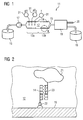
- a channel-like reaction space 12 provided, in which in a first section 13a and in a second section 13b each designed as oligonucleotides Interaction partner 14 with different Structure are immobilized on a reactor inner wall 15.
- the overall structure of the microreactor 11 can still be see how it works. This is used for a so-called "Upstream processing" used as follows. From a storage container 16, a reaction liquid is removed and by means of a pump 17 of the reaction chamber 12, which after Plug-flow principle works, fed. Crossing out the reaction liquid first the first section 13a, in which a first catalyst is used and then section 13b where the reaction is supported by another catalyst. After that leaves the sample liquid enters the reaction space and enters an analytical module 18, not shown. Here you can Data on the reaction product are collected, too optimization of the process to be examined can be. After the analysis, the reaction liquid arrives in a waste container 19, or possible reaction products can another via an interface 20 Use are fed.
- FIG. 2 shows the mode of action of the connection of a catalyst particle 21 to the inner wall 15 of the reactor.
- the interaction partner 14, which consists of an oligonucleotide (i.e. DNA, RNA or PNA) is with the help well-known coupling chemistry 22 on the inner wall of the reactor 15 immobilized.
- the catalyst particle 21 has one not shown on the structure of a certain reaction is suitable to influence. Furthermore, this is Setup with a coupling partner 23 in the form of a with the Interaction partner 14 corresponding oligonucleotides equipped so that by the two oligonucleotides a Connection of the catalyst particle 21 to the inner wall of the reactor 15 can be done.
- the catalyst particle 21 can be a cell, for example be due to their function in a biochemical reaction is involved.
- the binding of an oligonucleotide as a coupling partner to a cell is easily possible. However, such a connection can also be made using a suitable one Coupling chemistry (already mentioned) to an inorganic one Substance.
- the coupling partner 23 itself part of a longer one Nucleotide chain, which also functions of the catalyst takes over. In this embodiment however, the coupling partner 23 itself is not effective involved as a catalyst, since this with the interaction partner 14 is hybridized.
- Figure 3 shows a partial section through a possible structure of a microreactor in which an array of reaction spaces 12 is provided. This is through structuring the surface several substrates 24 and then connecting them Substrates are formed, for example, by bonding. hereby arise in the joints between the individual substrates channel-like reaction spaces.
- FIG an array of reaction spaces 12 are shown in FIG an array of reaction spaces 12. These will formed by a bundle of glass tubes 25, which on their Ends are cast in plastic carrier 26. How schematic shown, the plastic carrier 26 are suitable of connectors 27, which are part of a not shown Reactor are to be included. In these connectors can have inlets 28 and outlets 29 for the reaction fluid be provided. You can also use connecting channels 30 an interconnection of individual glass tubes 25 reach a single reaction space. A is shown serial connection of three glass tubes; is also conceivable a parallel connection, if this is one to be achieved Reaction is beneficial.
- FIGS. 1 and 3 also show how the reaction spaces 12 can be equipped with a sensor system for monitoring the reaction taking place.
- 1 shows sensors designed as micro probes 31, which, as indicated, are provided for measuring the pH value, the oxygen content (pO 2 ) and the temperature (T).
- further micro probes for measuring the values mentioned can be provided in the further course of the reaction space, for example in section 13b (not shown).
- FIG. 3 also shows an electrode 32 for measuring the conductivity of the reaction fluid.
- this can be produced by means of metallic coatings which lie in the parting lines between the substrates and are provided with a contact 33 on the outside.
Landscapes
- Chemical & Material Sciences (AREA)
- Organic Chemistry (AREA)
- Chemical Kinetics & Catalysis (AREA)
- Health & Medical Sciences (AREA)
- Life Sciences & Earth Sciences (AREA)
- Biochemistry (AREA)
- General Chemical & Material Sciences (AREA)
- Medicinal Chemistry (AREA)
- Molecular Biology (AREA)
- Apparatus Associated With Microorganisms And Enzymes (AREA)
- Physical Or Chemical Processes And Apparatus (AREA)
Abstract
Description
- Figur 1
- den schematischen Aufbau eines Ausführungsbeispiels des erfindungsgemäßen Mikroreaktors,
- Figur 2
- das Detail X gemäß Figur 1,
- Figur 3
- einen Ausschnitt eines geschnitten dargestellten Ausführungsbeispiels eines Reaktionsraumes des erfindungsgemäßen Reaktors und
- Figur 4
- den schematischen Längsschnitt eines Arrays von Reaktionsräumen gemäß einem anderen Ausführungsbeispiel des erfindungsgemäßen Reaktors.
Claims (9)
- Mikroreaktor (11) mit einem Reaktionsraum (12) für ein mindestens ein Reaktionsedukt enthaltendes Fluid,
dadurch gekennzeichnet, dass Katalysatorpartikel (21) für ein angestrebtes Reaktionsprodukt vorgesehen sind, wobei jeder Katalysatorpartikel mit einem Ankopplungspartner (23) an Wechselwirkungspartner (14) gebunden ist, welche ihrerseits im Innern des Reaktionsraumes (12) immobilisiert sind. - Mikroreaktor nach Anspruch 1,
dadurch gekennzeichnet, dass die Ankopplungspartner (23) und die Wechselwirkungspartner (14) als komplementäre Oligonukleotide ausgeführt sind. - Mikroreaktor nach einem der vorangehenden Ansprüche,
dadurch gekennzeichnet, dass dieser als Plug-Flow-Reaktor ausgeführt ist. - Mikroreator nach Anspruch 3,
dadurch gekennzeichnet, dass in Flussrichtung des Fluides gesehen hintereinander verschiedenartige Katalysatorpartikel (21) mit verschiedenartigen Ankopplungspartnern (23) versehen sind und die Ankopplungspartner (23) an jeweils spezifisch auf die Ankopplungspartner (23) abgestimmte Wechselwirkungspartner gebunden sind. - Mikroreaktor nach einem der vorangehenden Ansprüche,
dadurch gekennzeichnet, dass eine Vielzahl von Reaktionsräumen (12) als Array in dem Mikroreaktor angeordnet sind. - Mikroreaktor nach Anspruch 5,
dadurch gekennzeichnet, dass zumindest ein Teil der Reaktionsräume (12) untereinander fluidisch verbunden ist. - Mikroreaktor nach einem der vorangehenden Ansprüche,
dadurch gekennzeichnet, dass mindestens ein Sensor (31,32) zur Überwachung der angestrebten Reaktion dem Mikroreaktor zugeordnet ist. - Katalysatorpartikel mit einem eine Reaktion beeinflussenden Aufbau,
dadurch gekennzeichnet, dass dieser Aufbau mit einem Ankopplungspartner (23) zur Anbindung des Katalysatorpartikels an einen ortsgebundenen Wechselwirkungspartner versehen ist. - Katalysatorpartikel nach Anspruch 8,
dadurch gekennzeichnet, dass der Ankopplungspartner (23) aus einem Oligonukleotid gebildet ist.
Applications Claiming Priority (2)
| Application Number | Priority Date | Filing Date | Title |
|---|---|---|---|
| DE10241093 | 2002-09-02 | ||
| DE10241093A DE10241093A1 (de) | 2002-09-02 | 2002-09-02 | Mikroreaktor |
Publications (2)
| Publication Number | Publication Date |
|---|---|
| EP1393799A2 true EP1393799A2 (de) | 2004-03-03 |
| EP1393799A3 EP1393799A3 (de) | 2004-10-20 |
Family
ID=31197612
Family Applications (1)
| Application Number | Title | Priority Date | Filing Date |
|---|---|---|---|
| EP03090234A Withdrawn EP1393799A3 (de) | 2002-09-02 | 2003-07-25 | Mikroreaktor |
Country Status (3)
| Country | Link |
|---|---|
| US (1) | US20050100484A1 (de) |
| EP (1) | EP1393799A3 (de) |
| DE (1) | DE10241093A1 (de) |
Family Cites Families (14)
| Publication number | Priority date | Publication date | Assignee | Title |
|---|---|---|---|---|
| US5599668A (en) * | 1994-09-22 | 1997-02-04 | Abbott Laboratories | Light scattering optical waveguide method for detecting specific binding events |
| US5585069A (en) * | 1994-11-10 | 1996-12-17 | David Sarnoff Research Center, Inc. | Partitioned microelectronic and fluidic device array for clinical diagnostics and chemical synthesis |
| US6143247A (en) * | 1996-12-20 | 2000-11-07 | Gamera Bioscience Inc. | Affinity binding-based system for detecting particulates in a fluid |
| US5856174A (en) * | 1995-06-29 | 1999-01-05 | Affymetrix, Inc. | Integrated nucleic acid diagnostic device |
| US6699667B2 (en) * | 1997-05-14 | 2004-03-02 | Keensense, Inc. | Molecular wire injection sensors |
| JP3654481B2 (ja) * | 1997-06-05 | 2005-06-02 | 独立行政法人理化学研究所 | 生化学反応用マイクロリアクタ |
| DE19841993B4 (de) * | 1998-09-04 | 2005-02-17 | P21 - Power For The 21St Century Gmbh | Mikrostruktur-Reaktor |
| DE19902391A1 (de) * | 1999-01-22 | 2000-07-27 | Christof Niemeyer | Verfahren zur reversiblen, ortsspezifischen, hocheffizienten und gleichzeitigen Immobilisierung verschiedenartiger (biologischer) Makromoleküle auf Festphasen |
| US6749814B1 (en) * | 1999-03-03 | 2004-06-15 | Symyx Technologies, Inc. | Chemical processing microsystems comprising parallel flow microreactors and methods for using same |
| EP1259324A2 (de) * | 2000-02-18 | 2002-11-27 | Aclara BioSciences, Inc. | Mehrstellige reaktionsvorrichtung und zugehöriges verfahren |
| DE10058394C1 (de) * | 2000-11-24 | 2002-07-11 | Siemens Ag | Verfahren für die biochemische Analytik und zugehörige Anordnung |
| AU2002231189A1 (en) * | 2000-12-22 | 2002-07-08 | Burstein Technologies, Inc. | Optical bio-discs and methods relating thereto |
| WO2002061112A2 (en) * | 2001-01-29 | 2002-08-08 | The University Of Tennessee Research Corporation | Methods for detection of incorporation of a nucleotide onto a nucleic acid primer |
| US6919046B2 (en) * | 2001-06-07 | 2005-07-19 | Nanostream, Inc. | Microfluidic analytical devices and methods |
-
2002
- 2002-09-02 DE DE10241093A patent/DE10241093A1/de not_active Ceased
-
2003
- 2003-07-25 EP EP03090234A patent/EP1393799A3/de not_active Withdrawn
- 2003-09-02 US US10/651,968 patent/US20050100484A1/en not_active Abandoned
Also Published As
| Publication number | Publication date |
|---|---|
| DE10241093A1 (de) | 2004-03-18 |
| US20050100484A1 (en) | 2005-05-12 |
| EP1393799A3 (de) | 2004-10-20 |
Similar Documents
| Publication | Publication Date | Title |
|---|---|---|
| EP2809803B1 (de) | Gemultiplexte digital pcr | |
| DE69802587T2 (de) | Integrierte mikrokeramische chemische Anlage | |
| DE69505986T2 (de) | Vorrichtung zum chemischen mischen und reagieren | |
| DE60018733T2 (de) | Vorrichtung und verfahren zur probenanalyse | |
| EP1198294A1 (de) | Mikrofluidischer reaktionsträger mit drei strömungsebenen und transparenter deckschicht | |
| DE102009035270A1 (de) | Ein Einweg-Multiplex-Polymerase-Kettenreaktions(PCR)-Chip und Gerät | |
| EP1075326B1 (de) | Vorrichtung für den transport von flüssigkeiten entlang vorgegebener leitwege | |
| WO2007147712A1 (de) | Verfahren zur analyse von amplifizierten nukleinsäuren | |
| EP1303353B1 (de) | Verfahren und vorrichtung zum analysieren von chemischen oder biologischen proben | |
| EP1393799A2 (de) | Mikroreaktor | |
| WO2003046216A1 (de) | Nanostruktur insbesondere zur analyse von einzelmolekülen | |
| WO2002002225A9 (de) | Einzelmolekül-sequenzierungsverfahren | |
| DE10224339A1 (de) | Verfahren zur hochparallelen Nukleinsäuresequenzierung | |
| DE102008021364A1 (de) | Verfahren zum Einbringen von Trockenreagenzien in eine Analyseeinheit und Kit | |
| WO2014060998A1 (de) | Integriertes mikrofluidisches bauteil zur anreicherung und extraktion biologischer zellbestandteile | |
| DE102006027675A1 (de) | Verfahren zur Bestimmung der Konzentration von Nukleinsäuren | |
| DE29923907U1 (de) | Miniaturisierter Objektträger zur Durchführung einer Vielzahl von Testreihen im Submikroliterbereich | |
| DE19919607A1 (de) | Verfahren und Vorrichtung zur parallelen Herstellung von wenigstens 4n Oligonukleotiden | |
| EP3927842B1 (de) | Vorrichtung zur untersuchung einer biologischen probe | |
| EP1234056B1 (de) | Dynamische bestimmung von analyten durch arrays auf inneren oberflächen | |
| DE102008021365A1 (de) | Verfahren zum Einbringen von Reagenzien in Mikrokanäle einer Analyseeinheit | |
| AT503116B1 (de) | Mikroreaktor | |
| WO2025252784A1 (de) | Verfahren, primer-set und kit zum gleichzeitigen amplifizieren von einer mehr-zahl von ziel-nukleinsäuresequenzen in einer probe | |
| EP1440313A2 (de) | Arrays mit hairpin-strukturen | |
| DE102014207184A1 (de) | Verfahren zum Herstellen einer Elektrodenanordnung für eine Sequenziervorrichtung |
Legal Events
| Date | Code | Title | Description |
|---|---|---|---|
| PUAI | Public reference made under article 153(3) epc to a published international application that has entered the european phase |
Free format text: ORIGINAL CODE: 0009012 |
|
| AK | Designated contracting states |
Kind code of ref document: A2 Designated state(s): AT BE BG CH CY CZ DE DK EE ES FI FR GB GR HU IE IT LI LU MC NL PT RO SE SI SK TR |
|
| AX | Request for extension of the european patent |
Extension state: AL LT LV MK |
|
| PUAL | Search report despatched |
Free format text: ORIGINAL CODE: 0009013 |
|
| AK | Designated contracting states |
Kind code of ref document: A3 Designated state(s): AT BE BG CH CY CZ DE DK EE ES FI FR GB GR HU IE IT LI LU MC NL PT RO SE SI SK TR |
|
| AX | Request for extension of the european patent |
Extension state: AL LT LV MK |
|
| AKX | Designation fees paid | ||
| REG | Reference to a national code |
Ref country code: DE Ref legal event code: 8566 |
|
| STAA | Information on the status of an ep patent application or granted ep patent |
Free format text: STATUS: THE APPLICATION IS DEEMED TO BE WITHDRAWN |
|
| 18D | Application deemed to be withdrawn |
Effective date: 20050421 |