EP1391448A1 - Optisch aktive Diamine und deren Anwendung in katalytischen Prozessen - Google Patents
Optisch aktive Diamine und deren Anwendung in katalytischen Prozessen Download PDFInfo
- Publication number
- EP1391448A1 EP1391448A1 EP03018220A EP03018220A EP1391448A1 EP 1391448 A1 EP1391448 A1 EP 1391448A1 EP 03018220 A EP03018220 A EP 03018220A EP 03018220 A EP03018220 A EP 03018220A EP 1391448 A1 EP1391448 A1 EP 1391448A1
- Authority
- EP
- European Patent Office
- Prior art keywords
- amino
- bis
- transition metal
- ethyl
- metal complexes
- Prior art date
- Legal status (The legal status is an assumption and is not a legal conclusion. Google has not performed a legal analysis and makes no representation as to the accuracy of the status listed.)
- Withdrawn
Links
- 238000000034 method Methods 0.000 title claims description 16
- 150000004985 diamines Chemical class 0.000 title abstract description 6
- 230000003197 catalytic effect Effects 0.000 title 1
- 229910052723 transition metal Inorganic materials 0.000 claims abstract description 26
- 150000003624 transition metals Chemical class 0.000 claims abstract description 26
- 239000003054 catalyst Substances 0.000 claims abstract description 16
- 125000003118 aryl group Chemical group 0.000 claims abstract description 14
- 150000002576 ketones Chemical class 0.000 claims abstract description 14
- 239000005977 Ethylene Substances 0.000 claims abstract description 9
- 125000003710 aryl alkyl group Chemical group 0.000 claims abstract description 7
- 150000004756 silanes Chemical class 0.000 claims abstract description 7
- 125000000753 cycloalkyl group Chemical group 0.000 claims abstract description 3
- -1 cobalt halides Chemical class 0.000 claims description 36
- 150000001875 compounds Chemical class 0.000 claims description 26
- 125000002924 primary amino group Chemical group [H]N([H])* 0.000 claims description 24
- 125000000217 alkyl group Chemical group 0.000 claims description 19
- 229920001843 polymethylhydrosiloxane Polymers 0.000 claims description 18
- 125000004432 carbon atom Chemical group C* 0.000 claims description 12
- 229910052717 sulfur Inorganic materials 0.000 claims description 12
- 239000003638 chemical reducing agent Substances 0.000 claims description 9
- XDTMQSROBMDMFD-UHFFFAOYSA-N Cyclohexane Chemical compound C1CCCCC1 XDTMQSROBMDMFD-UHFFFAOYSA-N 0.000 claims description 8
- 239000001257 hydrogen Substances 0.000 claims description 8
- 229910052739 hydrogen Inorganic materials 0.000 claims description 8
- 150000003752 zinc compounds Chemical class 0.000 claims description 8
- HCHKCACWOHOZIP-UHFFFAOYSA-N Zinc Chemical compound [Zn] HCHKCACWOHOZIP-UHFFFAOYSA-N 0.000 claims description 7
- 239000011701 zinc Substances 0.000 claims description 7
- 229910052725 zinc Inorganic materials 0.000 claims description 6
- 150000001298 alcohols Chemical class 0.000 claims description 5
- 238000006243 chemical reaction Methods 0.000 claims description 5
- 125000001997 phenyl group Chemical group [H]C1=C([H])C([H])=C(*)C([H])=C1[H] 0.000 claims description 5
- 125000004122 cyclic group Chemical group 0.000 claims description 4
- UOSGBHIGLINCHD-WOJBJXKFSA-N 3-[[(1r,2r)-2-(2-cyanoethylamino)-1,2-diphenylethyl]amino]propanenitrile Chemical compound C1([C@@H](NCCC#N)[C@H](NCCC#N)C=2C=CC=CC=2)=CC=CC=C1 UOSGBHIGLINCHD-WOJBJXKFSA-N 0.000 claims description 3
- PBYSRLAIQZOLHQ-ZYTVHREMSA-N 4-[[(1r,2r)-2-(4-carboxybutan-2-ylamino)-1,2-diphenylethyl]amino]pentanoic acid Chemical compound C1([C@@H](NC(C)CCC(O)=O)[C@H](NC(CCC(O)=O)C)C=2C=CC=CC=2)=CC=CC=C1 PBYSRLAIQZOLHQ-ZYTVHREMSA-N 0.000 claims description 3
- ZAMOUSCENKQFHK-UHFFFAOYSA-N Chlorine atom Chemical compound [Cl] ZAMOUSCENKQFHK-UHFFFAOYSA-N 0.000 claims description 3
- 239000003905 agrochemical Substances 0.000 claims description 3
- 125000003545 alkoxy group Chemical group 0.000 claims description 3
- 239000000460 chlorine Substances 0.000 claims description 3
- 229910052801 chlorine Inorganic materials 0.000 claims description 3
- 239000003814 drug Substances 0.000 claims description 3
- 238000004519 manufacturing process Methods 0.000 claims description 3
- WKBOTKDWSSQWDR-UHFFFAOYSA-N Bromine atom Chemical compound [Br] WKBOTKDWSSQWDR-UHFFFAOYSA-N 0.000 claims description 2
- 229910019142 PO4 Inorganic materials 0.000 claims description 2
- 150000004703 alkoxides Chemical class 0.000 claims description 2
- MDFFNEOEWAXZRQ-UHFFFAOYSA-N aminyl Chemical compound [NH2] MDFFNEOEWAXZRQ-UHFFFAOYSA-N 0.000 claims description 2
- GDTBXPJZTBHREO-UHFFFAOYSA-N bromine Substances BrBr GDTBXPJZTBHREO-UHFFFAOYSA-N 0.000 claims description 2
- 229910052794 bromium Inorganic materials 0.000 claims description 2
- 150000004649 carbonic acid derivatives Chemical class 0.000 claims description 2
- 150000007942 carboxylates Chemical class 0.000 claims description 2
- 150000001868 cobalt Chemical class 0.000 claims description 2
- 229910017052 cobalt Inorganic materials 0.000 claims description 2
- 239000010941 cobalt Substances 0.000 claims description 2
- 150000007973 cyanuric acids Chemical class 0.000 claims description 2
- 239000012948 isocyanate Substances 0.000 claims description 2
- 150000002513 isocyanates Chemical class 0.000 claims description 2
- 150000002823 nitrates Chemical class 0.000 claims description 2
- 235000021317 phosphate Nutrition 0.000 claims description 2
- 150000003013 phosphoric acid derivatives Chemical class 0.000 claims description 2
- 150000003467 sulfuric acid derivatives Chemical class 0.000 claims description 2
- 125000004435 hydrogen atom Chemical class [H]* 0.000 claims 3
- UMOMDAQBQVWUPT-FGZHOGPDSA-N 4-[[(1r,2r)-2-(3-carboxypropylamino)-1,2-diphenylethyl]amino]butanoic acid Chemical compound C1([C@@H](NCCCC(O)=O)[C@H](NCCCC(=O)O)C=2C=CC=CC=2)=CC=CC=C1 UMOMDAQBQVWUPT-FGZHOGPDSA-N 0.000 claims 1
- PNDPGZBMCMUPRI-UHFFFAOYSA-N iodine Chemical compound II PNDPGZBMCMUPRI-UHFFFAOYSA-N 0.000 claims 1
- YXFVVABEGXRONW-UHFFFAOYSA-N Toluene Chemical compound CC1=CC=CC=C1 YXFVVABEGXRONW-UHFFFAOYSA-N 0.000 description 39
- LFQSCWFLJHTTHZ-UHFFFAOYSA-N Ethanol Chemical compound CCO LFQSCWFLJHTTHZ-UHFFFAOYSA-N 0.000 description 17
- 239000003446 ligand Substances 0.000 description 14
- 239000000203 mixture Substances 0.000 description 11
- 239000011541 reaction mixture Substances 0.000 description 9
- XKRFYHLGVUSROY-UHFFFAOYSA-N Argon Chemical compound [Ar] XKRFYHLGVUSROY-UHFFFAOYSA-N 0.000 description 8
- 239000012074 organic phase Substances 0.000 description 8
- 238000004587 chromatography analysis Methods 0.000 description 7
- 239000007789 gas Substances 0.000 description 7
- 238000002360 preparation method Methods 0.000 description 6
- HQWPLXHWEZZGKY-UHFFFAOYSA-N diethylzinc Chemical compound CC[Zn]CC HQWPLXHWEZZGKY-UHFFFAOYSA-N 0.000 description 5
- RTZKZFJDLAIYFH-UHFFFAOYSA-N Diethyl ether Chemical compound CCOCC RTZKZFJDLAIYFH-UHFFFAOYSA-N 0.000 description 4
- 238000004458 analytical method Methods 0.000 description 4
- 229910052786 argon Inorganic materials 0.000 description 4
- 239000007795 chemical reaction product Substances 0.000 description 4
- 238000001035 drying Methods 0.000 description 4
- 238000004817 gas chromatography Methods 0.000 description 4
- 239000002904 solvent Substances 0.000 description 4
- 238000003756 stirring Methods 0.000 description 4
- NLHHRLWOUZZQLW-UHFFFAOYSA-N Acrylonitrile Chemical compound C=CC#N NLHHRLWOUZZQLW-UHFFFAOYSA-N 0.000 description 3
- XEKOWRVHYACXOJ-UHFFFAOYSA-N Ethyl acetate Chemical compound CCOC(C)=O XEKOWRVHYACXOJ-UHFFFAOYSA-N 0.000 description 3
- UFHFLCQGNIYNRP-UHFFFAOYSA-N Hydrogen Chemical compound [H][H] UFHFLCQGNIYNRP-UHFFFAOYSA-N 0.000 description 3
- WHXSMMKQMYFTQS-UHFFFAOYSA-N Lithium Chemical compound [Li] WHXSMMKQMYFTQS-UHFFFAOYSA-N 0.000 description 3
- OKKJLVBELUTLKV-UHFFFAOYSA-N Methanol Chemical compound OC OKKJLVBELUTLKV-UHFFFAOYSA-N 0.000 description 3
- IMNFDUFMRHMDMM-UHFFFAOYSA-N N-Heptane Chemical compound CCCCCCC IMNFDUFMRHMDMM-UHFFFAOYSA-N 0.000 description 3
- 239000012230 colorless oil Substances 0.000 description 3
- 150000002431 hydrogen Chemical class 0.000 description 3
- 229910052751 metal Inorganic materials 0.000 description 3
- 239000002184 metal Substances 0.000 description 3
- IJGRMHOSHXDMSA-UHFFFAOYSA-N nitrogen Substances N#N IJGRMHOSHXDMSA-UHFFFAOYSA-N 0.000 description 3
- KRIOVPPHQSLHCZ-UHFFFAOYSA-N propiophenone Chemical compound CCC(=O)C1=CC=CC=C1 KRIOVPPHQSLHCZ-UHFFFAOYSA-N 0.000 description 3
- 150000003254 radicals Chemical class 0.000 description 3
- 125000004400 (C1-C12) alkyl group Chemical group 0.000 description 2
- 125000004209 (C1-C8) alkyl group Chemical group 0.000 description 2
- DREPONDJUKIQLX-UHFFFAOYSA-N 1-[ethenyl(ethoxy)phosphoryl]oxyethane Chemical compound CCOP(=O)(C=C)OCC DREPONDJUKIQLX-UHFFFAOYSA-N 0.000 description 2
- YXWWHNCQZBVZPV-UHFFFAOYSA-N 2'-methylacetophenone Chemical compound CC(=O)C1=CC=CC=C1C YXWWHNCQZBVZPV-UHFFFAOYSA-N 0.000 description 2
- BSMGLVDZZMBWQB-UHFFFAOYSA-N 2-methyl-1-phenylpropan-1-one Chemical compound CC(C)C(=O)C1=CC=CC=C1 BSMGLVDZZMBWQB-UHFFFAOYSA-N 0.000 description 2
- 125000003542 3-methylbutan-2-yl group Chemical group [H]C([H])([H])C([H])(*)C([H])(C([H])([H])[H])C([H])([H])[H] 0.000 description 2
- KWOLFJPFCHCOCG-UHFFFAOYSA-N Acetophenone Chemical compound CC(=O)C1=CC=CC=C1 KWOLFJPFCHCOCG-UHFFFAOYSA-N 0.000 description 2
- ZOXJGFHDIHLPTG-UHFFFAOYSA-N Boron Chemical compound [B] ZOXJGFHDIHLPTG-UHFFFAOYSA-N 0.000 description 2
- XTHFKEDIFFGKHM-UHFFFAOYSA-N Dimethoxyethane Chemical compound COCCOC XTHFKEDIFFGKHM-UHFFFAOYSA-N 0.000 description 2
- JIGUQPWFLRLWPJ-UHFFFAOYSA-N Ethyl acrylate Chemical compound CCOC(=O)C=C JIGUQPWFLRLWPJ-UHFFFAOYSA-N 0.000 description 2
- BZLVMXJERCGZMT-UHFFFAOYSA-N Methyl tert-butyl ether Chemical compound COC(C)(C)C BZLVMXJERCGZMT-UHFFFAOYSA-N 0.000 description 2
- ZLMJMSJWJFRBEC-UHFFFAOYSA-N Potassium Chemical compound [K] ZLMJMSJWJFRBEC-UHFFFAOYSA-N 0.000 description 2
- KEAYESYHFKHZAL-UHFFFAOYSA-N Sodium Chemical compound [Na] KEAYESYHFKHZAL-UHFFFAOYSA-N 0.000 description 2
- NINIDFKCEFEMDL-UHFFFAOYSA-N Sulfur Chemical group [S] NINIDFKCEFEMDL-UHFFFAOYSA-N 0.000 description 2
- WYURNTSHIVDZCO-UHFFFAOYSA-N Tetrahydrofuran Chemical compound C1CCOC1 WYURNTSHIVDZCO-UHFFFAOYSA-N 0.000 description 2
- 229910052784 alkaline earth metal Inorganic materials 0.000 description 2
- 229910052782 aluminium Inorganic materials 0.000 description 2
- XAGFODPZIPBFFR-UHFFFAOYSA-N aluminium Chemical compound [Al] XAGFODPZIPBFFR-UHFFFAOYSA-N 0.000 description 2
- QVGXLLKOCUKJST-UHFFFAOYSA-N atomic oxygen Chemical group [O] QVGXLLKOCUKJST-UHFFFAOYSA-N 0.000 description 2
- 229910052799 carbon Inorganic materials 0.000 description 2
- 125000005842 heteroatom Chemical group 0.000 description 2
- 229910052744 lithium Inorganic materials 0.000 description 2
- 235000019988 mead Nutrition 0.000 description 2
- VLKZOEOYAKHREP-UHFFFAOYSA-N n-Hexane Chemical compound CCCCCC VLKZOEOYAKHREP-UHFFFAOYSA-N 0.000 description 2
- 229910052757 nitrogen Inorganic materials 0.000 description 2
- 230000003287 optical effect Effects 0.000 description 2
- 239000001301 oxygen Chemical group 0.000 description 2
- 229910052760 oxygen Chemical group 0.000 description 2
- PNJWIWWMYCMZRO-UHFFFAOYSA-N pent‐4‐en‐2‐one Natural products CC(=O)CC=C PNJWIWWMYCMZRO-UHFFFAOYSA-N 0.000 description 2
- LIGACIXOYTUXAW-UHFFFAOYSA-N phenacyl bromide Chemical compound BrCC(=O)C1=CC=CC=C1 LIGACIXOYTUXAW-UHFFFAOYSA-N 0.000 description 2
- 239000000047 product Substances 0.000 description 2
- 238000010992 reflux Methods 0.000 description 2
- 125000002914 sec-butyl group Chemical group [H]C([H])([H])C([H])([H])C([H])(*)C([H])([H])[H] 0.000 description 2
- 239000011734 sodium Substances 0.000 description 2
- 239000007858 starting material Substances 0.000 description 2
- 239000011593 sulfur Chemical group 0.000 description 2
- CYRMSUTZVYGINF-UHFFFAOYSA-N trichlorofluoromethane Chemical compound FC(Cl)(Cl)Cl CYRMSUTZVYGINF-UHFFFAOYSA-N 0.000 description 2
- 125000004642 (C1-C12) alkoxy group Chemical group 0.000 description 1
- 125000004178 (C1-C4) alkyl group Chemical group 0.000 description 1
- 0 *CCNC1CCCCC1 Chemical compound *CCNC1CCCCC1 0.000 description 1
- 125000005919 1,2,2-trimethylpropyl group Chemical group 0.000 description 1
- 125000005918 1,2-dimethylbutyl group Chemical group 0.000 description 1
- RYHBNJHYFVUHQT-UHFFFAOYSA-N 1,4-Dioxane Chemical compound C1COCCO1 RYHBNJHYFVUHQT-UHFFFAOYSA-N 0.000 description 1
- 125000006218 1-ethylbutyl group Chemical group [H]C([H])([H])C([H])([H])C([H])([H])C([H])(*)C([H])([H])C([H])([H])[H] 0.000 description 1
- 125000006176 2-ethylbutyl group Chemical group [H]C([H])([H])C([H])([H])C([H])(C([H])([H])*)C([H])([H])C([H])([H])[H] 0.000 description 1
- 125000004493 2-methylbut-1-yl group Chemical group CC(C*)CC 0.000 description 1
- 125000005916 2-methylpentyl group Chemical group 0.000 description 1
- 125000004105 2-pyridyl group Chemical group N1=C([*])C([H])=C([H])C([H])=C1[H] 0.000 description 1
- UOSGBHIGLINCHD-PMACEKPBSA-N 3-[[(1s,2s)-2-(2-cyanoethylamino)-1,2-diphenylethyl]amino]propanenitrile Chemical compound C1([C@H](NCCC#N)[C@@H](NCCC#N)C=2C=CC=CC=2)=CC=CC=C1 UOSGBHIGLINCHD-PMACEKPBSA-N 0.000 description 1
- 125000004179 3-chlorophenyl group Chemical group [H]C1=C([H])C(*)=C([H])C(Cl)=C1[H] 0.000 description 1
- 125000004180 3-fluorophenyl group Chemical group [H]C1=C([H])C(*)=C([H])C(F)=C1[H] 0.000 description 1
- 125000005917 3-methylpentyl group Chemical group 0.000 description 1
- 125000003349 3-pyridyl group Chemical group N1=C([H])C([*])=C([H])C([H])=C1[H] 0.000 description 1
- PBYSRLAIQZOLHQ-OSZFHHHMSA-N 4-[[(1s,2s)-2-(4-carboxybutan-2-ylamino)-1,2-diphenylethyl]amino]pentanoic acid Chemical compound C1([C@H](NC(C)CCC(O)=O)[C@@H](NC(CCC(O)=O)C)C=2C=CC=CC=2)=CC=CC=C1 PBYSRLAIQZOLHQ-OSZFHHHMSA-N 0.000 description 1
- 125000000339 4-pyridyl group Chemical group N1=C([H])C([H])=C([*])C([H])=C1[H] 0.000 description 1
- ZCYVEMRRCGMTRW-UHFFFAOYSA-N 7553-56-2 Chemical compound [I] ZCYVEMRRCGMTRW-UHFFFAOYSA-N 0.000 description 1
- ZAFNJMIOTHYJRJ-UHFFFAOYSA-N Diisopropyl ether Chemical compound CC(C)OC(C)C ZAFNJMIOTHYJRJ-UHFFFAOYSA-N 0.000 description 1
- PXGOKWXKJXAPGV-UHFFFAOYSA-N Fluorine Chemical compound FF PXGOKWXKJXAPGV-UHFFFAOYSA-N 0.000 description 1
- DGAQECJNVWCQMB-PUAWFVPOSA-M Ilexoside XXIX Chemical compound C[C@@H]1CC[C@@]2(CC[C@@]3(C(=CC[C@H]4[C@]3(CC[C@@H]5[C@@]4(CC[C@@H](C5(C)C)OS(=O)(=O)[O-])C)C)[C@@H]2[C@]1(C)O)C)C(=O)O[C@H]6[C@@H]([C@H]([C@@H]([C@H](O6)CO)O)O)O.[Na+] DGAQECJNVWCQMB-PUAWFVPOSA-M 0.000 description 1
- 229910010082 LiAlH Inorganic materials 0.000 description 1
- CTQNGGLPUBDAKN-UHFFFAOYSA-N O-Xylene Chemical compound CC1=CC=CC=C1C CTQNGGLPUBDAKN-UHFFFAOYSA-N 0.000 description 1
- VYPSYNLAJGMNEJ-UHFFFAOYSA-N Silicium dioxide Chemical compound O=[Si]=O VYPSYNLAJGMNEJ-UHFFFAOYSA-N 0.000 description 1
- RTAQQCXQSZGOHL-UHFFFAOYSA-N Titanium Chemical compound [Ti] RTAQQCXQSZGOHL-UHFFFAOYSA-N 0.000 description 1
- GTIVDIGFCBZLEE-UHFFFAOYSA-M [Cl-].CC[Zn+] Chemical compound [Cl-].CC[Zn+] GTIVDIGFCBZLEE-UHFFFAOYSA-M 0.000 description 1
- VFHDCDDYMMQCBF-UHFFFAOYSA-M [Cl-].[Zn+]C1=CC=CC=C1 Chemical compound [Cl-].[Zn+]C1=CC=CC=C1 VFHDCDDYMMQCBF-UHFFFAOYSA-M 0.000 description 1
- 239000004480 active ingredient Substances 0.000 description 1
- 125000005073 adamantyl group Chemical group C12(CC3CC(CC(C1)C3)C2)* 0.000 description 1
- 150000001338 aliphatic hydrocarbons Chemical class 0.000 description 1
- 239000003513 alkali Substances 0.000 description 1
- 150000001342 alkaline earth metals Chemical class 0.000 description 1
- 239000004411 aluminium Substances 0.000 description 1
- 150000001412 amines Chemical class 0.000 description 1
- 125000002178 anthracenyl group Chemical group C1(=CC=CC2=CC3=CC=CC=C3C=C12)* 0.000 description 1
- 235000019568 aromas Nutrition 0.000 description 1
- 150000004945 aromatic hydrocarbons Chemical class 0.000 description 1
- 150000005840 aryl radicals Chemical class 0.000 description 1
- 125000000499 benzofuranyl group Chemical group O1C(=CC2=C1C=CC=C2)* 0.000 description 1
- 125000001797 benzyl group Chemical group [H]C1=C([H])C([H])=C(C([H])=C1[H])C([H])([H])* 0.000 description 1
- 229910052796 boron Inorganic materials 0.000 description 1
- FFSAXUULYPJSKH-UHFFFAOYSA-N butyrophenone Chemical compound CCCC(=O)C1=CC=CC=C1 FFSAXUULYPJSKH-UHFFFAOYSA-N 0.000 description 1
- 150000004696 coordination complex Chemical class 0.000 description 1
- 239000012043 crude product Substances 0.000 description 1
- YMHQVDAATAEZLO-UHFFFAOYSA-N cyclohexane-1,1-diamine Chemical compound NC1(N)CCCCC1 YMHQVDAATAEZLO-UHFFFAOYSA-N 0.000 description 1
- 125000000113 cyclohexyl group Chemical group [H]C1([H])C([H])([H])C([H])([H])C([H])(*)C([H])([H])C1([H])[H] 0.000 description 1
- 125000001511 cyclopentyl group Chemical group [H]C1([H])C([H])([H])C([H])([H])C([H])(*)C1([H])[H] 0.000 description 1
- AXAZMDOAUQTMOW-UHFFFAOYSA-N dimethylzinc Chemical compound C[Zn]C AXAZMDOAUQTMOW-UHFFFAOYSA-N 0.000 description 1
- MKRVHLWAVKJBFN-UHFFFAOYSA-N diphenylzinc Chemical compound C=1C=CC=CC=1[Zn]C1=CC=CC=C1 MKRVHLWAVKJBFN-UHFFFAOYSA-N 0.000 description 1
- 238000010828 elution Methods 0.000 description 1
- 150000002170 ethers Chemical class 0.000 description 1
- 125000001495 ethyl group Chemical group [H]C([H])([H])C([H])([H])* 0.000 description 1
- 239000012847 fine chemical Substances 0.000 description 1
- 125000003983 fluorenyl group Chemical group C1(=CC=CC=2C3=CC=CC=C3CC12)* 0.000 description 1
- 229910052731 fluorine Inorganic materials 0.000 description 1
- 239000011737 fluorine Substances 0.000 description 1
- 239000003205 fragrance Substances 0.000 description 1
- 125000001072 heteroaryl group Chemical group 0.000 description 1
- 150000004678 hydrides Chemical class 0.000 description 1
- 230000006698 induction Effects 0.000 description 1
- 239000013067 intermediate product Substances 0.000 description 1
- 239000011630 iodine Substances 0.000 description 1
- 229910052740 iodine Inorganic materials 0.000 description 1
- 125000004491 isohexyl group Chemical group C(CCC(C)C)* 0.000 description 1
- 125000001972 isopentyl group Chemical group [H]C([H])([H])C([H])(C([H])([H])[H])C([H])([H])C([H])([H])* 0.000 description 1
- 125000001449 isopropyl group Chemical group [H]C([H])([H])C([H])(*)C([H])([H])[H] 0.000 description 1
- 229910000103 lithium hydride Inorganic materials 0.000 description 1
- 125000000040 m-tolyl group Chemical group [H]C1=C([H])C(*)=C([H])C(=C1[H])C([H])([H])[H] 0.000 description 1
- 239000000463 material Substances 0.000 description 1
- AUHZEENZYGFFBQ-UHFFFAOYSA-N mesitylene Substances CC1=CC(C)=CC(C)=C1 AUHZEENZYGFFBQ-UHFFFAOYSA-N 0.000 description 1
- 125000001827 mesitylenyl group Chemical group [H]C1=C(C(*)=C(C([H])=C1C([H])([H])[H])C([H])([H])[H])C([H])([H])[H] 0.000 description 1
- 229910052987 metal hydride Inorganic materials 0.000 description 1
- 150000004681 metal hydrides Chemical class 0.000 description 1
- 125000001160 methoxycarbonyl group Chemical group [H]C([H])([H])OC(*)=O 0.000 description 1
- 125000002496 methyl group Chemical group [H]C([H])([H])* 0.000 description 1
- 125000004108 n-butyl group Chemical group [H]C([H])([H])C([H])([H])C([H])([H])C([H])([H])* 0.000 description 1
- 125000003136 n-heptyl group Chemical group [H]C([H])([H])C([H])([H])C([H])([H])C([H])([H])C([H])([H])C([H])([H])C([H])([H])* 0.000 description 1
- 125000001280 n-hexyl group Chemical group C(CCCCC)* 0.000 description 1
- 125000000740 n-pentyl group Chemical group [H]C([H])([H])C([H])([H])C([H])([H])C([H])([H])C([H])([H])* 0.000 description 1
- 125000004123 n-propyl group Chemical group [H]C([H])([H])C([H])([H])C([H])([H])* 0.000 description 1
- 125000001624 naphthyl group Chemical group 0.000 description 1
- 125000001971 neopentyl group Chemical group [H]C([*])([H])C(C([H])([H])[H])(C([H])([H])[H])C([H])([H])[H] 0.000 description 1
- QJGQUHMNIGDVPM-UHFFFAOYSA-N nitrogen group Chemical group [N] QJGQUHMNIGDVPM-UHFFFAOYSA-N 0.000 description 1
- 239000003921 oil Substances 0.000 description 1
- 125000003538 pentan-3-yl group Chemical group [H]C([H])([H])C([H])([H])C([H])(*)C([H])([H])C([H])([H])[H] 0.000 description 1
- 239000003208 petroleum Substances 0.000 description 1
- 125000001792 phenanthrenyl group Chemical group C1(=CC=CC=2C3=CC=CC=C3C=CC12)* 0.000 description 1
- 229910052700 potassium Inorganic materials 0.000 description 1
- 239000011591 potassium Substances 0.000 description 1
- 125000004076 pyridyl group Chemical group 0.000 description 1
- 125000002943 quinolinyl group Chemical group N1=C(C=CC2=CC=CC=C12)* 0.000 description 1
- 150000003839 salts Chemical class 0.000 description 1
- 125000003548 sec-pentyl group Chemical group [H]C([H])([H])C([H])([H])C([H])([H])C([H])(*)C([H])([H])[H] 0.000 description 1
- 239000000741 silica gel Substances 0.000 description 1
- 229910002027 silica gel Inorganic materials 0.000 description 1
- 125000004469 siloxy group Chemical group [SiH3]O* 0.000 description 1
- 229910052708 sodium Inorganic materials 0.000 description 1
- 229910000104 sodium hydride Inorganic materials 0.000 description 1
- 239000012312 sodium hydride Substances 0.000 description 1
- 239000007787 solid Substances 0.000 description 1
- 125000001424 substituent group Chemical group 0.000 description 1
- 238000006467 substitution reaction Methods 0.000 description 1
- 125000000999 tert-butyl group Chemical group [H]C([H])([H])C(*)(C([H])([H])[H])C([H])([H])[H] 0.000 description 1
- 125000001973 tert-pentyl group Chemical group [H]C([H])([H])C([H])([H])C(*)(C([H])([H])[H])C([H])([H])[H] 0.000 description 1
- YLQBMQCUIZJEEH-UHFFFAOYSA-N tetrahydrofuran Natural products C=1C=COC=1 YLQBMQCUIZJEEH-UHFFFAOYSA-N 0.000 description 1
- 239000010936 titanium Substances 0.000 description 1
- 229910052719 titanium Inorganic materials 0.000 description 1
- 239000008096 xylene Substances 0.000 description 1
- ZULTYUIALNTCSA-UHFFFAOYSA-N zinc hydride Chemical compound [ZnH2] ZULTYUIALNTCSA-UHFFFAOYSA-N 0.000 description 1
- 229910000051 zinc hydride Inorganic materials 0.000 description 1
- HEPBQSXQJMTVFI-UHFFFAOYSA-N zinc;butane Chemical compound [Zn+2].CCC[CH2-].CCC[CH2-] HEPBQSXQJMTVFI-UHFFFAOYSA-N 0.000 description 1
- NMLXKNNXODLJIN-UHFFFAOYSA-M zinc;carbanide;chloride Chemical compound [CH3-].[Zn+]Cl NMLXKNNXODLJIN-UHFFFAOYSA-M 0.000 description 1
Classifications
-
- C—CHEMISTRY; METALLURGY
- C07—ORGANIC CHEMISTRY
- C07C—ACYCLIC OR CARBOCYCLIC COMPOUNDS
- C07C255/00—Carboxylic acid nitriles
- C07C255/01—Carboxylic acid nitriles having cyano groups bound to acyclic carbon atoms
- C07C255/24—Carboxylic acid nitriles having cyano groups bound to acyclic carbon atoms containing cyano groups and singly-bound nitrogen atoms, not being further bound to other hetero atoms, bound to the same saturated acyclic carbon skeleton
-
- B—PERFORMING OPERATIONS; TRANSPORTING
- B01—PHYSICAL OR CHEMICAL PROCESSES OR APPARATUS IN GENERAL
- B01J—CHEMICAL OR PHYSICAL PROCESSES, e.g. CATALYSIS OR COLLOID CHEMISTRY; THEIR RELEVANT APPARATUS
- B01J31/00—Catalysts comprising hydrides, coordination complexes or organic compounds
- B01J31/16—Catalysts comprising hydrides, coordination complexes or organic compounds containing coordination complexes
- B01J31/18—Catalysts comprising hydrides, coordination complexes or organic compounds containing coordination complexes containing nitrogen, phosphorus, arsenic or antimony as complexing atoms, e.g. in pyridine ligands, or in resonance therewith, e.g. in isocyanide ligands C=N-R or as complexed central atoms
- B01J31/1805—Catalysts comprising hydrides, coordination complexes or organic compounds containing coordination complexes containing nitrogen, phosphorus, arsenic or antimony as complexing atoms, e.g. in pyridine ligands, or in resonance therewith, e.g. in isocyanide ligands C=N-R or as complexed central atoms the ligands containing nitrogen
-
- C—CHEMISTRY; METALLURGY
- C07—ORGANIC CHEMISTRY
- C07C—ACYCLIC OR CARBOCYCLIC COMPOUNDS
- C07C229/00—Compounds containing amino and carboxyl groups bound to the same carbon skeleton
- C07C229/02—Compounds containing amino and carboxyl groups bound to the same carbon skeleton having amino and carboxyl groups bound to acyclic carbon atoms of the same carbon skeleton
- C07C229/04—Compounds containing amino and carboxyl groups bound to the same carbon skeleton having amino and carboxyl groups bound to acyclic carbon atoms of the same carbon skeleton the carbon skeleton being acyclic and saturated
- C07C229/06—Compounds containing amino and carboxyl groups bound to the same carbon skeleton having amino and carboxyl groups bound to acyclic carbon atoms of the same carbon skeleton the carbon skeleton being acyclic and saturated having only one amino and one carboxyl group bound to the carbon skeleton
- C07C229/10—Compounds containing amino and carboxyl groups bound to the same carbon skeleton having amino and carboxyl groups bound to acyclic carbon atoms of the same carbon skeleton the carbon skeleton being acyclic and saturated having only one amino and one carboxyl group bound to the carbon skeleton the nitrogen atom of the amino group being further bound to acyclic carbon atoms or to carbon atoms of rings other than six-membered aromatic rings
- C07C229/16—Compounds containing amino and carboxyl groups bound to the same carbon skeleton having amino and carboxyl groups bound to acyclic carbon atoms of the same carbon skeleton the carbon skeleton being acyclic and saturated having only one amino and one carboxyl group bound to the carbon skeleton the nitrogen atom of the amino group being further bound to acyclic carbon atoms or to carbon atoms of rings other than six-membered aromatic rings to carbon atoms of hydrocarbon radicals substituted by amino or carboxyl groups, e.g. ethylenediamine-tetra-acetic acid, iminodiacetic acids
-
- C—CHEMISTRY; METALLURGY
- C07—ORGANIC CHEMISTRY
- C07C—ACYCLIC OR CARBOCYCLIC COMPOUNDS
- C07C229/00—Compounds containing amino and carboxyl groups bound to the same carbon skeleton
- C07C229/76—Metal complexes of amino carboxylic acids
-
- C—CHEMISTRY; METALLURGY
- C07—ORGANIC CHEMISTRY
- C07C—ACYCLIC OR CARBOCYCLIC COMPOUNDS
- C07C237/00—Carboxylic acid amides, the carbon skeleton of the acid part being further substituted by amino groups
- C07C237/02—Carboxylic acid amides, the carbon skeleton of the acid part being further substituted by amino groups having the carbon atoms of the carboxamide groups bound to acyclic carbon atoms of the carbon skeleton
- C07C237/04—Carboxylic acid amides, the carbon skeleton of the acid part being further substituted by amino groups having the carbon atoms of the carboxamide groups bound to acyclic carbon atoms of the carbon skeleton the carbon skeleton being acyclic and saturated
- C07C237/06—Carboxylic acid amides, the carbon skeleton of the acid part being further substituted by amino groups having the carbon atoms of the carboxamide groups bound to acyclic carbon atoms of the carbon skeleton the carbon skeleton being acyclic and saturated having the nitrogen atoms of the carboxamide groups bound to hydrogen atoms or to acyclic carbon atoms
-
- C—CHEMISTRY; METALLURGY
- C07—ORGANIC CHEMISTRY
- C07C—ACYCLIC OR CARBOCYCLIC COMPOUNDS
- C07C29/00—Preparation of compounds having hydroxy or O-metal groups bound to a carbon atom not belonging to a six-membered aromatic ring
- C07C29/132—Preparation of compounds having hydroxy or O-metal groups bound to a carbon atom not belonging to a six-membered aromatic ring by reduction of an oxygen containing functional group
- C07C29/136—Preparation of compounds having hydroxy or O-metal groups bound to a carbon atom not belonging to a six-membered aromatic ring by reduction of an oxygen containing functional group of >C=O containing groups, e.g. —COOH
- C07C29/143—Preparation of compounds having hydroxy or O-metal groups bound to a carbon atom not belonging to a six-membered aromatic ring by reduction of an oxygen containing functional group of >C=O containing groups, e.g. —COOH of ketones
-
- C—CHEMISTRY; METALLURGY
- C07—ORGANIC CHEMISTRY
- C07F—ACYCLIC, CARBOCYCLIC OR HETEROCYCLIC COMPOUNDS CONTAINING ELEMENTS OTHER THAN CARBON, HYDROGEN, HALOGEN, OXYGEN, NITROGEN, SULFUR, SELENIUM OR TELLURIUM
- C07F9/00—Compounds containing elements of Groups 5 or 15 of the Periodic Table
- C07F9/02—Phosphorus compounds
- C07F9/28—Phosphorus compounds with one or more P—C bonds
- C07F9/38—Phosphonic acids [RP(=O)(OH)2]; Thiophosphonic acids ; [RP(=X1)(X2H)2(X1, X2 are each independently O, S or Se)]
- C07F9/40—Esters thereof
- C07F9/4003—Esters thereof the acid moiety containing a substituent or a structure which is considered as characteristic
- C07F9/4006—Esters of acyclic acids which can have further substituents on alkyl
-
- B—PERFORMING OPERATIONS; TRANSPORTING
- B01—PHYSICAL OR CHEMICAL PROCESSES OR APPARATUS IN GENERAL
- B01J—CHEMICAL OR PHYSICAL PROCESSES, e.g. CATALYSIS OR COLLOID CHEMISTRY; THEIR RELEVANT APPARATUS
- B01J2231/00—Catalytic reactions performed with catalysts classified in B01J31/00
- B01J2231/60—Reduction reactions, e.g. hydrogenation
- B01J2231/64—Reductions in general of organic substrates, e.g. hydride reductions or hydrogenations
- B01J2231/641—Hydrogenation of organic substrates, i.e. H2 or H-transfer hydrogenations, e.g. Fischer-Tropsch processes
- B01J2231/643—Hydrogenation of organic substrates, i.e. H2 or H-transfer hydrogenations, e.g. Fischer-Tropsch processes of R2C=O or R2C=NR (R= C, H)
-
- B—PERFORMING OPERATIONS; TRANSPORTING
- B01—PHYSICAL OR CHEMICAL PROCESSES OR APPARATUS IN GENERAL
- B01J—CHEMICAL OR PHYSICAL PROCESSES, e.g. CATALYSIS OR COLLOID CHEMISTRY; THEIR RELEVANT APPARATUS
- B01J2531/00—Additional information regarding catalytic systems classified in B01J31/00
- B01J2531/20—Complexes comprising metals of Group II (IIA or IIB) as the central metal
- B01J2531/26—Zinc
-
- B—PERFORMING OPERATIONS; TRANSPORTING
- B01—PHYSICAL OR CHEMICAL PROCESSES OR APPARATUS IN GENERAL
- B01J—CHEMICAL OR PHYSICAL PROCESSES, e.g. CATALYSIS OR COLLOID CHEMISTRY; THEIR RELEVANT APPARATUS
- B01J2531/00—Additional information regarding catalytic systems classified in B01J31/00
- B01J2531/80—Complexes comprising metals of Group VIII as the central metal
- B01J2531/84—Metals of the iron group
- B01J2531/845—Cobalt
-
- C—CHEMISTRY; METALLURGY
- C07—ORGANIC CHEMISTRY
- C07B—GENERAL METHODS OF ORGANIC CHEMISTRY; APPARATUS THEREFOR
- C07B2200/00—Indexing scheme relating to specific properties of organic compounds
- C07B2200/07—Optical isomers
-
- C—CHEMISTRY; METALLURGY
- C07—ORGANIC CHEMISTRY
- C07C—ACYCLIC OR CARBOCYCLIC COMPOUNDS
- C07C2601/00—Systems containing only non-condensed rings
- C07C2601/12—Systems containing only non-condensed rings with a six-membered ring
- C07C2601/14—The ring being saturated
Definitions
- the invention relates to stereoisomerically enriched diamines containing metal complexes these diamines and their use in a process for asymmetric Reduction of ketones using silanes such as in particular Polymethylhydrosiloxane as a reducing agent.
- the focus is particularly on the development of catalysts, which enable high yields and conversion rates with high stereoselectivities.
- the compounds of formula (I) have different stereoisomers. From the invention are both the pure stereoisomers and any mixtures of Stereoisomers such as racemates.
- Alkyl each independently means a straight-chain, cyclic, branched or unbranched alkyl radical. The same applies to the non-aromatic part of an arylalkyl radical.
- C 1 -C 4 alkyl is, for example, methyl, ethyl, n-propyl, isopropyl, n-butyl, sec-butyl and tert-butyl
- C 1 -C 8 -alkyl is also, for example, n-pentyl , 1-methylbutyl, 2-methylbutyl, 3-methylbutyl, neo-pentyl, 1-ethylpropyl, cyclo-hexyl, cyclo-pentyl, n-hexyl, 1,1-dimethylpropyl, 1,2-dimethylpropyl, 1,2-dimethylpropyl , 1-methylpentyl, 2-methylpentyl, 3-methylpentyl, 4-methylpentyl, 1,1-dimethylbutyl, 1,2-dimethylbutyl, 1,3-dimethylbutyl, 2,2-dimethylbutyl, 2,3-dimethylbutyl, 3.3
- Aryl each independently means a heteroaromatic radical with 4 to 24 carbon atoms in which none, one, two or three carbon atoms per cycle, but at least one carbon atom in the entire molecule, can be substituted by heteroatoms selected from the group consisting of nitrogen, sulfur or oxygen , but preferably for a carbocyclic aromatic radical having 6 to 24 skeletal carbon atoms.
- carbocyclic aromatic radicals with 6 to 24 carbon atoms are phenyl, naphthyl, phenanthrenyl, anthracenyl or fluorenyl, heteroaromatic Residues with 4 to 24 carbon atoms in which none, one, two or three Framework carbon atoms per cycle, but at least one in the entire molecule
- Carbon atom, by heteroatoms, selected from the group nitrogen, Sulfur or oxygen, which may be substituted, are, for example, pyridinyl, Benzofuranyl, dibenzofuran-yl or quinolinyl.
- the carbocyclic aromatic radical or heteroaromatic radical can be substituted with up to five identical or different substituents per cycle, which are selected from the group chlorine, fluorine, C 1 -C 12 alkyl, C 1 -C 12 alkoxy, di ( C 1 -C 8 alkyl) amino, COO (C 1 -C 8 alkyl), CON (C 1 -C 8 alkyl) 2 , COO (C 1 -C 8 alkyl), COO (C 4 -C 14 aryl), CO (C 1 -C 8 alkyl), C 5 -C 15 arylalkyl or tri (C 1 -C 6 alkyl) siloxyl.
- substituents per cycle which are selected from the group chlorine, fluorine, C 1 -C 12 alkyl, C 1 -C 12 alkoxy, di ( C 1 -C 8 alkyl) amino, COO (C 1 -C 8 alkyl), CON (C 1 -C 8 alkyl) 2 , CO
- C 4 -C 24 aryl is, for example and preferably, phenyl, o-, p-, m-tolyl, o-, p-, m-anisyl, o-, p-, m-fluorophenyl, o-, p-, m-chlorophenyl, o-, p-, m-trifluoromethylphenyl, o-, p-, m-nitrophenyl and 2-, 3- and 4-pyridyl.
- Arylalkyl each independently means a straight-chain, cyclic, branched or unbranched alkyl radical as defined above, which can be substituted once, several times or completely by aryl radicals as defined above.
- C 5 -C 15 arylalkyl is, for example and preferably, benzyl or (R) - or (S) -1-phenylethyl.
- the compounds of the formula (I) according to the invention can be prepared in a manner known per se (see WO-A 00/24751), for example by reacting amines of the formula (II) in the *, R 1 , R 2 , R 3 and R 4 have the meanings given under formula (I), including their preferred ranges, with compounds of formula (III) in the R 5 and R 6 have the meanings mentioned under the formula (I), including their preferred ranges, getting produced.
- the invention further encompasses catalysts, the transition metal complexes contain compounds of formula (I).
- the ratio of transition metal to compound is preferably Formula (I) 0.05 to 2.0, particularly preferably 0.1 to 1.5 and very particularly preferably 0.9 to 1.1.
- Transition metal complexes of compounds of formula (I) are preferably zinc and Cobalt complexes of compounds of formula (I).
- transition metal complexes of compounds of the formula (I) are those that are produced by the reaction of zinc or cobalt halides, carbonates, Cyanurates, isocyanates, sulfates, phosphates, nitrates, carboxylates or alkoxides with compounds of formula (I) are available.
- Very particularly preferred reducing agents are LiBH 4 , NaBH 4 , Zn (BH 4 ) 2 , LiAlH 4 , Li [BHEthyl 3 ] and Li [AlH (sec-butyl) 3], Na [AlH 2 (2-methoxyethoxy) 2] , Sodium hydride and lithium hydride.
- the amount of reducing agent is preferably chosen so that the molar Ratio of hydridic hydrogen in the reducing agents and the transition metal complex Is 0.5 to 5. Larger ratios are possible, but uneconomical.
- transition metal complexes are those which are obtained by reacting compounds of the formula (I) with zinc compounds ZnY 2 or ZnYHal, where Y is in each case independently of hydrogen, BH 4 or an organic radical, for example and preferably C 1 -C 8 -alkyl or phenyl and Hal represents bromine, chlorine or iodine.
- Preferred zinc compounds ZnY 2 are dimethyl zinc, diethyl zinc, dibutyl zinc, diphenyl zinc and zinc hydride.
- Preferred zinc compounds ZnYHal for example phenyl zinc chloride, methyl zinc chloride and ethyl zinc chloride.
- transition metal complexes can be used directly as catalysts be used.
- a method for the asymmetrical reduction of Includes ketones with silanes in the presence of catalysts characterized in that is that the transition metal complexes are used as catalysts contain compounds of formula (I).
- Transition metal complexes of compounds of formula (I) can either be as isolated complexes are used or in a preferred procedure be prepared directly in the reaction mixture.
- the amount of the catalyst is advantageously chosen so that the molar Ratio of transition metal, preferably zinc, to ketone used 0.001 to Is 0.20, preferably 0.01 to 0.1 and particularly preferably 0.01 to 0.05.
- the reaction temperature is, for example, -20 ° C to 120 ° C, preferably 0 ° C up to 60 ° C.
- the reaction can be carried out with or without, preferably with solvent become.
- ethers such as methyl tert-butyl ether, Dioxane, tetrahydrofuran, ethylene glycol dimethyl ether or diisopropyl ether and aliphatic or aromatic hydrocarbons such as cyclohexane, Toluene, n-hexane, n-heptane, petroleum ether, xylene or mesitylene can be used.
- ketones are aryl ketones such as, in particular, optionally substituted ones Acetophenone, Propiophenone or Butyrophenone.
- Stereoisomerically enriched alcohols are obtained in a manner according to the invention.
- stereoisomerically enriched alcohols which can be prepared according to the invention are suitable particularly in a process for the manufacture of pharmaceuticals and agrochemicals.
- the advantage of the invention is that ligands and their transition metal complexes are made available that are easy to manufacture and high yields and stereoselectivities in the asymmetric reduction of ketones allow.
- a crimp rim vessel with a septum closure is evacuated and filled with argon. Then 0.23 mmol of a chiral ligand from Examples 1 to 6 are weighed out, in 0.7 ml of toluene dissolved and 0.21 ml of a 1.1M solution of diethyl zinc in toluene (0.23 mmol) added. The complex is allowed to stir for 10 min at room temperature to form from the zinc compound and the ligand. Then add 1.5 ml Propiophenone (1.51 g, 11.3 mmol) and 0.90 g polymethylhydrosiloxane (PMHS, 13.2 mmol) to the reaction mixture and the mixture is stirred at 30 ° C. for 23 h.
- PMHS polymethylhydrosiloxane
- a crimp rim vessel with a septum closure is evacuated and filled with argon. Then 0.20 mmol of a chiral ligand from Examples 1 to 6 are weighed out in 0.62 ml of toluene dissolved and 0.185 ml of a 1.1M solution of diethyl zinc in toluene (0.20 mmol) added. The complex is allowed to stir for 10 min at room temperature to form from the zinc compound and the ligand. Then add 1.5 ml Isobutyrophenone (1.48 g, 10.0 mmol) and 0.80 g polymethylhydrosiloxane (PMHS, 12.3 mmol) to the reaction mixture and the mixture is stirred at 30 ° C. for 23.5 h.
- Isobutyrophenone (1.48 g, 10.0 mmol
- PMHS polymethylhydrosiloxane
- a crimp rim vessel with a septum closure is evacuated and filled with argon. Then 0.20 mmol of a chiral ligand from Examples 1 to 6 are weighed in 0.7 ml of toluene and 0.21 ml of a 1.1M solution of diethyl zinc in toluene (0.20 mmol) added. The complex is allowed to stir for 10 min at room temperature to form from the zinc compound and the ligand. Then 1.52 ml of 2-bromoacetophenone are added (2.2 g, 11.3 mmol) and 0.90 g polymethylhydrosiloxane (PMHS, 13.2 mmol) to the reaction mixture and the mixture is stirred at 30 ° C. for 23 h.
- 2-bromoacetophenone 2-bromoacetophenone
- a crimp rim vessel with a septum closure is evacuated and filled with argon. Then 0.20 mmol of a chiral ligand from Examples 1 to 6 are weighed out in 0.62 ml of toluene dissolved and 0.185 ml of a 1.1M solution of diethyl zinc in toluene (0.20 mmol) added. The complex is allowed to stir for 10 min at room temperature to form from the zinc compound and the ligand. Then 1.31 ml of 2-methyl acetophenone are added (1.34 g, 10.0 mmol) and 0.80 g polymethylhydrosiloxane (PMHS, 11.8 mmol) to the reaction mixture and the mixture is stirred at 30 ° C. for 22 h.
- PMHS polymethylhydrosiloxane
Landscapes
- Chemical & Material Sciences (AREA)
- Organic Chemistry (AREA)
- Health & Medical Sciences (AREA)
- Life Sciences & Earth Sciences (AREA)
- Biochemistry (AREA)
- General Health & Medical Sciences (AREA)
- Molecular Biology (AREA)
- Inorganic Chemistry (AREA)
- Engineering & Computer Science (AREA)
- Materials Engineering (AREA)
- Chemical Kinetics & Catalysis (AREA)
- Organic Low-Molecular-Weight Compounds And Preparation Thereof (AREA)
Abstract
Description
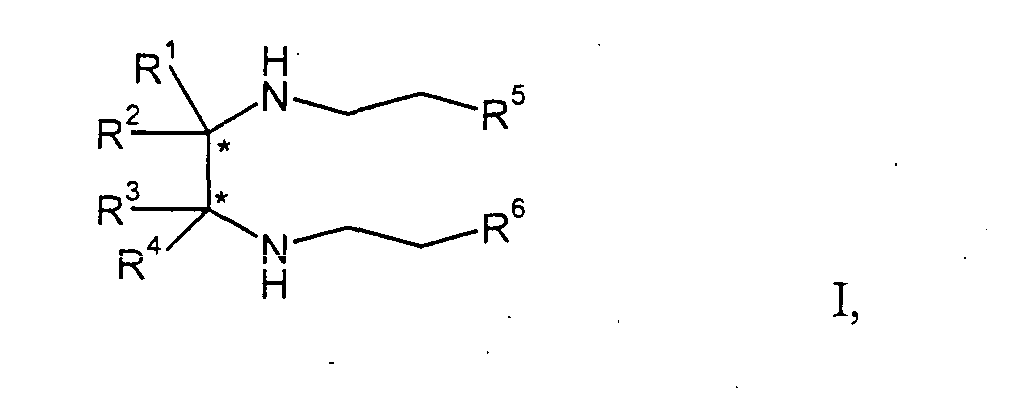
- *
- stereogene Kohlenstoffatome markiert, die jeweils unabhängig voneinander R- oder S-konfiguriert sind, wobei jedoch Meso-Verbindungen ausgeschlossen sind,
- R1, R2, R3 und R4
- jeweils unabhängig voneinander für Wasserstoff, C1-C12-Alkyl, C4-C24-Aryl oder C5-C25-Arylalkyl stehen oder R1, R2, R3 und R4 zusammen mit der Ethylenbrücke für 1,2-(C5-C8-Cycloalkyl) stehen und
- R5 und R6
- jeweils unabhängig voneinander für Reste stehen, die ausgewählt sind aus der Gruppe -COOR7, -CONR8R9, -CN oder -PO(OR10)2, wobei R7, R8, R9 und R10 jeweils für C1-C12-Alkyl, C4-C24-Aryl oder C5-C25-Arylalkyl stehen oder NR8R9 als Ganzes für einen cyclischen Aminorest mit insgesamt 4 bis 12 Kohlenstoffatomen steht.
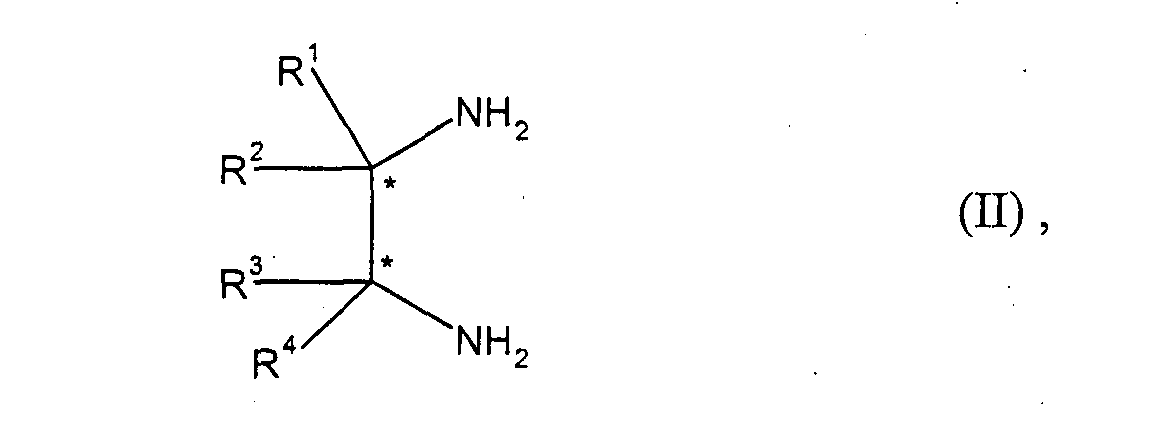
*, R1, R2, R3 und R4 die unter der Formel (I) genannten Bedeutungen einschließlich deren Vorzugsbereichen besitzen,
mit Verbindungen der Formel (III)
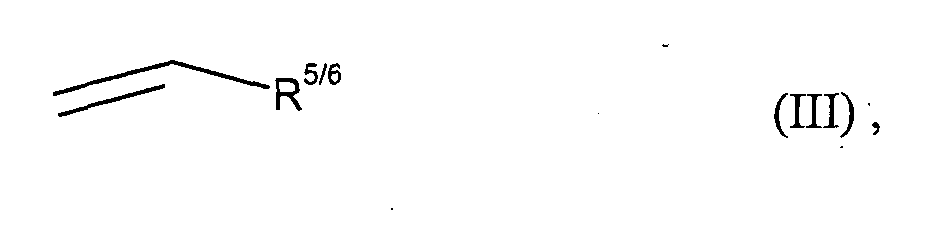
R5 und R6 die unter der Formel (I) genannten Bedeutungen einschließlich deren Vorzugsbereichen besitzen,
hergestellt werden.
- Met
- für ein ein- oder zweiwertiges Metall wie vorzugsweise Zink, Lithium, Natrium oder Kalium und
- E
- für Aluminium oder Bor und
- R11
- für C1-C8-Alkyl und
- q
- für 1, 2, 3 oder 4, bevorzugt für 4 oder 1, und
- p
- für die Wertigkeit von Met stehen.
- r
- eins, zwei oder drei ist
oder Polymethylhydrosiloxan (PMHS) mit der wiederkehrenden Struktureinheit





Claims (17)
- Verbindungen der Formel (I),in der

- *
- stereogene Kohlenstoffatome markiert, die jeweils unabhängig voneinander R- oder S-konfiguriert sind, wobei jedoch Meso-Formen ausgeschlossen sind und
- R1, R2, R3 und R4
- jeweils unabhängig voneinander für Wasserstoff, C1-C12-Alkyl, C4-C24-Aryl oder C5-C25-Arylalkyl stehen oder R1, R2, R3 und R4 zusammen mit der Ethylenbrücke für 1,2-(C5-C8-Cycloalkyl) stehen und
- R5 und R6
- jeweils unabhängig voneinander für Reste stehen, die ausgewählt sind aus der Gruppe -COOR7, -CONR8R9, -CN oder -PO(OR10)2, wobei R7, R8, R9 und R10 jeweils für C1-C12-Alkyl, C4-C24-Aryl oder C5-C25-Arylalkyl stehen oder NR8R9 als Ganzes für einen cyclischen Aminorest mit insgesamt 4 bis 12 Kohlenstoffatomen steht.
- Verbindungen gemäß Anspruch 1, dadurch gekennzeichnet, dass R1, R2, R3 und R4 jeweils unabhängig voneinander für Wasserstoff, C1-C8-Alkyl oder C4-C24-Aryl stehen oder R1, R2, R3 und R4 zusammen mit der Ethylenbrücke für 1,2-Cyclohexylen stehen.
- Verbindungen gemäß mindestens einem der Ansprüche 1 und 2, dadurch gekennzeichnet, dass R1, R2, R3 und R4 zusammen mit der Ethylenbrücke für (R,R)- und (S,S)-1,2-Diphenyl-1,2-ethylen oder (R,R)- und (S,S)-1,2-Cyclohexylen stehen.
- Verbindungen gemäß mindestens einem der Ansprüche 1 bis 3, dadurch gekennzeichnet, dass R5 und R6 jeweils unabhängig voneinander ausgewählt sind aus der Gruppe -COOR7, -CONR8R9, -CN oder -PO(OR10)2, wobei R7, R8, R9 und R10 jeweils für C1-C4-Alkyl oder C4-C24-Aryl stehen.
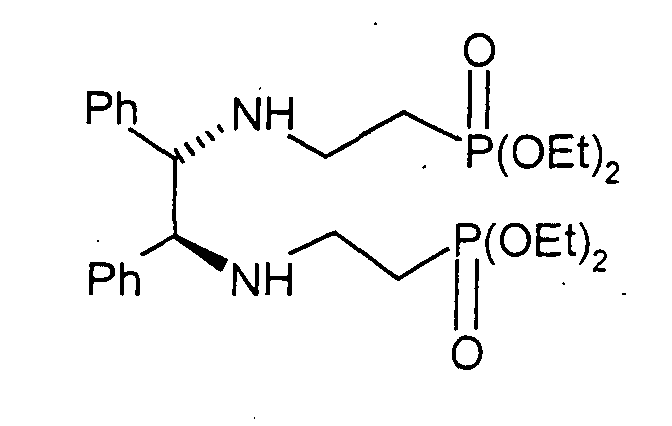
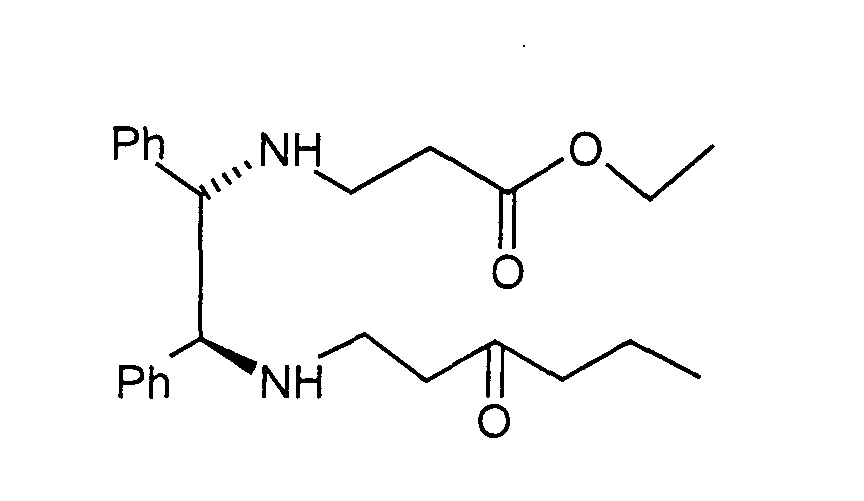
- (1S,2S)- und (1R,2R)-Bis-[N-(2-dimethylphosphonato-ethyl)amino]-cyclohexan, (1S,2S)- und (1R,2R)-Bis-[N-(2-diethylphosphonato-ethyl)amino]-cyclohexan, (1S,2S)- und (1R,2R)-Bis-[N-(2-diphenylphosphonato-ethyl)-amino]-cyclohexan, (1S,2S)- und (1R,2R)-Bis-[N-(2-cyanoethyl)amino]-cyclohexan, (1S,2S)- und (1R,2R)-Bis-[N-(2-carboxylethyl-ethyl)amino]-cyclohexan und (1S,2S)- und (1R,2R)-Bis-[N-(2-carboxylmethyl-ethyl)-amino]-cyclohexan, (1S,2S)- und (1R,2R)-Bis-[N-(2-dimethylphosphonatoethyl)amino]-1,2-diphenylethan, (1S,2S)- und (1R,2R)-Bis-[N-(2-diethylphosphonato-ethyl)amino]-1,2-diphenylethan, (1S,2S)- und (1R,2R)-Bis-[N-(2-diphenylphosphonato-ethyl)amino]-1,2-diphenylethan, (1S,2S)- und (1R,2R)-Bis-[N-(2-cyanoethyl)amino]-1,2-diphenylethan, (1S,2S)- und (1R,2R)-Bis-[N-(2-carboxyethyl-ethyl)amino]-1,2-diphenylethan, (1S,2S)-und (1R,2R)-Bis- [N-(2-carboxymethyl-ethyl)amino]-1,2-diphenylethan.
- Übergangsmetallkomplexe von Verbindungen gemäß mindestens einem der Ansprüche 1 bis 5.
- Übergangsmetallkomplexe gemäß Anspruch 6, dadurch gekennzeichnet, dass das Verhältnis von Übergangsmetall zu Verbindungen der Formel (I) 0,5 bis 1,5 beträgt.
- Übergangsmetallkomplexe gemäß mindestens einem der Ansprüche 6 und 7, dadurch gekennzeichnet, dass die Verbindungen Zink- und Cobalt-Komplexe sind.
- Übergangsmetallkomplexe gemäß mindestens einem der Ansprüche 6 bis 8, dadurch gekennzeichnet, dass die Übergangsmetallkomplexe durch Umsetzung von Zink- oder Kobalt-Halogeniden, Carbonaten, Cyanuraten, Isocyanaten, Sulfaten, Phosphaten, Nitraten, Carboxylaten oder Alkoxiden mit Verbindungen gemäß mindestens einem der Ansprüche 1 bis 5 erhältlich sind.
- Übergangsmetallkomplexe gemäß Anspruch 9, dadurch gekennzeichnet, dass weiterhin die Umsetzung mit einem Reduktionsmittel erfolgt.
- Übergangsmetallkomplexe gemäß mindestens einem der Ansprüche 6 bis 8, dadurch gekennzeichnet, dass die Übergangsmetallkomplexe durch Umsetzung von Zinkverbindungen ZnY2 oder ZnYHal, wobei Y jeweils unabhängig für Wasserstoff, BH4 oder einen organischen Rest und Hal für Brom, Chlor oder Iod stehen, mit Verbindungen gemäß mindestens einem der Ansprüche 1 bis 5 hergestellt werden.
- Katalysatoren ,enthaltend Übergangsmetallkomplexe gemäß mindestens einem der Ansprüche 6 bis 11.
- Verfahren zur asymmetrischen Reduktion von Ketonen mit Silanen in Gegenwart von Katalysatoren, dadurch gekennzeichnet, dass als Katalysatoren solche gemäß Anspruch 12 eingesetzt werden.
- Verfahren gemäß Anspruch 13, dadurch gekennzeichnet, dass als Silane solche der Formel (V)
- r
- eins, zwei oder drei ist
oder Polymethylhydrosiloxan (PMHS) mit der wiederkehrenden Struktureinheitverwendet werden.
- Verfahren gemäß mindestens einem der Ansprüche 13 und 14, dadurch gekennzeichnet, dass die Menge des Katalysators so gewählt wird, dass das molare Verhältnis von Übergangsmetall zu eingesetztem Keton 0,01 bis 0,20 beträgt.
- Verfahren gemäß mindestens einem der Ansprüche 13 bis 15, dadurch gekennzeichnet, dass als Ketone Arylketone eingesetzt werden.
- Verwendung von stereoisomerenangereicherten Alkoholen, die nach einem Verfahren gemäß mindestens einem der Ansprüche 13 bis 16 hergestellt wurden, in einem Verfahren zur Herstellung von Arzneimitteln und Agrochemikalien.
Applications Claiming Priority (2)
| Application Number | Priority Date | Filing Date | Title |
|---|---|---|---|
| DE10238114A DE10238114A1 (de) | 2002-08-21 | 2002-08-21 | Optisch aktive Diamine und deren Anwendung in katalytischen Prozessen |
| DE10238114 | 2002-08-21 |
Publications (1)
| Publication Number | Publication Date |
|---|---|
| EP1391448A1 true EP1391448A1 (de) | 2004-02-25 |
Family
ID=30775455
Family Applications (1)
| Application Number | Title | Priority Date | Filing Date |
|---|---|---|---|
| EP03018220A Withdrawn EP1391448A1 (de) | 2002-08-21 | 2003-08-11 | Optisch aktive Diamine und deren Anwendung in katalytischen Prozessen |
Country Status (3)
| Country | Link |
|---|---|
| US (1) | US7064231B2 (de) |
| EP (1) | EP1391448A1 (de) |
| DE (1) | DE10238114A1 (de) |
Cited By (3)
| Publication number | Priority date | Publication date | Assignee | Title |
|---|---|---|---|---|
| EP4700061A1 (de) | 2024-08-22 | 2026-02-25 | Basf Se | Verfahren zur synthese funktionalisierter spaltbarer amine durch alkoxylierung und anschliessende alkoholaminierung |
| WO2026041754A1 (en) | 2024-08-22 | 2026-02-26 | Basf Se | Process for the synthesis of functionalized cleavable amines via alcohol amination |
| WO2026041753A1 (en) | 2024-08-22 | 2026-02-26 | Basf Se | Process for the synthesis of functionalized cleavable amines by cyanoethylation followed by hydrogenation |
Families Citing this family (3)
| Publication number | Priority date | Publication date | Assignee | Title |
|---|---|---|---|---|
| CN110041486A (zh) * | 2012-01-09 | 2019-07-23 | 阿德希西斯医疗有限公司 | β-氨基酸酯改性的(天冬氨酸酯)硬化剂及其在聚脲组织粘合剂中的用途 |
| CN108383756B (zh) * | 2018-02-07 | 2021-04-20 | 万华化学集团股份有限公司 | 一种氰乙基胺类化合物的制备方法 |
| CN112079790B (zh) * | 2020-09-03 | 2022-06-14 | 大连理工大学 | 一种绿色荧光的双胺-噁唑啉锌配合物、制备方法和应用 |
Citations (2)
| Publication number | Priority date | Publication date | Assignee | Title |
|---|---|---|---|---|
| DE2338216A1 (de) * | 1972-07-31 | 1974-02-14 | Exxon Research Engineering Co | Optisch aktive chelate und ihre verwendung fuer die asymmetrische synthese optisch aktiver verbindungen |
| WO2000024751A1 (en) * | 1998-10-23 | 2000-05-04 | I.N.S.E.R.M. (Institut National De La Sante Et De La Recherche Medicale) | Chelating agents for radioimmunotherapy |
Family Cites Families (4)
| Publication number | Priority date | Publication date | Assignee | Title |
|---|---|---|---|---|
| US4165330A (en) | 1972-07-31 | 1979-08-21 | Exxon Research & Engineering Co. | Asymmetric synthesis via optically active chelating agents |
| US5227538A (en) | 1990-11-21 | 1993-07-13 | Massachusetts Institute Of Technology | Catalytic asymmetric reduction of ketones using metal catalysts |
| ES2195371T3 (es) | 1997-09-09 | 2003-12-01 | Firmenich & Cie | Reduccion enantioselectiva de cetonas con un sistema de agente silanico/compuesto metalico/ligando quiral. |
| ES2198886T3 (es) | 1998-04-01 | 2004-02-01 | Firmenich Sa | Reduccion de compuestos carbonilados por un silano en presencia de un catalizador de zinc. |
-
2002
- 2002-08-21 DE DE10238114A patent/DE10238114A1/de not_active Withdrawn
-
2003
- 2003-08-11 EP EP03018220A patent/EP1391448A1/de not_active Withdrawn
- 2003-08-19 US US10/643,855 patent/US7064231B2/en not_active Expired - Fee Related
Patent Citations (2)
| Publication number | Priority date | Publication date | Assignee | Title |
|---|---|---|---|---|
| DE2338216A1 (de) * | 1972-07-31 | 1974-02-14 | Exxon Research Engineering Co | Optisch aktive chelate und ihre verwendung fuer die asymmetrische synthese optisch aktiver verbindungen |
| WO2000024751A1 (en) * | 1998-10-23 | 2000-05-04 | I.N.S.E.R.M. (Institut National De La Sante Et De La Recherche Medicale) | Chelating agents for radioimmunotherapy |
Non-Patent Citations (2)
| Title |
|---|
| MIMOUN H ET AL: "ENANTIOSELECTIVE REDUCTION OF KETONES BY POLYMETHYLHYDROSILOXANE INTHE PRESENCE OF CHIRAL ZINC CATALYSTS", JOURNAL OF THE AMERICAN CHEMICAL SOCIETY, AMERICAN CHEMICAL SOCIETY, WASHINGTON, DC, US, vol. 121, no. 26, 1999, pages 6158 - 6166, XP001034278, ISSN: 0002-7863 * |
| SAKATA K ET AL.: "Preparation and Spectral Properties of Nickel(II) and Copper(II) Complexes with Two Isomeric Cyclohexylcyclams", POLYHEDRON, vol. 17, no. 9, 1998, pages 1463 - 1470, XP001156620 * |
Cited By (3)
| Publication number | Priority date | Publication date | Assignee | Title |
|---|---|---|---|---|
| EP4700061A1 (de) | 2024-08-22 | 2026-02-25 | Basf Se | Verfahren zur synthese funktionalisierter spaltbarer amine durch alkoxylierung und anschliessende alkoholaminierung |
| WO2026041754A1 (en) | 2024-08-22 | 2026-02-26 | Basf Se | Process for the synthesis of functionalized cleavable amines via alcohol amination |
| WO2026041753A1 (en) | 2024-08-22 | 2026-02-26 | Basf Se | Process for the synthesis of functionalized cleavable amines by cyanoethylation followed by hydrogenation |
Also Published As
| Publication number | Publication date |
|---|---|
| DE10238114A1 (de) | 2004-03-04 |
| US20040044238A1 (en) | 2004-03-04 |
| US7064231B2 (en) | 2006-06-20 |
Similar Documents
| Publication | Publication Date | Title |
|---|---|---|
| Weingarten et al. | Ketimine syntheses. Use of titanium tetrachloride in a new procedure for their preparation | |
| DE69711395T2 (de) | Verfahren zur herstellung von cyclohexen-carboxylatderivate | |
| DE69118906T2 (de) | Neue methoden zur katalytischen reduktion organischer substrate | |
| EP0718235B1 (de) | Verfahren zur Herstellung von ether- und halogenidfreiem Aluminiumwasserstoff | |
| Maruoka et al. | Enantioselective activation of ethers by chiral organoaluminum reagents: application to asymmetric Claisen rearrangement | |
| DE3874627T2 (de) | Herstellungsverfahren eines optisch aktiven alkohols. | |
| DE19649564A1 (de) | Verfahren zur Herstellung von gamma,delta-ungesättigter Ketone durch Umsetzung tertiärer Allylalkohole mit Alkenylalkylethern | |
| DE69412588T2 (de) | Optisch aktive beta-aminoalkoxyborankomplexe | |
| EP0708081B1 (de) | Verwendung von N,N'-disubstituierten p-Chinondiiminen bei der Herstellung und zur Stabilisierung von Organosilanen | |
| DE10238114A1 (de) | Optisch aktive Diamine und deren Anwendung in katalytischen Prozessen | |
| DE2252674C3 (de) | Verfahren zur Herstellung von Aldehyden aus Olefinen | |
| DE69516548T2 (de) | Verfahren zur Herstellung von Cyclopropancarboxamid | |
| DE69527070T2 (de) | Verfahren zur herstellung von diisopinocampheylchloroboran | |
| EP1495037B1 (de) | Verfahren zur herstellung von perfluoralkylphosphinen und deren verwendung als perfluoralkylierungsreagenzien | |
| EP0592779B1 (de) | Verfahren zur Herstellung von Distannanen | |
| EP3750877A1 (de) | Verfahren zur herstellung von triacetonamin und 2,2,4,6-tetramethylpiperidin | |
| EP0708080B1 (de) | Verfahren zur Herstellung von N,N'-Disubstituierten p-Chinondiiminen und deren Verwendung | |
| EP1934159B1 (de) | Verfahren zur auftrennung stereoisomerer verbindungen | |
| EP1272496B1 (de) | Verfahren zur herstellung von alkalimetallmonohydrido-boranaten und -aluminaten | |
| DE1235893B (de) | Verfahren zur Herstellung von N-Vinyl-N-alkyl-formamiden | |
| EP2657216B1 (de) | Verfahren zum Umsetzen von Farnesol zu Nerolidol in Gegenwart von alpha-Bisabolol | |
| CH396941A (de) | Verfahren zur Herstellung neuer sekundärer Amine | |
| DE69801850T2 (de) | Verfahren zur Herstellung optisch aktiver Pyrrolidine | |
| DE4033259A1 (de) | Verfahren zur herstellung von 2-pyrrolidinonen | |
| DE1963997A1 (de) | Metallorganische Verbindungen |
Legal Events
| Date | Code | Title | Description |
|---|---|---|---|
| PUAI | Public reference made under article 153(3) epc to a published international application that has entered the european phase |
Free format text: ORIGINAL CODE: 0009012 |
|
| AK | Designated contracting states |
Kind code of ref document: A1 Designated state(s): AT BE BG CH CY CZ DE DK EE ES FI FR GB GR HU IE IT LI LU MC NL PT RO SE SI SK TR |
|
| AX | Request for extension of the european patent |
Extension state: AL LT LV MK |
|
| 17P | Request for examination filed |
Effective date: 20040825 |
|
| AKX | Designation fees paid |
Designated state(s): AT BE BG CH CY CZ DE DK EE ES FI FR GB GR HU IE IT LI LU MC NL PT RO SE SI SK TR |
|
| 17Q | First examination report despatched |
Effective date: 20050502 |
|
| RAP1 | Party data changed (applicant data changed or rights of an application transferred) |
Owner name: LANXESS DEUTSCHLAND GMBH |
|
| RAP1 | Party data changed (applicant data changed or rights of an application transferred) |
Owner name: SALTIGO GMBH |
|
| RAP1 | Party data changed (applicant data changed or rights of an application transferred) |
Owner name: SALTIGO GMBH |
|
| GRAP | Despatch of communication of intention to grant a patent |
Free format text: ORIGINAL CODE: EPIDOSNIGR1 |
|
| STAA | Information on the status of an ep patent application or granted ep patent |
Free format text: STATUS: THE APPLICATION IS DEEMED TO BE WITHDRAWN |
|
| 18D | Application deemed to be withdrawn |
Effective date: 20080208 |
|
| RIC1 | Information provided on ipc code assigned before grant |
Ipc: C07F 15/00 20060101ALI20110916BHEP Ipc: C07F 9/40 20060101ALI20110916BHEP Ipc: C07C 255/25 20060101ALI20110916BHEP Ipc: C07C 237/06 20060101ALI20110916BHEP Ipc: C07C 67/56 20060101ALI20110916BHEP Ipc: C07C 29/143 20060101AFI20110916BHEP |