EP1390725B1 - Verwendung von optischen diffraktionselementen in nachweisverfahren - Google Patents
Verwendung von optischen diffraktionselementen in nachweisverfahren Download PDFInfo
- Publication number
- EP1390725B1 EP1390725B1 EP02747328.9A EP02747328A EP1390725B1 EP 1390725 B1 EP1390725 B1 EP 1390725B1 EP 02747328 A EP02747328 A EP 02747328A EP 1390725 B1 EP1390725 B1 EP 1390725B1
- Authority
- EP
- European Patent Office
- Prior art keywords
- sample
- carrier
- volume elements
- luminescence
- determination
- Prior art date
- Legal status (The legal status is an assumption and is not a legal conclusion. Google has not performed a legal analysis and makes no representation as to the accuracy of the status listed.)
- Expired - Lifetime
Links
Images



Classifications
-
- G—PHYSICS
- G01—MEASURING; TESTING
- G01N—INVESTIGATING OR ANALYSING MATERIALS BY DETERMINING THEIR CHEMICAL OR PHYSICAL PROPERTIES
- G01N21/00—Investigating or analysing materials by the use of optical means, i.e. using sub-millimetre waves, infrared, visible or ultraviolet light
- G01N21/62—Systems in which the material investigated is excited whereby it emits light or causes a change in wavelength of the incident light
- G01N21/63—Systems in which the material investigated is excited whereby it emits light or causes a change in wavelength of the incident light optically excited
- G01N21/64—Fluorescence; Phosphorescence
- G01N21/645—Specially adapted constructive features of fluorimeters
- G01N21/6452—Individual samples arranged in a regular 2D-array, e.g. multiwell plates
-
- G—PHYSICS
- G01—MEASURING; TESTING
- G01N—INVESTIGATING OR ANALYSING MATERIALS BY DETERMINING THEIR CHEMICAL OR PHYSICAL PROPERTIES
- G01N21/00—Investigating or analysing materials by the use of optical means, i.e. using sub-millimetre waves, infrared, visible or ultraviolet light
- G01N21/62—Systems in which the material investigated is excited whereby it emits light or causes a change in wavelength of the incident light
- G01N21/63—Systems in which the material investigated is excited whereby it emits light or causes a change in wavelength of the incident light optically excited
- G01N21/64—Fluorescence; Phosphorescence
- G01N2021/6417—Spectrofluorimetric devices
- G01N2021/6421—Measuring at two or more wavelengths
-
- G—PHYSICS
- G01—MEASURING; TESTING
- G01N—INVESTIGATING OR ANALYSING MATERIALS BY DETERMINING THEIR CHEMICAL OR PHYSICAL PROPERTIES
- G01N21/00—Investigating or analysing materials by the use of optical means, i.e. using sub-millimetre waves, infrared, visible or ultraviolet light
- G01N21/62—Systems in which the material investigated is excited whereby it emits light or causes a change in wavelength of the incident light
- G01N21/63—Systems in which the material investigated is excited whereby it emits light or causes a change in wavelength of the incident light optically excited
- G01N21/64—Fluorescence; Phosphorescence
- G01N21/645—Specially adapted constructive features of fluorimeters
- G01N21/6456—Spatial resolved fluorescence measurements; Imaging
- G01N21/6458—Fluorescence microscopy
Definitions
- the invention relates to a method for the determination of luminescent molecules by optical excitation in confocal measurement volumes using a diffractive optical element.
- the method is particularly suitable for single molecule determination, e.g. by fluorescence correlation spectroscopy or by dynamic light scattering.
- a device suitable for carrying out the method according to the invention is disclosed.
- FCS fluorescence correlation spectroscopy
- WO 00/58715 discloses an apparatus and method for performing multiple biochemical assays simultaneously.
- the apparatus comprises a laser light source, a diffraction grating to split the light into a plurality of excitation beams, a sample holder containing a plurality of samples, and a detector.
- WO 00/58715 gives however, no indication of the technique of confocal fluorescence spectroscopy.
- An object underlying the present application was to provide methods and apparatus for the determination of luminescent molecules, in particular by fluorescence correlation spectroscopy, which allows in a simple manner a parallel determination in multiple confocal volume elements.
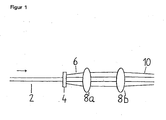
- the splitting of excitation light irradiated into the sample by means of diffractive optical elements allows the production of multiple confocal volume elements while maintaining a sufficient light intensity for detection.
- This principle can be used for the production of multiple confocal dot foci for the detection of single molecules or a small number, e.g. up to 100 molecules, in confocal volume elements using suitable excitation or detection methods.
- New microstructure fabrication technologies make it possible to fabricate optical elements with a previously calculated three-dimensional structure, which is a predetermined diffraction grating for a light source.
- a desired dot pattern generated by light diffraction is converted by means of Fourier transformation into a three-dimensional diffractive structure which is subsequently produced from a suitable material, for example by means of photolithographic etching.
- three-dimensional optical gratings optionally applied to an optically transparent carrier can be used as diffractive optical elements, which diffract light passing through and produce a predetermined diffraction pattern, ie a desired arrangement of multiple optical foci, in the object plane by constructive and destructive interference.
- diffractive optical elements any arrangement of the partial beams can be selected by the shape of the optical grating.
- the multiple partial beams are preferably formed by interference of the first order, with only slight light losses due to interference of the 0th order or higher orders occurring.
- suitable diffractive optical elements is, for example, in the dissertation of F. Nikolaef at the Chalmers Institute of Technologies (1999 ), in the dissertation of M. Johansson at the Chalmers Institute of Technologies (2001 ) as well as in the publication Johansson and Härd (Applied Optics 38 (1999), 1302-1310 ).
- materials for manufacturing the optical elements plastics, glass and composites or other materials having optical transparency for a given wavelength are suitable, which can be processed by photolithographic etching.
- a preferred embodiment of the method according to the invention relates to the detection of molecules luminescent in the confocal measurement volumes by fluorescence correlation spectroscopy.
- the method can basically according to the in EP-B-0 679 251 method described.
- the measurement of one or a few analyte molecules in a measurement volume is preferably carried out, wherein the concentration of the analyte molecules to be determined is preferably ⁇ 10 -6 mol / l and the measurement volume is preferably ⁇ 10 -14 .
- Substance-specific parameters are determined which are determined by luminescence measurement on the analyte molecules.
- These parameters may be translation diffusion coefficients, rotational diffusion coefficients or / and the excitation wavelength, the emission wavelength or / and the lifetime of an excited state of a luminescent molecule or the Combining one or more of these measures act.
- translation diffusion coefficients rotational diffusion coefficients or / and the excitation wavelength, the emission wavelength or / and the lifetime of an excited state of a luminescent molecule or the Combining one or more of these measures act.
- a preferred feature of the method according to the invention is that the distance between the measurement volume in the sample liquid and the focusing optics of the light source is ⁇ 1 mm, preferably 1.5 to 10 mm and particularly preferably 2 to 5 mm. Furthermore, it is preferred that between the carrier containing the sample liquid and the optical focusing device, a gas phase region is arranged, which may contain air, inert gas or vacuum. Methods and apparatus for performing FCS with a large distance between the focusing optic and the confocal measuring volume are in DE 101 11 420.6 described.
- the inventive method is basically suitable for carrying out any determination method.
- a preferred embodiment relates to the determination of an analyte in a sample, eg for diagnostic applications or for a screening for the identification of active substances which interact with a target substance.
- one or more analyte-binding substances are added to the sample, which carry a detectable by Lumineszenzunk marking group, in particular fluorescence labeling group.
- the method according to the invention preferably comprises a determination of the binding of the labeling substance to the analyte to be detected.
- This detection can be done, for example, by changing the mobility of the labeling group due to the binding to the analyte or by changing the luminescence of the labeling group (intensity and / or decay time) due to the binding to the analyte or when using multiple labeling groups - by the so-called cross-correlation.
- the cross-correlation determination at least two different labels, in particular fluorescent labels, are used, their correlated signal within the measuring volume is determined. This cross-correlation determination is included, for example Schwille et al. (Biophys J. 72 (1997), 1878-1886 ) and Rigler et al. (J. Biotechnol., 63 (1998), 97-109 ).
- the method according to the invention is suitable for the detection of biomolecules, e.g. Nucleic acids, proteins or other, in living organisms, especially in mammals such as human occurring, analyte molecules.
- biomolecules e.g. Nucleic acids, proteins or other
- analytes produced from biological samples in vitro e.g. cDNA molecules produced by reverse transcription from mRNA or proteins produced by in vitro translation from mRNA and from DNA, respectively.
- the method is useful for detection of analytes present as elements of a library and having predetermined characteristics, e.g. Binding to the detection reagent to show. Examples of such libraries are phage libraries or ribosomal libraries.
- the determination comprises a nucleic acid hybridization, wherein one or more luminescence-labeled probes bind to a target nucleic acid as analyte.
- hybridization methods can be used, for example, for the analysis of gene expression, eg for the determination of a gene expression profile, for the analysis of mutations, eg single nucleotide polymorphisms (SNP).
- SNP single nucleotide polymorphisms
- the method according to the invention is also suitable for the determination of enzymatic reactions or / and for the determination of nucleic acid amplifications, in particular in a thermocycling process.
- Preferred methods for the determination of nucleic acid polymorphisms are in DE 100 56 226.4 and DE 100 65 631.5 described. In this case, a two- or multi-color cross-correlation determination is particularly preferably carried out.
- the determination comprises the detection of a protein-protein or protein-ligand interaction, wherein as protein ligands e.g. Low molecular weight drugs, peptides, nucleic acids, etc. can be used.
- protein ligands e.g. Low molecular weight drugs, peptides, nucleic acids, etc.
- a two-color multicolor correlation measurement is preferably carried out.
- so-called “molecular beacon” probes or primers can be used, which - if they are in free form - give a different measurement signal in terms of luminescence intensity and / or -coating time than in the bound state.
- Another preferred embodiment of the invention comprises a method of selecting particles in a substance library, wherein a particle having a predetermined property is selected from a population comprising a plurality of different particles.
- a population of different particles is provided, particles having a predetermined property are labeled, the particles are passed in a microchannel through a detection element comprising multiple confocal volume elements to distinguish between labeled and unlabeled particles and separated labeled particles.
- the steps of conducting and separating are preferably repeated at least once, wherein the concentration of the particles in a subsequent cycle is preferably reduced by at least a factor of 10 4 compared to a preceding cycle.
- the particles can be selected, for example, from cells, parts of cell surfaces, cell organelles, viruses, nucleic acids, proteins and low molecular weight substances.
- the method is also useful for selecting particles from a combinatorial library that may contain genetic packs such as phage, cells, spores or ribosomes.
- the particle population preferably contains more than 10 6 and more preferably more than 10 10 different particles.
- the particles are preferably labeled with a luminescent labeling group.
- Yet another embodiment comprises carrying out a sequence analysis of polymers, in particular biopolymers, wherein lumescent fragments of an analyte present in the sample are determined.
- This embodiment is particularly suitable for performing nucleic acid sequencing.
- a carrier particle with a nucleic acid molecule immobilized thereon is preferably provided, with essentially all nucleotide units of at least one base type carrying a fluorescent label in at least one strand of the nucleic acid molecule.
- the carrier particle is introduced into a sequencing device comprising a microchannel, there, e.g. held with an IR capture laser and, e.g. by treatment with an exonuclease, progressively splitting off individual nucleotide building blocks from the immobilized nucleic acid molecule.
- the cleaved nucleotide units are then passed through a microchannel, preferably by means of a hydrodynamic flow, where they determine the base sequence of the nucleic acid molecule in confocal volume elements on the basis of the sequence of the cleaved nucleotide units.
- the method according to the invention enables the splitting of a light beam originating from a light source, eg a laser, into a plurality of partial beams.
- the light beam is split in 2-32, in particular in 4-16 partial beams.
- confocal volume elements in the sample are imaged from these partial beams.
- the confocal volume elements preferably have a size of 10 -18 to 10 -12 l, and more preferably 10 -16 to 10 -14 l.
- a separate detector per unit volume or a spatially resolving detection matrix eg an avalanche photodiode matrix or an electronic detector matrix, eg a CCD camera, is used.
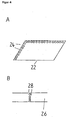
- confocal volume elements are provided in separate containers of a carrier, preferably a microstructure.
- the volume of these containers is preferably in the range of ⁇ 10 -6 l and more preferably ⁇ 10 -8 l to 10 -12 l.
- the carrier may comprise a microwell structure having a plurality of wells for receiving sample liquid, for example having a diameter between 10 and 1000 microns. Suitable microstructures are, for example, in DE 100 23 421.6 and DE 100 65 632.3 described. These microstructures can be used for example for determining a nucleic acid hybridization in solution.
- the carrier preferably comprises at least one temperature control element, for example a Peltier element, which allows temperature control of the carrier or / and individual sample containers therein.
- the carrier used for the method is expediently designed such that it allows optical detection of the sample.
- a carrier which is optically transparent at least in the region of the sample containers is used.
- the support can either be completely optically transparent or contain an optically transparent base and an optically impermeable cover layer with recesses in the sample containers.
- Suitable materials for carriers are, for example, composite metal carriers (eg silicon for the Cover layer) and glass (for the base). Such carriers can be produced for example by applying a metal layer with predetermined recesses for the sample containers on the glass.
- plastic carriers for example made of polystyrene or polymers based on acrylate or methacrylate can be used.
- the carrier has a cover for the sample containers in order to provide a closed system that is substantially isolated from the environment during the measurement.
- a carrier which contains a lens element which is arranged in the beam path between the measuring volume and the light source or detector of the optical device.
- the lens element may be attached to the bottom of a microwave structure.
- a lens element can be formed, for example, by heating and forming a photoresist using a master mold, e.g. made of metal such as silicon, and then applied to the carrier.
- a master mold e.g. made of metal such as silicon
- the lens elements integrated into the carrier e.g. produced during manufacture by injection molding.
- the numerical aperture of the optical measuring device can be increased. This numerical aperture is preferably in the range of 0.5 to 1.2.
- the support is also preferably coated with a transparent antireflection coating to produce a higher refractive index.
- a transparent antireflection coating for example, transparent oxides or nitrides can be used.
- Antireflection coatings are also preferably used on the optics.
- electric fields in particular in the region of the sample containers, can be generated in the carrier in order to increase the concentration of to reach determining analytes in the measurement volume.
- Examples of electrodes which are suitable for generating such electric fields are, for example, in DE 101 03 304.4 described.
- the molecule to be determined may be bound to a carrier particle, in particular in a determination in the microwave format or in the single-molecule sequencing.
- the carrier particle has a size that allows movement in microchannels and retention at a desired position within a sequencing device.
- the particle size is preferably in the range of 0.5-10 microns and more preferably 1-3 microns.
- suitable materials of carrier particles are plastics such as polystyrene, glass, quartz, metals or semimetals such as silicon, metal oxides such as silica or composites containing several of the aforementioned components.
- Particularly preferred are optically transparent carrier particles, for example made of plastics or particles with a plastic core and a silicon dioxide shell.
- Nucleic acid molecules are preferably immobilized via their 5 'end on the carrier particle, e.g. by covalent or noncovalent interaction. More preferably, the binding of polynucleotides to the support occurs through high affinity interactions between the partners of a specific binding pair, e.g. Biotin / streptavidin or avidin etc. Alternatively, nucleic acid molecules can also be bound adsorptively or covalently to the support.
- Carrier particles to which only a single nucleic acid molecule is bound are preferably used.
- Such carrier particles can be produced by contacting the nucleic acid molecules intended for the determination in a molar ratio of preferably from 1: 5 to 1:20, for example 1:10, with the carrier particles under conditions be brought, in which an immobilization of the nucleic acid molecules to the carrier takes place.
- the nucleic acid molecules bound to a support can be in single-stranded or double-stranded form.
- the nucleic acid molecules are in single-stranded form.
- a fluorescent labeling group When used for sequencing carry essentially all, for example at least 90%, preferably at least 95% of all nucleotide building blocks of at least one base type, a fluorescent labeling group. It is also possible for essentially all nucleotide building blocks of at least 2 base types, for example 2, 3 or 4 base types, to carry a fluorescence marking, each base type advantageously containing a different fluorescent labeling group.
- Such labeled nucleic acids can be generated by enzymatic primer extension on a nucleic acid template using a suitable polymerase, eg, a thermostable DNA polymerase.
- a suitable polymerase eg, a thermostable DNA polymerase.
- the carrier is preferably a microstructure having a plurality, preferably at least 10, more preferably at least 10 2 containers for holding a sample liquid, wherein the sample liquid in the separate containers may originate from one or more sources.
- the introduction of the sample liquid into the containers of the carrier can take place, for example, by means of a piezoelectric liquid dispensing device.
- the containers of the carrier are designed to allow binding of the detection reagent to the analyte in solution.
- the containers are preferably depressions in the carrier surface, wherein these depressions may in principle have any shape, eg circular, square, diamond-shaped, etc.
- the carrier may also comprise 10 3 or more separate containers.
- the support may also contain a microchannel structure with one or more microchannels, particularly for a single-molecule sequencing method, as in DE 100 31 840.1 and DE 100 65 626.9 described or for a particle selection method, as in DE 100 31 028.1 described, are suitable.
- the optical excitation device comprises a strongly focused light source, preferably a laser beam, which is focused by means of corresponding optical devices on the measurement volume in the sample liquid.
- the light source may also contain two or more laser beams, which are then each focused on the measurement volume by different optics before entering the sample liquid.
- a separate diffractive optical element can be used for each laser beam.
- the detection device may include, for example, a fiber-coupled avalanche photodiode detector or an electronic detector.
- excitation and / or detection matrices consisting of a dot matrix of laser spots produced by diffraction optics or a quantum well laser and a detector array generated by an avalanche photodiode array or an electronic detector matrix, e.g. a CCD camera, to be used.
- the carrier can be provided in prefabricated form, wherein luminescence-labeled detection reagents, preferably luminescence-labeled hybridization probes or primers, are introduced into a plurality of separate containers of the carrier. Subsequently, the support containing the detection reagents is desirably dried.
- a prefabricated carrier comprising a plurality of separate, e.g. Contains 100 containers in each of which different detection reagents, e.g. Present reagents for detecting a nucleic acid hybridization such as primers and / or probes filled.
- This carrier may then be combined with an organism to be tested, e.g. a human sample, so that in the respective containers different analytes are determined from a single sample.
- Such carriers can be used, for example, to generate a gene expression profile, e.g. for the diagnosis of diseases, or for the determination of nucleic acid polymorphisms, e.g. for the detection of a certain genetic predisposition.
- the invention relates to the use of a diffractive optical element for generating multiple partial beams for a parallel determination of molecular interactions in multiple cofocal volume elements with a size of 10 -18 to 10 -9 l for fluorescence correlation spectroscopy or dynamic light scattering.
- diffractive optical elements can also be used for other methods in which the intensity fluctuation is determined by scattered light in confocal volume elements.
Landscapes
- Health & Medical Sciences (AREA)
- Nuclear Medicine, Radiotherapy & Molecular Imaging (AREA)
- Physics & Mathematics (AREA)
- Life Sciences & Earth Sciences (AREA)
- Chemical & Material Sciences (AREA)
- Analytical Chemistry (AREA)
- Biochemistry (AREA)
- General Health & Medical Sciences (AREA)
- General Physics & Mathematics (AREA)
- Immunology (AREA)
- Pathology (AREA)
- Investigating, Analyzing Materials By Fluorescence Or Luminescence (AREA)
- Measuring Or Testing Involving Enzymes Or Micro-Organisms (AREA)
- Investigating Or Analysing Biological Materials (AREA)
- Investigating Or Analysing Materials By The Use Of Chemical Reactions (AREA)
Applications Claiming Priority (3)
| Application Number | Priority Date | Filing Date | Title |
|---|---|---|---|
| DE10126083 | 2001-05-29 | ||
| DE10126083A DE10126083A1 (de) | 2001-05-29 | 2001-05-29 | Verwendung von optischen Diffraktionselementen in Nachweisverfahren |
| PCT/EP2002/005866 WO2002097406A1 (de) | 2001-05-29 | 2002-05-28 | Verwendung von optischen diffraktionselementen in nachweisverfahren |
Publications (2)
| Publication Number | Publication Date |
|---|---|
| EP1390725A1 EP1390725A1 (de) | 2004-02-25 |
| EP1390725B1 true EP1390725B1 (de) | 2015-12-23 |
Family
ID=7686488
Family Applications (1)
| Application Number | Title | Priority Date | Filing Date |
|---|---|---|---|
| EP02747328.9A Expired - Lifetime EP1390725B1 (de) | 2001-05-29 | 2002-05-28 | Verwendung von optischen diffraktionselementen in nachweisverfahren |
Country Status (6)
| Country | Link |
|---|---|
| US (1) | US7259847B2 (enExample) |
| EP (1) | EP1390725B1 (enExample) |
| JP (1) | JP2004530137A (enExample) |
| CA (1) | CA2449190A1 (enExample) |
| DE (1) | DE10126083A1 (enExample) |
| WO (1) | WO2002097406A1 (enExample) |
Families Citing this family (24)
| Publication number | Priority date | Publication date | Assignee | Title |
|---|---|---|---|---|
| EP1637871B1 (en) * | 2003-05-30 | 2011-03-23 | Olympus Corporation | Measuring apparatus including a light-receiving unit |
| DE10336080A1 (de) * | 2003-08-06 | 2005-03-03 | Gnothis Holding Sa | Verfahren und Vorrichtung zur Bestimmung von lumineszierenden Molekülen, insbesondere nach der Methode der Fluoreszenzkorrelationsspektroskopie |
| DE202004012992U1 (de) * | 2004-08-19 | 2005-12-29 | Storz Endoskop Produktions Gmbh | Endoskopisches Video-Meßsystem |
| US20090218514A1 (en) | 2004-12-10 | 2009-09-03 | Koninklijke Philips Electronics, N.V. | Multi-spot investigation apparatus |
| DE102005000840B4 (de) * | 2005-01-05 | 2007-12-27 | Fraunhofer-Gesellschaft zur Förderung der angewandten Forschung e.V. | Verfahren und Vorrichtung zur Elementanalyse mittels Laser-Emissionsspektrometrie |
| CN100372947C (zh) * | 2005-03-03 | 2008-03-05 | 华南师范大学 | 转基因物种的荧光相关光谱检测方法 |
| DE112006002099A5 (de) * | 2005-05-31 | 2008-05-21 | W.O.M. World Of Medicine Ag | Verfahren und Vorrichtung zur optischen Charakterisierung von Gewebe |
| US20080277595A1 (en) * | 2007-05-10 | 2008-11-13 | Pacific Biosciences Of California, Inc. | Highly multiplexed confocal detection systems and methods of using same |
| US20100167413A1 (en) * | 2007-05-10 | 2010-07-01 | Paul Lundquist | Methods and systems for analyzing fluorescent materials with reduced autofluorescence |
| AU2008251861B2 (en) * | 2007-05-10 | 2014-03-20 | Pacific Biosciences Of California, Inc. | Methods and systems for analyzing fluorescent materials with reduced autofluorescence |
| DE102010016818A1 (de) * | 2010-03-16 | 2011-09-22 | Leica Microsystems Cms Gmbh | Verfahren und Vorrichtung zur Durchführung von Multipoint-FCS |
| WO2013131888A1 (en) | 2012-03-06 | 2013-09-12 | Rudolf Rigler | Cyclic single molecule sequencing process |
| US11091805B2 (en) | 2014-01-10 | 2021-08-17 | Gnothis Holding Ag | Single molecule analysis with high accuracy |
| EP3112841A1 (en) | 2015-06-30 | 2017-01-04 | Gnothis Holding SA | Single molecule analysis in an electrical field |
| EP3330763A1 (en) | 2016-12-05 | 2018-06-06 | Gnothis AB | Apparatus for characterizing luminescent entities |
| DE102017105113B4 (de) | 2017-03-10 | 2021-09-30 | Leibniz-Institut für Photonische Technologien e.V. (Engl.Leibniz Institute of Photonic Technology) | Anordnung und Verfahren für die Erfassung von Änderungen der optischen Weglänge in einem Nano-Kapillarkanal |
| CN112912715B (zh) * | 2018-10-25 | 2024-08-09 | 浜松光子学株式会社 | 光学测定装置及光学测定方法 |
| CN120457344A (zh) | 2022-11-07 | 2025-08-08 | 格诺特斯控股股份公司 | 选择性区域涂覆的抗蛋白表面 |
| EP4379378A1 (en) | 2022-11-29 | 2024-06-05 | Gnothis Holding AG | Selective-area coated protein resistant surface |
| EP4403643A1 (en) | 2023-01-19 | 2024-07-24 | Gnothis Holding AG | Multiple molecular binding sites |
| CN120513302A (zh) | 2022-11-21 | 2025-08-19 | 格诺特斯控股股份公司 | 多分子结合位点 |
| EP4375644A1 (en) | 2022-11-22 | 2024-05-29 | Gnothis Holding AG | Fingerprint analysis of single molecule events |
| EP4379355A1 (en) | 2022-11-29 | 2024-06-05 | Gnothis Holding AG | High throughput analysis of single molecule events |
| EP4382614A1 (en) | 2022-12-06 | 2024-06-12 | Gnothis Holding AG | High yield support |
Citations (1)
| Publication number | Priority date | Publication date | Assignee | Title |
|---|---|---|---|---|
| US6208411B1 (en) * | 1998-09-28 | 2001-03-27 | Kla-Tencor Corporation | Massively parallel inspection and imaging system |
Family Cites Families (10)
| Publication number | Priority date | Publication date | Assignee | Title |
|---|---|---|---|---|
| AU5884394A (en) | 1993-01-18 | 1994-08-15 | Evotec Biosystems Gmbh | Method and device for assessing the suitability of biopolymers |
| JP3474652B2 (ja) * | 1994-11-11 | 2003-12-08 | 株式会社モリテックス | 多点レーザトラッピング装置及びその方法 |
| DE19748211A1 (de) | 1997-10-31 | 1999-05-06 | Zeiss Carl Fa | Optisches Array-System und Reader für Mikrotiterplatten |
| US6055106A (en) * | 1998-02-03 | 2000-04-25 | Arch Development Corporation | Apparatus for applying optical gradient forces |
| US6455861B1 (en) * | 1998-11-24 | 2002-09-24 | Cambridge Research & Instrumentation, Inc. | Fluorescence polarization assay system and method |
| GB9906929D0 (en) | 1999-03-26 | 1999-05-19 | Univ Glasgow | Assay system |
| JP2001228756A (ja) * | 2000-02-18 | 2001-08-24 | Canon Inc | 画像形成装置 |
| WO2001063262A1 (en) * | 2000-02-25 | 2001-08-30 | Cambridge Research & Instrumentation Inc. | Multiple label fluorescence polarization assay system and method |
| DE10065632A1 (de) | 2000-05-12 | 2001-11-15 | Smtech Biovision Holding Ag Ec | Verfahren zum Nachweis von Polynukleotiden |
| DE10065626A1 (de) | 2000-06-30 | 2002-01-10 | Smtech Biovision Holding Ag Ec | Einzelmolekül-Sequenzierungsverfahren |
-
2001
- 2001-05-29 DE DE10126083A patent/DE10126083A1/de not_active Withdrawn
-
2002
- 2002-05-28 US US10/479,177 patent/US7259847B2/en not_active Expired - Lifetime
- 2002-05-28 CA CA002449190A patent/CA2449190A1/en not_active Abandoned
- 2002-05-28 WO PCT/EP2002/005866 patent/WO2002097406A1/de not_active Ceased
- 2002-05-28 EP EP02747328.9A patent/EP1390725B1/de not_active Expired - Lifetime
- 2002-05-28 JP JP2003500537A patent/JP2004530137A/ja active Pending
Patent Citations (1)
| Publication number | Priority date | Publication date | Assignee | Title |
|---|---|---|---|---|
| US6208411B1 (en) * | 1998-09-28 | 2001-03-27 | Kla-Tencor Corporation | Massively parallel inspection and imaging system |
Also Published As
| Publication number | Publication date |
|---|---|
| US7259847B2 (en) | 2007-08-21 |
| EP1390725A1 (de) | 2004-02-25 |
| WO2002097406A1 (de) | 2002-12-05 |
| US20040126780A1 (en) | 2004-07-01 |
| JP2004530137A (ja) | 2004-09-30 |
| DE10126083A1 (de) | 2002-12-05 |
| CA2449190A1 (en) | 2002-12-05 |
Similar Documents
| Publication | Publication Date | Title |
|---|---|---|
| DE10126083A1 (de) | Verwendung von optischen Diffraktionselementen in Nachweisverfahren | |
| EP1556695B1 (de) | Analytische plattform und nachweisverfahren mit gegebenenfalls nach fraktionierung in einer probe nachzuweisenden analyten als immobilisierten spezifischen bindungspartnern | |
| EP0706646B1 (de) | Probenträger und seine verwendung | |
| EP1274986B1 (de) | Vorrichtung und verfahren zur multianalytbestimmung | |
| US5776674A (en) | Chemical biochemical and biological processing in thin films | |
| EP2167964B1 (de) | Verfahren zur durchführung und auswertung von mix&measure assays für die messung von reaktionskinetiken sowie von konzentrationen und affinitäten von analyten im multiplexformat | |
| EP1334361A2 (de) | Kit und verfahren zur multianalytbestimmung, mit vorkehrungen zur referenzierung der dichte immobilisierter erkennungselemente | |
| DE19731479A1 (de) | Vorrichtung und Verfahren mit Feldlichtquellenarray für eine integrierte Probenerfassung | |
| EP2269724A1 (de) | Verfahren zur Bestimmung eines oder mehrerer Analyten in komplex zusammengesetzten Proben biologischen Ursprungs und dessen Verwendung | |
| EP1280939B1 (de) | Verfahren zum nachweis von polynukleotiden | |
| EP1561109A1 (de) | Analytische plattform und nachweisverfahren mit den in einer probe nachzuweisenden analyten als immobilisierten spezifischen bindungspartnern | |
| DE10210737A1 (de) | Einkanal-Mehrfarben-Korrelationsanalyse | |
| DE4301005A1 (de) | Verfahren und Vorrichtung zur Bewertung der Fitness von Biopolymeren | |
| DE10111420A1 (de) | Bestimmung von Analyten durch Fluoreszenz-Korrelationsspektroskopie | |
| WO2003021240A1 (de) | Einkanal-mehrfarben-korrelationsanalyse | |
| EP2852458B1 (de) | Verfahren zur echtzeit-detektion von molekülanlagerungen und/oder überwachung des herstellungsprozesses eines molekül-mikroarrays | |
| DE10065632A1 (de) | Verfahren zum Nachweis von Polynukleotiden | |
| EP1483413B1 (de) | Verwendung von abfangsonden beim nachweis von nukleinsäuren | |
| EP3899494B1 (de) | Anordnung und verfahren zur erfassung von optischen eigenschaften einer probe, insbesondere zum selektiven nachweis von biologischen molekülen und zum auslesen einer molekülbewegung | |
| WO2002073172A2 (de) | Bestimmung von analyten durch fluoreszenz-korrelationsspektroskopie | |
| WO2003076655A2 (de) | Verfahren zur bestimmung eines nukleinsäureanalyten | |
| CN120659891A (zh) | 单分子事件的高通量分析 |
Legal Events
| Date | Code | Title | Description |
|---|---|---|---|
| PUAI | Public reference made under article 153(3) epc to a published international application that has entered the european phase |
Free format text: ORIGINAL CODE: 0009012 |
|
| 17P | Request for examination filed |
Effective date: 20031127 |
|
| AK | Designated contracting states |
Kind code of ref document: A1 Designated state(s): AT BE CH CY DE DK ES FI FR GB GR IE IT LI LU MC NL PT SE TR |
|
| AX | Request for extension of the european patent |
Extension state: AL LT LV MK RO SI |
|
| 17Q | First examination report despatched |
Effective date: 20091105 |
|
| GRAP | Despatch of communication of intention to grant a patent |
Free format text: ORIGINAL CODE: EPIDOSNIGR1 |
|
| INTG | Intention to grant announced |
Effective date: 20141127 |
|
| GRAP | Despatch of communication of intention to grant a patent |
Free format text: ORIGINAL CODE: EPIDOSNIGR1 |
|
| INTG | Intention to grant announced |
Effective date: 20150423 |
|
| GRAS | Grant fee paid |
Free format text: ORIGINAL CODE: EPIDOSNIGR3 |
|
| GRAA | (expected) grant |
Free format text: ORIGINAL CODE: 0009210 |
|
| AK | Designated contracting states |
Kind code of ref document: B1 Designated state(s): AT BE CH CY DE DK ES FI FR GB GR IE IT LI LU MC NL PT SE TR |
|
| REG | Reference to a national code |
Ref country code: GB Ref legal event code: FG4D Free format text: NOT ENGLISH |
|
| REG | Reference to a national code |
Ref country code: CH Ref legal event code: EP |
|
| REG | Reference to a national code |
Ref country code: IE Ref legal event code: FG4D Free format text: LANGUAGE OF EP DOCUMENT: GERMAN |
|
| REG | Reference to a national code |
Ref country code: AT Ref legal event code: REF Ref document number: 766761 Country of ref document: AT Kind code of ref document: T Effective date: 20160115 |
|
| REG | Reference to a national code |
Ref country code: DE Ref legal event code: R096 Ref document number: 50216107 Country of ref document: DE |
|
| REG | Reference to a national code |
Ref country code: NL Ref legal event code: MP Effective date: 20151223 |
|
| REG | Reference to a national code |
Ref country code: FR Ref legal event code: PLFP Year of fee payment: 15 |
|
| PG25 | Lapsed in a contracting state [announced via postgrant information from national office to epo] |
Ref country code: NL Free format text: LAPSE BECAUSE OF FAILURE TO SUBMIT A TRANSLATION OF THE DESCRIPTION OR TO PAY THE FEE WITHIN THE PRESCRIBED TIME-LIMIT Effective date: 20151223 Ref country code: GR Free format text: LAPSE BECAUSE OF FAILURE TO SUBMIT A TRANSLATION OF THE DESCRIPTION OR TO PAY THE FEE WITHIN THE PRESCRIBED TIME-LIMIT Effective date: 20160324 Ref country code: SE Free format text: LAPSE BECAUSE OF FAILURE TO SUBMIT A TRANSLATION OF THE DESCRIPTION OR TO PAY THE FEE WITHIN THE PRESCRIBED TIME-LIMIT Effective date: 20151223 Ref country code: FI Free format text: LAPSE BECAUSE OF FAILURE TO SUBMIT A TRANSLATION OF THE DESCRIPTION OR TO PAY THE FEE WITHIN THE PRESCRIBED TIME-LIMIT Effective date: 20151223 |
|
| PG25 | Lapsed in a contracting state [announced via postgrant information from national office to epo] |
Ref country code: ES Free format text: LAPSE BECAUSE OF FAILURE TO SUBMIT A TRANSLATION OF THE DESCRIPTION OR TO PAY THE FEE WITHIN THE PRESCRIBED TIME-LIMIT Effective date: 20151223 Ref country code: IT Free format text: LAPSE BECAUSE OF FAILURE TO SUBMIT A TRANSLATION OF THE DESCRIPTION OR TO PAY THE FEE WITHIN THE PRESCRIBED TIME-LIMIT Effective date: 20151223 |
|
| PG25 | Lapsed in a contracting state [announced via postgrant information from national office to epo] |
Ref country code: BE Free format text: LAPSE BECAUSE OF NON-PAYMENT OF DUE FEES Effective date: 20160531 Ref country code: PT Free format text: LAPSE BECAUSE OF FAILURE TO SUBMIT A TRANSLATION OF THE DESCRIPTION OR TO PAY THE FEE WITHIN THE PRESCRIBED TIME-LIMIT Effective date: 20160426 |
|
| REG | Reference to a national code |
Ref country code: DE Ref legal event code: R097 Ref document number: 50216107 Country of ref document: DE |
|
| PLBE | No opposition filed within time limit |
Free format text: ORIGINAL CODE: 0009261 |
|
| STAA | Information on the status of an ep patent application or granted ep patent |
Free format text: STATUS: NO OPPOSITION FILED WITHIN TIME LIMIT |
|
| PG25 | Lapsed in a contracting state [announced via postgrant information from national office to epo] |
Ref country code: DK Free format text: LAPSE BECAUSE OF FAILURE TO SUBMIT A TRANSLATION OF THE DESCRIPTION OR TO PAY THE FEE WITHIN THE PRESCRIBED TIME-LIMIT Effective date: 20151223 |
|
| 26N | No opposition filed |
Effective date: 20160926 |
|
| PG25 | Lapsed in a contracting state [announced via postgrant information from national office to epo] |
Ref country code: LU Free format text: LAPSE BECAUSE OF FAILURE TO SUBMIT A TRANSLATION OF THE DESCRIPTION OR TO PAY THE FEE WITHIN THE PRESCRIBED TIME-LIMIT Effective date: 20160528 |
|
| REG | Reference to a national code |
Ref country code: CH Ref legal event code: PL |
|
| PG25 | Lapsed in a contracting state [announced via postgrant information from national office to epo] |
Ref country code: CH Free format text: LAPSE BECAUSE OF NON-PAYMENT OF DUE FEES Effective date: 20160531 Ref country code: LI Free format text: LAPSE BECAUSE OF NON-PAYMENT OF DUE FEES Effective date: 20160531 |
|
| REG | Reference to a national code |
Ref country code: IE Ref legal event code: MM4A |
|
| REG | Reference to a national code |
Ref country code: FR Ref legal event code: PLFP Year of fee payment: 16 |
|
| PG25 | Lapsed in a contracting state [announced via postgrant information from national office to epo] |
Ref country code: IE Free format text: LAPSE BECAUSE OF NON-PAYMENT OF DUE FEES Effective date: 20160528 |
|
| REG | Reference to a national code |
Ref country code: AT Ref legal event code: MM01 Ref document number: 766761 Country of ref document: AT Kind code of ref document: T Effective date: 20160528 |
|
| PG25 | Lapsed in a contracting state [announced via postgrant information from national office to epo] |
Ref country code: AT Free format text: LAPSE BECAUSE OF NON-PAYMENT OF DUE FEES Effective date: 20160528 |
|
| REG | Reference to a national code |
Ref country code: FR Ref legal event code: PLFP Year of fee payment: 17 |
|
| PG25 | Lapsed in a contracting state [announced via postgrant information from national office to epo] |
Ref country code: CY Free format text: LAPSE BECAUSE OF FAILURE TO SUBMIT A TRANSLATION OF THE DESCRIPTION OR TO PAY THE FEE WITHIN THE PRESCRIBED TIME-LIMIT Effective date: 20151223 |
|
| PG25 | Lapsed in a contracting state [announced via postgrant information from national office to epo] |
Ref country code: MC Free format text: LAPSE BECAUSE OF FAILURE TO SUBMIT A TRANSLATION OF THE DESCRIPTION OR TO PAY THE FEE WITHIN THE PRESCRIBED TIME-LIMIT Effective date: 20151223 Ref country code: TR Free format text: LAPSE BECAUSE OF FAILURE TO SUBMIT A TRANSLATION OF THE DESCRIPTION OR TO PAY THE FEE WITHIN THE PRESCRIBED TIME-LIMIT Effective date: 20151223 |
|
| PGFP | Annual fee paid to national office [announced via postgrant information from national office to epo] |
Ref country code: FR Payment date: 20210527 Year of fee payment: 20 Ref country code: DE Payment date: 20210531 Year of fee payment: 20 |
|
| PGFP | Annual fee paid to national office [announced via postgrant information from national office to epo] |
Ref country code: GB Payment date: 20210527 Year of fee payment: 20 |
|
| REG | Reference to a national code |
Ref country code: DE Ref legal event code: R071 Ref document number: 50216107 Country of ref document: DE |
|
| REG | Reference to a national code |
Ref country code: GB Ref legal event code: PE20 Expiry date: 20220527 |
|
| PG25 | Lapsed in a contracting state [announced via postgrant information from national office to epo] |
Ref country code: GB Free format text: LAPSE BECAUSE OF EXPIRATION OF PROTECTION Effective date: 20220527 |