EP1384625A2 - Betätigungselement für eine Kfz-Sicherheitseinrichtung, wie ein Trennnetz - Google Patents
Betätigungselement für eine Kfz-Sicherheitseinrichtung, wie ein Trennnetz Download PDFInfo
- Publication number
- EP1384625A2 EP1384625A2 EP03016052A EP03016052A EP1384625A2 EP 1384625 A2 EP1384625 A2 EP 1384625A2 EP 03016052 A EP03016052 A EP 03016052A EP 03016052 A EP03016052 A EP 03016052A EP 1384625 A2 EP1384625 A2 EP 1384625A2
- Authority
- EP
- European Patent Office
- Prior art keywords
- safety device
- actuating element
- motor vehicle
- vehicle safety
- fastening element
- Prior art date
- Legal status (The legal status is an assumption and is not a legal conclusion. Google has not performed a legal analysis and makes no representation as to the accuracy of the status listed.)
- Granted
Links
- 238000000926 separation method Methods 0.000 title description 2
- 238000005192 partition Methods 0.000 claims abstract 3
- 238000009434 installation Methods 0.000 claims description 4
- 238000004873 anchoring Methods 0.000 description 6
- 210000003811 finger Anatomy 0.000 description 4
- 208000027418 Wounds and injury Diseases 0.000 description 3
- 230000000903 blocking effect Effects 0.000 description 3
- 238000006073 displacement reaction Methods 0.000 description 3
- 230000006378 damage Effects 0.000 description 2
- 230000000694 effects Effects 0.000 description 2
- 208000014674 injury Diseases 0.000 description 2
- 230000036316 preload Effects 0.000 description 2
- 230000000007 visual effect Effects 0.000 description 2
- 208000034656 Contusions Diseases 0.000 description 1
- 206010052428 Wound Diseases 0.000 description 1
- 238000005253 cladding Methods 0.000 description 1
- 238000005516 engineering process Methods 0.000 description 1
- 230000003287 optical effect Effects 0.000 description 1
- 238000007639 printing Methods 0.000 description 1
- 230000000717 retained effect Effects 0.000 description 1
- 238000007493 shaping process Methods 0.000 description 1
- 210000003813 thumb Anatomy 0.000 description 1
- 238000004804 winding Methods 0.000 description 1
Images



Classifications
-
- B—PERFORMING OPERATIONS; TRANSPORTING
- B60—VEHICLES IN GENERAL
- B60R—VEHICLES, VEHICLE FITTINGS, OR VEHICLE PARTS, NOT OTHERWISE PROVIDED FOR
- B60R5/00—Compartments within vehicle body primarily intended or sufficiently spacious for trunks, suit-cases, or the like
- B60R5/04—Compartments within vehicle body primarily intended or sufficiently spacious for trunks, suit-cases, or the like arranged at rear of vehicle
- B60R5/044—Compartments within vehicle body primarily intended or sufficiently spacious for trunks, suit-cases, or the like arranged at rear of vehicle luggage covering means, e.g. parcel shelves
- B60R5/045—Compartments within vehicle body primarily intended or sufficiently spacious for trunks, suit-cases, or the like arranged at rear of vehicle luggage covering means, e.g. parcel shelves collapsible or transformable
- B60R5/047—Compartments within vehicle body primarily intended or sufficiently spacious for trunks, suit-cases, or the like arranged at rear of vehicle luggage covering means, e.g. parcel shelves collapsible or transformable collapsible by rolling-up
Definitions
- the invention relates to a motor vehicle safety device according to the preamble of claim 1.
- Such a vehicle safety device designed as a roller blind is known from DE 40 13 158 C1 of the applicant.
- the cover blind are fasteners on the housing of the Cover blinds arranged between a locked position and a release position are relocatable.
- the cover blind are fasteners on the housing of the Cover blinds arranged between a locked position and a release position are relocatable.
- the first embodiment according to the Fig. 3 is a push button with a wedge surface provided with one on the Counter wedge surface arranged as a locking projection interacts.
- this is Actuating element designed as a pivotable lever, which is in one piece with it connected as a fastener has a locking projection which in a Vehicle-side recess occurs.
- the fastener For fixing the housing of the vehicle safety device on the vehicle the fastener is usually with very strong spring elements biased into its locked position to shake-proof the housing determine what, on the one hand, regarding the safety of the cargo hold cover but also plays a special role in avoiding disruptive Serves noises. Problems occur among other things then when particularly large vehicle-side Tolerances have to be observed and accordingly large displacement routes are required for the fasteners. In addition, the Operating comfort of the actuating element with special attention of the large spring forces to be overcome.
- the invention is based on the stand described at the beginning the technology is based on the task of a vehicle safety device develop the preamble of claim 1 such that they have the possibility offers easier handling.
- the invention solves this problem first with the features of Claim 1, in particular with those of the identification part, and is accordingly characterized in that the actuator has a comfort position is assigned from which it can be transferred to the working position, and that the actuator from its rest position when interrupted Active connection to the fastener can be transferred to the comfort position is.
- the principle of the invention is therefore essentially that Actuator in addition to the rest position and the working position between assign these two positions to the comfort position.
- To move the actuator from the rest position to the working position transfer it must first be moved to the comfort position.
- the Active connection between the actuating element and the least one Fastener exists during the transfer of the actuator not from the rest position to the comfort position. The active connection only comes into force when the actuating element from the comfort position is transferred to the working position.
- the invention provides a possibility of the actuating element while exercising a very low operating force in the Transfer comfort position. For example, the movement of the actuating element from the rest position to the comfort position against the Very weak spring effect. Such a spring element is however not necessary either.
- the fastener which is biased into its locked position with a very strong spring is then shifted against the action of the spring force when the actuating element is transferred from the comfort position to its working position.
- the Actuator can be in a very comfortable position by a user be comfortably gripped so that the relocation of the fastener required from the locked position to its release position Operating personnel can be used by the user without any particular effort can.
- this solution according to the invention now exists the possibility of hiding the actuating element at rest on or to be arranged within the housing of the motor vehicle safety device.
- the invention also achieves the stated object with the Features of claim 2, in particular with those of the identification part, and is accordingly characterized in that the one in the rest position Actuator is arranged essentially hidden, and that the actuator an exposed, especially from the hiding place outstanding, comfort position is assigned from which it is in the working position is transferable.
- the principle of this invention is thus essentially that in Not to let the actuating element in the rest position protrude freely, but to be hidden so that it is a user when handling the vehicle safety device does not significantly interfere.
- the Handling of the vehicle safety device in the built in the vehicle Condition according to the invention relieved that no protruding projections are present that could otherwise pose a risk of injury. Such non-existent protruding corners or edges must when handling are therefore disregarded what handling facilitated.
- the vehicle-side definition of the housing relates in particular to that Definition of the vehicle safety device directly on a vehicle side Cladding, e.g. Automotive side panel, in the corresponding, for example Recordings for the fasteners are provided.
- vehicle side Cladding e.g. Automotive side panel
- definition also includes such applications a housing of a motor vehicle safety device on another motor vehicle equipment part, for example on a housing of a second motor vehicle safety device is set.
- This use case affects e.g. so-called Piggyback solutions in which a vehicle safety device designed as a separation network directly on another as a load compartment cover trained vehicle security device is set.
- This wording also specifies the establishment of a vehicle safety device a motor vehicle backrest.
- the actuating element on the vehicle safety device is advantageously provided to arrange the actuating element on the vehicle safety device, to be arranged in particular on their housing. From the invention However, teaching is also included, the actuating element on the vehicle side to be arranged, for example in the area of the vehicle side paneling.
- the actuating element just shift a fastener, which is typically is arranged at an axial end region of the housing. It is however equally possible, at both axial end regions of the Provide housing one or more fasteners.
- two fastening elements can also be coupled to one another be such that a common actuator for the at least two fasteners is provided.
- a common actuator for the at least two fasteners is provided.
- several actuators on the Housing are arranged.
- the hidden arrangement of the actuating element in the rest position means according to the invention that the actuating element in the Rest position is not exposed, i.e. by the vehicle security device or not protruding from their housing.
- the risk of injury completely excludes.
- the possibility is provided of a outward-looking, uniform design to enable the one otherwise, with large lever lengths to a chunky overall impression avoids leading actuator.
- this is in the rest position located actuating element essentially within the contour arranged of the housing.
- This embodiment of the invention enables a particularly space-saving design that further facilitates handling.
- this is Actuator designed as a lever.
- this configuration there is the possibility in a particularly simple manner with very low operating forces to overcome very large spring prestressing forces of the fastening element, so that the fasteners with a particularly large spring force can be biased into their locked position.
- the Lever designed as a two-armed lever.
- This offers particularly simple Way the possibility to move the lever into a comfort position.
- a short and a long lever arm can be provided be, by exerting a pressure force on the short lever arm of Lever from its rest position to a comfort position can.
- the long lever arm protrudes when the actuator is in the comfort position exposed from its hiding place and can be easily grasped become.
- actuating element as a two-armed Lever
- the actuating element has an at least visually highlighted actuating surface on.
- This actuating surface serves in particular to relocate hidden operating position located in its actuator Comfort position. Especially when the arrangement is hidden at rest located actuator is not without this for the user more visible.
- a visual highlighted operating area can handle the user in the manner of an optical display to the extent that it easily recognizes where it is printing or Must exert tensile forces on the actuator to this in the Transfer comfort position.
- the actuating surface can be arranged in a trough.
- the motor vehicle safety device designated in its entirety by reference number 10 is designed for example as a vehicle load compartment cover.
- the vehicle safety device 10 preferably has Housing 11, which usually has a top wall 12, several side walls 13a, 13b and a bottom wall 14.
- the walls 12, 13a, 13b, 14 define an interior 15 in the manner not shown a winding shaft is rotatably received, on which a material web, ie in the case of a loading space cover, the covering roller blind can be wound up.
- the housing 11 usually has an outlet slot, not shown for the material web.
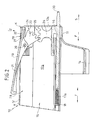
- Fig. 1 shows a partially sectioned view corresponding to a viewing direction in the direction of travel of the vehicle to the front of a right edge area in the direction of travel the load compartment cover 10. So you can only see that in the direction of travel right end portion of the load compartment cover 10, which is relative to Fig. 1 continues to the left.
- Fig. 1 shows a fastener 16 in the manner of a flat bar, the between a locking position shown in Fig. 1 and a shown in Fig. 3 Release position along the arrows F, S is displaceable.
- the anchoring end 30 of the fastener 16 engages when in the locked position State of the fastener 16 in a vehicle side, not shown Recording for the anchoring end 30 a.
- a receiving pocket for the right end region with respect to FIG. 1 to provide the safety device 10 in a motor vehicle side cover, one inside the receiving pocket into which the end wall 13a enters separate recess for the anchoring end 30 of the fastener 16 is arranged.
- End area of the load compartment cover 10 can be a corresponding fastening element 16 may be provided, but this is not absolutely necessary.
- Fig. 4 shows that it is, for example are two separate, parallel spring elements 17a, 17b can, but this is not necessary.
- the double arrangement of spring elements 17a, 17b makes it clear, however, that the fastening element 16 exerted preload is very high to ensure a secure click to ensure the anchoring end 30 in the intended receptacle.
- 1 is an actuating element above the fastening element 16 19 arranged. This is as about a pivot axis 20th pivotable lever with a first lever arm 21 and a second lever arm 22 trained. An extension 23 is on a second lever arm 22 a toothing 24 arranged. A corresponding counter toothing 25 is provided on an opposite extension 26, which is fixed, advantageously in one piece, is connected to the fastening element 16.
- a user can Applying a compressive force along the arrow Z in Fig. 1 to the second Lever arm 22 a pivoting of the actuating element 19 in a clockwise direction reach around the pivot axis 20.
- This is in the area of second lever arm 22 on the actuating element 19 a special actuating surface 27 provided.
- this is in one Operating trough 28 arranged so that a user has the operating surface 27 can quickly recognize as such.
- the Swivel angle is about 8 degrees in the embodiment, this being the case can of course only be seen as an example.
- the actuating element 19 in its comfort position according to FIG. 2 exposes and in this way counteracts the user.
- the actuating element 19 is in its comfort position according to FIG. 2 easily accessible by the user. With your fingers a user can use his hand the first lever arm 21 of the actuating element 19 easily grasp and exercise an operator that leads to a further pivoting of the actuating element 19 starting from the 2 leads into a working position according to FIG. 3.
- the for the Swiveling required from the comfort position to the working position Operators to be exercised are now much higher because of the meshing the teeth 24 and 25 an operative connection between the actuator 19 and the fastener 16 and the fastener 16 against the large spring force of the spring elements 17a, 17b to be shifted in the release direction F.
- the fastening element 19 is used at the same time as a handle for the load compartment cover 10, i.e. a user can the load compartment cover 10 in one hand or in one work step unlock and by carrying transport by reaching around the actuator Remove 19 carrying from the load compartment of the motor vehicle.
- the actuating element 19 is in a 1, so that a particularly space-saving Storage is possible because the actuator 19 in turn from the Contour K of the housing 11 does not protrude.
- the comfort position according to FIG. 2 and the working position of the actuating element according to FIG. 3 can advantageously, can be locked for example by a locking mechanism. This can offer further ease of handling.
- the actuating surface 27 and the second lever arm 21 are arranged according to the embodiment shown in the figures is a handling particularly easy since a user with a thumb of his right Hand can easily press on the operating recess 28, which is almost without Force is possible.
- the first lever arm 21 thereby moves out Housing 11 out towards the user, so that the user immediately with the remaining four fingers of his right hand the first lever arm 21 reach around, and carry the load compartment cover 10 and the motor vehicle can see. In this case, the comfort position of the Actuator 19 not necessary.
- a special feature of the toothing mechanism of the extensions 23 and 26 can be seen in the fact that when the actuating element is in the rest position 19 according to FIG. 1, a displaceability of the fastening element 16 is given, since the toothings 24 and 25 do not engage in this position come.
- a wedge surface at the anchoring end 30 of the fastener 16 is designed in the manner of a snap lock, so that the fastening element 16 when inserting the loading space cover 10 into the vehicle-side, Recording pockets not shown automatically snaps when the Actuator 19 is in the rest position. This snap movement is not hindered when the actuating element 19 is in the rest position.
- the actuating trough 28 is for operating the actuating element 19 an advantage.
- Other ergonomically advantageous ones can also be used Measures are taken, for example by attaching finger depressions on the underside of the first lever arm 21.
- the actuating surface 27 cannot be highlighted purely visually be colored, for example, but there can also be more Emphasis can be provided, for example by shaping.
- the In this context, the actuation trough 28 is a visual highlight, because you can see the bottom of the trough visually and from the rest Can distinguish the area of the actuator 19. But it is at the same time also a formative emphasis.
Landscapes
- Engineering & Computer Science (AREA)
- Mechanical Engineering (AREA)
- Lock And Its Accessories (AREA)
- Vehicle Step Arrangements And Article Storage (AREA)
- Seats For Vehicles (AREA)
Abstract
Description
- Fig. 1
- in teilgeschnittener Ansicht, einen axialen Endbereich einer erfindungsgemäßen Kfz-Sicherheitseinrichtung mit in Ruheposition befindlichem Betätigungselement und in Sperrposition befindlichen Befestigungselement,
- Fig. 2
- die Kfz-Sicherheitseinrichtung gemäß Fig. 1 mit in Komfort-Position befindlichem Betätigungselement,
- Fig. 3
- in einer Darstellung gemäß Fig. 2 die Kfz-Sicherheitseinrichtung mit in Arbeitsposition befindlichem Betätigungselement und in Freigabeposition befindlichem Befestigungselement, und
- die Fig. 4 bis 6
- schematisch in perspektivischer Ansicht das Betätigungselement und das Befestigungselement isoliert in drei unterschiedlichen Positionen gemäß den Fig. 1 bis 3.
Claims (18)
- Kfz-Sicherheitseinrichtung (10), wie Laderaumabdeckung, Trennetz, Sonnenrollo od. dgl., insbesondere für Kombinations-Personenkraftfahrzeuge, mit einer flexiblen Werkstoffbahn, die in ihrer Nichtgebrauchsstellung in einem Gehäuse (11) unterbringbar ist, welches mittels wenigstens einem Befestigungselement (16) fahrzeugseitig festlegbar ist, wobei ein zwischen einer Ruheposition und einer Arbeitsposition verlagerbares Betätigungselement (19) für das Befestigungselement (19) vorgesehen ist, dadurch gekennzeichnet, daß dem Betätigungselement eine Komfort-Position (Fig. 2) zugeordnet ist, aus der es in die Arbeitsposition (Fig. 3) überführbar ist, und daß das Betätigungselement (19) aus seiner Ruheposition (Fig. 1) bei unterbrochener Wirkverbindung zu dem Befestigungselement (16) in die Komfort-Position überführbar ist.
- Kfz-Sicherheitseinrichtung (10), wie Laderaumabdeckung, Trennetz, Sonnenrollo od. dgl., insbesondere für Kombinations-Personenkraftfahrzeuge, mit einer flexiblen Werkstoffbahn, die in ihrer Nichtgebrauchsstellung in einem Gehäuse (11) unterbringbar ist, welches mittels wenigstens einem Befestigungselement (16) fahrzeugseitig festlegbar ist, wobei ein zwischen einer Ruheposition und einer Arbeitsposition verlagerbares Betätigungselement (19) für das Befestigungselement (16) vorgesehen ist, dadurch gekennzeichnet, daß das in Ruheposition (Fig. 1) befindliche Betätigungselement (19) im wesentlichen versteckt angeordnet ist, und daß dem Betätigungselement (19) eine exponierte, insbesondere aus dem Versteck herausragende, Komfort-Position (Fig. 2) zugeordnet ist, aus der es in die Arbeitsposition (Fig. 3) überführbar ist.
- Kfz-Sicherheitseinrichtung nach Anspruch 1 oder 2, dadurch gekennzeichnet, daß das in Ruheposition (Fig. 1) befindliche Betätigungselement (19) im wesentlichen innerhalb der Kontur (K) des Gehäuses (11) angeordnet ist.
- Kfz-Sicherheitseinrichtung nach einem der Ansprüchen 1 bis 3, dadurch gekennzeichnet, daß das Gehäuse (11) einen Einbauraum (29) für das Betätigungselement (19) aufweist.
- Kfz-Sicherheitseinrichtung nach Anspruch 4, dadurch gekennzeichnet, daß der Einbauraum (29) im wesentlichen bündig mit einer Außenseite (12') des Gehäuses (11) abschließt.
- Kfz-Sicherheitseinrichtung nach einem der vorangegangenen Ansprüche, dadurch gekennzeichnet, daß das Betätigungselement (19) als Hebel ausgebildet ist.
- Kfz-Sicherheitseinrichtung nach Anspruch 6, dadurch gekennzeichnet, daß der Hebel (19) als zweiarmiger Hebel (21, 22) ausgebildet ist.
- Kfz-Sicherheitseinrichtung nach Anspruch 6 oder 7, dadurch gekennzeichnet, daß ein Hebelarm (22) einen Fortsatz (23) zum Zusammenwirken mit dem Befestigungselement (16) aufweist.
- Kfz-Sicherheitseinrichtung nach einem der vorangegangenen Ansprüche, dadurch gekennzeichnet, daß der Hebel (19, 21) als Tragegriff für die Kfz-Sicherheitseinrichtung (10) ausgebildet ist.
- Kfz-Sicherheitseinrichtung nach einem der vorangegangenen Ansprüche, dadurch gekennzeichnet, daß das Betätigungselement (19) eine zumindest visuell hervorgehobene Betätigungsfläche (27) aufweist.
- Kfz-Sicherheitseinrichtung nach Anspruch 10, dadurch gekennzeichnet, daß die Betätigungsfläche (27) in einer Mulde (28) angeordnet ist.
- Kfz-Sicherheitseinrichtung nach einem der vorangegangenen Ansprüche, dadurch gekennzeichnet, daß das Betätigungselement (19) in seiner Komfort-Position arretierbar ist.
- Kfz-Sicherheitseinrichtung nach einem der vorangegangenen Ansprüche, dadurch gekennzeichnet, daß das Betätigungselement (19) in seiner Arbeitsposition arretierbar ist.
- Kfz-Sicherheitseinrichtung nach einem der vorangegangenen Ansprüche, dadurch gekennzeichnet, daß das Betätigungselement (19) in seiner Ruheposition arretierbar ist.
- Kfz-Sicherheitseinrichtung nach einem der vorangegangenen Ansprüche, dadurch gekennzeichnet, daß das Befestigungselement (16) bei in Arbeitsposition befindlichem Betätigungselement (19) in einer Sperrposition angeordnet ist.
- Kfz-Sicherheitseinrichtung nach einem der vorangegangenen Ansprüche, dadurch gekennzeichnet, daß das Befestigungselement (16) bei in Ruheposition befindlichem Betätigungselement (19) in einer Freigabeposition anordenbar ist.
- Kfz-Sicherheitseinrichtung nach einem der vorangegangenen Ansprüche, dadurch gekennzeichnet, daß das Befestigungselement (16) bei in Ruheposition befindlichem Betätigungselement (19) verlagerbar ist.
- Kfz-Sicherheitseinrichtung nach einem der vorangegangenen Ansprüche, dadurch gekennzeichnet, daß das Befestigungselement (16) bei in Komfort-Position befindlichem Betätigungselement (19) in einer Freigabeposition angeordnet ist.
Applications Claiming Priority (2)
| Application Number | Priority Date | Filing Date | Title |
|---|---|---|---|
| DE2002134283 DE10234283B4 (de) | 2002-07-26 | 2002-07-26 | Kfz-Sicherheitseinrichtung, wie Laderaumabdeckung, Trennnetz, Sonnenrollo od. dgl. |
| DE10234283 | 2002-07-26 |
Publications (3)
| Publication Number | Publication Date |
|---|---|
| EP1384625A2 true EP1384625A2 (de) | 2004-01-28 |
| EP1384625A3 EP1384625A3 (de) | 2004-03-03 |
| EP1384625B1 EP1384625B1 (de) | 2007-11-28 |
Family
ID=29796595
Family Applications (1)
| Application Number | Title | Priority Date | Filing Date |
|---|---|---|---|
| EP20030016052 Expired - Lifetime EP1384625B1 (de) | 2002-07-26 | 2003-07-15 | Betätigungselement für eine Kfz-Sicherheitseinrichtung, wie ein Trennnetz |
Country Status (2)
| Country | Link |
|---|---|
| EP (1) | EP1384625B1 (de) |
| DE (2) | DE10234283B4 (de) |
Family Cites Families (6)
| Publication number | Priority date | Publication date | Assignee | Title |
|---|---|---|---|---|
| DE4013158C2 (de) * | 1990-04-25 | 1995-12-07 | Butz Peter Verwaltung | Abdeckrollo für Kraftfahrzeuge |
| JPH04254230A (ja) * | 1991-02-01 | 1992-09-09 | Toyota Motor Corp | トノカバーの巻取軸支持構造 |
| DE19540048C2 (de) * | 1995-10-27 | 1998-03-19 | Ford Werke Ag | Kraftfahrzeug |
| DE19736170C1 (de) * | 1997-08-20 | 1999-04-29 | Baumeister & Ostler Gmbh Co | Abdeckrollo mit Hebelmechanik |
| DE19739625C1 (de) * | 1997-09-10 | 1998-10-15 | Audi Ag | Laderaum-Trennvorrichtung für Kraftwagen, insbesondere für Kombinations-Personenkraftwagen |
| DE10218632C1 (de) * | 2002-04-25 | 2003-05-08 | Butz Peter Verwaltung | Kfz-Sicherheitseinrichtung, wie Laderaumabdeckung, Trennnetz od. dgl. |
-
2002
- 2002-07-26 DE DE2002134283 patent/DE10234283B4/de not_active Expired - Fee Related
-
2003
- 2003-07-15 DE DE50308673T patent/DE50308673D1/de not_active Expired - Lifetime
- 2003-07-15 EP EP20030016052 patent/EP1384625B1/de not_active Expired - Lifetime
Also Published As
| Publication number | Publication date |
|---|---|
| DE10234283A1 (de) | 2004-02-12 |
| EP1384625B1 (de) | 2007-11-28 |
| DE50308673D1 (de) | 2008-01-10 |
| EP1384625A3 (de) | 2004-03-03 |
| DE10234283B4 (de) | 2005-06-09 |
Similar Documents
| Publication | Publication Date | Title |
|---|---|---|
| EP0668187B1 (de) | Abdeckrollo für Kombi-Personenkraftfahrzeuge | |
| DE102008007322B4 (de) | Mechanisch abschliessbarer Handgriff für ein bewegliches Verschlusselement | |
| DE102007045177B4 (de) | Verriegelungsvorrichtung | |
| EP0345438A2 (de) | Abdeckrollo oder - einrichtung für einen Kofferraum eines Kraftfahrzeuges | |
| DE10248591A1 (de) | Fensterrollo mit Deckel auf dem Auszugschlitz | |
| WO2013149691A1 (de) | Verstellvorrichtung für ein schwenkbares komfortelement, insbesondere für eine armlehne eines fahrzeugs | |
| WO2018041623A1 (de) | Türaussengriff für ein kraftfahrzeug | |
| EP1396382B1 (de) | Laderaumabdeckung für Kraftwagen, insbesondere für Kombinations-Personenkraftwagen | |
| DE4312032C2 (de) | Kupplung zum Befestigen und Lösen von Ausrüstungsgegenständen | |
| DE10236582A1 (de) | Beweglicher Behälter für den Einbau in Kraftwagen, wie Mittelkonsolbehälter o. dgl. | |
| DE10161647B4 (de) | Kfz-Sicherheitseinrichtung, insbesondere Laderaumabdeckung | |
| DE202017101828U1 (de) | Verschlussvorrichtung für einen Deckel eines Abdeckfachs, Deckel eines Ablagefachs mit einer derartigen Verschlussvorrichtung sowie Ablagefach mit einem solchen Deckel | |
| EP1356991B1 (de) | Kfz-Sicherheitseinrichtung, wie Laderaumabdeckung, Trennnetz od.dgl. | |
| DE10205154C5 (de) | Kfz-Sicherheitseinrichtung, wie Laderaumabdeckung, Sicherheitsnetz, Sonnenrollo od.dgl. | |
| DE19708192C1 (de) | Laderaum-Trennvorrichtung für Kraftwagen, insbesondere für Kombinations-Personenkraftwagen | |
| EP1591317B1 (de) | Staufachabdeckung | |
| EP1384625B1 (de) | Betätigungselement für eine Kfz-Sicherheitseinrichtung, wie ein Trennnetz | |
| DE112023003189T5 (de) | Markisenbefestigung, Markisenzubehör und Markisenanordnungen | |
| DE10354161B4 (de) | Vorrichtung zur Verriegelung einer Fahrzeuglehne in wenigstens zwei unterschiedlichen Lehnenpositionen | |
| DE4405346C2 (de) | Vorrichtung zur Entriegelung und Verriegelung der Rücksitzlehne von Kfz | |
| DE4135663C1 (en) | Roll cover for vehicle load space - is supported by cross-struts sliding in rails and fitting into boxes at ends of rails | |
| DE102008015231B4 (de) | Abdeck- und/oder Trennvorrichtung für einen Gepäckraum eines Kraftfahrzeuges | |
| DE10146528B4 (de) | Entriegelungsvorrichtung für eine klappbare Rückenlehne eines Kraftfahrzeugsitzes | |
| EP1176271A2 (de) | Vorrichtung zur Arretierung eines Schliesszylindergehäuses | |
| DE10300505B4 (de) | Kfz-Sicherheitseinrichtung, insbesondere Kfz-Trennnetz |
Legal Events
| Date | Code | Title | Description |
|---|---|---|---|
| PUAI | Public reference made under article 153(3) epc to a published international application that has entered the european phase |
Free format text: ORIGINAL CODE: 0009012 |
|
| PUAL | Search report despatched |
Free format text: ORIGINAL CODE: 0009013 |
|
| AK | Designated contracting states |
Kind code of ref document: A2 Designated state(s): AT BE BG CH CY CZ DE DK EE ES FI FR GB GR HU IE IT LI LU MC NL PT RO SE SI SK TR |
|
| AX | Request for extension of the european patent |
Extension state: AL LT LV MK |
|
| AK | Designated contracting states |
Kind code of ref document: A3 Designated state(s): AT BE BG CH CY CZ DE DK EE ES FI FR GB GR HU IE IT LI LU MC NL PT RO SE SI SK TR |
|
| AX | Request for extension of the european patent |
Extension state: AL LT LV MK |
|
| 17P | Request for examination filed |
Effective date: 20040902 |
|
| AKX | Designation fees paid |
Designated state(s): DE ES FR GB |
|
| RBV | Designated contracting states (corrected) |
Designated state(s): DE FR GB SE |
|
| RAP1 | Party data changed (applicant data changed or rights of an application transferred) |
Owner name: BOS GMBH & CO. KG |
|
| 17Q | First examination report despatched |
Effective date: 20041221 |
|
| 17Q | First examination report despatched |
Effective date: 20041221 |
|
| GRAP | Despatch of communication of intention to grant a patent |
Free format text: ORIGINAL CODE: EPIDOSNIGR1 |
|
| GRAS | Grant fee paid |
Free format text: ORIGINAL CODE: EPIDOSNIGR3 |
|
| GRAA | (expected) grant |
Free format text: ORIGINAL CODE: 0009210 |
|
| AK | Designated contracting states |
Kind code of ref document: B1 Designated state(s): DE FR GB SE |
|
| REF | Corresponds to: |
Ref document number: 50308673 Country of ref document: DE Date of ref document: 20080110 Kind code of ref document: P |
|
| REG | Reference to a national code |
Ref country code: SE Ref legal event code: TRGR |
|
| GBT | Gb: translation of ep patent filed (gb section 77(6)(a)/1977) |
Effective date: 20080304 |
|
| ET | Fr: translation filed | ||
| PLBE | No opposition filed within time limit |
Free format text: ORIGINAL CODE: 0009261 |
|
| STAA | Information on the status of an ep patent application or granted ep patent |
Free format text: STATUS: NO OPPOSITION FILED WITHIN TIME LIMIT |
|
| 26N | No opposition filed |
Effective date: 20080829 |
|
| PGFP | Annual fee paid to national office [announced via postgrant information from national office to epo] |
Ref country code: GB Payment date: 20080723 Year of fee payment: 6 |
|
| GBPC | Gb: european patent ceased through non-payment of renewal fee |
Effective date: 20090715 |
|
| PG25 | Lapsed in a contracting state [announced via postgrant information from national office to epo] |
Ref country code: GB Free format text: LAPSE BECAUSE OF NON-PAYMENT OF DUE FEES Effective date: 20090715 |
|
| PGFP | Annual fee paid to national office [announced via postgrant information from national office to epo] |
Ref country code: FR Payment date: 20110729 Year of fee payment: 9 |
|
| PGFP | Annual fee paid to national office [announced via postgrant information from national office to epo] |
Ref country code: SE Payment date: 20110721 Year of fee payment: 9 |
|
| REG | Reference to a national code |
Ref country code: SE Ref legal event code: EUG |
|
| REG | Reference to a national code |
Ref country code: FR Ref legal event code: ST Effective date: 20130329 |
|
| PG25 | Lapsed in a contracting state [announced via postgrant information from national office to epo] |
Ref country code: FR Free format text: LAPSE BECAUSE OF NON-PAYMENT OF DUE FEES Effective date: 20120731 Ref country code: SE Free format text: LAPSE BECAUSE OF NON-PAYMENT OF DUE FEES Effective date: 20120716 |
|
| PGFP | Annual fee paid to national office [announced via postgrant information from national office to epo] |
Ref country code: DE Payment date: 20130724 Year of fee payment: 11 |
|
| REG | Reference to a national code |
Ref country code: DE Ref legal event code: R119 Ref document number: 50308673 Country of ref document: DE |
|
| PG25 | Lapsed in a contracting state [announced via postgrant information from national office to epo] |
Ref country code: DE Free format text: LAPSE BECAUSE OF NON-PAYMENT OF DUE FEES Effective date: 20150203 |
|
| REG | Reference to a national code |
Ref country code: DE Ref legal event code: R119 Ref document number: 50308673 Country of ref document: DE Effective date: 20150203 |