EP1380698A2 - Deckenrand-Dämmung - Google Patents
Deckenrand-Dämmung Download PDFInfo
- Publication number
- EP1380698A2 EP1380698A2 EP03015234A EP03015234A EP1380698A2 EP 1380698 A2 EP1380698 A2 EP 1380698A2 EP 03015234 A EP03015234 A EP 03015234A EP 03015234 A EP03015234 A EP 03015234A EP 1380698 A2 EP1380698 A2 EP 1380698A2
- Authority
- EP
- European Patent Office
- Prior art keywords
- ceiling
- support
- ceiling edge
- insulation
- edge insulation
- Prior art date
- Legal status (The legal status is an assumption and is not a legal conclusion. Google has not performed a legal analysis and makes no representation as to the accuracy of the status listed.)
- Withdrawn
Links
Images
Classifications
-
- E—FIXED CONSTRUCTIONS
- E04—BUILDING
- E04B—GENERAL BUILDING CONSTRUCTIONS; WALLS, e.g. PARTITIONS; ROOFS; FLOORS; CEILINGS; INSULATION OR OTHER PROTECTION OF BUILDINGS
- E04B1/00—Constructions in general; Structures which are not restricted either to walls, e.g. partitions, or floors or ceilings or roofs
- E04B1/62—Insulation or other protection; Elements or use of specified material therefor
- E04B1/74—Heat, sound or noise insulation, absorption, or reflection; Other building methods affording favourable thermal or acoustical conditions, e.g. accumulating of heat within walls
- E04B1/76—Heat, sound or noise insulation, absorption, or reflection; Other building methods affording favourable thermal or acoustical conditions, e.g. accumulating of heat within walls specifically with respect to heat only
-
- E—FIXED CONSTRUCTIONS
- E04—BUILDING
- E04B—GENERAL BUILDING CONSTRUCTIONS; WALLS, e.g. PARTITIONS; ROOFS; FLOORS; CEILINGS; INSULATION OR OTHER PROTECTION OF BUILDINGS
- E04B1/00—Constructions in general; Structures which are not restricted either to walls, e.g. partitions, or floors or ceilings or roofs
- E04B1/62—Insulation or other protection; Elements or use of specified material therefor
- E04B1/74—Heat, sound or noise insulation, absorption, or reflection; Other building methods affording favourable thermal or acoustical conditions, e.g. accumulating of heat within walls
- E04B1/76—Heat, sound or noise insulation, absorption, or reflection; Other building methods affording favourable thermal or acoustical conditions, e.g. accumulating of heat within walls specifically with respect to heat only
- E04B2001/7679—Means preventing cold bridging at the junction of an exterior wall with an interior wall or a floor
-
- E—FIXED CONSTRUCTIONS
- E04—BUILDING
- E04B—GENERAL BUILDING CONSTRUCTIONS; WALLS, e.g. PARTITIONS; ROOFS; FLOORS; CEILINGS; INSULATION OR OTHER PROTECTION OF BUILDINGS
- E04B5/00—Floors; Floor construction with regard to insulation; Connections specially adapted therefor
- E04B5/16—Load-carrying floor structures wholly or partly cast or similarly formed in situ
- E04B5/32—Floor structures wholly cast in situ with or without form units or reinforcements
- E04B2005/322—Floor structures wholly cast in situ with or without form units or reinforcements with permanent forms for the floor edges
Definitions
- the invention relates to ceiling edge insulation for concrete ceilings, in particular In-situ concrete ceilings, prefabricated ceilings, semi-finished ceilings or such from brick floorboards, with a wall element, a thermal insulation board, the outside of which is flush with the outside of the wall element and their top and bottom edges essentially symmetrical about the The top and bottom of the blanket protrude, and one on the inside the thermal insulation plate attached support, which in the direction of Ceiling edge runs, and its underside perpendicular to the facade is aligned and aligned with the underside of the ceiling.
- the outer walls of Living and work rooms have thermal insulation, their requirements are defined by DIN standards. Aim of thermal insulation is to equalize the temperature or heat flow from the Slow down the inside of the building towards the outside. Highly insulating building materials are therefore used to create the outer walls used, the thermal insulation effect of the Inclusion of air spaces is achieved.
- building materials of mentioned type include, for example, hollow bricks, pore bricks, gas concrete blocks or mats made of glass or rock wool and plate-shaped element made of polystyrene or polyurethane.
- Critical points of a building from the perspective of thermal insulation are the openings of the ceilings in the walls. Because these blankets in the Usually made of materials with low thermal insulation, such as Reinforced concrete, manufactured, direct the recorded inside the rooms Heat well and quickly towards the outer walls. Around to reduce the heat flow to the outside of the building wall Special design measures are therefore taken at the front of the ceilings required.
- Measures known from the prior art include et al Formwork elements made of highly heat-insulating material. This Elements perform two tasks, the first in the real one Thermal insulation of the ceiling edge and the second is that it is used as lost formwork when manufacturing the concrete floor become.
- the mentioned applications see the solution to the second task each on the inside of the plate-shaped facing the ceiling Insulation element an angled support on the plate.
- the insulation element is then used to manufacture the slab formwork with its support placed on the last row of stones and on Masonry or the reinforcement of the ceiling fixed.
- the bottom of the support usually lies in alignment with the underside of the deck, while the height of the support is much smaller than the thickness the ceiling is sized.
- a material for the support is common a material with comparatively high mechanical stability is provided, that usually has a correspondingly low thermal insulation.
- a disadvantage of the above mentioned is that the support makes no contribution to the thermal insulation of the insulation element.
- the thermal insulation of the insulation element is therefore on the Insulating effect of the plate-shaped part of the element limited.
- the parallel to the ceiling level to the outside heat flows in the building are not optimally reduced.
- the invention has set itself the task Ceiling edge insulation for concrete ceilings, especially in-situ concrete ceilings, Ready-made ceilings, semi-finished ceilings or those made of brick flooring going to further develop that the disadvantages mentioned avoided be, while increasing thermal insulation achieved and attaching the insulation elements when creating the Slab formwork is simplified.
- the existing ceiling edge insulation basically consists of two thermal insulation Elements, a known plate-shaped and an additional cuboid element that is positive and / or non-positive are interconnected. From a thermal point of view both elements connected in series. The thermal insulation property The ceiling edge insulation is thereby in the direction perpendicular to External facade compared to known elements around the insulation effect of the cuboid element increased.
- this plate-shaped element to a height, which is based on the State of the art protrudes above the top and bottom of the ceiling, while the cuboid element is designed so that its Top and bottom with the top and bottom of the blanket aligned.
- This training has the consequence that the thermal resistance also for heat flows that are inclined against the perpendicular to the outer facade run out of the interior of the ceiling, is raised and thus this also made a contribution to improved thermal insulation becomes.
- the proposed insulation element can be in two parts as well be formed in one piece.
- the insulation board and the cuboid support independent elements which form and / or are positively connected to each other, for example are interlocked or glued together.
- Both elements can Need to be made of different materials to Example the external insulation board made of stone or glass wool, the internal support element, however, for example made of extruded Polystyrene.
- the ceiling edge insulation the hydrostatic forces that occur when pouring the concrete completely absorbed by the support element because of its height corresponds to the full height of the ceiling. The lower static strength the rock or glass wool is therefore irrelevant to the casting process.
- a two-part training according to the present Execution of the special thermal properties of mineral fiber wool can be used for special applications.
- a one-piece design of the insulating element is preferred, preferably as the material extruded polystyrene is used.
- the advantage of this construction is due to its simple and inexpensive manufacture.
- said polystyrene has a closed cell Structure based on an air exchange between the individual cells and prevents the environment and therefore the material very good thermal insulation Gives properties.
- the closed cells lead moreover, that such elements are not absorbent, always dry and can be loaded with comparatively high pressure forces.
- the Surface of the ceiling edge insulation is at least partially rough is. This roughening of the surface can occur during production the insulation elements or through a subsequent work step be performed. A method has proven itself in which the roughness is created by sticking sand. As the Practice has shown, such insulation elements have good adhesion for the adjacent materials.
- the support has fastening elements that are used for fixing the ceiling edge insulation on the wall element and / or on Steel skeleton serve the ceiling. Allow these fasteners on the one hand a fixation of the ceiling edge elements to simple Way and are, on the other hand, suitable when pouring the concrete on to absorb the hydrostatic forces exerted on the ceiling.
- fastening elements that are used for fixing the ceiling edge insulation on the wall element and / or on Steel skeleton serve the ceiling.
- a first variant provides to design the fastening elements as nails or rods, which can be fixed on the wall element through the support are. It is advantageous here if the support is already factory-fitted Openings for the nails or rods are provided. Because the hydrostatic Forces when pouring the concrete are essentially horizontal act on the ceiling edge elements, the above Nails or rods are essentially only subjected to shear, so that deep anchoring in the wall element is not required.
- the fastening elements comprise Hooks, eyes, openings, fixing wires, or similar elements, the surface of the surface facing the front of the ceiling Support are attached. These elements are with the wall element or the steel skeleton connectable, for this in the simplest case Binding wire is used, or in the formation of the fasteners as fixing wires they are attached to the steel skeleton themselves.
- the fasteners mentioned are usually about the height the support is distributed.
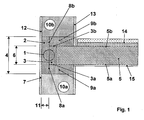
- the ceiling edge insulation characterized by the reference number 1. It consists of two elements 2 and 3, 2 the insulation board and 3 the cuboid support reproduces. Both elements are extruded from highly insulating Polystyrene manufactured and positively and / or non-positively with each other connected. As can be seen from the figure, the height exceeds 4 the insulation board 2 that of the ceiling 5. The height 6 corresponds to the support contrast, the thickness of the ceiling, the bottom 3a and the top 3b of the support 3 are therefore aligned with the underside 5a and the top 5b of the ceiling 5.
- the ceiling edge insulation 1 is arranged on the end face of the concrete ceiling 5 and thus prevents the formation of a thermal bridge between Ceiling 5 and exterior facade 7. Since the heat flow on the Away from the ceiling 5 to the outer facade 7 both the support 3 and must also pass through the insulation board 2, their thermal resistances add up.
- the thermal insulation property of ceiling edge insulation 1 according to the present invention is thus both in a External facade 7 vertical as well as in one of the vertical to direction deviating to a certain amount from known ones Insulating elements around the insulating effect of the cuboid support 3 increased.
- the different heights (4, 6) of the plate-shaped 2 and the cuboid Part 3 give the lower and the upper boundary surface the ceiling edge element 1 has a step-shaped course 8a or 8b. Accordingly, the last row of stones 9a before the ceiling 5 built of stones, which on the outside of the masonry 10a one around the thickness 11 of the plate-shaped part 2 of the ceiling edge insulation 1 have reduced thickness.
- This training leads to that the ceiling edge element 1 according to the present invention in the Production of the formwork for the ceiling 5 then simply with the lower step-like step 8a are placed on the last row of stones 9a can, the step-like course a good fit and hold the Insulation elements 1 guaranteed on the stone row mentioned.
- the masonry 10b adjoins above the concrete ceiling 5 first row of stones 9b has a thickness that is reduced by the same amount is, as with stones 9a below the ceiling 5.
- the stones 9b therefore fit positively in the upper step-shaped walls 8b of the ceiling edge insulation 1. Because the thickness of the Insulation board 11 and reducing the thickness of the stones in the rows 9a and 9b correspond to each other, closes the outside of the insulation board 2 flush with the exterior facade 7.
- the masonry 10a, 10b has one on the outside and inside Plaster 12 or 13, the ceiling 5 on its top a floor 14 and on the bottom a coat of 15 plaster, floor and paint
- the ceiling 5 on its top a floor 14 and on the bottom a coat of 15 plaster, floor and paint
Landscapes
- Physics & Mathematics (AREA)
- Engineering & Computer Science (AREA)
- Architecture (AREA)
- Acoustics & Sound (AREA)
- Electromagnetism (AREA)
- Civil Engineering (AREA)
- Structural Engineering (AREA)
- Building Environments (AREA)
Abstract
Description
- die Abstützung
- die Form eines Quaders aufweist,
- dessen Höhe der Dicke der Decke entspricht
- aus wärmedämmenden Material ausgebildet ist,
- und mit der Wärmedämmplatte form- und/oder kraftschlüssig verbunden ist.
- die Form eines Quaders aufweist,
- Figur 1
- zeigt: einen Schnitt durch Decke und Mauerwerk im Bereich der Deckenrand-Dämmung
Claims (8)
- Deckenrand-Dämmung für Betondecken (5), insbesondere Ortsbetondecken, Fertigdecken, Halbfertigdecken oder solche aus Ziegeldielen, miteinem Mauerelement (10a, 10b),einer Wärmedämmplatte (2),deren Außenseite mit der Außenseite (7) des Mauerelementes (10a, 10b) fluchtet,und deren Ober- und Unterkante im wesentlichen symmetrisch über die Oberseite (5b) und Unterseite (5a) der Betondecke (5) übersteht,und einer an der zur Decke gerichteten Seite der Wärmedämplatte (2) befestigten Abstützung (3),welche in Richtung des Deckenrandes verläuft,und deren Unterseite (3a)senkrecht zur Fassade (7) ausgerichtet istund mit der Unterseite (5a) der Decke (5) fluchtet, dadurch gekennzeichnet, daßdie Abstützung (3)die Form eines Quaders aufweist,dessen Höhe (6) der Dicke der Decke (5) entsprichtaus wärmedämmenden Material ausgebildet ist,und mit der Wärmedämmplatte (2) form- und/oder kraftschlüssig verbunden ist.
- Deckenrand-Dämmung nach Anspruch 1, dadurch gekennzeichnet, daßdie Abstützung (3) aus exdrudiertem Polystyrol besteht.
- Deckenrand-Dämmung nach Anspruch 1 oder 2, dadurch gekennzeichnet, daßdie formschlüsige Verbindung eine einstückige Verbindung ist.
- Deckenrand-Dämmung nach einem der Ansprüche 1 - 3, dadurch gekennzeichnet, daßdie Oberfläche der Abstützung (3) und die Oberfläche der Wärmedämmplatte (4) wenigstens teilweise rau ausgebildet sind.
- Deckenrand-Dämmung nach Anspruch 4, dadurch gekennzeichnet, daßdie Rauhigkeit durch aufgeklebten Sand erzeugt ist.
- Deckenrand-Dämmung nach einem der Ansprüche 1- 5, dadurch gekennzeichnet, daßdie Abstützung (3) Befestigungselemente aufweist,die zur Festlegung der Deckenrand-Dämmung (1) an genanntem Mauerelement (10a, 10b) und/oder am Stahlskelett der Decke (5) nutzbar sind.
- Deckenrand-Dämmung nach Anspruch 6, dadurch gekennzeichnet, daßdie Befestigungselemente aus Nägeln oder Stäben bestehen,welche durch die Abstützung (3) hindurch,vorzugsweise durch hierfür vorgesehene vertikale Öffnungen,
am Mauerelement (10a) festlegbar sind. - Deckenrand-Dämmung nach Anspruch 6 oder 7 , dadurch gekennzeichnet, daßdie BefestigungselementeHaken,Ösen,Öffnungen,Fixierdrähten,oder dergl. Elementen umfassen,welche an der zur Stirnseite der Decke hin gewandten Oberfläche der Abstützung (3) angebracht sindund mit dem Mauerelement (10a) oder dem Stahlskelett der Decke (5) verbindbar sind.
Applications Claiming Priority (2)
| Application Number | Priority Date | Filing Date | Title |
|---|---|---|---|
| DE10231244 | 2002-07-11 | ||
| DE2002131244 DE10231244A1 (de) | 2002-07-11 | 2002-07-11 | Deckenrand-Dämmung |
Publications (2)
| Publication Number | Publication Date |
|---|---|
| EP1380698A2 true EP1380698A2 (de) | 2004-01-14 |
| EP1380698A3 EP1380698A3 (de) | 2006-04-05 |
Family
ID=29723836
Family Applications (1)
| Application Number | Title | Priority Date | Filing Date |
|---|---|---|---|
| EP03015234A Withdrawn EP1380698A3 (de) | 2002-07-11 | 2003-07-05 | Deckenrand-Dämmung |
Country Status (2)
| Country | Link |
|---|---|
| EP (1) | EP1380698A3 (de) |
| DE (1) | DE10231244A1 (de) |
Families Citing this family (1)
| Publication number | Priority date | Publication date | Assignee | Title |
|---|---|---|---|---|
| DE102017100483A1 (de) * | 2017-01-11 | 2018-07-12 | DiHa Patentverwertungs GbR (vertretungsberechtigte Gesellschafter Konrad Wetzstein, 86502 Laugna und Anton Kempter, 89361 Landensberg) | Deckenrandschalungselement |
Family Cites Families (5)
| Publication number | Priority date | Publication date | Assignee | Title |
|---|---|---|---|---|
| DE3542467A1 (de) * | 1985-11-30 | 1987-06-04 | Camino Handelsgesellschaft Mbh | Bausatz fuer eine stahlbeton-konsole zum abfangen eines verblendmauerwerks |
| DE29510878U1 (de) * | 1995-07-05 | 1995-10-19 | Meiser, Gert, 51149 Köln | Verlorenes Schalungsprofil für Elementedecken (Filigran) für die lotrechten Stirnseiten von Balkonen und Kragplatten |
| AT2945U1 (de) * | 1998-05-19 | 1999-07-26 | Augustin Dipl Ing Heuberger | Formstein zur herstellung von mauerelementen |
| DE10000432A1 (de) * | 2000-01-10 | 2001-07-12 | Harald Hagedorn | Deckenrandschalung |
| DE20203286U1 (de) * | 2002-03-01 | 2002-05-02 | SAINT-GOBAIN ISOVER G+H AG, 67059 Ludwigshafen | Deckenranddämmelement |
-
2002
- 2002-07-11 DE DE2002131244 patent/DE10231244A1/de not_active Withdrawn
-
2003
- 2003-07-05 EP EP03015234A patent/EP1380698A3/de not_active Withdrawn
Also Published As
| Publication number | Publication date |
|---|---|
| EP1380698A3 (de) | 2006-04-05 |
| DE10231244A1 (de) | 2004-01-22 |
Similar Documents
| Publication | Publication Date | Title |
|---|---|---|
| DE69128482T2 (de) | Plattenmodul aus geschäumtem kunststoff mit versetzten t-förmigen längskanälen für hölzerne stützen | |
| EP0191144A2 (de) | Plattenförmiger Baukörper zur Erstellung und Verkleidung von Mauern, Wänden und Fassaden | |
| DE3005402C2 (de) | Isolierendes Verbandsmauerwerk | |
| DE2724755A1 (de) | Sturz zur abstuetzung der aeusseren mauerschicht von mauerwerk ueber wandoeffnungen | |
| DE19527275A1 (de) | Verfahren zur Herstellung vorgefertigter verputzter Mauerwerkswände und Schalungstisch zu dessen Durchführung | |
| DE3542467C2 (de) | ||
| DE3206163A1 (de) | Bauelement | |
| DE4421839C1 (de) | Schalungstafel aus Beton | |
| DE102007004573B4 (de) | Wandbauelement und Verfahren zur Herstellung eines Wandbauelements | |
| CH662849A5 (de) | Verfahren zum herstellen eines gebaeudes und ein nach diesem verfahren hergestelltes gebaeude. | |
| DE19950356C2 (de) | Mehrschichtige Bauplatte, sowie Verfahren zu ihrer Herstellung | |
| DE3344861A1 (de) | Bauelement | |
| EP1380698A2 (de) | Deckenrand-Dämmung | |
| DE9315026U1 (de) | Fertigbauwandelement für Gebäude, insbesondere Wohngebäude | |
| EP3971361A1 (de) | Lehmbauwandscheibe | |
| DE8916179U1 (de) | Bauelement für Hochbauwerke | |
| DE102021133372B3 (de) | Konstruktionssystem | |
| DE19714435C2 (de) | Verfahren zum Errichten von bewehrtem Mauerwerk | |
| EP0656452B1 (de) | Riemchen- oder Kachelplatte | |
| DE3545707A1 (de) | Leichtlehmbauelement | |
| DE606167C (de) | Hohlwand oder Decke aus Platten, vorzugsweise Korksteinplatten | |
| DE19745783A1 (de) | Holzsystemhaus | |
| AT402314B (de) | Zwischendeckenauflager für fertigteilhäuser | |
| DE29702623U1 (de) | Putzunterlage | |
| DE2804637A1 (de) | Vorgefertigtes bauteil zur verwendung im bauwesen |
Legal Events
| Date | Code | Title | Description |
|---|---|---|---|
| PUAI | Public reference made under article 153(3) epc to a published international application that has entered the european phase |
Free format text: ORIGINAL CODE: 0009012 |
|
| AK | Designated contracting states |
Kind code of ref document: A2 Designated state(s): AT BE BG CH CY CZ DE DK EE ES FI FR GB GR HU IE IT LI LU MC NL PT RO SE SI SK TR |
|
| AX | Request for extension of the european patent |
Extension state: AL LT LV MK |
|
| PUAL | Search report despatched |
Free format text: ORIGINAL CODE: 0009013 |
|
| AK | Designated contracting states |
Kind code of ref document: A3 Designated state(s): AT BE BG CH CY CZ DE DK EE ES FI FR GB GR HU IE IT LI LU MC NL PT RO SE SI SK TR |
|
| AX | Request for extension of the european patent |
Extension state: AL LT LV MK |
|
| AKX | Designation fees paid | ||
| STAA | Information on the status of an ep patent application or granted ep patent |
Free format text: STATUS: THE APPLICATION IS DEEMED TO BE WITHDRAWN |
|
| 18D | Application deemed to be withdrawn |
Effective date: 20061006 |
|
| REG | Reference to a national code |
Ref country code: DE Ref legal event code: 8566 |