EP1373360B1 - Verfahren und vorrichtung zur kontinuierlichen polykondensation von polyestermaterial in fester phase - Google Patents
Verfahren und vorrichtung zur kontinuierlichen polykondensation von polyestermaterial in fester phase Download PDFInfo
- Publication number
- EP1373360B1 EP1373360B1 EP01905567A EP01905567A EP1373360B1 EP 1373360 B1 EP1373360 B1 EP 1373360B1 EP 01905567 A EP01905567 A EP 01905567A EP 01905567 A EP01905567 A EP 01905567A EP 1373360 B1 EP1373360 B1 EP 1373360B1
- Authority
- EP
- European Patent Office
- Prior art keywords
- gas
- post
- polyester material
- heating
- flow
- Prior art date
- Legal status (The legal status is an assumption and is not a legal conclusion. Google has not performed a legal analysis and makes no representation as to the accuracy of the status listed.)
- Expired - Lifetime
Links
- 238000000034 method Methods 0.000 title claims abstract description 40
- 229920000728 polyester Polymers 0.000 title claims abstract description 22
- 239000000463 material Substances 0.000 title claims abstract description 17
- 239000007790 solid phase Substances 0.000 title claims abstract description 9
- 238000006068 polycondensation reaction Methods 0.000 title claims abstract description 7
- 239000008187 granular material Substances 0.000 claims abstract description 43
- 238000010438 heat treatment Methods 0.000 claims abstract description 33
- 239000007789 gas Substances 0.000 claims description 101
- IJGRMHOSHXDMSA-UHFFFAOYSA-N Atomic nitrogen Chemical compound N#N IJGRMHOSHXDMSA-UHFFFAOYSA-N 0.000 claims description 14
- 238000002425 crystallisation Methods 0.000 claims description 13
- 229910052757 nitrogen Inorganic materials 0.000 claims description 7
- 238000001816 cooling Methods 0.000 claims description 6
- 239000002808 molecular sieve Substances 0.000 claims description 2
- URGAHOPLAPQHLN-UHFFFAOYSA-N sodium aluminosilicate Chemical compound [Na+].[Al+3].[O-][Si]([O-])=O.[O-][Si]([O-])=O URGAHOPLAPQHLN-UHFFFAOYSA-N 0.000 claims description 2
- 230000014759 maintenance of location Effects 0.000 claims 2
- 238000004140 cleaning Methods 0.000 claims 1
- 238000009833 condensation Methods 0.000 claims 1
- 239000002826 coolant Substances 0.000 claims 1
- 238000011144 upstream manufacturing Methods 0.000 claims 1
- 238000001953 recrystallisation Methods 0.000 abstract description 2
- 230000008025 crystallization Effects 0.000 description 7
- 238000002844 melting Methods 0.000 description 5
- 230000008018 melting Effects 0.000 description 5
- 239000007787 solid Substances 0.000 description 5
- 230000004927 fusion Effects 0.000 description 4
- 239000011261 inert gas Substances 0.000 description 4
- 230000007704 transition Effects 0.000 description 4
- 230000015572 biosynthetic process Effects 0.000 description 3
- 239000002184 metal Substances 0.000 description 3
- 230000009257 reactivity Effects 0.000 description 3
- 239000013078 crystal Substances 0.000 description 2
- 238000001035 drying Methods 0.000 description 2
- 238000005469 granulation Methods 0.000 description 2
- 230000003179 granulation Effects 0.000 description 2
- 238000013021 overheating Methods 0.000 description 2
- 238000006116 polymerization reaction Methods 0.000 description 2
- 239000004793 Polystyrene Substances 0.000 description 1
- 239000000654 additive Substances 0.000 description 1
- 238000013019 agitation Methods 0.000 description 1
- 238000000137 annealing Methods 0.000 description 1
- 239000003054 catalyst Substances 0.000 description 1
- 239000000356 contaminant Substances 0.000 description 1
- 238000010586 diagram Methods 0.000 description 1
- 238000001125 extrusion Methods 0.000 description 1
- 238000009472 formulation Methods 0.000 description 1
- 229920006158 high molecular weight polymer Polymers 0.000 description 1
- 230000007062 hydrolysis Effects 0.000 description 1
- 238000006460 hydrolysis reaction Methods 0.000 description 1
- 238000009533 lab test Methods 0.000 description 1
- 238000004519 manufacturing process Methods 0.000 description 1
- 239000000155 melt Substances 0.000 description 1
- 239000000203 mixture Substances 0.000 description 1
- 229920002223 polystyrene Polymers 0.000 description 1
- 238000000746 purification Methods 0.000 description 1
Images



Classifications
-
- C—CHEMISTRY; METALLURGY
- C08—ORGANIC MACROMOLECULAR COMPOUNDS; THEIR PREPARATION OR CHEMICAL WORKING-UP; COMPOSITIONS BASED THEREON
- C08G—MACROMOLECULAR COMPOUNDS OBTAINED OTHERWISE THAN BY REACTIONS ONLY INVOLVING UNSATURATED CARBON-TO-CARBON BONDS
- C08G63/00—Macromolecular compounds obtained by reactions forming a carboxylic ester link in the main chain of the macromolecule
- C08G63/88—Post-polymerisation treatment
-
- C—CHEMISTRY; METALLURGY
- C08—ORGANIC MACROMOLECULAR COMPOUNDS; THEIR PREPARATION OR CHEMICAL WORKING-UP; COMPOSITIONS BASED THEREON
- C08G—MACROMOLECULAR COMPOUNDS OBTAINED OTHERWISE THAN BY REACTIONS ONLY INVOLVING UNSATURATED CARBON-TO-CARBON BONDS
- C08G63/00—Macromolecular compounds obtained by reactions forming a carboxylic ester link in the main chain of the macromolecule
- C08G63/78—Preparation processes
- C08G63/785—Preparation processes characterised by the apparatus used
-
- C—CHEMISTRY; METALLURGY
- C08—ORGANIC MACROMOLECULAR COMPOUNDS; THEIR PREPARATION OR CHEMICAL WORKING-UP; COMPOSITIONS BASED THEREON
- C08G—MACROMOLECULAR COMPOUNDS OBTAINED OTHERWISE THAN BY REACTIONS ONLY INVOLVING UNSATURATED CARBON-TO-CARBON BONDS
- C08G63/00—Macromolecular compounds obtained by reactions forming a carboxylic ester link in the main chain of the macromolecule
- C08G63/78—Preparation processes
- C08G63/80—Solid-state polycondensation
Definitions
- the invention relates to a process for the continuous polycondensation of polyester material in solid phase, in particular PET in the form of granules or the like according to the preamble of patent claim 1 and an apparatus for carrying out the method according to the preamble of patent claim 9.
- polyester production and post-treatment usually occur temporally and locally separated, granules are produced as an intermediate. This is due to low crystallization rate and rapid cooling of the polyester melt in amorphous form. During granulation and storage, the granules absorb moisture, which can lead to hydrolysis during subsequent remelting. In addition, amorphous polystyrene granules at high temperatures (especially above 100 ° C) have a strong tendency to stick.
- WO 00/01754 describes a process for the crystallization of PEN copolymers without a devolatilization step, initially forming a PEN copolymer solid and subsequent crystallization of these solids, comprising heating the solids to at least their sticking temperature at an average rate of at least 10 ° C / min to form agglomerate-free crystallized solids.
- This procedure is intended for experimental setup in the laboratory. Obtaining high heating rates in a small laboratory experiment that does not operate continuously is, of course, much easier than in a continuous plant in which cold product is continuously supplied.
- JP 59025815 describes a process for the crystallization of polyester granules. However, no high heating rates and no thin product layers are disclosed.
- US 5,510,454 describes a method to obtain a new form of a low molecular weight PET and also describes the use in the solid state polymerization to obtain a high molecular weight polymer. Again, no high heating rates and no thin product layers are disclosed.
- the invention has for its object to develop a process for the continuous polycondensation of polyester material in the solid phase, which allows a high throughput of polyester material.
- the object is achieved by the characterizing features of claim 1.
- the invention is further based on the object to provide a device for carrying out such a method. This object is solved by the features of claim 9.
- the invention assumes that it is possible to subject large amounts of polyester material to SSP treatment without damaging the given crystal structures when rapid heating occurs.
- This rapid heating for recrystallization can be carried out with both cold and hot granules. It is necessary to comply with low layer heights of granules in order to achieve a rapid heating (flow with hot process gas) within a few minutes at a high throughput. At the same time, such rapid heating must be controlled (heating rate) in order to avoid the melting or melting of the polyester material.
- the temperature is to be maintained and adjusted in order to avoid sticking during the SSP treatment despite usual residence times (up to approx. 40 hours) in the reactor.
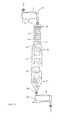
- FIG. 1 An amorphous or partially crystallized (about 0-50%) polyester granulate with an IV of up to 0.7 and at low temperature (room temperature or higher) or in a hot state (up to about 200 ° C) enters a fluidized bed 1 (type OTWG the applicant). There is a flow through the granules with hot process gas 2, z. As air or nitrogen. The supplied high amount of gas has a speed of 1.5-4 m / s. Within 2-8 minutes, the granules are heated to 200 ° C to 250 ° C, which is why the layer height is only 1-30 cm, preferably 2-15 cm.
- the heating and residence time is 2-25 minutes, preferably 15 minutes ( EP-A-379684 ) or 5-30 minutes ( EP-A-822 214 ).
- two gas inlets 2 and 3 can be used with different gas inlet temperatures.
- the Nachkristallisator 4 in which the granules passes from above into a channel 5, corresponds in its structure also the disclosure of DE-A-19743461 the applicant.
- the channel can increase from approx. 5-10 cm width (top) to approx. 20-30 cm in the middle area and to approx. 40-60 cm in the lower area of the post-crystallizer 4.
- the channel 5 can also have a constant width of eg 10 cm to eg 60 cm.
- the granules are flowed through in cross-flow with high gas volumes with a gas inlet 6 and a gas outlet 8.
- the gas inlet can also take place at position 7 with the corresponding gas outlet at position 6.
- a direct or reverse flow of the gas through the product is directly possible. Due to the disclosed Forming the Nachkristallisators 4 results in a uniform flow through the granules with short heating and residence with subsequent annealing (about 0.2 to 3 hours, preferably 0.5 to 1 hour), at temperatures between 200 and 250 ° C.
- the reactor Via a channel 9, the granules pass directly into the reactor 10, where it remains at a constant temperature for the purpose of SSP treatment to about 40 hours.
- the reactor has 10 baffles 11, as shown in the CH-A-689284 the applicant are known. It can be driven with correspondingly small amounts of gas in countercurrent.
- the process gas used is inert gas, for example nitrogen.
- the product is pre-cooled in the area of the gas inlet 12 with a gas inlet temperature of less than or equal to 60 ° C.
- the gas outlet of the reactor gas takes place at position 13, but can alternatively take place at position 8.
- the SSP-treated granules leave the reactor 10 through a lock 14 to be further cooled in a fluidized bed cooler 15 to below 60 ° C product temperature.
- a second embodiment according to FIG. 2 passes the turn cold or hot granules in a channel 22 of a plant, which combines in itself Nachkristallisator 21 and 27 reactor.
- the post-crystallizer 21 has a structure similar to that of the first embodiment in FIG. 1 (Post-crystallizer 4).
- the heating to 200 ° C to 250 ° C erflogt quickly and indeed in the uppermost compartments of the Nachkristallisators 21.
- the gas passes through the gas inlet 23 quickly to the granules in the channel 22.
- the residence time in the Nachkristallisator 21 is between 0.5 and 8 Hours. In the lowermost compartment of the Nachkristallisators 21, the product with the gas inlet 24 can be easily cooled again.
- the gas outlet takes place at position 25.
- a channel 26 the granules pass directly into the reactor 27, where it remains at the same temperature for SSP treatment until about 36 hours.
- the description of the reactor 27 and the process explanations of embodiment 1 also apply to reactor 27. Near the bottom of the reactor 27, but above a cone, a gas inlet 29 is provided. Another gas inlet 30 is located below the channel 26. See Table 1 for the individual data.
- the SSP-treated granules leave the reactor 27 through a lock 31 to be further cooled in a fluidized bed cooler 32 to below 60 ° C product temperature.
- a third embodiment is according to FIG. 3 described.
- hot process gas 42 for example, air or nitrogen, which is supplied via the gas inlet 42 and / or 43.
- the supplied high amount of gas has a speed of 1.5-4 m / s.
- the granules are heated to 200 ° C to 250 ° C, which is why the layer height is only 1-30 cm, preferably 2-15 cm.
- the granules pass into a conditioner 44, which is provided with annular inserts 45 made of sheet metal.
- the internals 45 are arranged so that a certain direction reversal and low product pressure high Granulatsink Weg. The rate of descent in the upper region of the conditioner 44 is higher than in the subsequent reactor 49, but at least approximately the same.
- the internals 45 may also be straight (vertical).
- the conditioner 44 is used for further heating of the granules to about 220 ° C - 250 ° C, the setting and holding the temperature, possibly the cooling in case of overheating.
- the granules are heated by means of process gas (gas inlet 46 and gas outlet 47 may possibly be reversed) and held for 1-8 hours in the conditioner 44.
- process gas gas inlet 46 and gas outlet 47 may possibly be reversed
- the IV value is increased.
- the reactor 49 located below the conditioner 44, where it remains at the same temperature for the purpose of SSP treatment up to about 36 hours.
- the reactor 49 has internals 50, as they also from the CH-A-689284 the applicant are known. It can be driven with correspondingly small amounts of gas in countercurrent.
- the process gas used is inert gas, for example nitrogen.
- the product is pre-cooled in the area of the gas inlet 51 with a gas inlet temperature of less than 60 ° C. Analogous to FIG. 2 a gas outlet 52 is provided.
- the SSP-treated granules leave the reactor 49 through a lock 53 to be further cooled in a fluidized bed cooler 54 below 60 ° C.
- hot process gas 62 such as air or nitrogen.
- the supplied high amount of gas has a speed of 1.5-4 m / s.
- the granules are heated to 200 ° C to 250 ° C, which is why the layer height is only 1-30 cm, preferably 2-15 cm.
- a gas inlet 62 two gas inlets 62 and 63 with different gas inlet temperatures can be used.
- the granules then pass via a distributor 64 into a conditioner 65.
- the distributor distributes the product by means of 6 to 16 tubes over the entire ring surface of the conditioner 65.
- the conditioner 65 itself is designed as a hollow cylinder. In the outer ring, the product moves from top to bottom.
- the inner ring 66 is free of product and gas.
- Outer diameter minus inner diameter of the hollow cylinder is constantly 80 to 200 cm, preferably 120 to 160 cm (product distance between the outer wall to inner wall is therefore 40 to 100 cm, preferably 60-80 cm). This results in a low product pressure and a high rate of granule sinking in the conditioner 65.
- the geometry of the conditioner 65 can also be formed analogously to the post-crystallizer 4 according to the first embodiment, i. that the product-filled part of the conditioner increases from top to bottom with the diameter, i.
- the product distance between outer wall and inner wall increases stepwise or continuously from top to bottom, e.g. from 40 cm at the top to 100 cm at the bottom in the product flow direction.
- the product pressure in the uppermost area of the conditioner is the smallest and the rate of descent highest and then changes with increasing treatment time of the granulate.
- a gas inlet 68 is provided.
- the conditioner 65 is used for further heating of the granules up to about 200-250 ° C., preferably 220-235 ° C., the setting and holding of the temperature, optionally the cooling in the event of overheating.
- the granules are heated by means of process gas and held for 1-8 hours in the conditioner 65.
- the IV value is increased.
- the product passes into a transition part 70.
- the temperature for the subsequent reactor 73 is set. This is done with a gas supply 72 by means of inert gas (countercurrent heat exchange), wherein the temperature may be between 200 ° C and 250 ° C depending on the product.
- the transition part 70 can be dispensed with.
- the reactor 73 From the transition part 70, the granules enter the reactor 73, where it remains at the same temperature for the purpose of SSP treatment up to 40 hours.
- the reactor 73 has internals 74 as shown in FIG CH-A-689284 the applicant are known. It can be driven with correspondingly small amounts of gas in countercurrent.
- the process gas used is inert gas, for example nitrogen.
- the product is pre-cooled in the area of the gas inlet 75 with a gas inlet temperature of less than or equal to 60 ° C.
- the gas outlet of the reactor gas takes place at position 69.
- the SSP-treated granules leave the reactor 10 through a lock 76 to be further cooled in a fluidized bed cooler 77 to below 60 ° C product temperature.
- the product can be flowed through in countercurrent and in the same direction in order to achieve a low pressure, preferably below 1 bar.
- recrystallizer and / or preheater In order to be able to reuse the process gas after it leaves the reactor, recrystallizer and / or preheater, it preferably passes through a gas purification, a filter, a gas scrubber / scrubber or a catalyst and a molecular sieve dryer.
Landscapes
- Chemical & Material Sciences (AREA)
- Health & Medical Sciences (AREA)
- Chemical Kinetics & Catalysis (AREA)
- Medicinal Chemistry (AREA)
- Polymers & Plastics (AREA)
- Organic Chemistry (AREA)
- Polyesters Or Polycarbonates (AREA)
Description
- Die Erfindung betrifft ein Verfahren zur kontinuierlichen Polykondensation von Polyestermaterial in fester Phase, insbesondere von PET in Form von Granulat oder dergleichen gemäss dem Oberbegriff des Patentanspruchs 1 sowie eine Vorrichtung zur Durchführung des Verfahrens gemäss dem Oberbegriff des Patentanspruchs 9.
- Je nach dem Verwendungszweck von Polyestermaterialien sind besondere Eigenschaften erforderlich. Können gewisse Eigenschaften bereits mit der Rezeptur von Komponenten, Co-Komponenten oder Additiven gezielt modifiziert werden, sind andere Eigenschaften wie z.B. ein hohes Molekulargewicht und hohe Reinheit erst durch eine Nachbehandlung in fester Phase (SSP) erreichbar. Da Polyesterproduktion und Nachbehandlung meist zeitlich und örtlich getrennt erfolgen, wird als Zwischenprodukt ein Granulat hergestellt. Dieses fällt auf Grund geringer Kristallisationsgeschwindigkeit und schneller Abkühlung der Polyesterschmelze in amorpher Form an. Beim Granulieren und Lagern nimmt das Granulat Feuchtigkeit auf, was beim späteren Wiederaufschmelzen zur Hydrolyse führen kann. Zudem haben amorphe Polystergranulate bei höheren Temperaturen (insbesondere oberhalb 100°C) eine starke Tendenz zum Verkleben.
- Es sind diverse Verfahren und Vorrichtung zum herkömmlichen Kristallisieren und Nachkondensieren von Polyestermaterialien in fester Phase bekannt, so z.B. gemäss der
EP-A-379684 DE-AS-2559290 oder derUS-PS 4238593 . Um ein Verkleben zu vermeiden erfolgt gemässUS-A-4064122 ein intensives Bewegen der Granulate beim Kristallisieren und Polykondensieren. - Hierbei sind auch Lösungen bekannt, das Verhältnis zuströmendes Prozessgas zu auslaufendem Produkt beim Nachkondensieren kleiner 0,6 zu halten (
EP-A-717061 - Zur Vermeidung eines erneuten Aufheizens der Granulate für die Nachbehandlung wurde bereits vorgeschlagen, ohne Abkühlung der Schmelze ein Extrudieren, Pelletieren und Kristallisieren von Polyestermaterial auszuführen (
EP-A-822214 WO-A-97/23543 US-A-5510454 , wo Schmelzetropfen auf eine heisse Metallplatte gelangen und teilweise kristallisieren. Auf Grund spezifischer Kristallstrukturen sollen die erreichbaren IV-Werte kleiner 0,3 sein. Tiefe IV-Werte von 0,4 bis 0,6 sind auch derUS-A-4154920 zu entnehmen. - Es ist auch bekannt, anstelle der Metallplatte ein Band vorzusehen (ROLLDROP) oder das Material durchläuft in Strangform eine Trocknungsstrecke mit einer Ablaufrinne, welche luftdurchströmt ist, wobei nach dem Trocknen ein Granulieren erfolgt (
WO-A-94/25239 -
WO 00/01754 -
JP 59025815 -
US 4,271,287 beschreibt ein Verfahren zur kontinuierlichen Polymerisation von PET in fester Phase, ohne jedoch hohe Aufheizgeschwindigkeiten zu erzielen. -
US 5,510,454 beschreibt ein Verfahren, um eine neue Form eines niedermolekularen PET's zu erhalten und beschreibt ebenfalls die Verwendung in der Festphasenpolymerisation, um ein hochmolekulares Polymer zu erzielen. Auch hier werden keine hohen Aufheizgeschwindigkeiten und keine dünnen Produktschichten offenbart. - Der Erfindung liegt die Aufgabe zugrunde, ein Verfahren zur kontinuierlichen Polykondensation von Polyestermaterial in fester Phase zu entwickeln, welches einen hohen Durchsatz von Polyestermaterial ermöglicht. Die Lösung der Aufgabe erfolgt mit den kennzeichnenden Merkmalen des Patentanspruchs 1.
- Der Erfindung liegt weiterhin die Aufgabe zugrunde, eine Vorrichtung zur Durchführung eines solchen Verfahrens zu schaffen. Diese Aufgabe wird durch die Merkmale von Patentanspruch 9 gelöst.
- Bevorzugte Ausführungsvarianten sind in den Unteransprüchen offenbart.
- Die Erfindung geht davon aus, dass es möglich ist, grosse Mengen von Polyestermaterial einer SSP-Behandlung zu unterziehen, ohne die gegebenen Kristallstrukturen zu schädigen, wenn ein schnelles Aufheizen erfolgt. Dieses schnelle Aufheizen zum Nachkristallisieren kann sowohl mit kalten als auch mit heissen Granulaten erfolgen. Es ist notwendig, geringe Schichthöhen an Granulat einzuhalten, um bei hohem Durchsatz ein schnelles Aufheizen (durchströmen mit heissem Prozessgas) innerhalb weniger Minuten zu erreichen. Ein solches schnelles Aufheizen muss zugleich kontrolliert erfolgen (Aufheizrate), um ein An- bzw. Aufschmelzen des Polyestermateriales zu vermeiden.
- Nachfolgend ist die Temperatur zu halten und einzustellen, um trotz üblicher Verweilzeiten (bis ca. 40 Stunden) im Reaktor ein Verkleben bei der SSP-Behandlung zu vermeiden.
- Bezogen auf die hohe Produktmenge ist nur ein geringer Energie- und Gasaufwand erforderlich.
- Die Erfindung wird nachfolgend in einem Beispiel an Hand einer Zeichnung näher beschrieben. In der Zeichnung zeigen die
- Figur 1:
- eine erste Ausführungsform in einer Prinzipdarstellung (erfindungsgemäss)
- Figur 2:
- eine zweite nicht erfindungsgemässe Ausführungsform in einer Prinzipdarstellung
- Figur 3:
- eine dritte Ausführungsform in einer Prinzipdarstellung (erfindungsgemäss) und
- Figur 4:
- eine weitere Ausführungsform in einer Prinzipdarstellung (erfindungsgemäss).
- Gemäss
Figur 1 gelangt ein amorphes oder teilkristallisiertes (ca. 0-50%) Polyestergranulat mit einem IV von bis zu 0.7 und mit tiefer Temperatur (Raumtemperatur oder höher) oder in heissem Zustand (bis ca. 200°C) in ein Fliessbett 1 (Typ OTWG der Anmelderin). Dort erfolgt ein Durchströmen des Granulates mit heissem Prozessgas 2, z. B. Luft oder Stickstoff. Die zugeführte hohe Gasmenge weist eine Geschwindigkeit von 1,5-4 m/s auf. Innerhalb von 2-8 Minuten wird das Granulat auf 200°C bis 250°C erwärmt, weshalb die Schichthöhe nur 1-30 cm, vorzugsweise 2-15 cm beträgt. Bei bekannten Verfahren beträgt die Aufheiz- und Verweilzeit 2-25 Minuten, bevorzugt 15 Minuten (EP-A-379684 EP-A-822214 - Der Nachkristallisator 4, in den das Granulat von oben in einen Kanal 5 gelangt, entspricht in seinem Aufbau auch der Offenbarung der
DE-A-19743461 der Anmelderin. Der Kanal kann sich von ca. 5-10 cm Breite (oben) auf ca. 20-30 cm im mittleren Bereich und bis ca. 40-60 cm im unteren Bereich des Nachkristallisators 4 vergrössern. Der Kanal 5 kann aber auch eine konstante Breite von z.B. 10 cm bis z.B. 60 cm aufweisen. Das Granulat wird im Kreuzstrom mit hohen Gasmengen durchströmt mit einem Gaseintritt 6 und einem Gasaustritt 8. Der Gaseintritt kann auch an Position 7 erfolgen mit dem entsprechenden Gasaustritt an Position 6. Alternativ ist auch ein Gleich- oder Gegenstrom des Gases durch das Produkt direkt möglich. Auf Grund der offenbarten Ausbildung des Nachkristallisators 4 ergibt sich eine gleichmässige Durchströmung des Granulates bei kurzen Aufheiz- und Verweilzeiten mit nachfolgendem Tempern (ca. 0,2 bis 3 Stunden, bevorzugt 0,5 bis 1 Stunde), bei Temperaturen zwischen 200 und 250°C. - Über einen Kanal 9 gelangt das Granulat direkt in den Reaktor 10, wo es bei gleichbleibender Temperatur zwecks SSP-Behandlung bis ca. 40 Stunden verweilt. Zur Vergleichmässigung des Durchlaufs und um ein Verkleben zu verhindern, weist der Reaktor 10 Einbauten 11 auf, wie sie aus der
CH-A-689284 - Bei schnellem Aufheizen des Produktes nahe beim Schmelzpunkt, was bei der vorgeschlagenen Betriebsweise geschieht (im Fliessbett 1 und Nachkristallisator 4), wird die Kristallinitätsbildung begrenzt und es hat sich gezeigt, dass dadurch die SSP-Reaktivität stark ansteigt (der IV-Aufbau/h ist bedeutend höher als bei konventionellem Aufheizen). Siehe dazu Tabelle 1.
- Das SSP-behandelte Granulat verlässt den Reaktor 10 durch eine Schleuse 14, um in einem Fliessbettkühler 15 auf unter 60°C Produkttemperatur weitergekühlt zu werden.
- Als Nachkristallisator kann auch ein üblicher Dächertrockner zur Anwendung gelangen. Ebenso könnte ein zweistufiger Kristallisator zur Anwendung gelangen.
- In einer zweiten Ausführung gemäss
Figur 2 (nicht erfindungsgemäss) gelangt das wiederum kalte oder heisse Granulat in einen Kanal 22 einer Anlage, die in sich Nachkristallisator 21 und Reaktor 27 vereint. Der Nachkristallisator 21 weist einen ähnlichen Aufbau auf wie derjenige von der ersten Ausführung inFigur 1 (Nachkristallisator 4). Das Aufheizen auf 200° C bis 250°C erflogt schnell und zwar in den obersten Abteilen des Nachkristallisators 21. Das Gas gelangt über den Gaseintritt 23 rasch an das Granulat im Kanal 22. Die Verweilzeit im Nachkristallisator 21 beträgt zwischen 0.5 und 8 Stunden. Im untersten Abteil des Nachkristallisators 21 kann das Produkt mit dem Gaseintritt 24 wieder leicht abgekühlt werden. Der Gasaustritt erfolgt an Position 25. - Über einen Kanal 26 gelangt das Granulat direkt in den Reaktor 27, wo es bei gleichbleibender Temperatur zwecks SSP-Behandlung bis ca. 36 Stunden verweilt. Die Beschreibung des Reaktors 27 und die Prozesserklärungen von Ausführungsform 1 gelten auch für Reaktor 27. Nahe beim Boden des Reaktors 27, jedoch oberhalb eines Konusses ist ein Gaseintritt 29 vorgesehen. Ein weiterer Gaseintritt 30 befindet sich unterhalb des Kanals 26. Siehe Tabelle 1 zu den einzelnen Daten.
- Das SSP-behandelte Granulat verlässt den Reaktor 27 durch eine Schleuse 31, um in einem Fliessbettkühler 32 auf unter 60°C Produkttemperatur weiter gekühlt zu werden.
- Eine dritte Ausführungsform wird gemäss
Figur 3 beschrieben. Dabei gelangt ein amorphes oder teilkristallisiertes (ca. 0-50%) Polyestergranulat mit einem IV von bis zu 0.7 und mit tiefer Temperatur (Raumtemperatur oder höher) oder in heissem Zustand (bis ca. 200°C) in ein Fliessbett 41 (Typ OTWG der Anmelderin). Dort erfolgt ein Durchströmen des Granulates mit heissem Prozessgas 42, z.B. Luft oder Stickstoff, welches über den Gaseintritt 42 und/oder 43 zugeführt wird. Die zugeführte hohe Gasmenge weist eine Geschwindigkeit von 1,5-4 m/s auf. Innerhalb von 2-8 Minuten wird das Granulat auf 200°C bis 250°C erwärmt, weshalb die Schichthöhe nur 1-30 cm, vorzugsweise 2-15 cm beträgt. - Anschliessend gelangt das Granulat in einen Konditionierer 44, welcher mit ringförmigen Einbauten 45 aus Blech versehen ist. Die Einbauten 45 sind so angeordnet, dass eine gewisse Richtungsumkehr sowie bei geringem Produktdruck eine hohe Granulatsinkgeschwindigkeit erreicht wird. Die Sinkgeschwindigkeit im oberen Bereich des Konditionierers 44 ist höher als im nachfolgenden Reaktor 49, zumindest jedoch etwa gleich. Die Einbauten 45 können auch gerade (vertikal) ausgeführt sein.
- Der Konditionierer 44 dient dem weiteren Erwärmen des Granulates bis auf ca. 220°C - 250°C, dem Einstellen und Halten der Temperatur, ggf. dem Kühlen bei Überhitzung.
- Im Gleichstrom oder Gegenstrom wird das Granulat mittels Prozessgas erwärmt (Gaseintritt 46 und Gasaustritt 47 können ggf. vertauscht sein) und während 1-8 Stunden im Konditionierer 44 gehalten. Dabei wird der IV-Wert erhöht.
- Anschliessend gelangt das Granulat via Übergangsteil 48 direkt in den unter dem Konditionierer 44 befindlichen Reaktor 49, wo es bei gleichbleibender Temperatur zwecks SSP-Behandlung bis ca. 36 Stunden verweilt. Zur Vergleichmässigung des Durchlaufs und um ein Verkleben zu verhindern, weist der Reaktor 49 Einbauten 50 auf, wie sie ebenfalls aus der
CH-A-689284 Figur 2 ist ein Gasausstritt 52 vorgesehen. - Bei schnellem Aufheizen des Produktes nahe beim Schmelzpunkt, was bei einer Betriebsweise wie der vorgeschlagenen passiert (im Fliessbett 41 und Konditionierer 44), wird die Kristallinitätsbildung begrenzt und es hat sich gezeigt, dass dadurch die SSP-Reaktivität stark ansteigt (der IV-Aufbau/h ist bedeutend höher als bei konventionellem Aufheizen). Siehe dazu auch Tabelle 1.
- Das SSP-behandelte Granulat verlässt den Reaktor 49 durch eine Schleuse 53, um in einem Fliessbettkühler 54 auf unter 60°C weiter gekühlt zu werden.
- Bei einer weiteren Ausführungsform der Erfindung gemäss
Figur 4 gelangt ein amorphes oder teilkristallisiertes (ca. 0-50%) Polyestergranulat mit einem IV von bis zu 0.7 und mit tiefer Temperatur (Raumtemperatur oder höher) oder in heissem Zustand (bis ca. 200°C) in ein Fliessbett 61 (Typ OTWG der Anmelderin). Dort erfolgt ein Durchströmen des Granulates mit heissem Prozessgas 62, z.B. Luft oder Stickstoff. Die zugeführte hohe Gasmenge weist eine Geschwindigkeit von 1,5-4 m/s auf. Innerhalb von 2-8 Minuten wird das Granulat auf 200°C bis 250°C erwärmt, weshalb die Schichthöhe nur 1-30 cm, vorzugsweise 2-15 cm beträgt. Anstelle eines Gaseintrittes 62 können auch zwei Gaseintritte 62 und 63 mit unterschiedlichen Gaseintrittstemperaturen verwendet werden. - Anschliessend gelangt das Granulat über einen Verteiler 64 in einen Konditionierer 65.
- Der Verteiler verteilt das Produkt mittels 6 bis 16 Rohren über die ganze Ringoberfläche des Konditionierers 65. Der Konditionierer 65 selbst ist als Hohlzylinder ausgebildet. Im Aussenring bewegt sich das Produkt von oben nach unten. Der Innenring 66 ist frei von Produkt und Gas. Aussendurchmesser minus Innendurchmesser des Hohlzylinders beträgt konstant 80 bis 200 cm, bevorzugt 120 -160 cm (Produktabstand zwischen Aussenwand zu Innenwand beträgt daher 40 bis 100 cm, bevorzugt 60 -80 cm). Dadurch ergibt sich ein geringer Produktdruck und eine hohe Granulatsinkgeschwindigkeit im Konditionierer 65. Die Geometrie des Konditionierers 65 kann auch analog zum Nachkristallisators 4 gemäss der ersten Ausführungsform ausgebildet sein, d.h. dass der mit Produkt gefüllte Teil des Konditionierer von oben nach unten mit dem Durchmesser zunimmt, d.h. dass der Produktabstand zwischen Aussenwand und Innenwand stufenweise oder kontinuierlich von oben nach unten zunimmt, z.B. von 40 cm zuoberst bis 100 cm zuunterst in Produktströmungsrichtung. Dadurch ist im obersten Bereich des Konditionierers der Produktdruck am kleinsten und die Sinkgeschwindigkeit am grössten und verändert sich dann mit zunehmender Behandlungszeit des Granulates. Weiterhin ist ein Gaseintritt 68 vorgesehen.
- Der Konditionierer 65 dient dem weiteren Erwärmen des Granulates bis auf ca. 200 - 250°C, bevorzugt 220 - 235°C, dem Einstellen und Halten der Temperatur, ggf. dem Kühlen bei Überhitzung. Im Gleichstrom (Gaseintritt 68 und Gasaustritt 69) oder im Gegenstrom (Gaseintritt 69 und Gasaustritt 68) wird das Granulat mittels Prozessgas erwärmt und während 1-8 Stunden im Konditionierer 65 gehalten. Dabei wird der IV-Wert erhöht.
- Aus dem Konditionierer 65 gelangt das Produkt in ein Übergangsteil 70. Hier wird die Temperatur für den nachfolgenden Reaktor 73 eingestellt. Dies erfolgt mit einer Gaszuführung 72 mittels Inertgas (Gegenstromwärmeaustausch), wobei die Temperatur je nach Produkt zwischen 200°C und 250°C betragen kann. Alternativ kann auf das Übergangsteil 70 verzichtet werden.
- Aus dem Übergangsteil 70 gelangt das Granulat in den Reaktor 73, wo es bei gleichbleibender Temperatur zwecks SSP-Behandlung bis zu 40 Stunden verweilt. Zur Vergleichmässigung des Durchlaufs und um ein Verkleben zu verhindern, weist der Reaktor 73 Einbauten 74 auf, wie sie aus der
CH-A-689284 - Bei schnellem Aufheizen des Produktes nahe beim Schmelzpunkt, was bei der vorgeschlagenen Betriebsweise geschieht (im Fliessbett 61 und Konditionierer 65), wird die Kristallinitätsbildung begrenzt und es hat sich gezeigt, dass dadurch die SSP-Reaktivität stark ansteigt (der IV-Aufbau/h ist bedeutend höher als bei konventionellem Aufheizen). Siehe dazu Tabelle 1.
- Das SSP-behandelte Granulat verlässt den Reaktor 10 durch eine Schleuse 76, um in einem Fliessbettkühler 77 auf unter 60°C Produkttemperatur weiter gekühlt zu werden.
- Weiterhin wäre auch denkbar, einen mittleren Gasaustritt 69 aus dem Reaktor 73 und/oder Konditionierer 65 vorzusehen. Er würde eine Umkehrung üblicher, dächerförmiger Gasverteiler 67, 71 darstellen. Zur Gewährleistung entsprechender Druckverhältnisse erfolgt dann der Gasaustrag über ein Zentralrohr und vier um 90° versetzt angeordnete Gasaustrittsrohre. Es können ein oder zwei derartige Gasaustritte bei gleichsinniger Durchströmung vorgesehen sein, um die grossen Gasmengen gut zu führen.
- Das Produkt kann bei allen Ausführungsformen kombiniert im Gegenstrom und gleichsinnig durchströmt werden, um einen niedrigen Druck, bevorzugt unter 1 bar zu erreichen.
- Um das Prozessgas nach dem Austritt aus Reaktor, Nachkristallisator und/oder Vorerhitzer erneut verwenden zu können, durchläuft es eine Gasreinigung bevorzugt, einen Filter, einen Gaswäscher/Scrubber oder einen Katalysator und einen Molekularsiebtrockner.
Tabelle 1a: Der Einfluss von der Heizungsrate bis zu 200°C Temperaturbereich Heizungsrate Gesamtzeit Schmelzwärme Kristallinität (Basis 100% = 115 J/g) [°C] [°C/min] [min] [J/g] [%] 25-200 100 1,75 57,6 50,0 25-200 50 3,5 57,7 50,2 25-200 10 17,5 57,4 49,9 25-200 5 35 57,4 49,9 Tabelle 1b: Der Einfluss von der Heizungsrate bis zu 230°C Temperaturbereich Heizungsrate Gesamtzeit Schmelzwärme Kristallinität (Basis 100% = 115 J/g) [°C] [°C/min] [min] [J/g] [%] 25-230 100 2,05 51,1 44,4 25-230 50 4,1 52,6 45,7 25-230 20 10,25 55,8 48,5 25-230 5 41 57,0 49,6 Tabelle 1c: Der Einfluss von Temperatur Temperaturbereich Heizungsrate Gesamtzeit Schmelzwärme Kristallinität (Basis 100% = 115 J/g) [°C] [°C/min] [min] [J/g] [%] 25-200 50 3,5 57,6 50,0 25-225 50 4,0 52,7 45,8 25-230 50 4,1 52,6 45,7 25-235 50 4,2 53,6 46,6 Tabelle 1d: Der Einfluss von Verweilzeit Temperaturbereich Heizungsrate Gesamtzeit Schmelzwärme Kristallinität (Basis 100% =115 J/g) [°C] [°C/min] [min] [J/g] [%] 25-225 50 3 68,2 59,3 25-230 50 3 67,7 58,7 25-235 50 3 66,9 58,2 -
- 1
- Fliessbett
- 2
- Gaseintritt
- 3
- Gaseintritt
- 4
- Nachkristallisator
- 5
- Kanal
- 6
- Gaseintritt
- 7
- Gaseintritt
- 8
- Gasaustritt
- 9
- Kanal
- 10
- Reaktor
- 11
- Einbauten
- 12
- Gaseintritt
- 13
- Gasaustritt
- 14
- Schleuse
- 15
- Fliessbettkühler
- 21
- Nachkristallisator
- 22
- Kanal
- 23
- Gaseintritt
- 24
- Gaseintritt
- 25
- Gasaustritt
- 26
- Kanal
- 27
- Reaktor
- 28
- Einbauten
- 29
- Gaseintritt
- 30
- Gasaustritt
- 31
- Schleuse
- 32
- Fleissbettkühler
- 41
- Fliessbett
- 42
- Gaseintritt
- 43
- Gaseintritt
- 44
- Konditionierer
- 45
- Einbauten
- 46
- Gaseintritt
- 47
- Gasaustritt
- 48
- Übergangsteil
- 49
- Reaktor
- 50
- Einbauten
- 51
- Gaseintritt
- 52
- Gasaustritt
- 53
- Schleuse
- 54
- Fliessbettkühler
- 61
- Fliessbett
- 62
- Gaseintritt
- 63
- Gaseintritt
- 64
- Verteiler
- 65
- Konditionierer
- 66
- Innenring
- 67
- Gasverteiler
- 68
- Gaseintritt
- 69
- Gasaustritt
- 70
- Übergangsteil
- 71
- Gasverteiler
- 72
- Gaszuführung
- 73
- Reaktor
- 74
- Einbauten
- 75
- Gaseintritt
- 76
- Schleuse
- 77
- Fliessbettkühler
Claims (12)
- Verfahren zur kontinuierlichen Polykondensation von Polyestermaterial in fester Phase, in Form von amorphem oder teilkristallisiertem Granulat durch Nachkristallisation bei 140°C bis 250°C und nachfolgender Nachkondensation bei 200°C bis 250°C und abschliessender Kühlung auf unter 60°C, wobei als Aufheiz- und Kühlmedium übliche Prozessgase eingesetzt werden, die Aufheizzeit auf Nachkristallisationstemperatur und Verweilzeit 1-10 Minuten beträgt, dadurch gekennzeichnet, dass ein Nachkristallisationsschritt im Fliessbett durchgeführt wird, wobei das Aufheizen mit einer Heizungsrate für die Aufheizung von 50°C/min.-100°C/min. bis in einen Temperaturbereich von 200°C bis 235°C erfolgt, und die Dicke der vom Prozessgas beim Nachkristallisieren im Fliessbett zu durchströmenden Produktschicht 2-15 cm beträgt.
- Verfahren nach Anspruch 1, dadurch gekennzeichnet dass die Dicke der vom Prozessgas beim Nachkristallisieren zu durchströmenden Produktschicht 3 cm bis 8 cm beträgt.
- Verfahren nach Anspruch 1 oder 2, dadurch gekennzeichnet, dass die Aufheiz- und Verweilzeit 2-8 Minuten beträgt.
- Verfahren nach Anspruch 1 bis 3, dadurch gekennzeichnet, dass beim Nachkristallisieren eine Gasmenge mit einer Strömungsgeschwindigkeit von 1,5 bis 4 m/s verwendet wird.
- Verfahren nach Anspruch 1, dadurch gekennzeichnet, dass der Anfangs-IV des Polyestermaterials bis 0,7 beträgt.
- Verfahren nach Anspruch 1 bis 5, dadurch gekennzeichnet, dass das Polyestermaterial im Kreuzstrom (im Kanal) oder im Gegenstrom und/oder gleichsinnig durchströmt wird.
- Verfahren nach Anspruch 1 bis 6, dadurch gekennzeichnet, dass das nachkondensierte Polyestermaterial durch das Prozessgas im Bereich des Gaseintritts vorgekühlt wird.
- Verfahren nach einem der Ansprüche 1 bis 5, dadurch gekennzeichnet, dass als Prozessgas Stickstoff verwendet wird.
- Vorrichtung zur kontinuierlichen Polykondensation von Polyestermaterial in fester Phase, bevorzugt Granulat, zur Durchführung des Verfahrens nach einem der Ansprüche 1 bis 8, aufweisend einen Nachkristallisator (4, 21), einen Reaktor (10, 27), eine Granulatkühlung und eine Gasführung, wobei der Nachkristallisator (21) direkt über dem Reaktor (27) und mit diesem eine Einheit bildend angeordnet ist, wobei dem Nachkristallisator (4) ein Fliessbett (1) vorgeschaltet ist.
- Vorrichtung nach Anspruch 9, dadurch gekennzeichnet, dass der Reaktor (10, 27, 49, 73) ringförmige Einbauten (4) aufweist, die bevorzugt gleichsinnig angeordnet sind.
- Vorrichtung nach Anspruch 9, dadurch gekennzeichnet, dass der Konditionierer (44) ringförmige Einbauten (45) aufweist, die gegensinnig angeordnet sind.
- Vorrichtung nach Anspruch 8, dadurch gekennzeichnet, dass sie zur Gasreinigung einen Filter, einen Gaswäscher/Scrubber oder einen Katalysator und einen Molekularsiebtrockner aufweist.
Applications Claiming Priority (1)
| Application Number | Priority Date | Filing Date | Title |
|---|---|---|---|
| PCT/CH2001/000124 WO2002068498A1 (de) | 2001-02-26 | 2001-02-26 | Verfahren und vorrichtung zur kontinuierlichen polykondensation von polyestermaterial in fester phase |
Publications (2)
| Publication Number | Publication Date |
|---|---|
| EP1373360A1 EP1373360A1 (de) | 2004-01-02 |
| EP1373360B1 true EP1373360B1 (de) | 2008-10-15 |
Family
ID=4358183
Family Applications (1)
| Application Number | Title | Priority Date | Filing Date |
|---|---|---|---|
| EP01905567A Expired - Lifetime EP1373360B1 (de) | 2001-02-26 | 2001-02-26 | Verfahren und vorrichtung zur kontinuierlichen polykondensation von polyestermaterial in fester phase |
Country Status (13)
| Country | Link |
|---|---|
| US (1) | US7884177B2 (de) |
| EP (1) | EP1373360B1 (de) |
| JP (1) | JP2004521982A (de) |
| KR (1) | KR100783197B1 (de) |
| CN (2) | CN1224634C (de) |
| AT (1) | ATE411348T1 (de) |
| BR (1) | BR0116827A (de) |
| DE (1) | DE50114433D1 (de) |
| EA (1) | EA005785B1 (de) |
| ES (1) | ES2313946T3 (de) |
| MX (1) | MXPA03006747A (de) |
| PL (1) | PL363343A1 (de) |
| WO (1) | WO2002068498A1 (de) |
Families Citing this family (13)
| Publication number | Priority date | Publication date | Assignee | Title |
|---|---|---|---|---|
| DE10259694A1 (de) * | 2002-12-18 | 2004-07-01 | Bühler AG | Herstellung eines Polyester-Performs mit reduziertem Acetaldehydgehalt |
| DE102004010680A1 (de) | 2004-03-04 | 2005-10-06 | Zimmer Ag | Verfahren zur Herstellung von hochkondensierten Polyestern in der festen Phase |
| DE102004015515A1 (de) * | 2004-03-28 | 2004-09-16 | Zimmer Ag | Verfahren zur Herstellung von hochkondensiertem Polyestergranulat |
| DE102004041370A1 (de) * | 2004-08-25 | 2006-03-02 | Bühler AG | Festphasen-Polykondensation von Polyester mit Prozessgas-Reinigung |
| US7718137B2 (en) * | 2005-10-28 | 2010-05-18 | Eastman Chemical Company | Reactor with optimized internal tray design |
| DE102006012587B4 (de) * | 2006-03-16 | 2015-10-29 | Lurgi Zimmer Gmbh | Verfahren und Vorrichtung zur Kristallisation von Polyestermaterial |
| CN100509910C (zh) * | 2006-12-29 | 2009-07-08 | 中国石化仪征化纤股份有限公司 | 卧式聚酯固相缩聚反应装置 |
| CN101307140B (zh) * | 2008-07-10 | 2011-05-11 | 北京德厚朴化工技术有限公司 | 分段式聚酯切片固相增粘反应器 |
| DE102009009957A1 (de) | 2009-02-23 | 2010-08-26 | Bühler AG | Verfahren zur Herstellung von Polyesterpartikeln bei hohem Durchsatz in einer Linie |
| JP5738747B2 (ja) * | 2010-12-15 | 2015-06-24 | 富士フイルム株式会社 | ポリエチレンテレフタレート樹脂及びその製造方法、ポリエチレンテレフタレートフィルム、太陽電池用バックシート、並びに太陽電池モジュール |
| WO2013049120A2 (en) | 2011-09-30 | 2013-04-04 | Ticona Llc | Solid-state polymerization system for a liquid crystalline polymer |
| CN104066767B (zh) * | 2011-12-22 | 2016-04-13 | 布勒热处理股份公司 | 用于固相缩聚的方法 |
| DE102013105674A1 (de) * | 2013-06-03 | 2014-12-04 | L'Air Liquide, Société Anonyme pour l'Etude et l'Exploitation des Procédés Georges Claude | Schachtreaktor |
Family Cites Families (10)
| Publication number | Priority date | Publication date | Assignee | Title |
|---|---|---|---|---|
| US4271287A (en) * | 1979-09-28 | 1981-06-02 | Rohm And Haas Company | Process for the continuous polymerization of polyethylene terephthalate in the solid phase |
| DE3213025C2 (de) * | 1982-04-02 | 1997-06-12 | Fischer Karl Ind Gmbh | Verfahren zur Nachkondensation von Polykondensaten |
| JPS5925815A (ja) * | 1982-08-04 | 1984-02-09 | Teijin Ltd | ポリエステルの結晶化方法 |
| DE58906032D1 (de) | 1988-12-23 | 1993-12-02 | Buehler Ag | Verfahren und Vorrichtung zum kontinuierlichen Kristallisieren von Polyestermaterial. |
| IT1271073B (it) * | 1994-11-21 | 1997-05-26 | M & G Ricerche Spa | Procedimento per la cristallizzazione di resine poliestere |
| DE69627984T2 (de) * | 1995-01-20 | 2004-02-26 | E.I. Du Pont De Nemours And Co., Wilmington | Herstellung von polyethylenterephtalat |
| US5540868A (en) * | 1995-01-20 | 1996-07-30 | E. I. Du Pont De Nemours And Company | Process for pellet formation from amorphous polyester |
| US5510454A (en) * | 1995-01-20 | 1996-04-23 | E. I. Du Pont De Nemours And Company | Production of poly(ethylene terephthalate) |
| IT1285524B1 (it) * | 1996-10-18 | 1998-06-08 | Sinco Eng Spa | Procedimento per il raffreddamento di resine poliestere e/o poliammidiche |
| US6124423A (en) * | 1998-07-02 | 2000-09-26 | Shell Oil Company | Process for crystallizing polyethylene naphthalate copolymers in the absence of devolatilization |
-
2001
- 2001-02-26 CN CNB01822878XA patent/CN1224634C/zh not_active Expired - Fee Related
- 2001-02-26 DE DE50114433T patent/DE50114433D1/de not_active Expired - Lifetime
- 2001-02-26 CN CNB2005100751232A patent/CN1304456C/zh not_active Expired - Fee Related
- 2001-02-26 EP EP01905567A patent/EP1373360B1/de not_active Expired - Lifetime
- 2001-02-26 PL PL01363343A patent/PL363343A1/xx not_active Application Discontinuation
- 2001-02-26 US US10/470,988 patent/US7884177B2/en not_active Expired - Fee Related
- 2001-02-26 KR KR1020037010569A patent/KR100783197B1/ko not_active Expired - Fee Related
- 2001-02-26 EA EA200300938A patent/EA005785B1/ru not_active IP Right Cessation
- 2001-02-26 WO PCT/CH2001/000124 patent/WO2002068498A1/de not_active Ceased
- 2001-02-26 JP JP2002568006A patent/JP2004521982A/ja active Pending
- 2001-02-26 BR BR0116827-4A patent/BR0116827A/pt not_active Application Discontinuation
- 2001-02-26 MX MXPA03006747A patent/MXPA03006747A/es active IP Right Grant
- 2001-02-26 ES ES01905567T patent/ES2313946T3/es not_active Expired - Lifetime
- 2001-02-26 AT AT01905567T patent/ATE411348T1/de not_active IP Right Cessation
Also Published As
| Publication number | Publication date |
|---|---|
| JP2004521982A (ja) | 2004-07-22 |
| PL363343A1 (en) | 2004-11-15 |
| CN1304456C (zh) | 2007-03-14 |
| BR0116827A (pt) | 2004-02-03 |
| DE50114433D1 (de) | 2008-11-27 |
| EP1373360A1 (de) | 2004-01-02 |
| KR20030094248A (ko) | 2003-12-11 |
| CN1492895A (zh) | 2004-04-28 |
| CN1224634C (zh) | 2005-10-26 |
| US20040192878A1 (en) | 2004-09-30 |
| WO2002068498A1 (de) | 2002-09-06 |
| EA005785B1 (ru) | 2005-06-30 |
| ATE411348T1 (de) | 2008-10-15 |
| CN1690102A (zh) | 2005-11-02 |
| US7884177B2 (en) | 2011-02-08 |
| ES2313946T3 (es) | 2009-03-16 |
| EA200300938A1 (ru) | 2004-02-26 |
| KR100783197B1 (ko) | 2007-12-06 |
| MXPA03006747A (es) | 2003-10-24 |
Similar Documents
| Publication | Publication Date | Title |
|---|---|---|
| EP2712881B1 (de) | Verfahren und Vorrichtung zur Direktkristallisation von Polymeren unter Inertgas | |
| EP2520402B1 (de) | Stranggranulationsverfahren | |
| EP1274761B1 (de) | Verfahren und vorrichtung zur herstellung von granulat aus vorprodukten thermoplastischer polyester und copolyester | |
| DE69631305T2 (de) | Verfahren zur Herstellung von Polymilchsäure | |
| EP0371971B1 (de) | Sprudelschichtkammer | |
| DE1905677A1 (de) | Verfahren zum Kristallisieren von Polyestern | |
| EP1373360A1 (de) | Verfahren und vorrichtung zur kontinuierlichen polykondensation von polyestermaterial in fester phase | |
| EP2029267B1 (de) | Verfahren und vorrichtung zur kontinuierlichen polymerisation von polymer in fester phase | |
| WO2003054063A1 (de) | Herstellen kugelförmiger partikel aus einer schmelze aus kunststoff | |
| EP1313599B1 (de) | Verfahren und vorrichtung zum herstellen kugelförmiger partikel aus einer polymerschmelze | |
| EP1676686A2 (de) | Verfahren und Vorrichtung zur Erhöhung der Grenzviskosität von Polyester | |
| WO2009027064A2 (de) | Verfahren zur herstellung von hydrolysearmen polyester-granulaten aus hochviskosen polyester-schmelzen sowie vorrichtung zur herstellung der polyester-granulate | |
| EP0864409B1 (de) | Vorrichtung zur Kristallisation von Polymergranulaten sowie Verfahren zur Kristallisation von Polymergranulaten | |
| EP2101972B1 (de) | Verfahren zur herstellung homogen kristallisierter polykondensatgranulate | |
| EP1159304B1 (de) | Verfahren und apparat zur gasphasenpolymerisation von alpha-olefinen | |
| EP1129124B1 (de) | Verfahren und anlage zum herstellen von pet-granulat | |
| EP3650186B1 (de) | Verfahren und vorrichtung zur direktkristallisation von polykondensaten | |
| EP0597155A1 (de) | Verfahren und Vorrichtung zum kontinuierlichen Kristallisieren von Kunststoffgranulat | |
| EP3363841B1 (de) | Verfahren und vorrichtung zur direktkristallisation von polykondensaten | |
| EP2671902B1 (de) | Polyamid-konditionierung | |
| EP1144169B1 (de) | Vorrichtung und verfahren zum behandeln von kunststoffmaterial | |
| EP1572777A1 (de) | Herstellung eines polyester-hohlkörpers oder dessen preforms mit reduziertem acetaldehydgehalt | |
| EP4435366B1 (de) | Wärmetauscher für eine feststoffschüttung | |
| DE102005025975A1 (de) | Verfahren zur Herstellung eines hochmolekularen Poykondensates mit hoher Durchsatzleistung | |
| DD269104A1 (de) | Verfahren und vorrichtung zur herstellung von aktiviertem molekularsiebgranulat |
Legal Events
| Date | Code | Title | Description |
|---|---|---|---|
| PUAI | Public reference made under article 153(3) epc to a published international application that has entered the european phase |
Free format text: ORIGINAL CODE: 0009012 |
|
| 17P | Request for examination filed |
Effective date: 20030707 |
|
| AK | Designated contracting states |
Kind code of ref document: A1 Designated state(s): AT BE CH CY DE DK ES FI FR GB GR IE IT LI LU MC NL PT SE TR |
|
| AX | Request for extension of the european patent |
Extension state: AL LT LV MK RO SI |
|
| 17Q | First examination report despatched |
Effective date: 20070326 |
|
| GRAP | Despatch of communication of intention to grant a patent |
Free format text: ORIGINAL CODE: EPIDOSNIGR1 |
|
| GRAS | Grant fee paid |
Free format text: ORIGINAL CODE: EPIDOSNIGR3 |
|
| GRAA | (expected) grant |
Free format text: ORIGINAL CODE: 0009210 |
|
| AK | Designated contracting states |
Kind code of ref document: B1 Designated state(s): AT BE CH CY DE DK ES FI FR GB GR IE IT LI LU MC NL PT SE TR |
|
| AX | Request for extension of the european patent |
Extension state: LT LV MK |
|
| REG | Reference to a national code |
Ref country code: CH Ref legal event code: EP Ref country code: GB Ref legal event code: FG4D Free format text: NOT ENGLISH |
|
| REG | Reference to a national code |
Ref country code: IE Ref legal event code: FG4D Free format text: LANGUAGE OF EP DOCUMENT: GERMAN |
|
| REF | Corresponds to: |
Ref document number: 50114433 Country of ref document: DE Date of ref document: 20081127 Kind code of ref document: P |
|
| REG | Reference to a national code |
Ref country code: ES Ref legal event code: FG2A Ref document number: 2313946 Country of ref document: ES Kind code of ref document: T3 |
|
| LTIE | Lt: invalidation of european patent or patent extension |
Effective date: 20081015 |
|
| NLV1 | Nl: lapsed or annulled due to failure to fulfill the requirements of art. 29p and 29m of the patents act | ||
| PG25 | Lapsed in a contracting state [announced via postgrant information from national office to epo] |
Ref country code: FI Free format text: LAPSE BECAUSE OF FAILURE TO SUBMIT A TRANSLATION OF THE DESCRIPTION OR TO PAY THE FEE WITHIN THE PRESCRIBED TIME-LIMIT Effective date: 20081015 Ref country code: NL Free format text: LAPSE BECAUSE OF FAILURE TO SUBMIT A TRANSLATION OF THE DESCRIPTION OR TO PAY THE FEE WITHIN THE PRESCRIBED TIME-LIMIT Effective date: 20081015 Ref country code: PT Free format text: LAPSE BECAUSE OF FAILURE TO SUBMIT A TRANSLATION OF THE DESCRIPTION OR TO PAY THE FEE WITHIN THE PRESCRIBED TIME-LIMIT Effective date: 20090316 |
|
| REG | Reference to a national code |
Ref country code: IE Ref legal event code: FD4D |
|
| PG25 | Lapsed in a contracting state [announced via postgrant information from national office to epo] |
Ref country code: DK Free format text: LAPSE BECAUSE OF FAILURE TO SUBMIT A TRANSLATION OF THE DESCRIPTION OR TO PAY THE FEE WITHIN THE PRESCRIBED TIME-LIMIT Effective date: 20081015 Ref country code: IE Free format text: LAPSE BECAUSE OF FAILURE TO SUBMIT A TRANSLATION OF THE DESCRIPTION OR TO PAY THE FEE WITHIN THE PRESCRIBED TIME-LIMIT Effective date: 20081015 |
|
| PLBE | No opposition filed within time limit |
Free format text: ORIGINAL CODE: 0009261 |
|
| STAA | Information on the status of an ep patent application or granted ep patent |
Free format text: STATUS: NO OPPOSITION FILED WITHIN TIME LIMIT |
|
| BERE | Be: lapsed |
Owner name: BUHLER A.G. Effective date: 20090228 |
|
| PG25 | Lapsed in a contracting state [announced via postgrant information from national office to epo] |
Ref country code: SE Free format text: LAPSE BECAUSE OF FAILURE TO SUBMIT A TRANSLATION OF THE DESCRIPTION OR TO PAY THE FEE WITHIN THE PRESCRIBED TIME-LIMIT Effective date: 20090115 |
|
| 26N | No opposition filed |
Effective date: 20090716 |
|
| PG25 | Lapsed in a contracting state [announced via postgrant information from national office to epo] |
Ref country code: MC Free format text: LAPSE BECAUSE OF NON-PAYMENT OF DUE FEES Effective date: 20090228 |
|
| REG | Reference to a national code |
Ref country code: CH Ref legal event code: PL |
|
| PG25 | Lapsed in a contracting state [announced via postgrant information from national office to epo] |
Ref country code: CH Free format text: LAPSE BECAUSE OF NON-PAYMENT OF DUE FEES Effective date: 20090228 Ref country code: LI Free format text: LAPSE BECAUSE OF NON-PAYMENT OF DUE FEES Effective date: 20090228 |
|
| PG25 | Lapsed in a contracting state [announced via postgrant information from national office to epo] |
Ref country code: BE Free format text: LAPSE BECAUSE OF NON-PAYMENT OF DUE FEES Effective date: 20090228 |
|
| PG25 | Lapsed in a contracting state [announced via postgrant information from national office to epo] |
Ref country code: AT Free format text: LAPSE BECAUSE OF NON-PAYMENT OF DUE FEES Effective date: 20090226 |
|
| PG25 | Lapsed in a contracting state [announced via postgrant information from national office to epo] |
Ref country code: GR Free format text: LAPSE BECAUSE OF FAILURE TO SUBMIT A TRANSLATION OF THE DESCRIPTION OR TO PAY THE FEE WITHIN THE PRESCRIBED TIME-LIMIT Effective date: 20090116 |
|
| PG25 | Lapsed in a contracting state [announced via postgrant information from national office to epo] |
Ref country code: LU Free format text: LAPSE BECAUSE OF NON-PAYMENT OF DUE FEES Effective date: 20090226 |
|
| PG25 | Lapsed in a contracting state [announced via postgrant information from national office to epo] |
Ref country code: TR Free format text: LAPSE BECAUSE OF FAILURE TO SUBMIT A TRANSLATION OF THE DESCRIPTION OR TO PAY THE FEE WITHIN THE PRESCRIBED TIME-LIMIT Effective date: 20081015 |
|
| PG25 | Lapsed in a contracting state [announced via postgrant information from national office to epo] |
Ref country code: CY Free format text: LAPSE BECAUSE OF FAILURE TO SUBMIT A TRANSLATION OF THE DESCRIPTION OR TO PAY THE FEE WITHIN THE PRESCRIBED TIME-LIMIT Effective date: 20081015 |
|
| REG | Reference to a national code |
Ref country code: DE Ref legal event code: R082 Ref document number: 50114433 Country of ref document: DE Representative=s name: ISARPATENT GBR PATENT- UND RECHTSANWAELTE, DE |
|
| REG | Reference to a national code |
Ref country code: ES Ref legal event code: PC2A Owner name: BUHLER THERMAL PROCESSES AG Effective date: 20140507 |
|
| REG | Reference to a national code |
Ref country code: DE Ref legal event code: R081 Ref document number: 50114433 Country of ref document: DE Owner name: BUEHLER THERMAL PROCESSES AG, CH Free format text: FORMER OWNER: BUEHLER AG, UZWIL, CH Effective date: 20140407 Ref country code: DE Ref legal event code: R082 Ref document number: 50114433 Country of ref document: DE Representative=s name: ISARPATENT GBR PATENT- UND RECHTSANWAELTE, DE Effective date: 20140407 Ref country code: DE Ref legal event code: R082 Ref document number: 50114433 Country of ref document: DE Representative=s name: ISARPATENT PATENTANWAELTE BEHNISCH, BARTH, CHA, DE Effective date: 20140407 Ref country code: DE Ref legal event code: R081 Ref document number: 50114433 Country of ref document: DE Owner name: POLYMETRIX AG, CH Free format text: FORMER OWNER: BUEHLER AG, UZWIL, CH Effective date: 20140407 Ref country code: DE Ref legal event code: R082 Ref document number: 50114433 Country of ref document: DE Representative=s name: ISARPATENT - PATENTANWAELTE- UND RECHTSANWAELT, DE Effective date: 20140407 |
|
| REG | Reference to a national code |
Ref country code: FR Ref legal event code: TP Owner name: BUEHLER THERMAL PROCESSES AG, CH Effective date: 20140429 |
|
| REG | Reference to a national code |
Ref country code: GB Ref legal event code: 732E Free format text: REGISTERED BETWEEN 20140508 AND 20140514 |
|
| REG | Reference to a national code |
Ref country code: FR Ref legal event code: PLFP Year of fee payment: 16 |
|
| REG | Reference to a national code |
Ref country code: DE Ref legal event code: R082 Ref document number: 50114433 Country of ref document: DE Representative=s name: ISARPATENT - PATENT- UND RECHTSANWAELTE BEHNIS, DE Ref country code: DE Ref legal event code: R082 Ref document number: 50114433 Country of ref document: DE Representative=s name: ISARPATENT - PATENT- UND RECHTSANWAELTE BARTH , DE Ref country code: DE Ref legal event code: R082 Ref document number: 50114433 Country of ref document: DE Representative=s name: ISARPATENT PATENTANWAELTE BEHNISCH, BARTH, CHA, DE Ref country code: DE Ref legal event code: R082 Ref document number: 50114433 Country of ref document: DE Representative=s name: ISARPATENT - PATENTANWAELTE- UND RECHTSANWAELT, DE Ref country code: DE Ref legal event code: R081 Ref document number: 50114433 Country of ref document: DE Owner name: POLYMETRIX AG, CH Free format text: FORMER OWNER: BUEHLER THERMAL PROCESSES AG, OBERBUEREN, CH |
|
| REG | Reference to a national code |
Ref country code: FR Ref legal event code: CD Owner name: POLYMETRIX AG, CH Effective date: 20160620 |
|
| REG | Reference to a national code |
Ref country code: ES Ref legal event code: PC2A Owner name: POLYMETRIX Effective date: 20160926 |
|
| REG | Reference to a national code |
Ref country code: FR Ref legal event code: PLFP Year of fee payment: 17 |
|
| REG | Reference to a national code |
Ref country code: FR Ref legal event code: PLFP Year of fee payment: 18 |
|
| PGFP | Annual fee paid to national office [announced via postgrant information from national office to epo] |
Ref country code: DE Payment date: 20190212 Year of fee payment: 19 Ref country code: IT Payment date: 20190221 Year of fee payment: 19 Ref country code: FR Payment date: 20190111 Year of fee payment: 19 Ref country code: ES Payment date: 20190301 Year of fee payment: 19 Ref country code: GB Payment date: 20190220 Year of fee payment: 19 |
|
| REG | Reference to a national code |
Ref country code: DE Ref legal event code: R119 Ref document number: 50114433 Country of ref document: DE |
|
| GBPC | Gb: european patent ceased through non-payment of renewal fee |
Effective date: 20200226 |
|
| PG25 | Lapsed in a contracting state [announced via postgrant information from national office to epo] |
Ref country code: FR Free format text: LAPSE BECAUSE OF NON-PAYMENT OF DUE FEES Effective date: 20200229 Ref country code: DE Free format text: LAPSE BECAUSE OF NON-PAYMENT OF DUE FEES Effective date: 20200901 Ref country code: GB Free format text: LAPSE BECAUSE OF NON-PAYMENT OF DUE FEES Effective date: 20200226 |
|
| REG | Reference to a national code |
Ref country code: ES Ref legal event code: FD2A Effective date: 20210708 |
|
| PG25 | Lapsed in a contracting state [announced via postgrant information from national office to epo] |
Ref country code: IT Free format text: LAPSE BECAUSE OF NON-PAYMENT OF DUE FEES Effective date: 20200226 |
|
| PG25 | Lapsed in a contracting state [announced via postgrant information from national office to epo] |
Ref country code: ES Free format text: LAPSE BECAUSE OF NON-PAYMENT OF DUE FEES Effective date: 20200227 |