EP1373241B1 - Verfahren zur herstellung optisch aktiver dihydropyrone - Google Patents
Verfahren zur herstellung optisch aktiver dihydropyrone Download PDFInfo
- Publication number
- EP1373241B1 EP1373241B1 EP02719830A EP02719830A EP1373241B1 EP 1373241 B1 EP1373241 B1 EP 1373241B1 EP 02719830 A EP02719830 A EP 02719830A EP 02719830 A EP02719830 A EP 02719830A EP 1373241 B1 EP1373241 B1 EP 1373241B1
- Authority
- EP
- European Patent Office
- Prior art keywords
- same meaning
- formula
- proviso
- groups
- salt
- Prior art date
- Legal status (The legal status is an assumption and is not a legal conclusion. Google has not performed a legal analysis and makes no representation as to the accuracy of the status listed.)
- Expired - Lifetime
Links
- 238000004519 manufacturing process Methods 0.000 title claims abstract description 11
- 150000001875 compounds Chemical class 0.000 claims abstract description 98
- UFHFLCQGNIYNRP-UHFFFAOYSA-N Hydrogen Chemical compound [H][H] UFHFLCQGNIYNRP-UHFFFAOYSA-N 0.000 claims abstract description 51
- 229910052739 hydrogen Inorganic materials 0.000 claims abstract description 36
- 239000001257 hydrogen Substances 0.000 claims abstract description 36
- 125000002887 hydroxy group Chemical group [H]O* 0.000 claims abstract description 16
- 229910052736 halogen Inorganic materials 0.000 claims abstract description 15
- 150000002367 halogens Chemical class 0.000 claims abstract description 15
- 125000006552 (C3-C8) cycloalkyl group Chemical group 0.000 claims abstract description 14
- 125000004178 (C1-C4) alkyl group Chemical group 0.000 claims abstract description 10
- 125000000229 (C1-C4)alkoxy group Chemical group 0.000 claims abstract description 10
- 125000000041 C6-C10 aryl group Chemical group 0.000 claims abstract description 10
- 125000002023 trifluoromethyl group Chemical group FC(F)(F)* 0.000 claims abstract 5
- 125000001997 phenyl group Chemical group [H]C1=C([H])C([H])=C(*)C([H])=C1[H] 0.000 claims description 50
- 125000002496 methyl group Chemical group [H]C([H])([H])* 0.000 claims description 39
- 125000001436 propyl group Chemical group [H]C([*])([H])C([H])([H])C([H])([H])[H] 0.000 claims description 38
- -1 methoxy, ethoxy Chemical group 0.000 claims description 35
- 125000001495 ethyl group Chemical group [H]C([H])([H])C([H])([H])* 0.000 claims description 34
- 239000002904 solvent Substances 0.000 claims description 32
- 125000001797 benzyl group Chemical group [H]C1=C([H])C([H])=C(C([H])=C1[H])C([H])([H])* 0.000 claims description 31
- 125000000286 phenylethyl group Chemical group [H]C1=C([H])C([H])=C(C([H])=C1[H])C([H])([H])C([H])([H])* 0.000 claims description 28
- 238000002360 preparation method Methods 0.000 claims description 23
- 125000000484 butyl group Chemical group [H]C([*])([H])C([H])([H])C([H])([H])C([H])([H])[H] 0.000 claims description 21
- 125000004344 phenylpropyl group Chemical group 0.000 claims description 18
- 150000003839 salts Chemical class 0.000 claims description 17
- 125000004029 hydroxymethyl group Chemical group [H]OC([H])([H])* 0.000 claims description 13
- 239000000460 chlorine Substances 0.000 claims description 12
- 125000006501 nitrophenyl group Chemical group 0.000 claims description 12
- WKBOTKDWSSQWDR-UHFFFAOYSA-N Bromine atom Chemical compound [Br] WKBOTKDWSSQWDR-UHFFFAOYSA-N 0.000 claims description 10
- ZAMOUSCENKQFHK-UHFFFAOYSA-N Chlorine atom Chemical compound [Cl] ZAMOUSCENKQFHK-UHFFFAOYSA-N 0.000 claims description 10
- AVXURJPOCDRRFD-UHFFFAOYSA-N Hydroxylamine Chemical compound ON AVXURJPOCDRRFD-UHFFFAOYSA-N 0.000 claims description 10
- GDTBXPJZTBHREO-UHFFFAOYSA-N bromine Substances BrBr GDTBXPJZTBHREO-UHFFFAOYSA-N 0.000 claims description 10
- 229910052794 bromium Inorganic materials 0.000 claims description 10
- 229910052801 chlorine Inorganic materials 0.000 claims description 10
- 229940125904 compound 1 Drugs 0.000 claims description 9
- SUJUHGSWHZTSEU-UHFFFAOYSA-N Tipranavir Natural products C1C(O)=C(C(CC)C=2C=C(NS(=O)(=O)C=3N=CC(=CC=3)C(F)(F)F)C=CC=2)C(=O)OC1(CCC)CCC1=CC=CC=C1 SUJUHGSWHZTSEU-UHFFFAOYSA-N 0.000 claims description 6
- 125000004464 hydroxyphenyl group Chemical group 0.000 claims description 6
- AQYSYJUIMQTRMV-UHFFFAOYSA-N hypofluorous acid Chemical compound FO AQYSYJUIMQTRMV-UHFFFAOYSA-N 0.000 claims description 6
- SUJUHGSWHZTSEU-FYBSXPHGSA-N tipranavir Chemical compound C([C@@]1(CCC)OC(=O)C([C@H](CC)C=2C=C(NS(=O)(=O)C=3N=CC(=CC=3)C(F)(F)F)C=CC=2)=C(O)C1)CC1=CC=CC=C1 SUJUHGSWHZTSEU-FYBSXPHGSA-N 0.000 claims description 6
- 229960000838 tipranavir Drugs 0.000 claims description 6
- 230000015572 biosynthetic process Effects 0.000 abstract description 8
- 238000003786 synthesis reaction Methods 0.000 abstract description 8
- 239000013067 intermediate product Substances 0.000 abstract 1
- 150000003254 radicals Chemical class 0.000 description 62
- YXFVVABEGXRONW-UHFFFAOYSA-N Toluene Chemical compound CC1=CC=CC=C1 YXFVVABEGXRONW-UHFFFAOYSA-N 0.000 description 30
- 238000000034 method Methods 0.000 description 28
- 239000000203 mixture Substances 0.000 description 17
- WYURNTSHIVDZCO-UHFFFAOYSA-N Tetrahydrofuran Chemical compound C1CCOC1 WYURNTSHIVDZCO-UHFFFAOYSA-N 0.000 description 16
- WEVYAHXRMPXWCK-UHFFFAOYSA-N Acetonitrile Chemical compound CC#N WEVYAHXRMPXWCK-UHFFFAOYSA-N 0.000 description 15
- QAOWNCQODCNURD-UHFFFAOYSA-N Sulfuric acid Chemical compound OS(O)(=O)=O QAOWNCQODCNURD-UHFFFAOYSA-N 0.000 description 14
- 239000000243 solution Substances 0.000 description 14
- 238000006243 chemical reaction Methods 0.000 description 12
- YMWUJEATGCHHMB-UHFFFAOYSA-N Dichloromethane Chemical compound ClCCl YMWUJEATGCHHMB-UHFFFAOYSA-N 0.000 description 9
- XEKOWRVHYACXOJ-UHFFFAOYSA-N Ethyl acetate Chemical compound CCOC(C)=O XEKOWRVHYACXOJ-UHFFFAOYSA-N 0.000 description 9
- OKKJLVBELUTLKV-UHFFFAOYSA-N Methanol Chemical compound OC OKKJLVBELUTLKV-UHFFFAOYSA-N 0.000 description 9
- BZLVMXJERCGZMT-UHFFFAOYSA-N Methyl tert-butyl ether Chemical compound COC(C)(C)C BZLVMXJERCGZMT-UHFFFAOYSA-N 0.000 description 9
- DKPFZGUDAPQIHT-UHFFFAOYSA-N butyl acetate Chemical compound CCCCOC(C)=O DKPFZGUDAPQIHT-UHFFFAOYSA-N 0.000 description 8
- VLKZOEOYAKHREP-UHFFFAOYSA-N n-Hexane Chemical compound CCCCCC VLKZOEOYAKHREP-UHFFFAOYSA-N 0.000 description 8
- 239000003960 organic solvent Substances 0.000 description 8
- YLQBMQCUIZJEEH-UHFFFAOYSA-N tetrahydrofuran Natural products C=1C=COC=1 YLQBMQCUIZJEEH-UHFFFAOYSA-N 0.000 description 8
- VEXZGXHMUGYJMC-UHFFFAOYSA-N Hydrochloric acid Chemical compound Cl VEXZGXHMUGYJMC-UHFFFAOYSA-N 0.000 description 7
- 238000002425 crystallisation Methods 0.000 description 7
- 230000008025 crystallization Effects 0.000 description 7
- 0 *C(*)(CC(O)=C1)*C1=O Chemical compound *C(*)(CC(O)=C1)*C1=O 0.000 description 6
- 239000002253 acid Substances 0.000 description 6
- 125000004432 carbon atom Chemical group C* 0.000 description 6
- 239000013078 crystal Substances 0.000 description 6
- 239000012074 organic phase Substances 0.000 description 6
- XLYOFNOQVPJJNP-UHFFFAOYSA-N water Substances O XLYOFNOQVPJJNP-UHFFFAOYSA-N 0.000 description 6
- DGAQECJNVWCQMB-PUAWFVPOSA-M Ilexoside XXIX Chemical compound C[C@@H]1CC[C@@]2(CC[C@@]3(C(=CC[C@H]4[C@]3(CC[C@@H]5[C@@]4(CC[C@@H](C5(C)C)OS(=O)(=O)[O-])C)C)[C@@H]2[C@]1(C)O)C)C(=O)O[C@H]6[C@@H]([C@H]([C@@H]([C@H](O6)CO)O)O)O.[Na+] DGAQECJNVWCQMB-PUAWFVPOSA-M 0.000 description 5
- 239000008346 aqueous phase Substances 0.000 description 5
- 239000011734 sodium Substances 0.000 description 5
- 229910052708 sodium Inorganic materials 0.000 description 5
- 125000000094 2-phenylethyl group Chemical group [H]C1=C([H])C([H])=C(C([H])=C1[H])C([H])([H])C([H])([H])* 0.000 description 4
- NJGFHHXZSDLYQJ-UHFFFAOYSA-N 4-hydroxy-2,3-dihydropyran-6-one Chemical compound OC1=CC(=O)OCC1 NJGFHHXZSDLYQJ-UHFFFAOYSA-N 0.000 description 4
- HEDRZPFGACZZDS-UHFFFAOYSA-N Chloroform Chemical compound ClC(Cl)Cl HEDRZPFGACZZDS-UHFFFAOYSA-N 0.000 description 4
- PXGOKWXKJXAPGV-UHFFFAOYSA-N Fluorine Chemical compound FF PXGOKWXKJXAPGV-UHFFFAOYSA-N 0.000 description 4
- NBIIXXVUZAFLBC-UHFFFAOYSA-N Phosphoric acid Chemical compound OP(O)(O)=O NBIIXXVUZAFLBC-UHFFFAOYSA-N 0.000 description 4
- 125000000217 alkyl group Chemical group 0.000 description 4
- 150000001412 amines Chemical class 0.000 description 4
- 125000003118 aryl group Chemical group 0.000 description 4
- 229910052731 fluorine Inorganic materials 0.000 description 4
- 239000011737 fluorine Substances 0.000 description 4
- ZYWUVGFIXPNBDL-UHFFFAOYSA-N n,n-diisopropylaminoethanol Chemical compound CC(C)N(C(C)C)CCO ZYWUVGFIXPNBDL-UHFFFAOYSA-N 0.000 description 4
- GBXQPDCOMJJCMJ-UHFFFAOYSA-M trimethyl-[6-(trimethylazaniumyl)hexyl]azanium;bromide Chemical compound [Br-].C[N+](C)(C)CCCCCC[N+](C)(C)C GBXQPDCOMJJCMJ-UHFFFAOYSA-M 0.000 description 4
- QTBSBXVTEAMEQO-UHFFFAOYSA-N Acetic acid Chemical compound CC(O)=O QTBSBXVTEAMEQO-UHFFFAOYSA-N 0.000 description 3
- RTZKZFJDLAIYFH-UHFFFAOYSA-N Diethyl ether Chemical compound CCOCC RTZKZFJDLAIYFH-UHFFFAOYSA-N 0.000 description 3
- WHXSMMKQMYFTQS-UHFFFAOYSA-N Lithium Chemical compound [Li] WHXSMMKQMYFTQS-UHFFFAOYSA-N 0.000 description 3
- KVNRLNFWIYMESJ-UHFFFAOYSA-N butyronitrile Chemical compound CCCC#N KVNRLNFWIYMESJ-UHFFFAOYSA-N 0.000 description 3
- 125000001449 isopropyl group Chemical group [H]C([H])([H])C([H])(*)C([H])([H])[H] 0.000 description 3
- 229910052744 lithium Inorganic materials 0.000 description 3
- OVEHNNQXLPJPPL-UHFFFAOYSA-N lithium;n-propan-2-ylpropan-2-amine Chemical compound [Li].CC(C)NC(C)C OVEHNNQXLPJPPL-UHFFFAOYSA-N 0.000 description 3
- NCFSDGWPAKOPOU-UHFFFAOYSA-N n-ethylethanamine;lithium Chemical compound [Li].CCNCC NCFSDGWPAKOPOU-UHFFFAOYSA-N 0.000 description 3
- 125000004123 n-propyl group Chemical group [H]C([H])([H])C([H])([H])C([H])([H])* 0.000 description 3
- 125000001624 naphthyl group Chemical group 0.000 description 3
- 150000007530 organic bases Chemical class 0.000 description 3
- 239000012071 phase Substances 0.000 description 3
- FVSKHRXBFJPNKK-UHFFFAOYSA-N propionitrile Chemical compound CCC#N FVSKHRXBFJPNKK-UHFFFAOYSA-N 0.000 description 3
- 125000004805 propylene group Chemical group [H]C([H])([H])C([H])([*:1])C([H])([H])[*:2] 0.000 description 3
- 239000007858 starting material Substances 0.000 description 3
- 238000003756 stirring Methods 0.000 description 3
- 125000000383 tetramethylene group Chemical group [H]C([H])([*:1])C([H])([H])C([H])([H])C([H])([H])[*:2] 0.000 description 3
- RYHBNJHYFVUHQT-UHFFFAOYSA-N 1,4-Dioxane Chemical compound C1COCCO1 RYHBNJHYFVUHQT-UHFFFAOYSA-N 0.000 description 2
- HBAQYPYDRFILMT-UHFFFAOYSA-N 8-[3-(1-cyclopropylpyrazol-4-yl)-1H-pyrazolo[4,3-d]pyrimidin-5-yl]-3-methyl-3,8-diazabicyclo[3.2.1]octan-2-one Chemical class C1(CC1)N1N=CC(=C1)C1=NNC2=C1N=C(N=C2)N1C2C(N(CC1CC2)C)=O HBAQYPYDRFILMT-UHFFFAOYSA-N 0.000 description 2
- NLXLAEXVIDQMFP-UHFFFAOYSA-N Ammonia chloride Chemical compound [NH4+].[Cl-] NLXLAEXVIDQMFP-UHFFFAOYSA-N 0.000 description 2
- KFZMGEQAYNKOFK-UHFFFAOYSA-N Isopropanol Chemical compound CC(C)O KFZMGEQAYNKOFK-UHFFFAOYSA-N 0.000 description 2
- IMNFDUFMRHMDMM-UHFFFAOYSA-N N-Heptane Chemical compound CCCCCCC IMNFDUFMRHMDMM-UHFFFAOYSA-N 0.000 description 2
- XBDQKXXYIPTUBI-UHFFFAOYSA-M Propionate Chemical compound CCC([O-])=O XBDQKXXYIPTUBI-UHFFFAOYSA-M 0.000 description 2
- QQIRAVWVGBTHMJ-UHFFFAOYSA-N [dimethyl-(trimethylsilylamino)silyl]methane;lithium Chemical compound [Li].C[Si](C)(C)N[Si](C)(C)C QQIRAVWVGBTHMJ-UHFFFAOYSA-N 0.000 description 2
- FYJKEHKQUPSJDH-UHFFFAOYSA-N [dimethyl-(trimethylsilylamino)silyl]methane;potassium Chemical compound [K].C[Si](C)(C)N[Si](C)(C)C FYJKEHKQUPSJDH-UHFFFAOYSA-N 0.000 description 2
- KXKVLQRXCPHEJC-UHFFFAOYSA-N acetic acid trimethyl ester Natural products COC(C)=O KXKVLQRXCPHEJC-UHFFFAOYSA-N 0.000 description 2
- 150000004729 acetoacetic acid derivatives Chemical class 0.000 description 2
- 150000007513 acids Chemical class 0.000 description 2
- 125000003545 alkoxy group Chemical group 0.000 description 2
- 125000002947 alkylene group Chemical group 0.000 description 2
- 125000005275 alkylenearyl group Chemical group 0.000 description 2
- 229910000147 aluminium phosphate Inorganic materials 0.000 description 2
- 150000001414 amino alcohols Chemical class 0.000 description 2
- 239000007864 aqueous solution Substances 0.000 description 2
- 229910052799 carbon Inorganic materials 0.000 description 2
- 150000001728 carbonyl compounds Chemical class 0.000 description 2
- 125000000753 cycloalkyl group Chemical group 0.000 description 2
- 239000004030 hiv protease inhibitor Substances 0.000 description 2
- BDAGIHXWWSANSR-UHFFFAOYSA-N methanoic acid Natural products OC=O BDAGIHXWWSANSR-UHFFFAOYSA-N 0.000 description 2
- 125000000956 methoxy group Chemical group [H]C([H])([H])O* 0.000 description 2
- 150000007522 mineralic acids Chemical class 0.000 description 2
- 239000003495 polar organic solvent Substances 0.000 description 2
- 239000002798 polar solvent Substances 0.000 description 2
- QQONPFPTGQHPMA-UHFFFAOYSA-N propylene Natural products CC=C QQONPFPTGQHPMA-UHFFFAOYSA-N 0.000 description 2
- WRIKHQLVHPKCJU-UHFFFAOYSA-N sodium bis(trimethylsilyl)amide Chemical compound C[Si](C)(C)N([Na])[Si](C)(C)C WRIKHQLVHPKCJU-UHFFFAOYSA-N 0.000 description 2
- IULJJGJXIGQINK-UWVGGRQHSA-N (1s,2s)-2-amino-1-(4-methylsulfanylphenyl)propane-1,3-diol Chemical compound CSC1=CC=C([C@H](O)[C@@H](N)CO)C=C1 IULJJGJXIGQINK-UWVGGRQHSA-N 0.000 description 1
- 125000004815 1,2-dimethylethylene group Chemical group [H]C([H])([H])C([H])([*:1])C([H])([*:2])C([H])([H])[H] 0.000 description 1
- VXNZUUAINFGPBY-UHFFFAOYSA-N 1-Butene Chemical group CCC=C VXNZUUAINFGPBY-UHFFFAOYSA-N 0.000 description 1
- 125000004343 1-phenylethyl group Chemical group [H]C1=C([H])C([H])=C(C([H])=C1[H])C([H])(*)C([H])([H])[H] 0.000 description 1
- CWWWHACKSNBBMU-UHFFFAOYSA-N 1-phenylhexan-3-one Chemical compound CCCC(=O)CCC1=CC=CC=C1 CWWWHACKSNBBMU-UHFFFAOYSA-N 0.000 description 1
- 125000006201 3-phenylpropyl group Chemical group [H]C1=C([H])C([H])=C(C([H])=C1[H])C([H])([H])C([H])([H])C([H])([H])* 0.000 description 1
- OSWFIVFLDKOXQC-UHFFFAOYSA-N 4-(3-methoxyphenyl)aniline Chemical compound COC1=CC=CC(C=2C=CC(N)=CC=2)=C1 OSWFIVFLDKOXQC-UHFFFAOYSA-N 0.000 description 1
- OKIJSNGRQAOIGZ-UHFFFAOYSA-N Butopyronoxyl Chemical compound CCCCOC(=O)C1=CC(=O)CC(C)(C)O1 OKIJSNGRQAOIGZ-UHFFFAOYSA-N 0.000 description 1
- 239000004215 Carbon black (E152) Substances 0.000 description 1
- 229940122440 HIV protease inhibitor Drugs 0.000 description 1
- XOBKSJJDNFUZPF-UHFFFAOYSA-N Methoxyethane Chemical compound CCOC XOBKSJJDNFUZPF-UHFFFAOYSA-N 0.000 description 1
- GRYLNZFGIOXLOG-UHFFFAOYSA-N Nitric acid Chemical compound O[N+]([O-])=O GRYLNZFGIOXLOG-UHFFFAOYSA-N 0.000 description 1
- ZLMJMSJWJFRBEC-UHFFFAOYSA-N Potassium Chemical compound [K] ZLMJMSJWJFRBEC-UHFFFAOYSA-N 0.000 description 1
- CIUQDSCDWFSTQR-UHFFFAOYSA-N [C]1=CC=CC=C1 Chemical compound [C]1=CC=CC=C1 CIUQDSCDWFSTQR-UHFFFAOYSA-N 0.000 description 1
- 235000019270 ammonium chloride Nutrition 0.000 description 1
- 150000005840 aryl radicals Chemical class 0.000 description 1
- 150000001768 cations Chemical class 0.000 description 1
- 229940125898 compound 5 Drugs 0.000 description 1
- 239000007859 condensation product Substances 0.000 description 1
- 125000001995 cyclobutyl group Chemical group [H]C1([H])C([H])([H])C([H])(*)C1([H])[H] 0.000 description 1
- 125000000582 cycloheptyl group Chemical group [H]C1([H])C([H])([H])C([H])([H])C([H])([H])C([H])(*)C([H])([H])C1([H])[H] 0.000 description 1
- 125000000113 cyclohexyl group Chemical group [H]C1([H])C([H])([H])C([H])([H])C([H])(*)C([H])([H])C1([H])[H] 0.000 description 1
- 125000000640 cyclooctyl group Chemical group [H]C1([H])C([H])([H])C([H])([H])C([H])([H])C([H])(*)C([H])([H])C([H])([H])C1([H])[H] 0.000 description 1
- 125000001511 cyclopentyl group Chemical group [H]C1([H])C([H])([H])C([H])([H])C([H])(*)C1([H])[H] 0.000 description 1
- 125000001559 cyclopropyl group Chemical group [H]C1([H])C([H])([H])C1([H])* 0.000 description 1
- HPNMFZURTQLUMO-UHFFFAOYSA-N diethylamine Chemical compound CCNCC HPNMFZURTQLUMO-UHFFFAOYSA-N 0.000 description 1
- IPZJQDSFZGZEOY-UHFFFAOYSA-N dimethylmethylene Chemical group C[C]C IPZJQDSFZGZEOY-UHFFFAOYSA-N 0.000 description 1
- XYIBRDXRRQCHLP-UHFFFAOYSA-N ethyl acetoacetate Chemical compound CCOC(=O)CC(C)=O XYIBRDXRRQCHLP-UHFFFAOYSA-N 0.000 description 1
- 235000019253 formic acid Nutrition 0.000 description 1
- 229930195733 hydrocarbon Natural products 0.000 description 1
- 150000002431 hydrogen Chemical class 0.000 description 1
- 238000011065 in-situ storage Methods 0.000 description 1
- 150000007529 inorganic bases Chemical class 0.000 description 1
- 229910052500 inorganic mineral Inorganic materials 0.000 description 1
- 239000000543 intermediate Substances 0.000 description 1
- PNDPGZBMCMUPRI-UHFFFAOYSA-N iodine Chemical compound II PNDPGZBMCMUPRI-UHFFFAOYSA-N 0.000 description 1
- 125000000959 isobutyl group Chemical group [H]C([H])([H])C([H])(C([H])([H])[H])C([H])([H])* 0.000 description 1
- 238000002955 isolation Methods 0.000 description 1
- 239000007788 liquid Substances 0.000 description 1
- DLEDOFVPSDKWEF-UHFFFAOYSA-N lithium butane Chemical compound [Li+].CCC[CH2-] DLEDOFVPSDKWEF-UHFFFAOYSA-N 0.000 description 1
- MZRVEZGGRBJDDB-UHFFFAOYSA-N n-Butyllithium Substances [Li]CCCC MZRVEZGGRBJDDB-UHFFFAOYSA-N 0.000 description 1
- 125000004108 n-butyl group Chemical group [H]C([H])([H])C([H])([H])C([H])([H])C([H])([H])* 0.000 description 1
- 230000007935 neutral effect Effects 0.000 description 1
- 229910017604 nitric acid Inorganic materials 0.000 description 1
- 239000012454 non-polar solvent Substances 0.000 description 1
- TVMXDCGIABBOFY-UHFFFAOYSA-N octane Chemical compound CCCCCCCC TVMXDCGIABBOFY-UHFFFAOYSA-N 0.000 description 1
- 230000003287 optical effect Effects 0.000 description 1
- 150000007524 organic acids Chemical class 0.000 description 1
- 150000002902 organometallic compounds Chemical class 0.000 description 1
- 125000004430 oxygen atom Chemical group O* 0.000 description 1
- 238000005191 phase separation Methods 0.000 description 1
- 239000011591 potassium Substances 0.000 description 1
- 229910052700 potassium Inorganic materials 0.000 description 1
- 159000000001 potassium salts Chemical class 0.000 description 1
- 230000003389 potentiating effect Effects 0.000 description 1
- 108090000765 processed proteins & peptides Proteins 0.000 description 1
- 239000000047 product Substances 0.000 description 1
- 238000000746 purification Methods 0.000 description 1
- 239000011541 reaction mixture Substances 0.000 description 1
- 230000035484 reaction time Effects 0.000 description 1
- 230000000717 retained effect Effects 0.000 description 1
- 229920006395 saturated elastomer Polymers 0.000 description 1
- 125000002914 sec-butyl group Chemical group [H]C([H])([H])C([H])([H])C([H])(*)C([H])([H])[H] 0.000 description 1
- 150000003335 secondary amines Chemical class 0.000 description 1
- 238000006467 substitution reaction Methods 0.000 description 1
- 229940124530 sulfonamide Drugs 0.000 description 1
- 238000010626 work up procedure Methods 0.000 description 1
Classifications
-
- C—CHEMISTRY; METALLURGY
- C07—ORGANIC CHEMISTRY
- C07D—HETEROCYCLIC COMPOUNDS
- C07D309/00—Heterocyclic compounds containing six-membered rings having one oxygen atom as the only ring hetero atom, not condensed with other rings
- C07D309/32—Heterocyclic compounds containing six-membered rings having one oxygen atom as the only ring hetero atom, not condensed with other rings having two double bonds between ring members or between ring members and non-ring members
-
- A—HUMAN NECESSITIES
- A61—MEDICAL OR VETERINARY SCIENCE; HYGIENE
- A61P—SPECIFIC THERAPEUTIC ACTIVITY OF CHEMICAL COMPOUNDS OR MEDICINAL PREPARATIONS
- A61P31/00—Antiinfectives, i.e. antibiotics, antiseptics, chemotherapeutics
- A61P31/12—Antivirals
- A61P31/14—Antivirals for RNA viruses
- A61P31/18—Antivirals for RNA viruses for HIV
-
- A—HUMAN NECESSITIES
- A61—MEDICAL OR VETERINARY SCIENCE; HYGIENE
- A61P—SPECIFIC THERAPEUTIC ACTIVITY OF CHEMICAL COMPOUNDS OR MEDICINAL PREPARATIONS
- A61P43/00—Drugs for specific purposes, not provided for in groups A61P1/00-A61P41/00
-
- C—CHEMISTRY; METALLURGY
- C07—ORGANIC CHEMISTRY
- C07B—GENERAL METHODS OF ORGANIC CHEMISTRY; APPARATUS THEREFOR
- C07B2200/00—Indexing scheme relating to specific properties of organic compounds
- C07B2200/07—Optical isomers
Definitions
- the invention relates to a novel process for producing optically active Dihydropyrone, new intermediates available through this synthesis, as well as their use as starting compounds in the preparation of pharmaceutical effective compounds.
- 5,6-dihydro-4-hydroxy-2-pyrone are important structural elements in a variety of pharmaceutically active compounds.
- class of 5,6-dihydro-4-hydroxy-2-pyrone-sulfonamides which are not peptide HIV protease inhibitors can be used.
- a particularly effective example of a potent and orally bioavailable HIV protease inhibitor of this class of compounds is the compound tipranavir (PNU-140690), which has the following structure
- radicals R 1 and R 2 are shown in the following detailed description of the present invention.
- the meaning of the radicals R and R ' is variable and is determined by the substitution pattern of the respective target compounds, as can be seen in the prior art.
- Racemic 5,6-dihydro-4-hydroxy-2-pyrone 1-rac is converted with chiral amino alcohols 4 into the salts 1-salt .
- These can be surprisingly obtained in the form of crystallizing compounds and thus isolate in good yields and high purity.
- the salts 1-salt of the R- or S-configured compounds 1 crystallize.
- the salts 1-salt 'of the unwanted enantiomers of 1 remain in solution in this reaction step. From the crystallized salts 1-salt , the optically active target compounds are released.
- a reference to compounds of the formula 1 is always to be understood as referring to the optically active compounds 1
- a reference to compounds of the formula 1-rac is to be understood as referring to the racemic mixture of the compounds of the formula 1 .
- the procedure can be as follows.
- the racemic mixture 1-rac is dissolved in a suitable organic solvent, preferably in an anhydrous organic solvent, more preferably in a non-polar organic solvent.
- Preferred solvents according to the invention are acetonitrile, propionitrile, butyronitrile, methylene chloride, chloroform, methyl acetate, ethyl acetate, n-butyl acetate, tert-butyl methyl ether, isopropanol, tetrahydrofuran, dioxane, methanol or mixtures thereof, particularly preferably acetonitrile, propionitrile, butyronitrile, methylene chloride, n-butyl acetate or mixtures thereof, more preferably acetonitrile, propionitrile, butyronitrile or mixtures thereof.
- the chiral amine 4 is added and the resulting mixture over a period of time from 1-12 h, preferably stirred for 3-8 h, more preferably 4-6 h stirred at the same temperature well mixed. Between 1 and 2 mol, preferably from 0.4 to 1.0 mol, more preferably from about 0.45 to 0.55 mol of amine 4 are used per mole of 1-rac used. Optionally, it may be helpful to add seed crystals to accelerate crystallization or to perform other methods known in the art for increasing the tendency to crystallize.
- the reaction mixture is brought to a temperature of -40 ° C to 30 ° C, preferably -20 ° C to 20 ° C, more preferably -10 ° C to 15 ° C, most preferably 0 ° C to 10 ° C and the separated crystalline 1-salt .
- the 1-salt diastereomeric salt is accessible by analogous application of methods known in the art.
- the crystals thus obtained are then washed with one of the abovementioned organic solvents, preferably with the organic solvent which is used to carry out the reaction, and dried in vacuo.
- the compounds 1-salt are taken up in a suitable solvent, preferably in a polar solvent, especially in water.
- a suitable solvent preferably in a polar solvent, especially in water.
- an organic solvent preferably an organic, water-immiscible solvent is added.
- This solvent is preferably selected from the group consisting of toluene, methyl tert-butyl ether, methylene chloride, chloroform, methyl acetate, ethyl acetate, n-butyl acetate and mixtures thereof, more preferably selected from toluene, methyl tert-butyl ether, ethyl acetate, n-butyl acetate and mixtures of which, toluene and methyl tert-butyl ether is of particular importance.
- the ratio in which the abovementioned polar solvent and the abovementioned water-immiscible solvent are used is, according to the invention, in the range from 1:10 (v / v) to 10: 1 (v / v), preferably 1: 5 ( v / v) to 5: 1 (v / v), more preferably 3: 1 (v / v) to 1: 3 (v / v).
- An organic or inorganic acid is then added to this mixture, the use of inorganic mineral acids being preferred according to the invention.
- the following acids are preferably used as inorganic acids: hydrochloric acid, sulfuric acid, nitric acid, formic acid, acetic acid or phosphoric acid, preferably hydrochloric acid, sulfuric acid or phosphoric acid, more preferably hydrochloric acid and sulfuric acid, wherein the sulfuric acid is of particular importance according to the invention for carrying out this process step.
- the acid can be dissolved in dilute or concentrated form, dissolved in aqueous solutions or in organic solvents, if appropriate also in gaseous form, if technically feasible. If sulfuric acid is used, for example, 30% sulfuric acid (aq) can be used.
- a pH of ⁇ 5 preferably a pH of 0.5-3, particularly preferably a pH of about 1-2 is set according to the invention.
- the mixture is stirred for 0.25-5 h, preferably 0.5-3 h, particularly preferably 0.75-1.5 h. This forms two phases. The aqueous phase is separated off and the remaining organic phase is optionally washed one to five times with water and finally the solvent is distilled off in vacuo. Further purification of the products is usually not required.
- the isolation of the target compounds can also be carried out by means of crystallization.
- the amines 4 used in the synthesis are available again and can be fed to a new reaction with 1-rac again.
- the compounds of the formula 1-salt are of particular importance, which is due, for example, to the surprisingly high crystallization tendency of these salts.
- a further aspect relates to the use of compounds of general formula 1-salt for the preparation of pharmaceutically active compounds.
- the present invention relates to the use of compounds of formula 1-salt for the production of tipranavir.
- the present invention relates to processes for the preparation of pharmaceutically active compounds, which are characterized in that compounds of formula 1-salt are used, which are obtainable according to the inventive method for the preparation of 1-salt .
- the present invention relates to processes for the preparation of tipranavir, which are characterized in that compounds of formula 1-salt are used, which are obtainable according to the inventive method for the preparation of 1-salt .
- an aspect of the present invention relates to the use of compounds of general formula 1, which are obtained according to the present invention, for the preparation of pharmaceutically active compounds.
- the present invention relates to the use of compounds of formula 1 , which are obtained according to the present invention, for the production of tipranavir.
- the present invention relates to processes for the preparation of pharmaceutically active compounds, which are characterized in that compounds of formula 1 are used, which are obtained according to the inventive method for the preparation of 1 .
- the present invention relates to processes for the preparation of tipranavir, which are characterized in that compounds of formula 1 are used, which are obtained according to the inventive method for the preparation of 1 .
- a suitably substituted carbonyl compound 5 in which the radicals R 1 and R 2 may have the abovementioned meanings, with an acetoacetic acid derivative 6 , in which R 5 is C 1 -C 4 -alkyl or for a cation selected from lithium, sodium and Potassium, preferably sodium, preferably methyl, ethyl, propyl or sodium, particularly preferably ethyl or sodium, to the compound 1-rac , in which the radicals R 1 and R 2 may have the meanings given above, implemented.
- organic or inorganic bases preferably in the presence of organic, sterically demanding bases.
- organic bases preferably such organic bases in Consider that are selected from the group consisting of DBU or DBN.
- organometallic compounds such as Lithium, sodium and potassium salts of secondary amines.
- Preferred bases of this Type are selected from the group consisting of lithium diisopropylamine, Lithium diethylamine, lithium hexamethyldisilazane, sodium hexamethyldisilazane, Potassium hexamethyldisilazane or lithium tert.-bitylate, preferred Lithium diisopropylamine, lithium diethylamine, lithium hexamethyldisilazane, Sodium hexamethyldisilazane, potassium hexamethyldisilazane, particularly preferred Lithium diisopropylamine, and lithium diethylamine.
- the latter bases are either commercially available or can be prepared by methods known in the art be synthesized.
- one of the abovementioned bases which is either generated in situ or used directly, is initially charged in a suitable organic solvent, preferably in an organic anhydrous solvent.
- suitable solvents are preferably ethereal solvents, such as tetrahydrofuran (THF), methyl ethyl ether, diethyl ether, dioxane or other non-polar organic solvents such as toluene, hexane or heptane into consideration.
- the ethereal solvents can also be used for mixture with the aforementioned non-polar solvents.
- THF tetrahydrofuran
- mixtures used are preferably THF / hexane or THF / toluene.
- the solution thus obtained is cooled, preferably to a temperature of below 0 ° C., preferably below -10 ° C., particularly preferably below -20 ° C. Most preferably, the reaction is carried out in a range of -78 ° C to -40 ° C. If one of the abovementioned solvents is no longer present in the liquid state of matter at these temperature ranges, the lowest possible reaction temperature, as can be seen by the person skilled in the art, is determined by the pour point of the solvent used.
- the acetoacetic acid derivative 6 is subsequently added.
- Per mole of base used maximum stoichiometric amounts of 6 are added.
- Preferably substoichiometric amounts of 6 are used, wherein the molar ratio of 6 to the base used is preferably in a range of 0.9: 1 - 0.2: 1, more preferably 0.7: 1 - 0.3: 1, particularly preferably 0 , 6: 1 - 0.4: 1.
- the temperature is raised, it is still preferably below 0 ° C, preferably below -10 ° C; more preferably kept below -20 ° C.
- the reaction is conducted in a range from -40C to -20 ° C.
- the reaction time is according to the invention in a range of 0.5 to 8 hours, preferably 1 to 5 hours, more preferably 1.5 to 3 hours.
- the termination of the reaction can be carried out by methods known in the art, for example, by adding aqueous solutions, for example aqueous Ammonium chloride solution.
- aqueous solutions for example aqueous Ammonium chloride solution.
- the workup is also possible in analogy to known in the art.
- alkyl groups (even if they are part of other radicals), as far as not otherwise defined, branched and unbranched alkyl groups having 1 to 4 Considered carbon atoms.
- hydrocarbon radicals named: methyl, ethyl, propyl, 1-methylethyl (isopropyl), n-butyl, 1-methylpropyl, 2-methylpropyl, 1,1-dimethylethyl (tert-butyl).
- the definitions are propyl and butyl always comprises the respective isomeric radicals. If necessary for the abovementioned alkyl groups, the common abbreviations Me for Methyl, Et used for ethyl, Prop for propyl and Butyl for butyl.
- alkylene groups are branched and unbranched alkylene bridges with 1 to 4 Considered carbon atoms.
- methylene, ethylene, Propylene and butylene Unless otherwise stated, of the above named propylene and butylene all of the possible isomers Forms included. Accordingly, the term propylene includes the isomers Bridges n-propylene, methylethylene and dimethylmethylene and the name Butylene, the isomeric bridges n-butylene, 1-methylpropylene, 2-methylpropylene, 1,1-dimethylethylene and 1,2-dimethylethylene.
- Cycloalkyl is generally a saturated cyclic Hydrocarbon radical having 3 to 8 carbon atoms. Preference is given to cyclic Hydrocarbons having 3 to 6 carbon atoms. Examples are cyclopropyl, Cyclobutyl, cyclopentyl, cyclohexyl, cycloheptyl and cyclooctyl.
- Alkyloxy which may also be referred to as alkoxy, is available in the general for a bonded via an oxygen atom, straight-chain or branched alkyl group having 1 to 4 carbon atoms. Particularly preferred is the Methoxy group.
- aryl stands for an aromatic ring system with 6 to 10 Carbon atoms.
- Preferred aryl radicals are naphthyl and phenyl, wherein the Phenyl radical is particularly preferred.
- the naphthyl the naphthyl and used as abbreviations for phenyl ph.
- arylalkylene or alkylene-aryl are aryl groups understood that are linked via an alkylene bridge, wherein the above definitions for alkylene groups and aryl groups reach.
- Alkylene-aryl groups preferred according to the invention are, if not otherwise defined, benzyl, 2-phenylethyl and 3-phenylpropyl.
- Halogen is in the context of the present invention for fluorine, chlorine, bromine or iodine, with fluorine, chlorine and bromine, unless otherwise defined, being preferred.
- reference to compounds of the formula 1 is to be understood as referring to the compound in an optically active form.
- the respective optically active form results from the respective definition of the radicals R 1 and R 2 .
- Reference to Figure 1 includes all enantiomeric mixtures of the two possible enantiomers of Figure 1 that are not racemic. Racemic mixtures are referred to as 1-rac , as previously defined.
- Reference to Figure 1 further includes the respective tautomeric forms of Figure 1 .
- reference to compounds of the formula 1-salt is to be understood as referring to the compound in an optically active form.
- the respective optically active form results from the respective definition of the radicals R 1 , R 2 , R 3 , R 3 ' , R 4 and R 4' .
- Reference to 1-salt includes all diastereomeric mixtures of the possible diastereomers of 1-salt that are not racemic.
- Reference to 1-salt further includes the respective tautomeric forms of 1-salt .
- the residue is taken up in 400 ml of water and 400 ml of toluene and the aqueous phase is extracted again after phase separation with 400 ml of toluene.
- the aqueous phase is adjusted to pH ⁇ 2 with 136 ml of 30% strength H 2 SO 4 and extracted with 400 ml of toluene.
- the toluene phase is washed three times with 200 ml of water.
- the toluene is concentrated to about half the volume.
- the residue is treated with 500 ml of octane and stirred until crystallization. This gives 67.5 g (76%) of the compound 1-rac .
- the crystals are dried in a vacuum oven for 12 h. This gives 21.3 g (90% yield based on amine 4 used) of colorless crystals.
- the diastereomer ratio is already about 90:10 without further crystallization step. If necessary, the optical purity can be further increased by a renewed crystallization step.
- Table 1 summarizes the compounds of formula 1-salt , which were obtained by the procedure according to the invention together.
Landscapes
- Health & Medical Sciences (AREA)
- Chemical & Material Sciences (AREA)
- Organic Chemistry (AREA)
- Life Sciences & Earth Sciences (AREA)
- Veterinary Medicine (AREA)
- Animal Behavior & Ethology (AREA)
- Public Health (AREA)
- General Health & Medical Sciences (AREA)
- Virology (AREA)
- Chemical Kinetics & Catalysis (AREA)
- General Chemical & Material Sciences (AREA)
- Medicinal Chemistry (AREA)
- Nuclear Medicine, Radiotherapy & Molecular Imaging (AREA)
- Pharmacology & Pharmacy (AREA)
- Bioinformatics & Cheminformatics (AREA)
- Molecular Biology (AREA)
- Oncology (AREA)
- Communicable Diseases (AREA)
- AIDS & HIV (AREA)
- Engineering & Computer Science (AREA)
- Tropical Medicine & Parasitology (AREA)
- Pharmaceuticals Containing Other Organic And Inorganic Compounds (AREA)
- Organic Low-Molecular-Weight Compounds And Preparation Thereof (AREA)
- Plural Heterocyclic Compounds (AREA)
- Hydrogenated Pyridines (AREA)
- Pyrane Compounds (AREA)
- Compounds Of Unknown Constitution (AREA)
Description


worin
- R1 und R2
- unabhängig voneinander Wasserstoff oder ein Rest ausgewählt aus der Gruppe bestehend aus C1-C4-Alkyl, C3-C8-Cycloalkyl, C6-C10-Aryl und -C1-C4-Alkylen-C6-C10-Aryl, der gegebenenfalls ein-, zwei- oder dreifach substituiert sein kann durch einen oder mehrere Reste ausgewählt aus der Gruppe bestehend aus Hydroxy, Halogen, C1-C4-Alkoxy und CF3, bedeuten, mit der Maßgabe, daß R1 und R2 nicht gleichzeitig dieselbe Bedeutung aufweisen können,


- R3, R3', R4 und R4'
- gleich oder verschieden Wasserstoff oder ein Rest ausgewählt
aus der Gruppe bestehend aus C1-C4-Alkyl, C3-C8-Cycloalkyl, C6-C10-Aryl
und -C1-C4-Alkylen-C6-C10-Aryl, der gegebenenfalls ein-, zwei- oder dreifach
substituiert sein kann durch einen oder mehrere Reste ausgewählt aus der
Gruppe bestehend aus Hydroxy, Halogen, C1-C4-Alkoxy, -S-C1-C4-Alkyl,
-SO2-C1-C4-Alkyl, NO2 und CF3, bedeuten,
mit der Maßgabe, daß wenn R3 und R3' dieselbe Bedeutung aufweisen, die Reste R4 und R4' nicht dieselbe Bedeutung aufweisen können, sowie mit der Maßgabe, daß wenn R4 und R4' dieselbe Bedeutung aufweisen, die Reste R3 und R3' nicht dieselbe Bedeutung aufweisen können,

worin
- R1 und R2
- unabhängig voneinander ein Rest ausgewählt aus der Gruppe bestehend
aus Methyl, Ethyl, Propyl, Butyl, Phenyl, Benzyl, Phenylethyl und Phenylpropyl
der gegebenenfalls einfach substituiert sein kann durch einen Rest
ausgewählt aus der Gruppe bestehend aus Hydroxy, Fluor, Chlor, Brom,
Methoxy, Ethyoxy und CF3
bedeuten, mit der Maßgabe, daß R1 und R2 nicht gleichzeitig dieselbe Bedeutung aufweisen können,
worin
- R3, R3', R4 und R4'
- gleich oder verschieden Wasserstoff oder ein Rest ausgewählt
aus der Gruppe bestehend aus Methyl, Ethyl, Propyl, Phenyl, Benzyl und
Phenylethyl, der gegebenenfalls ein- oder zweifach substituiert sein kann
durch einen oder zwei Reste ausgewählt aus der Gruppe bestehend aus
Hydroxy, Fluor, Chlor, Brom, Methoxy, Ethyoxy, Me-S-, Me-SO2-, Et-S-, Et-SO2-,
NO2 und CF3, bedeuten,
mit der Maßgabe, daß wenn R3 und R3' dieselbe Bedeutung aufweisen, die Reste R4 und R4' nicht dieselbe Bedeutung aufweisen können, sowie mit der Maßgabe, daß wenn R4 und R4' dieselbe Bedeutung aufweisen, die Reste R3 und R3' nicht dieselbe Bedeutung aufweisen können,
worin
- R1 und R2
- unabhängig voneinander ein Rest ausgewählt aus der Gruppe bestehend
aus Methyl, Ethyl, Propyl, Butyl, Phenyl, Benzyl, Phenylethyl und
Phenylpropyl,
bedeuten, mit der Maßgabe, daß R1 und R2 nicht gleichzeitig dieselbe Bedeutung aufweisen können,
worin
- R3, R3', R4 und R4'
- gleich oder verschieden Wasserstoff oder ein Rest ausgewählt
aus der Gruppe bestehend aus Methyl, Ethyl, Propyl, Phenyl und Benzyl, der
gegebenenfalls einfach substituiert sein kann durch einen Rest ausgewählt
aus der Gruppe bestehend aus Hydroxy, Methoxy, Me-S-, Me-SO2- und NO2,
bedeuten,
mit der Maßgabe, daß wenn R3 und R3' dieselbe Bedeutung aufweisen, die Reste R4 und R4' nicht dieselbe Bedeutung aufweisen können, sowie mit der Maßgabe, daß wenn R4 und R4' dieselbe Bedeutung aufweisen, die Reste R3 und R3' nicht dieselbe Bedeutung aufweisen können,
- R1 und R2
- unabhängig voneinander ein Rest ausgewählt aus der Gruppe bestehend aus Ethyl, Propyl, Butyl, Benzyl, Phenylethyl und Phenylpropyl, bedeuten, mit der Maßgabe, daß R1 und R2 nicht gleichzeitig dieselbe Bedeutung aufweisen können,
- R3 und R3'
- gleich oder verschieden Wasserstoff oder ein Rest ausgewählt aus der
Gruppe bestehend aus Phenyl, Hydroxyphenyl, Methylthiophenyl und
Nitrophenyl,
und - R4 und R4'
- gleich oder verschieden Wasserstoff oder ein Rest ausgewählt aus der
Gruppe bestehend aus Methyl, Hydroxymethyl und Phenyl,
mit der Maßgabe, daß wenn R3 und R3' dieselbe Bedeutung aufweisen, die Reste R4 und R4' nicht dieselbe Bedeutung aufweisen können, sowie mit der Maßgabe, daß wenn R4 und R4' dieselbe Bedeutung aufweisen, die Reste R3 und R3' nicht dieselbe Bedeutung aufweisen können,
worin R1 Phenylethyl und R2 Propyl bedeuten
dadurch gekennzeichnet, daß in einem ersten Schritt eine Verbindung der Formel 1-rac , in der R1 und R2 die vorstehend genannten Bedeutungen aufweisen können, in einem geeigneten Lösemittel mit einem oder mehreren, bevorzugt einem chiralen Aminoalkohol der Formel 4
worin
- R3 und R3'
- gleich oder verschieden Wasserstoff oder ein Rest ausgewählt aus der
Gruppe bestehend aus Phenyl, Methylthiophenyl und Nitrophenyl,
und - R4 und R4'
- gleich oder verschieden Wasserstoff oder ein Rest ausgewählt aus der
Gruppe bestehend aus Methyl, Hydroxymethyl und Phenyl,
mit der Maßgabe, daß wenn R3 und R3' dieselbe Bedeutung aufweisen, die Reste R4 und R4' nicht dieselbe Bedeutung aufweisen können, sowie mit der Maßgabe, daß wenn R4 und R4' dieselbe Bedeutung aufweisen, die Reste R3 und R3' nicht dieselbe Bedeutung aufweisen können,
Anschließend wird die Reaktionsmischung auf eine Temperatur von -40°C bis 30°C, bevorzugt -20°C bis 20°C, besonders bevorzugt -10°C bis 15°C, höchst bevorzugt 0°C bis 10°C gebracht und das kristalline 1-salt abgetrennt. Aus der verbleibenden Lösung wird unter analoger Anwendung von im Stand der Technik bekannten Methoden das zu 1-salt diastereomere Salz zugänglich.
Die so erhaltenen Kristalle werden anschließend mit einem der vorstehend genannten organischen Lösemittel, bevorzugt mit dem organichen Lösemittel, welches zur Durchführung der Reaktion verwendet wird, gewaschen und im Vakuum getrocknet.
Nach beendeter Säurezugabe wird zwischen 0,25 - 5 h, bevorzugt 0.5-3 h, besonders bevorzugt 0,75-1,5 h gerührt. Dabei bilden sich zwei Phasen. Die wässrige Phase wird abgetrennt und die verbleibende organische Phase gegebenenfalls noch ein- bis fünfmal mit Wasser gewaschen und abschließend das Lösemittel im Vakuum abdestilliert. Eine weitergehende Reinigung der Produkte ist in der Regel nicht erforderlich. Je nach Kristallisationsneigung von 1 im jeweiligen Lösemittel kann die Isolierung der Zielverbindungen auch mittels Kristallisation erfolgen. Durch Aufarbeitung der organischen Phase, beispielsweise durch Basenzusatz, sind die eingangs in die Synthese eingesetzten Amine 4 wieder erhältlich und können einer erneuten Umsetzung mit 1-rac wieder zugeführt werden.

- R1 und R2
- unabhängig voneinander Wasserstoff oder ein Rest ausgewählt aus der Gruppe bestehend aus C1-C4-Alkyl, C3-C8-Cycloalkyl, C6-C10-Aryl und -C1-C4-Alkylen-C6-C10-Aryl, der gegebenenfalls ein-, zwei- oder dreifach substituiert sein kann durch einen oder mehrere Reste ausgewählt aus der Gruppe bestehend aus Hydroxy, Halogen, C1-C4-Alkoxy und CF3;
- R3, R3', R4 und R4'
- gleich oder verschieden Wasserstoff oder ein Rest ausgewählt aus der Gruppe bestehend aus C1-C4-Alkyl, C3-C8-Cycloalkyl, C6-C10-Aryl und -C1-C4-Alkylen-C6-C10-Aryl, der gegebenenfalls ein-, zwei- oder dreifach substituiert sein kann durch einen oder mehrere Reste ausgewählt aus der Gruppe bestehend aus Hydroxy, Halogen, C1-C4-Alkoxy, -S-C1-C4-Alkyl, -SO2-C1-C4-Alkyl, NO2 und CF3,
mit der Maßgabe, daß R1 und R2 nicht gleichzeitig dieselbe Bedeutung aufweisen können,
mit der Maßgabe, daß wenn R3 und R3' dieselbe Bedeutung aufweisen, die Reste R4 und R4' nicht dieselbe Bedeutung aufweisen können, sowie
mit der Maßgabe, daß wenn R4 und R4' dieselbe Bedeutung aufweisen, die Reste R3 und R3' nicht dieselbe Bedeutung aufweisen können.
worin
- R1 und R2
- unabhängig voneinander ein Rest ausgewählt aus der Gruppe bestehend aus Methyl, Ethyl, Propyl, Butyl, Phenyl, Benzyl, Phenylethyl und Phenylpropyl der gegebenenfalls einfach substituiert sein kann durch einen Rest ausgewählt aus der Gruppe bestehend aus Hydroxy, Fluor, Chlor, Brom, Methoxy, Ethyoxy und CF3;
- R3, R3', R4 und R4'
- gleich oder verschieden Wasserstoff oder ein Rest ausgewählt aus der Gruppe bestehend aus Methyl, Ethyl, Propyl, Phenyl, Benzyl und Phenylethyl, der gegebenenfalls ein- oder zweifach substituiert sein kann durch einen oder zwei Reste ausgewählt aus der Gruppe bestehend aus Hydroxy, Fluor, Chlor, Brom, Methoxy, Ethyoxy, Me-S-, Me-SO2-, Et-S-, Et-SO2-, NO2 und CF3,
mit der Maßgabe, daß R1 und R2 nicht gleichzeitig dieselbe Bedeutung aufweisen können,
mit der Maßgabe, daß wenn R3 und R3' dieselbe Bedeutung aufweisen, die Reste R4 und R4' nicht dieselbe Bedeutung aufweisen können; sowie
mit der Maßgabe, daß wenn R4 und R4' dieselbe Bedeutung aufweisen, die Reste R3 und R3' nicht dieselbe Bedeutung aufweisen können.
worin
- R1 und R2
- unabhängig voneinander ein Rest ausgewählt aus der Gruppe bestehend aus Methyl, Ethyl, Propyl, Butyl, Phenyl, Benzyl, Phenylethyl und Phenylpropyl,
- R3, R3', R4 und R4'
- gleich oder verschieden Wasserstoff oder ein Rest ausgewählt aus der Gruppe bestehend aus Methyl, Ethyl, Propyl, Phenyl und Benzyl, der gegebenenfalls einfach substituiert sein kann durch einen Rest ausgewählt aus der Gruppe bestehend aus Hydroxy, Methoxy, Me-S-, Me-SO2- und NO2,
mit der Maßgabe, daß R1 und R2 nicht gleichzeitig dieselbe Bedeutung aufweisen können,
mit der Maßgabe, daß wenn R3 und R3' dieselbe Bedeutung aufweisen, die Reste R4 und R4' nicht dieselbe Bedeutung aufweisen können, sowie
mit der Maßgabe, daß wenn R4 und R4' dieselbe Bedeutung aufweisen, die Reste R3 und R3' nicht dieselbe Bedeutung aufweisen können.
worin
- R1 und R2
- unabhängig voneinander ein Rest ausgewählt aus der Gruppe bestehend aus Ethyl, Propyl, Butyl, Benzyl, Phenylethyl und Phenylpropyl,
- R3 und R3'
- gleich oder verschieden Wasserstoff oder ein Rest ausgewählt aus der Gruppe bestehend aus Phenyl, Hydroxyphenyl, Methylthiophenyl und Nitrophenyl;
- R4 und R4'
- gleich oder verschieden Wasserstoff oder ein Rest ausgewählt aus der Gruppe bestehend aus Methyl, Hydroxymethyl und Phenyl,
mit der Maßgabe, daß R1 und R2 nicht gleichzeitig dieselbe Bedeutung aufweisen können,
mit der Maßgabe, daß wenn R3 und R3' dieselbe Bedeutung aufweisen, die Reste R4 und R4' nicht dieselbe Bedeutung aufweisen können, sowie
mit der Maßgabe, daß wenn R4 und R4' dieselbe Bedeutung aufweisen, die Reste R3 und R3' nicht dieselbe Bedeutung aufweisen können.
worin
- R1
- Phenylethyl und R2 Propyl,
- R3 und R3'
- gleich oder verschieden Wasserstoff oder ein Rest ausgewählt aus der
Gruppe bestehend aus Phenyl, Methylthiophenyl und Nitrophenyl,
und - R4 und R4'
- gleich oder verschieden Wasserstoff oder ein Rest ausgewählt aus der Gruppe bestehend aus Methyl, Hydroxymethyl und Phenyl, gegebenenfalls in Form ihrer Tautomere, mit der Maßgabe, daß wenn R3 und R3' dieselbe Bedeutung aufweisen, die Reste R4 und R4' nicht dieselbe Bedeutung aufweisen können, sowie mit der Maßgabe, daß wenn R4 und R4' dieselbe Bedeutung aufweisen, die Reste R3 und R3' nicht dieselbe Bedeutung aufweisen können.
Bevorzugt betrifft die vorliegende Erfindung Verfahren zur Herstellung von Tipranavir, die dadurch gekennzeichnet sind, daß Verbindungen der Formel 1-salt eingesetzt werden, die gemäß dem erfindungsgemäßen Verfahren zur Herstellung von 1-salt erhältlich sind.
Bevorzugt betrifft die vorliegende Erfindung die Verwendung von Verbindungen der Formel 1 , die gemäß der vorliegenden Erfindung erhalten werden, zur Herstellung von Tipranavir.
Bevorzugt betrifft die vorliegende Erfindung Verfahren zur Herstellung von Tipranavir, die dadurch gekennzeichnet sind, daß Verbindungen der Formel 1 eingesetzt werden, die gemäß dem erfindungsgemäßen Verfahren zur Herstellung von 1 erhalten werden.

104 ml (1,00 mol) Diethylamin in 160 ml THF werden auf -50°C gekühlt. Zu dieser Lösung werden innerhalb von 10 min 400 ml (1,00 mol) einer 2.5 M n-BuLi-Lösung in n-Hexan gegeben. Nach beendeter Zugabe wird weitere 10 min nachgerührt und anschließend 63 ml (0,500 mol) Acetessigester zugegeben. Nach 10 min werden 60 g (0,340 mol) 1-Phenylhexan-3-on in 80 ml THF in 30 min bei -50 °C zugetropft. Anschließend wird auf -30 °C erwärmt und weiter 2 h gerührt. Die Reaktionslösung wird zu 1200 ml ges. NH4Cl-Lösung gegeben, die wässrige Phase abgetrennt und die organische Phase mit 400 ml ges. NH4Cl-Lösung und mit 200 ml 2N HCl gewaschen. Anschließend wird die organische Phase mit NaHCO3-Lsg neutral gewaschen, abgetrennt und das Lösemittel im Vakuum abdestilliert. Das erhaltene Öl (118 g) wird bei Raumtemperatur mit einer Lösung aus 29,4 g (1,20 mol) KOH (85%ig) in 140 ml MeOH versetzt. Nach beendeter Reaktion (ca. 10h) wird vom MeOH abdestilliert. Den Rückstand wird in 400 ml Wasser und 400 ml Toluol aufgenommen und die wässrige Phase nach Phasentrennung nochmals mit 400 ml Toluol extrahiert. Die wässrige Phase wird mit 136 ml 30 % iger H2SO4 auf pH < 2 gestellt und mit 400 ml Toluol extrahiert.. Die Toluolphase wird dreimal mit 200 ml Wasser nachgewaschen. Das Toluol wird ca. bis auf die Hälfte des Volumens eingeengt. Der Rückstand wird mit 500 ml Octan versetzt und bis zur Kristallisation gerührt. Man erhält 67,5 g (76%) der Verbindung 1-rac .
29 g (110 mmol) der nach vorstehendem Verfahren erhaltenen Verbindung 1-rac werden in 250 ml Acetonitril gelöst. Nach Zugabe von 10,6 g (50,0 mmol) (+)-Thiomicamin 4 bildet sich eine Lösung. Man rührt 5 Stunden bei Raumtemperatur, kühlt auf ca 5 °C ab und saugt die Kristalle über einen Büchnertrichter ab. Die erhaltenen Kristalle werden mit 150 ml Acetonitril gewaschen. Die Kristalle werden im Vakuumtrockenschrank 12 h getrocknet. Man erhält 21,3 g (90% Ausbeute bezogen auf eingesetztes Amin 4) farblose Kristalle. Das Diastereomerenverhältnis beträgt ohne weiteren Kristallisatiosnschritt bereits etwa 90:10. Fall erforderlich kann die optische Reinheit durch einen erneuten Kristallisationsschritt weiter erhöht werden.
29 g (110 mmol) der gemäß vorstehend beschriebener Vorgehensweise erhaltenen Verbindung 1-salt werden in 290 ml Wasser mit 290 Methyl-tert.-Butylether versetzt. Dazu werden 15 ml 30%ige Schwefelsäure gegeben (pH =1,5). Nach einer Stunde Rühren bilden sich zwei Phasen. Die wässrige Phase wird abgetrennt. Die organische Phase wird dreimal mit je 100 ml Wasser gewaschen. Anschließend wird die organische Phase im Vakuum bis zum Rückstand eingedampft.
Man erhält 14,0 g (Ausbeute 88%) der Verbindung 1.

Claims (12)
- Verfahren zur Herstellung einer Verbindung der Formel 1gegebenenfalls in Form ihrer Tautomere,
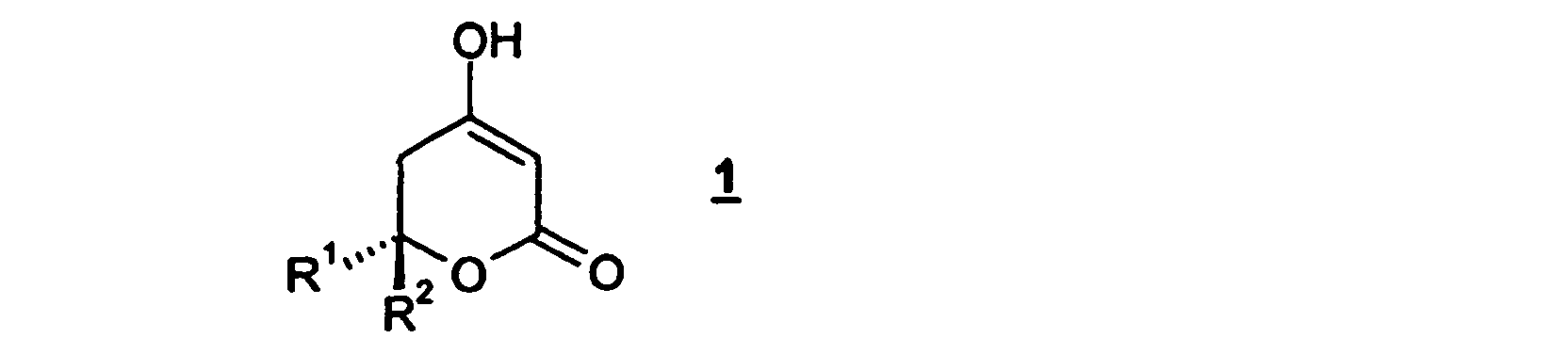
worin- R1 und R2
- unabhängig voneinander Wasserstoff oder ein Rest ausgewählt aus der Gruppe bestehend aus C1-C4-Alkyl, C3-C8-Cycloalkyl, C6-C10-Aryl und -C1-C4-Alkylen-C6-C10-Aryl, der gegebenenfalls ein-, zwei- oder dreifach substituiert sein kann durch einen oder mehrere Reste ausgewählt aus der Gruppe bestehend aus Hydroxy, Halogen, C1-C4-Alkoxy und CF3, bedeuten, mit der Maßgabe, daß R1 und R2 nicht gleichzeitig dieselbe Bedeutung aufweisen können,
in der R1 und R2 die vorstehend genannten Bedeutungen aufweisen können, in einem geeigneten Lösemittel mit einem oder mehreren, bevorzugt einem chiralen Aminoalkohol der Formel 4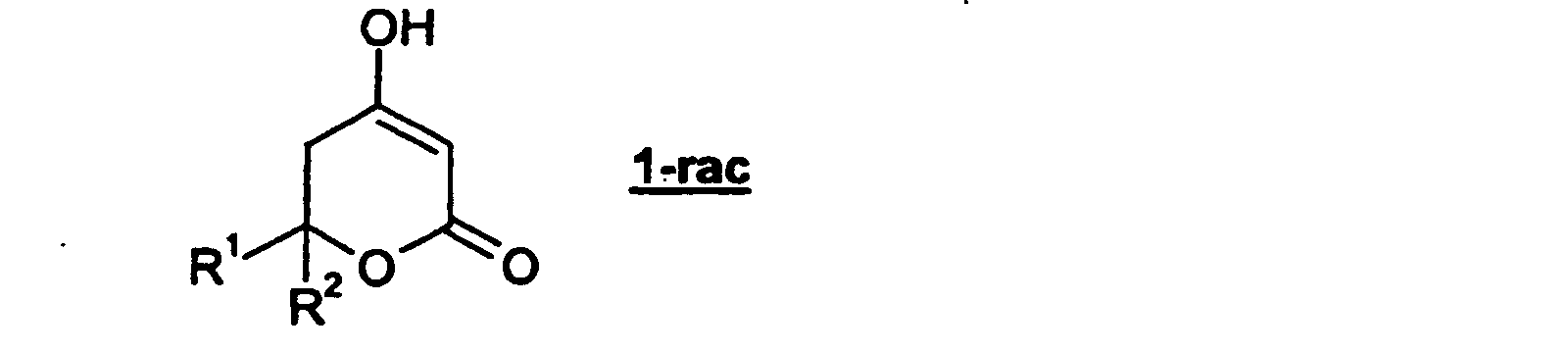 worin
worin
- R3, R3', R4 und R4'
- gleich oder verschieden Wasserstoff oder ein Rest ausgewählt
aus der Gruppe bestehend aus C1-C4-Alkyl, C3-C8-Cycloalkyl, C6-C10-Aryl
und -C1-C4-Alkylen-C6-C10-Aryl, der gegebenenfalls ein-, zwei- oder dreifach
substituiert sein kann durch einen oder mehrere Reste ausgewählt aus der
Gruppe bestehend aus Hydroxy, Halogen, C1-C4-Alkoxy, -S-C1-C4-Alkyl,
-SO2-C1-C4-Alkyl, NO2 und CF3, bedeuten,
mit der Maßgabe, daß wenn R3 und R3' dieselbe Bedeutung aufweisen, die Reste R4 und R4' nicht dieselbe Bedeutung aufweisen können, sowie mit der Maßgabe, daß wenn R4 und R4' dieselbe Bedeutung aufweisen, die Reste R3 und R3' nicht dieselbe Bedeutung aufweisen können,
worin die Reste R1, R2, R3, R3', R4 und R4' die vorstehend genannten Bedeutungen haben können, umgesetzt wird, die erhaltene kristalline Verbindung 1-salt isoliert und daraus die Zielverbindung freigesetzt wird.
- Verfahren zur Herstellung einer Verbindung der Formel 1 , gegebenenfalls in Form ihrer Tautomere, nach Anspruch 1,
worin- R1 und R2
- unabhängig voneinander ein Rest ausgewählt aus der Gruppe bestehend
aus Methyl, Ethyl, Propyl, Butyl, Phenyl, Benzyl, Phenylethyl und Phenylpropyl
der gegebenenfalls einfach substituiert sein kann durch einen Rest
ausgewählt aus der Gruppe bestehend aus Hydroxy, Fluor, Chlor, Brom,
Methoxy, Ethyoxy und CF3
bedeuten, mit der Maßgabe, daß R1 und R2 nicht gleichzeitig dieselbe Bedeutung aufweisen können,
worin- R3, R3', R4 und R4'
- gleich oder verschieden Wasserstoff oder ein Rest ausgewählt
aus der Gruppe bestehend aus Methyl, Ethyl, Propyl, Phenyl, Benzyl und
Phenylethyl, der gegebenenfalls ein- oder zweifach substituiert sein kann
durch einen oder zwei Reste ausgewählt aus der Gruppe bestehend aus
Hydroxy, Fluor, Chlor, Brom, Methoxy, Ethyoxy, Me-S-, Me-SO2-, Et-S-, Et-SO2-,
NO2 und CF3 , bedeuten,
mit der Maßgabe, daß wenn R3 und R3' dieselbe Bedeutung aufweisen, die Reste R4 und R4' nicht dieselbe Bedeutung aufweisen können, sowie mit der Maßgabe, daß wenn R4 und R4' dieselbe Bedeutung aufweisen, die Reste R3 und R3' nicht dieselbe Bedeutung aufweisen können,
- Verfahren zur Herstellung einer Verbindung der Formel 1 , gegebenenfalls in Form ihrer Tautomere, nach einem der Ansprüche 1 oder 2,
worin- R1 und R2
- unabhängig voneinander ein Rest ausgewählt aus der Gruppe bestehend
aus Methyl, Ethyl, Propyl, Butyl, Phenyl, Benzyl, Phenylethyl und
Phenylpropyl,
bedeuten, mit der Maßgabe, daß R1 und R2 nicht gleichzeitig dieselbe Bedeutung aufweisen können,
worin- R3, R3', R4 und R4'
- gleich oder verschieden Wasserstoff oder ein Rest ausgewählt
aus der Gruppe bestehend aus Methyl, Ethyl, Propyl, Phenyl und Benzyl, der
gegebenenfalls einfach substituiert sein kann durch einen Rest ausgewählt
aus der Gruppe bestehend aus Hydroxy, Methoxy, Me-S-, Me-SO2- und NO2,
bedeuten,
mit der Maßgabe, daß wenn R3 und R3' dieselbe Bedeutung aufweisen, die Reste R4 und R4' nicht dieselbe Bedeutung aufweisen können, sowie mit der Maßgabe, daß wenn R4 und R4' dieselbe Bedeutung aufweisen, die Reste R3 und R3' nicht dieselbe Bedeutung aufweisen können,
- Verfahren zur Herstellung einer Verbindung der Formel 1 , gegebenenfalls in Form ihrer Tautomere, nach einem der Ansprüche 1, 2 oder 3,
worin- R1 und R2
- unabhängig voneinander ein Rest ausgewählt aus der Gruppe bestehend aus Ethyl, Propyl, Butyl, Benzyl, Phenylethyl und Phenylpropyl, bedeuten, mit der Maßgabe, daß R1 und R2 nicht gleichzeitig dieselbe Bedeutung aufweisen können,
- R3 und R3'
- gleich oder verschieden Wasserstoff oder ein Rest ausgewählt aus der
Gruppe bestehend aus Phenyl, Hydroxyphenyl, Methylthiophenyl und
Nitrophenyl,
und - R4 und R4'
- gleich oder verschieden Wasserstoff oder ein Rest ausgewählt aus der
Gruppe bestehend aus Methyl, Hydroxymethyl und Phenyl,
mit der Maßgabe, daß wenn R3 und R3' dieselbe Bedeutung aufweisen, die Reste R4 und R4' nicht dieselbe Bedeutung aufweisen können, sowie mit der Maßgabe, daß wenn R4 und R4' dieselbe Bedeutung aufweisen, die Reste R3 und R3' nicht dieselbe Bedeutung aufweisen können,
- Verfahren zur Herstellung einer Verbindung der Formel 1 , gegebenenfalls in Form ihrer Tautomere, nach einem der Ansprüche 1, 2, 3 oder 4,
worin
R1 Phenylethyl und R2 Propyl bedeuten
dadurch gekennzeichnet, daß in einem ersten Schritt eine Verbindung der Formel 1-rac , in der R1 und R2 die vorstehend genannten Bedeutungen aufweisen können, in einem geeigneten Lösemittel mit einem oder mehreren, bevorzugt einem chiralen Aminoalkohol der Formel 4
worin- R3 und R3'
- gleich oder verschieden Wasserstoff oder ein Rest ausgewählt aus der
Gruppe bestehend aus Phenyl, Methylthiophenyl und Nitrophenyl,
und - R4 und R4'
- gleich oder verschieden Wasserstoff oder ein Rest ausgewählt aus der
Gruppe bestehend aus Methyl, Hydroxymethyl und Phenyl,
mit der Maßgabe, daß wenn R3 und R3' dieselbe Bedeutung aufweisen, die Reste R4 und R4' nicht dieselbe Bedeutung aufweisen können, sowie mit der Maßgabe, daß wenn R4 und R4' dieselbe Bedeutung aufweisen, die Reste R3 und R3' nicht dieselbe Bedeutung aufweisen können,
- Verbindungen der Formel 1-saltworin

- R1 und R2
- unabhängig voneinander Wasserstoff oder ein Rest ausgewählt aus der Gruppe bestehend aus C1-C4-Alkyl, C3-C8-Cycloalkyl, C6-C10-Aryl und -C1-C4-Alkylen-C6-C10-Aryl, der gegebenenfalls ein-, zwei- oder dreifach substituiert sein kann durch einen oder mehrere Reste ausgewählt aus der Gruppe bestehend aus Hydroxy, Halogen, C1-C4-Alkoxy und CF3;
- R3, R3', R4 und R4'
- gleich oder verschieden Wasserstoff oder ein Rest ausgewählt aus der Gruppe bestehend aus C1-C4-Alkyl, C3-C8-Cycloalkyl, C6-C10-Aryl und -C1-C4-Alkylen-C6-C10 -Aryl, der gegebenenfalls ein-, zwei- oder dreifach substituiert sein kann durch einen oder mehrere Reste ausgewählt aus der Gruppe bestehend aus Hydroxy, Halogen, C1-C4-Alkoxy, -S-C1-C4-Alkyl, -SO2-C1-C4-Alkyl, NO2 und CF3,
mit der Maßgabe, daß R1 und R2 nicht gleichzeitig dieselbe Bedeutung aufweisen können, mit der Maßgabe, daß wenn R3 und R3' dieselbe Bedeutung aufweisen, die Reste R4 und R4' nicht dieselbe Bedeutung aufweisen können, sowie mit der Maßgabe, daß wenn R4 und R4' dieselbe Bedeutung aufweisen, die Reste R3 und R3' nicht dieselbe Bedeutung aufweisen können. - Verbindungen der Formel 1-salt gemäß Anspruch 6,
worin- R1 und R2
- unabhängig voneinander ein Rest ausgewählt aus der Gruppe bestehend aus Methyl, Ethyl, Propyl, Butyl, Phenyl, Benzyl, Phenylethyl und Phenylpropyl der gegebenenfalls einfach substituiert sein kann durch einen Rest ausgewählt aus der Gruppe bestehend aus Hydroxy, Fluor, Chlor, Brom, Methoxy, Ethyoxy und CF3;
- R3, R3', R4 und R4'
- gleich oder verschieden Wasserstoff oder ein Rest ausgewählt aus der Gruppe bestehend aus Methyl, Ethyl, Propyl, Phenyl, Benzyl und Phenylethyl, der gegebenenfalls ein- oder zweifach substituiert sein kann durch einen oder zwei Reste ausgewählt aus der Gruppe bestehend aus Hydroxy, Fluor, Chlor, Brom, Methoxy, Ethyoxy, Me-S-, Me-SO2-, Et-S-, Et-SO2-, NO2 und CF3 ,
mit der Maßgabe, daß R1 und R2 nicht gleichzeitig dieselbe Bedeutung aufweisen können, mit der Maßgabe, daß wenn R3 und R3' dieselbe Bedeutung aufweisen, die Reste R4 und R4' nicht dieselbe Bedeutung aufweisen können, sowie mit der Maßgabe, daß wenn R4 und R4' dieselbe Bedeutung aufweisen, die Reste R3 und R3' nicht dieselbe Bedeutung aufweisen können. - Verbindungen der Formel 1-salt gemäß einem der Ansprüche 6 oder 7,
worin- R1 und R2
- unabhängig voneinander ein Rest ausgewählt aus der Gruppe bestehend aus Methyl, Ethyl, Propyl, Butyl, Phenyl, Benzyl, Phenylethyl und Phenylpropyl,
- R3, R3', R4 und R4'
- gleich oder verschieden Wasserstoff oder ein Rest ausgewählt aus der Gruppe bestehend aus Methyl, Ethyl, Propyl, Phenyl und Benzyl, der gegebenenfalls einfach substituiert sein kann durch einen Rest ausgewählt aus der Gruppe bestehend aus Hydroxy, Methoxy, Me-S-, Me-SO2- und NO2,
mit der Maßgabe, daß R1 und R2 nicht gleichzeitig dieselbe Bedeutung aufweisen können, mit der Maßgabe, daß wenn R3 und R3' dieselbe Bedeutung aufweisen, die Reste R4 und R4' nicht dieselbe Bedeutung aufweisen können, sowie mit der Maßgabe, daß wenn R4 und R4' dieselbe Bedeutung aufweisen, die Reste R3 und R3' nicht dieselbe Bedeutung aufweisen können. - Verbindungen der Formel 1-salt gemäß einem der Anspüche 6, 7 oder 8,
worin- R1 und R2
- unabhängig voneinander ein Rest ausgewählt aus der Gruppe bestehend aus Ethyl, Propyl, Butyl, Benzyl, Phenylethyl und Phenylpropyl,
- R3 und R3'
- gleich oder verschieden Wasserstoff oder ein Rest ausgewählt aus der Gruppe bestehend aus Phenyl, Hydroxyphenyl, Methylthiophenyl und Nitrophenyl;
- R4 und R4'
- gleich oder verschieden Wasserstoff oder ein Rest ausgewählt aus der Gruppe bestehend aus Methyl, Hydroxymethyl und Phenyl,
mit der Maßgabe, daß R1 und R2 nicht gleichzeitig dieselbe Bedeutung aufweisen können, mit der Maßgabe, daß wenn R3 und R3' dieselbe Bedeutung aufweisen, die Reste R4 und R4' nicht dieselbe Bedeutung aufweisen können, sowie mit der Maßgabe, daß wenn R4 und R4' dieselbe Bedeutung ausweisen, die Reste R3 und R3' nicht dieselbe Bedeutung aufweisen können. - Verbindung der Formel 1-salt gemäß einem der Ansprüche 6 bis 9,
worin
R1 Phenylethyl und R2 Propyl,- R3 und R3'
- gleich oder verschieden Wasserstoff oder ein Rest ausgewählt aus der
Gruppe bestehend aus Phenyl, Methylthiophenyl und Nitrophenyl,
und - R4 und R4'
- gleich oder verschieden Wasserstoff oder ein Rest ausgewählt aus der Gruppe bestehend aus Methyl, Hydroxymethyl und Phenyl, gegebenenfalls in Form ihrer Tautomere, mit der Maßgabe, daß wenn R3 und R3' dieselbe Bedeutung aufweisen, die Reste R4 und R4' nicht dieselbe Bedeutung aufweisen können, sowie mit der Maßgabe, daß wenn R4 und R4' dieselbe Bedeutung aufweisen, die Reste R3 und R3' nicht dieselbe Bedeutung aufweisen können.
- Verwendung von Verbindungen der allgemeinen Formel 1-salt gemäß einem der Ansprüche 6 bis 10 zur Herstellung pharmazeutisch wirksamer Verbindungen.
- Verwendung von Verbindungen der Formel 1-salt nach Anspruch 11 zur Herstellung von Tipranavir.
Applications Claiming Priority (3)
| Application Number | Priority Date | Filing Date | Title |
|---|---|---|---|
| DE10108470 | 2001-02-22 | ||
| DE10108470A DE10108470A1 (de) | 2001-02-22 | 2001-02-22 | Verfahren zur Herstellung optisch aktiver Dihydropyrone |
| PCT/EP2002/001534 WO2002068404A1 (de) | 2001-02-22 | 2002-02-14 | Verfahren zur herstellung optisch aktiver dihydropyrone |
Publications (2)
| Publication Number | Publication Date |
|---|---|
| EP1373241A1 EP1373241A1 (de) | 2004-01-02 |
| EP1373241B1 true EP1373241B1 (de) | 2005-12-28 |
Family
ID=7675072
Family Applications (1)
| Application Number | Title | Priority Date | Filing Date |
|---|---|---|---|
| EP02719830A Expired - Lifetime EP1373241B1 (de) | 2001-02-22 | 2002-02-14 | Verfahren zur herstellung optisch aktiver dihydropyrone |
Country Status (8)
| Country | Link |
|---|---|
| EP (1) | EP1373241B1 (de) |
| JP (1) | JP4070608B2 (de) |
| AT (1) | ATE314358T1 (de) |
| CA (1) | CA2438891C (de) |
| DE (2) | DE10108470A1 (de) |
| ES (1) | ES2254667T3 (de) |
| MX (1) | MXPA03007352A (de) |
| WO (1) | WO2002068404A1 (de) |
Families Citing this family (1)
| Publication number | Priority date | Publication date | Assignee | Title |
|---|---|---|---|---|
| DE10257761A1 (de) | 2002-12-10 | 2004-06-24 | Boehringer Ingelheim Pharma Gmbh & Co. Kg | Verfahren zur Herstellung optisch aktiver Dihydropyrone |
Family Cites Families (6)
| Publication number | Priority date | Publication date | Assignee | Title |
|---|---|---|---|---|
| FR2096877B1 (de) * | 1970-07-09 | 1973-08-10 | Hexachimie | |
| IT1208109B (it) * | 1983-11-23 | 1989-06-06 | Alfa Chem Ital | Procedimento per la risoluzione ottica di acidi arilpropionici |
| ATE263761T1 (de) * | 1993-11-19 | 2004-04-15 | Parke Davis & Co | 5,6-dihydropyronderivate als proteaseinhibitoren und antiviralmittel |
| IL129871A (en) * | 1994-05-06 | 2003-11-23 | Pharmacia & Upjohn Inc | Process for preparing 4-phenyl-substituted octanoyl-oxazolidin-2-one intermediates that are useful for preparing pyran-2-ones useful for treating retroviral infections |
| SK284974B6 (sk) * | 1997-09-11 | 2006-03-02 | Pharmacia & Upjohn Company | Medziprodukty na výrobu a spôsob výroby proteázového inhibítora |
| CN1154491C (zh) * | 1998-11-04 | 2004-06-23 | 法玛西雅厄普约翰美国公司 | 用于改善替普拉那维的药物动力学的方法 |
-
2001
- 2001-02-22 DE DE10108470A patent/DE10108470A1/de not_active Withdrawn
-
2002
- 2002-02-14 EP EP02719830A patent/EP1373241B1/de not_active Expired - Lifetime
- 2002-02-14 DE DE50205442T patent/DE50205442D1/de not_active Expired - Lifetime
- 2002-02-14 ES ES02719830T patent/ES2254667T3/es not_active Expired - Lifetime
- 2002-02-14 JP JP2002567918A patent/JP4070608B2/ja not_active Expired - Fee Related
- 2002-02-14 CA CA002438891A patent/CA2438891C/en not_active Expired - Fee Related
- 2002-02-14 WO PCT/EP2002/001534 patent/WO2002068404A1/de not_active Ceased
- 2002-02-14 AT AT02719830T patent/ATE314358T1/de active
- 2002-02-14 MX MXPA03007352A patent/MXPA03007352A/es active IP Right Grant
Also Published As
| Publication number | Publication date |
|---|---|
| MXPA03007352A (es) | 2003-12-04 |
| CA2438891C (en) | 2009-09-29 |
| ATE314358T1 (de) | 2006-01-15 |
| ES2254667T3 (es) | 2006-06-16 |
| EP1373241A1 (de) | 2004-01-02 |
| DE50205442D1 (de) | 2006-02-02 |
| WO2002068404A1 (de) | 2002-09-06 |
| CA2438891A1 (en) | 2002-09-06 |
| DE10108470A1 (de) | 2002-09-05 |
| JP2004522785A (ja) | 2004-07-29 |
| JP4070608B2 (ja) | 2008-04-02 |
Similar Documents
| Publication | Publication Date | Title |
|---|---|---|
| AT405283B (de) | Neues kristallines 7-(z)-(2-(2-aminothiazol-4-yl) -2-hydroxyiminoacetamido)-3-vinyl-3-cephem-4- carbonsäure dicyclohexylammoniumsalz und verfahren zu dessen herstellung | |
| DE69619809T2 (de) | Verfahren zur herstellung von (s)-3-(aminoethyl)-5-metylhexansäure | |
| EP0509359B1 (de) | Verfahren zur Herstellung von enantiomerenreinen substituierten (Chinolin-2-yl-methoxy)phenyl-essigsäuren | |
| EP1773801A1 (de) | Verfahren zur gewinnung von reinem tetrahydrocannabinol | |
| EP0176846A2 (de) | 3-Amino-2-benzoyl-acrylsäurederivate und ein Verfahren zu ihrer Herstellung | |
| EP0206993B1 (de) | Neue Sulfonsäureester | |
| DE60313157T2 (de) | Ein verfahren zur herstellung von clopidogrel | |
| DE10108470A1 (de) | Verfahren zur Herstellung optisch aktiver Dihydropyrone | |
| DE69932269T2 (de) | Herstellung optisch aktiver Cyclohexylphenylglykolsäureester | |
| EP0216324A2 (de) | 4-Alkoxy-3-pyrrolin-2-on-1-yl-essigsäurealkyl- bzw. -benzylester sowie deren Herstellung | |
| DE3811621A1 (de) | Verfahren zur herstellung von 1h-imidazol-5-carbon-saeureestern oder -nitrilen und von pyrrol-3,4-carbonsaeureestern oder -nitrilen sowie verwendung der hergestellten verbindungen zur synthese von pilocarpin | |
| EP0279781A2 (de) | Verfahren zur Herstellung von 4-Acetoxy-3-hydroxyethyl-azetidinon | |
| EP0173185B1 (de) | Verfahren zur Herstellung von (3a5,6aR)-und/oder(3aR,6a5)-1,3-Dibenzyl-hexahydro-1H-furo(3,4-d)imidazol-2,4-dion | |
| WO2007009143A2 (de) | Verfahren zur herstellung nebivolol | |
| DE2944106C2 (de) | Verfahren zur Herstellung von Cyclo-1,3,2-oxazaphosphoryl-Derivaten | |
| EP0657425A1 (de) | Verfahren zur Herstellung chiraler Aminoalkohole | |
| DE69417333T2 (de) | Verfahren zur Herstellung von Piperidinderivaten | |
| DE60125343T2 (de) | Synthese von zwischenprodukten zur herstellung von tricyclischen verbindungen | |
| US6500963B2 (en) | Process for preparing optically active dihydropyrones | |
| DE2555685A1 (de) | Neue cyanessigsaeureanilid-derivate, verfahren zu ihrer herstellung und diese verbindungen enthaltende mittel | |
| DE2604248C2 (de) | Verfahren zur Herstellung von Thienopyridinderivaten | |
| DE69208888T2 (de) | N-trityl asparaginsäurederivate zur herstellung von phosphonat nmda antagonisten | |
| DE2926828A1 (de) | Verfahren zur herstellung von n,n'- disubstituierten 2-naphthalinaethanimidamiden und ihren salzen und 2-nphthylimidoessigsaeureestersalze | |
| DE2813287A1 (de) | Verfahren zur herstellung von 2-benzoyl- 3,3-dimethyl-7-oxo-alpha-(4-benzyloxyphenyl) -4-thia-2,6-diazabicyclo-eckige klammer auf 3.2.0 eckige klammer zu heptan-6-essigsaeurebenzylester | |
| US9896463B2 (en) | Preparation of purified phosphorodiamidite |
Legal Events
| Date | Code | Title | Description |
|---|---|---|---|
| PUAI | Public reference made under article 153(3) epc to a published international application that has entered the european phase |
Free format text: ORIGINAL CODE: 0009012 |
|
| 17P | Request for examination filed |
Effective date: 20030922 |
|
| AK | Designated contracting states |
Kind code of ref document: A1 Designated state(s): AT BE CH CY DE DK ES FI FR GB GR IE IT LI LU MC NL PT SE TR |
|
| AX | Request for extension of the european patent |
Extension state: AL LT LV MK RO SI |
|
| 17Q | First examination report despatched |
Effective date: 20040607 |
|
| GRAP | Despatch of communication of intention to grant a patent |
Free format text: ORIGINAL CODE: EPIDOSNIGR1 |
|
| GRAS | Grant fee paid |
Free format text: ORIGINAL CODE: EPIDOSNIGR3 |
|
| GRAA | (expected) grant |
Free format text: ORIGINAL CODE: 0009210 |
|
| AK | Designated contracting states |
Kind code of ref document: B1 Designated state(s): AT BE CH CY DE DK ES FI FR GB GR IE IT LI LU MC NL PT SE TR |
|
| PG25 | Lapsed in a contracting state [announced via postgrant information from national office to epo] |
Ref country code: FI Free format text: LAPSE BECAUSE OF FAILURE TO SUBMIT A TRANSLATION OF THE DESCRIPTION OR TO PAY THE FEE WITHIN THE PRESCRIBED TIME-LIMIT Effective date: 20051228 Ref country code: IE Free format text: LAPSE BECAUSE OF FAILURE TO SUBMIT A TRANSLATION OF THE DESCRIPTION OR TO PAY THE FEE WITHIN THE PRESCRIBED TIME-LIMIT Effective date: 20051228 |
|
| REG | Reference to a national code |
Ref country code: GB Ref legal event code: FG4D Free format text: NOT ENGLISH |
|
| REG | Reference to a national code |
Ref country code: CH Ref legal event code: EP |
|
| REG | Reference to a national code |
Ref country code: IE Ref legal event code: FG4D Free format text: LANGUAGE OF EP DOCUMENT: GERMAN |
|
| REF | Corresponds to: |
Ref document number: 50205442 Country of ref document: DE Date of ref document: 20060202 Kind code of ref document: P |
|
| PG25 | Lapsed in a contracting state [announced via postgrant information from national office to epo] |
Ref country code: LU Free format text: LAPSE BECAUSE OF NON-PAYMENT OF DUE FEES Effective date: 20060228 Ref country code: BE Free format text: LAPSE BECAUSE OF NON-PAYMENT OF DUE FEES Effective date: 20060228 Ref country code: MC Free format text: LAPSE BECAUSE OF NON-PAYMENT OF DUE FEES Effective date: 20060228 |
|
| PG25 | Lapsed in a contracting state [announced via postgrant information from national office to epo] |
Ref country code: DK Free format text: LAPSE BECAUSE OF FAILURE TO SUBMIT A TRANSLATION OF THE DESCRIPTION OR TO PAY THE FEE WITHIN THE PRESCRIBED TIME-LIMIT Effective date: 20060328 Ref country code: SE Free format text: LAPSE BECAUSE OF FAILURE TO SUBMIT A TRANSLATION OF THE DESCRIPTION OR TO PAY THE FEE WITHIN THE PRESCRIBED TIME-LIMIT Effective date: 20060328 Ref country code: GR Free format text: LAPSE BECAUSE OF FAILURE TO SUBMIT A TRANSLATION OF THE DESCRIPTION OR TO PAY THE FEE WITHIN THE PRESCRIBED TIME-LIMIT Effective date: 20060328 |
|
| GBT | Gb: translation of ep patent filed (gb section 77(6)(a)/1977) |
Effective date: 20060329 |
|
| PG25 | Lapsed in a contracting state [announced via postgrant information from national office to epo] |
Ref country code: PT Free format text: LAPSE BECAUSE OF FAILURE TO SUBMIT A TRANSLATION OF THE DESCRIPTION OR TO PAY THE FEE WITHIN THE PRESCRIBED TIME-LIMIT Effective date: 20060529 |
|
| REG | Reference to a national code |
Ref country code: ES Ref legal event code: FG2A Ref document number: 2254667 Country of ref document: ES Kind code of ref document: T3 |
|
| REG | Reference to a national code |
Ref country code: IE Ref legal event code: FD4D |
|
| ET | Fr: translation filed | ||
| PLBE | No opposition filed within time limit |
Free format text: ORIGINAL CODE: 0009261 |
|
| STAA | Information on the status of an ep patent application or granted ep patent |
Free format text: STATUS: NO OPPOSITION FILED WITHIN TIME LIMIT |
|
| 26N | No opposition filed |
Effective date: 20060929 |
|
| BERE | Be: lapsed |
Owner name: BOEHRINGER INGELHEIM PHARMA G.M.B.H. & CO.KG Effective date: 20060228 |
|
| PG25 | Lapsed in a contracting state [announced via postgrant information from national office to epo] |
Ref country code: TR Free format text: LAPSE BECAUSE OF FAILURE TO SUBMIT A TRANSLATION OF THE DESCRIPTION OR TO PAY THE FEE WITHIN THE PRESCRIBED TIME-LIMIT Effective date: 20051228 |
|
| PG25 | Lapsed in a contracting state [announced via postgrant information from national office to epo] |
Ref country code: CY Free format text: LAPSE BECAUSE OF FAILURE TO SUBMIT A TRANSLATION OF THE DESCRIPTION OR TO PAY THE FEE WITHIN THE PRESCRIBED TIME-LIMIT Effective date: 20051228 |
|
| PGFP | Annual fee paid to national office [announced via postgrant information from national office to epo] |
Ref country code: NL Payment date: 20140218 Year of fee payment: 13 Ref country code: CH Payment date: 20140218 Year of fee payment: 13 Ref country code: DE Payment date: 20140219 Year of fee payment: 13 |
|
| PGFP | Annual fee paid to national office [announced via postgrant information from national office to epo] |
Ref country code: FR Payment date: 20140219 Year of fee payment: 13 Ref country code: ES Payment date: 20140226 Year of fee payment: 13 Ref country code: AT Payment date: 20140212 Year of fee payment: 13 Ref country code: IT Payment date: 20140225 Year of fee payment: 13 |
|
| PGFP | Annual fee paid to national office [announced via postgrant information from national office to epo] |
Ref country code: GB Payment date: 20140218 Year of fee payment: 13 |
|
| REG | Reference to a national code |
Ref country code: DE Ref legal event code: R119 Ref document number: 50205442 Country of ref document: DE |
|
| REG | Reference to a national code |
Ref country code: NL Ref legal event code: V1 Effective date: 20150901 |
|
| PG25 | Lapsed in a contracting state [announced via postgrant information from national office to epo] |
Ref country code: NL Free format text: LAPSE BECAUSE OF NON-PAYMENT OF DUE FEES Effective date: 20150901 |
|
| REG | Reference to a national code |
Ref country code: CH Ref legal event code: PL |
|
| REG | Reference to a national code |
Ref country code: AT Ref legal event code: MM01 Ref document number: 314358 Country of ref document: AT Kind code of ref document: T Effective date: 20150214 |
|
| GBPC | Gb: european patent ceased through non-payment of renewal fee |
Effective date: 20150214 |
|
| PG25 | Lapsed in a contracting state [announced via postgrant information from national office to epo] |
Ref country code: CH Free format text: LAPSE BECAUSE OF NON-PAYMENT OF DUE FEES Effective date: 20150228 Ref country code: LI Free format text: LAPSE BECAUSE OF NON-PAYMENT OF DUE FEES Effective date: 20150228 |
|
| REG | Reference to a national code |
Ref country code: FR Ref legal event code: ST Effective date: 20151030 |
|
| PG25 | Lapsed in a contracting state [announced via postgrant information from national office to epo] |
Ref country code: AT Free format text: LAPSE BECAUSE OF NON-PAYMENT OF DUE FEES Effective date: 20150214 |
|
| PG25 | Lapsed in a contracting state [announced via postgrant information from national office to epo] |
Ref country code: IT Free format text: LAPSE BECAUSE OF NON-PAYMENT OF DUE FEES Effective date: 20150214 |
|
| PG25 | Lapsed in a contracting state [announced via postgrant information from national office to epo] |
Ref country code: GB Free format text: LAPSE BECAUSE OF NON-PAYMENT OF DUE FEES Effective date: 20150214 Ref country code: DE Free format text: LAPSE BECAUSE OF NON-PAYMENT OF DUE FEES Effective date: 20150901 |
|
| PG25 | Lapsed in a contracting state [announced via postgrant information from national office to epo] |
Ref country code: FR Free format text: LAPSE BECAUSE OF NON-PAYMENT OF DUE FEES Effective date: 20150302 |
|
| REG | Reference to a national code |
Ref country code: ES Ref legal event code: FD2A Effective date: 20160331 |
|
| PG25 | Lapsed in a contracting state [announced via postgrant information from national office to epo] |
Ref country code: ES Free format text: LAPSE BECAUSE OF NON-PAYMENT OF DUE FEES Effective date: 20150215 |