EP1358144B1 - Epothilon-synthesebausteine i: unsymmetrisch substituierte acyloine und acyloinderivate, verfahren zu deren herstellung sowie deren verwendung zur herstellung von epothilonen und epothilonderivaten - Google Patents
Epothilon-synthesebausteine i: unsymmetrisch substituierte acyloine und acyloinderivate, verfahren zu deren herstellung sowie deren verwendung zur herstellung von epothilonen und epothilonderivaten Download PDFInfo
- Publication number
- EP1358144B1 EP1358144B1 EP01987736A EP01987736A EP1358144B1 EP 1358144 B1 EP1358144 B1 EP 1358144B1 EP 01987736 A EP01987736 A EP 01987736A EP 01987736 A EP01987736 A EP 01987736A EP 1358144 B1 EP1358144 B1 EP 1358144B1
- Authority
- EP
- European Patent Office
- Prior art keywords
- mmol
- group
- methyl
- compounds
- general formula
- Prior art date
- Legal status (The legal status is an assumption and is not a legal conclusion. Google has not performed a legal analysis and makes no representation as to the accuracy of the status listed.)
- Expired - Lifetime
Links
- 238000000034 method Methods 0.000 title claims abstract description 137
- 229930013356 epothilone Natural products 0.000 title claims abstract description 55
- 238000003786 synthesis reaction Methods 0.000 title abstract description 72
- 230000015572 biosynthetic process Effects 0.000 title abstract description 69
- 150000003883 epothilone derivatives Chemical class 0.000 title abstract description 21
- 238000004519 manufacturing process Methods 0.000 title abstract description 11
- MWKAGZWJHCTVJY-UHFFFAOYSA-N 3-hydroxyoctadecan-2-one Chemical class CCCCCCCCCCCCCCCC(O)C(C)=O MWKAGZWJHCTVJY-UHFFFAOYSA-N 0.000 title description 24
- HESCAJZNRMSMJG-KKQRBIROSA-N epothilone A Chemical class C/C([C@@H]1C[C@@H]2O[C@@H]2CCC[C@@H]([C@@H]([C@@H](C)C(=O)C(C)(C)[C@@H](O)CC(=O)O1)O)C)=C\C1=CSC(C)=N1 HESCAJZNRMSMJG-KKQRBIROSA-N 0.000 claims abstract description 32
- 150000001875 compounds Chemical class 0.000 claims description 159
- 125000002496 methyl group Chemical group [H]C([H])([H])* 0.000 claims description 110
- -1 CHnF3-n (n = 0-3) Chemical group 0.000 claims description 97
- 239000000203 mixture Substances 0.000 claims description 73
- 238000006243 chemical reaction Methods 0.000 claims description 63
- 125000000217 alkyl group Chemical group 0.000 claims description 51
- 125000001495 ethyl group Chemical group [H]C([H])([H])C([H])([H])* 0.000 claims description 51
- 229910052739 hydrogen Inorganic materials 0.000 claims description 46
- 125000006239 protecting group Chemical group 0.000 claims description 41
- 125000001797 benzyl group Chemical group [H]C1=C([H])C([H])=C(C([H])=C1[H])C([H])([H])* 0.000 claims description 38
- 108090001060 Lipase Proteins 0.000 claims description 33
- 102000004882 Lipase Human genes 0.000 claims description 33
- 239000004367 Lipase Substances 0.000 claims description 33
- 235000019421 lipase Nutrition 0.000 claims description 33
- 150000002367 halogens Chemical class 0.000 claims description 30
- 125000001997 phenyl group Chemical group [H]C1=C([H])C([H])=C(*)C([H])=C1[H] 0.000 claims description 26
- 229910052801 chlorine Inorganic materials 0.000 claims description 25
- 229910052794 bromium Inorganic materials 0.000 claims description 24
- 238000002360 preparation method Methods 0.000 claims description 23
- 229910052736 halogen Inorganic materials 0.000 claims description 22
- 125000002252 acyl group Chemical group 0.000 claims description 21
- 150000002118 epoxides Chemical class 0.000 claims description 21
- 125000003903 2-propenyl group Chemical group [H]C([*])([H])C([H])=C([H])[H] 0.000 claims description 20
- 125000001436 propyl group Chemical group [H]C([*])([H])C([H])([H])C([H])([H])[H] 0.000 claims description 20
- 125000000999 tert-butyl group Chemical group [H]C([H])([H])C(*)(C([H])([H])[H])C([H])([H])[H] 0.000 claims description 20
- 108090000371 Esterases Proteins 0.000 claims description 19
- 102000004190 Enzymes Human genes 0.000 claims description 18
- 108090000790 Enzymes Proteins 0.000 claims description 18
- 230000002255 enzymatic effect Effects 0.000 claims description 17
- 125000000524 functional group Chemical group 0.000 claims description 17
- 230000032050 esterification Effects 0.000 claims description 15
- 238000005886 esterification reaction Methods 0.000 claims description 15
- 229910052740 iodine Inorganic materials 0.000 claims description 15
- 230000007062 hydrolysis Effects 0.000 claims description 14
- 238000006460 hydrolysis reaction Methods 0.000 claims description 14
- 125000002777 acetyl group Chemical group [H]C([H])([H])C(*)=O 0.000 claims description 12
- 241000589513 Burkholderia cepacia Species 0.000 claims description 11
- 125000003236 benzoyl group Chemical group [H]C1=C([H])C([H])=C(C([H])=C1[H])C(*)=O 0.000 claims description 11
- 229910052796 boron Inorganic materials 0.000 claims description 11
- 125000001181 organosilyl group Chemical group [SiH3]* 0.000 claims description 11
- 125000001501 propionyl group Chemical group O=C([*])C([H])([H])C([H])([H])[H] 0.000 claims description 10
- AFVFQIVMOAPDHO-UHFFFAOYSA-M Methanesulfonate Chemical compound CS([O-])(=O)=O AFVFQIVMOAPDHO-UHFFFAOYSA-M 0.000 claims description 8
- 241001661345 Moesziomyces antarcticus Species 0.000 claims description 8
- 241000142915 Streptomyces diastatochromogenes Species 0.000 claims description 8
- 125000004184 methoxymethyl group Chemical group [H]C([H])([H])OC([H])([H])* 0.000 claims description 8
- ITMCEJHCFYSIIV-UHFFFAOYSA-N triflic acid Chemical compound OS(=O)(=O)C(F)(F)F ITMCEJHCFYSIIV-UHFFFAOYSA-N 0.000 claims description 8
- 125000004183 alkoxy alkyl group Chemical group 0.000 claims description 7
- 125000001412 tetrahydropyranyl group Chemical group 0.000 claims description 7
- CBOIHMRHGLHBPB-UHFFFAOYSA-N hydroxymethyl Chemical group O[CH2] CBOIHMRHGLHBPB-UHFFFAOYSA-N 0.000 claims description 6
- 241000589540 Pseudomonas fluorescens Species 0.000 claims description 5
- 125000000026 trimethylsilyl group Chemical group [H]C([H])([H])[Si]([*])(C([H])([H])[H])C([H])([H])[H] 0.000 claims description 5
- 230000007071 enzymatic hydrolysis Effects 0.000 claims description 4
- 238000006047 enzymatic hydrolysis reaction Methods 0.000 claims description 4
- HNYBRPOTLDAYRG-UHFFFAOYSA-N 2-hydroxy-2-(2-methoxyphenyl)acetic acid Chemical compound COC1=CC=CC=C1C(O)C(O)=O HNYBRPOTLDAYRG-UHFFFAOYSA-N 0.000 claims description 3
- 125000001570 methylene group Chemical group [H]C([H])([*:1])[*:2] 0.000 claims 1
- RTZKZFJDLAIYFH-UHFFFAOYSA-N Diethyl ether Chemical compound CCOCC RTZKZFJDLAIYFH-UHFFFAOYSA-N 0.000 description 279
- XEKOWRVHYACXOJ-UHFFFAOYSA-N Ethyl acetate Chemical compound CCOC(C)=O XEKOWRVHYACXOJ-UHFFFAOYSA-N 0.000 description 214
- 239000000243 solution Substances 0.000 description 146
- WYURNTSHIVDZCO-UHFFFAOYSA-N Tetrahydrofuran Chemical compound C1CCOC1 WYURNTSHIVDZCO-UHFFFAOYSA-N 0.000 description 78
- 235000019439 ethyl acetate Nutrition 0.000 description 72
- 239000011734 sodium Substances 0.000 description 66
- VLKZOEOYAKHREP-UHFFFAOYSA-N n-Hexane Chemical compound CCCCCC VLKZOEOYAKHREP-UHFFFAOYSA-N 0.000 description 64
- 239000003208 petroleum Substances 0.000 description 58
- XLYOFNOQVPJJNP-UHFFFAOYSA-N water Substances O XLYOFNOQVPJJNP-UHFFFAOYSA-N 0.000 description 58
- 239000012230 colorless oil Substances 0.000 description 51
- YMWUJEATGCHHMB-UHFFFAOYSA-N Dichloromethane Chemical compound ClCCl YMWUJEATGCHHMB-UHFFFAOYSA-N 0.000 description 50
- OKKJLVBELUTLKV-UHFFFAOYSA-N Methanol Chemical compound OC OKKJLVBELUTLKV-UHFFFAOYSA-N 0.000 description 49
- 239000003921 oil Substances 0.000 description 48
- 238000003756 stirring Methods 0.000 description 48
- 239000002904 solvent Substances 0.000 description 46
- FAPWRFPIFSIZLT-UHFFFAOYSA-M Sodium chloride Chemical compound [Na+].[Cl-] FAPWRFPIFSIZLT-UHFFFAOYSA-M 0.000 description 44
- IAZDPXIOMUYVGZ-UHFFFAOYSA-N Dimethylsulphoxide Chemical class CS(C)=O IAZDPXIOMUYVGZ-UHFFFAOYSA-N 0.000 description 42
- 239000000047 product Substances 0.000 description 42
- 150000002148 esters Chemical class 0.000 description 41
- LFQSCWFLJHTTHZ-UHFFFAOYSA-N Ethanol Chemical compound CCO LFQSCWFLJHTTHZ-UHFFFAOYSA-N 0.000 description 40
- 238000003818 flash chromatography Methods 0.000 description 38
- 230000008569 process Effects 0.000 description 38
- UHOVQNZJYSORNB-UHFFFAOYSA-N Benzene Chemical compound C1=CC=CC=C1 UHOVQNZJYSORNB-UHFFFAOYSA-N 0.000 description 36
- 238000007792 addition Methods 0.000 description 34
- ZMANZCXQSJIPKH-UHFFFAOYSA-N Triethylamine Chemical compound CCN(CC)CC ZMANZCXQSJIPKH-UHFFFAOYSA-N 0.000 description 33
- ZMXDDKWLCZADIW-UHFFFAOYSA-N N,N-Dimethylformamide Chemical compound CN(C)C=O ZMXDDKWLCZADIW-UHFFFAOYSA-N 0.000 description 31
- 239000012267 brine Substances 0.000 description 31
- HPALAKNZSZLMCH-UHFFFAOYSA-M sodium;chloride;hydrate Chemical compound O.[Na+].[Cl-] HPALAKNZSZLMCH-UHFFFAOYSA-M 0.000 description 31
- YXFVVABEGXRONW-UHFFFAOYSA-N Toluene Chemical compound CC1=CC=CC=C1 YXFVVABEGXRONW-UHFFFAOYSA-N 0.000 description 30
- 238000004587 chromatography analysis Methods 0.000 description 29
- 239000012074 organic phase Substances 0.000 description 29
- 125000001424 substituent group Chemical group 0.000 description 29
- BXSUQWZHUHROLP-UHFFFAOYSA-N 3-(1h-pyrazol-4-yl)benzoic acid Chemical compound OC(=O)C1=CC=CC(C2=CNN=C2)=C1 BXSUQWZHUHROLP-UHFFFAOYSA-N 0.000 description 28
- QTBSBXVTEAMEQO-UHFFFAOYSA-N Acetic acid Chemical compound CC(O)=O QTBSBXVTEAMEQO-UHFFFAOYSA-N 0.000 description 26
- 229910052760 oxygen Inorganic materials 0.000 description 26
- 239000000725 suspension Substances 0.000 description 26
- VYPSYNLAJGMNEJ-UHFFFAOYSA-N Silicium dioxide Chemical compound O=[Si]=O VYPSYNLAJGMNEJ-UHFFFAOYSA-N 0.000 description 25
- 239000000741 silica gel Substances 0.000 description 23
- 229910002027 silica gel Inorganic materials 0.000 description 23
- 239000012044 organic layer Substances 0.000 description 22
- 239000002585 base Substances 0.000 description 20
- 238000002330 electrospray ionisation mass spectrometry Methods 0.000 description 20
- 229920006395 saturated elastomer Polymers 0.000 description 20
- 238000001914 filtration Methods 0.000 description 18
- 150000003254 radicals Chemical class 0.000 description 18
- 230000003647 oxidation Effects 0.000 description 16
- 238000007254 oxidation reaction Methods 0.000 description 16
- 239000011780 sodium chloride Substances 0.000 description 16
- 239000008346 aqueous phase Substances 0.000 description 15
- 238000001035 drying Methods 0.000 description 15
- HEDRZPFGACZZDS-UHFFFAOYSA-N Chloroform Chemical compound ClC(Cl)Cl HEDRZPFGACZZDS-UHFFFAOYSA-N 0.000 description 14
- 239000002253 acid Substances 0.000 description 14
- 150000001732 carboxylic acid derivatives Chemical class 0.000 description 14
- 239000003054 catalyst Substances 0.000 description 14
- 239000003153 chemical reaction reagent Substances 0.000 description 14
- 230000004048 modification Effects 0.000 description 14
- 238000012986 modification Methods 0.000 description 14
- 125000003118 aryl group Chemical group 0.000 description 13
- CSCPPACGZOOCGX-UHFFFAOYSA-N Acetone Chemical compound CC(C)=O CSCPPACGZOOCGX-UHFFFAOYSA-N 0.000 description 12
- HEMHJVSKTPXQMS-UHFFFAOYSA-M Sodium hydroxide Chemical compound [OH-].[Na+] HEMHJVSKTPXQMS-UHFFFAOYSA-M 0.000 description 12
- 229910052717 sulfur Inorganic materials 0.000 description 12
- 150000001298 alcohols Chemical class 0.000 description 11
- 150000001299 aldehydes Chemical class 0.000 description 11
- 125000002485 formyl group Chemical group [H]C(*)=O 0.000 description 11
- 125000001072 heteroaryl group Chemical group 0.000 description 11
- 229910052751 metal Inorganic materials 0.000 description 11
- 239000002184 metal Substances 0.000 description 11
- 229910052757 nitrogen Inorganic materials 0.000 description 11
- 239000012071 phase Substances 0.000 description 11
- 125000001844 prenyl group Chemical group [H]C([*])([H])C([H])=C(C([H])([H])[H])C([H])([H])[H] 0.000 description 11
- 229910000104 sodium hydride Inorganic materials 0.000 description 11
- 150000003505 terpenes Chemical class 0.000 description 11
- XKGQJGHVXIGEJR-UHFFFAOYSA-N tert-butyl 2-acetyloxy-3-oxobutanoate Chemical compound CC(=O)OC(C(C)=O)C(=O)OC(C)(C)C XKGQJGHVXIGEJR-UHFFFAOYSA-N 0.000 description 11
- VHYFNPMBLIVWCW-UHFFFAOYSA-N 4-Dimethylaminopyridine Chemical compound CN(C)C1=CC=NC=C1 VHYFNPMBLIVWCW-UHFFFAOYSA-N 0.000 description 10
- 241000222120 Candida <Saccharomycetales> Species 0.000 description 10
- 229910002091 carbon monoxide Inorganic materials 0.000 description 10
- 239000000543 intermediate Substances 0.000 description 10
- 229930001119 polyketide Natural products 0.000 description 10
- JPJALAQPGMAKDF-UHFFFAOYSA-N selenium dioxide Chemical compound O=[Se]=O JPJALAQPGMAKDF-UHFFFAOYSA-N 0.000 description 10
- HXJUTPCZVOIRIF-UHFFFAOYSA-N sulfolane Chemical compound O=S1(=O)CCCC1 HXJUTPCZVOIRIF-UHFFFAOYSA-N 0.000 description 10
- 229920002554 vinyl polymer Polymers 0.000 description 10
- 239000000872 buffer Substances 0.000 description 9
- 238000006114 decarboxylation reaction Methods 0.000 description 9
- 238000000605 extraction Methods 0.000 description 9
- HSZCZNFXUDYRKD-UHFFFAOYSA-M lithium iodide Chemical compound [Li+].[I-] HSZCZNFXUDYRKD-UHFFFAOYSA-M 0.000 description 9
- 125000000325 methylidene group Chemical group [H]C([H])=* 0.000 description 9
- 238000000746 purification Methods 0.000 description 9
- IJGRMHOSHXDMSA-UHFFFAOYSA-N Atomic nitrogen Chemical compound N#N IJGRMHOSHXDMSA-UHFFFAOYSA-N 0.000 description 8
- UFHFLCQGNIYNRP-UHFFFAOYSA-N Hydrogen Chemical compound [H][H] UFHFLCQGNIYNRP-UHFFFAOYSA-N 0.000 description 8
- 150000007513 acids Chemical class 0.000 description 8
- 125000003545 alkoxy group Chemical group 0.000 description 8
- 150000004820 halides Chemical class 0.000 description 8
- 229930195733 hydrocarbon Natural products 0.000 description 8
- 230000009467 reduction Effects 0.000 description 8
- 238000006722 reduction reaction Methods 0.000 description 8
- 238000000926 separation method Methods 0.000 description 8
- CIHOLLKRGTVIJN-UHFFFAOYSA-N tert‐butyl hydroperoxide Chemical compound CC(C)(C)OO CIHOLLKRGTVIJN-UHFFFAOYSA-N 0.000 description 8
- YLQBMQCUIZJEEH-UHFFFAOYSA-N tetrahydrofuran Natural products C=1C=COC=1 YLQBMQCUIZJEEH-UHFFFAOYSA-N 0.000 description 8
- IZXIZTKNFFYFOF-UHFFFAOYSA-N 2-Oxazolidone Chemical compound O=C1NCCO1 IZXIZTKNFFYFOF-UHFFFAOYSA-N 0.000 description 7
- VEXZGXHMUGYJMC-UHFFFAOYSA-N Hydrochloric acid Chemical compound Cl VEXZGXHMUGYJMC-UHFFFAOYSA-N 0.000 description 7
- 238000000023 Kugelrohr distillation Methods 0.000 description 7
- 125000004432 carbon atom Chemical group C* 0.000 description 7
- 150000002430 hydrocarbons Chemical class 0.000 description 7
- 150000002576 ketones Chemical class 0.000 description 7
- 239000011541 reaction mixture Substances 0.000 description 7
- 150000003839 salts Chemical class 0.000 description 7
- 239000007858 starting material Substances 0.000 description 7
- KXPNKCVWCFFXDU-UHFFFAOYSA-N (11-hydroxy-6,10-dimethyl-2-oxoundec-5-en-3-yl) acetate Chemical compound OCC(C)CCCC(C)=CCC(C(C)=O)OC(C)=O KXPNKCVWCFFXDU-UHFFFAOYSA-N 0.000 description 6
- OISVCGZHLKNMSJ-UHFFFAOYSA-N 2,6-dimethylpyridine Chemical compound CC1=CC=CC(C)=N1 OISVCGZHLKNMSJ-UHFFFAOYSA-N 0.000 description 6
- 101100273064 Brassica oleracea var. botrytis CAL-B gene Proteins 0.000 description 6
- DTQVDTLACAAQTR-UHFFFAOYSA-N Trifluoroacetic acid Chemical compound OC(=O)C(F)(F)F DTQVDTLACAAQTR-UHFFFAOYSA-N 0.000 description 6
- 229960000583 acetic acid Drugs 0.000 description 6
- 150000001335 aliphatic alkanes Chemical class 0.000 description 6
- VSCWAEJMTAWNJL-UHFFFAOYSA-K aluminium trichloride Chemical compound Cl[Al](Cl)Cl VSCWAEJMTAWNJL-UHFFFAOYSA-K 0.000 description 6
- 150000001412 amines Chemical group 0.000 description 6
- PMOWTIHVNWZYFI-WAYWQWQTSA-N cis-2-coumaric acid Chemical compound OC(=O)\C=C/C1=CC=CC=C1O PMOWTIHVNWZYFI-WAYWQWQTSA-N 0.000 description 6
- 238000006735 epoxidation reaction Methods 0.000 description 6
- 239000007789 gas Substances 0.000 description 6
- 125000000468 ketone group Chemical group 0.000 description 6
- 210000004185 liver Anatomy 0.000 description 6
- 125000000956 methoxy group Chemical group [H]C([H])([H])O* 0.000 description 6
- 239000003607 modifier Substances 0.000 description 6
- 125000001624 naphthyl group Chemical group 0.000 description 6
- 239000003960 organic solvent Substances 0.000 description 6
- 125000000830 polyketide group Chemical group 0.000 description 6
- ZDYVRSLAEXCVBX-UHFFFAOYSA-N pyridinium p-toluenesulfonate Chemical compound C1=CC=[NH+]C=C1.CC1=CC=C(S([O-])(=O)=O)C=C1 ZDYVRSLAEXCVBX-UHFFFAOYSA-N 0.000 description 6
- WRIKHQLVHPKCJU-UHFFFAOYSA-N sodium bis(trimethylsilyl)amide Chemical compound C[Si](C)(C)N([Na])[Si](C)(C)C WRIKHQLVHPKCJU-UHFFFAOYSA-N 0.000 description 6
- 239000000126 substance Substances 0.000 description 6
- 238000006467 substitution reaction Methods 0.000 description 6
- 238000005809 transesterification reaction Methods 0.000 description 6
- DIWVBIXQCNRCFE-MRVPVSSYSA-N (2r)-2-methoxy-2-phenylacetic acid Chemical compound CO[C@@H](C(O)=O)C1=CC=CC=C1 DIWVBIXQCNRCFE-MRVPVSSYSA-N 0.000 description 5
- ABNSCYXEHNLUFJ-UHFFFAOYSA-N 11-[tert-butyl(dimethyl)silyl]oxy-3-hydroxy-6,10-dimethylundec-5-en-2-one Chemical compound CC(C)(C)[Si](C)(C)OCC(C)CCCC(C)=CCC(O)C(C)=O ABNSCYXEHNLUFJ-UHFFFAOYSA-N 0.000 description 5
- 229960000549 4-dimethylaminophenol Drugs 0.000 description 5
- 108090000604 Hydrolases Proteins 0.000 description 5
- 102000004157 Hydrolases Human genes 0.000 description 5
- 238000005481 NMR spectroscopy Methods 0.000 description 5
- HNIRRSRZTRGSFW-UHFFFAOYSA-N [11-[tert-butyl(dimethyl)silyl]oxy-6,10-dimethyl-2-oxoundec-5-en-3-yl] acetate Chemical compound CC(C)(C)[Si](C)(C)OCC(C)CCCC(C)=CCC(OC(C)=O)C(C)=O HNIRRSRZTRGSFW-UHFFFAOYSA-N 0.000 description 5
- XFSPSFWQRVRTPK-UHFFFAOYSA-N [11-hydroxy-2,6,10-trimethyl-1-(2-methyl-1,3-thiazol-4-yl)undeca-1,5-dien-3-yl] acetate Chemical compound OCC(C)CCCC(C)=CCC(OC(C)=O)C(C)=CC1=CSC(C)=N1 XFSPSFWQRVRTPK-UHFFFAOYSA-N 0.000 description 5
- ICKIXZFKEBMUAV-UHFFFAOYSA-N [2,6,10-trimethyl-1-(2-methyl-1,3-thiazol-4-yl)-11-oxoundeca-1,5-dien-3-yl] acetate Chemical compound O=CC(C)CCCC(C)=CCC(OC(C)=O)C(C)=CC1=CSC(C)=N1 ICKIXZFKEBMUAV-UHFFFAOYSA-N 0.000 description 5
- 230000029936 alkylation Effects 0.000 description 5
- 238000005804 alkylation reaction Methods 0.000 description 5
- 125000000753 cycloalkyl group Chemical group 0.000 description 5
- 238000004821 distillation Methods 0.000 description 5
- 239000001257 hydrogen Substances 0.000 description 5
- YAMHXTCMCPHKLN-UHFFFAOYSA-N imidazolidin-2-one Chemical compound O=C1NCCN1 YAMHXTCMCPHKLN-UHFFFAOYSA-N 0.000 description 5
- 239000010410 layer Substances 0.000 description 5
- 238000007127 saponification reaction Methods 0.000 description 5
- 239000000758 substrate Substances 0.000 description 5
- NEZFXKPVENSNGR-UHFFFAOYSA-N tert-butyl 2-acetyl-2-acetyloxyhex-4-enoate Chemical compound CC=CCC(OC(C)=O)(C(C)=O)C(=O)OC(C)(C)C NEZFXKPVENSNGR-UHFFFAOYSA-N 0.000 description 5
- JOXIMZWYDAKGHI-UHFFFAOYSA-N toluene-4-sulfonic acid Chemical compound CC1=CC=C(S(O)(=O)=O)C=C1 JOXIMZWYDAKGHI-UHFFFAOYSA-N 0.000 description 5
- 238000005406 washing Methods 0.000 description 5
- 238000010626 work up procedure Methods 0.000 description 5
- JHHZQADGLDKIPM-WAYWQWQTSA-N (z)-hept-3-en-2-one Chemical compound CCC\C=C/C(C)=O JHHZQADGLDKIPM-WAYWQWQTSA-N 0.000 description 4
- 125000004080 3-carboxypropanoyl group Chemical group O=C([*])C([H])([H])C([H])([H])C(O[H])=O 0.000 description 4
- HSJKGGMUJITCBW-UHFFFAOYSA-N 3-hydroxybutanal Chemical compound CC(O)CC=O HSJKGGMUJITCBW-UHFFFAOYSA-N 0.000 description 4
- QIVGFWLCTDASGQ-UHFFFAOYSA-N 4-bromo-1,1-dimethoxy-2,2-dimethylpentan-3-one Chemical compound COC(OC)C(C)(C)C(=O)C(C)Br QIVGFWLCTDASGQ-UHFFFAOYSA-N 0.000 description 4
- QTBSBXVTEAMEQO-UHFFFAOYSA-M Acetate Chemical compound CC([O-])=O QTBSBXVTEAMEQO-UHFFFAOYSA-M 0.000 description 4
- WEVYAHXRMPXWCK-UHFFFAOYSA-N Acetonitrile Chemical compound CC#N WEVYAHXRMPXWCK-UHFFFAOYSA-N 0.000 description 4
- 101100494530 Brassica oleracea var. botrytis CAL-A gene Proteins 0.000 description 4
- GLZPCOQZEFWAFX-UHFFFAOYSA-N Geraniol Chemical compound CC(C)=CCCC(C)=CCO GLZPCOQZEFWAFX-UHFFFAOYSA-N 0.000 description 4
- AMIMRNSIRUDHCM-UHFFFAOYSA-N Isopropylaldehyde Chemical compound CC(C)C=O AMIMRNSIRUDHCM-UHFFFAOYSA-N 0.000 description 4
- 239000002841 Lewis acid Substances 0.000 description 4
- MZRVEZGGRBJDDB-UHFFFAOYSA-N N-Butyllithium Chemical compound [Li]CCCC MZRVEZGGRBJDDB-UHFFFAOYSA-N 0.000 description 4
- ZCQWOFVYLHDMMC-UHFFFAOYSA-N Oxazole Chemical compound C1=COC=N1 ZCQWOFVYLHDMMC-UHFFFAOYSA-N 0.000 description 4
- JUJWROOIHBZHMG-UHFFFAOYSA-N Pyridine Chemical compound C1=CC=NC=C1 JUJWROOIHBZHMG-UHFFFAOYSA-N 0.000 description 4
- XTXRWKRVRITETP-UHFFFAOYSA-N Vinyl acetate Chemical compound CC(=O)OC=C XTXRWKRVRITETP-UHFFFAOYSA-N 0.000 description 4
- 230000002378 acidificating effect Effects 0.000 description 4
- 125000002877 alkyl aryl group Chemical group 0.000 description 4
- 230000008901 benefit Effects 0.000 description 4
- WTEOIRVLGSZEPR-UHFFFAOYSA-N boron trifluoride Chemical compound FB(F)F WTEOIRVLGSZEPR-UHFFFAOYSA-N 0.000 description 4
- 150000004649 carbonic acid derivatives Chemical class 0.000 description 4
- 238000004440 column chromatography Methods 0.000 description 4
- 239000012043 crude product Substances 0.000 description 4
- 125000001559 cyclopropyl group Chemical group [H]C1([H])C([H])([H])C1([H])* 0.000 description 4
- 150000002170 ethers Chemical class 0.000 description 4
- DLLJVQNYBYOKGS-UHFFFAOYSA-N ethoxyethane;pentane Chemical compound CCCCC.CCOCC DLLJVQNYBYOKGS-UHFFFAOYSA-N 0.000 description 4
- 230000002140 halogenating effect Effects 0.000 description 4
- 125000002887 hydroxy group Chemical group [H]O* 0.000 description 4
- XEEYBQQBJWHFJM-UHFFFAOYSA-N iron Substances [Fe] XEEYBQQBJWHFJM-UHFFFAOYSA-N 0.000 description 4
- 150000007517 lewis acids Chemical class 0.000 description 4
- 239000003446 ligand Substances 0.000 description 4
- 125000005647 linker group Chemical group 0.000 description 4
- KWGKDLIKAYFUFQ-UHFFFAOYSA-M lithium chloride Chemical compound [Li+].[Cl-] KWGKDLIKAYFUFQ-UHFFFAOYSA-M 0.000 description 4
- 150000002739 metals Chemical class 0.000 description 4
- CTSLXHKWHWQRSH-UHFFFAOYSA-N oxalyl chloride Chemical compound ClC(=O)C(Cl)=O CTSLXHKWHWQRSH-UHFFFAOYSA-N 0.000 description 4
- 239000008363 phosphate buffer Substances 0.000 description 4
- 125000001557 phthalyl group Chemical group C(=O)(O)C1=C(C(=O)*)C=CC=C1 0.000 description 4
- 150000003881 polyketide derivatives Chemical class 0.000 description 4
- 229920000642 polymer Polymers 0.000 description 4
- TYJJADVDDVDEDZ-UHFFFAOYSA-M potassium hydrogencarbonate Chemical compound [K+].OC([O-])=O TYJJADVDDVDEDZ-UHFFFAOYSA-M 0.000 description 4
- 239000002243 precursor Substances 0.000 description 4
- 125000002568 propynyl group Chemical group [*]C#CC([H])([H])[H] 0.000 description 4
- 239000007790 solid phase Substances 0.000 description 4
- 238000003797 solvolysis reaction Methods 0.000 description 4
- 150000003462 sulfoxides Chemical class 0.000 description 4
- RSLRKDAIIQXZHX-UHFFFAOYSA-N tert-butyl 2-bromo-3-oxobutanoate Chemical compound CC(=O)C(Br)C(=O)OC(C)(C)C RSLRKDAIIQXZHX-UHFFFAOYSA-N 0.000 description 4
- SDSMZSUWTYFEBO-UHFFFAOYSA-M tributyl(methyl)phosphanium;bromide Chemical compound [Br-].CCCC[P+](C)(CCCC)CCCC SDSMZSUWTYFEBO-UHFFFAOYSA-M 0.000 description 4
- XXXPBDIVZCFSAQ-UHFFFAOYSA-N undec-9-en-2-one Chemical compound CC=CCCCCCCC(C)=O XXXPBDIVZCFSAQ-UHFFFAOYSA-N 0.000 description 4
- 125000000391 vinyl group Chemical group [H]C([*])=C([H])[H] 0.000 description 4
- 239000011701 zinc Substances 0.000 description 4
- 229910052725 zinc Inorganic materials 0.000 description 4
- KWGRBVOPPLSCSI-WPRPVWTQSA-N (-)-ephedrine Chemical compound CN[C@@H](C)[C@H](O)C1=CC=CC=C1 KWGRBVOPPLSCSI-WPRPVWTQSA-N 0.000 description 3
- 125000006272 (C3-C7) cycloalkyl group Chemical group 0.000 description 3
- LMDZBCPBFSXMTL-UHFFFAOYSA-N 1-Ethyl-3-(3-dimethylaminopropyl)carbodiimide Substances CCN=C=NCCCN(C)C LMDZBCPBFSXMTL-UHFFFAOYSA-N 0.000 description 3
- KKVJIQKXCDXPIQ-UHFFFAOYSA-N 2-(8-chloro-2,6-dimethylocta-2,6-dienoxy)oxane Chemical compound ClCC=C(C)CCC=C(C)COC1CCCCO1 KKVJIQKXCDXPIQ-UHFFFAOYSA-N 0.000 description 3
- ZETDYFPZAFRTLN-UHFFFAOYSA-N 2-oxohept-5-en-3-yl acetate Chemical compound CC=CCC(C(C)=O)OC(C)=O ZETDYFPZAFRTLN-UHFFFAOYSA-N 0.000 description 3
- FPQQSJJWHUJYPU-UHFFFAOYSA-N 3-(dimethylamino)propyliminomethylidene-ethylazanium;chloride Chemical compound Cl.CCN=C=NCCCN(C)C FPQQSJJWHUJYPU-UHFFFAOYSA-N 0.000 description 3
- DIENUDZICGPASP-UHFFFAOYSA-N 5-hydroxy-1,1-dimethoxy-2,2,4,6-tetramethylheptan-3-one Chemical compound COC(OC)C(C)(C)C(=O)C(C)C(O)C(C)C DIENUDZICGPASP-UHFFFAOYSA-N 0.000 description 3
- QMMFVYPAHWMCMS-UHFFFAOYSA-N Dimethyl sulfide Chemical compound CSC QMMFVYPAHWMCMS-UHFFFAOYSA-N 0.000 description 3
- 241000222175 Diutina rugosa Species 0.000 description 3
- LYCAIKOWRPUZTN-UHFFFAOYSA-N Ethylene glycol Chemical compound OCCO LYCAIKOWRPUZTN-UHFFFAOYSA-N 0.000 description 3
- 229930194542 Keto Natural products 0.000 description 3
- PMZURENOXWZQFD-UHFFFAOYSA-L Sodium Sulfate Chemical compound [Na+].[Na+].[O-]S([O-])(=O)=O PMZURENOXWZQFD-UHFFFAOYSA-L 0.000 description 3
- UIIMBOGNXHQVGW-UHFFFAOYSA-M Sodium bicarbonate Chemical class [Na+].OC([O-])=O UIIMBOGNXHQVGW-UHFFFAOYSA-M 0.000 description 3
- FZWLAAWBMGSTSO-UHFFFAOYSA-N Thiazole Chemical compound C1=CSC=N1 FZWLAAWBMGSTSO-UHFFFAOYSA-N 0.000 description 3
- HCHKCACWOHOZIP-UHFFFAOYSA-N Zinc Chemical compound [Zn] HCHKCACWOHOZIP-UHFFFAOYSA-N 0.000 description 3
- YFJPMTFSDKEHEI-UHFFFAOYSA-N [2,6,10-trimethyl-1-(2-methyl-1,3-thiazol-4-yl)-11-(oxan-2-yloxy)undeca-1,5-dien-3-yl] acetate Chemical compound C1CCCOC1OCC(C)CCCC(C)=CCC(OC(C)=O)C(C)=CC1=CSC(C)=N1 YFJPMTFSDKEHEI-UHFFFAOYSA-N 0.000 description 3
- JKZMROMUZUONRX-UHFFFAOYSA-N [6,10-dimethyl-11-(oxan-2-yloxy)-2-oxoundec-5-en-3-yl] acetate Chemical compound CC(=O)OC(C(C)=O)CC=C(C)CCCC(C)COC1CCCCO1 JKZMROMUZUONRX-UHFFFAOYSA-N 0.000 description 3
- YNAOPTIRNRNSPN-UHFFFAOYSA-N [CH2-]C(=O)C=C Chemical compound [CH2-]C(=O)C=C YNAOPTIRNRNSPN-UHFFFAOYSA-N 0.000 description 3
- 150000001241 acetals Chemical class 0.000 description 3
- 239000004480 active ingredient Substances 0.000 description 3
- 239000013543 active substance Substances 0.000 description 3
- 125000004423 acyloxy group Chemical group 0.000 description 3
- 150000008064 anhydrides Chemical class 0.000 description 3
- 238000011914 asymmetric synthesis Methods 0.000 description 3
- 125000004429 atom Chemical group 0.000 description 3
- QVGXLLKOCUKJST-UHFFFAOYSA-N atomic oxygen Chemical group [O] QVGXLLKOCUKJST-UHFFFAOYSA-N 0.000 description 3
- 238000005119 centrifugation Methods 0.000 description 3
- 238000003776 cleavage reaction Methods 0.000 description 3
- 238000001816 cooling Methods 0.000 description 3
- 230000008878 coupling Effects 0.000 description 3
- 238000010168 coupling process Methods 0.000 description 3
- 238000005859 coupling reaction Methods 0.000 description 3
- 238000002425 crystallisation Methods 0.000 description 3
- 230000008025 crystallization Effects 0.000 description 3
- 239000002274 desiccant Substances 0.000 description 3
- UAOMVDZJSHZZME-UHFFFAOYSA-N diisopropylamine Chemical compound CC(C)NC(C)C UAOMVDZJSHZZME-UHFFFAOYSA-N 0.000 description 3
- GUVUOGQBMYCBQP-UHFFFAOYSA-N dmpu Chemical compound CN1CCCN(C)C1=O GUVUOGQBMYCBQP-UHFFFAOYSA-N 0.000 description 3
- 238000005837 enolization reaction Methods 0.000 description 3
- 238000010438 heat treatment Methods 0.000 description 3
- 150000002390 heteroarenes Chemical class 0.000 description 3
- 125000005842 heteroatom Chemical group 0.000 description 3
- FFUAGWLWBBFQJT-UHFFFAOYSA-N hexamethyldisilazane Chemical class C[Si](C)(C)N[Si](C)(C)C FFUAGWLWBBFQJT-UHFFFAOYSA-N 0.000 description 3
- RAXXELZNTBOGNW-UHFFFAOYSA-N imidazole Natural products C1=CNC=N1 RAXXELZNTBOGNW-UHFFFAOYSA-N 0.000 description 3
- 238000011065 in-situ storage Methods 0.000 description 3
- 239000011968 lewis acid catalyst Substances 0.000 description 3
- 150000002678 macrocyclic compounds Chemical class 0.000 description 3
- 230000014759 maintenance of location Effects 0.000 description 3
- 239000002480 mineral oil Substances 0.000 description 3
- 235000010446 mineral oil Nutrition 0.000 description 3
- 229930014626 natural product Natural products 0.000 description 3
- 125000004433 nitrogen atom Chemical group N* 0.000 description 3
- 239000012038 nucleophile Substances 0.000 description 3
- 238000005935 nucleophilic addition reaction Methods 0.000 description 3
- 230000003287 optical effect Effects 0.000 description 3
- 230000001590 oxidative effect Effects 0.000 description 3
- 125000004430 oxygen atom Chemical group O* 0.000 description 3
- 210000000496 pancreas Anatomy 0.000 description 3
- 229940083082 pyrimidine derivative acting on arteriolar smooth muscle Drugs 0.000 description 3
- 150000003230 pyrimidines Chemical class 0.000 description 3
- 230000007017 scission Effects 0.000 description 3
- 238000007086 side reaction Methods 0.000 description 3
- FVAUCKIRQBBSSJ-UHFFFAOYSA-M sodium iodide Chemical compound [Na+].[I-] FVAUCKIRQBBSSJ-UHFFFAOYSA-M 0.000 description 3
- 229910052938 sodium sulfate Inorganic materials 0.000 description 3
- 235000011152 sodium sulphate Nutrition 0.000 description 3
- 125000004434 sulfur atom Chemical group 0.000 description 3
- IWHUXMOSYORJGT-NVRQVHSWSA-N tert-butyl (z,9s)-2-acetyl-2-acetyloxy-10-hydroxy-5,9-dimethyldec-4-enoate Chemical compound OC[C@@H](C)CCC\C(C)=C/CC(OC(C)=O)(C(C)=O)C(=O)OC(C)(C)C IWHUXMOSYORJGT-NVRQVHSWSA-N 0.000 description 3
- 150000003512 tertiary amines Chemical class 0.000 description 3
- 239000010936 titanium Substances 0.000 description 3
- SUTWGKKLKYNEMJ-UHFFFAOYSA-M tributyl-[(2-methyl-1,3-thiazol-4-yl)methyl]phosphanium;chloride Chemical compound [Cl-].CCCC[P+](CCCC)(CCCC)CC1=CSC(C)=N1 SUTWGKKLKYNEMJ-UHFFFAOYSA-M 0.000 description 3
- QBYIENPQHBMVBV-HFEGYEGKSA-N (2R)-2-hydroxy-2-phenylacetic acid Chemical compound O[C@@H](C(O)=O)c1ccccc1.O[C@@H](C(O)=O)c1ccccc1 QBYIENPQHBMVBV-HFEGYEGKSA-N 0.000 description 2
- JSCUZAYKVZXKQE-JXMROGBWSA-N (2e)-1-bromo-3,7-dimethylocta-2,6-diene Chemical compound CC(C)=CCC\C(C)=C\CBr JSCUZAYKVZXKQE-JXMROGBWSA-N 0.000 description 2
- YDZGVMBMEMKXNF-ALCKZIOKSA-N (2e,6z)-3,7-dimethyl-8-(oxan-2-yloxy)octa-2,6-dien-1-ol Chemical compound OC\C=C(/C)CC\C=C(\C)COC1CCCCO1 YDZGVMBMEMKXNF-ALCKZIOKSA-N 0.000 description 2
- JSCUZAYKVZXKQE-YFHOEESVSA-N (2z)-1-bromo-3,7-dimethylocta-2,6-diene Chemical compound CC(C)=CCC\C(C)=C/CBr JSCUZAYKVZXKQE-YFHOEESVSA-N 0.000 description 2
- GYGRRRVFPIUFEZ-HOCLYGCPSA-N (3s)-1-[(4s)-4-benzyl-2-oxo-1,3-oxazolidin-3-yl]-3-hydroxy-4,4-dimethylheptane-1,5-dione Chemical compound C1OC(=O)N(C(=O)C[C@H](O)C(C)(C)C(=O)CC)[C@H]1CC1=CC=CC=C1 GYGRRRVFPIUFEZ-HOCLYGCPSA-N 0.000 description 2
- ANTOMNWQHCTPIC-LBPRGKRZSA-N (3s)-3-[tert-butyl(dimethyl)silyl]oxy-4,4-dimethyl-5-oxoheptanoic acid Chemical compound CCC(=O)C(C)(C)[C@H](CC(O)=O)O[Si](C)(C)C(C)(C)C ANTOMNWQHCTPIC-LBPRGKRZSA-N 0.000 description 2
- ZTDBXMQQOMKDNP-FLIBITNWSA-N (5z)-3-hydroxy-6,10-dimethylundeca-5,9-dien-2-one Chemical compound CC(C)=CCC\C(C)=C/CC(O)C(C)=O ZTDBXMQQOMKDNP-FLIBITNWSA-N 0.000 description 2
- NCWAIZPDLMQLDZ-UHFFFAOYSA-N (6,10-dimethyl-2,11-dioxoundec-5-en-3-yl) acetate Chemical compound O=CC(C)CCCC(C)=CCC(C(C)=O)OC(C)=O NCWAIZPDLMQLDZ-UHFFFAOYSA-N 0.000 description 2
- NWWCJROHUGHTLE-UHFFFAOYSA-N (6-methyl-2-oxoheptan-3-yl) acetate Chemical compound CC(C)CCC(C(C)=O)OC(C)=O NWWCJROHUGHTLE-UHFFFAOYSA-N 0.000 description 2
- JTPZTKBRUCILQD-UHFFFAOYSA-N 1-methylimidazolidin-2-one Chemical compound CN1CCNC1=O JTPZTKBRUCILQD-UHFFFAOYSA-N 0.000 description 2
- VKIGAWAEXPTIOL-UHFFFAOYSA-N 2-hydroxyhexanenitrile Chemical compound CCCCC(O)C#N VKIGAWAEXPTIOL-UHFFFAOYSA-N 0.000 description 2
- XWKFPIODWVPXLX-UHFFFAOYSA-N 2-methyl-5-methylpyridine Natural products CC1=CC=C(C)N=C1 XWKFPIODWVPXLX-UHFFFAOYSA-N 0.000 description 2
- ZMROVGWHWOAPLX-UHFFFAOYSA-N 2-oxononan-3-yl acetate Chemical compound CCCCCCC(C(C)=O)OC(C)=O ZMROVGWHWOAPLX-UHFFFAOYSA-N 0.000 description 2
- BASABAYVDBBLTL-UHFFFAOYSA-N 2-oxopentyl acetate Chemical compound CCCC(=O)COC(C)=O BASABAYVDBBLTL-UHFFFAOYSA-N 0.000 description 2
- UUTYZPOOFRWUJV-UHFFFAOYSA-N 3-hydroxynonan-2-one Chemical compound CCCCCCC(O)C(C)=O UUTYZPOOFRWUJV-UHFFFAOYSA-N 0.000 description 2
- AAFNVRRCWHPGEQ-UHFFFAOYSA-N 3-oxohexan-2-yl acetate Chemical compound CCCC(=O)C(C)OC(C)=O AAFNVRRCWHPGEQ-UHFFFAOYSA-N 0.000 description 2
- QPUOLUOKRLVSDI-UHFFFAOYSA-N 4-oxoheptan-3-yl acetate Chemical compound CCCC(=O)C(CC)OC(C)=O QPUOLUOKRLVSDI-UHFFFAOYSA-N 0.000 description 2
- YMTICPAFULWVEN-UHFFFAOYSA-N 4-oxononan-5-yl acetate Chemical compound CCCCC(OC(C)=O)C(=O)CCC YMTICPAFULWVEN-UHFFFAOYSA-N 0.000 description 2
- NFVIMJHPLKBTAS-UHFFFAOYSA-N 5-[tert-butyl(dimethyl)silyl]oxy-1,1-dimethoxy-2,2,4,6-tetramethylheptan-3-one Chemical compound COC(OC)C(C)(C)C(=O)C(C)C(C(C)C)O[Si](C)(C)C(C)(C)C NFVIMJHPLKBTAS-UHFFFAOYSA-N 0.000 description 2
- SXOHJEYCWIDWDL-UHFFFAOYSA-N 5-hydroxy-1,1-dimethoxy-2,2,4-trimethyl-5-phenylpentan-3-one Chemical compound COC(OC)C(C)(C)C(=O)C(C)C(O)C1=CC=CC=C1 SXOHJEYCWIDWDL-UHFFFAOYSA-N 0.000 description 2
- WPFXVDUSSDQQBB-UHFFFAOYSA-N 5-oxooctan-4-yl acetate Chemical compound CCCC(OC(C)=O)C(=O)CCC WPFXVDUSSDQQBB-UHFFFAOYSA-N 0.000 description 2
- DLFVBJFMPXGRIB-UHFFFAOYSA-N Acetamide Chemical compound CC(N)=O DLFVBJFMPXGRIB-UHFFFAOYSA-N 0.000 description 2
- NLXLAEXVIDQMFP-UHFFFAOYSA-N Ammonia chloride Chemical class [NH4+].[Cl-] NLXLAEXVIDQMFP-UHFFFAOYSA-N 0.000 description 2
- XKRFYHLGVUSROY-UHFFFAOYSA-N Argon Chemical compound [Ar] XKRFYHLGVUSROY-UHFFFAOYSA-N 0.000 description 2
- 241000228245 Aspergillus niger Species 0.000 description 2
- 229910015900 BF3 Inorganic materials 0.000 description 2
- BVKZGUZCCUSVTD-UHFFFAOYSA-M Bicarbonate Chemical class OC([O-])=O BVKZGUZCCUSVTD-UHFFFAOYSA-M 0.000 description 2
- QWOJMRHUQHTCJG-UHFFFAOYSA-N CC([CH2-])=O Chemical class CC([CH2-])=O QWOJMRHUQHTCJG-UHFFFAOYSA-N 0.000 description 2
- BVKZGUZCCUSVTD-UHFFFAOYSA-L Carbonate Chemical compound [O-]C([O-])=O BVKZGUZCCUSVTD-UHFFFAOYSA-L 0.000 description 2
- QOSSAOTZNIDXMA-UHFFFAOYSA-N Dicylcohexylcarbodiimide Chemical compound C1CCCCC1N=C=NC1CCCCC1 QOSSAOTZNIDXMA-UHFFFAOYSA-N 0.000 description 2
- BUDQDWGNQVEFAC-UHFFFAOYSA-N Dihydropyran Chemical compound C1COC=CC1 BUDQDWGNQVEFAC-UHFFFAOYSA-N 0.000 description 2
- 239000004593 Epoxy Substances 0.000 description 2
- 101710098556 Lipase A Proteins 0.000 description 2
- 101710098554 Lipase B Proteins 0.000 description 2
- 101710099648 Lysosomal acid lipase/cholesteryl ester hydrolase Proteins 0.000 description 2
- 102100026001 Lysosomal acid lipase/cholesteryl ester hydrolase Human genes 0.000 description 2
- AFVFQIVMOAPDHO-UHFFFAOYSA-N Methanesulfonic acid Chemical compound CS(O)(=O)=O AFVFQIVMOAPDHO-UHFFFAOYSA-N 0.000 description 2
- BZLVMXJERCGZMT-UHFFFAOYSA-N Methyl tert-butyl ether Chemical compound COC(C)(C)C BZLVMXJERCGZMT-UHFFFAOYSA-N 0.000 description 2
- 241000498617 Mucor javanicus Species 0.000 description 2
- PCLIMKBDDGJMGD-UHFFFAOYSA-N N-bromosuccinimide Chemical compound BrN1C(=O)CCC1=O PCLIMKBDDGJMGD-UHFFFAOYSA-N 0.000 description 2
- BAWFJGJZGIEFAR-NNYOXOHSSA-N NAD zwitterion Chemical compound NC(=O)C1=CC=C[N+]([C@H]2[C@@H]([C@H](O)[C@@H](COP([O-])(=O)OP(O)(=O)OC[C@@H]3[C@H]([C@@H](O)[C@@H](O3)N3C4=NC=NC(N)=C4N=C3)O)O2)O)=C1 BAWFJGJZGIEFAR-NNYOXOHSSA-N 0.000 description 2
- KDLHZDBZIXYQEI-UHFFFAOYSA-N Palladium Chemical compound [Pd] KDLHZDBZIXYQEI-UHFFFAOYSA-N 0.000 description 2
- 101100272976 Panax ginseng CYP716A53v2 gene Proteins 0.000 description 2
- OFBQJSOFQDEBGM-UHFFFAOYSA-N Pentane Chemical compound CCCCC OFBQJSOFQDEBGM-UHFFFAOYSA-N 0.000 description 2
- 241000589774 Pseudomonas sp. Species 0.000 description 2
- IWYDHOAUDWTVEP-UHFFFAOYSA-N R-2-phenyl-2-hydroxyacetic acid Natural products OC(=O)C(O)C1=CC=CC=C1 IWYDHOAUDWTVEP-UHFFFAOYSA-N 0.000 description 2
- IICMXFNJSXSIHG-JINQPTGOSA-N [(10s)-11-[tert-butyl(dimethyl)silyl]oxy-2,6,10-trimethyl-1-(2-methyl-1,3-thiazol-4-yl)undeca-1,5-dien-3-yl] acetate Chemical compound CC(C)(C)[Si](C)(C)OC[C@@H](C)CCCC(C)=CCC(OC(C)=O)C(C)=CC1=CSC(C)=N1 IICMXFNJSXSIHG-JINQPTGOSA-N 0.000 description 2
- KXPNKCVWCFFXDU-SFVWDYPZSA-N [(10s)-11-hydroxy-6,10-dimethyl-2-oxoundec-5-en-3-yl] acetate Chemical compound OC[C@@H](C)CCCC(C)=CCC(C(C)=O)OC(C)=O KXPNKCVWCFFXDU-SFVWDYPZSA-N 0.000 description 2
- YFJPMTFSDKEHEI-CCYWVKEMSA-N [(10s)-2,6,10-trimethyl-1-(2-methyl-1,3-thiazol-4-yl)-11-(oxan-2-yloxy)undeca-1,5-dien-3-yl] acetate Chemical compound C([C@H](C)COC1OCCCC1)CCC(C)=CCC(OC(C)=O)C(C)=CC1=CSC(C)=N1 YFJPMTFSDKEHEI-CCYWVKEMSA-N 0.000 description 2
- JKZMROMUZUONRX-DZIBYMRMSA-N [(10s)-6,10-dimethyl-11-(oxan-2-yloxy)-2-oxoundec-5-en-3-yl] acetate Chemical compound CC(=O)OC(C(C)=O)CC=C(C)CCC[C@H](C)COC1CCCCO1 JKZMROMUZUONRX-DZIBYMRMSA-N 0.000 description 2
- QGALINYWQMTMGI-UHFFFAOYSA-N [11-[tert-butyl(dimethyl)silyl]oxy-2,6,10-trimethyl-1-(2-methyl-1,3-thiazol-4-yl)undeca-1,5-dien-3-yl] 6-bromo-3-[tert-butyl(dimethyl)silyl]oxy-4,4-dimethyl-5-oxoheptanoate Chemical compound CC(C)(C)[Si](C)(C)OCC(C)CCCC(C)=CCC(OC(=O)CC(O[Si](C)(C)C(C)(C)C)C(C)(C)C(=O)C(C)Br)C(C)=CC1=CSC(C)=N1 QGALINYWQMTMGI-UHFFFAOYSA-N 0.000 description 2
- IICMXFNJSXSIHG-UHFFFAOYSA-N [11-[tert-butyl(dimethyl)silyl]oxy-2,6,10-trimethyl-1-(2-methyl-1,3-thiazol-4-yl)undeca-1,5-dien-3-yl] acetate Chemical compound CC(C)(C)[Si](C)(C)OCC(C)CCCC(C)=CCC(OC(C)=O)C(C)=CC1=CSC(C)=N1 IICMXFNJSXSIHG-UHFFFAOYSA-N 0.000 description 2
- XJLXINKUBYWONI-DQQFMEOOSA-N [[(2r,3r,4r,5r)-5-(6-aminopurin-9-yl)-3-hydroxy-4-phosphonooxyoxolan-2-yl]methoxy-hydroxyphosphoryl] [(2s,3r,4s,5s)-5-(3-carbamoylpyridin-1-ium-1-yl)-3,4-dihydroxyoxolan-2-yl]methyl phosphate Chemical compound NC(=O)C1=CC=C[N+]([C@@H]2[C@H]([C@@H](O)[C@H](COP([O-])(=O)OP(O)(=O)OC[C@@H]3[C@H]([C@@H](OP(O)(O)=O)[C@@H](O3)N3C4=NC=NC(N)=C4N=C3)O)O2)O)=C1 XJLXINKUBYWONI-DQQFMEOOSA-N 0.000 description 2
- WLLIXJBWWFGEHT-UHFFFAOYSA-N [tert-butyl(dimethyl)silyl] trifluoromethanesulfonate Chemical compound CC(C)(C)[Si](C)(C)OS(=O)(=O)C(F)(F)F WLLIXJBWWFGEHT-UHFFFAOYSA-N 0.000 description 2
- DHKHKXVYLBGOIT-UHFFFAOYSA-N acetaldehyde Diethyl Acetal Natural products CCOC(C)OCC DHKHKXVYLBGOIT-UHFFFAOYSA-N 0.000 description 2
- 150000001242 acetic acid derivatives Chemical class 0.000 description 2
- 238000013019 agitation Methods 0.000 description 2
- 125000003158 alcohol group Chemical group 0.000 description 2
- 239000003513 alkali Substances 0.000 description 2
- 229910052783 alkali metal Inorganic materials 0.000 description 2
- 229910000288 alkali metal carbonate Inorganic materials 0.000 description 2
- 150000008041 alkali metal carbonates Chemical class 0.000 description 2
- 150000008044 alkali metal hydroxides Chemical class 0.000 description 2
- 229910052784 alkaline earth metal Inorganic materials 0.000 description 2
- 125000003342 alkenyl group Chemical group 0.000 description 2
- 125000000746 allylic group Chemical group 0.000 description 2
- 150000001408 amides Chemical class 0.000 description 2
- HUMNYLRZRPPJDN-UHFFFAOYSA-N benzaldehyde Chemical compound O=CC1=CC=CC=C1 HUMNYLRZRPPJDN-UHFFFAOYSA-N 0.000 description 2
- 230000033228 biological regulation Effects 0.000 description 2
- BVKZGUZCCUSVTD-UHFFFAOYSA-N carbonic acid Chemical class OC(O)=O BVKZGUZCCUSVTD-UHFFFAOYSA-N 0.000 description 2
- 150000001733 carboxylic acid esters Chemical class 0.000 description 2
- 150000001735 carboxylic acids Chemical class 0.000 description 2
- 239000003638 chemical reducing agent Substances 0.000 description 2
- 239000003795 chemical substances by application Substances 0.000 description 2
- 238000000633 chiral stationary phase gas chromatography Methods 0.000 description 2
- 238000013375 chromatographic separation Methods 0.000 description 2
- 239000011651 chromium Substances 0.000 description 2
- UZEDIBTVIIJELN-UHFFFAOYSA-N chromium(2+) Chemical class [Cr+2] UZEDIBTVIIJELN-UHFFFAOYSA-N 0.000 description 2
- 238000005888 cyclopropanation reaction Methods 0.000 description 2
- KWGRBVOPPLSCSI-UHFFFAOYSA-N d-ephedrine Natural products CNC(C)C(O)C1=CC=CC=C1 KWGRBVOPPLSCSI-UHFFFAOYSA-N 0.000 description 2
- 238000010586 diagram Methods 0.000 description 2
- 238000010790 dilution Methods 0.000 description 2
- 239000012895 dilution Substances 0.000 description 2
- 238000002845 discoloration Methods 0.000 description 2
- 238000006911 enzymatic reaction Methods 0.000 description 2
- 229960002179 ephedrine Drugs 0.000 description 2
- 125000002350 geranyl group Chemical group [H]C([*])([H])/C([H])=C(C([H])([H])[H])/C([H])([H])C([H])([H])C([H])=C(C([H])([H])[H])C([H])([H])[H] 0.000 description 2
- 239000012362 glacial acetic acid Substances 0.000 description 2
- 238000010262 high-speed countercurrent chromatography Methods 0.000 description 2
- 150000004678 hydrides Chemical class 0.000 description 2
- 150000004679 hydroxides Chemical class 0.000 description 2
- 229910052738 indium Inorganic materials 0.000 description 2
- 150000004694 iodide salts Chemical class 0.000 description 2
- 229910052742 iron Inorganic materials 0.000 description 2
- 238000006317 isomerization reaction Methods 0.000 description 2
- 125000000555 isopropenyl group Chemical group [H]\C([H])=C(\*)C([H])([H])[H] 0.000 description 2
- JVTAAEKCZFNVCJ-UHFFFAOYSA-N lactic acid Chemical class CC(O)C(O)=O JVTAAEKCZFNVCJ-UHFFFAOYSA-N 0.000 description 2
- CDOSHBSSFJOMGT-UHFFFAOYSA-N linalool Chemical compound CC(C)=CCCC(C)(O)C=C CDOSHBSSFJOMGT-UHFFFAOYSA-N 0.000 description 2
- 239000007788 liquid Substances 0.000 description 2
- 238000004811 liquid chromatography Methods 0.000 description 2
- 229910052744 lithium Inorganic materials 0.000 description 2
- 239000012280 lithium aluminium hydride Substances 0.000 description 2
- AMXOYNBUYSYVKV-UHFFFAOYSA-M lithium bromide Chemical compound [Li+].[Br-] AMXOYNBUYSYVKV-UHFFFAOYSA-M 0.000 description 2
- 229910003002 lithium salt Inorganic materials 0.000 description 2
- 159000000002 lithium salts Chemical class 0.000 description 2
- GLXDVVHUTZTUQK-UHFFFAOYSA-M lithium;hydroxide;hydrate Chemical compound [Li+].O.[OH-] GLXDVVHUTZTUQK-UHFFFAOYSA-M 0.000 description 2
- 229960002510 mandelic acid Drugs 0.000 description 2
- 229910052748 manganese Inorganic materials 0.000 description 2
- 239000011572 manganese Substances 0.000 description 2
- 229910021645 metal ion Inorganic materials 0.000 description 2
- BDAGIHXWWSANSR-UHFFFAOYSA-N methanoic acid Natural products OC=O BDAGIHXWWSANSR-UHFFFAOYSA-N 0.000 description 2
- IPFLXIPNXQKBNX-UHFFFAOYSA-N methyl 15-acetyloxy-3-[tert-butyl(dimethyl)silyl]oxy-4,4,6,8,12,16-hexamethyl-17-(2-methyl-1,3-thiazol-4-yl)-5-oxo-7-triethylsilyloxyheptadeca-12,16-dienoate Chemical compound COC(=O)CC(O[Si](C)(C)C(C)(C)C)C(C)(C)C(=O)C(C)C(O[Si](CC)(CC)CC)C(C)CCCC(C)=CCC(OC(C)=O)C(C)=CC1=CSC(C)=N1 IPFLXIPNXQKBNX-UHFFFAOYSA-N 0.000 description 2
- ZYDASVGXXWIREM-UHFFFAOYSA-N methyl 15-acetyloxy-3-[tert-butyl(dimethyl)silyl]oxy-7-hydroxy-4,4,6,8,12,16-hexamethyl-17-(2-methyl-1,3-thiazol-4-yl)-5-oxoheptadeca-12,16-dienoate Chemical compound COC(=O)CC(O[Si](C)(C)C(C)(C)C)C(C)(C)C(=O)C(C)C(O)C(C)CCCC(C)=CCC(OC(C)=O)C(C)=CC1=CSC(C)=N1 ZYDASVGXXWIREM-UHFFFAOYSA-N 0.000 description 2
- 229950006238 nadide Drugs 0.000 description 2
- 239000005445 natural material Substances 0.000 description 2
- 239000012299 nitrogen atmosphere Substances 0.000 description 2
- 230000000269 nucleophilic effect Effects 0.000 description 2
- 238000010534 nucleophilic substitution reaction Methods 0.000 description 2
- 150000002902 organometallic compounds Chemical class 0.000 description 2
- 239000007800 oxidant agent Substances 0.000 description 2
- 239000001301 oxygen Substances 0.000 description 2
- 238000005191 phase separation Methods 0.000 description 2
- UMJSCPRVCHMLSP-UHFFFAOYSA-N pyridine Natural products COC1=CC=CN=C1 UMJSCPRVCHMLSP-UHFFFAOYSA-N 0.000 description 2
- 125000001453 quaternary ammonium group Chemical group 0.000 description 2
- 238000010791 quenching Methods 0.000 description 2
- 230000000171 quenching effect Effects 0.000 description 2
- 230000035484 reaction time Effects 0.000 description 2
- GEHJYWRUCIMESM-UHFFFAOYSA-L sodium sulfite Chemical compound [Na+].[Na+].[O-]S([O-])=O GEHJYWRUCIMESM-UHFFFAOYSA-L 0.000 description 2
- 150000003871 sulfonates Chemical class 0.000 description 2
- YXNQIIGKCWBCPC-NTCAYCPXSA-N tert-butyl (4e)-2-acetyl-2-acetyloxy-5,9-dimethyldeca-4,8-dienoate Chemical compound CC(C)=CCC\C(C)=C\CC(OC(C)=O)(C(C)=O)C(=O)OC(C)(C)C YXNQIIGKCWBCPC-NTCAYCPXSA-N 0.000 description 2
- IRZNJSYJCAJSSN-UHFFFAOYSA-N tert-butyl 2-acetyl-2-acetyloxy-5,9-dimethyl-10-(oxan-2-yloxy)deca-4,8-dienoate Chemical compound CC(C)(C)OC(=O)C(OC(=O)C)(C(C)=O)CC=C(C)CCC=C(C)COC1CCCCO1 IRZNJSYJCAJSSN-UHFFFAOYSA-N 0.000 description 2
- VZGDMQKNWNREIO-UHFFFAOYSA-N tetrachloromethane Chemical compound ClC(Cl)(Cl)Cl VZGDMQKNWNREIO-UHFFFAOYSA-N 0.000 description 2
- CZDYPVPMEAXLPK-UHFFFAOYSA-N tetramethylsilane Chemical compound C[Si](C)(C)C CZDYPVPMEAXLPK-UHFFFAOYSA-N 0.000 description 2
- 150000007970 thio esters Chemical class 0.000 description 2
- 238000012546 transfer Methods 0.000 description 2
- 125000005270 trialkylamine group Chemical group 0.000 description 2
- 238000007738 vacuum evaporation Methods 0.000 description 2
- 229910052720 vanadium Inorganic materials 0.000 description 2
- GGEZPMGQYPDHAV-VFZIEYQESA-N (-)-Epothilone C1 Natural products O=C1[C@H](C)[C@@H](O)[C@@H](C)CCC/C=C\C[C@@H](/C(=C\c2nc(C)sc2)/C)OC(=O)C[C@H](O)[C@H]1C GGEZPMGQYPDHAV-VFZIEYQESA-N 0.000 description 1
- ZXIMRAZTOBJACF-UHFFFAOYSA-N (11-hydroxy-15,15-dimethoxy-6,10,12,14,14-pentamethyl-2,13-dioxopentadec-5-en-3-yl) acetate Chemical compound COC(OC)C(C)(C)C(=O)C(C)C(O)C(C)CCCC(C)=CCC(C(C)=O)OC(C)=O ZXIMRAZTOBJACF-UHFFFAOYSA-N 0.000 description 1
- VRVFIMYRXLTDDG-UHFFFAOYSA-N (3-oxo-1-phenylbutan-2-yl) acetate Chemical compound CC(=O)OC(C(C)=O)CC1=CC=CC=C1 VRVFIMYRXLTDDG-UHFFFAOYSA-N 0.000 description 1
- 239000001490 (3R)-3,7-dimethylocta-1,6-dien-3-ol Substances 0.000 description 1
- YIUXGKGNGXCXIA-DTIOYNMSSA-N (3s)-6-bromo-3-[tert-butyl(dimethyl)silyl]oxy-4,4-dimethyl-5-oxoheptanoic acid Chemical compound CC(Br)C(=O)C(C)(C)[C@H](CC(O)=O)O[Si](C)(C)C(C)(C)C YIUXGKGNGXCXIA-DTIOYNMSSA-N 0.000 description 1
- OJOFMLDBXPDXLQ-VIFPVBQESA-N (4s)-4-benzyl-1,3-oxazolidin-2-one Chemical compound C1OC(=O)N[C@H]1CC1=CC=CC=C1 OJOFMLDBXPDXLQ-VIFPVBQESA-N 0.000 description 1
- GGEZPMGQYPDHAV-BEVKDQKBSA-N (4s,5r,7r,8s,9s,13z,16s)-4,8-dihydroxy-5,7,9-trimethyl-16-[(e)-1-(2-methyl-1,3-thiazol-4-yl)prop-1-en-2-yl]-1-oxacyclohexadec-13-ene-2,6-dione Chemical compound O1C(=O)C[C@H](O)[C@@H](C)C(=O)[C@H](C)[C@@H](O)[C@@H](C)CCC\C=C/C[C@H]1C(\C)=C\C1=CSC(C)=N1 GGEZPMGQYPDHAV-BEVKDQKBSA-N 0.000 description 1
- ROFAAPRTXVOLLR-DFIDMPDGSA-N (4s,7r,8s,9s,11e,13z,16s)-4,8-dihydroxy-5,5,7,9-tetramethyl-16-[(e)-1-(2-methyl-1,3-thiazol-4-yl)prop-1-en-2-yl]-1-oxacyclohexadeca-11,13-diene-2,6-dione Chemical compound O1C(=O)C[C@H](O)C(C)(C)C(=O)[C@H](C)[C@@H](O)[C@@H](C)C\C=C\C=C/C[C@H]1C(\C)=C\C1=CSC(C)=N1 ROFAAPRTXVOLLR-DFIDMPDGSA-N 0.000 description 1
- WAWIXTDQYULIIY-UHFFFAOYSA-N (6-methyl-2-oxohept-5-en-3-yl) acetate Chemical compound CC(C)=CCC(C(C)=O)OC(C)=O WAWIXTDQYULIIY-UHFFFAOYSA-N 0.000 description 1
- HZIJXISIZGWHAY-UHFFFAOYSA-N (8-hydroxy-3,7-dimethylocta-2,6-dienyl) acetate Chemical compound CC(=O)OCC=C(C)CCC=C(C)CO HZIJXISIZGWHAY-UHFFFAOYSA-N 0.000 description 1
- CDOSHBSSFJOMGT-JTQLQIEISA-N (R)-linalool Natural products CC(C)=CCC[C@@](C)(O)C=C CDOSHBSSFJOMGT-JTQLQIEISA-N 0.000 description 1
- 150000000180 1,2-diols Chemical class 0.000 description 1
- LNNXOEHOXSYWLD-UHFFFAOYSA-N 1-bromobut-2-yne Chemical compound CC#CCBr LNNXOEHOXSYWLD-UHFFFAOYSA-N 0.000 description 1
- MPPPKRYCTPRNTB-UHFFFAOYSA-N 1-bromobutane Chemical compound CCCCBr MPPPKRYCTPRNTB-UHFFFAOYSA-N 0.000 description 1
- MNDIARAMWBIKFW-UHFFFAOYSA-N 1-bromohexane Chemical compound CCCCCCBr MNDIARAMWBIKFW-UHFFFAOYSA-N 0.000 description 1
- YZWKKMVJZFACSU-UHFFFAOYSA-N 1-bromopentane Chemical compound CCCCCBr YZWKKMVJZFACSU-UHFFFAOYSA-N 0.000 description 1
- CYNYIHKIEHGYOZ-UHFFFAOYSA-N 1-bromopropane Chemical compound CCCBr CYNYIHKIEHGYOZ-UHFFFAOYSA-N 0.000 description 1
- AJIXFROFTDICOV-UHFFFAOYSA-N 11-[tert-butyl(dimethyl)silyl]oxy-2,6,10-trimethyl-1-(2-methyl-1,3-thiazol-4-yl)undeca-1,5-dien-3-ol Chemical compound CC(C)(C)[Si](C)(C)OCC(C)CCCC(C)=CCC(O)C(C)=CC1=CSC(C)=N1 AJIXFROFTDICOV-UHFFFAOYSA-N 0.000 description 1
- FPIPGXGPPPQFEQ-UHFFFAOYSA-N 13-cis retinol Natural products OCC=C(C)C=CC=C(C)C=CC1=C(C)CCCC1(C)C FPIPGXGPPPQFEQ-UHFFFAOYSA-N 0.000 description 1
- PVYBKZHBCCMBPS-UHFFFAOYSA-N 2,2-dimethyl-3-oxopentanal Chemical compound CCC(=O)C(C)(C)C=O PVYBKZHBCCMBPS-UHFFFAOYSA-N 0.000 description 1
- NTTVYJHEKKJEKS-SECBINFHSA-N 2-[(1r)-1-methoxycyclohexa-2,4-dien-1-yl]acetic acid Chemical compound OC(=O)C[C@]1(OC)CC=CC=C1 NTTVYJHEKKJEKS-SECBINFHSA-N 0.000 description 1
- LSTRKXWIZZZYAS-UHFFFAOYSA-N 2-bromoacetyl bromide Chemical compound BrCC(Br)=O LSTRKXWIZZZYAS-UHFFFAOYSA-N 0.000 description 1
- LSINPOJRLORTNG-UHFFFAOYSA-N 2-oxohept-5-yn-3-yl acetate Chemical compound CC#CCC(C(C)=O)OC(C)=O LSINPOJRLORTNG-UHFFFAOYSA-N 0.000 description 1
- VKCMSBYAVUQGIV-UHFFFAOYSA-N 2-oxoheptan-3-yl acetate Chemical compound CCCCC(C(C)=O)OC(C)=O VKCMSBYAVUQGIV-UHFFFAOYSA-N 0.000 description 1
- YDZGVMBMEMKXNF-UHFFFAOYSA-N 3,7-dimethyl-8-(oxan-2-yloxy)octa-2,6-dien-1-ol Chemical compound OCC=C(C)CCC=C(C)COC1CCCCO1 YDZGVMBMEMKXNF-UHFFFAOYSA-N 0.000 description 1
- QBCUUJGHWFKMDC-UHFFFAOYSA-N 3-Hydroxy-4-phenylbutan-2-one Chemical compound CC(=O)C(O)CC1=CC=CC=C1 QBCUUJGHWFKMDC-UHFFFAOYSA-N 0.000 description 1
- QQAYIROWAQQQFZ-UHFFFAOYSA-N 3-hydroxy-6-methylhept-5-en-2-one Chemical compound CC(C)=CCC(O)C(C)=O QQAYIROWAQQQFZ-UHFFFAOYSA-N 0.000 description 1
- IUPOQZQYWZEIPA-UHFFFAOYSA-N 3-hydroxy-6-methylheptan-2-one Chemical compound CC(C)CCC(O)C(C)=O IUPOQZQYWZEIPA-UHFFFAOYSA-N 0.000 description 1
- COGCULVSFKYVJK-UHFFFAOYSA-N 3-hydroxyhept-5-en-2-one Chemical compound CC=CCC(O)C(C)=O COGCULVSFKYVJK-UHFFFAOYSA-N 0.000 description 1
- OSWFIVFLDKOXQC-UHFFFAOYSA-N 4-(3-methoxyphenyl)aniline Chemical compound COC1=CC=CC(C=2C=CC(N)=CC=2)=C1 OSWFIVFLDKOXQC-UHFFFAOYSA-N 0.000 description 1
- BEIFJAQSZQTBTR-UHFFFAOYSA-N 4-[tert-butyl(dimethyl)silyl]oxy-8-hydroxy-5,5,7,9,13-pentamethyl-16-[1-(2-methyl-1,3-thiazol-4-yl)prop-1-en-2-yl]-1-oxacyclohexadec-13-ene-2,6-dione Chemical class O1C(=O)CC(O[Si](C)(C)C(C)(C)C)C(C)(C)C(=O)C(C)C(O)C(C)CCCC(C)=CCC1C(C)=CC1=CSC(C)=N1 BEIFJAQSZQTBTR-UHFFFAOYSA-N 0.000 description 1
- YIUXGKGNGXCXIA-UHFFFAOYSA-N 6-bromo-3-[tert-butyl(dimethyl)silyl]oxy-4,4-dimethyl-5-oxoheptanoic acid Chemical compound CC(Br)C(=O)C(C)(C)C(CC(O)=O)O[Si](C)(C)C(C)(C)C YIUXGKGNGXCXIA-UHFFFAOYSA-N 0.000 description 1
- 241001136792 Alle Species 0.000 description 1
- QGZKDVFQNNGYKY-UHFFFAOYSA-O Ammonium Chemical compound [NH4+] QGZKDVFQNNGYKY-UHFFFAOYSA-O 0.000 description 1
- CPELXLSAUQHCOX-UHFFFAOYSA-M Bromide Chemical compound [Br-] CPELXLSAUQHCOX-UHFFFAOYSA-M 0.000 description 1
- GDVPHWUZNFHGCX-UHFFFAOYSA-N C(C1)C(C2)=C1C1C2=C1 Chemical compound C(C1)C(C2)=C1C1C2=C1 GDVPHWUZNFHGCX-UHFFFAOYSA-N 0.000 description 1
- ZTDBXMQQOMKDNP-UHFFFAOYSA-N CC(C)=CCCC(C)=CCC(O)C(C)=O Chemical compound CC(C)=CCCC(C)=CCC(O)C(C)=O ZTDBXMQQOMKDNP-UHFFFAOYSA-N 0.000 description 1
- GDOPTJXRTPNYNR-UHFFFAOYSA-N CC1CCCC1 Chemical compound CC1CCCC1 GDOPTJXRTPNYNR-UHFFFAOYSA-N 0.000 description 1
- LSPHULWDVZXLIL-UHFFFAOYSA-N Camphoric acid Natural products CC1(C)C(C(O)=O)CCC1(C)C(O)=O LSPHULWDVZXLIL-UHFFFAOYSA-N 0.000 description 1
- 239000004215 Carbon black (E152) Substances 0.000 description 1
- VEXZGXHMUGYJMC-UHFFFAOYSA-M Chloride anion Chemical compound [Cl-] VEXZGXHMUGYJMC-UHFFFAOYSA-M 0.000 description 1
- 235000005979 Citrus limon Nutrition 0.000 description 1
- 244000131522 Citrus pyriformis Species 0.000 description 1
- 229920000858 Cyclodextrin Polymers 0.000 description 1
- DIWVBIXQCNRCFE-UHFFFAOYSA-N DL-alpha-Methoxyphenylacetic acid Chemical compound COC(C(O)=O)C1=CC=CC=C1 DIWVBIXQCNRCFE-UHFFFAOYSA-N 0.000 description 1
- QSJXEFYPDANLFS-UHFFFAOYSA-N Diacetyl Chemical group CC(=O)C(C)=O QSJXEFYPDANLFS-UHFFFAOYSA-N 0.000 description 1
- ROFAAPRTXVOLLR-QBOGYLEGSA-N Epothilone C6 Natural products O=C1[C@H](C)[C@@H](O)[C@@H](C)C/C=C/C=C\C[C@@H](/C(=C\c2nc(C)sc2)/C)OC(=O)C[C@H](O)C1(C)C ROFAAPRTXVOLLR-QBOGYLEGSA-N 0.000 description 1
- 241000588724 Escherichia coli Species 0.000 description 1
- 241000193385 Geobacillus stearothermophilus Species 0.000 description 1
- 239000005792 Geraniol Substances 0.000 description 1
- GLZPCOQZEFWAFX-YFHOEESVSA-N Geraniol Natural products CC(C)=CCC\C(C)=C/CO GLZPCOQZEFWAFX-YFHOEESVSA-N 0.000 description 1
- MHAJPDPJQMAIIY-UHFFFAOYSA-N Hydrogen peroxide Chemical compound OO MHAJPDPJQMAIIY-UHFFFAOYSA-N 0.000 description 1
- DGAQECJNVWCQMB-PUAWFVPOSA-M Ilexoside XXIX Chemical compound C[C@@H]1CC[C@@]2(CC[C@@]3(C(=CC[C@H]4[C@]3(CC[C@@H]5[C@@]4(CC[C@@H](C5(C)C)OS(=O)(=O)[O-])C)C)[C@@H]2[C@]1(C)O)C)C(=O)O[C@H]6[C@@H]([C@H]([C@@H]([C@H](O6)CO)O)O)O.[Na+] DGAQECJNVWCQMB-PUAWFVPOSA-M 0.000 description 1
- 241000235058 Komagataella pastoris Species 0.000 description 1
- 102000003855 L-lactate dehydrogenase Human genes 0.000 description 1
- 108700023483 L-lactate dehydrogenases Proteins 0.000 description 1
- JVTAAEKCZFNVCJ-UHFFFAOYSA-M Lactate Chemical compound CC(O)C([O-])=O JVTAAEKCZFNVCJ-UHFFFAOYSA-M 0.000 description 1
- 229910010082 LiAlH Inorganic materials 0.000 description 1
- WHXSMMKQMYFTQS-UHFFFAOYSA-N Lithium Chemical compound [Li] WHXSMMKQMYFTQS-UHFFFAOYSA-N 0.000 description 1
- PWHULOQIROXLJO-UHFFFAOYSA-N Manganese Chemical compound [Mn] PWHULOQIROXLJO-UHFFFAOYSA-N 0.000 description 1
- 238000006957 Michael reaction Methods 0.000 description 1
- 241000235395 Mucor Species 0.000 description 1
- FXHOOIRPVKKKFG-UHFFFAOYSA-N N,N-Dimethylacetamide Chemical compound CN(C)C(C)=O FXHOOIRPVKKKFG-UHFFFAOYSA-N 0.000 description 1
- RKOTXQYWCBGZLP-UHFFFAOYSA-N N-[(2,4-difluorophenyl)methyl]-2-ethyl-9-hydroxy-3-methoxy-1,8-dioxospiro[3H-pyrido[1,2-a]pyrazine-4,3'-oxolane]-7-carboxamide Chemical compound CCN1C(OC)C2(CCOC2)N2C=C(C(=O)NCC3=C(F)C=C(F)C=C3)C(=O)C(O)=C2C1=O RKOTXQYWCBGZLP-UHFFFAOYSA-N 0.000 description 1
- 206010028980 Neoplasm Diseases 0.000 description 1
- GLZPCOQZEFWAFX-JXMROGBWSA-N Nerol Natural products CC(C)=CCC\C(C)=C\CO GLZPCOQZEFWAFX-JXMROGBWSA-N 0.000 description 1
- VEQPNABPJHWNSG-UHFFFAOYSA-N Nickel(2+) Chemical class [Ni+2] VEQPNABPJHWNSG-UHFFFAOYSA-N 0.000 description 1
- 229910019142 PO4 Inorganic materials 0.000 description 1
- 229930012538 Paclitaxel Natural products 0.000 description 1
- 240000004808 Saccharomyces cerevisiae Species 0.000 description 1
- 229920002536 Scavenger resin Polymers 0.000 description 1
- BUGBHKTXTAQXES-UHFFFAOYSA-N Selenium Chemical compound [Se] BUGBHKTXTAQXES-UHFFFAOYSA-N 0.000 description 1
- KEAYESYHFKHZAL-UHFFFAOYSA-N Sodium Chemical compound [Na] KEAYESYHFKHZAL-UHFFFAOYSA-N 0.000 description 1
- VMHLLURERBWHNL-UHFFFAOYSA-M Sodium acetate Chemical compound [Na+].CC([O-])=O VMHLLURERBWHNL-UHFFFAOYSA-M 0.000 description 1
- QAOWNCQODCNURD-UHFFFAOYSA-L Sulfate Chemical compound [O-]S([O-])(=O)=O QAOWNCQODCNURD-UHFFFAOYSA-L 0.000 description 1
- NINIDFKCEFEMDL-UHFFFAOYSA-N Sulfur Chemical compound [S] NINIDFKCEFEMDL-UHFFFAOYSA-N 0.000 description 1
- 238000006859 Swern oxidation reaction Methods 0.000 description 1
- RTAQQCXQSZGOHL-UHFFFAOYSA-N Titanium Chemical compound [Ti] RTAQQCXQSZGOHL-UHFFFAOYSA-N 0.000 description 1
- LCKIEQZJEYYRIY-UHFFFAOYSA-N Titanium ion Chemical compound [Ti+4] LCKIEQZJEYYRIY-UHFFFAOYSA-N 0.000 description 1
- FPIPGXGPPPQFEQ-BOOMUCAASA-N Vitamin A Natural products OC/C=C(/C)\C=C\C=C(\C)/C=C/C1=C(C)CCCC1(C)C FPIPGXGPPPQFEQ-BOOMUCAASA-N 0.000 description 1
- 229930003779 Vitamin B12 Natural products 0.000 description 1
- 238000006463 Yamaguchi esterification reaction Methods 0.000 description 1
- HNIRRSRZTRGSFW-DIMJTDRSSA-N [(10s)-11-[tert-butyl(dimethyl)silyl]oxy-6,10-dimethyl-2-oxoundec-5-en-3-yl] acetate Chemical compound CC(C)(C)[Si](C)(C)OC[C@@H](C)CCCC(C)=CCC(OC(C)=O)C(C)=O HNIRRSRZTRGSFW-DIMJTDRSSA-N 0.000 description 1
- JMTAJBLCLMXSEN-QMXUZLBISA-N [(3s)-11-[tert-butyl(dimethyl)silyl]oxy-6,10-dimethyl-2-oxoundec-5-en-3-yl] (2r)-2-methoxy-2-phenylacetate Chemical compound CC(C)(C)[Si](C)(C)OCC(C)CCCC(C)=CC[C@@H](C(C)=O)OC(=O)[C@H](OC)C1=CC=CC=C1 JMTAJBLCLMXSEN-QMXUZLBISA-N 0.000 description 1
- WWVBPGNCTIZPEK-FMIVXFBMSA-N [(5e)-6,10-dimethyl-2-oxoundeca-5,9-dien-3-yl] acetate Chemical compound CC(C)=CCC\C(C)=C\CC(C(C)=O)OC(C)=O WWVBPGNCTIZPEK-FMIVXFBMSA-N 0.000 description 1
- WWVBPGNCTIZPEK-XFXZXTDPSA-N [(5z)-6,10-dimethyl-2-oxoundeca-5,9-dien-3-yl] acetate Chemical compound CC(C)=CCC\C(C)=C/CC(C(C)=O)OC(C)=O WWVBPGNCTIZPEK-XFXZXTDPSA-N 0.000 description 1
- CDFLMINXZBILKO-LRCGCRHYSA-N [11-[tert-butyl(dimethyl)silyl]oxy-2,6,10-trimethyl-1-(2-methyl-1,3-thiazol-4-yl)undeca-1,5-dien-3-yl] (2r)-2-methoxy-2-phenylacetate Chemical compound O=C([C@H](OC)C=1C=CC=CC=1)OC(CC=C(C)CCCC(C)CO[Si](C)(C)C(C)(C)C)C(C)=CC1=CSC(C)=N1 CDFLMINXZBILKO-LRCGCRHYSA-N 0.000 description 1
- JSPSFTBEWOAKQU-UHFFFAOYSA-N [11-hydroxy-15,15-dimethoxy-2,6,10,12,14,14-hexamethyl-1-(2-methyl-1,3-thiazol-4-yl)-13-oxopentadeca-1,5-dien-3-yl] acetate Chemical class COC(OC)C(C)(C)C(=O)C(C)C(O)C(C)CCCC(C)=CCC(OC(C)=O)C(C)=CC1=CSC(C)=N1 JSPSFTBEWOAKQU-UHFFFAOYSA-N 0.000 description 1
- FOMSWAAUXIAFDS-SLEHHAAYSA-N [11-hydroxy-2,6,10-trimethyl-1-(2-methyl-1,3-thiazol-4-yl)undeca-1,5-dien-3-yl] (3s)-6-bromo-3-[tert-butyl(dimethyl)silyl]oxy-4,4-dimethyl-5-oxoheptanoate Chemical compound OCC(C)CCCC(C)=CCC(OC(=O)C[C@H](O[Si](C)(C)C(C)(C)C)C(C)(C)C(=O)C(C)Br)C(C)=CC1=CSC(C)=N1 FOMSWAAUXIAFDS-SLEHHAAYSA-N 0.000 description 1
- FOMSWAAUXIAFDS-UHFFFAOYSA-N [11-hydroxy-2,6,10-trimethyl-1-(2-methyl-1,3-thiazol-4-yl)undeca-1,5-dien-3-yl] 6-bromo-3-[tert-butyl(dimethyl)silyl]oxy-4,4-dimethyl-5-oxoheptanoate Chemical compound OCC(C)CCCC(C)=CCC(OC(=O)CC(O[Si](C)(C)C(C)(C)C)C(C)(C)C(=O)C(C)Br)C(C)=CC1=CSC(C)=N1 FOMSWAAUXIAFDS-UHFFFAOYSA-N 0.000 description 1
- CLKSVSPYTGYDCA-SLEHHAAYSA-N [2,6,10-trimethyl-1-(2-methyl-1,3-thiazol-4-yl)-11-oxoundeca-1,5-dien-3-yl] (3s)-6-bromo-3-[tert-butyl(dimethyl)silyl]oxy-4,4-dimethyl-5-oxoheptanoate Chemical compound O=CC(C)CCCC(C)=CCC(OC(=O)C[C@H](O[Si](C)(C)C(C)(C)C)C(C)(C)C(=O)C(C)Br)C(C)=CC1=CSC(C)=N1 CLKSVSPYTGYDCA-SLEHHAAYSA-N 0.000 description 1
- CLKSVSPYTGYDCA-UHFFFAOYSA-N [2,6,10-trimethyl-1-(2-methyl-1,3-thiazol-4-yl)-11-oxoundeca-1,5-dien-3-yl] 6-bromo-3-[tert-butyl(dimethyl)silyl]oxy-4,4-dimethyl-5-oxoheptanoate Chemical compound O=CC(C)CCCC(C)=CCC(OC(=O)CC(O[Si](C)(C)C(C)(C)C)C(C)(C)C(=O)C(C)Br)C(C)=CC1=CSC(C)=N1 CLKSVSPYTGYDCA-UHFFFAOYSA-N 0.000 description 1
- SKBWXLJVWRMODW-UHFFFAOYSA-N [9-hydroxy-4,8-dimethyl-1-(2-methyl-1,3-dioxolan-2-yl)non-3-enyl] acetate Chemical compound OCC(C)CCCC(C)=CCC(OC(C)=O)C1(C)OCCO1 SKBWXLJVWRMODW-UHFFFAOYSA-N 0.000 description 1
- INOYZHKMHZFKOF-UHFFFAOYSA-N [9-hydroxy-4,8-dimethyl-1-(2-methyl-1,3-dioxolan-2-yl)nona-3,7-dienyl] acetate Chemical compound OCC(C)=CCCC(C)=CCC(OC(=O)C)C1(C)OCCO1 INOYZHKMHZFKOF-UHFFFAOYSA-N 0.000 description 1
- 238000006359 acetalization reaction Methods 0.000 description 1
- 125000000218 acetic acid group Chemical group C(C)(=O)* 0.000 description 1
- WDJHALXBUFZDSR-UHFFFAOYSA-M acetoacetate Chemical compound CC(=O)CC([O-])=O WDJHALXBUFZDSR-UHFFFAOYSA-M 0.000 description 1
- 239000012190 activator Substances 0.000 description 1
- 230000010933 acylation Effects 0.000 description 1
- 238000005917 acylation reaction Methods 0.000 description 1
- 238000006657 acyloin condensation reaction Methods 0.000 description 1
- 230000001476 alcoholic effect Effects 0.000 description 1
- 150000001340 alkali metals Chemical class 0.000 description 1
- 229910001860 alkaline earth metal hydroxide Inorganic materials 0.000 description 1
- 150000001342 alkaline earth metals Chemical class 0.000 description 1
- 150000004703 alkoxides Chemical class 0.000 description 1
- FPIPGXGPPPQFEQ-OVSJKPMPSA-N all-trans-retinol Chemical compound OC\C=C(/C)\C=C\C=C(/C)\C=C\C1=C(C)CCCC1(C)C FPIPGXGPPPQFEQ-OVSJKPMPSA-N 0.000 description 1
- 150000004808 allyl alcohols Chemical class 0.000 description 1
- RMRFFCXPLWYOOY-UHFFFAOYSA-N allyl radical Chemical compound [CH2]C=C RMRFFCXPLWYOOY-UHFFFAOYSA-N 0.000 description 1
- 238000005937 allylation reaction Methods 0.000 description 1
- 238000007075 allylic rearrangement reaction Methods 0.000 description 1
- PNEYBMLMFCGWSK-UHFFFAOYSA-N aluminium oxide Inorganic materials [O-2].[O-2].[O-2].[Al+3].[Al+3] PNEYBMLMFCGWSK-UHFFFAOYSA-N 0.000 description 1
- 150000001413 amino acids Chemical class 0.000 description 1
- 150000001414 amino alcohols Chemical class 0.000 description 1
- 238000013459 approach Methods 0.000 description 1
- 239000007864 aqueous solution Substances 0.000 description 1
- 229910052786 argon Inorganic materials 0.000 description 1
- 238000009876 asymmetric hydrogenation reaction Methods 0.000 description 1
- 239000012298 atmosphere Substances 0.000 description 1
- 230000001580 bacterial effect Effects 0.000 description 1
- 229910052788 barium Inorganic materials 0.000 description 1
- DSAJWYNOEDNPEQ-UHFFFAOYSA-N barium atom Chemical compound [Ba] DSAJWYNOEDNPEQ-UHFFFAOYSA-N 0.000 description 1
- 238000005815 base catalysis Methods 0.000 description 1
- 230000009286 beneficial effect Effects 0.000 description 1
- 150000001555 benzenes Chemical class 0.000 description 1
- 230000001588 bifunctional effect Effects 0.000 description 1
- 230000004071 biological effect Effects 0.000 description 1
- 238000009835 boiling Methods 0.000 description 1
- CKOVQQULGNBJAP-UHFFFAOYSA-N bromane Chemical compound Br.Br.Br CKOVQQULGNBJAP-UHFFFAOYSA-N 0.000 description 1
- RDHPKYGYEGBMSE-UHFFFAOYSA-N bromoethane Chemical compound CCBr RDHPKYGYEGBMSE-UHFFFAOYSA-N 0.000 description 1
- 230000003139 buffering effect Effects 0.000 description 1
- 244000309464 bull Species 0.000 description 1
- 125000004063 butyryl group Chemical group O=C([*])C([H])([H])C([H])([H])C([H])([H])[H] 0.000 description 1
- 239000006227 byproduct Substances 0.000 description 1
- LSPHULWDVZXLIL-QUBYGPBYSA-N camphoric acid Chemical compound CC1(C)[C@H](C(O)=O)CC[C@]1(C)C(O)=O LSPHULWDVZXLIL-QUBYGPBYSA-N 0.000 description 1
- 201000011510 cancer Diseases 0.000 description 1
- 229910052799 carbon Inorganic materials 0.000 description 1
- 125000002915 carbonyl group Chemical group [*:2]C([*:1])=O 0.000 description 1
- 150000007942 carboxylates Chemical class 0.000 description 1
- 125000002843 carboxylic acid group Chemical group 0.000 description 1
- 230000003197 catalytic effect Effects 0.000 description 1
- 238000009903 catalytic hydrogenation reaction Methods 0.000 description 1
- 238000006555 catalytic reaction Methods 0.000 description 1
- 210000004027 cell Anatomy 0.000 description 1
- 239000007795 chemical reaction product Substances 0.000 description 1
- 238000011097 chromatography purification Methods 0.000 description 1
- AGVAZMGAQJOSFJ-WZHZPDAFSA-M cobalt(2+);[(2r,3s,4r,5s)-5-(5,6-dimethylbenzimidazol-1-yl)-4-hydroxy-2-(hydroxymethyl)oxolan-3-yl] [(2r)-1-[3-[(1r,2r,3r,4z,7s,9z,12s,13s,14z,17s,18s,19r)-2,13,18-tris(2-amino-2-oxoethyl)-7,12,17-tris(3-amino-3-oxopropyl)-3,5,8,8,13,15,18,19-octamethyl-2 Chemical compound [Co+2].N#[C-].[N-]([C@@H]1[C@H](CC(N)=O)[C@@]2(C)CCC(=O)NC[C@@H](C)OP(O)(=O)O[C@H]3[C@H]([C@H](O[C@@H]3CO)N3C4=CC(C)=C(C)C=C4N=C3)O)\C2=C(C)/C([C@H](C\2(C)C)CCC(N)=O)=N/C/2=C\C([C@H]([C@@]/2(CC(N)=O)C)CCC(N)=O)=N\C\2=C(C)/C2=N[C@]1(C)[C@@](C)(CC(N)=O)[C@@H]2CCC(N)=O AGVAZMGAQJOSFJ-WZHZPDAFSA-M 0.000 description 1
- 238000002288 cocrystallisation Methods 0.000 description 1
- 230000000536 complexating effect Effects 0.000 description 1
- 238000009833 condensation Methods 0.000 description 1
- 230000005494 condensation Effects 0.000 description 1
- 238000010276 construction Methods 0.000 description 1
- 238000007796 conventional method Methods 0.000 description 1
- 238000006880 cross-coupling reaction Methods 0.000 description 1
- 239000002254 cytotoxic agent Substances 0.000 description 1
- 229940127089 cytotoxic agent Drugs 0.000 description 1
- 231100000599 cytotoxic agent Toxicity 0.000 description 1
- 150000004985 diamines Chemical class 0.000 description 1
- 230000004069 differentiation Effects 0.000 description 1
- 229940043279 diisopropylamine Drugs 0.000 description 1
- FAMGJMYDHOESPR-UHFFFAOYSA-M dilithium;carbanide;bromide Chemical compound [Li+].[Li+].[CH3-].[Br-] FAMGJMYDHOESPR-UHFFFAOYSA-M 0.000 description 1
- UXGNZZKBCMGWAZ-UHFFFAOYSA-N dimethylformamide dmf Chemical compound CN(C)C=O.CN(C)C=O UXGNZZKBCMGWAZ-UHFFFAOYSA-N 0.000 description 1
- 238000007599 discharging Methods 0.000 description 1
- KPUWHANPEXNPJT-UHFFFAOYSA-N disiloxane Chemical class [SiH3]O[SiH3] KPUWHANPEXNPJT-UHFFFAOYSA-N 0.000 description 1
- 230000000694 effects Effects 0.000 description 1
- 239000012039 electrophile Substances 0.000 description 1
- 238000003683 electrophilic halogenation reaction Methods 0.000 description 1
- 150000002081 enamines Chemical class 0.000 description 1
- HESCAJZNRMSMJG-HGYUPSKWSA-N epothilone A Natural products O=C1[C@H](C)[C@H](O)[C@H](C)CCC[C@H]2O[C@H]2C[C@@H](/C(=C\c2nc(C)sc2)/C)OC(=O)C[C@H](O)C1(C)C HESCAJZNRMSMJG-HGYUPSKWSA-N 0.000 description 1
- 125000004185 ester group Chemical group 0.000 description 1
- 125000004672 ethylcarbonyl group Chemical group [H]C([H])([H])C([H])([H])C(*)=O 0.000 description 1
- 238000001704 evaporation Methods 0.000 description 1
- 230000008020 evaporation Effects 0.000 description 1
- 238000002474 experimental method Methods 0.000 description 1
- 238000011049 filling Methods 0.000 description 1
- 239000000706 filtrate Substances 0.000 description 1
- 235000019253 formic acid Nutrition 0.000 description 1
- 210000002196 fr. b Anatomy 0.000 description 1
- 210000003918 fraction a Anatomy 0.000 description 1
- 230000006870 function Effects 0.000 description 1
- 239000000417 fungicide Substances 0.000 description 1
- 229940113087 geraniol Drugs 0.000 description 1
- 229940093915 gynecological organic acid Drugs 0.000 description 1
- 125000005283 haloketone group Chemical group 0.000 description 1
- 125000000623 heterocyclic group Chemical group 0.000 description 1
- 150000002431 hydrogen Chemical class 0.000 description 1
- 230000003301 hydrolyzing effect Effects 0.000 description 1
- USZLCYNVCCDPLQ-UHFFFAOYSA-N hydron;n-methoxymethanamine;chloride Chemical compound Cl.CNOC USZLCYNVCCDPLQ-UHFFFAOYSA-N 0.000 description 1
- 150000008624 imidazolidinones Chemical class 0.000 description 1
- 150000003949 imides Chemical class 0.000 description 1
- 150000002466 imines Chemical class 0.000 description 1
- 230000006872 improvement Effects 0.000 description 1
- 238000000338 in vitro Methods 0.000 description 1
- APFVFJFRJDLVQX-UHFFFAOYSA-N indium atom Chemical compound [In] APFVFJFRJDLVQX-UHFFFAOYSA-N 0.000 description 1
- 239000003112 inhibitor Substances 0.000 description 1
- 238000002955 isolation Methods 0.000 description 1
- 125000001449 isopropyl group Chemical group [H]C([H])([H])C([H])(*)C([H])([H])[H] 0.000 description 1
- 239000004310 lactic acid Chemical class 0.000 description 1
- 235000014655 lactic acid Nutrition 0.000 description 1
- 150000002596 lactones Chemical class 0.000 description 1
- 238000007273 lactonization reaction Methods 0.000 description 1
- 229910052747 lanthanoid Inorganic materials 0.000 description 1
- 229930007744 linalool Natural products 0.000 description 1
- 239000011981 lindlar catalyst Substances 0.000 description 1
- QBZXOWQOWPHHRA-UHFFFAOYSA-N lithium;ethane Chemical compound [Li+].[CH2-]C QBZXOWQOWPHHRA-UHFFFAOYSA-N 0.000 description 1
- 150000007931 macrolactones Chemical class 0.000 description 1
- 238000006841 macrolactonization reaction Methods 0.000 description 1
- 229910052749 magnesium Inorganic materials 0.000 description 1
- 238000003760 magnetic stirring Methods 0.000 description 1
- IWYDHOAUDWTVEP-UHFFFAOYSA-M mandelate Chemical class [O-]C(=O)C(O)C1=CC=CC=C1 IWYDHOAUDWTVEP-UHFFFAOYSA-M 0.000 description 1
- 230000001404 mediated effect Effects 0.000 description 1
- 229910001511 metal iodide Inorganic materials 0.000 description 1
- WCYWZMWISLQXQU-UHFFFAOYSA-N methyl Chemical compound [CH3] WCYWZMWISLQXQU-UHFFFAOYSA-N 0.000 description 1
- AQJWICQHCRFZPE-KIYNQFGBSA-N methyl (3s)-6-bromo-3-[tert-butyl(dimethyl)silyl]oxy-4,4-dimethyl-5-oxoheptanoate Chemical compound COC(=O)C[C@H](O[Si](C)(C)C(C)(C)C)C(C)(C)C(=O)C(C)Br AQJWICQHCRFZPE-KIYNQFGBSA-N 0.000 description 1
- 150000007522 mineralic acids Chemical class 0.000 description 1
- 230000011278 mitosis Effects 0.000 description 1
- VDCLSGXZVUDARN-UHFFFAOYSA-N molecular bromine;pyridine;hydrobromide Chemical compound Br.BrBr.C1=CC=NC=C1 VDCLSGXZVUDARN-UHFFFAOYSA-N 0.000 description 1
- 125000000896 monocarboxylic acid group Chemical group 0.000 description 1
- 150000002773 monoterpene derivatives Chemical class 0.000 description 1
- SYSQUGFVNFXIIT-UHFFFAOYSA-N n-[4-(1,3-benzoxazol-2-yl)phenyl]-4-nitrobenzenesulfonamide Chemical class C1=CC([N+](=O)[O-])=CC=C1S(=O)(=O)NC1=CC=C(C=2OC3=CC=CC=C3N=2)C=C1 SYSQUGFVNFXIIT-UHFFFAOYSA-N 0.000 description 1
- 230000007935 neutral effect Effects 0.000 description 1
- 229930027945 nicotinamide-adenine dinucleotide Natural products 0.000 description 1
- 150000007524 organic acids Chemical class 0.000 description 1
- 235000005985 organic acids Nutrition 0.000 description 1
- 238000010653 organometallic reaction Methods 0.000 description 1
- 150000007978 oxazole derivatives Chemical class 0.000 description 1
- CFHIDWOYWUOIHU-UHFFFAOYSA-N oxomethyl Chemical class O=[CH] CFHIDWOYWUOIHU-UHFFFAOYSA-N 0.000 description 1
- 229960001592 paclitaxel Drugs 0.000 description 1
- QNGNSVIICDLXHT-UHFFFAOYSA-N para-ethylbenzaldehyde Natural products CCC1=CC=C(C=O)C=C1 QNGNSVIICDLXHT-UHFFFAOYSA-N 0.000 description 1
- 125000001147 pentyl group Chemical group C(CCCC)* 0.000 description 1
- 150000002978 peroxides Chemical class 0.000 description 1
- 150000004965 peroxy acids Chemical class 0.000 description 1
- NBIIXXVUZAFLBC-UHFFFAOYSA-K phosphate Chemical compound [O-]P([O-])([O-])=O NBIIXXVUZAFLBC-UHFFFAOYSA-K 0.000 description 1
- 239000010452 phosphate Substances 0.000 description 1
- UEZVMMHDMIWARA-UHFFFAOYSA-M phosphonate Chemical compound [O-]P(=O)=O UEZVMMHDMIWARA-UHFFFAOYSA-M 0.000 description 1
- IUGYQRQAERSCNH-UHFFFAOYSA-N pivalic acid Chemical class CC(C)(C)C(O)=O IUGYQRQAERSCNH-UHFFFAOYSA-N 0.000 description 1
- 238000000711 polarimetry Methods 0.000 description 1
- 229920001195 polyisoprene Polymers 0.000 description 1
- 125000001185 polyprenyl group Chemical group 0.000 description 1
- 235000015277 pork Nutrition 0.000 description 1
- 238000002953 preparative HPLC Methods 0.000 description 1
- 238000010926 purge Methods 0.000 description 1
- 239000000376 reactant Substances 0.000 description 1
- 230000009257 reactivity Effects 0.000 description 1
- 238000006479 redox reaction Methods 0.000 description 1
- 238000010992 reflux Methods 0.000 description 1
- 238000006798 ring closing metathesis reaction Methods 0.000 description 1
- 238000007363 ring formation reaction Methods 0.000 description 1
- HFHDHCJBZVLPGP-UHFFFAOYSA-N schardinger α-dextrin Chemical compound O1C(C(C2O)O)C(CO)OC2OC(C(C2O)O)C(CO)OC2OC(C(C2O)O)C(CO)OC2OC(C(O)C2O)C(CO)OC2OC(C(C2O)O)C(CO)OC2OC2C(O)C(O)C1OC2CO HFHDHCJBZVLPGP-UHFFFAOYSA-N 0.000 description 1
- SPVXKVOXSXTJOY-UHFFFAOYSA-N selane Chemical class [SeH2] SPVXKVOXSXTJOY-UHFFFAOYSA-N 0.000 description 1
- 229910052711 selenium Inorganic materials 0.000 description 1
- 239000011669 selenium Substances 0.000 description 1
- 239000001632 sodium acetate Substances 0.000 description 1
- 235000017281 sodium acetate Nutrition 0.000 description 1
- URGAHOPLAPQHLN-UHFFFAOYSA-N sodium aluminosilicate Chemical class [Na+].[Al+3].[O-][Si]([O-])=O.[O-][Si]([O-])=O URGAHOPLAPQHLN-UHFFFAOYSA-N 0.000 description 1
- 229910000030 sodium bicarbonate Inorganic materials 0.000 description 1
- 235000017557 sodium bicarbonate Nutrition 0.000 description 1
- CDBYLPFSWZWCQE-UHFFFAOYSA-L sodium carbonate Substances [Na+].[Na+].[O-]C([O-])=O CDBYLPFSWZWCQE-UHFFFAOYSA-L 0.000 description 1
- 229910000029 sodium carbonate Inorganic materials 0.000 description 1
- 239000012312 sodium hydride Substances 0.000 description 1
- SUKJFIGYRHOWBL-UHFFFAOYSA-N sodium hypochlorite Chemical compound [Na+].Cl[O-] SUKJFIGYRHOWBL-UHFFFAOYSA-N 0.000 description 1
- 235000009518 sodium iodide Nutrition 0.000 description 1
- 239000012064 sodium phosphate buffer Substances 0.000 description 1
- 235000010265 sodium sulphite Nutrition 0.000 description 1
- 229910001220 stainless steel Inorganic materials 0.000 description 1
- 239000010935 stainless steel Substances 0.000 description 1
- 239000011593 sulfur Substances 0.000 description 1
- 150000003467 sulfuric acid derivatives Chemical class 0.000 description 1
- YBBRCQOCSYXUOC-UHFFFAOYSA-N sulfuryl dichloride Chemical compound ClS(Cl)(=O)=O YBBRCQOCSYXUOC-UHFFFAOYSA-N 0.000 description 1
- 230000002194 synthesizing effect Effects 0.000 description 1
- 150000003899 tartaric acid esters Chemical class 0.000 description 1
- RCINICONZNJXQF-MZXODVADSA-N taxol Chemical compound O([C@@H]1[C@@]2(C[C@@H](C(C)=C(C2(C)C)[C@H](C([C@]2(C)[C@@H](O)C[C@H]3OC[C@]3([C@H]21)OC(C)=O)=O)OC(=O)C)OC(=O)[C@H](O)[C@@H](NC(=O)C=1C=CC=CC=1)C=1C=CC=CC=1)O)C(=O)C1=CC=CC=C1 RCINICONZNJXQF-MZXODVADSA-N 0.000 description 1
- RCINICONZNJXQF-XAZOAEDWSA-N taxol® Chemical compound O([C@@H]1[C@@]2(CC(C(C)=C(C2(C)C)[C@H](C([C@]2(C)[C@@H](O)C[C@H]3OC[C@]3(C21)OC(C)=O)=O)OC(=O)C)OC(=O)[C@H](O)[C@@H](NC(=O)C=1C=CC=CC=1)C=1C=CC=CC=1)O)C(=O)C1=CC=CC=C1 RCINICONZNJXQF-XAZOAEDWSA-N 0.000 description 1
- 235000007586 terpenes Nutrition 0.000 description 1
- FYWMXIZLQDPYRZ-UHFFFAOYSA-N tert-butyl 2-acetyl-2-acetyloxyheptanoate Chemical compound CCCCCC(OC(C)=O)(C(C)=O)C(=O)OC(C)(C)C FYWMXIZLQDPYRZ-UHFFFAOYSA-N 0.000 description 1
- PRAVWJQBETUWBM-UHFFFAOYSA-N tert-butyl 2-acetyl-2-acetyloxyhexanoate Chemical compound CCCCC(OC(C)=O)(C(C)=O)C(=O)OC(C)(C)C PRAVWJQBETUWBM-UHFFFAOYSA-N 0.000 description 1
- YHFBODCSOGJAPY-UHFFFAOYSA-N tert-butyl 2-acetyl-2-acetyloxyoctanoate Chemical compound CCCCCCC(OC(C)=O)(C(C)=O)C(=O)OC(C)(C)C YHFBODCSOGJAPY-UHFFFAOYSA-N 0.000 description 1
- KSKAVRZLVUGGRC-UHFFFAOYSA-N tert-butyl 2-acetyl-2-acetyloxypentanoate Chemical compound CCCC(OC(C)=O)(C(C)=O)C(=O)OC(C)(C)C KSKAVRZLVUGGRC-UHFFFAOYSA-N 0.000 description 1
- LTQNZUUKMQCJDY-UHFFFAOYSA-N tert-butyl 2-acetyloxy-2-ethyl-3-oxobutanoate Chemical compound CC(=O)OC(CC)(C(C)=O)C(=O)OC(C)(C)C LTQNZUUKMQCJDY-UHFFFAOYSA-N 0.000 description 1
- JKUYRAMKJLMYLO-UHFFFAOYSA-N tert-butyl 3-oxobutanoate Chemical compound CC(=O)CC(=O)OC(C)(C)C JKUYRAMKJLMYLO-UHFFFAOYSA-N 0.000 description 1
- FQFILJKFZCVHNH-UHFFFAOYSA-N tert-butyl n-[3-[(5-bromo-2-chloropyrimidin-4-yl)amino]propyl]carbamate Chemical compound CC(C)(C)OC(=O)NCCCNC1=NC(Cl)=NC=C1Br FQFILJKFZCVHNH-UHFFFAOYSA-N 0.000 description 1
- BCNZYOJHNLTNEZ-UHFFFAOYSA-N tert-butyldimethylsilyl chloride Chemical compound CC(C)(C)[Si](C)(C)Cl BCNZYOJHNLTNEZ-UHFFFAOYSA-N 0.000 description 1
- 125000001981 tert-butyldimethylsilyl group Chemical group [H]C([H])([H])[Si]([H])(C([H])([H])[H])[*]C(C([H])([H])[H])(C([H])([H])[H])C([H])([H])[H] 0.000 description 1
- 238000012360 testing method Methods 0.000 description 1
- 238000010257 thawing Methods 0.000 description 1
- 229930192474 thiophene Natural products 0.000 description 1
- 150000003608 titanium Chemical class 0.000 description 1
- 229910052719 titanium Inorganic materials 0.000 description 1
- MJOXZELXZLIYPI-UHFFFAOYSA-N titanium(2+) Chemical compound [Ti+2] MJOXZELXZLIYPI-UHFFFAOYSA-N 0.000 description 1
- 230000009466 transformation Effects 0.000 description 1
- 238000000844 transformation Methods 0.000 description 1
- 125000004665 trialkylsilyl group Chemical group 0.000 description 1
- 125000004205 trifluoroethyl group Chemical group [H]C([H])(*)C(F)(F)F 0.000 description 1
- GNMJFQWRASXXMS-UHFFFAOYSA-M trimethyl(phenyl)azanium;bromide Chemical compound [Br-].C[N+](C)(C)C1=CC=CC=C1 GNMJFQWRASXXMS-UHFFFAOYSA-M 0.000 description 1
- JLTRXTDYQLMHGR-UHFFFAOYSA-N trimethylaluminium Chemical compound C[Al](C)C JLTRXTDYQLMHGR-UHFFFAOYSA-N 0.000 description 1
- 235000019155 vitamin A Nutrition 0.000 description 1
- 239000011719 vitamin A Substances 0.000 description 1
- 235000019163 vitamin B12 Nutrition 0.000 description 1
- 239000011715 vitamin B12 Substances 0.000 description 1
- 229940045997 vitamin a Drugs 0.000 description 1
- 239000003039 volatile agent Substances 0.000 description 1
Classifications
-
- C—CHEMISTRY; METALLURGY
- C07—ORGANIC CHEMISTRY
- C07D—HETEROCYCLIC COMPOUNDS
- C07D417/00—Heterocyclic compounds containing two or more hetero rings, at least one ring having nitrogen and sulfur atoms as the only ring hetero atoms, not provided for by group C07D415/00
- C07D417/02—Heterocyclic compounds containing two or more hetero rings, at least one ring having nitrogen and sulfur atoms as the only ring hetero atoms, not provided for by group C07D415/00 containing two hetero rings
- C07D417/06—Heterocyclic compounds containing two or more hetero rings, at least one ring having nitrogen and sulfur atoms as the only ring hetero atoms, not provided for by group C07D415/00 containing two hetero rings linked by a carbon chain containing only aliphatic carbon atoms
-
- C—CHEMISTRY; METALLURGY
- C07—ORGANIC CHEMISTRY
- C07C—ACYCLIC OR CARBOCYCLIC COMPOUNDS
- C07C45/00—Preparation of compounds having >C = O groups bound only to carbon or hydrogen atoms; Preparation of chelates of such compounds
- C07C45/61—Preparation of compounds having >C = O groups bound only to carbon or hydrogen atoms; Preparation of chelates of such compounds by reactions not involving the formation of >C = O groups
- C07C45/67—Preparation of compounds having >C = O groups bound only to carbon or hydrogen atoms; Preparation of chelates of such compounds by reactions not involving the formation of >C = O groups by isomerisation; by change of size of the carbon skeleton
- C07C45/673—Preparation of compounds having >C = O groups bound only to carbon or hydrogen atoms; Preparation of chelates of such compounds by reactions not involving the formation of >C = O groups by isomerisation; by change of size of the carbon skeleton by change of size of the carbon skeleton
-
- C—CHEMISTRY; METALLURGY
- C07—ORGANIC CHEMISTRY
- C07C—ACYCLIC OR CARBOCYCLIC COMPOUNDS
- C07C45/00—Preparation of compounds having >C = O groups bound only to carbon or hydrogen atoms; Preparation of chelates of such compounds
- C07C45/61—Preparation of compounds having >C = O groups bound only to carbon or hydrogen atoms; Preparation of chelates of such compounds by reactions not involving the formation of >C = O groups
- C07C45/67—Preparation of compounds having >C = O groups bound only to carbon or hydrogen atoms; Preparation of chelates of such compounds by reactions not involving the formation of >C = O groups by isomerisation; by change of size of the carbon skeleton
- C07C45/68—Preparation of compounds having >C = O groups bound only to carbon or hydrogen atoms; Preparation of chelates of such compounds by reactions not involving the formation of >C = O groups by isomerisation; by change of size of the carbon skeleton by increase in the number of carbon atoms
- C07C45/72—Preparation of compounds having >C = O groups bound only to carbon or hydrogen atoms; Preparation of chelates of such compounds by reactions not involving the formation of >C = O groups by isomerisation; by change of size of the carbon skeleton by increase in the number of carbon atoms by reaction of compounds containing >C = O groups with the same or other compounds containing >C = O groups
-
- C—CHEMISTRY; METALLURGY
- C07—ORGANIC CHEMISTRY
- C07C—ACYCLIC OR CARBOCYCLIC COMPOUNDS
- C07C49/00—Ketones; Ketenes; Dimeric ketenes; Ketonic chelates
- C07C49/04—Saturated compounds containing keto groups bound to acyclic carbon atoms
- C07C49/17—Saturated compounds containing keto groups bound to acyclic carbon atoms containing hydroxy groups
-
- C—CHEMISTRY; METALLURGY
- C07—ORGANIC CHEMISTRY
- C07C—ACYCLIC OR CARBOCYCLIC COMPOUNDS
- C07C49/00—Ketones; Ketenes; Dimeric ketenes; Ketonic chelates
- C07C49/04—Saturated compounds containing keto groups bound to acyclic carbon atoms
- C07C49/175—Saturated compounds containing keto groups bound to acyclic carbon atoms containing ether groups, groups, groups, or groups
-
- C—CHEMISTRY; METALLURGY
- C07—ORGANIC CHEMISTRY
- C07C—ACYCLIC OR CARBOCYCLIC COMPOUNDS
- C07C49/00—Ketones; Ketenes; Dimeric ketenes; Ketonic chelates
- C07C49/20—Unsaturated compounds containing keto groups bound to acyclic carbon atoms
- C07C49/24—Unsaturated compounds containing keto groups bound to acyclic carbon atoms containing hydroxy groups
-
- C—CHEMISTRY; METALLURGY
- C07—ORGANIC CHEMISTRY
- C07C—ACYCLIC OR CARBOCYCLIC COMPOUNDS
- C07C49/00—Ketones; Ketenes; Dimeric ketenes; Ketonic chelates
- C07C49/20—Unsaturated compounds containing keto groups bound to acyclic carbon atoms
- C07C49/24—Unsaturated compounds containing keto groups bound to acyclic carbon atoms containing hydroxy groups
- C07C49/245—Unsaturated compounds containing keto groups bound to acyclic carbon atoms containing hydroxy groups containing six-membered aromatic rings
-
- C—CHEMISTRY; METALLURGY
- C07—ORGANIC CHEMISTRY
- C07C—ACYCLIC OR CARBOCYCLIC COMPOUNDS
- C07C49/00—Ketones; Ketenes; Dimeric ketenes; Ketonic chelates
- C07C49/20—Unsaturated compounds containing keto groups bound to acyclic carbon atoms
- C07C49/255—Unsaturated compounds containing keto groups bound to acyclic carbon atoms containing ether groups, groups, groups, or groups
-
- C—CHEMISTRY; METALLURGY
- C07—ORGANIC CHEMISTRY
- C07C—ACYCLIC OR CARBOCYCLIC COMPOUNDS
- C07C69/00—Esters of carboxylic acids; Esters of carbonic or haloformic acids
- C07C69/007—Esters of unsaturated alcohols having the esterified hydroxy group bound to an acyclic carbon atom
-
- C—CHEMISTRY; METALLURGY
- C07—ORGANIC CHEMISTRY
- C07C—ACYCLIC OR CARBOCYCLIC COMPOUNDS
- C07C69/00—Esters of carboxylic acids; Esters of carbonic or haloformic acids
- C07C69/66—Esters of carboxylic acids having esterified carboxylic groups bound to acyclic carbon atoms and having any of the groups OH, O—metal, —CHO, keto, ether, acyloxy, groups, groups, or in the acid moiety
- C07C69/73—Esters of carboxylic acids having esterified carboxylic groups bound to acyclic carbon atoms and having any of the groups OH, O—metal, —CHO, keto, ether, acyloxy, groups, groups, or in the acid moiety of unsaturated acids
- C07C69/738—Esters of keto-carboxylic acids or aldehydo-carboxylic acids
-
- C—CHEMISTRY; METALLURGY
- C07—ORGANIC CHEMISTRY
- C07D—HETEROCYCLIC COMPOUNDS
- C07D233/00—Heterocyclic compounds containing 1,3-diazole or hydrogenated 1,3-diazole rings, not condensed with other rings
- C07D233/04—Heterocyclic compounds containing 1,3-diazole or hydrogenated 1,3-diazole rings, not condensed with other rings having one double bond between ring members or between a ring member and a non-ring member
- C07D233/28—Heterocyclic compounds containing 1,3-diazole or hydrogenated 1,3-diazole rings, not condensed with other rings having one double bond between ring members or between a ring member and a non-ring member with hetero atoms or with carbon atoms having three bonds to hetero atoms with at the most one bond to halogen, e.g. ester or nitrile radicals, directly attached to ring carbon atoms
- C07D233/30—Oxygen or sulfur atoms
- C07D233/32—One oxygen atom
- C07D233/38—One oxygen atom with acyl radicals or hetero atoms directly attached to ring nitrogen atoms
-
- C—CHEMISTRY; METALLURGY
- C07—ORGANIC CHEMISTRY
- C07D—HETEROCYCLIC COMPOUNDS
- C07D263/00—Heterocyclic compounds containing 1,3-oxazole or hydrogenated 1,3-oxazole rings
- C07D263/02—Heterocyclic compounds containing 1,3-oxazole or hydrogenated 1,3-oxazole rings not condensed with other rings
- C07D263/08—Heterocyclic compounds containing 1,3-oxazole or hydrogenated 1,3-oxazole rings not condensed with other rings having one double bond between ring members or between a ring member and a non-ring member
- C07D263/10—Heterocyclic compounds containing 1,3-oxazole or hydrogenated 1,3-oxazole rings not condensed with other rings having one double bond between ring members or between a ring member and a non-ring member with only hydrogen atoms, hydrocarbon or substituted hydrocarbon radicals, directly attached to ring carbon atoms
- C07D263/12—Heterocyclic compounds containing 1,3-oxazole or hydrogenated 1,3-oxazole rings not condensed with other rings having one double bond between ring members or between a ring member and a non-ring member with only hydrogen atoms, hydrocarbon or substituted hydrocarbon radicals, directly attached to ring carbon atoms with radicals containing only hydrogen and carbon atoms
-
- C—CHEMISTRY; METALLURGY
- C07—ORGANIC CHEMISTRY
- C07D—HETEROCYCLIC COMPOUNDS
- C07D263/00—Heterocyclic compounds containing 1,3-oxazole or hydrogenated 1,3-oxazole rings
- C07D263/02—Heterocyclic compounds containing 1,3-oxazole or hydrogenated 1,3-oxazole rings not condensed with other rings
- C07D263/08—Heterocyclic compounds containing 1,3-oxazole or hydrogenated 1,3-oxazole rings not condensed with other rings having one double bond between ring members or between a ring member and a non-ring member
- C07D263/16—Heterocyclic compounds containing 1,3-oxazole or hydrogenated 1,3-oxazole rings not condensed with other rings having one double bond between ring members or between a ring member and a non-ring member with hetero atoms or with carbon atoms having three bonds to hetero atoms with at the most one bond to halogen, e.g. ester or nitrile radicals, directly attached to ring carbon atoms
- C07D263/18—Oxygen atoms
- C07D263/20—Oxygen atoms attached in position 2
- C07D263/22—Oxygen atoms attached in position 2 with only hydrogen atoms or radicals containing only hydrogen and carbon atoms, directly attached to other ring carbon atoms
-
- C—CHEMISTRY; METALLURGY
- C07—ORGANIC CHEMISTRY
- C07D—HETEROCYCLIC COMPOUNDS
- C07D263/00—Heterocyclic compounds containing 1,3-oxazole or hydrogenated 1,3-oxazole rings
- C07D263/02—Heterocyclic compounds containing 1,3-oxazole or hydrogenated 1,3-oxazole rings not condensed with other rings
- C07D263/08—Heterocyclic compounds containing 1,3-oxazole or hydrogenated 1,3-oxazole rings not condensed with other rings having one double bond between ring members or between a ring member and a non-ring member
- C07D263/16—Heterocyclic compounds containing 1,3-oxazole or hydrogenated 1,3-oxazole rings not condensed with other rings having one double bond between ring members or between a ring member and a non-ring member with hetero atoms or with carbon atoms having three bonds to hetero atoms with at the most one bond to halogen, e.g. ester or nitrile radicals, directly attached to ring carbon atoms
- C07D263/18—Oxygen atoms
- C07D263/20—Oxygen atoms attached in position 2
- C07D263/26—Oxygen atoms attached in position 2 with hetero atoms or acyl radicals directly attached to the ring nitrogen atom
-
- C—CHEMISTRY; METALLURGY
- C07—ORGANIC CHEMISTRY
- C07D—HETEROCYCLIC COMPOUNDS
- C07D277/00—Heterocyclic compounds containing 1,3-thiazole or hydrogenated 1,3-thiazole rings
- C07D277/02—Heterocyclic compounds containing 1,3-thiazole or hydrogenated 1,3-thiazole rings not condensed with other rings
- C07D277/20—Heterocyclic compounds containing 1,3-thiazole or hydrogenated 1,3-thiazole rings not condensed with other rings having two or three double bonds between ring members or between ring members and non-ring members
- C07D277/22—Heterocyclic compounds containing 1,3-thiazole or hydrogenated 1,3-thiazole rings not condensed with other rings having two or three double bonds between ring members or between ring members and non-ring members with only hydrogen atoms, hydrocarbon or substituted hydrocarbon radicals, directly attached to ring carbon atoms
- C07D277/24—Radicals substituted by oxygen atoms
-
- C—CHEMISTRY; METALLURGY
- C07—ORGANIC CHEMISTRY
- C07D—HETEROCYCLIC COMPOUNDS
- C07D309/00—Heterocyclic compounds containing six-membered rings having one oxygen atom as the only ring hetero atom, not condensed with other rings
- C07D309/02—Heterocyclic compounds containing six-membered rings having one oxygen atom as the only ring hetero atom, not condensed with other rings having no double bonds between ring members or between ring members and non-ring members
- C07D309/08—Heterocyclic compounds containing six-membered rings having one oxygen atom as the only ring hetero atom, not condensed with other rings having no double bonds between ring members or between ring members and non-ring members with hetero atoms or with carbon atoms having three bonds to hetero atoms with at the most one bond to halogen, e.g. ester or nitrile radicals, directly attached to ring carbon atoms
- C07D309/10—Oxygen atoms
- C07D309/12—Oxygen atoms only hydrogen atoms and one oxygen atom directly attached to ring carbon atoms, e.g. tetrahydropyranyl ethers
-
- C—CHEMISTRY; METALLURGY
- C07—ORGANIC CHEMISTRY
- C07D—HETEROCYCLIC COMPOUNDS
- C07D317/00—Heterocyclic compounds containing five-membered rings having two oxygen atoms as the only ring hetero atoms
- C07D317/08—Heterocyclic compounds containing five-membered rings having two oxygen atoms as the only ring hetero atoms having the hetero atoms in positions 1 and 3
- C07D317/10—Heterocyclic compounds containing five-membered rings having two oxygen atoms as the only ring hetero atoms having the hetero atoms in positions 1 and 3 not condensed with other rings
- C07D317/14—Heterocyclic compounds containing five-membered rings having two oxygen atoms as the only ring hetero atoms having the hetero atoms in positions 1 and 3 not condensed with other rings with substituted hydrocarbon radicals attached to ring carbon atoms
- C07D317/18—Radicals substituted by singly bound oxygen or sulfur atoms
- C07D317/24—Radicals substituted by singly bound oxygen or sulfur atoms esterified
-
- C—CHEMISTRY; METALLURGY
- C07—ORGANIC CHEMISTRY
- C07D—HETEROCYCLIC COMPOUNDS
- C07D417/00—Heterocyclic compounds containing two or more hetero rings, at least one ring having nitrogen and sulfur atoms as the only ring hetero atoms, not provided for by group C07D415/00
- C07D417/02—Heterocyclic compounds containing two or more hetero rings, at least one ring having nitrogen and sulfur atoms as the only ring hetero atoms, not provided for by group C07D415/00 containing two hetero rings
- C07D417/12—Heterocyclic compounds containing two or more hetero rings, at least one ring having nitrogen and sulfur atoms as the only ring hetero atoms, not provided for by group C07D415/00 containing two hetero rings linked by a chain containing hetero atoms as chain links
-
- C—CHEMISTRY; METALLURGY
- C07—ORGANIC CHEMISTRY
- C07D—HETEROCYCLIC COMPOUNDS
- C07D493/00—Heterocyclic compounds containing oxygen atoms as the only ring hetero atoms in the condensed system
- C07D493/02—Heterocyclic compounds containing oxygen atoms as the only ring hetero atoms in the condensed system in which the condensed system contains two hetero rings
- C07D493/04—Ortho-condensed systems
-
- C—CHEMISTRY; METALLURGY
- C07—ORGANIC CHEMISTRY
- C07F—ACYCLIC, CARBOCYCLIC OR HETEROCYCLIC COMPOUNDS CONTAINING ELEMENTS OTHER THAN CARBON, HYDROGEN, HALOGEN, OXYGEN, NITROGEN, SULFUR, SELENIUM OR TELLURIUM
- C07F7/00—Compounds containing elements of Groups 4 or 14 of the Periodic Table
- C07F7/02—Silicon compounds
- C07F7/08—Compounds having one or more C—Si linkages
- C07F7/18—Compounds having one or more C—Si linkages as well as one or more C—O—Si linkages
- C07F7/1804—Compounds having Si-O-C linkages
-
- C—CHEMISTRY; METALLURGY
- C07—ORGANIC CHEMISTRY
- C07B—GENERAL METHODS OF ORGANIC CHEMISTRY; APPARATUS THEREFOR
- C07B2200/00—Indexing scheme relating to specific properties of organic compounds
- C07B2200/07—Optical isomers
Definitions
- the invention relates to acyloins, their derivatives, processes for their preparation and their use for the preparation of epothilones and their derivatives. Furthermore, the invention relates to epothilone-synthesis building blocks, processes for their preparation and the use of the synthesis building blocks for the production of epothilones and their derivatives.
- Acyloines or ⁇ -hydroxyketones are important functional units in many biologically active substances. They are also important intermediates for the synthesis and important as a small bifunctional unit as a double linker with other building blocks, e.g. in heterocyclic chemistry.
- acyloins in particular those in which the hydroxy group is esterified or otherwise protected or derivatized.
- Acyloins with unprotected hydroxy groups are also referred to as free acyloins.
- the keto (or aldehyde) group can be produced primarily by acetal formation, condensation, e.g. to imines, etc., or alkenylation, e.g. be derivatized by Wittig-type reactions.
- acyloins and their derivatives have in common that they have at the ⁇ - (OH) -carbon, ie at the ⁇ -hydroxy position, a chiral center which can easily racemize through the adjacent keto group.
- unsymmetrically substituted acyloins are those which carry different substituents R 1 and R 2 on the keto group and on the ⁇ -hydroxymethylene group, ie those which form an acyloin of a different constitution in the case of acyloinshift.
- Names of the substituents always refer to the standard formula, not the shift version with reversed keto / alcohol function, which is shown here for demonstration purposes only.
- Acyloins are preferably prepared by acyloin condensation from carboxylic acid derivatives or aldehydes, a process which is particularly suitable for symmetrical acyloins.
- Other processes use the oxidation of 1,2-diols and the reduction of 1,2-dioxo compounds.
- the latter methods have also been carried out asymmetrically, also by means of enzymatic reactions (see, for example, Bioorg Chemistry 21, 1993, 342; Bull Chem. Soc., Jpn., 1994, 3314, J. Chem. Soc., Perkin Trans I 1991, 1329, ibid., 1996, 425; J. Chem. Soc., Chem. Commun. 1993; 341, J. Org. Chem.
- Acyloine and derivatives thereof in particular those having an allyl substituent as the radical R 2 - that Homoallylacyloine (Homoallylalkohole) -, and with a methyl radical as preferred radical R 1 , are also excellent building blocks for the synthesis of epothilones, wherein the acyloxy unit is found especially as carbon atoms C15 and C16 according to the epothilone numbering given below.
- Epothilones are natural substances with an extraordinary biological activity, for example as mitosis inhibitors, microtubule-modifying agents, cytotoxic agents or fungicides. In particular, they have paclitaxel-like properties and exceed paclitaxel (Taxol ®) in some tests still in activity. You are currently in clinical trials for the treatment of cancer.
- Epothilone in particular epothilones B and D, have a C7-C18 (methyl) moiety in the "northern half" structurally corresponding to a modified polyprenyl (polyisoprene) chain, and e.g. B. after the German Patent Applications No. 197 13 970.1 and No. 100 51 136.8 can be displayed; and a C1-C6 (methyl) moiety in the "south half" derived from aldol type reactions, e.g. B. according to German published patent application no. 197 01 758.4, (1998), can be represented.
- epothilone building blocks follows that of the epothilone (see above).
- substituents and especially methyl branches are usually not separately mentioned in the designation of the building blocks as the C (number) -C (number) region, but are expressly but not necessarily included.
- EP 0 404 672 describes the synthesis of terpene derivatives and their use in perfumery and vitamin A synthesis.
- ⁇ -Hydroxyketones having at least one chiral center at the ⁇ -hydroxy position are thus important precursors of biologically active substances, such as, for example, polyketides and terpenoids, and in particular of epothilones and derivatives thereof.
- biologically active substances such as, for example, polyketides and terpenoids, and in particular of epothilones and derivatives thereof.
- An economical production process is therefore of great importance.
- An optimal and economical, optionally enzyme-catalyzed preparation of non-racemic acyloins at the ⁇ -hydroxy position should advantageously fulfill a number of conditions, such as, for example, a high enantioselectivity, based on the ⁇ -hydroxy position of the acyloin; a high diastereoselectivity; a good space-time yield (short reaction times, high conversions based on one enantiomer, high reactant and product concentrations); a high substrate width of the enzyme, a high chemical yield of the desired product; small amounts of catalyst (in particular enzyme amounts), a slight purification of the synthesis products; a good solubility of starting material and product under the reaction conditions; and a cost-effective synthesis, ie readily preparable educts, good handling of the starting materials, solvents, reagents and enzymes.
- a high enantioselectivity based on the ⁇ -hydroxy position of the acyloin
- the object of the present invention is therefore to overcome the above-described disadvantages of the prior art and, in particular, to provide a method which fulfills as many of the abovementioned conditions as possible.
- acyloins and acyloin derivatives may optionally be prepared with high enantiomeric excess at the ⁇ -hydroxy position of the acyloins.
- a further object of the present invention is therefore to overcome the above-described disadvantages of the prior art in the synthesis of the structural elements C1-C6 or C7-C16 of the epothilones and, in particular, to provide low-cost, cost-effective processes as free of side reactions as possible where the desired structural elements are provided in the highest possible yield.
- the compound of the invention at the ⁇ -hydroxy position of the general formula I is not racemic or optically active.
- the compounds according to the invention are particularly suitable for use in the economic synthesis of polyketides and terpenoids, in particular of epothilones and derivatives thereof, since in this way a high enantioselectivity and diastereoselectivity is ensured, thereby enabling a clinical application of the end products in particular.
- racemic compounds as described above are likewise provided by the present invention at the ⁇ -hydroxyposition of the general formula I.
- the compound is racemic and / or non-racemic at the ⁇ -hydroxy position of general formula 1.
- R 2 in the general formula I is an allyl radical
- R 2 is selected from the group consisting of 3-alkylallyl, 3,3-dialkylallyl, E- or Z-3-haloallyl and 3,3-dihaloallyl.
- the radical R 2 or A is selected from the group consisting of a neryl radical and a geranyl radical, in particular from the group consisting of one at the ⁇ -position to the alcohol, to the aldehyde or carboxylic acid oxidized and / or ⁇ -1/2-hydrogenated neryl or. Geranylderivat.
- the radical R 2 can thus be selected from the group consisting of an ⁇ -hydroxy and a ⁇ -oxo ( ⁇ -1/2) dihydro-nerylrest.
- the ⁇ -hydroxy group of the general formula I is protected by a protective group PG.
- the protective group PG is an acyl group. More preferably, the protective group PG is selected from the group consisting of an acetyl, propionyl, butyroyl and benzoyl group.
- non-racemic acyl groups compounds are particularly suitable as a building block for the synthesis of polyketides and terpenoids, epothilones and / or their derivatives, since they allow a diastereomer separation of the synthesis building blocks and thus after cleavage of the acyl group, the preparation Enantiomerenangereicherter Acyloine or Acyloinderivate and other Epothilonbausteine is guaranteed.
- the ⁇ -hydroxy group of general formula 1 is protected by a nonracemic chiral acyl group selected from the group consisting of 2-alkoxy and 2- (N, N-di-PG-amino) acyl groups.
- a nonracemic chiral acyl group selected from the group consisting of 2-alkoxy and 2- (N, N-di-PG-amino) acyl groups.
- the ⁇ -hydroxy group of general formula I is esterified with optically active 2-alkoxymandelic acid or 2-alkoxylactic acid and preferably with 2-methoxymandelic acid as non-racemic protecting group.
- nonracemic chiral protecting groups especially nonracemic chiral acyl groups, are known to those skilled in the art.
- a compound having the general formula VI wherein Aux-N * is a NO-alkyl, preferably NO-methyl, and / or an oxazolidinone or imidazolidinone type Evans-type auxiliary;
- R 2 is an allyl derivative of type A (attachment at X) is, where B 1 and / or B 2 for a single or a double bond as E ( trans ) form, Z - ( cis ) form or E / Z mixture or an epoxide as E - ( trans ) form, Z ( cis ) form or E / Z mixture and / or combinations thereof; and preferably B 1 is a Z double bond or an epoxide and B 2 is a single bond;
- radical R 2 is selected from the group consisting of a neryl and a geranyl radical, and particularly preferably radical R 2 is selected from the group consisting of an oxidized at the ⁇ -position to the alcohol, to the aldehyde or to the carboxylic acid and / or ⁇ -1/2-hydrogenated neryl or Geranyl derivative, and most preferably R 2 is selected from the group consisting of ⁇ -hydroxy and ⁇ -oxo ( ⁇ -1/2) dihydro-neryl; and PG 'is selected from the group consisting of H and protecting groups which do not react upon conventional enolization of the auxiliary modified intermediates, and is preferably selected from the group consisting of silyl, benzyl and oxymethyl derivatives.
- the Evans-type auxiliary Aux-N * is an optically active oxazolidinone or N-methylimidazolidinone having the general formula in which R at the chiral centers 4 and / or 5 of the oxazolidinone or N-methylimidazolidinone is selected from the group consisting of methyl, phenyl, isopropyl, benzyl, polymeric radicals, and combinations thereof.
- the Evans-type auxiliary derives from ephedrines.
- Such a compound of the general formula V in particular if it is non-racemic or optically active at the ⁇ -hydroxy position of the general formula V and / or Z is a carbonyl radical, represents a particularly preferred structural element for the epothilone synthesis.
- process steps a) to d) described above can be carried out in any order which is familiar to the person skilled in the art and preferably in the sequence indicated above. Furthermore, depending on the desired product, one or more of the process steps may be omitted.
- radicals R 2 are carried out, for example, by the skilled person familiar Propinylierept or allylations, wherein the radicals R 2 at its point of attachment, preferably with H; OH; or halogen or other common leaving groups and combinations thereof; preferably Cl, Br, I, O-tosyl, methylsulfonate, trifluoromethylsulfonate, alkanoate and arylcarboxylates; and most preferably H, Cl, Br; are provided.
- step c) of the process according to the invention is carried out by hydrolysis with water and / or transesterification with alcohols.
- the catalysts are preferably selected from the group consisting of alkali metal hydroxides, alkaline earth metal hydroxides, alkali metal hydrogencarbonates, alkaline earth hydrogen carbonates, alkali metal carbonates, alkaline earth carbonates, nitrogen bases, inorganic acids, organic acids, in particular aromatic sulfonic acids or polymer-bound acids, and Lewis acid catalysts such as lanthanide salts, titanium salts, in particular titanium (IV). alkoxides.
- Some Lewis acid catalysts can only be used under anhydrous conditions according to their chemical properties.
- Suitable solvents are known to the person skilled in the art. Examples are given below in connection with other processes of the invention for the synthesis of epothilone-synthesis building blocks.
- the reaction temperature is in the range of -80 ° C to 150 ° C, depending on the reactivity and solvent system, but preferably in the range of 0 ° C to 90 ° C, and more preferably in the range of 15 ° C to 35 ° C.
- the workup is usually carried out by shaking out with the usual organic solvents, drying and, if appropriate, by distillation, crystallization and / or chromatographic purification.
- the solvolysis in step c) is carried out by the mildly basic hydrolysis with slightly basic catalysts, preferably in aqueous and / or alcoholic solutions, with higher alkali metal carbonates or dilute alkali metal hydroxides as catalyst, preferably being metered in during the reaction the pH does not exceed that of a carbonate solution.
- the reaction is preferably carried out in methanol or ethanol with aqueous sodium or potassium carbonate solution.
- Racemate cleavages have rarely been carried out on acyloins, almost exclusively on symmetrical acyloins, without Acyloinshiftproblematik or with a worse result in terms of enantiomeric purity and / or yield and / or rotation, and / or more expensive than those below 1997 , 1399.
- Tetrahedron Asymmetry 10, 1996, 2207, ibid., 1997, 2773, Tetrahedron Lett., 1997, 6429).
- racemate resolution of homoallylic alcohols for example Tetrahedron: Asymmetry 10 , 1999, 315).
- the ⁇ -hydroxy group can be esterified with optically active 2-alkoxymandelic acid or 2-alkoxylactic acid and preferably with 2-methoxymandelic acid.
- N-Aux Evans-type chiral auxiliary, preferably oxazolidinone or, in particular, imidazolidinone derivatives:
- the compounds of general formula VI are provided in this embodiment by reacting non-racemic 4- and / or 5-substituted N- [O-PG] -acetyl-N-methylimidazolidinones in which PG is a protecting group with ⁇ Hydroxyketone compounds, if appropriate in the presence of base, preferably lithium dialkylamides and / or alkali hexamethyldisilazides.
- the ⁇ -hydroxy ketone compounds include the radical R 2 , in particular the radical Y, particularly preferably neryl derivatives, and suitable leaving groups X.
- the purification and optionally diastereomer separation is preferably carried out by liquid chromatographic methods on achiral solid phases such as silica gel.
- the preparation of compounds of the general formula I which are not racemic at the ⁇ -hydroxy position is particularly preferably carried out by addition of organometallic compounds, preferably of alkyllithium or alkylmagnesium compounds, more preferably of methyl or ethyllithium or of methyl or ethylgrignard compounds, to compounds of the formula general formula VI.
- organometallic compounds preferably of alkyllithium or alkylmagnesium compounds, more preferably of methyl or ethyllithium or of methyl or ethylgrignard compounds
- racemic free acyloin is partially, preferably predominantly and most preferably nearly complete racemate resolution can be enzymatically esterified to O-acyl-acyloins.
- the preparation of compounds of the general formula I or IV which are not racemic at the ⁇ -hydroxy position is carried out by racemate-splitting enzymatic esterification of compounds of the type I.
- esterification is carried out with an active ester, preferably isopropenyl and / or vinyl acetate.
- the enzymes catalyzing the esterification are preferably selected from the group consisting of lipases and esterases, and are particularly preferably lipases, for example lipases from Pseudomonas cepacia and / or Candida antarctica.
- esterases from Pseudomonas fluorescens and / or Streptomyces diastatochromogenes are used.
- acyloin in a suitable organic solvent, preferably an alkane, more preferably toluene; with a lipase or esterase, also in immobilized or otherwise prepared form, preferably a lipase; and an active ester, preferably isopropenyl or vinyl acetate, more preferably in slight excess; preferably between 10-70 ° C, more preferably at the enzymatic optimum or in a range of plus / minus 10 ° C to the enzymatic optimum, optionally with agitation, preferably shear-free stirring or shaking, reacted until the desired reaction is carried out , The reaction is terminated by work-up or preferably centrifuging, the solvent is removed and removed by vacuum evaporation.
- Esters and unreacted free acyloin can be separated by distillation, crystallization or chromatography, preferably chromatographically on a solid phase, eg. B. on silica gel or alumina.
- the enzyme catalyzing the hydrolysis is selected from the group consisting of lipases and esterases.
- lipases from Pseudomonas cepacia and / or Candida antarctica can be used.
- esterases from Pseudomonas fluorescens and / or Streptomyces diastatochromogenes are advantageous.
- Recombinant pork liver esterase is particularly preferably used as the enzyme.
- an ester of general formula IV is dissolved or suspended in a buffer, preferably a phosphate or carbonate buffer; and the hydrolase, preferably a lipase or esterase, also in immobilized or otherwise prepared form.
- buffering can preferably be achieved by pH-controlled addition of base.
- the pH value depends on the known or determined optimum and limit values of the enzyme, whereby a pH between these values which allows optimal reaction control is ideal.
- the reaction is preferably between 10-70 ° C, more preferably at the enzymatic optimum or in a plus / minus 10 ° C to the enzymatic optimum until the desired reaction is carried out, optionally under agitation, preferably by shear-free stirring or shaking.
- the reaction is carried out at a conversion by 50% (based on racemate), possibly also slightly below or, less frequently, if this is beneficial for a higher optical purity of the target product (alcohol or ester).
- the workup is carried out by extraction with suitable non-water-miscible organic solvents (esters, ethers, aromatics, with product solubility also simple alkanes), preferably with ethyl acetate or toluene. In some cases, the extraction yield can be increased by the prior addition of small amounts of acetone or other solubilizers or by prior centrifugation of the enzyme.
- the workup and purification follows the usual processes also described above.
- the above-described enzyme-catalyzed racemate-splitting hydrolysis or esterification preferably takes place in a temperature range from 10.degree. C. to 70.degree.
- the lipase CAL-B has a temperature optimum of 60 ° C and can readily be used at temperatures up to 70 ° C.
- Another possible preferred temperature range for the temperatures suitable in the processes of the invention is e.g. 20 ° C - 45 ° C.
- the enzymatic optima or temperature optima, in particular the above-mentioned enzymes are known in the art or can be determined by simple experiments.
- the reaction is carried out by Wittigtyp reactions known to those skilled in the art.
- the reaction takes place to a compound having the general formula
- the compounds of the general formulas I, II, IV and / or V are racemized under anhydrous, strongly basic conditions, preferably with the bases trialkylamine, DBU, DBN and / or polymeric strong bases. In this way, a return to the racemate resolution is possible.
- the free or protected acyloin is dissolved in an anhydrous organic solvent, preferably an alkane, ether and / or aromatics, and the base is added.
- an anhydrous organic solvent preferably an alkane, ether and / or aromatics
- the temperature preferably 0 ° C to 65 ° C, more preferably 25 ° C to 40 ° C, can be increased to the boiling point of the solvent for faster isomerization, unless it comes to strong side reactions.
- After completion of the isomerization is filtered through silica gel or washed with acid or stirred with scavenger resin to remove the basic catalyst.
- Another object of the present invention is the use of the compounds of the invention as a building block, in particular as a C 15 -C 16 -containing building block for the production of epothilones and their derivatives.
- Another object of the present invention is the use of the inventive method in the production of epothilones and their derivatives.
- the structural elements of the general formulas I and V can preferably be used as products or as intermediates in the synthesis of active ingredients.
- the structural elements of the invention can be used with the general formulas I to V for the synthesis of polyketide and terpenoid natural products or derivatives of polyketide and terpenoid natural products, preferably, as well as structural elements of the general formula V, for the synthesis of makrocylischen active ingredients such as epothilones and their derivatives, including stereoisomers and / or homologues, Nor compounds, and / or as fully or partially inverted elements, in which they are preferably C15 / C16 building blocks, C12-C16 building blocks, C11-C16 and C7-C16 building blocks or particularly preferably as C7-C16 (Me) building blocks of the ring can serve, which can additionally carry already preformed elements or the complete side chain at C15 or C16 of the ring.
- the synthetic building blocks are preferably enriched in an enantiomeric and / or diastereomeric form, more preferably of the absolute configuration corresponding to the natural epothilones. Further provided are compounds of the general structural formula I, IV and V according to the invention in which the functional groups have been completely or partially protected by PG.
- the compounds of the invention having the general formulas I; II, III, IV and V are added to C15 (or in the case of shift acyloins to C16) in optically active form according to the invention i.a. provided by asymmetric synthesis with alkoxyacetyl compounds linked to evan-type auxiliaries, by diastereomer formation and subsequent separation with optically active acids and their derivatives, and by resolution by means of enzymatic hydrolysis or esterification; preferably by one of the latter two methods, more preferably by enzymatic methods.
- the compounds of the invention having the general formulas I, II, III, IV and V usually have at least one substituent in the lowest C position, which is suitable for allowing linkages with other epothilone building blocks, eg. B. at C7 especially with C1-C6 building blocks as z. B. in German Patent Application DE 197 01 758.4 are listed.
- Another essential aspect of the present invention relates to epothilone synthesis building blocks for the northern and southern halves of epothilones and to processes for their preparation and linkage.
- the compounds provided by the present invention are useful as building blocks for the synthesis of polyketides, terpenoids, epothilones and / or their derivatives.
- epothilone synthesis building blocks according to the invention are selected from the group consisting of compounds having the general formulas VII, X, Xa, XI, XIa, XII, XIII, XVa and XVb.
- E is CH 2 X, CO 2 PG and / or CHO, and most preferably CHO.
- EWG H; and X is H and / or halogen. Most preferably, EWG is selected from the group consisting of Cl, Br and I.
- substituent Y-CO-CRR'X is replaced by an OH or NH 2 group, preferably by OH.
- Preferred embodiments of compounds having the general formulas XI and / or XIa are those in which B 3 is a single or double bond as E ( trans ) -form, Z ( cis ) -form or E / Z- mixture; preferably a single or double bond to heteroatoms such as O, S or N, more preferably a single bond to O-PG or OH; R is selected from the group consisting of H, methyl, ethyl, propyl, phenyl, benzyl; is preferably selected from the group consisting of H, methyl, ethyl and combinations thereof; R "is selected from the same group as R and more preferably is methyl.
- the term derivatives includes homologous, analogous and Nor compounds, preferably also variants with further substituents on the main chain or in the C15-C16 element.
- there is no further CC for the regions C7-C10 and / or C11-C14 (a prenyl unit), but especially for C7-C14 (two prenyl units, for example of nerol, geraniol and linalool, Y OH) Link required.
- the starting material E or Z prenyl compound
- the stereochemistry at C12-C13 can be predetermined.
- X is preferably OH, OAc, OTs, Cl and / or Br.
- Particularly preferred electrophilic building blocks are OTs, Cl, Br.
- Synthesis units prepared according to the invention have, inter alia, the general structural formula VII, preferably the formula VIIa, particularly preferably the formula VIIb, and can be present in racemic or nonracemic form or as individual diastereomers or as mixture of diastereomers.
- the structural elements VII and X can be used preferably as products or as intermediates in the synthesis of active ingredients.
- the structural elements VII according to the invention can be used for the synthesis of polyketide and terpenoid natural products or derivatives of polyketide and terpenoid natural substances, preferably for macrocyclic active substances such as epothilones and their derivatives including stereoisomers and / or homologs, Nor compounds, and / or as completely or partially inverted elements, in which they may preferably serve as C7-C15 and C7-C16 or more preferably as C7-C14 building blocks of the ring, optionally additionally preformed elements or else can carry the complete side chain to C15 of the ring.
- building blocks hereinafter also referred to as synthesis building blocks, are preferably enriched in an enantiomeric and / or diastereomeric form, particularly preferably in the forms corresponding to the natural epothilones.
- the compounds according to the invention of type VII and their stereoisomers can be prepared, for example, starting from commercially available starting materials VIII and / or IX which can be prepared by known processes by C-C linking with 2-oxy-substituted-1,3-diactivated methylene compounds having general formula X, preferably with 2-acyloxy-1,3-dicarbonyl compounds, particularly preferably with 2-acyloxy-acetoacetates, especially preferably with compounds of the formula Xa, where, in particular, basic reaction conditions are advantageous.
- sensitive positions which are not to be oxidized can be protected in the usual and known manner (see below).
- alcohols are preferably protected as silyl ethers or alkanoates and carboxylic acid groups, preferably as esters.
- the oxidation is carried out according to the regulations, as they are for. In HUDLICKY 1990 (Oxidations in Organic Chemistry, 0-8412-1781-5 / 90) are listed.
- the 7-position is oxidized, preferably with selenium reagents, particularly preferably catalytically with selenium dioxide or peroxides.
- allyl alcohols obtained from the commercial prenyl alcohols or the above processes can be converted into an activated form by known methods, preferably allyl halides, sulfonates or carboxylates, more preferably C7 and C14 halides of compounds VII or VIII, and protected derivatives thereof ,
- double bonds can be converted by literature methods into single bonds, epoxides and cyclopropanes.
- the reduction is possible by known methods, preferably find hydride donors and more preferably catalytic methods, asymmetric variants use.
- adjacent protecting groups electrospraying or pushing
- steric e.g. by choosing a suitable order of the prenyl modifications described above.
- the C 8 -C 9 double bond can be selectively reduced.
- a remaining C12-13 double bond can be selectively epoxidized with peracids.
- compounds of type VII preferably VIIa
- PG t-butyl
- formula VIIb dealkylcarboxylate under acidic catalysis in one step
- the latter can likewise be linked to C1-C6 building blocks.
- Suitable protecting groups are: allyl, benzyl, methyl, ethyl, t-butyl, activated methylene derivatives such as methoxymethyl, 1-oxacycloalkyl, silyl, especially trialkylsilyl; and - predominantly for alcohol functions - also acyl protecting groups, preferably acetyl, propionyl and benzoyl and their derivatives.
- protecting groups which simultaneously protect adjacent groups Y such as acetonides, methylene, cyclodiacyl and those protecting carbonyl groups, especially acetals and cyclic acetals (O and S).
- protecting groups according to the invention are described in GREENE / WUTS 1991 (Protective Groups in Organic Synthesis), to which reference is expressly made. Combinations of the protective groups mentioned are also conceivable and advantageous depending on the nature of the procedure.
- compounds of type XI are suitable C3-C6 building blocks, and that they can be represented, for example, by reaction of 2-haloacyl halides with the enamine of isobutyraldehyde and subsequent hydrolysis and acetalization.
- C6-position-activated compounds of the type XII or XIII easily from compounds of the type XIII and XIa by oxidation, in particular by electrophilic halogenation, particularly preferably with tertiary or quaternary ammonium perhalides, very easily and in good yield are available.
- reaction ie the reaction with compounds of general formula VII is syn- selective and aldehyde-selective to an exceptionally high degree, which makes it possible to efficiently convert substances of type VII, especially those in which Z is a ketone or a Hetarylalkylidenurbane is.
- a particular advantage of the method according to the invention is that the functionalities can be used unprotected to a large extent.
- an ester group can be used as C1 and a keto group on C16 in free form.
- An essential aspect of the present invention relates to the combination of north and south half. It was found in particular, the northern and southern halves by means of the abovementioned processes, which are described in detail below and in particular in the examples, by Aldolre forceen, preferably by those of the Reformatsky type, more preferably with chromium (II) salts, between C6 -C7 or C2-C3, or successively in both places, linked together or - in Vorveresterten blocks - can be cyclized.
- Open chain compounds can also be cyclized by macrolactonization by known methods.
- Modifications and substitutions can be achieved at the various stages during the synthesis of the building blocks as well as the macrocyclic synthesis.
- the abovementioned substituents, protective groups, types of bonding B and / or stereoisomers, as well as the Order of linking or modification can, as far as it makes sense chemically, arbitrari
- the compounds of the general formulas VII, VIII, X and / or XI are racemized under anhydrous, strongly basic conditions, preferably with the bases trialkylamine, DBU, DBN and / or polymeric strong bases.
- Another Austexunsgform of the inventive method for the preparation of compounds of formula VII comprises the reaction of ⁇ - and / or ⁇ -position electrophilically activated prenyl compounds consisting of 1-4 Prenylvenezen with compounds according to the general formula X.
- the prenyl compounds which are electrophilically activated in the ⁇ - and / or ⁇ -position are selected from the group consisting of prenyl alcohols, acetates, halides, compounds of the general formula VIII, compounds of the general formula IX, and functionalized and / or protected prenyl derivatives of the general formula XIV, wherein B 1 , B 2 are selected from the group consisting of single and double bonds as E - ( trans ) -form, Z- ( cis ) -form or E / Z- mixture; Epoxide as E - (trans) form, Z - (cis) form or E / Z mixture; Cyclopropane rings, as E ( trans ) form, Z ( cis ) form or E / Z mixture; and / or combinations thereof; preferably selected from the group consisting of single and double bonds; and more preferably B 1 is a Z double bond or an epoxide and B 2 is a single bond; E is selected from the group consisting of CH
- the prenyl compounds are prepared by CC linkage by means of nucleophilic substitution with 2-oxy-substituted-1,3-di-activated methylene compounds of the formula X, preferably 2-acyloxy-1, 3-dicarbonyl compounds, more preferred with 2-acyloxy-acetoacetates, most preferably with compounds of formula Xa, preferably in the presence of one or more bases, optionally with the addition of a solvent and / or in the presence of modifiers.
- the reaction temperature is usually from -80 ° C to + 180 ° C, preferably from -30 ° C to + 100 ° C, and more preferably from -5 ° C to + 80 ° C.
- Suitable bases are usually selected from the group comprising alkali metals, hydridic bases, nitrogen bases in neutral or negatively charged form, alcoholates, hydroxides, carbonates, bicarbonates and carbanions; preferably comprising hydridic bases, nitrogen bases, negatively charged nitrogen bases, carbonates, bicarbonates; and particularly preferably comprising hydridic bases, carbonates and / or hydroxides of the alkali and alkaline earth metals such as NaH, KH and LiH.
- Suitable solvents are e.g. selected from the group comprising hydrocarbons, alkanes, benzene and alkylated derivatives thereof, ethers, dichloromethane, chloroform, carbon tetrachloride, chlorinated aromatics, alcohols, ketones, sulfoxides such as DMSO and sulfolane, carboxylic acid amides, alkylated carboxylic acid amides, sulfolane, DMPU, glymes, alkyl and Aryl nitriles, carboxylic acid esters, tertiary amines and / or mixtures thereof; preferably comprising carboxylic acid amides and alkylated carboxylic acid amides, ketones, sulfoxides such as DMSO and sulfolane, alcohols, alkyl and / or aryl nitriles; and particularly preferably comprising carboxylic acid amides, alkylated carboxylic acid amides, ketones
- Another object of the present invention are methods for the synthesis of compounds having the general formula XI.
- Another object of the present invention are methods for the synthesis of compounds having the general formula XII.
- Such methods include reacting a compound of general formula XIII with a reagent selected from the group consisting of halogenating reagents and electrophilic oxygen reagents in a suitable solvent, optionally with the addition of acidic or basic modifiers.
- Suitable halogenating reagents are, for example, electrophilic halogenating agents, preferably selected from the group consisting of elemental halogens; Halogenimidderivaten; Sulfur (oxy) halides such as sulfuryl chloride; Perhaloalkanes and ammonium perhalides; and particularly preferably selected from the group consisting of tertiary or quaternary ammonium perhalides such as pyridinium bromide perbromide, trimethylphenylammonium bromide perbromide and / or polymer-bound variants of the abovementioned reagents.
- electrophilic halogenating agents preferably selected from the group consisting of elemental halogens; Halogenimidderivaten; Sulfur (oxy) halides such as sulfuryl chloride; Perhaloalkanes and ammonium perhalides; and particularly preferably selected from the group consisting of tertiary or quaternary ammonium perhalides such as
- the reaction temperature in the latter methods is usually from -80 to + 160 ° C; preferably from -30 to + 65 ° C; and more preferably from -5 to + 10 ° C.
- Suitable solvents are usually selected from the group consisting of ethereal and halogenated solvents; are preferably selected from the group consisting of diethyl ether, THF, chloroform, dichloromethane, liquid carboxylic acid amides and esters; and are more preferably selected from the group consisting of DMF, DMA, ethyl acetate, liquid sulfoxides such as DMSO and sulfolane.
- Another object of the present invention are methods for the synthesis of compounds having the general formulas XVa and / or XVb. Such methods include the reaction of compounds VII with compounds of the type XI or XIa; XII; and / or XIII. Such compounds XV are preferred in which all carbon atoms of the epothilone macrocycle XVI are present.
- the reaction temperature is usually from -80 ° C to + 140 ° C; preferably above 0 ° to 65 ° C, and more preferably from 15 ° C to 35 ° C.
- Suitable metals are usually selected from the group consisting of Li, Mg, Zn, In, Mn, Fe (in each case also in activated form); and suitable metal salts, preferably inorganic or organic salts, complexes and / or organometallic compounds of the metal ions Ti (II), Ti (III), Cr (II), Sm (II), Co (I), V (II) and Fe (II ), particularly preferably halides, sulfates, sulfonates, alkanoates, cyclopentadienylates and phenylates; solid phase or polymer bound metal salts; and combinations thereof; and are preferably selected from the group consisting of zinc, titanium (II) and Cr (II) compounds, in particular as chloride, bromide, acetate, sulfate, generated in situ or polymer bound.
- suitable metal salts preferably inorganic or organic salts, complexes and / or organometallic compounds of the metal ions Ti (II),
- Suitable catalysts are selected from the group consisting of iodides; insoluble Lewis acids, for example lithium salts, aluminum chloride, boron trifluoride, and / or in situ in the formation of reducing metal salts with LiAlH 4 resulting Lewis acids; Nickel (II) salts; nucleophilic and / or redox-active metal complexes, eg, vitamin B12 and comparable synthetic co-complexes.
- the suitable catalysts are furthermore preferably present in amide solvents and / or sulfolane; furthermore preferably up to 33 mol% of the anhydrous catalyst, preferably 0.01-5 mol% of reactive Lewis acids, if appropriate with the appropriate Meatllsalz, preferably before the addition of the solvent, mixed, are added.
- the modifiers are preferably selected from the group consisting of iodides (metal iodides MI): irreducible conventional Lewis acids, for example lithium salts, aluminum chloride, boron trifluoride; complexing ligands, in particular also chiral ligands, particularly preferably bidentate ligands and other common ligands; and combinations thereof; and are also preferably in the anhydrous state.
- the modifiers are selected from the group consisting of anhydrous lithium iodide, sodium iodide, and aluminum chloride.
- Suitable solvents are usually selected from the group consisting of hydrocarbons such as alkanes, benzene and alkylated derivatives; ethers; dichloromethane; Chloroform; chlorinated aromatics; sec./tert.-Alkoholen; ketones; dimethyl sulfoxide; carboxylic acid amides; alkylated carboxylic acid amides; sulfolane; DMPU; glymes; Alkyl and aryl nitriles; Carboxylic acid esters, tertiary amines and mixtures thereof; and are preferably selected from the group consisting of methyl tertiary butyl ether, diethyl ether, tetrahydrofuran, glymes, sulfolane, DMSO, ketones to C5, dimethylformamide and acetamide, acetonitrile and mixtures thereof; and are particularly preferably anhydrous solvents as possible.
- hydrocarbons such as alkan
- the processes of the invention comprise the reaction of one or more metal salts by reduction with a reducing agent in an oxidation state useful for the process; wherein the reaction is preferably carried out in situ or in the synthesis of the compound of general formula XVa above.
- Suitable reducing agents or processes are selected, for example, from the group consisting of electrochemical processes, lithium aluminum hydride and comparable hydrides, metallic iron or manganese in their various forms, and are preferably selected from the group consisting of lithium aluminum hydride and zinc.
- the reaction temperature in this process according to the invention is usually from -50 ° C to + 160 ° C, preferably above 0 ° to 100 ° C, and more preferably from 15 ° C to 55 ° C.
- Esterification and / or transesterification catalysts are e.g. selected from the group consisting of bases customary for this purpose, acids and metal alcoholates such as titanium tetraalcoholate.
- coupling reagents preferably selected from the group comprising EDCI, DCC / DMAP, and / or methods such as Yamaguchi esterification are used.
- Suitable solvents in this process are usually selected from the group consisting of hydrocarbons, such as alkanes, benzene and alkylated derivatives; ethers; dichloromethane; Chloroform; chlorinated aromatics; carboxylic acid amides; alkylated carboxylic acid amides; sulfolane; DMPU; glymes; Alkyl and aryl nitriles; Carbon Acidestern; tertiary amines; and mixtures thereof, and are preferably selected from the group consisting of methyl tertiary butyl ether, diethyl ether, tetrahydrofuran, glymes, sulfolane, chloroform, dichloromethane and / or mixtures thereof; and are more preferably selected from the group consisting of chloroform and dichloromethane.
- hydrocarbons such as alkanes, benzene and alkylated derivatives
- ethers such as alkanes,
- the solvents are preferably anhydrous.
- the oxidation is preferably carried out with selenium dioxide.
- the oxidizing agents are preferably used catalytically.
- the oxidation may be bacterial or enzymatic with cell systems, with oxidation with SeO 2 being particularly preferred.
- Another object of the present invention relates to methods for the synthesis of a compound having the general formulas VII and / or XV, comprising the addition of a nucleophile or electrophile to one or more or the reduction, epoxidation or cyclopropanation of one or more double bonds of a compound with the general Formula VII and / or Formula XV.
- the process of the invention comprises reducing the C8-C9 double bond; the epoxidation of the C12-C13 double bond; and / or the addition of a nucleophile to C9.
- the inventive method comprises the asymmetric and / or catalytic hydrogenation of the C8-C9 double bond.
- B 1 , B 2 , B 3 are selected from the group consisting of single bonds; Double bonds as E- (trans) form, Z - (cis) form or E / Z mixture; Epoxy rings as E ( trans ) -form, Z ( cis ) -form or E / Z- mixture; Cyclopropane rings as E- (trans) form, Z - (cis) form or E / Z mixture; and / or combinations thereof; preferably selected from the group consisting of single and Double bonds; and particularly preferably selected from the group consisting of B 1 as a Z double bond or epoxide and B 2 and B 3 as a single bond; R is selected from the group consisting of H; alkyl; aryl; Alkyl-aryl such as CH 2 -aryl, C 2 H 4 -aryl and the like; Vinyl; Cycloalkyl,
- PG is a protecting group and is preferably selected from the group consisting of allyl, methyl, t-butyl (preferred in EWG), benzyl, silyl, acyl and activated methylene derivatives such as methoxymethyl, alkoxyalkyl or 2-oxacycloalkyl; preferably - predominantly for alcohol and amine functions - is selected from the group consisting of trimethylsilyl, triethylsilyl, dimethyl-tert-butylsilyl, acetyl, propionyl, benzoyl, tetrahydropyranyl, and Protecting groups which simultaneously protect adjacent or divalent groups (PG 2 ) to form 5 to 7 membered rings, such as succinyl, phthalyl, methylene, ethylene, propylene, 2,2-dimethylpropa-1,3-diyl, acetonide; and / or combinations of all the aforementioned protective groups.
- EWG t-butyl
- Alkyl is selected from the group consisting of hydrocarbons, including branched isomers, preferably with C 1-20 , particularly preferably with 1 to 8 carbon atoms;
- Aryl is selected from the group consisting of phenyl, naphthyl, benzyl and derivatives thereof, preferably having up to five alkyl, alkoxy and / or halogen substituents, preferably those having up to three substituents, more preferably having up to one substituent; is preferably selected from the group consisting of phenyl and benzyl derivatives; and combinations thereof;
- Hetaryl / heteroaryl is selected from the group consisting of five- and six-membered heteroaromatic compounds having one or more O, S and N atoms and derivatives thereof having up to four alkyl, alkoxy and / or halogen substituents, preferably those containing up to two substituents, more preferably having up to one substituent; is preferably selected from the group consisting of oxazole,
- M is selected from the group consisting of ZnX, MgX, Li, CrX 2 , SmX 2 and InX 2 ; and X is preferably halide.
- the ring closure is then carried out in particular by electrophilic C2 or C7 building blocks.
- the synthetic building blocks according to the invention having the general formulas VII to XVI and compounds derived therefrom can be prepared in a manner analogous to the ⁇ -hydroxyketones according to the invention described above in non-racemic form at the position corresponding to the ⁇ -hydroxy position of the compound of general formula I.
- the transfer of the illustrated by the example of compounds of the general formulas I to VI and illustrated in the examples for the preparation of correspondingly non-racemic synthetic building blocks having the general formulas VII to XVI is the skilled worker readily possible.
- the invention is not limited in its execution to the above-mentioned preferred embodiments. Rather, a variety of variants is conceivable, which make use of the solutions shown even in fundamentally different versions.
- Table 1 Ac acetyl AYS Lipase from Candida rugosa BSDR Bacillus stearothermophilus Diacetyl CAA / CAL-A Lipase type A from Candida antartica CAB / CAL-B Lipase type B from Candida antartica CD cyclodextrin CPGC Chiralphasengaschromatographie DMF N, N- dimethylformamide e Enantioselectivity (Enantiomeric ratio) to Chen, CS; Fujimoto, Y .; Girdaukas, G.; Sih, CJ J. Am. Chem. Soc. 1982, 104, 7294-7299.
- Trimethylaluminum solution (4.50 mL, 2 M in toluene, 9.00 mmol) was added at 0 ° C to a suspension of N, O -dimethylhydroxylamine hydrochloride (878 mg, 9.00 mmol) in CH 2 Cl 2 (12 mL). slowly dropped. The mixture was stirred at ambient temperature for 15 minutes and then cooled to -10 ° C.
- the phases were separated and the aqueous phase extracted twice with CH 2 Cl 2 (2 x 25 ml).
- Methyl lithium lithium bromide complex (1.87 mL, 1.5 M in THF, 2.80 mmol) became a solution of nonracemic 2-benzyloxy-N-methoxy-N, 5,9-trimethyl deca-4 at -78 ° C (Z), 8-dienoylamide (so, 345 mg, 1.00 mmol) in CH 2 Cl 2 (15 ml). It was stirred for 40 minutes at -78 ° C, then the reaction mixture was passed through a stainless steel cannula in a cooled to 0 ° C and stirred thoroughly mixture of saturated NH 4 Cl solution (20 ml), 14 ml of hexane and 7 ml of CH 2 Cl 2 pumped.
- the ester is dissolved in methanol (eg 0.05-1 M, usually about 0.13 M) and then slowly with aqueous base, preferably - and if not mentioned separately - in saturated aqueous potassium carbonate solution (80 .mu.l per mmol of ester) , After completion of the reaction (e.g., 30 min.), Combine with sat. NaCl solution (about 1.5 ⁇ methanol volume) and five times the amount of ether. The organic phase is washed again thoroughly with NaCl solution, dried with sodium sulfate, filtered, and freed from solvent in vacuo. Further purification can z. B. by chromatography on silica gel.
- a suitable vessel here, z. B. an Eppendorf ® 1.5 ml vessel
- lipase or esterase for example, about 20 mg
- 0.7 ml phosphate buffer 0.1 M, pH 7.0
- the Acyloinester eg 5 ⁇ l
- the mixture is shaken vigorously and continued to shake normally (vortex, 300 strokes / minute) at 0-60 ° C depending on the enzyme, usually at room temperature.
- the reaction is stopped by adding acetone.
- the course is controlled by a titrator or a polarimeter, or over time, usually about 30 minutes are scheduled.
- Ethyl acetate (0.4 ml) is added, shaken out and centrifuged (at 8000 g for 5 min.). The upper organic layer is removed and the remainder is extracted again. The extraction can be more difficult to achieve without centrifuging. After drying the combined organic phases over Na 2 SO 4 it is possible to centrifuge again (for example at 8000 g for 5 min).
- hydrolase lipase or esterase
- 1 ml of sodium phosphate buffer pH 7.5, 50 mM
- 200 ⁇ l of substrate solution are added (10 mg / ml in toluene).
- the reaction is stopped by centrifuging off the enzyme, the toluene layer is separated off and analyzed (for example by GC, polarimetry).
- Optically active ( E ) -3-acetoxy-6,10-dimethyl-5-en-11- O- TBDMS-undecan-2-one and ( E ) -3-hydroxy-6,10-dimethyl-5-ene 11- O -TBDMS-undecan-2-one: hydrolysis (1.25 mmol) with PCL (Chirazyme L6) according to general procedure IV results in optically active (e) -3-acetoxy-6,10-dimethyl-5-ene 11- O- TBDMS-undecan-2-one (48% y, 46% ee) and alcohol 3-hydroxy-6,10-dimethyl-5-en-11- O- TBDMS-undecan-2-one (42%).
- the indicated compounds can also be mixtures of isomers, racemates, and / or diastereomers).
- Enantiomerically enriched compounds are usually indicated by the specification of a rotation value. If necessary, the resulting products were purified by purification methods known in the art.
- Diastereomer a Yield: 24 mg (0.045 mmol, 32%) of colorless oil MS (CI, isobut.): m / z (%) 538 (0.86) [M + H] + , 506 (0.55) [-OMe], 478 (1.14) [-AcOH], 446 (1.41) [-AcOH, MeOH], 364 (0.86 ), 304 (1.84), 279 (2.12), 265 (3.53), 253 (8.35), 241 (2.82), 225 (3.68), 210 (11.76), 168 (30.43), 164 (21.74), 128 (100.00 ).
- Procedure 1 324 mg (1.20 mmol) of a crude product of 3-acetoxy-11-hydroxy-6,10-dimethyl-5-undecene-2-one ( 11a ) and 219 ⁇ l (202 mg, 2.40 mmol) dihydropyrans were dissolved in 8.5 mL CH 2 Cl 2 . After addition of 30 mg (0.12 mmol) pyridinium paratoluenesulphonate, the solution is stirred at ambient temperature for 18 hours. Then 25 mL of diethyl ether were added to the 25 mL halfconcentrated NaCl solution and dried over Na 2 SO 4 .
- Procedure 1 (from THP-ether): A solution of 238 mg (0.53 mmol) of 3-acetoxy-11- (tetrahydro-pyran-2-yloxy) -2,6,10-trimethyl-1- (2-methyl-thiazole -4-yl) -undeca-1,5-dienes ( 270b ) and 13 mg (0.053 mmol) pyridinium paratoluenesulphonate in 5.0 mL 96% ethanol was stirred at 55 ° C for eight hours. After concentration in vacuo, the residue was dissolved in 25 mL diethyl ether.
- tert- butyl-2-acetoxy-acetoacetate ( 219a ) (1.08 g, 5.00 mmol), NaH (156 mg, 6.5 mmol) and ethyl bromide (also propyl + pentyl ) (373 ⁇ L, 549 mg, 5.00 mmol) in DMF (10 mL) to give 2-acetoxy-2-acetylbutanoic acid tert-butyl ester ( 250 g ) (970 mg, 3.97 mmol, 79%) as a slightly yellow oil.
- tert- butyl-2-acetoxy-acetoacetate ( 219a ) (7.12g, 32.9mmol), NaH (900mg, 37.5mmol) and propylbromide (4.05g, 32.9mmol) were prepared in DMF (64 mL) to give 2-acetoxy-2-acetyl-pentanoicacid tert-butyl ester ( 250h ) (6.00 g, 23.2 mmol, 71%) as a slightly yellow oil after Kugelrohr distillation at 160 ° C and 1.0 mbar.
- tert- butyl-2-acetoxy-acetoacetate ( 219a ) (1.08 g, 5.00 mmol)
- NaH 156 mg, 6.5 mmol
- butylbromide 538 ⁇ L, 685 mg, 5.00 mmol
- DMF 10 mL
- 2-acetoxy-2-acetylhexanoic acid tert-butyl ester ( 250i ) 1026 mg, 3.77 mmol, 75%) as a slightly yellow oil.
- tert- butyl-2-acetoxy-acetoacetate ( 219a ) (7.12g, 32.9mmol), NaH (900mg, 37.5mmol) and pentylbromide (4.97g, 32.9mmol) were prepared in DMF (64 mL) to give 2-acetoxy-2-acetyl-heptanoicacid- tert-butyl ester ( 250j ) (6.40 g, 22.3 mmol, 68%) as a mild yellow oil after Kugelrohr distillation at 185 ° C and 1.0 mbar.
- tert- butyl-2-acetoxy-acetoacetate ( 219a ) (1.08 g, 5.00 mmol)
- NaH 156 mg, 6.5 mmol
- hexylbromide 702 ⁇ L, 825 mg, 5.00 mmol
- 2-acetoxy-2-acetyloctanoic acid tert-butyl ester ( 250k ) 1063 mg, 3.54 mmol, 71%) as a slightly yellow oil.
Landscapes
- Chemical & Material Sciences (AREA)
- Organic Chemistry (AREA)
- Chemical Kinetics & Catalysis (AREA)
- Heterocyclic Carbon Compounds Containing A Hetero Ring Having Oxygen Or Sulfur (AREA)
- Organic Low-Molecular-Weight Compounds And Preparation Thereof (AREA)
- Epoxy Compounds (AREA)
Description
- Die Erfindung betrifft Acyloine, deren Derivate, Verfahren zu deren Herstellung sowie deren Verwendung zur Herstellung von Epothilonen und deren Derivaten. Ferner betrifft die Erfindung Epothilon-Synthesebausteine, Verfahren zu deren Herstellung und die Verwendung der Synthesebausteine zur Herstellung von Epothilonen und deren Derivaten.
- Acyloine bzw. α-Hydroxyketone (und-aldehyde), sind wichtige funktionelle Einheiten in vielen biologisch aktiven Substanzen. Sie sind zudem wichtige Zwischenstufen für die Synthese und als kleine bifunktionelle Einheit bedeutend als doppelte Verknüpfungsstelle mit weiteren Synthesebausteinen, z.B. in der Heterocyclenchemie.
- Dasselbe gilt für Derivate der Acyloine, insbesondere solche, in denen die Hydroxygruppe verestert oder anderweitig geschützt oder derivatisiert ist. Acyloine mit ungeschützter Hydroxygruppe werden auch als freie Acyloine bezeichnet. Die Keto- (oder Aldehyd-)gruppe kann vor allem durch Acetalbildung, Kondensation, z.B. zu Iminen usw., oder Alkenylierung, z.B. durch Wittig-Typ-Reaktionen, derivatisiert werden.
- Allen α-monosubstituierten Acyloinen und deren Derivaten ist gemeinsam, dass sie am α-(OH)-Kohlenstoff, d.h. an der α-Hydroxyposition, ein Chiralitätszentrum besitzen, welches durch die benachbarte Ketogruppe leicht racemisieren kann. Bei vielen Acyloinen, besonders einfach bei freien Acyloinen (PG = H), kann es zusätzlich auch zu einem Acyloinshift, einem Austausch von Keto- und Hydroxygruppe über eine dihydroxyalkenartige Zwischenstufe führen. Dies geschieht bevorzugt unter Basenkatalyse.
- Als unsymmetrisch substituierte Acyloine werden im Rahmen der vorliegenden Erfindung solche bezeichnet, die an der Ketogruppe und an der α-Hydroxymethylengruppe unterschiedliche Substituenten R1 und R2 tragen, also solche, die bei einem Acyloinshift ein Acyloin anderer Konstitution bilden. Benennungen der Substituenten beziehen sich immer auf die Standardformel, nicht die Shiftversion mit vertauschter Keto/Alkoholfunktion, die hier nur zu Demonstrationszwecken abgebildet ist.

- Acyloine werden bevorzugt durch Acyloinkondensation aus Carbonsäurederivaten oder Aldehyden hergestellt, ein Verfahren, welches vor allem für symmetrische Acyloine geeignet ist. Weitere Verfahren nutzen die Oxidation von 1,2-Diolen und die Reduktion von 1,2-Dioxoverbindungen. Letztere Verfahren wurden auch asymmetrisch, auch mittels enzymatischer Reaktionen, durchgeführt (siehe z.B. Bioorg. Chemistry 21, 1993, 342; Bull. Chem. Soc. Jpn. 1994, 3314; J. Chem. Soc., Perkin Trans I 1991, 1329, ibid. 1996, 425; J. Chem. Soc., Chem. Commun. 1993; 341, J. Org. Chem. 51, 1986, 25-36; ibid. 1997, 1854). Allen vorstehend genannten Verfahren ist gemeinsam, daß sie nicht oder nur schlecht für die gezielte Synthese unsymmetrischer Acyloine anwendbar sind, da Kreuzkupplungen bzw. regioselektive Redoxreaktionen oft schwierig zu beherrschen oder in größerem Maßstab (Cofaktoren) durchführbar sind.
- Acyloine und deren Derivate, insbesondere solche mit einem Allylsubstituenten als Rest R2- also Homoallylacyloine (Homoallylalkohole) -, und mit einem Methylrest als bevorzugtem Rest R1, sind zudem ausgezeichnete Bausteine für die Synthese von Epothilonen, wobei die Acyloineinheit sich vor allem als Kohlenstoffatome C15 und C16 gemäß der nachstehend angegebenen Epothilon-Nummerierung wiederfindet.
- Epothilone sind Naturstoffe mit außerordentlicher biologischer Wirkung, z.B. als Mitosehemmer, Mikrotubuli-modifizierende Agenzien, Cytotoxica oder Fungizide. Insbesondere verfügen sie über Paclitaxel-ähnliche Eigenschaften und übertreffen Paclitaxel (Taxol®) in einigen Tests noch an Aktivität. Sie befinden sich derzeit in klinischen Studien zur Behandlung von Krebsleiden.
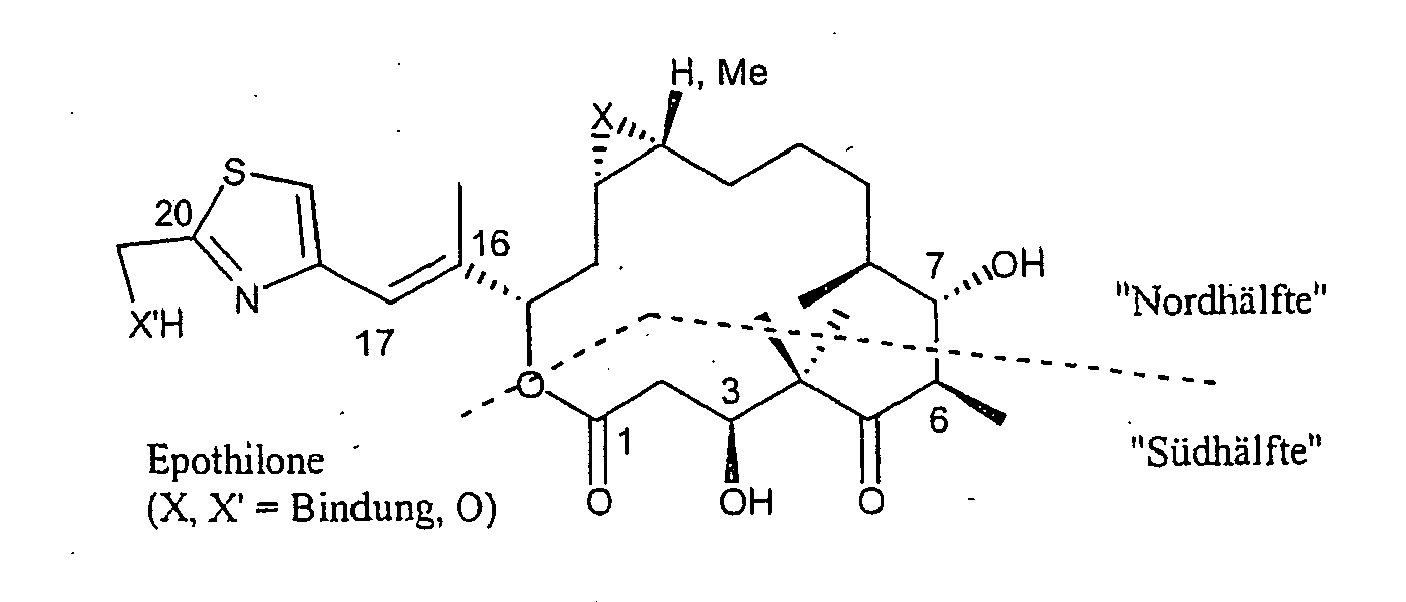
- Epothilon, insbesondere Epothilone B und D, weisen eine C7-C18(Methyl)-Einheit in der "Nordhälfte", die strukturell einer modifizierten Polyprenyl- (Polyisopren-) Kette entspricht, und z. B. nach den Deutschen Patentanmeldungen Nr. 197 13 970.1 und Nr. 100 51 136.8 darstellbar ist; sowie eine C1-C6(Methyl)-Einheit in der "Südhälfte" auf, die aus Aldol-Typ-Reaktionen, z. B. gemäß der Deutschen Offenlegungsschrift Nr. 197 01 758.4, (1998), darstellbar ist.
- Die Begriffe Strukturelement, Synthesebaustein und Baustein werden im Rahmen der vorliegenden Erfindung synonym verwendet. Die Nummerierung bei Epothilonbausteinen folgt derjenigen des Epothilons (siehe oben). Insbesondere Substituenten und besonders Methylverzweigungen sind bei der Benennung der Bausteine als C(Zahl)-C(Zahl)-Bereich gewöhnlich nicht gesondert erwähnt, sind aber ausdrücklich-jedoch nicht zwingend - mit eingeschlossen.
- Bislang wurden zur Herstellung des Struktureiements C7-C21 der Epothilone oder von Untereinheiten, insbesondere C7-C15/16 und C11-C15/16-Bausteinen, üblicherweise Allylverbindungen einschließlich Prenylderivaten, synthetisiert, wobei die Allylverbindungen mit schwierig zugänglichen oder in der falschen Oxidationsstufe befindlichen C15-C16-Methylbausteinen verknüpft wurden.
- Bei Verfahren zur Herstellung der Epothilon-Nordhälfte, bei denen an C15 und C16 eine für die Epothilon-Synthese korrekte Oxidationsstufe vorlag, insbesondere gemäß der deutschen Patentanmeldung 100 51 136.8 entstehen üblicherweise Racemate. Somit weisen alle bislang bekannten Methoden zum Aufbau der Epothilon-Nordhälfte den Nachteil auf, daß eine asymmetrische Synthese nur schwierig durchzuführen ist.
- In Tetrahedron Letters 39 (1998) 209 - 212 wird die enantioselektive Synthese einer C7 - C15 Aldehyd-Untereinheit von Epothilon A beschrieben.
- EP 0 404 672 beschreibt die Synthese von Terpen-Derivaten und ihre Verwendung bei der Parfümherstellung und der Vitamin A-Synthese.
- α-Hydroxyketone mit mindestens einem chiralem Zentrum an der α-HydroxyPosition sind somit wichtige Vorstufen von biologisch aktiven Substanzen, wie beispielsweise Polyketiden und Terpenoiden und insbesondere von Epothilonen und deren Derivaten. Ein wirtschaftliches Herstellungsverfahren ist deshalb von großer Bedeutung.
- Eine optimale und wirtschaftliche, gegebenenfalls enzymkatalysierte Herstellung von an der α-Hydroxy-Position nicht-racemischen Acyloinen sollte vorteilhafterweise eine Reihe von Bedingungen erfüllen, wie beispielsweise eine hohe Enantioselektivität, bezogen auf die α-Hydroxy-Position des Acyloins; eine hohe Diastereoselektivität; eine gute Raum-Zeit-Ausbeute (kurze Reaktionszeiten, hohe Umsätze bezogen auf ein Enantiomer, hohe Edukt- und Produkt-Konzentrationen); eine hohe Substratbreite des Enzyms, eine hohe chemische Ausbeute des gewünschten Produkts; geringe Katelysatormengen (insbesondere Enzymmengen), eine leichte Reinigung der Syntheseprodukte ; eine gute Löslichkeit von Edukt und Produkt unter den Reaktionsbedingungen; sowie eine kostengünstige Synthese, d.h. leicht herstellbare Edukte, gute Handhabbarkeit der Edukte, Lösungsmittel, Reagenzien und Enzyme.
- Aufgabe der vorliegenden Erfindung ist es daher, die vorstehend beschriebenen Nachteile des Standes der Technik zu überwinden und insbesondere ein Verfahren bereitzustellen, das möglichst viele der vorstehend genannten Bedingungen erfüllt.
- Insbesondere ist es eine Aufgabe der vorliegenden Erfindung, ein alternatives und verbessertes Verfahren bereitzustellen, mit dem vorzugsweise unsymmetrisch substituierte Acyloine und Acyloinderivate ggf. mit hohem Enantiomerenüberschuß an α-Hydroxy-Position der Acyloine hergestellt werden können. Ferner ist es eine Aufgabe der vorliegenden Erfindung, Verbindungen bereitzustellen, die als Bausteine in der Synthese von Polyketiden und Terpenoiden, insbesondere von Epothilonen und/oder deren Derivaten eingesetzt werden können und die insbesondere an der α-Hydroxy-Position der Acyloin-Einheit nicht racemisch sind.
- Wie bereits vorstehend erwähnt wurde Strukturelemente C7-C16-Me der Epothilone oder Untereinheiten, insbesondere C7-C15-Bausteine, bisher mit Prenylderivaten aus nucleophilen Prenylmetallderivaten synthetisiert, z.B. gemäß der in der deutschen Offenlegungsschrift Nr. 197 13 970.1 offenbarten Methode. Diese Methode weist zwar deutliche Vorteile gegenüber anderen Methoden zum Aufbau dieses Strukturelementes auf, enthält jedoch den Nachteil, daß Prenylmetallspezies, insbesondere solche des Bariums erzeugt werden müssen. Dies ist teuer, aufwendig und führt auch zu Nebenprodukten, z.B. durch Allylumlagerung (SN2'-Angriff) während der Reaktion. Ebenso ist entweder eine Oxidation an C15 oder C16 erforderlich, um die Sauerstofffunktion einzuführen, oder diese Funktion ist passend mitzubringen, was relativ aufwendige Bausteine erfordert, die zudem für weitere Synthesen oft Probleme aufwerfen.
- Bei dem Strukturelement C1-C6-Me der Epothilone ergab sich nach den Verfahren des Stands der Technik oft ein Problem bei der Anknüpfung an C7. Diese soll syn-spezifisch erfolgen. In bisherig bekannten Verfahren, die vor allem mit Basen erzeugte Enolate nutzen, sind Nebenreaktionen aufgrund dieser Reagenzien möglich, und/oder die Partner können nur mit Hilfe bestimmter Schutzgruppen oder durch geeignete Beeinflussung durch das Stereozentrum an C3 in ausreichender Ausbeute korrekt verknüpft werden.
- Eine weitere Aufgabe der vorliegenden Erfindung besteht daher auch darin, die vorstehend beschriebenen Nachteile des Standes der Technik bei der Synthese der Strukturelemente C1-C6 bzw. C7-C16 der Epothilone zu überwinden und insbesondere wenig aufwändige, kostengünstige Verfahren möglichst frei von Nebenreaktionen bereitzustellen, mit denen die gewünschten Strukturelemente in möglichst hoher Ausbeute bereitgestellt werden.
- Weitere Aufgaben ergeben sich aus der nachfolgenden Beschreibung.
- Zur Lösung der vorstehend genannten Aufgaben dienen die in den unabhängigen Ansprüchen definierten Merkmale.
- Vorteilhafte Ausgestaltungen sind in den Unteransprüchen beschrieben.
- Die Aufgabe der Erfindung wird insbesondere gelöst, indem Verbindungen mit der allgemeinen Formel I

- R1 ausgewählt wird aus der Gruppe bestehend aus H, Methyl, CHnF3-n (n=0-3), Ethyl oder Propyl; und bevorzugt Methyl ist; und
- R2 ein Allylderivat vom Typ A (Anknüpfung bei X)
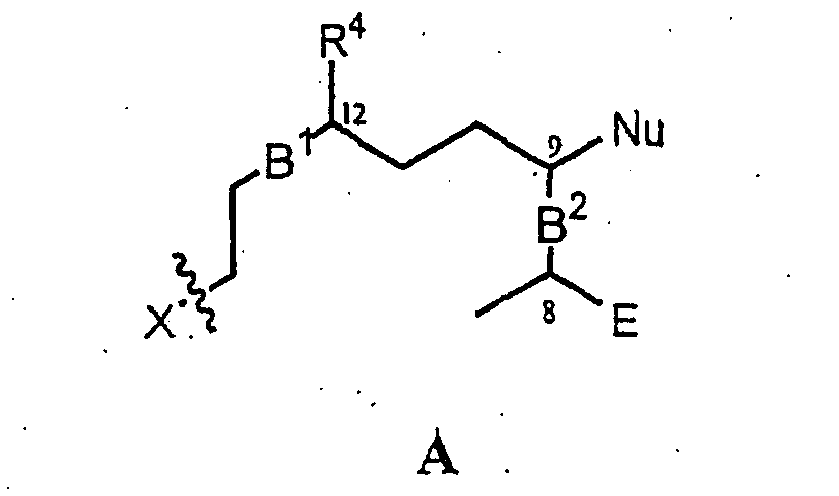
- B1 und/oder B2 für eine Einfach- oder Doppelbindung als E-(trans)-Form, Z-(cis)-Form oder E/Z-Gemisch oder ein Epoxid als E-(trans)-Form, Z-(cis)-Form oder E/Z-Gemisch und/oder Kombinationen davon steht; und vorzugsweise für Einfach-und Doppelbindungen steht und besonders bevorzugt B1 für eine Z-Doppelbindung oder ein Epoxid und B2 für eine Einfachbindung steht;
- R4 Methyl, Ethyl, CHnF3-n (n = 0-3), oder Halogen ist; E CH3, CH2OH, CH2OPG, CH=O, CO2R, oder CO2PG ist; R H, Methyl oder Ethyl ist; Nu, H oder Alkyl ist;
- und PG für das angegebene Verknüpfungs- atom oder die angegebene funktionelle Gruppe übliche Schutzgruppen bezeichnet, ausgeschlossen eine Verbindung mit R1=Methyl, B1=Doppel bindung, R4=Methyl, Nu-H, B2=Doppelbindung und E=Methyl.
- Bei einer bevorzugten Ausführungsform der vorliegenden Erfindung ist die erfindungsgemäße Verbindung an der α-Hydroxyposition der allgemeinen Formel I nicht racemisch bzw. optisch aktiv. In dieser Ausführungsform sind die erfindungsgemäßen Verbindungen besonders geeignet für den Einsatz in der wirtschaftlichen Synthese von Polyketiden und Terpenoiden, insbesondere von Epothilonen und deren Derivaten, da auf diese Weise eine hohe Enantioselektivität und Diastereoselektivität gewährleistet ist, wodurch insbesondere eine klinische Anwendung der Endprodukte ermöglicht wird.
- An der α-Hydroxyposition der allgemeinen Formel I racemische, wie vorstehend beschriebene Verbindungen sind jedoch ebenfalls Gegenstand der vorliegenden Erfindung.
- Besonders bevorzugt ist die Verbindung ist an der α-Hydroxyposition der allgemeinen Formel 1 racemisch und/oder nicht racemisch.
- Falls der Rest R2 in der allgemeinen Formel I ein Allylrest ist, wird R2 ausgewählt aus der Gruppe bestehend aus 3-Alkylallyl, 3,3-Dialkylallyl, E- oder Z-3-Halogenallyl und 3,3-Dihalogenallyl.
- Einebesonders bevorzugte erfindungsgemäße Verbindung weist als Rest R2 in der allgemeinen Formel I ein Allylderivat vom Typ A (Anknüpfung an Formel I bei X)

- B1 und/oder B2 für eine Einfach- oder eine Doppelbindung als E-(trans)-Form, Z-(cis)-Form oder E/Z-Gemisch oder ein Epoxid als E-(trans)-Form, Z-(cis)-Form oder E/Z-Gemisch und/oder Kombinationen davon steht; und vorzugsweise B1 für eine Z-Doppelbindung oder ein Epoxid und B2 für eine Einfachbindung steht;
- R4 Methyl, Ethyl, CHnF3-n (n = 0-3), oder Halogen ist; E CH3, CH2OH, CH2OPG, CH=O, CO2R, oder CO2PG ist; R H, Methyl oder Ethyl ist; Nu H oder Alkyl ist; und PG für das angegebene Verknüpfungsatom oder die angegebene funktionelle Gruppe übliche schutzgruppe bezeichnet, ausgeschlossen eine Verbindung mit R4=Methyl, B1=Doppelbindung, R4=Methyl, Nu=H, B2= Doppelbindung und E=Methyl.
- Für die Verwendung als Epothilon-Baustein ist es besonders vorteilhaft, wenn Rest R2 bzw. A ausgewählt wird aus der Gruppe bestehend aus einem Neryl- und einem Geranyl-Rest, insbesondere aus der Gruppe bestehend aus einem an der ω-Position zum Alkohol, zum Aldehyd oder zur Carbonsäure oxidierten und/oder ω-1/2-hydrierten Neryl-bzw. Geranylderivat. Beispiele für den Rest R2 können somit ausgewählt werden aus der Gruppe bestehend aus einem ω-Hydroxy- und einem ω-Oxo-(ω-1/2)-dihydro-nerylrest.
- Ebenfalls von besonderem Vorteil im Hinblick auf einen möglichen Einsatz der erfindungsgemäßen Verbindungen in der Synthese der Epothilon-Nordhälfte ist es, wenn die absolute Konfiguration an der α-Hydroxyposition der allgemeinen Formel I der natürlichen Konfiguration von Epothilonen an Position C15 entspricht.
- Bei einer weiteren möglichen Ausführungsform der vorliegenden Erfindung ist die α-Hydroxygruppe der allgemeinen Formel I durch eine Schutzgruppe PG geschützt. Insbesondere ist die Schutzgruppe PG eine Acylgruppe Besonders bevorzugt wird die Schutzgruppe PG ausgewählt aus der Gruppe bestehend aus einer Acetyl-, Propionyl-, Butyroyl und Benzoyl-Gruppe.
- Ein Beispiel der erfindungsgemäßen Verbindung weist die allgemeine Formel III

- R2 = Propinyl und/oder Propinylderivate vom Typ CH2-C≡C-R mit R = Alkyl, Homoallyl, CH2X;
- R3 ausgewählt wird aus der Gruppe bestehend aus Alkyl, Benzyl und Phenyl; und bevorzugt ausgewählt aus der Gruppe bestehend aus Methyl, Ethyl und Propyl; und EWG eine elektronenziehende funktionelle Gruppe wie CO2PG ist.
- Ein weiteres Beispiel für die erfindungsgemäßen Verbindungen weist die allgemeine Formel IV

- R2 = Propinyl und/oder Propinylderivate vom Typ CH2-C≡C-R mit R= Alkyl, Homoallyl, CH2X; und
- R3 ausgewählt wird aus der Gruppe bestehend aus Alkyl, Benzyl und Phenyl; und bevorzugt ausgewählt aus der Gruppe bestehend aus Methyl, Ethyl und Propyl.
- Bei einem weiteren Aspekt der vorliegenden Erfindung wird eine Verbindung bereitgestellt, bei der die α-Hydroxygruppe der allgemeinen Formel I

R1 ausgewählt wird aus der Gruppe bestehend aus H, Methyln CHnF3-n (n = 0-3), Ethyl oder Propyl und bevorzugt Methyl ist; und
R2 ein Allylderivat vom Typ A (Anknüpfung bei X)
B1 und/oder B2 für eine Einfach- oder Doppelbindung als E-(trans)-Form, Z-(cis)-Form oder E/Z-Gemisch oder ein Epoxid als E-(trans)-Form, Z-(cis)-Form oder E/Z-Gemisch und/oder Kombinationen davon steht; und vorzugsweise B1 für eine Z-Doppelbindungoder ein Epoxid und B2 für eine Einfachbindung steht;
R4 Methyl, Ethyl, CHnF3-n (n = 0-3), oder Halogen ist; E CH3, CH2OH, CH2OPG, CH=O, CO2R, oder CO2PG ist; R H, Methyl oder Ethyl ist, Nu H oder Alkyl ist,
und PG für das angegebene Verknüpfungsatom oder die angegebene funktionelle Gruppe übliche Schutzgruppe bezeichnet, ausgeschlossen eine Verbindung mit R1=Methyl, B1=Doppelbindung, R4=Methyl, Nu=H, B2=Doppelbindung und E=Methyl. - Derartige an der α-Hydroxy-Position mit nicht-racemischen Acylgruppen versehene Verbindungen sind besonders geeignet als Baustein für die Synthese von Polyketiden und Terpenoiden, Epothilonen und/oder deren Derivaten, da sie eine Diastereomerentrennung der Synthesebausteine ermöglichen und folglich nach Abspaltung der Acylgruppe die Herstellung enantiomerenangereicherter Acyloine bzw. Acyloinderivate und weiterer Epothilonbausteine gewährleistet ist.
- Insbesondere wird die α-Hydroxygruppe der allgemeinen Formel 1 durch eine nichtracemische chirale Acylgruppe ausgewählt aus der Gruppe bestehend aus 2-Alkoxy- und 2-(N,N-Di-PG-amino)acylgruppen geschützt. Besonders bevorzugt ist die α-Hydroxygruppe der all gemeinen Formel I mit optisch aktiver 2-Alkoxymandelsäure oder 2-Alkoxymilchsäure und vorzugsweise mit 2-Methoxymandelsäure als nicht racemischer Schutzgruppe verestert.
- Weitere Beispiele für nicht-racemische chirale Schutzgruppen, insbesondere nicht-racemische chirale Acylgruppen sind dem Fachmann bekannt.
- Bei einem weiteren Aspekt der vorliegenden Erfindung wird eine Verbindung mit der allgemeinen Formel VI
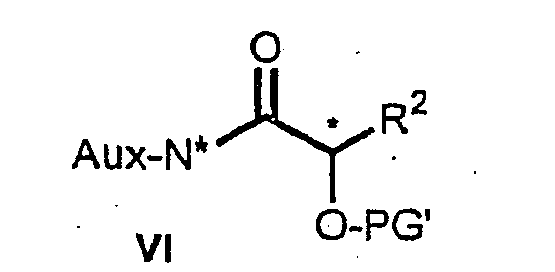
Aux-N* ein N-O-Alkyl, vorzugsweise N-O-Methyl, und/oder ein Evans-Typ-Auxiliar vom Oxazolidinon- oder Imidazolidinon-Typ ist;
R2 ein Allylderivat vom Typ A (Anknüpfung bei X)
B1 und/oder B2 für eine Einfach- oder eine Doppelbindung als E-(trans)-Form, Z-(cis)-Form oder E/Z-Gemisch oder ein Epoxid als E-(trans)-Form, Z-(cis)-Form oder E/Z-Gemisch und/oder Kombinationen davon steht; und vorzugsweise B1 für eine Z-Doppelbindung oder ein Epoxid und B2 für eine Einfachbindung steht;
R4 Methyl, Ethyl, CHnF3-n (n = 0-3), oder Halogen ist; E CH3, CH2OH, CH2OPG, CH=O, CO2R oder CO2PG ist; R-H, Methyl oder Ethyl ist; Nu H oder Alkyl ist; und PG für das angegebene Verknüpfungsatom oder die angegebene funktionelle Gruppe übliche Schutzgruppe bezeichnet, ausgeschlossen eine Verbindung mit R1 = Methyl, B2 = Doppelbindung, R4 = Methyl, Nu = H, B2 = Doppelbindung und E = Methyl. und vorzugsweise Rest R2 ausgewählt wird aus der Gruppe bestehend aus einem Neryl- und einem Geranyl-Rest, und besonders bevorzugt Rest R2 ausgewählt wird aus der Gruppe bestehend aus einem an der ω-Position zum Alkohol, zum Aldehyd oder zur Carbonsäure oxidierten und/oder ω-1/2-hydrierten Neryl- bzw
Geranylderivat, und am meisten bevorzugt Rest R2 ausgewählt wird aus der Gruppe bestehend aus einem ω-Hydroxy- und ω-Oxo-(ω-1/2)-dihydro-neryl; und PG' ausgewählt wird aus der Gruppe bestehend aus H und Schutzgruppen, die bei üblicher Enolisierung der auxiliarmodifizierten Zwischenstufen nicht reagieren, und vorzugsweise ausgewählt wird aus der Gruppe bestehend aus Silyl, Benzyl und Oxymethylderivaten. - Mit den vorstehend genannten erfindungsgemäßen, mit einem Evans-Typ-Auxiliar versehenen Acyloinen bzw. Acyloin-Derivaten ist ebenfalls eine enantiomerenangereicherte Synthese von Polyketiden und Terpenoiden, Epothilonen und/oder deren Derivaten möglich.
- Vorzugsweise ist das Evans-Typ-Auxiliar Aux-N* ein optisch aktives Oxazolidinon- oder N-Methylimidazolidinon mit der allgemeinen Formel

R an den die Chiralitätszentren darstellenden Positionen 4 und/oder 5 des Oxazolidinons bzw. N-Methylimidazolidinons ausgewählt wird aus der Gruppe bestehend aus Methyl, Phenyl, Isopropyl, Benzyl, polymeren Resten und Kombinationen davon. - Beispielsweise leitet sich das Evans-Typ-Auxiliar von Ephedrinen ab.
- Bei einem weiteren Aspekt der vorliegenden Erfindung wird eine Verbindung mit der allgemeinen Formel V

Y ausgewählt wird aus der Gruppe bestehend aus S, NH, N-PG, NR, 0; und vorzugsweise ausgewählt wird aus der Gruppe bestehend aus NH, N-PG, NR und O; und besonders bevorzugt O ist;
R1 ausgewählt wird aus der Gruppe bestehend aus H, Methyl, CHnF3-n (n=0-3), Ethyl oder Propyl und bevorzugt Methyl ist; und
R2 ein Allylderivat vom Typ A (Anknüpfung bei X)
B1 und/oder B2 für eine Einfach- oder eine Doppelbindung als E-(trans)-Form, Z-(cis)-Form oder E/Z-Gemisch oder ein Epoxid als E-(trans)-Form, Z-(cis)-Form oder E/Z-Gemisch und/oder Kombinationen davon steht; und vorzugsweise B1 für eine Z-Doppelbindung oder ein Epoxid und B2 für eine Einfachbindung steht;
R4 Methyl, Ethyl, CHnF3-n (n = 0-3), oder Halogen ist; E CH3, CH2OH, CH2OPG, CH=O, CO2R, oder CO2PG ist R H, Methyl oder Ethyl ist;
Nu H oder Alkyl ist; und PG für das angegebene Verknüpfungsatom oder die angegebene funktionelle Gruppe übliche Schutzgruppe bezeichnet, ausgeschlossen eine Verbindung mit R1=Methyl, B1=Doppelbingung, R4=Methyl, Mu=H, B2=Doppelbindung und E=Methyl.
R3 ausgewählt wird aus der Gruppe bestehend aus Methyl, Ethyl und Propyl; und Z ausgewählt wird aus der Gruppe bestehend aus =O, =N-Nu, =CH-Hetaryl, =CH-Aryl und =PR3; und vorzugsweise =CH-Hetaryl ist; und besonders bevorzugt ausgewählt wird aus der Gruppe bestehend aus (E)-(2-Methylthiazol-4-yl)-CH= und (E)-(2-Methyloxazol-4-yl)-CH=ist; wobei alle Gruppen Z in (E)-form, (Z)-Form oder als (E/Z)-Gemisch vorliegen können, - Eine derartige Verbindung mit der allgemeinen Formel V, insbesondere wenn sie an der α-Hydroxyposition der allgemeinen Formel V nicht-racemisch bzw. optisch aktiv ist und/oder Z ein Carbonylrest ist, stellt ein besonders bevorzugtes Strukturelement für die Epothilon-Synthese dar.
- Bei einem weiteren Gegenstand der vorliegenden Erfindung wird ein Verfahren zur Herstellung der vorstehend beschriebenen erfindungsgemäßen α-Hydroxyketon-Verbindungen bereitgestellt, das mindestens einen der nachfolgenden Schritte umfaßt:
- a) Umsetzung von Verbindungen der allgemeinen Formel II

R1 ausgewählt wird aus der Gruppe bestehend aus H, Methyl, CHnF3-n (n=0-3), Ethyl oder Propyl;
R3 ausgewählt aus der Gruppe bestehend aus Alkyl, Benzyl und Phenyl oder ein chiraler, nicht racemischer Rest R* ist; und besonders bevorzugt ausgewählt aus der Gruppe bestehend aus Methyl, Ethyl und Propyl und EWG eine elektronenziehende funktionelle Gruppe wie CO2PG und bevorzugt CO2-t-Bu ist;
mit einem Allylderivat vom Typ A (Anknüpfung bei X)
B1 und/oder B2 für eine Einfach- oder eine Doppelbindung als E-(trans)-Form, Z-(cis)-Form oder E/Z-Gemisch oder ein Epoxid als E-(trans)-Form, Z-(cis)-Form oder E/Z-Gemisch und/oder Kombinationen davon steht; und vorzugsweise B1 für eine Z-Doppelbindung oder ein Epoxid und B2 für eine Einfachbindung steht;
R4 Methyl, Ethyl, CHnF3-n (n = 0-3), oder Halogen ist; E CH3, CH2OH, CH2OPG, CH=O, CO2R oder CO2PG ist; R.H, Methyl oder Ethyl ist; Nu H oder Alkyl ist; und PG für das angegebene VerKnüpfungsatom oder die angegebene funktionelle Gruppe übliche Schutzgruppe bezeichnet, ausgeschlossen eine Verbindung mit R1=Methyl, B1=Doppelbindung, R4=Methyl, Nu=H, B2=Doppelbindung und E=Methyl.
zu Verbindungen der allgemeinen Formel III
- b) Umsetzung der Verbindung der allgemeinen Formel III zu Verbindungen der allgemeinen Formel IV

- c) Solvolyse der Verbindung der allgemeinen Formel IV zu freien α-Hydroxyketonen der allgemeinen Formel I.

- d) Racematspaitendo Veresterung von Verbindungen der allgemeinen Formel I.
- Die vorstehend beschriebenen Verfahrensschritte a) bis d) können in beliebiger, dem Fachmann geläufiger und vorzugsweise in der vorstehend angegebenen Reihenfolge durchgeführt werden. Ferner können je nach gewünschtem Produkt einer oder mehrere der Verfahrensschritte weggelassen werden.
- Die Umwandlung der Verbindungen der allgemeinen Formel II mit Resten R2 erfolgt beispielsweise durch dem Fachmann geläufige Propinylierungen oder Allyllierungen, wobei die Reste R2 an ihrer Verknüpfungsstelle vorzugsweise mit H; OH; oder Halogen oder anderen üblichen Abgangsgruppen und deren Kombinationen; bevorzugt Cl, Br, I, O-Tosyl, Methylsulfonat, Trifluormethylsulfonat, Alkanoat und Arylcarboxylate; und besonders bevorzugt H, Cl, Br; versehen sind.
- Insbesondere erfolgt die Solvolyse in Schritt c) des erfindungsgemäßen Verfahrens durch Hydrolyse mit Wasser und/oder Umesterung mit Alkoholen.
- Als Katalysatoren für die Solvolyse in Schritt c) sind basische, saure und/oder Lewissäurekatalysatoren denkbar. Vorzugsweise werden die Katalysatoren ausgewählt werden aus der Gruppe bestehend aus Alkalihydroxiden, Erdalkalihydroxiden, Alkalihydrogencarbonaten, Erdalkalihydrogencarbonate, Alkalicarbonaten, Erdalkalicarbonaten, Stickstoffbasen, anorganischen Säuren, organischen Säuren, insbesondere aromatischen Sulfonsäuren oder polymergebundenen Säuren, und Lewissäurekatalysatoren wie Lanthanidensalzen, Titansalzen, insbesondere Titan(IV)alkoxiden.
- Einige Lewissäurekatalysatoren können entsprechend ihrer chemischen Eigenschaften nur unter wasserfreien Bedingungen eingesetzt werden.
- Geeignete Lösemittel sind dem Fachmann bekannt. Beispiele werden nachstehend im Zusammenhang mit weiteren erfindungsgemäßen Verfahren zur Synthese von Epothilon-Synthesebausteinen angegeben.
- Die Reaktionstemperatur liegt im Bereich von -80°C bis 150°C, je nach Reaktivität und Lösemittelsystem, vorzugsweise jedoch im Bereich von 0°C bis 90°C, und besonders bevorzugt im Bereich von 15°C bis 35°C liegt.
- Die Aufarbeitung erfolgt üblicherweise durch Ausschütteln mit den üblichen organischen Lösemitteln, Trocknen und gegebenenfalls destillative, kristallisierende und/oder chromatographische Aufreinigung.
- Ferner ist bevorzugt, daß die Solvolyse in Schritt c) durch die milde basische Hydrolyse mit leicht basischen Katalysatoren, bevorzugt in wässerigen und/oder alkoholischen Lösungen, mit höheren Alkalicarbonaten oder verdünnten Alkalihydroxiden als Katalysator erfolgt, wobei vorzugsweise derart während der Reaktion zudosiert wird, daß der pH-Wert den einer Carbonatlösung nicht übersteigt. Die Reaktion erfolgt dabei bevorzugt in Methanol oder Ethanol mit wässriger Natrium- oder Kaliumcarbonatlösung.
- Bei weiteren, im folgenden beschriebenen Ausfühningsformen werden erfindungsgemäße Verfahren beschrieben, mit denen durch asymmetrische Synthese oder Racematspaltung, vorzugsweise jedoch durch enzymatische und/oder chemischphysikalische Racematspaltung nichtracemische, unsymmetrisch substituierte Acyloine und Acyloinester und deren Derivate hergestellt werden können, vorzugsweise solche Derivate, die als Epothilon-Synthesebausteine dienen können, ganz besonders solche die in der deutschen Patentanmeldung 100 51 136.8 beschrieben sind, auf deren Offenbarung hiermit ausdrücklich Bezug genommen wird.
- Racematspaltungen sind bislang nur selten an Acyloinen durchgeführt worden, nahezu ausschließlich an symmetrischen Acyloinen, ohne Acyloinshiftproblematik oder mit einem schlechterem Ergebnis bezüglich Enantiomerenreinheit und/oder Ausbeute und/oder Drehwert, und/oder aufwendigeren als den im folgenden beschriebenen Verfahren (siehe z.B. J. Chem. Soc. Chem. Commun. 1997, 1399; Tetrahedron: Asymmetry 10, 1996, 2207; ibid. 1997, 2773; Tetrahedron Lett. 1997, 6429). Ferner gibt es wenige Beispiele zur Racematspaltung von Homoallylalkoholen (z. B. Tetrahedron: Asymmetry 10, 1999, 315). Auch die C15-Racematspaltung fortgeschrittener Epothilonnordhälften mit Thiazolmethylidenseitenkette lieferte nur unzureichende Enantiomerenüberschüsse (Tetrahedron Lett. 41, 2000, 1863-1866; s.a. Synthesis 1999, 1469). Die insbesondere für Epothilonbausteine wichtige Kombination zu Homoallylacyloinen, d.h. allylisch substituierten Acyloinen (R2 = Allyl und Derivate, insbesondere Y) wurde bislang nicht erfolgreich der enzymatischen Racematspaltung unterworfen. Für diese Racemattrennungen müssen insbesondere Substrate mit geschützten und z. T. ungeschützten funktionellen Gruppen (z. B. 7-OH) umgesetzt werden, die die weitere Umsetzung zu Epothilonen und Epothilonderivaten erlaubt.
- Wie im folgenden beschrieben wird, werden im Rahmen der vorliegenden Erfindung nun erstmals geeignete Bedingungen und insbesondere geeignete Enzyme für diese Umsetzungen zur Verfügung gestellt. Ferner wurde erstmals gefunden, dass bestimmte genetisch durch in vitro-Evolution veränderte Enzyme vorteilhaft für die Synthese dieser nichtracemischen Epothilonnordhälfte-Bausteine eingesetzt werden können.
- In der folgenden Darstellung ist schematisch ein Beispiel für die Synthese racemischer Acyloinvorstufen und Acyloine beschrieben:

- Überraschenderweise wurde gefunden, daß der Einsatz bestimmter nichtracemischer Acyloxygruppen als Schutzgruppen für die α-Hydroxygruppe von Acyloinen bzw. Acyloin-Derivaten die Diastereomerentrennung von Acyloinvorstufen und/oder geschützten Acyloine erlaubt, und somit beispielsweise nach Hydrolyse oder anderer Umsetzung, die Synthese enantiomerenangereicherter Acyloine bzw.
Acyloinderivate sowie ggf. fortgeschrittener Epothilonbausteine möglich ist.
Insbesondere wurde dabei gefunden, dass dies aus den Diastereomeren ganz oder größtenteils unter Erhalt eines Enantiomerenüberschusses gelingt. - In der folgenden Darstellung ist eine idealisierte Diastereomerentrennung veranschaulicht:

- Somit wird bei einer besonders bevorzugten Ausführungsform der vorliegenden Erfindung ein Verfahren bereitgestellt, bei dem die Herstellung von an der α-Hydroxyposition nicht-racemischen Verbindungen der allgemeinen Formel I durch Umsetzung von Verbindungen mit den allgemeinen Formeln II, III und IV erfolgt, deren α-Hydroxygruppe durch eine nicht-racemische chirale Acylgruppe (R3 = R*) geschützt ist.
- Insbesondere kann bei dieser Ausführungsform die α-Hydroxygruppe mit optisch aktiver 2-Alkoxymandelsäure oder 2-Alkoxymilchsäure und vorzugsweise mit 2-Methoxymandelsäure verestert werden.
- Ferner wurde im Rahmen der vorliegenden Erfindung gefunden, daß auch die auxiliargesteuerte Synthese von derartigen Acyloinen mit 2-oxysubstituierten Acetylderivaten analog der Evans-Methodik gelingt.
- In der folgenden Darstellung ist eine "enantioselektive" Synthese von Acyloinen veranschaulicht (N-Aux = chirales Auxiliar vom Evans-Typ, bevorzugt Oxazolidinon- oder insbesondere Imidazolidinon-Derivate):

- Somit erfolgt bei einer alternativen Ausführungsform des erfindungsgemäßen Verfahrens die Herstellung von an der α-Hydroxyposition nicht-racemischen Verbindungen der allgemeinen Formel I über Zwischenprodukte in Form von Verbindungen der allgemeinen Formel VI

- Die Verbindungen mit der allgemeinen Formel VI werden bei dieser Ausführungsform insbesondere bereitgestellt durch Umsetzung von nicht-racemischen 4- und/oder 5-substituierten N-[O-PG]-Acetyl-N-methylimidazolidinonen, bei denen PG eine Schutzgruppe ist, mit α-Hydroxyketon-Verbindungen ggf. in Gegenwart von Base, vorzugsweise Lithiumdialkylamiden und/oder Alkalihexamethyldisilaziden. Die α-Hydroxyketon-Verbindungen umfassen den Rest R2, insbesondere den Rest Y, besonders bevorzugt Nerylderivate, sowie geeignete Abgangsgruppen X.
- Die Reinigung und gegebenenfalls Diastereomerentrennung erfolgt bevorzugt durch flüssigchromatographische Verfahren an achiralen Festphasen wie Kieselgel.
- Besonders bevorzugt erfolgt die Herstellung von an der α-Hydroxyposition nicht-racemischen Verbindungen der allgemeinen Formel I durch Addition von Organometallverbindungen, vorzugsweise von Alkyllithium- oder Alkylmagnesiumverbindungen, besonders bevorzugt von Methyl- bzw. Ethyllithium bzw. Methyl- bzw. Ethylgrignardverbindungen, an Verbindungen der allgemeinen Formel VI.
- Es wurde ferner überraschenderweise gefunden, dass racemisches freies Acyloin unter teilweiser, vorzugsweise überwiegender und besonders bevorzugt nahezu vollständiger Racematspaltung enzymatisch zu O-Acyl-acyloinen verestert werden kann.
- In der folgenden Darstellung ist eine enzymatische Veresterung unter Racecnatspaltung idealisiert veranschaulicht:
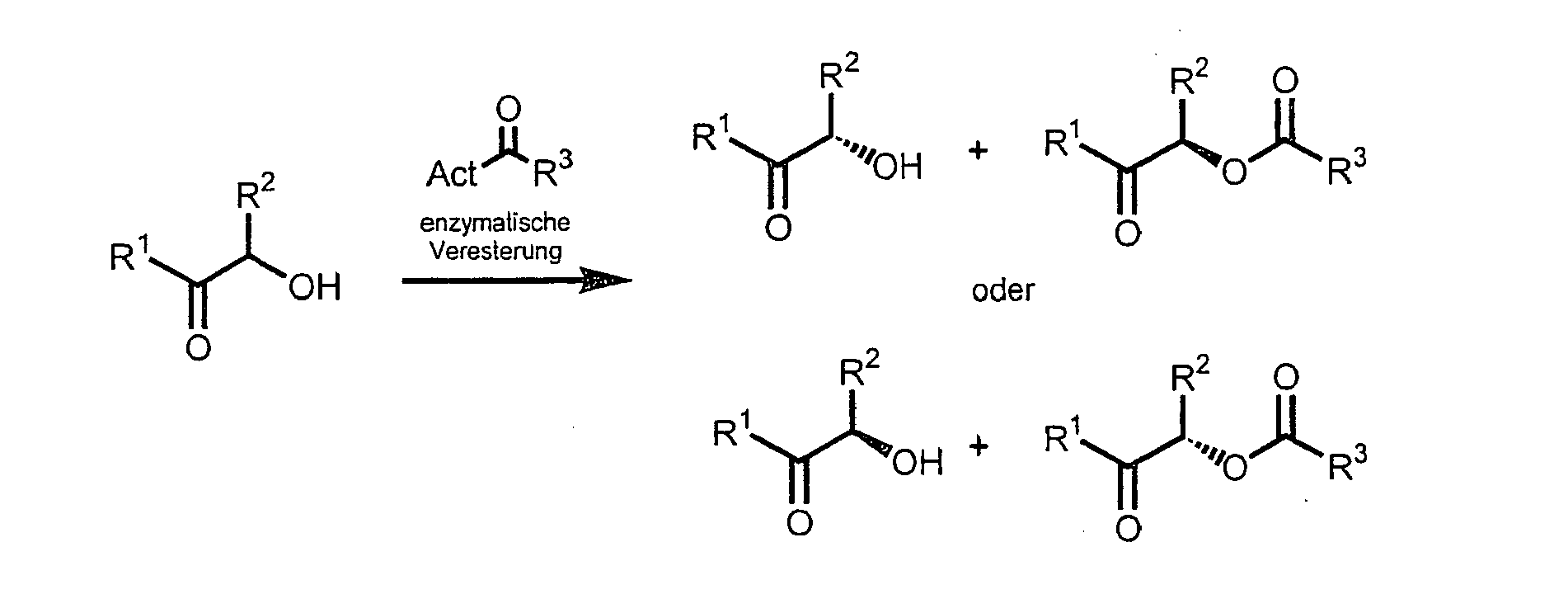
- Somit erfolgt bei einer weiteren alternativen und besonders bevorzugten Ausführungsform des erfindungsgemäßen Verfahrens die Herstellung von an der α-Hydroxyposition nicht-racemischen Verbindungen der allgemeinen Formel I bzw. IV durch racematspaltende enzymatische Veresterung von Verbindungen des Typs I.
- Insbesondere erfolgt die Veresterung mit einem Aktivester, vorzugsweise Isopropenyl- und/oder Vinylacetat.
- Die die Veresterung katalysierenden Enzyme werden vorzugsweise ausgewählt aus der Gruppe bestehend aus Lipasen und Esterasen, und sind besonders bevorzugt Lipasen, beispielsweise Lipasen aus Pseudomonas cepacia und/oder Candida antarctica.
- Alternativ werden Esterasen aus Pseudomonas fluorescens und/oder Streptomyces diastatochromogenes eingesetzt.
- Beispielsweise wird eine Lösung des Acyloins in einem geeigneten organischem Lösemittel, bevorzugt einem Alkan, besonders bevorzugt Toluol; mit einer Lipase oder Esterase, auch in immobilisierter oder anderweitig zubereiteter Form, bevorzugt einer Lipase; und einem Aktivester, bevorzugt Isopropenyl- oder Vinylacetat, besonders bevorzugt in leichtem Überschuß; bevorzugt zwischen 10-70°C, besonders bevorzugt beim enzymatischen Optimum oder in einem Bereich von plus/minus 10°C um das enzymatische Optimum, ggf. unter Agitation, bevorzugt scherfreiem Rühren oder Schütteln, zur Reaktion gebracht, bis die gewünschte Umsetzung erfolgt ist. Die Reaktion wird durch Aufarbeitung oder bevorzugt Zentrifugieren beendet, das Lösemittel abgenommen und durch Vakuumverdampfung entfernt. Ester und nicht reagiertes freies Acyloin können destillativ, kristallisierend oder chromatographisch getrennt werden, bevorzugt chromatographisch an fester Phase, z. B. an Kieselgel oder Aluminiumoxid.
- Ferner wurde im Rahmen der vorliegenden Erfindung überraschenderweise gefunden, daß es alternativ bei racemischen O-acylierten Acyloinen (PG = Acyl, bevorzugt Acetyl, Butyryl, Benzoyl) gelingt, mittels enzymatischer Hydrolyse eine Racematspaltung zu nicht-racemischem freiem Acyloin und nicht-racemischem O-Acyl-acyloin entgegengesetzter Stereochemie zu erreichen.
- In der folgenden Darstellung ist eine derartige enzymatische hydrolytische Racematspaltung idealisiert veranschaulicht:

- Somit erfolgt bei einer weiteren alternativen und ebenfalls besonders bevorzugten Ausführungsform des erfindungsgemäßen Verfahrens die Herstellung von an der α-Hydroxyposition nicht-racemischen Verbindungen der allgemeinen Formel I bzw. IV durch racematspaltende enzymatische Hydrolyse von Verbindungen des Typs IV.
- Vorzugsweise wird das die Hydrolyse katalysierende Enzym ausgewählt aus der Gruppe bestehend aus Lipasen und Esterasen. Beispielsweise können Lipasen aus Pseudomonas cepacia und/oder Candida antarctica eingesetzt werden. Alternativ sind Esterasen aus Pseudomonas fluorescens und/oder Streptomyces diastatochromogenes vorteilhaft. Besonders bevorzugt wird als Enzym rekombinante Schweineleberesterase eingesetzt.
- Beispielsweise wird bei dieser Ausführunsgform ein Ester der allgemeinen Formel IV in einem Puffer gelöst oder suspendiert, bevorzugt einem Phosphat- oder Carbonatpuffer; und die Hydrolase, bevorzugt eine Lipase oder Esterase, auch in immobilisierter oder anderweitig zubereiteter Form, zugesetzt. Bei größeren Ansätzen kann eine Pufferung bevorzugt durch pH-kontrollierten Zusatz von Base erreicht werden. Der pH-Wert richtet sich nach den bekannten oder bestimmten Optimum- und Grenzwerten des Enzyms, wobei ein pH-Wert zwischen diesen Werten der eine optimale Reaktionsführung erlaubt ideal ist. Die Reaktion erfolgt bevorzugt zwischen 10-70°C, besonders bevorzugt beim enzymatischen Optimum oder in einem plus/minus 10°C um das enzymatische Optimum, bis die gewünschte Umsetzung erfolgt ist, ggf. unter Agitation, bevorzugt durch scherfreies Rühren oder Schütteln. Die Reaktion wird bei einem Umsatz um 50% (bezogen auf Racemat) durchgeführt, ggf. auch etwas darunter oder seltener darüber, wenn dies einer höheren optischen Reinheit des Zielproduktes (Alkohol bzw. Ester) dienlich ist. Die Aufarbeitung erfolgt durch Extraktion mit geeigneten nicht-wassermischbaren organischen Lösemitteln (Ester, Ether, Aromaten, bei Produktlöslichkeit auch einfache Alkane), bevorzugt mit Ethylacetat oder Toluol. In einigen Fällen läßt sich die Extraktionsausbeute durch den vorherigen Zusatz geringer Mengen Aceton oder anderer Lösevermittler steigern, oder durch das vorherige Abzentrifugieren des Enzyms. Die Aufarbeitung und Reinigung folgt den üblichen auch vorstehend beschriebenen Prozessen.
- Die vorstehend beschriebene enzymkatalysierte racematspaltende Hydrolyse bzw. Veresterung findet vorzugsweise in einem Temperaturbereich von 10°C bis 70°C statt. Insbesondere die Lipase CAL-B hat ein Temperaturoptimum von 60°C und kann ohne weiteres auch bei Temperaturen bis zu 70°C eingesetzt werden. Ein weiterer möglicher bevorzugter Temperaturbereich für die bei den erfindungsgemäßen Verfahren geeigneten Temperaturen ist z.B. 20°C - 45°C.
- Die enzymatischen Optima bzw. Temperaturoptima, insbesondere der vorstehend genannten Enzyme sind dem Fachmann bekannt oder können durch einfache Versuche ermittelt werden.
- Bei sämtlichen vorstehend beschriebenen erfindungsgemäßen Verfahren ist es vorteilhaft, wenn zwischen den jeweiligen Syntheseschritten bzw. vor dem Einsatz als Synthesebaustein beispielsweise in der Epothilon-Synthese eine Diastereomerentrennung von Verbindungen der allgemeinen Formeln I, II, III, IV und/oder V, deren α-Hydroxygruppe durch eine nicht-racemische chirale Acylgruppe (R3 = R*) geschützt ist, durchgeführt wird. Die Diastereomerentrennung kann beispielsweise durch Kristallisation, Cokristallisation, Destillation, sequentielle Extraktion, z. B. HSCCC (high speed counter current chromatography) und/oder chromatographische Trennung, vorzugsweise durch chromatographische Trennung, besonders bevorzugt durch flüssigchromatographische Verfahren an achiralen Festphasen wie Kieselgel erfolgen.
- Bei einer weiteren bevorzugten Ausführungsform werden die Verbindungen der allgemeinen Formel IV zu Verbindungen der allgemeinen Formel V

wobei Z ausgewählt wird aus der Gruppe bestehend aus =O, =N-Nu, =CH-Hetaryl, =CH-Aryl und =PR3; und vorzugsweise =CH-Hetaryl ist; und besonders bevorzugt ausgewählt wird aus der Gruppe bestehend aus (E)-(2-Methylthiazol-4-yl)-CH= und (E)-(2-Methyloxazol-4-yl)-CH=; wobei alle Gruppen Z in (E)-form, (Z)-Form oder als (E/Z)-Gemisch vorliegen können. - Vorzugsweise erfolgt die Umsetzung durch dem Fachmann bekannte Wittigtyp-Reaktionen. Besonders bevorzugt erfolgt die Umsetzung zu einer Verbindung mit der allgemeinen Formel

- Auf diese Weise werden für die Epothilon-Synthese besonders geeignete Bausteine zur Verfügung gestellt.
- Sämtliche vorstehend beschriebenen Umsetzungen können an getrennten Diastereomeren und/oder am Diastereomerengemisch erfolgen.
- Sämtliche vorstehend beschriebenen Synthesebausteine und Verfahrensschritte können bei der Bereitstellung von Verbindungen mit der allgemeinen Formel I, vorzugsweise in nicht-racemischer Form an der α-Hydroxyposition, eingesetzt werden.
- Bei einer weiteren alternativen Ausführungsform des erfindungsgemäßen Verfahrens werden die Verbindungen der allgemeinen Formeln I, II, IV und/oder V unter wasserfreien, stark basischen Bedingungen, vorzugsweise mit den Basen Trialkylamin, DBU, DBN und/oder polymeren starken Basen racemisiert. Auf diese Weise wird eine Rückführung in die Racematspaltung ermöglicht.
- Dazu wird beispielsweise das freie oder geschützte Acyloin in einem wasserfreien organischen Lösemittel, bevorzugt einem Alkan, Ether und/oder Aromaten, gelöst und mit der Base versetzt. Die Temperatur, vorzugsweise 0°C bis 65°C, besonders bevorzugt 25°C bis 40°C, kann zwecks schnellerer Isomerisierung bis zum Siedepunkt des Lösemittels erhöht werden, sofern es nicht zu starken Nebenreaktionen kommt. Nach Beendigung der Isomerisierung wird durch Kieselgel filtriert oder mit Säure ausgewaschen oder mit Scavenger-Harz gerührt um den basischen Katalysator zu entfernen.
- Ein weiterer Gegenstand der vorliegenden Erfindung ist die Verwendung der erfindungsgemäßen Verbindungen als Baustein, insbesondere als C15-C16-haltiger Baustein für die Herstellung von Epothilonen und deren Derivaten.
- Schließlich ist ein weiterer Gegenstand der vorliegenden Erfindung die Verwendung der erfindungsgemäßen Verfahren bei der Herstellung von Epothilonen und deren Derivaten.
- Erfindungsgemäß hergestellte Synthesebausteine weisen die allgemeine Strukturformel I, II, III, IV und V, vorzugsweise die Formel I, IV oder V mit R1 = Me und R2 = A auf, und können in racemischer oder nichtracemischer Form oder als einzelne Diastereomere oder als Diastereomerengemisch vorliegen. Die Strukturelemente mit den allgemeinen Formeln I und V können vorzugsweise als Produkte oder als Zwischenprodukte in der Synthese von Wirkstoffen verwendet werden. Außerdem können die erfindungsgemäßen Strukturelemente mit den allgemeinen Formeln I bis V verwendet werden für die Synthese von Polyketid- und Terpenoid-Naturstoffen oder Derivaten von Polyketid- und Terpenoid-Naturstoffen, vorzugsweise, wie auch Strukturelemente der allgemeinen Formel V, für die Synthese von makrocylischen Wirkstoffe wie Epothilonen und deren Derivaten einschließlich Stereoisomeren und/oder Homologen, Nor-Verbindungen, und/oder als ganz oder teilweise invertierte Elemente, bei denen sie vorzugsweise als C15/C16-Bausteine, als C12-C16-Bausteine, als C11-C16- und C7-C16-Bausteine oder besonders bevorzugt als C7-C16(Me)-Bausteine des Ringes dienen können, die zusätzlich bereits vorgebildete Elemente oder auch die komplette Seitenkette an C15 oder C16 des Ringes tragen können. Die Synthesebausteine sind vorzugsweise angereichert in einer enantiomeren und/oder diastereomeren Form, besonders bevorzugt der den natürlichen Epothilonen entsprechenden absoluten Konfiguration. Ferner werden erfindungsgemäße Verbindungen mit der allgemeinen Strukturformel I, IV und V bereitgestellt, bei denen die funktionellen Gruppen ganz oder teilweise durch PG geschützt wurden.
- Die erfindungsgemäßen Verbindungen mit den allgemeinen Formeln I; II, III, IV und V werden an C15 (oder bei Shift-Acyloinen an C16) in optisch aktiver Form erfindungsgemäß u.a. bereitgestellt durch asymmetrische Synthese mit Alkoxyacetylverbindungen verknüpft an Evanstyp-Auxiliare, durch Diastereomerenbildung und anschließende Trennung mit optisch aktiven Säuren und deren Derivaten, und durch Racematspaltung mittels enzymatischer Hydrolyse oder Veresterung; bevorzugt durch eines der letzteren beiden Verfahren, besonders bevorzugt durch enzymatische Verfahren.
- Die erfindungsgemäßen Verbindungen mit den allgemeinen Formeln I, II, III, IV und V. weisen üblicherweise in der niedrigsten C-Position wenigstens einen Substituenten auf, der geeignet ist, Verknüpfungen mit anderen Epothilonbausteinen zu ermöglichen, z. B. an C7 besonders mit C1-C6-Bausteinen, wie sie z. B. in der deutschen Patentanmeldung DE 197 01 758.4 aufgeführt sind.
- Im Zusammenhang mit den im Rahmen der vorliegenden Erfindung beschriebenen α-Hydroxyketon-Verbindungen und gegebenenfalls auch im Zusammmenhang mit den weiteren nachfolgend beschriebenen erfindungsgemäßen Epothilon-Synthesebausteinen VII bis XVI umfassen die Reste in den vorstehend angegebenen allgemeinen Formeln die folgenden Substituenten:
- R1: H, Methyl, CHnFn-3 (n=0-3), Ethyl oder Propyl
- R2 Allylderivate vom Typ A (Anknüpfung bei X)

- B1, B2: Einfach- Doppelbindung als E-(trans)-Form, Z-(cis)-Form oder E/Z-Gemisch; auch Epoxid als E-(trans)-Form, Z-(cis)-Form oder E/Z-Gemisch; bevorzugt Einfach-und Doppelbindungen; besonders bevorzugt mit B1 als Z-Doppelbindung oder Epoxid und mit B2 als Einfachbindung; und/oder Kombinationen davon;
- R4: Methyl, Ethyl, CHnF3-n (n = 0-3), Halogen, oder Kombinationen davon
- E: CH3, CH2OH, CH2OPG, CH=O, CO2R, CO2PG, vorzugsweise CH3, CO2R, CO2PG, besonders bevorzugt CH2OH, CH2OPG, CH=O;
- X: Anknüpfungspunkt (als Formelteil) oder: H; OH; oder Halogen oder andere übliche Abgangsgruppen und deren Kombinationen; bevorzugt Cl, Br, I, O-Tosyl, Methylsulfonat, Trifluormethylsulfonat, Alkanoat und Arylcarboxylate; besonders bevorzugt H, Cl, Br;
- Nu: H oder Alkyl.
- R3: Alkyl, Benzyl, Phenyl, bevorzugt Methyl, Ethyl oder Propyl,
- R*: chirale nichtracemische Reste, insbesondere von solchen optisch aktiven Carbonsäuren und Derivaten (Estern, Halogeniden, Anhydriden) R*-CO-X, die käuflich sind oder üblicherweise für Diastereomerenbildung eingesetzt werden, z.B. Mandelsäure, O-geschützte Mandelsäure, Milchsäure, O-geschützte Milchsäure, N-geschützte Aminosäuren, Weinsäurederivate, Camphersäure etc., bevorzugt α-chirale N-geschützte Amino- und O-geschützte Hydroxycarbonsäuren, besonders bevorzugt O-Alkylmandelsäure, ganz besonders mit R* = CH(OMe)Ph.
- Z: =O, =N-Nu, =CH-Hetaryl, =CH-Aryl, =PR3; wobei alle vorgenannten doppelgebundenen Gruppen Z in (E)-form, (Z)-Form oder als (E/Z)-Gemisch vorliegen, bevorzugt =CH-Hetaryl; besonders bevorzugt =O, (E)-(2-Methylthiazol-4-yl)-CH=, (E)-(2-Methyloxazol-4-yl)-CH=.
- EWG: übliche elektronenziehende funktionelle Gruppen-wie CO2PG
- N-Aux*: übliche Evans-Typ Auxiliare vom Oxazolidinon - (Evans et al. Pure & Appl. Chem. 1981, 53, 1109-1127) oder Imidazolidinon-Typ (Close, W. J. J. Org. Chem., 1950, 15, 1131), abgeleitet von nicht-racemischen Aminoalkoholen oder Diaminen, kommerziell erhältlich oder zugänglich aus Aminosäuren, Ephedrinen etc. durch literaturbekannte Verfahren, besonders bevorzugt vom Ephedrin abgeleitete nicht-racemische Imidazolidinone.
- Alkyl bezeichnet Kohlenwasserstoffreste, auch verzweigte Isomere, mit vorzugsweise 1 bis 8 Kohlenstoffatomen.
- Aryl bezeichnet Phenyl, Naphthyl, Benzyl und deren Derivate mit bis zu fünf Alkyl-, Alkoxy- oder Halogensubstituenten, bevorzugt jedoch solche mit bis zu drei Substituenten, besonders bevorzugt mit bis zu einem Substituenten; bevorzugt sind entsprechende Phenyl- und Benzyl-Derivate; und Kombinationen davon.
- Hetaryl oder Heteroaryl bezeichnet fünf- und sechsgliedrige Heteroaromaten mit einem oder mehreren O, S, und N-Atomen; und deren Derivate mit bis zu vier Alkyl-, Alkoxy- oder Halogensubstituenten, bevorzugt jedoch solche mit bis zu zwei Substituenten, besonders bevorzugt mit bis zu einem Substituenten; bevorzugt sind entsprechende Oxazol-, Thiazol- und Pyrimidin-Derivate; besonders bevorzugt Alkylthiazol- und Oxazolderivate; und Kombinationen davon.
- PG bezeichnet für das angegebene Verknüpfungsatom oder die angegebene funktionelle Gruppe übliche Schutzgruppen, z. B. entsprechend dem Buch GREENE/WUTS 1991 (Protective Groups in Organic Synthesis, ISBN 0-471-62301-6), wie Allyl, t-Butyl, Methyl, Benzyl, Silyl-, Acyl- oder aktivierte Methylenderivate wie Methoxymethyl, Alkoxyalkyl oder 2-Oxacycloalkyl-Schutzgruppen; bevorzugt - überwiegend für Alkohol und Aminfunktionen - Trimethylsilyl, Triethylsilyl, Dimethyl-tert-butylsilyl, Acetyl, Propionyl, Benzoyl, Tetrahydropyranyl.
PG' sind dabei solche Gruppen, die bei üblicher Enolisierung der auxiliarmodifizierten Zwischenstufen (z. B. mit LDA) nicht reagieren, wie Silyl, Benzyl oder Oxymethylderivate entsprechend obiger Literatur. - Act sind übliche Aktivatoren die für den enzymatischen Acyltransfer geeignet sind. Dies sind üblicherweise Anhydride oder Aktivester wie Alkenylester (Act = O-vinyl, O-isopropenyl etc.), Trifluorethylester, Oximester oder Thioester, bevorzugt Alkenylester, besonders bevorzugt O-Vinyl und O-isopropenyl.
- Ein weiterer wesentlicher Aspekt der vorliegenden Erfindung betrifft Epothilon-Synthesebausteine für die Nord- und Südhälfte von Epothilonen sowie Verfahren zu deren Herstellung und Verknüpfung.
- Insbesondere sind die durch die vorliegenden Erfindung bereitgestellten Verbindungen geeignet als Baustein für die Synthese von Polyketiden, Terpenoiden, Epothilonen und/oder deren Derivaten. Beispiele für erfindungsgemäße Epothilon-Synthesebausteine sind ausgewählt aus der Gruppe bestehend aus Verbindungen mit den allgemeinen Formeln VII , X, Xa, XI, XIa, XII, XIII, XVa und XVb.
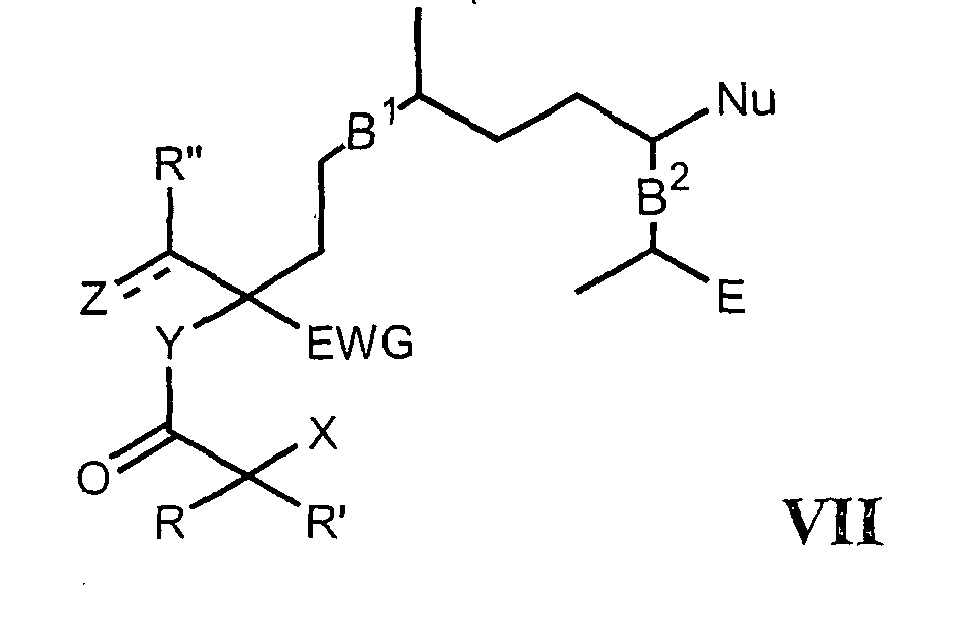


B1, B2, B3 ausgewählt werden aus der Gruppe bestehend aus Einfachbindungen; Doppelbindungen als E-(trans)-Form, Z-(cis)-Form oder E/Z-Gemisch; Epoxidringe als E-(trans)-Form, Z-(cis)-Form oder E/Z-Gemisch; und Cyclopropanringe als E-(trans)-Form, Z-(cis)-Form oder E/Z-Gemisch; und/oder Kombinationen davon; vorzugsweise ausgewählt werden aus der Gruppe bestehend aus Einfach- und Doppelbindungen; und besonders bevorzugt B1 eine Z-Doppelbindung oder ein Epoxid ist und B2 sowie B3 Einfachbindungen sind;
R ausgewählt wird aus der Gruppe bestehend aus H; Alkyl; Aryl; Alkyl-Aryl wie CH2-Aryl, C2H4-Aryl und dergleichen; Vinyl; Cycloalkyl, insbesondere ein (3- bis 7-gliedriges Cycloalkyl; CHnF3-n (n = 0-3); Oxacycloalkyl, insbesondere ein 3- bis 7-gliedriges Oxacycloalkyl und/oder Kombinationen davon; vorzugsweise ausgewählt wird aus der Gruppe bestehend aus H, Methyl, Ethyl, Phenyl und Benzyl; und besonders bevorzugt H, Methyl, Ethyl und/oder Kombinationen davon ist;
R' aus derselben Gruppe ausgewählt wird wie R und besonders bevorzugt H ist;
R" aus derselben Gruppe ausgewählt wird wie R und besonders bevorzugt Methyl ist;
E ausgewählt wird aus der Gruppe bestehend aus CH3, CH2OH, CH2OPG, CH=O, CO2R, CO2PG, CH2X, CONR2, CON(PG)2, CON(OMe)(Me) und CN; vorzugsweise ausgewählt wird aus der Gruppe bestehend aus CH3, CH2X, CO2R, und CO2PG; und besonders bevorzugt ausgewählt wird aus der Gruppe bestehend aus CH2OH, CH2OPG und CH=O;
X ausgewählt wird aus der Gruppe bestehend aus H; OH; Halogen; anderen üblichen Abgangsgruppen und/oder deren Kombinationen; vorzugsweise ausgewählt wird aus der Gruppe bestehend aus Cl, Br, I, O-Tosyl, Methylsulfonat, Trifluormethylsulfonat, Alkanoaten und Arylcarboxylaten; und besonders bevorzugt ausgewählt wird aus der Gruppe bestehend aus H, Cl und Br;
X' ausgewählt wird aus der Gruppe bestehend aus OH; Halogen, anderen üblichen Abgangsgruppen und/oder deren Kombinationen; vorzugsweise ausgewählt wird aus der Gruppe bestehend aus Cl, Br, I, O-Tosyl, Methylsulfonat, Trifluormethylsulfonat, Alkanoaten und Arylcarboxylaten, und besonders bevorzugt Cl und/oder Br ist;
Y ausgewählt wird aus der Gruppe bestehend aus S, NH, N-PG, NR, O; und vorzugsweise ausgewählt wird aus der Gruppe bestehend aus NH, N-PG, NR und O; und besonders bevorzugt O ist;
Y' ausgewählt wird aus der Gruppe bestehend aus H, OH, OR, O-PG, NH2, NR2, N(PG)2, SR und SH; und vorzugsweise O-PG und/oder OR ist;
Y" ausgewählt wird aus der Gruppe bestehend aus H, OH, OR, O-PG, NH2, NR2, N(PG)2, SR, SH, Cl, Br und CR'2-EWG; vorzugsweise O-PG und/oder OR ist; und besonders bevorzugt H, CH2CO2R und/oder CH2COR* ist;
Z ausgewählt wird aus der Gruppe bestehend aus -OH, -O-PG, -OR, =O, =N-Nu, =CH-Hetaryl, =CH-Aryl und =PR3; wobei alle vorgenannten doppelgebunden Gruppen Z in (E)-form, (Z)-Form oder als (E/Z)-Gemisch vorliegen können, vorzugsweise =CH-Hetaryl ist; und besonders bevorzugt ausgewählt wird aus der Gruppe bestehend aus =O, (E)-(2-Methylthiazol-4-yl)-CH= und (E)-(2-Methyloxazol-4-yl)-CH=;
Z' ausgewählt ist aus der Gruppe bestehend aus O, OH, OR, O-PG, N(H)1-2, N(R)1-2, N(PG)1-2, SR, S-PG und R; vorzugsweise O, O-PG und/oder OR ist;
Nu ausgewählt wird aus der Gruppe bestehend aus R, O-PG, OR, N(PG)2, NR2, S-PG, SR, SeR, CN, N3, Aryl und Heteroaryl; vorzugsweise ausgewählt wird aus der Gruppe bestehend aus R, O-PG, OR, N(PG)2 und NR2; und besonders bevorzugt H und/oder Alkyl ist;
EWG ausgewählt wird aus der Gruppe bestehend aus E, CN, CO-R, Dialkylphosphonat, SO2-R, SO2OR, CF3, CCl3 und NO2; vorzugsweise ausgewählt wird aus der Gruppe bestehend aus CN, CO-R und CO-NR2; und besonders bevorzugt CO2R, CO2PG ist, wobei PG vorzugsweise tert-Butyl ist;
Alkyl ausgewählt wird aus Kohlenwasserstoffen, auch verzweigten Isomeren, beispielsweise mit C1-20 und vorzugsweise mit 1 bis 8 Kohlenstoffatomen;
Aryl ausgewählt wird aus der Gruppe bestehend aus Phenyl, Naphthyl, Benzyl und deren Derivaten; vorzugsweise mit bis zu fünf Alkyl-, Alkoxy- oder Halogensubstituenten, besonders bevorzugt solche mit bis zu drei Substituenten, am meisten bevorzugt solche mit bis zu einem Substituenten; und vorzugsweise ausgewählt wird aus der Gruppe bestehend aus Phenyl- und Benzyl-Derivaten und Kombinationen davon;
Hetaryl/Heteroaryl ausgewählt wird aus der Gruppe bestehend aus fünf- und sechsgliedrigen Heteroaromaten mit einem oder mehreren O-, S- und N-Atomen; und deren Derivaten mit bis zu vier Alkyl-, Alkoxy- und/oder Halogensubstituenten; vorzugsweise solche mit bis zu zwei Substituenten, besonders bevorzugt mit bis zu einem Substituenten; vorzugsweise ausgewählt wird aus der Gruppe bestehend aus Oxazol-, Thiazol- und Pyrimidin-Derivaten; und besonders bevorzugt ein Alkylthiazolderivat ist; und Kombinationen davon;
PG eine Schutzgruppe ist, vorzugsweise ausgewählt aus der Gruppe bestehend aus Allyl, Methyl, t-Butyl (bevorzugt bei EWG), Benzyl, Silyl, Acyl und aktivierten Methylenderivaten wie Methoxymethyl, Alkoxyalkyl und 2-Oxacycloalkyl; vorzugsweise - überwiegend für Alkohol und Aminfunktionen - ausgewählt aus der Gruppe bestehend aus Trimethylsilyl, Triethylsilyl, Dimethyl-tert-butylsilyl, Acetyl, Propionyl, Benzoyl, Tetrahydropyranyl; sowie aus Schutzgruppen, die benachbarte oder zweiwertige Gruppen (PG2) unter Bildung 5-7-gliedriger Ringe gleichzeitig schützen, wie Succinyl, Phthalyl, Methylen, Acetonid und/oder Kombinationen aller vorgenannten Schutzgruppen. - Vorzugsweise ist E CH2X, CO2PG und/oder CHO und besonders bevorzugt CHO.
- Ferner ist es bevorzugt, daß EWG = H ist; und X H und/oder Halogen. Besonders bevorzugt ist EWG ausgewählt aus der Gruppe bestehend aus Cl, Br und I.
- Des weiteren ist es bevorzugt, daß der Substituent Y-CO-CRR'X durch eine OH- oder NH2-Gruppe, vorzugsweise durch OH, ersetzt ist.
- Bei den Verbindungen mit der allgemeinen Formel X, insbesondere bei denen mit der allgemeinen Formel Xa, ist R = tert-Butyl und X = H, Cl und/oder Br.
- Bevorzugte Ausführungsformen für Verbindungen mit den allgemeinen Formeln XI und/oder XIa sind solche, bei denen B3 eine Einfach- oder Doppelbindung als E-(trans)-Form, Z-(cis)-Form oder E/Z-Gemisch ist; vorzugsweise eine Einfach- oder Doppelbindung zu Heteroatomen wie O, S oder N, besonders bevorzugt eine Einfachbindung zu O-PG oder OH; R ausgewählt wird aus der Gruppe bestehend aus H, Methyl, Ethyl, Propyl, Phenyl, Benzyl; vorzugsweise ausgewählt wird aus der Gruppe bestehend aus H, Methyl, Ethyl und Kombinationen davon; R" aus derselben Gruppe ausgewählt wird wie R und besonders bevorzugt Methyl ist.
- Bevorzugte Ausführungsformen für Verbindungen mit der allgemeinen Formel XII und/oder mit der allgemeinen Formel XIII, sind solche, bei denen B1 ausgewählt ist aus der Gruppe bestehend aus Einfachbindungen, Doppelbindungen als E-(trans)-Form, Z-(cis)-Form oder E/Z-Gemisch; R ausgewählt ist aus der Gruppe bestehend aus H; Alkyl; Aryl; Alkyl-Aryl wie CH2-Aryl, C2H4-Aryl und dergleichen; Vinyl; Cycloalkyl, insbesondere ein 3- bis 7-gliedriges Cycloalkyl; CHnF3-n mit n = 0 bis 3;, Oxacycloalkyl, insbesondere ein 3- bis 7-gliedriges Oxacycloalykl; und/oder Kombinationen davon; vorzugsweise ausgewählt ist aus der Gruppe bestehend aus H, Methyl, Ethyl, Phenyl und Benzyl; und besonders bevorzugt ausgewählt ist aus der Gruppe bestehend aus H, Methyl, Ethyl und Kombinationen davon; R' aus derselben Gruppe ausgewählt ist wie R und besonders bevorzugt H ist; R" aus derselben Gruppe ausgewählt ist wie R und besonders bevorzugt Methyl ist; X' ausgewählt ist aus der Gruppe bestehend aus OH; Halogen; anderen üblichen Abgangsgruppen und/oder deren Kombinationen; vorzugsweise ausgewählt ist aus der Gruppe bestehend aus Cl, Br, I, O-Tosyl, Methylsulfonat, Trifluormethylsulfonat, Alkanoaten und Arylcarboxylaten; und besonders bevorzugt ausgewählt ist aus der Gruppe bestehend aus H, Cl und Br; Z' ausgewählt ist aus der Gruppe bestehend aus O, OH, OR, O-PG, N(H)1-2, N(R)1-2, N(PG)1-2, SR, S-PG und R; vorzugsweise O, O-PG und/oder OR ist; E ausgewählt ist aus der Gruppe bestehend aus CH2OH, CH2OPG, CH2OR, CH=O, CR=O, CH(OR)2, CH(OPG)2, CH=NPG und Kombinationen davon; vorzugsweise ausgewählt ist aus der Gruppe bestehend aus COEt, CO2R, COR* und CH(OPG)2; und besonders bevorzugt ausgewählt ist aus der Gruppe bestehend aus CO2R, CO2PG, CO2H und COR*; R* ausgewählt ist aus der Gruppe bestehend aus chiralen Resten und Auxiliaren und bei Acylderivaten wie Estern, Amiden und Imiden vorzugsweise ausgewählt ist aus der Gruppe bestehend aus 1-Alkylbenzylamino; 1-Alkylbenzyloxy-; Lactat- und Mandelatderivaten; Monoterpenderivaten, z.B. Oppolzer-Sultam, 8-Arylmenthyloxy und dergleichen; und N-gebundenen Oxazolidinonen (Evans-Typ-Auxiliaren); besonders bevorzugt ausgewählt ist aus der Gruppe bestehend aus 4-substituierten Oxazolidinonen; jeweils in enantiomerenreiner, enantiomerenangereicherter, racemischer Form und/oder Mischungen; Alkyl für Kohlenwasserstoffe, auch verzweigte Isomere, steht, vorzugsweise mit C1-20, und besonders bevorzugt mit 1 bis 8 Kohlenstoffatomen; Aryl ausgewählt ist aus der Gruppe bestehend aus Phenyl, Naphthyl, Benzyl und deren Derivaten, vorzugsweise mit bis zu fünf Alkyl-, Alkoxy- und/oder Halogensubstituenten, besonders bevorzugt mit bis zu drei Substituenten, am meisten bevorzugt mit bis zu einem Substituenten; und vorzugsweise ausgewählt ist aus der Gruppe bestehend aus entsprechenden Phenyl- und Benzyl-Derivaten und Kombinationen davon; PG eine Schutzgruppe ist und vorzugsweise ausgewählt ist aus der Gruppe bestehend aus Allyl, Methyl, t-Butyl (bevorzugt bei EWG), Benzyl, Silyl, Acyl und aktivierten Methylenderivaten wie Methoxymethyl, Alkoxyalkyl und 2-Oxacycloalkyl-Schutzgruppen; vorzugsweise - überwiegend für Alkohol und Aminfunktionen - ausgewählt ist aus der Gruppe bestehend aus Trimethylsilyl, Triethylsilyl, Dimethyl-tert-butylsilyl, Acetyl, Propionyl, Benzoyl, Tetrahydropyranyl; sowie aus Schutzgruppen, die benachbarte oder zweiwertige Gruppen (PG2) unter Bildung 5-7-gliedriger Ringe gleichzeitig schützen, wie Succinyl, Phthalyl, Methylen, Acetonid; und/oder Kombinationen aller vorgenannten Schutzgruppen; wobei besonders bevorzugt X' = Cl und/oder Br; R' = H; R = Me; E = CO2R, CO2PG, CO2H und/oder COR*, und/oder B1-Z' = O-PG ist.
- Bevorzugte Ausftihrungsformen für Verbindungen mit der allgemeinen Formel XVa und/oder XVb, sind solche, bei denen B3 eine Einfach- oder Doppelbindung als E-(trans)-Form, Z-(cis)-Form oder E/Z-Gemisch ist; vorzugsweise eine Einfach- oder Doppelbindung zu Heteroatomen wie O, S, N; besonders bevorzugt eine einfache Bindung zu O-PG oder eine Doppelbindung zu O; EWG mit X ≠ H besonders bevorzugt H ist; wobei besonders bevorzugt X ≠ H; EWG = H; Z =O, (E)-(2-Methylthiazol-4-yl)-CH= und/oder (E)-(2-Methyloxazol-4-yl)-CH=; R'= H; R"= Me; und/oder Y" = CH2COOH, OH; Y', Z' = O-PG und/oder OH ist.
- Im folgenden werden besondere Ausführungsformen von erfindungsgemäßen Synthesebausteinen für die Nord- bzw. Südhälfte von Epothilonen dargestellt.
- Es wurde überraschenderweise gefunden, daß natürliche, kommerzielle oder literaturbekannte Prenylderivate, insbesondere Geranyl-, Neryl-, Linaloyl- und Farnesylderivate mit den allgemeinen Formeln VIII und IX, vorzugsweise ausgehend von deren Alkoholen, Acetaten oder Halogeniden, in elektrophile Synthesebausteine des Typs VIII für Epothilone und deren Derivate umgewandelt werden können bzw. als solche genutzt werden können, um durch einfache nukleophile Substitution mit einem C15-C16-Strukturelement mit der allgemeinen Formel X- insbesondere des Acetoacetat-Typs, ganz besonders mit der Formel Xa - verknüpft zu werden, welches an C15 bereits über die geeignete Oxidationsstufe bzw. Substitution Y verfügt.
- Der Begriff Derivate beinhaltet homologe, analoge und Nor-Verbindungen, vorzugsweise auch Varianten mit weiteren Substituenten an der Hauptkette oder im C15-C16-Element. Dabei ist je nach Ausgangssubstanz für die Bereiche C7-C10 und/oder C11-C14 (eine Prenyleinheit), insbesondere jedoch für C7-C14 (zwei Prenyleinheiten, z. B. aus Nerol, Geraniol und Linalool, Y = OH) keine weitere C-C-Verknüpfung erforderlich. Durch die Wahl des Startmaterials (E- oder Z-Prenylverbindung) läßt sich die Stereochemie an C12-C13 vorbestimmen.
- Im folgenden sind spezielle Beispiele für Verbindungen mit der allgemeinen Formel VII angegeben.

- In Verbindungen VIIb ist Z' vorzugsweise =O, 2-Methylthiazol-4-ylmethylen, 2-Methyloxazol-4-ylmethylen, X = Cl, Br; und besonders bevorzugt H; PG = t-Bu

- In den Verbindungen VIII und IX ist X vorzugsweise OH, OAc, OTs, Cl und/oder Br. Als elektrophile Bausteine besonders bevorzugt sind OTs, Cl, Br.

- Bei dem C15-16-Baustein mit der Formel IV ist besonders bevorzugt X=H, R=t-Bu und/oder R"=Me.
- Erfindungsgemäß hergestellte Synthesebausteine weisen unter anderem die allgemeine Strukturformel VII, vorzugsweise die Formel VIIa, besonders bevorzugt die Formel VIIb auf, und können in racemischer oder nichtracemischer Form oder als einzelne Diastereomere oder als Diastereomerengemisch vorliegen.
- Die Strukturelemente VII und X können vorzugsweise als Produkte oder als Zwischenprodukte in der Synthese von Wirkstoffen verwendet werden. Außerdem können die erfindungsgemäßen Strukturelemente VII für die Synthese von Polyketid- und Terpenoid-Naturstoffen oder Derivaten von Polyketid- und Terpenoid-Naturstoffen verwendet werden, vorzugsweise für makrocylische Wirkstoffe wie Epothilone und deren Derivate einschließlich Stereoisomeren und/oder Homologen, Nor-Verbindungen, und/oder als ganz oder teilweise invertierte Elemente, bei denen sie vorzugsweise als C7-C15- und C7-C16- oder besonders bevorzugt als C7-C14-Bausteine des Ringes dienen können, die gegebenenfalls zusätzlich bereits vorgebildete Elemente oder auch die komplette Seitenkette an C15 des Ringes tragen können.
- Diese Bausteine, nachfolgend auch als Synthesebausteine bezeichnet, sind vorzugsweise angereichert an einer enantiomeren und/oder diastereomeren Form, besonders bevorzugt in den den natürlichen Epothilonen entsprechenden Formen.
- Ferner werden erfindungsgemäße Verbindungen mit den allgemeinen Strukturformeln VII und X bereitgestellt, bei denen die funktionellen Gruppen ganz oder teilweise durch PG geschützt wurden.
- Die erfindungsgemäßen Verbindungen des Typs VII sowie deren Stereoisomere können beispielsweise ausgehend von kommerziell erhältlichen oder nach bekannten Verfahren darstellbaren Ausgangsstoffen VIII und/oder IX durch C-C-Verknüpfung mit 2-oxy-substituierten-1,3-diaktivierten Methylenverbindungen mit der allgemeinen Formel X, vorzugsweise mit 2-Acyloxy-1,3-dicarbonylverbindungen, besonders bevorzugt mit 2-Acyloxy-acetoacetaten, speziell bevorzugt mit Verbindungen der Formel Xa, erhalten werden, wobei insbesondere basische Reaktionsbedingungen vorteilhaft sind.
- Es wurde ferner gefunden, daß sich Modifikationen an C7, C8 und C9 der vorstehend genannten Verbindungen durchführen lassen, insbesondere durch Oxidation beispielsweise an C7; Reduktion von beispielsweise C8-9; nukleophile Addition an beispielsweise C9 mit E = EWG; Substitution beispielsweise an C7; Modifikationen an C12-13, beispielsweise Epoxidierung; Modifikationen an C16, beispielsweise Alkenylierung, z.B. Wittig-Typ-Reaktion mit Z = O; Modifikationen an C15 wie Entfernen von EWG, beispielsweise Decarboxylierung; und/oder Umesterung oder Verseifung/Veresterung von Y.
- Die vorgenannten Substituenten, Schutzgruppen, Bindungsarten B und/oder Stereoisomeren sowie die Reihenfolge der Verknüpfung oder Modifikation können, soweit es chemisch sinnvoll ist, beliebig geändert und kombiniert werden.
- Die erfindungsgemäßen Verbindungen des Typs VII, aber auch des Typs VII mit EWG = H weisen üblicherweise in den Positionen 7, 15 und/oder 16 wenigstens einen Substituenten auf, der nicht Wasserstoff oder R ist, vorzugsweise solche Substituenten, die geeignet sind, Verknüpfungen mit C17-C20-Seitenkettenbausteinen und insbesondere mit C1-C6-Bausteinen oder deren Ausgangsmaterialien herbeizuführen, wie sie z.B. in der deutschen Offenlegungsschrift 197 01 758.4 aufgeführt sind, besonders bevorzugt durch Ester- oder Lactonbildung eines Epothilon-C1-Bausteines mit C15 und/oder Aldol- oder Reformatsky-Typ-Reaktion eines Epothilon-C6-Bausteines mit C7 und/oder Verknüpfung eines C17-C20-Seitenkettenbausteines mit C16, sofern letzterer nicht schon in einem früheren Stadium angeknüpft wurde.
- Verbindungen des Strukturelementes des Typs I mit E = CH2OH, CHO, CO2R lassen sich beispielsweise darstellen, indem Verbindungen VII, vorzugsweise VIIa, besonders bevorzugt Nerylderivate, oxidiert werden, vorzugsweise in 7-Stellung. Dazu können empfindliche Positionen, die nicht oxidiert werden sollen, in üblicher und bekannter Weise (siehe unten) geschützt werden. So werden Alkohole vorzugsweise als Silylether oder Alkanoate und Carbonsäuregruppen vorzugsweise als Ester geschützut. Die Oxidation erfolgt entsprechend der Vorschriften, wie sie z. B. in HUDLICKY 1990 (Oxidations in Organic Chemistry, 0-8412-1781-5/90) aufgeführt sind. Dabei wird vorzugsweise die 7-Position oxidiert, vorzugsweise mit Selenreagenzien, besonders vorzugsweise katalytisch mit Selendioxid bzw. Peroxiden.
- In diesem Zusammenhang wurde erfindungsgemäß gefunden, daß je nach Verfahren und der gewählten Menge Selendioxid zunächst Alkohole (E = CH2OH) oder Aldehyde (E = CHO) gebildet werden.
- Weitere Oxidation der Alkohole zum Aldehyd vorzugsweise mit aktiviertem DMSO, aber auch Reduktion und Substitution nach üblichen Verfahren machen weitere Substituenten E zugänglich. Weitere Oxidation der Aldehyde, z. B. mit NaClO2 oder Luft/Katalysator, liefert Carbonsäuren.
- Die aus den kommerziellen Prenylalkoholen oder nach obigen Verfahren gewonnen Allylalkohole können nach bekannten Verfahren in eine aktivierte Form überführt werden, vorzugsweise in Allylhalogenide, -sulfonate oder -carboxylate, besonders bevorzugt in C7- und C14-Halogenide der Verbindungen VII oder VIII und geschützte Derivate davon.
- Weitere Modifikationen können an den Doppelbindungen erfolgen. So können diese nach literaturbekannten Verfahren in Einfachbindungen, Epoxide und Cyclopropane überführt werden. Die Reduktion gelingt nach bekannten Verfahren, vorzugsweise finden Hydriddonoren und besonders bevorzugt katalytische Verfahren, auch asymmetrische Varianten Verwendung. Eine Differenzierung der Doppelbindungen, soweit sie nicht bereits durch Substitutionsmuster der Ausgangsstoffe besteht, kann elektronisch, z. B. durch geeignet gewählte benachbarte Schutzgruppen (elektronenziehend oder-schiebend), oder vorzugsweise sterisch, z.B. durch die Wahl einer geeigneten Reihenfolge der im vorstehend beschriebenen Prenylmodifikationen, erfolgen.
- So wurde insbesondere gefunden, das mit geeigneten Gruppen EWG, insbesondere tert-Butylcarboxylaten (CO2t-Bu) die C8-C9-Doppelbindung selektiv reduziert werden kann. Eine verbleibende C12-13-Doppelbindung kann z.B. mit Persäuren selektiv epoxidiert werden. Ist die C8-9-Doppelbindung elektronenziehend substituiert (E = Oxomethylderivate, bevorzugt CO2R, CHO), lassen sich selektiv Nucleophile durch Michael-Reaktion in Position C9 einführen, bevorzugt einfache Alkylcuprate, Alkohole und Amine.
- Die Reduktionen, Nukleophilen Additionen, Epoxidierungen und Cyclopropanierungen der Doppelbindungen, oder Kombinationen davon, können an geeignet geschützten Prenylderivaten VII nach literaturbekannten Verfahren durchgeführt werden. Soweit chemisch sinnvoll, können einige diese Modifikationen auch noch bei einem einfach oder zweifach an Verbindungen der Formel I (auch mit EWG = H) angeknüpften C1-C6-Baustein erfolgen. Bevorzugt ist auch die Epoxidierung der C12-C13-Doppelbindung.
- Ferner wurde erfindungsgemäß gefunden, daß sich Verbindungen des Typs VII, bevorzugt VIIa in Verbindungen des Typs VII mit EWG = H überführen lassen. Besonders bevorzugt verwendet man Verbindungen der Formel VII mit PG=t-Butyl, speziell solche der Formel VIIb, die unter saurer Katalyse in einem Schritt dealkylcarboxylieren zu entsprechenden Verbindungen VII mit EWG = H. Letztere lassen sich ebenfalls mit C1-C6-Bausteinen verknüpfen.
- Bei den erfindungsgemäßen Verfahren zur Herstellung der vorstehend genannten Verbindungen ist es bevorzugt, daß die funktionellen Gruppen der Verbindungen des Typs VII-X, vorzugsweise des Typs VIIa, sowie von Intermediaten, in ihre geschützte Form übergeführt werden (M = PG). Geeignete Schutzgruppen sind: Allyl, Benzyl, Methyl, Ethyl, t-Butyl, aktivierte Methylenderivate wie Methoxymethyl, 1-Oxacycloalkyl, Silyl, insbesondere Trialkylsilyl; und - überwiegend für Alkoholfunktionen - auch Acylschutzgruppen, vorzugsweise Acetyl, Propionyl und Benzoyl und deren Derivate. Ebenfalls sind solche Schutzgruppen bevorzugt, die benachbarte Gruppen Y gleichzeitig schützenwie beispielsweise Acetonide, Methylen, Cyclodiacyl und solche, die Carbonylgruppen schützen, insbesondere Acetale und cyclische Acetale (O und S). Weitere für die erfindungsgemäßen Verfahren geeignete Schutzgruppen sind in GREENE/WUTS 1991 (Protective Groups in Organic Synthesis) beschrieben, worauf ausdrücklich Bezug genommen wird. Auch Kombinationen der genannten Schutzgruppen sind denkbar und je nach Art Vorgehensweise vorteilhaft.
- Für die Synthese der Südhälfte von Epothilonen kommt erfindungsgemäß insbesondere die Verwendung der Verbindungen des Typs XII und XIII in Frage.
- Es wurde erfindungsgemäß gefunden, daß auch Verbindungen des Typs XI geeignete C3-C6-Bausteine sind, und daß sich diese beispielsweise durch Reaktion von 2-Haloacylhalogeniden mit dem Enamin des Isobutyraldehyds und anschließende Hydrolyse und Acetalisierung darstellen lassen.
- Es wurde ferner erfindungsgemäß gefunden, daß in C6-Position aktivierte Verbindungen des Typs XII bzw. XIII, leicht aus Verbindungen des Typs XIII und XIa durch Oxidation, insbesondere durch elektrophile Halogenierung, besonders bevorzugt mit tertiären oder quartären Ammoniumperhalogeniden, ausgesprochen leicht und in guter Ausbeute erhältlich sind.
- Es wurde ferner erfindungsgemäß gefunden, daß sich die vorstehend genannten Verbindungen XI bis XIII gut an C7 -etc.-Bausteine, z.B. des Typs VII anknüpfen lassen, bevorzugt vermittelt durch niedervalente Metallionen oder Metalle in Reformatsky-Typ-Reaktionen wie sie beispielsweise in der deutschen Offenlegungsschrift Nr. 197 01 758.4 erläutert sind.
- Ebenfalls wurde erfindungsgemäß gefunden, daß die Reaktion, d.h die Umsetzung Mit Verbindungen der allgemeinen Formel VII in außergewöhnlich hohem Maße syn-selektiv und aldehydselektiv verläuft, was es ermöglicht, Stoffe vom Typ VII effizient umzusetzen, insbesondere auch solche, bei denen Z ein Keton oder eine Hetarylalkylidenseitenkette ist. Ein besonderer Vorteil des erfindungsgemäßen Verfahrens ist es, daß die Funktionalitäten in großem Ausmaß ungeschützt verwendbar sind. So kann z.B. eine Estergruppe als C1 und eine Ketogruppe an C16 in freier Form eingesetzt werden.
- Ein wesentlicher Aspekt der vorliegenden Erfindung betrifft die Verknüpfung von Nord- und Südhälfte. Dabei wurde insbesondere gefunden, das Nord- und Südhälfte mittels der vorstehend genannten Verfahren, die im folgenden und insbesondere in den Beispielen detailliert beschrieben werden, durch Aldolreaktionen, bevorzugt durch solche vom Reformatsky-Typ, besonders bevorzugt mit Chrom(II)salzen, zwischen C6-C7 oder C2-C3, oder sukzessive an beiden Stellen, mitander verknüpft oder - bei vorveresterten Bausteinen - zyklisiert werden können.
- Diese völlig neue Methode ermöglicht die Cyclisierung mit hoher syn-Selektivität und Chemoselektivität. Offenkettige Verbindungen können auch durch Macrolactonisierung nach bekannten Verfahren cyclisiert werden.
- Auf den verschieden Etappen während der Bausteinsynthese als auch der Macrocyclensynthese lassen sich Modifikationen und Substitutionen erreichen. So wurde beispielsweise gefunden, daß sich Modifikationen an C7, C8 und C9 der vorstehend beschriebenen Bausteine und an geeigneten Zwischenverbindungen auf dem Weg zum Macrocyclus durchführen lassen, insbesondere durch Oxidation, bevorzugt an C7; Reduktion, bevorzugt an C8-9; nukleophile Addition, bevorzugt an C9 mit E = EWG; Substitution, bevorzugt an C7; Modifikationen an C12-13, bevorzugt Epoxidierung; Modifikationen an C16, bevorzugt an Alkenylierung, besonders bevorzugt Wittig-Typ-Reaktion mit Z = O; Modifikationen an C15, bevorzugt Entfernen von EWG, besonders bevorzugt durch Decarboxylierung; sowie Umesterung oder VerseifunglVeresterung von Y. Die vorgenannten Substituenten, Schutzgruppen, Bindungsarten B und/oder Stereoisomeren, sowie die Reihenfolge der Verknüpfung oder Modifikation können, soweit es chemisch sinnvoll ist, beliebig geändert und kombiniert werden.
- Im folgenden werden eine Reihe von bevorzugten Ausführungsformen für erfindungsgemäße Verfahren zur Synthese von erfindungsgemäßen Synthesebausteinen VII bis XVI beschrieben:
- Bei einer Ausführungsform der erfindungsgemäßen Verfahren werden die Verbindungen der allgemeinen Formeln VII, VIII, X und/oder XI unter wasserfreien, stark basischen Bedingungen, vorzugsweise mit den Basen Trialkylamin, DBU, DBN und/oder polymeren starken Basen racemisiert.
- Eine weitere Ausführunsgform der erfindungsgemäßen Verfahren zur Herstellung von Verbindungen der Formel VII umfaßt die Umsetzung von in α- und/oder ω-Stellung elektrophil aktivierten Prenylverbindungen bestehend aus 1-4 Prenyleinheiten mit Verbindungen gemäß der allgemeinen Formel X.
- Die in α- und/oder ω-Stellung elektrophil aktivierten Prenylverbindungen werden ausgewählt aus der Gruppe bestehend aus Prenylalkoholen, -acetaten, -halogeniden, Verbindungen der allgemeinen Formel VIII, Verbindungen der allgemeinen Formel IX, und funktionalisierten und/oder geschützten Prenylderivaten der allgemeinen Formel XIV,


B1, B2 ausgewählt sind aus der Gruppe bestehend aus Einfach- und Doppelbindungen als E-(trans)-Form, Z-(cis)-Form oder E/Z-Gemisch; Epoxidringen als E-(trans)-Form, Z-(cis)-Form oder E/Z-Gemisch; Cyclopropanringen, als E-(trans)-Form, Z-(cis)-Form oder E/Z-Gemisch; und/oder Kombinationen davon; vorzugsweise ausgewählt sind aus der Gruppe bestehend aus Einfach- und Doppelbindungen; und besonders bevorzugt B1 eine Z-Doppelbindung oder ein Epoxid ist und B2 eine Einfachbindung ist;
E ausgewählt ist aus der Gruppe bestehend aus CH3, CH2OH, CH2OPG, CH=O, CO2R, CO2PG, CH2X, CONR2, CON(PG)2, CON(OMe)(Me) und CN; vorzugsweise ausgewählt ist aus der Gruppe bestehend aus CH3, CH2X, CO2R und CO2PG; und besonders bevorzugt ausgewählt ist aus der Gruppe bestehend aus CH2OH, CH2OPG und CH=O;
X ausgewählt ist aus der Gruppe bestehend aus H; OH; Halogen; anderen üblichen Abgangsgruppen und deren Kombinationen; vorzugsweise ausgewählt ist aus der Gruppe bestehend aus Cl, Br, I, O-Tosyl, Methylsulfonat, Trifluormethylsulfonat, Alkanoaten und Arylcarboxylaten; und besonders bevorzugt ausgewählt ist aus der Gruppe bestehend aus H, Cl und Br;
Nu ausgewählt ist aus der Gruppe bestehend aus R, O-PG, OR, N(PG)2, NR2, S-PG, SR, SeR, CN, N3, Aryl und Heteroaryl; vorzugsweise ausgewählt ist aus der Gruppe bestehend aus R, O-PG, OR, N(PG)2 und NR2; und besonders bevorzugt ausgewählt ist aus der Gruppe bestehend aus H und Alkyl;
R ausgewählt ist aus der Gruppe bestehend aus H; Alkyl; Aryl; Alkyl-Aryl wie CH2-Aryl, C2H4-Aryl und dergleichen; Vinyl; Cycloalkyl, insbesondere ein 3- bis 7- gliedriges Cycloalkyl; CHnF3-n (n = 0-3); Oxacycloalkyl, insbesondere ein 3- bis 7- gliedriges Oxacycloalkyl; und Kombinationen davon, vorzugsweise ausgewählt ist aus der Gruppe bestehend aus H, Methyl, Ethyl, Phenyl und Benzyl; und besonders bevorzugt ausgewählt ist aus der Gruppe bestehend aus H, Methyl, Ethyl und Kombinationen davon;
Alkyl ausgewählt ist aus Kohlenwasserstoffen, auch verzweigten Isomeren, beispielsweise mit C1-20 und vorzugsweise mit 1 bis 8 Kohlenstoffatomen; Aryl ausgewählt ist aus der Gruppe bestehend aus Phenyl, Naphthyl, Benzyl und deren Derivaten, vorzugsweise mit bis zu fünf Alkyl-, Alkoxy- oder Halogensubstituenten, besonders bevorzugt solche mit bis zu drei Substituenten, am meisten bevorzugt solche mit bis zu einem Substituenten; und vorzugsweise ausgewählt ist aus der Gruppe bestehend aus Phenyl- und Benzyl-Derivaten und Kombinationen davon;
PG eine Schutzgruppe ist, vorzugsweise ausgewählt aus der Gruppe bestehend aus Allyl, Methyl, t-Butyl (bevorzugt bei EWG), Benzyl, Silyl, Acyl und aktivierten Methylenderivaten wie Methoxymethyl, Alkoxyalkyl oder 2-Oxacycloalkyl; vorzugsweise - überwiegend für Alkohol und Aminfunktionen - ausgewählt aus der Gruppe bestehend aus Trimethylsilyl, Triethylsilyl, Dimethyl-tert-butylsilyl, Acetyl, Propionyl, Benzoyl, Tetrahydropyranyl; sowie aus Schutzgruppen, die benachbarte oder zweiwertige Gruppen (PG2) unter Bildung 5-7-gliedriger Ringe gleichzeitig schützen, wie Succinyl, Phthalyl, Methylen, Acetonid; und/oder Kombinationen aller vorgenannten Schutzgruppen;
wobei besonders bevorzugt B1 eine Doppelbindung ist; Nu H ist; E ausgewählt ist aus der Gruppe bestehend aus CH2OH, CHO und CO2R; und/oder X ausgewählt ist aus der Gruppe bestehend aus Cl, Br und OTs. - Insbesondere werden die Prenylverbindungen, vorzugsweise die Verbindungen der Formeln VIII, IX und/oder XIV durch C-C-Verknüpfung mittels nucleophiler Substitution mit 2-oxy-substituierten-1,3-di-aktivierten Methylenverbindungen der Formel X, bevorzugt 2-Acyloxy-1,3-dicarbonylverbindungen, besonders bevorzugt mit 2-Acyloxy-acetoacetaten, am meisten bevorzugt mit Verbindungen der Formel Xa, vorzugsweise in Gegenwart einer oder mehrerer Basen, gegebenenfalls unter Zusatz eines Lösemittels und/oder in Gegenwart von Modifikatoren, umgesetzt.
- Die Reaktionstemperatur beträgt üblicherweise von -80°C bis +180°C, vorzugsweise von -30°C bis +100°C, und besonders bevorzugt von -5°C bis +80°C.
- Geeignete Basen werden üblicherweise ausgewählt aus der Gruppe umfassend Alkalimetalle, hydridische Basen, Stickstoffbasen in neutraler oder negativ geladener Form, Alkoholate, Hydroxide, Carbonate, Hydrogencarbonate und Carbanionen; vorzugsweise umfassend hydridische Basen, Stickstoffbasen, negativ geladene Stickstoffbasen, Carbonate, Hydrogencarbonate; und besonders bevorzugt umfassend hydridische Basen, Carbonate und/oder Hydroxide der Alkali- und Erdalkalimetalle wie NaH, KH und LiH.
- Geeignete Lösemittel werden z.B. ausgewählt aus der Gruppe umfassend Kohlenwasserstoffe, Alkane, Benzol und alkylierte Derivate davon, Ether, Dichlormethan, Chloroform, Tetrachlorkohlenstoff, chlorierte Aromaten, Alkohole, Ketone, Sulfoxide wie DMSO und Sulfolan, Carbonsäureamide, alkylierte Carbonsäureamide, Sulfolan, DMPU, Glymes, Alkyl- und Arylnitrile, Carbonsäureester, tertiäre Amine und/oder Mischungen davon; vorzugsweise umfassend Carbonsäureamide und alkylierte Carbonsäureamide, Ketone, Sulfoxide wie DMSO und Sulfolan, Alkohole, Alkyl- und/oder Arylnitrile; und besonders bevorzugt umfassend Carbonsäureamide, alkylierte Carbonsäureamide, Ketone, Sulfoxide, DMSO, Sulfolan und/oder Alkohole.
- Ein weiterer Gegenstand der vorliegenden Erfindung sind Verfahren zur Synthese von Verbindungen mit der allgemeinen Formel VII mit EWG = H. Derartige Verfahren umfassen die Alkyldecarboxylierung oder Verseifung/Decarboxylierung von Verbindungen mit der allgemeinen Formel VII mit EWG = CO2R oder CO2PG, bevorzugt nach der Krapcho-Methode, noch bevorzugter in Gegenwart von LiCl und DMSO beispielsweise bei erhöhter Temperatur, und besonders bevorzugt ausgehend von Verbindungen mit der allgemeinen Formel VII mit EWG = CO2tBu in Gegenwart geeignet starker Säuren, vorzugsweise flüchtiger und wasserfreier Säuren, besonders bevorzugt in Gegenwart von Trifluoressigsäure.
- Ein weiterer Gegenstand der vorliegenden Erfindung sind Verfahren zur Synthese von Verbindungen mit der allgemeinen Formel XI. Derartige Verfahren umfassen die Umsetzung einer Verbindung mit der allgemeinen Formel XI mit X' = H mit einem Reagenz ausgewählt aus der Gruppe bestehend aus Halogenierungsreagenzien und elektrophilen Sauerstoffreagenzien in einem geeigneten Lösemittel gegebenenfalls unter Zusatz von sauren oder basischen Modifikatoren.
- Vorzugsweise wird als Verbindung mit der allgemeinen Formel XI eine Verbindung mit der allgemeinen Formel XIa mit Y' = OMe eingesetzt.
- Ein weiterer Gegenstand der vorliegenden Erfindung sind Verfahren zur Synthese von Verbindungen mit der allgemeinen Formel XII. Derartige Verfahren umfassen die Umsetzung einer Verbindung mit der allgemeinen Formel XIII mit einem Reagenz ausgewählt aus der Gruppe bestehend aus Halogenierungsreagenzien und elektrophilen Sauerstoffreagenzien in einem geeigneten Lösemittel gegebenenfalls unter Zusatz von sauren oder basischen Modifikatoren.
- Geeignete Halogenierungsreagenzien sind beispielsweise elektrophile Halogenierungsmitiel, vorzugsweise ausgewählt aus der Gruppe bestehend aus elementaren Halogenen; Halogenimidderivaten; Schwefel(oxy)halogeniden wie Sulfurylchlorid; Perhaloalkanen und Ammoniumperhalogeniden; und besonders bevorzugt ausgewählt aus der Gruppe bestehend aus tertiären oder quarternären Ammoniumperhalogeniden wie Pyridiniumbromidperbromid, Trimethylphenylammoniumbromidperbromid und/oder polymergebundenen Varianten der vorgenannten Reagenzien.
- Die Reaktionstemperatur bei den letztgenannten Verfahren beträgt üblicherweise von -80 bis +160°C; vorzugsweise von -30 bis +65°C; und besonders bevorzugt von -5 bis +10°C beträgt.
- Geeignete Lösemittel sind üblicherweise ausgewählt aus der Gruppe bestehend aus etherischen und halogenierten Lösemitteln; sind vorzugsweise ausgewählt aus der Gruppe bestehend aus Diethylether, THF, Chloroform, Dichlormethan, flüssigen Carbonsäureamiden und -estern; und sind besonders bevorzugt ausgewählt aus der Gruppe bestehend aus DMF, DMA, Essigester, flüssigen Sulfoxiden wie DMSO und Sulfolan.
- Ein weiterer Gegenstand der vorliegenden Erfindung sind Verfahren zur Synthese von Verbindungen mit den allgemeinen Formeln XVa und/oder XVb. Derartige Verfahren umfassen die Umsetzung von Verbindungen VII mit Verbindungen des Typs XI bzw. XIa; XII; und/oder XIII. Solche Verbindungen XV sind bevorzugt, bei denen alle Kohlenstoffatome des Epothilon-Macrocyclus XVI vorhanden sind. Besonders bevorzugt sind solche Verbindungen XV, bei denen die Bindungen C2-3 wie in XVa; O15-C1 wie z. B. in XVa mit Y-CO-CR'2X = OH oder Y" = CH2CO2H; und/oder C6-7 wie in XVb noch offen sind. Am meisten bevorzugt sind solche Verbindungen XV, die ein Halogen an C2 und/oder C6 tragen.
- Ein weiterer Gegenstand der vorliegenden Erfindung sind Verfahren zur Synthese von Verbindungen mit der allgemeinen Formel XVa, umfassend die Erzeugung einer C6-C7-Verknüpfung durch Umsetzung von Verbindungen der Formel VII mit solchen der allgemeinen Formeln XI, XII und/oder XIII; vorzugsweise mit solchen der allgemeinen Formeln XI und/oder XII mit X' = Cl, Br oder I; in Gegenwart von Basen und/oder in Gegenwart eines oder mehrerer Metalle und/oder Metallsalze, gegebenenfalls unter Zusatz von Lösemitteln, Katalysatoren und/oder Modifikatoren.
- Bei diesen Verfahren beträgt die Reaktionstemperatur üblicherweise von -80°C bis +140°C; vorzugsweise oberhalb von 0° bis 65°C, und besonders bevorzugt von 15°C bis 35°C.
- Geeignete Metalle werden üblicherweise ausgewählt aus der Gruppe bestehend aus Li, Mg, Zn, In, Mn, Fe (jeweils auch in aktivierter Form); und geeigneten Metallsalzen, vorzugsweise anorganischen oder organischen Salzen, Komplexen und/oder Organometallverbindungen der Metallionen Ti(II), Ti(III), Cr(II), Sm(II), Co(I), V(II) und Fe(II), besonders bevorzugt Halogeniden, Sulfaten, Sulfonaten, Alkanoaten, Cyclopentadienylaten und Phenylaten; festphasen- oder polymergebundenen Metallsalzen; und Kombinationen davon; und werden vorzugsweise ausgewählt aus der Gruppe bestehend aus Zink, Titan(II) und Cr(II)-Verbindungen, insbesondere als Chlorid, Bromid, Acetat, Sulfat, in situ erzeugt oder polymergebunden.
- Geeignete Katalysatoren werden ausgewählt aus der Gruppe bestehend aus Iodiden; nicht reduzierbaren Lewissäuren, z.B. Lithiumsalzen, Aluminiumchlorid, Bortrifluorid, und/oder in situ bei der Bildung reduzierender Metallsalze mit LiAlH4 entstehenden Lewissäuren; Nickel(II)salzen; nukleophilen und/oder redoxaktiven Metallkomplexen, z.B. Vitamin B12 und vergleichbaren synthetischen Co-Komplexen. Die geeigneten Katalysatoren liegen ferner bevorzugt in amidischen Lösungsmitteln und/oder Sulfolan vor; desweiteren bevorzugt bis zu 33 mol% des wasserfreien Katalysators, vorzugsweise 0.01 - 5 mol% reaktive Lewissäuren, gegebenenfalls mit dem geeigneten Meatllsalz, bevorzugt vor der Zugabe des Lösemittels, vermischt, zugesetzt werden.
- Die Modifikatoren werden vorzugsweise ausgewählt aus der Gruppe bestehend aus Iodiden (Metalliodiden MI): nicht reduzierbaren gebräuchlichen Lewissäuren, z.B. Lithiumsalzen, Aluminiumchlorid, Bortrifluorid; komplexierenden Liganden, insbesondere auch chiralen Liganden, besonders bevorzugt bidentaten Liganden und anderen üblichen Liganden; und Kombinationen davon; und sind ebenfalls vorzugsweise im wasserfreien Zustand. Besonders bevorzugt werden die Modifikatoren aus der Gruppe bestehend aus wasserfreiem Lithiumiodid, Natriumiodid und Aluminimchlorid.
- Geeignete Lösemittel werden üblicherweise ausgewählt aus der Gruppe bestehend aus Kohlenwasserstoffen wie Alkanen, Benzol und alkylierten Derivaten; Ethern; Dichlormethan; Chloroform; chlorierten Aromaten; sec./tert.-Alkoholen; Ketonen; Dimethylsulfoxid; Carbonsäureamiden; alkylierten Carbonsäureamiden; Sulfolan; DMPU; Glymes; Alkyl- und Arylnitrilen; Carbonsäureestern, tertiären Aminen und Mischungen davon; und werden vorzugsweise ausgewählt aus der Gruppe bestehend aus Methyl-tert.-butylether, Diethylether, Tetrahydrofuran, Glymes, Sulfolan, DMSO, Ketone bis C5, Dimethylformamid und -acetamid, Acetonitril und Mischungen davon; und sind besonders bevorzugt möglichst wasserfreie Lösemittel.
- Vorzugsweise umfassen die erfindungsgemäßen Verfahren die Umsetzung von einem oder mehreren Metallsalzen durch Reduktion mit einem Reduktionsmittel in einer für das Verfahren verwendbaren Oxidationsstufe; wobei die Umsetzung vorzugsweise in situ oder der Synthese der Verbindung mit der allgemeinen Formel XVa vorhergehend durchgeführt wird.
- Geeignete Reduktionsmittel bzw. -verfahren werden beispielsweise ausgewählt aus der Gruppe bestehend aus elektrochemischen Verfahren, Lithiumaluminiumhydrid und vergleichbaren Hydriden, metallischem Eisen oder Mangan in ihren verschiedenen Formen, und werden vorzugsweise ausgewählt aus der Gruppe bestehend aus Lithiumaluminiumhydrid und Zink.
- Ein weiterer Gegenstand der vorliegenden Erfindung betrifft Verfahren zur Synthese einer Verbindung mit der allgemeinen Formel XVb, umfassend die Erzeugung einer O15-C1-Verknüpfung durch Umsetzung von Verbindungen mit der allgemeinen Formel VII mit solchen der Formel XII oder XIII, besonders bevorzugt XII mit X' = Cl, Br oder I, in Gegenwart von Veresterungs-, Umesterungskatalysatoren, und/oder Kupplungsreagenzien, gegebenenfalls unter Zusatz von Lösemitteln.
- Die Reaktionstemperatur bei diesem erfindungsgemäßen Verfahren beträgt üblicherweise von -50°C bis +160°C, vorzugsweise oberhalb von 0° bis 100°C, und besonders bevorzugt von 15°C bis 55°C.
- Veresterungs- und/oder Umesterungskatalysatoren werden z.B. ausgewählt aus der Gruppe bestehend aus für diese Zwecke üblichen Basen, Säuren und Metallalkoholaten wie Titantetraalkoholat.
- Zur Veresterung freier Säuren werden insbesondere Kupplungsreagenzien, vorzugsweise ausgewählt aus der Gruppe umfassend EDCI, DCC/DMAP, und/oder Verfahren wie die Yamaguchi-Veresterung eingesetzt.
- Geeignete Lösemittel werden bei diesem Verfahren üblicherweise ausgewählt aus der Gruppe bestehend aus Kohlenwasserstoffen wie Alkanen, Benzol und alkylierten Derivaten; Ethern; Dichlormethan; Chloroform; chlorierten Aromaten; Carbonsäureamiden; alkylierte Carbonsäureamiden; Sulfolan; DMPU; Glymes; Alkyl- und Arylnitrilen; Carbonsäureestern; tertiären Aminen; und Mischungen davon, und werden vorzugsweise ausgewählt aus der Gruppe bestehend aus Methyl-tert.-butylether, Diethylether, Tetrahydrofuran, Glymes, Sulfolan, Chloroform, Dichlormethan und/oder Mischungen davon; und werden besonders bevorzugt ausgewählt aus der Gruppe bestehend aus Chloroform und Dichlormethan.
- Vorzugsweise sind die Lösemittel möglichst wasserfrei.
- Ein weiterer Gegenstand der vorliegenden Erfindung betrifft Verfahren zur Synthese einer Verbindung mit der allgemeinen Formel VII mit E ≠ CH3, vorzugsweise mit E = CN2OH, CHO und/oder CO2H, bei denen man eine geschützte Verbindung mit der allgemeinen Formel VII mit E = CH3, bevorzugt VIIa mit E = CH3, in Allylstellung oxidiert und/oder vorhandene funktionelle Gruppen oxidiert. Die Oxidation erfolgt vorzugsweise mit Selendioxid.
- Ein weiterer Gegenstand der vorliegenden Erfindung betrifft Verfahren zur Synthese einer Verbindung mit der allgemeinen Formel VIIa und/oder XVb, vorzugsweise mit E = CH2OH, CHO und/oder CO2H, bei denen man eine vorzugsweise geschützte Verbindung mit der allgemeinen Formel VII und/oder XVb, beispielsweise mit E = CH3, oxidiert, vorzugsweise an Position C7 bzw. in Allylstellung bzw. an anderen funktionellen Gruppen, wobei als Oxidationsmittel vorzugsweise Selen-(IV)-Verbindungen, besonders bevorzugt Selendioxid, und/oder C6F5SO2H, eingesetzt werden. Die Oxidationsmittel werden vorzugsweise katalytisch eingesetzt. Alternativ kann die Oxidation bakteriell oder enzymatisch mit Zellsystemen erfolgen, wobei die Oxidation mit SeO2 besonders bevorzugt ist.
- Ein weiterer Gegenstand der vorliegenden Erfindung betrifft Verfahren zur Synthese einer Verbindung mit den allgemeinen Formeln VII und/oder XV, umfassend die Addition eines Nucleophils oder Elektrophils an eine oder mehrere bzw. die Reduzierung, Epoxidierung oder Cyclopropanierung einer oder mehrerer Doppelbindungen einer Verbindung mit der allgemeinen Formel VII und/oder Formel XV.
- Vorzugsweise umfaßt das erfindungsgemäßen Verfahren die Reduzierung der C8-C9-Doppelbindung; die Epoxidierung der C12-C13-Doppelbindung; und/oder die Addition eines Nucleophils an C9.
- Ebenfalls bevorzugt umfaßt das erfindungsgemäße Verfahren die asymmetrische und/oder katalytische Hydrierung der C8-C9-Doppelbindung.
- Ein weiterer Aspekt der vorliegenden Erfindung betrifft Verfahren zur Synthese von Epothilonmacrocyclen und Derivaten mit der allgemeinen Formel XVI

B1, B2, B3 ausgewählt werden aus der Gruppe bestehend aus Einfachbindungen; Doppelbindungen als E-(trans)-Form, Z-(cis)-Form oder E/Z-Gemisch; Epoxidringen als E-(trans)-Form, Z-(cis)-Form oder E/Z-Gemisch; Cyclopropanringen als E-(trans)-Form, Z-(cis)-Form oder E/Z-Gemisch; und/oder Kombinationen davon; vorzugsweise ausgewählt werden aus der Gruppe bestehend aus Einfach- und
Doppelbindungen; und besonders bevorzugt ausgewählt werden aus der Gruppe bestehend aus B1 als Z-Doppelbindung oder Epoxid und B2 und B3 als Einfachbindung;
R ausgewählt wird aus der Gruppe bestehend aus H; Alkyl; Aryl; Alkyl-Aryl wie CH2-Aryl, C2H4-Aryl und dergleichen; Vinyl; Cycloalkyl, insbesondere ein 3- bis 7-gliedriges Cycloalkyl; CHnF3-n mit n = 0 bis 3; Oxacycloalkyl, insbsondere ein 3-7-gliedriges Oxacycloalkyl; und/oder Kombinationen davon; vorzugsweise ausgewählt wird aus der Gruppe bestehend aus H, Methyl, Ethyl, Phenyl, Benzyl; und besonders bevorzugt ausgewählt wird aus der Gruppe bestehend aus H, Methyl, Ethyl und Kombinationen davon;
R' aus derselben Gruppe ausgewählt wird wie R und ganz besonders bevorzugt H ist; R'' aus derselben Gruppe ausgewählt wird wie R und ganz besonders bevorzugt Methyl ist;
Y ausgewählt wird aus der Gruppe bestehend aus S, NH, N-PG, NR und O; vorzugsweise ausgewählt wird aus der Gruppe bestehend aus NH, N-PG, NR und O, und besonders bevorzugt O ist;
Y' ausgewählt wird aus der Gruppe bestehend aus H, OH, OR, O-PG, NH2, NR2, N(PG)2, SR und SH; vorzugsweise O-PG und/oder OH ist;
Nu ausgewählt wird aus der Gruppe bestehend aus R, O-PG, OR, N(PG)2, NR2, S-PG, SR, SeR, CN, N3, Aryl und Heteroaryl; vorzugsweise ausgewählt wird aus der Gruppe bestehend aus R, O-PG, OR, N(PG)2 und NR2, und besonders bevorzugt H ist;
Z ausgewählt wird aus der Gruppe bestehend aus -OH, -O-PG, -OR, =O, =N-Nu, =CH-Hetaryl, =CH-Aryl und =PR3, wobei alle vorgenannten doppelgebunden Gruppen Z in (E)-form, (Z)-Form oder als (E/Z)-Gemisch vorliegen können; vorzugsweise =CH-Hetaryl ist; und besonders bevorzugt ausgewählt wird aus der Gruppe bestehend aus =O, (E)-(2-Methylthiazol-4-yl)-CH= und (E)-(2-Methyloxazol-4-yl)-CH=;
Z' ausgewählt wird aus der Gruppe bestehend aus O, OH, OR, O-PG, N(H)1-2, N(R)1-2, N(PG)1-2, SR, S-PG und R; vorzugsweise O, O-PG und/oder OR ist;
B3 ausgewählt wird aus der Gruppe bestehend aus Einfach- und Doppelbindungen als E-(trans)-Form, Z-(cis)-Form oder E/Z-Gemisch; vorzugsweise ausgewählt wird aus der Gruppe bestehend aus Einfach- und Doppelbindungen zu Heteroatomen wie O, S und N; und besonders bevorzugt eine einfache Bindung zu O-PG und/oder OH ist. PG eine Schutzgruppe ist und vorzugsweise ausgewählt wird aus der Gruppe bestehend aus Allyl, Methyl, t-Butyl (bevorzugt bei EWG), Benzyl, Silyl, Acyl und aktivierten Methylenderivaten wie Methoxymethyl, Alkoxyalkyl oder 2-Oxacycloalkyl; vorzugsweise - überwiegend für Alkohol und Aminfunktionen - ausgewählt wird aus der Gruppe bestehend aus Trimethylsilyl, Triethylsilyl, Dimethyl-tert-butylsilyl, Acetyl, Propionyl, Benzoyl, Tetrahydropyranyl, sowie Schutzgruppen, die benachbarte oder zweiwertige Gruppen (PG2) unter Bildung 5-bis 7-gliedriger Ringe gleichzeitig schützen, wie Succinyl, Phthalyl, Methylen, Ethylen, Propylen, 2,2-Dimethylpropa-1,3-diyl, Acetonid; und/oder Kombinationen aller vorgenannten Schutzgruppen.
Alkyl ausgewählt wird aus der Gruppe bestehend aus Kohlenwasserstoffen, auch verzweigten Isomeren, vorzugsweise mit C1-20, besonders bevorzugt mit 1 bis 8 Kohlenstoffatomen;
Aryl ausgewählt wird aus der Gruppe bestehend aus Phenyl, Naphthyl, Benzyl und deren Derivaten, vorzugsweise mit bis zu fünf Alkyl-, Alkoxy- und/oder Halogensubstituenten, bevorzugt solche mit bis zu drei Substituenten, besonders bevorzugt mit bis zu einem Substituenten; vorzugsweise ausgewählt wird aus der Gruppe bestehend aus Phenyl- und Benzyl-Derivaten; und Kombinationen davon; Hetaryl/Heteroaryl ausgewählt wird aus der Gruppe bestehend aus fünf- und sechsgliedrigen Heteroaromaten mit einem oder mehreren O-, S- und N-Atomen und deren Derivaten mit bis zu vier Alkyl-, Alkoxy- und/oder Halogensubstituenten, bevorzugt solche mit bis zu zwei Substituenten, besonders bevorzugt mit bis zu einem Substituenten; vorzugsweise ausgewählt wird aus der Gruppe bestehend aus Oxazol-, Thiazol- und Pyrimidin-Derivaten; und besonders bevorzugt ein Alkylthiazolderivat ist; und Kombinationen davon;
worin besonders bevorzugt Z = O, (E)-(2-Methylthiazol-4-yl)-CH=, (E)-(2-Methyloxazol-4-yl)-CH=; R' = H; R" = Me; Y', Z' = O-PG, OH und/oder Y = O ist, - Die Synthese von Epothilonmacrocyclen und Derivaten mit der allgemeinen Formel XVI erfolgt insbesondere durch ringschließende Lactonisierung und/oder Reformatsky-Typ-Reaktionen und/oder Macroaldolisierungen der offenkettigen Verbindung mit der allgemeinen Formel XVa und/oder XVb, wobei Verknüpfungen an C2-C3 und/oder C6-C7 jeweils bevorzugt mit EWG = H; E = CHO, CO2R, CO2PG; Y", B3-Z' = OH oder Y"+B3-Z' = (=O), bevorzugt sind.
- Die Alternative Y", B3-Z' = OH stellt ein Acetal an Position C3 dar, während die Alternative Y"+B3-Z' = (=O) für eine entsprechende Aldehydfunktion an Position C3 steht.
- Als Reformatsky-Typ-Reaktionen werden im Rahmen der vorliegenden Erfindung Umsetzungen von Halogencarbonsäureestern bzw. Halogenketonen mit Aldehyden oder Ketonen in Gegenwart von Metallen bezeichnet. Analog zu Grignard-Verbindungen werden bei diesem Reaktionstyp metallorganische Reaktionsstufen durchlaufen, die eine C-C-Verknüpfung insbesondere an C2-C3 und/oder C6-C7 ermöglichen.
- Bevorzugte Reformatsky-Typ-Reaktionen im Rahmen der vorliegenden Erfindung umfassen die Umsetzung von Verbindungen XVa und/oder XVb mit X = Cl, Br, I mit Chrom(II)salzen, Indium und/oder Zink und/oder deren Salzen.
- Bei einer besonders bevorzugten Ausführungsform des erfindungsgemäßen Verfahrens werden Verbindungen XVa und/oder XVb in Verbindungen XVa und/oder XVb mit X = M überführt, wobei M ausgewählt wird aus der Gruppe bestehend aus ZnX, MgX, Li, CrX2, SmX2 und InX2; und X vorzugsweise Halogenid ist. Anschließend erfolgt die Ringschließung insbesondere durch elektrophile C2- bzw. C7-Bausteine.
- Eine speziellen Ausführungsform eines Verfahren zur Makrocyclensynthese umfaßt die folgenden Schritte:
- a) Überführung von Verbindungen XI und XIa in Verbindungen XI mit X' = M überführt werden, wobei M ausgewählt wird aus der Gruppe bestehend aus ZnX, MgX, Li, CrX2, SmX2 und InX2; und X vorzugsweise Halogenid ist; und
- b) Umsetzung der Verbindungen aus Schritt a) mit elektrophilen C-7-Bausteinen, z.B. des Typs VII mit geeigneten Substituenten E, vorzugsweise mit E = CHO.
- Selbstverständlich lassen sich die erfindungsgemäßen Synthesebausteine mit den allgemeinen Formeln VII bis XVI sowie davon abgeleitete Verbindungen auf analoge Weise wie die vorstehend beschriebenen erfindungsgemäßen α-Hydroxyketone in nicht racemischer Form an der der α-Hydroxyposition der Verbindung mit der allgemeinen Formel I entsprechenden Position darstellen. Die Übertragung der am Beispiel von Verbindungen mit den allgemeinen Formeln I bis VI dargestellten und in den Beispielen veranschaulichten Prinzipien zur Herstellung von entsprechend nicht racemischen Synthesebausteinen mit den allgemeinen Formeln VII bis XVI ist dem Fachmann ohne weiteres möglich.
- Die Erfindung beschränkt sich in ihrer Ausführung nicht auf die vorstehend genannten bevorzugten Ausführungsbeispiele. Vielmehr ist eine Vielzahl von Varianten denkbar, welche von den dargestellten Lösungen auch bei grundsätzlich anders gearteten Ausführungen Gebrauch machen.
- Die vorliegende Erfindung wird im folgenden anhand von weiteren Beispielen veranschaulicht, die jedoch keineswegs als einschränkend auszulegen sind.
- Durch in Formeln eingezeichnete Stereozentren wird keine Aussage bezüglich der absoluten Konfiguration oder optischer Reinheit begründet, es handelt sich in diesen Fällen lediglich um nicht-racemische (optisch aktive) Produkte.
- Ferner werden in den Beispielen die Abkürzungen gemäß Tabelle 1 verwendet:
Tabelle 1 Ac Acetyl AYS Lipase aus Candida rugosa BSDR Bacillus stearothermophilus Diacetylreduktase CAA/CAL-A Lipase Typ A aus Candida antartica CAB/CAL-B Lipase Typ B aus Candida antartica CD Cyclodextrin CPGC Chiralphasengaschromatographie DMF N,N-Dimethylformamid E Enantioselektivität (Enantiomeric ratio) nach Chen, C. S.; Fujimoto, Y.; Girdaukas, G.; Sih, C. J. J. Am. Chem. Soc. 1982, 104, 7294-7299. e.e. Enantiomerenüberschuß (enantiomeric excess) LDH Lactatdehydrogenase MJ Lipase aus Mucor javanicus MPA Methoxyphenylessigsäure NAD(H) (Reduziertes) Nicotinamidadenindinukleotid NADP(H) (Reduziertes) Nicotinamidadenindinukleotid-phosphat n.d. nicht bestimmt (not determined) NMR Kernspinresonanaspektroskopie (Nuclear magnetic resonance spectroscopy) O-PG O-Schutzgruppe PPL Porcine pancreas lipase PS Lipase aus Pseudomonas cepacia pTsOH para-Toluolsulfonsäure TBDMS siehe TBS TBS(O) tert-Butyl-di-methyl-silyl(-ether) t-Bu tert-Butyl TMS Tetramethylsilan - 3,24 g (15,0 mmol) tert-Butyl-2-acetoxyacetoacetat werden zu einer Suspension aus 660 mg (16,5 mmol) Natriumhydrid in 30 ml DMF bei 0°C gegeben. nach Beendigung der Gasentwicklung wurden 2,00 g (15,0 mmol) 1-Brom-2-butin bei 0°C zugegeben. Die orange Lösung wurde 40 min gerührt und dann in 15 min auf Zimmertemperatur erwärmt. Nach der Zugabe von 120 ml Diethylether wurde einige Male mit 35 ml Wasser gewaschen und zuletzt mit konz. Kochsalzlösung. Die organische Phase wurde mit Na2SO4 getrocknet, filtriert und in vacuo vom Lösemittel befreit
Ausbeute 3,83 g (14,3 mmol, 95%) Rf-Wert ca. 0,57 mit Ethylacetat/Hexan = 1:4 - 1,61 g (6,00 mmol) tert-Butyl-2-acetoxy-2-acetyl-4-hexenoat, 114 mg (0,60 mmol) para-Toluolsulfonsäuremonohydrat und 20 ml Benzol wurden bei 78°C 2 h gerührt. Nach Ende der Reaktion (Ende der Gasentwicklung, Verfärbung) wurde das Rohprodukt auf Kieselgel gegeben mit Ethylacetat/Hexan = 1:4 eluiert. Die Fraktion mit dem gewünschten Produkt wird in vacuo eingedampft.
Ausbeute 922 mg (5,48 mmol, 91 %) - 630 mg (2,3 mmol) tert-Butyl-2-acetoxy-2-acetyl-4-hexenoat werden zu einer Suspension von 120 mg Lindlar-Katalysator in 50 ml Ethylacetat gegeben und zweimal evakuiert und unter Wasserstoffatmosphäre mit leichtem Überdruck gesetzt. Nach 24 h Rühren wird durch Celite® mit Ethylacetat filtriert, mit gesättigter Natriumhydrogencarbonatlösung gewaschen, mit Na2SO4 getrocknet, gefiltert und in vacuo vom Lösungsmittel befreit.
Ausbeute 628 mg (2,32 mmol, 99%) - 433 mg (1,60 mmol) tert-Butyl-2-acetoxy-2-acetyl-4-hexenoat, 30 mg (0.16 mmol) para-Toluolsulfonsäuremonohydrat und 6 ml Benzol wurden bei 78°C 4 h gerührt. Nach Ende der Reaktion (Ende der Gasentwicklung, Verfärbung) wurde das Rohprodukt auf Kieselgel gegeben und mit Ethylacetat/Hexan = 1:4 eluiert. Die Fraktion mit dem gewünschten Produkt wird in vacuo eingedampft.
Ausbeute 205 mg (1,20 mmol, 75%) Rf-Wert ca. 0,50 mit Ethylacetat/Hexan = 1:4 - 300 mg (1,63 mmol) 3-Acetoxy-5-hepten-2-on und 60 mg 5% Palladium auf Kohle wurden bei Raumtemperatur in trockenem Ethanol verrührt. Nach dreimaligem Evakuieren und Begasen mit Wasserstoff wird das Gas noch 25 min. langsam durch die Suspension geleitet. Nach Filtrieren durch Celite® und Trocknen über Na2SO4 wird filtriert und in vacuo das Lösemittel entfernt.
Ausbeute 302 mg (1,62 mmol, 99%) - Zu einer Lösung von Diisopropylamin (2,65 ml, 1,90 g, 18,8 mmol) in THF (25 ml) wird bei 0°C eine n-Butyllithium-Lösung (1,88 ml, 10 M in Hexan, 18,78 mmol) getropft. Die so erhaltene LDA-Lösung wurde bei -78°C langsam zu einer Lösung von (4S,5R)-1,5-Dimethyl-4-phenyl-3-(benzyloxyacetyl)-imidazolidin-2-on (5,30 g, 15,7 mmol) in THF (25 ml) getropft. Nach einstündigem Rühren bei -78°C wurde Nerylbromid (3,40 g, 15,7 mmol) tropfenweise zugegeben. Nach dreistündigem Rühren bei -78°C wurde das Kühlbad entfernt und 15 Minuten bei Umgebungstemperatur gerührt. Nach Löschen mit einer gesättigten NH4Cl Lösung (25 ml) wurde das organische Lösemittel im Vakuum entfernt und die zurückbleibende wässrige Phase wurde mit demi. Wasser (25 ml) verdünnt. Es wurde dreimal mit 75 ml Et2O extrahiert und die vereinigten organischen Phasen wurden über Na2SO4 getrocknet. Danach wurde vom Trockenmittel abfiltriert und das Lösemittel im Vakuum entfernt.
- Das Produkt wurde mittels Chromatographie an Kieselgel (Säulendimension: 30 x 3 cm, EtOAc/Petrolether = 1:2) gereinigt.
Ausbeute: 3,64 g (7,67 mmol, 49 %) - Trimethylaluminium Lösung (4,50 ml, 2 M in Toluol, 9,00 mmol) wurde bei 0°C zu einer Suspension von N,O-Dimethylhydroxylaminhydrochlorid (878 mg, 9,00 mmol) in CH2Cl2 (12 ml) langsam zugetropft. Das Gemisch wurde 15 Minuten bei Umgebungstemperatur gerührt und danach auf-10°C abgekühlt. Jetzt wurde eine Lösung von (4S,5R,2'-nicht-rac)-1,5-dimethyl-4-phenyl-3-(2'-benzyloxy-5',9'-dimethyldeca-4'(Z),8'-dienoyl)imidazolidin-2-on (s.o., 1.42 g, 3.00 mmol) in CH2Cl2 (12 ml) langsam zugetropft. Es wurde eine Stunde bei -10°C, zwei Stunden bei 0°C und 30 Minuten bei Umgebungstemperatur gerührt. Die Reaktionsmischung wurde schließlich in ein Gemisch von 0.5 N HCl (100 ml) und CH2Cl2 (50 ml) geschüttet und für 5 Minuten intensiv geschüttelt. Die Phasen wurden getrennt und die wässrige Phase zweimal mit CH2Cl2 (2 x 25 ml) extrahiert. Die vereinigten organischen Phasen wurden mit 0.5 N HCl (60 ml) und 1 M Phosphatpuffer (60 ml, pH = 7,0) gewaschen und anschließend über Na2SO4 getrocknet. Danach wurde vom Trockenmittel abfiltriert und das Lösemittel im Vakuum entfernt.
- Das Produkt wurde mittels Chromatographie an Kieselgel (Säulendimension: 30 x 3 cm, EtOAc/Petrolether = 1:2) gereinigt.
Ausbeute: 779 mg (2,25 mmol, 75 %) - Methyllithium-Lithiumbromid Komplex (1,87 ml, 1,5 M in THF, 2,80 mmol) wurde bei -78°C zu einer Lösung von nichtracemischen 2-Benzyloxy-N-methoxy-N,5,9-trimethyldeca-4(Z),8-dienoylamid (s.o., 345 mg, 1,00 mmol) in CH2Cl2 (15 ml) getropft. Es wurde 40 Minuten bei -78°C gerührt, anschließend wurde das Reaktionsgemisch über eine Edelstahlkanüle in eine auf 0°C gekühlte und intensiv gerührte Mischung aus gesättigter NH4Cl Lösung (20 ml), 14 ml Hexan und 7 ml CH2Cl2 gepumpt. Das Gemisch wurde nach Auftauen auf Umgebungstemperatur mit gesättigter NaCl-Lösung (50 ml) sowie mit einem 3:1 Hexan/CH2Cl2 Gemisch (50 ml) verdünnt. Es wurde nochmals intensiv geschüttelt und nach Phasentrennung wurde die wässrige Phase nochmals mit CH2Cl2 (30 ml) extrahiert. Die vereinigten organischen Phasen wurden mit gesättigter NaCl-Lösung (150 ml) gewaschen und über Na2SO4 getrocknet. Danach wurde vom Trockenmittel abfiltriert und das Lösemittel im Vakuum entfernt. Das Produkt konnte in hoher Reinheit erhalten werden.
Ausbeute: 308 mg (1,03 mmol, nahezu quantitativ) 
- Zu 1,94 g (5,05 mmol) 3-Acetoxy-11-(tert-butyl-dimethylsilyloxy)-6,10-dimethyl-5-undecen-2-on in 20.0 ml Methanol werden 400 µl gesättigte Kaliumcarbonatlösung gegeben. Nach Beendigung der Reaktion (genaue DC-Kontrolle, z. B. ca. 10 min. bei Raumtemperatur) werden 30 ml NaCl-Lösung zugesetzt und fünf mal mit 30 ml Diethylether extrahiert. Die vereinten organischen Phasen werden nochmals mit NaCl-Lösung gewaschen und über Natriumsulfat getrocknet, das Lösemittel dann im Vakuum entfernt, und der Rückstand an Kieselgel chromatographiert.
- Ausbeute 1,68 g (4,92 mmol, 97%)
Rf- Wert 0,42
C19H38O3Si (342,59) - Zu 50 mg (0,146 mmol) 11-(tert-Butyl-dimethyl-silanyloxy)-3-hydroxy-6,10-dimethyl-undec-5-en-2-on, 27 mg (0,161 mmol) (R)-1-Methoxy-phenyl-essigsäure und 4 mg (0,029 mmol) 4,4'-Dimethylaminopyridin (DMAP) in 1.0 ml CH2Cl2werden 56 mg (0,292 mmol) des Kupplungsreagenzes EDCI gegeben und 18 h bei Zimmertemperatur gerührt. Nach Zugabe von 5 ml Diethylether wird zweimal mit 2 ml Wasser 2 ml NaCl-Lösung extrahiert, die organische Phase über Na2SO4 getrocknet und Lösemittel in vacuo abdestilliert. Das O-Methylmandelat (102 mg) enthält zwei Diastereomere, die sich chromatographisch trennen lassen, an Kieselgel mit Säule 1,0×20,0 cm, Diethylether/Petrolether = 2:9.
- Gesamtausbeute: 53 mg (0,108 mmol, 74%)
C28H46O5Si (490,75) - 18 mg (0,037 mmol, 25%)
Rf - Wert 0.31 (Diethylether/Petrolether =1:4)
Drehwert = -19,1° - Ausbeute 23 mg (0,047 mmol, 32%)
Rf-Wert ca.0,22 (Diethylether/Petrolether = 1:4)
Drehwert = -23,9°
C28H46O5Si (490,75) - Milde basische Hydrolyse (s.u.) eines der diastereomeren Methoxy-phenylessigsäure [(1-acetyl-9-(tert-butyl-dimethyl-silanyloxy)-4,8-dimethyl-non-3-enyl]ester liefert nichtracemisches Produkt.
- Eine Lösung von 1022 mg (2,92 mmol) 2-methyl-4-(methyl-tributylphosphoniumbromid)-1,3-thiazol in 19.0 ml abs. THF wurde auf-65°C gekühlt und 1,56 ml (3,12 mmol) einer 2,0 M Natrium-hexamethyldisilazid-Lösung in THF wurden langsam zugetropft. Nach zehnminütigem Rühren wurde eine Lösung von 1194 mg (2,43 mmol) (R)-Methoxy-phenyl-essigsäure (3S)-1-acetyl-9-(tert-butyl-dimethylsilanyloxy)-4,8-dimethyl-non-3-enylester in 8.0 ml abs. THF langsam zugetropft.
- Nach 60 Minuten Rühren bei -65°C wurden 45 ml gesättigte NH4Cl-Lösung zugegeben. Die Phasen wurden geschieden und die wässrige Phase fünfmal mit 25 ml Diethylether extrahiert. Die organischen Phasen wurden vereinigt und dreimal mit 30 ml demineralisiertem Wasser sowie einmal mit 50 ml gesättigter NaCl-Lösung gewaschen. Schließlich wurde über Na2SO4 getrocknet, filtriert und im Vakuum eingeengt. Das zurückbleibende braune Öl wurde mittels Flashchromatographie an Kieselgel (Parameter der Chromatographiesäule: 2,0 x 20,0 cm, Ethylacetat/Petroleumether = 1:5) gereinigt.
Ausbeute 1,3 g (2,3 mmol, ca. 95%) Rf - Wert 0,37 (Ethylacetat/Petrolether = 1:5) - Eine Lösung von 1018 mg (2,91 mmol) 2-Methyl-4-(methyl-tributylphosphoniumbromid)-1,3-thiazol in 19,0 ml abs. THF wurde auf -65°C gekühlt und 1,39 ml (2,79 mmol) einer 2.0M Natrium-hexamethyldisilazid-Lösung in THF wurden langsam zugetropft. Nach zehnminütigem Rühren wurde eine Lösung von 1190 mg (2,42 mmol) (R)-Methoxy-phenyl-essigsäure (3R)-1-acetyl-9-(tert-butyl-dimethylsilanyloxy)-4,8-dimethyl-non-3-enylester in 8,0 ml abs. THF langsam zugetropft.
- Nach 60 Minuten Rühren bei -65°C wurden 45 ml gesättigte NH4Cl-Lösung zugegeben. Die Phasen wurden geschieden und die wässrige Phase fünfmal mit 25 ml Diethylether extrahiert. Die organischen Phasen wurden vereinigt und dreimal mit 30 ml demineralisiertem Wasser sowie einmal mit 50 ml gesättigter NaCl-Lösung gewaschen. Schließlich wurde über Na2SO4 getrocknet, filtriert und im Vakuum eingeengt. Das zurückbleibende braune Öl wurde mittels Flashchromatographie an Kieselgel (Parameter der Chromatographiesäule: 2,0 x 20,0 cm, Ethylacetat/Petroleumether= 1:5) gereinigt.
Ausbeute 1,282 mg (2,19 mmol, 90%) Rf - Wert 0.37 (Ethylacetat/Petrolether = 1:5) C33H51NO4SSi (585,91) - Im folgenden werden die nachstehend beschriebenen Enzyme eingesetzt:
- Lipasen: Candida antarctica (Novo lipase B~Chirazyme L2, CAL-B), Candida antarctica (Novo, lipase A, CAL-A), Candida rugosa (Amano AY, CRL), Aspergillus niger (Amano, ANL), Pseudomonas cepacia (Amano PS, PCL-PS). Pseudomonas cepacia (Amano AK, PCL-AK), Pseudomonas sp. (Chirazyme L6, PSL). AYS = Candida rurgosa, CAA= Candida antartica A, CAB = Candida antartica B, MJ = Mucor javanicus, PS = Pseudomonas cepacia, PPL = porcine pancreas lipase.
- Schweineleberesterase, pig liver esterase (PLE, Sigma).
- Produktion rekombinanter Esterasen aus Pseudomonas fluorescens (PFE, PFE-II), Streptomyces diastatochromogenes (SDE) durch Expression in E. coli gemäß Literatur (Krebsfänger, N.; Zocher, F.; Altenbuchner, J.; Bornscheuer, U. T. Enzyme Microb. Technol. 1998, 21, 641-646. Khalameyzer, V.; Bornscheuer, U. T. Biotechnol. Lett. 1999, 21, 101-104. Khalameyzer, V.; Fischer, I.; Bornscheuer, U. T.; Altenbuchner, J. Appl. Environm. Microbiol. 1999, 65, 477-482.)
- Rekombinante Schweineleberesterase, pig liver esterases (rPLE) durch Expression in der Hefe Pichia pastoris. (Musidlowska, A.; Lange, S.; Bornscheuer, U. T. Angew. Chem. Int. Ed. Engl. 2001, im Druck. Lange, S.; Musidlowska, A.; Schmidt-Dannert, C.; Schmitt, J.; Bornscheuer, U. T. Chem. Bio. Chem. 2001, im Druck).
- Der Ester wird in Methanol gelöst (z.B. 0,05 - 1 M, üblicherweise ca. 0,13 M) und dann langsam mit wässeriger Base, bevorzugt - und falls nicht gesondert erwähnt - in gesättigter wässeriger Kaliumcarbonatlösung versetzt (80 µl pro mmol Ester). Nach abgeschlossener Reaktion (z.B. 30 min.) wird mit ges. NaCl-Lösung (ca. 1,5 × des Methanolvolumens) und der fünffachen Menge Ether versetzt. Die organische Phase wird nochmals gründlich mit NaCl-Lösung gewaschen, mit Natriumsulfat getrocknet, filtriert, und in vacuo vom Lösemittel befreit. Weitere Reinigung kann z. B. durch die Chromatographie an Kieselgel erfolgen.
- In ein geeignetes Gefäß (hier z. B. ein Eppendorf® 1.5 ml-Gefäß) wird nacheinander bestückt mit Lipase oder Esterase (z.B. circa 20 mg), 0.7 ml Phosphatpuffer (0,1 M, pH 7,0) und dem Acyloinester (z.B. 5 µl). Die Mischung wird heftig aufgeschüttelt und weiterhin normal geschüttelt (Vortex, 300 strokes / Minute) bei 0 -60°C je nach Enzym, normalerweise bei Zimmertemperatur. Die Reaktion wird durch Zugabe von Aceton beendet. Üblicherweise wird der Verlauf durch einen Titrator oder ein Polarimeter kontrolliert, oder über Zeit, wobei meist etwa 30 Minuten angesetzt werden. Ethylacetat (0,4 ml) wird zugegeben, ausgeschüttelt und zentrifugiert (bei 8000 g 5 min.). Die obere organische Schicht wird entfernt und der Rest erneut extrahiert. Die Extraktion kann schwieriger auch ohne Zentrifugieren erreicht werden. Nach dem Trocknen der vereinten organischen Phasen über Na2SO4 kann nochmals zentrifugiert werden (z. B. bei 8000 g 5 min).
- In der folgenden Tabelle 2 sind Beispiele von Umsetzungen nach allgemeiner Vorschrift II mit Substrat IV R1, R3 = Me beschrieben (ee-Werte nach GC, 99+= 99-100%, 1Die e.e.Werte der Substrate sind berechnete Werte, Alkohol/Ester 1 und 2 bezeichnen das jeweils andere Enantiomer).


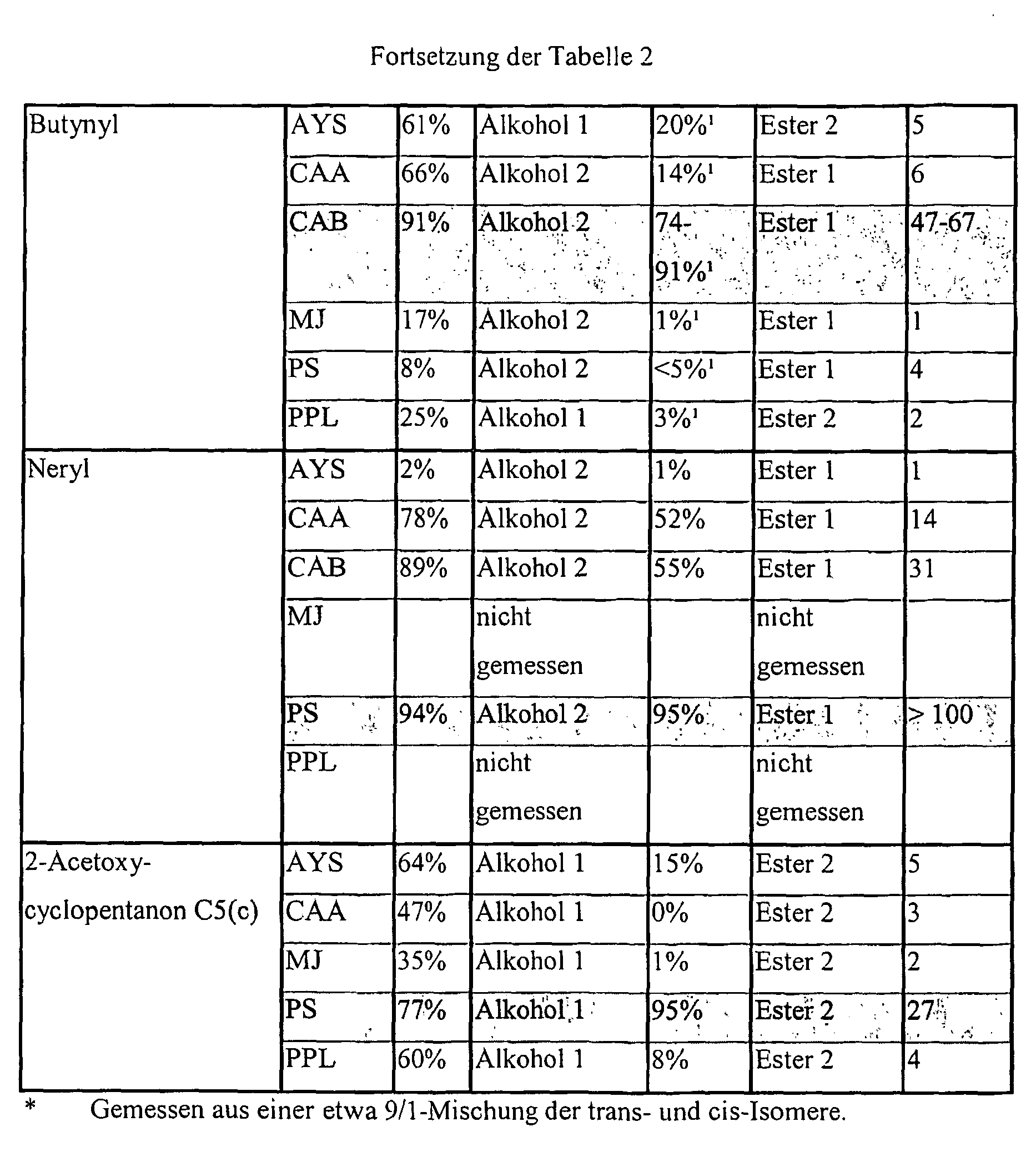
- Der Ester wurde in 0,1 M Phosphatpuffer pH 7,0 (Konzentration ca. 0,07 M) gelöst Lipase zugesetzt (z. B. bis 25 Gew. % des Acyloinesters). Während der Reaktion wurde bis zur Vollständigkeit geschüttelt (DC und GC-Kontrolle). Aceton wurde zugesetzt (1/2 des Puffervol.) und fünf mal mit Ethylacetat extrahiert (1,5 × Puffervol.). Die organischen Phasen werden zweimal mit NaCl-Lösung gewaschen, mit Natriumsulfat getrocknet und in vacuo vom Lösemittel befreit. Alkohol und Ester werden durch Chromatographie getrennt (z. B. an Kieselgel mit Ethylacetat/Petroleumether = 1:6)
- Kleine Ansätze: 10 mg Hydrolase (Lipase oder Esterase) werden in 1 ml Natriumphosphat-puffer (pH 7,5, 50 mM) in 2 ml Reaktionsgefäßen bei 37°C geschüttelt (z.B. mit Thermoshaker - Eppendorf, Hamburg, Deustchland). Dann werden 200 µl Substratlösung zugesetzt (10 mg/ml in Toluol). Nach 20 h wird die Reaktion durch Abzentrifugieren des Enzyms gestoppt, die Toluolschicht abgetrennt und analysiert (z. B. durch GC, Polarimetrie)
- Größere Ansätze: Diese werden ähnlich durchgeführt, aber in 10 ml Phosphatpuffer mit 200 mg Hydrolase und 0,44 mmol (etwa 100 mg) Acyloinester in 3 ml Toluol. Zum Ende der Reaktion werden 10 ml Toluol zugesetzt, das Enzym durch Zentrifugieren entfernt und die organische Schicht abgetrennt. Die wässerige Phase wird noch zweimal mit 5 ml Toluol extrahiert, die vereinten organischen Phasen getrocknet (Na2SO4) und vom Lösemittel in vacuo befreit. Acyloin und der nicht reagierte Ester werden chromatographisch getrennt (z. B. an Kieselgel mit Petrolether:Ether, 4:1). Enantiomerenüberschüsse können am besten mittels Chiralphasen-Gaschromatograpie (CP-GC), chemische Identität mittels NMR-Spektroskopie analysiert werden.
- Eine Lösung von 0,44 mmol des Acyloins in 3 ml Toluol, activiertes Molecularsieb (3 Å), 200 mg Lipase oder Esterase und Vinylacetat (1,2 Äquivalente) werden bei 37°C zur Reaktion gebracht, bis die gewünschte Umsetzung erfolgt ist (ggf. Schütteln). Die Reaktion wird durch Zentrifugieren beendet, das Lösemittel abgenommen und durch Vakuumverdampfung entfernt. Ester und nicht reagiertes freies Acyloin können chromatographisch getrennt werden (z. B. an Kieselgel mit Petrolether:Ether, 4:1). Enantiomerenüberschüsse können am besten mittels Chiralphasen-GC, Chemische Identität mittels NMR-Spektroskopie analysiert werden.
- Anstelle des Vinylacetates lassen sich auch andere Aktivester einsetzen.
Tabelle 3. Racematspaltung von Acyloin acetat UWE1b nach Vorschrift IV (klein) Hydrolasea Umsatz Enantiomerenüberschuß E-Wertc [%]b (e.e.)b Acetat Acyloin [%ee] [%ee] CAL-A 99 0 0 0 CAL-B 30 31 80 12 ANL 7 n.d.d n.d. n.d. CRL 30 18 13 3 PCL 51 >99 93 >100 PFE 56 >99 92 >100 SDE 56 >99 85 64 a Abk. s.o., Haupttext oder Fachbücher; bgemäß GC; cberechnet nach Chen et al. ( J. Am. Chem. Soc. 1982, 104, 7294-7299); dn.d.,nicht bestimmt Tabelle 4. Racematspaltung von Acyloinacetat UWE3a nach Vorschrift IV (klein). Hydrolasea Umsatz Enantiomerenüberschußb E-Wertc [%]b Acetat Acyloin [%ee] [%ee] CAL-B 5 5 96 >50 PSL 50 >99 >99 >100 PCL-AK 50 >99 >99 >100 PLEd 80 >99 20 6 rPLEd,e 25 33 >98 >50 SDE 50 >99 >99 >100 PFE 11 11 86 15 PFE-II 75 <3 <1 1 a Abk. s. Verzeichnis oder Fachbücher; bgemäß GC; cberechnet nach Chen et al. (J. Am. Chem. Soc. 1982, 104, 7294-7299); dumgekehrte Stereopräferenz; eRekombinante Schweineleberesterase (pig liver esterase) - Gemäß allgemeiner Vorschrift 1 werden 48 mg (0,26 mmol) 3-Acetoxy-5-hepten-2-on 20 min. hydrolysiert, wobei die Lösung trübe und dann gelblich wird. Chromatographie (DiethyletherlPetrolether = 1:4) ergibt:
Ausbeute 28 mg (0,20 mmol, 77%) R1-Wert ca. 0,46 mit Ethylacetat/Hexan = 1:4 - Gemäß allgemeiner Vorschrift I werden 60 mg (0,30 mmol) 3-Acetoxy-nonan-2-on 20 min hydrolysiert, wobei die Lösung trübe und dann gelblich wird.
Chromatographie ergibt:Ausbeute 42 mg (0,27 mmol, 88%) Rf-Wert ca. 0,63 mit Ethylacetat/Hexan = 1:4 - Gemäß allgemeiner Vorschrift I werden 47 mg (0,25 mmol) 3-acetoxy-6-methylheptan-2-on 5 min. hydrolysiert, wobei die Lösung trübe und dann gelblich wird.
Ausbeute 32 mg (0,22 mmol, 88%) - Gemäß allgemeiner Vorschrift I werden 43 mg (0,25 mmol) 3-acetoxy-5(Z)-hepten-2-on 5 min hydrolysiert, wobei die Lösung trübe und dann gelblich wird.
Ausbeute 31 mg (0.24 mmol, 96%) - Gemäß allgemeiner Vorschrift I werden 63 mg (0,25 mmol) (E) 3-Acetoxy-6,10-dimethyl-5,9-undecen-2-on 6 min hydrolysiert, wobei die Lösung trübe und dann gelblich wird.
Ausbeute 47 mg (0,22 mmol, 89%) Rf-Wert ca. 0.35 mit Ethylacetat/Hexan = 1:4 - Gemäß allgemeiner Vorschrift I werden 63 mg (0,25 mmol) (Z) 3-Acetoxy-6,10-dimethyl-5,9-undecen-2-on 6 min hydrolysiert, wobei die Lösung trübe und dann gelblich wird.
Ausbeute 47 mg (0,22 mmol, 89%) eines gelben Öls Rf-Wert 0,42 mit Ethylacetat/Hexan = 1:4 - Das jeweilige Startmaterial ist nicht zusätzlich im Titel erwähnt.
-
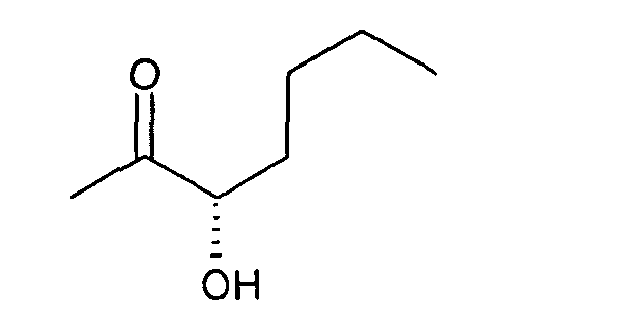
- Gemäß allgemeiner Vorschrift III werden 100 mg (0,58 mmol) 3-Acetoxy-heptan-2-on mit 6 mg Candida antartica B Lipase in 10 ml Puffer umgesetzt und nach 3,75 h beendet. Nach Chromatographie erhält man:
Ausbeute Alkohol: 20 mg (0,15 mmol, 26%) Ester: 35 mg (0,20 mmol, 35%) Rf-Wert Alkohol: ca. 0,33 mit Ethylacetat/Hexan = 1:4 Ester: ca. 0,48 mit Ethylacetat/Hexan = 1:4 
Alkohol: +69,9° (c=0,410; CHCl3; e.e. = 82%) Ester: +9,6° (c=1,805; CHCl3; e.e. = 78%) - Gemäß allgemeiner Vorschrift III werden 16 mg (0,58 mmol) 3-Acetoxy-nonan-2-on mit 7 mg Candida antartica B Lipase in 10 ml Puffer umgesetzt und nach 4,5 h beendet. Nach Chromatographie erhält man:
Ausbeute Alkohol: 10 mg (0,063 mmol, 11%) Ester: 46 mg (0,23 mmol, 40%) Rf-Wert Alkohol: ca. 0,44 mit Ethylacetat/Hexan = 1:4 Ester: ca. 0,61 mit Ethylacetat/Hexan =1:4 
Ester: +6,3° (c=1,615; CHCl3) - Gemäß allgemeiner Vorschrift III werden 32 mg (0,19 mmol) 3-Acetoxy-5(Z)-hepten-2-on mit 20 mg Amano PS Lipase in 5 ml Puffer umgesetzt und nach 40 min beendet. Nach Chromatographie erhält man die Produkte:
Rf-Wert Alkohol: ca. 0,30 mit Ethylacetat/Hexan =1:4 Ester: ca. 0,50 mit Ethylacetat/Hexan = 1:4 - Gemäß allgemeiner Vorschrift III werden 200 mg (1,09 mmol) 3-Acetoxy-6-methyl-5-hepten-2-on mit 63 mg Amano PS Lipase in 15 ml Puffer umgesetzt und nach 6 h beendet. Nach Chromatographie erhält man die Produkte:
Ausbeute Alkohol: 71 mg (0,50 mmol, 46%) eines klaren farblosen Öls Ester: 103 mg (0,56 mmol, 52%) eines klaren farblosen Öls Rf-Wert Alkohol: ca. 0,22 mit Ethylacetat/Hexan = 1:4 Ester: ca. 0,50 mit Ethylacetat/Hexan = 1:4 
Alkohol: +77,3° (c=0,979; CHCl3) Ester: -15.5° (c=2,030; CHCl3) - Gemäß allgemeiner Vorschrift III werden 150 mg (0,73 mmol) 3-Acetoxy-4-phenylbutan-2-on mit 38 mg Amano PS Lipase in 15 ml Puffer umgesetzt und nach 3 h beendet. Nach Chromatographie erhält man die Produkte:
Ausbeute Alkohol: 51 mg (0,31 mmol, 43%) eines klaren farblosen Öls Ester: 76 mg (0,37 mmol, 50%) eines klaren farblosen Öls. 
Alkohol: +64,1° (c=0,820; CHCl3; e.e. = 89%) Ester: -3.0° (c=2,325; CHCl3; e.e. = 85%) - Gemäß allgemeiner Vorschrift III werden 200 mg (0,79 mmol) 3-Acetoxy-6,10-dimethylundeca-5(Z),9-dien-2-on mit 63 mg Amano PS Lipase in 15 ml Puffer umgesetzt und nach 6 h beendet. Nach Chromatographie erhält man die Produkte:
Ausbeute Alkohol: 70 mg (0,33 mmol, 42%) eines klaren farblosen Öls Ester: 107 mg (0,42 mmol, 54%) eines klaren farblosen Öls. Rf-Wert Alkohol: ca. 0,38 mit Ethylacetat/Hexan = 1:4 Ester: ca. 0,52 mit Ethylacetat/Hexan = 1:4 
Alkohol: +63,7° (c=2,115; CHCl3; e.e. = 95%) Ester: -19,7° (c=1,560; CHCl3; e.e. = 97%) - Optisch aktives (Z)-3-Acetoxy-6,10-dimethyl-5,9-undecadien-2-on und (Z)-3-Hydroxy-6,10-dimethyl-5,9-undecadien-2-on: Hydrolyse (größerer Ansatz) mit PCL nach allgemeiner Vorschrift IV gibt optisch aktives (Z)-3-Acetoxy-6,10-dimethyl-5,9-undecadien-2-on (40% Ausbeute, >99 %ee) und (Z)-3-Hydroxy-6,10-dimethyl-5,9-undecadien-2-on (43 % Ausbeute, 92 %ee), E»100.
- Optisch aktives (E)-3-Acetoxy-6,10-dimethyl-5,9-undecadien-2-on und (E)-3-Hydroxy-6,10-dimethyl-5,9-undecadien-2-on: Hydrolyse (größerer Ansatz) mit PCL nach allgemeiner Vorschrift IV gibt optisch aktives (E)-3-Acetoxy-6,10-dimethyl-5,9-undecadien-2-on (40 % Ausbeute, 95 %ee) und (E)-3-Hydroxy-6,10-dimethyl-5,9-undecadien-2-on (32 % Ausbeute, >99 %ee), E»100.
- Optisch aktives (Z)-3-Hydroxy-6,10-dimethyl-5,9-undecadien-2-on und (Z)-3-Acetoxy-6,10-dimethyl-5,9-undecadien-2-on: Acylierung mit PCL nach allgemeiner Vorschrift V gibt optisch aktives (Z)-3-Hydroxy-6,10-dimethyl-5,9-undecadien-2-on (40 % Ausbeute, 95 %ee) und (Z)-3-Acetoxy-6,10-dimethyl-5,9-undecadien-2-on (32 % Ausbeute, >99 %ee), E>>100.
- Optisch aktives (E)-3-Acetoxy-6,10-dimethyt-5-en-11-hydroxy-undecan-2-on und (E)-3-Hydroxy-6,10-dimethyl-5-en-11-hydroxy-undecan-2-on: Hydrolyse (0,94 mmol) mit PCL nach allgemeiner Vorschrift IV gibt optisch aktives (E)-3-Acetoxy-6,10-dimethyl-5-en-11-hydroxy-undecan-2-on (28 % Ausbeute, 92 %ee) und Alkohol (E)-3-Hydroxy-6,10-dimethyl-5-en-11-hydroxy-undecan-2-on (28 % Ausbeute, >99 %ee), E»100.
- Optisch aktives (E)-3-Acetoxy-6,10-dimethyl-5-en-11-O-TBDMS-undecan-2-on und (E)-3-Hydroxy-6,10-dimethyl-5-en-11-O-TBDMS-undecan-2-on: Hydrolyse (1,25 mmol) mit PCL (Chirazyme L6) nach allgemeiner Vorschrift IV ergibt optisch aktives (E)-3-Acetoxy-6,10-dimethyl-5-en-11-O-TBDMS-undecan-2-on (48 % y, 46 %ee) und Alkohol 3-Hydroxy-6,10-dimethyl-5-en-11-O-TBDMS-undecan-2-on (42 % Ausbeute, >99 %ee), E»100. Eine weitere Verbesserung der optischen Ausbeuten von (E)-3-Acetoxy-6,10-dimethyl-5-en-11-O-TBDMS-undecan-2-on wurde durch eine zweite kinetische Racematspaltung mit PCL (Amano PS) erreicht. Ausbeute 35 % (E)-3-Acetoxy-6,10-dimethyl-5-en-11-O-TBDMS-undecan-2-on mit >98 %ee.
- Bei den angegebenen Verbindungen kann es sich, sofern nicht explizit anders angegeben, auch um Isomerengemische, Racemate, und/oder Diastereomere) handeln. Enantiomerenangereicherte Verbindungen sind gewöhnlich durch die Angabe eines Drehwertes angezeigt. Bei Bedarf wurden die erhaltenen Produkte durch im Stand der Technik bekannte Reinigungsverfahren gereinigt.
- Zu einer Lösung von tert-butyl acetoacetate (49.0 ml, 47.5 g, 300 mmol) in Aceton (30 ml) wurde N-bromsuccinimid (58.7 g, 330 mmol) portionsweise gegeben. Die erhaltene Suspension wurde eine Stunde bei Umgebungstemperatur gerührt und anschliessend filtriert. Das Filtrat wurde im Vakuuum eingeengt und der Rückstand in 300 ml Petroleumether aufgenommen. Nach dreimaligem Waschen mit je 100 ml Wasser wurde die Lösung über Na2SO4 getrocknet und filtriert. Anschließend wurde durch Einengen im Vakuum das Produkt erhalten.
- Eine Lösung von Eisessig (10.6 ml, 186 mmol) in DMF (169 ml) wurde mit Triethylamin (25.8 ml, 186 mmol) unter Eiskühlung neutralisiert. Zu der so erhaltenen Triethylammonium-acetatlösung wurde bei 0°C tert-butyl-2-bromacetoacetate (40.0 g, 169 mmol) tropfenweise zugegeben. Das Eisbad wurde nach vollendeter Zugabe entfernt und die Reaktionsmischung wurde zwei Stunden bei Raumtemperatur gerührt. Anschliessend wurde mit Wasser (280 ml) gelöscht und mit Ethylacetat extrahiert (3 x 215 ml). Die organischen Phasen wurden vereinigt und sowohl mit Wasser (3 x 215 ml) als auch konzentrierter NaCl-Lösung (1 x 215 ml) gewaschen. Nach trocknen über Na2SO4, Filtrieren und Einengen im Vakuum erhielt man das Produkt Öl, welches durch zweifache Destillation bei 12 mbar und 128°C gereinigt wurde.
- tert-Butyl-2-acetoxyacetoacetat (19.5 g, 90 mmol) wurde langsam zu einer Suspension von NaH ( 2.59 g, 108 mmol) in DMF (180 ml) at 0°C getropft. Nachdem die Gasentwicklung abgeschlossen war, wurde Nerylbromid (19.6 g, 90 mmol) bei 0°C langsam zugetropft. Schliesslich wurde das Eisbad entfernt und 16 Stunden bei Umgebungstemperatur gerührt. Die erhaltene gelbe Lösung wurde mit Diethylether verdünnt (750 ml) und mit Wasser (3 x 200 ml) und konzentrierter NaCl-Lösung (1 x 200 ml) gewaschen. Nach Trocknen über Na2SO4, Filtrieren und Einengen im Vakuum erhielt man das Produkt.
- Fein pulverisiertes Selendioxid (0.158 g, 1.42 mmol) wurde in DCM (50 ml) suspensiert. Danach gab man eine 70% tert-Butylhydroperoxidlösung (10.2 g, 79.5 mmol) zu und rührte 30 Minuten bei Umgebungstemperatur. Schliesslich wurden 10.0 g (28.4 mmol) (4Z)-2-Acetoxy-2-acetyl-5,9-dimehtyl-deca-4,8-diensäure-tert-butylester zugegeben und bei Umgebungstemperatur für 48 Stunden gerührt. Nach Einengen im Vakuum wurden 50 ml Toluol zugegeben und im Vakuum entfernt (dies dient der Entfernung überschüssigen tert-Butylhydroperoxids). Dies wurde insgesamt dreimal wiederholt und das erhaltene Produkt wurde mittels Flashchromatographie (Parameter der Chromatographiesäule: 5.0 x 19.5 cm, Ethylacetat/Petroleumether = 1:2) getrennt.
- 7.94 g (21.6 mmol) (4Z)-2-Acetoxy-2-acetyl-5,9-dimehtyl-10-hydroxy-deca-4,8-diensäure-tert-butylester wurden in 15.0 ml absolutem Methanol gelöst und 750 µl demineralisiertes Wasser zugefügt. Die erhaltene Lösung wurde mittels dreier Einfrier-Auftau-Zyklen entgast. Anschliessend wurden 185 mg Ru(R-BWAP)(OAc)2 sowie ein Magnetrührstab zugegeben und die erhaltene zitronengelbe Lösung in einen Autoklaven überführt. Die Stickstoffatmosphäre wurde mittels dreimaligem Füllen und Entlassen von Wasserstoffgas (5.0 Qualität) aus dem Autoklaven verdrängt. Schliesslich wurde ein Druck von 100 bar Wasserstoffgas (5.0 Qualität) angelegt und 25 Stunden bei Umgebungstemperatur gerührt. Das Gas wurde aus dem Autoklaven entlassen und die Lösung wurde im Vakuum eingeengt. Das zurückbleibende Produkt wurde mittels Flashchromatographie (Parameter der Chromatographiesäule: 4.5 x 25.0 cm, Ethylacetat/Petroleumether = 1:2) gereinigt.
- 1.032 g (2.79 mmol) (9S)(4Z)-2-acetoxy-2-acetyl-5,9-dimehtyl-10-hydroxy-deca-4-ensäure-tert-butylester wurden in 28 ml DCM gelöst und 2.80 ml TFA zugegeben. Nach zweistündigem Rühren bei Umgebungstemperatur wurden alle flüchtigen Bestandteile im Vakuum entfernt und das zurückbleibende braune Öl in 28.0 ml Methanol gelöst. Anschliessend wurden 5.6 ml gesättigte NaHCO3-Lösung zugegeben und die erhaltene Suspension 140 Minuten bei Umgebungstemperatur gerührt. Nach Zugabe von 200 ml Ether wurde die organische Phase zweimal mit 50 ml demineralisiertem Wasser sowie einmal mit 50 ml konzentrierter NaCl-Lösung gewaschen und anschliessend über Na2SO4 getrocknet. Nach Filtrieren und Einengen im Vakuum erhielt man das Produkt, welches mittels Flashchromatographie (Parameter der Chromatographiesäule: 2.0 x 20.0 cm, Ethylacetat/Petroleumether = 2:3) gereinigt wurde.
- 528 mg (1.95 mmol) 3-Acetoxy-11-hydroxy-6,10-dimethyl-5-undecen-2-on wurden in 10.0 ml absolutem DCM gelöst und mit sowohl 541 µl (395 mg, 3.90 mmol) Triethylamin als auch 12 mg (0.10 mmol) DMAP versetzt. Die Lösung wurde mit Hilfe eines Eisbades gekühlt und fünf Minuten gerührt. Danach wurden 368 mg (2.44 mmol) TBDMSCl auf einmal zugefügt und die erhaltene Lösung erst zwei Stunden bei 0°C und schliesslich 14 Stunden bei Umgebungstemperatur gerührt. Man erhielt eine farblose Suspension, welche man auf 0°C abkühlt, bevor man schliesslich 460 µl Methanol zufügte und 30 Minuten rührte. Anschliessend wurden 15 ml Diethylether und 15 ml gesättigte Ammoniumchloridlösung zugefügt und intensiv gerührt. Die wässrige Phase wurde zweimal mit 10 ml Diethylether extrahiert und die organischen Phasen vereinigt. Es wurde mit 15 ml ges. NaCl-Lösung gewaschen, über Na2SO4 getrocknet, filtriert und im Vakuum eingeengt. Das zurückbleibende Produkt wurde mittels Flashchromatographie (Parameter der Chromatographiesäule: 2.0 x 20.0 cm, Ethylacetat/Petroleumether = 1:10) gereinigt.
- Eine Lösung von 524 mg (1.50 mmol) 2-methyl-4-(methyl-tributylphosphoniumbromid)-1,3-thiazol in 10.0 ml abs. THF wurde auf-63°C gekühlt und 749 µl (1.50 mmol) einer 2.0M Natrium-hexamethyldisilazid-Lösung in THF wurden langsam zugetropft. Nach fünfzehnminütigem Rühren wurde eine Lösung von 480 mg (1.25 mmol) 3-Acetoxy-11-tert-butyl-dimethylsilyloxy-6,10-dimethyl-5-undecen-2-on in 4.0 ml THF langsam zugetropft.
- Nach 30 Minuten rühren bei -63°C wurde die Lösung auf 55°C erwärmt und eine weitere Stunde gerührt. Anschliessend wurde das Heizbad entfernt und 20 ml gesättigte NH4Cl-Lösung zugegeben. Die Phasen wurden geschieden und die wässrige Phase dreimal mit 20 ml Diethylether extrahiert. Die organischen Phasen wurden vereinigt und dreimal mit 20 ml demineralisiertem Wasser sowie einmal mit 20 ml gesättigter NaCl-Lösung gewaschen. Schliesslich wurde über Na2SO4 getrocknet, filtriert und im Vakuum eingeengt. Das zurückbleibende Produkt wurde mittels Flashchromatographie (Parameter der Chromatographiesäule: 2.0 x 20.0 cm, Ethylacetat/Petroleumether = 1:4) gereinigt.
- 221 mg (0.461 mmol) 3-Acetoxy-11-(tert-butyl-dimethyl-silanyloxy)-2,6,10-trimethyl-1-(2-methyl-thiazol-4-yl)-undeca-1,5-dien und 64 mg (0.461 mmol) K2CO3 wurden in 5.5 ml absolutem Methanol zwei Stunden bei Umgebungstemperatur gerührt. Anschliessend wurden 30 ml Ethylacetat zugefügt und die organische Phase wurde mit demineralisiertem Wasser (3 x 10 ml) und mit gesättigter NaCl-Lösung (1 x 10 ml) gewaschen, über Na2SO4 getrocknet, filtriert and letztendlich im Vakuum eingeengt. Man erhielt ein Produkt, welches flashchromatographisch (Parameter der Chromatographiesäule: 2.0 x 20.0 cm, Ethylacetat/Petroleumether = 1:4) gereinigt wurde.
- Zu 2.55 g (14.4 mmol) (S)-4-Benzyl-2-oxazolidinon in 50 ml Tetrahydrofuran wurden bei -78°C 9.0 ml (14.4 mmol) Butyllithium (1.6M in Hexan) getropft. 1.25 ml (14.4 mmol) Bromacetylbromid wurden auf einmal zugegeben.Man rührt 30 min at -78°C und erwärmt auf Raumtemperatur. Im Handschuhkasten werden 2.03 g (15.8 mmol) 2,2-dimethyl-3-oxopentanal, 4.42 g (36.0 mmol) CrCl2 und 193 mg (1.44 mmol) LiI zugegeben. Nach acht Stunden Reaktionszeit bei 20°C wurden 20 ml gesättigte NaCl-Lösung zugegeben und das dunkelgrüne zweiphasige System 15 Minuten lang gerührt. Die organische Phase wurde abgetrennt und die wässrige Phase wurde dreimal mit Diethylether extrahiert. Die vereinigten organischen Phasen wurden dreimal mit demineralisiertem Wasser sowie einmal mit gesättigter NaCl-Lösung gewaschen, über MgSO4 getrocknet, filtriert und im Vakuum eingeengt.Das Produkt wurde an Kieselgel mit Essigester/Petrolether (1:1) chromatographiert.
- Zu 1.50 g (4.32 mmol) (4S)-3-[(3S)-4,4-Dimethyl-1,5-dioxo-3-hydroxyheptyl]-4-benzyl-2-oxazolidinon in 20 ml absolutem DCM wurden bei 0°C unter Argon 1.11 ml (9.50 mmol) frisch destilliertes 2,6-Lutidin und 1.49 ml (6.48 mmol) (tert-Butyl-dimethylsilyl)-trifluormethansulfonat gegeben. Nach 2.5 Stunden rühren bei 0°C gab man 4.0 ml 2N NaOH-Lösung zu und verdünnte mit 30 ml DCM. Nach Phasentrennung wurde die organische Phase zweimal mit 30 ml 2N Salzsäure und einmal mit gesättigter NaCl-Lösung gewaschen. Man trocknete mit MgSO4, engte im Vakuum ein und chromatographierte das Produkt an Kieselgel mit Essigester/Petroleumether (1:4).
- Zu 742 mg (1.61 mmol) (4S)-3-[(3S)-4,4-Dimethyl-1,5-dioxo-3-(tert-butyl-dimethylsilyloxy)]-4-benzyl-2-oxazolidinon in 36 ml Tetrahydrofuran/Wasser (3:1) wurden bei 0°C 1.11 ml (9.66 mmol) Wasserstoffperoxidlösung (30%) und 135 mg (3.22 mmol) Lithiumhydroxid-Hydrat gegeben. Nach einer Stunde Rühren wurden 1.40 g Natriumsulfit in 20 ml demineralisiertem Wasser zugegeben. Man pufferte mit wässriger Natriumhydrogencarbonat-Lösung, entfernte Tetrahydrofuran im Vakuum und waschte die wässrige Lösung dreimal mit 5.0 ml DCM. Die wässrige Phase wurde mit HCl (10%) auf pH1 angesäürt und fünfmal mit 10 ml DCM extrahiert. Die organischen Phasen wurden über MgSO4 getrocknet und das Produkt im Vakuum eingeengt.
- Zu einer Lösung von 116 mg (0.383 mmol) (3S)-3-(tert-Butyl-dimethyl-silanyloxy)-4,4-dimethyl-5-oxo-heptanoic acid in 3.8 ml Tetrahydrofuran wurden bei 0°C 152 mg (0.403 mmol) Phenytrimethylammoniumbromid-dibromid gegeben.
Nach fünfzehnminütigem Rühren wurde das Eisbad entfernt und eine weitere Stunde bei Umgebungstemperatur gerührt. Zur erhaltenen Suspension wurden 5.0 ml demineralisiertes Wasser gegeben. Die wässrige Phase wurde dreimal mit 8 ml Diethylether extrahiert. Die vereinigten organischen Phasen wurden mit 10 ml 1N HCl-Lösung und mit 10 ml gesättigter NaCl-Lösung gewaschen, anschliessend über Na2SO4 getrocknet, letztendlich filtriert und im Vakuum eingeengt. Das zurückbleibende Öl wurde flashchromatographisch (Parameter der Chromatographiesäule: 1.0 x 20.0 cm, Ethylacetat/Petroleumether = 1:4 mit 2% Eisessig) gereinigt. Zwei Fraktionen konnten isoliert werden. Fraktion 1 enthielt ein einziges Diastereomer, Fraktion 2 war eine Diastereomerenmischung. - 127 mg (0.291 mmol) 11-(tert-Butyl-dimethyl-silanyloxy)-2,6,10-trimethyl-1-(2-methyl-thiazol-4-yl)-undeca-1,5-dien-3-ol, 115 mg (0.291 mmol) (3S)-6-Brom-3-(tent-butyl-dimethyl-silanyloxy)-4,4-dimethyl-5-oxo-heptanoic acid und 7 mg (0.058 mmol) DMAP wurden in 1.60 ml absolutem DCM gelöst und auf 0°C gekühlt. Unter Rühren wurden 73 mg (0.378 mmol) EDCI bei 0°C zugefügt. Nach zehnminütigem Rühren, wurde das Eisbad entfernt und 18 Stunden bei Umgebungstemperatur gerührt. Das Lösungsmittel wurde im Vakuum entfernt und das Produkt mittels Flashchromatographie (Parameter der Chromatographiesäule: 2.0 x 20.0 cm, Ethylacetat/Petroleumether = 1:4) gereinigt.
- 162 mg (0.202 mmol) 6-Brom-3-(tert-butyl-dimethyl-silanyloxy)-4,4-dimethyl-5-oxo-heptanoic acid 9-(tert-butyl-dimethyl-silanyloxy)-4,8-dimethyl-1-[1-methyl-2-(2-methyl-thiazol-4-yl)-vinyl]-non-3-enyl ester wurden in 6.0 ml eines 1:1 - Gemisches von DCM und MeOH gelöst und auf 0°C gekühlt. Nach Zugabe von 47 mg (0.202 mmol) CSA wurde die Lösung 2.5 Stunden bei 0°C gerührt. Nach Zugabe von 42µl (31 mg, 0.303 mmol) Triethylamin wurden die Lösemittel im Vakuum entfernt und das zurückbleibende Produkt flashchromatographisch (Parameter der Chromatographiesäule: 2.0 x 20.0 cm, Ethylacetat/Petroleumether = 1:2) gereinigt.
- 119 mg (0.173 mmol) 6-Brom-3-(tert-butyl-dimethyl-silanyloxy)-4,4-dimethyl-5-oxo-heptanoic acid 9-hydroxy-4,8-dimethyl-1-[1-methyl-2-(2-mefihyl-thiazol-4-yl)-vinyl]-non-3-enyl ester wurden in 2.10 ml DCM und 700 µl DMSO gelöst und auf 0°C gekühlt. Anschliessend wurden unter Rühren 120 µl (885 mg, 0.865 mmol) Triethylamin zugegeben. Nach Zugabe von 110 mg (0.692 mmol) SO3•Pyridine-Komplex wurde 40 min bei 0°C gerührt. Anschliesend wurde mit 30 ml Ethylacetat verdünnt und zweimal mit 10 ml demineralisiertem Wasser sowie einmal mit 10 ml gesättigter NaCl-Lösung gewaschen. Die organische Phase wurde über Na2SO4 getrocknet, anschliessend filtriert und im Vakuum eingeengt. Das erhaltene Produkt wurde nicht weiter behandelt und konnte im folgenden Reaktionschritt direkt eingesetzt werden.
- Zu einer Suspension von 35 mg (0.285 mmol) CrCl2 und 30 mg (0.224 mmol) LiI in 25 ml trockenem Tetrahydrofuran wurde eine Lösung von 80 mg (0.117 mmol) 6-Brom-3-(tert-butyl-dimethyl-silanyloxy)-4,4-dimethyl-5-oxo-heptanoic acid 4,8-dimethyl-1-[l-methyl-2-(2-methyl-thiazol-4-yl)-vinyl]-9-oxo-non-3-enyl ester in 5.0 ml absolutem Tetrahydrofuran innerhalb 80 min mit Hilfe einer Spritzenpumpe zugegeben. Nach vollendeter Zugabe wurde die erhaltene Suspension weitere zwei Stunden bei Umgebungstemperatur gerührt. Anschliessend wurde mit 20 ml halbkonzentrierter N-H4Cl - Lösung gelöscht, die organische Phase mit Diethylether (5x15 ml) extrahiert. Die organischen Phasen wurden vereinigt und zweimal mit 15 ml demineralisiertem Wasser sowie zweimal mit 15 ml gesättigter NaCl-Lösung gewaschen, über Na2SO4 getrocknet, filtriert und im Vakuum eingeengt. Dabei erhielt man 67 mg eines gelben Öls.
- Dieses Öl enthielt verschiedene 6,7,8,15-stereoisomere Makrocyclen, von denen drei auf folgende weise isoliert werden konnten.
Flashchromatographie (Parameter der Chromatographiesäule: 1.0 x 20.0 cm, Dieethylether/Petroleumether = 1:2) erlaubte die Isolierung mehrerer Fraktionen, welche durch präparative HPLC auf einer Econosil C18/10µ 10x250mm Säule unter isocratischen Bedingungen mit 85% MeCN, 15% Wasser (welches 1 % Ameisensäure enthält) bei 5.0 ml/min weiter aufgetrennt werden konnten, und u. a. folgende drei 3-TBS-geschützte Epothilondiastereomere lieferte. -
Ausbeute 4 mg (0.0066 mmol, 6%) farbloses Öl Rf-Wert 0.30 Retentionszeit 42.5 bis 63 Minuten HRMS: berechnet für C33H56NO5SSi (MH+): 606.3648 Gefunden: 606.3650 
C33H55NO5SSi (605,95) -
Ausbeute 7 mg (0.0116 mmol, 10%) farbloses Öl Rf - Wert 0.15 und 0.18 Retentionszeit 24 bis 36 Minuten HRMS: berechnet für C33H56NO5SSi (MH+): 606.3648 gefunden: 606.3663 
C33H55NO5SSi (605,95) -
Ausbeute 2 mg (0.0033 mmol, 3%) farbloses Öl Rf- Wert 0.09 Retentionszeit 37.5 bis 54.0 Minuten 
C33H55NO5SSi (605,95) - 324 mg (1,20 mmol) eines Rohprodukts von 3-Acetoxy-11-hydroxy-6,10-dimethyl-5-undecen-2-on und 219 µl (202 mg, 2,40 mmol) Dihydropyran wurden in 8,5 ml DCM gelöst. Nach Zugabe von 30 mg (0.12 mmol) Pyridinium-paratoluolsulfonat wurde die Reaktionsmischung 18 Stunden bei Umgebungstemperatur gerührt. Danach wurden 25 ml Diethyether zugefügt, die erhaltene organische Phase einmal mit 25 ml halbkonzentrierter NaCl-Lösung gewaschen und über Na2SO4 getrocknet. Nach Filtration und Entfernen der Lösemittel im Vakuum wurde das zurückbleibende Produkt mittels Flashchromatographie (Parameter der Chromatographiesäule: 2.0 x 20.0 cm, Ethylacetat/Petroleumether = 1:4) an Kieselgel gereinigt.
- Eine Lösung von 200 mg (0.57 mmol) 2-Methyl-4-(methyl-tributylphosphoniumbromide)-1,3-thiazole in 5.0 ml abs. THF wurde auf-63°C gekühlt und mit 286 µl (0.57 mmol) einer 2.0M Natrium-hexamethyldisilazid Lösung tropfenweise versetzt. Nach Fünfzehnminütigem Rühren wurde eine Lösung von 167 mg (0.48 mmol) 3-Acetoxy-11-(2-tetrahydropyranyloxy)-6,10-dimethyl-5-undecen-2-on in 2.0 ml THF langsam zugetropft. Nach Fünfzehnminütigem Rühren bei -63°C wurde die Lösung auf 55°C erwärmt und eine weitere Stunde gerührt. Danach wurde das Wärmebad entfernt und 10 ml gesättigte NH4Cl - Lösung zugegeben. Dreifache Extraktion mit 10 ml ether, Waschen der vereinigten Etherphasen mit demi water (3 x 10 ml) und mit gesättigter NaCl-Lösung (1 x 10 ml), Trocknen über Na2SO4, Filtration und Entfernen des Lösemittels im Vakuum gab ein Produkt, welches mittels Flashchromatographie (Parameter der Chromatographiesäule: 2.0 x 20.0 cm, Ethylacetat/Petroleumether = 1:4) an Kieselgel gereinigt wurde.
- Eine Lösung von 238 mg (0.53 mmol) Essigsäure 4,8-dimethyl-1-[1-methyl-2-(2-methyl-thiazol-4-yl)-vinyl]-9-(tetrahydro-pyran-2-yloxy)-non-3-enyl ester und 13 mg (0.053 mmol) Pyridinium-paratoluolsulfonate in 5.0 ml 96% Ethanol wurde acht Stunden bei 55°C gerührt. Nach Einengen im Vakuum wurde der Rückstand in 25 ml Diethylether aufgenommen. Die organische Phase wurde mit 5% NaHCO3 (2x10 ml) und mit konzentrierter NaCl-Lösung (1x101) gewaschen, dann über Na2SO4 getrocknet, schliesslich filtriert und im Vakuum eingeengt. Das zurückbleibende Produkt wurde mittels Flashchromatographie (Parameter der Chromatographiesäule: 2.0 x 20.0 cm, Ethylacetat/Petroleumether = 1:2) an Kieselgel gereinigt.
- 26 µl (38 mg, 0.30 mmol) Oxalylchlorid wurden in 2.0 ml abs. DCM gelöst und auf -63°C gekühlt. Nach Zugabe einer Lösung von 42 µl (46 mg, 0.59 mmol) abs. DMSO in 0.5 ml abs. DCM wurde 10 min bei -63°C gerührt und eine Lösung von 99 mg (0.27 mmol) Essigsäure 9-hydroxy-4,8-dimethyl-1-[1-methyl-2-(2-methylthiazol-4-yl)-vinyl]-non-3-enyl ester in 1.0 ml abs. DCM langsam zugetropft. Nach dreissigminütigem Rühren bei -68°C wurden 187 µl (137 mg, 1.35 mmol) Triethylamin zugefügt. Schliesslich liess man auf Umgebungstemperatur auftauen und eine Stunde bei dieser Temperatur rühren.
- Nach Zugabe von 5.0 ml Wasser wurden die Phasen getrennt und die wässrige Phase zweimal mit 5.0 ml DCM extrahiert. Die vereinigten organischen Phasen wurden mit gesättigter NH4Cl-Lösung (2x4.5 ml), mit Wasser (1x4.5ml) und mit konzentrierter NaCl-Lösung gewaschen (1x4.5 ml). Nach Trocknen über Na2SO4, Filtration und Einengen im Vakuum wurde das erhaltene Produkt mittels Flashchromatographie (Parameter der Chromatographiesäule: 2.0 x 20.0 cm, Ethylacetat/Petroleumether = 1:2) an Kieselgel gereinigt.
- 107 mg (0.86 mmol) CrCl2 und 54 mg (0.4 mmol) LiI wurden in 1.0 ml abs. THF suspensiert und mit einer Lösung von 103 mg (0.38 mmol) Essigsäure 1-acetyl-4,8-dimethyl-9-oxo-non-3-enyl ester in 1.0 ml abs. THF versetzt. Anschliessend gibt man 102 mg (0.40 mmol) 4-Brom-1,1-dimethoxy-2,2-dimethyl-pentan-3-on auf einmal zu. Nach dreistündigem Rühren bei Umgebungstemperatur wurde mit 2.0 ml sauerstofffreier ges. NaCl-Lösung gelöscht und die wässrige Phase fünfmal mit 2.0 ml eines 5:1 Diethylether/Pentan Gemischs extrahiert. Die vereinigten organischen Phasen wurden dreimal mit 2.0 ml gesättigter NH4Cl-Lösung gewaschen und über Na2SO4 getrocknet, filtriert und eingeengt. Das zurückbleibende Produkt wurde mittels Flashchromatographie (Parameter der Chromatographiesäule: 2.0 x 20.0 cm, Ethylacetat/Petroleumether = 1:1) an Kieselgel gereinigt. Man erhielt zwei Diastereomere.
syn / anti - Diastereomer Ausbeute: 97 mg (0.22 mmol, 58%) farbloses Öl syn / syn- Diastereomer Ausbeute: 58 mg (0.13 mmol, 35%) farbloses Öl - Die nachfolgenden Beispiele wurden analog zu den in Beispiel 1 und 2 oder in der Beschreibung beschriebenen Verfahren dargestellt (Standardumsetzungen sind in R. C. Larock, Comprehensive Organic Transformations, VCH, 1989, ISBN: 0-89573-710-8 beschrieben).
- Ausbeute: 93 mg (0.27 mmol, 67%)
C20H29NO2S (347.52) -
Ausbeute: 17.6 g (50 mmol, quant.) MS (EI): m/z (%) = 352 (0.01, M+), 296, 236, 193, 167, 153, 69, 57, 43 (100.0). C20H32O5 (352.47) -
Ausbeute: 11.66 g (46 mmol, 92%) MS (ESI-MS): m/z (%) = 253.0 (100) [M+H]+, 209 (42) [M-COCH3]+, 193 (23) [M+H-AcOH]+. C15H24O3 (252.35) -
Ausbeute: 1.63 (6.07 mmol, 27%) C15H24O4 (268.35) -
Ausbeute: 5.78 g (19.5 mmol, 97%) C17H28O4 (296.40) -
Ausbeute: 1.59 g (5.08 mmol, 26%) MS (ESI-MS): m/z (%) = 313.0 (48) [M+H]+. C17H28O5 (312.40) -
Ausbeute: 1.185 g (3.77 mmol, 80%) farbloses Öl C17H30O5 (314.42) -
Ausbeute: 796 mg (1.84 mmol, 68%) MS (CI, isobut.): m/z (%) = 435 (0.3) [M+H]+, 375 (0.3), 313 (0.7), 253 (0.4), 241 (1.0), 193 (0.6), 163 (0.9), 121 (52), 87 (51). C25H38O6 (434.57) -
Ausbeute: 568 mg (2.10 mmol, 75%) farbloses Öl MS (ESI-MS): m/z (%) = 563.3 (100) [2M+Na]+, 293.0 (54) [M+Na]+, 271.1 (7) [M+H]+. C15H26O4 (270.36) -
Ausbeute 597 mg (1.55 mmol, 80%) MS (CI, isobut.): m/z (%) = 385 (13) [M+H]+, 327 (13), 267 (26), 253 (6), 193 (40),175 (62), 117 (100). C21H40O4Si (384.63) -
Ausbeute: 1169 mg (2.44 mmol, 94%) MS (CI, isobut.): m/z (%) = 480 (9) [M+H]+, 422 (22), 420 (51), 362 (5), 210 (>100), 178 (35), 168 (>100), 164 (72), 128 (55), 117 (65). C26H45NO3 SSi(479.79) -
Ausbeute: 429 mg (1.21 mmol, 64%) farbloses Öl C20H34O5 (354,48) -
Ausbeute: 216 mg (0.48 mmol, quant.) farbloses Öl C25H39NO4S (449,65) -
Ausbeute: 10.27g (40.4 mmol, 99%) gelbes Öl C15H26O3 (254.37) -
Ausbeute: 9.80 g (36.0 mmol, quant.) C15H25ClO2 (272.81) -
Ausbeute: 6.67 g (14.7 mmol, 88%) MS (ESI-MS): m/z (%) = 475.3 (68) [M+Na]+, 453.2 (23) [M+H]+, 269.2 (80) [M+H-DHP]+, 313.1 (51) [M+H-C4H8-DHP]+, 295.1 (100) [M+H-C4H8-DHP-H2O]+. C25H40O7 (452,58) -
Ausbeute: 1.686 g (4.92 mmol, 97%) C19H38O3Si (342.59) -
Ausbeute: 150 mg (0.219 mmol, 84%) leicht gelbliches Öl C33H54BrNO5SSi (684,84) -
Ausbeute: 196 mg (70%) farbloses Öl C16H24O4 (280.36) -
Ausbeute: 206 mg (84%) farbloses Öl MS (EI): m/z (%) = 246 (0.02, M+), 75 (100.0). C13H26O4 (246.347) -
Ausbeute:: 736 mg (88%) farbloses Öl C19H40O4Si (360.60) -
Ausbeute: 377 mg (1.031 mmol, 97%) MS (ESI-MS): m/z (%) = 753.3 (33) [2M+Na]+, 388.1 (33) [M+Na]+,366.1 (100) [M+H]+, 306 (28) [M+H-AcOH]+. C20H31NO3S (365.53) -
Ausbeute: 348 mg (0.957 mmol, 93%) farbloses Öl MS (ESI-MS): m/z (%) = 386.1 (48) [M+Na]+, 364.1 (100) [M+H]+, 304 (33) [M+H-AcOH]+. C20H29NO3S (363,52) -
Diastereomer a Ausbeute: 24 mg (0.045 mmol, 32%) farbloses Öl MS (CI, isobut.): m/z (%) = 538 (0.86) [M+H]+, 506 (0.55) [-OMe], 478 (1.14) [-AcOH], 446 (1.41) [-AcOH, MeOH], 364 (0.86), 304 (1.84), 279 (2.12), 265 (3.53), 253 (8.35), 241 (2.82), 225 (3.68), 210 (11.76), 168 (30.43), 164 (21.74), 128 (100.00). HRMS: berechnet für C29H48NO6S (MH+): 538.32025 gefunden: 538.322854 C29H47NO6S (537.75) Diastereomerengemisch a und b Ausbeute: 25 mg (0.046 mmol, 33%) farbloses Öl -
Ausbeute: 52 mg (0.089 mmol, 64%) farbloses Öl C31H56O8Si (584.86) -
Ausbeute: 161 mg (0.60 mmol, 60%) farbloses Öl MS (ESI-MS): m/z (%) = 702.3 (100) [M+Na]+, 680.3 (28) [M+H]+, 620.3 (26) [M+H-AcOH]+. C36H61NO7 SSi(680,02) -
Ausbeute: 138 mg (0.17 mmol, 100%) farbloses Öl MS (ESI-MS): m/z (%) = 794.4 (100) [M+H]+, 756.4 (8), 734.4 (13) [-AcOH]. C42H75NO7SSi2 (794.28) -
Ausbeute: 486 mg (3.4 mmol, 59%). MS (CI): m/z (%) = 43 (39), 45 (22), 57 (34), 91 (19), 119 (10), 145 (9), 173 (9), 189 (14), 190 (78), 191 (18), 233 (45), 246 (22), 251 (100), 252 (11), 307 (44). -
Ausbeute: 2.00 g (12.6 mmol, 54%) -
Ausbeute 415 mg (2.41 mmol, 90%) MS(CI): m/z (%) =143 (26), 157(11), 169 (13), 173 (100), 174 (12), 185 (18). -
Ausbeute: 1.6 g (8.59 mmol, 39%) -
Ausbeute: 419 mg (2.10 mmol, 29%) als farbloses Öl. MS (CI): m/z (%) = 113 (28), 142 (12), 158 (15), 171 (29), 185 (16), 201 (100), 202 (12). - Procedure 1: A solution of acetic acid (10.6 mL, 186 mmol) in DMF (169 mL) was neutralised with triethylamine (25.8 mL, 186 mmol) at 0°C. To the resulting triethylammoniumacetate solution was added tert-butyl-2-bromo-acetoacetate (249) (40.0 g, 169 mmol) dropwise at 0°C. Then the icebath was removed and the reaction mixture stirred for two hours at room temperature. Quenching with water (280 mL) was followed by threefold extraction with ethyl acetate (3×215 mL). The organic layers were combined and washed with water (3×215 mL) and brine (1×215 mL) and dried over Na2SO4. After filtration, the solvent was removed in vacuo. The resulting oil was twice distilled at 12 mbar and 128°C to give a colourless oil.
yield 20.7 g (96 mmol, 57%) - Procedure 2: To a suspension sodiumacetate (30.76 g, 375 mmol) in 250 mL DMF were added 59.27 g (250 mmol) of tert-butyl-2-bromo-acetoacetate (249). After stirring at ambient temperature for 90 minutes, 415 mL demi water were added and threefold extraction with 325 mL ethyl acetate followed. The combined organic layers were washed three times with 325 mL demi water and once with 325 mL brine, then dried over Na2SO4. After filtration, the solvent was removed in vacuo. The resulting oil was purified via Kugelrohrdistillation.
yield 36.52 g (169 mmol, 68%) MS (CI): m/z (%) = 117 (19), 143 (12), 161 (100), 205 (43), 207 (12), 217 (18). HRMS: calculated for C10H17O5 (MH+): 217.10760 found: 217.10460 C10H16O5 (216.23) - To a suspension of 19 mg (0.48 mmol) NaH (60% in mineral oil) in 2.5 mL THF were added dropwise 100µl (77 mg, 0.48 mmol) 1,1,1,3,3,3-hexamethyl-disilazane. The resulting solution was cooled to -63°C and a solution of 153 mg (0.44 mmol) tributyl-(2-methyl-thiazol-4-ylmethyl)-phosphonium chloride (9c) in 2.5 mL abs. THF was slowly added. Then 100 mg (0.40 mmol) of (5Z)-3-acetoxy-6,10-dimethylundeca-5,9-dien-2-one (251a) were added and the mixture was stirred for 30 min at - 63°C as well as another hour at 55°C.
After cooling down to ambient temperature, 10 mL saturated NH4Cl solution were added and the waterlayer was extracted three times with 10 mL diethylether. The combined organic layers were washed with demi water (3 □ 10 mL), with brine (1 □ 20 mL), then dried over Na2SO4, filtrated, and concentrated in vacuo. The remaining oil was purified via flash chromatography (column dimensions: 3.0×20.0 cm, ethyl acetate/petroleum ether = 1:6)yield 93 mg (0.27 mmol, 67%) C20H29NO2S (347.52) - Tert-butyl-2-acetoxy-acetoacetate (10.8 g, 50 mmol) was added dropwise to a stirred suspension of NaH (2.32 g, 58 mmol, 60% suspension in mineral oil) in DMF (100 mL) at 0°C. After the liberation of hydrogen gas stopped, geranylbromide (220d) (10.9 g, 50 mmol) was added dropwise at 0°C. Afterwards the icebath was removed and the mixture stirred at room temperature for 16 hours. Then the mixture was diluted with ether (500 mL) and washed with water (3×200 mL) as well as with brine (1 × 200 mL). The solution was dried over Na2SO4, filtered and concentrated in vacuo to give a slightly yellow oil.
yield 17.6 g (50 mmol, quant.) MS (EI): m/z (%) = 352 (0.01, M+), 296, 236, 193, 167, 153, 69, 57, 43 (100.0). C20H32O5 (352.47) - A solution of 17.62 g (50.0 mmol) (4E)-2-acetoxy-2-acetyl-5,9-dimehtyl-deca-4,8-dienoic-acid-tert-butylester (250b), 2.33 g (55.0 mmol) LiCl and 1.00 mL (55.0 mmol) demi water were stirred in 125 mL DMSO at 160°C for six hours and 14 hours at ambient temperature. The brown solution was diluted with 400 mL demi water and the waterphase was extracted three times with 250 mL diethylether. The etherlayers were combined and washed three times with 250 mL demi water as well as once with 250 mL brine. Finally the etherlayer was dried over Na2SO4, filtrated and concentrated in vacuo to remain a redbrown oil.
Yield 11.66 g (46 mmol, 92%) MS (ESI-MS): m/z (%) =253.0 (100) [M+H]+, 209 (42) [M-COCH3]+, 193 (23) [M+H-AcOH]+. C15H24O3 (252.35) - 127 mg (1.14 mmol) SeO2 and 8.19 g tert-butyl hydroperoxide (70% solution in water) were stirred for 30 minutes in 15.0 mL CH2Cl2. Then 5.73 g (22.7 mmol) (5E)-3-acetoxy-6,10-dimethyl-undeca-5,9-dien-2-one (251b) were added and the reaction mixture was stirred at ambient temperature for 24 hours. Then 20 mL benzene were added and all volatile matter was removed in vacuo. The remaining oil was diluted with 100 mL diethylether and was washed twice with 30 mL of 0.2N NaOH solution as well as with 30 mL brine. The organic layer was dried over Na2SO4, filtrated and concetrated in vacuo. The product was isolated via column chromatography (column dimensions: 2.0×20.0cm, ethyl acetate/petroleum ether =1:5)
yield 1.63 (6.07 mmol, 27%) C15H24O4 (268.35) - 5.05 g (20.0 mmol) (5E)-3-acetoxy-6,10-dimethyl-undeca-5,9-dien-2-one (251b), 1.32 mL (1.49 g, 24.0 mmol) ethylene glycol and 0.190 mg (1.00 mmol) p-toluenesulphonic acid were heatet at a dean stark trap under reflux in 50.0 mL benzene for five hours. The benzene solution was diluted with 200 mL diethylether, washed with saturated NaHCO3 solution (2×100 mL), demi water (100 mL) and brine (100 mL). The organic layer was dried over Na2SO4, filtrated and concentrated in vacuo.
yield 5.78 g (19.5 mmol, 97%) yellow oil C17H28O4 (296.40) - To a suspension of 108 mg (0.975 mmol) SeO2 in 13 mL CH2Cl2 were added 7.03 g (54.6 mmol) of a 70% tert-butyl hydroperoxide. After stirring for 30 min at ambient temperature 5.775 g (19.5 mmol) acetic acid 4,8-dimethyl-1-(2-methyl-[1,3]dloxolan-2-yl)-nona-3,7-dienyl ester (262) were added and the resulting suspension was stirred 38 hours at ambient temperaure. After addition of 20 mL all volatile matter was removed in vacuo and the remaining oil was purified by column chromatography.
yield 1.59 g (5.08 mmol, 26%) colourless oil MS (ESI-MS): m/z (%) = 313.0 (48) [M+H]+. C17H28O5 (312.40) - 1.474 g (4.71 mmol) acetic acid 9-hydroxy-4,8-dimethyl-1-(2-methyl-[1,3]dioxolan-2-yl)-nona-3,7-dienyl ester (263) was dissolved in 15.0 mL absolute methanol and 750 µl demi water were added. The solution was degassed with three freeze-thawcycles before 41 mg Ru(R-BINAP)(OAc)2 were added and put in an autoclave under nitrogen atmosphere together with a magnetic stirring bar. After threefold purging with hydrogen (5.0 quality) the autoclave was set under a pressure of 100 bar hydrogen (5.0 quality) and stirred at room temperature for 25h.
The hydrogen pressure was released and the solution concentrated in vacuo. The obtained brown oil was purified by flash chromatography (column dimensions: 4.0×20.0 cm, ethyl acetate/petroleum ether = 1:2).yield 1.185 g (3.77 mmol, 80%) colourless oil C17H30O5 (314.42) - 849 mg (2.700 mmol) acetic acid 9-hydroxy-4,8-dimethyl-1-(2-methyl-[1,3]dioxolan-2-yl)-non-3-enyl ester (264) were dissolved in 10.0 mL CH2Cl2 and 48 mg (0.19 mmol) PPTS as well as 1.526 g (5.400 mmol) para-methoxy benzyl trochloroimidate (268) were added and stirred 18 hours at ambient temperature. Then the solution was diluted with 25 mL diethylether and 25 mL petroleumether, washed with demi water (2×20 mL) and with brine (20 mL), dried over Na2SO4, filtrated and concentrated in vacuo. The remaining yellow oil was purified via flash chromatography (column dimensions: 3.5×20.0 cm, ethyl acetate/petroleum ether = 1:4).
yield 796 mg (1.84 mmol, 68%) MS (CI, isobut.): m/z (%) = 435 (0.3) [M+H]+, 375 (0.3), 313 (0.7), 253 (0.4), 241 (1.0), 193 (0.6), 163 (0.9), 121 (52), 87 (51). C25H38O6 (434.57) - 1.032 g (2.79 mmol) (9S)-(4Z)-2-acetoxy-2-acetyl-5,9-dimehtyl-10-hydroxy-deca-4-enoic-acid-tert-butylester (266) were dissolved in 28 mL CH2Cl2 and 2.80 mL TFA were added. After stirring for two hours at room temperature, all volatile matter was removed in vacuo and the reaming oil was dissolved in 28 mL methanol. Then 5.6 mL saturated NaHCO3 - solution was added and the suspension was stirred for 140 minutes at ambient temperature before dilution with 200 mL ether was performed. The organic layer was washed two times with 50 mL demi water as well as once with 50 mL brine. After drying over Na2SO4, filtration and removal of the solvents in vacuo, a slightly yellow oil was obtained. Purification was achieved by flash chromatography (column dimensions: 2.0x20.0 cm, ethyl acetate/petroleum ether = 2:3)
yield 568 mg (2.10 mmol, 75%) colourless oil MS (ESI-MS): m/z (%) = 563.3 (100) [2M+Na]+, 293.0 (54) [M+Na]+, 271.1 (7) [M+H]+. C15H26O4 (270.36) - 528 mg (1.95 mmol) 3-acetoxy-11-hydroxy-6,10-dimethyl-5-undecen-2-one (11a) were dissolved in 10.0 mL absolute CH2Cl2. After addition of 541 µl (395 mg, 3.90 mmol) triethylamine and 12 mg (0.10 mmol) of DMAP, the solution was cooled with an ice bath. After stirring for five minutes 368 mg (2.44 mmol) of TBDMSCI were added at once and the resulting solution was stirred at 0°C for two hours and additional 14 hours at room temperature. The resulting colourless suspension was again cooled to 0°C before 460 µl of methanol were added. After stirring for 30 min at 0°C, all solvents were removed in vacuo. Then 15 mL ether as well as 15 mL saturated NH4Cl - solution were added and after intensive stirring and separation, the aqueous phase was extracted twice with 10 mL ether. The combined organic layers were washed with 15 mL brine, dried over Na2SO4, filtered and concentrated in vacuo. The obtained oil was purified by means of flash chromatography (column dimensions: 2.0×20.0 cm, ethyl acetate/petroleum ether = 1:10).
yield 597 mg (1.55 mmol, 80%) colourless oil Rf-value 0.32 MS (CI, isobut.): m/z (%) = 385 (13) [M+H]+, 327 (13), 267 (26), 253 (6), 193 (40), 175 (62), 117 (100). HRMS: calculated for C21H41O4Si (MH+): 385.27740 found: 385.278524 C21H40O4Si (384.63) - A solution of 1092 mg (3.12 mmol) tributyl-(2-methyl-thiazol-4-ylmethyl)-phosphonium chloride (9c) in 21.0 mL abs. THF was cooled to -63°C and 1.56 mL (3.12 mmol) of a 2.0M solution of sodium-hexamethyldisilazid were added dropwise. After stirring for 15 min, a solution of 1000 mg (2.60 mmol) 3-acetoxy-11-tert-butyl-dimethylsilyloxy-6,10-dimethyl-5-undecen-2-one (11b) in 8.0 mL THF was added slowly. After 15 min stirring at -63°C, the solution was heated to 55°C and stirred for an additional hour. Then the heating bath was removed and 42 mL saturated NH4Cl- solution were added. Threefold extraction with 20 mL ether, washing the combined etherlayers with demi water (3×20 mL) and with brine (1×30 mL), drying over Na2SO4, filtration and removal of the solvent in vacuo gave a brown oil. Purification was achieved via flash chromatography (column dimensions: 3.5×20.0 cm, ethyl acetate/petroleum ether = 1:4).
yield 1169 mg (2.44 mmol, 94%) colourless oil MS (CI, isobut.): m/z (%) = 480 (9) [M+H]+, 422 (22), 420 (51), 362 (5), 210 (>100), 178 (35), 168 (>100), 164 (72), 128 (55), 117 (65). HRMS: calculated for C26H46NO3SSi (MH+): 480.295912 found: 480.29678 EA: calculated C 65.09 H 9.45 N 2.92 S 6.68 found C 64.79 H 9.53 N 2.96 S 6.54 C26H45NO3 SSi(479.79) - Procedure 1: 324 mg (1,20 mmol) of a crude product of 3-acetoxy-11-hydroxy-6,10-dimethyl-5-undecen-2-one (11a) and 219 µl (202 mg, 2,40 mmol) dihydropyrane were dissolved in 8,5 mL CH2Cl2. After addition of 30 mg (0.12 mmol) pyridinium paratoluenesulphonate, the solution was stirred at ambient temperature for 18 hours. Then 25 mL diethylether were added, the organic layer washed once with 25 mL halfconcentrated NaCl-solution and dried over Na2SO4. After filtration and evaporation of the solvents in vacuo, the remaining oil was purified by flash chromatography (column dimensions: 2.0×20.0cm, ethyl acetate/petroleum ether = 1:4).
yield 176 mg (0,50 mmol, 41 %) colourless oil - Procedure 2: 508 mg (1.88 mmol) of 3-acetoxy-11-hydroxy-6,10-dimethyl-5-undecen-2-one (11a) and 344 µl (320 mg, 3.80 mmol) dihydropyrane were dissolved in 5.0 mL CH2Cl2. After addition of 165 mg (1.90 mmol) LiBr the mixture was stirred four hours at ambient temperature. After addition of 20.0 mL diethylether, the organic layer was washed once with 5.0 mL water and once with 5.0 mL brine. The organic layer was dried over Na2SO4, filtrated and concentrated in vacuo and the remaining oil was purified via flash chromatography (column dimensions: 2.0×20.0 cm, ethyl acetate/petroleum ether = 1:4).
yield 429 mg (1.21 mmol, 64%) colourless oil C20H34O5 (354,48) - A solution of 200 mg (0.57 mmol) tributyl-(2-methyl-thiazol-4-ylmethyl)-phosphonium chloride (9c) in 5.0 mL abs. THF was cooled to -63°C and 286 µl (0.57 mmol) of a 2.0M solution of sodium-hexamethyldisilazid were added dropwise. After stirring for 15 min, a solution of 167 mg (0.48 mmol) 3-acetoxy-11-(2-tetrahydropyranyloxy)-6,10-dimethyl-5-undecen-2-one (11c) in 2.0 mL THF was added slowly. After 15 min stirring at -63°C, the solution was heated to 55°C and stirred for an additional hour. Then the heating bath was removed and 10 mL saturated NH4Cl- solution were added. Threefold extraction with 10 mL ether, washing the combined etherlayers with demi water (3×10mL) and with brine (1×10 mL), drying over Na2SO4, filtration and removal of the solvent in vacuo gave a brown oil. Purification was achieved via flash chromatography (column dimensions: 2.0×20.0 cm, ethyl acetate/petroleum ether = 1:4).
yield 216 mg (0.48 mmol, quant.) colourless oil C25H39NO4S (449,65) - 8.66 g (40.8 mmol) 1-acetoxy-8-hydroxy-3,7-dimethyl-octa-2,6-dien (257a) and 7.44 mL (6.86 g, 81.6 mmol) DHP were dissolved in 20 mL CH2Cl2. After addition of 513 mg (2.04 mmol) PPTS, the mixture was stirred seven hours at ambient temperature. After removal of all volatile matter in vacuo, the obtained oil was dissolved in 200 mL methanol and 14.96 g (151 mmol) K2CO3 were added and the suspension was stirred at ambient temperature for one hour. After addition of 500 mL demi water, fivefold extraction with 150 mL diethylether was performed. The organic layers were combined and washed with demi water (2□100 mL) as well as brine (1□100 mL), dried over Na2SO4, filtrated and concentrated in vacuo.
yield 10.27 g (40.4 mmol, 99%) yellow oil C15H26O3 (254.37) - In a dry 500 mL Schlenk flask, 5.29 g (39.6 mmol) NCS is were dissolved in 185 mL dry CH2Cl2 and the solution was then cooled to -5°C before 3.17 mL (2.68 g, 43.2 mmol) dimethylsulfide were added dropwise. After stirring for five minutes at - 5°C, the resulting white suspension was cooled to -63°C and 9.16 g (36.0 mmol) 3,7-dimethyl-8-(tetrahydro-pyran-2-yloxy)-octa-2,6-dien-1-ol (271) were added dropwise. After the addition was complete, the reaction mixture was allowed to reach -5°C again and was stirred one hour at that temperature in which the white suspension tumed slowly into a colourless solution. Then 90 mL saturated ammoniumchloride solution were added, the layers separated and the aqueous layer extracted twice with 75 mL diethylether. The organic layers were combined and washed twice with 75 mL brine, then dried over Na2SO4, filtered and concentrated in vacuo. A slightly yellow oil was obtained in high purity.
yield 9.80 g (36.0 mmol, quant.) C15H25ClO2 (272.81) - Tert-butyl-2-acetoxy-acetoacetate (219a) (3.80 g, 17.6 mmol) was added dropwise to a stirred suspension of NaH (60% suspension in mineral oil, 0.870 g, 21.8 mmol) in DMF (35 mL) at 0°C. After the liberation of hydrogen gas stopped, 1-chloro-3,7-dimethyl-8-(tetrahydro-pyran-2-yloxy)-2,6-octadiene (272) (4.57 g, 16.7 mmol) was added dropwise at 0°C. After stirring for one hour at 0°C the icebath was removed and the mixture stirred at room temperature for three hours. Then the mixture was diluted with ether (225 mL) and washed with water (3×75 mL) as well as with brine (1×75 mL). The solution was dried over Na2SO4, filtered and concentrated in vacuo, to give a slightly yellow oil.
yield 6.67 g (14.7 mmol, 88%) MS (ESI-MS): m/z (%) = 475.3 (68) [M+Na]+, 453.2 (23) [M+H]+, 269.2 (80) [M+H-DHP]+, 313.1 (51) [M+H-C4H8-DHP]+, 295.1 (100) [M+H-C4H8-DHP-H2O]+. C25H40O7 (452,58) - 1.943 g (5.05 mmol) 3-acetoxy-11-(tert-butyl-dimethylsilyloxy)-6,10-dimethyl-5-undecen-2-one (11b) were dissolved in 20.0 mL methanol and 400 µl of a saturated potassium carbonate solution were added. After stirring at ambient temperature for 14 minutes, 30 mL brine were added and fivefold extraction with 30 mL diethylether followed. (The hydrolysis actually was already complete after five minutes according to TLC. Workup right on time is crucial, for the yield drop drastically if the reaction is not stopped in time. Stirring for example for ninety minutes resulted in dramatic drop of the yield to 43%!!!) The combined organic layers were washed with 50 mL brine and dried over Na2SO4. After filtration and removal of the solvent in vacuo, the remaining oil was purified via flash chromatography (column dimensions: 2.0×20.0 cm, ethyl acetate/petroleum ether = 1:4).
yield 1.686 g (4.92 mmol, 97%) C19H38O3Si (342.59) - 180 mg (0.262 mmol) (3S)-6-bromo-3-(tert-butyl-dimethyl-silanyloxy)-4,4-dimethyl-5-oxo-heptanoic acid 9-hydroxy-4,8-dimethyl-1-[1-methyl-2-(2-methylthiazol-4-yl)-vinyl]-non-3-enyl ester (277b) were dissolved in 5.30 mL CH2Cl2 and 1.72 mL DMSO at 0°C and 212 µl (155 mg, 1.53 mmol) triethylamine were added. After addition of 195 mg (1.223 mmol) SO3•Pyridine - complex the mixture was stirred 60 min at 0°C. Dilution with 40 mL diethylether was followed by twofold washing with 10 mL demi water and with brine (2□10 mL). The organic layer was the dried over Na2SO4, filtered and concentrated in vacuo to give a slightly yellow oil which was used in the following reaction step without further purification.
yield 150 mg (0.219 mmol, 84%) slightly yellow oil C33H54BrNO5SSi (684,84) - To a solution of 298 mg (2.42 mmol) CrCl2 and 20 mg (0.15 mmol) LiI in 6.0 mL abs. THF were added 117 µl (1.1 mmol) benzaldehyde and 253 mg (1.0 mmol) 4-bromo-1,1-dimethoxy-2,2-dimethyl-pentan-3-one (225). After stirring at ambient temperature for 30 minutes the brown solution was quenched with 5.0 mL brine. The aqueous phase was extracted three times with 5.0 mL diethylether. The organic layers were combined, washed with conc. NH4Cl solution (2□5.0 mL), dried over MgSO4, filtrated and concentrated in vacuo. The remaining green oil (196 mg) was purified via flash chromatography (column dimensions: 3.5×20.0 cm, ethyl acetate/petroleum ether = 1:6).
yield: 196 mg (70%) colourless oil C16H24O4 (280.36) - To a solution of 298 mg (2.42 mmol) CrCl2 and 29 mg (0.22 mmol) LiI in 6.0 mL abs. THF were added 100 µl (1.1 mmol) isobutyric aldehyde and 253 mg (1.0 mmol) 4-bromo-1,1-dimethoxy-2,2-dimethyl-pentan-3-one (225). After stirring at ambient temperature for one hour the brown solution was quenched with 5.0 mL brine. The aqueous phase was extracted three times with 5.0 mL of a diethylether-pentane mixture (5:1). The organic layers were combined, washed with conc. NH4Cl solution (3□5.0 mL), dried over MgSO4, filtrated and concentrated in vacuo. The remaining colourless oil (206 mg) was purified via flash chromatography (column dimensions: 3.5×20.0 cm, ethyl acetate/petroleum ether = 1:8).
yield: 206 mg (84%) colourless oil MS (EI): m/z (%) = 246 (0.02, M+), 75 (100.0). C13H26O4 (246.347) - To a solution of 571 mg (2.31 mmol) 5-hydroxy-1,1-dimethoxy-2,2,4,6-tetramethylheptan-3-one (281) and 539 µl (4.63 mmol) 2,6-lutidine in 2.3 mL CH2Cl2 at 0°C were added 797 µl (3.47 mmol) tert-butyl-dimethylsilyltriflate dropwise. After two hours stirring at 0°C, 2.0 mL 0.2N NaOH solution was added and the mixture stirred ten minutes at ambient temperature. After addition of 30 mL CH2Cl2, the organic layer was washed twice with 0.2N HCl solution as well as twice with 30 mL brine. The organic layer was dried over MgSO4, filtrated and concentrated in vacuo. The obtained yellow oil was purified y flash chromatography (column dimensions: 3.5×20.0 cm, ethyl acetate/petroleum ether= 1:10).
yield: 736 mg (88%) colourless oil Rf-value 0.53 (Essigester/Petrolether, V:V = 1:10) C19H40O4Si (360.60) - Procedure 1 (from THP-ether): A solution of 238 mg (0.53 mmol) 3-acetoxy-11-(tetrahydro-pyran-2-yloxy)-2,6,10-trimethyl-1-(2-methyl-thiazol-4-yl)-undeca-1,5-diene (270b) and 13 mg (0.053 mmol) pyridinium paratoluenesulphonate in 5.0 mL 96% ethanol was stirred at 55°C for eight hours. After concentration in vacuo, the residue was dissolved in 25 mL diethylether. The organic layer was washed with 5% NaHCO3 (2□10 mL) and with brine (1□101), then dried over Na2SO4, filtrated and concentrated in vacuo. The remaining oil was purified via flash chromatography (column dimensions: 2.0×20.0 cm, ethyl acetate/petroleum ether = 1:2).
yield 99 mg (0.27 mmol, 51%) colourless oil - Procedure 2 (from TBS-ether): 512 mg (1.067 mmol) 3-acetoxy-11-(tert-butyldimethyl-silanyloxy)-2,6,10-trimethyl-1-(2-methyl-thiazol-4-yl)-undeca-1,5-diene (270a) were dissolved in 15.0 mL CH2Cl2 and 15.0 mL MeOH and cooled to 0°C. After addition of 248 mg (1.067 mmol) CSA the solution was stirred for 4.0 hours at 0°C. Then 222µl (162 mg, 1.601 mmol) triethylamine were added, the solvents removed in vacuo and the remaining oil was purified by flash chromatography (column dimensions: 2.0x20.0 cm, ethyl acetate/petroleum ether= 1:1),
yield 377 mg (1.031 mmol, 97%) MS(ESI-MS): m/z (%) = 753.3 (33) [2M+Na]+, 388.1 (33) [M+Na]+,366.1 (100) [M+H]+, 306 (28) [M+H-AcOH]+. C20H31NO3S (365.53) - Procedure 1 (Swern-oxidation): 26 µl (38 mg, 0.30 mmol) oxalyl chloride were dissolved in 2.0 mL abs. CH2Cl2 and cooled to -63°C. After addition of a solution of 42 µl (46 mg, 0.59 mmol) abs. DMSO in 0.5 mL abs. CH2Cl2, the mixture was stirred for 10 min at -63°C and a solution of 99 mg (0.27 mmol) 3-acetoxy-11-hydroxy-2,6,10-trimethyl-1-(2-methyl-thiazol-4-yl)-undeca-1,5-diene (270e) in 1.0 mL abs. CH2Cl2 was added dropwise. Then the mixture was stirred at -63°C for an additional 30 minutes before 187 µl (137 mg, 1.35 mmol) triethylamine were added. Finally the mixture was allowed to reach ambient temperature and stirred for one more hour.
Then 5.0 mL water were added, the layers separated and the water layer extracted twice with 5.0 mL CH2Cl2. The combined organic layers were washed with saturated NH4Cl-solution (2□4.5 mL), with water (1□4.5ml) and with brine (1□4.5 mL). After drying over Na2SO4, filtration and concentrating in vacuo, the obtained oil was purified by flash chromatography (column dimensions: 2.0×20.0 cm, ethyl acetate/petroleum ether = 1:2).yield 74 mg (0.204 mmol, 75%) colourless oil - Procedure 2 (SO3•Py/DMSO): A solution of 377 mg (1.031 mmol) 3-acetoxy-11-hydroxy-2,6,10-trimethyl-1-(2-methyl-thiazol-4-yl)-undeca-1,5-diene (270e) and 715 µl (522 mg, 5.157 mmol) triethylamine in 12.5 mL abs. CH2Cl2 and 4.2 mL DMSO was cooled to 0°C. Then 657 mg (4.123 mmol) of SO3•Py complex were added at once and the resulting solution was stirred 30 min at 0°C. Finally, 100 mL diethylether were added and the organic layer was washed twice with 50 mL demi water as well as once with 50 mL brine. After drying over Na2SO4, filtration and concentrating in vacuo, the obtained oil was purified by flash chromatography (column dimensions: 2.0×20.0 cm, ethyl acetate/petroleum ether = 1:2).
yield 348 mg (0.957 mmol, 93%) colourless oil MS (ESI-MS): m/z (%) = 386.1 (48) [M+Na]+, 364.1 (100) [M+H]+, 304 (33) [M+H-AcOH]+. C20H29NO3S (363,52) - To a suspension of 39 mg (0.316 mmol) CrCl2 and 40 mg (0.299 mmol) LiI in 1.0 mL absolute THF was added a solution of 51 mg (0.140 mmol) 3-acetoxy-2,6,10-trimethyl-1-(2-methyl-thiazol-4-yl)-11-oxo-undeca-1,5-diene (8b) in 1.0 mL absolute THF. After five minutes stirring at ambient temperature, 37 mg (0.147 mmol) 4-bromo-1,1-dimethoxy-2,2-dimethyl-pentan-3-one (225) were added. After stirring for 3h 40min at ambient temperature, 2.5 mL brine were added and stirring was continued for five minutes. The waterphase was extracted five times with 2.0 mL of a pentane-diethylether-mixture (1:5) and the combined organic layers were washed three times with 2.0 mL saturated NH4Cl solution. After drying over Na2SO4, filtration and concentrating in vacuo, the obtained oil was purified by flash chromatography (column dimensions: 1.0×20.0 cm, diethylether/petroleum ether = 5:4). Two fractions were collected, fraction A containing only the major diastereomer, fraction B containing the major and the minor diasteromer.
Diastereomer a yield 24 mg (0.045 mmol, 32%) colourless oil MS (CI, isobut.): m/z (%) = 538 (0.86) [M+H]+, 506 (0.55) [-OMe], 478(1.14) [-AcOH], 446 (1.41) [-AcOH,-MeOH], 364 (0.86), 304 (1.84), 279 (2.12), 265 (3.53), 253 (8.35), 241 (2.82), 225 (3.68), 210 (11.76), 168 (30.43), 164 (21.74), 128 (100.00). HRMS: calculated for C29H48NO6S (MH+): 538.32025 found: 538.322854 C29H47NO6S (537.75) mixture of Diastereomers a and b yield 25 mg (0.046 mmol, 33%) colourless oil - To a suspension of 79 mg (0.640 mmol) CrCl2 and 41 mg (0.306 mmol) LiI in 2.0 mL absolute THF were added 51 mg (0.140 mmol) 3-acetoxy-6,10-dimethyl-11-oxo-5-undecen-2-one (285). After ten minutes stirring at ambient temperature, a solution of 37 mg (0.147 mmol) (3S)-6-bromo-3-(tert-butyl-dimethyl-silanyloxy)-4,4-dimethyl-5-oxo-heptanoic acid methyl ester (235) in 1.0 mL THF was added. After stirring for three hours at ambient temperature, 3.0 mL brine were added and stirring was continued for five minutes. The waterphase was extracted five times with 3.0 mL of a pentane-diethylether-mixture (1:5) and the combined organic layers were washed three times with 3.0 mL saturated NH4Cl solution. After drying over Na2SO4, filtration and concentrating in vacuo, the obtained oil was purified by flash chromatography (column dimensions: 2.0×20.0 cm, diethylether/petroleum ether = 1:1).
yield 52 mg (0.089 mmol, 64%) colourless oil C31H56O8Si (584.86) - To a suspension of 240 mg (1.95 mmol) CrCl2 and 125 mg (0.93 mmol) in 10.0 mL absolute THF was added 322 mg (0.886 mmol) 3-acetoxy-2,6,10-trimethyl-1-(2-methyl-thiazol-4-yl)-11-oxo-undeca-1,5-diene (8b) in 1.0 mL absolute THF and 384 mg (0.971 mmol) (3S)-6-bromo-3-(tert-butyl-dimethyl-silanyloxy)-4,4-dimethyl-5-oxo-heptanoic acid methyl ester (235) at ambient temperature. After stirring for 2h15min at ambient temperature, 12 mL brine were added and stirring was continued for five minutes. The waterphase was extracted five times with 15 mL of a pentane-diethylether-mixture (1:5) and the combined organic layers were washed twice with 20 mL demi water and twice with 20 mL brine. After drying over Na2SO4, filtration and concentrating in vacuo, the obtained oil was purified by flash chromatography (column dimensions: 2.0x20.0 cm, diethylether/petroleum ether = 5:4).
yield 161 mg (0.60 mmol, 60%) colourless oil MS (ESI-MS): m/z (%) = 702.3 (100) [M+Na]+, 680.3 (28) [M+H]+, 620.3 (26) [M+H-AcOH]+. C36H61NO7 SSi(680,02) - A solution of 115 mg (0.17 mmol) 15-acetoxy-3-(tert-butyl-dimethyl-sitanyloxy)-7-hydroxy-4,4,6,8,12,16-hexamethyl-17-(2-methyl-thiazol-4-yl)-5-oxo-heptadeca-12,16-dienoic acid methyl ester (289) and 36 mg (0.50 mmol) imidazole in 1000□1 absolute DMF was cooled to 0°C. After addition of 84□1 (0.50 mmol) triethylsilylchloride, the icebath was removed and the solution was stirred for 3h15min at ambient temperature before 5.0 mL diethylether were added. The organic layer was washed with demi water (2□1000□1) as well as with brine (1□1000□1), dried over Na2SO4, filtrated and concentrated in vacuo. The remaining oil was purified via flash chromatography (column dimensions: 1.0×20.0 cm, diethylether/petroleum ether = 1:1).
yield 138 mg (0.17 mmol, 100%) colourless oil MS (ESI-MS): m/z (%) = 794.4 (100) [M+H]+, 756.4 (8), 734.4 (13) [-AcOH]. C42H75NO7SSi2 (794.28) - According to the general alkylation method, tert-butyl-2-acetoxy-aceto-acetate (219a) (1.08 g, 5.00 mmol), NaH (156 mg, 6.5 mmol) and ethylbromide (auch propyl + pentyl) (373 µL, 549 mg, 5.00 mmol) were reacted in DMF (10 mL) to give 2-acetoxy-2-acetylbutanoic-acid-tert-butylester (250g) (970 mg, 3.97 mmol, 79%) as a slightly yellow oil. Then, 250g (1.40 g, 5.73 mmol) and 109 mg (0.57 mmol) p-TsOH•H2O were stirred in 18.0 mL benzene according to decarboxylation method A. Kugelrohr distillation gave 486 mg (3.4 mmol, 59%) of 251g as a colourless oil.
MS (CI): m/z (%) = 43 (39), 45 (22), 57 (34), 91 (19), 119 (10), 145 (9), 173 (9), 189 (14), 190 (78), 191 (18), 233 (45), 246 (22), 251 (100), 252 (11), 307 (44). HRMS: calculated for C17H23O5 (MH+): 307.15454 found: 307.15070 - According to the general alkylation method, tert-butyl-2-acetoxy-aceto-acetate (219a) (7.12 g, 32.9 mmol), NaH (900 mg, 37.5 mmol) and propylbromide (4.05 g, 32.9 mmol) were reacted in DMF (64 mL) to give 2-acetoxy-2-acetyl-pentanoicacid-tert-butylester (250h) (6.00 g, 23.2 mmol, 71%) as a slightly yellow oil after Kugelrohr distillation at 160°C and 1.0 mbar. Then, 250h (6.00 g, 23.2 mmol) and 393 mg (2.07 mmol) p-TsOH•H2O were stirred in 60 mL benzene according to decarboxylation method A. Kugelrohr distillation at 1.0 mbar and 150°C, followed by column chromatography (diethylether:petroleum ether = 1:8) gave 251h (2.00 g, 12.6 mmol, 54%) as a colourless oil.
- According to the general alkylation method, tert-butyl-2-acetoxy-aceto-acetate (219a) (1.08 g, 5.00 mmol), NaH (156 mg, 6.5 mmol) and butylbromide (538 µL, 685 mg, 5.00 mmol) were reacted in DMF (10 mL) to give 2-acetoxy-2-acetylhexanoic-acid-tert-butylester (250i) (1026 mg, 3.77 mmol, 75%) as a slightly yellow oil. Then, 250i (731 mg, 2.68 mmol) and 51 mg (0.27 mmol) p-TsOH•H2O were stirred in 9.0 mL benzene according to decarboxylation method A. Kugelrohr distillation at 1.0 mbar and 60°C gave 251i (415 mg, 2.41 mmol, 90%) as a colourless oil.
MS (CI): m/z (%) = 143 (26), 157 (11), 169 (13), 173 (100), 174 (12), 185 (18). HRMS: calculated for C9H17O3 (MH+): 173.11777 found: 173.11535 - According to the general alkylation method, tert-butyl-2-acetoxy-aceto-acetate (219a) (7.12 g, 32.9 mmol), NaH (900 mg, 37.5 mmol) and pentylbromide (4.97 g, 32.9 mmol) were reacted in DMF (64 mL) to give 2-acetoxy-2-acetyl-heptanoicacid-tert-butylester (250j) (6.40 g, 22.3 mmol, 68%) as a slightly yellow oil after Kugelrohr distillation at 185°C and 1.0 mbar. Then, 250j (6.40 g, 22.3 mmol) and 402 mg (2.11 mmol) p-TsOH•H2O were stirred in 65 mL benzene according to decarboxylation method A. Kugelrohr distillation at 1.0 mbar and 125°C, followed by column chromatography (ethyl acetate:petroleum ether = 1:4) gave 251j (1.6 g, 8.59 mmol, 39%) as a colourless oil.
- According to the general alkylation method, tert-butyl-2-acetoxy-aceto-acetate (219a) (1.08 g, 5.00 mmol), NaH (156 mg, 6.5 mmol) and hexylbromide (702 µL, 825 mg, 5.00 mmol) were reacted in DMF (10 mL) to give 2-acetoxy-2-acetyloctanoic-acid-tert-butylester (250k) (1063 mg, 3.54 mmol, 71%) as a slightly yellow oil. Then, 250k (2.19 g, 7.29 mmol) and 139 mg (0.73 mmol) p-TsOH•H2O were stirred in 22.0 mL benzene according to decarboxylation method A. Kugelrohr distillation at 0.8 mbar and 80°C and subsequent flash-chromatography (column dimensions: 2.0 □ 20.0 cm, diethylether/petroleum ether = 1:6) gave 251k (419 mg 2.10 mmol, 29%) as a colourless oil.
MS(CI): m/z (%) = 113 (28), 142 (12), 158 (15), 171 (29), 185 (16), 201 (100), 202 (12). HRMS: calculated for C11H21O3 (MH+): 201.14906 found: 201.14587
Claims (20)
- α-Hydroxyketon-Verbindung der allgemeinen Formel I:
 R1 ausgewählt wird aus der Gruppe bestehend aus H, Methyl, CHnF3-n (n = 0-3), Ethyl oder Propyl;B1 und/oder B2 für eine Einfach- oder eine Doppelbindung als E-(trans)-Form, Z-(cis)-Form oder E/Z-Gemisch oder ein Epoxid als E-(trans)-Form, Z-(cis)-Form oder E/Z-Gemisch und/oder Kombinationen davon steht;R4 Methyl, Ethyl, CHnF3-n (n = 0-3), oder Halogen ist;Nu H oder Alkyl ist;E CH3, CH2OH, CH2OPG, CO2PG, CO2R oder CH=O ist;R H, Methyl oder Ethyl ist; undPG für das angegebene Verknüpfungsatom oder die angegebene funktionelle Gruppe übliche Schutzgruppen bezeichnet,ausgeschlossen eine Verbindung mit R1 = Methyl, B1 = Doppelbindung, R4 = Methyl, Nu = H, B2 = Doppelbindung und E = Methyl.
 - Verbindungen nach Anspruch 1, wobei B1 für eine Z-Doppelbindung oder ein Epoxid steht.
- Verbindungen nach Anspruch 1 oder 2, wobei R1 Methyl ist.
- Verbindungen nach einem der Ansprüche 1-3, wobei B2 für eine Einfachbindung steht.
- Verbindungen nach einem der Ansprüche 1 - 4, wobei PG Allyl, t-Butyl, Methyl, Benzyl, Silyl, Acyl, ein aktiviertes Methylenderivat wie Methoxymethyl, Alkoxyalkyl, 2-Oxacycloalkyl, Trimethylsilyl, Triethylsilyl, Dimethyl-tert-butylsilyl, Acetyl, Propionyl, Benzoyl oder Tetrahydropyranyl ist.
- Verbindungen nach einem der Ansprüche 1 - 5, dadurch gekennzeichnet, dass die Verbindung an der α-Hydroxyposition an Position 15 der allgemeinen Formel I nicht racemisch bzw. optisch aktiv ist.
- Verbindungen nach Anspruch 6, dadurch gekennzeichnet, dass die absolute Konfiguration an der α-Hydroxyposition an Position 15 der allgemeinen Formel I der natürlichen Konfiguration von Epothilonen an Position C15 entspricht.
- Verbindungen nach einem der Ansprüche 1-7, dadurch gekennzeichnet, dass die α-Hydroxygruppe an Position 15 der allgemeinen Formel I durch eine Schutzgruppe PG geschützt ist.
- Verbindungen nach Anspruch 8, dadurch gekennzeichnet, dass die Schutzgruppe PG ausgewählt ist aus der Gruppe bestehend aus einer Acetyl-, Propionyl-, Butyroyl und Benzoyl-Gruppe.
- Verbindungen nach Anspruch 8, dadurch gekennzeichnet, dass die α-Hydroxygruppe an Position 15 der allgemeinen Formel I durch eine nicht-racemische chirale Acylgruppe geschützt ist.
- Verbindungen nach Anspruch 10, dadurch gekennzeichnet, dass die α-Hydroxygruppe an Position 15 der allgemeinen Formel I mit optisch aktiver 2-Methoxymandelsäure verestert ist.
- Verfahren zur Herstellung von Verbindungen nach einem der Ansprüche 1 bis 11, umfassend mindestens einen der nachfolgenden Schritte:a) Umsetzung von Verbindungen der allgemeinen Formel II

mit einem Allylderivat vom Typ A (Anknüpfung bei X)
zu Verbindungen der allgemeinen Formel III b) Umsetzung der Verbindungen der allgemeinen Formel III zu Verbindungen der allgemeinen Formel IV
 c) Solvolyse der Verbindungen der allgemeinen Formel IV zu freien α-Hydroxyketonen der allgemeinen Formel I; und/oderd) Racematspaltende Veresterung von Verbindungen der allgemeinen Formel I.
 - Verfahren nach Anspruch 12, dadurch gekennzeichnet, dass die Herstellung von an der α-Hydroxyposition nicht-racemischen Verbindungen der allgemeinen Formel I durch Umsetzung von Verbindungen mit den allgemeinen Formeln II, III und IV erfolgt, deren α-Hydroxygruppe durch eine nicht-racemische chirale Acylgruppe (R3 = R*, wobei R* ein chiraler, nichtracemischer Rest ist) geschützt ist.
- Verfahren nach Anspruch 12, dadurch gekennzeichnet, dass die Herstellung von an der α-Hydroxyposition nicht-racemischen Verbindungen der allgemeinen Formel I bzw. IV durch racematspaltende enzymatische Veresterung von Verbindungen des Typs I erfolgt.
- Verfahren nach Anspruch 14, dadurch gekennzeichnet, dass die Veresterung in Gegenwart eines Enzyms ausgewählt aus der Gruppe bestehend aus Lipasen und Esterasen erfolgt.
- Verfahren nach Anspruch 15, dadurch gekennzeichnet, dass Lipasen aus Pseudomonas cepacia und/oder Candida antarctica bzw. Esterasen aus Pseudomonas fluorescens und/oder Streptomyces diastatochromogenes eingesetzt werden.
- Verfahren nach Anspruch 12, dadurch gekennzeichnet, dass die Herstellung von an der α-Hydroxyposition nicht-racemischen Verbindungen der allgemeinen Formel I bzw. IV durch racematspaltende enzymatische Hydrolyse von Verbindungen des Typs IV erfolgt.
- Verfahren nach Anspruch 17, dadurch gekennzeichnet, dass die Hydrolyse in Gegenwart eines Enzyms ausgewählt aus der Gruppe bestehend aus Lipasen und Esterasen erfolgt.
- Verfahren nach Anspruch 18, dadurch gekennzeichnet, dass Lipasen aus Pseudomonas cepacia und/oder Candida antarctica bzw. Esterasen aus Pseudomonas fluorescens und/oder Streptomyces diastatochromogenes eingesetzt werden.
- Verwendung einer Verbindung nach einem der Ansprüche 1 bis 11 zur Herstellung von Epothilonen und deren Derivaten.
Applications Claiming Priority (5)
| Application Number | Priority Date | Filing Date | Title |
|---|---|---|---|
| DE10051136 | 2000-10-16 | ||
| DE10051136A DE10051136A1 (de) | 2000-10-16 | 2000-10-16 | Epothilone-Synthesebausteine III und Verfahren zur Herstellung von Epothilon B, D und Epothilonderivaten |
| DE10134172 | 2001-07-13 | ||
| DE10134172A DE10134172A1 (de) | 2001-07-13 | 2001-07-13 | Epothilone-Synthesebausteine IV:Unsymmetrisch substituierte Acyloine und Acyloinderivate und Verfahren zu deren Herstellung |
| PCT/EP2001/011992 WO2002032844A2 (de) | 2000-10-16 | 2001-10-16 | Epothilone-synthesebausteine iii und iv: unsymmetrisch substituierte acyloine und acyloinderivate, verfahren zu deren herstellung sowie verfahren zur herstellung von epothilon b, d und epothilonderivaten |
Publications (2)
| Publication Number | Publication Date |
|---|---|
| EP1358144A1 EP1358144A1 (de) | 2003-11-05 |
| EP1358144B1 true EP1358144B1 (de) | 2006-12-27 |
Family
ID=26007372
Family Applications (1)
| Application Number | Title | Priority Date | Filing Date |
|---|---|---|---|
| EP01987736A Expired - Lifetime EP1358144B1 (de) | 2000-10-16 | 2001-10-16 | Epothilon-synthesebausteine i: unsymmetrisch substituierte acyloine und acyloinderivate, verfahren zu deren herstellung sowie deren verwendung zur herstellung von epothilonen und epothilonderivaten |
Country Status (6)
| Country | Link |
|---|---|
| US (1) | US6867333B2 (de) |
| EP (1) | EP1358144B1 (de) |
| AT (1) | ATE349412T1 (de) |
| AU (1) | AU2002221693A1 (de) |
| DE (1) | DE50111753D1 (de) |
| WO (1) | WO2002032844A2 (de) |
Families Citing this family (29)
| Publication number | Priority date | Publication date | Assignee | Title |
|---|---|---|---|---|
| EP1386922B1 (de) | 1996-12-03 | 2012-04-11 | Sloan-Kettering Institute For Cancer Research | Synthese von Epitholonen, Zwischenprodukte, Analoga und ihre Verwendung |
| US6204388B1 (en) | 1996-12-03 | 2001-03-20 | Sloan-Kettering Institute For Cancer Research | Synthesis of epothilones, intermediates thereto and analogues thereof |
| US20020058286A1 (en) * | 1999-02-24 | 2002-05-16 | Danishefsky Samuel J. | Synthesis of epothilones, intermediates thereto and analogues thereof |
| US7649006B2 (en) | 2002-08-23 | 2010-01-19 | Sloan-Kettering Institute For Cancer Research | Synthesis of epothilones, intermediates thereto and analogues thereof |
| US6921769B2 (en) | 2002-08-23 | 2005-07-26 | Sloan-Kettering Institute For Cancer Research | Synthesis of epothilones, intermediates thereto and analogues thereof |
| ATE350383T1 (de) * | 2002-08-23 | 2007-01-15 | Sloan Kettering Inst Cancer | Synthese von epothilonen, zwischenprodukte dafür, analoga und deren verwendungen |
| DE10344882A1 (de) | 2003-09-26 | 2005-04-21 | Morphochem Ag Komb Chemie | Neue Makrocyclen zur Behandlung von Krebserkrankungen |
| US7384990B2 (en) * | 2004-06-17 | 2008-06-10 | Hewlett-Packard Development Company, L.P. | Latex particulates with active ester functional groups |
| WO2006013920A1 (ja) * | 2004-08-04 | 2006-02-09 | Ube Industries, Ltd. | 2-置換-3-(4-テトラヒドロピラニル)-3-オキソプロパン酸エステル及びその製法 |
| EP1674098A1 (de) | 2004-12-23 | 2006-06-28 | Schering Aktiengesellschaft | Stabile, unbedenkliche parenterale Formulierungen von hochreaktiven organischen Arzneimitteln mit niedriger oder keiner wässrigen Löslichkeit |
| EP2634252B1 (de) | 2005-02-11 | 2018-12-19 | University of Southern California | Verfahren zur Expression von Proteinen mit Disulfidbrücken |
| US8008256B2 (en) * | 2006-05-01 | 2011-08-30 | University Of Southern California | Combination therapy for treatment of cancer |
| EP2065054A1 (de) | 2007-11-29 | 2009-06-03 | Bayer Schering Pharma Aktiengesellschaft | Kombinationen mit einem Prostaglandin und Verwendungen davon |
| EP2070521A1 (de) | 2007-12-10 | 2009-06-17 | Bayer Schering Pharma Aktiengesellschaft | Nanopartikel mit modifizierter Oberfläche |
| DE102007059752A1 (de) | 2007-12-10 | 2009-06-18 | Bayer Schering Pharma Aktiengesellschaft | Funktionalisierte, feste Polymernanopartikel enthaltend Epothilone |
| CN102076339A (zh) | 2008-04-24 | 2011-05-25 | 百时美施贵宝公司 | 埃坡霉素D在治疗包括阿尔茨海默病的τ相关疾病中的用途 |
| US8802394B2 (en) | 2008-11-13 | 2014-08-12 | Radu O. Minea | Method of expressing proteins with disulfide bridges with enhanced yields and activity |
| EP2210584A1 (de) | 2009-01-27 | 2010-07-28 | Bayer Schering Pharma Aktiengesellschaft | Stabile Polymerzusammensetzung mit einem Epothilon und einem amphiphilischen Blockpolymer |
| CN102268031B (zh) * | 2011-06-14 | 2014-04-09 | 中国科学院上海有机化学研究所 | 合成埃坡霉素碳1-6片段的中间体、合成方法和用途 |
| GB201116271D0 (en) * | 2011-09-21 | 2011-11-02 | Univ Cardiff | Dispersion anaesthetic device |
| CA2858806A1 (en) | 2011-12-23 | 2013-06-27 | Innate Pharma | Enzymatic conjugation of polypeptides |
| EP2872894B1 (de) | 2012-07-13 | 2019-04-17 | Innate Pharma | Screening von konjugierten antikörpern |
| EP2916872B1 (de) | 2012-11-09 | 2019-02-27 | Innate Pharma | Kennungen für tgase-vermittelte konjugation |
| US10611824B2 (en) | 2013-03-15 | 2020-04-07 | Innate Pharma | Solid phase TGase-mediated conjugation of antibodies |
| WO2014202773A1 (en) | 2013-06-20 | 2014-12-24 | Innate Pharma | Enzymatic conjugation of polypeptides |
| KR20160042871A (ko) | 2013-06-21 | 2016-04-20 | 이나뜨 파르마, 에스.아. | 폴리펩티드의 효소적 콘쥬게이션 |
| WO2019092148A1 (en) | 2017-11-10 | 2019-05-16 | Innate Pharma | Antibodies with functionalized glutamine residues |
| CN110790650B (zh) * | 2019-11-14 | 2023-09-29 | 西安瑞联新材料股份有限公司 | 反-4’-(4-烷基苯基)(1,1’-联环己烷)-4-酮的合成方法 |
| CN114525527B (zh) * | 2022-01-24 | 2023-06-13 | 安徽师范大学 | 一种磺内酰胺衍生物的电化学合成方法 |
Citations (1)
| Publication number | Priority date | Publication date | Assignee | Title |
|---|---|---|---|---|
| EP0404672A1 (de) * | 1989-06-22 | 1990-12-27 | Rhone-Poulenc Sante | Terpenderivate, ihre Herstellung und Verwendung |
Family Cites Families (2)
| Publication number | Priority date | Publication date | Assignee | Title |
|---|---|---|---|---|
| US4929760A (en) * | 1987-11-24 | 1990-05-29 | Showa Shell Sekiyu Kabushiki Kaisha | Fluorine-containing carbonyl compounds and method for preparing the same |
| US5545558A (en) * | 1991-10-04 | 1996-08-13 | Schering Corporation | Selection of chiral α-hydroxyketones and derivatives using lipase |
-
2001
- 2001-10-16 AU AU2002221693A patent/AU2002221693A1/en not_active Abandoned
- 2001-10-16 DE DE50111753T patent/DE50111753D1/de not_active Expired - Lifetime
- 2001-10-16 EP EP01987736A patent/EP1358144B1/de not_active Expired - Lifetime
- 2001-10-16 AT AT01987736T patent/ATE349412T1/de not_active IP Right Cessation
- 2001-10-16 WO PCT/EP2001/011992 patent/WO2002032844A2/de not_active Ceased
-
2003
- 2003-04-15 US US10/414,510 patent/US6867333B2/en not_active Expired - Fee Related
Patent Citations (1)
| Publication number | Priority date | Publication date | Assignee | Title |
|---|---|---|---|---|
| EP0404672A1 (de) * | 1989-06-22 | 1990-12-27 | Rhone-Poulenc Sante | Terpenderivate, ihre Herstellung und Verwendung |
Non-Patent Citations (1)
| Title |
|---|
| BIJOY P.; AVERY M.A.: "Synthetic studies directed towards Epothilone A", TETRAHEDRON LETT., vol. 39, 1998, pages 209 - 212, XP004100923, DOI: doi:10.1016/S0040-4039(97)10527-5 * |
Also Published As
| Publication number | Publication date |
|---|---|
| WO2002032844A8 (de) | 2003-08-21 |
| AU2002221693A1 (en) | 2002-04-29 |
| ATE349412T1 (de) | 2007-01-15 |
| EP1358144A1 (de) | 2003-11-05 |
| DE50111753D1 (de) | 2007-02-08 |
| US6867333B2 (en) | 2005-03-15 |
| WO2002032844A2 (de) | 2002-04-25 |
| US20040082651A1 (en) | 2004-04-29 |
Similar Documents
| Publication | Publication Date | Title |
|---|---|---|
| WO2002032844A2 (de) | Epothilone-synthesebausteine iii und iv: unsymmetrisch substituierte acyloine und acyloinderivate, verfahren zu deren herstellung sowie verfahren zur herstellung von epothilon b, d und epothilonderivaten | |
| Marco-Contelles et al. | Naturally occurring cyclohexane epoxides: sources, biological activities, and synthesis | |
| Evans et al. | Synthesis of 1, 3-diol synthons from epoxy aromatic precursors: an approach to the construction of polyacetate-derived natural products | |
| DE60129865T2 (de) | Verfahren zur Herstellung von Dihydroxyestern und ihren Derivaten | |
| DE69127222T2 (de) | Verfahren zur Herstellung von Epoxyalkoholen von hoher optischer Reinheit | |
| DE69033442T2 (de) | Optisch aktive Verbindungen mit mehreren chiralen Zentren und ihre Herstellung | |
| DE2558190C2 (de) | ||
| Ahmad et al. | Synthetic studies towards garsubellin A: synthesis of model systems and potential mimics by regioselective lithiation of bicyclo [3.3. 1] nonane-2, 4, 9-trione derivatives from catechinic acid | |
| Carnell et al. | Synthesis of (+)-brefeldin-A | |
| Izumi et al. | Enzymatic resolution of planar chiral ferrocene derivatives | |
| FR2582648A1 (fr) | Intermediaires carbacycline optiquement actifs et procedes de leur preparation | |
| Akeboshi et al. | Chemoenzymatic Approach toward the Pure Enantiomers of 2‐Methyl‐1, 3‐propanediol Mono (p‐Methoxybenzyl Ether) | |
| Stumpf et al. | Acyloin condensation of acyclic unsaturated aldehydes by Mucor species | |
| DE10134172A1 (de) | Epothilone-Synthesebausteine IV:Unsymmetrisch substituierte Acyloine und Acyloinderivate und Verfahren zu deren Herstellung | |
| DE10051136A1 (de) | Epothilone-Synthesebausteine III und Verfahren zur Herstellung von Epothilon B, D und Epothilonderivaten | |
| Pilli et al. | The asymmetric synthesis of (+)-sitophilure, the natural form of the aggregation pheromone of Sitophilus oryzae L. and Sitophilus zeamais M. | |
| DE69104681T2 (de) | Optisch aktive 7-substituierte-3,5-difunktionalisierte 6-Heptensäureester. | |
| EP1786913B1 (de) | Verfahren zur herstellung von diarylcycloalkylderivaten | |
| EP0469480A2 (de) | Verfahren zur stereoselektiven Herstellung von 5-substituierten delta-Lactonen und deren Verwendung | |
| DE102006039189B4 (de) | Enantioselektive Darstellung von aliphatischen azyklischen Estern und Ketonen | |
| DE69216122T2 (de) | Optisch aktive 1,3-Dioxin-4-one | |
| US6495725B2 (en) | Process for the preparation of optically active enones and intermediates thereof | |
| US5292898A (en) | Process for the stereoselective preparation of 5-substituted delta-lactones and use thereof | |
| Chikashita et al. | Stereoselective Synthesis of Trans Isomers of a Volatile Compound Isolated from the Elm Bark Beetle" Pteleobius vittatus" via Stereospecific Cyclodehydration Route. | |
| DE102006055047A1 (de) | Verfahren zur Herstellung von Dihydroxy-Verbindungen aus Diketo-Verbindungen durch enzymkatalysierte enantioselektive Reduktion |
Legal Events
| Date | Code | Title | Description |
|---|---|---|---|
| PUAI | Public reference made under article 153(3) epc to a published international application that has entered the european phase |
Free format text: ORIGINAL CODE: 0009012 |
|
| 17P | Request for examination filed |
Effective date: 20030515 |
|
| AK | Designated contracting states |
Kind code of ref document: A1 Designated state(s): AT BE CH CY DE DK ES FI FR GB GR IE IT LI LU MC NL PT SE TR |
|
| AX | Request for extension of the european patent |
Extension state: AL LT LV MK RO SI |
|
| 17Q | First examination report despatched |
Effective date: 20041029 |
|
| RTI1 | Title (correction) |
Free format text: EPOTHILONE SYNTHESIS COMPONENTS I: ASYMMETRICALLY SUBSTITUTED ACYLOINS AND ACYLOIN DERIVATIVES, METHOD FOR THE PRODUCTION THEREOF AND METHOD FOR THE PRODUCTION OF EPITHILONE AND |
|
| RAP1 | Party data changed (applicant data changed or rights of an application transferred) |
Owner name: R&D-BIOPHARMACEUTICALS |
|
| GRAP | Despatch of communication of intention to grant a patent |
Free format text: ORIGINAL CODE: EPIDOSNIGR1 |
|
| GRAS | Grant fee paid |
Free format text: ORIGINAL CODE: EPIDOSNIGR3 |
|
| GRAA | (expected) grant |
Free format text: ORIGINAL CODE: 0009210 |
|
| AK | Designated contracting states |
Kind code of ref document: B1 Designated state(s): AT BE CH CY DE DK ES FI FR GB GR IE IT LI LU MC NL PT SE TR |
|
| PG25 | Lapsed in a contracting state [announced via postgrant information from national office to epo] |
Ref country code: IT Free format text: LAPSE BECAUSE OF FAILURE TO SUBMIT A TRANSLATION OF THE DESCRIPTION OR TO PAY THE FEE WITHIN THE PRESCRIBED TIME-LIMIT;WARNING: LAPSES OF ITALIAN PATENTS WITH EFFECTIVE DATE BEFORE 2007 MAY HAVE OCCURRED AT ANY TIME BEFORE 2007. THE CORRECT EFFECTIVE DATE MAY BE DIFFERENT FROM THE ONE RECORDED. Effective date: 20061227 Ref country code: NL Free format text: LAPSE BECAUSE OF FAILURE TO SUBMIT A TRANSLATION OF THE DESCRIPTION OR TO PAY THE FEE WITHIN THE PRESCRIBED TIME-LIMIT Effective date: 20061227 Ref country code: FI Free format text: LAPSE BECAUSE OF FAILURE TO SUBMIT A TRANSLATION OF THE DESCRIPTION OR TO PAY THE FEE WITHIN THE PRESCRIBED TIME-LIMIT Effective date: 20061227 Ref country code: DK Free format text: LAPSE BECAUSE OF FAILURE TO SUBMIT A TRANSLATION OF THE DESCRIPTION OR TO PAY THE FEE WITHIN THE PRESCRIBED TIME-LIMIT Effective date: 20061227 Ref country code: IE Free format text: LAPSE BECAUSE OF FAILURE TO SUBMIT A TRANSLATION OF THE DESCRIPTION OR TO PAY THE FEE WITHIN THE PRESCRIBED TIME-LIMIT Effective date: 20061227 |
|
| REG | Reference to a national code |
Ref country code: GB Ref legal event code: FG4D Free format text: NOT ENGLISH |
|
| REG | Reference to a national code |
Ref country code: IE Ref legal event code: FG4D Free format text: LANGUAGE OF EP DOCUMENT: GERMAN |
|
| REF | Corresponds to: |
Ref document number: 50111753 Country of ref document: DE Date of ref document: 20070208 Kind code of ref document: P |
|
| PG25 | Lapsed in a contracting state [announced via postgrant information from national office to epo] |
Ref country code: SE Free format text: LAPSE BECAUSE OF FAILURE TO SUBMIT A TRANSLATION OF THE DESCRIPTION OR TO PAY THE FEE WITHIN THE PRESCRIBED TIME-LIMIT Effective date: 20070327 |
|
| PG25 | Lapsed in a contracting state [announced via postgrant information from national office to epo] |
Ref country code: ES Free format text: LAPSE BECAUSE OF FAILURE TO SUBMIT A TRANSLATION OF THE DESCRIPTION OR TO PAY THE FEE WITHIN THE PRESCRIBED TIME-LIMIT Effective date: 20070407 |
|
| GBT | Gb: translation of ep patent filed (gb section 77(6)(a)/1977) |
Effective date: 20070330 |
|
| REG | Reference to a national code |
Ref country code: CH Ref legal event code: NV Representative=s name: BOVARD AG PATENTANWAELTE |
|
| PG25 | Lapsed in a contracting state [announced via postgrant information from national office to epo] |
Ref country code: PT Free format text: LAPSE BECAUSE OF FAILURE TO SUBMIT A TRANSLATION OF THE DESCRIPTION OR TO PAY THE FEE WITHIN THE PRESCRIBED TIME-LIMIT Effective date: 20070528 |
|
| NLV1 | Nl: lapsed or annulled due to failure to fulfill the requirements of art. 29p and 29m of the patents act | ||
| EN | Fr: translation not filed | ||
| PLBE | No opposition filed within time limit |
Free format text: ORIGINAL CODE: 0009261 |
|
| STAA | Information on the status of an ep patent application or granted ep patent |
Free format text: STATUS: NO OPPOSITION FILED WITHIN TIME LIMIT |
|
| 26N | No opposition filed |
Effective date: 20070928 |
|
| BERE | Be: lapsed |
Owner name: R&D-BIOPHARMACEUTICALS Effective date: 20071031 |
|
| PG25 | Lapsed in a contracting state [announced via postgrant information from national office to epo] |
Ref country code: GR Free format text: LAPSE BECAUSE OF FAILURE TO SUBMIT A TRANSLATION OF THE DESCRIPTION OR TO PAY THE FEE WITHIN THE PRESCRIBED TIME-LIMIT Effective date: 20070328 Ref country code: FR Free format text: LAPSE BECAUSE OF FAILURE TO SUBMIT A TRANSLATION OF THE DESCRIPTION OR TO PAY THE FEE WITHIN THE PRESCRIBED TIME-LIMIT Effective date: 20070817 |
|
| PG25 | Lapsed in a contracting state [announced via postgrant information from national office to epo] |
Ref country code: MC Free format text: LAPSE BECAUSE OF NON-PAYMENT OF DUE FEES Effective date: 20071031 |
|
| PG25 | Lapsed in a contracting state [announced via postgrant information from national office to epo] |
Ref country code: BE Free format text: LAPSE BECAUSE OF NON-PAYMENT OF DUE FEES Effective date: 20071031 |
|
| PG25 | Lapsed in a contracting state [announced via postgrant information from national office to epo] |
Ref country code: FR Free format text: LAPSE BECAUSE OF FAILURE TO SUBMIT A TRANSLATION OF THE DESCRIPTION OR TO PAY THE FEE WITHIN THE PRESCRIBED TIME-LIMIT Effective date: 20061227 |
|
| PG25 | Lapsed in a contracting state [announced via postgrant information from national office to epo] |
Ref country code: AT Free format text: LAPSE BECAUSE OF NON-PAYMENT OF DUE FEES Effective date: 20071016 |
|
| PG25 | Lapsed in a contracting state [announced via postgrant information from national office to epo] |
Ref country code: CY Free format text: LAPSE BECAUSE OF FAILURE TO SUBMIT A TRANSLATION OF THE DESCRIPTION OR TO PAY THE FEE WITHIN THE PRESCRIBED TIME-LIMIT Effective date: 20061227 Ref country code: LU Free format text: LAPSE BECAUSE OF NON-PAYMENT OF DUE FEES Effective date: 20071016 |
|
| PG25 | Lapsed in a contracting state [announced via postgrant information from national office to epo] |
Ref country code: TR Free format text: LAPSE BECAUSE OF FAILURE TO SUBMIT A TRANSLATION OF THE DESCRIPTION OR TO PAY THE FEE WITHIN THE PRESCRIBED TIME-LIMIT Effective date: 20061227 |
|
| REG | Reference to a national code |
Ref country code: CH Ref legal event code: PFA Owner name: R&D-BIOPHARMACEUTICALS Free format text: R&D-BIOPHARMACEUTICALS#AM KLOPFERSPITZ 19A#82152 MARTINSRIED (DE) -TRANSFER TO- R&D-BIOPHARMACEUTICALS#AM KLOPFERSPITZ 19A#82152 MARTINSRIED (DE) |
|
| PGFP | Annual fee paid to national office [announced via postgrant information from national office to epo] |
Ref country code: CH Payment date: 20121026 Year of fee payment: 12 Ref country code: DE Payment date: 20121029 Year of fee payment: 12 |
|
| PGFP | Annual fee paid to national office [announced via postgrant information from national office to epo] |
Ref country code: GB Payment date: 20121010 Year of fee payment: 12 |
|
| REG | Reference to a national code |
Ref country code: CH Ref legal event code: PL |
|
| GBPC | Gb: european patent ceased through non-payment of renewal fee |
Effective date: 20131016 |
|
| PG25 | Lapsed in a contracting state [announced via postgrant information from national office to epo] |
Ref country code: LI Free format text: LAPSE BECAUSE OF NON-PAYMENT OF DUE FEES Effective date: 20131031 Ref country code: GB Free format text: LAPSE BECAUSE OF NON-PAYMENT OF DUE FEES Effective date: 20131016 Ref country code: CH Free format text: LAPSE BECAUSE OF NON-PAYMENT OF DUE FEES Effective date: 20131031 |
|
| REG | Reference to a national code |
Ref country code: DE Ref legal event code: R119 Ref document number: 50111753 Country of ref document: DE Effective date: 20140501 |
|
| PG25 | Lapsed in a contracting state [announced via postgrant information from national office to epo] |
Ref country code: DE Free format text: LAPSE BECAUSE OF NON-PAYMENT OF DUE FEES Effective date: 20140501 |