EP1355674B1 - Oligo- oder polyalkylenglycolgekoppelte thrombininhibitoren - Google Patents
Oligo- oder polyalkylenglycolgekoppelte thrombininhibitoren Download PDFInfo
- Publication number
- EP1355674B1 EP1355674B1 EP02708308A EP02708308A EP1355674B1 EP 1355674 B1 EP1355674 B1 EP 1355674B1 EP 02708308 A EP02708308 A EP 02708308A EP 02708308 A EP02708308 A EP 02708308A EP 1355674 B1 EP1355674 B1 EP 1355674B1
- Authority
- EP
- European Patent Office
- Prior art keywords
- pro
- und
- mmol
- peg
- integer
- Prior art date
- Legal status (The legal status is an assumption and is not a legal conclusion. Google has not performed a legal analysis and makes no representation as to the accuracy of the status listed.)
- Expired - Lifetime
Links
- 229920001515 polyalkylene glycol Polymers 0.000 title claims abstract description 21
- -1 alkylene glycol Chemical compound 0.000 title claims description 80
- 229940122388 Thrombin inhibitor Drugs 0.000 title description 21
- 239000003868 thrombin inhibitor Substances 0.000 title description 21
- LYCAIKOWRPUZTN-UHFFFAOYSA-N ethylene glycol Natural products OCCO LYCAIKOWRPUZTN-UHFFFAOYSA-N 0.000 title 1
- WGCNASOHLSPBMP-UHFFFAOYSA-N hydroxyacetaldehyde Natural products OCC=O WGCNASOHLSPBMP-UHFFFAOYSA-N 0.000 title 1
- 239000003112 inhibitor Substances 0.000 claims abstract description 72
- 230000001732 thrombotic effect Effects 0.000 claims abstract description 6
- 238000011321 prophylaxis Methods 0.000 claims abstract description 3
- 239000004480 active ingredient Substances 0.000 claims abstract 3
- 229920001223 polyethylene glycol Polymers 0.000 claims description 81
- 150000001875 compounds Chemical class 0.000 claims description 69
- 125000004435 hydrogen atom Chemical group [H]* 0.000 claims description 14
- 125000000217 alkyl group Chemical group 0.000 claims description 13
- 125000004432 carbon atom Chemical group C* 0.000 claims description 11
- 125000005843 halogen group Chemical group 0.000 claims description 11
- 238000000034 method Methods 0.000 claims description 10
- 229910052799 carbon Inorganic materials 0.000 claims description 9
- 125000001424 substituent group Chemical group 0.000 claims description 9
- 125000003118 aryl group Chemical group 0.000 claims description 7
- 125000001997 phenyl group Chemical group [H]C1=C([H])C([H])=C(*)C([H])=C1[H] 0.000 claims description 7
- 238000002360 preparation method Methods 0.000 claims description 7
- OKTJSMMVPCPJKN-UHFFFAOYSA-N Carbon Chemical compound [C] OKTJSMMVPCPJKN-UHFFFAOYSA-N 0.000 claims description 6
- 125000003827 glycol group Chemical group 0.000 claims description 6
- 125000005842 heteroatom Chemical group 0.000 claims description 5
- 125000002887 hydroxy group Chemical group [H]O* 0.000 claims description 5
- 239000002202 Polyethylene glycol Substances 0.000 claims description 4
- 229920006395 saturated elastomer Polymers 0.000 claims description 4
- 125000003545 alkoxy group Chemical group 0.000 claims description 3
- 239000003814 drug Substances 0.000 claims description 3
- 238000002560 therapeutic procedure Methods 0.000 claims description 3
- 125000004390 alkyl sulfonyl group Chemical group 0.000 claims description 2
- 150000001408 amides Chemical class 0.000 claims description 2
- 125000005140 aralkylsulfonyl group Chemical group 0.000 claims description 2
- 125000004391 aryl sulfonyl group Chemical group 0.000 claims description 2
- 239000011248 coating agent Substances 0.000 claims description 2
- 238000000576 coating method Methods 0.000 claims description 2
- 125000004122 cyclic group Chemical group 0.000 claims description 2
- 125000000816 ethylene group Chemical group [H]C([H])([*:1])C([H])([H])[*:2] 0.000 claims description 2
- 125000000113 cyclohexyl group Chemical group [H]C1([H])C([H])([H])C([H])([H])C([H])(*)C([H])([H])C1([H])[H] 0.000 claims 2
- 125000004438 haloalkoxy group Chemical group 0.000 claims 2
- 108090000190 Thrombin Proteins 0.000 abstract description 46
- 239000000543 intermediate Substances 0.000 abstract description 5
- 239000012622 synthetic inhibitor Substances 0.000 abstract description 2
- 108010022999 Serine Proteases Proteins 0.000 abstract 1
- 102000012479 Serine Proteases Human genes 0.000 abstract 1
- 238000011282 treatment Methods 0.000 abstract 1
- RTZKZFJDLAIYFH-UHFFFAOYSA-N Diethyl ether Chemical compound CCOCC RTZKZFJDLAIYFH-UHFFFAOYSA-N 0.000 description 88
- 125000000956 methoxy group Chemical group [H]C([H])([H])O* 0.000 description 73
- QTBSBXVTEAMEQO-UHFFFAOYSA-N Acetic acid Chemical compound CC(O)=O QTBSBXVTEAMEQO-UHFFFAOYSA-N 0.000 description 55
- OKKJLVBELUTLKV-UHFFFAOYSA-N Methanol Chemical compound OC OKKJLVBELUTLKV-UHFFFAOYSA-N 0.000 description 54
- VEXZGXHMUGYJMC-UHFFFAOYSA-N Hydrochloric acid Chemical compound Cl VEXZGXHMUGYJMC-UHFFFAOYSA-N 0.000 description 45
- 229960004072 thrombin Drugs 0.000 description 41
- 239000012588 trypsin Substances 0.000 description 40
- 239000000243 solution Substances 0.000 description 39
- XLYOFNOQVPJJNP-UHFFFAOYSA-N water Substances O XLYOFNOQVPJJNP-UHFFFAOYSA-N 0.000 description 34
- 108090000631 Trypsin Proteins 0.000 description 28
- 102000004142 Trypsin Human genes 0.000 description 28
- 125000001309 chloro group Chemical group Cl* 0.000 description 27
- XEKOWRVHYACXOJ-UHFFFAOYSA-N Ethyl acetate Chemical group CCOC(C)=O XEKOWRVHYACXOJ-UHFFFAOYSA-N 0.000 description 26
- JGFZNNIVVJXRND-UHFFFAOYSA-N N,N-Diisopropylethylamine (DIPEA) Chemical compound CCN(C(C)C)C(C)C JGFZNNIVVJXRND-UHFFFAOYSA-N 0.000 description 22
- 239000002904 solvent Substances 0.000 description 22
- KFZMGEQAYNKOFK-UHFFFAOYSA-N Isopropanol Chemical compound CC(C)O KFZMGEQAYNKOFK-UHFFFAOYSA-N 0.000 description 20
- DTQVDTLACAAQTR-UHFFFAOYSA-N trifluoroacetic acid Substances OC(=O)C(F)(F)F DTQVDTLACAAQTR-UHFFFAOYSA-N 0.000 description 20
- NQRYJNQNLNOLGT-UHFFFAOYSA-N Piperidine Chemical compound C1CCNCC1 NQRYJNQNLNOLGT-UHFFFAOYSA-N 0.000 description 19
- 238000004128 high performance liquid chromatography Methods 0.000 description 19
- 150000003254 radicals Chemical class 0.000 description 18
- 239000000047 product Substances 0.000 description 17
- WYURNTSHIVDZCO-UHFFFAOYSA-N Tetrahydrofuran Chemical compound C1CCOC1 WYURNTSHIVDZCO-UHFFFAOYSA-N 0.000 description 16
- QUUYRYYUKNNNNS-UHFFFAOYSA-N piperidine-1-carboximidamide Chemical compound NC(=N)N1CCCCC1 QUUYRYYUKNNNNS-UHFFFAOYSA-N 0.000 description 16
- HEMHJVSKTPXQMS-UHFFFAOYSA-M Sodium hydroxide Chemical compound [OH-].[Na+] HEMHJVSKTPXQMS-UHFFFAOYSA-M 0.000 description 15
- 229960000583 acetic acid Drugs 0.000 description 13
- 239000000203 mixture Substances 0.000 description 13
- 229910001868 water Inorganic materials 0.000 description 13
- LRHPLDYGYMQRHN-UHFFFAOYSA-N N-Butanol Chemical compound CCCCO LRHPLDYGYMQRHN-UHFFFAOYSA-N 0.000 description 12
- 229960004132 diethyl ether Drugs 0.000 description 12
- VLKZOEOYAKHREP-UHFFFAOYSA-N n-Hexane Chemical compound CCCCCC VLKZOEOYAKHREP-UHFFFAOYSA-N 0.000 description 12
- 238000003786 synthesis reaction Methods 0.000 description 12
- 0 CC[C@@](*)C[C@]1[C@@](CCCC2)[C@@]2[C@@]1C Chemical compound CC[C@@](*)C[C@]1[C@@](CCCC2)[C@@]2[C@@]1C 0.000 description 11
- 230000015572 biosynthetic process Effects 0.000 description 11
- 210000004369 blood Anatomy 0.000 description 11
- 239000008280 blood Substances 0.000 description 11
- SJRJJKPEHAURKC-UHFFFAOYSA-N N-Methylmorpholine Chemical compound CN1CCOCC1 SJRJJKPEHAURKC-UHFFFAOYSA-N 0.000 description 10
- KDLHZDBZIXYQEI-UHFFFAOYSA-N Palladium Chemical compound [Pd] KDLHZDBZIXYQEI-UHFFFAOYSA-N 0.000 description 10
- 238000007920 subcutaneous administration Methods 0.000 description 10
- 210000002700 urine Anatomy 0.000 description 10
- QTBSBXVTEAMEQO-UHFFFAOYSA-M Acetate Chemical compound CC([O-])=O QTBSBXVTEAMEQO-UHFFFAOYSA-M 0.000 description 9
- YXFVVABEGXRONW-UHFFFAOYSA-N Toluene Chemical compound CC1=CC=CC=C1 YXFVVABEGXRONW-UHFFFAOYSA-N 0.000 description 9
- 230000008030 elimination Effects 0.000 description 9
- 238000003379 elimination reaction Methods 0.000 description 9
- 230000005764 inhibitory process Effects 0.000 description 9
- 238000003756 stirring Methods 0.000 description 9
- WFDIJRYMOXRFFG-UHFFFAOYSA-N Acetic anhydride Chemical compound CC(=O)OC(C)=O WFDIJRYMOXRFFG-UHFFFAOYSA-N 0.000 description 8
- DCXYFEDJOCDNAF-REOHCLBHSA-N L-asparagine Chemical compound OC(=O)[C@@H](N)CC(N)=O DCXYFEDJOCDNAF-REOHCLBHSA-N 0.000 description 8
- 239000007832 Na2SO4 Substances 0.000 description 8
- PMZURENOXWZQFD-UHFFFAOYSA-L Sodium Sulfate Chemical compound [Na+].[Na+].[O-]S([O-])(=O)=O PMZURENOXWZQFD-UHFFFAOYSA-L 0.000 description 8
- FAPWRFPIFSIZLT-UHFFFAOYSA-M Sodium chloride Chemical compound [Na+].[Cl-] FAPWRFPIFSIZLT-UHFFFAOYSA-M 0.000 description 8
- 150000005840 aryl radicals Chemical class 0.000 description 8
- 238000006243 chemical reaction Methods 0.000 description 8
- 238000005259 measurement Methods 0.000 description 8
- 239000012071 phase Substances 0.000 description 8
- 229910052938 sodium sulfate Inorganic materials 0.000 description 8
- 239000007787 solid Substances 0.000 description 8
- 239000012362 glacial acetic acid Substances 0.000 description 7
- 239000000126 substance Substances 0.000 description 7
- RYHBNJHYFVUHQT-UHFFFAOYSA-N 1,4-Dioxane Chemical compound C1COCCO1 RYHBNJHYFVUHQT-UHFFFAOYSA-N 0.000 description 6
- 241000700159 Rattus Species 0.000 description 6
- 125000001584 benzyloxycarbonyl group Chemical group C(=O)(OCC1=CC=CC=C1)* 0.000 description 6
- 125000003178 carboxy group Chemical group [H]OC(*)=O 0.000 description 6
- 239000003054 catalyst Substances 0.000 description 6
- 239000000460 chlorine Substances 0.000 description 6
- 238000001816 cooling Methods 0.000 description 6
- 239000012043 crude product Substances 0.000 description 6
- PAFZNILMFXTMIY-UHFFFAOYSA-N cyclohexylamine Chemical compound NC1CCCCC1 PAFZNILMFXTMIY-UHFFFAOYSA-N 0.000 description 6
- 238000002474 experimental method Methods 0.000 description 6
- WQPDUTSPKFMPDP-OUMQNGNKSA-N hirudin Chemical compound C([C@@H](C(=O)N[C@@H](CCC(O)=O)C(=O)N[C@@H](CCC(O)=O)C(=O)N[C@@H]([C@@H](C)CC)C(=O)N1[C@@H](CCC1)C(=O)N[C@@H](CCC(O)=O)C(=O)N[C@@H](CCC(O)=O)C(=O)N[C@@H](CC=1C=CC(OS(O)(=O)=O)=CC=1)C(=O)N[C@@H](CC(C)C)C(=O)N[C@@H](CCC(N)=O)C(O)=O)NC(=O)[C@H](CC(O)=O)NC(=O)CNC(=O)[C@H](CC(O)=O)NC(=O)[C@H](CC(N)=O)NC(=O)[C@H](CC=1NC=NC=1)NC(=O)[C@H](CO)NC(=O)[C@H](CCC(N)=O)NC(=O)[C@H]1N(CCC1)C(=O)[C@H](CCCCN)NC(=O)[C@H]1N(CCC1)C(=O)[C@@H](NC(=O)CNC(=O)[C@H](CCC(O)=O)NC(=O)CNC(=O)[C@@H](NC(=O)[C@@H](NC(=O)[C@H]1NC(=O)[C@H](CCC(N)=O)NC(=O)[C@H](CC(N)=O)NC(=O)[C@H](CCCCN)NC(=O)[C@H](CCC(O)=O)NC(=O)CNC(=O)[C@H](CC(O)=O)NC(=O)[C@H](CO)NC(=O)CNC(=O)[C@H](CC(C)C)NC(=O)[C@H]([C@@H](C)CC)NC(=O)[C@@H]2CSSC[C@@H](C(=O)N[C@@H](CCC(O)=O)C(=O)NCC(=O)N[C@@H](CO)C(=O)N[C@@H](CC(N)=O)C(=O)N[C@H](C(=O)N[C@H](C(NCC(=O)N[C@@H](CCC(N)=O)C(=O)NCC(=O)N[C@@H](CC(N)=O)C(=O)N[C@@H](CCCCN)C(=O)N2)=O)CSSC1)C(C)C)NC(=O)[C@H](CC(C)C)NC(=O)[C@H]1NC(=O)[C@H](CC(C)C)NC(=O)[C@H](CC(N)=O)NC(=O)[C@H](CCC(N)=O)NC(=O)CNC(=O)[C@H](CO)NC(=O)[C@H](CCC(O)=O)NC(=O)[C@H]([C@@H](C)O)NC(=O)[C@@H](NC(=O)[C@H](CC(O)=O)NC(=O)[C@@H](NC(=O)[C@H](CC=2C=CC(O)=CC=2)NC(=O)[C@@H](NC(=O)[C@@H](N)C(C)C)C(C)C)[C@@H](C)O)CSSC1)C(C)C)[C@@H](C)O)[C@@H](C)O)C1=CC=CC=C1 WQPDUTSPKFMPDP-OUMQNGNKSA-N 0.000 description 6
- UYWQUFXKFGHYNT-UHFFFAOYSA-N phenylmethyl ester of formic acid Natural products O=COCC1=CC=CC=C1 UYWQUFXKFGHYNT-UHFFFAOYSA-N 0.000 description 6
- 239000012047 saturated solution Substances 0.000 description 6
- CHOGNBXWAZDZBM-UHFFFAOYSA-N 4-(aminomethyl)benzenecarboximidamide Chemical compound NCC1=CC=C(C(N)=N)C=C1 CHOGNBXWAZDZBM-UHFFFAOYSA-N 0.000 description 5
- UHOVQNZJYSORNB-UHFFFAOYSA-N Benzene Chemical compound C1=CC=CC=C1 UHOVQNZJYSORNB-UHFFFAOYSA-N 0.000 description 5
- 102000007625 Hirudins Human genes 0.000 description 5
- 108010007267 Hirudins Proteins 0.000 description 5
- 241001465754 Metazoa Species 0.000 description 5
- 101000712605 Theromyzon tessulatum Theromin Proteins 0.000 description 5
- 229910052801 chlorine Inorganic materials 0.000 description 5
- 229940006607 hirudin Drugs 0.000 description 5
- 230000002401 inhibitory effect Effects 0.000 description 5
- 229910052757 nitrogen Inorganic materials 0.000 description 5
- 229920003229 poly(methyl methacrylate) Polymers 0.000 description 5
- 239000004926 polymethyl methacrylate Substances 0.000 description 5
- KWPACVJPAFGBEQ-IKGGRYGDSA-N (2s)-1-[(2r)-2-amino-3-phenylpropanoyl]-n-[(3s)-1-chloro-6-(diaminomethylideneamino)-2-oxohexan-3-yl]pyrrolidine-2-carboxamide Chemical compound C([C@@H](N)C(=O)N1[C@@H](CCC1)C(=O)N[C@@H](CCCNC(N)=N)C(=O)CCl)C1=CC=CC=C1 KWPACVJPAFGBEQ-IKGGRYGDSA-N 0.000 description 4
- GWEATQMXNIFWCP-UHFFFAOYSA-N 1H-pyrazole-5-carboximidamide hydrochloride Chemical compound Cl.NC(=N)C=1C=CNN=1 GWEATQMXNIFWCP-UHFFFAOYSA-N 0.000 description 4
- ABSNGNUGFQIDDO-UHFFFAOYSA-N 2-benzylguanidine Chemical compound NC(N)=NCC1=CC=CC=C1 ABSNGNUGFQIDDO-UHFFFAOYSA-N 0.000 description 4
- CSCPPACGZOOCGX-UHFFFAOYSA-N Acetone Chemical compound CC(C)=O CSCPPACGZOOCGX-UHFFFAOYSA-N 0.000 description 4
- 102000004190 Enzymes Human genes 0.000 description 4
- 108090000790 Enzymes Proteins 0.000 description 4
- 108010088842 Fibrinolysin Proteins 0.000 description 4
- ODKSFYDXXFIFQN-BYPYZUCNSA-N L-arginine Chemical compound OC(=O)[C@@H](N)CCCN=C(N)N ODKSFYDXXFIFQN-BYPYZUCNSA-N 0.000 description 4
- TUWZZXGAUMSUOB-UHFFFAOYSA-N benzyl piperidine-1-carboxylate Chemical compound C1CCCCN1C(=O)OCC1=CC=CC=C1 TUWZZXGAUMSUOB-UHFFFAOYSA-N 0.000 description 4
- 150000001721 carbon Chemical group 0.000 description 4
- 125000002057 carboxymethyl group Chemical group [H]OC(=O)C([H])([H])[*] 0.000 description 4
- 229920001577 copolymer Polymers 0.000 description 4
- 150000003983 crown ethers Chemical class 0.000 description 4
- 230000001186 cumulative effect Effects 0.000 description 4
- 229940088598 enzyme Drugs 0.000 description 4
- 229920000642 polymer Polymers 0.000 description 4
- 238000004007 reversed phase HPLC Methods 0.000 description 4
- WEVYAHXRMPXWCK-UHFFFAOYSA-N Acetonitrile Chemical compound CC#N WEVYAHXRMPXWCK-UHFFFAOYSA-N 0.000 description 3
- 108010067463 CRC 220 Proteins 0.000 description 3
- 102000035195 Peptidases Human genes 0.000 description 3
- 108091005804 Peptidases Proteins 0.000 description 3
- 239000004365 Protease Substances 0.000 description 3
- 241000282887 Suidae Species 0.000 description 3
- 241000282898 Sus scrofa Species 0.000 description 3
- 108090000435 Urokinase-type plasminogen activator Proteins 0.000 description 3
- 102000003990 Urokinase-type plasminogen activator Human genes 0.000 description 3
- 230000002429 anti-coagulating effect Effects 0.000 description 3
- 229960003856 argatroban Drugs 0.000 description 3
- KXNPVXPOPUZYGB-XYVMCAHJSA-N argatroban Chemical compound OC(=O)[C@H]1C[C@H](C)CCN1C(=O)[C@H](CCCN=C(N)N)NS(=O)(=O)C1=CC=CC2=C1NC[C@H](C)C2 KXNPVXPOPUZYGB-XYVMCAHJSA-N 0.000 description 3
- 230000023555 blood coagulation Effects 0.000 description 3
- 230000036765 blood level Effects 0.000 description 3
- 229910052794 bromium Inorganic materials 0.000 description 3
- 230000008878 coupling Effects 0.000 description 3
- 238000010168 coupling process Methods 0.000 description 3
- 238000005859 coupling reaction Methods 0.000 description 3
- 230000000694 effects Effects 0.000 description 3
- 230000029142 excretion Effects 0.000 description 3
- 229910052731 fluorine Inorganic materials 0.000 description 3
- 210000003734 kidney Anatomy 0.000 description 3
- 125000002496 methyl group Chemical group [H]C([H])([H])* 0.000 description 3
- 229910052763 palladium Inorganic materials 0.000 description 3
- 235000018102 proteins Nutrition 0.000 description 3
- 102000004169 proteins and genes Human genes 0.000 description 3
- 108090000623 proteins and genes Proteins 0.000 description 3
- 229960005356 urokinase Drugs 0.000 description 3
- ZQEBQGAAWMOMAI-ZETCQYMHSA-N (2s)-1-[(2-methylpropan-2-yl)oxycarbonyl]pyrrolidine-2-carboxylic acid Chemical compound CC(C)(C)OC(=O)N1CCC[C@H]1C(O)=O ZQEBQGAAWMOMAI-ZETCQYMHSA-N 0.000 description 2
- JXGVXCZADZNAMJ-NSHDSACASA-N (2s)-1-phenylmethoxycarbonylpyrrolidine-2-carboxylic acid Chemical compound OC(=O)[C@@H]1CCCN1C(=O)OCC1=CC=CC=C1 JXGVXCZADZNAMJ-NSHDSACASA-N 0.000 description 2
- PUWCNJZIFKBDJQ-YFKPBYRVSA-N (3s)-3-azaniumyl-4-[(2-methylpropan-2-yl)oxy]-4-oxobutanoate Chemical compound CC(C)(C)OC(=O)[C@@H](N)CC(O)=O PUWCNJZIFKBDJQ-YFKPBYRVSA-N 0.000 description 2
- LFIWXXXFJFOECP-UHFFFAOYSA-N 4-(aminomethyl)benzonitrile Chemical compound NCC1=CC=C(C#N)C=C1 LFIWXXXFJFOECP-UHFFFAOYSA-N 0.000 description 2
- DTJVECUKADWGMO-UHFFFAOYSA-N 4-methoxybenzenesulfonyl chloride Chemical compound COC1=CC=C(S(Cl)(=O)=O)C=C1 DTJVECUKADWGMO-UHFFFAOYSA-N 0.000 description 2
- USFZMSVCRYTOJT-UHFFFAOYSA-N Ammonium acetate Chemical compound N.CC(O)=O USFZMSVCRYTOJT-UHFFFAOYSA-N 0.000 description 2
- 239000005695 Ammonium acetate Substances 0.000 description 2
- IJGRMHOSHXDMSA-UHFFFAOYSA-N Atomic nitrogen Chemical compound N#N IJGRMHOSHXDMSA-UHFFFAOYSA-N 0.000 description 2
- WKBOTKDWSSQWDR-UHFFFAOYSA-N Bromine atom Chemical compound [Br] WKBOTKDWSSQWDR-UHFFFAOYSA-N 0.000 description 2
- ZYUZLEUJKZZXNN-UHFFFAOYSA-N C1=CC(CC(N)C(O)=O)=CC=C1OS(=O)(=O)C1=CC=C(C=CC=C2)C2=C1 Chemical group C1=CC(CC(N)C(O)=O)=CC=C1OS(=O)(=O)C1=CC=C(C=CC=C2)C2=C1 ZYUZLEUJKZZXNN-UHFFFAOYSA-N 0.000 description 2
- ZAMOUSCENKQFHK-UHFFFAOYSA-N Chlorine atom Chemical compound [Cl] ZAMOUSCENKQFHK-UHFFFAOYSA-N 0.000 description 2
- 108010000196 Factor XIIIa Proteins 0.000 description 2
- 102000009123 Fibrin Human genes 0.000 description 2
- 108010073385 Fibrin Proteins 0.000 description 2
- BWGVNKXGVNDBDI-UHFFFAOYSA-N Fibrin monomer Chemical compound CNC(=O)CNC(=O)CN BWGVNKXGVNDBDI-UHFFFAOYSA-N 0.000 description 2
- UFHFLCQGNIYNRP-UHFFFAOYSA-N Hydrogen Chemical compound [H][H] UFHFLCQGNIYNRP-UHFFFAOYSA-N 0.000 description 2
- WTDHULULXKLSOZ-UHFFFAOYSA-N Hydroxylamine hydrochloride Chemical compound Cl.ON WTDHULULXKLSOZ-UHFFFAOYSA-N 0.000 description 2
- 241000242362 Kordia Species 0.000 description 2
- VGALFAWDSNRXJK-VIFPVBQESA-N L-aspartic acid beta-benzyl ester Chemical compound OC(=O)[C@@H](N)CC(=O)OCC1=CC=CC=C1 VGALFAWDSNRXJK-VIFPVBQESA-N 0.000 description 2
- KDXKERNSBIXSRK-UHFFFAOYSA-N Lysine Natural products NCCCCC(N)C(O)=O KDXKERNSBIXSRK-UHFFFAOYSA-N 0.000 description 2
- 208000007536 Thrombosis Diseases 0.000 description 2
- 239000007983 Tris buffer Substances 0.000 description 2
- YUDRVAHLXDBKSR-UHFFFAOYSA-N [CH]1CCCCC1 Chemical compound [CH]1CCCCC1 YUDRVAHLXDBKSR-UHFFFAOYSA-N 0.000 description 2
- 239000002253 acid Substances 0.000 description 2
- 229940024606 amino acid Drugs 0.000 description 2
- 235000001014 amino acid Nutrition 0.000 description 2
- 150000001413 amino acids Chemical class 0.000 description 2
- 229940043376 ammonium acetate Drugs 0.000 description 2
- 235000019257 ammonium acetate Nutrition 0.000 description 2
- 150000008064 anhydrides Chemical class 0.000 description 2
- 230000002785 anti-thrombosis Effects 0.000 description 2
- 239000003146 anticoagulant agent Substances 0.000 description 2
- 239000008346 aqueous phase Substances 0.000 description 2
- JPYQFYIEOUVJDU-UHFFFAOYSA-N beclamide Chemical compound ClCCC(=O)NCC1=CC=CC=C1 JPYQFYIEOUVJDU-UHFFFAOYSA-N 0.000 description 2
- ABJVEAFRFGTATH-UHFFFAOYSA-N benzyl 4-(aminomethyl)piperidine-1-carboxylate Chemical compound C1CC(CN)CCN1C(=O)OCC1=CC=CC=C1 ABJVEAFRFGTATH-UHFFFAOYSA-N 0.000 description 2
- HSDAJNMJOMSNEV-UHFFFAOYSA-N benzyl chloroformate Chemical compound ClC(=O)OCC1=CC=CC=C1 HSDAJNMJOMSNEV-UHFFFAOYSA-N 0.000 description 2
- 230000001588 bifunctional effect Effects 0.000 description 2
- GDTBXPJZTBHREO-UHFFFAOYSA-N bromine Substances BrBr GDTBXPJZTBHREO-UHFFFAOYSA-N 0.000 description 2
- 125000002915 carbonyl group Chemical group [*:2]C([*:1])=O 0.000 description 2
- 239000000969 carrier Substances 0.000 description 2
- 230000015271 coagulation Effects 0.000 description 2
- 238000005345 coagulation Methods 0.000 description 2
- 238000004590 computer program Methods 0.000 description 2
- 239000013078 crystal Substances 0.000 description 2
- 230000001419 dependent effect Effects 0.000 description 2
- 238000001514 detection method Methods 0.000 description 2
- 230000006866 deterioration Effects 0.000 description 2
- 238000011161 development Methods 0.000 description 2
- 239000003480 eluent Substances 0.000 description 2
- 125000001495 ethyl group Chemical group [H]C([H])([H])C([H])([H])* 0.000 description 2
- 238000001704 evaporation Methods 0.000 description 2
- 229950003499 fibrin Drugs 0.000 description 2
- 239000000706 filtrate Substances 0.000 description 2
- 238000001990 intravenous administration Methods 0.000 description 2
- 210000004731 jugular vein Anatomy 0.000 description 2
- 150000002576 ketones Chemical class 0.000 description 2
- 238000012417 linear regression Methods 0.000 description 2
- 210000004185 liver Anatomy 0.000 description 2
- 230000005923 long-lasting effect Effects 0.000 description 2
- 238000003760 magnetic stirring Methods 0.000 description 2
- 239000000178 monomer Substances 0.000 description 2
- 125000004433 nitrogen atom Chemical group N* 0.000 description 2
- 229910052760 oxygen Inorganic materials 0.000 description 2
- WEXRUCMBJFQVBZ-UHFFFAOYSA-N pentobarbital Chemical compound CCCC(C)C1(CC)C(=O)NC(=O)NC1=O WEXRUCMBJFQVBZ-UHFFFAOYSA-N 0.000 description 2
- RGCLLPNLLBQHPF-HJWRWDBZSA-N phosphamidon Chemical compound CCN(CC)C(=O)C(\Cl)=C(/C)OP(=O)(OC)OC RGCLLPNLLBQHPF-HJWRWDBZSA-N 0.000 description 2
- LTEKQAPRXFBRNN-UHFFFAOYSA-N piperidin-4-ylmethanamine Chemical compound NCC1CCNCC1 LTEKQAPRXFBRNN-UHFFFAOYSA-N 0.000 description 2
- 230000036470 plasma concentration Effects 0.000 description 2
- 229940012957 plasmin Drugs 0.000 description 2
- 230000003389 potentiating effect Effects 0.000 description 2
- 238000011084 recovery Methods 0.000 description 2
- 238000001953 recrystallisation Methods 0.000 description 2
- 238000011160 research Methods 0.000 description 2
- 150000003839 salts Chemical group 0.000 description 2
- DCKVNWZUADLDEH-UHFFFAOYSA-N sec-butyl acetate Chemical compound CCC(C)OC(C)=O DCKVNWZUADLDEH-UHFFFAOYSA-N 0.000 description 2
- 239000011780 sodium chloride Substances 0.000 description 2
- 239000000758 substrate Substances 0.000 description 2
- 125000000999 tert-butyl group Chemical group [H]C([H])([H])C(*)(C([H])([H])[H])C([H])([H])[H] 0.000 description 2
- 238000012360 testing method Methods 0.000 description 2
- LENZDBCJOHFCAS-UHFFFAOYSA-N tris Chemical compound OCC(N)(CO)CO LENZDBCJOHFCAS-UHFFFAOYSA-N 0.000 description 2
- 108010036927 trypsin-like serine protease Proteins 0.000 description 2
- XPRCPVGCTGELMN-MRVPVSSYSA-N (2r)-2-amino-3-(4-carbamimidoylphenyl)propanoic acid Chemical compound OC(=O)[C@H](N)CC1=CC=C(C(N)=N)C=C1 XPRCPVGCTGELMN-MRVPVSSYSA-N 0.000 description 1
- BVAUMRCGVHUWOZ-ZETCQYMHSA-N (2s)-2-(cyclohexylazaniumyl)propanoate Chemical compound OC(=O)[C@H](C)NC1CCCCC1 BVAUMRCGVHUWOZ-ZETCQYMHSA-N 0.000 description 1
- NIOKQPJRXDRREF-QMMMGPOBSA-N (2s)-2-amino-3-(3-carbamimidoylphenyl)propanoic acid Chemical compound OC(=O)[C@@H](N)CC1=CC=CC(C(N)=N)=C1 NIOKQPJRXDRREF-QMMMGPOBSA-N 0.000 description 1
- XPRCPVGCTGELMN-QMMMGPOBSA-N (2s)-2-amino-3-(4-carbamimidoylphenyl)propanoic acid Chemical compound OC(=O)[C@@H](N)CC1=CC=C(C(N)=N)C=C1 XPRCPVGCTGELMN-QMMMGPOBSA-N 0.000 description 1
- ZSQPDAOJXSYJNP-LBPRGKRZSA-N (2s)-2-amino-5-(diaminomethylideneamino)-n-(4-methyl-2-oxochromen-7-yl)pentanamide Chemical compound C1=C(NC(=O)[C@@H](N)CCCN=C(N)N)C=CC2=C1OC(=O)C=C2C ZSQPDAOJXSYJNP-LBPRGKRZSA-N 0.000 description 1
- BISKEOIROPAOGY-RXQQAGQTSA-N (2s)-n-[(2s)-5-(diaminomethylideneamino)-1-oxopentan-2-yl]-1-[(2r)-2-(methylamino)-3-phenylpropanoyl]pyrrolidine-2-carboxamide;sulfuric acid Chemical compound OS(O)(=O)=O.C([C@@H](NC)C(=O)N1[C@@H](CCC1)C(=O)N[C@@H](CCCN=C(N)N)C=O)C1=CC=CC=C1 BISKEOIROPAOGY-RXQQAGQTSA-N 0.000 description 1
- 125000001637 1-naphthyl group Chemical group [H]C1=C([H])C([H])=C2C(*)=C([H])C([H])=C([H])C2=C1[H] 0.000 description 1
- YBYIRNPNPLQARY-UHFFFAOYSA-N 1H-indene Natural products C1=CC=C2CC=CC2=C1 YBYIRNPNPLQARY-UHFFFAOYSA-N 0.000 description 1
- CDPROXZBMHOBTQ-SJORKVTESA-N 2-[[(2r)-3-cyclohexyl-1-[(2s)-2-[3-(diaminomethylideneamino)propylcarbamoyl]piperidin-1-yl]-1-oxopropan-2-yl]amino]acetic acid Chemical compound NC(N)=NCCCNC(=O)[C@@H]1CCCCN1C(=O)[C@H](NCC(O)=O)CC1CCCCC1 CDPROXZBMHOBTQ-SJORKVTESA-N 0.000 description 1
- VMAOKVWDXNFNQQ-UHFFFAOYSA-N 2-amino-2-(4-carbamimidoylphenyl)acetic acid Chemical compound OC(=O)C(N)C1=CC=C(C(N)=N)C=C1 VMAOKVWDXNFNQQ-UHFFFAOYSA-N 0.000 description 1
- QGNCLSQOOODALH-UHFFFAOYSA-N 2-cyano-3-hydroxy-3-phenylprop-2-enoic acid Chemical compound OC(=O)C(C#N)=C(O)C1=CC=CC=C1 QGNCLSQOOODALH-UHFFFAOYSA-N 0.000 description 1
- YOETUEMZNOLGDB-UHFFFAOYSA-N 2-methylpropyl carbonochloridate Chemical group CC(C)COC(Cl)=O YOETUEMZNOLGDB-UHFFFAOYSA-N 0.000 description 1
- 125000001622 2-naphthyl group Chemical group [H]C1=C([H])C([H])=C2C([H])=C(*)C([H])=C([H])C2=C1[H] 0.000 description 1
- RNNMXTSTLVYYQG-UHFFFAOYSA-N 3-[2-[(4-methylphenyl)sulfonylamino]-3-oxo-3-piperidin-1-ylpropyl]benzenecarboximidamide Chemical compound C1=CC(C)=CC=C1S(=O)(=O)NC(C(=O)N1CCCCC1)CC1=CC=CC(C(N)=N)=C1 RNNMXTSTLVYYQG-UHFFFAOYSA-N 0.000 description 1
- YKGYIDJEEQRWQH-UHFFFAOYSA-N 4-[6-(diaminomethylideneamino)-1-oxohexoxy]benzoic acid ethyl ester Chemical compound CCOC(=O)C1=CC=C(OC(=O)CCCCCN=C(N)N)C=C1 YKGYIDJEEQRWQH-UHFFFAOYSA-N 0.000 description 1
- ZCYVEMRRCGMTRW-UHFFFAOYSA-N 7553-56-2 Chemical group [I] ZCYVEMRRCGMTRW-UHFFFAOYSA-N 0.000 description 1
- RZVAJINKPMORJF-UHFFFAOYSA-N Acetaminophen Chemical compound CC(=O)NC1=CC=C(O)C=C1 RZVAJINKPMORJF-UHFFFAOYSA-N 0.000 description 1
- QYPPJABKJHAVHS-UHFFFAOYSA-N Agmatine Natural products NCCCCNC(N)=N QYPPJABKJHAVHS-UHFFFAOYSA-N 0.000 description 1
- 239000004475 Arginine Substances 0.000 description 1
- DCXYFEDJOCDNAF-UHFFFAOYSA-N Asparagine Natural products OC(=O)C(N)CC(N)=O DCXYFEDJOCDNAF-UHFFFAOYSA-N 0.000 description 1
- KRKNYBCHXYNGOX-UHFFFAOYSA-K Citrate Chemical compound [O-]C(=O)CC(O)(CC([O-])=O)C([O-])=O KRKNYBCHXYNGOX-UHFFFAOYSA-K 0.000 description 1
- 206010053567 Coagulopathies Diseases 0.000 description 1
- DCXYFEDJOCDNAF-UWTATZPHSA-N D-Asparagine Chemical compound OC(=O)[C@H](N)CC(N)=O DCXYFEDJOCDNAF-UWTATZPHSA-N 0.000 description 1
- 206010051055 Deep vein thrombosis Diseases 0.000 description 1
- LCGLNKUTAGEVQW-UHFFFAOYSA-N Dimethyl ether Chemical compound COC LCGLNKUTAGEVQW-UHFFFAOYSA-N 0.000 description 1
- 108010016626 Dipeptides Proteins 0.000 description 1
- 108010062466 Enzyme Precursors Proteins 0.000 description 1
- 102000010911 Enzyme Precursors Human genes 0.000 description 1
- JOYRKODLDBILNP-UHFFFAOYSA-N Ethyl urethane Chemical compound CCOC(N)=O JOYRKODLDBILNP-UHFFFAOYSA-N 0.000 description 1
- 108010049003 Fibrinogen Proteins 0.000 description 1
- 102000008946 Fibrinogen Human genes 0.000 description 1
- PXGOKWXKJXAPGV-UHFFFAOYSA-N Fluorine Chemical compound FF PXGOKWXKJXAPGV-UHFFFAOYSA-N 0.000 description 1
- DHMQDGOQFOQNFH-UHFFFAOYSA-N Glycine Natural products NCC(O)=O DHMQDGOQFOQNFH-UHFFFAOYSA-N 0.000 description 1
- 239000004471 Glycine Substances 0.000 description 1
- 206010062506 Heparin-induced thrombocytopenia Diseases 0.000 description 1
- 241000237902 Hirudo medicinalis Species 0.000 description 1
- CPELXLSAUQHCOX-UHFFFAOYSA-N Hydrogen bromide Chemical compound Br CPELXLSAUQHCOX-UHFFFAOYSA-N 0.000 description 1
- 150000008575 L-amino acids Chemical class 0.000 description 1
- JVTAAEKCZFNVCJ-UHFFFAOYSA-M Lactate Chemical compound CC(O)C([O-])=O JVTAAEKCZFNVCJ-UHFFFAOYSA-M 0.000 description 1
- 239000004472 Lysine Substances 0.000 description 1
- CERQOIWHTDAKMF-UHFFFAOYSA-M Methacrylate Chemical compound CC(=C)C([O-])=O CERQOIWHTDAKMF-UHFFFAOYSA-M 0.000 description 1
- 108010080798 N(alpha)-(2-naphthylsulfonylglycyl)-4-amidinophenylalanine piperidide Proteins 0.000 description 1
- 208000030831 Peripheral arterial occlusive disease Diseases 0.000 description 1
- 239000004952 Polyamide Substances 0.000 description 1
- 239000004793 Polystyrene Substances 0.000 description 1
- 208000010378 Pulmonary Embolism Diseases 0.000 description 1
- 241000700157 Rattus norvegicus Species 0.000 description 1
- 102000007056 Recombinant Fusion Proteins Human genes 0.000 description 1
- 108010008281 Recombinant Fusion Proteins Proteins 0.000 description 1
- BQCADISMDOOEFD-UHFFFAOYSA-N Silver Chemical compound [Ag] BQCADISMDOOEFD-UHFFFAOYSA-N 0.000 description 1
- NINIDFKCEFEMDL-UHFFFAOYSA-N Sulfur Chemical group [S] NINIDFKCEFEMDL-UHFFFAOYSA-N 0.000 description 1
- STSCVKRWJPWALQ-UHFFFAOYSA-N TRIFLUOROACETIC ACID ETHYL ESTER Chemical compound CCOC(=O)C(F)(F)F STSCVKRWJPWALQ-UHFFFAOYSA-N 0.000 description 1
- 102000003790 Thrombin receptors Human genes 0.000 description 1
- 108090000166 Thrombin receptors Proteins 0.000 description 1
- 206010047249 Venous thrombosis Diseases 0.000 description 1
- OCBFFGCSTGGPSQ-UHFFFAOYSA-N [CH2]CC Chemical compound [CH2]CC OCBFFGCSTGGPSQ-UHFFFAOYSA-N 0.000 description 1
- 238000002835 absorbance Methods 0.000 description 1
- 238000010521 absorption reaction Methods 0.000 description 1
- 230000002378 acidificating effect Effects 0.000 description 1
- 230000003213 activating effect Effects 0.000 description 1
- 239000002671 adjuvant Substances 0.000 description 1
- 238000001261 affinity purification Methods 0.000 description 1
- QYPPJABKJHAVHS-UHFFFAOYSA-P agmatinium(2+) Chemical group NC(=[NH2+])NCCCC[NH3+] QYPPJABKJHAVHS-UHFFFAOYSA-P 0.000 description 1
- 125000000539 amino acid group Chemical group 0.000 description 1
- 125000003277 amino group Chemical group 0.000 description 1
- 125000004103 aminoalkyl group Chemical group 0.000 description 1
- 238000010171 animal model Methods 0.000 description 1
- 229940127219 anticoagulant drug Drugs 0.000 description 1
- 230000000890 antigenic effect Effects 0.000 description 1
- 238000013459 approach Methods 0.000 description 1
- ODKSFYDXXFIFQN-UHFFFAOYSA-N arginine Natural products OC(=O)C(N)CCCNC(N)=N ODKSFYDXXFIFQN-UHFFFAOYSA-N 0.000 description 1
- 125000003710 aryl alkyl group Chemical group 0.000 description 1
- 229960001230 asparagine Drugs 0.000 description 1
- 235000009582 asparagine Nutrition 0.000 description 1
- 125000004429 atom Chemical group 0.000 description 1
- 230000008901 benefit Effects 0.000 description 1
- 125000001164 benzothiazolyl group Chemical group S1C(=NC2=C1C=CC=C2)* 0.000 description 1
- 125000001797 benzyl group Chemical group [H]C1=C([H])C([H])=C(C([H])=C1[H])C([H])([H])* 0.000 description 1
- 125000002619 bicyclic group Chemical group 0.000 description 1
- 210000000941 bile Anatomy 0.000 description 1
- 238000011138 biotechnological process Methods 0.000 description 1
- 238000010241 blood sampling Methods 0.000 description 1
- 210000001124 body fluid Anatomy 0.000 description 1
- 239000010839 body fluid Substances 0.000 description 1
- 230000037396 body weight Effects 0.000 description 1
- 210000004899 c-terminal region Anatomy 0.000 description 1
- 125000004181 carboxyalkyl group Chemical group 0.000 description 1
- 150000001732 carboxylic acid derivatives Chemical class 0.000 description 1
- 230000003197 catalytic effect Effects 0.000 description 1
- 230000008859 change Effects 0.000 description 1
- BULLHNJGPPOUOX-UHFFFAOYSA-N chloroacetone Chemical compound CC(=O)CCl BULLHNJGPPOUOX-UHFFFAOYSA-N 0.000 description 1
- 230000035602 clotting Effects 0.000 description 1
- 230000021615 conjugation Effects 0.000 description 1
- 239000006071 cream Substances 0.000 description 1
- 238000004132 cross linking Methods 0.000 description 1
- 125000004093 cyano group Chemical group *C#N 0.000 description 1
- 150000003946 cyclohexylamines Chemical class 0.000 description 1
- 230000003111 delayed effect Effects 0.000 description 1
- KZNICNPSHKQLFF-UHFFFAOYSA-N dihydromaleimide Natural products O=C1CCC(=O)N1 KZNICNPSHKQLFF-UHFFFAOYSA-N 0.000 description 1
- 239000002270 dispersing agent Substances 0.000 description 1
- 238000004090 dissolution Methods 0.000 description 1
- 238000009826 distribution Methods 0.000 description 1
- 239000003651 drinking water Substances 0.000 description 1
- 235000020188 drinking water Nutrition 0.000 description 1
- 229940079593 drug Drugs 0.000 description 1
- 238000009509 drug development Methods 0.000 description 1
- 108010085662 ecarin Proteins 0.000 description 1
- 108010078659 efegatran Proteins 0.000 description 1
- 229950009814 efegatran Drugs 0.000 description 1
- 239000003995 emulsifying agent Substances 0.000 description 1
- 238000005516 engineering process Methods 0.000 description 1
- 125000001301 ethoxy group Chemical group [H]C([H])([H])C([H])([H])O* 0.000 description 1
- VFRSADQPWYCXDG-LEUCUCNGSA-N ethyl (2s,5s)-5-methylpyrrolidine-2-carboxylate;2,2,2-trifluoroacetic acid Chemical compound OC(=O)C(F)(F)F.CCOC(=O)[C@@H]1CC[C@H](C)N1 VFRSADQPWYCXDG-LEUCUCNGSA-N 0.000 description 1
- 238000011156 evaluation Methods 0.000 description 1
- 230000008020 evaporation Effects 0.000 description 1
- 229940012952 fibrinogen Drugs 0.000 description 1
- 239000003527 fibrinolytic agent Substances 0.000 description 1
- 230000003480 fibrinolytic effect Effects 0.000 description 1
- 239000000945 filler Substances 0.000 description 1
- 238000011049 filling Methods 0.000 description 1
- 238000001914 filtration Methods 0.000 description 1
- 239000011737 fluorine Substances 0.000 description 1
- 125000000524 functional group Chemical group 0.000 description 1
- 125000002541 furyl group Chemical group 0.000 description 1
- 229950000501 gabexate Drugs 0.000 description 1
- 239000007789 gas Substances 0.000 description 1
- 150000004676 glycans Chemical class 0.000 description 1
- 125000003630 glycyl group Chemical group [H]N([H])C([H])([H])C(*)=O 0.000 description 1
- 238000001631 haemodialysis Methods 0.000 description 1
- 230000000322 hemodialysis Effects 0.000 description 1
- 210000003494 hepatocyte Anatomy 0.000 description 1
- 125000000623 heterocyclic group Chemical group 0.000 description 1
- 238000011540 hip replacement Methods 0.000 description 1
- 239000001257 hydrogen Substances 0.000 description 1
- 229910052739 hydrogen Inorganic materials 0.000 description 1
- WCYJQVALWQMJGE-UHFFFAOYSA-M hydroxylammonium chloride Chemical compound [Cl-].O[NH3+] WCYJQVALWQMJGE-UHFFFAOYSA-M 0.000 description 1
- 125000002883 imidazolyl group Chemical group 0.000 description 1
- 230000006872 improvement Effects 0.000 description 1
- 238000010348 incorporation Methods 0.000 description 1
- 125000003454 indenyl group Chemical group C1(C=CC2=CC=CC=C12)* 0.000 description 1
- 229950003291 inogatran Drugs 0.000 description 1
- 230000003993 interaction Effects 0.000 description 1
- 238000011835 investigation Methods 0.000 description 1
- 238000004255 ion exchange chromatography Methods 0.000 description 1
- 125000002183 isoquinolinyl group Chemical group C1(=NC=CC2=CC=CC=C12)* 0.000 description 1
- 239000007788 liquid Substances 0.000 description 1
- 125000003564 m-cyanobenzyl group Chemical group [H]C1=C([H])C(=C([H])C(C#N)=C1[H])C([H])([H])* 0.000 description 1
- 229920002521 macromolecule Polymers 0.000 description 1
- 230000014759 maintenance of location Effects 0.000 description 1
- 238000004949 mass spectrometry Methods 0.000 description 1
- 238000001819 mass spectrum Methods 0.000 description 1
- 239000011159 matrix material Substances 0.000 description 1
- 229960002137 melagatran Drugs 0.000 description 1
- DKWNMCUOEDMMIN-PKOBYXMFSA-N melagatran Chemical compound C1=CC(C(=N)N)=CC=C1CNC(=O)[C@H]1N(C(=O)[C@H](NCC(O)=O)C2CCCCC2)CC1 DKWNMCUOEDMMIN-PKOBYXMFSA-N 0.000 description 1
- 239000002207 metabolite Substances 0.000 description 1
- 238000012986 modification Methods 0.000 description 1
- 230000004048 modification Effects 0.000 description 1
- 125000002950 monocyclic group Chemical group 0.000 description 1
- 208000010125 myocardial infarction Diseases 0.000 description 1
- 239000002547 new drug Substances 0.000 description 1
- 231100000252 nontoxic Toxicity 0.000 description 1
- 230000003000 nontoxic effect Effects 0.000 description 1
- 239000002674 ointment Substances 0.000 description 1
- 238000005457 optimization Methods 0.000 description 1
- 239000001301 oxygen Substances 0.000 description 1
- 125000004430 oxygen atom Chemical group O* 0.000 description 1
- 125000006505 p-cyanobenzyl group Chemical group [H]C1=C([H])C(=C([H])C([H])=C1C#N)C([H])([H])* 0.000 description 1
- 230000037361 pathway Effects 0.000 description 1
- 229960001412 pentobarbital Drugs 0.000 description 1
- 125000003170 phenylsulfonyl group Chemical group C1(=CC=CC=C1)S(=O)(=O)* 0.000 description 1
- 229920003023 plastic Polymers 0.000 description 1
- 239000004033 plastic Substances 0.000 description 1
- 230000010118 platelet activation Effects 0.000 description 1
- 229920002239 polyacrylonitrile Polymers 0.000 description 1
- 229920001281 polyalkylene Polymers 0.000 description 1
- 229920002647 polyamide Polymers 0.000 description 1
- 229920002776 polycyclohexyl methacrylate Polymers 0.000 description 1
- 229920002959 polymer blend Polymers 0.000 description 1
- 238000006116 polymerization reaction Methods 0.000 description 1
- 229920000182 polyphenyl methacrylate Polymers 0.000 description 1
- 229920001451 polypropylene glycol Polymers 0.000 description 1
- 239000005017 polysaccharide Substances 0.000 description 1
- 229920001282 polysaccharide Polymers 0.000 description 1
- 229920002223 polystyrene Polymers 0.000 description 1
- 229920002689 polyvinyl acetate Polymers 0.000 description 1
- 239000011118 polyvinyl acetate Substances 0.000 description 1
- 239000002244 precipitate Substances 0.000 description 1
- 230000001376 precipitating effect Effects 0.000 description 1
- 238000002953 preparative HPLC Methods 0.000 description 1
- 239000003755 preservative agent Substances 0.000 description 1
- 230000002265 prevention Effects 0.000 description 1
- 125000002924 primary amino group Chemical group [H]N([H])* 0.000 description 1
- 108090000765 processed proteins & peptides Proteins 0.000 description 1
- 239000003380 propellant Substances 0.000 description 1
- 125000001436 propyl group Chemical group [H]C([*])([H])C([H])([H])C([H])([H])[H] 0.000 description 1
- 230000001681 protective effect Effects 0.000 description 1
- 125000002294 quinazolinyl group Chemical group N1=C(N=CC2=CC=CC=C12)* 0.000 description 1
- 125000002943 quinolinyl group Chemical group N1=C(C=CC2=CC=CC=C12)* 0.000 description 1
- 230000029058 respiratory gaseous exchange Effects 0.000 description 1
- 238000004366 reverse phase liquid chromatography Methods 0.000 description 1
- 230000002441 reversible effect Effects 0.000 description 1
- 229910052709 silver Inorganic materials 0.000 description 1
- 150000003378 silver Chemical class 0.000 description 1
- VFWRGKJLLYDFBY-UHFFFAOYSA-N silver;hydrate Chemical compound O.[Ag].[Ag] VFWRGKJLLYDFBY-UHFFFAOYSA-N 0.000 description 1
- 239000007921 spray Substances 0.000 description 1
- 235000000891 standard diet Nutrition 0.000 description 1
- 239000007858 starting material Substances 0.000 description 1
- 230000004936 stimulating effect Effects 0.000 description 1
- 238000010254 subcutaneous injection Methods 0.000 description 1
- 239000007929 subcutaneous injection Substances 0.000 description 1
- 125000003107 substituted aryl group Chemical group 0.000 description 1
- 229960002317 succinimide Drugs 0.000 description 1
- 229910052717 sulfur Inorganic materials 0.000 description 1
- 239000011593 sulfur Chemical group 0.000 description 1
- 238000001356 surgical procedure Methods 0.000 description 1
- 125000004213 tert-butoxy group Chemical group [H]C([H])([H])C(O*)(C([H])([H])[H])C([H])([H])[H] 0.000 description 1
- BNWCETAHAJSBFG-UHFFFAOYSA-N tert-butyl 2-bromoacetate Chemical compound CC(C)(C)OC(=O)CBr BNWCETAHAJSBFG-UHFFFAOYSA-N 0.000 description 1
- YLQBMQCUIZJEEH-UHFFFAOYSA-N tetrahydrofuran Natural products C=1C=COC=1 YLQBMQCUIZJEEH-UHFFFAOYSA-N 0.000 description 1
- 125000001544 thienyl group Chemical group 0.000 description 1
- JOXIMZWYDAKGHI-UHFFFAOYSA-N toluene-4-sulfonic acid Chemical compound CC1=CC=C(S(O)(=O)=O)C=C1 JOXIMZWYDAKGHI-UHFFFAOYSA-N 0.000 description 1
- 210000003437 trachea Anatomy 0.000 description 1
- 238000012546 transfer Methods 0.000 description 1
- 239000002753 trypsin inhibitor Substances 0.000 description 1
- 238000009827 uniform distribution Methods 0.000 description 1
- 210000003708 urethra Anatomy 0.000 description 1
- 230000002485 urinary effect Effects 0.000 description 1
- 238000005406 washing Methods 0.000 description 1
- 238000005303 weighing Methods 0.000 description 1
- 239000000080 wetting agent Substances 0.000 description 1
Images



Classifications
-
- C—CHEMISTRY; METALLURGY
- C08—ORGANIC MACROMOLECULAR COMPOUNDS; THEIR PREPARATION OR CHEMICAL WORKING-UP; COMPOSITIONS BASED THEREON
- C08G—MACROMOLECULAR COMPOUNDS OBTAINED OTHERWISE THAN BY REACTIONS ONLY INVOLVING UNSATURATED CARBON-TO-CARBON BONDS
- C08G65/00—Macromolecular compounds obtained by reactions forming an ether link in the main chain of the macromolecule
- C08G65/02—Macromolecular compounds obtained by reactions forming an ether link in the main chain of the macromolecule from cyclic ethers by opening of the heterocyclic ring
- C08G65/32—Polymers modified by chemical after-treatment
- C08G65/329—Polymers modified by chemical after-treatment with organic compounds
-
- A—HUMAN NECESSITIES
- A61—MEDICAL OR VETERINARY SCIENCE; HYGIENE
- A61K—PREPARATIONS FOR MEDICAL, DENTAL OR TOILETRY PURPOSES
- A61K47/00—Medicinal preparations characterised by the non-active ingredients used, e.g. carriers or inert additives; Targeting or modifying agents chemically bound to the active ingredient
- A61K47/50—Medicinal preparations characterised by the non-active ingredients used, e.g. carriers or inert additives; Targeting or modifying agents chemically bound to the active ingredient the non-active ingredient being chemically bound to the active ingredient, e.g. polymer-drug conjugates
- A61K47/51—Medicinal preparations characterised by the non-active ingredients used, e.g. carriers or inert additives; Targeting or modifying agents chemically bound to the active ingredient the non-active ingredient being chemically bound to the active ingredient, e.g. polymer-drug conjugates the non-active ingredient being a modifying agent
- A61K47/56—Medicinal preparations characterised by the non-active ingredients used, e.g. carriers or inert additives; Targeting or modifying agents chemically bound to the active ingredient the non-active ingredient being chemically bound to the active ingredient, e.g. polymer-drug conjugates the non-active ingredient being a modifying agent the modifying agent being an organic macromolecular compound, e.g. an oligomeric, polymeric or dendrimeric molecule
- A61K47/59—Medicinal preparations characterised by the non-active ingredients used, e.g. carriers or inert additives; Targeting or modifying agents chemically bound to the active ingredient the non-active ingredient being chemically bound to the active ingredient, e.g. polymer-drug conjugates the non-active ingredient being a modifying agent the modifying agent being an organic macromolecular compound, e.g. an oligomeric, polymeric or dendrimeric molecule obtained otherwise than by reactions only involving carbon-to-carbon unsaturated bonds, e.g. polyureas or polyurethanes
- A61K47/60—Medicinal preparations characterised by the non-active ingredients used, e.g. carriers or inert additives; Targeting or modifying agents chemically bound to the active ingredient the non-active ingredient being chemically bound to the active ingredient, e.g. polymer-drug conjugates the non-active ingredient being a modifying agent the modifying agent being an organic macromolecular compound, e.g. an oligomeric, polymeric or dendrimeric molecule obtained otherwise than by reactions only involving carbon-to-carbon unsaturated bonds, e.g. polyureas or polyurethanes the organic macromolecular compound being a polyoxyalkylene oligomer, polymer or dendrimer, e.g. PEG, PPG, PEO or polyglycerol
-
- A—HUMAN NECESSITIES
- A61—MEDICAL OR VETERINARY SCIENCE; HYGIENE
- A61P—SPECIFIC THERAPEUTIC ACTIVITY OF CHEMICAL COMPOUNDS OR MEDICINAL PREPARATIONS
- A61P7/00—Drugs for disorders of the blood or the extracellular fluid
- A61P7/02—Antithrombotic agents; Anticoagulants; Platelet aggregation inhibitors
Definitions
- the invention relates to novel, covalent oligo- and polyalkylene glycol conjugates with synthetic inhibitors of trypsin-like serine proteases, in particular inhibitors of the blood coagulation protease thrombin, synthetic intermediates for their preparation and their use for the preparation of active compounds for the therapy or prophylaxis of thrombotic complications.
- the trypsin-like serine protease thrombin is the central enzyme of the blood coagulation cascade. Among other things, it cleaves fibrinogen to give a fibrin clot which is stabilized by the following cross-linking catalyzed by factor XIIIa ( Davie et al., 1991 Biochemistry 30, 10363-10370 ). Factor XIIIa itself is also activated by the catalytic action of thrombin from its zymogen form. Thrombin can additionally accelerate the blood coagulation cascade by activating factors V and VIII. Furthermore, thrombin is capable of specifically stimulating the platelet surface thrombin receptor, resulting in platelet activation.
- thrombotic complications such as myocardial infarction, deep venous thrombosis, peripheral arterial occlusive disease or pulmonary embolism. Thrombotic complications may also occur in therapies where blood comes into contact with nonphysiological surfaces, such as surgery, hemodialysis or heart-lung machines.
- the use of the thrombin inhibitor hirudin has been able to demonstrate that specific thrombin inhibitors have anticoagulant properties and are suitable for the avoidance of thrombotic complications ( Markwardt, 1970 Methods in Enzymol. 19, 924-932 ).
- Hirudin is a naturally occurring protein that has been isolated from medicinal leech and has been present in recombinant form for several years.
- recombinantly produced hirudin has been approved for some indications, such as for the prevention of thrombosis after hip replacement or for heparin-induced thrombocytopenia ( Menear, 1999 Expert Opinion on Investigational Drugs 8, 1373-1384 ). Since recombinant proteins have to be produced cost-intensive, can only be administered parenterally and foreign proteins have an antigenic effect has been intensively researching the development of low molecular weight, synthetic thrombin inhibitors for use as orally active anticoagulants. Despite intensive efforts, only two low-molecular thrombin inhibitors, argatroban and gabexate mesilates, have been approved in Japan, but these compounds are only parenterally active and have a very short residence time in the blood. Argatroban was also approved in the US in 2000.
- Examples are compounds with C-terminal agmatine (D-Phe-Pro-Agmatine; Bajusz et al., 1982 Folia Haematol., Leipzig 109, 16-21 ), Noragmatin (Inogatran, Teger-Nilsson, WO 93/11152 ), 4-amidinobenzylamine ( Melagatran, Antonsson et al., WO 94/29336 or Bohm et al., US 5,852,051 ) or 4-aminomethyl-N (amidino) piperidine Sanderson et al., 1997 Bioorganic & Medicinal Chemistry Letters 7, 1497-1500 ).
- C-terminal agmatine D-Phe-Pro-Agmatine; Bajusz et al., 1982 Folia Haematol., Leipzig 109, 16-21
- Noragmatin Inogatran, Teger-Nilsson, WO 93/11152
- 4-amidinobenzylamine Melaga
- thrombin inhibitors A problem with the use of thrombin inhibitors is often that the liver rapidly ingests, metabolizes and secretes these substances. This may result in new metabolites with undesirable side effects, some of which are released back into the bloodstream and thus, for example: are only partially suitable for drug development. An exception in the liver was z. B. for thrombin inhibitors of completely different classes of substances, such as CRC220, TAPAP, NAPAP, argatroban or efegatran.
- oligo- or polyalkylene glycol-bound inhibitors (inhibitor conjugates) described here are eliminated to a greater extent or almost completely via the kidney. That is, the covalent coupling of an oligo- or polyalkylene glycol moiety to the low molecular weight, synthetic thrombin inhibitors we use changes their excretion pathway. At the same time, the retention time of the inhibitor conjugates in the blood increases in comparison to the free inhibitors and thus also their anticoagulant effect, which is strictly dependent on the concentration in the blood ( Captain and Sturzbecher, 1999 Thrombosis Research 93, 203-241 ).
- inhibitor means molecules which bind specifically to the active center of the target enzyme and thus lead to its inhibition. If such molecules are integrated together with oligo- or polyalkylene glycols into the inhibitor conjugates according to the invention, they form the inhibitor structure, ie the part of the conjugates according to the invention whose structure allows a specific interaction with the target enzyme.
- Bivalent inhibitor conjugates are those whose oligo- or polyalkylene moiety is linked to two inhibitor structures
- these oligo- and polyalkylene glycol-coupled inhibitors are not or only to a limited extent taken up in the hepatocytes where they are metabolized or converted into bile, but almost exclusively eliminated via the kidney.
- the uniform distribution after absorption from a subcutaneous injection depot leads to an exclusive filling of the extracellular water space, since the coupling of the inhibitors with oligo- or polyalkylene glycols leads to substances with enlarged Hydrathüllen.
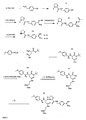
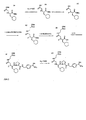
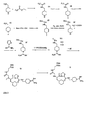
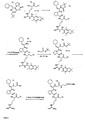
- A is an ethylene group B is a bond or wherein R 5 is an alkyl radical which comprises 1 to 4, preferably 1 or 2 and particularly preferably a carbon atom and with one or more identical or different halogen atoms, preferably Cl or F, or with a radical may be substituted; n is 0, 1, 2, 3, 4 or 5, D a rest -R 8 - (CH 2 ) b -NH 2 , or where R 6 and R 8 are, independently of one another, bivalent radicals selected from aromatic or saturated 6-membered rings which, in addition to carbon, may also contain a heteroatom, preferably a nitrogen atom, and may carry one or more identical or different alkyl substituents, and R 6
- -NH- may be if a is 0, R 7 is a water atom or -NH 2 and a is 0 or 1 and b is 0, 1 or 2; R 1 is a hydrogen atom or an arylsulfonyl, Aral
- B in the general formula (I) preferably represents a bond or one of the following structures:
- R 6 is preferably 1,4-piperidinediyl, 1,3-piperidinediyl, 1,4-phenylene, 1,3-phenylene, 1,4-cyclohexanediyl, 1,3-cyclohexanediyl or --NH--.
- R 8 is preferably 1,4-phenylene, 1,3-phenylene, 1,4-cyclohexanediyl, 1,3-cyclohexanediyl or 2,5-pyridinediyl.
- D Particularly preferred for D are the following structures which are linked via the ⁇ labeled bond with the rest of the general structure (I)
- Preferred substituents of the aryl moiety of R 1 are methyl, ethyl, propyl, methoxy or ethoxy groups.
- the halogen atoms used are preferably Cl, Br or F.
- Preferred radicals R 1 are thus, for example, 3-methoxy-phenylsulfonyl, 3,4-dichloro-phenylsulfonyl, Benzylsulfonyl, 3,4-dimethoxyphenylsulfonyl, 2,4,5-trichloro-phenylsulfonyl, 2-naphthylsulfonyl, 4-chloro-phenylsulfonyl, pentamethyl-phenylsulfonyl, 2,4,6-triisopropyl-phenylsulfonyl.
- Particularly preferred radical R 1 is a 4-methoxy-substituted phenylsulfonyl radical, or a 4-methoxy-substituted phenylsulfonyl radical which is additionally substituted at position 3 with a chlorine atom or with a methyl group. It may also carry further methyl radicals at positions 2, and / or 6.
- the oligo- or polyalkylene glycol fraction of the compounds according to the invention encompassed by X is preferably represented by a polyethylene glycol or polypropylene glycol, ie the parameters d and f are preferably 2 or 3.
- Preferred chain lengths result from values of the parameter e of 3 and 500, more preferably this has resulting polyalkylene glycol has an average molecular weight which is between 750 and 20,000 Da, in particular around 750, 2000, 3000, 3400, 5000, 6000, 10,000 or 20,000 Da.
- X forms a cyclic structure, ie a crown ether of the structure f also preferably assumes the values 2 and 3. Particularly preferred values for g are 3, 4, 5 or 6 here.
- crown ethers corresponds to that of polyalkylene glycol chains of a considerably higher molecular weight.
- crown ether conjugates composed of 5 PEG units have a blood elimination kinetics of rats which are those of polyethylene glycol (PEG) conjugates having a molecular weight of PEG Proportion of 5000 to 10,000 Da corresponds.
- PEG polyethylene glycol
- crown ethers provide chemically uniquely defined compounds compared to linear polyalkylene glycols, which necessarily have a certain breadth of molecular weight distribution, which has advantages, particularly in the provision of medicaments
- X has the structure - [O- (CH 2 ) d ] e -OZ or - [O-CH (CH 3 ) -CH 2 ] e -OZ and Z is chosen such that it corresponds to the inhibitor structure, to which the rest X is bound with its free valence, which is located at the end of the oligo- or polyalkylene glycol structure, which Z is opposite, thus creating a double-inhibitor-functionalized oligo- or polyalkylene glycol.
- the inhibitory effect can be increased based on the number of molecules of structure (I) present. This can be done, inter alia, in the modification of surfaces with molecules of Structure (I) be advantageous if the highest possible inhibitor density per unit area is to be achieved.
- alkyl in the context of the present invention refers to linear or branched C 1 -C 8 alkyl radicals, preferably C 1 -C 5 , particularly preferably C 1 -C 3 .
- Cycloalkyl radicals contain 3-8, preferably 3 to 6 C atoms.
- Alkoxy refers to those radicals whose carbon chain comprises 1 to 8, preferably 1 to 5, particularly preferably 1 to 3, carbon atoms.
- Alkyl describes structures having 7 to 19, preferably 7 to 13, particularly preferably 7 to 9 C atoms.
- Aryl radicals are radicals having 6 to 18, preferably 6 to 12, particularly preferably 6 C atoms. This definition applies independently for each case of occurrence of the above designations.
- R 1 is a 4-methoxyphenylsulphonyl, 4-methoxy-3-chlorophenylsulphonyl, 4-methoxy-3-methylphenylsulphonyl or 4-methoxy-2,3,6-trimethylphenylsulphonyl radical (Mtr) is
- Q is - (CH 2)
- S 'with s' 0, 1, 2, 3 or 4, -O-CH 2 - or -CH 2 -CH 2 -CO-NH-CH 2
- PEG represents a polyethylene glycol structure of the formula - [OC 2 H 4 ] i -, with values of i of 3 to 1000, preferably 3 to 500, with those values of i being preferred which have an average molecular weight of the PEG of around 750 to 20,000 Da , preferably around 750, 2000, 3000, 3400, 5000, 6000, 10000 or 2000 Da.
- the variable h is a 4-methoxyphenylsulphonyl, 4-methoxy
- the compounds of general formula (I) are prepared in a pharmaceutically acceptable, non-toxic salt form, such as e.g. As hydrochloride, hydrobromide, acetate, lactate; Citrate, tosylate or trifluoroacetate salt. They can be used in the usual galenic application forms solid or liquid, for example as solutions, sprays, ointments or creams. These are produced in the usual way.
- the active compounds can be processed with the usual galenic adjuvants such as fillers, preservatives, flow regulators, wetting agents, dispersants, emulsifiers, solvents and / or propellants (cf. H. Sucker et al., Pharmaceutical Technology, Thieme-Verlag, Stuttgart, 1978 ).
- the compounds may be administered orally or parenterally (subcutaneously, intravenously, intramuscularly, intraperitoneally) in a conventional manner. They may be used for diagnostic purposes or are also useful for biotechnological processes, such as e.g. Affinity purification of proteases or the removal of proteases from solutions of any kind suitable.
- Compounds of structure (I) are also particularly suitable for coating or modifying the surface of macromolecular carriers to prevent or reduce coagulation on these supports.
- macromolecular carriers especially surfaces of medical articles and devices such as hemodialyzers, oxygenators and their tube systems, are preferably made of polymethyl methacrylate, copolymers with polymethyl methacrylate and analogous plastics, as described in WO 98/46648 (Bucha and Nowak ) are defined.
- the polymer preferably contains a repeating unit of the formula (A): wherein the radicals R may be the same or different and represent an alkyl or aryl radical or a hydrogen atom.
- the alkyl radical may be linear or branched and preferably consists of 1 to 20 carbon atoms.
- the aryl radical preferably consists of 6 to 18, particularly preferably 6 to 12 carbon atoms.
- alkyl radical is a straight-chain or branched, optionally substituted C 1-8 -alkyl radical, for example a methyl, ethyl or propyl radical.
- optional substituents include one or more halogen atoms, for example fluorine, chlorine, bromine or iodine atoms or hydroxyl groups, C 1-6 -alkyl radicals or C 1-6 -alkoxy radicals or C 1-6 -alkylthiol radicals.
- the aryl radical is particularly preferably a monocyclic or bicyclic, optionally substituted aryl radical which may optionally contain one or more heteroatoms.
- aryl radicals are phenyl, 1- or 2-naphthyl, indenyl or isoindenyl radicals.
- heteroatom-containing aryl radicals are C 3-9 heteroaryl radicals containing heteroatoms selected from oxygen, sulfur or nitrogen atoms.
- Monocyclic heteroaryl radicals include, for example, pyrolyl, furyl, thienyl, imidazolyl, N-methylimidazolyl, N-ethylimidazolyl, benzothiazolyl, quinazolinyl, naphthylpyridinyl, quinolinyl, isoquinolinyl and tetrazolyl radicals.
- a preferred polymer containing such groups is a polyalkyl methacrylate (PAMA) having an alkyl group, preferably comprising 1-6 C atoms, such as, for example, Polymethylmethacrylate (PMMA), polyethylniethacrylate (PEMA) or polypropylmethacrylate.
- PMMA Polymethylmethacrylate
- PEMA polyethylniethacrylate
- polypropylmethacrylate polypropylmethacrylate
- polyvinyl acetate, polycyclohexyl methacrylates or polyphenyl methacrylate can be used. Particular preference is given to using polymethyl methacrylate.
- Copolymers or polymer blends of any proportions of the abovementioned polymers with one another or with one or more further polymer components, for example polystyrene, polyacrylonitrile or polyamides, can also be used.
- the proportion of monomers which have a structural element (A) on such copolymers is preferably at least 20%, particularly preferably at least 40% and very particularly preferably at least 60%.
- the surface is coated with the inhibitor conjugates of the invention, e.g. in the form of a solution, brought into contact. It is also possible to use mixtures of different inhibitor conjugates of the present invention.
- Analytical HPLC Shimadzu LC-10A System, Column: Vydac C 18 , 5 ⁇ m (250 x 4 mm) Solvent A: 0.1% TFA in water, B: 0.1% TFA in ACN, gradient: 10% B to 60% B in 50 min, 1 ml / min flow, detection at 220 or 215 nm.
- the mass spectra were measured on a Kompact sample from Kratos (Manchester, England) using a time-of-flight measurement detector and ⁇ -cyano-hydroxycinnamic acid as matrix.
- the K i values After calculating the increases (reaction rates), the K i values according to Dixon ( Biochem. J. 55, 170-171, 1953 ) determined by linear regression using a computer program. The K i values are the mean of at least three determinations. In an analogous manner, the K i values for trypsin were determined. To determine the Thrombinhemmrial by all reversibly binding inhibitors and inhibitor conjugates with inhibitory constants less than 1 nM was a Fluorescence spectrometer (LS50B Perkin Elmer) used.
- the measurement batch consists of 880 ⁇ l of Tris buffer (0.05 mM, 0.1 M NaCl, pH 7.8, containing the inhibitor, the inhibitor concentration in the measurement batch is greater than 200 pM) and 100 ⁇ l of substrate (Tos-Gly-Pro).
- Arg-AMC concentrations in the measurement batch 5-30 ⁇ M).
- the measurement is started by addition of 20 ⁇ l of human ⁇ -thrombin (Kordia, final thrombin concentration in the measurement batch 21 pM). Over a period of 7 minutes, the increase in fluorescence intensity was followed ( ⁇ Ex 365 nm, ⁇ Em 455 nm). After calculating the increases (reaction rates), the K i values according to Dixon ( Biochem. J.
- thrombin inhibitors with good trypsin selectivity have been found to be the compounds of structure (II) in which R 1 is a 4-methoxy-3-chlorobenzenesulfonyl, 4-methoxy-3-methyl-benzenesulfonyl, 4-methoxy-benzenesulfonyl- or 4-methoxy-2,3,6-trimethyl-phenylsulfonyl and R 10 is a radical represents.
- R 1 represents a 4-methoxy-3-chlorobenzenesulfonyl, 4-methoxy-3-methyl-benzenesulfonyl, 4-methoxyphenylsulfonyl or a 4-methoxy-2,3,6-trimethylphenylsulfonyl radical;
- R 9 is one of the radicals - (CH 2 ) j -C (O) OR 11 , - (CH 2 ) j -R 12 , or - (CH 2 ) j -C (O) NH-R 11 where R 11 is a hydrogen atom, or a C 1 -C 6 alkyl radical, C 7 -C 13 aralkyl radical or a C 6 to C 12 aryl radical which may optionally be substituted, R 12 is one of the groups NH 2 , OH or SH, and j 1, 2, 3 or 4, R 10 is and there is an L-configuration on the C-atom marked with *.
- Suitable substituents of the radical R 11 are halogen atoms, such as, for example, chlorine or bromine, linear or branched alkyl groups, carboxyl groups, cyano groups, carboxyalkyl groups or aminoalkyl groups, which may be present in the case of the aralkyl radical on the aromatic but also on the alkyl part.
- the PEG-coupled compound is somewhat less active than the analogous free compound, but on the other hand it is a stronger thrombin inhibitor than the PACK already described in the literature.
- Effective thrombin inhibitors should preferably hardly inhibit the plasminolytic enzymes plasmin, urokinase and tPA, since these proteases are involved in the dissolution of fibrin clots and therefore possess antithrombotic properties. Therefore, 2 selected representatives of the inhibitors described in Tables 1 and 2 without PEG and a PEG-coupled inhibitor were examined for their inhibitory effect on these enzymes.
- Inhibitory constants of selected inhibitors with respect to the enzymes thrombin, plasmin, urokinase and tPA values in nM.
- No. sequence K i thrombin K i plasmin K i urokinase K i tPA 1c 4-MeO-bs-Gly-Pro-4-Amba 0.97 5800 225000 630 50
- the introduction of a suitable side chain L-amino acid not only enhances thrombin inhibition, but also attenuates the inhibition of the fibrinolytic enzymes plasmin and tPA. Accordingly, the compound with asparagine listed in the table and the PEG-coupled inhibitor are very effective and also very selective thrombin inhibitors.
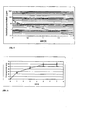
- Fig. 5 shows the elimination of the compound shown in formula (IV) after intravenous administration of 10 mg / kg to the rat.
- the elimination half-life is approx. 16.5 min.
- FIG. 6 Figure 4 shows the results of determination of urinary cumulative recovery of the compound shown in formula (IV) after subcutaneous administration to the rat. About 58% of the compound is recovered in the urine.
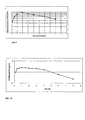
- Fig. 7 shows the blood level of the compound of formula (V) shown below (the PEG chain has an average molecular weight of 5000 Da) after subcutaneous administration of 10 mg / kg.
- the determined elimination half-life is approximately 2.6 hours and is thus significantly longer compared to the free, non-pegylated compound (see Fig. 5 ).
- Fig. 9 shows a semilogarithmic representation of the concentration-time curve after subcutaneous administration of 5 mg / kg of the inhibitor structure (VI) in the rat.
- the calculated elimination half-life is approximately 350 minutes. The half-life of this compound is thus significantly extended.
- the inhibitor concentrations were determined in the blood, in the plasma and in the urine by means of the Ecarin clotting test ( Nowak and Bucha, (1996) Quantitative determination of hirudin in blood and body fluids. Semin. Thromb. 22, 197-202 ) certainly.
- Fig. 10 shows the plasma levels of the inhibitor of general structure (VII) with an average PEG chain around 2000 Da after subcutaneous administration of 2.5 mg / kg in swine.
- FIG. 11 Figure 2 shows the cumulative excretion of the inhibitor of general structure (VII) with an average PEG chain around 2000 Da after subcutaneous administration of 2.5 mg / kg in porcine urine.
- Fig. 12 shows the plasma levels of the inhibitor of general structure (VII) with an average PEG chain around 10000 Da after subcutaneous administration of 20 mg / kg in swine.
- FIG. 13 Figure 4 shows the cumulative excretion of the inhibitor of general structure (VII) with an average PEG chain at 10000 Da after subcutaneous administration of 20 mg / kg in pig urine.
Landscapes
- Health & Medical Sciences (AREA)
- Chemical & Material Sciences (AREA)
- Medicinal Chemistry (AREA)
- Animal Behavior & Ethology (AREA)
- Public Health (AREA)
- Veterinary Medicine (AREA)
- Organic Chemistry (AREA)
- Engineering & Computer Science (AREA)
- Bioinformatics & Cheminformatics (AREA)
- Pharmacology & Pharmacy (AREA)
- Chemical Kinetics & Catalysis (AREA)
- Life Sciences & Earth Sciences (AREA)
- General Chemical & Material Sciences (AREA)
- General Health & Medical Sciences (AREA)
- Epidemiology (AREA)
- Polymers & Plastics (AREA)
- Diabetes (AREA)
- Hematology (AREA)
- Nuclear Medicine, Radiotherapy & Molecular Imaging (AREA)
- Medicines That Contain Protein Lipid Enzymes And Other Medicines (AREA)
- Medicinal Preparation (AREA)
- Peptides Or Proteins (AREA)
- Enzymes And Modification Thereof (AREA)
- Pharmaceuticals Containing Other Organic And Inorganic Compounds (AREA)
- Polyethers (AREA)
Description
- Die Erfindung betrifft neuartige, kovalente Oligo- und Polyalkylenglykolkonjugate mit synthetischen Inhibitoren trypsinartiger Serinproteasen, insbesondere Inhibitoren der Blutgerinnungsprotease Thrombin, synthetische Zwischenstufen zu deren Herstellung und ihre Verwendung zur Herstellung von Wirkstoffen für die Therapie oder Prophylaxe thrombotischer Komplikationen.
- Die trypsinartige Serinprotease Thrombin ist das zentrale Enzym der Blutgerinnungskaskade. Unter anderem spaltet es Fibrinogen, wodurch ein Fibringerinnsel entsteht, dass durch folgende Quervernetzung, katalysiert durch Faktor XIIIa, stabilisiert wird (Davie et al., 1991 Biochemistry30, 10363-10370). Auch der Faktor XIIIa selbst wird durch die katalytische Wirkung des Thrombins aus seiner Zymogenform aktiviert. Thrombin kann die Blutgerinnungskaskade zusätzlich durch die Aktivierung der Faktoren V und VIII beschleunigen. Weiterhin ist Thrombin in der Lage, den auf der Thrombocytenoberfläche befindlichen Thrombinrezeptor spezifisch zu stimulieren, was zu einer Plättchenaktivierung führt Zu hohe Thrombinaktivitäten können zu verschiedenen thrombotischen Komplikationen führen, wie z.B. Myocardinfarkt, tiefer Venenthrombose, peripheren arteriellen Verschlusskrankheiten oder Lungenembolie. Thrombotische Komplikationen können auch bei Therapien auftreten, bei denen Blut in Kontakt mit nichtphysiologischen Oberflächen kommt, wie z.B. bei operativen Eingriffen, bei der Hämodialyse oder in Herz-Lungenmaschinen.
Durch die Verwendung des Thrombininhibitors Hirudin konnte nachgewiesen werden, daß spezifische Thrombinhemmer blutgerinnungshemmende Eigenschaften besitzen und für die Vermeidung thrombotischer Komplikationen geeignet sind (Markwardt, 1970 Methods in Enzymol. 19, 924-932). Hirudin ist ein natürlich vorkommendes Protein, das aus dem medizinischen Blutegel isoliert wurde und seit einigen Jahren in rekombinanter Form vorliegt. Inzwischen wurde rekombinant hergestelltes Hirudin für einige Indikationen, wie z.B. zur Vermeidung von Thrombosen nach Hüftgelenksoperationen oder bei Heparin-induzierter Thrombocytopenia, zugelassen (Menear, 1999 Expert Opinion on Investigational Drugs 8, 1373-1384).
Da rekombinante Proteine kostenintensiv hergestellt werden müssen, nur parenteral appliziert werden können und körperfremde Proteine eine antigene Wirkung besitzen, wird intensiv an der Entwicklung niedermolekularer, synthetischer Thrombininhibitorn zur Verwendung als oral wirksame Antikoagulantien geforscht. Trotz intensiver Bemühungen sind bisher nur zwei niedermolekulare Thrombininhibitoren, Argatroban und Gabexate Mesilate, in Japan zugelassen, jedoch sind auch diese Verbindungen nur parenteral wirksam und besitzen eine sehr kurze Verweildauer im Blut. Argatroban erhielt im Jahr 2000 auch die Zulassung in den USA. - Aus der Literatur ist bekannt, dass man durch kovalente Konjugation mit Makromolekülen, wie z.B. Polysacchariden oder Polyethylenglykolen (PEG), die Verweildauer von Proteinen, Inhibitoren und anderen Wirkstoffen im Blut verlängern kann. Dies gilt z.B. auch für ein PEG-gekoppeltes Hirudin (
Kurfürst et al., WO 91/08229 Stüber und Koschinsky EP 0658 585 A2 ). Beide PEG-Inhibitoren besitzen eine längere Halbwertszeit im Blut von Versuchstieren im Vergleich zu den freien, unmodifizierten Verbindungen.
Aus der Entwicklung niedermolekularer Thrombinhemmstoffe ist bekannt, dass man die für die Bindung notwendigen basischen Aminosäuren Arginin und Lysin, als auch deren Mimetika 4-Amidinophenylglycin oder 3- und 4-Amidinophenylalanin durch geeignete decarboxylierte Analoga ersetzen kann, ohne dass ein Verlust an Thrombinaffinität auftritt. Beispiele dafür sind Verbindungen mit C-terminalem Agmatin (D-Phe-Pro-Agmatin; Bajusz et al., 1982 Folia Haematol., Leipzig 109, 16-21), Noragmatin (Inogatran; Teger-Nilsson,WO 93/11152 Melagatran, Antonsson et al., WO 94/29336 Böhm et al., US 5,852,051 ) oder 4-Aminomethyl-N(Amidino)Piperidin Sanderson et al., 1997 Bioorganic & Medicinal Chemistry Letters 7, 1497-1500). - Ein Problem bei der Anwendung von Thrombininhibitoren ist oftmals, dass die Leber diese Stoffe rasch aufnimmt, metabolisiert und sezerniert. Dabei können neue Metabolite mit unerwünschten Nebenwirkungen entstehen, die teilweise wieder in den Blutkreislauf abgegeben werden und so z.B: für eine Medikamentenentwicklung nur bedingt geeignet sind. Eine Ausnahme in die Leber wurde z. B. für Thrombininhibitoren aus völlig verschiedenen Substanzklassen gezeigt, wie z.B. für CRC220, TAPAP, NAPAP, Argatroban oder Efegatran.
- Überraschenderweise konnten wir feststellen, dass die hier beschriebenen Oligo- oder Polyalkylenglykol-gebundenen Inhibitoren (Inhibitor-Konjugate) in verstärktem Maß bzw. nahezu vollständig über die Niere eliminiert werden. Das heißt, dass die kovalente Kopplung eines Oligo- oder Polyalkylenglykolanteils an die von uns verwendeten niedermolekularen, synthetischen Thrombininhibitoren deren Ausscheidungsweg verändert. Gleichzeitig erhöht sich die Verweildauer der Inhibitor-Konjugate im Blut im Vergleich zu den freien Inhibitoren und damit auch ihre gerinnungshemmende Wirkung, die strikt von der Konzentration im Blut abhängig ist (Hauptmann und Stürzebecher, 1999 Thrombosis Research 93, 203-241).
Unter der Bezeichnung Inhibitor werden im Rahmen der vorliegenden Anmeldung Moleküle verstanden die spezifisch an das aktive Zentrum des Zielenzyms binden und so zu dessen Hemmung führen. Werden solche Moleküle zusammen mit Oligo- oder Polyalkylenglykolen in die erfindungsgemäßen Inhibitorkonjugate integriert, so bilden sie die Inhibitorstruktur, d.h. den Teil der erfindungsgemäßen Konjugate, dessen Struktur eine spezifische Wechselwirkung mit dem Zielenzym erlaubt. Als bivalente Inhibitorkonjugate werden solche bezeichnet, deren Oligo- oder Polyalkylenanteil mit zwei Inhibitorstruktwen verknüpft ist - Wir haben gefunden, dass man durch Einbau von decarboxylierten, basischen P1-Resten in Oligo- und Polyalkylenglykol-gekoppelte Verbindungen hochpotente Thrombininhibitor-Konjugate erhalten kann. Zusätzlich haben wir gefunden, dass man auch Thrombininhibitoren mit Oligo- und Polyalkylenglykolen modifizieren kann, die als Pl-Rest substituierte Arginylketonderivate besitzen. Bei Einsatz solcher Verbindungen ist man weder auf das im aus dem Stand der Technik bekannten PEG-gekoppelten CRC-220 verwendete, kostenintensive D-4-Amidinophenylalanin noch auf nur unter großem Aufwand herzustellendes rekombinantes Hirudin angewiesen.
- Diese Oligo- und Polyalkylenglykol-gekoppelten Inhibitoren werden im Gegensatz zu den freien Inhibitoren nicht bzw. nur in geringem Umfang in die Leberzellen aufgenommen und dort verstoffwechselt oder in die Galle überführt, sondern fast ausschließlich über die Niere eliminiert. Nach subkutaner Applikation der Oligo- und Polyälkylenglykol-gekoppelten Inhibitoren wurden lang anhaltende und für eine Gerinnungshemmung notwendige Blutspiegel der Inhibitoren bestimmt und es wurde festgestellt, das hierfür die stark verzögerte Transferrate der Substanzen zwischen Extravasalraum und Intravasalraum verantwortlich ist. Die gleichmäßige Verteilung nach Resorption aus einem subkutanen Injektionsdepot führt zu einem ausschließlichen Ausfüllen des extrazellulären Wasserraumes, da die Kopplung der Inhibitoren mit Oligo- oder Polyalkylenglykolen zu Substanzen mit vergrößerten Hydrathüllen führt.
- Die von uns entwickelten Verbindungen besitzen die allgemeine Struktur (I)

A eine Ethylengruppe ist
B eine Bindung oder

D einen Rest

R1 ein Wasserstoffatom oder ein Arylsulfonyl-, Aralkylsulfonyl-, Cycloalkylmethylsulfonyl-, Cycloalkylethylsulfonyl- oder ein Alkylsulfonylrest ist, deren Arylteil gegebenenfalls einen, zwei, drei, vier oder fünf Substituenten, die unabhängig voneinander ausgewählt sind aus Halogenatomen, Alkyl- oder Alkoxyresten, tragen kann, oder mit einem weiteren Arylrest verknüpft ist;
und entweder
R2 -(CH2)p-CO-NH-(CH2)q-X, -(CH2)r-NH-CO-(CH2)s-V-X oder
-(CH2)r-NH-CO-O-(CH2)s-V-X ist
wobei
p eine ganze Zahl von 1 bis 5 und q eine ganze Zahl von 2 bis 5 ist,
r eine ganze Zahl von 2 bis 5 und s ist eine ganze Zahl von 1-5 ist,
V eine Bindung oder -CO-NH-(CH2)c- und c eine ganze Zahl von 2 bis 5 ist, und
X einen Oligo- oder Polyalkylenglykol der Struktur -[O-(CH2)d]c-OZ oder -[O-CH(CH3)-CH2]e-OZ oder einen Cyclus der Struktur
R3 ein Phenyl- oder Cyclohexylrest ist, der mit 1 bis 5 gleichen oder unterschiedlichen Substituenten, unabhängig voneinander ausgewählt aus Halogenatomen, Alkyl- oder Alkoxyresten oder Hydroxylgruppen substituiert sein kann und
R4 ein Wasserstoffatom, Phenyl- oder Cyclohexylrest ist, der mit 1 bis 5 gleichen oder unterschiedlichen Substituenten, unabhängig voneinander ausgewählt aus Halogenatomen, Alkyl- oder Alkoxyresten oder Hydroxylgruppen substituiert sein kann, wobei das Wasserstoffatom bevorzugt wird wenn m größer als 1 ist,
m 0, 1, 2, 3 oder 4 ist und
am mit *gekennzeichneten Kohlenstoffatom eine D-Konfiguration vorliegt;
oder
R2 ein Wasserstoffatom ist und
R3 -CO-NH-(CH2)q-X, -CO-W1-W2-(CH2)q-X, -NH-CO-(CH2)5-V-X, -NH-CO-O-(CH2)s-V-X, -S-CH2-CO-NH-(CH2)x-X oder -S-S-CH2-CH2-X ist,
wobei q, s X und V wie vorstehend definiert sind und t eine ganze Zahl von 2 bis 5 ist, und der Rest W1 -O- oder -NH- ist, und W2 eine Bindung darstellt oder die Struktur -(CH2)v-Ph-(CH2)v'-Amid- aufweist, in der v und v' unabhängig von einander 0, 1 oder 2 sind, Ph einen 1,2-, 1,3- oder 1,4-substituierten Phenylrest und Amid -HN-(O)C- oder-C(O)NH- darstellt, R4 ein Wasserstoffatom ist,
m 1, 2, 3, 4 oder 5 ist und
am mit * gekennzeichneten Kohlenstoffatom eine L-Konfiguration vorliegt. - Bevorzugt stellt B in der allgemeinen Formel (I) eine Bindung oder eine der folgenden Strukturen dar:

- Im Rest D in der allgemeinen Formel (I) ist R6 bevorzugt 1,4-Piperidindiyl, 1,3-Piperidindiyl, 1,4-Phenylen, 1,3-Phenylen, 1,4-Cyclohexandiyl, 1,3-Cyclohexandiyl oder -NH-. R8 ist bevorzugt 1,4-Phenylen, 1,3-phenylen, 1,4-Cyclohexandiyl, 1,3-Cyclohexandiyl oder 2,5-Pyridindiyl.
- Besonders bevorzugt sind für D die folgenden Strukturen, die über die mit ∼ markierte Bindung mit dem Rest der allgemeinen Struktur (I) verknüpft sind


- Bevorzugte Substituenten des Arylanteils von R1 sind Methyl, Ethyl, Propyl, Methoxy oder Ethoxygruppen. Als Halogenatome werden bevorzugt Cl, Br oder F eingesetzt. Bevorzugte Reste R1 sind damit beispielsweise 3-Methoxy-phenylsulfonyl, 3,4-Dichlor-phenylsulfonyl, Benzylsulfonyl, 3,4-Dimethoxy-phenylsulfonyl, 2,4,5-Trichlor-phenylsulfonyl, 2-Naphtylsulfonyl, 4-Chlor-phenylsulfonyl, Pentamethyl-phenylsulfonyl, 2,4,6-Triisopropyl-phenylsulfonyl. Als besonders bevorzugter Rest R1 ist ein 4-methoxysubstituierter Phenylsulfonylrest zu nennen, oder ein 4-methoxy-substituierter Phenylsulfonylrest, der an Position 3 zusätzlich mit einem Chloratom oder mit einer Methylgruppe substituiert ist. Er kann auch an den Positionen 2, und/oder 6 gegebenenfalls weitere Methylreste tragen.
- Der von X umfasste Oligo- oder Polyalkylenglykolanteil der erfindungsgemäßen Verbindungen wird bevorzugt durch ein Polyethylenglykol oder Polypropylenglykol dargestellt, d.h. die Parameter d und f sind vorzugsweise 2 oder 3. Bevorzugte Kettenlängen ergeben sich aus Werten des Parameters e von 3 und 500, besonders bevorzugt hat das resultierende Polyalkylenglycol ein mittleres Molekulargewicht, das zwischen 750 und 20000 Da liegt, insbesondere um 750, 2000, 3000, 3400, 5000 6000, 10000 oder 20000 Da. Bildet X eine cyclische Struktur, d.h. einen Kronenether der Struktur

- Überraschenderweise wurde festgestellt, dass die Wirkung solcher Kronenether der von Polyalkylenglykolketten eines erheblich höheren Molekulargewichtes entspricht So besitzen beispielsweise Kronenetherkonjugate die aus 5 PEG-Einheiten aufgebaut sind eine Eliminierungskinetik im Blut von Ratten, die der von Polyethylenglykol (PEG)-Konjugaten mit einem Molekulargewicht des PEG Anteils von 5000 bis 10000 Da entspricht. Darüber hinaus stellen Kronenether im Vergleich zu linearen Polyalkylenglykolen, die notwendigerweise eine gewisse Breite der Molekulargewichtsverteilung aufweisen, chemisch einheitlich definierte Verbindungen dar, was insbesondere bei der Bereitstellung von Medikamenten Vorteile mit sich bringt
- Besitzt X die Struktur -[O-(CH2)d]e-OZ oder -[O-CH(CH3)-CH2]e-OZ und wird Z so gewählt, dass es der Inhibitorstruktur entspricht, an welche der Rest X mit seiner freien Valenz gebunden ist, die sich an dem Ende der Oligo- oder Polyalkylenglykolstruktur befindet, welche Z entgegengesetzt liegt, so entsteht ein zweifach inhibitorfunktionalisiertes Oligo- oder Polyalkylenglykol. Mittels solcher bifunktionalen Konjugate läßt sich die Hemmwirkung bezogen auf die Anzahl der vorhandenen Moleküle der Struktur (I) erhöhen. Dies kann unter anderem bei der Modifizierung von Oberflächen mit Molekülen der Struktur (I) von Vorteil sein, wenn eine möglichst hohe Inhibitordichte pro Flächeneinheit erreicht werden soll.
- Soweit nicht gesondert definiert bezieht sich der Begriff "Alkyl-" im Rahmen der vorliegenden Erfindung auf lineare oder verzweigte C1-C8 Alkylreste, bevorzugt C1-C5, besonders bevorzugt C1-C3. Cycloalkylreste beinhalten 3-8, bevorzugt 3 bis 6 C-Atome. "Alkoxy-" bezieht sich auf solche Reste, deren Kohlenstoffkette 1 bis 8, bevorzugt 1 bis 5, besonders bevorzugt 1 bis 3 C-Atome umfasst. "Aralkyl-" beschreibt Strukturen mit 7 bis 19, bevorzugt 7 bis 13, besonders bevorzugt 7 bis 9 C-Atomen. Arylreste sind Reste mit 6 bis 18, bevorzugt 6 bis 12, besonders bevorzugt 6 C-Atomen. Diese Definition gilt unabhängig voneinander für jeden Fall des Auftretens der obigen Bezeichnungen.
- Besonders bevorzugt sind im Rahmen der vorliegenden Erfindung die folgenden Verbindungen der Formel (Ia-h)


Q -(CH2)s'- mit s' = 0, 1, 2, 3 oder 4, -O-CH2- oder -CH2-CH2-CO-NH-CH2 ist und
PEG eine Polyethylenglykolstruktur der Formel -[O-C2H4]i- darstellt, mit Werten für i von 3 bis 1000, bevorzugt 3 bis 500, wobei solche Werte für i bevorzugt sind, die ein durchschnittliches Molekulargewicht des PEG von um 750 bis 20000 Da, bevorzugt um 750, 2000, 3000, 3400, 5000, 6000, 10000 oder 2000 Da ergeben. Die Variable h steht für 1, 2, 3 oder 4 und R10 ist
- Die Verbindungen der allgemeinen Formel (I) werden in einer pharmazeutisch geeigneten, nicht-toxischen Salzform hergestellt, wie z. B. als Hydrochlorid-, Hydrobromid-, Acetat-, Lactat-; Zitrat-, Tosylat- oder Trifluoracetat-Salz. Sie können in den gebräuchlichen galenischen Applikationsformen fest oder flüssig angewendet werden, z.B. als Lösungen, Sprays, Salben oder Cremes. Diese werden in üblicher Weise hergestellt. Die Wirkstoffe können dabei mit den üblichen galenischen Hilfsmitteln wie Füllstoffen, Konservierungsmitteln, FlieBregulierungsmitteln, Netzmitteln, Dispergiermitteln, Emulgatoren, Lösungsmitteln und/oder Treibgasen verarbeitet werden (vgl. H. Sucker et al., Pharmazeutische Technologie, Thieme-Verlag, Stuttgart, 1978).
- Die Verbindungen können in üblicher Weise oral oder parenteral (subkutan, intravenös, intramuskulär, intraperitoneal) verabreicht werden. Sie können für diagnostische Zwecke verwendet werden oder sind auch für biotechnologische Prozesse, wie z.B. Affinitätsreinigungen von Proteasen oder das Entfernen von Proteasen aus Lösungen jeglicher Art geeignet.
- Verbindungen der Struktur (I) sind auch besonders für eine Beschichtung oder Modifikation der Oberfläche makromolekularer Träger geeignet, um die Gerinnung an diesen Trägern zu verhindern bzw. zu reduzieren. Diese makromolekularen Träger, insbesondere Oberflächen medizinischer Gegenstände und Geräte wie z.B Hämodialysatoren, Oxygenatoren und deren Schlauchsysteme, bestehen bevorzugt aus Polymethylmethacrylat, Copolymeren mit Polymethylmethacrylat und analogen Kunststoffen, wie sie in
WO 98/46648 (Bucha und Nowak 
- Besonders bevorzugt als Alkylrest ist ein geradkettiger oder verzweigter, gegebenenfalls substituierter C1-8-Alkylrest, beispielsweise ein Methyl-, Ethyl- oder Propylrest. Beispiele für gegebenenfalls vorhandene Substituenten umfassen ein oder mehrere Halogenatome, z.B. Fluor-, Chlor-, Brom- oder Iodatome oder Hydroxylgruppen, C1-6-Alkylreste oder C1-6-Alkoxyreste oder C1-6-Alkylthiolreste. Der Arylrest ist besonders bevorzugt ein monocyclischer oder bicyclischer, gegebenenfalls substituierter Arylrest, der gegebenenfalls ein oder mehrere Heteroatome enthalten kann. Beispiele für solche Arylreste sind Phenyl, 1- oder 2-Naphthyl, Indenyl- oder Isoindenylreste. Beispiele für heteroatomhaltige Arylreste sind C3-9-Heteroarylreste, die Heteroatome, ausgewählt aus Sauerstoff-, Schwefel- oder Stickstoffatomen, enthalten. Monocyclische Heteroarylreste umfassen beispielsweise Pyrolyl-, Furyl-, Thienyl-, Imidazolyl-, N-Methylimidazolyl-, N-Ethylimidazolyl-, Benzothiazolyl-, Chinazolinyl-, Naphthylpyridinyl-, Chinolyinyl-, Isochinolinyl- und Tetrazolylreste.
- Ein bevorzugtes Polymer, das solche Gruppen enthält, ist ein Polyalkylmethacrylat (PAMA) mit einem Alkylrest, der vorzugsweise 1-6 C-Atome umfasst, wie z.B. Polymethylmethacrylat (PMMA), Polyethylniethacrylat (PEMA) oder Polypropylmethacrylat. Weiterhin können Polyvinylacetat, Polycyclohexylmethacrylate oder Polyphenylmethacrylat eingesetzt werden. Besonders bevorzugt wird Polymethylmethacrylat eingesetzt.
- Auch Copolymere oder Polymermischungen aus beliebigen Anteilen der vorstehend genannten Polymere untereinander oder mit einer oder mehrerer weiterer Polymerkomponenten, beispielsweise Polystyrol, Polyacrylnitril oder Polyamiden können eingesetzt werden. Bevorzugt beträgt der Anteil der Monomere, die ein Strukturelement (A) aufweisen an solchen Mischpolymeren mindestens 20 %, besonders bevorzugt mindestens 40 % und ganz besonders bevorzugt mindestens 60 %.
- Zur Modifikation solcher Oberflächen wird die Oberfläche mit den erfindungsgemäßen Irihibitorkonjugaten, z.B. in Form einer Lösung, in Kontakt gebracht. Dabei können auch Gemische unterschiedlicher Inhibitorkonjugate der vorliegenden Erfindung eingesetzt werden.
-
- ACN = Acetonitril
- Amba =Amidinobenzylamid
- Cha = Cyclohexylalanin
- CKIBE = Chlorkohlensäureisobutylester
- DIEA = Diisopropylethylamin
- DMF = Dimethylformanlid
- EE = Essigsäureethylester
- AcOH = Essigsäure
- HBTU = 2-(1H-Benzotriazole-1-yl)-1,1,3,3-Tetramethyluronium Hexafluorophosphat
- 4-MeO-bs = 4-Methoxy-benzensulfonyl
- 4-MeO-3-Cl-bs = 4-Methoxy-3-Chlor-benzensulfonyl
- 4-MeO-3-Me-bs = 4-Methoxy-3-Methyl-benzensulfonyl
- Mtr = 4-Methoxy-2,3,6-trimethyl-benzensulfonyl
- NMM = N-Methyl-Morpholin
- OSu = Succinimidester
- OtBu = tert.Butylester
- PyBOP = Benzotriazole-1-yl-oxy-tris-pyrrolidino-phosphonium hexafluorophosphat
- TFA = Trifluoressigsäure
- THF = Tetrahydrofuran
- Analytische HPLC: Shimadzu LC-10A System, Säule: Vydac C18, 5 µm (250 x 4 mm) Lösungsmittel A: 0,1 % TFA in Wasser, B: 0,1 % TFA in ACN, Gradient: 10 % B bis 60 % B in 50 min, 1 ml/min Fluß, Detektion bei 220 oder 215 nm.
- Präparative HPLC: Shimadzu LC-8A System, Säule: Vydac C18, 10 µm (250 x 22 mm) Lösungsmittel A: 0,1 % TFA in Wasser, B: 0,1 % TFA in ACN, Gradient: 20 % B bis 65 % B in 120 min, 10 ml/min Fluß, Detektion bei 220 nm.
- Die Massenspektren wurden auf einem Kompact Probe der Firma Kratos (Manchester, England) mit einem Flugzeitmessungsdetektor und α-Cyano-Hydroxyzimtsäure als Matrix gemessen.
- Zur Bestimmung der Thrombinhemmwirkung durch alle reversibel bindenden Inhibitoren und Inhibitor-Konjugate mit Hemmkonstanten ≥ 1 nM wurden 175 µl Tris-Puffer (0,05 mM, 0,1 M NaCI, pH 7,8; enthält den Inhibitor) und 50 µl Substrat (d-Phe-Gly-ArgpNA in H2O, Konzentrationen im Messansatz 360, 120 und 60 µM) bei Raumtemperatur gemischt und die Reaktion durch Zugabe von 50 µl humanes' α-Thrombin (Kordia, finale Thrombinkonzentration im Messansatz 0,16 nM) gestartet. Über einen Zeitraum von 5 min wurde die Änderung der Absorption bei 405 nm mittels eines Microplate Readers (Labsystems iEMS Reader MF) bestimmt. Nach Berechnung der Anstiege (Reaktionsgeschwindigkeiten) wurden die Ki-Werte nach Dixon (Biochem. J. 55, 170-171, 1953) durch lineare Regression mittels eines Computerprogramms ermittelt. Die Ki-Werte sind das Mittel aus mindestens drei Bestimmungen.
Auf analoge Weise wurden die Ki-Werte für Trypsin bestimmt.
Zur Bestimmung der Thrombinhemmwirkung durch alle reversibel bindenden Inhibitoren und Inhibitor-Konjugate mit Hemmkonstanten kleiner 1 nM wurde ein Fluoreszenzspektrometer (LS50B der Firma Perkin Elmer) verwendet. Der Messansatz besteht aus 880 µl Tris-Puffer (0,05 mM, 0,1 M NaCI, pH 7,8; enthält den Inhibitor, die Inhibitorkonzentration im Messansatz ist größer 200 pM) und 100 µl Substrat (Tos-Gly-Pro-Arg-AMC, Konzentrationen im Messansatz 5-30 µM). Die Messung wird durch Zugabe von 20 µl humanes α-Thrombin (Kordia, finale Thrombinkonzentration im Messansatz 21 pM) gestartet. Über einen Zeitraum von 7 min wurde die Zunahme der Fluoreszenzintensität verfolgt (λEx 365 nm, λEm 455 nm). Nach Berechnung der Anstiege (Reaktionsgeschwindigkeiten) wurden die Ki-Werte nach Dixon (Biochem. J. 55, 170-171, 1953) durch lineare Regression mittels eines Computerprogramms ermittelt. Die Ki-Werte sind das Mittel aus mindestens drei Bestimmungen.
Wurde für die Inhibitoren ein slow-binding beobachtet, erfolgte die Auswertung analog einer früher beschriebenen Prozedur (Steinmetzer et al., Potent bivalent thrombin inhibitors: Replacement of the scissile peptide bond at P1-P1' with arginyl ketomethylene isosteres. J. Med. Chem. (1999) 42, 3109-3115).
Für die Optimierung der Inhibitor-Konjugate, insbesondere aus den nachfolgenden Beispielen 1 und 2, wurde nach geeigneten Resten R1 gesucht, die eine möglichst starke Thrombinhemmung ermöglichen. Um die Selektivität der Verbindungen zu untersuchen wurden auch die Hemmkonstanten für Trypsin bestimmt Je größer der Quotient [KiTrypsin/KiThrombin], desto selektiver ist die Verbindung als Thrombininhibitor. Um die Synthese zu erleichtern, wurde diese Optmierung zunächst ohne Kopplung mit einem Polyalkylenglykolrest an Inhibitorrnolekülen der Formel (II), wie in Tabelle I aufgeführt, vorgenommen. Diese Verbindungen, die selbst als Thrombininhibitoren aktiv sind, können als synthetische Zwischenstufen für die Inhibitorkonjugate der Formel (I) verwendet werden. Als zentraler Baustein wurde konstant ein Glycyl-Prolyl-Dipeptid in die Inhibitoren eingebaut.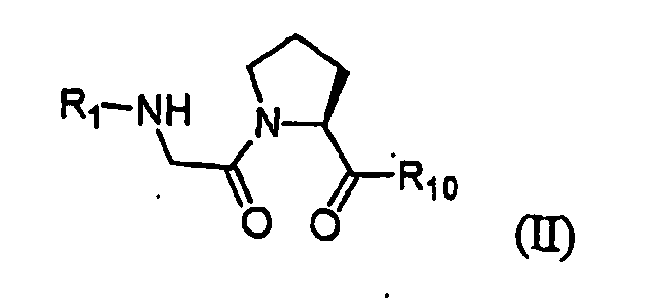
- Die Ergebnisse der Selektivitätsbestimmung sind für beispielhafte Verbindungen in Tabelle I gezeigt; wobei R10 für die Verbindungen der Tabelle die Struktur

Tabelle 1: Nr. R1 Ki Thrombin (nM) Ki Trypsin (nM) Ki Trypsin/ Ki Thrombin 1a 4-Methoxy-3-Chlor-bs 0,44 20 45 1b 4-Methoxy-3-Methyl-bs 0,64 13 20 1c 4-Methoxy-bs* 0,97 22,7 23,4 2 Mtr** 1,3 15,7 12,1 3 3-Methoxy-bs 1,9 3 1,6 4a 3,4-Dichlor-bs 2,5 5,8 2,3 4b . 3-Methyl-bs 2,8 8 2,9 5 3-Chlor,4-Methyl-bs 3,5 6,2 1,8 6 Benzylsulfonyl 3,6 7,4 2,1 7 3-Chlor-bs 3,8 3,7 0,97 8 3,4-DiMethoxy-bs 4,7 19,6 4,2 9 2,4,5-TriChlor-bs 5,9 19,5 3,3 10 1-Naphthylsulfonyl 7,8 3,9 0,5 11 3,5-DiChlor-bs 8,5 3,4 0,4 12 2-Naphthylsulfonyl 8,5 58 6,8 13 4-Chlor-bs 10,0 27,3 2,7 14 2,4-DiChlor, 5-Methyl-bs 10,5 11,8 1,1 15 Bs 10,8 10,4 0,96 16 PentaMethyl-bs 12,7 27,8 2,2 17 2,3-DiChlor-bs 12,7 11,1 0,87 18 2,3,5,6-TetraMetbyl-bs 13,4 34,0 2,5 19 2,4,6-TriIsopropyl-bs 13,5 9,1 0,67 20 Cyclohexylmethylsulfonyl 13,6 3,1 0,22 21 2,4-DiChlor-bs 15,1 17,5 1,2 22 4-Methyl-bs 16,1 14,2 0,88 23 2,3,4-TriChlor-bs 16,4 11,7 0,71 24 2,4,6-TriMethyl-bs 16,6 13,4 0,80 25 2,4-DiChlor, 6-Methyl-bs 16,9 19 . 1,1 26 4-Ethyl-bs 19,1 50,2 2,6 27 2-Chlor-bs 19,3 19,1 0,98 28 Pbf*** 30,3 37,1 1,2 29 4-tert.Butyl-bs 32,2 10,4 0,32 30 3-Nitro-bs 38,0 16,1 0,42 31 Phenylethylsutfonyt 41,9 16,5 0,39 32 trans-Styrensulfonyl 44,3 2,1 0,05 33a 3-Cyano-bs 48 22,5 0,47 33b 4-Ethoxy-bs 66 28 0,42 34 4-Cyano-bs 76 24,9 0,33 35 4-Nitro-bs 115 12,6 0,11 *bs = Benzensulfonyl; **Mtr = 2,3,6-Trimethyl-4-methoxy-bs, ***Pbf= 2,2,4,6,7-Pentamethyldihydrobenzofuran-5-Sulfonyl - Als besonders geeignete Thrombininhibitoren mit guter Trypsinselektivität erwiesen sich die Verbindungen der Struktur (II), bei denen R1 einen 4-Methoxy-3-Chlor-benzensulfonyl-, 4-Methoxy-3-Methyl-benzensulfonyl-, 4-Methoxy-benzensulfonyl- oder 4-Methoxy-2,3,6-trimethyl-phenylsulfonylrest und R10 einen Rest

- In Folge dieser Arbeiten wurde das Glycin durch trifunktionelle Aminosäuren ausgetauscht. Selektivitätswerte für die entstehenden Verbindungen der Struktur (III), die analog zu den in Tabelle 1 angegebenen Werten erhalten wurden, sind in Tabelle II aufgeführt. Dabei sind in Spalte 3 diejenigen Säurereste und Aminosäurereste aufgeführt, die von R9 zusammen mit der Aminogruppe am benachbarten C-Atom und der Carbonylgruppe gebildet werden, die mit dem Stickstoff des Heterocyclus eine Amidbindung bildet Auch für die Verbindungen der Tabelle II ist R10

- Verbindungen der Struktur (III), die selbst als Thrombininhibitoren aktiv sind, sind als synthetische Zwischenstufen einsetzbar.

- Besonders geeignet sind Verbindungen der Struktur III, für die
R1 einen 4-Methoxy-3-Chlor-benzensulfonyl-, 4-Methoxy-3-Methyl-benzensulfonyl-, 4-Methoxy-phenylsulfonyl- oder einen 4-Methoxy-2,3,6-trimethylphenylsulfonylrest darstellt;
R9 einen der Reste -(CH2)j-C(O)OR11, -(CH2)j -R12, oder -(CH2)j -C(O)NH-R11
darstellt, wobei R11 ein Wasserstoffatom, oder ein C1-C6 Alkylrest, C7-C13 Aralkylrest oder ein C6 bis C12 Arylrest ist der gegebenenfalls substituiert sein kann, R12 eine der Gruppen NH2, OH oder SH ist, und j 1, 2, 3 oder 4 ist,
R10
am mit * gekennzeichneten C-Atom eine L-Konfiguration vorliegt. - Geeignete Substituenten des Restes R11 sind Halogenatome wie z.B. Chlor oder Brom, lineare oder verzweigte Alkylgruppen, Carboxylgruppen, Cyanogruppen, Carboxyalkylgruppen oder Aminoalkylgruppen, die im Falle des Aralkylrestes am Aromaten, aber auch am Alkylteil vorliegen können.
- Beispielhafte Verbindungen der Formel (III) sind in Tabelle 2 zusammen mit ihren Selektivitätswerten aufgeführt.
Tabelle 2: Nr. R1 -NH-CHR9-CO- Ki Thrombin (nM) Ki Trypsin (nM) Ki Trypsin/ Ki Thrombin 36 2-Naphthylsulphonyl Asp(OBzl) 1,3 17,6 13,6 37 2-Naphthylsulphonyl Diaminopropionsäure 2,4 10,3 4,3 38 2-Naphthylsulphonyl Ser 2,54 27,6 10,9 39 2-Naphthylsulphonyl Asn 3,4 37,4 11 40 2-Naphthylsulphonyl Gln 3,8 16,1 4,2 41 2-Naphthylsulphonyl Thr 5,24 54,5 10,4 12 2-Naphthylsulphonyl Gly 8,5 58 6,8 42 2-Naphthylsulphonyl Asp 24,1 69 2,9 43 2-Naphthylsulphonyl D-Asn 52,5 22,4 0,42 44 4-Methoxy-bs Asn(4-Cyano-Benzyl) 0,045 41 911 45 4-Methoxy-bs Asn(4-Aminomethyl-Benzyl) 0,061 39 639 46 4-Methoxy-bs Asn(3-Cyano-Benzyl) 0,061 71 1163 47 4-Methoxy-bs Asn(Benzyl) 0,065 39 600 48 4-Methoxy-bs Asn(3-Aminomethyl-Benzyl) 0,08 41 512 49 4-Methoxy-bs Asp(OBzl) 0,21 38 181 50 4-Methoxy-bs Asn 0,36 53 147 51 4-Methoxy-bs Ser 0,255 17 67 52 4-Methoxy-bs Asp(OMe) 0,68 21,4 31 53 4-Methoxy-bs Lys 0,73 82 112 1c 4-Methoxy-bs Gly 0,97 22,7 23,4 55 4-Methoxy-bs Asp 1,6 77 48 - Herstellung von 4-Methoxy-benzensulfonyl-Asn(PEG2000-OMe)-Pro-4-Amidinobenzylamid (Die Synthese der Verbindung ist in der nachstehenden
Abbildung 1 weiter veranschaulicht): - A) Z-Pro-4-(Cyano)Benzylamid
7,27 g (29,16 mmol) Z-Pro-OH und 3,2 ml (29,16 mmol) NMM wurden in 200 ml THF unter Rühren gelöst. Der Ansatz wurde danach auf - 15 °C gekühlt und mit 3,79 ml (29,16 mmol) CKIBE versetzt. Nach ca. 10 min bei -15 °C wurden 4,24 g (32 mmol) 4-(Cyano)Benzylamin hinzugefügt und eine weitere Stunde bei -15°C und weitere 12 Stunden bei Raumtemperatur gerührt. Das Lösungsmittel wurde im Vakuum entfernt und der Rückstand in 500 ml EE gelöst und 3 x mit 5 % KHSO4-Lösung, 1 x mit NaCl-gesättigter Lösung, 3 x mit NaHCO3-gesättigter Lösung und 3 x mit NaCl-gesättigter Lösung gewaschen, mit Na2SO4 getrocknet und im Vakuum eingeengt. Ausbeute: 9,9 g (27,2 mmol) Öl, 93 %, HPLC: 31,67 min - B) Z-Pro-4(Acetyl-oxamidino)Benzylamid
9,5 g (26,1 mmol) Z-Pro-4-(Cyano)Benzylamid wurden in 300 ml Methanol gelöst und mit 3,1 g (45 mmol) Hydroxylamin Hydrochlorid und 7,83 ml (45 mmol) DIEA unter Rühren versetzt. Der Ansatz wurde 4 h unter Rückfluss gekocht und über Nacht bei Raumtemperatur stehen gelassen. Das ausgefallene Zwischenprodukt (HPLC 18,18 min) wurde abgesaugt, im Vakuum getrocknet, bei Raumtemperatur in 200 ml AcOH gelöst und in 3 Portionen mit 75 mmol Acetanhydrid versetzt. Nach 30 Minuten wurde das Lösungsmittel und überschüssiges Acetanhydrid im Vakuum entfernt und der verbleibende Rückstand in EE gelöst. Es wurde 3 x mit 5 % KHSO4-Lösung und 3 x mit NaCl-gesättigter Lösung gewaschen, dabei fällt bereits das Produkt als Feststoff aus, das abgesaugt, mit Wasser auf der Fritte gewaschen und im Vakuum getrocknet wurde. Ausbeute: 6,4 g (14,6 mmol) 56 %; weiße Kristalle, HPLC: 24,37 min - C) H-Pro-4(Amidino)Benzylamid x 2 HCl
6 g (13,6 mmol) Z-Pro-4(Acetyl-oxamidino)Benzylamid werden in 200 ml 90%iger AcOH unter Rühren gelöst und unter Schutzgas mit 0,5 g 10 %igem Palladium auf Aktivkohle versetzt. Dann wird mittels Wasserstoff 12 h hydriert und der Katalysator abgefiltert. Das Filtrat wird im Vakuum eingeengt, der Rückstand in 100 ml 0,5 N HCl gelöst und danach wieder im Vakuum eingeengt und getrocknet.
Ausbeute: 3,3 g (10,3 mmol) 76 % Feststoff, HPLC: 11,3 min (Start bei 0 % B) - D) 4-MeO-benzensulfonyl-Asp-OtBu
10 g (52,8 mmol) H-Asp-OtBu (Novabiochem) wurden in 250 ml H20 und 150 ml ACN unter Rühren bei Raumtemperatur suspendiert und mit 13 ml (75 mmol) DIEA versetzt. Der Ansatz wurde im Eisbad gekühlt. Dann wurden innerhalb einer Stunde 11,7 g (55 mmol) 4-Methoxy-benzensulfonylchlorid, gelöst in 100 ml ACN, zugetropft. Der pH-Wert wurde während dieses Zeitraums kontrolliert und durch zusätzliche DIEA-Zugabe auf 8-9 eingestellt. Danach wurde der Ansatz weitere 6 Stunden bei Raumtemperatur und bei einem pH-Wert von 8-9 gerührt. Dann wurde das Lösungsmittel im Vakuum entfernt und der verbleibende Rückstand in 300 ml Wasser bei einem pH-Wert von ca. 9 gelöst. Die wässrige Phase wurde 2 x mit Ether extrahiert und danach durch Zusatz von 5 %iger KHSO4-Lösung auf einen pH-Wert von ca. 3 eingestellt. Die saure, wässrige Phase wurde anschließend 3 x mit EE extrahiert, die vereinigte EE-Phase wurde danach noch 2 x mit 5 %iger KHSO4-Lösung und 3 x mit gesättigter NaCl-Lösung gewaschen und mit Na2SO4 getrocknet. Danach wurde der EE im Vakuum entfernt, das verbleibende Öl wurde in heißem EE gelöst und mit Hexan überschichtet. Das Produkt kristallisierte bei ca. 4 °C.
Ausbeute: 13,6 g, HPLC bei 28,9 min - E) 4-MeO-bs-Asn(PEG2000-OMe)-OtBu
5 g (ca. 2,5 mmol) Amino-PEG2000-Monomethylether (Rapp Polymere, Tübingen) und 2,7 g (7,5 mmol) 4-MeO-bs-Asp-OtBu wurden in 200 ml DMF und 50 ml ACN bei Raumtemperatur gelöst und danach im Eisbad abgefühlt. Dann wurden 2,84 g (7,5 mmol) HBTU und 3,48 ml (20 mmol) DIEA hinzugegeben und der Ansatz für weitere 30 min unter Eiskühlung und anschließend weitere 5 h bei Raumtemperatur gerührt Das Lösungsmittel wurde im Vakuum eingeengt und der verbleibende Rückstand in wenig heißem Methanol gelöst und mit einem großen Überschuß an Ether versetzt. Der Ansatz wurde für eine Stunde ins Eisbad gestellt, danach wurde das ausgefallene Produkt abgesaugt und mit Ether gewaschen und getrocknet Die Festsubstanz wird wieder in wenig, heißem Methanol gelöst und mit einem großen Überschuß an Isopropanol versetzt. Beim Stehen im Eisbad fällt das Produkt aus, es wird abgesaugt und auf der Fritte mit Isopropanol gewaschen und danach im Vakuum getrocknet. Die Verbindung wird getrocknet und in dieser Form für die weitere Synthese verwendet.
Ausbeute: 5,5 g, HPLC 35,1 min - F) 4-MeO-bs-Asn(PEG2000-OMe)-OH
5 g 4-MeO-bs-Asn(PEG2000-OMe)-OtBu wurden bei Raumtemperatur in 150 ml 1 N HCl in Essigsäure gelöst, der Ansatz wurde 4 h bei Raumtemperatur stehen gelassen und danach das Lösungsmittel im Vakuum entfernt. Der Rückstand wird in Toluol gelöst und danach das Lösungsmittel wieder im Vakuum abgedampft, um Säurespuren zu entfernen. Dieser Schritt wird noch 2 x wiederholt, der Rückstand in wenig heißem Methanol gelöst und das Produkt mit Ether in der Kälte gefällt. Nach Absaugen und Waschen mit Ether wird das Produkt im Vakuum getrocknet und in dieser Form für den nächsten Syntheseschritt eingesetzt.
Ausbeute: 4,7 g, HPLC 30,5 min - G) 4-Methoxy-benzensulfonyl-Asn(PEG2000-CMe)-Pro-4-Amidinobenzylamid
2 g (ca. 0,9 mmol) 4-MeO-bs-Asn(PEG2000-OMe)-OH und 0,57 g (1,8 mmol) des unter C) beschriebenen H-Pro-4-Amidinobenzylamids x 2 HCl werden in 50 ml DMF unter Rührem gelöst. Nach Kühlung mit einem Eisbad werden 0,94 g (1,8 mmol) PyBOP und 0,93 ml (5,4 mmol) DIEA hinzugefügt. Der Ansatz wurde 30 Minuten unter Eiskühlung und weitere 4 h bei Raumtemperatur gerührt, das Lösungsmittel im Vakuum eingeengt und der verbleibende Rückstand an Biogel P2 (Firma Biorad) mit 2 %iger Essigsäure als Laufmittel getrennt. Die Produkt-enthaltenden Fraktionen wurden vereinigt, im Vakuum eingeengt und aus 80 %igem tert. Butanol lyophilisiert. In einem zweiten Schritt wurde anschließend das Produkt durch Ionenaustauschchromotographie an Fractogel EMD COO- oder Source 30Smit einem Ammoniumacetatgradienten getrennt und die vereinten Fraktionen 3 x nacheinander lyophilisiert.
HPLC: 30,66 min - In analoger Weise zu Beispiel 1 wurden die folgenden Verbindungen synthetisiert, wobei für die Synthese Amino-PEG-Verbindungen mit verschiedenen Molekulargewichten verwendet wurden.
- 4-MeO-bs-Asn(PEG5000-OMe)-Pro-4-Amidinobenzylamid
- 4-MeO-bs-Asn(PEG10000-OMe)-Pro-4-Amidinobenzylamid
- 4-MeO-bs-Asn(PEG20000-OMe)-Pro-4-Amidinobenzylamid
- Mtr-Asn(PEG2000-OMe)-Pro-4-Amidinobenzylamid
- Mtr-Asn(PEG5000-O-OMe)-Pro-4-Amidinobenzylamid
- Mtr-Asn(PEG10000-OMe)-Pro-4-Amidinobenzylamid
- Mtr-Asn(PEG20000-OMe)-Pro-4-Amidinobenzylamid
- Durch Verwendung eines bifunktionalisierten Amino-PEG wurden die beiden folgenden Verbindungen hergestellt, wobei die Verbindungslinie in dieser und den folgenden Formeln die Verknüpfung der beiden Inhibitoreinheiten mittels des angegeben bifunktionellen Polyalkylenglykols darstellt.
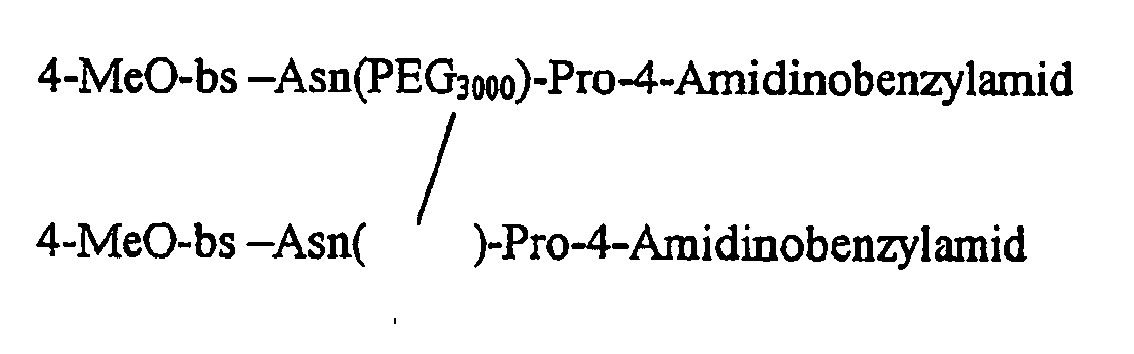

- Durch Verwendung von Aminomethyl-Crown-Ethern wurden die folgenden Verbindungen hergestellt:
- 4-MeO-bs-Asn(CH2-Crown5)-Pro-4-Arnidinobenzylamid
- 4-MeO-bs-Asn(CH2-Crown6)-Pro-4-Amidinobenzylamid
- (Die Synthese der Zielverbindung ist in der nachfolgenden
Abbildung 2 weiter veranschaulicht): - A) D-N(Benzyloxycarbonylmethyl)Cha-OtBu
Der Ausgangsstoff D-N(Benzyloxycarbonylmethyl)Cha-OtBu wurde entsprechend der beschriebenen Literaturmethode hergestellt (Preville et al., Bioorganic & Medicinal Chemistry Letters 7, 1563-1566 (1997). - B) D-N(Carboxymethyl)Cha-OtBu x Acetat
3,75 g (10 mmol) D-N(Benzyloxycarbonylmethyl)Cha-OtBu wurden in einer Mischung aus 100 ml Methanol, 5 ml Essigsäure und 5 ml H2O bei Raumtemperatur und Normaldruck 3 h mit 0,3 g 10 % Pd/C als Katalysator wie üblich hydriert. Der Katalysator wurde abfiltriert, und das Filtrat unter Zusatz von Toluen 3Mal im Vakuum eingeengt. Die verbleibende Substanz wird in 15 ml Essigsäure gelöst und unter Zusatz von 200 ml Diethylether gefällt (weißer Feststoff). - C)Z-D-N(Carboxymethyl)Cha-OtBu x Cyclohexylamin
2 g (5,8 mmol) D-N(Carboxymethyl)Cha-OtBu x Acetat wurden in 75 ml Wasser, 15 ml 1 N NaOH und 75 ml Dioxan unter starkem Rühren suspendiert und im Eisbad gekühlt. Danach wurden 7 mmol Z-Cl, gelöst in 30 ml Dioxan, im Verlauf von 30 Minuten zugetropft, noch 30 Minuten unter Eiskühlung und weitere 12 h bei Raumtemperatur gerührt. Der pH-Wert wurde durch Zugabe von 1 N NaOH auf ca. 9-10 mehrmals nachgestellt. Danach wurde das Lösungsmittel im Vakuum entfernt und der Rückstand in EE und Wasser aufgenommen und 3 x mit 5 %iger KHSO4-Lösung und 3 x mit NaCl-gesättigter Lösung gewaschen, mit Na2SO4 getrocknet und im Vakuum eingeengt. Der ölige Rückstand wurde in Ether gelöst und als Cyclohexylamin-Salz kristallisiert, abgesaugt und im Vakuum getrocknet. - D) Z-D-N(CH2-CO-NH-PEG5000-OMe)Cha-OtBu
0,62 g (1,2 mmol) Z-D-N(Carboxymethyl)Cha-OtBu x Cyclohexylamin wurden in 200 ml EE suspendiert und 3 x mit 50 ml 5 % KHSO4-Lösung und 3 x mit NaCl-gesättigter Lösung gewaschen, mit Na2SO4 getrocknet und im Vakuum eingeengt. Der ölige Rückstand und 2 g (0,4 mmol) Amino-PEG5000-OMe wurden in 100 ml DMF unter Rühren gelöst und im Eisbad abgekühlt. Dazu wurden 0,62 g (1,2 mmol) PyBOP und 3 mmol DIEA gegeben, weitere 30 Minuten unter Eiskühlung und danach 12 h bei Raumtemperatur gerührt. Das Lösungsmittel wurde im Vakuum verdampft, der Rückstand in wenig, heißem Methanol gelöst und in der Kälte mit Isopropanol gefällt, abgesaugt und im Vakuum getrocknet. Die Festsubstanz wurde wieder in wenig, heißem Methanol gelöst und in der Kälte mit Ether gefällt, abgesaugt und im Vakuum getrocknet (Feststoff).
Ausbeute: 1,9 g - E) Z-D-N(CH2-CO-NH-PEG5000-OMe)Cha-OH
Der tert.Butylester wurde wie im Beispiel 1F beschrieben abgespalten.
Ausbeute: 1,7 g (Feststoff) - F) Z-D-N(CH2-CO-NH-PEG5000-OMe)Cha-Pro-4-(Amidino)Benzylamid
Das unter Beispiel 1C hergestellte H-Pro-4(Amidino)Benzylamid x 2 HCl wurde entsprechend der Vorschrift aus Beispiel 1G an 1 g Z-D-N(CH2-CO-NH-PEG5000-OMe)Cha-OH angekoppelt Das Produkt wurde nacheinander mit Isopropanol und Ether gefällt, abgesaugt und im Vakuum getrocknet (Rohprodukt: 0,9 g). - G) H-D-N(CH2-CO-NH-PEG5000-OMe)Cha-Pro-4-(Amidino)Benzylamid
0,9 g Z-D-N(CH2-CO-NH-PEG5000-OMe)Cha-Pro-4-(Amidino)Benzylamid wurden wie in Beispiel 1C beschrieben 4 h hydriert, nach abfiltrieren des Katalysators, einengen des Lösungsmittels im Vakuum, wurde der Rückstand in wenig heißem Methanol gelöst und mit viel Ether gefällt und abgesaugt. Das gefällte Rohprodukt wurde an Biogel P2 mit 2 % AcOH als Laufmittel gereinigt. In einem zweiten Schritt wurde anschließend das Produkt durch Ionenaustauschchromotographie an Fractogel EMD COO- oder Source 30S mit einem Ammoniumacetatgradienten getrennt und die vereinten Fraktionen 3 x nacheinander lyophilisiert. - In analoger Weise zum Beispiel 3 wurden die folgenden Verbindungen synthetisiert, wobei für die Synthese Amino-PEG-Verbindungen init verschiedenen Molekulargewichten verwendet wurden.
- H-D-N(CH2-CO-NH-PEG2000-OMe)Cha-Pro-4-(Amidino)Benzylamid
- H-D-N(CH2-CO-NH-PEG10000-OMe)Cha-Pro-4-(Amidino)Benzylamid
- H-D-N(CH2-CO-NH-PEG20000-OMe)Cha-Pro-4-(Amidino)Benzylamid
- Durch Verwendung eines bifunktionalisierten Amino-PEG wurden die folgenden Verbindungen hergestellt:

- Durch Verwendung von Aminomethyl-Crown-Ethern wurden die folgenden Verbindungen hergestellt:
- H-D-N(CH2-CO-NH-CH2-Crown5)-Pro-4-Amidinobenzylamid
- H-D-N(CH2-CO-NH-CH2-Crown6)-Pro-4-Amidinobenzylamid
- (Die Synthese der Zielverbindung ist in der nachfolgenden
Abbildung 3 weiter veranschaulicht): - A) 4-(Trifluoroacetyl-Amidomethyl)-Piperidin
166 mmol (18,95 g, 19.91 ml) 4-Aminomethylpiperidin werden in 100 ml DCM gelöst und unter magnetischen Rühren im Eisbad gekühlt. Über einen Zeitraum von einer. Stunde werden 182.6 mmol (25.94 g, 21.78 ml) Trifluoroessigsäureethylester zugetropft. Danach wird der Ansatz eine weitere Stunde im Eisbad gekühlt und danach noch 5 Stunden bei Raumtemperatur gerührt. Das während der Reaktion ausfallende Produkt wird abgesaugt.
Ausbeute: 18.68 g = 53.55 %
MS: berechnet, 210.17; gefunden 211,3 [M+H]+ (Maldi)
DC: Rf n-Butanol/Eisessig/Wasser 4/1/1 = 0.51 - B) 4-(Trifluoroacetyl-Amidomethyl)-N(Benzyloxycarbonyl)-Piperidin
Zu einer Lösung von 18 g (85.6 mmol) 4-(Trifluoroacetyl-Amidomethyl)-Piperidin in 150 ml DMF werden 14.89 ml (85.6 mmol) DIEA hinzugegeben. Unter Rühren im Eisbad gibt man zu dieser Mischung 22.36 g (89.75 mmol) Z-Osu, das vorher in 75 ml DMF gelöst wurde. Der Ansatz wird 1 Stunde im Eisbad und danach 7 Stunden bei Raumtemperatur gerührt. Danach wird das Lösungsmittel im Vakuum eingeengt und der verbleibende Rest in Essigester aufgenommen und 3 x mit 5%iger KHSO4-Lösung und 3 x mit gesättigter NaCl-Lösung gewaschen. Die EE-Phase wird über Na2SO4 getrocknet, und das Lösungsmittel eingeengt. Umkristallisation aus Essigester/Hexan (weiße Kristalle).
Ausbeute: 28.15 g = 95.52 %
MS: berechnet: 344.27; gefunden: 345,1
DC: Rf n-Butanol/Eisessig(Wasser 4/1/1 = 0.83
Benzen/Aceton/Eisessig 27/10/0.5 = 0.73 - C) 4-(Aminomethyl)-N(Benzyloxycarbonyl)-Piperidin
27.5 g (79.88 mmol) 4-(Trifluoroacetyl-Amidomethyl)-N(Benzyloxycarbonyl)-Piperidin werden in 150 ml Dioxan gelöst und mit 150 ml 1 n NaOH-Lösung versetzt. Der Ansatz wird 3 Stunden bei 40° C gerührt und danach das Lösungsmittel im Vakuum eingeengt. Der Rest wird in Wasser aufgenommen und 3 x mit DCM extrahiert. Die vereinigten DCM-Phasen werden über Na2SO4 getrocknet, danach wird das Lösungsmittel im Vakuum eingeengt.
Ausbeute: 13.92 g Öl, 56.09 mmol = 70.2 %
MS: berechnet, 248,13; gefunden, 249,3 [M+M]+ - D) Boc-Pro-4-(Amidomethyl)-N(Benzyloxycarbonyl)-Piperidin
0,86 g Boc-Pro-OH werden in 60 ml absolutem THF unter magnetischem Rühren gelöst und mit 0.44 ml (4 mmol) NMM versetzt. Der Ansatz wird auf -15° C gekühlt und dann mit 4 mmol (0.52 ml) CKIBE versetzt. Nach weiteren 10 Minuten Rühren bei -15° C werden 1.1 g (4.4 mmol) 4-(Aminomethyl)-N(Benzyloxycarbonyl)-Piperidin zugesetzt und der Ansatz eine weitere Stunde bei -15° C und weiter über Nacht bei Raumtemperatur gerührt Das Lösungsmittel wird im Vakuum eingeengt und der verbleibende Rest in Essigester aufgenommen und nacheinander 3 x mit 5% KHSO4-Lösung, 1 x mit gesättigter NaCl-Lösung, 3 x mit gesättigter NaHCO3-Lösung und nochmals 3 x mit gesättigter NaCl-Lösung gewaschen. Danach wird die Essigesterphase mit Na2SO4 getrocknet und eingeengt.
Umkristallisation aus Essigester/Hexan.
Ausbeute: 1.5 g, 3,3 mmol (82,5 %) - E) Boc-Pro-4-(Amidomethyl)Piperidin x Acetat 1 g (2,2 mmol) Boc-Pro-4-(Amidomethyl)-N(Benzyloxycarbonyl)-Piperidin werden in Analogie zum Beispiel 1C mit 150 mg Pd/C als Katalysator in Eisessig hydriert. Der Katalysator wird abfiltriert und das Lösungsmittel weitestgehend im Vakuum eingeengt, und das Produkt durch Zusatz mit Diethylether gefällt.
Ausbeute: 0,6 g - F) Boc-Pro-4-(Amidomethyl)-N(Amidino)Piperidin x TFA
0,5 g (1,34 mmol) Boc-Pro-4-(Amidomethyl)Piperidin x Acetat werden mit 0,4 g (2,7 mmol) Pyrazol-Carboxamidin-Hydrochlorid und 0,7 ml(4 mmol) DIEA in 4 ml DMF bei Raumtemperatur für 24 h gerührt Das DMF wird im Vakuum entfernt und der Rückstand mittels präparativer Reversed-Phase-HPLC von Salzen und nicht umgesetzten Pyrazol-Carboxamidin-Hydrochlorid getrennt.
Ausbeute: 0,35 g - G) H-Pro-4-(Amidomethyl)-N(Amidino)Piperidin x 2 HCl
0,3 g (0,64 mmol) Boc-Pro-4-(Amidomethyl)-N(Amidino)Piperidin x TFA werden mit 5 ml 1 N HCl/Eisessig übergossen und bei Raumtemperatur 1 Stunde stehen gelassen. Der Eisessig wird im Vakuum weitestgehend eingeengt und der Rückstand durch Zugabe von Diethylether gefällt. Das Produkt wird abgesaugt, mit weiterem Diethylether gewaschen und im Vakuum getrocknet.
Ausbeute: 0,18 g - H) Z-D-N(CH2-CO-NH-PEG5000-OMe)Cha-Pro-4-(Amidomethyl)-N(Amidino)Piperidin x HCl
0,15 g (0,46 mmol) des unter Beispiel 5G hergestellten H-Pro-4-(Amidomethyl)-N(Amidino)Piperidin x 2 HCl wurde entsprechend der Vorschrift aus Beispiel 1G an 1 g Z-D-N(CH2-CO-NH-PEG5000-0Me)Cha-OH mittels PyBop/DIEA angekoppelt. Das Produkt wurde nacheinander mit Isopropanol und Ether gefällt abgesaugt und im Vakuum getrocknet (Rohprodukt: 0,9 g). - I) D-N(CH2-CO-NH-PEG5000-OMe)Cha-Pro-4-(Amidomethyl)-N(Amidino)Piperidin x 2 HCl
0,8 g Z-D-N(CH2-CO-NH-PEG5000-OMe)Cha-Pro-4-(Amidomethyl)-N(Amidino)Piperidin x HCl werden in 90 %iger Essigsäure analog der Vorschrift 1C hydriert. Das Produkt wird aus Methanol/Ether gefällt und über Biogel P2 und Ionenaustauschchromatographie (Fractogel EMD COO- oder Source 30S ) gereinigt und lyophilisiert
Ausbeute: 0,46 g - In analoger Weise zum Beispiel 5 wurden die folgenden Verbindungen synthetisiert, wobei für die Synthese Amino-PEG-Verbindungen mit verschiedenen Molekulargewichten verwendet wurden.
- H-D-N(CH2-CO-NH-PEG2000-OMe)Cha-Pro-4-(Amidomethyl)-N(Amidino)Piperidin x 2 HCl
- H-D-N(CH2-CO-NH- PEG10000-OMe)Cha-Pro-4-(Amidomethyl)-N (Amidino)Piperidin x 2HCl
- H-D-N(CH2-CO-NH-PEG20000-OMe)Cha-Pro-4-(Amidomethyl)-N(Amidino)Piperidin x 2 HCl
- Durch Verwendung eines bifunktionalisierten Amino-PEG wurden die folgenden Verbindungen hergestellt:

- Durch Verwendung von Aminomethyl-Crown-Ethern wurden die folgenden Verbindungen hergestellt:
- H-D-N(CH2-CO-NH-CH2-Crown5)-Pro-4-(Amidomethyl)-N(Amidino)Piperidin x 2 HCl
- H-D-N(CH2-CO-NH-CH2-Crown6)-Pro-4-(Amidomethyl)-N(Amidino)Piperidin x 2 HCl
- (Die Synthese der Zielverbindung ist in der nachfolgenden
Abbildung 4 weiter veranschaulicht): - A) H-Arg(Pbf)-CH2-Cl x HCl
Boc-Arg(Pbf)-CH2-Cl wurde analog der Literaturvorschrift für Boc-Arg(Z2)-CH2-Cl (Steinmetzer et al., 1999 J. Med. Chem. 42, 3109-3115) hergestellt. Durch versetzen von 5g Boc-Arg(Pbf)-CH2-Cl mit 75 ml 1 N HCl in Eisessig wurde selektiv die Boc-Gruppe abgespalten, das Lösungsmittel weitestgehend im Vakuum entfernt und das Produkt durch Zusatz von kaltem Diethylether gefällt, abgesaugt und im Vakuum getrocknet Ausbeute: 3,7 g - B) Boc-d-Cha-Pro-OH.
Die Verbindung wird entsprechend der in der Literatur beschriebenen Synthesestrategie hergestellt (Steinmetzer et al., 1999 J. Med. Chem. 42, 3109-3115). - C) Boc-d-Cha-Pro-Arg(Pbf)-CH2-Cl
Aus 3 g (8.14 mmol) Boc-d-Cha-Pro-OH, 0.9 ml (8.14 mmol) NMM und 1,06 ml (8.14 mmol) CKIBE in 100 ml THF wird bei -15 °C das gemischte Anhydrid gebildet. Nach 10 min werden 4,03 g (8.14 mmol) H-Arg(Pbf)-CH2-Cl x HCl hinzugefügt und der Ansatz eine weitere Stunde bei -15 °C und über Nacht bei Raumtemperatur gerührt und wie unter Beispiel 1A beschrieben, aufgearbeitet
Ausbeute: 4.6 g (5.7 mmol) - D) H-d-Cha-Pro-Arg(Pbf)-CH2-Cl x HCl
Die Boc-Gruppe wird analog der Vorschrift aus Beispiel 5G abgespalten, das Produkt mit Ether gefällt, abgesaugt und im Vakuum getrocknet.
Ausbeute: 3.86 g (5.2 mmol) - E) H-d-N(CH2-CO-OtBut)Cha-Pro-Arg(Pbt)-CH2-Cl x HCl
3 g (4 mmol) H-d-Cha-Pro-Arg(Pbf)-CH2-Cl x HCl werden in 100 ml DMF gelöst und bei Raumtemperatur mit 0,74 ml (4.15 mmol) Bromessigsäure-tert.Butylester und 1,16 g (5 mmol) Silber(I)Oxid versetzt. Der Ansatz wird über Nacht gerührt und danach die ausgefallenen Silbersalze abzentrifugiert. Das DMF wird im Vakuum entfernt, der Rückstand in Essigester aufgenommen und 2 x mit NaCl-gesättigtem Wasser gewaschen, mit Na2SO4 getrocknet und eingeengt.
Ausbeute: 2.7 g (3.1 mmol) Rohprodukt - F) H-d-N(CH2-COOH)Cha-Pro-Arg-CH2Cl x 2 Trifluoressigsäure
2,5 g (2,87 mmol) des Rohproduktes an H-d-N(CH2-CO-OtBut)Cha-Pro-Arg(Pbf)-CH2-Cl x HCl werden bei Raumtemperatur mit 50 ml 90% Trifluoressigsäure in Wasser versetzt und 1,5 h bei Raumtemperatur gerührt. Das Lösungsmittel wird im Vakuum weitestgehend entfernt und der Rückstand mit kaltem Diethylether gefällt. Das Rohprodukt wird abgesaugt, mit Ether gewaschen, getrocknet und mit präparativer reversed-phase HPLC gereinigt. - G) H-d-N(CH2-CONH-PEG2000-CMe)Cha-Pro-Arg-CH2-Cl x 2 Trifluoressigsäure
40 mg (0,054 mmol) HPLC gereinigtes H-d-N(CH2-COOH)Cha-Pro-Arg-CH2-Cl x 2 Trifluoressigsäure und 80,75 mg (0,04 mmol) Amino-PEG2000-OMe werden in 3 ml DMF gelöst und unter Eiskühlung mit 57 µl Propanphosphonsäureanhydrid, sowie 55 µl DIEA versetzt. Nach einer Stunde wird das Eisbad entfernt, und der Ansatz weitere 3 h bei Raumtemperatur gerührt. Das Lösungsmittel wird im Vakuum entfernt und der Rückstand mittel präparativer Umkehrphasenchromatographie gereinigt.
Ausbeute: 45 mg - Bis auf die im Beispiel 6 beschriebene Verbindung sind sämtliche Inhibitoren reversibel bindende Thrombininhibitoren. Die bestimmten Ki-Werte sind nur in geringem Maße von der Kettenlänge des PEG abhängig, daher ist für alle Verbindungstypen exemplarisch jeweils nur ein Inhibitor mit seinem Ki-Wert angegeben, als Referenz werden die kinetischen Konstanten für die Verbindungen mit freier Carboxylgruppe, die keine PEG-Kette gebunden haben, angegeben.
- Kinetische Konstanten für den reversibel bindenden Inhibitor aus Beispiel 1/2
- 4-Methoxy-benzensulfonyl-Asn(PEG2000-OMe)-Pro-4-Amidinobenzylamid
- KiThrombin: 0,53 nM; KiTrypsin: 92,53 nM; KiTrypsin/KiThrombin: 174
- Referenz: 4-Methoxy-benzensulfonyl-Asp-Pro-4-Amidinobenzylamid
- KiThrombin: 1,6 nM; KiTrypsin: 77 nM; KiTrypsin/KiThrombin: 48
- Bei den Inhibitoren dieses Typs führt die Einführung der PEG-Kette zu einer Verbesserung der Thrombinhemmung im Vergleich zu der gewählten Referenzverbindung und auch zu einer verbesserten Selektivität gegenüber Trypsin.
- 4-Methoxy-benzensulfonyl-Asn(4-[MeO-PEG5000-CH2CH2CO-NHCH2]-Benzyl)-Pro-4-Amidinobenzylamid
Ki Thrombin 0,19 nM - Referenz: 4-Methoxy-benzensulfonyl-Asp-Pro-4-Amidinobenzylamid
KiThrombin: 1,6 nM; - 4-Methoxy-benzensulfonyl-Lys(Propionyl-PEG5000-OMe)-Pro-4-Amidinobenzylamid
Ki Thrombin 0,95 nM. Ki Trypsin 61 nM, Ki Typsin/Ki Thrombin 64 - Referenz: 4-Methoxy-benzensulfonyl-Lys-Pro-4-Amidinobenzylamid
Ki Thrombin 0,73 nM, Ki Trypsin 82 nM, Ki Trypsin/Ki Thrombin = 112 - Kinetische Konstanten für den reversibel bindenden Inhibitor aus Beispiel 3/4 H-D-N(CH2-CO-NH-PEG5000-OMe)Cha-Pro-4-(Amidino)Benzylamid
KiThrombin: 0,97 nM; KiTrypsin: 3,4 nM; KiTrypsin/KiThrombin: 3,5 - Referenz: H-D-N(CH2-COOH)Cha-Pro-4-(Amidino)Benzylamid (Diese nicht PEG-gekoppelte Referenzverbindung ist identisch mit dem von der Firma Astra beschriebenen Inhibitor H317/86; Gustafsson et al., 1998 Thromb. Haemost. 79, 110-118).
KiThombin: 0,3 nM; KiTrypsin: 3,6 nM; KiTrypsin/KiThrombin: 12 - Bei den Inhibitoren dieses Typs führt die Beinführung der PEG-Kette zu einer leichten Verschlechterung der Thrombinhemmung, die Trypsinhemmung bleibt unbeeinflusst
- Kinetische Konstanten für den reversibel bindenden Inhibitor aus Beispiel 5 und 6
- H-D-N(CH2-CO-NH-PEG5000-OMe)Cha-Pro-4-(Amidomethyl)-N(Amidino)Piperidin
- KiThrombin: 2,4 nM; KiTrypsin: 239 nM; KiTrypsin/KiThrombin: 100
- Referenz: H-D-N(CH2-COOH)Cha-Pro-4-(Amidomethyl)-N(Amidino)Piperidin
- KiThrombin: 1,3 nM; KiTrypsin: 226 nM; KiTrypsin/KiThrombin: 173
- Auch bei den Inhibitoren dieses Typs führt die Einführung der PEG-Kette zu einer leichten Verschlechterung der Thrombinhemmung, die Trypsinhemmung bleibt dagegen nahezu unbeeinflusst.
- Die folgenden kinetischen Konstanten wurden entsprechend dem in der Literatur beschriebenen Verfahren (Stein und Trainor, 1986 Biochemistry 25, 5414-5419) bestimmt.
- H-d-N(CH2-CONE-PEG2000-OMe)Cha-Pro-Arg-CH2-Cl x 2 Trifluoressigsäure:
Ki =10,6 nM; kinact = 0,08 s-1; kinact/Ki = 7,5 x 10⁶ M-1s-1 - Als Referenz wurde die analoge, nicht PEG-gekoppelte Verbindung gemessen:
Ki = 3,8 nM; kinact = 0,079 s-1; kinact/Ki = 2,1 x 10⁷ M-1s-1 - Aus der Literatur wurden die Daten für die Chlormethylketon-Leitstrukhu D-Phe-Pro-Arg-CH2-Cl (PPACK) entnommen (Walker et al., 1985 Biochem. J. 230, 645-650):
Ki = 25 nM; kinact = 0,11 s-1; kinact/Ki = 4,4 x 10⁶ M-1s-1 - Die PEG-gekoppelte Verbindung ist etwas weniger aktiv, als die analoge freie Verbindung, andererseits ist sie jedoch ein stärkerer Thrombinhemmstoff als das in der Literatur bereits beschriebene PACK.
- Wirksame Thrombinhemmstoffe sollten bevorzugt die plasminolytischen Enzyme Plasmin, Urokinase und tPA kaum hemmen, da diese Proteasen an der Auflösung von Fibringerinnseln beteiligt sind und deshalb antithrombotische Eigenschaften besitzen. Deshalb wurden 2 ausgewählte Vertreter der in den Tabellen 1 und 2 beschriebenen Inhibitoren ohne PEG und ein PEG-gekoppelter Inhibitor bezüglich ihrer Hemmwirkung auf diese Enzyme untersucht.
- Hemmkonstanten ausgewählter Inhibitoren bezüglich der Enzyme Thrombin, Plasmin, Urokinase und tPA (Werte in nM).
Nr. Sequenz Ki Thrombin Ki Plasmin Ki Urokinase Ki tPA 1c 4-MeO-bs-Gly-Pro-4-Amba 0,97 5800 225000 630 50 4-MeO-bs-Asn-Pro-4-Amba 0,36 17500 52000 47000 4-MeO-bs-Asn(PEG2000-OMe)-Pro-4-Amba 0,53 33500 157000 599000 - Interessanterweise zeigt sich aus den Ki-Werten der in der obigen Tabelle aufgelisteten Inhibitoren, dass die Einführung einer geeigneten L-Aminosäure mit Seitenkette nicht nur eine Verstärkung der Thrombinhemmung bewirkt, sondern zusätzlich auch die Hemmung der fibrinolytischen Enzyme Plasmin und tPA abschwächt. Demzufolge sind die in der Tabelle aufgeführte Verbindung mit Asparagin und der PEG-gekoppelte Inhibitor sehr wirksame und gleichzeitig auch sehr selektive Thrombinhemmstoffe.
- Vorbemerkungen: Für die Versuche wurden weibliche Wistarratten mit einem Körpergewicht zwischen 150-250 g verwendet. Die Tiere wurden unter konventionellen Bedingungen gehalten und erhielten Standardfutter und Trinkwasser ad libitum. Die Narkotisierung erfolgte mittels 1,5 g/kg Körpermasse Ethylurethan. Anschließend wurden die rechte und linke Vena jugularis präpariert und Katheter eingebunden, um zu unterschiedlichem Zeitpunkt Blut entnehmen zu können. Der Urin wurde über die gesamte Versuchsdauer gesammelt und die Inhibitorkonzentration mit einem Gerinnungstest bestimmt.
-
Abb. 5 zeigt die Eliminierung der in Formel (IV) dargestellten Verbindung nach intravenöser Gabe von 10 mg/kg an der Ratte. Die Eliminierungshalbwertszeit beträgt ca. 16.5 min.
-
Abb. 6 zeigt die Ergebnisse der Bestimmung der kumulativen Wiederfindung im Urin der in Formel (IV) dargestellten Verbindung nach subkutaner Gabe an der Ratte. Es werden ca. 58 % der Verbindung im Urin wiedergefunden. - Zum Vergleich ist ein Beispiel mit einer analogen Verbindung angegeben, an die ein PEG5000 kovalent gekoppelt wurde.
-
Abb. 7 zeigt den Blutspiegel der unten dargestellten Verbindung der Formel (V) (die PEG-Kette hat ein durchschnittliches Molekulargewicht von 5000 Da) nach subkutaner Gabe von 10 mg/kg. Die bestimmte Eliminierungshalbwertszeit beträgt ca. 2,6 Stunden und ist somit deutlich länger im Vergleich zur freien, nicht pegylierten Verbindung (sieheAbb. 5 ).
Abb.8 zeigt die Ergebnisse der Bestimmung der kumulativen Wiederfindung im Urin der Verbindung (V) nach subkutaner Gabe an der Ratte (n=4). Es werden nahezu 100 % der Verbindung im Urin wiedergefunden. -
Abb. 9 zeigt eine halblogarithmische Darstellung der Konzentrations-Zeit-Kurve nach subkutaner Gabe von 5 mg/kg der Inhibitorstruktur (VI) an der Ratte. Die berechnete Eliminierungshalbwertszeit beträgt ca. 350 min. Die Halbwertszeit dieser Verbindung ist somit deutlich verlängert.
- Vorbemerkungen: Für die Versuche wurden weibliche und männliche Schweine mit einem Körpergewicht zwischen 12 und 15 kg verwendet. Die Narkotisierung der Tiere erfolgte durch intravenöse Gabe von 20 mg/kg Pentobarbital. In die linke oder rechte Vena jugularis wurde ein Katheter zur Blutentnahme und in die Luftröhre ein Trachealkatheter eingebunden, um eine gute Atmung der Tiere während der Versuche aufrechtzuerhalten. Die Blase der Tiere wurde ebenfalls mit einem Katheter versehen, so dass der Urin über die gesamte Versuchsdauer gesammelt werden konnte. Bei den männlichen Tieren wurde zusätzlich die Harnröhre abgebunden, so dass der Urin nur durch den Blasenkatheter in ein Sammelgefäß abfließen konnte. Die Inhibitorkonzentrationen wurden im Blut, im Plasma und im Urin mittels des Ecarin-Clotting-Tests (Nowak und Bucha, (1996) Quantitative determination of hirudin in blood and body fluids. Semin. Thromb. 22, 197-202) bestimmt.
- Für die Eliminierungsuntersuchungen an Schweinen wurden die Inhibitoren der allgemeinen Formel (VII) mit einer durchschnittlichen PEG-Kettenlänge von 2000 oder 10000 Da verwendet.

- In den Untersuchungen zeigte sich überraschenderweise, dass in Abhängigkeit der Länge der PEG-Kette der Inhibitoren der allgemeinen Formel (VII) große Unterschiede in der Eliminierungsgeschwindigkeit der Inhibitoren aus dem Blut auftreten. Im Falle der Inhibitoren mit einer durchschnittlichen PEG-Kettenlänge um 10000 Da (
Abb. 12 und13 ) konnten bis zu 28 h nach subkutaner Inhibitorgabe lang anhaltende, antithrombotisch wirksame Blutspiegel gemessen werden. Interessanterweise wurden bis zu diesem Zeitpunkt nur ca. 35 % des Inhibitors im Urin wiedergefunden.
Im Gegensatz dazu wurde der Inhibitor der allgemeinen Formel (VII) mit einer durchschnittlichen PEG-Kettenlänge von 2000 Da bereits nach ca. 12 h nahezu vollständig über die Niere eliminiert (Abb. 10 und11 ). -
Abb. 10 zeigt die Plasmaspiegel des Inhibitors der allgemeinen Struktur (VII) mit einer durchschnittlichen PEG-Kette um 2000 Da nach subcutaner Gabe von 2,5 mg/kg in Schweinen. -
Abb. 11 zeigt die kumulative Ausscheidung des Inhibitors der allgemeinen Struktur (VII) mit einer durchschnittlichen PEG-Kette um 2000 Da nach subcutaner Gabe von 2,5 mg/kg im Urin von Schweinen. -
Abb. 12 zeigt die Plasmaspiegel des Inhibitors der allgemeinen Struktur (VII) mit einer durchschnittlichen PEG-Kette um 10000 Da nach subcutaner Gabe von 20 mg/kg in Schweinen. -
Abb. 13 zeigt die kumulative Ausscheidung des Inhibitors der allgemeinen Struktur (VII) mit einer durchschnittlichen PEG-Kette um 10000 Da nach subcutaner Gabe von 20 mg/kg im Urin von Schweinen.
Claims (8)
- Verbindung der allgemeinen Struktur (I)

n 0, 1, 2, 3, 4 oder 5 ist;
A eine Ethylen
B eine Bindung oder
Halogenatomen oder mit einem Rest
D einen Rest

R1 ein Wasserstoffatom oder ein Arylsulfonyl-, Aralk-ylsulfonyl-, Cycloalkylmethylsulfonyl-, Cycloalkylethylsulfonyl- oder ein Alkylsulfonylrest ist, deren Arylteil gegebenenfalls einen, zwei, drei, vier oder fünf Substituenten, die unabhängig voneinander ausgewählt sind aus Halogenatomen, Alkyl- oder Alkoxyresten, tragen kann, oder mit einem weiteren Arylrest verknüpft ist;
und entweder
R2 -(CH2)p-CO-NH-(CH2)q-X, -(CH2)r-NH-CO-(CH2)s-V-X oder
-(CH2)r-NH-CO-O-(CH2)s-V-X ist
wobei
p eine ganze Zahl von 1 bis 5 und q eine ganze Zahl von 2 bis 5 ist,
r eine ganze Zahl von 2 bis 5 und s ist eine ganze Zahl von 1-5 ist,
V eine Bindung oder -CO-NH-(CH2)c- und c eine ganze Zahl von 2 bis 5 ist, und
X ein Oligo- oder Polyalkylenglykol der Struktur -[O-(CH2)d]c-OZ oder -[O-CH(CH3)-CH2]c-OZ oder einen Cyclus der Struktur
eine ganze Zahl von 2 bis 6, e eine ganze Zahl von 3 bis 1000 ist, Z ein Wasserstoffatom oder ein Alkylrest ist oder die gesamte Inhibitorstruktur repliziert, die an die freie Valenz des Restes X gebunden ist, f eine ganze Zahl von 2 bis 6 ist und g eine ganze Zahl von 3 bis 10, ist; und
R3 ein Phenyl- oder Cyclohexylrest ist, der mit 1 bis 5 gleichen oder unterschiedlichen Substituenten, unabhängig voneinander ausgewählt aus Halogenatomen, Allyl- oder Alkoxyresten oder Hydroxylgruppen substituiert sein kann und
R4 ein Wasserstoffatom, Phenyl- oder Cyclohexylrest ist, der mit 1 bis 5 gleichen oder unterschiedlichen Substituenten, unabhängig voneinander ausgewählt aus Halogenatomen, Alkyl- oder Alkoxyresten oder Hydroxylgruppen substituiert sein kann,
m 0, 1, 2, 3 oder 4 ist und
am mit * gekennzeichneten Kohlenstoffatom eine D-Konfguration vorliegt;
oder
R2 ein Wasserstoffatom ist und
R3 -CO-NH-(CH2)q-X, -CO-W1-W2-(CH2)q-X, -NH-CO-(CH2)s-V-X, -NH-CO-O-(CH2)s-V-X, -S-CH2-CO-NH-(CH2)t-X oder -S-S-CH2-CH2-X ist,
wobei q, s=X und V wie vorstehend definiert sind und t eine ganze Zahl von 2 bis 5 ist, und der Rest W1 -O- oder -NH- ist, und W2 eine Bindung darstellt oder die Struktur -(CH2)v-Ph. (CH2)v'-Amid- aufweist, in der und v' unabhängig von einander 0, 1 oder 2 sind, Ph einen 1,2-, 1,3- oder 1,4-substituierten Phenylrest und Amid -HN-(O)C- oder -C(O)NH- darstellt, und
R4 ein Wasserstoffatom ist
m 1, 2, 3, 4 oder 5 ist und
am mit gekennzeichneten Kohlenstoffatom eine L-Konfiguration vorliegt. - Verbindung gemäß Anspruch 1, wobei B eine der folgenden Strukturen darstellt

- Verbindung gemäß Anspruch 1 oder 2, wobei D eine der folgenden Strukturen darstellt


- Verbindung gemäß einem der Ansprüche 1 bis 3, wobei X eine cyclische Struktur der Formel
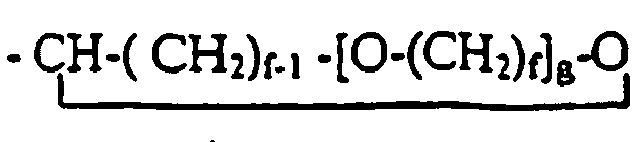
- Verbindung gemäß Anspruch 1 mit einer der folgenden Formeln Ia-Ih


und
PEG eine Polyethylenglykolstruktur der Formel -[O-C2H4]i- darstellt, mit Werten für i von 3 bis 1000,
h für 1, 2, 3 oder 4 steht
und R10
- Verwendung einer Verbindung gemäß einem der Ansprüche 1 bis 5 als Wirkstoff bei der Herstellung eines Medikaments zur Therapie oder Prophylaxe thrombotischer Komplikationen, wobei der Wirkstoff überwiegend renal eliminiert wird.
- Verwendung einer Verbindung gemäß einem der Ansprüche 1 bis 5 zum Beschichten einer Oberfläche.
- Verfahren zur Modifikation einer Oberfläche, umfassend das in Kontakt bringen der Oberfläche mit einer Verbindung gemäß einem der Ansprüche 1 bis 5.
Applications Claiming Priority (3)
| Application Number | Priority Date | Filing Date | Title |
|---|---|---|---|
| DE10102878A DE10102878A1 (de) | 2001-01-23 | 2001-01-23 | Oligo- oder Polyalkylengekoppelte Thrombininhibitoren |
| DE10102878 | 2001-01-23 | ||
| PCT/EP2002/000652 WO2002059065A2 (de) | 2001-01-23 | 2002-01-23 | Oligo- oder polyalkylenglycolgekoppelte thrombininhibitoren |
Publications (2)
| Publication Number | Publication Date |
|---|---|
| EP1355674A2 EP1355674A2 (de) | 2003-10-29 |
| EP1355674B1 true EP1355674B1 (de) | 2010-10-27 |
Family
ID=7671444
Family Applications (1)
| Application Number | Title | Priority Date | Filing Date |
|---|---|---|---|
| EP02708308A Expired - Lifetime EP1355674B1 (de) | 2001-01-23 | 2002-01-23 | Oligo- oder polyalkylenglycolgekoppelte thrombininhibitoren |
Country Status (7)
| Country | Link |
|---|---|
| US (1) | US7407982B2 (de) |
| EP (1) | EP1355674B1 (de) |
| JP (1) | JP4461217B2 (de) |
| AT (1) | ATE485838T1 (de) |
| CA (1) | CA2431487C (de) |
| DE (2) | DE10102878A1 (de) |
| WO (1) | WO2002059065A2 (de) |
Families Citing this family (25)
| Publication number | Priority date | Publication date | Assignee | Title |
|---|---|---|---|---|
| DE10162521A1 (de) * | 2001-12-19 | 2003-07-17 | Goetz Nowak | Verwendung von molekulargewichtserweiterten Substanzen in der Tumortherapie |
| US7838560B2 (en) * | 2002-03-11 | 2010-11-23 | The Medicines Company (Leipzig) Gmbh | Urokinase inhibitors, production and use thereof |
| DE10301300B4 (de) * | 2003-01-15 | 2009-07-16 | Curacyte Chemistry Gmbh | Verwendung von acylierten 4-Amidino- und 4-Guanidinobenzylaminen zur Inhibierung von Plasmakallikrein |
| DE10342108A1 (de) * | 2003-09-11 | 2005-04-14 | Curacyte Chemistry Gmbh | Basisch-substituierte Benzylaminanaloga als Inhibitoren des Gerinnungsfaktors Xa, ihre Herstellung und Verwendung |
| CN101094867B (zh) | 2004-10-19 | 2011-08-24 | 隆萨股份公司 | 用于固相肽合成的方法 |
| DE102005044319A1 (de) * | 2005-09-16 | 2007-03-22 | Curacyte Chemistry Gmbh | 2-(Aminomethyl)-5-Chlor-Benzylamid-Derivate und ihre Verwendung als Hemmstoffe des Gerinnungsfaktors Xa |
| DE102006048300A1 (de) | 2006-01-26 | 2007-08-02 | Hellstern, Peter, Prof. Dr.med. | Inhibitoren des Blutgerinnungsfaktors Xa zur Verwendung als Antikoagulans |
| CA2664299C (en) * | 2006-09-15 | 2016-01-19 | Toray Industries, Inc. | Substrate comprising an anticoagulant and a hydrophilic polymer and manufacturing method thereof |
| WO2008032400A1 (fr) * | 2006-09-15 | 2008-03-20 | Toray Industries, Inc. | Procédé pour la production d'un substrat modifié |
| DE102006050672A1 (de) * | 2006-10-24 | 2008-04-30 | Curacyte Discovery Gmbh | Hemmstoffe des Plasmins und des Plasmakallikreins |
| DE102007033787A1 (de) | 2007-07-09 | 2009-01-15 | Aesculap Ag | Gefäßprothese mit reduzierter Thrombogenität |
| WO2010033226A1 (en) * | 2008-09-17 | 2010-03-25 | Nektar Therapeutics | Oligomer-protease inhibitor conjugates |
| US8835710B2 (en) * | 2009-03-24 | 2014-09-16 | Mead Johnson Nutrition Company | Animal model for infant pathologies |
| RU2539566C2 (ru) | 2009-12-24 | 2015-01-20 | Торэй Индастриз, Инк. | Гидрофильное полимерное соединение, имеющее антикоагулянтный эффект |
| ES2703176T3 (es) | 2010-03-11 | 2019-03-07 | Univ New York | Compuestos amido como moduladores de RORgammat y usos de los mismos |
| CN103403018B (zh) * | 2010-12-21 | 2015-08-19 | 医药公司(莱比锡)有限公司 | 胰蛋白酶样丝氨酸蛋白酶抑制剂,它们的制备以及作为凝结因子IIa和Xa的选择性抑制剂的用途 |
| TW201311774A (zh) * | 2011-06-23 | 2013-03-16 | Toray Industries | 具有抗血液凝固作用的疏水性高分子化合物 |
| TW201309354A (zh) | 2011-06-23 | 2013-03-01 | Toray Industries | 醫療材料 |
| US20140142613A1 (en) * | 2011-06-24 | 2014-05-22 | Toray Industries, Inc. | Instrument for capturing free thrombi |
| US20160067066A1 (en) * | 2013-04-12 | 2016-03-10 | Toray Industries, Inc. | Antithrombotic artificial blood vessel |
| WO2015080176A1 (ja) | 2013-11-28 | 2015-06-04 | 東レ株式会社 | 抗血栓性材料 |
| EP3106128B1 (de) * | 2014-02-12 | 2020-12-02 | Toray Industries, Inc. | Künstliches blutgefäss |
| CN109790654B (zh) | 2016-10-07 | 2020-09-18 | 东丽株式会社 | 筒状织物 |
| WO2018181918A1 (ja) | 2017-03-31 | 2018-10-04 | 東レ株式会社 | 筒状構造体 |
| CN117497842B (zh) * | 2023-12-27 | 2024-03-12 | 江苏蓝固新能源科技有限公司 | 一种聚合物电解质和制备方法及其在二次电池中的应用 |
Family Cites Families (6)
| Publication number | Priority date | Publication date | Assignee | Title |
|---|---|---|---|---|
| CA2067224C (en) | 1989-12-01 | 2001-02-13 | Manfred Kurfuerst | Hirudin/polyalkylene glycol conjugates |
| US5583146A (en) * | 1992-12-02 | 1996-12-10 | Bristol-Myers Squibb Company | Heterocyclic thrombin inhibitors |
| DE4342154A1 (de) * | 1993-12-10 | 1995-06-14 | Behringwerke Ag | Amidinophenylalaninderivate, Verfahren zu deren Herstellung, deren Verwendung und diese enthaltende Mittel als Antikoagulantien |
| US5914319A (en) * | 1995-02-27 | 1999-06-22 | Eli Lilly And Company | Antithrombotic agents |
| US5798377A (en) * | 1996-10-21 | 1998-08-25 | Merck & Co., Inc. | Thrombin inhibitors |
| JP2001508783A (ja) | 1997-01-29 | 2001-07-03 | ポリマスク・ファーマシューティカルズ・パブリック・リミテッド・カンパニー | Peg化法 |
-
2001
- 2001-01-23 DE DE10102878A patent/DE10102878A1/de not_active Ceased
-
2002
- 2002-01-23 EP EP02708308A patent/EP1355674B1/de not_active Expired - Lifetime
- 2002-01-23 DE DE50214734T patent/DE50214734D1/de not_active Expired - Lifetime
- 2002-01-23 WO PCT/EP2002/000652 patent/WO2002059065A2/de not_active Ceased
- 2002-01-23 US US10/344,722 patent/US7407982B2/en not_active Expired - Fee Related
- 2002-01-23 AT AT02708308T patent/ATE485838T1/de active
- 2002-01-23 JP JP2002559370A patent/JP4461217B2/ja not_active Expired - Fee Related
- 2002-01-23 CA CA2431487A patent/CA2431487C/en not_active Expired - Fee Related
Also Published As
| Publication number | Publication date |
|---|---|
| JP4461217B2 (ja) | 2010-05-12 |
| DE10102878A1 (de) | 2002-08-01 |
| ATE485838T1 (de) | 2010-11-15 |
| CA2431487C (en) | 2012-03-27 |
| DE50214734D1 (de) | 2010-12-09 |
| JP2004525888A (ja) | 2004-08-26 |
| US20050070479A1 (en) | 2005-03-31 |
| EP1355674A2 (de) | 2003-10-29 |
| WO2002059065A2 (de) | 2002-08-01 |
| CA2431487A1 (en) | 2002-08-01 |
| WO2002059065A3 (de) | 2002-12-12 |
| US7407982B2 (en) | 2008-08-05 |
Similar Documents
| Publication | Publication Date | Title |
|---|---|---|
| EP1355674A2 (de) | Oligo- oder polyalkylenglycolgekoppelte thrombininhibitoren | |
| DE69823178T2 (de) | Serine protease inhibitoren | |
| EP1583526B1 (de) | Acylierte 4-amidino- und 4-guanidinobenzylaminen zur inhibierung von plasmakallikrein | |
| DE69431718T2 (de) | Thrombin-inhibitoren | |
| EP0918792B1 (de) | Dipeptidische benzamidine als kininogenasen-inhibitoren | |
| DE69616770T2 (de) | Thrombin inhibitore mit einer hirudin-ähnlichen sequenz | |
| DE69328104T2 (de) | Antagonisten gegen den thrombinrezeptor | |
| DE69620161T2 (de) | Thrombininhibitoren | |
| EP0513543B1 (de) | Amidinophenylalaninderivate, Verfahren zu deren Herstellung, deren Verwendung und diese enthaltende Mittel als Antikoagulantien | |
| EP1294742B1 (de) | Urokinase-hemmstoffe | |
| WO2001014318A2 (de) | Neue effektoren der dipeptidyl peptidase iv zur topischen anwendung | |
| EP0956294A1 (de) | Thrombininhibitoren | |
| EP0508220B1 (de) | Amidinophenylalaninderivate, Verfahren zu deren Herstellung, deren Verwendung und diese enthaltende Mittel | |
| EP1485345B1 (de) | Hemmstoffe der urokinase, ihre herstellung und verwendung | |
| DE68924804T2 (de) | Polypeptid mit sich wiederholenden zelladhäsiven Hauptsequenzen. | |
| US8445450B2 (en) | Antithrombotic dual inhibitors comprising a biotin residue | |
| EP0658585B1 (de) | Amidinophenylalaninderivate, Verfahren zu deren Herstellung, deren Verwendung und diese enthaltende Mittel als Antikoagulantien | |
| DE69128247T2 (de) | Thrombin-inhibitoren mit einer hirudin-ähnlichen sequenz | |
| DE69304538T2 (de) | Aminosäure-derivate und deren verwendung | |
| DE69319733T2 (de) | In der konformation beschränkte peptid analoge als wirkstoff gegen plättchenaggregation | |
| WO2007095659A1 (de) | Peptide und peptid-derivate, herstellun derselben sowie deren verwendung zur herstellung eines therapeutisch und/oder präventiv wirkenden arzneimittels | |
| DE60312178T2 (de) | Fluoralkylcyclopeptidderivate mit antiintegrinwirkung | |
| WO1995018147A1 (en) | Aureobasidins | |
| DE60010344T2 (de) | Diketopiperazinderivate als thrombininhibitoren | |
| DE10049937A1 (de) | Niedermolekulare Inhibitoren von Serinproteasen mit Polyhydroxyalkyl- und Polyhydroxycycloalkylresten |
Legal Events
| Date | Code | Title | Description |
|---|---|---|---|
| PUAI | Public reference made under article 153(3) epc to a published international application that has entered the european phase |
Free format text: ORIGINAL CODE: 0009012 |
|
| 17P | Request for examination filed |
Effective date: 20030820 |
|
| AK | Designated contracting states |
Kind code of ref document: A2 Designated state(s): AT BE CH CY DE DK ES FI FR GB GR IE IT LI LU MC NL PT SE TR |
|
| 19U | Interruption of proceedings before grant |
Effective date: 20070501 |
|
| 19W | Proceedings resumed before grant after interruption of proceedings |
Effective date: 20080401 |
|
| RAP1 | Party data changed (applicant data changed or rights of an application transferred) |
Owner name: JENAFFIN GMBH |
|
| GRAP | Despatch of communication of intention to grant a patent |
Free format text: ORIGINAL CODE: EPIDOSNIGR1 |
|
| GRAS | Grant fee paid |
Free format text: ORIGINAL CODE: EPIDOSNIGR3 |
|
| GRAA | (expected) grant |
Free format text: ORIGINAL CODE: 0009210 |
|
| AK | Designated contracting states |
Kind code of ref document: B1 Designated state(s): AT BE CH CY DE DK ES FI FR GB GR IE IT LI LU MC NL PT SE TR |
|
| REG | Reference to a national code |
Ref country code: GB Ref legal event code: FG4D Free format text: NOT ENGLISH |
|
| REG | Reference to a national code |
Ref country code: CH Ref legal event code: NV Representative=s name: VOSSIUS & PARTNER Ref country code: CH Ref legal event code: EP |
|
| REG | Reference to a national code |
Ref country code: IE Ref legal event code: FG4D Free format text: LANGUAGE OF EP DOCUMENT: GERMAN |
|
| REF | Corresponds to: |
Ref document number: 50214734 Country of ref document: DE Date of ref document: 20101209 Kind code of ref document: P |
|
| REG | Reference to a national code |
Ref country code: NL Ref legal event code: VDEP Effective date: 20101027 |
|
| REG | Reference to a national code |
Ref country code: IE Ref legal event code: FD4D |
|
| PG25 | Lapsed in a contracting state [announced via postgrant information from national office to epo] |
Ref country code: FI Free format text: LAPSE BECAUSE OF FAILURE TO SUBMIT A TRANSLATION OF THE DESCRIPTION OR TO PAY THE FEE WITHIN THE PRESCRIBED TIME-LIMIT Effective date: 20101027 Ref country code: NL Free format text: LAPSE BECAUSE OF FAILURE TO SUBMIT A TRANSLATION OF THE DESCRIPTION OR TO PAY THE FEE WITHIN THE PRESCRIBED TIME-LIMIT Effective date: 20101027 Ref country code: PT Free format text: LAPSE BECAUSE OF FAILURE TO SUBMIT A TRANSLATION OF THE DESCRIPTION OR TO PAY THE FEE WITHIN THE PRESCRIBED TIME-LIMIT Effective date: 20110228 Ref country code: SE Free format text: LAPSE BECAUSE OF FAILURE TO SUBMIT A TRANSLATION OF THE DESCRIPTION OR TO PAY THE FEE WITHIN THE PRESCRIBED TIME-LIMIT Effective date: 20101027 |
|
| PG25 | Lapsed in a contracting state [announced via postgrant information from national office to epo] |
Ref country code: GR Free format text: LAPSE BECAUSE OF FAILURE TO SUBMIT A TRANSLATION OF THE DESCRIPTION OR TO PAY THE FEE WITHIN THE PRESCRIBED TIME-LIMIT Effective date: 20110128 |
|
| PG25 | Lapsed in a contracting state [announced via postgrant information from national office to epo] |
Ref country code: ES Free format text: LAPSE BECAUSE OF FAILURE TO SUBMIT A TRANSLATION OF THE DESCRIPTION OR TO PAY THE FEE WITHIN THE PRESCRIBED TIME-LIMIT Effective date: 20110207 Ref country code: IE Free format text: LAPSE BECAUSE OF FAILURE TO SUBMIT A TRANSLATION OF THE DESCRIPTION OR TO PAY THE FEE WITHIN THE PRESCRIBED TIME-LIMIT Effective date: 20101027 |
|
| BERE | Be: lapsed |
Owner name: JENAFFIN G.M.B.H. Effective date: 20110131 |
|
| PG25 | Lapsed in a contracting state [announced via postgrant information from national office to epo] |
Ref country code: DK Free format text: LAPSE BECAUSE OF FAILURE TO SUBMIT A TRANSLATION OF THE DESCRIPTION OR TO PAY THE FEE WITHIN THE PRESCRIBED TIME-LIMIT Effective date: 20101027 Ref country code: MC Free format text: LAPSE BECAUSE OF NON-PAYMENT OF DUE FEES Effective date: 20110131 |
|
| PLBE | No opposition filed within time limit |
Free format text: ORIGINAL CODE: 0009261 |
|
| STAA | Information on the status of an ep patent application or granted ep patent |
Free format text: STATUS: NO OPPOSITION FILED WITHIN TIME LIMIT |
|
| 26N | No opposition filed |
Effective date: 20110728 |
|
| REG | Reference to a national code |
Ref country code: DE Ref legal event code: R097 Ref document number: 50214734 Country of ref document: DE Effective date: 20110728 |
|
| PG25 | Lapsed in a contracting state [announced via postgrant information from national office to epo] |
Ref country code: BE Free format text: LAPSE BECAUSE OF NON-PAYMENT OF DUE FEES Effective date: 20110131 |
|
| PG25 | Lapsed in a contracting state [announced via postgrant information from national office to epo] |
Ref country code: IT Free format text: LAPSE BECAUSE OF FAILURE TO SUBMIT A TRANSLATION OF THE DESCRIPTION OR TO PAY THE FEE WITHIN THE PRESCRIBED TIME-LIMIT Effective date: 20101027 |
|
| PGFP | Annual fee paid to national office [announced via postgrant information from national office to epo] |
Ref country code: CH Payment date: 20120130 Year of fee payment: 11 Ref country code: FR Payment date: 20120202 Year of fee payment: 11 |
|
| PGFP | Annual fee paid to national office [announced via postgrant information from national office to epo] |
Ref country code: DE Payment date: 20120301 Year of fee payment: 11 |
|
| PGFP | Annual fee paid to national office [announced via postgrant information from national office to epo] |
Ref country code: GB Payment date: 20120130 Year of fee payment: 11 |
|
| PGFP | Annual fee paid to national office [announced via postgrant information from national office to epo] |
Ref country code: AT Payment date: 20120123 Year of fee payment: 11 |
|
| PG25 | Lapsed in a contracting state [announced via postgrant information from national office to epo] |
Ref country code: CY Free format text: LAPSE BECAUSE OF FAILURE TO SUBMIT A TRANSLATION OF THE DESCRIPTION OR TO PAY THE FEE WITHIN THE PRESCRIBED TIME-LIMIT Effective date: 20101027 Ref country code: LU Free format text: LAPSE BECAUSE OF NON-PAYMENT OF DUE FEES Effective date: 20110123 |
|
| REG | Reference to a national code |
Ref country code: CH Ref legal event code: PL |
|
| REG | Reference to a national code |
Ref country code: AT Ref legal event code: MM01 Ref document number: 485838 Country of ref document: AT Kind code of ref document: T Effective date: 20130131 |
|
| GBPC | Gb: european patent ceased through non-payment of renewal fee |
Effective date: 20130123 |
|
| PG25 | Lapsed in a contracting state [announced via postgrant information from national office to epo] |
Ref country code: TR Free format text: LAPSE BECAUSE OF FAILURE TO SUBMIT A TRANSLATION OF THE DESCRIPTION OR TO PAY THE FEE WITHIN THE PRESCRIBED TIME-LIMIT Effective date: 20101027 |
|
| REG | Reference to a national code |
Ref country code: FR Ref legal event code: ST Effective date: 20130930 |
|
| PG25 | Lapsed in a contracting state [announced via postgrant information from national office to epo] |
Ref country code: DE Free format text: LAPSE BECAUSE OF NON-PAYMENT OF DUE FEES Effective date: 20130801 Ref country code: AT Free format text: LAPSE BECAUSE OF NON-PAYMENT OF DUE FEES Effective date: 20130131 Ref country code: CH Free format text: LAPSE BECAUSE OF NON-PAYMENT OF DUE FEES Effective date: 20130131 Ref country code: LI Free format text: LAPSE BECAUSE OF NON-PAYMENT OF DUE FEES Effective date: 20130131 |
|
| REG | Reference to a national code |
Ref country code: DE Ref legal event code: R119 Ref document number: 50214734 Country of ref document: DE Effective date: 20130801 |
|
| PG25 | Lapsed in a contracting state [announced via postgrant information from national office to epo] |
Ref country code: GB Free format text: LAPSE BECAUSE OF NON-PAYMENT OF DUE FEES Effective date: 20130123 Ref country code: FR Free format text: LAPSE BECAUSE OF NON-PAYMENT OF DUE FEES Effective date: 20130131 |