EP1350556A1 - Mehrfachemulsionen - Google Patents
Mehrfachemulsionen Download PDFInfo
- Publication number
- EP1350556A1 EP1350556A1 EP03004297A EP03004297A EP1350556A1 EP 1350556 A1 EP1350556 A1 EP 1350556A1 EP 03004297 A EP03004297 A EP 03004297A EP 03004297 A EP03004297 A EP 03004297A EP 1350556 A1 EP1350556 A1 EP 1350556A1
- Authority
- EP
- European Patent Office
- Prior art keywords
- phase
- emulsion
- dispersed
- particle
- multiple emulsion
- Prior art date
- Legal status (The legal status is an assumption and is not a legal conclusion. Google has not performed a legal analysis and makes no representation as to the accuracy of the status listed.)
- Granted
Links
- 239000000839 emulsion Substances 0.000 title claims abstract description 138
- 239000002245 particle Substances 0.000 claims abstract description 139
- 239000007787 solid Substances 0.000 claims abstract description 50
- 238000000034 method Methods 0.000 claims abstract description 43
- 239000013543 active substance Substances 0.000 claims abstract description 9
- 239000000693 micelle Substances 0.000 claims abstract description 4
- 239000012071 phase Substances 0.000 claims description 206
- VYPSYNLAJGMNEJ-UHFFFAOYSA-N Silicium dioxide Chemical compound O=[Si]=O VYPSYNLAJGMNEJ-UHFFFAOYSA-N 0.000 claims description 124
- 239000000377 silicon dioxide Substances 0.000 claims description 53
- 235000012239 silicon dioxide Nutrition 0.000 claims description 33
- 239000000203 mixture Substances 0.000 claims description 21
- 239000003921 oil Substances 0.000 claims description 21
- 239000000725 suspension Substances 0.000 claims description 21
- 229910044991 metal oxide Inorganic materials 0.000 claims description 16
- 150000004706 metal oxides Chemical class 0.000 claims description 16
- 230000002209 hydrophobic effect Effects 0.000 claims description 12
- 238000002360 preparation method Methods 0.000 claims description 10
- 239000008346 aqueous phase Substances 0.000 claims description 7
- 239000003905 agrochemical Substances 0.000 claims description 4
- 239000002537 cosmetic Substances 0.000 claims description 4
- 239000003814 drug Substances 0.000 claims description 4
- 239000003054 catalyst Substances 0.000 claims description 2
- 230000003111 delayed effect Effects 0.000 claims description 2
- 239000000126 substance Substances 0.000 abstract description 19
- 239000006185 dispersion Substances 0.000 abstract description 12
- 238000004581 coalescence Methods 0.000 abstract description 9
- 239000004480 active ingredient Substances 0.000 abstract description 5
- 238000013270 controlled release Methods 0.000 abstract description 5
- XLYOFNOQVPJJNP-UHFFFAOYSA-N water Substances O XLYOFNOQVPJJNP-UHFFFAOYSA-N 0.000 description 62
- 229910001868 water Inorganic materials 0.000 description 54
- 125000005372 silanol group Chemical group 0.000 description 40
- 229910021485 fumed silica Inorganic materials 0.000 description 34
- 239000003795 chemical substances by application Substances 0.000 description 32
- 239000007788 liquid Substances 0.000 description 32
- -1 glycerin Chemical class 0.000 description 28
- OKKJLVBELUTLKV-UHFFFAOYSA-N Methanol Chemical compound OC OKKJLVBELUTLKV-UHFFFAOYSA-N 0.000 description 24
- LFQSCWFLJHTTHZ-UHFFFAOYSA-N Ethanol Chemical compound CCO LFQSCWFLJHTTHZ-UHFFFAOYSA-N 0.000 description 23
- 238000002604 ultrasonography Methods 0.000 description 18
- OKTJSMMVPCPJKN-UHFFFAOYSA-N Carbon Chemical compound [C] OKTJSMMVPCPJKN-UHFFFAOYSA-N 0.000 description 17
- 229910052799 carbon Inorganic materials 0.000 description 17
- 238000004519 manufacturing process Methods 0.000 description 16
- YXFVVABEGXRONW-UHFFFAOYSA-N Toluene Chemical compound CC1=CC=CC=C1 YXFVVABEGXRONW-UHFFFAOYSA-N 0.000 description 15
- 239000000463 material Substances 0.000 description 13
- 229910020175 SiOH Inorganic materials 0.000 description 11
- FAPWRFPIFSIZLT-UHFFFAOYSA-M Sodium chloride Chemical compound [Na+].[Cl-] FAPWRFPIFSIZLT-UHFFFAOYSA-M 0.000 description 9
- 239000011164 primary particle Substances 0.000 description 9
- 230000001698 pyrogenic effect Effects 0.000 description 8
- 239000004094 surface-active agent Substances 0.000 description 8
- 241001295925 Gegenes Species 0.000 description 6
- 239000007900 aqueous suspension Substances 0.000 description 6
- VTYYLEPIZMXCLO-UHFFFAOYSA-L calcium carbonate Substances [Ca+2].[O-]C([O-])=O VTYYLEPIZMXCLO-UHFFFAOYSA-L 0.000 description 6
- 230000009969 flowable effect Effects 0.000 description 6
- 238000004062 sedimentation Methods 0.000 description 5
- 239000011780 sodium chloride Substances 0.000 description 5
- KFZMGEQAYNKOFK-UHFFFAOYSA-N Isopropanol Chemical compound CC(C)O KFZMGEQAYNKOFK-UHFFFAOYSA-N 0.000 description 4
- VLKZOEOYAKHREP-UHFFFAOYSA-N n-Hexane Chemical class CCCCCC VLKZOEOYAKHREP-UHFFFAOYSA-N 0.000 description 4
- 238000000518 rheometry Methods 0.000 description 4
- 238000006884 silylation reaction Methods 0.000 description 4
- 238000001179 sorption measurement Methods 0.000 description 4
- WEVYAHXRMPXWCK-UHFFFAOYSA-N Acetonitrile Chemical compound CC#N WEVYAHXRMPXWCK-UHFFFAOYSA-N 0.000 description 3
- UHOVQNZJYSORNB-UHFFFAOYSA-N Benzene Chemical compound C1=CC=CC=C1 UHOVQNZJYSORNB-UHFFFAOYSA-N 0.000 description 3
- DBMJMQXJHONAFJ-UHFFFAOYSA-M Sodium laurylsulphate Chemical compound [Na+].CCCCCCCCCCCCOS([O-])(=O)=O DBMJMQXJHONAFJ-UHFFFAOYSA-M 0.000 description 3
- 150000001298 alcohols Chemical class 0.000 description 3
- TZCXTZWJZNENPQ-UHFFFAOYSA-L barium sulfate Chemical compound [Ba+2].[O-]S([O-])(=O)=O TZCXTZWJZNENPQ-UHFFFAOYSA-L 0.000 description 3
- 229910052796 boron Inorganic materials 0.000 description 3
- 235000010216 calcium carbonate Nutrition 0.000 description 3
- KRKNYBCHXYNGOX-UHFFFAOYSA-N citric acid Chemical compound OC(=O)CC(O)(C(O)=O)CC(O)=O KRKNYBCHXYNGOX-UHFFFAOYSA-N 0.000 description 3
- 238000002474 experimental method Methods 0.000 description 3
- 150000002484 inorganic compounds Chemical class 0.000 description 3
- 230000007774 longterm Effects 0.000 description 3
- TVMXDCGIABBOFY-UHFFFAOYSA-N octane Chemical compound CCCCCCCC TVMXDCGIABBOFY-UHFFFAOYSA-N 0.000 description 3
- 150000002894 organic compounds Chemical class 0.000 description 3
- 239000000843 powder Substances 0.000 description 3
- IAZDPXIOMUYVGZ-UHFFFAOYSA-N Dimethylsulphoxide Chemical compound CS(C)=O IAZDPXIOMUYVGZ-UHFFFAOYSA-N 0.000 description 2
- ZHNUHDYFZUAESO-UHFFFAOYSA-N Formamide Chemical compound NC=O ZHNUHDYFZUAESO-UHFFFAOYSA-N 0.000 description 2
- PEDCQBHIVMGVHV-UHFFFAOYSA-N Glycerine Chemical compound OCC(O)CO PEDCQBHIVMGVHV-UHFFFAOYSA-N 0.000 description 2
- VEXZGXHMUGYJMC-UHFFFAOYSA-N Hydrochloric acid Chemical compound Cl VEXZGXHMUGYJMC-UHFFFAOYSA-N 0.000 description 2
- 239000005909 Kieselgur Substances 0.000 description 2
- IMNFDUFMRHMDMM-UHFFFAOYSA-N N-Heptane Chemical class CCCCCCC IMNFDUFMRHMDMM-UHFFFAOYSA-N 0.000 description 2
- GWEVSGVZZGPLCZ-UHFFFAOYSA-N Titan oxide Chemical compound O=[Ti]=O GWEVSGVZZGPLCZ-UHFFFAOYSA-N 0.000 description 2
- 150000001335 aliphatic alkanes Chemical class 0.000 description 2
- KBPLFHHGFOOTCA-UHFFFAOYSA-N caprylic alcohol Natural products CCCCCCCCO KBPLFHHGFOOTCA-UHFFFAOYSA-N 0.000 description 2
- 238000006555 catalytic reaction Methods 0.000 description 2
- 239000000084 colloidal system Substances 0.000 description 2
- 238000007796 conventional method Methods 0.000 description 2
- SNRUBQQJIBEYMU-UHFFFAOYSA-N dodecane Chemical compound CCCCCCCCCCCC SNRUBQQJIBEYMU-UHFFFAOYSA-N 0.000 description 2
- 238000000921 elemental analysis Methods 0.000 description 2
- 239000003995 emulsifying agent Substances 0.000 description 2
- 239000007789 gas Substances 0.000 description 2
- 235000011187 glycerol Nutrition 0.000 description 2
- 229930195733 hydrocarbon Natural products 0.000 description 2
- 150000002430 hydrocarbons Chemical class 0.000 description 2
- 125000002887 hydroxy group Chemical group [H]O* 0.000 description 2
- 229910052500 inorganic mineral Inorganic materials 0.000 description 2
- 229960004592 isopropanol Drugs 0.000 description 2
- BDAGIHXWWSANSR-UHFFFAOYSA-N methanoic acid Natural products OC=O BDAGIHXWWSANSR-UHFFFAOYSA-N 0.000 description 2
- 235000010755 mineral Nutrition 0.000 description 2
- 239000011707 mineral Substances 0.000 description 2
- BKIMMITUMNQMOS-UHFFFAOYSA-N nonane Chemical compound CCCCCCCCC BKIMMITUMNQMOS-UHFFFAOYSA-N 0.000 description 2
- 238000000879 optical micrograph Methods 0.000 description 2
- 230000003204 osmotic effect Effects 0.000 description 2
- 229920000642 polymer Polymers 0.000 description 2
- 150000003839 salts Chemical class 0.000 description 2
- 239000000243 solution Substances 0.000 description 2
- RSJKGSCJYJTIGS-UHFFFAOYSA-N undecane Chemical compound CCCCCCCCCCC RSJKGSCJYJTIGS-UHFFFAOYSA-N 0.000 description 2
- 238000009736 wetting Methods 0.000 description 2
- OSWFIVFLDKOXQC-UHFFFAOYSA-N 4-(3-methoxyphenyl)aniline Chemical compound COC1=CC=CC(C=2C=CC(N)=CC=2)=C1 OSWFIVFLDKOXQC-UHFFFAOYSA-N 0.000 description 1
- 229910052580 B4C Inorganic materials 0.000 description 1
- 238000004438 BET method Methods 0.000 description 1
- 229910052582 BN Inorganic materials 0.000 description 1
- PZNSFCLAULLKQX-UHFFFAOYSA-N Boron nitride Chemical compound N#B PZNSFCLAULLKQX-UHFFFAOYSA-N 0.000 description 1
- UXVMQQNJUSDDNG-UHFFFAOYSA-L Calcium chloride Chemical compound [Cl-].[Cl-].[Ca+2] UXVMQQNJUSDDNG-UHFFFAOYSA-L 0.000 description 1
- LZZYPRNAOMGNLH-UHFFFAOYSA-M Cetrimonium bromide Chemical compound [Br-].CCCCCCCCCCCCCCCC[N+](C)(C)C LZZYPRNAOMGNLH-UHFFFAOYSA-M 0.000 description 1
- XDTMQSROBMDMFD-UHFFFAOYSA-N Cyclohexane Chemical compound C1CCCCC1 XDTMQSROBMDMFD-UHFFFAOYSA-N 0.000 description 1
- OPFTUNCRGUEPRZ-QLFBSQMISA-N Cyclohexane Natural products CC(=C)[C@@H]1CC[C@@](C)(C=C)[C@H](C(C)=C)C1 OPFTUNCRGUEPRZ-QLFBSQMISA-N 0.000 description 1
- LYCAIKOWRPUZTN-UHFFFAOYSA-N Ethylene glycol Chemical class OCCO LYCAIKOWRPUZTN-UHFFFAOYSA-N 0.000 description 1
- WQZGKKKJIJFFOK-GASJEMHNSA-N Glucose Natural products OC[C@H]1OC(O)[C@H](O)[C@@H](O)[C@@H]1O WQZGKKKJIJFFOK-GASJEMHNSA-N 0.000 description 1
- 229920000084 Gum arabic Polymers 0.000 description 1
- NHTMVDHEPJAVLT-UHFFFAOYSA-N Isooctane Chemical compound CC(C)CC(C)(C)C NHTMVDHEPJAVLT-UHFFFAOYSA-N 0.000 description 1
- CTQNGGLPUBDAKN-UHFFFAOYSA-N O-Xylene Chemical compound CC1=CC=CC=C1C CTQNGGLPUBDAKN-UHFFFAOYSA-N 0.000 description 1
- OFBQJSOFQDEBGM-UHFFFAOYSA-N Pentane Chemical class CCCCC OFBQJSOFQDEBGM-UHFFFAOYSA-N 0.000 description 1
- 239000004793 Polystyrene Substances 0.000 description 1
- 241000978776 Senegalia senegal Species 0.000 description 1
- 229910052581 Si3N4 Inorganic materials 0.000 description 1
- 229910003902 SiCl 4 Inorganic materials 0.000 description 1
- PMZURENOXWZQFD-UHFFFAOYSA-L Sodium Sulfate Chemical compound [Na+].[Na+].[O-]S([O-])(=O)=O PMZURENOXWZQFD-UHFFFAOYSA-L 0.000 description 1
- 239000004280 Sodium formate Substances 0.000 description 1
- MCMNRKCIXSYSNV-UHFFFAOYSA-N ZrO2 Inorganic materials O=[Zr]=O MCMNRKCIXSYSNV-UHFFFAOYSA-N 0.000 description 1
- LRHSENVDAQAWKP-UHFFFAOYSA-N [C].CC1=CC=CC=C1 Chemical compound [C].CC1=CC=CC=C1 LRHSENVDAQAWKP-UHFFFAOYSA-N 0.000 description 1
- 238000010521 absorption reaction Methods 0.000 description 1
- 239000000205 acacia gum Substances 0.000 description 1
- 235000010489 acacia gum Nutrition 0.000 description 1
- 238000009825 accumulation Methods 0.000 description 1
- 150000001242 acetic acid derivatives Chemical class 0.000 description 1
- 239000002253 acid Substances 0.000 description 1
- 238000002479 acid--base titration Methods 0.000 description 1
- 230000002378 acidificating effect Effects 0.000 description 1
- 125000001931 aliphatic group Chemical group 0.000 description 1
- 150000001336 alkenes Chemical class 0.000 description 1
- VXAUWWUXCIMFIM-UHFFFAOYSA-M aluminum;oxygen(2-);hydroxide Chemical compound [OH-].[O-2].[Al+3] VXAUWWUXCIMFIM-UHFFFAOYSA-M 0.000 description 1
- 150000001408 amides Chemical class 0.000 description 1
- 238000004458 analytical method Methods 0.000 description 1
- 230000005975 antitumor immune response Effects 0.000 description 1
- 239000007864 aqueous solution Substances 0.000 description 1
- 235000012216 bentonite Nutrition 0.000 description 1
- INAHAJYZKVIDIZ-UHFFFAOYSA-N boron carbide Chemical compound B12B3B4C32B41 INAHAJYZKVIDIZ-UHFFFAOYSA-N 0.000 description 1
- 239000004566 building material Substances 0.000 description 1
- 239000001110 calcium chloride Substances 0.000 description 1
- 229910001628 calcium chloride Inorganic materials 0.000 description 1
- 238000004364 calculation method Methods 0.000 description 1
- 150000001720 carbohydrates Chemical class 0.000 description 1
- 150000004649 carbonic acid derivatives Chemical class 0.000 description 1
- 239000001913 cellulose Substances 0.000 description 1
- 229920002678 cellulose Polymers 0.000 description 1
- SLLGVCUQYRMELA-UHFFFAOYSA-N chlorosilicon Chemical compound Cl[Si] SLLGVCUQYRMELA-UHFFFAOYSA-N 0.000 description 1
- 238000000576 coating method Methods 0.000 description 1
- 150000001875 compounds Chemical class 0.000 description 1
- 229910000365 copper sulfate Inorganic materials 0.000 description 1
- XTVVROIMIGLXTD-UHFFFAOYSA-N copper(II) nitrate Chemical compound [Cu+2].[O-][N+]([O-])=O.[O-][N+]([O-])=O XTVVROIMIGLXTD-UHFFFAOYSA-N 0.000 description 1
- ARUVKPQLZAKDPS-UHFFFAOYSA-L copper(II) sulfate Chemical compound [Cu+2].[O-][S+2]([O-])([O-])[O-] ARUVKPQLZAKDPS-UHFFFAOYSA-L 0.000 description 1
- OPQARKPSCNTWTJ-UHFFFAOYSA-L copper(ii) acetate Chemical compound [Cu+2].CC([O-])=O.CC([O-])=O OPQARKPSCNTWTJ-UHFFFAOYSA-L 0.000 description 1
- 125000004122 cyclic group Chemical group 0.000 description 1
- DIOQZVSQGTUSAI-NJFSPNSNSA-N decane Chemical compound CCCCCCCCC[14CH3] DIOQZVSQGTUSAI-NJFSPNSNSA-N 0.000 description 1
- 239000008367 deionised water Substances 0.000 description 1
- 229910021641 deionized water Inorganic materials 0.000 description 1
- 230000001419 dependent effect Effects 0.000 description 1
- 238000010586 diagram Methods 0.000 description 1
- 235000013870 dimethyl polysiloxane Nutrition 0.000 description 1
- JVSWJIKNEAIKJW-UHFFFAOYSA-N dimethyl-hexane Natural products CCCCCC(C)C JVSWJIKNEAIKJW-UHFFFAOYSA-N 0.000 description 1
- 238000009826 distribution Methods 0.000 description 1
- 230000000694 effects Effects 0.000 description 1
- 150000002148 esters Chemical class 0.000 description 1
- 150000002170 ethers Chemical class 0.000 description 1
- 238000011156 evaluation Methods 0.000 description 1
- 235000019253 formic acid Nutrition 0.000 description 1
- 150000004675 formic acid derivatives Chemical class 0.000 description 1
- 239000008103 glucose Substances 0.000 description 1
- 150000004676 glycans Chemical class 0.000 description 1
- 150000002314 glycerols Chemical class 0.000 description 1
- 150000002334 glycols Chemical class 0.000 description 1
- 238000010191 image analysis Methods 0.000 description 1
- 238000005213 imbibition Methods 0.000 description 1
- 239000008384 inner phase Substances 0.000 description 1
- 229910010272 inorganic material Inorganic materials 0.000 description 1
- 238000003990 inverse gas chromatography Methods 0.000 description 1
- 238000002955 isolation Methods 0.000 description 1
- 150000002576 ketones Chemical class 0.000 description 1
- 239000006193 liquid solution Substances 0.000 description 1
- 238000005259 measurement Methods 0.000 description 1
- 238000000691 measurement method Methods 0.000 description 1
- 229910052751 metal Inorganic materials 0.000 description 1
- 239000002184 metal Substances 0.000 description 1
- 150000001247 metal acetylides Chemical class 0.000 description 1
- 150000002739 metals Chemical class 0.000 description 1
- MUDCDMMNYVJLEB-UHFFFAOYSA-N methyl 2-(3-amino-4,5-dibromo-6-iminoxanthen-9-yl)benzoate;hydrochloride Chemical compound Cl.COC(=O)C1=CC=CC=C1C1=C2C=CC(=N)C(Br)=C2OC2=C(Br)C(N)=CC=C21 MUDCDMMNYVJLEB-UHFFFAOYSA-N 0.000 description 1
- 238000002156 mixing Methods 0.000 description 1
- 229910052901 montmorillonite Inorganic materials 0.000 description 1
- DIOQZVSQGTUSAI-UHFFFAOYSA-N n-butylhexane Natural products CCCCCCCCCC DIOQZVSQGTUSAI-UHFFFAOYSA-N 0.000 description 1
- 150000004767 nitrides Chemical class 0.000 description 1
- 239000007764 o/w emulsion Substances 0.000 description 1
- 239000012053 oil suspension Substances 0.000 description 1
- 150000007524 organic acids Chemical class 0.000 description 1
- 235000005985 organic acids Nutrition 0.000 description 1
- 150000003961 organosilicon compounds Chemical class 0.000 description 1
- 229910052760 oxygen Inorganic materials 0.000 description 1
- 239000001301 oxygen Substances 0.000 description 1
- RVTZCBVAJQQJTK-UHFFFAOYSA-N oxygen(2-);zirconium(4+) Chemical compound [O-2].[O-2].[Zr+4] RVTZCBVAJQQJTK-UHFFFAOYSA-N 0.000 description 1
- 239000000123 paper Substances 0.000 description 1
- 239000012188 paraffin wax Substances 0.000 description 1
- 235000019809 paraffin wax Nutrition 0.000 description 1
- 235000019271 petrolatum Nutrition 0.000 description 1
- 239000004033 plastic Substances 0.000 description 1
- 229920003023 plastic Polymers 0.000 description 1
- 229920000435 poly(dimethylsiloxane) Polymers 0.000 description 1
- 229920006294 polydialkylsiloxane Polymers 0.000 description 1
- 229920000570 polyether Polymers 0.000 description 1
- 229920001282 polysaccharide Polymers 0.000 description 1
- 239000005017 polysaccharide Substances 0.000 description 1
- 229920001296 polysiloxane Polymers 0.000 description 1
- 229920002223 polystyrene Polymers 0.000 description 1
- 239000011148 porous material Substances 0.000 description 1
- NNFCIKHAZHQZJG-UHFFFAOYSA-N potassium cyanide Chemical compound [K+].N#[C-] NNFCIKHAZHQZJG-UHFFFAOYSA-N 0.000 description 1
- 238000003825 pressing Methods 0.000 description 1
- 239000011347 resin Substances 0.000 description 1
- 229920005989 resin Polymers 0.000 description 1
- 238000012552 review Methods 0.000 description 1
- 239000013049 sediment Substances 0.000 description 1
- 150000004760 silicates Chemical class 0.000 description 1
- RMAQACBXLXPBSY-UHFFFAOYSA-N silicic acid Chemical compound O[Si](O)(O)O RMAQACBXLXPBSY-UHFFFAOYSA-N 0.000 description 1
- HBMJWWWQQXIZIP-UHFFFAOYSA-N silicon carbide Chemical compound [Si+]#[C-] HBMJWWWQQXIZIP-UHFFFAOYSA-N 0.000 description 1
- 229910010271 silicon carbide Inorganic materials 0.000 description 1
- 150000003377 silicon compounds Chemical class 0.000 description 1
- HQVNEWCFYHHQES-UHFFFAOYSA-N silicon nitride Chemical compound N12[Si]34N5[Si]62N3[Si]51N64 HQVNEWCFYHHQES-UHFFFAOYSA-N 0.000 description 1
- 235000011091 sodium acetates Nutrition 0.000 description 1
- HLBBKKJFGFRGMU-UHFFFAOYSA-M sodium formate Chemical compound [Na+].[O-]C=O HLBBKKJFGFRGMU-UHFFFAOYSA-M 0.000 description 1
- 235000019254 sodium formate Nutrition 0.000 description 1
- 229910052938 sodium sulfate Inorganic materials 0.000 description 1
- 235000011152 sodium sulphate Nutrition 0.000 description 1
- 230000006641 stabilisation Effects 0.000 description 1
- 238000011105 stabilization Methods 0.000 description 1
- 238000010561 standard procedure Methods 0.000 description 1
- 230000003068 static effect Effects 0.000 description 1
- 238000003756 stirring Methods 0.000 description 1
- 239000004575 stone Substances 0.000 description 1
- 238000003860 storage Methods 0.000 description 1
- 150000005846 sugar alcohols Polymers 0.000 description 1
- 150000003462 sulfoxides Chemical class 0.000 description 1
- 150000003467 sulfuric acid derivatives Chemical class 0.000 description 1
- 230000002123 temporal effect Effects 0.000 description 1
- 238000012360 testing method Methods 0.000 description 1
- 230000008719 thickening Effects 0.000 description 1
- 239000004408 titanium dioxide Substances 0.000 description 1
- 230000007704 transition Effects 0.000 description 1
- 238000004627 transmission electron microscopy Methods 0.000 description 1
- UFTFJSFQGQCHQW-UHFFFAOYSA-N triformin Chemical compound O=COCC(OC=O)COC=O UFTFJSFQGQCHQW-UHFFFAOYSA-N 0.000 description 1
- 239000007762 w/o emulsion Substances 0.000 description 1
- 229920003169 water-soluble polymer Polymers 0.000 description 1
- 239000001993 wax Substances 0.000 description 1
- 239000008096 xylene Substances 0.000 description 1
Images




Classifications
-
- B—PERFORMING OPERATIONS; TRANSPORTING
- B01—PHYSICAL OR CHEMICAL PROCESSES OR APPARATUS IN GENERAL
- B01F—MIXING, e.g. DISSOLVING, EMULSIFYING OR DISPERSING
- B01F23/00—Mixing according to the phases to be mixed, e.g. dispersing or emulsifying
- B01F23/40—Mixing liquids with liquids; Emulsifying
- B01F23/41—Emulsifying
- B01F23/414—Emulsifying characterised by the internal structure of the emulsion
- B01F23/4144—Multiple emulsions, in particular double emulsions, e.g. water in oil in water; Three-phase emulsions
-
- B—PERFORMING OPERATIONS; TRANSPORTING
- B01—PHYSICAL OR CHEMICAL PROCESSES OR APPARATUS IN GENERAL
- B01F—MIXING, e.g. DISSOLVING, EMULSIFYING OR DISPERSING
- B01F23/00—Mixing according to the phases to be mixed, e.g. dispersing or emulsifying
- B01F23/40—Mixing liquids with liquids; Emulsifying
- B01F23/41—Emulsifying
- B01F23/4105—Methods of emulsifying
-
- B—PERFORMING OPERATIONS; TRANSPORTING
- B01—PHYSICAL OR CHEMICAL PROCESSES OR APPARATUS IN GENERAL
- B01F—MIXING, e.g. DISSOLVING, EMULSIFYING OR DISPERSING
- B01F23/00—Mixing according to the phases to be mixed, e.g. dispersing or emulsifying
- B01F23/40—Mixing liquids with liquids; Emulsifying
- B01F23/41—Emulsifying
- B01F23/414—Emulsifying characterised by the internal structure of the emulsion
- B01F23/4146—Emulsions including solid particles, e.g. as solution or dispersion, i.e. molten material or material dissolved in a solvent or dispersed in a liquid
Definitions
- the invention relates to multiple emulsions, their preparation and Use.
- Emulsions require the immiscibility of two phases. Emulsions can therefore be formed if two are not completely miscible phases, phase A and phase B, available.
- Conventional emulsions consist of a water phase and an oil phase and one or more surface-active Substances. Typically they are surfactants low molecular weight substances that are simultaneously one or more contain polar groups and at the same time one or more contain non-polar groups.
- Emulsions stabilized by means of particles were first described by Pickering: J. Chem. Soc., 1907, 91 , 2001.
- Option I (A / B / A ').
- Multiple emulsions consisting of (1) a phase A which is emulsified in a (2) phase B, this phase A-in-phase B emulsion (A / B) is (3) in turn present as a droplet in another phase A 'emulsified : Phase A-in-phase B-in-phase A '(A / B / A').
- Option II (B / A / B ').
- phase B which is emulsified in a (2) phase A
- this phase B-in-phase A emulsion (B / A) is (3) again present as droplets in a further phase B 'emulsified : Phase B-in-phase A-in-phase B '(B / A / B').
- the object of the invention is to improve the prior art improve and especially long-term stable and shear stable To produce multiple emulsions.
- the invention relates to a multiple emulsion consisting of a polar phase A1, a non-polar phase B and one polar phase A2 or a non-polar phase B1, a polar Phase A and a non-polar phase B2 exists characterized that they have particle-shaped solids that are smaller than 1 ⁇ m, with the proviso that surface-active substances only up to a maximum Concentration less than 0.1 times the critical Micelle concentration of these surfactants in phase A, A1, or A2 are included.
- phase A1-in-B-in-A2 (A1 / B / A2) consisting of a phase A1, dispersed in a second phase B, which in turn is dispersed in a third phase A2.
- Phases A1 and A2 can be the same or different; they are selected from the substances of phase A.
- Phase A1 can consist of phase A2 and contain other soluble substances.
- Phase A1 and phase A2 preferably consist of the same substances of phase A and contain one or more further identical or different soluble substances.
- Phases B1 and B2 can be the same or different; they are selected from the substances of phase B.
- Phase B1 can consist of phase B2 and contain other soluble substances.
- Phase B1 and phase B2 preferably consist of the same substances of phase B and contain one or more further identical or different soluble substances.
- Phases A and B are preferably liquids.
- Liquids are such substances or mixtures of substances, which at temperatures and Pressing the application of the emulsions in liquid or flowable or shearable flowable form available.
- Temperatures above 0 ° C. and below 100 ° C. are preferred, particularly preferably greater than 5 ° C. and less than 70 ° C., particularly preferably greater than 20 ° C and less than 40 ° C.
- Phase A is water or an aqueous solution or highly polar phase, for example consisting of amides, such as Formamide or dimethylformaid, glycols such as ethylene glycols, Polyalcohols such as glycerin, lower alcohols such as methanol, alkylated sulfoxides such as dimethyl sulfoxide, acetonitrile, or solutions based on this.
- amides such as Formamide or dimethylformaid
- glycols such as ethylene glycols
- Polyalcohols such as glycerin
- lower alcohols such as methanol
- alkylated sulfoxides such as dimethyl sulfoxide
- acetonitrile or solutions based on this.
- Phase B which can also be referred to as the oil phase, can consist of all in water or in phase A, not completely soluble non-polar substances exist like hydrocarbons like Aromatics, such as benzene, toluene and xylene, aliphatics, alkanes, such as Pentanes, hexanes, such as n-hexane and cyclo-hexane, heptanes, octanes, such as n-octane and iso-octane, nonane, decane, undecane, dodecane, such as alkenes, such as esters, ethers, such as polyethers, such as ketones, such as long chain alcohols, e.g.
- Aromatics such as benzene, toluene and xylene, aliphatics, alkanes, such as Pentanes, hexanes, such as n-hexane and cyclo-hexane
- Organosilicon compounds such as silicones, e.g. linear or cyclic polydialkylsiloxanes such as polydimethylsiloxanes with 0 - 10% by weight of methylsiloxy and / or trimethysiloxy in addition to 90-100 % By weight of dimethylsiloxy units, or any mixtures thereof.
- particulate solids are suitable as particulate solids, in particular finely divided particulate solids which are neither completely soluble in phase A nor in phase B and are therefore present as particles in the finished multiple emulsion; such as layered silicates, for example clays, such as laponites, such as bentonites, for example montmorillonites; such as solid polymers, eg polystyrene; such as carbonates, for example calcium carbonates, for example natural calcium carbonates, preferably ground and classified, and also precipitated synthetic calcium carbonates; such as sulfates, such as barium sulfate, for example natural, ground and classified barium sulfates or precipitated; such as nitrides, for example boron nitride, silicon nitride; such as carbides, for example boron carbide, silicon carbide; and such as metal oxides, eg titanium dioxide, aluminum dioxide, zirconium dioxide and silicon dioxide; among the silicon dioxide, for example, natural ground or classified by other processes such as
- any mixtures of the above-mentioned particles can be used. Mixtures of hydrophilic, water-wettable and hydrophobic, water-non-wettable particles are preferred. A mixing ratio of the particles of 1: 4 to 4: 1, particularly preferably of 1: 2 to 2: 1, of hydrophilic to hydrophobic particles is preferred.
- the multiple emulsions according to the invention preferably contain Particle-shaped solids containing at least metal oxides contain, particularly preferably particle-shaped solids, the contain at least silicon dioxide, very particularly preferred Particle-shaped solids that are at least hydrophobic Silicon dioxide or at least partially silylated silicon dioxide contain.
- Particle-shaped are further particularly preferred Solids that are at least mixtures of hydrophilic and contain hydrophobic silicon dioxide and further particularly preferred are particle-shaped solids that at least contain pyrogenic silicon dioxide.
- the particle size is preferably less than 1 micron, particularly preferably less than 100 nm and very particularly preferably less 30 nm, based on the average diameter of the Primary particles.
- the specific surface area of the particles is preferably greater than 1 m 2 / g, particularly preferably greater than 10 m 2 / g, particularly preferably greater than 50 m 2 / g, very particularly preferably greater than 150 m 2 / g.
- the specific surface can be followed, for example, by BET DIN 66131/66132 or, for example, by a other suitable method such as CTAB adsorption according to ASTM D3765-85 or, for example, obtained through image analysis of images Transmission electron microscopy and counting the Diameter of the primary particles, and subsequent calculation the volume distribution of the particle size and from it resulting specific surface.
- a suitable method such as CTAB adsorption according to ASTM D3765-85 or, for example, obtained through image analysis of images Transmission electron microscopy and counting the Diameter of the primary particles, and subsequent calculation the volume distribution of the particle size and from it resulting specific surface.
- All particle shapes are possible for the particles according to the invention, such as spherical, disk-shaped, rod-shaped, branched, for example fractal with fractal dimensions of the mass D m of 1 ⁇ D m ⁇ 3;
- the particles are spherical; in another particularly preferred embodiment, the particles are branched and / or fractal.
- Fumed silica is particularly preferably used.
- the silica is preferably medium Primary particle size smaller than 100 nm, preferably with an average primary particle size of 5 to 50 nm. These primary particles do not exist in isolation Silicon dioxide, but are components of larger aggregates and agglomerates.
- the silicon dioxide preferably has aggregates (definition according to DIN 53206) in the range of diameters 50 to 1000 nm, the silica being agglomerates built up from aggregates (Definition according to DIN 53206), which depends on the external shear stress (e.g. measurement conditions) sizes of 1 up to 500 ⁇ m.
- the silicon dioxide preferably has a fractal dimension of the surface of preferably less than or equal to 2.3, preferably less than or equal to 2.1, particularly preferably from 1.95 to 2.05, the fractal dimension of the surface D s being defined here as: Particle surface area A is proportional to the particle radius R high D s
- the silicon dioxide preferably has a fractal dimension of the mass D m of preferably less than or equal to 2.8, preferably equal to or greater than 2.7, particularly preferably from 2.4 to 2.6.
- the fractal dimension of the mass D m is defined as: Particle mass M is proportional to the particle radius R high D m .
- the silicon dioxide preferably has a density of surface silanol groups SiOH of less than 2.5 SiOH / nm 2 , preferably less than 2.1 SiOH / nm 2 , preferably less than 2 SiOH / nm 2 , particularly preferably from 1.7 to 1 , 9 SiOH / nm 2 .
- Silicas are used. Are particularly preferred fumed silica. It can also be hydrophilic Silicas are used that are freshly made come directly from the burner, temporarily stored or already are packed commercially. It can also be hydrophobic Silicas e.g. commercially available, can be used.
- Mixtures of different silicas can be used are used, e.g. Mixtures of silicon dioxide different BET surface area, or mixtures of Silicas with different Hydrophobier- or Silylation.
- the hydrophobization, and in particular the silylation of Particles, in particular of metal oxides, and in particular of Silicon dioxide can be made according to DE 2344388, DE 1163784, DE 1916360, EP 579 049, EP 686676, EP 926210 or DE-Akz-10150274, or comparable procedures.
- the analysis of the coverage of Particles, especially metal oxides, and in particular Silicon dioxide, with hydrophobizing agents or silylating agents can be done by determining the carbon content as Elemental analysis, using IR methods such as DRIFT and ATIR, using Adsorption methods based on the BET methodology, as in S. Brunnauer, P.H. Emmett and E.
- the provision the acidic OH groups on metal oxide surfaces, in particular the remaining silica-silanol groups on the surface Silicas can be made, for example, by acid-base Titrations following the G.W. Sears, Anal. Chem., 28 (12) (1956) 510.
- the contact angle ⁇ of the particles against phase A, A1 or A2 is preferably between 60 ° and 120 °.
- the contact angle ⁇ of the particles against water is preferably between 60 ° and 120 °.
- the particles are finely divided solids which are preferably not completely water-wettable, that is to say those which do not have complete water wetting, that is to say those which have a surface energy ⁇ of less than 72.5 mJ / m 2 and a contact angle gegen against water in air have greater than 0 °.
- the particles are preferably further characterized in that that they are completely wetted by phase B, i.e. one Have contact angle ⁇ in air of 0 ° against phase B.
- Methanol number If methanol is used as alcohol, the result is Methanol content in water is the methanol number.
- the particles have a surface energy ⁇ less than the surface tension ⁇ of phase A, A1, A2 but greater than the surface tension ⁇ of phase B, B1, B2.
- the metal oxides are preferably partially hydrophobicized, preferably partially silylated.
- partially silylated here means that neither the entire metal oxide surface is unsilylated, nor that the entire metal oxide surface is silylated.
- the degree of coverage ⁇ of the surface with residues of silylating agent is 25% ⁇ ⁇ 75% based on the total metal oxide particle surface.
- the contact angle ⁇ particle against water is preferably 0 ° ⁇ particle ⁇ 180 °.
- Covering with silylating agent can be, for example determined by elemental analysis, such as the carbon content be, or by determining the residual content of reactive Surface OH groups of the metal oxide.
- partial silylation means that the content of unsilylated surface silanol groups on the silica surface ranges between at least 20% and at most 80% of the starting silica; the starting silicon dioxide (100%) has 1.5-2.5 SiOH per nm 2 specific surface, preferably 1.6-2.0. This means that the density of the surface silanol groups SiOH ranges between a minimum of 0.3 and a maximum of 1.5 SiOH per nm 2 particle surface.
- a silicon dioxide of 200 m 2 / g specific surface area which is used for the silylation, this means 0.1 mmol / g SiOH to 0.5 mmol / g SiOH; for a silicon dioxide with a smaller or larger surface, this means linearly proportional more or fewer surface silanol groups SiOH.
- Complete water wetting of pyrogenic silicon dioxide occurs when it has less than 0.1% by weight carbon content with a specific surface area of 100 m 2 / g. For a silicon dioxide with a smaller or larger surface, this means linearly proportional more or less carbon content.
- fumed silicon dioxide which is not completely Is water-wettable, that is, a contact angle ⁇ against Has water greater than 0 °
- fumed silicon dioxide which is not completely water-wettable and has a carbon content of greater than 0.1% by weight with a specific surface area of 100 m 2 / g. For a silicon dioxide with a smaller or larger surface, this means linearly proportional more or less carbon content.
- fumed silica has not completely Water-non-wettable, a methanol number of less than 20 (see above).
- the properties of the particles according to the invention can be determined by a particle type, but also by a suitable mixture of Particles of different properties can be achieved.
- Another object is a method for producing a (A1 / B / A2) Multiple emulsion, characterized in that the Particle-shaped solids are dispersed in the B phase and this suspension is dispersed in the A1 phase and the thus formed emulsion in the A2 phase, the particle-shaped Contains solids, is dispersed.
- Another object is a method for producing a (A1 / B / A2) Multiple emulsion, characterized in that the Particle-shaped solids are dispersed in the A1 phase and this suspension is dispersed in the B phase and so formed emulsion in the A2 phase, the particle-shaped Contains solids, is dispersed.
- phase A1-in-phase B-in phase A2 (A1 / B / A2) or water-in-oil-in-water (w / o / w) multiple emulsion
- Particles are preferably used, which from phase A, A1, A2 not be wetted. Particles which are wetted by phase B are preferably used become.
- Particles are preferably used that are not of water be wetted. Particles are preferably used that are from the oil phase be wetted.
- the particles can be dispersed in phase A1 or phase B. become.
- the particles are preferably in phase dispersed in which they are wetted and thus more effective be dispersed.
- the amount of particles according to the invention is greater than 0.1% by weight, preferably greater than 0.5% by weight, particularly preferably greater than 1% by weight based on phase A1 or phase B in which it be suitably dispersed.
- an amount of greater than 4% by weight of particles according to the invention prefers.
- the upper limit for the amount of particles is limited by the rheology and viscosity of the particle-in-phase B or particle-in-oil or particle-in-phase A1 or particle-in-water suspension to be initially produced.
- the upper limit on the amount of particles is arbitrary with the proviso that a liquid, flowable and processable suspension is formed. The resulting viscosity depends on the particle size, the particle structure and the surface properties of the particles.
- the maximum concentration of silylated pyrogenic silica with a BET specific surface area of 250 m 2 / g when producing a suspension in the oil phase is less than 25% by weight, preferably less than 10% by weight, particularly preferably less than 5% by weight in the oil phase, but the maximum concentration of silylated pyrogenic silica with a BET specific surface area of 40 m 2 / g when producing a suspension in the oil phase of less than 75% by weight, preferably 40% by weight, particularly preferably less than 15% by weight. %.
- phase B or oil phase is introduced and particles are added.
- Dispersion is then carried out by means of suitable processes, particularly preferred are processes which achieve complete or almost complete dispersion of the particles, flakes, piles or agglomerates, such as ultrasound homogenizers, ultrasound tips or transmitters with frequencies of 1 to 100 kHz, typically 20 kHz, powers from 10 to 1000 W / cm 2 , typically 100 to 500 W / cm 2 , such as sonolators, high-speed rotor-stator units, with revolutions from 5000 to 20,000 revolutions per minute, preferably 10000-15000 revolutions per minute. This is done for 1 to 60 minutes, preferably 1.5 to 5 minutes.
- High-speed rotor stators are typically suitable for this Units with speeds from 5000 to 20000 Revolutions per minute, preferably 10000-15000 revolutions per minute. This is done for 1 to 60 minutes, preferably at 1.5 to 5 minutes
- Particles which are wetted by phase A, A2 are preferably used.
- Particles which are wetted by phase B are preferably used.
- Particles that are wetted by water are preferably used.
- Particles that are wetted by the oil phase are preferably used.
- the surface area of which is at least 20% and at most 40% covered by hydrophobizing agent, preferably silylating agent are, i.e. the degree of coverage ⁇ of hydrophobizing agent, or Silylating agent, between 20% and 40%, and the content of uncovered surface between a maximum of 80% and a minimum of 60% of the entire surface.
- pyrogenic silicas are used as particles, so are preferably those whose surface area is at least 20% and a maximum of 40% of hydrophobizing agent, preferably silylating agent, are covered, i.e. the degree of coverage ⁇ between 20% and 40% lies, and the content of unsilylated Surface silanol groups between a maximum of 80% and a minimum of 60% the original silanol groups.
- the total number of silanol groups is the sum of the remaining silanol groups and the sum of the Silylating agent residues on the silica surface.
- the upper limit for the amount of particles is limited by the rheology and viscosity of the particle-in-phase A2 or particle-in-water suspension to be initially produced.
- the upper limit of the amount of particles in phase A, A2 is arbitrary with the proviso that a liquid, flowable and processable suspension is created. The resulting viscosity depends on the particle size, the particle structure and the surface properties of the particles.
- the maximum concentration of pyrogenic silica with a BET specific surface area of 275 m 2 / g in the production of an aqueous suspension is less than 15% by weight, preferably less than 10% by weight, particularly preferably less than 5% by weight in the Water phase, but the maximum concentration of fumed silica with a BET specific surface area of 45 m 2 / g when producing an aqueous suspension of less than 50% by weight, preferably 25% by weight, particularly preferably less than 10% by weight.
- Using the amount in% by weight of particles based on phase A2 can be the mean diameter of the outer emulsion droplets w / o / w, typically in the range 1 ⁇ m to 500 ⁇ m, for one stable multiple emulsion, preferably smaller than 100 ⁇ m, especially preferably less than 30 ⁇ m, can be controlled in a targeted manner; the bigger the amount of particles, the smaller the average diameter the emulsion droplets.
- phase A2 or aqueous phase is initially introduced and particles are added.
- Dispersion is then carried out by means of suitable processes, particularly preferred are processes which achieve complete or almost complete dispersion of the particles, flakes, piles or agglomerates, such as ultrasound homogenizers, ultrasound tips or transmitters with frequencies of 1 to 100 kHz, typically 20 kHz, powers from 10 to 1000 W / cm 2 , typically 100 to 500 W / cm 2 , such as sonolators, high-speed rotor-stator units, with revolutions from 5000 to 20,000 revolutions per minute, preferably 10000-15000 revolutions per minute. This is done for 1 to 60 minutes, preferably 1.5 to 5 minutes.
- Another object is a method for producing a (B1 / A / B2) Multiple emulsion, characterized in that the Particle-shaped solids are dispersed in the B1 phase and this suspension is dispersed in the A phase and so formed emulsion in the B2 phase, the particle-shaped Contains solids, is dispersed.
- Another object is a method for producing a (B1 / A / B2) Multiple emulsion, characterized in that the Particle-shaped solids are dispersed in the A phase and this suspension is dispersed in the B1 phase and the thus formed emulsion in the B2 phase, the particle-shaped Contains solids, is dispersed.
- the particles can be dispersed in phase A or phase B1 become.
- the particles are preferably in phase dispersed in which they are wetted and thus more effective be dispersed.
- phase B1 or Phase A is greater than 1% by weight, preferably greater than 2% by weight, particularly preferably greater than 4% by weight based on phase B1 or Phase A, in which they are suitably dispersed.
- the upper limit for the amount of particles is limited by the rheology and viscosity of the particle-in-phase A or particle-in-water or particle-in-phase B1 suspension to be initially produced.
- the upper limit of the amount of particles is arbitrarily large, with the proviso that a liquid, flowable and processable suspension is formed.
- the resulting viscosity depends on the particle size, the particle structure and the surface properties of the particles.
- the maximum concentration of pyrogenic silica with a BET specific surface area of 275 m 2 / g in the production of an aqueous suspension is less than 15% by weight, preferably less than 10% by weight, particularly preferably less than 5% by weight in the Water phase, but the maximum concentration of fumed silica with a BET specific surface area of 45 m 2 / g when producing an aqueous suspension of less than 50% by weight, preferably 25% by weight, particularly preferably less than 10% by weight.
- Particles which are wetted by phase A are preferably used.
- Particles which are wetted by phase B are preferably used.
- Particles that are wetted by water are preferably used.
- Particles that are wetted by the oil phase are preferably used.
- metal oxides are used as particles, they are preferred those with a surface area of at least 20% and a maximum of 40% are covered by hydrophobizing agents, preferably silylating agents, i.e. the degree of coverage ⁇ of hydrophobizing agent, or Silylating agent, between 20% and 40%, and the content of uncovered surface between a maximum of 80% and a minimum of 60% of the entire surface.
- hydrophobizing agents preferably silylating agents, i.e. the degree of coverage ⁇ of hydrophobizing agent, or Silylating agent, between 20% and 40%, and the content of uncovered surface between a maximum of 80% and a minimum of 60% of the entire surface.
- pyrogenic silicas are used as particles, preference is given to those whose surface is at least 20% and at most 40% covered by hydrophobizing agents, preferably silylating agents, ie the degree of coverage ⁇ is between 20% and 40% and the content of unsilylated surface silanol groups is between a maximum of 80% and 60% of the original silanol groups.
- the total number of silanol groups results from the sum of the remaining silanol groups and the sum of the silylating agent residues on the silica surface.
- phase A or aqueous phase is introduced and particles are added.
- Dispersion is then carried out by means of suitable processes, particularly preferred are processes which achieve complete or almost complete dispersion of the particles, flakes, piles or agglomerates, such as ultrasound homogenizers, ultrasound tips or transmitters with frequencies of 1 to 100 kHz, typically 20 kHz, powers from 10 to 1000 W / cm 2 , typically 100 to 500 W / cm 2 , such as sonolators, high-speed rotor-stator units, with revolutions from 5000 to 20,000 revolutions per minute, preferably 10000-15000 revolutions per minute. This is done for 1 to 60 minutes, preferably 1.5 to 5 minutes.
- phase B1 or Oil phase are added to the suspension particle-in-phase A and with methods suitable for the preparation of emulsions emulsified; high-speed rotor-stators are typically used for this Units with speeds from 5000 to 20000 Revolutions per minute, preferably 10000-15000 revolutions suitable per minute. This happens for 1 to 60 minutes, preferably at 1.5 to 5 min.
- Particles which are not wetted by phase A are preferably used.
- Particles which are wetted by phase B are preferably used.
- Particles that are not wetted by water are preferably used.
- Particles that are wetted by the oil phase are preferably used.
- metal oxides are used as particles, these are preferred, the surface of which is at least 40% and maximum 60% covered by hydrophobizing agent, preferably silylating agent are, i.e. the degree of coverage ⁇ of hydrophobizing agent, or Silylating agent, is between 40% and 60%, and the content of uncovered surface between a maximum of 60% and a minimum of 40% of the entire surface.
- hydrophobizing agent preferably silylating agent are, i.e. the degree of coverage ⁇ of hydrophobizing agent, or Silylating agent, is between 40% and 60%, and the content of uncovered surface between a maximum of 60% and a minimum of 40% of the entire surface.
- pyrogenic silicas are used as particles, preference is given to those whose surfaces are covered by at least 40% and at most 60% by hydrophobizing agents, preferably silylating agents, ie the degree of coverage ⁇ is between 40% and 60% and the content of unsilylated surface silanol groups is between a maximum of 60% and a minimum of 40% of the silanol groups originally present.
- the total number of silanol groups results from the sum of the remaining silanol groups and the sum of the silylating agent residues on the silica surface.
- the amount of particles according to the invention is greater than 0.1% by weight, preferably greater than 0.5% by weight, particularly preferably greater than 1% by weight, based on phase B2.
- a quantity of greater than 4% by weight is particularly suitable for producing multiple emulsions which are stable against sedimentation % of particles according to the invention preferred.
- the upper limit for the amount of particles is limited by the rheology and viscosity of the particle-in-phase B2 or particle-in-oil suspension to be initially produced.
- the upper limit of the amount of particles in phase B2 is arbitrary with the proviso that a liquid, flowable and processable suspension is created. The resulting viscosity depends on the particle size, the particle structure and the surface properties of the particles.
- the maximum concentration of silylated pyrogenic silica with a specific surface area according to BET of 250 m 2 / g is at Preparation of a suspension in the oil phase of less than 30% by weight, preferably less than 15% by weight, particularly preferably less than 5% by weight in the water phase, but the maximum concentration of silylated pyrogenic silica with a BET specific surface area of 40 m 2 / g in the preparation of a suspension in the oil phase less than 75% by weight, preferably 50% by weight, particularly preferably less than 25% by weight.
- Using the amount in% by weight of particles based on phase B2 can be the mean diameter of the outer emulsion droplets o / w / o, typically in the range 1 ⁇ m to 500 ⁇ m, for one stable emulsion smaller than 100 ⁇ m, preferably smaller than 30 ⁇ m, be controlled in a targeted manner; the larger the amount of particles, the more the mean diameter of the emulsion droplets is smaller.
- phase B2 or oil phase is introduced and particles are added.
- Dispersion is then carried out by means of suitable processes, particularly preferred are processes which achieve complete or almost complete dispersion of the particles, flakes, piles or agglomerates, such as ultrasound homogenizers, ultrasound tips or transmitters with frequencies of 1 to 100 kHz, typically 20 kHz, powers from 10 to 1000 W / cm 2 , typically 100 to 500 W / cm 2 , such as sonolators, high-speed rotor-stator units, with revolutions from 5000 to 20,000 revolutions per minute, preferably 10000-15000 revolutions per minute. This is done for 1 to 60 minutes, preferably 1.5 to 5 minutes.
- Gentle here means that the shear energy introduced into the system is less than 10%, preferably less than 5%, particularly preferably less than 1%, of the energy for producing the B1 / A or o / w emulsion, typically high-speed rotor stators Units with speeds of 5000 to 15000 revolutions per minute, preferably 8000 to 13000, particularly preferably at 13000 revolutions per minute. This happens for 1 to 120 seconds, preferably 5 to 25 seconds.
- Phase A, A1, A2 can contain dissolved solids.
- examples are soluble inorganic or organic compounds that no or very little surface-active properties have and the conductivity and pH of phases A, A1, A2 and B, B1, B2 do not exceed the permissible limits specified below changed beyond.
- water soluble inorganic compounds mineral salts such as Sodium chloride, calcium chloride, sodium sulfate, copper nitrate, Copper sulfate, potassium cyanide or mineral acid such as Hydrochloric acid.
- water soluble organic compounds are sugar, saccharides, Polysaccharides, glycerols, organic acids, such as formic acid, Citric acid, or its salts such as formates, e.g. Sodium formate, or acetates such as copper acetate or water-soluble polymers such as gum arabic (guagum), cellulose, Etc.,
- Phase B, B1, B2 can contain dissolved solids.
- examples are soluble inorganic or organic compounds, Polymers, waxes, resins that have no surfactants Have properties and the conductivity and pH of the Phase A or B does not have the below permissible limits changed, e.g. liquid solutions of paraffin waxes in one lower alkane e.g. Dean.
- the pH can be adjusted without restrictions, provided that phases A, A1, A2 or / and B, B1, B2 are not chemical change, and that the particles are not dissolved or decomposed will be varied.
- the ionic strength of the two phases, A, A1, A2 and B, B1, B2, in particular of phase A, A1, A2, is preferably less than 1 Mol, preferably less than 0.1 mol, particularly preferably less than 0.01 mol, particularly preferably less than 0.001 mol;
- salt sodium chloride, NaCl means this is smaller than 1 mol, preferably less than 0.1 mol, particularly preferred less than 0.01 mol, particularly preferably less than 0.001 Mol.
- Another object of the invention is the use of Multiple emulsion in pharmaceuticals, cosmetics, medical devices, Food, feed, agrochemicals and Catalysts.
- Another object of the invention is the use of Multiple emulsion for controlled and controlled delayed release of active substances to the environment.
- Example 1 according to the invention of a w / o / w multiple emulsion
- a hydrophobic, fumed silica silylated with dimethylsiloxy groups (available under the name Wacker HDK H30 from Wacker-Chemie GmbH) is produced by silylating a pyrogenic silica with a BET surface area of 300 m 2 / g) with a carbon content of 1.8% by weight and a content of surface silanol groups of 0.83 mmol / g (corresponding to a residual content of surface silanol groups of 51% relative to the starting silica) added and then dispersed with an ultrasound transmitter (Sonics & Material, 20 kHz at 10 W for 2 minutes).
- an ultrasound transmitter Sonics & Material
- a pyrogenic silica silylated with dimethylsiloxy groups available under the name Wacker HDK H30ED from Wacker-Chemie GmbH, produced by silylating a pyrogenic silica with a BET surface area of 300 m 2 / g ) with a carbon content of 0.8% by weight and a content of surface silanol groups of 0.68 mmol / g (corresponding to a residual content of surface silanol groups of 79% relative to starting silica) and then with an ultrasound transmitter (Sonics & Material, 20 kHz at 10 W for 2 minutes).
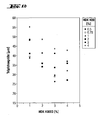
- Figure 1a Optical micrograph of the w / o / w multiple emulsion The scale is 50 microns
- Figure 1a can be found as Figure 1a.
- Figure 1b can be found as Figure 1b.
- Example 2 according to the invention of a w / o / w multiple emulsion
- a hydrophobic pyrogenic silica silylated with dimethylsiloxy groups available under the name Wacker HDK H30 from Wacker-Chemie GmbH, produced by silylating a pyrogenic silica with a BET surface area of 300 m 2 / g
- Wacker HDK H30 from Wacker-Chemie GmbH, produced by silylating a pyrogenic silica with a BET surface area of 300 m 2 / g
- a content of surface silanol groups 0.83 mmol / g (corresponding to a residual content of surface silanol groups of 51% relative to starting silica) and then with an ultrasound transmitter (Sonics & Material, 20 kHz at 10 W for 2 minutes) dispersed.
- a pyrogenic silica silylated with dimethylsiloxy groups available under the name Wacker HDK H30ED from Wacker-Chemie GmbH, produced by silylating a pyrogenic silica with a BET surface area of 300 m 2 / g
- Wacker HDK H30ED from Wacker-Chemie GmbH, produced by silylating a pyrogenic silica with a BET surface area of 300 m 2 / g
- Figure 2 can be found as Figure 2.
- Example 3 according to the invention of an o / w / o multiple emulsion
- 3 g of a hydrophobic fumed silica silylated with dimethylsiloxy groups are added to 80 ml demineralized water (available under the name Wacker HDK H20ED from Wacker-Chemie GmbH, produced by silylating a fumed silica with a BET surface area of 200 m 2 / g) with a carbon content of 0.6% by weight and a content of surface silanol groups of 0.44 mmol / g (corresponding to a residual content of surface silanol groups of 80% relative to the starting silica) and then with an ultrasound transmitter (Sonics & Material, 20 kHz at 10 W for 2 minutes) dispersed.
- Wacker HDK H20ED available under the name Wacker HDK H20ED from Wacker-Chemie GmbH, produced by silylating a fumed silica with a BET surface area of 200 m 2 / g) with a carbon content of 0.6% by weight and a content of surface silanol groups of
- Figure 3 Optical micrograph of the w / o / w multiple emulsion Scale: 20 microns
- Figure 3 can be found as Figure 3.
- step 2 the procedure is the same as described in Example 2, but sodium chloride is additionally added to the inner, first water phase from step 1 in a total concentration of 4a) 0.01 mol / l, 4b) 0.02 mol / l, 4c) 0, 05 mol / l, 4d) 0.1 mol / l, 4e) 0.2 mol / l and 4f) 0.5 mol / l, and in step 2 of the outer third phase, also water phase, glucose is added, in an amount so that there is an isotonic balance between the inner (step 1) and outer water phase (step 2) (to compensate for the osmotic pressure).
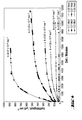
- Figure 4 can be found as Figure 4.
- Non-inventive reference example 1 in which additionally a surfactant is used.
- a pyrogenic silica silylated with dimethylsiloxy groups available under the name Wacker HDK H30ED from Wacker-Chemie GmbH, produced by silylating a pyrogenic silica with a BET surface area of 300 m 2 / g
- Wacker HDK H30ED from Wacker-Chemie GmbH, produced by silylating a pyrogenic silica with a BET surface area of 300 m 2 / g
- step 2 15 months after step 2 become 10 ml of the stable w / o / w
- step 2 0.1 ml of a 0.1 molar solution the surface active substance SDS (sodium dodecyl sulfate) in Water added.
- SDS sodium dodecyl sulfate
- the w / o / w multiple emulsion breaks and a solid forms Sediment.
- Example 5 according to the invention of a w / o / w multiple emulsion
- Non-inventive reference example 2 in which only one surfactant is used.
- Example 2 The procedure is as in Example 2 according to the invention, with except that instead of pyrogenic silica 1 g Sodium dodecyl sulfate is used.
- step 1 a stable w / o emulsion results.
- step 2 a multiple emulsion results, which is immediate breaks and coalesces.
Landscapes
- Chemical & Material Sciences (AREA)
- Chemical Kinetics & Catalysis (AREA)
- Cosmetics (AREA)
- Colloid Chemistry (AREA)
- Medicinal Preparation (AREA)
- Silicon Compounds (AREA)
- Compositions Of Macromolecular Compounds (AREA)
Abstract
Description
Problem dieser Mehrfachemulsionen ist ihre Instabilität gegenüber Koaleszenz.
PhaseX-in-PhaseY-in-PhaseZ (PhaseX/PhaseY/PhaseZ).
Möglichkeit I: (A/B/A').
Mehrfachemulsionen bestehend aus (1) einer Phase A, die emulgiert in einer (2) Phase B vorliegt, diese Phase A-in-Phase B Emulsion (A/B) liegt (3) wiederum als Tröpfchen in einer weiteren Phase A' emulgiert vor: Phase A-in-Phase B-in-Phase A' (A/B/A').
Möglichkeit II: (B/A/B').
Mehrfachemulsionen bestehend aus (1) einer Phase B, die emulgiert in einer (2) Phase A vorliegt, diese Phase B-in-Phase A Emulsion (B/A) liegt (3) wiederum als Tröpfchen in einer weiteren Phase B' emulgiert vor: Phase B-in-Phase A-in-Phase B' (B/A/B').
Sie sind zum Beispiel ein wichtiger technischer Schlüssel in Anwendungen, die eine "controlled release" Funktion erfordern. Controlled Release, gezielte und kontrollierte Abgabe, bedeutet die kontrollierte und langsame Abgabe von
- in der Pharmazie,
- der Medizin,
- der Agrochemie,
- der Lebensmittel- und
- Tiernahrungsindustrie,
- in der Kosmetik und
- in der chemischen Katalyse.
Phasen A1 und A2 können gleich oder verschieden sein; sie sind ausgewählt aus den Stoffen der Phase A.
Phase A1 kann aus Phase A2 bestehen und weitere lösliche Stoffe enthalten.
Bevorzugt bestehen Phase A1 und Phase A2 aus den gleichen Stoffen der Phase A und enthalten eine oder mehrere weitere gleiche oder verschiedene lösliche Substanzen.
Phasen B1 und B2 können gleich oder verschieden sein; sie sind ausgewählt aus den Stoffen der Phase B.
Phase B1 kann aus Phase B2 bestehen und weitere lösliche Stoffe enthalten.
Bevorzugt bestehen Phase B1 und Phase B2 aus den gleichen Stoffen der Phase B und enthalten eine oder mehrere weitere gleiche oder verschiedene lösliche Substanzen.
Bevorzugt sind Gemische aus hydrophilen, wasserbenetzbaren, und hydrophoben, wasserunbenetzbaren Partikeln.
Bevorzugt ist ein Mischungsverhältnis der Partikel von 1:4 bis 4:1, besonders bevorzugt von 1:2 bis 2:1, von hydrophilen zu hydrophoben Partikeln.
In einer bevorzugten Ausführung sind die Partikel kugelförmig; in einer anderen besonders bevorzugten Ausführung sind die Partikel verzweigt und/oder fraktal aufgebaut.
- bevorzugt 0,5 bis 5 kg/l für die Primärpartikel
- bevorzugt 0,05 bis 1 kg/l für verzweigte, gegebenenfalls fraktale, Aggregate bestehend aus Primärpartikeln
- bevorzugt 0,01 bis 0,5 kg/l für verzweigte, gegebenenfalls fraktale, Agglomerate bestehend aus Aggregaten
Partikel-Oberfläche A ist proportional zum Partikel-Radius R hoch Ds
Partikel-Masse M ist proportional zum Partikel-Radius R hoch Dm.
Bevorzugt liegt der Kontaktwinkel der Partikel gegen Wasser zwischen 60° und 120°.
Der Kontaktwinkel definiert das Verhältnis der Oberflächenspannungen und -energien γ von Flüssigkeiten (1) und Feststoffen (s) in einem Gasraum (g) wie folgt.
- mit t :
- Zeit
- m :
- Masse der angesaugten Flüssigkeit
- η :
- Viskosität der Flüssigkeit
- ρ :
- Dichte der Flüssigkeit
- γ :
- Oberflächenspannung der Flüssigkeit
- ϑ :
- Randwinkel Flüssigkeit-Pulver
- C :
- Faktor, nur abhängig von den geometrischen Eigenschaften des Pulvers und Probenrohrs
Bei Verwendung verschiedener Flüssigkeiten mit verschiedener Oberflächenspannung kann exakt die Oberflächenspannung einer Flüssigkeit ermittelt werden, bei der die Partikel-Agglomerate einsinken; diese liefert die kritische Oberflächenenergie γcrit als Maß für die Oberflächenenergie γ der Partikel.
Die Methode kann auch dergestalt vereinfacht werden, dass die Oberflächenspannung von Wasser (72,5 mN/m) durch Zugabe von Methanol, Ethanol oder iso-Propanol verringert wird. 4a) Typischerweise wird dann Wasser vorgelegt, eine bestimmte Menge an Partikel-Agglomeraten auf die Wasseroberfläche aufgelegt (schwimmend) und dann der Alkohol zutitriert, unter Rühren. Das Wasser zu Alkohol-Verhältnis bei Einsinken der Partikel-Agglomerate wird notiert und genau für dieses Verhältnis Wasser : Alkohol in einem getrennten Versuch mit Standardmethoden (Ringabreißmethode, Wilhelmy-Methode) die Oberflächenspannung bestimmt.
Für erfindungsgemäße Partikel, die bevorzugt Metalloxid-Partikel sind, bedeutet dies, dass die Metalloxide bevorzugt teilweise hydrophobiert sind, bevorzugt teilweise silyliert sind.
dass weder die gesamte Metalloxid-Oberfläche unsilyliert ist, noch dass die gesamte Metalloxid-Oberfläche silyliert ist. Der Bedeckungsgrad τ der Oberfläche mit Silyliermittelresten ist dabei 25% < τ < 75% bezogen auf die Gesamt-Metalloxid-Partikel-Oberfläche.
Werden als Partikel pyrogene Kieselsäuren eingesetzt, so sind bevorzugt solche, deren Oberfläche zu mindestens 40% und zu maximal 60% von Hydrophobiermittel, bevorzugt Silyliermittel, bedeckt sind, d.h. der Bedeckungsgrad τ zwischen 40% und 60% liegt, und der Gehalt an nichtsilylierten Oberflächensilanolgruppen zwischen maximal 60% und 40% der ursprünglich vorhandenen Silanolgruppen liegt. Die Gesamtzahl der Silanolgruppen ergibt sich durch die Summe der restlichen Silanolgruppen und die Summe der Silyliermittelreste auf der Kieselsäureoberfläche.
Die Obergrenze an der Menge an Partikel ist hierbei beliebig mit der Maßgabe, dass eine flüssige, fließfähige und verarbeitbare Suspension entsteht. Die resultierende Viskosität ist abhängig von der Partikelgröße, der Partikelstruktur und den Oberflächeneigenschaften der Partikel.
Aus rheologischen Gründen ist beispielweise die maximale Konzentration an silylierter pyrogener Kieselsäure mit spezifischer Oberfläche nach BET von 250 m2/g bei der Herstellung einer Suspension in Ölphase kleiner 25 Gew.%, bevorzugt kleiner 10 Gew.%, besonders bevorzugt kleiner 5 Gew.% in der Öl-Phase, aber die maximale Konzentration an silylierter pyrogener Kieselsäure mit spezifischer Oberfläche nach BET von 40 m2/g bei der Herstellung einer Suspension in Ölphase kleiner 75 Gew.%, bevorzugt 40 Gew.%, besonders bevorzugt kleiner 15 Gew.%.
Bevorzugt werden Partikel eingesetzt, die von Phase B benetzt werden.
Bevorzugt werden Partikel eingesetzt, die von der Öl-Phase benetzt werden.
ist größer 1 Gew.%, bevorzugt größer als 3 Gew.%, besonders bevorzugt größer als 4 Gew.% bezogen auf die Phase A2.
Aus rheologischen Gründen ist beispielweise die maximale Konzentration an pyrogener Kieselsäure mit spezifischer Oberfläche nach BET von 275 m2/g bei der Herstellung einer wässrigen Suspension kleiner 15 Gew.%, bevorzugt kleiner 10 Gew.%, besonders bevorzugt kleiner 5 Gew.% in der Wasser-Phase, aber die maximale Konzentration an pyrogener Kieselsäure mit spezifischer Oberfläche nach BET von 45 m2/g bei der Herstellung einer wässrigen Suspension kleiner 50 Gew.%, bevorzugt 25 Gew.%, besonders bevorzugt kleiner 10 Gew.%.
Die Obergrenze an Menge Partikel ist hierbei beliebig groß mit der Maßgabe, dass eine flüssige, fließfähige und verarbeitbare Suspension entsteht. Die resultierende Viskosität ist abhängig von der Partikelgröße, der Partikelstruktur und den Oberflächeneigenschaften der Partikel.
Aus rheologischen Gründen ist beispielweise die maximale Konzentration an pyrogener Kieselsäure mit spezifischer Oberfläche nach BET von 275 m2/g bei der Herstellung einer wässrigen Suspension kleiner 15 Gew.%, bevorzugt kleiner 10 Gew.%, besonders bevorzugt kleiner 5 Gew.% in der Wasser-Phase, aber die maximale Konzentration an pyrogener Kieselsäure mit spezifischer Oberfläche nach BET von 45 m2/g bei der Herstellung einer wässrigen Suspension kleiner 50 Gew.%, bevorzugt 25 Gew.%, besonders bevorzugt kleiner 10 Gew.%.
Bevorzugt werden Partikel eingesetzt, die von Phase B benetzt werden.
Bevorzugt werden Partikel eingesetzt, die von der Öl-Phase benetzt werden.
Die Gesamtzahl der Silanolgruppen ergibt sich durch die Summe der restlichen Silanolgruppen und die Summe der Silyliermittelreste auf der Kieselsäureoberfläche.
Bevorzugt werden Partikel eingesetzt, die von Phase B benetzt werden.
Bevorzugt werden Partikel eingesetzt, die von der Öl-Phase benetzt werden.
Die Gesamtzahl der Silanolgruppen ergibt sich durch die Summe der restlichen Silanolgruppen und die Summe der Silyliermittelreste auf der Kieselsäureoberfläche.
ist größer als 0,1 Gew.%, bevorzugt größer als 0,5 Gew.%, besonders bevorzugt größer als 1 Gew.% bezogen auf die Phase B2.Zur Herstellung von gegen Sedimentation stabilen Mehrfachemulsion ist im besonderen eine Menge von größer 4 Gew.% an erfindungsgemäßen Partikeln bevorzugt.
Die Obergrenze an Menge Partikel in Phase B2 ist beliebig mit der Maßgabe, dass eine flüssige, fließfähige und verarbeitbare Suspension entsteht. Die resultierende Viskosität ist abhängig von der Partikelgröße, der Partikelstruktur und,den Oberflächeneigenschaften der Partikel.
Aus rheologischen Gründen ist beispielweise die maximale Konzentration an silylierter pyrogener Kieselsäure mit spezifischer Oberfläche nach BET von 250 m2/g bei der
Herstellung einer Suspension in der Ölphase kleiner 30 Gew.%, bevorzugt kleiner 15 Gew.%, besonders bevorzugt kleiner 5 Gew.% in der Wasser-Phase, aber die maximale Konzentration an silylierter pyrogener Kieselsäure mit spezifischer Oberfläche nach BET von 40 m2/g bei der Herstellung einer Suspension in der Ölphase kleiner 75 Gew.%, bevorzugt 50 Gew.%, besonders bevorzugt kleiner 25 Gew.%.
0,1 bis 0,5 Teile, bevorzugt 0,15 bis 0,25 Teile, Emulsion Phase B1-in-Phase A (B1/A) bzw. Öl-in-Wasser (o/w) werden der Suspension Partikel-in-Phase B2 zugefügt, sodass sich eine Gesamtmenge von 1,0 Gewichtsteile ergibt und mit für die Herstellung von Emulsionen geeigneten Verfahren schonend emulgiert; schonend heißt hierbei, dass die in das System eingebrachte Scherenergie bei kleiner 10%, bevorzugt kleiner 5%, besonders bevorzugt kleiner 1%, der Energie der Herstellung der B1/A oder o/w Emulsion, liegt, typischerweise sind hierfür schnelllaufende Rotor-Stator Einheiten, mit Umdrehungszahlen von 5000 bis 15000 Umdrehungen pro Minute, vorzugsweise 8000 bis 13000, besonders bevorzugt bei 13000 Umdrehungen pro Minute geeignet. Dies geschieht während 1 bis 120 Sekunden, vorzugsweise bei 5 bis 25 Sekunden.
- in Pharmazie
- in Medizin
- in Agrochemie
- in Lebensmitteln
- in Tiernahrung
- in Kosmetics
- sowie in der chemischen Katalyse
- Oberflächenbeschichtungen, insbesondere für Papier, Metalle, Kunststoffe, Stein, Baumaterialien.
Es resultiert eine stabile w/o Emulsion.
| 1 g HDK H30 | 13 µm (dieses o.g. Beispiel 1) |
| 2 g HDK H30 | 8 µm (unter Änderung o.g. Beispiels 1) |
| 3 g HDK H30 | 5 µm (unter Änderung o.g. Beispiels 1) |
Es resultiert eine für über 15 Monate und gegen Scherung stabile w/o/w Mehrfachemulsion, die keinerlei Koaleszenz zeigt.
Maßstab ist 50 Mikrometer
Abhängigkeit der Größe der äußeren (w/o) Tröpfchen in (w) von der Konzentration von Kieselsäure HDK H30 (siehe Legende in der Abbildung 1b: HDK H30 = 0,5%; 0,75%; 1%; 2%; 3%, 4%) und von der Konzentration der Kieselsäure HDK H30ED (siehe Abszisse: 1%; 2%, 3%, 4%) in Beispiel 1
Es resultiert eine stabile w/o Emulsion.
Es resultiert eine für über 15 Monate und gegen Scherung stabile w/o/w Mehrfachemulsion, die keinerlei Koaleszenz zeigt.
| innere (w) Tröpfchen in (o) | 0,8 µm |
| äußere (w/o) Tröpfchen in (w) | 26 µm |
Abhängigkeit der Größe der äußeren (w/o) Tröpfchen in (w) von der Konzentration von Kieselsäure HDK H30 (siehe Legende in der Abbildung 2: HDK H30 = 0,5%; 0,75%; 1%; 2%; 3%, 4%) und von der Konzentration der Kieselsäure HDK H30ED (siehe Abszisse: 1%; 2%, 3%, 4%) in Beispiel 2
Es resultiert eine stabile o/w Emulsion.
Es resultiert eine für über 15 Monate und gegen Scherung stabile Öl-in-Wasser-in-Öl (o/w/o) Mehrfachemulsion, die über keinerlei Koaleszenz aufweist
Maßstab: 20 Mikrometer
Die zeitliche Änderung der Leitfähigkeit in der äußeren Wasserphase w/o/w, als Maß des Übergangs von Natriumchlorid von der Inneren w/o/w in die Äußere w/o/w Wasserphase wird gemessen. Es wird die typische zeitlich Zunahme auf Grund eines "Controlled Release" Vorgangs erhalten, siehe Abbildung 4
Dimethylsiloxy-Gruppen silylierten pyrogenen Kieselsäure (erhältlich unter dem Namen Wacker HDK H30 bei der Wacker-Chemie GmbH, hergestellt durch Silylierung einer pyrogenen Kieselsäure mit BET Oberfläche von 300 m2/g) mit einem Kohlenstoffgehalt von 1,8 Gew.% und einem Gehalt an Oberflächensilanolgruppen von 0,83 mMol/g (entsprechend einem Restgehalt an Oberflächensilanolgruppen von 51% relativ zu Ausgangskieselsäure) hinzugefügt und anschließend mit einem Ultraschallgeber (Sonics&Material, 20 kHz bei 10 W für 2 Minuten) dispergiert. Anschließend werden 20 ml VE-Wasser hinzugefügt und mit einem Ultra-Turrax Rotor-Stator-Homogenisator (1,8 cm Durchmesser) bei 13.000 UpM für 2 Minuten emulgiert.
Es resultiert eine stabile w/o Emulsion.
Es resultiert eine für über 15 Monate und gegen Scherung stabile w/o/w Mehrfachemulsion, die keinerlei Koaleszenz zeigt.
Es resultiert eine stabile w/o Emulsion.
Es resultiert eine für über 15 Monate und gegen Scherung stabile und viskose w/o/w Mehrfachemulsion, die keinerlei Koaleszenz und keinerlei Sedimentation zeigt.
Claims (17)
- Mehrfachemulsion, die aus einer polaren Phase A1, einer unpolaren Phase B und einer polaren Phase A2 oder einer unpolaren Phase B1, einer polaren Phase A und einer unpolaren Phase B2 besteht, dadurch gekennzeichnet, dass sie Partikel-förmige Feststoffe, die kleiner 1 µm sind, enthält, mit der Maßgabe, dass oberflächenaktive Substanzen nur bis zu einer maximalen Konzentration von kleiner als 0,1 mal der kritischen Micellkonzentration der oberflächenaktiven Substanzen in Phase A, A1, A2 enthalten sind.
- Mehrfachemulsionen nach Anspruch 1, dadurch gekennzeichnet, dass die Phasen A, A1, A2 jeweils wässrige Phasen und die Phasen B, B1, B2 jeweils eine Öl-Phase sind.
- Mehrfachemulsion nach Anspruch 1 und 2, dadurch gekennzeichnet, dass die Partikel-förmigen Feststoffe sich in ihren Oberflächeneigenschaften unterscheiden.
- Mehrfachemulsion nach Anspruch 1, 2 oder 3, dadurch - gekennzeichnet, dass die Partikel-förmigen Feststoffe einen Kontaktwinkel an der Luft gegen Phase A von größer 0° und zugleich kleiner 180 ° aufweisen.
- Mehrfachemulsion nach einem oder mehreren der Ansprüche 1 bis 4, dadurch gekennzeichnet, dass die Partikel-förmigen Feststoffe Mischungen verschiedener Partikel-förmiger Feststoffe sind.
- Mehrfachemulsion nach einem oder mehreren der Ansprüche 1 bis 5, dadurch gekennzeichnet, dass die Partikel-förmigen Feststoffe zumindest Metalloxide enthalten.
- Mehrfachemulsion nach einem oder mehreren der Ansprüche 1 bis 6, dadurch gekennzeichnet, dass die Partikel-förmigen Feststoffe zumindest Siliciumdioxid enthalten.
- Mehrfachemulsion nach einem oder mehreren der Ansprüche 1 bis 7, dadurch gekennzeichnet, dass die Partikel-förmigen Feststoffe zumindest hydrophobes Siliciumdioxid enthalten
- Mehrfachemulsion nach einem oder mehreren der Ansprüche 1 bis 7, dadurch gekennzeichnet, dass die Partikel-förmigen Feststoffe zumindest teilsilyliertes Siliciumdioxid enthalten.
- Mehrfachemulsion nach einem oder mehreren der Ansprüche 1 bis 9, dadurch gekennzeichnet, dass die Partikel-förmigen Feststoffe zumindest Mischungen von hydrophilem und hydrophobem Siliciumdioxid enthalten.
- Mehrfachemulsionen nach einem oder mehreren der Ansprüche 1 bis 10, dadurch gekennzeichnet, dass die Partikel-förmigen Feststoffe zumindest pyrogen hergestelltes Siliciumdioxid - enthalten.
- Verfahren zur Herstellung einer (A1/B/A2) Mehrfachemulsion, dadurch gekennzeichnet, dass die Partikel-förmigen Feststoffe in der B Phase dispergiert werden und diese Suspension in der A1 Phase dispergiert wird und die so gebildete Emulsion in der A2 Phase, die Partikel-förmige Feststoffe enthält, dispergiert wird.
- Verfahren zur Herstellung einer (A1/B/A2) Mehrfachemulsion, dadurch gekennzeichnet, dass die Partikel-förmigen Feststoffe in der A1 Phase dispergiert werden und diese Suspension in der B Phase dispergiert wird und die so gebildete Emulsion in der A2 Phase, die Partikel-förmige Feststoffe enthält, dispergiert wird.
- Verfahren zur Herstellung einer (B1/A/B2) Mehrfachemulsion, dadurch gekennzeichnet, dass die Partikel-förmigen Feststoffe in der B1 Phase dispergiert werden und diese Suspension in der A Phase dispergiert wird und die so gebildete Emulsion in der B2 Phase, die Partikel-förmige Feststoffe enthält, dispergiert wird.
- Verfahren zur Herstellung einer (B1/A/B2) Mehrfachemulsion, dadurch gekennzeichnet, dass die Partikel-förmigen Feststoffe in der A Phase dispergiert werden und diese Suspension in der B1 Phase dispergiert wird und die so gebildete Emulsion in der B2 Phase, die Partikel-förmige Feststoffe enthält, dispergiert wird.
- Verwendung der Mehrfachemulsion in Pharmazeutika, Kosmetika, Medizinprodukten, Nahrungsmitteln, Futtermittel, agrochemischen Mitteln und Katalysatoren.
- Verwendung der Mehrfachemulsion zur kontrollierten und kontrollierten verzögerten Abgabe von Wirkstoffen an die Umgebung.
Applications Claiming Priority (2)
| Application Number | Priority Date | Filing Date | Title |
|---|---|---|---|
| DE10211313 | 2002-03-14 | ||
| DE10211313A DE10211313A1 (de) | 2002-03-14 | 2002-03-14 | Mehrfachemulsionen |
Publications (2)
| Publication Number | Publication Date |
|---|---|
| EP1350556A1 true EP1350556A1 (de) | 2003-10-08 |
| EP1350556B1 EP1350556B1 (de) | 2004-09-08 |
Family
ID=27797772
Family Applications (1)
| Application Number | Title | Priority Date | Filing Date |
|---|---|---|---|
| EP03004297A Expired - Lifetime EP1350556B1 (de) | 2002-03-14 | 2003-02-27 | Mehrfachemulsionen |
Country Status (6)
| Country | Link |
|---|---|
| US (1) | US7722891B2 (de) |
| EP (1) | EP1350556B1 (de) |
| JP (1) | JP4473514B2 (de) |
| CN (1) | CN1306990C (de) |
| DE (2) | DE10211313A1 (de) |
| PL (1) | PL359056A1 (de) |
Cited By (1)
| Publication number | Priority date | Publication date | Assignee | Title |
|---|---|---|---|---|
| CZ307690B6 (cs) * | 2011-02-28 | 2019-02-20 | Vysoké Učení Technické V Brně | Způsob úpravy povrchu nanočástic vodných disperzních systémů pro nanášení organických hydrofobních vrstev s použitím azeotropické destilace |
Families Citing this family (28)
| Publication number | Priority date | Publication date | Assignee | Title |
|---|---|---|---|---|
| GB2400609A (en) * | 2003-04-16 | 2004-10-20 | Reckitt Benckiser | Multiple-emulsion cleaner |
| DE10349082A1 (de) * | 2003-10-22 | 2005-05-25 | Wacker-Chemie Gmbh | Wässrige Polymerdispersionen |
| DE102004014704A1 (de) * | 2004-03-25 | 2005-10-13 | Wacker-Chemie Gmbh | Partikelstabilisierte Emulsionen |
| DE102004039212A1 (de) * | 2004-08-12 | 2006-03-02 | Wacker-Chemie Gmbh | Rheologiesteuerung von Pickering-Emulsion durch Elektrolyte |
| US20080193513A1 (en) * | 2005-06-07 | 2008-08-14 | University Of South Australia | Dried Formulations of Nanoparticle-Coated Capsules |
| ATE542880T1 (de) * | 2005-12-16 | 2012-02-15 | Unilever Nv | Oberflächenaktives material und seine anwendung |
| JP2009536162A (ja) * | 2006-05-04 | 2009-10-08 | ユニバーシティー オブ サウス オーストラリア | ナノ粒子被覆カプセルからの薬物放出 |
| CN101528054B (zh) * | 2006-10-17 | 2013-03-13 | 荷兰联合利华有限公司 | 包含气泡的食品组合物及其制备方法 |
| WO2008046699A1 (en) * | 2006-10-17 | 2008-04-24 | Unilever N.V. | Aerated food product and process for preparing it |
| RU2009118385A (ru) * | 2006-10-17 | 2010-11-27 | Юнилевер Н.В. (Nl) | Пищевая композиция, содержащая пузырьки газа, и способ ее приготовления |
| RU2009118467A (ru) * | 2006-10-17 | 2010-11-27 | Юнилевер Н.В. (Nl) | Пищевая композиция, содержащая пузырьки газа, и способ ее приготовления |
| US20100186420A1 (en) * | 2006-10-17 | 2010-07-29 | Mark John Berry | Frozen aerated food product comprising surface-active fibres |
| AU2008241367A1 (en) * | 2007-04-20 | 2008-10-30 | University Of South Australia | Nanoparticle-coated capsule formulation for dermal drug delivery |
| FR2926229B1 (fr) * | 2008-01-11 | 2011-12-09 | Univ Claude Bernard Lyon | Emulsions stables de type huile-dans-eau comprenant des particules de silice hydrophile non modifiee |
| US8778400B2 (en) * | 2008-04-21 | 2014-07-15 | University Of South Australia | Nanoparticle-stabilized capsule formulation for treatment of inflammation |
| DE102008049522A1 (de) * | 2008-09-17 | 2010-04-15 | Universität Tübingen | Granulat, insbesondere als pharmazeutisches Vehikel für lipophile Arzneistoffe |
| CN101690481B (zh) * | 2009-07-07 | 2013-09-11 | 深圳诺普信农化股份有限公司 | 螺螨酯多重乳状液及其制备方法 |
| JP5427996B2 (ja) * | 2009-10-19 | 2014-02-26 | サンノプコ株式会社 | 両親媒性粒子及びその製造方法 |
| JP5427997B2 (ja) * | 2010-02-02 | 2014-02-26 | サンノプコ株式会社 | 乳化分散組成物、この製造方法及び両親媒性粒子水性分散体 |
| WO2013042069A1 (en) | 2011-09-22 | 2013-03-28 | Ariel-University Research And Development Company, Ltd. | Emulsions and methods of making emulsions |
| CN102675516B (zh) * | 2012-05-16 | 2014-09-10 | 华南理工大学 | 一种互通多孔磁性聚合物微球及其制备方法 |
| EP2769995B1 (de) | 2013-02-20 | 2016-02-03 | King Saud University | Mikrostrukturiertes material und verfahren zur herstellung davon |
| WO2014130763A1 (en) * | 2013-02-22 | 2014-08-28 | Stiefel Laboratories, Inc. | Non-aqueous solid stabilized emulsions |
| AU2014363887B2 (en) * | 2013-12-13 | 2018-04-05 | Société des Produits Nestlé S.A. | Emulsions stabilized by particles of an edible inorganic salt |
| CN104592969B (zh) * | 2015-02-17 | 2017-10-20 | 中国石油集团渤海钻探工程有限公司 | 多重乳化酸液体系 |
| CN106821774A (zh) * | 2017-02-23 | 2017-06-13 | 韩后化妆品股份有限公司 | 包裹精油和稻米发酵滤液的微囊复合物及应用 |
| WO2018209293A2 (en) | 2017-05-11 | 2018-11-15 | The Regents Of The University Of California | Nanoscale multiple emulsions and nanoparticles |
| CN110041459B (zh) * | 2019-04-23 | 2021-07-23 | 中国科学院长春应用化学研究所 | 一种o/w/o多重乳液、其制备方法和应用 |
Citations (8)
| Publication number | Priority date | Publication date | Assignee | Title |
|---|---|---|---|---|
| GB1152607A (en) * | 1967-03-08 | 1969-05-21 | Pfizer Ltd | Antigenic Compositions |
| EP0529396A1 (de) * | 1991-08-22 | 1993-03-03 | Beiersdorf Aktiengesellschaft | Galenisch Matrix |
| EP0780112A1 (de) * | 1995-12-21 | 1997-06-25 | Beiersdorf Aktiengesellschaft | Verfahren zur Herstellung von O/W- oder O/W/O-Emulsionen sowie nach solchen Verfahren erhältliche O/W- und O/W/O-Emulsionen |
| EP0782846A2 (de) * | 1995-12-14 | 1997-07-09 | Shiseido Company Limited | Multiple Emulsion des Typs O/W/O und Verfahren zu ihrer Herstellung |
| EP0836847A2 (de) * | 1996-09-13 | 1998-04-22 | LANCASTER GROUP GmbH | Stabile Mehrphasenemulsion vom Typ O1/W/O2 |
| EP0892035A1 (de) * | 1997-07-17 | 1999-01-20 | Intevep SA | Mehrphasenemulsion und Verfahren zu ihrer Herstellung |
| WO1999007463A1 (fr) * | 1997-08-07 | 1999-02-18 | Centre National De La Recherche Scientifique (Cnrs) | Procede de liberation d'un principe actif contenu dans une emulsion multiple |
| WO2000037045A2 (en) * | 1998-12-22 | 2000-06-29 | Maine Biological Laboratories, Inc. | Stabilized water-in-oil-in-water antigen delivery system |
Family Cites Families (16)
| Publication number | Priority date | Publication date | Assignee | Title |
|---|---|---|---|---|
| DE1163784C2 (de) | 1962-03-30 | 1973-05-03 | Degussa | Verfahren zur Oberflaechenbehandlung von hochdispersen Oxyden |
| DE2344388B2 (de) | 1973-09-03 | 1978-06-22 | Elektroschmelzwerk Kempten Gmbh, 8000 Muenchen | Verfahren zum Herstellen von hydrophobem Siliciumdioxyd |
| DE3339056A1 (de) | 1983-10-28 | 1985-05-09 | Günter Horst 7927 Sontheim Röhm | Bohreinrichtung zum schlagbohren |
| WO1991017822A1 (fr) * | 1990-05-24 | 1991-11-28 | Nippon Kayaku Kabushiki Kaisha | Microcapsule et procede de fabrication associe |
| DE4136699A1 (de) * | 1991-11-07 | 1992-10-22 | Lancaster Group Ag | Verfahren zur herstellung von stabilen, komplexen emulsionssystemen des typs wasser-oel-wasser und deren verwendung als kosmetische praeparate |
| DE4221716A1 (de) | 1992-07-02 | 1994-01-05 | Wacker Chemie Gmbh | Verfahren zur Hydrophobierung von pyrogen hergestelltem Siliciumdioxid |
| DE4341113B4 (de) * | 1993-12-02 | 2006-04-13 | IFAC Institut für angewandte Colloidtechnologie GmbH & Co. KG | Stabile multiple X/O/Y-Emulsion |
| DE4419234A1 (de) | 1994-06-01 | 1995-12-07 | Wacker Chemie Gmbh | Verfahren zur Silylierung von anorganischen Oxiden |
| EP0745372B2 (de) * | 1995-05-30 | 2002-05-29 | L'oreal | Verwendung von kolloidaler Kieselsäure zur Verstärkung von keratinischen Fasern |
| DE19756831A1 (de) | 1997-12-19 | 1999-07-01 | Wacker Chemie Gmbh | Siliciumdioxid, das an seiner Oberfläche teil- oder vollständig silylierte Polykieselsäureketten trägt |
| US6193412B1 (en) * | 1999-02-26 | 2001-02-27 | General Electric Company | Method for measurement of the surface polarity of inorganic material |
| FR2791556B1 (fr) * | 1999-03-30 | 2003-03-07 | Oreal | Composition de maquillage ou de soin contenant un organopolysiloxane reticule a groupement oxyalkylene |
| JP2001354520A (ja) | 2000-06-12 | 2001-12-25 | Lion Corp | 層状珪酸塩含有w/o/w型及びw/o型エマルション |
| GB2400609A (en) * | 2003-04-16 | 2004-10-20 | Reckitt Benckiser | Multiple-emulsion cleaner |
| DE102004014704A1 (de) * | 2004-03-25 | 2005-10-13 | Wacker-Chemie Gmbh | Partikelstabilisierte Emulsionen |
| DE102004039212A1 (de) * | 2004-08-12 | 2006-03-02 | Wacker-Chemie Gmbh | Rheologiesteuerung von Pickering-Emulsion durch Elektrolyte |
-
2002
- 2002-03-14 DE DE10211313A patent/DE10211313A1/de not_active Withdrawn
-
2003
- 2003-02-27 EP EP03004297A patent/EP1350556B1/de not_active Expired - Lifetime
- 2003-02-27 DE DE50300067T patent/DE50300067D1/de not_active Expired - Lifetime
- 2003-02-28 US US10/376,811 patent/US7722891B2/en not_active Expired - Fee Related
- 2003-03-07 PL PL03359056A patent/PL359056A1/xx unknown
- 2003-03-13 JP JP2003068515A patent/JP4473514B2/ja not_active Expired - Lifetime
- 2003-03-14 CN CNB031199798A patent/CN1306990C/zh not_active Expired - Fee Related
Patent Citations (8)
| Publication number | Priority date | Publication date | Assignee | Title |
|---|---|---|---|---|
| GB1152607A (en) * | 1967-03-08 | 1969-05-21 | Pfizer Ltd | Antigenic Compositions |
| EP0529396A1 (de) * | 1991-08-22 | 1993-03-03 | Beiersdorf Aktiengesellschaft | Galenisch Matrix |
| EP0782846A2 (de) * | 1995-12-14 | 1997-07-09 | Shiseido Company Limited | Multiple Emulsion des Typs O/W/O und Verfahren zu ihrer Herstellung |
| EP0780112A1 (de) * | 1995-12-21 | 1997-06-25 | Beiersdorf Aktiengesellschaft | Verfahren zur Herstellung von O/W- oder O/W/O-Emulsionen sowie nach solchen Verfahren erhältliche O/W- und O/W/O-Emulsionen |
| EP0836847A2 (de) * | 1996-09-13 | 1998-04-22 | LANCASTER GROUP GmbH | Stabile Mehrphasenemulsion vom Typ O1/W/O2 |
| EP0892035A1 (de) * | 1997-07-17 | 1999-01-20 | Intevep SA | Mehrphasenemulsion und Verfahren zu ihrer Herstellung |
| WO1999007463A1 (fr) * | 1997-08-07 | 1999-02-18 | Centre National De La Recherche Scientifique (Cnrs) | Procede de liberation d'un principe actif contenu dans une emulsion multiple |
| WO2000037045A2 (en) * | 1998-12-22 | 2000-06-29 | Maine Biological Laboratories, Inc. | Stabilized water-in-oil-in-water antigen delivery system |
Cited By (1)
| Publication number | Priority date | Publication date | Assignee | Title |
|---|---|---|---|---|
| CZ307690B6 (cs) * | 2011-02-28 | 2019-02-20 | Vysoké Učení Technické V Brně | Způsob úpravy povrchu nanočástic vodných disperzních systémů pro nanášení organických hydrofobních vrstev s použitím azeotropické destilace |
Also Published As
| Publication number | Publication date |
|---|---|
| CN1449862A (zh) | 2003-10-22 |
| US20030175317A1 (en) | 2003-09-18 |
| PL359056A1 (en) | 2003-09-22 |
| JP2003311144A (ja) | 2003-11-05 |
| JP4473514B2 (ja) | 2010-06-02 |
| CN1306990C (zh) | 2007-03-28 |
| US7722891B2 (en) | 2010-05-25 |
| EP1350556B1 (de) | 2004-09-08 |
| DE50300067D1 (de) | 2004-10-14 |
| DE10211313A1 (de) | 2003-10-02 |
Similar Documents
| Publication | Publication Date | Title |
|---|---|---|
| EP1350556B1 (de) | Mehrfachemulsionen | |
| Aveyard et al. | Emulsions stabilised solely by colloidal particles | |
| EP1727865B1 (de) | Partikelstabilisierte emulsionen | |
| Kempin et al. | W/O Pickering emulsion preparation using a batch rotor-stator mixer–Influence on rheology, drop size distribution and filtration behavior | |
| EP1789170B1 (de) | Rheologiesteuerung von pickering-emulsionen durch elektrolyte | |
| EP1433749B1 (de) | Wasserbenetzbare silylierte Metalloxide | |
| Vazquez et al. | Synthesis of mesoporous silica nanoparticles by sol–gel as nanocontainer for future drug delivery applications | |
| Wu et al. | Investigation of the stability in Pickering emulsions preparation with commercial cosmetic ingredients | |
| Benchabane et al. | Effects of anionic additives on the rheological behavior of aqueous calcium montmorillonite suspensions | |
| DE69727032T2 (de) | HERSTELLUNGSVERFAHREN FüR EMULSIONEN | |
| EP0810822B1 (de) | Verwendung von aerogelen in der landwirtschaft | |
| Ali et al. | Graphene oxide–silica hybrid capsules for sustained fragrance release | |
| WO2008046854A2 (de) | Stabile wässrige dispersionen von siliciumdioxid | |
| EP0948395A1 (de) | Organisch modifizierte aerogele, verfahren zu ihrer herstellung durch oberflächenmodifikation des wässrigen gels ohne vorherigen lösungsmitteltausch und anschliessende trocknung sowie deren verwendung | |
| Farias et al. | Nanodiamond-stabilized Pickering emulsions: Microstructure and rheology | |
| Acharya et al. | Formation and characterization of a pharmaceutically useful microemulsion derived from isopropylmyristate, polyoxyethylene (4) lauryl ether (Brij-30), isopropyl alcohol and water | |
| EP1017745B1 (de) | An ihrer oberfläche anisotrop verteilte überwiegend hydrophile und überwiegend hydrophobe domänen aufweisende amphiphile teilchen oder moleküle | |
| WO2021228828A1 (de) | Verfahren zur herstellung von aerogelen und mit diesem erhältliche aerogele | |
| WO2008040320A1 (de) | Verfahren zur herstellung von funktionellen cellulosischen formkörpern | |
| Sy et al. | Water/oil pickering emulsion stabilized by magnesium oxide particles: a potential system with two active substances (Paracetamol and Griseofulvin) | |
| DE69811903T2 (de) | Verfahren zum vorbereiten von konzentrierten und kalibrierten emulsionen bzw. emulsionen aus bitumen in eine phase von erhöhter viskosität | |
| Masalova et al. | Is the combination of two particles with different degrees of hydrophobicity an alternative method for tuning the average particle hydrophobicity? | |
| EP3266442A1 (de) | Durch ton stabilisierte emulsion | |
| DE19742759A1 (de) | Verfahren zur Herstellung amphiphiler anisotroper Teilchen | |
| EP3717407A1 (de) | Hoch dispergierbare gefällte kieselsäuren |
Legal Events
| Date | Code | Title | Description |
|---|---|---|---|
| PUAI | Public reference made under article 153(3) epc to a published international application that has entered the european phase |
Free format text: ORIGINAL CODE: 0009012 |
|
| 17P | Request for examination filed |
Effective date: 20030227 |
|
| AK | Designated contracting states |
Kind code of ref document: A1 Designated state(s): AT BE BG CH CY CZ DE DK EE ES FI FR GB GR HU IE IT LI LU MC NL PT SE SI SK TR |
|
| AX | Request for extension of the european patent |
Extension state: AL LT LV MK RO |
|
| GRAP | Despatch of communication of intention to grant a patent |
Free format text: ORIGINAL CODE: EPIDOSNIGR1 |
|
| GRAS | Grant fee paid |
Free format text: ORIGINAL CODE: EPIDOSNIGR3 |
|
| AKX | Designation fees paid |
Designated state(s): BE DE FR GB NL |
|
| GRAA | (expected) grant |
Free format text: ORIGINAL CODE: 0009210 |
|
| AK | Designated contracting states |
Kind code of ref document: B1 Designated state(s): BE DE FR GB NL |
|
| REG | Reference to a national code |
Ref country code: GB Ref legal event code: FG4D Free format text: NOT ENGLISH |
|
| REG | Reference to a national code |
Ref country code: IE Ref legal event code: FG4D Free format text: GERMAN |
|
| REF | Corresponds to: |
Ref document number: 50300067 Country of ref document: DE Date of ref document: 20041014 Kind code of ref document: P |
|
| GBT | Gb: translation of ep patent filed (gb section 77(6)(a)/1977) |
Effective date: 20050111 |
|
| REG | Reference to a national code |
Ref country code: IE Ref legal event code: FD4D |
|
| ET | Fr: translation filed | ||
| PLBE | No opposition filed within time limit |
Free format text: ORIGINAL CODE: 0009261 |
|
| STAA | Information on the status of an ep patent application or granted ep patent |
Free format text: STATUS: NO OPPOSITION FILED WITHIN TIME LIMIT |
|
| 26N | No opposition filed |
Effective date: 20050609 |
|
| PGFP | Annual fee paid to national office [announced via postgrant information from national office to epo] |
Ref country code: FR Payment date: 20120227 Year of fee payment: 10 |
|
| PGFP | Annual fee paid to national office [announced via postgrant information from national office to epo] |
Ref country code: DE Payment date: 20120221 Year of fee payment: 10 |
|
| PGFP | Annual fee paid to national office [announced via postgrant information from national office to epo] |
Ref country code: BE Payment date: 20120329 Year of fee payment: 10 Ref country code: GB Payment date: 20120221 Year of fee payment: 10 |
|
| PGFP | Annual fee paid to national office [announced via postgrant information from national office to epo] |
Ref country code: NL Payment date: 20120228 Year of fee payment: 10 |
|
| BERE | Be: lapsed |
Owner name: *WACKER-CHEMIE G.M.B.H. Effective date: 20130228 |
|
| REG | Reference to a national code |
Ref country code: NL Ref legal event code: V1 Effective date: 20130901 |
|
| GBPC | Gb: european patent ceased through non-payment of renewal fee |
Effective date: 20130227 |
|
| PG25 | Lapsed in a contracting state [announced via postgrant information from national office to epo] |
Ref country code: NL Free format text: LAPSE BECAUSE OF NON-PAYMENT OF DUE FEES Effective date: 20130901 |
|
| REG | Reference to a national code |
Ref country code: FR Ref legal event code: ST Effective date: 20131031 |
|
| REG | Reference to a national code |
Ref country code: DE Ref legal event code: R119 Ref document number: 50300067 Country of ref document: DE Effective date: 20130903 |
|
| PG25 | Lapsed in a contracting state [announced via postgrant information from national office to epo] |
Ref country code: FR Free format text: LAPSE BECAUSE OF NON-PAYMENT OF DUE FEES Effective date: 20130228 Ref country code: GB Free format text: LAPSE BECAUSE OF NON-PAYMENT OF DUE FEES Effective date: 20130227 Ref country code: DE Free format text: LAPSE BECAUSE OF NON-PAYMENT OF DUE FEES Effective date: 20130903 Ref country code: BE Free format text: LAPSE BECAUSE OF NON-PAYMENT OF DUE FEES Effective date: 20130228 |