EP1337201B1 - Hornhautprothese - Google Patents
Hornhautprothese Download PDFInfo
- Publication number
- EP1337201B1 EP1337201B1 EP01995534A EP01995534A EP1337201B1 EP 1337201 B1 EP1337201 B1 EP 1337201B1 EP 01995534 A EP01995534 A EP 01995534A EP 01995534 A EP01995534 A EP 01995534A EP 1337201 B1 EP1337201 B1 EP 1337201B1
- Authority
- EP
- European Patent Office
- Prior art keywords
- corneal prosthesis
- peripheral zone
- prosthesis
- corneal
- eye
- Prior art date
- Legal status (The legal status is an assumption and is not a legal conclusion. Google has not performed a legal analysis and makes no representation as to the accuracy of the status listed.)
- Expired - Lifetime
Links
- 210000001508 eye Anatomy 0.000 claims abstract description 41
- 238000000576 coating method Methods 0.000 claims abstract description 34
- 239000011248 coating agent Substances 0.000 claims abstract description 33
- 239000000463 material Substances 0.000 claims abstract description 18
- 238000002513 implantation Methods 0.000 claims abstract description 16
- 239000002033 PVDF binder Substances 0.000 claims abstract description 13
- 229920002981 polyvinylidene fluoride Polymers 0.000 claims abstract description 13
- 210000003205 muscle Anatomy 0.000 claims abstract description 12
- 239000006096 absorbing agent Substances 0.000 claims abstract description 6
- 230000015572 biosynthetic process Effects 0.000 claims abstract description 4
- 210000005252 bulbus oculi Anatomy 0.000 claims abstract description 3
- 230000002093 peripheral effect Effects 0.000 claims abstract 22
- 125000000524 functional group Chemical group 0.000 claims description 22
- 210000004027 cell Anatomy 0.000 claims description 21
- 239000004753 textile Substances 0.000 claims description 16
- 230000000975 bioactive effect Effects 0.000 claims description 14
- -1 polyethylene Polymers 0.000 claims description 13
- 238000000034 method Methods 0.000 claims description 11
- 108090000623 proteins and genes Proteins 0.000 claims description 11
- 102000004169 proteins and genes Human genes 0.000 claims description 11
- NIXOWILDQLNWCW-UHFFFAOYSA-N acrylic acid group Chemical group C(C=C)(=O)O NIXOWILDQLNWCW-UHFFFAOYSA-N 0.000 claims description 7
- 230000000181 anti-adherent effect Effects 0.000 claims description 7
- 238000003776 cleavage reaction Methods 0.000 claims description 7
- 239000000017 hydrogel Substances 0.000 claims description 7
- 239000000178 monomer Substances 0.000 claims description 7
- 229920000642 polymer Polymers 0.000 claims description 7
- 230000007017 scission Effects 0.000 claims description 7
- SMZOUWXMTYCWNB-UHFFFAOYSA-N 2-(2-methoxy-5-methylphenyl)ethanamine Chemical compound COC1=CC=C(C)C=C1CCN SMZOUWXMTYCWNB-UHFFFAOYSA-N 0.000 claims description 6
- 210000002381 plasma Anatomy 0.000 claims description 6
- 125000006850 spacer group Chemical group 0.000 claims description 6
- 102000010780 Platelet-Derived Growth Factor Human genes 0.000 claims description 5
- 108010038512 Platelet-Derived Growth Factor Proteins 0.000 claims description 5
- 239000004744 fabric Substances 0.000 claims description 5
- 229920001223 polyethylene glycol Polymers 0.000 claims description 5
- XKRFYHLGVUSROY-UHFFFAOYSA-N Argon Chemical compound [Ar] XKRFYHLGVUSROY-UHFFFAOYSA-N 0.000 claims description 4
- 239000012634 fragment Substances 0.000 claims description 4
- 230000004410 intraocular pressure Effects 0.000 claims description 4
- 229920000728 polyester Polymers 0.000 claims description 4
- 108090000765 processed proteins & peptides Proteins 0.000 claims description 4
- 230000002787 reinforcement Effects 0.000 claims description 4
- HTTJABKRGRZYRN-UHFFFAOYSA-N Heparin Chemical compound OC1C(NC(=O)C)C(O)OC(COS(O)(=O)=O)C1OC1C(OS(O)(=O)=O)C(O)C(OC2C(C(OS(O)(=O)=O)C(OC3C(C(O)C(O)C(O3)C(O)=O)OS(O)(=O)=O)C(CO)O2)NS(O)(=O)=O)C(C(O)=O)O1 HTTJABKRGRZYRN-UHFFFAOYSA-N 0.000 claims description 3
- 239000004698 Polyethylene Substances 0.000 claims description 3
- QVGXLLKOCUKJST-UHFFFAOYSA-N atomic oxygen Chemical compound [O] QVGXLLKOCUKJST-UHFFFAOYSA-N 0.000 claims description 3
- 125000003178 carboxy group Chemical group [H]OC(*)=O 0.000 claims description 3
- 238000006243 chemical reaction Methods 0.000 claims description 3
- 150000001875 compounds Chemical class 0.000 claims description 3
- 238000007334 copolymerization reaction Methods 0.000 claims description 3
- 239000000835 fiber Substances 0.000 claims description 3
- 239000006260 foam Substances 0.000 claims description 3
- 229920001519 homopolymer Polymers 0.000 claims description 3
- 150000002432 hydroperoxides Chemical class 0.000 claims description 3
- 239000001301 oxygen Substances 0.000 claims description 3
- 229910052760 oxygen Inorganic materials 0.000 claims description 3
- 239000004033 plastic Substances 0.000 claims description 3
- 229920003023 plastic Polymers 0.000 claims description 3
- 229920000573 polyethylene Polymers 0.000 claims description 3
- 229920001296 polysiloxane Polymers 0.000 claims description 3
- 230000029663 wound healing Effects 0.000 claims description 3
- 229920002971 Heparan sulfate Polymers 0.000 claims description 2
- 239000004696 Poly ether ether ketone Substances 0.000 claims description 2
- 239000002202 Polyethylene glycol Substances 0.000 claims description 2
- 239000004743 Polypropylene Substances 0.000 claims description 2
- 101000781681 Protobothrops flavoviridis Disintegrin triflavin Proteins 0.000 claims description 2
- 229920002125 Sokalan® Polymers 0.000 claims description 2
- 239000012190 activator Substances 0.000 claims description 2
- 150000001413 amino acids Chemical class 0.000 claims description 2
- 125000003277 amino group Chemical group 0.000 claims description 2
- 229910052786 argon Inorganic materials 0.000 claims description 2
- 230000004956 cell adhesive effect Effects 0.000 claims description 2
- 238000009826 distribution Methods 0.000 claims description 2
- 239000010408 film Substances 0.000 claims description 2
- 239000007789 gas Substances 0.000 claims description 2
- 239000003102 growth factor Substances 0.000 claims description 2
- 229920000669 heparin Polymers 0.000 claims description 2
- 229960002897 heparin Drugs 0.000 claims description 2
- 239000011261 inert gas Substances 0.000 claims description 2
- 238000005259 measurement Methods 0.000 claims description 2
- 229920005615 natural polymer Polymers 0.000 claims description 2
- 229920001643 poly(ether ketone) Polymers 0.000 claims description 2
- 229920002530 polyetherether ketone Polymers 0.000 claims description 2
- 229920001155 polypropylene Polymers 0.000 claims description 2
- 239000004810 polytetrafluoroethylene Substances 0.000 claims description 2
- 229920001343 polytetrafluoroethylene Polymers 0.000 claims description 2
- 102000004196 processed proteins & peptides Human genes 0.000 claims description 2
- 125000000391 vinyl group Chemical group [H]C([*])=C([H])[H] 0.000 claims description 2
- 229920002554 vinyl polymer Polymers 0.000 claims description 2
- 238000010348 incorporation Methods 0.000 claims 9
- 230000001747 exhibiting effect Effects 0.000 claims 4
- WOBHKFSMXKNTIM-UHFFFAOYSA-N Hydroxyethyl methacrylate Chemical compound CC(=C)C(=O)OCCO WOBHKFSMXKNTIM-UHFFFAOYSA-N 0.000 claims 1
- 238000005273 aeration Methods 0.000 claims 1
- 125000004432 carbon atom Chemical group C* 0.000 claims 1
- 238000003032 molecular docking Methods 0.000 claims 1
- 239000004584 polyacrylic acid Substances 0.000 claims 1
- 239000000126 substance Substances 0.000 claims 1
- 239000003356 suture material Substances 0.000 claims 1
- 230000003287 optical effect Effects 0.000 abstract description 39
- 230000005855 radiation Effects 0.000 abstract description 3
- 230000025712 muscle attachment Effects 0.000 abstract description 2
- 210000004087 cornea Anatomy 0.000 description 10
- 238000004018 waxing Methods 0.000 description 10
- 230000035876 healing Effects 0.000 description 8
- 239000011148 porous material Substances 0.000 description 7
- 239000007943 implant Substances 0.000 description 6
- 210000003786 sclera Anatomy 0.000 description 6
- 230000021164 cell adhesion Effects 0.000 description 4
- 210000002808 connective tissue Anatomy 0.000 description 4
- 230000001737 promoting effect Effects 0.000 description 4
- 238000009530 blood pressure measurement Methods 0.000 description 3
- 230000008569 process Effects 0.000 description 3
- 238000004073 vulcanization Methods 0.000 description 3
- 238000013459 approach Methods 0.000 description 2
- 229920001971 elastomer Polymers 0.000 description 2
- 239000000806 elastomer Substances 0.000 description 2
- 238000005755 formation reaction Methods 0.000 description 2
- 238000007373 indentation Methods 0.000 description 2
- 230000007774 longterm Effects 0.000 description 2
- 238000001179 sorption measurement Methods 0.000 description 2
- 230000007704 transition Effects 0.000 description 2
- 206010016654 Fibrosis Diseases 0.000 description 1
- 206010061218 Inflammation Diseases 0.000 description 1
- 229910000831 Steel Inorganic materials 0.000 description 1
- 239000004904 UV filter Substances 0.000 description 1
- 150000001252 acrylic acid derivatives Chemical class 0.000 description 1
- 238000007792 addition Methods 0.000 description 1
- 239000000853 adhesive Substances 0.000 description 1
- 238000004026 adhesive bonding Methods 0.000 description 1
- 230000001070 adhesive effect Effects 0.000 description 1
- 230000000274 adsorptive effect Effects 0.000 description 1
- 239000003242 anti bacterial agent Substances 0.000 description 1
- 229940088710 antibiotic agent Drugs 0.000 description 1
- 230000004509 aqueous humor production Effects 0.000 description 1
- 230000008901 benefit Effects 0.000 description 1
- 238000003490 calendering Methods 0.000 description 1
- 230000010261 cell growth Effects 0.000 description 1
- 230000004663 cell proliferation Effects 0.000 description 1
- 239000002131 composite material Substances 0.000 description 1
- 230000008878 coupling Effects 0.000 description 1
- 238000010168 coupling process Methods 0.000 description 1
- 238000005859 coupling reaction Methods 0.000 description 1
- 238000005520 cutting process Methods 0.000 description 1
- 230000007547 defect Effects 0.000 description 1
- 230000001419 dependent effect Effects 0.000 description 1
- 238000013461 design Methods 0.000 description 1
- 239000003814 drug Substances 0.000 description 1
- 229940079593 drug Drugs 0.000 description 1
- 201000006549 dyspepsia Diseases 0.000 description 1
- 230000004761 fibrosis Effects 0.000 description 1
- 239000011888 foil Substances 0.000 description 1
- 238000009998 heat setting Methods 0.000 description 1
- 208000015181 infectious disease Diseases 0.000 description 1
- 230000004054 inflammatory process Effects 0.000 description 1
- 230000002452 interceptive effect Effects 0.000 description 1
- 208000016339 iris pattern Diseases 0.000 description 1
- 238000004519 manufacturing process Methods 0.000 description 1
- 239000011159 matrix material Substances 0.000 description 1
- 239000012528 membrane Substances 0.000 description 1
- QSHDDOUJBYECFT-UHFFFAOYSA-N mercury Chemical compound [Hg] QSHDDOUJBYECFT-UHFFFAOYSA-N 0.000 description 1
- 229910052753 mercury Inorganic materials 0.000 description 1
- 150000002734 metacrylic acid derivatives Chemical class 0.000 description 1
- 238000013508 migration Methods 0.000 description 1
- 230000005012 migration Effects 0.000 description 1
- 230000001459 mortal effect Effects 0.000 description 1
- 238000000465 moulding Methods 0.000 description 1
- 230000000149 penetrating effect Effects 0.000 description 1
- 238000012805 post-processing Methods 0.000 description 1
- 238000012545 processing Methods 0.000 description 1
- 230000035755 proliferation Effects 0.000 description 1
- 210000001747 pupil Anatomy 0.000 description 1
- 238000011084 recovery Methods 0.000 description 1
- 230000001105 regulatory effect Effects 0.000 description 1
- 239000005871 repellent Substances 0.000 description 1
- 210000001525 retina Anatomy 0.000 description 1
- 230000037390 scarring Effects 0.000 description 1
- 238000009958 sewing Methods 0.000 description 1
- 239000007787 solid Substances 0.000 description 1
- 238000010186 staining Methods 0.000 description 1
- 239000010959 steel Substances 0.000 description 1
- 210000001760 tenon capsule Anatomy 0.000 description 1
- 210000001519 tissue Anatomy 0.000 description 1
- 239000012780 transparent material Substances 0.000 description 1
- 238000002054 transplantation Methods 0.000 description 1
Images

Classifications
-
- A—HUMAN NECESSITIES
- A61—MEDICAL OR VETERINARY SCIENCE; HYGIENE
- A61F—FILTERS IMPLANTABLE INTO BLOOD VESSELS; PROSTHESES; DEVICES PROVIDING PATENCY TO, OR PREVENTING COLLAPSING OF, TUBULAR STRUCTURES OF THE BODY, e.g. STENTS; ORTHOPAEDIC, NURSING OR CONTRACEPTIVE DEVICES; FOMENTATION; TREATMENT OR PROTECTION OF EYES OR EARS; BANDAGES, DRESSINGS OR ABSORBENT PADS; FIRST-AID KITS
- A61F2/00—Filters implantable into blood vessels; Prostheses, i.e. artificial substitutes or replacements for parts of the body; Appliances for connecting them with the body; Devices providing patency to, or preventing collapsing of, tubular structures of the body, e.g. stents
- A61F2/02—Prostheses implantable into the body
- A61F2/14—Eye parts, e.g. lenses or corneal implants; Artificial eyes
- A61F2/142—Cornea, e.g. artificial corneae, keratoprostheses or corneal implants for repair of defective corneal tissue
-
- A—HUMAN NECESSITIES
- A61—MEDICAL OR VETERINARY SCIENCE; HYGIENE
- A61F—FILTERS IMPLANTABLE INTO BLOOD VESSELS; PROSTHESES; DEVICES PROVIDING PATENCY TO, OR PREVENTING COLLAPSING OF, TUBULAR STRUCTURES OF THE BODY, e.g. STENTS; ORTHOPAEDIC, NURSING OR CONTRACEPTIVE DEVICES; FOMENTATION; TREATMENT OR PROTECTION OF EYES OR EARS; BANDAGES, DRESSINGS OR ABSORBENT PADS; FIRST-AID KITS
- A61F9/00—Methods or devices for treatment of the eyes; Devices for putting in contact-lenses; Devices to correct squinting; Apparatus to guide the blind; Protective devices for the eyes, carried on the body or in the hand
- A61F9/007—Methods or devices for eye surgery
- A61F9/00781—Apparatus for modifying intraocular pressure, e.g. for glaucoma treatment
-
- B—PERFORMING OPERATIONS; TRANSPORTING
- B29—WORKING OF PLASTICS; WORKING OF SUBSTANCES IN A PLASTIC STATE IN GENERAL
- B29D—PRODUCING PARTICULAR ARTICLES FROM PLASTICS OR FROM SUBSTANCES IN A PLASTIC STATE
- B29D11/00—Producing optical elements, e.g. lenses or prisms
- B29D11/02—Artificial eyes from organic plastic material
- B29D11/023—Implants for natural eyes
Definitions
- the invention relates to a cornea prosthesis with a transparent optical center and with a surrounding edge zone, wherein the cornea prosthesis according to Art a flexible curved scleral lens of flexible material is formed and the Border zone a covalently bonded, biocompatible coating to achieve high Having adherence of cell aggregates.
- From DE 195 08 922 C2 is a cornea prosthesis with a clear optical center and with a surrounding edge zone known in which the prosthesis formed in the manner of a flexible curved scleral lens of flexible material is the inner surface of the optical center covalently bonded to the lens material, biocompatible antiadhesive coating to reduce adherence of cell clusters and the marginal zone has a covalent bond to the lens material, biocompatible adhesive coating to achieve high adherence of cell aggregates having.
- the disadvantage of this design is that this prosthesis is not suitable as a permanent implant due to various influences. That's how it can be In the lens of the eye, these radicals form radicals that damage the eye and the eyes Avoid viewing through the optical center. Too short trained Randzonenmaterial with insufficient mechanical properties favors a lender and thus loosening the prosthesis. Already one of the mentioned and in the practical Application of frequently occurring factors is sufficient to ensure the longevity of one To significantly reduce the degree of indigestion.
- the object of the present invention is now to provide a corneal prosthesis which grows permanently without their good mechanical and optical properties to lose.
- the optical center internally and / or externally provided with UV absorbers is that the outer edge of the edge zone after Implantation of the cornea prosthesis throughout to the area of the eye muscle attachments It is enough that the marginal zone in the area of the eye muscles between Eyeball and eye muscles are fixed in the area of the equator, and that the optical Center on the side facing the eye to the edge zone by a circumferential Implantation lip is limited. This excludes in practice known interfering factors created a permanent implant, which the wearer long-term sufficient vision allows.
- the optical center of transparent Polymers and / or elastomers in particular polyester, silicone and / or polyethylene consists. It is for the respective use of the optimal material or a Combination of several materials to choose.
- the surface facing the eye of the optical center a covalently bound, biocompatible antiadhesive Coating for reducing the adherence of cell clusters.
- a covalently bound, biocompatible antiadhesive Coating for reducing the adherence of cell clusters.
- the optical center at least partially colored and / or printed. This can be a pupil drawing be modeled. The operated eye thus becomes more like a healthy eye.
- PVDF polyvinylidene fluoride
- the edge zone at least partially porous structures, in particular textile structures as a textile waxing area, having. Textile waxing areas allow due to their precise Porosity gives the cells a good ingrowth.
- edge zone at least partially, to print and / or to embroider.
- This can be the natural iris pattern be modeled
- edge zone formations for receiving suture A quick and accurate stitching during the Operation is thus ensured.
- the surface of the edge zone by a Coating, in particular a covalently bound, biocompatible coating is bioactive.
- the bioactive surface of the Edge zone in particular their optionally existing coating, anchor molecules comprising at least one covalently bound to the edge zone chemical compound with at least one functional group.
- anchor molecules prevent the adsorptive uncontrolled attachment of biomolecules, especially proteins.
- bioactive surface of the edge zone in particular their optionally existing coating, with a functional group having provided biomolecules, wherein the biomolecules on at least one of their functional groups with functional groups of anchor molecules connected is.
- the biomolecules at least one bioactive center for coupling cells.
- the implant is quickly integrated into the body.
- the coating of the edge zone Having provided with functional groups spacer molecules, wherein the spacer molecules are arranged between anchor molecules and biomolecules and their functional Covalent groups with the functional groups of anchor molecules and biomolecules are connected.
- the spacers act as spacers to be covalently bonded Keep biomolecules away from the edge zone.
- bound biomolecules become Only limited in their freedom of movement and can their natural Preserve conformation.
- graft-copolymerized poly (acrylic acid) can be used as anchor molecules.
- the functional group (s) of the anchor molecules carboxyl groups and amino groups as the functional group (s) of the biomolecules be.
- Cell adhesion promoting proteins and / or their fragments may be used as biomolecules but also growth factors, in particular Platelet Derived Growth Factor (PDGF).
- PDGF Platelet Derived Growth Factor
- biomolecules can act as small peptides that form a cell-binding domain containing, in particular, RGD-containing peptides of 3 to 40 amino acids Peptide sequences, be provided.
- bioactive surface of the edge zone in particular their optionally existing coating, coating Activators for wound healing includes.
- the bioactive surface of the Edge zone in particular their optionally existing coating, reaction accelerator for cell composite formation. This also helps with the faster Healing of the corneal prosthesis.
- the Einwachs Council as knitted fabric, braid, Knit fabric, foam, foil, fleece, other porous or perforated Form element or a combination thereof. Staple fibers, mono-, and / or multifilaments find use.
- the ingrowth area at least partially form absorbable material, wherein the absorbed material from the body through endogenous material is replaced.
- the waxing area over the remaining edge zone and / or directly connected to the optical center non-positively is.
- a positive and / or cohesive connection possible.
- the compound can e.g. by vulcanization or molding.
- the Einwachs Council with the remaining edge zone and with the optical center or directly with the optical Center shed, fused, glued, sewn, welded and / or by Copolymeristation is connected.
- the anti-adhesive coating heparin, Heparin sulfates and / or their derivatives includes.
- a PEG / PEI hydrogel coating for the optical center may require specific protein adsorption be inhibited.
- the PEG / PEI hydrogel coating comprises polyethylene glycols and their derivatives and polyethyleneimides and their derivatives.
- the invention can be provided at the inner diameter of the Einwachs Schemes to form a reinforcement and / or a collar.
- the textile material The edge zone is guided into the implantation lip and about 2 mm into the eye into stands. There, this inner textile lip is sewn to the back of the cornea and thus brings a strain relief in the eye.
- the Einwachs Council one for ingrowth the cell has optimized open porosity and pore size distribution.
- the Inner and / or outer surface of the optical center for a dioptric adjustment are designed.
- biocompatible Cell adhesive coating provided on the edge of a cornea prosthesis be that at the edge zone functional group-containing anchor molecules be formed by plasma ignition with microwave induced low pressure plasmas be generated by inert gas radical groups, which after the Aerating with atmospheric oxygen to peroxy radicals and finally to hydroperoxides abreact, then by thermal and / or photochemical cleavage form free radicals over which monomers are graft copolymerized. with atmospheric oxygen to react to peroxy radicals and finally to hydroperoxides, which subsequently form free radicals via thermal and / or photochemical cleavage the monomers are graft copolymerized.
- the functional group (s) of the anchor molecules covalently bind biomolecules via their functional group (s). Thereby allows the prosthesis to grow into the eye.
- a thermal and / or UV-induced cleavage takes place by means of excimer radiators.
- excimer radiators in the Unlike mercury high pressure and low pressure lamps allow Excimerstrahler the emission of incoherent narrow band UV radiation.
- vinyl monomer to be grafted in particular acrylic acid (AAc), and / or macromonomers, in particular Polyethylene glycol methacrylates (PEGMA) to form a highly hydrophilic hydrogel layer to use.
- acrylic acid AAc
- PEGMA Polyethylene glycol methacrylates
- the hydrogel layer prevents the unwanted adsorption of Proteins.
- the layer also allows the release of drugs, e.g. antibiotics, over an extended timespan. This helps to prevent infections.
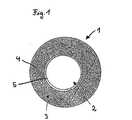
- FIG. 1 a circular curved cornea prosthesis 1 with a circular one is shown clear optical center 2 and an annular edge zone 3, the continuous as textile-like Einwachs Society 4 is formed, shown.
- the optical center 2 has usually a diameter of 5.0 to 9.0 mm and the annular edge zone an extension of 3 to 17 mm between its outer and inner diameter.
- the Optical center 2 is on the eye facing side to the edge zone 3 out limited by a circumferential implantation lip 5.
- the area between optical Center 2 and edge zone 3, which is occupied by the implantation lip 5, has a width of 0.2 to 0.6 mm.
- the optical center 2 may be made of soft transparent material, e.g. transparent Polymers, transparent elastomers (polyester, silicone, polyethylene) or dyeable Made of polymers and be provided with a cell-repellent coating.
- transparent Polymers transparent elastomers (polyester, silicone, polyethylene) or dyeable Made of polymers and be provided with a cell-repellent coating.
- polymers to be colored or embroidered an artificial iris can be produced become.
- the curvature of the outer and inner surfaces of the optical center can for a dioptric adjustment can be selected specifically.
- a UV filter It is possible to prevent UV radiation from penetrating through the implant into the eye can be formed and then radicals which cause an intraocular inflammation and damage the retina.
- the surface of the optical center be coated by UV absorbers or introduced into the optical center Additions of UV Absorbem be provided.
- a covalently bound biocompatible Antiadhesive coating can reduce the adherence of cell aggregates cause.
- the optical center 2 is the mechanical properties of the adapted to surrounding and to be replaced endogenous material, creating microtrauma be prevented in the implant bed and thus ensures a better healing becomes.
- the textile waxing area 4 smooth or crimped staple fibers, Monound Multifilaments and combinations thereof in the form of knitted fabrics Find. Foams and / or perforated films can also be used. It is the waxing area 4 the mechanical properties of the surrounding and to adapted to replacing tissue and may be at least partially absorbable Materials exist.
- An optimized average pore size of the textile waxing area 4 supports the ingrowth of cells by inserting cell aggregates into the Pores of Einwachs Kunststoffes 4 emigrate into it and there a solid matrix for healing can train. For this, e.g. a directed pore structure or perforation to get voted.
- the pore size can be determined by the choice of material, processing and / or further post-processing steps, e.g.
- Calendering, shrinking and / or Heat setting processes are set.
- a suitable Embroidery or sewing process the ingrowth 4 an optimized pore size, mechanical properties and coloration are assigned.
- the staining may be optional also by the use of different materials in the production the textile structure can be achieved. Knitted fabrics have the advantage of adjustable stretch properties also a good cutting ability. Therefore, besides in the final form waxed areas 4 also made-to-order goods for individual Cropping will be chosen.
- a PVDF used with acrylic acid (AAc) as a monomer to produce a hydrophilic carboxyl-containing surface was grafted.
- AAc acrylic acid
- Such a surface-modified PVDF is extremely biocompatible.
- cell adhesion proteins i.e. molecular biologically produced proteins of the body, imaginable. These cell adhesion proteins signal the cells as messengers good adhesion, or themselves act as adhesion molecules.
- Covalently bound to the edge zone 3 proteins or respiration-protected protein fragments may include proliferation, migration and Create scarring of ingrowing cell aggregates and / or a peri-implant Reduce fibrosis.
- the coating may also include means for promoting wound healing and for producing a connective tissue healing. Such coatings can be covalent directly or via spacers with the surface of the edge zone be connected.
- the Einwachs Council 4 can with the rest of the edge zone via a Einschmelzrea or a "vulcanization" be connected. This is a kind of modified gluing, like it is also used when pouring textiles and steel into car tires.
- the optical Center 2 and the edge zone 3 may e.g. glued together, welded or copolymerized be. It is thus between Einwachs Scheme and optical center intimate bond achieved, which is long-term load-stable and only small differences on the mechanical properties of the eye area to be replaced
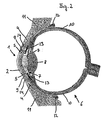
- Fig. 2 shows an implanted in an eye 6 cornea prosthesis 1.
- This consists of a soft optical center 2, in front of the iris 7 and eye lens 8, which prevent from retro-aesthetic membranes could optionally be removed is.
- the optical center 2 has a thickness of 0.2 to 0.7 mm and is with a UV absorber provided for clarity.
- An anti-adhesive coating prevents et al the attachment of radicals and thus helps the transparency of the optical Center to receive.
- the optical center 2 is on the eye 6 facing Side limited to the edge zone 3 through a circumferential implantation lip 5, which is sunk into a defect and thus the eye 6 at the place of corneal removal closes. This leads to a surgical situation, which later causes a recovery of the anterior segment through transplantation.
- the Edge zone 3 is partially formed as a textile Einwachs Scheme 4 of PVDF and in one Transition region 9 connected to the optical center 2 by vulcanization.
- the textile waxing area 4 is between the sclera 10 and a connective tissue envelope (Mucosal plastic or Tenonplastik) 11 arranged
- the connective tissue envelope 11 is grown on the textile waxing area 4 and in the pore space of Einwachs Kunststoffes 4 ingrown.
- the waxing area 4 extends beyond the Eye muscle approaches 12 and is pulled through in the area under the eye muscles and laterally of the eye muscles and on the sclera with stitching, e.g. fixed by seams.
- the implantation lip 5 a running substantially parallel to the edge zone 3 inner Lippe 13 as on the back of the Absetzstumpfes the cornea reaching structure of the Einwachs Kunststoffes, with a seam 14 shown outlined with the Homhautstroma is connected.
- the extension of the inner lip 13 between inner and Outer diameter is about 3 to 4 mm.
- FIG. 3 shows a soft corneal prosthesis 1 according to the invention with a textile Growing area 4 made of PVDF and shown with means for intraocular pressure measurement.
- the means for internal pressure measurement comprise a transmitter 15 for evaluated Eye pressure signals.
- Electrodes are provided to remove the piezoelectric currents and these to the transducer 16 and the transmitter 15 forward. Also, the use of strain gauges is conceivable. If a deforming force is exerted on the optical center, then it leads this e.g. to a applanation or indentation 17.
- aqueous humor production increase the intraocular volume of the eye 6.
- the resulting Pressure-dependent deformation of the attachment of the keratoprosthesis in the area of the sclera can then be detected by micronized telemetry.
- Micropump technique can then be regulated the intraocular pressure.
Landscapes
- Health & Medical Sciences (AREA)
- Engineering & Computer Science (AREA)
- Ophthalmology & Optometry (AREA)
- Biomedical Technology (AREA)
- General Health & Medical Sciences (AREA)
- Transplantation (AREA)
- Veterinary Medicine (AREA)
- Public Health (AREA)
- Heart & Thoracic Surgery (AREA)
- Vascular Medicine (AREA)
- Life Sciences & Earth Sciences (AREA)
- Animal Behavior & Ethology (AREA)
- Surgery (AREA)
- Nuclear Medicine, Radiotherapy & Molecular Imaging (AREA)
- Mechanical Engineering (AREA)
- Manufacturing & Machinery (AREA)
- Cardiology (AREA)
- Oral & Maxillofacial Surgery (AREA)
- Prostheses (AREA)
- Saccharide Compounds (AREA)
- Polysaccharides And Polysaccharide Derivatives (AREA)
- Materials For Medical Uses (AREA)
- Organic Low-Molecular-Weight Compounds And Preparation Thereof (AREA)
- Acyclic And Carbocyclic Compounds In Medicinal Compositions (AREA)
- Graft Or Block Polymers (AREA)
Description
- Fig. 1
- eine schematische Aufsicht auf eine erfindungsgemäße Homhautprothese,
- Fig. 2
- einen schematischen Schnitt durch ein Auge mit implantierter erfindungsgemäßer Homhautprothese, und
- Fig. 3
- einen schematischen Schnitt durch eine erfindungsgemäße Homhautprothese mit Mitteln zur Druckmessung.
- 1.
- Hornhautprothese
- 2.
- Optisches Zentrum
- 3.
- Randzone
- 4.
- Einwachsbereich
- 5.
- Implantationslippe
- 6.
- Auge
- 7.
- Iris
- 8.
- Augenlinse
- 9.
- Übergangsbereich
- 10.
- Sklera
- 11.
- Bindegewebshülle
- 12.
- Augenmuskeln
- 13.
- Innere Lippe
- 14.
- Naht
- 15.
- Sender
- 16.
- Transducer
- 17.
- Applanation/Indentation
Claims (38)
- Hornhautprothese mit einem transparenten optischen Zentrum (2) und mit einer dieses umgebenden Randzone (3), wobei die Homhautprothese nach Art einer flexiblen gewölbten Skierallinse aus flexiblem Material ausgebildet ist und die Randzone (3) mit einer bioaktiven Oberfläche zur Erzielung hoher Adherenz von Zellverbänden ausgestattet ist,
dadurch gekennzeichnet,dass das optische Zentrum (2) innerlich und/oder äußerlich mit UV-Absorbem versehen ist,dass die Außenkante der Randzone (3,4) nach Implantation der Homhautprothese durchgehend bis hinter den Bereich der Augenmuskelansätze reicht,dass die Randzone (3) im Bereich der Augenmuskeln (12) zwischen Augapfel und Augenmuskeln (12) im Bereich des Äquators fixiert werden kann, unddass das optische Zentrum (2) auf der dem Auge (6) zugewandten Seite zur Randzone (3) durch eine umlaufende Implantationslippe (5) begrenzt ist. - Hornhautprothese nach Anspruch 1, dadurch gekennzeichnet, dass das optische Zentrum (2) aus transparenten Polymeren und / oder Elastomeren, insbesondere Polyester, Silikon und / oder Polyethylen besteht.
- Hornhautprothese nach Anspruch 1 oder 2, dadurch gekennzeichnet, dass die dem Auge (6) zugewandte Oberfläche des optischen Zentrums (2) eine kovalent gebundene, biokompatible antiadhäsive Beschichtung zur Verminderung der Adherenz von Zellverbänden aufweist.
- Hornhautprothese nach einem der vorhergehenden Ansprüche, dadurch gekennzeichnet, dass das optische Zentrum (2) zumindest teilweise eingefärbt und / oder bedruckt ist.
- Hornhautprothese nach einem der vorhergehenden Ansprüche, dadurch gekennzeichnet, dass die Randzone (3) Polyvinylidenfluorid (PVDF), Polyester, Polypropylen, Polytetrafluorethylen, Polyetherketon, Polyetheretherketon, natürliche Polymere, künstliche Polymere, polymere Kunststoffe, Acrylatverbindungen, Chemiefasern, Derivate und/oder Kombinationen hieraus beinhaltet.
- Hornhautprothese nach einem der vorhergehenden Ansprüche, dadurch gekennzeichnet, dass die Randzone (3) zumindest partiell poröse Strukturen, insbesondere textile Strukturen als textiler Einwachsbereich (4), aufweist.
- Hornhautprothese nach einem der vorhergehenden Ansprüche, dadurch gekennzeichnet, dass die Randzone (3) zumindest teilweise eingefärbt, bedruckt und / oder bestickt ist.
- Hornhautprothese nach einem der vorhergehenden Ansprüche, dadurch gekennzeichnet, dass die Randzone (3) Ausformungen zur Aufnahme von Nahtmaterial aufweist.
- Hornhautprothese nach einem der vorhergehenden Ansprüche, dadurch gekennzeichnet, dass die Oberfläche der Randzone durch eine Beschichtung, insbesondere eine kovalent gebundene, biokompatible Beschichtung, bioaktiv ist.
- Hornhautprothese nach einem der vorhergehenden Ansprüche, dadurch gekennzeichnet, dass die bioaktive Oberfläche der Randzone (1), insbesondere deren gegebenenfalls vorhandene Beschichtung, Ankermoleküle aufweist, die aus zumindest einer kovalent an die Randzone (3) gebundenen chemischen Verbindung mit zumindest einer funktionellen Gruppe bestehen.
- Hornhautprothese nach Anspruch 10, dadurch gekennzeichnet, dass die bioaktive Oberfläche der Randzone (3), insbesondere deren gegebenenfalls vorhandene Beschichtung, mit einer funktionellen Gruppe versehene Biomoleküle aufweist, wobei die Biomoleküle über zumindest eine ihrer funktionellen Gruppen mit funktionellen Gruppen der Ankermoleküle verbunden ist.
- Hornhautprothese nach Anspruch 11, dadurch gekennzeichnet, dass die Biomoleküle zumindest ein bioaktives Zentrum zur Ankopplung von Zellen aufweisen.
- Hornhautprothese nach Anspruch 11 oder 12, dadurch gekennzeichnet, dass die bioaktive Oberfläche der Randzone (3), insbesondere deren gegebenenfalls vorhandene Beschichtung, mit funktionellen Gruppen versehene Spacermoleküle aufweist, wobei die Spacermoleküle zwischen Ankermolekülen und Biomolekülen angeordnet sind und ihre funktionellen Gruppen mit den funktionellen Gruppen der Ankermoleküle und Biomoleküle kovalent verbunden sind.
- Hornhautprothese nach einem der Ansprüche 10 bis 13, dadurch gekennzeichnet, dass als Ankermoleküle pfropfcopolymerisierte Poly(-acrylsäure-) ketten vorgesehen sind.
- Hornhautprothese nach einem der Ansprüche 10 bis 14, dadurch gekennzeichnet, dass als funktionelle Gruppe(n) der Ankermoleküle Carboxylgruppen vorgesehen sind.
- Hornhautprothese nach einem der Ansprüche 11 bis 15, dadurch gekennzeichnet, dass als funktionelle Gruppe(n) der Biomoleküle Aminogruppen vorgesehen sind.
- Hornhautprothese nach einem der Ansprüche 11 bis 16, dadurch gekennzeichnet, dass als Biomoleküle zelladhäsionsfördernde Proteine und/oder deren Fragmente vorgesehen sind.
- Hornhautprothese nach einem der Ansprüche 11 bis 17, dadurch gekennzeichnet, dass als Biomoleküle Wachstumsfaktoren, insbesondere Platelet Derived Growth Factor (PDGF), vorgesehen sind.
- Hornhautprothese nach einem der Ansprüche 11 bis 18, dadurch gekennzeichnet, dass als Biomoleküle kleine Peptide, die eine zellbindende Domaine enthalten, insbesondere RGD-haltige Peptide von 3 bis 40 Aminosäuren umfassenden Peptidsequenzen, vorgesehen sind.
- Hornhautprothese nach einem der vorhergehenden Ansprüche, dadurch gekennzeichnet, dass die bioaktive Oberfläche der Randzone (3), insbesondere deren gegebenenfalls vorhandene Beschichtung, Beschichtung Aktivatoren für die Wundheilung beinhaltet.
- Hornhautprothese nach einem der vorhergehenden Ansprüche, dadurch gekennzeichnet, dass die bioaktive Oberfläche der Randzone (3), insbesondere deren gegebenenfalls vorhandene Beschichtung, Reaktionsbeschleuniger für die Zellverbundbildung beinhaltet.
- Hornhautprothese nach einem der Ansprüche 6 bis 21, dadurch gekennzeichnet, dass der Einwachsbereich (4) als Gewirk, Geflecht, Gestrick, Gewebe, Schaum, Folie, Vlies, sonstiges poröses oder perforiertes Element oder als Kombination hiervon ausgebildet ist.
- Hornhautprothese nach einem der Ansprüche 6 bis 22, dadurch gekennzeichnet, dass der Einwachsbereich (4) zumindest partiell aus resorbierbarem Material ausgebildet ist.
- Hornhautprothese nach einem der Ansprüche 6 bis 23, dadurch gekennzeichnet, dass der Einwachsbereich (4) über die restliche Randzone und/oder direkt mit dem optischen Zentrum (2) kraftschlüssig verbunden ist.
- Hornhautprothese nach einem der Ansprüche 6 bis 24, dadurch gekennzeichnet, dass der Einwachsbereich (4) mit der restlichen Randzone und mit dem optischen Zentrum (2) oder direkt mit dem optischen Zentrum (2) vergossen, verschmolzen, verklebt, vernäht, verschweißt und/oder durch Copolymeristation verbunden ist.
- Hornhautprothese nach einem der Ansprüche 3 bis 25, dadurch gekennzeichnet, dass die antiadhäsive Beschichtung für das optische Zentrum (2) Heparin, Heparinsulfate und / oder deren Abkömmlinge umfasst.
- Hornhautprothese nach einem der vorhergehenden Ansprüche, dadurch gekennzeichnet, dass zur Ermittlung des Augeninnendruckes Mittel zur Dehnungsmessung im Bereich der Randzone (3), insbesondere an dem textilartigen Einwachsbereich (4), vorgesehen sind.
- Hornhautprothese nach einem der Ansprüche 6 bis 27, dadurch gekennzeichnet, dass am Innendurchmesser des Einwachsbereichs (4) eine Verstärkung und/oder ein Kragen ausgebildet ist.
- Hornhautprothese nach einem der Ansprüche 6 bis 28, dadurch gekennzeichnet, dass am Außendurchmesser des Einwachsbereichs (4) zum Auginneren hin eine Verstärkung ausgebildet ist.
- Hornhautprothese nach einem der Ansprüche 6 bis 29, dadurch gekennzeichnet, dass der Einwachsbereich (4) eine für das Einwachsen der Zellen optimierte offene Porosität und Porengrößenverteilung aufweist.
- Hornhautprothese nach einem der vorhergehenden Ansprüche, dadurch gekennzeichnet, dass die Innen- und/oder Außenfläche des optischen Zentrums (2) für eine dioptrische Anpassung ausgestaltet sind.
- Verfahren zur Erzeugung einer kovalent gebundenen, biokompatiblen zelladhäsiven Beschichtung auf der Randzone (3) einer Hornhautprothese nach einem der vorangehenden Ansprüche, dadurch gekennzeichnet, dass auf der Randzone (3) funktionelle Gruppen aufweisende Ankermoleküle gebildet werden, indem bei einer Plasmazündung mit mikrowelleninduzierten Niederdruckplasmen durch Inertgas radikalische Gruppen erzeugt werden, welche nach der Belüftung mit Luftsauerstoff zu Peroxyradikalen und schließlich zu Hydroperoxiden abreagieren, die anschließend durch thermische und/oder photochemische Spaltung freie Radikale bilden, über die Monomere pfropfcopolymerisiert werden.
- Verfahren nach Anspruch 32, dadurch gekennzeichnet, dass an die funktionelle(n) Gruppe(n) der Ankermoleküle kovalent Biomoleküle über deren funktionelle Gruppe(n) gebunden werden.
- Verfahren nach Anspruch 32 oder 33, dadurch gekennzeichnet, dass überschüssige, nicht kovalent gebundene Homopolymere im Anschluß an die Pfropfcopolymerisation entfernt werden.
- Verfahren nach einem der Ansprüche 32 bis 34, dadurch gekennzeichnet, dass als Plasmagas Argon und/oder N2 verwendet wird.
- Verfahren nach einem der Ansprüche 32 bis 35, dadurch gekennzeichnet, dass zur photochemischen Spaltung eine thermische und/oder UV-induzierte Spaltung mittels Excimerstrahler erfolgt.
- Verfahren nach einem der Ansprüche 32 bis 36, dadurch gekennzeichnet, dass als zu pfropfendes Monomer Vinylmonomere, insbesondere Acrylsäure (AAc), und/oder Macromonomere, insbesondere Polyethylenglykolmethacrylate (PEGMA), zur Bildung einer hochhydrophilen Hydrogelschicht verwendet werden.
- Verfahren nach Anspruch 37, dadurch gekennzeichnet, dass ein PEGMA mit Poly(ethylen)kettenlängen von 4 bis 100 zur Bildung einer hochhydrophilen Hydrogelschicht eingesetzt wird.
Applications Claiming Priority (3)
| Application Number | Priority Date | Filing Date | Title |
|---|---|---|---|
| DE10059852 | 2000-11-30 | ||
| DE10059852 | 2000-11-30 | ||
| PCT/DE2001/004459 WO2002043622A1 (de) | 2000-11-30 | 2001-11-29 | Hornhautprothese |
Publications (2)
| Publication Number | Publication Date |
|---|---|
| EP1337201A1 EP1337201A1 (de) | 2003-08-27 |
| EP1337201B1 true EP1337201B1 (de) | 2005-06-01 |
Family
ID=7665499
Family Applications (1)
| Application Number | Title | Priority Date | Filing Date |
|---|---|---|---|
| EP01995534A Expired - Lifetime EP1337201B1 (de) | 2000-11-30 | 2001-11-29 | Hornhautprothese |
Country Status (5)
| Country | Link |
|---|---|
| EP (1) | EP1337201B1 (de) |
| AT (1) | ATE296593T1 (de) |
| AU (1) | AU2002226276A1 (de) |
| DE (2) | DE10195127D2 (de) |
| WO (1) | WO2002043622A1 (de) |
Families Citing this family (7)
| Publication number | Priority date | Publication date | Assignee | Title |
|---|---|---|---|---|
| FR2817976B1 (fr) * | 2000-12-11 | 2004-01-23 | Frederic Baechele | Collection de verres scleraux pour boite d'essai, boites d'essai et verres scleraux individuels correspondants |
| EP1372019A1 (de) * | 2002-06-13 | 2003-12-17 | Fréderic Baechele | Sklerallinsen |
| GB2403908B (en) * | 2003-07-17 | 2007-03-28 | I O Internat Ltd | Artificial cornea |
| WO2009079726A1 (en) * | 2007-12-26 | 2009-07-02 | Paulo Ferrara De Almeida Cunha | Intracomeal ring |
| BR112017026559B1 (pt) | 2015-06-08 | 2022-11-29 | Corneat Vision Ltd | Ceratoprótese |
| US12364591B2 (en) | 2019-04-25 | 2025-07-22 | Corneat Vision Ltd | Keratoprosthesis devices and kits and surgical methods of their use |
| US20220339323A1 (en) * | 2019-09-12 | 2022-10-27 | Corneat Vision Ltd | Graft patch for the treatment of myopia and ophthalmic conditions |
Family Cites Families (9)
| Publication number | Priority date | Publication date | Assignee | Title |
|---|---|---|---|---|
| DE2705234A1 (de) * | 1977-02-08 | 1978-08-17 | Hennig Gerhard | Keratoprothese |
| NL8501403A (nl) * | 1985-05-15 | 1986-12-01 | Groningen Science Park | Kunsthoornvlies en bevestigingsmiddelen daarvoor. |
| GB2185124B (en) * | 1986-01-03 | 1989-10-25 | Choyce David P | Intra-corneal implant |
| US4693715A (en) * | 1986-06-19 | 1987-09-15 | Abel Robert Jr | Artificial cornea |
| CA2066660C (en) * | 1989-09-15 | 2002-07-30 | Cary Reich | Method for achieving epithelialization of synthetic lenses |
| US5262097A (en) * | 1990-07-03 | 1993-11-16 | Allergan, Inc. | Methods for attaching fixation members to optics of intraocular lenses |
| FR2665356B1 (fr) * | 1990-08-02 | 1992-12-04 | Lacombe Emmanuel | Cornee artificielle. |
| DE19508922C2 (de) * | 1994-03-14 | 1999-10-14 | Norbert Schrage | Hornhautprothese |
| FR2778555B1 (fr) * | 1998-05-15 | 2000-10-13 | Fci France Chirurgie Instrumen | Keratoprothese |
-
2001
- 2001-11-29 AT AT01995534T patent/ATE296593T1/de not_active IP Right Cessation
- 2001-11-29 DE DE10195127T patent/DE10195127D2/de not_active Expired - Fee Related
- 2001-11-29 WO PCT/DE2001/004459 patent/WO2002043622A1/de not_active Ceased
- 2001-11-29 EP EP01995534A patent/EP1337201B1/de not_active Expired - Lifetime
- 2001-11-29 AU AU2002226276A patent/AU2002226276A1/en not_active Abandoned
- 2001-11-29 DE DE50106407T patent/DE50106407D1/de not_active Expired - Lifetime
Also Published As
| Publication number | Publication date |
|---|---|
| DE10195127D2 (de) | 2004-05-27 |
| AU2002226276A1 (en) | 2002-06-11 |
| ATE296593T1 (de) | 2005-06-15 |
| EP1337201A1 (de) | 2003-08-27 |
| DE50106407D1 (de) | 2005-07-07 |
| WO2002043622A1 (de) | 2002-06-06 |
Similar Documents
| Publication | Publication Date | Title |
|---|---|---|
| He et al. | Polymeric biomaterials | |
| DE69433625T2 (de) | Zusammenlegbarer, intrastromaler, kornealer einsatz aus mehreren segmenten | |
| DE69533436T2 (de) | System zum einbringen von material in die korneale stroma | |
| DE60205903T2 (de) | Komposit eptfe/textil prothese | |
| RU2692214C1 (ru) | Кератопротез и его применение | |
| DE69535595T2 (de) | Verfahren zur Herstellung einer Bio-umbaubaren Transplantatprothese aus Kollagen | |
| DE19654884C2 (de) | Formkörper | |
| DE3880824T2 (de) | Implantierung von protheseanordnungen. | |
| Legeais et al. | A second generation of artificial cornea (Biokpro II) | |
| DE3326341A1 (de) | Verbessertes befestigungssystem fuer intraocular-linsen | |
| EP2887908A2 (de) | Intraokularlinse, insbesondere kapselsackintraokularlinse | |
| WO2017088818A1 (zh) | 组织修复用纤维膜及其制备方法和应用以及组织修复用制品 | |
| CN106492272A (zh) | 组织修复用纤维膜及其制备方法和应用、以及组织修复用制品 | |
| US20110125260A1 (en) | Artificial cornea | |
| DE69723466T2 (de) | Herstellungsmethoden für intraokularlinsen | |
| DE3904741A1 (de) | Okularvorrichtung | |
| EP1337201A1 (de) | Hornhautprothese | |
| CN108784890A (zh) | 一种微创通道下的椎间融合器及骨水泥注入装置 | |
| DE69738054T2 (de) | Intraokularlinse | |
| WO2024133805A1 (de) | Linse zur implantation in ein auge | |
| JPH09182762A (ja) | 人工角膜 | |
| DE102006028221A1 (de) | Schlauchförmige Gefäßprothese, Verfahren zu ihrer Herstellung und Verwendung in der Chirurgie | |
| EP1790316A1 (de) | Implantat zur verstärkung der hornhaut und keratoprothese mit einer platte aus porösem polytetrafluorethylen | |
| EP0489185B1 (de) | Intraokulare künstliche Augenlinse | |
| CN207532465U (zh) | 眼内植入物 |
Legal Events
| Date | Code | Title | Description |
|---|---|---|---|
| PUAI | Public reference made under article 153(3) epc to a published international application that has entered the european phase |
Free format text: ORIGINAL CODE: 0009012 |
|
| 17P | Request for examination filed |
Effective date: 20030613 |
|
| AK | Designated contracting states |
Designated state(s): AT BE CH CY DE DK ES FI FR GB GR IE IT LI LU MC NL PT SE TR |
|
| AX | Request for extension of the european patent |
Extension state: AL LT LV MK RO SI |
|
| RIN1 | Information on inventor provided before grant (corrected) |
Inventor name: KLEE, DORIS Inventor name: KINGSHOTT, PETER; Inventor name: SCHRAGE, NORBERT Inventor name: ADEMOVIC, ZAHIDA Inventor name: BERNDT, ERIK |
|
| GRAP | Despatch of communication of intention to grant a patent |
Free format text: ORIGINAL CODE: EPIDOSNIGR1 |
|
| GRAS | Grant fee paid |
Free format text: ORIGINAL CODE: EPIDOSNIGR3 |
|
| GRAA | (expected) grant |
Free format text: ORIGINAL CODE: 0009210 |
|
| RAP1 | Party data changed (applicant data changed or rights of an application transferred) |
Owner name: FREUNDES- UND FOERDERKREIS DES INSTITUTES FUER TEX Owner name: AACHENER CENTRUM FUER TECHNOLOGIETRANSFER IN DER O |
|
| AK | Designated contracting states |
Kind code of ref document: B1 Designated state(s): AT BE CH CY DE DK ES FI FR GB GR IE IT LI LU MC NL PT SE TR |
|
| PG25 | Lapsed in a contracting state [announced via postgrant information from national office to epo] |
Ref country code: IT Free format text: LAPSE BECAUSE OF FAILURE TO SUBMIT A TRANSLATION OF THE DESCRIPTION OR TO PAY THE FEE WITHIN THE PRESCRIBED TIME-LIMIT;WARNING: LAPSES OF ITALIAN PATENTS WITH EFFECTIVE DATE BEFORE 2007 MAY HAVE OCCURRED AT ANY TIME BEFORE 2007. THE CORRECT EFFECTIVE DATE MAY BE DIFFERENT FROM THE ONE RECORDED. Effective date: 20050601 Ref country code: FI Free format text: LAPSE BECAUSE OF FAILURE TO SUBMIT A TRANSLATION OF THE DESCRIPTION OR TO PAY THE FEE WITHIN THE PRESCRIBED TIME-LIMIT Effective date: 20050601 Ref country code: TR Free format text: LAPSE BECAUSE OF FAILURE TO SUBMIT A TRANSLATION OF THE DESCRIPTION OR TO PAY THE FEE WITHIN THE PRESCRIBED TIME-LIMIT Effective date: 20050601 Ref country code: GB Free format text: LAPSE BECAUSE OF FAILURE TO SUBMIT A TRANSLATION OF THE DESCRIPTION OR TO PAY THE FEE WITHIN THE PRESCRIBED TIME-LIMIT Effective date: 20050601 Ref country code: IE Free format text: LAPSE BECAUSE OF FAILURE TO SUBMIT A TRANSLATION OF THE DESCRIPTION OR TO PAY THE FEE WITHIN THE PRESCRIBED TIME-LIMIT Effective date: 20050601 Ref country code: NL Free format text: LAPSE BECAUSE OF FAILURE TO SUBMIT A TRANSLATION OF THE DESCRIPTION OR TO PAY THE FEE WITHIN THE PRESCRIBED TIME-LIMIT Effective date: 20050601 |
|
| REG | Reference to a national code |
Ref country code: GB Ref legal event code: FG4D Free format text: NOT ENGLISH |
|
| REG | Reference to a national code |
Ref country code: CH Ref legal event code: EP |
|
| REF | Corresponds to: |
Ref document number: 50106407 Country of ref document: DE Date of ref document: 20050707 Kind code of ref document: P |
|
| REG | Reference to a national code |
Ref country code: IE Ref legal event code: FG4D Free format text: LANGUAGE OF EP DOCUMENT: GERMAN |
|
| PG25 | Lapsed in a contracting state [announced via postgrant information from national office to epo] |
Ref country code: DK Free format text: LAPSE BECAUSE OF FAILURE TO SUBMIT A TRANSLATION OF THE DESCRIPTION OR TO PAY THE FEE WITHIN THE PRESCRIBED TIME-LIMIT Effective date: 20050901 Ref country code: SE Free format text: LAPSE BECAUSE OF FAILURE TO SUBMIT A TRANSLATION OF THE DESCRIPTION OR TO PAY THE FEE WITHIN THE PRESCRIBED TIME-LIMIT Effective date: 20050901 Ref country code: GR Free format text: LAPSE BECAUSE OF FAILURE TO SUBMIT A TRANSLATION OF THE DESCRIPTION OR TO PAY THE FEE WITHIN THE PRESCRIBED TIME-LIMIT Effective date: 20050901 |
|
| PG25 | Lapsed in a contracting state [announced via postgrant information from national office to epo] |
Ref country code: ES Free format text: LAPSE BECAUSE OF FAILURE TO SUBMIT A TRANSLATION OF THE DESCRIPTION OR TO PAY THE FEE WITHIN THE PRESCRIBED TIME-LIMIT Effective date: 20050912 |
|
| PG25 | Lapsed in a contracting state [announced via postgrant information from national office to epo] |
Ref country code: PT Free format text: LAPSE BECAUSE OF FAILURE TO SUBMIT A TRANSLATION OF THE DESCRIPTION OR TO PAY THE FEE WITHIN THE PRESCRIBED TIME-LIMIT Effective date: 20051103 |
|
| PG25 | Lapsed in a contracting state [announced via postgrant information from national office to epo] |
Ref country code: CY Free format text: LAPSE BECAUSE OF FAILURE TO SUBMIT A TRANSLATION OF THE DESCRIPTION OR TO PAY THE FEE WITHIN THE PRESCRIBED TIME-LIMIT Effective date: 20051129 Ref country code: AT Free format text: LAPSE BECAUSE OF NON-PAYMENT OF DUE FEES Effective date: 20051129 |
|
| PG25 | Lapsed in a contracting state [announced via postgrant information from national office to epo] |
Ref country code: LU Free format text: LAPSE BECAUSE OF NON-PAYMENT OF DUE FEES Effective date: 20051130 Ref country code: LI Free format text: LAPSE BECAUSE OF NON-PAYMENT OF DUE FEES Effective date: 20051130 Ref country code: MC Free format text: LAPSE BECAUSE OF NON-PAYMENT OF DUE FEES Effective date: 20051130 Ref country code: BE Free format text: LAPSE BECAUSE OF NON-PAYMENT OF DUE FEES Effective date: 20051130 Ref country code: CH Free format text: LAPSE BECAUSE OF NON-PAYMENT OF DUE FEES Effective date: 20051130 |
|
| NLV1 | Nl: lapsed or annulled due to failure to fulfill the requirements of art. 29p and 29m of the patents act | ||
| GBV | Gb: ep patent (uk) treated as always having been void in accordance with gb section 77(7)/1977 [no translation filed] |
Effective date: 20050601 |
|
| REG | Reference to a national code |
Ref country code: IE Ref legal event code: FD4D |
|
| PLBE | No opposition filed within time limit |
Free format text: ORIGINAL CODE: 0009261 |
|
| STAA | Information on the status of an ep patent application or granted ep patent |
Free format text: STATUS: NO OPPOSITION FILED WITHIN TIME LIMIT |
|
| 26N | No opposition filed |
Effective date: 20060302 |
|
| REG | Reference to a national code |
Ref country code: CH Ref legal event code: PL |
|
| EN | Fr: translation not filed | ||
| BERE | Be: lapsed |
Owner name: FREUNDES- UND FORDERKREIS DES INSTITUTES FUR TEXTI Effective date: 20051130 Owner name: AACHENER CENTRUM FUR TECHNOLOGIETRANSFER IN DER OP Effective date: 20051130 |
|
| PG25 | Lapsed in a contracting state [announced via postgrant information from national office to epo] |
Ref country code: FR Free format text: LAPSE BECAUSE OF NON-PAYMENT OF DUE FEES Effective date: 20051130 |
|
| PG25 | Lapsed in a contracting state [announced via postgrant information from national office to epo] |
Ref country code: FR Free format text: LAPSE BECAUSE OF NON-PAYMENT OF DUE FEES Effective date: 20050601 |
|
| PGFP | Annual fee paid to national office [announced via postgrant information from national office to epo] |
Ref country code: DE Payment date: 20141130 Year of fee payment: 14 |
|
| REG | Reference to a national code |
Ref country code: DE Ref legal event code: R119 Ref document number: 50106407 Country of ref document: DE |
|
| PG25 | Lapsed in a contracting state [announced via postgrant information from national office to epo] |
Ref country code: DE Free format text: LAPSE BECAUSE OF NON-PAYMENT OF DUE FEES Effective date: 20160601 |