EP1336470A2 - Konstruktionselement aus faserverstärktem Kunststoff - Google Patents
Konstruktionselement aus faserverstärktem Kunststoff Download PDFInfo
- Publication number
- EP1336470A2 EP1336470A2 EP03001432A EP03001432A EP1336470A2 EP 1336470 A2 EP1336470 A2 EP 1336470A2 EP 03001432 A EP03001432 A EP 03001432A EP 03001432 A EP03001432 A EP 03001432A EP 1336470 A2 EP1336470 A2 EP 1336470A2
- Authority
- EP
- European Patent Office
- Prior art keywords
- construction element
- fibers
- element according
- inner layer
- construction
- Prior art date
- Legal status (The legal status is an assumption and is not a legal conclusion. Google has not performed a legal analysis and makes no representation as to the accuracy of the status listed.)
- Granted
Links
Images



Classifications
-
- B—PERFORMING OPERATIONS; TRANSPORTING
- B32—LAYERED PRODUCTS
- B32B—LAYERED PRODUCTS, i.e. PRODUCTS BUILT-UP OF STRATA OF FLAT OR NON-FLAT, e.g. CELLULAR OR HONEYCOMB, FORM
- B32B1/00—Layered products having a non-planar shape
- B32B1/08—Tubular products
-
- B—PERFORMING OPERATIONS; TRANSPORTING
- B62—LAND VEHICLES FOR TRAVELLING OTHERWISE THAN ON RAILS
- B62D—MOTOR VEHICLES; TRAILERS
- B62D25/00—Superstructure or monocoque structure sub-units; Parts or details thereof not otherwise provided for
- B62D25/06—Fixed roofs
-
- B—PERFORMING OPERATIONS; TRANSPORTING
- B62—LAND VEHICLES FOR TRAVELLING OTHERWISE THAN ON RAILS
- B62D—MOTOR VEHICLES; TRAILERS
- B62D29/00—Superstructures, understructures, or sub-units thereof, characterised by the material thereof
- B62D29/04—Superstructures, understructures, or sub-units thereof, characterised by the material thereof predominantly of synthetic material
- B62D29/041—Understructures
-
- Y—GENERAL TAGGING OF NEW TECHNOLOGICAL DEVELOPMENTS; GENERAL TAGGING OF CROSS-SECTIONAL TECHNOLOGIES SPANNING OVER SEVERAL SECTIONS OF THE IPC; TECHNICAL SUBJECTS COVERED BY FORMER USPC CROSS-REFERENCE ART COLLECTIONS [XRACs] AND DIGESTS
- Y10—TECHNICAL SUBJECTS COVERED BY FORMER USPC
- Y10T—TECHNICAL SUBJECTS COVERED BY FORMER US CLASSIFICATION
- Y10T428/00—Stock material or miscellaneous articles
- Y10T428/13—Hollow or container type article [e.g., tube, vase, etc.]
- Y10T428/1352—Polymer or resin containing [i.e., natural or synthetic]
- Y10T428/1362—Textile, fabric, cloth, or pile containing [e.g., web, net, woven, knitted, mesh, nonwoven, matted, etc.]
Definitions
- the invention relates to a construction element made of fiber-reinforced Plastic according to claim 1.
- Fiber Reinforced Plastics known from the aerospace industry Space travel, hold more indentation as construction elements in the Automotive engineering. The reasons for this are the increased necessity for lightweight construction, which in turn means higher production costs justify and on the other hand optimizations in the manufacturing process of FVK materials, which also reduces costs can be.
- Sandwich construction There are different types of construction elements made of FRP Possibilities, especially common is the so-called Sandwich construction.
- Sandwich construction is a hollow profile made of FRP with a Core provided or built around a core.
- This core preferably consists of foams or natural materials such as balsa wood.
- the core materials contribute significantly to the rigidity of the component.
- the object of the invention is now a construction element Made of FRP material that provide a high damage tolerance and has high rigidity and for the cathode dip suitable is. Furthermore, may by the construction element no contact corrosion with the surrounding Shell construction occur.
- the construction element of claim 1 a multi-layered structure of different fiber types and fiber orientations. These include an inner layer, an intermediate layer and an outer layer.
- the inner layer encloses a largely hollow core.
- the intermediate layer contributes in particular to the strength of the structural element at.
- the fibers are in the preferred direction of force, in which is the design element charged, oriented.
- the outer layer serves to the final contour of the construction element It is also electrically insulated Fibers designed, which makes contact corrosion with the adjacent metallic structural elements of the shell avoided becomes.
- the construction element according to the invention can be dispensed with a core material, yet the Same strength and damage tolerance as comparable Sandwich structures is guaranteed.
- the construction element suitable for the KTL process is provided.
- the inner layer is suitably by one or more Braided hoses shown.
- Several braided tubes next to each other result in the construction element a honeycomb Cross-section.
- the honeycombs can be in any shape (n-corner or round) and are limited by webs. The webs result from contact surfaces of the braided tubes and contribute to the strength of the structural element.
- the number of braided tubes or the resulting honeycombs is preferably between 2 and 6, more preferably between 3 and 5.
- the fibers of the inner layer are preferably glass fibers. This are inexpensive and have a high elongation, resulting in has a positive impact on claims tolerance.
- the intermediate layer is preferred by carbon fibers or aramid fibers. These show a clear higher strength than the glass fibers of the inner layer, which Carbon fibers, however, are more brittle than the glass fibers.
- the fiber orientation of the intermediate layer has a preferred direction along the highest force of the structural element on. Particularly preferred is the fiber orientation unidirectional along a longitudinal axis of the structural element arranged.
- the outer layer in turn, as the inner layer in more useful Way formed by a braided hose.
- This Braided hose encloses the inner layers and prevents a delamination.
- the fibers of the outer layer are like the fibers of the inner layer preferably represented by glass fibers, this is inexpensive and increases the damage tolerance of the structural element. Another important point is that glass fibers are electric are insulating and especially in the case that the intermediate layer is made of carbon fibers, prevent the glass fibers of the outer layer make direct contact carbon fibers with adjacent metal elements.
- connection of the construction element according to the invention a shell is preferably carried out by at least one, in turn preferably metallic attachment element.
- the attachment element may be in the layers of the construction element be integrated, for. B. laminated between the layers be (if this does not lead to contact corrosion) or adhered to the structural element.
- a construction element is shown, as Roof hoist of a vehicle body shell is used.
- the construction element has a curvature in the longitudinal direction.
- the cavities 12 are separated by webs 10 from each other.
- FIG. 2 The construction of the construction element 2 is shown in FIG. 2.
- the three layers of the construction element according to the invention are in Fig. 2 shown offset, so that the essential layers are recognizable. This is the inner layer 4, the intermediate layer 6 and the outer layer 8
- the inner layer 4 comprises in FIG. 2 five braided tubes, which are arranged side by side.
- the braided tubes in a process known per se on plastic film hoses pulled, several plastic coated plastic hoses next to each other with the intermediate layer. 6 Surrounded, this container will turn from a larger braided hose coated, which forms the outer layer 8.
- This Composite is placed in a mold, the plastic film tubes in the core are inflated, so the shape is completed. The spaces between the fibers will be filled with resin under pressure. The resin is cured and removed the plastic foil tubes. In essence, the stay Cavities 12 are. The glued together by the resin Braided hoses of the inner layer 4 form the webs 10.
- the resin forming a matrix of the FRP is preferably one High temperature phenolic resin with a softening temperature Tg of approx. 190 ° C.
- the braided hoses of the inner layer have a Cross braid on, which adds an extra fiber in the direction may have the component longitudinal axis 18.
- the fibers 13 of the Inner layer consist of glass fibers.
- the intermediate layer 6 is laminated, which consists of carbon fibers 14.
- the carbon fibers 14 are aligned along the longitudinal axis 18. This matches with the main force direction, which in case of load on the construction element acts (see Fig. 3). The carbon fibers 14 point sufficient strength for this load case.
- the outer layer 8 again consists mainly of glass fibers 16.
- the fibers 16 of the outer layer 8 are again designed as a braided hose, so is a delamination of the prevents individual layers passing through the outer layer. 8 bundled together.
- the honeycomb structure by the webs 10th and the channels 12 are formed also contributes to improvement strength.
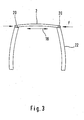
- FIG. 3 is the installation of the inventive construction element 2 (as roof bow 2) according to FIGS. 1 and 2 schematically shown.
- the roof bow 2 connects a left and right vehicle side in height of the B-pillars 22 with each other and prevented in the event of a side crash (indicated by the Lines of force F) buckling of the B-pillars 22.
- the roof hoop 2 is welded to the B-pillars 22 by tie bars 20.
- the connection elements 22 are in turn on the Roof hoop 2 attached and glued so that they are cohesively and are positively connected to this and the Force F can transfer to the roof bow 2.
- FIG. 4 shows a three-dimensional representation a connection element 20, which by welding points 26 is welded to the roof rail 24 at the level of the B-pillar 22.
- the construction element according to the invention all parts of a vehicle body or chassis applicable.
- the Construction element can also be ausgestaltet ausgestalt, z. B. in the form of a partition.
- the fibers of the intermediate layer are then oriented along the occurring main directions of force.
Landscapes
- Engineering & Computer Science (AREA)
- Mechanical Engineering (AREA)
- Laminated Bodies (AREA)
- Body Structure For Vehicles (AREA)
- Panels For Use In Building Construction (AREA)
Abstract
Description
- Fig. 1,
- ein gewölbtes Konstruktionselement aus FVK-Material,
- Fig. 2,
- eine Darstellung der Schichten des Konstruktionselements aus Fig. 1
- Fig. 3,
- die schematische Darstellung der Integration eines Konstruktionselements in einem Fahrzeugrohbau und
- Fig. 4,
- eine dreidimensionale Darstellung der Anbindung eines Konstruktionselementes an einen Fahrzeugrohbau.
Claims (11)
- Konstruktionselement aus faserverstärktem Kunststoff, das einen mehrschichtigen Aufbau mit unterschiedlichen Fasertypen und unterschiedlichen Faserorientierungen aufweist,
dadurch gekennzeichnet,dass das Konstruktionselement mindestens eine Innenschicht, die einen weitgehend hohlen Kern umschließt,mindestens eine Zwischenschicht mit mindestens einer Faser-Vorzugsorientierung in Richtung einer Belastungsachse des Konstruktionselements undeine Außenschicht mit elektrisch isolierenden Fasern umfasst. - Konstruktionselement nach Anspruch 1,
dadurch gekennzeichnet, dass die Innenschicht mindestens einen Geflechtschlauch umfasst. - Konstruktionselement nach Anspruch 1 oder 2,
dadurch gekennzeichnet, dass die Innenschicht mehrere Geflechtschläuche umfasst, die im Querschnitt des Konstruktionselementes Stege bilden. - Konstruktionselement nach einem der Ansprüche 1 bis 3,
dadurch gekennzeichnet, dass die Geflechtschläuche der Innenschicht Fasern entlang der Längsachse aufweisen. - Konstruktionselement nach einem der Ansprüche 1 bis 4,
dadurch gekennzeichnet, dass die Innenschicht Glasfasern umfasst. - Konstruktionselement nach einem der Ansprüche 1 bis 5,
dadurch gekennzeichnet, dass die Zwischenschicht Kohlenstoff oder Aramidfasern umfasst. - Konstruktionselement nach einem der Ansprüche 1 bis 6,
dadurch gekennzeichnet, dass die Fasern der Zwischenschicht unidirektional entlang der Längsachse angeordnet sind. - Konstruktionselement nach einem der Ansprüche 1 bis 7,
dadurch gekennzeichnet, dass die Außenschicht einen Geflechtschlauch umfasst. - Konstruktionselement nach einem der Ansprüche 1 bis 8,
dadurch gekennzeichnet, dass die Außenschicht Glasfasern umfasst. - Konstruktionselement nach einem der Ansprüche 1 bis 9,
dadurch gekennzeichnet, dass das Konstruktionselement mindestens ein Anbindungselement zu einem Rohbau aufweist. - Konstruktionselement nach einem der Ansprüche 1 bis 10,
dadurch gekennzeichnet, dass das Anbindungselement in den Schichten des Konstruktionselementes integriert ist oder an das Konstruktionselement geklebt ist.
Applications Claiming Priority (2)
| Application Number | Priority Date | Filing Date | Title |
|---|---|---|---|
| DE10205965 | 2002-02-14 | ||
| DE10205965A DE10205965A1 (de) | 2002-02-14 | 2002-02-14 | Konstruktionselement aus faserverstärktem Kunststoff |
Publications (3)
| Publication Number | Publication Date |
|---|---|
| EP1336470A2 true EP1336470A2 (de) | 2003-08-20 |
| EP1336470A3 EP1336470A3 (de) | 2004-03-03 |
| EP1336470B1 EP1336470B1 (de) | 2007-08-15 |
Family
ID=27618652
Family Applications (1)
| Application Number | Title | Priority Date | Filing Date |
|---|---|---|---|
| EP03001432A Expired - Lifetime EP1336470B1 (de) | 2002-02-14 | 2003-01-22 | Konstruktionselement aus faserverstärktem Kunststoff |
Country Status (4)
| Country | Link |
|---|---|
| US (1) | US20030175455A1 (de) |
| EP (1) | EP1336470B1 (de) |
| JP (1) | JP2003291232A (de) |
| DE (2) | DE10205965A1 (de) |
Cited By (3)
| Publication number | Priority date | Publication date | Assignee | Title |
|---|---|---|---|---|
| EP1714856A4 (de) * | 2004-01-23 | 2008-12-17 | Toray Industries | Faserverstärktes paneel für kraftfahrzeug |
| WO2020074710A1 (de) * | 2018-10-11 | 2020-04-16 | Elda Entwicklungsgesellschaft Mbh | Sicherheitskabine für ein wohn- bzw. reisemobil mit deformationselementen |
| CN113525431A (zh) * | 2021-07-30 | 2021-10-22 | 常州市新创智能科技有限公司 | 一种抗弯曲碳纤维梁及其制造方法 |
Families Citing this family (21)
| Publication number | Priority date | Publication date | Assignee | Title |
|---|---|---|---|---|
| US7105071B2 (en) * | 2001-04-06 | 2006-09-12 | Ebert Composites Corporation | Method of inserting z-axis reinforcing fibers into a composite laminate |
| JP2005231618A (ja) * | 2004-01-23 | 2005-09-02 | Toray Ind Inc | 自動車用外板部材 |
| JP4583775B2 (ja) * | 2004-02-13 | 2010-11-17 | 本田技研工業株式会社 | 自動車用衝撃吸収部材 |
| JP4696651B2 (ja) * | 2005-04-04 | 2011-06-08 | トヨタ自動車株式会社 | 車両のピラー構造体 |
| JP4788539B2 (ja) * | 2006-09-13 | 2011-10-05 | トヨタ自動車株式会社 | 車体パネル構造 |
| DE102012010768A1 (de) * | 2012-05-31 | 2013-12-05 | Decoma (Germany) Gmbh | Strukturbauteil für ein Kraftfahrzeug |
| EP2999616B1 (de) * | 2013-05-22 | 2017-10-11 | Bayerische Motoren Werke Aktiengesellschaft | Achsträger eines fahrzeugs |
| DE102013106070C5 (de) * | 2013-06-12 | 2019-10-24 | Leichtbau-Zentrum Sachsen Gmbh | Seitenwandgruppe für Personenkraftwagen |
| DE102013213711A1 (de) | 2013-07-12 | 2015-01-15 | Brose Fahrzeugteile Gmbh & Co. Kommanditgesellschaft, Hallstadt | Verfahren zur Herstellung eines Strukturbauteils für Kraftfahrzeuge aus einem Organoblech |
| JP6032630B2 (ja) * | 2013-08-23 | 2016-11-30 | 本田技研工業株式会社 | 自動車車体の壁体構造 |
| DE102013111702A1 (de) * | 2013-10-24 | 2015-04-30 | Dr. Ing. H.C. F. Porsche Aktiengesellschaft | Faserverbundbauteil und Verfahren zum Herstellen eines Faserverbundbauteils |
| WO2015095042A1 (en) * | 2013-12-16 | 2015-06-25 | Borgwarner Inc. | Composite tensioner arm or guide for timing drive application |
| EP3152052B1 (de) | 2014-06-04 | 2021-08-11 | Bright Lite Structures LLC | Verstärkte verbundstruktur |
| DE102014019149A1 (de) | 2014-12-19 | 2016-06-23 | Daimler Ag | Profilteil mit einer Mehrzahl von Schichten |
| US10967583B2 (en) | 2015-04-03 | 2021-04-06 | Bright Lite Structures Llc | Apparatus for controllably cutting fibers and related methods |
| JP6616227B2 (ja) * | 2016-03-30 | 2019-12-04 | 三菱重工業株式会社 | 前妻構体及び車両 |
| JP7208390B2 (ja) | 2018-11-19 | 2023-01-18 | ブライト ライト ストラクチャーズ エルエルシー | 熱放出性の低い高強度の複合材 |
| CN111907596A (zh) * | 2019-05-10 | 2020-11-10 | 广州汽车集团股份有限公司 | 一种吸能标准件、前纵梁及吸能标准件的制作方法 |
| JP7323402B2 (ja) * | 2019-09-26 | 2023-08-08 | 株式会社Subaru | 繊維強化樹脂複合材及び繊維強化樹脂複合材の製造方法 |
| JP6760549B1 (ja) | 2019-10-01 | 2020-09-23 | 日本製鉄株式会社 | 曲面パネル部材 |
| JP7264072B2 (ja) * | 2020-01-24 | 2023-04-25 | トヨタ自動車株式会社 | 車両用リンフォースメント |
Family Cites Families (14)
| Publication number | Priority date | Publication date | Assignee | Title |
|---|---|---|---|---|
| US4389269A (en) * | 1978-02-21 | 1983-06-21 | Pepsico, Inc. | Sports racket |
| DE3202594A1 (de) * | 1982-01-27 | 1983-08-11 | Ford-Werke AG, 5000 Köln | Kraftfahrzeugkarosserie mit einem fest verbundenen dach aus verbundwerkstoff |
| EP0244120A3 (de) * | 1986-04-16 | 1989-07-12 | Courtaulds Plc | Element aus Verbundwerkstoff |
| DE3908433A1 (de) * | 1988-03-17 | 1989-09-28 | Schmidt Gmbh R | Kraftfahrzeugdach und verfahren zu seiner herstellung |
| US5118555A (en) * | 1989-05-11 | 1992-06-02 | Zvi Horovitz | Composite article |
| US5534318A (en) * | 1991-03-18 | 1996-07-09 | Parabeam Industrie-En Handelsonderneming B.V. | Hollow fiber-reinforced plastic body |
| US5556677A (en) * | 1994-01-07 | 1996-09-17 | Composite Development Corporation | Composite shaft structure and manufacture |
| JP3322497B2 (ja) * | 1994-12-28 | 2002-09-09 | 三菱重工業株式会社 | Frp製構造材 |
| DE19736573A1 (de) * | 1997-08-22 | 1999-02-25 | Huels Chemische Werke Ag | Verfahren zum Imprägnieren von endlosen Fasern mit einem Thermoplasten sowie nach diesem Verfahren hergestellte Faser-Matrix-Verbunde |
| US5914163A (en) * | 1997-10-10 | 1999-06-22 | General Motors Corporation | Reduced crush initiation force composite tube |
| WO1999024251A1 (en) * | 1997-11-07 | 1999-05-20 | Ube-Nitto Kasei Co., Ltd. | Fiber-reinforced composite hollow structure, method for production thereof, and appartus therefor |
| FR2776358B1 (fr) * | 1998-03-23 | 2000-05-05 | Coflexip | Armure composite a base de fibres de carbone, pour conduite flexible |
| US20020198071A1 (en) * | 1998-07-22 | 2002-12-26 | Michael L. Snow | Ball bat |
| MY125417A (en) * | 1999-10-18 | 2006-07-31 | Stork Screens Bv | Thin-walled cylinder made from fibre-reinforced plastics material |
-
2002
- 2002-02-14 DE DE10205965A patent/DE10205965A1/de not_active Withdrawn
-
2003
- 2003-01-22 EP EP03001432A patent/EP1336470B1/de not_active Expired - Lifetime
- 2003-01-22 DE DE50307921T patent/DE50307921D1/de not_active Expired - Lifetime
- 2003-02-13 JP JP2003035833A patent/JP2003291232A/ja active Pending
- 2003-02-14 US US10/366,707 patent/US20030175455A1/en not_active Abandoned
Cited By (9)
| Publication number | Priority date | Publication date | Assignee | Title |
|---|---|---|---|---|
| EP1714856A4 (de) * | 2004-01-23 | 2008-12-17 | Toray Industries | Faserverstärktes paneel für kraftfahrzeug |
| EP2316711A3 (de) * | 2004-01-23 | 2011-07-20 | Toray Industries, Inc. | FK-Paneel für Kraftfahrzeuge |
| US8276975B2 (en) | 2004-01-23 | 2012-10-02 | Toray Industries, Inc. | FRP panel for automobile |
| WO2020074710A1 (de) * | 2018-10-11 | 2020-04-16 | Elda Entwicklungsgesellschaft Mbh | Sicherheitskabine für ein wohn- bzw. reisemobil mit deformationselementen |
| US20210387673A1 (en) * | 2018-10-11 | 2021-12-16 | Elda Entwicklungsgesellschaft Mbh | Safety cab for a mobile home or camper with deformation elements |
| CN114206709A (zh) * | 2018-10-11 | 2022-03-18 | 艾尔达恩特威克伦格斯塞尔夏特有限责任公司 | 具有变形元件的用于移动房屋或机动房屋的安全舱 |
| EP3863910B1 (de) | 2018-10-11 | 2022-09-28 | ELDA Entwicklungsgesellschaft mbH | Sicherheitskabine für ein wohn- bzw. reisemobil mit deformationselementen und herstellungsverfahren für eine solche sicherheitskabine |
| US11691557B2 (en) * | 2018-10-11 | 2023-07-04 | Elda Entwicklungsgesellschaft Mbh | Safety cab for a mobile home or camper with deformation elements |
| CN113525431A (zh) * | 2021-07-30 | 2021-10-22 | 常州市新创智能科技有限公司 | 一种抗弯曲碳纤维梁及其制造方法 |
Also Published As
| Publication number | Publication date |
|---|---|
| DE50307921D1 (de) | 2007-09-27 |
| DE10205965A1 (de) | 2003-09-04 |
| EP1336470B1 (de) | 2007-08-15 |
| US20030175455A1 (en) | 2003-09-18 |
| JP2003291232A (ja) | 2003-10-14 |
| EP1336470A3 (de) | 2004-03-03 |
Similar Documents
| Publication | Publication Date | Title |
|---|---|---|
| EP1336470B1 (de) | Konstruktionselement aus faserverstärktem Kunststoff | |
| DE102017207883B4 (de) | Stoßdämpfende Verstärkungsstruktur für B-Säulen | |
| DE102011015071A1 (de) | Verbundwerkstoff und Strukturbauteil für ein Kraftfahrzeug | |
| DE102015204494B4 (de) | Hybrid-Seitenschweller für ein Kraftfahrzeug und Herstellungsverfahren desselben | |
| DE102011009892A1 (de) | Kraftfahrzeugbauteil und Verfahren zur Herstellung des Kraftfahrzeugbauteils | |
| DE102011111232A1 (de) | Leichtbauteil, insbesondere Karosseriesäulenverstärkung und Verfahren zur Herstellung des Leichtbauteils | |
| DE102010054097A1 (de) | Verfahren zur Herstellung eines Metall-Faserverbund-Bauteiles | |
| DE102013017269A1 (de) | Karosseriebauteil und Kraftfahrzeug mit dem Karosseriebauteil | |
| DE102010053731A1 (de) | Elastische Lagerung für ein Bauteil und Verfahren zu deren Herstellung | |
| DE102021108564B4 (de) | Bauteil eines Kraftfahrzeugs | |
| DE3390383T1 (de) | Mehrschichtiges Verbundmaterial mit variabler Dichte | |
| EP1211054B1 (de) | Verfahren zum Herstellen einer Faserverbundstruktur | |
| EP3057779A1 (de) | Verfahren zum herstellen eines verstärkten faserverbundbauteils | |
| EP3490782B1 (de) | Verfahren zum herstellen eines dreidimensionalen, vielschichtigen faserverbundteils | |
| DE102011113441B4 (de) | Integralträger aus Faserverbundwerkstoff | |
| DE102010015972A1 (de) | Energieabsorptionsvorrichtung zur Absorption von Aufprallenergie und Fahrzeug mit mindestens einer Energieabsorptionsvorrichtung | |
| DE10253300A1 (de) | Faserverstärkter Verbundkunststoff zur Herstellung von Strukturbauteilen, Strukturbauteile aus einem derartigen Verbundkunststoff sowie Verfahren zur Herstellung von faserverstärkten Strukturbauteilen | |
| DE102019208696A1 (de) | Vorderwagen-Struktur eines Kraftfahrzeugs | |
| EP3077202B1 (de) | Tragendes, flächiges formteil aus einem mehrschichtfaserverbundwerkstoff, insbesondere für eine fahrzeugkarosserie | |
| DE102012203418A1 (de) | Baugruppe einer Kraftfahrzeugkarosserie | |
| DE102020005020A1 (de) | Tragrahmen für eine Batterie | |
| DE102013204953A1 (de) | Baugruppe einer Kraftfahrzeugkarosserie | |
| DE102016222717A1 (de) | Integralbauteil eines Kfz-Rahmens | |
| DE102015225760A1 (de) | Trägerelement, Kraftfahrzeug mit einem Trägerelement und Verfahren zur Herstellung eines Trägerelements | |
| DE102013106507B4 (de) | Mehrschichtverbund und Verfahren zu dessen Herstellung |
Legal Events
| Date | Code | Title | Description |
|---|---|---|---|
| PUAI | Public reference made under article 153(3) epc to a published international application that has entered the european phase |
Free format text: ORIGINAL CODE: 0009012 |
|
| AK | Designated contracting states |
Designated state(s): AT BE BG CH CY CZ DE DK EE ES FI FR GB GR HU IE IT LI LU MC NL PT SE SI SK TR |
|
| AX | Request for extension of the european patent |
Extension state: AL LT LV MK RO |
|
| PUAL | Search report despatched |
Free format text: ORIGINAL CODE: 0009013 |
|
| RIC1 | Information provided on ipc code assigned before grant |
Ipc: 7B 32B 3/10 B Ipc: 7B 32B 5/28 B Ipc: 7B 32B 5/26 A |
|
| AK | Designated contracting states |
Kind code of ref document: A3 Designated state(s): AT BE BG CH CY CZ DE DK EE ES FI FR GB GR HU IE IT LI LU MC NL PT SE SI SK TR |
|
| AX | Request for extension of the european patent |
Extension state: AL LT LV MK RO |
|
| 17P | Request for examination filed |
Effective date: 20040129 |
|
| AKX | Designation fees paid |
Designated state(s): DE FR GB IT |
|
| GRAP | Despatch of communication of intention to grant a patent |
Free format text: ORIGINAL CODE: EPIDOSNIGR1 |
|
| RAP1 | Party data changed (applicant data changed or rights of an application transferred) |
Owner name: DAIMLERCHRYSLER AG |
|
| GRAS | Grant fee paid |
Free format text: ORIGINAL CODE: EPIDOSNIGR3 |
|
| GRAA | (expected) grant |
Free format text: ORIGINAL CODE: 0009210 |
|
| AK | Designated contracting states |
Kind code of ref document: B1 Designated state(s): DE FR GB IT |
|
| REG | Reference to a national code |
Ref country code: GB Ref legal event code: FG4D Free format text: NOT ENGLISH |
|
| REF | Corresponds to: |
Ref document number: 50307921 Country of ref document: DE Date of ref document: 20070927 Kind code of ref document: P |
|
| RAP2 | Party data changed (patent owner data changed or rights of a patent transferred) |
Owner name: DAIMLER AG |
|
| GBV | Gb: ep patent (uk) treated as always having been void in accordance with gb section 77(7)/1977 [no translation filed] |
Effective date: 20070815 |
|
| EN | Fr: translation not filed | ||
| PG25 | Lapsed in a contracting state [announced via postgrant information from national office to epo] |
Ref country code: GB Free format text: LAPSE BECAUSE OF FAILURE TO SUBMIT A TRANSLATION OF THE DESCRIPTION OR TO PAY THE FEE WITHIN THE PRESCRIBED TIME-LIMIT Effective date: 20070815 |
|
| PLBE | No opposition filed within time limit |
Free format text: ORIGINAL CODE: 0009261 |
|
| STAA | Information on the status of an ep patent application or granted ep patent |
Free format text: STATUS: NO OPPOSITION FILED WITHIN TIME LIMIT |
|
| 26N | No opposition filed |
Effective date: 20080516 |
|
| PG25 | Lapsed in a contracting state [announced via postgrant information from national office to epo] |
Ref country code: IT Free format text: LAPSE BECAUSE OF NON-PAYMENT OF DUE FEES Effective date: 20080131 |
|
| PG25 | Lapsed in a contracting state [announced via postgrant information from national office to epo] |
Ref country code: FR Free format text: LAPSE BECAUSE OF FAILURE TO SUBMIT A TRANSLATION OF THE DESCRIPTION OR TO PAY THE FEE WITHIN THE PRESCRIBED TIME-LIMIT Effective date: 20080411 |
|
| PGFP | Annual fee paid to national office [announced via postgrant information from national office to epo] |
Ref country code: DE Payment date: 20170331 Year of fee payment: 15 |
|
| REG | Reference to a national code |
Ref country code: DE Ref legal event code: R119 Ref document number: 50307921 Country of ref document: DE |
|
| PG25 | Lapsed in a contracting state [announced via postgrant information from national office to epo] |
Ref country code: DE Free format text: LAPSE BECAUSE OF NON-PAYMENT OF DUE FEES Effective date: 20180801 |