EP1333451A2 - Feine ferrimagnetiche, Spinel Typ, Fe-Ni-Co befassende Teilchen und deren Herstellungsverfahren - Google Patents
Feine ferrimagnetiche, Spinel Typ, Fe-Ni-Co befassende Teilchen und deren Herstellungsverfahren Download PDFInfo
- Publication number
- EP1333451A2 EP1333451A2 EP03002078A EP03002078A EP1333451A2 EP 1333451 A2 EP1333451 A2 EP 1333451A2 EP 03002078 A EP03002078 A EP 03002078A EP 03002078 A EP03002078 A EP 03002078A EP 1333451 A2 EP1333451 A2 EP 1333451A2
- Authority
- EP
- European Patent Office
- Prior art keywords
- type ferrimagnetic
- ferrimagnetic particles
- fine
- particles
- spinel
- Prior art date
- Legal status (The legal status is an assumption and is not a legal conclusion. Google has not performed a legal analysis and makes no representation as to the accuracy of the status listed.)
- Pending
Links
- 239000002245 particle Substances 0.000 title claims abstract description 121
- 230000005293 ferrimagnetic effect Effects 0.000 title claims abstract description 59
- 238000000034 method Methods 0.000 title claims description 22
- 230000008569 process Effects 0.000 title claims description 11
- 229910020630 Co Ni Inorganic materials 0.000 title description 6
- 229910002440 Co–Ni Inorganic materials 0.000 title description 6
- 239000000203 mixture Substances 0.000 claims abstract description 23
- PXHVJJICTQNCMI-UHFFFAOYSA-N nickel Substances [Ni] PXHVJJICTQNCMI-UHFFFAOYSA-N 0.000 claims description 73
- XEEYBQQBJWHFJM-UHFFFAOYSA-N iron Substances [Fe] XEEYBQQBJWHFJM-UHFFFAOYSA-N 0.000 claims description 59
- 230000005291 magnetic effect Effects 0.000 claims description 52
- 239000000243 solution Substances 0.000 claims description 27
- 239000007864 aqueous solution Substances 0.000 claims description 22
- 230000005415 magnetization Effects 0.000 claims description 20
- 239000003513 alkali Substances 0.000 claims description 18
- 229910052759 nickel Inorganic materials 0.000 claims description 15
- 239000002002 slurry Substances 0.000 claims description 14
- 238000003756 stirring Methods 0.000 claims description 14
- 239000011259 mixed solution Substances 0.000 claims description 13
- 229910052742 iron Inorganic materials 0.000 claims description 12
- 229910017052 cobalt Inorganic materials 0.000 claims description 10
- 239000010941 cobalt Substances 0.000 claims description 10
- GUTLYIVDDKVIGB-UHFFFAOYSA-N cobalt atom Chemical compound [Co] GUTLYIVDDKVIGB-UHFFFAOYSA-N 0.000 claims description 10
- 238000010438 heat treatment Methods 0.000 claims description 9
- 229910021645 metal ion Inorganic materials 0.000 claims description 9
- XLYOFNOQVPJJNP-UHFFFAOYSA-N water Substances O XLYOFNOQVPJJNP-UHFFFAOYSA-N 0.000 claims description 9
- 125000002887 hydroxy group Chemical group [H]O* 0.000 claims description 8
- 150000003839 salts Chemical class 0.000 claims description 8
- 238000002156 mixing Methods 0.000 claims description 5
- 229920005989 resin Polymers 0.000 claims description 4
- 239000011347 resin Substances 0.000 claims description 4
- 239000011230 binding agent Substances 0.000 claims description 2
- 239000010419 fine particle Substances 0.000 abstract description 14
- 229910000859 α-Fe Inorganic materials 0.000 description 21
- HEMHJVSKTPXQMS-UHFFFAOYSA-M Sodium hydroxide Chemical compound [OH-].[Na+] HEMHJVSKTPXQMS-UHFFFAOYSA-M 0.000 description 12
- 239000000696 magnetic material Substances 0.000 description 12
- 230000005347 demagnetization Effects 0.000 description 8
- 239000013078 crystal Substances 0.000 description 7
- ZWEHNKRNPOVVGH-UHFFFAOYSA-N 2-Butanone Chemical compound CCC(C)=O ZWEHNKRNPOVVGH-UHFFFAOYSA-N 0.000 description 6
- 229910052596 spinel Inorganic materials 0.000 description 6
- 239000011029 spinel Substances 0.000 description 6
- 239000006249 magnetic particle Substances 0.000 description 5
- 238000004519 manufacturing process Methods 0.000 description 5
- 238000000921 elemental analysis Methods 0.000 description 4
- 239000011521 glass Substances 0.000 description 4
- 230000010354 integration Effects 0.000 description 4
- 230000007246 mechanism Effects 0.000 description 4
- 239000002184 metal Substances 0.000 description 4
- 229910052751 metal Inorganic materials 0.000 description 4
- 239000002244 precipitate Substances 0.000 description 4
- 239000007787 solid Substances 0.000 description 4
- 239000010409 thin film Substances 0.000 description 4
- YXFVVABEGXRONW-UHFFFAOYSA-N Toluene Chemical compound CC1=CC=CC=C1 YXFVVABEGXRONW-UHFFFAOYSA-N 0.000 description 3
- 238000002441 X-ray diffraction Methods 0.000 description 3
- 230000005540 biological transmission Effects 0.000 description 3
- 230000008859 change Effects 0.000 description 3
- 238000006243 chemical reaction Methods 0.000 description 3
- 239000008199 coating composition Substances 0.000 description 3
- 230000001747 exhibiting effect Effects 0.000 description 3
- 230000006872 improvement Effects 0.000 description 3
- UQSXHKLRYXJYBZ-UHFFFAOYSA-N Iron oxide Chemical compound [Fe]=O UQSXHKLRYXJYBZ-UHFFFAOYSA-N 0.000 description 2
- 238000003917 TEM image Methods 0.000 description 2
- 239000011324 bead Substances 0.000 description 2
- GFHNAMRJFCEERV-UHFFFAOYSA-L cobalt chloride hexahydrate Chemical compound O.O.O.O.O.O.[Cl-].[Cl-].[Co+2] GFHNAMRJFCEERV-UHFFFAOYSA-L 0.000 description 2
- 238000010908 decantation Methods 0.000 description 2
- 230000000694 effects Effects 0.000 description 2
- 229940044631 ferric chloride hexahydrate Drugs 0.000 description 2
- 239000002902 ferrimagnetic material Substances 0.000 description 2
- 239000012065 filter cake Substances 0.000 description 2
- NQXWGWZJXJUMQB-UHFFFAOYSA-K iron trichloride hexahydrate Chemical compound O.O.O.O.O.O.[Cl-].Cl[Fe+]Cl NQXWGWZJXJUMQB-UHFFFAOYSA-K 0.000 description 2
- 239000007788 liquid Substances 0.000 description 2
- 239000000463 material Substances 0.000 description 2
- 239000004570 mortar (masonry) Substances 0.000 description 2
- LAIZPRYFQUWUBN-UHFFFAOYSA-L nickel chloride hexahydrate Chemical compound O.O.O.O.O.O.[Cl-].[Cl-].[Ni+2] LAIZPRYFQUWUBN-UHFFFAOYSA-L 0.000 description 2
- 239000000047 product Substances 0.000 description 2
- 230000009467 reduction Effects 0.000 description 2
- 239000011369 resultant mixture Substances 0.000 description 2
- 239000012266 salt solution Substances 0.000 description 2
- 238000000926 separation method Methods 0.000 description 2
- 230000003068 static effect Effects 0.000 description 2
- VHUUQVKOLVNVRT-UHFFFAOYSA-N Ammonium hydroxide Chemical compound [NH4+].[OH-] VHUUQVKOLVNVRT-UHFFFAOYSA-N 0.000 description 1
- 229920002799 BoPET Polymers 0.000 description 1
- XDTMQSROBMDMFD-UHFFFAOYSA-N Cyclohexane Chemical compound C1CCCCC1 XDTMQSROBMDMFD-UHFFFAOYSA-N 0.000 description 1
- 229910017061 Fe Co Inorganic materials 0.000 description 1
- CWYNVVGOOAEACU-UHFFFAOYSA-N Fe2+ Chemical group [Fe+2] CWYNVVGOOAEACU-UHFFFAOYSA-N 0.000 description 1
- 229910021578 Iron(III) chloride Inorganic materials 0.000 description 1
- 229910000708 MFe2O4 Inorganic materials 0.000 description 1
- 229910021586 Nickel(II) chloride Inorganic materials 0.000 description 1
- BZHJMEDXRYGGRV-UHFFFAOYSA-N Vinyl chloride Chemical compound ClC=C BZHJMEDXRYGGRV-UHFFFAOYSA-N 0.000 description 1
- 229910052782 aluminium Inorganic materials 0.000 description 1
- QGZKDVFQNNGYKY-UHFFFAOYSA-N ammonia Natural products N QGZKDVFQNNGYKY-UHFFFAOYSA-N 0.000 description 1
- 238000004458 analytical method Methods 0.000 description 1
- 230000015572 biosynthetic process Effects 0.000 description 1
- 239000003518 caustics Substances 0.000 description 1
- 238000009614 chemical analysis method Methods 0.000 description 1
- 229920006026 co-polymeric resin Polymers 0.000 description 1
- 238000000975 co-precipitation Methods 0.000 description 1
- 239000011248 coating agent Substances 0.000 description 1
- 238000000576 coating method Methods 0.000 description 1
- 150000001868 cobalt Chemical class 0.000 description 1
- GVPFVAHMJGGAJG-UHFFFAOYSA-L cobalt dichloride Chemical compound [Cl-].[Cl-].[Co+2] GVPFVAHMJGGAJG-UHFFFAOYSA-L 0.000 description 1
- 229910000361 cobalt sulfate Inorganic materials 0.000 description 1
- 229940044175 cobalt sulfate Drugs 0.000 description 1
- KTVIXTQDYHMGHF-UHFFFAOYSA-L cobalt(2+) sulfate Chemical compound [Co+2].[O-]S([O-])(=O)=O KTVIXTQDYHMGHF-UHFFFAOYSA-L 0.000 description 1
- 230000000052 comparative effect Effects 0.000 description 1
- 239000002131 composite material Substances 0.000 description 1
- 229910052802 copper Inorganic materials 0.000 description 1
- 238000001035 drying Methods 0.000 description 1
- 238000002474 experimental method Methods 0.000 description 1
- 229940032296 ferric chloride Drugs 0.000 description 1
- 239000003302 ferromagnetic material Substances 0.000 description 1
- 239000010408 film Substances 0.000 description 1
- 238000001914 filtration Methods 0.000 description 1
- 230000003993 interaction Effects 0.000 description 1
- 150000002505 iron Chemical class 0.000 description 1
- 159000000014 iron salts Chemical class 0.000 description 1
- RBTARNINKXHZNM-UHFFFAOYSA-K iron trichloride Chemical compound Cl[Fe](Cl)Cl RBTARNINKXHZNM-UHFFFAOYSA-K 0.000 description 1
- RUTXIHLAWFEWGM-UHFFFAOYSA-H iron(3+) sulfate Chemical compound [Fe+3].[Fe+3].[O-]S([O-])(=O)=O.[O-]S([O-])(=O)=O.[O-]S([O-])(=O)=O RUTXIHLAWFEWGM-UHFFFAOYSA-H 0.000 description 1
- 229910000360 iron(III) sulfate Inorganic materials 0.000 description 1
- 229910052748 manganese Inorganic materials 0.000 description 1
- 238000006386 neutralization reaction Methods 0.000 description 1
- 150000002815 nickel Chemical class 0.000 description 1
- QMMRZOWCJAIUJA-UHFFFAOYSA-L nickel dichloride Chemical compound Cl[Ni]Cl QMMRZOWCJAIUJA-UHFFFAOYSA-L 0.000 description 1
- LGQLOGILCSXPEA-UHFFFAOYSA-L nickel sulfate Chemical compound [Ni+2].[O-]S([O-])(=O)=O LGQLOGILCSXPEA-UHFFFAOYSA-L 0.000 description 1
- 229910000363 nickel(II) sulfate Inorganic materials 0.000 description 1
- 238000007747 plating Methods 0.000 description 1
- 238000006068 polycondensation reaction Methods 0.000 description 1
- 239000000843 powder Substances 0.000 description 1
- 238000004663 powder metallurgy Methods 0.000 description 1
- 238000010298 pulverizing process Methods 0.000 description 1
- 239000007921 spray Substances 0.000 description 1
- 239000000126 substance Substances 0.000 description 1
- 238000011282 treatment Methods 0.000 description 1
- 238000005406 washing Methods 0.000 description 1
- 229910052725 zinc Inorganic materials 0.000 description 1
- 229910006540 α-FeOOH Inorganic materials 0.000 description 1
Images





Classifications
-
- B—PERFORMING OPERATIONS; TRANSPORTING
- B82—NANOTECHNOLOGY
- B82Y—SPECIFIC USES OR APPLICATIONS OF NANOSTRUCTURES; MEASUREMENT OR ANALYSIS OF NANOSTRUCTURES; MANUFACTURE OR TREATMENT OF NANOSTRUCTURES
- B82Y25/00—Nanomagnetism, e.g. magnetoimpedance, anisotropic magnetoresistance, giant magnetoresistance or tunneling magnetoresistance
-
- H—ELECTRICITY
- H01—ELECTRIC ELEMENTS
- H01F—MAGNETS; INDUCTANCES; TRANSFORMERS; SELECTION OF MATERIALS FOR THEIR MAGNETIC PROPERTIES
- H01F1/00—Magnets or magnetic bodies characterised by the magnetic materials therefor; Selection of materials for their magnetic properties
- H01F1/0027—Thick magnetic films
-
- H—ELECTRICITY
- H01—ELECTRIC ELEMENTS
- H01F—MAGNETS; INDUCTANCES; TRANSFORMERS; SELECTION OF MATERIALS FOR THEIR MAGNETIC PROPERTIES
- H01F1/00—Magnets or magnetic bodies characterised by the magnetic materials therefor; Selection of materials for their magnetic properties
- H01F1/0036—Magnets or magnetic bodies characterised by the magnetic materials therefor; Selection of materials for their magnetic properties showing low dimensional magnetism, i.e. spin rearrangements due to a restriction of dimensions, e.g. showing giant magnetoresistivity
- H01F1/0045—Zero dimensional, e.g. nanoparticles, soft nanoparticles for medical/biological use
- H01F1/0063—Zero dimensional, e.g. nanoparticles, soft nanoparticles for medical/biological use in a non-magnetic matrix, e.g. granular solids
-
- H—ELECTRICITY
- H01—ELECTRIC ELEMENTS
- H01F—MAGNETS; INDUCTANCES; TRANSFORMERS; SELECTION OF MATERIALS FOR THEIR MAGNETIC PROPERTIES
- H01F1/00—Magnets or magnetic bodies characterised by the magnetic materials therefor; Selection of materials for their magnetic properties
- H01F1/01—Magnets or magnetic bodies characterised by the magnetic materials therefor; Selection of materials for their magnetic properties of inorganic materials
- H01F1/03—Magnets or magnetic bodies characterised by the magnetic materials therefor; Selection of materials for their magnetic properties of inorganic materials characterised by their coercivity
- H01F1/12—Magnets or magnetic bodies characterised by the magnetic materials therefor; Selection of materials for their magnetic properties of inorganic materials characterised by their coercivity of soft-magnetic materials
- H01F1/34—Magnets or magnetic bodies characterised by the magnetic materials therefor; Selection of materials for their magnetic properties of inorganic materials characterised by their coercivity of soft-magnetic materials non-metallic substances, e.g. ferrites
- H01F1/342—Oxides
- H01F1/344—Ferrites, e.g. having a cubic spinel structure (X2+O)(Y23+O3), e.g. magnetite Fe3O4
-
- H—ELECTRICITY
- H01—ELECTRIC ELEMENTS
- H01F—MAGNETS; INDUCTANCES; TRANSFORMERS; SELECTION OF MATERIALS FOR THEIR MAGNETIC PROPERTIES
- H01F1/00—Magnets or magnetic bodies characterised by the magnetic materials therefor; Selection of materials for their magnetic properties
- H01F1/01—Magnets or magnetic bodies characterised by the magnetic materials therefor; Selection of materials for their magnetic properties of inorganic materials
- H01F1/03—Magnets or magnetic bodies characterised by the magnetic materials therefor; Selection of materials for their magnetic properties of inorganic materials characterised by their coercivity
- H01F1/12—Magnets or magnetic bodies characterised by the magnetic materials therefor; Selection of materials for their magnetic properties of inorganic materials characterised by their coercivity of soft-magnetic materials
- H01F1/34—Magnets or magnetic bodies characterised by the magnetic materials therefor; Selection of materials for their magnetic properties of inorganic materials characterised by their coercivity of soft-magnetic materials non-metallic substances, e.g. ferrites
- H01F1/36—Magnets or magnetic bodies characterised by the magnetic materials therefor; Selection of materials for their magnetic properties of inorganic materials characterised by their coercivity of soft-magnetic materials non-metallic substances, e.g. ferrites in the form of particles
- H01F1/37—Magnets or magnetic bodies characterised by the magnetic materials therefor; Selection of materials for their magnetic properties of inorganic materials characterised by their coercivity of soft-magnetic materials non-metallic substances, e.g. ferrites in the form of particles in a bonding agent
Definitions
- the present invention relates to fine spinel-type. ferrimagnetic particles containing Fe, Co and Ni, and a process for producing the same. More particularly, the present invention relates to fine spinel-type ferrimagnetic particles containing Fe, Co and Ni, which can exhibit a high coercive force in spite of fine particles, and a process for producing the fine spinel-type ferrimagnetic particles in an aqueous solution at a temperature of not more than 101°C.
- the spinel-type ferrite in the form of an iron-containing composite oxide.
- the spinel-type ferrite has various compositions represented by the formula: MFe 2 O 4 , wherein M is Fe (II) , Co, Ni, Mn, Al, Cu, Zn or the like.
- the spinel-type ferrite includes, for example, Co ferrite.
- the Co ferrite has a large crystal magnetic anisotropy constant and, therefore, is unlikely to form superparamagnetic particles in spite of finer particles. As a result, the Co ferrite can maintain good magnetic properties, so that it has been expected to apply the Co ferrite to high-density magnetic recording materials.
- the Co ferrite is formed into a thin film by a spin-spray ferrite plating method.
- the above Co-Ni-based spinel ferrite is a ferrimagnetic material, and is used in the form of a bulky mass or a thin film.
- the Co-Ni-based spinel ferrite has a coercive force as low as less than 239 kA/m (3,000 Oe), it may be difficult to produce recording media having high-recording density, by using such a magnetic material.
- the Co-Ni-based spinel ferrite is applicable to tape-shaped recording media, there arises such a problem that the recording media are no longer improved in performance thereof since the coercive force of the Co-Ni-based spinel ferrite cannot be further enhanced.
- magnetoplumbite-type ferrite as magnetic material applied to recording media, e.g., Ba ferrite
- Ba ferrite has also been studied for reducing the particle size thereof.
- Ba ferrite magnetic particles having an average particle diameter of 30 nm to 40 nm exhibit a coercive force as low as less than 239 kA/m (3,000 Oe).
- An object of the present invention is to provide fine spinel-type ferrimagnetic particles useful as a high-density magnetic recording material capable of exhibiting not only a high coercive force in spite of fine particles but also a rotational hysteresis integration value relating to rotational hysteresis loss and magnetization mechanism which is close to Fanning Model.
- Another object of the present invention is to provide a process for producing fine spinel-type ferrimagnetic particles of a single-phase structure, which are capable of exhibiting a high coercive force in spite of fine particles, in an aqueous solution at a temperature of 80 to about 101°C using a simple apparatus.
- fine spinel-type ferrimagnetic particles comprising single-phase structure, comprising iron, cobalt and nickel, the ratio of an iron mole to the sum of a cobalt mole and a nickel mole being from more than 2.0 to less than 3.0, and having a particle diameter of 10 to 50 nm, a saturation magnetization ⁇ s of 50.3 x 10 -6 to 88.0 x 10 -6 Wb ⁇ m/kg and a coercive force HcJ of 239 to 637 kA/m.
- the molar ratio (n) of Fe to (Co + Ni) is preferably from not less than 2.25 to less than 3.0, more preferably 2.25 to 2.75.
- x is usually 0.4 to 0.9, preferably 0.45 to 0.9, more preferably 0.5 to 0.9
- y is usually 0.1 to 0.6, preferably 0.1 to 0.55, more preferably 0.1 to 0.5.
- a sum of x and y (x + y) is usually 1.
- x and y are preferably 0.5, respectively.
- the fine spinel-type ferrimagnetic particles have a particle diameter of usually 10 to 50 nm, preferably 20 to 40 nm.
- the particle diameter is less than 10 nm, the magnetization of such particles is low, so that it may be difficult to accomplish the aims of the present invention.
- the particle diameter is more than 50 nm, the particle size becomes too large, so that it may also be difficult to accomplish the aims of the present invention.
- the fine spinel-type ferrimagnetic particles of the present invention have a saturation magnetization ⁇ s of usually 50.3 x 10 -6 to 88.0 x 10 -6 Wb•m/kg (40 to 70 emu/g), preferably 56.5 x 10 -6 to 88.0 x 10 -6 Wb•m/kg (45 to 70 emu/g).
- the saturation magnetization ⁇ s is less than 50.3 x 10 -6 Wb•m/kg (40 emu/g)
- the obtained particles are insufficient in magnetic properties required for magnetic material, so that it may be difficult to accomplish the aims of the present invention.
- the fine spinel-type ferrimagnetic particles of the present invention have a coercive force HcJ of usually not less than 239 kA/m (3,000 Oe), preferably 239 to 637 kA/m (3,000 to 8,000 Oe), more preferably 279 to 637 kA/m (3,500 to 8,000 Oe).
- HcJ coercive force
- the coercive force HcJ is less than 239 kA/m (3,000 Oe)
- the obtained particles are insufficient in magnetic properties required for magnetic material, so that it may be difficult to accomplish the aims of the present invention.
- the fine spinel-type ferrimagnetic particles of the present invention are composed of a single phase.
- the obtained particles are deteriorated in magnetic properties required for magnetic material, so that it may be difficult to accomplish the aims of the present invention.
- the fine spinel-type ferrimagnetic particles are produced by (1) mixing aqueous solutions containing Fe 3+ , Co 2+ and Ni 2+ with each other, which are prepared by dissolving each of water-soluble salts of iron, cobalt and nickel in water, at such ratio of an Fe mole to the sum of a Co mole and a Ni mole being from more than 2.0 to less than 3.0 and the Co mole to the Ni mole being 0.4 to 0.9/0.6 to 0.1, i.e., at a molar ratio satisfying the above formula (I), (2) while stirring the resultant mixed solution, adding thereto an aqueous alkali solution in an amount of from not less than one equivalent based on whole metal ions contained in the mixed solution to an amount such that the concentration of OH groups contained in the resultant solution obtained after adding the aqueous alkali solution is not more than 3 mol/liter, thereby obtaining a precipitated slurry by neutralization reaction of the mixed metal salt solutions; and (3) heating the resultant precipitation of the mixed
- Examples of the water-soluble iron salts used in the present invention may include ferric salts such as ferric chloride and ferric sulfate, or the like.
- Examples of the water-soluble cobalt salts used in the present invention may include cobalt chloride, cobalt sulfate or the like.
- Examples of the water-soluble nickel salts used in the present invention may include nickel chloride, nickel sulfate or the like.
- water-soluble caustic alkalis such as sodium hydroxide and aqueous ammonia.
- the amount of the alkali added is a range of usually from not less than one equivalent based on whole metal ions contained the raw aqueous metal salt solutions to an amount such that the concentration of OH groups contained in the resultant solution after adding the aqueous alkali solution is not more than 3 mol/liter.
- the pH value of the resultant precipitated slurry produced by adding the alkali is controlled to usually 12.7 to 13.3, preferably 13.0 to 13.3.
- the amount of the alkali added is less than one equivalent, metal ions may remain unreacted.
- the amount of the alkali added is more than the amount such that the concentration of OH groups contained in the resultant solution after adding the aqueous alkali solution is more than 3 mol/liter, cobalt may be eluted out again.
- the heating temperature of the precipitated slurry is usually 80 to 101°C, preferably 85 to 100°C.
- the heating temperature is less than 80°C, ⁇ -FeOOH may be mixed in the obtained particles.
- the heating temperature is more than 101°C, it is required to use special apparatuses such as autoclave or the like.
- the fine spinel-type ferrimagnetic particles produced by the above heat-treatment may be then subjected to ordinary treatments for particles such as solid/liquid separation (for example, filtration), washing, drying and pulverization.
- particles such as solid/liquid separation (for example, filtration), washing, drying and pulverization.
- the point of the present invention is that as a result of noticing the divalent metal ion occupying the 16d position of Co ferrite as a ferrimagnetic material, a part of Co is replaced with Ni to allow Co and Ni to coexist therein, thereby enabling enhancement in superexchange interaction as well as improvement in coercive force.
- the fine spinel-type ferrimagnetic particles are a magnetic material having very high magnetic properties such as high coercive force, and rotational hysteresis integration value relating to rotational hysteresis loss and magnetization mechanism, which are close to Fanning model, in spite of fine particles.
- the fine spinel-type ferrimagnetic particles of the present invention are useful for producing digital magnetic recording media having a high recording density.
- the process for producing the fine spinel-type ferrimagnetic particles according to the present invention it is possible not only to produce single-phase fine spinel-type ferrimagnetic particles in an aqueous solution at a temperature of not more than about 101°C by chemical coprecipitation method without postannealing without using an autoclave or the like, but also to purify the obtained particles by ordinary methods such as solid/liquid separation, resulting in highly economical process.
- the pH value of the reaction solution was measured by a pH meter (manufactured by Horiba Seisakusho Co., Ltd.).
- VSM vibration sample magnetometer
- ICP Inductivity Coupled Plasma
- the crystal structure was measured by an X-ray diffractometer (manufactured by Rigaku Co., Ltd.).
- the particle configuration was measured by a transmission electron microscope (TEM) (manufactured by Nippon Denshi Co., Ltd.).
- the rotational hysteresis loss Wr was measured by a torque magnetometer (manufactured by Tamagawa Seisakusho Co., Ltd.).
- Ferric chloride hexahydrate, cobalt chloride hexahydrate and nickel chloride hexahydrate as raw metal salts were respectively dissolved in pure water in a glass beaker to prepare an aqueous solution containing 0.225 mol/liter of Fe 3+ , an aqueous solution containing 0.10 mol/liter of Co 2+ and an aqueous solution containing 0.10 mol/liter of Ni 2+ , respectively.
- a two-liter flask equipped with a pH meter, a stirrer and a thermometer is charged with 400 ml of the aqueous Fe 3+ solution, 200 ml of the aqueous Co 2+ solution and 200 ml of the aqueous Ni 2+ solution to prepare 800 ml of a mixed aqueous solution having a molar ratio of Fe to (Co + Ni) of 2.25.
- 240 ml of a 3.0 mol/liter sodium hydroxide aqueous solution was added thereto, thereby obtaining 1,040 ml of a precipitated slurry having a pH value of 13.3.
- the precipitated slurry was heated under stirring at 100°C for 120 minutes, thereby obtaining black particles.
- the thus obtained black particles were washed with water five times at intervals of 24 hours by decantation method, and then filtered through a filter paper #2 using a nutsche.
- the recovered filter cake was dried at 80°C for 12 hours using an electric oven. Then, the resultant dried product was pulverized by a mortar, thereby fine black particles.
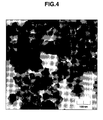
- the TEM micrograph of the thus obtained fine black particles is shown in Fig. 4.
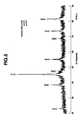
- the particles contained fine particles having a spinel crystal structure as shown in Fig. 5.
- TEM transmission electron microscope
- the saturation magnetization ⁇ s thereof was 56.3 x 10 -6 Wb•m/kg (44.8 emu/g), and the coercive force HcJ thereof was 507 kA/m (6,370 Oe).
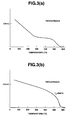
- the obtained fine black particles are single-phase crystal ferrimagnetic particles having a Curie point of 557.3C as shown by the ⁇ -T curve in Fig. 6.
- Ferric chloride hexahydrate, cobalt chloride hexahydrate and nickel chloride hexahydrate as raw metal salts were respectively dissolved in pure water in a glass beaker to prepare 200 ml of an aqueous solution containing 0.275 mol/liter of Fe 3+ , 180 ml of an aqueous solution containing 0.1 mol/liter of Co 2+ and 20 ml of an aqueous solution containing 0.1 mol/liter of Ni 2+ , respectively.
- aqueous solutions were charged into a 1-liter flask equipped with a pH meter, a stirrer and a thermometer to prepare 400 ml of a mixed aqueous solution having a molar ratio (n) of Fe to (Co + Ni) of 2.75. While stirring the mixed aqueous solution, 250 ml of a 3.0 mol/liter sodium hydroxide aqueous solution was added thereto, thereby obtaining 650 ml of a precipitated slurry having a pH value of 13.3.
- the obtained precipitated slurry was heated under stirring at 100°C for 120 minutes, thereby obtaining black particles.
- the thus obtained black particles were washed with water five times at intervals of 24 hours by decantation method, and then filtered through a filter paper #2.
- the recovered filter cake was dried at 80°C for 12 hours using a constant temperature oven. Then, the resultant dried product was pulverized by a mortar, thereby fine black particles.
- the fine black particles had a composition represented by the formula: (CoO) 0.9 (NiO) 0.1 •1.375Fe 2 O 3 .
- the fine black particles had a spinel crystal structure, and as a result of observing the fine black particles by a transmission electron microscope (TEM), it was confirmed that the particles were monodisperse fine particles of cubic shape having an average particle diameter of about 25 nm.
- the coercive force HcJ thereof was 310 kA/m (3.9 kOe) and the saturation magnetization ⁇ s thereof was 58.8 x 10 -6 Wb ⁇ m/kg (46.8 emu/g). Further, it was confirmed that the obtained black fine particles are fine spinel-type ferrimagnetic particles of a single-phase crystal structure.
- Example 2 The same procedure as defined in Example 2 was conducted except that concentration of Fe 3+ , amount of aqueous Co 2+ solution, amount of aqueous Ni 2+ solution, amount of aqueous sodium hydroxide solution, and pH value of precipitated slurry were changed variously, thereby obtaining fine spinel-type ferrimagnetic particles having a single-phase crystal structure.
- One part by weight of vinyl chloride-based copolymer resin, 6.21 parts by weight of cyclohexane, 6.21 parts by weight of toluene and 2.59 parts by weight of methyl ethyl ketone (MEK) were mixed together to prepare a mixed solution.
- Example 2 Four parts by weight of the obtained mixed solution was mixed with 1 part by weight of the fine spinel-type ferrimagnetic particles obtained in Example 1 and 8 parts by weight of glass beads having a diameter of about 0.3 mm.
- the resultant mixture was dispersed using a dispersing apparatus "Mixer Mill Model 8000-D" (manufactured by Spex Co., Ltd.) for 8 hours, thereby preparing a magnetic coating composition (solid content (magnetic particles plus resin): 25% by weight).
- Example 13 Four parts by weight of the obtained mixed solution was mixed with 1 part by weight of the fine spinel-type ferrimagnetic particles obtained in Example 13 and 8 parts by weight of glass beads having a diameter of about 0.3 mm.
- the resultant mixture was dispersed using a dispersing apparatus "Mixer Mill Model 8000-D" (manufactured by Spex Co., Ltd.) for 8 hours, thereby preparing a magnetic coating composition (solid content (magnetic particles plus resin): 25% by weight).
- the thus obtained magnetic coating compositions were respectively uniformly applied onto a 15 ⁇ m-thick PET film using a doctor blade. Thereafter, the obtained coating film was immediately oriented in a magnetic field of 0.8 MA/m (10 kOe) and then dried, thereby obtaining magnetic sheets.
- Magnetic properties of the thus obtained magnetic sheets were measured and evaluated by the following methods.
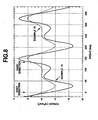
- Figs. 8 to 10 show a torque curve measured in a magnetic field of 2.15 MA/m
- Fig. 9 shows a rotational hysteresis loss
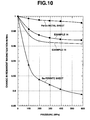
- Fig. 10 shows a demagnetization under pressurization.
- the constants K 1 and K 2 were as follows: K 1 ⁇ 1 x 10 5 J/cm 3 and K 2 ⁇ 1 x 10 5 J/cm 3 .
- the rotational hysteresis loss was evaluated by plotting Wr/Js which was the value corresponding to the rotational hysteresis loss on an ordinate and plotting an external magnetic field H on an abscissa.
- Wr/Js was the value corresponding to the rotational hysteresis loss on an ordinate
- an external magnetic field H on an abscissa.
- the anisotropic magnetic field Ha was about 2.79 to 3.18 MA/m
- the magnetic sheet obtained by using the fine spinel-type ferrimagnetic particles of the present invention showed a high magnetic anisotropy.
- the magnetic sheets obtained by using the fine spinel-type ferrimagnetic particles of the present invention as well as other magnetic sheets obtained by using particles having different compositions were measured for determining demagnetization under static pressurization.
- the magnetic sheets obtained by using the fine spinel-type ferrimagnetic particles of the present invention exhibited a smaller demagnetization under pressurization.
- the fine spinel-type ferrimagnetic particles of the present invention are of a cubic system and do not show monoaxial anisotropy, it is considered that since the magnetic anisotropic energy is sufficiently larger than the magnetostrictive energy due to pressurization, the demagnetization under pressurization is unlikely to occur. As a result, the fine spinel-type ferrimagnetic particles of the present invention can exhibit excellent magnetic properties.
Landscapes
- Engineering & Computer Science (AREA)
- Chemical & Material Sciences (AREA)
- Power Engineering (AREA)
- Nanotechnology (AREA)
- Dispersion Chemistry (AREA)
- Life Sciences & Earth Sciences (AREA)
- Health & Medical Sciences (AREA)
- Biomedical Technology (AREA)
- General Health & Medical Sciences (AREA)
- Molecular Biology (AREA)
- Crystallography & Structural Chemistry (AREA)
- Compounds Of Iron (AREA)
- Hard Magnetic Materials (AREA)
Applications Claiming Priority (4)
| Application Number | Priority Date | Filing Date | Title |
|---|---|---|---|
| JP2002024239 | 2002-01-31 | ||
| JP2002024239 | 2002-01-31 | ||
| JP2002042827 | 2002-02-20 | ||
| JP2002042827 | 2002-02-20 |
Publications (2)
| Publication Number | Publication Date |
|---|---|
| EP1333451A2 true EP1333451A2 (de) | 2003-08-06 |
| EP1333451A3 EP1333451A3 (de) | 2003-11-12 |
Family
ID=26625666
Family Applications (1)
| Application Number | Title | Priority Date | Filing Date |
|---|---|---|---|
| EP03002078A Pending EP1333451A3 (de) | 2002-01-31 | 2003-01-30 | Feine ferrimagnetiche, Spinel Typ, Fe-Ni-Co befassende Teilchen und deren Herstellungsverfahren |
Country Status (2)
| Country | Link |
|---|---|
| US (1) | US6764608B2 (de) |
| EP (1) | EP1333451A3 (de) |
Cited By (2)
| Publication number | Priority date | Publication date | Assignee | Title |
|---|---|---|---|---|
| US4704226A (en) * | 1985-11-14 | 1987-11-03 | Texaco, Inc. | Process for thickening aqueous solutions |
| RU2548868C1 (ru) * | 2013-10-09 | 2015-04-20 | Федеральное государственное автономное образовательное учреждение высшего профессионального образования "Уральский федеральный университет имени первого Президента России Б.Н. Ельцина" | Способ изготовления материала для получения магнитного клина |
Families Citing this family (3)
| Publication number | Priority date | Publication date | Assignee | Title |
|---|---|---|---|---|
| WO2004100190A1 (ja) * | 2003-05-07 | 2004-11-18 | Meiji University Legal Person | スピネル型フェリ磁性粉及び磁気記録用媒体 |
| US20060188755A1 (en) * | 2005-02-23 | 2006-08-24 | Meiji University Legal Person | Spinel-type ferrimagnetic particles process for producing the same, and magnetic recording medium using the same |
| WO2013063467A1 (en) * | 2011-10-27 | 2013-05-02 | Arizona Board Of Regents, A Body Corporate Of The State Of Arizona Acting For And On Behalf Of Arizona State University | Thin film ferrite lamination |
Family Cites Families (5)
| Publication number | Priority date | Publication date | Assignee | Title |
|---|---|---|---|---|
| BE554942A (de) * | 1956-02-14 | |||
| US3078234A (en) * | 1958-04-24 | 1963-02-19 | Jr Charles M Davis | Magnetostrictive ferrite |
| GB1142214A (en) * | 1966-02-21 | 1969-02-05 | Nippon Electric Co | Improvements in or relating to ferrite particles and process for manufacturing same |
| DE3273566D1 (en) * | 1981-08-19 | 1986-11-06 | Basf Ag | Process for the preparation of finely divided ferrite powder |
| JPH07267645A (ja) | 1994-03-31 | 1995-10-17 | Taiyo Yuden Co Ltd | フェライト粉末の製造方法 |
-
2003
- 2003-01-29 US US10/353,072 patent/US6764608B2/en not_active Expired - Fee Related
- 2003-01-30 EP EP03002078A patent/EP1333451A3/de active Pending
Cited By (2)
| Publication number | Priority date | Publication date | Assignee | Title |
|---|---|---|---|---|
| US4704226A (en) * | 1985-11-14 | 1987-11-03 | Texaco, Inc. | Process for thickening aqueous solutions |
| RU2548868C1 (ru) * | 2013-10-09 | 2015-04-20 | Федеральное государственное автономное образовательное учреждение высшего профессионального образования "Уральский федеральный университет имени первого Президента России Б.Н. Ельцина" | Способ изготовления материала для получения магнитного клина |
Also Published As
| Publication number | Publication date |
|---|---|
| US20030183800A1 (en) | 2003-10-02 |
| US6764608B2 (en) | 2004-07-20 |
| EP1333451A3 (de) | 2003-11-12 |
Similar Documents
| Publication | Publication Date | Title |
|---|---|---|
| Han et al. | Structure and magnetic properties of the porous Al-substituted barium hexaferrites | |
| Haneda et al. | Preparation of small particles of SrFe 12 O 19 with high coercivity by hydrolysis of metal-organic complexes | |
| JP6676493B2 (ja) | 鉄系酸化物磁性粒子粉の製造方法 | |
| Ghosh et al. | Disordered surface spins induced large exchange anisotropy in single-phase Sm3+ ions substituted nickel ferrite nanoparticles | |
| Zhang et al. | Cr3+ substituted spinel ferrite nanoparticles with high coercivity | |
| JP6106303B2 (ja) | 表面改質鉄系酸化物磁性粒子粉およびその製造方法 | |
| JP2016130208A (ja) | 鉄系酸化物磁性粒子粉およびその製造方法並びに塗料および磁気記録媒体 | |
| EP0633564B1 (de) | Ferromagnetisches Metallpulver | |
| WO2007145301A1 (ja) | 窒化鉄系磁性粉末およびその製造法並びに磁気記録媒体 | |
| WO2016111224A1 (ja) | 鉄系酸化物磁性粒子粉およびその製造方法並びに塗料および磁気記録媒体 | |
| US8133405B2 (en) | Spinel-type ferrimagnetic particles, process for producing the same, and magnetic recording medium using the same | |
| US6048412A (en) | Spindle-shaped goethite particles, spindle-shaped hematite particles and spindle-shaped magnetic iron based alloy particles | |
| Silva et al. | Synthesis, structural and magnetic study of BaFe12O19/CoFe2O4@ CoFe2 nanocomposites | |
| Qin et al. | Significantly enhanced magnetism in cobalt ferrite by manganese and terbium co-doping | |
| US7399523B2 (en) | Spinel ferrimagnetic particles and magnetic recording medium | |
| US6764608B2 (en) | Fine spinel-type ferrimagnetic particles containing Fe-Co-Ni and process for producing the same | |
| US4273807A (en) | Acicular α-iron particles and recording media employing same | |
| AU5830199A (en) | Substantially spherical magneto-plumbite ferrite particles and methods for producing and media employing the same | |
| JP4687136B2 (ja) | スピネル型フェリ磁性粒子の製造方法 | |
| US4207092A (en) | Acicular α-iron particles, their preparation and recording media employing same | |
| US20070111039A1 (en) | Iron system magnetic powder having high coercive force, and magnetic recording medium using same | |
| JP3897347B2 (ja) | Fe−Co−Niから成るスピネル型フェリ磁性微粒子粉及びその生成方法 | |
| US4650597A (en) | Preparation of finely divided isotropic cobalt-containing ferrite powder | |
| Kubisztal et al. | Collective superspin glass state of interacting cobalt ferrite nanoparticles | |
| JP2005109191A (ja) | スピネル型フェリ磁性粉及び当該磁性粉を含有する磁気記録用媒体 |
Legal Events
| Date | Code | Title | Description |
|---|---|---|---|
| PUAI | Public reference made under article 153(3) epc to a published international application that has entered the european phase |
Free format text: ORIGINAL CODE: 0009012 |
|
| AK | Designated contracting states |
Designated state(s): AT BE BG CH CY CZ DE DK EE ES FI FR GB GR HU IE IT LI LU MC NL PT SE SI SK TR |
|
| AX | Request for extension of the european patent |
Extension state: AL LT LV MK RO |
|
| PUAL | Search report despatched |
Free format text: ORIGINAL CODE: 0009013 |
|
| AK | Designated contracting states |
Kind code of ref document: A3 Designated state(s): AT BE BG CH CY CZ DE DK EE ES FI FR GB GR HU IE IT LI LU MC NL PT SE SI SK TR |
|
| AX | Request for extension of the european patent |
Extension state: AL LT LV MK RO |
|
| RIC1 | Information provided on ipc code assigned before grant |
Ipc: 7G 11B 5/706 B Ipc: 7H 01F 1/37 B Ipc: 7H 01F 1/36 B Ipc: 7H 01F 1/00 A |
|
| 17P | Request for examination filed |
Effective date: 20040415 |
|
| AKX | Designation fees paid |
Designated state(s): DE FR GB NL |
|
| 17Q | First examination report despatched |
Effective date: 20040812 |
|
| GRAP | Despatch of communication of intention to grant a patent |
Free format text: ORIGINAL CODE: EPIDOSNIGR1 |
|
| RIC1 | Information provided on ipc code assigned before grant |
Ipc: G11B 5/706 20060101ALI20060726BHEP Ipc: H01F 1/37 20060101ALI20060726BHEP Ipc: H01F 1/113 20060101ALI20060726BHEP Ipc: H01F 1/00 20060101AFI20060726BHEP |
|
| GRAS | Grant fee paid |
Free format text: ORIGINAL CODE: EPIDOSNIGR3 |
|
| STAA | Information on the status of an ep patent application or granted ep patent |
Free format text: STATUS: GRANT OF PATENT IS INTENDED |