EP1332158B1 - Peptide, deren herstellung und verwendung zur bindung von immunglobulinen - Google Patents
Peptide, deren herstellung und verwendung zur bindung von immunglobulinen Download PDFInfo
- Publication number
- EP1332158B1 EP1332158B1 EP01993614A EP01993614A EP1332158B1 EP 1332158 B1 EP1332158 B1 EP 1332158B1 EP 01993614 A EP01993614 A EP 01993614A EP 01993614 A EP01993614 A EP 01993614A EP 1332158 B1 EP1332158 B1 EP 1332158B1
- Authority
- EP
- European Patent Office
- Prior art keywords
- deletion
- derivatives
- peptide
- immunoglobulins
- artificial sequence
- Prior art date
- Legal status (The legal status is an assumption and is not a legal conclusion. Google has not performed a legal analysis and makes no representation as to the accuracy of the status listed.)
- Expired - Lifetime
Links
- 108090000765 processed proteins & peptides Proteins 0.000 title claims abstract description 228
- 102000004196 processed proteins & peptides Human genes 0.000 title claims abstract description 57
- 108060003951 Immunoglobulin Proteins 0.000 title claims description 170
- 102000018358 immunoglobulin Human genes 0.000 title claims description 170
- 229940072221 immunoglobulins Drugs 0.000 title claims description 134
- 150000001413 amino acids Chemical class 0.000 claims abstract description 30
- 229910052739 hydrogen Inorganic materials 0.000 claims description 89
- 238000012217 deletion Methods 0.000 claims description 66
- 230000037430 deletion Effects 0.000 claims description 66
- 239000007790 solid phase Substances 0.000 claims description 42
- 241000282414 Homo sapiens Species 0.000 claims description 28
- 235000001014 amino acid Nutrition 0.000 claims description 26
- 125000006850 spacer group Chemical group 0.000 claims description 23
- 210000002381 plasma Anatomy 0.000 claims description 19
- 150000001408 amides Chemical class 0.000 claims description 17
- 235000018417 cysteine Nutrition 0.000 claims description 17
- 238000006798 ring closing metathesis reaction Methods 0.000 claims description 14
- 238000007363 ring formation reaction Methods 0.000 claims description 14
- 238000001042 affinity chromatography Methods 0.000 claims description 12
- 239000002253 acid Substances 0.000 claims description 10
- 125000003178 carboxy group Chemical group [H]OC(*)=O 0.000 claims description 10
- 238000000034 method Methods 0.000 claims description 10
- 238000001179 sorption measurement Methods 0.000 claims description 10
- -1 amino, acetyl Chemical group 0.000 claims description 9
- BLCJBICVQSYOIF-UHFFFAOYSA-N 2,2-diaminobutanoic acid Chemical compound CCC(N)(N)C(O)=O BLCJBICVQSYOIF-UHFFFAOYSA-N 0.000 claims description 6
- AHLPHDHHMVZTML-BYPYZUCNSA-N L-Ornithine Chemical compound NCCC[C@H](N)C(O)=O AHLPHDHHMVZTML-BYPYZUCNSA-N 0.000 claims description 6
- 150000007513 acids Chemical class 0.000 claims description 6
- 125000000896 monocarboxylic acid group Chemical group 0.000 claims description 6
- 229920000936 Agarose Polymers 0.000 claims description 5
- 235000018977 lysine Nutrition 0.000 claims description 5
- 208000023275 Autoimmune disease Diseases 0.000 claims description 4
- 125000001433 C-terminal amino-acid group Chemical group 0.000 claims description 4
- AHLPHDHHMVZTML-UHFFFAOYSA-N Orn-delta-NH2 Natural products NCCCC(N)C(O)=O AHLPHDHHMVZTML-UHFFFAOYSA-N 0.000 claims description 4
- UTJLXEIPEHZYQJ-UHFFFAOYSA-N Ornithine Natural products OC(=O)C(C)CCCN UTJLXEIPEHZYQJ-UHFFFAOYSA-N 0.000 claims description 4
- 239000001913 cellulose Substances 0.000 claims description 4
- 229920002678 cellulose Polymers 0.000 claims description 4
- 229960003104 ornithine Drugs 0.000 claims description 4
- 125000000951 phenoxy group Chemical group [H]C1=C([H])C([H])=C(O*)C([H])=C1[H] 0.000 claims description 4
- 125000001429 N-terminal alpha-amino-acid group Chemical group 0.000 claims description 3
- VYPSYNLAJGMNEJ-UHFFFAOYSA-N Silicium dioxide Chemical compound O=[Si]=O VYPSYNLAJGMNEJ-UHFFFAOYSA-N 0.000 claims description 3
- 201000010099 disease Diseases 0.000 claims description 3
- 208000037265 diseases, disorders, signs and symptoms Diseases 0.000 claims description 3
- 206010028417 myasthenia gravis Diseases 0.000 claims description 3
- 125000001997 phenyl group Chemical group [H]C1=C([H])C([H])=C(*)C([H])=C1[H] 0.000 claims description 3
- 239000000741 silica gel Substances 0.000 claims description 3
- 229910002027 silica gel Inorganic materials 0.000 claims description 3
- 239000004952 Polyamide Substances 0.000 claims description 2
- 150000003973 alkyl amines Chemical class 0.000 claims description 2
- 238000010640 amide synthesis reaction Methods 0.000 claims description 2
- 239000003146 anticoagulant agent Substances 0.000 claims description 2
- 229940127219 anticoagulant drug Drugs 0.000 claims description 2
- 125000003118 aryl group Chemical group 0.000 claims description 2
- 125000006515 benzyloxy alkyl group Chemical group 0.000 claims description 2
- 239000013060 biological fluid Substances 0.000 claims description 2
- 210000004369 blood Anatomy 0.000 claims description 2
- 239000008280 blood Substances 0.000 claims description 2
- 125000004122 cyclic group Chemical group 0.000 claims description 2
- 150000002669 lysines Chemical class 0.000 claims description 2
- 201000006417 multiple sclerosis Diseases 0.000 claims description 2
- 238000002414 normal-phase solid-phase extraction Methods 0.000 claims description 2
- 239000012071 phase Substances 0.000 claims description 2
- 229920002647 polyamide Polymers 0.000 claims description 2
- 229920002451 polyvinyl alcohol Polymers 0.000 claims description 2
- 235000019422 polyvinyl alcohol Nutrition 0.000 claims description 2
- 239000007787 solid Substances 0.000 claims description 2
- 229920001059 synthetic polymer Polymers 0.000 claims description 2
- 150000001945 cysteines Chemical class 0.000 claims 7
- 230000006334 disulfide bridging Effects 0.000 claims 3
- SKWCZPYWFRTSDD-UHFFFAOYSA-N 2,3-bis(azaniumyl)propanoate;chloride Chemical compound Cl.NCC(N)C(O)=O SKWCZPYWFRTSDD-UHFFFAOYSA-N 0.000 claims 2
- 102000001189 Cyclic Peptides Human genes 0.000 claims 1
- 108010069514 Cyclic Peptides Proteins 0.000 claims 1
- 208000037908 antibody-mediated disorder Diseases 0.000 claims 1
- 229920000642 polymer Polymers 0.000 claims 1
- 102000004169 proteins and genes Human genes 0.000 abstract description 23
- 108090000623 proteins and genes Proteins 0.000 abstract description 23
- 125000003275 alpha amino acid group Chemical group 0.000 abstract 1
- 239000011159 matrix material Substances 0.000 description 33
- 239000000523 sample Substances 0.000 description 30
- 235000018102 proteins Nutrition 0.000 description 22
- 239000000872 buffer Substances 0.000 description 12
- 238000011534 incubation Methods 0.000 description 12
- FAPWRFPIFSIZLT-UHFFFAOYSA-M Sodium chloride Chemical compound [Na+].[Cl-] FAPWRFPIFSIZLT-UHFFFAOYSA-M 0.000 description 11
- 125000000151 cysteine group Chemical class N[C@@H](CS)C(=O)* 0.000 description 10
- 239000000427 antigen Substances 0.000 description 8
- 102000036639 antigens Human genes 0.000 description 8
- 108091007433 antigens Proteins 0.000 description 8
- 238000005859 coupling reaction Methods 0.000 description 8
- 238000011068 loading method Methods 0.000 description 7
- 238000002415 sodium dodecyl sulfate polyacrylamide gel electrophoresis Methods 0.000 description 7
- WEVYAHXRMPXWCK-UHFFFAOYSA-N Acetonitrile Chemical compound CC#N WEVYAHXRMPXWCK-UHFFFAOYSA-N 0.000 description 6
- KDXKERNSBIXSRK-UHFFFAOYSA-N Lysine Natural products NCCCCC(N)C(O)=O KDXKERNSBIXSRK-UHFFFAOYSA-N 0.000 description 6
- 230000008878 coupling Effects 0.000 description 6
- 238000010168 coupling process Methods 0.000 description 6
- 239000003550 marker Substances 0.000 description 6
- 125000002924 primary amino group Chemical group [H]N([H])* 0.000 description 6
- 230000001225 therapeutic effect Effects 0.000 description 6
- 230000000903 blocking effect Effects 0.000 description 5
- 239000011780 sodium chloride Substances 0.000 description 5
- 238000012360 testing method Methods 0.000 description 5
- QKNYBSVHEMOAJP-UHFFFAOYSA-N 2-amino-2-(hydroxymethyl)propane-1,3-diol;hydron;chloride Chemical compound Cl.OCC(N)(CO)CO QKNYBSVHEMOAJP-UHFFFAOYSA-N 0.000 description 4
- 210000004027 cell Anatomy 0.000 description 4
- 238000001514 detection method Methods 0.000 description 4
- PECYZEOJVXMISF-UHFFFAOYSA-N 3-aminoalanine Chemical compound [NH3+]CC(N)C([O-])=O PECYZEOJVXMISF-UHFFFAOYSA-N 0.000 description 3
- IAZDPXIOMUYVGZ-UHFFFAOYSA-N Dimethylsulphoxide Chemical compound CS(C)=O IAZDPXIOMUYVGZ-UHFFFAOYSA-N 0.000 description 3
- 239000004472 Lysine Substances 0.000 description 3
- 229920002684 Sepharose Polymers 0.000 description 3
- 108010071390 Serum Albumin Proteins 0.000 description 3
- 102000007562 Serum Albumin Human genes 0.000 description 3
- 238000001994 activation Methods 0.000 description 3
- 238000003556 assay Methods 0.000 description 3
- 230000015572 biosynthetic process Effects 0.000 description 3
- 230000004154 complement system Effects 0.000 description 3
- XUJNEKJLAYXESH-UHFFFAOYSA-N cysteine Natural products SCC(N)C(O)=O XUJNEKJLAYXESH-UHFFFAOYSA-N 0.000 description 3
- 230000001717 pathogenic effect Effects 0.000 description 3
- 238000002360 preparation method Methods 0.000 description 3
- 102000005962 receptors Human genes 0.000 description 3
- 108020003175 receptors Proteins 0.000 description 3
- 210000002966 serum Anatomy 0.000 description 3
- 241000894007 species Species 0.000 description 3
- YSFQIJDACSFIOH-UHFFFAOYSA-N 2,2-diaminopropanoic acid Chemical compound CC(N)(N)C(O)=O YSFQIJDACSFIOH-UHFFFAOYSA-N 0.000 description 2
- 102000002260 Alkaline Phosphatase Human genes 0.000 description 2
- 108020004774 Alkaline Phosphatase Proteins 0.000 description 2
- 241000894006 Bacteria Species 0.000 description 2
- 206010056370 Congestive cardiomyopathy Diseases 0.000 description 2
- 201000010046 Dilated cardiomyopathy Diseases 0.000 description 2
- 241001494479 Pecora Species 0.000 description 2
- 239000007983 Tris buffer Substances 0.000 description 2
- 125000000218 acetic acid group Chemical group C(C)(=O)* 0.000 description 2
- 230000004913 activation Effects 0.000 description 2
- 239000003463 adsorbent Substances 0.000 description 2
- 150000001412 amines Chemical class 0.000 description 2
- 239000011324 bead Substances 0.000 description 2
- UCMIRNVEIXFBKS-UHFFFAOYSA-N beta-alanine Chemical compound NCCC(O)=O UCMIRNVEIXFBKS-UHFFFAOYSA-N 0.000 description 2
- 210000001124 body fluid Anatomy 0.000 description 2
- 239000010839 body fluid Substances 0.000 description 2
- 239000008366 buffered solution Substances 0.000 description 2
- 239000003795 chemical substances by application Substances 0.000 description 2
- 239000007979 citrate buffer Substances 0.000 description 2
- ATDGTVJJHBUTRL-UHFFFAOYSA-N cyanogen bromide Chemical group BrC#N ATDGTVJJHBUTRL-UHFFFAOYSA-N 0.000 description 2
- 230000008030 elimination Effects 0.000 description 2
- 238000003379 elimination reaction Methods 0.000 description 2
- 229940098197 human immunoglobulin g Drugs 0.000 description 2
- 230000003053 immunization Effects 0.000 description 2
- 238000002649 immunization Methods 0.000 description 2
- 230000037361 pathway Effects 0.000 description 2
- 238000005375 photometry Methods 0.000 description 2
- 239000000243 solution Substances 0.000 description 2
- 238000007669 thermal treatment Methods 0.000 description 2
- 150000003568 thioethers Chemical class 0.000 description 2
- LENZDBCJOHFCAS-UHFFFAOYSA-N tris Chemical compound OCC(N)(CO)CO LENZDBCJOHFCAS-UHFFFAOYSA-N 0.000 description 2
- 108091003079 Bovine Serum Albumin Proteins 0.000 description 1
- 241001598984 Bromius obscurus Species 0.000 description 1
- 229920006051 Capron® Polymers 0.000 description 1
- 108010009685 Cholinergic Receptors Proteins 0.000 description 1
- 241000218691 Cupressaceae Species 0.000 description 1
- 229940117942 Factor IX inhibitor Drugs 0.000 description 1
- 108010054218 Factor VIII Proteins 0.000 description 1
- 102000001690 Factor VIII Human genes 0.000 description 1
- 229940124135 Factor VIII inhibitor Drugs 0.000 description 1
- 108010049003 Fibrinogen Proteins 0.000 description 1
- 102000008946 Fibrinogen Human genes 0.000 description 1
- 241000287828 Gallus gallus Species 0.000 description 1
- COLNVLDHVKWLRT-QMMMGPOBSA-N L-phenylalanine Chemical compound OC(=O)[C@@H](N)CC1=CC=CC=C1 COLNVLDHVKWLRT-QMMMGPOBSA-N 0.000 description 1
- QIVBCDIJIAJPQS-VIFPVBQESA-N L-tryptophane Chemical compound C1=CC=C2C(C[C@H](N)C(O)=O)=CNC2=C1 QIVBCDIJIAJPQS-VIFPVBQESA-N 0.000 description 1
- 241001465754 Metazoa Species 0.000 description 1
- 229920001213 Polysorbate 20 Polymers 0.000 description 1
- 241000295644 Staphylococcaceae Species 0.000 description 1
- 229930006000 Sucrose Natural products 0.000 description 1
- CZMRCDWAGMRECN-UGDNZRGBSA-N Sucrose Chemical compound O[C@H]1[C@H](O)[C@@H](CO)O[C@@]1(CO)O[C@@H]1[C@H](O)[C@@H](O)[C@H](O)[C@@H](CO)O1 CZMRCDWAGMRECN-UGDNZRGBSA-N 0.000 description 1
- YTPLMLYBLZKORZ-UHFFFAOYSA-N Thiophene Chemical compound C=1C=CSC=1 YTPLMLYBLZKORZ-UHFFFAOYSA-N 0.000 description 1
- 101710120037 Toxin CcdB Proteins 0.000 description 1
- QIVBCDIJIAJPQS-UHFFFAOYSA-N Tryptophan Natural products C1=CC=C2C(CC(N)C(O)=O)=CNC2=C1 QIVBCDIJIAJPQS-UHFFFAOYSA-N 0.000 description 1
- 241000251539 Vertebrata <Metazoa> Species 0.000 description 1
- 102000034337 acetylcholine receptors Human genes 0.000 description 1
- 125000000217 alkyl group Chemical group 0.000 description 1
- 102000016967 beta-1 Adrenergic Receptors Human genes 0.000 description 1
- 108010014494 beta-1 Adrenergic Receptors Proteins 0.000 description 1
- 229940000635 beta-alanine Drugs 0.000 description 1
- 230000004071 biological effect Effects 0.000 description 1
- 238000006664 bond formation reaction Methods 0.000 description 1
- 229940098773 bovine serum albumin Drugs 0.000 description 1
- 150000004657 carbamic acid derivatives Chemical class 0.000 description 1
- BVKZGUZCCUSVTD-UHFFFAOYSA-N carbonic acid Chemical class OC(O)=O BVKZGUZCCUSVTD-UHFFFAOYSA-N 0.000 description 1
- 150000001735 carboxylic acids Chemical class 0.000 description 1
- 238000011097 chromatography purification Methods 0.000 description 1
- 230000015271 coagulation Effects 0.000 description 1
- 238000005345 coagulation Methods 0.000 description 1
- 230000024203 complement activation Effects 0.000 description 1
- 230000000295 complement effect Effects 0.000 description 1
- 229920001577 copolymer Polymers 0.000 description 1
- 230000006378 damage Effects 0.000 description 1
- 230000001419 dependent effect Effects 0.000 description 1
- 238000011161 development Methods 0.000 description 1
- 230000004069 differentiation Effects 0.000 description 1
- 238000005516 engineering process Methods 0.000 description 1
- JBKVHLHDHHXQEQ-UHFFFAOYSA-N epsilon-caprolactam Chemical compound O=C1CCCCCN1 JBKVHLHDHHXQEQ-UHFFFAOYSA-N 0.000 description 1
- 229940012952 fibrinogen Drugs 0.000 description 1
- 230000007124 immune defense Effects 0.000 description 1
- 230000001900 immune effect Effects 0.000 description 1
- 229940027941 immunoglobulin g Drugs 0.000 description 1
- 230000003993 interaction Effects 0.000 description 1
- 230000001404 mediated effect Effects 0.000 description 1
- 230000000813 microbial effect Effects 0.000 description 1
- 239000013642 negative control Substances 0.000 description 1
- 230000003472 neutralizing effect Effects 0.000 description 1
- 229940043515 other immunoglobulins in atc Drugs 0.000 description 1
- 244000045947 parasite Species 0.000 description 1
- 230000000144 pharmacologic effect Effects 0.000 description 1
- COLNVLDHVKWLRT-UHFFFAOYSA-N phenylalanine Natural products OC(=O)C(N)CC1=CC=CC=C1 COLNVLDHVKWLRT-UHFFFAOYSA-N 0.000 description 1
- 239000000256 polyoxyethylene sorbitan monolaurate Substances 0.000 description 1
- 235000010486 polyoxyethylene sorbitan monolaurate Nutrition 0.000 description 1
- 230000008569 process Effects 0.000 description 1
- 238000000746 purification Methods 0.000 description 1
- 238000011160 research Methods 0.000 description 1
- 206010039073 rheumatoid arthritis Diseases 0.000 description 1
- 238000010532 solid phase synthesis reaction Methods 0.000 description 1
- 239000011550 stock solution Substances 0.000 description 1
- 239000000758 substrate Substances 0.000 description 1
- 239000005720 sucrose Substances 0.000 description 1
- 150000003460 sulfonic acids Chemical class 0.000 description 1
- 238000003786 synthesis reaction Methods 0.000 description 1
- 150000003566 thiocarboxylic acids Chemical class 0.000 description 1
- 150000003573 thiols Chemical class 0.000 description 1
- 125000004665 trialkylsilyl group Chemical group 0.000 description 1
- 125000002221 trityl group Chemical group [H]C1=C([H])C([H])=C([H])C([H])=C1C([*])(C1=C(C(=C(C(=C1[H])[H])[H])[H])[H])C1=C([H])C([H])=C([H])C([H])=C1[H] 0.000 description 1
Images

Classifications
-
- C—CHEMISTRY; METALLURGY
- C07—ORGANIC CHEMISTRY
- C07K—PEPTIDES
- C07K7/00—Peptides having 5 to 20 amino acids in a fully defined sequence; Derivatives thereof
- C07K7/04—Linear peptides containing only normal peptide links
- C07K7/06—Linear peptides containing only normal peptide links having 5 to 11 amino acids
-
- A—HUMAN NECESSITIES
- A61—MEDICAL OR VETERINARY SCIENCE; HYGIENE
- A61P—SPECIFIC THERAPEUTIC ACTIVITY OF CHEMICAL COMPOUNDS OR MEDICINAL PREPARATIONS
- A61P37/00—Drugs for immunological or allergic disorders
-
- C—CHEMISTRY; METALLURGY
- C07—ORGANIC CHEMISTRY
- C07K—PEPTIDES
- C07K7/00—Peptides having 5 to 20 amino acids in a fully defined sequence; Derivatives thereof
- C07K7/04—Linear peptides containing only normal peptide links
- C07K7/08—Linear peptides containing only normal peptide links having 12 to 20 amino acids
Definitions
- the present invention relates to peptides having affinity for immunoglobulins, solid phases to which the peptides according to the invention are bound, a method for adsorbing immunoglobulins, a device for carrying out the method and uses of the peptides according to the invention.
- Immunoglobulins are protein molecules found in all vertebrates that bind the body's own specific immune defense by binding to and neutralizing antigens, microbial and other foreign structures.
- Antigen-carrying structures such as e.g. Bacteria or parasites that have entered the body and virus-infected body cells are released by bound immunoglobulins for destruction by appropriately specialized cells or molecular systems, such.
- Immunoglobulins are assigned, depending on the structure of their molecular subunits, to different classes of immunoglobulins, which also differ in their biological activity, e.g. distinguish the ability to complement activation or mucosal.
- all immunoglobulins irrespective of the immunoglobulin class, differ in their variable, specific for the respective antigen binding site. All immunoglobulins have common structural features through which they can also be shared together, with the "Fc region” molecular subunit being preferred (Davies and Metzger (1983), Alt et al., (1987)).
- Naturally occurring immunoglobulin-binding molecules are primarily surface receptors of body cells that recognize and bind to the Fc region of the various immunoglobulins. After they have bound immunoglobulins, they are dependent on the receptors differentiated activation processes from the bound immunoglobulin class and the cell type (McKenzie and Schreiber (1994); Makiya and Stigbrand (1992); Sarfati et al. (1992); Capron et al (1992); Shen (1992); Sandor et al. (1992)).
- the complement system represents a system of coordinated proteins, which serves to destroy the antigen-carrying target structure and has two different activation pathways. In one of them - the classical pathway - the activation takes place via the binding of the complement component C1 or its subunit C1q to the Fc region of the antigen-bound immunoglobulins (Miletic and Frank (1995)).
- proteins capable of binding immunoglobulins across the Fc region include the protein A of staphylococci and the protein G of streptococci. These proteins and their derivatives are interesting tools in immunological research, for example in the study of receptor-immunoglobulin interaction, and are widely used in affinity chromatographic purification of immunoglobulins coupled to a support matrix (Stahl et al., 1993).
- protein A is used immobilized on agarose (Sepharose) as a carrier matrix (Immunosorba, Fresenius HemoCare AG / Germany) (Samuelsson (1998)), on the other hand silica gel is used as a carrier matrix (Prosorba, Cypress Bioscience Inc./USA).
- agarose Sepharose
- silica gel is used as a carrier matrix (Prosorba, Cypress Bioscience Inc./USA).
- the use of immunoapheresis with protein A to remove the immunoglobulins has been successfully used in various autoimmune diseases, such as rheumatoid arthritis (Felson et al., 1999).
- antibodies can be induced which are then capable of binding the immunoglobulins of the first species.
- a therapeutic immuno-pheresis product which utilizes matrix-coupled antibodies from sheep obtained from the serum of the animals after immunization with human immunoglobulins.
- this system Ig-Therasorb, PlasmaSelect AG / Germany
- this system is used in the total immunoglobulin removal and thus also serves the therapeutic removal of pathogenic antibodies (Koll (1998)), for example, factor VIII and factor IX inhibitors (Knobl and Derfler ( 1999)).
- Matrix-immobilized amino acids are also used for therapeutic immuno-pheresis.
- Adsorbers to phenylalanine (IM-PH350, Asahi Medical Co. Ltd., Japan) and tryptophan base (IM-TR350, Asahi, Japan) are used (Jimenez et al., 1993; Fadul et al., 1996).
- the binding capacity of these adsorbers is not limited to immunoglobulins, but other proteins, such as the fibrinogen necessary for coagulation, are also removed from the blood plasma.
- adsorbent MG-50 Kerpton Co. Ltd./Japan
- MG-50 adsorbent MG-50
- Another example is the specific immunophoretic elimination of autoantibodies against the ⁇ 1-adrenergic receptor ( EP 99 118 631 ), Affina Immuntechnik GmbH / Germany) in the treatment of dilated cardiomyopathy (DCM).
- peptides have also been described in the literature which are not bound via the antigen binding site of an immunoglobulin but bind to the Fc region of immunoglobulins.
- a protein A-mimetic peptide has been described which is suitable for the industrial purification of immunoglobulins (Fassina et al. (1996); Fassina et al. (1998)).
- a peptide has been described which binds a monoclonal IgG antibody in the region of the protein A binding site of the immunoglobulin in buffered solution (DeLano et al. (2000)) and WO-A-01/45746 ,
- Other 10-amino acid peptides binding in the Fc region have also been described by the Krook group (Krook et al., 1998).
- the invention is therefore based on the technical problem of providing new peptides which have a high affinity for immunoglobulins.
- synthetic peptides which are preferably selectively to immunoglobulins, in particular the classes G 1 - 4 , A and M in complex solutions, such as. As body fluids and native human blood plasma, and are stable under these conditions.
- the peptides claimed in this patent surprisingly meet the stated requirements both in soluble form and in the immobilized state and are thus suitable for medical-technical and pharmacological use.
- the peptides meet the stated requirements, surprisingly even after thermal treatment (autoclaving at 121 ° C.).
- the peptides according to the invention can be present in particular in linear as well as cyclic form, wherein the peptide ring closure takes place in the presence of two cysteines via disulfide bridge formation or via an amide cyclization which optionally takes place via side chains, via the C and N terminus or via a combination of both possibilities.
- peptides are preferred according to the invention which have the following peptide sequences and which can be cyclized linearly or, if appropriate, via the N- and C-terminus of the peptide via an amide bond: R1 - R2-CAWHLGKLVWCT R1-DCAWHLGKLVWC - R2 R1 - CAWHLGKLVWC - R2 R1-R2-DCSWHLGKLVWCT R1-R2-DCAWHHGKLVWCT R1-R2-DCAWHQGKLVWCT R1-R2-DCAWHGGKLVWCT R1-R2-DCAWHGGKLVWCT R1-R2-DCAWHGGHLVWCT R1-R2-DCAWHGGKLVWCE
- the abovementioned peptides according to the invention bind immunoglobulins or antigen-immunoglobulin complexes in biological fluids.
- solid phases for affinity chromatography or solid phase extraction from organic, inorganic, synthetic polymers or from copolymers, preferably crosslinked agarose, cellulose, silica gel, polyamide and polyvinyl alcohols, which are optionally chemically activated, with peptides immobilized on the surface of the solid phase according to the invention.
- the invention relates to a process for the adsorption of immunoglobulins on a solid phase, wherein the peptides according to the invention are bound to a solid phase usual for affinity chromatography or to mobile solid phases, and brought to be adsorbed immunoglobulin-containing samples in particular with the solid phases according to the invention in contact become.
- a method for adsorbing immunoglobulins on a solid phase is carried out, wherein the peptides according to the invention are bound to a usual for affinity chromatography solid phase or to mobile solid phases, and to be adsorbed immunoglobulin-containing samples with anticoagulants treated human blood plasma or human whole blood and be brought with the solid phases according to the invention.
- the inventive method is particularly suitable for the adsorption of immunoglobulins from immunoglobulin-containing samples containing autoantibodies associated with autoimmune diseases, in particular rheumatoid diseases, multiple sclerosis, myasthenia gravis and other autoantibody-mediated diseases.
- the method according to the invention is advantageously carried out with a device according to the invention for the removal of immunoglobulins from immunoglobulin-containing samples on solid phases, wherein the device contains a solid phase according to the invention and devices are provided for the introduction of immunoglobulin-containing samples.
- the invention also provides a use of the peptides according to the invention, the solid phases according to the invention and the devices according to the invention for the removal of immunoglobulins from immunoglobulin-containing samples.
- the invention will be explained in more detail with reference to the following examples.
- Peptides consisting of 13 amino acids were synthesized by solid phase synthesis (Houghten, 1985) on a cellulose matrix with ( ⁇ A) ( ⁇ A) as a spacer moiety.
- the immobilized peptides were tested for their binding capacity of immunoglobulin by incubation with human IgG-Fc in buffered solution and incubation with human plasma.
- the solid-phase immobilized peptide variants were washed with T-TBS buffer (136 mM NaCl, 1.6 mM KCl, 0.05% (v / v) Tween 20, 50 mM Tris-HCl pH 8.0) and then with blocking buffer ( 5% (w / v) sucrose, 4% (w / v) bovine serum albumin in T-TBS).
- T-TBS buffer 136 mM NaCl, 1.6 mM KCl, 0.05% (v / v) Tween 20, 50 mM Tris-HCl pH 8.0
- blocking buffer 5% (w / v) sucrose, 4% (w / v) bovine serum albumin in T-TBS.
- Incubation of the immobilized peptides with IgG-Fc (1 ⁇ g / ml) in blocking buffer and human serum (diluted 1: 10,000 in blocking buffer) was carried out for 3 hours at room temperature.
- the peptides were dissolved to a concentration of 1 mg / ml in coupling buffer (30% (v / v) acetonitrile, 0.5 M NaCl, 0.1 M NaHCO 3 pH 8.3) and washed with washed and CNB pre-activated Sepharose 4B in the volume ratio 10: 1 mixed.
- the peptide matrices were washed with coupling buffer and the excess CNBr groups inactivated by incubation of the matrix in Tris buffer (100 mM Tris-HCl, 500 mM NaCl pH 8.0).
- the peptide loading of the matrices was determined photometrically (A 280 nm ) by differentiation of the peptide mass used before and the unimmobilized peptide mass after the coupling.
- the peptide matrices were tested for their binding capacity and binding specificity for immunoglobulins with human plasma as a sample by affinity chromatography. For this purpose, 6 volumes of human plasma were passed as a sample at a linear flow rate of 80 cm / h over 1 column volume fraction of peptide matrix.
- the affinity chromatography column was equilibrated with PBS pH 7.2. After sample application, the column was rinsed with PBS pH 7.2 until reaching the adsorption baseline and then the bound protein was eluted with 30 mM Na citrate buffer pH 2.8.
- the concentration of the eluted protein was determined by photometric measurement of the adsorption at 280 nm.
- the specificity of the immunoglobulin-peptide bond was determined by SDS-PAGE. It was compared with the specificity for immunoglobulin of protein A and anti-immunoglobulin G antibodies.
- the peptides were dissolved to a concentration of 1 mg / ml in coupling buffer (30% (v / v) acetonitrile, 0.5 M NaCl, 0.1 M NaHCO 3 pH 8.3) and washed with washed and CNB pre-activated Sepharose 4B in the volume ratio 10: 1 mixed. After completion of the coupling reaction, the peptide matrices were washed with coupling buffer and the excess CNBr groups inactivated by incubation of the matrix in Tris buffer (100 mM Tris-HCl, 500 mM NaCl pH 8.0).
- the peptide loading of the matrices was determined photometrically (A280nm) by difference of the peptide mass used before and the unimmobilized peptide mass after the coupling.
- the peptide matrices were tested for their binding capacity and their binding specificity for immunoglobulins with human plasma as a sample before and after autoclaving at 121 ° C for 20 min by affinity chromatography. For this purpose, 6 volumes of human plasma were passed as a sample at a linear flow rate of 80 cm / h over 1 column volume fraction of peptide matrix.
- the affinity chromatography column was washed with. PBS pH 7.2 has been equilibrated. After sample application, the column was rinsed with PBS pH 7.2 until reaching the adsorption baseline and then the bound protein was eluted with 30 mM Na citrate buffer pH 2.8.
- the concentration of the eluted protein was determined by photometric measurement of the adsorption at 280 nm.
- the specificity of immunoglobulin peptide binding before and after autoclaving was determined by SDS-PAGE.
- Table 1 Test of 248 peptide variants (13-mers) on immunoglobulin binding
- the detection of the binding of immunoglobulins to the solid-phase-immobilized peptide variants was carried out by means of alkaline phosphatase-conjugated anti-human IgG antibody.
- Fig. 1 Specificity of the immunoglobulin-peptide bond
- the specificity of the immunoglobulin-peptide bond (A) was determined by SDS-PAGE with the specificity of immunoglobulin-protein A binding (Prot. A) and with the specificity of human IgG binding with a chicken IgY-anti human IgG antibody (AK1) or a sheep IgG anti human IgG antibody (AK2) compared (B) and with the specificity of the immunoglobulin peptide RTY binding, (acetyl (RTy) ⁇ A)) 2 KGKK amide derived from Fassina et al., (1996) and the specificity of immunoglobulin-peptide K1 or K2 binding, where K1 is acetyl-FGRLVSSIRY ( ⁇ A) ( ⁇ A) K-amide and K2 is acetyl-TWKTSRISIF ( ⁇ A) ( ⁇ A) K-amide is derived from Krook et al. (1998) (C).
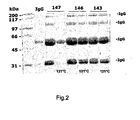
- Table 3 Binding capacity of the peptide matrices for immunoglobulins before and after autoclaving peptide matrix Rel. Capacity before autoclaving [%] Rel. Capacity after autoclaving [%] Relative residual capacity based on MF147 MF0147 5.11 100 0.72 14 100% MF0146 3.48 100 1.88 54 386% MF0143 2.85 100 1.85 65 464%
- SDS-PAGE sample preparation was performed under reducing conditions.
Landscapes
- Chemical & Material Sciences (AREA)
- Organic Chemistry (AREA)
- Health & Medical Sciences (AREA)
- Life Sciences & Earth Sciences (AREA)
- Medicinal Chemistry (AREA)
- General Health & Medical Sciences (AREA)
- Proteomics, Peptides & Aminoacids (AREA)
- Molecular Biology (AREA)
- Genetics & Genomics (AREA)
- Biophysics (AREA)
- Biochemistry (AREA)
- General Chemical & Material Sciences (AREA)
- Animal Behavior & Ethology (AREA)
- Pharmacology & Pharmacy (AREA)
- Public Health (AREA)
- Veterinary Medicine (AREA)
- Nuclear Medicine, Radiotherapy & Molecular Imaging (AREA)
- Chemical Kinetics & Catalysis (AREA)
- Immunology (AREA)
- Bioinformatics & Cheminformatics (AREA)
- Engineering & Computer Science (AREA)
- Peptides Or Proteins (AREA)
- Preparation Of Compounds By Using Micro-Organisms (AREA)
- Medicines That Contain Protein Lipid Enzymes And Other Medicines (AREA)
Description
- Gegenstand der vorliegenden Erfindung sind Peptide mit Affinität zu Immunglobulinen, feste Phasen an denen die erfindungsgemäßen Peptide gebunden sind, ein Verfahren zur Adsorption von Immunoglobulinen, eine Vorrichtung zur Durchführung des Verfahrens sowie Verwendungen der erfindungsgemäßen Peptide.
- Immunglobuline sind bei allen Vertebraten vorkommende Proteinmoleküle, die der körpereigenen spezifischen Immunabwehr dienen, indem sie an Antigene, mikrobielle sowie andere körperfremde Strukturen, binden und diese neutralisieren. Antigentragende Strukturen wie z.B. in den Körper eingedrungene Bakterien oder Parasiten sowie virusinfizierte Körperzellen werden durch gebundene Immunglobuline für eine Vernichtung durch entsprechend spezialisierte Zellen oder Molekülsysteme, wie z. B. das Komplementsystem, kenntlich gemacht. Immunglobuline werden je nach der Struktur ihrer molekularen Untereinheiten verschiedenen Immunglobulinklassen zugeordnet, die sich auch hinsichtlich ihrer biologischen Aktivität, wie z.B. der Fähigkeit zur Komplementaktivierung oder Schleimhautgängigkeit unterscheiden. Allgemein unterscheiden sich alle Immunglobuline, unabhängig von der Immunglobulinklasse, in ihrer variablen, für das jeweilige Antigen spezifischen Bindungsstelle. Alle Immunglobuline haben gemeinsame Strukturmerkmale, über die sie auch gemeinsam gebunden werden können, wobei hierfür die "Fc-Region" genannte molekulare Untereinheit bevorzugt wird (Davies and Metzger (1983); Alt et al. (1987)).
- In der Natur vorkommende Immunglobulin-bindende Moleküle sind vor allem Oberflächenrezeptoren von Körperzellen, welche die Fc-Region der verschiedenen Immunglobuline erkennen und an diese binden. Nachdem sie Immunglobuline gebunden haben, werden über die Rezeptoren, in Abhängigkeit von der gebundenen Immunglobulinklasse und dem Zelltyp unterschiedliche Aktivierungsvorgänge ausgelöst (McKenzie and Schreiber (1994); Makiya and Stigbrand (1992); Sarfati et al. (1992); Capron et al. (1992); Shen (1992); Sandor et al. (1992)).
- Neben Oberflächenrezeptoren binden auch Moleküle des Komplementsystems an die Fc-Region von Immunglobulinen. Das Komplementsystem stellt eine System von aufeinander abgestimmten Proteinen dar, welches der Zerstörung der antigentragenden Zielstruktur dient und zwei unterschiedliche Aktivierungswege aufweist. Bei dem einen - dem klassische Weg - erfolgt die Aktivierung über die Bindung der Komplementkomponente C1 bzw. deren Untereinheit C1q an die Fc-Region der antigengebundenen Immunglobuline (Miletic and Frank (1995)).
- Auch einige Bakterien haben Proteine entwickelt, die in der Lage sind, Immunglobuline über die Fc-Region zu binden. Dazu gehören das Protein A der Staphylokokken und das Protein G der Streptokokken. Diese Proteine und deren Abkömmlinge sind interessante Arbeitsmittel in der immunologischen Forschung, beispielsweise beim Studium der Rezeptor-Immunglobulin-Interaktion und finden gekoppelt an eine Trägermatrix breiten Einsatz in der affinitätschromatographischen Reinigung von Immunglobulinen (Stahl et al. (1993)).
- Ausgehend von dieser Anwendung wurde die therapeutische Immunapherese zur Behandlung von Autoimmunerkrankungen etabliert. Bei diesem Verfahren werden auf der Basis von matrixgekoppeltem Protein A Immunglobuline aus humanem Plasma entfernt und damit auch die Konzentration von pathogenen Autoantikörpern abgesenkt (Belak et al. (1994)).
- Auf dem Markt befinden sich derzeit zwei Protein A-Produkte, die sich hinsichtlich der verwendeten Adsorbermatrix unterscheiden. Zum einen wird Protein A immobilisiert an Agarose (Sepharose) als Trägermatrix verwendet (Immunosorba, Fresenius HemoCare AG/Deutschland) (Samuelsson (1998)), zum anderen findet Kieselgel als Trägermatrix Anwendung (Prosorba, Cypress Bioscience Inc./USA). Die Anwendung der Immunapherese mit Protein A zur Entfernung der Immunglobuline wurde bei verschiedenen Autoimmunerkrankungen, beispielsweise der Rheumatoiden Arthritis erfolgreich eingesetzt (Felson et al. (1999)).
- Weiterhin können nach Immunisierung mit Immunglobulinen einer bestimmten Spezies in einer anderen Spezies Antikörper induziert werden, die dann in der Lage sind die Immunglobuline der ersten Spezies zu binden. Hierauf beruht ein Produkt zur therapeutischen Immunapherese, welches matrixgekoppelte Antikörper vom Schafen verwendet, die aus dem Serum der Tiere nach Immunisierung mit menschlichen Immunglobulinen gewonnen werden. Auch dieses System (Ig-Therasorb, PlasmaSelect AG/Deutschland) findet Einsatz bei der Gesamtimmunglobulinentfernung und dient somit auch der therapeutischen Entfernung von pathogenen Antikörpern (Koll (1998)), beispielsweise von Faktor VIII- und Faktor IX-Inhibitoren (Knobl and Derfler (1999)).
- Auch matrix-immobilisierte Aminosäuren werden für die therapeutische Immunapherese eingesetzt. Hierzu kommen Adsorber auf Phenylalanin- (IM-PH350, Asahi Medical Co. Ltd. /Japan) und Tryptophanbasis (IM-TR350, Asahi/Japan) zum Einsatz (Jimenez et al. (1993); Fadul et al. (1996)). Die Bindungsfähigkeit dieser Adsorber ist jedoch im Gegensatz zu den vorgenannten Adsorbersystemen nicht auf Immunglobuline beschränkt, sondern es werden auch andere Proteine, wie das für die Gerinnung notwendige Fibrinogen, aus dem Blutplasma entfernt.
- Ein vollkommen anderes Bindungsprinzip wird bei der Verwendung von Peptiden als Antigen oder Antigenmimetikum zur Entfernung pathogener Autoantikörper angewandt. Beispielsweise wird der Adsorber MG-50 (Kuraray Co. Ltd./Japan) zur Eliminierung von Autoantikörpern gegen den Acetylcholinrezeptor bei der Behandlung von Myasthenia gravis angewendet (Takamori and Ide (1996)). Ein weiteres Beispiel ist die spezifische, immunapheretische Eliminierung von Autoantikörpern gegen den β1-adrenergen Rezeptor (
EP 99 118 631 - Interessanterweise und im Gegensatz zu den oben beschriebenen Peptiden sind in der Literatur auch Peptide beschrieben worden, die nicht über die Antigenbindungsstelle eines Immunglobulins gebunden werden, sondern an die Fc-Region von Immunglobulinen binden. So wurde ein Protein A-mimetisches Peptid beschrieben, das sich zur technischen Reinigung von Immunglobulinen eignet (Fassina et al. (1996) ; Fassina et al. (1998)). Weiterhin wurde ein Peptid beschrieben, das in gepufferter Lösung einen monoklonalen IgG-Antikörper im Bereich der Protein A-Bindungsstelle des Immunglobulins bindet (DeLano et al. (2000)) sowie
WO-A-01/45746 - Für die therapeutische Eignung als Pharmakon und/oder für den therapeutischen medizintechnischen Einsatz von Molekülen zur Bindung von Immunglobulinen der Klassen G1-4, A und M sind die Spezifität für die genannten Immunglobulinklassen, eine geringe Bindung anderer Plasmabestandteile sowie die Stabilität des Peptids in Körperflüssigkeiten wie z.B. humanem Plasma oder Serum, elementare Voraussetzungen.
- Der Erfindung liegt somit das technische Problem zugrunde, neue Peptide bereitzustellen, die eine hohe Affinität zu Immunglobulinen aufweisen.
- Erfindungsgemäß wird dieses Problem durch synthetische Peptide gelöst, die vorzugsweise selektiv an Immunglobuline, insbesondere der Klassen G1-4, A und M in komplexen Lösungen, wie z. B. Körperflüssigkeiten und nativem humanen Blutplasma, binden und unter diesen Einsatzbedingungen stabil sind.
- Die in diesem Patent beanspruchten Peptide erfüllen die genannten Anforderungen überraschenderweise sowohl in löslicher Form, als auch im immobilisiertem Zustand und sind somit für eine medizinisch-technische und pharmakologische Verwendung geeignet.
- Insbesondere nach Immobilisierung der Peptide über X08 gleich K (Lys) (siehe unten) erfüllen die Peptide die genannten Forderungen, überraschenderweise auch nach thermischer Behandlung (Autoklavierung bei 121°C).
- Im einzelnen sind dies die erfindungsgemäßen Peptide mit der folgenden Aminosäuresequenz sowie Peptide oder Proteine, die diese Aminosäuresequenz enthalten,
R1-X01-X02-X03-X04-X05-X06-X07-X08-X09-X10-X11-X12-X13-R2,
wobei R1, R2 sowie X01 bis X013 die folgende Bedeutung haben: - R1 =
- Amino-, Acetyl- sowie Spacer/Linker, oder Deletion
- X01 =
- A, D, E, G, Deletion
- X02 =
- C, S, D, E, Diaminobuttersäure (Dab), Diaminopropionsäure (Dpr), K, Ornithin (Orn),
- X03 =
- A, S, T
- X04 =
- E, F, H, K, M, R, S, T, V, W, Y
- X05 =
- H
- X06 =
- G, H, K, L, M, N, Q, R
- X07 =
- D, G
- X08 =
- D, H, K, M, N, Q, R
- X09 =
- K, L, R
- X10 =
- V
- X11 =
- W
- X12 =
- C, S, D, E, Diaminobuttersäure (Dab), Diaminopropionsäure (Dpr), K, Ornithin (Orn),
- X13 =
- D, E, K, Q, R, S, T, Deletion
- R2 =
- -COOH, -Amid, -GK, -GKK, -(βA)GK, -(βA)GKK, -(βA)(βA), -(βA)(βA)K sowie Spacer/Linker, oder Deletion.
- Die erfindungsgemäßen Peptide können insbesondere in linearer sowie zyklischer Form vorliegen, wobei der Peptidringschluss bei Anwesenheit von zwei Cysteinen über Disulfidbrückenbildung oder über eine Amidzyklisierung erfolgt, die gegebenenfalls über Seitenketten, über den C- und N-Terminus oder über eine Kombinationen beider Möglichkeiten erfolgt.
- Erfindungsgemäß bevorzugt werden die folgenden Peptide,
- R1-ACAWHLGKLVWCT-R2
- R1-ECAWHLGKLVWCT-R2
- R1-GCAWHLGKLVWCT-R2
- R1--CAWHLGKLVWCT-R2
- X02 =
- S
- X03 =
- S, T
- X04 =
- E, F, H, K, M, R, S, T, V, Y
- X06 =
- G, H, K, M, N, Q,R
- X07 =
- D
- X08 =
- D, H, M, N, Q, R
- X09 =
- K, R
- X12 =
- S
- X13 =
- D, E, K, Q, R, S, Deletion
- X01 =
- A, E, G, Deletion
- X03 =
- S, T
- X04 =
- E, F, H, K, M, R, S, T, V, Y
- X06 =
- G, H, K, M, N, Q, R
- X07 =
- D
- X08 =
- D, H, M, N, Q, R
- X09 =
- K, R
- X12 =
- S
- X13 =
- D, E, K, Q, R, S, Deletion
- X01 =
- A, E, G, Deletion
- X02 =
- S
- X04 =
- E, F, H, K, M, R, S, T, V, Y
- X06 =
- G, H, K, M, N, Q, R
- X07 =
- D
- X08 =
- D, H, M, N, Q, R
- X09 =
- K, R
- X12 =
- S
- X13 =
- D, E, K, Q, R, S, Deletion,
- X01 =
- A, E, G, Deletion
- X02 =
- S
- X03 =
- S, T
- X06 =
- G,H,K,M,N,Q,R
- X07 =
- D
- X08 =
- D, H, M, N, Q, R
- X09 =
- K, R
- X12 =
- S
- X13 =
- D, E, K, Q, R, S, Deletion,
- X01 =
- A, E, G, Deletion
- X02 =
- S
- X03 =
- S, T
- X04 =
- E, F, H, K, M, R, S, T, V, Y
- X07 =
- D
- X08 =
- D, H, .M, N, Q, R
- X09 =
- K, R
- X12 =
- S
- X13 =
- D, E, K, Q, R, S, Deletion,
- X01 =
- A, E, G, Deletion
- X02 =
- S
- X03 =
- S, T
- X04 =
- E, F, H, K, M, R, S, T, V, Y
- X06 =
- G, H, K, M, N, Q, R
- X08 =
- D, H, M, N, Q, R
- X09 =
- K, R
- X12 =
- S
- X13 =
- D, E, K, Q, R, S, Deletion
- X01 =
- A, E, G, Deletion
- X02 =
- S
- X03 =
- S, T
- X04 =
- E, F, H, K, M, R, S, T, V, Y
- X06 =
- G, H, K, M, N, Q, R
- X07 =
- D
- X09 =
- K, R
- X12 =
- S
- X13 =
- D, E, K, Q, R, S, Deletion,
- X01 =
- A, E, G, Deletion
- X02 =
- S
- X03 =
- S, T
- X04 =
- E, F, H, K, M, R, S, T, V, Y
- X06 =
- G, H, K, M, N, Q, R
- X07 =
- D
- X08 =
- D, H, M, N, Q, R
- X12 =
- S
- X13 =
- D, E, K, Q, R, S, Deletion,
- X01 =
- A, E, G, Deletion
- X02 =
- S
- X03 =
- S, T
- X04 =
- E, F, H, K, M, R, S, T, V, Y
- X06 =
- G, H, K, M, N, Q, R
- X07 =
- D
- X08 =
- D, H, M, N, Q, R
- X09 =
- K, R
- X13 =
- D, E, K, Q, R, S, Deletion
- X01 =
- A, E, G, Deletion
- X02 =
- S
- X03 =
- S, T
- X04 =
- E, F, H, K, M, R, S, T, V, Y
- X06 =
- G, H, K, M, N, Q, R
- X07 =
- D
- X08 =
- D, H, M, N, Q, R
- X09 =
- K, R
- X12 =
- S
- Des Weiteren werden Peptide erfindungsgemäß bevorzugt, die die folgenden Peptidsequenzen aufweisen und die linear oder gegebenenfalls über N-und C-Terminus des Peptids über eine Amidbindung zyklisiert sein können:
R1--CAWHLGKLVWCT-R2
R1-DCAWHLGKLVWC--R2
R1--CAWHLGKLVWC--R2
R1-DCSWHLGKLVWCT-R2
R1-DCAWHHGKLVWCT-R2
R1-DCAWHQGKLVWCT-R2
R1-DCAWHGGKLVWCT-R2
R1-DCAWHGGKLVWCT-R2
R1-DCAWHGGHLVWCT-R2
R1-DCAWHGGKLVWCE-R2
wobei R1 = Amino-, Acetyl-
R2 = -COOH, -Amid, -GK, -GKK, -(βA)GK, -(βA)GKK, -(βA)(βA), -(βA)(βA)K ist,
R1-DCAWHLGKLVWCT-R2
R1-DCAWHQGKLVWCT-R2
R1-DCAYHLGKLVWCT-R2
R1-DCSWHLGKLVWCT-R2
R1-DCAYHQGKLVWCT-R2
R1-DCSWHQGKLVWCT-R2
R1-DCSYHLGKLVWCT-R2
R1-DCSYHQGKLVWCT-R2
R1-CAWHLGKLVWCT-R2
R1--CAWHQGKLVWCT-R2
R1--CAYHLGKLVWCT-R2
R1-CSWHLGKLVWCT-R2
R1-CAYHQGKLVWCT-R2
R1--CSWHQGKLVWCT-R2
R1--CSYHLGKLVWCT-R2
R1--CSYHQGKLVWCT-R2
R1-DCAWHLGKLVWC--R2
R1-DCAWHQGKLVWC--R2
R1-DCAYHLGKLVWC--R2
R1-DCSWHLGKLVWC--R2
R1-DCAYHQGKLVWC--R2
R1-DCSWHQGKLVWC--R2
R1-DCSYHLGKLVWC--R2
R1-DCSYHQGKLVWC--R2
R1--CAWHLGKLVWC--R2
-R1--CAWHQGKLVWC--R2
R1--CAYHLGKLVWC--R2
R1--CSWHLGKLVWC--R2
R1--CAYHQGKLVWC--R2
R1--CSWHQGKLVWC--R2
R1--CSYHLGKLVWC--R2
R1--CSYHQGKLVWC--R2
wobei
R1 = Acetyl-
R2 = -COOH, -Amid ist,
gegebenenfalls die Cysteine in Position X02 und X12 für einen Ringschluss über Disulfdbrückenbildung verwendet werden,
oder die Cysteine in Position X02 und X12 durch Dpr oder Dab oder K oder Orn für X02 in Kombination mit D oder E für X12 ersetzt sind und für eine Amidzyklisierung über die Seitenketten verwendet werden,
oder die Cysteine in Position X02 und X12 durch D oder E für X02 in Kombination mit Dpr oder Dab oder K oder Orn für X12 ersetzt sind und für eine Amidzyklisierung über die Seitenketten verwendet werden. - Die genannten erfindungsgemäßen Peptide binden Immunglobuline oder Antigen-Immunglobulin-Komplexe in biologischen Flüssigkeiten.
- Erfindungsgemäß beansprucht werden auch feste Phasen für die Affinitätschromatographie oder Festphasenextraktion aus organischen, anorganischen, synthetischen Polymeren oder aus Mischpolymeren, vorzugsweise quervernetzte Agarose, Cellulose, Kieselgel, Polyamid und Polyvinylalkohole, die gegebenenfalls chemisch aktiviert werden, mit an der Oberfläche der festen Phase immobilisierten erfindungsgemäßen Peptiden.
- Bei den erfindungsgemäßen festen Phasen sind die Peptide vorzugsweise kovalent oder durch Adsorption an die feste Trägerphase gebunden. Bei einer weiteren bevorzugten Ausführungsform der erfindungsgemäßen festen Phasen sind die Peptide von der Trägeroberfläche über Linker/Spacer beabstandet. Um die erfindungsgemäßen Peptide an feste Phasen zu koppeln, werden diese vorzugsweise mit einem Linker/Spacer versehen. Vorzugsweise ist der Linker/Spacer ausgewählt aus der Gruppe bestehend aus:
- Carbonsäuren und deren Derivate, Hydroxycarbonsäuren und deren Derivate, Oligoalkoxyderivate und deren Oligomere, α-Aminocarbonsäuren sowie deren Homo- und Heterooligomere, α,ω-Aminocarbonsäuren sowie deren verzweigte Homo- und Heterooligomere, sonstige Aminosäuren sowie deren lineare und verzweigte Homo- und Heterooligomere, Amino-oligoalkoxy-alkylamine und deren lineare und verzweigte Homo- und Heterooligomere, Maleinimidocarbonsäure und deren Derivate, Oligomere von Alkylaminen, 4-Alkylphenyl-Derivate, 4-Oligoalkoxyphenyl- und 4-Oligoalkoxyphenoxy-Derivate, Oligoalkylmercaptophenyl- und 4-Oligoalkylmercaptophenoxy-Derivate, 4-Oligoalkylaminphenyl- und 4-Oligoalkylaminyphenoxy-Derivate, (Oligoalkylbenzyl)-phenyl- bzw. 4-(Oligoalkylbenzyl)-phenoxy-Derivate sowie 4-(Oligoalkoxy-benzyl)-phenyl- bzw. 4-(Oligoalkoxybenzyl)-phenoxy-Derivate, Trityl-Derivate, Benzyloxyaryl- und Benzyloxyalkyl-Derivate, Xanthen-3-yl-oxyalkyl-Derivate, ω-(4-Alkylphenyl)- bzw. ω-(4-Alkylphenoxy)-alkansäure-Derivate, Oligoalkyl-phenoxyalkyl- bzw. Oligoalkoxy-phenoxyalkyl-Derivate, Carbamat-Derivate, Amine, Trialkylsilyl- und Dialkyl-alkoxysilyl-Derivate, Alkyl- bzw. Aryl-Derivate, Thiole und deren Derivate, Thioether und deren Derivate, Thiocarbonsäuren und deren Derivate, Thiolcarbonsäuren und deren Derivate, Sulfonsäuren und deren Derivate sowie Kombinationen aus den aufgeführten Linkern oder Spacern.
- Gegenstand der Erfindung ist ein Verfahren zur Adsorption von Immunglobulinen an einer festen Phase, wobei die erfindungsgemäßen Peptide an eine für die Affinitätschromatographie übliche feste Phase oder an mobile feste Phasen gebunden werden, und die zu adsorbierenden immunglobulinhaltigen Proben insbesondere mit den erfindungsgemäßen festen Phasen in Kontakt gebracht werden.
- Vorzugsweise wird ein Verfahren zur Adsorption von Immunglobulinen an einer festen Phase durchgeführt, wobei die erfindungsgemäßen Peptide an eine für die Affinitätschromatographie übliche feste Phase oder an mobile feste Phasen gebunden werden, und die zu adsorbierenden immunglobulinhaltigen Proben mit Antikoagulantien behandeltes humanes Blutplasma oder humanes Vollblut sind und mit den erfindungsgemäßen festen Phasen gebracht werden.
- Das erfindungsgemäße Verfahren eignet sich insbesondere zur Adsorption von Immunglobulinen aus immunglobulinhaltigen Proben, die Autoantikörper enthalten, die mit Autoimmunerkrankungen, insbesondere rheumatioden Erkrankungen, Multiple Sklerose, Myasthenia gravis sowie andere Autoantikörper-vermittelte Erkrankungen, assoziiert sind.
- Das erfindungsgemäße Verfahren wird vorteilhafterweise mit einer erfindungsgemäßen Vorrichtung zur Entfernung von Immunglobulinen aus immunglobulinhaltigen Proben an festen Phasen durchgeführt, wobei die Vorrichtung eine erfindungsgemäße feste Phase enthält und Einrichtungen zum Einlass von immunglobulinhaltigen Proben vorgesehen sind.
- Gegenstand der Erfindung ist auch eine Verwendung der erfindungsgemäßen Peptide, der erfindungsgemäßen festen Phasen sowie der erfindungsgemäßen Vorrichtungen zur Entfernung von Immunglobulinen aus immunglobulinhaltigen Proben.
Die Erfindung wird an Hand der folgenden Beispiele näher erläutert. - Peptidimmobilisierung auf Cellulosematrix und Test auf Immunglobulinbindung
- Peptide bestehend aus 13 Aminosäuren wurden mittels Festphasensynthese (Houghten, 1985) an einer Cellulosematrix mit (βA)(βA) als Spacergruppierung synthetisiert.
- Ausgehend von
R1-XO1-X02-X03-X04-X05-X06-X07-X08-X09-X10-X11-X12-X13-R2
- D - C - A - W - H - L - G - E - L - V - W - C - T -
R1 = Amino-
R2 = (βA)(βA), wobei βA = β-Alanin
wurden festphasenimmobilisierte Peptidvarianten synthetisiert wie in Tabelle 1 beschrieben. - Die immobilisierten Peptide wurden auf ihre Bindungsfähigkeit von Immunglobulin durch Inkubation mit humanem IgG-Fc in gepufferter Lösung und durch Inkubation mit Humanplasma getestet.
- Hierzu wurden die festphasenimmobilisierten Peptidvarianten mit T-TBS-Puffer (136 mM Nacl, 1,6 mM KCI, 0,05% (v/v) Tween 20, 50 mM Tris-HCl pH 8,0) gewaschen und anschließend mit Blockierungspuffer (5% (w/v) Saccharose, 4% (w/v) Rinderserumalbumin in T-TBS) behandelt. Die Inkubation der immobilisierten Peptide mit IgG-Fc (1 µg/ml) in Blockierungspuffer und Humanserum (1:10.000 verdünnt in Blockierungspuffer) erfolgte für 3 h bei Raumtemperatur. Zur Überprüfung der Spezifität der Bindung wurde gepufferte Serumalbumin-Lösung (Blockierungspuffer) ohne Zusatz als Kontrolle mitgeführt. Danach wurden die festphasenimmobilisierten Peptidvarianten noch dreimal mit T-TBS-Puffer gewaschen.
- Nach Inkubation mit Alkalischer-Phosphatase-konjugiertem anti-Human IgG Antikörper (1,2 µg/ml) in Blockierungspuffer erfolgte die Detektion der Immunglobulinbindung anschließend mittels NBT (Nitroblautetrazoliumchlorid)/BCIP (5-Brom-4-Chlor-3-indolyl-phosphat, Toluidin-Salz) als Substrat (200 µl Stammlösung (18,75 mg/ml NBT und 9,4 mg/ml BCIP in 67% (v/v) DMSO) in 10 ml Entwicklungspuffer (100 mM Tris-HCl, 100 mM Nacl, 5 mM MgCl2 pH 9,5)).
- Die Ergebnisse der Tests auf Immunglotrulinbindung sind in Tabelle 1 dargestellt.
- Peptide immobilisiert auf Agarose-Beads mit Glu (E) im Vergleich zu Lys (K) in Peptidposition X08 (s.o.) und Test der Immunglobulin-Bindung aus Humanplasma
- Zur Immobilisierung an einer festen Phase wurden die Peptide zu einer Konzentration von 1 mg/ml in Kopplungspuffer (30 % (v/v) Acetonitril, 0,5 M NaCl, 0,1 M NaHCO3 pH 8,3) gelöst und mit gewaschener und CNBrvoraktivierter Sepharose 4B im Volumenverhältnis 10 : 1 gemischt. Nach Beendigung der Kopplungsreaktion wurden die Peptidmatrizes mit Kopplungspuffer gewaschen und die überschüssigen CNBr-Gruppen durch Inkubation der Matrix in Tris-Puffer (100 mM Tris-HCl, 500 mm NaCl pH 8,0) inaktiviert.
- Die Peptidbeladung der Matrizes wurde photometrisch (A280nm) durch Differenzbildung der eingesetzten Peptidmasse vor und der nichtimmobilisierten Peptidmasse nach der Kopplung bestimmt.
- Die Ergebnisse der Peptidbeladungen sind in Tabelle 2 dargestellt.
-
A Lineare Peptide A1 Acetyl- D-S-A-W-H-L-G-E-L-V-W-C-T -((βA)(βA)K) B Peptide zyklisiert über Disulfidbrückenbindung B1 
B2 
B3 
C Peptide zyklisiert über Seitenkettenamidbindung C1 
C2 
Dpr = Diaminopropionsäure - Die Peptidmatrizes wurden mittels Affinitätschromatographie auf ihre Bindungskapazität und auf ihre Bindungsspezifität für Immunglobuline mit Humanplasma als Probe getestet. Hierzu wurden als Probe 6 Volumenanteile Humanplasma mit einer linearen Flussrate von 80 cm/h über 1 Säulenvolumenanteil Peptidmatrix geleitet.
- Vor Probenauftrag wurde die Affinitätschromatographiesäule mit PBS pH 7,2 äquilibriert worden. Nach Probenauftrag wurde die Säule mit PBS pH 7,2 bis zur Erreichung der Adsorptionsbasislinie gespült und anschließend das gebundene Protein mit 30 mM Na-Citratpuffer pH 2,8 eluiert.
- Die Konzentrationsbestimmung des eluierten Proteins erfolgte durch photometrische Messung der Adsorption bei 280 nm. Die Immunglobulinkonzentration wurde daraus mit ε 280 nm = 1,35 cm2/mg für IgG berechnet.
- Die Ergebnisse der Kapazitätsbestimmungen sind in Tabelle 2 dargestellt.
- Die Spezifität der Immunglobulin-Peptidbindung wurde mittels SDS-PAGE ermittelt. Sie wurde mit der Spezifität für Immunglobulin von Protein A und anti-Immunglobulin G-Antikörpern verglichen.
- Hierzu wurden die Eluate des jeweiligen Affinitätschromatographielaufs (wie oben beschrieben) unter reduzierenden Bedingungen für die SDS-PAGE aufbereitet.
- Die Ergebnisse der Spezifitätsprüfung sind in Fig. 1 dargestellt.
- Glu (E) im Vergleich zu Lys (K) in Peptidposition X08 (s.o.): Peptidimmobilisierung auf Agarose-Beads und Test der Immunglobulin-Bindung aus Humanplasma vor und nach thermischer Behandlung
- Zur Immobilisierung an einer festen Phase wurden die Peptide zu einer Konzentration von 1 mg/ml in Kopplungspuffer (30 % (v/v) Acetonitril, 0,5 M Nacl, 0,1 M NaHC03 pH 8,3) gelöst und mit gewaschener und CNBrvoraktivierter Sepharose 4B im Volumenverhältnis 10 : 1 gemischt. Nach Beendigung der Kopplungsreaktion wurden die Peptidmatrizes mit Kopplungspuffer gewaschen und die überschüssigen CNBr-Gruppen durch Inkubation der Matrix in Tris-Puffer (100 mM Tris-HCl, 500 mM NaCl pH 8,0) inaktiviert.
- Die Peptidbeladung der Matrizes wurde photometrisch (A280nm) durch Differenzbildung der eingesetzten Peptidmasse vor und der nichtimmobilisierten Peptidmasse nach der Kopplung bestimmt.
- Alle genannten Peptide sind über Disulfidbrückenbindung zyklisiert.
MF0147 
- Immobilisierung über den Aminoterminus.
MF0146 
- Immobilisierung über die e-Aminogruppe des Lysins (K)
MF0143 
- Immobilisierung über die e-Aminogruppe des Lysins (K)
- Die Peptidmatrizes wurden vor und nach Autoklavierung bei 121°C für 20 min mittels Affinitätschromatographie auf ihre Bindungskapazität und auf ihre Bindungsspezifität für Immunglobuline mit Humanplasma als Probe getestet. Hierzu wurden als Probe 6 Volumenanteile Humanplasma mit einer linearen Flussrate von 80 cm/h über 1 Säulenvolumenanteil Peptidmatrix geleitet.
- Vor Probenauftrag wurde die Affinitätschromatographiesäule mit. PBS pH 7,2 equilibriert worden. Nach Probenauftrag wurde die Säule mit PBS pH 7,2 bis zur Erreichung der Adsorptionsbasislinie gespült und anschließend das gebundene Protein mit 30 mM Na-Citratpuffer pH 2,8 eluiert.
- Die Konzentrationsbestimmung des eluierten Proteins erfolgte durch photometrische Messung der Adsorption bei 280 nm. Die Immunglobulinkonzentration wurde daraus mit ε 280 nm = 1,35 cm2/mg für IgG berechnet.
- Die Ergebnisse der Kapazitätsbestimmungen sind in Tabelle 3 dargestellt.
- Die Spezifität der Immunglobulin-Peptidbindung vor und nach Autoklavierung wurde mittels SDS-PAGE ermittelt.
- Hierzu wurden die Eluate des jeweiligen Affinitätschromatographielaufs (wie oben beschrieben) unter reduzierenden Bedingungen für die SDS-PAGE aufbereitet.
- Die Ergebnisse der Spezifitätsprüfung sind in Fig. 2 dargestellt.
-
- (A) Inkubation der festphasenimmobilisierten Peptidvarianten mit Serumalbumin als negative Kontrollprobe
- (B) Inkubation der festphasenimmobilisierten Peptidvarianten mit Humanplasma als Probe
- (C) Inkubation der festphasenimmobilisierten Peptidvarianten mit humanem IgG-Fc als Probe
- Die Detektion der Bindung von Immunglobulinen an die festphasenimmobilisierten Peptidvarianten erfolgte mittels Alkalischer-Phosphatase-konjugiertem anti-Human IgG Antikörper.
- Erste Zeile: Ein-Buchstaben-Code für die ausgetauschte Aminosäure
- Erste Spalte: Sequenzposition der ausgetauschten Aminosäure
- Keine Bindung von Immunglobulin bei vorgegebener Peptidvariante, Detektion negativ: 0
- Bindung von Immunglobulin bei vorgegebener Peptidvariante, Detektion positiv: +
-
A C D E F G H I J K L M N P Q R S T V W Y 01 0 0 0 0 0 0 0 0 0 0 0 0 0 0 0 0 0 0 0 0 0 02 0 0 0 0 0 0 0 0 0 0 0 0 0 0 0 0 0 0 0 0 0 03 0 0 0 0 0 0 0 0 0 0 0 0 0 0 0 0 0 0 0 0 0 04 0 0 0 0 0 0 0 0 0 0 0 0 0 0 0 0 0 0 0 0 0 05 0 0 0 0 0 0 0 0 0 0 0 0 0 0 0 0 0 0 0 0 0 06 0 0 0 0 0 0 0 0 0 0 0 0 0 0 0 0 0 0 0 0 0 07 0 0 0 0 0 0 0 0 0 0 0 0 0 0 0 0 0 0 0 0 0 08 0 0 0 0 0 0 0 0 0 0 0 0 0 0 0 0 0 0 0 0 0 09 0 0 0 0 0 0 0 0 0 0 0 0 0 0 0 0 0 0 0 0 0 10 0 0 0 0 0 0 0 0 0 0 0 0 0 0 0 0 0 0 0 0 0 11 0 0 0 0 0 0 0 0 0 0 0 0 0 0 0 0 0 0 0 0 0 12 0 0 0 0 0 0 0 0 0 0 0 0 0 0 0 0 0 0 0 0 0 13 0 0 0 0 0 0 0 0 0 0 0 0 0 0 0 0 0 0 0 0 0 -
A C D E F G H I K L M N P Q R S T V W Y 01 + 0 + + 0 + 0 0 0 0 0 0 0 0 0 0 0 0 0 0 02 0 + 0 0 0 0 0 0 0 0 0 0 0 0 0 0 0 0 0 0 03 + 0 0 0 0 0 0 0 0 0 0 0 0 0 0 + + 0 0 0 04 0 0 0 + + 0 + 0 + 0 + 0 0 0 + + + + + + 05 0 0 0 0 0 0 + 0 0 0 0 0 0 0 0 0 0 0 0 0 06 0 0 0 0 0 + + 0 + + + + 0 + + 0 0 0 0 0 07 0 0 + 0 0 + 0 0 0 0 0 0 0 0 0 0 0 0 0 0 08 0 0 + + 0 0 + 0 + 0 + + 0 + + 0 0 0 0 0 09 0 0 0 0 0 0 0 0 + + 0 0 0 0 + 0 0 0 0 0 10 0 0 0 0 0 0 0 0 0 0. 0 0 0 0 0 0 0 + 0 0 11 0 0 0 0 0 0 0 0 0 0 0 0 0 0 0 0 0 0 + 0 12 0 + 0 0 0 0 0 0 0 0 0 0 0 0 0 0 0 0 0 0 13 0 0 + + 0 0 0 0 + 0 0 0 0 + + + + 0 0 0 -
A C D E F G H I K L M N P Q R S T V W Y 01 + 0 + + 0 + + 0 + + + + + + + + 0 0 0 0 02 0 + 0 0 0 0 0 0 0 0 0 0 0 0 0 0 0 0 0 0 03 + 0 0 + 0 0 0 0 + 0 0 0 0 + 0 + + 0 0 0 04 0 0 0 + + 0 0 + + + + + + 0 + + + + + + 05 0 0 0 0 0 0 + 0 0 0 0 0 0 0 0 0 0 0 0 0 06 + 0 + + 0 + + 0 + + + + 0 + + + + 0 0 0 07 0 0 + 0 0 + 0 0 0 0 0 0 0 0 0 0 0 0 0 0 08 + 0 + + 0 0 + 0 + 0 + + 0 + + + 0 0 0 0 09 0 0 0 0 0 0 0 0 + + + 0 + + + 0 0 0 0 0 10 0 0 0 0 0 0 0 0 0 0 0 0 0 0 0 0 0 + 0 0 11 0 0 0 0 0 0 + 0 + 0 0 0 0 0 0 0 0 0 + 0 12 0 + 0 0 0 0 0 0 0 0 0 0 0 0 0 0 0 0 0 0 13 + 0 + + 0 0 + 0 + 0 + + 0 + + + + 0 0 0 - Beladung: mg immobilisiertes Peptid/ ml Matrix [mg/ml].
Volumenkapazität: mg gebundenes Protein / ml Peptidmatrix; [mg/ml].
Relative Kapazität: mg gebundenes Protein / mg Peptidmatrixbeladung; [mg/mg].Peptidmatrix Beladung Volumenkapazität Rel. Kapazität A1 8,8 4,70 0,53 B1 8,2 1,18 0,14 B2 8,5 5,87 0,69 B3 7,7 10,7 1,40 C1 8,0 1,74 0,22 C2 8,8 1,50 0,17 - Die Spezifität der Immunglobulin-Peptidbindung (A) wurde im SDS-PAGE mit der Spezifität der Immunglobulin-Protein A-Bindung (Prot. A) und mit der Spezifität der Bindung von Human-IgG mit einem Huhn-IgY-anti Human-IgG Antikörper (AK1) bzw. einem Schaf-IgG-anti Human-IgG Antikörper (AK2) verglichen (B) sowie mit der Spezifität der Immunglobulin-Peptid RTY-Bindung, (Acetyl-(RTy)βA))2KGKK-amid abgeleitet von Fassina et al.(1996) und der Spezifität der Immunglobulin-Peptid K1- bzw. K2-Bindung, wobei K1 Acetyl-FGRLVSSIRY(βA)(βA)K-amid ist und K2 Acetyl-TWKTSRISIF(βA)(βA)K-amid ist, abgeleitet von Krook et al. (1998) (C).
-
- Marker:
- Marker für die molekularen Masse, in kDa.
- HP:
- Humanplasmaprobe, 10 µl Probe 1:200 in PBS vorverdünnt.
- IgG:
- Humanes Immunglobulin G, 1,25 µg.
-
- A1:
- Eluat von der Peptidmatrix A1, 10 µl Probe
-
- B1:
- Eluat von der Peptidmatrix B1, 10 µl Probe
- B2:
- Eluat von der Peptidmatrix B2, 10 µl Probe
- B3:
- Eluat von der Peptidmatrix B3, 10 µl Probe
-
- C1:
- Eluat von der Peptidmatrix C1, 10 µl Probe
- C2:
- Eluat von der Peptidmatrix C2, 10 µl Probe
-
- Ak1:
- Eluat von der Antikörpermatrix 1, 10 µl Probe
- Ak2:
- Eluat von der Antikörpermatrix 2, 10 µl Probe
- Prot. A:
- Eluat von der Protein A-Matrix, 10 µl Probe
-
- RTY:
- Eluat von der Peptidmatrix RTY, 10 µl Probe
- K1:
- Eluat von der Peptidmatrix K1, 10 µl Probe
- K2:
- Eluat von der Peptidmatrix K2, 10 µl Probe
- Die SDS-PAGE Probenvorbereitung erfolgte unter reduzierten Bedingungen.
Tabelle 3: Bindungskapazität der Peptidmatrizes für Immunglobuline vor und nach Autoklavierung Peptidmatrix Rel. Kapazität vor Autoklavierung [% ] Rel. Kapazität nach Autoklavierung [% ] Relative Restkapazität bezogen auf MF147 MF0147 5,11 100 0,72 14 100% MF0146 3,48 100 1,88 54 386% MF0143 2,85 100 1,85 65 464% - Relative Kapazität: mg gebundenes Protein / mg Peptidmatrixbeladung; [mg/mg].
- Fig. 2: Spezifität der Immunglobulin-Peptidbindung vor und nach Autoklavierung
- Marker:
- Marker für die molekularen Masse, in kDa.
- IgG:
- Humanes Immunglobulin G, 1,25 µg.
- 147, 146, 143:
- Eluat der jeweiligen Peptidmatrix vor Autoklavierung, jeweils 10 µl Probe
- 121°C:
- Eluat nach Autoklavierung der Matrix bei 121°C für 20 min, jeweils 10 µl Probe
- SDS-PAGE Probenvorbereitung erfolgte unter reduzierenden Bedingungen.
-
- Davies DR, Metzger H. Structural basis of antibody function. Annu Rev Immunol 1983;1:87-117
- Alt FW, Blackwell TK, Yancopoulos GD Development of the primary antibody repertoire. Science 1987 Nov 20;238(4830):1079-87
- McKenzie SE, Schreiber AD. Biological advances and clinical applications of Fc receptors for IgG. Curr Opin Hematol 1994 Jan;1(1):45-52
- Makiya R, Stigbrand T., Placental alkaline phosphatase as the placental IgG receptor. Clin Chem 1992 Dec;38(12):2543-5
- Sarfati M, Fournier S, Wu CY, Delespesse G., Expression, regulation and function of human Fc epsilon RII (CD23) antigen. Immunol Res. 1992;11(3-4):260-72
- Capron M, Truong MJ, Aldebert D, Gruart V, Suemura M, Delespesse G, Tourvieille B, Capron A., Eosinophil IgE receptor and CD23 Immunol Res. 1992;11(3-4):252-9
- Shen L, Receptors for IgA on phagocytic cells.Immunol Res. 1992;11(3-4):273-82. Review.
- Sandor M, Ibraghimov A, Rosenberg MG, Teeraratkul P, Lynch RG, Expression of IgA and IgM Fc receptors on murine T lymphocytes. Immunol Res. 1992;11(3-4):169-80.
- Miletic VD, Frank MM, Complement-immunoglobulin interactions. Curr Opin Immunol. 1995 Feb;7(1):41-7
- Stahl S, Nygren PA, Sjolander A, Uhlen M, Engineered bacterial receptors in immunology. Curr Opin Immunol. 1993 Apr;5(2):272-7
- Belak M, Borberg H, Jimenez C, Oette K, Technical and clinical experience with protein A immunoadsorption columns. Transfus Sci 1994 Dec; 15(4):419-22
- Samuelsson G, Immunoadsorption using the Excorim treatment system. Transfus Sci 1998 Mar;19 Suppl:3-4
- Felson DT, LaValley MP, Baldassare AR, Block JA, Caldwell JR, Cannon GW, Deal C, Evans S, Fleischmann R, Gendreau RM, Harris ER, Matteson EL, Roth SH, Schumacher HR, Weisman MH, Furst DE, The Prosorba column for treatment of refractory rheumatoid arthritis: a randomized, double-blind, sham-controlled trial. Arthritis Rheum 1999 Oct;42(10):2153-9
- Koll RA, Ig-Therasorb immunoadsorption for selective removal of human immunoglobulins in diseases associated with pathogenic antibodies of all classes and IgG subclasses, immune complexes, and fragments of immunoglobulins. Ther Apher 1998 May;2(2):147-52
- Knobl P, Derfler K, Extracorporeal immunoadsorption for the treatment of haemophilic patients with inhibitors to factor VIII or IX. Vox Sang 1999;77 Suppl 1:57-64
- Jimenez C, Rosenow F, Grieb P, Haupt WF, Borberg H, Adsorption therapy with tryptophan-conjugated polyvinyl alcohol gels in 10 patients with acute Guillain-Barre syndrome. Transfus Sci 1993 Jan; 14(1):9-11
- Fadul JE, Danielson BG, Wikstrom B, Reduction of plasma fibrinogen, immunoglobulin G, and immunoglobulin M concentrations by immunoadsorption therapy with tryptophan and phenylalanine adsorbents. Artif Organs 1996 Sep;20(9):986-90
- Takamori M, Ide Y, Specific removal of anti-acetylcholine receptor antibodies in patients with myasthenia gravis. Transfus Sci 1996 Sep;17(3):445-53
- Fassina G, Verdoliva A, Odierna MR, Ruvo M, Cassini G, Protein A mimetic peptide ligand for affinity purification of antibodies. J Mol Recognit 1996 Sep-Dec;9(5-6):564-9
- Fassina G, Verdoliva A, Palombo G, Ruvo M, Cassani G, Immunoglobulin specificity of TG19318: a novel synthetic ligand for antibody affinity purification. J Mol Recognit 1998 Winter;11(1-6): 128-33
- DeLano WL, Ultsch MH, de Vos AM, Wells JA, Convergent solutions to binding at a protein-protein interface. Science 2000 Feb 18;287(5456):1279-83
- Krook M, Mosbach K, Ramstrom O, Novel peptides binding to the Fc-portion of immunoglobulins obtained from a combinatorial phage display peptide library. J Immunol Methods 1998 Dec 1;221(1-2):151-7
- Houghten RA, General method for the rapid solid-phase synthesis of large numbers of peptides: specificity of antigen-antibody interaction at the level of individual amino acids. Proc Natl Acad Sci U S A 1985 Aug;82(15):5131-5.
-
- <110> Affina Immuntechnik GmbH
- <120> Peptide, deren Herstellung und Verwendung zur Bindung von Immunglobulinen
- <130> 012827wo
- <140>
PCT/EP01/12933
<141> 2001-11-08 - <150>
EP00124418.5
<151> 2000-11-08 - <160> 88
- <170> PatentIn Ver. 2.1
- <210> 1
<211> 13
<212> PRT
<213> Künstliche Sequenz - <220>
<223> Beschreibung der künstlichen Sequenz: synthetisches Peptid mit Affinität zu Immunglobulinen - <400> 1

- <210> 2
<211> 13
<212> PRT
<213> Künstliche Sequenz - <220>
<223> Beschreibung der künstlichen Sequenz: synthetisches Peptid mit Affinität zu Immunglobulinen - <400> 2

- <210> 3
<211> 13
<212> PRT
<213> Künstliche Sequenz - <220> <223> Beschreibung der künstlichen Sequenz: synthetisches Peptid mit Affinität zu Immunglobulinen
- <400> 3

- <210> 4
<211> 12
<212> PRT
<213> Künstliche Sequenz - <220>
<223> Beschreibung der künstlichen Sequenz: synthetisches Peptid mit Affinität zu Immunglobulinen - <400> 4

- <210> 5
<211> 13
<212> PRT
<213> Künstliche Sequenz - <220>
<223> Beschreibung der künstlichen Sequenz: synthetisches Peptid mit Affinität zu Immunglobulinen - <400> 5

- <210> 6
<211> 13
<212> PRT
<213> Künstliche Sequenz - <220>
<223> Beschreibung der künstlichen Sequenz: synthetisches Peptid mit Affinität zu Immunglobulinen - <400> 6

- <210> 7
<211> 13
<212> PRT
<213> Künstliche Sequenz - <220>
<223> Beschreibung der künstlichen Sequenz: synthetisches Peptid mit Affinität zu Immunglobulinen - <400> 7

- <210> 8
<211> 13
<212> PRT
<213> Künstliche Sequenz - <220>
<223> Beschreibung der künstlichen Sequenz: synthetisches Peptid mit Affinität zu Immunglobulinen - <400> 8

- <210> 9
<211> 13
<212> PRT
<213> Künstliche Sequenz - <220>
<223> Beschreibung der künstlichen Sequenz: synthetisches Peptid mit Affinität zu Immunglobulinen - <400> 9

- <210> 10
<211> 13
<212> PRT
<213> Künstliche Sequenz - <220>
<223> Beschreibung der künstlichen Sequenz: synthetisches Peptid mit Affinität zu Immunglobulinen - <400> 10

- <210> 11
<211> 13
<212> PRT
<213> Künstliche Sequenz - <220>
<223> Beschreibung der künstlichen Sequenz: synthetisches Peptid mit Affinität zu. Immunglobulinen - <400> 11

- <210> 12
<211> 13
<212> PRT
<213> Künstliche Sequenz - <220>
<223> Beschreibung der künstlichen Sequenz: synthetisches Peptid mit Affinität zu Immunglobulinen - <400> 12

- <210> 13
<211> 13
<212> PRT
<213> Künstliche Sequenz - <220>
<223> Beschreibung der künstlichen Sequenz: synthetisches Peptid mit Affinität zu Immunglobulinen - <400> 13

- <210> 14
<211> 13
<212> PRT
<213> Künstliche Sequenz - <220>
<223> Beschreibung der künstlichen Sequenz: synthetisches Peptid mit Affinität zu Immunglobulinen - <400> 14

- <210> 15
<211> 13
<212> PRT
<213> Künstliche Sequenz - <220>
<223> Beschreibung der künstlichen Sequenz: synthetisches Peptid mit Affinität zu Immunglobulinen - <400> 15

- <210> 16
<211> 13
<212> PRT
<213> Künstliche Sequenz - <220>
<223> Beschreibung der künstlichen Sequenz: synthetisches Peptid mit Affinität zu Immunglobulinen - <400> 16

- <210> 17
<211> 13
<212> PRT
<213> Künstliche Sequenz - <220>
<223> Beschreibung der künstlichen Sequenz: synthetisches Peptid mit Affinität zu Immunglobulinen - <400> 17

- <210> 18
<211> 13
<212> PRT
<213> Künstliche Sequenz - <220>
<223> Beschreibung der künstlichen Sequenz: synthetisches Peptid mit Affinität zu Immunglobulinen - <400> 18

- <210> 19
<211> 13
<212> PRT
<213> Künstliche Sequenz - <220>
<223> Beschreibung der künstlichen Sequenz: synthetisches Peptid mit Affinität zu Immunglobulinen - <400> 19

- <210> 20
<211> 13
<212> PRT
<213> Künstliche Sequenz - <220>
<223> Beschreibung der künstlichen Sequenz: synthetisches Peptid mit Affinität zu Immunglobulinen - <400> 20

- <210> 21
<211> 13
<212> PRT
<213> Künstliche Sequenz - <220>
<223> Beschreibung der künstlichen Sequenz: synthetisches Peptid mit Affinität zu Immunglobulinen - <400> 21

- <210> 22
<211> 13
<212> PRT
<213> Künstliche Sequenz - <220>
<223> Beschreibung der künstlichen Sequenz: synthetisches Peptid mit Affinität zu Immunglobulinen - <400> 22

- <210> 23
<211> 13
<212> PRT
<213> Künstliche Sequenz - <220>
<223> Beschreibung der künstlichen Sequenz: synthetisches Peptid mit Affinität zu Immunglobulinen - <400> 23

- <210> 24
<211> 13
<212> PRT
<213> Künstliche Sequenz - <220>
<223> Beschreibung der künstlichen Sequenz: synthetisches Peptid mit Affinität zu Immunglobulinen - <400> 24

- <210> 25
<211> 13
<212> PRT
<213> Künstliche Sequenz - <220>
<223> Beschreibung der künstlichen Sequenz: synthetisches Peptid mit Affinität zu Immunglobulinen - <400> 25

- <210> 26
<211> 13
<212> PRT
<213> Künstliche Sequenz - <220>
<223> Beschreibung der künstlichen Sequenz: synthetisches Peptid mit Affinität zu Immunglobulinen - <400> 26

- <210> 27
<211> 13
<212> PRT
<213> Künstliche Sequenz - <220>
<223> Beschreibung der künstlichen Sequenz: synthetisches Peptid mit Affinität zu Immunglobulinen - <400> 27

- <210> 28
<211> 13
<212> PRT
<213> Künstliche Sequenz - <220>
<223> Beschreibung der künstlichen Sequenz: synthetisches Peptid mit Affinität zu Immunglobulinen - <400> 28

- <210> 29
<211> 13
<212> PRT
<213> Künstliche Sequenz - <220>
<223> Beschreibung der künstlichen Sequenz: synthetisches Peptid mit Affinität zu Immunglobulinen - <400> 29

- <210> 30
<211> 13
<212> PRT
<213> Künstliche Sequenz - <220>
<223> Beschreibung der künstlichen Sequenz: synthetisches Peptid mit Affinität zu Immunglobulinen - <400> 30

- <210> 31
<211> 13
<212> PRT
<213> Künstliche Sequenz - <220>
<223> Beschreibung der künstlichen Sequenz: synthetisches Peptid mit Affinität zu Immunglobulinen - <400> 31

- <210> 32
<211> 13
<212> PRT
<213> Künstliche Sequenz - <220>
<223> Beschreibung der künstlichen Sequenz: synthetisches Peptid mit Affinität zu Immunglobulinen - <400> 32

- <210> 33
<211> 13
<212> PRT
<213> Künstliche Sequenz - <220>
<223> Beschreibung der künstlichen Sequenz: synthetisches Peptid mit Affinität zu Immunglobulinen - <400> 33

- <210> 34
<211> 13
<212> PRT
<213> Künstliche Sequenz - <220>
<223> Beschreibung der künstlichen Sequenz: synthetisches Peptid mit Affinität zu Immunglobulinen - <400> 34

- <210> 35
<211> 13
<212> PRT
<213> Künstliche Sequenz - <220>
<223> Beschreibung der künstlichen Sequenz: synthetisches Peptid mit Affinität zu Immunglobulinen - <400> 35

- <210> 36
<211> 13
<212> PRT
<213> Künstliche Sequenz - <220>
<223> Beschreibung der künstlichen Sequenz: synthetisches Peptid mit Affinität zu Immunglobulinen - <400> 36

- <210> 37
<211> 13
<212> PRT
<213> Künstliche Sequenz - <220>
<223> Beschreibung der künstlichen Sequenz: synthetisches Peptid mit Affinität zu Immunglobulinen - <400> 37

- <210> 38
<211> 13
<212> PRT
<213> Künstliche Sequenz - <220>
- <223> Beschreibung der künstlichen Sequenz: synthetisches Peptid mit Affinität zu Immunglobulinen
- <400> 38

- <210> 39
<211> 13
<212> PRT
<213> Künstliche Sequenz - <220>
<223> Beschreibung der künstlichen Sequenz: synthetisches Peptid mit Affinität zu Immunglobulinen - <400> 39

- <210> 40
<211> 13
<212> PRT
<213> Künstliche Sequenz - <220>
<223> Beschreibung der künstlichen Sequenz: synthetisches Peptid mit Affinität zu Immunglobulinen - <400> 40

- <210> 41
<211> 13
<212> PRT
<213> Künstliche Sequenz - <220>
<223> Beschreibung der künstlichen Sequenz: synthetisches Peptid mit Affinität zu Immunglobulinen - <400> 41

- <210> 42
<211> 13
<212> PRT
<213> Künstliche Sequenz - <220>
<223> Beschreibung der künstlichen Sequenz: synthetisches Peptid mit Affinität zu Immunglobulinen - <400> 42

- <210> 43
<211> 13
<212> PRT
<213> Künstliche Sequenz - <220>
<223> Beschreibung der künstlichen Sequenz: synthetisches Peptid mit Affinität zu Immunglobulinen - <400> 43

- <210> 44
<211> 13
<212> PRT
<213> Künstliche Sequenz - <220>
<223> Beschreibung der künstlichen Sequenz: synthetisches Peptid mit Affinität zu Immunglobulinen - <400> 44

- <210> 45
<211> 12
<212> PRT
<213> Künstliche Sequenz - <220>
<223> Beschreibung der künstlichen Sequenz: synthetisches Peptid mit Affinität zu Immunglobulinen - <400> 45

- <210> 46
<211> 12
<212> PRT
<213> Künstliche Sequenz - <220>
<223> Beschreibung der künstlichen Sequenz: synthetisches Peptid mit Affinität zu Immunglobulinen - <400> 46

- <210> 47
<211> 12
<212> PRT
<213> Künstliche Sequenz - <220>
<223> Beschreibung der künstlichen Sequenz: synthetisches Peptid mit Affinität zu Immunglobulinen - <400> 47

- <210> 48
<211> 11
<212> PRT
<213> Künstliche Sequenz - <220>
<223> Beschreibung der künstlichen Sequenz: synthetisches Peptid mit Affinität zu Immunglobulinen - <400> 48

- <210> 49
<211> 13
<212> PRT
<213> Künstliche Sequenz - <220>
<223> Beschreibung der künstlichen Sequenz: synthetisches Peptid mit Affinität zu Immunglobulinen - <400> 49

- <210> 50
<211> 13
<212> PRT
<213> Künstliche Sequenz - <220>
<223> Beschreibung der künstlichen Sequenz: synthetisches Peptid mit Affinität zu Immunglobulinen - <400> 50

- <210> 51
<211> 13
<212> PRT
<213> Künstliche Sequenz - <220>
<223> Beschreibung der künstlichen Sequenz: synthetisches Peptid mit Affinität zu Immunglobulinen - <400> 51

- <210> 52
<211> 13
<212> PRT
<213> Künstliche Sequenz - <220>
<223> Beschreibung der künstlichen Sequenz: synthetisches Peptid mit Affinität zu Immunglobulinen - <400> 52

- <210> 53
<211> 13
<212> PRT
<213> Künstliche Sequenz - <220>
<223> Beschreibung der künstlichen Sequenz: synthetisches Peptid mit Affinität zu Immunglobulinen - <400> 53

- <210> 54
<211> 13
<212> PRT
<213> Künstliche Sequenz - <220>
<223> Beschreibung der künstlichen Sequenz: synthetisches Peptid mit Affinität zu Immunglobulinen - <400> 54

- <210> 55
<211> 13
<212> PRT
<213> Künstliche Sequenz - <220>
<223> Beschreibung der künstlichen Sequenz: synthetisches Peptid mit Affinität zu Immunglobulinen - <400> 55

- <210> 56
<211> 13
<212> PRT
<213> Künstliche Sequenz - <220>
<223> Beschreibung der künstlichen Sequenz: synthetisches Peptid mit Affinität zu Immunglobulinen - <400> 56

- <210> 57
<211> 13
<212> PRT
<213> Künstliche Sequenz - <220>
<223> Beschreibung der künstlichen Sequenz: synthetisches Peptid mit Affinität zu Immunglobulinen - <400> 57

- <210> 58
<211> 13
<212> PRT
<213> Künstliche Sequenz - <220>
<223> Beschreibung der künstlichen Sequenz: synthetisches Peptid mit Affinität zu Immunglobulinen - <400> 58

- <210> 59
<211> 13
<212> PRT
<213> Künstliche Sequenz - <220>
<223> Beschreibung der künstlichen Sequenz: synthetisches Peptid mit Affinität zu Immunglobulinen - <400> 59

- <210> 60
<211> 13
<212> PRT
<213> Künstliche Sequenz - <220>
<223> Beschreibung der künstlichen Sequenz: synthetisches Peptid mit Affinität zu Immunglobulinen - <400> 60

- <210> 61
<211> 13
<212> PRT
<213> Künstliche Sequenz - <220>
<223> Beschreibung der künstlichen sequenz: synthetisches Peptid mit Affinität zu Immunglobulinen - <400> 61

- <210> 62
<211> 13
<212> PRT
<213> Künstliche Sequenz - <220>
<223> Beschreibung der künstlichen Sequenz: synthetisches Peptid mit Affinität zu Immunglobulinen - <400> 62

- <210> 63
<211> 13
<212> PRT
<213> Künstliche Sequenz - <220>
<223> Beschreibung der künstlichen Sequenz: synthetisches Peptid mit Affinität zu Immunglobulinen - <400> 63

- <210> 64
<211> 12
<212> PRT
<213> Künstliche Sequenz - <220>
<223> Beschreibung der künstlichen Sequenz: synthetisches Peptid mit Affinität zu Immunglobulinen - <400> 64

- <210> 65
<211> 12
<212> PRT
<213> Künstliche Sequenz - <220>
<223> Beschreibung der künstlichen Sequenz: synthetisches Peptid mit Affinität zu Immunglobulinen - <400> 65

- <210> 66
<211> 12
<212> PRT
<213> Künstliche Sequenz - <220>
<223> Beschreibung der künstlichen Sequenz: synthetisches Peptid mit Affinität zu Immunglobulinen - <400> 66

- <210> 67
<211> 12
<212> PRT
<213> Künstliche Sequenz - <220>
<223> Beschreibung der künstlichen Sequenz: synthetisches Peptid mit Affinität zu Immunglobulinen - <400> 67

- <210> 68
<211> 12
<212> PRT
<213> Künstliche Sequenz - <220>
<223> Beschreibung der künstlichen Sequenz: synthetisches Peptid mit Affinität zu Immunglobulinen - <400> 68

- <210> 69
<211> 12
<212> PRT
<213> Künstliche Sequenz - <220>
<223> Beschreibung der künstlichen Sequenz: synthetisches Peptid mit Affinität zu Immunglobulinen - <400> 69

- <210> 70
<211> 12
<212> PRT
<213> Künstliche Sequenz - <220>
<223> Beschreibung der künstlichen Sequenz: synthetisches Peptid mit Affinität zu Immunglobulinen - <400> 70

- <210> 71
<211> 12
<212> PRT
<213> Künstliche Sequenz - <220>
<223> Beschreibung der künstlichen Sequenz: synthetisches Peptid mit Affinität zu Immunglobulinen - <400> 71

- <210> 72
<211> 12
<212> PRT
<213> Künstliche Sequenz - <220>
<223> Beschreibung der künstlichen Sequenz: synthetisches Peptid mit Affinität zu Immunglobulinen - <400> 72

- <210> 73
<211> 12
<212> PRT
<213> Künstliche Sequenz - <220>
<223> Beschreibung der künstlichen Sequenz: synthetisches Peptid mit Affinität zu Immunglobulinen - <400> 73

- <210> 74
<211> 12
<212> PRT
<213> Künstliche Sequenz - <220>
<223> Beschreibung der künstlichen Sequenz: synthetisches Peptid mit Affinität zu Immunglobulinen - <400> 74

- <210> 75
<211> 12
<212> PRT
<213> Künstliche Sequenz - <220>
<223> Beschreibung der künstlichen Sequenz: synthetisches Peptid mit Affinität zu Immunglobulinen - <400> 75

- <210> 76
<211> 12
<212> PRT
<213> Künstliche Sequenz - <220>
<223> Beschreibung der künstlichen Sequenz: synthetisches Peptid mit Affinität zu Immunglobulinen - <400> 76

- <210> 77
<211> 12
<212> PRT
<213> Künstliche Sequenz - <220>
<223> Beschreibung der künstlichen Sequenz: synthetisches Peptid mit Affinität zu Immunglobulinen - <400> 77

- <210> 78
<211> 12
<212> PRT
<213> Künstliche Sequenz - <220>
<223> Beschreibung der künstlichen Sequenz: synthetisches Peptid mit Affinität zu Immunglobulinen - <400> 78

- <210> 79
<211> 12
<212> PRT
<213> Künstliche Sequenz - <220>
<223> Beschreibung der künstlichen Sequenz: synthetisches Peptid mit Affinität zu Immunglobulinen - <400> 79

- <210> 80
<211> 11
<212> PRT
<213> Künstliche Sequenz - <220>
<223> Beschreibung der künstlichen Sequenz: synthetisches Peptid mit Affinität zu Immunglobulinen - <400> 80

- <210> 81
<211> 11
<212> PRT
<213> Künstliche Sequenz - <220>
<223> Beschreibung der künstlichen Sequenz: synthetisches Peptid mit Affinität zu Immunglobulinen - <400> 81

- <210> 82
<211> 11
<212> PRT
<213> Künstliche Sequenz - <220>
<223> Beschreibung der künstlichen Sequenz: synthetisches Peptid mit Affinität zu Immunglobulinen - <400> 82

- <210> 83
<211> 11
<212> PRT
<213> Künstliche Sequenz - <220>
<223> Beschreibung der künstlichen Sequenz: synthetisches Peptid mit Affinität zu Immunglobulinen - <400> 83

- <210> 84
<211> 11
<212> PRT
<213> Künstliche Sequenz - <220>
<223> Beschreibung der künstlichen Sequenz: synthetisches Peptid mit Affinität zu Immunglobulinen - <400> 84

- <210> 85
<211> 11
<212> PRT
<213> Künstliche Sequenz - <220>
<223> Beschreibung der künstlichen Sequenz: synthetisches Peptid mit Affinität zu Immunglobulinen - <400> 85

- <210> 86
<211> 11
<212> PRT
<213> Künstliche Sequenz - <220>
<223> Beschreibung der künstlichen Sequenz: synthetisches Peptid mit Affinität zu Immunglobulinen - <400> 86

- <210> 87
<211> 11
<212> PRT
<213> Künstliche Sequenz - <220>
<223> Beschreibung der künstlichen Sequenz: synthetisches Peptid mit Affinität zu Immunglobulinen - <400> 87

- <210> 88
<211> 13
<212> PRT
<213> Künstliche Sequenz - <220>
<223> Beschreibung der künstlichen Sequenz: synthetisches Peptid mit Affinität zu Immunglobulinen - <400> 88

R1-DSAWHLGKLVWCT-R2
mit maximal vier gleichzeitigen Aminosäureaustauschen in den Peptidpositionen wie folgt,
R1-DCSWHLGKLVWCT-R2
R1-DCTWHLGKLVWCT-R2
mit maximal vier gleichzeitigen Aminosäureaustauschen in den Peptidpositionen wie folgt,
R1-DCAEHLGKLVWCT-R2
R1-DCAFHLGKLVWCT-R2
R1-DCAHHLGKLVWCT-R2
R1-DCAKHLGKLVWCT-R2
R1-DCAMHLGKLVWCT-R2
R1-DCARHLGKLVWCT-R2
R1-DCASHLGKLVWCT-R2
R1-DCATHLGKLVWCT-R2
R1-DCAVHLGKLVWCT-R2
R1-DCAWHLGKLVWCT-R2
R1-DCAYHLGKLVWCT-R2
mit maximal vier gleichzeitigen Aminosäureaustauschen in den Peptidpositionen wie folgt,
R1-DCAWHDGKLVWCT-R2
R1-DCAWHEGKLVWCT-R2
R1-DCAWHGGKLVWCT-R2
R1-DCAWHHGKLVWCT-R2
R1-DCAWHKGKLVWCT-R2
R1-DCAWHMGKLVWCT-R2
R1-DCAWHNGKLVWCT-R2
R1-DCAWHQGKLVWCT-R2
R1-DCAWHRGKLVWCT-R2
mit maximal vier gleichzeitigen Aminosäureaustauschen in den Peptidpositionen wie folgt,
R1-DCAWHLDKLVWCT-R2
mit maximal vier gleichzeitigen Aminosäureaustauschen in den Peptidpositionen wie folgt,
R1-DCAWHLGDLVWCT-R2
R1-DCAWHLGHLVWCT-R2
R1-DCAWHLGKLVWCT-R2
R1-DCAWHLGMLVWCT-R2
R1-DCAWHLGNLVWCT-R2
R1-DCAWHLGQLVWCT-R2
R1-DCAWHLGRLVWCT-R2
mit maximal vier gleichzeitigen Aminosäureaustauschen in den Peptidpositionen wie folgt,
R1-DCAWHLGKKVWCT-R2
R1-DCAWHLGKRVWCT-R2
mit maximal vier gleichzeitigen Aminosäureaustauschen in den Peptidpositionen wie folgt,
R1-DCAWHLGKLVWST-R2
mit maximal vier gleichzeitigen Aminosäureaustauschen in den Peptidpositionen wie folgt,
R1-DCAWHLGKLVWCD-R2
R1-DCAWHLGKLVWCE-R2
R1-DCAWHLGKLVWCK-R2
R1-DCAWHLGKLVWCQ-R2
R1-DCAWHLGKLVWCR-R2
R1-DCAWHLGKLVWCS-R2
R1-DCAWHLGKLVWC--R2
mit maximal vier gleichzeitigen Aminosäureaustauschen in den Peptidpositionen wie folgt,
R1 = Amino-, Acetyl- sowie Spacer/Linker,
R2 = -COOH, -Amid, -GK, -GKK, -(βA)GK, -(βA)GKK, -(βA)(βA), -(βA)(βA)K sowie Spacer/Linker sein kann, gegebenenfalls die Cysteine in Position X02 und X12 für einen Ringschluss über Disulfidbrückenbildung verwendet werden, oder die Cysteine in Position X02 und X12 durch Dpr oder Dab oder K oder Orn für X02 in Kombination mit D oder E für X12 ersetzt sind und für eine Amidzyklisierung über die Seitenketten verwendet werden,
oder die Cysteine in Position X02 und X12 durch D oder E für X02 in Kombination mit Dpr oder Dab oder K oder Orn für X12 ersetzt sind und für eine Amidzyklisierung über die Seitenketten verwendet werden,
oder bei R2 = COOH die Position X02 Dpr oder Dab, oder K oder Orn ist und deren Seitenkette mit der C-terminalen Aminosäure über eine Amidzyklisierung einen Ringschluss bildet,
oder bei R1 = NH2 die Position X12 E oder D ist und deren Seitenkette mit der N-terminalen Aminosäure über eine Amidzyklisierung einen Ringschluss bildet, oder bei R1 = NH2 und R2 = COOH die N-terminale und die C-terminale Aminosäure des Peptids für einen Ringschluss über Amidbildung verwendet wird,
und gegebenenfalls vorhandene Lysine, die nicht für einen Ringschluss verwendet werden, über Spacer/Linker derivatisiert sein können.
Claims (15)
- Peptide mit der folgenden Aminosäuresequenz,
R1-X01-X02-X03-X04-X05-X06-X07-X08-X09-X10-X11-X12-X13-R2,
wobei R1, R2 sowie X01 bis X013 die folgende Bedeutung haben:R1 = Amino-, Acetyl- sowie Spacer/Linker, oder DeletionX01 = A, D, E, G, DeletionX02 = C, S, D, E, Diaminobuttersäure (Dab), Diaminopropionsäure (Dpr), K, Ornithin (Orn),X03 = A, S, TX04 = E, F, H, K, M, R, S, T, V, W, YX05 = HX06 = E, G, H, K, L, M, N, Q, RX07 = D, GX08 = D, H, K, M, N, Q, RX09 = K, L, RX10 = VX11 = WX12 = C, S, D, E, Diaminobuttersäure (Dab), Diaminopropionsäure (Dpr), K, Ornithin (Orn),X13 = D, E, K, Q, R, S, T, DeletionR2 = -COOH, -Amid, -GK, -GKK, -(βA)GK, -(βA)GKK, -(βA)(βA), -(βA)(βA)K sowie Spacer/Linker, oder Deletion. - Peptid nach Anspruch 1 in linearer sowie zyklischer Form, wobei der Peptidringschluss bei Anwesenheit von zwei Cysteinen über Disulfidbrückenbildung oder über eine Amidzyklisierung erfolgt, die gegebenenfalls über Seitenketten, über den C- und N-Terminus oder über eine Kombinationen beider Möglichkeiten erfolgt.
- Peptide nach Anspruch 1 und/oder 2, dadurch gekennzeichnet, dass es sich uma) die folgenden Peptidsequenzen handelt,wobei
R1-ACAWHLGKLVWCT-R2
R1-ECAWHLGKLVWCT-R2
R1-GCAWHLGKLVWCT-R2
R1--CAWHLGKLVWCT-R2
mit maximal vier gleichzeitigen Aminosäureaustauschen in den Peptidpositionen wie folgt,X02 = SX03 = S, TX04 = E, F, H, K, M, R, S, T, V, YX06 = G, H, K, M, N, Q, RX07 = DX08 = D, H, M, N, Q, RX09 = K, RX12 = SX13 = D, E, K, Q, R, S, Deletionoder
R1-DSAWHLGKLVWCT-R2
mit maximal vier gleichzeitigen Aminosäureaustauschen in den Peptidpositionen wie folgt,X01 = A, E, G, DeletionX03 = S, TX04 = E, F, H, K, M, R, S, T, V, YX06 = G, H, K, M, N, Q, RX07 = DX08 = D, H, M, N, Q, RX09 = K, RX12 = SX13 = D, E, K, Q, R, S, Deletionoder
R1-DCSWHLGKLVWCT-R2
R1-DCTWHLGKLVWCT-R2
mit maximal vier gleichzeitigen Aminosäureaustauschen in den Peptidpositionen wie folgt,X01 = A, E, G, DeletionX02 = SX04 = E, F, H, K, M, R, S, T, V, YX06 = G, H, K, M, N, Q, RX07 = DX08 = D, H, M, N, Q, RX09 = K, RX12 = SX13 = D, E, K, Q, R, S, Deletion,oder
R1-DCAEHLGKLVWCT-R2
R1-DCAFHLGKLVWCT-R2
R1-DCAHHLGKLVWCT-R2
R1-DCAKHLGKLVWCT-R2
R1-DCAMHLGKLVWCT-R2
R1-DCARHLGKLVWCT-R2
R1-DCASHLGKLVWCT-R2
R1-DCATHLGKLVWCT-R2
R1-DCAVHLGKLVWCT-R2
R1-DCAWHLGKLVWCT-R2
R1-DCAYHLGKLVWCT-R2
mit maximal vier gleichzeitigen Aminosäureaustauschen in den Peptidpositionen wie folgt,X01 = A, E, G, DeletionX02 = SX03 = S, TX06 = G, H, K, M, N, Q, RX07 = DX08 = D, H, M, N, Q, RX09 = K, RX12 = SX13 = D, E, K, Q, R, S, Deletion,oder
R1-DCAWHDGKLVWCT-R2
R1-DCAWHEGKLVWCT-R2
R1-DCAWHGGKLVWCT-R2
R1-DCAWHHGKLVWCT-R2
R1-DCAWHKGKLVWCT-R2
R1-DCAWHMGKLVWCT-R2
R1-DCAWHNGKLVWCT-R2
R1-DCAWHQGKLVWCT-R2
R1-DCAWHRGKLVWCT-R2
mit maximal vier gleichzeitigen Aminosäureaustauschen in den Peptidpositionen wie folgt,X01 = A, E, G, DeletionX02 = SX03 = S, TX04 = E, F, H, K, M, R, S, T, V, YX07 = DX08 = D, H, M, N, Q, RX09 = K, RX12 = SX13 = D, E, K, Q, R, S, Deletion,oder
R1-DCAWHLDKLVWCT-R2
mit maximal vier gleichzeitigen Aminosäureaustauschen in den Peptidpositionen wie folgt,X01 = A, E, G, DeletionX02 = SX03 = S, TX04 = E, F, H, K, M, R,S,T,V,YX06 = G, H, K, M, N, Q, RX08 = D, H, M, N, Q, RX09 = K, RX12 = SX13 = D, E, K, Q, R, S, Deletionoder
R1-DCAWHLGDLVWCT-R2
R1-DCAWHLGHLVWCT-R2
R1-DCAWHLGKLVWCT-R2
R1-DCAWHLGMLVWCT-R2
R1-DCAWHLGNLVWCT-R2
R1-DCAWHLGQLVWCT-R2
R1-DCAWHLGRLVWCT-R2
mit maximal vier gleichzeitigen Aminosäureaustauschen in den Peptidpositionen wie folgt,X01 = A, E, G, DeletionX02 = SX03 = S, TX04 = E, F, H, K, M, R, S, T, V, YX06 = G, H, K, M, N, Q, RX07 = DX09 = K, RX12 = SX13 = D, E, K, Q, R, S, Deletion,oder
R1-DCAWHLGKKVWCT-R2
R1-DCAWHLGKRVWCT-R2
mit maximal vier gleichzeitigen Aminosäureaustauschen in den Peptidpositionen wie folgt,X01 = A, E, G, DeletionX02 = SX03 = S, TX04 = E, F, H, K, M, R, S, T, V, YX06 = G, H, K, M, N, Q, RX07 = DX08 = D, H, M, N, Q, RX12 = SX13 = D, E, K, Q, R, S, Deletion,oder
R1-DCAWHLGKLVWST-R2
mit maximal vier gleichzeitigen Aminosäureaustauschen in den Peptidpositionen wie folgt,X01 = A, E, G, DeletionX02 = SX03 = S, TX04 = E, F, H, K, M, R, S, T, V, YX06 = G, H, K, M, N, Q, RX07 = DX08 = D, H, M, N, Q, RX09 = K, RX13 = D, E, K, Q, R, S, Deletionoder
R1-DCAWHLGKLVWCD-R2
R1-DCAWHLGKLVWCE-R2
R1-DCAWHLGKLVWCK-R2
R1-DCAWHLGKLVWCQ-R2
R1-DCAWHLGKLVWCR-R2
R1-DCAWHLGKLVWCS-R2
R1-DCAWHLGKLVWC--R2
mit maximal vier gleichzeitigen Aminosäureaustauschen in den Peptidpositionen wie folgt,X01 = A, E, G, DeletionX02 = SX03 = S, TX04 = E, F, H, K, M, R, S, T, V, YX06 = G, H, K, M, N, Q, RX07 = DX08 = D, H, M, N, Q, RX09 = K, RX12 = S
R1 = Amino-, Acetyl- sowie Spacer/Linker,
R2 = -COOH, -Amid, -GK, -GKK, -(βA)GK, -(βA)GKK, -(βA)(βA), -(βA)(βA)K sowie Spacer/Linker sein kann, gegebenenfalls die Cysteine in Position X02 und X12 für einen Ringschluss über Disulfidbrückenbildung verwendet werden, oder die Cysteine in Position X02 und X12 durch Dpr oder Dab oder K oder Orn für X02 in Kombination mit D oder E für X12 ersetzt sind und für eine Amidzyklisierung über die Seitenketten verwendet werden,
oder die Cysteine in Position X02 und X12 durch D oder E für X02 in Kombination mit Dpr oder Dab oder K oder Orn für X12 ersetzt sind und für eine Amidzyklisierung über die Seitenketten verwendet werden,
oder bei R2 = COOH die Position X02 Dpr oder Dab, oder K oder Orn ist und deren Seitenkette mit der C-terminalen Aminosäure über eine Amidzyklisierung einen Ringschluss bildet,
oder bei R1 = NH2 die Position X12 E oder D ist und deren Seitenkette mit der N-terminalen Aminosäure über eine Amidzyklisierung einen Ringschluss bildet,
oder bei R1 = NH2 und R2 = COOH die N-terminale und die C-terminale Aminosäure des Peptids für einen Ringschluss über Amidbildung verwendet wird,
und gegebenenfalls vorhandene Lysine, die nicht für einen Ringschluss verwendet werden, über Spacer/Linker derivatisiert sein können. - Lineare sowie zyklische Peptide nach Anspruch 1 bis 3, dadurch gekennzeichnet, dass es sich um die folgenden Peptidsequenzen handelt,
R1--CAWHLGKLVWCT-R2
R1-DCAWHLGKLVWC--R2
R1--CAWHLGKLVWC--R2
R1-DCSWHLGKLVWCT-R2
R1-DCAWHHGKLVWCT-R2
R1-DCAWHQGKLVWCT-R2
R1-DCAWHGGKLVWCT-R2
R1-DCAWHGGKLVWCT-R2
R1-DCAWHGGHLVWCT-R2
R1-DCAWHGGKLVWCE-R2
wobei R1 = Amino-, Acetyl-
R2 = -COOH, -Amid, -GK, -GKK, -(βA)GK, -(βA)GKK, -(βA)(βA), -(βA)(βA)K ist,
R1-DCAWHLGKLVWCT-R2
R1-DCAWHQGKLVWCT-R2
R1-DCAYHLGKLVWCT-R2
R1-DCSWHLGKLVWCT-R2
R1-DCAYHQGKLVWCT-R2
R1-DCSWHQGKLVWCT-R2
R1-DCSYHLGKLVWCT-R2
R1-DCSYHQGKLVWCT-R2
R1--CAWHLGKLVWCT-R2
R1--CAWHQGKLVWCT-R2
R1--CAYHLGKLVWCT-R2
R1--CSWHLGKLVWCT-R2
R1--CAYHQGKLVWCT-R2
R1--CSWHQGKLVWCT-R2
R1--CSYHLGKLVWCT-R2
R1--CSYHQGKLVWCT-R2
R1-DCAWHLGKLVWC--R2
R1-DCAWHQGKLVWC--R2
R1-DCAYHLGKLVWC-R2
R1-DCSWHLGKLVWC--R2
R1-DCAYHQGKLVWC--R2
R1-DCSWHQGKLVWC--R2
R1-DCSYHLGKLVWC--R2
R1-DCSYHQGKLVWC--R2
R1--CAWHLGKLVWC--R2
R1--CAWHQGKLVWC--R2
R1--CAYHLGKLVWC--R2
R1--CSWHLGKLVWC--R2
R1--CAYHQGKLVWC--R2
R1--CSWHQGKLVWC--R2
R1--CSYH LGKLVWC--R2
R1--CSYHQGKLVWC--R2
wobei
R1 = Acetyl-
R2 = -COOH, -Amid ist,
gegebenenfalls die Cysteine in Position X02 und X12 für einen Ringschluss über Disulfidbrückenbildung verwendet werden,
oder die Cysteine in Position X02 und X12 durch Dpr oder Dab oder K oder Orn für X02 in Kombination mit D oder E für X12 ersetzt sind und für eine Amidzyklisierung über die Seitenketten verwendet werden,
oder die Cysteine in Position X02 und X12 durch D oder E für X02 in Kombination mit Dpr oder Dab oder K oder Orn für X12 ersetzt sind und für eine Amidzyklisierung über die Seitenketten verwendet werden. - Peptide nach einem der Ansprüche 1 bis 4, dadurch gekennzeichnet, dass die Peptide Immunglobuline oder Antigen-Immunglobulin-Komplexe in biologischen Flüssigkeiten binden.
- Peptide nach einem der Ansprüche 1 bis 3, dadurch gekennzeichnet, dass der Linker/Spacer aus der Gruppe ausgewählt wird, bestehend aus:- Carbonsäuren und deren Derivate- Hydroxycarbonsäuren und deren Derivate- Oligoalkoxyderivate und deren Oligomere- α-Aminocarbonsäuren sowie deren Homo- und Heterooligomere- α,ω-Aminocarbonsäuren sowie deren verzweigte Homo- und Heterooligomere- sonstige Aminosäuren sowie deren lineare und verzweigte Homo- und Heterooligomere- Amino-oligoalkoxy-alkylamine und deren lineare und verzweigte Homo- und Heterooligomere- Maleinimidocarbonsäure und deren Derivate- Oligomere von Alkylaminen- 4-Alkylphenyl-Derivate- 4-Oligoalkoxyphenyl- und 4-Oligoalkoxyphenoxy-Derivate- Oligoalkylmercaptophenyl- und 4-Oligoalkylmercaptophenoxy-Derivate- 4-Oligoalkylaminphenyl- und 4-Oligoalkylaminyphenoxy-Derivate- (Oligoalkylbenzyl)-phenyl- bzw. 4-(Oligoalkylbenzyl)-phenoxy-Derivate sowie 4-(Oligoalkoxy-benzyl)-phenyl- bzw. 4-(Oligoalkoxybenzyl)-phenoxy-Derivate- Trityl-Derivate- Benzyloxyaryl- und Benzyloxyalkyl-Derivate- Xanthen-3-yl-oxyalkyl-Derivate- ω-(4-Alkylphenyl)- bzw. ω-(4-Alkylphenoxy)-alkansäure-Derivate- Oligoalkyl-phenoxyalkyl- bzw. Oligoalkoxy-phenoxyalkyl-Derivate- Carbamat-Derivate- Amine- Trialkylsilyl- und Dialkyl-alkoxysilyl-Derivate- Alkyl- bzw. Aryl-Derivate- Thiole und deren Derivate- Thioether und deren Derivate- Thiocarbonsäuren und deren Derivate- Thiolcarbonsäuren und deren Derivate- Sulfonsäuren und deren Derivate sowieKombinationen aus den aufgeführten Linkern oder Spacern.
- Feste Phasen für die Affinitätschromatographie oder Festphasenextraktion aus organischen, anorganischen, synthetischen Polymeren oder aus Mischpolymeren, vorzugsweise quervernetzte Agarose, Cellulose, Kieselgel, Polyamid und Polyvinylalkohole, die gegebenenfalls chemisch aktiviert werden, mit an der Oberfläche der festen Phase immobilisierten Peptiden gemäss mindestens nach einem der Ansprüche 1 bis 6.
- Feste Phasen nach Anspruch 7 wobei die Peptide kovalent oder durch Adsorption an die feste Trägerphase gebunden sind.
- Feste Phasen nach Anspruch 7 oder 8, wobei die Peptide über K(Lys) an Position X08 kovalent an die feste Phase gebunden sind.
- Feste Phasen nach Anspruch 8 oder 9 wobei die Peptide von der Trägeroberfläche über Linker/Spacer beabstandet sind.
- Verfahren zur Adsorption von Immunglobulinen an einer festen Phase, wobei die Peptide nach Anspruch 1 bis 3 an eine übliche feste Phase für die Affinitätschromatographie oder an mobile feste Phasen gebunden werden, und die zu adsorbierenden immunglobulinhaltigen Proben mit den festen Phasen gemäss Anspruch 7 bis 10 in Kontakt gebracht werden.
- Verfahren zur Adsorption von Immunglobulinen an einer festen Phase, wobei die Peptide nach Anspruch 1 bis 6 an eine übliche feste Phase für die Affinitätschromatographie oder an mobile feste Phasen gebunden werden, und die zu adsorbierenden immunglobulinhaltigen Proben mit Antikoagulantien behandeltes humanes Blutplasma oder humanes Vollblut sind und mit den festen Phasen gemäss Anspruch 7 bis 10 in Kontakt gebracht werden.
- Verfahren nach Anspruch 12 zur Adsorption von Immunglobulinen aus immunglobulinhaltigen Proben, die Autoantikörper enthalten, die mit Autoimmunerkrankungen, vorzugsweise rheumatoide Erkrankungen, Multiple Sklerose, Myasthenia gravis sowie andere Autoantikörper-vermittelte Erkrankungen, assoziiert sind.
- Vorrichtung zur Entfernung von Immunglobulinen aus immunglobulinhaltigen Proben an festen Phasen, wobei die Vorrichtung eine feste Phase gemäss einem der Ansprüche 7 bis 10 enthält und Einrichtungen vorgesehen sind zum Einlass von immunglobulinhaltigen Proben.
- Verwendung von Peptiden nach einem der Ansprüche 1 bis 6, von festen Phasen nach einem der Ansprüche 7 bis 10 sowie Vorrichtungen nach Anspruch 14 zur Entfernung von Immunglobulinen aus immunglobulinhaltigen Proben.
Priority Applications (1)
| Application Number | Priority Date | Filing Date | Title |
|---|---|---|---|
| EP01993614A EP1332158B1 (de) | 2000-11-08 | 2001-11-08 | Peptide, deren herstellung und verwendung zur bindung von immunglobulinen |
Applications Claiming Priority (4)
| Application Number | Priority Date | Filing Date | Title |
|---|---|---|---|
| EP00124418 | 2000-11-08 | ||
| EP00124418 | 2000-11-08 | ||
| PCT/EP2001/012933 WO2002038592A2 (de) | 2000-11-08 | 2001-11-08 | Peptide, deren herstellung und verwendung zur bindung von immunglobulinen |
| EP01993614A EP1332158B1 (de) | 2000-11-08 | 2001-11-08 | Peptide, deren herstellung und verwendung zur bindung von immunglobulinen |
Publications (2)
| Publication Number | Publication Date |
|---|---|
| EP1332158A2 EP1332158A2 (de) | 2003-08-06 |
| EP1332158B1 true EP1332158B1 (de) | 2007-08-01 |
Family
ID=8170325
Family Applications (1)
| Application Number | Title | Priority Date | Filing Date |
|---|---|---|---|
| EP01993614A Expired - Lifetime EP1332158B1 (de) | 2000-11-08 | 2001-11-08 | Peptide, deren herstellung und verwendung zur bindung von immunglobulinen |
Country Status (7)
| Country | Link |
|---|---|
| US (1) | US7205382B2 (de) |
| EP (1) | EP1332158B1 (de) |
| AT (1) | ATE368688T1 (de) |
| AU (1) | AU2002217010A1 (de) |
| DE (1) | DE50112802D1 (de) |
| ES (1) | ES2292638T3 (de) |
| WO (1) | WO2002038592A2 (de) |
Families Citing this family (27)
| Publication number | Priority date | Publication date | Assignee | Title |
|---|---|---|---|---|
| US6916904B2 (en) * | 2002-04-24 | 2005-07-12 | Zolaris Biosciences, Llc | Inhibition of immune complex formation |
| AU2003270149A1 (en) | 2002-09-06 | 2004-03-29 | Forschungsverbund Berlin E. V. | Akap18 delta, a novel splicing variant of a protein kinase a anchor protein and the use of the same |
| AU2005221187B2 (en) | 2004-03-10 | 2011-09-01 | Trinity Therapeutics, Inc. | Method for inhibiting immune complex formation in a subjetc |
| EP1754715A1 (de) | 2005-08-19 | 2007-02-21 | Bundesrepublik Deutschland vertreten durch das Bundesminsterium für Gesundheit, dieses vertr. durch das Robert-Koch-Institut | Impfstoff auf Basis virusneutralisierender Antikörper |
| JP5329961B2 (ja) * | 2005-09-06 | 2013-10-30 | トリニティー セラピューティクス インコーポレイテッド | 免疫介在性神経疾患を治療するための方法 |
| EP1832600A1 (de) | 2006-03-09 | 2007-09-12 | Max-Delbrück-Centrum Für Molekulare Medizin | Peptide gegen Autoantikörper verbunden mit Glaukom und deren Verwendung |
| GB0620200D0 (en) * | 2006-10-11 | 2006-11-22 | E2V Biosensors Ltd | Conjugates for use in analyte detection |
| DE102007004909A1 (de) | 2007-01-26 | 2008-07-31 | Ga Generic Assays Gmbh | Verfahren zum Nachweis von Antikörpern aus Körperflüssigkeiten durch eine Immunreaktion mit Glykoprotein 2(GP2) aus zymogenen Granula des Pankreas zur Differentialdiagnose von entzündlichen Darmerkrankungen und chronischer Pankreatitis |
| EP2080519A1 (de) | 2008-01-15 | 2009-07-22 | Max-Delbrück-Centrum für Molekulare Medizin (MDC) | Peptide mit Bindungsaffinität an einen Antikörper, der ein Epitop in einer Alpha1-Schleife2 oder einer Beta2-Schleife 1 eines Adrenorezeptors erkennt |
| AU2009270805B2 (en) | 2008-07-18 | 2016-11-03 | Trinity Therapeutics, Inc. | Methods for treating immune-mediated dengue fever infections and antibody-dependent enhancement of dengue fever infections, including dengue hemorrhagic fever and dengue shock syndrome |
| EP2172481B1 (de) | 2008-10-06 | 2014-10-29 | Novoplant GmbH | Proteolytisch stabile Antikörperformate |
| EP2199305A1 (de) | 2008-12-18 | 2010-06-23 | Max-Delbrück-Centrum | Peptide gegen Autoantikörper, die mit CRPS assoziiert sind, und Verwendung dieser Peptide |
| EA032728B1 (ru) | 2009-08-19 | 2019-07-31 | Мерк Патент Гмбх | Антитела для выявления комплексов интегрина в ffpe материале |
| RU2014104690A (ru) | 2011-08-12 | 2015-09-20 | Е.Р.Д.Е.-ААК-Диагностик ГмбХ | АГОНИСТИЧЕСКИЕ АУТОАНТИТЕЛА К α1- И β2-АДРЕНЕРГИЧЕСКИМ РЕЦЕПТОРАМ ПРИ БОЛЕЗНИ АЛЬЦГЕЙМЕРА И СОСУДИСТОЙ ДЕМЕНЦИИ |
| CN103890174B9 (zh) * | 2011-08-24 | 2026-04-03 | 大塚化学株式会社 | IgG结合性肽及利用其检测和纯化IgG的方法 |
| EP2913675B1 (de) | 2014-02-28 | 2020-02-12 | GA Generic Assays GmbH | GP2-Isoformen und deren Verwendung bei der Autoantikörpererfassung |
| CA2940579A1 (en) | 2014-03-13 | 2015-09-17 | Universitaet Basel | Carbohydrate ligands that bind to igm antibodies against myelin-associated glycoprotein |
| US11091591B2 (en) | 2015-09-16 | 2021-08-17 | Universität Basel | Carbohydrate ligands that bind to antibodies against glycoepitopes of glycosphingolipids |
| WO2017069269A1 (ja) * | 2015-10-23 | 2017-04-27 | 富士フイルム株式会社 | 環状ペプチド、アフィニティクロマトグラフィー担体、標識化抗体、抗体薬物複合体、および医薬製剤 |
| SG11201803001WA (en) | 2015-10-23 | 2018-05-30 | Fujifilm Corp | Cyclic peptide, affinity chromatography support, labeled antibody, antibody drug conjugate, and pharmaceutical preparation |
| WO2017209471A1 (ko) * | 2016-05-30 | 2017-12-07 | 동국대학교 산학협력단 | 높은 항체결합용량과 온화한 용출 조건을 가진 항체정제용 흡착 리간드 및 그 용도 |
| EP3299818B1 (de) | 2016-09-26 | 2019-12-04 | GA Generic Assays GmbH | Verfahren zur diagnose akuter pankreatitis (ap) durch detektion von glycoprotein-2-isoform-alpha (gp2a) |
| CN109790202B (zh) * | 2016-09-30 | 2022-09-13 | 富士胶片株式会社 | 环肽、亲和层析载体、标记抗体、抗体药物复合体及药物制剂 |
| WO2019015814A1 (en) | 2017-07-20 | 2019-01-24 | Ga Generic Assays Gmbh | USE OF CHITINASE-3 PROTEIN-1 (CHI3L1) AS AUTO-ANTIGEN IN AUTOIMMUNE DISORDERS OF THE DIGESTIVE SYSTEM |
| EP3669888B1 (de) | 2018-12-20 | 2025-09-24 | Gambro Lundia AB | Extrakorporale vorrichtungen für verfahren zur behandlung von erkrankungen im zusammenhang mit zytoplasmischen anti-neutrophil-antikörpern |
| WO2020127968A1 (en) | 2018-12-20 | 2020-06-25 | Marino Stephen F | Protein-drug conjugate comprising a monomeric form of proteinase 3 |
| EP4003451B1 (de) | 2019-07-26 | 2024-12-18 | Technische Universität Dresden | Vorrichtung zur extrakorporalen senkung von asymmetrischen dimethylarginin- und argininspiegeln in menschlichem blut |
Family Cites Families (2)
| Publication number | Priority date | Publication date | Assignee | Title |
|---|---|---|---|---|
| EP1086955A1 (de) * | 1999-09-21 | 2001-03-28 | Affina Immuntechnik GmbH | Peptide gegen DCM hervorrufende Autoantikörper |
| US7608681B2 (en) * | 1999-12-24 | 2009-10-27 | Genentech, Inc. | Methods and compositions for prolonging elimination half-times of bioactive compounds |
-
2001
- 2001-11-08 AT AT01993614T patent/ATE368688T1/de not_active IP Right Cessation
- 2001-11-08 ES ES01993614T patent/ES2292638T3/es not_active Expired - Lifetime
- 2001-11-08 US US10/415,665 patent/US7205382B2/en not_active Expired - Lifetime
- 2001-11-08 DE DE50112802T patent/DE50112802D1/de not_active Expired - Lifetime
- 2001-11-08 AU AU2002217010A patent/AU2002217010A1/en not_active Abandoned
- 2001-11-08 EP EP01993614A patent/EP1332158B1/de not_active Expired - Lifetime
- 2001-11-08 WO PCT/EP2001/012933 patent/WO2002038592A2/de not_active Ceased
Also Published As
| Publication number | Publication date |
|---|---|
| WO2002038592A3 (de) | 2003-01-23 |
| ATE368688T1 (de) | 2007-08-15 |
| DE50112802D1 (de) | 2007-09-13 |
| US7205382B2 (en) | 2007-04-17 |
| EP1332158A2 (de) | 2003-08-06 |
| ES2292638T3 (es) | 2008-03-16 |
| US20040087765A1 (en) | 2004-05-06 |
| WO2002038592A2 (de) | 2002-05-16 |
| AU2002217010A1 (en) | 2002-05-21 |
Similar Documents
| Publication | Publication Date | Title |
|---|---|---|
| EP1332158A2 (de) | Peptide, deren herstellung und verwendung zur bindung von immunglobulinen | |
| Meutermans et al. | Synthesis of difficult cyclic peptides by inclusion of a novel photolabile auxiliary in a ring contraction strategy | |
| US20030199671A1 (en) | Binding molecules for Fc-region polypeptides | |
| CN107614514A (zh) | 利用IgG结合肽的抗体特异性修饰 | |
| AU2458701A (en) | Methods and compositions for prolonging elimination half-times of bioactive compounds | |
| Verdoliva et al. | A new ligand for immunoglobulin G subdomains by screening of a synthetic peptide library | |
| CN105658228B (zh) | 结合人类补体c5的稳定多肽 | |
| EP3543251B1 (de) | Fester träger mit igg-bindendem peptid und verfahren zur trennung von igg | |
| US12202858B2 (en) | Solid-phase carrier including IgG-binding peptide, and IgG separation method | |
| JP2003514772A (ja) | Dcmを引き起こす自己抗体に対するペプチド | |
| JPH02221296A (ja) | ホロレナ・クルタくも毒液から単離されたポリペプチド類 | |
| KR20140008787A (ko) | 항체의 Fc 부위 결합 펩타이드를 이용한 항체 정제용 흡착 칼럼 | |
| DE69604454T2 (de) | Peptidliganden für die konstante Region von Immunoglobulinen | |
| US5449753A (en) | Autotaxin: motility stimulating protein useful in cancer diagnosis | |
| WO1988007054A1 (en) | Complement-binding peptide | |
| Cheng et al. | Fractionation of antibodies to the pneumococcal polysaccharides by affinity chromatography | |
| Fassina et al. | Design and recognition properties of a hydropathically complementary peptide to human interleukin 1 β | |
| Chu et al. | Purification of polyclonal immunoglobulin G from human serum using peptide‐based adsorbents | |
| Abrahmsén | Superantigen engineering | |
| JP2005510469A (ja) | 自己免疫疾患の治療の構想における翻訳後型修飾を含むペプチドの使用 | |
| KR102741262B1 (ko) | 전압-게이팅된 칼슘 채널 보조 서브유닛 α2δ 및 이의 용도 | |
| Goncalves et al. | Total chemical synthesis of the D2 domain of human VEGF receptor 1 | |
| RU2739246C1 (ru) | Пептиды, связывающие фактор роста эндотелия сосудов | |
| Sato et al. | Roles of individual disulfide bridges in the conformation and activity of μ-conotoxin GIIIA, a peptide blocker of muscle sodium channels | |
| EP4661892A1 (de) | Tnf-alpha-bindende wirkstoffe und verfahren zur verwendung davon |
Legal Events
| Date | Code | Title | Description |
|---|---|---|---|
| PUAI | Public reference made under article 153(3) epc to a published international application that has entered the european phase |
Free format text: ORIGINAL CODE: 0009012 |
|
| 17P | Request for examination filed |
Effective date: 20030507 |
|
| AK | Designated contracting states |
Designated state(s): AT BE CH CY DE DK ES FI FR GB GR IE IT LI LU MC NL PT SE TR |
|
| AX | Request for extension of the european patent |
Extension state: AL LT LV MK RO SI |
|
| RAP1 | Party data changed (applicant data changed or rights of an application transferred) |
Owner name: FRESENIUS MEDICAL CARE AFFINA GMBH |
|
| GRAP | Despatch of communication of intention to grant a patent |
Free format text: ORIGINAL CODE: EPIDOSNIGR1 |
|
| GRAS | Grant fee paid |
Free format text: ORIGINAL CODE: EPIDOSNIGR3 |
|
| GRAA | (expected) grant |
Free format text: ORIGINAL CODE: 0009210 |
|
| AK | Designated contracting states |
Kind code of ref document: B1 Designated state(s): AT BE CH CY DE DK ES FI FR GB GR IE IT LI LU MC NL PT SE TR |
|
| REG | Reference to a national code |
Ref country code: GB Ref legal event code: FG4D Free format text: NOT ENGLISH |
|
| REG | Reference to a national code |
Ref country code: CH Ref legal event code: EP |
|
| REG | Reference to a national code |
Ref country code: IE Ref legal event code: FG4D Free format text: LANGUAGE OF EP DOCUMENT: GERMAN |
|
| REF | Corresponds to: |
Ref document number: 50112802 Country of ref document: DE Date of ref document: 20070913 Kind code of ref document: P |
|
| GBT | Gb: translation of ep patent filed (gb section 77(6)(a)/1977) |
Effective date: 20071107 |
|
| PG25 | Lapsed in a contracting state [announced via postgrant information from national office to epo] |
Ref country code: NL Free format text: LAPSE BECAUSE OF FAILURE TO SUBMIT A TRANSLATION OF THE DESCRIPTION OR TO PAY THE FEE WITHIN THE PRESCRIBED TIME-LIMIT Effective date: 20070801 Ref country code: FI Free format text: LAPSE BECAUSE OF FAILURE TO SUBMIT A TRANSLATION OF THE DESCRIPTION OR TO PAY THE FEE WITHIN THE PRESCRIBED TIME-LIMIT Effective date: 20070801 |
|
| NLV1 | Nl: lapsed or annulled due to failure to fulfill the requirements of art. 29p and 29m of the patents act | ||
| REG | Reference to a national code |
Ref country code: IE Ref legal event code: FD4D |
|
| REG | Reference to a national code |
Ref country code: ES Ref legal event code: FG2A Ref document number: 2292638 Country of ref document: ES Kind code of ref document: T3 |
|
| PG25 | Lapsed in a contracting state [announced via postgrant information from national office to epo] |
Ref country code: DK Free format text: LAPSE BECAUSE OF FAILURE TO SUBMIT A TRANSLATION OF THE DESCRIPTION OR TO PAY THE FEE WITHIN THE PRESCRIBED TIME-LIMIT Effective date: 20070801 Ref country code: GR Free format text: LAPSE BECAUSE OF FAILURE TO SUBMIT A TRANSLATION OF THE DESCRIPTION OR TO PAY THE FEE WITHIN THE PRESCRIBED TIME-LIMIT Effective date: 20071102 |
|
| PG25 | Lapsed in a contracting state [announced via postgrant information from national office to epo] |
Ref country code: IE Free format text: LAPSE BECAUSE OF FAILURE TO SUBMIT A TRANSLATION OF THE DESCRIPTION OR TO PAY THE FEE WITHIN THE PRESCRIBED TIME-LIMIT Effective date: 20070801 Ref country code: PT Free format text: LAPSE BECAUSE OF FAILURE TO SUBMIT A TRANSLATION OF THE DESCRIPTION OR TO PAY THE FEE WITHIN THE PRESCRIBED TIME-LIMIT Effective date: 20080102 |
|
| BERE | Be: lapsed |
Owner name: FRESENIUS MEDICAL CARE AFFINA G.M.B.H. Effective date: 20071130 |
|
| PLBE | No opposition filed within time limit |
Free format text: ORIGINAL CODE: 0009261 |
|
| STAA | Information on the status of an ep patent application or granted ep patent |
Free format text: STATUS: NO OPPOSITION FILED WITHIN TIME LIMIT |
|
| PG25 | Lapsed in a contracting state [announced via postgrant information from national office to epo] |
Ref country code: MC Free format text: LAPSE BECAUSE OF NON-PAYMENT OF DUE FEES Effective date: 20071130 Ref country code: SE Free format text: LAPSE BECAUSE OF FAILURE TO SUBMIT A TRANSLATION OF THE DESCRIPTION OR TO PAY THE FEE WITHIN THE PRESCRIBED TIME-LIMIT Effective date: 20071101 |
|
| 26N | No opposition filed |
Effective date: 20080506 |
|
| PG25 | Lapsed in a contracting state [announced via postgrant information from national office to epo] |
Ref country code: LI Free format text: LAPSE BECAUSE OF NON-PAYMENT OF DUE FEES Effective date: 20071130 Ref country code: CH Free format text: LAPSE BECAUSE OF NON-PAYMENT OF DUE FEES Effective date: 20071130 |
|
| REG | Reference to a national code |
Ref country code: CH Ref legal event code: PL |
|
| PG25 | Lapsed in a contracting state [announced via postgrant information from national office to epo] |
Ref country code: BE Free format text: LAPSE BECAUSE OF NON-PAYMENT OF DUE FEES Effective date: 20071130 |
|
| PG25 | Lapsed in a contracting state [announced via postgrant information from national office to epo] |
Ref country code: AT Free format text: LAPSE BECAUSE OF NON-PAYMENT OF DUE FEES Effective date: 20071108 |
|
| PG25 | Lapsed in a contracting state [announced via postgrant information from national office to epo] |
Ref country code: CY Free format text: LAPSE BECAUSE OF FAILURE TO SUBMIT A TRANSLATION OF THE DESCRIPTION OR TO PAY THE FEE WITHIN THE PRESCRIBED TIME-LIMIT Effective date: 20070801 |
|
| PG25 | Lapsed in a contracting state [announced via postgrant information from national office to epo] |
Ref country code: LU Free format text: LAPSE BECAUSE OF NON-PAYMENT OF DUE FEES Effective date: 20071108 |
|
| PG25 | Lapsed in a contracting state [announced via postgrant information from national office to epo] |
Ref country code: TR Free format text: LAPSE BECAUSE OF FAILURE TO SUBMIT A TRANSLATION OF THE DESCRIPTION OR TO PAY THE FEE WITHIN THE PRESCRIBED TIME-LIMIT Effective date: 20070801 |
|
| REG | Reference to a national code |
Ref country code: FR Ref legal event code: PLFP Year of fee payment: 15 |
|
| REG | Reference to a national code |
Ref country code: FR Ref legal event code: PLFP Year of fee payment: 16 |
|
| REG | Reference to a national code |
Ref country code: FR Ref legal event code: PLFP Year of fee payment: 17 |
|
| REG | Reference to a national code |
Ref country code: FR Ref legal event code: PLFP Year of fee payment: 18 |
|
| PGFP | Annual fee paid to national office [announced via postgrant information from national office to epo] |
Ref country code: IT Payment date: 20201021 Year of fee payment: 20 Ref country code: ES Payment date: 20201201 Year of fee payment: 20 Ref country code: GB Payment date: 20201021 Year of fee payment: 20 Ref country code: FR Payment date: 20201021 Year of fee payment: 20 Ref country code: DE Payment date: 20201020 Year of fee payment: 20 |
|
| REG | Reference to a national code |
Ref country code: DE Ref legal event code: R071 Ref document number: 50112802 Country of ref document: DE |
|
| REG | Reference to a national code |
Ref country code: GB Ref legal event code: PE20 Expiry date: 20211107 |
|
| PG25 | Lapsed in a contracting state [announced via postgrant information from national office to epo] |
Ref country code: GB Free format text: LAPSE BECAUSE OF EXPIRATION OF PROTECTION Effective date: 20211107 |
|
| REG | Reference to a national code |
Ref country code: ES Ref legal event code: FD2A Effective date: 20220225 |
|
| PG25 | Lapsed in a contracting state [announced via postgrant information from national office to epo] |
Ref country code: ES Free format text: LAPSE BECAUSE OF EXPIRATION OF PROTECTION Effective date: 20211109 |