EP1330440B1 - Pathogeninaktivierendes mittel mit einem an nukleinsäuren bindenden element und dessen verwendung - Google Patents
Pathogeninaktivierendes mittel mit einem an nukleinsäuren bindenden element und dessen verwendung Download PDFInfo
- Publication number
- EP1330440B1 EP1330440B1 EP01951478A EP01951478A EP1330440B1 EP 1330440 B1 EP1330440 B1 EP 1330440B1 EP 01951478 A EP01951478 A EP 01951478A EP 01951478 A EP01951478 A EP 01951478A EP 1330440 B1 EP1330440 B1 EP 1330440B1
- Authority
- EP
- European Patent Office
- Prior art keywords
- pathogen
- inactivating agent
- agent according
- group
- inactivation
- Prior art date
- Legal status (The legal status is an assumption and is not a legal conclusion. Google has not performed a legal analysis and makes no representation as to the accuracy of the status listed.)
- Expired - Lifetime
Links
- 239000003795 chemical substances by application Substances 0.000 title claims abstract description 40
- 150000007523 nucleic acids Chemical class 0.000 title claims abstract description 25
- 108020004707 nucleic acids Proteins 0.000 title claims abstract description 24
- 102000039446 nucleic acids Human genes 0.000 title claims abstract description 24
- 244000052769 pathogen Species 0.000 title claims abstract description 16
- 241000700605 Viruses Species 0.000 claims abstract description 29
- 229910052751 metal Inorganic materials 0.000 claims abstract description 16
- 239000002184 metal Substances 0.000 claims abstract description 16
- 210000004369 blood Anatomy 0.000 claims abstract description 13
- 239000008280 blood Substances 0.000 claims abstract description 13
- 230000003647 oxidation Effects 0.000 claims abstract description 7
- 238000007254 oxidation reaction Methods 0.000 claims abstract description 7
- 239000007788 liquid Substances 0.000 claims abstract 3
- AUNGANRZJHBGPY-SCRDCRAPSA-N Riboflavin Chemical compound OC[C@@H](O)[C@@H](O)[C@@H](O)CN1C=2C=C(C)C(C)=CC=2N=C2C1=NC(=O)NC2=O AUNGANRZJHBGPY-SCRDCRAPSA-N 0.000 claims description 25
- 230000002779 inactivation Effects 0.000 claims description 24
- XEEYBQQBJWHFJM-UHFFFAOYSA-N Iron Chemical group [Fe] XEEYBQQBJWHFJM-UHFFFAOYSA-N 0.000 claims description 18
- 108091034117 Oligonucleotide Proteins 0.000 claims description 18
- CIWBSHSKHKDKBQ-JLAZNSOCSA-N Ascorbic acid Chemical compound OC[C@H](O)[C@H]1OC(=O)C(O)=C1O CIWBSHSKHKDKBQ-JLAZNSOCSA-N 0.000 claims description 15
- AUNGANRZJHBGPY-UHFFFAOYSA-N D-Lyxoflavin Natural products OCC(O)C(O)C(O)CN1C=2C=C(C)C(C)=CC=2N=C2C1=NC(=O)NC2=O AUNGANRZJHBGPY-UHFFFAOYSA-N 0.000 claims description 14
- 239000011230 binding agent Substances 0.000 claims description 14
- 229960002477 riboflavin Drugs 0.000 claims description 14
- 230000027455 binding Effects 0.000 claims description 13
- OPTASPLRGRRNAP-UHFFFAOYSA-N cytosine Chemical compound NC=1C=CNC(=O)N=1 OPTASPLRGRRNAP-UHFFFAOYSA-N 0.000 claims description 12
- 239000002773 nucleotide Substances 0.000 claims description 12
- 125000003729 nucleotide group Chemical group 0.000 claims description 12
- 235000019192 riboflavin Nutrition 0.000 claims description 12
- 239000002151 riboflavin Substances 0.000 claims description 12
- 239000000126 substance Substances 0.000 claims description 11
- RWQNBRDOKXIBIV-UHFFFAOYSA-N thymine Chemical compound CC1=CNC(=O)NC1=O RWQNBRDOKXIBIV-UHFFFAOYSA-N 0.000 claims description 10
- -1 ellipticene Chemical compound 0.000 claims description 9
- ISAKRJDGNUQOIC-UHFFFAOYSA-N Uracil Chemical compound O=C1C=CNC(=O)N1 ISAKRJDGNUQOIC-UHFFFAOYSA-N 0.000 claims description 8
- 150000004697 chelate complex Chemical class 0.000 claims description 8
- 229910052742 iron Inorganic materials 0.000 claims description 8
- 235000010323 ascorbic acid Nutrition 0.000 claims description 7
- 239000011668 ascorbic acid Substances 0.000 claims description 7
- KCXVZYZYPLLWCC-UHFFFAOYSA-N EDTA Chemical class OC(=O)CN(CC(O)=O)CCN(CC(O)=O)CC(O)=O KCXVZYZYPLLWCC-UHFFFAOYSA-N 0.000 claims description 6
- DZBUGLKDJFMEHC-UHFFFAOYSA-N acridine Chemical compound C1=CC=CC2=CC3=CC=CC=C3N=C21 DZBUGLKDJFMEHC-UHFFFAOYSA-N 0.000 claims description 6
- 239000010836 blood and blood product Substances 0.000 claims description 6
- 229940125691 blood product Drugs 0.000 claims description 6
- 229940104302 cytosine Drugs 0.000 claims description 6
- 230000006378 damage Effects 0.000 claims description 6
- UYTPUPDQBNUYGX-UHFFFAOYSA-N guanine Chemical compound O=C1NC(N)=NC2=C1N=CN2 UYTPUPDQBNUYGX-UHFFFAOYSA-N 0.000 claims description 6
- ZCCUUQDIBDJBTK-UHFFFAOYSA-N psoralen Chemical compound C1=C2OC(=O)C=CC2=CC2=C1OC=C2 ZCCUUQDIBDJBTK-UHFFFAOYSA-N 0.000 claims description 6
- 125000006850 spacer group Chemical group 0.000 claims description 6
- 229940113082 thymine Drugs 0.000 claims description 5
- 241000894006 Bacteria Species 0.000 claims description 4
- 229930010555 Inosine Natural products 0.000 claims description 4
- UGQMRVRMYYASKQ-KQYNXXCUSA-N Inosine Chemical compound O[C@@H]1[C@H](O)[C@@H](CO)O[C@H]1N1C2=NC=NC(O)=C2N=C1 UGQMRVRMYYASKQ-KQYNXXCUSA-N 0.000 claims description 4
- JLCPHMBAVCMARE-UHFFFAOYSA-N [3-[[3-[[3-[[3-[[3-[[3-[[3-[[3-[[3-[[3-[[3-[[5-(2-amino-6-oxo-1H-purin-9-yl)-3-[[3-[[3-[[3-[[3-[[3-[[5-(2-amino-6-oxo-1H-purin-9-yl)-3-[[5-(2-amino-6-oxo-1H-purin-9-yl)-3-hydroxyoxolan-2-yl]methoxy-hydroxyphosphoryl]oxyoxolan-2-yl]methoxy-hydroxyphosphoryl]oxy-5-(5-methyl-2,4-dioxopyrimidin-1-yl)oxolan-2-yl]methoxy-hydroxyphosphoryl]oxy-5-(6-aminopurin-9-yl)oxolan-2-yl]methoxy-hydroxyphosphoryl]oxy-5-(6-aminopurin-9-yl)oxolan-2-yl]methoxy-hydroxyphosphoryl]oxy-5-(6-aminopurin-9-yl)oxolan-2-yl]methoxy-hydroxyphosphoryl]oxy-5-(6-aminopurin-9-yl)oxolan-2-yl]methoxy-hydroxyphosphoryl]oxyoxolan-2-yl]methoxy-hydroxyphosphoryl]oxy-5-(5-methyl-2,4-dioxopyrimidin-1-yl)oxolan-2-yl]methoxy-hydroxyphosphoryl]oxy-5-(4-amino-2-oxopyrimidin-1-yl)oxolan-2-yl]methoxy-hydroxyphosphoryl]oxy-5-(5-methyl-2,4-dioxopyrimidin-1-yl)oxolan-2-yl]methoxy-hydroxyphosphoryl]oxy-5-(5-methyl-2,4-dioxopyrimidin-1-yl)oxolan-2-yl]methoxy-hydroxyphosphoryl]oxy-5-(6-aminopurin-9-yl)oxolan-2-yl]methoxy-hydroxyphosphoryl]oxy-5-(6-aminopurin-9-yl)oxolan-2-yl]methoxy-hydroxyphosphoryl]oxy-5-(4-amino-2-oxopyrimidin-1-yl)oxolan-2-yl]methoxy-hydroxyphosphoryl]oxy-5-(4-amino-2-oxopyrimidin-1-yl)oxolan-2-yl]methoxy-hydroxyphosphoryl]oxy-5-(4-amino-2-oxopyrimidin-1-yl)oxolan-2-yl]methoxy-hydroxyphosphoryl]oxy-5-(6-aminopurin-9-yl)oxolan-2-yl]methoxy-hydroxyphosphoryl]oxy-5-(4-amino-2-oxopyrimidin-1-yl)oxolan-2-yl]methyl [5-(6-aminopurin-9-yl)-2-(hydroxymethyl)oxolan-3-yl] hydrogen phosphate Polymers Cc1cn(C2CC(OP(O)(=O)OCC3OC(CC3OP(O)(=O)OCC3OC(CC3O)n3cnc4c3nc(N)[nH]c4=O)n3cnc4c3nc(N)[nH]c4=O)C(COP(O)(=O)OC3CC(OC3COP(O)(=O)OC3CC(OC3COP(O)(=O)OC3CC(OC3COP(O)(=O)OC3CC(OC3COP(O)(=O)OC3CC(OC3COP(O)(=O)OC3CC(OC3COP(O)(=O)OC3CC(OC3COP(O)(=O)OC3CC(OC3COP(O)(=O)OC3CC(OC3COP(O)(=O)OC3CC(OC3COP(O)(=O)OC3CC(OC3COP(O)(=O)OC3CC(OC3COP(O)(=O)OC3CC(OC3COP(O)(=O)OC3CC(OC3COP(O)(=O)OC3CC(OC3COP(O)(=O)OC3CC(OC3COP(O)(=O)OC3CC(OC3CO)n3cnc4c(N)ncnc34)n3ccc(N)nc3=O)n3cnc4c(N)ncnc34)n3ccc(N)nc3=O)n3ccc(N)nc3=O)n3ccc(N)nc3=O)n3cnc4c(N)ncnc34)n3cnc4c(N)ncnc34)n3cc(C)c(=O)[nH]c3=O)n3cc(C)c(=O)[nH]c3=O)n3ccc(N)nc3=O)n3cc(C)c(=O)[nH]c3=O)n3cnc4c3nc(N)[nH]c4=O)n3cnc4c(N)ncnc34)n3cnc4c(N)ncnc34)n3cnc4c(N)ncnc34)n3cnc4c(N)ncnc34)O2)c(=O)[nH]c1=O JLCPHMBAVCMARE-UHFFFAOYSA-N 0.000 claims description 4
- 229960005070 ascorbic acid Drugs 0.000 claims description 4
- 229960003786 inosine Drugs 0.000 claims description 4
- IDBIFFKSXLYUOT-UHFFFAOYSA-N netropsin Chemical compound C1=C(C(=O)NCCC(N)=N)N(C)C=C1NC(=O)C1=CC(NC(=O)CN=C(N)N)=CN1C IDBIFFKSXLYUOT-UHFFFAOYSA-N 0.000 claims description 4
- 125000002467 phosphate group Chemical group [H]OP(=O)(O[H])O[*] 0.000 claims description 4
- 230000002829 reductive effect Effects 0.000 claims description 4
- 229940035893 uracil Drugs 0.000 claims description 4
- GFFGJBXGBJISGV-UHFFFAOYSA-N Adenine Chemical compound NC1=NC=NC2=C1N=CN2 GFFGJBXGBJISGV-UHFFFAOYSA-N 0.000 claims description 3
- 229930024421 Adenine Natural products 0.000 claims description 3
- 229930192392 Mitomycin Natural products 0.000 claims description 3
- NWIBSHFKIJFRCO-WUDYKRTCSA-N Mytomycin Chemical compound C1N2C(C(C(C)=C(N)C3=O)=O)=C3[C@@H](COC(N)=O)[C@@]2(OC)[C@@H]2[C@H]1N2 NWIBSHFKIJFRCO-WUDYKRTCSA-N 0.000 claims description 3
- 229960000643 adenine Drugs 0.000 claims description 3
- 239000000470 constituent Substances 0.000 claims description 3
- 239000000138 intercalating agent Substances 0.000 claims description 3
- 229960004857 mitomycin Drugs 0.000 claims description 3
- PDYBUYVOPAJLKP-UHFFFAOYSA-M 2,3,10,11-tetramethoxy-8-methylisoquinolino[2,1-b]isoquinolin-7-ium;chloride Chemical compound [Cl-].C1=C(OC)C(OC)=CC2=CC3=C(C=C(C(OC)=C4)OC)C4=CC=[N+]3C(C)=C21 PDYBUYVOPAJLKP-UHFFFAOYSA-M 0.000 claims description 2
- OZFPSOBLQZPIAV-UHFFFAOYSA-N 5-nitro-1h-indole Chemical compound [O-][N+](=O)C1=CC=C2NC=CC2=C1 OZFPSOBLQZPIAV-UHFFFAOYSA-N 0.000 claims description 2
- 229930195730 Aflatoxin Natural products 0.000 claims description 2
- 235000001258 Cinchona calisaya Nutrition 0.000 claims description 2
- QTANTQQOYSUMLC-UHFFFAOYSA-O Ethidium cation Chemical class C12=CC(N)=CC=C2C2=CC=C(N)C=C2[N+](CC)=C1C1=CC=CC=C1 QTANTQQOYSUMLC-UHFFFAOYSA-O 0.000 claims description 2
- 108010042309 Netropsin Proteins 0.000 claims description 2
- FZEYVTFCMJSGMP-UHFFFAOYSA-N acridone Chemical compound C1=CC=C2C(=O)C3=CC=CC=C3NC2=C1 FZEYVTFCMJSGMP-UHFFFAOYSA-N 0.000 claims description 2
- 239000005409 aflatoxin Substances 0.000 claims description 2
- 238000006243 chemical reaction Methods 0.000 claims description 2
- 150000003278 haem Chemical class 0.000 claims description 2
- UPBAOYRENQEPJO-UHFFFAOYSA-N n-[5-[[5-[(3-amino-3-iminopropyl)carbamoyl]-1-methylpyrrol-3-yl]carbamoyl]-1-methylpyrrol-3-yl]-4-formamido-1-methylpyrrole-2-carboxamide Chemical compound CN1C=C(NC=O)C=C1C(=O)NC1=CN(C)C(C(=O)NC2=CN(C)C(C(=O)NCCC(N)=N)=C2)=C1 UPBAOYRENQEPJO-UHFFFAOYSA-N 0.000 claims description 2
- MGFYIUFZLHCRTH-UHFFFAOYSA-N nitrilotriacetic acid Chemical compound OC(=O)CN(CC(O)=O)CC(O)=O MGFYIUFZLHCRTH-UHFFFAOYSA-N 0.000 claims description 2
- 229920000768 polyamine Polymers 0.000 claims description 2
- XJMOSONTPMZWPB-UHFFFAOYSA-M propidium iodide Chemical compound [I-].[I-].C12=CC(N)=CC=C2C2=CC=C(N)C=C2[N+](CCC[N+](C)(CC)CC)=C1C1=CC=CC=C1 XJMOSONTPMZWPB-UHFFFAOYSA-M 0.000 claims description 2
- 108010042747 stallimycin Proteins 0.000 claims description 2
- 239000001003 triarylmethane dye Substances 0.000 claims description 2
- 150000001491 aromatic compounds Chemical class 0.000 claims 4
- 150000003839 salts Chemical class 0.000 claims 3
- HAUGRYOERYOXHX-UHFFFAOYSA-N Alloxazine Chemical compound C1=CC=C2N=C(C(=O)NC(=O)N3)C3=NC2=C1 HAUGRYOERYOXHX-UHFFFAOYSA-N 0.000 claims 2
- QPCDCPDFJACHGM-UHFFFAOYSA-N N,N-bis{2-[bis(carboxymethyl)amino]ethyl}glycine Chemical class OC(=O)CN(CC(O)=O)CCN(CC(=O)O)CCN(CC(O)=O)CC(O)=O QPCDCPDFJACHGM-UHFFFAOYSA-N 0.000 claims 2
- LOUPRKONTZGTKE-WZBLMQSHSA-N Quinine Chemical compound C([C@H]([C@H](C1)C=C)C2)C[N@@]1[C@@H]2[C@H](O)C1=CC=NC2=CC=C(OC)C=C21 LOUPRKONTZGTKE-WZBLMQSHSA-N 0.000 claims 2
- WHTVZRBIWZFKQO-AWEZNQCLSA-N (S)-chloroquine Chemical compound ClC1=CC=C2C(N[C@@H](C)CCCN(CC)CC)=CC=NC2=C1 WHTVZRBIWZFKQO-AWEZNQCLSA-N 0.000 claims 1
- JECYNCQXXKQDJN-UHFFFAOYSA-N 2-(2-methylhexan-2-yloxymethyl)oxirane Chemical compound CCCCC(C)(C)OCC1CO1 JECYNCQXXKQDJN-UHFFFAOYSA-N 0.000 claims 1
- GJCOSYZMQJWQCA-UHFFFAOYSA-N 9H-xanthene Chemical compound C1=CC=C2CC3=CC=CC=C3OC2=C1 GJCOSYZMQJWQCA-UHFFFAOYSA-N 0.000 claims 1
- GDALETGZDYOOGB-UHFFFAOYSA-N Acridone Natural products C1=C(O)C=C2N(C)C3=CC=CC=C3C(=O)C2=C1O GDALETGZDYOOGB-UHFFFAOYSA-N 0.000 claims 1
- 241000233866 Fungi Species 0.000 claims 1
- SIKJAQJRHWYJAI-UHFFFAOYSA-N Indole Chemical class C1=CC=C2NC=CC2=C1 SIKJAQJRHWYJAI-UHFFFAOYSA-N 0.000 claims 1
- 239000002738 chelating agent Substances 0.000 claims 1
- 229960003677 chloroquine Drugs 0.000 claims 1
- WHTVZRBIWZFKQO-UHFFFAOYSA-N chloroquine Natural products ClC1=CC=C2C(NC(C)CCCN(CC)CC)=CC=NC2=C1 WHTVZRBIWZFKQO-UHFFFAOYSA-N 0.000 claims 1
- LOUPRKONTZGTKE-UHFFFAOYSA-N cinchonine Natural products C1C(C(C2)C=C)CCN2C1C(O)C1=CC=NC2=CC=C(OC)C=C21 LOUPRKONTZGTKE-UHFFFAOYSA-N 0.000 claims 1
- ZYGHJZDHTFUPRJ-UHFFFAOYSA-N coumarin Chemical compound C1=CC=C2OC(=O)C=CC2=C1 ZYGHJZDHTFUPRJ-UHFFFAOYSA-N 0.000 claims 1
- 150000002211 flavins Chemical class 0.000 claims 1
- RMBPEFMHABBEKP-UHFFFAOYSA-N fluorene Chemical compound C1=CC=C2C3=C[CH]C=CC3=CC2=C1 RMBPEFMHABBEKP-UHFFFAOYSA-N 0.000 claims 1
- 150000002390 heteroarenes Chemical class 0.000 claims 1
- QDLAGTHXVHQKRE-UHFFFAOYSA-N lichenxanthone Natural products COC1=CC(O)=C2C(=O)C3=C(C)C=C(OC)C=C3OC2=C1 QDLAGTHXVHQKRE-UHFFFAOYSA-N 0.000 claims 1
- NIHNNTQXNPWCJQ-UHFFFAOYSA-N o-biphenylenemethane Natural products C1=CC=C2CC3=CC=CC=C3C2=C1 NIHNNTQXNPWCJQ-UHFFFAOYSA-N 0.000 claims 1
- 230000000737 periodic effect Effects 0.000 claims 1
- 125000001997 phenyl group Chemical group [H]C1=C([H])C([H])=C(*)C([H])=C1[H] 0.000 claims 1
- 229960000948 quinine Drugs 0.000 claims 1
- LISFMEBWQUVKPJ-UHFFFAOYSA-N quinolin-2-ol Chemical compound C1=CC=C2NC(=O)C=CC2=C1 LISFMEBWQUVKPJ-UHFFFAOYSA-N 0.000 claims 1
- 230000000415 inactivating effect Effects 0.000 abstract description 11
- 239000012503 blood component Substances 0.000 abstract description 6
- 230000001717 pathogenic effect Effects 0.000 description 18
- 102100033749 Radical S-adenosyl methionine domain-containing protein 2 Human genes 0.000 description 10
- 101710094907 Radical S-adenosyl methionine domain-containing protein 2 Proteins 0.000 description 10
- 244000052616 bacterial pathogen Species 0.000 description 10
- 229920002477 rna polymer Polymers 0.000 description 8
- 108020004414 DNA Proteins 0.000 description 7
- 102000053602 DNA Human genes 0.000 description 7
- VTLYFUHAOXGGBS-UHFFFAOYSA-N Fe3+ Chemical compound [Fe+3] VTLYFUHAOXGGBS-UHFFFAOYSA-N 0.000 description 7
- 150000002500 ions Chemical class 0.000 description 6
- JVXHQHGWBAHSSF-UHFFFAOYSA-L 2-[2-[bis(carboxylatomethyl)amino]ethyl-(carboxylatomethyl)amino]acetate;hydron;iron(2+) Chemical compound [H+].[H+].[Fe+2].[O-]C(=O)CN(CC([O-])=O)CCN(CC([O-])=O)CC([O-])=O JVXHQHGWBAHSSF-UHFFFAOYSA-L 0.000 description 5
- 230000000694 effects Effects 0.000 description 5
- 239000003446 ligand Substances 0.000 description 5
- 238000000034 method Methods 0.000 description 5
- 108090000623 proteins and genes Proteins 0.000 description 5
- 239000000872 buffer Substances 0.000 description 4
- 239000003638 chemical reducing agent Substances 0.000 description 4
- 230000000295 complement effect Effects 0.000 description 4
- 230000001419 dependent effect Effects 0.000 description 4
- 238000011534 incubation Methods 0.000 description 4
- 235000010378 sodium ascorbate Nutrition 0.000 description 4
- 229960005055 sodium ascorbate Drugs 0.000 description 4
- PPASLZSBLFJQEF-RKJRWTFHSA-M sodium ascorbate Substances [Na+].OC[C@@H](O)[C@H]1OC(=O)C(O)=C1[O-] PPASLZSBLFJQEF-RKJRWTFHSA-M 0.000 description 4
- PPASLZSBLFJQEF-RXSVEWSESA-M sodium-L-ascorbate Chemical compound [Na+].OC[C@H](O)[C@H]1OC(=O)C(O)=C1[O-] PPASLZSBLFJQEF-RXSVEWSESA-M 0.000 description 4
- 239000007983 Tris buffer Substances 0.000 description 3
- 229940072107 ascorbate Drugs 0.000 description 3
- 230000000711 cancerogenic effect Effects 0.000 description 3
- 231100000315 carcinogenic Toxicity 0.000 description 3
- 239000013522 chelant Substances 0.000 description 3
- 150000001875 compounds Chemical class 0.000 description 3
- 231100000219 mutagenic Toxicity 0.000 description 3
- 230000003505 mutagenic effect Effects 0.000 description 3
- 210000002381 plasma Anatomy 0.000 description 3
- 150000004032 porphyrins Chemical class 0.000 description 3
- 125000006239 protecting group Chemical group 0.000 description 3
- 102000004169 proteins and genes Human genes 0.000 description 3
- LENZDBCJOHFCAS-UHFFFAOYSA-N tris Chemical compound OCC(N)(CO)CO LENZDBCJOHFCAS-UHFFFAOYSA-N 0.000 description 3
- XLYOFNOQVPJJNP-UHFFFAOYSA-N water Substances O XLYOFNOQVPJJNP-UHFFFAOYSA-N 0.000 description 3
- 241000710780 Bovine viral diarrhea virus 1 Species 0.000 description 2
- AUJXLBOHYWTPFV-BLWRDSOESA-N CS[C@H]1SC[C@H]2N(C)C(=O)[C@@H](C)NC(=O)[C@H](COC(=O)[C@@H](C(C)C)N(C)C(=O)[C@@H]1N(C)C(=O)[C@@H](C)NC(=O)[C@H](COC(=O)[C@@H](C(C)C)N(C)C2=O)NC(=O)c1cnc2ccccc2n1)NC(=O)c1cnc2ccccc2n1 Chemical compound CS[C@H]1SC[C@H]2N(C)C(=O)[C@@H](C)NC(=O)[C@H](COC(=O)[C@@H](C(C)C)N(C)C(=O)[C@@H]1N(C)C(=O)[C@@H](C)NC(=O)[C@H](COC(=O)[C@@H](C(C)C)N(C)C2=O)NC(=O)c1cnc2ccccc2n1)NC(=O)c1cnc2ccccc2n1 AUJXLBOHYWTPFV-BLWRDSOESA-N 0.000 description 2
- 108010009858 Echinomycin Proteins 0.000 description 2
- 241000709744 Enterobacterio phage MS2 Species 0.000 description 2
- CWYNVVGOOAEACU-UHFFFAOYSA-N Fe2+ Chemical compound [Fe+2] CWYNVVGOOAEACU-UHFFFAOYSA-N 0.000 description 2
- 241001465754 Metazoa Species 0.000 description 2
- FAPWRFPIFSIZLT-UHFFFAOYSA-M Sodium chloride Chemical compound [Na+].[Cl-] FAPWRFPIFSIZLT-UHFFFAOYSA-M 0.000 description 2
- 108020004566 Transfer RNA Proteins 0.000 description 2
- 229930003471 Vitamin B2 Natural products 0.000 description 2
- 150000001251 acridines Chemical class 0.000 description 2
- 230000004913 activation Effects 0.000 description 2
- OIRDTQYFTABQOQ-KQYNXXCUSA-N adenosine Chemical compound C1=NC=2C(N)=NC=NC=2N1[C@@H]1O[C@H](CO)[C@@H](O)[C@H]1O OIRDTQYFTABQOQ-KQYNXXCUSA-N 0.000 description 2
- XDROKJSWHURZGO-UHFFFAOYSA-N angelicin Chemical compound C1=C2OC=CC2=C2OC(=O)C=CC2=C1 XDROKJSWHURZGO-UHFFFAOYSA-N 0.000 description 2
- PPBOKXIGFIBOGK-BDTUAEFFSA-N bvdv Chemical compound C([C@@H](C(=O)N[C@@H](CCCCN)C(=O)N[C@@H](CCC(N)=O)C(=O)N[C@@H]([C@@H](C)CC)C(=O)N[C@@H](CC(N)=O)C(=O)N[C@@H](CCCNC(N)=N)C(=O)NCC(=O)N[C@@H](CC(C)C)C(=O)N[C@@H](CCCCN)C(=O)N[C@@H](CCCCN)C(O)=O)NC(=O)[C@H](CC(C)C)NC(=O)[C@H](CO)NC(=O)[C@H](CC=1C=CC(O)=CC=1)NC(=O)[C@@H](NC(=O)[C@H](CC(C)C)NC(=O)[C@H](CC(O)=O)NC(=O)[C@H](CC(C)C)NC(=O)[C@@H](N)C(C)C)[C@@H](C)CC)C1=CN=CN1 PPBOKXIGFIBOGK-BDTUAEFFSA-N 0.000 description 2
- 150000001768 cations Chemical class 0.000 description 2
- 210000004027 cell Anatomy 0.000 description 2
- 238000001727 in vivo Methods 0.000 description 2
- 230000002401 inhibitory effect Effects 0.000 description 2
- 230000005764 inhibitory process Effects 0.000 description 2
- ZJTJUVIJVLLGSP-UHFFFAOYSA-N lumichrome Chemical compound N1C(=O)NC(=O)C2=C1N=C1C=C(C)C(C)=CC1=N2 ZJTJUVIJVLLGSP-UHFFFAOYSA-N 0.000 description 2
- KPDQZGKJTJRBGU-UHFFFAOYSA-N lumiflavin Chemical compound CN1C=2C=C(C)C(C)=CC=2N=C2C1=NC(=O)NC2=O KPDQZGKJTJRBGU-UHFFFAOYSA-N 0.000 description 2
- 238000013507 mapping Methods 0.000 description 2
- 244000005700 microbiome Species 0.000 description 2
- 244000309711 non-enveloped viruses Species 0.000 description 2
- 231100000252 nontoxic Toxicity 0.000 description 2
- 230000003000 nontoxic effect Effects 0.000 description 2
- AUJXLBOHYWTPFV-UHFFFAOYSA-N quinomycin A Natural products CN1C(=O)C(C)NC(=O)C(NC(=O)C=2N=C3C=CC=CC3=NC=2)COC(=O)C(C(C)C)N(C)C(=O)C2N(C)C(=O)C(C)NC(=O)C(NC(=O)C=3N=C4C=CC=CC4=NC=3)COC(=O)C(C(C)C)N(C)C(=O)C1CSC2SC AUJXLBOHYWTPFV-UHFFFAOYSA-N 0.000 description 2
- 230000001603 reducing effect Effects 0.000 description 2
- 239000000243 solution Substances 0.000 description 2
- ATHGHQPFGPMSJY-UHFFFAOYSA-N spermidine Chemical compound NCCCCNCCCN ATHGHQPFGPMSJY-UHFFFAOYSA-N 0.000 description 2
- PFNFFQXMRSDOHW-UHFFFAOYSA-N spermine Chemical compound NCCCNCCCCNCCCN PFNFFQXMRSDOHW-UHFFFAOYSA-N 0.000 description 2
- 238000012360 testing method Methods 0.000 description 2
- 241001515965 unidentified phage Species 0.000 description 2
- 235000019164 vitamin B2 Nutrition 0.000 description 2
- 239000011716 vitamin B2 Substances 0.000 description 2
- LAOOXBLMIJHMFO-UHFFFAOYSA-N 1-[2-(diethylamino)ethylamino]-4-methylthioxanthen-9-one;hydron;chloride Chemical compound Cl.S1C2=CC=CC=C2C(=O)C2=C1C(C)=CC=C2NCCN(CC)CC LAOOXBLMIJHMFO-UHFFFAOYSA-N 0.000 description 1
- LLTPLSJAVYAPKE-UHFFFAOYSA-N 3-phenylquinoline-2-carboxamide Chemical compound NC(=O)C1=NC2=CC=CC=C2C=C1C1=CC=CC=C1 LLTPLSJAVYAPKE-UHFFFAOYSA-N 0.000 description 1
- VXGRJERITKFWPL-UHFFFAOYSA-N 4',5'-Dihydropsoralen Natural products C1=C2OC(=O)C=CC2=CC2=C1OCC2 VXGRJERITKFWPL-UHFFFAOYSA-N 0.000 description 1
- FWBHETKCLVMNFS-UHFFFAOYSA-N 4',6-Diamino-2-phenylindol Chemical compound C1=CC(C(=N)N)=CC=C1C1=CC2=CC=C(C(N)=N)C=C2N1 FWBHETKCLVMNFS-UHFFFAOYSA-N 0.000 description 1
- 102000009027 Albumins Human genes 0.000 description 1
- 108010088751 Albumins Proteins 0.000 description 1
- 108020000948 Antisense Oligonucleotides Proteins 0.000 description 1
- JEGZRTMZYUDVBF-UHFFFAOYSA-N Benz[a]acridine Chemical class C1=CC=C2C3=CC4=CC=CC=C4N=C3C=CC2=C1 JEGZRTMZYUDVBF-UHFFFAOYSA-N 0.000 description 1
- 239000002126 C01EB10 - Adenosine Substances 0.000 description 1
- 241000157855 Cinchona Species 0.000 description 1
- ZZZCUOFIHGPKAK-UHFFFAOYSA-N D-erythro-ascorbic acid Natural products OCC1OC(=O)C(O)=C1O ZZZCUOFIHGPKAK-UHFFFAOYSA-N 0.000 description 1
- 230000007018 DNA scission Effects 0.000 description 1
- 238000001712 DNA sequencing Methods 0.000 description 1
- 230000004568 DNA-binding Effects 0.000 description 1
- 108010092160 Dactinomycin Proteins 0.000 description 1
- CTSPAMFJBXKSOY-UHFFFAOYSA-N Ellipticine Natural products N1=CC=C2C(C)=C(NC=3C4=CC=CC=3)C4=C(C)C2=C1 CTSPAMFJBXKSOY-UHFFFAOYSA-N 0.000 description 1
- 102000004190 Enzymes Human genes 0.000 description 1
- 108090000790 Enzymes Proteins 0.000 description 1
- 241000701959 Escherichia virus Lambda Species 0.000 description 1
- PIICEJLVQHRZGT-UHFFFAOYSA-N Ethylenediamine Chemical compound NCCN PIICEJLVQHRZGT-UHFFFAOYSA-N 0.000 description 1
- ZIXGXMMUKPLXBB-UHFFFAOYSA-N Guatambuinine Natural products N1C2=CC=CC=C2C2=C1C(C)=C1C=CN=C(C)C1=C2 ZIXGXMMUKPLXBB-UHFFFAOYSA-N 0.000 description 1
- WNYOPINACXXCOV-BCAICVSZSA-N N-[(4S,7R,11S,17S,20R,24S)-2,4,12,15,17,25-hexamethyl-11,24-bis[(2R)-3-methylbutan-2-yl]-27-methylsulfanyl-3,6,10,13,16,19,23,26-octaoxo-20-(quinoxaline-2-carbonylamino)-9,22-dioxa-28-thia-2,5,12,15,18,25-hexazabicyclo[12.12.3]nonacosan-7-yl]quinoxaline-2-carboxamide Chemical compound CSC1SCC2N(C)C(=O)[C@H](C)NC(=O)[C@@H](COC(=O)[C@H]([C@H](C)C(C)C)N(C)C(=O)C1N(C)C(=O)[C@H](C)NC(=O)[C@@H](COC(=O)[C@H]([C@H](C)C(C)C)N(C)C2=O)NC(=O)c1cnc2ccccc2n1)NC(=O)c1cnc2ccccc2n1 WNYOPINACXXCOV-BCAICVSZSA-N 0.000 description 1
- 108091028043 Nucleic acid sequence Proteins 0.000 description 1
- MUBZPKHOEPUJKR-UHFFFAOYSA-N Oxalic acid Chemical compound OC(=O)C(O)=O MUBZPKHOEPUJKR-UHFFFAOYSA-N 0.000 description 1
- 229910019142 PO4 Inorganic materials 0.000 description 1
- WDVSHHCDHLJJJR-UHFFFAOYSA-N Proflavine Chemical compound C1=CC(N)=CC2=NC3=CC(N)=CC=C3C=C21 WDVSHHCDHLJJJR-UHFFFAOYSA-N 0.000 description 1
- SUYXJDLXGFPMCQ-INIZCTEOSA-N SJ000287331 Natural products CC1=c2cnccc2=C(C)C2=Nc3ccccc3[C@H]12 SUYXJDLXGFPMCQ-INIZCTEOSA-N 0.000 description 1
- 108020004682 Single-Stranded DNA Proteins 0.000 description 1
- GULVULFEAVZHHC-IITWSDOJSA-N Triostin A Chemical compound O=C([C@@H]1CSSC[C@H](N(C(=O)[C@H](C)NC2=O)C)C(=O)N(C)[C@H](C(OC[C@H](C(=O)N[C@@H](C)C(=O)N1C)NC(=O)C=1N=C3C=CC=CC3=NC=1)=O)C(C)C)N(C)[C@@H](C(C)C)C(=O)OC[C@H]2NC(=O)C1=CN=C(C=CC=C2)C2=N1 GULVULFEAVZHHC-IITWSDOJSA-N 0.000 description 1
- VGQOVCHZGQWAOI-UHFFFAOYSA-N UNPD55612 Natural products N1C(O)C2CC(C=CC(N)=O)=CN2C(=O)C2=CC=C(C)C(O)=C12 VGQOVCHZGQWAOI-UHFFFAOYSA-N 0.000 description 1
- 229930003268 Vitamin C Natural products 0.000 description 1
- 239000002253 acid Substances 0.000 description 1
- 229930183665 actinomycin Natural products 0.000 description 1
- 229960005305 adenosine Drugs 0.000 description 1
- 239000003463 adsorbent Substances 0.000 description 1
- 230000002152 alkylating effect Effects 0.000 description 1
- 150000001450 anions Chemical class 0.000 description 1
- VGQOVCHZGQWAOI-HYUHUPJXSA-N anthramycin Chemical compound N1[C@@H](O)[C@@H]2CC(\C=C\C(N)=O)=CN2C(=O)C2=CC=C(C)C(O)=C12 VGQOVCHZGQWAOI-HYUHUPJXSA-N 0.000 description 1
- 150000004056 anthraquinones Chemical class 0.000 description 1
- 239000000074 antisense oligonucleotide Substances 0.000 description 1
- 238000012230 antisense oligonucleotides Methods 0.000 description 1
- 239000003443 antiviral agent Substances 0.000 description 1
- 125000003118 aryl group Chemical group 0.000 description 1
- ZAPZRSTXADAUHS-UHFFFAOYSA-N benzanthracene-5,6-oxide Chemical compound C12=CC3=CC=CC=C3C=C2C2=CC=CC=C2C2=C1O2 ZAPZRSTXADAUHS-UHFFFAOYSA-N 0.000 description 1
- WPYMKLBDIGXBTP-UHFFFAOYSA-N benzoic acid group Chemical group C(C1=CC=CC=C1)(=O)O WPYMKLBDIGXBTP-UHFFFAOYSA-N 0.000 description 1
- IOJUPLGTWVMSFF-UHFFFAOYSA-N benzothiazole Chemical class C1=CC=C2SC=NC2=C1 IOJUPLGTWVMSFF-UHFFFAOYSA-N 0.000 description 1
- HINUXGZHCXYZMB-DJNFHWKQSA-N beta-Rhodomycin Chemical compound O([C@H]1C[C@]([C@@H](C2=C(O)C=3C(=O)C4=CC=CC(O)=C4C(=O)C=3C(O)=C21)O)(O)CC)[C@H]1C[C@H](N(C)C)[C@H](O)[C@H](C)O1 HINUXGZHCXYZMB-DJNFHWKQSA-N 0.000 description 1
- 229930182873 beta-Rhodomycin Natural products 0.000 description 1
- 230000015572 biosynthetic process Effects 0.000 description 1
- 238000004820 blood count Methods 0.000 description 1
- 239000006227 byproduct Substances 0.000 description 1
- 230000015556 catabolic process Effects 0.000 description 1
- 239000003153 chemical reaction reagent Substances 0.000 description 1
- 239000008139 complexing agent Substances 0.000 description 1
- 239000012141 concentrate Substances 0.000 description 1
- 230000001268 conjugating effect Effects 0.000 description 1
- 125000004122 cyclic group Chemical group 0.000 description 1
- STQGQHZAVUOBTE-VGBVRHCVSA-N daunorubicin Chemical compound O([C@H]1C[C@@](O)(CC=2C(O)=C3C(=O)C=4C=CC=C(C=4C(=O)C3=C(O)C=21)OC)C(C)=O)[C@H]1C[C@H](N)[C@H](O)[C@H](C)O1 STQGQHZAVUOBTE-VGBVRHCVSA-N 0.000 description 1
- 238000006731 degradation reaction Methods 0.000 description 1
- 230000001934 delay Effects 0.000 description 1
- 230000001066 destructive effect Effects 0.000 description 1
- 238000001514 detection method Methods 0.000 description 1
- 239000000539 dimer Substances 0.000 description 1
- XNYZHCFCZNMTFY-UHFFFAOYSA-N diminazene Chemical compound C1=CC(C(=N)N)=CC=C1N\N=N\C1=CC=C(C(N)=N)C=C1 XNYZHCFCZNMTFY-UHFFFAOYSA-N 0.000 description 1
- 201000010099 disease Diseases 0.000 description 1
- 208000037265 diseases, disorders, signs and symptoms Diseases 0.000 description 1
- 229940079593 drug Drugs 0.000 description 1
- 239000003814 drug Substances 0.000 description 1
- 239000000975 dye Substances 0.000 description 1
- 210000003743 erythrocyte Anatomy 0.000 description 1
- 229940071106 ethylenediaminetetraacetate Drugs 0.000 description 1
- 150000008376 fluorenones Chemical class 0.000 description 1
- 125000003983 fluorenyl group Chemical class C1(=CC=CC=2C3=CC=CC=C3CC12)* 0.000 description 1
- 125000000524 functional group Chemical group 0.000 description 1
- 230000009931 harmful effect Effects 0.000 description 1
- 229910001385 heavy metal Inorganic materials 0.000 description 1
- 125000000623 heterocyclic group Chemical group 0.000 description 1
- 229930195733 hydrocarbon Natural products 0.000 description 1
- 229910052739 hydrogen Inorganic materials 0.000 description 1
- 239000001257 hydrogen Substances 0.000 description 1
- 238000000338 in vitro Methods 0.000 description 1
- 150000002475 indoles Chemical class 0.000 description 1
- 238000001802 infusion Methods 0.000 description 1
- PRGAWFXXABCMIW-UHFFFAOYSA-L magnesium;quinolin-8-olate Chemical compound [Mg+2].C1=CN=C2C([O-])=CC=CC2=C1.C1=CN=C2C([O-])=CC=CC2=C1 PRGAWFXXABCMIW-UHFFFAOYSA-L 0.000 description 1
- 230000013011 mating Effects 0.000 description 1
- 229960000901 mepacrine Drugs 0.000 description 1
- 229910021645 metal ion Inorganic materials 0.000 description 1
- 244000000010 microbial pathogen Species 0.000 description 1
- 231100001223 noncarcinogenic Toxicity 0.000 description 1
- 230000002352 nonmutagenic effect Effects 0.000 description 1
- 230000001590 oxidative effect Effects 0.000 description 1
- 150000002924 oxiranes Chemical class 0.000 description 1
- 125000001791 phenazinyl group Chemical class C1(=CC=CC2=NC3=CC=CC=C3N=C12)* 0.000 description 1
- 125000001484 phenothiazinyl group Chemical class C1(=CC=CC=2SC3=CC=CC=C3NC12)* 0.000 description 1
- 125000001644 phenoxazinyl group Chemical class C1(=CC=CC=2OC3=CC=CC=C3NC12)* 0.000 description 1
- 239000010452 phosphate Substances 0.000 description 1
- INAAIJLSXJJHOZ-UHFFFAOYSA-N pibenzimol Chemical compound C1CN(C)CCN1C1=CC=C(N=C(N2)C=3C=C4NC(=NC4=CC=3)C=3C=CC(O)=CC=3)C2=C1 INAAIJLSXJJHOZ-UHFFFAOYSA-N 0.000 description 1
- 238000012545 processing Methods 0.000 description 1
- 239000000047 product Substances 0.000 description 1
- 229960000286 proflavine Drugs 0.000 description 1
- MLMVLVJMKDPYBM-UHFFFAOYSA-N pseudoisopsoralene Natural products C1=C2C=COC2=C2OC(=O)C=CC2=C1 MLMVLVJMKDPYBM-UHFFFAOYSA-N 0.000 description 1
- ZXLJWZULPBXHSY-UHFFFAOYSA-N pyrano[2,3-g]chromene-2,7-dione Chemical class O1C(=O)C=CC2=C1C=C1C=CC(=O)OC1=C2 ZXLJWZULPBXHSY-UHFFFAOYSA-N 0.000 description 1
- GPKJTRJOBQGKQK-UHFFFAOYSA-N quinacrine Chemical compound C1=C(OC)C=C2C(NC(C)CCCN(CC)CC)=C(C=CC(Cl)=C3)C3=NC2=C1 GPKJTRJOBQGKQK-UHFFFAOYSA-N 0.000 description 1
- 125000003410 quininyl group Chemical group 0.000 description 1
- 150000007660 quinolones Chemical class 0.000 description 1
- 229930183794 quinomycin Natural products 0.000 description 1
- 108700038839 quinomycin Proteins 0.000 description 1
- 238000011084 recovery Methods 0.000 description 1
- 238000011160 research Methods 0.000 description 1
- 150000003287 riboflavins Chemical class 0.000 description 1
- 238000007363 ring formation reaction Methods 0.000 description 1
- 238000000926 separation method Methods 0.000 description 1
- 239000011780 sodium chloride Substances 0.000 description 1
- 229940063673 spermidine Drugs 0.000 description 1
- 229940063675 spermine Drugs 0.000 description 1
- 150000005075 thioxanthenes Chemical class 0.000 description 1
- 239000003634 thrombocyte concentrate Substances 0.000 description 1
- 230000036962 time dependent Effects 0.000 description 1
- 231100000331 toxic Toxicity 0.000 description 1
- 230000002588 toxic effect Effects 0.000 description 1
- 239000003440 toxic substance Substances 0.000 description 1
- 230000001960 triggered effect Effects 0.000 description 1
- 239000013638 trimer Substances 0.000 description 1
- 241000712461 unidentified influenza virus Species 0.000 description 1
- 235000019154 vitamin C Nutrition 0.000 description 1
- 239000011718 vitamin C Substances 0.000 description 1
- 125000001834 xanthenyl group Chemical class C1=CC=CC=2OC3=CC=CC=C3C(C12)* 0.000 description 1
Images




Classifications
-
- C—CHEMISTRY; METALLURGY
- C07—ORGANIC CHEMISTRY
- C07D—HETEROCYCLIC COMPOUNDS
- C07D219/00—Heterocyclic compounds containing acridine or hydrogenated acridine ring systems
- C07D219/04—Heterocyclic compounds containing acridine or hydrogenated acridine ring systems with hetero atoms or with carbon atoms having three bonds to hetero atoms with at the most one bond to halogen, e.g. ester or nitrile radicals, directly attached to carbon atoms of the ring system
- C07D219/08—Nitrogen atoms
- C07D219/10—Nitrogen atoms attached in position 9
- C07D219/12—Amino-alkylamino radicals attached in position 9
-
- C—CHEMISTRY; METALLURGY
- C07—ORGANIC CHEMISTRY
- C07D—HETEROCYCLIC COMPOUNDS
- C07D475/00—Heterocyclic compounds containing pteridine ring systems
- C07D475/12—Heterocyclic compounds containing pteridine ring systems containing pteridine ring systems condensed with carbocyclic rings or ring systems
- C07D475/14—Benz [g] pteridines, e.g. riboflavin
Definitions
- the invention relates to an agent for inactivating pathogenic germs such as viruses and bacteria and its use preferably in physiological solutions such as blood or blood components.
- the pathogen inactivating agent consists of a nucleic acid binding element and a nucleic acid destructive conjugate, and optionally an intervening spacer, wherein the conjugate is a metal chelate complex.
- nucleic acids ie the DNA (desoxiribonucleic acid) or RNA (ribonucleic acid) of the pathogenic germ.
- RNA ribonucleic acid
- oligonucleotide which have the pathogenic germ inhibiting properties.
- the oligonucleotide consists in each case of sequences which are likewise complementary to the nucleic acid sequence of the pathogenic germ or in the case of WO 92/05284 bind to specific strategic sites of the microbes. Thus, only specific pathogenic target germs are detected and the oligonucleotides are therefore not suitable for different pathogenic microorganisms, in particular not for all types of viruses.
- intercalators are substances that lie between the two nucleic acid strands of the DNA.
- a DNA double helix has larger grooves in the spiral and smaller ones in which the major or minor groove binders can be incorporated.
- the substances which bind to the phosphate group skeleton of nucleic acids and nonspecific oligonucleotides, as well as in detail in the priority reasons DE 100 51 628.9 are called.
- the WO 00/04930 shows a method and an apparatus for inactivating microorganisms, wherein the attachment to the nucleic acid of the microorganisms is to take place by means of a non-toxic substance, which is first activated by irradiation and destroys the DNA.
- a non-toxic substance which is first activated by irradiation and destroys the DNA.
- Such substances are alloxazines or isoalloxazines, which include riboflavin or vitamin B2.
- riboflavin should belong to the intercalators because of its benzoic multi-ring structure, it does not appear to be mutagenic or carcinogenic To exhibit properties. Only when exposed to light has riboflavin the pathogen inactivating effect.
- a disadvantage of this method is the irradiation, which represents an additional processing step, as well as can have a harmful effect on other cells. Furthermore, undesired by-products are formed; for example, riboflavin can be converted to lumiflavine or lumichrome.
- the object of the present invention is to provide a means for inactivating viruses which does not have the disadvantages of the pathogen inactivating agents known in the prior art, for example complicated handling.
- the object is solved by the features of the first claim.
- Characteristic of the invention is the functional separation of the pathogen inactivating agent in two areas, with an area for the Responsible for binding to nucleic acids, and the second area for the destruction of nucleic acids.
- the binding can be specific or unspecific, but is preferably non-specific, since as far as possible all pathogenic germs should be achieved.
- pathogenic germs are understood to mean all organisms that cause organisms to be diseases with a genome, such as bacteria or viruses.
- FIG. 1 shows in tabular form the most important viruses and bacteria that are involved in blood transfusion. It can be seen that some viruses have double-stranded DNA, other single-stranded RNA, viruses can be enveloped or unwrapped.
- oligonucleotides offer the possibility of establishing the desired specificity by means of complementary base pair formation.
- Low specificity is achieved by the length of an oligonucleotide of at most 6 specific nucleotides, specific nucleotide meaning that its base is selected from the group of the specific bases guanine, adenine, thymine, uracil and / or cytosine.
- such a synthetic oligonucleotide finds multiple hits on a genome, so that as far as possible all pathogenic germs, especially if possible all types of viruses can be inactivated. If the nucleotide sequence of specific nucleotides is longer than 6 nucleotides, the hits on the genome become considerably smaller, as a result of which the specificity and, as a consequence, also the selectivity increases.
- inosine which base-pair with all or at least several bases.
- Inosine which is a base of transfer RNA (tRNA)
- tRNA transfer RNA
- inosine is preferred as the universal base.
- other universal bases are conceivable for use in vitro.
- the use of a universal base allows binding of the oligonucleotide at higher temperatures, but the advantage is preserved to obtain as many bonds with genomes of pathogenic germs with only a few specific nucleotides.
- the length of the genome also determines the frequency of attachment.
- An oligonucleotide is also capable of binding to a double-stranded DNA (dsDNA) and forming with it a so-called triple helix. It has been shown that a sequence of identical nucleotides with the bases thymine or cytosine bind particularly advantageously to dsDNA. For this reason, such a structure is preferably used, more preferably a sequence of at least three cytosines, since cytosine has about twice the binding strength to DNA as thymine.
- one side of the oligonucleotide is advantageously provided with a protective group which at least delays the degradation of the oligonucleotide.
- a protective group which at least delays the degradation of the oligonucleotide.
- another nucleotide is again used for this, since this occurs naturally and can not be toxic in the human and animal body.
- the further nucleotide is incorporated mirror-symmetrically to the other nucleotides so that as little as possible the RNAses or DNAses, ie the nucleotide-degrading enzymes, is offered a possibility of attack.
- This protecting group nucleotide does not contribute to binding to a complementary strand and is therefore not included in the length determination of an oligonucleotide.
- Examples of substances which bind to the phosphate group skeleton are spermine, spermidine and other polyamines, "major groove binders" are, for example, the aflatoxins and the “minor groove binders” include, among others, the triarylmethane dyes or Hoechst 33258 and others Maximum Dyes, Berenil, DAPI (4 ', 6'-diamidin-2-phenylindole), distamycin, mitomycin, netropsin and other lexitropsins.
- intercalators are usually flat aromatic systems that form a bridge between the double strands instead of the otherwise existing hydrogen bonds through their ⁇ -electron system. These aromatics may be heterocyclic or benzoid, but mostly intercalators are composed of multi-ring systems.
- Representatives of the group include acridines, acridones, proflavine, acriflavines, aloxazines, isoalloxazines, porphins or porphyrins, actinomycin, anthracyclinone, beta-rhodomycin A, daunamycin, thiaxanthenones, miracil D, anthramycin, mitomycin, echinomycin, quinomycin, triostin , Diacridines, ellipticenes (also dimers, trimers and analogs), norphilin A, fluorenes and fluorenones, fluorenodiamines, quinacrine, benzacridines, phenazines, phenanthradines, phenothiazines, chlorpromazines, phenoxazines, benzothiazoles, xanthenes and thioxanthenes, anthraquinones, anthrapyrrazoles, benzo
- acridines, a triple 6-membered ring system and their derivatives such as alloxazines and isoalloxazines, as well as porphines or substituted porphines, the porphyrins, and derivatives thereof are preferred.
- These substances are selected on the one hand because of their strong binding ability on the other hand because of the fact that non-toxic, non-mutagenic and non-carcinogenic derivatives can be selected for use in biological systems from this group.
- heme a constituent of the blood, consists of a porphyrin ring made from 4 indoles and containing Fe (II).
- Vitamin B2 or also Riboflavin to find which as the nucleic acid binding element is particularly preferred.
- FIG. 2 shows suitable multi-ring systems.
- the actual destruction of the genome occurs through the reactive conjugate attached to the free end of the oligonucleotide, which is a metal chelate complex, where the metal can switch between two oxidation states.
- the pathogen-inhibiting effect is likely to be triggered by cutting the nucleic acids according to the Fenton mechanism and is thus based on the reducing property of the metal. Accordingly, the metal itself is oxidized and can be regenerated by the use of a reducing agent.
- Complexes consist of a central atom or according to the invention a central ion and ligands.
- the central ions are usually heavy metal cations of high charge with small ionic radii.
- the ligands are anions, but also uncharged molecules appear as ligands. If compounds are involved which have two or more functional groups, that is, can occupy several coordination sites of the central ion, one speaks of bidentate or multidental ligands, such as ethylenediamine or oxalate.
- the charge of the complex corresponds to the sum of the charge of the individual ions forming it.
- chelate complexes compounds in which a molecule is closed via a metal ion by coordination to a ring are referred to as chelate complexes or chelates.
- chelate complexes compounds in which a molecule is closed via a metal ion by coordination to a ring are referred to as chelate complexes or chelates.
- chelate complexes uncharged chelate complexes are referred to, the charges of the central ion and the ring-forming ligands compensate, as in such as nickel-diacethyldioxime or magnesium oxinate, to name exemplified complexes.
- complexones whose most important representatives are EDTA and nitrilotriacetic acid, are complexing agents which in some cases form very stable, water-soluble complexes with almost all cations, including the alkaline earth ions.
- the iron is called EDPA (diethyleneamine pentaacetate).
- Preference according to the invention is given to an iron (II) EDTA chelate complex or a ferric EDTA chelate complex.
- this complex is particularly suitable because both iron and EDTA are biocompatible and already approved drugs to promote the human blood count and therefore used without hesitation in infusion into the human or animal body can be.
- the combination with also a biocompatible element, such as, for example, the mentioned riboflavin is particularly advantageous.
- a spacer between the iron-EDTA complex and riboflavin therefore, also offers a biocompatible spacer or linker.
- the iron can be present in the oxidation states 2+ or 3+. If the iron is in the oxidation state 2+, each molecule of iron can once exert its effect and is itself oxidized to iron (III). By reducing the iron (III) to iron (II) again by using a further reducing agent, the effect of the complex can be repeated as often as desired so that only small amounts of the pathogen-inactivating agent have to be used. Also, as a reducing agent, a harmless, biocompatible substance will be used in vivo, for example, vitamin C or ascorbic acid, or their salt ascorbate. Furthermore, the use of Fe (III) is conceivable in principle, so that the inactivation reaction can only start by the inventive addition of the reducing agent.
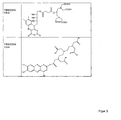
- FIG. 3 shows various VIPERINES, wherein VIPERIN81 or VIN6 shows the above-mentioned preferred embodiment of a compound of riboflavin and iron-EDTA. With VIPERIN 1, all of the following tests have been carried out.
- a phage titer of a MS2 phage of 1x10 9 pfu / ml of water was incubated for 4 hours at room temperature with 50 ⁇ g / ml VIPERIN1.
- the acridine base is suitable for binding to the nucleic acids of the phage MS2, while the attached iron-EDTA complex initiates the destruction of the nucleic acid.
- VIPERIN1 is loaded with iron (III) (not shown in FIG. 3). From a sodium ascorbate concentration of 100 ⁇ mol / l, virus inactivation (VI), applied in the 10-logarithm, increases steadily.
- the concentration of ascorbate in the human body is about 100 ⁇ M, so it can be assumed that there is little or no activation of the iron (III) -EDTA complex in blood or blood components.
- the MS2 bacteriophage was exposed as a non-enveloped virus with single-stranded RNA (ssRNA) to various media, including physiological media such as blood or blood components. Furthermore, the inactivation ability of VIPERIN1 was detected on other viruses. To ensure the highest possible heterogeneity, the lambda bacteriophage was incubated as a non-enveloped virus but with dsDNA with VIPERIN1 both in Tris buffer pH 7.5 and in blood plasma and the BVDV, a model virus for enveloped viruses with also single-stranded RNA in buffer , In Figure 5 , the results are tabulated.
- ssRNA single-stranded RNA
- Virus inactivation is again indicated in the 10th logarithm, with log 6 representing the detection limit of the tests.
- the sterile Tris buffer is in each case mixed with 6 g Tris, 2 g MgSO 4 .7H 2 O, 5.8g NaCl to 11 water, and addition of 5ml 20% albumin solution was added.
- FIG. 6 shows graphically the result that the inactivation of MS2 increases by almost 2 logarithms over a period of about 4 hours, ie the inactivation is time-dependent.
- Figure 7 shows the result of virus inactivation once at room temperature (RT) and also graphically at 37 ° C at 4 hours incubation.
- the virus inactivation is temperature dependent. It has been found that at lower VIPERIN concentrations the inactivation is higher at 37 ° C, but already at about 40 ⁇ M VIPERIN shows its maximum value of at least 6 logarithm levels of virus activity reduction.
- the virus inactivation is concentration-dependent. Upon incubation at room temperature, inactivation of the MS2 phage increases steadily with increasing concentration of VIPERIN.
Landscapes
- Chemical & Material Sciences (AREA)
- Organic Chemistry (AREA)
- Pharmaceuticals Containing Other Organic And Inorganic Compounds (AREA)
- Medicines Containing Material From Animals Or Micro-Organisms (AREA)
Abstract
Description
- Die Erfindung betrifft ein Mittel zur Inaktivierung von pathogenen Keimen wie Viren und Bakterien und dessen Verwendung vorzugsweise in physiologischen Lösungen wie Blut oder Blutbestandteilen. Insbesondere besteht das pathogeninaktivierende Mittel aus einem an Nucleinsäuren bindenden Element und einem die Wirkung der Nukleinsäure zerstörenden Konjungat sowie optional einem dazwischen befindlichen Spacer, wobei das Konjungat ein Metallchelatkomplex ist.
- Mit zunehmender Ausbreitung pathogener Keime wird es immer schwieriger, geeignete Mittel zur Inaktivierung der Keime zu finden. Die Problematik wird dadurch verschärft, daß gerade Viren eine hohe Variabilität aufweisen, die früher eingesetzte antivirale Mittel wirkungslos machen. Dabei sollte es möglich sein, ein pathogeninaktivierendes Mittel zum einem sehr spezifisch zu gestalten, um eine Virenart gezielt abzutöten, zum anderen aber auch soweit unspezifisch zu gestalten, daß eine Großzahl pathogener Keime inaktiviert wird.
- Dazu bietet sich an, wie dies auch in weiten Bereichen des Standes der Technik bereits geschehen ist, als Angriffsziel des pathogenen Keimes seine Nukleinesäuren zu wählen, also die DNA (desoxiribonucleic acid) oder RNA (ribonucleic acid) des pathogenen Keimes. Im Falle einer spezifischen Anlagerung des pathogeninaktivierenden Mittels kann man eine sehr selektive Inhibierung erreichen wie dies in Nucleic Acid Research, Vol. 15 Nr. 23(1), Seite 9909 bis 9919 die Autoren Zerial et al. zeigen, indem sie die selektive Inhibierung von Typ A Influenza Viren mittlels eines hochspezifischen Oligonukleotids mit einem reaktiven Konjungat beschreiben. Diese Selektivität ist darauf zurückzuführen, daß das einzusetzende Oligonukleotid spezifisch als Komplementärstrang zu einer konservativen DNA-Sequzenz synthetisiert wurde. Dabei paaren bekanntlich die Basen Cytosin stets mit Guanin und Thymin bzw. sein Gegenstück in der RNA, Uracil stets mit Adenin. Diese Adhäsionskräfte sind zum einem temperaturabhängig, zum anderen abhängig von der Menge der zueinander passenden Paare. Mit dieser Methode läßt sich demnach spezifisch eine Virensorte oder eine Klasse von Viren mit Gemeinsamkeiten inhibieren.
- In der
WO 95/32986 WO 92/05284 WO 92/05284 - Um auch Viren abtöten zu können, werden oft Stoffe verwendet, die eine hohe oxidierende oder alkylierende Wirkung haben und/oder sich an das Genom anlagern. Daher sind diese Stoffe auch für andere Zellen mutagen oder cancerogen. Weiterhin stellt sich das Problem, daß sie dennoch für eine große Zahl von Viren aufgrund deren Heterogenität versagen. Um auch Viren zu aktivieren, sollte eine Anlagerung an Nukleinsäuren zwar erfolgen, aber möglichst unspezifisch.
- Im Falle einer unspezifischen Anlagerung wird gibt es 4 Gruppen von Anlagerungsreagenzien, die auch in der
US 5,691,132 beschrieben sind, die Interkalatoren, die sog. "groove binders", wobei diese in "minor groove binder" und "major groove binder" unterteilt sind. Dabei sind Interkalatoren Stoffe, die sich zwischen die beiden Nukleinsäurestränge der DNA legen. Eine DNA-Doppelhelix weist größere Rillen in der Spirale und kleinere auf, in die sich die "major -" bzw. "minor groove binder" einlagern können. Weiterhin sind die Stoffe, die an das Phosphatgruppengerüst von Nukleinsäuren binden sowie unspezifische Oligonukleotide, wie sie auch ausführlich in der prioritätsbegründenenDE 100 51 628.9 genannt sind. - Insbesondere bei der Verwendung von Blutprodukten beispielsweise bei der Transfusion von humanem Blut oder bei der Gewinnung von Proteinen aus Blut oder Blutbestandteilen besteht eine großer Bedarf, potentiell pathogene Keime abzutöten, bevor die Produkte ihrer bestimmungsmäßigen Verwendung zugeführt werden. Im Stand der Technik sind bereits diverse Methoden und Stoffe bekannt, die eine Inaktivierung von pathogenen Keimen bewirken. Allen gemeinsam sind entweder belastende Nebenwirkungen oder eine aufwendige Handhabung.
- In der
US 5,691,132 wird ein Verfahren beansprucht, Pathogene in einem Blutprodukt zu inaktivieren, wobei ein Interkalator zu dem Blutprodukt gegeben wird, der durch seine unspezifische Anlagerung an die DNA der Pathogene bereits eine Zerstörung der DNA bewirken kann. Allerdings ist dieser Interkalator in der Lage, auch andere DNA anzugreifen und wirkt dadurch mutagen bzw. cancerogen. Daher muß er nach erfolgter Inaktivierung mittels eines Adsorbens wieder aus dem Blutprodukt entfernt werden, wodurch ein weiterer Handlungsschritt erforderlich ist, der zudem nicht ungefährlich für den Durchführenden ist. - Auch die
WO 00/04930 - Weiterhin ist bekannt, Strangbrüche in der DNA oder RNA zu induzieren durch ein Konjungat mit einer reaktiven Gruppe, wie beispielsweise ein EDTA-Eisen Chelatkomplex (EDTA=EthylenDiaminTetraAcetat). In der Literaturstelle Gene 72 (1988), Seite 361-371 zeigen die Autoren Boidet-Foget et al., daß ein spezifisches Schneiden von einzelsträngiger und doppelsträngiger DNA möglich ist. Auch ist in Biochemistry Vol. 29 Nr. 6 (Feb. 13, 1990) von Celander und Chech gezeigt worden, daß das Eisen (II)-EDTA katalysierte Schneiden von RNA und DNA keine oder nur geringe Spezifität hat.
- Diese Eigenschaft ist in der Molekularbiologie demnach seit Jahren bekannt und wird für ein sogenanntes "mapping" genutzt. Dabei bindet meist ein Protein an eine spezifische Stelle der DNA, wobei diese Stelle, die durch das Protein geschützt sind, durch die Fe(II)-Komplexe nicht angegriffen werden kann. Dadurch ist es möglich, Anbindungsstellen an einem Gen zu identifizieren. Beispiele für ein derartiges mapping finden sich in Biochemistry (1994), Vol. 33, Seite 9831 bis 9844 oder Biochemistry Vol. 35 Nr. 37 (Sept. 7, 1996) Seite 11931ff.
- Aufgabe der vorliegenden Erfindung ist es, ein Mittel zur Inaktivierung von Viren bereitzustellen, welches die Nachteile der im Stand der Technik bekannt gewordenen Pathogen inaktivierenden Mittel, beispielsweise eine aufwendige Handhabung nicht aufweist. Die Aufgabe wird durch die Merkmale des ersten Anspruchs gelöst.
- Kennzeichnend für die Erfindung ist die funktionelle Trennung des pathogeninaktivierenden Mittels in zwei Bereiche, wobei ein Bereich für die Anbindung an Nukleinsäuren zuständig ist, und der zweite Bereich für die Zerstörung der Nukleinsäuren. Dabei kann die Anbindung spezifisch oder unspezifisch erfolgen, ist jedoch vorzugsweise unspezifisch, da möglichst alle pathogenen Keime erreicht werden sollten.
- Dabei wird unter pathogenen Keimen alle für Organismen zu Krankheitsbildern führenden Keime mit einem Genom verstanden, wie Bakterien oder Viren. In Figur 1 sind tabellarisch die wichtigsten bei einer Blutübertragung relevanten Viren und Bakterien aufgezeigt. Daraus ist zu ersehen, daß manche Viren doppelsträngige DNA, andere einzelsträngige RNA besitzen, Viren behüllt oder unbehüllt sein können.
- Während Interkalatoren, Phophatbrücken-Binder oder "groove-binder" per se unspezifisch an DNA binden, gibt es bei Oligonukleotiden die Möglichkeit, durch komplementäre Basenpaarbildung die gewünschte Spezifität einzustellen. Dabei wird die Spezifität umso geringer, je kleiner das Oligonukleotid ist. Eine geringe Spezifität wird durch die Länge eines Oligonukleotides von maximal 6 spezifischen Nukleotiden erreicht, wobei spezifisches Nukleotid bedeutet, daß ihre Base aus der Gruppe der spezifischen Basen Guanin, Adenin, Thymin, Uracil und/oder Cytosin ausgewählt ist. Statistisch findet ein derartiges synthetisches Oligonukleotid mehrere Treffer auf einem Genom, so daß möglichst alle pathogenen Keime, vor allem möglichst alle Virenarten inaktiviert werden können. Wird die Nukleotidfolge aus spezifischen Nukleotiden länger als 6 Nukleotide, werden die Treffer auf dem Genom erheblich kleiner, wodurch die Spezifität und als Folge davon auch die Selektivität steigt.
- Außer den 5 oben genannten spezifischen Basen existieren auch sogenannte universellen Basen, die mit allen oder zumindest mehreren Basen eine Basenpaarbildung eingehen. Diese können - wie das 5-Nitroindol - synthetisch sein, oder wie das Inosin natürlich vorkommend. Inosin, welches eine Base der Transfer RNA (tRNA) ist, kann mit Cytosin, Adenosin und Uracil eine Basenpaarbildung eingehen. Bei einer Verwendung des Inaktivierungsmittels in Blut oder Blutprodukten, die für eine Transfusion vorgesehen sind, ist dementsprechend Inosin als universelle Base bevorzugt. Aber auch andere universelle Basen sind für die Verwendung in vitro denkbar.
- Der Einsatz einer universellen Base ermöglicht eine Bindung des Oligonukleotides bei höheren Temperaturen, wobei aber der Vorteil erhalten bleibt, möglichst viele Bindungen mit Genomen pathogener Keime zu erhalten mit nur wenigen spezifischen Nukleotiden. Dabei entscheidet auch die Länge des Genoms über die Häufigkeit einer Anlagerung.
- Ein Oligonukleotid ist auch fähig, an eine doppelsträngige DNA (dsDNA) zu binden und mit ihr eine sogenannte Triple-Helix zu bilden. Es hat sich gezeigt, daß eine Folge gleicher Nukleotiden mit den Basen Thymin oder Cytosin besonders vorteilhaft an dsDNA binden. Aus diesem Grund wird bevorzugt eine derartige Struktur verwendet, besonders bevorzugt eine Folge von mindestens drei Cytosinen, da Cytosin eine etwa doppelte Bindungsstärke an DNA aufweist als Thymin.
- Des weiteren wird vorteilhafterweise eine Seite des Oligonukleotides mit einer Schutzgruppe versehen, die den Abbau des Oligonukleotides zumindest verzögert. Für eine in vivo Anwednung wird auch hierfür wieder ein weiteres Nukleotid verwendet, da dieses natürlich vorkommt und im menschlichen und tierischen Körper nicht giftig wirken kann. Um ihre Wirksamkeit als Schutzgruppe entfalten zu können, wird aber das weitere Nukleotid spiegelsymmetrisch zu den anderen Nukleotiden eingebaut, so daß möglichst wenig den RNAsen oder DNAsen, also den nukleotidabbauende Enzymen, eine Angriffsmöglichkeit geboten wird. Dieses Schutzgruppen-Nukleotid trägt nicht zur Bindung an einen Komplementärstrang bei und wird daher bei der Längenbestimmung eines Oligonukleotides nicht mitgezählt.
- Beispiele für Stoffe, die an das Phosphatgruppengerüst binden, sind Spermine, Spermidine und andere Polyamine zu nennen, "major groove binders" sind beispielsweise die Aflatoxine und zu den "minor groove binders" zählen unter anderem die Triarylmethan-Farbstoffe oder Hoechst 33258- und andere Hoechst Farbstoffe, Berenil, DAPI (4', 6'-Diamidin-2-Phenylindol), Distamycin, Mitomycin, Netropsin und andere Lexitropsine.
- Die größte Gruppe der an DNA bindenden Substanzen stellen jedoch die Interkalatoren. Diese sind in der Regel flache aromatische Systeme, die durch ihr π-Elektronensystem eine Brücke zwischen den Doppelsträngen statt der sonst vorhandenen Wasserstoffbrücken bilden. Dabei können diese Aromaten heterozyklisch sein oder benzoid, meist jedoch sind Interkalatoren aus Mehrringsystemen zusammengesetzt.
- Als Vertreter der Gruppe sind zu nennen: Acridine, Acridone, Proflavin, Acriflavine, Aloxazine, Isoalloxazine, Porphine bzw. Porphyrine, Actinomycin, Anthracyclinon, beta-Rhodomycin A, Daunamycin, Thiaxanthenone, Miracil D, Anthramycin, Mitomycin, Echinomycin, Quinomycin, Triostin, Diacridine, Ellipticene (auch Dimere, Trimere und Analoga), Norphilin A, Fluorene und Fluorenone, Fluorenodiamine, Quinacrin, Benzacridine, Phenazine, Phenanthradine, Phenothiazine, Chlorpromazine, Phenoxazine, Benzothiazole, Xanthene und Thioxanthene, Anthraquinone, Anthrapyrazole, Benzothiopyranoindole, 3,4-Benzpyrene, Benzopyrendiolepoxid, 1-Phenyloxirane, Benzanthracen-5,6-oxid, Benzodipyrone, Quinolone, Chloroquine, Quinine, Phenylquinolinecarboxamid, Furocoumarine, wie Psoralen und Isopsoralen, Ethidiumsalze, Propidium und Coralyne, Ellipticin-Katione und deren Derivate, polycyclische Hydrocarbone und ihre Oxiranderivate und Echinomycin.
- Bevorzugt sind erfindungsgemäß Acridine, ein dreifaches 6-Ring-System und deren Derivate, wie Alloxazine und Isoalloxazine sowie Porphine bzw. substituierte Porphine, die Porphyrine, und deren Derivate. Diese Stoffe sind zum einen wegen ihrer starken Bindungsfähigkeit ausgewählt zum anderen wegen der Tatsache, daß für eine Anwendung in biologischen Systemen aus dieser Gruppe auch nicht toxische, nicht mutagen und nicht cancerogen wirkende Derivate ausgewählt werden können. So besteht beispielsweise Häm, ein Bestandteil des Blutes aus einem mit Fe(II) besetzten, aus 4 Indolen hergestellten Porphyrinring. Ebenso ist unter den Alloxazinen das Vitamin B2 oder auch Riboflavin zu finden, welches als das nukleinsäurebindende Element besonders bevorzugt ist. In Figur 2 sind geeignete Mehrringsystem dargestellt.
- Die eigentliche Zerstörung des Genoms erfolgt durch das an das freie Ende des Oligonukleotides angehängte reaktive Konjungat, welches ein Metali-Chelatkomplex ist, wobei das Metall zwischen zwei Oxidationsstufen wechseln kann. Die pathogeninhibierende Wirkung wird wahrscheinlich durch Schneiden der Nukleinsäuren gemäß dem Fenton Mechanismus ausgelöst und geht dabei demnach von der reduzierenden Eigenschaft des Metalls aus. Demnach wird das Metall selbst oxidiert und kann durch den Einsatz eines Reduktionsmittels wieder regeneriert werden.
- Erfindungsgemäß können alle Komplexe, die eine Zerstörung des Genoms der Pathogene bewirken, eingesetzt werden. Komplexe bestehen aus einem Zentralatom oder erfindungsgemäß einem Zentralion und Liganden. Als Zentralionen fungieren meist Schwermetallkationen hoher Ladung mit kleinen Ionenradien. Häufig sind die Liganden Anionen, aber auch ungeladene Moleküle treten als Liganden auf. Handelt es sich um Verbindungen, die zwei oder mehrere funktionelle Gruppen besitzen, also mehrere Koordinationsstellen des Zentralions besetzen können, spricht man von bi- oder multidentalen Liganden, wie Ethylendiamin oder Oxalat. Die Ladung des Komplexes entspricht der Summe der Ladung der ihn bildenden Einzelionen.
- Die Anwesenheit von zwei oder mehr Koordinationsstellen in einem organischen Molekül führt zur Ringbildung. Sie erfolgt vorzugsweise, wenn sich ein spannungsfreier 5- oder 6-Ring bilden kann. Allgemein werden Verbindungen, in denen ein Molekül über ein Metallion durch Koordination zu einem Ring geschlossen ist, als Chelatkomplexe oder Chelate bezeichnet. Als innere Chelatkomplexe werden ungeladene Chelatkomplexe bezeichnet, die Ladungen des Zentralions und die der ringbildenden Liganden kompensieren sich, wie im wie Nickel-Diacethyldioxim oder Magnesium-Oxinat, um beispielhaft bekannte Komplexe zu nennen.
- Die sogenannten Komplexone, deren wichtigster Vertreter EDTA und die Nitrilotriessigsäure darstellen, sind Komplexbildner, die mit fast allen Kationen, einschließlich der Erdalkaliionen, zum Teil sehr stabile, wasserlösliche Komplexe bilden. Als weiteres Beispiel sei das Eisen EDPA (Diethylenaminpentaacetat) genannt.
- Erfindungsgemäß bevorzugt ist ein Eisen(II)-EDTA-Chelatkomplex bzw. ein Eisen(III)-EDTA-Chelatkomplex. Insbesonders im Einsatz in biologischen Systemen wie zur Inaktivierung von Viren in Blut oder Blutbestandteilen ist dieser Komplex besonders geeignet, da sowohl Eisen als auch EDTA biokompatibel sind sowie bereits zugelassene Medikamente zur Förderung des menschlichen Blutbildes und daher bei Infusion in den menschlichen oder tierischen Körper bedenkenlos eingesetzt werden können. Besonders vorteilhaft ist für eine derartige Verwendung die Kombination mit ebenfalls einem biokompatiblen Element, wie beispielsweise das genannte Riboflavin. Bei Verwendung eines Spacers zwischen dem Eisen-EDTA-Komplex und Riboflavin bietet sich demnach ein ebenfalls biokompatibler Spacer oder Linker an.
- Dabei kann das Eisen in den Oxidationsstufen 2+ oder 3+ vorliegen. Liegt das Eisen in der Oxidationsstufe 2+ vor, so kann jedes Molekül Eisen einmal seine Wirkung entfalten und wird dabei selbst zu Eisen (III) oxidiert. Indem das Eisen (III) nun wiederum durch den Einsatz eines weiteren Reduktionsmittels wieder zu Eisen (II) reduziert wird, ist die Wirkung des Komplexes beliebig oft wiederholbar, so daß nur geringe Mengen des pathogeninaktivierenden Mittels eingesetzt werden müssen. Auch als Reduktionsmittel wird man in vivo ein unbedenklicher, biokompatibler Stoff verwenden, beispielsweise Vitamin C oder Ascorbinsäure, respektive ihr Salz Ascorbat. Des weiteren ist der Einsatz von Fe(III) grundsätzlich denkbar, so daß die Inaktivierungsreaktion durch die erfindungsgemäße Zugabe des Reduktionsmittels erst starten kann.
- Die erfindungsgemäße Kombination von einem an Nukleinsäure bindenden Element, gegebenenfalls einem Spacer und dem Nukleinsäure zerstörenden Konjungat wird fortan als VIPERIN bezeichnet. Figur 3 zeigt verschiedene VIPERINE, wobei VIPERIN81 oder VIN6 die oben genannte bevorzugte Ausführung aus einer Verbindung von Riboflavin und Eisen-EDTA, aufzeigt. Mit VIPERIN 1 sind alle nachfolgend aufgezeigten Versuche ausgeführt worden.
- Die oben erwähnte Virusaktivierung ist in Figur 4 in Abhängigkeit von der Natriumascorbatkonzentration dargestellt:
- Ein Phagentiter eines MS2-Phagen von 1x10⁹ pfu/ml Wasser wurde 4 Stunden bei Raumtemperatur mit 50µg/ml VIPERIN1 inkubiert. Der Acridingrundkörper eignet sich dazu, an die Nukleinsäuren des Phagen MS2 zu binden, während der angehängte Eisen-EDTA-Komplex die Zerstörung der Nukleinsäure initiiert. Dabei ist VIPERIN1 mit Eisen(III) beladen (nicht gezeigt in Figur 3). Ab einer Natriumascorbat-Konzentration von 100µmol/l steigt die Vireninaktivierung (VI), aufgetragen im 10-er Logarithmus stetig an. Je höher die Ascorbatkonzentation, desto mehr Eisen(III) wird zu Eisen(II) reduziert, der "aktiven" Form des EDTA-Eisen-Komplexes und desto aktiver ist demnach auch das Nukleinsäure zerstörende Konjungat. Interessanterweise ist die Konzentration von Ascorbat im menschlichen Körper etwa 100µM, so daß davon auszugehen ist, daß in Blut oder Blutbestandteilen keine oder nur geringe Aktivierung des Eisen(III)-EDTA Komplexes erfolgt.
- Zur Untermauerung dieser These wurde der MS2-Bakteriophage als nicht umhüllter Virus mit einzelsträngiger RNA (ssRNA) verschiedenen Medien, auch physiologischen Medien wie Blut oder Blutbestandteilen ausgesetzt. Des weiteren wurde die Inaktivierungfähigkeit von VIPERIN1 an weiteren Viren nachgewiesen. Um eine möglichst hohe Heterogenität zu gewährleisten, wurden der Lamda-Bakteriophage als ebenfalls nicht umhülltes Virus jedoch mit dsDNA mit VIPERIN1 sowohl in Tris-Puffer pH 7.5 als auch in Blutplasma inkubiert sowie der BVDV, ein Modellvirus für behüllte Viren mit ebenfalls einzelsträngiger RNA in Puffer. In Figur 5 sind die Ergebnisse tabellarisch dargestellt. Die Vireninaktivierung ist wiederum im 10-er Logarithmus angegeben, wobei log 6 die Nachweisgrenze der Tests darstellte. Der sterile Tris-Puffer ist jeweils mit 6g Tris, 2g MgSO4 *7H2O, 5.8g NaCl auf 11 Wasser, sowie Zugabe 5ml 20%ige Albuminlösung angesetzt worden.
- Es wurden jeweils 50µg/ml VIPERIN beladen mit Eisen(III) 4 Stunden bei Raumtemperatur mit je 1x10⁹ pfu Phagentiter pro ml Wasser und 5mM Natriumascorbat. Der MS2-Phage wurde dabei um mindestens 6 Logarithmusstufen in Puffer, Plasma, Erythrozytenkonzentrat und in Vollblut reduziert, in Thrombozytenkonzentrat um mehr als 5,6 Stufen. Der Lamda-Phage wurde in Puffer um mehr als 5,6 und in Plasma um mehr als 6 Logarithmusstufen reduziert, der BVDV in Puffer um mehr als 6.
- Darüber hinaus wurde die Wirksamkeit von VIPERIN beispielhaft durch die Inaktivierung des Phagen MS2 in Abhängigkeit von der Zeit, von der Temperatur bzw. von der Konzentration untersucht. Der Inkubationsansatz bestand jeweils aus einer Virusbeladung von 109 pfu/ml, VIPERIN beladen mit Eisen(III) und 5mM Natriumascorbat. In Figur 6 ist graphisch das Ergebnis dargestellt, daß die Inaktivierung von MS2 über eine Zeitdauer von etwa 4 Stunden um fast 2 Logarithmusstufen ansteigt, die Inaktivierung also zeitabhängig ist.
- Figur 7 zeigt das Ergebnis der Vireninaktivierung einmal bei Raumtemperatur (RT) und bei 37°C bei 4 Stunden Inkubation ebenfalls graphisch. Zum einen ist die Vireninaktivierung temperaturabhängig. Es wurde gefunden, daß bei geringeren VIPERIN-Konzentrationen die Inaktivierung bei 37°C höher ist, allerdings bereits bei etwa 40µM VIPERIN seinen maximalen Wert von mindestens 6 Logarithmusstufen Reduzierung der Virenaktivität zeigt. Zum anderen ist die Vireninaktivierung konzentrationsabhängig. Bei Inkubation bei Raumtemperatur steigt die Inaktivierung des MS2-Phagen mit zunehmender Konzentration an VIPERIN stetig an. Obgleich bei Inkubation bei 37°C der maximal zu messende Wert der Inaktivierung des MS2 von 6 Logarithmusstufen bereits bei 40µM VIPERIN erreicht ist, kann auch eine Steigerung der Inaktivierungsfähigkeit von 3 Logarithmusstufen ab 20µM VIPERIN detektiert werden.
Claims (28)
- Pathogeninaktivierendes Mittel aus zwei funktionell getrennten Bereichen, mit einem an Nukleinsäure bindenden Element als ersten Bereich und einem die Nukleinsäure zerstörenden Konjugat als zweiten Bereich, sowie gegebenenfalls einem Spacer zwischen den beiden Bereichen,
wobei das an Nukleinsäure bindende Element aus der Gruppe der Olegonukleotide, der Interkalatoren, der Phosphatgruppengerüst-Binder und/oder der groove binders ausgewählt ist,
und das die Nukleinsäure zerstörende Konjugat ein Metallchelatkomplex ist, in welchem das Metall in verschiedenen Oxidationsstufen oxidierbar bzw. reduzierbar ist. - Pathogeninaktivierendes Mittel nach Anspruch 1, dadurch gekennzeichnet, dass der Metallchelatkomplex aus der Gruppe der inneren Komplexe oder der Gruppe der Komplexone ausgewählt ist.
- Pathogeninaktivierendes Mittel nach Anspruch 1 und 2, dadurch gekennzeichnet, dass der Komplexbildner ausgewählt ist aus der Gruppe der Dioxime, Oxinate, EDTA-Komplexe, DTPA-Komplexe, EDTA-Komplexderivate, DTPA-Komplexderivate, Nitrilotriessigsäure und/oder Porphine hergestellt ist.
- Pathogeninaktivierendes Mittel nach Anspruch 1 und 2, dadurch gekennzeichnet, dass das Metall des Metallchelatkomplexes aus der 8. Nebengruppe des Periodensystems ausgewählt ist.
- Pathogeninaktivierendes Mittel nach Anspruch 1 und 2, dadurch gekennzeichnet, dass das Metall des Metallchelatkomplexes Eisen in der Oxidationsstufe II ist.
- Pathogeninaktivierendes Mittel nach Anspruch 1 und 2, dadurch gekennzeichnet, dass das Metall des Metallchelatkomplexes Eisen in der Oxidationsstufe III ist.
- Pathogeninaktivierendes Mittel nach einem oder mehreren der vorhergehenden Ansprüche, dadurch gekennzeichnet, dass der Metallchelatkomplex Eisen-(III)-EDTA ist.
- Pathogeninaktivierendes Mittel nach einem oder mehreren der vorhergehenden Ansprüche, dadurch gekennzeichnet, dass zusätzlich ein Reduktionsmittel enthalten ist.
- Pathogeninaktivierendes Mittel nach Anspruch 8, dadurch gekennzeichnet, dass das Reduktionsmittel Ascorbinsäure oder eines deren Salze ist.
- Pathogeninaktivierendes Mittel nach einem oder mehreren der vorhergehenden Ansprüche, dadurch gekennzeichnet, dass die Ascorbinsäure oder deren Salz in einer Konzentration von mehr als 100µmol/l vorliegt.
- Pathogeninaktivierendes Mittel nach Anspruch 1, dadurch gekennzeichnet, dass das Oligonukleotid einzelsträngig ist und weniger als 7 spezifische Nukleotide aus der Gruppe Thymin, Adenin, Cytosin, Guanin und/oder Uracil aufweist.
- Pathogeninaktivierendes Mittel nach Anspruch 11, dadurch gekennzeichnet, dass das Oligonukleotid weitere universelle Basen ausgewählt aus der Gruppe Inosin und/oder 5-Nitroindol aufweist.
- Pathogeninaktivierendes Mittel nach Anspruch 1, dadurch gekennzeichnet, dass die "groove binders" ausgewählt sind aus der Gruppe der "minor groove binder", enthaltend Distamycin, Mitomycin, Netropsin, Lexitropsine, Berenile, Indole und/oder Triarylmethan-Farbstoffe, und der Gruppe der "major groove binder" enthaltend Aflatoxine ausgewählt sind.
- Pathogeninaktivierendes Mittel nach Anspruch 1, dadurch gekennzeichnet, dass Phosphatgruppengerüst-Binder ausgewählt sind aus der Gruppe der Spermine, Spermidine und anderen Polyaminen.
- Pathogeninaktivierendes Mittel nach Anspruch 1, dadurch gekennzeichnet, dass die Interkalatoren ausgewählt sind aus der Gruppe der benzoiden Aromate und/oder der nicht benzoiden Aromate, wie Heteroaromate.
- Pathogeninaktivierendes Mittel nach Anspruch 15, dadurch gekennzeichnet, dass die Aromate aus Mehrringsystemen bestehen.
- Pathogeninaktivierendes Mittel nach Anspruch 15 und 16, dadurch gekennzeichnet, dass Aromate Acridine, Acridone, Alloxazine bzw. Isoaloxazine wie Riboflavin und andere Flavine, Porphine bzw. Porphyrine wie Häm, Mycine, Fluorene, Acridine, Psoralene, Ethidiumsalze, Oxirane, Coumarine, Psoralene, Phenylverbindungen, Xanthene, Ellipticene, Quinolone, Chloroquine, Quinine, Propidium Coralyne und/oder deren Derivate sind.
- Pathogeninaktivierendes Mittel nach einem oder mehreren der vorhergehenden Ansprüche, dadurch gekennzeichnet, dass als Interkalator Riboflavin bevorzugt ist.
- Pathogeninaktivierendes Mittel nach einem oder mehreren der vorhergehenden Ansprüche, dadurch gekennzeichnet, dass das pathogeninaktivierende Mittel Riboflavin mit kovalent gebundenem Eisen-EDTA-Komplex enthält, wobei der Komplex über einen Spacer an das Riboflavin gebunden sein kann.
- Pathogeninaktivierendes Mittel nach Anspruch 1, dadurch gekennzeichnet, dass die Pathogene Nukleotid tragende Viren, Bakterien, Protozoen und/oder Pilze sind.
- Verwendung eines pathogeninaktivierenden Mittels gemäß den Ansprüchen 1 bis 20 zur Inaktivierung von Pathogenen in Blutprodukten, dadurch gekennzeichnet, dass die Inaktivierung durch Anlagerung an Nukleinsäuren der Pathogene erfolgt und Zerstörung der Nukleinsäuren an dieser Stelle.
- Verwendung nach Anspruch 21, dadurch gekennzeichnet, dass die Inaktivierung durch Zugabe eines Stoffes vorzugsweise eines Reduktionsmittels gestartet wird.
- Verwendung nach Anspruch 22, dadurch gekennzeichnet, dass das Reduktionsmittel Ascorbinsäure oder eines deren Salze ist.
- Verwendung nach Anspruch 21 bis 23, dadurch gekennzeichnet, dass die Inaktivierung in Flüssigkeiten erfolgt.
- Verwendung nach Anspruch 21 bis 24, dadurch gekennzeichnet, dass die Flüssigkeiten physiologische Lösungen sind.
- Verwendung nach Anspruch 25, dadurch gekennzeichnet, dass die physiologischen Lösungen Blut oder Blutbestandteile sind.
- Verwendung gemäß den Ansprüchen 21 bis 26, dadurch gekennzeichnet, dass das Mittel zur Inaktivierung von Pathogenen oder dessen Bestandteile nach erfolgter Inaktivierung entfernt wird.
- Verwendung gemäß den Ansprüchen 21 bis 26, dadurch gekennzeichnet, dass das Mittel zum Starten der Reaktion nach erfolgter Inaktivierung entfernt wird.
Applications Claiming Priority (3)
| Application Number | Priority Date | Filing Date | Title |
|---|---|---|---|
| DE10051628A DE10051628B4 (de) | 2000-10-18 | 2000-10-18 | Einzelsträngiges Oligonukleotid und dessen Verwendung |
| DE10051628 | 2000-10-18 | ||
| PCT/EP2001/005034 WO2002032875A1 (de) | 2000-10-18 | 2001-05-04 | Pathogeninaktivierendes mittel mit einem an nukleinsäuren bindenden element und dessen verwendung |
Publications (2)
| Publication Number | Publication Date |
|---|---|
| EP1330440A1 EP1330440A1 (de) | 2003-07-30 |
| EP1330440B1 true EP1330440B1 (de) | 2007-11-21 |
Family
ID=7660197
Family Applications (1)
| Application Number | Title | Priority Date | Filing Date |
|---|---|---|---|
| EP01951478A Expired - Lifetime EP1330440B1 (de) | 2000-10-18 | 2001-05-04 | Pathogeninaktivierendes mittel mit einem an nukleinsäuren bindenden element und dessen verwendung |
Country Status (6)
| Country | Link |
|---|---|
| US (1) | US20040023913A1 (de) |
| EP (1) | EP1330440B1 (de) |
| AU (1) | AU2001272393A1 (de) |
| DE (2) | DE10051628B4 (de) |
| ES (1) | ES2296771T3 (de) |
| WO (1) | WO2002032875A1 (de) |
Cited By (1)
| Publication number | Priority date | Publication date | Assignee | Title |
|---|---|---|---|---|
| US10874108B2 (en) | 2016-05-04 | 2020-12-29 | 5d Health Protection Group Ltd. | Anti-microbial compositions |
Families Citing this family (1)
| Publication number | Priority date | Publication date | Assignee | Title |
|---|---|---|---|---|
| CN103740658A (zh) * | 2014-01-26 | 2014-04-23 | 中国科学院海洋研究所 | 美国红鱼抗病毒蛋白(viperin)及其制备和应用 |
Family Cites Families (21)
| Publication number | Priority date | Publication date | Assignee | Title |
|---|---|---|---|---|
| EP0266099A3 (de) * | 1986-10-28 | 1990-09-19 | The Johns Hopkins University | Alkyl- oder Arylphosphonat-Oligonukleosid, das sich mit Nukleinesäuren vernetzen kann oder das Nukleinsäure spalten kann |
| WO1989004375A1 (en) * | 1987-10-23 | 1989-05-18 | Siska Diagnostics, Inc. | Lanthanide chelate-tagged nucleic acid probes |
| US5789155A (en) * | 1987-10-30 | 1998-08-04 | California Institute Of Technology | Process for identifying nucleic acids and triple helices formed thereby |
| US5874555A (en) * | 1987-10-30 | 1999-02-23 | California Institute Of Technology | Triple helices and processes for making same |
| WO1989005853A1 (en) * | 1987-12-15 | 1989-06-29 | Synthetic Genetics | Nucleic acid chelate conjugate as therapeutic and diagnostic agents |
| US5082772A (en) * | 1988-10-24 | 1992-01-21 | Eli Lilly And Company | Process for preparing deacetylcephalosporin c |
| US5556949A (en) * | 1991-08-20 | 1996-09-17 | Rutgers University | CAP-phenanthroline conjugate for DNA cleavage |
| WO1993012230A1 (en) * | 1991-12-13 | 1993-06-24 | Sri International | Triple-helix formation at (punpyn).(punpyn) tracts |
| IL107150A0 (en) * | 1992-09-29 | 1993-12-28 | Isis Pharmaceuticals Inc | Oligonucleotides having a conserved g4 core sequence |
| AU6402494A (en) * | 1993-03-11 | 1994-09-26 | Steritech, Inc. | Decontaminating clinical samples |
| US5801154A (en) * | 1993-10-18 | 1998-09-01 | Isis Pharmaceuticals, Inc. | Antisense oligonucleotide modulation of multidrug resistance-associated protein |
| US5446137B1 (en) * | 1993-12-09 | 1998-10-06 | Behringwerke Ag | Oligonucleotides containing 4'-substituted nucleotides |
| US5691132A (en) * | 1994-11-14 | 1997-11-25 | Cerus Corporation | Method for inactivating pathogens in red cell compositions using quinacrine mustard |
| DE4444045C2 (de) * | 1994-12-10 | 1997-04-17 | Behringwerke Ag | Verfahren zur Inaktivierung von Viren mit Hilfe von Acridin oder Acridinderivaten |
| WO1996039818A1 (en) * | 1995-06-07 | 1996-12-19 | Cerus Corporation | Treating red blood cell solutions with anti-viral agents |
| US5612473A (en) * | 1996-01-16 | 1997-03-18 | Gull Laboratories | Methods, kits and solutions for preparing sample material for nucleic acid amplification |
| US6022959A (en) * | 1996-08-20 | 2000-02-08 | Pharmacyclics, Inc. | Nucleic acids internally-derivatized with a texaphyrin metal complex and uses thereof |
| CA2276532C (en) * | 1997-01-06 | 2008-06-17 | Cerus Corporation | Frangible compounds for pathogen inactivation |
| US7776386B2 (en) | 2007-01-31 | 2010-08-17 | Motorola, Inc. | Method for forming a micro fuel cell |
| JP5254254B2 (ja) | 2007-02-05 | 2013-08-07 | ビーエーエスエフ ソシエタス・ヨーロピア | Dmc触媒、その製造方法と利用 |
| JP2009099271A (ja) | 2007-10-12 | 2009-05-07 | Harison Toshiba Lighting Corp | 中空式面照明装置 |
-
2000
- 2000-10-18 DE DE10051628A patent/DE10051628B4/de not_active Expired - Fee Related
-
2001
- 2001-05-04 DE DE50113304T patent/DE50113304D1/de not_active Expired - Lifetime
- 2001-05-04 ES ES01951478T patent/ES2296771T3/es not_active Expired - Lifetime
- 2001-05-04 EP EP01951478A patent/EP1330440B1/de not_active Expired - Lifetime
- 2001-05-04 AU AU2001272393A patent/AU2001272393A1/en not_active Abandoned
- 2001-05-04 US US10/399,048 patent/US20040023913A1/en not_active Abandoned
- 2001-05-04 WO PCT/EP2001/005034 patent/WO2002032875A1/de not_active Ceased
Cited By (1)
| Publication number | Priority date | Publication date | Assignee | Title |
|---|---|---|---|---|
| US10874108B2 (en) | 2016-05-04 | 2020-12-29 | 5d Health Protection Group Ltd. | Anti-microbial compositions |
Also Published As
| Publication number | Publication date |
|---|---|
| DE10051628A1 (de) | 2002-05-02 |
| US20040023913A1 (en) | 2004-02-05 |
| EP1330440A1 (de) | 2003-07-30 |
| DE10051628B4 (de) | 2007-06-06 |
| AU2001272393A1 (en) | 2002-04-29 |
| ES2296771T3 (es) | 2008-05-01 |
| WO2002032875A1 (de) | 2002-04-25 |
| DE50113304D1 (de) | 2008-01-03 |
Similar Documents
| Publication | Publication Date | Title |
|---|---|---|
| DE69815703T2 (de) | Verbindungen mit leicht spaltbaren bindungen zur inaktivierung von pathogenen | |
| DE69533942T2 (de) | Behandlung von lösungen roter blutkörperchen mit antiviralen wirkstoffen | |
| DE3750615T2 (de) | Hemmung von htlv-iii durch exogene oligonukleotide. | |
| EP1141273B1 (de) | Methode zur isolierung von dna aus biologischen materialien | |
| Benoit-Vical et al. | Trioxaquines are new antimalarial agents active on all erythrocytic forms, including gametocytes | |
| AT392081B (de) | Verfahren zur herstellung eines arzneimittels zur behandlung von virusinfektionen | |
| DE68925278T2 (de) | Hemmung von htlv-iii durch exogene oligonukleotide | |
| Crooke | Potential roles of antisense technology in cancer chemotherapy | |
| DE3852714T2 (de) | Oligodesoxynukleotide als Inhibitoren der Replikation von Retroviren und der Expression von Onkogenen. | |
| DE69633239T2 (de) | Trockenes festes medium zur lagerung und analyse von genetischem material | |
| DE3650720T2 (de) | Einschrittverfahren und Polynukleotidverbindungen zur Hybridisierung mit Ziel-Polynukleotiden | |
| WO2003035876A1 (de) | Verwendung einer doppelsträngigen ribonukleinsäure zur behandlung einer infektion mit einem (+)-strang-rna-virus | |
| DE2154279A1 (de) | Medikamente für das fibrinolytische System | |
| BR9811555A (pt) | 2-aminopiridinas contendo anéis substituintes fundidos como inibidores nos | |
| EP3317410B1 (de) | Diskontinuierliche oligonukleotid-liganden | |
| DE102015220401B4 (de) | Erythrozyten-Lyselösung | |
| DE60303020T2 (de) | Verfahren zur gewinnung von nukleinsäuren mit hilfe chaotroper-und ammoniumreagentien | |
| Rjiba-Touati et al. | Induction of DNA fragmentation, chromosome aberrations and micronuclei by cisplatin in rat bone-marrow cells: protective effect of recombinant human erythropoietin | |
| EP2057267B1 (de) | Verfahren zum lösen geladener nukleinsäure in einer organischen flüssigkeit | |
| Nandy et al. | Exploring the nucleobase-specific hydrophobic interaction of cryptolepine hydrate with RNA and its subsequent sequestration | |
| DE69130394T2 (de) | Nicht-ätzende zusammensetzung und verfahren zur gewinnung von nukleinsäuren | |
| EP1330440A1 (de) | Pathogeninaktivierendes mittel mit einem an nukleinsäuren bindenden element und dessen verwendung | |
| Blacker et al. | Photochemical cleavage of DNA by 2, 7-diazapyrenium cations | |
| DE69404856T2 (de) | Verfahren zum nachweis geladener oligonukleotide in biologischen flüssigkeiten | |
| DE69736243T2 (de) | 2-CYCLOPENTEN-1-ON UND SEINE DERIVATE ALS INHIBITOREN VON NF-kappa B |
Legal Events
| Date | Code | Title | Description |
|---|---|---|---|
| PUAI | Public reference made under article 153(3) epc to a published international application that has entered the european phase |
Free format text: ORIGINAL CODE: 0009012 |
|
| 17P | Request for examination filed |
Effective date: 20030307 |
|
| AK | Designated contracting states |
Designated state(s): AT BE CH CY DE DK ES FI FR GB GR IE IT LI LU MC NL PT SE TR |
|
| AX | Request for extension of the european patent |
Extension state: AL LT LV MK RO SI |
|
| 17Q | First examination report despatched |
Effective date: 20040402 |
|
| RAP1 | Party data changed (applicant data changed or rights of an application transferred) |
Owner name: FRESENIUS HEMOCARE BETEILIGUNGS GMBH |
|
| 17Q | First examination report despatched |
Effective date: 20040402 |
|
| GRAP | Despatch of communication of intention to grant a patent |
Free format text: ORIGINAL CODE: EPIDOSNIGR1 |
|
| GRAS | Grant fee paid |
Free format text: ORIGINAL CODE: EPIDOSNIGR3 |
|
| GRAA | (expected) grant |
Free format text: ORIGINAL CODE: 0009210 |
|
| AK | Designated contracting states |
Kind code of ref document: B1 Designated state(s): AT BE CH CY DE DK ES FI FR GB GR IE IT LI LU MC NL PT SE TR |
|
| REG | Reference to a national code |
Ref country code: GB Ref legal event code: FG4D Free format text: NOT ENGLISH |
|
| REG | Reference to a national code |
Ref country code: IE Ref legal event code: FG4D Free format text: LANGUAGE OF EP DOCUMENT: GERMAN |
|
| REG | Reference to a national code |
Ref country code: CH Ref legal event code: EP |
|
| REF | Corresponds to: |
Ref document number: 50113304 Country of ref document: DE Date of ref document: 20080103 Kind code of ref document: P |
|
| RAP2 | Party data changed (patent owner data changed or rights of a patent transferred) |
Owner name: FRESENIUS HEMOCARE DEUTSCHLAND GMBH |
|
| GBT | Gb: translation of ep patent filed (gb section 77(6)(a)/1977) |
Effective date: 20080124 |
|
| NLT2 | Nl: modifications (of names), taken from the european patent patent bulletin |
Owner name: FRESENIUS HEMOCARE DEUTSCHLAND GMBH Effective date: 20080206 |
|
| PG25 | Lapsed in a contracting state [announced via postgrant information from national office to epo] |
Ref country code: SE Free format text: LAPSE BECAUSE OF FAILURE TO SUBMIT A TRANSLATION OF THE DESCRIPTION OR TO PAY THE FEE WITHIN THE PRESCRIBED TIME-LIMIT Effective date: 20080221 Ref country code: NL Free format text: LAPSE BECAUSE OF FAILURE TO SUBMIT A TRANSLATION OF THE DESCRIPTION OR TO PAY THE FEE WITHIN THE PRESCRIBED TIME-LIMIT Effective date: 20071121 |
|
| NLV1 | Nl: lapsed or annulled due to failure to fulfill the requirements of art. 29p and 29m of the patents act | ||
| REG | Reference to a national code |
Ref country code: ES Ref legal event code: FG2A Ref document number: 2296771 Country of ref document: ES Kind code of ref document: T3 |
|
| REG | Reference to a national code |
Ref country code: GB Ref legal event code: 732E |
|
| PG25 | Lapsed in a contracting state [announced via postgrant information from national office to epo] |
Ref country code: FI Free format text: LAPSE BECAUSE OF FAILURE TO SUBMIT A TRANSLATION OF THE DESCRIPTION OR TO PAY THE FEE WITHIN THE PRESCRIBED TIME-LIMIT Effective date: 20071121 |
|
| ET | Fr: translation filed | ||
| PG25 | Lapsed in a contracting state [announced via postgrant information from national office to epo] |
Ref country code: DK Free format text: LAPSE BECAUSE OF FAILURE TO SUBMIT A TRANSLATION OF THE DESCRIPTION OR TO PAY THE FEE WITHIN THE PRESCRIBED TIME-LIMIT Effective date: 20071121 |
|
| PLBE | No opposition filed within time limit |
Free format text: ORIGINAL CODE: 0009261 |
|
| STAA | Information on the status of an ep patent application or granted ep patent |
Free format text: STATUS: NO OPPOSITION FILED WITHIN TIME LIMIT |
|
| PG25 | Lapsed in a contracting state [announced via postgrant information from national office to epo] |
Ref country code: PT Free format text: LAPSE BECAUSE OF FAILURE TO SUBMIT A TRANSLATION OF THE DESCRIPTION OR TO PAY THE FEE WITHIN THE PRESCRIBED TIME-LIMIT Effective date: 20080421 |
|
| REG | Reference to a national code |
Ref country code: IE Ref legal event code: FD4D |
|
| 26N | No opposition filed |
Effective date: 20080822 |
|
| PG25 | Lapsed in a contracting state [announced via postgrant information from national office to epo] |
Ref country code: IE Free format text: LAPSE BECAUSE OF FAILURE TO SUBMIT A TRANSLATION OF THE DESCRIPTION OR TO PAY THE FEE WITHIN THE PRESCRIBED TIME-LIMIT Effective date: 20071121 |
|
| BERE | Be: lapsed |
Owner name: FRESENIUS HEMOCARE BETEILIGUNGS G.M.B.H. Effective date: 20080531 |
|
| PG25 | Lapsed in a contracting state [announced via postgrant information from national office to epo] |
Ref country code: MC Free format text: LAPSE BECAUSE OF NON-PAYMENT OF DUE FEES Effective date: 20080531 |
|
| REG | Reference to a national code |
Ref country code: CH Ref legal event code: PL |
|
| PG25 | Lapsed in a contracting state [announced via postgrant information from national office to epo] |
Ref country code: LI Free format text: LAPSE BECAUSE OF NON-PAYMENT OF DUE FEES Effective date: 20080531 Ref country code: GR Free format text: LAPSE BECAUSE OF FAILURE TO SUBMIT A TRANSLATION OF THE DESCRIPTION OR TO PAY THE FEE WITHIN THE PRESCRIBED TIME-LIMIT Effective date: 20080222 Ref country code: CH Free format text: LAPSE BECAUSE OF NON-PAYMENT OF DUE FEES Effective date: 20080531 |
|
| PG25 | Lapsed in a contracting state [announced via postgrant information from national office to epo] |
Ref country code: BE Free format text: LAPSE BECAUSE OF NON-PAYMENT OF DUE FEES Effective date: 20080531 |
|
| PG25 | Lapsed in a contracting state [announced via postgrant information from national office to epo] |
Ref country code: CY Free format text: LAPSE BECAUSE OF FAILURE TO SUBMIT A TRANSLATION OF THE DESCRIPTION OR TO PAY THE FEE WITHIN THE PRESCRIBED TIME-LIMIT Effective date: 20071121 |
|
| PG25 | Lapsed in a contracting state [announced via postgrant information from national office to epo] |
Ref country code: AT Free format text: LAPSE BECAUSE OF NON-PAYMENT OF DUE FEES Effective date: 20080504 |
|
| PG25 | Lapsed in a contracting state [announced via postgrant information from national office to epo] |
Ref country code: LU Free format text: LAPSE BECAUSE OF NON-PAYMENT OF DUE FEES Effective date: 20080504 |
|
| PGFP | Annual fee paid to national office [announced via postgrant information from national office to epo] |
Ref country code: ES Payment date: 20120530 Year of fee payment: 12 |
|
| PGFP | Annual fee paid to national office [announced via postgrant information from national office to epo] |
Ref country code: DE Payment date: 20130529 Year of fee payment: 13 Ref country code: GB Payment date: 20130528 Year of fee payment: 13 |
|
| PGFP | Annual fee paid to national office [announced via postgrant information from national office to epo] |
Ref country code: FR Payment date: 20130625 Year of fee payment: 13 Ref country code: IT Payment date: 20130522 Year of fee payment: 13 Ref country code: TR Payment date: 20130415 Year of fee payment: 13 |
|
| REG | Reference to a national code |
Ref country code: DE Ref legal event code: R119 Ref document number: 50113304 Country of ref document: DE |
|
| GBPC | Gb: european patent ceased through non-payment of renewal fee |
Effective date: 20140504 |
|
| REG | Reference to a national code |
Ref country code: FR Ref legal event code: ST Effective date: 20150130 |
|
| REG | Reference to a national code |
Ref country code: DE Ref legal event code: R119 Ref document number: 50113304 Country of ref document: DE Effective date: 20141202 |
|
| PG25 | Lapsed in a contracting state [announced via postgrant information from national office to epo] |
Ref country code: DE Free format text: LAPSE BECAUSE OF NON-PAYMENT OF DUE FEES Effective date: 20141202 Ref country code: IT Free format text: LAPSE BECAUSE OF NON-PAYMENT OF DUE FEES Effective date: 20140504 |
|
| PG25 | Lapsed in a contracting state [announced via postgrant information from national office to epo] |
Ref country code: FR Free format text: LAPSE BECAUSE OF NON-PAYMENT OF DUE FEES Effective date: 20140602 Ref country code: GB Free format text: LAPSE BECAUSE OF NON-PAYMENT OF DUE FEES Effective date: 20140504 |
|
| REG | Reference to a national code |
Ref country code: ES Ref legal event code: FD2A Effective date: 20150701 |
|
| PG25 | Lapsed in a contracting state [announced via postgrant information from national office to epo] |
Ref country code: ES Free format text: LAPSE BECAUSE OF NON-PAYMENT OF DUE FEES Effective date: 20140505 |
|
| PG25 | Lapsed in a contracting state [announced via postgrant information from national office to epo] |
Ref country code: TR Free format text: LAPSE BECAUSE OF NON-PAYMENT OF DUE FEES Effective date: 20140504 |