EP1316858A1 - Mecanisme de quantième de pièce d'horlogerie - Google Patents
Mecanisme de quantième de pièce d'horlogerie Download PDFInfo
- Publication number
- EP1316858A1 EP1316858A1 EP01811165A EP01811165A EP1316858A1 EP 1316858 A1 EP1316858 A1 EP 1316858A1 EP 01811165 A EP01811165 A EP 01811165A EP 01811165 A EP01811165 A EP 01811165A EP 1316858 A1 EP1316858 A1 EP 1316858A1
- Authority
- EP
- European Patent Office
- Prior art keywords
- mobile
- tens
- indicator
- units
- date
- Prior art date
- Legal status (The legal status is an assumption and is not a legal conclusion. Google has not performed a legal analysis and makes no representation as to the accuracy of the status listed.)
- Granted
Links
- 230000007246 mechanism Effects 0.000 title claims abstract description 44
- 210000000056 organ Anatomy 0.000 claims description 2
- 230000000903 blocking effect Effects 0.000 claims 1
- 230000008901 benefit Effects 0.000 description 6
- 238000012937 correction Methods 0.000 description 5
- 230000008859 change Effects 0.000 description 2
- 238000000034 method Methods 0.000 description 2
- 230000008569 process Effects 0.000 description 2
- 230000007704 transition Effects 0.000 description 2
- 244000027321 Lychnis chalcedonica Species 0.000 description 1
- 230000005540 biological transmission Effects 0.000 description 1
- 230000006866 deterioration Effects 0.000 description 1
- 238000004519 manufacturing process Methods 0.000 description 1
- 230000003287 optical effect Effects 0.000 description 1
- 239000010979 ruby Substances 0.000 description 1
- 229910001750 ruby Inorganic materials 0.000 description 1
Images





Classifications
-
- G—PHYSICS
- G04—HOROLOGY
- G04B—MECHANICALLY-DRIVEN CLOCKS OR WATCHES; MECHANICAL PARTS OF CLOCKS OR WATCHES IN GENERAL; TIME PIECES USING THE POSITION OF THE SUN, MOON OR STARS
- G04B19/00—Indicating the time by visual means
- G04B19/24—Clocks or watches with date or week-day indicators, i.e. calendar clocks or watches; Clockwork calendars
- G04B19/243—Clocks or watches with date or week-day indicators, i.e. calendar clocks or watches; Clockwork calendars characterised by the shape of the date indicator
- G04B19/247—Clocks or watches with date or week-day indicators, i.e. calendar clocks or watches; Clockwork calendars characterised by the shape of the date indicator disc-shaped
- G04B19/253—Driving or releasing mechanisms
- G04B19/25333—Driving or releasing mechanisms wherein the date indicators are driven or released mechanically by a clockwork movement
- G04B19/25353—Driving or releasing mechanisms wherein the date indicators are driven or released mechanically by a clockwork movement driven or released stepwise by the clockwork movement
- G04B19/25366—Driving or releasing mechanisms wherein the date indicators are driven or released mechanically by a clockwork movement driven or released stepwise by the clockwork movement manually corrected at the end of months having less than 31 days
-
- G—PHYSICS
- G04—HOROLOGY
- G04B—MECHANICALLY-DRIVEN CLOCKS OR WATCHES; MECHANICAL PARTS OF CLOCKS OR WATCHES IN GENERAL; TIME PIECES USING THE POSITION OF THE SUN, MOON OR STARS
- G04B19/00—Indicating the time by visual means
- G04B19/24—Clocks or watches with date or week-day indicators, i.e. calendar clocks or watches; Clockwork calendars
- G04B19/243—Clocks or watches with date or week-day indicators, i.e. calendar clocks or watches; Clockwork calendars characterised by the shape of the date indicator
- G04B19/247—Clocks or watches with date or week-day indicators, i.e. calendar clocks or watches; Clockwork calendars characterised by the shape of the date indicator disc-shaped
- G04B19/253—Driving or releasing mechanisms
- G04B19/25333—Driving or releasing mechanisms wherein the date indicators are driven or released mechanically by a clockwork movement
- G04B19/25353—Driving or releasing mechanisms wherein the date indicators are driven or released mechanically by a clockwork movement driven or released stepwise by the clockwork movement
- G04B19/2536—Driving or releasing mechanisms wherein the date indicators are driven or released mechanically by a clockwork movement driven or released stepwise by the clockwork movement automatically corrected at the end of months having less than 31 days
Definitions
- This timepiece date mechanism includes a mobile unit indicator with ten teeth or a multiple of ten and a tens indicator mobile with four teeth or a multiple of four, a link kinematics between the mobile indicator units, respectively tens to move the mobile one step tens indicator every ten steps of the mobile indicator units and a training mobile for the indicating mobile of the units, linked to the gear train of the room watchmaking.
- the first type is represented by the documents CH 310559, EP 529191, CH 688671 and EP 1070996. These are mechanisms formed by two discs, one for the tens, the other for the units. These discs can be superimposed, coaxial or be located on either side of the actuating device which comprises a wheel with 31 positions indexed by a jumper. This 31 position wheel carries two other wheels, one driving the 30-tooth units, the 31 st being replaced by a corresponding space, the other driving the tens has only 4 teeth distributed over a circumference of the same diameter as the wheel of thirty-one teeth.
- This type of mechanism has three necklaces, so that it takes a relatively high torque to drive the date, thereby reducing the torque transmitted to the exhaust.
- the drive device When the drive device includes a mobile 31 teeth, it occupies a large area.
- This unit disk should be as large as a disk of normal date and despite this, the size of the numbers will be limited. This system also implies that the date is found at six o'clock or noon. Indeed, if we want the figures are relatively large, it is necessary to orient them radially, so that they would be lying if they appeared through a window arranged at three hours. Finally in this case the discs are also Bunk.
- the control mechanism is relatively complex and the display is done on two levels, with the disadvantages above.
- CH 578202 and CH 690515 The last type of mechanism is illustrated by the CH 578202 and CH 690515. It uses two discs which are ordered by Maltese crosses and seesaws that make this mechanism relatively difficult to adjust.
- the object of the present invention is to remedy the less in part to the disadvantages of the above-mentioned solutions.
- the present invention relates to a mechanism timepiece calendar according to claim 1.
- This mechanism has several advantages, among which we can cite the small number of pieces, the absence of flip-flops, the presence of two necklaces only, which does not work together only every ten days, thereby reducing loss of energy from movement.
- the space occupied by this mechanism is reduced, in particular on the surface, insofar as it does not use thirty-one teeth drive wheel.
- All components of the mechanism can be realized by cutting by generation, which is a manufacturing process allowing to obtain very precise geometries with very good surface conditions, guaranteeing very good efficiency of force transmissions in the mechanism.
- the date mechanism can then be move in both directions of rotation of these toothed organs without any risk of deterioration or blockage, as this can happen with rocker systems.
- the motives of the units and dozens consist of concentric coplanar discs, so the space between these two discs may be small and of constant width so as not to be hidden, to display the unit and tens figures in one window.
- the disc of the units may not include than ten digits.
- This disc can be reduced in size, although the figures he wears may have a size far superior to that of a classic 31-date disc, especially if this disc is coaxial in the center of the movement.
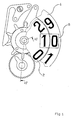
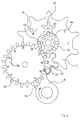
- the date mechanism illustrated in Figure 1 has two disks, one disk of units 1 carrying ten digits or a multiple of ten for displaying units, a tens 2 disc with four digits or a multiple of four for displaying tens.
- the digit "0" from the tens 2 disc can be deleted and replaced by an empty space.
- the two discs 1 and 2 are concentric and allow the display of the digits of units and tens through a single window 5.
- the disc of the units 1 is secured to a toothed wheel 3 units which has 10 teeth or a multiple of ten.
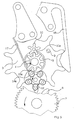
- the tens 2 disc is attached to a tens pinion 4 (figure 2) which has four teeth or a multiple of four.
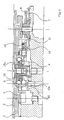
- Tens pinion 4 and unit wheel 3 are concentric, the pinion 4 being partially housed in a circular clearance formed in the center of the wheel units 3.
- the surfaces of the two discs 1, 2 carrying the date digits are coplanar, as we can imagine report on figure 6.
- the unit wheel 3 is connected to the hour wheel of the cog hour indicator (not shown) which makes two turns in 24 hours by an intermediate wheel which drives a calendar wheel 7 at the rate of one revolution in 24 hours.
- This calendar wheel 7 carries a date finger 8 which drives the wheel of units 3 one step every 24 hours.
- a reference 10 carried by a tenon 10a secured to the plate of the timepiece meshes with the pinion of the tens 4.
- This reference 10 is located on the trajectory of a pin 9 carried by the wheel of the units 3, so that this reference 10 is driven one step at each turn of the wheel 3 units and also drives the tens gable 4 also one step.
- Tens 4 pinion drive coincides with the passage of the disc of units 1 from "9" to "0".
- the unit wheel 3 carries an auxiliary mobile constituted by a pinion of end of month 12 a tooth of which is positioned by a cam 15 secured to the tens 4 pinion instead of a tooth hollowed out 11 of the wheel of the units 3.
- Each tooth of the pinion of end of month 12 is associated with a pivoting roller 14 in ruby. These rollers 14 are located at the height of the cam 15, so that these rollers 14 roll on the cam 15, thus reducing friction to a minimum between this cam 15 and the end of month pinion 12.
- Cam 15 has a clearance 15a located between two teeth of the tens pinion 4, corresponding to the passage of the digit "3" to digit “0” on the tens 2 disc.
- this cam 15 and at its release 15a, the end gear of month is locked angularly with respect to the unit wheel 3 when changing tens digits both that a portion of the cam 15 intersects the path of a roller 14, which is the case when changing tens, except when changing from "31” to "01” which corresponds to the recess 15a of cam 15, so that in this case the pinion end of month 12 can turn one step, the unit wheel 3 remaining stationary. Therefore, the tens disk changes from “3” to "0", while the unit disc remains on the digit "1" which corresponds to the digit of the units of calendar "31” and "01".
- Two positioning jumpers 16 and 17 cooperate respectively with the wheel of the units 3 and with the pinion of the tens 4.
- the jumper 16 of the wheel of units 3 thicker, is likely to develop a greater torque than the long necklace 17. This keeps the wheel of the units 3 stationary during the transition from the tens disc from "3" to "0" between the "31" and "01".
- Figure 3 shows the date mechanism when the disks of units 1 and tens 2 display "30", that is to say that the pin 9 secured to the wheel of the units 3 rotating in the direction of the arrow on this wheel 3 has just advanced the reference 10 as well as the sprocket of the tens 4 of a step in the direction of their arrows respective, to pass from the position of figure 2 to that of Figure 3.
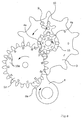
- Figure 4 shows the position of the moving parts of the mechanism date when the two discs 1, 2 display "31". Note that in this position, a roller 14a of the pinion at the end of month 12 is in front of clearance 15a of the cam 15. Thus when passing from the position of FIG. 4 to that of FIG. 5, the date finger 8 can then rotate the end of month pinion 12 by one step. This one no longer blocked by cam 15, the unit wheel 3 then remains motionless. Thanks to this end of month gear and cam 15, we can directly pass the date of the "31" to "01".
- Figures 7-11 show how you can shoot take advantage of this peculiarity of the date mechanism described so far to get an annual calendar based on a new concept according to which the date display changes fully automatically from 01.03 to 28 or 29.02 of the following year, without any of the disks or both disks simultaneously move from more than one step per 24 hours.
- the basic mechanism described above already allows to perform the passage from "31" to "01” by changing only the disk of tens of steps and holding the disk of 1 stationary units. You just have to find a way to simultaneously move the two discs one step to move from "30" to "01” and we then have a very annual calendar simple, capable of implementing this clever process of date change with all listed benefits previously.
- the annual wheel 18 has twenty-four teeth, i.e. two per month. Some of these teeth are thinned out an arc of a circle 18a concentric with the axis of this annual wheel 18, others are not. The thickness of thinned teeth of the annual wheel 18 is therefore reduced for allow these teeth to pass under the lug 8a of the finger of calendar.
- the thickness of the two teeth 4a of the tens pinion 4 corresponding to the digit "0" spans the entire the thickness of the teeth of the annual wheel 18, so that we are in gear position between these teeth and the pinion of tens 4.
- the thickness of the others teeth of this tens gable is reduced so that they don't not meet the teeth of the annual wheel 18.
- the teeth of the annual wheel 18 which are not thinned are five in number and correspond to five month of the year with less than 31 days.
- every two teeth of the annual wheel are numbered according to the months of the years to which they correspond, from 01 for January to 12 for December.
- the unthinned teeth of the annual wheel 18 therefore correspond to the months of February, April, June, September and November.
- the date finger 8 drives the unit wheel 3 by one step.
- the annual wheel 18 does not move the tooth corresponding to the month "10" being a thinned tooth which passes under the lug 8a of the date finger 8.
- the next tooth of the wheel of the units 3 which will engage with the date finger is actually a tooth of the end pinion of months 12.
- month pinion 12 can therefore turn on itself without driving the wheel of units 3, but by driving not against the tens pinion 4 of a step, tooth "0" of this pinion 4 engaged in the teeth of the annual wheel 18 again driving this wheel 18 a step. So the date that previously displayed "31" only changed the digit of tens, that of the units having remained motionless and the next calendar date is therefore "01".
- the date mechanism described above therefore allows to pass automatically and without any correction from 01.03 on 28 or 29.02 of the following year.
Landscapes
- Physics & Mathematics (AREA)
- General Physics & Mathematics (AREA)
- Electromechanical Clocks (AREA)
Abstract
Description
Claims (8)
- Mécanisme de quantième de pièce d'horlogerie comprenant un mobile indicateur des unités (1, 3) muni de dix dents ou d'un multiple de dix et un mobile indicateur des dizaines (2, 4) muni de quatre dents ou d'un multiple de quatre, une liaison cinématique entre les mobiles indicateurs des unités (1, 3), respectivement des dizaines (2, 4) pour déplacer d'un pas ce dernier tous les dix pas du mobile indicateur des unités (1, 3) et un mobile d'entraínement (7, 8) du mobile indicateur des unités (1, 3), relié au rouage indicateur (5) de la pièce d'horlogerie, caractérisé en ce qu'une dent du mobile indicateur des unités (3) pour le passage de "1" à "2" est une dent d'un mobile auxiliaire (12) dont l'axe de rotation est solidaire du mobile indicateur des unités (3) et qui est susceptible de venir en prise alternativement avec la denture du mobile indicateur des dizaines (2, 4) et avec une came (15) coaxiale et solidaire de ce mobile indicateur des dizaines (2, 4), cette came (15) comportant d'une part au moins une partie de blocage angulaire dudit mobile auxiliaire (12) et d'autre part au moins un dégagement (15a) dont la position est choisie pour permettre audit mobile auxiliaire (12) d'entraíner ledit mobile indicateur des dizaines (2, 4) d'un pas entre le "31" et le "01" sans entraíner le mobile indicateur des unités (1, 3).
- Mécanisme de quantième selon la revendication 1, dans lequel ledit mobile des dizaines (3) est encore sélectivement en prise avec un mobile annuel (18) lui-même sélectivement en prise avec ledit mobile d'entraínement (8, 8a) du mobile indicateur des unités (3), ledit mobile annuel (18) et ledit mobile des dizaines (4) étant conformés pour être en prise lors du passage du mobile indicateur des dizaines (4) du "2" au "3" et du "3" au "0", ledit mobile d'entraínement (8, 8a) du mobile indicateur des unités (3) étant conformé pour n'être en prise avec ledit mobile annuel (18) que lorsqu'un quantième passe directement du "30" au "01".
- Mécanisme de quantième selon la revendication 1, dans lequel le mobile des unités (3) et le mobile des dizaines (4) sont concentriques et portent chacun un disque d'affichage (1, 2), les surfaces des deux disques portant les chiffres des quantièmes étant coplanaires.
- Mécanisme de quantième selon la revendication 1, dans lequel tous les mobiles sont des organes dentés circulaires à axe de rotation central.
- Mécanisme de quantième selon la revendication 1, dans lequel les surfaces de frottement dudit mobile auxiliaire (12) avec ladite came (15) sont constituées par des galets pivotants associés à chaque dent dudit mobile auxiliaire (12).
- Mécanisme de quantième selon la revendication 1, dans lequel ledit mobile auxiliaire (12) est logé au moins en partie dans un logement formé dans la roue des unités (3).
- Mécanisme de quantième selon la revendication 2, dans lequel la mise en prise sélective entre le mobile annuel (18) et d'une part, le mobile des dizaines (4), d'autre part le mobile d'entraínement (8a) est obtenu par des dents d'épaisseurs différentes situées à des niveaux différents.
- Mécanisme de quantième selon la revendication 1, dans lequel les chiffres des dizaines et des unités apparaissent dans un guichet (19) unique.
Priority Applications (6)
| Application Number | Priority Date | Filing Date | Title |
|---|---|---|---|
| EP01811165A EP1316858B1 (fr) | 2001-11-30 | 2001-11-30 | Mecanisme de quantième de pièce d'horlogerie |
| DE0001316858T DE01811165T1 (de) | 2001-11-30 | 2001-11-30 | Kalendermechanismus für eine Uhr |
| DE60132602T DE60132602T2 (de) | 2001-11-30 | 2001-11-30 | Kalendermechanismus für eine Uhr |
| US10/295,432 US6738316B2 (en) | 2001-11-30 | 2002-11-15 | Timepiece date mechanism |
| JP2002350009A JP4242634B2 (ja) | 2001-11-30 | 2002-12-02 | 時計用日付機構 |
| HK03104984.7A HK1053172B (zh) | 2001-11-30 | 2003-07-10 | 钟表的日期机构 |
Applications Claiming Priority (1)
| Application Number | Priority Date | Filing Date | Title |
|---|---|---|---|
| EP01811165A EP1316858B1 (fr) | 2001-11-30 | 2001-11-30 | Mecanisme de quantième de pièce d'horlogerie |
Publications (2)
| Publication Number | Publication Date |
|---|---|
| EP1316858A1 true EP1316858A1 (fr) | 2003-06-04 |
| EP1316858B1 EP1316858B1 (fr) | 2008-01-23 |
Family
ID=8184281
Family Applications (1)
| Application Number | Title | Priority Date | Filing Date |
|---|---|---|---|
| EP01811165A Expired - Lifetime EP1316858B1 (fr) | 2001-11-30 | 2001-11-30 | Mecanisme de quantième de pièce d'horlogerie |
Country Status (5)
| Country | Link |
|---|---|
| US (1) | US6738316B2 (fr) |
| EP (1) | EP1316858B1 (fr) |
| JP (1) | JP4242634B2 (fr) |
| DE (2) | DE01811165T1 (fr) |
| HK (1) | HK1053172B (fr) |
Cited By (6)
| Publication number | Priority date | Publication date | Assignee | Title |
|---|---|---|---|---|
| EP2141557A3 (fr) * | 2008-07-02 | 2011-01-12 | Seiko Epson Corporation | Pièce d'horlogerie |
| EP2439600A1 (fr) * | 2010-10-07 | 2012-04-11 | Blancpain S.A. | Affichage des heures et des minutes par disque et anneau coaxiaux et coplanaires |
| CH713000A1 (fr) * | 2016-10-03 | 2018-04-13 | David W Lea Lea & Associe | Quantième annuel pour pièce d'horlogerie. |
| US10668311B2 (en) | 2018-03-23 | 2020-06-02 | Goodrich Corporation | Fire suppressant inert gas generator |
| EP3779609A1 (fr) * | 2019-08-13 | 2021-02-17 | Patek Philippe SA Genève | Mecanisme d'affichage pour piece d'horlogerie |
| US12353170B2 (en) | 2019-08-30 | 2025-07-08 | Patek Philippe Sa Geneve | Display mechanism |
Families Citing this family (18)
| Publication number | Priority date | Publication date | Assignee | Title |
|---|---|---|---|---|
| SG102647A1 (en) * | 2000-12-22 | 2004-03-26 | Ebauchesfabrik Eta Ag | Timepiece provided with a date having a large aperture |
| DE01811166T1 (de) * | 2001-11-30 | 2004-03-11 | Rolex Sa | Verfahren zur Herstellung eines Kalendermechanismus für eine Uhr |
| CH695397A5 (fr) * | 2002-04-15 | 2006-04-28 | Richemont Int Sa | Dispositif d'affichage du quantième. |
| EP1369753A1 (fr) * | 2002-06-06 | 2003-12-10 | Zenith International SA | Pièce d'horlogerie à affichage du quantième |
| DE60314752T2 (de) * | 2003-10-13 | 2008-04-10 | Daniel Roth Et Gerald Genta Haute Horlogerie S.A. | Ewige oder jährliche Kalenderuhr mit einem mechanismus zur Anzeige der Nummer der Tage im aktuellen Monat |
| EP1536300B1 (fr) * | 2003-11-26 | 2011-06-08 | ETA SA Manufacture Horlogère Suisse | Mécanisme de quantième pour pièce d'horlogerie comprenant deux anneaux de quantième superposés |
| EP1536299B1 (fr) * | 2003-11-26 | 2010-05-19 | ETA SA Manufacture Horlogère Suisse | Mécanisme de quantième pour pièce d'horlogerie comprenant deux anneaux de quantième superposés |
| JP2005214836A (ja) * | 2004-01-30 | 2005-08-11 | Seiko Instruments Inc | 2つの日車を含むカレンダ機構付き時計 |
| ATE337574T1 (de) * | 2004-06-28 | 2006-09-15 | Grisogono S A De | Vorrichtung zur grossdatumsanzeige |
| DE102005010602B4 (de) * | 2005-03-06 | 2006-12-07 | Mühle-Glashütte GmbH Nautische Instrumente & Feinmechanik | Datumsanzeige für eine Uhr |
| WO2006106787A1 (fr) * | 2005-03-30 | 2006-10-12 | Citizen Holdings Co., Ltd. | Dispositif d’affichage et dispositif de calendrier d’horodateur |
| FR2893726B1 (fr) * | 2005-11-21 | 2008-01-18 | Sylvain Boileau | Mecanisme d'affichage du quantieme pour pieces d'horlogerie |
| ATE460690T1 (de) | 2007-01-30 | 2010-03-15 | Longines Montres Comp D | UHR, DIE EINEN ANTRIEBSMECHANISMUS EINER VORRICHTUNG ZUR ANZEIGE EINER MIT DER ZEIT ZUSAMMENHÄNGENDEN GRÖßE UMFASST |
| FR2973124B1 (fr) * | 2011-03-23 | 2013-05-10 | Samep Montres Emile Pequignet | Mecanisme d'affichage d'une grande date |
| EP3173876B1 (fr) * | 2015-11-26 | 2020-09-02 | Rolex Sa | Système de calendrier horloger |
| CN108227454B (zh) * | 2016-12-22 | 2023-05-26 | 天津海鸥表业集团有限公司 | 一种钟表的双层日历机构 |
| EP3667434B1 (fr) * | 2018-12-10 | 2021-08-04 | Montres Breguet S.A. | Mécanisme d'affichage de quantième grande date et pièce d'horlogerie comprenant un tel mécanisme |
| JP7741317B2 (ja) * | 2021-10-21 | 2025-09-17 | モントレー ブレゲ・エス アー | 時計表示機構 |
Citations (2)
| Publication number | Priority date | Publication date | Assignee | Title |
|---|---|---|---|---|
| GB718896A (en) * | 1950-06-28 | 1954-11-24 | Boris Elberg | Alarm clocks with automatic calendar and methods for producing them |
| DE1523777A1 (de) * | 1966-07-20 | 1969-07-24 | Franz Hetzel | Automatischer Datumanzeiger mit Kontaktausloesevorrichtung |
Family Cites Families (7)
| Publication number | Priority date | Publication date | Assignee | Title |
|---|---|---|---|---|
| JPS5146049Y2 (fr) * | 1971-08-19 | 1976-11-08 | ||
| CH182972A4 (fr) * | 1972-02-09 | 1975-01-31 | ||
| CH581857B5 (fr) * | 1974-04-05 | 1976-11-15 | Tavannes Ebauches Sa | |
| CH624534GA3 (fr) * | 1979-04-04 | 1981-08-14 | ||
| CH692538A5 (fr) * | 1998-11-03 | 2002-07-15 | Mct Holding Sa | Mécanisme de quantième annuel. |
| DE10017589A1 (de) * | 2000-04-08 | 2001-10-11 | Glashuetter Uhrenbetrieb Gmbh | Kalendermechanismus für ein Uhrwerk |
| DE01811166T1 (de) * | 2001-11-30 | 2004-03-11 | Rolex Sa | Verfahren zur Herstellung eines Kalendermechanismus für eine Uhr |
-
2001
- 2001-11-30 DE DE0001316858T patent/DE01811165T1/de active Pending
- 2001-11-30 EP EP01811165A patent/EP1316858B1/fr not_active Expired - Lifetime
- 2001-11-30 DE DE60132602T patent/DE60132602T2/de not_active Expired - Lifetime
-
2002
- 2002-11-15 US US10/295,432 patent/US6738316B2/en not_active Expired - Fee Related
- 2002-12-02 JP JP2002350009A patent/JP4242634B2/ja not_active Expired - Fee Related
-
2003
- 2003-07-10 HK HK03104984.7A patent/HK1053172B/zh not_active IP Right Cessation
Patent Citations (2)
| Publication number | Priority date | Publication date | Assignee | Title |
|---|---|---|---|---|
| GB718896A (en) * | 1950-06-28 | 1954-11-24 | Boris Elberg | Alarm clocks with automatic calendar and methods for producing them |
| DE1523777A1 (de) * | 1966-07-20 | 1969-07-24 | Franz Hetzel | Automatischer Datumanzeiger mit Kontaktausloesevorrichtung |
Cited By (6)
| Publication number | Priority date | Publication date | Assignee | Title |
|---|---|---|---|---|
| EP2141557A3 (fr) * | 2008-07-02 | 2011-01-12 | Seiko Epson Corporation | Pièce d'horlogerie |
| EP2439600A1 (fr) * | 2010-10-07 | 2012-04-11 | Blancpain S.A. | Affichage des heures et des minutes par disque et anneau coaxiaux et coplanaires |
| CH713000A1 (fr) * | 2016-10-03 | 2018-04-13 | David W Lea Lea & Associe | Quantième annuel pour pièce d'horlogerie. |
| US10668311B2 (en) | 2018-03-23 | 2020-06-02 | Goodrich Corporation | Fire suppressant inert gas generator |
| EP3779609A1 (fr) * | 2019-08-13 | 2021-02-17 | Patek Philippe SA Genève | Mecanisme d'affichage pour piece d'horlogerie |
| US12353170B2 (en) | 2019-08-30 | 2025-07-08 | Patek Philippe Sa Geneve | Display mechanism |
Also Published As
| Publication number | Publication date |
|---|---|
| JP4242634B2 (ja) | 2009-03-25 |
| DE01811165T1 (de) | 2004-03-11 |
| US20030103416A1 (en) | 2003-06-05 |
| DE60132602T2 (de) | 2008-08-28 |
| JP2003167068A (ja) | 2003-06-13 |
| EP1316858B1 (fr) | 2008-01-23 |
| HK1053172A1 (zh) | 2003-10-10 |
| DE60132602D1 (de) | 2008-03-13 |
| HK1053172B (zh) | 2008-03-28 |
| US6738316B2 (en) | 2004-05-18 |
Similar Documents
| Publication | Publication Date | Title |
|---|---|---|
| EP1316858B1 (fr) | Mecanisme de quantième de pièce d'horlogerie | |
| EP1316859B1 (fr) | Procédé pour former un mécanisme de quantième actionnné par un mouvement d'horlogerie | |
| EP1586962B9 (fr) | Mécanisme de quantième perpétuel | |
| EP2490084B1 (fr) | Mécanisme de calendrier | |
| EP1546818B1 (fr) | Dispositif mecanique d affichage des heures et des minutes | |
| EP0756217B1 (fr) | Mécanisme de quantième annuel pour pièce d'horlogerie | |
| EP1596261A1 (fr) | Mécanisme de quantième annuel pour mouvement d'horlogerie | |
| EP1070996B1 (fr) | Pièce d'horlogerie à affichage du quantième | |
| EP3008523B1 (fr) | Mécanisme de calendrier pour mouvement horloger | |
| EP1351104B1 (fr) | Dispositif à roue de programme pour mécanisme de quantième perpétuel, et pièce d'horlogerie comportant un tel mécanisme | |
| EP3904964B1 (fr) | Dispositif d'affichage d'une indication horaire ou dérivée de l'heure et dispositif d'indexation | |
| EP3629102A1 (fr) | Mécanisme d'affichage à guichet unique | |
| EP2443525B1 (fr) | Montre avec affichage de l'heure sous forme numerique et commande de sauts | |
| EP3173876A1 (fr) | Système de calendrier horloger | |
| EP1240559B1 (fr) | Mecanisme de calendrier annuel, perpetuel ou seculaire | |
| CH682967B5 (fr) | Dispositif d'affichage pour pièce d'horlogerie. | |
| EP3460588B1 (fr) | Mecanisme de quantieme | |
| EP3904962B1 (fr) | Dispositif d'indexation et dispositif d'affichage d'une indication horaire ou dérivée de l'heure | |
| CH689601A5 (fr) | Mécanisme de quantième pour mouvement d'horlogerie. | |
| EP3667435B1 (fr) | Systeme de reglage de la position d'un premier mobile dente par rapport a un support sur lequel le premier mobile dente est monte pivotant et piece d'horlogerie comprenant un tel systeme | |
| CH717422A2 (fr) | Mécanisme de quantième. | |
| CH715471A1 (fr) | Mécanisme horloger pour quantième perpétuel. | |
| CH704506A2 (fr) | Dispositif à roue de programme pour mécanisme de calendrier et mécanisme de calendrier perpétuel comportant un tel dispositif. | |
| EP4655650A1 (fr) | Module séculaire pour mécanisme de quantième perpétuel d'un mouvement horloger | |
| CH718804B1 (fr) | Mécanisme de quantième perpétuel ou annuel. |
Legal Events
| Date | Code | Title | Description |
|---|---|---|---|
| PUAI | Public reference made under article 153(3) epc to a published international application that has entered the european phase |
Free format text: ORIGINAL CODE: 0009012 |
|
| AK | Designated contracting states |
Designated state(s): AT BE CH CY DE DK ES FI FR GB GR IE IT LI LU MC NL PT SE TR |
|
| AX | Request for extension of the european patent |
Extension state: AL LT LV MK RO SI |
|
| 17P | Request for examination filed |
Effective date: 20030710 |
|
| GBC | Gb: translation of claims filed (gb section 78(7)/1977) | ||
| AKX | Designation fees paid |
Designated state(s): CH DE FR GB LI |
|
| DET | De: translation of patent claims | ||
| GRAP | Despatch of communication of intention to grant a patent |
Free format text: ORIGINAL CODE: EPIDOSNIGR1 |
|
| GRAS | Grant fee paid |
Free format text: ORIGINAL CODE: EPIDOSNIGR3 |
|
| GRAA | (expected) grant |
Free format text: ORIGINAL CODE: 0009210 |
|
| AK | Designated contracting states |
Kind code of ref document: B1 Designated state(s): CH DE FR GB LI |
|
| REG | Reference to a national code |
Ref country code: GB Ref legal event code: FG4D Free format text: NOT ENGLISH |
|
| REG | Reference to a national code |
Ref country code: CH Ref legal event code: EP |
|
| REG | Reference to a national code |
Ref country code: CH Ref legal event code: NV Representative=s name: MOINAS & SAVOYE SA |
|
| REF | Corresponds to: |
Ref document number: 60132602 Country of ref document: DE Date of ref document: 20080313 Kind code of ref document: P |
|
| GBT | Gb: translation of ep patent filed (gb section 77(6)(a)/1977) |
Effective date: 20080227 |
|
| REG | Reference to a national code |
Ref country code: HK Ref legal event code: GR Ref document number: 1053172 Country of ref document: HK |
|
| PLBE | No opposition filed within time limit |
Free format text: ORIGINAL CODE: 0009261 |
|
| STAA | Information on the status of an ep patent application or granted ep patent |
Free format text: STATUS: NO OPPOSITION FILED WITHIN TIME LIMIT |
|
| 26N | No opposition filed |
Effective date: 20081024 |
|
| PGFP | Annual fee paid to national office [announced via postgrant information from national office to epo] |
Ref country code: GB Payment date: 20141118 Year of fee payment: 14 Ref country code: DE Payment date: 20141113 Year of fee payment: 14 |
|
| PGFP | Annual fee paid to national office [announced via postgrant information from national office to epo] |
Ref country code: FR Payment date: 20141201 Year of fee payment: 14 |
|
| REG | Reference to a national code |
Ref country code: DE Ref legal event code: R119 Ref document number: 60132602 Country of ref document: DE |
|
| GBPC | Gb: european patent ceased through non-payment of renewal fee |
Effective date: 20151130 |
|
| REG | Reference to a national code |
Ref country code: FR Ref legal event code: ST Effective date: 20160729 |
|
| PG25 | Lapsed in a contracting state [announced via postgrant information from national office to epo] |
Ref country code: GB Free format text: LAPSE BECAUSE OF NON-PAYMENT OF DUE FEES Effective date: 20151130 Ref country code: DE Free format text: LAPSE BECAUSE OF NON-PAYMENT OF DUE FEES Effective date: 20160601 |
|
| PG25 | Lapsed in a contracting state [announced via postgrant information from national office to epo] |
Ref country code: FR Free format text: LAPSE BECAUSE OF NON-PAYMENT OF DUE FEES Effective date: 20151130 |
|
| REG | Reference to a national code |
Ref country code: CH Ref legal event code: PFA Owner name: ROLEX SA, CH Free format text: FORMER OWNER: ROLEX SA, CH |
|
| PGFP | Annual fee paid to national office [announced via postgrant information from national office to epo] |
Ref country code: CH Payment date: 20201117 Year of fee payment: 20 |