EP1306802B1 - Kodierer und Dekodierer für elektronisches Wasserzeichen - Google Patents
Kodierer und Dekodierer für elektronisches Wasserzeichen Download PDFInfo
- Publication number
- EP1306802B1 EP1306802B1 EP02257213.5A EP02257213A EP1306802B1 EP 1306802 B1 EP1306802 B1 EP 1306802B1 EP 02257213 A EP02257213 A EP 02257213A EP 1306802 B1 EP1306802 B1 EP 1306802B1
- Authority
- EP
- European Patent Office
- Prior art keywords
- electronic watermark
- digital content
- blocks
- block
- pixels
- Prior art date
- Legal status (The legal status is an assumption and is not a legal conclusion. Google has not performed a legal analysis and makes no representation as to the accuracy of the status listed.)
- Expired - Lifetime
Links
Images








Classifications
-
- G—PHYSICS
- G06—COMPUTING OR CALCULATING; COUNTING
- G06T—IMAGE DATA PROCESSING OR GENERATION, IN GENERAL
- G06T1/00—General purpose image data processing
- G06T1/0021—Image watermarking
- G06T1/005—Robust watermarking, e.g. average attack or collusion attack resistant
- G06T1/0057—Compression invariant watermarking
-
- G—PHYSICS
- G06—COMPUTING OR CALCULATING; COUNTING
- G06T—IMAGE DATA PROCESSING OR GENERATION, IN GENERAL
- G06T1/00—General purpose image data processing
- G06T1/0021—Image watermarking
- G06T1/0028—Adaptive watermarking, e.g. Human Visual System [HVS]-based watermarking
-
- G—PHYSICS
- G06—COMPUTING OR CALCULATING; COUNTING
- G06T—IMAGE DATA PROCESSING OR GENERATION, IN GENERAL
- G06T2201/00—General purpose image data processing
- G06T2201/005—Image watermarking
- G06T2201/0052—Embedding of the watermark in the frequency domain
-
- G—PHYSICS
- G06—COMPUTING OR CALCULATING; COUNTING
- G06T—IMAGE DATA PROCESSING OR GENERATION, IN GENERAL
- G06T2201/00—General purpose image data processing
- G06T2201/005—Image watermarking
- G06T2201/0061—Embedding of the watermark in each block of the image, e.g. segmented watermarking
Definitions
- the present invention relates to a method and an apparatus for encoding to generate electronic watermark information, and embedding an electronic watermark into a digital content, a method and an apparatus for reading and decoding the embedded electronic watermark so as to detect tampering, a program for encoding and decoding, and a recording medium for recording this program so as to be read by an information processing apparatus.
- Information of a digital content is easily copied on an information processing apparatus such as a computer without degradation.
- the information of the digital content is easily tampered by rewriting and the like.
- the information of the digital content can be easily transmitted on a communication line.
- the information of the digital content is copied illegally by a simple process or operation, and then reused without permission.
- the information of the digital content is not used as a photographic evidence as a photograph taken by a silver film camera is used.
- the electronic watermark is a method for adding information, which is hardly recognized visually when the information is reproduced normally, to a digital content such as digital image information.
- This electronic watermark technology is roughly divided into two categories.
- the first category is technology which directly embeds electronic watermark data into a sampled value of content data.
- the second category technology which embeds electronic watermark data into a frequency component.
- the technology for embedding the electronic watermark data into the sampled value of the content data though the embedded electronic watermark data tend to be lost when the content data is processed or compressed, the embedding is simple.
- the technology for embedding the electronic watermark data into the frequency component though the electronic watermark is robust against processing and compressing the content data, the processing for embedding and extracting the electronic watermark data is complicated.
- a method for uniformly scattering and embedding the electronic watermark data on the entire image, and a method for inserting the electronic watermark only at a remarkable part are known as the technologies for embedding the electronic watermark data into the sampled value of the content data.
- a method for adding the electronic watermark data to data in the frequency domain by applying a frequency transform such as fast Fourier transform (FFT), discrete cosine transform (DCT), and wavelet transform to a digital content is known as the technology for embedding the electronic watermark data into the frequency component.
- FFT fast Fourier transform
- DCT discrete cosine transform
- wavelet transform wavelet transform
- the embedding the electronic watermark into the digital content using a computer or a scanner is secondary processing which allows tampering before creating the digital content to which the electronic watermark is embedded.
- a Loss-Less image compression method such as MH, MR, and MMR which are G3 and G4 standards of the International Telecommunication Union (ITU-T)
- ITU-T International Telecommunication Union
- a Lossy image compression technology which may lose detailed information comes to be often used for a multi-valued image such as a color image and a grayscale image while emphasis is placed on data compression for storage rather than avoiding more or less degradation of the image quality.
- Image compression technology such as JPEG and MPEG using frequency transform based on the discrete cosine transform (DCT) corresponds this technology.
- the embedded electronic watermark degrades as the image compression degrades the image quality in an application which prevents tampering the multi-valued image, capability for detecting tampering an image decreases, and consequently, there is such a problem that a sufficient function for preventing tampering is not realized.
- the present invention aims to solving the problems of the prior art.
- the present invention provides an encoding method and an encoder, a decoding method and a decoder, and encoding and decoding programs as defined in the appended claims.
- a digital content e.g. a multi-valued image and a binary image pictured by a digital camera
- Embodiments of the present invention can provide a pictured image which can be used as photographic evidence, for example.
- Embodiments of the present invention can store and recover both the electronic watermark information, and tampered information with hardly loosing them even when non-compression, Loss-Less image compression, or Lossy compression is applied to a subject image.
- the encoder for electronic watermark further comprises means for arbitrarily changing the size of the multiple divided blocks, and the overlap regions between the blocks in place of the means for dividing the digital content into multiple blocks, so that an electronic watermark which detects an exchange between the blocks as tampering is formed, and the blocks are divided into an arbitrary size.
- the means for independently forming electronic watermark information in the blocks forms the electronic watermark information by means of a hash function (randomizing) which uses plurality of data of a digital content embedded with an electronic watermark immediately before, a secret key, the date of executing the process, an apparatus production number, and the like as seed data, and further, the number of successive pixels in individual regions of the digital content embedded with a digital watermark immediately before is used as the data of the digital content embedded with a digital watermark immediately before for forming the electronic watermark in the encoder so that an electronic watermark with high security is formed.
- a hash function randomizing
- odd/even of a pixel value of individual pixels in a multi-valued image of the digital content is matched using odd/even of an integer of a result of the randomizing by the hash function (randomizing) used for the means for forming an electronic watermark
- odd/even of the number of successive pixels in individual regions in a binary image of the digital content is matched using odd/even of an integer of a result of the randomizing by the hash function
- regions are formed based on a threshold for pixel values of individual pixels in a multi-valued image of the digital content
- odd/even of the number of successive pixels in the individual regions is matched using odd/even of an integer of a result of the randomizing of the hash function in the encoder watermark, so that the electronic watermark information is formed in multi-valued and binary images.
- the encoder comprises means for embedding the electronic watermark while positions for applying an electronic watermark are skipped in the digital content, and may further comprise means for embedding the electronic watermark at a boundary between successive pixels in the digital content, and means for arbitrarily changing the positions for skipping the electronic watermark is added to the means for skipping positions for applying the electronic watermark in the digital content, an electronic watermark which restrains degradation of the digital content, and arbitrarily selects a range of the degradation is embedded.
- information indicating that the electronic watermark is embedded is recorded in a file header of the digital content when the digital content with the embedded electronic watermark is created by the encoder for electronic watermark according to the first aspect, and then is recorded on a recording medium, so that the digital content after the processing is easily handled.
- the encoder since the encoder, is added to a digital camera, a subject is pictured as a digital content by imaging means, and the digital content is recorded on a recording medium while the electronic watermark is embedded, tampering the digital content pictured by the digital camera is disabled, and evidence capability of the pictured image is secured.
- the encoding method further comprises steps of arbitrarily changing the size of the multiple divided blocks, and the overlap regions between the blocks, thereby an electronic watermark which detects an exchange between the blocks as tampering is formed, and the blocks are divided into an arbitrary size.
- electronic watermark information is formed independently in said blocks by means of a hash function (randomizing) which uses at least one of a plurality of data of a digital content embedded with an electronic watermark immediately before, a secret key, the date of executing the process, an apparatus production number, as seed data, and further, the number of successive pixels in individual regions of the digital content embedded with a digital watermark immediately before is used as the data of the digital content embedded with a digital watermark immediately before used as the seed data for the hash function (randomizing) in the encoding method, electronic watermark information with high security is formed.
- a hash function randomizing
- the electronic watermark information is formed in multi-valued and binary images.
- the digital content after the processing is easily handled.
- a decoder reads out and decodes the electronic watermark embedded in a digital content by the encoder and comprises means for reading out the electronic watermark information individually formed for the multiple divided blocks, means for decoding the electronic watermark information, means for detecting an existence of a tampered part in the digital content based on the result from the decoding means, and means for showing a block including the tampered part detected by the means for detecting an existence of a tampered part in the digital content as a color inversion pattern, a black fill pattern, a white fill pattern, a color fill pattern other than the black and white fills, and the like, the electronic watermark embedded in the digital content is read out and decoded, and an existence of a tampered part in the digital content is detected, and the detected tampered part is made as visually identifiable.
- a decoding method reads out and decodes the electronic watermark embedded in a digital content by the encoding method and comprises the steps of reading out the electronic watermark information individually for the multiple divided blocks, decoding the electronic watermark information, detecting an existence of a tampered part in the digital content, and showing a block including the tampered part detected based on reading out and decoding the electronic watermark information in the digital content as a color inversion pattern, a black fill pattern, a white fill pattern, a color fill other than the black and white fills, and the like, the electronic watermark embedded in the digital content is read out and decoded, and an existence of the tampered part in the digital content is detected, and the tampered part is made as visually identifiable.
- Fig. 1 is a controller for controlling an entire apparatus
- 2 is an operation entry unit such as a keyboard and a mouse
- 3 is an external recording interface (referred to as I/F hereafter) with which a unit such as an external recording medium is connected
- 4 is a memory
- 5 is a hash converter
- 6 is a display
- 7 is an imager
- 8 is an image reproducing unit
- 9 is an electronic watermark embedding unit
- 10 is an electronic watermark decoder
- 11 is a Loss-Less conversion compressor
- 12 is a Loss-Less conversion de-compressor
- 13 is a tampering display for displaying a detected tampered part
- 14 is a bus for connecting the individual parts with each other. I/F's required between the individual parts and the bus 14 are not shown in Fig. 1 .
- the controller 1 is a microcomputer (comprises a CPU, a ROM, and a RAM, and is simply referred to as CPU) which controls an entire operation and functions of a decoder and an encoder for electronic watermark, and software processing on this CPU in the controller 1 realizes the individual functions of the imager 7, the electronic watermark embedding unit 9, and the Loss-Less conversion compressor 11 for conducting processing for picturing an image, and the image reproduction unit 8, the Loss-Less conversion de-compressor 12, the electronic watermark decoder 10, and the tampering display 13 for displaying a detected tampered part (presenting an indication such as inversion) for conducting processing for reproducing the image.
- the operation entry unit 2 servers for entering various types of operation instructions, function selection commands, edit data, and the like, and corresponds to a keyboard, a mouse, a touch panel, and the like. Especially, the operation entry unit 2 is used for entering a secret key for encrypting in order to embed electric watermark information, and for decrypting the encrypted electronic watermark.
- the operation entry unit 2 also servers as display selection means, and an operator operates the operation entry unit 2 to change the display 6 to a desired display state. For example, an entry through a key operation can superimpose the result of decoding the electronic watermark on image information of the input image, or can select either one of them for display.
- the external recording I/F 3 is an I/F for extracting the image information on an image obtained by the imager 7, image information including an electronic watermark compressed by the Loss-Less conversion compressor 11, data of a tampered part detected by the electronic watermark decoder 10 and the like to the outside of the decoder, and records them on a recording medium (such as a floppy disk (FD) and an optical magnetic disk (OMD)) for storage.
- a recording medium such as a floppy disk (FD) and an optical magnetic disk (OMD)
- the external recording I/F 3 may be connected with a recording medium for recording the software program whose processing is executed on the controller 1.
- the memory 4 is recording means for storing image information on the image obtained by the imager 7, image information which includes the embedded electronic watermark, and is reproduced by the image reproduction unit 8, image information which is Loss-Less-converted and compressed, and the like, and corresponds to a RAM or a hard disk with a large capacity.
- the hash converter 5 is used to encrypt image information when the electronic watermark embedding unit 9 embeds electronic watermark information, and is also used to decrypt the image information when the electronic watermark decoder 10 decodes the electronic watermark information.
- the imager 7 is image information entry means for reading in image information through scanning a set photography or form.
- the imager 7 corresponds to an image scanner, a scan optical system for a digital camera, a CCD, and the like which are publicly known, and comprise a sensor and its drive circuit.
- the image reproduction unit 8 controls to reproduce the image information stored in a recording medium accessed through the external recording I/F 3, and the like.
- the electronic watermark embedding unit 9 uses the hash converter 5 to encrypt the image information read by the imager 7, and stored in the memory 4 so as to apply the processing for embedding an electronic watermark into the image information.
- the electronic watermark decoder 10 extracts the electronic watermark from image information including an embedded electronic watermark, and determines an existence of tampering of the image based on whether the extracted electronic watermark can be decoded or not.
- the Loss-Less conversion compressor 11 is used only when it is necessary to compress (Loss-Less convert) image information including an embedded electronic watermark without degrading the information.
- the Loss-Less conversion de-compressor 12 decompresses and decodes the image information which is compressed with Loss-Less conversion after the electronic watermark is embedded. Since the compression/decompression processing is known art, the detailed description is not provided.
- the tampering display 13 includes a function for displaying a corresponding part as an inversion or a black fill when it is determined that image information is tampered based on the result of the decoding in the electronic watermark decoder 10.
- Figs. 2A and 2B are flowcharts showing an encoding method for electronic watermark of the first embodiment, and showing processing which divides an image into blocks, and embeds an electronic watermark when the electronic watermark is embedded into image information as a digital content.
- the following section describes a case where processing for embedding an electronic watermark into an image taken by a digital camera is applied to a multi-valued image to which Loss-Less compressing/decompressing can be applied.
- the controller 1 stores an encryption key, which is entered from the operation entry unit 2, and is used for embedding an electronic watermark, into the memory 4 (S1). Also, the controller 1 stores image information taken by the imager 7 into the memory 4 (S2). The controller 1 divides the image information into blocks with the same size comprising nxm pixels (S3). At this time, the controller 1 divides such that the block partially overlaps the upper, lower, left, and right blocks.
- the controller 1 checks whether the entire image information is divided into blocks (S4), and if the processing for the entire blocks has not completed yet (No in S4), the controller initializes "Hash NO" in which a hash value obtained using a hash function (S5).
- the controller 1 checks a luminance value or a color difference value (a pixel value) pixel by pixel from the upper left to the lower right in the same block, and compares it with a predetermined threshold of a predetermined luminance value or color difference value so as to obtain the length (the position of change) of a run (a row) of successive luminance values or color difference values of the pixels.
- the controller 1 checks whether the length (the position of change) of the run (the row) of the successive luminance values or color difference values are obtained for the entire pixels (S6), and if the processing has not completed yet (No in S6), a hash value is obtained while the last HashNO, the luminance value or color difference value of the pixel, the secret key, the date of the processing, and the production number of the apparatus are used as seeds for the hash function, and is stored in "Hash NO" (S7). It is possible to set which item is selected from these seed data for the hash function (a combination of multiple items is possible), and to set the size of the blocks to be divided, and the quantity of the overlap between the neighboring blocks thorough operating the operation entry unit 2.
- the size of the block where an electronic watermark is embedded is inversely proportional to the level of the degradation of an original image
- arbitrarily changing the size of the divided blocks can selects a range of the image degradation. Also it is possible to restrain the image degradation due to embedding an electronic watermark by comparing the predetermined value as the threshold with a difference in pixel value between the pixel to be checked in Step S6 and its neighboring pixel, and then, embedding the electronic watermark at a part (boundary) where a difference in neighboring pixel values is large.
- the controller 1 determines whether the position of change in the run length in Step S6 is in a changeable region in the block (S8), and if the position is not in a changeable region (No in S8), the controller 1 moves to processing for the next pixel (S9), and then returns to Step S6. If the position is in a changeable region (Yes in S8), the controller 1 checks whether the position of the pixel corresponds to a position subject to skipping (S10), and moves to Step S9 if so (Yes in S10). This prevents image degradation while skipping positions where an electronic watermark is. embedded since the image degradation increases if an electronic watermark is embedded to entire corresponding pixels.
- the positions for skipping are set to (multiples of a certain integer)th pixel positions or positions where the luminance value or the color difference value changes largely, for example. It is possible to arbitrarily change the degree of skipping the position for embedding an electronic watermark. When the degree of skipping is large, the degradation of an image decreases. Thus, since it is necessary to increase the area required for decoding an electronic watermark so as to increase reliability of an electronic watermark for detecting tampering, the area of a gray zone (indicating tampering) for identifying a tampered position increases (precision for identifying a tampered position decreases).
- Step S10 If the position does not correspond to a position subject to skipping in Step S10 (No in S10), the controller 1 matches the odd/even of the luminance value or the color difference value of the pixel at the position of change to the odd/even of "Hash NO" obtained in Step S7 (S11). This process (Step S11) conducts the processing for embedding an electronic watermark. Then the controller 1 moves to the processing of Step S9.
- Step S6 If the processing has completed for the entire pixels in the block in Step S6 (Yes in S6), the controller 1 moves the processing to the next block (S12), and then, moves the processing to Step S4. At this time, the selection of the block in the subject image information moves from the upper left to the lower right as of the run of the pixels.
- Step S4 the controller 1 records the image information including the embedded electronic watermark in the memory 4 or the recording medium (S13), and then, completes the processing. If information indicating that processing for preventing tampering with an electronic watermark has been applied to image information is added to a file header when the digital content including the embedded electronic watermark is recorded on the recording medium (since it is difficult to visually confirm whether an electronic watermark has been embedded or not when the image information is displayed), managing and handling the content becomes easy. It is possible to further apply electronic watermark data to the processing described above.
- Fig. 3 is a view exemplifying the overlaps of the blocks divided by the processing which divides an image into blocks with the same size (nxm pixels) shown in Step S3 in Fig. 2A .
- a changeable region in a first block (block size: n1 ⁇ m1) in Step S8 is (n1 ⁇ m1)
- a changeable region in a second block (n2 ⁇ m2) is a region excluding an overlap with the first block (x1 ⁇ m1)
- a changeable region in a (k+1)th block (n2 ⁇ m2) is a region excluding an overlap with the second block (n2 ⁇ y1) and an overlap with the kth block (x1 ⁇ m2).
- a changeable region in a block selected later excludes regions which are changed in blocks selected before.
- the blocks are associated with one another by generating electronic watermark information including the overlapping regions among the individual blocks, it is possible to detect a replacement between blocks.
- Fig. 4 shows a part of pixel values (luminance value: Y) of pixels in an original multi-valued image and those after an electronic watermark is embedded.
- the luminance value "12" of the pixel Yk is changed to an odd number of "11" based on a hash value (such as an odd number) stored in "Hash NO" in Step S7 shown in Fig 2A .
- the processing for embedding an electronic watermark is not conducted.
- Figs. 5A and 5B are flowcharts showing processing for reading an electronic watermark, decoding it, and detecting tampering during reproducing an image in the first embodiment.
- the controller 1 stores an encryption key, which is used for encryption for embedding an electronic watermark, and is entered from the operation entry unit 2 shown in Fig. 1 , into the memory (S21), and reads out image information including an embedded electronic watermark from the memory 4 (S22).
- the controller 1 uses the Loss-Less conversion de-compressor 12 to decompress the image information.
- the controller 1 divides the image information into blocks with the same size of n ⁇ m (S23). At this time, the controller 1 conducts the division such that the divided blocks partially overlap neighboring upper, lower, left, and right blocks.
- the controller 1 checks whether the entire image information is divided into blocks (S24), and if the processing for the entire blocks has not completed yet (No in S24), the controller 1 initializes "Hash NO" for storing the hash value (S25).
- the controller 1 checks a luminance value or a color difference value pixel by pixel from the upper left to the lower right in the same block, and compares it with a predetermined threshold so as to obtain the length (the position of change) of a run (a row) of successive luminance values or color difference values of the pixels. Also, the controller 1 checks whether the check of the pixel value has completed for the entire pixels (S26), and if the processing has not completed yet (No in S26), a hash value is obtained while the last Hash NO, the luminance value or color difference value of the pixel, the secret key, the date of the processing, and the production number of the apparatus are used as seeds for a hash function, and is stored in "Hash NO" (S27).
- the controller 1 determines whether the position of change in the run length in Step S26 is in a changeable region in the block (S28), and if the position is not in a changeable region (No in S28), the controller 1 moves to processing for the next pixel (S29), and then returns to step S26. If the position is in a changeable region (Yes in S28), the controller 1 checks whether the position of the pixel corresponds to a position subject to skipping (S30), and moves to Step S29 if so (Yes in S30).
- Step S30 If the position does not correspond to a position subject to skipping in Step S30 (No in S30), the controller 1 confirms whether the odd/even of the luminance value or the color difference value of a pixel at the position of change matches the odd/even of "Hash NO" obtained in Step S27 (S31). With this confirmation, the reproducibility of the embedded electronic watermark is checked.
- Step S31 If the odd/even matches in Step S31 (Yes in S31), the controller 1 determines that tampering does not exist, and moves to Step S29. If the odd/even does not match (No in S31), the controller 1 determines that there exist tampering, records the position of the corresponding block (S32), and moves to Step S29.
- Step S26 If the processing has completed for the entire pixels in the block in Step S26 (Yes in S26), the controller 1 moves the processing to the next block (S33), and then, returns to Step S24. At this time, the selection of the block in the subject image information moves from the upper left to the lower right as of the run of the pixels.
- Step S24 If the controller confirms that the processing has completed for the entire blocks in Step S24 (Yes in S24), the controller 1 shows a result of analysis of the image information including the embedded electronic watermark (S34), and finishes the processing.
- the controller 1 shows the block recorded in Step S32 as a color inversion pattern, a black fill pattern, a white fill pattern, a color fill pattern other than the black and white fills, or the like on the display 13 based on this analysis result so as to inform the tampering. If tampering was not detected, the controller 1 may show a state such as the date of applying the electronic watermark based on the information such as the date used as the seed data for the hash function when the electronic watermark information is encrypted.
- an existence of tampering a digital content is detected, and the tampering is shown by storing multi-valued image information including an electronic watermark after it is Loss-Less compressed or non-compressed, reading out the Loss-Less compressed or non-compressed image information, decoding, and checking the electronic watermark in the image information.
- Fig. 6 is a block diagram showing a schematic constitution of an encoder and a decoder for electronic watermark according to a second embodiment of the present invention. This constitution corresponds to the constitution elements in the encoder and the decoder for electronic watermark described while referring to Fig. 1 in the first embodiment described above, and the same numerals are assigned to constitution elements virtually having a similar function.
- Fig. 6 is a block diagram showing a schematic constitution of an encoder and a decoder for electronic watermark according to a second embodiment of the present invention. This constitution corresponds to the constitution elements in the encoder and the decoder for electronic watermark described while referring to Fig. 1 in the first embodiment described above, and the same numerals are assigned to constitution elements virtually having a similar function.
- Fig. 6 is a block diagram showing a schematic constitution of an encoder and a decoder for electronic watermark according to a second embodiment of the present invention. This constitution corresponds to the constitution elements in the encoder and the decoder for electronic watermark described while
- 6 , 1 is a controller
- 2 is an operation entry unit
- 3 is an external recording I/F
- 4 is a memory
- 5 is a hash converter
- 6 is a display
- 7 is an imager
- 8 is an image reproduction unit
- 9 is an electronic watermark embedding unit
- 10 is an electronic watermark decoder
- 13 is a tampering display
- 14 is a bus
- 15 is an MMR compressor
- 16 is an MMR de-compressor
- 17 is a multi-value/binary converter.
- the MMR compressor 15 in Fig. 6 uses MMR compression to compress an image including an electronic watermark embedded by the electronic watermark embedding unit 9.
- the MMR de-compressor 16 decompresses to decode the MMR-compressed image including the electronic watermark embedded by the MMR compressor 15.
- the multi-value/binary converter 17 binarizes read image information from a multi-valued image to a binary image at a predetermined resolution, thereby obtaining image information comprising white dots and black dots, and a publicly-known technology can be applied to the conversion.
- Figs. 7A and 7B show an image formed by binarizing an image read by the imager 7, and a drawing which is an enlarged part of it respectively.
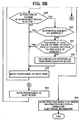
- Figs. 8A and 8B are flowcharts showing processing which is an encoding method for electronic watermark according to the second embodiment, and divides an image into blocks when an electronic watermark is embedded into the image which is a digital content.
- the following section describes processing for embedding an electronic watermark into a binary image as an example.
- Figs. 8A and 8B the same numerals are also assigned to constitution elements virtually having a similar function to the constitution elements described while referring to Figs. 2A and 2B in the first embodiment.
- the controller 1 stores an encryption key, which is entered from the operation entry unit 2 shown in Fig. 6 , and is used for encryption for embedding an electronic watermark, into the memory 4 (S1). Also, the controller 1 stores image information taken by the imager 7 into the memory 4 (S2). If the image information is a multi-valued image, the controller 1 obtains a binarization threshold using discriminant analysis in the multi-value/binary converter 17 (S2'). If the image information is a binary image, the controller 1 skips this processing. The controller 1 divides the image information into blocks with the same size comprising nxm pixels (S3). At this time, the controller 1 divides such that the block partially overlaps the upper, lower, left, and right blocks.
- the controller 1 checks whether the entire image information is divided into the blocks (S4), and if the processing for the entire blocks has not completed yet (No in S4), the controller initializes "HashNO" in which a hash value obtained using a hash function (S5).
- the controller 1 checks successive white runs and black runs pixel by pixel from the upper left to the lower right in the same block, obtains the lengths (the positions of change) of the successive runs (rows), also checks whether the check has completed for the entire pixels (S6'), and if the processing has not completed (No in S6'), a new hash value is obtained while the last HashNO, the lengths of the white run and the black run of the pixels, the secret key, the date of the processing, and the production number of the apparatus are used as seeds for a hash function, and is stored in "Hash NO" (S7'). It is possible to select which item is selected from these seed data for the hash function (a combination of multiple items is possible).
- the controller 1 determines whether the position of change in the run length in Step S6' is in a changeable region in the block (S8), and if the position is not in a changeable region (No in S8), the controller 1 moves to processing for the next pixel (a white run or a black run) (S9), and then returns to step S6'. If the position is in a changeable region (Yes in S8), the controller 1 checks whether the position of the pixel corresponds to a position subject to skipping (S10), and moves the processing to Step S9 if so (Yes in S10). This processing prevents an image degradation caused by embedding an electronic watermark. As the position for the skip, a position where a (multiple of a certain integer)th white or black run changes is set, for example.
- Step S10 If the position does not correspond to a position subject to skipping (No in S10) in Step S10, the controller 1 matches the odd/even of the length of the white run or the black run to the odd/even of "Hash NO" obtained in Step S7' (S11'). This step conducts the processing for embedding an electronic watermark, and then, the controller 1 moves to the processing of Step S9.
- Step S6' If the processing has completed for the entire pixels in the block in Step S6' (Yes in S6'), the controller 1 moves the processing to the next block (S12), and then, returns the processing to step S4. At this time, the selection of the block in the subject image information moves from the upper left to the lower right as of the run of the pixels.
- Step S4 If the controller 1 confirms that the processing for the entire blocks has completed in Step S4, the controller 1 records the image information including the embedded electronic watermark in the memory 4 or the recording medium (S13), and then, completes the processing.
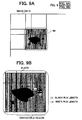
- Figs. 9A and 9B show processing for embedding an electronic watermark into the length of a white run (Lw), and the length of a black run (Lb) in an original binary image respectively.
- the controller 1 uses the length of a previous white run (Lw) or the like to change the length of a black run (Lb) in which an electronic watermark is embedded such that the odd/even of the length of the black run (Lb) matches the odd/even of the hash value obtained in Step S7'.
- the controller 1 conducts processing for extending or contracting the pixel number of the black run (Lb) by ⁇ 1 so as to conduct the processing for embedding an electronic watermark. If the position of change for embedding the electronic watermark is not in the changeable region, or at a position subject to skipping, the controller 1 does not conduct the processing for embedding an electronic watermark.
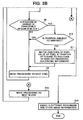
- Figs. 10A and 10B are flowcharts showing processing relating to the second embodiment, and shows processing for reading an electronic watermark, decoding it, and detecting tampering during reproducing an image.
- the flowcharts shown in Figs. 10A and 10B conduct almost the same processing as conducted by the flowcharts shown in Figs. 5A and 5B and differ in processing binary image in stead of a multi-valued image.
- the controller 1 stores an entered encryption key (S21), and reads out image information including an embedded electronic watermark from the memory 4 (S22). At this time, when the image information is stored while it is compressed with MMR compression, the controller 1 uses MMR decompression to decode the image information. Further, the controller 1 divides the image information into blocks with the same size of nxm pixels (S23).
- the controller 1 checks whether the entire image information is divided into blocks (S24), and if the entire image information has not been divided (No in S24), the controller 1 initializes "Hash NO" for storing the hash value (S25).
- the controller 1 checks successive white runs and black runs pixel by pixel from the upper left to the lower right in the same block, and obtains the lengths (the positions of change) of the successive runs (rows). The controller 1 also checks whether the check has completed for the entire pixels (S26'), and if the processing has not completed (No in S26'), a new hash value is obtained while the last Hash NO, the lengths of the white run and the black run of the pixels, the secret key, the date of the processing, and the production number of the apparatus are used as seeds for a hash function, and is stored in "Hash NO" (S27').
- the controller 1 determines whether the position of change in the length in Step S26' is in a changeable region in the block (S28), and if the position is not in a changeable region (No in S28), the controller 1 moves to processing for the next pixel (S29), and returns to Step S26'. If the position is in a changeable region (Yes in S28), the controller 1 checks whether the position of change in the length of the white run or the black run corresponds to a position subject to skipping (S30), and moves to Step S29 if so (Yes in S30).
- Step S30 If the position does not correspond to a position subject to skipping (No in S30) in Step S30, the controller 1 confirms that the odd/even of the length of the white run or the black run matches the odd/even of "Hash NO" obtained in Step S27' (S31'). With this processing, the controller 1 conducts the processing for confirming reproducibility of the embedded electronic watermark.
- Step S31' If the odd/even matches in Step S31' (Yes in S31'), the controller 1 determines that tampering does not exist, and moves the processing to Step S29. If the odd/even does not match (No in S31'), the controller 1 determines that there exists tampering, records the position of the corresponding block (S32), and moves to Step S29.
- Step S26' If the processing has completed for the entire pixels in the block in Step S26' (Yes in S26'), the controller 1 moves the processing to the next block (S33), and then, returns to Step S24. At this time, the selection of the block in the subject image information moves from the upper left to the lower right as of the run of the pixels.
- Step S24 If the controller confirms that the processing has completed for the entire blocks in Step S24 (Yes in S24), the controller 1 shows a result of analysis of the image information including the embedded electronic watermark (S34), and finishes the processing.
- the controller 1 shows the block recorded in Step S32 as a color inversion, a black fill pattern, a white fill pattern, a color fill pattern other than the black and white fills, or the like on the display 13 based on this analysis result so as to inform the tampering.
- Figs. 11A and 11B show an example of an image where processing for detecting tampering is conducted, and a corresponding block is inverted respectively.
- the controller 1 reads and decodes the image information compressed with MMR, and checks the electronic watermark in the image information.
- Fig. 12 is a block diagram showing a schematic constitution of an encoder and a decoder for electronic watermark according to a third embodiment of the present invention.
- the block diagram shown in Fig. 12 is different in a JPEG compressor 18 for compressing an image and storing it as an approximated image, and a JPEG de-compressor 19 for decompressing an compressed image in place of the Loss-Less conversion compressor 11 and the Loss-Less conversion de-compressor 12 in the block diagram shown in Fig.1 .
- the JPEG compressor 18 compresses with JPEG compression an image including an electronic watermark embedded by an electronic watermark embedding unit 9, and the JPEG de-compressor 19 decompresses to decode the JPEG-compressed image including the electronic watermark embedded by the JPEG compressor 18.
- Fig. 13 is a flowchart showing processing which is an encoding method for electronic watermark according to the third embodiment; and divides an image into blocks when an electronic watermark is embedded into the image which is a digital content.
- a controller 1 stores an entered encryption key (a secret key) for embedding an electronic watermark (S41).
- the controller 1 reads in a multi-valued image, which is image information for embedding an electronic watermark, and stores it into a memory 4 (S42).
- the controller 1 divides the image information into blocks with the same size comprising nxm pixels (S43). At this time, the controller 1 divides such that the block partially overlaps the upper, lower, left, and right blocks.
- the controller 1 sets a threshold for a pixel value (such as a luminance value and a color difference value) of a pixel in the block, and compares the pixel value of the individual pixels with the threshold to obtain a boundary between two types of image regions based on the length (the position of change) of a successive run of the pixel values (such as a luminance value and a color difference value) of the pixel (S44).
- the controller 1 uses the average of pixel values in a block processed immediately before as this threshold, and selects and switches it according to the application.
- the controller 1 changes the pixel value so as to increase the difference from the threshold at the obtained boundary (S45). Since an electronic watermark is embedded at the boundary where the density changes largely, a pixel value which is larger or smaller than the threshold by several pixel values in density is enhanced. For example, a pixel value larger than the threshold is set to the white side, and a pixel value smaller than the threshold is set to the black side.
- the controller 1 checks whether the processing for the entire divided blocks has completed (S46), if the processing for the entire divided blocks has not completed (No in S46), the controller 1 embeds an electronic watermark in the block (S47), when Step S47 ends, the controller 1 moves the processing to the next block (S48), and the controller 1 returns to Step S46.
- the JPEG compressor conducts compressing (S49) so as to store the image information including the embedded electronic watermark.
- Fig. 16 is a flowchart showing embedding an electronic watermark in a block according to the third embodiment. Embedding an electronic watermark is repeated using independent multiple processing methods in Step S47 in Fig. 15 such that the image information including the embedded electronic watermark withstands degradation of the image quality when the JPEG compression and the like are conducted.
- the controller 1 initializes "Loop NO” which records the number of repeating processing for the multiple methods for embedding an electronic watermark (S51), and checks whether the embedding an electronic watermark has repeated for predetermined times set as embedding an electronic watermark (S52). When the processing has not repeated for the specified times (No in S52), the controller 1 initializes "Hash NO" for storing a hash value (S53).
- the controller 1 checks the pixel values from the upper left to the lower right pixel by pixel in the same block, obtains the length (the position of change) of the run of the pixel values (the white side or the black side) of the pixel.
- the controller 1 also checks whether the check has completed for the entire pixels (S54), and if the processing has not completed (No in S54), a new hash value is obtained while the last Hash NO, the lengths of the run of the pixel values (the white side or the black side) of the pixel, the secret key, the date of the processing, and the production number of the apparatus are used as seeds for a hash function, and is stored in "Hash NO" (S55). It is possible to select arbitrary data (such as a combination of multiple data) from these seed data for the hash function.
- the controller 1 determines whether the position of change in the run length on the white side or the black side in Step S55 is in a changeable region in the block (S56), and if the position is not in a changeable region (No in S56), the controller 1 moves to processing for the next pixel (S57), and then returns to Step S54. If the position is in a changeable region (Yes in S56), the controller 1 checks whether the position of the pixel corresponds to a position subject to skipping (S58), and moves to Step S57 if so (Yes in S58).
- Step S58 If the position does not correspond to a position subject to skipping (No in S58) in Step S58, the controller 1 matches the odd/even of the length of the run at the position of change to the odd/even of "Hash NO" obtained in Step S55 (S59). The value on the side toward which the change should be conducted is copied to the pixel for matching in odd/even so as to embed an electronic watermark. Then, the controller 1 moves the processing to the processing of Step S57.
- Step S54 If the processing has completed for the entire pixels in the block in Step S54 (Yes in S54), the controller 1 adds one to "Loop NO", moves to the next method for embedding an electronic watermark (S60), and returns to Step S52.
- the controller 1 conducts a similar processing for a new pixel value of the pixel, and if the controller 1 has completed the processing methods for different individual pixel values (such as a density value and a color difference value), moves to Step S48 in the flowchart in Fig. 15 , repeats the processing for the next block, and conducts the processing for the entire divided blocks.
- Fig. 17 is a flowchart showing processing for reading in an electronic watermark, decoding it, and detecting tampering during reproducing an image in the third embodiment.
- the controller 1 stores an entered encryption key (a secret key) for embedding an electronic watermark (S61).
- the controller 1 also reads out the image information including an embedded electronic watermark (S62), and decompress the compressed image information (S63). Further, the controller 1 divides the image information into blocks with the same size comprising n ⁇ m pixels (S64). At this time, the controller 1 divides such that the block partially overlaps the upper, lower, left, and right blocks.
- the controller 1 sets a threshold for a pixel value (such as a luminance value and a color difference value) of the pixel in the block, and compares with the threshold to obtain a boundary between two types of image regions based on the length (the position of change) of a successive run of the pixel values (such as a luminance value and a color difference value) of the pixel (S65).
- a threshold for a pixel value such as a luminance value and a color difference value
- the controller 1 checks whether the processing for the entire divided blocks has completed (S66), when the processing for the entire blocks has not completed (No in S66), the controller 1 reads out an electronic watermark in the block, decodes it, and determines an existence of tampering (S67), and the controller 1 moves the processing to the next block when Step S67 is completed (S68), and returns to Step S66. If the processing has completed for the entire blocks (Yes in S66), the controller 1 shows a result of analyzing the image information including the embedded electronic watermark (S69).
- Figs. 16A and 16B are flowcharts showing processing for reading out the electronic watermark in the block, decoding it, and determining an existence of tampering according to the third embodiment.
- Step S67 in Fig. 15 the electronic watermark is read out and decoded with the independent multiple processing methods.
- the controller 1 Since reading out and decoding the electronic watermark is repeated for the multiple methods, the controller 1 initializes "Loop NO” for recording the number of the processing methods and "NG#Count” for recording a count of detected abnormalities (S70). Then, the controller 1 checks whether the multiple types of processing conducted as embedding an electronic watermark have conducted (S71), and if the count of the conducted types of the processing is not the total of the multiple types of the processing (No in S71), the controller 1 initializes "Hash NO" for storing a hash value obtained by the hash function (S72).
- the controller 1 checks the pixel values from the upper left to the lower right pixel by pixel in the same block, obtains the length (the position of change) of the white side run or the black side run of the successive pixel values of the pixel, and also checks whether the check has completed for the entire pixels (S73). If the processing has not completed for the entire pixels (No in S73), the controller 1 obtains a new hash value while the last Hash NO, the lengths of the run of the pixel values (the white side or the black side) of the pixel, the secret key, the date of the processing, and the production number of the apparatus are used as seed data for a hash function, and stores it in "Hash NO" (S74).
- the controller 1 determines whether the position of change in the run length in Step S73 is in a changeable region in the block (S75), and if the position is not in a changeable region (No in S75), the controller 1 moves to processing in the corresponding method for the next pixel (S76), and then returns to Step S73. If the position is in a changeable region (Yes in S75), the controller 1 checks whether the position of the pixel corresponds to a position subject to skipping (S77), and moves to Step S76 if so (Yes in S77).
- Step S77 the controller 1 checks the odd/even of the length of the run of the pixel at the position of change based on the odd/even of "Hash NO" obtained in Step S74 (S78). If the match of the odd/even is confirmed (Yes in S78), the controller 1 determines that the image was not tampered, and moves to Step S76. If a mismatch of the odd/even is detected (No in S78), the controller 1 determines that the image was tampered, adds 1 to "NG#Count", and moves to Step S76.
- Step S73 If the processing has completed for the entire pixels in the block in Step S73 (Yes in S73), the controller 1 adds 1 to "Loop NO", switches to a new method for reading out an electronic watermark (S80), and returns to Step S71. Similar processing is applied to a pixel value of the pixels in the new method, if the entire processing methods for the specified different pixel values (such as a density value and a color difference value) have completed (Yes in S71), the controller 1 checks whether "NG#Count” recording the number of abnormalities is larger than a reference (S81), and if it is larger (Yes in S81), the controller 1 determines that the corresponding block was tampered, records the position of the block (S82), and moves to Step S68 in Fig. 15 . If "NG#Count” is smaller in S81 (No in S81), the controller 1 determines that the corresponding block was not tampered, records the position of the block (S83), and returns to Step S68 in Fig. 15 in the same way.
- the present invention when the present invention is integrated into a digital camera and the like, since an electronic watermark is directly embedded into multi-valued or binary image information pictured and recorded, the image information is non-compressed, Loss-Less-compressed, or Lossy-compressed, and is stored, the embedded electronic watermark during the imaging is reproduced in a similar state, and tampering is detected and a block at a corresponding position is limited by checking this electronic watermark, the present invention provides such an effect that an image pictured by the digital camera can be used as an photographic evidence.
Landscapes
- Physics & Mathematics (AREA)
- General Physics & Mathematics (AREA)
- Engineering & Computer Science (AREA)
- Theoretical Computer Science (AREA)
- Editing Of Facsimile Originals (AREA)
- Image Processing (AREA)
- Television Systems (AREA)
Claims (26)
- Codierer zum Erzeugen von elektronischen Wasserzeicheninformationen, der eine Verfälschung in einem digitalen Inhalt durch Einbetten eines elektronischen Wasserzeichens detektiert und einen Teil der Verfälschung aufgrund des in den digitalen Inhalt eingebetteten elektronischen Wasserzeichens begrenzt, wobei der Codierer umfasst:Mittel zum Unterteilen eines digitalen Inhalts eines Gegenstands in mehrere Pixelblöcke, so dass Nicht-Kanten-Blöcke auf der oberen, der unteren, der linken und der rechten Seite mit benachbarten Blöcke überlappen, wobei jeder Block dieselbe Größe aufweist;Mittel zum Erzeugen eines elektronischen Wasserzeichens aufgrund der Pixelinformationen der gesamten Blöcke;Mittel zum Einbetten des elektronischen Wasserzeichens in ausgewählte Pixel der Pixelblöcke, wobei sich die ausgewählten Pixel innerhalb eines änderbaren Bereichs eines jeden Blocks befinden, wobei das elektronische Wasserzeichen erzeugt wird, um die Detektion des Austauschs zwischen den Blöcken als Verfälschung zu ermöglichen, wobei der änderbare Bereich des ersten Blocks der gesamte erste Block ist und ein änderbarer Bereich eines darauffolgenden Blocks Teile des Blocks sind, wobei Bereiche der Überlappung mit Blöcken, in die das elektronische Wasserzeichen bereits eingebettet wurde, und an einer Grenze, an der ein Unterschied zwischen benachbarten Pixeln groß ist, ausgeschlossen sind und wobei die Mittel zum Einbetten ausgelegt sind, einige der mehreren möglichen Pixelpositionen für die Anwendung eines elektronischen Wasserzeichens zu überspringen, um zu verhindern, dass sich der digitale Inhalt verschlechtert; undMittel zum Einstellen der Positionen für das Überspringen und Ändern des Ausmaßes des von den Mitteln zum Einbetten ausgeführten Überspringens.
- Codierer nach Anspruch 1, der ferner Mittel umfasst, um die Größe der mehreren unterteilten Blöcke und die Überlappungsbereiche zwischen den Blöcken beliebig zu ändern.
- Codierer nach Anspruch 1 oder 2, wobei die Mittel zum Erzeugen von elektronischen Wasserzeicheninformationen in den Blöcken ausgelegt sind, das elektronische Wasserzeichen mithilfe einer Hash-Funktion zu erzeugen, die mehrere Daten eines unmittelbar vorher mit einem elektronischen Wasserzeichen eingebetteten digitalen Inhalts und/oder einen Geheimschlüssel und/oder das Datum des Ausführens des Vorgangs und/oder eine Vorrichtungsherstellungsnummer als Ausgangsdaten verwendet.
- Codierer nach Anspruch 3, wobei die Anzahl von aufeinanderfolgenden Pixeln in individuellen Bereichen des unmittelbar vorher mit dem digitalen Wasserzeichen eingebetteten digitalen Inhalts als Ausgangsdaten für die Hash-Funktion verwendet wird.
- Codierer nach Anspruch 4, wobei die Parität eines Pixelwertes von individuellen Pixeln in einem mehrwertigen Bild des digitalen Inhalts unter Verwendung der Parität einer ganzen Zahl des Ergebnisses der Hash-Funktion, die für die Mittel zum Erzeugen der elektronischen Wasserzeicheninformationen verwendet wird, angepasst wird.
- Codierer nach Anspruch 3, wobei die Parität der Anzahl von aufeinanderfolgenden Pixeln in individuellen Bereiche in einem binären Bild des digitalen Inhalts unter Verwendung der Parität einer ganzen Zahl des Ergebnisses der Hash-Funktion, die für die Mittel zum Erzeugen der elektronischen Wasserzeicheninformationen verwendet wird, angepasst wird.
- Codierer nach Anspruch 3, wobei Bereiche aufgrund eines Schwellenwertes für Pixelwerte von individuellen Pixeln in einem mehrwertigen Bild des digitalen Inhalts erzeugt werden und die Parität der Anzahl von aufeinanderfolgenden Pixeln in den individuellen Bereichen unter Verwendung der Parität des Ergebnisses der Hash-Funktion, die für die Mittel zum Erzeugen der elektronischen Wasserzeicheninformationen verwendet wird, angepasst wird.
- Codierer nach einem der Ansprüche 1 bis 7, der ferner Mittel umfasst, um die Positionen für das Überspringen des elektronischen Wasserzeichens beliebig zu ändern.
- Codierer nach einem der vorhergehenden Ansprüche, der ferner Mittel umfasst, um Informationen aufzuzeichnen, die angeben, das das elektronische Wasserzeichen in einen Dateikopf des digitalen Inhalts eingebettet ist, wenn der digitale Inhalt mit dem eingebetteten elektronischen Wasserzeichen erzeugt wird, und um den Inhalt auf ein Aufzeichnungsmedium aufzuzeichnen.
- Digitalkamera, die einen Codierer zum Erzeugen eines elektronischen Wasserzeichens nach einem der vorhergehenden Ansprüche, Abbildungsmittel zum Darstellen eines Gegenstands als einen digitalen Inhalt und Mittel zum Aufzeichnen des digitalen Inhalts, in den das elektronische Wasserzeichen eingebettet wurde, auf ein Aufzeichnungsmedium, enthält.
- Codierverfahren zum Markieren mit einem elektronischen Wasserzeichen, das die Detektion der Verfälschung in einem digitalen Inhalt durch Einbetten eines elektronischen Wasserzeichens ermöglicht und einen Teil der Verfälschung aufgrund des in den digitalen Inhalt eingebetteten elektronischen Wasserzeichens begrenzt, wobei das Verfahren die Schritte umfasst:Unterteilen eines digitalen Inhalts eines Gegenstands in mehrere Pixelblöcke (S3), so dass ein Bereich von mindestens einem Block auf der oberen, der unteren, der linken und der rechten Seite mit benachbarten Blöcke überlappt, wobei jeder Block dieselbe Größe aufweist; undErzeugen eines elektronischen Wasserzeichens (S7) aufgrund der Pixelinformationen der gesamten Blöcke, um die Detektion eines Austauschs zwischen den Blöcken als Verfälschung zu ermöglichen;Zuordnen des elektronischen Wasserzeichens in den individuellen Blöcken zueinander mithilfe des Überlappungsbereichs zwischen den Blöcken; und durch:Einbetten des elektronischen Wasserzeichens (S 11) in ausgewählte Pixel der Blöcke des digitalen Inhalts, während einige der mehreren möglichen Pixelpositionen für die Anwendung eines elektronischen Wasserzeichens übersprungen werden, um zu verhindern, dass sich der digitale Inhalt verschlechtert, wobei sich die ausgewählten Pixel innerhalb eines änderbaren Bereichs eines jeden Blocks befinden, um die Detektion eines Austauschs zwischen den Blöcken als Verfälschung zu ermöglichen, wobei der änderbare Bereich des ersten Blocks der gesamte erste Block ist und ein änderbarer Bereich eines darauffolgenden Blocks Teile des Blocks sind, wobei Bereiche der Überlappung mit vorhergehenden Blöcken und an einer Grenze, an der ein Unterschied zwischen benachbarten Pixeln groß ist, ausgeschlossen werden; undEinstellen der Positionen für das Überspringen (S10) und Ändern des Ausmaßes des von den Mitteln zum Einbetten ausgeführten Überspringens.
- Codierverfahren nach Anspruch 11, das ferner den Schritt umfasst, die Größe der mehreren unterteilten Blöcke und den Überlappungsbereich zwischen den Blöcken beliebig zu ändern, um die Blöcke in beliebige Größen zu unterteilen, wenn der digitale Inhalt in mehrere Blöcke unterteilt wird.
- Codierverfahren nach Anspruch 11 oder 12, wobei das elektronische Wasserzeichen in den Blöcken mithilfe einer Hash-Funktion erzeugt wird und mehreren Daten eines unmittelbar vorher mit einem elektronischen Wasserzeichen eingebetteten digitalen Inhalts und/oder ein Geheimnisschlüssel und/oder das Datum des Ausführens des Vorgangs und/oder eine Vorrichtungsherstellungsnummer als Ausgangsdaten verwendet werden.
- Codierverfahren nach Anspruch 11 oder 12, wobei die Anzahl von aufeinanderfolgenden Pixeln in individuellen Bereichen des unmittelbar vorher mit dem digitalen Wasserzeichen eingebetteten digitalen Inhalts als Ausgangsdaten für die Hash-Funktion verwendet wird.
- Codierverfahren nach Anspruch 13, wobei die Parität eines Pixelwertes der individuellen Pixel in einem mehrwertigen Bild des digitalen Inhalts unter Verwendung der Parität einer ganzen Zahl des Ergebnisses der Hash-Funktion, die für das Erzeugen des elektronischen Wasserzeichens verwendet wird, angepasst wird.
- Codierverfahren nach Anspruch 13, wobei die Parität der Anzahl von aufeinanderfolgenden Pixeln in individuellen Bereichen in einem binären Bild des digitalen Inhalts unter Verwendung der Parität einer ganzen Zahl des Ergebnisses der Hash-Funktion, die für das Erzeugen des elektronischen Wasserzeichens verwendet wird, angepasst wird.
- Codierverfahren nach Anspruch 13, 14, 15 oder 16, wobei Bereiche aufgrund eines Schwellenwertes für Pixelwerte von individuellen Pixeln in einem mehrwertigen Bild des digitalen Inhalts erzeugt werden und die Parität der Anzahl von aufeinanderfolgenden Pixeln in den individuellen Bereichen unter Verwendung der Parität einer ganzen Zahl des Ergebnisses der Hash-Funktion, die für das Erzeugen des elektronischen Wasserzeichens verwendet wird, angepasst wird.
- Codierverfahren nach einem der Ansprüche 11 bis 17, wobei die übersprungenen Positionen beliebig änderbar sind, um einen beliebig auswählbaren Umfang der Verschlechterung des digitalen Inhalts zu liefern.
- Codierverfahren nach einem der Ansprüche 11 bis 18, wobei Informationen, die angeben, das ein elektronisches Wasserzeichen eingebettet ist, in einen Dateikopf des digitalen Inhalts aufgezeichnet werden, wenn der digitale Inhalt mit dem eingebetteten elektronischen Wasserzeichen erzeugt wird, und der digitale Inhalt dann auf ein Aufzeichnungsmedium aufgezeichnet wird.
- Decodierer zum Auslesen und Decodieren eines elektronischen Wasserzeichens, das durch den Codierer für ein elektronisches Wasserzeichen nach einem der Ansprüche 1 bis 11 in einen digitalen Inhalt eingebettet wurde, wobei der Decodierer umfasst:Mittel zum Unterteilen eines digitalen Inhalts eines Gegenstands in mehrere Pixelblöcke, so dass Nicht-Kanten-Blöcke auf der oberen, der unteren, der linken und der rechten Seite mit benachbarten Blöcken überlappen, wobei jeder Block dieselbe Größe aufweist;Mittel zum Erzeugen eines elektronischen Wasserzeichens aufgrund der Pixelinformationen der gesamten Blöcke;Mittel zum Zuordnen des elektronischen Wasserzeichens in ausgewählten Pixeln der Pixelblöcke, wobei sich die ausgewählten Pixel innerhalb eines änderbaren Bereichs eines jeden Blocks befinden, wobei der änderbare Bereich des ersten Blocks der gesamte erste Block ist und ein änderbarer Bereich eines darauffolgenden Blocks Teile des Blocks sind, wobei Bereiche der Überlappung mit vorhergehenden Blöcken und an einer Grenze, an der ein Unterschied zwischen benachbarten Pixeln groß ist, ausgeschlossen werden und wobei die Mittel zum Zuordnen ausgelegt sind, einige der mehreren möglichen Pixelpositionen für die Anwendung eines elektronischen Wasserzeichens zu überspringen, um zu verhindern, dass sich der digitale Inhalt verschlechtert;Mittel zum Einstellen von Positionen für das Überspringen und Ändern des Ausmaßes des von dem Mitteln zum Zuordnen ausgeführten Überspringens;Mittel zum Vergleichen des elektronischen Wasserzeichens mit Werten der zugeordneten Pixel; undMittel zum Detektieren eines Vorhandenseins eines verfälschten Teils in dem digitalen Inhalt aufgrund des Ergebnisses von den Vergleichsmitteln.
- Decodierer nach Anspruch 22, der ferner Mittel umfasst, einen Block, der den durch die Mittel zum Detektierten eines Vorhandenseins eines verfälschten Teils in dem digitalen Inhalt detektierten verfälschten Teil enthält, als ein Farbinversionsmuster, ein schwarzes Füllmuster, ein weißes Füllmuster, ein von der schwarzen und der weißen Füllung verschiedenes farbiges Füllmuster und Ähnliches zu zeigen, um den verfälschten Teil visuell zu identifizieren.
- Decodierverfahren zum Auslesen und Decodieren eines elektronischen Wasserzeichens, das durch ein Codierverfahren für das Markieren mit einem elektronischen Wasserzeichen nach einem der Ansprüche 11 bis 19 in einen digitalen Inhalt eingebettet wurde, wobei das Verfahren die Schritte umfasst:Unterteilen eines digitalen Inhalts eines Gegenstands in mehrere Pixelblöcke (S23), so dass ein Bereich von mindestens einem Block auf der oberen, der unteren, der linken und der rechten Seite mit benachbarten Blöcken überlappt, wobei jeder Block dieselbe Größe aufweist; undErzeugen eines elektronischen Wasserzeichens (S27) aufgrund der Pixelinformationen der gesamten Blöcke;Zuordnen des elektronischen Wasserzeichens in den individuellen Blöcken zueinander mithilfe des Überlappungsbereichs zwischen den Blöcken; und durch:Zuordnen des elektronischen Wasserzeichens zu ausgewählten Pixeln der Blöcke des digitalen Inhalts, während einige der mehreren möglichen Pixelpositionen für das Anwenden eines elektronischen Wasserzeichens übersprungen werden, um zu verhindern, dass sich der digitale Inhalt verschlechtert, wobei sich die ausgewählten Pixel innerhalb eines änderbaren Bereichs eines jeden Blocks befinden, wobei der änderbare Bereich des ersten Blocks der gesamte erste Block ist und ein änderbarer Bereich eines darauffolgenden Blocks Teile des Blocks sind, wobei Bereiche der Überlappung mit vorhergehenden Blöcken und an einer Grenze, an der ein Unterschied zwischen benachbarten Pixeln groß ist, ausgeschlossen werden;Einstellen der Positionen für das Überspringen (S30) und Ändern des Ausmaßes des in dem Schritt des Einbettens ausgeführten Überspringens;Auslesen der elektronischen Wasserzeicheninformationen einzeln für die mehreren unterteilten Blöcke; undDetektieren eines Vorhandenseins eines verfälschten Teils in dem digitalen Inhalt durch Vergleichen der ausgelesenen elektronischen Wasserzeicheninformationen mit dem zugeordneten elektronischen Wasserzeichen (S32).
- Decodierverfahren für ein elektronisches Wasserzeichen nach Anspruch 22, das ferner den Schritt umfasst, einen Block, der den verfälschten Teil, der aufgrund des Auslesens und des Decodierens der elektronischen Wasserzeicheninformationen in dem digitalen Inhalt detektiert wurde, als ein Farbinversionsmuster, ein schwarzes Füllmuster, ein weißes Füllmuster, ein von der schwarzen und der weißen Füllung farbiges verschiedenes Füllmuster und Ähnliches zu zeigen, um den verfälschten Teil visuell zu identifizieren.
- Codierprogramm für das Markieren mit einem elektronischen Wasserzeichen, wobei das Programm Codemittel umfasst, die, wenn sie durch eine Datenverarbeitungsvorrichtung ausgeführt werden, die Datenverarbeitungsvorrichtung anweisen, ein Verfahren nach einem der Ansprüche 11 bis 19 auszuführen.
- Decodierprogramm für das Markieren mit einem elektronischen Wasserzeichen, wobei das Programm Codemittel umfasst, die, wenn sie durch eine Datenverarbeitungsvorrichtung ausgeführt werden, die Datenverarbeitungsvorrichtung anweisen, ein Verfahren nach einem der Ansprüche 22 bis 23 auszuführen.
- Aufzeichnungsmedium, auf dem ein Programm für das Markieren eines elektronischen Wasserzeichen nach einem der Ansprüche 24 oder 25 aufgezeichnet ist, um lesbar zu sein, um auf einer Datenverarbeitungsvorrichtung zu funktionieren.
Applications Claiming Priority (4)
| Application Number | Priority Date | Filing Date | Title |
|---|---|---|---|
| JP2001324184 | 2001-10-22 | ||
| JP2001324184 | 2001-10-22 | ||
| JP2002177268 | 2002-06-18 | ||
| JP2002177268A JP4035383B2 (ja) | 2001-10-22 | 2002-06-18 | 電子透かしの符号生成装置と符号生成方法、および電子透かしの復号装置と復号方法、並びに電子透かしの符号生成復号プログラムと、これを記録した記録媒体 |
Publications (3)
| Publication Number | Publication Date |
|---|---|
| EP1306802A2 EP1306802A2 (de) | 2003-05-02 |
| EP1306802A3 EP1306802A3 (de) | 2006-06-07 |
| EP1306802B1 true EP1306802B1 (de) | 2014-02-12 |
Family
ID=26624030
Family Applications (1)
| Application Number | Title | Priority Date | Filing Date |
|---|---|---|---|
| EP02257213.5A Expired - Lifetime EP1306802B1 (de) | 2001-10-22 | 2002-10-17 | Kodierer und Dekodierer für elektronisches Wasserzeichen |
Country Status (4)
| Country | Link |
|---|---|
| US (1) | US7212649B2 (de) |
| EP (1) | EP1306802B1 (de) |
| JP (1) | JP4035383B2 (de) |
| ES (1) | ES2460265T3 (de) |
Families Citing this family (45)
| Publication number | Priority date | Publication date | Assignee | Title |
|---|---|---|---|---|
| US6424725B1 (en) * | 1996-05-16 | 2002-07-23 | Digimarc Corporation | Determining transformations of media signals with embedded code signals |
| US7720249B2 (en) * | 1993-11-18 | 2010-05-18 | Digimarc Corporation | Watermark embedder and reader |
| US7532740B2 (en) * | 1998-09-25 | 2009-05-12 | Digimarc Corporation | Method and apparatus for embedding auxiliary information within original data |
| US7162035B1 (en) | 2000-05-24 | 2007-01-09 | Tracer Detection Technology Corp. | Authentication method and system |
| US6996273B2 (en) * | 2001-04-24 | 2006-02-07 | Microsoft Corporation | Robust recognizer of perceptually similar content |
| US6973574B2 (en) | 2001-04-24 | 2005-12-06 | Microsoft Corp. | Recognizer of audio-content in digital signals |
| US7356188B2 (en) * | 2001-04-24 | 2008-04-08 | Microsoft Corporation | Recognizer of text-based work |
| JP4035383B2 (ja) | 2001-10-22 | 2008-01-23 | 株式会社リコー | 電子透かしの符号生成装置と符号生成方法、および電子透かしの復号装置と復号方法、並びに電子透かしの符号生成復号プログラムと、これを記録した記録媒体 |
| US8171567B1 (en) | 2002-09-04 | 2012-05-01 | Tracer Detection Technology Corp. | Authentication method and system |
| JP2004282677A (ja) * | 2003-01-21 | 2004-10-07 | Canon Inc | 画像処理方法 |
| US7831832B2 (en) * | 2004-01-06 | 2010-11-09 | Microsoft Corporation | Digital goods representation based upon matrix invariances |
| US20050165690A1 (en) * | 2004-01-23 | 2005-07-28 | Microsoft Corporation | Watermarking via quantization of rational statistics of regions |
| US20050251486A1 (en) * | 2004-02-03 | 2005-11-10 | Mark Nair | System and methods for protecting digital works using a watermark gateway |
| US7770014B2 (en) * | 2004-04-30 | 2010-08-03 | Microsoft Corporation | Randomized signal transforms and their applications |
| US7584366B2 (en) * | 2004-07-08 | 2009-09-01 | At&T Intellectual Property I, L.P. | Methods, systems and computer program products for detecting tampering of electronic equipment based on constrained time to obtain computational result |
| JP2006121656A (ja) | 2004-09-24 | 2006-05-11 | Ricoh Co Ltd | 電子透かし埋込装置、電子透かし埋込方法、その方法をコンピュータに実行させるためのプログラム |
| JP2006121655A (ja) * | 2004-09-24 | 2006-05-11 | Ricoh Co Ltd | 改竄検出装置、改竄検出方法、その方法をコンピュータに実行させるためのプログラム |
| EP1703461B1 (de) * | 2005-03-18 | 2010-05-26 | Thomson Licensing | Verfahren und Vorrichtung zur Kodierung und Dekodierung von nutzlasttragenden Zeichen zur Einbettung eines Wasserzeichens in ein Audio- oder Videosignal |
| EP1703460A1 (de) | 2005-03-18 | 2006-09-20 | Deutsche Thomson-Brandt Gmbh | Verfahren und Vorrichtung zur Kodierung und Dekodierung von Nutzlast tragenden Zeichen zur Einbetung eines Wasserzeichens in ein Audio- oder Videosignal |
| US20070076869A1 (en) * | 2005-10-03 | 2007-04-05 | Microsoft Corporation | Digital goods representation based upon matrix invariants using non-negative matrix factorizations |
| DE102005058006A1 (de) | 2005-12-05 | 2007-06-06 | Siemens Ag | Verfahren und Peer-Netzwerk zur Ermittlung der Peer-Netzwerk-Herkunftsstadion einer Datei |
| US7729508B2 (en) * | 2006-01-11 | 2010-06-01 | Hewlett-Packard Development Company, L.P. | Modifying data |
| US7656557B2 (en) * | 2006-04-27 | 2010-02-02 | Xerox Corporation | Tools to embed tampering indicator into digital visual works using two screens with halftoning elements of different size dots or shapes |
| US20090324199A1 (en) * | 2006-06-20 | 2009-12-31 | Koninklijke Philips Electronics N.V. | Generating fingerprints of video signals |
| JP4962906B2 (ja) * | 2007-03-12 | 2012-06-27 | 富士ゼロックス株式会社 | 画像形成装置およびプログラム |
| DE102008014409A1 (de) * | 2008-03-14 | 2009-09-24 | Fraunhofer-Gesellschaft zur Förderung der angewandten Forschung e.V. | Einbetter zum Einbetten eines Wasserzeichens in eine Informationsdarstellung, Detektor zum Detektieren eines Wasserzeichens in einer Informationsdarstellung, Verfahren und Computerprogramm |
| US7995196B1 (en) | 2008-04-23 | 2011-08-09 | Tracer Detection Technology Corp. | Authentication method and system |
| JP2010041710A (ja) * | 2008-07-11 | 2010-02-18 | Ricoh Co Ltd | 埋込情報検出装置、埋込情報検出方法、プログラムおよび記録媒体 |
| JP5287072B2 (ja) * | 2008-09-17 | 2013-09-11 | 株式会社リコー | 画像処理装置、画像処理方法、画像処理プログラム |
| JP5347765B2 (ja) * | 2009-06-30 | 2013-11-20 | 株式会社Jvcケンウッド | デジタルコンテンツデータの管理システム、管理方法、利用装置及び改変検出装置 |
| JP5353485B2 (ja) * | 2009-06-30 | 2013-11-27 | 株式会社Jvcケンウッド | コンテンツデータの管理システム、管理方法、利用装置及び管理装置 |
| WO2011034507A1 (en) * | 2009-09-18 | 2011-03-24 | Nanyang Technological University | A method of providing security for transmitting a digital medical image |
| EP2541478A1 (de) * | 2011-06-27 | 2013-01-02 | Accenture Global Services Limited | Dynamisches elektronisches Geld |
| CA2753508C (en) * | 2011-09-23 | 2013-07-30 | Guy Le Henaff | Tracing a document in an electronic publication |
| KR101758685B1 (ko) * | 2012-03-14 | 2017-07-14 | 한화테크윈 주식회사 | 카메라 템퍼링 감지 방법 및 시스템 |
| CN103426142A (zh) * | 2013-08-14 | 2013-12-04 | 中山大学深圳研究院 | 一种基于Arnold变换的Patchwork数字水印编解码方法 |
| CN103996165B (zh) * | 2014-05-30 | 2017-09-19 | 东北大学 | 一种基于压缩感知特征的数字图像零水印嵌入和提取方法 |
| US11200859B2 (en) | 2017-01-24 | 2021-12-14 | Semiconductor Energy Laboratory Co., Ltd. | Display device and electronic device |
| IL251149A0 (en) * | 2017-03-14 | 2017-06-29 | Google Inc | Semi-transparent watermarks for served content |
| US11683180B1 (en) | 2018-05-24 | 2023-06-20 | Swear Inc. | Protecting digital media with nested hashing techniques |
| US10355865B1 (en) | 2018-05-24 | 2019-07-16 | DeepTruth, LLC | Systems and techniques for certification of trusted media data |
| JP6497468B1 (ja) * | 2018-06-06 | 2019-04-10 | 株式会社Jvcケンウッド | 画像符号化装置、画像符号化方法、及び画像改ざん判定プログラム |
| CN109145132B (zh) * | 2018-07-12 | 2021-06-18 | 北京奇虎科技有限公司 | 从图像中提取哈希码的方法、装置及图像检索方法、装置 |
| CN109325140B (zh) * | 2018-07-12 | 2021-07-13 | 北京奇虎科技有限公司 | 从图像中提取哈希码的方法、装置及图像检索方法、装置 |
| CN113052745B (zh) * | 2021-04-25 | 2022-01-07 | 景德镇陶瓷大学 | 数字水印模型训练方法、陶瓷水印图像的制作方法及陶瓷 |
Family Cites Families (8)
| Publication number | Priority date | Publication date | Assignee | Title |
|---|---|---|---|---|
| JPH07162830A (ja) * | 1993-12-10 | 1995-06-23 | Ricoh Co Ltd | テレビ会議通信装置の制御方法 |
| JPH07312647A (ja) * | 1994-05-17 | 1995-11-28 | Ricoh Co Ltd | テレビ会議通信装置 |
| US6185312B1 (en) * | 1997-01-28 | 2001-02-06 | Nippon Telegraph And Telephone Corporation | Method for embedding and reading watermark-information in digital form, and apparatus thereof |
| JP3809297B2 (ja) * | 1998-05-29 | 2006-08-16 | キヤノン株式会社 | 画像処理方法、装置及び媒体 |
| JP3607521B2 (ja) * | 1999-03-24 | 2005-01-05 | 株式会社東芝 | 電子透かし埋込装置、電子透かし検出装置、デジタル情報配布装置及び記憶媒体 |
| JP2001309212A (ja) * | 2000-04-21 | 2001-11-02 | Ricoh Co Ltd | デジタルカメラ |
| US6996717B2 (en) * | 2001-05-24 | 2006-02-07 | Matsushita Electric Industrial Co., Ltd. | Semi-fragile watermarking system for MPEG video authentication |
| JP4035383B2 (ja) | 2001-10-22 | 2008-01-23 | 株式会社リコー | 電子透かしの符号生成装置と符号生成方法、および電子透かしの復号装置と復号方法、並びに電子透かしの符号生成復号プログラムと、これを記録した記録媒体 |
-
2002
- 2002-06-18 JP JP2002177268A patent/JP4035383B2/ja not_active Expired - Fee Related
- 2002-10-17 ES ES02257213.5T patent/ES2460265T3/es not_active Expired - Lifetime
- 2002-10-17 EP EP02257213.5A patent/EP1306802B1/de not_active Expired - Lifetime
- 2002-10-18 US US10/272,857 patent/US7212649B2/en not_active Expired - Fee Related
Also Published As
| Publication number | Publication date |
|---|---|
| EP1306802A3 (de) | 2006-06-07 |
| EP1306802A2 (de) | 2003-05-02 |
| JP4035383B2 (ja) | 2008-01-23 |
| JP2003204429A (ja) | 2003-07-18 |
| US7212649B2 (en) | 2007-05-01 |
| US20030133591A1 (en) | 2003-07-17 |
| ES2460265T3 (es) | 2014-05-13 |
Similar Documents
| Publication | Publication Date | Title |
|---|---|---|
| US7212649B2 (en) | Encoder and encoding method for electronic watermark, decoder and decoding method for electronic watermark, encoding and decoding program for electronic watermark, and recording medium for recording such program | |
| US6064764A (en) | Fragile watermarks for detecting tampering in images | |
| US7545938B2 (en) | Digital watermarking which allows tampering to be detected on a block-specific basis | |
| US6246777B1 (en) | Compression-tolerant watermarking scheme for image authentication | |
| US6728408B1 (en) | Water-mark embedding method and system | |
| Holliman et al. | Counterfeiting attacks on oblivious block-wise independent invisible watermarking schemes | |
| US6285775B1 (en) | Watermarking scheme for image authentication | |
| Wu et al. | Watermarking for image authentication | |
| US6275599B1 (en) | Compressed image authentication and verification | |
| Queluz | Authentication of digital images and video: Generic models and a new contribution | |
| US6879703B2 (en) | Method and apparatus for watermarking images | |
| KR101135472B1 (ko) | 차이값 히스토그램을 이용한 가역 워터마크 삽입, 추출 및 원본 복원 방법 | |
| US20020172398A1 (en) | Image processing apparatus and method, program code and storage medium | |
| EP1566763B1 (de) | Einbettung eines Wasserzeichens in Bildern mit einer beschränkten Anzahl an Farben | |
| Amanipour et al. | Video-tampering detection and content reconstruction via self-embedding | |
| CN100385903C (zh) | 视频中的实时签名嵌置 | |
| JP4948551B2 (ja) | 電子透かし埋め込み検出方法とその装置、プログラム、記録媒体 | |
| KR101200345B1 (ko) | 점진적 차이값 히스토그램 기반의 가역 워터마킹을 이용한 블록단위 영상 인증방법 | |
| JP2003289435A (ja) | 画像データ作成方法、改竄検出方法、画像データ作成装置、改竄検出装置、コンピュータプログラム、及び記録媒体 | |
| EP1628257B1 (de) | Erkennung von Änderungen in digitalen Daten mittels empfindlichen Wasserzeichens | |
| KR100500144B1 (ko) | 디지털 영상 인증을 위한 디지털 워터마크의 삽입 및추출방법 | |
| Bassali et al. | Compression tolerant watermarking for image verification | |
| EP1743296B1 (de) | Wasserzeichen für ein komprimiertes informationssignal | |
| US6963655B1 (en) | Alteration detection apparatus and method thereof | |
| JP2007028402A (ja) | 画像処理方法、装置、プログラムおよび記録媒体 |
Legal Events
| Date | Code | Title | Description |
|---|---|---|---|
| PUAI | Public reference made under article 153(3) epc to a published international application that has entered the european phase |
Free format text: ORIGINAL CODE: 0009012 |
|
| 17P | Request for examination filed |
Effective date: 20021026 |
|
| AK | Designated contracting states |
Designated state(s): AT BE BG CH CY CZ DE DK EE ES FI FR GB GR IE IT LI LU MC NL PT SE SK TR |
|
| AX | Request for extension of the european patent |
Extension state: AL LT LV MK RO SI |
|
| RIN1 | Information on inventor provided before grant (corrected) |
Inventor name: WATANABE, KAZUMITSU,C/O RICOH COMPANY LTD. Inventor name: NISHIMURA, T.,RICOH TOTTORI SOFTWARE TECHN.CO.LTD Inventor name: WATANABE, TOSHIO,C/O RICOH COMPANY LTD. Inventor name: NAGAO, SEIJI,C/O RICOH COMPANY LTD. |
|
| PUAL | Search report despatched |
Free format text: ORIGINAL CODE: 0009013 |
|
| AK | Designated contracting states |
Kind code of ref document: A3 Designated state(s): AT BE BG CH CY CZ DE DK EE ES FI FR GB GR IE IT LI LU MC NL PT SE SK TR |
|
| AX | Request for extension of the european patent |
Extension state: AL LT LV MK RO SI |
|
| AKX | Designation fees paid |
Designated state(s): DE ES FR GB IT NL |
|
| 17Q | First examination report despatched |
Effective date: 20070123 |
|
| 17Q | First examination report despatched |
Effective date: 20070123 |
|
| GRAJ | Information related to disapproval of communication of intention to grant by the applicant or resumption of examination proceedings by the epo deleted |
Free format text: ORIGINAL CODE: EPIDOSDIGR1 |
|
| GRAP | Despatch of communication of intention to grant a patent |
Free format text: ORIGINAL CODE: EPIDOSNIGR1 |
|
| GRAP | Despatch of communication of intention to grant a patent |
Free format text: ORIGINAL CODE: EPIDOSNIGR1 |
|
| INTG | Intention to grant announced |
Effective date: 20130910 |
|
| GRAS | Grant fee paid |
Free format text: ORIGINAL CODE: EPIDOSNIGR3 |
|
| GRAA | (expected) grant |
Free format text: ORIGINAL CODE: 0009210 |
|
| AK | Designated contracting states |
Kind code of ref document: B1 Designated state(s): DE ES FR GB IT NL |
|
| REG | Reference to a national code |
Ref country code: GB Ref legal event code: FG4D |
|
| REG | Reference to a national code |
Ref country code: DE Ref legal event code: R096 Ref document number: 60245982 Country of ref document: DE Effective date: 20140320 |
|
| REG | Reference to a national code |
Ref country code: ES Ref legal event code: FG2A Ref document number: 2460265 Country of ref document: ES Kind code of ref document: T3 Effective date: 20140513 |
|
| REG | Reference to a national code |
Ref country code: NL Ref legal event code: T3 |
|
| REG | Reference to a national code |
Ref country code: DE Ref legal event code: R097 Ref document number: 60245982 Country of ref document: DE |
|
| PLBE | No opposition filed within time limit |
Free format text: ORIGINAL CODE: 0009261 |
|
| STAA | Information on the status of an ep patent application or granted ep patent |
Free format text: STATUS: NO OPPOSITION FILED WITHIN TIME LIMIT |
|
| 26N | No opposition filed |
Effective date: 20141113 |
|
| REG | Reference to a national code |
Ref country code: DE Ref legal event code: R097 Ref document number: 60245982 Country of ref document: DE Effective date: 20141113 |
|
| REG | Reference to a national code |
Ref country code: FR Ref legal event code: PLFP Year of fee payment: 14 |
|
| REG | Reference to a national code |
Ref country code: FR Ref legal event code: PLFP Year of fee payment: 15 |
|
| PGFP | Annual fee paid to national office [announced via postgrant information from national office to epo] |
Ref country code: GB Payment date: 20161020 Year of fee payment: 15 Ref country code: NL Payment date: 20161019 Year of fee payment: 15 Ref country code: DE Payment date: 20161020 Year of fee payment: 15 Ref country code: FR Payment date: 20161020 Year of fee payment: 15 |
|
| PGFP | Annual fee paid to national office [announced via postgrant information from national office to epo] |
Ref country code: ES Payment date: 20161011 Year of fee payment: 15 Ref country code: IT Payment date: 20161024 Year of fee payment: 15 |
|
| REG | Reference to a national code |
Ref country code: DE Ref legal event code: R119 Ref document number: 60245982 Country of ref document: DE |
|
| REG | Reference to a national code |
Ref country code: NL Ref legal event code: MM Effective date: 20171101 |
|
| GBPC | Gb: european patent ceased through non-payment of renewal fee |
Effective date: 20171017 |
|
| REG | Reference to a national code |
Ref country code: FR Ref legal event code: ST Effective date: 20180629 |
|
| PG25 | Lapsed in a contracting state [announced via postgrant information from national office to epo] |
Ref country code: GB Free format text: LAPSE BECAUSE OF NON-PAYMENT OF DUE FEES Effective date: 20171017 Ref country code: NL Free format text: LAPSE BECAUSE OF NON-PAYMENT OF DUE FEES Effective date: 20171101 Ref country code: DE Free format text: LAPSE BECAUSE OF NON-PAYMENT OF DUE FEES Effective date: 20180501 |
|
| PG25 | Lapsed in a contracting state [announced via postgrant information from national office to epo] |
Ref country code: FR Free format text: LAPSE BECAUSE OF NON-PAYMENT OF DUE FEES Effective date: 20171031 |
|
| PG25 | Lapsed in a contracting state [announced via postgrant information from national office to epo] |
Ref country code: IT Free format text: LAPSE BECAUSE OF NON-PAYMENT OF DUE FEES Effective date: 20171017 |
|
| REG | Reference to a national code |
Ref country code: ES Ref legal event code: FD2A Effective date: 20181221 |
|
| PG25 | Lapsed in a contracting state [announced via postgrant information from national office to epo] |
Ref country code: ES Free format text: LAPSE BECAUSE OF NON-PAYMENT OF DUE FEES Effective date: 20171018 |