EP1566763B1 - Einbettung eines Wasserzeichens in Bildern mit einer beschränkten Anzahl an Farben - Google Patents
Einbettung eines Wasserzeichens in Bildern mit einer beschränkten Anzahl an Farben Download PDFInfo
- Publication number
- EP1566763B1 EP1566763B1 EP05003538A EP05003538A EP1566763B1 EP 1566763 B1 EP1566763 B1 EP 1566763B1 EP 05003538 A EP05003538 A EP 05003538A EP 05003538 A EP05003538 A EP 05003538A EP 1566763 B1 EP1566763 B1 EP 1566763B1
- Authority
- EP
- European Patent Office
- Prior art keywords
- run
- digital watermark
- lengths
- embedding
- length
- Prior art date
- Legal status (The legal status is an assumption and is not a legal conclusion. Google has not performed a legal analysis and makes no representation as to the accuracy of the status listed.)
- Expired - Lifetime
Links
Images




Classifications
-
- G—PHYSICS
- G06—COMPUTING OR CALCULATING; COUNTING
- G06T—IMAGE DATA PROCESSING OR GENERATION, IN GENERAL
- G06T1/00—General purpose image data processing
- G06T1/0021—Image watermarking
-
- H—ELECTRICITY
- H04—ELECTRIC COMMUNICATION TECHNIQUE
- H04N—PICTORIAL COMMUNICATION, e.g. TELEVISION
- H04N21/00—Selective content distribution, e.g. interactive television or video on demand [VOD]
- H04N21/80—Generation or processing of content or additional data by content creator independently of the distribution process; Content per se
- H04N21/83—Generation or processing of protective or descriptive data associated with content; Content structuring
- H04N21/835—Generation of protective data, e.g. certificates
- H04N21/8358—Generation of protective data, e.g. certificates involving watermark
-
- G—PHYSICS
- G06—COMPUTING OR CALCULATING; COUNTING
- G06T—IMAGE DATA PROCESSING OR GENERATION, IN GENERAL
- G06T2201/00—General purpose image data processing
- G06T2201/005—Image watermarking
- G06T2201/0051—Embedding of the watermark in the spatial domain
Definitions
- the present invention generally relates to image processing methods, image processing apparatuses, programs, and recording media that embed digital watermarks in digital content by encoding, and detect copyright information and/or falsification in the process of decoding the digital watermarks embedded in the digital content.
- the present invention handles digital content such as information of still images, moving images, computer programs, and computer data.
- digital content such as information of still images, moving images, computer programs, and computer data.
- the present invention provides techniques effective for digital watermark embedding processes in the cases where data are saved in data formats that are difficult to be expressed in gradation. Examples of such data include binary images and color images such as artificial images, which only allow use of specific colors (for example, expression in 256 colors; also referred to as limited colors or index colors).
- Digital information can be easily copied by, for example, computers, without being degraded. Conversely, digital information may be easily overwritten and/or falsified. Hence, with simple processes and/or operations, digital information is likely to be illegally copied and reused without permission, or may be partially altered such that the digital information cannot be used as evidence photography.
- Digital watermarking is a method of adding information that is invisible when digital contents such as digital images are normally reproduced.
- Methods for embedding digital watermarks may be broadly classified into the following two categories:
- the method (1) is generally used for digital watermarking in such cases. As described below, the present invention is realized with the method (1)
- Intended purposes of adding digital watermarks to digital contents include, for example: recording of copyright information; tracing of information of illegal copiers; recording of IP address history; prevention of illegal copying (invisible/high tolerance type); application to prevention of falsification (invisible/low tolerance type); authentication; secret communications; embedding of remarks and/or labels of digital contents (visible/invisible type, displaying owner); allowing for removal of watermarks (visible/invisible type, content distribution).
- a method has been proposed to provide a camera with a mechanism for embedding the serial number of the camera and shooting date and time, and simultaneously creating an electronic signature when taking pictures (refer to " Research Report on Digital Watermark Techniques", Japan Electronic Industry Development Association, March, 1993 , and 'Prevention of Illegal copying of Electronic Information', pp. 68-70 of "Nikkei Business", February 23, 1998 ).
- Falsification may be detected only by electronic signature techniques.
- the digital watermark is generally embedded in the edge portions of the image.
- the area of the' edge portions is less than that of the flat portions.
- the image quality is significantly degraded.
- the information and/or meaning of an original image may be lost when degradation of the image quality is such that the outline of the image (e.g., ledger sheet, figure, or map) that is artificially created is excessively affected, or such that the framework of the image is divided or deleted.
- Video Steganography How to Secretly Embed a Signature in a Picture
- Matsui, K. and Tanaka, K., IMA Intellectual Property Project Proceedings, pp. 187-206 refers to Video Steganography.
- this publication presents several methods to secretly embed digital signatures in pictures to protect property in the networked multimedia environment, wherein run-lengths in a side-by-side arrangement are used.
- the invention is defined by the subject-matter of the independent claims.
- the dependent claims are directed to advantageous embodiments.
- an image processing method an image processing apparatus, a program, and a recording medium that can embed a digital watermark in accordance with a topology conservation law of digital images while reducing image quality degradation.
- topology preservation law topology preservation law
- an image processing method that includes the steps of:
- an image processing apparatus including:
- a computer-readable recording medium recording thereon a program for causing a computer to realize each of the steps of:
- the information value of a digital watermark is indicated by the run-length.
- embedding a digital watermark may change the size of the original run-length from +1 to -1 pixel.
- the following methods A through C represent methods for determining a changed value.
- Method A or C may be applied in the cases other than the exceptions given in the above descriptions of Methods A and C. However, in order to avoid degradation of the shape of an image as much as possible, Methods A and C are used appropriately in accordance with the following determination methods (A) and (B).
- the following determination methods are based on the characteristics that "even if the run-length value of a specific run (hereinafter referred to as "relevant run") is changed, from the need to reduce degradation of image quality, the run-length adjacent to the changed run-length (either the left or right side of the relevant run) also needs to be changed (to be changed by an increase or decrease that reverses the sign of the changed value of the relevant run)".
- variable digital watermark information cannot be embedded even for 1 bit in the following two cases, which are extreme cases for a series of pixels into which a digital watermark is to be embedded.
- a method for preserving topology of a digital image divides the image into blocks and realizes a unique topology preserving function for each of the blocks.
- topology preserving (unchangeable rule) is "a same color pixel region (run-length), which is formed by consecutive pixels having the same color, prohibits the run-length from being divided such that one or more pixels having another color are inserted therein, prohibits new formation of a nested region to be embedded therein, and prohibits deletion of the run-length".
- the advantages of dividing an image into blocks are as follows: management in units of blocks becomes simple by dividing a place to embed information; and in an environment allowing parallel processing, a watermark embedding process and a watermark extracting process can be performed in parallel for each block, which speeds up the processing.
- the topology preservation function is handled as follows in block boundaries:
- a lot.of horizontal lines, vertical lines, and oblique lines are highly important in the images.
- the pixels of a CCD or a display device corresponding to the pixels of a photographing device, are arranged in a horizontal direction or a vertical direction.
- a digital watermark is embedded by changing pixel values such that a series of consecutive pixels having identical colors do not damage the characteristics of horizontal lines, vertical lines, or oblique lines (having a step-like shape when an image is expanded).
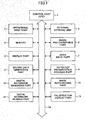
- FIG. 1 shows a system structure according to one embodiment of the present invention. More specifically, FIG. 1 shows an exemplary structure of an encoding/decoding apparatus, which implements a coding (embedding of a digital watermark)/decoding (reading a digital watermark and detecting falsification) method for digital images.
- a coding embedding of a digital watermark
- decoding reading a digital watermark and detecting falsification
- the encoding/decoding apparatus includes a control part (CPU) 1, an operational input part (keyboard, mouse) 2, an external storage unit 3, a memory 4, an image photographing part 5, a display part 6, a data input part 7 for inputting arbitrary data from outside, a source data generation part 8 for embedding digital watermarks, a topology preservation process part 9, a digital watermark embedding part 10, an image reproducing part 11, a digital watermark reading part 12, a falsification (inverting) display part 13 for displaying detected falsification, and a bus 14. It should be noted that illustration of interfaces required between each of the above-mentioned parts (or devices) and the bus 14 are omitted.
- the control part 1 is a microcomputer (hereinafter simply referred to as "CPU", though it may be formed by, for example, CPU, ROM and RAM) that controls operations and functions of the apparatus.
- Functions of each of the image photographing part 5, the data input part 7, the source data generation part 8, the topology preservation process part 9, and digital watermark embedding part 10, the image reproducing part 11, the digital watermark reading part 12, and the falsification display part 13 may be realized by software processing by the CPU.
- An image photographing process is performed by the image photographing part 5, the data input part 7, the source data generation part 8, the topology preservation process part 9, and digital watermark embedding part 10.
- An image reproducing process is performed by the image reproducing part 11, the digital watermark reading part 12, and the falsification display part 13.
- the operational input part 2 is for inputting various operational instructions, function selection instructions, edited data and the like.
- the operational input part 2 may be, for example, a keyboard, a mouse, or a touch panel. More specifically, the operational input part 2 is used for inputting a secret key when encrypting image data to which digital watermark data are embedded or when reading an encrypted digital watermark.
- the operational input part 2 also includes functions as display selection means, and can change the display state of the display part 6 to a desired display state. For example, with a key operation, a digital watermark reading result may be displayed by superposing input image data thereon, or only one of them may be selected and displayed.
- the external storage unit 3 is a storage medium that can be ejected from the apparatus and stores, for example, image data photographed by the image photographing part 5, compressed data in which a digital watermark is embedded by the digital watermark embedding part 10, and data of a falsified portion detected by the digital watermark reading part 12.
- the external storage unit 3 may be, for example, a flexible disk (FD) or a magneto optical disk (MOD). Additionally, the external storage unit 3 also functions as a medium that records program software to be implemented by the control part 1.
- the memory 4 is a memory storing, for example, image data read by the image photographing part 5 and image data generated by reading and decompressing, by the image reproducing part 11, saved data in which a digital watermark is embedded.
- the memory 4 may be, for example, a large-capacity RAM or a hard disk.
- the image photographing part 5 is image data inputting means for scanning, for example, a photograph or a ledger sheet that is set, reading the image thereof, and inputting the image data.
- the image photographing part 5 may be, for example, a known image scanner or digital camera including an image sensor such as a scanning optical system and a CCD and a drive circuit therefor.
- the data input part 7 is means for inputting: source information for embedding supplementary information of digital contents as a digital watermark; and embedded information for falsification detection and copyright protection. Input data are stored in the memory 4 to be sent to the source data generation part 8.
- the source data generation part 8 encrypts or encodes the data that are input by the data input part 7. After processing, the data are stored in the memory 4 to be sent to the digital watermark embedding part 10.
- the digital watermark embedding part 10 performs a process of embedding, as a digital watermark, the data that are input by the data input part 7, encoded (encrypted) by the source data generation part 8, and stored the memory 4.
- the digital watermark embedding part 10 divides an original image into blocks when embedding a digital watermark.
- the digital watermark embedding part 10 also performs a process of converting the entire image into a list of runs according to a method of processing a series of consecutive (in a horizontal direction or a vertical direction) pixels of an identical color as a single run (run-length).
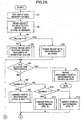
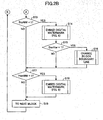
- FIGS. 2A and 2B show a flowchart for explaining a process of embedding a digital watermark at the time of image photographing.
- the topology preservation process part 9 is means for controlling, in the digital watermark embedding part 10, the position to embed, in digital contents, the data generated by the source data generation part 8 such that image quality degradation is reduced as much as possible.
- the image reproducing part 11 performs control for reading data that includes a digital watermark embedded by the digital watermark embedding part 10 and is saved in, for example, the external storage unit 3.
- the read image is stored in the memory 4.
- the digital watermark reading part 12 reads a digital watermark from the image data that are reproduced from the memory 4 by the image reproducing part 11 and embedding therein the digital watermark. Depending on whether the digital watermark can be read, the digital watermark reading part 12 determines whether the image is falsified and/or whether copyright protection information is valid.
- the digital watermark reading part 12 divides the image embedding therein a digital watermark into blocks.
- the digital watermark reading part 12 also performs a process of converting the entire image into a list of runs according to the method of processing a series of consecutive (in a horizontal direction or a vertical direction) pixels of an identical color as a single run (run-length).
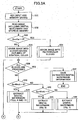
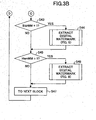
- FIGS. 3A and 3B show a flowchart for explaining a process of extracting digital watermark information when reproducing an image.
- the falsification display part 13 displays the corresponding region by reversing display and/or filling the region with black color.
- FIGS. 4A, 4B and 4C are diagrams for explaining digital watermark embedding according to a first embodiment of the present invention. Referring to FIGS. 4A, 4B and 4C, a description is given of topology preservation rules in the case of embedding a digital watermark in the same line.
- FIG. 4A (a) represents an original image, (b) represents the image embedding therein a digital watermark, and circles ( ⁇ ) shown in the bottom of the figure indicate whether a topology conservation law is satisfied ( ⁇ indicates "YES".)
- FIG. 4A-(a) represents a part of run-length of image data of one line quantized by, for example, 8 bits. That is, the run-length shown in FIG.
- 4A-(a) consists of run-lengths of four kinds of colors, i.e., a run-length a (e.g., having the length of 5 pixels and each pixel value is 100), a run-length b (e.g., having the length of 1 pixel and the pixel value is 0), a run-length c (e.g., having the length of 5 pixels and each pixel value is 255), and a run-length d (the length of 2 pixels and each pixel value is 50). It should be noted that run-length information is saved in blocks not shown in the figure.
- a run-length a e.g., having the length of 5 pixels and each pixel value is 100
- a run-length b e.g., having the length of 1 pixel and the pixel value is 0
- a run-length c e.g., having the length of 5 pixels and each pixel value is 255
- a run-length d the length of 2 pixels and each
- FIG. 4 shows a case where a digital watermark is embedded without deleting a run-length (corresponding to making a run-length 0) or newly adding a run-length (newly creating run-length information having a value equal to or more than 1) so that the topology in an identical line is not changed.
- bit 0 is assigned to a run-length having an even-numbered length
- bit 1 is assigned to a run-length having an odd-numbered length
- the run-length a having a length of five pixels, is decreased by a length of one pixel to be a run-length a' having a length of four pixels.
- the run-length b having a length of one pixel, is increased by a length of one pixel to be a run-length b' having a length of two pixels.
- the run-length c having a length of five pixels, is increased by a length of one pixel to be a run-length c' having a length of six pixels.
- the run-length d having a length of two pixels, is decreased by a length of one pixel to be a run-length d' having a length of one pixel.
- the image (b), preserving the topology is generated from the original image (a).
- bit 0 is assigned to a run-length having an even-numbered length
- bit 1 is assigned to a run-length having an odd-numbered length
- the image (b), embedding therein the digital watermark information "0001" is generated. It should be noted that the number of pixels to be increased or decreased is up to one pixel so as to reduce degradation of image quality.
- FIG. 4B shows the case where topology is not preserved.
- (a) represents an original image
- (b) represents the image embedding therein a digital watermark
- circles ( ⁇ ) and crosses ( ⁇ ) shown in the bottom of the figure indicate whether a topology conservation law is satisfied ( ⁇ indicates "YES” and ⁇ indicates "NO”).
- FIG. 4B shows the case where there is an excess or deficiency in a run-length of an identical color in the same line.
- the run-lengths of the original image (a) in FIG. 4B are same as those of the original image (a) in FIG.
- FIG. 4A (that is, both original images (a) have the order: "odd number” ⁇ "odd number” ⁇ "odd number” ⁇ "even number” from the left to right).
- (b) represents the image in which a digital watermark is embedded by increasing the run-length a by one pixel and decreasing the run-length c by one pixel. Since the run-length b is deleted and a run-length e' is newly created, the topology is not preserved, and the image (b), embedding therein the digital watermark, is determined to be invalid.
- the original image is discarded (deleted) in many cases.
- the image embedding the digital watermark is used as a new original image.
- the new original image is different from the original image, but the new original image includes additional information as hidden information while maintaining the original functions of the original image.
- the processing method in embedding a digital watermark corresponds to step 9 of FIG. 2A.
- the processing method may be realized, for example, as follows. Processing Method
- Pixels are processed one by one from the leftmost pixel toward the right, while analyzing an original images.
- the position of the end of the run described in the above item i)-(2) is moved.
- moving the right end of a target run to the left for one pixel corresponds to the change from the run a to the run a', which are represented by (a) and (b) in FIG. 4A, respectively.
- the rightmost pixel forming the run a is changed to the pixel forming the right adjacent run b.
- FIG. 4C also shows a case where topology is not preserved. More specifically, FIG. 4C shows the case where a new run-length is inserted or deleted in a run-length of an identical color in the same line.
- (a) represents an original image
- (b) represents the image embedding therein a digital watermark
- circles ( ⁇ ) and crosses ( ⁇ ) indicate whether a topology conservation law is satisfied (O indicates "YES” and ⁇ indicates "NO").
- a run-length f is newly created (inserted) and a run-length g is deleted.
- the topology is not preserved.
- the digital watermark in the image (b) of FIG. 4C is determined to be invalid.
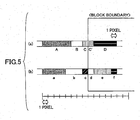
- FIG. 5 is a diagram for explaining digital watermark embedding according to a second embodiment. Referring to FIG. 5, a description is given of a digital watermark embedding method that preserves topology in block boundary portions.
- run-lengths C and C' each having a length of one pixel of Line 1 (indicated by (a) in FIG. 5) of an original image
- the run-lengths C and C' are of an identical color, even if one of the run-lengths C and C' is deleted, the topology is preserved and a valid digital watermark embedding process may be performed.
- One of the run-lengths C and C' may be deleted by extending a run-length B for one pixel to delete the run-length C or by extending a run-length D for one pixel to delete the run-length C'.
- a process may be performed that allows extension of the run-length C or C' for one pixel without performing the above-mentioned deletion of the run-length C or C' by not assuming the run-lengths C and C' are of an identical color even if they are (not making the continuity valid).
- run-lengths c and d each having a length of one pixel
- Line 2 indicated by (b) in FIG. 5
- run-lengths c and d do not have an identical color
- neither of run-lengths c and b may be deleted.
- the run-length c may be extended for one pixel toward the run-length d
- the run-length d may be extended for one pixel toward a run-length e.
- FIG. 6 is a diagram for explaining digital watermark embedding according to a third embodiment.
- a description is given of a digital watermark embedding method that preserves topology between the adjacent lines stacked on one another.
- (a) represents the original images of two lines, i.e., Line 1 and Line 2
- (b) represents a case where a digital watermark is valid.
- the run-length C of Line 1 is extended for one pixel, the continuity between the run-length C of the Line 1 and the run-length d of Line 2 is maintained (the topology is preserved).
- the lengths of the run-lengths A, B, a, b, c and e are not changed for simplicity of explanation.
- (c) represents the case where the run-length c of Line 2 and the run-length D of Line 1 are extended for one pixel.
- the run-lengths C and d are not continuous, which is different from the original image (a).
- the topology is not preserved, and the process is determined to be invalid.
- FIG. 7 is a diagram for explaining digital watermark embedding according to a fourth embodiment.
- a description is given of a method for embedding a digital watermark while preserving topology between adjacent lines stacked on one another.
- FIG. 7 shows a case of four adjacent lines.
- (a) represents an original image
- (b) represents the image embedding therein a digital watermark
- circles ( ⁇ ) and crosses ( ⁇ ) shown in the bottom of the figure indicate validity and invalidity, respectively.
- the run-length B of Line 2 is expanded for one pixel, run-lengths C become different from those of the original image.
- the continuity among run-lengths D is maintained (topology is preserved).
- the continuity of the run-lengths C is broken by Line 2.
- the topology is not preserved, and the process is determined to be invalid.
- FIG. 8 is a diagram for explaining digital watermark embedding according to a fifth embodiment. Referring to FIG. 8, a description is given of a method for embedding, in a target block, a pixel to be embedded while preserving topology.
- (a) represents an original image
- (b) represents the image embedding therein a digital watermark.
- D indicates a block formed by pixels of an identical color
- A indicates a region that is in the block D and is formed by pixels in which a digital watermark is to be embedded.
- B indicates a pixel (one pixel) having a color the same as that of the region A and added when embedding the digital watermark
- C indicates that a pixel (one pixel) having a color the same as that of the region A is deleted when embedding the digital watermark and the deleted pixel is replaced by a pixel of the block D.
- the pixel B contacts the outline of the block D when embedding the pixel B, the topology is not preserved, and the process is determined to be invalid.
- the outline of the block D may be moved (changed) such that the outline does not contact the pixel B.
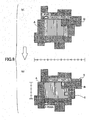
- FIG. 9 is a diagram for explaining digital watermark embedding according to a sixth embodiment.
- a description is given of a method for embedding a digital watermark without changing the shape of a region in which the digital watermark is to be embedded so as to prevent image quality degradation.
- (a) represents an original image
- (b) represents the image embedding therein a digital watermark.
- A indicates a block in which a digital watermark is to be embedded
- B indicates a region of pixels in which the digital watermark is to be embedded.
- the region B has a stair-like shape.
- each run-length of the region B is extended for one pixel to form a region B', and the digital watermark is embedded as regions a and b.
- the shape of the region B of the original image (a) and that of the region B' of the image (b) are similar.
- image quality degradation is not likely to be conspicuous.
- the shape (concavity and convexity) of the region B and that of the region B' are different (not similar), which causes degradation of image quality.
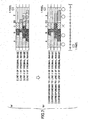
- FIG. 10 is a diagram for explaining digital watermark embedding according to a seventh embodiment. Referring to FIG. 10, a description is given of a second method for embedding a digital watermark without changing the shape of a region in which the digital watermark is to be embedded so as to prevent image quality degradation.
- (a) represents an original image including run-lengths of Lines 1 and 2
- (b) represents the image after a valid digital watermark embedding process
- (c) represents the image after an invalid digital watermark embedding process.
- a run-length b of Line 2 is extended for one pixel
- a run-length C of Line 1 is extended for one pixel, thereby embedding a digital watermark. Comparing the portions embedding the digital watermark between the images (a) and (b), it is found that the characteristics of the original image (a) (differences in levels between Lines 1 and 2 (A and a, and B and b) are maintained in the image (b). More specifically, the characteristics of the original image such as horizontal lines, vertical lines (formed by, for example, the right ends of B and b), and oblique lines (formed by, for example, the right ends of A and a) are maintained in the image (b). Thus, the process is valid.
- the difference in levels between run-lengths A and a disappears. Additionally, differences in levels that do not exist in the original image (a) are created between run-lengths B and b and run-lengths C and c. More specifically, in the image (c), a new oblique line extending from top left to bottom right, which does not exist in the original image (a), is newly formed by C and c. Thus, the characteristics of the original image (a) are lost, and the process is invalid.
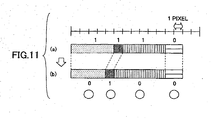
- FIG. 11 is a diagram showing digital watermark embedding according to another embodiment of the present invention.
- (a) represents an original image
- (b) represents the image embedding therein a digital watermark.
- the pixel arrangement of the original image (a) in FIG. 11 is the same as that of the original image (a) in FIG. 4A.
- the alignment of run-lengths is the same ("5: odd number” ⁇ "1: odd number” ⁇ "5: odd number” ⁇ "2: even number”).
- FIG. 11 since information to be embedded as a digital watermark is "0100", digital watermark embedding is realized by changing the first and third run-lengths such that the run-lengths becomes "4: even number” ⁇ "1: odd number” ⁇ "6: even number” "2: even number” so as not to delete or newly add a run-length and not to change the topology in the same line.
- FIG. 4A shows the case where all run-lengths are changed (from an odd-numbered value to an even-numbered value, or an even-numbered value to an odd-numbered value), while FIG. 11 shows the case where only a part of the run-lengths is changed.
- step S1 a key.input is made to determine a selection function (an input is made via, for example, a keyboard), and the input is saved in the memory for the processes as follows.
- the information amount of a digital watermark to be embedded in a portion, corresponding to a set of runs to be aligned (synchronized) is only 1 bit per such a portion. This is for reducing image quality degradation.
- step S2 a photographic object is read as a multilevel image, which serves as an original image in which a digital watermark is to be embedded, and is stored in the memory 4.
- the image may be a binary image.
- step S3 the subsequent process flow is determined in accordance with the block dividing method DevVar, which is set in step S1.
- DevVar 0 (YES in step S3)
- step S4 which performs division into rectangular blocks.
- step S5 which performs division into blocks having a shape other than a rectangular shape.
- Step S4 division into rectangular blocks, is performed by blocks having a fixed block size that is not influenced by pixel values within the image
- step S5 the image in which a digital watermark is to be embedded is divided into blocks having outlines of an identical color.
- FIG. 8 shows one of the divided blocks and a case where a digital watermark is embedded therein.
- a known method may be used as a block division method.
- step S6 it is determined whether.the digital watermark embedding process in units of blocks has ended. If the process (steps S8 through S19) for each block has been performed on all of the blocks divided in step S4 or S5 (YES in step S6), then the process proceeds to step S7. On the other hand, if the process has not been performed on all of the blocks (NO in step S6), then the process proceeds to step S8.
- Step S7 corresponds to a process after the digital watermark embedding process is completed.
- the image embedding therein a digital watermark is saved as a file.
- the image is saved in the memory 4 or the external storage unit 3.
- Step S8 is one of a process of the digital watermark embedding process, which process is to be performed on each block.
- step S8 based on the embedding synchronization method SynMesh, which is set in step S1, a first identification is performed with respect to a method for embedding a digital watermark inside the block.
- SynMesh 0
- a digital watermark embedding process is performed (see FIGS. 4 and 11).
- Law C is a law provided in order to satisfy both topology preservation law and law prohibiting change of line width of.image.
- the value of the rightmost pixel Ite of Lt is changed to the value of the leftmost pixel Irs of Lr (of course, value of Ite ⁇ value of Irs), or the value of the pixel Irs is changed to the value of the pixel Ite.
- Conditions satisfying FIG. 10 may be either of the following two cases based on the above-mentioned assumption.
- Step S10 is a process of the digital watermark embedding process, which process is performed for each block.
- step S10 based on the embedding synchronization method SynMesh, which is set in step S1, the following identification is performed with respect to the digital watermark embedding method for the block.
- the value of the rightmost pixel Ite of Lt is changed to the value of the leftmost pixel Irs of Lr (of course, value of Ite ⁇ value of Irs), or the value of the pixel Irs is changed to the value of the pixel Ite.
- Conditions satisfying FIG. 6 may be either of the following two cases based on the above-mentioned assumption.
- the value of the rightmost pixel Ite of Lt is changed to the value of the leftmost pixel Irs of Lr (of course, value of Ite ⁇ value of Irs), or the value of the pixel Irs is changed to the value of the pixel Ite.
- step S13 subsequent to the process for embedding the digital watermark inside the block performed in the above-mentioned steps S9 through S12, based on BdrWM, which is set in step S1, it is determined whether to perform a digital watermark embedding process dependent on the continuity of pixels having an identical color in a block boundary portion in a digital watermark embedding process for block boundary portions, which are formed by the adjacent blocks.
- step S15 in the case where the block division is performed by using the outlines of an identical color, it is determined based on DevVar, which is set in step S1, whether block boundary lines can be changed.
- step S17 the process proceeds to a determination process in step S17.
- Step S16 is performed only when the block division method is carried out by using the outlines of an identical color.
- a block boundary line cannot be formed by an outline of an identical color (invaded by a run having a different pixel value inside the block) due to embedding of a digital watermark (extension of a run) by a pixel value that is different from the value of a pixel in a block outline portion inside the block
- a change is made that expands (extends) pixels having an identical color in the outline portion toward outside of the block (see FIG. 8).
- step S17 based on HamWM, which is set in step S1, it is determined whether to perform digital watermark embedding that aligns run-lengths (extends each of the run-lengths for the same amount as shown in FIG. 9) in a direction perpendicular to lines.
- the process proceeds to step S18.
- step S19 the process proceeds to step S19.
- step S19 assuming that the target block has been processed, the next target block in which a digital watermark is to be embedded is selected, and the process proceeds to the determination process of step S6.
- the digital watermark extraction process performed at the time of image reproduction includes a lot of processes the same as those of the digital watermark embedding process at the time of image photographing. They are different in the following aspect. That is, in the digital watermark embedding process, in order to make digital watermark information effective, an original image is modified. On the other hand, in the digital watermark extracting process, embedded digital watermark information is extracted by analyzing an image without modifying the image to be read.
- the options for DevVar include the function that "outline of identical color can be changed" as a block dividing function. However, the digital watermark extracting process (FIGS. 3A and 3B) does not include such a function.
- step S31 a key input is made to determine a selection function (an input is made via, for example, a keyboard), and the input is saved in the memory for the processes as follows.
- the determined one of selection functions (1) through (5) be the same as that set at the time of digital watermark embedding. If they do not match, it is impossible to extract a digital watermark embedded in an image from which the digital watermark is to be extracted.
- the block dividing method DevVar which is to be explained in the item (2), in the case where the setting at the time of digital watermark embedding is "1: outline of identical color can be changed” or “2: outline of identical color cannot be changed", by setting "1: outline of an identical color” at the time of extracting, it is regarded that the same function is selected (both match).
- step S32 the image is read as a target image from which the digital watermark is to be extracted, and is stored in the memory.
- the image may be either a multilevel image or a binary image.
- step S33 the subsequent process flow is determined in accordance with the block dividing method DevVar, which is set in step S31.
- DevVar 0 (YES in step S33)
- step S34 which performs division into rectangular blocks.
- step S35 which performs division into blocks having a shape other than a rectangular shape.
- Step S34 division into rectangular blocks, is performed by blocks having a fixed block size that is not influenced by pixel values within the image.
- step S35 the image from which the digital watermark is to be extracted is divided into blocks having outlines of an identical color.
- FIG. 8 shows one of the divided blocks and a case where a digital watermark is embedded therein.
- a known method may be used as a block division method.
- step S36 it is determined whether the digital watermark extracting process in units of blocks has ended. If the process (steps S38 through S47) for each block has been performed on all of the blocks divided in step S34 or S35 (YES in step S36), then the process proceeds to step S37. On the other hand, if the process has not been performed on all of the blocks (NO in step S36), then the process proceeds to step S38.
- Step S37 corresponds to a process after the digital watermark extracting process is completed.
- the extracted digital watermark information is saved.
- the information is saved in the memory 4 or the external storage unit 3.
- Step S38 is one of a process of the digital watermark extracting process, which process is to be performed on each block.
- step S38 based on the embedding synchronization method SynMesh, which is set in step S31, a first identification is performed with respect to a method for extracting the digital watermark inside the block.
- SynMesh 0
- step S40 the process proceeds to step S40, which performs the next identification process.
- a digital watermark extracting process is performed (see FIGS. 4 and 11).
- the limitation of FIG. 10 has been put at the time of digital watermark embedding (illustration thereof is omitted in the flowchart), it is possible to extract the digital watermark under the same limitation also at the time of extraction.
- Step S40 is a process of the digital watermark extracting process, which process is performed for each block.
- step S40 based on the embedding synchronization method SynMesh, which is set in step S31, the following identification is performed with respect to the method for extracting the digital watermark inside the block.
- SynMesh 1
- Step S40 proceeds to step S41.
- the limitation of FIG. 10 has been put at the time of digital watermark embedding (illustration thereof is omitted in the flowchart), it is possible to extract the digital watermark under the same limitation also at the time of extraction.
- step S43 subsequent to the process for extracting the digital watermark inside the block performed in the above-mentioned steps S39 through S42, based on BdrWM, which is set in step S31, it is determined whether to perform a digital watermark extracting process dependent on the continuity of pixels having an identical color in a block boundary portion in a digital watermark extracting process for block boundary portions, which are formed by the adjacent blocks.
- YES BdrWM 1
- the process proceeds to step S44.
- step S45 the process proceeds to step S45.
- step S45 based on HamWM, which is set in step S1, it is determined whether to assume that the digital watermark embedding process has been performed that aligns run-lengths (extends each of the run-lengths for the same amount as shown in FIG. 9) in a direction perpendicular to lines.
- the process proceeds to step S46.
- step S47 the process proceeds to step S47.
- step S47 assuming that the target block has been processed, the next target block from which a digital watermark is to be extracted is selected, and the process proceeds to the determination process of step S36.
- the present Invention may be achieved by providing, to a system or device, a storing medium (recording medium) recording thereon program codes of software that realizes the functions according to the above-mentioned embodiments, and reading and executing, by a computer (CPU or MPU) of the system or device, the program codes stored in the storing medium (recording medium).
- the program codes that are read from the storing medium realize the functions according to the above-mentioned embodiments.
- a flexible disk, a hard disk, an optical disk, a magneto optical disk, a magnetic tape, a non-volatile memory card, or ROM may be used as the storing medium (recording medium) for supplying the program codes.
- the functions according to the above-mentioned embodiments are not always realized by executing the program codes that are read by the computer. Based on instructions given by the program codes, the OS (operating system) working on the computer may perform a part or all of actual processes so as to realize the functions according to the above-mentioned embodiments. Further, after the program codes read from the storing medium are written in a function enhancement board inserted in the computer or memory provided in a function enhancement unit coupled to the computer, based on instructions given by the program codes, CPU provided in the function enhancement board or function enhancement unit may perform a part or all of the actual processes so as to realize the functions according to the above-mentioned embodiments.
Landscapes
- Engineering & Computer Science (AREA)
- Physics & Mathematics (AREA)
- General Physics & Mathematics (AREA)
- Theoretical Computer Science (AREA)
- Computer Security & Cryptography (AREA)
- Multimedia (AREA)
- Signal Processing (AREA)
- Image Processing (AREA)
- Editing Of Facsimile Originals (AREA)
Claims (28)
- Bildverarbeitungsverfahren, das die folgenden Schritte aufweist:ein digitaler Inhalt wird in Lauflängen (Fig. 4 bis 7; a bis g, A bis E) geteilt, die eine oder mehrere aufeinander folgende Pixel mit einer identischen Farbe einschließen bzw. beinhalten; unddigitale Wasserzeicheninformation wird in die Lauflängen (Fig. 4 bis 7; a bis g, A bis E) eingebettet, indem die Lauflängen geändert werden, während die Topologie nach einem ersten Topologieschutzgesetz geschützt wird,wobei das erste Topologieschutzgesetz ein Gesetz ist, das nicht erlaubt, dass "die Lauflängen (Fig. 4 bis 7; a bis g, A bis E) geteilt werden, indem in die Lauflängen (Fig. 4 bis 7; a bis g, A bis E) ein oder mehrere Pixel mit einer Farbe eingefügt werden, die unterschiedlich von den Farben der Lauflängen (Fig. 4 bis 7; a bis g, A bis E) ist", und das die Lauflängen (Fig. 4 bis 7; a bis g, A bis E) nicht löscht,
das Verfahren ist gekennzeichnet durch:weiter aufweisend die folgenden Schritte:wobei die einzigartige Topologieschutzfunktion eine Lauflänge zu teilen verbietet, die Formation bzw. Formierung einer genesteten bzw. verschachtelten oder ineinander geschobenen bzw. eingeschlossenen Lauflänge verbietet und das Löschen einer Lauflänge verbietet; undder digitale Inhalt wird weiter in Blöcke (Fig. 8, 9; A bis D) geteilt;eine einzigartige Topologieschutzfunktion wird für jeden der Blöcke (Fig. 8, 9; A bis D) realisiert,
die digitale Wasserzeicheninformation in angrenzende Lauflängen (Fig. 4 bis 7; a bis g, A bis E) des digitalen Inhalts einbettet, indem die Lauflängen geändert werden, während die Topologie nach einem vierten Topologieschutzgesetz geschützt wird, wobei die angrenzenden Lauflängen (Fig. 4 bis 7; a bis g, A bis E) aufeinander bzw. übereinander gestapelt bzw. angeordnet werden,
wobei das vierte Topologieschutzgesetz ein Gesetz ist, das nicht erlaubt, dass "die Lauflängen (Fig. 4 bis 7; a bis g, A bis E) geteilt werden, indem ein oder mehrere Pixel mit einer unterschiedlichen bzw. anderen Farbe in zumindest einer von einer horizontalen Richtung und einer vertikalen Richtung neu eingefügt werden", und das die Lauflängen (Fig. 4 bis 7; a bis g, A bis E) nicht löscht,
wobei die digitale Wasserzeicheninformation durch einen von einem ungeradzahligen Wert und einem geradzahligen Wert von jeder der Lauflängen (Fig. 4 bis 7; a bis g, A bis E) ausgedrückt wird,
wobei jeder von dem ungeradzahligen Wert und dem geradzahligen Wert zu einer Länge einer Lauflänge zugeordnet bzw. zugewiesen ist. - Bildverarbeitungsverfahren nach Anspruch 1, das weiter die Schritte aufweist:wenn die Lauflängen (Fig. 4 bis 7; a bis g, A bis E) in Grenzabschnitten der geteilten Blöcke (Fig. 8, 9; A bis D) existieren, wird die digitale Wasserzeicheninformation in die Lauflängen (Fig. 4 bis 7; a bis g, A bis E) eingebettet, indem die Lauflängen geändert werden, während die Topologie nach dem zweiten Topologieschutzgesetz geschützt wird,wobei das zweite Topologieschutzgesetz ein Gesetz ist, das, wenn die Lauflängen (Fig. 4 bis 7; a bis g, A bis E) einen oder mehrere der Grenzabschnitte der geteilten Blöcke (Fig. 8, 9; A bis D) kreuzen bzw. queren, die Validität bzw. Gültigkeit oder Gültigerklärung der Kontinuität zwischen den Lauflängen (Fig. 4 bis 7; a bis g, A bis E) in den Grenzabschnitten nicht erlaubt, d.h. die Kontinuität einer vertikalen oder horizontalen Lauflänge die einen oder mehrere der Grenzabschnitte kreuzt bzw. quert ist unterbrochen bzw. gebrochen oder durchbrochen.
- Bildverarbeitungsverfahren nach Anspruch 1, das weiter die Schritte aufweist:wenn die Lauflängen (Fig. 4 bis 7; a bis g, A bis E) in den Grenzabschnitten der geteilten Blöcke (Fig. 8, 9; A bis D) existieren, wird die digitale Wasserzeicheninformation in die Lauflängen (Fig. 4 bis 7; a bis g, A bis E) eingebettet, indem die Lauflängen geändert werden, während die Topologie nach dem dritten Topologieschutzgesetz geschützt wird,wobei das dritte Topologieschutzgesetz ein Gesetz ist, das, wenn die Lauflängen (Fig. 4 bis 7; a bis g, A bis E) einen oder mehrere der Grenzabschnitte der geteilten Blöcke (Fig. 8, 9; A bis D) kreuzen bzw. queren, die Validität bzw. Gültigkeit oder Gültigerklärung der Kontinuität zwischen den Lauflängen (Fig. 4 bis 7; a bis g, A bis E) in den Grenzabschnitten erlaubt, d.h. die Kontinuität von einer vertikalen oder horizontalen Lauflänge, die einen oder mehrere der Grenzabschnitte kreuzt bzw. quert, ist nicht unterbrochen bzw. gebrochen oder durchbrochen.
- Bildverarbeitungsverfahren nach Anspruch 1, das weiter den Schritt aufweist:wenn die digitale Wasserzeicheninformation in den angrenzenden Lauflängen (Fig. 4 bis 7; a bis g, A bis E) eingebettet wird, indem die Lauflängen geändert werden, während die Topologie geschützt wird, werden die Charakteristiken eines Originalbildes eingebettet, so dass die Charakteristiken geschützt bzw. gespeichert sind.
- Bildverarbeitungsverfahren nach Anspruch 4, wobei in dem Schritt des Einbettens der Charakteristiken des Originalbildes eine vertikale Linie bzw. Zeile, die durch die angrenzenden Lauflängen (Fig. 4 bis 7; a bis g, A bis E) ausgebildet ist, geschützt bzw. gespeichert wird.
- Bildverarbeitungsverfahren nach Anspruch 4, wobei in dem Schritt des Einbettens der Charakteristiken des Originalbildes eine treppenähnlich Form, die durch die angrenzenden Lauflängen (Fig. 4 bis 7; a bis g, A bis E) ausgebildet ist, geschützt wird.
- Bildverarbeitungsverfahren nach Anspruch 1, das weiter den Schritt aufweist:die digitale Wasserzeicheninformation wird von einem Bild, in welchem die digitale Wasserzeicheninformation in dem Schritt des Einbettens eingebettet ist, extrahiert.
- Bildverarbeitungsverfahren nach Anspruch 1, das weiter die Schritte aufweist:in einer Pixelregion (Fig. 8; A), die ein Ziel ist, in welches ein digitales Wasserzeichen einzubetten ist, und die in einer geteilten Blockregion (Fig. 8; D) existiert, die durch ein oder mehrere Pixel von einer identischen Farbe ausgebildet ist, und zwar derart, dass die Pixelregion durch Pixel von einer identischen Farbe umgeben ist, wird die digitale Wasserzeicheninformation ohne Änderung der Grenzlinie des Blockbereichs bzw. der Blockregion und während die Topologie geschützt wird, d.h. es wird keine neue Lauflänge hinzugefügt und keine Lauflänge gelöscht, eingebettet.
- Bildverarbeitungsverfahren nach Anspruch 8, das weiter den Schritt aufweist:die digitale Wasserzeicheninformation von einem Bild, in welchem die digitale Wasserzeicheninformation in dem Schritt des Einbettens eingebettet ist, wird extrahiert.
- Bildverarbeitungsverfahren nach Anspruch 1, das weiter die Schritte aufweist:in einer Pixelregion (Fig. 8; A), die ein Ziel ist, in welches ein digitales Wasserzeichen einzubetten ist, und die in einem geteilten Blockbereich bzw. einer geteilten Blockregion (Fig. 8; D) existiert, die durch ein oder mehrere Pixel von einer identischen Farbe ausgebildet ist, und zwar derart, dass die Pixelregion durch Pixel von einer identischen Farbe umgeben ist, wird die digitale Wasserzeicheninformation eingebettet, indem eine Änderung einer Grenzlinie der Blockregion bzw. des Blockbereichs (Fig. 8; D) erlaubt wird, und während die Topologie geschützt wird, d.h. es wird keine neue Lauflänge hinzugefügt und keine Lauflänge gelöscht.
- Bildverarbeitungsverfahren nach Anspruch 10, das weiter den Schritt aufweist:die digitale Wasserzeicheninformation wird von einem Bild, in welchem die digitale Wasserzeicheninformation in dem Schritt des Einbettens eingebettet ist, extrahiert.
- Bildverarbeitungsverfahren nach Anspruch 1, das weiter die Schritte aufweist:wenn in einer Pixelregion bzw. einem Pixelbereich (Fig. 9, B, B'), die bzw. der ein Ziel ist, in welches ein digitales Wasserzeichen einzubetten ist, und die bzw. der in einer geteilten Blockregion bzw. einem geteilten Blockbereich (Fig. 9; A) existiert, die bzw. der durch ein oder mehrere Pixel von einer identischen Farbe derart ausgebildet ist, dass die Pixelregion bzw. der Pixelbereich durch Pixel von einer identischen Farbe umgeben ist, digitale Wasserzeicheninformation eingebettet wird, während die Topologie geschützt wird, d.h., es wird keine neue Lauflänge hinzugefügt und keine Lauflänge gelöscht, wird die digitale Wasserzeicheninformation derart eingebettet, dass eine Form des Bereichs bzw. der Region (Fig. 9; B') nach dem Einbetten ähnlich zu der Form der Region bzw. des Bereichs (Fig. 9; B) vor dem Einbetten wird.
- Bildverarbeitungsverfahren nach Anspruch 12, das weiter den Schritt aufweist:die digitale Wasserzeicheninformation wird von einem Bild, in welchem die digitale Wasserzeicheninformation in dem Schritt des Einbettens eingebettet ist, extrahiert.
- Bildverarbeitungsvorrichtung, die aufweist:ein Teilungsteil (10), das den digitalen Inhalt in Läuflängen (Fig. 4 bis 7; a bis g, A bis E) teilt, wobei jede einen oder mehrere aufeinander folgende Pixel einschließt, die eine identische Farbe aufweisen; undein digitales Wasserzeichen Einbettungsteil (10), das digitale Wasserzeicheninformation in die Lauflängen (Fig. 4 bis 7; a bis g, A bis E) einbettet, indem die Lauflängen geändert werden, während die Topologie nach einem ersten Topologieschutzgesetz geschützt wird,wobei das erste Topologieschutzgesetz ein Gesetz ist, das nicht erlaubt, dass "die Lauflängen (Fig. 4 bis 7; a bis g, A bis E) geteilt werden, indem in die Lauflängen (Fig. 4 bis 7; a bis g, A bis E) ein oder mehrere Pixel mit einer Farbe eingefügt werden, die unterschiedlich ist von den Farben der Lauflängen (Fig. 4 bis 7; a bis g, A bis E)", und das die Lauflängen (Fig. 4 bis 7; a bis g, A bis E) nicht löscht,
dadurch gekennzeichnet, dass:das Teilungsteil (10) weiter konfiguriert ist, um den digitalen Inhalt in Blöcke (Fig. 8, 9; A bis D) zu teilen, wobei eine einzigartige Topologieschutzfunktion für jeden der Blöcke (Fig. 8, 9; A bis D) realisiert ist,wobei die einzigartige Topologieschutzfunktion eine Lauflänge zu teilen verbietet, die Formation bzw. Formierung einer genesteten bzw. verschachtelten oder ineinander geschoben bzw. eingeschlossenen Lauflänge verbietet und das Löschen einer Lauflänge verbietet; und dadurch, dass
das digitale Wasserzeicheneinbettungsteil (10) weiter konfiguriert ist, um die digitale Wasserzeicheninformation in angrenzende Lauflängen (Fig. 4 bis 7; a bis g, A bis E) des digitalen Inhalts einzubetten, indem die Lauflängen geändert werden, während die Topologie nach einem vierten Topologieschutzgesetz geschützt wird, wobei die angrenzenden Lauflängen (Fig. 4 bis 7; a bis g, A bis E) aufeinander bzw. übereinander gestapelt bzw. angeordnet werden,
wobei das vierte Topologieschutzgesetz ein Gesetz ist, das nicht erlaubt, dass "die Lauflängen geteilt werden, indem ein oder mehrere Pixel mit einer unterschiedlichen bzw. anderen Farbe in zumindest einer von einer horizontalen Richtung und einer vertikalen Richtung neu eingefügt werden", und das die Lauflängen nicht löscht,
wobei die digitale Wasserzeicheninformation durch einen von einem ungeradzahligen Wert und einen geradzahligen Wert von jeder der Lauflängen ausgedrückt wird,
wobei jeder von dem ungeradzahligen Wert und dem geradzahligen Wert zu einer Länge einer Lauflänge zugewiesen bzw. zugeordnet ist. - Bildverarbeitungsvorrichtung nach Anspruch 14, die weiter aufweist:ein Einbettungsteil (10), das, wenn die Lauflängen (Fig. 4 bis 7; a bis g, A bis E) in den Grenzabschnitten der geteilten Blöcke (Fig. 8; D) existieren, die digitale Wasserzeicheninformation in die Lauflängen (Fig. 4 bis 7; a bis g, A bis E) einbettet, indem die Lauflängen geändert werden, während die Topologie nach dem zweiten Topologieschutzgesetz geschützt wird,wobei das zweite Topologieschutzgesetz ein Gesetz ist, das, wenn die Lauflängen (Fig. 4 bis 7; a bis g, A bis E) einen oder mehrere der Grenzabschnitte der geteilten Blöcke (Fig. 8; D) kreuzen bzw. queren, die Validität bzw. Gültigkeit oder Gültigerklärung der Kontinuität zwischen den Lauflängen (Fig. 4 bis 7; a bis g, A bis E) in den Grenzabschnitten nicht erlaubt, d.h. die Kontinuität von einer vertikalen oder horizontalen Lauflänge, die einen oder mehrere der Grenzabschnitte kreuzt bzw. quert, ist unterbrochen bzw. gebrochen oder durchbrochen.
- Bildverarbeitungsvorrichtung nach Anspruch 14, die weiter aufweist:ein Einbettungsteil (10), das, wenn die Lauflängen (Fig. 4 bis 7; a bis g, A bis E) in den Grenzabschnitten der geteilten Blöcke (Fig. 8; D) existieren, die digitale Wasserzeicheninformation in die Lauflängen (Fig. 4 bis 7; a bis g, A bis E) einbettet, indem die Lauflängen geändert werden, während die Topologie nach dem dritten Topologieschutzgesetz geschützt wird,wobei das dritte Topologieschutzgesetz ein Gesetz ist, das, wenn die Lauflängen (Fig. 4 bis 7; a bis g, A bis E) einen oder mehrere der Grenzabschnitte der geteilten Blöcke (Fig. 8; D) kreuzen bzw. queren, die Validität bzw. Gültigkeit oder Gültigerklärung der Kontinuität zwischen den Lauflängen (Fig. 4 bis 7; a bis g, A bis E) in den Grenzabschnitten erlaubt, d.h., die Kontinuität von einer vertikalen oder horizontalen Lauflänge, die einen oder mehrere der Grenzabschnitte kreuzt bzw. quert ist nicht unterbrochen, gebrochen oder durchbrochen.
- Bildverarbeitungsvorrichtung nach Anspruch 14, die weiter aufweist:ein Einbettungsteil (10), das, wenn die digitale Wasserzeicheninformation in die angrenzenden Lauflängen (Fig. 4 bis 7; a bis g, A bis E) eingebettet werden, indem die Lauflängen geändert werden, während die Topologie geschützt wird, die Charakteristiken von einem Originalbild einbettet, so dass die Charakteristiken geschützt bzw. gespeichert sind.
- Bildverarbeitungsvorrichtung nach Anspruch 17, wobei das Einbettungsteil (10) eine vertikale Linie bzw. Zeile einbettet, die durch die angrenzenden Lauflängen (Fig. 4 bis 7; a bis g, A bis E) derart ausgebildet ist, dass die vertikale Linie bzw. Zeile geschützt bzw. gespeichert ist.
- Bildverarbeitungsvorrichtung nach Anspruch 17, wobei das Einbettungsteil (10) eine treppenähnliche Form einbettet, die durch die angrenzenden Lauflängen (Fig. 4 bis 7; a bis g, A bis E) ausgebildet ist, derart, dass die treppenähnliche Form geschützt bzw. gespeichert ist.
- Bildverarbeitungsvorrichtung nach Anspruch 14, die weiter aufweist:ein Extrahierteil (12), der die digitale Wasserzeicheninformation von einem Bild, in welchem die digitale Wasserzeicheninformation durch das Einbettungsteil (10) eingebettet ist, extrahiert.
- Bildverarbeitungsvorrichtung nach Anspruch 14, die weiter aufweist:ein Einbettungsteil (10), das in einer Pixelregion bzw. einem Pixelbereich (Fig. 8; A), die bzw. der ein Ziel ist, in welches ein digitales Wasserzeichen einzubetten ist, und die bzw. der in einem geteilten Blockbereich bzw. einer geteilten Blockregion (Fig. 8; D) existiert, die durch ein oder mehrere Pixel von einer identischen Farbe ausgebildet sind, so dass der Pixelbereich bzw. die Pixelregion (Fig. 8; A) durch Pixel von einer identischen Farbe umgeben ist, digitale Wasserzeicheninformation ohne Änderung einer Grenzlinie der Blockregion bzw. des Blockbereichs (Fig. 8; D) und während die Topologie geschützt wird, d.h., es wird keine neue Lauflänge hinzugefügt und keine Lauflänge gelöscht, einbettet.
- Bildverarbeitungsvorrichtung nach Anspruch 21, die weiter aufweist:ein Extrahierteil (12), das die digitale Wasserzeicheninformation von einem Bild in welchem die digitale Wasserzeicheninformation durch das Einbettungsteil (10) eingebettet ist, extrahiert.
- Bildverarbeitungsvorrichtung nach Anspruch 21, die weiter aufweist:ein Einbettungsteil (10), das in einer Pixelregion bzw. einem Pixelbereich (Fig. 8; A), die bzw. der ein Ziel ist, in welches ein digitales Wasserzeichen einzubetten ist, und die bzw. der in einem geteilten Blockbereich bzw. geteilten Blockregion (Fig. 8; D) existiert, die durch ein oder mehrere Pixel von einer identischen Farbe ausgebildet ist, derart, dass die Pixelregion bzw. der Pixelbereich (Fig. 8; A) durch Pixel von einer identischen Farbe umgeben ist, digitale Wasserzeicheninformation durch Erlauben einer Änderung einer Grenzlinie des Blockbereichs bzw. der Blockregion (Fig. 8; D) und während die Topologie geschützt wird, d.h., es wird keine neue Lauflänge hinzugefügt und keine Lauflänge gelöscht, einbettet.
- Bildverarbeitungsvorrichtung nach Anspruch 23, die weiter aufweist:ein Extrahierteil (12), das die digitale Wasserzeicheninformation von einem Bild, in welchem die digitale Wasserzeicheninformation durch das Einbettungsteil (10) eingebettet ist, extrahiert.
- Bildverarbeitungsvorrichtung nach Anspruch 23, die weiter aufweist:ein Einbettungsteil (10), das, wenn in einer Pixelregion bzw. einem Pixelbereich (Fig. 8; A) die bzw. der ein Ziel ist, in welches ein digitales Wasserzeichen einzubetten ist, und die bzw. der in einer geteilten Blockregion bzw. einem geteilten Blockbereich (Fig. 8; D) existiert, der durch ein oder mehrere Pixel von einer identischen Farbe ausgebildet ist, derart, dass die Pixelregion bzw. der Pixelbereich (Fig. 8; A) durch Pixel von einer identischen Farbe umgeben ist, digitale Wasserzeicheninformation, während die Topologie geschützt wird, d.h., es wird keine neue Lauflänge hinzugefügt und keine Lauflänge gelöscht, eingebettet wird, die digitale Wasserzeicheninformation derart einbettet, dass eine Form der Region bzw. des Bereichs (Fig. 8; A) nach dem Einbetten eine Form der Region (Fig. 8; A) vor dem Einbetten schützt bzw. speichert.
- Bildverarbeitungsvorrichtung nach Anspruch 25, die weiter aufweist:ein Extrahierteil (12), das die digitale Wasserzeicheninformation von einem Bild, in welchem die digitale Wasserzeicheninformation durch das Einbettungsteil (10) eingebettet ist, extrahiert.
- Programm, das einen Computer dazu veranlasst, jeden der Schritte des Verfahrens, nach irgendeinem der Ansprüche 1 bis 13 zu realisieren.
- Computerlesbares Aufzeichnungsmedium, das darauf ein Programm aufzeichnet, das einen Computer dazu veranlasst, jeden der Schritte des Verfahrens nach irgendeinem der Ansprüche 1 bis 13 realisiert.
Applications Claiming Priority (4)
| Application Number | Priority Date | Filing Date | Title |
|---|---|---|---|
| JP2004041022 | 2004-02-18 | ||
| JP2004041022 | 2004-02-18 | ||
| JP2005027807A JP4507189B2 (ja) | 2004-02-18 | 2005-02-03 | 画像処理方法、装置、プログラムおよび記録媒体 |
| JP2005027807 | 2005-02-03 |
Publications (2)
| Publication Number | Publication Date |
|---|---|
| EP1566763A1 EP1566763A1 (de) | 2005-08-24 |
| EP1566763B1 true EP1566763B1 (de) | 2008-01-23 |
Family
ID=34713003
Family Applications (1)
| Application Number | Title | Priority Date | Filing Date |
|---|---|---|---|
| EP05003538A Expired - Lifetime EP1566763B1 (de) | 2004-02-18 | 2005-02-18 | Einbettung eines Wasserzeichens in Bildern mit einer beschränkten Anzahl an Farben |
Country Status (5)
| Country | Link |
|---|---|
| US (1) | US7542584B2 (de) |
| EP (1) | EP1566763B1 (de) |
| JP (1) | JP4507189B2 (de) |
| CN (1) | CN100346354C (de) |
| DE (1) | DE602005004434T2 (de) |
Families Citing this family (21)
| Publication number | Priority date | Publication date | Assignee | Title |
|---|---|---|---|---|
| US7609894B2 (en) | 2004-02-17 | 2009-10-27 | Corel Corporation | Adaptive sampling region for a region editing tool |
| US7782338B1 (en) * | 2004-02-17 | 2010-08-24 | Krzysztof Antoni Zaklika | Assisted adaptive region editing tool |
| US7826668B1 (en) | 2004-02-17 | 2010-11-02 | Corel Corporation | Adaptive region editing tool |
| JP2007143123A (ja) * | 2005-10-20 | 2007-06-07 | Ricoh Co Ltd | 画像処理装置、画像処理方法、画像処理プログラム及び記録媒体 |
| JP4576318B2 (ja) * | 2005-10-26 | 2010-11-04 | 富士通株式会社 | エンコード装置 |
| JP4607771B2 (ja) * | 2006-01-11 | 2011-01-05 | 株式会社リコー | 画像処理方法、画像処理装置、コンピュータが実行するためのプログラム、及びコンピュータ読み取り可能な記録媒体 |
| JP4809198B2 (ja) | 2006-11-29 | 2011-11-09 | 株式会社リコー | 画像処理機器,記事画像選択方法,プログラム,および記録媒体 |
| EP1973330B1 (de) * | 2007-03-19 | 2013-08-28 | Ricoh Company, Ltd. | Bildverarbeitungsvorrichtung und Bildverarbeitungsverfahren |
| US8325970B2 (en) * | 2007-03-19 | 2012-12-04 | Ricoh Company, Limited | Apparatus, method, and computer product for image processing |
| JP5176404B2 (ja) * | 2007-06-19 | 2013-04-03 | カシオ電子工業株式会社 | 印刷装置 |
| US20090080688A1 (en) * | 2007-09-25 | 2009-03-26 | The Hong Kong University Of Science And Technology | Digital watermarking for few-color images |
| EP2071822A1 (de) * | 2007-12-13 | 2009-06-17 | Thomson Licensing | Verfahren und Vorrichtung zum Einfügen eines entfernbaren, sichtbaren Wasserzeichens in einem Bild und Verfahren und Vorrichtung zur Entfernung derartiger Wasserzeichen |
| JP4539733B2 (ja) * | 2008-02-28 | 2010-09-08 | 富士ゼロックス株式会社 | 画像処理装置及び画像処理プログラム |
| US8085972B2 (en) * | 2008-07-03 | 2011-12-27 | Primax Electronics Ltd. | Protection method for preventing hard copy of document from being released or reproduced |
| EP3171584B1 (de) * | 2014-07-14 | 2021-08-11 | Fujitsu Limited | Elektronisches wasserzeicheninformationserkennungsvorrichtung und elektronisches wasserzeichenformationserkennungsverfahren |
| KR101940563B1 (ko) | 2017-05-12 | 2019-01-22 | 주식회사 로보프린트 | 이미지 가공 방법, 이미지 자동 인쇄 방법 및 자동인쇄장치용 노즐 |
| EP3673390B1 (de) | 2019-05-20 | 2022-10-05 | Advanced New Technologies Co., Ltd. | Identifizierung von urheberrechtlichem material unter verwendung eingebetteter urheberrechtsinformationen |
| EP3673394A4 (de) * | 2019-05-20 | 2020-09-09 | Alibaba Group Holding Limited | Identifizierung von urheberrechtlich geschütztem material unter verwendung von eingebetteten zeitgestempelten urheberrechtsinformationen |
| CN112817510B (zh) * | 2019-11-15 | 2022-11-15 | 台达电子工业股份有限公司 | 图形程序语言的垂直线连续编辑方法 |
| US20230144092A1 (en) * | 2021-11-09 | 2023-05-11 | Hidden Pixels, LLC | System and method for dynamic data injection |
| CN120356020A (zh) * | 2025-06-24 | 2025-07-22 | 杭州市滨江区浙工大人工智能创新研究院 | 一种基于数字指纹的图片鉴伪方法及系统 |
Family Cites Families (16)
| Publication number | Priority date | Publication date | Assignee | Title |
|---|---|---|---|---|
| US4658430A (en) * | 1984-12-27 | 1987-04-14 | International Business Machines Corp. | System for rotating binary images |
| JP2653490B2 (ja) * | 1988-09-07 | 1997-09-17 | 興和紡績株式会社 | 画像データの符号化・復合化方法およびファクシミリ装置 |
| JP3545782B2 (ja) * | 1993-08-31 | 2004-07-21 | 株式会社リコー | 極秘文書の機密保持方法 |
| DE19521969C1 (de) * | 1995-06-16 | 1997-02-27 | Fraunhofer Ges Forschung | Verfahren zur Markierung binär codierter Datensätze |
| US5859920A (en) * | 1995-11-30 | 1999-01-12 | Eastman Kodak Company | Method for embedding digital information in an image |
| US6473516B1 (en) * | 1998-05-22 | 2002-10-29 | Asa Systems, Inc. | Large capacity steganography |
| JP3592545B2 (ja) * | 1998-08-07 | 2004-11-24 | 株式会社リコー | 画像処理装置および画像処理方法および情報記録媒体 |
| JP3596590B2 (ja) * | 1998-11-18 | 2004-12-02 | ソニー株式会社 | 付随情報付加装置および方法、付随情報検出装置および方法 |
| JP2000270204A (ja) * | 1999-03-19 | 2000-09-29 | Nec Corp | 電子すかし挿入装置及び方法 |
| JP4447799B2 (ja) * | 2000-04-26 | 2010-04-07 | キヤノン株式会社 | 撮像装置及びその制御方法 |
| JP3431593B2 (ja) * | 2000-10-31 | 2003-07-28 | 株式会社東芝 | コンテンツ生成装置、電子透かし検出装置、コンテンツ生成方法、電子透かし検出方法及び記録媒体 |
| US7317811B2 (en) * | 2001-11-28 | 2008-01-08 | Sony Electronics Inc. | Method to decode temporal watermarks in compressed video |
| JP3958128B2 (ja) * | 2002-06-28 | 2007-08-15 | キヤノン株式会社 | 画像処理装置及び方法、並びにコンピュータプログラム及びコンピュータ可読記憶媒体 |
| CA2435659A1 (en) * | 2002-07-23 | 2004-01-23 | Kabushiki Kaisha Toshiba | Image processing method |
| CN1195378C (zh) * | 2003-04-03 | 2005-03-30 | 上海交通大学 | 基于混沌特性的鲁棒性盲水印嵌入与提取方法 |
| CN1194530C (zh) * | 2003-05-10 | 2005-03-23 | 合肥工业大学 | 用于版权保护的图像水印方法 |
-
2005
- 2005-02-03 JP JP2005027807A patent/JP4507189B2/ja not_active Expired - Fee Related
- 2005-02-18 CN CNB2005100640297A patent/CN100346354C/zh not_active Expired - Fee Related
- 2005-02-18 EP EP05003538A patent/EP1566763B1/de not_active Expired - Lifetime
- 2005-02-18 DE DE602005004434T patent/DE602005004434T2/de not_active Expired - Lifetime
- 2005-02-18 US US11/061,276 patent/US7542584B2/en not_active Expired - Fee Related
Also Published As
| Publication number | Publication date |
|---|---|
| CN1658237A (zh) | 2005-08-24 |
| US20050180596A1 (en) | 2005-08-18 |
| EP1566763A1 (de) | 2005-08-24 |
| DE602005004434T2 (de) | 2009-01-22 |
| JP4507189B2 (ja) | 2010-07-21 |
| CN100346354C (zh) | 2007-10-31 |
| JP2005269617A (ja) | 2005-09-29 |
| DE602005004434D1 (de) | 2008-03-13 |
| US7542584B2 (en) | 2009-06-02 |
Similar Documents
| Publication | Publication Date | Title |
|---|---|---|
| US7542584B2 (en) | Image processing method, image processing apparatus, program and recording medium that can reduce image quality degradation | |
| JP4035383B2 (ja) | 電子透かしの符号生成装置と符号生成方法、および電子透かしの復号装置と復号方法、並びに電子透かしの符号生成復号プログラムと、これを記録した記録媒体 | |
| EP0901102B1 (de) | Wasserzeicheneinbettungsverfahren und -system | |
| US7106884B2 (en) | Digital watermark embedding apparatus for document, digital watermark extraction apparatus for document, and their control method | |
| US7853040B2 (en) | Covert and robust mark for media identification | |
| US7098931B2 (en) | Image management system and methods using digital watermarks | |
| US7206432B2 (en) | Extracting embedded information from digital image data | |
| EP1143698A2 (de) | Datenverarbeitungsgerät und -Verfahren, und Speichermedium | |
| JPWO1997049235A1 (ja) | データ・ハイディング方法及びデータ抽出方法 | |
| US8755598B2 (en) | System for embedding data | |
| Huang et al. | Hierarchy-based reversible data hiding | |
| US20100100971A1 (en) | System for embedding data | |
| US20070098214A1 (en) | Image processing apparatus, image processing method, and storage medium | |
| JP5508896B2 (ja) | 画像処理方法 | |
| Venkatesan et al. | A new data hiding scheme with quality control for binary images using block parity | |
| US20060002584A1 (en) | Image processing apparatus, image processing method, computer program and computer readable storage medium | |
| KR101200345B1 (ko) | 점진적 차이값 히스토그램 기반의 가역 워터마킹을 이용한 블록단위 영상 인증방법 | |
| Weng et al. | Visible watermarking images in high quality of data hiding | |
| JP4652167B2 (ja) | 画像処理装置、画像処理方法およびプログラム | |
| JP4889529B2 (ja) | 画像処理方法、画像処理装置、コンピュータプログラム及び記録媒体 | |
| Burdescu et al. | A spatial watermarking algorithm for video images | |
| JP4607771B2 (ja) | 画像処理方法、画像処理装置、コンピュータが実行するためのプログラム、及びコンピュータ読み取り可能な記録媒体 | |
| JP2007028402A (ja) | 画像処理方法、装置、プログラムおよび記録媒体 | |
| JP3754845B2 (ja) | 画像処理装置及び方法及び記憶媒体 | |
| CN112801844A (zh) | 一种高保真半脆弱二维矢量图可逆水印 |
Legal Events
| Date | Code | Title | Description |
|---|---|---|---|
| PUAI | Public reference made under article 153(3) epc to a published international application that has entered the european phase |
Free format text: ORIGINAL CODE: 0009012 |
|
| 17P | Request for examination filed |
Effective date: 20050218 |
|
| AK | Designated contracting states |
Kind code of ref document: A1 Designated state(s): AT BE BG CH CY CZ DE DK EE ES FI FR GB GR HU IE IS IT LI LT LU MC NL PL PT RO SE SI SK TR |
|
| AX | Request for extension of the european patent |
Extension state: AL BA HR LV MK YU |
|
| AKX | Designation fees paid |
Designated state(s): DE ES FR GB IT NL |
|
| 17Q | First examination report despatched |
Effective date: 20060201 |
|
| 17Q | First examination report despatched |
Effective date: 20060201 |
|
| GRAP | Despatch of communication of intention to grant a patent |
Free format text: ORIGINAL CODE: EPIDOSNIGR1 |
|
| GRAS | Grant fee paid |
Free format text: ORIGINAL CODE: EPIDOSNIGR3 |
|
| GRAA | (expected) grant |
Free format text: ORIGINAL CODE: 0009210 |
|
| AK | Designated contracting states |
Kind code of ref document: B1 Designated state(s): DE ES FR GB IT NL |
|
| REG | Reference to a national code |
Ref country code: GB Ref legal event code: FG4D |
|
| REF | Corresponds to: |
Ref document number: 602005004434 Country of ref document: DE Date of ref document: 20080313 Kind code of ref document: P |
|
| NLV1 | Nl: lapsed or annulled due to failure to fulfill the requirements of art. 29p and 29m of the patents act | ||
| PG25 | Lapsed in a contracting state [announced via postgrant information from national office to epo] |
Ref country code: ES Free format text: LAPSE BECAUSE OF FAILURE TO SUBMIT A TRANSLATION OF THE DESCRIPTION OR TO PAY THE FEE WITHIN THE PRESCRIBED TIME-LIMIT Effective date: 20080504 |
|
| ET | Fr: translation filed | ||
| PG25 | Lapsed in a contracting state [announced via postgrant information from national office to epo] |
Ref country code: NL Free format text: LAPSE BECAUSE OF FAILURE TO SUBMIT A TRANSLATION OF THE DESCRIPTION OR TO PAY THE FEE WITHIN THE PRESCRIBED TIME-LIMIT Effective date: 20080123 |
|
| PLBE | No opposition filed within time limit |
Free format text: ORIGINAL CODE: 0009261 |
|
| STAA | Information on the status of an ep patent application or granted ep patent |
Free format text: STATUS: NO OPPOSITION FILED WITHIN TIME LIMIT |
|
| 26N | No opposition filed |
Effective date: 20081024 |
|
| PG25 | Lapsed in a contracting state [announced via postgrant information from national office to epo] |
Ref country code: IT Free format text: LAPSE BECAUSE OF FAILURE TO SUBMIT A TRANSLATION OF THE DESCRIPTION OR TO PAY THE FEE WITHIN THE PRESCRIBED TIME-LIMIT Effective date: 20080123 |
|
| REG | Reference to a national code |
Ref country code: FR Ref legal event code: PLFP Year of fee payment: 11 |
|
| PGFP | Annual fee paid to national office [announced via postgrant information from national office to epo] |
Ref country code: DE Payment date: 20150219 Year of fee payment: 11 |
|
| PGFP | Annual fee paid to national office [announced via postgrant information from national office to epo] |
Ref country code: FR Payment date: 20150219 Year of fee payment: 11 Ref country code: GB Payment date: 20150218 Year of fee payment: 11 |
|
| REG | Reference to a national code |
Ref country code: DE Ref legal event code: R119 Ref document number: 602005004434 Country of ref document: DE |
|
| GBPC | Gb: european patent ceased through non-payment of renewal fee |
Effective date: 20160218 |
|
| REG | Reference to a national code |
Ref country code: FR Ref legal event code: ST Effective date: 20161028 |
|
| PG25 | Lapsed in a contracting state [announced via postgrant information from national office to epo] |
Ref country code: GB Free format text: LAPSE BECAUSE OF NON-PAYMENT OF DUE FEES Effective date: 20160218 Ref country code: DE Free format text: LAPSE BECAUSE OF NON-PAYMENT OF DUE FEES Effective date: 20160901 Ref country code: FR Free format text: LAPSE BECAUSE OF NON-PAYMENT OF DUE FEES Effective date: 20160229 |