EP1304635A1 - Medizinisches informationssystem, terminal zur benutzung durch den patienten, medium - Google Patents
Medizinisches informationssystem, terminal zur benutzung durch den patienten, medium Download PDFInfo
- Publication number
- EP1304635A1 EP1304635A1 EP01947982A EP01947982A EP1304635A1 EP 1304635 A1 EP1304635 A1 EP 1304635A1 EP 01947982 A EP01947982 A EP 01947982A EP 01947982 A EP01947982 A EP 01947982A EP 1304635 A1 EP1304635 A1 EP 1304635A1
- Authority
- EP
- European Patent Office
- Prior art keywords
- information
- central control
- terminal device
- control device
- patient
- Prior art date
- Legal status (The legal status is an assumption and is not a legal conclusion. Google has not performed a legal analysis and makes no representation as to the accuracy of the status listed.)
- Withdrawn
Links
Images









Classifications
-
- G—PHYSICS
- G06—COMPUTING OR CALCULATING; COUNTING
- G06Q—INFORMATION AND COMMUNICATION TECHNOLOGY [ICT] SPECIALLY ADAPTED FOR ADMINISTRATIVE, COMMERCIAL, FINANCIAL, MANAGERIAL OR SUPERVISORY PURPOSES; SYSTEMS OR METHODS SPECIALLY ADAPTED FOR ADMINISTRATIVE, COMMERCIAL, FINANCIAL, MANAGERIAL OR SUPERVISORY PURPOSES, NOT OTHERWISE PROVIDED FOR
- G06Q50/00—Information and communication technology [ICT] specially adapted for implementation of business processes of specific business sectors, e.g. utilities or tourism
- G06Q50/10—Services
- G06Q50/22—Social work or social welfare, e.g. community support activities or counselling services
-
- A—HUMAN NECESSITIES
- A61—MEDICAL OR VETERINARY SCIENCE; HYGIENE
- A61B—DIAGNOSIS; SURGERY; IDENTIFICATION
- A61B5/00—Measuring for diagnostic purposes; Identification of persons
- A61B5/0002—Remote monitoring of patients using telemetry, e.g. transmission of vital signals via a communication network
-
- A—HUMAN NECESSITIES
- A61—MEDICAL OR VETERINARY SCIENCE; HYGIENE
- A61B—DIAGNOSIS; SURGERY; IDENTIFICATION
- A61B5/00—Measuring for diagnostic purposes; Identification of persons
- A61B5/02—Detecting, measuring or recording for evaluating the cardiovascular system, e.g. pulse, heart rate, blood pressure or blood flow
-
- G—PHYSICS
- G06—COMPUTING OR CALCULATING; COUNTING
- G06Q—INFORMATION AND COMMUNICATION TECHNOLOGY [ICT] SPECIALLY ADAPTED FOR ADMINISTRATIVE, COMMERCIAL, FINANCIAL, MANAGERIAL OR SUPERVISORY PURPOSES; SYSTEMS OR METHODS SPECIALLY ADAPTED FOR ADMINISTRATIVE, COMMERCIAL, FINANCIAL, MANAGERIAL OR SUPERVISORY PURPOSES, NOT OTHERWISE PROVIDED FOR
- G06Q10/00—Administration; Management
- G06Q10/10—Office automation; Time management
-
- G—PHYSICS
- G16—INFORMATION AND COMMUNICATION TECHNOLOGY [ICT] SPECIALLY ADAPTED FOR SPECIFIC APPLICATION FIELDS
- G16H—HEALTHCARE INFORMATICS, i.e. INFORMATION AND COMMUNICATION TECHNOLOGY [ICT] SPECIALLY ADAPTED FOR THE HANDLING OR PROCESSING OF MEDICAL OR HEALTHCARE DATA
- G16H10/00—ICT specially adapted for the handling or processing of patient-related medical or healthcare data
- G16H10/60—ICT specially adapted for the handling or processing of patient-related medical or healthcare data for patient-specific data, e.g. for electronic patient records
-
- G—PHYSICS
- G16—INFORMATION AND COMMUNICATION TECHNOLOGY [ICT] SPECIALLY ADAPTED FOR SPECIFIC APPLICATION FIELDS
- G16H—HEALTHCARE INFORMATICS, i.e. INFORMATION AND COMMUNICATION TECHNOLOGY [ICT] SPECIALLY ADAPTED FOR THE HANDLING OR PROCESSING OF MEDICAL OR HEALTHCARE DATA
- G16H20/00—ICT specially adapted for therapies or health-improving plans, e.g. for handling prescriptions, for steering therapy or for monitoring patient compliance
- G16H20/10—ICT specially adapted for therapies or health-improving plans, e.g. for handling prescriptions, for steering therapy or for monitoring patient compliance relating to drugs or medications, e.g. for ensuring correct administration to patients
-
- G—PHYSICS
- G16—INFORMATION AND COMMUNICATION TECHNOLOGY [ICT] SPECIALLY ADAPTED FOR SPECIFIC APPLICATION FIELDS
- G16H—HEALTHCARE INFORMATICS, i.e. INFORMATION AND COMMUNICATION TECHNOLOGY [ICT] SPECIALLY ADAPTED FOR THE HANDLING OR PROCESSING OF MEDICAL OR HEALTHCARE DATA
- G16H40/00—ICT specially adapted for the management or administration of healthcare resources or facilities; ICT specially adapted for the management or operation of medical equipment or devices
- G16H40/60—ICT specially adapted for the management or administration of healthcare resources or facilities; ICT specially adapted for the management or operation of medical equipment or devices for the operation of medical equipment or devices
- G16H40/67—ICT specially adapted for the management or administration of healthcare resources or facilities; ICT specially adapted for the management or operation of medical equipment or devices for the operation of medical equipment or devices for remote operation
-
- G—PHYSICS
- G16—INFORMATION AND COMMUNICATION TECHNOLOGY [ICT] SPECIALLY ADAPTED FOR SPECIFIC APPLICATION FIELDS
- G16H—HEALTHCARE INFORMATICS, i.e. INFORMATION AND COMMUNICATION TECHNOLOGY [ICT] SPECIALLY ADAPTED FOR THE HANDLING OR PROCESSING OF MEDICAL OR HEALTHCARE DATA
- G16H70/00—ICT specially adapted for the handling or processing of medical references
- G16H70/40—ICT specially adapted for the handling or processing of medical references relating to drugs, e.g. their side effects or intended usage
Definitions
- the present invention relates to a system capable of browsing data regarding diseases and medicines.
- the so-called aging society wherein the life span of people is extending as the medical technology progresses but the proportion of old people in population increases at the same time, has become a worldwide issue.
- the rates of chronic diseases, such as diabetes, heart diseases and rheumatism are high inevitably.
- the present invention is intended to provide a system and the like capable of collecting and simply browsing the vital information and the like of patients.
- the present invention is a medical information system comprising patient terminal devices, a central control device and data browsing terminal devices, wherein said patient terminal devices, said central control device and said data browsing terminal devices are connected on a network, said patient terminal device has means of transferring vital information relating to the health condition of a patient to said central control device via said network and means of receiving control information from said central control device, said central control device has means of storing said vital information transferred from said patient terminal device and arranging said information to information having anonymity, and said data browsing terminal device has means capable of browsing all or parts of said vital information stored and arranged in said central control device.
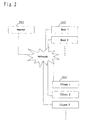
- FIG. 2 is a view showing a configuration of a medical information system in accordance with a first preferred embodiment of the present invention.
- the medical information system comprises patient terminal devices (hereafter simply referred to as clients) 201, a central control device (hereafter simply referred to as a server) 203 and administrator terminal devices (hereafter simply referred to as hosts) 202, and the above-mentioned clients 201, the above-mentioned server 203 and the above-mentioned hosts 202 are connected on a network.
- an administrator who uses the host 202 is a doctor or a nurse.
- the above-mentioned client 201 has sensors having functions of measuring vital information serving as the indicators of the health condition of a patient, a means of transferring the above-mentioned vital information obtained by the above-mentioned sensors to the inside of the above-mentioned client and a means of transferring the above-mentioned vital information from the above-mentioned sensors to the above-mentioned server 203 via the network.
- the above-mentioned server 203 has a means of storing the above-mentioned vital information transferred from the above-mentioned client 201 and arranging the information to information having anonymity, and the above-mentioned host 202 has a means of browsing the whole or part of the above-mentioned vital information stored or arranged in the above-mentioned server 203.
- FIG. 19 is a view showing a configuration of the client 201.
- a patient designates which sensor should be used; on the basis of this input, an control board 1902 extracts data regarding the method of using the sensor from a storage device 1903, and a display device 1905 displays the method of using the sensor.
- the patient takes measurement by using the sensor in accordance with the instructions at the display device 1905 and obtains vital information.
- the above-mentioned sensors designate a thermometer, a sphygmomanometer, an oxymeter, a blood glucose level meter, an electrocardiograph, a body weight/fat scale, a stethoscope and a camera shown in FIG. 19, and include at least one of these.
- the vital information obtained by the above-mentioned sensors is converted into a designated data sequence at a sensor interface 1901, the above-mentioned vital information is received by the control board 1902, and the vital information is stored in the storage device 1903 and displayed by the display device 1905 at the same time.
- the vital information from the sensors can be received directly by the control board 1902.
- the above-mentioned vital information stored in the storage device 1903 of the client 201 is transferred to the server 202 via a network I/F (an abbreviation for interface) 1906.
- the input device 1904 includes at least one of a touch panel, a keyboard, a mouse and a voice input
- the storage device 1903 includes at least one of a hard disk and a flash memory
- the network I/F 1906 includes at least one of an analog modem, an xDSL modem, a cable modem and an Ethernet adaptor.
- the client 201 realizes the function of a videoconference with the host 202, it is required to be provided with a camera, a microphone and a speaker.
- FIG. 20 is a view showing a configuration of the host 202.
- the host 202 is provided with a camera, a microphone and a speaker.
- a control board In addition, it is also provided with a control board, a display device, a storage device and an input device.
- FIG. 21 is a view showing a configuration of the server 203. It is provided with an interface for communication with the network, in addition to a control board, a display device, a storage device and an input device.
- FIG. 1 is a flowchart for the medical information system having the configuration shown in FIG. 2.
- a patient measures vital information by using the client 201, and the above-mentioned vital information is stored in the inside of the client.
- the above-mentioned vital information is transferred to the server 203.
- the transferred above-mentioned vital information is stored and arranged in the server 203.
- the stored vital information is displayed only as statistical data. This is because, if the vital information is opened wholly, it is expected that human rights be violated significantly owing to an invasion of privacy. Hence, instead of personal level data, statistically processed data is browsed, whereby anonymity is secured, the issue of the invasion of privacy is avoided, and anyone is allowed to browse the tendency of the vital information.
- FIG. 3 is a detailed flowchart for step #104, and the process thereof starts after an administrator (a doctor or a nurse) wishing to browse the statistical data of the vital information makes a connection to the network by using the host 202 used as an example of the data browsing terminal device of the present invention and logs in to the server 203.
- an administrator a doctor or a nurse
- FIG. 3 is a detailed flowchart for step #104, and the process thereof starts after an administrator (a doctor or a nurse) wishing to browse the statistical data of the vital information makes a connection to the network by using the host 202 used as an example of the data browsing terminal device of the present invention and logs in to the server 203.
- the vital information to be browsed for example, one of body temperature, blood pressure and blood glucose level, is selected.
- the conditions of the vital information desired to be browsed are set.
- FIG. 4 is a detailed flowchart for step #302.
- the age, sex, region, location, period (schedule), measurement time and condition of a patient are set as conditions.
- the statistical data depending on the input conditions is output.
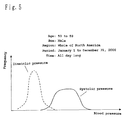
- FIG. 5 shows an output example of the statistical data in the case when blood pressure is selected as the vital information.
- FIG. 6 shows an output example of the statistical data regarding the amount of breakfast taken by the patients. This data regarding the amount of breakfast is included in the vital information of the present information, and is supposed to be self-stated by people.
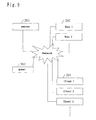
- FIG. 9 is a view showing a configuration of a medical information system in accordance with a second preferred embodiment of the present invention.
- a terminal device 901 (hereafter simply referred to as a guest) is connected to the network of the medical information system as an example of the data browsing terminal device of the present invention.
- an administrator a doctor or a nurse
- a third party hereafter simply referred to as a user
- a user not a patient or an administrator, that is, for example, a pharmaceutical researcher or the like, desires to brows the statistical data in some cases. In such a case, it is necessary to restrict the browsing of the statistical data or to charge money.
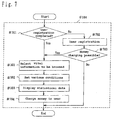
- FIG. 7 is a detailed flowchart for step #104.
- data browsing is available at no charge; however, the flowchart shown in FIG. 7 differs in that a money charging process is added thereto.
- step #701 a confirmation is made as to whether a user wishing to browse the statistical data of vital information has made registration or not. If registration has been made, the sequence advances to step #301; if no registration has been made, the sequence advances to step #702. At step #702, user registration is made, and the money charging information for the user is collected.
- the money charging information represents a credit card number, the personal identification number for a bank account, electronic money and the like.
- step #703 a judgment is made as to whether money charging is possible or not according to the money charging information obtained by the user registration; if money charging is possible, the sequence advances to step #301; if money charging is impossible, the processing ends.
- steps #301, #302 and #303 are omitted since they are similar to those given above.
- money is charged to the user at step #704.
- the money charging is performed depending on the amount of the statistical data having been browsed.
- FIG. 8 is a detailed flowchart of another example for step #104. In the flowchart shown in FIG. 7, money is charged to a user; however in FIG. 8, money is charged to an advertiser.
- step #303 the statistical data is displayed, and advertisement data is also displayed.
- step #802 the number of times the advertisement data is displayed is counted in a constant period (for example, one month).
- step #803 money is charged to the advertiser depending on the number of display times.
- FIG. 11 is a view showing a configuration of a medical information system in accordance with a third preferred embodiment of the present invention. This differs from FIG. 2 in that a medicine control terminal device 1101 (hereafter simply referred to as a medicine server) is connected.
- a medicine control terminal device 1101 hereafter simply referred to as a medicine server
- This medicine server 1101 is installed at a pharmacy, a pharmaceutical company, etc.
- the device holds a database regarding medicines and can receive and place orders for medicines.
- This medicine server 1101 is installed at a pharmacy, for example.
- FIG. 10 is a flowchart for a medicine order reception/placement system in the medical information system shown in FIG. 11. This flowchart starts after a doctor or a nurse conducts a diagnosis of a patient.
- prescription information information regarding a necessary medicine (hereafter referred to as prescription information) is input by using the host 202 and stored in the server 203.
- this prescription information is transferred to the client 201 and the medicine server 1101.
- the patient having received the prescription information from the client 201 makes a judgment as to whether to purchase the medicine in accordance with the direction thereof or not.
- a request for the purchase is sent from the client 201 to the medicine server 1101, and the sequence advances to step #1004.
- the processing ends.
- the pharmacy prepares the medicine on the basis of the prescription information in the medicine server 1101 and sends the medicine to the patient by a door-to-door delivery service or the like.
- the pharmacy charges money for the medicine to the patient.
- This kind of medicine order reception/placement system saves the patient from taking trouble in getting the medicine and shortens the time for getting the medicine. Furthermore, when the patient purchases a medicine that does not require prescription information, it is possible to use a system wherein the flowchart shown in FIG. 10 begins with the step #1003, and the patient purchases the medicine online.
- FIG. 12 is a flowchart for the registration and browsing of the information on the effects and side effects of a medicine in the medical information system shown in FIG. 11. This flowchart starts when a patient diagnosed by a doctor receives a prescription and takes a medicine. In some cases, however, this flowchart may start when a patient purchases a medicine by himself at a pharmacy without being diagnosed by a doctor.
- the patient takes the medicine in accordance with the prescription information.
- a judgment is made as to whether the medicine taken by the patient has noteworthy effects or side effects.
- step #1203 If there are effects or side effects, the sequence advances to step #1203; otherwise, the processing ends.
- the patient inputs the information on the effects and side effects of the medicine in the client 201. Furthermore, the patient inputs the medicine under consideration and the amount of the medicine having been taken. Examples of the side effects include conditions, such as headache, stomachache and nausea, and also include the degree of pain. Examples of the effects include the stoppage of bleeding, the reduction of pain and the like.
- the input information on the effects and side effects of the medicine is transferred from the client 201 to the server 203.
- Step #1205 is processed by the server 203; the transferred information on the effects and side effects of the medicine is stored, arranged and processed statistically, thereby making it possible for the user to browse the information as statistical data.
- the statistically processed data By allowing the statistically processed data to be browsed, anonymity is secured, thereby avoiding the issue of the invasion of privacy.
- Step #1206 is processed by the user; the user browses the above-mentioned statistical data; in the case where money is charged for the browsing, money charging is performed.
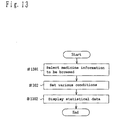
- FIG. 13 is a detailed flowchart for the above-mentioned step #1206; the process thereof starts after a doctor or a nurse wishing to browse the statistical data of the information on the effects and side effects of a medicine makes a connection to the network by using the host 202 as an example of a data browsing terminal device and logs in to the server 203.
- a medicine to be browsed is selected.
- conditions for the information on the effects and side effects of the medicine to be browsed are set. The explanation regarding this condition setting is omitted since it is similar to that described above.
- step #1302 the statistical data of the information on the effects and side effects of the medicine is displayed on the basis of the input conditions.
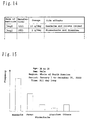
- FIG. 14 shows examples of the information on the side effects of medicines, and the names of the selected medicines and the conditions due to the side effects caused by taking the medicines are described.
- FIG. 15 also shows examples of the information on the side effects of a medicine. The frequencies of the side effects on the basis of the input conditions are indicated visually.
- the effects and side effects of the medicines taken by patients are indicated as statistical data, whereby the data can be used as a reference for the future development of medicines.
- FIG. 18 is a view showing a configuration of a medical information system in accordance with a fourth preferred embodiment of the present invention. This differs from FIG. 11 in that, in addition to the hosts 202 used by doctors and nurses, a data browsing terminal device 901 (hereafter simply referred to as a guest) is connected as an example of the data browsing terminal device of the present invention.
- a data browsing terminal device 901 hereafter simply referred to as a guest
- an administrator browses the statistical data by using the host 202; however, a third party (hereafter simply referred to as a user), not a patient or an administrator, that is, for example, a pharmaceutical researcher or the like, desires to browse the statistical data in some cases. In such a case, it is necessary to restrict the browsing of the statistical data or to charge money.
- a third party hereafter simply referred to as a user
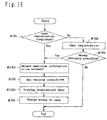
- FIG. 16 is a detailed flowchart for step #1206.
- data browsing is available at no charge; however, the flowchart shown in FIG. 16 differs in that a charging process is added thereto.
- the explanation for the flowchart is omitted since it is almost similar to the explanation for the above-mentioned FIG. 7.
- FIG. 17 is a detailed flowchart for step #104.
- money is charged to the user; however, in FIG. 17, money is charged to the advertiser.
- the explanation for the flowchart is omitted since it is almost similar to that for the above-mentioned FIG. 8.
- the difference is that the vital information is handled in FIG. 8 but the information on the effects and side effects of a medicine is handled in FIG. 17.
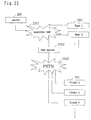
- FIG. 22 is a view showing a network configuration of the medical information system in accordance with the first preferred embodiment of the present invention.
- FIG. 2 only the fact that the server, hosts and clients are connected to the network is explained; however, the detailed network configuration thereof is not mentioned; in FIG. 22, a case wherein the server 203 is installed in a local area network 2201 in a hospital (hereafter simply referred to as a Hospital LAN) is described.
- a hospital hereafter simply referred to as a Hospital LAN
- the client 201 is connected to a public switched telephone network 2202 (hereafter simply referred to as a PSTN), and vital information is transferred to the server.
- PSTN 2202 herein mainly designates an analog telephone network; however, the network may be replaced with a digital telephone network, a cable television network, an Ethernet network, etc.
- a remote access server 2203 (hereafter simply referred to as an RAS server) is installed to receive communication from the client.
- the RAS server 2203 performs authentication (validation of user name and password) for the connection of the client to the Hospital LAN 2201.
- FIG. 23 is a view showing a configuration of a medical information system in accordance with a fifth preferred embodiment of the present invention. This differs from FIG. 22 in that, although the server in FIG. 22 is installed in the Hospital LAN 2201, the server in FIG. 23 is installed in an Internet service provider's local area network 2304 (hereafter simply referred to as an ISP LAN). Installing the server 203 in the ISP LAN 2304 has advantages that software and hardware can be upgraded and maintained promptly. However, a data replication terminal device 2301 (hereafter simply referred to as a mirror server) for storing the same data as that stored in the server 203 is also installed in the Hospital LAN 2201.
- a data replication terminal device 2301 hereafter simply referred to as a mirror server
- the Hospital LAN 2201 is connected to the ISP LAN 2304 through the Internet (hereafter simply referred to as the Internet), and a firewall 2303 for ensuring security (hereafter simply referred to as a FireWall) is installed at the entrance of each LAN.
- the Internet hereafter simply referred to as the Internet
- a firewall 2303 for ensuring security hereafter simply referred to as a FireWall
- the present invention relates to programs for allowing a computer to carry out the functions of all or parts of the devices or means of the medical information system and the patient terminal devices of the present invention described above, wherein the programs work in cooperation with the computer.
- the present invention relates to a medium holding programs for allowing a computer to carry out all or parts of the functions of all or parts of the devices or means of the medical information system and the patient terminal devices of the present invention described above, wherein the medium can be read by a computer and the above-mentioned programs read by the computer carry out the above-mentioned functions in cooperation with the computer.
- the parts of the devices or means of the present invention designate some devices or means in the plurality of devices or means, or designate parts of functions in one device or means.
- a recording medium on which the programs of the present invention are recorded and which can be read by a computer is also included in the present invention.
- a utilization embodiment of the programs of the present invention may be an embodiment that is recorded on a recording medium readable by a computer and operates in cooperation with the computer.
- a utilization embodiment of the programs of the present invention may be an embodiment that is transmitted through a transmission medium, is read by a computer and operates in cooperation with the computer.
- the recording medium includes ROM and the like
- the transmission medium includes transmission media, such as the Internet, light, radio wave and sound wave.
- the computer of the present invention described above may include not only pure hardware, such as a CPU, but also firmware and OS, and may further include peripheral devices.
- the configuration of the present invention may be realized by software or realized by hardware.
- the present invention can realize a system capable of easily browsing data, such as the vital information of patients.
Landscapes
- Health & Medical Sciences (AREA)
- Engineering & Computer Science (AREA)
- General Health & Medical Sciences (AREA)
- Medical Informatics (AREA)
- Public Health (AREA)
- Business, Economics & Management (AREA)
- Life Sciences & Earth Sciences (AREA)
- Primary Health Care (AREA)
- Epidemiology (AREA)
- Biomedical Technology (AREA)
- Physics & Mathematics (AREA)
- Strategic Management (AREA)
- Human Resources & Organizations (AREA)
- General Business, Economics & Management (AREA)
- Entrepreneurship & Innovation (AREA)
- Chemical & Material Sciences (AREA)
- Bioinformatics & Cheminformatics (AREA)
- Medicinal Chemistry (AREA)
- Tourism & Hospitality (AREA)
- Molecular Biology (AREA)
- Theoretical Computer Science (AREA)
- Animal Behavior & Ethology (AREA)
- Surgery (AREA)
- Veterinary Medicine (AREA)
- General Physics & Mathematics (AREA)
- Marketing (AREA)
- Heart & Thoracic Surgery (AREA)
- Pathology (AREA)
- Biophysics (AREA)
- Economics (AREA)
- Data Mining & Analysis (AREA)
- Operations Research (AREA)
- Quality & Reliability (AREA)
- Computer Networks & Wireless Communication (AREA)
- Toxicology (AREA)
- Pharmacology & Pharmacy (AREA)
- Child & Adolescent Psychology (AREA)
- Cardiology (AREA)
- Physiology (AREA)
- Medical Treatment And Welfare Office Work (AREA)
Applications Claiming Priority (3)
| Application Number | Priority Date | Filing Date | Title |
|---|---|---|---|
| JP2000214470A JP2002032488A (ja) | 2000-07-14 | 2000-07-14 | 医療情報システム、患者用端末装置、媒体 |
| JP2000214470 | 2000-07-14 | ||
| PCT/JP2001/006035 WO2002007025A1 (en) | 2000-07-14 | 2001-07-12 | Medical information system, patient-use terminal device, medium |
Publications (1)
| Publication Number | Publication Date |
|---|---|
| EP1304635A1 true EP1304635A1 (de) | 2003-04-23 |
Family
ID=18710039
Family Applications (1)
| Application Number | Title | Priority Date | Filing Date |
|---|---|---|---|
| EP01947982A Withdrawn EP1304635A1 (de) | 2000-07-14 | 2001-07-12 | Medizinisches informationssystem, terminal zur benutzung durch den patienten, medium |
Country Status (7)
| Country | Link |
|---|---|
| US (1) | US20030014283A1 (de) |
| EP (1) | EP1304635A1 (de) |
| JP (1) | JP2002032488A (de) |
| KR (1) | KR20020033800A (de) |
| CN (1) | CN1388939A (de) |
| TW (1) | TWI221999B (de) |
| WO (1) | WO2002007025A1 (de) |
Families Citing this family (19)
| Publication number | Priority date | Publication date | Assignee | Title |
|---|---|---|---|---|
| JP2002083058A (ja) * | 2000-09-06 | 2002-03-22 | Yokogawa Electric Corp | 広域医療情報システム |
| US8150710B2 (en) | 2002-02-08 | 2012-04-03 | Panasonic Corporation | Medical information system |
| AU2002230188A1 (en) * | 2002-02-08 | 2003-09-02 | Matsushita Electric Industrial Co., Ltd. | Medical information system |
| CN1806252B (zh) | 2003-06-18 | 2010-10-27 | 松下电器产业株式会社 | 生物学信息利用系统及生物学信息利用方法 |
| US20050086079A1 (en) * | 2003-09-19 | 2005-04-21 | Graves Alan F. | Integrated and secure architecture for delivery of communications services in a hospital |
| US20080209513A1 (en) * | 2003-09-19 | 2008-08-28 | Nortel Networks Limited | Systems and methods for preventing an attack on healthcare data processing resources in a hospital information system |
| US7430671B2 (en) * | 2004-03-31 | 2008-09-30 | Nortel Networks Limited | Systems and methods for preserving confidentiality of sensitive information in a point-of-care communications environment |
| US7376836B2 (en) * | 2003-09-19 | 2008-05-20 | Nortel Networks Limited | Systems and methods for preventing an attack on healthcare data processing resources in a hospital information system |
| US20070154889A1 (en) * | 2004-06-25 | 2007-07-05 | Veridex, Llc | Methods and reagents for the detection of melanoma |
| US9436931B2 (en) * | 2006-09-29 | 2016-09-06 | Intel Corporation | Remote prompting infrastructure |
| CN102831294B (zh) * | 2007-08-10 | 2016-08-17 | 施曼信医疗Asd公司 | 一种在服务器处确定医疗设备的操作能力的方法和系统 |
| JP2010017410A (ja) * | 2008-07-11 | 2010-01-28 | Fujifilm Corp | 類似症例画像検索システム及び類似症例画像検索装置 |
| KR101134504B1 (ko) * | 2010-07-30 | 2012-04-13 | 엘지전자 주식회사 | 임상 의사 결정을 지원하는 단말기, 이를 이용한 복약 관리 방법, 및 상기 복약 관리 방법을 실행하기 위한 프로그램을 저장하는 기록 매체 |
| JP2014123279A (ja) * | 2012-12-21 | 2014-07-03 | Psp Corp | 電子お薬手帳による健康管理システム |
| EP3069314A4 (de) * | 2013-11-14 | 2017-06-14 | Elwha, Llc | Vorrichtungen, systeme und verfahren zur automatisierten ausgabe medizinischer produkte oder dienstleistungen |
| CN104083162A (zh) * | 2014-07-22 | 2014-10-08 | 河海大学常州校区 | 一种患者生理特征数据监测系统及其工作方法 |
| JP6489624B2 (ja) * | 2017-05-09 | 2019-03-27 | Nl技研株式会社 | 通信機器 |
| KR102490966B1 (ko) * | 2019-06-14 | 2023-01-26 | 서울대학교병원 | 생체신호에 기초한 의료서비스 지원 및 데이터베이스 구축 시스템 |
| KR102434367B1 (ko) * | 2021-11-05 | 2022-08-22 | 주식회사 에이치엠씨네트웍스 | 비대면 진료 상담 서비스를 제공하는 방법 및 장치 |
Family Cites Families (15)
| Publication number | Priority date | Publication date | Assignee | Title |
|---|---|---|---|---|
| JPH06215011A (ja) * | 1992-11-26 | 1994-08-05 | Chuo Computer Syst Kk | 個体別情報開示閲覧方法及びその実施装置 |
| US5737539A (en) * | 1994-10-28 | 1998-04-07 | Advanced Health Med-E-Systems Corp. | Prescription creation system |
| JP3493847B2 (ja) * | 1995-11-15 | 2004-02-03 | 株式会社日立製作所 | 広域医療情報システム |
| JPH09319451A (ja) * | 1996-05-28 | 1997-12-12 | Hitachi Ltd | 計算機ソフトウェアの使用料金決定装置及び使用権管理装置 |
| JPH10124601A (ja) * | 1996-10-22 | 1998-05-15 | Kdk Corp | 分散型健康管理システム |
| DE69715255T2 (de) * | 1996-07-16 | 2003-05-08 | Kyoto Daiichi Kagaku Co. Ltd., Kyoto | Verteilte überwachungs-/mess-anordnung zur gesundheitsversorgung |
| US5966126A (en) * | 1996-12-23 | 1999-10-12 | Szabo; Andrew J. | Graphic user interface for database system |
| US6532459B1 (en) * | 1998-12-15 | 2003-03-11 | Berson Research Corp. | System for finding, identifying, tracking, and correcting personal information in diverse databases |
| JP3029829B2 (ja) * | 1999-02-04 | 2000-04-10 | 株式会社望星薬局 | 医薬品等販売システム |
| US6264614B1 (en) * | 1999-08-31 | 2001-07-24 | Data Critical Corporation | System and method for generating and transferring medical data |
| US20010039504A1 (en) * | 2000-03-15 | 2001-11-08 | Linberg Kurt R. | Individualized, integrated and informative internet portal for holistic management of patients with implantable devices |
| US6760731B2 (en) * | 2000-03-15 | 2004-07-06 | Kent W. Huff | Genealogy registry system |
| US6988075B1 (en) * | 2000-03-15 | 2006-01-17 | Hacker L Leonard | Patient-controlled medical information system and method |
| JP2001275997A (ja) * | 2000-03-29 | 2001-10-09 | Ntt Me Corp | 健康管理情報システム |
| US20020107700A1 (en) * | 2000-05-19 | 2002-08-08 | Cooney John Barry | System and process for capturing, storing, maintaining and reporting information regarding databases via the internet |
-
2000
- 2000-07-14 JP JP2000214470A patent/JP2002032488A/ja active Pending
-
2001
- 2001-07-12 CN CN01802594A patent/CN1388939A/zh active Pending
- 2001-07-12 WO PCT/JP2001/006035 patent/WO2002007025A1/ja not_active Ceased
- 2001-07-12 US US10/088,189 patent/US20030014283A1/en not_active Abandoned
- 2001-07-12 EP EP01947982A patent/EP1304635A1/de not_active Withdrawn
- 2001-07-12 KR KR1020027003374A patent/KR20020033800A/ko not_active Ceased
- 2001-07-13 TW TW090117227A patent/TWI221999B/zh not_active IP Right Cessation
Non-Patent Citations (1)
| Title |
|---|
| See references of WO0207025A1 * |
Also Published As
| Publication number | Publication date |
|---|---|
| CN1388939A (zh) | 2003-01-01 |
| TWI221999B (en) | 2004-10-11 |
| WO2002007025A1 (en) | 2002-01-24 |
| US20030014283A1 (en) | 2003-01-16 |
| KR20020033800A (ko) | 2002-05-07 |
| JP2002032488A (ja) | 2002-01-31 |
Similar Documents
| Publication | Publication Date | Title |
|---|---|---|
| EP1304635A1 (de) | Medizinisches informationssystem, terminal zur benutzung durch den patienten, medium | |
| US20210251486A1 (en) | System and method for integration of telemedicine into multimedia video visitation systems in correctional facilities | |
| CA2432141C (en) | Computer oriented record administration system | |
| US20100250278A1 (en) | Method and system for providing medical assistance to a traveler | |
| US20030149593A1 (en) | Health-care system | |
| US20040006488A1 (en) | Creation of a database containing personal health care profiles | |
| US20170330298A1 (en) | Systems and Methods for Reducing Medical Claims Fraud | |
| US20050075907A1 (en) | Emergency station kiosk and related methods | |
| US20070041626A1 (en) | Healthcare administration communication systems and methods | |
| JP5845235B2 (ja) | 病院利用支援システム | |
| WO2004053638A2 (en) | Method for remote medical consultation and care | |
| EP1521200A2 (de) | Verfahren und Vorrichtung zur Bereitstellung von medizinischen Daten | |
| JP2002032484A (ja) | 健康管理システム、健康管理方法および健康管理用プログラムを記録した記録媒体 | |
| US20180322248A1 (en) | Mobile interoperable personal health information exchange with biometrics data analytics | |
| US20130132113A1 (en) | Method and system for distributing community-based health service information | |
| JP2003141251A (ja) | 診断投薬方法及び診断投薬システム | |
| JP7236514B1 (ja) | 情報提供システム、情報提供方法 | |
| US20200272761A1 (en) | Software having control logic for secure transmission of personal data via the internet from computers to the server, with secure storage of the data on servers | |
| JPWO2019224971A1 (ja) | サーバ装置、およびサービス提供システム | |
| KR20220086491A (ko) | 구간별 블랙박스를 이용한 병원정보시스템과 외부서비스의 인증장치 및 방법 | |
| KR20040012155A (ko) | 통신망을 통해 원격으로 건강을 진단하고 처방하는동양의학 처방진단 서비스 방법 및 그 시스템 | |
| CA3024149C (en) | System and method for integration of telemedicine into multimedia video visitation systems in correctional facilities | |
| JP2003076782A (ja) | 医療機関予約システムおよびサーバおよびプログラム | |
| JP2003067502A (ja) | ヘルスケア管理システム | |
| JP2003076781A (ja) | 随時診察受付システム |
Legal Events
| Date | Code | Title | Description |
|---|---|---|---|
| PUAI | Public reference made under article 153(3) epc to a published international application that has entered the european phase |
Free format text: ORIGINAL CODE: 0009012 |
|
| 17P | Request for examination filed |
Effective date: 20020619 |
|
| AK | Designated contracting states |
Designated state(s): AT BE CH CY DE DK ES FI FR GB GR IE IT LI LU MC NL PT SE TR |
|
| RBV | Designated contracting states (corrected) |
Designated state(s): AT BE CH CY DE FR GB LI |
|
| STAA | Information on the status of an ep patent application or granted ep patent |
Free format text: STATUS: THE APPLICATION HAS BEEN WITHDRAWN |
|
| 18W | Application withdrawn |
Effective date: 20070604 |