EP1301271B1 - Katalysator zum abbau von distickstoffoxid sowie methode zur durchführung von verfahren, welche die bildung von distickstoffoxid beinhalten - Google Patents
Katalysator zum abbau von distickstoffoxid sowie methode zur durchführung von verfahren, welche die bildung von distickstoffoxid beinhalten Download PDFInfo
- Publication number
- EP1301271B1 EP1301271B1 EP01958644A EP01958644A EP1301271B1 EP 1301271 B1 EP1301271 B1 EP 1301271B1 EP 01958644 A EP01958644 A EP 01958644A EP 01958644 A EP01958644 A EP 01958644A EP 1301271 B1 EP1301271 B1 EP 1301271B1
- Authority
- EP
- European Patent Office
- Prior art keywords
- catalyst
- cerium oxide
- oxide
- mol
- cobalt
- Prior art date
- Legal status (The legal status is an assumption and is not a legal conclusion. Google has not performed a legal analysis and makes no representation as to the accuracy of the status listed.)
- Expired - Lifetime
Links
- 239000003054 catalyst Substances 0.000 title claims abstract description 121
- 238000000034 method Methods 0.000 title claims abstract description 28
- 230000008569 process Effects 0.000 title claims abstract description 17
- 230000015572 biosynthetic process Effects 0.000 title abstract description 4
- GQPLMRYTRLFLPF-UHFFFAOYSA-N Nitrous Oxide Chemical compound [O-][N+]#N GQPLMRYTRLFLPF-UHFFFAOYSA-N 0.000 title description 143
- 239000001272 nitrous oxide Substances 0.000 title description 64
- MCMNRKCIXSYSNV-UHFFFAOYSA-N Zirconium dioxide Chemical compound O=[Zr]=O MCMNRKCIXSYSNV-UHFFFAOYSA-N 0.000 claims abstract description 40
- QGZKDVFQNNGYKY-UHFFFAOYSA-N Ammonia Chemical compound N QGZKDVFQNNGYKY-UHFFFAOYSA-N 0.000 claims abstract description 28
- 239000000203 mixture Substances 0.000 claims abstract description 23
- 238000000354 decomposition reaction Methods 0.000 claims abstract description 21
- 229910000420 cerium oxide Inorganic materials 0.000 claims abstract description 20
- BMMGVYCKOGBVEV-UHFFFAOYSA-N oxo(oxoceriooxy)cerium Chemical compound [Ce]=O.O=[Ce]=O BMMGVYCKOGBVEV-UHFFFAOYSA-N 0.000 claims abstract description 20
- 230000003647 oxidation Effects 0.000 claims abstract description 19
- 238000007254 oxidation reaction Methods 0.000 claims abstract description 19
- 229910052782 aluminium Inorganic materials 0.000 claims abstract description 18
- 229910017052 cobalt Inorganic materials 0.000 claims abstract description 17
- 239000010941 cobalt Substances 0.000 claims abstract description 17
- GUTLYIVDDKVIGB-UHFFFAOYSA-N cobalt atom Chemical compound [Co] GUTLYIVDDKVIGB-UHFFFAOYSA-N 0.000 claims abstract description 17
- 229910021529 ammonia Inorganic materials 0.000 claims abstract description 14
- 229910052742 iron Inorganic materials 0.000 claims abstract description 11
- WNLRTRBMVRJNCN-UHFFFAOYSA-N adipic acid Chemical compound OC(=O)CCCCC(O)=O WNLRTRBMVRJNCN-UHFFFAOYSA-N 0.000 claims description 8
- 239000001361 adipic acid Substances 0.000 claims description 4
- 235000011037 adipic acid Nutrition 0.000 claims description 4
- 238000002360 preparation method Methods 0.000 claims description 4
- 238000010521 absorption reaction Methods 0.000 claims description 3
- 239000007789 gas Substances 0.000 abstract description 27
- MWUXSHHQAYIFBG-UHFFFAOYSA-N Nitric oxide Chemical compound O=[N] MWUXSHHQAYIFBG-UHFFFAOYSA-N 0.000 description 32
- 230000000694 effects Effects 0.000 description 27
- 238000012360 testing method Methods 0.000 description 24
- 229910000422 cerium(IV) oxide Inorganic materials 0.000 description 22
- CETPSERCERDGAM-UHFFFAOYSA-N ceric oxide Chemical compound O=[Ce]=O CETPSERCERDGAM-UHFFFAOYSA-N 0.000 description 21
- 238000006243 chemical reaction Methods 0.000 description 19
- CPLXHLVBOLITMK-UHFFFAOYSA-N magnesium oxide Inorganic materials [Mg]=O CPLXHLVBOLITMK-UHFFFAOYSA-N 0.000 description 19
- 239000000463 material Substances 0.000 description 12
- 239000012071 phase Substances 0.000 description 12
- XEEYBQQBJWHFJM-UHFFFAOYSA-N Iron Chemical compound [Fe] XEEYBQQBJWHFJM-UHFFFAOYSA-N 0.000 description 11
- 239000000395 magnesium oxide Substances 0.000 description 11
- 229910052596 spinel Inorganic materials 0.000 description 11
- 239000011029 spinel Substances 0.000 description 11
- VYPSYNLAJGMNEJ-UHFFFAOYSA-N Silicium dioxide Chemical compound O=[Si]=O VYPSYNLAJGMNEJ-UHFFFAOYSA-N 0.000 description 8
- GRYLNZFGIOXLOG-UHFFFAOYSA-N Nitric acid Chemical compound O[N+]([O-])=O GRYLNZFGIOXLOG-UHFFFAOYSA-N 0.000 description 7
- 229910000428 cobalt oxide Inorganic materials 0.000 description 7
- IVMYJDGYRUAWML-UHFFFAOYSA-N cobalt(ii) oxide Chemical compound [Co]=O IVMYJDGYRUAWML-UHFFFAOYSA-N 0.000 description 7
- 238000011068 loading method Methods 0.000 description 7
- 229910044991 metal oxide Inorganic materials 0.000 description 7
- 150000004706 metal oxides Chemical class 0.000 description 7
- 229910017604 nitric acid Inorganic materials 0.000 description 7
- IJGRMHOSHXDMSA-UHFFFAOYSA-N Atomic nitrogen Chemical compound N#N IJGRMHOSHXDMSA-UHFFFAOYSA-N 0.000 description 6
- OKKJLVBELUTLKV-UHFFFAOYSA-N Methanol Chemical compound OC OKKJLVBELUTLKV-UHFFFAOYSA-N 0.000 description 6
- PNEYBMLMFCGWSK-UHFFFAOYSA-N aluminium oxide Inorganic materials [O-2].[O-2].[O-2].[Al+3].[Al+3] PNEYBMLMFCGWSK-UHFFFAOYSA-N 0.000 description 6
- 230000003197 catalytic effect Effects 0.000 description 6
- 229910001387 inorganic aluminate Inorganic materials 0.000 description 6
- 239000004411 aluminium Substances 0.000 description 5
- XAGFODPZIPBFFR-UHFFFAOYSA-N aluminium Chemical compound [Al] XAGFODPZIPBFFR-UHFFFAOYSA-N 0.000 description 5
- 229930195733 hydrocarbon Natural products 0.000 description 5
- 150000002430 hydrocarbons Chemical class 0.000 description 5
- 238000004519 manufacturing process Methods 0.000 description 5
- UGFAIRIUMAVXCW-UHFFFAOYSA-N Carbon monoxide Chemical compound [O+]#[C-] UGFAIRIUMAVXCW-UHFFFAOYSA-N 0.000 description 4
- 239000012072 active phase Substances 0.000 description 4
- BASFCYQUMIYNBI-UHFFFAOYSA-N platinum Chemical compound [Pt] BASFCYQUMIYNBI-UHFFFAOYSA-N 0.000 description 4
- 239000000377 silicon dioxide Substances 0.000 description 4
- QVGXLLKOCUKJST-UHFFFAOYSA-N atomic oxygen Chemical compound [O] QVGXLLKOCUKJST-UHFFFAOYSA-N 0.000 description 3
- 229910002091 carbon monoxide Inorganic materials 0.000 description 3
- UBEWDCMIDFGDOO-UHFFFAOYSA-N cobalt(II,III) oxide Inorganic materials [O-2].[O-2].[O-2].[O-2].[Co+2].[Co+3].[Co+3] UBEWDCMIDFGDOO-UHFFFAOYSA-N 0.000 description 3
- 229910001701 hydrotalcite Inorganic materials 0.000 description 3
- 229960001545 hydrotalcite Drugs 0.000 description 3
- 239000011777 magnesium Substances 0.000 description 3
- 229910052751 metal Inorganic materials 0.000 description 3
- 239000002184 metal Substances 0.000 description 3
- 229910000480 nickel oxide Inorganic materials 0.000 description 3
- 229910052757 nitrogen Inorganic materials 0.000 description 3
- GNRSAWUEBMWBQH-UHFFFAOYSA-N oxonickel Chemical compound [Ni]=O GNRSAWUEBMWBQH-UHFFFAOYSA-N 0.000 description 3
- 239000001301 oxygen Substances 0.000 description 3
- 229910052760 oxygen Inorganic materials 0.000 description 3
- 239000002243 precursor Substances 0.000 description 3
- 230000009467 reduction Effects 0.000 description 3
- 238000006722 reduction reaction Methods 0.000 description 3
- XKRFYHLGVUSROY-UHFFFAOYSA-N Argon Chemical compound [Ar] XKRFYHLGVUSROY-UHFFFAOYSA-N 0.000 description 2
- QPLDLSVMHZLSFG-UHFFFAOYSA-N Copper oxide Chemical compound [Cu]=O QPLDLSVMHZLSFG-UHFFFAOYSA-N 0.000 description 2
- 229910052776 Thorium Inorganic materials 0.000 description 2
- BLJNPOIVYYWHMA-UHFFFAOYSA-N alumane;cobalt Chemical compound [AlH3].[Co] BLJNPOIVYYWHMA-UHFFFAOYSA-N 0.000 description 2
- 230000008901 benefit Effects 0.000 description 2
- 238000001354 calcination Methods 0.000 description 2
- 238000010531 catalytic reduction reaction Methods 0.000 description 2
- 239000003638 chemical reducing agent Substances 0.000 description 2
- CRHLEZORXKQUEI-UHFFFAOYSA-N dialuminum;cobalt(2+);oxygen(2-) Chemical compound [O-2].[O-2].[O-2].[O-2].[O-2].[Al+3].[Al+3].[Co+2].[Co+2] CRHLEZORXKQUEI-UHFFFAOYSA-N 0.000 description 2
- GDVKFRBCXAPAQJ-UHFFFAOYSA-A dialuminum;hexamagnesium;carbonate;hexadecahydroxide Chemical compound [OH-].[OH-].[OH-].[OH-].[OH-].[OH-].[OH-].[OH-].[OH-].[OH-].[OH-].[OH-].[OH-].[OH-].[OH-].[OH-].[Mg+2].[Mg+2].[Mg+2].[Mg+2].[Mg+2].[Mg+2].[Al+3].[Al+3].[O-]C([O-])=O GDVKFRBCXAPAQJ-UHFFFAOYSA-A 0.000 description 2
- 239000004615 ingredient Substances 0.000 description 2
- 238000011835 investigation Methods 0.000 description 2
- 238000009533 lab test Methods 0.000 description 2
- AXZKOIWUVFPNLO-UHFFFAOYSA-N magnesium;oxygen(2-) Chemical compound [O-2].[Mg+2] AXZKOIWUVFPNLO-UHFFFAOYSA-N 0.000 description 2
- NUJOXMJBOLGQSY-UHFFFAOYSA-N manganese dioxide Chemical compound O=[Mn]=O NUJOXMJBOLGQSY-UHFFFAOYSA-N 0.000 description 2
- 150000002823 nitrates Chemical class 0.000 description 2
- -1 oxide Chemical class 0.000 description 2
- 239000002245 particle Substances 0.000 description 2
- 229910052697 platinum Inorganic materials 0.000 description 2
- 239000000843 powder Substances 0.000 description 2
- 239000006104 solid solution Substances 0.000 description 2
- 229910052566 spinel group Inorganic materials 0.000 description 2
- 229910052723 transition metal Inorganic materials 0.000 description 2
- 150000003624 transition metals Chemical class 0.000 description 2
- XLYOFNOQVPJJNP-UHFFFAOYSA-N water Substances O XLYOFNOQVPJJNP-UHFFFAOYSA-N 0.000 description 2
- 239000010457 zeolite Substances 0.000 description 2
- 229910052726 zirconium Inorganic materials 0.000 description 2
- BYFGZMCJNACEKR-UHFFFAOYSA-N Al2O Inorganic materials [Al]O[Al] BYFGZMCJNACEKR-UHFFFAOYSA-N 0.000 description 1
- VYZAMTAEIAYCRO-UHFFFAOYSA-N Chromium Chemical compound [Cr] VYZAMTAEIAYCRO-UHFFFAOYSA-N 0.000 description 1
- 229910002518 CoFe2O4 Inorganic materials 0.000 description 1
- PWHULOQIROXLJO-UHFFFAOYSA-N Manganese Chemical compound [Mn] PWHULOQIROXLJO-UHFFFAOYSA-N 0.000 description 1
- 229910003023 Mg-Al Inorganic materials 0.000 description 1
- ODUCDPQEXGNKDN-UHFFFAOYSA-N Nitrogen oxide(NO) Natural products O=N ODUCDPQEXGNKDN-UHFFFAOYSA-N 0.000 description 1
- CBENFWSGALASAD-UHFFFAOYSA-N Ozone Chemical compound [O-][O+]=O CBENFWSGALASAD-UHFFFAOYSA-N 0.000 description 1
- WGLPBDUCMAPZCE-UHFFFAOYSA-N Trioxochromium Chemical compound O=[Cr](=O)=O WGLPBDUCMAPZCE-UHFFFAOYSA-N 0.000 description 1
- 229910021536 Zeolite Inorganic materials 0.000 description 1
- QVYYOKWPCQYKEY-UHFFFAOYSA-N [Fe].[Co] Chemical class [Fe].[Co] QVYYOKWPCQYKEY-UHFFFAOYSA-N 0.000 description 1
- 239000006096 absorbing agent Substances 0.000 description 1
- 150000001298 alcohols Chemical class 0.000 description 1
- 229910000323 aluminium silicate Inorganic materials 0.000 description 1
- 230000003444 anaesthetic effect Effects 0.000 description 1
- 229910052786 argon Inorganic materials 0.000 description 1
- 229910052797 bismuth Inorganic materials 0.000 description 1
- JCXGWMGPZLAOME-UHFFFAOYSA-N bismuth atom Chemical compound [Bi] JCXGWMGPZLAOME-UHFFFAOYSA-N 0.000 description 1
- BRPQOXSCLDDYGP-UHFFFAOYSA-N calcium oxide Chemical compound [O-2].[Ca+2] BRPQOXSCLDDYGP-UHFFFAOYSA-N 0.000 description 1
- 239000000292 calcium oxide Substances 0.000 description 1
- ODINCKMPIJJUCX-UHFFFAOYSA-N calcium oxide Inorganic materials [Ca]=O ODINCKMPIJJUCX-UHFFFAOYSA-N 0.000 description 1
- 239000000969 carrier Substances 0.000 description 1
- 230000015556 catabolic process Effects 0.000 description 1
- 238000006555 catalytic reaction Methods 0.000 description 1
- VGBWDOLBWVJTRZ-UHFFFAOYSA-K cerium(3+);triacetate Chemical compound [Ce+3].CC([O-])=O.CC([O-])=O.CC([O-])=O VGBWDOLBWVJTRZ-UHFFFAOYSA-K 0.000 description 1
- 229910000421 cerium(III) oxide Inorganic materials 0.000 description 1
- 230000008859 change Effects 0.000 description 1
- 229910052804 chromium Inorganic materials 0.000 description 1
- 239000011651 chromium Substances 0.000 description 1
- 229910000423 chromium oxide Inorganic materials 0.000 description 1
- 150000001868 cobalt Chemical class 0.000 description 1
- 229940011182 cobalt acetate Drugs 0.000 description 1
- 229910001429 cobalt ion Inorganic materials 0.000 description 1
- XLJKHNWPARRRJB-UHFFFAOYSA-N cobalt(2+) Chemical compound [Co+2] XLJKHNWPARRRJB-UHFFFAOYSA-N 0.000 description 1
- QAHREYKOYSIQPH-UHFFFAOYSA-L cobalt(II) acetate Chemical compound [Co+2].CC([O-])=O.CC([O-])=O QAHREYKOYSIQPH-UHFFFAOYSA-L 0.000 description 1
- 238000002485 combustion reaction Methods 0.000 description 1
- 150000001875 compounds Chemical class 0.000 description 1
- 229960004643 cupric oxide Drugs 0.000 description 1
- 230000006378 damage Effects 0.000 description 1
- 230000009849 deactivation Effects 0.000 description 1
- 230000003247 decreasing effect Effects 0.000 description 1
- 238000006731 degradation reaction Methods 0.000 description 1
- 238000009792 diffusion process Methods 0.000 description 1
- HNPSIPDUKPIQMN-UHFFFAOYSA-N dioxosilane;oxo(oxoalumanyloxy)alumane Chemical compound O=[Si]=O.O=[Al]O[Al]=O HNPSIPDUKPIQMN-UHFFFAOYSA-N 0.000 description 1
- 239000006185 dispersion Substances 0.000 description 1
- 238000001035 drying Methods 0.000 description 1
- 230000007613 environmental effect Effects 0.000 description 1
- 238000011156 evaluation Methods 0.000 description 1
- 238000002474 experimental method Methods 0.000 description 1
- 238000001125 extrusion Methods 0.000 description 1
- 238000011049 filling Methods 0.000 description 1
- PCHJSUWPFVWCPO-UHFFFAOYSA-N gold Chemical group [Au] PCHJSUWPFVWCPO-UHFFFAOYSA-N 0.000 description 1
- 229910052737 gold Inorganic materials 0.000 description 1
- 239000010931 gold Substances 0.000 description 1
- 239000005431 greenhouse gas Substances 0.000 description 1
- 239000003779 heat-resistant material Substances 0.000 description 1
- 238000013101 initial test Methods 0.000 description 1
- 230000000977 initiatory effect Effects 0.000 description 1
- SZVJSHCCFOBDDC-UHFFFAOYSA-N iron(II,III) oxide Inorganic materials O=[Fe]O[Fe]O[Fe]=O SZVJSHCCFOBDDC-UHFFFAOYSA-N 0.000 description 1
- 150000002576 ketones Chemical class 0.000 description 1
- 229910052749 magnesium Inorganic materials 0.000 description 1
- 239000000391 magnesium silicate Substances 0.000 description 1
- 229910052919 magnesium silicate Inorganic materials 0.000 description 1
- 229910052748 manganese Inorganic materials 0.000 description 1
- 239000011572 manganese Substances 0.000 description 1
- 238000002844 melting Methods 0.000 description 1
- 230000008018 melting Effects 0.000 description 1
- 150000002739 metals Chemical class 0.000 description 1
- 238000002156 mixing Methods 0.000 description 1
- 229910000510 noble metal Inorganic materials 0.000 description 1
- 230000000704 physical effect Effects 0.000 description 1
- 239000011148 porous material Substances 0.000 description 1
- 229910052761 rare earth metal Inorganic materials 0.000 description 1
- 150000002910 rare earth metals Chemical class 0.000 description 1
- 238000011084 recovery Methods 0.000 description 1
- 239000011819 refractory material Substances 0.000 description 1
- 238000005245 sintering Methods 0.000 description 1
- 239000002002 slurry Substances 0.000 description 1
- 239000000243 solution Substances 0.000 description 1
- 239000000126 substance Substances 0.000 description 1
- 239000000758 substrate Substances 0.000 description 1
- 238000003786 synthesis reaction Methods 0.000 description 1
- 229910001428 transition metal ion Inorganic materials 0.000 description 1
Images




Classifications
-
- B—PERFORMING OPERATIONS; TRANSPORTING
- B01—PHYSICAL OR CHEMICAL PROCESSES OR APPARATUS IN GENERAL
- B01J—CHEMICAL OR PHYSICAL PROCESSES, e.g. CATALYSIS OR COLLOID CHEMISTRY; THEIR RELEVANT APPARATUS
- B01J23/00—Catalysts comprising metals or metal oxides or hydroxides, not provided for in group B01J21/00
- B01J23/70—Catalysts comprising metals or metal oxides or hydroxides, not provided for in group B01J21/00 of the iron group metals or copper
- B01J23/76—Catalysts comprising metals or metal oxides or hydroxides, not provided for in group B01J21/00 of the iron group metals or copper combined with metals, oxides or hydroxides provided for in groups B01J23/02 - B01J23/36
- B01J23/83—Catalysts comprising metals or metal oxides or hydroxides, not provided for in group B01J21/00 of the iron group metals or copper combined with metals, oxides or hydroxides provided for in groups B01J23/02 - B01J23/36 with rare earths or actinides
-
- B—PERFORMING OPERATIONS; TRANSPORTING
- B01—PHYSICAL OR CHEMICAL PROCESSES OR APPARATUS IN GENERAL
- B01D—SEPARATION
- B01D53/00—Separation of gases or vapours; Recovering vapours of volatile solvents from gases; Chemical or biological purification of waste gases, e.g. engine exhaust gases, smoke, fumes, flue gases, aerosols
- B01D53/34—Chemical or biological purification of waste gases
- B01D53/74—General processes for purification of waste gases; Apparatus or devices specially adapted therefor
- B01D53/86—Catalytic processes
- B01D53/8621—Removing nitrogen compounds
- B01D53/8625—Nitrogen oxides
- B01D53/8628—Processes characterised by a specific catalyst
-
- B—PERFORMING OPERATIONS; TRANSPORTING
- B01—PHYSICAL OR CHEMICAL PROCESSES OR APPARATUS IN GENERAL
- B01D—SEPARATION
- B01D53/00—Separation of gases or vapours; Recovering vapours of volatile solvents from gases; Chemical or biological purification of waste gases, e.g. engine exhaust gases, smoke, fumes, flue gases, aerosols
- B01D53/34—Chemical or biological purification of waste gases
- B01D53/92—Chemical or biological purification of waste gases of engine exhaust gases
- B01D53/94—Chemical or biological purification of waste gases of engine exhaust gases by catalytic processes
- B01D53/9404—Removing only nitrogen compounds
- B01D53/9409—Nitrogen oxides
- B01D53/9413—Processes characterised by a specific catalyst
- B01D53/9427—Processes characterised by a specific catalyst for removing nitrous oxide
-
- B—PERFORMING OPERATIONS; TRANSPORTING
- B01—PHYSICAL OR CHEMICAL PROCESSES OR APPARATUS IN GENERAL
- B01J—CHEMICAL OR PHYSICAL PROCESSES, e.g. CATALYSIS OR COLLOID CHEMISTRY; THEIR RELEVANT APPARATUS
- B01J23/00—Catalysts comprising metals or metal oxides or hydroxides, not provided for in group B01J21/00
- B01J23/002—Mixed oxides other than spinels, e.g. perovskite
-
- B—PERFORMING OPERATIONS; TRANSPORTING
- B01—PHYSICAL OR CHEMICAL PROCESSES OR APPARATUS IN GENERAL
- B01J—CHEMICAL OR PHYSICAL PROCESSES, e.g. CATALYSIS OR COLLOID CHEMISTRY; THEIR RELEVANT APPARATUS
- B01J23/00—Catalysts comprising metals or metal oxides or hydroxides, not provided for in group B01J21/00
- B01J23/70—Catalysts comprising metals or metal oxides or hydroxides, not provided for in group B01J21/00 of the iron group metals or copper
- B01J23/74—Iron group metals
- B01J23/75—Cobalt
-
- B—PERFORMING OPERATIONS; TRANSPORTING
- B01—PHYSICAL OR CHEMICAL PROCESSES OR APPARATUS IN GENERAL
- B01D—SEPARATION
- B01D2255/00—Catalysts
- B01D2255/20—Metals or compounds thereof
- B01D2255/206—Rare earth metals
- B01D2255/2065—Cerium
-
- B—PERFORMING OPERATIONS; TRANSPORTING
- B01—PHYSICAL OR CHEMICAL PROCESSES OR APPARATUS IN GENERAL
- B01D—SEPARATION
- B01D2255/00—Catalysts
- B01D2255/20—Metals or compounds thereof
- B01D2255/207—Transition metals
- B01D2255/20746—Cobalt
-
- B—PERFORMING OPERATIONS; TRANSPORTING
- B01—PHYSICAL OR CHEMICAL PROCESSES OR APPARATUS IN GENERAL
- B01J—CHEMICAL OR PHYSICAL PROCESSES, e.g. CATALYSIS OR COLLOID CHEMISTRY; THEIR RELEVANT APPARATUS
- B01J2523/00—Constitutive chemical elements of heterogeneous catalysts
-
- Y—GENERAL TAGGING OF NEW TECHNOLOGICAL DEVELOPMENTS; GENERAL TAGGING OF CROSS-SECTIONAL TECHNOLOGIES SPANNING OVER SEVERAL SECTIONS OF THE IPC; TECHNICAL SUBJECTS COVERED BY FORMER USPC CROSS-REFERENCE ART COLLECTIONS [XRACs] AND DIGESTS
- Y02—TECHNOLOGIES OR APPLICATIONS FOR MITIGATION OR ADAPTATION AGAINST CLIMATE CHANGE
- Y02C—CAPTURE, STORAGE, SEQUESTRATION OR DISPOSAL OF GREENHOUSE GASES [GHG]
- Y02C20/00—Capture or disposal of greenhouse gases
- Y02C20/10—Capture or disposal of greenhouse gases of nitrous oxide (N2O)
-
- Y—GENERAL TAGGING OF NEW TECHNOLOGICAL DEVELOPMENTS; GENERAL TAGGING OF CROSS-SECTIONAL TECHNOLOGIES SPANNING OVER SEVERAL SECTIONS OF THE IPC; TECHNICAL SUBJECTS COVERED BY FORMER USPC CROSS-REFERENCE ART COLLECTIONS [XRACs] AND DIGESTS
- Y10—TECHNICAL SUBJECTS COVERED BY FORMER USPC
- Y10S—TECHNICAL SUBJECTS COVERED BY FORMER USPC CROSS-REFERENCE ART COLLECTIONS [XRACs] AND DIGESTS
- Y10S502/00—Catalyst, solid sorbent, or support therefor: product or process of making
- Y10S502/524—Spinel
Definitions
- the present invention relates to a catalyst for decomposing nitrous oxide (N 2 O) to nitrogen and oxygen at temperatures of 250-1000°C.
- the invention also comprises a method for performing processes where nitrous oxide is formed.
- N 2 O is an atmospheric ozone depletion gas (greenhouse gas).
- N 2 O will be formed during the catalytic oxidation of ammonia in connection with nitric acid production and during oxidation of alcohols and ketones, for instance in connection with the adipic acid production.
- the effluent N 2 O should not be discharged to the atmosphere, but decomposed.
- N 2 O will decompose homogeneously to some extent at high temperatures, most processes are comprised of the application of various types of catalysts for its decomposition.
- a catalyst which may function well in a certain temperature range and/or gas mixture containing N 2 O, will not necessarily function for other operating conditions.
- the selectivity of the catalyst is also of great importance, especially if the catalyst is applied in connection with ammonia oxidation, up front of the absorption unit, in a nitric acid plant. In that case the catalyst should not decompose the main product, i.e. the nitrogen oxide (NO).
- NO nitrogen oxide
- N 2 O decomposition catalysts are known and most of these are based on various metal oxides such as oxide, cobalt oxide, cupric oxide, chromium oxide, manganese dioxide and nickel oxide as the active component. Furthermore, there are known catalysts based on metal oxides on zeolite carriers and transition metal ion exchanged zeolites.
- a catalyst for reducing nitrogen oxide compounds is known from Japanese application JP 48089185. Though this application does not mention nitrous oxide specifically, its definition also covers this nitrogen oxide.
- the catalyst contain Co and Ce oxides as its main components. In an example a mixture of 249 parts cobalt acetate, and 315 parts cerium acetate was dissolved in water. ZrO 2 was soaked with this solution and pyrolyzed at 900°C for 5 hours to give a catalyst containing CeO 2 and Co 3 O 4 on the surface of the ZrO 2 support.
- a catalyst comprised of ceria and 1-20 weight % of at least Al, Si Zr, Th or rare earth metals as oxides.
- This composition which essentially contains ceria and preferably 1-5 weight% of said metal oxides can be used for the synthesis of methanol over an extended period without loss of surface area.
- Application WO98/32524 descibes an invention related to the catalytic reduction of nitrogen oxide and the use of a catalyst for the reduction of nitrogen oxide and the oxidation of carbon monoxide and hydrocarbons.
- the essential ingredient is gold which is complexed by a transtion metal and anchored to an oxide support. No reference is made to a catalytic decompostion of nitrogen oxide without reductants. No example referes to nitrous oxide.
- EP 562 567 concerns a catalyst having improved mechanical resistance and high catalytic selectivity for the oxidation of ammonia to nitrogen oxides. It comprises oxides of cobalt, iron, bismuth, chromium, manganese or mixtures thereof as its main catalytically active component, wherein the active catalytic component is supported on a monolithic structured carrier of a heat resistant material. There is no indication of that this catalyst could be used for the decomposition of N 2 O.
- Applied Catalysis B Environmental 13 (1977) 69-79 R.S. Drago et al. describes a catalyzed decomposition of N 2 O on metal oxide supports. Decomposition of N 2 O using metal oxides supported on silica, magnesium oxide, calcium oxide and hydrotalcite-like supports were studied. CoO was found to be a most active catalyst when supported on silica at temperatures of 500°C.
- the silica supported catalysts were prepared by pore filling the silica support with nitrates of the metals, drying at 180°C and decomposition of the nitrates to oxides at 500°C.
- the catalyst for N 2 O decomposition comprises cobalt oxide, as reported in Journal of Chem.Soc. Faraday Trans. 1, 74(7), 1595-603, which studied the structure and activity of Co x Mg 1-x Al 2 O spinel solid solutions for use as catalysts in decomposing N 2 O, the catalyst activity generally increases when a greater amount of cobalt ions is incorporated into octahedral sites in the structure.
- the main object of the present invention was to arrive at a versatile, active and thermally stable catalyst for decomposing N 2 O at temperatures above 250°C, especially at temperatures of 800-1000°C.
- the catalyst should be stable and retain its activity for at least a normal cycle, i.e. the length of time between change of the ammonia oxidation catalyst.
- a further objective was to produce a catalyst which could be applied at high space velocities and having a high selectivity for decomposing N 2 O without decomposing NO.
- Another object was to remove nitrous oxide from the tail end gas from nitric acid plants and other exhaust gases.
- N 2 O decomposition catalysts were first evaluated with regard to activity and thermal stability.
- Cobalt oxide was known from the literature to possess high activity, at least initially for some gas compositions and at relatively low temperatures.
- N 2 O decomposition in the tail end gas from nitric acid plants was reported to perform at high activity by using catalysts prepared from hydrotalcite precursors containing cobalt and being lightly calcined, i.e. at 200-500°C.
- the inventors therefore started by further investigating this type of catalyst for preparation of a process gas catalyst.
- An essential requirement for a new catalyst was that it should be thermally stable at ammonia oxidation operating conditions. This means that the catalyst must be active, selective and stable at temperatures of 800-1000°C and for the gas mixtures formed during the catalytic ammonia oxidation.
- the inventors then started to investigate catalysts based on active components on a support, for instance metal oxides like zirconia, alumina, ceria and mixtures thereof.
- catalysts based on active components on a support for instance metal oxides like zirconia, alumina, ceria and mixtures thereof.
- One advantage of these types of catalysts will be the material cost reduction if it is possible to substantially reduce the amount of the active component in the decomposition of nitrous oxide.
- the cobalt-aluminium system was systematically evaluated in laboratory reactor tests.
- Co 3-x Fe x O 4 was Another oxide system which was also thoroughly examined.
- x could vary from 0 to 2. These materials were tested in a laboratory microreactor and the results are shown in Figure 2. CoFe 2 O 4 showed the highest activity. This particular composition may be described as "cobalt stabilised magnetite".
- the support should be a refractory material, preferably with a melting point above 1800°C, so that it resists sintering and maintains a high surface area under the process conditions. Further, the support should not react significantly with the active phase resulting in loss of activity and/or selectivity. Finally, the support should be readily available at a price substantially lower than that of the active phase.
- alumina Another commonly used support material is alumina.
- alumina was found to occur, leading to the formation of alumina rich spinels which exhibit a lower intrinsic rate than the cobalt rich spinel or perovskite active phases. Therefore, alumina had to be excluded as a realistic support material. Similar arguments are made against the use of alumino-silicates and alumino-magnesium silicate supports.
- Zirconia, ceria and mixtures of these have also been used as support material in some catalysts for oxidation of carbon monoxide and hydrocarbons, (WO 96/14153), the active catalyst being a noble metal and possibly also a transition metal.
- cerium oxide is also used in a catalyst for methanol production. This catalyst contains 1-20% of at least Al, Si Zr or Th. In view of the physical properties of ceria it was decided to investigate this support material further. The solubility of cobalt and iron in ceria is low, and the rate of diffusion of these elements into ceria is reported to be very slow, therefore, ceria remained an interesting candidate.
- Ceria will in most cases be in the form of CeO 2 , but can also be in the form of Ce 2 O 3 .
- Laboratory tests with Co 3 O 4 /CeO 2 were then performed and the activity and stability of the catalyst were most promising. Further laboratory tests and pilot plant tests were then performed in order to establish the optimum composition of this type of catalyst.
- cerium oxide samples without an active phase component, was also tested for activity towards N 2 O decomposition in the laboratory microreactors under standard test conditions. At a temperature of 890°C, conversion of 70% was achieved, compared with conversions of greater than 95% for the best supported spinel catalysts. These results indicate an additional advantage or synergy of using cerium oxide as a support material. The whole area of the catalyst, both the active phase and the support material will be contributing to the decomposition of the nitrous oxide. Contrary to cerium oxide, other support materials such as alumina and magnesia were found to be completely inert towards nitrous oxide decomposition.
- Ceria supported catalysts could be made in several ways using conventional catalyst manufacturing methods. Cobalt salts, cobalt-aluminium-salts and cobalt-iron-salts could be precipitated on or impregnated into cerium oxide powder and the resulting slurry could be dried and calcined. The catalyst particles could then be formed into useful shape by tableting, compacting, extrusion etc. A high surface area of the ceria will be advantageous and as it will be reduced during calcination, a ceria with high initial surface area should be used. At operating temperature the surface area of the ceria should be larger than 10 m 2 /g, preferably larger than 50 m 2 /g.
- a preferred catalyst also contains 0.01-2 weight % ZrO 2 .
- the supported catalyst contains preferably 1-5 mol% of the cobalt component.
- the cerium oxide support used in the preparation of the catalyst should preferably have a surface area larger than 10 m 2 /g, preferably larger than 50 m 2 /g at operating temperature.
- ammonia is oxidised in presence of an oxidation catalyst and then the thereby formed gas mixture is brought in contact with the catalyst comprising the cobalt component on cerium oxide support at a temperature of 500-1000°C.
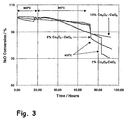
- the catalysts used in the tests of example 1 were then tested in a pilot plant having ammonia oxidation conditions. Further, the tests comprised investigations of unsupported Co 2 AlO 4 catalyst and a catalyst being Co 2 AlO 4 on MgO support The N 2 O conversion catalyst was placed right below the ammonia oxidation catalyst and platinum recovery gauze's. The tests were performed at the following standard conditions: Pressure 5 bar, temperature 900°C, GHSV 55.000 h -1 - 0,000h -1 .
- the gas composition was:
- Figure 4 further shows that the unsupported Co 2 AlO 4 catalyst and the same active phase on MgO both lost most of their activity after a few days of operation.
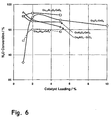
- This example shows the effect on catalyst composition and loading on N 2 O conversion in a laboratory reactor.
- the operating conditions were as in Example 1.
- the tests were run at 890°C.
- the best results are obtained at a catalyst loading of about 2 mol%, but for some high activity is achieved already at very low loading as illustrated in Figure 6.
- N 2 O conversion of more than 95% can be obtained at very low catalyst loading and even at as much as 10 mol%, but nothing seems to be gained by increasing the catalyst loading above 5 mol%.
- the catalyst loading will accordingly also depend on practical and economical evaluations.
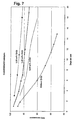
- This example shows the effect of ZrO 2 addition to the performance of the CO 2 AlO 4 /CeO 2 catalyst installed in an amonia oxidation pilot plant.
- the catalyst was prepared by mixing the ingredients as in previous examples plus adding 0.01 weight % - 2 weight % fine ZrO 2 powder (particle size 1-3 ⁇ m). The tests were performed under the same standard conditions as for Example 2. In Figure 7 the results are presented for an addition of 0.22, 0.28 and 0.90 weight % ZrO 2 compared to catalysts without ZrO 2 . The optimum concentration in this case was 0.2 weight %. The effect of adding ZrO 2 is reduced degradation of catalyst activity over time.
- the inventors have by the present invention succeeded in arriving at a versatile, active and thermally stable N 2 O decomposition catalyst.
- the catalysts according to the invention can be applied at a wide temperature range and will also be stable at varying gas composition. Presence of water, which often is a problem, for instance in connection with catalyst for exhaust from car engines, have been found to be no serious problem for these catalysts. Accordingly, the new catalysts can be applied for decomposing N 2 O from processes where N 2 O is formed.
- the catalysts are especially useful in connection with nitric acid production as the N 2 O can be decomposed in the process gas formed after ammonia oxidation without significant destruction of NO and also be used in the tail gas from the subsequent absorber unit.
Landscapes
- Chemical & Material Sciences (AREA)
- Engineering & Computer Science (AREA)
- Chemical Kinetics & Catalysis (AREA)
- Materials Engineering (AREA)
- Organic Chemistry (AREA)
- Environmental & Geological Engineering (AREA)
- Health & Medical Sciences (AREA)
- Biomedical Technology (AREA)
- Analytical Chemistry (AREA)
- General Chemical & Material Sciences (AREA)
- Oil, Petroleum & Natural Gas (AREA)
- Combustion & Propulsion (AREA)
- Catalysts (AREA)
- Exhaust Gas Treatment By Means Of Catalyst (AREA)
Claims (7)
- Katalysator für die N2O-Zersetzung bei Temperaturen von 250-1000 °C, dadurch gekennzeichnet, dass der Katalysator aus 0,1 -10 mol% Co3-xMxO4 und bis zu 2 Gew.% ZrO2 auf einem Ceroxid-Träger besteht, wobei M Fe oder Al ist und x = 0,25-2.
- Katalysator nach Anspruch 1, dadurch gekennzeichnet, dass der Katalysator auf dem Träger 1-5 mol% der Kobaltkomponente enthält.
- Katalysator nach Anspruch 1, dadurch gekennzeichnet, dass der Ceroxid-Trägerstoff, der bei der Herstellung des Katalysators verwendet wird, eine Oberfläche hat, die größer ist als 10 m2/g, vorzugsweise größer als 50 m2/g bei Betriebstemperatur.
- Verfahren zur Durchführung eines Prozesses, bei dem N2O gebildet wird, dadurch gekennzeichnet, dass ein N2O-haltiges Gas bei 250 bis 1000 °C mit einem Katalysator in Kontakt gebracht wird, der aus 0,1 -10 mol% Co3-xMxO4 auf einem Ceroxid-Träger und bis zu 2 Gew.% ZrO2 besteht, wobei M Fe oder Al ist und x = 0,25-2.
- Verfahren nach Anspruch 4, dadurch gekennzeichnet, dass Ammoniak in Gegenwart eines Oxidationskatalysators oxidiert wird, und dann die dadurch gebildete Gasmischung bei einer Temperatur von 250-500 °C in Kontakt gebracht wird mit dem Katalysator, der die Kobaltkomponente auf einem Ceroxid-Träger umfasst.
- Verfahren nach Anspruch 4, dadurch gekennzeichnet, dass das Abgas von der Absorptionsanlage, die der Ammoniakoxidationsanlage nachgeschaltet ist, bei 250 - 500 °C in Kontakt gebracht wird mit dem N2O-Zersetzungskatalysator, der aus 0,1 -10 mol% Co3-xMxO4 und bis zu 2 Gew.% ZrO2 auf einem Ceroxid-Träger besteht, wobei M Fe oder Al ist und x = 0,25-2.
- Verfahren nach Anspruch 4, dadurch gekennzeichnet, dass die N2O-haltige Gasmischung aus einem Adipinsäureprozess bei 500 - 800 °C in Kontakt gebracht wird mit dem N2O-Zersetzungskatalysator, der aus 0,1 -10 mol% Co3-xMxO4 und bis zu 2 Gew.% ZrO2 auf einem Ceroxid-Träger besteht, wobei M Fe oder Al ist und x = 0,25-2.
Applications Claiming Priority (3)
| Application Number | Priority Date | Filing Date | Title |
|---|---|---|---|
| NO20003467A NO313494B1 (no) | 2000-07-05 | 2000-07-05 | Katalysator for spalting av dinitrogenoksid og fremgangsmåte ved utförelse av prosesser hvor det dannes dinitrogenoksid |
| NO20003467 | 2000-07-05 | ||
| PCT/NO2001/000283 WO2002002230A1 (en) | 2000-07-05 | 2001-07-04 | Catalyst for decomposing nitrous oxide and method for performing processes comprising formation of nitrous oxide |
Publications (2)
| Publication Number | Publication Date |
|---|---|
| EP1301271A1 EP1301271A1 (de) | 2003-04-16 |
| EP1301271B1 true EP1301271B1 (de) | 2005-04-13 |
Family
ID=19911354
Family Applications (1)
| Application Number | Title | Priority Date | Filing Date |
|---|---|---|---|
| EP01958644A Expired - Lifetime EP1301271B1 (de) | 2000-07-05 | 2001-07-04 | Katalysator zum abbau von distickstoffoxid sowie methode zur durchführung von verfahren, welche die bildung von distickstoffoxid beinhalten |
Country Status (19)
| Country | Link |
|---|---|
| US (2) | US7700519B2 (de) |
| EP (1) | EP1301271B1 (de) |
| CN (1) | CN1269566C (de) |
| AT (1) | ATE293014T1 (de) |
| AU (1) | AU2001280269A1 (de) |
| BR (1) | BR0112164B1 (de) |
| CZ (1) | CZ299806B6 (de) |
| DE (1) | DE60110079T2 (de) |
| EE (1) | EE05321B1 (de) |
| ES (1) | ES2241852T3 (de) |
| HR (1) | HRP20021004B1 (de) |
| HU (1) | HU228480B1 (de) |
| MX (1) | MXPA02012737A (de) |
| NO (1) | NO313494B1 (de) |
| PL (1) | PL202653B1 (de) |
| RO (1) | RO120889B1 (de) |
| RU (1) | RU2237514C1 (de) |
| UA (1) | UA75362C2 (de) |
| WO (1) | WO2002002230A1 (de) |
Families Citing this family (33)
| Publication number | Priority date | Publication date | Assignee | Title |
|---|---|---|---|---|
| NO313494B1 (no) * | 2000-07-05 | 2002-10-14 | Norsk Hydro As | Katalysator for spalting av dinitrogenoksid og fremgangsmåte ved utförelse av prosesser hvor det dannes dinitrogenoksid |
| US20060088469A1 (en) * | 2002-11-25 | 2006-04-27 | Yara International Asa | Method for preparation and activation of multimetallic zeolite catalysts, a catalyst composition and application for n2o abatement |
| JP4641498B2 (ja) * | 2003-06-13 | 2011-03-02 | ヤラ・インターナショナル・アーエスアー | 触媒担持酸化物の製造方法 |
| RU2329100C2 (ru) * | 2003-06-13 | 2008-07-20 | Яра Интернэшнл Аса | Способ получения оксидных катализаторов на подложке |
| DE102004024026A1 (de) * | 2004-03-11 | 2005-09-29 | W.C. Heraeus Gmbh | Katalysator zur N2O-Zersetzung beim Ostwaldprozess |
| US20050202966A1 (en) | 2004-03-11 | 2005-09-15 | W.C. Heraeus Gmbh | Catalyst for the decomposition of N2O in the Ostwald process |
| US7981145B2 (en) * | 2005-07-18 | 2011-07-19 | Tearscience Inc. | Treatment of meibomian glands |
| RU2296706C1 (ru) * | 2005-09-29 | 2007-04-10 | Открытое акционерное общество "Акрон" | Способ производства неконцентрированной азотной кислоты |
| CN100522317C (zh) * | 2005-11-28 | 2009-08-05 | 中国科学院生态环境研究中心 | 低温催化n2o直接分解的钴铈复合氧化物催化剂 |
| JP2008168228A (ja) * | 2007-01-12 | 2008-07-24 | Okayama Univ | 未燃カーボンを用いてディーゼルエンジン排ガス中の窒素酸化物を浄化するための触媒と方法 |
| DE102007038711A1 (de) * | 2007-08-14 | 2009-02-19 | Uhde Gmbh | Katalysator, Verfahren zu dessen Herstellung und dessen Verwendung |
| NO20074325L (no) * | 2007-08-24 | 2009-02-25 | Yara Int Asa | Catalyst |
| WO2009050323A1 (en) * | 2007-10-19 | 2009-04-23 | Ecocat Oy | Removal of ammonia from fluids |
| WO2009054315A1 (ja) * | 2007-10-23 | 2009-04-30 | Cataler Corporation | 排ガス浄化用触媒 |
| RU2365831C1 (ru) * | 2008-03-27 | 2009-08-27 | Константин Валентинович Урпин | Мобильный тепловой пункт |
| DE502008001533D1 (de) | 2008-07-16 | 2010-11-25 | Umicore Ag & Co Kg | Katalysator zur Umsetzung von Distickstoffmonoxid und seine Verwendung bei der industriellen Salpetersäureherstellung |
| GB0819094D0 (en) | 2008-10-20 | 2008-11-26 | Johnson Matthey Plc | Catalyst containment unit |
| CN101875015B (zh) * | 2009-04-29 | 2012-06-13 | 高等技术研究院研究组合 | 用于消除一氧化二氮的催化剂制备方法 |
| PL388518A1 (pl) | 2009-07-10 | 2011-01-17 | Instytut Nawozów Sztucznych | Katalizator do wysokotemperaturowego rozkładu podtlenku azotu |
| DE102010005105A1 (de) | 2010-01-19 | 2011-07-21 | Umicore AG & Co. KG, 63457 | Katalysator |
| GB201002378D0 (en) | 2010-02-12 | 2010-03-31 | Johnson Matthey Plc | Catalyst structures |
| FR2964043B1 (fr) | 2010-08-26 | 2013-03-22 | Irma | Procede de decomposition catalytique du n2o a haute temperature |
| DE102011011881A1 (de) | 2011-02-21 | 2012-08-23 | Thyssenkrupp Uhde Gmbh | Verfahren zur Beseitigung von N2O und NOX aus dem Prozess zur Salpetersäureherstellung |
| CN104519996A (zh) * | 2012-08-10 | 2015-04-15 | 丰田自动车株式会社 | 废气净化用催化剂及其制造方法 |
| PL237044B1 (pl) | 2015-03-13 | 2021-03-08 | Inst Nowych Syntez Chemicznych | Nośnikowy katalizator do redukcji emisji tlenku azotu(I) z instalacji kwasu azotowego oraz sposób jego wytwarzania |
| WO2017004414A1 (en) * | 2015-07-01 | 2017-01-05 | Basf Corporation | Nitrous oxide removal catalysts for exhaust systems |
| KR101829917B1 (ko) * | 2015-07-14 | 2018-02-20 | 성균관대학교산학협력단 | 피셔-트롭쉬 합성 반응용 메조 기공 구조의 주골격을 갖는 코발트계 촉매 및 이의 제조방법 |
| CN106391037B (zh) * | 2016-11-11 | 2018-10-30 | 四川蜀泰化工科技有限公司 | 一种用于高温催化分解n2o的催化剂的制备工艺 |
| CN106984318B (zh) * | 2017-04-27 | 2020-01-03 | 山西大学 | 一种双金属钴基催化剂及制备方法和应用 |
| EP3427828A1 (de) * | 2017-07-10 | 2019-01-16 | Bosal Emission Control Systems NV | Katalysatorelement aus einer hydrotalkit mischmetalloxidverbindung |
| US10239047B1 (en) * | 2017-09-12 | 2019-03-26 | Toyota Motor Engineering & Manufacturing North America, Inc. | Direct NOx decomposition catalyst with improved activity and selectivity |
| CZ2018398A3 (cs) | 2018-08-07 | 2019-10-02 | Vysoká Škola Báňská - Technická Univerzita Ostrava | Způsob přípravy katalyzátoru pro odstranění oxidu dusného z odpadních průmyslových plynů a katalyzátor připravený tímto způsobem |
| CN118434493A (zh) | 2021-12-23 | 2024-08-02 | 托普索公司 | 一种处理高浓度n2o气体流的方法 |
Family Cites Families (15)
| Publication number | Priority date | Publication date | Assignee | Title |
|---|---|---|---|---|
| JPS4889185A (de) * | 1972-02-28 | 1973-11-21 | ||
| GB1511841A (en) * | 1974-03-06 | 1978-05-24 | Johnson Matthey Co Ltd | Catalysis |
| GB2072035B (en) | 1979-10-03 | 1984-02-01 | Acurex Corp | Catalyst compositions their method of formulation and combination processes using the catalyst compositions |
| CA1247074A (en) * | 1985-01-31 | 1988-12-20 | Chung-Zong Wan | Three-way catalysts of improved efficiency |
| US4727052A (en) * | 1986-06-27 | 1988-02-23 | Engelhard Corporation | Catalyst compositions and methods of making the same |
| JPH0644999B2 (ja) * | 1988-04-30 | 1994-06-15 | 株式会社豊田中央研究所 | 排気ガス浄化用触媒 |
| RU2071817C1 (ru) * | 1992-02-04 | 1997-01-20 | Институт катализа СО РАН | Способ очистки отходящих газов от оксида азота (i) |
| RU2065320C1 (ru) * | 1992-03-04 | 1996-08-20 | Институт катализа СО РАН | Способ очистки газов от оксидов азота |
| DK170529B1 (da) | 1992-03-23 | 1995-10-16 | Topsoe Haldor As | Ammoniakoxidationskatalysator |
| ES2132728T3 (es) * | 1994-11-02 | 1999-08-16 | Anglo American Res Lab Pty Ltd | Catalizador con soporte de oxido de zirconio/oxido de cerio. |
| JP3664182B2 (ja) | 1994-12-19 | 2005-06-22 | トヨタ自動車株式会社 | 高耐熱性排ガス浄化用触媒とその製造方法 |
| DE19546612A1 (de) * | 1995-12-13 | 1997-06-19 | Basf Ag | Verfahren zur Reduktion von NOx aus Abgasen |
| EP0954370B1 (de) | 1997-01-22 | 2003-04-09 | Anglo American Research Laboratories (Proprietary) Limited | Verminderung von stickoxid |
| US6379640B1 (en) * | 1999-03-05 | 2002-04-30 | E. I. Du Pont De Nemours And Company | Process for the decomposition of nitrous oxide |
| NO313494B1 (no) * | 2000-07-05 | 2002-10-14 | Norsk Hydro As | Katalysator for spalting av dinitrogenoksid og fremgangsmåte ved utförelse av prosesser hvor det dannes dinitrogenoksid |
-
2000
- 2000-07-05 NO NO20003467A patent/NO313494B1/no not_active IP Right Cessation
-
2001
- 2001-04-07 UA UA2003020998A patent/UA75362C2/uk unknown
- 2001-07-04 CN CN01812491.7A patent/CN1269566C/zh not_active Expired - Lifetime
- 2001-07-04 AT AT01958644T patent/ATE293014T1/de active
- 2001-07-04 CZ CZ20024184A patent/CZ299806B6/cs not_active IP Right Cessation
- 2001-07-04 PL PL359369A patent/PL202653B1/pl unknown
- 2001-07-04 RO ROA200201660A patent/RO120889B1/ro unknown
- 2001-07-04 EP EP01958644A patent/EP1301271B1/de not_active Expired - Lifetime
- 2001-07-04 HR HR20021004A patent/HRP20021004B1/xx not_active IP Right Cessation
- 2001-07-04 MX MXPA02012737A patent/MXPA02012737A/es active IP Right Grant
- 2001-07-04 WO PCT/NO2001/000283 patent/WO2002002230A1/en not_active Ceased
- 2001-07-04 EE EEP200300009A patent/EE05321B1/xx unknown
- 2001-07-04 AU AU2001280269A patent/AU2001280269A1/en not_active Abandoned
- 2001-07-04 HU HU0301430A patent/HU228480B1/hu unknown
- 2001-07-04 DE DE60110079T patent/DE60110079T2/de not_active Expired - Lifetime
- 2001-07-04 ES ES01958644T patent/ES2241852T3/es not_active Expired - Lifetime
- 2001-07-04 US US10/312,993 patent/US7700519B2/en not_active Expired - Lifetime
- 2001-07-04 RU RU2003103290A patent/RU2237514C1/ru active
- 2001-07-04 BR BRPI0112164-2A patent/BR0112164B1/pt not_active IP Right Cessation
-
2009
- 2009-10-26 US US12/588,722 patent/US8992870B2/en not_active Expired - Lifetime
Also Published As
| Publication number | Publication date |
|---|---|
| CN1440309A (zh) | 2003-09-03 |
| US20040023796A1 (en) | 2004-02-05 |
| US20110110835A9 (en) | 2011-05-12 |
| HRP20021004A2 (en) | 2005-02-28 |
| US8992870B2 (en) | 2015-03-31 |
| HRP20021004B1 (en) | 2010-03-31 |
| NO20003467L (no) | 2002-01-07 |
| HUP0301430A2 (en) | 2003-08-28 |
| BR0112164B1 (pt) | 2011-08-09 |
| MXPA02012737A (es) | 2003-04-25 |
| DE60110079T2 (de) | 2006-03-02 |
| CN1269566C (zh) | 2006-08-16 |
| PL202653B1 (pl) | 2009-07-31 |
| EP1301271A1 (de) | 2003-04-16 |
| RO120889B1 (ro) | 2006-09-29 |
| US20100098611A1 (en) | 2010-04-22 |
| UA75362C2 (en) | 2006-04-17 |
| RU2237514C1 (ru) | 2004-10-10 |
| PL359369A1 (en) | 2004-08-23 |
| ES2241852T3 (es) | 2005-11-01 |
| HU228480B1 (en) | 2013-03-28 |
| CZ299806B6 (cs) | 2008-12-03 |
| EE05321B1 (et) | 2010-08-16 |
| WO2002002230A1 (en) | 2002-01-10 |
| CZ20024184A3 (cs) | 2003-05-14 |
| DE60110079D1 (de) | 2005-05-19 |
| EE200300009A (et) | 2004-10-15 |
| AU2001280269A1 (en) | 2002-01-14 |
| US7700519B2 (en) | 2010-04-20 |
| NO20003467D0 (no) | 2000-07-05 |
| ATE293014T1 (de) | 2005-04-15 |
| NO313494B1 (no) | 2002-10-14 |
| BR0112164A (pt) | 2003-05-13 |
Similar Documents
| Publication | Publication Date | Title |
|---|---|---|
| EP1301271B1 (de) | Katalysator zum abbau von distickstoffoxid sowie methode zur durchführung von verfahren, welche die bildung von distickstoffoxid beinhalten | |
| US6153162A (en) | Method for the reduction of nitrogen oxides | |
| Centi et al. | Catalytic decomposition of N2O over noble and transition metal containing oxides and zeolites. Role of some variables on reactivity | |
| Teraoka et al. | Catalytic activity of perovskite-type oxides for the direct decomposition of nitrogen monoxide. | |
| AU2008286480B2 (en) | Catalyst, production method therefor and use thereof for decomposing N2O | |
| Song et al. | Preparation and characterization of Ag/MnOx/perovskite catalysts for CO oxidation | |
| CZ34494A3 (en) | Supported catalyst containing silver and process of selective catalytic decomposition of nitrogen monoxide | |
| US6489264B1 (en) | Ammonia oxidation catalyst | |
| US4818745A (en) | Catalyst for oxidation of carbon monoxide and process for preparing the catalyst | |
| EP0062912B1 (de) | Verfahren zur katalytischen Konvertierung von Kohlenmonoxid und schwefelaktiver Co-Konvertierungskatalysator | |
| WO1991001175A1 (en) | Low temperature oxidation process | |
| Shi et al. | Promotion effects of ZrO2 on the Pd/HZSM-5 catalyst for low-temperature catalytic combustion of methane | |
| RU2397810C2 (ru) | Катализатор и способ разложения монооксида диазота и способ и устройство для получения азотной кислоты | |
| Boix et al. | Binder effect upon the catalytic behavior of PtCoZSM5 washcoated on cordierite monoliths | |
| RU2191625C1 (ru) | Хромсодержащий катализатор и способ его получения (варианты) | |
| Lassi et al. | Deactivation correlations over Pd/Rh monoliths: the role of gas phase composition | |
| KR100418717B1 (ko) | 선택적, 비선택적 촉매환원에 의한 질소산화물 제거기술에사용되는 촉매 및 제조방법 | |
| Shenghui et al. | Effect of metal doping into Ce0. 5Zr0. 5O2 on catalytic activity of MnOx/Ce0. 5–xZr0. 5–xM0. 2xOy/Al2O3 for benzene combustion | |
| JP4664608B2 (ja) | アンモニア分解用触媒およびアンモニアの分解方法 | |
| Wan et al. | Improving the SO2 Resistance of Perovskite Type Oxidation Catalyst |
Legal Events
| Date | Code | Title | Description |
|---|---|---|---|
| PUAI | Public reference made under article 153(3) epc to a published international application that has entered the european phase |
Free format text: ORIGINAL CODE: 0009012 |
|
| 17P | Request for examination filed |
Effective date: 20030205 |
|
| AK | Designated contracting states |
Designated state(s): AT BE CH CY DE DK ES FI FR GB GR IE IT LI LU MC NL PT SE TR |
|
| AX | Request for extension of the european patent |
Extension state: AL LT LV MK RO SI |
|
| RIN1 | Information on inventor provided before grant (corrected) |
Inventor name: NIRISEN, YSTEIN Inventor name: OEVREBOE, DAG Inventor name: SCHOEFFEL, KLAUS Inventor name: WALLER, DAVID |
|
| 17Q | First examination report despatched |
Effective date: 20040218 |
|
| GRAP | Despatch of communication of intention to grant a patent |
Free format text: ORIGINAL CODE: EPIDOSNIGR1 |
|
| RAP1 | Party data changed (applicant data changed or rights of an application transferred) |
Owner name: YARA INTERNATIONAL ASA |
|
| GRAS | Grant fee paid |
Free format text: ORIGINAL CODE: EPIDOSNIGR3 |
|
| GRAA | (expected) grant |
Free format text: ORIGINAL CODE: 0009210 |
|
| AK | Designated contracting states |
Kind code of ref document: B1 Designated state(s): AT BE CH CY DE DK ES FI FR GB GR IE IT LI LU MC NL PT SE TR |
|
| AX | Request for extension of the european patent |
Extension state: LT LV |
|
| PG25 | Lapsed in a contracting state [announced via postgrant information from national office to epo] |
Ref country code: LI Free format text: LAPSE BECAUSE OF FAILURE TO SUBMIT A TRANSLATION OF THE DESCRIPTION OR TO PAY THE FEE WITHIN THE PRESCRIBED TIME-LIMIT Effective date: 20050413 Ref country code: CH Free format text: LAPSE BECAUSE OF FAILURE TO SUBMIT A TRANSLATION OF THE DESCRIPTION OR TO PAY THE FEE WITHIN THE PRESCRIBED TIME-LIMIT Effective date: 20050413 |
|
| REG | Reference to a national code |
Ref country code: GB Ref legal event code: FG4D |
|
| RIN1 | Information on inventor provided before grant (corrected) |
Inventor name: OEVREBOE, DAG Inventor name: NIRISEN, OEYSTEIN Inventor name: WALLER, DAVID Inventor name: SCHOEFFEL, KLAUS |
|
| REG | Reference to a national code |
Ref country code: CH Ref legal event code: EP |
|
| REG | Reference to a national code |
Ref country code: IE Ref legal event code: FG4D |
|
| REF | Corresponds to: |
Ref document number: 60110079 Country of ref document: DE Date of ref document: 20050519 Kind code of ref document: P |
|
| PG25 | Lapsed in a contracting state [announced via postgrant information from national office to epo] |
Ref country code: LU Free format text: LAPSE BECAUSE OF NON-PAYMENT OF DUE FEES Effective date: 20050704 Ref country code: CY Free format text: LAPSE BECAUSE OF FAILURE TO SUBMIT A TRANSLATION OF THE DESCRIPTION OR TO PAY THE FEE WITHIN THE PRESCRIBED TIME-LIMIT Effective date: 20050704 |
|
| PG25 | Lapsed in a contracting state [announced via postgrant information from national office to epo] |
Ref country code: GR Free format text: LAPSE BECAUSE OF FAILURE TO SUBMIT A TRANSLATION OF THE DESCRIPTION OR TO PAY THE FEE WITHIN THE PRESCRIBED TIME-LIMIT Effective date: 20050713 Ref country code: SE Free format text: LAPSE BECAUSE OF FAILURE TO SUBMIT A TRANSLATION OF THE DESCRIPTION OR TO PAY THE FEE WITHIN THE PRESCRIBED TIME-LIMIT Effective date: 20050713 Ref country code: DK Free format text: LAPSE BECAUSE OF FAILURE TO SUBMIT A TRANSLATION OF THE DESCRIPTION OR TO PAY THE FEE WITHIN THE PRESCRIBED TIME-LIMIT Effective date: 20050713 |
|
| PG25 | Lapsed in a contracting state [announced via postgrant information from national office to epo] |
Ref country code: MC Free format text: LAPSE BECAUSE OF NON-PAYMENT OF DUE FEES Effective date: 20050731 |
|
| PG25 | Lapsed in a contracting state [announced via postgrant information from national office to epo] |
Ref country code: PT Free format text: LAPSE BECAUSE OF FAILURE TO SUBMIT A TRANSLATION OF THE DESCRIPTION OR TO PAY THE FEE WITHIN THE PRESCRIBED TIME-LIMIT Effective date: 20050913 |
|
| LTIE | Lt: invalidation of european patent or patent extension |
Effective date: 20050413 |
|
| REG | Reference to a national code |
Ref country code: CH Ref legal event code: PL |
|
| REG | Reference to a national code |
Ref country code: ES Ref legal event code: FG2A Ref document number: 2241852 Country of ref document: ES Kind code of ref document: T3 |
|
| PLBE | No opposition filed within time limit |
Free format text: ORIGINAL CODE: 0009261 |
|
| STAA | Information on the status of an ep patent application or granted ep patent |
Free format text: STATUS: NO OPPOSITION FILED WITHIN TIME LIMIT |
|
| ET | Fr: translation filed | ||
| 26N | No opposition filed |
Effective date: 20060116 |
|
| REG | Reference to a national code |
Ref country code: FR Ref legal event code: PLFP Year of fee payment: 16 |
|
| REG | Reference to a national code |
Ref country code: FR Ref legal event code: PLFP Year of fee payment: 17 |
|
| REG | Reference to a national code |
Ref country code: FR Ref legal event code: PLFP Year of fee payment: 18 |
|
| PGFP | Annual fee paid to national office [announced via postgrant information from national office to epo] |
Ref country code: FR Payment date: 20200611 Year of fee payment: 20 |
|
| PGFP | Annual fee paid to national office [announced via postgrant information from national office to epo] |
Ref country code: NL Payment date: 20200615 Year of fee payment: 20 Ref country code: GB Payment date: 20200624 Year of fee payment: 20 Ref country code: BE Payment date: 20200617 Year of fee payment: 20 |
|
| PGFP | Annual fee paid to national office [announced via postgrant information from national office to epo] |
Ref country code: DE Payment date: 20200624 Year of fee payment: 20 Ref country code: IE Payment date: 20200709 Year of fee payment: 20 Ref country code: FI Payment date: 20200709 Year of fee payment: 20 Ref country code: TR Payment date: 20200703 Year of fee payment: 20 Ref country code: ES Payment date: 20200803 Year of fee payment: 20 |
|
| PGFP | Annual fee paid to national office [announced via postgrant information from national office to epo] |
Ref country code: IT Payment date: 20200610 Year of fee payment: 20 Ref country code: AT Payment date: 20200625 Year of fee payment: 20 |
|
| REG | Reference to a national code |
Ref country code: DE Ref legal event code: R071 Ref document number: 60110079 Country of ref document: DE |
|
| REG | Reference to a national code |
Ref country code: NL Ref legal event code: MK Effective date: 20210703 |
|
| REG | Reference to a national code |
Ref country code: GB Ref legal event code: PE20 Expiry date: 20210703 |
|
| REG | Reference to a national code |
Ref country code: FI Ref legal event code: MAE |
|
| REG | Reference to a national code |
Ref country code: BE Ref legal event code: MK Effective date: 20210704 |
|
| REG | Reference to a national code |
Ref country code: AT Ref legal event code: MK07 Ref document number: 293014 Country of ref document: AT Kind code of ref document: T Effective date: 20210704 |
|
| REG | Reference to a national code |
Ref country code: IE Ref legal event code: MK9A |
|
| PG25 | Lapsed in a contracting state [announced via postgrant information from national office to epo] |
Ref country code: IE Free format text: LAPSE BECAUSE OF EXPIRATION OF PROTECTION Effective date: 20210704 |
|
| PG25 | Lapsed in a contracting state [announced via postgrant information from national office to epo] |
Ref country code: GB Free format text: LAPSE BECAUSE OF EXPIRATION OF PROTECTION Effective date: 20210703 |
|
| REG | Reference to a national code |
Ref country code: ES Ref legal event code: FD2A Effective date: 20220128 |
|
| PG25 | Lapsed in a contracting state [announced via postgrant information from national office to epo] |
Ref country code: ES Free format text: LAPSE BECAUSE OF EXPIRATION OF PROTECTION Effective date: 20210705 |
|
| PG25 | Lapsed in a contracting state [announced via postgrant information from national office to epo] |
Ref country code: TR Free format text: LAPSE BECAUSE OF NON-PAYMENT OF DUE FEES Effective date: 20210704 |