EP1295113B1 - Flüssiges nichtthermosensibles medium für die analyse von spezien in einem kanal - Google Patents
Flüssiges nichtthermosensibles medium für die analyse von spezien in einem kanal Download PDFInfo
- Publication number
- EP1295113B1 EP1295113B1 EP01949600A EP01949600A EP1295113B1 EP 1295113 B1 EP1295113 B1 EP 1295113B1 EP 01949600 A EP01949600 A EP 01949600A EP 01949600 A EP01949600 A EP 01949600A EP 1295113 B1 EP1295113 B1 EP 1295113B1
- Authority
- EP
- European Patent Office
- Prior art keywords
- polymer
- type
- segments
- medium according
- acrylamide
- Prior art date
- Legal status (The legal status is an assumption and is not a legal conclusion. Google has not performed a legal analysis and makes no representation as to the accuracy of the status listed.)
- Expired - Lifetime
Links
- 229920000642 polymer Polymers 0.000 claims abstract description 159
- 238000000926 separation method Methods 0.000 claims abstract description 87
- 239000000126 substance Substances 0.000 claims abstract description 32
- 229920001400 block copolymer Polymers 0.000 claims abstract description 29
- 230000001788 irregular Effects 0.000 claims abstract description 23
- 238000000034 method Methods 0.000 claims abstract description 20
- 239000007788 liquid Substances 0.000 claims abstract description 13
- 229920001577 copolymer Polymers 0.000 claims description 66
- WHNPOQXWAMXPTA-UHFFFAOYSA-N 3-methylbut-2-enamide Chemical compound CC(C)=CC(N)=O WHNPOQXWAMXPTA-UHFFFAOYSA-N 0.000 claims description 42
- STMDPCBYJCIZOD-UHFFFAOYSA-N 2-(2,4-dinitroanilino)-4-methylpentanoic acid Chemical compound CC(C)CC(C(O)=O)NC1=CC=C([N+]([O-])=O)C=C1[N+]([O-])=O STMDPCBYJCIZOD-UHFFFAOYSA-N 0.000 claims description 40
- HRPVXLWXLXDGHG-UHFFFAOYSA-N Acrylamide Chemical compound NC(=O)C=C HRPVXLWXLXDGHG-UHFFFAOYSA-N 0.000 claims description 31
- -1 polyoxypropylene Polymers 0.000 claims description 29
- 239000000203 mixture Substances 0.000 claims description 23
- NIXOWILDQLNWCW-UHFFFAOYSA-N 2-Propenoic acid Natural products OC(=O)C=C NIXOWILDQLNWCW-UHFFFAOYSA-N 0.000 claims description 22
- IMSODMZESSGVBE-UHFFFAOYSA-N 2-Oxazoline Chemical compound C1CN=CO1 IMSODMZESSGVBE-UHFFFAOYSA-N 0.000 claims description 18
- 229920002521 macromolecule Polymers 0.000 claims description 17
- 229910052757 nitrogen Inorganic materials 0.000 claims description 16
- 150000004676 glycans Chemical class 0.000 claims description 15
- 229920001282 polysaccharide Polymers 0.000 claims description 15
- 239000005017 polysaccharide Substances 0.000 claims description 15
- SMZOUWXMTYCWNB-UHFFFAOYSA-N 2-(2-methoxy-5-methylphenyl)ethanamine Chemical compound COC1=CC=C(C)C=C1CCN SMZOUWXMTYCWNB-UHFFFAOYSA-N 0.000 claims description 14
- 229920001519 homopolymer Polymers 0.000 claims description 14
- 108090000623 proteins and genes Proteins 0.000 claims description 14
- 229920003171 Poly (ethylene oxide) Polymers 0.000 claims description 13
- 150000003926 acrylamides Chemical class 0.000 claims description 13
- 102000004169 proteins and genes Human genes 0.000 claims description 13
- VHJQYUYRTBJTTH-UHFFFAOYSA-N n-(1-hydroxyethyl)prop-2-enamide Chemical compound CC(O)NC(=O)C=C VHJQYUYRTBJTTH-UHFFFAOYSA-N 0.000 claims description 12
- 230000002209 hydrophobic effect Effects 0.000 claims description 11
- 150000002918 oxazolines Chemical class 0.000 claims description 11
- 229920000936 Agarose Polymers 0.000 claims description 10
- RTZKZFJDLAIYFH-UHFFFAOYSA-N Diethyl ether Chemical compound CCOCC RTZKZFJDLAIYFH-UHFFFAOYSA-N 0.000 claims description 10
- 229920002678 cellulose Polymers 0.000 claims description 10
- 229920002307 Dextran Polymers 0.000 claims description 9
- 229920005604 random copolymer Polymers 0.000 claims description 9
- 229920000609 methyl cellulose Polymers 0.000 claims description 8
- 239000001923 methylcellulose Substances 0.000 claims description 8
- 108020004707 nucleic acids Proteins 0.000 claims description 6
- 102000039446 nucleic acids Human genes 0.000 claims description 6
- 150000007523 nucleic acids Chemical class 0.000 claims description 6
- 239000002245 particle Substances 0.000 claims description 6
- 125000000217 alkyl group Chemical group 0.000 claims description 5
- 229920001184 polypeptide Polymers 0.000 claims description 5
- 102000004196 processed proteins & peptides Human genes 0.000 claims description 5
- 108090000765 processed proteins & peptides Proteins 0.000 claims description 5
- 125000003903 2-propenyl group Chemical group [H]C([*])([H])C([H])=C([H])[H] 0.000 claims description 4
- 239000004372 Polyvinyl alcohol Substances 0.000 claims description 4
- 210000004027 cell Anatomy 0.000 claims description 4
- 239000001913 cellulose Substances 0.000 claims description 4
- 238000011049 filling Methods 0.000 claims description 4
- 229920000570 polyether Polymers 0.000 claims description 4
- 229920001451 polypropylene glycol Polymers 0.000 claims description 4
- 229920002451 polyvinyl alcohol Polymers 0.000 claims description 4
- 108010015899 Glycopeptides Proteins 0.000 claims description 3
- 102000002068 Glycopeptides Human genes 0.000 claims description 3
- 229920000663 Hydroxyethyl cellulose Polymers 0.000 claims description 3
- 239000004354 Hydroxyethyl cellulose Substances 0.000 claims description 3
- 239000004952 Polyamide Substances 0.000 claims description 3
- 230000015572 biosynthetic process Effects 0.000 claims description 3
- 238000001914 filtration Methods 0.000 claims description 3
- 235000019447 hydroxyethyl cellulose Nutrition 0.000 claims description 3
- FZWBNHMXJMCXLU-BLAUPYHCSA-N isomaltotriose Chemical compound O[C@@H]1[C@@H](O)[C@H](O)[C@@H](CO)O[C@@H]1OC[C@@H]1[C@@H](O)[C@H](O)[C@@H](O)[C@@H](OC[C@@H](O)[C@@H](O)[C@H](O)[C@@H](O)C=O)O1 FZWBNHMXJMCXLU-BLAUPYHCSA-N 0.000 claims description 3
- 210000003463 organelle Anatomy 0.000 claims description 3
- 229920000765 poly(2-oxazolines) Polymers 0.000 claims description 3
- 229920002647 polyamide Polymers 0.000 claims description 3
- 229920002635 polyurethane Polymers 0.000 claims description 3
- 239000004814 polyurethane Substances 0.000 claims description 3
- 150000004756 silanes Chemical class 0.000 claims description 3
- 238000003786 synthesis reaction Methods 0.000 claims description 3
- 229920000954 Polyglycolide Polymers 0.000 claims description 2
- 239000004721 Polyphenylene oxide Substances 0.000 claims description 2
- 230000002378 acidificating effect Effects 0.000 claims description 2
- 125000003118 aryl group Chemical group 0.000 claims description 2
- 238000001514 detection method Methods 0.000 claims description 2
- 238000003745 diagnosis Methods 0.000 claims description 2
- 125000003709 fluoroalkyl group Chemical group 0.000 claims description 2
- 235000003869 genetically modified organism Nutrition 0.000 claims description 2
- 229910052500 inorganic mineral Inorganic materials 0.000 claims description 2
- 229920000126 latex Polymers 0.000 claims description 2
- FQPSGWSUVKBHSU-UHFFFAOYSA-N methacrylamide Chemical compound CC(=C)C(N)=O FQPSGWSUVKBHSU-UHFFFAOYSA-N 0.000 claims description 2
- 239000011707 mineral Substances 0.000 claims description 2
- 229920001467 poly(styrenesulfonates) Polymers 0.000 claims description 2
- 229920000728 polyester Polymers 0.000 claims description 2
- 239000004633 polyglycolic acid Substances 0.000 claims description 2
- 229960002796 polystyrene sulfonate Drugs 0.000 claims description 2
- 239000011970 polystyrene sulfonate Substances 0.000 claims description 2
- 229920000036 polyvinylpyrrolidone Polymers 0.000 claims description 2
- 239000001267 polyvinylpyrrolidone Substances 0.000 claims description 2
- 235000013855 polyvinylpyrrolidone Nutrition 0.000 claims description 2
- 230000008569 process Effects 0.000 claims description 2
- 238000003908 quality control method Methods 0.000 claims description 2
- 239000002773 nucleotide Substances 0.000 claims 1
- 125000003729 nucleotide group Chemical group 0.000 claims 1
- 238000011084 recovery Methods 0.000 claims 1
- 238000012216 screening Methods 0.000 claims 1
- 239000012530 fluid Substances 0.000 abstract description 10
- 238000004458 analytical method Methods 0.000 abstract description 8
- 238000000746 purification Methods 0.000 abstract description 5
- 238000004321 preservation Methods 0.000 abstract 1
- 239000002609 medium Substances 0.000 description 56
- 239000000178 monomer Substances 0.000 description 19
- 238000001962 electrophoresis Methods 0.000 description 12
- 230000006870 function Effects 0.000 description 12
- 239000000243 solution Substances 0.000 description 11
- 238000001179 sorption measurement Methods 0.000 description 11
- 108020004414 DNA Proteins 0.000 description 10
- 238000002360 preparation method Methods 0.000 description 10
- 239000000872 buffer Substances 0.000 description 7
- 238000005251 capillar electrophoresis Methods 0.000 description 7
- 235000010980 cellulose Nutrition 0.000 description 7
- 238000007334 copolymerization reaction Methods 0.000 description 7
- 230000003993 interaction Effects 0.000 description 7
- XLYOFNOQVPJJNP-UHFFFAOYSA-N water Substances O XLYOFNOQVPJJNP-UHFFFAOYSA-N 0.000 description 7
- OKKJLVBELUTLKV-UHFFFAOYSA-N Methanol Chemical compound OC OKKJLVBELUTLKV-UHFFFAOYSA-N 0.000 description 6
- 230000009471 action Effects 0.000 description 6
- 239000004202 carbamide Substances 0.000 description 6
- 239000003792 electrolyte Substances 0.000 description 6
- 238000005370 electroosmosis Methods 0.000 description 6
- 229920002401 polyacrylamide Polymers 0.000 description 6
- 239000007787 solid Substances 0.000 description 6
- VEXZGXHMUGYJMC-UHFFFAOYSA-N Hydrochloric acid Chemical compound Cl VEXZGXHMUGYJMC-UHFFFAOYSA-N 0.000 description 5
- 208000034953 Twin anemia-polycythemia sequence Diseases 0.000 description 5
- XSQUKJJJFZCRTK-UHFFFAOYSA-N Urea Chemical compound NC(N)=O XSQUKJJJFZCRTK-UHFFFAOYSA-N 0.000 description 5
- 230000008901 benefit Effects 0.000 description 5
- 230000008859 change Effects 0.000 description 5
- 239000000499 gel Substances 0.000 description 5
- 235000010981 methylcellulose Nutrition 0.000 description 5
- 238000006116 polymerization reaction Methods 0.000 description 5
- 239000011734 sodium Substances 0.000 description 5
- IJGRMHOSHXDMSA-UHFFFAOYSA-N Atomic nitrogen Chemical compound N#N IJGRMHOSHXDMSA-UHFFFAOYSA-N 0.000 description 4
- KCXVZYZYPLLWCC-UHFFFAOYSA-N EDTA Chemical compound OC(=O)CN(CC(O)=O)CCN(CC(O)=O)CC(O)=O KCXVZYZYPLLWCC-UHFFFAOYSA-N 0.000 description 4
- 239000004698 Polyethylene Substances 0.000 description 4
- 238000009826 distribution Methods 0.000 description 4
- 230000005684 electric field Effects 0.000 description 4
- 238000012163 sequencing technique Methods 0.000 description 4
- 238000001712 DNA sequencing Methods 0.000 description 3
- YMWUJEATGCHHMB-UHFFFAOYSA-N Dichloromethane Chemical compound ClCCl YMWUJEATGCHHMB-UHFFFAOYSA-N 0.000 description 3
- QOSSAOTZNIDXMA-UHFFFAOYSA-N Dicylcohexylcarbodiimide Chemical compound C1CCCCC1N=C=NC1CCCCC1 QOSSAOTZNIDXMA-UHFFFAOYSA-N 0.000 description 3
- 229920002125 Sokalan® Polymers 0.000 description 3
- 238000006243 chemical reaction Methods 0.000 description 3
- 238000010586 diagram Methods 0.000 description 3
- 239000003999 initiator Substances 0.000 description 3
- 238000005259 measurement Methods 0.000 description 3
- 238000006068 polycondensation reaction Methods 0.000 description 3
- 239000002244 precipitate Substances 0.000 description 3
- 238000007614 solvation Methods 0.000 description 3
- 108091032973 (ribonucleotides)n+m Proteins 0.000 description 2
- ZQXIMYREBUZLPM-UHFFFAOYSA-N 1-aminoethanethiol Chemical group CC(N)S ZQXIMYREBUZLPM-UHFFFAOYSA-N 0.000 description 2
- CSCPPACGZOOCGX-UHFFFAOYSA-N Acetone Chemical compound CC(C)=O CSCPPACGZOOCGX-UHFFFAOYSA-N 0.000 description 2
- XKRFYHLGVUSROY-UHFFFAOYSA-N Argon Chemical compound [Ar] XKRFYHLGVUSROY-UHFFFAOYSA-N 0.000 description 2
- 102000053602 DNA Human genes 0.000 description 2
- ZHNUHDYFZUAESO-UHFFFAOYSA-N Formamide Chemical compound NC=O ZHNUHDYFZUAESO-UHFFFAOYSA-N 0.000 description 2
- ATHHXGZTWNVVOU-UHFFFAOYSA-N N-methylformamide Chemical compound CNC=O ATHHXGZTWNVVOU-UHFFFAOYSA-N 0.000 description 2
- 108091034117 Oligonucleotide Proteins 0.000 description 2
- 101710205840 Ribonuclease P protein component 2 Proteins 0.000 description 2
- 102100028671 Ribonuclease P/MRP protein subunit POP5 Human genes 0.000 description 2
- 101100244535 Saccharomyces cerevisiae (strain ATCC 204508 / S288c) POP6 gene Proteins 0.000 description 2
- 101100244540 Schizosaccharomyces pombe (strain 972 / ATCC 24843) pop7 gene Proteins 0.000 description 2
- 108020004682 Single-Stranded DNA Proteins 0.000 description 2
- JLCPHMBAVCMARE-UHFFFAOYSA-N [3-[[3-[[3-[[3-[[3-[[3-[[3-[[3-[[3-[[3-[[3-[[5-(2-amino-6-oxo-1H-purin-9-yl)-3-[[3-[[3-[[3-[[3-[[3-[[5-(2-amino-6-oxo-1H-purin-9-yl)-3-[[5-(2-amino-6-oxo-1H-purin-9-yl)-3-hydroxyoxolan-2-yl]methoxy-hydroxyphosphoryl]oxyoxolan-2-yl]methoxy-hydroxyphosphoryl]oxy-5-(5-methyl-2,4-dioxopyrimidin-1-yl)oxolan-2-yl]methoxy-hydroxyphosphoryl]oxy-5-(6-aminopurin-9-yl)oxolan-2-yl]methoxy-hydroxyphosphoryl]oxy-5-(6-aminopurin-9-yl)oxolan-2-yl]methoxy-hydroxyphosphoryl]oxy-5-(6-aminopurin-9-yl)oxolan-2-yl]methoxy-hydroxyphosphoryl]oxy-5-(6-aminopurin-9-yl)oxolan-2-yl]methoxy-hydroxyphosphoryl]oxyoxolan-2-yl]methoxy-hydroxyphosphoryl]oxy-5-(5-methyl-2,4-dioxopyrimidin-1-yl)oxolan-2-yl]methoxy-hydroxyphosphoryl]oxy-5-(4-amino-2-oxopyrimidin-1-yl)oxolan-2-yl]methoxy-hydroxyphosphoryl]oxy-5-(5-methyl-2,4-dioxopyrimidin-1-yl)oxolan-2-yl]methoxy-hydroxyphosphoryl]oxy-5-(5-methyl-2,4-dioxopyrimidin-1-yl)oxolan-2-yl]methoxy-hydroxyphosphoryl]oxy-5-(6-aminopurin-9-yl)oxolan-2-yl]methoxy-hydroxyphosphoryl]oxy-5-(6-aminopurin-9-yl)oxolan-2-yl]methoxy-hydroxyphosphoryl]oxy-5-(4-amino-2-oxopyrimidin-1-yl)oxolan-2-yl]methoxy-hydroxyphosphoryl]oxy-5-(4-amino-2-oxopyrimidin-1-yl)oxolan-2-yl]methoxy-hydroxyphosphoryl]oxy-5-(4-amino-2-oxopyrimidin-1-yl)oxolan-2-yl]methoxy-hydroxyphosphoryl]oxy-5-(6-aminopurin-9-yl)oxolan-2-yl]methoxy-hydroxyphosphoryl]oxy-5-(4-amino-2-oxopyrimidin-1-yl)oxolan-2-yl]methyl [5-(6-aminopurin-9-yl)-2-(hydroxymethyl)oxolan-3-yl] hydrogen phosphate Polymers Cc1cn(C2CC(OP(O)(=O)OCC3OC(CC3OP(O)(=O)OCC3OC(CC3O)n3cnc4c3nc(N)[nH]c4=O)n3cnc4c3nc(N)[nH]c4=O)C(COP(O)(=O)OC3CC(OC3COP(O)(=O)OC3CC(OC3COP(O)(=O)OC3CC(OC3COP(O)(=O)OC3CC(OC3COP(O)(=O)OC3CC(OC3COP(O)(=O)OC3CC(OC3COP(O)(=O)OC3CC(OC3COP(O)(=O)OC3CC(OC3COP(O)(=O)OC3CC(OC3COP(O)(=O)OC3CC(OC3COP(O)(=O)OC3CC(OC3COP(O)(=O)OC3CC(OC3COP(O)(=O)OC3CC(OC3COP(O)(=O)OC3CC(OC3COP(O)(=O)OC3CC(OC3COP(O)(=O)OC3CC(OC3COP(O)(=O)OC3CC(OC3CO)n3cnc4c(N)ncnc34)n3ccc(N)nc3=O)n3cnc4c(N)ncnc34)n3ccc(N)nc3=O)n3ccc(N)nc3=O)n3ccc(N)nc3=O)n3cnc4c(N)ncnc34)n3cnc4c(N)ncnc34)n3cc(C)c(=O)[nH]c3=O)n3cc(C)c(=O)[nH]c3=O)n3ccc(N)nc3=O)n3cc(C)c(=O)[nH]c3=O)n3cnc4c3nc(N)[nH]c4=O)n3cnc4c(N)ncnc34)n3cnc4c(N)ncnc34)n3cnc4c(N)ncnc34)n3cnc4c(N)ncnc34)O2)c(=O)[nH]c1=O JLCPHMBAVCMARE-UHFFFAOYSA-N 0.000 description 2
- 150000001412 amines Chemical group 0.000 description 2
- ROOXNKNUYICQNP-UHFFFAOYSA-N ammonium persulfate Chemical compound [NH4+].[NH4+].[O-]S(=O)(=O)OOS([O-])(=O)=O ROOXNKNUYICQNP-UHFFFAOYSA-N 0.000 description 2
- 239000012736 aqueous medium Substances 0.000 description 2
- 238000007385 chemical modification Methods 0.000 description 2
- 238000004587 chromatography analysis Methods 0.000 description 2
- 239000004205 dimethyl polysiloxane Substances 0.000 description 2
- 239000006185 dispersion Substances 0.000 description 2
- 238000006073 displacement reaction Methods 0.000 description 2
- 238000011209 electrochromatography Methods 0.000 description 2
- 229940082150 encore Drugs 0.000 description 2
- 239000012634 fragment Substances 0.000 description 2
- 238000001502 gel electrophoresis Methods 0.000 description 2
- 238000002347 injection Methods 0.000 description 2
- 239000007924 injection Substances 0.000 description 2
- 150000002500 ions Chemical class 0.000 description 2
- QNILTEGFHQSKFF-UHFFFAOYSA-N n-propan-2-ylprop-2-enamide Chemical compound CC(C)NC(=O)C=C QNILTEGFHQSKFF-UHFFFAOYSA-N 0.000 description 2
- 229920000435 poly(dimethylsiloxane) Polymers 0.000 description 2
- 229920003229 poly(methyl methacrylate) Polymers 0.000 description 2
- 229920000573 polyethylene Polymers 0.000 description 2
- 239000004926 polymethyl methacrylate Substances 0.000 description 2
- USHAGKDGDHPEEY-UHFFFAOYSA-L potassium persulfate Chemical group [K+].[K+].[O-]S(=O)(=O)OOS([O-])(=O)=O USHAGKDGDHPEEY-UHFFFAOYSA-L 0.000 description 2
- 238000001556 precipitation Methods 0.000 description 2
- 125000002924 primary amino group Chemical group [H]N([H])* 0.000 description 2
- 239000000047 product Substances 0.000 description 2
- 238000010526 radical polymerization reaction Methods 0.000 description 2
- 230000009467 reduction Effects 0.000 description 2
- 238000001542 size-exclusion chromatography Methods 0.000 description 2
- LENZDBCJOHFCAS-UHFFFAOYSA-N tris Chemical compound OCC(N)(CO)CO LENZDBCJOHFCAS-UHFFFAOYSA-N 0.000 description 2
- ADFXKUOMJKEIND-UHFFFAOYSA-N 1,3-dicyclohexylurea Chemical compound C1CCCCC1NC(=O)NC1CCCCC1 ADFXKUOMJKEIND-UHFFFAOYSA-N 0.000 description 1
- BTBUEUYNUDRHOZ-UHFFFAOYSA-N Borate Chemical compound [O-]B([O-])[O-] BTBUEUYNUDRHOZ-UHFFFAOYSA-N 0.000 description 1
- 229920002153 Hydroxypropyl cellulose Polymers 0.000 description 1
- KDXKERNSBIXSRK-UHFFFAOYSA-N Lysine Natural products NCCCCC(N)C(O)=O KDXKERNSBIXSRK-UHFFFAOYSA-N 0.000 description 1
- 239000004472 Lysine Substances 0.000 description 1
- YNLCVAQJIKOXER-UHFFFAOYSA-N N-[tris(hydroxymethyl)methyl]-3-aminopropanesulfonic acid Chemical compound OCC(CO)(CO)NCCCS(O)(=O)=O YNLCVAQJIKOXER-UHFFFAOYSA-N 0.000 description 1
- 229910019142 PO4 Inorganic materials 0.000 description 1
- 239000002202 Polyethylene glycol Chemical class 0.000 description 1
- 239000004642 Polyimide Substances 0.000 description 1
- 239000004743 Polypropylene Substances 0.000 description 1
- 102000016611 Proteoglycans Human genes 0.000 description 1
- 108010067787 Proteoglycans Proteins 0.000 description 1
- VYPSYNLAJGMNEJ-UHFFFAOYSA-N Silicium dioxide Chemical compound O=[Si]=O VYPSYNLAJGMNEJ-UHFFFAOYSA-N 0.000 description 1
- RTAQQCXQSZGOHL-UHFFFAOYSA-N Titanium Chemical compound [Ti] RTAQQCXQSZGOHL-UHFFFAOYSA-N 0.000 description 1
- PBCJIPOGFJYBJE-UHFFFAOYSA-N acetonitrile;hydrate Chemical compound O.CC#N PBCJIPOGFJYBJE-UHFFFAOYSA-N 0.000 description 1
- 239000002253 acid Substances 0.000 description 1
- 150000001335 aliphatic alkanes Chemical class 0.000 description 1
- 229910001870 ammonium persulfate Inorganic materials 0.000 description 1
- 239000012062 aqueous buffer Substances 0.000 description 1
- 239000007864 aqueous solution Substances 0.000 description 1
- 239000003125 aqueous solvent Substances 0.000 description 1
- 229910052786 argon Inorganic materials 0.000 description 1
- 230000004888 barrier function Effects 0.000 description 1
- 230000009286 beneficial effect Effects 0.000 description 1
- 230000001588 bifunctional effect Effects 0.000 description 1
- 238000009835 boiling Methods 0.000 description 1
- 230000005587 bubbling Effects 0.000 description 1
- 239000006227 byproduct Substances 0.000 description 1
- 239000011203 carbon fibre reinforced carbon Substances 0.000 description 1
- 239000000919 ceramic Substances 0.000 description 1
- 239000003638 chemical reducing agent Substances 0.000 description 1
- 239000003795 chemical substances by application Substances 0.000 description 1
- 239000013065 commercial product Substances 0.000 description 1
- 150000001875 compounds Chemical class 0.000 description 1
- 238000011109 contamination Methods 0.000 description 1
- 229920006037 cross link polymer Polymers 0.000 description 1
- 238000004132 cross linking Methods 0.000 description 1
- 239000003431 cross linking reagent Substances 0.000 description 1
- 230000007423 decrease Effects 0.000 description 1
- 230000003247 decreasing effect Effects 0.000 description 1
- 238000007872 degassing Methods 0.000 description 1
- 230000001627 detrimental effect Effects 0.000 description 1
- 238000001035 drying Methods 0.000 description 1
- 229920001971 elastomer Polymers 0.000 description 1
- 239000000806 elastomer Substances 0.000 description 1
- 125000003700 epoxy group Chemical group 0.000 description 1
- 230000002349 favourable effect Effects 0.000 description 1
- 239000000706 filtrate Substances 0.000 description 1
- IYWCBYFJFZCCGV-UHFFFAOYSA-N formamide;hydrate Chemical compound O.NC=O IYWCBYFJFZCCGV-UHFFFAOYSA-N 0.000 description 1
- 238000009472 formulation Methods 0.000 description 1
- 125000000524 functional group Chemical group 0.000 description 1
- 239000005350 fused silica glass Substances 0.000 description 1
- 238000003205 genotyping method Methods 0.000 description 1
- 239000011521 glass Substances 0.000 description 1
- JEGUKCSWCFPDGT-UHFFFAOYSA-N h2o hydrate Chemical compound O.O JEGUKCSWCFPDGT-UHFFFAOYSA-N 0.000 description 1
- 238000013537 high throughput screening Methods 0.000 description 1
- HNDVDQJCIGZPNO-UHFFFAOYSA-N histidine Natural products OC(=O)C(N)CC1=CN=CN1 HNDVDQJCIGZPNO-UHFFFAOYSA-N 0.000 description 1
- 125000002887 hydroxy group Chemical group [H]O* 0.000 description 1
- 239000001863 hydroxypropyl cellulose Substances 0.000 description 1
- 235000010977 hydroxypropyl cellulose Nutrition 0.000 description 1
- 239000001866 hydroxypropyl methyl cellulose Substances 0.000 description 1
- 229920003088 hydroxypropyl methyl cellulose Polymers 0.000 description 1
- 235000010979 hydroxypropyl methyl cellulose Nutrition 0.000 description 1
- UFVKGYZPFZQRLF-UHFFFAOYSA-N hydroxypropyl methyl cellulose Chemical compound OC1C(O)C(OC)OC(CO)C1OC1C(O)C(O)C(OC2C(C(O)C(OC3C(C(O)C(O)C(CO)O3)O)C(CO)O2)O)C(CO)O1 UFVKGYZPFZQRLF-UHFFFAOYSA-N 0.000 description 1
- 238000010348 incorporation Methods 0.000 description 1
- 229910010272 inorganic material Inorganic materials 0.000 description 1
- 239000011147 inorganic material Substances 0.000 description 1
- 239000004816 latex Substances 0.000 description 1
- 239000011159 matrix material Substances 0.000 description 1
- 230000007246 mechanism Effects 0.000 description 1
- 239000000693 micelle Substances 0.000 description 1
- 230000005012 migration Effects 0.000 description 1
- 238000013508 migration Methods 0.000 description 1
- 230000004048 modification Effects 0.000 description 1
- 238000012986 modification Methods 0.000 description 1
- 238000010369 molecular cloning Methods 0.000 description 1
- 229940088644 n,n-dimethylacrylamide Drugs 0.000 description 1
- YLGYACDQVQQZSW-UHFFFAOYSA-N n,n-dimethylprop-2-enamide Chemical compound CN(C)C(=O)C=C YLGYACDQVQQZSW-UHFFFAOYSA-N 0.000 description 1
- 230000007935 neutral effect Effects 0.000 description 1
- 239000007800 oxidant agent Substances 0.000 description 1
- 230000001590 oxidative effect Effects 0.000 description 1
- NBIIXXVUZAFLBC-UHFFFAOYSA-K phosphate Chemical compound [O-]P([O-])([O-])=O NBIIXXVUZAFLBC-UHFFFAOYSA-K 0.000 description 1
- 239000010452 phosphate Substances 0.000 description 1
- 239000003495 polar organic solvent Substances 0.000 description 1
- 229920001992 poloxamer 407 Polymers 0.000 description 1
- 229920003213 poly(N-isopropyl acrylamide) Polymers 0.000 description 1
- 239000004584 polyacrylic acid Substances 0.000 description 1
- 229920000515 polycarbonate Polymers 0.000 description 1
- 239000004417 polycarbonate Substances 0.000 description 1
- 229920001223 polyethylene glycol Chemical class 0.000 description 1
- 239000005020 polyethylene terephthalate Substances 0.000 description 1
- 229920000139 polyethylene terephthalate Polymers 0.000 description 1
- 229920001721 polyimide Polymers 0.000 description 1
- 238000000710 polymer precipitation Methods 0.000 description 1
- 108091033319 polynucleotide Proteins 0.000 description 1
- 102000040430 polynucleotide Human genes 0.000 description 1
- 239000002157 polynucleotide Substances 0.000 description 1
- 229920001155 polypropylene Polymers 0.000 description 1
- 230000037452 priming Effects 0.000 description 1
- 238000000425 proton nuclear magnetic resonance spectrum Methods 0.000 description 1
- 239000008213 purified water Substances 0.000 description 1
- 150000003254 radicals Chemical class 0.000 description 1
- 239000012429 reaction media Substances 0.000 description 1
- 230000000717 retained effect Effects 0.000 description 1
- 150000003839 salts Chemical class 0.000 description 1
- 238000007873 sieving Methods 0.000 description 1
- 239000010703 silicon Substances 0.000 description 1
- 229910052710 silicon Inorganic materials 0.000 description 1
- 238000007711 solidification Methods 0.000 description 1
- 230000008023 solidification Effects 0.000 description 1
- 239000002904 solvent Substances 0.000 description 1
- 229910001220 stainless steel Inorganic materials 0.000 description 1
- 239000010935 stainless steel Substances 0.000 description 1
- 229920006301 statistical copolymer Polymers 0.000 description 1
- 230000008961 swelling Effects 0.000 description 1
- 229920001059 synthetic polymer Polymers 0.000 description 1
- 239000010936 titanium Substances 0.000 description 1
- 229910052719 titanium Inorganic materials 0.000 description 1
- 238000012546 transfer Methods 0.000 description 1
- 230000009466 transformation Effects 0.000 description 1
- 229920002554 vinyl polymer Polymers 0.000 description 1
- 229920003169 water-soluble polymer Polymers 0.000 description 1
Images



Classifications
-
- G—PHYSICS
- G01—MEASURING; TESTING
- G01N—INVESTIGATING OR ANALYSING MATERIALS BY DETERMINING THEIR CHEMICAL OR PHYSICAL PROPERTIES
- G01N27/00—Investigating or analysing materials by the use of electric, electrochemical, or magnetic means
- G01N27/26—Investigating or analysing materials by the use of electric, electrochemical, or magnetic means by investigating electrochemical variables; by using electrolysis or electrophoresis
- G01N27/416—Systems
- G01N27/447—Systems using electrophoresis
- G01N27/44704—Details; Accessories
- G01N27/44747—Composition of gel or of carrier mixture
-
- C—CHEMISTRY; METALLURGY
- C08—ORGANIC MACROMOLECULAR COMPOUNDS; THEIR PREPARATION OR CHEMICAL WORKING-UP; COMPOSITIONS BASED THEREON
- C08F—MACROMOLECULAR COMPOUNDS OBTAINED BY REACTIONS ONLY INVOLVING CARBON-TO-CARBON UNSATURATED BONDS
- C08F120/00—Homopolymers of compounds having one or more unsaturated aliphatic radicals, each having only one carbon-to-carbon double bond, and only one being terminated by only one carboxyl radical or a salt, anhydride, ester, amide, imide or nitrile thereof
- C08F120/02—Monocarboxylic acids having less than ten carbon atoms; Derivatives thereof
- C08F120/52—Amides or imides
- C08F120/54—Amides, e.g. N,N-dimethylacrylamide or N-isopropylacrylamide
-
- C—CHEMISTRY; METALLURGY
- C08—ORGANIC MACROMOLECULAR COMPOUNDS; THEIR PREPARATION OR CHEMICAL WORKING-UP; COMPOSITIONS BASED THEREON
- C08F—MACROMOLECULAR COMPOUNDS OBTAINED BY REACTIONS ONLY INVOLVING CARBON-TO-CARBON UNSATURATED BONDS
- C08F2/00—Processes of polymerisation
- C08F2/04—Polymerisation in solution
- C08F2/10—Aqueous solvent
-
- C—CHEMISTRY; METALLURGY
- C08—ORGANIC MACROMOLECULAR COMPOUNDS; THEIR PREPARATION OR CHEMICAL WORKING-UP; COMPOSITIONS BASED THEREON
- C08F—MACROMOLECULAR COMPOUNDS OBTAINED BY REACTIONS ONLY INVOLVING CARBON-TO-CARBON UNSATURATED BONDS
- C08F265/00—Macromolecular compounds obtained by polymerising monomers on to polymers of unsaturated monocarboxylic acids or derivatives thereof as defined in group C08F20/00
- C08F265/10—Macromolecular compounds obtained by polymerising monomers on to polymers of unsaturated monocarboxylic acids or derivatives thereof as defined in group C08F20/00 on to polymers of amides or imides
-
- C—CHEMISTRY; METALLURGY
- C08—ORGANIC MACROMOLECULAR COMPOUNDS; THEIR PREPARATION OR CHEMICAL WORKING-UP; COMPOSITIONS BASED THEREON
- C08F—MACROMOLECULAR COMPOUNDS OBTAINED BY REACTIONS ONLY INVOLVING CARBON-TO-CARBON UNSATURATED BONDS
- C08F290/00—Macromolecular compounds obtained by polymerising monomers on to polymers modified by introduction of aliphatic unsaturated end or side groups
- C08F290/02—Macromolecular compounds obtained by polymerising monomers on to polymers modified by introduction of aliphatic unsaturated end or side groups on to polymers modified by introduction of unsaturated end groups
- C08F290/04—Polymers provided for in subclasses C08C or C08F
-
- C—CHEMISTRY; METALLURGY
- C08—ORGANIC MACROMOLECULAR COMPOUNDS; THEIR PREPARATION OR CHEMICAL WORKING-UP; COMPOSITIONS BASED THEREON
- C08F—MACROMOLECULAR COMPOUNDS OBTAINED BY REACTIONS ONLY INVOLVING CARBON-TO-CARBON UNSATURATED BONDS
- C08F290/00—Macromolecular compounds obtained by polymerising monomers on to polymers modified by introduction of aliphatic unsaturated end or side groups
- C08F290/02—Macromolecular compounds obtained by polymerising monomers on to polymers modified by introduction of aliphatic unsaturated end or side groups on to polymers modified by introduction of unsaturated end groups
- C08F290/04—Polymers provided for in subclasses C08C or C08F
- C08F290/046—Polymers of unsaturated carboxylic acids or derivatives thereof
-
- C—CHEMISTRY; METALLURGY
- C08—ORGANIC MACROMOLECULAR COMPOUNDS; THEIR PREPARATION OR CHEMICAL WORKING-UP; COMPOSITIONS BASED THEREON
- C08F—MACROMOLECULAR COMPOUNDS OBTAINED BY REACTIONS ONLY INVOLVING CARBON-TO-CARBON UNSATURATED BONDS
- C08F8/00—Chemical modification by after-treatment
- C08F8/10—Acylation
-
- C—CHEMISTRY; METALLURGY
- C08—ORGANIC MACROMOLECULAR COMPOUNDS; THEIR PREPARATION OR CHEMICAL WORKING-UP; COMPOSITIONS BASED THEREON
- C08F—MACROMOLECULAR COMPOUNDS OBTAINED BY REACTIONS ONLY INVOLVING CARBON-TO-CARBON UNSATURATED BONDS
- C08F2810/00—Chemical modification of a polymer
- C08F2810/30—Chemical modification of a polymer leading to the formation or introduction of aliphatic or alicyclic unsaturated groups
-
- C—CHEMISTRY; METALLURGY
- C08—ORGANIC MACROMOLECULAR COMPOUNDS; THEIR PREPARATION OR CHEMICAL WORKING-UP; COMPOSITIONS BASED THEREON
- C08F—MACROMOLECULAR COMPOUNDS OBTAINED BY REACTIONS ONLY INVOLVING CARBON-TO-CARBON UNSATURATED BONDS
- C08F2810/00—Chemical modification of a polymer
- C08F2810/40—Chemical modification of a polymer taking place solely at one end or both ends of the polymer backbone, i.e. not in the side or lateral chains
Definitions
- the present invention relates to the field of techniques for analyzing, separating and purifying species, according to which it is necessary to migrate these species in a fluid called "separation medium".
- microchannels a separation medium suitable for the separation of species in channels or capillaries of which at least one of the dimensions is submillimetric, and typically between 20 ⁇ m and 200 ⁇ m (hereinafter referred to as microchannels).
- these are methods for separating or analyzing biological macromolecules by capillary electrophoresis, by chromatography, or by any method involved in microchannels (capillary electrophoresis and chromatography, microfluidic systems, "chip labs").
- the invention is particularly useful in the case of electrophoresis.
- microfluidic system is intended to mean any system in which fluids and / or species contained in a fluid are moved within a channel or set of channels of which one of the dimensions at least is submillimetric, and capillary electrophoresis (EC) will be referred to as the microfluidic systems in which the transport of species occurs under the action of an electric field.
- EC capillary electrophoresis
- EC and microfluidic systems allow faster and more resolving separations than older gel electrophoresis methods, do not require an anticonvective medium, and their properties have been widely used to perform liquid ion separations. .
- the great majority of biological macromolecule separations carried out in EC use entangled linear water-soluble polymer solutions having the advantage that they can be replaced as often as necessary.
- copolymers As the separation medium.
- Menchen, WO 94/07133 it is proposed to use, as separation medium in capillary electrophoresis, media comprising copolymers of block copolymer type called regular because having hydrophilic segments of a selected length and substantially uniform and a plurality of hydrophobic segments regularly spaced at a concentration greater than the concentration of overlap between polymers.
- These media have the advantage of being shear thinners, that is to say they can be introduced into a capillary under high pressure, while presenting in the absence of external pressure solid topological obstacles.
- the media usable according to this principle are difficult to synthesize, which makes them expensive and limits the type of structures that can be envisaged.
- these polymers are relatively hydrophobic, and their performance for DNA sequencing for example, are modest.
- Aoki et al. (Macromolecules, 2000, 33, 444) describe non-heat-sensitive media based on a polymer composed of several polymeric segments of poly (N-isopropylacrylamide) type grafted with poly (acrylic acid) (PAA c -g-PDMAAm75) and of poly type (AA c- co-DMAAm) statistics.
- thermosensitive media whose viscosity varies greatly during a temperature rise.
- This type of medium has the advantage of allowing the injection of said medium into the capillary at a first temperature in a state of low viscosity, and the separation at a second temperature in a state of higher viscosity having good separation performance, such as this is commonly done in gel electrophoresis, particularly with agarose.
- applications WO 94/10561 and WO 95/30782 are in particular proposed media allowing easier injection by raising the temperature.
- microgels are essentially described in these patent applications capable of decreasing volume at high temperature (thus leading to a dilute solution of discontinuous particles of low viscosity) and of swelling at low temperature to occupy the entire separation (thereby conferring on the medium a gelled character and good separating properties).
- the application WO 98/10274 proposes for its part a molecular separation medium comprising at least one type of block copolymer which is in solution at a first temperature and in a gel-like state at a second temperature.
- the described media include triblock polymers of low molecular weight (typically less than 20,000), polyoxyethylene-polyoxypropylene-polyoxyethylene (POE-POP-POE) and more specifically (POE 99 -POP 69 -POE 99 , where the indices represent the numbers of monomers in each block) (trade name "Pluronic F127").
- POE-POP-POE polyoxyethylene-polyoxypropylene-polyoxyethylene
- POE 99 -POP 69 -POE 99 where the indices represent the numbers of monomers in each block
- separation media comprising a sieving medium and a surface interaction component consisting of a polymer with adsorption properties. with walls, with a molecular mass of between 5,000 and 1,000,000, of the disubstituted acrylamide polymer type.
- matrices and more particularly polydimethylacrylamide (PDMA) can reduce electroosmosis and lead to certain applications, such as sequencing, good separation properties.
- PDMA polydimethylacrylamide
- they are relatively hydrophobic, which limits their performance for certain applications such as DNA sequencing, and is even more detrimental for other applications such as protein separation. Moreover, they lead to slow separations.
- the subject of the present invention is a liquid medium non-thermosensitive for the analysis, purification or species separation within a channel, according to claim 1.
- polymer means a product consisting of a set of macromolecules and characterized by certain properties such as molecular weight, polymolecularity, chemical composition and microstructure.
- Polymolecularity characterizes the molecular mass distribution of macromolecules, in the sense of the mass average familiar to those skilled in the art.
- microstructure we mean the way in which are arranged within the macromolecules the monomers used in their chemical composition.
- liquid and in contrast to a gel, any condensed medium capable of flow, whether Newtonian or viscoelastic.
- the gels deriving from the copolymerization of monomers in the presence of bifunctional or multifunctional crosslinking agent are excluded from the field of the invention, the gels deriving from the copolymerization of monomers in the presence of bifunctional or multifunctional crosslinking agent (s). Indeed, these gels are, given their crosslinked state, solid or elastic and are therefore not liquid. In particular, they do not lend themselves to introduction into a capillary.
- the liquid medium according to the invention is non-thermosensitive, that is to say that it does not show, between its solidification temperature plus 10 ° C., and its boiling temperature minus 10 ° C., a sudden change in its viscosity.
- abrupt change is meant a variation of the order of a factor of 2 or more over a temperature range of 20 ° C or less.
- the term "separation method” is intended to cover any method for separating, purifying, identifying or analyzing all or some of the species contained in a sample.
- the liquid is in this case called “separation medium”, and is crossed by the species to be separated or at least some of them during the separation process.
- species is generally understood to mean particles, organelles or cells, molecules or macromolecules, and in particular biological macromolecules such as nucleic acids (DNA, RNA, oligonucleotides), nucleic acid analogues obtained by synthesis or chemical modification, proteins, polypeptides, glycopeptides and polysaccharides. In analytical methods, said species are commonly referred to as “analytes”.
- the invention is particularly advantageous in the case of electrokinetic separation methods.
- electrokinetic separation it is meant to cover any method for separating all or some of the species contained in a mixture, by migrating them within a medium under the action of an electric field, than the field exerts its motive action on the analytes directly or indirectly, for example by means of a displacement of the medium itself, as in the electrochromatography, or of a displacement of additional species such as micelles, in the case of micellar electrochromatography, or by any combination of direct and indirect actions.
- electrokinetic separation method any separation method in which said action of the electric field is combined with another driving action of non-electrical origin.
- electrokinetics are the methods of capillary electrophoresis or electrophoresis on "chips”.
- the liquid will consist of an electrolyte.
- electrolyte means a liquid capable of conducting the ions.
- this medium is a buffered aqueous medium, such as phosphate, tris (hydroxymethyl) aminomethane (TRIS), borate, N-tris (hydroxymethyl) methyl-3-aminopropane sulfonic acid-based buffers. (TAPS), histidine, lysine, etc.
- buffers usable in electrophoresis are known to those skilled in the art, and a number of them are described for example in “Sambrook et al. Coll., "Molecular Cloning: a laboratory manual", Cold Spring Harbor Lab, New York, 1989.
- electrolyte can be used in the context of the invention including hydroorganic solvents such as for example the water-acetonitrile, water-formamide or water-urea mixtures, polar organic solvents such as, for example, N-methylformamide, electrolytes known as "sequencing buffers", constituted by an aqueous buffer with added alkaline pH a significant proportion of urea and / or formamide are particularly useful in the context of the invention.
- hydroorganic solvents such as for example the water-acetonitrile, water-formamide or water-urea mixtures
- polar organic solvents such as, for example, N-methylformamide
- channel means any volume defined by one or more solid walls, having at least two orifices and intended to contain or to be traversed by a fluid.
- the invention is particularly advantageous in systems comprising at least one channel of at least one submillimeter dimension, such as capillary electrokinetic separation systems, microfluidic systems, and more generally systems for the separation of species using microchannels.
- the invention aims to use as a liquid separation medium, a solution containing polymers having on average at least four junction points, preferably a number of junction points between 4 and 100, and more preferably a number of junction points between 4 and 40.
- junction point is meant a point connecting either two polymer segments of significantly different chemical nature, as in the case of a block copolymer; or a crosslinking point between a number of polymer segments, of identical or different chemical nature, greater than two, as in the comb polymers.
- a comb polymer comprising three lateral branches has three junction points and seven distinct polymer segments.
- an A-B-A-B block copolymer has three junction points and four distinct polymeric segments.
- polymeric segment or “segment” is intended to denote a set of monomers linked together in a covalent and linear manner, and belonging to a given type of chemical composition, that is to say having generally specific physicochemical properties, in particular as regards solvation, interaction with a solid wall, a specific affinity for certain molecules, or a combination of these properties.
- polymeric segment within the meaning of the invention is given by the sequence within a copolymer of all identical monomers (homopolymeric segment), or a copolymer having no significant composition correlation over distances of more than some monomers (segment of statistical copolymer type).
- the polymer according to the invention is composed of several so-called distinct polymer segments. Are distinct in the sense of the invention two polymer segments differing by their chemical nature and / or their topology, that is to say the spatial distribution of the segments relative to each other, for example skeleton as opposed with side branch.
- the polymers according to the invention are of the irregular block-copolymer type.
- block copolymer is intended to denote a copolymer consisting of several polymer segments connected to one another covalently and belonging to at least two different types of chemical composition.
- two adjacent polymeric segments within a linear block copolymer are necessarily of a significantly different chemical nature.
- the block copolymer is defined by the fact that each of the segments comprises a sufficient number of monomers to present, within the separation medium, physicochemical and in particular solvation properties, comparable to those of a homopolymer of the same composition and of the same size. .
- the size of the homopolymer segments necessary to obtain this block character can vary according to the types of monomers and the electrolyte, but it is typically a few tens of atoms along the backbone of said segment.
- a block copolymer can be constituted within the meaning of the invention, in which part or all of the segments are themselves constituted by a copolymer of statistical type, insofar as it is possible to distinguish within said block copolymer polymeric segments of sufficient size and difference in chemical composition to give rise, from one segment to another, to a significant variation in the physicochemical properties and in particular to solvation.
- polymeric segment within the meaning of the invention, a portion of polymer must comprise along its skeleton at least 10 atoms.
- the polymer according to the invention is of the irregular block block copolymer type.
- block copolymer block a block copolymer composed of polymeric segments belonging to at least two distinct chemical types linearly connected.
- the polymer according to the invention is of the comb-like polymer type.
- comb polymer is intended to mean a polymer having a linear skeleton of a certain chemical nature, and polymeric segments called “side branches", of an identical or different chemical nature, also linear but significantly shorter than the skeleton, covalently attached to said skeleton by one of their ends.
- side branches of an identical or different chemical nature, also linear but significantly shorter than the skeleton, covalently attached to said skeleton by one of their ends.
- the polymeric segments constituting the skeleton and those constituting the lateral branches differ in their topological nature. If the polymeric segments constituting the side branches of the comb polymer and those constituting its backbone also differ in their chemical nature, the polymer has both the "comb polymer” and the "block copolymer” characteristics.
- Such polymers, referred to as “comb copolymers” constitute a subset of the comb polymers and may of course be used within the scope of the invention.
- the number of polymer segments of a given chemical or topological type and present in the polymers according to the invention are understood as average values, it being understood that this is still a population of a large number of molecules, presenting in said numbers a certain polydispersity.
- All of the polymers considered according to the invention namely block copolymers or comb polymers, have the advantageous characteristic of being of irregular type, that is to say that all the segments of at least one type of nature.
- the chemical or topological composition thereof has a polymolecularity of at least 1.5, and preferably greater than 1.8.
- the polymolecularity of a type of polymeric segments used in the composition of a polymer according to the invention is understood as the average value of the molecular weight of said segments, taken on all the segments of this type used in the composition. said polymer (mass average in the usual sense of the physicochemistry of polymers).
- a preferred variant of an irregular comb polymer is to have a lateral branch polymolecularity of at least 1.5, and preferably greater than 1.8.
- Another preferred variant of the comb-like polymer consists in having a polymolecularity of the backbone segments comprised between two lateral branches of at least 1.5, and preferably greater than 1.8.
- the segments of each of the types of chemical or topological nature used in the composition of the polymers according to the invention have a polymolecularity of at least 1.5, and preferably greater than 1.8.
- the polymolecularity of the polymers according to the invention is greater than 1.5, and preferably greater than 1.8.
- the length and the number of distinct polymer segments present in the comb polymers or the copolymers used in the media according to the invention, as well as their chemical nature, can vary significantly within the scope of the invention, and it is possible to so vary greatly the properties of said media according to the desired application, as will be shown more specifically to the discussion of the examples of implementation.
- the polymers according to the invention have a molecular weight (mass average) greater than 50,000, preferably greater than 300,000, more preferably greater than 1,000,000, and more preferably greater than 3,000,000.
- said polymers according to the invention manifest within the separation medium a significant affinity for the walls of said channel.
- a particularly preferred mode is to present within the polymer according to the invention at least one type of polymeric segments showing, within the separation medium a specific affinity with the wall, and at least one type of polymeric segments having in said medium less or no affinity with the wall.
- a problem for all methods involving species within channels is the adsorption of said species to the walls of said channels.
- This problem is particularly exacerbated in the case of small channels and biological macromolecules, the latter being often amphiphilic.
- This phenomenon of adsorption on the walls of species contained in the sample or the fluid has the consequence of delaying certain analytes and of creating an additional dispersion, and therefore a loss of resolution, in the case of the analytical methods.
- This adsorption can also give rise to contamination of the walls of the channel, which may affect the fluids that it is desired to introduce into the latter later.
- electroosmosis a general movement separation medium due to the presence of charges on the walls of the capillary or the channel. This movement being often variable in time and non-uniform, it hinders the reproducibility of the measurements and the resolution. It is due to the charges that may be present on the surface of the capillary because of its chemical structure, but may also be created or increased by the adsorption on the wall of charged species initially contained in the samples to be separated, and in particular of proteins.
- the polymers according to the invention further comprising in their structure polymeric segments having in said medium less or no affinity with the wall, avoid an overly hydrophobic nature that is harmful for the resolution, and can repel more efficiently the analytes of the walls.
- types of polymeric segments lacking affinity for the wall consist of polymer well soluble in the separation medium.
- soluble polymers in said medium there may exist soluble polymers in said medium, and nevertheless having in it a particular affinity for a wall.
- segments without affinity with the wall are typically very hydrophilic segments.
- segments with affinity are not very hydrophilic or even hydrophobic.
- other more specific types of affinity can be used, depending on the nature of the wall and that of the separation medium.
- Copolymers optimized for the implementation of the invention are especially those in which all the segments having a specific affinity with the wall represent between 2 and 80% by weight, of preferably between 5 and 30% of the average total molar mass of said copolymers, or between 3 and 85% and preferably between 5 and 50% of the total composition of the copolymers in number of moles of monomers.
- Another preferred embodiment particularly advantageous when the analytes are biological macromolecules, consists in using polymers according to the invention also having a specific affinity for one or more analytes.
- This affinity can be obtained by integrating into the structure of said polymers polymeric segments capable of having a specific affinity for certain analytes.
- polymeric segments may be, for example, and non-exhaustively, a predetermined sequence of different monomers, such as a polynucleotide or a polypeptide.
- This affinity can also be obtained by combining with the polymer according to the invention a native or denatured protein, a protein fraction or a protein complex, or an acidic or basic function, and / or a function of acid or base type in the sense of Lewis.
- all the polymeric segments of a given type of chemical or topological nature possess average along their backbone, a number of atoms greater than 75, and more preferably greater than 210, or have a molecular weight greater than 1500, and preferably greater than 4500.
- the different types of segments have, along their skeleton, an average number of atoms greater than 75, and even more preferably greater than 210, or have a molecular mass greater than 1500, and preferably greater than 1500. at 4500.
- the separation medium consists of a liquid in which at least one polymer according to the invention is dissolved in a proportion of 0.1 to 20% and preferably 1 to 6% by weight. weight.
- polyethers such as polyglycolic acid
- soluble polyoxyalkylene soluble homopolymers and copolymers such as polyoxypropylene, polyoxybutylene, polyoxyethylene, polysaccharides, polyvinyl alcohol, polyvinylpyrrolidone, polyure
- polyacrylamide and polyacrylic acid As representative of the types of polymer segments having in an aqueous separation medium little or no affinity for the walls, polyacrylamide and polyacrylic acid, polyacryloylaminopropanol, water-soluble acrylic and allyl polymers and copolymers may be mentioned, dextran, polyethylene glycol, polysaccharides and various cellulose derivatives such as hydroxyethyl cellulose, methylcellulose, hydroxypropylcellulose, hydroxypropylmethylcellulose, or else methylcellulose, polyvinyl alcohol, polyurethanes, polyamides, polysulphonamides, polysulfoxides, polyoxazoline, polystyrenesulphonate, as well as polymers bearing hydroxyl groups, and all the random copolymers of the above-mentioned derivatives.
- soluble polymer segments in the separation medium may be used according to the invention, depending on the nature of said fluid and that of the walls of the channel, the particular application and the ease of introducing them into the within a polymer block of desired structure.
- polymeric segments As representative of the types of polymeric segments, soluble or not in aqueous solvents, and which may have in them a particular affinity with the walls, mention may be made of dimethylacrylamide, acrylamides N-substituted by alkyl functions, acrylamides N, N disubstituted by alkyl functions, allylglycidylether, copolymers of the above acrylic derivatives with each other or with other acrylic derivatives, alkanes, fluorinated derivatives, silanes, fluorosilanes, polyvinyl alcohol, polymers and copolymers involving oxazoline derivatives, as well as polymers generally having a combination of carbon-carbon bonds, ether-oxide functions and epoxide functions, as well as all the random copolymers of these compounds.
- polymeric segments may be chosen to constitute the polymeric segments constituting a polymer according to the invention, depending on the electrolyte envisaged, among the types of polymers known to those skilled in the art, in particular among those soluble. in an aqueous medium. It is thus possible to refer to the book "Polymer Handbook” Brandrupt & Immergut, John Wiley, New York.
- the polymers according to the invention can be natural or synthetic. According to a preferred variant for the variety and the control it allows the level of the microstructure, the polymers according to the invention are synthetic polymers.
- the preparation of the copolymers used according to the invention can be carried out by any conventional polymerization or polycondensation technique.
- the choice of the method of preparation is generally carried out taking into account the desired structure for the copolymer namely comb or linear and the chemical nature of the various blocks constituting it.
- reactive functional group is understood to mean a group allowing the carrier molecule of this group to be integrated into the macromolecule during the copolymerization reaction without interrupting said copolymerization.
- the separation medium may contain, in addition to the polymers according to the invention, other elements, and in particular components interacting with the species or the walls. Many such elements are known to those skilled in the art.
- polymers of the irregular block copolymer type and other polymers capable of interacting with the analytes either by steric interaction or by affinity, in order to improve the performances compared with those obtained with the polymer according to the invention used alone.
- polymers according to the invention having a mass fraction of polymer segments having a specific affinity for the wall greater than when these polymers are used alone. This fraction can be between 20% and 80%.
- the present invention also relates to the use of a separation medium according to the invention for the separation, purification, filtration or analysis of species selected from molecular species or macromolecules, and in particular biological macromolecules such as nucleic acids (DNA, RNA, oligonucleotides), nucleic acid analogues obtained by synthesis or chemical modification, proteins, polypeptides, glycopeptides and polysaccharides, organic molecules, synthetic macromolecules or particles such as mineral particles, latex, cells or organelles.
- biological macromolecules such as nucleic acids (DNA, RNA, oligonucleotides), nucleic acid analogues obtained by synthesis or chemical modification, proteins, polypeptides, glycopeptides and polysaccharides, organic molecules, synthetic macromolecules or particles such as mineral particles, latex, cells or organelles.
- the invention is particularly useful for the sequencing of DNA, for which it provides minimal bandwidths. It is also particularly favorable for the separation of proteins, proteoglycans, or cells, for which adsorption problems on the wall are particularly troublesome and particularly difficult to solve.
- the claimed medium can be implemented in a channel of at least one dimension of submillimetric dimension.
- the claimed medium is particularly advantageous for microfluidic systems, since it makes it possible, through the optimal choice of the different types of blocks within the polymers, to combine blocks having a good affinity for the surface of the channel for obtaining a durable treatment, and blocks having a good repulsion for the species to be separated, regardless of said species and the chemical nature of said channel.
- the media according to the invention and the separation methods involving these media are particularly advantageous for electrophoretic separation and applications of diagnosis, genotyping, and high throughput screening, quality control, or for presence detection. of genetically modified organisms in a product.
- channels consisting of polymers or elastomers such as PDMS (polydimethylsiloxane), PMMA (polymethylmethacrylate), polycarbonate, polyethylene, polypropylene, polyethylene terephthalate, polyimide, or inorganic materials such as glass, ceramics, silicon, stainless steel, titanium, as in more traditional applications using channels whose walls are made of fused silica.
- PDMS polydimethylsiloxane
- PMMA polymethylmethacrylate
- polycarbonate polyethylene
- polypropylene polypropylene
- polyethylene terephthalate polyimide
- inorganic materials such as glass, ceramics, silicon, stainless steel, titanium, as in more traditional applications using channels whose walls are made of fused silica.
- the polymers according to the invention also have superior performance in terms of resolution, probably related to their irregular nature, that is to say to the polymolecularity of the polymeric segments involved in the polymers according to the invention.
- This feature is particularly surprising insofar as all the block copolymers used in the prior art deliberately involve copolymers having regularly spaced segments and / or of a selected and essentially uniform length (ie say low polymolecularity).
- This polymolecularity of the segments in the polymers according to the invention also has advantages in terms of cost and flexibility in the formulation, since polymers comprising such polymolecular segments are not only more efficient, but also easier to prepare. In particular, they can be prepared at high molecular weights.
- the polymers according to the invention in applications for which a reduction of electroosmosis or the interaction of species with the wall is desired, the polymers according to the invention, by the presence in their structure of a large number of polymeric segments having a significant affinity with the wall, have a high adsorption energy and can therefore durably reduce the electroosmosis and adsorption of species.
- FIGURES are a diagrammatic representation of FIGURES.
- the radical polymerization of N, N-dimethylacrylamide (DMA) is carried out in pure water.
- the initiator is a redox couple whose oxidant is potassium persulfate, K 2 S 2 O 8 (KPS) and the reducing agent is aminoethanethiol AET, HCl.
- KPS potassium persulfate
- the priming reaction is: K 2 S 2 O 8 + 2Cl - , NH 3 + -CH 2 CH 2 -SH ⁇ 2KHSO 4 + 2Cl - , HN 3 + -CH 2 -CH 2 -S •
- AET also plays the role of transfer agent, which makes it possible to control the length of the chains.
- the solid obtained is redissolved in 100 ml of methanol.
- the hydrochloride present is neutralized by the addition of 0.0054 mol of KOH (ie 0.30 g dissolved in approximately 25 ml of methanol) incorporated dropwise into the solution.
- the formed salt, KCl precipitates and is filtered off.
- the filtrate thus recovered is concentrated and then poured dropwise into 4 liters of ether.
- the polymer precipitates and is recovered by filtration on No. 4 sinter.
- the solid is then dried under a vacuum pump vane.
- the mass yield is of the order of 50%.
- the macromolecules of synthesized PNIPAM have end-chain amine functions, these originating from the aminoethanethiol initiator AET, HCl.
- the reaction medium is stirred for one hour. Acrylic acid being in excess of the PDMA (the amount of acrylic acid is about twenty times that of PDMA), all amino functions has been modified.
- the mixture is then filtered on sinter No. 4 to remove the precipitate dicyclohexylurea, a by-product resulting from the transformation of DCCI.
- the purification is carried out by precipitation in ether.
- a PDMA-1 macromonomer carrying an allyl function at the end of the chain is thus obtained with a mass yield of the order of 70%.
- the average molar mass and the polydispersity of the macromonomers thus prepared, measured by SEC (size exclusion chromatography), are respectively of the order of 15,000 and 2.
- the copolymerization of the aminated PDMA (0.4 g) and acrylamide (2.8 g) is carried out for 4 hours in 50 ml of water at room temperature, with vigorous degassing with argon.
- the initiator used is the redox ammonium persulfate couple ((NH 4 ) 2 S 2 O 8 ) [0.075 mol% of the amount of monomers] - sodium metabisulfite (Na 2 S 2 O 5 ) (0.0225 mol% of the amount of monomers).
- the resulting copolymer is purified by precipitation in acetone and drying under vacuum. Its molecular weight is 1500 KDalton, and its polymolecularity Mw / Mn of the order of 2.
- the rate of macromonomer incorporation, measured by proton NMR is of the order of 6%, which corresponds to an average number lateral branches on the skeleton of the order of 6.
- the macromonomers constituting the side chains are integrated in the polymer chain at random positions determined by the randomness of collisions between molecules (statistical distribution).
- This method of polymerization leads to a distribution of the molecular masses of the polymer segments of the skeleton between two lateral branches of shape approximately exponential, and therefore to polymolecularities of said polymeric backbone segments much greater than 1.8.
- this polymer according to the invention which comprises a large fraction of acrylamide, and a lower fraction of PDMA, presents by the particular arrangement of said fractions and the presence of junction which characterize the invention, properties superior to those of each of said components in the form of homopolymer.
- the preparation is identical to that described in Example 2, with the exception of the concentration of ((NH 4 ) 2 S 2 O 8 ) [0.1% instead of 0.075%, in moles of the amount of monomers] and in (Na 2 S 2 O 5 ) (0.015% instead of 0.0225%, in mole of the amount of monomers).
- the viscosity shown in FIG. 6, makes it possible to evaluate the molecular mass, of the order of 3000 kDaltons, from that of p (AM-PDMA) -1, by using the cubic dependence of the viscosity as a function of molecular weight for entangled polymers.
- the macromonomer with a molecular weight of 30,000 is prepared as described in Example 1, with the exception of the ratio Ro, set at 0.015 instead of 0.03. This macromonomer is then polymerized with acrylamide, according to the protocol described in Example 4.
- EXAMPLE 6 Measurement of the Viscosity of 3% Solutions Obtained with the Polymers Described in Examples 2, 4 and 5, and with a Linear Acrylamide Homo Polymer
- each of the polymers was introduced at a rate of 3 g / 100 ml in purified water (MilliQ).
- the viscosity of each of the corresponding solutions was measured on a Brookfield DV3 cone-plane rheometer controlled by Rheocalc software (Sodexim, Muizon, F).
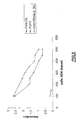
- the shear rate retained is 10 (1 / s) for a temperature gradient of 1 ° C per minute. It can be seen from FIG.
- the copolymers according to the invention do not exhibit a heat-sensitive character (their viscosity decreases in a low and regular manner with temperature), and a moderate viscosity. It is also found that the structure and the properties of the copolymers can be varied by controlling the polymerization conditions.
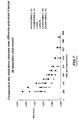
- EXAMPLE 7 Electrophoretic Separations of Single-Stranded DNA Fragments in Separation Media According to the Invention Based on the Copolymers Described in Examples 2, 4 and 5, and by Way of Comparison, in Linear Polyacrylamide (LPA ) and the "POP5" commercial separation medium (Applied Biosystems). The separation conditions are identical to those of Example 4, with the exception of the sample, a "sizer" of 100 to 1500 bases (BioVentures, USA). It can be seen from FIG.
- LPA Linear Polyacrylamide
- POP5 commercial separation medium
- the media based on copolymers according to the invention in particular those corresponding to a concentration in mass in separation medium of 3%, lead to a resolution significantly higher than that obtained with the polymers of the prior art.
- the media according to the invention must allow reading lengths greater than 800 bases.
Landscapes
- Chemical & Material Sciences (AREA)
- Health & Medical Sciences (AREA)
- Chemical Kinetics & Catalysis (AREA)
- Organic Chemistry (AREA)
- Polymers & Plastics (AREA)
- Medicinal Chemistry (AREA)
- Life Sciences & Earth Sciences (AREA)
- Molecular Biology (AREA)
- Analytical Chemistry (AREA)
- Biochemistry (AREA)
- General Health & Medical Sciences (AREA)
- General Physics & Mathematics (AREA)
- Immunology (AREA)
- Pathology (AREA)
- Physics & Mathematics (AREA)
- Electrochemistry (AREA)
- Dispersion Chemistry (AREA)
- General Chemical & Material Sciences (AREA)
- Measuring Or Testing Involving Enzymes Or Micro-Organisms (AREA)
- Solid-Sorbent Or Filter-Aiding Compositions (AREA)
- Apparatus Associated With Microorganisms And Enzymes (AREA)
- Investigating Or Analyzing Non-Biological Materials By The Use Of Chemical Means (AREA)
- Peptides Or Proteins (AREA)
- Investigating Or Analyzing Materials Using Thermal Means (AREA)
- Compositions Of Macromolecular Compounds (AREA)
- Other Resins Obtained By Reactions Not Involving Carbon-To-Carbon Unsaturated Bonds (AREA)
- Treatments Of Macromolecular Shaped Articles (AREA)
- Absorbent Articles And Supports Therefor (AREA)
- Safety Valves (AREA)
- Materials For Medical Uses (AREA)
- Other Investigation Or Analysis Of Materials By Electrical Means (AREA)
- Investigating Or Analysing Biological Materials (AREA)
Claims (22)
- Flüssiges Medium zur Analyse, Reinigung oder Trennung von Spezies in einem Kanal, die mindestens ein Polymer aus mehreren Polymersegmenten enthält, wobei dieses Medium nicht thermosensibel ist und das Polymer- vom Typ eines unregelmäßigen Block-Copolymers oder eines unregelmäßigen Kammpolymers ist;- über mindestens drei Bindungspunkte zwischen den Polymersegmenten verfügt, die von verschiedener chemischer oder topologischer Art sind;- eine mittlere Molekülmasse über 50.000 aufweist;
dadurch gekennzeichnet, dass- die Gesamtheit der Segmente mindestens eines Typs chemischer oder topologischer Art, die in seine Zusammensetzung eintreten, eine Polymolekularität von mindestens 1,5 aufweisen. - Medium nach Anspruch 1, dadurch gekennzeichnet, dass die Segmente jedes der Typen chemischer oder topologischer Art, die in die Zusammensetzung des Polymers eintreten, eine Polymolekularität von mindestens 1,5 aufweisen.
- Medium nach Anspruch 1 oder 2, dadurch gekennzeichnet, dass die Polymolekularität über 1,8 beträgt.
- Medium nach einem der vorstehenden Ansprüche, dadurch gekennzeichnet, dass das Polymer eine mittlere Molekülmasse über 300.000 aufweist.
- Medium nach einem der Ansprüche 1 bis 4, dadurch gekennzeichnet, dass das Polymer eine spezifische Affinität für die Wände des Kanals zeigt.
- Medium nach Anspruch 5, dadurch gekennzeichnet, dass das Polymer über mindestens einen Polymersegmenttyp, der im Trennmedium eine spezifische Affinität zur Wand zeigt, und über mindestens einen Polymersegmenttyp verfügt, der im genannten Medium über weniger oder keine Affinität zur Wand verfügt.
- Medium nach Anspruch 5 oder 6, dadurch gekennzeichnet, dass die Gesamtheit der Segmente, die eine spezifische Affinität zur Wand zeigen, zwischen 2 und 80 Massen% der gesamten mittleren Molekülmasse des Polymers ausmachen.
- Medium nach einem der vorstehenden Ansprüche, dadurch gekennzeichnet, dass das Polymer eine spezifische Affinität zu einem oder mehreren Analyseobjekten zeigt.
- Medium nach Anspruch 8, dadurch gekennzeichnet, dass das Polymer Träger von Nukleotiden oder Polypeptiden einer bestimmten Sequenz ist.
- Medium nach Anspruch 8, dadurch gekennzeichnet, dass das Polymer einem Protein, einem Proteinbruchstück, einem Proteinkomplex und/oder einer Säure- oder Basefunktion zugeordnet ist.
- Medium nach einem der vorstehenden Ansprüche, dadurch gekennzeichnet, dass die Gesamtheit der Polymersegmente mindestens eines Typs chemischer oder topologischer Natur im Mittel eine Atomzahl über 75, vorzugsweise über 210, aufweisen, oder sie eine Molekülmasse über 1.500, vorzugsweise über 4.500, aufweisen.
- Medium nach einem der vorstehenden Ansprüche, dadurch gekennzeichnet, dass die verschiedenen Polymersegmenttypen, die das genannte Polymer bilden, eine mittlere Atomzahl über 75, vorzugsweise über 210, aufweisen, oder sie eine Molekülmasse über 1.500, vorzugsweise über 4.500, aufweisen.
- Medium nach einem der vorstehenden Ansprüche, dadurch gekennzeichnet, dass das Polymer im Mittel über eine Anzahl von Bindungsstellen zwischen 4 und 100 verfügt.
- Medium nach einem der vorstehenden Ansprüche, dadurch gekennzeichnet, dass das Polymer ein Block-Copolymer ist, das im Mittel über mindestens vier Polymersegmente verfügt.
- Medium nach einem der vorstehenden Ansprüche, dadurch gekennzeichnet, dass das Polymer ein Kammpolymer ist, das im Mittel über mindestens zwei Seitenketten verfügt.
- Medium nach einem der vorstehenden Ansprüche, dadurch gekennzeichnet, dass das Polymer über mindestens einen Segmenttyp verfügt, der aus Folgendem ausgewählt ist: Polyether, Polyester, wie Polyglykolsäure, lösliche Homopolymere und statistische Copolymere vom Polyalkylentyp, wie Polyoxypropylen, Polyoxybutylen, Polyoxyethylen, Polysaccharide, Polyvinylalkohol, Polyvinylpyrolidon, Polyurethane, Polyamide, Polysulfonamide, Polysulfoxide, Polyoxazolin, Polystyrensulfonat, Polymere und Copolymere von Acrylamiden, Methacrylamiden und Allylen, jeweils substituiert oder unsubstituiert.
- Medium nach einem der vorstehenden Ansprüche, dadurch gekennzeichnet, dass das Polymer über mindestens ein aus Folgendem ausgewähltes Polymer verfügt:- Copolymere vom Kammcopolymertyp, deren Skelett vom Dextran-, Acrylamid-, Acrylsäure-, Acryloylaminoethanol- oder (N,N)-Dimethylacrylamid-Typ ist und bei denen Seitensegmente vom folgenden Typ aufgepfropft sind: Acrylamid, substituiertes Acrylamid, (N,N)-Dimethylacrylamid (DMA) oder vom Typ eines Copolymers von DMA und Allylglycidylether (AGE) oder Homopolymer oder Copolymer von Oxazolin oder Oxazolinderivaten;- nicht thermosensible Copolymere vom Copolymertyp mit unregelmäßiger Sequenz, die entlang ihrem Skelett abwechselnd Segmente vom Polyoxyethylen-Typ und Segmente vom Polyoxypropylen-Typ oder abwechselnd Segmente vom Polyoxyethylen-Typ und Segmente vom Polyoxybutylen-Typ oder abwechselnd Polyethylensegmente und Segmente vom Polyether-Typ zuzüglich Hydrophoben wie Polyoxyethylen zeigen;- Copolymere vom Block-Copolymertyp mit unregelmäßiger Sequenz, die entlang ihrem Skelett abwechselnd einerseits Segmente vom Acrylamid-, Acrylsäure-Acryloylaminoethanol- oder Dimethylacrylamid-Typ sowie Segmente vom (N,N)-Dimethylacrylamid(DMA)-Typ oder vom Typ eines Copolymers von DMA und Alylglycidylether (AGE) oder eines Homopolymers oder eines Copolymers von Oxazolin oder Oxazolinderivaten zeigen;- Polymere vom unregelmäßigen Kammpolymer-Typ, deren Skelett vom folgenden Polymertyp ist: Agarose, Acrylamid, substituiertes Acrylamid, Acrylsäure, Acryloylaminoethanol, Dimethylacrylamid (DMA), Allylglycidylether (AGE), statistisches Copolymer von DMA und AGE, Oxazolin, Oxazolinderivaten, Dextran, Methylcellulose, Hydroxyethylcellulose, modifizierte Cellulosen, Polysaccharide, Etheroxide; und bei denen Seitensegmente vom Folgenden Polymertyp aufgepfropft sind: Agarose, Acrylamid, substituiertes Acrylamid, Acrylsäure, Acryloylaminoethanol, Dimethylacrylamid (DMA), Allylglycidylether (AGE), statistisches Copolymer von DMA und AGE, Oxazolin, Oxazolinderivate, Dextran, Methylcellulose, Hydroxyethylcellulose, modifizierte Cellulosen, Polysaccharide, Etheroxide;- Copolymere vom Typ unregelmäßiger Kammpolymere, deren Skelett vom folgenden Polymertyp ist: Acrylamid, substituiertes Acrylamid, Acrylsäure, Acryloylaminoethanol, Dimethylacrylamid (DMA), Allylglycidylether (AGE), statistisches Copolymer von DMA und AGE, Oxazolin, Oxazolinderivate, Dextran, Methylcellulose, Hydroxyethylcellulose, modifizierte Cellulosen, Polysaccharide, Etheroxide, und wobei dieses Skelett Träger hydrophober Seitensegmente mit kurzen Ketten, wie Alkylketten, aromatischen Derivaten, Fluoralkylen, Silanen, Fluorsilanen, ist.
- Verwendung eines Mediums nach einem der Ansprüche 1 bis 17 zur Trennung, Reinigung, Filterung oder Analyse von Spezies, die unter den folgenden Spezies ausgewählt sind: Molekülen oder Makromolekülen, biologischen Makromolekülen vom Nukleinsäuretyp, deren synthetischen Analogen, Proteinen, Polypeptiden, Glykopeptiden und Polysacchariden, organischen Molekülen, synthetischen Makromolekülen oder Teilchen wie Mineralteilchen, Latexteilchen, Zellen oder Organellen.
- Verwendung nach Anspruch 18 oder Verwendung eines Mediums nach einem der Ansprüche 1 bis 17 in einem Kanal, dessen Abmessung mindestens im Submillimeterbereich liegt.
- Verwendung nach Anspruch 18 oder 19 oder Verwendung eines Mediums nach einem der Ansprüche 1 bis 17 für elektrokinetische Trennvorgänge.
- Verwendung nach einem der Ansprüche 18 bis 20 oder Verwendung eines Mediums nach einem der Ansprüche 1 bis 17 zur Diagnose, zur Genotypfeststellung und zum Sieben mit hohem Durchsatz, zur Qualitätskontrolle oder zum Erkennen des Vorliegens genetisch modifizierter Organismen in einem Erzeugnis.
- Verfahren zur Trennung, Analyse und/oder Identifizierung von in einer Probe enthaltenen Spezies, dadurch gekennzeichnet, dass es Folgendes beinhaltet:a) das Füllen eines Kanals einer Trennvorrichtung mit einem Trennmedium nach einem der Ansprüche 1 bis 17;b) das Einleiten der die Spezies enthaltenden Probe an einem Ende des Kanals;c) das Anlegen eines externen Felds zum Bewegen bestimmter in der Probe enthaltener Spezies, undd) das Rückgewinnen der Spezies oder das Erkennen ihres Durchlaufs an einer Stelle entlang dem Kanal, die vom Einleitungspunkt der Probe verschieden ist.
Applications Claiming Priority (3)
| Application Number | Priority Date | Filing Date | Title |
|---|---|---|---|
| FR0008526A FR2811083B1 (fr) | 2000-06-30 | 2000-06-30 | Milieu liquide non-thermosensible pour l'analyse d'especes au sein d'un canal |
| FR0008526 | 2000-06-30 | ||
| PCT/FR2001/002103 WO2002001218A2 (fr) | 2000-06-30 | 2001-06-29 | Milieu liquide non-thermosensible pour l'analyse d'especes au sein d'un canal |
Publications (2)
| Publication Number | Publication Date |
|---|---|
| EP1295113A2 EP1295113A2 (de) | 2003-03-26 |
| EP1295113B1 true EP1295113B1 (de) | 2006-07-26 |
Family
ID=8851970
Family Applications (1)
| Application Number | Title | Priority Date | Filing Date |
|---|---|---|---|
| EP01949600A Expired - Lifetime EP1295113B1 (de) | 2000-06-30 | 2001-06-29 | Flüssiges nichtthermosensibles medium für die analyse von spezien in einem kanal |
Country Status (10)
| Country | Link |
|---|---|
| US (4) | US20040084310A1 (de) |
| EP (1) | EP1295113B1 (de) |
| JP (2) | JP2004502172A (de) |
| AT (1) | ATE334386T1 (de) |
| AU (1) | AU2001270725A1 (de) |
| CA (1) | CA2414295C (de) |
| DE (1) | DE60121767T2 (de) |
| ES (1) | ES2269427T3 (de) |
| FR (1) | FR2811083B1 (de) |
| WO (1) | WO2002001218A2 (de) |
Cited By (1)
| Publication number | Priority date | Publication date | Assignee | Title |
|---|---|---|---|---|
| US8784627B2 (en) | 2002-07-29 | 2014-07-22 | Applied Biosystems, Llc | Graft copolymers, their preparation and use in capillary electrophoresis |
Families Citing this family (7)
| Publication number | Priority date | Publication date | Assignee | Title |
|---|---|---|---|---|
| FR2811083B1 (fr) * | 2000-06-30 | 2002-11-22 | Inst Curie | Milieu liquide non-thermosensible pour l'analyse d'especes au sein d'un canal |
| WO2003076922A1 (en) * | 2002-03-04 | 2003-09-18 | Symyx Technologies, Inc. | Copolymers for use in capillary electrophoretic separation media |
| AU2003301503A1 (en) * | 2003-12-16 | 2005-07-14 | Centre National De La Recherche Scientifique | Methods and compositions for assaying mutations in nucleic acids |
| FR2867479B1 (fr) * | 2004-03-15 | 2007-11-02 | Commissariat Energie Atomique | Polymere de haut poids moleculaire a base de n,n- dimethylacrylamide et de monomeres fonctionnalises par des molecules sondes et ses utilisations |
| FR2886301B1 (fr) * | 2005-05-25 | 2010-08-20 | Inst Curie | Nouveau procede de preparation de copolymeres en peigne hydrosolubles |
| US7932339B2 (en) * | 2005-05-25 | 2011-04-26 | Centre National De La Recherche Scientifique | Method for producing water-soluble comb-shaped copolymers |
| ATE510025T1 (de) | 2005-12-13 | 2011-06-15 | Inst Curie | Verfahren für die detektion von mutationen in nukleinsaüren, und die anwendung in der diagnose von genetischen krankheiten und krebs |
Citations (1)
| Publication number | Priority date | Publication date | Assignee | Title |
|---|---|---|---|---|
| WO2002000746A2 (fr) * | 2000-06-30 | 2002-01-03 | Institut Curie | Solution de traitement de surface minimisant les phenomenes d'adsorption et/ou d'electroosmose |
Family Cites Families (37)
| Publication number | Priority date | Publication date | Assignee | Title |
|---|---|---|---|---|
| US4504641A (en) | 1982-02-19 | 1985-03-12 | Fmc Corporation | Polyacrylamide cross-linked with a polysaccharide resin as electrophoretic gel medium |
| CA1206666A (en) | 1982-02-19 | 1986-06-24 | Samuel Nochumson | Copolymer of acrylamide and polysaccharide resin as electrophoretic gel medium |
| US4542200A (en) | 1982-02-19 | 1985-09-17 | Fmc Corporation | Polyacrylamide cross-linked with a polysaccharide resin as electrophoretic gel medium |
| US4496708A (en) * | 1983-12-14 | 1985-01-29 | Union Carbide Corporation | Water-soluble polyurethane comb polymer production |
| DE3500180A1 (de) | 1985-01-04 | 1986-07-10 | Ernst Prof. Dr. 7400 Tübingen Bayer | Pfropfcopolymerisate aus vernetzten polymeren und polyoxyethylen, verfahren zu ihrer herstellung und ihre verwendung |
| US4680201A (en) | 1985-10-30 | 1987-07-14 | Stellan Hjerten | Coating for electrophoresis tube |
| US5112460A (en) | 1986-10-21 | 1992-05-12 | Northeastern University | High performance microcapillary gel electrophoresis |
| US5225491A (en) | 1987-05-07 | 1993-07-06 | The B. F. Goodrich Company | Comb-shaped copolymers of a macromolecular monomer of polyhaloether with terminal olefinic unsaturation and process |
| US5055517A (en) * | 1988-04-29 | 1991-10-08 | At Biochem | Electrophoretic media |
| US5306501A (en) | 1990-05-01 | 1994-04-26 | Mediventures, Inc. | Drug delivery by injection with thermoreversible gels containing polyoxyalkylene copolymers |
| EP0490406A3 (en) * | 1990-12-14 | 1992-08-05 | Hewlett-Packard Company | Capillary gel electrophoresis columns and methods of preparing the same |
| DE4230403A1 (de) | 1992-09-11 | 1994-03-17 | Studiengesellschaft Kohle Mbh | Desaktivierung der inneren Oberfläche von Kapillaren |
| US5290418A (en) | 1992-09-24 | 1994-03-01 | Applied Biosystems, Inc. | Viscous electrophoresis polymer medium and method |
| US5759369A (en) * | 1992-09-24 | 1998-06-02 | The Perkin-Elmer Corporation | Viscous electrophoresis polymer medium and method |
| WO1994010561A1 (en) * | 1992-11-05 | 1994-05-11 | Soane Technologies, Inc. | Separation media for electrophoresis |
| US5569364A (en) | 1992-11-05 | 1996-10-29 | Soane Biosciences, Inc. | Separation media for electrophoresis |
| EP0639592A1 (de) | 1993-08-18 | 1995-02-22 | Nippon Shokubai Co., Ltd. | Wasserlösliche Pfropfcopolymerisate und Verfahren zur Herstellung davon |
| US5891313A (en) * | 1993-11-23 | 1999-04-06 | The Perkin-Elmer Corp. | Entrapment of nucleic acid sequencing template in sample mixtures by entangled polymer networks |
| AU1254295A (en) * | 1993-12-17 | 1995-07-03 | Perkin-Elmer Corporation, The | Uncharged polymers for separation of biomolecules by capillary electrophoresis |
| DE4425408A1 (de) * | 1994-07-13 | 1996-01-18 | Hoechst Ag | Cycloolefinpolymere |
| US5571410A (en) * | 1994-10-19 | 1996-11-05 | Hewlett Packard Company | Fully integrated miniaturized planar liquid sample handling and analysis device |
| FR2738573B1 (fr) | 1995-09-08 | 1997-10-17 | Rhone Poulenc Chimie | Utilisation en tant qu'agents thermoepaississants de copolymeres multiblocs |
| US5807937A (en) * | 1995-11-15 | 1998-09-15 | Carnegie Mellon University | Processes based on atom (or group) transfer radical polymerization and novel (co) polymers having useful structures and properties |
| US5883211A (en) | 1996-01-19 | 1999-03-16 | Aclara Biosciences, Inc. | Thermoreversible hydrogels comprising linear copolymers and their use in electrophoresis |
| DE69729726T2 (de) * | 1996-05-24 | 2005-07-07 | Zeptosens Ag | Verfahren zur trennung von wirkstoffgemischen mit kapillaraffinity-gelelektrophorese |
| US6001232A (en) * | 1996-09-04 | 1999-12-14 | The Research Foundation Of State University Of New York | Separation medium for capillary electrophoresis |
| US5989399A (en) | 1996-09-04 | 1999-11-23 | The Research Foundation Of State University Of New York | Effective surface treatment for a new separation medium in electrophoresis |
| ES2166982T3 (es) | 1996-09-24 | 2002-05-01 | Shell Int Research | Mejoradores del indice de viscosidad dispersantes. |
| US6166149A (en) | 1996-12-27 | 2000-12-26 | Nippon Shokubai Co., Ltd. | Hydrophilic graft polymer, production process therefor, composition containing the polymer, and use thereof |
| FR2764892B1 (fr) * | 1997-06-23 | 2000-03-03 | Rhodia Chimie Sa | Procede de synthese de polymeres a blocs |
| US6114077A (en) | 1998-07-31 | 2000-09-05 | Agfa-Gevaert, N.V. | White toner composition |
| US6162877A (en) * | 1998-12-04 | 2000-12-19 | Hercules Incorporated | Hydrophobically modified comb copolymers |
| FR2788008B1 (fr) | 1998-12-30 | 2001-03-23 | Inst Curie | Milieu thermosensible pour la separation electrocinetique d'especes au sein d'un canal de separation |
| CA2358480A1 (en) | 1999-01-12 | 2000-07-20 | Spectrumedix Corporation | Copolymers for capillary gel electrophoresis |
| US6306273B1 (en) * | 1999-04-13 | 2001-10-23 | Aclara Biosciences, Inc. | Methods and compositions for conducting processes in microfluidic devices |
| FR2811083B1 (fr) * | 2000-06-30 | 2002-11-22 | Inst Curie | Milieu liquide non-thermosensible pour l'analyse d'especes au sein d'un canal |
| US8975328B2 (en) * | 2000-06-30 | 2015-03-10 | Institute Curie | Non-thermosensitive medium for analyzing species in a channel and for minimizing adsorption and/or electroosomosic phenomena |
-
2000
- 2000-06-30 FR FR0008526A patent/FR2811083B1/fr not_active Expired - Lifetime
-
2001
- 2001-06-29 DE DE60121767T patent/DE60121767T2/de not_active Expired - Lifetime
- 2001-06-29 AT AT01949600T patent/ATE334386T1/de not_active IP Right Cessation
- 2001-06-29 ES ES01949600T patent/ES2269427T3/es not_active Expired - Lifetime
- 2001-06-29 US US10/312,538 patent/US20040084310A1/en not_active Abandoned
- 2001-06-29 CA CA2414295A patent/CA2414295C/fr not_active Expired - Lifetime
- 2001-06-29 JP JP2002506100A patent/JP2004502172A/ja not_active Withdrawn
- 2001-06-29 EP EP01949600A patent/EP1295113B1/de not_active Expired - Lifetime
- 2001-06-29 AU AU2001270725A patent/AU2001270725A1/en not_active Abandoned
- 2001-06-29 WO PCT/FR2001/002103 patent/WO2002001218A2/fr not_active Ceased
-
2012
- 2012-01-20 JP JP2012010033A patent/JP5038536B2/ja not_active Expired - Fee Related
-
2016
- 2016-05-02 US US15/143,972 patent/US9658189B2/en not_active Expired - Fee Related
-
2017
- 2017-05-08 US US15/588,951 patent/US20180024095A1/en not_active Abandoned
-
2018
- 2018-10-03 US US16/151,318 patent/US20190204266A1/en not_active Abandoned
Patent Citations (1)
| Publication number | Priority date | Publication date | Assignee | Title |
|---|---|---|---|---|
| WO2002000746A2 (fr) * | 2000-06-30 | 2002-01-03 | Institut Curie | Solution de traitement de surface minimisant les phenomenes d'adsorption et/ou d'electroosmose |
Non-Patent Citations (1)
| Title |
|---|
| AOKI T. ET AL: "Thermosensitive Phase-Separation Behavior of Poly(acrylic acid)-graft-poly(N,N-dimethylacrylamide) Aqueous Solution", MACROMOLECULES, vol. 33, 31 December 1999 (1999-12-31), pages 444 - 450 * |
Cited By (1)
| Publication number | Priority date | Publication date | Assignee | Title |
|---|---|---|---|---|
| US8784627B2 (en) | 2002-07-29 | 2014-07-22 | Applied Biosystems, Llc | Graft copolymers, their preparation and use in capillary electrophoresis |
Also Published As
| Publication number | Publication date |
|---|---|
| US20040084310A1 (en) | 2004-05-06 |
| JP2004502172A (ja) | 2004-01-22 |
| CA2414295A1 (fr) | 2002-01-03 |
| JP5038536B2 (ja) | 2012-10-03 |
| DE60121767D1 (de) | 2006-09-07 |
| CA2414295C (fr) | 2015-05-26 |
| WO2002001218A3 (fr) | 2002-04-11 |
| US20180024095A1 (en) | 2018-01-25 |
| US9658189B2 (en) | 2017-05-23 |
| AU2001270725A1 (en) | 2002-01-08 |
| FR2811083B1 (fr) | 2002-11-22 |
| EP1295113A2 (de) | 2003-03-26 |
| US20190204266A1 (en) | 2019-07-04 |
| ATE334386T1 (de) | 2006-08-15 |
| ES2269427T3 (es) | 2007-04-01 |
| JP2012098304A (ja) | 2012-05-24 |
| DE60121767T2 (de) | 2007-08-02 |
| FR2811083A1 (fr) | 2002-01-04 |
| WO2002001218A2 (fr) | 2002-01-03 |
| US20160238557A1 (en) | 2016-08-18 |
Similar Documents
| Publication | Publication Date | Title |
|---|---|---|
| CA2358092C (fr) | Milieu thermosensible pour la separation d'especes au sein d'un canal de separation | |
| JP5038536B2 (ja) | 流路内の種を分析するための非感熱液状媒体 | |
| US7399396B2 (en) | Sparsely cross-linked nanogels: a novel polymer structure for microchannel DNA sequencing | |
| CN1266471C (zh) | 一种由毛细管电泳分离分析物的方法 | |
| EP0662217A1 (de) | Viscoses elektroforetisches polymer und dessen verwendung | |
| JP4681177B2 (ja) | ダイナミックコーティング | |
| FR2810905A1 (fr) | Additif pour minimiser les phenomenes d'adsorption et/ou d'electroosmose | |
| WO2001092361A1 (fr) | Polymere biocompatible pour la fixation de ligands biologiques | |
| US9347915B2 (en) | Non-thermosensitive medium for analyzing species in a channel and for minimizing absorption and/or electroosomosic phenomena | |
| JP5284100B2 (ja) | マイクロチャネル分離用マトリックス、ダイナミックポリマーシステム及び組成物 | |
| Chiari et al. | Performances of new sugar‐bearing poly (acrylamide) copolymers as DNA sieving matrices and capillary coatings for electrophoresis | |
| CN121240921A (zh) | 用于纳米孔测序的混合三嵌段共聚物膜组合物和方法 | |
| Bromberg | Polyacrylamide conjugated with poly (oxyethylene)‐block‐poly (oxypropylene)‐block‐poly (oxyethylene): a self‐assembling material | |
| US12092606B2 (en) | Compositions and kits comprising interpenetrating polymer network for capillary electrophoresis | |
| US20050070668A1 (en) | Quasi-interpenetrating networks used as separation media | |
| WO2007147279A2 (fr) | Composition de gel d'électrophorèse à base de monomère nat et utilisation dudit gel | |
| CN119491039A (zh) | 用于微通道筛分的基质及其应用、用于分离dna及rna的测序胶及其制备方法和应用 | |
| CN1997678A (zh) | 用作分离介质的类互穿网络 | |
| CN121057766A (zh) | 经修饰的三嵌段共聚物化合物及其使用方法 | |
| CN105367693A (zh) | 一种用于毛细管电泳的无胶筛分介质及其制备方法 | |
| CA2417534A1 (fr) | Procede d'analyse d'acides nucleiques |
Legal Events
| Date | Code | Title | Description |
|---|---|---|---|
| PUAI | Public reference made under article 153(3) epc to a published international application that has entered the european phase |
Free format text: ORIGINAL CODE: 0009012 |
|
| 17P | Request for examination filed |
Effective date: 20021220 |
|
| AK | Designated contracting states |
Kind code of ref document: A2 Designated state(s): AT BE CH CY DE DK ES FI FR GB GR IE IT LI LU MC NL PT SE TR Designated state(s): AT BE CH CY DE DK ES FI FR GB GR IE IT LI LU MC NL PT SE TR |
|
| AX | Request for extension of the european patent |
Extension state: AL LT LV MK RO SI |
|
| RIN1 | Information on inventor provided before grant (corrected) |
Inventor name: VIOVY, JEAN-LOUIS Inventor name: BARBIER, VALESSA |
|
| 17Q | First examination report despatched |
Effective date: 20041118 |
|
| GRAP | Despatch of communication of intention to grant a patent |
Free format text: ORIGINAL CODE: EPIDOSNIGR1 |
|
| GRAS | Grant fee paid |
Free format text: ORIGINAL CODE: EPIDOSNIGR3 |
|
| GRAA | (expected) grant |
Free format text: ORIGINAL CODE: 0009210 |
|
| AK | Designated contracting states |
Kind code of ref document: B1 Designated state(s): AT BE CH CY DE DK ES FI FR GB GR IE IT LI LU MC NL PT SE TR |
|
| PG25 | Lapsed in a contracting state [announced via postgrant information from national office to epo] |
Ref country code: IT Free format text: LAPSE BECAUSE OF FAILURE TO SUBMIT A TRANSLATION OF THE DESCRIPTION OR TO PAY THE FEE WITHIN THE PRESCRIBED TIME-LIMIT;WARNING: LAPSES OF ITALIAN PATENTS WITH EFFECTIVE DATE BEFORE 2007 MAY HAVE OCCURRED AT ANY TIME BEFORE 2007. THE CORRECT EFFECTIVE DATE MAY BE DIFFERENT FROM THE ONE RECORDED. Effective date: 20060726 Ref country code: AT Free format text: LAPSE BECAUSE OF FAILURE TO SUBMIT A TRANSLATION OF THE DESCRIPTION OR TO PAY THE FEE WITHIN THE PRESCRIBED TIME-LIMIT Effective date: 20060726 Ref country code: FI Free format text: LAPSE BECAUSE OF FAILURE TO SUBMIT A TRANSLATION OF THE DESCRIPTION OR TO PAY THE FEE WITHIN THE PRESCRIBED TIME-LIMIT Effective date: 20060726 |
|
| REG | Reference to a national code |
Ref country code: GB Ref legal event code: FG4D Free format text: NOT ENGLISH |
|
| REG | Reference to a national code |
Ref country code: CH Ref legal event code: EP |
|
| REG | Reference to a national code |
Ref country code: IE Ref legal event code: FG4D Free format text: LANGUAGE OF EP DOCUMENT: FRENCH |
|
| REF | Corresponds to: |
Ref document number: 60121767 Country of ref document: DE Date of ref document: 20060907 Kind code of ref document: P |
|
| PG25 | Lapsed in a contracting state [announced via postgrant information from national office to epo] |
Ref country code: SE Free format text: LAPSE BECAUSE OF FAILURE TO SUBMIT A TRANSLATION OF THE DESCRIPTION OR TO PAY THE FEE WITHIN THE PRESCRIBED TIME-LIMIT Effective date: 20061026 Ref country code: DK Free format text: LAPSE BECAUSE OF FAILURE TO SUBMIT A TRANSLATION OF THE DESCRIPTION OR TO PAY THE FEE WITHIN THE PRESCRIBED TIME-LIMIT Effective date: 20061026 |
|
| GBT | Gb: translation of ep patent filed (gb section 77(6)(a)/1977) |
Effective date: 20061030 |
|
| PG25 | Lapsed in a contracting state [announced via postgrant information from national office to epo] |
Ref country code: PT Free format text: LAPSE BECAUSE OF FAILURE TO SUBMIT A TRANSLATION OF THE DESCRIPTION OR TO PAY THE FEE WITHIN THE PRESCRIBED TIME-LIMIT Effective date: 20061226 |
|
| REG | Reference to a national code |
Ref country code: ES Ref legal event code: FG2A Ref document number: 2269427 Country of ref document: ES Kind code of ref document: T3 |
|
| PLBE | No opposition filed within time limit |
Free format text: ORIGINAL CODE: 0009261 |
|
| STAA | Information on the status of an ep patent application or granted ep patent |
Free format text: STATUS: NO OPPOSITION FILED WITHIN TIME LIMIT |
|
| 26N | No opposition filed |
Effective date: 20070427 |
|
| PG25 | Lapsed in a contracting state [announced via postgrant information from national office to epo] |
Ref country code: MC Free format text: LAPSE BECAUSE OF NON-PAYMENT OF DUE FEES Effective date: 20070630 |
|
| PG25 | Lapsed in a contracting state [announced via postgrant information from national office to epo] |
Ref country code: GR Free format text: LAPSE BECAUSE OF FAILURE TO SUBMIT A TRANSLATION OF THE DESCRIPTION OR TO PAY THE FEE WITHIN THE PRESCRIBED TIME-LIMIT Effective date: 20061027 |
|
| PG25 | Lapsed in a contracting state [announced via postgrant information from national office to epo] |
Ref country code: LU Free format text: LAPSE BECAUSE OF NON-PAYMENT OF DUE FEES Effective date: 20070629 Ref country code: CY Free format text: LAPSE BECAUSE OF FAILURE TO SUBMIT A TRANSLATION OF THE DESCRIPTION OR TO PAY THE FEE WITHIN THE PRESCRIBED TIME-LIMIT Effective date: 20060726 |
|
| PG25 | Lapsed in a contracting state [announced via postgrant information from national office to epo] |
Ref country code: TR Free format text: LAPSE BECAUSE OF FAILURE TO SUBMIT A TRANSLATION OF THE DESCRIPTION OR TO PAY THE FEE WITHIN THE PRESCRIBED TIME-LIMIT Effective date: 20060726 |
|
| PG25 | Lapsed in a contracting state [announced via postgrant information from national office to epo] |
Ref country code: IT Free format text: LAPSE BECAUSE OF NON-PAYMENT OF DUE FEES Effective date: 20090629 |
|
| PGRI | Patent reinstated in contracting state [announced from national office to epo] |
Ref country code: IT Effective date: 20110616 |
|
| REG | Reference to a national code |
Ref country code: FR Ref legal event code: PLFP Year of fee payment: 16 |
|
| REG | Reference to a national code |
Ref country code: FR Ref legal event code: PLFP Year of fee payment: 17 |
|
| REG | Reference to a national code |
Ref country code: FR Ref legal event code: PLFP Year of fee payment: 18 |
|
| PGFP | Annual fee paid to national office [announced via postgrant information from national office to epo] |
Ref country code: IE Payment date: 20190624 Year of fee payment: 19 Ref country code: NL Payment date: 20190626 Year of fee payment: 19 Ref country code: IT Payment date: 20190620 Year of fee payment: 19 Ref country code: DE Payment date: 20190618 Year of fee payment: 19 |
|
| PGFP | Annual fee paid to national office [announced via postgrant information from national office to epo] |
Ref country code: FR Payment date: 20190627 Year of fee payment: 19 Ref country code: BE Payment date: 20190626 Year of fee payment: 19 |
|
| PGFP | Annual fee paid to national office [announced via postgrant information from national office to epo] |
Ref country code: CH Payment date: 20190628 Year of fee payment: 19 |
|
| PGFP | Annual fee paid to national office [announced via postgrant information from national office to epo] |
Ref country code: ES Payment date: 20190701 Year of fee payment: 19 Ref country code: GB Payment date: 20190626 Year of fee payment: 19 |
|
| REG | Reference to a national code |
Ref country code: DE Ref legal event code: R119 Ref document number: 60121767 Country of ref document: DE |
|
| REG | Reference to a national code |
Ref country code: CH Ref legal event code: PL |
|
| REG | Reference to a national code |
Ref country code: NL Ref legal event code: MM Effective date: 20200701 |
|
| GBPC | Gb: european patent ceased through non-payment of renewal fee |
Effective date: 20200629 |
|
| REG | Reference to a national code |
Ref country code: BE Ref legal event code: MM Effective date: 20200630 |
|
| PG25 | Lapsed in a contracting state [announced via postgrant information from national office to epo] |
Ref country code: FR Free format text: LAPSE BECAUSE OF NON-PAYMENT OF DUE FEES Effective date: 20200630 Ref country code: GB Free format text: LAPSE BECAUSE OF NON-PAYMENT OF DUE FEES Effective date: 20200629 Ref country code: NL Free format text: LAPSE BECAUSE OF NON-PAYMENT OF DUE FEES Effective date: 20200701 Ref country code: CH Free format text: LAPSE BECAUSE OF NON-PAYMENT OF DUE FEES Effective date: 20200630 Ref country code: LI Free format text: LAPSE BECAUSE OF NON-PAYMENT OF DUE FEES Effective date: 20200630 Ref country code: IE Free format text: LAPSE BECAUSE OF NON-PAYMENT OF DUE FEES Effective date: 20200629 |
|
| PG25 | Lapsed in a contracting state [announced via postgrant information from national office to epo] |
Ref country code: BE Free format text: LAPSE BECAUSE OF NON-PAYMENT OF DUE FEES Effective date: 20200630 Ref country code: DE Free format text: LAPSE BECAUSE OF NON-PAYMENT OF DUE FEES Effective date: 20210101 |
|
| REG | Reference to a national code |
Ref country code: ES Ref legal event code: FD2A Effective date: 20211103 |
|
| PG25 | Lapsed in a contracting state [announced via postgrant information from national office to epo] |
Ref country code: ES Free format text: LAPSE BECAUSE OF NON-PAYMENT OF DUE FEES Effective date: 20200630 |
|
| PG25 | Lapsed in a contracting state [announced via postgrant information from national office to epo] |
Ref country code: IT Free format text: LAPSE BECAUSE OF NON-PAYMENT OF DUE FEES Effective date: 20200630 |