EP1293555A2 - Duft- und Aromastoff - Google Patents
Duft- und Aromastoff Download PDFInfo
- Publication number
- EP1293555A2 EP1293555A2 EP02020195A EP02020195A EP1293555A2 EP 1293555 A2 EP1293555 A2 EP 1293555A2 EP 02020195 A EP02020195 A EP 02020195A EP 02020195 A EP02020195 A EP 02020195A EP 1293555 A2 EP1293555 A2 EP 1293555A2
- Authority
- EP
- European Patent Office
- Prior art keywords
- rac
- ent
- dec
- mixture
- tricyclo
- Prior art date
- Legal status (The legal status is an assumption and is not a legal conclusion. Google has not performed a legal analysis and makes no representation as to the accuracy of the status listed.)
- Granted
Links
- CFYWBOZLQRYGSN-KSAJGXHHSA-N C[C@@H]([C@@H](C)O)/C=C1/C(C2)C3C=CCC3C2C1 Chemical compound C[C@@H]([C@@H](C)O)/C=C1/C(C2)C3C=CCC3C2C1 CFYWBOZLQRYGSN-KSAJGXHHSA-N 0.000 description 1
Images





Classifications
-
- C—CHEMISTRY; METALLURGY
- C11—ANIMAL OR VEGETABLE OILS, FATS, FATTY SUBSTANCES OR WAXES; FATTY ACIDS THEREFROM; DETERGENTS; CANDLES
- C11B—PRODUCING, e.g. BY PRESSING RAW MATERIALS OR BY EXTRACTION FROM WASTE MATERIALS, REFINING OR PRESERVING FATS, FATTY SUBSTANCES, e.g. LANOLIN, FATTY OILS OR WAXES; ESSENTIAL OILS; PERFUMES
- C11B9/00—Essential oils; Perfumes
- C11B9/0042—Essential oils; Perfumes compounds containing condensed hydrocarbon rings
- C11B9/0046—Essential oils; Perfumes compounds containing condensed hydrocarbon rings containing only two condensed rings
- C11B9/0049—Essential oils; Perfumes compounds containing condensed hydrocarbon rings containing only two condensed rings the condensed rings sharing two common C atoms
-
- C—CHEMISTRY; METALLURGY
- C07—ORGANIC CHEMISTRY
- C07C—ACYCLIC OR CARBOCYCLIC COMPOUNDS
- C07C33/00—Unsaturated compounds having hydroxy or O-metal groups bound to acyclic carbon atoms
- C07C33/05—Alcohols containing rings other than six-membered aromatic rings
- C07C33/14—Alcohols containing rings other than six-membered aromatic rings containing six-membered rings
Definitions
- the invention further relates to preferred configuration isomers (diastereomers, Enantiomers) of the compound mentioned with particularly pronounced sensory properties as well as corresponding mixtures.
- the invention also relates to fragrance and / or flavoring compositions which a sensory (organoleptically) active (effective) amount of the named Compound (including the associated configuration isomers) or of a corresponding configuration isomer mixture.
- the invention also relates to methods for modifying the sensory Properties of a fragrance or aroma composition, one or several components of the fragrance or aroma composition with one sensory effective amount of the compound of the invention (including the associated configuration isomers) or a corresponding one Mixture to be mixed.
- fragrances should have pleasant, as natural as possible scent notes of sufficient Have intensity and be able to smell cosmetic or to influence technical consumer goods.
- flavorings should be well tolerated, more popular with typical flavor components Remember food or even be identical to it and contribute to it can, the taste of food, orally administered drugs and the like. To influence positively. Finding fragrance and Flavors that meet these requirements have proven to be proportionate proven to be elaborate and regularly requires extensive Investigations, especially if interesting new types of fragrance or flavors are sought.
- the present invention is based on the object, taking into account of the general framework conditions described above To specify flavoring, which is in particular able, usual Fragrance or aroma base compositions a natural sandalwood to convey a reminding scent or the existing scent of such Modify compositions in an advantageous manner.
- the substances to be specified should be the perfumer or flavorist a versatile one when composing fragrances or aromas Alternative to the fragrances previously used or described offer a sandalike or sandy-woody fragrance.
- a lengthy process that is usually only carried out by specialists, it is sufficient to achieve an in not the idea of existing fragrance or aroma image, to use any fragrance or aroma as a template in the literature a certain smell or aroma aspect is assigned has been.
- the smell or aroma characteristics of a composition can be namely not precisely predict in the sense of an addition if only that Components of the composition are known because these components are subject to unpredictable interactions in the mixture. It is therefore important also the compatibility of one fragrance or aroma substance with the others Constituent parts of a composition and the presence or absence of accompanying sensory aspects that affect the overall character influence the finished composition, without it maybe A special appreciation in the description of the smell of the pure substance Experienced.
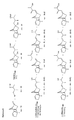
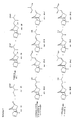
- the configuration isomers of the compound according to the invention shown each have a very interesting smell, whereby connections with the Configuration feature (E, 1R, 2R, 6R, 7R) a clearly sandal-like smell own, which is colored in individual cases by secondary aspects, and where the configuration isomers with the configuration feature (E, 1S, 2S, 6S, 7S) a smell own, which can be described as rather woody.
- configuration isomers to be classified as particularly interesting with the configuration feature (E, 1R, 2R, 6R, 7R) are the connections with the configuration feature (2S, 3R), i.e. the compound according to formula A, or (2S, 3S), i.e. the compound of formula D because of its surprising olfactory secondary notes of particular importance for the creation of new ones Perfume compositions. This is explained in more detail below in the examples.
- the compound according to the invention (represented by its 8 configuration isomers) belongs to a larger group of compounds, which is described in WO86 / 03737.
- the compound 9- (2-methyl-3-hydroxybutylidene) -2,6-exo-tricyclo [5.2.1.0 2,6 ] -decen-3 (4) disclosed in Example 2 of this document comprises a total of 32 isomers which regarding the position of the double bond in the terminal five-membered ring (carbon atoms C2 to C6), regarding the configuration on the double bond between the C8 of the ring structure and the C4 of the side chain (E or Z configuration) and regarding their stereochemistry (configuration at C2 and C3 in side chain and configuration of the chiral centers in the ring structure).
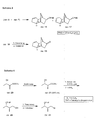
- Ketone rac - 13 was prepared analogously to the following representation of ketone rac - 15 , ie by saponification of acetate rac - 8 or p nitrobenzoate rac - 16 to alcohol rac - 6 and its subsequent oxidation.
- Acetate rac - 9 was prepared analogously to the above representation of acetate rac - 8 , ie from oxoacetate rac - 10 via acetic acid (1 RS, 2RS, 6RS, 7RS, 8SR) -3-hydroxy-tricyclo [5.2.1.0 2,6 ] dec-8-yl ester ( rac - 14 ).
- Acetic acid (1RS, 2SR, 6RS, 7RS, 8SR) tricyclo [5.2.1.0 2,6 ] dec-3-en-8-ylester ( rac - 9 ) : 1 H-NMR (300 MHz, CDCl 3 ): ⁇ 1.33 (br.
- MS: m / z (%) 157 (35, M + - 15), 101 (100), 99 (51), 98 (46), 83 (53), 73 (44), 55 (54), 43 (56), 41 (69), 29 (96), 27 (79).
- reaction mixture was filtered through talcum powder, freed from solvent on a rotary evaporator and distilled at 1 hPa on a Kugelrohr. 24.7 g of product remained, according to GC / MS analysis contained the anti-ester rac - 21 with 98% de.
- the E / Z ratio was determined to be 55:45 by integrating the characteristic 1 H NMR signals for the side chain vinyl proton at 5.08 (E isomers) and 4.85 ppm (Z isomers).
- the E / Z ratio was determined to be 55:45 by integrating the characteristic 1 H NMR signals for the side chain vinyl proton at 5.08 (E isomers) and 4,835 ppm (Z isomers).
- the minor isomers rac - 37-E and rac - 36-Z are indicated by signals of lower intensity.
- the E / Z ratio was determined to be 55:45 by integrating the characteristic 1 H NMR signals for the side chain vinyl proton at 5,085 (E isomers) and 4.85 ppm (Z isomers).
- the minor isomers rac - 39-E and rac - 38-Z were indicated by signals of lower intensity.
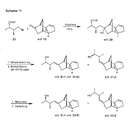
- the presentation was carried out analogously to the above presentation of the alcohol mixture rac - A / rac - 31-Z / rac - B / rac - 30-Z , ie from ketone 13 and bromide ent - 23 via coupling alcohol 29 and its dehydration and deprotection.
- Odor slightly woody Odor threshold: 168 ⁇ g / l water
- Odor slightly flowery Odor threshold: 204 ⁇ g / l water
Landscapes
- Chemical & Material Sciences (AREA)
- Organic Chemistry (AREA)
- Life Sciences & Earth Sciences (AREA)
- Engineering & Computer Science (AREA)
- Chemical Kinetics & Catalysis (AREA)
- Oil, Petroleum & Natural Gas (AREA)
- Wood Science & Technology (AREA)
- Fats And Perfumes (AREA)
- Organic Low-Molecular-Weight Compounds And Preparation Thereof (AREA)
- Indole Compounds (AREA)
- Seasonings (AREA)
Abstract
- (2R/S,3R/S) bedeutet (2R,3R), (2R,3S), (2S,3R) oder (2S,3S) und
- (E,1R/S,2R/S,6R/S,7R/S) bedeutet (E,1R,2R,6R,7R) oder (E,1S,2S,6S,7S). Diese Verbindung lässt sich hervorragend als Duftund/oder Aromastoff einsetzen.
Description
- (2R/S, 3R/S) bedeutet (2R,3R), (2R,3S), (2S,3R) oder (2S,3S) und
- (E,1R/S,2R/S,6R/S,7R/S) bedeutet (E,1R,2R,6R,7R) oder (E,1S,2S,6S,7S).
- Die Mechanismen der Duft- bzw. Aromawahrnehmungen sind nicht bekannt.
- Eine objektiv-quantitative Charakterisierung eines Duftes oder Aromas ist nicht möglich.
- Die Zusammenhänge zwischen der Duft- und/oder Aromawahrnehmung einerseits und der chemischen Struktur des Duft- und/oder Aromastoffs andererseits sind nicht hinreichend erforscht.
- Häufig bewirken bereits geringfügige Änderungen am strukturellen Aufbau bekannter Duft- oder Aromastoffe starke Änderungen der olfaktorischen bzw. geschmacklichen Eigenschaften und führen zu einer Beeinträchtigung der Verträglichkeit für den menschlichen Organismus.


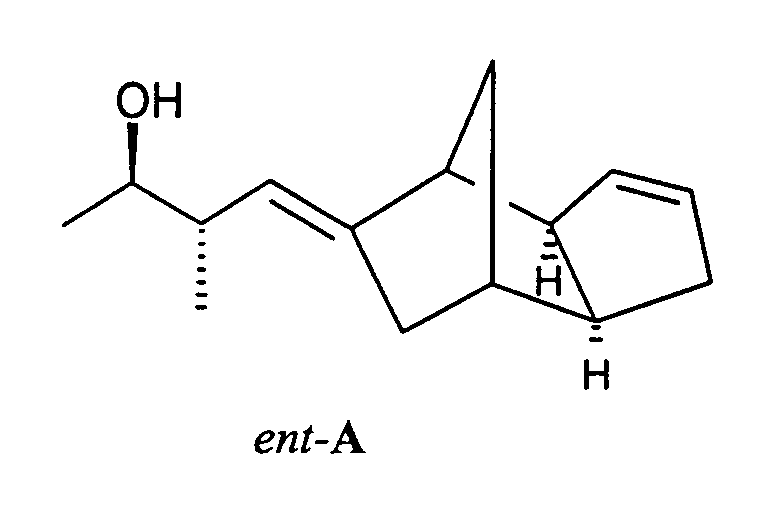
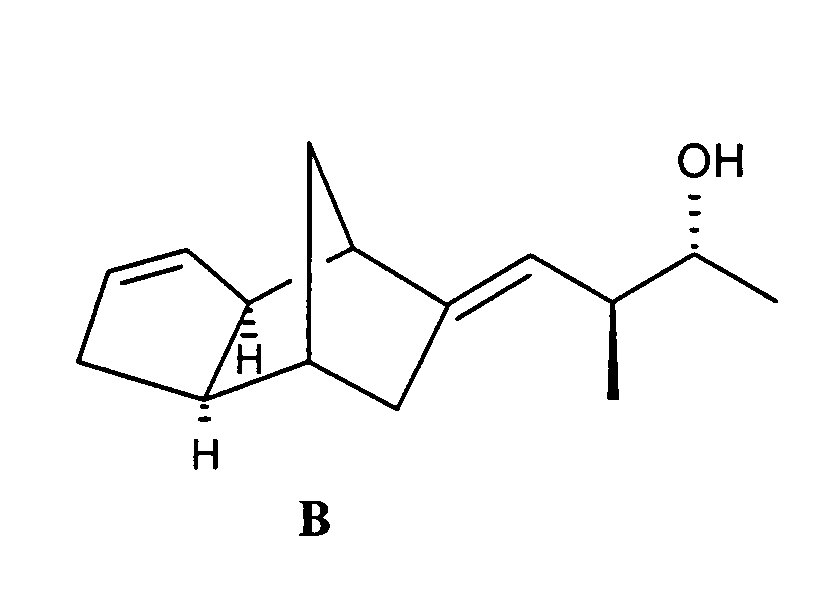
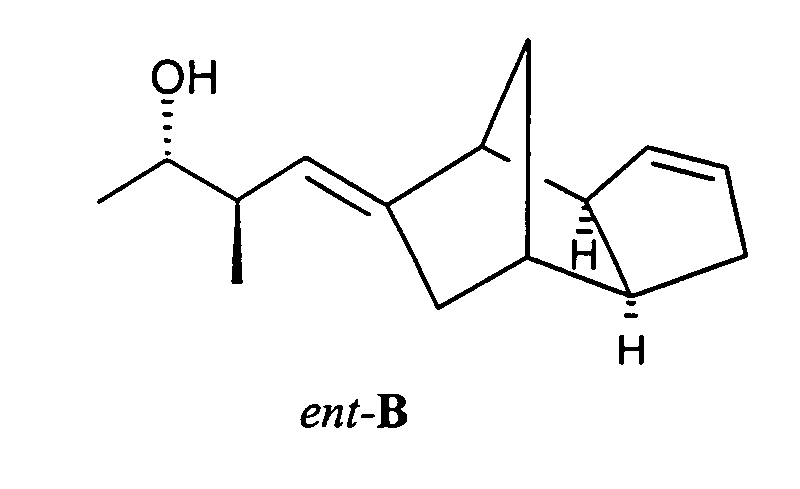
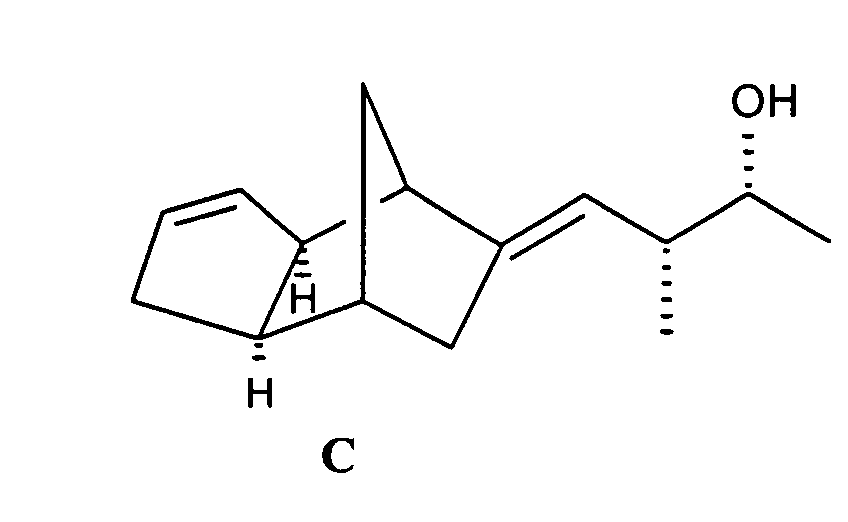


3-Methyl-4-[(Z,1R/S,2S/R,6R/S,7R/S)tricyclo[5.2.1.02,6]dec-3-en-8-yliden]-butan-2-ol (Formel rac-4)

Essigsäure-(1RS,2RS,6SR,7RS,8SR)-3-oxotricyclo[5.2.1.02,6]dec-4-en-8-ylester ( rac - 10 ):
1H-NMR (300 MHz, CDCl3): δ = 1.06 (dm, J = 11 Hz, 1 H), 1.36 (dm, J = 11 Hz, 1 H), 1.57 (ddd, J = 13.5, 4.25, 2.75 Hz, 1 H), 1.86 (ddd, J = 13.5, 7, 2.5 Hz, 1 H), 2.04 (s, 3 H), 2.12 (d, J = 5 Hz, 1 H), 2.34 (s, 1 H), 2.48 (d, J = 4.25 Hz, 1 H), 2.75 - 2.81 (m, 1 H), 4.75 (d,
J = 7 Hz, 1 H), 6.32 (dd, J = 5.5, 1.5 Hz, 1 H), 7.53 ppm (dd, J = 5.5, 2.75 Hz, 1 H). 13C-NMR (75 MHz, CDCl3): δ = 21.2 (q), 28.3 (t), 37.7 (d), 38.2 (t), 43.2 (d), 46.1 (d), 52.2 (d),
76.7 (d), 137.7 (d), 164.1 (d), 170.6 (s), 210.3 ppm (s).
MS: m/z (%) = 206 (1, M+), 147 (11), 146 (100), 145 (14), 120 (17), 118 (19),
117 (18), 95 (47), 91 (17), 66 (11), 43 (38).
Essigsäure-(1RS,2SR,6RS,7RS,8SR)-5-oxotricyclo[5.2.1.02,6]dec-3-en-8-ylester ( rac - 11 ):
1H-NMR (300 MHz, CDCl3): δ = 1.09 (dm, J = 11 Hz, 1 H), 1.39 (dm, J = 11 Hz,1 H), 1.59 (ddd, J = 13.5, 4, 2.5 Hz, 1 H), 1.93 (ddd, J = 13.5, 7, 2.5 Hz, 1 H), 2.02 (s, 3 H), 2.14 (d, J = 5 Hz, 1 H), 2.30 (d, J = 4.5 Hz, 1 H), 2.47 (s, 1 H), 2.70 - 2.76 (m,1 H), 4.71 (d, J = 7 Hz, 1 H), 6.31 (dd, J = 5.5, 1.5 Hz, 1 H), 7.55 ppm (dd, J = 5.5, 2.5 Hz, 1 H).
13C-NMR (75 MHz, CDCl3): δ = 21.2 (q), 28.2 (t), 36.9 (d), 39.3 (t), 43.7 (d), 48.4 (d), 49.9 (d), 75.6 (d), 137.6 (d), 165.2 (d), 170.4 (s), 209.9 ppm (s).
MS: m/z (%) = 206 (7, M+), 164 (29), 146 (100), 136 (29), 135 (21), 123 (30),
119 (24), 118 (21), 117 (27), 94 (28), 91 (30), 43 (45).
MS (Hauptisomer): m/z (%) = 210 (Spur, M+), 150 (37), 132 (42), 121 (29), 109 (32), 106 (100), 105 (29), 91 (34), 79 (43), 67 (34), 66 (26), 43 (60).
1H-NMR (300 MHz, CDCl3): δ = 1.315 (br. s, 2 H), 1.39 (ddd, J = 13.5, 4, 2.5 Hz, 1 H), 1.76 (dd, J = 13.5, 7 Hz, 1 H), 1.89 (dm, J =17.5 Hz, 1 H), 1.97 - 2.09 (m, 2 H), 2.005 (s, 3 H), 2.115 (s, 1 H), 2.50 - 2.62 (m, 2 H), 4.66 (dd, J = 7, 2.5 Hz, 1 H), 5.40 - 5.46 (m, 1 H), 5.66 - 5.72 ppm (m, 1 H).
13C-NMR (75 MHz, CDCl3): δ = 21.4 (q), 28.8 (t), 39.1 (t), 39.3 (t), 41.9 (d), 42.9 (d), 45.9 (d), 50.9 (d), 77.5 (d), 130.9 (d),132.7 (d), 170.7 ppm (s).
MS: m/z (%) = 192 (40, M+), 124 (81), 117 (62), 105 (30), 91 (45), 83 (52), 82 (47), 67 (48), 66 (100), 43 (65).
(1RS,2RS,6RS,7RS)tricyclo[5.2.1.02,6]dec-4-en-8-on ( rac - 13 ):
1H-NMR (300 MHz, CDCl3): δ = 1.52 (dm, J = 10.5 Hz, 1 H), 1.655 (dm, J = 10.5 Hz, 1 H), 1.87 (dd, J = 17.5, 4 Hz, 1 H), 1.99 - 2.10 (m, 2 H), 2.33 - 2.42 (m, 3 H), 2.71 (ddm, J = 17.5, 9.5 Hz, 1 H), 2.90 - 2.97 (m, 1 H), 5.42 - 5.48 (m, 1 H), 5.76 - 5.81 ppm (m, 1 H).
13C-NMR (75 MHz, CDCl3): δ = 31.0 (t), 39.6 (t), 41.7 (d), 42.3 (d), 45.3 (t), 50.1 (d), 54.0 (d), 129.4 (d), 133.4 (d), 217.5 ppm (s).
MS: m/z (%) = 148 (100, M+), 105 (35), 104 (26), 92 (38), 91 (57), 79 (49), 78 (28), 77 (32), 67 (21), 66 (35).
(1 RS,2RS,6RS,7RS,8SR)-3-hydroxy-tricyclo[5.2.1.02,6]dec-8-ylester (rac-14).
Essigsäure-(1RS,2SR,6RS,7RS,8SR)tricyclo[5.2.1.02,6]dec-3-en-8-ylester ( rac - 9 ):
1H-NMR (300 MHz, CDCl3): δ = 1.33 (br. s, 2 H), 1.44 (ddd, J = 13.5, 4.25, 2.5 Hz, 1 H), 1.81 (ddd, J = 13.5, 7, 2 Hz, 1 H), 1.92 (dm, J = 17 Hz, 1H), 2.005 (s, 3 H), 2.02 - 2.16 (m, 3 H), 2.535 (br. d, J = 7.5 Hz, 1 H), 2.62 (ddm, J = 17, 10 Hz, 1 H), 4.61 (dd, J = 7, 2.5 Hz, 1 H), 5.42 - 5.47 (m, 1 H), 5.65 - 5.71 ppm (m, 1 H). 13C-NMR (75 MHz, CDCl3): δ = 21.4 (q), 28.9 (t), 38.9 (d), 39.15 (t), 39.2 (t), 39.5 (d), 48.3 (d), 54.9 (d), 76.9 (d), 131.9 (d), 132.3 (d), 170.8 ppm (s).
MS: m/z (%) = 192 (1, M'), 132 (48), 117 (22), 104 (12), 91 (21), 79 (14), 77 (15), 67 (31), 66 (100), 43 (42), 39 (14).
MS: m/z (%) = 150 (32, M+), 132 (13), 117 (18), 106 (27), 91 (39), 83 (20), 79 (26), 78 (21), 77 (24), 67 (46), 66 (100), 39 (24).
1H-NMR (300 MHz, CDCl3): δ = 1.53 (dm, J = 10.5 Hz, 1 H), 1.745 (dm, J = 10.5 Hz, 1 H), 1.92 (dd, J = 17.5, 4 Hz, 1 H), 1.98 - 2.14 (m, 2 H), 2.33 (br. s, 1 H), 2.40 - 2.49 (m, 2 H), 2.70 (ddm, J = 17.5, 10 Hz, 1 H), 2.85 - 2.92 (m, 1 H), 5.55 - 5.60 (m, 1 H), 5.76 - 5.81 ppm (m, 1 H).
13C-NMR (75 MHz, CDCl3): δ = 31.1 (t), 37.9 (d), 38.8 (t), 39.7 (d), 44.9 (t), 54.4 (d), 56.2 (d), 131.6 (d), 133.1 (d), 217.3 ppm (s).
MS: m/z (%) = 148 (100, M+), 105 (28), 104 (34), 92 (30), 91 (55), 82 (52), 79 (48), 78 (29), 77 (34), 66 (63).
4-Nitrobenzoesäure-(1RS,2RS,6RS,7RS,8SR)tricyclo[5.2.1.02,6]dec-4-en-8-ylester ( rac - 16 ):
1H-NMR (300 MHz, CDCl3): δ =1.43 ("tm", J = 11.5 Hz, 2 H), 1.59 (ddd, J = 13.5, 4, 2.5 Hz, 1 H), 1.86 - 1.99 (m, 2 H), 2.08-2.20 (m, 2 H), 2.30 (br. s, 1 H), 2.54 - 2.71 (m, 2 H), 4.96 (dd, J = 7, 2.5 Hz, 1 H), 5.44 - 5.50 (m, 1 H), 5.70 - 5.76 (m, 1 H), 8.18 (dm, J = 9 Hz, 2 H), 8.27 ppm (dm, J = 9 Hz, 2 H). 13C-NMR (75 MHz, CDCl3): δ = 29.1(t), 39.2 (t), 39.3 (t), 41.9 (d), 42.9 (d), 46.0 (d), 50.8 (d), 79.2 (d), 123.4 (2d), 130.6 (2d), 130.7 (d), 132.9 (d), 136.1 (s), 150.4 (s), 164.3 ppm (s).
Der Enantiomerenüberschuß (ee) an 6 wurde per chiraler Gaschromatografie (Vorsäule: DBWax, 30 m, 80 - 240°C 4°C/min; Hauptsäule: Ethyl-β-Bicchi, 15 min 80°C, - 200°C 1°C/min) ermittelt: tR = 30.1 (74 % 6), 30.3 min (26 % ent-6).
(1R,2R,6R,7R,8S)tricyclo[5.2.1.02,6]dec-4-en-8-ol ( 6 ):
1H-NMR (300 MHz, CDCl3): δ = 1.19 - 1.32 (m, 2H), 1.38 (ddd, J = 10.1, 1.4, 1.4 Hz, 1H), 1.67 (ddd, 13.0, 7.0, 2.4 Hz, 1H), 1.87 (dm, J = 17.2 Hz, 1H), 1.96 (br. d, J = 1.3 Hz, 2H), 1.98 - 2.05 (m, 1H), 2.40 - 2.47 (m, 1H), 2.53 (ddddd, J = 17.0, 9.6, 2.2, 2.2, 1.3 Hz, 1H), 3.05 (br. s, OH), 3.79 (d, J = 6.6 Hz, 1H), 5.42 (dddd, J = 4.6, 2.2, 2.2, 2.2 Hz, 1H), 5.66 ppm (dddd, J = 5.9, 2.0, 2.0, 2.0 Hz, 1H).
13C-NMR (75 MHz, CDCl3): δ = 28.0 (t), 39.2 (t), 41.7 (t), 42.0 (d), 42.9 (d), 48.7 (d), 51.2 (d), 74.5 (d), 131.2 (d), 132.2 ppm (d).
MS: m/z (%) = 150 (45, M+), 132 (38), 117 (78), 105 (31), 91 (60), 83 (42), 79 (30), 77 (32), 67 (34), 66 (100).
Der Enantiomerenüberschuß an ent-6 wurde per chiraler GC (siehe oben) ermittelt: tR = 30.1 (20 % 6), 30.3 min (80 % ent-6).
(1S,2S,6S,7S,8R)Tricyclo[5.2.1.02,6]dec-4-en-8-ol ( ent - 6 ):
Die spektralen Daten entsprechen denen von Alkohol 6.
(1S,4R)-3-Oxo-4,7,7-trimethyl-2-oxabicyclo[2.2.1]heptan-1-carbonsäure-(1S,2S,6S,7S,8R)tricyclo[5.2.1.02,6]dec-4-en-8-ylester ( ent -19):
1H-NMR (300 MHz, CDCl3): δ = 0.96 (s, 3H), 1.05 (s, 3H), 1.11 (s, 3H), 1.34 (s, 2H), 1.48 (ddd, J = 13.7, 4.2, 2.2 Hz, 1H), 1.67 (ddd, J = 13.7, 4.2, 2.2 Hz, 1H), 1.77 - 2.00 (m, 7H), 2.41 (ddd, J = 13.3, 10.5, 4.2 Hz, 1H), 2.50 - 2.70 (m, 2H), 4.83 (dd, J = 7.0, 2.2 Hz, 1H), 5.44 (dddd, J = 5.1, 2.4, 2.4, 2.4 Hz,1H), 5.70 ppm (dddd, J= 5.9, 2.0, 2.0, 2.0 Hz, 1H).
13C-NMR (75 MHz, CDCl3): δ = 9.7 (q), 16.7 (q), 16.8 (q), 28.85 (t), 28.9 (t), 30.5 (t), 39.0 (t), 39.2 (t), 41.8 (d), 42.9 (d), 46.1 (d), 50.7 (d), 54.1 (s), 54.8 (s), 78.9 (d), 91.0 (s), 130.6 (d), 133.0 (d), 167.1 (s), 178.3 ppm (s).
(1R,4S)-3-Oxo-4,7,7-trimethyl-2-oxabicyclo[2.2.1]heptan-1-carbonsäure-(1R,2R,6R,7R,8S)tricyclo[5.2.1.02,6]dec-4-en-8-ylester ( 19 ):
Die spektralen Daten entsprechen denen von Ester ent-19.
Die spektralen Daten entsprechen denen von Keton rac-13.
Dann wurden 1,2 g des vorstehenden Rohalkoholes mit 3,76 g Pyridiniumdichromat (10 mmol) oxidiert. Nach Aufarbeitung und Chromatografie an Kieselgel wurden 1,03 g Keton 13 erhalten.
(1R,2R,6R,7R,8S)tricyclo[5.2.1.02,6]dec-4-en-8-on ( 13 ):
Die spektralen Daten entsprechen denen von Keton rac-13.
3-Hydroxy-2-methylen-buttersäurebutylester (rac- 20 ):
1H-NMR (300 MHz, CDCl3): δ = 0.955 (t, J = 7.5 Hz, 3 H), 1.355 (d, J = 6.5 Hz, 3 H), 1.36 - 1.48 (m, 2 H), 1.62 - 1.72 (m, 2 H), 3.53 (br. s, 1 H), 4.175 (t, J = 6.5 Hz, 2 H), 4.62 (q, J = 6.5 Hz, 1 H), 5.855 (t, J = 1.25 Hz, 1 H), 6.20 ppm (dd, J = 1.25, 0.75 Hz, 1 H).
13C-NMR (75 MHz, CDCl3): δ = 13.7 (q), 19.3 (t), 22.5 (q), 30.7 (t), 64.7 (t), 66.6 (d), 123.6 (t), 144.4 (s), 166.7 ppm (s).
MS: m/z (%) = 157 (35, M+ - 15), 101 (100), 99 (51), 98 (46), 83 (53), 73 (44), 55 (54), 43 (56), 41 (69), 29 (96), 27 (79).
den anti-Ester rac-21 mit 98 % de enthielt.
(2RS,3RS)-3-Hvdroxv-2-methyl-buttersäurebutylester (rac- 21 ):
1H-NMR (300 MHz, CDCl3): δ = 0.94 (t, J = 7.5 Hz, 3 H), 1.165 (d, J = 7 Hz, 3 H), 1.205 (d, J = 6.5 Hz, 3 H), 1.32 - 1.46 (m, 2 H), 1.58 - 1.68 (m, 2 H), 2.465 (dq, J = 7, 7 Hz, 1 H), 3.26 (br. s, 1 H), 3.905 (dq (5 Linien), J = 6.5, 7 Hz, 1 H), 4.11 ppm (t, J = 6.5 Hz, 2 H).
13C-NMR (75 MHz, CDCl3): δ = 13.7 (q), 13.8 (q), 19.2 (t), 20.5 (q), 30.7 (t), 47.2 (d), 64.4 (t), 69.3 (d), 175.9 ppm (s).
MS: m/z (%) = 159 (4, M+ - 15), 130 (13), 103 (13), 101 (61), 74 (100), 73 (13), 57 (30), 56 (34), 45 (16), 41 (13).
13C-NMR (75 MHz, CDCl3): δ = 14.9 (q), 15.3 (q), 15.9 (q), 18.6 (q), 18.8 (t), 19.7 (t), 25.5 (2t), 31.1 (2t), 38.2 (t), 38.6 (t), 40.8 (d), 41.4 (d), 62.6 (t), 63.0 (t), 72.5 (d), 77.0 (d), 95.2 (d), 100.5 ppm (d).
MS (beispielhaftes Diastereomer): m/z (%) = 251/249 (1/1, M+ - 1), 151/149 (5/5), 129 (13), 101 (19), 85 (100), 69 (38), 67 (10), 56 (18), 55 (11), 43 (11), 41 (23).
1H-NMR (300 MHz, CDCl3): δ = 1.40 (d, J = 6.5 Hz, 3 H), 4.69 (q, J = 6.5 Hz, 1 H), 5.96 (s, 1 H), 6.35 (s, 1 H), 8.22 ppm (br. s, 2 H).
13C-NMR (75 MHz, CDCl3): δ = 22.1 (q), 66.7 (d), 126,2 (t), 143.1 (s), 170.5 ppm (s).
MS: m/z (%) = 115 (73, M+ - 15), 98 (27), 87 (43), 83 (100), 55 (73), 45 (29), 43 (85), 29 38), 27 (55).
(2R,3R)-3-Hydroxy-2-methyl-buttersäuremethylester ( ent - 27 ):
1H-NMR (300 MHz, CDCl3): δ = 1.15 (t, J = 7 Hz, 3 H), 1.195 (t, J = 6.5 Hz, 3 H), 2.49 (dq, J = 7, 7 Hz, 1 H), 3.55 (br. s, 1 H), 3.70 (s, 3 H), 3.915 ppm (dq (6 Linien), J = 6.5, 7 Hz, 1 H).
13C-NMR (75 MHz, CDCl3): δ = 13.5 (q), 20.4 (q), 47.2 (d), 51.7 (q), 69.2 (d), 176.2 ppm (s).
MS: m/z (%) = 117 (9, M+ - 15), 101 (19), 88 (100), 87 (15), 85 (21), 59 (12), 57 (52), 56 (25), 55 (16), 45 (24), 43 (12).
MS (beispielhaftes Isomer): m/z (%) = 302 (2, M+ - 18), 219 (14), 218 (13), 191 (22), 149 (12), 105 (11), 91 (10), 85 (100), 84 (10), 79 (11), 67 (24).
MS (beispielhaftes Isomer): m/z (%) = 302 (Spur, M+), 174 (5), 146 (5), 107 (10), 86 (5), 85 (100), 79 (7), 67 (17), 41 (5).
tR = 30.80 (rac-30-Z), 30.95 (rac-31-Z), 31.00 (rac-B = rac-31-E), 31.05 min (rac-A = rac-30-E).
NMR-Analyse ergab
(2SR,3RS)-3-Methyl-4-[(E,1RS,2RS,6RS,7RS)tricyclo[5.2.1.02,6]dec-4-en-8-yliden]butan-2-ol (rac-A = rac-30-E) und
(2RS,3SR)-3-Methyl-4-[(Z,1RS,2RS,6RS,7RS)tricyclo[5.2.1.02,6]dec-4-en-8 ylidenlbutan-2-ol (rac-31-Z) als Hauptisomere und rac-B (= rac-31-E) und rac-30-Z als Nebenisomere:
MS (beispielhaftes Isomer): m/z (%) = 322 (Spur, M+), 200 (38), 173 (22), 134 (27), 133 (100), 107 (26), 106 (16), 105 (85), 91 (17), 79 (12), 77 (31), 67 (32).
tR = 31.35 (rac-32-Z), 31.40 (rac-33-Z), 31.50 (rac-D = rac-33-E), 31.60 min (rac-C = rac-32-E).
Das E/Z-Verhältnis wurde durch Integration der charakteristischen 1H-NMR-Signale für das Seitenketten-Vinylproton bei 5.09 (E-lsomere) und 4.86 ppm (Z-Isomere) mit 55 : 45 bestimmt.
NMR-Analyse ergab
(2RS,3RS)-3-Methyl-4-[(E,1RS,2RS,6RS,7RS)tricyclo[5.2.1.02,6]dec-4-en-8-yliden]butan-2-ol (rac-C = rac-32-E) und
(2SR,3SR)-3-Methyl-4-[(Z,1RS,2RS,6RS,7RS)tricyclo[5.2.1.02,6]dec-4-en-8-yliden]butan-2-ol (rac-33-Z) als Hauptisomere und rac-D (= rac-33-E) und rac-32-Z als Nebenisomere:
Spektrale Daten siehe unter Alkoholgemisch C/32-Z und unter Alkoholgemisch D/33-Z.
Gaschromatogramm (60 m DBWax-60N, 50 - 250°C 4°C/min):
tR = 40.50 (rac-36-Z), 40.55 (rac-37-Z), 40.85 (rac-37-E), 40.95 min (rac-36-E).
Das E/Z-Verhältnis wurde durch Integration der charakteristischen 1H-NMR-Signale für das Seitenketten-Vinylproton bei 5.08 (E-lsomere) und 4.835 ppm (Z-Isomere) mit 55 : 45 bestimmt.
NMR-Analyse ergab
(2SR,3RS)-3-Methyl-4-[(E,1RS,2SR,6RS,7RS)tricyclo[5.2.1.02,6]dec-3-en-8-yliden]butan-2-ol ( rac - 36-E ) und
(2RS,3SR)-3-Methyl-4-[(Z,1RS,2SR,6RS,7RS)tricyclo[5.2.1.02,6]dec-3-en-8-yliden]butan-2-ol ( rac - 37-Z ) als Hauptisomere und rac-37-E und rac-36-Z als Nebenisomere:
1H-NMR (300 MHz, CDCl3):
δ = 3.37 - 3.53 (m, 1 H), 5.47 - 5.53 (m, 1 H), 5.65 - 5.71 ppm (m, 1 H).
rac-36-E zugeordnet: δ = 0.925 (d, J = 7 Hz), 1.15 (d, J = 6 Hz), 2.35 (br. s), 5.08 ppm (dt, J = 10, 2.25 Hz).
rac-37-Z zugeordnet: δ = 0.96 (d, J = 7 Hz), 1.17 (d, J = 6 Hz), 2.68 (br. s), 4.835 ppm (d, J = 10 Hz).
13C-NMR (75 MHz, CDCl3):
rac-36-E zugeordnet: δ = 16.8 (q), 20.0 (q), 32.45 (t), 35.75 (t), 39.05 (t), 40.9 (d), 41.7 (d), 43.8 (d), 51.8 (d), 55.2 (d), 71.7 (d), 119.7 (d), 132.25 (d), 132.35 (d), 148.25 ppm (s).
rac-37-Z zugeordnet: δ = 17.4 (q), 19.9 (q), 32.35 (t), 38.35 (t), 39.2 (t), 40.6 (d), 42.45 (d), 43.3 (d), 47.05 (d), 55.1 (d), 71.55 (d), 120.5 (d), 132.15 (d), 132.4 (d), 147.75 ppm (s).
Die Nebenisomere rac-37-E und rac-36-Z werden durch Signale geringerer Intensität angezeigt.
MS:
rac-36-E: m/z (%) = 218 (4, M+), 174 (58), 173 (82), 131 (20), 117 (22), 107 (100), 105 (28), 91 (55), 79 (53), 77 (27), 67 (56).
rac-37-Z: m/z (%) = 218 (2, M+), 174 (72), 173 (98), 131 (27), 117 (35), 107 (100), 105 (35), 91 (66), 79 (74), 77 (34), 67 (77).
Gaschromatogramm (60 m DBWax-60N, 60 - 250°C 4°C/min):
tR = 40.85 (rac-38-Z), 41.00 (rac-39-Z), 41.45 (rac-39-E), 41.475 min (rac-38-E).
Das E/Z-Verhältnis wurde durch Integration der charakteristischen 1H-NMR-Signale für das Seitenketten-Vinylproton bei 5.085 (E-Isomere) und 4.85 ppm (Z-Isomere) mit 55 : 45 bestimmt.
NMR-Analyse ergab
(2RS,3RS)-3-Methyl-4-[(E,1RS,2SR,6RS,7RS)tricyclo[5.2.1.02,6]dec-3-en-8-yliden]butan-2-ol ( rac - 38-E ) und
(2SR,3SR)-3-Methyl-4-[(Z,1RS,2SR,6RS,7RS)tricyclo[5.2.1.02,6]dec-3-en-8
yliden]butan-2-ol ( rac - 39-Z ) als Hauptisomere und rac-39-E und rac-38-Z als Nebenisomere:
1H-NMR (300 MHz, CDCl3):
δ = 3.54 - 3.64 (m, 1 H), 5.48 - 5.54 (m, 1 H), 5.65 - 5.71 ppm (m, 1 H).
rac-38-E zugeordnet: δ = 0.965 (d, J = 7 Hz), 1.12 (d, J = 6 Hz), 2.34 (br. s), 5.085 ppm (ddd, J = 10, 5, 2 Hz).
rac-39-Z zugeordnet: δ = 1.00 (d, J = 7 Hz), 1.115 (d, J = 6.5 Hz), 2.67 (br. s), 4.85 ppm (d, J = 9.5 Hz).
13C-NMR (75 MHz, CDCl3):
rac-38-E zugeordnet: δ = 16.6 (q), 20.15 (q), 32.3 (t), 35.75 (t), 39.1 (t), 40.8 (d), 40.95 (d), 43.85 (d), 51.8 (d), 55.2 (d), 72.05 (d), 119.3 (d), 132.25 (d), 132.4 (d), 146.85 ppm (s).
rac-39-Z zugeordnet: δ = 17.3 (q), 19.95 (q), 32.25 (t), 38.4 (t), 39.2 (t), 40.65 (d), 41.25 (d), 43.35 (d), 47.0 (d), 55.1 (d), 72.0 (d), 119.75 (d), 132.2 (d), 132.45 (d), 146.45 ppm (s).
Die Nebenisomere rac-39-E und rac-38-Z wurden durch Signale geringerer Intensität angezeigt.
MS:
rac-38-E: m/z (%) = 218 (2, M+), 174 (58), 173 (83), 131 (24), 117 (26), 107 (100), 105 (27), 91 (56), 79 (56), 77 (25), 67 (67).
rac-39-Z: m/z (%) = 218 (2, M+), 174 (54), 173 (86), 131 (24), 117 (25), 107 (100), 105 (28), 91 (62), 79 (57), 77 (27), 67 (69).
tR = 30.80 (19 % 30-Z), 31.05 min (81 % A).
(2S,3R)-3-Methyl-4-[(E,1R,2R,6R,7R)tricyclo[5.2.1.02,6]dec-4-en-8-yliden]butan-2-ol ( A = 30-E),
(2S,3R)-3-Methyl-4-[(Z,1R,2R,6R,7R)tricyclo[5.2.1.02,6]dec-4-en-8-yliden]butan-2-ol (30-Z):
1H-NMR (300 MHz, CDCl3):
δ = 3.41 - 3.55 (m, 1 H), 5.44 - 5.50 (m, 1 H), 5.64 - 5.70 ppm (m, 1 H).
A (= 30-E): δ = 0.925 (d, J = 7 Hz), 1.145 (d, J = 6 Hz), 2.41 (br. s, 0.8 H), 5.08 ppm (d"d", J = 10, 2.5 Hz, 0.8 H).
30-Z: δ = 0.94 (d, J = 7 Hz), 1.17 (d, J = 6 Hz), 4.85 ppm (d, J = 10 Hz, 0.2 H). 13C-NMR (75 MHz, CDCl3):
A (= 30-E): δ = 16.8 (q), 20.0 (q), 32.4 (t), 35.7 (t), 39.7 (t), 41.65 (d), 43.15 (d), 43.2 (d), 49.3 (d), 55.8 (d), 71.7 (d), 119.6 (d), 131.4 (d), 132.25 (d), 148.45 ppm (s).
30-Z: δ = 17.3 (q), 19.95 (q), 32.3 (t), 38.15 (t), 39.75 (t), 42.35 (d), 42.95 (d), 43.15 (d), 44.35 (d), 55.2 (d), 71.55 (d), 120.4 (d), 131.4 (d), 132.35 (d), 147.5 ppm (s).
MS:
A (= 30-E): m/z (%) = 218 (8, M+), 174 (17), 173 (53), 151 (18), 108 (14), 107 (100), 91 (22), 79 (24), 67 (55).
30-Z: m/z (%) = 218 (8, M+), 174 (15), 173 (49), 151 (16), 108 (13), 107 (100), 91 (22), 79 (23), 67 (57).
tR = 31.35 (20 % 32-Z), 31.55 min (80 % C).
(2R,3R)-3-Methyl-4-[(E,1R,2R,6R,7R)tricyclo[5.2.1.02,6]dec-4-en-8-yliden]butan-2-ol (C = 32-E ),
(2R,3R)-3-Methyl-4-[(Z,1R,2R,6R,7R)tricyclo[5.2.1.02,6]dec-4-en-8-yliden]butan-2-ol (32-Z):
1H-NMR (300 MHz, CDCl3):
δ = 3.54 - 3.66 (m, 1 H), 5.44 - 5.50 (m, 1 H), 5.65 - 5.71 ppm (m, 1 H).
C (= 32-E): δ = 0.965 (d, J = 7 Hz), 1.12 (d, J = 6 Hz), 2.39 (br. s, 0.8 H), 5.09 ppm (dt, J = 10,2 Hz, 0.8 H)
32-Z: δ = 0.985 (d, J = 7 Hz), 1.16 (d, J = 6 Hz), 4.86 ppm (d, J = 9.5 Hz, 0.2 H) 13C-NMR (75 MHz, CDCl3):
C (= 32-E): δ = 16.65 (q), 20.15 (q), 32.25 (t), 35.7 (t), 39.7 (t), 40.8 (d), 43.15 (d), 43.25 (d), 49.3 (d), 55.85 (d), 72.05 (d), 119.15 (d), 131.5 (d), 132.25 (d), 147.1 ppm (s).
32-Z: δ = 17.3 (q), 20.55 (q), 32.3 (t), 38.15 (t), 39.7 (t), 41.55 (d), 42.95 (d), 43.15 (d), 44.3 (d), 55.0 (d), 72.0 (d), 119.9 (d), 131.35 (d), 132.45 (d), 146.2 ppm (s).
MS:
C (= 32-E): m/z (%) = 218 (8, M+), 174 (17), 173 (52), 151 (14), 108 (14), 107 (100), 91 (26), 79 (30), 67 (67).
32-Z: m/z (%) = 218 (5, M+), 174 (15), 173 (47), 151 (12), 108 (12), 107 (100), 91 (25), 79 (30), 67 (72).
tR = 30.95 (70 % 31-Z), 31.00 min (30 % B).
(2R,3S)-3-Methyl-4-[(E,1R,2R,6R,7R)tricyclo[5.2.1.02,6]dec-4-en-8-yliden]butan-2-ol ( B = 31-E ),
(2R,3S)-3-Methyl-4-[(Z,1R,2R,6R,7R)tricyclo[5.2.1.02,6]dec-4-en-8-yliden]butan-2-ol ( 31-Z ):
1H-NMR (300 MHz, CDCl3):
δ = 3.38 - 3.53 (m, 1 H), 5.44 - 5.50 (m, 1 H), 5.65 - 5.71 ppm (m, 1 H).
B (= 31-E): δ = 0.925 (d, J = 7 Hz, 0.9 H), 1.155 (d, J = 6 Hz), 2.42 (br. s), 5.075 ppm (dt, J = 10,2 Hz, 0.3 H).
31-Z: δ = 0.97 (d, J = 7 Hz, 2.1 H), 1.17 (d, J = 6 Hz), 2.34 (ddq (10 Linien), J = 7, 7, 10 Hz, 0.7 H), 2.73 (br. s), 4.85 ppm (d, J = 10 Hz, 0.7 H).
13C-NMR (75 MHz, CDCl3):
B (= 31-E): δ = 16.7 (q), 19.95 (q), 31.95 (t), 35.45 (t), 39.65 (t), 41.45 (d), 43.1 (d), 43.15 (d), 49.5 (d), 56.4 (d), 71.65 (d), 119.35 (d), 131.35 (d), 132.3 (d), 148.65 ppm (s).
31-Z: δ = 17.4 (q), 19.95 (q), 32.35 (t), 38.3 (t), 39.7 (t), 42.25 (d), 42.9 (d), 43.05 (d), 44.55 (d), 55.25 (d), 71.5 (d), 120.25 (d), 131.25 (d), 132.45 (d), 147.85 ppm (s).
MS:
B (= 31-E): m/z (%) = 218 (7, M+), 174 (12), 173 (40), 151 (18), 108 (13), 107 (100), 91 (21), 79 (24), 67 (51).
31-Z: m/z (%) = 218 (8, M+), 174 (19), 173 (58), 151 (12), 108 (14), 107 (100), 91 (25), 79 (28), 67 (61).
tR = 31.40 (70 % 33-Z), 31.50 min (30 % D).
(2S,3S)-3-Methyl-4-[(E,1R,2R,6R,7R)tricyclo[5.2.1.02,6]dec-4-en-8-yliden]butan-2-ol (D= 33-E),
(2S,3S)-3-Methyl-4-[(Z,1R,2R,6R,7R)tricyclo[5.2.1.02,6]dec-4-en-8-yliden]butan-2-ol (33-Z):
1H-NMR (300 MHz, CDCl3):
δ = 3.54 - 3.64 (m, 1 H), 5.44 - 5.50 (m, 1 H), 5.66 - 5.72 ppm (m, 1 H).
D (= 33-E): δ = 0.965 (d, J = 7 Hz, 0.9 H), 1.14 (d, J = 6.5 Hz), 2.40 (br. s), 5.07 ppm (dt, J = 10, 2.25 Hz, 0.3 H.
33-Z: δ = 1.005 (d, J = 7 Hz, 2.1 H), 1.12 (d, J = 6.5 Hz), 2.50 (ddq (10 Linien), J = 6.5, 6.5, 10 Hz), 2.73 (br. s), 4.86 ppm (d, J = 10 Hz, 0.7 H).
13C-NMR (75 MHz, CDCl3):
D (= 33-E): δ = 16.65 (q), 20.35 (q), 32.0 (t), 35.55 (t), 39.7 (t), 40.8 (d), 43.15 (d), 43.2 (d), 49.45 (d), 56.05 (d), 72.25 (d), 119.2 (d), 131.4 (d), 132.35 (d), 147.25 ppm (s).
33-Z: δ = 17.35 (q), 19.95 (q), 32.25 (t), 38.3 (t), 39.7 (t), 41.2 (d), 42.95 (d), 43.05 (d), 44.55 (d), 55.3 (d), 72.0 (d), 119.5 (d), 131.3 (d), 132.45 (d), 146.75 ppm (s).
MS:
D (= 33-E): m/z (%) = 218 (6, M+), 174 (12), 173 (43), 151 (14), 108 (13), 107 (100), 91 (24), 79 (28), 67 (68).
33-Z: m/z (%) = 218 (7, M'), 174 (18), 173 (56), 151 (11), 108 (14), 107 (100), 91 (24), 79 (31), 67 (75).
tR = 30.80 (20 % ent- 30-Z), 31.05 min (80 % ent-A).
(2R,3S)-3-Methyl-4-[(E,1S,2S,6S,7S)tricyclo[5.2.1.02,6]dec-4-en-8-ylidenlbutan-2-ol ( ent - A ),
(2R,3S)-3-Methyl-4-[(Z,1S,2S,6S,7S)tricyclo[5.2.1.02,6]dec-4-en-8-yliden]butan-2-ol ( ent - 30-Z ):
Die spektralen Daten entsprechen denen von Alkoholgemisch A/30-Z.
tR = 31.35 (20 % ent- 32-Z ), 31.55 min (80 % ent- C).
(2S,3S)-3-Methyl-4-[(E,1S,2S,6S,7S)tricyclo[5.2.1.02,6]dec-4-en-8-yliden]butan-2-ol ( ent- C ),
(2S,3S)-3-Methyl-4-[(Z,1S,2S,6S,7S)tricyclo[5.2.1.02,6]dec-4-en-8-yliden]butan-2-ol ( ent- 32-Z ) :
Die spektralen Daten entsprechen denen von Alkoholgemisch C/32-Z.
tR = 30,95 (71 % ent- 31-Z), 31,00 (29 % ent- B) .
(2S,3R)-3-Methyl-4-[(E,1S,2S,6S,7S)tricyclo[5.2.1.02,6]dec-4-en-8-ylidenlbutan-2-ol ( ent- B ),
(2S,3R)-3-Methyl-4-[(Z,1S,2S,6S,7S)tricyclo[5.2.1.02,6]dec-4-en-8-yliden]butan-2-ol ( ent - 31-Z ):
Die spektralen Daten entsprechen denen von Alkoholgemisch B/31-Z.
tR = 31.40 (71 % ent-33-Z), 31.50 (29 % ent- D).
(2R,3R)-3-Methyl-4-[(E,1S,2S,6S,7S)tricyclo[5.2.1.02,6]dec-4-en-8-yliden]butan-2-ol ( ent - D ),
(2R,3R)-3-Methyl-4-[(Z,1S,2S,6S,7S)tricyclo[5.2.1.02,6]dec-4-en-8-yliden]butan-2-ol ( ent - 33-Z ):
Die spektralen Daten entsprechen denen von Alkoholgemisch D/33-Z.
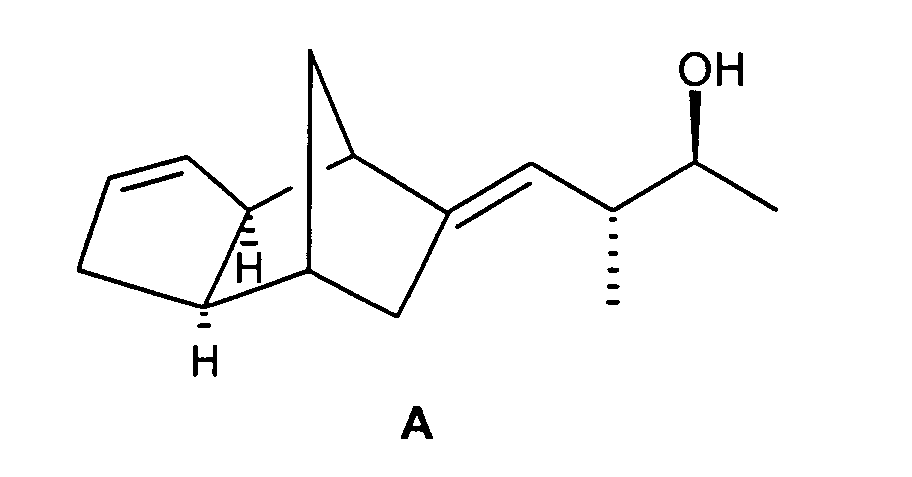
Geruchsschwellenwert: 5 µg/l Wasser

Geruchsschwellenwert: 168 µg/l Wasser
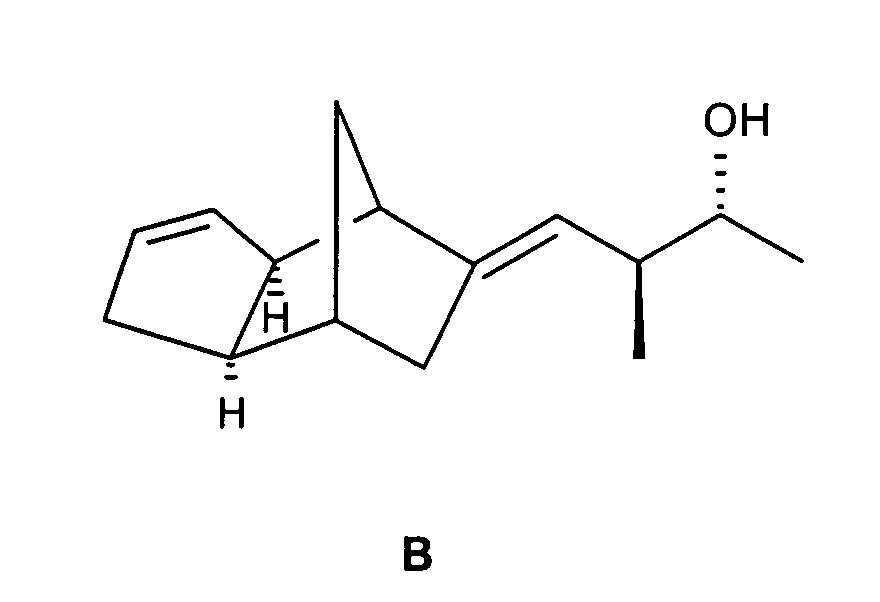
Geruchsschwellenwert: 70 µg/l Wasser
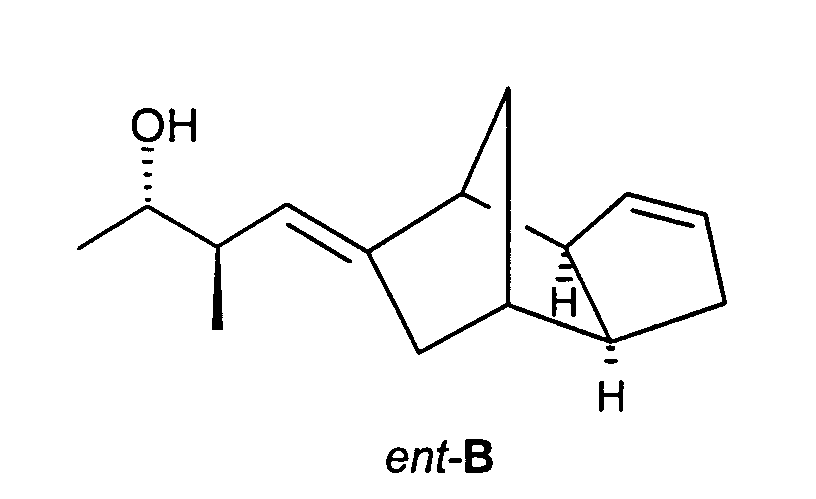
Geruchsschwellenwert: 72 µg/l Wasser
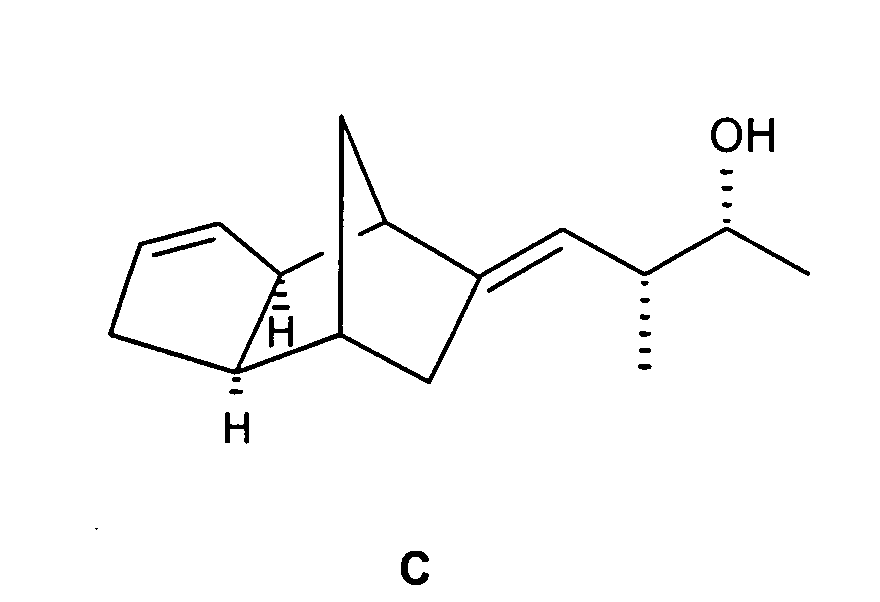
Geruchsschwellenwert: 137 µg/l Wasser

Geruchsschwellenwert: 591 µg/l Wasser
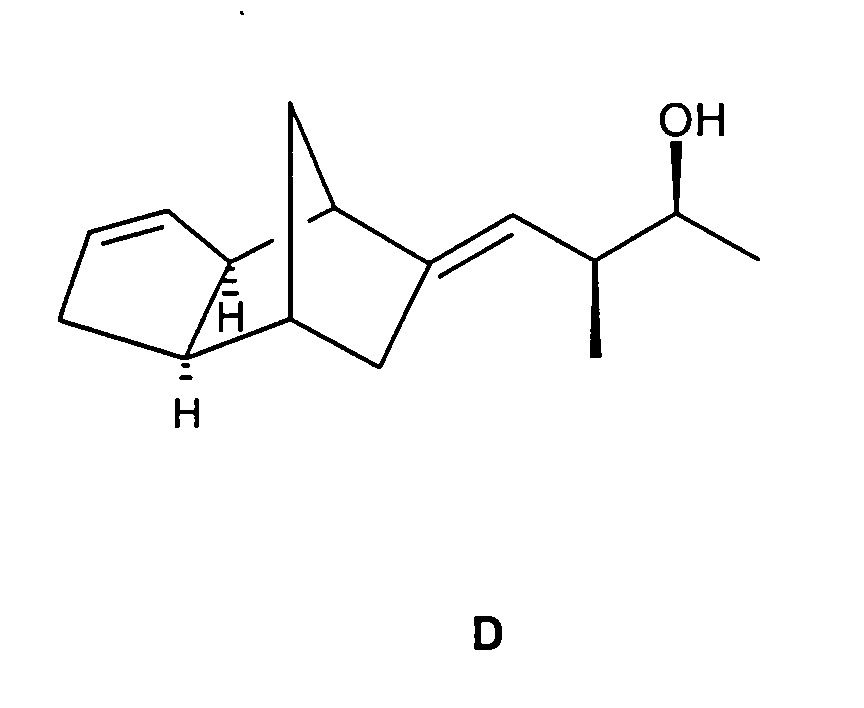
Geruchsschwellenwert: 46 µg/l Wasser

Geruchsschwellenwert: 204 µg/l Wasser
Claims (9)
- Verbindung der Formel
(2R/S, 3R/S)-3-Methyl-4-[(E,1R/S,2R/S,6R/S,7R/S)tricyclo[5.2.1.02,6]dec-4-en-8-yliden]butan-2-ol,
wobei jeweils unabhängig voneinander gilt:(2R/S, 3R/S) bedeutet (2R,3R), (2R,3S), (2S,3R) oder (2S,3S) und(E,1R/S,2R/S,6R/S,7R/S) bedeutet (E,1R,2R,6R,7R) oder (E,1S,2S,6S,7S). - Verbindung nach Anspruch 1 mit dem Konfigurationsmerkmal (E,1R,2R,6R,7R).
- Verbindung nach Anspruch 2 mit dem Konfigurationsmerkmal (2S, 3R) oder (2S,3S).
- Verbindung nach Anspruch 1 mit dem Konfigurationsmerkmal (E,1S,2S,6S,7S).
- Gemisch aus mehreren Konfigurationsisomeren einer Verbindung nach einem der vorangehenden Ansprüche.
- Gemisch, umfassend
ein Konfigurationsisomer oder mehrere Konfigurationsisomeren einer Verbindung nach einem der Ansprüche 1-4 sowie
eine oder mehrere Verbindungen der Formel
3-Methyl-4-[(E,1R/S,2S/R,6R/S,7R/S)tricyclo[5.2.1.02,6]dec-3-en-8-yliden]-butan-2-ol
oder der Formel
3-Methyl-4-[(Z,1R/S,2R/S,6R/S,7R/S)tricyclo[5.2.1.02,6]dec-4-en-8-yliden]-butan-2-ol
oder der Formel
3-Methyl-4-[(Z,1R/S,2S/R,6R/S,7R/S)tricyclo[5.2.1.02,6]dec-3-en-8-yliden]-butan-2-ol
wobei das Mischungsverhältnis so gewählt ist, dass die sensorischen Eigenschaften des Gemisches überwiegend durch das oder die Konfigurationsisomeren der Verbindung nach einem der Ansprüche 1-4 bestimmt werden. - Duftstoff- oder Aromakomposition, umfassend eine sensorisch wirksame Menge einer Verbindung nach einem der Ansprüche 1-4 oder eines Gemisches nach einem der Ansprüche 5-6.
- Verwendung einer Verbindung nach einem der Ansprüche 1-4 oder eines Gemisches nach einem der Ansprüche 5-6 als Duft- oder Aromastoff.
- Verfahren zum Modifizieren der sensorischen Eigenschaften einer Duftstoff- oder Aromakomposition, wobei eine oder mehrere Komponenten der Duftstoff- oder Aromakomposition mit einer sensorisch wirksamen Menge einer Verbindung nach einem der Ansprüche 1-4 oder eines Gemisches nach einem der Ansprüche 5-6 vermischt wird.
Applications Claiming Priority (2)
| Application Number | Priority Date | Filing Date | Title |
|---|---|---|---|
| DE10144816 | 2001-09-12 | ||
| DE10144816A DE10144816A1 (de) | 2001-09-12 | 2001-09-12 | Duft-und Aromastoff |
Publications (3)
| Publication Number | Publication Date |
|---|---|
| EP1293555A2 true EP1293555A2 (de) | 2003-03-19 |
| EP1293555A3 EP1293555A3 (de) | 2003-07-02 |
| EP1293555B1 EP1293555B1 (de) | 2006-06-07 |
Family
ID=7698703
Family Applications (1)
| Application Number | Title | Priority Date | Filing Date |
|---|---|---|---|
| EP02020195A Expired - Lifetime EP1293555B1 (de) | 2001-09-12 | 2002-09-10 | Duft- und Aromastoff |
Country Status (8)
| Country | Link |
|---|---|
| US (1) | US20030083225A1 (de) |
| EP (1) | EP1293555B1 (de) |
| JP (1) | JP2003104924A (de) |
| CN (1) | CN1429801A (de) |
| AT (1) | ATE328988T1 (de) |
| DE (2) | DE10144816A1 (de) |
| ES (1) | ES2266370T3 (de) |
| MX (1) | MXPA02008868A (de) |
Families Citing this family (1)
| Publication number | Priority date | Publication date | Assignee | Title |
|---|---|---|---|---|
| US7763238B2 (en) * | 2002-01-16 | 2010-07-27 | Monell Chemical Senses Center | Olfactory adaptation and cross-adapting agents to reduce the perception of body odors |
Family Cites Families (8)
| Publication number | Priority date | Publication date | Assignee | Title |
|---|---|---|---|---|
| US4057515A (en) * | 1969-02-04 | 1977-11-08 | N.V. Chemische Fabriek "Naarden" | Perfume compositions |
| JPS6039256B2 (ja) * | 1978-05-04 | 1985-09-05 | 花王株式会社 | 三環式α,β−不飽和アルデヒド |
| JPS54148768A (en) * | 1978-05-10 | 1979-11-21 | Kao Corp | Novel tricyclic alpha,beta-unsaturated ketone |
| DE3245524A1 (de) * | 1982-12-09 | 1984-06-14 | Dragoco Gerberding & Co Gmbh, 3450 Holzminden | Dimethyl-tricyclo(5.2.1.0(pfeil hoch)2(pfeil hoch)(pfeil hoch),(pfeil hoch)(pfeil hoch)6(pfeil hoch))decan-derivate mit funktionalisierter seitenkette, deren herstellung und verwendung als riechstoffe |
| DE3303893C2 (de) * | 1983-02-05 | 1985-01-24 | Dragoco Gerberding & Co Gmbh, 3450 Holzminden | 2,6-Exo-konfigurierte Tricyclo[5.2.1.0↑2↑↑,↑↑6↑]decan-Derivate mit funktionalisierter Seitenkette an C-9 und ihre Verwendung als Riechstoffe |
| JPS62501149A (ja) * | 1984-12-19 | 1987-05-07 | ドラゴコ ゲルベルデイング ウント コンパニ− ゲ−エムベ−ハ− | 官能化された側鎖アルキリデンを有するトリシクロ〔5.2.1.0↑2′↑6〕デカン/デセン誘導体およびそれの香料としての用途 |
| JP4063400B2 (ja) * | 1997-07-31 | 2008-03-19 | ダイセル化学工業株式会社 | D−アミノアシラーゼ |
| DE19822232A1 (de) * | 1998-05-07 | 1999-11-11 | Dragoco Gerberding Co Ag | 2,4,6-Trimethyl-4-phenyl-1,3-dioxan |
-
2001
- 2001-09-12 DE DE10144816A patent/DE10144816A1/de not_active Withdrawn
-
2002
- 2002-09-10 JP JP2002264438A patent/JP2003104924A/ja active Pending
- 2002-09-10 AT AT02020195T patent/ATE328988T1/de not_active IP Right Cessation
- 2002-09-10 EP EP02020195A patent/EP1293555B1/de not_active Expired - Lifetime
- 2002-09-10 ES ES02020195T patent/ES2266370T3/es not_active Expired - Lifetime
- 2002-09-10 DE DE50207077T patent/DE50207077D1/de not_active Expired - Lifetime
- 2002-09-11 MX MXPA02008868A patent/MXPA02008868A/es unknown
- 2002-09-12 US US10/243,597 patent/US20030083225A1/en not_active Abandoned
- 2002-09-12 CN CN02131694A patent/CN1429801A/zh active Pending
Also Published As
| Publication number | Publication date |
|---|---|
| ES2266370T3 (es) | 2007-03-01 |
| ATE328988T1 (de) | 2006-06-15 |
| DE50207077D1 (de) | 2006-07-20 |
| EP1293555A3 (de) | 2003-07-02 |
| US20030083225A1 (en) | 2003-05-01 |
| DE10144816A1 (de) | 2003-03-27 |
| JP2003104924A (ja) | 2003-04-09 |
| EP1293555B1 (de) | 2006-06-07 |
| MXPA02008868A (es) | 2004-08-19 |
| CN1429801A (zh) | 2003-07-16 |
Similar Documents
| Publication | Publication Date | Title |
|---|---|---|
| DE60224180T2 (de) | Cycloalkancarbonsäurederivate als duftstoffe mit moschuscharakter | |
| DE69215070T2 (de) | Verfahren zur herstellung von 3-dpa-lacton | |
| DE2455761C2 (de) | Verwendung von hydrierten Methyljononen und deren Derivaten als Riechstoffe, Verfahren zu ihrer Herstellung und neue hydrierte Methyljononderivate | |
| EP0911311A1 (de) | Herstellung eines Lycopinmetaboliten | |
| DE2427608A1 (de) | Verfahren zur herstellung poly-ungesaettigter kohlenwasserstoffe | |
| DE69505226T2 (de) | Verfahren zur herstellung von (+)-(1r)-cis-3-oxo-2-pentyl-1-cyclopentanessigsäure | |
| CH618968A5 (de) | ||
| EP0045453B1 (de) | Neue Alkenole (I) und Verfahren zu deren Herstellung, Verwendung von (I) als Riech- und/oder Geschmackstoffe sowie Riech- und/oder Geschmackstoffkompositionen mit einem Gehalt an (I) | |
| EP0983989B1 (de) | Methylcyclotetradec-5-en-1-one | |
| EP1412313A1 (de) | ISO-$g(b)-BISABOLOL ALS DUFT-UND AROMASTOFF | |
| EP0010142B1 (de) | Als Einzelverbindungen oder in Form von Gemischen vorliegende sesquiterpenoide Tetrahydrofuranderivate (I), Verfahren und Ausgangsstoffe (V) zu deren Herstellung, Verwendung von (I) als Riech- und/oder Geschmackstoffe und Riech- und/oder Geschmackstoffkompositionen mit einem Gehalt an (I) | |
| EP0000719B1 (de) | Neue 1,4-Epoxy-trimethyl-butenyliden-cyclohexane (I), Verfahren zu deren Herstellung, Verwendung von (I) als Riech- und/oder Geschmackstoffe, Riech- und/oder Geschmackstoffkompositionen mit einem Gehalt an den neuen Cyclohexanen | |
| EP0513627B1 (de) | Tetrahydro-alpha-pyronderivat, Verfahren zu seiner Herstellung und dieses enthaltende Riech- und/oder Geschmackstoffkompositionen | |
| EP1293555B1 (de) | Duft- und Aromastoff | |
| DE2443191A1 (de) | Neue bicyclo- eckige klammer auf 2,2,2 eckige klammer zu- octanderivate, verfahren zu ihrer herstellung und ihre verwendung | |
| EP0044448A1 (de) | Verfahren zur Herstellung von Derivaten des Methylesters der 2-Methoxymethylen-3-methyl-6-phenyl-3,5-hexadiensäure | |
| DE2347172A1 (de) | Prostaglandin e tief 1-synthese | |
| EP0924198B1 (de) | 3-Mercapto-2-alkyl-alkan-1-ole und ihre Anwendung als Duft- und Aromastoffe | |
| EP0086944B1 (de) | Neue ungesättigte Aether (I), Verfahren zu deren Herstellung, Verwendung von (I) als Riech- und/oder Geschmackstoffe und Riech- und/oder Geschmackstoffkompositionen mit einem Gehalt an (I) | |
| DE2504618B2 (de) | Spiranderivate, Verfahren zu deren Herstellung, und die Verwendung dieser Verbindungen als Riech- bzw. Aromastoffe | |
| DE68920966T2 (de) | Zyklische Äther und deren Verwendung als Duft- oder Aromazutat. | |
| EP1565423B1 (de) | 2-heptylcyclopropyl-1-carbonsäure | |
| DE68909143T2 (de) | Prostaglandin-Vorläufer und ihre Herstellung. | |
| EP0924198A2 (de) | 3-Mercapto-2-alkyl-alkan-1-ole und ihre Anwendung als Duft- und Aromastoffe | |
| EP0119546B1 (de) | Neues Verfahren zur Herstellung von Verbindungen der 4-Oxodamascon-Reihe sowie neue Riechstoffe aus dieser Verbindungsklasse |
Legal Events
| Date | Code | Title | Description |
|---|---|---|---|
| PUAI | Public reference made under article 153(3) epc to a published international application that has entered the european phase |
Free format text: ORIGINAL CODE: 0009012 |
|
| AK | Designated contracting states |
Kind code of ref document: A2 Designated state(s): AT BE BG CH CY CZ DE DK EE ES FI FR GB GR IE IT LI LU MC NL PT SE SK TR |
|
| AX | Request for extension of the european patent |
Extension state: AL LT LV MK RO SI |
|
| PUAL | Search report despatched |
Free format text: ORIGINAL CODE: 0009013 |
|
| AK | Designated contracting states |
Designated state(s): AT BE BG CH CY CZ DE DK EE ES FI FR GB GR IE IT LI LU MC NL PT SE SK TR |
|
| AX | Request for extension of the european patent |
Extension state: AL LT LV MK RO SI |
|
| RAP1 | Party data changed (applicant data changed or rights of an application transferred) |
Owner name: SYMRISE GMBH & CO. KG |
|
| 17P | Request for examination filed |
Effective date: 20040102 |
|
| AKX | Designation fees paid |
Designated state(s): AT BE BG CH CY CZ DE DK EE ES FI FR GB GR IE IT LI LU MC NL PT SE SK TR |
|
| 17Q | First examination report despatched |
Effective date: 20050314 |
|
| GRAP | Despatch of communication of intention to grant a patent |
Free format text: ORIGINAL CODE: EPIDOSNIGR1 |
|
| GRAS | Grant fee paid |
Free format text: ORIGINAL CODE: EPIDOSNIGR3 |
|
| GRAA | (expected) grant |
Free format text: ORIGINAL CODE: 0009210 |
|
| AK | Designated contracting states |
Kind code of ref document: B1 Designated state(s): AT BE BG CH CY CZ DE DK EE ES FI FR GB GR IE IT LI LU MC NL PT SE SK TR |
|
| PG25 | Lapsed in a contracting state [announced via postgrant information from national office to epo] |
Ref country code: IT Free format text: LAPSE BECAUSE OF FAILURE TO SUBMIT A TRANSLATION OF THE DESCRIPTION OR TO PAY THE FEE WITHIN THE PRESCRIBED TIME-LIMIT;WARNING: LAPSES OF ITALIAN PATENTS WITH EFFECTIVE DATE BEFORE 2007 MAY HAVE OCCURRED AT ANY TIME BEFORE 2007. THE CORRECT EFFECTIVE DATE MAY BE DIFFERENT FROM THE ONE RECORDED. Effective date: 20060607 Ref country code: NL Free format text: LAPSE BECAUSE OF FAILURE TO SUBMIT A TRANSLATION OF THE DESCRIPTION OR TO PAY THE FEE WITHIN THE PRESCRIBED TIME-LIMIT Effective date: 20060607 Ref country code: CZ Free format text: LAPSE BECAUSE OF FAILURE TO SUBMIT A TRANSLATION OF THE DESCRIPTION OR TO PAY THE FEE WITHIN THE PRESCRIBED TIME-LIMIT Effective date: 20060607 Ref country code: IE Free format text: LAPSE BECAUSE OF FAILURE TO SUBMIT A TRANSLATION OF THE DESCRIPTION OR TO PAY THE FEE WITHIN THE PRESCRIBED TIME-LIMIT Effective date: 20060607 Ref country code: FI Free format text: LAPSE BECAUSE OF FAILURE TO SUBMIT A TRANSLATION OF THE DESCRIPTION OR TO PAY THE FEE WITHIN THE PRESCRIBED TIME-LIMIT Effective date: 20060607 Ref country code: SK Free format text: LAPSE BECAUSE OF FAILURE TO SUBMIT A TRANSLATION OF THE DESCRIPTION OR TO PAY THE FEE WITHIN THE PRESCRIBED TIME-LIMIT Effective date: 20060607 |
|
| REG | Reference to a national code |
Ref country code: GB Ref legal event code: FG4D Free format text: NOT ENGLISH |
|
| REG | Reference to a national code |
Ref country code: CH Ref legal event code: EP Ref country code: CH Ref legal event code: NV Representative=s name: E. BLUM & CO. PATENTANWAELTE |
|
| GBT | Gb: translation of ep patent filed (gb section 77(6)(a)/1977) |
Effective date: 20060612 |
|
| REG | Reference to a national code |
Ref country code: IE Ref legal event code: FG4D Free format text: LANGUAGE OF EP DOCUMENT: GERMAN |
|
| REF | Corresponds to: |
Ref document number: 50207077 Country of ref document: DE Date of ref document: 20060720 Kind code of ref document: P |
|
| PG25 | Lapsed in a contracting state [announced via postgrant information from national office to epo] |
Ref country code: SE Free format text: LAPSE BECAUSE OF FAILURE TO SUBMIT A TRANSLATION OF THE DESCRIPTION OR TO PAY THE FEE WITHIN THE PRESCRIBED TIME-LIMIT Effective date: 20060907 Ref country code: DK Free format text: LAPSE BECAUSE OF FAILURE TO SUBMIT A TRANSLATION OF THE DESCRIPTION OR TO PAY THE FEE WITHIN THE PRESCRIBED TIME-LIMIT Effective date: 20060907 |
|
| PG25 | Lapsed in a contracting state [announced via postgrant information from national office to epo] |
Ref country code: MC Free format text: LAPSE BECAUSE OF NON-PAYMENT OF DUE FEES Effective date: 20060930 Ref country code: BE Free format text: LAPSE BECAUSE OF NON-PAYMENT OF DUE FEES Effective date: 20060930 |
|
| PG25 | Lapsed in a contracting state [announced via postgrant information from national office to epo] |
Ref country code: PT Free format text: LAPSE BECAUSE OF FAILURE TO SUBMIT A TRANSLATION OF THE DESCRIPTION OR TO PAY THE FEE WITHIN THE PRESCRIBED TIME-LIMIT Effective date: 20061107 |
|
| NLV1 | Nl: lapsed or annulled due to failure to fulfill the requirements of art. 29p and 29m of the patents act | ||
| ET | Fr: translation filed | ||
| REG | Reference to a national code |
Ref country code: IE Ref legal event code: FD4D |
|
| REG | Reference to a national code |
Ref country code: ES Ref legal event code: FG2A Ref document number: 2266370 Country of ref document: ES Kind code of ref document: T3 |
|
| PLBE | No opposition filed within time limit |
Free format text: ORIGINAL CODE: 0009261 |
|
| STAA | Information on the status of an ep patent application or granted ep patent |
Free format text: STATUS: NO OPPOSITION FILED WITHIN TIME LIMIT |
|
| 26N | No opposition filed |
Effective date: 20070308 |
|
| REG | Reference to a national code |
Ref country code: CH Ref legal event code: PFA Owner name: SYMRISE GMBH & CO. KG Free format text: SYMRISE GMBH & CO. KG#MUEHLENFELDSTRASSE 1#37603 HOLZMINDEN (DE) -TRANSFER TO- SYMRISE GMBH & CO. KG#MUEHLENFELDSTRASSE 1#37603 HOLZMINDEN (DE) |
|
| PG25 | Lapsed in a contracting state [announced via postgrant information from national office to epo] |
Ref country code: AT Free format text: LAPSE BECAUSE OF NON-PAYMENT OF DUE FEES Effective date: 20060910 |
|
| BERE | Be: lapsed |
Owner name: SYMRISE G.M.B.H. & CO. KG Effective date: 20060930 |
|
| PG25 | Lapsed in a contracting state [announced via postgrant information from national office to epo] |
Ref country code: GR Free format text: LAPSE BECAUSE OF FAILURE TO SUBMIT A TRANSLATION OF THE DESCRIPTION OR TO PAY THE FEE WITHIN THE PRESCRIBED TIME-LIMIT Effective date: 20060908 |
|
| PG25 | Lapsed in a contracting state [announced via postgrant information from national office to epo] |
Ref country code: EE Free format text: LAPSE BECAUSE OF FAILURE TO SUBMIT A TRANSLATION OF THE DESCRIPTION OR TO PAY THE FEE WITHIN THE PRESCRIBED TIME-LIMIT Effective date: 20060607 Ref country code: BG Free format text: LAPSE BECAUSE OF FAILURE TO SUBMIT A TRANSLATION OF THE DESCRIPTION OR TO PAY THE FEE WITHIN THE PRESCRIBED TIME-LIMIT Effective date: 20060907 |
|
| PG25 | Lapsed in a contracting state [announced via postgrant information from national office to epo] |
Ref country code: TR Free format text: LAPSE BECAUSE OF FAILURE TO SUBMIT A TRANSLATION OF THE DESCRIPTION OR TO PAY THE FEE WITHIN THE PRESCRIBED TIME-LIMIT Effective date: 20060607 Ref country code: LU Free format text: LAPSE BECAUSE OF NON-PAYMENT OF DUE FEES Effective date: 20060910 |
|
| PGFP | Annual fee paid to national office [announced via postgrant information from national office to epo] |
Ref country code: CH Payment date: 20080923 Year of fee payment: 7 Ref country code: ES Payment date: 20080922 Year of fee payment: 7 |
|
| PG25 | Lapsed in a contracting state [announced via postgrant information from national office to epo] |
Ref country code: CY Free format text: LAPSE BECAUSE OF FAILURE TO SUBMIT A TRANSLATION OF THE DESCRIPTION OR TO PAY THE FEE WITHIN THE PRESCRIBED TIME-LIMIT Effective date: 20060607 |
|
| REG | Reference to a national code |
Ref country code: CH Ref legal event code: PL |
|
| PG25 | Lapsed in a contracting state [announced via postgrant information from national office to epo] |
Ref country code: CH Free format text: LAPSE BECAUSE OF NON-PAYMENT OF DUE FEES Effective date: 20090930 Ref country code: LI Free format text: LAPSE BECAUSE OF NON-PAYMENT OF DUE FEES Effective date: 20090930 |
|
| REG | Reference to a national code |
Ref country code: ES Ref legal event code: FD2A Effective date: 20110712 |
|
| PG25 | Lapsed in a contracting state [announced via postgrant information from national office to epo] |
Ref country code: ES Free format text: LAPSE BECAUSE OF NON-PAYMENT OF DUE FEES Effective date: 20110630 |
|
| PG25 | Lapsed in a contracting state [announced via postgrant information from national office to epo] |
Ref country code: ES Free format text: LAPSE BECAUSE OF NON-PAYMENT OF DUE FEES Effective date: 20090911 |
|
| PGFP | Annual fee paid to national office [announced via postgrant information from national office to epo] |
Ref country code: GB Payment date: 20120920 Year of fee payment: 11 |
|
| PGFP | Annual fee paid to national office [announced via postgrant information from national office to epo] |
Ref country code: DE Payment date: 20121001 Year of fee payment: 11 Ref country code: FR Payment date: 20121008 Year of fee payment: 11 |
|
| REG | Reference to a national code |
Ref country code: FR Ref legal event code: TP Owner name: SYMRISE AG, DE Effective date: 20131022 |
|
| GBPC | Gb: european patent ceased through non-payment of renewal fee |
Effective date: 20130910 |
|
| REG | Reference to a national code |
Ref country code: FR Ref legal event code: ST Effective date: 20140530 |
|
| REG | Reference to a national code |
Ref country code: DE Ref legal event code: R119 Ref document number: 50207077 Country of ref document: DE Effective date: 20140401 |
|
| PG25 | Lapsed in a contracting state [announced via postgrant information from national office to epo] |
Ref country code: GB Free format text: LAPSE BECAUSE OF NON-PAYMENT OF DUE FEES Effective date: 20130910 |
|
| PG25 | Lapsed in a contracting state [announced via postgrant information from national office to epo] |
Ref country code: DE Free format text: LAPSE BECAUSE OF NON-PAYMENT OF DUE FEES Effective date: 20140401 Ref country code: FR Free format text: LAPSE BECAUSE OF NON-PAYMENT OF DUE FEES Effective date: 20130930 |