EP1290067B1 - Materiaux composites flexibles, isolants et thermiquement stables - Google Patents
Materiaux composites flexibles, isolants et thermiquement stables Download PDFInfo
- Publication number
- EP1290067B1 EP1290067B1 EP01938352A EP01938352A EP1290067B1 EP 1290067 B1 EP1290067 B1 EP 1290067B1 EP 01938352 A EP01938352 A EP 01938352A EP 01938352 A EP01938352 A EP 01938352A EP 1290067 B1 EP1290067 B1 EP 1290067B1
- Authority
- EP
- European Patent Office
- Prior art keywords
- varnish
- composite material
- support
- agents
- acrylate
- Prior art date
- Legal status (The legal status is an assumption and is not a legal conclusion. Google has not performed a legal analysis and makes no representation as to the accuracy of the status listed.)
- Expired - Lifetime
Links
- 239000002131 composite material Substances 0.000 title claims abstract description 45
- 239000002966 varnish Substances 0.000 claims abstract description 31
- 238000004132 cross linking Methods 0.000 claims abstract description 5
- 239000004925 Acrylic resin Substances 0.000 claims abstract description 4
- 229920000178 Acrylic resin Polymers 0.000 claims abstract description 4
- NIXOWILDQLNWCW-UHFFFAOYSA-M Acrylate Chemical compound [O-]C(=O)C=C NIXOWILDQLNWCW-UHFFFAOYSA-M 0.000 claims description 24
- CERQOIWHTDAKMF-UHFFFAOYSA-M methacrylate group Chemical group C(C(=C)C)(=O)[O-] CERQOIWHTDAKMF-UHFFFAOYSA-M 0.000 claims description 17
- 239000003795 chemical substances by application Substances 0.000 claims description 15
- 230000009477 glass transition Effects 0.000 claims description 9
- 230000005855 radiation Effects 0.000 claims description 6
- 239000000654 additive Substances 0.000 claims description 5
- 239000003365 glass fiber Substances 0.000 claims description 5
- 239000000463 material Substances 0.000 claims description 5
- 239000011248 coating agent Substances 0.000 claims description 4
- 238000000576 coating method Methods 0.000 claims description 4
- 150000002118 epoxides Chemical class 0.000 claims description 3
- 238000009499 grossing Methods 0.000 claims description 2
- 230000000873 masking effect Effects 0.000 claims description 2
- 238000005476 soldering Methods 0.000 claims description 2
- 239000004094 surface-active agent Substances 0.000 claims description 2
- 239000000080 wetting agent Substances 0.000 claims description 2
- 238000011437 continuous method Methods 0.000 claims 1
- 238000007872 degassing Methods 0.000 claims 1
- 238000009281 ultraviolet germicidal irradiation Methods 0.000 abstract description 2
- 238000000016 photochemical curing Methods 0.000 abstract 1
- 238000000034 method Methods 0.000 description 12
- 239000004744 fabric Substances 0.000 description 10
- 239000000203 mixture Substances 0.000 description 10
- -1 bisphenol A epoxides Chemical class 0.000 description 6
- 239000011521 glass Substances 0.000 description 6
- VOBUAPTXJKMNCT-UHFFFAOYSA-N 1-prop-2-enoyloxyhexyl prop-2-enoate Chemical compound CCCCCC(OC(=O)C=C)OC(=O)C=C VOBUAPTXJKMNCT-UHFFFAOYSA-N 0.000 description 5
- CSCPPACGZOOCGX-UHFFFAOYSA-N Acetone Chemical class CC(C)=O CSCPPACGZOOCGX-UHFFFAOYSA-N 0.000 description 5
- 239000004593 Epoxy Substances 0.000 description 5
- 239000003085 diluting agent Substances 0.000 description 5
- 230000007704 transition Effects 0.000 description 5
- 230000000052 comparative effect Effects 0.000 description 4
- 239000004922 lacquer Substances 0.000 description 4
- JOYRKODLDBILNP-UHFFFAOYSA-N Ethyl urethane Chemical compound CCOC(N)=O JOYRKODLDBILNP-UHFFFAOYSA-N 0.000 description 3
- 238000004519 manufacturing process Methods 0.000 description 3
- QSHDDOUJBYECFT-UHFFFAOYSA-N mercury Chemical compound [Hg] QSHDDOUJBYECFT-UHFFFAOYSA-N 0.000 description 3
- 229910052753 mercury Inorganic materials 0.000 description 3
- 238000006116 polymerization reaction Methods 0.000 description 3
- 150000003254 radicals Chemical class 0.000 description 3
- 229920005989 resin Polymers 0.000 description 3
- 239000011347 resin Substances 0.000 description 3
- YIKSHDNOAYSSPX-UHFFFAOYSA-N 1-propan-2-ylthioxanthen-9-one Chemical compound S1C2=CC=CC=C2C(=O)C2=C1C=CC=C2C(C)C YIKSHDNOAYSSPX-UHFFFAOYSA-N 0.000 description 2
- GOXQRTZXKQZDDN-UHFFFAOYSA-N 2-Ethylhexyl acrylate Chemical compound CCCCC(CC)COC(=O)C=C GOXQRTZXKQZDDN-UHFFFAOYSA-N 0.000 description 2
- LWRBVKNFOYUCNP-UHFFFAOYSA-N 2-methyl-1-(4-methylsulfanylphenyl)-2-morpholin-4-ylpropan-1-one Chemical compound C1=CC(SC)=CC=C1C(=O)C(C)(C)N1CCOCC1 LWRBVKNFOYUCNP-UHFFFAOYSA-N 0.000 description 2
- 238000003848 UV Light-Curing Methods 0.000 description 2
- RWCCWEUUXYIKHB-UHFFFAOYSA-N benzophenone Chemical compound C=1C=CC=CC=1C(=O)C1=CC=CC=C1 RWCCWEUUXYIKHB-UHFFFAOYSA-N 0.000 description 2
- 239000012965 benzophenone Substances 0.000 description 2
- 125000004386 diacrylate group Chemical group 0.000 description 2
- 238000010586 diagram Methods 0.000 description 2
- ACCCMOQWYVYDOT-UHFFFAOYSA-N hexane-1,1-diol Chemical compound CCCCCC(O)O ACCCMOQWYVYDOT-UHFFFAOYSA-N 0.000 description 2
- 239000004745 nonwoven fabric Substances 0.000 description 2
- 229920000728 polyester Polymers 0.000 description 2
- 230000008569 process Effects 0.000 description 2
- 239000000758 substrate Substances 0.000 description 2
- XLYOFNOQVPJJNP-UHFFFAOYSA-N water Substances O XLYOFNOQVPJJNP-UHFFFAOYSA-N 0.000 description 2
- DTGKSKDOIYIVQL-WEDXCCLWSA-N (+)-borneol Chemical group C1C[C@@]2(C)[C@@H](O)C[C@@H]1C2(C)C DTGKSKDOIYIVQL-WEDXCCLWSA-N 0.000 description 1
- QNODIIQQMGDSEF-UHFFFAOYSA-N (1-hydroxycyclohexyl)-phenylmethanone Chemical compound C=1C=CC=CC=1C(=O)C1(O)CCCCC1 QNODIIQQMGDSEF-UHFFFAOYSA-N 0.000 description 1
- CKGKXGQVRVAKEA-UHFFFAOYSA-N (2-methylphenyl)-phenylmethanone Chemical compound CC1=CC=CC=C1C(=O)C1=CC=CC=C1 CKGKXGQVRVAKEA-UHFFFAOYSA-N 0.000 description 1
- SMZOUWXMTYCWNB-UHFFFAOYSA-N 2-(2-methoxy-5-methylphenyl)ethanamine Chemical compound COC1=CC=C(C)C=C1CCN SMZOUWXMTYCWNB-UHFFFAOYSA-N 0.000 description 1
- XMLYCEVDHLAQEL-UHFFFAOYSA-N 2-hydroxy-2-methyl-1-phenylpropan-1-one Chemical compound CC(C)(O)C(=O)C1=CC=CC=C1 XMLYCEVDHLAQEL-UHFFFAOYSA-N 0.000 description 1
- YDIYEOMDOWUDTJ-UHFFFAOYSA-M 4-(dimethylamino)benzoate Chemical compound CN(C)C1=CC=C(C([O-])=O)C=C1 YDIYEOMDOWUDTJ-UHFFFAOYSA-M 0.000 description 1
- IISBACLAFKSPIT-UHFFFAOYSA-N Bisphenol A Natural products C=1C=C(O)C=CC=1C(C)(C)C1=CC=C(O)C=C1 IISBACLAFKSPIT-UHFFFAOYSA-N 0.000 description 1
- 239000004604 Blowing Agent Substances 0.000 description 1
- CERQOIWHTDAKMF-UHFFFAOYSA-N Methacrylic acid Chemical compound CC(=C)C(O)=O CERQOIWHTDAKMF-UHFFFAOYSA-N 0.000 description 1
- 238000010521 absorption reaction Methods 0.000 description 1
- 239000002253 acid Substances 0.000 description 1
- 150000001252 acrylic acid derivatives Chemical class 0.000 description 1
- 230000009471 action Effects 0.000 description 1
- 230000003213 activating effect Effects 0.000 description 1
- 230000000996 additive effect Effects 0.000 description 1
- 239000002318 adhesion promoter Substances 0.000 description 1
- 125000001931 aliphatic group Chemical group 0.000 description 1
- 125000003118 aryl group Chemical group 0.000 description 1
- 150000001558 benzoic acid derivatives Chemical class 0.000 description 1
- 230000015572 biosynthetic process Effects 0.000 description 1
- 238000006243 chemical reaction Methods 0.000 description 1
- 230000000536 complexating effect Effects 0.000 description 1
- 150000001875 compounds Chemical class 0.000 description 1
- 239000000470 constituent Substances 0.000 description 1
- 230000000694 effects Effects 0.000 description 1
- 238000010292 electrical insulation Methods 0.000 description 1
- 239000003822 epoxy resin Substances 0.000 description 1
- 239000011152 fibreglass Substances 0.000 description 1
- LNEPOXFFQSENCJ-UHFFFAOYSA-N haloperidol Chemical compound C1CC(O)(C=2C=CC(Cl)=CC=2)CCN1CCCC(=O)C1=CC=C(F)C=C1 LNEPOXFFQSENCJ-UHFFFAOYSA-N 0.000 description 1
- 238000005470 impregnation Methods 0.000 description 1
- 238000005259 measurement Methods 0.000 description 1
- 239000002184 metal Substances 0.000 description 1
- 229910052751 metal Inorganic materials 0.000 description 1
- CRVGTESFCCXCTH-UHFFFAOYSA-N methyl diethanolamine Chemical compound OCCN(C)CCO CRVGTESFCCXCTH-UHFFFAOYSA-N 0.000 description 1
- 239000012764 mineral filler Substances 0.000 description 1
- 239000000178 monomer Substances 0.000 description 1
- 229920003986 novolac Polymers 0.000 description 1
- 239000004843 novolac epoxy resin Substances 0.000 description 1
- 239000003973 paint Substances 0.000 description 1
- HPAFOABSQZMTHE-UHFFFAOYSA-N phenyl-(2,4,6-trimethylphenyl)methanone Chemical compound CC1=CC(C)=CC(C)=C1C(=O)C1=CC=CC=C1 HPAFOABSQZMTHE-UHFFFAOYSA-N 0.000 description 1
- 239000000049 pigment Substances 0.000 description 1
- 239000004033 plastic Substances 0.000 description 1
- 239000004014 plasticizer Substances 0.000 description 1
- 229920000647 polyepoxide Polymers 0.000 description 1
- 229920005862 polyol Polymers 0.000 description 1
- 150000003077 polyols Chemical class 0.000 description 1
- 238000003892 spreading Methods 0.000 description 1
- 230000007480 spreading Effects 0.000 description 1
- 238000003860 storage Methods 0.000 description 1
- 239000000126 substance Substances 0.000 description 1
- 238000012719 thermal polymerization Methods 0.000 description 1
- 229920001169 thermoplastic Polymers 0.000 description 1
Images
Classifications
-
- C—CHEMISTRY; METALLURGY
- C08—ORGANIC MACROMOLECULAR COMPOUNDS; THEIR PREPARATION OR CHEMICAL WORKING-UP; COMPOSITIONS BASED THEREON
- C08J—WORKING-UP; GENERAL PROCESSES OF COMPOUNDING; AFTER-TREATMENT NOT COVERED BY SUBCLASSES C08B, C08C, C08F, C08G or C08H
- C08J5/00—Manufacture of articles or shaped materials containing macromolecular substances
- C08J5/04—Reinforcing macromolecular compounds with loose or coherent fibrous material
-
- C—CHEMISTRY; METALLURGY
- C08—ORGANIC MACROMOLECULAR COMPOUNDS; THEIR PREPARATION OR CHEMICAL WORKING-UP; COMPOSITIONS BASED THEREON
- C08J—WORKING-UP; GENERAL PROCESSES OF COMPOUNDING; AFTER-TREATMENT NOT COVERED BY SUBCLASSES C08B, C08C, C08F, C08G or C08H
- C08J2333/00—Characterised by the use of homopolymers or copolymers of compounds having one or more unsaturated aliphatic radicals, each having only one carbon-to-carbon double bond, and only one being terminated by only one carboxyl radical, or of salts, anhydrides, esters, amides, imides, or nitriles thereof; Derivatives of such polymers
- C08J2333/04—Characterised by the use of homopolymers or copolymers of compounds having one or more unsaturated aliphatic radicals, each having only one carbon-to-carbon double bond, and only one being terminated by only one carboxyl radical, or of salts, anhydrides, esters, amides, imides, or nitriles thereof; Derivatives of such polymers esters
- C08J2333/06—Characterised by the use of homopolymers or copolymers of compounds having one or more unsaturated aliphatic radicals, each having only one carbon-to-carbon double bond, and only one being terminated by only one carboxyl radical, or of salts, anhydrides, esters, amides, imides, or nitriles thereof; Derivatives of such polymers esters of esters containing only carbon, hydrogen, and oxygen, the oxygen atom being present only as part of the carboxyl radical
-
- H—ELECTRICITY
- H05—ELECTRIC TECHNIQUES NOT OTHERWISE PROVIDED FOR
- H05K—PRINTED CIRCUITS; CASINGS OR CONSTRUCTIONAL DETAILS OF ELECTRIC APPARATUS; MANUFACTURE OF ASSEMBLAGES OF ELECTRICAL COMPONENTS
- H05K3/00—Apparatus or processes for manufacturing printed circuits
- H05K3/02—Apparatus or processes for manufacturing printed circuits in which the conductive material is applied to the surface of the insulating support and is thereafter removed from such areas of the surface which are not intended for current conducting or shielding
- H05K3/022—Processes for manufacturing precursors of printed circuits, i.e. copper-clad substrates
Definitions
- the subject of the present invention is flexible, insulating and thermally stable composite materials which can be used in many fields in the form of sheets or strips, preferably unrollable, in particular in the field of electronics, for example for masking.
- Composite materials are already known which are used as printed circuit boards in the form of strips or sheets. These composite materials generally consist of a support and a resin.
- the support is most often made of glass fiber fabric and the resin is generally made of a polyester, an epoxy or a thermoplastic polymer.
- the composite material whose support is fiberglass, must be heat-stable, that is to say withstand temperatures above about 150 ° C, it is generally used epoxy resins which are known for their mechanical properties.
- thermostable composite materials are generally obtained by thermal polymerization of the appropriate monomers on the support or by prepolymerization and polymerization.
- thermostable composite materials are rigid even when they are thin, which is a handicap for certain applications, particularly in the field of sheet materials or unwrapping strips.
- the composite materials according to the invention consist of at least one support based on glass fibers impregnated with an acrylic resin and obtained by free radical crosslinking by means of UV irradiation of a photocurable varnish on said support.
- the composite material of the invention consists of two supports and a resin layer sandwiched between said two supports.
- the composite material is a multilayer material.
- the support which is suitable for the purposes of the invention has a thickness of 6 to 1000 microns, preferably 20 to 300 microns, and is advantageously in the form of rolls.
- suitable supports for the purposes of the invention, mention may be made of products based on glass fibers, such as yarns, strips, mats, rovings, fabrics, veils, tablecloths.
- suitable supports include glass fabrics for electronic laminates and electrical insulation, such as those marketed by HEXCEL Fabrics, nonwovens marketed by INTERGLAS, said fabrics being based on glass fibers, the fabrics marketed by the NORDLYS Company.
- the varnish must have a Brookfield viscosity measured at 20 ° C. of less than or equal to 5000 mPa.s, preferably between 400 and 2000 mPa.s.
- the oligomer is obtained by reacting an epoxide-based prepolymer with acrylic or methacrylic acid under conventional conditions allowing addition (reaction of the acid with the epoxide functions of the prepolymer). See, for example, DE-A-19757090.
- the oligomer contains 2 to 5 acrylate or methacrylate groups, preferably 2 to 3 acrylate or methacrylate groups.
- the acrylate or methacrylate diluent that may be present in the photocurable varnish is a polyol or epoxide acrylate or methacrylate having a Brookfield viscosity measured at 25 ° C. of less than 100 mPa.s, preferably of between 2 and 15 mPa.s.
- the diluent preferably contains 1 to 2 acrylate or methacrylate groups. The diluent improves the flexibility or flexibility of the composite material and limits the shrinkage during crosslinking.
- Suitable acrylates are hexanediol diacrylate having a molecular weight of 226 and a Brookfield viscosity measured at 25 ° C of 10 mPa.s; isobornyl monoacrylate having a molecular weight of 208 and a Brookfield viscosity measured at 25 ° C of 10 mPa.s.
- the photoinitiator photoinitiator is a substance that initiates the formation of free radicals under the action of ultraviolet (UV) radiation. It is optionally combined with an activating agent, which is preferably an amino compound, such as, for example, N -méthyldiéthanolamine.
- the absorption wavelengths of the photoinitiator are between 250 nm and 500 nm, preferably between 280 nm and 500 nm.
- photoinitiators for the purposes of the invention include benzoates, alkyl-benzophenones or propanones, in particular 4-dimethylaminobenzoate, methylbenzophenone, 2,4,6-trimethylbenzophenone, 2-hydroxy-2- methyl-1- [4- (1-methylvinyl) phenyl] propanone, 2-hydroxy-2-methyl-1-phenyl-1-propanone or mixtures thereof.
- photoinitiator mixtures are marketed, for example, by LAMBERTI Spa (Italy) under the trade name ESACURE® and by CIBA Specialties Chimiques (Switzerland) under the trade name IRGAGURE®.
- the useful photopolymerizable varnish according to the invention can contain various additives commonly used in the field of paints and varnishes, such as adhesion promoters on various metal or plastic substrates, spreading agents, smoothing agents, wetting agents, blowing agents, tackifiers, anti-scratch agents, surfactants, plasticizers, tackifiers.
- the photopolymerizable lacquer may also contain pigments or mineral fillers.
- the photopolymerizable varnish has a glass transition temperature between 50 ° C and 230 ° C.
- the support (1) is impregnated with a layer of varnish (2) by passing said support between two drums (A) and (B), the drum (A) being in permanent contact with the photocurable varnish, the drum (B) rotating in the opposite direction of the drum (A) for obtaining a uniform coating of the varnish on said support.
- the support thus coated with the varnish is then directed towards the ultraviolet radiation (3), after having optionally been coated with a second support (1 ') according to the operating mode shown in FIG. 2.
- the composite material obtained after the polymerization is then stored on a storage cylinder (not shown) or directly cut into sheets and packaged according to conventional procedures.
- the impregnation of the support with the polymerizable lacquer is advantageously carried out at room temperature.
- the UV light curing is carried out using UV radiation obtained with lamps having a power of 100 to 250 W / cm, for example using mercury lamps of 127 W / cm or 220 W / cm, 160 W / cm iron-doped mercury lamps or 160 W / cm gallium-doped mercury lamps.
- the running speed of the substrate / varnish under UV radiation is not critical; it varies according to the lamps used and the nature of the support. However, it should be noted that speeds ranging from 5 m / min to 20 m / min are quite appropriate.
- the composite material according to the invention is endowed with excellent properties of heat stability and flexibility.
- This material is particularly suitable as a printed circuit board.
- a glass fabric of 70 to 95 g / m 2 was used as the support.
- Comparative Example 5 Composite Material F and G.
- Example 6 according to the invention composite material H
- Example 4 The procedure of Example 4 was repeated using varnish A and complexing 2 glass fabrics of 100 g / m 2 according to the procedure shown in FIG. 2.
- the composite material H had a flexibility of 2390 N / m and a glass transition temperature of 149 ° C.
- Example 1 The procedure of Example 1 was repeated using Varnish A and replacing the glass fabric with a 110 micron cellulosic paper.
- the resulting composite material had a glass transition temperature of 150 ° C and a thickness of 140 microns.
- the elastic torsionally dynamic modules of the composite materials obtained according to Examples 1 to 7 were determined by subjecting one of the ends of a rectangular sample of 5 ⁇ 15 mm 2 to an alternating rotation and measuring the resulting deformation to the other extremity. This determination is made using the RHEOMETRICS RMS 800 / RDS II device. The results obtained are as follows: Composite material Torsional elastic modules x 10 7 MPa at 50 ° C at 200 ° C AT 53 19 B 37 8 VS 7 4 F 13 4 BOY WUT 8 two H 49 20 I 52 27 2 - The thermostability of these composite materials is observed by observing the modules at 200 ° C and their high value.
Landscapes
- Chemical & Material Sciences (AREA)
- Organic Chemistry (AREA)
- Materials Engineering (AREA)
- Health & Medical Sciences (AREA)
- Chemical Kinetics & Catalysis (AREA)
- Medicinal Chemistry (AREA)
- Manufacturing & Machinery (AREA)
- Polymers & Plastics (AREA)
- Engineering & Computer Science (AREA)
- Reinforced Plastic Materials (AREA)
- Laminated Bodies (AREA)
- Inorganic Insulating Materials (AREA)
- Organic Insulating Materials (AREA)
- Compositions Of Macromolecular Compounds (AREA)
- Insulated Conductors (AREA)
- Paints Or Removers (AREA)
- Insulating Bodies (AREA)
Description
- La présente invention a pour objet des matériaux composites flexibles, isolants et thermiquement stables qui peuvent être utilisés dans de nombreux domaines sous la forme de feuilles ou de bandes, de préférence déroulables, notamment dans le domaine de l'électronique, par exemple pour les masquages des circuits imprimés lors de la soudure à la vague, des supports électroniques pour cartes à puces ou dans le domaine du marquage électronique de documents d'identification, tels que par exemple des étiquettes électroniques.
- On connaît déjà des matériaux composites, qui sont utilisés comme supports de circuits imprimés sous forme de bandes ou de feuilles. Ces matériaux composites sont généralement constitués d'un support et d'une résine. Le support est, le plus souvent, constitué d'un tissu de fibres de verre et la résine est généralement constituée d'un polyester, d'un époxyde ou d'un polymère thermoplastique.
- Lorsque le matériau composite, dont le support est en fibres de verre, doit être thermostable, c'est-à-dire résister à des températures supérieures à 150°C environ, on utilise généralement des résines époxydes qui sont réputées pour leurs propriétés mécaniques.
- Ces matériaux composites, thermostables, sont généralement obtenus par polymérisation par voie thermique des monomères appropriés sur le support ou par prépolymérisation puis polymérisation.
- Malheureusement, les matériaux composites thermostables sont rigides même lorsqu'ils sont de faible épaisseur, ce qui constitue un handicap pour certaines applications, notamment dans le domaines des matériaux en feuilles ou en bandes déroulables.
- On a maintenant trouvé de nouveaux matériaux composites qui sont à la fois souples, thermostables et isolants.
- Les matériaux composites selon l'invention sont constitués d'au moins un support à base de fibres de verre imprégné d'une résine acrylique et obtenus par réticulation par voie radicalaire grâce à une irradiation UV d'un vernis photoréticulable sur ledit support.
- Selon une variante, le matériau composite de l'invention est constitué de deux supports et d'une couche de résine prise en sandwich entre lesdits deux supports.
- Selon une autre variante, le matériau composite est un matériau multicouche.
- Avantageusement, le support qui convient aux fins de l'invention a une épaisseur de 6 à 1 000 microns, de préférence 20 à 300 microns, et se présente avantageusement sous la forme de rouleaux.
- A titre d'exemples de support appropriés aux fins de l'invention, on peut citer les produits à base de fibres de verre, tels que les fils, bandes, mats, rovings, tissus, voiles, nappes.
- On peut également utiliser les feutres ou non-tissés à base de verre.
- Des exemples de supports appropriés sont notamment les tissus de verre pour stratifiés électroniques et isolation électrique, tels que ceux commercialisés par la Société HEXCEL Fabrics, les non tissés commercialisés par la Société INTERGLAS, lesdits tissus étant à base de fibres de verre, les tissus commercialisés par la Société NORDLYS.
- Le vernis photoréticulable utilisé pour la fabrication du matériau composite, selon l'invention est constitué essentiellement :
- d'un oligomère à base d'époxyde, comportant des groupes acrylate ou méthacrylate ;
- d'un photoinitiateur de radicaux libres ;
- éventuellement d'un diluant acrylate ou méthacrylate ;
- Le vernis doit présenter une viscosité Brookfield mesurée à 20°C inférieure ou égale à 5 000 mPa.s, comprise de préférence entre 400 et 2 000 mPa.s.
- L'oligomère est obtenu en faisant réagir un prépolymère à base d'époxyde, avec de l'acide acrylique ou méthacrylique dans des conditions classiques permettant une addition (réaction de l'acide avec les fonctions époxyde du prépolymère). Voir par example le document DE-A-19757090.
- Avantageusement, l'oligomère contient 2 à 5 groupes acrylate ou méthacrylate, de préférence 2 à 3 groupes acrylate ou methacrylate.
- Des exemples de prépolymères appropriés aux fins de l'invention sont les composés ci-après :
- les époxydes bisphénol A de poids équivalent en époxy de 182-194 et ayant une viscosité Brookfield à 25°C de 10 000 mPa.s ;
- les résines époxydes novolaques de poids équivalent époxy de 176-181 et ayant une viscosité Brookfield à 50°C de 35 000 mPa.s.
- Le diluant acrylate ou méthacrylate éventuellement présent dans le vernis photoréticulable est un acrylate ou méthacrylate de polyol ou d'époxyde ayant une viscosité Brookfield mesurée à 25°C inférieure à 100 mPa.s, de préférence comprise entre 2 à 15 mPa.s. Le diluant contient de préférence 1 à 2 groupes acrylate ou méthacrylate. Le diluant permet d'améliorer la flexibilité ou la souplesse du matériau composite et il limite le retrait lors de la réticulation.
- Des exemples d'acrylates appropriés sont le diacrylate d'hexanediol ayant une masse moléculaire de 226 et une viscosité Brookfield mesurée à 25°C de 10 mPa.s ; le monoacrylate d'isobornyle ayant une masse moléculaire de 208 et une viscosité Brookfield mesurée à 25°C de 10 mPa.s.
- Le photoinitiateur du vernis photoréticulable est une substance qui initie la formation de radicaux libres sous l'action d'un rayonnement ultraviolet (U.V.) Il est éventuellement combiné avec un agent activateur, qui est de préférence un composé aminé, tel que par exemple la N-méthyldiéthanolamine.
- Les longueurs d'onde d'absorption du photoinitiateur sont comprises entre 250 nm et 500 nm, de préférence entre 280 nm et 500 nm.
- Des exemples de photoinitiateurs appropriés aux fins de l'invention sont notamment les benzoates, les alkyl-benzophénones ou les propanones, en particulier le 4-diméthylaminobenzoate, la méthylbenzophénone, la 2,4,6-triméthylbenzophénone, le 2-hydroxy-2-méthyl-1-[4-(1-méthylvinyl)phényl] propanone, la 2-hydroxy-2-méthyl-1-phényl-1-propanone ou leurs mélanges. De tels mélanges photoinitiateurs sont commercialisés par exemple par la Société LAMBERTI Spa (Italie) sous la dénomination commerciale ESACURE® et par la Société CIBA Spécialités Chimiques (Suisse) sous la dénomination commerciale IRGAGURE®.
- De plus, le vernis photopolymérisable utile selon l'invention peut contenir divers additifs couramment utilisés dans le domaine des vernis et des peintures, tels que notamment des promoteurs d'adhérence sur différents supports métalliques ou plastiques, des agents d'étalement, de lissage, des agents mouillants, des agents débullants, des agents collants, des agents anti-rayure, des agents tensioactifs, des agents plastifiants, des agents tackifiants.
- Il appartiendra à l'homme de métier de choisir l'additif approprié en fonction de l'effet recherché.
- Le vernis photopolymérisable peut également contenir des pigments ou des charges minérales.
- Les proportions pondérales des différents constituants du vernis photoréticulable sont avantageusement les suivantes :
- oligomère 50 à 99,9 parties en poids
- diluant acrylate ou méthacrylate 0 à 60 parties en poids
- photoinitiateur 0,1 à 3 parties en poids
- additifs 0 à 30 parties en poids
- Avantageusement, le vernis photopolymérisable a une température de transition vitreuse comprise entre 50 °C et 230 °C.
- Le matériau composite selon l'invention peut être préparé par le procédé qui consiste à :
- enduire le vernis photopolymérisable sur au moins l'une des surfaces du support ;
- photoréticuler le vernis sur ledit support à l'aide d'un rayonnement U.V. ayant une longueur d'onde comprise entre 280 et 500 nm.
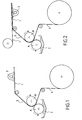
- Ce procédé, qui est avantageusement un procédé continu (en ligne), peut être mis en oeuvre selon les modes opératoires représentés sur les Fig.1 et 2 sur lesquelles :
- FIG. 1 est un schéma classique de revêtement d'un support à l'aide d'un vernis et polymérisation U.V.
- FIG. 2 est un schéma classique de fabrication d'un stratifié constitué de deux supports séparés par une couche de vernis et polymérisation U.V.
- Selon l'un ou l'autre de ces schémas, le support (1) est imprégné d'une couche de vernis (2) en faisant passer ledit support entre deux tambours (A) et (B), le tambour (A) étant en contact permanent avec le vernis photoréticulable, le tambour (B) tournant dans le sens inverse du tambour (A) permettant d'obtenir un revêtement uniforme du vernis sur ledit support.
- Le support ainsi revêtu du vernis est ensuite dirigé vers le rayonnement ultraviolet (3), après avoir éventuellement été revêtu d'un second support (1') selon le mode opératoire représenté sur la Figure 2.
- Le matériau composite obtenu après la polymérisation est ensuite stocké sur un cylindre de stockage (non représenté) ou directement découpé en feuilles et emballé selon des procédures classiques.
- L'imprégnation du support par le vernis polymérisable est avantageusement réalisée à la température ambiante.
- La photopolymérisation U.V. est réalisée à l'aide d'un rayonnement U.V. obtenu avec des lampes ayant une puissance de 100 à 250 W/cm par exemple à l'aide de lampes au mercure de 127 W/cm ou 220 W/cm , de lampes au mercure dopées au fer de 160 W/cm ou de lampes au mercure dopées au gallium de 160 W/cm.
- La vitesse de défilement du support/vernis sous le rayonnement U.V. n'est pas critique ; elle varie en fonction des lampes utilisées et de la nature du support. On indiquera toutefois que les vitesses allant de 5 m/min à 20 m/min sont tout à fait appropriées.
- Le matériau composite selon l'invention est doué d'excellentes propriétés de stabilité à la chaleur et de souplesse.
- Ce matériau convient particulièrement bien comme support de circuits imprimés.
- La présente invention va maintenant être décrite plus en détail par les exemples illustratifs ci-après :
- On a utilisé comme support un tissu de verre de 70 à 95 g/m2.
- On a revêtu ledit support selon le schéma opératoire représenté sur la Figure 1 à l'aide du vernis A dont la composition est la suivante :
- 50 parties pondérales (pp) d'époxyde novolaque modifié acrylate, dilué dans 30% d'hexanediol diacrylate
- 50 pp d'acrylate aliphatique
- 10 pp d'acrylate d'éthyle hexyle
- 1 pp d'agent débullant
- 2 pp de photoinitiateur n°1 : "Irgacure 907"
- 0,2 de photoinitiateur n° 2 : isopropylthioxanthone
- On a répété le mode opératoire de l'exemple 1 en utilisant le vernis B ayant la composition ci-après :
- 68 pp d'époxyde bis-phénol A modifié acrylate
- 32 pp de diacrylate hexanediol
- 1 pp d'agent débullant
- 2 pp de photoinitiateur constitué d'un mélange de benzophénone et d'une propanone (produit connu sous la dénomination commerciale "Esacure KT55".
- On a répété le mode opératoire de l'exemple 1 en utilisant le vernis C ayant la composition ci-après :
- 50 pp d'uréthane aliphatique modifié acrylate
- 40 pp d'uréthane aromatique modifié acrylate
- 28 pp d'acrylate éthyle hexyle
- 10 pp de diacrylate hexanediol
- 5 pp d'un méthacrylate
- 2 pp du photoinitiateur utilisé dans l'exemple 2
- Dans cet exemple, on a utilisé comme premier support un tissu de verre de 70 g/m2.
On a revêtu ledit support selon le schéma opératoire représenté sur la Figure 2 avec, soit le vernis D, soit le vernis E ayant les compositions indiquées ci-après, puis on a revêtu ledit ensemble support/vernis d'une feuille de cuivre de 35 microns d'épaisseur : - Vernis D :
- 100 pp d'un prépolymère polyester comportant des groupes acrylate.
- 5 pp de méthacrylate
- 2 pp du photoinitiateur utilisé dans l'exemple 3.
Le stratifié obtenu présentait une souplesse de 99 N/m et une température de transition vitreuse de 75 °C. - Vernis E :
- 56 pp de diacrylate uréthane aromatique
- 10 pp de triacrylate isocyanurate
- 33 pp d'isobornyl acrylate
- 1 pp de phosphate méthacrylé
- 2 pp de photoinitiateur n°1 : "IRGACURE 184"
- photoinitiateur n° 2 0,2 pp : "IRGACURE 819"
- On a répété le mode opératoire de l'exemple 1 en utilisant le vernis B et en remplaçant le tissu de verre par un non-tissé polyester.
Le matériau composite F obtenu avait les caractéristiques ci-après : - épaisseur de support de 100 microns ;
- température de transition vitreuse de 100 °C ;
- souplesse 72 N/m.
- On a répété le mode opératoire de l'exemple 4 en utilisant le vernis A et en complexant 2 tissus de verre de 100 g/m2 selon le mode opératoire représenté sur la figure 2.
Le matériau composite H avait une souplesse de 2 390 N/m et une température de transition vitreuse de 149°C. - On a répété le mode opératoire de l'exemple 1 en utilisant le vernis A et en remplaçant le tissu de verre par un papier cellulosique de 110 microns.
Le matériau composite obtenu avait une température de transition vitreuse de 150°C et une épaisseur de 140 microns. -
1 - Les modules élastiques en torsion dynamique des matériaux composites obtenus selon les exemples 1 à 7 ont été déterminés en soumettant l'une des extrémités d'un échantillon rectangulaire de 5 x 15 mm2 à une rotation alternative et en mesurant la déformation résultante à l'autre extrémité. Cette détermination est réalisée à l'aide de l'appareil RHEOMETRICS RMS 800/RDS II.
Les résultats obtenus sont les suivants :Matériau composite Modules élastiques en torsion x 107 MPa à 50°C à 200°C A 53 19 B 37 8 C 7 4 F 13 4 G 8 2 H 49 20 I 52 27
2 - La thermostabilité de ces matériaux composites est constatée en observant les modules à 200 °C et leur valeur élevée.
3 - Les propriétés isolantes des matériaux composites ont été déterminées en mesurant la permitivité et le facteur de dissipation sous une tension de 250 mV à différentes fréquences :
Mesure de la résistivité superficielle en (M.ohms) Composition Etat naturel Après 24 heures dans l'eau à 23°C A 2,6.109 3,1.107 B 2,8.109 3,6.106 Mesure de la résistivité transversale en (M.ohms/Cm) Composition Etat naturel Après 24 heures dans l'eau à 23°C A 8,4.1010 3,1.108 B 2,7.1010 3,5.107
Ce matériau composite présentait une souplesse de 172 N/m et une température de transition vitreuse de 160°C.
Ce matériau composite présentait une souplesse de 160 N/m et une température de transition vitreuse de 110°C.
Ce matériau composite présentait une souplesse de 66 N/m et une température de transition vitreuse de 60°C.
Claims (7)
- Matériau composite flexible, isolant et thermostable, caractérisé en ce qu'il est sous la forme de feuilles, de bandes ou de rouleaux et qu'il est constitué d'au moins un support à base de fibres de verre imprégné d'une résine acrylique, ledit matériau composite étant obtenu par réticulation par voie radicalaire d'un vernis photoréticulable déposé sur ledit support, ledit vernis ayant une viscosité Brookfield mesurée à 20°C inférieure ou égale à 5 000 mPa.s et étant constitué essentiellement :- d'un oligomère à base d'époxyde, comportant des groupes acrylate ou méthacrylate ;- d'un photoinitiateur de radicaux libres ;- éventuellement d'un diluant acrylate ou méthacrylate.
- Matériau composite selon la revendication 1, caractérisé en ce que le diluant acrylate ou méthacrylate a une viscosité Brookfield mesurée à 25°C inférieure à 100 mPa.s.
- Matériau composite selon la revendication 1 ou 2, caractérisé en ce que le vernis contient en outre un ou plusieurs additifs parmi les agents d'étalement, de lissage, des agents mouillants, des agents débullants, des agents collants, des agents anti-rayure, des agents tensioactifs, des agents plastifiants, des agents tackifiants.
- Matériau composite selon l'une quelconque des revendications 1 à 3, caractérisé en ce que le vernis photoréticulable contient :- 50 à 99,9 parties en poids d'oligomère- 0 à 60 parties en poids de diluant acrylate ou méthacrylate- 0,1 à 3 parties en poids de photoinitiateur- 0 à 30 parties en poids d'additifs
- Matériau composite selon l'une quelconque des revendications 1 à 4, caractérisé en ce qu'il a une température de transition vitreuse comprise entre 50°C et 230°C.
- Procédé continu pour l'obtention d'un matériau composite flexible selon l'une des revendications 1 à 5, isolant et thermostable constitué d'un support imprégné d'une résine acrylique, caractérisé en ce qu'il consiste à :- enduire le vernis photoréticulable sur au moins l'une des surfaces du support ;- photoréticuler le vernis sur ledit support à l'aide d'un rayonnement U.V. ayant une longueur d'onde comprise entre 280 et 500 nm.
- Utilisation d'un matériau selon l'une quelconque des revendications 1 à 5 pour les masquages des circuits imprimés lors de la soudure à la vague ou des supports électroniques pour cartes à puces, dans le domaine du marquage électronique.
Applications Claiming Priority (3)
| Application Number | Priority Date | Filing Date | Title |
|---|---|---|---|
| FR0006821A FR2809406B1 (fr) | 2000-05-29 | 2000-05-29 | Materiaux composites flexibles, isolants et thermiquement stables constitues d'un support impregne d'une resine acrylique |
| FR0006821 | 2000-05-29 | ||
| PCT/FR2001/001636 WO2001092380A1 (fr) | 2000-05-29 | 2001-05-28 | Materiaux composites flexibles, isolants et thermiquement stables |
Publications (2)
| Publication Number | Publication Date |
|---|---|
| EP1290067A1 EP1290067A1 (fr) | 2003-03-12 |
| EP1290067B1 true EP1290067B1 (fr) | 2006-03-22 |
Family
ID=8850703
Family Applications (1)
| Application Number | Title | Priority Date | Filing Date |
|---|---|---|---|
| EP01938352A Expired - Lifetime EP1290067B1 (fr) | 2000-05-29 | 2001-05-28 | Materiaux composites flexibles, isolants et thermiquement stables |
Country Status (6)
| Country | Link |
|---|---|
| EP (1) | EP1290067B1 (fr) |
| AT (1) | ATE321091T1 (fr) |
| AU (1) | AU2001264035A1 (fr) |
| DE (1) | DE60118182T2 (fr) |
| FR (1) | FR2809406B1 (fr) |
| WO (1) | WO2001092380A1 (fr) |
Families Citing this family (2)
| Publication number | Priority date | Publication date | Assignee | Title |
|---|---|---|---|---|
| WO2010104534A1 (fr) | 2009-03-12 | 2010-09-16 | Dow Corning Corporation | Matériaux d'interface thermique et leurs procédés de fabrication et d'utilisation |
| US9701802B2 (en) | 2009-04-08 | 2017-07-11 | Allnex Ip S.A.R.L. | Reinforced UV-A curable composite compositions and methods |
Citations (1)
| Publication number | Priority date | Publication date | Assignee | Title |
|---|---|---|---|---|
| DE19757090A1 (de) * | 1997-12-20 | 1999-04-01 | Herberts Gmbh | Verfahren zum Verstärken von faserartigem Material |
Family Cites Families (7)
| Publication number | Priority date | Publication date | Assignee | Title |
|---|---|---|---|---|
| US4451529A (en) * | 1982-04-09 | 1984-05-29 | Beacon Chemical Company, Inc. | Coated polystyrene foams and compositions and processes for the production thereof |
| US4401962A (en) * | 1982-11-02 | 1983-08-30 | Westinghouse Electric Corp. | Flexible thermally stable tapes containing a high flash point solventless insulating varnish |
| US4615950A (en) * | 1985-03-15 | 1986-10-07 | M&T Chemicals Inc. | Printed circuit boards having improved adhesion between solder mask and metal |
| JPS62177012A (ja) * | 1986-01-30 | 1987-08-03 | Nitto Electric Ind Co Ltd | 光硬化性樹脂組成物 |
| JPH0277749A (ja) * | 1988-09-13 | 1990-03-16 | Mitsubishi Kasei Corp | ソルダーマスクの製造法 |
| US5169571A (en) * | 1991-04-16 | 1992-12-08 | The C.A. Lawton Company | Mat forming process and apparatus |
| US5763503A (en) * | 1995-06-07 | 1998-06-09 | Esschem, Inc. | Radiation-curable, moldable material, methods for curing it and molded articles obtained therefrom |
-
2000
- 2000-05-29 FR FR0006821A patent/FR2809406B1/fr not_active Expired - Fee Related
-
2001
- 2001-05-28 EP EP01938352A patent/EP1290067B1/fr not_active Expired - Lifetime
- 2001-05-28 AU AU2001264035A patent/AU2001264035A1/en not_active Abandoned
- 2001-05-28 WO PCT/FR2001/001636 patent/WO2001092380A1/fr not_active Ceased
- 2001-05-28 DE DE60118182T patent/DE60118182T2/de not_active Expired - Fee Related
- 2001-05-28 AT AT01938352T patent/ATE321091T1/de not_active IP Right Cessation
Patent Citations (1)
| Publication number | Priority date | Publication date | Assignee | Title |
|---|---|---|---|---|
| DE19757090A1 (de) * | 1997-12-20 | 1999-04-01 | Herberts Gmbh | Verfahren zum Verstärken von faserartigem Material |
Also Published As
| Publication number | Publication date |
|---|---|
| DE60118182D1 (de) | 2006-05-11 |
| FR2809406B1 (fr) | 2006-02-17 |
| FR2809406A1 (fr) | 2001-11-30 |
| WO2001092380A1 (fr) | 2001-12-06 |
| EP1290067A1 (fr) | 2003-03-12 |
| ATE321091T1 (de) | 2006-04-15 |
| AU2001264035A1 (en) | 2001-12-11 |
| DE60118182T2 (de) | 2007-03-08 |
Similar Documents
| Publication | Publication Date | Title |
|---|---|---|
| JP7343021B2 (ja) | セラミックグリーンシート製造用離型フィルム | |
| US5436073A (en) | Multi-layer composite | |
| US20230143643A1 (en) | Low dk copper clad laminate compositions | |
| CN113265220B (zh) | 热固性树脂组合物、粘合剂、膜及使用所述热固性树脂组合物的层叠板、预浸料及电路基板 | |
| KR102769684B9 (ko) | 이형 필름 | |
| FR2661916A1 (fr) | Matiere composite thermoplastique. | |
| WO1995023694A1 (fr) | Compositions anti-adhesives aux silicones durcissables sous rayonnement et substrats enduits correspondants | |
| JPH0417148B2 (fr) | ||
| US5543231A (en) | Radiation-curable silicone release compositions | |
| FR2797882A1 (fr) | Composition adhesive pouvant etre durci par un faisceau d'energie actif | |
| JP5321756B2 (ja) | 光導波路の製造方法 | |
| WO1999031145A1 (fr) | Compositions antiadhesives durcissables par exposition a un rayonnement et contenant des fibres de cellulose | |
| KR102505646B1 (ko) | 유리 가공용 테이프 | |
| US5562992A (en) | Radiation-curable silicone release compositions and coated articles | |
| FR2809406A1 (fr) | Materiaux composites flexibles, isolants et thermiquement stables constitues d'un support impregne d'une resine acrylique | |
| KR20060121220A (ko) | 적층체 | |
| US9296915B1 (en) | Toughened arylcyclobutene polymers | |
| EP0951947A1 (fr) | Couche barrière réticulable par rayonnements et son procédé de fabrication | |
| CN119013141A (zh) | 脱模薄膜 | |
| JPS63280711A (ja) | ガラス積層用接着剤組成物 | |
| TWI772095B (zh) | 印刷電路板製造用離型膜 | |
| JP2019137005A (ja) | 離型フィルム | |
| JP2025177235A (ja) | 光学部品の製造方法 | |
| JP2896623B2 (ja) | ガラスエポキシ積層板用離型シート | |
| JP2023038936A (ja) | 離型フィルム{release film} |
Legal Events
| Date | Code | Title | Description |
|---|---|---|---|
| PUAI | Public reference made under article 153(3) epc to a published international application that has entered the european phase |
Free format text: ORIGINAL CODE: 0009012 |
|
| 17P | Request for examination filed |
Effective date: 20021126 |
|
| AK | Designated contracting states |
Kind code of ref document: A1 Designated state(s): AT BE CH CY DE DK ES FI FR GB GR IE IT LI LU MC NL PT SE TR |
|
| AX | Request for extension of the european patent |
Extension state: AL LT LV MK RO SI |
|
| RIN1 | Information on inventor provided before grant (corrected) |
Inventor name: KAMENETZKY, DANIEL Inventor name: DUBUISSON, ALAIN Inventor name: NODIN, CHRISTIAN Inventor name: LEBOURG, SABINE |
|
| 17Q | First examination report despatched |
Effective date: 20030811 |
|
| GRAP | Despatch of communication of intention to grant a patent |
Free format text: ORIGINAL CODE: EPIDOSNIGR1 |
|
| GRAS | Grant fee paid |
Free format text: ORIGINAL CODE: EPIDOSNIGR3 |
|
| GRAA | (expected) grant |
Free format text: ORIGINAL CODE: 0009210 |
|
| AK | Designated contracting states |
Kind code of ref document: B1 Designated state(s): AT BE CH CY DE DK ES FI FR GB GR IE IT LI LU MC NL PT SE TR |
|
| PG25 | Lapsed in a contracting state [announced via postgrant information from national office to epo] |
Ref country code: IT Free format text: LAPSE BECAUSE OF FAILURE TO SUBMIT A TRANSLATION OF THE DESCRIPTION OR TO PAY THE FEE WITHIN THE PRESCRIBED TIME-LIMIT;WARNING: LAPSES OF ITALIAN PATENTS WITH EFFECTIVE DATE BEFORE 2007 MAY HAVE OCCURRED AT ANY TIME BEFORE 2007. THE CORRECT EFFECTIVE DATE MAY BE DIFFERENT FROM THE ONE RECORDED. Effective date: 20060322 Ref country code: NL Free format text: LAPSE BECAUSE OF FAILURE TO SUBMIT A TRANSLATION OF THE DESCRIPTION OR TO PAY THE FEE WITHIN THE PRESCRIBED TIME-LIMIT Effective date: 20060322 Ref country code: IE Free format text: LAPSE BECAUSE OF FAILURE TO SUBMIT A TRANSLATION OF THE DESCRIPTION OR TO PAY THE FEE WITHIN THE PRESCRIBED TIME-LIMIT Effective date: 20060322 Ref country code: AT Free format text: LAPSE BECAUSE OF FAILURE TO SUBMIT A TRANSLATION OF THE DESCRIPTION OR TO PAY THE FEE WITHIN THE PRESCRIBED TIME-LIMIT Effective date: 20060322 |
|
| REG | Reference to a national code |
Ref country code: GB Ref legal event code: FG4D Free format text: NOT ENGLISH |
|
| REG | Reference to a national code |
Ref country code: CH Ref legal event code: EP |
|
| REG | Reference to a national code |
Ref country code: IE Ref legal event code: FG4D Free format text: LANGUAGE OF EP DOCUMENT: FRENCH |
|
| REF | Corresponds to: |
Ref document number: 60118182 Country of ref document: DE Date of ref document: 20060511 Kind code of ref document: P |
|
| PG25 | Lapsed in a contracting state [announced via postgrant information from national office to epo] |
Ref country code: BE Free format text: LAPSE BECAUSE OF NON-PAYMENT OF DUE FEES Effective date: 20060531 Ref country code: LI Free format text: LAPSE BECAUSE OF NON-PAYMENT OF DUE FEES Effective date: 20060531 Ref country code: MC Free format text: LAPSE BECAUSE OF NON-PAYMENT OF DUE FEES Effective date: 20060531 |
|
| PG25 | Lapsed in a contracting state [announced via postgrant information from national office to epo] |
Ref country code: DK Free format text: LAPSE BECAUSE OF FAILURE TO SUBMIT A TRANSLATION OF THE DESCRIPTION OR TO PAY THE FEE WITHIN THE PRESCRIBED TIME-LIMIT Effective date: 20060622 Ref country code: SE Free format text: LAPSE BECAUSE OF FAILURE TO SUBMIT A TRANSLATION OF THE DESCRIPTION OR TO PAY THE FEE WITHIN THE PRESCRIBED TIME-LIMIT Effective date: 20060622 |
|
| PG25 | Lapsed in a contracting state [announced via postgrant information from national office to epo] |
Ref country code: ES Free format text: LAPSE BECAUSE OF FAILURE TO SUBMIT A TRANSLATION OF THE DESCRIPTION OR TO PAY THE FEE WITHIN THE PRESCRIBED TIME-LIMIT Effective date: 20060703 |
|
| GBT | Gb: translation of ep patent filed (gb section 77(6)(a)/1977) |
Effective date: 20060710 |
|
| PG25 | Lapsed in a contracting state [announced via postgrant information from national office to epo] |
Ref country code: PT Free format text: LAPSE BECAUSE OF FAILURE TO SUBMIT A TRANSLATION OF THE DESCRIPTION OR TO PAY THE FEE WITHIN THE PRESCRIBED TIME-LIMIT Effective date: 20060822 |
|
| NLV1 | Nl: lapsed or annulled due to failure to fulfill the requirements of art. 29p and 29m of the patents act | ||
| REG | Reference to a national code |
Ref country code: IE Ref legal event code: FD4D |
|
| REG | Reference to a national code |
Ref country code: CH Ref legal event code: PL |
|
| PLBE | No opposition filed within time limit |
Free format text: ORIGINAL CODE: 0009261 |
|
| STAA | Information on the status of an ep patent application or granted ep patent |
Free format text: STATUS: NO OPPOSITION FILED WITHIN TIME LIMIT |
|
| REG | Reference to a national code |
Ref country code: CH Ref legal event code: AEN Free format text: LE BREVET A ETE REACTIVE SELON LA DEMANDE DE POURSUITE DE LA PROCEDURE DU 08.02.2007. |
|
| 26N | No opposition filed |
Effective date: 20061227 |
|
| REG | Reference to a national code |
Ref country code: CH Ref legal event code: NV Representative=s name: BOVARD AG PATENTANWAELTE |
|
| REG | Reference to a national code |
Ref country code: GB Ref legal event code: 732E |
|
| REG | Reference to a national code |
Ref country code: CH Ref legal event code: PFA Owner name: VON ROLL ISOLA FRANCE DIVISION RESINES Free format text: VON ROLL ISOLA FRANCE SA#145, RUE DE LA REPUBLIQUE#69330 MEYZIEU (FR) -TRANSFER TO- VON ROLL ISOLA FRANCE DIVISION RESINES#145, RUE DE LA REPUBLIQUE#69330 MEYZIEU (FR) Ref country code: CH Ref legal event code: PUE Owner name: VON ROLL ISOLA FRANCE HOLDING Free format text: VON ROLL ISOLA FRANCE DIVISION RESINES#145, RUE DE LA REPUBLIQUE#69330 MEYZIEU (FR) -TRANSFER TO- VON ROLL ISOLA FRANCE HOLDING#27, FAUBOURG DE BELFORT#90100 DELLE (FR) Ref country code: CH Ref legal event code: PFA Owner name: VON ROLL FRANCE SA Free format text: VON ROLL ISOLA FRANCE HOLDING#27, FAUBOURG DE BELFORT#90100 DELLE (FR) -TRANSFER TO- VON ROLL FRANCE SA#27, FAUBOURG DE BELFORT#90100 DELLE (FR) |
|
| BERE | Be: lapsed |
Owner name: VON ROLL ISOLA FRANCE SA Effective date: 20060531 |
|
| REG | Reference to a national code |
Ref country code: FR Ref legal event code: TP Ref country code: FR Ref legal event code: CJ Ref country code: FR Ref legal event code: CD |
|
| PG25 | Lapsed in a contracting state [announced via postgrant information from national office to epo] |
Ref country code: GR Free format text: LAPSE BECAUSE OF FAILURE TO SUBMIT A TRANSLATION OF THE DESCRIPTION OR TO PAY THE FEE WITHIN THE PRESCRIBED TIME-LIMIT Effective date: 20060623 |
|
| PG25 | Lapsed in a contracting state [announced via postgrant information from national office to epo] |
Ref country code: FI Free format text: LAPSE BECAUSE OF FAILURE TO SUBMIT A TRANSLATION OF THE DESCRIPTION OR TO PAY THE FEE WITHIN THE PRESCRIBED TIME-LIMIT Effective date: 20060322 |
|
| PG25 | Lapsed in a contracting state [announced via postgrant information from national office to epo] |
Ref country code: LU Free format text: LAPSE BECAUSE OF NON-PAYMENT OF DUE FEES Effective date: 20060528 Ref country code: TR Free format text: LAPSE BECAUSE OF FAILURE TO SUBMIT A TRANSLATION OF THE DESCRIPTION OR TO PAY THE FEE WITHIN THE PRESCRIBED TIME-LIMIT Effective date: 20060322 |
|
| PGFP | Annual fee paid to national office [announced via postgrant information from national office to epo] |
Ref country code: CH Payment date: 20080613 Year of fee payment: 8 Ref country code: DE Payment date: 20080613 Year of fee payment: 8 |
|
| PG25 | Lapsed in a contracting state [announced via postgrant information from national office to epo] |
Ref country code: CY Free format text: LAPSE BECAUSE OF FAILURE TO SUBMIT A TRANSLATION OF THE DESCRIPTION OR TO PAY THE FEE WITHIN THE PRESCRIBED TIME-LIMIT Effective date: 20060322 |
|
| PGFP | Annual fee paid to national office [announced via postgrant information from national office to epo] |
Ref country code: FR Payment date: 20080529 Year of fee payment: 8 |
|
| PGFP | Annual fee paid to national office [announced via postgrant information from national office to epo] |
Ref country code: GB Payment date: 20080620 Year of fee payment: 8 |
|
| REG | Reference to a national code |
Ref country code: CH Ref legal event code: PL |
|
| GBPC | Gb: european patent ceased through non-payment of renewal fee |
Effective date: 20090528 |
|
| PG25 | Lapsed in a contracting state [announced via postgrant information from national office to epo] |
Ref country code: LI Free format text: LAPSE BECAUSE OF NON-PAYMENT OF DUE FEES Effective date: 20090531 Ref country code: CH Free format text: LAPSE BECAUSE OF NON-PAYMENT OF DUE FEES Effective date: 20090531 |
|
| REG | Reference to a national code |
Ref country code: FR Ref legal event code: ST Effective date: 20100129 |
|
| PG25 | Lapsed in a contracting state [announced via postgrant information from national office to epo] |
Ref country code: FR Free format text: LAPSE BECAUSE OF NON-PAYMENT OF DUE FEES Effective date: 20090602 |
|
| PG25 | Lapsed in a contracting state [announced via postgrant information from national office to epo] |
Ref country code: GB Free format text: LAPSE BECAUSE OF NON-PAYMENT OF DUE FEES Effective date: 20090528 |
|
| PG25 | Lapsed in a contracting state [announced via postgrant information from national office to epo] |
Ref country code: DE Free format text: LAPSE BECAUSE OF NON-PAYMENT OF DUE FEES Effective date: 20091201 |
|
| REG | Reference to a national code |
Ref country code: FR Ref legal event code: ER |