EP1288197A2 - N-unsubstituierte Amidinium-Salze - Google Patents
N-unsubstituierte Amidinium-Salze Download PDFInfo
- Publication number
- EP1288197A2 EP1288197A2 EP02018160A EP02018160A EP1288197A2 EP 1288197 A2 EP1288197 A2 EP 1288197A2 EP 02018160 A EP02018160 A EP 02018160A EP 02018160 A EP02018160 A EP 02018160A EP 1288197 A2 EP1288197 A2 EP 1288197A2
- Authority
- EP
- European Patent Office
- Prior art keywords
- alkyl sulfates
- alkyl
- general formula
- amidinium
- independently
- Prior art date
- Legal status (The legal status is an assumption and is not a legal conclusion. Google has not performed a legal analysis and makes no representation as to the accuracy of the status listed.)
- Withdrawn
Links
Classifications
-
- C—CHEMISTRY; METALLURGY
- C07—ORGANIC CHEMISTRY
- C07C—ACYCLIC OR CARBOCYCLIC COMPOUNDS
- C07C257/00—Compounds containing carboxyl groups, the doubly-bound oxygen atom of a carboxyl group being replaced by a doubly-bound nitrogen atom, this nitrogen atom not being further bound to an oxygen atom, e.g. imino-ethers, amidines
- C07C257/04—Compounds containing carboxyl groups, the doubly-bound oxygen atom of a carboxyl group being replaced by a doubly-bound nitrogen atom, this nitrogen atom not being further bound to an oxygen atom, e.g. imino-ethers, amidines without replacement of the other oxygen atom of the carboxyl group, e.g. imino-ethers
- C07C257/06—Compounds containing carboxyl groups, the doubly-bound oxygen atom of a carboxyl group being replaced by a doubly-bound nitrogen atom, this nitrogen atom not being further bound to an oxygen atom, e.g. imino-ethers, amidines without replacement of the other oxygen atom of the carboxyl group, e.g. imino-ethers having carbon atoms of imino-carboxyl groups bound to hydrogen atoms, to acyclic carbon atoms, or to carbon atoms of rings other than six-membered aromatic rings
-
- C—CHEMISTRY; METALLURGY
- C07—ORGANIC CHEMISTRY
- C07C—ACYCLIC OR CARBOCYCLIC COMPOUNDS
- C07C257/00—Compounds containing carboxyl groups, the doubly-bound oxygen atom of a carboxyl group being replaced by a doubly-bound nitrogen atom, this nitrogen atom not being further bound to an oxygen atom, e.g. imino-ethers, amidines
- C07C257/10—Compounds containing carboxyl groups, the doubly-bound oxygen atom of a carboxyl group being replaced by a doubly-bound nitrogen atom, this nitrogen atom not being further bound to an oxygen atom, e.g. imino-ethers, amidines with replacement of the other oxygen atom of the carboxyl group by nitrogen atoms, e.g. amidines
- C07C257/14—Compounds containing carboxyl groups, the doubly-bound oxygen atom of a carboxyl group being replaced by a doubly-bound nitrogen atom, this nitrogen atom not being further bound to an oxygen atom, e.g. imino-ethers, amidines with replacement of the other oxygen atom of the carboxyl group by nitrogen atoms, e.g. amidines having carbon atoms of amidino groups bound to acyclic carbon atoms
-
- C—CHEMISTRY; METALLURGY
- C07—ORGANIC CHEMISTRY
- C07C—ACYCLIC OR CARBOCYCLIC COMPOUNDS
- C07C305/00—Esters of sulfuric acids
- C07C305/02—Esters of sulfuric acids having oxygen atoms of sulfate groups bound to acyclic carbon atoms of a carbon skeleton
- C07C305/04—Esters of sulfuric acids having oxygen atoms of sulfate groups bound to acyclic carbon atoms of a carbon skeleton being acyclic and saturated
- C07C305/06—Hydrogenosulfates
Definitions
- the invention relates to N-unsubstituted amidinium salts, their precursors and a process for their manufacture.
- N-unsubstituted amidines and their salts hereinafter simplified amidines and Amidinium salts are valuable building blocks in the manufacture of heterocyclic compounds.
- Such connections are used in many ways especially in the pharmaceutical and crop protection sectors.
- Vitamin B1 eprosartan and conivaptan advantageously from alkylamidines or alkylamidinium salts getting produced.
- Alkylamidinium salts such as acetamidinium chloride
- Pinner synthesis Organic Synthesis Col. Vol I, S: 4; RO 59061; Izobreteniya 1995 (32), 264).
- acetonitrile, Methanol and HCl synthesized the corresponding imidate hydrochloride.
- imidic acid ester Imido esters imino esters, imido ethers, imidates or imino ethers, however, are equivalent are.
- amidines of the general formula (VI) can be known per se Converted into the generally more stable amidine-carbon dioxide adducts (see for example Acta Cryst. 1984, C40, 297).
- alkyl is, for example, a straight-chain or branched, cyclic or acyclic alkyl radical which can also be substituted by C 1 -C 4 alkoxy.
- C 1 -C 4 alkoxy radicals are methoxy, ethoxy, n-propoxy, iso-propoxy, n-butoxy, sec-butoxy and tert-butoxy.
- alkyl radicals mentioned can be, for example: for C 1 -C 4 methyl, ethyl, n-propyl, isopropyl, n-butyl, iso-butyl or tert-butyl, for C 1 -C 6 additionally n-pentyl, cyclopentyl , n-Hexyl and for C 1 -C 12 additionally cyclohexyl, n-octyl, iso-octyl, n-decyl and n-dodecyl.
- alkyl is, for example, a straight-chain or branched, cyclic or acyclic alkyl radical, such as, for example, methyl, ethyl, n-propyl, isopropyl, n-butyl, isobutyl, n-pentyl, n-hexyl and cyclohexyl.
- alkylene is, for example, a straight-chain or branched, cyclic or acyclic alkylene radical, such as, for example, methylene, 1,1-ethylene, 1,2-ethylene, 1,3-propylene, 2,3-propylene, 2,2-propylene , 1,4-butylene, 2,3-butylene, 1,2-cyclopentylene and 1,2-cyclohexylene.
- alkenyl represents , for example, a straight-chain or branched alkenyl radical.
- these are vinyl, allyl, 1-methyl vinyl and 2-methyl vinyl.
- Alkenylene in the context of the invention is, for example, a straight-chain or branched alkenylene radical.
- haloalkyl is, for example, a straight-chain or branched, cyclic or acyclic alkyl radical in which one, several or all hydrogen atoms are substituted by halogen atoms which are selected independently of one another from the group of chlorine and fluorine.
- these are fluoromethyl, chloromethyl, dichloromethyl, difluoromethyl, Chlorofluoromethyl, dichlorofluoromethyl, chlorodifluoromethyl, trifluoromethyl, trichloromethyl, 2,2,2-trichloroethyl, pentafluoroethyl, heptafluoro-n-propyl and nonafluoro-nbutyl.
- arylalkyl is, for example, a straight-chain or branched alkyl radical which is substituted by at least one aryl radical.
- the aryl radical (s) can in turn be further substituted.
- Phenyl is preferred as the aryl radical.
- Arylalkyl radicals can be, for example: benzyl, 1-methylbenzyl, o-, m-, p-methylbenzyl as well as o-, m-, p-methoxybenzyl.
- substituents of the general formula (II) are: Cyanomethyl, cyanoethyl, methoxycarbonylmethyl, methoxycarbonylethyl, ethoxycarbonylmethyl, ethoxycarbonylethyl and acetylmethyl.
- Acetic acid amide is very particularly preferred for the process according to the invention (Acetamide) used.
- Preferred sulfuric acid diesters of the general formula (III) are those in which the two radicals R 3 are identical and are methyl, ethyl, n-propyl or n-butyl.
- Dimethyl sulfuric acid (dimethyl sulfate) is particularly preferred.
- step a) can be carried out in the presence of solvent.
- Suitable solvents for step a) are, for example, aliphatic or aromatic Hydrocarbons such as n-hexane, the isomeric hexanes or mixtures thereof, cyclohexane, toluene, o-, m-, p-xylene, halogenated hydrocarbons such as for example chloroform, dichloroethane or chlorobenzene, ethers such as tetrahydrofuran, Dioxane, dimethoxyethane (glyme), diethoxyethane, diglyme or methyl tert-butyl ether or mixtures of such solvents.
- Hydrocarbons such as n-hexane, the isomeric hexanes or mixtures thereof, cyclohexane, toluene, o-, m-, p-xylene, halogenated hydrocarbons such as for example chloroform, dichloroethane or chlorobenzene, ether
- step a) it is preferred to carry out step a) without solvent.
- the reaction temperature for step a) can be, for example, 20 to 130 ° C., preferably 50 to 100 ° C.
- the pressure is generally not critical and can be, for example, 0.1 to 20 bar are preferably 0.8 to 1.2 bar.
- the molar ratio of carboxamide groups to diesters of sulfuric acid general formula (III) can be, for example, 0.4 to 3, 0.9 to 1.5 preferred, 1.0 to 1.1 particularly preferred.
- the use of larger amounts of Sulfuric acid ester is possible but uneconomical.
- Step a) can preferably be carried out in such a way that the sulfuric acid diester is used if appropriate in solvent and the carboxamide if appropriate added dissolved in solvent.
- the imidate alkyl sulfates of the general formula obtained in this way (IV) can be isolated and stored due to their surprising stability or be directly implemented further. Direct further implementation is preferred.
- Step b) can optionally be carried out in the presence of solvents.
- Suitable solvents for step b) are, for example, aliphatic or aromatic Hydrocarbons such as n-hexane, the isomeric hexanes or mixtures thereof, cyclohexane, toluene, o-, m-, p-xylene, halogenated hydrocarbons such as for example chloroform, dichloroethane or chlorobenzene, ethers such as tetrahydrofuran, Dioxane, dimethoxyethane (glyme), diethoxyethane, diglyme or methyl tert-butyl ether, Alcohols such as methanol, ethanol, iso-propanol, n-butanol, iso-butanol or tert-butanol or mixtures of such solvents.
- Step b) is preferred without solvent or in the presence of methanol, Ethanol or iso-propanol or mixtures of these alcohols performed.
- Step b) is particularly preferably carried out in the presence of methanol.
- the molar ratio of ammonia to imidic acid ester alkyl sulfate groups can for example 0.4 to 3, preferably between 0.9 and 1.5 particularly preferred between 1.0 and 1.2. A larger amount of ammonia is possible serve as a solvent in liquefied form, for example.
- the reaction temperature can be, for example, between -40 and 100 ° C. preferably between 10 and 50 ° C.
- the pressure of the reaction can be, for example, 0.5 to 100 bar, preferably between 0.8 and 2 bar, 0.8 to 1.2 bar are particularly preferred.
- the pressure is to be chosen so that the ammonia used at least partially at the selected reaction temperature is liquid.
- Solvents which are optionally used for working up are preferably the alcohol released in the reaction and possibly excess Ammonia removed. This can be done, for example, by distillation reduced pressure.
- an alcoholic ammonia solution is placed before and metered in the imidate alkyl sulfate of the general formula (IV) if appropriate dissolved in solvent.
- Liquid imidic acid ester alkyl sulfates of the general formula (IV) are preferred metered in without solvent.
- amidinium alkyl sulfates of the general formula (V) obtained in this way can either be stored or directly implemented.
- amidinium alkyl sulfates of the general Formula (V), for example, the free amidines by adding base in itself received in a known manner.
- Suitable bases are, for example, alkali metal alcoholates or ⁇ hydride. Sodium and potassium methanolate and ethanolate are preferred, isopropanolate and tert-butanolate. Sodium methoxide is particularly preferred.
- the free amidines can be converted into a carbon dioxide adduct in a manner known per se are transferred, preferably the production by introduction of carbon dioxide in a solution of the free amidine.
- amidinium alkyl sulfates according to the invention are particularly suitable for processes for the production of nitrogen-containing heterocycles and compounds which contain nitrogen-containing heterocycles.
- nitrogen-containing heterocycles are imidazoles or pyrimidines.
- Compounds containing nitrogen-containing heterocycles Contain, for example, vitamin B1, as well as used in medicines Substances such as Conivaptan and Eprosartan as well as the derivatives of these connections.
- the advantage of the method according to the invention is that the amidinium alkyl sulfates based on the less toxic compared to the corresponding nitriles Carboxamides can be produced in extremely high yields.
- the imidic acid ester alkyl sulfates and amidinium alkyl sulfates according to the invention surprisingly high stability and solubility what their processing considerably easier compared to the known methods.
- the compounds mentioned are at least partially liquid, which the Processing also considerably simplified. The easy handling also makes their use in a process for the preparation of compounds containing nitrogen Contain heterocycles, particularly advantageous.
Landscapes
- Chemical & Material Sciences (AREA)
- Organic Chemistry (AREA)
- Organic Low-Molecular-Weight Compounds And Preparation Thereof (AREA)
Abstract
Description

- n
- für eins oder zwei und abhängig von n
- R1
- für C1-C12-Alkyl, C2-C8-Alkenyl, C1-C12-Halogenalkyl oder C7-C12-Arylalkyl
oder Substituenten der allgemeinen Formel (II)
- A
- für einen C1-C4-Alkylenrest und
- B
- für eine Carbonylgruppe und
- D
- für R2 oder OR2 steht,
B und D zusammen für eine Cyanogruppe stehen,
und für n=2
- R1
- für C1-C6-Alkylen oder C2-C6-Alkenylen steht,
- a) gegebenenfalls in Gegenwart von Lösungsmittel mit mindestens einem
Schwefelsäurediester der allgemeinen Formel (III)
in der die Reste R3 jeweils unabhängig voneinander für C1-C6-Alkyl stehen, zu Imidsäureester-Alkylsulfaten der allgemeinen Formel (IV)
 in der
n, R1 und jeweils unabhängig voneinander die Reste R3 die oben genannte Bedeutung besitzen., umgesetzt werden und - b) diese dann gegebenenfalls in Gegenwart von Lösungsmittel mit Ammoniak
zu den Amidinium-Alkylsulfaten der allgemeinen Formel (V) umgesetzt werden,
in der
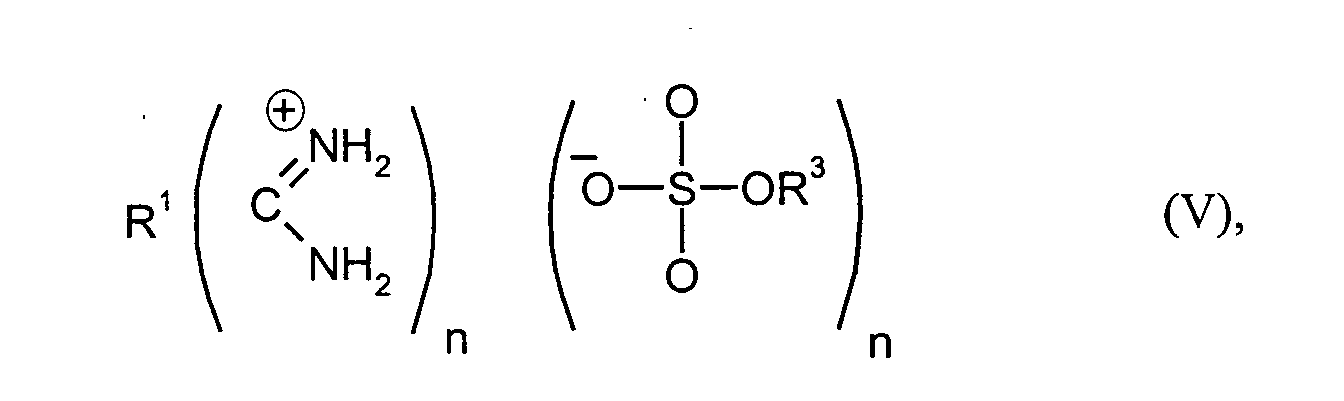
n, R1 und R3 die oben genannte Bedeutung besitzen.
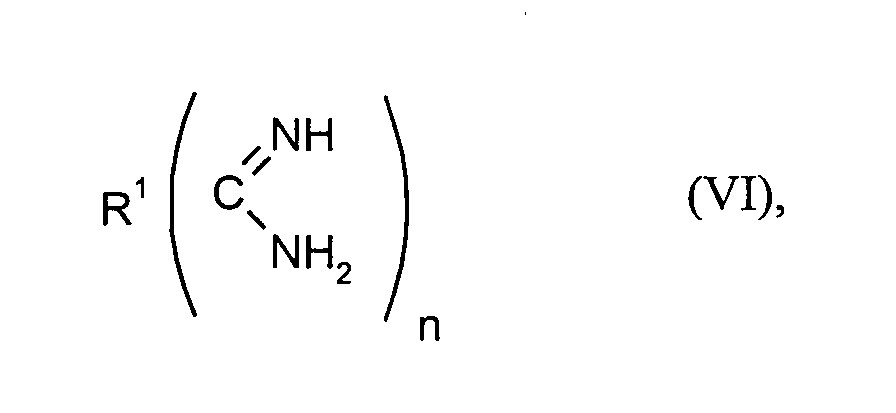
n und R1 die oben genannten Bedeutungen besitzen
aus den entsprechenden Amidinium-Alkylsulfaten der allgemeinen Formel (V) durch Basenzusatz in an sich bekannter Weise erhalten werden (siehe beispielsweise Acta Chem. Scand., B. 35, 1981, 605).
Cyanomethyl, Cyanoethyl, Methoxycarbonylmethyl, Methoxycarbonylethyl, Ethoxycarbonyl-methyl, Ethoxycarbonylethyl und Acetylmethyl.
Claims (19)
- Verfahren zur Herstellung von Amidinium-Salzen, dadurch gekennzeichnet, dass Carbonsäureamide der allgemeinen Formel (I)in der

n = 1 oder 2 und abhängig von n
für n = 1
R1 für C1-C12-Alkyl, C2-C8-Alkenyl, C1-C12-Halogenalkyl, oder C7-C12-Arylalkyl oder für Substituenten der allgemeinen Formel (II) steht,- A
- für einen C1-C4-Alkylenrest und
- B
- für eine Carbonylgruppe und
- D
- für R2 oder OR2 steht,
oder
B und D zusammen für eine Cyanogruppe stehen,
und für n = 2- R1
- für C1-C6-Alkylen oder C2-C6-Alkenylen steht,
a) mit mindestens einem Schwefelsäurediester der allgemeinen Formel (III)in der die Reste R3 jeweils unabhängig voneinander für C1-C6-Alkyl stehen,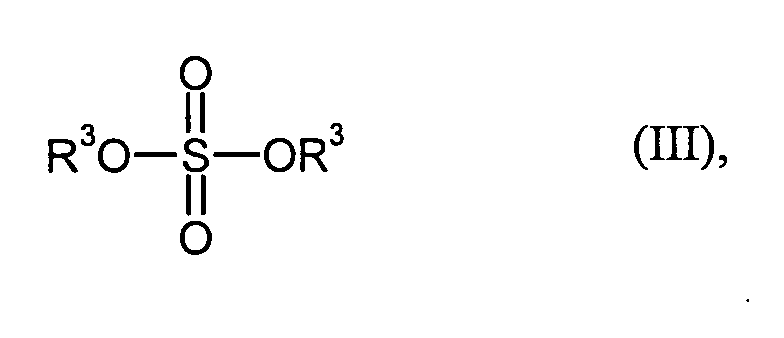
zu Imidsäureester-Alkylsulfaten der allgemeinen Formel (IV)in der
n, R1 und jeweils unabhängig voneinander die Reste R3 die oben genannte Bedeutung besitzen., umgesetzt werden undb) diese dann mit Ammoniak zu den Amidinium-Alkylsulfaten der allgemeinen Formel (V) umgesetzt werden,in der
n, R1 und jeweils unabhängig voneinander die Reste R3 die oben genannte Bedeutung besitzen. - Verfahren nach Anspruch 1, dadurch gekennzeichnet, dass Schritt b) in Gegenwart von Lösungsmittel durchgeführt wird.
- Verfahren nach einem oder mehreren der Ansprüche 1 bis 2, dadurch gekennzeichnet, dass Schritt a) bei 30 bis 130°C durchgeführt wird.
- Verfahren nach einem oder mehreren der Ansprüche 1 bis 3, dadurch gekennzeichnet, dass Schritt b) bei einer Temperatur von ―40 bis 100°C durchgeführt wird.
- Verfahren nach einem oder mehreren der Ansprüche 1 bis 4, dadurch gekennzeichnet, dass als Schwefelsäurediester Dimethylsulfat verwendet wird.
- Imidsäureester-Alkylsulfate der allgemeinen Formel (IV)in der
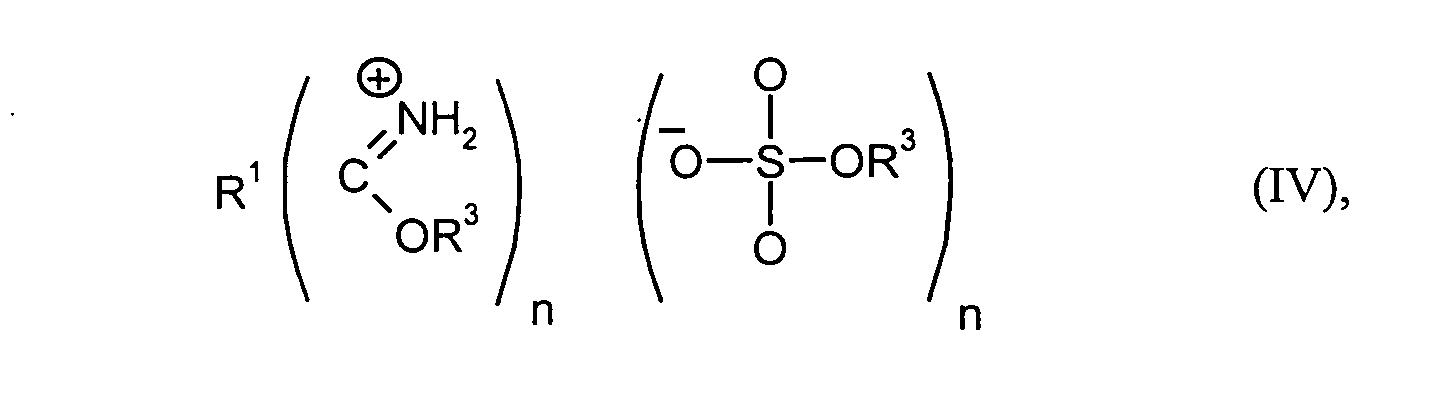
n für 1 oder 2 und abhängig von n
für n = 1
R1 für C1-C12-Alkyl, C2-C8-Alkenyl, C1-C12-Halogenalkyl, oder C7-C12-Arylalkyl oder für Substituenten der allgemeinen Formel (II)- A
- für einen C1-C4-Alkylenrest und
- B
- für eine Carbonylgruppe und
- D
- für R2 oder OR2 steht
oder B und D zusammen für eine Cyanogruppe stehen,
und für n = 2- R1
- für C1-C6-Alkylen oder C2-C6-Alkenylen steht
- Imidessigsäuremethylester-Methylsulfat.
- Amidinium-Alkylsulfate der allgemeinen Formel (V)in der

n für 1 oder 2 und abhängig von n
für n = 1
R1 für C1-C12-Alkyl, C2-C8-Alkenyl, C1-C12-Halogenalkyl, oder C7-C12-Arylalkyl oder für Substituenten der allgemeinen Formel (II)- A
- für einen C1-C4-Alkylenrest und
- B
- für eine Carbonylgruppe und
- D
- für R2 oder OR2 steht
oder B und D zusammen für eine Cyanogruppe stehen,
und für n = 2- R1
- für C1-C6-Alkylen oder C2-C6-Alkenylen steht
- Acetamidinium-Methylsulfat.
- Verfahren zur Herstellung von Amidinen, dadurch gekennzeichnet, dass Amidinium-Alkylsulfate gemäß Ansprüchen 8 oder 9 mit Base umgesetzt werden.
- Verfahren zur Herstellung von stickstoffhaltigen Heterocyclen, dadurch gekennzeichnet, dass man Imidsäureester-Alkylsulfate gemäß Anspruch 6 oder Amidinium-Alkylsulfate gemäß Anspruch 8 oder Amidine gemäß Anspruch 10 oder deren Kohlendioxid Addukte einsetzt.
- Verfahren zur Herstellung von Amidin-Kohlendioxid-Addukten, dadurch gekennzeichnet, dass man Imidsäureester-Alkylsulfate gemäß Anspruch 6 oder Amidinium-Alkylsulfate gemäß Anspruch 8 einsetzt.
- Verwendung von Imidsäureester-Alkylsulfaten gemäß Anspruch 6 in einem Verfahren zur Herstellung von Arzneimitteln.
- Verwendung von Amidinium-Alkylsulfaten gemäß Anspruch 8 in einem Verfahren zur Herstellung von Arzneimitteln.
- Verwendung von Imidsäureester-Alkylsulfaten gemäß Anspruch 6 in einem Verfahren zur Herstellung von Vitamin B1.
- Verwendung von Amidinium-Alkylsulfaten gemäß Anspruch 8 in einem Verfahren zur Herstellung von Vitamin B1.
- Verwendung von Amidinen gemäß Anspruch 10 oder deren Kohlendioxid-Addukte in einem Verfahren zur Herstellung von Arzneimitteln.
- Verfahren zur Herstellung von Arzneimitteln, dadurch gekennzeichnet, dass man Imidsäureester-Alkylsulfate gemäß Anspruch 6 einsetzt.
- Verfahren zur Herstellung von Arzneimitteln, dadurch gekennzeichnet, dass man Amidinium-Alkylsulfate gemäß Anspruch 8 oder Amidine gemäß Anspruch 10 oder deren Kohlendioxid-Addukte einsetzt.
Applications Claiming Priority (2)
| Application Number | Priority Date | Filing Date | Title |
|---|---|---|---|
| DE10142335 | 2001-08-30 | ||
| DE10142335A DE10142335A1 (de) | 2001-08-30 | 2001-08-30 | N-unsubstituierte Amidinium-Salze |
Publications (2)
| Publication Number | Publication Date |
|---|---|
| EP1288197A2 true EP1288197A2 (de) | 2003-03-05 |
| EP1288197A3 EP1288197A3 (de) | 2004-03-10 |
Family
ID=7696999
Family Applications (1)
| Application Number | Title | Priority Date | Filing Date |
|---|---|---|---|
| EP02018160A Withdrawn EP1288197A3 (de) | 2001-08-30 | 2002-08-19 | N-unsubstituierte Amidinium-Salze |
Country Status (4)
| Country | Link |
|---|---|
| US (2) | US6841696B2 (de) |
| EP (1) | EP1288197A3 (de) |
| JP (1) | JP2003113151A (de) |
| DE (1) | DE10142335A1 (de) |
Families Citing this family (2)
| Publication number | Priority date | Publication date | Assignee | Title |
|---|---|---|---|---|
| CN105037205B (zh) * | 2015-07-01 | 2017-03-01 | 湖北志诚化工科技有限公司 | 一种二甲氧基丙二亚胺二甲基硫酸氢盐的制备新方法 |
| CN117050022A (zh) * | 2023-08-17 | 2023-11-14 | 台州臻挚生物科技有限公司 | 嘧啶羧酸类除草剂核心中间体生产的新方法 |
Family Cites Families (3)
| Publication number | Priority date | Publication date | Assignee | Title |
|---|---|---|---|---|
| JPS6084254A (ja) | 1983-10-13 | 1985-05-13 | Takeda Chem Ind Ltd | アミジン塩酸塩の製造法 |
| DE3431270A1 (de) * | 1984-08-25 | 1986-03-06 | Basf Ag, 6700 Ludwigshafen | Alpha-(o-chlorphenyl)-aminomethylen-beta-formylaminopropionitril, verfahren zu seiner herstellung sowie verwendung zur herstellung von 2-methyl-4-amino-5-formylaminomethylpyrimidin |
| DE19910093A1 (de) * | 1999-03-08 | 2000-09-21 | Sueddeutsche Kalkstickstoff | Formamidin-Salze, Verfahren zu ihrer Herstellung und deren Verwendung |
-
2001
- 2001-08-30 DE DE10142335A patent/DE10142335A1/de not_active Withdrawn
-
2002
- 2002-08-19 EP EP02018160A patent/EP1288197A3/de not_active Withdrawn
- 2002-08-27 US US10/228,654 patent/US6841696B2/en not_active Expired - Fee Related
- 2002-08-29 JP JP2002251688A patent/JP2003113151A/ja active Pending
-
2004
- 2004-10-05 US US10/958,870 patent/US20050043403A1/en not_active Abandoned
Also Published As
| Publication number | Publication date |
|---|---|
| US20050043403A1 (en) | 2005-02-24 |
| US20030060653A1 (en) | 2003-03-27 |
| US6841696B2 (en) | 2005-01-11 |
| JP2003113151A (ja) | 2003-04-18 |
| DE10142335A1 (de) | 2003-03-20 |
| EP1288197A3 (de) | 2004-03-10 |
Similar Documents
| Publication | Publication Date | Title |
|---|---|---|
| DE69710052T2 (de) | Verfahren zur herstellung von zwischenprodukten für pestizide | |
| EP1644314B1 (de) | Verfahren zum herstellen von difluoracetessigs urealkylestern | |
| EP2847183B1 (de) | Verfahren zur herstellung von triazol-verbindungen | |
| CH706864B1 (de) | Verfahren zur Herstellung einer Pyrazol-Verbindung. | |
| DE69231843T2 (de) | Verfahren zur Herstellung von insektiziden, nematiziden und akariziden 2-Aryl-3-subst.-5- trifluormethylpyrrolen aus N-(subst. Benzyl)-2,2,2-trifluoracetimidoylchloriden | |
| EP3658545B1 (de) | Verfahren zur herstellung von 3-[(3s)-7-bromo-2-oxo-5-(pyridin-2-yl)-2,3-dihydro-1h-[1,4]-benzodiazepin-3-yl]propionsäuremethylester und in dem verfahren nützliche verbindungen | |
| JPH10501248A (ja) | α−メトキシイミノカルボン酸メチルアミドの製造方法およびその中間生成物 | |
| DE10061212A1 (de) | Verfahren zur Herstellung heterocyclischer Verbindungen | |
| DE10142335A1 (de) | N-unsubstituierte Amidinium-Salze | |
| CH702298B1 (de) | Verfahren zur Herstellung von Cyanoalkylpropionat-Derivaten. | |
| EP1131299B1 (de) | Verfahren zur herstellung von 1-substituierten 5- oder 3-hydroxy-pyrazolen | |
| EP1606246B1 (de) | Verfahren zur hertellung von 2-cyan-3-hydroxy-n-(phenyl)but-2-enamiden | |
| DE69706757T2 (de) | Verfahren zur Herstellung von 3-Amino substituierten Crotonaten | |
| DE10331496A1 (de) | Verfahren zum Herstellen von Difluoracetessigsäurealkylestern | |
| EP1131298B1 (de) | Verfahren zur herstellung von 1-substituierten 5-hydroxypyrazolen | |
| DE69619402T2 (de) | Verfahren zur herstellung von methoximinophenylglyoxylsäure-derivaten | |
| JP3595110B2 (ja) | C−h−酸化合物のニトロソ化方法 | |
| DE69427148T2 (de) | Verfahren zur Herstellung von 2,4,5-Tribrompyrrol-3-carbonitril | |
| EP0704429B1 (de) | 2-(Arylimino-methyl)-3-(di-substituierte-amino)-alcylnitrile, Verfahren zu ihrer Herstellung und ihre Verwendung | |
| EP3507274B1 (de) | Verfahren zur herstellung chiraler aminonitrile | |
| EP0069883B1 (de) | Verfahren zur Herstellung von Hydrazidinen | |
| DE3102318A1 (de) | Verfahren zur herstellung von 3,6-disubstituierten 4-amino-1,2,4-triazin-5-onen | |
| Gerus et al. | Regioselective reactions of N-monosubstituted β-aminovinyl trifluoromethyl ketones with tosyl isocyanate | |
| DE3127042A1 (de) | "verfahren zur herstellung von hydrazidinen" | |
| DE2015650A1 (de) | omega-Guanidinosäureamid-Derivate und deren Oniumsalze |
Legal Events
| Date | Code | Title | Description |
|---|---|---|---|
| PUAI | Public reference made under article 153(3) epc to a published international application that has entered the european phase |
Free format text: ORIGINAL CODE: 0009012 |
|
| AK | Designated contracting states |
Kind code of ref document: A2 Designated state(s): AT BE BG CH CY CZ DE DK EE ES FI FR GB GR IE IT LI LU MC NL PT SE SK TR Designated state(s): AT BE BG CH CY CZ DE DK EE ES FI FR GB GR IE IT LI LU MC NL PT SE SK TR |
|
| AX | Request for extension of the european patent |
Extension state: AL LT LV MK RO SI |
|
| RIC1 | Information provided on ipc code assigned before grant |
Ipc: 7C 07C 257/18 B Ipc: 7C 07C 257/16 B Ipc: 7C 07C 257/14 B Ipc: 7C 07C 257/08 B Ipc: 7C 07C 257/06 B Ipc: 7C 07C 303/24 B Ipc: 7C 07C 305/04 A |
|
| RAP1 | Party data changed (applicant data changed or rights of an application transferred) |
Owner name: BAYER CHEMICALS AG |
|
| RIC1 | Information provided on ipc code assigned before grant |
Ipc: 7C 07D 233/54 B Ipc: 7C 07D 213/08 B Ipc: 7C 07C 257/18 B Ipc: 7C 07C 257/16 B Ipc: 7C 07C 257/14 B Ipc: 7C 07C 257/08 B Ipc: 7C 07C 257/06 B Ipc: 7C 07C 303/24 B Ipc: 7C 07C 305/04 A |
|
| PUAL | Search report despatched |
Free format text: ORIGINAL CODE: 0009013 |
|
| AK | Designated contracting states |
Kind code of ref document: A3 Designated state(s): AT BE BG CH CY CZ DE DK EE ES FI FR GB GR IE IT LI LU MC NL PT SE SK TR |
|
| AX | Request for extension of the european patent |
Extension state: AL LT LV MK RO SI |
|
| 17P | Request for examination filed |
Effective date: 20040910 |
|
| AKX | Designation fees paid |
Designated state(s): BE CH DE GB LI NL |
|
| 17Q | First examination report despatched |
Effective date: 20050527 |
|
| RAP1 | Party data changed (applicant data changed or rights of an application transferred) |
Owner name: LANXESS DEUTSCHLAND GMBH |
|
| STAA | Information on the status of an ep patent application or granted ep patent |
Free format text: STATUS: THE APPLICATION IS DEEMED TO BE WITHDRAWN |
|
| 18D | Application deemed to be withdrawn |
Effective date: 20051007 |