EP1286879B1 - Floor arrangement for a vehicle - Google Patents
Floor arrangement for a vehicle Download PDFInfo
- Publication number
- EP1286879B1 EP1286879B1 EP01934747A EP01934747A EP1286879B1 EP 1286879 B1 EP1286879 B1 EP 1286879B1 EP 01934747 A EP01934747 A EP 01934747A EP 01934747 A EP01934747 A EP 01934747A EP 1286879 B1 EP1286879 B1 EP 1286879B1
- Authority
- EP
- European Patent Office
- Prior art keywords
- frame
- plate
- floor arrangement
- absorbent
- arrangement according
- Prior art date
- Legal status (The legal status is an assumption and is not a legal conclusion. Google has not performed a legal analysis and makes no representation as to the accuracy of the status listed.)
- Expired - Lifetime
Links
- 230000002745 absorbent Effects 0.000 claims description 52
- 239000002250 absorbent Substances 0.000 claims description 52
- 239000004033 plastic Substances 0.000 claims description 12
- 229920003023 plastic Polymers 0.000 claims description 12
- 239000011800 void material Substances 0.000 claims description 8
- -1 polypropylene Polymers 0.000 claims description 6
- 238000010521 absorption reaction Methods 0.000 claims description 5
- 239000004698 Polyethylene Substances 0.000 claims description 3
- 239000004743 Polypropylene Substances 0.000 claims description 3
- 229920000573 polyethylene Polymers 0.000 claims description 3
- 229920001155 polypropylene Polymers 0.000 claims description 3
- XAGFODPZIPBFFR-UHFFFAOYSA-N aluminium Chemical compound [Al] XAGFODPZIPBFFR-UHFFFAOYSA-N 0.000 claims description 2
- 229910052782 aluminium Inorganic materials 0.000 claims description 2
- 239000004411 aluminium Substances 0.000 claims description 2
- 229920001971 elastomer Polymers 0.000 description 17
- 239000000463 material Substances 0.000 description 9
- 230000001413 cellular effect Effects 0.000 description 8
- 238000013016 damping Methods 0.000 description 7
- 239000011148 porous material Substances 0.000 description 6
- 229920001821 foam rubber Polymers 0.000 description 5
- 229920005830 Polyurethane Foam Polymers 0.000 description 2
- 230000005540 biological transmission Effects 0.000 description 2
- 239000011496 polyurethane foam Substances 0.000 description 2
- 238000005452 bending Methods 0.000 description 1
- 238000006243 chemical reaction Methods 0.000 description 1
- 238000010276 construction Methods 0.000 description 1
- 239000006260 foam Substances 0.000 description 1
- 230000005484 gravity Effects 0.000 description 1
- 238000004519 manufacturing process Methods 0.000 description 1
- 239000002245 particle Substances 0.000 description 1
Images
Classifications
-
- B—PERFORMING OPERATIONS; TRANSPORTING
- B62—LAND VEHICLES FOR TRAVELLING OTHERWISE THAN ON RAILS
- B62D—MOTOR VEHICLES; TRAILERS
- B62D33/00—Superstructures for load-carrying vehicles
- B62D33/06—Drivers' cabs
- B62D33/0604—Cabs insulated against vibrations or noise, e.g. with elastic suspension
-
- B—PERFORMING OPERATIONS; TRANSPORTING
- B60—VEHICLES IN GENERAL
- B60R—VEHICLES, VEHICLE FITTINGS, OR VEHICLE PARTS, NOT OTHERWISE PROVIDED FOR
- B60R13/00—Elements for body-finishing, identifying, or decorating; Arrangements or adaptations for advertising purposes
- B60R13/08—Insulating elements, e.g. for sound insulation
- B60R13/0815—Acoustic or thermal insulation of passenger compartments
- B60R13/083—Acoustic or thermal insulation of passenger compartments for fire walls or floors
-
- B—PERFORMING OPERATIONS; TRANSPORTING
- B62—LAND VEHICLES FOR TRAVELLING OTHERWISE THAN ON RAILS
- B62D—MOTOR VEHICLES; TRAILERS
- B62D25/00—Superstructure or monocoque structure sub-units; Parts or details thereof not otherwise provided for
- B62D25/20—Floors or bottom sub-units
-
- B—PERFORMING OPERATIONS; TRANSPORTING
- B62—LAND VEHICLES FOR TRAVELLING OTHERWISE THAN ON RAILS
- B62D—MOTOR VEHICLES; TRAILERS
- B62D33/00—Superstructures for load-carrying vehicles
- B62D33/06—Drivers' cabs
Definitions
- the present invention relates to a floor arrangement for a space in a vehicle according to the preamble to patent claim 1.
- a truck incorporates an elongate chassis element which, inter alia, supports the driver's cab and the engine.
- the cab is defined inter alia by a frame which may be made of sheetmetal and which incorporates a surface which defines the cab floor.
- the engine is usually situated under the cab and hence under said surface of the frame, which means that noise from the engine propagates to the cab substantially in the form of bending waves due to frame deformation.
- the cab should incorporate an internal lining with sound damping capacity.
- the cab floor is usually provided with some kind of rubber mat.
- a rubber mat often incorporates a layer of rubber about 5 mm thick and a layer of cellular plastic about 25 mm thick with closed pores. So-called soft cellular plastic is often used because it provides better sound damping than rigid foam plastic.
- the weight of such a rubber mat may be regarded as high, particularly in relation to endeavouring to lighten component parts used in truck construction.
- the rubber mat rests by gravity on the frame, which may be made of sheetmetal, and one square metre of the frame, i.e. the portion of the frame which incorporates the surface which defines the cab floor, supports about 8 kg which may be accounted for by the rubber mat.
- the foam rubber layer acts as a spring intended to alleviate, and insulate the rubber layer from, vibration of the sheetmetal frame.
- a truck driver often spends a great deal of time in the cab. It also happens that he/she may sleep in the cab, to which end many cabs are provided with bedlike arrangements. It follows that the driver sometimes stands up and walks about in the cab. The cab floor therefore has to be comfortable to stand and walk on.
- the driver of a truck in which the cab is provided with a rubber mat of the type mentioned above may find that the rubber mat is spongy and too soft to be comfortable to walk.
- rigid cellular plastic with closed pores has been tried instead of soft cellular plastic with closed pores, but replacing soft cellular plastic with rigid cellular plastic does not provide sufficient sound damping.
- the cab frame on which the rubber mat is arranged is often treated in such a way as to create a rigid structure.
- the frame may for example be corrugated to create a rigid structure or be provided with stiffening ribs or the like.
- the rubber mat rests not on a planar surface but on an uneven surface. The driver will therefore perceive this unevenness when he/she stands or walks on the floor if it incorporates a rubber mat of the aforesaid kind.
- a floor arrangement according the preamble of claim 1 is known from the document DE-A-4 412 427.
- the object of the present invention is to eliminate the problem described above. What is particularly aimed at is a floor arrangement which is light, has good sound damping characteristics and is comfortable to walk on.
- the space in which the floor arrangement is applied may be a driver's cab for a truck.
- the space is defined inter alia by a frame which incorporates a surface which faces said space.
- the frame may be made of sheetmetal and may also be provided with stiffening ribs or the like to stiffen the structure.
- the surface of the sheetmetal frame on which the floor arrangement is intended to be applied may be uneven.
- the floor arrangement incorporates a plate arranged at a distance from said frame in such a way that a void is formed between said frame surface and the plate.
- the cab floor may thus be likened to a double floor whereby noise radiating from the frame is transmitted to said void which contains air between the frame and the plate.
- the plate is preferably rigid and intended to even out the unevenness which may be present in the frame.
- spacing devices are arranged to extend between said frame surface and said plate and to create said distance between said frame surface and said plate.
- the spacing devices may for example incorporate elongate bars which may for example be arranged parallel to one another or cross in such a way to form a grid as viewed in a plane which extends through said bars.
- the spacing devices may incorporate a multiplicity of spacing elements evenly distributed relative to the surface of the plate. It should be noted that the spacing devices have to be arranged in way of node points of the frame. This positioning minimises the risk of vibration being transmitted from the frame to the plate via the spacing devices.
- the spacing devices are designed in such a way that they support the plate relative to the frame of the vehicle space so that the plate will be self-supporting. It should be noted that the contact surface between the spacing devices and the frame should be as small as possible with a view to minimising vibration transmission from the frame to the plate via the spacing devices.
- the plate is preferably made of some kind of plastic, e.g. polypropylene or polyethylene, produced in such a way to be more rigid and tougher and have a harder surface and better heat resistance than ordinary polyethylene.
- the plate together with spacing devices may be injection-moulded to minimise the manufacturing costs. It should be noted also that the spacing devices may be separate or connected to the vehicle space frame.
- the contact surface between the spacing devices and the plate should be as small as possible with a view to minimising vibration transmission from the frame to the plate via the spacing devices.
- a suitable material if the spacing devices are separate is aluminium in relation to endeavouring to keep parts as light as possible.
- an absorbent may be arranged between said frame and said plate.
- the absorbent may incorporate cellular plastic with open pores, e.g. polyurethane foam. It should be noted that the absorbent may also incorporate other materials, e.g. rags, but cellular plastic with open pores is preferable in being of lower density than rags and in relation to endeavouring to lighten vehicle components.
- the absorbent damps noise by converting part of the acoustic energy to heat.
- the thickness of the absorbent substantially corresponds to the distance between the frame surface and the plate, but there is between the frame and the absorbent an air gap whose function will be described later on in the description.
- the thickness of the absorbent is smaller than the distance between the frame surface and the plate. It is possible for the vertical extent of the absorbent to be about half the distance between the frame and the plate.
- the absorbent substantially fills said void. It is possible for cables and the like to extend in the space between the frame and the plate, in which case absorbent material may be omitted to provide space for, for example, cables.
- an air gap between the vehicle frame and said absorbent.
- the presence of said air gap means that the absorbent will not act as a spring as the foam rubber layer of the rubber mat in the introductory description does.
- the absorption factor of the absorbent is between 0.3 and 1.0.
- the absorbent damps noise by converting part of the acoustic energy to heat.
- the impedance of the absorbent has to substantially correspond to the impedance of the air.
- the impedance of the air is arrived at by multiplying the air density po by the wave propagation velocity, i.e. the velocity of sound in air, c 0 . If the difference between the respective impedances of the media is very great, this reduces the possibility of waves passing from one medium to the other without being reflected at the boundary surface between the media.
- a good absorbent has an impedance which substantially corresponds to the impedance of the air. Another way of expressing this is that the absorption factor has to be as close to unity as possible, and R as close to nil as possible. This means that the impedance of the absorbent should correspond substantially to the impedance of the air.
- the distance between the frame surface and the plate is about 15-25 mm, preferably 20 mm.
- the dimensions of the floor arrangement according to the invention may vary but it is conceivable for the thickness of the plate to be about 4 mm and the distance between the frame surface and the plate to be 20 mm. If an absorbent incorporating polyurethane foam with open pores substantially fills the void between the frame surface and the plate and the plate is made of polypropylene, one square metre of the frame supports about 4.5 kg which may be accounted for by the floor arrangement according to the invention, comprising about 4 kg from the plate and about 0.5 kg from the absorbent.
- the floor arrangement according to the invention is thus significantly lighter than the rubber mat described in the introductory description.
- the present invention relates to a floor arrangement (floor lining) for a space in a vehicle such as a truck. It should be noted that the floor arrangement according to the invention is also applicable to other types of vehicles, e.g. other types of freight vehicles, buses or similar utility vehicles, and all types of vehicles where similar problems and requirements occur.
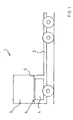
- Fig. 1 depicts a truck 1 incorporating an elongate chassis element 2 which, inter alia, supports the driver's cab 3 and the engine 4.
- the cab 3 is defined inter alia by a frame 5 which incorporates a surface 6 facing the cab 3, i.e. the space which constitutes the cab 3, and this part of the frame 5 constitutes the floor frame of the cab 3.
- the frame 5 may be corrugated to stiffen the structure.
- the engine 4 is usually situated under the cab 3 and hence under the portion of the frame 5 which constitutes the floor frame of the cab 3. Accordingly, the cab 3 should have an internal lining which inter alia is capable of damping noise from outside the cab, e.g. noise from the engine 4.
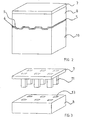
- Fig. 2 depicts a section of a floor arrangement applied to the surface 6 of the frame 5 which defines the cab 3 of the truck 1 in Fig. 1.
- the frame 5 in Fig. 2 is corrugated to create a rigid structure.
- the surface 6 of the frame 5 is not planar but uneven.
- the surface 6 extends in a substantially horizontal plane.
- the floor arrangement incorporates a plate 7 arranged at a distance from the surface 6 of the frame 5 and arranged substantially parallel with the surface 6 in such a way as to form a void between the surface 6 of the frame 5 and the plate 7.
- the plate 7 is rigid and preferably made of plastic.
- An absorbent 8 is arranged between the frame 5 and the plate 7. According to the embodiment depicted in Fig.
- An absorbent 10 is usually arranged under the frame 5 to help to damp the noise from, for example, the engine 4.
- the plate 7 incorporates a multiplicity of spacing devices 11, 12 which support the plate 7 relative to the frame 5.
- the distance between the frame 5 and the plate 7 corresponds to the height (i.e. the vertical extent) of the spacing devices 11, 12.
- the thickness (i.e. the vertical extent) of the absorbent 8 is smaller than the height of the spacing devices 11, 12.
- the thickness of the absorbent 8 being smaller than the height of the spacing devices creates the possibility of the air gap 9.
- said spacing devices incorporate spacing elements 11 in the form of homogeneous columns of square cross-section. It should be noted that other cross-sections are also conceivable.
- the spacing elements 11 might also incorporate tubes of, for example, circular cross-section. It is also possible to provide spacing elements 11 in the form of cones or pyramids.
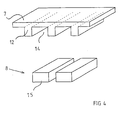
- the plate 7 incorporates spacing devices in the form of elongate bars 12 arranged parallel to one another.
- the bars 12 are of rectangular cross-section but other cross-sections are also conceivable.
- the fact that the spacing devices 11, 12 in Fig. 3 and Fig. 4 are integrated with the plate 7 means that the latter is self-supporting relative to the frame 5. It should be noted that the contact surface between the spacing devices 11, 12 and the frame 5 should be as small as possible with a view to minimising the propagation of vibration from the frame 5 to the plate 7 via the spacing devices 11, 12.
- spacing elements 11 in the form of cones or pyramids may be preferable. If the spacing devices are integrated with the plate 7, the bases of the cones or pyramids concerned should be arranged in way of the plate 7. The tip of each cone or pyramid concerned should also be arranged in way of a node point of the frame 5.
- the absorbent material 8 incorporates holes designed to accommodate the spacing devices 11 when the plate 7 and the absorbent material 8 are assembled.
- the plate 7 and the absorbent material 8 may be detachably assembled to one another or be firmly connected to one another.
- the holes 13 preferably have such dimensions relative to the spacing elements 11 that the absorbent material 8 is connected to the plate 7 by friction.
- An intermediate space 14 is formed between two adjacent bars 12 in Fig. 4.
- the absorbent 8 also incorporates a multiplicity of slabs 15 which are intended, when assembling the floor arrangement according to the invention, to be placed in said intermediate spaces 14.
- the slabs 15 may be connected to the plate 7 in the same way as the absorbent 8 is connected to the plate 7 in Fig. 3.
- noise from sources (e.g. the engine 4) outside the cab 3 will first be damped by the absorbent 10 converting part of the sound energy to heat.
- the majority of the sound waves passing through the absorbent 10 will be reflected by the frame 5.
- the majority of the sound which passes through the frame 5 will be reflected by the plate 7.
- the absorbent 8 is arranged between the frame 5 and the plate 7.
- an air gap 9 is arranged between the frame 5 and the absorbent 8. With the floor arrangement according to Fig. 2, the air in the gap 9 will act as a spring.
Landscapes
- Engineering & Computer Science (AREA)
- Mechanical Engineering (AREA)
- Chemical & Material Sciences (AREA)
- Combustion & Propulsion (AREA)
- Transportation (AREA)
- Physics & Mathematics (AREA)
- Acoustics & Sound (AREA)
- Body Structure For Vehicles (AREA)
- Passenger Equipment (AREA)
Applications Claiming Priority (3)
| Application Number | Priority Date | Filing Date | Title |
|---|---|---|---|
| SE0001818 | 2000-05-18 | ||
| SE0001818A SE520366C2 (sv) | 2000-05-18 | 2000-05-18 | Golvarrangemang för ett utrymme hos ett fordon |
| PCT/SE2001/001091 WO2001087690A1 (en) | 2000-05-18 | 2001-05-17 | Floor arrangement for a vehicle |
Publications (2)
| Publication Number | Publication Date |
|---|---|
| EP1286879A1 EP1286879A1 (en) | 2003-03-05 |
| EP1286879B1 true EP1286879B1 (en) | 2004-07-21 |
Family
ID=20279703
Family Applications (1)
| Application Number | Title | Priority Date | Filing Date |
|---|---|---|---|
| EP01934747A Expired - Lifetime EP1286879B1 (en) | 2000-05-18 | 2001-05-17 | Floor arrangement for a vehicle |
Country Status (5)
| Country | Link |
|---|---|
| EP (1) | EP1286879B1 (enExample) |
| BR (1) | BR0110855A (enExample) |
| DE (1) | DE60104418T2 (enExample) |
| SE (1) | SE520366C2 (enExample) |
| WO (1) | WO2001087690A1 (enExample) |
Family Cites Families (4)
| Publication number | Priority date | Publication date | Assignee | Title |
|---|---|---|---|---|
| US3416465A (en) * | 1966-06-21 | 1968-12-17 | Compass Container Company Inc | Cargo container floor system |
| US4965138A (en) * | 1989-09-20 | 1990-10-23 | Rene Gonzalez | Structural panel |
| JP3026694B2 (ja) * | 1993-04-19 | 2000-03-27 | 河西工業株式会社 | 車両用防音部材 |
| JP2762956B2 (ja) * | 1995-05-17 | 1998-06-11 | 日産自動車株式会社 | 遮音壁構造 |
-
2000
- 2000-05-18 SE SE0001818A patent/SE520366C2/sv unknown
-
2001
- 2001-05-17 WO PCT/SE2001/001091 patent/WO2001087690A1/en not_active Ceased
- 2001-05-17 BR BR0110855-7A patent/BR0110855A/pt active Search and Examination
- 2001-05-17 DE DE60104418T patent/DE60104418T2/de not_active Expired - Fee Related
- 2001-05-17 EP EP01934747A patent/EP1286879B1/en not_active Expired - Lifetime
Also Published As
| Publication number | Publication date |
|---|---|
| SE520366C2 (sv) | 2003-07-01 |
| DE60104418D1 (de) | 2004-08-26 |
| DE60104418T2 (de) | 2005-08-25 |
| SE0001818L (enExample) | 2001-11-19 |
| WO2001087690A1 (en) | 2001-11-22 |
| BR0110855A (pt) | 2003-12-30 |
| EP1286879A1 (en) | 2003-03-05 |
| SE0001818D0 (sv) | 2000-05-18 |
Similar Documents
| Publication | Publication Date | Title |
|---|---|---|
| US5681072A (en) | Sound absorber for motor vehicles | |
| US20100089691A1 (en) | Sound absorbing structure built into luggage compartment of vehicle | |
| US5664397A (en) | Sandwich plate for use as motor-vehicle body part | |
| US8360201B2 (en) | Sound absorbing structure and sound chamber | |
| CN103975385B (zh) | 高带宽抗共振膜 | |
| US20110056763A1 (en) | Acoustic resonance device | |
| JP5056248B2 (ja) | 吸音材を備えた吸音構造 | |
| JP2648991B2 (ja) | 遮音及び消音複合部材並びに該複合部材の遮音層 | |
| KR20060092275A (ko) | 흡음 구조체 | |
| EP1286879B1 (en) | Floor arrangement for a vehicle | |
| JP2000170123A (ja) | 吸音パネル及びこれに用いるパネル強化体 | |
| RU2149788C1 (ru) | Шумовибродемпфирующий узел панели кузова транспортного средства | |
| EP3794584B1 (en) | Sound insulation element | |
| JP2016200668A (ja) | 吸音樹脂構造体 | |
| JP5315864B2 (ja) | 車体構造体およびフロア | |
| EP1299878B1 (en) | Sound absorbing material | |
| RU2309079C2 (ru) | Кабина транспортного средства | |
| US20250260917A1 (en) | Construction for mounting an electrodynamic transducer in a passenger compartment of a motor vehicle | |
| WO2018189879A1 (ja) | 鉄道車両 | |
| RU2042547C1 (ru) | Звукопоглощающая внутренняя панель кабины транспортного средства | |
| JP2000289610A (ja) | 鉄道車両の台枠 | |
| JP2008213652A (ja) | 鉄道車両の床構造 | |
| CN117465493A (zh) | 一种机车司机室地板结构、司机室及机车 | |
| JP4317554B2 (ja) | 高速鉄道車両用吸音パネル | |
| WO2018179485A1 (ja) | 防音パネル |
Legal Events
| Date | Code | Title | Description |
|---|---|---|---|
| PUAI | Public reference made under article 153(3) epc to a published international application that has entered the european phase |
Free format text: ORIGINAL CODE: 0009012 |
|
| 17P | Request for examination filed |
Effective date: 20021218 |
|
| AK | Designated contracting states |
Kind code of ref document: A1 Designated state(s): AT BE CH CY DE DK ES FI FR GB GR IE IT LI LU MC NL PT SE TR |
|
| GRAP | Despatch of communication of intention to grant a patent |
Free format text: ORIGINAL CODE: EPIDOSNIGR1 |
|
| GRAS | Grant fee paid |
Free format text: ORIGINAL CODE: EPIDOSNIGR3 |
|
| GRAA | (expected) grant |
Free format text: ORIGINAL CODE: 0009210 |
|
| AK | Designated contracting states |
Kind code of ref document: B1 Designated state(s): DE |
|
| REG | Reference to a national code |
Ref country code: IE Ref legal event code: FG4D |
|
| REF | Corresponds to: |
Ref document number: 60104418 Country of ref document: DE Date of ref document: 20040826 Kind code of ref document: P |
|
| PLBE | No opposition filed within time limit |
Free format text: ORIGINAL CODE: 0009261 |
|
| STAA | Information on the status of an ep patent application or granted ep patent |
Free format text: STATUS: NO OPPOSITION FILED WITHIN TIME LIMIT |
|
| 26N | No opposition filed |
Effective date: 20050422 |
|
| PGFP | Annual fee paid to national office [announced via postgrant information from national office to epo] |
Ref country code: DE Payment date: 20090514 Year of fee payment: 9 |
|
| PG25 | Lapsed in a contracting state [announced via postgrant information from national office to epo] |
Ref country code: DE Free format text: LAPSE BECAUSE OF NON-PAYMENT OF DUE FEES Effective date: 20101201 |