EP1285910A2 - Verfahren zur Herstellung von Acyloxybenzolsulfonaten - Google Patents
Verfahren zur Herstellung von Acyloxybenzolsulfonaten Download PDFInfo
- Publication number
- EP1285910A2 EP1285910A2 EP02017347A EP02017347A EP1285910A2 EP 1285910 A2 EP1285910 A2 EP 1285910A2 EP 02017347 A EP02017347 A EP 02017347A EP 02017347 A EP02017347 A EP 02017347A EP 1285910 A2 EP1285910 A2 EP 1285910A2
- Authority
- EP
- European Patent Office
- Prior art keywords
- carboxylic acid
- reaction
- phenolsulfonate
- sodium
- yield
- Prior art date
- Legal status (The legal status is an assumption and is not a legal conclusion. Google has not performed a legal analysis and makes no representation as to the accuracy of the status listed.)
- Granted
Links
Classifications
-
- C—CHEMISTRY; METALLURGY
- C07—ORGANIC CHEMISTRY
- C07C—ACYCLIC OR CARBOCYCLIC COMPOUNDS
- C07C303/00—Preparation of esters or amides of sulfuric acids; Preparation of sulfonic acids or of their esters, halides, anhydrides or amides
- C07C303/32—Preparation of esters or amides of sulfuric acids; Preparation of sulfonic acids or of their esters, halides, anhydrides or amides of salts of sulfonic acids
-
- C—CHEMISTRY; METALLURGY
- C07—ORGANIC CHEMISTRY
- C07C—ACYCLIC OR CARBOCYCLIC COMPOUNDS
- C07C303/00—Preparation of esters or amides of sulfuric acids; Preparation of sulfonic acids or of their esters, halides, anhydrides or amides
- C07C303/02—Preparation of esters or amides of sulfuric acids; Preparation of sulfonic acids or of their esters, halides, anhydrides or amides of sulfonic acids or halides thereof
- C07C303/22—Preparation of esters or amides of sulfuric acids; Preparation of sulfonic acids or of their esters, halides, anhydrides or amides of sulfonic acids or halides thereof from sulfonic acids, by reactions not involving the formation of sulfo or halosulfonyl groups; from sulfonic halides by reactions not involving the formation of halosulfonyl groups
Definitions
- the invention relates to a process for the preparation of acyloxybenzenesulfonates, starting from carboxylic acid halides and low-water salts of Phenolsulfonic.
- Acyloxybenzenesulfonic acids and their salts have long been known compounds. Depending on the chain length of the acyl group, they can be used as surfactants, Bleach activators or in other applications.
- This Compounds can be obtained by reacting sodium phenol sulfonate (SPS) with the chloride of an organic carboxylic acid.
- SPS sodium phenol sulfonate
- As a reaction medium serve organic solvents such as methylene chloride (US 35 03 888), high-boiling hydrocarbons (EP 220 826), xylene or toluene (EP 164 786). According to US 5,069,828, this reaction is carried out in an aprotic organic Solvent carried out in the presence of a phase transfer catalyst.
- WO 01/19 771 describes the implementation of acyl chlorides with SPS in Trifluoroacetic acid (TFA) as a solvent.
- TFA Trifluoroacetic acid
- the examples use a ratio TFA: SPS worked from 0.5: 1 to 3: 1.
- the high price of the TFA, its complete Separation from the reaction mixture and possible transesterification reactions or By-product formation is an industrial use of the process however contrary.
- the object of the present invention is therefore a both on an industrial scale also to develop continuously feasible processes that work in very good Yields leads to the most uniform products possible Composition, quality and color for use in washing and Detergents are suitable.
- the process should be independent of the Quality of the sodium phenolsulfonate used and its pretreatment.
- acyloxybenzenesulfonates in high Yields and good qualities, regardless of the quality of the used PLC can be produced if the implementation of the PLC with a Alkane carboxylic acid derivative in an aliphatic or aromatic solvent in Presence of catalytic amounts of a nitrogenous organic compound is carried out with a base character.
- the invention relates to a method for producing Acyloxybenzenesulfonates by reacting phenolsulfonates, the one Water content of less than 0.5, preferably less than 0.2% by weight of water have, with alkane carboxylic acid derivatives, in an aliphatic or aromatic hydrocarbon, characterized in that the reaction in the presence of 0.01 to 10 wt .-% of a catalyst in the form of a nitrogenous organic compound with basic properties.
- the phenolsulfonates serving as starting compounds are preferably compounds of the formula where X is hydrogen, halogen or C 1 -C 4 alkyl and M is an alkali or alkaline earth metal ion.
- Sodium ortho- or para-phenolsulfonates are preferred, in particular sodium para-phenolsulfonate (SPS), which can contain 0 to 20% of the corresponding ortho-isomer due to the manufacturing process.
- SPS is commercial as a dihydrate, i.e. available with a water content of 15%.
- the Phenolsulfonate initially to a residual moisture of at most 0.5, preferably at most 0.2% by weight of water can be dried. This can be done according to usual and known processes happen, for example in a disc dryer, which allows drying to a residual moisture content of less than 0.1% by weight.
- the drying times can vary depending on the equipment used between 1 min and 18 h, the temperatures between 80 and 250 ° C.
- the method according to the invention does not have the quality of the dried PLC Influence the yield of the acylation reaction and it can on average Sales greater than 95% can be achieved.
- too Dry conditions are applied that are outside of those described in US 4,666,636 optimal drying conditions, i.e. those who too lead "over-dried" product.
- Such a product can according to the state of the Technique not to be used for acylation reactions as it is not reactive is enough.
- both the halides and the Anhydrides can be used.
- the carboxylic acid chlorides come in particular or bromides in question, the chlorides being preferred. These can be found in the corresponding carboxylic acids e.g. by reaction with phosgene, thionyl chloride, Phosphorus trichloride, phosphorus oxychloride, phosphorus pentachloride or Phosphorus tribromide can be produced.
- the anhydrides can be symmetrical or unbalanced connections are used. Examples of this are Nonanoic anhydride, octanoic anhydride or acetyl nonanoic anhydride.
- Alkane carboxylic acids having 6 to 22 carbon atoms can be used. Examples for this are hexanoic acid, heptanoic acid, octanoic acid, methyl octanoic acid, nonanoic acid, 3,3,5-isononanoic acid, decanoic acid, undecanoic acid, undecenoic acid, lauric acid, Myristic acid, hardened tallow fatty acid and stearic acid. Particularly preferred are octanoic acid, nonanoic acid, isononanoic acid, decanoic acid and lauric acid.
- the Alkane carboxylic acid can have further substituents such as halogens, nitro or Wear amino groups.
- Carboxylic acid derivative and phenol sulfonate according to the invention can preferably in a molar ratio of 0.9: 1 to 2: 1, preferably 1: 1 to 1.5: 1 with one another be implemented.
- Aliphatic or aromatic hydrocarbons with boiling points between 80 and 220 ° C., in particular 100 to 180 ° C., for example toluene, xylene, paraffins with 8 to 22 carbon atoms, such as decane, undecane, dodecane, hexadecane or octadecane, are used as the reaction medium or their mixtures.
- Aliphatic hydrocarbon mixtures such as those commercially available as shell sol (Shell), ISOPAR G and ISOPAR 4 (ESSO) are particularly suitable.
- the solubility of the SPS in this reaction medium is often less than 1%.
- the catalyst is a nitrogenous organic compound with basic Characteristics. Open-chain or cyclic tertiary amines or are preferred Carboxylic acid amides. Triethylamine, tripropylamine, Dimethylformamide, diethylformamide, dimethylacetamide, tetramethylurea, substituted pyrrolidones such as N-methylpyrrolidone, N-ethylpyrrolidone, N-butylpyrrolidone, N-octylpyrrolidone, n-methylcaprolactam, N-octylcaprolactam. Triethylamine, dimethylformamide, N-methylpyrrolidone and are particularly preferred N-octyl.
- the molar ratio of the catalyst used to Phenol sulfonate is 0.0001: 1 to 0.02: 1, preferably 0.005: 1 to 0.012: 1.
- the acylation reaction is carried out at temperatures between 60 and 200 ° C, performed in particular between 100 and 150 ° C. That during the reaction resulting gas is discharged, if necessary, the reaction with an inert gas stream overlaid with nitrogen or argon.
- the reaction becomes heterogeneous Reaction (slurry) carried out since neither the phenolsulfonate nor the resulting Acyloxybenzenesulfonate a significant solubility in the reaction medium exhibit.
- the reaction time depends on the reaction conditions and can be between 10 min and 5 h, preferably 30 to 120 min.
- Kettle cascades are particularly suitable for this or tubular reactors as are known to the person skilled in the art.
- the reaction product becomes conventional Separation methods isolated. Centrifuges and filter devices are suitable for this. For complete Separation of the catalyst, it is advisable to the solid reaction product or wash out several times with the reaction medium. The mother liquor can be without further purification can be used or cycled for the next reactions.
- the Acyloxybenzenesulfonate formed falls in high yields in the form of a white Powder that can be isolated by conventional drying.
- the acyloxybenzenesulfonate obtained in this way can be used as a surfactant or Persalt activator in detergents and cleaning agents such as powder Heavy duty detergents, stain removers or powdered dishwasher detergents be used.
- cleaning agents such as powder Heavy duty detergents, stain removers or powdered dishwasher detergents be used.
- powder Heavy duty detergents such as powder Heavy duty detergents, stain removers or powdered dishwasher detergents
- Example 1 a Preparation of anhydrous 4-phenolsulfonate sodium (good quality).
- Comparative Example C Use of Over-Dried, Ground SPS The procedure was analogous to that of Comparative Example B, but the SPS was ground to a fine powder under nitrogen using a mortar immediately before the start of the reaction. Telquel yield: 132.8 g (yield 79%) of a beige-brown powder with a nonanoyloxybenzenesulfonate sodium (NOBS) content of 58%. yield NOBS: 46%
Landscapes
- Chemical & Material Sciences (AREA)
- Organic Chemistry (AREA)
- Chemical Kinetics & Catalysis (AREA)
- Organic Low-Molecular-Weight Compounds And Preparation Thereof (AREA)
- Low-Molecular Organic Synthesis Reactions Using Catalysts (AREA)
Abstract
Description
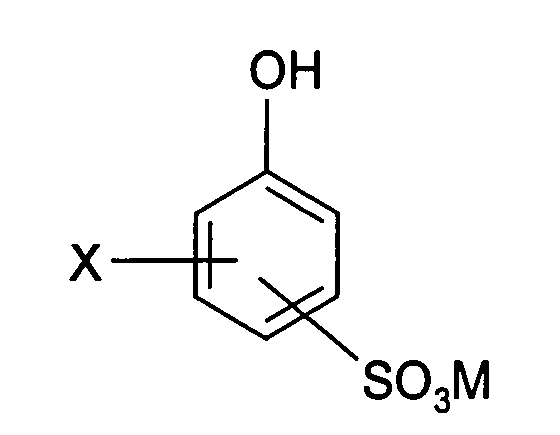
Bevorzugt sind Natrium-ortho- oder para-Phenolsulfonate, insbesondere Natriumpara-phenolsulfonat (SPS), das herstellbedingt 0 bis 20 % des entsprechenden ortho-Isomeren enthalten kann.
oder deren Mischungen. Besonders geeignet sind aliphatische Kohlenwasserstoffgemische wie sie als Shellsole (Shell), ISOPAR G und ISOPAR 4 (ESSO) kommerziell verfügbar sind. Die Löslichkeit des SPS in diesem Reaktionsmedium liegt häufig unter 1 %.
Telquel-Ausbeute: 164,8 g (Ausbeute 98 %) weißen Pulvers mit einem Nonanoyloxybenzolsulfonat-Natrium (NOBS) Gehalt von 98 %. Ausbeute NOBS: 96 %
NOBS: 45 %.
NOBS: 46 %
Telquel-Ausbeute: 165,6 g (Ausbeute 98,4 %) eines weißen Pulvers mit einem Nonanoyloxybenzolsulfonat-Natrium (NOBS) Gehalt von 97 %. Ausbeute
NOBS: 95 %. Die Mutterlauge konnte ohne weitere Aufreinigung für den folgenden Ansatz genutzt werden.
Telquel-Ausbeute: 164 g (Ausbeute 97,5 %) eines weißen Pulvers mit einem Nonanoyloxybenzolsulfonat-Natrium (NOBS) Gehalt von 97 %. Ausbeute
NOBS: 95 %.
Ausbeute: 165,7 g (Ausbeute 99 %) eines weißen Pulvers mit einem Nonanoyloxybenzolsulfonat-Natrium (NOBS) Gehalt von 98 %. Ausbeute
NOBS: 97 %.
Telquel-Ausbeute: 161,14 g (Ausbeute 96,2 %) eines weißen Pulvers mit einem Nonanoyloxybenzolsulfonat-Natrium (NOBS) Gehalt von 97 %. Ausbeute
NOBS: 93 %.
Telquel-Ausbeute: 185,4 g (Ausbeute 98 %) eines weißen Pulvers mit einem Lauroyloxybenzolsulfonat-Natrium (LOBS) Gehalt von 98 %. Ausbeute
LOBS: 96 %.
Claims (6)
- Verfahren zur Herstellung von Acyloxybenzolsulfonaten durch Umsetzung von Phenolsulfonaten, die einen Wassergehalt von weniger als 0,5, vorzugsweise weniger als 0,2 Gew.-% Wasseraufweisen, und Alkancarbonsäurederivaten, in einem aliphatischen oder aromatischen Kohlenwasserstoff, dadurch gekennzeichnet, dass man die Reaktion in Gegenwart von 0,01 bis 10 Gew.-% eines Katalysators in Form einer stickstoffhaltigen organischen Verbindung mit basischen Eigenschaften durchführt.
- Verfahren nach Anspruch 1, dadurch gekennzeichnet, dass man als Phenolsulfonat eine Verbindung der Formeleinsetzt, wobei X Wasserstoff, Halogen oder C1-C4-Alkyl und M ein Alkali- oder Erdalkalimetall-ion bedeutet.

- Verfahren nach Anspruch 1, dadurch gekennzeichnet, dass man als Phenolsulfonat Natriumphenolsulfonat einsetzt.
- Verfahren nach Anspruch 1, dadurch gekennzeichnet, dass man als Alkancarbonsäurederivat ein C6-C22-Carbonsäurechlorid einsetzt.
- Verfahren nach Anspruch 1, dadurch gekennzeichnet, dass man das Alkancarbonsäurederivat und Phenolsulfonat im Molverhältnis 0,9:1 bis 2:1 umsetzt
- Verfahren nach Anspruch 1, dadurch gekennzeichnet, dass offenkettige oder cyclische tertiäre Amine oder Carbonsäureamide als stickstoffhaltige organische Verbindung mit basischem Charakter eingesetzt werden.
Applications Claiming Priority (2)
| Application Number | Priority Date | Filing Date | Title |
|---|---|---|---|
| DE10139663A DE10139663A1 (de) | 2001-08-11 | 2001-08-11 | Verfahren zur Herstellung von Acyloxybenzolsulfonaten |
| DE10139663 | 2001-08-11 |
Publications (3)
| Publication Number | Publication Date |
|---|---|
| EP1285910A2 true EP1285910A2 (de) | 2003-02-26 |
| EP1285910A3 EP1285910A3 (de) | 2003-05-02 |
| EP1285910B1 EP1285910B1 (de) | 2006-06-07 |
Family
ID=7695264
Family Applications (1)
| Application Number | Title | Priority Date | Filing Date |
|---|---|---|---|
| EP02017347A Expired - Lifetime EP1285910B1 (de) | 2001-08-11 | 2002-08-02 | Verfahren zur Herstellung von Acyloxybenzolsulfonaten |
Country Status (5)
| Country | Link |
|---|---|
| US (1) | US6639096B2 (de) |
| EP (1) | EP1285910B1 (de) |
| JP (1) | JP2003073348A (de) |
| DE (2) | DE10139663A1 (de) |
| ES (1) | ES2266363T3 (de) |
Cited By (2)
| Publication number | Priority date | Publication date | Assignee | Title |
|---|---|---|---|---|
| EP1386911A2 (de) * | 2002-07-25 | 2004-02-04 | Clariant GmbH | Verfahren zur Herstellung von Acyloxybenzolsulfonaten |
| CN102304069A (zh) * | 2011-06-23 | 2012-01-04 | 东北石油大学 | 一种驱油用饱和腰果酚磺酸盐表面活性剂的合成方法 |
Families Citing this family (4)
| Publication number | Priority date | Publication date | Assignee | Title |
|---|---|---|---|---|
| US6790981B2 (en) * | 2002-12-13 | 2004-09-14 | Clariant Finance (Bvi) Limited | Process for the preparation of acyloxybenzenesulfonates |
| DE10300981A1 (de) * | 2003-01-14 | 2004-07-22 | Clariant Gmbh | Verfahren zur Herstellung von Acyloxybenzolsulfonaten |
| DE10334046A1 (de) * | 2003-07-25 | 2005-02-10 | Clariant Gmbh | Verfahren zur Herstellung von granulierten Acyloxybenzolsulfonaten oder Acyloxybenzolcarbonsäuren und deren Salze |
| CN101870667A (zh) * | 2009-04-23 | 2010-10-27 | 浙江金科化工股份有限公司 | 一种对壬酰氧基苯磺酸钠的合成方法 |
Family Cites Families (19)
| Publication number | Priority date | Publication date | Assignee | Title |
|---|---|---|---|---|
| US3503888A (en) | 1965-02-16 | 1970-03-31 | Dow Chemical Co | Synthetic detergent bar |
| US3954767A (en) * | 1972-05-17 | 1976-05-04 | Esteve Subirana Antonio | Piperazine salts of 2,5-dihydroxy benzene sulfonic acid mono- and diesters |
| EP0105673B1 (de) * | 1982-09-28 | 1988-07-27 | The Procter & Gamble Company | Synthese von Esterderivaten von hydrophilen Phenolen |
| US4544503A (en) * | 1983-09-01 | 1985-10-01 | Ethyl Corporation | Process for producing acyloxybenzenesulfonate salts |
| FR2559769B1 (fr) | 1984-02-17 | 1986-06-13 | Rhone Poulenc Chim Base | Procede de preparation de para acyloxybenzenesulfonate par catalyse basique |
| DE3419793A1 (de) * | 1984-05-26 | 1985-11-28 | Basf Ag, 6700 Ludwigshafen | Verfahren zur herstellung von acyloxybenzolsulfonsaeuren und ihrer alkali- und erdalkalisalze |
| GB8414696D0 (en) | 1984-06-08 | 1984-07-11 | Shell Int Research | P-isononanoyloxybenzenesulphonate |
| US4721805A (en) * | 1985-04-15 | 1988-01-26 | Stepan Company | Preparation of acyloxy benzene sulfonate |
| GB8523962D0 (en) | 1985-09-28 | 1985-10-30 | Interox Chemicals Ltd | Preparation of sulphophenyl esters |
| DE3538143A1 (de) * | 1985-10-26 | 1987-04-30 | Hoechst Ag | Verfahren zur herstellung von acyloxibenzolsulfonsaeuren und deren salzen |
| US4666636A (en) | 1985-10-28 | 1987-05-19 | Monsanto Company | Production of sodium phenol sulfonate |
| US5091560A (en) * | 1988-03-14 | 1992-02-25 | The Clorox Company | Method for synthesizing acyloxycarboxylic acids |
| US5069828A (en) | 1989-06-06 | 1991-12-03 | E. I. Du Pont De Nemours And Company | Process for preparing benzenesulfonate salts |
| US5124475A (en) * | 1991-03-01 | 1992-06-23 | Stepan Company | Preparation of p-phenyl sulfonate esters of acyl glycolic acids |
| US5446840A (en) * | 1993-02-19 | 1995-08-29 | Borland International, Inc. | System and methods for optimized screen writing |
| US5523434A (en) * | 1995-03-15 | 1996-06-04 | The Procter & Gamble Company | Synthesis of bleach activators |
| US5843879A (en) * | 1996-02-06 | 1998-12-01 | Lion Corporation | Bleaching activator granulate |
| DE19900939C2 (de) * | 1999-01-13 | 2001-06-07 | Clariant Gmbh | Verfahren zur Herstellung von Amidosäurephenylestern |
| US6448431B1 (en) * | 1999-09-13 | 2002-09-10 | Eastman Chemical Company | Production of aryl carboxylate esters |
-
2001
- 2001-08-11 DE DE10139663A patent/DE10139663A1/de not_active Withdrawn
-
2002
- 2002-08-01 US US10/209,723 patent/US6639096B2/en not_active Expired - Fee Related
- 2002-08-02 DE DE50207073T patent/DE50207073D1/de not_active Expired - Lifetime
- 2002-08-02 EP EP02017347A patent/EP1285910B1/de not_active Expired - Lifetime
- 2002-08-02 ES ES02017347T patent/ES2266363T3/es not_active Expired - Lifetime
- 2002-08-09 JP JP2002233143A patent/JP2003073348A/ja not_active Withdrawn
Cited By (3)
| Publication number | Priority date | Publication date | Assignee | Title |
|---|---|---|---|---|
| EP1386911A2 (de) * | 2002-07-25 | 2004-02-04 | Clariant GmbH | Verfahren zur Herstellung von Acyloxybenzolsulfonaten |
| CN102304069A (zh) * | 2011-06-23 | 2012-01-04 | 东北石油大学 | 一种驱油用饱和腰果酚磺酸盐表面活性剂的合成方法 |
| CN102304069B (zh) * | 2011-06-23 | 2013-11-06 | 东北石油大学 | 一种驱油用饱和腰果酚磺酸盐表面活性剂的合成方法 |
Also Published As
| Publication number | Publication date |
|---|---|
| EP1285910B1 (de) | 2006-06-07 |
| US20030064906A1 (en) | 2003-04-03 |
| ES2266363T3 (es) | 2007-03-01 |
| DE10139663A1 (de) | 2003-02-20 |
| JP2003073348A (ja) | 2003-03-12 |
| US6639096B2 (en) | 2003-10-28 |
| DE50207073D1 (de) | 2006-07-20 |
| EP1285910A3 (de) | 2003-05-02 |
Similar Documents
| Publication | Publication Date | Title |
|---|---|---|
| DE3586957T2 (de) | Persaeure- und bleichmittelaktivator-verbindungen und ihre verwendung in reinigungsmittelzusammensetzungen. | |
| DE69611356T2 (de) | Herstellung von bleichaktivatoren | |
| EP0003344B1 (de) | Verfahren zur Herstellung von Fluorbenzolen | |
| DE69417904T2 (de) | Herstellung von amidosäuren aus carbonsäuren und lactamen | |
| DE69616452T2 (de) | Verfahren zur Herstellung von Sulfonylharnstoffen | |
| DE10139663A1 (de) | Verfahren zur Herstellung von Acyloxybenzolsulfonaten | |
| DE2756169C2 (de) | Verfahren zur Herstellung von Perfluorcarbonsäuren oder Perfluoralkansulfonylchloriden | |
| DE3885415T2 (de) | Salze von Amino-(poly)-percarbonsäuren. | |
| DE3136808A1 (de) | Triazolidin-3,5-dione | |
| EP0512432B1 (de) | Imidocarbonsäureaktivatoren und Sulfimidocarbonsäureaktivatoren, Verfahren zu deren Herstellung und deren Verwendung | |
| EP0945430B1 (de) | N-phenylacetoacetamide und Verfahren zu ihrer Herstellung | |
| DE69410031T2 (de) | Verfahren zur Herstellung von Lösungen von Dichlorglyoxime in organischen Lösungsmitteln | |
| DE60217647T2 (de) | Verfahren zur herstellung von sulfamoylsubstituierten phenethylaminderivaten | |
| EP0249846A1 (de) | Verfahren zur Herstellung von festen Alkalimetallsalzen von alpha-Sulfofettsäurealkylestern | |
| DE10233827A1 (de) | Verfahren zur Herstellung von Acyloxybenzolsulfonaten | |
| EP0485927A1 (de) | Sulfimidoperoxicarbonsäuren | |
| DE2503190C3 (de) | Verfahren zur Herstellung von N,N-Diallyldichloracetamid | |
| EP2603485B1 (de) | Verfahren zur herstellung von acyloxybenzoesäuren | |
| DE3884499T2 (de) | Heterozyklische Peroxycarbonsäure. | |
| EP1439168B1 (de) | Verfahren zur Herstellung von Acyloxybenzolsulfonaten | |
| EP0022959B1 (de) | Verfahren zur Herstellung von Diazoniumtetrafluoroboraten in verdünnter wässriger Lösung | |
| EP0907638A2 (de) | 4-jod-2- n-(n-alkyl-aminocarbonyl)-aminosulfonyl]-benzoesäuremethylester und -derivate und verfahren zu deren herstellung | |
| EP0575365A1 (de) | Verfahren zur herstellung von benzoyloxybenzolsulfonaten | |
| DE3900865C1 (en) | Process for the preparation of 2-chloroethylamine hydrochloride | |
| EP2001836A1 (de) | Verbessertes verfahren zur herstellung von natriumchloridfreien ammoniumnitrilen |
Legal Events
| Date | Code | Title | Description |
|---|---|---|---|
| PUAI | Public reference made under article 153(3) epc to a published international application that has entered the european phase |
Free format text: ORIGINAL CODE: 0009012 |
|
| AK | Designated contracting states |
Kind code of ref document: A2 Designated state(s): AT BE BG CH CY CZ DE DK EE ES FI FR GB GR IE IT LI LU MC NL PT SE SK TR |
|
| AX | Request for extension of the european patent |
Extension state: AL LT LV MK RO SI |
|
| PUAL | Search report despatched |
Free format text: ORIGINAL CODE: 0009013 |
|
| AK | Designated contracting states |
Designated state(s): AT BE BG CH CY CZ DE DK EE ES FI FR GB GR IE IT LI LU MC NL PT SE SK TR |
|
| AX | Request for extension of the european patent |
Extension state: AL LT LV MK RO SI |
|
| 17P | Request for examination filed |
Effective date: 20031103 |
|
| AKX | Designation fees paid |
Designated state(s): AT BE BG CH CY CZ DE DK EE ES FI FR GB GR IE IT LI LU MC NL PT SE SK TR |
|
| 17Q | First examination report despatched |
Effective date: 20050527 |
|
| GRAP | Despatch of communication of intention to grant a patent |
Free format text: ORIGINAL CODE: EPIDOSNIGR1 |
|
| RAP1 | Party data changed (applicant data changed or rights of an application transferred) |
Owner name: CLARIANT PRODUKTE (DEUTSCHLAND) GMBH |
|
| GRAS | Grant fee paid |
Free format text: ORIGINAL CODE: EPIDOSNIGR3 |
|
| GRAA | (expected) grant |
Free format text: ORIGINAL CODE: 0009210 |
|
| AK | Designated contracting states |
Kind code of ref document: B1 Designated state(s): BE CH DE ES FR GB IT LI |
|
| REG | Reference to a national code |
Ref country code: GB Ref legal event code: FG4D Free format text: NOT ENGLISH |
|
| REG | Reference to a national code |
Ref country code: CH Ref legal event code: EP |
|
| REF | Corresponds to: |
Ref document number: 50207073 Country of ref document: DE Date of ref document: 20060720 Kind code of ref document: P |
|
| GBT | Gb: translation of ep patent filed (gb section 77(6)(a)/1977) |
Effective date: 20060927 |
|
| ET | Fr: translation filed | ||
| REG | Reference to a national code |
Ref country code: ES Ref legal event code: FG2A Ref document number: 2266363 Country of ref document: ES Kind code of ref document: T3 |
|
| PLBE | No opposition filed within time limit |
Free format text: ORIGINAL CODE: 0009261 |
|
| STAA | Information on the status of an ep patent application or granted ep patent |
Free format text: STATUS: NO OPPOSITION FILED WITHIN TIME LIMIT |
|
| 26N | No opposition filed |
Effective date: 20070308 |
|
| PGFP | Annual fee paid to national office [announced via postgrant information from national office to epo] |
Ref country code: CH Payment date: 20080623 Year of fee payment: 7 |
|
| PGFP | Annual fee paid to national office [announced via postgrant information from national office to epo] |
Ref country code: ES Payment date: 20080709 Year of fee payment: 7 |
|
| PGFP | Annual fee paid to national office [announced via postgrant information from national office to epo] |
Ref country code: FR Payment date: 20080612 Year of fee payment: 7 |
|
| PGFP | Annual fee paid to national office [announced via postgrant information from national office to epo] |
Ref country code: GB Payment date: 20080730 Year of fee payment: 7 |
|
| PGFP | Annual fee paid to national office [announced via postgrant information from national office to epo] |
Ref country code: BE Payment date: 20080729 Year of fee payment: 7 |
|
| PGFP | Annual fee paid to national office [announced via postgrant information from national office to epo] |
Ref country code: DE Payment date: 20090808 Year of fee payment: 8 |
|
| BERE | Be: lapsed |
Owner name: *CLARIANT PRODUKTE (DEUTSCHLAND) G.M.B.H. Effective date: 20090831 |
|
| REG | Reference to a national code |
Ref country code: CH Ref legal event code: PL |
|
| GBPC | Gb: european patent ceased through non-payment of renewal fee |
Effective date: 20090802 |
|
| PG25 | Lapsed in a contracting state [announced via postgrant information from national office to epo] |
Ref country code: LI Free format text: LAPSE BECAUSE OF NON-PAYMENT OF DUE FEES Effective date: 20090831 Ref country code: CH Free format text: LAPSE BECAUSE OF NON-PAYMENT OF DUE FEES Effective date: 20090831 |
|
| PGFP | Annual fee paid to national office [announced via postgrant information from national office to epo] |
Ref country code: IT Payment date: 20090729 Year of fee payment: 8 |
|
| REG | Reference to a national code |
Ref country code: FR Ref legal event code: ST Effective date: 20100430 |
|
| PG25 | Lapsed in a contracting state [announced via postgrant information from national office to epo] |
Ref country code: BE Free format text: LAPSE BECAUSE OF NON-PAYMENT OF DUE FEES Effective date: 20090831 |
|
| PG25 | Lapsed in a contracting state [announced via postgrant information from national office to epo] |
Ref country code: FR Free format text: LAPSE BECAUSE OF NON-PAYMENT OF DUE FEES Effective date: 20090831 |
|
| REG | Reference to a national code |
Ref country code: ES Ref legal event code: FD2A Effective date: 20090803 |
|
| PG25 | Lapsed in a contracting state [announced via postgrant information from national office to epo] |
Ref country code: GB Free format text: LAPSE BECAUSE OF NON-PAYMENT OF DUE FEES Effective date: 20090802 |
|
| PG25 | Lapsed in a contracting state [announced via postgrant information from national office to epo] |
Ref country code: IT Free format text: LAPSE BECAUSE OF NON-PAYMENT OF DUE FEES Effective date: 20100802 |
|
| REG | Reference to a national code |
Ref country code: DE Ref legal event code: R119 Ref document number: 50207073 Country of ref document: DE Effective date: 20110301 |
|
| PG25 | Lapsed in a contracting state [announced via postgrant information from national office to epo] |
Ref country code: DE Free format text: LAPSE BECAUSE OF NON-PAYMENT OF DUE FEES Effective date: 20110301 |
|
| PG25 | Lapsed in a contracting state [announced via postgrant information from national office to epo] |
Ref country code: ES Free format text: LAPSE BECAUSE OF NON-PAYMENT OF DUE FEES Effective date: 20090803 |