EP1283913B1 - Verfahren zur herstellung von kugelgraphit-gusseisen - Google Patents
Verfahren zur herstellung von kugelgraphit-gusseisen Download PDFInfo
- Publication number
- EP1283913B1 EP1283913B1 EP01927562A EP01927562A EP1283913B1 EP 1283913 B1 EP1283913 B1 EP 1283913B1 EP 01927562 A EP01927562 A EP 01927562A EP 01927562 A EP01927562 A EP 01927562A EP 1283913 B1 EP1283913 B1 EP 1283913B1
- Authority
- EP
- European Patent Office
- Prior art keywords
- cast iron
- spheroidal graphite
- graphite cast
- production
- pretreatment
- Prior art date
- Legal status (The legal status is an assumption and is not a legal conclusion. Google has not performed a legal analysis and makes no representation as to the accuracy of the status listed.)
- Expired - Lifetime
Links
- 229910001141 Ductile iron Inorganic materials 0.000 title claims abstract description 23
- 238000004519 manufacturing process Methods 0.000 title claims abstract description 21
- 238000000034 method Methods 0.000 claims abstract description 26
- 239000000126 substance Substances 0.000 claims abstract description 7
- 229910052749 magnesium Inorganic materials 0.000 claims description 35
- 239000011777 magnesium Substances 0.000 claims description 35
- FYYHWMGAXLPEAU-UHFFFAOYSA-N Magnesium Chemical compound [Mg] FYYHWMGAXLPEAU-UHFFFAOYSA-N 0.000 claims description 31
- 150000001875 compounds Chemical class 0.000 claims description 24
- 239000000203 mixture Substances 0.000 claims description 21
- 239000002054 inoculum Substances 0.000 claims description 20
- XTQHKBHJIVJGKJ-UHFFFAOYSA-N sulfur monoxide Chemical class S=O XTQHKBHJIVJGKJ-UHFFFAOYSA-N 0.000 claims description 11
- 229910052717 sulfur Inorganic materials 0.000 claims description 9
- NINIDFKCEFEMDL-UHFFFAOYSA-N Sulfur Chemical compound [S] NINIDFKCEFEMDL-UHFFFAOYSA-N 0.000 claims description 8
- 239000011593 sulfur Substances 0.000 claims description 8
- 229910052791 calcium Inorganic materials 0.000 claims description 7
- 229910052746 lanthanum Inorganic materials 0.000 claims description 6
- 229910052751 metal Inorganic materials 0.000 claims description 5
- 239000002184 metal Substances 0.000 claims description 5
- 229910004709 CaSi Inorganic materials 0.000 claims description 4
- 229910005347 FeSi Inorganic materials 0.000 claims description 4
- 229910052788 barium Inorganic materials 0.000 claims description 4
- 230000000737 periodic effect Effects 0.000 claims description 4
- 229910045601 alloy Inorganic materials 0.000 claims description 3
- 239000000956 alloy Substances 0.000 claims description 3
- 150000002739 metals Chemical class 0.000 claims description 3
- 238000002844 melting Methods 0.000 claims 1
- 230000008018 melting Effects 0.000 claims 1
- 239000008188 pellet Substances 0.000 claims 1
- 239000000155 melt Substances 0.000 abstract description 16
- 238000005266 casting Methods 0.000 abstract description 10
- 230000006911 nucleation Effects 0.000 abstract description 10
- 238000010899 nucleation Methods 0.000 abstract description 10
- 238000007711 solidification Methods 0.000 abstract description 6
- 230000008023 solidification Effects 0.000 abstract description 6
- 229910001018 Cast iron Inorganic materials 0.000 description 15
- 239000002893 slag Substances 0.000 description 7
- 239000011575 calcium Substances 0.000 description 5
- XEEYBQQBJWHFJM-UHFFFAOYSA-N iron Substances [Fe] XEEYBQQBJWHFJM-UHFFFAOYSA-N 0.000 description 5
- 239000002245 particle Substances 0.000 description 5
- OKTJSMMVPCPJKN-UHFFFAOYSA-N Carbon Chemical compound [C] OKTJSMMVPCPJKN-UHFFFAOYSA-N 0.000 description 4
- QVGXLLKOCUKJST-UHFFFAOYSA-N atomic oxygen Chemical compound [O] QVGXLLKOCUKJST-UHFFFAOYSA-N 0.000 description 4
- 230000007547 defect Effects 0.000 description 4
- 239000010439 graphite Substances 0.000 description 4
- 229910002804 graphite Inorganic materials 0.000 description 4
- 229910052760 oxygen Inorganic materials 0.000 description 4
- 239000001301 oxygen Substances 0.000 description 4
- 229910052710 silicon Inorganic materials 0.000 description 4
- 239000013078 crystal Substances 0.000 description 3
- 229910052742 iron Inorganic materials 0.000 description 3
- 239000000047 product Substances 0.000 description 3
- XUIMIQQOPSSXEZ-UHFFFAOYSA-N Silicon Chemical compound [Si] XUIMIQQOPSSXEZ-UHFFFAOYSA-N 0.000 description 2
- 239000000654 additive Substances 0.000 description 2
- 230000000996 additive effect Effects 0.000 description 2
- 230000015572 biosynthetic process Effects 0.000 description 2
- -1 calcium aluminates Chemical class 0.000 description 2
- 230000002349 favourable effect Effects 0.000 description 2
- 229910052500 inorganic mineral Inorganic materials 0.000 description 2
- 239000011707 mineral Substances 0.000 description 2
- 239000010703 silicon Substances 0.000 description 2
- 239000005997 Calcium carbide Substances 0.000 description 1
- 229910001208 Crucible steel Inorganic materials 0.000 description 1
- 230000002411 adverse Effects 0.000 description 1
- PNEYBMLMFCGWSK-UHFFFAOYSA-N aluminium oxide Inorganic materials [O-2].[O-2].[O-2].[Al+3].[Al+3] PNEYBMLMFCGWSK-UHFFFAOYSA-N 0.000 description 1
- 244000052616 bacterial pathogen Species 0.000 description 1
- BRPQOXSCLDDYGP-UHFFFAOYSA-N calcium oxide Chemical compound [O-2].[Ca+2] BRPQOXSCLDDYGP-UHFFFAOYSA-N 0.000 description 1
- 239000000292 calcium oxide Substances 0.000 description 1
- ODINCKMPIJJUCX-UHFFFAOYSA-N calcium oxide Inorganic materials [Ca]=O ODINCKMPIJJUCX-UHFFFAOYSA-N 0.000 description 1
- 239000007795 chemical reaction product Substances 0.000 description 1
- 239000003795 chemical substances by application Substances 0.000 description 1
- 239000000470 constituent Substances 0.000 description 1
- 238000007796 conventional method Methods 0.000 description 1
- 230000001419 dependent effect Effects 0.000 description 1
- 238000011161 development Methods 0.000 description 1
- 230000018109 developmental process Effects 0.000 description 1
- 238000009826 distribution Methods 0.000 description 1
- 230000000694 effects Effects 0.000 description 1
- 230000005484 gravity Effects 0.000 description 1
- 230000001771 impaired effect Effects 0.000 description 1
- 239000012535 impurity Substances 0.000 description 1
- 230000003993 interaction Effects 0.000 description 1
- FZLIPJUXYLNCLC-UHFFFAOYSA-N lanthanum atom Chemical compound [La] FZLIPJUXYLNCLC-UHFFFAOYSA-N 0.000 description 1
- 239000000314 lubricant Substances 0.000 description 1
- 238000003754 machining Methods 0.000 description 1
- 238000005259 measurement Methods 0.000 description 1
- 239000013528 metallic particle Substances 0.000 description 1
- 238000001000 micrograph Methods 0.000 description 1
- 239000012778 molding material Substances 0.000 description 1
- 239000002667 nucleating agent Substances 0.000 description 1
- 150000002927 oxygen compounds Chemical class 0.000 description 1
- 239000004033 plastic Substances 0.000 description 1
- 238000002360 preparation method Methods 0.000 description 1
- 238000002203 pretreatment Methods 0.000 description 1
- 238000000746 purification Methods 0.000 description 1
- 230000000717 retained effect Effects 0.000 description 1
- 239000004576 sand Substances 0.000 description 1
- 150000004760 silicates Chemical class 0.000 description 1
- 150000003467 sulfuric acid derivatives Chemical class 0.000 description 1
- CLZWAWBPWVRRGI-UHFFFAOYSA-N tert-butyl 2-[2-[2-[2-[bis[2-[(2-methylpropan-2-yl)oxy]-2-oxoethyl]amino]-5-bromophenoxy]ethoxy]-4-methyl-n-[2-[(2-methylpropan-2-yl)oxy]-2-oxoethyl]anilino]acetate Chemical compound CC1=CC=C(N(CC(=O)OC(C)(C)C)CC(=O)OC(C)(C)C)C(OCCOC=2C(=CC=C(Br)C=2)N(CC(=O)OC(C)(C)C)CC(=O)OC(C)(C)C)=C1 CLZWAWBPWVRRGI-UHFFFAOYSA-N 0.000 description 1
- 229960005486 vaccine Drugs 0.000 description 1
Images
Classifications
-
- C—CHEMISTRY; METALLURGY
- C21—METALLURGY OF IRON
- C21C—PROCESSING OF PIG-IRON, e.g. REFINING, MANUFACTURE OF WROUGHT-IRON OR STEEL; TREATMENT IN MOLTEN STATE OF FERROUS ALLOYS
- C21C1/00—Refining of pig-iron; Cast iron
- C21C1/10—Making spheroidal graphite cast-iron
Definitions
- the invention relates to a method for producing spheroidal graphite cast iron comprising at least the method steps pretreatment with pure magnesium in a converter and Impfstoffzugabe when poured into the mold.
- a method and an apparatus for the production of nodular cast iron are known.
- a treatment vessel for the molten cast iron pure magnesium is introduced into a vessel compartment which is accessible from the outside and which is in contact via openings in the dividing wall between the vessel compartment and the remaining treatment vessel.
- the converter When the converter is placed in a vertical position from a horizontal position taken to introduce the magnesium, the magnesium is wet by the melt and dissolved to generate heat of reaction.
- the reaction with the pure magnesium causes the following: From the non-metallic constituents of the melt arise mineral compounds consisting of oxides, sulfates, silicates and other compounds with magnesium. Due to the vapor pressure of magnesium, the melt is put into intensive motion.
- the mineral compounds coagulate, agglomerate and float due to the lower specific gravity at the bath surface. From the bath surface, the slags thus formed can be removed by skimming.
- This method is characterized, inter alia, by a bath composition having a high purity of, for example, less than 10 ppm of dissolved oxygen and a low nucleating agent concentration of, for example, less than 100 ppm of non-metallic particles.
- nodular cast iron which comprises at least the steps pre-treatment with pure magnesium in a converter and Impfstoffzugabe when poured into the mold, with as little unnecessary oxides, slags or Inoculant residues are introduced into the melt and into the casting.
- This object is achieved by a method for producing spheroidal graphite cast iron comprising at least the steps of pretreatment with pure magnesium in a converter and Impfstoffzugabe when poured into the mold, wherein the solubility of the substances formed in the pretreatment and in the vaccine is adjustable, and the Pretreatment with a mixture or compound of pure metallic magnesium is carried out with only one or more metals from groups IIa and IIIa of the periodic table and with sulfur.
- US-A-2,837,422 discloses an additive for the treatment of cast iron smelter for the production of nodular cast iron.
- the additive contains 30-50% Mg, 2.8-10% Ca, at least 35% Si and up to 30% Fe.
- the total amount of added substances is kept as low as possible. This is accomplished by making the amount of an FeSi or CaSi based inoculant added to the mold upon pouring substantially less, preferably four times smaller than the amount of oxysulfide-forming compound or mixture used in the pretreatment with magnesium.
- the method proposed here starts from the known pretreatment with pure metallic magnesium in the closed converter.
- the process leads to an improvement in the quality of the nodular cast iron produced in the magnesium converter, because casting defects by oxides and slags and other defects caused by inoculants are avoided.
- the process can be applied easily and without the intervention of additional process steps.
- By adding the oxysulfide-forming compound or mixture with the pure metallic magnesium both the purification of the melt and the preconditioning of the nucleation state in a single process step are achieved in the pretreatment.
- the chemical oxygen and sulfur activity in the melt is adjusted as accurately as possible, while as little foreign bodies per unit weight of cast iron must be added.
- the nuclei formed after the addition of the oxysulfide-forming compound or mixture by the reaction with the melt have a sufficiently long life in the melt. It can be said of a high nucleation capacity of Oxysulfiden.
- the formation of an oxysulfide in the pretreatment has shown that this least adversely affects the final purity of the cast iron alloy while positively affecting the solubility of the nucleating substances.
- the melt is preconditioned, i. optimally prepared for solidification in the mold.
- This optimum preparation substantially reduces the need for inoculant during pouring.
- the amount and type of compound or mixture introduced in the pretreatment in the magnesium converter can be chosen such that even the process step of adding imbibants during casting in the mold can be dispensed with. Due to the small addition of foreign substances, the purity of the molten cast iron is influenced as little as possible negatively.
- the use of oxysulphides also has the following advantages: The specific weight differs only slightly from the specific weight of the melt, so that a homogeneous mixing can be achieved easily.
- the grain size and the grain shape are selectable so that the germs are retained over a longer time.
- elements from groups IIa and IIIa of the periodic table for example Mg, Ca, Ba, La or rare earths.
- inoculating agent During the subsequent pouring from the casting furnace into the mold, only a small addition of inoculating agent is required for the final adjustment of the nucleation state. Because the oxysulfides formed in the pretreatment have a higher nucleation capacity than the heretofore known inoculants, a small amount, ie at most a quarter, is sufficient from the amount added in the pretreatment to control nucleation in the mold. With the inoculant, which is added when poured into the mold, the speed, crystal form and crystal distribution during solidification can be controlled and finally adjusted. For example, an FeSi or CaSi-based alloy or compound with Ca, Ba, Mg, Au, Ge, La or rare earths is used as the inoculant during casting.
- the pretreatment with oxysulfide-forming compounds or mixtures combined with the magnesium treatment in the converter on the one hand and the reduced addition of inoculant during pouring on the other hand has the following further advantages: Because few foreign bodies are introduced, considerably less slags are formed than in the conventional method, thus less iron is used with the slag lost. Because less gum is supplied to the molten cast iron altogether, less foreign matter is trapped between the crystals during solidification. This reduces the tendency for casting defects. Less inclusions of magnesium, silicon or oxygen compounds have a favorable influence on the microporosity of the cast iron and promote a uniform solidification in the mold. A lower microporosity is also advantageous for the interaction of the melt, with the molding material mixture or with the sand from which the mold is formed. As a result, the surface of the cast iron product becomes cleaner and more uniform, d. H. There are fewer surface defects. This makes the workability of the surface of the cast iron product easier.
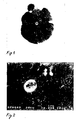
- Figures 1 and 2 show a micrograph of a nodular graphite particle having therein an undissolved core of an inoculant.
- Figure 2 shows an enlargement from the central region of the particle of Figure 1.
- the nodular graphite particle was obtained from a melt which was seeded with a compound of iron, silicon and lanthanum.
- the analysis of the core of the ductile iron particle showed the following composition: 41.7% La, 47.2% S, 9.1% Mg and 1.7% Si. It is shown that the poor solubility of the low added compounds or mixtures forming oxysulfides has a favorable influence on the formation of nodular graphite particles and on the casting properties.
- the spheroidal graphite cast iron products produced by this process are characterized by high purity at relatively low production costs. Fewer slags need to be disposed of or recycled, and the dosage of inoculants can be made significantly smaller.
- the effort for measurement and control of the casting process, in particular the apparatus required for the analysis of the melt, because the process is more stable and better reproducible, can be significantly reduced.
- the amount ratio of the added foreign bodies can be adjusted between pretreatment and inoculant. By mutual adjustment between pretreatment and Impfstoffschzugabe both the nucleation in the melt and the solidification in the mold can be matched. By the right choice of the type and the quantities of foreign bodies, it may be possible to dispense with an addition during casting into the mold.
- Ballistic graphite cast iron (GJS) is characterized by mechanical properties that are very close to the mechanical properties of cast steel.
Landscapes
- Chemical & Material Sciences (AREA)
- Engineering & Computer Science (AREA)
- Materials Engineering (AREA)
- Metallurgy (AREA)
- Organic Chemistry (AREA)
- Refinement Of Pig-Iron, Manufacture Of Cast Iron, And Steel Manufacture Other Than In Revolving Furnaces (AREA)
- Chemical Treatment Of Metals (AREA)
- Mold Materials And Core Materials (AREA)
- Pivots And Pivotal Connections (AREA)
- Dental Preparations (AREA)
- Glass Compositions (AREA)
Description
- Die Erfindung bezieht sich auf ein Verfahren zur Herstellung von Kugelgraphit-Gusseisen umfassend zumindest die Verfahrensschritte Vorbehandlung mit reinem Magnesium in einem Konverter und Impfmittelzugabe beim Abgiessen in die Form.
- Aus der US 5098651 sind ein Verfahren und eine Vorrichtung zur Herstellung von Kugelgraphit-Gusseisen bekannt. In einem Konverter, ein Behandlungsgefäss für die Gusseisenschmelze, wird in einem Gefässabteil, das von aussen zugänglich ist und das über Öffnungen in der Trennwand zwischen dem Gefässabteil und dem restlichen Behandlungsgefäss in Kontakt steht, reines Magnesium eingebracht. Wenn der Konverter von einer horizontalen Lage, die eingenommen wurde um das Magnesium einzubringen, in einer vertikalen Lage gebracht wird, wird das Magnesium von der Schmelze benetzt und unter Erzeugung von Reaktionswärme aufgelöst. Die Reaktion mit dem reinen Magnesium bewirkt folgendes: Aus den nicht-metallischen Bestandteilen der Schmelze entstehen mineralische Verbindungen, bestehend aus Oxiden, Sulfaten, Silikaten und anderen Verbindungen mit Magnesium. Durch den Dampfdruck des Magnesiums wird die Schmelze in eine intensive Bewegung versetzt. Die mineralischen Verbindungen koagulieren, agglomerieren und schwimmen, aufgrund des niedrigeren spezifischen Gewichtes, an der Badoberfläche auf. Von der Badoberfläche können die so gebildeten Schlacken durch Abschöpfen entfernt werden. Dieses Verfahren zeichnet sich unter anderem aus durch eine Badzusammensetzung mit einer hohen Reinheit von beispielsweise weniger als 10 ppm gelöstem Sauerstoff und einer niedrigen Keimbildnerkonzentration von beispielsweise weniger als 100 ppm nicht-metallischen Partikeln.
- In der WO 99/45156 A1 wird ein Verfahren angegeben, in dem vor der eigentlichen Behandlung mit Magnesium die Gusseisenschmelze in auf einander folgenden Schritten mit Calciumcarbid zum Entfernen von Sauerstoff und Schwefel, mit Walzzunder zum Zuführen von Sauerstoff und mit Aluminiumoxid oder mit Calciumoxid zum Bilden von Calciumaluminaten oder Calciumaluminiumsilikaten behandelt wird. Hierdurch wird erreicht, dass nach der nachfolgenden Behandlung mit Magnesium das Gusseisen nicht-metallische Einschlüsse aufweist, die bei der spanabhebenden Bearbeitung plastisch sind und somit als Schmiermittel dienen. In den nachfolgenden Verfahrensschritten werden oft zu grosse Mengen an Impfmittel zugegeben. Beim Abgiessen in die Form besteht dann die Gefahr, dass die Qualität beeinträchtigt wird, weil die Reaktionsprodukte zu unkontrollierbaren Fehlern, wie Schlacken, Oxiden und nicht aufgelösten Impfmittelpartikeln führen. Es entstehen unkontrollierbare Verhältnisse in bezug auf den Keimbildungszustand. Weil der Keimbildungszustand nicht genau bekannt ist, kann die Dosierung der Impfmittel nicht genau bestimmt werden. Im Unwissen des Keimbildungszustandes wird häufig überdosiert. Dies ist teuer und für die Qualität des Gusseisens nicht vorteilhaft.
- Ausgehend von diesem Stand der Technik ist es Aufgabe der Erfindung, ein Verfahren zur Herstellung von Kugelgraphit-Gusseisen anzugeben, das zumindest die Verfahrensschritte Vorbehandlung mit reinem Magnesium in einem Konverter und Impfmittelzugabe beim Abgiessen in die Form umfasst, wobei möglichst wenig unnötige Oxide, Schlacken oder Impfmittelreste in die Schmelze und in das Gussstück eingebracht werden.
- Diese Aufgabe wird gelöst durch ein Verfahren zur Herstellung von Kugelgraphit-Gusseisen umfassend zumindest die Verfahrensschritte Vorbehandlung mit reinem Magnesium in einem Konverter und Impfmittelzugabe beim Abgiessen in die Form, wobei die Löslichkeit der in der Vorbehandlung und in der Impfung gebildeten Substanzen einstellbar ist, und die Vorbehandlung mit einer Mischung oder Verbindung von reinem metallischen Magnesium nur mit einem oder mehreren Metallen aus der Gruppen IIa und IIIa des Periodensystems und mit Schwefel durchgeführt wird.
- Die US-A-2 837 422 beschreibt ein Zusatzmittel zur Behandlung von Gußeisenschmeter zur Herstellung von Kugelgraphit-Gußeisen. Das Zusatzmittel enthält 30-50% Mg, 2,8-10% Ca, mindestens 35% Si und bis zu 30% Fe.
- Bevorzugte Weiterbildungen der Erfindung ergeben sich aus den abhängigen Ansprüchen.
- Es ist von Vorteil, dass zur Herstellung von Kugelgraphit-Gusseisen möglichst keine Verunreinigungen im Gusseisen eingebracht werden. Dies wird dadurch erreicht, dass die Vorbehandlung mit einer Mischung oder einer Verbindung von reinem metallischen Magnesium mit einem oder mehreren Metallen aus den Gruppen IIa und IIIa des Periodensystems und mit Schwefel durchgeführt wird. Dies wird auch dadurch erreicht, dass die Vorbehandlung mit einer Mischung oder einer Verbindung von reinem metallischen Magnesium mit Schwefel und mit Ba, Ca, La oder seltenen Erden, wobei die Mischung oder Verbindung in der Metallschmelze Oxysulfiden bildet, durchgeführt wird.
- Es ist auch von Vorteil, dass zur Herstellung von Kugelgraphit-Gusseisen die Gesamtmenge der zugegebenen Substanzen möglichst gering gehalten wird. Dies wird dadurch erreicht, dass die Menge eines auf FeSi oder CaSi basierenden Impfmittels, das beim Abgiessen in die Form zugegeben wird, wesentlich kleiner, vorzugsweise viermal kleiner ist, als die in der Vorbehandlung mit Magnesium eingesetzten Menge der Oxysulfiden bildenden Verbindung oder Mischung.
- Das hier vorgeschlagene Verfahren geht aus von der bekannten Vorbehandlung mit reinem metallischen Magnesium im geschlossenen Konverter. Das Verfahren führt zu einer Verbesserung der Qualität des Kugelgraphit-Gusseisens, das im Magnesiumkonverter hergestellt wird, weil Gussfehler durch Oxide und Schlacken und weitere durch Impfmittel bedingten Fehler vermieden werden. In bestehenden Giessereien mit dem Magnesiumkonverter kann das Verfahren einfach und ohne Einschaltung zusätzlicher Verfahrensschritten angewendet werden. Durch die Zugabe der Oxysulfiden bildenden Verbindung oder Mischung mit dem reinen metallischen Magnesium wird in der Vorbehandlung sowohl eine Reinigung der Schmelze als auch eine Vorkonditionierung des Keimbildungszustandes in einem einzelnen Verfahrensschritt erreicht. Die chemische Sauerstoff- und Schwefelaktivität in der Schmelze wird möglichst genau einstellbar, während möglichst wenig Fremdkörper pro Gewichtseinheit Gusseisen zugegeben werden muss. Weil die gebildeten Oxysulfide eine relativ schlechte Löslichkeit in der Gusseisenschmelze aufweisen, haben die Keime, die nach der Zugabe der Oxysulfiden bildenden Verbindung oder Mischung durch die Reaktion mit der Schmelze gebildet werden, in der Schmelze eine ausreichend lange Lebensdauer. Es kann von einer hohen Keimbildungskapazität der Oxysulfiden gesprochen werden. Die Bildung eines Oxysulfides in der Vorbehandlung hat gezeigt, dass hierdurch die endgültige Reinheit der Gusseisenlegierung am wenigsten nachteilig beeinträchtigt wird und gleichzeitig die Löslichkeit der keimbildenden Substanzen positiv beeinflusst wird.
- Durch die Zugabe der Oxysulfide bildenden Verbindung oder Mischung in der Vorbehandlung wird die Schmelze vorkonditioniert, d.h. optimal vorbereitet auf die Erstarrung in der Form. Durch diese optimale Vorbereitung wird der Bedarf an Impfmittel beim Abgiessen weitgehend reduziert. Die Menge und die Art der bei der Vorbehandlung im Magnesiumkonverter eingebrachte Verbindung oder Mischung kann derart gewählt werden, dass sogar auf den Verfahrensschritt der Zugabe von lmpfmitteln beim Abgiessen in der Form verzichtet werden kann. Durch die geringe Zugabe von Fremdsubstanzen wird die Reinheit der Gusseisenschmelze möglichst wenig negativ beeinflusst. Die Verwendung von Oxysulfiden hat weiterhin folgende Vorteile: Das spezifische Gewicht weicht nur wenig ab vom spezifischen Gewicht der Schmelze, so dass eine homogene Durchmischung einfach erreicht werden kann. Die Korngrösse und die Kornform sind derart wählbar, dass die Keime über eine längere Zeit erhalten bleiben. Als Zugabe zum Magnesium in der Vorbehandlung werden vorteilhaft Elemente aus den Gruppen IIa und IIIa des Periodensystems, beispielsweise Mg, Ca, Ba, La oder seltene Erden gewählt.
- Beim nachfolgenden Abgiessen aus dem Giessofen in die Form ist lediglich eine geringe Zugabe von Impfmittel zur endgültigen Einstellung des Keimbildungszustandes erforderlich. Weil die Oxysulfide, die in der Vorbehandlung gebildet wurden, eine höhere Keimbildungskapazität als die bisher bekannten Impfmittel haben, reicht eine kleine Menge, d.h. höchstens ein Viertel der Menge, die in der Vorbehandlung zugegeben wurde, aus um die Keimbildung in der Form zu steuern. Mit dem Impfmittel, das beim Abgiessen in die Form zugegeben wird, kann die Geschwindigkeit, die Kristallform und die Kristallverteilung bei der Erstarrung gesteuert und endgültig eingestellt werden. Als Impfmittel beim Abgiessen wird beispielsweise eine auf FeSi oder CaSi basierende Legierung oder Verbindung mit Ca, Ba, Mg, Au, Ge, La oder seltenen Erden eingesetzt.
- Die Vorbehandlung mit Oxysulfide bildenden Verbindungen oder Mischungen kombiniert mit der Magnesiumbehandlung im Konverter einerseits und die reduzierte Impfmittelzugabe beim Abgiessen andererseits hat folgende weiteren Vorteile: Weil wenige Fremdkörper eingebracht werden, werden erheblich weniger Schlacken gebildet als beim herkömmlichen Verfahren, dadurch geht mit der Schlacke weniger Eisen verloren. Weil an die Gusseisenschmelze insgesamt weniger lmpfmittel zugeführt wird, werden bei der Erstarrung weniger Fremdkörper zwischen den Kristallen eingeschlossen. Hierdurch wird die Neigung zu Gussfehler reduziert. Weniger Einschlüsse von Magnesium-, Silicium- oder Sauerstoffverbindungen haben einen günstigen Einfluss auf die Mikroporosität des Gusseisens und fördern eine gleichmässige Erstarrung in der Form. Eine niedrigere Mikroporosität ist auch vorteilhaft für die Wechselwirkung der Schmelze, mit der Formstoffmischung oder mit dem Sand, aus dem die Form ausgebildet ist. Hierdurch wird die Oberfläche des Gusseisenproduktes sauberer und gleichmässiger, d. h. es treten weniger Oberflächenfehler auf. Dadurch wird die Bearbeitbarkeit der Oberfläche des Gusseisenproduktes leichter.
- Die Figuren 1 und 2 zeigen eine Mikroskopaufnahme eines Kugelgraphitpartikels mit darin einem ungelösten Kern eines Impfmittels. Figur 2 zeigt eine Vergrösserung aus dem zentralen Bereich des Partikels von Figur 1. Der Kugelgraphitpartikel wurde aus einer Schmelze erhalten, die geimpft wurde mit einer Verbindung von Eisen, Silicium und Lanthan. Die Analyse des Kerns des Kugelgraphitpartikels ergab folgende Zusammensetzung: 41,7% La, 47,2% S, 9,1% Mg und 1,7% Si. Hiermit wird gezeigt, dass die schlechte Löslichkeit der in geringen Mengen zugeführten Verbindungen oder Mischungen, die Oxysulfiden bilden, einen günstigen Einfluss auf die Bildung von Kugelgraphitpartikeln und auf die Gusseigenschaften hat.
- Die Kugelgraphit-Gusseisenprodukte, die nach diesem Verfahren hergestellt werden, zeichnen sich aus durch eine hohe Reinheit bei relativ günstigen Herstellungskosten. Es müssen weniger Schlacken entsorgt oder rezykliert werden und die Dosierung der Impfmittel kann erheblich kleiner ausgelegt werden. Der Aufwand für Messung und Regelung des Giessprozesses, insbesondere der apparative Aufwand für die Analyse der Schmelze kann, weil der Prozess stabiler und besser reproduzierbar ist, erheblich reduziert werden. Das Mengenverhältnis der zugegebenen Fremdkörper kann zwischen Vorbehandlung und Impfmittel angepasst werden. Durch die gegenseitige Anpassung zwischen Vorbehandlung und Impfmittelzugabe kann sowohl die Keimbildung in der Schmelze als auch die Erstarrung in der Form aufeinander abgestimmt werden. Durch die richtige Wahl der Art und der Mengen der Fremdkörper kann unter Umständen auf eine Zugabe beim Abgiessen in die Form verzichtet werden. Gusseisen mit Kugelgraphit (GJS) zeichnet sich aus durch mechanische Eigenschaften, die den mechanischen Eigenschaften von Stahlguss sehr nahe kommen.
Claims (11)
- Verfahren zur Herstellung von Kugelgraphit-Gusseisen umfassend zumindest die Verfahrensschritte Vorbehandlung mit reinem Magnesium in einem Konverter und lmpfmittelzugabe beim Abgiessen in die Form, wobei die Löslichkeit der in der Vorbehandlung und in der Impfmittelzugabe gebildeten Substanzen einstellbar ist, dadurch gekennzeichnet, dass die Vorbehandlung mit einer Mischung oder einer Verbindung von reinem metallischen Magnesium nur mit einem oder mehreren Metallen aus den Gruppen IIa und IIIa des Periodensystems und mit Schwefel durchgeführt wird.
- Verfahren zur Herstellung von Kugelgraphit-Gusseisen nach dem Anspruch 1, dadurch gekennzeichnet, dass die Menge eines auf FeSi oder CaSi basierenden Impfmittels, das beim Abgiessen in die Form zugegeben wird, wesentlich kleiner, vorzugsweise viermal kleiner, ist, als die in der Vorbehandlung mit Magnesium eingesetzten Menge der Oxysulfiden bildenden Verbindungen oder Mischungen.
- Verfahren zur Herstellung von Kugelgraphit-Gusseisen nach dem Anspruch 1 oder 2, dadurch gekennzeichnet, dass die Vorbehandlung mit einer Mischung oder einer Verbindung von reinem metallischen Magnesium mit Schwefel und mit Ca, Ba, La oder seltenen Erden, wobei die Mischung oder die Verbindung durch Reaktion mit der Metallschmelze Oxysulfide bildet, durchgeführt wird.
- Verfahren zur Herstellung von Kugelgraphit-Gusseisen nach einem der Ansprüche 1 bis 3, dadurch gekennzeichnet, dass in der nachfolgenden Impfmittelzugabe das auf FeSi oder CaSi basierende Impfmittel Mg, Ca, Ba, Au, Ge, Bi, La, oder seltene Erden enthält.
- Verfahren zur Herstellung von Kugelgraphit-Gusseisen nach einem der Ansprüche 1 bis 4, dadurch gekennzeichnet, dass die gebildeten Oxysulfide eine Komgrösse von 0,001 bis 0,03 mm aufweisen.
- Verfahren zur Herstellung von Kugelgraphit-Gusseisen nach einem der Ansprüche 1 bis 5, dadurch gekennzeichnet, dass die gebildeten Oxysulfide ein spezifisches Gewicht von 4000 bis 6000 kg/m3 aufweisen.
- Verfahren zur Herstellung von Kugelgraphit-Gusseisen nach einem der Ansprüche 1 bis 6, dadurch gekennzeichnet, dass die gebildeten Oxysulfide einen Schmelzpunkt von 1250 bis 1550 °C aufweisen.
- Verfahren zur Herstellung von Kugelgraphit-Gusseisen nach einem der Ansprüche 1 bis 7, dadurch gekennzeichnet, dass die spezifische Keimzahl der gebildeten Oxysulfiden zwischen 60 und 1200 mm-2 beträgt.
- Verfahren zur Herstellung von Kugelgraphit-Gusseisen nach einem der Ansprüche 1 bis 8, dadurch gekennzeichnet, dass die zur Vorbehandlung verwendeten Verbindungen oder Mischungen getrennt vom reinen Magnesium, mit dem Magnesium verbunden oder legiert, oder als Draht, als Granulat oder in Form eines Sandwiches im Magnesium eingebettet in die Schmelze im Konverter eingebracht werden.
- Verfahren zur Herstellung von Kugelgraphit-Gusseisen nach einem der Ansprüche 1 bis 9, dadurch gekennzeichnet, dass die Menge und die Art der beim Abgiessen in die Form eingebrachten Impfmittel angepasst werden an die Menge und die Art der bei der Vorbehandlung im Konverter eingebrachten Oxysulfiden bildenden Verbindungen oder Mischungen mit Magnesium und Schwefel.
- Verfahren zur Herstellung von Kugelgraphit-Gusseisen nach einem der Ansprüche 1 bis 10, dadurch gekennzeichnet, dass die Menge und die Art der bei der Vorbehandlung im Konverter eingebrachten Verbindungen oder Mischungen derart gewählt wird, dass auf eine Zugabe von Impfmittel beim Abgiessen in die Form verzichtet werden kann.
Applications Claiming Priority (3)
| Application Number | Priority Date | Filing Date | Title |
|---|---|---|---|
| DE10025940 | 2000-05-26 | ||
| DE10025940A DE10025940A1 (de) | 2000-05-26 | 2000-05-26 | Verfahren zur Herstellung von Kugelgraphit-Gusseisen |
| PCT/CH2001/000303 WO2001090425A1 (de) | 2000-05-26 | 2001-05-16 | Verfahren zur herstellung von kugelgraphit-gusseisen |
Publications (2)
| Publication Number | Publication Date |
|---|---|
| EP1283913A1 EP1283913A1 (de) | 2003-02-19 |
| EP1283913B1 true EP1283913B1 (de) | 2006-03-01 |
Family
ID=7643545
Family Applications (1)
| Application Number | Title | Priority Date | Filing Date |
|---|---|---|---|
| EP01927562A Expired - Lifetime EP1283913B1 (de) | 2000-05-26 | 2001-05-16 | Verfahren zur herstellung von kugelgraphit-gusseisen |
Country Status (9)
| Country | Link |
|---|---|
| US (1) | US20040025980A1 (de) |
| EP (1) | EP1283913B1 (de) |
| AT (1) | ATE318936T1 (de) |
| AU (1) | AU2001254589A1 (de) |
| DE (2) | DE10025940A1 (de) |
| DK (1) | DK1283913T3 (de) |
| ES (1) | ES2258524T3 (de) |
| PT (1) | PT1283913E (de) |
| WO (1) | WO2001090425A1 (de) |
Families Citing this family (1)
| Publication number | Priority date | Publication date | Assignee | Title |
|---|---|---|---|---|
| GB0614705D0 (en) * | 2006-07-25 | 2006-09-06 | Foseco Int | Improved meethod of producing ductile iron |
Family Cites Families (9)
| Publication number | Priority date | Publication date | Assignee | Title |
|---|---|---|---|---|
| US3871870A (en) * | 1973-05-01 | 1975-03-18 | Nippon Kokan Kk | Method of adding rare earth metals or their alloys into liquid steel |
| DE3801917A1 (de) * | 1988-01-23 | 1989-08-03 | Metallgesellschaft Ag | Verfahren zur herstellung von gusseisen mit kugelgraphit |
| US5100612A (en) * | 1989-06-21 | 1992-03-31 | 501 Hitachi Metals, Ltd. | Spheroidal graphite cast iron |
| DE3924558C1 (de) * | 1989-07-25 | 1990-11-22 | Skw Trostberg Ag, 8223 Trostberg, De | |
| CH679987A5 (de) * | 1989-11-28 | 1992-05-29 | Fischer Ag Georg | |
| SE501003C2 (sv) * | 1990-10-15 | 1994-10-17 | Sintercast Ab | Förfarande för framställning av segjärn |
| SE469712B (sv) * | 1990-10-15 | 1993-08-30 | Sintercast Ltd | Foerfarande foer framstaellning av gjutjaern med kompakt grafit |
| NO306169B1 (no) * | 1997-12-08 | 1999-09-27 | Elkem Materials | Ympemiddel for stöpejern og fremgangsmÕte for fremstilling av ympemiddel |
| SE512201C2 (sv) * | 1998-03-06 | 2000-02-14 | Sintercast Ab | Förfarande för framställning av Mg-behandlat järn med förbättrad bearbetbarhet |
-
2000
- 2000-05-26 DE DE10025940A patent/DE10025940A1/de not_active Ceased
-
2001
- 2001-05-16 US US10/296,888 patent/US20040025980A1/en not_active Abandoned
- 2001-05-16 DK DK01927562T patent/DK1283913T3/da active
- 2001-05-16 PT PT01927562T patent/PT1283913E/pt unknown
- 2001-05-16 AT AT01927562T patent/ATE318936T1/de not_active IP Right Cessation
- 2001-05-16 WO PCT/CH2001/000303 patent/WO2001090425A1/de not_active Ceased
- 2001-05-16 AU AU2001254589A patent/AU2001254589A1/en not_active Abandoned
- 2001-05-16 ES ES01927562T patent/ES2258524T3/es not_active Expired - Lifetime
- 2001-05-16 DE DE50109075T patent/DE50109075D1/de not_active Expired - Fee Related
- 2001-05-16 EP EP01927562A patent/EP1283913B1/de not_active Expired - Lifetime
Also Published As
| Publication number | Publication date |
|---|---|
| WO2001090425A1 (de) | 2001-11-29 |
| PT1283913E (pt) | 2006-05-31 |
| ES2258524T3 (es) | 2006-09-01 |
| DE10025940A1 (de) | 2001-11-29 |
| US20040025980A1 (en) | 2004-02-12 |
| DE50109075D1 (de) | 2006-04-27 |
| DK1283913T3 (da) | 2006-06-26 |
| EP1283913A1 (de) | 2003-02-19 |
| ATE318936T1 (de) | 2006-03-15 |
| AU2001254589A1 (en) | 2001-12-03 |
Similar Documents
| Publication | Publication Date | Title |
|---|---|---|
| DE1936153B2 (de) | Verfahren und giessform zum herstellen von gusstuecken mit kugelgraphit | |
| DE102019100390A1 (de) | Kugelgraphit-Gusseisen | |
| DE69412228T2 (de) | Verfahren und Vorrichtung zur Herstellung von Stahl in einem Behälter | |
| DE3789226T2 (de) | Verfahren zum Einstellen des gelösten Sauerstoffgehaltes in Stahlschmelzen. | |
| DE2322604C3 (de) | Verfahren zum Entschwefeln von in der Pfanne vollständig desoxidiertem, flüssigen Stahl | |
| DE2913207A1 (de) | Kalkhaltiges mittel zum behandeln von eisenschmelzen | |
| DE69311542T2 (de) | Bestimmung des kohlenstoffequivalents in strukturmodifiziertem gusseisen | |
| DE69911590T2 (de) | Verfahren zur herstellung von magnesium behandeltem eisen mit verbesserter bearbeitbarkeit | |
| EP1283913A1 (de) | Verfahren zur herstellung von kugelgraphit-gusseisen | |
| DE2757444A1 (de) | Verfahren zur herstellung von gusseisen zum giessen in einer giesserei | |
| DE3433610A1 (de) | Impflegierung auf basis von ferrosilicium oder silicium und verfahren zu ihrer herstellung | |
| CH545850A (en) | Nodular cast iron containing nodular - graphite | |
| DE4033182C2 (de) | ||
| EP0162194A1 (de) | Impflegierung zur Herstellung von sphärolithischem Gusseisen | |
| DE2323419A1 (de) | Verfahren zum herstellen von gussstuecken aus kugelgraphit-gusseisen und vorrichtung zu seiner durchfuehrung | |
| DE1758004B1 (de) | Verwendung von Siliziumdioxid als keimbildenden Schmelzzusatz bei Gusseisen | |
| DE3809315A1 (de) | Impflegierung auf basis von ferrosilicium oder silicium, verfahren zu ihrer herstellung und ihre verwendung | |
| DE1234748B (de) | Verfahren zur Aufbereitung von Schlacken aus metallurgischen Prozessen zur Verwendung als Strassenbaustoffe | |
| JPH04309444A (ja) | 高S含有鋼中にMnSを微細分散させる方法 | |
| DD233381A5 (de) | Verfahren zur herstellung eines gusseisens mit vermiculargraphit | |
| DE69125860T2 (de) | Verfahren zur Nodularisierung | |
| DE10118261A1 (de) | Zusatz zu Impfmitteln zum Animpfen von in einem Konverter mit Magnesium behandelten Gusseisenschmelzen | |
| AT234130B (de) | Verfahren zur Erzeugung von hochwertigem Grauguß | |
| DE1508229C (de) | Verwendung von nicht pyrophor!.m, pul verfbrmigem Eisenschwamm als metaliurgi scher Zusatz zu flussigem Gußeisen oder Stahlen | |
| DE1508229B1 (de) | Verwendung von nicht pyrophorem,pulverfoermigem Eisenschwamm als metallurgischer Zusatz zu fluessigem Gusseisen oder Staehlen |
Legal Events
| Date | Code | Title | Description |
|---|---|---|---|
| PUAI | Public reference made under article 153(3) epc to a published international application that has entered the european phase |
Free format text: ORIGINAL CODE: 0009012 |
|
| 17P | Request for examination filed |
Effective date: 20020828 |
|
| AK | Designated contracting states |
Designated state(s): AT BE CH CY DE DK ES FI FR GB GR IE IT LI LU MC NL PT SE TR |
|
| AX | Request for extension of the european patent |
Extension state: AL LT LV MK RO SI |
|
| RIN1 | Information on inventor provided before grant (corrected) |
Inventor name: SICLARI, ROLAND Inventor name: MARGARIA, THOMAS Inventor name: KELLER, KARL |
|
| 17Q | First examination report despatched |
Effective date: 20050509 |
|
| RAP1 | Party data changed (applicant data changed or rights of an application transferred) |
Owner name: PECHINEY ELECTROMETALLURGIE |
|
| GRAP | Despatch of communication of intention to grant a patent |
Free format text: ORIGINAL CODE: EPIDOSNIGR1 |
|
| GRAS | Grant fee paid |
Free format text: ORIGINAL CODE: EPIDOSNIGR3 |
|
| GRAA | (expected) grant |
Free format text: ORIGINAL CODE: 0009210 |
|
| AK | Designated contracting states |
Kind code of ref document: B1 Designated state(s): AT BE CH CY DE DK ES FI FR GB GR IE IT LI LU MC NL PT SE TR |
|
| PG25 | Lapsed in a contracting state [announced via postgrant information from national office to epo] |
Ref country code: IE Free format text: LAPSE BECAUSE OF FAILURE TO SUBMIT A TRANSLATION OF THE DESCRIPTION OR TO PAY THE FEE WITHIN THE PRESCRIBED TIME-LIMIT Effective date: 20060301 Ref country code: GB Free format text: LAPSE BECAUSE OF FAILURE TO SUBMIT A TRANSLATION OF THE DESCRIPTION OR TO PAY THE FEE WITHIN THE PRESCRIBED TIME-LIMIT Effective date: 20060301 |
|
| REG | Reference to a national code |
Ref country code: GB Ref legal event code: FG4D Free format text: NOT ENGLISH |
|
| REG | Reference to a national code |
Ref country code: CH Ref legal event code: EP |
|
| REG | Reference to a national code |
Ref country code: IE Ref legal event code: FG4D Free format text: LANGUAGE OF EP DOCUMENT: GERMAN |
|
| REF | Corresponds to: |
Ref document number: 50109075 Country of ref document: DE Date of ref document: 20060427 Kind code of ref document: P |
|
| REG | Reference to a national code |
Ref country code: SE Ref legal event code: TRGR |
|
| PG25 | Lapsed in a contracting state [announced via postgrant information from national office to epo] |
Ref country code: BE Free format text: LAPSE BECAUSE OF NON-PAYMENT OF DUE FEES Effective date: 20060531 Ref country code: CH Free format text: LAPSE BECAUSE OF NON-PAYMENT OF DUE FEES Effective date: 20060531 Ref country code: LI Free format text: LAPSE BECAUSE OF NON-PAYMENT OF DUE FEES Effective date: 20060531 Ref country code: MC Free format text: LAPSE BECAUSE OF NON-PAYMENT OF DUE FEES Effective date: 20060531 |
|
| REG | Reference to a national code |
Ref country code: PT Ref legal event code: SC4A Effective date: 20060320 |
|
| REG | Reference to a national code |
Ref country code: DK Ref legal event code: T3 |
|
| ET | Fr: translation filed | ||
| REG | Reference to a national code |
Ref country code: ES Ref legal event code: FG2A Ref document number: 2258524 Country of ref document: ES Kind code of ref document: T3 |
|
| GBV | Gb: ep patent (uk) treated as always having been void in accordance with gb section 77(7)/1977 [no translation filed] |
Effective date: 20060301 |
|
| REG | Reference to a national code |
Ref country code: IE Ref legal event code: FD4D |
|
| PLBE | No opposition filed within time limit |
Free format text: ORIGINAL CODE: 0009261 |
|
| STAA | Information on the status of an ep patent application or granted ep patent |
Free format text: STATUS: NO OPPOSITION FILED WITHIN TIME LIMIT |
|
| REG | Reference to a national code |
Ref country code: CH Ref legal event code: PL |
|
| 26N | No opposition filed |
Effective date: 20061204 |
|
| BERE | Be: lapsed |
Owner name: PECHINEY ELECTROMETALLURGIE Effective date: 20060531 |
|
| PG25 | Lapsed in a contracting state [announced via postgrant information from national office to epo] |
Ref country code: GR Free format text: LAPSE BECAUSE OF FAILURE TO SUBMIT A TRANSLATION OF THE DESCRIPTION OR TO PAY THE FEE WITHIN THE PRESCRIBED TIME-LIMIT Effective date: 20060602 |
|
| PG25 | Lapsed in a contracting state [announced via postgrant information from national office to epo] |
Ref country code: LU Free format text: LAPSE BECAUSE OF NON-PAYMENT OF DUE FEES Effective date: 20060516 |
|
| PGFP | Annual fee paid to national office [announced via postgrant information from national office to epo] |
Ref country code: DE Payment date: 20080514 Year of fee payment: 8 Ref country code: DK Payment date: 20080417 Year of fee payment: 8 Ref country code: ES Payment date: 20080522 Year of fee payment: 8 |
|
| PGFP | Annual fee paid to national office [announced via postgrant information from national office to epo] |
Ref country code: AT Payment date: 20080417 Year of fee payment: 8 |
|
| PGFP | Annual fee paid to national office [announced via postgrant information from national office to epo] |
Ref country code: PT Payment date: 20080417 Year of fee payment: 8 Ref country code: TR Payment date: 20080421 Year of fee payment: 8 Ref country code: FI Payment date: 20080508 Year of fee payment: 8 |
|
| PGFP | Annual fee paid to national office [announced via postgrant information from national office to epo] |
Ref country code: NL Payment date: 20080418 Year of fee payment: 8 Ref country code: SE Payment date: 20080418 Year of fee payment: 8 |
|
| PG25 | Lapsed in a contracting state [announced via postgrant information from national office to epo] |
Ref country code: CY Free format text: LAPSE BECAUSE OF FAILURE TO SUBMIT A TRANSLATION OF THE DESCRIPTION OR TO PAY THE FEE WITHIN THE PRESCRIBED TIME-LIMIT Effective date: 20060301 |
|
| PGFP | Annual fee paid to national office [announced via postgrant information from national office to epo] |
Ref country code: FR Payment date: 20080415 Year of fee payment: 8 Ref country code: IT Payment date: 20080528 Year of fee payment: 8 |
|
| REG | Reference to a national code |
Ref country code: PT Ref legal event code: MM4A Free format text: LAPSE DUE TO NON-PAYMENT OF FEES Effective date: 20091116 |
|
| REG | Reference to a national code |
Ref country code: DK Ref legal event code: EBP |
|
| PG25 | Lapsed in a contracting state [announced via postgrant information from national office to epo] |
Ref country code: FI Free format text: LAPSE BECAUSE OF NON-PAYMENT OF DUE FEES Effective date: 20090516 Ref country code: AT Free format text: LAPSE BECAUSE OF NON-PAYMENT OF DUE FEES Effective date: 20090516 |
|
| NLV4 | Nl: lapsed or anulled due to non-payment of the annual fee |
Effective date: 20091201 |
|
| PG25 | Lapsed in a contracting state [announced via postgrant information from national office to epo] |
Ref country code: NL Free format text: LAPSE BECAUSE OF NON-PAYMENT OF DUE FEES Effective date: 20091201 |
|
| REG | Reference to a national code |
Ref country code: FR Ref legal event code: ST Effective date: 20100129 |
|
| PG25 | Lapsed in a contracting state [announced via postgrant information from national office to epo] |
Ref country code: PT Free format text: LAPSE BECAUSE OF NON-PAYMENT OF DUE FEES Effective date: 20091116 |
|
| PG25 | Lapsed in a contracting state [announced via postgrant information from national office to epo] |
Ref country code: FR Free format text: LAPSE BECAUSE OF NON-PAYMENT OF DUE FEES Effective date: 20090602 Ref country code: DK Free format text: LAPSE BECAUSE OF NON-PAYMENT OF DUE FEES Effective date: 20090531 |
|
| PG25 | Lapsed in a contracting state [announced via postgrant information from national office to epo] |
Ref country code: DE Free format text: LAPSE BECAUSE OF NON-PAYMENT OF DUE FEES Effective date: 20091201 |
|
| REG | Reference to a national code |
Ref country code: ES Ref legal event code: FD2A Effective date: 20090518 |
|
| PG25 | Lapsed in a contracting state [announced via postgrant information from national office to epo] |
Ref country code: ES Free format text: LAPSE BECAUSE OF NON-PAYMENT OF DUE FEES Effective date: 20090518 |
|
| PG25 | Lapsed in a contracting state [announced via postgrant information from national office to epo] |
Ref country code: IT Free format text: LAPSE BECAUSE OF NON-PAYMENT OF DUE FEES Effective date: 20090516 |
|
| PG25 | Lapsed in a contracting state [announced via postgrant information from national office to epo] |
Ref country code: SE Free format text: LAPSE BECAUSE OF NON-PAYMENT OF DUE FEES Effective date: 20090517 |
|
| PG25 | Lapsed in a contracting state [announced via postgrant information from national office to epo] |
Ref country code: TR Free format text: LAPSE BECAUSE OF NON-PAYMENT OF DUE FEES Effective date: 20090516 |