EP1282598B1 - Verfahren zur herstellung von sulfonyl-benzoylguanidinium-salzen - Google Patents
Verfahren zur herstellung von sulfonyl-benzoylguanidinium-salzen Download PDFInfo
- Publication number
- EP1282598B1 EP1282598B1 EP01947223A EP01947223A EP1282598B1 EP 1282598 B1 EP1282598 B1 EP 1282598B1 EP 01947223 A EP01947223 A EP 01947223A EP 01947223 A EP01947223 A EP 01947223A EP 1282598 B1 EP1282598 B1 EP 1282598B1
- Authority
- EP
- European Patent Office
- Prior art keywords
- formula
- acid
- compounds
- process according
- reaction
- Prior art date
- Legal status (The legal status is an assumption and is not a legal conclusion. Google has not performed a legal analysis and makes no representation as to the accuracy of the status listed.)
- Expired - Lifetime
Links
- 0 *c(c(C(O*)=O)c1)cc(*)c1S(=O)=O Chemical compound *c(c(C(O*)=O)c1)cc(*)c1S(=O)=O 0.000 description 2
- GROMEQPXDKRRIE-UHFFFAOYSA-N Cc(c(C(N=C(N)N)=O)c1)cc(S(C)(=O)=O)c1S(C)(=O)=O Chemical compound Cc(c(C(N=C(N)N)=O)c1)cc(S(C)(=O)=O)c1S(C)(=O)=O GROMEQPXDKRRIE-UHFFFAOYSA-N 0.000 description 1
Classifications
-
- C—CHEMISTRY; METALLURGY
- C07—ORGANIC CHEMISTRY
- C07C—ACYCLIC OR CARBOCYCLIC COMPOUNDS
- C07C315/00—Preparation of sulfones; Preparation of sulfoxides
- C07C315/04—Preparation of sulfones; Preparation of sulfoxides by reactions not involving the formation of sulfone or sulfoxide groups
-
- C—CHEMISTRY; METALLURGY
- C07—ORGANIC CHEMISTRY
- C07C—ACYCLIC OR CARBOCYCLIC COMPOUNDS
- C07C315/00—Preparation of sulfones; Preparation of sulfoxides
Definitions
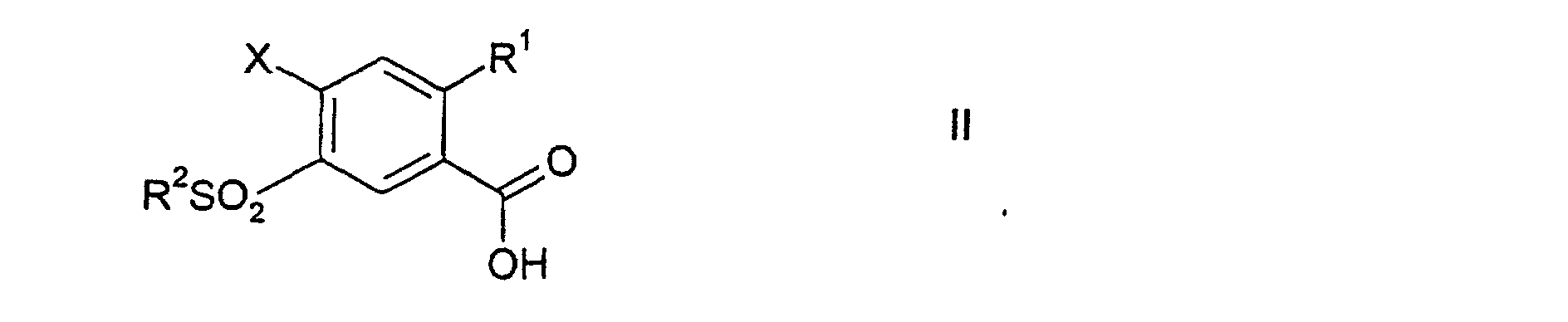
- the invention relates to a process for the preparation of acid addition salts of the compounds of the formula I, wherein R 1 , R 2 and R 3 independently of one another are alkyl having 1 to 12 carbon atoms, characterized in that in a step A the compounds of the formula II wherein R 1 and R 2 have the meaning given above and XF, Cl, Br, alkyl or aryl sulfonate or perfluoroalkyl sulfonate, by conventional methods in the esters of formula III in which R 1 , R 2 and X have the meaning given above and R 4 is alkyl having 1 to 10 carbon atoms, and this is converted in a step B in the presence of alkyl sulfinate to the compounds of the formula IV wherein R 1 , R 2 , R 3 and R 4 have the meaning given above, the compounds of the formula IV thus obtained are converted in a step C by reaction with guanidine into the corresponding compounds of the formula I and these are converted in a step D to Formation of the acid addition salt
- Sulfonyl-benzoylguanidines are known and are described, for example, in EP 0 758 644 A1. These substances are inhibitors of the cellular Na + / H + antiprotector, ie active substances which inhibit the Na + / H + exchange mechanism of the cells (Düsing et al., Med. Klin. 1992, 87, 367- 384) and thus represent good antiarrhythmics, which are particularly suitable for the treatment of arrhythmias that occur as a result of lack of oxygen.
- these compounds can also be used as therapeutic agents in diseases caused by cell proliferation, such as arteriosclerosis, diabetes and late diabetic complications, tumor diseases, fibrotic diseases, in particular of the lungs, liver and kidneys, and organ hypertrophies and hyperplasias.
- the compounds are suitable for diagnostic use for the detection of diseases which are caused by an increased activity of the Na + / H + antiporter z.
- the compounds can therefore be active pharmaceutical ingredients in human and Veterinary medicine can be used. They can also be used as Intermediate products for the production of other active pharmaceutical ingredients Find use.
- the compounds of the formula I can be prepared, for example, by EP 0 758 644.
- the previously known syntheses are based on the Introduction of alkyl sulfone groups into the ring of a corresponding one aromatic carboxylic acid and include a variety of Individual steps with partially unsatisfactory yields. Farther have the known methods for industrial production disadvantageous Reaction conditions. For example, the introduction of Alkylsulfone groups in the ring of an aromatic carboxylic acid nucleophilic substitution of suitable leaving groups with Alkyl sulfanes and subsequent oxidation because of the extreme and long after-effects of odor caused by alkyl sulfanes are problematic, even if these are only released in traces.
- the object of the present invention was therefore to provide an improved Production process for the compounds of formula I and their Acid addition salts provide the above bypasses problematic reaction steps and also better yields supplies.
- the process according to the invention is particularly suitable for the preparation of acid addition salts of compounds of the formula 1 in which R 1 , R 2 and R 3 simultaneously mean a methyl group (compounds of the formula IA).
- a very particularly preferred acid addition salt is the hydrochloride.
- the implementation of the process of the invention is simple, with the relevant starting compounds of the Formula II by the usual esterification methods known from the literature, such as an acid catalyzed esterification with a corresponding one Alcohol such as methanol or ethanol in the presence of excess Alcohol as a solvent or a suitable cosolvent which Implementation of the carboxylic acid salts of compounds of formula II with a suitable alkylating agent such as e.g. Dialkyl sulfate or the Conversion of the free acids with orthoesters into the corresponding esters be transferred.
- a suitable alkylating agent such as e.g. Dialkyl sulfate or the Conversion of the free acids with orthoesters into the corresponding esters be transferred.
- Another possible esterification reaction is the conversion of Acid into an acid halide and the subsequent reaction with a corresponding alcohol to the ester.
- esterification by reaction of the carboxylic acid salts is preferred of compounds of formula II with alkylating agents such as e.g. Dialkyl sulfate or by reacting the compounds of formula II with an orthoester.
- alkylating agents such as e.g. Dialkyl sulfate or by reacting the compounds of formula II with an orthoester.
- the reaction of the carboxylic acid salts with alkylating agents takes place expedient in such a way that the respective, in an inert Solvent-dissolved carboxylic acid salt, which is preferably carried out in situ Adding a base such as e.g. Alkali carbonate, bicarbonate, hydroxide or alcoholate, especially an alcoholate such as e.g. Potassium tert-butoxide or a hydroxide such as e.g. Sodium hydroxide, is produced preferably a dialkyl sulfate is added and the reactants at room temperature or elevated temperature and normal pressure implements. Dimethyl sulfate and diethyl sulfate are available as alkylating agents particularly preferred.
- a base such as e.g. Alkali carbonate, bicarbonate, hydroxide or alcoholate, especially an alcoholate such as e.g. Potassium tert-butoxide or a hydroxide such as e.g. Sodium hydroxide
- the carboxylic acid of formula II or is preferably esterified their salt in a molar ratio to the alkylating agent of 1 to 1 up to 1 to 8, in particular from 1 to 2 to 1 to 4.
- the esterification by reacting the corresponding acids with an orthoester such as trialkylorthoacetate, Tetraalkyl orthocarbonate or orthosilicate achieved.
- an orthoester Trimethyl or triethyl orthoacetate, tetramethyl or Tetraethyl orthocarbonate or orthosilicate preferred. In particular is Tetramethyl orthoacetate preferred.
- the esterification reaction will expediently at elevated temperatures, preferably at 30-180 ° C, especially at 80-120 ° C in an inert solvent.
- the carboxylic acid of formula II to be esterified is preferably in one molar ratio to the orthoester from 1 to 1 to 1 to 5, in particular from 1 to 1.5 to 1 to 3.
- the inert solvent for step A are preferably amides, such as e.g. Dimethylformamide, dimethylacetamide, tetramethyl urea, cyclic Ureas, e.g. N, N-dimethylimidazolidinone or Hexamethylphosphoric triamide or 1-methyl-2-pyrrolidone (N-methylpyrrolidone, NMP) in question.
- amides such as e.g. Dimethylformamide, dimethylacetamide, tetramethyl urea, cyclic Ureas, e.g. N, N-dimethylimidazolidinone or Hexamethylphosphoric triamide or 1-methyl-2-pyrrolidone (N-methylpyrrolidone, NMP) in question.
- amides such as e.g. Dimethylformamide, dimethylacetamide, tetramethyl urea, cyclic Ureas, e.g. N, N-dimethylimidazolidinone or Hex
- step A The duration of the reaction in step A depends on the reaction conditions chosen. As a rule, the reaction time is 0.5 hours to 2 days, preferably 1 to 15 hours.
- step B the compounds of the formula III are preferably in polar aprotic solvents at temperatures which are preferably in the range from 30-150 ° C., preferably from 50-110 ° C., in particular at 80-90 ° C., with alkyl sulfinate, preferably with alkali alkyl sulfinate , implemented.
- Sodium or potassium alkyl sulfinate is preferably used as the alkali alkyl sulfinate, in particular sodium methyl sulfinate or potassium methyl sulfinate.
- the compounds of formula III are preferably in a molar Ratio of alkali alkyl sulfinate from 1 to 1 to 1 to 4, especially 1 1.5 to 1 to 3 used.
- the polar aprotic solvent for step B is preferably dimethyl sulfoxide, sulfolane (tetrahydrothiophene-1,1-dioxide), dimethylformamide, dimethylacetamide, tetramethylurea, cyclic ureas, such as N, N-dimethylimidazolidinone or hexamethylphosphoric acid triamide or N-methylpyrrolidone or N-methylpyrrolidone Question. NMP is particularly preferred. Mixtures of the solvents mentioned can also be used.
- the duration of the implementation in step B depends on the chosen one Reaction conditions. As a rule, the reaction time is 0.5 hours to 2 days, preferably 1 to 25 hours.
- the Step B without working up the reaction mixture following the Step A can be performed.
- the esterification of the Compounds of formula II by reaction with alkylating agents or preferably by reaction with orthoestem in a polar aprotic solvent which can also be used for step B, preferably NMP, as outlined above.
- the reaction mixture obtained is mixed with alkyl sulfinate and allowed to continue to respond in the manner previously described for step B.
- the compounds of formula IV are preferably in an organic solvent at temperatures from -20 to + 60 ° C, preferably at -10 to + 30 °, at normal pressure with guanidine implemented.
- an organic solvent for this step preferably ethers such as tetrahydrofuran or dioxane or alcohols such as Methanol, ethanol, n-propanol or i-propanol are used. Mixtures of mentioned solvents can also be used.
- the compounds of formula IV are in a molar Ratio to guanidine from 1 to 1 to 1 to 6, in particular from 1 to 2 up to 1 to 4 used.
- the duration of the implementation in step C depends on the chosen one Reaction conditions. As a rule, the reaction time is 0.5 hours to 20 hours, preferably 1 to 5 hours.
- step D treatment of the compounds of the formula I with a corresponding acid, the acid addition salt is formed.
- acids are preferably those that come with the compounds of Formula I form physiologically acceptable and tolerable salts.
- Inorganic acids may preferably be used for this, e.g. Sulfuric acid, nitric acid, hydrohalic acids, such as Hydrochloric acid or hydrobromic acid, phosphoric acids such as Orthophosphoric acid, sulfamic acid, also organic acids, in particular aliphatic, alicyclic, araliphatic, aromatic or heterocyclic mono- or poly-based carbon, sulfonic or Sulfuric acids, e.g.
- Formic acid acetic acid, propionic acid, Pivalic acid, diethyl acetic acid, malonic acid, succinic acid, Pimelic acid, fumaric acid, maleic acid, lactic acid, tartaric acid, Malic acid, benzoic acid, salicylic acid, 2- or 3-phenylpropionic acid, Citric acid, gluconic acid, ascorbic acid, nicotinic acid, isonicotinic acid, Methane or ethanesulfonic acid, ethanedisulfonic acid, 2-hydroxyethanesulfonic acid, Benzenesulfonic acid, p-toluenesulfonic acid, Naphtaline mono- and disulfonic acids, lauryl sulfuric acid.
- hydrochloric acid is preferred.
- the treatment with an acid is preferably carried out in such a way that the compounds of formula I dissolved in a solvent and with a equimolar amount of the gaseous or liquid acid or an Solution of the acid in a suitable solvent.
- the acid addition salt of the compounds of the Formula I crystallized from the solution.
- the amount of solvent for each step A, B, C and D is not critical, preferably 10 g to 500 g of solvent per g of added compounds of formula I, II, III or IV to be reacted become.
- the compounds of the formulas I, II, III and IV can be prepared by customary methods Refurbishment steps, e.g. Add water to the reaction mixture and Extraction can be obtained after removal of the solvent. It can be advantageous to further purify the product by distillation or to connect crystallization.
Landscapes
- Chemical & Material Sciences (AREA)
- Organic Chemistry (AREA)
- Chemical Kinetics & Catalysis (AREA)
- Organic Low-Molecular-Weight Compounds And Preparation Thereof (AREA)
- Pharmaceuticals Containing Other Organic And Inorganic Compounds (AREA)
Abstract
Description


Als Alkalialkylsulfinat wird vorzugsweise Natrium- oder Kaliumalkylsulfinat verwendet, insbesondere Natriummethylsulfinat oder Kaliummethylsulfinat.
Mischungen der genannten Lösungsmittel können ebenfalls Verwendung finden.
- THF
- Tetrtahydrofuran
- KOtBu
- Kalium-tert.-butylat
- RT
- Raumtemperatur
- MTBE
- Methyl-tert.-butylether
- h
- Stunde(n)
- d
- Tag(e)
Claims (10)
- Verfahren zur Herstellung von Säureaddlitions-Salzen der Verbindungen der Formel I,worin R1, R2 und R3 unabhängig voneinander Alkyl mit 1 bis 12 C-Atomen bedeuten, dadurch gekennzeichnet, daß man in einem Schritt A die Verbindungen der Formel II
 worin R1 und R2 die oben angegebene Bedeutung aufweisen und X F, Cl, Br, Alkyl-oder Arylsulfonat oder Perfluoralkylsulfonat bedeuten, nach üblichen Methoden in die Ester der Formel III
 worin R1, R2 und X die oben angegebene Bedeutung aufweisen und R4 Alkyl mit 1 bis 10 C-Atomen bedeutet, überführt und diese in einem Schritt B in Gegenwart von Alkylsulfinat zu den Verbindungen der Formel IV
 worin R1, R2, R3 und R4 die oben angegebene Bedeutung aufweisen, umsetzt, die so erhaltenen Verbindungen der Formel IV in einem Schritt C durch Umsetzung mit Guanidin in die entsprechenden Verbindungen der Formel I überführt und diese in einem Schritt D zur Bildung des Säureadditions-Salzes mit einer geeigneten Säure behandelt.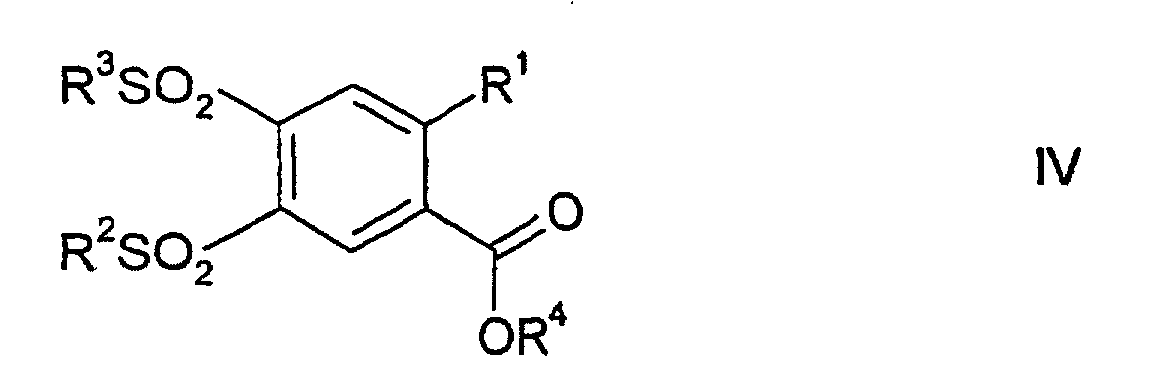
- Verfahren nach Anspruch 1, dadurch gekennzeichnet, daß Schritt B, die Umsetzung der Verbindungen der Formel III zu den Verbindungen der Formel IV, ohne Aufarbeitung des Reaktionsgemisches im Anschluß an den Schritt A, die Veresterung der Verbindungen der Formel II, durchgeführt wird.
- Verfahren nach Anspruch 1 oder 2, dadurch gekennzeichnet, daß Schritt D, die Behandlung der Verbindungen der Formel I mit einer geeigneten Säure zur Bildung des Säureadditions-Salzes, im Anschuß an den Schritt C, der Umsetzung der Verbindungen der Formel IV zu den Verbindungen der Formel I ohne vorherige Aufarbeitung des Reaktionsgemisches erfolgt.
- Verfahren nach Anspruch 1, 2 oder 3, dadurch gekennzeichnet, daß X in Formel 11 die Bedeutung Cl aufweist.
- Verfahren nach einem der vorhergehenden Ansprüche, dadurch gekennzeichnet, daß im Schritt A die Veresterung durch Umsetzung der entsprechenden Säuren der Formel II mit einem Orthoester erzielt wird.
- Verfahren nach einem der vorhergehenden Ansprüche, dadurch gekennzeichnet, daß für die Schritte A und B 1-Methyl-2-pyrrolidon als Lösungsmittel verwendet wird.
- Verfahren nach einem der vorhergehenden Ansprüche, dadurch gekennzeichnet, daß Schritt B bei einer Temperatur von 50-110°C durchgeführt wird.
- Verfahren nach einem der vorhergehenden Ansprüche, dadurch gekennzeichnet, daß als Säure im Schritt D Chlorwasserstoff-Säure verwendet wird.
- Verfahren nach einem der vorhergehenden Ansprüche zur Herstellung von Säureadditions-Salzen der Verbindung der Formel IA:

- Verfahren nach einem der vorhergehenden Ansprüche zur Herstellung der Verbindung der Formel V:

Applications Claiming Priority (3)
| Application Number | Priority Date | Filing Date | Title |
|---|---|---|---|
| DE10023405A DE10023405A1 (de) | 2000-05-12 | 2000-05-12 | Verfahren zur Herstellung von Sulfonyl-benzoylguanidinum-Salzen |
| DE10023405 | 2000-05-12 | ||
| PCT/EP2001/004294 WO2001085679A1 (de) | 2000-05-12 | 2001-04-17 | Verfahren zur herstellung von sulfonyl-benzoylguanidinium-salzen |
Publications (2)
| Publication Number | Publication Date |
|---|---|
| EP1282598A1 EP1282598A1 (de) | 2003-02-12 |
| EP1282598B1 true EP1282598B1 (de) | 2004-10-20 |
Family
ID=7641866
Family Applications (1)
| Application Number | Title | Priority Date | Filing Date |
|---|---|---|---|
| EP01947223A Expired - Lifetime EP1282598B1 (de) | 2000-05-12 | 2001-04-17 | Verfahren zur herstellung von sulfonyl-benzoylguanidinium-salzen |
Country Status (24)
| Country | Link |
|---|---|
| US (1) | US6706921B2 (de) |
| EP (1) | EP1282598B1 (de) |
| JP (1) | JP2003532704A (de) |
| KR (1) | KR20030007599A (de) |
| CN (1) | CN1193011C (de) |
| AR (1) | AR028442A1 (de) |
| AT (1) | ATE280151T1 (de) |
| AU (1) | AU783369B2 (de) |
| BR (1) | BR0110642A (de) |
| CA (1) | CA2408640A1 (de) |
| CZ (1) | CZ20023647A3 (de) |
| DE (2) | DE10023405A1 (de) |
| DK (1) | DK1282598T3 (de) |
| ES (1) | ES2228897T3 (de) |
| HU (1) | HUP0301936A2 (de) |
| MX (1) | MXPA02011069A (de) |
| MY (1) | MY133941A (de) |
| NO (1) | NO20025385D0 (de) |
| PL (1) | PL358690A1 (de) |
| PT (1) | PT1282598E (de) |
| RU (1) | RU2258699C2 (de) |
| SK (1) | SK15812002A3 (de) |
| WO (1) | WO2001085679A1 (de) |
| ZA (1) | ZA200210050B (de) |
Cited By (1)
| Publication number | Priority date | Publication date | Assignee | Title |
|---|---|---|---|---|
| EP2671576A1 (de) | 2008-05-09 | 2013-12-11 | Merck Patent GmbH | Pharmazeutische Zusammensetzung zur Behandlung von Erkrankungen im Zusammenhang mit Insulinresistenz und ß-Zellen-Dysfunktion |
Families Citing this family (2)
| Publication number | Priority date | Publication date | Assignee | Title |
|---|---|---|---|---|
| AU2003272967A1 (en) * | 2002-10-28 | 2004-05-13 | Kaneka Corporation | Processes for producing optically active n-(2,3-epoxypropan-1-yl)phthalimide |
| CA3228796A1 (en) * | 2016-02-08 | 2017-08-17 | Merck Patent Gmbh | Crystalline modifications of n-(4,5-bismethanesulfonyl-2-methylbenzoyl)guanidine hydrochloride and n-(4,5-bismethanesulfonyl-2-methylbenzoyl)guanidine salts |
Family Cites Families (9)
| Publication number | Priority date | Publication date | Assignee | Title |
|---|---|---|---|---|
| JPS6248648A (ja) * | 1985-08-28 | 1987-03-03 | Fujisawa Pharmaceut Co Ltd | ジアルコキシ酢酸エステル化合物の製造法 |
| DK0589336T3 (da) * | 1992-09-22 | 1997-06-16 | Hoechst Ag | Benzylguanidiner, fremgangsmåde til deres fremstilling samt deres anvendelse som antiarytmetika |
| DE4437874A1 (de) * | 1994-10-22 | 1996-04-25 | Merck Patent Gmbh | Alkyl-5-methylsulfonyl-benzoylguanidin-Derivate |
| DE19502644A1 (de) * | 1995-01-28 | 1996-08-01 | Merck Patent Gmbh | 4-Amino-benzoylguanidin-Derivate |
| DE19526381A1 (de) * | 1995-07-19 | 1997-01-23 | Hoechst Ag | 4-Fluoralkyl-substituierte Benzoylguanidine, Verfahren zu ihrer Herstellung, ihre Verwendung als Medikament oder Diagnostikum sowie sie enthaltendes Medikament |
| DE19529612A1 (de) * | 1995-08-11 | 1997-02-13 | Merck Patent Gmbh | Sulfonyl- oder Sulfinyl-benzoylguanidin-Derivate |
| DE19621482A1 (de) * | 1996-05-29 | 1997-12-04 | Hoechst Ag | Substituierte 1-Naphthoylguanidine, Verfahren zu ihrer Herstellung, ihre Verwendung als Medikament oder Diagnostikum sowie sie enthaltendes Medikament |
| DE19951418A1 (de) * | 1999-10-26 | 2001-05-03 | Merck Patent Gmbh | Verfahren zur Herstellung von N-(4,5-Bismethansulfonyl-2-methyl-benzoyl) -guanidin, Hydrochlorid |
| JP2001247557A (ja) * | 1999-12-27 | 2001-09-11 | Sagami Chem Res Center | 5−オキシ−7−オキサビシクロ[4.1.0]ヘプト−3−エン−3−カルボン酸エステルの製造方法 |
-
2000
- 2000-05-12 DE DE10023405A patent/DE10023405A1/de active Pending
-
2001
- 2001-04-17 EP EP01947223A patent/EP1282598B1/de not_active Expired - Lifetime
- 2001-04-17 BR BR0110642-2A patent/BR0110642A/pt not_active Application Discontinuation
- 2001-04-17 ES ES01947223T patent/ES2228897T3/es not_active Expired - Lifetime
- 2001-04-17 US US10/275,484 patent/US6706921B2/en not_active Expired - Fee Related
- 2001-04-17 RU RU2002133235/04A patent/RU2258699C2/ru not_active IP Right Cessation
- 2001-04-17 PT PT01947223T patent/PT1282598E/pt unknown
- 2001-04-17 CZ CZ20023647A patent/CZ20023647A3/cs unknown
- 2001-04-17 DE DE50104219T patent/DE50104219D1/de not_active Expired - Lifetime
- 2001-04-17 CN CNB018094058A patent/CN1193011C/zh not_active Expired - Fee Related
- 2001-04-17 CA CA002408640A patent/CA2408640A1/en not_active Abandoned
- 2001-04-17 KR KR1020027015038A patent/KR20030007599A/ko not_active Withdrawn
- 2001-04-17 HU HU0301936A patent/HUP0301936A2/hu unknown
- 2001-04-17 MX MXPA02011069A patent/MXPA02011069A/es active IP Right Grant
- 2001-04-17 PL PL01358690A patent/PL358690A1/xx unknown
- 2001-04-17 AT AT01947223T patent/ATE280151T1/de not_active IP Right Cessation
- 2001-04-17 SK SK1581-2002A patent/SK15812002A3/sk unknown
- 2001-04-17 JP JP2001582280A patent/JP2003532704A/ja active Pending
- 2001-04-17 WO PCT/EP2001/004294 patent/WO2001085679A1/de not_active Ceased
- 2001-04-17 DK DK01947223T patent/DK1282598T3/da active
- 2001-04-17 AU AU68969/01A patent/AU783369B2/en not_active Ceased
- 2001-05-09 MY MYPI20012143 patent/MY133941A/en unknown
- 2001-05-11 AR ARP010102230A patent/AR028442A1/es unknown
-
2002
- 2002-11-11 NO NO20025385A patent/NO20025385D0/no not_active Application Discontinuation
- 2002-12-11 ZA ZA200210050A patent/ZA200210050B/en unknown
Cited By (2)
| Publication number | Priority date | Publication date | Assignee | Title |
|---|---|---|---|---|
| EP2671576A1 (de) | 2008-05-09 | 2013-12-11 | Merck Patent GmbH | Pharmazeutische Zusammensetzung zur Behandlung von Erkrankungen im Zusammenhang mit Insulinresistenz und ß-Zellen-Dysfunktion |
| US10292949B2 (en) | 2008-05-09 | 2019-05-21 | Meck Patent Gmbh | Pharmaceutical composition comprising rimeporide for treating diseases associated with insulin resistance and β-cell dysfunction |
Also Published As
| Publication number | Publication date |
|---|---|
| SK15812002A3 (sk) | 2003-03-04 |
| NO20025385L (no) | 2002-11-11 |
| AU6896901A (en) | 2001-11-20 |
| NO20025385D0 (no) | 2002-11-11 |
| AU783369B2 (en) | 2005-10-20 |
| EP1282598A1 (de) | 2003-02-12 |
| US6706921B2 (en) | 2004-03-16 |
| JP2003532704A (ja) | 2003-11-05 |
| AR028442A1 (es) | 2003-05-07 |
| WO2001085679A1 (de) | 2001-11-15 |
| BR0110642A (pt) | 2003-03-18 |
| US20030162999A1 (en) | 2003-08-28 |
| CN1429207A (zh) | 2003-07-09 |
| KR20030007599A (ko) | 2003-01-23 |
| PT1282598E (pt) | 2005-03-31 |
| PL358690A1 (en) | 2004-08-09 |
| CZ20023647A3 (cs) | 2003-02-12 |
| CA2408640A1 (en) | 2002-11-08 |
| DK1282598T3 (da) | 2005-02-07 |
| ATE280151T1 (de) | 2004-11-15 |
| MY133941A (en) | 2007-11-30 |
| DE50104219D1 (de) | 2004-11-25 |
| ES2228897T3 (es) | 2005-04-16 |
| RU2258699C2 (ru) | 2005-08-20 |
| HUP0301936A2 (hu) | 2003-09-29 |
| ZA200210050B (en) | 2003-09-10 |
| CN1193011C (zh) | 2005-03-16 |
| DE10023405A1 (de) | 2001-11-15 |
| MXPA02011069A (es) | 2003-03-10 |
Similar Documents
| Publication | Publication Date | Title |
|---|---|---|
| DE1185180B (de) | Verfahren zur Herstellung von Benzolsulfonylharnstoffen | |
| EP0039844A2 (de) | Verfahren zur Herstellung von O-substituierten Derivaten des (+)-Cyanidan-3-ols | |
| EP2200978A1 (de) | Verfahren zur herstelung von sulfonsäurediamiden | |
| DE2858737C2 (de) | ||
| EP0403947B1 (de) | Verfahren zur Herstellung von aromatischen Sulfonsäurechloriden | |
| DE1445675B2 (de) | Pyridylharnstoffe und verfahren zu ihrer herstellung | |
| DE1122541B (de) | Verfahren zur Herstellung von Sulfamyl-anthranilsaeuren | |
| DE2109339A1 (de) | Mono und dl substituierte Sulfamoyl benzoesauren | |
| DE10023405A1 (de) | Verfahren zur Herstellung von Sulfonyl-benzoylguanidinum-Salzen | |
| EP0034751B1 (de) | Verfahren zur Herstellung von 1-Amino-1,3,5-triazin-2,4(1H, 3H)-dionen | |
| EP1685098B1 (de) | Ortho-substituierte pentafluorsulfanyl-benzole, verfahren zu ihrer herstellung sowie ihre verwendung ais wertvolle synthese-zwischenstufen | |
| DE2815340A1 (de) | Substituierte alkylsulfonanilide | |
| EP1053224A1 (de) | Biphenylsulfonylcyanamide, verfahren zu ihrer herstellung und ihre verwendung als medikament | |
| EP1224166A1 (de) | Verfahren zur herstellung von n-(4,5-bis-methansulfonyl-2-methyl-benzoyl)-guanidin, hydrochlorid | |
| DE2060386A1 (de) | Benzolsulfonsaeuren und Verfahren zu deren Herstellung | |
| DE837848C (de) | Verfahren zur Herstellung von Benzoesaeureestern sekundaerer Alkyl-sek. Aminopropanole und -butanole | |
| DE2718871C3 (de) | N-(2-Furylmethyl)-5-sulfamoylorthanilsäuren und deren physiologisch verträgliche Salze und Verfahren zu ihrer Herstellung und ihre Verwendung bei der Bekämpfung von Oedemkrankheiten und Bluthochdruck | |
| DE2317142B2 (de) | In 6-Stellung durch eine schwefelhaltige Gruppe substituierte 2,4-Diaminochinazoline | |
| DE1935404B2 (de) | Verfahren zur Herstellung von Chinazolinonen | |
| DE2605419A1 (de) | 3-amino-4-carbamylpyrrolderivate und verfahren zu deren herstellung | |
| EP0088346B1 (de) | 2-Aminomethyl-phenol-Derivate, Verfahren zu ihrer Herstellung, ihre Verwendung sowie pharmazeutische Präparate auf Basis dieser Verbindungen | |
| DE2225482C3 (de) | Pyrindin-2,6-bis(dithiocarbamat)-Derivate, Verfahren zur Herstellung derselben und Mittel mit einem Gehalt derselben | |
| EP0135860A2 (de) | 6-Sulfoxyphenolderivate, ihre Herstellung und ihre Verwendung als Cytoprotektiva; Verwendung von Salicylaldehydabkömmlingen als Cytoprotektiva | |
| EP1620394B1 (de) | Verfahren zur kristallisation von guanidinium-salzen | |
| EP1802311B1 (de) | 4-aminophenyl-morpholinon-derivate zur behandlung von hepatitis c |
Legal Events
| Date | Code | Title | Description |
|---|---|---|---|
| PUAI | Public reference made under article 153(3) epc to a published international application that has entered the european phase |
Free format text: ORIGINAL CODE: 0009012 |
|
| AK | Designated contracting states |
Designated state(s): AT BE CH CY DE DK ES FI FR GB GR IE IT LI LU MC NL PT SE TR |
|
| AX | Request for extension of the european patent |
Extension state: AL LT LV MK RO SI |
|
| 17P | Request for examination filed |
Effective date: 20020928 |
|
| RIN1 | Information on inventor provided before grant (corrected) |
Inventor name: BARTMANN, EKKEHARD Inventor name: KIRSCHBAUM, MICHAEL |
|
| GRAP | Despatch of communication of intention to grant a patent |
Free format text: ORIGINAL CODE: EPIDOSNIGR1 |
|
| GRAP | Despatch of communication of intention to grant a patent |
Free format text: ORIGINAL CODE: EPIDOSNIGR1 |
|
| GRAS | Grant fee paid |
Free format text: ORIGINAL CODE: EPIDOSNIGR3 |
|
| GRAA | (expected) grant |
Free format text: ORIGINAL CODE: 0009210 |
|
| AK | Designated contracting states |
Kind code of ref document: B1 Designated state(s): AT BE CH CY DE DK ES FI FR GB GR IE IT LI LU MC NL PT SE TR |
|
| AX | Request for extension of the european patent |
Extension state: LT LV RO SI |
|
| PG25 | Lapsed in a contracting state [announced via postgrant information from national office to epo] |
Ref country code: TR Free format text: LAPSE BECAUSE OF FAILURE TO SUBMIT A TRANSLATION OF THE DESCRIPTION OR TO PAY THE FEE WITHIN THE PRESCRIBED TIME-LIMIT Effective date: 20041020 Ref country code: FI Free format text: LAPSE BECAUSE OF FAILURE TO SUBMIT A TRANSLATION OF THE DESCRIPTION OR TO PAY THE FEE WITHIN THE PRESCRIBED TIME-LIMIT Effective date: 20041020 |
|
| REG | Reference to a national code |
Ref country code: GB Ref legal event code: FG4D Free format text: NOT ENGLISH |
|
| REG | Reference to a national code |
Ref country code: CH Ref legal event code: EP |
|
| REG | Reference to a national code |
Ref country code: IE Ref legal event code: FG4D Free format text: GERMAN |
|
| REF | Corresponds to: |
Ref document number: 50104219 Country of ref document: DE Date of ref document: 20041125 Kind code of ref document: P |
|
| REG | Reference to a national code |
Ref country code: SE Ref legal event code: TRGR |
|
| REG | Reference to a national code |
Ref country code: GR Ref legal event code: EP Ref document number: 20040404394 Country of ref document: GR |
|
| REG | Reference to a national code |
Ref country code: DK Ref legal event code: T3 |
|
| GBT | Gb: translation of ep patent filed (gb section 77(6)(a)/1977) |
Effective date: 20050115 |
|
| LTIE | Lt: invalidation of european patent or patent extension |
Effective date: 20041020 |
|
| REG | Reference to a national code |
Ref country code: PT Ref legal event code: SC4A Free format text: AVAILABILITY OF NATIONAL TRANSLATION Effective date: 20050119 |
|
| REG | Reference to a national code |
Ref country code: ES Ref legal event code: FG2A Ref document number: 2228897 Country of ref document: ES Kind code of ref document: T3 |
|
| PG25 | Lapsed in a contracting state [announced via postgrant information from national office to epo] |
Ref country code: LU Free format text: LAPSE BECAUSE OF NON-PAYMENT OF DUE FEES Effective date: 20050417 Ref country code: CY Free format text: LAPSE BECAUSE OF FAILURE TO SUBMIT A TRANSLATION OF THE DESCRIPTION OR TO PAY THE FEE WITHIN THE PRESCRIBED TIME-LIMIT Effective date: 20050417 |
|
| PG25 | Lapsed in a contracting state [announced via postgrant information from national office to epo] |
Ref country code: MC Free format text: LAPSE BECAUSE OF NON-PAYMENT OF DUE FEES Effective date: 20050430 |
|
| PLBE | No opposition filed within time limit |
Free format text: ORIGINAL CODE: 0009261 |
|
| STAA | Information on the status of an ep patent application or granted ep patent |
Free format text: STATUS: NO OPPOSITION FILED WITHIN TIME LIMIT |
|
| 26N | No opposition filed |
Effective date: 20050721 |
|
| ET | Fr: translation filed | ||
| PGFP | Annual fee paid to national office [announced via postgrant information from national office to epo] |
Ref country code: GB Payment date: 20100325 Year of fee payment: 10 |
|
| PGFP | Annual fee paid to national office [announced via postgrant information from national office to epo] |
Ref country code: IE Payment date: 20100416 Year of fee payment: 10 Ref country code: FR Payment date: 20100521 Year of fee payment: 10 Ref country code: ES Payment date: 20100505 Year of fee payment: 10 Ref country code: PT Payment date: 20100331 Year of fee payment: 10 Ref country code: DK Payment date: 20100412 Year of fee payment: 10 |
|
| PGFP | Annual fee paid to national office [announced via postgrant information from national office to epo] |
Ref country code: NL Payment date: 20100402 Year of fee payment: 10 Ref country code: IT Payment date: 20100423 Year of fee payment: 10 Ref country code: DE Payment date: 20100430 Year of fee payment: 10 Ref country code: AT Payment date: 20100413 Year of fee payment: 10 |
|
| PGFP | Annual fee paid to national office [announced via postgrant information from national office to epo] |
Ref country code: BE Payment date: 20100423 Year of fee payment: 10 Ref country code: CH Payment date: 20100414 Year of fee payment: 10 |
|
| PGFP | Annual fee paid to national office [announced via postgrant information from national office to epo] |
Ref country code: SE Payment date: 20100409 Year of fee payment: 10 |
|
| PGFP | Annual fee paid to national office [announced via postgrant information from national office to epo] |
Ref country code: GR Payment date: 20100317 Year of fee payment: 10 |
|
| REG | Reference to a national code |
Ref country code: PT Ref legal event code: MM4A Free format text: LAPSE DUE TO NON-PAYMENT OF FEES Effective date: 20111017 |
|
| BERE | Be: lapsed |
Owner name: *MERCK PATENT G.M.B.H. Effective date: 20110430 |
|
| REG | Reference to a national code |
Ref country code: NL Ref legal event code: V1 Effective date: 20111101 |
|
| REG | Reference to a national code |
Ref country code: SE Ref legal event code: EUG |
|
| REG | Reference to a national code |
Ref country code: CH Ref legal event code: PL |
|
| GBPC | Gb: european patent ceased through non-payment of renewal fee |
Effective date: 20110417 |
|
| REG | Reference to a national code |
Ref country code: AT Ref legal event code: MM01 Ref document number: 280151 Country of ref document: AT Kind code of ref document: T Effective date: 20110417 |
|
| REG | Reference to a national code |
Ref country code: GR Ref legal event code: ML Ref document number: 20040404394 Country of ref document: GR Effective date: 20111102 |
|
| REG | Reference to a national code |
Ref country code: FR Ref legal event code: ST Effective date: 20111230 |
|
| PG25 | Lapsed in a contracting state [announced via postgrant information from national office to epo] |
Ref country code: BE Free format text: LAPSE BECAUSE OF NON-PAYMENT OF DUE FEES Effective date: 20110430 Ref country code: CH Free format text: LAPSE BECAUSE OF NON-PAYMENT OF DUE FEES Effective date: 20110430 Ref country code: PT Free format text: LAPSE BECAUSE OF NON-PAYMENT OF DUE FEES Effective date: 20111017 Ref country code: DE Free format text: LAPSE BECAUSE OF NON-PAYMENT OF DUE FEES Effective date: 20111101 Ref country code: NL Free format text: LAPSE BECAUSE OF NON-PAYMENT OF DUE FEES Effective date: 20111101 Ref country code: FR Free format text: LAPSE BECAUSE OF NON-PAYMENT OF DUE FEES Effective date: 20110502 Ref country code: LI Free format text: LAPSE BECAUSE OF NON-PAYMENT OF DUE FEES Effective date: 20110430 |
|
| REG | Reference to a national code |
Ref country code: IE Ref legal event code: MM4A |
|
| REG | Reference to a national code |
Ref country code: DK Ref legal event code: EBP |
|
| REG | Reference to a national code |
Ref country code: DE Ref legal event code: R119 Ref document number: 50104219 Country of ref document: DE Effective date: 20111101 |
|
| PG25 | Lapsed in a contracting state [announced via postgrant information from national office to epo] |
Ref country code: GB Free format text: LAPSE BECAUSE OF NON-PAYMENT OF DUE FEES Effective date: 20110417 Ref country code: GR Free format text: LAPSE BECAUSE OF NON-PAYMENT OF DUE FEES Effective date: 20111102 Ref country code: IT Free format text: LAPSE BECAUSE OF NON-PAYMENT OF DUE FEES Effective date: 20110417 Ref country code: AT Free format text: LAPSE BECAUSE OF NON-PAYMENT OF DUE FEES Effective date: 20110417 |
|
| PG25 | Lapsed in a contracting state [announced via postgrant information from national office to epo] |
Ref country code: IE Free format text: LAPSE BECAUSE OF NON-PAYMENT OF DUE FEES Effective date: 20110418 |
|
| PG25 | Lapsed in a contracting state [announced via postgrant information from national office to epo] |
Ref country code: DK Free format text: LAPSE BECAUSE OF NON-PAYMENT OF DUE FEES Effective date: 20110430 |
|
| PG25 | Lapsed in a contracting state [announced via postgrant information from national office to epo] |
Ref country code: SE Free format text: LAPSE BECAUSE OF NON-PAYMENT OF DUE FEES Effective date: 20110418 |
|
| REG | Reference to a national code |
Ref country code: ES Ref legal event code: FD2A Effective date: 20130606 |
|
| PG25 | Lapsed in a contracting state [announced via postgrant information from national office to epo] |
Ref country code: ES Free format text: LAPSE BECAUSE OF NON-PAYMENT OF DUE FEES Effective date: 20110418 |