EP1270583A1 - Verfahren zur Reinigung von Phosphoniumsalzen - Google Patents
Verfahren zur Reinigung von Phosphoniumsalzen Download PDFInfo
- Publication number
- EP1270583A1 EP1270583A1 EP02013630A EP02013630A EP1270583A1 EP 1270583 A1 EP1270583 A1 EP 1270583A1 EP 02013630 A EP02013630 A EP 02013630A EP 02013630 A EP02013630 A EP 02013630A EP 1270583 A1 EP1270583 A1 EP 1270583A1
- Authority
- EP
- European Patent Office
- Prior art keywords
- polar
- solvent
- solution
- phosphonium salt
- resin
- Prior art date
- Legal status (The legal status is an assumption and is not a legal conclusion. Google has not performed a legal analysis and makes no representation as to the accuracy of the status listed.)
- Granted
Links
- 150000004714 phosphonium salts Chemical class 0.000 title claims abstract description 35
- 238000000034 method Methods 0.000 title claims description 28
- 238000000746 purification Methods 0.000 title claims description 8
- 239000000243 solution Substances 0.000 claims abstract description 22
- 229920005989 resin Polymers 0.000 claims abstract description 20
- 239000011347 resin Substances 0.000 claims abstract description 20
- 239000008151 electrolyte solution Substances 0.000 claims abstract description 18
- 239000012454 non-polar solvent Substances 0.000 claims abstract description 11
- 239000002904 solvent Substances 0.000 claims abstract description 11
- NWUYHJFMYQTDRP-UHFFFAOYSA-N 1,2-bis(ethenyl)benzene;1-ethenyl-2-ethylbenzene;styrene Chemical compound C=CC1=CC=CC=C1.CCC1=CC=CC=C1C=C.C=CC1=CC=CC=C1C=C NWUYHJFMYQTDRP-UHFFFAOYSA-N 0.000 claims abstract description 10
- 239000003729 cation exchange resin Substances 0.000 claims abstract description 10
- 150000003839 salts Chemical group 0.000 claims abstract description 8
- 238000005406 washing Methods 0.000 claims abstract description 6
- 150000001450 anions Chemical class 0.000 claims abstract description 4
- 125000003118 aryl group Chemical group 0.000 claims abstract description 4
- 239000004215 Carbon black (E152) Substances 0.000 claims abstract description 3
- 229930195733 hydrocarbon Natural products 0.000 claims abstract description 3
- -1 3,7,11-trimethyldodeca-2,4,6,10-tetraen-1-yl Chemical group 0.000 claims description 14
- FAPWRFPIFSIZLT-UHFFFAOYSA-M Sodium chloride Chemical compound [Na+].[Cl-] FAPWRFPIFSIZLT-UHFFFAOYSA-M 0.000 claims description 14
- RTZKZFJDLAIYFH-UHFFFAOYSA-N Diethyl ether Chemical compound CCOCC RTZKZFJDLAIYFH-UHFFFAOYSA-N 0.000 claims description 11
- 239000003586 protic polar solvent Substances 0.000 claims description 11
- XLYOFNOQVPJJNP-UHFFFAOYSA-N water Substances O XLYOFNOQVPJJNP-UHFFFAOYSA-N 0.000 claims description 9
- WYURNTSHIVDZCO-UHFFFAOYSA-N Tetrahydrofuran Chemical compound C1CCOC1 WYURNTSHIVDZCO-UHFFFAOYSA-N 0.000 claims description 8
- 125000004432 carbon atom Chemical group C* 0.000 claims description 7
- 239000011780 sodium chloride Substances 0.000 claims description 7
- IAZDPXIOMUYVGZ-UHFFFAOYSA-N Dimethylsulphoxide Chemical compound CS(C)=O IAZDPXIOMUYVGZ-UHFFFAOYSA-N 0.000 claims description 6
- RRHGJUQNOFWUDK-UHFFFAOYSA-N Isoprene Chemical group CC(=C)C=C RRHGJUQNOFWUDK-UHFFFAOYSA-N 0.000 claims description 5
- 239000004793 Polystyrene Substances 0.000 claims description 4
- YLQBMQCUIZJEEH-UHFFFAOYSA-N tetrahydrofuran Natural products C=1C=COC=1 YLQBMQCUIZJEEH-UHFFFAOYSA-N 0.000 claims description 4
- RYHBNJHYFVUHQT-UHFFFAOYSA-N 1,4-Dioxane Chemical compound C1COCCO1 RYHBNJHYFVUHQT-UHFFFAOYSA-N 0.000 claims description 3
- 150000001338 aliphatic hydrocarbons Chemical class 0.000 claims description 3
- 150000008282 halocarbons Chemical class 0.000 claims description 3
- 229920000058 polyacrylate Polymers 0.000 claims description 3
- 229920002223 polystyrene Polymers 0.000 claims description 3
- 239000003463 adsorbent Substances 0.000 claims description 2
- 239000002798 polar solvent Substances 0.000 claims description 2
- 125000000217 alkyl group Chemical group 0.000 abstract description 2
- 239000003880 polar aprotic solvent Substances 0.000 abstract 2
- 239000000010 aprotic solvent Substances 0.000 abstract 1
- QTBSBXVTEAMEQO-UHFFFAOYSA-N Acetic acid Chemical compound CC(O)=O QTBSBXVTEAMEQO-UHFFFAOYSA-N 0.000 description 30
- YMWUJEATGCHHMB-UHFFFAOYSA-N Dichloromethane Chemical compound ClCCl YMWUJEATGCHHMB-UHFFFAOYSA-N 0.000 description 21
- 239000000463 material Substances 0.000 description 13
- IMNFDUFMRHMDMM-UHFFFAOYSA-N N-Heptane Chemical compound CCCCCCC IMNFDUFMRHMDMM-UHFFFAOYSA-N 0.000 description 11
- 239000002253 acid Substances 0.000 description 11
- 238000005086 pumping Methods 0.000 description 11
- XYFCBTPGUUZFHI-UHFFFAOYSA-N Phosphine Chemical compound P XYFCBTPGUUZFHI-UHFFFAOYSA-N 0.000 description 10
- 150000001768 cations Chemical class 0.000 description 9
- 238000004587 chromatography analysis Methods 0.000 description 8
- RIOQSEWOXXDEQQ-UHFFFAOYSA-N triphenylphosphine Chemical compound C1=CC=CC=C1P(C=1C=CC=CC=1)C1=CC=CC=C1 RIOQSEWOXXDEQQ-UHFFFAOYSA-N 0.000 description 8
- OKKJLVBELUTLKV-UHFFFAOYSA-N Methanol Chemical compound OC OKKJLVBELUTLKV-UHFFFAOYSA-N 0.000 description 6
- 229940021013 electrolyte solution Drugs 0.000 description 6
- 238000004128 high performance liquid chromatography Methods 0.000 description 6
- VLKZOEOYAKHREP-UHFFFAOYSA-N n-Hexane Chemical compound CCCCCC VLKZOEOYAKHREP-UHFFFAOYSA-N 0.000 description 6
- LFQSCWFLJHTTHZ-UHFFFAOYSA-N Ethanol Chemical compound CCO LFQSCWFLJHTTHZ-UHFFFAOYSA-N 0.000 description 5
- 239000012071 phase Substances 0.000 description 5
- 229910000073 phosphorus hydride Inorganic materials 0.000 description 5
- KZMGYPLQYOPHEL-UHFFFAOYSA-N Boron trifluoride etherate Chemical compound FB(F)F.CCOCC KZMGYPLQYOPHEL-UHFFFAOYSA-N 0.000 description 4
- 235000021466 carotenoid Nutrition 0.000 description 4
- 150000001747 carotenoids Chemical class 0.000 description 4
- 229920001429 chelating resin Polymers 0.000 description 4
- 239000000203 mixture Substances 0.000 description 4
- 239000012264 purified product Substances 0.000 description 4
- OWUJMRYOLTVQND-UHFFFAOYSA-N triphenyl(3,7,11-trimethyldodeca-2,4,6,10-tetraenyl)phosphanium Chemical class C=1C=CC=CC=1[P+](C=1C=CC=CC=1)(CC=C(C)C=CC=C(C)CCC=C(C)C)C1=CC=CC=C1 OWUJMRYOLTVQND-UHFFFAOYSA-N 0.000 description 4
- YSXJXZWNKOUWCQ-UHFFFAOYSA-N 3,7,11-trimethyldodeca-2,4,6,10-tetraenylphosphane Chemical class CC(C)=CCCC(C)=CC=CC(C)=CCP YSXJXZWNKOUWCQ-UHFFFAOYSA-N 0.000 description 3
- UHOVQNZJYSORNB-UHFFFAOYSA-N Benzene Chemical compound C1=CC=CC=C1 UHOVQNZJYSORNB-UHFFFAOYSA-N 0.000 description 3
- YXFVVABEGXRONW-UHFFFAOYSA-N Toluene Chemical compound CC1=CC=CC=C1 YXFVVABEGXRONW-UHFFFAOYSA-N 0.000 description 3
- 230000005484 gravity Effects 0.000 description 3
- 125000002887 hydroxy group Chemical group [H]O* 0.000 description 3
- 238000005342 ion exchange Methods 0.000 description 3
- 150000002500 ions Chemical class 0.000 description 3
- 239000012074 organic phase Substances 0.000 description 3
- 239000000047 product Substances 0.000 description 3
- UIMSQVVHHIUQOZ-UHFFFAOYSA-N 3,7,11-trimethyldodeca-1,4,6,10-tetraen-3-ol Chemical compound CC(C)=CCCC(C)=CC=CC(C)(O)C=C UIMSQVVHHIUQOZ-UHFFFAOYSA-N 0.000 description 2
- CPELXLSAUQHCOX-UHFFFAOYSA-M Bromide Chemical compound [Br-] CPELXLSAUQHCOX-UHFFFAOYSA-M 0.000 description 2
- VEXZGXHMUGYJMC-UHFFFAOYSA-M Chloride anion Chemical compound [Cl-] VEXZGXHMUGYJMC-UHFFFAOYSA-M 0.000 description 2
- HEDRZPFGACZZDS-UHFFFAOYSA-N Chloroform Chemical compound ClC(Cl)Cl HEDRZPFGACZZDS-UHFFFAOYSA-N 0.000 description 2
- VEXZGXHMUGYJMC-UHFFFAOYSA-N Hydrochloric acid Chemical compound Cl VEXZGXHMUGYJMC-UHFFFAOYSA-N 0.000 description 2
- 229910019142 PO4 Inorganic materials 0.000 description 2
- NBIIXXVUZAFLBC-UHFFFAOYSA-N Phosphoric acid Chemical compound OP(O)(O)=O NBIIXXVUZAFLBC-UHFFFAOYSA-N 0.000 description 2
- 238000007239 Wittig reaction Methods 0.000 description 2
- 150000007513 acids Chemical class 0.000 description 2
- 125000000129 anionic group Chemical group 0.000 description 2
- 230000015572 biosynthetic process Effects 0.000 description 2
- 229960001701 chloroform Drugs 0.000 description 2
- 239000008367 deionised water Substances 0.000 description 2
- 229910021641 deionized water Inorganic materials 0.000 description 2
- 239000003480 eluent Substances 0.000 description 2
- 238000010828 elution Methods 0.000 description 2
- 239000012535 impurity Substances 0.000 description 2
- 239000007788 liquid Substances 0.000 description 2
- 239000007791 liquid phase Substances 0.000 description 2
- 125000004430 oxygen atom Chemical group O* 0.000 description 2
- 125000001997 phenyl group Chemical group [H]C1=C([H])C([H])=C(*)C([H])=C1[H] 0.000 description 2
- NBIIXXVUZAFLBC-UHFFFAOYSA-K phosphate Chemical compound [O-]P([O-])([O-])=O NBIIXXVUZAFLBC-UHFFFAOYSA-K 0.000 description 2
- 239000010452 phosphate Substances 0.000 description 2
- 125000006239 protecting group Chemical group 0.000 description 2
- 239000012266 salt solution Substances 0.000 description 2
- BDHFUVZGWQCTTF-UHFFFAOYSA-M sulfonate Chemical compound [O-]S(=O)=O BDHFUVZGWQCTTF-UHFFFAOYSA-M 0.000 description 2
- 238000003786 synthesis reaction Methods 0.000 description 2
- VZGDMQKNWNREIO-UHFFFAOYSA-N tetrachloromethane Chemical compound ClC(Cl)(Cl)Cl VZGDMQKNWNREIO-UHFFFAOYSA-N 0.000 description 2
- 229920002554 vinyl polymer Polymers 0.000 description 2
- RPAJSBKBKSSMLJ-DFWYDOINSA-N (2s)-2-aminopentanedioic acid;hydrochloride Chemical class Cl.OC(=O)[C@@H](N)CCC(O)=O RPAJSBKBKSSMLJ-DFWYDOINSA-N 0.000 description 1
- JKQXZKUSFCKOGQ-JLGXGRJMSA-N (3R,3'R)-beta,beta-carotene-3,3'-diol Chemical compound C([C@H](O)CC=1C)C(C)(C)C=1/C=C/C(/C)=C/C=C/C(/C)=C/C=C/C=C(C)C=CC=C(C)C=CC1=C(C)C[C@@H](O)CC1(C)C JKQXZKUSFCKOGQ-JLGXGRJMSA-N 0.000 description 1
- UOCLXMDMGBRAIB-UHFFFAOYSA-N 1,1,1-trichloroethane Chemical compound CC(Cl)(Cl)Cl UOCLXMDMGBRAIB-UHFFFAOYSA-N 0.000 description 1
- LBLYYCQCTBFVLH-UHFFFAOYSA-N 2-Methylbenzenesulfonic acid Chemical compound CC1=CC=CC=C1S(O)(=O)=O LBLYYCQCTBFVLH-UHFFFAOYSA-N 0.000 description 1
- LBLYYCQCTBFVLH-UHFFFAOYSA-M 2-methylbenzenesulfonate Chemical compound CC1=CC=CC=C1S([O-])(=O)=O LBLYYCQCTBFVLH-UHFFFAOYSA-M 0.000 description 1
- BZMCMLCQXWOTKJ-UHFFFAOYSA-N 3,7,11-trimethyldodeca-1,4,6,10-tetraen-2-ol Chemical compound OC(=C)C(C)C=CC=C(C)CCC=C(C)C BZMCMLCQXWOTKJ-UHFFFAOYSA-N 0.000 description 1
- BMYNFMYTOJXKLE-UHFFFAOYSA-N 3-azaniumyl-2-hydroxypropanoate Chemical compound NCC(O)C(O)=O BMYNFMYTOJXKLE-UHFFFAOYSA-N 0.000 description 1
- QTBSBXVTEAMEQO-UHFFFAOYSA-M Acetate Chemical compound CC([O-])=O QTBSBXVTEAMEQO-UHFFFAOYSA-M 0.000 description 1
- LSNNMFCWUKXFEE-UHFFFAOYSA-M Bisulfite Chemical compound OS([O-])=O LSNNMFCWUKXFEE-UHFFFAOYSA-M 0.000 description 1
- ZAFNJMIOTHYJRJ-UHFFFAOYSA-N Diisopropyl ether Chemical compound CC(C)OC(C)C ZAFNJMIOTHYJRJ-UHFFFAOYSA-N 0.000 description 1
- UFHFLCQGNIYNRP-UHFFFAOYSA-N Hydrogen Chemical compound [H][H] UFHFLCQGNIYNRP-UHFFFAOYSA-N 0.000 description 1
- DGAQECJNVWCQMB-PUAWFVPOSA-M Ilexoside XXIX Chemical compound C[C@@H]1CC[C@@]2(CC[C@@]3(C(=CC[C@H]4[C@]3(CC[C@@H]5[C@@]4(CC[C@@H](C5(C)C)OS(=O)(=O)[O-])C)C)[C@@H]2[C@]1(C)O)C)C(=O)O[C@H]6[C@@H]([C@H]([C@@H]([C@H](O6)CO)O)O)O.[Na+] DGAQECJNVWCQMB-PUAWFVPOSA-M 0.000 description 1
- UPYKUZBSLRQECL-UKMVMLAPSA-N Lycopene Natural products CC(=C/C=C/C=C(C)/C=C/C=C(C)/C=C/C1C(=C)CCCC1(C)C)C=CC=C(/C)C=CC2C(=C)CCCC2(C)C UPYKUZBSLRQECL-UKMVMLAPSA-N 0.000 description 1
- 235000007688 Lycopersicon esculentum Nutrition 0.000 description 1
- JEVVKJMRZMXFBT-XWDZUXABSA-N Lycophyll Natural products OC/C(=C/CC/C(=C\C=C\C(=C/C=C/C(=C\C=C\C=C(/C=C/C=C(\C=C\C=C(/CC/C=C(/CO)\C)\C)/C)\C)/C)\C)/C)/C JEVVKJMRZMXFBT-XWDZUXABSA-N 0.000 description 1
- CTQNGGLPUBDAKN-UHFFFAOYSA-N O-Xylene Chemical compound CC1=CC=CC=C1C CTQNGGLPUBDAKN-UHFFFAOYSA-N 0.000 description 1
- 240000003768 Solanum lycopersicum Species 0.000 description 1
- QAOWNCQODCNURD-UHFFFAOYSA-L Sulfate Chemical compound [O-]S([O-])(=O)=O QAOWNCQODCNURD-UHFFFAOYSA-L 0.000 description 1
- JKQXZKUSFCKOGQ-LQFQNGICSA-N Z-zeaxanthin Natural products C([C@H](O)CC=1C)C(C)(C)C=1C=CC(C)=CC=CC(C)=CC=CC=C(C)C=CC=C(C)C=CC1=C(C)C[C@@H](O)CC1(C)C JKQXZKUSFCKOGQ-LQFQNGICSA-N 0.000 description 1
- QOPRSMDTRDMBNK-RNUUUQFGSA-N Zeaxanthin Natural products CC(=C/C=C/C=C(C)/C=C/C=C(C)/C=C/C1=C(C)CCC(O)C1(C)C)C=CC=C(/C)C=CC2=C(C)CC(O)CC2(C)C QOPRSMDTRDMBNK-RNUUUQFGSA-N 0.000 description 1
- 125000002777 acetyl group Chemical group [H]C([H])([H])C(*)=O 0.000 description 1
- 230000002378 acidificating effect Effects 0.000 description 1
- 125000002252 acyl group Chemical group 0.000 description 1
- 150000001298 alcohols Chemical class 0.000 description 1
- 229910052783 alkali metal Inorganic materials 0.000 description 1
- 229910001508 alkali metal halide Inorganic materials 0.000 description 1
- 150000008045 alkali metal halides Chemical class 0.000 description 1
- 229910001615 alkaline earth metal halide Inorganic materials 0.000 description 1
- 150000001342 alkaline earth metals Chemical class 0.000 description 1
- 125000004183 alkoxy alkyl group Chemical group 0.000 description 1
- OENHQHLEOONYIE-UKMVMLAPSA-N all-trans beta-carotene Natural products CC=1CCCC(C)(C)C=1/C=C/C(/C)=C/C=C/C(/C)=C/C=C/C=C(C)C=CC=C(C)C=CC1=C(C)CCCC1(C)C OENHQHLEOONYIE-UKMVMLAPSA-N 0.000 description 1
- JKQXZKUSFCKOGQ-LOFNIBRQSA-N all-trans-Zeaxanthin Natural products CC(=C/C=C/C=C(C)/C=C/C=C(C)/C=C/C1=C(C)CC(O)CC1(C)C)C=CC=C(/C)C=CC2=C(C)CC(O)CC2(C)C JKQXZKUSFCKOGQ-LOFNIBRQSA-N 0.000 description 1
- 229910000147 aluminium phosphate Inorganic materials 0.000 description 1
- 239000007864 aqueous solution Substances 0.000 description 1
- 150000004945 aromatic hydrocarbons Chemical class 0.000 description 1
- 229940077388 benzenesulfonate Drugs 0.000 description 1
- SRSXLGNVWSONIS-UHFFFAOYSA-M benzenesulfonate Chemical compound [O-]S(=O)(=O)C1=CC=CC=C1 SRSXLGNVWSONIS-UHFFFAOYSA-M 0.000 description 1
- SRSXLGNVWSONIS-UHFFFAOYSA-N benzenesulfonic acid Chemical compound OS(=O)(=O)C1=CC=CC=C1 SRSXLGNVWSONIS-UHFFFAOYSA-N 0.000 description 1
- 229940092714 benzenesulfonic acid Drugs 0.000 description 1
- 125000003236 benzoyl group Chemical group [H]C1=C([H])C([H])=C(C([H])=C1[H])C(*)=O 0.000 description 1
- 235000013734 beta-carotene Nutrition 0.000 description 1
- 239000011648 beta-carotene Substances 0.000 description 1
- TUPZEYHYWIEDIH-WAIFQNFQSA-N beta-carotene Natural products CC(=C/C=C/C=C(C)/C=C/C=C(C)/C=C/C1=C(C)CCCC1(C)C)C=CC=C(/C)C=CC2=CCCCC2(C)C TUPZEYHYWIEDIH-WAIFQNFQSA-N 0.000 description 1
- 229960002747 betacarotene Drugs 0.000 description 1
- 238000005341 cation exchange Methods 0.000 description 1
- 238000006243 chemical reaction Methods 0.000 description 1
- 150000008280 chlorinated hydrocarbons Chemical class 0.000 description 1
- 150000001805 chlorine compounds Chemical class 0.000 description 1
- 238000004140 cleaning Methods 0.000 description 1
- 230000006835 compression Effects 0.000 description 1
- 238000007906 compression Methods 0.000 description 1
- 238000011109 contamination Methods 0.000 description 1
- 125000000753 cycloalkyl group Chemical group 0.000 description 1
- 239000007857 degradation product Substances 0.000 description 1
- 230000000694 effects Effects 0.000 description 1
- 239000003792 electrolyte Substances 0.000 description 1
- 150000002148 esters Chemical class 0.000 description 1
- 150000002170 ethers Chemical class 0.000 description 1
- 125000001495 ethyl group Chemical group [H]C([H])([H])C([H])([H])* 0.000 description 1
- JLHMVTORNNQCRM-UHFFFAOYSA-N ethylphosphine Chemical class CCP JLHMVTORNNQCRM-UHFFFAOYSA-N 0.000 description 1
- 238000000605 extraction Methods 0.000 description 1
- 125000002485 formyl group Chemical class [H]C(*)=O 0.000 description 1
- 229940052308 general anesthetics halogenated hydrocarbons Drugs 0.000 description 1
- 150000004820 halides Chemical class 0.000 description 1
- 125000005842 heteroatom Chemical group 0.000 description 1
- 150000002430 hydrocarbons Chemical group 0.000 description 1
- 239000001257 hydrogen Substances 0.000 description 1
- 229910052739 hydrogen Inorganic materials 0.000 description 1
- 125000004435 hydrogen atom Chemical group [H]* 0.000 description 1
- QAOWNCQODCNURD-UHFFFAOYSA-M hydrogensulfate Chemical compound OS([O-])(=O)=O QAOWNCQODCNURD-UHFFFAOYSA-M 0.000 description 1
- 239000012442 inert solvent Substances 0.000 description 1
- 238000011068 loading method Methods 0.000 description 1
- OAIJSZIZWZSQBC-GYZMGTAESA-N lycopene Chemical compound CC(C)=CCC\C(C)=C\C=C\C(\C)=C\C=C\C(\C)=C\C=C\C=C(/C)\C=C\C=C(/C)\C=C\C=C(/C)CCC=C(C)C OAIJSZIZWZSQBC-GYZMGTAESA-N 0.000 description 1
- 235000012661 lycopene Nutrition 0.000 description 1
- 239000001751 lycopene Substances 0.000 description 1
- 229960004999 lycopene Drugs 0.000 description 1
- 229910052751 metal Inorganic materials 0.000 description 1
- 239000002184 metal Substances 0.000 description 1
- 229910000000 metal hydroxide Inorganic materials 0.000 description 1
- 150000004692 metal hydroxides Chemical class 0.000 description 1
- 125000002496 methyl group Chemical group [H]C([H])([H])* 0.000 description 1
- 229910052757 nitrogen Chemical group 0.000 description 1
- 125000004433 nitrogen atom Chemical group N* 0.000 description 1
- 125000001181 organosilyl group Chemical group [SiH3]* 0.000 description 1
- 229910052760 oxygen Inorganic materials 0.000 description 1
- 239000001301 oxygen Substances 0.000 description 1
- 239000003208 petroleum Substances 0.000 description 1
- 229920001467 poly(styrenesulfonates) Polymers 0.000 description 1
- 239000002952 polymeric resin Substances 0.000 description 1
- 229920005553 polystyrene-acrylate Polymers 0.000 description 1
- 239000011148 porous material Substances 0.000 description 1
- 159000000001 potassium salts Chemical class 0.000 description 1
- 238000002360 preparation method Methods 0.000 description 1
- 125000001501 propionyl group Chemical group O=C([*])C([H])([H])C([H])([H])[H] 0.000 description 1
- 239000001044 red dye Substances 0.000 description 1
- 230000002441 reversible effect Effects 0.000 description 1
- 229910052708 sodium Inorganic materials 0.000 description 1
- 239000011734 sodium Substances 0.000 description 1
- 229910001415 sodium ion Inorganic materials 0.000 description 1
- 238000001179 sorption measurement Methods 0.000 description 1
- 125000000542 sulfonic acid group Chemical group 0.000 description 1
- 150000003467 sulfuric acid derivatives Chemical class 0.000 description 1
- 229920003002 synthetic resin Polymers 0.000 description 1
- 125000000999 tert-butyl group Chemical group [H]C([H])([H])C(*)(C([H])([H])[H])C([H])([H])[H] 0.000 description 1
- ILMRJRBKQSSXGY-UHFFFAOYSA-N tert-butyl(dimethyl)silicon Chemical group C[Si](C)C(C)(C)C ILMRJRBKQSSXGY-UHFFFAOYSA-N 0.000 description 1
- 125000001412 tetrahydropyranyl group Chemical group 0.000 description 1
- 125000005425 toluyl group Chemical group 0.000 description 1
- ZCIHMQAPACOQHT-ZGMPDRQDSA-N trans-isorenieratene Natural products CC(=C/C=C/C=C(C)/C=C/C=C(C)/C=C/c1c(C)ccc(C)c1C)C=CC=C(/C)C=Cc2c(C)ccc(C)c2C ZCIHMQAPACOQHT-ZGMPDRQDSA-N 0.000 description 1
- KBPHJBAIARWVSC-XQIHNALSSA-N trans-lutein Natural products CC(=C/C=C/C=C(C)/C=C/C=C(C)/C=C/C1=C(C)CC(O)CC1(C)C)C=CC=C(/C)C=CC2C(=CC(O)CC2(C)C)C KBPHJBAIARWVSC-XQIHNALSSA-N 0.000 description 1
- 125000000391 vinyl group Chemical group [H]C([*])=C([H])[H] 0.000 description 1
- 239000008096 xylene Substances 0.000 description 1
- 235000010930 zeaxanthin Nutrition 0.000 description 1
- 239000001775 zeaxanthin Substances 0.000 description 1
- 229940043269 zeaxanthin Drugs 0.000 description 1
- OENHQHLEOONYIE-JLTXGRSLSA-N β-Carotene Chemical compound CC=1CCCC(C)(C)C=1\C=C\C(\C)=C\C=C\C(\C)=C\C=C\C=C(/C)\C=C\C=C(/C)\C=C\C1=C(C)CCCC1(C)C OENHQHLEOONYIE-JLTXGRSLSA-N 0.000 description 1
Classifications
-
- C—CHEMISTRY; METALLURGY
- C07—ORGANIC CHEMISTRY
- C07F—ACYCLIC, CARBOCYCLIC OR HETEROCYCLIC COMPOUNDS CONTAINING ELEMENTS OTHER THAN CARBON, HYDROGEN, HALOGEN, OXYGEN, NITROGEN, SULFUR, SELENIUM OR TELLURIUM
- C07F9/00—Compounds containing elements of Groups 5 or 15 of the Periodic Table
- C07F9/02—Phosphorus compounds
- C07F9/28—Phosphorus compounds with one or more P—C bonds
- C07F9/54—Quaternary phosphonium compounds
- C07F9/5428—Acyclic unsaturated phosphonium compounds
-
- C—CHEMISTRY; METALLURGY
- C07—ORGANIC CHEMISTRY
- C07F—ACYCLIC, CARBOCYCLIC OR HETEROCYCLIC COMPOUNDS CONTAINING ELEMENTS OTHER THAN CARBON, HYDROGEN, HALOGEN, OXYGEN, NITROGEN, SULFUR, SELENIUM OR TELLURIUM
- C07F9/00—Compounds containing elements of Groups 5 or 15 of the Periodic Table
- C07F9/02—Phosphorus compounds
- C07F9/025—Purification; Separation; Stabilisation; Desodorisation of organo-phosphorus compounds
-
- C—CHEMISTRY; METALLURGY
- C07—ORGANIC CHEMISTRY
- C07F—ACYCLIC, CARBOCYCLIC OR HETEROCYCLIC COMPOUNDS CONTAINING ELEMENTS OTHER THAN CARBON, HYDROGEN, HALOGEN, OXYGEN, NITROGEN, SULFUR, SELENIUM OR TELLURIUM
- C07F9/00—Compounds containing elements of Groups 5 or 15 of the Periodic Table
- C07F9/02—Phosphorus compounds
- C07F9/28—Phosphorus compounds with one or more P—C bonds
- C07F9/54—Quaternary phosphonium compounds
- C07F9/5435—Cycloaliphatic phosphonium compounds
Definitions
- the present invention relates to a method for cleaning of phosphonium salts, which contain a hydrocarbon residue with 5 to Have 40 carbon atoms, in particular Jonylidenethylphosphoniumsalzen, such as 3,7,11-trimethyldodeca-2,4,6,10-tetraen-1-yl phosphonium salts.
- Phosphonium salts are often used to produce carotenoids and implemented aldehydes in a Wittig reaction. So become Synthesis of lycopene, a red dye that acts as a natural Carotenoid occurs in tomatoes, 3,7,11-trimethyldodeca-2,4,6,10-tetraen-1-yl-phosphonium salts for example with 2,7-dimethyl-2,4,6-octatrial dial implemented.
- ⁇ -Jonylidenethyl-phosphonium can correspondingly1 to ⁇ -carotene, 2-hydroxy- ⁇ -ionylidene ethylphosphonium salts implemented accordingly to zeaxanthin etc. become.
- EP 0 382 067 describes the preparation of 3,7,11-trimethyldodeca-2,4,6,10-tetraen-1-yl-phosphonium salts by reacting 3,7,11-trimethyldodeca-1,4,6,10 -tetraen-3-ol with at least one equivalent of triarylphosphine in an inert solvent in the presence of a C 1 -C 6 alkanoic acid or boron trifluoride etherate.
- the primarily obtained phosphonium salt can be converted into the chloride, bromide, sulfate, hydrogen sulfate, phosphate or a sulfonate.
- the object of the invention is therefore to provide a method which is a simple and effective purification of the raw phosphonium salts allows.
- X represents an equivalent of an anion, such as halide, e.g. B. chloride or bromide, sulfate, phosphate, a sulfonate such as benzenesulfonate or toluenesulfonate, C 1 -C 6 alkanoate, especially acetate, or hydroxytrifluoroborate.
- halide e.g. B. chloride or bromide
- sulfate phosphate
- a sulfonate such as benzenesulfonate or toluenesulfonate
- C 1 -C 6 alkanoate especially acetate, or hydroxytrifluoroborate.
- C 6 -C 10 aryl preferably represents phenyl or toluyl, especially phenyl.
- the radical R stands for a linear, branched and / or cyclic Hydrocarbon residue with 5 to 40 carbon atoms, preferably 10 to 20 carbon atoms, especially 15 carbon atoms. It can contain one or two heteroatoms, especially oxygen atoms, include. If the radical R comprises a hydroxyl group, can be protected by standard hydroxy protecting groups are present, such as those mentioned below as R ".
- the invention The method is particularly suitable for the purification of phosphonium salts, those for the synthesis of carotenoids according to the Wittig reaction are used, d. H. such phosphonium salts wherein R is one to 8 isoprene units, preferably 2 to 4 isoprene units, especially 3 isoprene units.
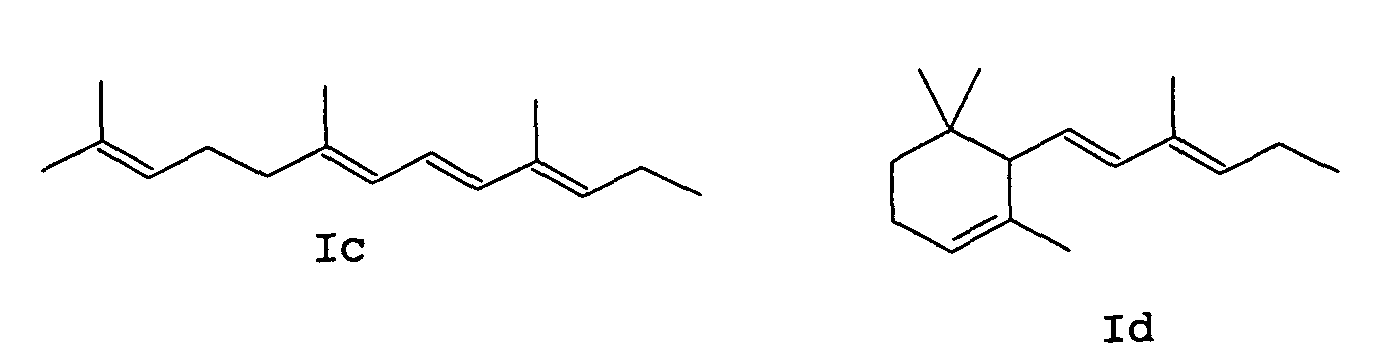
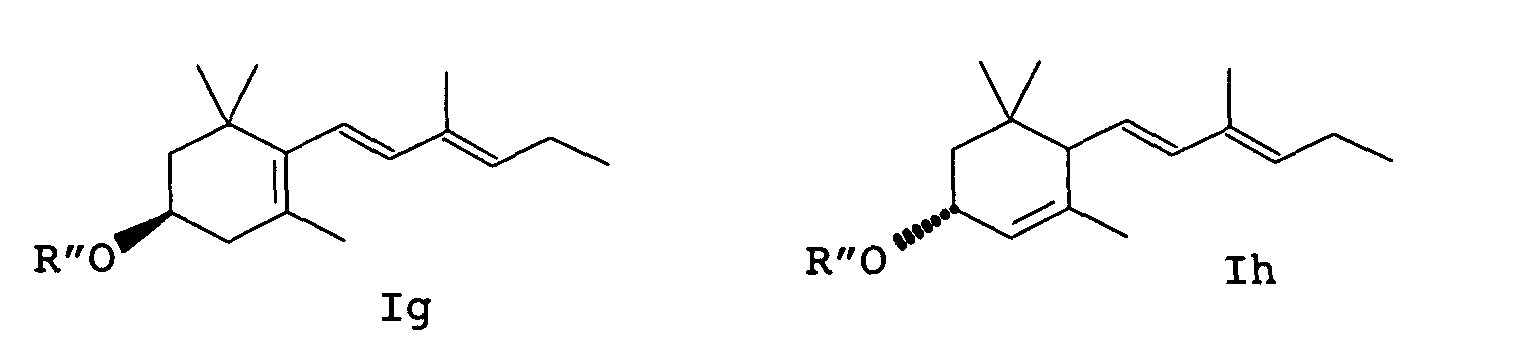
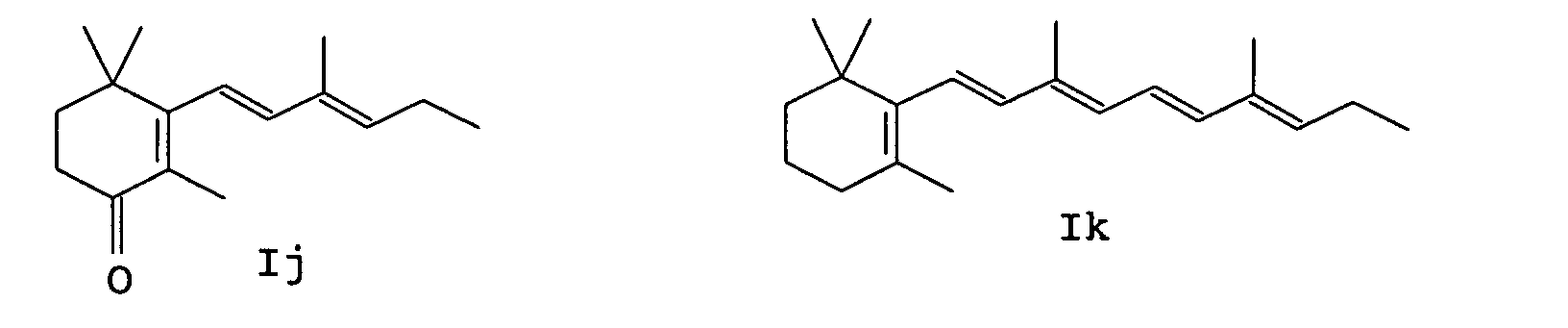
- R are the following radicals of the formulas Ia-Ik (in which R "stands for hydrogen or a hydroxy protective group, such as acyl, for example acetyl, propionyl or benzoyl; alkyl, for example methyl, ethyl or t-butyl ; Silyl, e.g. t-butyldimethylsilyl; or alkoxyalkyl, e.g. 2-methoxy-2-propyl or tetrahydropyranyl):
- R preferably represents a Jonylidenethylrest.
- the term "Jonylidenethyl” is to be understood comprehensively and encompass all C 15 residues which are derived from naturally occurring Jonons through the possession of two carbon atoms and / or can be regarded as degradation products of naturally occurring carotenoids.
- the phosphonium salts can be prepared in various ways. If R is a Jonylidenethylrest, they are advantageously obtained by reacting the corresponding vinyl ionol with at least one molar equivalent of phosphine of the formula PR ' 3 in a solvent in the presence of an acid.
- the vinyl ionols can in turn z. B. can be obtained from Jononen by reaction with Vinyl-Grignard.
- the phosphine is preferably used in excess, e.g. B. 1.1 to 3 equivalents. Triarylphosphines are preferred, most preferred is triphenylphosphine.
- the acid is preferably used in an excess of at least 3, in particular at least 8 equivalents. Suitable acids are C 1 -C 6 -alkanoic acids, boron trifluoride etherate, hydrochloric acid, hydrobromic acid, phosphoric acid or a sulfonic acid such as benzenesulfonic acid or toluenesulfonic acid. If an alkanoic acid, such as acetic acid, is used as the acid, this is expediently also used as a solvent.
- the process according to the invention is based on a solution of the crude phosphonium salt in a solvent, such as optionally chlorinated or aromatic hydrocarbons, ethers, alcohols or esters, such as hexane, dichloromethane, trichloromethane, benzene, toluene, xylene, diisopropyl ether, tetrahydrofuran, methanol, ethanol and the like , out.
- the crude phosphonium salt is particularly preferably in solution in a C 1 -C 6 -alkanoic acid, in particular acetic acid, or a mixture thereof with water.
- the cation exchanger In the cation exchanger according to the first aspect of the invention it is preferably a strongly acidic cation exchanger, the macroporous or gel-like, low or highly cross-linked can be.
- Polystyrene-based ion exchanger with sulfonic acid groups have proven particularly successful.
- Such ion exchangers are z. B. under the designation S1468, S100 from the Bayer or the name Amberlite IR-120, Amberlite 200 commercially available from Rohm and Haas.
- the phosphonium salt to be purified Before applying of the phosphonium salt to be purified becomes the cation exchanger into the salt form, d. H.
- the adsorber resin according to the second aspect of the invention has preferably an average pore size of 50 to 100 ⁇ , especially 60 to 100 ⁇ .
- Suitable adsorber resins are below other those based on polystyrene or polyacrylate. Polyacrylatadsorberharze are preferred.
- Suitable resins are below the designation XAD2, XAD4, XAD7, XAD16 from Rohm and Haas in trade available.
- a commercially available one Chromatography column in a conventional manner with a Ion exchange or adsorber resin suitable according to the invention packed.
- the resin material can, for example, be slurried in water and then filled into the column. The material is then compressed in a suitable manner and with the help of a Holding member fixed. Then the column becomes more common Pretreated by rinsing and equilibrating the resin.
- the raw phosphonium salt solution or the solvents and eluents can be in the direction of gravity or against the direction gravity over the bed of the cation exchanger or Adsorber resin are passed.
- the liquids are preferably conducted against the direction of gravity through the bed, a compression of the bed and an associated increase in pressure to prevent. It is advantageous to use a diaphragm pump for this, the pressure side with the lower end of the chromatography column connected is.
- the prepared chromatography column next becomes smaller Pump speed with a solution of the to be cleaned Load phosphonium salt.
- the temporary bond to that Resin material is based on an ionic in a cation exchanger Binding of the phosphonium cations to the anionic anchor groups of the ion exchanger, with a polymer resin on a reversible adsorption effect.
- the unwanted components removed by rinsing with suitable washing liquids.
- the method according to the first aspect of the invention is for washing with the polar protic solvent to remove polar Impurities such as B. excess alkanoic acid, and that Wash with the non-polar solvent to remove non-polar Impurities such as B. excess phosphine.
- the removal takes place polar contamination by rinsing with an electrolyte solution. The presence of the electrolyte is required in order to To reduce the solubility of the phosphonium salt, otherwise this would be eluted prematurely.
- Suitable polar protic solvents are those with a dielectric constant DK of 40 to 110 (with regard to the determination of the dielectric constant, reference is made to CRC Handbook of Chemistry and Physics, CRC Press, 76th ed., Pp. 6-159 to 6-192), which about have at least one hydrogen atom bonded to an oxygen or nitrogen atom.
- DK dielectric constant
- These include in particular water and C 1 -C 4 -alkanols, such as methanol or ethanol.
- Suitable non-polar solvents are those with a DK of 1 to 7. These include in particular aliphatic hydrocarbons, such as hexane, heptane, petroleum ether, or diethyl ether.
- Suitable polar non-protic solvents are those with a dielectric constant DK from 7 to 70. These include in particular halogenated hydrocarbons, such as dichloromethane, Trichloromethane, carbon tetrachloride, dichlorethylene, trichlorethylene, Dichloroethane, trichloroethane, tetrahydrofuran, dioxane or Dimethyl sulfoxide. Of these, dichloromethane is preferred.
- Suitable electrolyte solutions are solutions of salts in water, C 1 -C 4 alkanols or mixtures thereof.
- alkaline earth metal or alkali metal halides e.g. B. chlorides, sulfates or -C 1 -C 6 alkanoates.
- the sodium and potassium salts are generally preferred.
- Sodium chloride is most preferred.
- the salt concentration is preferably at least 2% by weight up to the saturation limit, usually 5 to 25% by weight.
- the Rinse column with a suitable eluent.
- the product eluted with an electrolytic solution.
- the electrolytic solution can optionally in combination with a polar non-protic Solvents are used.
- the electrolytic solution and the polar Non-protic solvents can be used as a mixture or alternately one after the other in any order, optionally in several servings. If the solvent is not miscible with the electrolyte solution, the organic Phase of the eluate expediently separated and to the desired Concentration evaporated.
- a polar solvent is preferred for elution, preferably a non-protic polar solvent.
- the eluate can then be evaporated to the desired concentration. The process generally yields more than 70%.
- the present invention will now be illustrated by the following examples further illustrated.
- the yield of the purified phosphonium salts and the ratios of E to Z isomers were determined by High pressure liquid chromatography (HPLC) using internal standards determined.
- HPLC High pressure liquid chromatography
- a chromatography column was 320 ml moistened with water Cation exchange material (Bayer Lewatit K2641) filled. The material was well compacted and with the help of a variable Fixed end piece. Then 150 g of crude triphenyl- (3,7,11-trimethyldodeca-2,4,6,10-tetraen-1-yl) phosphonium salt (about 26%; dissolved in 70 wt .-% aqueous acetic acid) with a ratio from E to Z isomers of 4.17 at a pumping rate of 150 ml / h applied to the column from below. After that was the column to remove the acetic acid with 1.35 l of deionized water rinsed.
- water Cation exchange material Biller Lewatit K2641
- the pumping speed during the rinsing process was 1500 ml / h.
- To remove unreacted triphenylphosphine was then rinsed with 1.0 l of n-heptane.
- the pumping speed was 1500 ml / h.
- the purified product was alternated four times with 250 ml each NaCl solution (10%) and 250 ml dichloromethane from the ion exchange material eluted and the phases separated.
- the organic Phase was concentrated to an approximately 25% solution.
- a chromatography column was 320 ml moistened with water Adsorber material based on polyacrylate (Rohm and Haas Amberlite XAD7) filled. The material was well compacted and with Fixed with the help of a variable end piece. Then 150 g of raw Triphenyl- (3,7,11-trimethyldodeca-2,4,6,10-tetraen-1-yl) phosphonium (about 26%; dissolved in 70% by weight aqueous acetic acid) with a ratio of E to Z isomers of 4.22 with one Pumping speed of 150 ml / h applied to the column.
- Adsorber material based on polyacrylate (Rohm and Haas Amberlite XAD7) filled. The material was well compacted and with Fixed with the help of a variable end piece. Then 150 g of raw Triphenyl- (3,7,11-trimethyldodeca-2,4,6,10-tetraen-1-yl) phosphonium (about 2
- the purified product was removed from the adsorbent material with 1.5 liters of dichloromethane eluted and the eluate to an approximately 25% solution concentrated.
- a chromatography column was filled with 350 ml of water-moist cation exchanger (Dowex 50 WX 2), the material was well compressed and fixed using a variable end piece.
- 100 g of crude triphenyl- (3,7,11-trimethyldodeca-2,4,6,10-tetraen-1-yl) phosphonium salt (about 23%; dissolved in 70% by weight aqueous acetic acid) with an E / Z ratio of 4.17 were pumped onto the column at a pumping rate of 150 ml / h.
- the mixture was then rinsed with 0.9 l of deionized water (pumping rate 1500 ml / h) to remove the acetic acid and with 1.0 l of n-heptane (pumping rate 1500 ml / h) to remove the triphenylphosphine.
- the purified product was eluted four times alternately with 250 ml of NaCl solution (10%) and 250 ml of dichloromethane from the ion exchange material, the phases were separated and the organic phase was concentrated to an approximately 25% solution. 15.9 g of purified C 15 phosphonium salt with an E / Z ratio of 4.18 were isolated by HPLC analysis (69% of theory).
- a chromatography column was filled with 350 ml of water-moist adsorber resin based on polystyrene (Rohm and Haas Amberlite XAD 16), the material was well compressed and fixed with a variable end piece.
Landscapes
- Chemical & Material Sciences (AREA)
- Organic Chemistry (AREA)
- Health & Medical Sciences (AREA)
- Life Sciences & Earth Sciences (AREA)
- Biochemistry (AREA)
- General Health & Medical Sciences (AREA)
- Molecular Biology (AREA)
- Organic Low-Molecular-Weight Compounds And Preparation Thereof (AREA)
Abstract
Description


Claims (14)
- Verfahren zur Reinigung von Phosphoniumsalzen der Formela) eine Lösung des rohen Phosphoniumsalzes über ein Bett eines Kationenaustauscherharzes in Salzform leitet,b) das Kationenaustauscherharz mit wenigstens einem polaren protischen oder nicht-protischen und/oder wenigstens einem unpolaren Lösungsmittel wäscht, undc) das Phosphoniumsalz mit einer einer Elektrolytlösung, gegebenenfalls in Kombination mit einem polaren nicht-protischen Lösungsmittel, vom Kationenaustauscherharz eluiert.
- Verfahren nach Anspruch 1, wobei R eine bis 8 Isopreneinheiten umfasst.
- Verfahren nach Anspruch 2, wobei R für einen Jonylidenethylrest steht.
- Verfahren nach Anspruch 3, wobei R für 3,7,11-Trimethyldodeca-2,4,6,10-tetraen-1-yl steht.
- Verfahren nach einem der vorhergehenden Ansprüche, wobei das polare protische Lösungsmittel unter Wasser und C1-C4-Alkanolen und das unpolare Lösungsmittel unter aliphatischen Kohlenwasserstoffen und Diethylether ausgewählt ist.
- Verfahren nach einem der vorhergehenden Ansprüche, wobei man das polare nicht-protische Lösungsmittel unter halogenierten Kohlenwasserstoffen, Tetrahydrofuran, Dioxan und Dimethylsulfoxid ausgewählt ist.
- Verfahren nach einem der vorhergehenden Ansprüche, wobei es sich bei der Elektrolytlösung um eine wässrige Natriumchloridlösung handelt.
- Verfahren zur Reinigung von Phosphoniumsalzen der Formela) eine Lösung des rohen Phosphoniumsalzes über ein Bett eines Adsorberharzes leitet,b) das Adsorberharz mit wenigstens einem unpolaren Lösungsmittel und/oder wenigstens einer Elektrolytlösung wäscht, undc) das Phosphoniumsalz mit einem polaren Lösungsmittel von dem Adsorberharz eluiert.
- Verfahren nach Anspruch 8, wobei man als Adsorberharz ein Polyacrylat- oder Polystyrol-Adsoberharz verwendet.
- Verfahren nach Anspruch 8 oder 9, wobei R eine bis 8 Isopreneinheiten umfasst.
- Verfahren nach Anspruch 10, wobei R für einen Jonylidenethylrest steht.
- Verfahren nach Anspruch 11, wobei R für 3,7,11-Trimethyldodeca-2,4,6,10-tetraen-1-yl steht.
- Verfahren nach einem der Ansprüche 8 bis 12, wobei das unpolare Lösungsmittel unter aliphatischen Kohlenwasserstoffen und Diethylether ausgewählt ist und es sich bei der Elektrolytlösung um eine wenigstens 2 gew.-%ige wässrige Natriumchloridlösung handelt.
- Verfahren nach einem der Ansprüche 8 bis 13, wobei das polare Lösungsmittel unter halogenierten Kohlenwasserstoffen, Tetrahydrofuran, Dioxan und Dimethylsulfoxid ausgewählt ist.
Applications Claiming Priority (2)
| Application Number | Priority Date | Filing Date | Title |
|---|---|---|---|
| DE10129403 | 2001-06-19 | ||
| DE10129403A DE10129403A1 (de) | 2001-06-19 | 2001-06-19 | Verfahren zur Reinigung von Phosphoniumsalzen |
Publications (2)
| Publication Number | Publication Date |
|---|---|
| EP1270583A1 true EP1270583A1 (de) | 2003-01-02 |
| EP1270583B1 EP1270583B1 (de) | 2007-10-31 |
Family
ID=7688603
Family Applications (1)
| Application Number | Title | Priority Date | Filing Date |
|---|---|---|---|
| EP02013630A Expired - Lifetime EP1270583B1 (de) | 2001-06-19 | 2002-06-19 | Verfahren zur Reinigung von Phosphoniumsalzen |
Country Status (6)
| Country | Link |
|---|---|
| US (1) | US6630605B2 (de) |
| EP (1) | EP1270583B1 (de) |
| JP (1) | JP2003012681A (de) |
| CN (1) | CN1392152A (de) |
| AT (1) | ATE377016T1 (de) |
| DE (2) | DE10129403A1 (de) |
Families Citing this family (2)
| Publication number | Priority date | Publication date | Assignee | Title |
|---|---|---|---|---|
| EP2130833A1 (de) * | 2008-06-05 | 2009-12-09 | DSM IP Assets B.V. | Verfahren zur Herstellung von Zeacarotinen |
| CN116712755A (zh) * | 2023-05-09 | 2023-09-08 | 江西天新药业股份有限公司 | 膦盐分离提纯的方法、膦盐及由其制得的维生素a醋酸酯 |
Citations (3)
| Publication number | Priority date | Publication date | Assignee | Title |
|---|---|---|---|---|
| DE3708041A1 (de) * | 1986-03-12 | 1987-10-08 | Hokko Chem Ind Co | Verfahren zum herstellen von quaternaerem phosphoniumhydroxid |
| JPS63190893A (ja) * | 1987-02-03 | 1988-08-08 | Daicel Chem Ind Ltd | ホスホニウムカルボン酸塩の製法 |
| EP0382067A1 (de) * | 1989-02-10 | 1990-08-16 | F. Hoffmann-La Roche Ag | 3,7,11-Trimethyldodeca-2,4,6,10-tetraen-1-yl-phosphoniumsalze |
Family Cites Families (9)
| Publication number | Priority date | Publication date | Assignee | Title |
|---|---|---|---|---|
| BE639829A (de) * | 1962-11-16 | |||
| US3432559A (en) * | 1965-06-04 | 1969-03-11 | Monsanto Co | Process for preparing quaternary phosphonium halides |
| US3932485A (en) * | 1974-08-28 | 1976-01-13 | Hoffmann-La Roche Inc. | Improved preparation of Wittig salt of vinyl β-ionol |
| CH616688A5 (de) * | 1974-12-05 | 1980-04-15 | Hoechst Ag | |
| US4098827A (en) * | 1977-01-17 | 1978-07-04 | Hoffmann-La Roche Inc. | 1-(2,6,6-Trimethyl-3-hydroxy-1-cyclohexen-1-yl)-3-methyl-penta-1,4-diene[or 1-yn-4-EN]-3-ols |
| CA1101431A (en) * | 1977-06-18 | 1981-05-19 | Bernhard Schulz | Preparation of aqueous solutions or fine aqueous dispersions of polyenyltriarylphosphonium salts |
| DE19734446A1 (de) * | 1997-08-08 | 1999-02-11 | Basf Ag | Verfahren zur Herstellung von Phosphoniumsalzen |
| SG77658A1 (en) * | 1997-11-21 | 2001-01-16 | Ube Indusries Ltd | Preparation of organic phosphonium chloride |
| DE10009459C1 (de) * | 2000-03-02 | 2001-06-07 | Basf Ag | Verfahren zur Herstellung von Phosphoniumsalzen |
-
2001
- 2001-06-19 DE DE10129403A patent/DE10129403A1/de not_active Withdrawn
-
2002
- 2002-06-05 US US10/161,682 patent/US6630605B2/en not_active Expired - Fee Related
- 2002-06-18 CN CN02121389.5A patent/CN1392152A/zh active Pending
- 2002-06-18 JP JP2002177680A patent/JP2003012681A/ja active Pending
- 2002-06-19 DE DE50211128T patent/DE50211128D1/de not_active Expired - Fee Related
- 2002-06-19 EP EP02013630A patent/EP1270583B1/de not_active Expired - Lifetime
- 2002-06-19 AT AT02013630T patent/ATE377016T1/de not_active IP Right Cessation
Patent Citations (3)
| Publication number | Priority date | Publication date | Assignee | Title |
|---|---|---|---|---|
| DE3708041A1 (de) * | 1986-03-12 | 1987-10-08 | Hokko Chem Ind Co | Verfahren zum herstellen von quaternaerem phosphoniumhydroxid |
| JPS63190893A (ja) * | 1987-02-03 | 1988-08-08 | Daicel Chem Ind Ltd | ホスホニウムカルボン酸塩の製法 |
| EP0382067A1 (de) * | 1989-02-10 | 1990-08-16 | F. Hoffmann-La Roche Ag | 3,7,11-Trimethyldodeca-2,4,6,10-tetraen-1-yl-phosphoniumsalze |
Non-Patent Citations (1)
| Title |
|---|
| PATENT ABSTRACTS OF JAPAN vol. 012, no. 472 (C - 551) 9 December 1988 (1988-12-09) * |
Also Published As
| Publication number | Publication date |
|---|---|
| US6630605B2 (en) | 2003-10-07 |
| CN1392152A (zh) | 2003-01-22 |
| EP1270583B1 (de) | 2007-10-31 |
| DE50211128D1 (de) | 2007-12-13 |
| JP2003012681A (ja) | 2003-01-15 |
| DE10129403A1 (de) | 2003-01-02 |
| US20020193637A1 (en) | 2002-12-19 |
| ATE377016T1 (de) | 2007-11-15 |
Similar Documents
| Publication | Publication Date | Title |
|---|---|---|
| DE19932771A1 (de) | Verfahren zur Eluierung fluorierter Emulgatoren | |
| DE1817812B2 (de) | Komplexbildner | |
| EP0382067B1 (de) | 3,7,11-Trimethyldodeca-2,4,6,10-tetraen-1-yl-phosphoniumsalze | |
| EP1270583B1 (de) | Verfahren zur Reinigung von Phosphoniumsalzen | |
| DD201672A5 (de) | Verfahren zur herstellung von estern beta, gamma-ungesaettigter carbonsaeuren | |
| CH641446A5 (de) | Cyclohexenderivate. | |
| DE1618019A1 (de) | Verfahren zur Herstellung von Bi-[ss-(N.N-dimethylamino)-alkyl-aether | |
| DE3609492A1 (de) | Verfahren zur herstellung von phosphorsaeureestern | |
| DE2311388A1 (de) | Rhodium-katalysatoren | |
| DE2156862C3 (de) | Verfahren zur Herstellung von Gemischen aus trans-L- und cis-L-T-Desmethyl-4'-despropyl-4'-alkyI--lincomycinen oder -clindamycinen | |
| DE68912100T4 (de) | 4,4,5,8-Tetramethyl-1-oxaspiro(2.5)octan, Verfahren zu seiner Herstellung und seine Verwendung als Ausgangsprodukt in der Herstellung von 2,2,3,6-Tetramethyl-cyclohexan-carboxaldehyd. | |
| DE3708041C2 (de) | ||
| EP0143416B1 (de) | Verfahren zur Isolierung von Alkalisulfat-armen Paraffinsulfonaten und Schwefelsäure aus Paraffin-Sulfoxidation-Reaktionsgemischen | |
| Petersson | Branched deoxyaldaric acids from alkaline degradation of carbohydrates: structure determination by mass spectrometry of trimethylsilyl derivatives | |
| DE1197085B (de) | Verfahren zur Herstellung von Triaryl-phosphoniumsalzen | |
| DE60002922T2 (de) | Verfahren zur herstellung und isolierung von 9-deoxo-9(z)-hydroxyiminoerythromycin a | |
| DE2461906C3 (de) | Phosphinoxide mit polyfluorierter Kette und Verfahren zu ihrer Herstellung | |
| DE2630783B2 (de) | Verfahren zur Abtrennung von Acetylenverbindungen | |
| DE19637429A1 (de) | Verfahren zur Herstellung von Cyclopentanolen | |
| DE2624340C2 (de) | Verfahren zur Herstellung von 1,1-Dihalogen-1,3-dienen | |
| EP0037016B1 (de) | Verfahren zur Extraktion und Gewinnung von Thioglycolsäure aus wässrigen Medien | |
| DE69308826T2 (de) | Aufarbeitung von Wittig-Reaktionsprodukten | |
| DE10227432B4 (de) | Verfahren zur Trennung von Kohlenhydratcarbonsäuren | |
| Lam et al. | Fatty acids: VI. The thin-layer chromatographic behaviour of mercury adducts of acetylenic esters and a study of the demercurated products | |
| WO1994021654A1 (de) | Verfahren zur herstellung von zuckeracetalen__________________ |
Legal Events
| Date | Code | Title | Description |
|---|---|---|---|
| PUAI | Public reference made under article 153(3) epc to a published international application that has entered the european phase |
Free format text: ORIGINAL CODE: 0009012 |
|
| AK | Designated contracting states |
Kind code of ref document: A1 Designated state(s): AT BE CH CY DE DK ES FI FR GB GR IE IT LI LU MC NL PT SE TR |
|
| AX | Request for extension of the european patent |
Free format text: AL;LT;LV;MK;RO;SI |
|
| 17P | Request for examination filed |
Effective date: 20030702 |
|
| AKX | Designation fees paid |
Designated state(s): AT BE CH CY DE DK ES FI FR GB GR IE IT LI LU MC NL PT SE TR |
|
| AXX | Extension fees paid |
Extension state: RO Payment date: 20030702 Extension state: SI Payment date: 20030702 |
|
| 17Q | First examination report despatched |
Effective date: 20061123 |
|
| 17Q | First examination report despatched |
Effective date: 20061123 |
|
| GRAP | Despatch of communication of intention to grant a patent |
Free format text: ORIGINAL CODE: EPIDOSNIGR1 |
|
| GRAS | Grant fee paid |
Free format text: ORIGINAL CODE: EPIDOSNIGR3 |
|
| GRAA | (expected) grant |
Free format text: ORIGINAL CODE: 0009210 |
|
| AK | Designated contracting states |
Kind code of ref document: B1 Designated state(s): AT BE CH CY DE DK ES FI FR GB GR IE IT LI LU MC NL PT SE TR |
|
| AX | Request for extension of the european patent |
Extension state: RO SI |
|
| REG | Reference to a national code |
Ref country code: GB Ref legal event code: FG4D Free format text: NOT ENGLISH |
|
| REG | Reference to a national code |
Ref country code: IE Ref legal event code: FG4D Free format text: LANGUAGE OF EP DOCUMENT: GERMAN |
|
| REG | Reference to a national code |
Ref country code: CH Ref legal event code: EP |
|
| REF | Corresponds to: |
Ref document number: 50211128 Country of ref document: DE Date of ref document: 20071213 Kind code of ref document: P |
|
| RAP2 | Party data changed (patent owner data changed or rights of a patent transferred) |
Owner name: BASF SE |
|
| NLV1 | Nl: lapsed or annulled due to failure to fulfill the requirements of art. 29p and 29m of the patents act | ||
| PG25 | Lapsed in a contracting state [announced via postgrant information from national office to epo] |
Ref country code: ES Free format text: LAPSE BECAUSE OF FAILURE TO SUBMIT A TRANSLATION OF THE DESCRIPTION OR TO PAY THE FEE WITHIN THE PRESCRIBED TIME-LIMIT Effective date: 20080211 Ref country code: SE Free format text: LAPSE BECAUSE OF FAILURE TO SUBMIT A TRANSLATION OF THE DESCRIPTION OR TO PAY THE FEE WITHIN THE PRESCRIBED TIME-LIMIT Effective date: 20080131 Ref country code: NL Free format text: LAPSE BECAUSE OF FAILURE TO SUBMIT A TRANSLATION OF THE DESCRIPTION OR TO PAY THE FEE WITHIN THE PRESCRIBED TIME-LIMIT Effective date: 20071031 |
|
| GBV | Gb: ep patent (uk) treated as always having been void in accordance with gb section 77(7)/1977 [no translation filed] | ||
| PG25 | Lapsed in a contracting state [announced via postgrant information from national office to epo] |
Ref country code: PT Free format text: LAPSE BECAUSE OF FAILURE TO SUBMIT A TRANSLATION OF THE DESCRIPTION OR TO PAY THE FEE WITHIN THE PRESCRIBED TIME-LIMIT Effective date: 20080331 |
|
| REG | Reference to a national code |
Ref country code: IE Ref legal event code: FD4D |
|
| PG25 | Lapsed in a contracting state [announced via postgrant information from national office to epo] |
Ref country code: DK Free format text: LAPSE BECAUSE OF FAILURE TO SUBMIT A TRANSLATION OF THE DESCRIPTION OR TO PAY THE FEE WITHIN THE PRESCRIBED TIME-LIMIT Effective date: 20071031 |
|
| EN | Fr: translation not filed | ||
| PLBE | No opposition filed within time limit |
Free format text: ORIGINAL CODE: 0009261 |
|
| STAA | Information on the status of an ep patent application or granted ep patent |
Free format text: STATUS: NO OPPOSITION FILED WITHIN TIME LIMIT |
|
| 26N | No opposition filed |
Effective date: 20080801 |
|
| PG25 | Lapsed in a contracting state [announced via postgrant information from national office to epo] |
Ref country code: FR Free format text: LAPSE BECAUSE OF FAILURE TO SUBMIT A TRANSLATION OF THE DESCRIPTION OR TO PAY THE FEE WITHIN THE PRESCRIBED TIME-LIMIT Effective date: 20080704 Ref country code: IE Free format text: LAPSE BECAUSE OF FAILURE TO SUBMIT A TRANSLATION OF THE DESCRIPTION OR TO PAY THE FEE WITHIN THE PRESCRIBED TIME-LIMIT Effective date: 20071031 |
|
| PG25 | Lapsed in a contracting state [announced via postgrant information from national office to epo] |
Ref country code: GB Free format text: LAPSE BECAUSE OF FAILURE TO SUBMIT A TRANSLATION OF THE DESCRIPTION OR TO PAY THE FEE WITHIN THE PRESCRIBED TIME-LIMIT Effective date: 20071031 |
|
| BERE | Be: lapsed |
Owner name: BASF A.G. Effective date: 20080630 |
|
| PG25 | Lapsed in a contracting state [announced via postgrant information from national office to epo] |
Ref country code: GR Free format text: LAPSE BECAUSE OF FAILURE TO SUBMIT A TRANSLATION OF THE DESCRIPTION OR TO PAY THE FEE WITHIN THE PRESCRIBED TIME-LIMIT Effective date: 20080201 Ref country code: MC Free format text: LAPSE BECAUSE OF NON-PAYMENT OF DUE FEES Effective date: 20080630 |
|
| REG | Reference to a national code |
Ref country code: CH Ref legal event code: PL |
|
| PG25 | Lapsed in a contracting state [announced via postgrant information from national office to epo] |
Ref country code: FI Free format text: LAPSE BECAUSE OF FAILURE TO SUBMIT A TRANSLATION OF THE DESCRIPTION OR TO PAY THE FEE WITHIN THE PRESCRIBED TIME-LIMIT Effective date: 20071031 |
|
| PG25 | Lapsed in a contracting state [announced via postgrant information from national office to epo] |
Ref country code: BE Free format text: LAPSE BECAUSE OF NON-PAYMENT OF DUE FEES Effective date: 20080630 |
|
| PG25 | Lapsed in a contracting state [announced via postgrant information from national office to epo] |
Ref country code: DE Free format text: LAPSE BECAUSE OF NON-PAYMENT OF DUE FEES Effective date: 20090101 |
|
| PG25 | Lapsed in a contracting state [announced via postgrant information from national office to epo] |
Ref country code: LI Free format text: LAPSE BECAUSE OF NON-PAYMENT OF DUE FEES Effective date: 20080630 Ref country code: CH Free format text: LAPSE BECAUSE OF NON-PAYMENT OF DUE FEES Effective date: 20080630 |
|
| PG25 | Lapsed in a contracting state [announced via postgrant information from national office to epo] |
Ref country code: CY Free format text: LAPSE BECAUSE OF FAILURE TO SUBMIT A TRANSLATION OF THE DESCRIPTION OR TO PAY THE FEE WITHIN THE PRESCRIBED TIME-LIMIT Effective date: 20071031 |
|
| PG25 | Lapsed in a contracting state [announced via postgrant information from national office to epo] |
Ref country code: AT Free format text: LAPSE BECAUSE OF NON-PAYMENT OF DUE FEES Effective date: 20080619 |
|
| PG25 | Lapsed in a contracting state [announced via postgrant information from national office to epo] |
Ref country code: LU Free format text: LAPSE BECAUSE OF NON-PAYMENT OF DUE FEES Effective date: 20080619 |
|
| PG25 | Lapsed in a contracting state [announced via postgrant information from national office to epo] |
Ref country code: TR Free format text: LAPSE BECAUSE OF FAILURE TO SUBMIT A TRANSLATION OF THE DESCRIPTION OR TO PAY THE FEE WITHIN THE PRESCRIBED TIME-LIMIT Effective date: 20071031 |
|
| PG25 | Lapsed in a contracting state [announced via postgrant information from national office to epo] |
Ref country code: IT Free format text: LAPSE BECAUSE OF NON-PAYMENT OF DUE FEES Effective date: 20080630 |