EP1264883A2 - Glukose-Isomerasen mit geänderter Substratspezifität - Google Patents
Glukose-Isomerasen mit geänderter Substratspezifität Download PDFInfo
- Publication number
- EP1264883A2 EP1264883A2 EP02018565A EP02018565A EP1264883A2 EP 1264883 A2 EP1264883 A2 EP 1264883A2 EP 02018565 A EP02018565 A EP 02018565A EP 02018565 A EP02018565 A EP 02018565A EP 1264883 A2 EP1264883 A2 EP 1264883A2
- Authority
- EP
- European Patent Office
- Prior art keywords
- glucose isomerase
- glucose
- mutant
- naturally occurring
- xylose
- Prior art date
- Legal status (The legal status is an assumption and is not a legal conclusion. Google has not performed a legal analysis and makes no representation as to the accuracy of the status listed.)
- Granted
Links
Images

Classifications
-
- C—CHEMISTRY; METALLURGY
- C12—BIOCHEMISTRY; BEER; SPIRITS; WINE; VINEGAR; MICROBIOLOGY; ENZYMOLOGY; MUTATION OR GENETIC ENGINEERING
- C12N—MICROORGANISMS OR ENZYMES; COMPOSITIONS THEREOF; PROPAGATING, PRESERVING, OR MAINTAINING MICROORGANISMS; MUTATION OR GENETIC ENGINEERING; CULTURE MEDIA
- C12N9/00—Enzymes; Proenzymes; Compositions thereof; Processes for preparing, activating, inhibiting, separating or purifying enzymes
- C12N9/90—Isomerases (5.)
- C12N9/92—Glucose isomerase (5.3.1.5; 5.3.1.9; 5.3.1.18)
-
- C—CHEMISTRY; METALLURGY
- C12—BIOCHEMISTRY; BEER; SPIRITS; WINE; VINEGAR; MICROBIOLOGY; ENZYMOLOGY; MUTATION OR GENETIC ENGINEERING
- C12N—MICROORGANISMS OR ENZYMES; COMPOSITIONS THEREOF; PROPAGATING, PRESERVING, OR MAINTAINING MICROORGANISMS; MUTATION OR GENETIC ENGINEERING; CULTURE MEDIA
- C12N9/00—Enzymes; Proenzymes; Compositions thereof; Processes for preparing, activating, inhibiting, separating or purifying enzymes
Definitions
- the present invention relates to the application of protein engineering technology to improve the properties of enzymes. Specifically, the present invention discloses a method for selecting amino acids which upon substitution give rise to an altered substrate specificity. The method is applied to glucose isomerases. In another aspect the invention provides glucose isomerases with an altered substrate specificity. These new glucose isomerases can advantageously be used in industrial processes, for example in the production of high fructose corn syrups (HFCS).
- HFCS high fructose corn syrups
- Glucose isomerases catalyze the reversible isomerization of glucose to fructose.
- Fructose is nowadays commonly applied as sugar substitute due to its higher sweetness compared to e.g. sucrose and glucose.
- glucose isomerases also show a high affinity for sugars other than glucose.
- D-xylose, D-ribose, L-arabinose, D-allose and 6-deoxyglucose were found to be substrates of this enzyme.
- the K m values of D-glucose, D-xylose and D-ribose were shown to vary from microorganism to microorganism and were reported to be in the range, of 0.086-0.920, 0.005-0.093 and 0.35-0.65 M, respectively.
- the K m values for xylose are significantly lower than for glucose, which implies that the correct name for the enzyme is in fact xylose isomerase. Furthermore, the V max of the commonly used glucose isomerases is higher on xylose than on glucose, which also suggest that xylose isomerase is a better name.
- glucose isomerase is active on different substrates it may be advantageous to alter the substrate specificity depending on the desired reaction product, the specific process in which it is used or the wish to avoid unwanted side-products.
- the digestibility and the taste of feed for monogastric animals can be improved if glucose is converted enzymatically into fructose.
- glucose isomerase is hampered by the xylose isomerisation activity, which causes an unwanted formation of xylulose in feed.
- a glucose isomerase with no or reduced specificity (V max or K m ) for xylose would be preferred for application in feed pretreatment.
- subtilisin Bacillus licheniformis and B. amyloliquefaciens serine proteases differ by 31% (86 amino acid residues) in protein sequence and by a factor of 60 in catalytic efficiency on certain substrates. By substituting 3 of the 86 different amino acids from the B . amyloliquefaciens sequence by the corresponding B . licheniformis residues the catalytic activity of the mutant enzyme was improved nearly 60 fold.
- glucose isomerase no naturally occurring enzyme is known, which shows a better specificity for glucose than for xylose.
- the above-mentioned method based on the comparison of active sites of homologous enzymes having a different substrate specificity, can therefore not be applied to glucose isomerase.
- WO 89/01520 (Cetus) lists a number of muteins of the xylose isomerase which may be obtained from Streptomyces rubiginosus and that may have an increased stability. The selection of possible sites that may be mutated is based on criteria differing from the ones used in the present invention. More than 300 mutants are listed but no data are presented concerning the characteristics and the alterations therein of the mutant enzyme molecules.
- the present invention discloses a method for selecting amino acids which upon replacement lead to an altered substrate specificity of a given enzyme. This method, which is generally applicable, is used to alter the substrate specificity of glucose isomerase.
- the invention also provides glucose isomerases with altered substrate specificities.
- This altered substrate specificity is expressed in terms of an altered substrate binding capacity and/or an altered catalytic activity.
- mutant glucose isomerases are provided with both an absolute and a relative change in substrate binding capacity and catalytic activity on glucose and xylose as substrates.
- mutant glucose isomerases are provided which show that parameters, such as, increased stability (expressed in terms of decay constant) and altered substrate specificity can be combined into a single molecule by adding the respective mutations that have these effects.
- the mutant glucose isomerases are obtained by the expression of a gene encoding said glucose isomerase enzyme having an amino acid sequence which differs at least in one amino acid from the wildtype glucose isomerase enzyme.
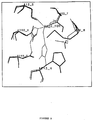
- Figure 1 shows a schematic representation of the active site of glucose isomerase from Actinoplanes missouriensis , derived from the three dimensional structure of the glucose isomerase - xylitol complex.
- the inhibitor is shown in ful] detail in the centre of the figure.
- Residue names are in boxes drawn with solid lines, solvent molecules in boxes drawn with dashed lines
- Metal binding sites are represented by ovals numbered 395 and 580. Dashed lines indicate electrostatic interactions: the thin dotted lines represent hydrogen bonds, the fat dashed lines the proposed ligation of the metals.
- Strictly conserved residues are marked by an asterix. For non-conserved residues the substitutions found in nature are indicated.
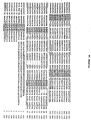
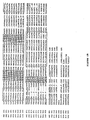
- Figure 2 shows the alignment of the amino acid sequences of glucose isomerases obtained from different microorganisms.
- the complete sequence of Actinoplanes missouriensis glucose isomerase is given.
- the amino acid sequence of Ampullariella glucose isomerase differs from that of the published sequences (Saari, J. Bacteriol., 169 , (1987) 612) by one residue: Proline 177 in the published sequence was found to be Arginine.
- Streptomyces thermovulgaris sequence has only been established upto amino acid 346. Undetermined residues are left blank. A dot indicates the absence of an amino acid residue at this position as compared to any of the other sequences.
- the different species are indicated by the following symbols:
- Figure 3 shows a comparison of the H290N mutant (bold) with the wildtype-sorbitol-Mg structure.
- the present invention discloses a method for selecting amino acids, in an enzyme, that upon substitution give rise to an altered substrate specificity.
- the DNA seqence encoding this enzyme is altered in such a way that the encoded enzyme has one or more selected amino acid replacements.
- the altered DNA is expressed in a desired host/vector system.
- a rational approach is taken, relying on the well coordinated application of protein crystallography, molecular modelling and computational methods, enzymology and kinetics, molecular biology and protein chemistry techniques.
- Changes in substrate specificity according to the present invention include all combinations of increase and decrease of V max and K m for both glucose and xylose. A person skilled in the art will understand that this encompasses the changes in other kinetic parameters. Furthermore, the specificities for other substrates will inherently be changed also. The proposed rules for changing the substrate specificity are not restricted to the mentioned substrates, they can be applied to other substrates. Among these are, D-ribose, L-arabinose, D-allose and 6-deoxyglucose.
- the selected amino acid replacements can be engineered in the DNA encoding the glucose isomerase by methods well known to a person skilled in the art (e.g. site-directed mutagenesis).
- the DNA encoding the glucose isomerase or its mutants may be cloned on an expression vector and this construct may be transformed to a host wherein the gene is expressed, the mRNA translated and preferably the mature protein, or a precursor, secreted from the cell. Subsequently the protein can be purified. Standard procedures can be found in Maniatis et al. (Cold Spring Harbor, 1st and 2nd edition, 1982 and 1989 respectively).
- mutant glucose isomerase enzymes obtained by the expression of a gene encoding said glucose isomerase enzyme having an amino acid sequence which differs at least in one amino acid from the wildtype glucose isomerase enzyme, which mutant glucose isomerase enzyme is characterized in that it exhibits an altered substrate specificity.
- double mutants instead of single mutants also double mutants may be obtained. Some of these double mutants, aimed at combining the desired properties, show that the properties are at least partially cumulative.
- the substrate specificity of the new enzymes can be tested on the substrate that is necessary for the desired application.
- special attention is paid to the kinetic parameters concerning glucose and xylose as a substrate and also to the relative changes in these parameters.
- Figure 1 shows a schematic map of residues around the active site of A. missouriensis . In the following methods are described to design mutants which have a higher relative specificity for glucose compared to the wildtype enzyme.
- Single substitutions at these sites and/or combinations of substitutions at the different sites may lead to an improved activity either through relief of steric hindrance or by the modulation of polarity of the sugar environment.
- Different properties such as modulating the affinity and/or catalytic efficiency for various substrates may be altered in this way.
- the hydrophobic side chains 16Trp, 88Met, 135Val are unable to solvate the hydroxyl group.
- the hydroxyl group of the 90Thr side chain is rotated away, exposing its methyl group to the inhibitor.
- the water molecule (491) bridges O6 and O4 of the sorbitol.
- the active site contains a number of water molecules bound at positions roughly corresponding to the positions of the O1, O2, O3, O4 and O5 of the inhibitor in the enzyme-sorbitol-cobalt complex.
- the environment corresponding to the 06 position is not able to accommodate a water molecule. This provides additional evidence that the hydroxyl group on C6 is not properly solvated.
- substitutions which have been made in the collection of target residues were aimed to increase the polarity of the environment of the substrate hydroxyl groups, particularly of the O6, and to increase the flexibility of the active site to accommodate the larger substrate.
- the removing or shifting of bound water molecules in the active site of mutant H290N is correlated with the observed increase in activity for glucose. Similar effects may be obtained by shifting other bound water molecules. Water molecules which are in a sphere of 4 ⁇ around atoms O3, O4, O5 or O6 of the substrate are candidates to be removed or shifted by mutating neighbouring amino acids.
- D-glucose isomerase is synonymously used for D-xylose isomerase (D-xylose) ketol-isomerase (EC 5.3.1.5), an enzyme that converts D-xylose into D-xylulose.
- the D-glucose isomerase from Actinoplanes missouriensis produced by engineered E . coli strains is designated as EcoAmi (DSM) GI.
- DSM EcoAmi
- GI EcoAmi
- EP-A-0351029 specifically describes most of the techniques applied in this application and it is therefore incorporated herein by reference.
- the enzymatic activity of glucose isomerase was assayed as described below (1 unit of enzymatic activity produces 1.0 micromole of product -D-xylulose or D-fructose- per minute; therefore, specific activity -spa- is expressed as units per mg of GI enzymes).
- GI activity was assayed directly by measuring the increase in absorbance at 278 nm of xylulose produced at 35°C by isomerisation of xylose by glucose isomerases.
- This assay was performed in 50 mM triethanolamine buffer, pH 7.5, containing 10mM MgSO 4 , in the presence of 0.1 M xylose.
- the final concentration of glucose isomerase in the assay was ⁇ 0.01 mg/ml, this concentration was precisely determined, prior to dilution in the enzymatic assay mixture, by absorption spectroscopy using an extinction coefficient of 1.08 at 278 nm for a solution of enzyme of 1.0 mg/ml.
- D-Sorbitol Dehydrogenase Coupled Assay enzymatic determination of D-xylulose was performed at 35°C as previously described (Kersters-Hilderson et al ., Enzyme Microb. Technol. 9 (1987) 145) in 50mM triethanolamine, pH 7.5, 10mM MgSO 4 , and 0.1 M xylose, in the presence of ⁇ 2 x 10 -8 M D-sorbitol dehydrogenase (L-iditol : NAD oxido-reductase, EC 1.1.14), and 0.15 mM NADH.
- the final concentration of glucose isomerase in this assay was ⁇ 2.5 x 10 -3 mg/ml, this concentration was precisely determined as described above.
- GI activity can be assayed by the measurement of D-fructose produced during the isomerization reaction using the cysteine-carbazole method (CCM) which is based on the reaction of ketosugars with carbazole in acids to yield a purple product (Dische and Borenfreund, J. Biol. Chem. 192 (1951) 583).
- CCM cysteine-carbazole method
- the D-fructose produced during the isomerization reaction can be determined enzymatically using sorbitol dehydrogenase and NADH.
- V max /K m As a measure of specificity the quotient V max /K m is sometimes used (Wells et al ., ibid). For mutants the V max /K m values for xylose and for glucose were routinely calculated. Measurements for xylose parameters are carried out at 35°C, whereas glucose parameters are determined at 60°C. These temperatures are chosen for practical reasons. To find out whether conclusions about relative specificity are generally applicable independent of the measurement temperature, some measurements on xylose were performed at 60°C for both wildtype and mutant enzymes. It was found that conclusions that could be drawn concerning steady-state kinetic parameters at 60°C were similar to those at 35°C.
- Table 3 summarizes measured K m values from various mutants compared to wildtype enzyme. It can be seen that all of these mutants have a lower K m for glucose. This means that the binding of the substrate glucose is enhanced. Moreover, for some of the mutants the K m for xylose has not improved but became worse, as exemplified in Table 2. Thus, mutants M88S, T90S, T90SV135Q, V135Q, H290N, K294Q, H243N have acquired a better K m xylose/K m glucose ratio as compared to the wild-type enzyme.
- Example 3 Glucose isomerases with enhanced catalytic activity on glucose
- Glucose isomerase mutants with enhanced catalytic activity on glucose are E186D, L258K, H290N and combined mutations with H290N.
- L258K was not selected using the criteria described in the general methods as the leucine at position 258 is about 10 ⁇ away from the substrate or inhibitor.
- V max relative to wildtype V max is shown. An increase from 8,9% to 43% is shown. This will give rise to a faster isomerisation of the preferred substrate glucose.
- the V max for glucose is expressed in micromoles/min/mg.
- Mutant H290N shows a V max for glucose of 41.80 which is significantly better than the wildtype enzyme. Moreover, the V max xylose has not improved. The ratio V max glucose/V max xylose of H290N has therefore been improved, rendering this mutant more into a "true" glucose isomerase.
- the hydroxyl group of 52Thr hydrogen bonded to ne2 of 290His in the w.t. structures, can no longer hydrogen bond to 290Asn.
- the introduction of a water molecule at this position, which forms a hydrogen bond to 52Thr forces a reorientation of the side chain of 88Met in the mutant structure as compared to wildtype.
- the 52Thr side chain hydrogen bonds in the mutant to the main chain hydrogen of 53Phe (d 2.23 ⁇ ).
- Example 5 Glucose isomerase with an improved substrate binding
- the relative specificity is defined as the V max /K m ratio for xylose divided by the V max /K m ratio for glucose. Therefore, if the number is smaller than for the wild-type the relative specificity for glucose is increased.
- Substrate specificity can also be changed by amino acid replacements resulting in amino acids that show a greater side-chain flexibility.
- the space created by the 88Met to 88Ser mutation is filled with an additional water molecule.
- the observed alternate side chain locations and the slight movement of the barrel allow the introduction of another water molecule and the movement of a water molecule in the C6 hyrdoxyl direction of the substrate.
- Mn 2+ can be used as a bivalent cation during isomerisation.
- Mn 2+ is not commonly used in commercial isomerisation processes, its use can be envisaged for applications in which metal ions can be removed from the product or in which metal ions are not relevant for the quality of the product.
- E186Q shows an improved catalytic activity towards glucose in the presence of Mn 2+ , see Table 7: E186Q V max ( ⁇ moles/min/mg) Km(mM) Conditions Xylose 5.4 3.15 35°C, 1mM Mn, pH 7.5 Xylose 14.4 7.83 35°C, 2mM Mn, pH 6.4 Glucose 22.6 387 60°C, 1mM Mn, pH 7.5 Mn 5.63 0.01 35°C, 100mM xylose,pH 7.5 Mn 14.5 ⁇ 0.03 35°C,200mM xylose,pH 6.4 Wildtype V max ( ⁇ moles/min/mg) Km(mM) Conditions Xylose 8.6 13.2 35°C, 1mM Mn, pH 7.5 Glucose 6.5 1537 60°C, 1mM Mn, Ph 7.5 Mn 10.2 0.0048 35°C,100mM xylose,pH7.5
- V max glucose is 3- to 4-fold as compared to the wild-type enzyme.
- K m glucose is 4-fold. Since 186E is in the vicinity of the UP metal position (see Figure 1), it can be envisaged that 186Q is in better concert with the larger Mn 2+ radius than with the Mg 2+ radius.
- Mutant H290N shows an increased activity on glucose as can be seen in Table 4.
- Table 6 shows that the specificity for glucose is also increased in this mutant.
- This mutant was immobilized as described in EP-A-351029 (Example 7 of that application).
- Application testing of the wildtype and this mutant glucose isomerase was performed as described in the same application (Example 8).
- the stability is indicated by the first order decay constant (K d , the lower the decay constant the more stable the enzyme).
- Table 8 gives the K d values for the wildtype and mutant glucose isomerases. Decay constants for wildtype and mutant glucose isomerase, immobilized on Lewatit K d (x 10 6 sec -1 ) Wildtype 2.5 H290N 3.1 K253R 0.7 H290NK253R 1.6
- H290N is destabilized as compared with the wildtype glucose isomerase.
- K253R was found to stabilize the wildtype glucose isomerase by a factor larger than three. Combination of H290N with the stability mutation K253R shows that these characteristics are additive.
- Table 4 it can be seen in Table 4 that the activity of K253RH290N on glucose is not negatively influenced by the stability mutation, on the contrary the double mutant shows an even higher activity on this substrate than mutant H290N.
- the specificity is concerned, in Table 6 it can be seen that the K253R mutation does not substantially influence the specificity of the H290N mutant.
- activity mutants can be stabilized by introducing mutations that have been shown to stabilize the wildtype enzyme.
Landscapes
- Health & Medical Sciences (AREA)
- Life Sciences & Earth Sciences (AREA)
- Chemical & Material Sciences (AREA)
- Zoology (AREA)
- Genetics & Genomics (AREA)
- Engineering & Computer Science (AREA)
- Bioinformatics & Cheminformatics (AREA)
- Organic Chemistry (AREA)
- Wood Science & Technology (AREA)
- General Engineering & Computer Science (AREA)
- Biomedical Technology (AREA)
- Biotechnology (AREA)
- Medicinal Chemistry (AREA)
- Biochemistry (AREA)
- Molecular Biology (AREA)
- General Health & Medical Sciences (AREA)
- Microbiology (AREA)
- Enzymes And Modification Thereof (AREA)
- Preparation Of Compounds By Using Micro-Organisms (AREA)
- Measuring Or Testing Involving Enzymes Or Micro-Organisms (AREA)
- Immobilizing And Processing Of Enzymes And Microorganisms (AREA)
- Saccharide Compounds (AREA)
- Fats And Perfumes (AREA)
- Micro-Organisms Or Cultivation Processes Thereof (AREA)
Priority Applications (1)
| Application Number | Priority Date | Filing Date | Title |
|---|---|---|---|
| EP02018565A EP1264883B1 (de) | 1990-01-04 | 1991-01-02 | Glukose-Isomerasen mit geänderter Substratspezifität |
Applications Claiming Priority (4)
| Application Number | Priority Date | Filing Date | Title |
|---|---|---|---|
| EP90200029 | 1990-01-04 | ||
| EP90200029 | 1990-01-04 | ||
| EP02018565A EP1264883B1 (de) | 1990-01-04 | 1991-01-02 | Glukose-Isomerasen mit geänderter Substratspezifität |
| EP91200003A EP0440273B1 (de) | 1990-01-04 | 1991-01-02 | Eine Methode zur Herstellung von Glukose-Isomerasen mit geänderter Substratspezifität |
Related Parent Applications (2)
| Application Number | Title | Priority Date | Filing Date |
|---|---|---|---|
| EP91200003A Division EP0440273B1 (de) | 1990-01-04 | 1991-01-02 | Eine Methode zur Herstellung von Glukose-Isomerasen mit geänderter Substratspezifität |
| EP91200003.1 Division | 1991-01-02 |
Publications (3)
| Publication Number | Publication Date |
|---|---|
| EP1264883A2 true EP1264883A2 (de) | 2002-12-11 |
| EP1264883A3 EP1264883A3 (de) | 2002-12-18 |
| EP1264883B1 EP1264883B1 (de) | 2010-04-14 |
Family
ID=8204915
Family Applications (2)
| Application Number | Title | Priority Date | Filing Date |
|---|---|---|---|
| EP02018565A Expired - Lifetime EP1264883B1 (de) | 1990-01-04 | 1991-01-02 | Glukose-Isomerasen mit geänderter Substratspezifität |
| EP91200003A Revoked EP0440273B1 (de) | 1990-01-04 | 1991-01-02 | Eine Methode zur Herstellung von Glukose-Isomerasen mit geänderter Substratspezifität |
Family Applications After (1)
| Application Number | Title | Priority Date | Filing Date |
|---|---|---|---|
| EP91200003A Revoked EP0440273B1 (de) | 1990-01-04 | 1991-01-02 | Eine Methode zur Herstellung von Glukose-Isomerasen mit geänderter Substratspezifität |
Country Status (17)
| Country | Link |
|---|---|
| US (1) | US5310665A (de) |
| EP (2) | EP1264883B1 (de) |
| JP (1) | JPH06277072A (de) |
| KR (1) | KR910014504A (de) |
| AT (2) | ATE464376T1 (de) |
| AU (1) | AU642185B2 (de) |
| BG (1) | BG60323B2 (de) |
| BR (1) | BR9100024A (de) |
| CA (1) | CA2033657C (de) |
| DE (2) | DE69133232T2 (de) |
| DK (2) | DK1264883T3 (de) |
| FI (1) | FI102543B1 (de) |
| HU (1) | HUT61329A (de) |
| IE (1) | IE910012A1 (de) |
| PT (1) | PT96415A (de) |
| RU (1) | RU2096457C1 (de) |
| ZA (1) | ZA9181B (de) |
Cited By (4)
| Publication number | Priority date | Publication date | Assignee | Title |
|---|---|---|---|---|
| WO2007056931A1 (en) * | 2005-11-18 | 2007-05-24 | Bioright Worldwide Company Limited | Use of glucose isomerase mutants |
| US7704719B2 (en) | 2005-11-18 | 2010-04-27 | Geneharbor (Hk) Technologies Ltd. | Glucose isomerase mutants, DNA thereof and use thereof |
| CN101423828B (zh) * | 2004-05-26 | 2011-07-27 | 百瑞全球有限公司 | 葡萄糖异构酶突变体 |
| KR20200015500A (ko) * | 2017-05-05 | 2020-02-12 | 씨-렉타 게엠베하 | 글루코스 이소머라제 |
Families Citing this family (16)
| Publication number | Priority date | Publication date | Assignee | Title |
|---|---|---|---|---|
| JPH0556789A (ja) * | 1990-10-29 | 1993-03-09 | Juzo Udaka | テルムス アクアテイカスのキシロースイソメラーゼ遺伝子、キシロースイソメラーゼ及びそれを用いたフラクトースの製造方法 |
| TW284788B (de) * | 1991-05-28 | 1996-09-01 | L Air Liquide Soliete And Nyme Dour L Expl Des Proce | |
| US5266475A (en) * | 1991-09-19 | 1993-11-30 | Michigan Biotechnology Institute | Glucose isomerases with improved affinity for D-glucose |
| JP3193494B2 (ja) * | 1992-01-03 | 2001-07-30 | レール・リキード・ソシエテ・アノニム・プール・レテュード・エ・レクスプロワタシオン・デ・プロセデ・ジョルジュ・クロード | 希ガスを使用し、グルコースから高フルクトースコーンシロップを製造する方法 |
| US5364777A (en) * | 1992-04-03 | 1994-11-15 | American Air Liquide | Method of improving lipase activity using noble gases |
| US6342261B1 (en) | 1992-04-03 | 2002-01-29 | American Air Liquide | Method of preserving foods using noble gases |
| EP0587877B1 (de) | 1992-04-03 | 1997-06-18 | L'air Liquide, Societe Anonyme Pour L'etude Et L'exploitation Des Procedes Georges Claude | Methode zur kontrolle des bräunungsverfahrens mittels edelgasen |
| US5382525A (en) * | 1992-11-27 | 1995-01-17 | American Air Liquide | Method of effecting increased performance of diagnostic enzyme reaction systems using noble gases |
| CA2109458A1 (en) | 1992-11-27 | 1994-05-28 | Kevin C. Spencer | Method of improving processes using pectinase enzymes with noble gases |
| US5328823A (en) * | 1992-11-27 | 1994-07-12 | American Air Liquide | Enzyme-based biosensors for detecting noble gases |
| US5567605A (en) * | 1994-11-21 | 1996-10-22 | Uop | Assay for D-allose using a NAD cofactor coupled D-allose dehydrogenase |
| US6066779A (en) * | 1997-04-28 | 2000-05-23 | Yan's Heterosis & Herbicide, Inc. | Crop heterosis and herbicide |
| US8486859B2 (en) * | 2002-05-15 | 2013-07-16 | Bioenergy, Inc. | Use of ribose to enhance plant growth |
| US20060281908A1 (en) * | 2002-11-06 | 2006-12-14 | Walter Callen | Xylose isomerases, nucleic acids encoding them and methods for making and using them |
| CN100445376C (zh) * | 2006-11-27 | 2008-12-24 | 南京工业大学 | 突变的木糖异构酶及其基因和用途 |
| CN101589155A (zh) * | 2007-01-11 | 2009-11-25 | 丹尼斯科美国公司 | 在含粗甘油的培养基中生产酶 |
Family Cites Families (9)
| Publication number | Priority date | Publication date | Assignee | Title |
|---|---|---|---|---|
| US4894331A (en) * | 1985-09-27 | 1990-01-16 | Amgen Inc. | Partial marker cassette mutagenesis of xylose isomerase |
| NZ221627A (en) * | 1986-09-09 | 1993-04-28 | Genencor Inc | Preparation of enzymes, modifications, catalytic triads to alter ratios or transesterification/hydrolysis ratios |
| EP0916732B1 (de) * | 1987-04-06 | 2007-08-22 | Novozymes A/S | Regelung von elektrostatischen interaktionen an metallionen-Bindungsstellen zur Stabilisierung von Proteinen |
| US5041378A (en) * | 1987-08-11 | 1991-08-20 | Cetus Corporation | Procaryotic xylose isomerase muteins |
| WO1989001520A1 (en) * | 1987-08-11 | 1989-02-23 | Cetus Corporation | Procaryotic xylose isomerase muteins and method to increase protein stability |
| GB8815902D0 (en) * | 1988-07-04 | 1988-08-10 | Imperial College | Xylose isomerase mutants |
| EP0351029B1 (de) * | 1988-07-15 | 2002-03-06 | Genencor International, Inc. | Glucose-Isomerase-Enzyme und deren Verwendung |
| AU637766B2 (en) * | 1988-07-15 | 1993-06-10 | Gist-Brocades N.V. | Methods and means for controlling the stability of proteins |
| FI102542B1 (fi) * | 1990-01-04 | 1998-12-31 | Genencor Int | Muuttuneen pH-profiilin omaavat uudet glukoosi-isomeraasit |
-
1991
- 1991-01-02 EP EP02018565A patent/EP1264883B1/de not_active Expired - Lifetime
- 1991-01-02 AT AT02018565T patent/ATE464376T1/de not_active IP Right Cessation
- 1991-01-02 FI FI910025A patent/FI102543B1/fi active
- 1991-01-02 DK DK02018565.8T patent/DK1264883T3/da active
- 1991-01-02 DK DK91200003T patent/DK0440273T3/da active
- 1991-01-02 DE DE69133232T patent/DE69133232T2/de not_active Expired - Lifetime
- 1991-01-02 EP EP91200003A patent/EP0440273B1/de not_active Revoked
- 1991-01-02 AT AT91200003T patent/ATE236974T1/de not_active IP Right Cessation
- 1991-01-02 DE DE69133632T patent/DE69133632D1/de not_active Expired - Lifetime
- 1991-01-03 IE IE001291A patent/IE910012A1/en unknown
- 1991-01-03 AU AU68651/91A patent/AU642185B2/en not_active Ceased
- 1991-01-03 HU HU9118A patent/HUT61329A/hu unknown
- 1991-01-03 RU SU914894162A patent/RU2096457C1/ru active
- 1991-01-03 PT PT96415A patent/PT96415A/pt not_active Application Discontinuation
- 1991-01-04 KR KR1019910000043A patent/KR910014504A/ko not_active Abandoned
- 1991-01-04 BR BR919100024A patent/BR9100024A/pt not_active Application Discontinuation
- 1991-01-04 CA CA002033657A patent/CA2033657C/en not_active Expired - Lifetime
- 1991-01-04 US US07/637,870 patent/US5310665A/en not_active Expired - Lifetime
- 1991-01-04 JP JP3208958A patent/JPH06277072A/ja active Pending
- 1991-01-04 BG BG093585A patent/BG60323B2/xx unknown
- 1991-01-04 ZA ZA9181A patent/ZA9181B/xx unknown
Cited By (7)
| Publication number | Priority date | Publication date | Assignee | Title |
|---|---|---|---|---|
| CN101423828B (zh) * | 2004-05-26 | 2011-07-27 | 百瑞全球有限公司 | 葡萄糖异构酶突变体 |
| WO2007056931A1 (en) * | 2005-11-18 | 2007-05-24 | Bioright Worldwide Company Limited | Use of glucose isomerase mutants |
| US7704719B2 (en) | 2005-11-18 | 2010-04-27 | Geneharbor (Hk) Technologies Ltd. | Glucose isomerase mutants, DNA thereof and use thereof |
| US7923222B2 (en) | 2005-11-18 | 2011-04-12 | Geneharbor (Hk) Technologies Ltd. | Methods of using isolated glucose isomerase |
| US8012726B2 (en) | 2005-11-18 | 2011-09-06 | Bioright Worldwide Company Limited | Method of making bioethanol by using glucose isomerase mutants |
| US8067561B2 (en) | 2005-11-18 | 2011-11-29 | Bioright Worldwide Company Limited | Isolated DNA encoding recombinant glucose isomerase |
| KR20200015500A (ko) * | 2017-05-05 | 2020-02-12 | 씨-렉타 게엠베하 | 글루코스 이소머라제 |
Also Published As
| Publication number | Publication date |
|---|---|
| US5310665A (en) | 1994-05-10 |
| FI102543B (fi) | 1998-12-31 |
| DE69133632D1 (de) | 2010-05-27 |
| HU910018D0 (en) | 1991-08-28 |
| KR910014504A (ko) | 1991-08-31 |
| DE69133232D1 (de) | 2003-05-15 |
| FI910025L (fi) | 1991-07-05 |
| HUT61329A (en) | 1992-12-28 |
| EP1264883B1 (de) | 2010-04-14 |
| ATE236974T1 (de) | 2003-04-15 |
| EP0440273A2 (de) | 1991-08-07 |
| RU2096457C1 (ru) | 1997-11-20 |
| FI910025A0 (fi) | 1991-01-02 |
| JPH06277072A (ja) | 1994-10-04 |
| DK0440273T3 (da) | 2003-08-04 |
| PT96415A (pt) | 1991-10-15 |
| DK1264883T3 (da) | 2010-07-19 |
| CA2033657A1 (en) | 1991-07-05 |
| EP0440273B1 (de) | 2003-04-09 |
| EP0440273A3 (en) | 1992-01-22 |
| ZA9181B (en) | 1991-10-30 |
| EP1264883A3 (de) | 2002-12-18 |
| ATE464376T1 (de) | 2010-04-15 |
| IE910012A1 (en) | 1991-07-17 |
| FI102543B1 (fi) | 1998-12-31 |
| CA2033657C (en) | 2001-03-20 |
| AU6865191A (en) | 1991-07-11 |
| AU642185B2 (en) | 1993-10-14 |
| DE69133232T2 (de) | 2004-02-12 |
| BR9100024A (pt) | 1991-10-22 |
| BG60323B2 (bg) | 1994-07-25 |
Similar Documents
| Publication | Publication Date | Title |
|---|---|---|
| EP0440273B1 (de) | Eine Methode zur Herstellung von Glukose-Isomerasen mit geänderter Substratspezifität | |
| US8216818B2 (en) | Ketose 3-epimerase, its preparation and uses | |
| US5384257A (en) | Glucose isomerases with an altered pH optimum | |
| Ito et al. | Crystal structure of an ADP-dependent glucokinase from Pyrococcus furiosus: implications for a sugar-induced conformational change in ADP-dependent kinase | |
| JP2023166380A (ja) | 副反応性が低いリブロースリン酸3-エピメラーゼのモチーフ及びそれを含む酵素 | |
| Ben Hlima et al. | Identification of critical residues for the activity and thermostability of Streptomyces sp. SK glucose isomerase | |
| Deng et al. | Heterologous expression and biochemical characterization of glucose isomerase from Thermobifida fusca | |
| WO2021135796A1 (zh) | D-木酮糖4-差向异构酶、其突变体及其用途 | |
| EP0351029B1 (de) | Glucose-Isomerase-Enzyme und deren Verwendung | |
| Lama et al. | Purification and characterization of thermostable xylose (glucose) isomerase from Bacillus thermoantarcticus | |
| Borgi et al. | Glucose isomerase of the Streptomyces sp. SK strain: purification, sequence analysis and implication of alanine 103 residue in the enzyme thermostability and acidotolerance | |
| Cha et al. | Lowering the pH optimum of D-xylose isomerase: the effect of mutations of the negatively charged residues | |
| KR100443865B1 (ko) | 호열성 아라비노스 이성화효소 및 그를 이용한 타가토스의 제조방법 | |
| KR20190068470A (ko) | 신규한 사이코스-6-인산 탈인산효소, 상기 효소를 포함하는 사이코스 생산용 조성물, 상기 효소를 이용하여 사이코스를 제조하는 방법 | |
| Dokuzparmak et al. | Development of some properties of a thermophilic recombinant glucose isomerase by mutation | |
| KR102166943B1 (ko) | PbXI 효소 단백질, 그의 결정화 방법 및 그의 용도 | |
| AU638416B2 (en) | Novel glucose isomerase enzymes and their use | |
| Wang et al. | Expression, enzymatic characterization, and high-level production of glucose isomerase from Actinoplanes missouriensis CICIM B0118 (A) in Escherichia coli | |
| US5376536A (en) | Glucose isomerase enzymes and their use | |
| KR102802698B1 (ko) | 신규한 코리네박테리움 속 균주 유래 prai 효소 및 이의 용도 | |
| Misset | Xylose (glucose) isomerase | |
| JP4233306B2 (ja) | 耐熱性コージビオースホスホリラーゼ | |
| Kim et al. | Crystallization and preliminary X-ray studies of Trp138Phe/Val185Thr xylose isomerases from Thermotoga neapolitana and Thermoanaerobacterium thermosulfurigenes | |
| 나수휘 | Crystal structure and branching mechanism of GH57-type glycogen branching enzyme from Pyrococcus horikoshii | |
| JP2005034074A (ja) | 基質特異性改変キメラ酵素 |
Legal Events
| Date | Code | Title | Description |
|---|---|---|---|
| PUAI | Public reference made under article 153(3) epc to a published international application that has entered the european phase |
Free format text: ORIGINAL CODE: 0009012 |
|
| PUAL | Search report despatched |
Free format text: ORIGINAL CODE: 0009013 |
|
| 17P | Request for examination filed |
Effective date: 20020816 |
|
| AC | Divisional application: reference to earlier application |
Ref document number: 440273 Country of ref document: EP |
|
| AK | Designated contracting states |
Kind code of ref document: A2 Designated state(s): AT BE CH DE DK ES FR GB GR IT LI LU NL SE |
|
| AK | Designated contracting states |
Kind code of ref document: A3 Designated state(s): AT BE CH DE DK ES FR GB GR IT LI LU NL SE |
|
| RIN1 | Information on inventor provided before grant (corrected) |
Inventor name: QUAX, WILHELMUS JOHANNES Inventor name: VAN DER LAAN, JAN METSKE Inventor name: LAMBEIR, ANNE-MARIE VIRGINIE RENEE Inventor name: LASTERS, IGNACE |
|
| RIN1 | Information on inventor provided before grant (corrected) |
Inventor name: QUAX, WILHELMUS JOHANNES Inventor name: LASTERS, IGNACE Inventor name: LAMBEIR, ANNE-MARIE VIRGINIE RENEE Inventor name: VAN DER LAAN, JAN METSKE |
|
| AKX | Designation fees paid |
Designated state(s): AT BE CH DE DK ES FR GB GR IT LI LU NL SE |
|
| 17Q | First examination report despatched |
Effective date: 20050517 |
|
| 17Q | First examination report despatched |
Effective date: 20050517 |
|
| GRAP | Despatch of communication of intention to grant a patent |
Free format text: ORIGINAL CODE: EPIDOSNIGR1 |
|
| GRAS | Grant fee paid |
Free format text: ORIGINAL CODE: EPIDOSNIGR3 |
|
| GRAA | (expected) grant |
Free format text: ORIGINAL CODE: 0009210 |
|
| RAP1 | Party data changed (applicant data changed or rights of an application transferred) |
Owner name: DANISCO US INC. |
|
| AC | Divisional application: reference to earlier application |
Ref document number: 0440273 Country of ref document: EP Kind code of ref document: P |
|
| AK | Designated contracting states |
Kind code of ref document: B1 Designated state(s): AT BE CH DE DK ES FR GB GR IT LI LU NL SE |
|
| REG | Reference to a national code |
Ref country code: GB Ref legal event code: FG4D |
|
| REG | Reference to a national code |
Ref country code: CH Ref legal event code: EP |
|
| REF | Corresponds to: |
Ref document number: 69133632 Country of ref document: DE Date of ref document: 20100527 Kind code of ref document: P |
|
| REG | Reference to a national code |
Ref country code: DK Ref legal event code: T3 |
|
| REG | Reference to a national code |
Ref country code: NL Ref legal event code: T3 |
|
| PG25 | Lapsed in a contracting state [announced via postgrant information from national office to epo] |
Ref country code: SE Free format text: LAPSE BECAUSE OF FAILURE TO SUBMIT A TRANSLATION OF THE DESCRIPTION OR TO PAY THE FEE WITHIN THE PRESCRIBED TIME-LIMIT Effective date: 20100414 Ref country code: ES Free format text: LAPSE BECAUSE OF FAILURE TO SUBMIT A TRANSLATION OF THE DESCRIPTION OR TO PAY THE FEE WITHIN THE PRESCRIBED TIME-LIMIT Effective date: 20100725 |
|
| PG25 | Lapsed in a contracting state [announced via postgrant information from national office to epo] |
Ref country code: AT Free format text: LAPSE BECAUSE OF FAILURE TO SUBMIT A TRANSLATION OF THE DESCRIPTION OR TO PAY THE FEE WITHIN THE PRESCRIBED TIME-LIMIT Effective date: 20100414 |
|
| PG25 | Lapsed in a contracting state [announced via postgrant information from national office to epo] |
Ref country code: GR Free format text: LAPSE BECAUSE OF FAILURE TO SUBMIT A TRANSLATION OF THE DESCRIPTION OR TO PAY THE FEE WITHIN THE PRESCRIBED TIME-LIMIT Effective date: 20100715 |
|
| REG | Reference to a national code |
Ref country code: NL Ref legal event code: V4 Effective date: 20110102 |
|
| REG | Reference to a national code |
Ref country code: CH Ref legal event code: PL |
|
| REG | Reference to a national code |
Ref country code: DK Ref legal event code: EUP |
|
| PLBE | No opposition filed within time limit |
Free format text: ORIGINAL CODE: 0009261 |
|
| STAA | Information on the status of an ep patent application or granted ep patent |
Free format text: STATUS: NO OPPOSITION FILED WITHIN TIME LIMIT |
|
| PG25 | Lapsed in a contracting state [announced via postgrant information from national office to epo] |
Ref country code: BE Free format text: LAPSE BECAUSE OF FAILURE TO SUBMIT A TRANSLATION OF THE DESCRIPTION OR TO PAY THE FEE WITHIN THE PRESCRIBED TIME-LIMIT Effective date: 20100414 |
|
| 26N | No opposition filed |
Effective date: 20110117 |
|
| PG25 | Lapsed in a contracting state [announced via postgrant information from national office to epo] |
Ref country code: IT Free format text: LAPSE BECAUSE OF FAILURE TO SUBMIT A TRANSLATION OF THE DESCRIPTION OR TO PAY THE FEE WITHIN THE PRESCRIBED TIME-LIMIT Effective date: 20100414 |
|
| PG25 | Lapsed in a contracting state [announced via postgrant information from national office to epo] |
Ref country code: NL Free format text: LAPSE BECAUSE OF EXPIRATION OF PROTECTION Effective date: 20110102 |
|
| REG | Reference to a national code |
Ref country code: GB Ref legal event code: PE20 Expiry date: 20110101 |
|
| PG25 | Lapsed in a contracting state [announced via postgrant information from national office to epo] |
Ref country code: GB Free format text: LAPSE BECAUSE OF EXPIRATION OF PROTECTION Effective date: 20110101 |
|
| PG25 | Lapsed in a contracting state [announced via postgrant information from national office to epo] |
Ref country code: DE Free format text: LAPSE BECAUSE OF EXPIRATION OF PROTECTION Effective date: 20110103 |