EP1263968B2 - Beta 1, 2-xylosyltransferase-gene from arabidopsis - Google Patents
Beta 1, 2-xylosyltransferase-gene from arabidopsis Download PDFInfo
- Publication number
- EP1263968B2 EP1263968B2 EP01919367.1A EP01919367A EP1263968B2 EP 1263968 B2 EP1263968 B2 EP 1263968B2 EP 01919367 A EP01919367 A EP 01919367A EP 1263968 B2 EP1263968 B2 EP 1263968B2
- Authority
- EP
- European Patent Office
- Prior art keywords
- xylosyltransferase
- sequence
- dna
- dna molecule
- plant
- Prior art date
- Legal status (The legal status is an assumption and is not a legal conclusion. Google has not performed a legal analysis and makes no representation as to the accuracy of the status listed.)
- Expired - Lifetime
Links
- 241000219194 Arabidopsis Species 0.000 title description 2
- 238000000034 method Methods 0.000 claims abstract description 56
- 102000003886 Glycoproteins Human genes 0.000 claims abstract description 47
- 108090000288 Glycoproteins Proteins 0.000 claims abstract description 47
- 125000000969 xylosyl group Chemical group C1([C@H](O)[C@@H](O)[C@H](O)CO1)* 0.000 claims abstract description 9
- 108020004414 DNA Proteins 0.000 claims description 92
- 108010044310 beta 1,2-xylosyltransferase Proteins 0.000 claims description 92
- 239000013598 vector Substances 0.000 claims description 46
- 239000002299 complementary DNA Substances 0.000 claims description 43
- 102000053602 DNA Human genes 0.000 claims description 42
- SRBFZHDQGSBBOR-IOVATXLUSA-N Xylose Natural products O[C@@H]1COC(O)[C@H](O)[C@H]1O SRBFZHDQGSBBOR-IOVATXLUSA-N 0.000 claims description 25
- 230000000694 effects Effects 0.000 claims description 22
- 241000282414 Homo sapiens Species 0.000 claims description 18
- 125000003275 alpha amino acid group Chemical group 0.000 claims description 16
- SRBFZHDQGSBBOR-UHFFFAOYSA-N beta-D-Pyranose-Lyxose Natural products OC1COC(O)C(O)C1O SRBFZHDQGSBBOR-UHFFFAOYSA-N 0.000 claims description 14
- 238000004519 manufacturing process Methods 0.000 claims description 14
- 230000035772 mutation Effects 0.000 claims description 14
- PYMYPHUHKUWMLA-UHFFFAOYSA-N arabinose Natural products OCC(O)C(O)C(O)C=O PYMYPHUHKUWMLA-UHFFFAOYSA-N 0.000 claims description 13
- 238000003199 nucleic acid amplification method Methods 0.000 claims description 11
- 108091028043 Nucleic acid sequence Proteins 0.000 claims description 10
- 230000003321 amplification Effects 0.000 claims description 10
- 102000004357 Transferases Human genes 0.000 claims description 9
- 108090000992 Transferases Proteins 0.000 claims description 9
- 238000003780 insertion Methods 0.000 claims description 9
- 230000037431 insertion Effects 0.000 claims description 9
- 241000251539 Vertebrata <Metazoa> Species 0.000 claims description 8
- 230000000295 complement effect Effects 0.000 claims description 8
- 108010029485 Protein Isoforms Proteins 0.000 claims description 7
- 102000001708 Protein Isoforms Human genes 0.000 claims description 7
- 238000010367 cloning Methods 0.000 claims description 6
- DQQDLYVHOTZLOR-OCIMBMBZSA-N UDP-alpha-D-xylose Chemical compound C([C@@H]1[C@H]([C@H]([C@@H](O1)N1C(NC(=O)C=C1)=O)O)O)OP(O)(=O)OP(O)(=O)O[C@H]1OC[C@@H](O)[C@H](O)[C@H]1O DQQDLYVHOTZLOR-OCIMBMBZSA-N 0.000 claims description 5
- DQQDLYVHOTZLOR-UHFFFAOYSA-N UDP-alpha-D-xylose Natural products O1C(N2C(NC(=O)C=C2)=O)C(O)C(O)C1COP(O)(=O)OP(O)(=O)OC1OCC(O)C(O)C1O DQQDLYVHOTZLOR-UHFFFAOYSA-N 0.000 claims description 5
- 238000012217 deletion Methods 0.000 claims description 5
- 230000037430 deletion Effects 0.000 claims description 5
- 239000003550 marker Substances 0.000 claims description 5
- 238000002360 preparation method Methods 0.000 claims description 5
- 102100034343 Integrase Human genes 0.000 claims description 4
- 108700026244 Open Reading Frames Proteins 0.000 claims description 4
- 108010064851 Plant Proteins Proteins 0.000 claims description 4
- 108010092799 RNA-directed DNA polymerase Proteins 0.000 claims description 4
- 235000021118 plant-derived protein Nutrition 0.000 claims description 4
- 238000010839 reverse transcription Methods 0.000 claims description 4
- 239000000126 substance Substances 0.000 claims description 4
- 238000006467 substitution reaction Methods 0.000 claims description 4
- 125000000837 carbohydrate group Chemical group 0.000 claims 3
- 108090000623 proteins and genes Proteins 0.000 abstract description 69
- 102000004169 proteins and genes Human genes 0.000 abstract description 36
- 108090000765 processed proteins & peptides Proteins 0.000 abstract description 26
- 230000014509 gene expression Effects 0.000 abstract description 23
- 108010065282 UDP xylose-protein xylosyltransferase Proteins 0.000 abstract description 20
- 102000010199 Xylosyltransferases Human genes 0.000 abstract description 20
- 108090000144 Human Proteins Proteins 0.000 abstract description 5
- 102000003839 Human Proteins Human genes 0.000 abstract description 5
- 230000002829 reductive effect Effects 0.000 abstract description 5
- 241000196324 Embryophyta Species 0.000 description 84
- 210000004027 cell Anatomy 0.000 description 65
- 102000004190 Enzymes Human genes 0.000 description 44
- 108090000790 Enzymes Proteins 0.000 description 44
- 235000018102 proteins Nutrition 0.000 description 33
- 239000000047 product Substances 0.000 description 25
- 244000068988 Glycine max Species 0.000 description 23
- 235000010469 Glycine max Nutrition 0.000 description 23
- 108091093037 Peptide nucleic acid Proteins 0.000 description 21
- 150000002482 oligosaccharides Polymers 0.000 description 16
- 108020004999 messenger RNA Proteins 0.000 description 15
- 239000000523 sample Substances 0.000 description 14
- 229920001542 oligosaccharide Polymers 0.000 description 13
- 239000000758 substrate Substances 0.000 description 13
- 108020005544 Antisense RNA Proteins 0.000 description 12
- 102000004196 processed proteins & peptides Human genes 0.000 description 12
- 108091032973 (ribonucleotides)n+m Proteins 0.000 description 11
- 239000000370 acceptor Substances 0.000 description 9
- 230000008105 immune reaction Effects 0.000 description 9
- 239000002773 nucleotide Substances 0.000 description 9
- 125000003729 nucleotide group Chemical group 0.000 description 9
- 241000238631 Hexapoda Species 0.000 description 8
- 239000003184 complementary RNA Substances 0.000 description 8
- 241000219195 Arabidopsis thaliana Species 0.000 description 7
- 150000001720 carbohydrates Chemical group 0.000 description 7
- 239000000203 mixture Substances 0.000 description 7
- 238000013519 translation Methods 0.000 description 7
- WQZGKKKJIJFFOK-QTVWNMPRSA-N D-mannopyranose Chemical compound OC[C@H]1OC(O)[C@@H](O)[C@@H](O)[C@@H]1O WQZGKKKJIJFFOK-QTVWNMPRSA-N 0.000 description 6
- 238000004458 analytical method Methods 0.000 description 6
- 230000000692 anti-sense effect Effects 0.000 description 6
- 230000015572 biosynthetic process Effects 0.000 description 6
- 230000013595 glycosylation Effects 0.000 description 6
- 238000006206 glycosylation reaction Methods 0.000 description 6
- 239000013642 negative control Substances 0.000 description 6
- 238000013518 transcription Methods 0.000 description 6
- 230000035897 transcription Effects 0.000 description 6
- 238000001890 transfection Methods 0.000 description 6
- 238000007792 addition Methods 0.000 description 5
- 150000001413 amino acids Chemical class 0.000 description 5
- 230000029087 digestion Effects 0.000 description 5
- 238000002744 homologous recombination Methods 0.000 description 5
- 230000006801 homologous recombination Effects 0.000 description 5
- 230000036961 partial effect Effects 0.000 description 5
- 238000012546 transfer Methods 0.000 description 5
- SHZGCJCMOBCMKK-UHFFFAOYSA-N D-mannomethylose Natural products CC1OC(O)C(O)C(O)C1O SHZGCJCMOBCMKK-UHFFFAOYSA-N 0.000 description 4
- PNNNRSAQSRJVSB-SLPGGIOYSA-N Fucose Natural products C[C@H](O)[C@@H](O)[C@H](O)[C@H](O)C=O PNNNRSAQSRJVSB-SLPGGIOYSA-N 0.000 description 4
- SHZGCJCMOBCMKK-DHVFOXMCSA-N L-fucopyranose Chemical compound C[C@@H]1OC(O)[C@@H](O)[C@H](O)[C@@H]1O SHZGCJCMOBCMKK-DHVFOXMCSA-N 0.000 description 4
- 239000013504 Triton X-100 Substances 0.000 description 4
- 229920004890 Triton X-100 Polymers 0.000 description 4
- 241000700605 Viruses Species 0.000 description 4
- 235000001014 amino acid Nutrition 0.000 description 4
- 229940024606 amino acid Drugs 0.000 description 4
- 238000000137 annealing Methods 0.000 description 4
- 238000003556 assay Methods 0.000 description 4
- 238000006243 chemical reaction Methods 0.000 description 4
- 239000003599 detergent Substances 0.000 description 4
- 239000012634 fragment Substances 0.000 description 4
- 238000011534 incubation Methods 0.000 description 4
- 238000001840 matrix-assisted laser desorption--ionisation time-of-flight mass spectrometry Methods 0.000 description 4
- 238000003757 reverse transcription PCR Methods 0.000 description 4
- 230000001629 suppression Effects 0.000 description 4
- 210000001519 tissue Anatomy 0.000 description 4
- WVDDGKGOMKODPV-UHFFFAOYSA-N Benzyl alcohol Chemical compound OCC1=CC=CC=C1 WVDDGKGOMKODPV-UHFFFAOYSA-N 0.000 description 3
- 108091092195 Intron Proteins 0.000 description 3
- 235000007688 Lycopersicon esculentum Nutrition 0.000 description 3
- DBMJMQXJHONAFJ-UHFFFAOYSA-M Sodium laurylsulphate Chemical compound [Na+].CCCCCCCCCCCCOS([O-])(=O)=O DBMJMQXJHONAFJ-UHFFFAOYSA-M 0.000 description 3
- 240000003768 Solanum lycopersicum Species 0.000 description 3
- 239000000872 buffer Substances 0.000 description 3
- 230000003197 catalytic effect Effects 0.000 description 3
- 238000004520 electroporation Methods 0.000 description 3
- 238000002474 experimental method Methods 0.000 description 3
- 238000000605 extraction Methods 0.000 description 3
- 238000001727 in vivo Methods 0.000 description 3
- 230000002401 inhibitory effect Effects 0.000 description 3
- 230000005764 inhibitory process Effects 0.000 description 3
- 238000004949 mass spectrometry Methods 0.000 description 3
- 238000001819 mass spectrum Methods 0.000 description 3
- 238000000520 microinjection Methods 0.000 description 3
- 239000013612 plasmid Substances 0.000 description 3
- 102000040430 polynucleotide Human genes 0.000 description 3
- 108091033319 polynucleotide Proteins 0.000 description 3
- 239000002157 polynucleotide Substances 0.000 description 3
- 230000008569 process Effects 0.000 description 3
- 238000004007 reversed phase HPLC Methods 0.000 description 3
- 241000894007 species Species 0.000 description 3
- 241000701447 unidentified baculovirus Species 0.000 description 3
- YBJHBAHKTGYVGT-ZKWXMUAHSA-N (+)-Biotin Chemical compound N1C(=O)N[C@@H]2[C@H](CCCCC(=O)O)SC[C@@H]21 YBJHBAHKTGYVGT-ZKWXMUAHSA-N 0.000 description 2
- 102000040650 (ribonucleotides)n+m Human genes 0.000 description 2
- QKNYBSVHEMOAJP-UHFFFAOYSA-N 2-amino-2-(hydroxymethyl)propane-1,3-diol;hydron;chloride Chemical compound Cl.OCC(N)(CO)CO QKNYBSVHEMOAJP-UHFFFAOYSA-N 0.000 description 2
- 108010055851 Acetylglucosaminidase Proteins 0.000 description 2
- 241000589158 Agrobacterium Species 0.000 description 2
- CIWBSHSKHKDKBQ-JLAZNSOCSA-N Ascorbic acid Chemical compound OC[C@H](O)[C@H]1OC(=O)C(O)=C1O CIWBSHSKHKDKBQ-JLAZNSOCSA-N 0.000 description 2
- 108091026890 Coding region Proteins 0.000 description 2
- 108020004705 Codon Proteins 0.000 description 2
- 108020004635 Complementary DNA Proteins 0.000 description 2
- 108091035707 Consensus sequence Proteins 0.000 description 2
- 241000237858 Gastropoda Species 0.000 description 2
- 102000002068 Glycopeptides Human genes 0.000 description 2
- 108010015899 Glycopeptides Proteins 0.000 description 2
- 108700023372 Glycosyltransferases Proteins 0.000 description 2
- CSNNHWWHGAXBCP-UHFFFAOYSA-L Magnesium sulfate Chemical compound [Mg+2].[O-][S+2]([O-])([O-])[O-] CSNNHWWHGAXBCP-UHFFFAOYSA-L 0.000 description 2
- 239000004365 Protease Substances 0.000 description 2
- 102100030122 Protein O-GlcNAcase Human genes 0.000 description 2
- 244000061456 Solanum tuberosum Species 0.000 description 2
- 108091081024 Start codon Proteins 0.000 description 2
- 239000002253 acid Substances 0.000 description 2
- 102000019199 alpha-Mannosidase Human genes 0.000 description 2
- 108010012864 alpha-Mannosidase Proteins 0.000 description 2
- 230000000903 blocking effect Effects 0.000 description 2
- 210000004899 c-terminal region Anatomy 0.000 description 2
- 235000014633 carbohydrates Nutrition 0.000 description 2
- 239000003153 chemical reaction reagent Substances 0.000 description 2
- 230000000536 complexating effect Effects 0.000 description 2
- 238000007796 conventional method Methods 0.000 description 2
- 230000001419 dependent effect Effects 0.000 description 2
- 238000010828 elution Methods 0.000 description 2
- 238000005516 engineering process Methods 0.000 description 2
- 230000030279 gene silencing Effects 0.000 description 2
- 238000012226 gene silencing method Methods 0.000 description 2
- 102000045442 glycosyltransferase activity proteins Human genes 0.000 description 2
- 108700014210 glycosyltransferase activity proteins Proteins 0.000 description 2
- 210000002288 golgi apparatus Anatomy 0.000 description 2
- 238000004128 high performance liquid chromatography Methods 0.000 description 2
- 238000000338 in vitro Methods 0.000 description 2
- 230000002779 inactivation Effects 0.000 description 2
- 239000002502 liposome Substances 0.000 description 2
- 230000014759 maintenance of location Effects 0.000 description 2
- 238000005259 measurement Methods 0.000 description 2
- 230000007246 mechanism Effects 0.000 description 2
- BDAGIHXWWSANSR-UHFFFAOYSA-N methanoic acid Natural products OC=O BDAGIHXWWSANSR-UHFFFAOYSA-N 0.000 description 2
- 238000004806 packaging method and process Methods 0.000 description 2
- YBYRMVIVWMBXKQ-UHFFFAOYSA-N phenylmethanesulfonyl fluoride Chemical compound FS(=O)(=O)CC1=CC=CC=C1 YBYRMVIVWMBXKQ-UHFFFAOYSA-N 0.000 description 2
- 229920000642 polymer Polymers 0.000 description 2
- 235000010482 polyoxyethylene sorbitan monooleate Nutrition 0.000 description 2
- 229920001184 polypeptide Polymers 0.000 description 2
- 229920000053 polysorbate 80 Polymers 0.000 description 2
- 238000012545 processing Methods 0.000 description 2
- 108091008146 restriction endonucleases Proteins 0.000 description 2
- 238000012163 sequencing technique Methods 0.000 description 2
- 230000001960 triggered effect Effects 0.000 description 2
- MTCFGRXMJLQNBG-REOHCLBHSA-N (2S)-2-Amino-3-hydroxypropansäure Chemical compound OC[C@H](N)C(O)=O MTCFGRXMJLQNBG-REOHCLBHSA-N 0.000 description 1
- DQJCDTNMLBYVAY-ZXXIYAEKSA-N (2S,5R,10R,13R)-16-{[(2R,3S,4R,5R)-3-{[(2S,3R,4R,5S,6R)-3-acetamido-4,5-dihydroxy-6-(hydroxymethyl)oxan-2-yl]oxy}-5-(ethylamino)-6-hydroxy-2-(hydroxymethyl)oxan-4-yl]oxy}-5-(4-aminobutyl)-10-carbamoyl-2,13-dimethyl-4,7,12,15-tetraoxo-3,6,11,14-tetraazaheptadecan-1-oic acid Chemical compound NCCCC[C@H](C(=O)N[C@@H](C)C(O)=O)NC(=O)CC[C@H](C(N)=O)NC(=O)[C@@H](C)NC(=O)C(C)O[C@@H]1[C@@H](NCC)C(O)O[C@H](CO)[C@H]1O[C@H]1[C@H](NC(C)=O)[C@@H](O)[C@H](O)[C@@H](CO)O1 DQJCDTNMLBYVAY-ZXXIYAEKSA-N 0.000 description 1
- OLNJKAXRBXUBTB-JYJNAYRXSA-N (2s)-2-[[(2s)-2-[[(2s)-2-acetamido-4-methylpentanoyl]amino]-4-methylpentanoyl]amino]-5-(diaminomethylideneamino)pentanoic acid Chemical compound CC(C)C[C@H](NC(C)=O)C(=O)N[C@@H](CC(C)C)C(=O)N[C@H](C(O)=O)CCCN=C(N)N OLNJKAXRBXUBTB-JYJNAYRXSA-N 0.000 description 1
- 125000004066 1-hydroxyethyl group Chemical group [H]OC([H])([*])C([H])([H])[H] 0.000 description 1
- 125000000979 2-amino-2-oxoethyl group Chemical group [H]C([*])([H])C(=O)N([H])[H] 0.000 description 1
- ICSNLGPSRYBMBD-UHFFFAOYSA-N 2-aminopyridine Chemical compound NC1=CC=CC=N1 ICSNLGPSRYBMBD-UHFFFAOYSA-N 0.000 description 1
- OSWFIVFLDKOXQC-UHFFFAOYSA-N 4-(3-methoxyphenyl)aniline Chemical compound COC1=CC=CC(C=2C=CC(N)=CC=2)=C1 OSWFIVFLDKOXQC-UHFFFAOYSA-N 0.000 description 1
- PZUPAGRIHCRVKN-UHFFFAOYSA-N 5-[5-[3,4-dihydroxy-6-[(3,4,5-trihydroxyoxan-2-yl)oxymethyl]-5-[3,4,5-trihydroxy-6-[(3,4,5-trihydroxyoxan-2-yl)oxymethyl]oxan-2-yl]oxyoxan-2-yl]oxy-3,4-dihydroxy-6-[(3,4,5-trihydroxyoxan-2-yl)oxymethyl]oxan-2-yl]oxy-6-(hydroxymethyl)oxane-2,3,4-triol Chemical compound OCC1OC(O)C(O)C(O)C1OC1C(O)C(O)C(OC2C(C(O)C(OC3C(C(O)C(O)C(COC4C(C(O)C(O)CO4)O)O3)O)C(COC3C(C(O)C(O)CO3)O)O2)O)C(COC2C(C(O)C(O)CO2)O)O1 PZUPAGRIHCRVKN-UHFFFAOYSA-N 0.000 description 1
- 240000004731 Acer pseudoplatanus Species 0.000 description 1
- 235000002754 Acer pseudoplatanus Nutrition 0.000 description 1
- QTBSBXVTEAMEQO-UHFFFAOYSA-M Acetate Chemical compound CC([O-])=O QTBSBXVTEAMEQO-UHFFFAOYSA-M 0.000 description 1
- GUBGYTABKSRVRQ-XLOQQCSPSA-N Alpha-Lactose Chemical compound O[C@@H]1[C@@H](O)[C@@H](O)[C@@H](CO)O[C@H]1O[C@@H]1[C@@H](CO)O[C@H](O)[C@H](O)[C@H]1O GUBGYTABKSRVRQ-XLOQQCSPSA-N 0.000 description 1
- 108010037365 Arabidopsis Proteins Proteins 0.000 description 1
- GOVUDFOGXOONFT-VEVYYDQMSA-N Asn-Arg-Thr Chemical compound [H]N[C@@H](CC(N)=O)C(=O)N[C@@H](CCCNC(N)=N)C(=O)N[C@@H]([C@@H](C)O)C(O)=O GOVUDFOGXOONFT-VEVYYDQMSA-N 0.000 description 1
- DCXYFEDJOCDNAF-UHFFFAOYSA-N Asparagine Natural products OC(=O)C(N)CC(N)=O DCXYFEDJOCDNAF-UHFFFAOYSA-N 0.000 description 1
- 241000736542 Awaous banana Species 0.000 description 1
- 241000894006 Bacteria Species 0.000 description 1
- 241000283690 Bos taurus Species 0.000 description 1
- 108091003079 Bovine Serum Albumin Proteins 0.000 description 1
- 108010004032 Bromelains Proteins 0.000 description 1
- 125000001433 C-terminal amino-acid group Chemical group 0.000 description 1
- 244000045232 Canavalia ensiformis Species 0.000 description 1
- 235000010520 Canavalia ensiformis Nutrition 0.000 description 1
- 241000196319 Chlorophyceae Species 0.000 description 1
- FBPFZTCFMRRESA-KVTDHHQDSA-N D-Mannitol Chemical compound OC[C@@H](O)[C@@H](O)[C@H](O)[C@H](O)CO FBPFZTCFMRRESA-KVTDHHQDSA-N 0.000 description 1
- 230000004544 DNA amplification Effects 0.000 description 1
- 230000007067 DNA methylation Effects 0.000 description 1
- 238000000018 DNA microarray Methods 0.000 description 1
- 239000003298 DNA probe Substances 0.000 description 1
- 102000016928 DNA-directed DNA polymerase Human genes 0.000 description 1
- 108010014303 DNA-directed DNA polymerase Proteins 0.000 description 1
- 102000004163 DNA-directed RNA polymerases Human genes 0.000 description 1
- 108090000626 DNA-directed RNA polymerases Proteins 0.000 description 1
- 102000016911 Deoxyribonucleases Human genes 0.000 description 1
- 108010053770 Deoxyribonucleases Proteins 0.000 description 1
- 241000255581 Drosophila <fruit fly, genus> Species 0.000 description 1
- KCXVZYZYPLLWCC-UHFFFAOYSA-N EDTA Chemical compound OC(=O)CN(CC(O)=O)CCN(CC(O)=O)CC(O)=O KCXVZYZYPLLWCC-UHFFFAOYSA-N 0.000 description 1
- 108010042407 Endonucleases Proteins 0.000 description 1
- 102000004533 Endonucleases Human genes 0.000 description 1
- 108050001605 Galanin receptor Proteins 0.000 description 1
- 102000011392 Galanin receptor Human genes 0.000 description 1
- 101001061554 Homo sapiens Galanin receptor type 1 Proteins 0.000 description 1
- 206010020751 Hypersensitivity Diseases 0.000 description 1
- DGAQECJNVWCQMB-PUAWFVPOSA-M Ilexoside XXIX Chemical compound C[C@@H]1CC[C@@]2(CC[C@@]3(C(=CC[C@H]4[C@]3(CC[C@@H]5[C@@]4(CC[C@@H](C5(C)C)OS(=O)(=O)[O-])C)C)[C@@H]2[C@]1(C)O)C)C(=O)O[C@H]6[C@@H]([C@H]([C@@H]([C@H](O6)CO)O)O)O.[Na+] DGAQECJNVWCQMB-PUAWFVPOSA-M 0.000 description 1
- DCXYFEDJOCDNAF-REOHCLBHSA-N L-asparagine Chemical compound OC(=O)[C@@H](N)CC(N)=O DCXYFEDJOCDNAF-REOHCLBHSA-N 0.000 description 1
- GUBGYTABKSRVRQ-QKKXKWKRSA-N Lactose Natural products OC[C@H]1O[C@@H](O[C@H]2[C@H](O)[C@@H](O)C(O)O[C@@H]2CO)[C@H](O)[C@@H](O)[C@H]1O GUBGYTABKSRVRQ-QKKXKWKRSA-N 0.000 description 1
- 108091026898 Leader sequence (mRNA) Proteins 0.000 description 1
- 239000007987 MES buffer Substances 0.000 description 1
- 229930195725 Mannitol Natural products 0.000 description 1
- 102000001696 Mannosidases Human genes 0.000 description 1
- 108010054377 Mannosidases Proteins 0.000 description 1
- 241001465754 Metazoa Species 0.000 description 1
- 108010046068 N-Acetyllactosamine Synthase Proteins 0.000 description 1
- BNSTVBLCTRZUDD-KEWYIRBNSA-N N-[(3R,4S,5S,6R)-2,3,4,5-tetrahydroxy-6-(hydroxymethyl)oxan-2-yl]acetamide Chemical group CC(=O)NC1(O)O[C@H](CO)[C@@H](O)[C@H](O)[C@H]1O BNSTVBLCTRZUDD-KEWYIRBNSA-N 0.000 description 1
- OVRNDRQMDRJTHS-UHFFFAOYSA-N N-acelyl-D-glucosamine Natural products CC(=O)NC1C(O)OC(CO)C(O)C1O OVRNDRQMDRJTHS-UHFFFAOYSA-N 0.000 description 1
- OVRNDRQMDRJTHS-RTRLPJTCSA-N N-acetyl-D-glucosamine Chemical compound CC(=O)N[C@H]1C(O)O[C@H](CO)[C@@H](O)[C@@H]1O OVRNDRQMDRJTHS-RTRLPJTCSA-N 0.000 description 1
- MBLBDJOUHNCFQT-LXGUWJNJSA-N N-acetylglucosamine Natural products CC(=O)N[C@@H](C=O)[C@@H](O)[C@H](O)[C@H](O)CO MBLBDJOUHNCFQT-LXGUWJNJSA-N 0.000 description 1
- 230000004988 N-glycosylation Effects 0.000 description 1
- 125000001429 N-terminal alpha-amino-acid group Chemical group 0.000 description 1
- 241000244206 Nematoda Species 0.000 description 1
- 206010028980 Neoplasm Diseases 0.000 description 1
- 244000061176 Nicotiana tabacum Species 0.000 description 1
- 235000002637 Nicotiana tabacum Nutrition 0.000 description 1
- 239000000020 Nitrocellulose Substances 0.000 description 1
- 101710163270 Nuclease Proteins 0.000 description 1
- 108091034117 Oligonucleotide Proteins 0.000 description 1
- 229910019142 PO4 Inorganic materials 0.000 description 1
- 108091005804 Peptidases Proteins 0.000 description 1
- 102000035195 Peptidases Human genes 0.000 description 1
- 108010002747 Pfu DNA polymerase Proteins 0.000 description 1
- 235000006485 Platanus occidentalis Nutrition 0.000 description 1
- 239000002202 Polyethylene glycol Substances 0.000 description 1
- 229920000954 Polyglycolide Polymers 0.000 description 1
- 241000183024 Populus tremula Species 0.000 description 1
- 108020004511 Recombinant DNA Proteins 0.000 description 1
- 108020005091 Replication Origin Proteins 0.000 description 1
- 102000006382 Ribonucleases Human genes 0.000 description 1
- 108010083644 Ribonucleases Proteins 0.000 description 1
- 241000242678 Schistosoma Species 0.000 description 1
- 108091081021 Sense strand Proteins 0.000 description 1
- MTCFGRXMJLQNBG-UHFFFAOYSA-N Serine Natural products OCC(N)C(O)=O MTCFGRXMJLQNBG-UHFFFAOYSA-N 0.000 description 1
- 235000002595 Solanum tuberosum Nutrition 0.000 description 1
- 238000002105 Southern blotting Methods 0.000 description 1
- 108010017842 Telomerase Proteins 0.000 description 1
- 241000255588 Tephritidae Species 0.000 description 1
- 108700019146 Transgenes Proteins 0.000 description 1
- 241000397921 Turbellaria Species 0.000 description 1
- 108091005956 Type II transmembrane proteins Proteins 0.000 description 1
- 240000004922 Vigna radiata Species 0.000 description 1
- 235000010721 Vigna radiata var radiata Nutrition 0.000 description 1
- 235000011469 Vigna radiata var sublobata Nutrition 0.000 description 1
- 108020005202 Viral DNA Proteins 0.000 description 1
- HMNZFMSWFCAGGW-XPWSMXQVSA-N [3-[hydroxy(2-hydroxyethoxy)phosphoryl]oxy-2-[(e)-octadec-9-enoyl]oxypropyl] (e)-octadec-9-enoate Chemical compound CCCCCCCC\C=C\CCCCCCCC(=O)OCC(COP(O)(=O)OCCO)OC(=O)CCCCCCC\C=C\CCCCCCCC HMNZFMSWFCAGGW-XPWSMXQVSA-N 0.000 description 1
- 150000007513 acids Chemical class 0.000 description 1
- 230000009471 action Effects 0.000 description 1
- 239000000654 additive Substances 0.000 description 1
- 239000002671 adjuvant Substances 0.000 description 1
- 239000011543 agarose gel Substances 0.000 description 1
- 239000013566 allergen Substances 0.000 description 1
- 208000026935 allergic disease Diseases 0.000 description 1
- 230000000172 allergic effect Effects 0.000 description 1
- 230000007815 allergy Effects 0.000 description 1
- 108010070113 alpha-1,3-mannosyl-glycoprotein beta-1,2-N-acetylglucosaminyltransferase I Proteins 0.000 description 1
- WQZGKKKJIJFFOK-PHYPRBDBSA-N alpha-D-galactose Chemical compound OC[C@H]1O[C@H](O)[C@H](O)[C@@H](O)[C@H]1O WQZGKKKJIJFFOK-PHYPRBDBSA-N 0.000 description 1
- UDCWMKJVKMPGDB-MYQRWESPSA-N alpha-L-Fucp-(1->3)-{alpha-D-Manp-(1->3)-[alpha-D-Manp-(1->6)]-[beta-D-Xylp-(1->2)]-beta-D-Manp-(1->4)-beta-D-GlcpNAc-(1->4)}-D-GlcpNAc Chemical compound O[C@H]1[C@H](O)[C@H](O)[C@H](C)O[C@H]1O[C@H]1[C@H](O[C@H]2[C@@H]([C@@H](O)[C@H](O[C@H]3[C@H]([C@@H](O[C@@H]4[C@H]([C@@H](O)[C@H](O)[C@@H](CO)O4)O)[C@H](O)[C@@H](CO[C@@H]4[C@H]([C@@H](O)[C@H](O)[C@@H](CO)O4)O)O3)O[C@H]3[C@@H]([C@@H](O)[C@H](O)CO3)O)[C@@H](CO)O2)NC(C)=O)[C@@H](CO)OC(O)[C@@H]1NC(C)=O UDCWMKJVKMPGDB-MYQRWESPSA-N 0.000 description 1
- 125000000088 alpha-mannosyl group Chemical group C1([C@@H](O)[C@@H](O)[C@H](O)[C@H](O1)CO)* 0.000 description 1
- 125000000539 amino acid group Chemical group 0.000 description 1
- BFNBIHQBYMNNAN-UHFFFAOYSA-N ammonium sulfate Chemical compound N.N.OS(O)(=O)=O BFNBIHQBYMNNAN-UHFFFAOYSA-N 0.000 description 1
- 229910052921 ammonium sulfate Inorganic materials 0.000 description 1
- 239000003963 antioxidant agent Substances 0.000 description 1
- 235000006708 antioxidants Nutrition 0.000 description 1
- 235000010323 ascorbic acid Nutrition 0.000 description 1
- 229960005070 ascorbic acid Drugs 0.000 description 1
- 239000011668 ascorbic acid Substances 0.000 description 1
- 229960001230 asparagine Drugs 0.000 description 1
- 235000009582 asparagine Nutrition 0.000 description 1
- 208000010668 atopic eczema Diseases 0.000 description 1
- 239000012752 auxiliary agent Substances 0.000 description 1
- 230000008901 benefit Effects 0.000 description 1
- 235000019445 benzyl alcohol Nutrition 0.000 description 1
- WQZGKKKJIJFFOK-RWOPYEJCSA-N beta-D-mannose Chemical compound OC[C@H]1O[C@@H](O)[C@@H](O)[C@@H](O)[C@@H]1O WQZGKKKJIJFFOK-RWOPYEJCSA-N 0.000 description 1
- 238000011953 bioanalysis Methods 0.000 description 1
- 230000003115 biocidal effect Effects 0.000 description 1
- 230000005540 biological transmission Effects 0.000 description 1
- 229960002685 biotin Drugs 0.000 description 1
- 235000020958 biotin Nutrition 0.000 description 1
- 239000011616 biotin Substances 0.000 description 1
- 235000019835 bromelain Nutrition 0.000 description 1
- 238000010804 cDNA synthesis Methods 0.000 description 1
- 239000001506 calcium phosphate Substances 0.000 description 1
- 229910000389 calcium phosphate Inorganic materials 0.000 description 1
- 235000011010 calcium phosphates Nutrition 0.000 description 1
- 238000004364 calculation method Methods 0.000 description 1
- 230000015556 catabolic process Effects 0.000 description 1
- 238000001444 catalytic combustion detection Methods 0.000 description 1
- 239000003795 chemical substances by application Substances 0.000 description 1
- 239000013611 chromosomal DNA Substances 0.000 description 1
- 210000000349 chromosome Anatomy 0.000 description 1
- 238000004590 computer program Methods 0.000 description 1
- 230000037029 cross reaction Effects 0.000 description 1
- 230000009260 cross reactivity Effects 0.000 description 1
- 230000001086 cytosolic effect Effects 0.000 description 1
- 230000002950 deficient Effects 0.000 description 1
- 238000006731 degradation reaction Methods 0.000 description 1
- 238000001514 detection method Methods 0.000 description 1
- 238000011161 development Methods 0.000 description 1
- 239000003085 diluting agent Substances 0.000 description 1
- LOKCTEFSRHRXRJ-UHFFFAOYSA-I dipotassium trisodium dihydrogen phosphate hydrogen phosphate dichloride Chemical compound P(=O)(O)(O)[O-].[K+].P(=O)(O)([O-])[O-].[Na+].[Na+].[Cl-].[K+].[Cl-].[Na+] LOKCTEFSRHRXRJ-UHFFFAOYSA-I 0.000 description 1
- 239000003995 emulsifying agent Substances 0.000 description 1
- 239000003623 enhancer Substances 0.000 description 1
- 230000007515 enzymatic degradation Effects 0.000 description 1
- 230000002255 enzymatic effect Effects 0.000 description 1
- 230000029142 excretion Effects 0.000 description 1
- 239000012894 fetal calf serum Substances 0.000 description 1
- 239000000945 filler Substances 0.000 description 1
- 235000013305 food Nutrition 0.000 description 1
- 235000019253 formic acid Nutrition 0.000 description 1
- 238000013467 fragmentation Methods 0.000 description 1
- 238000006062 fragmentation reaction Methods 0.000 description 1
- 229930182830 galactose Natural products 0.000 description 1
- 238000001502 gel electrophoresis Methods 0.000 description 1
- 230000002068 genetic effect Effects 0.000 description 1
- 150000004676 glycans Chemical class 0.000 description 1
- 239000010931 gold Substances 0.000 description 1
- 229910052737 gold Inorganic materials 0.000 description 1
- 238000010438 heat treatment Methods 0.000 description 1
- 230000001900 immune effect Effects 0.000 description 1
- 230000005847 immunogenicity Effects 0.000 description 1
- 238000010348 incorporation Methods 0.000 description 1
- 230000001939 inductive effect Effects 0.000 description 1
- 208000015181 infectious disease Diseases 0.000 description 1
- 230000008611 intercellular interaction Effects 0.000 description 1
- 230000002452 interceptive effect Effects 0.000 description 1
- 150000002500 ions Chemical class 0.000 description 1
- 238000001155 isoelectric focusing Methods 0.000 description 1
- 238000002955 isolation Methods 0.000 description 1
- 210000003734 kidney Anatomy 0.000 description 1
- 238000002372 labelling Methods 0.000 description 1
- 239000008101 lactose Substances 0.000 description 1
- 239000007788 liquid Substances 0.000 description 1
- 229910052943 magnesium sulfate Inorganic materials 0.000 description 1
- 239000000594 mannitol Substances 0.000 description 1
- 235000010355 mannitol Nutrition 0.000 description 1
- 125000000311 mannosyl group Chemical group C1([C@@H](O)[C@@H](O)[C@H](O)[C@H](O1)CO)* 0.000 description 1
- 239000000463 material Substances 0.000 description 1
- 239000011159 matrix material Substances 0.000 description 1
- 239000012528 membrane Substances 0.000 description 1
- 230000004060 metabolic process Effects 0.000 description 1
- 210000001589 microsome Anatomy 0.000 description 1
- 238000002703 mutagenesis Methods 0.000 description 1
- 231100000350 mutagenesis Toxicity 0.000 description 1
- GBRAQQUMMCVTAV-LXGUWJNJSA-N n-[(3s,4r,5r,6r)-4,5-dihydroxy-6-(hydroxymethyl)piperidin-3-yl]acetamide Chemical compound CC(=O)N[C@H]1CN[C@H](CO)[C@@H](O)[C@@H]1O GBRAQQUMMCVTAV-LXGUWJNJSA-N 0.000 description 1
- 229920001220 nitrocellulos Polymers 0.000 description 1
- 230000002018 overexpression Effects 0.000 description 1
- 239000002245 particle Substances 0.000 description 1
- 230000000149 penetrating effect Effects 0.000 description 1
- 230000035515 penetration Effects 0.000 description 1
- 239000008194 pharmaceutical composition Substances 0.000 description 1
- NBIIXXVUZAFLBC-UHFFFAOYSA-K phosphate Chemical compound [O-]P([O-])([O-])=O NBIIXXVUZAFLBC-UHFFFAOYSA-K 0.000 description 1
- 239000010452 phosphate Substances 0.000 description 1
- 239000002953 phosphate buffered saline Substances 0.000 description 1
- 230000037039 plant physiology Effects 0.000 description 1
- 229920000747 poly(lactic acid) Polymers 0.000 description 1
- 230000008488 polyadenylation Effects 0.000 description 1
- 229920001223 polyethylene glycol Polymers 0.000 description 1
- 239000004633 polyglycolic acid Substances 0.000 description 1
- 239000004626 polylactic acid Substances 0.000 description 1
- 239000000244 polyoxyethylene sorbitan monooleate Substances 0.000 description 1
- 229940068968 polysorbate 80 Drugs 0.000 description 1
- 230000001124 posttranscriptional effect Effects 0.000 description 1
- 239000003755 preservative agent Substances 0.000 description 1
- 230000017854 proteolysis Effects 0.000 description 1
- 210000001938 protoplast Anatomy 0.000 description 1
- 238000000746 purification Methods 0.000 description 1
- 230000002285 radioactive effect Effects 0.000 description 1
- 230000035484 reaction time Effects 0.000 description 1
- 230000001105 regulatory effect Effects 0.000 description 1
- 230000010076 replication Effects 0.000 description 1
- 210000003660 reticulum Anatomy 0.000 description 1
- 230000002441 reversible effect Effects 0.000 description 1
- 238000012552 review Methods 0.000 description 1
- 210000003705 ribosome Anatomy 0.000 description 1
- 238000002741 site-directed mutagenesis Methods 0.000 description 1
- 150000003384 small molecules Chemical class 0.000 description 1
- 239000011734 sodium Substances 0.000 description 1
- 229910052708 sodium Inorganic materials 0.000 description 1
- 239000001509 sodium citrate Substances 0.000 description 1
- NLJMYIDDQXHKNR-UHFFFAOYSA-K sodium citrate Chemical compound O.O.[Na+].[Na+].[Na+].[O-]C(=O)CC(O)(CC([O-])=O)C([O-])=O NLJMYIDDQXHKNR-UHFFFAOYSA-K 0.000 description 1
- HRZFUMHJMZEROT-UHFFFAOYSA-L sodium disulfite Chemical compound [Na+].[Na+].[O-]S(=O)S([O-])(=O)=O HRZFUMHJMZEROT-UHFFFAOYSA-L 0.000 description 1
- 229940001584 sodium metabisulfite Drugs 0.000 description 1
- 235000010262 sodium metabisulphite Nutrition 0.000 description 1
- 239000007787 solid Substances 0.000 description 1
- 239000000243 solution Substances 0.000 description 1
- 239000002904 solvent Substances 0.000 description 1
- 239000006228 supernatant Substances 0.000 description 1
- 239000004094 surface-active agent Substances 0.000 description 1
- 238000003786 synthesis reaction Methods 0.000 description 1
- 125000005931 tert-butyloxycarbonyl group Chemical group [H]C([H])([H])C(OC(*)=O)(C([H])([H])[H])C([H])([H])[H] 0.000 description 1
- RTKIYNMVFMVABJ-UHFFFAOYSA-L thimerosal Chemical compound [Na+].CC[Hg]SC1=CC=CC=C1C([O-])=O RTKIYNMVFMVABJ-UHFFFAOYSA-L 0.000 description 1
- 229940033663 thimerosal Drugs 0.000 description 1
- 108010062760 transportan Proteins 0.000 description 1
- PBKWZFANFUTEPS-CWUSWOHSSA-N transportan Chemical compound C([C@@H](C(=O)N[C@@H](CC(C)C)C(=O)N[C@@H](CC(C)C)C(=O)NCC(=O)N[C@@H](CCCCN)C(=O)N[C@H](C(=O)N[C@@H](CC(N)=O)C(=O)N[C@@H](CC(C)C)C(=O)N[C@@H](CCCCN)C(=O)N[C@@H](C)C(=O)N[C@@H](CC(C)C)C(=O)N[C@@H](C)C(=O)N[C@@H](C)C(=O)N[C@@H](CC(C)C)C(=O)N[C@@H](C)C(=O)N[C@@H](CCCCN)C(=O)N[C@@H](CCCCN)C(=O)N[C@@H]([C@@H](C)CC)C(=O)N[C@@H](CC(C)C)C(N)=O)[C@@H](C)CC)NC(=O)CNC(=O)[C@H](C)NC(=O)[C@H](CO)NC(=O)[C@H](CC(N)=O)NC(=O)[C@H](CC(C)C)NC(=O)[C@@H](NC(=O)[C@H](CC=1C2=CC=CC=C2NC=1)NC(=O)CN)[C@@H](C)O)C1=CC=C(O)C=C1 PBKWZFANFUTEPS-CWUSWOHSSA-N 0.000 description 1
- QORWJWZARLRLPR-UHFFFAOYSA-H tricalcium bis(phosphate) Chemical compound [Ca+2].[Ca+2].[Ca+2].[O-]P([O-])([O-])=O.[O-]P([O-])([O-])=O QORWJWZARLRLPR-UHFFFAOYSA-H 0.000 description 1
- XLYOFNOQVPJJNP-UHFFFAOYSA-N water Substances O XLYOFNOQVPJJNP-UHFFFAOYSA-N 0.000 description 1
- AFVLVVWMAFSXCK-UHFFFAOYSA-N α-cyano-4-hydroxycinnamic acid Chemical compound OC(=O)C(C#N)=CC1=CC=C(O)C=C1 AFVLVVWMAFSXCK-UHFFFAOYSA-N 0.000 description 1
Images







Classifications
-
- C—CHEMISTRY; METALLURGY
- C12—BIOCHEMISTRY; BEER; SPIRITS; WINE; VINEGAR; MICROBIOLOGY; ENZYMOLOGY; MUTATION OR GENETIC ENGINEERING
- C12N—MICROORGANISMS OR ENZYMES; COMPOSITIONS THEREOF; PROPAGATING, PRESERVING, OR MAINTAINING MICROORGANISMS; MUTATION OR GENETIC ENGINEERING; CULTURE MEDIA
- C12N15/00—Mutation or genetic engineering; DNA or RNA concerning genetic engineering, vectors, e.g. plasmids, or their isolation, preparation or purification; Use of hosts therefor
- C12N15/09—Recombinant DNA-technology
- C12N15/11—DNA or RNA fragments; Modified forms thereof; Non-coding nucleic acids having a biological activity
- C12N15/52—Genes encoding for enzymes or proenzymes
-
- C—CHEMISTRY; METALLURGY
- C12—BIOCHEMISTRY; BEER; SPIRITS; WINE; VINEGAR; MICROBIOLOGY; ENZYMOLOGY; MUTATION OR GENETIC ENGINEERING
- C12P—FERMENTATION OR ENZYME-USING PROCESSES TO SYNTHESISE A DESIRED CHEMICAL COMPOUND OR COMPOSITION OR TO SEPARATE OPTICAL ISOMERS FROM A RACEMIC MIXTURE
- C12P21/00—Preparation of peptides or proteins
- C12P21/005—Glycopeptides, glycoproteins
-
- A—HUMAN NECESSITIES
- A61—MEDICAL OR VETERINARY SCIENCE; HYGIENE
- A61P—SPECIFIC THERAPEUTIC ACTIVITY OF CHEMICAL COMPOUNDS OR MEDICINAL PREPARATIONS
- A61P37/00—Drugs for immunological or allergic disorders
-
- C—CHEMISTRY; METALLURGY
- C12—BIOCHEMISTRY; BEER; SPIRITS; WINE; VINEGAR; MICROBIOLOGY; ENZYMOLOGY; MUTATION OR GENETIC ENGINEERING
- C12N—MICROORGANISMS OR ENZYMES; COMPOSITIONS THEREOF; PROPAGATING, PRESERVING, OR MAINTAINING MICROORGANISMS; MUTATION OR GENETIC ENGINEERING; CULTURE MEDIA
- C12N15/00—Mutation or genetic engineering; DNA or RNA concerning genetic engineering, vectors, e.g. plasmids, or their isolation, preparation or purification; Use of hosts therefor
- C12N15/09—Recombinant DNA-technology
- C12N15/63—Introduction of foreign genetic material using vectors; Vectors; Use of hosts therefor; Regulation of expression
- C12N15/79—Vectors or expression systems specially adapted for eukaryotic hosts
- C12N15/82—Vectors or expression systems specially adapted for eukaryotic hosts for plant cells, e.g. plant artificial chromosomes (PACs)
- C12N15/8241—Phenotypically and genetically modified plants via recombinant DNA technology
- C12N15/8242—Phenotypically and genetically modified plants via recombinant DNA technology with non-agronomic quality (output) traits, e.g. for industrial processing; Value added, non-agronomic traits
- C12N15/8257—Phenotypically and genetically modified plants via recombinant DNA technology with non-agronomic quality (output) traits, e.g. for industrial processing; Value added, non-agronomic traits for the production of primary gene products, e.g. pharmaceutical products, interferon
-
- C—CHEMISTRY; METALLURGY
- C12—BIOCHEMISTRY; BEER; SPIRITS; WINE; VINEGAR; MICROBIOLOGY; ENZYMOLOGY; MUTATION OR GENETIC ENGINEERING
- C12N—MICROORGANISMS OR ENZYMES; COMPOSITIONS THEREOF; PROPAGATING, PRESERVING, OR MAINTAINING MICROORGANISMS; MUTATION OR GENETIC ENGINEERING; CULTURE MEDIA
- C12N9/00—Enzymes; Proenzymes; Compositions thereof; Processes for preparing, activating, inhibiting, separating or purifying enzymes
- C12N9/10—Transferases (2.)
- C12N9/1048—Glycosyltransferases (2.4)
- C12N9/1077—Pentosyltransferases (2.4.2)
-
- C—CHEMISTRY; METALLURGY
- C12—BIOCHEMISTRY; BEER; SPIRITS; WINE; VINEGAR; MICROBIOLOGY; ENZYMOLOGY; MUTATION OR GENETIC ENGINEERING
- C12Y—ENZYMES
- C12Y204/00—Glycosyltransferases (2.4)
- C12Y204/02—Pentosyltransferases (2.4.2)
- C12Y204/02038—Glycoprotein 2-beta-D-xylosyltransferase (2.4.2.38)
-
- C—CHEMISTRY; METALLURGY
- C12—BIOCHEMISTRY; BEER; SPIRITS; WINE; VINEGAR; MICROBIOLOGY; ENZYMOLOGY; MUTATION OR GENETIC ENGINEERING
- C12Y—ENZYMES
- C12Y302/00—Hydrolases acting on glycosyl compounds, i.e. glycosylases (3.2)
- C12Y302/01—Glycosidases, i.e. enzymes hydrolysing O- and S-glycosyl compounds (3.2.1)
- C12Y302/01024—Alpha-mannosidase (3.2.1.24)
-
- C—CHEMISTRY; METALLURGY
- C12—BIOCHEMISTRY; BEER; SPIRITS; WINE; VINEGAR; MICROBIOLOGY; ENZYMOLOGY; MUTATION OR GENETIC ENGINEERING
- C12Y—ENZYMES
- C12Y302/00—Hydrolases acting on glycosyl compounds, i.e. glycosylases (3.2)
- C12Y302/01—Glycosidases, i.e. enzymes hydrolysing O- and S-glycosyl compounds (3.2.1)
- C12Y302/0105—Alpha-N-acetylglucosaminidase (3.2.1.50)
-
- C—CHEMISTRY; METALLURGY
- C12—BIOCHEMISTRY; BEER; SPIRITS; WINE; VINEGAR; MICROBIOLOGY; ENZYMOLOGY; MUTATION OR GENETIC ENGINEERING
- C12Y—ENZYMES
- C12Y302/00—Hydrolases acting on glycosyl compounds, i.e. glycosylases (3.2)
- C12Y302/01—Glycosidases, i.e. enzymes hydrolysing O- and S-glycosyl compounds (3.2.1)
- C12Y302/01052—Beta-N-acetylhexosaminidase (3.2.1.52)
Definitions
- the invention relates to polynucleotides coding for a ⁇ 1,2-xylosyltransferase. Furthermore, the invention relates to vectors comprising these polynucleotides, recombinant host cells or plants transfected with the polynucleotides or with DNA derived therefrom, respectively, as well as to glycoproteins produced in these systems.
- Glycoproteins exhibit a variety and complexity of carbohydrate units, the composition and arrangement of the carbohydrates being characteristic of different organisms.
- the oligosaccharide units of the glycoproteins have a number of tasks, e.g. they are important in regulating metabolism, they are involved in transmitting cell-cell interactions, they determine the circulation periods of proteins in circulation, and they are decisive for recognizing epitopes in antigen-antibody reactions.
- the glycosylation of glycoproteins starts in the endoplasmatic reticulum (ER), where the oligosaccharides are either bound to asparagine side chains by N-glycosidic bonds or to serine or threonine side chains by O-glycosidic bonds.
- the N-bound oligosaccharides contain a common core from a penta-saccharide unit which consists of three mannose and two N-acetyl glucose amine residues.
- the proteins are transported from the ER to the Golgi complex.
- the structure of the N-bound oligosaccharide units of glycoproteins is determined by their conformation and by the composition of the glycosyl transferases of the Golgi compartments in which they are processed.
- N-glycans mannose-deficient or truncated N-glycans, respectively.
- the ⁇ -mannosyl residues may be further replaced by GlcNAc, to which galactose and fucose are bound so that a structure is prepared which corresponds to the human Lewis a-epitope ( Melo et al., 1997, FEBS Lett 415, 186-191 ; Fitchette-Laine et al., 1997, Plant J. 12, 1411-1417 ).
- ⁇ 1,2-xylose nor the ⁇ 1,3-bound fucose exist in mammalian glycoproteins. It has been found that the ⁇ 1,2-xylose together with ⁇ 1,3-fucose plays an important role in the epitope recognition of antibodies which are directed against plant N-bound oligosaccharides, and thereby trigger immune reactions in human or animal bodies against these oligosaccharides ( Faye et al., 1993, Anal. Biochem. 209, 104-108 ).
- the ⁇ 1,2-xylose and/or ⁇ 1,3-fucose containing N-glycans furthermore seem to be one of the main causes for the wide-spread allergic cross reactivity between various plant and insect allergens and is also termed "cross-reactive carbohydrate determinant" (CCD). Due to the frequent occurrence of immunological cross reactions, the CCDs moreover mask allergy diagnoses.
- CCD cross-reactive carbohydrate determinant
- ⁇ 1,2-xylosyltransferase transfers the D-xylose from UDP-xylose to the beta-linked mannose of plant N-linked oligosaccharides.
- soybean ⁇ 1,2-xylosyltransferase was isolated and purified in 1997. Only a part of the xylosyltransferase cDNA has been isolated, s. WO99/29835 A1 ; SEQ ID NO 6 and 7), however, the complete cDNA, which codes for the active protein could not be isolated and characterized so far. The reason why the nucleotide sequence has not been identified so far could be major problems in the procedure due to very low abundance of the mRNA which codes for the xylosyltransferase in the organisms, as for example soybeans.
- EP 1 033 405 A2 discloses A. thaliana DNA and polypeptides encoded thereby.
- soybean ⁇ 1,2-xylosyltransferase One problem of the isolated soybean ⁇ 1,2-xylosyltransferase is that its solubility and activity depends on the presence of detergents.
- a further object is the production of large quantities of puri fied recombinant enzyme in order to allow in vitro synthesis of homogenous N-glycans or glycoconjugates containing ⁇ 1,2-xylose. This will aid the further elucidation of the role of ⁇ 1,2-xylose in the immunogenicity and allergenicity of plant glycoproteins.
- the object according to the invention is achieved by an isolatted DNA molecule, coding for a plant protein having ⁇ 1,2-xylosyltransferase activity and in that it comprises a sequence selected from the group consisting of
- A. thaliana xylosyltransferase gene after which the first strand cDNA was subjected to a PCR using the specifically designed primers.
- the reason for the successful production of A. thaliana xylosyltransferase-cDNA may be on the one hand that the xylosyltransferase-mRNA of A. thaliana is less problematic compared to other plant species, on the other hand the PCR was performed with optimally designed gene-specific primers.
- the open reading frame of the SEQ ID NO: 8 codes for a protein with 534 amino acids and with a theoretical molecular weight of 60.2 kDa, a transmembrane portion presumably being present in the region between Ile11 and Phe29.
- the calculated pI value of the encoded protein of the sequence according to SEQ ID NO: 9 is 7.52.
- the activity of the plant ⁇ 1,2-xylosyltransferase is detected by a method and measured, the xylosyltransferase being added to a sample containing UDP-xylose and a labelled acceptor (e.g. a glycopeptide or labelled oligosaccharide). After the reaction time, the content of bound xylose is measured.
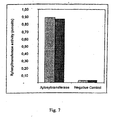
- the activity of the xylosyltransferase in this case is seen as positive if the activity measurement is higher by at least 10 to 20%, in particular at least 30 to 50%, than the activity measurement of the negative control.
- the structure of the oligosaccharide may additionally be verified by means of HPLC. Such protocols are prior art ( Staudacher et al., 1998, Anal.
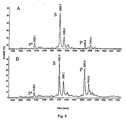
- Whether the xylose is bound or not to the acceptor substrate can furthermore be determined by measuring the mass of the product by means of mass spectrometry.
- the pairing of two DNA molecules can be changed by selection of the temperature and ionic strength of the sample.
- stringent conditions according to the invention conditions are understood which allow for an exact, stringent, binding.
- the DNA molecules are hybridized in 7% sodium dodecyl sulfate (SDS), 0.5M NaPO4, pH 7.0, 1mM EDTA at 50°C, and washed with 1% SDS at 42°C.
- Whether sequences have an at least 50% homology to SEQ ID NO: 8 can be determined e.g. by means of the program FastDB of EMBL or SWISSPROT data bank.
- recombinant ⁇ 1,2-xylosyltransferase encoded by the DNA molecule of the present invention and the respective enzyme from soybean as described in WO99/29835 A1 : 1.
- the recombinant enzyme is soluble without detergents (e.g. Triton X-100), whereas the solubility of the enzyme from soybean depends on the presence of detergents. 2.
- the recombinant enzyme is fully active in the absence of detergents (e.g. Triton X-100).
- the recombinant enzyme is N-glycosylated, whereas the enzyme from soybean is described to be unglycosylated. 4.
- the enzyme from A 1.
- the cDNA sequence coding for the soybean enzyme corresponds only to amino acids (aa) 199 - 469 of the A. thaliana protein, see figure 11 .
- the cDNA sequence coding for A. thaliana xylosyltransferase contains two insertions (corresponding to aa 375-382 and aa 425-429 of the predicted protein sequence) compared to the partial sequence of the soybean enzyme, see figure 11 . 8.
- the DNA molecule according to the present invention is particularly advantageous since it encodes for an active recombinant enzyme which shows surprisingly advantageous characteristics and effects over the known purified enzyme.
- the sequence of the DNA molecule of the invention encodes a plant protein with a ⁇ 1,2-xylosyltransferase activity. This specific protein is especially useful for analysis, experiments and production methods which relate to the ⁇ 1,2-xylosyltransferase.
- the DNA molecule according to the invention is at least 70%, preferably at least 80%, particularly preferred at least 95%, homologous with the sequence according to SEQ ID NO: 8.
- This sequence codes for a particularly active ⁇ 1,2-xylosyltransferase.
- the homology preferably is determined with a program which recognizes insertions and deletions and which does not consider these in the homology calculation.
- the DNA molecule comprises 1750 to 1850, in particular 1831, base pairs.
- one of the above-indicated DNA molecules is covalently associated with a detectable marker substance.
- a detectable marker substance any common marker can be used, such as, e.g., fluorescent, luminescent, radioactive markers, biotin, etc.
- reagents are provided which are suitable for the detection, selection and quantitation of corresponding DNA molecules in solid tissue samples (e.g. from plants) or also in liquid samples, by means of hybridizing methods.
- a disclosed DNA molecule includes a sequence which comprises a deletion, insertion and/or substitution mutation.
- the number of mutant nucleotides is variable and varies from a single one to several deleted, inserted or substituted nucleotides. It is also possible that the reading frame is shifted by the mutation. In such a "knock-out gene" it is merely important that the expression of a ⁇ 1,2-xylosyltransferase is disturbed, and the formation of an active, functional enzyme is prevented. In doing so, the site of the mutation is variable, as long as expression of an enzymatically active protein is prevented.
- the mutation in the catalytic region of the enzyme which is located in the C-terminal region.
- a further aspect of the invention relates to a biologically functional vector which comprises one of the above-indicated DNA molecules.
- a biologically functional vector which comprises one of the above-indicated DNA molecules.
- an independent vector capable of amplification is necessary, wherein, depending on the host cell, transfection mechanism, task and size of the DNA molecule, a suitable vector can be used. Since a large number of different vectors is known, an enumeration thereof would go beyond the limits of the present application and there fore is done without here, particularly since the vectors are very well known to the skilled artisan (as regards the vectors as well as all the techniques and terms used in this specification which are known to the skilled artisan, cf. also Maniatis).
- the vector has a small molecule mass and should comprise selectable genes so as to lead to an easily recognizable phenotype in a cell so thus enable an easy selection of vector-containing and vector-free host cells.
- the vector should comprise a strong promoter, as well as an enhancer, gene amplification signals and regulator sequences.
- a replication origin is important for an autonomous replication of the vector. Polyadenylation sites are responsible for correct processing of the mRNA and splice signals for the RNA transcripts. If phages, viruses or virus particles are used as the vectors, packaging signals will control the packaging of the vector DNA. For instance, for transcription in plants, Ti plasmids are suitable, and for transcription in insect cells, baculoviruses, and in insects, respectively, transposons, such as the P element.
- a post-transcriptional suppression of the gene expression of the endogenous ⁇ 1,2-xylosyltransferase gene is attained by transcription of a transgene homologous thereto or of parts thereof, in sense orientation.
- This strategy of "gene silencing" is an effective way of suppressing the expression of the ⁇ 1,2-xylosyltransferase gene, cf. also Waterhouse et al., 1998, Proc. Natl. Acad. Sci. USA, 95:13959-13964 .
- the invention relates to a biologically functional vector comprising a DNA molecule according to one of the above-described embodiments, being inversely orientated with respect to the promoter. If this vector is transfected in a host cell, an "antisense mRNA" will be read which is complementary to the mRNA of the ⁇ 1,2-xylosyltransferase and complexes the latter. This bond will either hinder correct processing, transportation, stability or, by preventing ribosome annealing, it will hinder translation and thus the normal gene expression of the ⁇ 1,2-xylosyltransferase.
- a suitable antisense RNA molecule comprises, e.g., from 50 to 200 nucleotides since many of the known, naturally occurring antisense RNA molecules comprise approximately 100 nucleotides.
- rapidly hybridizing RNA molecules are used.
- the efficiency of antisense RNA molecules which have a size of more than 50 nucleotides will depend on the annealing kinetics in vitro.
- rapidly annealing antisense RNA molecules exhibit a greater inhibition of protein expression than slowly hybridizing RNA molecules ( Wagner et al., 1994, Annu. Rev. Microbiol., 48:713-742 ; Rittner et al., 1993, Nucl. Acids Res., 21: 1381-1387 ).
- Such rapidly hybridizing antisense RNA molecules particularly comprise a large number of external bases (free ends and connecting sequences), a large number of structural subdomains (components) as well as a low degree of loops ( Patzel et al. 1998; Nature Biotechnology, 16; 64-68 ).
- the hypothetical secondary structures of the antisense RNA molecule may, e.g., be determined by aid of a computer program, according to which a suitable antisense RNA DNA sequence is chosen.
- Different sequence regions of the DNA molecule may be inserted into the vector.
- One possibility consists, e.g., in inserting into the vector only that part which is responsible for ribosome annealing. Blocking in this region of the mRNA will suffice to stop the entire translation. A particularly high efficiency of the antisense molecules also results for the 5'- and 3'-non translated regions of the gene.
- RNA is isolated from a plant cell, in particular from leaf cells, by means of which a reverse transcription is carried out after the addition of a reverse transcriptase and primers.
- the individual steps of this method are carried out according to protocols known per se.
- For the reverse transcription on the one hand, it is possible to produce the cDNA of the entire mRNA with the help of oligo(dT) primers, and only then to carry out a PCR by means of selected primers so as to prepare DNA molecules comprising the ⁇ 1,2-xylosyltransferase gene.
- the selected primers may directly be used for the reverse transcription so as to obtain short, specific cDNA.
- the suitable primers may be prepared e.g. synthetically according to the pattern of cDNA sequences of the transferase.
- the invention furthermore relates to a method of cloning a ⁇ 1,2-xylosyltransferase, characterized in that the DNA molecule of the invention is cloned into a vector which subsequently is transfected into a host cell or host, respectively, wherein, by selection and amplification of transfected host cells, cell lines are obtained which express the active ⁇ 1,2-xylosyltransferase.
- the DNA molecule is inserted into the vector by aid of restriction endonucleases, e.g..
- restriction endonucleases e.g.
- What is important in this method is that an efficient host-vector system is chosen.
- eukaryotic host cells are particularly suitable.
- One possible way is to transfect the vector in insect cells. In doing so, in particular an insect virus would have to be used as vector, such as, e.g., baculovirus.
- plants or plant cells, human or other vertebrate cells can also be transfected, in which case the latter would express an enzyme foreign to them.
- a method of preparing recombinant host cells, in particular plant cells or plants, respectively, with a suppressed or completely stopped ⁇ 1,2-xylosyltransferase production is provided, which is characterized in that at least one of the vectors according to the invention, i.e. that one comprising the inventive DNA molecule, the mutant DNA molecule or the one comprising the DNA molecule in inverse orientation to the promoter, is inserted into the host cell or plant, respectively. What has been said above for the transfection also is applicable in this case.
- plant cells may, e.g., be used, wherein, e.g., the Ti plasmid with the agrobacterium system is eligible.
- agrobacterium system it is possible to transfect a plant directly: agrobacteria cause root stem galls in plants. If agrobacteria infect an injured plant, the bacteria themselves do not get into the plant, but they insert the recombinant DNA portion, the so-called T-DNA, from the annular, extrachromosomal, tumour-inducing Ti-plasmid into the plant cells.
- the T-DNA, and thus also the DNA molecule inserted therein, are installed in the chromosomal DNA of the cell in a stable manner so that the genes of the T-DNA will be expressed in the plant.
- the transfected cells are selected, e.g. on the basis of antibiotic resistences for which the vector comprises genes, or other marker genes.
- the transfected cell lines are amplified, either in small amounts, e.g. in Petri dishes, or in large amounts, e.g. in fermentors.
- plants have a particular characteristic, i.e. they are capable to re-develop from one (transfected) cell or from a protoplast, respectively, to a complete plant which can be grown.
- a sense or antisense-mRNA will be expressed in the transfected cell (or plant, respectively).
- the antisense mRNA is complementary at least to a part of the mRNA sequence of the ⁇ 1,2-xylosyltransferase and may likewise inhibit translation of the enzyme.
- a method of suppressing the expression of a gene by antisense technique reference is made to the publication by Smith et al., 1990, Mol. Gen. Genet. 224:477-481 , wherein in this publication the expression of a gene involved in the maturing process of tomatoes is inhibited.
- Double-stranded RNA has recently been shown to trigger sequence-specific gene silencing in a wide variety of organisms, including nematodes, plants, trypanosomes, fruit flies and planaria; an as yet uncharacterized RNA trigger has been shwon to induce DNA methylation in several different plant systems leading to selective interference with gene function (for review see Fire A., 1999, Trends Genet 15 (9): 358-363 ).
- ⁇ 1,2-xylosyltransferase expression of the ⁇ 1,2-xylosyltransferase is at least suppressed, preferably even completely blocked.
- the degree of the disturbance of the gene expression will depend on the degree of complexing, homologous recombination, on possible subsequent coincidental mutations and on other processes in the region of the genome.
- the transfected cells are checked for ⁇ 1,2-xylosyltransferase activity and selected.
- ⁇ 1,2-xylosyltransferase it is possible to still further increase the above-described suppression of the expression of the ⁇ 1,2-xylosyltransferase by introducing into the host a vector comprising a gene coding for a mammalian protein, e.g. ⁇ 1,4-galactosyltransferase, in addition to the insertion of an above-described vector.
- Xylosylation may be reduced by the action of other mammalian enzymes, the combination of the inhibition of the expression of an active ⁇ 1,2-xylosyltransferase by means of the inventive vector and by means of a mammalian enzyme vector being particularly efficient.
- Any type of plant may be used for transfection, e.g. mung bean, tobacco plant, tomato and/or potato plant.
- Another advantageous method of producing recombinant host cells, in particular plant cells, or plants, respectively, consists in that the DNA molecule comprising the mutation is inserted into the genome of the host cell, or plant, respectively, in the place of the non-mutated homologous sequence ( Schaefer et al., 1997, Plant J.; 11(6):1195-1206 ). This method thus does not function with a vector, but with a pure DNA molecule.
- the DNA molecule is inserted into the host e.g. by gene bombardment, microinjection or electroporation, to mention just three examples.
- the DNA molecule binds to the homologous sequence in the genome of the host so that a homologous recombination and thus reception of the deletion, insertion or substitution mutation, respectively, will result in the genome: Expression of the ⁇ 1,2-xylosyltransferase is suppressed or completely blocked.
- recombinant plants or plant cells are provided which have been prepared by one of the methods described above, their ⁇ 1,2-xylosyltransferase production being suppressed or completely blocked, respectively.
- their ⁇ 1,2-xylosyltransferase activity is less than 50%, in particular less than 20%, particularly preferred 0%, of the ⁇ 1,2-xylosyltransferase activity occurring in natural plants or plant cells, respectively.
- the advantage of these plants or plant cells, respectively, is that the glycoproteins produced by them do not comprise any or hardly comprise any ⁇ 1,2-bound xylose. If products of these plants are taken up by human or vertebrate bodies, there will be no immune reaction due to the ⁇ 1,2-xylose epitope.
- PNA peptide nucleic acid
- PNA peptide nucleic acid
- RNA- or PNA-oligomers by Watson-Crick base pairing and helix formation.
- the peptide backbone ensures a greater resistance to enzymatic degradation.
- the PNA molecule thus is an improved antisense agent.
- nucleases nor proteases are capable of attacking a PNA molecule.
- the stability of the PNA molecule, if bound to a complementary sequence, comprises a sufficient steric blocking of DNA and RNA polymerases, reverse transcriptase, telomerase and ribosomes.
- the publication by Pooga et al., "Cell penetrating PNA constructs regulate galanin receptor levels and modify pain transmission in vivo" (Nature Biotechnology 16:857-861; 1998 ) relates to PNA molecules in general and specifically to a PNA molecule that is complementary to human galanin receptor type 1 mRNA.
- the PNA molecule comprises the above-mentioned sequence, it will bind to the DNA or to a site of the DNA, respectively, which codes for ⁇ 1,2-xylosyltransferase and in this way is capable of inhibiting transcription of this enzyme. As it is neither transcribed nor translated, the PNA molecule will be prepared synthetically, e.g. by aid of the the t-Boc technique.
- a PNA molecule which comprises a base sequence which corresponds to the sequence of the inventive DNA molecule.
- This PNA molecule will complex the mRNA or a site of the mRNA of ⁇ 1,2-xylosyltransferase so that the translation of the enzyme will be inhibited. Similar arguments as set forth for the antisense RNA apply in this case.
- a particularly efficient complexing region is the translation start region or also the 5'-non-translated regions of mRNA.
- the present description also discloses a method of preparing plants or plant cells, respectively, in particular plant cells which comprise a blocked expression of the ⁇ 1,2-xylosyltransferase at the transcription or translation level, respectively, which is characterized in that inventive PNA molecules are inserted in the cells.
- inventive PNA molecules are inserted in the cells.
- conventional methods such as, e.g., electroporation or microinjection, are used.
- Particularly efficient is insertion if the PNA oligomers are bound to cell penetration peptides, e.g. transportan or pAntp ( Pooga et al., 1998, Nature Biotechnology, 16; 857-861 ).
- the present description further discloses a method of preparing recombinant glyco- proteins which is characterized in that the inventive, recombinant plants or plant cells, respectively, whose ⁇ 1,2-xylosyltransferase production is suppressed or completely blocked, respectively, or plants or cells, respectively, in which the PNA molecules have been inserted according to the method of the invention, are transfected with the gene that expresses the glycoprotein so that the recombinant glycoproteins are expressed.
- vectors comprising genes for the desired proteins are transfected into the host or host cells, respectively, as has also already been described above.
- the transfected plant cells will express the desired proteins, and they have no or hardly any ⁇ 1,2-bound xylose. Thus, they do not trigger the immune reactions already mentioned above in the human or vertebrate body. Any proteins may be produced in these systems.
- the tissues of this plant comprise the recombinant glycoprotein so that, e.g. by extraction of the recombinant glycoprotein from the tissue and subsequent administration, or directly by eating the plant tissue, respectively, the recombinant glycoprotein is taken up in the human body.
- a method of preparing recombinant human glycoproteins for medical use is described, wherein the disclosed, recombinant plants or plant cells, respectively, whose ⁇ 1,2-xylosyltransferase production is suppressed or completely blocked, respectively, or plants or cells, respectively, into which the PNA molecules have been inserted according to the described method are transfected with the gene that expresses the glycoprotein so that the recombinant glycoproteins are expressed. In doing so, any protein can be used which is of medical interest.
- glycoproteins can be prepared in plant systems, wherein their peptide sequence comprises less than 50%, in particular less than 20%, particularly preferred 0%, of the ⁇ 1,2-bound xylose residues occurring in proteins expressed in non-xylosyltransferase-reduced plant systems.
- glycoproteins which do not comprise ⁇ 1,2-bound xylose residues are also disclosed. The amount of ⁇ 1,2-bound xylose will depend on the degree of the above-described suppression of the ⁇ 1,2-xylosyltransferase.
- recombinant human glycoproteins which have been produced in plant systems according to a method described above and whose peptide sequence comprises less than 50%, in particular less than 20%, particularly preferred 0%, of the ⁇ 1,2-bound xylose residues occurring in the proteins expressed in non-xylosyltransferase-reduced plant systems.
- Recombinant human glycoproteins for medical use can be prepared in plant systems according to a method described above, whose peptide sequence comprises less than 50%, in particular less than 20%, particularly preferred 0%, of the ⁇ 1,2-bound xylose residues occurring in the proteins expressed in non-xylosyltransferase-reduced plant systems.
- glycoproteins may include other bound oligosaccharide units specific for plants, whereby - in the case of human glycoproteins - they differ from these natural glycoproteins. Nevertheless, by these glycoproteins a slighter immune reaction or no immune reaction at all, respectively, is triggered in the human body, since, as has already been explained in the introductory portion of the specification, the ⁇ 1,2-bound xylose residues, together with ⁇ 1,3-fucose residues, are the main cause for the immune reactions or cross immune reaction, respectively, to plant glycoproteins.
- a pharmaceutical composition may comprise further additions common for such compositions.
- suitable diluting agents of various buffer contents e.g. Tris-HCl, acetate, phosphate, pH and ionic strength
- additives such as tensides and solubilizers (e.g. Tween 80, Polysorbate 80)
- preservatives e.g. Thimerosal, benzyl alcohol
- adjuvants e.g. ascorbic acid, sodium metabisulfite
- emulsifiers e.g.
- lactose lactose, mannitol
- covalent bonds of polymers such as polyethylene glycol
- polymeric compounds such as polylactic acid, polyglycolic acid, etc. or in liposomes
- auxiliary agents and/or carrier substances which are suitable in the respective treatment.
- Such compositions will influence the physical condition, stability, rate of in vivo liberation and rate of in vivo excretion of these glycoproteins.
- the invention also provides a method of selecting DNA molecules which code for a ⁇ 1,2-xylosyltransferase, in a sample, wherein the labelled DNA molecules of the invention or partial sequences thereof, are added to the sample, which bind to the DNA molecules that code for a ⁇ 1,2-xylosyltransferase.
- the hybridized DNA molecules can be detected, quantitated and selected.
- the sample is denatured, e.g. by heating.
- One possible way is to separate the DNA to be assayed, possibly after the addition of endonucleases, by gel electrophoresis on an agarose gel. After having been transferred to a membrane of nitrocellulose, the labelled DNA molecules according to the invention are admixed which hybridize to the corresponding homologous DNA molecule ("Southern blotting").
- Another possible way consists in finding homologous genes from other species by PCR-dependent methods using specific and/or degenerated primers, derived from the sequence of the DNA molecule according to the invention.
- the labelled DNA molecules of the invention or partial sequences thereof are immobilized onto carrier matrices.
- DNA microarrays (“gene chips") is a further possible way to find homologous genes or to study the expression level of homologous genes.
- DNA representing either the entire genomic gene sequence, the full-length cDNA sequence, parts of these sequences or any combination of partial sequences is immobilized onto carrier matrices, in order that homologous genes, after adding the sample to the carrier matrices, hybridize with the labelled DNA molecules (for examples see e.g. Ferea T.L. & Brown, P.O., 1999, Current Opinion in Genetics & Development 9: 715-722 and references cited herein).
- the sample for the above-identified inventive method comprises genomic DNA of a plant organism.
- genomic DNA of a plant organism.
- a large number of plants or other species is assayed in a very rapid and efficient manner for the presence of the ⁇ 1,2-xylosyltransferase gene.
- DNA molecules which code for a ⁇ 1,2-xylosyltransferase can be selected according to the three last-mentioned methods and subsequently be isolated from the sample. These molecules can be used for further assays. They can be sequenced and in turn can be used as DNA probes for finding ⁇ 1,2-xylosyltransferases. These - labelled - DNA molecules will function for organisms, which are related to the organisms from which they have been isolated, more efficiently as probes than the DNA molecules of the invention.
- a further aspect of the invention relates to a preparation of ⁇ 1,2-xylosyltransferase cloned according to the invention which comprises isoforms having pI values of between 6.0 and 9.0, in particular between 7.50 and 8.00.
- the pI values of a protein is that pH value at which its net charge is zero and is dependent on the amino acid sequence, the glycosylation pattern as well as on the spatial structure of the protein.
- the ⁇ 1,2-xylosyltransferase may comprise several isoforms which have a pI value in this range.
- the reason for the various isoforms of the transferase are, e.g., different glycosylations as well as limited proteolysis.
- the pI value of a protein can be determined by isoelectric focussing, which is known to the skilled artisan.
- the main isoform of the enzyme has an apparent molecular weight of 60,2 kDa.
- the preparation of the invention comprises an isoform having a pI value of 7.52.
- the invention also relates to a method of preparing "plantified" carbohydrate units of human and other vertebrate glycoproteins or other glycoconjugates, wherein UDP-xylose as well as ⁇ 1,2-xylosyltransferase encoded by an above-described DNA molecule are added to a sample that comprises a carbohydrate unit or a glycoprotein, respectively, so that xylose in ⁇ 1,2-position is bound by the ⁇ 1,2-xylosyltransferase to the carbohydrate unit or to the glycoprotein, respectively.
- UDP-xylose as well as ⁇ 1,2-xylosyltransferase encoded by an above-described DNA molecule are added to a sample that comprises a carbohydrate unit or a glycoprotein, respectively, so that xylose in ⁇ 1,2-position is bound by the ⁇ 1,2-xylosyltransferase to the carbohydrate unit or to the glycoprotein, respectively.
- Primers for the amplification of the putative ⁇ 1,2-xylosyltransferase cDNA by RT-PCR were designed as follows: A BLASTP search of the DDBJ database using two soybean peptides (SEQ ID NO: 1 and 2; corresponding to SEQ ID NO: 3 and 5 in Fig. 4 in patent WO99/29835 A1 ; however, the C-terminal amino acids LG were omitted from SEQ ID NO: 5) (see Fig.1 ) showed one protein sequence derived from a Arabidopsis thaliana genomic DNA sequence (Acc. Nr. AB015479) with more than 80 % homology (SEQ ID NO: 3).
- Primers 3 (SEQ ID NO: 4) and 4 (SEQ ID NO: 5) were based on the A. thaliana sequence homologous to the soybean peptides 2 and 3. Analysis of the homologous genomic DNA sequence using Gene-Finder at the BCM Search Launcher resulted in one predicted protein.
- Primer 1 (SEQ ID NO: 6) was designed to include the start codon of the predicted protein, whereas primer 2 (SEQ ID NO: 7) contains the stop codon of the predicted protein.
- the first strand cDNA was subjected to a PCR, wherein different combinations of sense and antisense primers were used (illustrated in Fig. 6 ):
- the product of primer 3 and primer 4 was a DNA fragment with length of 174 bp (P1)
- the product of primer 1 and primer 2 was a 1605 bp (P2) DNA fragment
- the product of primer 1 and primer 4 was a DNA fragment with length of 1525 bp (P3)
- primer 3 and primer 4 produced a DNA of 254 bp (P4).
- primer 1 and primer 2 were used for amplification of the putative open reading frame.
- a PCR reaction contained in a total volume of 50 ⁇ l 0.2 ⁇ mol of each primer, 0.05 mM dNTPs, 2 mM MgSO 4 , 20 mM Tris-HCl (pH 8.2 at 25°C), 10 mM KCl, 10 mM (NH 4 ) 2 SO 4 , 0.1 % Triton X-100, 5 ⁇ g nuclease-free BSA and 2.5 units Pfu DNA polymerase from Promega.
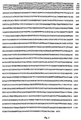
- PCR products were subcloned into SmaI linearised and dephosphorylated puc19 vector, and sequenced: The sequences of the subcloned fragments were obtained by means of the didesoxynucleotide method (ABI PRISM Dye Termination Cycle Sequencing Ready reaction Kit and ABI PRISM 310 Genetic analyzer from Perkin Elmer). As a result of the RT-PCR three slightly different cDNA sequences were obtained. The sequence of cDNA 6 which has a size of 1605 bp (xt-Ath6; SEQ ID NO: 8) and codes for a protein of 534 amino acids having a molecular weight of 60,2 kDA and a theoretical pI value of 7,52 (see Fig.
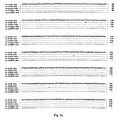
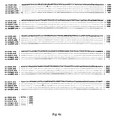
- cDNA 9 shows 4 base pair changes compared to cDNA 6, whereas cDNA 16 shows 6 base pair changes compared to cDNA 6 (illustrated in Figs. 4a , 4b and 4c ). Therefore the amino acid sequence derived from cDNA 9 comprises two changes compared to the amino acid sequence derived from cDNA 6 (SEQ ID NO: 8), and the amino acid sequence of cDNA 16 shows four changed residues (illustrated in Fig. 5 ).
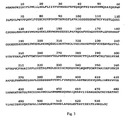
- Fig. 3 shows the cDNA-derived amino acid sequence (SEQ ID NO: 9) of the ⁇ 1,2-xylosyltransferase (xt-Ath6; SEQ ID NO: 8). Potential sites for the asparagine-bound glycosylation are at Asn51, Asn301 and Asn479.
- Figs. 4a , 4b and 4c show the alignment of ⁇ 1,2-xylosyltransferase nucleotide sequences from the A. thaliana cDNA 6 (xt-Ath6; SEQ ID NO: 8), the A. thaliana cDNA 9 (xt-Ath9), the A. thaliana cDNA 16 (xt-Ath16), the A. thaliana genomic DNA sequence after removing of two introns (xt-Athgen), and from a A. thaliana EST sequence (xtAthEST).
- the dotted line stands for the consensus sequence; the dashed line for a gap.
- the genomic sequence results from removing of two putative introns (intron 1: from position 58881 to 59116 of the genomic DNA; intron 2: from position 59268 to 59458 of the genomic DNA) using the splice site prediction server NetPlantGene.
- the A. thaliana EST sequence is the result of a database search using BLASTN.
- Fig. 5 shows the alignment of amino acid sequences from ⁇ 1,2-xylosyltransferase derived from A. thaliana cDNA 6 (xt-Ath6; SEQ ID NO: 9), from A. thaliana cDNA 9 (xt-Ath9), from A. thaliana cDNA 16 (xt-Ath16), from the A. thaliana genomic sequence (xt-Athgen), and derived from a A. thaliana EST sequence (xt-AthEST).
- the dotted line stands for a consensus sequence; the dashed line stands for a gap.
- FIG. 6 the schematic predicted ⁇ 1,2-xylosyltransferase protein (top) and the derived hydrophobicity index using ProtScale, of the encoded protein (bottom) are illustrated, a positive hydrophobicity index meaning an increased hydrophobicity.
- P1-P4 the sizes of the four above-indicated PCR products (P1-P4) are shown in relationship to the cDNA.
- C coding for the postulated cytoplasmic region
- T for the postulated transmembrane region
- G for the postulated Golgi lumen catalytic region of the transferase.
- the entire coding region of the assumed ⁇ 1,2-xylosyltransferase including cytoplasmatic and transmembrane region was removed from the puc19 vector by BamHI and EcoRI digestion and subcloned into BamHI / EcoRI digested and dephosphorylated baculovirus transfer vector pVL 1393 (PharMingen, San Diego, CA). Correct cloning was confirmed by sequencing using pVL1393 forward primer 5'-AACCATCTCGCAAATAAATAAGTA-3'(SEQ ID NO: 10) and pVL1393 reverse primer 5'-GTCGGGTTTAACATTACGGATTTC-3' (SEQ ID NO: 11).
- 1 ⁇ g of the transfer vector was cotransfected with 200 ng linear Baculo-Gold viral DNA (PharMingen, San Diego, CA) into 1 x 10 6 Sf-9 cells in IPL-41 Medium using Lipofectin (Life Technologies) according to the manufacturer's protocol. After an incubation of 5 days at 27° C, various volumes of the supernatant with the recombinant virus were used for infection of Sf-21 insect cells. Cells were incubated in IPL-41 medium supplemented with 5 % heat-inactivated fetal calf serum for 4 days at 27° C, then harvested and washed 2x with phosphate-buffered saline solution.
- the cells were resuspended and homogenised in the following buffer (1 ml per 10 7 cells): 100 mM MES buffer, pH 7.0, with 1 % Triton X-100, 1 mM DTT, 1 mM PMSF, 5 ⁇ g/ml Leupeptin (Sigma), 5 ⁇ g/ml E-64 (Serva) and incubated on ice for 30 min.
- the cell homogenates were assayed for ⁇ 1,2-xylosyltransferase activity. Negative controls were carried out with the same number of uninfected cells.
- the assay mixtures contained, in a total volume of 20 ⁇ l, 13 ⁇ l of homogenised cells, 2 nmol dabsylated GnGn hexapeptide or GnGn-pyridylamine as acceptor substrate ( Fig. 8a ), 1 mM UDP-xylose as donor substrate, 10 mM ATP, 20 mM MnC12 and 1 mM 2-acetamido-1,2-dideoxy-nojirimycin was included to prevent degradation of product by N-acetylhexosaminidase. The samples were incubated for 1 hour at 37° C and analysed by MALDI-TOF mass spectrometry.
- Fig. 7 shows the measured enzyme activity of the recombinant ⁇ 1,2-xylosyltransferase as well as of the negative control. Grey bars show the activity when GnGn hexapeptide was used as a substrate, whereas black bars indicate the use of GnGn-pyridylamin as a substrate. The enzyme activity of the cotransfected cells was 30x higher than that of the negative controls.
- Fig. 8a The structure of the acceptor substrate of ⁇ 1,2-xylosyltransferase is shown in Fig. 8a , and the postulated product in Fig. 8b , where R represents either a pyridylamine or dabsylated hexapeptide residue.
- Mass spectrometry was performed on a DYNAMO (BioAnalysis, Santa Fe, NM), a MALDITOF MS which is capable of dynamic extraction (synonym for late extraction).
- Two types of sample matrix preparations were used: dabsylated glycopeptides were dissolved in 5 % formic acid, and aliquots were applied to the target, air-dried, and covered with 1 % alpha-cyano-4-hydroxy cinnamic acid. Pyridylaminated glycans were diluted with water, applied to the target and air-dried. After addition of 2 % 2.5-dihydroxy benzoic acid, the samples were immediately dried by applying vacuum.
- Fig. 9 shows the mass spectrum of these samples, (A) being the negative control:
- the main peak (S) shows the dabsyl-Val-Gly-Glu-(GlcNAc 4 man 3 )Asn-Arg-Thr substrate, the calculated [M+H] + value being 2262.3.
- This substrate also appears as sodium addition product and as smaller ion which has been formed by fragmentation of the Azo function of the dabsyl group, at (S*).
- the mass spectrum (B) shows the sample with recombinant ⁇ 1,2-xylosyltransferase after incubation for 1 h at 37° C.
- the main peak (P) having a [M+H] + value of 2393.4, represents the xylosylated product.
- Xylosyltransferase assays were performed as described above under example 3 except that 10 nmol of GnGn-pyridylamine were used as the acceptor substrate. After 4 h of incubation the sample was analyzed both by MALDI-TOF mass spectrometry and by rever sed-phase HPLC to verify the structure of the product. The presumed product peak eluting slightly ahead of the substrate GnGn-PA was collected. By MALDI-TOF MS the product's mass was determined to be 1550.9 which is in good agreement with being GnGnX-PA.
- Fig. 10 shows the analysis of the xylosyltransferase product by reversed-phase HPLC.
- A transferase incubation mixture
- B isolated xylosyltransferase product
- C isolated xylosyltransferase product after digestion with ⁇ -N-acetylglucosaminidase
- D isolated xylosyltransferase product after further digestion with alpha-mannosidase.
- the assignments of peaks are as follows: 1, GnGn-PA; 2, GnGnX-PA; 3, MMX-PA; 4, MOX-PA; 5, 00X-PAA; 6, M0-PA (from trace of substrate in isolated product).
- N-glycan structures see Wilson I.B.H. and Altmann, F., 1998, Glycoconj. J. 15, 1055-1077 .
- Fig. 11 shows the alignment of the predicted amino acid sequence according to the WO 99/29835 A1 .
- This alignment shows that the amino acid sequence of the purified soybean enzym corresponds only to amino acids 199-469 of the sequence derived from the cDNA according to the present invention.
- the predicted amino acid sequence derived from the cDNA of the present application contains two insertions (corresponding to aa 375-382 and aa 425-429 of the predicted sequence) compared to the sequence of the purified soybean enzyme.
Landscapes
- Health & Medical Sciences (AREA)
- Life Sciences & Earth Sciences (AREA)
- Chemical & Material Sciences (AREA)
- Genetics & Genomics (AREA)
- Organic Chemistry (AREA)
- Engineering & Computer Science (AREA)
- Wood Science & Technology (AREA)
- Zoology (AREA)
- Bioinformatics & Cheminformatics (AREA)
- General Engineering & Computer Science (AREA)
- General Health & Medical Sciences (AREA)
- Biochemistry (AREA)
- Molecular Biology (AREA)
- Biotechnology (AREA)
- Biomedical Technology (AREA)
- Microbiology (AREA)
- Medicinal Chemistry (AREA)
- Biophysics (AREA)
- Chemical Kinetics & Catalysis (AREA)
- Plant Pathology (AREA)
- Physics & Mathematics (AREA)
- Pharmacology & Pharmacy (AREA)
- General Chemical & Material Sciences (AREA)
- Cell Biology (AREA)
- Nuclear Medicine, Radiotherapy & Molecular Imaging (AREA)
- Animal Behavior & Ethology (AREA)
- Veterinary Medicine (AREA)
- Immunology (AREA)
- Public Health (AREA)
- Enzymes And Modification Thereof (AREA)
- Micro-Organisms Or Cultivation Processes Thereof (AREA)
- Breeding Of Plants And Reproduction By Means Of Culturing (AREA)
- Peptides Or Proteins (AREA)
- Preparation Of Compounds By Using Micro-Organisms (AREA)
- Measuring Or Testing Involving Enzymes Or Micro-Organisms (AREA)
- Medicines That Contain Protein Lipid Enzymes And Other Medicines (AREA)
- Medicines Containing Plant Substances (AREA)
Priority Applications (3)
| Application Number | Priority Date | Filing Date | Title |
|---|---|---|---|
| DE60115863.6T DE60115863T3 (de) | 2000-03-03 | 2001-03-02 | Beta 1, 2-xylosyltransferase gen aus arabidopsis |
| EP05108014.1A EP1621633B1 (en) | 2000-03-03 | 2001-03-02 | Glycoproteins produced in plants with suppressed expression of beta 1, 2-xylosyltransferase |
| DK05108014.1T DK1621633T3 (da) | 2000-03-03 | 2001-03-02 | Glycoproteiner produceret i planter med undertrykt ekspression af beta 1,2-xylosyltransferase |
Applications Claiming Priority (3)
| Application Number | Priority Date | Filing Date | Title |
|---|---|---|---|
| AT0035500A AT409381B (de) | 2000-03-03 | 2000-03-03 | Xylosyltransferase-gen |
| AT3552000 | 2000-03-03 | ||
| PCT/EP2001/002352 WO2001064901A1 (en) | 2000-03-03 | 2001-03-02 | Beta 1, 2-xylosyltransferase-gene from arabidopsis |
Related Child Applications (3)
| Application Number | Title | Priority Date | Filing Date |
|---|---|---|---|
| EP05108014.1A Division-Into EP1621633B1 (en) | 2000-03-03 | 2001-03-02 | Glycoproteins produced in plants with suppressed expression of beta 1, 2-xylosyltransferase |
| EP05108014.1A Division EP1621633B1 (en) | 2000-03-03 | 2001-03-02 | Glycoproteins produced in plants with suppressed expression of beta 1, 2-xylosyltransferase |
| EP05108014.1 Division-Into | 2005-09-01 |
Publications (3)
| Publication Number | Publication Date |
|---|---|
| EP1263968A1 EP1263968A1 (en) | 2002-12-11 |
| EP1263968B1 EP1263968B1 (en) | 2005-12-14 |
| EP1263968B2 true EP1263968B2 (en) | 2014-09-10 |
Family
ID=3672559
Family Applications (2)
| Application Number | Title | Priority Date | Filing Date |
|---|---|---|---|
| EP01919367.1A Expired - Lifetime EP1263968B2 (en) | 2000-03-03 | 2001-03-02 | Beta 1, 2-xylosyltransferase-gene from arabidopsis |
| EP05108014.1A Expired - Lifetime EP1621633B1 (en) | 2000-03-03 | 2001-03-02 | Glycoproteins produced in plants with suppressed expression of beta 1, 2-xylosyltransferase |
Family Applications After (1)
| Application Number | Title | Priority Date | Filing Date |
|---|---|---|---|
| EP05108014.1A Expired - Lifetime EP1621633B1 (en) | 2000-03-03 | 2001-03-02 | Glycoproteins produced in plants with suppressed expression of beta 1, 2-xylosyltransferase |
Country Status (12)
| Country | Link |
|---|---|
| US (3) | US7205137B2 (enExample) |
| EP (2) | EP1263968B2 (enExample) |
| JP (2) | JP5279976B2 (enExample) |
| KR (5) | KR20080077296A (enExample) |
| AT (2) | AT409381B (enExample) |
| AU (1) | AU781010B2 (enExample) |
| CA (1) | CA2402015C (enExample) |
| DE (1) | DE60115863T3 (enExample) |
| DK (2) | DK1263968T4 (enExample) |
| ES (2) | ES2252208T5 (enExample) |
| PT (1) | PT1621633E (enExample) |
| WO (1) | WO2001064901A1 (enExample) |
Families Citing this family (15)
| Publication number | Priority date | Publication date | Assignee | Title |
|---|---|---|---|---|
| ES2350063T3 (es) | 1998-12-09 | 2011-01-17 | Phyton Holdings, Llc | Método para fabricación de glicoproteínas que tienen glicosilación de tipo humano. |
| NZ518532A (en) | 1999-10-26 | 2004-02-27 | Plant Res Internat B | Transgenic plant expressing mammalian beta-1,4- galactosyltransferase |
| CA2434364C (en) | 2001-01-19 | 2013-03-19 | The Dow Chemical Company | Method for secretory production of glycoprotein having human-type sugar chain using plant cell |
| CA2799805C (en) | 2002-03-19 | 2016-05-17 | Stichting Dienst Landbouwkundig Onderzoek | Optimizing glycan processing in plants |
| WO2003078614A2 (en) | 2002-03-19 | 2003-09-25 | Plant Research International B.V. | Gntiii (udp-n-acethylglucosamine:beta-d mannoside beta (1,4)-n-acethylglucosaminy ltransferase iii) expression in plants |
| CL2003002461A1 (es) | 2002-11-27 | 2005-01-07 | Dow Chemical Company Agroscien | Inmunoglobulina que comprende al menos un glicano afucosilado, composicion que la contiene, secuencia nucleotidica y vector que la comprende, procedimiento para producir dicha inmunoglobulina en plantas. |
| ATE426033T1 (de) | 2003-08-11 | 2009-04-15 | Greenovation Biotech Gmbh | Promoter sequenzen aus moos und dessen verwendung |
| MX2008009220A (es) * | 2006-01-17 | 2008-10-10 | Biolex Therapeutics Inc | Composiciones y metodos para la humanizacion y optimizacion de n-glicanos en plantas. |
| US20090060921A1 (en) * | 2006-01-17 | 2009-03-05 | Biolex Therapeutics, Inc. | Glycan-optimized anti-cd20 antibodies |
| AU2007229061A1 (en) * | 2006-03-23 | 2007-09-27 | Bayer Bioscience N.V. | Novel nucleotide sequences encoding nicotiana beta-1,2-xylosyltransferase |
| CN101702919B (zh) | 2007-04-17 | 2014-08-13 | 基金会农业研究服务中心 | 植物通过表达非哺乳动物糖基转移酶而表现出哺乳动物类型的糖基化作用 |
| CA2693525C (en) | 2007-06-07 | 2020-09-29 | Agriculture And Agri-Food Canada | Nanocarrier based transfection and transduction of plant gametophytic cells |
| EP2789686A1 (en) | 2013-04-11 | 2014-10-15 | Greenovation Biotech GmbH | Expression of phosphorylated glycoproteins in plants |
| JP6934666B2 (ja) * | 2018-01-18 | 2021-09-15 | 国立研究開発法人産業技術総合研究所 | 植物細胞においてキシロース修飾タンパク質を製造する方法、コアオリゴ糖修飾タンパク質を製造する方法、及びプロテオグリカンを製造する方法 |
| EP3871687A1 (en) | 2020-02-27 | 2021-09-01 | eleva GmbH | Enzyme replacement therapy for treating pompe disease |
Citations (2)
| Publication number | Priority date | Publication date | Assignee | Title |
|---|---|---|---|---|
| WO1999029835A1 (en) † | 1997-12-08 | 1999-06-17 | Board Of Trustees Of The University Of Arkansas | PURIFIED β1,2-XYLOSYLTRANSFERASE AND USES THEREOF |
| WO1999029879A1 (de) † | 1997-12-09 | 1999-06-17 | Antje Von Schaewen | PFLANZLICHE GntI-SEQUENZEN UND VERWENDUNG DERSELBEN ZUR GEWINNUNG VON PFLANZEN MIT VERMINDERTER ODER FEHLENDER N-ACETYLGLUCOSAMINYLTRANSFERASE I (GnTI)-AKTIVITÄT |
Family Cites Families (6)
| Publication number | Priority date | Publication date | Assignee | Title |
|---|---|---|---|---|
| ATE259378T1 (de) * | 1995-11-23 | 2004-02-15 | Cancer Res Campaign Tech | Materialien und methoden mit bezug zur identifizierung und sequenzierung des krebs- suszeptilitaetsgens brca2 und dessen anwendungen |
| CA2309391A1 (en) * | 1997-12-19 | 1999-07-01 | Pharmacia & Upjohn Company | Human sel-10 polypeptides and polynucleotides that encode them |
| US6207811B1 (en) * | 1998-03-18 | 2001-03-27 | Karl Tryggvason | Nephrin gene and protein |
| AU5559499A (en) * | 1998-08-11 | 2000-03-06 | Darwin Discovery Limited | Identification of the gene causing the mouse scurfy phenotype and its human ortholog |
| EP1033405A3 (en) * | 1999-02-25 | 2001-08-01 | Ceres Incorporated | Sequence-determined DNA fragments and corresponding polypeptides encoded thereby |
| BR0014945A (pt) * | 1999-10-21 | 2004-08-31 | Monsanto Co | Modificação pós-traducional de proteìnas recombinantes produzidas em plantas |
-
2000
- 2000-03-03 AT AT0035500A patent/AT409381B/de not_active IP Right Cessation
-
2001
- 2001-03-02 AT AT01919367T patent/ATE312931T1/de active
- 2001-03-02 PT PT51080141T patent/PT1621633E/pt unknown
- 2001-03-02 EP EP01919367.1A patent/EP1263968B2/en not_active Expired - Lifetime
- 2001-03-02 US US10/220,467 patent/US7205137B2/en not_active Expired - Lifetime
- 2001-03-02 KR KR1020087019207A patent/KR20080077296A/ko not_active Ceased
- 2001-03-02 ES ES01919367.1T patent/ES2252208T5/es not_active Expired - Lifetime
- 2001-03-02 WO PCT/EP2001/002352 patent/WO2001064901A1/en not_active Ceased
- 2001-03-02 AU AU46495/01A patent/AU781010B2/en not_active Expired
- 2001-03-02 ES ES05108014.1T patent/ES2460672T3/es not_active Expired - Lifetime
- 2001-03-02 EP EP05108014.1A patent/EP1621633B1/en not_active Expired - Lifetime
- 2001-03-02 DK DK01919367.1T patent/DK1263968T4/da active
- 2001-03-02 KR KR1020077011024A patent/KR100859919B1/ko not_active Expired - Lifetime
- 2001-03-02 DE DE60115863.6T patent/DE60115863T3/de not_active Expired - Lifetime
- 2001-03-02 DK DK05108014.1T patent/DK1621633T3/da active
- 2001-03-02 CA CA2402015A patent/CA2402015C/en not_active Expired - Lifetime
- 2001-03-02 KR KR1020107023909A patent/KR101185123B1/ko not_active Expired - Lifetime
- 2001-03-02 KR KR1020027011341A patent/KR100861437B1/ko not_active Expired - Lifetime
- 2001-03-02 JP JP2001563590A patent/JP5279976B2/ja not_active Expired - Lifetime
- 2001-03-02 KR KR1020097019435A patent/KR20090101981A/ko not_active Ceased
-
2007
- 2007-03-12 US US11/684,898 patent/US20070186311A1/en not_active Abandoned
-
2012
- 2012-03-23 US US13/428,777 patent/US20120331578A1/en not_active Abandoned
-
2013
- 2013-01-16 JP JP2013005404A patent/JP2013116113A/ja active Pending
Patent Citations (3)
| Publication number | Priority date | Publication date | Assignee | Title |
|---|---|---|---|---|
| WO1999029835A1 (en) † | 1997-12-08 | 1999-06-17 | Board Of Trustees Of The University Of Arkansas | PURIFIED β1,2-XYLOSYLTRANSFERASE AND USES THEREOF |
| WO1999029879A1 (de) † | 1997-12-09 | 1999-06-17 | Antje Von Schaewen | PFLANZLICHE GntI-SEQUENZEN UND VERWENDUNG DERSELBEN ZUR GEWINNUNG VON PFLANZEN MIT VERMINDERTER ODER FEHLENDER N-ACETYLGLUCOSAMINYLTRANSFERASE I (GnTI)-AKTIVITÄT |
| US6653459B1 (en) † | 1997-12-09 | 2003-11-25 | Antje Von Schaewen | Plant GntI sequences and the use thereof for the production of plants having reduced or lacking N-acetyl glucosaminyl transferase I(GnTI) activity |
Non-Patent Citations (26)
| Title |
|---|
| BENCUR P ET AL.: "Arabidopsis thaliana bèta a,2-xylosyltransferase: an unusual glycosyltransferase with the potential to act at multiple stages of the plant N-glycosylation pathway", BIOCHEM JOURNAL, vol. 2005, no. 388, 2 May 2005 (2005-05-02), BJ IMMEDIATE PUBLICATION, pages 515 - 525 † |
| BIOLOGICAL ABSTRACTS, vol. 17, no. 1-2, 2 January 2000, Philadelphia, PA, US; abstract no. S7B.15 GLYCONJUGATE JOURNAL, STRASSER R ET AL.: "Molecular cloning and functional expression of bèta 1.2-xylosyltransferase from arabidopsis thaliana" page 1-140; † |
| BIOLOGICAL ABSTRACTS, vol. 389, 23 October 1997, Philadelphia, PA, US; abstract no. NATURE, KEMPIN S ET AL.: "Targeted disruption in Arabidopsis" † |
| BONDILI J ET AL.: "Molecular cloning and heterologous expression of bèta 1,2-xylosyltransferase and core alfa 1,3-fucosyltransferase from maize", SCIENCEDIRECT PHYTOCHEMISTRY, vol. 2006, no. 67, ELSEVIER, pages 2215 - 2224 † |
| BRENDEL V AND KLEFFE, J: "Prediction of locally optimal splice sites in plant pre-mRNA with applications to gene identification in Arabidipsis thaliana genomic DNA", NUCLEIC ACIDS RESARCH, vol. 1998, no. 20, OXFORD UNIVERSITY PRESS, pages 4748 - 4757, XP002387950 † |
| COX K ET AL.: "Glycan optimization of a human monoclonal antibody in the aquatic plant Lemna minor", NATURE BIOTECHNOLOGY ADVANCE ONLINE PUBLICATION, 25 November 2006 (2006-11-25), NATURE PUBLISHING GROUP † |
| DATABASE EMBL NAKAMURA ET AL.; 19 June 1998 (1998-06-19), "Arabidopsis genomic clone from Chromosome 5" † |
| DATABASE GENBANK STERKY F ET AL.: "Gene discovery in the wood-forming tissues of poplar: Analysis of 5,692 expressed sequence tags" † |
| HANIN M ET AL: "Gene targeting in Arabidopsis", THE PLANT JOURNAL, vol. 28, no. 6, BLACKWELL SCIENCE LTD, pages 671 - 677 † |
| HEBSGAARD ET AL.: "Splice site prediction in Arabidopsis thaliana pre-mRNA by combining local and global sequence information", NUCLEIC ACIDS RESEARCH, vol. 1996, no. 17, OXFORD UNIVERSITY PRESS, pages 3439 - 3452, XP002205852, DOI: doi:10.1093/nar/24.17.3439 † |
| LÉONARD, R ET AL.: "A genetic and structural analysis of the N-glycosylation capabilities or rice and other monocotyledons", PLANT MOLECULAR BIOLOGY, vol. 2004, no. 55, KLUWER ACADEMIC PUBLISHERS, pages 631 - 644 † |
| MATHÉ C ET AL.: "Current methods of gene prediction, their strengths and weaknesses", NUCLEIC ACIDS RESEARCH, vol. 30, no. 19, OXFORD UNIVERSITY PRESS, pages 4103 - 4117 † |
| MEINKE D ET AL.: "Arabidopsis thaliana: A Model Plant for Genome Analysis", GENOME, vol. 282, 23 October 1998 (1998-10-23) † |
| MENIGISTE T AND PASZKOWSKI J: "Prospects for the Precise Engineering of Plant Genomes by Homologous Recombination", BIOL. CHEM., vol. 1999, no. 380, WALTER DE GRUYTER, pages 749 - 758 † |
| Molecular Cloning; A laboratory Manual by Cold Spring Harbor Laboratory, chapter12 and pp. 387-389. Author Maniatis T et al. 1982 † |
| NAKAMURA, ET AL: "Structural Analysis of Arabidopsis thaliana Chromosome 5. VII", DNA RESEARCH, no. 5, THE BRITISH LIBRARY - THE WORLD'S KNOWLEDGE, pages 297 - 308, XP002479049, DOI: doi:10.1093/dnares/5.5.297 † |
| PAGNY S ET AL.: "Structural requirements for Arabidopsis bèta 1,2-xylosyltransferase activity and targeting to the Golgi", THE PLANT JOURNAL, vol. 2003, BLACKWELL PUBLISHING LTD, pages 189 - 203 † |
| PUCHTA H AND HOHN B: "Green light for gene targeting in plants", THE NATIONAL ACADEMY OF SCIENCES OF THE USA, vol. 102, no. 34, 23 August 2005 (2005-08-23), pages 11961 - 11962 † |
| PUCHTA H: "Gene replacement by homologous recombination in plants", PLANT MOLECULAR BIOLOGY, vol. 2002, no. 48, KLUWER ACADEMIC PUBLISHERS, pages 173 - 182 † |
| SCHAEFER D AND ZRYD J-P: "Efficient gene targeting in the moss Physcomitrella patens", THE PLANT JOURNAL, vol. 11, no. 6, pages 1195 - 1206, XP000885764, DOI: doi:10.1046/j.1365-313X.1997.11061195.x † |
| STRASSER, R ET AL.: "Molecular cloning and functional expression of bèta 1,2-xylosyltransferase cDNA from Arabidopsis thaliana", FEBS LETTERS, vol. 2000, no. 472, 7 March 2000 (2000-03-07), pages 105 - 108 † |
| SYMONS ROBERT H: "Ribozymes", STRUCTURAL BIOLOGY, vol. 1994, no. 4, pages 322 - 330 † |
| TERADA R ET AL.: "Efficient gene targeting by homologous recombination in rice", NATURE BIOTECHNOLOGY, vol. 10/20022, no. 20, 9 September 2002 (2002-09-09), NATURE PUBLISHING GROUP, pages 1030 - 1034 † |
| WRIGHT D ET AL.: "High-frequency homologous recombination in plants mediated by zinc-finger nucleases", THE PLANT JOURNAL, vol. 2005, no. 44, 8 August 2005 (2005-08-08), BLACKWELL PUBLISHING LTD, pages 693 - 705 † |
| ZENG Y ET AL.: "Purification and Specificity of bèta 1,2-Xylosyltransferase, an Enzyme That Contribures to the Allergenicity of Some Plant Proteins", THE JOURNAL OF BIOLOGICAL CHEMISTRY, vol. 272, no. 50, THE AMERICAN SOCIETY FOR BIOCHEMISTRY AND MOLECULAR BIOLOGY, pages 31340 - 31347 † |
| ZHANG, M.Q.: "Identification of protein coding regions in the human genome by quadratic discriminant analysis.", PROC. NATL. ACAD. SCI. USA, no. JAN 97, THE NATIONAL ACADEMY OF SCIENCES OF THE USA, pages 565 - 568, XP002155356, DOI: doi:10.1073/pnas.94.2.565 † |
Also Published As
Similar Documents
| Publication | Publication Date | Title |
|---|---|---|
| US20070186311A1 (en) | BETA 1,2-xylosyltransferase-gene from arabidopsis | |
| US8198078B2 (en) | Fucosyl transferase gene | |
| Strasser et al. | Molecular cloning of cDNA encoding N-acetylglucosaminyltransferase II from Arabidopsis thaliana | |
| EP2066790B1 (en) | Galactosyltransferase | |
| US20090328251A1 (en) | Galactosyltransferase | |
| HK1153236A1 (en) | Optimizing glycan processing in plants |
Legal Events
| Date | Code | Title | Description |
|---|---|---|---|
| PUAI | Public reference made under article 153(3) epc to a published international application that has entered the european phase |
Free format text: ORIGINAL CODE: 0009012 |
|
| 17P | Request for examination filed |
Effective date: 20021001 |
|
| AK | Designated contracting states |
Kind code of ref document: A1 Designated state(s): AT BE CH CY DE DK ES FI FR GB GR IE IT LI LU MC NL PT SE TR |
|
| AX | Request for extension of the european patent |
Free format text: AL;LT;LV;MK;RO;SI |
|
| 17Q | First examination report despatched |
Effective date: 20030221 |
|
| GRAP | Despatch of communication of intention to grant a patent |
Free format text: ORIGINAL CODE: EPIDOSNIGR1 |
|
| GRAS | Grant fee paid |
Free format text: ORIGINAL CODE: EPIDOSNIGR3 |
|
| GRAA | (expected) grant |
Free format text: ORIGINAL CODE: 0009210 |
|
| AK | Designated contracting states |
Kind code of ref document: B1 Designated state(s): AT BE CH CY DE DK ES FI FR GB GR IE IT LI LU MC NL PT SE TR |
|
| PG25 | Lapsed in a contracting state [announced via postgrant information from national office to epo] |
Ref country code: FI Free format text: LAPSE BECAUSE OF FAILURE TO SUBMIT A TRANSLATION OF THE DESCRIPTION OR TO PAY THE FEE WITHIN THE PRESCRIBED TIME-LIMIT Effective date: 20051214 |
|
| REG | Reference to a national code |
Ref country code: GB Ref legal event code: FG4D |
|
| REG | Reference to a national code |
Ref country code: CH Ref legal event code: EP |
|
| REG | Reference to a national code |
Ref country code: IE Ref legal event code: FG4D |
|
| REF | Corresponds to: |
Ref document number: 60115863 Country of ref document: DE Date of ref document: 20060119 Kind code of ref document: P |
|
| REG | Reference to a national code |
Ref country code: CH Ref legal event code: NV Representative=s name: ROTTMANN, ZIMMERMANN + PARTNER AG |
|
| PG25 | Lapsed in a contracting state [announced via postgrant information from national office to epo] |
Ref country code: GR Free format text: LAPSE BECAUSE OF FAILURE TO SUBMIT A TRANSLATION OF THE DESCRIPTION OR TO PAY THE FEE WITHIN THE PRESCRIBED TIME-LIMIT Effective date: 20060314 |
|
| PG25 | Lapsed in a contracting state [announced via postgrant information from national office to epo] |
Ref country code: LU Free format text: LAPSE BECAUSE OF NON-PAYMENT OF DUE FEES Effective date: 20060331 Ref country code: MC Free format text: LAPSE BECAUSE OF NON-PAYMENT OF DUE FEES Effective date: 20060331 |
|
| REG | Reference to a national code |
Ref country code: SE Ref legal event code: TRGR |
|
| REG | Reference to a national code |
Ref country code: DK Ref legal event code: T3 |
|
| REG | Reference to a national code |
Ref country code: ES Ref legal event code: FG2A Ref document number: 2252208 Country of ref document: ES Kind code of ref document: T3 |
|
| ET | Fr: translation filed | ||
| PLBI | Opposition filed |
Free format text: ORIGINAL CODE: 0009260 |
|
| PLAX | Notice of opposition and request to file observation + time limit sent |
Free format text: ORIGINAL CODE: EPIDOSNOBS2 |
|
| 26 | Opposition filed |
Opponent name: HARRISON GODDARD FOOTE Effective date: 20060913 |
|
| NLR1 | Nl: opposition has been filed with the epo |
Opponent name: HARRISON GODDARD FOOTE |
|
| PLAF | Information modified related to communication of a notice of opposition and request to file observations + time limit |
Free format text: ORIGINAL CODE: EPIDOSCOBS2 |
|
| PLBB | Reply of patent proprietor to notice(s) of opposition received |
Free format text: ORIGINAL CODE: EPIDOSNOBS3 |
|
| PG25 | Lapsed in a contracting state [announced via postgrant information from national office to epo] |
Ref country code: TR Free format text: LAPSE BECAUSE OF FAILURE TO SUBMIT A TRANSLATION OF THE DESCRIPTION OR TO PAY THE FEE WITHIN THE PRESCRIBED TIME-LIMIT Effective date: 20051214 |
|
| PG25 | Lapsed in a contracting state [announced via postgrant information from national office to epo] |
Ref country code: CY Free format text: LAPSE BECAUSE OF FAILURE TO SUBMIT A TRANSLATION OF THE DESCRIPTION OR TO PAY THE FEE WITHIN THE PRESCRIBED TIME-LIMIT Effective date: 20051214 |
|
| RDAF | Communication despatched that patent is revoked |
Free format text: ORIGINAL CODE: EPIDOSNREV1 |
|
| APBM | Appeal reference recorded |
Free format text: ORIGINAL CODE: EPIDOSNREFNO |
|
| APBP | Date of receipt of notice of appeal recorded |
Free format text: ORIGINAL CODE: EPIDOSNNOA2O |
|
| APAH | Appeal reference modified |
Free format text: ORIGINAL CODE: EPIDOSCREFNO |
|
| APBQ | Date of receipt of statement of grounds of appeal recorded |
Free format text: ORIGINAL CODE: EPIDOSNNOA3O |
|
| PG25 | Lapsed in a contracting state [announced via postgrant information from national office to epo] |
Ref country code: IT Free format text: LAPSE BECAUSE OF NON-PAYMENT OF DUE FEES Effective date: 20080302 |
|
| REG | Reference to a national code |
Ref country code: CH Ref legal event code: PFA Owner name: GLOESSL, JOSEF Free format text: GLOESSL, JOSEF#ZENTRUM FUER ANGEWANDTE GENETIK UNIVERSITAET FUER BODENKULTUR WIEN, MUTHGASSE 18#1190 VIENNA (AT) -TRANSFER TO- GLOESSL, JOSEF#ZENTRUM FUER ANGEWANDTE GENETIK UNIVERSITAET FUER BODENKULTUR WIEN, MUTHGASSE 18#1190 VIENNA (AT) |
|
| APBU | Appeal procedure closed |
Free format text: ORIGINAL CODE: EPIDOSNNOA9O |
|
| APBY | Invitation to file observations in appeal sent |
Free format text: ORIGINAL CODE: EPIDOSNOBA2O |
|
| PUAH | Patent maintained in amended form |
Free format text: ORIGINAL CODE: 0009272 |
|
| STAA | Information on the status of an ep patent application or granted ep patent |
Free format text: STATUS: PATENT MAINTAINED AS AMENDED |
|
| 27A | Patent maintained in amended form |
Effective date: 20140910 |
|
| AK | Designated contracting states |
Kind code of ref document: B2 Designated state(s): AT BE CH CY DE DK ES FI FR GB GR IE IT LI LU MC NL PT SE TR |
|
| REG | Reference to a national code |
Ref country code: DE Ref legal event code: R102 Ref document number: 60115863 Country of ref document: DE |
|
| REG | Reference to a national code |
Ref country code: DE Ref legal event code: R102 Ref document number: 60115863 Country of ref document: DE Effective date: 20140910 |
|
| REG | Reference to a national code |
Ref country code: DK Ref legal event code: T4 Effective date: 20141030 |
|
| REG | Reference to a national code |
Ref country code: ES Ref legal event code: DC2A Ref document number: 2252208 Country of ref document: ES Kind code of ref document: T5 Effective date: 20141104 |
|
| REG | Reference to a national code |
Ref country code: SE Ref legal event code: RPEO |
|
| REG | Reference to a national code |
Ref country code: NL Ref legal event code: T3 |
|
| REG | Reference to a national code |
Ref country code: FR Ref legal event code: PLFP Year of fee payment: 16 |
|
| REG | Reference to a national code |
Ref country code: CH Ref legal event code: PCAR Free format text: NEW ADDRESS: GARTENSTRASSE 28 A, 5400 BADEN (CH) |
|
| REG | Reference to a national code |
Ref country code: FR Ref legal event code: PLFP Year of fee payment: 17 |
|
| REG | Reference to a national code |
Ref country code: FR Ref legal event code: PLFP Year of fee payment: 18 |
|
| PGFP | Annual fee paid to national office [announced via postgrant information from national office to epo] |
Ref country code: NL Payment date: 20200218 Year of fee payment: 20 Ref country code: AT Payment date: 20200311 Year of fee payment: 20 Ref country code: DK Payment date: 20200212 Year of fee payment: 20 Ref country code: PT Payment date: 20200213 Year of fee payment: 20 Ref country code: SE Payment date: 20200218 Year of fee payment: 20 Ref country code: GB Payment date: 20200214 Year of fee payment: 20 Ref country code: IT Payment date: 20200302 Year of fee payment: 20 Ref country code: IE Payment date: 20200313 Year of fee payment: 20 Ref country code: DE Payment date: 20200319 Year of fee payment: 20 |
|
| PGFP | Annual fee paid to national office [announced via postgrant information from national office to epo] |
Ref country code: BE Payment date: 20200323 Year of fee payment: 20 Ref country code: CH Payment date: 20200325 Year of fee payment: 20 |
|
| PGFP | Annual fee paid to national office [announced via postgrant information from national office to epo] |
Ref country code: FR Payment date: 20200226 Year of fee payment: 20 |
|
| PGFP | Annual fee paid to national office [announced via postgrant information from national office to epo] |
Ref country code: ES Payment date: 20200401 Year of fee payment: 20 |
|
| REG | Reference to a national code |
Ref country code: DE Ref legal event code: R071 Ref document number: 60115863 Country of ref document: DE |
|
| REG | Reference to a national code |
Ref country code: NL Ref legal event code: MK Effective date: 20210301 |
|
| REG | Reference to a national code |
Ref country code: DK Ref legal event code: EUP Expiry date: 20210302 |
|
| REG | Reference to a national code |
Ref country code: CH Ref legal event code: PL |
|
| REG | Reference to a national code |
Ref country code: GB Ref legal event code: PE20 Expiry date: 20210301 |
|
| REG | Reference to a national code |
Ref country code: AT Ref legal event code: MK07 Ref document number: 312931 Country of ref document: AT Kind code of ref document: T Effective date: 20210302 |
|
| REG | Reference to a national code |
Ref country code: IE Ref legal event code: MK9A Ref country code: BE Ref legal event code: MK Effective date: 20210302 |
|
| PG25 | Lapsed in a contracting state [announced via postgrant information from national office to epo] |
Ref country code: GB Free format text: LAPSE BECAUSE OF EXPIRATION OF PROTECTION Effective date: 20210301 Ref country code: PT Free format text: LAPSE BECAUSE OF EXPIRATION OF PROTECTION Effective date: 20210311 |
|
| REG | Reference to a national code |
Ref country code: ES Ref legal event code: FD2A Effective date: 20210625 |
|
| PG25 | Lapsed in a contracting state [announced via postgrant information from national office to epo] |
Ref country code: IE Free format text: LAPSE BECAUSE OF EXPIRATION OF PROTECTION Effective date: 20210302 Ref country code: ES Free format text: LAPSE BECAUSE OF EXPIRATION OF PROTECTION Effective date: 20210303 |
|
| REG | Reference to a national code |
Ref country code: SE Ref legal event code: EUG |