EP1251142A1 - Verwendung von Copolymerisaten auf Basis von Acrylamidoalkylsulfonsäuren als Verdicker in Zubereitungen enthaltend organische Lösemittel - Google Patents
Verwendung von Copolymerisaten auf Basis von Acrylamidoalkylsulfonsäuren als Verdicker in Zubereitungen enthaltend organische Lösemittel Download PDFInfo
- Publication number
- EP1251142A1 EP1251142A1 EP02008535A EP02008535A EP1251142A1 EP 1251142 A1 EP1251142 A1 EP 1251142A1 EP 02008535 A EP02008535 A EP 02008535A EP 02008535 A EP02008535 A EP 02008535A EP 1251142 A1 EP1251142 A1 EP 1251142A1
- Authority
- EP
- European Patent Office
- Prior art keywords
- preparations
- weight
- use according
- structural unit
- formula
- Prior art date
- Legal status (The legal status is an assumption and is not a legal conclusion. Google has not performed a legal analysis and makes no representation as to the accuracy of the status listed.)
- Granted
Links
- 229920001577 copolymer Polymers 0.000 title claims abstract description 37
- 239000000203 mixture Substances 0.000 title claims abstract description 19
- 239000003960 organic solvent Substances 0.000 title claims abstract description 18
- 239000002562 thickening agent Substances 0.000 title claims abstract description 18
- 239000002253 acid Substances 0.000 title description 4
- 238000002360 preparation method Methods 0.000 claims abstract description 39
- 239000000178 monomer Substances 0.000 claims abstract description 11
- 239000003513 alkali Chemical group 0.000 claims abstract description 6
- QGZKDVFQNNGYKY-UHFFFAOYSA-O ammonium group Chemical group [NH4+] QGZKDVFQNNGYKY-UHFFFAOYSA-O 0.000 claims abstract description 6
- 125000003342 alkenyl group Chemical group 0.000 claims abstract description 5
- 125000000217 alkyl group Chemical group 0.000 claims abstract description 5
- 125000002947 alkylene group Chemical group 0.000 claims abstract description 5
- XLYOFNOQVPJJNP-UHFFFAOYSA-N water Substances O XLYOFNOQVPJJNP-UHFFFAOYSA-N 0.000 claims description 19
- LFQSCWFLJHTTHZ-UHFFFAOYSA-N Ethanol Chemical compound CCO LFQSCWFLJHTTHZ-UHFFFAOYSA-N 0.000 claims description 16
- CSCPPACGZOOCGX-UHFFFAOYSA-N Acetone Chemical compound CC(C)=O CSCPPACGZOOCGX-UHFFFAOYSA-N 0.000 claims description 12
- WEVYAHXRMPXWCK-UHFFFAOYSA-N Acetonitrile Chemical compound CC#N WEVYAHXRMPXWCK-UHFFFAOYSA-N 0.000 claims description 12
- DNIAPMSPPWPWGF-UHFFFAOYSA-N Propylene glycol Chemical compound CC(O)CO DNIAPMSPPWPWGF-UHFFFAOYSA-N 0.000 claims description 12
- DKGAVHZHDRPRBM-UHFFFAOYSA-N Tert-Butanol Chemical compound CC(C)(C)O DKGAVHZHDRPRBM-UHFFFAOYSA-N 0.000 claims description 12
- LYCAIKOWRPUZTN-UHFFFAOYSA-N Ethylene glycol Chemical compound OCCO LYCAIKOWRPUZTN-UHFFFAOYSA-N 0.000 claims description 10
- PEDCQBHIVMGVHV-UHFFFAOYSA-N Glycerine Chemical compound OCC(O)CO PEDCQBHIVMGVHV-UHFFFAOYSA-N 0.000 claims description 10
- LRHPLDYGYMQRHN-UHFFFAOYSA-N N-Butanol Chemical compound CCCCO LRHPLDYGYMQRHN-UHFFFAOYSA-N 0.000 claims description 10
- OKKJLVBELUTLKV-UHFFFAOYSA-N Methanol Chemical compound OC OKKJLVBELUTLKV-UHFFFAOYSA-N 0.000 claims description 9
- 239000001257 hydrogen Substances 0.000 claims description 9
- 229910052739 hydrogen Inorganic materials 0.000 claims description 9
- 230000008719 thickening Effects 0.000 claims description 9
- UFHFLCQGNIYNRP-UHFFFAOYSA-N Hydrogen Chemical compound [H][H] UFHFLCQGNIYNRP-UHFFFAOYSA-N 0.000 claims description 8
- ZMXDDKWLCZADIW-UHFFFAOYSA-N N,N-Dimethylformamide Chemical compound CN(C)C=O ZMXDDKWLCZADIW-UHFFFAOYSA-N 0.000 claims description 8
- 125000004432 carbon atom Chemical group C* 0.000 claims description 8
- 229920001223 polyethylene glycol Polymers 0.000 claims description 8
- 150000001298 alcohols Chemical class 0.000 claims description 7
- 239000002537 cosmetic Substances 0.000 claims description 7
- 125000001495 ethyl group Chemical group [H]C([H])([H])C([H])([H])* 0.000 claims description 7
- 125000002496 methyl group Chemical group [H]C([H])([H])* 0.000 claims description 7
- XHZPRMZZQOIPDS-UHFFFAOYSA-N 2-Methyl-2-[(1-oxo-2-propenyl)amino]-1-propanesulfonic acid Chemical compound OS(=O)(=O)CC(C)(C)NC(=O)C=C XHZPRMZZQOIPDS-UHFFFAOYSA-N 0.000 claims description 6
- KFZMGEQAYNKOFK-UHFFFAOYSA-N Isopropanol Chemical compound CC(C)O KFZMGEQAYNKOFK-UHFFFAOYSA-N 0.000 claims description 6
- 238000004132 cross linking Methods 0.000 claims description 6
- WHNWPMSKXPGLAX-UHFFFAOYSA-N N-Vinyl-2-pyrrolidone Chemical compound C=CN1CCCC1=O WHNWPMSKXPGLAX-UHFFFAOYSA-N 0.000 claims description 5
- DAKWPKUUDNSNPN-UHFFFAOYSA-N Trimethylolpropane triacrylate Chemical compound C=CC(=O)OCC(CC)(COC(=O)C=C)COC(=O)C=C DAKWPKUUDNSNPN-UHFFFAOYSA-N 0.000 claims description 5
- 150000003863 ammonium salts Chemical class 0.000 claims description 5
- 150000002431 hydrogen Chemical class 0.000 claims description 5
- WGCNASOHLSPBMP-UHFFFAOYSA-N hydroxyacetaldehyde Natural products OCC=O WGCNASOHLSPBMP-UHFFFAOYSA-N 0.000 claims description 5
- 239000003880 polar aprotic solvent Substances 0.000 claims description 5
- HGOUNPXIJSDIKV-UHFFFAOYSA-N 2,2-bis(hydroxymethyl)butyl 2-methylprop-2-enoate Chemical compound CCC(CO)(CO)COC(=O)C(C)=C HGOUNPXIJSDIKV-UHFFFAOYSA-N 0.000 claims description 4
- WYURNTSHIVDZCO-UHFFFAOYSA-N Tetrahydrofuran Chemical compound C1CCOC1 WYURNTSHIVDZCO-UHFFFAOYSA-N 0.000 claims description 4
- 235000011187 glycerol Nutrition 0.000 claims description 4
- 239000000825 pharmaceutical preparation Substances 0.000 claims description 4
- 150000003839 salts Chemical class 0.000 claims description 4
- PUPZLCDOIYMWBV-UHFFFAOYSA-N (+/-)-1,3-Butanediol Chemical compound CC(O)CCO PUPZLCDOIYMWBV-UHFFFAOYSA-N 0.000 claims description 3
- ZXEKIIBDNHEJCQ-UHFFFAOYSA-N isobutanol Chemical compound CC(C)CO ZXEKIIBDNHEJCQ-UHFFFAOYSA-N 0.000 claims description 3
- BDERNNFJNOPAEC-UHFFFAOYSA-N propan-1-ol Chemical compound CCCO BDERNNFJNOPAEC-UHFFFAOYSA-N 0.000 claims description 3
- 150000005846 sugar alcohols Polymers 0.000 claims description 3
- 150000001408 amides Chemical class 0.000 claims description 2
- 150000002148 esters Chemical class 0.000 claims description 2
- 150000002170 ethers Chemical class 0.000 claims description 2
- 150000002576 ketones Chemical class 0.000 claims description 2
- 238000000034 method Methods 0.000 claims description 2
- 150000002825 nitriles Chemical class 0.000 claims description 2
- 238000012673 precipitation polymerization Methods 0.000 claims description 2
- 150000003462 sulfoxides Chemical class 0.000 claims description 2
- FBCQUCJYYPMKRO-UHFFFAOYSA-N prop-2-enyl 2-methylprop-2-enoate Chemical compound CC(=C)C(=O)OCC=C FBCQUCJYYPMKRO-UHFFFAOYSA-N 0.000 claims 1
- QTECDUFMBMSHKR-UHFFFAOYSA-N prop-2-enyl prop-2-enoate Chemical compound C=CCOC(=O)C=C QTECDUFMBMSHKR-UHFFFAOYSA-N 0.000 claims 1
- YLQBMQCUIZJEEH-UHFFFAOYSA-N tetrahydrofuran Natural products C=1C=COC=1 YLQBMQCUIZJEEH-UHFFFAOYSA-N 0.000 claims 1
- -1 cyclic N-vinylcarboxylic acid amides Chemical class 0.000 abstract description 16
- ZQXSMRAEXCEDJD-UHFFFAOYSA-N n-ethenylformamide Chemical class C=CNC=O ZQXSMRAEXCEDJD-UHFFFAOYSA-N 0.000 abstract description 6
- 125000004122 cyclic group Chemical group 0.000 abstract description 5
- 150000003460 sulfonic acids Chemical class 0.000 abstract 2
- 239000002904 solvent Substances 0.000 description 20
- 239000000499 gel Substances 0.000 description 12
- 239000000047 product Substances 0.000 description 11
- 229920002125 Sokalan® Polymers 0.000 description 10
- 238000006243 chemical reaction Methods 0.000 description 7
- 239000003795 chemical substances by application Substances 0.000 description 7
- 235000014113 dietary fatty acids Nutrition 0.000 description 7
- 239000000194 fatty acid Substances 0.000 description 7
- 229930195729 fatty acid Natural products 0.000 description 7
- 229920000642 polymer Polymers 0.000 description 7
- QGZKDVFQNNGYKY-UHFFFAOYSA-N Ammonia Chemical compound N QGZKDVFQNNGYKY-UHFFFAOYSA-N 0.000 description 6
- 238000006116 polymerization reaction Methods 0.000 description 6
- IAZDPXIOMUYVGZ-UHFFFAOYSA-N Dimethylsulphoxide Chemical compound CS(C)=O IAZDPXIOMUYVGZ-UHFFFAOYSA-N 0.000 description 4
- 239000006071 cream Substances 0.000 description 4
- 239000000839 emulsion Substances 0.000 description 4
- 150000004665 fatty acids Chemical class 0.000 description 4
- 239000003973 paint Substances 0.000 description 4
- LGJCFVYMIJLQJO-UHFFFAOYSA-N 1-dodecylperoxydodecane Chemical compound CCCCCCCCCCCCOOCCCCCCCCCCCC LGJCFVYMIJLQJO-UHFFFAOYSA-N 0.000 description 3
- ATVJXMYDOSMEPO-UHFFFAOYSA-N 3-prop-2-enoxyprop-1-ene Chemical compound C=CCOCC=C ATVJXMYDOSMEPO-UHFFFAOYSA-N 0.000 description 3
- UHOVQNZJYSORNB-UHFFFAOYSA-N Benzene Chemical compound C1=CC=CC=C1 UHOVQNZJYSORNB-UHFFFAOYSA-N 0.000 description 3
- 239000002202 Polyethylene glycol Substances 0.000 description 3
- 230000002378 acidificating effect Effects 0.000 description 3
- 239000008367 deionised water Substances 0.000 description 3
- 229910021641 deionized water Inorganic materials 0.000 description 3
- MTHSVFCYNBDYFN-UHFFFAOYSA-N diethylene glycol Chemical compound OCCOCCO MTHSVFCYNBDYFN-UHFFFAOYSA-N 0.000 description 3
- 229920001451 polypropylene glycol Polymers 0.000 description 3
- 239000000243 solution Substances 0.000 description 3
- 238000003756 stirring Methods 0.000 description 3
- RWNUSVWFHDHRCJ-UHFFFAOYSA-N 1-butoxypropan-2-ol Chemical compound CCCCOCC(C)O RWNUSVWFHDHRCJ-UHFFFAOYSA-N 0.000 description 2
- VZAWCLCJGSBATP-UHFFFAOYSA-N 1-cycloundecyl-1,2-diazacycloundecane Chemical compound C1CCCCCCCCCC1N1NCCCCCCCCC1 VZAWCLCJGSBATP-UHFFFAOYSA-N 0.000 description 2
- FENFUOGYJVOCRY-UHFFFAOYSA-N 1-propoxypropan-2-ol Chemical compound CCCOCC(C)O FENFUOGYJVOCRY-UHFFFAOYSA-N 0.000 description 2
- OZAIFHULBGXAKX-UHFFFAOYSA-N 2-(2-cyanopropan-2-yldiazenyl)-2-methylpropanenitrile Chemical compound N#CC(C)(C)N=NC(C)(C)C#N OZAIFHULBGXAKX-UHFFFAOYSA-N 0.000 description 2
- SMZOUWXMTYCWNB-UHFFFAOYSA-N 2-(2-methoxy-5-methylphenyl)ethanamine Chemical compound COC1=CC=C(C)C=C1CCN SMZOUWXMTYCWNB-UHFFFAOYSA-N 0.000 description 2
- SVTBMSDMJJWYQN-UHFFFAOYSA-N 2-methylpentane-2,4-diol Chemical compound CC(O)CC(C)(C)O SVTBMSDMJJWYQN-UHFFFAOYSA-N 0.000 description 2
- GETJHIYPEXUGHO-UHFFFAOYSA-N 3-(prop-2-enoylamino)propane-1-sulfonic acid Chemical class OS(=O)(=O)CCCNC(=O)C=C GETJHIYPEXUGHO-UHFFFAOYSA-N 0.000 description 2
- YEJRWHAVMIAJKC-UHFFFAOYSA-N 4-Butyrolactone Chemical compound O=C1CCCO1 YEJRWHAVMIAJKC-UHFFFAOYSA-N 0.000 description 2
- 229920001817 Agar Polymers 0.000 description 2
- 241000416162 Astragalus gummifer Species 0.000 description 2
- IJGRMHOSHXDMSA-UHFFFAOYSA-N Atomic nitrogen Chemical compound N#N IJGRMHOSHXDMSA-UHFFFAOYSA-N 0.000 description 2
- 108010010803 Gelatin Proteins 0.000 description 2
- QIGBRXMKCJKVMJ-UHFFFAOYSA-N Hydroquinone Chemical compound OC1=CC=C(O)C=C1 QIGBRXMKCJKVMJ-UHFFFAOYSA-N 0.000 description 2
- 239000004166 Lanolin Substances 0.000 description 2
- 239000004743 Polypropylene Substances 0.000 description 2
- JUJWROOIHBZHMG-UHFFFAOYSA-N Pyridine Chemical compound C1=CC=NC=C1 JUJWROOIHBZHMG-UHFFFAOYSA-N 0.000 description 2
- 229920001615 Tragacanth Polymers 0.000 description 2
- ZFOZVQLOBQUTQQ-UHFFFAOYSA-N Tributyl citrate Chemical compound CCCCOC(=O)CC(O)(C(=O)OCCCC)CC(=O)OCCCC ZFOZVQLOBQUTQQ-UHFFFAOYSA-N 0.000 description 2
- 150000007513 acids Chemical class 0.000 description 2
- 235000010419 agar Nutrition 0.000 description 2
- PXWCUJRVSZCPHE-UHFFFAOYSA-N alpha-Butyl-omega-hydroxypoly(oxyethylene) poly(oxypropylene) Chemical compound CCCCOCCOCC(C)OCCCOC PXWCUJRVSZCPHE-UHFFFAOYSA-N 0.000 description 2
- 229910021529 ammonia Inorganic materials 0.000 description 2
- SESFRYSPDFLNCH-UHFFFAOYSA-N benzyl benzoate Chemical compound C=1C=CC=CC=1C(=O)OCC1=CC=CC=C1 SESFRYSPDFLNCH-UHFFFAOYSA-N 0.000 description 2
- 239000001913 cellulose Substances 0.000 description 2
- 229920002678 cellulose Polymers 0.000 description 2
- 239000002781 deodorant agent Substances 0.000 description 2
- SWXVUIWOUIDPGS-UHFFFAOYSA-N diacetone alcohol Chemical compound CC(=O)CC(C)(C)O SWXVUIWOUIDPGS-UHFFFAOYSA-N 0.000 description 2
- SZXQTJUDPRGNJN-UHFFFAOYSA-N dipropylene glycol Chemical compound OCCCOCCCO SZXQTJUDPRGNJN-UHFFFAOYSA-N 0.000 description 2
- 239000006185 dispersion Substances 0.000 description 2
- 238000005516 engineering process Methods 0.000 description 2
- 238000009472 formulation Methods 0.000 description 2
- 229920000159 gelatin Polymers 0.000 description 2
- 239000008273 gelatin Substances 0.000 description 2
- 235000019322 gelatine Nutrition 0.000 description 2
- 235000011852 gelatine desserts Nutrition 0.000 description 2
- 150000002334 glycols Chemical class 0.000 description 2
- ZSIAUFGUXNUGDI-UHFFFAOYSA-N hexan-1-ol Chemical compound CCCCCCO ZSIAUFGUXNUGDI-UHFFFAOYSA-N 0.000 description 2
- 238000010348 incorporation Methods 0.000 description 2
- 239000003999 initiator Substances 0.000 description 2
- 150000002500 ions Chemical class 0.000 description 2
- 235000019388 lanolin Nutrition 0.000 description 2
- 229940039717 lanolin Drugs 0.000 description 2
- 238000004519 manufacturing process Methods 0.000 description 2
- 238000002156 mixing Methods 0.000 description 2
- 239000002674 ointment Substances 0.000 description 2
- 239000004584 polyacrylic acid Substances 0.000 description 2
- 229920001155 polypropylene Polymers 0.000 description 2
- 239000011541 reaction mixture Substances 0.000 description 2
- 238000010992 reflux Methods 0.000 description 2
- 239000007787 solid Substances 0.000 description 2
- 239000011877 solvent mixture Substances 0.000 description 2
- 238000003860 storage Methods 0.000 description 2
- 239000000725 suspension Substances 0.000 description 2
- 235000010487 tragacanth Nutrition 0.000 description 2
- 239000000196 tragacanth Substances 0.000 description 2
- 229940116362 tragacanth Drugs 0.000 description 2
- 229920002554 vinyl polymer Polymers 0.000 description 2
- ALSTYHKOOCGGFT-KTKRTIGZSA-N (9Z)-octadecen-1-ol Chemical compound CCCCCCCC\C=C/CCCCCCCCO ALSTYHKOOCGGFT-KTKRTIGZSA-N 0.000 description 1
- ZWVMLYRJXORSEP-UHFFFAOYSA-N 1,2,6-Hexanetriol Chemical compound OCCCCC(O)CO ZWVMLYRJXORSEP-UHFFFAOYSA-N 0.000 description 1
- CYIGRWUIQAVBFG-UHFFFAOYSA-N 1,2-bis(2-ethenoxyethoxy)ethane Chemical compound C=COCCOCCOCCOC=C CYIGRWUIQAVBFG-UHFFFAOYSA-N 0.000 description 1
- 229940043375 1,5-pentanediol Drugs 0.000 description 1
- WGYZMNBUZFHYRX-UHFFFAOYSA-N 1-(1-methoxypropan-2-yloxy)propan-2-ol Chemical compound COCC(C)OCC(C)O WGYZMNBUZFHYRX-UHFFFAOYSA-N 0.000 description 1
- LAVARTIQQDZFNT-UHFFFAOYSA-N 1-(1-methoxypropan-2-yloxy)propan-2-yl acetate Chemical compound COCC(C)OCC(C)OC(C)=O LAVARTIQQDZFNT-UHFFFAOYSA-N 0.000 description 1
- LORVPHHKJFSORQ-UHFFFAOYSA-N 1-[1-(1-butoxypropan-2-yloxy)propan-2-yloxy]propan-2-ol Chemical compound CCCCOCC(C)OCC(C)OCC(C)O LORVPHHKJFSORQ-UHFFFAOYSA-N 0.000 description 1
- FMWCKLXINCGQFM-UHFFFAOYSA-N 1-methoxyethyl acetate Chemical class COC(C)OC(C)=O FMWCKLXINCGQFM-UHFFFAOYSA-N 0.000 description 1
- ARXJGSRGQADJSQ-UHFFFAOYSA-N 1-methoxypropan-2-ol Chemical compound COCC(C)O ARXJGSRGQADJSQ-UHFFFAOYSA-N 0.000 description 1
- IIZPXYDJLKNOIY-JXPKJXOSSA-N 1-palmitoyl-2-arachidonoyl-sn-glycero-3-phosphocholine Chemical compound CCCCCCCCCCCCCCCC(=O)OC[C@H](COP([O-])(=O)OCC[N+](C)(C)C)OC(=O)CCC\C=C/C\C=C/C\C=C/C\C=C/CCCCC IIZPXYDJLKNOIY-JXPKJXOSSA-N 0.000 description 1
- IBLKWZIFZMJLFL-UHFFFAOYSA-N 1-phenoxypropan-2-ol Chemical compound CC(O)COC1=CC=CC=C1 IBLKWZIFZMJLFL-UHFFFAOYSA-N 0.000 description 1
- PQSMEVPHTJECDZ-UHFFFAOYSA-N 2,3-dimethylheptan-2-ol Chemical compound CCCCC(C)C(C)(C)O PQSMEVPHTJECDZ-UHFFFAOYSA-N 0.000 description 1
- OAYXUHPQHDHDDZ-UHFFFAOYSA-N 2-(2-butoxyethoxy)ethanol Chemical compound CCCCOCCOCCO OAYXUHPQHDHDDZ-UHFFFAOYSA-N 0.000 description 1
- SBASXUCJHJRPEV-UHFFFAOYSA-N 2-(2-methoxyethoxy)ethanol Chemical compound COCCOCCO SBASXUCJHJRPEV-UHFFFAOYSA-N 0.000 description 1
- XNWFRZJHXBZDAG-UHFFFAOYSA-N 2-METHOXYETHANOL Chemical compound COCCO XNWFRZJHXBZDAG-UHFFFAOYSA-N 0.000 description 1
- NIXOWILDQLNWCW-UHFFFAOYSA-N 2-Propenoic acid Natural products OC(=O)C=C NIXOWILDQLNWCW-UHFFFAOYSA-N 0.000 description 1
- GVZNXUAPPLHUOM-UHFFFAOYSA-N 2-[1-(1-methoxypropan-2-yloxy)propan-2-yloxy]propan-1-ol Chemical compound COCC(C)OCC(C)OC(C)CO GVZNXUAPPLHUOM-UHFFFAOYSA-N 0.000 description 1
- POAOYUHQDCAZBD-UHFFFAOYSA-N 2-butoxyethanol Chemical compound CCCCOCCO POAOYUHQDCAZBD-UHFFFAOYSA-N 0.000 description 1
- NQBXSWAWVZHKBZ-UHFFFAOYSA-N 2-butoxyethyl acetate Chemical compound CCCCOCCOC(C)=O NQBXSWAWVZHKBZ-UHFFFAOYSA-N 0.000 description 1
- DKAKITCMBOHHQU-UHFFFAOYSA-N 2-butoxypropan-2-ol Chemical compound CCCCOC(C)(C)O DKAKITCMBOHHQU-UHFFFAOYSA-N 0.000 description 1
- XMVBHZBLHNOQON-UHFFFAOYSA-N 2-butyl-1-octanol Chemical compound CCCCCCC(CO)CCCC XMVBHZBLHNOQON-UHFFFAOYSA-N 0.000 description 1
- CZVOIAOPRGNENY-UHFFFAOYSA-N 2-butyloctyl 2-hydroxybenzoate Chemical compound CCCCCCC(CCCC)COC(=O)C1=CC=CC=C1O CZVOIAOPRGNENY-UHFFFAOYSA-N 0.000 description 1
- ZGGHMDBVRJATBC-UHFFFAOYSA-N 2-butyloctyl benzoate Chemical compound CCCCCCC(CCCC)COC(=O)C1=CC=CC=C1 ZGGHMDBVRJATBC-UHFFFAOYSA-N 0.000 description 1
- ZNQVEEAIQZEUHB-UHFFFAOYSA-N 2-ethoxyethanol Chemical compound CCOCCO ZNQVEEAIQZEUHB-UHFFFAOYSA-N 0.000 description 1
- QWGRWMMWNDWRQN-UHFFFAOYSA-N 2-methylpropane-1,3-diol Chemical compound OCC(C)CO QWGRWMMWNDWRQN-UHFFFAOYSA-N 0.000 description 1
- 125000003903 2-propenyl group Chemical group [H]C([*])([H])C([H])=C([H])[H] 0.000 description 1
- BUIXEGYUDCDLCD-UHFFFAOYSA-N 3-(2-methylpropoxy)propan-1-ol Chemical compound CC(C)COCCCO BUIXEGYUDCDLCD-UHFFFAOYSA-N 0.000 description 1
- BXAAQNFGSQKPDZ-UHFFFAOYSA-N 3-[1,2,2-tris(prop-2-enoxy)ethoxy]prop-1-ene Chemical compound C=CCOC(OCC=C)C(OCC=C)OCC=C BXAAQNFGSQKPDZ-UHFFFAOYSA-N 0.000 description 1
- MFKRHJVUCZRDTF-UHFFFAOYSA-N 3-methoxy-3-methylbutan-1-ol Chemical compound COC(C)(C)CCO MFKRHJVUCZRDTF-UHFFFAOYSA-N 0.000 description 1
- XPFCZYUVICHKDS-UHFFFAOYSA-N 3-methylbutane-1,3-diol Chemical compound CC(C)(O)CCO XPFCZYUVICHKDS-UHFFFAOYSA-N 0.000 description 1
- KOVAQMSVARJMPH-UHFFFAOYSA-N 4-methoxybutan-1-ol Chemical compound COCCCCO KOVAQMSVARJMPH-UHFFFAOYSA-N 0.000 description 1
- 241000894006 Bacteria Species 0.000 description 1
- DKPFZGUDAPQIHT-UHFFFAOYSA-N Butyl acetate Natural products CCCCOC(C)=O DKPFZGUDAPQIHT-UHFFFAOYSA-N 0.000 description 1
- MRABAEUHTLLEML-UHFFFAOYSA-N Butyl lactate Chemical compound CCCCOC(=O)C(C)O MRABAEUHTLLEML-UHFFFAOYSA-N 0.000 description 1
- 229920002134 Carboxymethyl cellulose Polymers 0.000 description 1
- 102000008186 Collagen Human genes 0.000 description 1
- 108010035532 Collagen Proteins 0.000 description 1
- 239000004971 Cross linker Substances 0.000 description 1
- 239000004375 Dextrin Substances 0.000 description 1
- 229920001353 Dextrin Polymers 0.000 description 1
- ZAFNJMIOTHYJRJ-UHFFFAOYSA-N Diisopropyl ether Chemical compound CC(C)OC(C)C ZAFNJMIOTHYJRJ-UHFFFAOYSA-N 0.000 description 1
- 102000002322 Egg Proteins Human genes 0.000 description 1
- 108010000912 Egg Proteins Proteins 0.000 description 1
- 102000004190 Enzymes Human genes 0.000 description 1
- 108090000790 Enzymes Proteins 0.000 description 1
- IAYPIBMASNFSPL-UHFFFAOYSA-N Ethylene oxide Chemical compound C1CO1 IAYPIBMASNFSPL-UHFFFAOYSA-N 0.000 description 1
- 241000206672 Gelidium Species 0.000 description 1
- 229920000663 Hydroxyethyl cellulose Polymers 0.000 description 1
- 239000004354 Hydroxyethyl cellulose Substances 0.000 description 1
- 229940124091 Keratolytic Drugs 0.000 description 1
- CERQOIWHTDAKMF-UHFFFAOYSA-M Methacrylate Chemical compound CC(=C)C([O-])=O CERQOIWHTDAKMF-UHFFFAOYSA-M 0.000 description 1
- 229920000881 Modified starch Polymers 0.000 description 1
- DYUQAZSOFZSPHD-UHFFFAOYSA-N Phenylpropanol Chemical compound CCC(O)C1=CC=CC=C1 DYUQAZSOFZSPHD-UHFFFAOYSA-N 0.000 description 1
- 229920003171 Poly (ethylene oxide) Polymers 0.000 description 1
- 229920002565 Polyethylene Glycol 400 Polymers 0.000 description 1
- GOOHAUXETOMSMM-UHFFFAOYSA-N Propylene oxide Chemical compound CC1CO1 GOOHAUXETOMSMM-UHFFFAOYSA-N 0.000 description 1
- 229920002472 Starch Polymers 0.000 description 1
- AAQDYYFAFXGBFZ-UHFFFAOYSA-N Tetrahydrofurfuryl acetate Chemical compound CC(=O)OCC1CCCO1 AAQDYYFAFXGBFZ-UHFFFAOYSA-N 0.000 description 1
- 239000001089 [(2R)-oxolan-2-yl]methanol Substances 0.000 description 1
- 239000004480 active ingredient Substances 0.000 description 1
- 239000000654 additive Substances 0.000 description 1
- 239000008272 agar Substances 0.000 description 1
- 125000005399 allylmethacrylate group Chemical group 0.000 description 1
- 229940072049 amyl acetate Drugs 0.000 description 1
- PGMYKACGEOXYJE-UHFFFAOYSA-N anhydrous amyl acetate Natural products CCCCCOC(C)=O PGMYKACGEOXYJE-UHFFFAOYSA-N 0.000 description 1
- 239000004599 antimicrobial Substances 0.000 description 1
- 239000003125 aqueous solvent Substances 0.000 description 1
- 229960002903 benzyl benzoate Drugs 0.000 description 1
- QNRYOQRUGRVBRL-UHFFFAOYSA-N benzyl dodecanoate Chemical compound CCCCCCCCCCCC(=O)OCC1=CC=CC=C1 QNRYOQRUGRVBRL-UHFFFAOYSA-N 0.000 description 1
- 230000000035 biogenic effect Effects 0.000 description 1
- 230000015572 biosynthetic process Effects 0.000 description 1
- CDQSJQSWAWPGKG-UHFFFAOYSA-N butane-1,1-diol Chemical compound CCCC(O)O CDQSJQSWAWPGKG-UHFFFAOYSA-N 0.000 description 1
- GUXKPDWOPIQSCD-UHFFFAOYSA-N butane-1,4-diol;propanoic acid Chemical compound CCC(O)=O.OCCCCO GUXKPDWOPIQSCD-UHFFFAOYSA-N 0.000 description 1
- 239000001191 butyl (2R)-2-hydroxypropanoate Substances 0.000 description 1
- 229940110975 butyloctyl benzoate Drugs 0.000 description 1
- 229930188620 butyrolactone Natural products 0.000 description 1
- 239000001768 carboxy methyl cellulose Substances 0.000 description 1
- 235000010948 carboxy methyl cellulose Nutrition 0.000 description 1
- 239000008112 carboxymethyl-cellulose Substances 0.000 description 1
- 239000000969 carrier Substances 0.000 description 1
- 229920003086 cellulose ether Polymers 0.000 description 1
- 239000007795 chemical reaction product Substances 0.000 description 1
- 239000007957 coemulsifier Substances 0.000 description 1
- 229920001436 collagen Polymers 0.000 description 1
- 239000003086 colorant Substances 0.000 description 1
- 150000001875 compounds Chemical class 0.000 description 1
- 238000007334 copolymerization reaction Methods 0.000 description 1
- 239000003431 cross linking reagent Substances 0.000 description 1
- 235000019425 dextrin Nutrition 0.000 description 1
- XXJWXESWEXIICW-UHFFFAOYSA-N diethylene glycol monoethyl ether Chemical compound CCOCCOCCO XXJWXESWEXIICW-UHFFFAOYSA-N 0.000 description 1
- GPLRAVKSCUXZTP-UHFFFAOYSA-N diglycerol Chemical compound OCC(O)COCC(O)CO GPLRAVKSCUXZTP-UHFFFAOYSA-N 0.000 description 1
- SBZXBUIDTXKZTM-UHFFFAOYSA-N diglyme Chemical compound COCCOCCOC SBZXBUIDTXKZTM-UHFFFAOYSA-N 0.000 description 1
- 239000002270 dispersing agent Substances 0.000 description 1
- 238000009826 distribution Methods 0.000 description 1
- 230000000694 effects Effects 0.000 description 1
- 235000013345 egg yolk Nutrition 0.000 description 1
- 210000002969 egg yolk Anatomy 0.000 description 1
- 239000003792 electrolyte Substances 0.000 description 1
- 239000003995 emulsifying agent Substances 0.000 description 1
- RTZKZFJDLAIYFH-UHFFFAOYSA-N ether Substances CCOCC RTZKZFJDLAIYFH-UHFFFAOYSA-N 0.000 description 1
- 229940052303 ethers for general anesthesia Drugs 0.000 description 1
- 150000002191 fatty alcohols Chemical class 0.000 description 1
- 238000011049 filling Methods 0.000 description 1
- 239000000706 filtrate Substances 0.000 description 1
- 238000005189 flocculation Methods 0.000 description 1
- 230000016615 flocculation Effects 0.000 description 1
- 239000006260 foam Substances 0.000 description 1
- 239000003205 fragrance Substances 0.000 description 1
- 239000007789 gas Substances 0.000 description 1
- 239000000118 hair dye Substances 0.000 description 1
- MNWFXJYAOYHMED-UHFFFAOYSA-M heptanoate Chemical compound CCCCCCC([O-])=O MNWFXJYAOYHMED-UHFFFAOYSA-M 0.000 description 1
- ACCCMOQWYVYDOT-UHFFFAOYSA-N hexane-1,1-diol Chemical compound CCCCCC(O)O ACCCMOQWYVYDOT-UHFFFAOYSA-N 0.000 description 1
- FUZZWVXGSFPDMH-UHFFFAOYSA-N hexanoic acid Chemical compound CCCCCC(O)=O FUZZWVXGSFPDMH-UHFFFAOYSA-N 0.000 description 1
- 229940051250 hexylene glycol Drugs 0.000 description 1
- 235000019447 hydroxyethyl cellulose Nutrition 0.000 description 1
- 239000000976 ink Substances 0.000 description 1
- 230000001530 keratinolytic effect Effects 0.000 description 1
- 235000010445 lecithin Nutrition 0.000 description 1
- 239000000787 lecithin Substances 0.000 description 1
- 229940067606 lecithin Drugs 0.000 description 1
- 239000006210 lotion Substances 0.000 description 1
- FPYJFEHAWHCUMM-UHFFFAOYSA-N maleic anhydride Chemical compound O=C1OC(=O)C=C1 FPYJFEHAWHCUMM-UHFFFAOYSA-N 0.000 description 1
- 238000005259 measurement Methods 0.000 description 1
- 125000000956 methoxy group Chemical group [H]C([H])([H])O* 0.000 description 1
- XJRBAMWJDBPFIM-UHFFFAOYSA-N methyl vinyl ether Chemical compound COC=C XJRBAMWJDBPFIM-UHFFFAOYSA-N 0.000 description 1
- 229940100573 methylpropanediol Drugs 0.000 description 1
- 235000019426 modified starch Nutrition 0.000 description 1
- YKYONYBAUNKHLG-UHFFFAOYSA-N n-Propyl acetate Natural products CCCOC(C)=O YKYONYBAUNKHLG-UHFFFAOYSA-N 0.000 description 1
- SLCVBVWXLSEKPL-UHFFFAOYSA-N neopentyl glycol Chemical compound OCC(C)(C)CO SLCVBVWXLSEKPL-UHFFFAOYSA-N 0.000 description 1
- 229940117969 neopentyl glycol Drugs 0.000 description 1
- 229910052757 nitrogen Inorganic materials 0.000 description 1
- 235000016709 nutrition Nutrition 0.000 description 1
- AZJXQVRPBZSNFN-UHFFFAOYSA-N octane-3,3-diol Chemical compound CCCCCC(O)(O)CC AZJXQVRPBZSNFN-UHFFFAOYSA-N 0.000 description 1
- 239000003921 oil Substances 0.000 description 1
- 229940055577 oleyl alcohol Drugs 0.000 description 1
- XMLQWXUVTXCDDL-UHFFFAOYSA-N oleyl alcohol Natural products CCCCCCC=CCCCCCCCCCCO XMLQWXUVTXCDDL-UHFFFAOYSA-N 0.000 description 1
- 239000003605 opacifier Substances 0.000 description 1
- 238000004806 packaging method and process Methods 0.000 description 1
- WCVRQHFDJLLWFE-UHFFFAOYSA-N pentane-1,2-diol Chemical compound CCCC(O)CO WCVRQHFDJLLWFE-UHFFFAOYSA-N 0.000 description 1
- 150000002978 peroxides Chemical class 0.000 description 1
- JRKICGRDRMAZLK-UHFFFAOYSA-L persulfate group Chemical group S(=O)(=O)([O-])OOS(=O)(=O)[O-] JRKICGRDRMAZLK-UHFFFAOYSA-L 0.000 description 1
- 229940106026 phenoxyisopropanol Drugs 0.000 description 1
- WVDDGKGOMKODPV-ZQBYOMGUSA-N phenyl(114C)methanol Chemical compound O[14CH2]C1=CC=CC=C1 WVDDGKGOMKODPV-ZQBYOMGUSA-N 0.000 description 1
- 229950009195 phenylpropanol Drugs 0.000 description 1
- 229920002432 poly(vinyl methyl ether) polymer Polymers 0.000 description 1
- 229920002401 polyacrylamide Polymers 0.000 description 1
- 229920000058 polyacrylate Polymers 0.000 description 1
- 229920000570 polyether Polymers 0.000 description 1
- 229940093429 polyethylene glycol 6000 Drugs 0.000 description 1
- 229920000151 polyglycol Polymers 0.000 description 1
- 239000010695 polyglycol Substances 0.000 description 1
- 229920001184 polypeptide Polymers 0.000 description 1
- 229920001296 polysiloxane Polymers 0.000 description 1
- 229920002451 polyvinyl alcohol Polymers 0.000 description 1
- 235000019422 polyvinyl alcohol Nutrition 0.000 description 1
- 229920000036 polyvinylpyrrolidone Polymers 0.000 description 1
- 239000001267 polyvinylpyrrolidone Substances 0.000 description 1
- 235000013855 polyvinylpyrrolidone Nutrition 0.000 description 1
- 239000000843 powder Substances 0.000 description 1
- 229940095014 ppg 12 buteth 16 Drugs 0.000 description 1
- 229940089994 ppg-2 methyl ether Drugs 0.000 description 1
- 230000002028 premature Effects 0.000 description 1
- 239000003755 preservative agent Substances 0.000 description 1
- 102000004196 processed proteins & peptides Human genes 0.000 description 1
- 108090000765 processed proteins & peptides Proteins 0.000 description 1
- MRXVCTWDXRBVLW-UHFFFAOYSA-N prop-2-enoylsulfamic acid Chemical class OS(=O)(=O)NC(=O)C=C MRXVCTWDXRBVLW-UHFFFAOYSA-N 0.000 description 1
- 229940090181 propyl acetate Drugs 0.000 description 1
- RUOJZAUFBMNUDX-UHFFFAOYSA-N propylene carbonate Chemical compound CC1COC(=O)O1 RUOJZAUFBMNUDX-UHFFFAOYSA-N 0.000 description 1
- 108090000623 proteins and genes Proteins 0.000 description 1
- 102000004169 proteins and genes Human genes 0.000 description 1
- 239000003586 protic polar solvent Substances 0.000 description 1
- UMJSCPRVCHMLSP-UHFFFAOYSA-N pyridine Natural products COC1=CC=CN=C1 UMJSCPRVCHMLSP-UHFFFAOYSA-N 0.000 description 1
- 230000005855 radiation Effects 0.000 description 1
- 150000003254 radicals Chemical class 0.000 description 1
- 230000000717 retained effect Effects 0.000 description 1
- 239000002453 shampoo Substances 0.000 description 1
- 229940047670 sodium acrylate Drugs 0.000 description 1
- 235000010413 sodium alginate Nutrition 0.000 description 1
- 239000011343 solid material Substances 0.000 description 1
- 239000003381 stabilizer Substances 0.000 description 1
- 235000019698 starch Nutrition 0.000 description 1
- 239000008107 starch Substances 0.000 description 1
- 239000000126 substance Substances 0.000 description 1
- 239000000516 sunscreening agent Substances 0.000 description 1
- 239000004094 surface-active agent Substances 0.000 description 1
- BSYVTEYKTMYBMK-UHFFFAOYSA-N tetrahydrofurfuryl alcohol Chemical compound OCC1CCCO1 BSYVTEYKTMYBMK-UHFFFAOYSA-N 0.000 description 1
- WONPWMKTZAPWSP-UHFFFAOYSA-N thiolane-3,4-diol Chemical compound OC1CSCC1O WONPWMKTZAPWSP-UHFFFAOYSA-N 0.000 description 1
- 238000011282 treatment Methods 0.000 description 1
- URAYPUMNDPQOKB-UHFFFAOYSA-N triacetin Chemical compound CC(=O)OCC(OC(C)=O)COC(C)=O URAYPUMNDPQOKB-UHFFFAOYSA-N 0.000 description 1
- 238000009827 uniform distribution Methods 0.000 description 1
- 238000001291 vacuum drying Methods 0.000 description 1
- NQPDZGIKBAWPEJ-UHFFFAOYSA-N valeric acid Chemical compound CCCCC(O)=O NQPDZGIKBAWPEJ-UHFFFAOYSA-N 0.000 description 1
- 125000000391 vinyl group Chemical group [H]C([*])=C([H])[H] 0.000 description 1
Classifications
-
- C—CHEMISTRY; METALLURGY
- C08—ORGANIC MACROMOLECULAR COMPOUNDS; THEIR PREPARATION OR CHEMICAL WORKING-UP; COMPOSITIONS BASED THEREON
- C08F—MACROMOLECULAR COMPOUNDS OBTAINED BY REACTIONS ONLY INVOLVING CARBON-TO-CARBON UNSATURATED BONDS
- C08F220/00—Copolymers of compounds having one or more unsaturated aliphatic radicals, each having only one carbon-to-carbon double bond, and only one being terminated by only one carboxyl radical or a salt, anhydride ester, amide, imide or nitrile thereof
- C08F220/02—Monocarboxylic acids having less than ten carbon atoms; Derivatives thereof
- C08F220/52—Amides or imides
- C08F220/54—Amides, e.g. N,N-dimethylacrylamide or N-isopropylacrylamide
- C08F220/58—Amides, e.g. N,N-dimethylacrylamide or N-isopropylacrylamide containing oxygen in addition to the carbonamido oxygen, e.g. N-methylolacrylamide, N-(meth)acryloylmorpholine
- C08F220/585—Amides, e.g. N,N-dimethylacrylamide or N-isopropylacrylamide containing oxygen in addition to the carbonamido oxygen, e.g. N-methylolacrylamide, N-(meth)acryloylmorpholine and containing other heteroatoms, e.g. 2-acrylamido-2-methylpropane sulfonic acid [AMPS]
Definitions
- the present invention relates to the use of water-soluble or water-swellable copolymers based on acrylamidoalkylsulfonic acids and cyclic N-vinylcarboxamides or cyclic and linear N-vinyl carboxamides as thickeners in preparations containing organic Solvents.
- Multi-component systems containing water or solvents are often adjusted or thickened to higher viscosities for reasons of economy, application technology or stability.
- increasing the viscosity of the external or internal phase of emulsions or suspensions can significantly increase the time until the components separate, which means an increased storage time.
- Increasing the viscosity of many products also improves their uniform distribution, especially on uneven surfaces. This applies in particular to hair care products, skin care products and pharmaceutical ointments on the skin.
- many technical products such as wallpaper strippers, paint strippers or aircraft deicers, the increased viscosity prevents premature drainage from the surface to be treated. The effectiveness is increased due to the more even distribution and longer exposure time.
- the high viscosity of such preparations also offers advantages in production, packaging, filling and storage, as well as in transportation.
- the thickening of acidic media is of particular importance here from a safety point of view.
- the rheological properties in the manufacture or formulation of cosmetic, pharmaceutical or technical preparations are a decisive criterion for the use of these products in practice.
- the thickeners used should lead to sufficient thickening even in the smallest possible amounts and in a wide pH range.
- the basic properties of the products, such as their color, should not be changed. Numerous thickener systems are proposed in the specialist literature for adjusting the rheological properties of aqueous or solvent-containing systems.
- Known thickeners are, for example, polymers based on polyacrylic acid, for example ®Carbopole, carbomers, ammonium polyacrylates or sodium acrylate copolymers.
- cellulose ethers eg carboxymethyl cellulose, hydroxyethyl cellulose
- gelatin starch and starch derivatives
- sodium alginates fatty acid polyethylene glycol esters, agar agar, tragacanth or dextrins.
- polyvinyl alcohols polyacrylamides, polyvinyl pyrrolidone, polyvinyl methyl ether, polyethylene oxides, copolymers of maleic anhydride and vinyl methyl ether, and mixtures thereof.
- Long-chain polyethers are also used together with fatty acid esters, for example polyethylene glycol 6000 distearate, polyethylene glycol polypropylene glycol monoether, and reaction products of polyalcohols with fatty acids, for example pentaerythritol fatty acid esters.
- fatty acid esters for example polyethylene glycol 6000 distearate, polyethylene glycol polypropylene glycol monoether, and reaction products of polyalcohols with fatty acids, for example pentaerythritol fatty acid esters.
- the thickeners mentioned in the prior art are not free from disadvantages.
- the thickeners based on polyacrylic acid have an inadequate thickening capacity in the strongly acidic pH range and in the case of agents with a high content of organic solvents.
- the corresponding gels / formulation are sensitive to UV radiation and shear and also impart a sticky feeling on the skin.
- Cellulose derivatives are very susceptible to bacteria.
- the formation of "stringy" gels is also undesirable.
- Fatty acid polyethylene glycol esters tend to hydrolyze in the presence of water. The resulting insoluble fatty acids cause undesirable cloudiness.
- Thickeners of natural origin e.g. agar or tragacanth
- the mixing ratio regarding structural unit a2) can be any Limits vary.
- Particularly preferred structural units according to formula (1) are derived from N-vinylpyrrolidone from.
- Suitable structural unit according to formula (3) is preferably 2-acrylamido-2-methyl-propane-sulfonic acid, preferably the ammonium salts, particularly preferably the NH 4 + salt.
- the crosslinking structural units c) are preferably derived from acrylic or methacrylic acid allyl ester, trimethylolpropane triacrylate, trimethylolpropane methacrylate, dipropylene glycol diallyl ether, polyglycol diallyl ether, triethylene glycol divinyl ether, hydroquinone diallyl ether, tetraallyloxyethane, vinyl or other allyl tetraethyl alcohol, vinyl tetraallyloxyethane or vinyl alcohol Allyl acrylates, allyl methacrylates, trimethylolpropane triacrylate and / or trimethylolpropane methacrylate are particularly preferred.
- the crosslinking structures are particularly preferably derived from monomers of the general formula (4) where R is hydrogen, methyl or ethyl.
- the copolymers are preferably water-soluble or water-swellable copolymers.
- the copolymers are preferably prepared by radical copolymerization, preferably by precipitation polymerization, particularly preferably in tert-butanol.
- the monomers corresponding to formulas (1), (2) and (3) are preferably dissolved or dispersed in a protic solvent, then one or more crosslinkers c) are added to this solution or dispersion and the polymerization is carried out in a known manner by adding a radical-forming connection started.
- the polymerization reaction is preferably carried out in a water-soluble alcohol or a mixture of several alcohols with 1 to 6 carbon atoms, preferably in tert-butanol.
- the water content of the alcohol or alcohol mixture should not exceed 10% by weight, since otherwise lumps can form in the course of the polymerization.
- the type and the amount of the solvent should be chosen so that the salt of the acrylamidoalkylsulfonic acid according to formula (3), in particular the 2-acrylamido-2-methyl-propane-sulfonic acid, is largely soluble or dispersible therein.
- Largely soluble or dispersible is to be understood as meaning that no solid material settles out of the solution or dispersion even after the agitator has been switched off.
- the polymer formed in the course of the reaction should be largely insoluble in the solvent or solvent mixture chosen.
- largely insoluble is to be understood to mean that, during the course of the polymerization, an easily stirrable, pulpy polymer paste is formed in which no lumps or adhesions form.
- the filtrate obtained by suctioning off the paste should have a maximum solids content of 5% by weight. If the copolymers are more soluble in the selected solvent or solvent mixture, lumps can form when the polymer paste dries.
- the polymerization reaction itself is started in a manner known per se by radical-forming compounds such as azo initiators (for example azobisisobutyronitrile), peroxides (for example dilauryl peroxide) or persulfates in the temperature interval from 20 to 120 ° C, preferably between 40 and 80 ° C, and over a period of 30 Minutes to several hours continued.
- azo initiators for example azobisisobutyronitrile
- peroxides for example dilauryl peroxide
- persulfates in the temperature interval from 20 to 120 ° C, preferably between 40 and 80 ° C, and over a period of 30 Minutes to several hours continued.
- the property profile of the copolymers can be varied by varying the mixing ratio of
- the thickening effect of the polymers can be improved by the increased incorporation of ammonium salts of acrylamido sulfonic acids.
- the incorporation of more cyclic N-vinylcarboxamide improves the electrolyte compatibility of the polymers and their solubility in non-aqueous systems.
- the NH 4 + salts are particularly preferably copolymerized as acrylamidopropylsulfonic acid salts.
- ammonium salts it is also possible to use the free acrylamidopropylsulfonic acids and to generate the ammonium salts by adding ammonia before adding the remaining monomers.
- the preparations preferably contain 0.1 to 5% by weight, particularly preferably 0.5 up to 2% by weight, particularly preferably 0.7 to 1.5% by weight, of copolymers.
- the organic solvents are preferably polar aprotic Solvents, particularly preferably water-miscible polar aprotic solvents.
- Monohydric alcohols are preferred, and those selected from are particularly preferred Methanol, ethanol, propanol, isopropanol, n-butanol, i-butanol, t-butanol, Benzyl alcohol, phenoxyisopropanol, phenylpropanol, diacetone alcohol, oleyl alcohol, Ethoxyethanol, hexyl alcohol, isobutoxypropanol, 4-methoxybutanol, Methoxyethanol, methoxyisopropanol, methoxymethylbutanol, trimethylhexanol, particularly preferably those with 1 to 6 carbon atoms, very particularly preferred Methanol, ethanol, propanol, isopropanol, n-butanol, i-butanol and t-butanol.
- polyhydric alcohols particularly preferably those selected from the group glycerol, benzene glycol, butoxydiglycol, butoxyethanol, Butanediol, butoxyisopropanol, butylene glycol, butyl octanol, pentylene glycol, Hexanediol, propylene glycol, diethylene glycol, dimethoxydiglycol, dipropylene glycol, Glycol, 1,2,6-hexanetriol, isopentyldiol, methoxydiglycol, methylpropane diol, Neopentylglycol, ethoxydiglycol, ethylhexanediol, hexylene glycol, very special preferably glycerin, propylene glycol, butylene glycol and glycol.
- ketones, esters, ethers, amides, sulfoxides, nitriles, O-, N- and S-heterocycles preferably acetone, methoxyethanol acetates, triacetin (Glycerol triacetate), amyl acetate, benzyl benzoate, benzyl laurate, butoxyethyl acetate, Butyl acetate, butylene glycol propionate, butyl lactate, butyl octyl benzoate, Butyl octyl salicylate, butyrolactone, C5-18 fatty acid triglycerides, PEG / PPG Copolymers, propyl acetate, propylene carbonate, propylene glycol butyl ether, Propylene glycol propyl ether, tetrahydrofurfuryl acetate, tetrahydrofurfuryl alcohol, Thiolanediol, tributy
- Ethoxylated and / or propoxylated alcohols are also preferred, in particular preferably ethoxylated and / or propoxylated alcohols with 1 to 20 moles of ethylene oxide and / or 1 to 20 moles of propylene oxide, particularly preferably ethoxylated and / or propoxylated alcohols selected from polypropylene glycol-7, polypropylene glycol-10, PPG-2-Buteth-3, PPG-3-Buteth-5, PPG-5-Buteth-7, PPG-7-Buteth-10, PPG-12-Buteth-16, PPG-15-buteth-20, PPG-20-buteth-20, PPG-2-butyl ether, PPG-3-butyl ether, PPG-24-glycereth-24, PPG-10-glyceryl ether, glyceryl ether, PPG-2-methyl ether, PPG-3 methyl ether, PPG 2 methyl ether acetate, PPG 2 propyl ether, Propylene glyco
- polyethylene glycols particularly preferably polyethylene glycols with a molecular weight less than 2000 g / mol, particularly preferred Polyethylene glycols with a molecular weight between 200 to 600 g / mol.
- the solvent content of the preparations can, based on the finished Preparations, 5 to 99.9 wt .-% amount.
- the copolymers also show higher Solvent contents a very good thickening performance.
- Preparations with high Solvent contents preferably contain 40 to 95% by weight, particularly preferably 50 to 85% by weight of solvent.
- Preparations with low solvent contents preferably contain 5 to 30% by weight of solvent. Preparations with low levels of solvents show a high especially in the pH range 3 to 6, preferably 3 to 5 Viscosity stability.
- the preparations can be water-containing or water-free. However, especially in the case of cosmetic, dermatological and pharmaceutical preparations, a water content of 30 to 80% by weight, based on the finished preparations, is advantageous.
- the preparations preferably have a pH in the range from 3 to 10, particularly preferably from 4 to 9.
- the use of the copolymers as thickeners is particularly suitable for cosmetic, dermatological and pharmaceutical preparations.
- the cosmetic products can be rinse-off products, for example shampoos, shower baths, shower gels, foam baths, or also leave-on products, for example skin care products such as day creams, night creams, skin care creams, nutritional creams, body lotions, ointments, sunscreen agents, lip care products and deodorants, act.
- skin care products such as day creams, night creams, skin care creams, nutritional creams, body lotions, ointments, sunscreen agents, lip care products and deodorants, act.
- surfactant-free aqueous solvent-containing agents and emulsions for example hair treatments and conditioners, hair gels, permanent wave agents, hair colorants and the like.
- Agents can, as further auxiliaries and additives, all customary surfactants, oil bodies, Emulsifiers and co-emulsifiers, superfatting agents, stabilizers, biogenic Active ingredients, preservatives, pearlescent agents, colors and fragrances, Opacifiers, other thickeners and dispersants, protein derivatives, e.g. Gelatin, collagen hydrolyzates, polypeptides on a natural and synthetic basis, Egg yolk, lecithin, lanolin and lanolin derivatives, fatty alcohols, silicones, deodorants Agents, substances with keratolytic and keratoplastic action, enzymes, contain antimicrobial agents and carriers.
- the use according to the invention is not cosmetic, dermatological and pharmaceutical preparations limited. Rather, it can the preparations e.g. also for paint strippers, paint removers, Aircraft deicer, hard surface cleaner, window cleaner, emulsion paints, Trade printing inks and pastes.
- a major advantage of the use according to the invention is the high level Viscosity stability of the preparations against changes in pH.
- Another The advantage is the high UV stability of the preparations.
- Butanol (approx. 6 ml) to minimize losses when adding.
- the reaction started immediately after the addition of the initiator, which was evident from an increase in the temperature and from the flocculation of the polymer.
- the nitrogen feed was shut off approximately 15 minutes after the onset of the polymerization reaction.
- the temperature reached a maximum (approx. 65 - 70 ° C) about 30 minutes after the addition of the dilauryl peroxide.
- Tables 1, 2 and 3 show the thickening performance of the copolymers in solvent-containing preparations.
- a commercially available acrylic acid-based thickener (Carbopol® 980 from Goodrich) was used as a comparison.
- copolymer 1 and Carbopol® 980 were used to produce aqueous gels, which were then adjusted to the desired solvent concentration by adding the polar aprotic solvents.
- the thickener content was always 1.0% by weight.
- the viscosity was measured at 20 ° C. using a Brookfield RVT viscometer at 20 rpm.
- the copolymers in solvent-containing preparations possess high thickening performance. This is especially true in the area of higher Solvent contents.
- the thickener performance is in the range of lower solvent contents very good, especially in the acidic pH range.
Landscapes
- Chemical & Material Sciences (AREA)
- Health & Medical Sciences (AREA)
- Chemical Kinetics & Catalysis (AREA)
- Medicinal Chemistry (AREA)
- Polymers & Plastics (AREA)
- Organic Chemistry (AREA)
- Addition Polymer Or Copolymer, Post-Treatments, Or Chemical Modifications (AREA)
- Medicinal Preparation (AREA)
- Cosmetics (AREA)
- Polymerisation Methods In General (AREA)
Abstract
Description
Generell sind die rheologischen Eigenschaften bei der Herstellung bzw. Formulierung kosmetischer, pharmazeutischer oder technischer Präparate ein entscheidendes Kriterium für den Einsatz dieser Produkte in der Praxis. Die eingesetzten Verdicker sollen dabei bereits in möglichst geringen Einsatzmengen und in einem weiten pH-Bereich zu einer ausreichenden Verdickung führen.
Dabei sollen die prinzipiellen Eigenschaften der Produkte, z.B. auch deren Farbe, nicht verändert werden.
Zur Einstellung der rheologischen Eigenschaften von wässrigen oder lösemittelhaltigen Systemen werden in der Fachliteratur zahlreiche Verdickersysteme vorgeschlagen.
Bekannte Verdicker sind z.B. Polymere auf Basis von Polyacrylsäure, z.B. ®Carbopole, Carbomere, Ammonium Polyacrylate oder Sodium Acrylates Copolymere. Weiterhin geeignet sind Celluloseether, Cellulosederivate (z.B. Carboxymethylcellulose, Hydroxyethylcellulose), Gelatine, Stärke und Stärkederivate, Natriumalginate, Fettsäurepolyethylenglykolester, Agar-Agar, Traganth oder Dextrine. Ebenfalls geeignet sind Polyvinylalkohole, Polyacrylamide, Polyvinylpyrrolidon, Polyvinylmethylether, Polyethylenoxide, Copolymere aus Maleinsäureanhydrid und Vinylmethylether, sowie deren Mischungen.
Auch verwendet werden langkettige Polyether zusammen mit Fettsäureestern, z.B. Polyethylenglykol 6000 Distearat, Polyethylenglycol-polypropylenglycol-monoether, sowie Umsetzungsprodukte von Polyalkoholen mit Fettsäuren, z.B. Pentaerythritfettsäureester.
Cellulosederivate sind sehr anfällig gegen Bakterien. Ebenfalls unerwünscht ist die Bildung "fadenziehender" Gele.
Fettsäurepolyethylenglykolester neigen in Gegenwart von Wasser zur Hydrolyse. Die dabei entstehenden unlöslichen Fettsäuren verursachen unerwünschte Trübungen.
Verdickungsmittel natürlichen Ursprungs (z.B. Agar-Agar oder Traganth) weisen je nach Herkunft stark schwankende Zusammensetzung auf.
Gegenstand der Erfindung ist daher die Verwendung von Copolymeren, bestehend im wesentlichen aus

oder
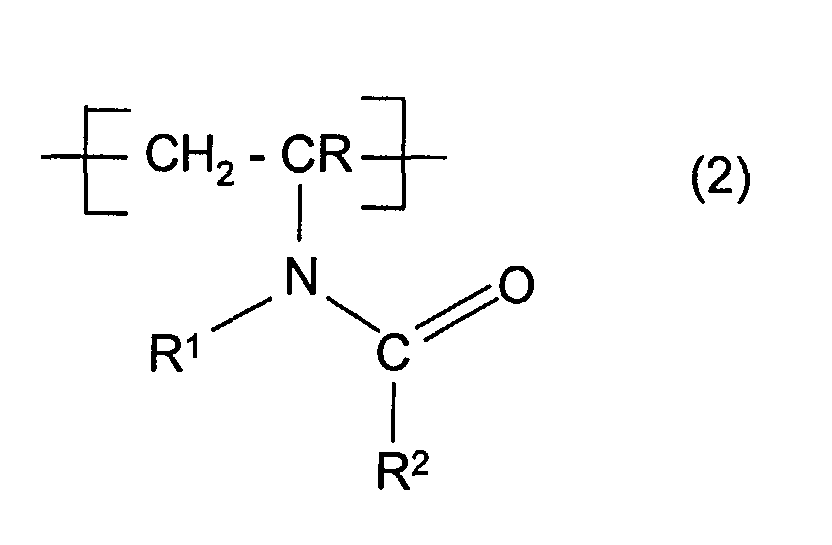

Insbesondere bevorzugt leiten sich die vernetzenden Strukturen ab von Monomeren der allgemeinen Formel (4)
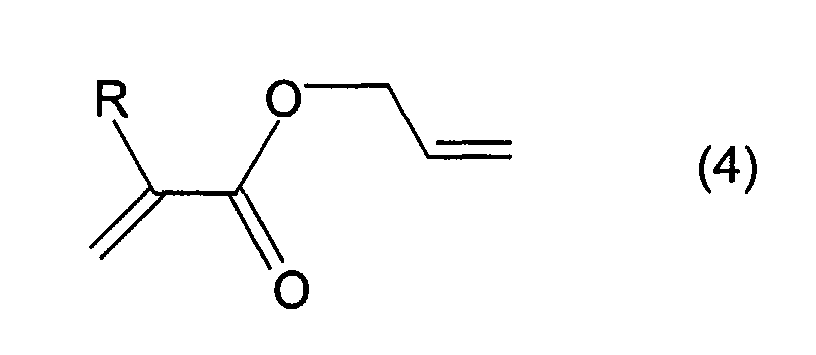
Die Polymerisationsreaktion erfolgt vorzugsweise in einem wasserlöslichen Alkohol oder einem Gemisch mehrerer Alkohole mit 1 bis 6 C-Atomen, vorzugsweise in tert.-Butanol. Der Wassergehalt des Alkohols oder Alkoholgemisches sollte 10 Gew.-% nicht überschreiten, da sonst im Verlauf der Polymerisation eine Klumpenbildung auftreten kann. Die Art und die Menge des Lösungsmittels sollten so gewählt werden, dass das Salz der Acrylamidoalkylsulfonsäure entsprechend Formel (3), insbesondere der 2-Acrylamido-2-methyl-propan-sulfonsäure, darin weitgehend löslich oder dispergierbar ist. Unter weitgehend löslich oder dispergierbar ist zu verstehen, dass sich auch nach Abstellen des Rührwerks kein festes Material aus der Lösung oder Dispersion absetzt. Das im Verlaufe der Reaktion entstehende Polymerisat soll hingegen in dem gewählten Lösungsmittel bzw. Lösungsmittelgemisch weitgehend unlöslich sein. Unter weitgehend unlöslich ist hierbei zu verstehen, dass im Verlauf der Polymerisation eine gut rührbare, breiige Polymerpaste entsteht, in der sich keine Klumpen oder Verklebungen bilden. Das durch Absaugen der Paste erhältliche Filtrat sollte einen Feststoffgehalt von maximal 5 Gew.-% aufweisen. Sind die Copolymere in stärkerem Ausmaß im gewählten Lösungsmittel oder Lösungsmittelgemisch löslich, kann es beim Trocknen der Polymerisatpaste zu Verklumpungen kommen.
Die Polymerisationsreaktion selbst wird in an sich bekannter Weise durch radikalbildende Verbindungen wie Azoinitiatoren (z.B. Azobisisobutyronitril), Peroxide (z.B. Dilaurylperoxid) oder Persulfate im Temperaturintervall von 20 bis 120°C, vorzugsweise zwischen 40 und 80°C, gestartet und über einen Zeitraum von 30 Minuten bis mehrere Stunden fortgeführt.
Das Eigenschaftsprofil der Copolymere lässt sich durch Variation des Mischungsverhältnisses der Monomere sowie dem Anteil an Vernetzer variieren. So kann z.B. durch den verstärkten Einbau von Ammoniumsalzen der Acrylamidosulfonsäuren die verdickende Wirkung der Polymerisate verbessert werden. Durch Einbau von mehr cyclischem N-Vinylcarbonsäureamid wird dagegen die Elektrolytverträglichkeit der Polymerisate und deren Löslichkeit in nichtwässrigen Systemen verbessert.
Bevorzugt besitzen die Zubereitungen einen pH-Wert im Bereich 3 bis 10, besonders bevorzugt 4 bis 9.
Bei den kosmetischen Mitteln kann es sich um rinse-off Produkte, z.B. Shampoos, Duschbäder, Duschgels, Schaumbäder, oder auch leave-on Produkte, z.B. Hautpflegemittel wie Tagescremes, Nachtcremes, Pflegecremes, Nährcremes, Bodylotions, Salben, Sonnenschutzmittel, Lippenpflegemittel und Deodorantien, handeln. Weiterhin kann es sich um tensidfreie wässrig-lösemittelhaltige Mittel und Emulsionen, z.B. Haarkuren und -spülungen, Haargele, Dauerwellenmittel, Haarfärbemittel und dergleichen, handeln.

oder

und

und
| Viskositäten [mPas] von 1,0 Gew.-% Copolymer 1 und 1,0 Gew.-% ®Carbopol 980 in Ethanol/E-Wasser und Aceton/ E-Wasser Gemischen; pH-Wert 5.5 bis 6 | ||
| Mischungen | Viskositäten [mPas] | Viskositäten [mPas] |
| EtOH/E-Wasser | Copolymer 1 | ®Carbopol 980 |
| 0:10 | 50 000 | 61 000 |
| 1:9 | 49 000 | 59 000 |
| 2:8 | 48 000 | 48 000 |
| 3:7 | 46000 | < 100 |
| 4:6 | 41 000 | < 100 |
| 5:5 | 33 000 | < 100 |
| 6:4 | 23 500 | < 100 |
| 7:3 | 14 000 | < 100 |
| 8:2 | 5000 | < 100 |
| Aceton/E-Wasser | Copolymer 1 | ®Carbopol 980 |
| 0:10 | 50 000 | 61 000 |
| 1:9 | 48 300 | 65 500 |
| 2:8 | 46 400 | 66 000 |
| 3:7 | 44 000 | 50 000 |
| 4:6 | 41 000 | < 100 |
| 5:5 | 36 000 | < 100 |
| 6:4 | 27 000 | < 100 |
| Viskositäten [mPas] von 1,0 Gew.-% Copolymer 1 und 1,0 Gew.-% ®Carbopol 980 in Ethanol/ E-Wasser (1:9) bei verschiedenen pH-Werten | ||
| pH-Wert | Viskositäten [mPas] | Viskositäten [mPas] |
| Copolymer 1 | ®Carbopol 980 | |
| 7,0 | 49 000 | 59 000 |
| 6,0 | 48 000 | 48 000 |
| 5,0 | 47 000 | 25 000 |
| 4,5 | 47 500 | 10 000 |
| 4,0 | 48 000 | < 100 |
| 3,5 | 35 000 | < 100 |
| 3,0 | 29 000 | < 100 |
| Viskositäten [mPas] von 1,0 Gew.-% Copolymer 1 in 1:1 Mischungen verschiedener Lösemittel mit Wasser; pH-Wert 5.5 bis 6 | ||
| Mischung | Viskosität [mPas] | Aussehen |
| Propylenglykol/E-Wasser | 55 000 | klare Gele |
| PEG 400/E-Wasser | 18 200 | klare Gele |
| Glykol/E-Wasser | 46 800 | klare Gele |
| Glycerin/E-Wasser | 55 000 | klare Gele |
| Acetonitril/E-Wasser | 23 500 | trübes Gel |
| DMF/E-Wasser | 39 500 | klares Gel |
| DMSO/E-Wasser | 63 500 | trübes Gel |
Claims (18)
- Verwendung von Copolymeren, bestehend im wesentlichen ausals Verdicker in Zubereitungen, enthaltend organische Lösemittel.a1) 1 bis 50 Gew.-% der wiederkehrenden Struktureinheit der Formel (1)wobei n eine ganze Zahl von 2 bis 9 bedeutet
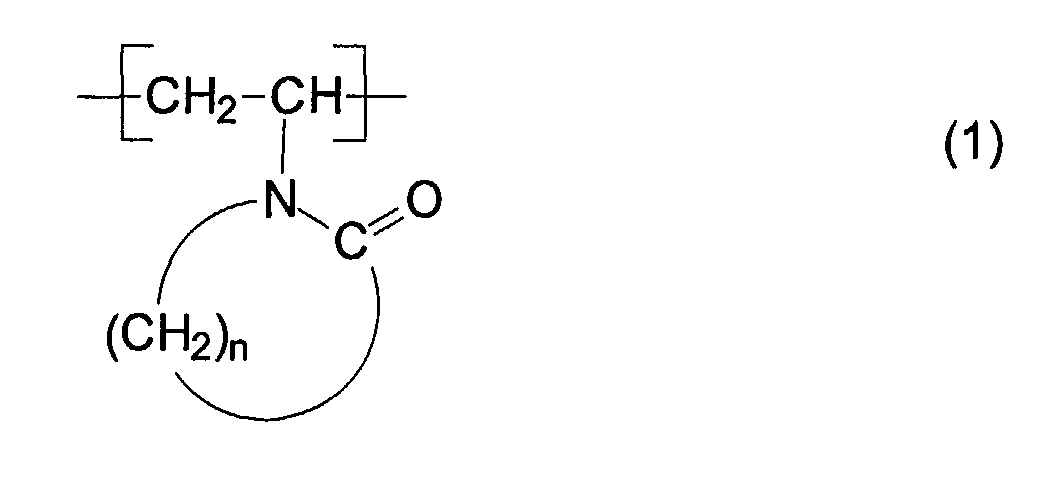
odera2) 1 bis 50 Gew.-% einer Mischung der wiederkehrenden Struktureinheit der Formel (1) und der wiederkehrenden Struktureinheit der Formel (2)wobei R, R1 und R2 gleich oder verschieden sein können und Wasserstoff oder eine lineare oder verzweigte Alkyl- oder Alkenylgruppe mit jeweils 1 bis 30 C-Atomen, bedeuten und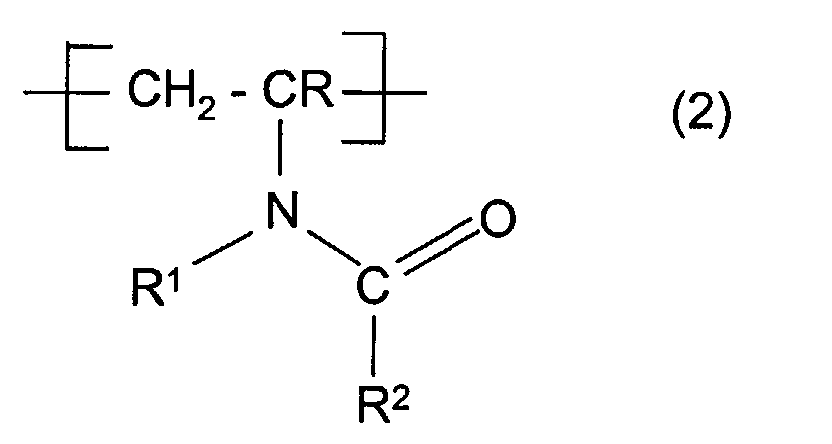 b) 49,99 bis 98,99 Gew.-% der wiederkehrenden Struktureinheit der Formel (3)worin R3 Wasserstoff, Methyl oder Ethyl, Z (C1-C8)-Alkylen und X ein Ammonium-, Alkali- oder Erdalkali-lon bedeuten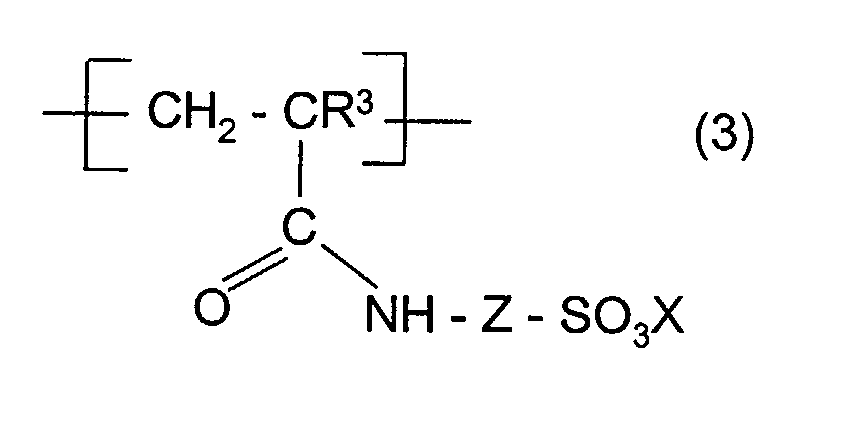
undc) 0,01 bis 8 Gew.-% vernetzenden Strukturen, die aus Monomeren mit mindestens zwei olefinischen Doppelbindungen hervorgegangen sind, - Verwendung nach Anspruch 1, dadurch gekennzeichnet, dass die Copolymere 2 bis 30 Gew.-% der Struktureinheiten a1) oder a2), 69,5 bis 97,5 Gew.-% der Struktureinheit b) und 0,01 bis 5 Gew.-% der Struktureinheit c) enthalten.
- Verwendung nach Anspruch 1 und/oder 2, dadurch gekennzeichnet, dass die Copolymere die Struktureinheit a2) enthalten.
- Verwendung nach mindestens einem der Ansprüche 1 bis 3, dadurch gekennzeichnet, dass sich die Struktureinheit gemäss Formel (1) vom N-Vinylpyrrolidon ableitet.
- Verwendung nach mindestens einem der Ansprüche 1 bis 4, dadurch gekennzeichnet, dass es sich die Struktureinheit gemäss Formel (3) von der 2-Acrylamido-2-methyl-propan-sulfonsäure, bevorzugt den Ammoniumsalzen, besonders bevorzugt dem NH4 +-Salz, ableitet.
- Verwendung nach mindestens einem der Ansprüche 1 bis 5, dadurch gekennzeichnet, dass sich die Struktureinheiten c) von Acrylsäureallylester, Methacrylsäureallylester, Trimethylolpropantriacrylat und/oder Trimethylolpropanmethacrylat ableitet.
- Verwendung nach mindestens einem der Ansprüche 1 bis 6, dadurch gekennzeichnet, dass die Copolymere durch Fällungspolymerisation in tert.-Butanol hergestellt werden.
- Verwendung nach mindestens einem der Ansprüche 1 bis 7, dadurch gekennzeichnet, dass die Zubereitungen, bezogen auf die fertigen Zubereitungen, 0,1 bis 5 Gew.-% an Copolymeren enthalten.
- Verwendung nach mindestens einem der Ansprüche 1 bis 8, dadurch gekennzeichnet, dass es sich bei den organischen Lösemittel um polar aprotische Lösemittel, bevorzugt wassermischbare polar aprotische Lösemittel, handelt.
- Verwendung nach Anspruch 9, dadurch gekennzeichnet, dass es sich bei den organischen Lösemitteln um einwertige Alkohole, mehrwertige Alkohole, Ketone, Ester, Ether, Amide, Sulfoxide, Nitrile, O-, N- und S-Heterocyclen, ethoxylierte und/oder propoxylierte Alkohole und/oder Polyethylenglykole handelt.
- Verwendung nach Anspruch 10, dadurch gekennzeichnet, dass es sich bei den organischen Lösemitteln um Methanol, Ethanol, Propanol, Isopropanol, n-Butanol, i-Butanol, t-Butanol, Glycerin, Propylenglykol, Butylenglykol, Glykol, Aceton, Acetonitril, Tetrahydrofuran und/oder Dimethylformamid handelt.
- Verwendung nach mindestens einem der Ansprüche 1 bis 11, dadurch gekennzeichnet, dass die Zubereitungen, bezogen auf die fertigen Zubereitungen, 5 bis 99.9 Gew.-% organisches Lösemittel enthalten.
- Verwendung nach Anspruch 12, dadurch gekennzeichnet, dass die Zubereitungen, bezogen auf die fertigen Zubereitungen, 40 bis 95 Gew.-% an organischen Lösemitteln enthalten.
- Verwendung nach Anspruch 12, dadurch gekennzeichnet, dass die Zubereitungen, bezogen auf die fertigen Zubereitungen, 5 bis 30 Gew.-% an organischen Lösemitteln, bevorzugt im pH-Bereich 3 bis 6, enthalten.
- Verwendung nach mindestens einem der Ansprüche 1 bis 14, dadurch gekennzeichnet, dass die Zubereitungen, bezogen auf die fertigen Zubereitungen 30 bis 80 Gew.-% Wasser enthalten.
- Verwendung nach mindestens einem der Ansprüche 1 bis 15, dadurch gekennzeichnet, dass die Zubereitungen einen pH-Wert von 4 bis 9 besitzen.
- Verwendung nach mindestens einem der Ansprüche 1 bis 16, dadurch gekennzeichnet, dass es sich bei den Zubereitungen um kosmetische, dermatologische und pharmazeutische Zubereitungen handelt.
- Verfahren zur Verdickung von Zubereitungen, enthaltend organische Lösemittel, dadurch gekennzeichnet, dass den Zubereitungen mindestens ein Copolymer bestehend im wesentlichen ausa1) 1 bis 50 Gew.-% der wiederkehrenden Struktureinheit der Formel (1)wobei n eine ganze Zahl von 2 bis 9 bedeutet

odera2) 1 bis 50 Gew.-% einer Mischung der wiederkehrenden Struktureinheit der Formel (1) und der wiederkehrenden Struktureinheit der Formel (2)wobei R, R1 und R2 gleich oder verschieden sein können und Wasserstoff oder eine lineare oder verzweigte Alkyl- oder Alkenylgruppe mit jeweils 1 bis 30 C-Atomen bedeuten und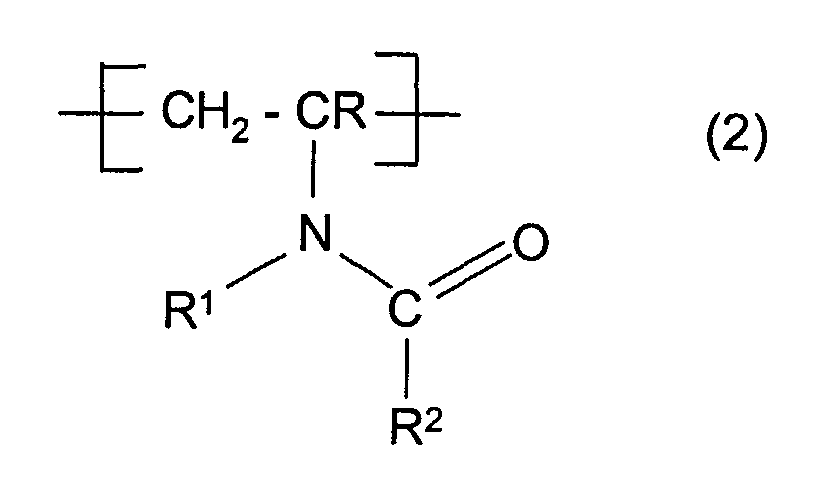 b) 49,99 bis 98,99 Gew.-% der wiederkehrenden Struktureinheit der Formel (3)worin R3 Wasserstoff, Methyl oder Ethyl, Z (C1-C8)-Alkylen und X ein Ammonium-, Alkali- oder Erdalkali-lon bedeuten und
 c) 0,01 bis 8 Gew.-% vernetzenden Strukturen, die aus Monomeren mit mindestens zwei olefinischen Doppelbindungen hervorgegangen sind, zugesetzt wird.
Applications Claiming Priority (2)
| Application Number | Priority Date | Filing Date | Title |
|---|---|---|---|
| DE10119338 | 2001-04-20 | ||
| DE10119338A DE10119338A1 (de) | 2001-04-20 | 2001-04-20 | Verwendung von Copolymerisaten auf Basis von Acrylamidoalkylsulfonsäuren als Verdicker in Zubereitungen enthaltend organische Lösemittel |
Publications (2)
| Publication Number | Publication Date |
|---|---|
| EP1251142A1 true EP1251142A1 (de) | 2002-10-23 |
| EP1251142B1 EP1251142B1 (de) | 2008-03-19 |
Family
ID=7682063
Family Applications (1)
| Application Number | Title | Priority Date | Filing Date |
|---|---|---|---|
| EP02008535A Expired - Lifetime EP1251142B1 (de) | 2001-04-20 | 2002-04-16 | Verwendung von Copolymerisaten auf Basis von Acrylamidoalkylsulfonsäuren als Verdicker in Zubereitungen enthaltend organische Lösemittel |
Country Status (4)
| Country | Link |
|---|---|
| US (1) | US6696517B2 (de) |
| EP (1) | EP1251142B1 (de) |
| JP (1) | JP4488401B2 (de) |
| DE (2) | DE10119338A1 (de) |
Cited By (3)
| Publication number | Priority date | Publication date | Assignee | Title |
|---|---|---|---|---|
| WO2003055944A1 (de) * | 2001-12-22 | 2003-07-10 | Clariant Gmbh | Kristallisationsinhibitor für pflanzenschutz-formulierungen |
| WO2009083130A1 (de) * | 2007-12-21 | 2009-07-09 | Clariant International Ltd | Wasserlösliche oder wasserquellbare polymere auf basis von salzen der acryloyldimethyltaurinsäure oder ihrer derivate, deren herstellung un deren verwendung als verdicker, stabilisator und konsistenzgeber |
| WO2012028261A1 (de) * | 2010-09-04 | 2012-03-08 | Clariant International Ltd | Sedimentationsstabilisierte wasserbasierende pigmentpräparationen |
Families Citing this family (17)
| Publication number | Priority date | Publication date | Assignee | Title |
|---|---|---|---|---|
| US7100685B2 (en) * | 2000-10-02 | 2006-09-05 | Enventure Global Technology | Mono-diameter wellbore casing |
| WO2004051004A2 (en) * | 2002-12-02 | 2004-06-17 | Bj Services Company | Method and apparatus for sub-sea pile-driving |
| DE10322269A1 (de) * | 2003-05-16 | 2004-12-02 | Clariant Gmbh | Flüssige Wasch- und Reinigungsmittel mit Konsistenzgebenden Polymeren |
| US7670595B2 (en) * | 2004-06-28 | 2010-03-02 | Merck Patent Gmbh | Fc-interferon-beta fusion proteins |
| CN101072793B (zh) * | 2004-12-09 | 2012-06-20 | 默克专利有限公司 | 具有降低的免疫原性的il-7变体 |
| CA2602323A1 (en) * | 2005-03-18 | 2006-09-21 | Basf Aktiengesellschaft | Cationic polymers as thickeners for aqueous and alcoholic compositions |
| US7354889B2 (en) * | 2005-08-31 | 2008-04-08 | Kimberly-Clark Worldwide, Inc. | Method of removing medical adhesive with a remover comprising tetrahydrofurfuryl acetate |
| GB0716228D0 (en) * | 2007-08-20 | 2007-09-26 | Reckitt Benckiser Nv | Detergent composition |
| US7939484B1 (en) * | 2009-10-27 | 2011-05-10 | Clariant International, Ltd. | Method for reducing the adhesion forces between hard surfaces and subsequently occurring soil |
| WO2015133986A1 (en) | 2014-03-03 | 2015-09-11 | Halliburton Energy Services, Inc. | Viscosifier polymer for treatment of a subterranean formation |
| US10113098B2 (en) * | 2014-12-19 | 2018-10-30 | Halliburton Energy Servives, Inc. | Composition including viscosifier polymer and polyamine viscosity modifier for treatment of subterranean formations |
| MX2017004209A (es) * | 2014-12-19 | 2017-06-06 | Halliburton Energy Services Inc | Composicion que incluye un polimero viscosificante y modificador de la viscosidad de poliamina para el tratamiento de formaciones subterraneas. |
| MX383468B (es) | 2014-12-22 | 2025-03-14 | Halliburton Energy Services Inc | Polímeros reticulados que incluyen grupos de ácido sulfónico o sales o ésteres de estos como viscosificantes y aditivos contra la pérdida de fluidos para tratamiento subterráneo. |
| AU2015384198B2 (en) * | 2015-02-23 | 2018-01-04 | Halliburton Energy Services, Inc. | Crosslinked polymer compositions for use in subterranean formation operations |
| BR112017015188A2 (pt) | 2015-02-23 | 2018-01-16 | Halliburton Energy Services Inc | polímero reticulado |
| US10336850B2 (en) | 2015-02-23 | 2019-07-02 | Hallibunon Energy Services, Inc. | Methods of use for crosslinked polymer compositions in subterranean formation operations |
| US10752822B2 (en) | 2015-02-23 | 2020-08-25 | Halliburton Energy Services, Inc. | Crosslinked polymer compositions and methods for use in subterranean formation operations |
Citations (2)
| Publication number | Priority date | Publication date | Assignee | Title |
|---|---|---|---|---|
| EP1033378A1 (de) * | 1999-03-03 | 2000-09-06 | Clariant GmbH | Copolymere und ihre Verwendung als Bohrhilfsmittel |
| EP1116733A1 (de) * | 2000-01-11 | 2001-07-18 | Clariant GmbH | Wasserlösliche oder wasserquellbare vernetzte Copolymere |
Family Cites Families (3)
| Publication number | Priority date | Publication date | Assignee | Title |
|---|---|---|---|---|
| US5080809A (en) * | 1983-01-28 | 1992-01-14 | Phillips Petroleum Company | Polymers useful in the recovery and processing of natural resources |
| DE19640363A1 (de) * | 1996-09-30 | 1998-04-02 | Basf Ag | Verwendung wasserlöslicher Copolymere als Wirkstoffe in kosmetischen Formulierungen |
| DE19905639A1 (de) | 1999-02-11 | 2000-08-17 | Clariant Gmbh | Wasserlösliche oder wasserquellbare Polymerisate |
-
2001
- 2001-04-20 DE DE10119338A patent/DE10119338A1/de not_active Withdrawn
-
2002
- 2002-04-16 DE DE50211903T patent/DE50211903D1/de not_active Expired - Lifetime
- 2002-04-16 US US10/123,450 patent/US6696517B2/en not_active Expired - Lifetime
- 2002-04-16 EP EP02008535A patent/EP1251142B1/de not_active Expired - Lifetime
- 2002-04-18 JP JP2002116264A patent/JP4488401B2/ja not_active Expired - Fee Related
Patent Citations (2)
| Publication number | Priority date | Publication date | Assignee | Title |
|---|---|---|---|---|
| EP1033378A1 (de) * | 1999-03-03 | 2000-09-06 | Clariant GmbH | Copolymere und ihre Verwendung als Bohrhilfsmittel |
| EP1116733A1 (de) * | 2000-01-11 | 2001-07-18 | Clariant GmbH | Wasserlösliche oder wasserquellbare vernetzte Copolymere |
Cited By (4)
| Publication number | Priority date | Publication date | Assignee | Title |
|---|---|---|---|---|
| WO2003055944A1 (de) * | 2001-12-22 | 2003-07-10 | Clariant Gmbh | Kristallisationsinhibitor für pflanzenschutz-formulierungen |
| WO2009083130A1 (de) * | 2007-12-21 | 2009-07-09 | Clariant International Ltd | Wasserlösliche oder wasserquellbare polymere auf basis von salzen der acryloyldimethyltaurinsäure oder ihrer derivate, deren herstellung un deren verwendung als verdicker, stabilisator und konsistenzgeber |
| US8629224B2 (en) | 2007-12-21 | 2014-01-14 | Clariant Finance (Bvi) Limited | Water-soluble or water-swellable polymers on the basis of salts of acryloyldimethyltaurine acid or the derivatives thereof, the production thereof and the use thereof as thickener, stabilizer and consistency agents |
| WO2012028261A1 (de) * | 2010-09-04 | 2012-03-08 | Clariant International Ltd | Sedimentationsstabilisierte wasserbasierende pigmentpräparationen |
Also Published As
| Publication number | Publication date |
|---|---|
| US20030004241A1 (en) | 2003-01-02 |
| JP4488401B2 (ja) | 2010-06-23 |
| US6696517B2 (en) | 2004-02-24 |
| EP1251142B1 (de) | 2008-03-19 |
| JP2003012443A (ja) | 2003-01-15 |
| DE50211903D1 (de) | 2008-04-30 |
| DE10119338A1 (de) | 2002-10-24 |
Similar Documents
| Publication | Publication Date | Title |
|---|---|---|
| EP1251142B1 (de) | Verwendung von Copolymerisaten auf Basis von Acrylamidoalkylsulfonsäuren als Verdicker in Zubereitungen enthaltend organische Lösemittel | |
| EP1116733B1 (de) | Wasserlösliche oder wasserquellbare vernetzte Copolymere | |
| EP1028129B1 (de) | Wasserlösliche oder wasserquellbare Polymerisate | |
| DE69122377T2 (de) | Verwendung eines Mikrogels eines feinteiligen, vernetzten Harzes vom N-Vinylamid-Typ | |
| EP0047714B1 (de) | Gemische aus quaternären, polymeren, hochmolekularen Ammoniumsalzen auf Acrylbasis und Tensiden, deren Herstellung und Verwendung in kosmetischen Mitteln | |
| EP0413953B1 (de) | Als Verdickungsmittel für wässrige Zubereitungen eines pH-Wertes 5,5 wirkendes Copolymerisat, Verfahren zu seiner Herstellung und seine Verwendung als Verdickungsmittel | |
| EP0080976B1 (de) | Gemische aus quaternären, polymeren Ammoniumsalzen auf Acrylbasis, aus quaternären, mono- bis oligomeren Ammoniumsalzen und aus Tensiden, deren Herstellung und Verwendung in kosmetischen Mitteln | |
| DE69332494T2 (de) | Acrylat-Copolymer, teilweise oder ganz löslich in Wasser, vernetzt oder nicht und seine Verwendung | |
| DE69127886T2 (de) | Copolymere auf Basis von N-Alkylacrylamid, deren Herstellung und deren Verwendung als Verdickungsmittel in Shampoozusammensetzungen | |
| DE60305335T2 (de) | Verfahren zur herstellung von wässrigen dispersionen kationischer homo- und copolymere unter verwendung von amphoteren schutzkolloiden | |
| EP0031005B1 (de) | Verfahren zur Herstellung wasserlöslicher Polymer-Festprodukte | |
| WO2007059857A1 (de) | Polymerdispersionen, verfahren zu deren herstellung und verwendung | |
| DE69624817T2 (de) | Carboxylgruppen enthaltende polymerzusammensetzung | |
| EP2705062B1 (de) | Scherstabile polymersysteme, deren herstellung sowie deren verwendung als verdicker | |
| EP0547519A1 (de) | Verfahren zur Herstellung einer wasserlöslichen Polymersuspension | |
| DE3781256T2 (de) | Polymere, ihre herstellung und verwendungen. | |
| EP2242783B1 (de) | Verfahren zur herstellung von polymeren durch ionenaustausch |
Legal Events
| Date | Code | Title | Description |
|---|---|---|---|
| PUAI | Public reference made under article 153(3) epc to a published international application that has entered the european phase |
Free format text: ORIGINAL CODE: 0009012 |
|
| AK | Designated contracting states |
Kind code of ref document: A1 Designated state(s): AT BE CH CY DE DK ES FI FR GB GR IE IT LI LU MC NL PT SE TR |
|
| AX | Request for extension of the european patent |
Free format text: AL;LT;LV;MK;RO;SI |
|
| 17P | Request for examination filed |
Effective date: 20030423 |
|
| AKX | Designation fees paid |
Designated state(s): DE FR GB IT |
|
| RAP1 | Party data changed (applicant data changed or rights of an application transferred) |
Owner name: CLARIANT PRODUKTE (DEUTSCHLAND) GMBH |
|
| 17Q | First examination report despatched |
Effective date: 20070508 |
|
| GRAP | Despatch of communication of intention to grant a patent |
Free format text: ORIGINAL CODE: EPIDOSNIGR1 |
|
| RIC1 | Information provided on ipc code assigned before grant |
Ipc: A61K 9/00 20060101ALI20071108BHEP Ipc: C08F 226/06 20060101ALI20071108BHEP Ipc: C08F 220/58 20060101AFI20071108BHEP |
|
| GRAS | Grant fee paid |
Free format text: ORIGINAL CODE: EPIDOSNIGR3 |
|
| GRAA | (expected) grant |
Free format text: ORIGINAL CODE: 0009210 |
|
| AK | Designated contracting states |
Kind code of ref document: B1 Designated state(s): DE FR GB |
|
| RBV | Designated contracting states (corrected) |
Designated state(s): DE FR GB |
|
| REG | Reference to a national code |
Ref country code: GB Ref legal event code: FG4D Free format text: NOT ENGLISH |
|
| REF | Corresponds to: |
Ref document number: 50211903 Country of ref document: DE Date of ref document: 20080430 Kind code of ref document: P |
|
| ET | Fr: translation filed | ||
| PLBE | No opposition filed within time limit |
Free format text: ORIGINAL CODE: 0009261 |
|
| STAA | Information on the status of an ep patent application or granted ep patent |
Free format text: STATUS: NO OPPOSITION FILED WITHIN TIME LIMIT |
|
| 26N | No opposition filed |
Effective date: 20081222 |
|
| REG | Reference to a national code |
Ref country code: FR Ref legal event code: PLFP Year of fee payment: 15 |
|
| REG | Reference to a national code |
Ref country code: FR Ref legal event code: PLFP Year of fee payment: 16 |
|
| PGFP | Annual fee paid to national office [announced via postgrant information from national office to epo] |
Ref country code: FR Payment date: 20170301 Year of fee payment: 16 |
|
| PGFP | Annual fee paid to national office [announced via postgrant information from national office to epo] |
Ref country code: GB Payment date: 20170216 Year of fee payment: 16 |
|
| PGFP | Annual fee paid to national office [announced via postgrant information from national office to epo] |
Ref country code: DE Payment date: 20170223 Year of fee payment: 16 |
|
| REG | Reference to a national code |
Ref country code: DE Ref legal event code: R119 Ref document number: 50211903 Country of ref document: DE |
|
| GBPC | Gb: european patent ceased through non-payment of renewal fee |
Effective date: 20180416 |
|
| PG25 | Lapsed in a contracting state [announced via postgrant information from national office to epo] |
Ref country code: DE Free format text: LAPSE BECAUSE OF NON-PAYMENT OF DUE FEES Effective date: 20181101 |
|
| PG25 | Lapsed in a contracting state [announced via postgrant information from national office to epo] |
Ref country code: GB Free format text: LAPSE BECAUSE OF NON-PAYMENT OF DUE FEES Effective date: 20180416 |
|
| PG25 | Lapsed in a contracting state [announced via postgrant information from national office to epo] |
Ref country code: FR Free format text: LAPSE BECAUSE OF NON-PAYMENT OF DUE FEES Effective date: 20180430 |