EP1241240A2 - Trägermaterial auf Vliesbasis insbesondere für ein Klebeband mit verbesserter Handeinreissbarkeit - Google Patents
Trägermaterial auf Vliesbasis insbesondere für ein Klebeband mit verbesserter Handeinreissbarkeit Download PDFInfo
- Publication number
- EP1241240A2 EP1241240A2 EP02005581A EP02005581A EP1241240A2 EP 1241240 A2 EP1241240 A2 EP 1241240A2 EP 02005581 A EP02005581 A EP 02005581A EP 02005581 A EP02005581 A EP 02005581A EP 1241240 A2 EP1241240 A2 EP 1241240A2
- Authority
- EP
- European Patent Office
- Prior art keywords
- strips
- material according
- adhesive
- nonwoven
- backing
- Prior art date
- Legal status (The legal status is an assumption and is not a legal conclusion. Google has not performed a legal analysis and makes no representation as to the accuracy of the status listed.)
- Granted
Links
- 239000012876 carrier material Substances 0.000 title claims abstract description 20
- 239000002390 adhesive tape Substances 0.000 title claims description 60
- 229920000642 polymer Polymers 0.000 claims abstract description 15
- 239000010432 diamond Substances 0.000 claims abstract description 6
- 239000000835 fiber Substances 0.000 claims description 60
- 239000004745 nonwoven fabric Substances 0.000 claims description 55
- 239000011230 binding agent Substances 0.000 claims description 35
- 239000000463 material Substances 0.000 claims description 26
- 238000007639 printing Methods 0.000 claims description 25
- 238000000034 method Methods 0.000 claims description 23
- 239000000853 adhesive Substances 0.000 claims description 22
- 238000000576 coating method Methods 0.000 claims description 19
- 238000005516 engineering process Methods 0.000 claims description 17
- 230000001070 adhesive effect Effects 0.000 claims description 16
- 239000006185 dispersion Substances 0.000 claims description 16
- 239000011248 coating agent Substances 0.000 claims description 15
- 238000005470 impregnation Methods 0.000 claims description 8
- 239000012943 hotmelt Substances 0.000 claims description 7
- PPBRXRYQALVLMV-UHFFFAOYSA-N Styrene Chemical compound C=CC1=CC=CC=C1 PPBRXRYQALVLMV-UHFFFAOYSA-N 0.000 claims description 6
- 238000007646 gravure printing Methods 0.000 claims description 6
- 239000000976 ink Substances 0.000 claims description 6
- 239000004922 lacquer Substances 0.000 claims description 5
- 229920000058 polyacrylate Polymers 0.000 claims description 5
- 238000007650 screen-printing Methods 0.000 claims description 5
- 229920001577 copolymer Polymers 0.000 claims description 4
- 229920002635 polyurethane Polymers 0.000 claims description 4
- 239000004814 polyurethane Substances 0.000 claims description 4
- 239000003960 organic solvent Substances 0.000 claims description 3
- 239000003973 paint Substances 0.000 claims description 3
- 229920002689 polyvinyl acetate Polymers 0.000 claims description 3
- 238000005266 casting Methods 0.000 claims description 2
- 229920000728 polyester Polymers 0.000 claims description 2
- 238000005507 spraying Methods 0.000 claims description 2
- 239000004753 textile Substances 0.000 description 31
- 238000004519 manufacturing process Methods 0.000 description 23
- 239000004744 fabric Substances 0.000 description 20
- 230000008569 process Effects 0.000 description 14
- 238000009958 sewing Methods 0.000 description 12
- 230000006872 improvement Effects 0.000 description 11
- XLYOFNOQVPJJNP-UHFFFAOYSA-N water Substances O XLYOFNOQVPJJNP-UHFFFAOYSA-N 0.000 description 8
- 230000008901 benefit Effects 0.000 description 7
- 239000010410 layer Substances 0.000 description 7
- 239000000203 mixture Substances 0.000 description 7
- 239000000126 substance Substances 0.000 description 7
- 230000032798 delamination Effects 0.000 description 6
- 238000004049 embossing Methods 0.000 description 6
- 230000010354 integration Effects 0.000 description 6
- -1 polyethylene Polymers 0.000 description 6
- 238000004804 winding Methods 0.000 description 6
- 238000001266 bandaging Methods 0.000 description 5
- NIXOWILDQLNWCW-UHFFFAOYSA-N acrylic acid group Chemical group C(C=C)(=O)O NIXOWILDQLNWCW-UHFFFAOYSA-N 0.000 description 4
- 239000000969 carrier Substances 0.000 description 4
- 238000007596 consolidation process Methods 0.000 description 4
- 239000000470 constituent Substances 0.000 description 4
- 238000001723 curing Methods 0.000 description 4
- 238000005520 cutting process Methods 0.000 description 4
- 230000002349 favourable effect Effects 0.000 description 4
- 230000035515 penetration Effects 0.000 description 4
- 229920003023 plastic Polymers 0.000 description 4
- 239000004033 plastic Substances 0.000 description 4
- 238000007711 solidification Methods 0.000 description 4
- 230000008023 solidification Effects 0.000 description 4
- 238000012360 testing method Methods 0.000 description 4
- 239000004698 Polyethylene Substances 0.000 description 3
- 229920000297 Rayon Polymers 0.000 description 3
- 239000002131 composite material Substances 0.000 description 3
- 238000007872 degassing Methods 0.000 description 3
- 230000000694 effects Effects 0.000 description 3
- 150000002148 esters Chemical class 0.000 description 3
- 238000004321 preservation Methods 0.000 description 3
- 230000009467 reduction Effects 0.000 description 3
- 239000002904 solvent Substances 0.000 description 3
- 239000000758 substrate Substances 0.000 description 3
- NIXOWILDQLNWCW-UHFFFAOYSA-M Acrylate Chemical compound [O-]C(=O)C=C NIXOWILDQLNWCW-UHFFFAOYSA-M 0.000 description 2
- 229920003043 Cellulose fiber Polymers 0.000 description 2
- 239000004743 Polypropylene Substances 0.000 description 2
- 238000005299 abrasion Methods 0.000 description 2
- ADCOVFLJGNWWNZ-UHFFFAOYSA-N antimony trioxide Chemical compound O=[Sb]O[Sb]=O ADCOVFLJGNWWNZ-UHFFFAOYSA-N 0.000 description 2
- ISAOCJYIOMOJEB-UHFFFAOYSA-N benzoin Chemical class C=1C=CC=CC=1C(O)C(=O)C1=CC=CC=C1 ISAOCJYIOMOJEB-UHFFFAOYSA-N 0.000 description 2
- 230000007423 decrease Effects 0.000 description 2
- 238000013461 design Methods 0.000 description 2
- 238000011161 development Methods 0.000 description 2
- 230000018109 developmental process Effects 0.000 description 2
- 229910003460 diamond Inorganic materials 0.000 description 2
- 238000001035 drying Methods 0.000 description 2
- 239000002657 fibrous material Substances 0.000 description 2
- 239000003063 flame retardant Substances 0.000 description 2
- 238000010348 incorporation Methods 0.000 description 2
- 238000009776 industrial production Methods 0.000 description 2
- 229920000573 polyethylene Polymers 0.000 description 2
- 229920001155 polypropylene Polymers 0.000 description 2
- 238000012545 processing Methods 0.000 description 2
- 239000000047 product Substances 0.000 description 2
- 230000005855 radiation Effects 0.000 description 2
- 229920002994 synthetic fiber Polymers 0.000 description 2
- 239000012209 synthetic fiber Substances 0.000 description 2
- VZCYOOQTPOCHFL-UHFFFAOYSA-N trans-butenedioic acid Natural products OC(=O)C=CC(O)=O VZCYOOQTPOCHFL-UHFFFAOYSA-N 0.000 description 2
- 125000000391 vinyl group Chemical group [H]C([*])=C([H])[H] 0.000 description 2
- 238000009736 wetting Methods 0.000 description 2
- 239000002759 woven fabric Substances 0.000 description 2
- MSMAPCFQRXQMRL-UHFFFAOYSA-N (2-oxo-1,2-diphenylethyl) prop-2-enoate Chemical compound C=1C=CC=CC=1C(OC(=O)C=C)C(=O)C1=CC=CC=C1 MSMAPCFQRXQMRL-UHFFFAOYSA-N 0.000 description 1
- RNFJDJUURJAICM-UHFFFAOYSA-N 2,2,4,4,6,6-hexaphenoxy-1,3,5-triaza-2$l^{5},4$l^{5},6$l^{5}-triphosphacyclohexa-1,3,5-triene Chemical group N=1P(OC=2C=CC=CC=2)(OC=2C=CC=CC=2)=NP(OC=2C=CC=CC=2)(OC=2C=CC=CC=2)=NP=1(OC=1C=CC=CC=1)OC1=CC=CC=C1 RNFJDJUURJAICM-UHFFFAOYSA-N 0.000 description 1
- SMZOUWXMTYCWNB-UHFFFAOYSA-N 2-(2-methoxy-5-methylphenyl)ethanamine Chemical compound COC1=CC=C(C)C=C1CCN SMZOUWXMTYCWNB-UHFFFAOYSA-N 0.000 description 1
- JAHNSTQSQJOJLO-UHFFFAOYSA-N 2-(3-fluorophenyl)-1h-imidazole Chemical compound FC1=CC=CC(C=2NC=CN=2)=C1 JAHNSTQSQJOJLO-UHFFFAOYSA-N 0.000 description 1
- NEFZIZUSNPOFFC-UHFFFAOYSA-N 2-hydroxy-1,2-diphenylethanone;2-methylprop-2-enoic acid Chemical compound CC(=C)C(O)=O.C=1C=CC=CC=1C(O)C(=O)C1=CC=CC=C1 NEFZIZUSNPOFFC-UHFFFAOYSA-N 0.000 description 1
- QISOBCMNUJQOJU-UHFFFAOYSA-N 4-bromo-1h-pyrazole-5-carboxylic acid Chemical compound OC(=O)C=1NN=CC=1Br QISOBCMNUJQOJU-UHFFFAOYSA-N 0.000 description 1
- 239000004114 Ammonium polyphosphate Substances 0.000 description 1
- VZCYOOQTPOCHFL-OWOJBTEDSA-N Fumaric acid Natural products OC(=O)\C=C\C(O)=O VZCYOOQTPOCHFL-OWOJBTEDSA-N 0.000 description 1
- 244000043261 Hevea brasiliensis Species 0.000 description 1
- 239000004831 Hot glue Substances 0.000 description 1
- CERQOIWHTDAKMF-UHFFFAOYSA-N Methacrylic acid Chemical compound CC(=C)C(O)=O CERQOIWHTDAKMF-UHFFFAOYSA-N 0.000 description 1
- OAICVXFJPJFONN-UHFFFAOYSA-N Phosphorus Chemical compound [P] OAICVXFJPJFONN-UHFFFAOYSA-N 0.000 description 1
- OFOBLEOULBTSOW-UHFFFAOYSA-N Propanedioic acid Natural products OC(=O)CC(O)=O OFOBLEOULBTSOW-UHFFFAOYSA-N 0.000 description 1
- XTXRWKRVRITETP-UHFFFAOYSA-N Vinyl acetate Chemical compound CC(=O)OC=C XTXRWKRVRITETP-UHFFFAOYSA-N 0.000 description 1
- QYKIQEUNHZKYBP-UHFFFAOYSA-N Vinyl ether Chemical class C=COC=C QYKIQEUNHZKYBP-UHFFFAOYSA-N 0.000 description 1
- 150000003926 acrylamides Chemical class 0.000 description 1
- 230000002730 additional effect Effects 0.000 description 1
- 239000012790 adhesive layer Substances 0.000 description 1
- 230000032683 aging Effects 0.000 description 1
- 150000001298 alcohols Chemical class 0.000 description 1
- 235000019826 ammonium polyphosphate Nutrition 0.000 description 1
- 229920001276 ammonium polyphosphate Polymers 0.000 description 1
- 230000003712 anti-aging effect Effects 0.000 description 1
- 238000013459 approach Methods 0.000 description 1
- 238000009835 boiling Methods 0.000 description 1
- 238000003490 calendering Methods 0.000 description 1
- 125000004432 carbon atom Chemical group C* 0.000 description 1
- 230000008859 change Effects 0.000 description 1
- 239000007795 chemical reaction product Substances 0.000 description 1
- 239000003795 chemical substances by application Substances 0.000 description 1
- 230000001427 coherent effect Effects 0.000 description 1
- 150000001875 compounds Chemical class 0.000 description 1
- 238000010276 construction Methods 0.000 description 1
- 238000001816 cooling Methods 0.000 description 1
- 238000005336 cracking Methods 0.000 description 1
- 238000004132 cross linking Methods 0.000 description 1
- 239000003431 cross linking reagent Substances 0.000 description 1
- 238000013016 damping Methods 0.000 description 1
- 230000001419 dependent effect Effects 0.000 description 1
- 239000000975 dye Substances 0.000 description 1
- 229920001971 elastomer Polymers 0.000 description 1
- 238000011156 evaluation Methods 0.000 description 1
- 238000001125 extrusion Methods 0.000 description 1
- 239000004835 fabric adhesive Substances 0.000 description 1
- 238000010021 flat screen printing Methods 0.000 description 1
- 239000011888 foil Substances 0.000 description 1
- 238000009472 formulation Methods 0.000 description 1
- 230000009477 glass transition Effects 0.000 description 1
- 238000010438 heat treatment Methods 0.000 description 1
- 229930195733 hydrocarbon Natural products 0.000 description 1
- 150000002430 hydrocarbons Chemical class 0.000 description 1
- 229910052739 hydrogen Inorganic materials 0.000 description 1
- 239000001257 hydrogen Substances 0.000 description 1
- 229910052500 inorganic mineral Inorganic materials 0.000 description 1
- 150000002576 ketones Chemical class 0.000 description 1
- 238000009940 knitting Methods 0.000 description 1
- 238000003475 lamination Methods 0.000 description 1
- 238000011068 loading method Methods 0.000 description 1
- VZCYOOQTPOCHFL-UPHRSURJSA-N maleic acid Chemical compound OC(=O)\C=C/C(O)=O VZCYOOQTPOCHFL-UPHRSURJSA-N 0.000 description 1
- FPYJFEHAWHCUMM-UHFFFAOYSA-N maleic anhydride Chemical compound O=C1OC(=O)C=C1 FPYJFEHAWHCUMM-UHFFFAOYSA-N 0.000 description 1
- 238000000691 measurement method Methods 0.000 description 1
- 239000000155 melt Substances 0.000 description 1
- 239000002184 metal Substances 0.000 description 1
- 125000005397 methacrylic acid ester group Chemical group 0.000 description 1
- LVHBHZANLOWSRM-UHFFFAOYSA-N methylenebutanedioic acid Natural products OC(=O)CC(=C)C(O)=O LVHBHZANLOWSRM-UHFFFAOYSA-N 0.000 description 1
- 239000011707 mineral Substances 0.000 description 1
- 239000000178 monomer Substances 0.000 description 1
- 229920003052 natural elastomer Polymers 0.000 description 1
- 229920001194 natural rubber Polymers 0.000 description 1
- 230000003287 optical effect Effects 0.000 description 1
- 238000005457 optimization Methods 0.000 description 1
- 150000005526 organic bromine compounds Chemical class 0.000 description 1
- 238000004806 packaging method and process Methods 0.000 description 1
- 238000000053 physical method Methods 0.000 description 1
- 239000000049 pigment Substances 0.000 description 1
- 239000006223 plastic coating Substances 0.000 description 1
- 229920006254 polymer film Polymers 0.000 description 1
- 229920001296 polysiloxane Polymers 0.000 description 1
- 230000008092 positive effect Effects 0.000 description 1
- 239000013557 residual solvent Substances 0.000 description 1
- 230000000717 retained effect Effects 0.000 description 1
- 238000010022 rotary screen printing Methods 0.000 description 1
- 230000035945 sensitivity Effects 0.000 description 1
- 239000007787 solid Substances 0.000 description 1
- 239000003381 stabilizer Substances 0.000 description 1
- 239000007858 starting material Substances 0.000 description 1
- 230000035882 stress Effects 0.000 description 1
- 238000010998 test method Methods 0.000 description 1
- 238000009823 thermal lamination Methods 0.000 description 1
- 239000002966 varnish Substances 0.000 description 1
- 229920001567 vinyl ester resin Polymers 0.000 description 1
- 229920002554 vinyl polymer Polymers 0.000 description 1
- 239000002699 waste material Substances 0.000 description 1
- 230000003313 weakening effect Effects 0.000 description 1
- 238000009941 weaving Methods 0.000 description 1
- 239000000080 wetting agent Substances 0.000 description 1
- 210000002268 wool Anatomy 0.000 description 1
- 230000037303 wrinkles Effects 0.000 description 1
Images

Classifications
-
- D—TEXTILES; PAPER
- D04—BRAIDING; LACE-MAKING; KNITTING; TRIMMINGS; NON-WOVEN FABRICS
- D04H—MAKING TEXTILE FABRICS, e.g. FROM FIBRES OR FILAMENTARY MATERIAL; FABRICS MADE BY SUCH PROCESSES OR APPARATUS, e.g. FELTS, NON-WOVEN FABRICS; COTTON-WOOL; WADDING ; NON-WOVEN FABRICS FROM STAPLE FIBRES, FILAMENTS OR YARNS, BONDED WITH AT LEAST ONE WEB-LIKE MATERIAL DURING THEIR CONSOLIDATION
- D04H1/00—Non-woven fabrics formed wholly or mainly of staple fibres or like relatively short fibres
- D04H1/40—Non-woven fabrics formed wholly or mainly of staple fibres or like relatively short fibres from fleeces or layers composed of fibres without existing or potential cohesive properties
- D04H1/44—Non-woven fabrics formed wholly or mainly of staple fibres or like relatively short fibres from fleeces or layers composed of fibres without existing or potential cohesive properties the fleeces or layers being consolidated by mechanical means, e.g. by rolling
- D04H1/46—Non-woven fabrics formed wholly or mainly of staple fibres or like relatively short fibres from fleeces or layers composed of fibres without existing or potential cohesive properties the fleeces or layers being consolidated by mechanical means, e.g. by rolling by needling or like operations to cause entanglement of fibres
- D04H1/492—Non-woven fabrics formed wholly or mainly of staple fibres or like relatively short fibres from fleeces or layers composed of fibres without existing or potential cohesive properties the fleeces or layers being consolidated by mechanical means, e.g. by rolling by needling or like operations to cause entanglement of fibres by fluid jet
-
- C—CHEMISTRY; METALLURGY
- C09—DYES; PAINTS; POLISHES; NATURAL RESINS; ADHESIVES; COMPOSITIONS NOT OTHERWISE PROVIDED FOR; APPLICATIONS OF MATERIALS NOT OTHERWISE PROVIDED FOR
- C09J—ADHESIVES; NON-MECHANICAL ASPECTS OF ADHESIVE PROCESSES IN GENERAL; ADHESIVE PROCESSES NOT PROVIDED FOR ELSEWHERE; USE OF MATERIALS AS ADHESIVES
- C09J7/00—Adhesives in the form of films or foils
- C09J7/20—Adhesives in the form of films or foils characterised by their carriers
- C09J7/21—Paper; Textile fabrics
-
- C—CHEMISTRY; METALLURGY
- C09—DYES; PAINTS; POLISHES; NATURAL RESINS; ADHESIVES; COMPOSITIONS NOT OTHERWISE PROVIDED FOR; APPLICATIONS OF MATERIALS NOT OTHERWISE PROVIDED FOR
- C09J—ADHESIVES; NON-MECHANICAL ASPECTS OF ADHESIVE PROCESSES IN GENERAL; ADHESIVE PROCESSES NOT PROVIDED FOR ELSEWHERE; USE OF MATERIALS AS ADHESIVES
- C09J7/00—Adhesives in the form of films or foils
- C09J7/20—Adhesives in the form of films or foils characterised by their carriers
- C09J7/29—Laminated material
-
- D—TEXTILES; PAPER
- D04—BRAIDING; LACE-MAKING; KNITTING; TRIMMINGS; NON-WOVEN FABRICS
- D04H—MAKING TEXTILE FABRICS, e.g. FROM FIBRES OR FILAMENTARY MATERIAL; FABRICS MADE BY SUCH PROCESSES OR APPARATUS, e.g. FELTS, NON-WOVEN FABRICS; COTTON-WOOL; WADDING ; NON-WOVEN FABRICS FROM STAPLE FIBRES, FILAMENTS OR YARNS, BONDED WITH AT LEAST ONE WEB-LIKE MATERIAL DURING THEIR CONSOLIDATION
- D04H1/00—Non-woven fabrics formed wholly or mainly of staple fibres or like relatively short fibres
- D04H1/40—Non-woven fabrics formed wholly or mainly of staple fibres or like relatively short fibres from fleeces or layers composed of fibres without existing or potential cohesive properties
- D04H1/44—Non-woven fabrics formed wholly or mainly of staple fibres or like relatively short fibres from fleeces or layers composed of fibres without existing or potential cohesive properties the fleeces or layers being consolidated by mechanical means, e.g. by rolling
- D04H1/46—Non-woven fabrics formed wholly or mainly of staple fibres or like relatively short fibres from fleeces or layers composed of fibres without existing or potential cohesive properties the fleeces or layers being consolidated by mechanical means, e.g. by rolling by needling or like operations to cause entanglement of fibres
- D04H1/492—Non-woven fabrics formed wholly or mainly of staple fibres or like relatively short fibres from fleeces or layers composed of fibres without existing or potential cohesive properties the fleeces or layers being consolidated by mechanical means, e.g. by rolling by needling or like operations to cause entanglement of fibres by fluid jet
- D04H1/495—Non-woven fabrics formed wholly or mainly of staple fibres or like relatively short fibres from fleeces or layers composed of fibres without existing or potential cohesive properties the fleeces or layers being consolidated by mechanical means, e.g. by rolling by needling or like operations to cause entanglement of fibres by fluid jet for formation of patterns, e.g. drilling or rearrangement
-
- D—TEXTILES; PAPER
- D04—BRAIDING; LACE-MAKING; KNITTING; TRIMMINGS; NON-WOVEN FABRICS
- D04H—MAKING TEXTILE FABRICS, e.g. FROM FIBRES OR FILAMENTARY MATERIAL; FABRICS MADE BY SUCH PROCESSES OR APPARATUS, e.g. FELTS, NON-WOVEN FABRICS; COTTON-WOOL; WADDING ; NON-WOVEN FABRICS FROM STAPLE FIBRES, FILAMENTS OR YARNS, BONDED WITH AT LEAST ONE WEB-LIKE MATERIAL DURING THEIR CONSOLIDATION
- D04H1/00—Non-woven fabrics formed wholly or mainly of staple fibres or like relatively short fibres
- D04H1/40—Non-woven fabrics formed wholly or mainly of staple fibres or like relatively short fibres from fleeces or layers composed of fibres without existing or potential cohesive properties
- D04H1/58—Non-woven fabrics formed wholly or mainly of staple fibres or like relatively short fibres from fleeces or layers composed of fibres without existing or potential cohesive properties by applying, incorporating or activating chemical or thermoplastic bonding agents, e.g. adhesives
- D04H1/64—Non-woven fabrics formed wholly or mainly of staple fibres or like relatively short fibres from fleeces or layers composed of fibres without existing or potential cohesive properties by applying, incorporating or activating chemical or thermoplastic bonding agents, e.g. adhesives the bonding agent being applied in wet state, e.g. chemical agents in dispersions or solutions
- D04H1/66—Non-woven fabrics formed wholly or mainly of staple fibres or like relatively short fibres from fleeces or layers composed of fibres without existing or potential cohesive properties by applying, incorporating or activating chemical or thermoplastic bonding agents, e.g. adhesives the bonding agent being applied in wet state, e.g. chemical agents in dispersions or solutions at spaced points or locations
-
- D—TEXTILES; PAPER
- D04—BRAIDING; LACE-MAKING; KNITTING; TRIMMINGS; NON-WOVEN FABRICS
- D04H—MAKING TEXTILE FABRICS, e.g. FROM FIBRES OR FILAMENTARY MATERIAL; FABRICS MADE BY SUCH PROCESSES OR APPARATUS, e.g. FELTS, NON-WOVEN FABRICS; COTTON-WOOL; WADDING ; NON-WOVEN FABRICS FROM STAPLE FIBRES, FILAMENTS OR YARNS, BONDED WITH AT LEAST ONE WEB-LIKE MATERIAL DURING THEIR CONSOLIDATION
- D04H3/00—Non-woven fabrics formed wholly or mainly of yarns or like filamentary material of substantial length
- D04H3/08—Non-woven fabrics formed wholly or mainly of yarns or like filamentary material of substantial length characterised by the method of strengthening or consolidating
- D04H3/10—Non-woven fabrics formed wholly or mainly of yarns or like filamentary material of substantial length characterised by the method of strengthening or consolidating with bonds between yarns or filaments made mechanically
- D04H3/11—Non-woven fabrics formed wholly or mainly of yarns or like filamentary material of substantial length characterised by the method of strengthening or consolidating with bonds between yarns or filaments made mechanically by fluid jet
-
- D—TEXTILES; PAPER
- D06—TREATMENT OF TEXTILES OR THE LIKE; LAUNDERING; FLEXIBLE MATERIALS NOT OTHERWISE PROVIDED FOR
- D06N—WALL, FLOOR, OR LIKE COVERING MATERIALS, e.g. LINOLEUM, OILCLOTH, ARTIFICIAL LEATHER, ROOFING FELT, CONSISTING OF A FIBROUS WEB COATED WITH A LAYER OF MACROMOLECULAR MATERIAL; FLEXIBLE SHEET MATERIAL NOT OTHERWISE PROVIDED FOR
- D06N3/00—Artificial leather, oilcloth or other material obtained by covering fibrous webs with macromolecular material, e.g. resins, rubber or derivatives thereof
- D06N3/0002—Artificial leather, oilcloth or other material obtained by covering fibrous webs with macromolecular material, e.g. resins, rubber or derivatives thereof characterised by the substrate
- D06N3/0011—Artificial leather, oilcloth or other material obtained by covering fibrous webs with macromolecular material, e.g. resins, rubber or derivatives thereof characterised by the substrate using non-woven fabrics
-
- C—CHEMISTRY; METALLURGY
- C09—DYES; PAINTS; POLISHES; NATURAL RESINS; ADHESIVES; COMPOSITIONS NOT OTHERWISE PROVIDED FOR; APPLICATIONS OF MATERIALS NOT OTHERWISE PROVIDED FOR
- C09J—ADHESIVES; NON-MECHANICAL ASPECTS OF ADHESIVE PROCESSES IN GENERAL; ADHESIVE PROCESSES NOT PROVIDED FOR ELSEWHERE; USE OF MATERIALS AS ADHESIVES
- C09J2203/00—Applications of adhesives in processes or use of adhesives in the form of films or foils
- C09J2203/302—Applications of adhesives in processes or use of adhesives in the form of films or foils for bundling cables
-
- C—CHEMISTRY; METALLURGY
- C09—DYES; PAINTS; POLISHES; NATURAL RESINS; ADHESIVES; COMPOSITIONS NOT OTHERWISE PROVIDED FOR; APPLICATIONS OF MATERIALS NOT OTHERWISE PROVIDED FOR
- C09J—ADHESIVES; NON-MECHANICAL ASPECTS OF ADHESIVE PROCESSES IN GENERAL; ADHESIVE PROCESSES NOT PROVIDED FOR ELSEWHERE; USE OF MATERIALS AS ADHESIVES
- C09J2400/00—Presence of inorganic and organic materials
- C09J2400/20—Presence of organic materials
- C09J2400/26—Presence of textile or fabric
- C09J2400/263—Presence of textile or fabric in the substrate
-
- Y—GENERAL TAGGING OF NEW TECHNOLOGICAL DEVELOPMENTS; GENERAL TAGGING OF CROSS-SECTIONAL TECHNOLOGIES SPANNING OVER SEVERAL SECTIONS OF THE IPC; TECHNICAL SUBJECTS COVERED BY FORMER USPC CROSS-REFERENCE ART COLLECTIONS [XRACs] AND DIGESTS
- Y10—TECHNICAL SUBJECTS COVERED BY FORMER USPC
- Y10T—TECHNICAL SUBJECTS COVERED BY FORMER US CLASSIFICATION
- Y10T442/00—Fabric [woven, knitted, or nonwoven textile or cloth, etc.]
- Y10T442/20—Coated or impregnated woven, knit, or nonwoven fabric which is not [a] associated with another preformed layer or fiber layer or, [b] with respect to woven and knit, characterized, respectively, by a particular or differential weave or knit, wherein the coating or impregnation is neither a foamed material nor a free metal or alloy layer
- Y10T442/2738—Coating or impregnation intended to function as an adhesive to solid surfaces subsequently associated therewith
-
- Y—GENERAL TAGGING OF NEW TECHNOLOGICAL DEVELOPMENTS; GENERAL TAGGING OF CROSS-SECTIONAL TECHNOLOGIES SPANNING OVER SEVERAL SECTIONS OF THE IPC; TECHNICAL SUBJECTS COVERED BY FORMER USPC CROSS-REFERENCE ART COLLECTIONS [XRACs] AND DIGESTS
- Y10—TECHNICAL SUBJECTS COVERED BY FORMER USPC
- Y10T—TECHNICAL SUBJECTS COVERED BY FORMER US CLASSIFICATION
- Y10T442/00—Fabric [woven, knitted, or nonwoven textile or cloth, etc.]
- Y10T442/20—Coated or impregnated woven, knit, or nonwoven fabric which is not [a] associated with another preformed layer or fiber layer or, [b] with respect to woven and knit, characterized, respectively, by a particular or differential weave or knit, wherein the coating or impregnation is neither a foamed material nor a free metal or alloy layer
- Y10T442/2738—Coating or impregnation intended to function as an adhesive to solid surfaces subsequently associated therewith
- Y10T442/2746—Heat-activatable adhesive
-
- Y—GENERAL TAGGING OF NEW TECHNOLOGICAL DEVELOPMENTS; GENERAL TAGGING OF CROSS-SECTIONAL TECHNOLOGIES SPANNING OVER SEVERAL SECTIONS OF THE IPC; TECHNICAL SUBJECTS COVERED BY FORMER USPC CROSS-REFERENCE ART COLLECTIONS [XRACs] AND DIGESTS
- Y10—TECHNICAL SUBJECTS COVERED BY FORMER USPC
- Y10T—TECHNICAL SUBJECTS COVERED BY FORMER US CLASSIFICATION
- Y10T442/00—Fabric [woven, knitted, or nonwoven textile or cloth, etc.]
- Y10T442/60—Nonwoven fabric [i.e., nonwoven strand or fiber material]
Definitions
- the invention relates to a carrier material based on fleece, in particular for an adhesive tape, which is characterized by improved hand tearability.
- Adhesive tapes with a carrier material made of woven and knitted fabrics have been around for decades both in medical applications, as universal adhesive tapes and for special ones technical applications in use. It is particularly valued here alongside the textile Habitus and character, the high tensile strength and flexibility that in itself surprising property of the manual tear and tear through of the adhesive tape in Transverse direction, which with a suitable choice of yarn material, the yarn size and the Fabric construction is achieved.
- this property of manual Cutting to length in any section length is an advantage, as this means that tools such as Scissors, knives, dispensers etc. can be dispensed with, which are not only not always available are, but their mandatory use especially in work processes industrial production lines can be disruptive.
- Nonwoven fabrics made of filaments or fibers of finite length are available for this and have already been used extensively, especially in medical applications found. Also as technical adhesive tapes, for example for the winding of Cable harnesses or electrical coils and transformers are non-woven tapes already in use. Nonwovens can not only be used on a large scale as a tissue replacement function, but can often be made to measure and then offer additional Properties that cannot be achieved with fabric.
- nonwovens has a significant cost advantage over them woven or knitted carriers connected because of the modern manufacturing processes for Spun or staple fiber nonwovens are orders of magnitude more productive and that Manufacturing technologies used, for example spunbonded fabrics, by means of water jet consolidated or thermally bonded staple fiber nonwovens still have great process optimization potential exhibit.
- nonwovens have an unfavorable ratio of physical strengths (maximum tensile strength, delamination resistance, tear and tear strength) to textile properties (such as feel, fluffiness, flexibility, softness, etc.) compared to the fabrics.
- Nonwovens are soft and fluffy like filter nonwovens and can easily be cut to length by hand, but they are unsuitable for adhesive tape applications.
- the low maximum tensile forces in the machine direction (MD) do not allow safe processing from roll to roll during manufacture, nor can the end user use such adhesive tapes for bandages and fixations with higher tensile loads, for example.
- the low bond strength of the nonwovens suggests problems such as delamination of the backing when the adhesive tape is unwound from the roll; the adhesive behavior of the adhesive tape is at least considerably restricted if loose or only slightly bound fibers or filaments are torn out of the nonwoven surface during unwinding from the roll and remain on the adhesive layer; finally, in the case of such nonwovens, manual cutting to length generally results in a frayed tear edge which is not very attractive.
- the backing properties required for tape application require a large number of seams close together (high fineness) and a short stitch length (Distance of the needle punctures during the sewing process) - both require a very complex process Manufacturing process, which is slow at about 1 to 2 m / min and therefore cost-intensive is - due to the large number of moving mechanical parts in such "sewing machines" noticeable increases in production speed are not expected.
- wet-laid nonwovens adhesive tapes can be accepted with acceptable Achieve hand tears in the transverse direction, since wet nonwovens are made from short fibers are mostly made of cellulose fibers.
- wet nonwovens are made from short fibers are mostly made of cellulose fibers.
- noticeable bond strengths are already evident when using Synthetic fibers require additional consolidation techniques - predominantly through Use of dispersions as chemical binders the necessary fiber-fiber bond achieved; more recently, melt fibers or bicomponent fibers are also increasingly being used admixed with a corresponding heat treatment also to solidify of the fleece composite.
- EP 0 821 044 A1 describes a packaging adhesive tape with good tearability in the transverse direction.
- a spunbonded fabric with filaments oriented in MD is laminated together with a second spunbonded fabric with filaments oriented in CD (CD - cross direction).
- the fineness of the filaments is less than or equal to 1 denier [denier describes the weight in g per 9000 m].
- the lamination is preferably done by thermal embossing, the embossing structures by means of embossing lines in the CD direction improving the transverse tearability.
- the second spunbonded fabric instead of the second spunbonded fabric, other cross-oriented fabrics can also be used.
- the described thermal embossing and an additional surface coating of the upper side with a plastic layer not only make the production complex, but also change the look and feel of the support from a textile in the direction of a film.
- nonwovens such as dry-laid staple fiber nonwovens for adhesive tape applications
- US 5,631,073 A1 is a specific solidification method in US 5,631,073 A1 described, in which not only the mechanical strength properties can be improved, but also good hand tearability in the transverse direction is achieved become.
- Nonwovens consisting of staple fibers and binding fibers are described which are shaped in a first step under pressure and temperature and then then by impregnation with a binder and / or the use of water jet or needle technology are further consolidated.
- embossed Line structures generated in the transverse direction which are essential for hand tearability be considered.
- the production of a hand-tearable is just as complex and justified in special cases Adhesive tape for medical applications, as described in WO 00/20201 A1 is described.
- the carrier consists of a laminate of two or three separate ones Layers, one of which is a scrim, one or the other two layers of nonwovens are.
- the nonwoven is first thermally preferred according to WO 93/15245 A1 embossed in order to achieve good transverse tearability.
- the laminate according to the invention is then by thermal lamination of nonwoven and scrim and additional Coating made with chemical binder.
- a rather gradual improvement in hand tearability can also be achieved by "normal" carded staple fiber nonwovens with the help of chemical binders or melt or binding fibers are solidified - such adhesive tapes are described in DE 199 23 399 A1 and DE 199 37 446 A1. In both In some cases, the additional binding systems are distributed homogeneously throughout the fiber composite to find.
- the textiles remain Preserve properties such as softness, feel, etc., which worsens hand tearability however, still more; if you choose hard, brittle binding systems, you improve mechanical strength and hand tearability, the nonwoven material however stiff and boardy - the desired textile properties for adhesive tape applications are negatively influenced and when used for cable bandage, there is Danger of unwanted wrinkles in spiral windings.
- an improvement in cross-hand tearability can be achieved achieve a nonwoven fabric by using a variety of separate, preferred parallel or transverse strips or blocks is provided, which produces are by deep impregnation in the entire layer thickness of the nonwoven with a binder.
- the ratio between strip width according to the invention and the gap is greater than 1, so that the majority of the nonwoven fabric is impregnated and solidified with a binder.
- a one-sided or double-sided coating of nonwovens with a plastic layer can have a positive influence on hand tearability, provided that this coating has not been chosen too soft and elastic.
- Composites that are produced by direct extrusion of suitable polymers such as polyethylene or polypropylene onto textile substrates such as woven fabrics, knitted fabrics and nonwovens are easier to tear than the pure textile substrates if the polymer film has a certain hardness and brittleness - but unfortunately this does also the flexibility and conformability desired for the adhesive tape deteriorates and, in the case of the common PE coating, the temperature and weather resistance of the adhesive tape is restricted.
- the thread thicknesses of the warp threads or sewing threads in MD are selected in such a way that with jerky loading, as occurs when tearing through, the tearing of the Fadens occurs as a shift in the fabric, is the property of hand tearability realized - on the other hand, the threads are too thick or the geometric fixation too weak, the individual threads become tufts of threads during the tearing process pushed together and represent the tearing process as a bundle of individual threads too much resistance to it, that only stretching, deforming and overstretching of the carrier material, but not a largely straight-line tearing - Part of the energy introduced goes into the deformation and distortion of the The fabric is lost and is not available for tearing through.
- the invention relates to a carrier material based on nonwovens, in particular for a Adhesive tape, on or on the surface of a tape-shaped carrier on a nonwoven basis At least one polymer-based strip is applied to both sides.
- the strips are used to imitate the sheets of thread that are found in textiles that can be torn by hand Woven through the warp threads, in the case of sewing nonwovens such as the Maliwatt through the sewing threads can be introduced - similar to thread groups in MD the printed strips in the longitudinal direction an increase in MD tensile strength, as for one fiber in the printing area are more bound to each other, the other the strips themselves represent an element for increasing strength.
- the strips are essentially in Machine direction are applied. Then it is particularly advantageous to complete the strips to orientate in the machine direction.
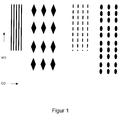
- the strips can consist of narrow lines and / or of chain-like strings Geometries such as diamonds, ellipses and / or circles exist.
- the strips are continuous or through spaces are interrupted regularly or statistically, with the distances between the elements are smaller than the lengths of the strip elements.
- transverse strips are applied to the carrier, which are arranged essentially at right angles to the strips, so that also Geometries can be used in addition to the dominant orientation in the longitudinal direction also have small proportions in the transverse or oblique direction (based on MD).
- the strips etc. can be in the CD direction greatly reduced in quantity and strength compared to the MD structures become. This not only saves noticeably binder, but also the extensive one Preservation of the textile properties can be realized in this way.
- the strips according to the invention are preferably produced by printing technologies such as Halftone or screen printing, using spraying techniques such as ink-jet, partial impregnation, unpressurized application from a casting head, nozzle stripe coating or in Squeegee application process applied.
- printing technologies such as Halftone or screen printing
- spraying techniques such as ink-jet, partial impregnation, unpressurized application from a casting head, nozzle stripe coating or in Squeegee application process applied.
- a suitable template for such geometries is to be used, or a base carrier material is used which already has grooves or scoring in the longitudinal direction. These can be created by embossing or occur as a normally undesirable effect of the last nozzle bar during water jet consolidation. With appropriate water pressure, the last water jets leave line-shaped depressions on the running nonwoven web, which can be filled with the binder or the printing ink in the doctor blade application process. Suitable lines in the longitudinal direction can be produced in the nonwoven carrier not only by printing but also by embossing by means of temperature and / or pressure.
- a large number of parallel and / or narrow strips are applied to the nonwoven fabric on one side using printing processes such as screen printing or gravure printing, since the necessary geometries and application quantities can best be achieved with this.
- printing processes such as screen printing or gravure printing
- These technologies also have extensive experience in the printing of textiles.
- the desired geometries can also be printed on with flexographic printing, but in order to adequately consolidate the fibers, a higher application quantity of binder is desirable than is normally possible with this high-pressure technology.
- the number and width of the strips depend on the desired properties of the finished nonwoven, but must also take into account the possibilities of the chosen application techniques.
- the finest stripes from about 0.1 to 6 mm in width can be printed, with stripe widths of 0.5 to 3 mm being preferred.
- coating technologies such as pouring head, knife application, etc., the strip width is limited downwards by the selected technologies.
- the spaces between the printed Stripes larger than the stripe width so that the area coverage is less than 50%.
- the sum of the area of all strips makes up less than 50% of the Total area of the carrier, in particular 20 to 40%.
- the printed strips are analogous to the warp threads in fabrics or the sewing threads Sewing fabrics are locally fixed and thus meet an essential requirement for good Adjust hand tearability.
- Adequate density of the strips is also desirable, with a large number of fine ones Stripes give better results than less, but thicker stripes; in the latter In some cases, the tear edge becomes more uneven, and at very wide distances there is even that Danger that the hand tearability hardly improves and that the crack propagation of the cross is redirected in the longitudinal direction.
- nonwovens can serve as the starting material. These are preferably staple fiber nonwovens which are produced from common natural or synthetic fibers and fiber mixtures with fiber lengths in the range from 30 to 100 mm and / or fiber finenesses from 1 to 6 dtex.
- the fiber orientation can move in a wide range between preferred longitudinal or transverse orientation or tangled position, whereby a not too strong longitudinal orientation with an MD: CD ratio of 1: 1 to 5: 1 is preferred, since only the tensile forces in the longitudinal direction are due to the strip printing -, but not improved in the transverse direction.
- the nonwoven fabric has insufficient strengths in the transverse direction, which are not sufficiently increased by the finishing according to the invention and therefore make use as an adhesive tape carrier problematic due to slight overstretching in the transverse direction.
- the suitable one can be used without additional refinement of such a base support
- type fiber length and fineness, through different fiber laying and Solidification produces a significant range of nonwovens, but all of them not the required combination of mechanical strength and fiber fixation at the same time textile character and good hand tearability in the transverse direction with appealing Show tear edge.
- viscose as a fiber material, very fluffy carriers become with improved hand tearability, mechanical strength and the integration of the surface fibers, however, is unsatisfactory.
- binders in the form of dispersions or pastes, dissolved in organic solvents, as hot melts or also as reactive systems, such as, for example, radiation-chemically curable lacquers, are used as the polymer base, in particular with main constituents such as polyacrylates, polyvinyl acetates, Polyurethanes, polyester, copolymers containing styrene.
- the polymers have sufficient adhesion and affinity for the respective fibers.
- the polymer base is applied to the carrier in the order of magnitude of 1 to 80 g / m 2 , in particular 3 to 20 g / m 2 , these application quantities being strongly dependent on the weight per unit area of the raw nonwoven used depend and refer to the entire support with its printed and unprinted surface.
- the binder or the printing ink are, on the one hand, the coating technology used adapt, on the other hand, the requirements of the basic nonwoven.
- binders In principle, various systems such as binders, paints, varnishes etc. in the form of Dispersions or pastes, dissolved in organic solvents, as hot melts or as reactive systems such as coatings chemically curable by radiation become.
- the main constituents of these binders which after curing form a coherent Forming films are polymers such as polyacrylates, polyvinyl acetates, Polyurethanes, copolymers containing styrene.
- dyes and pigments, Stabilizers, wetting agents, crosslinking agents, anti-aging agents, etc. are present.
- the binder is to be adapted to the fibers used, so that good wetting and after Curing permanent adhesion is achieved.
- Polymer dispersions such as are known as chemical binders in the field of nonwovens have proven to be particularly favorable in connection with the screen printing and screen gravure printing technologies: good fiber wetting and binding can be assumed as given here, and for all common fiber materials there is at least a selection of commercially available binding dispersions.
- the depth of penetration into the nonwoven and thus the additional consolidation can be controlled via the viscosity of the dispersion - if a highly viscous paste is printed, the strips are applied to the surface and only the surface fibers are bound - the tensile strength increases only slightly, the original textile character remains largely intact.
- the stripes widen on the one hand due to the "blotter effect" and the polymer sinks deeper into the nonwoven fabric. This creates more fiber-fiber bonds and thus increases both the tensile strength and the delamination resistance. If it is possible to locate the polymer substantially at the fiber-fiber nodes, the hardening of the nonwoven fabric is kept within acceptable limits.
- the curing technique for the binder after application is determined by the application form of the binder - dispersions and solutions are determined by Drying cured in conventional units, hotmelts through simple Cooling to room temperature, radiation-curable lacquers through crosslinking using UV light or other high-energy radiation.
- Water-jet bonded nonwovens can be advantageously used during manufacture Combine aqueous dispersions: through solidification using high-energy Water jets already damp fleece is after a rough drainage over a Squeeze station then printed by screen or gravure printing. About the viscosity The dispersion becomes the depth of penetration and thus the extent of the three-dimensional Solidification controlled. The drying of both the nonwoven as well as the curing of the binder is then carried out efficiently and inexpensively in one step conventional dryers.
- the carrier material is at least on applied a self-adhesive adhesive to one side of the band-shaped carrier.
- the carrier material according to the invention can accordingly be excellently used for the production insert an adhesive tape, on one side of the tape-shaped carrier Strips are applied and on the other side, which is opposite the side, on which the strip or strips are present, in particular a self-adhesive surface Adhesive is applied.
- the coated carrier material is particularly advantageous when used for sheathing elongated goods, such as cable sets, in particular Carrier material is guided in a spiral movement around the elongated material.
- Nonwovens according to the invention are used in the course of the manufacture of adhesive tapes the further manufacturing process in a known manner at least on one side with adhesives coated and, if necessary, covered with release paper and cut to length for die cuts or but cut into small rolls in the desired dimensions.
- the coating with the adhesive usually takes place on one side on the side facing away from the printing Side, but can also be carried out so that ultimately the printed binder geometries between nonwoven and adhesive as a partial intermediate layer are localized.
- Adhesive based on acrylate or rubber is used as the self-adhesive mass
- Adhesive based on acrylate or rubber is used as the self-adhesive mass
- An acrylic hotmelt-based adhesive which has a K value of at least 20, in particular greater than 30, has been found to be particularly advantageous as an adhesive, and can be obtained by concentrating a solution of such a composition to form a system which can be processed as a hotmelt. Concentration can take place in suitably equipped kettles or extruders, particularly in the case of the associated degassing, a degassing extruder is preferred.
- Such an adhesive is set out in German patent application DE 43 13 008 A1.
- the solvent is completely removed from these acrylic masses produced in this way.
- other volatile components are removed. After the coating from the melt, these masses only have a small proportion of volatile constituents.
- compositions described in the patent have a high K value and thus a high molecular weight.
- Those skilled in the art are aware that systems with higher molecular weights can be crosslinked more efficiently. The proportion of volatile constituents thus drops accordingly.
- the solution of the composition can contain 5 to 80% by weight, in particular 30 to 70% by weight, of solvent.
- Commercial solvents are preferably used, in particular low-boiling hydrocarbons, ketones, alcohols and / or esters. More preferably, single-screw, twin-screw or multi-screw extruders with one or in particular two or more degassing units are used.
- Benzoin derivatives for example benzoin acrylate or benzoin methacrylate, acrylic acid or methacrylic acid esters, can be polymerized into the adhesive composition based on hot-melt acrylate.
- benzoin derivatives are described in EP 0 578 151 A1.
- the acrylic hot melt adhesive can also be chemically cross-linked.
- copolymers of (meth) acrylic acid and its esters with 1 to 25 carbon atoms, maleic, fumaric and / or itaconic acid and / or their esters, substituted (meth) acrylamides, maleic anhydride and other vinyl compounds are used as self-adhesive compositions , such as vinyl esters, especially vinyl acetate, vinyl alcohols and / or vinyl ethers.
- the residual solvent content should be less than 1% by weight.
- the described adhesive tape is flame retardant, it can be achieve this by adding flame retardants to the carrier and / or the adhesive become.
- flame retardants can be organic bromine compounds, if necessary with synergists like antimony trioxide, but with regard to the halogen-free nature of the adhesive tape red phosphorus, organophosphorus, mineral or intumescent compounds such as ammonium polyphosphate alone or in combination with synergists Find use.
- Such adhesive tapes with nonwoven backing material produced according to the invention have an improvement in hand tearability in the transverse direction with a simultaneous increase the tensile strength in the longitudinal direction and an improvement in fiber integration in the surface, which is especially important for adhesive tapes that are on the roll without Release paper are sold.
- leg tear force With the measuring method for leg tear force according to EN ISO 13937-2 "tear properties A satisfactory correlation can be obtained from textile fabrics " producing the subjectively felt values - however, it should be borne in mind that the hand tearability is composed of two stages, the direct tear process as well as the tearing process, the crack propagation. The above measurement method is used to defined incision measured only the force for tearing. That's why a rough correlation of the physical measurements with subjective assessments expect. A good correlation is obtained when the maximum values of the forces be used for evaluation during the tear process.
- the tensile strength increases in the longitudinal direction and thus allows greater stress or, with constant demands, a reduction in the basis weight of the nonwoven.
- the increase in tensile strength is accompanied by a reduction in the elongation at break.
- the raw nonwovens usually have a flat force-elongation curve - even at low loads, the backing material lengthens and contracts. This sensitivity leads to manufacturing problems both in the production of the adhesive tapes and in applications such as cable wrapping.
- the printing with longitudinal stripes changes the force-elongation behavior in such a way that in the relevant force range the elongation is less, the curve is steeper but still has the necessary elasticity of a few percentage points.
- both the unrolling from the roll of tape and the actual processing such as bandaging cable harnesses can be carried out in such a way that the tape is not irreversibly constricted or stretched.
- Another product advantage is particularly when using the carrier material as Adhesive tape in the sheathing of wire harnesses to improve the abrasion resistance for an adhesive tape according to the invention and thus increasing the resilience of Wiring harnesses wrapped with such adhesive tapes - on the one hand the fibers especially integrated into the nonwoven fabric on the surface, making it one mechanical resistance to higher resistances, on the other hand they are partial plastic coatings on the carrier surface due to their film structure favorable conditions for higher abrasion resistance, especially if the selection of the binder polymer takes these requirements into account and for example the elastic portion of the polymer is chosen accordingly.
- the carrier material according to the invention is described below in an exemplary embodiment without intending to limit the invention in any way.
- a 64 g / m 2 heavy, hydroentangled carrier material made of 100% PES staple fibers is used as the raw nonwoven, the staple fibers having a fineness of 1.7 dtex and an average fiber length of 40 mm.
- the fleece has an MD: CD ratio of almost 1: 1.
- the hand tearability in the transverse direction is rated level 1 (very poor), according to the test method for leg tear force according to EN ISO 13937-2, the tear strength is 20.5 N.
- the fiber tear is tested with a test tape; tesaband® 4651 was used, an adhesive tape with a synthetic wool fabric coated on the top as a carrier for high tensile loads as well as a resin-modified, soft and very tacky natural rubber adhesive with a high affinity for the staple fibers.
- the assessment is carried out on a subjective scale starting with the grade 1 "very low fiber tearing" up to a grade 5 "very strong fiber tearing". A grade of 4 is given for the above raw fleece.
- the flat sieve is placed on the nonwoven fabric and the paste is pressed through with a doctor blade through a specially destined metal sieve with a mesh number of 80 strips / inch.
- the geometry for the printing consists of parallel, parallel strips of width 1 mm and a distance between the strips of 2 mm, ie an area coverage of 33%. With the chosen viscosity a predominantly superficial printing is achieved, however a slight penetration of the binder can be determined.
- the coating order is 16 g / m 2 .
- the subjective assessment of the hand tearability in the transverse direction results in an improvement by 3 units with the overall grade "good”; the tear strength according to EN ISO 13937-2 is 14.8 N.
- the elongation behavior of the fleece carrier changes: the elongation at break decreases by about 1/3 from 49% to 32%.
- Example 2 Carried out as in Example 1, but with a sieve geometry made of diamonds of the width of approx. 1 mm (CD direction) and a length of approx. 1.5 mm (MD direction), the Rhombuses form a continuous chain in the longitudinal direction and the respective diamond tips partially overlap - the distance between the diamond chains is 1 mm. The area coverage is almost 40%.
- the cross-hand tearability is rated as "very good” - the tear strength is 11.6 N.
- the fiber integration improves by 2 to 3 grades to “very good”, whereas the textile handle slightly deteriorates compared to the raw fleece. The elongation at break increases to 27%.
- the cross-hand tearability is rated as "very good" - the tear strength is 10.6 N.
- the fiber integration improves by 2 to 3 notes to "very good” with minor Losses regarding the textile handle.
- Compared to example 1 is in the transverse direction measured a slight increase in the maximum tensile strengths.
Landscapes
- Engineering & Computer Science (AREA)
- Textile Engineering (AREA)
- Mechanical Engineering (AREA)
- Chemical & Material Sciences (AREA)
- Organic Chemistry (AREA)
- Chemical Kinetics & Catalysis (AREA)
- Dispersion Chemistry (AREA)
- General Chemical & Material Sciences (AREA)
- Adhesive Tapes (AREA)
- Nonwoven Fabrics (AREA)
- Laminated Bodies (AREA)
- Adhesives Or Adhesive Processes (AREA)
Abstract
Description
Sind Vliesstoffe weich und flauschig wie Filtervliese und lassen sich leicht per Hand ablängen, sind sie jedoch für Klebebandanwendungen ungeeignet. Die geringen Höchstzugkräfte in Maschinenrichtung (MD) lassen weder eine sichere Verarbeitung von Rolle auf Rolle bei der Herstellung zu, noch kann der Endanwender derartige Klebebänder für zum Beispiel Bandagen und Fixierungen mit höheren Zugbelastungen einsetzen. Die geringe Verbundfestigkeit der Vliesstoffe läßt Probleme wie ein Delaminieren des Trägers bei dem Abwickeln des Klebebandes von der Rolle erwarten; auch wird das Klebeband in seinem Klebverhalten zumindest erheblich eingeschränkt, wenn lose oder nur leicht eingebundene Fasern oder Filamente aus der Vliesoberfläche beim Abwickeln von der Rolle herausgerissen werden und auf der Kleberschicht verbleiben; schlußendlich wird bei derartigen Vliesstoffen durch das manuelle Ablängen im Allgemeinen eine optisch wenig ansprechende, ausgefranste Rißkante erzielt.
- ein leichtes und über Stunden immer wieder durchzuführendes Ablängen ohne Ermüdung oder Überanstrengung der Mitarbeiter erwünscht; insbesondere für Konsumerklebebänder hat dagegen
- eine ansprechende Rißkante einen hohen Stellenwert, möglichst mit gerader Rißlinie, rechtwinklig zur Klebebandkante sowie mit nicht übermäßig ausgefransten Rändern.
Das Laminieren geschieht vorzugsweise durch Thermoprägung, wobei die Prägestrukturen durch Prägelinien in CD-Richtung die Quereinreißbarkeit verbessern. Anstelle des zweiten Spinnvlieses sind auch andere querorientierte Flächengebilde einsetzbar. Die beschriebene Thermoprägung sowie eine zusätzliche flächige Beschichtung der Oberseite mit einer Kunststoffschicht gestalten die Herstellung nicht nur aufwendig, sondern verändern die Optik und Haptik des Trägers von einem Textil in Richtung auf eine Folie.
Ähnliche Verbesserungen der Handeinreißbarkeit lassen sich durch ein- oder beidseitige Beschichtung mit Kunststoffdispersionen oder -pasten als auch durch Imprägnieren von Vliesträgern erzielen ― beispielsweise beschrieben in DE 44 42 092 C1-, wobei die Nutzung von geeigneten Kunststoffdispersionen auf Basis Polyacrylate, Polyurethane u.ä. gegenüber den genannten Polyethylen- und Polypropylenbeschichtungen Vorteile in der Temperatur- und Witterungsbeständigkeit ergibt.
Jedoch erfordern alle diese Beschichtungen von Vliesstoffen einen zusätzlichen Prozeßschritt, der normalerweise nicht online bei der Vliesherstellung vorgenommen werden kann. Derartige Beschichtungen bedeuten eine merkliche Verteuerung des Endproduktes und mindern den textilen Charakter des Vliesstoffes.
Auch lassen sich bei erfindungsgemäßer Ausgestaltung die textilen Eigenschaften wie Griff, Flexibilität, Weichheit etc. in weitem Umfang erhalten, wie dies nach bekannten Verfahren nicht möglich ist.
Diese können durch Prägung erzeugt werden oder bei der Wasserstrahlverfestigung als normalerweise unerwünschter Effekt der letzten Düsenleiste auftreten. Bei entsprechendem Wasserdruck hinterlassen die letzten Wasserstrahlen auf der laufenden Vliesstoffbahn linienförmige Vertiefungen, die im Rakelauftragsverfahren mit dem Bindemittel oder der Druckfarbe gefüllt werden können. Geeignete Linien in Längsrichtung können nach den Grundgedanken der Erfindung nicht nur durch Bedruckung, sondern auch über Prägung mittels Temperatur und/oder Druck im Vliesträger erzeugt werden.
Mit Flexodruck können auch die gewünschten Geometrien aufgedruckt werden, für eine ausreichende Faserverfestigung ist jedoch eine höhere Auftragsmenge an Bindemittel erwünscht, als dies mit dieser Hochdruck-Technik normalerweise möglich ist.
Bei den Drucktechnologien wie Sieb- und Rastertiefdruck lassen sich bei geeigneter Auswahl der "Druckfarbe" feinste Streifen von ca. 0,1 bis hin zu 6 mm Breite drucken, wobei bevorzugt Streifenbreiten von 0,5 bis 3 mm zu wählen sind.
Bei Nutzung von Beschichtungstechnologien wie Gießkopf, Rakelauftrag etc. ist die Streifenbreite nach unten hin durch die gewählten Technologien beschränkt.
Zum einen reichen Flächenbedeckungen von 5 bis 50% aus, wobei die besten Ergebnisse bei 20 bis 40% erzielt werden.
Zum anderen wird in Hinblick auf den geforderten Erhalt der textilen Eigenschaften eine nicht-vollständige Durchimprägnierung angestrebt; im Falle von gut vorverfestigten Wasserstrahlvliesstoffen werden die besten Ergebnisse erzielt, wenn das Bindemittel überwiegend an der Oberfläche des Basisvliesstoffes lokalisiert ist und die Bindemittelmengen im Dickenprofil des Vliesstoffes von oben nach unten stark abnehmen.
Die Faserorientierung kann sich in weiten Bereichen zwischen bevorzugter Längs- oder Querorientierung oder Wirrlage bewegen, wobei eine nicht zu starke Längsorientierung mit einem MD : CD-Verhältnis von 1 : 1 bis 5 : 1 bevorzugt ist, da durch die Streifenbedruckung nur die Zugkräfte in Längs-, nicht aber in Querrichtung verbessert werden. Bei stark ausgeprägter Längsorientierung der Fasern weist der Vliesstoff zu geringe Festigkeiten in Querrichtung auf, die durch die erfindungsgemäße Veredlung nicht ausreichend erhöht werden und deshalb den Einsatz als Klebebandträger aufgrund leichter Überdehnung in Querrichtung problematisch werden lassen.
Im Vergleich zu anderen bewährten Technologie bietet die Wasserstrahlverfestigung die günstigste Kombination von mechanischen Festigkeiten (Zug- und Delaminationsfestigkeit), Fasereinbindung in der Oberfläche und textilen Eigenschaften wie weicher Griff, Flexibilität etc., so daß derartige Träger für Klebebandanwendungen prädestiniert sind.
Die Polymere weisen eine ausreichende Haftung und Affinität zu den jeweiligen Fasern auf.
Über die Viskosität der Dispersion läßt sich die Eindringtiefe in den Vliesstoff und damit die zusätzliche Verfestigung steuern ― wird eine hochviskose Paste verdruckt, werden die Streifen flächig auf der Oberfläche aufgebracht und nur die Oberflächenfasern gebunden ― die Zugfestigkeit erhöht sich nur geringfügig, der ursprüngliche textile Charakter bleibt weitgehend erhalten.
Werden dünnflüssige Dispersionen verdruckt, verbreitern sich zum einen durch den "Löschblatteffekt" die Streifen, und das Polymere sinkt tiefer in den Vliesstoff ein. Dadurch werden mehr Faser-Faser-Bindungen hergestellt und somit sowohl die Zug- als auch die Delaminationsfestigkeit erhöht. Gelingt es, das Polymere wesentlich an den Faser-Faser-Knotenpunkten zu lokalisieren, hält sich die Verhärtung des Vliesstoffes in akzeptablen Grenzen.
Das Aufkonzentrieren kann in entsprechend ausgerüsteten Kesseln oder Extrudern stattfinden, insbesondere beim damit einhergehenden Entgasen ist ein Entgasungsextruder bevorzugt.
Eine derartige Klebemasse ist in der deutschen Patentanmeldung DE 43 13 008 A1 dargelegt. Diesen auf diesem Wege hergestellten Acrylatmassen wird in einem Zwischenschritt das Lösungsmittel vollständig entzogen.
Zusätzlich werden dabei weitere leichtflüchtige Bestanteile entfernt. Nach der Beschichtung aus der Schmelze weisen diese Massen nur noch geringe Anteile an flüchtigen Bestandteilen auf. Somit können alle im oben angeführten Patent beanspruchten Monomere/Rezepturen übernommen werden. Ein weiterer Vorteil der im Patent beschriebenen Massen ist darin zu sehen, daß diese einen hohen K-Wert und damit ein hohes Molekulargewicht aufweisen. Dem Fachmann ist bekannt, daß sich Systeme mit höheren Molekulargewichten effizienter vernetzen lassen. Damit sinkt entsprechend der Anteil an flüchtigen Bestandteilen.
Die Lösung der Masse kann 5 bis 80 Gew.-%, insbesondere 30 bis 70 Gew.-% Lösungsmittel enthalten.
Vorzugsweise werden handelsübliche Lösungsmittel eingesetzt, insbesondere niedrig siedende Kohlenwasserstoffe, Ketone, Alkohole und/oder Ester.
Weiter vorzugsweise werden Einschnecken-, Zweischnecken- oder Mehrschneckenextruder mit einer oder insbesondere zwei oder mehreren Entgasungseinheiten eingesetzt.
In der Klebemasse auf Acrylathotmelt-Basis können Benzoinderivate einpolymerisiert sein, so beispielsweise Benzoinacrylat oder Benzoinmethacrylat, Acrylsäure- oder Methacrylsäureester. Derartige Benzoinderivate sind in der EP 0 578 151 A1 beschrieben.
Die Klebemasse auf Acrylathotmelt-Basis kann aber auch chemisch vernetzt sein.
In einer besonders bevorzugten Ausführungsform werden als Selbstklebemassen Copolymerisate aus (Meth)acrylsäure und deren Estern mit 1 bis 25 C-Atomen, Malein-, Fumar- und/oder Itaconsäure und/oder deren Estern, substituierten (Meth)acrylamiden, Maleinsäureanhydrid und anderen Vinylverbindungen, wie Vinylestern, insbesondere Vinylacetat, Vinylalkoholen und/oder Vinylethern eingesetzt.
Der Restlösungsmittel-Gehalt sollte unter 1 Gew.-% betragen.
Die Handeinreißbarkeit in Querrichtung wird mit der Stufe 1 (sehr schlecht) bewertet, nach der Prüfmethode zur Schenkelweiterreißkraft nach EN ISO 13937-2 ergibt sich eine Weiterreißkraft von 20,5 N. Der Faserausriß wird mit einem Testklebeband geprüft; zum Einsatz kam tesaband® 4651, ein Klebeband mit einem oberseitig kunststoffbeschichteten Zellwollgewebe als Träger für hohe Zugbeanspruchungen sowie einer harzmodifizierten, weichen und sehr tackigen Naturkautschukklebemasse, die eine hohe Affinität zu den Stapelfasern aufweist. Die Beurteilung erfolgt nach einer subjektiven Skala beginnend mit der Note 1 "sehr geringer Faserausriß" bis zu einer Note 5 "sehr starker Faserausriß". Für obiges Rohvlies wird die Note 4 vergeben.
Claims (16)
- Trägermaterial auf Vliesbasis insbesondere für ein Klebeband, wobei auf der Oberfläche eines bandförmigen Trägers auf Vliesbasis ein- oder beidseitig zumindest ein Streifen auf Polymerbasis aufgebracht ist.
- Trägermaterial nach Anspruch 1, dadurch gekennzeichnet, daß eine Vielzahl vorzugsweise parallel angeordneter Streifen auf dem Träger aufgebracht sind.
- Trägermaterial nach den Ansprüchen 1 und 2, dadurch gekennzeichnet, daß die Streifen im wesentlichen in Maschinenrichtung aufgebracht sind.
- Trägermaterial nach Ansprüchen 1 bis 3, dadurch gekennzeichnet, daß die Streifen aus schmalen Linien oder/und aus kettenförmig aneinander gereihten Geometrien wie beispielsweise Rauten, Ellipsen und/oder Kreisen bestehen.
- Trägermaterial nach den Ansprüchen 1 bis 4, dadurch gekennzeichnet, daß die Streifen durchgängig oder durch Zwischenräume unterbrochen sind, wobei die Abstände zwischen den Elementen kleiner als die Längen der Streifenelemente sind.
- Trägermaterial nach den Ansprüchen 1 bis 5, dadurch gekennzeichnet, daß die Streifen eine Breite von 0,1 mm bis 6 mm, insbesondere von 0,5 mm bis 3 mm, aufweisen.
- Trägermaterial nach zumindest einem der vorherigen Ansprüche, dadurch gekennzeichnet, daß die Summe der Fläche aller Streifen weniger als 50% der Gesamtfläche des Trägers ausmacht, insbesondere 20 bis 40%.
- Trägermaterial nach zumindest einem der vorherigen Ansprüche, dadurch gekennzeichnet, daß Querstreifen auf dem Träger aufgebracht sind, die im wesentlichen rechtwinklig zu den Streifen angeordnet sind.
- Trägermaterial nach zumindest einem der vorherigen Ansprüche, dadurch gekennzeichnet, daß als Vliesmaterial Stapelfaservliese verwendet werden.
- Trägermaterial nach zumindest einem der vorherigen Ansprüche, dadurch gekennzeichnet, daß das Vliesmaterial aus Fasern besteht, die eine Länge im Bereich von 30 bis 100 mm und/oder eine Feinheit von 1 bis 6 dtex aufweisen.
- Trägermaterial nach zumindest einem der vorherigen Ansprüche, dadurch gekennzeichnet, daß die Streifen durch Drucktechnologien wie Rastertief- oder Siebdruck, durch Sprühtechniken wie Ink-Jet, partielles Imprägnieren, druckloses Aufbringen aus einem Gießkopf, Düsenstreifenstrichbeschichtung oder im Rakelauftragsverfahren aufgebracht werden.
- Trägermaterial nach zumindest einem der vorherigen Ansprüche, dadurch gekennzeichnet, daß als Polymerbasis Bindemittel, Druckfarben, Farben, Lacke in Form von Dispersionen oder Pasten, gelöst in organischen Lösemitteln, als Hotmelts oder auch als reaktive Systeme wie beispielsweise strahlenchemisch härtbare Lacke eingesetzt werden, insbesondere mit Hauptbestandteilen wie Polyacrylate, Polyvinylacetate, Polyurethane, Polyester, styrolhaltige Copolymere.
- Trägermaterial nach zumindest einem der vorherigen Ansprüche, dadurch gekennzeichnet, daß die Polymerbasis mit 1 bis 80 g/m2, insbesondere mit 3 bis 20 g/m2 auf dem Träger aufgetragen ist.
- Trägermaterial nach zumindest einem der vorherigen Ansprüche, dadurch gekennzeichnet, daß zumindest auf einer Seite des bandförmigen Trägers eine selbstklebende Klebemasse aufgebracht ist.
- Verwendung eines Trägermaterials nach zumindest einem der vorherigen Ansprüche für ein Klebeband, wobei auf der einen Seite des bandförmigen Trägers Streifen aufgebracht sind und auf der anderen Seite, die der Seite gegenüberliegt, auf der der oder die Streifen vorhanden sind, insbesondere vollflächig eine selbstklebende Klebemasse aufgebracht ist.
- Verwendung eines Trägermaterials nach den Ansprüchen 14 und 15 zum Ummanteln von langgestrecktem Gut, wie insbesondere Kabelsätzen, wobei das Trägermaterial in einer spiralförmigen Bewegung um das langgestreckte Gut geführt wird.
Applications Claiming Priority (2)
| Application Number | Priority Date | Filing Date | Title |
|---|---|---|---|
| DE10112375A DE10112375A1 (de) | 2001-03-15 | 2001-03-15 | Trägermaterial auf Vliesbasis insbesondere für ein Klebeband mit verbesserter Handeinreißbarkeit |
| DE10112375 | 2001-03-15 |
Publications (3)
| Publication Number | Publication Date |
|---|---|
| EP1241240A2 true EP1241240A2 (de) | 2002-09-18 |
| EP1241240A3 EP1241240A3 (de) | 2003-07-16 |
| EP1241240B1 EP1241240B1 (de) | 2013-06-26 |
Family
ID=7677505
Family Applications (1)
| Application Number | Title | Priority Date | Filing Date |
|---|---|---|---|
| EP02005581.0A Expired - Lifetime EP1241240B1 (de) | 2001-03-15 | 2002-03-12 | Trägermaterial auf Vliesbasis insbesondere für ein Klebeband mit verbesserter Handeinreissbarkeit |
Country Status (5)
| Country | Link |
|---|---|
| US (1) | US20020146952A1 (de) |
| EP (1) | EP1241240B1 (de) |
| JP (1) | JP4088086B2 (de) |
| DE (1) | DE10112375A1 (de) |
| ES (1) | ES2424500T3 (de) |
Cited By (1)
| Publication number | Priority date | Publication date | Assignee | Title |
|---|---|---|---|---|
| EP2067614A1 (de) * | 2007-12-04 | 2009-06-10 | tesa SE | Geräuschdämpfendes und hoch abriebfestes Band insbesondere für die Bandagierung von Kabelbäumen in Automobilen |
Families Citing this family (16)
| Publication number | Priority date | Publication date | Assignee | Title |
|---|---|---|---|---|
| JPH0713023U (ja) * | 1993-07-21 | 1995-03-03 | 炳 俊 朱 | コンピュータ本体用組立式フロントパネル |
| DE10312031A1 (de) * | 2003-03-18 | 2004-09-30 | Tesa Ag | Schwerentflammbare Haftklebemasse, Verfahren zu ihrer Herstellung sowie ihre Verwendung zur Herstellung eines Haftklebebandes |
| DE10349107A1 (de) * | 2003-10-17 | 2005-05-19 | Tesa Ag | Verfahren zum Verkleben von Kabelbäumen auf Untergründen wie die Innenraum-Dekorteile eines PKWs, insbesondere Dachhimmel, Türseitenteil, Kofferraumdeckel |
| DE102008024944B4 (de) * | 2007-08-22 | 2018-05-09 | Eswegee Vliesstoff Gmbh | Grundvlies für Trilaminate |
| DE102008024943B4 (de) * | 2007-08-22 | 2017-10-26 | Eswegee Vliesstoff Gmbh | Verfahren zur Herstellung eines Grundvliesstoffes als Beschichtungsträger |
| AU2008310685B2 (en) * | 2007-10-10 | 2012-02-09 | 3M Innovative Properties Company | Articles and methods of masking or protecting a substrate |
| DE102009006935A1 (de) * | 2009-01-30 | 2010-08-05 | Tesa Se | Träger verstärkte hitzeaktivierbare Klebemassen |
| US9477059B2 (en) | 2012-02-08 | 2016-10-25 | 3M Innovative Properties Company | Application of a continuous substrate with segmented adhesive |
| DE102014110554A1 (de) * | 2014-07-25 | 2016-01-28 | Certoplast Vorwerk & Sohn Gmbh | Verfahren zur Herstellung eines Klebebandes |
| DE102017113432A1 (de) | 2017-06-19 | 2018-12-20 | Deutsches Zentrum für Luft- und Raumfahrt e.V. | Filmklebstoff sowie Verfahren zu dessen Herstellung |
| US11479693B2 (en) | 2018-05-03 | 2022-10-25 | Avery Dennison Corporation | Adhesive laminates and method for making adhesive laminates |
| CN110777450B (zh) | 2018-07-31 | 2022-08-30 | 特吕茨施勒集团欧洲公司 | 借助梳理机制造无纺布的方法 |
| JP6734463B1 (ja) * | 2019-12-27 | 2020-08-05 | 一元 大山 | 靴 |
| JP7791090B2 (ja) * | 2020-08-18 | 2025-12-23 | デンカ株式会社 | 結束テープ |
| EP4201834B1 (de) * | 2020-08-18 | 2024-12-04 | Denka Company Limited | Bindeband |
| JP2025536761A (ja) * | 2022-11-21 | 2025-11-07 | ベリー グローバル インコーポレイテッド | 粘着テープ |
Family Cites Families (26)
| Publication number | Priority date | Publication date | Assignee | Title |
|---|---|---|---|---|
| US2750314A (en) * | 1949-03-16 | 1956-06-12 | Permacel Tape Corp | Adhesive tape |
| US3093502A (en) * | 1959-12-30 | 1963-06-11 | Johnson & Johnson | Nonwoven fabrics and methods of manufacturing the same |
| US4002708A (en) * | 1971-10-28 | 1977-01-11 | The United States Of America As Represented By The Secretary Of The Army | Method for producing polymer impregnated foamed masonry elements |
| US4002788A (en) * | 1971-10-28 | 1977-01-11 | The United States Of America As Represented By The Secretary Of The Army | Two-phase material of concrete and polymer and its method of preparation |
| DE2722429A1 (de) * | 1977-05-18 | 1978-11-23 | Freudenberg Carl Fa | Atmungsaktiver futterstoff mit formeffekt |
| US4773408A (en) * | 1985-01-04 | 1988-09-27 | E. R. Squibb & Sons, Inc. | Wound dressing |
| US4772499A (en) * | 1986-10-01 | 1988-09-20 | The Kendall Company | Novel tearable non-woven webs and products employing same |
| US5227225A (en) * | 1988-04-08 | 1993-07-13 | The Kendall Company | Masking tape |
| US5589122A (en) * | 1991-10-01 | 1996-12-31 | Minnesota Mining And Manufacturing Company | Method of making double-sided pressure-sensitive adhesive tape |
| US5496603A (en) * | 1992-02-03 | 1996-03-05 | Minnesota Mining And Manufacturing Company | Nonwoven sheet materials, tapes and methods |
| DE4318277C1 (de) * | 1993-06-03 | 1994-09-01 | Beiersdorf Ag | Verwendung von Zackenschnittmessern |
| US5613942A (en) * | 1994-10-04 | 1997-03-25 | Minnesota Mining And Manufacturing Company | Adhesive sheet material suitable for use on wet surfaces |
| US5552202A (en) * | 1995-07-11 | 1996-09-03 | Reynolds Consumer Products Inc. | Tear guide arrangement |
| JPH1036795A (ja) * | 1996-07-26 | 1998-02-10 | Nippon Petrochem Co Ltd | 粘着テープ用基布およびそれを用いた粘着テープ |
| DE19746998B4 (de) * | 1997-10-24 | 2008-06-05 | Tesa Ag | Laseretiketten und ihre Verwendung |
| DE19747000C2 (de) * | 1997-10-24 | 2003-10-30 | Tesa Ag | Laseretiketten und ihre Verwendung |
| US6107219A (en) * | 1998-02-11 | 2000-08-22 | 3M Innovative Properties Company | Breathable backing for an adhesive article |
| US6121166A (en) * | 1998-07-21 | 2000-09-19 | Wood; Benny R. | Double-sided adhesive material and method of making |
| US6410464B1 (en) * | 1998-10-02 | 2002-06-25 | 3M Innovative Properties Company | Hand-tearable tape |
| CA2347135C (en) * | 1998-10-02 | 2008-03-25 | 3M Innovative Properties Company | Laminated elastic composites |
| US6436528B1 (en) * | 1998-10-24 | 2002-08-20 | Tesa Ag | Adhesive tape based on a binder-consolidated web |
| DE19923399A1 (de) * | 1998-10-24 | 2000-04-27 | Beiersdorf Ag | Klebeband auf Basis eines mit Schmelzfasern thermofixierten Vlieses |
| US6451146B1 (en) * | 1998-10-24 | 2002-09-17 | Tesa Ag | Adhesive tape based on a web thermally bonded with fusible fibres |
| MXPA01012972A (es) * | 1999-06-18 | 2002-09-02 | 3M Innovative Properties Co | Hojas no tejidas, articulos adhesivos y metoos para fabricar los mismos. |
| FR2797268B1 (fr) * | 1999-08-02 | 2002-03-22 | Scapa Tapes France S A | Ruban adhesif sur tissu de polyester dechirable a la main |
| US6495229B1 (en) * | 1999-09-17 | 2002-12-17 | Avery Dennison Corporation | Pattern coated adhesive article |
-
2001
- 2001-03-15 DE DE10112375A patent/DE10112375A1/de not_active Withdrawn
-
2002
- 2002-02-15 US US10/076,796 patent/US20020146952A1/en not_active Abandoned
- 2002-03-08 JP JP2002063473A patent/JP4088086B2/ja not_active Expired - Fee Related
- 2002-03-12 EP EP02005581.0A patent/EP1241240B1/de not_active Expired - Lifetime
- 2002-03-12 ES ES02005581T patent/ES2424500T3/es not_active Expired - Lifetime
Cited By (1)
| Publication number | Priority date | Publication date | Assignee | Title |
|---|---|---|---|---|
| EP2067614A1 (de) * | 2007-12-04 | 2009-06-10 | tesa SE | Geräuschdämpfendes und hoch abriebfestes Band insbesondere für die Bandagierung von Kabelbäumen in Automobilen |
Also Published As
| Publication number | Publication date |
|---|---|
| ES2424500T3 (es) | 2013-10-02 |
| EP1241240B1 (de) | 2013-06-26 |
| JP4088086B2 (ja) | 2008-05-21 |
| JP2002327362A (ja) | 2002-11-15 |
| DE10112375A1 (de) | 2002-09-26 |
| US20020146952A1 (en) | 2002-10-10 |
| EP1241240A3 (de) | 2003-07-16 |
Similar Documents
| Publication | Publication Date | Title |
|---|---|---|
| EP1241240B1 (de) | Trägermaterial auf Vliesbasis insbesondere für ein Klebeband mit verbesserter Handeinreissbarkeit | |
| EP0995783B1 (de) | Verwendung eines Klebebands auf Basis eines mittels Bindemittel verfestigten Vlieses | |
| DE69902802T2 (de) | Handreissbares band | |
| EP0995782B1 (de) | Verwendung eines Klebebands auf Basis eines mit Schmelzfasern thermofixierten Vlieses | |
| EP2500389B2 (de) | Klebeband mit Laminat-Träger gebildet aus einem textilen Träger und einer Folie zum Ummanteln von langgestrecktem Gut wie insbesondere Kabelsätzen und Verfahren zur Ummantelung | |
| EP1311640B1 (de) | Klebebänder mit textilem träger für die ummantelung von langgestrecktem gut, wie insbesondere kabelsätzen | |
| EP1315781B1 (de) | Verfahren zur ummantelung von langgestrecktem gut, wie insbesondere kabelsätzen, mit einem klebeband | |
| EP2128212B1 (de) | Klebeband mit textilem Träger für die Kabelbandagierung | |
| DE10036805A1 (de) | Verfahren zur Ummantelung von langgestrecktem Gut, wie insbesondere Kabelsätzen | |
| EP1367608A2 (de) | Verfahren zum Ummanteln von langgestrecktem Gut, wie insbesondere Kabelsätzen, mit zwei streifenförmigen Eindeckungen, die das Gut schlauchartig umschliessen | |
| DE10329994A1 (de) | Verfahren zur Ummantelung von langgestrecktem Gut, wie insbesondere Kabelsätzen, mit einem Klebeband | |
| DE102007058460A1 (de) | Geräuschdämpfendes und hoch abriebfestes Band insbesondere für die Bandagierung von Kabelbäumen in Automobilen | |
| EP3613819B1 (de) | Klebeband zum ummanteln von langgestrecktem gut wie insbesondere kabelsätzen und verfahren zur ummantelung | |
| DE19923399A1 (de) | Klebeband auf Basis eines mit Schmelzfasern thermofixierten Vlieses | |
| DE10116600A1 (de) | Schneidemaschine für das Ablängen von selbstklebend ausgerüsteten textilen Trägern | |
| DE10309447A1 (de) | Verfahren zur Herstellung eines streifenförmigen Auftrags eines Substrats, insbesondere einer Klebemasse, auf einem Trägermaterial | |
| EP2937393A1 (de) | Handeinreißbares Gewebeklebeband mit hoher Abriebfestigkeit und Geräuschdämpfung und Verfahren zu seiner Herstellung | |
| DE10259616A1 (de) | Auf sich selbst wickelbares Klebeband, seine Verwendung und Verfahren zu seiner Herstellung | |
| DE10116770A1 (de) | Schneidemaschine für das Ablängen von selbstklebend ausgerüsteten textilen Trägern | |
| EP1270695B1 (de) | Verwendung eines mindestens einseitig mit einer kohäsiven Haftmasse beschichteten Trägermaterials zum Ummanteln von Kabelsätzen | |
| EP4424496A1 (de) | Verfahren zum konfektionieren von textilen klebebändern | |
| EP1097975A2 (de) | Selbstklebendes Abdeckband | |
| DE20121262U1 (de) | Trägermaterial auf Vliesbasis insbesondere für ein Klebeband mit verbesserter Handeinreißbarkeit | |
| EP1097974A2 (de) | Selbstklebender Formkörper | |
| DE10259682A1 (de) | Auf sich selbst wickelbares Klebeband, seine Verwendung und Verfahren zu seiner Herstellung |
Legal Events
| Date | Code | Title | Description |
|---|---|---|---|
| PUAI | Public reference made under article 153(3) epc to a published international application that has entered the european phase |
Free format text: ORIGINAL CODE: 0009012 |
|
| AK | Designated contracting states |
Kind code of ref document: A2 Designated state(s): AT BE CH CY DE DK ES FI FR GB GR IE IT LI LU MC NL PT SE TR |
|
| AX | Request for extension of the european patent |
Free format text: AL;LT;LV;MK;RO;SI |
|
| PUAL | Search report despatched |
Free format text: ORIGINAL CODE: 0009013 |
|
| AK | Designated contracting states |
Designated state(s): AT BE CH CY DE DK ES FI FR GB GR IE IT LI LU MC NL PT SE TR |
|
| AX | Request for extension of the european patent |
Extension state: AL LT LV MK RO SI |
|
| RIC1 | Information provided on ipc code assigned before grant |
Ipc: 7C 09J 7/04 A Ipc: 7D 06N 7/00 B Ipc: 7C 09J 7/02 B |
|
| 17P | Request for examination filed |
Effective date: 20040116 |
|
| AKX | Designation fees paid |
Designated state(s): DE ES FR GB IT |
|
| RAP1 | Party data changed (applicant data changed or rights of an application transferred) |
Owner name: TESA AG |
|
| 17Q | First examination report despatched |
Effective date: 20071123 |
|
| RAP1 | Party data changed (applicant data changed or rights of an application transferred) |
Owner name: TESA SE |
|
| GRAP | Despatch of communication of intention to grant a patent |
Free format text: ORIGINAL CODE: EPIDOSNIGR1 |
|
| INTG | Intention to grant announced |
Effective date: 20130410 |
|
| GRAS | Grant fee paid |
Free format text: ORIGINAL CODE: EPIDOSNIGR3 |
|
| GRAA | (expected) grant |
Free format text: ORIGINAL CODE: 0009210 |
|
| AK | Designated contracting states |
Kind code of ref document: B1 Designated state(s): DE ES FR GB IT |
|
| REG | Reference to a national code |
Ref country code: GB Ref legal event code: FG4D Free format text: NOT ENGLISH |
|
| REG | Reference to a national code |
Ref country code: DE Ref legal event code: R081 Ref document number: 50215789 Country of ref document: DE Owner name: TESA SE, DE Free format text: FORMER OWNER: TESA AG, 20253 HAMBURG, DE |
|
| REG | Reference to a national code |
Ref country code: DE Ref legal event code: R096 Ref document number: 50215789 Country of ref document: DE Effective date: 20130822 |
|
| REG | Reference to a national code |
Ref country code: ES Ref legal event code: FG2A Ref document number: 2424500 Country of ref document: ES Kind code of ref document: T3 Effective date: 20131002 |
|
| PLBE | No opposition filed within time limit |
Free format text: ORIGINAL CODE: 0009261 |
|
| STAA | Information on the status of an ep patent application or granted ep patent |
Free format text: STATUS: NO OPPOSITION FILED WITHIN TIME LIMIT |
|
| 26N | No opposition filed |
Effective date: 20140327 |
|
| REG | Reference to a national code |
Ref country code: DE Ref legal event code: R097 Ref document number: 50215789 Country of ref document: DE Effective date: 20140327 |
|
| REG | Reference to a national code |
Ref country code: DE Ref legal event code: R081 Ref document number: 50215789 Country of ref document: DE Owner name: TESA SE, DE Free format text: FORMER OWNER: TESA SE, 20253 HAMBURG, DE |
|
| REG | Reference to a national code |
Ref country code: FR Ref legal event code: PLFP Year of fee payment: 15 |
|
| PGFP | Annual fee paid to national office [announced via postgrant information from national office to epo] |
Ref country code: ES Payment date: 20160309 Year of fee payment: 15 |
|
| PGFP | Annual fee paid to national office [announced via postgrant information from national office to epo] |
Ref country code: GB Payment date: 20160321 Year of fee payment: 15 Ref country code: FR Payment date: 20160321 Year of fee payment: 15 |
|
| PGFP | Annual fee paid to national office [announced via postgrant information from national office to epo] |
Ref country code: IT Payment date: 20160324 Year of fee payment: 15 |
|
| REG | Reference to a national code |
Ref country code: FR Ref legal event code: CA Effective date: 20170201 |
|
| REG | Reference to a national code |
Ref country code: DE Ref legal event code: R079 Ref document number: 50215789 Country of ref document: DE Free format text: PREVIOUS MAIN CLASS: C09J0007040000 Ipc: C09J0007210000 |
|
| GBPC | Gb: european patent ceased through non-payment of renewal fee |
Effective date: 20170312 |
|
| REG | Reference to a national code |
Ref country code: FR Ref legal event code: ST Effective date: 20171130 |
|
| PG25 | Lapsed in a contracting state [announced via postgrant information from national office to epo] |
Ref country code: FR Free format text: LAPSE BECAUSE OF NON-PAYMENT OF DUE FEES Effective date: 20170331 |
|
| PG25 | Lapsed in a contracting state [announced via postgrant information from national office to epo] |
Ref country code: GB Free format text: LAPSE BECAUSE OF NON-PAYMENT OF DUE FEES Effective date: 20170312 Ref country code: IT Free format text: LAPSE BECAUSE OF NON-PAYMENT OF DUE FEES Effective date: 20170312 |
|
| REG | Reference to a national code |
Ref country code: ES Ref legal event code: FD2A Effective date: 20180704 |
|
| PG25 | Lapsed in a contracting state [announced via postgrant information from national office to epo] |
Ref country code: ES Free format text: LAPSE BECAUSE OF NON-PAYMENT OF DUE FEES Effective date: 20170313 |
|
| PGFP | Annual fee paid to national office [announced via postgrant information from national office to epo] |
Ref country code: DE Payment date: 20190321 Year of fee payment: 18 |
|
| REG | Reference to a national code |
Ref country code: DE Ref legal event code: R119 Ref document number: 50215789 Country of ref document: DE |
|
| PG25 | Lapsed in a contracting state [announced via postgrant information from national office to epo] |
Ref country code: DE Free format text: LAPSE BECAUSE OF NON-PAYMENT OF DUE FEES Effective date: 20201001 |