EP1237220A2 - Polymerelektrolytmembran-Brennstoffzelle - Google Patents
Polymerelektrolytmembran-Brennstoffzelle Download PDFInfo
- Publication number
- EP1237220A2 EP1237220A2 EP02004684A EP02004684A EP1237220A2 EP 1237220 A2 EP1237220 A2 EP 1237220A2 EP 02004684 A EP02004684 A EP 02004684A EP 02004684 A EP02004684 A EP 02004684A EP 1237220 A2 EP1237220 A2 EP 1237220A2
- Authority
- EP
- European Patent Office
- Prior art keywords
- fuel cell
- fuel
- membrane
- electrode
- polymer electrolyte
- Prior art date
- Legal status (The legal status is an assumption and is not a legal conclusion. Google has not performed a legal analysis and makes no representation as to the accuracy of the status listed.)
- Withdrawn
Links
Images


Classifications
-
- H—ELECTRICITY
- H01—ELECTRIC ELEMENTS
- H01M—PROCESSES OR MEANS, e.g. BATTERIES, FOR THE DIRECT CONVERSION OF CHEMICAL ENERGY INTO ELECTRICAL ENERGY
- H01M8/00—Fuel cells; Manufacture thereof
- H01M8/10—Fuel cells with solid electrolytes
- H01M8/1009—Fuel cells with solid electrolytes with one of the reactants being liquid, solid or liquid-charged
-
- H—ELECTRICITY
- H01—ELECTRIC ELEMENTS
- H01M—PROCESSES OR MEANS, e.g. BATTERIES, FOR THE DIRECT CONVERSION OF CHEMICAL ENERGY INTO ELECTRICAL ENERGY
- H01M8/00—Fuel cells; Manufacture thereof
- H01M8/10—Fuel cells with solid electrolytes
- H01M8/1007—Fuel cells with solid electrolytes with both reactants being gaseous or vaporised
-
- H—ELECTRICITY
- H01—ELECTRIC ELEMENTS
- H01M—PROCESSES OR MEANS, e.g. BATTERIES, FOR THE DIRECT CONVERSION OF CHEMICAL ENERGY INTO ELECTRICAL ENERGY
- H01M2300/00—Electrolytes
- H01M2300/0017—Non-aqueous electrolytes
- H01M2300/0065—Solid electrolytes
- H01M2300/0082—Organic polymers
-
- H—ELECTRICITY
- H01—ELECTRIC ELEMENTS
- H01M—PROCESSES OR MEANS, e.g. BATTERIES, FOR THE DIRECT CONVERSION OF CHEMICAL ENERGY INTO ELECTRICAL ENERGY
- H01M8/00—Fuel cells; Manufacture thereof
- H01M8/10—Fuel cells with solid electrolytes
- H01M8/1004—Fuel cells with solid electrolytes characterised by membrane-electrode assemblies [MEA]
-
- Y—GENERAL TAGGING OF NEW TECHNOLOGICAL DEVELOPMENTS; GENERAL TAGGING OF CROSS-SECTIONAL TECHNOLOGIES SPANNING OVER SEVERAL SECTIONS OF THE IPC; TECHNICAL SUBJECTS COVERED BY FORMER USPC CROSS-REFERENCE ART COLLECTIONS [XRACs] AND DIGESTS
- Y02—TECHNOLOGIES OR APPLICATIONS FOR MITIGATION OR ADAPTATION AGAINST CLIMATE CHANGE
- Y02E—REDUCTION OF GREENHOUSE GAS [GHG] EMISSIONS, RELATED TO ENERGY GENERATION, TRANSMISSION OR DISTRIBUTION
- Y02E60/00—Enabling technologies; Technologies with a potential or indirect contribution to GHG emissions mitigation
- Y02E60/30—Hydrogen technology
- Y02E60/50—Fuel cells
Definitions
- the present invention relates to a low-temperature operating-type fuel cell using a polymer electrolyte, and more particularly to a transportable fuel cell that can be made compact.
- Fuel cells include low-temperature operating-type fuel cells, which operate at an operating temperature of as low as 300°C or less, such as polymer electrolyte fuel cells, alkali fuel cells, phosphoric acid fuel cells, and direct methanol fuel cells.
- polymer electrolyte fuel cells such as the polymer electrolyte fuel cell and the direct methanol fuel cell
- oxidizer gas air or oxygen
- the thickness of the electrolyte membrane is set to several tens of micrometers or less, improvement in output power, compactness, and stacking capability can be achieved at the same time. Further, the fuel cell is excellent in starting characteristics and load responsiveness. Accordingly, application of such fuel cells to an oncoming electric automobile or domestic stationary power source has recently been receiving attention.
- a fuel cell as a small cell (battery), such as one in a portable device or a transportable power source is gaining a promising feature. Since a fuel cell can generate power instantaneously as soon as a fuel is supplied, it can reduce time required for charging and is sufficiently competitive in cost, as compared with a secondary battery.
- a conventional fuel cell is configured such that catalyst layers serving as a fuel electrode and an air electrode (oxygen electrode), respectively, are arranged on both sides of an electrolyte (flat sheet or flat membrane), and further carbon- or metal-made separator components (materials) each furnished with channels for flowing fuel gas and air (oxygen gas) are provided so as to sandwich the catalyst layers to form a unit that is called a single-cell.
- a separator is inserted between any adjacent two cells. The separator prevents mixing of fuel (e.g. hydrogen) that flows into the fuel electrode and air (or oxygen) that flows into the air electrode when cells are stacked, and at the same time, the separator functions as an electronic conductor for coupling two cells in series.
- a fuel cell stack is assembled, and this is further integrated with apparatuses for feeding fuel gas and oxidizer gas, a control device and the like, to fabricate a fuel cell, by use of which power generation is performed.
- the present invention is a fuel cell, which comprises a tubular polymer electrolyte membrane, with a fuel electrode on one of inner and outer sides of the membrane, and with an air electrode on the other side of the membrane.
- the inventors of the present invention have found that the above-mentioned problems in the conventional fuel cells can be solved at a time, by constructing the fuel cell as follows. That is, a polymer electrolyte membrane that has conventionally been stacked one on another in a flat plate form is formed in a tubular (hollow) form. Further, catalyst layers are arranged on inner and outer sides of the tube so as to serve either as a fuel electrode or an air electrode.
- Forming the polymer electrolyte membrane in a tubular form makes it possible to cope with miniaturization (making it small size) by making the tubular electrolyte membrane smaller in diameter. Further, designing the length of tube and thickness of membrane as appropriate, and further connecting the resultant units to each other as appropriate can give rise to cells that can respond to various powers. Since the inside of the tube is excellent in gas tightness, it is particularly suitable for constructing a fuel electrode. Further, the tubular (hollow) polymer electrolyte membrane not only has excellent flexibility in shape but also retains mechanical strength, so that the issue of how to select the material for a stack raising a problem in designing fuel cell can be solved.
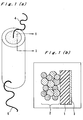
- Figs. 1(a) and 1(b) show one embodiment of a direct methanol fuel cell that embodies the present invention, in which liquid methanol is incorporated into the fuel electrode without passing through a reformer and is used as the fuel.
- Reference numeral 1 designates a tubular membrane made of a perfluorosulfonic acid-type polymer electrolyte, and on an inside of the tube are filled carbon particles 2 loaded with catalyst particles of platinum-ruthenium alloy (e.g. atomic composition, 50:50).
- the cavity of the tube is filled with 1.0-M sulfuric acid and a 3-M methanol solution.
- the inside of the tubular membrane constitutes a fuel electrode.
- platinum particles 3 On the outer side of the tubular membrane, are deposited platinum particles 3, which are fixed thereto, by a chemical plating method, to constitute an air electrode (oxygen electrode), which contacts outside air.
- Reference numerals 4 and 5 designate external terminals connected to the catalyst layers on the inner side and outer side of the tube, respectively, and corresponding to the output terminals of the fuel cell. If there is a need for connecting units of the fuel cell to each other in series, this is achieved by sequentially connecting the terminal 4 of one fuel cell and the terminal 5 of another fuel cell to each other, successively.
- Figs. 2(a) and 2(b) show one embodiment of a structure of a fuel cell suitable for the case where the inside of the tube is filled with gaseous fuel, for example, hydrogen, methanol gas or the like.
- Reference numeral 11 designates a tubular membrane made of a perfluorosulfonic acid-type polymer electrolyte, the inner side of which has a platinum particle layer 12 that is formed by depositing and fixing platinum particles thereon by a chemical plating method, or that is formed by coating thereto carbon particles loaded with platinum catalyst. Hydrogen gas or methanol gas is introduced into the inside of the tube, so that the platinum particle layer 12 serves as a catalyst for the fuel electrode.
- the fuel cell can be made to have the air electrode that is provided on the inner side of the tubular polymer electrolyte membrane, and the fuel electrode that is provided on the outer side of the tubular polymer electrolyte membrane.
- the oxidizer air or oxygen
- the oxidizer is made to pass through inside of the tube to contact with the air electrode, and fuel is fed to the outside of the tube, thereby making the fuel cell operate.
- the entire fuel cell is contained in a vessel filled with the fuel, thereby the fuel electrode provided on the outer side of the tubular membrane is brought into contact with the fuel in the vessel, while keeping the state in which the inside of the tube is sealed not to be contaminated with the fuel.
- the catalysts for fuel electrode and air electrode are preferably platinum family metals such as platinum, rhodium, palladium, ruthenium, and iridium. At least one of these metals is deposited and fixed on the inner side surface and outer side surface of the polymer membrane by a chemical plating method. Also, these catalysts may be fixed by coating or contact bonding the catalyst metal powder onto the membrane surface. Also, a method may be used in which the catalyst metal is dispersed as fine-particulates on the surface of carbon particles and the catalyst-loaded carbon particles are fixed on the inner and outer sides of the tubular membrane. Further, as described above, the catalyst-loaded carbon particles may be filled inside the tubular membrane.
- platinum family metals such as platinum, rhodium, palladium, ruthenium, and iridium. At least one of these metals is deposited and fixed on the inner side surface and outer side surface of the polymer membrane by a chemical plating method. Also, these catalysts may be fixed by coating or contact bonding the catalyst metal powder onto the
- the fuel electrode and air electrode may be provided on any one of the inner and outer sides of the tubular membrane. It is preferred that the fuel electrode is provided on the inner side and the air electrode is provided on the outer side of the membrane.
- the polymer electrolyte membrane material to be used is not necessarily limited to the above-mentioned perfluorosulfonic acid-type polymer, and it may be selected from a perfluorocarbonic acid-type membrane, a poly-styrene-vinylbenzene-type membrane, a quaternary ammonium-type anion-exchange membrane, and the like, as appropriate.
- a membrane made of benzimidazole-based polymer to which phosphoric acid is coordinated and a membrane made of polyacrylic acid impregnated with a concentrated potassium hydroxide solution are also effective, as the electrolyte membrane.
- a membrane made of benzimidazole-based polymer to which phosphoric acid is coordinated and a membrane made of polyacrylic acid impregnated with a concentrated potassium hydroxide solution are also effective, as the electrolyte membrane.
- use of a tubular electrolyte enables construction of fuel cells in which the fuel electrode and oxygen electrode are separated each other and which can be miniaturized (made compact).
- the size (outer/inner diameters), length and film thickness of the tubular polymer electrolyte membrane may be set as appropriate depending on the output power required for the fuel cell, an apparatus to which the fuel cell is applied, or the like.
- the tube has an inner diameter of 0.2 to 10 mm, an outer diameter of 0.5 to 12 mm, and a length of 20 to 1,000 mm.
- it has an inner diameter of 0.3 to 5 mm, an outer diameter of 0.5 to 7 mm, and a length of 30 to 500 mm.
- the fuel is brought into contact with the fuel electrode on the inner or outer side of the tubular polymer electrolyte membrane in a gaseous or liquid state.
- the fuel may be fed continuously or filled in a space on the side of the fuel electrode in advance.
- the oxidizer is brought into contact with the air electrode through the side of the air electrode of the tubular polymer electrolyte membrane. Since the electrolyte is a tubular membrane, the inside of the tube is gas tight and no leakage occurs, so that there is no fear of mixing of the fuel and oxidizer without resort to any special pass (channel), separator, or the like. Further, since the tubular membrane endures the pressure difference across the membrane, control of gas pressure or pressurization can be readily performed.
- the fuel cell of the present invention has high output density and low operating temperature of as low as 100°C so that a long-term durability can be expected. Because of easy handling, the fuel cell of the present invention can be utilized as a power source for mobile phones, video cameras, portable devices such as a note-type personal computer, or a transportable power source.
- the feature of the present invention resides in constructing a fuel cell by use of a tubular (hollow) polymer electrolyte membrane.
- the construction methods shown in Figs. 1(a) and 1(b) and Figs. 2(a) and 2(b) are only examples, and the present invention is not limited thereto with respect to the design of fuel cells, such as selection of catalysts, formation method of catalyst layers, selection of fuels, feeding methods for fuel and air, and the like.
- the fuel cell of the present invention can be applied to small portable devices, it can readily retain its gas tightness of the fuel electrode when constructing the fuel cell, its catalyst loading property is good, it has flexibility in shape upon fabricating a stack, and it is excellent in productivity.
- the fuel cell can be fabricated in a form such that it is adjusted to the contour of the device to which it is applied. Further, a low-temperature operating-type fuel cell that has extremely flexible, easy to make it small and light in weight can be constructed in a simple manner. In addition, for example, when the fuel electrode is formed on the inner side of the tube, injection of fuel is easy, no leakage of fuel occurs, and no cumbersome problem such as selection of sealing material or the like occurs.
- the method of loading catalysts and the area of electrode can be readily changed in design depending on the area where the fuel cell is to be applied.
- the fuel cell as a whole can be made compact (a small fuel cell) and its mass production at low costs is possible.
- a mixed solution of 0.1 M sodium borohydride and 1 M sodium hydroxide was charged inside a tubular Flemion (trade name of a perfluorosulfonic acid-type polymer, produced by Asahi Glass Company, Ltd.) electrolyte membrane having an inner diameter of 0.3 mm, an outer diameter of 0.5 mm and a length of 60 mm, and a 0.1 M aqueous chloroplatinic acid solution was contacted with the outer side of the resultant tube, to form a layer of deposited platinum on the outer side of the tube by a chemical plating method.
- Flemion trade name of a perfluorosulfonic acid-type polymer, produced by Asahi Glass Company, Ltd.
- a mixed solution of 0.1 M sodium borohydride and 1 M sodium hydroxide was charged inside a tubular Flemion electrolyte membrane having an inner diameter of 0.3 mm, an outer diameter of 0.5 mm and a length of 60 mm, and a 0.1 M aqueous chloroplatinic acid solution was contacted with the outer side of the resultant tube, to form a layer of deposited platinum on the outer side of the tube by a chemical plating method. Thereafter, the entire tube was washed with a sulfuric acid solution, and excess unreacted substance was removed, and at the same time the electrolyte membrane was rendered acid-type.
- a syringe a mixture of carbon particles being loaded thereon 20% by mass of platinum and a mixed solution of 3 M potassium hydroxide and 3 M methanol, in a state of suspension.
- the tip of the syringe was used as it was as a connection terminal of the inner catalyst layer serving as the fuel electrode.
- a terminal was connected to the platinum deposit layer formed on the outer side of the tube serving as the air electrode.
Landscapes
- Life Sciences & Earth Sciences (AREA)
- Engineering & Computer Science (AREA)
- Manufacturing & Machinery (AREA)
- Sustainable Development (AREA)
- Sustainable Energy (AREA)
- Chemical & Material Sciences (AREA)
- Chemical Kinetics & Catalysis (AREA)
- Electrochemistry (AREA)
- General Chemical & Material Sciences (AREA)
- Fuel Cell (AREA)
- Inert Electrodes (AREA)
Applications Claiming Priority (2)
| Application Number | Priority Date | Filing Date | Title |
|---|---|---|---|
| JP2001058277A JP3793801B2 (ja) | 2001-03-02 | 2001-03-02 | 小型燃料電池 |
| JP2001058277 | 2001-03-02 |
Publications (2)
| Publication Number | Publication Date |
|---|---|
| EP1237220A2 true EP1237220A2 (de) | 2002-09-04 |
| EP1237220A3 EP1237220A3 (de) | 2005-06-15 |
Family
ID=18918023
Family Applications (1)
| Application Number | Title | Priority Date | Filing Date |
|---|---|---|---|
| EP02004684A Withdrawn EP1237220A3 (de) | 2001-03-02 | 2002-02-28 | Polymerelektrolytmembran-Brennstoffzelle |
Country Status (4)
| Country | Link |
|---|---|
| US (1) | US20020122968A1 (de) |
| EP (1) | EP1237220A3 (de) |
| JP (1) | JP3793801B2 (de) |
| CA (1) | CA2373420A1 (de) |
Cited By (2)
| Publication number | Priority date | Publication date | Assignee | Title |
|---|---|---|---|---|
| US7378172B2 (en) * | 2005-05-09 | 2008-05-27 | Atomic Energy Council - Institute Of Nuclear Energy Research | Tubular membrane electrode assembly with leading wire |
| EP1590157A4 (de) * | 2002-12-23 | 2008-06-25 | Microcell Corp | Substratgestütztes herstellungsverfahren für mikrofaserbrennstoffzellen |
Families Citing this family (10)
| Publication number | Priority date | Publication date | Assignee | Title |
|---|---|---|---|---|
| JP3637392B2 (ja) * | 2002-04-08 | 2005-04-13 | 独立行政法人産業技術総合研究所 | 燃料電池 |
| US6960402B2 (en) * | 2002-06-28 | 2005-11-01 | Advanced Energy Technology Inc. | Perforated cylindrical fuel cells |
| JP4802458B2 (ja) | 2004-06-11 | 2011-10-26 | トヨタ自動車株式会社 | 燃料電池 |
| JP2005353490A (ja) * | 2004-06-11 | 2005-12-22 | Toyota Motor Corp | 燃料電池 |
| JP2005353484A (ja) | 2004-06-11 | 2005-12-22 | Toyota Motor Corp | チューブ型燃料電池用膜電極複合体およびチューブ型燃料電池用集電体 |
| JP4945887B2 (ja) | 2004-06-11 | 2012-06-06 | トヨタ自動車株式会社 | セルモジュール及び固体高分子電解質型燃料電池 |
| JP4440711B2 (ja) | 2004-06-11 | 2010-03-24 | トヨタ自動車株式会社 | 燃料電池用セルモジュール及びその製造方法、並びに燃料電池 |
| JP2006216281A (ja) * | 2005-02-01 | 2006-08-17 | Toyota Motor Corp | 燃料電池及び燃料電池の製造方法 |
| JP4839625B2 (ja) * | 2005-02-04 | 2011-12-21 | トヨタ自動車株式会社 | 燃料電池 |
| JP2007005162A (ja) * | 2005-06-24 | 2007-01-11 | Permelec Electrode Ltd | 燃料電池用触媒の製造方法、当該触媒を用いるガス拡散電極及び燃料電池 |
Family Cites Families (12)
| Publication number | Priority date | Publication date | Assignee | Title |
|---|---|---|---|---|
| JPS58176876A (ja) * | 1982-04-09 | 1983-10-17 | Shin Kobe Electric Mach Co Ltd | 円筒形液体燃料電池 |
| JPH06188008A (ja) * | 1992-04-01 | 1994-07-08 | Toshiba Corp | 燃料電池 |
| JPH07296840A (ja) * | 1994-04-27 | 1995-11-10 | Nippon Soken Inc | 高分子電解質型燃料電池 |
| JP3731234B2 (ja) * | 1996-02-15 | 2006-01-05 | 松下電器産業株式会社 | 固体高分子型燃料電池 |
| US6001500A (en) * | 1996-06-05 | 1999-12-14 | Southwest Res Inst | Cylindrical proton exchange membrane fuel cells and methods of making same |
| JPH1064572A (ja) * | 1996-08-14 | 1998-03-06 | Matsushita Electric Ind Co Ltd | 燃料電池用燃料供給システム及び携帯用電気機器 |
| US6060188A (en) * | 1998-04-06 | 2000-05-09 | Motorola, Inc. | High pressure coaxial fuel cell |
| US6080501A (en) * | 1998-06-29 | 2000-06-27 | Motorola, Inc. | Fuel cell with integral fuel storage |
| JP3427003B2 (ja) * | 1999-03-31 | 2003-07-14 | 株式会社東芝 | 燃料電池 |
| US20010050234A1 (en) * | 1999-12-22 | 2001-12-13 | Shiepe Jason K. | Electrochemical cell system |
| DE10040282A1 (de) * | 2000-08-14 | 2002-03-07 | Robert Heggemann | Brennstoffzelle |
| JP2002158015A (ja) * | 2000-11-21 | 2002-05-31 | Sony Corp | 電気化学素子、発電体及び発電装置 |
-
2001
- 2001-03-02 JP JP2001058277A patent/JP3793801B2/ja not_active Expired - Lifetime
-
2002
- 2002-02-26 CA CA002373420A patent/CA2373420A1/en not_active Abandoned
- 2002-02-28 EP EP02004684A patent/EP1237220A3/de not_active Withdrawn
- 2002-03-01 US US10/085,052 patent/US20020122968A1/en not_active Abandoned
Cited By (3)
| Publication number | Priority date | Publication date | Assignee | Title |
|---|---|---|---|---|
| EP1590157A4 (de) * | 2002-12-23 | 2008-06-25 | Microcell Corp | Substratgestütztes herstellungsverfahren für mikrofaserbrennstoffzellen |
| US7648665B2 (en) | 2002-12-23 | 2010-01-19 | Microcell Corporation | Substrate-supported process for manufacturing microfibrous fuel cells |
| US7378172B2 (en) * | 2005-05-09 | 2008-05-27 | Atomic Energy Council - Institute Of Nuclear Energy Research | Tubular membrane electrode assembly with leading wire |
Also Published As
| Publication number | Publication date |
|---|---|
| US20020122968A1 (en) | 2002-09-05 |
| JP3793801B2 (ja) | 2006-07-05 |
| JP2002260685A (ja) | 2002-09-13 |
| EP1237220A3 (de) | 2005-06-15 |
| CA2373420A1 (en) | 2002-09-02 |
Similar Documents
| Publication | Publication Date | Title |
|---|---|---|
| US6972160B2 (en) | Fuel cell | |
| TW533622B (en) | A fuel cell power generation equipment and a device using the same | |
| US7323266B2 (en) | Sheet-like chemical cell, fuel cell and methods for manufacturing thereof | |
| US7655335B2 (en) | Air breathing direct methanol fuel cell pack | |
| US6713206B2 (en) | Electrochemical cells comprising laminar flow induced dynamic conducting interfaces, electronic devices comprising such cells, and methods employing same | |
| US6869713B2 (en) | Fuel cell, fuel cell generator, and equipment using the same | |
| JP6219035B2 (ja) | 非対称構造を伴う燃料電池および燃料電池複合体ならびにその方法 | |
| TW531933B (en) | Direct methanol fuel cell system including an integrated methanol sensor and method of fabrication | |
| US20030198853A1 (en) | Air breathing direct methanol fuel cell pack | |
| US6576362B2 (en) | Electrochemical cell system | |
| US20020197520A1 (en) | Micro fuel cell array | |
| US20020122968A1 (en) | Fuel cell | |
| US7374837B2 (en) | Liquid electrochemical cell stacks and manufacturing methods for same | |
| US20080193817A1 (en) | Unit cell for fuel cell, method for manufacturing thereof and fuel cell system | |
| US7378175B2 (en) | Fuel cell and small electric equipment | |
| JP2005166552A (ja) | 燃料電池 | |
| US20090311576A1 (en) | Direct methanol type fuel cell stack and direct methanol type fuel cell system | |
| JP2004265872A (ja) | 燃料電池,燃料電池発電装置及びそれを用いた機器 | |
| US20060046126A1 (en) | Fuel cell and information terminal carrying the same | |
| EP3893300B1 (de) | Flache rohrförmige festoxidbrennstoffzelle oder wasserelektrolysezelle mit integriertem stromkollektor und herstellungsverfahren dafür | |
| JP2004259705A (ja) | 燃料電池,燃料電池発電装置及びそれを用いた機器 | |
| KR20220170011A (ko) | 초박막 튜브형 pem 연료전지 |
Legal Events
| Date | Code | Title | Description |
|---|---|---|---|
| PUAI | Public reference made under article 153(3) epc to a published international application that has entered the european phase |
Free format text: ORIGINAL CODE: 0009012 |
|
| 17P | Request for examination filed |
Effective date: 20020228 |
|
| AK | Designated contracting states |
Kind code of ref document: A2 Designated state(s): AT BE CH CY DE DK ES FI FR GB GR IE IT LI LU MC NL PT SE TR |
|
| AX | Request for extension of the european patent |
Free format text: AL;LT;LV;MK;RO;SI |
|
| RIN1 | Information on inventor provided before grant (corrected) |
Inventor name: YOSHITAKE, MASARU Inventor name: ISHIDA, MASAYOSHI Inventor name: OGURO, KEISUKE Inventor name: ISHIMARU, SHIN-YA Inventor name: OKADA, TATSUHIRO |
|
| PUAL | Search report despatched |
Free format text: ORIGINAL CODE: 0009013 |
|
| AK | Designated contracting states |
Kind code of ref document: A3 Designated state(s): AT BE CH CY DE DK ES FI FR GB GR IE IT LI LU MC NL PT SE TR |
|
| AX | Request for extension of the european patent |
Extension state: AL LT LV MK RO SI |
|
| AKX | Designation fees paid | ||
| STAA | Information on the status of an ep patent application or granted ep patent |
Free format text: STATUS: THE APPLICATION IS DEEMED TO BE WITHDRAWN |
|
| 18D | Application deemed to be withdrawn |
Effective date: 20051228 |
|
| REG | Reference to a national code |
Ref country code: DE Ref legal event code: 8566 |