EP1234613A1 - Katalysatorgemisch zur Isomerisierung von Dichlorbutenen - Google Patents
Katalysatorgemisch zur Isomerisierung von Dichlorbutenen Download PDFInfo
- Publication number
- EP1234613A1 EP1234613A1 EP02002072A EP02002072A EP1234613A1 EP 1234613 A1 EP1234613 A1 EP 1234613A1 EP 02002072 A EP02002072 A EP 02002072A EP 02002072 A EP02002072 A EP 02002072A EP 1234613 A1 EP1234613 A1 EP 1234613A1
- Authority
- EP
- European Patent Office
- Prior art keywords
- butene
- dichloro
- mixture
- alkyl
- aryl
- Prior art date
- Legal status (The legal status is an assumption and is not a legal conclusion. Google has not performed a legal analysis and makes no representation as to the accuracy of the status listed.)
- Withdrawn
Links
- 239000000203 mixture Substances 0.000 title claims abstract description 65
- 230000003197 catalytic effect Effects 0.000 title description 2
- UAZUEJTXWAXSMA-UHFFFAOYSA-N 1,1-dichlorobut-1-ene Chemical compound CCC=C(Cl)Cl UAZUEJTXWAXSMA-UHFFFAOYSA-N 0.000 title 1
- FQDIANVAWVHZIR-OWOJBTEDSA-N trans-1,4-Dichlorobutene Chemical compound ClC\C=C\CCl FQDIANVAWVHZIR-OWOJBTEDSA-N 0.000 claims abstract description 54
- 239000003054 catalyst Substances 0.000 claims abstract description 42
- XVEASTGLHPVZNA-UHFFFAOYSA-N 3,4-dichlorobut-1-ene Chemical compound ClCC(Cl)C=C XVEASTGLHPVZNA-UHFFFAOYSA-N 0.000 claims abstract description 39
- 150000004982 aromatic amines Chemical class 0.000 claims abstract description 21
- 238000006317 isomerization reaction Methods 0.000 claims abstract description 18
- 238000002156 mixing Methods 0.000 claims abstract description 15
- 125000000753 cycloalkyl group Chemical group 0.000 claims abstract description 11
- QTBSBXVTEAMEQO-UHFFFAOYSA-M Acetate Chemical group CC([O-])=O QTBSBXVTEAMEQO-UHFFFAOYSA-M 0.000 claims abstract description 10
- 239000010949 copper Substances 0.000 claims abstract description 10
- 125000002877 alkyl aryl group Chemical group 0.000 claims abstract description 9
- 125000003710 aryl alkyl group Chemical group 0.000 claims abstract description 9
- 125000003118 aryl group Chemical group 0.000 claims abstract description 9
- QAOWNCQODCNURD-UHFFFAOYSA-L Sulfate Chemical group [O-]S([O-])(=O)=O QAOWNCQODCNURD-UHFFFAOYSA-L 0.000 claims abstract description 7
- 150000004820 halides Chemical group 0.000 claims abstract description 7
- 125000005609 naphthenate group Chemical group 0.000 claims abstract description 7
- 238000000034 method Methods 0.000 claims description 23
- 150000001879 copper Chemical class 0.000 claims description 16
- PAYRUJLWNCNPSJ-UHFFFAOYSA-N Aniline Chemical compound NC1=CC=CC=C1 PAYRUJLWNCNPSJ-UHFFFAOYSA-N 0.000 claims description 14
- XEEYBQQBJWHFJM-UHFFFAOYSA-N Iron Chemical compound [Fe] XEEYBQQBJWHFJM-UHFFFAOYSA-N 0.000 claims description 12
- 238000006243 chemical reaction Methods 0.000 claims description 11
- POILWHVDKZOXJZ-ARJAWSKDSA-M (z)-4-oxopent-2-en-2-olate Chemical group C\C([O-])=C\C(C)=O POILWHVDKZOXJZ-ARJAWSKDSA-M 0.000 claims description 6
- JLTDJTHDQAWBAV-UHFFFAOYSA-N N,N-dimethylaniline Chemical compound CN(C)C1=CC=CC=C1 JLTDJTHDQAWBAV-UHFFFAOYSA-N 0.000 claims description 6
- 125000000217 alkyl group Chemical group 0.000 claims description 6
- 229910052799 carbon Inorganic materials 0.000 claims description 6
- 238000004821 distillation Methods 0.000 claims description 6
- 229920006395 saturated elastomer Polymers 0.000 claims description 6
- 150000001412 amines Chemical class 0.000 claims description 5
- RZXMPPFPUUCRFN-UHFFFAOYSA-N p-toluidine Chemical compound CC1=CC=C(N)C=C1 RZXMPPFPUUCRFN-UHFFFAOYSA-N 0.000 claims description 4
- AFBPFSWMIHJQDM-UHFFFAOYSA-N N-methyl-N-phenylamine Natural products CNC1=CC=CC=C1 AFBPFSWMIHJQDM-UHFFFAOYSA-N 0.000 claims description 2
- 230000035484 reaction time Effects 0.000 claims 1
- -1 copper salt Chemical class 0.000 abstract description 11
- 229910052802 copper Inorganic materials 0.000 abstract description 6
- 238000002360 preparation method Methods 0.000 abstract description 3
- WFDIJRYMOXRFFG-UHFFFAOYSA-N Acetic anhydride Chemical group CC(=O)OC(C)=O WFDIJRYMOXRFFG-UHFFFAOYSA-N 0.000 abstract 2
- IJGRMHOSHXDMSA-UHFFFAOYSA-N Atomic nitrogen Chemical compound N#N IJGRMHOSHXDMSA-UHFFFAOYSA-N 0.000 description 18
- 238000004519 manufacturing process Methods 0.000 description 13
- ZMANZCXQSJIPKH-UHFFFAOYSA-N Triethylamine Chemical compound CCN(CC)CC ZMANZCXQSJIPKH-UHFFFAOYSA-N 0.000 description 12
- 229910021591 Copper(I) chloride Inorganic materials 0.000 description 9
- OXBLHERUFWYNTN-UHFFFAOYSA-M copper(I) chloride Chemical compound [Cu]Cl OXBLHERUFWYNTN-UHFFFAOYSA-M 0.000 description 9
- 229910052757 nitrogen Inorganic materials 0.000 description 9
- 238000005070 sampling Methods 0.000 description 9
- FQDIANVAWVHZIR-UHFFFAOYSA-N 1,4-dichlorobut-2-ene Chemical compound ClCC=CCCl FQDIANVAWVHZIR-UHFFFAOYSA-N 0.000 description 6
- 239000005749 Copper compound Substances 0.000 description 4
- 239000006227 byproduct Substances 0.000 description 4
- 150000001880 copper compounds Chemical class 0.000 description 4
- FQDIANVAWVHZIR-UPHRSURJSA-N (z)-1,4-dichlorobut-2-ene Chemical compound ClC\C=C/CCl FQDIANVAWVHZIR-UPHRSURJSA-N 0.000 description 3
- 125000006539 C12 alkyl group Chemical group [H]C([H])([H])C([H])([H])C([H])([H])C([H])([H])C([H])([H])C([H])([H])C([H])([H])C([H])([H])C([H])([H])C([H])([H])C([H])([H])C([H])([H])* 0.000 description 3
- RYGMFSIKBFXOCR-UHFFFAOYSA-N Copper Chemical class [Cu] RYGMFSIKBFXOCR-UHFFFAOYSA-N 0.000 description 3
- JFDZBHWFFUWGJE-UHFFFAOYSA-N benzonitrile Chemical compound N#CC1=CC=CC=C1 JFDZBHWFFUWGJE-UHFFFAOYSA-N 0.000 description 3
- 125000004432 carbon atom Chemical group C* 0.000 description 3
- 229940120693 copper naphthenate Drugs 0.000 description 3
- SEVNKWFHTNVOLD-UHFFFAOYSA-L copper;3-(4-ethylcyclohexyl)propanoate;3-(3-ethylcyclopentyl)propanoate Chemical compound [Cu+2].CCC1CCC(CCC([O-])=O)C1.CCC1CCC(CCC([O-])=O)CC1 SEVNKWFHTNVOLD-UHFFFAOYSA-L 0.000 description 3
- 150000003254 radicals Chemical group 0.000 description 3
- KWOLFJPFCHCOCG-UHFFFAOYSA-N Acetophenone Chemical compound CC(=O)C1=CC=CC=C1 KWOLFJPFCHCOCG-UHFFFAOYSA-N 0.000 description 2
- KAKZBPTYRLMSJV-UHFFFAOYSA-N Butadiene Chemical compound C=CC=C KAKZBPTYRLMSJV-UHFFFAOYSA-N 0.000 description 2
- ZMXDDKWLCZADIW-UHFFFAOYSA-N N,N-Dimethylformamide Chemical compound CN(C)C=O ZMXDDKWLCZADIW-UHFFFAOYSA-N 0.000 description 2
- 230000015572 biosynthetic process Effects 0.000 description 2
- YACLQRRMGMJLJV-UHFFFAOYSA-N chloroprene Chemical compound ClC(=C)C=C YACLQRRMGMJLJV-UHFFFAOYSA-N 0.000 description 2
- DMBHHRLKUKUOEG-UHFFFAOYSA-N diphenylamine Chemical compound C=1C=CC=CC=1NC1=CC=CC=C1 DMBHHRLKUKUOEG-UHFFFAOYSA-N 0.000 description 2
- 230000000694 effects Effects 0.000 description 2
- 239000007789 gas Substances 0.000 description 2
- LQNUZADURLCDLV-UHFFFAOYSA-N nitrobenzene Chemical compound [O-][N+](=O)C1=CC=CC=C1 LQNUZADURLCDLV-UHFFFAOYSA-N 0.000 description 2
- 239000012299 nitrogen atmosphere Substances 0.000 description 2
- 238000010992 reflux Methods 0.000 description 2
- HHVIBTZHLRERCL-UHFFFAOYSA-N sulfonyldimethane Chemical compound CS(C)(=O)=O HHVIBTZHLRERCL-UHFFFAOYSA-N 0.000 description 2
- RIOQSEWOXXDEQQ-UHFFFAOYSA-N triphenylphosphine Chemical compound C1=CC=CC=C1P(C=1C=CC=CC=1)C1=CC=CC=C1 RIOQSEWOXXDEQQ-UHFFFAOYSA-N 0.000 description 2
- ZAMOUSCENKQFHK-UHFFFAOYSA-N Chlorine atom Chemical compound [Cl] ZAMOUSCENKQFHK-UHFFFAOYSA-N 0.000 description 1
- GSNUFIFRDBKVIE-UHFFFAOYSA-N DMF Natural products CC1=CC=C(C)O1 GSNUFIFRDBKVIE-UHFFFAOYSA-N 0.000 description 1
- SNRUBQQJIBEYMU-UHFFFAOYSA-N Dodecane Natural products CCCCCCCCCCCC SNRUBQQJIBEYMU-UHFFFAOYSA-N 0.000 description 1
- PIICEJLVQHRZGT-UHFFFAOYSA-N Ethylenediamine Chemical compound NCCN PIICEJLVQHRZGT-UHFFFAOYSA-N 0.000 description 1
- GSEJCLTVZPLZKY-UHFFFAOYSA-N Triethanolamine Chemical compound OCCN(CCO)CCO GSEJCLTVZPLZKY-UHFFFAOYSA-N 0.000 description 1
- HCHKCACWOHOZIP-UHFFFAOYSA-N Zinc Chemical class [Zn] HCHKCACWOHOZIP-UHFFFAOYSA-N 0.000 description 1
- 239000000654 additive Substances 0.000 description 1
- 150000001408 amides Chemical class 0.000 description 1
- 150000001448 anilines Chemical class 0.000 description 1
- 125000002178 anthracenyl group Chemical group C1(=CC=CC2=CC3=CC=CC=C3C=C12)* 0.000 description 1
- 239000012300 argon atmosphere Substances 0.000 description 1
- 150000005840 aryl radicals Chemical class 0.000 description 1
- 239000012298 atmosphere Substances 0.000 description 1
- 230000009286 beneficial effect Effects 0.000 description 1
- 238000009835 boiling Methods 0.000 description 1
- DKVNPHBNOWQYFE-UHFFFAOYSA-N carbamodithioic acid Chemical compound NC(S)=S DKVNPHBNOWQYFE-UHFFFAOYSA-N 0.000 description 1
- 238000005660 chlorination reaction Methods 0.000 description 1
- 239000000460 chlorine Substances 0.000 description 1
- 229910052801 chlorine Inorganic materials 0.000 description 1
- 150000001875 compounds Chemical class 0.000 description 1
- 125000000582 cycloheptyl group Chemical group [H]C1([H])C([H])([H])C([H])([H])C([H])([H])C([H])(*)C([H])([H])C1([H])[H] 0.000 description 1
- 125000000113 cyclohexyl group Chemical group [H]C1([H])C([H])([H])C([H])([H])C([H])(*)C([H])([H])C1([H])[H] 0.000 description 1
- 125000000640 cyclooctyl group Chemical group [H]C1([H])C([H])([H])C([H])([H])C([H])([H])C([H])(*)C([H])([H])C([H])([H])C1([H])[H] 0.000 description 1
- 125000001511 cyclopentyl group Chemical group [H]C1([H])C([H])([H])C([H])([H])C([H])(*)C1([H])[H] 0.000 description 1
- 125000002704 decyl group Chemical group [H]C([H])([H])C([H])([H])C([H])([H])C([H])([H])C([H])([H])C([H])([H])C([H])([H])C([H])([H])C([H])([H])C([H])([H])* 0.000 description 1
- HPNMFZURTQLUMO-UHFFFAOYSA-N diethylamine Chemical compound CCNCC HPNMFZURTQLUMO-UHFFFAOYSA-N 0.000 description 1
- 239000012990 dithiocarbamate Substances 0.000 description 1
- 125000003438 dodecyl group Chemical group [H]C([H])([H])C([H])([H])C([H])([H])C([H])([H])C([H])([H])C([H])([H])C([H])([H])C([H])([H])C([H])([H])C([H])([H])C([H])([H])C([H])([H])* 0.000 description 1
- 229920001971 elastomer Polymers 0.000 description 1
- 125000001495 ethyl group Chemical group [H]C([H])([H])C([H])([H])* 0.000 description 1
- 125000003983 fluorenyl group Chemical group C1(=CC=CC=2C3=CC=CC=C3CC12)* 0.000 description 1
- 125000003187 heptyl group Chemical group [H]C([*])([H])C([H])([H])C([H])([H])C([H])([H])C([H])([H])C([H])([H])C([H])([H])[H] 0.000 description 1
- 229910052742 iron Inorganic materials 0.000 description 1
- 125000000959 isobutyl group Chemical group [H]C([H])([H])C([H])(C([H])([H])[H])C([H])([H])* 0.000 description 1
- 125000001449 isopropyl group Chemical group [H]C([H])([H])C([H])(*)C([H])([H])[H] 0.000 description 1
- 239000002184 metal Substances 0.000 description 1
- 229910052751 metal Inorganic materials 0.000 description 1
- 125000002496 methyl group Chemical group [H]C([H])([H])* 0.000 description 1
- 239000000178 monomer Substances 0.000 description 1
- 125000004108 n-butyl group Chemical group [H]C([H])([H])C([H])([H])C([H])([H])C([H])([H])* 0.000 description 1
- 125000001280 n-hexyl group Chemical group C(CCCCC)* 0.000 description 1
- 125000000740 n-pentyl group Chemical group [H]C([H])([H])C([H])([H])C([H])([H])C([H])([H])C([H])([H])* 0.000 description 1
- VBEGHXKAFSLLGE-UHFFFAOYSA-N n-phenylnitramide Chemical class [O-][N+](=O)NC1=CC=CC=C1 VBEGHXKAFSLLGE-UHFFFAOYSA-N 0.000 description 1
- 125000004123 n-propyl group Chemical group [H]C([H])([H])C([H])([H])C([H])([H])* 0.000 description 1
- 125000001971 neopentyl group Chemical group [H]C([*])([H])C(C([H])([H])[H])(C([H])([H])[H])C([H])([H])[H] 0.000 description 1
- 150000002828 nitro derivatives Chemical class 0.000 description 1
- 125000001400 nonyl group Chemical group [H]C([*])([H])C([H])([H])C([H])([H])C([H])([H])C([H])([H])C([H])([H])C([H])([H])C([H])([H])C([H])([H])[H] 0.000 description 1
- QIQXTHQIDYTFRH-UHFFFAOYSA-N octadecanoic acid Chemical compound CCCCCCCCCCCCCCCCCC(O)=O QIQXTHQIDYTFRH-UHFFFAOYSA-N 0.000 description 1
- 125000002347 octyl group Chemical group [H]C([*])([H])C([H])([H])C([H])([H])C([H])([H])C([H])([H])C([H])([H])C([H])([H])C([H])([H])[H] 0.000 description 1
- 229940049964 oleate Drugs 0.000 description 1
- ZQPPMHVWECSIRJ-KTKRTIGZSA-N oleic acid Chemical compound CCCCCCCC\C=C/CCCCCCCC(O)=O ZQPPMHVWECSIRJ-KTKRTIGZSA-N 0.000 description 1
- 150000002903 organophosphorus compounds Chemical class 0.000 description 1
- 150000002923 oximes Chemical class 0.000 description 1
- 125000001997 phenyl group Chemical group [H]C1=C([H])C([H])=C(*)C([H])=C1[H] 0.000 description 1
- 229920001084 poly(chloroprene) Polymers 0.000 description 1
- 229920000570 polyether Polymers 0.000 description 1
- 229920001223 polyethylene glycol Polymers 0.000 description 1
- 230000001681 protective effect Effects 0.000 description 1
- 150000003839 salts Chemical class 0.000 description 1
- 238000003756 stirring Methods 0.000 description 1
- 125000000999 tert-butyl group Chemical group [H]C([H])([H])C(*)(C([H])([H])[H])C([H])([H])[H] 0.000 description 1
- 150000003568 thioethers Chemical class 0.000 description 1
- HIZCIEIDIFGZSS-UHFFFAOYSA-L trithiocarbonate Chemical class [S-]C([S-])=S HIZCIEIDIFGZSS-UHFFFAOYSA-L 0.000 description 1
- 125000002948 undecyl group Chemical group [H]C([*])([H])C([H])([H])C([H])([H])C([H])([H])C([H])([H])C([H])([H])C([H])([H])C([H])([H])C([H])([H])C([H])([H])C([H])([H])[H] 0.000 description 1
- 150000003672 ureas Chemical class 0.000 description 1
- 239000011701 zinc Chemical class 0.000 description 1
- 229910052725 zinc Chemical class 0.000 description 1
Classifications
-
- B—PERFORMING OPERATIONS; TRANSPORTING
- B01—PHYSICAL OR CHEMICAL PROCESSES OR APPARATUS IN GENERAL
- B01J—CHEMICAL OR PHYSICAL PROCESSES, e.g. CATALYSIS OR COLLOID CHEMISTRY; THEIR RELEVANT APPARATUS
- B01J31/00—Catalysts comprising hydrides, coordination complexes or organic compounds
- B01J31/16—Catalysts comprising hydrides, coordination complexes or organic compounds containing coordination complexes
- B01J31/18—Catalysts comprising hydrides, coordination complexes or organic compounds containing coordination complexes containing nitrogen, phosphorus, arsenic or antimony as complexing atoms, e.g. in pyridine ligands, or in resonance therewith, e.g. in isocyanide ligands C=N-R or as complexed central atoms
- B01J31/1805—Catalysts comprising hydrides, coordination complexes or organic compounds containing coordination complexes containing nitrogen, phosphorus, arsenic or antimony as complexing atoms, e.g. in pyridine ligands, or in resonance therewith, e.g. in isocyanide ligands C=N-R or as complexed central atoms the ligands containing nitrogen
-
- C—CHEMISTRY; METALLURGY
- C07—ORGANIC CHEMISTRY
- C07C—ACYCLIC OR CARBOCYCLIC COMPOUNDS
- C07C17/00—Preparation of halogenated hydrocarbons
- C07C17/35—Preparation of halogenated hydrocarbons by reactions not affecting the number of carbon or of halogen atoms in the reaction
- C07C17/358—Preparation of halogenated hydrocarbons by reactions not affecting the number of carbon or of halogen atoms in the reaction by isomerisation
-
- B—PERFORMING OPERATIONS; TRANSPORTING
- B01—PHYSICAL OR CHEMICAL PROCESSES OR APPARATUS IN GENERAL
- B01J—CHEMICAL OR PHYSICAL PROCESSES, e.g. CATALYSIS OR COLLOID CHEMISTRY; THEIR RELEVANT APPARATUS
- B01J2231/00—Catalytic reactions performed with catalysts classified in B01J31/00
- B01J2231/50—Redistribution or isomerisation reactions of C-C, C=C or C-C triple bonds
- B01J2231/52—Isomerisation reactions
-
- B—PERFORMING OPERATIONS; TRANSPORTING
- B01—PHYSICAL OR CHEMICAL PROCESSES OR APPARATUS IN GENERAL
- B01J—CHEMICAL OR PHYSICAL PROCESSES, e.g. CATALYSIS OR COLLOID CHEMISTRY; THEIR RELEVANT APPARATUS
- B01J2531/00—Additional information regarding catalytic systems classified in B01J31/00
- B01J2531/10—Complexes comprising metals of Group I (IA or IB) as the central metal
- B01J2531/16—Copper
Definitions
- 3,4-dichloro-1-butene is an important intermediate in the production of 2-chloroprene, that as a monomer for the production of polychloroprene rubber is used on an industrial scale.
- the chlorination of butadiene produces a mixture of cis -1,4-dichloro-2-butene, trans -1,4-dichloro-2-butene and 3,4-dichloro-1-butene, which contains about 65% cis or contains trans -1,4-dichloro-2-butene and about 35% 3,4-dichloro-1-butene.
- These isomers are usually in equilibrium in the mixture, the ratio depending on the manufacturing conditions.
- cis and trans -1,4-dichloro-2-butene are summarized below as 1,4-dichloro-2-butene.
- DE-A-21 38 790 discloses a process for the isomerization of 1,4-dichloro-2-butene to 3,4-dichloro-1-butene or vice versa at 80 to 160 ° C using copper naphthenate, Dinitrile and amide.
- DE-A-21 43 157 describes a process for isomerization in Presence of copper salts and oxime derivatives at 80 to 160 ° C described.
- DE-A-22 00 780 claims a process which uses a mixture of catalysts contains a copper compound and an organic phosphorus compound.
- DE-A-21 07 468 discloses the use of copper naphthenate and nitro compounds
- DE-A-21 30 488 the use of copper naphthenate and nitroanilines.
- DE-A-22 12 235 becomes an isomerization process using copper compound and Urea derivative described.
- DE-A-22 06 971 claims the use of a Mixture of copper compound (copper II stearate, oleate and naphthenate) and chlorine-containing aniline derivative.
- US-A-4,895,993 describes a process for isomerization in the presence of a catalyst consisting of a copper compound and a dithiocarbamate or trithiocarbonate derivative.
- Rostovshchikova et al. describe in Zh. Obshch. Khim. 1994, 64, 12 the use of triphenylphosphine or in Kinet. Catal. 1992, 33, 314 the use of different dialkyl sulfides in the presence of copper halides for catalytic isomerization.
- Asatryan et al. examined in arm. Khim. Zh. 1988, 41, 278 the effect of macrocyclic polyethers or polyethylene glycols in arm.
- Khim. Zh. 1988, 41, 273 the influence of benzonitrile, nitrobenzene, DMF, dimethyl sulfone or acetophenone.
- the disadvantage of this method is that the conversion speeds are comparatively high are low and a large amount of unwanted by-products is formed.
- C 1 -C 12 alkyl is understood to mean all linear or branched, saturated or unsaturated alkyl radicals having 1 to 12 C atoms known to the person skilled in the art, such as methyl, ethyl, n-propyl, i-propyl, n-butyl, i-butyl , t-butyl, n-pentyl, i-pentyl, neo-pentyl, n-hexyl, i-hexyl, heptyl, octyl, nonyl, decyl, undecyl and dodecyl, and their unsaturated homologues.
- C 5 to C 8 cycloalkyl is understood to mean all cyclic alkyl radicals having 5 to 8 carbon atoms known to the person skilled in the art, such as cyclopentyl, cyclohexyl, cycloheptyl, cyclooctyl, and their unsaturated homologues.
- C 6 to C 14 aryl is understood to mean all aryl radicals with 6 to 14 C atoms known to the person skilled in the art, such as phenyl, naphthenyl, fluorenyl, anthracenyl and phenanthranyl.
- Preferred aromatic amines are aniline, N, N-dimethylaniline, p-toluidine or Mixtures of 2 or 3 of these components.
- the concentration of the two components is advantageously in the range from 10 -3 to 1 mol / l, preferably between 5 ⁇ 10 -2 to 5 ⁇ 10 -1 mol Cu / l.
- the invention further relates to a method for producing an inventive Composition, characterized in that the components in the order aromatic amine or aromatic amines and then that or mix the anhydrous copper salts. It is beneficial to use this mixing process under a protective gas atmosphere, such as nitrogen atmosphere or argon atmosphere, in Temperature range from 30 to 180 ° C, preferably 50 to 150 ° C to perform.
- a protective gas atmosphere such as nitrogen atmosphere or argon atmosphere
- the invention further relates to the use of the composition according to the invention as a catalyst, in particular as a catalyst in a process for Isomerization of 1,4-dichloro-2-butene to 3,4-dichloro-1-butene or of 3,4-dichloro-1-butene to 1,4-dichloro-2-butene.
- the process can be carried out batchwise or continuously between 0.01 bar and 10 bar, preferably between 0.1 and 1.0 bar, it being advisable to firstly use a more concentrated solution of the catalyst system, preferably 10 -1 to 1 mol Cu / l, in 1,4-dichloro-2-butene and / or 3,4-dichloro-1-butene and this continuously a larger amount of 1,4-dichloro-2-butene and / or 3,4-dichloro Add -1-butene so that the desired concentration is preferably 5 x 10 -2 to 5 x 10 -1 mol Cu / l of the catalyst, with 1,4-dichloro-2-butene and / or 3,4- Dichloro-1-butene fed, a mixture of 1,4-dichloro-2-butene and 3,4-dichloro-1-butene continuously removed and then separated by distillation.
- Samples are taken at fixed intervals during the reaction period and gas chromatographically to determine their content of 3,4-dichloro-1-butene, cis -1,4-dichloro-2-butene, trans -1,4-dichloro-2-butene and possibly formed by-products, such as 1-chloroprene, are examined.
- the starting point of the reaction is determined by the end of the addition of the catalyst mixture. At the starting point, samples of approx. 2 ml volume are taken after 5, 15, 30 and 90 minutes.
- Example 2 In the experimental setup described in Example 1, 240.0 g of 1,4-dichloro-2-butene are used submitted, added at 130 ° C 84.0 g of the catalyst mixture B, so that a mixing temperature of 105 ° C occurs, and at this temperature 90 min stirred. The time, sampling and examination of the samples are carried out as in Example 1 explained.
- Example 2 In the experimental setup described in Example 1, 240.0 g of 1,4-dichloro-2-butene are used submitted, at 130 ° C 84.0 g of the catalyst mixture C added so that a mixing temperature of 105 ° C occurs, and at this temperature 90 min stirred. The time, sampling and examination of the samples are carried out as in Example 1 explained.
- Example 2 In the experimental setup described in Example 1, 240.0 g of 1,4-dichloro-2-butene are used submitted, added to 130.0 C 84.0 g of the catalyst mixture D, so that a mixing temperature of 105 ° C occurs, and at this temperature 90 min stirred. The time, sampling and examination of the samples are carried out as in Example 1 explained.
- Example 2 In the experimental setup described in Example 1, 240.0 g of 1,4-dichloro-2-butene are used submitted, added to 130.0 C 84.0 g of the catalyst mixture E, so that a mixing temperature of 105 ° C occurs, and at this temperature 90 min stirred. The time, sampling and examination of the samples are carried out as in Example 1 explained.
- Example 2 In the experimental setup described in Example 1, 240.0 g of 1,4-dichloro-2-butene are used submitted, at 130 ° C 84.0 g of the catalyst mixture F added so that a mixing temperature of 105 ° C occurs, and at this temperature 90 min stirred. The time, sampling and examination of the samples are carried out as in Example 1 explained.
- Example 2 In the experimental setup described in Example 1, 240.0 g of 1,4-dichloro-2-butene are used submitted, at 130 ° C 84.0 g of the catalyst mixture G added so that a mixing temperature of 105 ° C occurs, and at this temperature 90 min stirred. The time, sampling and examination of the samples are carried out as in Example 1 explained.
- Example 2 In the experimental setup described in Example 1, 240.0 g of 1,4-dichloro-2-butene are used submitted, added to 130.0 C 84.0 g of the catalyst mixture H, so that a mixing temperature of 105 ° C occurs, and at this temperature 90 min stirred. The time, sampling and examination of the samples are carried out as in Example 1 explained.
- Example 2 In the experimental setup described in Example 1, 240.0 g of 1,4-dichloro-2-butene are used submitted, at 130 ° C 84.0 g of the catalyst mixture I added so that a mixing temperature of 105 ° C, and at this temperature 90 min touched. The time, sampling and examination of the samples are carried out as in Example 1 explained.
- Example 1 In the experimental setup described in Example 1, 240.0 g of 1,4-dichloro-2-butene are introduced, 84.0 g of the catalyst mixture H are added at 165 ° C., so that a mixture temperature of 130 ° C. is established, and at this Temperature stirred 90 min. The time, sampling and examination of the samples are carried out as explained in Example 1.
Landscapes
- Chemical & Material Sciences (AREA)
- Organic Chemistry (AREA)
- Chemical Kinetics & Catalysis (AREA)
- Inorganic Chemistry (AREA)
- Engineering & Computer Science (AREA)
- Materials Engineering (AREA)
- Organic Low-Molecular-Weight Compounds And Preparation Thereof (AREA)
- Low-Molecular Organic Synthesis Reactions Using Catalysts (AREA)
- Catalysts (AREA)
Abstract
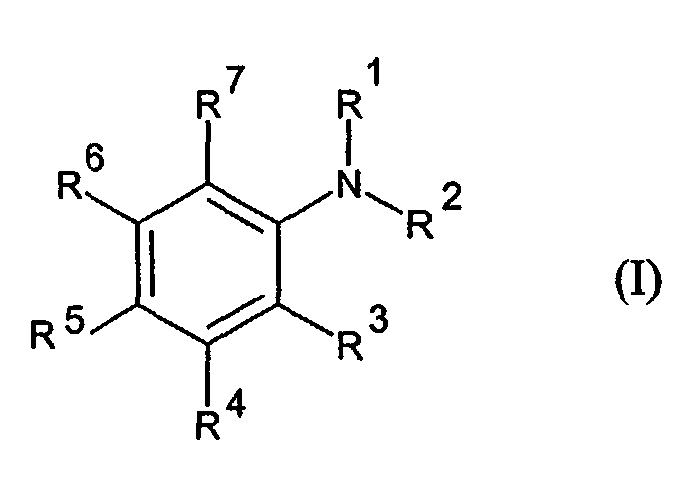
Die Erfindung betrifft eine Zusammensetzung herstellbar durch Mischung eines aromatischen Amins oder mehrerer aromatischer Amine der allgemeinen Formel I, <IMAGE> wobei R<1> bis R<7>: unabhängig voneinander für H, C1- bis C12-Alkyl, C5- bis C8-Cycloalkyl, C6- bis C14-Aryl, Alkylaryl, Arylalkyl, wobei zwei benachbarte Reste gemeinsam gesättigte oder ungesättigte C3- bis C14-Cyclen bilden können, oder für -SiR<8>R<9>R<10>, wobei R<8> bis R<10> unabhängig voneinander C1- bis C4-Alkyl, C5- bis C8-Cycloalkyl oder C6- bis C14-Aryl bedeuten kann, mit einem wasserfreien Kupfersalz CuXn, wobei n = 1 oder 2 und X = Halogenid, Sulfat, Acetat, Acetylacetonat ist, oder einem Gemisch aus zwei oder mehreren dieser Verbindungen in 1,4-Dichlor-2-buten oder 3,4-Dichlor-1-buten, einem Verfahren zu deren Herstellung, deren Verwendung als Katalysator, sowie einem Verfahren zur Isomerisierung von 1,4-Dichlor-2-buten zu 3,4-Dichlor-1-buten oder umgekehrt unter Verwendung der erfindungsgemäßen Zusammensetzung.
Description
Die Erfindung betrifft eine Zusammensetzung herstellbar durch Mischung eines aromatischen
Amins oder mehrerer aromatischer Amine der allgemeinen Formel I,
 wobei
wobei
- R1 bis R7
- unabhängig voneinander für H, C1- bis C12-Alkyl, C5- bis C8-Cycloalkyl, C6- bis C14-Aryl, Alkylaryl, Arylalkyl, wobei zwei benachbarte Reste gemeinsam gesättigte oder ungesättigte C3- bis C14-Cyclen bilden können, oder für -SiR8R9R10, wobei R8 bis R10 unabhängig voneinander C1- bis C4-Alkyl, C5- bis C8-Cycloalkyl oder C6- bis C14-Aryl bedeuten kann,
3,4-Dichlor-1-buten ist ein wichtiges Zwischenprodukt bei der Herstellung von 2-Chloropren,
das als Monomer für die Herstellung von Polychloroprenkautschuk
großtechnisch Verwendung findet.
Bei der Chlorierung von Butadien entsteht ein Gemisch von cis-1,4-Dichlor-2-buten,
trans-1,4-Dichlor-2-buten und 3,4-Dichlor-1-buten, das etwa 65 % cis- bzw. trans-1,4-Dichlor-2-buten
und etwa 35 % 3,4-Dichlor-1-buten enthält. Diese Isomeren
liegen gewöhnlich in der Mischung im Gleichgewicht vor, wobei das Verhältnis von
den Herstellungsbedingungen abhängt. Im folgenden seien zur Vereinfachung cisund
trans-1,4-Dichlor-2-buten als 1,4-Dichlor-2-buten zusammengefasst. Aufgrund
der unterschiedlichen Siedepunkte (1,4-Dichlor-2-buten: 154-9°C und 3,4-Dichlor-1-buten:
123°C) kann dieses Gemisch destillativ aufgetrennt werden. Da für die
Herstellung von 2-Chloropren nur das 3,4-Dichlor-1-buten geeignet ist, muss das
1,4-Dichlor-2-buten zum 3,4-Dichlor-1-buten isomerisiert und in den Prozess
zurückgeführt werden.
Die üblichen Verfahren zur Isomerisation von 1,4-Dichlor-2-buten zu 3,4-Dichlor-1-buten
oder umgekehrt basieren auf der Verwendung geeigneter
Isomerisierungskatalysatoren, welche für eine schnelle Gleichgewichtseinstellung
zwischen den Isomeren in 1,4-Dichlor-2-buten oder 3,4-Dichlor-1-buten bei erhöhten
Temperaturen sorgen. In den meisten Verfahren werden Metallsalze des Kupfers in
Gegenwart basischer Zusätze eingesetzt, die zur Erhöhung der Reaktionsgeschwindigkeiten
dienen.
DE-A-21 38 790 offenbart ein Verfahren zur Isomerisierung von 1,4-Dichlor-2-buten
zu 3,4-Dichlor-1-buten oder umgekehrt bei 80 bis 160°C mittels Kupfernaphthenat,
Dinitril und Amid. In DE-A-21 43 157 wird ein Verfahren zur Isomerisierung in
Gegenwart von Kupfersalzen und Oxim-Derivaten bei 80 bis 160°C beschrieben.
DE-A-22 00 780 beansprucht ein Verfahren, das als Katalysator ein Gemisch aus
einer Kupferverbindung und einer organischen Phosphorverbindung enthält. DE-A-21
07 468 offenbart die Verwendung von Kupfernaphthenat und Nitroverbindungen,
DE-A-21 30 488 die Verwendung von Kupfernaphthenat und Nitroanilinen. In DE-A-22
12 235 wird ein Isomerisierungsverfahren mittels Kupferverbindung und
Harnstoffderivat beschrieben. DE-A-22 06 971 beansprucht die Verwendung eines
Gemisches aus Kupferverbindung (Kupfer-II-Stearat, -oleat und -naphthenat) und
chlorhaltigem Anilinderivat. In US-A-4,895,993 wird ein Verfahren zur Isomerisierung
in Gegenwart eines Katalysators bestehend aus einer Kupferverbindung und
einem Dithiocarbamat- oder Trithiocarbonat- Derivat.
Rostovshchikova et al. beschreiben in Zh. Obshch. Khim. 1994, 64, 12 die
Verwendung von Triphenylphosphin oder in Kinet. Katal. 1992, 33, 314 den Einsatz
unterschiedlicher Dialkylsulfide in Gegenwart von Kupferhalogeniden zur katalytischen
Isomerisierung. Asatryan et al. untersuchten in Arm. Khim. Zh. 1988, 41, 278
die Wirkung von makrozyklischen Polyethern oder Polyethylenglykolen, in Arm.
Khim. Zh. 1988, 41, 273 den Einfluss von Benzonitril, Nitrobenzol, DMF, Dimethylsulfon
oder Acetophenon.
Von Nachteil an diesen Verfahren ist, dass die Umwandlungsgeschwindigkeiten vergleichsweise
gering sind und eine große Menge an unerwünschten Nebenprodukten
gebildet wird.
In Arm. Khim. Zh. 1987, 40, 709 wird von Asatryan et al. die Wirkung unterschiedlicher
Isomerisierungskatalysatoren auf der Basis von Halogenidsalzen des Kupfers,
Eisens oder Zinks in Gegenwart von Amin-Derivaten wie Triethylamin, Diethylamin,
Triethanolamin, Ethylendiamin oder Anilin beschrieben. Asatryan et al.
beschreiben jedoch, dass aliphatische Amine zu Isomerisierungskatalysatoren führen,
die aufgrund ihrer höherer Nucleophilie eine höhere Effektivität zeigen als aromatische
Amine. Daher wird dort die Verwendung aliphatischer Amine empfohlen.
Es war nun Aufgabe der vorliegenden Erfindung ein wirtschaftliches Verfahren zur
Isomerisierung von 1,4-Dichlor-2-buten zu 3,4-Dichlor-1-buten oder umgekehrt
mittels eines Katalysatorsystems zu finden, welches hohe Umwandlungsgeschwindigkeiten
gewährleistet und mit reduzierter Nebenproduktbildung die Isomerisierung
katalysiert.
Überraschend wurde gefunden, dass bei einem Verfahren zur Isomerisierung von 1,4-Dichlor-2-buten
zu 3,4-Dichlor-1-buten oder umgekehrt unter Verwendung einer
Zusammensetzung herstellbar durch Mischung eines aromatischen Amins und eines
Kupfersalzes die Isomerisierungsgeschwindigkeit entgegen den Befunden von
Asatryan et al. in Arm. Khim. Zh. 1987, 40, 709 höher, die Nebenproduktbildung
aufgrund der geringeren Basizität der aromatischen Amine geringer und damit das
Verfahren wirtschaftlicher ist.
Gegenstand der Erfindung ist eine Zusammensetzung herstellbar durch Mischung
eines aromatischen Amins oder mehrerer aromatischer Amine der allgemeinen
Formel I,
 wobei
wobei
- R1 bis R7
- unabhängig voneinander für H, C1- bis C12-Alkyl, C5- bis C8-Cycloalkyl, C6- bis C14-Aryl, Alkylaryl, Arylalkyl steht, wobei zwei benachbarte Reste gemeinsam gesättigte oder ungesättigte C3- bis C14-Cyclen bilden können, oder für -SiR8R9R10, wobei R8 bis R10 unabhängig voneinander C1- bis C4-Alkyl, C5- bis C8-Cycloalkyl oder C6- bis C14-Aryl bedeuten kann,
Unter C1-C12-Alkyl werden sämtliche dem Fachmann bekannte lineare oder verzweigte,
gesättigte oder ungesättigte Alkylreste mit 1 bis 12 C-Atomen verstanden,
wie Methyl, Ethyl, n-Propyl, i-Propyl, n-Butyl, i-Butyl, t-Butyl, n-Pentyl, i-Pentyl,
neo-Pentyl, n-Hexyl, i-Hexyl, Heptyl, Octyl, Nonyl, Decyl, Undecyl und Dodecyl,
sowie deren ungesättigten Homologen.
Unter C5- bis C8-Cycloalkyl werden sämtliche dem Fachmann bekannte cyclische
Alkylreste mit 5 bis 8 C-Atomen verstanden, wie Cyclopentyl, Cyclohexyl, Cycloheptyl,
Cyclooctyl, sowie deren ungesättigten Homologen.
Unter C6- bis C14-Aryl werden sämtliche dem Fachmann bekannte Arylreste mit 6 bis
14 C-Atomen verstanden, wie Phenyl, Naphthenyl, Fluorenyl, Anthracenyl und
Phenanthranyl.
Bevorzugte aromatische Amine sind Anilin, N,N-Dimethylanilin, p-Toluidin oder
Gemische aus 2 oder 3 dieser Komponenten.
Das molare Verhältnis der beiden Komponenten CuXn, wobei n = 1 oder 2 und X =
Halogenid, Sulfat, Acetat, Acetylacetonat, Naphthenat ist, zu aromatischem Amin
liegt dabei vorteilhaft im Bereich von 1:0,5 bis 1,5, bevorzugt 1:0,7 bis 1:1 Die
Konzentration der beiden Komponenten liegt vorteilhaft im Bereich von 10-3 bis 1
mol/l, bevorzugt zwischen 5×10⁻² bis 5×10⁻¹ mol Cu/l.
Die Erfindung betrifft weiterhin ein Verfahren zur Herstellung einer erfindungsgemäßen
Zusammensetzung, dadurch gekennzeichnet, dass man die Komponenten in
der Reihenfolge aromatisches Amin oder aromatische Amine und anschließend das
oder die wasserfreien Kupfersalze mischt. Es ist vorteilhaft, diesen Mischprozess
unter Schutzgasatmosphäre, wie Stickstoffatmosphäre oder Argonatmosphäre, im
Temperaturbereich von 30 bis 180°C, bevorzugt 50 bis 150°C durchzuführen.
Die Erfindung betrifft weiterhin die Verwendung der erfindungsgemäßen Zusammensetzung
als Katalysator, insbesondere als Katalysator in einem Verfahren zur
Isomerisierung von 1,4-Dichlor-2-buten zu 3,4-Dichlor-1-buten oder von 3,4-Dichlor-1-buten
zu 1,4-Dichlor-2-buten.
Somit ist ein weiterer Gegenstand der Erfindung ein Verfahren zur Isomerisierung
von 1,4-Dichlor-2-buten zu 3,4-Dichlor-1-buten oder von 3,4-Dichlor-1-buten zu
1,4-Dichlor-2-buten, dadurch gekennzeichnet, dass man

- R1 bis R7
- unabhängig voneinander für H, C1- bis C12-Alkyl, C5- bis C8-Cyclo-alkyl, C6- bis C14-Aryl, Alkylaryl, Arylalkyl steht, wobei zwei benachbarte Reste gemeinsam gesättigte oder ungesättigte C3- bis C14-Cyclen bilden können, oder für -SiR8R9R10, wobei R8 bis R10 unabhängig voneinander C1- bis C4-Alkyl, C5- bis C8-Cycloalkyl oder C6- bis C14-Aryl bedeuten kann,
Das Verfahren kann sowohl diskontinuierlich als auch kontinuierlich zwischen 0,01
bar und 10 bar, bevorzugt zwischen 0,1 und 1,0 bar, erfolgen, wobei es sich
empfiehlt, zunächst eine höherkonzentrierte Lösung des Katalysatorsystems, bevorzugt
10-1 bis 1 mol Cu/l, in 1,4-Dichlor-2-buten und/oder 3,4-Dichlor-1-buten
herzustellen und diese kontinuierlich einer größeren Menge an 1,4-Dichlor-2-buten
und/oder 3,4-Dichlor-1-buten zuzugeben, so dass die gewünschte Konzentration
bevorzugt 5 x 10⁻² bis 5 x 10⁻¹ mol Cu/l des Katalysators erhalten wird, wobei
kontinuierlich 1,4-Dichlor-2-buten und/oder 3,4-Dichlor-1-buten zugeleitet, ein
Gemisch an 1,4-Dichlor-2-buten und 3,4-Dichlor-1-buten kontinuierlich entfernt und
anschließend destillativ getrennt wird.
Im folgenden wird die Erfindung anhand von Ausführungsbeispielen näher erläutert,
ohne diese jedoch auf die Beispiele einzuschränken.
Unter Stickstoffatmosphäre werden in einem 500 ml Rundkolben mit Innenthermometer,
Rückflusskühler und Überdruckventil 232.0 g 1,4-Dichlor-2-buten vorgelegt,
bei 50°C 9,67 g (104 mmol) Anilin zugegeben und 4 h bei dieser Temperatur gerührt.
Anschließend werden bei 50°C 10,29 g (104 mmol) Kupfer(I)-chlorid zugegeben und
weitere 8 h bei dieser Temperatur gerührt.
In der bei der Herstellung von Katalysator A beschriebenen Apparatur werden unter
Stickstoff 232.0 g 1,4-Dichlor-2-buten vorgelegt, bei 50°C 8,72 g (94 mmol) Anilin
zugegeben und 4 h bei dieser Temperatur gerührt. Anschließend werden bei 50°C
10,29 g (104 mmol) Kupfer(I)-chlorid zugegeben und weitere 8 h bei dieser Temperatur
gerührt.
In der bei der Herstellung von Katalysator A beschriebenen Apparatur werden unter
Stickstoff 232.0 g 1,4-Dichlor-2-buten vorgelegt, bei 50°C 7,75 g (83 mmol) Anilin
zugegeben und 4 h bei dieser Temperatur gerührt. Anschließend werden bei 50°C
10,29 g (104 mmol) Kupfer(I)-chlorid zugegeben und weitere 8 h bei dieser Temperatur
gerührt.
In der bei der Herstellung von Katalysator A beschriebenen Apparatur werden unter
Stickstoff 232.0 g 1,4-Dichlor-2-buten vorgelegt, bei 50°C 6,78 g (73 mmol) Anilin
zugegeben und 4 h bei dieser Temperatur gerührt. Anschließend werden bei 50°C
10,29 g (104 mmol) Kupfer(I)-chlorid zugegeben und weitere 8 h bei dieser Temperatur
gerührt.
In der bei der Herstellung von Katalysator A beschriebenen Apparatur werden unter
Stickstoff 232.0 g 1,4-Dichlor-2-buten vorgelegt, bei 50°C 11,34 g (94 mmol) N,N-Dimethylanilin
zugegeben und 4 h bei dieser Temperatur gerührt. Anschließend
werden bei 50°C 10,29 g (104 mmol) Kupfer(I)-chlorid zugegeben und weitere 8 h
bei dieser Temperatur gerührt.
In der bei der Herstellung von Katalysator A beschriebenen Apparatur werden unter
Stickstoff 232.0 g 1,4-Dichlor-2-buten vorgelegt, bei 50°C 15,84 g (94 mmol) Diphenylamin
zugegeben und 4 h bei dieser Temperatur gerührt. Anschließend werden
bei 50°C 10,29 g (104 mmol) Kupfer(I)-chlorid zugegeben und weitere 8 h bei dieser
Temperatur gerührt.
In der bei der Herstellung von Katalysator A beschriebenen Apparatur werden unter
Stickstoff 232.0 g 1,4-Dichlor-2-buten vorgelegt, bei 50°C 10,52 g (104 mmol) Triethylamin
zugegeben und 4 h bei dieser Temperatur gerührt. Anschließend werden
bei 50°C 10,29 g (104 mmol) Kupfer(I)-chlorid zugegeben und weitere 8 h bei dieser
Temperatur gerührt.
In der bei der Herstellung von Katalysator A beschriebenen Apparatur werden unter
Stickstoff 232.0 g 1,4-Dichlor-2-buten vorgelegt, bei 50°C 9,47 g (94 mmol) Triethylamin
zugegeben und 4 h bei dieser Temperatur gerührt. Anschließend werden
bei 50°C 10,29 g (104 mmol) Kupfer(I)-chlorid zugegeben und weitere 8 h bei dieser
Temperatur gerührt.
In der bei der Herstellung von Katalysator A beschriebenen Apparatur werden unter
Stickstoff 232.0 g 1,4-Dichlor-2-buten vorgelegt, bei 50°C 7,37 g (73 mmol)
Triethylamin zugegeben und 4 h bei dieser Temperatur gerührt. Anschließend
werden bei 50°C 10,29 g (104 mmol) Kupfer(I)-chlorid zugegeben und weitere 8 h
bei dieser Temperatur gerührt.
In einem 500 ml Rundkolben mit Innenthermometer, Rückflusskühler und Überdruckventil
werden unter Stickstoff 240,0 g 1,4-Dichlor-2-buten vorgelegt, bei 130°C
84,0 g der auf Raumtemperatur erhaltenen Katalysatormischung A zugegeben, so
dass sich unter starkem Rühren eine Mischungstemperatur von 105°C einstellt, und
bei dieser Temperatur 90 min gerührt.
Während der Reaktionsdauer werden in festgelegten Intervallen Proben entnommen
und gaschromatographisch auf ihren Gehalt an 3,4-Dichlor-1-buten, cis-1,4-Dichlor-2-buten,
trans-1,4-Dichlor-2-buten und evtl. gebildeten Nebenprodukten, wie 1-Chloropren,
hin untersucht. Der Startpunkt der Reaktion wird durch die beendete
Zugabe der Katalysatormischung festgelegt. Es werden zum Startpunkt, nach 5, 15,
30 und 90 Minuten Proben von jeweils ca. 2 ml Volumen entnommen.
In dem in Beispiel 1 beschriebenen Versuchsaufbau werden 240,0 g 1,4-Dichlor-2-buten
vorgelegt, bei 130°C 84,0 g der Katalysatormischung B zugegeben, so dass
sich eine Mischungstemperatur von 105°C einstellt, und bei dieser Temperatur 90
min gerührt. Zeitpunkt, Probennahme und Untersuchung der Proben erfolgen wie in
Beispiel 1 erläutert.
In dem in Beispiel 1 beschriebenen Versuchsaufbau werden 240,0 g 1,4-Dichlor-2-buten
vorgelegt, bei 130°C 84,0 g der Katalysatormischung C zugegeben, so dass
sich eine Mischungstemperatur von 105°C einstellt, und bei dieser Temperatur 90
min gerührt. Zeitpunkt, Probennahme und Untersuchung der Proben erfolgen wie in
Beispiel 1 erläutert.
In dem in Beispiel 1 beschriebenen Versuchsaufbau werden 240,0 g 1,4-Dichlor-2-buten
vorgelegt, bei 130°C 84,0 g der Katalysatormischung D zugegeben, so dass
sich eine Mischungstemperatur von 105°C einstellt, und bei dieser Temperatur 90
min gerührt. Zeitpunkt, Probennahme und Untersuchung der Proben erfolgen wie in
Beispiel 1 erläutert.
In dem in Beispiel 1 beschriebenen Versuchsaufbau werden 240,0 g 1,4-Dichlor-2-buten
vorgelegt, bei 130°C 84,0 g der Katalysatormischung E zugegeben, so dass
sich eine Mischungstemperatur von 105°C einstellt, und bei dieser Temperatur 90
min gerührt. Zeitpunkt, Probennahme und Untersuchung der Proben erfolgen wie in
Beispiel 1 erläutert.
In dem in Beispiel 1 beschriebenen Versuchsaufbau werden 240,0 g 1,4-Dichlor-2-buten
vorgelegt, bei 130°C 84,0 g der Katalysatormischung F zugegeben, so dass
sich eine Mischungstemperatur von 105°C einstellt, und bei dieser Temperatur 90
min gerührt. Zeitpunkt, Probennahme und Untersuchung der Proben erfolgen wie in
Beispiel 1 erläutert.
In dem in Beispiel 1 beschriebenen Versuchsaufbau werden 240,0 g 1,4-Dichlor-2-buten
vorgelegt, bei 130°C 84,0 g der Katalysatormischung G zugegeben, so dass
sich eine Mischungstemperatur von 105°C einstellt, und bei dieser Temperatur 90
min gerührt. Zeitpunkt, Probennahme und Untersuchung der Proben erfolgen wie in
Beispiel 1 erläutert.
In dem in Beispiel 1 beschriebenen Versuchsaufbau werden 240,0 g 1,4-Dichlor-2-buten
vorgelegt, bei 130°C 84,0 g der Katalysatormischung H zugegeben, so dass
sich eine Mischungstemperatur von 105°C einstellt, und bei dieser Temperatur 90
min gerührt. Zeitpunkt, Probennahme und Untersuchung der Proben erfolgen wie in
Beispiel 1 erläutert.
In dem in Beispiel 1 beschriebenen Versuchsaufbau werden 240,0 g 1,4-Dichlor-2-buten
vorgelegt, bei 130°C 84,0 g der Katalysatormischung I zugegeben, so dass sich
eine Mischungstemperatur von 105°C einstellt, und bei dieser Temperatur 90 min
gerührt. Zeitpunkt, Probennahme und Untersuchung der Proben erfolgen wie in
Beispiel 1 erläutert.
In dem in Beispiel 1 beschriebenen Versuchsaufbau werden 240,0 g 1,4-Dichlor-2-buten
vorgelegt, bei 165°C 84,0 g der Katalysatormischung H zugegeben, so dass
sich eine Mischungstemperatur von 130°C einstellt, und bei dieser Temperatur 90
min gerührt. Zeitpunkt, Probennahme und Untersuchung der Proben erfolgen wie in
Beispiel 1 erläutert.

Claims (10)
- Zusammensetzung herstellbar durch Mischung eines aromatischen Amins oder mehrerer aromatischer Amine der allgemeinen Formel I,wobei

- R1 bis R7
- unabhängig voneinander für H, C1- bis C12-Alkyl, C5- bis C8-Cyclo-alkyl, C6- bis C14-Aryl, Alkylaryl, Arylalkyl steht, wobei zwei benachbarte Reste gemeinsam gesättigte oder ungesättigte C3- bis C14-Cyclen bilden können, oder für -SiR8R9R10, wobei R8 bis R10 unabhängig voneinander C1- bis C4-Alkyl, C5- bis C8-Cycloalkyl oder C6- bis C14-Aryl bedeuten kann,
- Zusammensetzung gemäss Anspruch 1, dadurch gekennzeichnet, dass man als Amin Anilin, N,N-Dimethylanilin, p-Toluidin oder Gemische aus 2 oder 3 dieser Komponenten einsetzt.
- Zusammensetzung nach Anspruch 1 oder 2, dadurch gekennzeichnet, dass das molare Verhältnis der beiden Komponenten Kupfersalz/Kupfersalzen zu aromatischem Amin/Aminen im Bereich von 1:0,5 bis 1,5 liegt.
- Zusammensetzung nach einem der Ansprüche 1 bis 3, dadurch gekennzeichnet, dass die Konzentration der Komponenten Kupfersalz/Kupfersalzen und aromatischem Amin/Aminen im Bereich von 10-3 bis 1 mol/l beträgt.
- Verwendung der Zusammensetzung nach einem der Ansprüche 1 bis 4 als Katalysator.
- Verfahren zur Isomerisierung von 1,4-Dichlor-2-buten zu 3,4-Dichlor-1-buten oder von 3,4-Dichlor-1-buten zu 1,4-Dichlor-2-buten, dadurch gekennzeichnet, dass mana) bei einer Temperatur von 30 bis 180°C zu 1,4-Dichlor-2-buten, 3,4-Dichlor-1-buten oder einem Gemisch hieraus ein aromatisches Amin oder mehrere aromatische Amine der allgemeinen Formel I,wobei
- R1 bis R7
- unabhängig voneinander für H, C1- bis C12-Alkyl, C5- bis C8-Cycloalkyl, C6- bis C14-Aryl, Alkylaryl, Arylalkyl steht, wobei zwei benachbarte Reste gemeinsam gesättigte oder ungesättigte C3- bis C14-Cyclen bilden können, oder für -SiR8R9R10, wobei R8 bis R10 unabhängig voneinander C1- bis C4-Alkyl, C5- bis C8-Cycloalkyl oder C6- bis C14-Aryl bedeuten kann,
b) die Reaktionslösung solange reagieren lässt, bis sich ein Gleichgewicht zwischen 1,4-Dichlor-2-buten und 3,4-dichlor-1-buten eingestellt hat,c) man ein Gemisch aus 1,4-Dichlor-2-buten und 3,4-Dichlor-1-buten kontinuierlich entfernt und dieses anschließend destillativ trennt,d) dem Reaktionssystem die nicht gewünschte Komponente aus der in c) durchgeführten Destillation erneut zuführte) und gegebenenfalls dem Reaktionssystem gleichzeitig mit c) kontinuierlich 1,4-Dichlor-2-buten und/oder 3,4-Dichlor-1-buten zuleitet. - Verfahren gemäss Anspruch 6, dadurch gekennzeichnet, dass die Temperatur im Schritt a) im Bereich von 50 bis 150°C liegt.
- Verfahren gemäss Anspruch 6 oder 7, dadurch gekennzeichnet, dass die Reaktionszeit im Schritt b) im Bereich von 15 und 45 Minuten beträgt.
- Verfahren gemäss einem der Ansprüche 6 bis 8, dadurch gekennzeichnet, dass man im Schritt a) eine vorbereitete Zusammensetzung gemäss einem der Ansprüche 1 bis 5 in Konzentrationen im Bereich von 10-1 bis 1 mol Cu/l in 1,4-Dichlor-2-buten und/oder 3,4-Dichlor-1-buten einsetzt und diese zu 1,4-Dichlor-2-buten, 3,4-Dichlor-1-buten oder einem Gemisch hieraus zugibt.
- Verfahren zur Herstellung einer Zusammensetzung gemäss einem der Ansprüche 1 bis 5, dadurch gekennzeichnet, dass man die einzelnen Komponenten miteinander vermischt.
Applications Claiming Priority (2)
| Application Number | Priority Date | Filing Date | Title |
|---|---|---|---|
| DE10108619 | 2001-02-22 | ||
| DE10108619A DE10108619A1 (de) | 2001-02-22 | 2001-02-22 | Katalysatorgemisch zur Isomerisierung von Dichlorbutenen |
Publications (1)
| Publication Number | Publication Date |
|---|---|
| EP1234613A1 true EP1234613A1 (de) | 2002-08-28 |
Family
ID=7675172
Family Applications (1)
| Application Number | Title | Priority Date | Filing Date |
|---|---|---|---|
| EP02002072A Withdrawn EP1234613A1 (de) | 2001-02-22 | 2002-02-11 | Katalysatorgemisch zur Isomerisierung von Dichlorbutenen |
Country Status (4)
| Country | Link |
|---|---|
| US (1) | US20020156307A1 (de) |
| EP (1) | EP1234613A1 (de) |
| JP (1) | JP2002316054A (de) |
| DE (1) | DE10108619A1 (de) |
Citations (4)
| Publication number | Priority date | Publication date | Assignee | Title |
|---|---|---|---|---|
| US3993586A (en) * | 1973-04-11 | 1976-11-23 | Bayer Aktiengesellschaft | Water-soluble complex of cuprous chloride, hydrochloric acid and at least one amine or amine salt |
| US4370275A (en) * | 1980-04-26 | 1983-01-25 | Bayer Aktiengesellschaft | Process for the preparation of carbonic acid esters |
| US4482697A (en) * | 1983-03-11 | 1984-11-13 | General Electric Company | Process, complex and catalyst for preparation of polyphenylene oxide |
| US4895993A (en) * | 1988-09-15 | 1990-01-23 | Phillips Petroleum Company | Promoters for haloalkene isomerization |
-
2001
- 2001-02-22 DE DE10108619A patent/DE10108619A1/de not_active Withdrawn
-
2002
- 2002-02-11 EP EP02002072A patent/EP1234613A1/de not_active Withdrawn
- 2002-02-15 US US10/077,430 patent/US20020156307A1/en not_active Abandoned
- 2002-02-21 JP JP2002044509A patent/JP2002316054A/ja active Pending
Patent Citations (4)
| Publication number | Priority date | Publication date | Assignee | Title |
|---|---|---|---|---|
| US3993586A (en) * | 1973-04-11 | 1976-11-23 | Bayer Aktiengesellschaft | Water-soluble complex of cuprous chloride, hydrochloric acid and at least one amine or amine salt |
| US4370275A (en) * | 1980-04-26 | 1983-01-25 | Bayer Aktiengesellschaft | Process for the preparation of carbonic acid esters |
| US4482697A (en) * | 1983-03-11 | 1984-11-13 | General Electric Company | Process, complex and catalyst for preparation of polyphenylene oxide |
| US4895993A (en) * | 1988-09-15 | 1990-01-23 | Phillips Petroleum Company | Promoters for haloalkene isomerization |
Also Published As
| Publication number | Publication date |
|---|---|
| DE10108619A1 (de) | 2002-09-05 |
| US20020156307A1 (en) | 2002-10-24 |
| JP2002316054A (ja) | 2002-10-29 |
Similar Documents
| Publication | Publication Date | Title |
|---|---|---|
| EP0018586B1 (de) | Verfahren zur Herstellung von aliphatischen und cycloaliphatischen Di- und Polyurethanen | |
| DE69602231T2 (de) | Verfahren zur Herstellung von aromatischen Carbamaten | |
| EP1860086A1 (de) | Verfahren zur Herstellung von Cyclododecatrien | |
| DE1266754B (de) | Verfahren zur Herstellung von 1, 1, 3, 4, 4, 6-Hexamethyl-1, 2, 3, 4-tetrahydronaphthalin | |
| EP0019109B1 (de) | Verfahren zur Herstellung von aromatischen Di- und Polyurethanen | |
| EP0022751B1 (de) | Verfahren zur Herstellung von 2,6-Dialkylcyclohexylaminen | |
| DE2604277A1 (de) | Verfahren zur herstellung von 2,5- dichlor-p-xylol | |
| EP0150770B1 (de) | Verfahren zur Orthoalkylierung von gegebenenfalls alkylsubstituierten m-Phenylendiaminen | |
| DE2531166C2 (de) | Verfahren zur Herstellung von 1,5,9-Cyclododecatrien | |
| DE2331878A1 (de) | Verfahren zur herstellung von diphenylamin und dessen derivaten | |
| DE69930733T2 (de) | Herstellung von substituierten (amino)alkoxysilanen | |
| DE10108619A1 (de) | Katalysatorgemisch zur Isomerisierung von Dichlorbutenen | |
| WO2006051011A1 (de) | Verfahren zur herstellung von trimethylcyclododecatrien | |
| DE2057956A1 (de) | Verfahren zur Herstellung von aliphatischen Carbonsaeurechloriden | |
| DE3313440C2 (de) | Verfahren zur Herstellung von Thio-bis-Phenolen | |
| EP0513640B1 (de) | Verfahren zur Herstellung von Dicyclohexylaminen | |
| DE10110641B4 (de) | Verfahren zur Isomerisierung von Dichlorbutenen | |
| DE69204057T2 (de) | Verfahren zur herstellung von hydrocarbylthiosubstituierten aromatischen aminen. | |
| DE10109878A1 (de) | Katalysatoren zur Isomerisierung von Dichlorbutenen | |
| DE1768182C3 (de) | Verfahren zur Herstellung aroma tischer Isothiocyanate | |
| DE2509262C3 (de) | Verfahren zum Herstellen eines 5-Alkyliden-2-norbornens durch Isomerisieren eines 5-Alkenyl-2-norbornens | |
| EP0976725B1 (de) | Verfahren zur kontinuierlichen Herstellung von Amino-halogenphenyl-alkylthioethern | |
| DE2028329B2 (de) | Kontinuierliche« Verfahren zur Herstellung von Cyclododecatrien-U,5,9) aus Butadien mittels Alkylaluminiumsesquichlorid-Titanhalogenid-Mischkatalysatoren | |
| DE2920536A1 (de) | Polyhalogenierte kohlenwasserstoffe und verfahren zu ihrer herstellung | |
| DE19634858A1 (de) | Herstellung von Alkylbromiden aus wäßriger Bromwasserstoffsäure und Olefinen |
Legal Events
| Date | Code | Title | Description |
|---|---|---|---|
| PUAI | Public reference made under article 153(3) epc to a published international application that has entered the european phase |
Free format text: ORIGINAL CODE: 0009012 |
|
| AK | Designated contracting states |
Kind code of ref document: A1 Designated state(s): AT BE CH CY DE DK ES FI FR GB GR IE IT LI LU MC NL PT SE TR |
|
| AX | Request for extension of the european patent |
Free format text: AL;LT;LV;MK;RO;SI |
|
| 17P | Request for examination filed |
Effective date: 20030228 |
|
| AKX | Designation fees paid |
Designated state(s): DE FR |
|
| STAA | Information on the status of an ep patent application or granted ep patent |
Free format text: STATUS: THE APPLICATION HAS BEEN WITHDRAWN |
|
| 18W | Application withdrawn |
Effective date: 20030716 |