EP1229017A1 - Erdalkalimetall-alkylendiamide, Verfahren zu deren Herstellung und deren Verwendung - Google Patents
Erdalkalimetall-alkylendiamide, Verfahren zu deren Herstellung und deren Verwendung Download PDFInfo
- Publication number
- EP1229017A1 EP1229017A1 EP02000991A EP02000991A EP1229017A1 EP 1229017 A1 EP1229017 A1 EP 1229017A1 EP 02000991 A EP02000991 A EP 02000991A EP 02000991 A EP02000991 A EP 02000991A EP 1229017 A1 EP1229017 A1 EP 1229017A1
- Authority
- EP
- European Patent Office
- Prior art keywords
- alkaline earth
- earth metal
- reaction
- hydrocarbons
- use according
- Prior art date
- Legal status (The legal status is an assumption and is not a legal conclusion. Google has not performed a legal analysis and makes no representation as to the accuracy of the status listed.)
- Granted
Links
Classifications
-
- C—CHEMISTRY; METALLURGY
- C07—ORGANIC CHEMISTRY
- C07C—ACYCLIC OR CARBOCYCLIC COMPOUNDS
- C07C29/00—Preparation of compounds having hydroxy or O-metal groups bound to a carbon atom not belonging to a six-membered aromatic ring
- C07C29/68—Preparation of metal alcoholates
- C07C29/70—Preparation of metal alcoholates by converting hydroxy groups to O-metal groups
-
- C—CHEMISTRY; METALLURGY
- C07—ORGANIC CHEMISTRY
- C07C—ACYCLIC OR CARBOCYCLIC COMPOUNDS
- C07C211/00—Compounds containing amino groups bound to a carbon skeleton
- C07C211/65—Metal complexes of amines
Definitions
- the invention relates to alkaline earth metal alkylene diamides, a process for their Manufacture and use.
- the alkaline earth amides are strong metalating agents and serve, among other things. as Starting materials for the production of alkaline earth metal alkoxides (M.F. Lappert et al., "Metall and Metalloid Amides", John Wiley & Sons, NY 1980).
- the alkoxides (or alcoholates) of the alkaline earth metals are used, for example, as precursors for the production of thin metal oxide layers (according to the CVD or the sol-gel process) for electronic materials, in particular the high-temperature superconductors (WA Hermann, Angew. Chem. 1995 , 107, 2371).
- Alkaline earth alkoxides are also used as additives in anionic polymerization used by butyl lithium; here the addition of Alkaline earth metal oxides have a high trans content of the polymer, which is advantageous to the properties of the final products, e.g. Tire, impact (US 5100965, US 4020115 and US 3992561).
- alkaline earth alkoxides are also versatile in use as reagents in deprotonation and alkoxylation reactions and condensations (DC Bradley, RC Mehrotra, DP Gaur, Metal Alkoxides, Academic Press, NY, 1978 ; US 4555498 ).
- reaction (1) is very slow and leads to "complexes" Ba (OR) 2 * (ROH) n , which have to be decomposed at high temperatures.
- reaction (2) the metal is first dissolved in liquid ammonia (T ⁇ - 33 ° C) dissolved to the amide and then converted to the alkoxide, which the Disadvantages of a low temperature reaction included.
- the object of the invention is to overcome the disadvantages of the prior art overcome and provide substances in a relatively simple process enable the production of alkaline earth metal alkoxides.
- alkaline earth metal alkylene diamides where as Alkaline earth metals Ba, Sr and Ca can be used.
- Alkaline earth metal alkylendiamide can easily with an alcohol to the corresponding Alkaline earth metal alkoxide are implemented.
- Preferred alkaline earth metal alkylene diamides are derived from the primary alkylene diamines. Especially alkaline earth metal ethylenediamides are preferred.
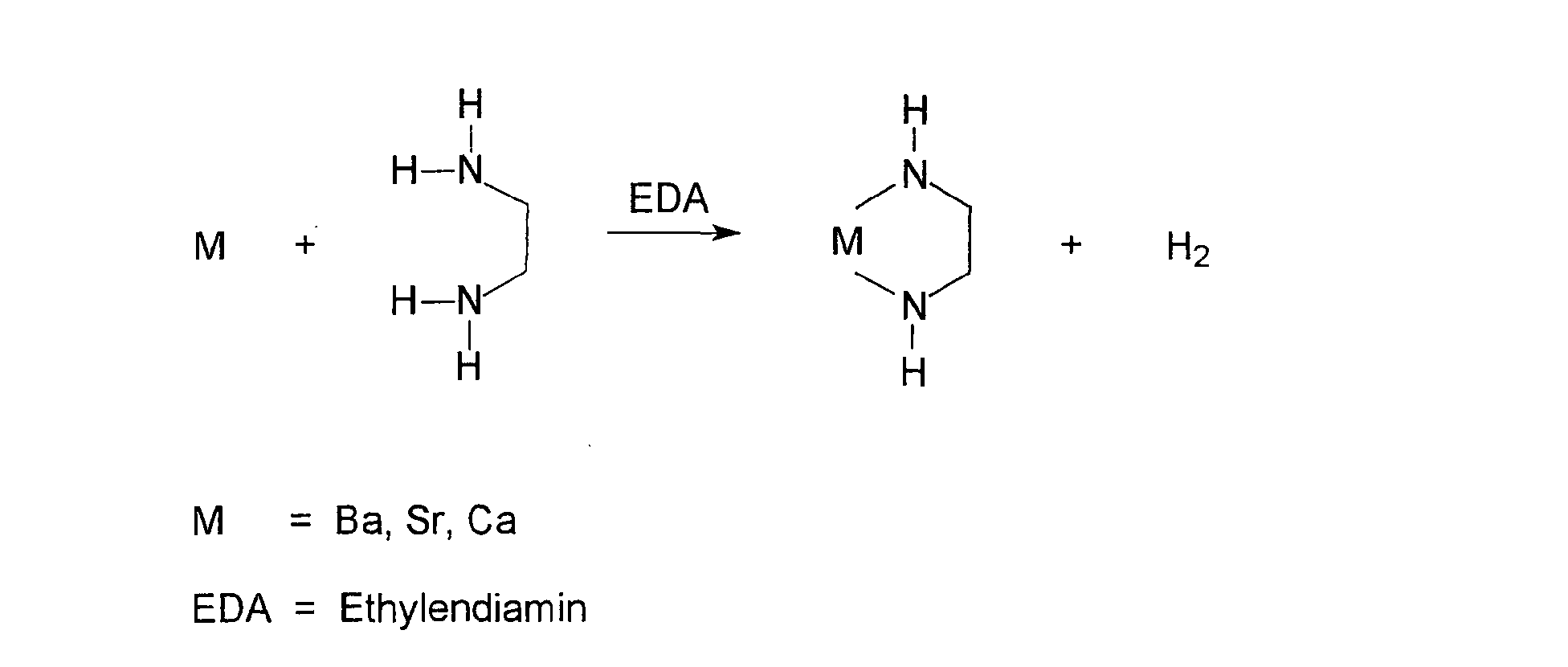
- alkaline earth metals Ba, Sr and Ca can be dissolved very easily in ethylenediamine, the corresponding alkaline earth metal ethylenediamide and hydrogen being formed:
- the ethylenediamine is preferably introduced and the alkaline earth metal in the form of e.g. Powder, granules or pieces are added.
- the reaction is preferably carried out under Inert gas atmosphere carried out.
- the ethylenediamine is preferably used for Alkaline earth metal in excess at a molar ratio of 2: 1 to 50: 1 used.
- a preferred reaction temperature is between 8.5 ° C and 118 ° C, i.e. in the area in which ethylenediamine is liquid.
- the temperature range of is particularly preferred 10 to 40 ° C; the reaction can therefore advantageously be carried out at room temperature become.
- the reaction rate of the exothermic reaction can due to the addition of the alkaline earth metal and to a limited extent Cooling of the reaction vessel can be controlled.
- the alkaline earth metal ethylenediamide is obtained as an insoluble gray solid, which by filtration and / or evaporation and drying can be isolated.
- reaction is best with barium as an alkaline earth metal and Carry out ethylenediamine as alkylenediamine.
- reaction can also be carried out with other alkylenediamines
- Ethylenediamine can be carried out, however, here are the reaction rates slower; you need e.g. for the dissolution of barium in Propylenediamine (to barium propylenediamide) at the boiling point under normal pressure multiple days.
- a reaction acceleration can be increased by increasing the Reach temperature while increasing pressure.
- alkaline earth metal alkylenediamides are their use in the synthesis of alkaline earth metal alkoxides.
- alkaline earth metal alkylene diamides here: an alkaline earth metal ethylenediamide
- an alcohol for this purpose, the alkaline earth metal alkylene diamides (here: an alkaline earth metal ethylenediamide) are reacted with an alcohol to give the corresponding alkaline earth metal alkoxide.
- a stoichiometric amount of alcohol is preferred, non-stoichiometric Amounts of alcohol lead to complexes in addition to the desired product.
- the Reaction with alcohol can be undiluted, in remaining, excess Alkylenediamine or in a solvent.
- hydrocarbons e.g. one or more of the connections Pentane, cyclopentane, hexane, heptane, octane, cyclohexane, toluene, xylene, cumene, Ethylbenzene or tetralin can be used.
- ethers e.g. one or more of the compounds tetrahydrofuran (THF), 2-methyl-THF, tetrahydropyran, diethyl ether, diisopropyl ether, Dibutyl ether, dioxane, methyl tert-butyl ether, glycol ether (such as monoglyme, Diglyme) or mixtures thereof.
- THF tetrahydrofuran
- 2-methyl-THF tetrahydropyran
- diethyl ether diethyl ether
- diisopropyl ether Dibutyl ether
- dioxane dioxane
- methyl tert-butyl ether glycol ether (such as monoglyme, Diglyme) or mixtures thereof.
- the alkaline earth alkoxide can be isolated by evaporation and drying take place, the alkylene diamine can be recycled.
- the alkaline earth alkoxide can either be provided as a solid or can be in one Solvent and be made available as a finished solution.
- Example 2 Analogously to Example 1, a Ba-EDA suspension was prepared, which was via a G-3 Frit was filtered. The residue was added in an oil pump vacuum Room temperature dried. The Ba-EDA (126 g) obtained had a content of 90%.
Landscapes
- Chemical & Material Sciences (AREA)
- Organic Chemistry (AREA)
- Organic Low-Molecular-Weight Compounds And Preparation Thereof (AREA)
- Catalysts (AREA)
- Manufacture Of Porous Articles, And Recovery And Treatment Of Waste Products (AREA)
Abstract
Description
- den Metallen:
- den Metallamiden (Amidroute):
- den Metalljodiden (Salzmetathese):

| Löslichkeit in Hexan | 5,9 % |
| Löslichkeit in Cyclohexan | 11,3 % |
| Löslichkeit in Toluol | 11,6 % |
| Löslichkeit in Hexan | 3,7 % |
| Löslichkeit in Cyclohexan | 4,0 % |
| Löslichkeit in Toluol | 3,4 % |
| Löslichkeit in Hexan | 17,8 % |
| Löslichkeit in Cyclohexan | 49,5 % |
| Löslichkeit in Toluol | 16,6 % |
Claims (13)
- Erdalkalimetall-alkylendiamide, mit Erdalkalimetall = Ba, Sr, Ca.
- Erdalkalimetall-ethylendiamide, mit Erdalkalimetall = Ba, Sr, Ca.
- Bariumethylendiamid.
- Verfahren zur Herstellung von Erdalkalimetall-alkylendiamiden, dadurch gekennzeichnet, dass ein Erdalkalimetall, ausgewählt aus Ba, Sr oder Ca in einem Alkylendiamin gelöst wird, wobei sich das entsprechende Erdalkalimetall-alkylendiamid bildet.
- Verfahren nach Anspruch 4, dadurch gekennzeichnet, dass das Alkylendiamin zum Erdalkalimetall im Überschuss bei einem molaren Verhältnis von 2 : 1 bis 50 : 1 eingesetzt wird.
- Verfahren nach Anspruch 4 oder 5, dadurch gekennzeichnet, dass die Reaktion bei einer Temperatur bis 200 °C und einem Druck bis 10 bar durchgeführt wird.
- Verwendung von Erdalkalimetall-alkylendiamiden zur Herstellung von Erdalkalimetallalkoxiden.
- Verwendung von Erdalkalimetall-alkylendiamiden zur Herstellung von Erdalkalimetallalkoxiden, dadurch gekennzeichnet, dass ein Erdalkalimetall in einem Alkylendiamin gelöst wird, wobei sich das entsprechende Erdalkalimetall-alkylendiamid bildet, und das entstandene Erdalkalimetall-alkylendiamid mit einem Alkohol zum Erdalkalimetallalkoxid umgesetzt wird.
- Verwendung nach Anspruch 8, dadurch gekennzeichnet, dass die Reaktion in einem Lösungsmittel durchgeführt wird.
- Verwendung nach Anspruch 9, dadurch gekennzeichnet, dass als Lösungsmittel Kohlenwasserstoffe und/oder Ether eingesetzt werden.
- Verwendung nach Anspruch 10, dadurch gekennzeichnet, dass als Kohlenwasserstoffe aliphatische Kohlenwasserstoffe (cyclische oder acyclische) mit 5 bis 12 C-Atomen oder aromatische Kohlenwasserstoffe mit 6 bis 12 C-Atomen eingesetzt werden.
- Verwendung nach Anspruch 11, dadurch gekennzeichnet, dass als Kohlenwasserstoffe eine oder mehrere der Verbindungen Pentan, Cyclopentan, Hexan, Heptan, Octan, Cyclohexan, Toluol, Xylol, Cumol, Ethylbenzol oder Tetralin eingesetzt werden.
- Verwendung nach Anspruch 10, dadurch gekennzeichnet, dass als Ether eine oder mehrere der Verbindungen Tetrahydrofuran (THF), 2-Methyl-THF, Tetrahydropyran, Diethylether, Diisopropylether, Dibutylether, Dioxan, Methyl-tert-butylether oder Glycolether eingesetzt werden.
Applications Claiming Priority (2)
| Application Number | Priority Date | Filing Date | Title |
|---|---|---|---|
| DE10104807A DE10104807C1 (de) | 2001-02-01 | 2001-02-01 | Erdalkalimetall-alkylendiamide, Verfahren zu deren Herstellung und deren Verwendung zur Herstellung von Erdalkalimetallalkoxiden |
| DE10104807 | 2001-02-01 |
Publications (2)
| Publication Number | Publication Date |
|---|---|
| EP1229017A1 true EP1229017A1 (de) | 2002-08-07 |
| EP1229017B1 EP1229017B1 (de) | 2004-05-12 |
Family
ID=7672689
Family Applications (1)
| Application Number | Title | Priority Date | Filing Date |
|---|---|---|---|
| EP02000991A Expired - Lifetime EP1229017B1 (de) | 2001-02-01 | 2002-01-17 | Erdalkalimetall-alkylendiamide, Verfahren zu deren Herstellung und deren Verwendung |
Country Status (4)
| Country | Link |
|---|---|
| US (1) | US6492561B2 (de) |
| EP (1) | EP1229017B1 (de) |
| AT (1) | ATE266621T1 (de) |
| DE (2) | DE10104807C1 (de) |
Families Citing this family (1)
| Publication number | Priority date | Publication date | Assignee | Title |
|---|---|---|---|---|
| CN104710440B (zh) * | 2013-12-11 | 2017-06-23 | 中国科学院大连化学物理研究所 | 含β‑H 的仲胺基金属有机化合物及其制备和应用 |
Citations (2)
| Publication number | Priority date | Publication date | Assignee | Title |
|---|---|---|---|---|
| US3992561A (en) * | 1975-07-07 | 1976-11-16 | The General Tire & Rubber Company | Preparation of solution polymers |
| US4020115A (en) * | 1975-07-07 | 1977-04-26 | The General Tire & Rubber Company | Alkaline barium alcoholates |
Family Cites Families (2)
| Publication number | Priority date | Publication date | Assignee | Title |
|---|---|---|---|---|
| US4555498A (en) * | 1983-11-15 | 1985-11-26 | Lithium Corporation Of America | Preparation of certain alkaline earth metal organometallic compounds |
| JP2002527528A (ja) * | 1998-10-21 | 2002-08-27 | プレジデント・アンド・フェロウズ・オブ・ハーバード・カレッジ | アルカリ土類金属を含有する材料を形成するための液体化合物 |
-
2001
- 2001-02-01 DE DE10104807A patent/DE10104807C1/de not_active Expired - Fee Related
-
2002
- 2002-01-17 AT AT02000991T patent/ATE266621T1/de not_active IP Right Cessation
- 2002-01-17 EP EP02000991A patent/EP1229017B1/de not_active Expired - Lifetime
- 2002-01-17 DE DE50200413T patent/DE50200413D1/de not_active Expired - Lifetime
- 2002-01-25 US US10/057,781 patent/US6492561B2/en not_active Expired - Lifetime
Patent Citations (2)
| Publication number | Priority date | Publication date | Assignee | Title |
|---|---|---|---|---|
| US3992561A (en) * | 1975-07-07 | 1976-11-16 | The General Tire & Rubber Company | Preparation of solution polymers |
| US4020115A (en) * | 1975-07-07 | 1977-04-26 | The General Tire & Rubber Company | Alkaline barium alcoholates |
Also Published As
| Publication number | Publication date |
|---|---|
| DE10104807C1 (de) | 2002-04-11 |
| DE50200413D1 (de) | 2004-06-17 |
| US6492561B2 (en) | 2002-12-10 |
| EP1229017B1 (de) | 2004-05-12 |
| ATE266621T1 (de) | 2004-05-15 |
| US20020151752A1 (en) | 2002-10-17 |
Similar Documents
| Publication | Publication Date | Title |
|---|---|---|
| DE2027327C3 (de) | Verfahren zur Herstellung einer Dialkylmagnesiumverbindung | |
| DE3855737T2 (de) | Polykondensiertes Polysilazan und Verfahren zu seiner Herstellung | |
| WO2011095261A1 (de) | Neuartige organomodifizierte siloxane mit primären aminofunktionen, neuartige organomodifizierte siloxane mit quaternären ammoniumfunktionen und das verfahren zu deren herstellung | |
| US6737485B1 (en) | Titanium chelate dispersions | |
| WO1985002176A1 (en) | Preparation of alkaline earth metal organometallic compounds | |
| DE1520055A1 (de) | Polymerisation von Epoxyden | |
| DE10104807C1 (de) | Erdalkalimetall-alkylendiamide, Verfahren zu deren Herstellung und deren Verwendung zur Herstellung von Erdalkalimetallalkoxiden | |
| DE102010030230A1 (de) | Konzentrierte Lösungen von Erdalkalimetallalkoxiden in aprotischen Lösungmitteln und Verfahren zu deren Herstellung | |
| DE2457592C3 (de) | Verfahren zur Herstellung pulverförmigen Aluminiumoxidhydrats | |
| EP1238944B1 (de) | Verfahren zur Herstellung von Lithiumamid | |
| DE3013240A1 (de) | Verfahren zur herstellung von erdalkalialkoxyalanaten | |
| DE2512665C3 (de) | Verfahren zur Herstellung von N-Alkyliminoalanen | |
| US11230519B2 (en) | Low-viscosity solutions of alkaline-earth metal alkoxides in aprotic solvents, method for the production of same and use for the production of ziegler-natta catalysts | |
| DE3728786A1 (de) | Polymere verbindungen, deren herstellung und verwendung | |
| DE2028569A1 (de) | Solvatierte Cyanoborohydride sowie Verfahren zur Herstellung derselben | |
| EP0690748B1 (de) | Koordinations-katalysatorsysteme enthaltend intramolekular stabilisierte metallorganische verbindungen | |
| EP1272496B1 (de) | Verfahren zur herstellung von alkalimetallmonohydrido-boranaten und -aluminaten | |
| DE102009003179A1 (de) | Verfahren zur Herstellung von Magnesiumamiden | |
| EP1167370B1 (de) | Ethyllithium in Dibutylether | |
| DE10061317C1 (de) | Verfahren zur Herstellung von Magnesium-bis[di(organo)amiden] und deren Verwendung | |
| EP1924542A1 (de) | Aktiviertes erdalkalimetall, insbesondere magnesium, zur herstellung von organo-erdalkalimetall-verbindungen | |
| EP0796859B1 (de) | Stabile homogene Formulierungen von oxidationsempfindlichen metallorganischen Verbindungen in Paraffinen und Verfahren zu deren Herstellung | |
| DE2445871A1 (de) | Verfahren zur herstellung von pyrrolidon-(2) | |
| DE2256533A1 (de) | Gemischte, aluminium und metalle der zweiten gruppe enthaltende polyiminhydride | |
| DE2460288A1 (de) | Verfahren zur herstellung von tricyclohexylzinnderivaten |
Legal Events
| Date | Code | Title | Description |
|---|---|---|---|
| PUAI | Public reference made under article 153(3) epc to a published international application that has entered the european phase |
Free format text: ORIGINAL CODE: 0009012 |
|
| AK | Designated contracting states |
Kind code of ref document: A1 Designated state(s): AT BE CH CY DE DK ES FI FR GB GR IE IT LI LU MC NL PT SE TR |
|
| AX | Request for extension of the european patent |
Free format text: AL;LT;LV;MK;RO;SI |
|
| 17P | Request for examination filed |
Effective date: 20030207 |
|
| AKX | Designation fees paid |
Designated state(s): AT BE CH CY DE DK ES FI FR GB GR IE IT LI LU MC NL PT SE TR |
|
| 17Q | First examination report despatched |
Effective date: 20030721 |
|
| GRAP | Despatch of communication of intention to grant a patent |
Free format text: ORIGINAL CODE: EPIDOSNIGR1 |
|
| GRAS | Grant fee paid |
Free format text: ORIGINAL CODE: EPIDOSNIGR3 |
|
| GRAA | (expected) grant |
Free format text: ORIGINAL CODE: 0009210 |
|
| AK | Designated contracting states |
Kind code of ref document: B1 Designated state(s): AT BE CH CY DE DK ES FI FR GB GR IE IT LI LU MC NL PT SE TR |
|
| PG25 | Lapsed in a contracting state [announced via postgrant information from national office to epo] |
Ref country code: IT Free format text: LAPSE BECAUSE OF FAILURE TO SUBMIT A TRANSLATION OF THE DESCRIPTION OR TO PAY THE FEE WITHIN THE PRESCRIBED TIME-LIMIT;WARNING: LAPSES OF ITALIAN PATENTS WITH EFFECTIVE DATE BEFORE 2007 MAY HAVE OCCURRED AT ANY TIME BEFORE 2007. THE CORRECT EFFECTIVE DATE MAY BE DIFFERENT FROM THE ONE RECORDED. Effective date: 20040512 Ref country code: IE Free format text: LAPSE BECAUSE OF FAILURE TO SUBMIT A TRANSLATION OF THE DESCRIPTION OR TO PAY THE FEE WITHIN THE PRESCRIBED TIME-LIMIT Effective date: 20040512 Ref country code: NL Free format text: LAPSE BECAUSE OF FAILURE TO SUBMIT A TRANSLATION OF THE DESCRIPTION OR TO PAY THE FEE WITHIN THE PRESCRIBED TIME-LIMIT Effective date: 20040512 Ref country code: FI Free format text: LAPSE BECAUSE OF FAILURE TO SUBMIT A TRANSLATION OF THE DESCRIPTION OR TO PAY THE FEE WITHIN THE PRESCRIBED TIME-LIMIT Effective date: 20040512 Ref country code: TR Free format text: LAPSE BECAUSE OF FAILURE TO SUBMIT A TRANSLATION OF THE DESCRIPTION OR TO PAY THE FEE WITHIN THE PRESCRIBED TIME-LIMIT Effective date: 20040512 |
|
| REG | Reference to a national code |
Ref country code: GB Ref legal event code: FG4D Free format text: NOT ENGLISH |
|
| REG | Reference to a national code |
Ref country code: CH Ref legal event code: EP |
|
| REG | Reference to a national code |
Ref country code: IE Ref legal event code: FG4D Free format text: GERMAN |
|
| REF | Corresponds to: |
Ref document number: 50200413 Country of ref document: DE Date of ref document: 20040617 Kind code of ref document: P |
|
| PG25 | Lapsed in a contracting state [announced via postgrant information from national office to epo] |
Ref country code: DK Free format text: LAPSE BECAUSE OF FAILURE TO SUBMIT A TRANSLATION OF THE DESCRIPTION OR TO PAY THE FEE WITHIN THE PRESCRIBED TIME-LIMIT Effective date: 20040812 Ref country code: GR Free format text: LAPSE BECAUSE OF FAILURE TO SUBMIT A TRANSLATION OF THE DESCRIPTION OR TO PAY THE FEE WITHIN THE PRESCRIBED TIME-LIMIT Effective date: 20040812 Ref country code: SE Free format text: LAPSE BECAUSE OF FAILURE TO SUBMIT A TRANSLATION OF THE DESCRIPTION OR TO PAY THE FEE WITHIN THE PRESCRIBED TIME-LIMIT Effective date: 20040812 |
|
| PG25 | Lapsed in a contracting state [announced via postgrant information from national office to epo] |
Ref country code: ES Free format text: LAPSE BECAUSE OF FAILURE TO SUBMIT A TRANSLATION OF THE DESCRIPTION OR TO PAY THE FEE WITHIN THE PRESCRIBED TIME-LIMIT Effective date: 20040823 |
|
| GBT | Gb: translation of ep patent filed (gb section 77(6)(a)/1977) |
Effective date: 20040817 |
|
| NLV1 | Nl: lapsed or annulled due to failure to fulfill the requirements of art. 29p and 29m of the patents act | ||
| REG | Reference to a national code |
Ref country code: IE Ref legal event code: FD4D |
|
| ET | Fr: translation filed | ||
| PG25 | Lapsed in a contracting state [announced via postgrant information from national office to epo] |
Ref country code: CY Free format text: LAPSE BECAUSE OF FAILURE TO SUBMIT A TRANSLATION OF THE DESCRIPTION OR TO PAY THE FEE WITHIN THE PRESCRIBED TIME-LIMIT Effective date: 20050117 Ref country code: LU Free format text: LAPSE BECAUSE OF NON-PAYMENT OF DUE FEES Effective date: 20050117 |
|
| PG25 | Lapsed in a contracting state [announced via postgrant information from national office to epo] |
Ref country code: BE Free format text: LAPSE BECAUSE OF NON-PAYMENT OF DUE FEES Effective date: 20050131 Ref country code: MC Free format text: LAPSE BECAUSE OF NON-PAYMENT OF DUE FEES Effective date: 20050131 Ref country code: AT Free format text: LAPSE BECAUSE OF NON-PAYMENT OF DUE FEES Effective date: 20050131 |
|
| PLBE | No opposition filed within time limit |
Free format text: ORIGINAL CODE: 0009261 |
|
| STAA | Information on the status of an ep patent application or granted ep patent |
Free format text: STATUS: NO OPPOSITION FILED WITHIN TIME LIMIT |
|
| 26N | No opposition filed |
Effective date: 20050215 |
|
| BERE | Be: lapsed |
Owner name: *CHEMETALL G.M.B.H. Effective date: 20050131 |
|
| PG25 | Lapsed in a contracting state [announced via postgrant information from national office to epo] |
Ref country code: CH Free format text: LAPSE BECAUSE OF NON-PAYMENT OF DUE FEES Effective date: 20060131 Ref country code: LI Free format text: LAPSE BECAUSE OF NON-PAYMENT OF DUE FEES Effective date: 20060131 |
|
| REG | Reference to a national code |
Ref country code: CH Ref legal event code: PL |
|
| BERE | Be: lapsed |
Owner name: *CHEMETALL G.M.B.H. Effective date: 20050131 |
|
| PG25 | Lapsed in a contracting state [announced via postgrant information from national office to epo] |
Ref country code: PT Free format text: LAPSE BECAUSE OF NON-PAYMENT OF DUE FEES Effective date: 20041012 |
|
| REG | Reference to a national code |
Ref country code: DE Ref legal event code: R081 Ref document number: 50200413 Country of ref document: DE Owner name: ROCKWOOD LITHIUM GMBH, DE Free format text: FORMER OWNER: CHEMETALL GMBH, 60487 FRANKFURT, DE Effective date: 20140508 Ref country code: DE Ref legal event code: R081 Ref document number: 50200413 Country of ref document: DE Owner name: ALBEMARLE GERMANY GMBH, DE Free format text: FORMER OWNER: CHEMETALL GMBH, 60487 FRANKFURT, DE Effective date: 20140508 |
|
| REG | Reference to a national code |
Ref country code: FR Ref legal event code: PLFP Year of fee payment: 15 |
|
| REG | Reference to a national code |
Ref country code: FR Ref legal event code: PLFP Year of fee payment: 16 |
|
| REG | Reference to a national code |
Ref country code: DE Ref legal event code: R081 Ref document number: 50200413 Country of ref document: DE Owner name: ALBEMARLE GERMANY GMBH, DE Free format text: FORMER OWNER: ROCKWOOD LITHIUM GMBH, 60487 FRANKFURT, DE |
|
| REG | Reference to a national code |
Ref country code: FR Ref legal event code: PLFP Year of fee payment: 17 |
|
| PGFP | Annual fee paid to national office [announced via postgrant information from national office to epo] |
Ref country code: DE Payment date: 20180129 Year of fee payment: 17 Ref country code: GB Payment date: 20180129 Year of fee payment: 17 |
|
| PGFP | Annual fee paid to national office [announced via postgrant information from national office to epo] |
Ref country code: FR Payment date: 20180125 Year of fee payment: 17 |
|
| REG | Reference to a national code |
Ref country code: DE Ref legal event code: R119 Ref document number: 50200413 Country of ref document: DE |
|
| GBPC | Gb: european patent ceased through non-payment of renewal fee |
Effective date: 20190117 |
|
| PG25 | Lapsed in a contracting state [announced via postgrant information from national office to epo] |
Ref country code: FR Free format text: LAPSE BECAUSE OF NON-PAYMENT OF DUE FEES Effective date: 20190131 Ref country code: DE Free format text: LAPSE BECAUSE OF NON-PAYMENT OF DUE FEES Effective date: 20190801 |
|
| PG25 | Lapsed in a contracting state [announced via postgrant information from national office to epo] |
Ref country code: GB Free format text: LAPSE BECAUSE OF NON-PAYMENT OF DUE FEES Effective date: 20190117 |