EP1227714B1 - Procede de production de metabolites a partir de vegetaux en culture hors sol - Google Patents
Procede de production de metabolites a partir de vegetaux en culture hors sol Download PDFInfo
- Publication number
- EP1227714B1 EP1227714B1 EP00976113A EP00976113A EP1227714B1 EP 1227714 B1 EP1227714 B1 EP 1227714B1 EP 00976113 A EP00976113 A EP 00976113A EP 00976113 A EP00976113 A EP 00976113A EP 1227714 B1 EP1227714 B1 EP 1227714B1
- Authority
- EP
- European Patent Office
- Prior art keywords
- plants
- solution
- metabolites
- nutrient solution
- roots
- Prior art date
- Legal status (The legal status is an assumption and is not a legal conclusion. Google has not performed a legal analysis and makes no representation as to the accuracy of the status listed.)
- Expired - Lifetime
Links
- 238000004519 manufacturing process Methods 0.000 title claims abstract description 22
- 239000002207 metabolite Substances 0.000 title claims description 55
- 235000015097 nutrients Nutrition 0.000 claims abstract description 70
- 239000007788 liquid Substances 0.000 claims abstract description 26
- 230000012010 growth Effects 0.000 claims abstract description 19
- 238000002386 leaching Methods 0.000 claims abstract description 14
- 241000196324 Embryophyta Species 0.000 claims description 201
- 239000000243 solution Substances 0.000 claims description 139
- 238000000034 method Methods 0.000 claims description 38
- 238000011282 treatment Methods 0.000 claims description 35
- 239000004094 surface-active agent Substances 0.000 claims description 22
- 239000002243 precursor Substances 0.000 claims description 16
- 239000002028 Biomass Substances 0.000 claims description 15
- 230000008569 process Effects 0.000 claims description 14
- 238000011084 recovery Methods 0.000 claims description 13
- 239000000126 substance Substances 0.000 claims description 13
- XLYOFNOQVPJJNP-UHFFFAOYSA-N water Substances O XLYOFNOQVPJJNP-UHFFFAOYSA-N 0.000 claims description 13
- 238000009826 distribution Methods 0.000 claims description 11
- 229930000044 secondary metabolite Natural products 0.000 claims description 10
- 238000005507 spraying Methods 0.000 claims description 9
- 238000000605 extraction Methods 0.000 claims description 8
- 238000004064 recycling Methods 0.000 claims description 8
- 230000015572 biosynthetic process Effects 0.000 claims description 7
- 239000003599 detergent Substances 0.000 claims description 7
- 239000002904 solvent Substances 0.000 claims description 7
- 238000007654 immersion Methods 0.000 claims description 6
- 238000002347 injection Methods 0.000 claims description 6
- 239000007924 injection Substances 0.000 claims description 6
- 230000000977 initiatory effect Effects 0.000 claims description 5
- 150000003839 salts Chemical class 0.000 claims description 5
- 241000589156 Agrobacterium rhizogenes Species 0.000 claims description 4
- 229940123237 Taxane Drugs 0.000 claims description 4
- 238000001704 evaporation Methods 0.000 claims description 4
- 230000008020 evaporation Effects 0.000 claims description 4
- 238000005325 percolation Methods 0.000 claims description 4
- 238000000859 sublimation Methods 0.000 claims description 4
- 230000008022 sublimation Effects 0.000 claims description 4
- 239000000758 substrate Substances 0.000 claims description 4
- 238000003786 synthesis reaction Methods 0.000 claims description 4
- RCINICONZNJXQF-MZXODVADSA-N taxol Chemical class O([C@@H]1[C@@]2(C[C@@H](C(C)=C(C2(C)C)[C@H](C([C@]2(C)[C@@H](O)C[C@H]3OC[C@]3([C@H]21)OC(C)=O)=O)OC(=O)C)OC(=O)[C@H](O)[C@@H](NC(=O)C=1C=CC=CC=1)C=1C=CC=CC=1)O)C(=O)C1=CC=CC=C1 RCINICONZNJXQF-MZXODVADSA-N 0.000 claims description 4
- 230000009466 transformation Effects 0.000 claims description 4
- 230000035899 viability Effects 0.000 claims description 4
- 239000003795 chemical substances by application Substances 0.000 claims description 3
- 239000005712 elicitor Substances 0.000 claims description 3
- 230000029142 excretion Effects 0.000 claims description 3
- 230000002538 fungal effect Effects 0.000 claims description 3
- 230000002068 genetic effect Effects 0.000 claims description 3
- 238000002955 isolation Methods 0.000 claims description 3
- 238000002156 mixing Methods 0.000 claims description 3
- 238000001953 recrystallisation Methods 0.000 claims description 3
- 230000004936 stimulating effect Effects 0.000 claims description 3
- 229930004668 tropane alkaloid Natural products 0.000 claims description 3
- 239000012298 atmosphere Substances 0.000 claims description 2
- 230000001580 bacterial effect Effects 0.000 claims description 2
- -1 furocoumarins Chemical class 0.000 claims description 2
- 229930182470 glycoside Natural products 0.000 claims description 2
- 150000002338 glycosides Chemical class 0.000 claims description 2
- 238000010438 heat treatment Methods 0.000 claims description 2
- 238000000622 liquid--liquid extraction Methods 0.000 claims description 2
- 238000001172 liquid--solid extraction Methods 0.000 claims description 2
- 235000016709 nutrition Nutrition 0.000 claims description 2
- 230000035515 penetration Effects 0.000 claims description 2
- 229930015704 phenylpropanoid Natural products 0.000 claims description 2
- 125000001474 phenylpropanoid group Chemical group 0.000 claims description 2
- 230000000243 photosynthetic effect Effects 0.000 claims description 2
- 230000035790 physiological processes and functions Effects 0.000 claims description 2
- 238000000746 purification Methods 0.000 claims description 2
- 229930182490 saponin Natural products 0.000 claims description 2
- 150000007949 saponins Chemical class 0.000 claims description 2
- 235000017709 saponins Nutrition 0.000 claims description 2
- 238000000926 separation method Methods 0.000 claims description 2
- 238000000638 solvent extraction Methods 0.000 claims description 2
- 150000003431 steroids Chemical class 0.000 claims description 2
- 150000003505 terpenes Chemical class 0.000 claims description 2
- 235000007586 terpenes Nutrition 0.000 claims description 2
- 241000592342 Tracheophyta Species 0.000 claims 1
- 239000012530 fluid Substances 0.000 claims 1
- 230000004907 flux Effects 0.000 claims 1
- 229930005303 indole alkaloid Natural products 0.000 claims 1
- 150000002475 indoles Chemical class 0.000 claims 1
- ZNJFBWYDHIGLCU-HWKXXFMVSA-N jasmonic acid Chemical class CC\C=C/C[C@@H]1[C@@H](CC(O)=O)CCC1=O ZNJFBWYDHIGLCU-HWKXXFMVSA-N 0.000 claims 1
- 230000001935 permeabilising effect Effects 0.000 claims 1
- 230000005855 radiation Effects 0.000 claims 1
- XLRPYZSEQKXZAA-OCAPTIKFSA-N tropane Chemical compound C1CC[C@H]2CC[C@@H]1N2C XLRPYZSEQKXZAA-OCAPTIKFSA-N 0.000 claims 1
- 230000008823 permeabilization Effects 0.000 description 27
- 230000000050 nutritive effect Effects 0.000 description 21
- 229920001213 Polysorbate 20 Polymers 0.000 description 16
- 239000000256 polyoxyethylene sorbitan monolaurate Substances 0.000 description 16
- 235000010486 polyoxyethylene sorbitan monolaurate Nutrition 0.000 description 16
- 230000004083 survival effect Effects 0.000 description 9
- 230000005587 bubbling Effects 0.000 description 8
- RKUNBYITZUJHSG-FXUDXRNXSA-N (S)-atropine Chemical compound C1([C@@H](CO)C(=O)O[C@H]2C[C@H]3CC[C@@H](C2)N3C)=CC=CC=C1 RKUNBYITZUJHSG-FXUDXRNXSA-N 0.000 description 7
- 229930000680 A04AD01 - Scopolamine Natural products 0.000 description 7
- 241000208296 Datura Species 0.000 description 7
- RKUNBYITZUJHSG-UHFFFAOYSA-N Hyosciamin-hydrochlorid Natural products CN1C(C2)CCC1CC2OC(=O)C(CO)C1=CC=CC=C1 RKUNBYITZUJHSG-UHFFFAOYSA-N 0.000 description 7
- STECJAGHUSJQJN-GAUPFVANSA-N Hyoscine Natural products C1([C@H](CO)C(=O)OC2C[C@@H]3N([C@H](C2)[C@@H]2[C@H]3O2)C)=CC=CC=C1 STECJAGHUSJQJN-GAUPFVANSA-N 0.000 description 7
- STECJAGHUSJQJN-UHFFFAOYSA-N N-Methyl-scopolamin Natural products C1C(C2C3O2)N(C)C3CC1OC(=O)C(CO)C1=CC=CC=C1 STECJAGHUSJQJN-UHFFFAOYSA-N 0.000 description 7
- 229930005342 hyoscyamine Natural products 0.000 description 7
- 229960003210 hyoscyamine Drugs 0.000 description 7
- 239000000463 material Substances 0.000 description 7
- 235000008935 nutritious Nutrition 0.000 description 7
- STECJAGHUSJQJN-FWXGHANASA-N scopolamine Chemical compound C1([C@@H](CO)C(=O)O[C@H]2C[C@@H]3N([C@H](C2)[C@@H]2[C@H]3O2)C)=CC=CC=C1 STECJAGHUSJQJN-FWXGHANASA-N 0.000 description 7
- 229960002646 scopolamine Drugs 0.000 description 7
- 229930013930 alkaloid Natural products 0.000 description 6
- 238000009360 aquaculture Methods 0.000 description 6
- 244000144974 aquaculture Species 0.000 description 6
- 239000003501 hydroponics Substances 0.000 description 6
- 238000009434 installation Methods 0.000 description 6
- 229920000915 polyvinyl chloride Polymers 0.000 description 6
- 239000004800 polyvinyl chloride Substances 0.000 description 6
- 230000003816 axenic effect Effects 0.000 description 5
- HEDRZPFGACZZDS-UHFFFAOYSA-N Chloroform Chemical compound ClC(Cl)Cl HEDRZPFGACZZDS-UHFFFAOYSA-N 0.000 description 4
- 238000000338 in vitro Methods 0.000 description 4
- 244000005700 microbiome Species 0.000 description 4
- 238000003860 storage Methods 0.000 description 4
- QGZKDVFQNNGYKY-UHFFFAOYSA-N Ammonia Chemical compound N QGZKDVFQNNGYKY-UHFFFAOYSA-N 0.000 description 3
- 240000007175 Datura inoxia Species 0.000 description 3
- IAZDPXIOMUYVGZ-UHFFFAOYSA-N Dimethylsulphoxide Chemical compound CS(C)=O IAZDPXIOMUYVGZ-UHFFFAOYSA-N 0.000 description 3
- OKKJLVBELUTLKV-UHFFFAOYSA-N Methanol Chemical compound OC OKKJLVBELUTLKV-UHFFFAOYSA-N 0.000 description 3
- 230000008859 change Effects 0.000 description 3
- 150000001875 compounds Chemical class 0.000 description 3
- 230000000694 effects Effects 0.000 description 3
- 238000004128 high performance liquid chromatography Methods 0.000 description 3
- 239000003595 mist Substances 0.000 description 3
- 238000006213 oxygenation reaction Methods 0.000 description 3
- 230000008635 plant growth Effects 0.000 description 3
- 239000007787 solid Substances 0.000 description 3
- BGEBZHIAGXMEMV-UHFFFAOYSA-N 5-methoxypsoralen Chemical compound O1C(=O)C=CC2=C1C=C1OC=CC1=C2OC BGEBZHIAGXMEMV-UHFFFAOYSA-N 0.000 description 2
- 241000894006 Bacteria Species 0.000 description 2
- 240000008853 Datura stramonium Species 0.000 description 2
- 241000233866 Fungi Species 0.000 description 2
- AHLPHDHHMVZTML-BYPYZUCNSA-N L-Ornithine Chemical compound NCCC[C@H](N)C(O)=O AHLPHDHHMVZTML-BYPYZUCNSA-N 0.000 description 2
- COLNVLDHVKWLRT-QMMMGPOBSA-N L-phenylalanine Chemical compound OC(=O)[C@@H](N)CC1=CC=CC=C1 COLNVLDHVKWLRT-QMMMGPOBSA-N 0.000 description 2
- AHLPHDHHMVZTML-UHFFFAOYSA-N Orn-delta-NH2 Natural products NCCCC(N)C(O)=O AHLPHDHHMVZTML-UHFFFAOYSA-N 0.000 description 2
- UTJLXEIPEHZYQJ-UHFFFAOYSA-N Ornithine Natural products OC(=O)C(C)CCCN UTJLXEIPEHZYQJ-UHFFFAOYSA-N 0.000 description 2
- 229930012538 Paclitaxel Natural products 0.000 description 2
- FAPWRFPIFSIZLT-UHFFFAOYSA-M Sodium chloride Chemical compound [Na+].[Cl-] FAPWRFPIFSIZLT-UHFFFAOYSA-M 0.000 description 2
- QAOWNCQODCNURD-UHFFFAOYSA-N Sulfuric acid Chemical compound OS(O)(=O)=O QAOWNCQODCNURD-UHFFFAOYSA-N 0.000 description 2
- 241001080024 Telles Species 0.000 description 2
- 239000002253 acid Substances 0.000 description 2
- 230000006378 damage Effects 0.000 description 2
- 235000013305 food Nutrition 0.000 description 2
- 238000004817 gas chromatography Methods 0.000 description 2
- 239000011521 glass Substances 0.000 description 2
- 230000000670 limiting effect Effects 0.000 description 2
- 239000002609 medium Substances 0.000 description 2
- SQBBOVROCFXYBN-UHFFFAOYSA-N methoxypsoralen Natural products C1=C2OC(=O)C(OC)=CC2=CC2=C1OC=C2 SQBBOVROCFXYBN-UHFFFAOYSA-N 0.000 description 2
- 244000005706 microflora Species 0.000 description 2
- 238000005457 optimization Methods 0.000 description 2
- 229960003104 ornithine Drugs 0.000 description 2
- 229960001592 paclitaxel Drugs 0.000 description 2
- 230000036961 partial effect Effects 0.000 description 2
- 230000035699 permeability Effects 0.000 description 2
- 239000008191 permeabilizing agent Substances 0.000 description 2
- 239000012071 phase Substances 0.000 description 2
- COLNVLDHVKWLRT-UHFFFAOYSA-N phenylalanine Natural products OC(=O)C(N)CC1=CC=CC=C1 COLNVLDHVKWLRT-UHFFFAOYSA-N 0.000 description 2
- ZCCUUQDIBDJBTK-UHFFFAOYSA-N psoralen Chemical compound C1=C2OC(=O)C=CC2=CC2=C1OC=C2 ZCCUUQDIBDJBTK-UHFFFAOYSA-N 0.000 description 2
- 239000002689 soil Substances 0.000 description 2
- 241000894007 species Species 0.000 description 2
- 231100000331 toxic Toxicity 0.000 description 2
- 230000002588 toxic effect Effects 0.000 description 2
- 150000003813 tropane derivatives Chemical class 0.000 description 2
- 235000013311 vegetables Nutrition 0.000 description 2
- 239000010455 vermiculite Substances 0.000 description 2
- 229910052902 vermiculite Inorganic materials 0.000 description 2
- 235000019354 vermiculite Nutrition 0.000 description 2
- VXGRJERITKFWPL-UHFFFAOYSA-N 4',5'-Dihydropsoralen Natural products C1=C2OC(=O)C=CC2=CC2=C1OCC2 VXGRJERITKFWPL-UHFFFAOYSA-N 0.000 description 1
- CJIJXIFQYOPWTF-UHFFFAOYSA-N 7-hydroxycoumarin Natural products O1C(=O)C=CC2=CC(O)=CC=C21 CJIJXIFQYOPWTF-UHFFFAOYSA-N 0.000 description 1
- BUNGCZLFHHXKBX-UHFFFAOYSA-N 8-methoxypsoralen Natural products C1=CC(=O)OC2=C1C=C1CCOC1=C2OC BUNGCZLFHHXKBX-UHFFFAOYSA-N 0.000 description 1
- 241000589155 Agrobacterium tumefaciens Species 0.000 description 1
- 229930190007 Baccatin Natural products 0.000 description 1
- UXVMQQNJUSDDNG-UHFFFAOYSA-L Calcium chloride Chemical class [Cl-].[Cl-].[Ca+2] UXVMQQNJUSDDNG-UHFFFAOYSA-L 0.000 description 1
- OKTJSMMVPCPJKN-UHFFFAOYSA-N Carbon Chemical compound [C] OKTJSMMVPCPJKN-UHFFFAOYSA-N 0.000 description 1
- 239000004215 Carbon black (E152) Substances 0.000 description 1
- 240000008067 Cucumis sativus Species 0.000 description 1
- 235000010799 Cucumis sativus var sativus Nutrition 0.000 description 1
- KCXVZYZYPLLWCC-UHFFFAOYSA-N EDTA Chemical compound OC(=O)CN(CC(O)=O)CCN(CC(O)=O)CC(O)=O KCXVZYZYPLLWCC-UHFFFAOYSA-N 0.000 description 1
- 102000004190 Enzymes Human genes 0.000 description 1
- 108090000790 Enzymes Proteins 0.000 description 1
- LFQSCWFLJHTTHZ-UHFFFAOYSA-N Ethanol Chemical compound CCO LFQSCWFLJHTTHZ-UHFFFAOYSA-N 0.000 description 1
- 235000007688 Lycopersicon esculentum Nutrition 0.000 description 1
- 241001508691 Martes zibellina Species 0.000 description 1
- QXKHYNVANLEOEG-UHFFFAOYSA-N Methoxsalen Chemical compound C1=CC(=O)OC2=C1C=C1C=COC1=C2OC QXKHYNVANLEOEG-UHFFFAOYSA-N 0.000 description 1
- 240000005746 Ruta graveolens Species 0.000 description 1
- 235000001347 Ruta graveolens Nutrition 0.000 description 1
- 240000003768 Solanum lycopersicum Species 0.000 description 1
- 208000027418 Wounds and injury Diseases 0.000 description 1
- 240000008042 Zea mays Species 0.000 description 1
- 239000003463 adsorbent Substances 0.000 description 1
- 229910021529 ammonia Inorganic materials 0.000 description 1
- 125000000129 anionic group Chemical group 0.000 description 1
- 239000003242 anti bacterial agent Substances 0.000 description 1
- 230000000843 anti-fungal effect Effects 0.000 description 1
- 229940088710 antibiotic agent Drugs 0.000 description 1
- 229940121375 antifungal agent Drugs 0.000 description 1
- 239000002246 antineoplastic agent Substances 0.000 description 1
- 229940041181 antineoplastic drug Drugs 0.000 description 1
- 239000008346 aqueous phase Substances 0.000 description 1
- 235000008452 baby food Nutrition 0.000 description 1
- 230000009286 beneficial effect Effects 0.000 description 1
- 229960002045 bergapten Drugs 0.000 description 1
- KGZDKFWCIPZMRK-UHFFFAOYSA-N bergapten Natural products COC1C2=C(Cc3ccoc13)C=CC(=O)O2 KGZDKFWCIPZMRK-UHFFFAOYSA-N 0.000 description 1
- 239000011942 biocatalyst Substances 0.000 description 1
- 230000001851 biosynthetic effect Effects 0.000 description 1
- 230000006696 biosynthetic metabolic pathway Effects 0.000 description 1
- 229910052799 carbon Inorganic materials 0.000 description 1
- 125000002091 cationic group Chemical group 0.000 description 1
- 238000004587 chromatography analysis Methods 0.000 description 1
- 239000003086 colorant Substances 0.000 description 1
- 239000012141 concentrate Substances 0.000 description 1
- 239000000356 contaminant Substances 0.000 description 1
- ARUVKPQLZAKDPS-UHFFFAOYSA-L copper(II) sulfate Chemical compound [Cu+2].[O-][S+2]([O-])([O-])[O-] ARUVKPQLZAKDPS-UHFFFAOYSA-L 0.000 description 1
- 229910000366 copper(II) sulfate Inorganic materials 0.000 description 1
- 239000002537 cosmetic Substances 0.000 description 1
- 230000002089 crippling effect Effects 0.000 description 1
- 230000008034 disappearance Effects 0.000 description 1
- 239000003657 drainage water Substances 0.000 description 1
- 229940079593 drug Drugs 0.000 description 1
- 239000003814 drug Substances 0.000 description 1
- 239000000284 extract Substances 0.000 description 1
- 239000000796 flavoring agent Substances 0.000 description 1
- 235000019634 flavors Nutrition 0.000 description 1
- 238000005187 foaming Methods 0.000 description 1
- 235000013373 food additive Nutrition 0.000 description 1
- 239000002778 food additive Substances 0.000 description 1
- 239000001963 growth medium Substances 0.000 description 1
- 238000003306 harvesting Methods 0.000 description 1
- 230000003862 health status Effects 0.000 description 1
- 239000013529 heat transfer fluid Substances 0.000 description 1
- 229930195733 hydrocarbon Natural products 0.000 description 1
- 150000002430 hydrocarbons Chemical class 0.000 description 1
- 230000002209 hydrophobic effect Effects 0.000 description 1
- 230000001976 improved effect Effects 0.000 description 1
- 238000011534 incubation Methods 0.000 description 1
- 239000003112 inhibitor Substances 0.000 description 1
- 208000014674 injury Diseases 0.000 description 1
- 229910052500 inorganic mineral Inorganic materials 0.000 description 1
- 238000012432 intermediate storage Methods 0.000 description 1
- 150000002500 ions Chemical class 0.000 description 1
- 230000002427 irreversible effect Effects 0.000 description 1
- 239000007791 liquid phase Substances 0.000 description 1
- 229960004469 methoxsalen Drugs 0.000 description 1
- 230000000813 microbial effect Effects 0.000 description 1
- 239000011707 mineral Substances 0.000 description 1
- 235000010755 mineral Nutrition 0.000 description 1
- 239000011490 mineral wool Substances 0.000 description 1
- 239000000203 mixture Substances 0.000 description 1
- 230000004048 modification Effects 0.000 description 1
- 238000012986 modification Methods 0.000 description 1
- 230000037125 natural defense Effects 0.000 description 1
- 150000002825 nitriles Chemical class 0.000 description 1
- 239000003960 organic solvent Substances 0.000 description 1
- 239000010451 perlite Substances 0.000 description 1
- 235000019362 perlite Nutrition 0.000 description 1
- 239000000575 pesticide Substances 0.000 description 1
- 230000029553 photosynthesis Effects 0.000 description 1
- 238000010672 photosynthesis Methods 0.000 description 1
- 229920001296 polysiloxane Polymers 0.000 description 1
- 239000003755 preservative agent Substances 0.000 description 1
- 230000002335 preservative effect Effects 0.000 description 1
- 230000001737 promoting effect Effects 0.000 description 1
- 230000003252 repetitive effect Effects 0.000 description 1
- 230000002441 reversible effect Effects 0.000 description 1
- 239000012487 rinsing solution Substances 0.000 description 1
- 239000001229 ruta graveolens Substances 0.000 description 1
- 238000005185 salting out Methods 0.000 description 1
- 239000004576 sand Substances 0.000 description 1
- 230000024053 secondary metabolic process Effects 0.000 description 1
- 238000002791 soaking Methods 0.000 description 1
- 239000011780 sodium chloride Substances 0.000 description 1
- 230000000638 stimulation Effects 0.000 description 1
- 238000006467 substitution reaction Methods 0.000 description 1
- 230000002194 synthesizing effect Effects 0.000 description 1
- 230000001225 therapeutic effect Effects 0.000 description 1
- 230000001960 triggered effect Effects 0.000 description 1
- 238000000825 ultraviolet detection Methods 0.000 description 1
- ORHBXUUXSCNDEV-UHFFFAOYSA-N umbelliferone Chemical compound C1=CC(=O)OC2=CC(O)=CC=C21 ORHBXUUXSCNDEV-UHFFFAOYSA-N 0.000 description 1
- HFTAFOQKODTIJY-UHFFFAOYSA-N umbelliferone Natural products Cc1cc2C=CC(=O)Oc2cc1OCC=CC(C)(C)O HFTAFOQKODTIJY-UHFFFAOYSA-N 0.000 description 1
- 238000005406 washing Methods 0.000 description 1
- 238000003809 water extraction Methods 0.000 description 1
Images


Classifications
-
- A—HUMAN NECESSITIES
- A01—AGRICULTURE; FORESTRY; ANIMAL HUSBANDRY; HUNTING; TRAPPING; FISHING
- A01G—HORTICULTURE; CULTIVATION OF VEGETABLES, FLOWERS, RICE, FRUIT, VINES, HOPS OR SEAWEED; FORESTRY; WATERING
- A01G31/00—Soilless cultivation, e.g. hydroponics
-
- A—HUMAN NECESSITIES
- A61—MEDICAL OR VETERINARY SCIENCE; HYGIENE
- A61P—SPECIFIC THERAPEUTIC ACTIVITY OF CHEMICAL COMPOUNDS OR MEDICINAL PREPARATIONS
- A61P23/00—Anaesthetics
-
- A—HUMAN NECESSITIES
- A61—MEDICAL OR VETERINARY SCIENCE; HYGIENE
- A61P—SPECIFIC THERAPEUTIC ACTIVITY OF CHEMICAL COMPOUNDS OR MEDICINAL PREPARATIONS
- A61P25/00—Drugs for disorders of the nervous system
-
- A—HUMAN NECESSITIES
- A61—MEDICAL OR VETERINARY SCIENCE; HYGIENE
- A61P—SPECIFIC THERAPEUTIC ACTIVITY OF CHEMICAL COMPOUNDS OR MEDICINAL PREPARATIONS
- A61P35/00—Antineoplastic agents
-
- A—HUMAN NECESSITIES
- A61—MEDICAL OR VETERINARY SCIENCE; HYGIENE
- A61P—SPECIFIC THERAPEUTIC ACTIVITY OF CHEMICAL COMPOUNDS OR MEDICINAL PREPARATIONS
- A61P43/00—Drugs for specific purposes, not provided for in groups A61P1/00-A61P41/00
-
- Y—GENERAL TAGGING OF NEW TECHNOLOGICAL DEVELOPMENTS; GENERAL TAGGING OF CROSS-SECTIONAL TECHNOLOGIES SPANNING OVER SEVERAL SECTIONS OF THE IPC; TECHNICAL SUBJECTS COVERED BY FORMER USPC CROSS-REFERENCE ART COLLECTIONS [XRACs] AND DIGESTS
- Y02—TECHNOLOGIES OR APPLICATIONS FOR MITIGATION OR ADAPTATION AGAINST CLIMATE CHANGE
- Y02P—CLIMATE CHANGE MITIGATION TECHNOLOGIES IN THE PRODUCTION OR PROCESSING OF GOODS
- Y02P60/00—Technologies relating to agriculture, livestock or agroalimentary industries
- Y02P60/20—Reduction of greenhouse gas [GHG] emissions in agriculture, e.g. CO2
- Y02P60/21—Dinitrogen oxide [N2O], e.g. using aquaponics, hydroponics or efficiency measures
Definitions
- the invention relates to a method for producing metabolites, in continuous or semi-continuous, from plants grown above ground, without loss of viability of said plants, as well as an installation for the implementation of this process.
- Plants produce many of the molecules that humans used as medicines, colors, flavors, food additives or pesticides. These compounds are often typical of a family of a genus or a species given plant. They are classified as secondary metabolites because they do not do not always seem essential to the survival of the unstressed plant (Bentley 1999, Bourgaud et al 1999, Gontier 1993). Many of these original molecules plants serve or have served as a model for chemical synthesis with a view to commercial use. Sometimes the molecules are complex and the extraction at from wild plants, plants cultivated in the field or in vitro remain the best sources of supply (Herman 1993).
- Production stimulation can be achieved by adding precursors in the culture medium (Boitel et al 1997), by permeabilization reversible from biomass or by physical stress (temperature rise, pH change, injury %), chemical (addition of CuSO4, NaCl, CaCl2 salts, (NH4) 2SO4 ... or other permeabilizers EDTA, DMSO, Tween20, others surfactants or detergents ...) or biochemical (elicitation ...) ... (Boitel et al 1995-1997, Weather et al 1991, Herman 1993, Mukundan et al 1998)
- the problem posed by the present invention therefore consists in propose a process for producing molecules from plants that do not require no axenic or sterile conditions, allowing production of quantities important, economically profitable and not causing destruction, even partial. plants for the extraction of the molecules sought.
- the present invention relates to a method of production of molecules from plants, characterized in that said plants are grown in soilless conditions and are fed with a nutrient solution and / or sprayed with a leaching liquid, said solution and / or said liquid being then recovered (s) and treated (s) to extract certain molecules determined that it contains and which have been released by the roots and / or aerial parts of said plants.
- the method may also include an additional step Forced permeabilization of the roots or aerial parts of plants with a solution containing in particular salts, surfactants, detergents. of the solvents, elicitors of fungal or bacterial origin, acid derivatives jasmonic or other products stimulating the natural defenses of plants, so that the outflows from the roots or leaves to the nutrient solution or the leaching liquid are increased significantly without total loss of viability of said plants, so that they can be reused, directly or after a rinsing and reconditioning phase of culture allowing at least the restoration of a good physiological state of said plants.
- permeabilization forced is performed permanently, by adding a solution permeable to the nutrient solution delivered continuously or to regular intervals at plants.
- the steps to re-condition the plants can be totally eliminated by choosing doses of substances little permeabilizers and by selecting little substances aggressive or stressful for the plants, or at least be spaced out with larger intervals.
- the production and excretion of metabolites synthesized by plants can be reinforced either by a neosynthesis of these molecules following the contribution of precursors of these metabolites, these precursors of the biosynthetic pathway of said metabolites being supplied to the plant by the nutrient solution at the level of roots or by sprinkling on the aerial parts mixed with surfactants to obtain leaf penetration, either by forcing the activity photosynthetic by means of artificial lighting for a longer period as long as the plant is used to.
- the metabolites sought are released by plants at their roots and are recovered in the used nutrient solution.
- the metabolites sought are obtained from the aerial parts of plants by showering or sprinkling said plants with a suitable solution or liquid, containing preferably surfactants, surfactants and / or detergents, the loaded showering or spraying solution being recovered separately or in mixing with the nutrient solution for extraction and purification of molecules sought.
- the plants used are chosen from the group of higher or vascularized plants, capable of synthesizing metabolites of economic interest in large quantities and in that the molecules sought correspond to naturally occurring secondary metabolites by these plants.
- the recovered and isolated metabolites are chosen from the group formed by alkaloids of tropanic and indolic types, anticancer drugs, taxanes or derivatives of taxol, furocoumarins, terpenes, glycosides, phenylpropanoids, saponins and steroids, and more generally substances which cannot be assimilated or are toxic to micro-organisms possibly present in the environment of said plants.
- the plants used can be genetically modified to make them produce more metabolites or to change their morphology, increasing by example their root biomass following a genetic transformation by Agrobacterium rhizogenes or tumefaciens.
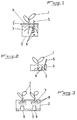
- FIG. 1 represents the system used for example 1 described later in this.
- Plants 1 Naturals
- Plants 1 Naturals
- the plant stem 1 is fixed on the lid 2 'of the pots previously pierced with three holes.
- a hole 4 is used for the replenishment of the nutrient solution and the other allows the passage of a hose air inlet 5 which maintains good oxygenation of the solution nutritive of plants by bubbling (bubbles 6).
- Figure 2 shows the device used for the culture of Ifs such as described for Example 2 in the following text.
- plants 1 are placed in the bottom of a 2 PVC (polyvinyl chloride) tank filled with nutritive solution 3, and an air bubbling ensures the oxygenation of the solution nutritious (bubbles 6).
- PVC polyvinyl chloride
- FIG. 3 describes the device used to carry out the work described in Example 4 below.
- Plants 1 Naturals
- the nutrient solution is regularly sprayed on the roots in the form of a mist 8 thanks to programmable foggers 9.
- Figures 4 to 7 show different culture devices usable for the production of metabolites from plants.
- FIGS. 4A and 4B represent cultivation devices in which the nutritive solution 3 is supplied to the plants 1 using capillaries. Once in contact with the roots of said plants, the 3 'used nutrient solution, also called percolate, is drained and recycled.
- the plants can be grown with or without a 2 "substrate.
- This substrate can be of different natures such as: rock wool, sand, perlite, vermiculite, reconstituted soil, or of any other nature currently used in soilless culture.
- Plants 1 can also be grown using the NFT method for: "Nutrient Film Technique".
- nutrient solution 3 is brought to the roots of plants 1 by runoff (Fig. 5) on a gutter or a plane support 10 slightly sloping. Recovery of the used nutrient solution 3 ' is done at the end of the gutter 10 and this solution can be recycled with or without recovery of the metabolites it contains.
- Figures 6A and 6B depict above-ground cropping systems with immersion of the root systems of plants 1 in a nutrient solution.
- the supply of nutrient solution 3 and the drainage of the used solution 3 ' can be permanent (continuous system) or not (discontinuous system).
- the immersion of root system can also be permanent (Fig. 6A) with air bubbling in this same nutritive or temporary solution (Fig. 6B).
- the drainage can be done to an airtight container 11 in the low position.
- the transfer of this liquid can then be made by a pump or by a compressor 12 which pushes the solution contained in this airtight container 11 to the culture container 2, possibly after addition of additional substances.
- FIG. 7 describes a culture device of the aeroponics type, in which plant roots are regularly watered by the nutrient solution 3 in the form of a mist 8. The latter is obtained by means of foggers 9 placed inside the culture tank 2. The used nutrient solution 3 'can be racked from below.
- Figure 8 schematically shows an installation for implementation, on a large scale and where appropriate automatically or semi-automatic, the process for producing metabolites according to the invention.
- this installation is essentially constituted, on the one hand, by a plurality of containers 2 for the above-ground culture of plants 1, whether or not containing a culture support or substrate inert 2 ", on the other hand, by a device for storing and supplying nutrient solution 3 for plants 1, comprising a reservoir 13 and a distribution line 13 ' associated with a network of conduits 13 "bringing said solution 3 so controlled at the base of said plants 1, and by a device for distributing permeabilization solution and / or leaching liquid, comprising in particular a mixing and storage tank 14 for the permeabilization solution and / or a reservoir 14 ′ for the leaching liquid, associated with lines of 14 "distribution by sprinkling and / or injection and, finally, by a set of means 15, 15 ', 15 ", 16 recovery, treatment and recycling at least of the used nutrient solution 3 '.
- the means of recovery, treatment and recycling consist advantageously in an intermediate storage tank 15 collecting the solution used nutrient 3 'evacuated by drainage from the containers 2 of soilless culture and connected by a direct recycling line 15 'and by a second recycling line 15 "comprising a unit 16 for the separation or extraction of metabolites sought, in a feedback loop on the storage tank 13 of nutrient solution 3, the latter also being supplied by an injection line 13 '' 'of additional nutritional substances stored in 13 "" tanks adapted, so as to compensate for the quantities of such substances withdrawn by plants 1.
- the latter can also include a device for distributing precursor solution (s) metabolites to be synthesized by plants and / or substances stimulating said synthesis of metabolites, comprising a storage tank 17 and a line of distribution 17 'connected simultaneously to the distribution line 13' or to the network of ducts 13 ", delivering the nutritive solution 3 and to distribution means 18 by spraying plants 1 on their aerial parts, just like the device 14, 14 ', 14 "for distributing permeabilization solution and / or washing liquid.
- a device for distributing precursor solution (s) metabolites to be synthesized by plants and / or substances stimulating said synthesis of metabolites comprising a storage tank 17 and a line of distribution 17 'connected simultaneously to the distribution line 13' or to the network of ducts 13 ", delivering the nutritive solution 3 and to distribution means 18 by spraying plants 1 on their aerial parts, just like the device 14, 14 ', 14 "for distributing permeabilization solution and / or washing liquid.
- the installation may further include. on the one hand, means 19 ', 19 "for heating the plants 1 and / or their containers 2, for example in the form of networks of parallel conduits and spaced apart through by a heat transfer fluid and extending above and / or below said containers 2 and, on the other hand, lighting means 20 or artificial insolation of said plants 1.
- Nutrient solution 3 is prepared and stored in a first reservoir 13. It is then brought to the base of the plants 1 by a system of smaller and smaller pipes forming a network of 13 "ducts. The plants are grown above ground, possibly on a 2 "inert support. The solution used nutritive 3 'flows on a support preferably sloping forming possibly the bottom of the corresponding container 2, this drainage 5 being permanent, cyclical or occasional. These drainage waters are collected in the storage bin 15. They are then recycled directly or molecules they contain are extracted and purified by unit 16 before recycling.
- a first optional auxiliary tank 14, and if necessary a second annex tank 14 ' contains or contain permeabilizing agents, precursors or other compounds that stimulate the production of metabolites in plants.
- plants 1 are put in contact with plants 1 at root level by percolation (injection into the nutritive solution 3) or at the level of the leaves by sprinkling. Plants are subject to natural or artificial lighting 20.
- the aerial and root parts plants can be heated or cooled by heat transfer liquids circulating in piping arrangements forming 19 ', 19 "networks or other equivalent means.
- said method will advantageously consist of three main steps. namely, a first cultivation step aimed at obtaining a biomass important, a second step favoring the release of metabolites by plants, either at the level of their root parts, or at the level of their parts aerial and a third step aimed at restoring said plants before return to the first or second step above (repetition of cycles).
- the present invention therefore relates to a method and a system allowing the recovery of metabolites released naturally (no permeabilization essential) or not (permeabilization essential) by the plant cultivated in above-ground conditions (definition of Morard 1995), with or without inert support (by soilless culture, it is necessary to understand any other culture mode than growing in the open ground in the fields or in nature).
- This plant can be grown by watering with a suitable nutrient solution [cultivation above ground on porous support, on cascade (method called NFT according to Morard 1995)], by permanent soaking in the nutrient solution with air bubbling (aquaculture according to Morard 1995) or temporary immersion in said nutrient solution (subirrigation, hydroponics, nutritious film, ...), or by contacting said nutritive solution in the form of a mist (aeroponics, according to Morard 1995).
- the metabolites are released from the plant roots, they will be contained in the nutrient solution (percolate) and therefore recovered by trapping either in a solvent immiscible with water, either on a support adsorbing said molecules or by evaporation or sublimation of water from the solution nutritious.
- the metabolites are released from the aerial parts of the plant. with or without permeabilization, they will be recovered by showering said plants, the shower solution (lye) being recovered and the metabolites it contains extracts as indicated above for percolate.
- the water, the used nutritive solution or the liquid charged leaching can be reused for plant cultivation after delivery to level of mineral and organic elements necessary for growth and secondary metabolism of the plant. If permeability treatment has been performed, it may be necessary to properly treat the used solution (percolate or lye) before reuse for a new permeable treatment or for reuse as a normal nutrient solution (for the growth of plants).
- the metabolites When the metabolites have been extracted from the nutrient solution by a solvent immiscible with water, the latter is separated from the aqueous phase, evaporated and the dry residue is recovered. The metabolites can then be purified and separated possible contaminants. If the metabolites have been trapped on a solid support, this solid support is isolated from the nutrient solution, the metabolites are eluted with a aqueous liquid phase by varying the ionic strength, the pH or by adding against ions or else an organic solvent miscible with water or not (alcohol, hydrocarbon, organochlorine, nitrile, or other ). In the latter case, will favor the most environmentally friendly solvents, the least flammable, least toxic, least expensive and most biodegradable. In all cases, all the conventional means of chromatography and chemistry to purify and concentrate molecules contained in the eluate.
- the permeabilizing treatment is stopped. Plants are returned to normal culture. When they have been treated with a permeable solution, a rinsing solution is used to remove this permeabilizing agent (surfactant, detergent, salt, acid, base ). This solution replaces the nutrient solution temporarily. Only then are the plants returned in culture under normal conditions. After a sufficient culture period, the plants can again be permeabilized. These cycles can be repeated until significant decrease in production, productivity, health status Plant. In this case, all or part of the culture is replaced by young people plants that are grown before the first permeabilizing treatment, preferably until optimal development is obtained.
- a permeable solution a rinsing solution is used to remove this permeabilizing agent (surfactant, detergent, salt, acid, base ). This solution replaces the nutrient solution temporarily. Only then are the plants returned in culture under normal conditions. After a sufficient culture period, the plants can again be permeabilized. These cycles can be repeated until significant decrease in production, productivity, health status Plant. In this case, all or part of
- continuous permeabilization treatment may be considered.
- the permeabilizing treatment will be gentle enough to allow the exit of metabolites and especially the survival of the plant throughout said permeabilizing treatment.
- treatment effectiveness begins to drop significantly, and causes a drop in yield not economically acceptable, we replace the "old" plants by more young that will be permeabilized immediately or after growth is forced.
- the addition precursors of the desired metabolites can be made.
- these molecules can be biotransformed by the cells of said plant.
- adding precursors should be done in moderation to prevent them from serve as a carbon source for microorganisms whose development could ultimately compromise the survival of said plants.
- This addition of precursors can be done directly in the nutrient solution when permeabilizing roots. It can be done through the nutrient solution via the roots if it is permeable the leaves too, but it can also be done foliarly via the liquid showering plants.
- Increasing doses (0, 1, 2, 3 or 5% V / V - volume for volume) surfactant (of the type known under the designation Tween20: polyoxyethylenesorbitan monolaurate) were added to the nutrient solution.
- Tween20 polyoxyethylenesorbitan monolaurate
- the permeabilization with Tween 20 was performed in the absence of air bubbling (to avoid foaming) for 0, 12, 24 or 48 hours.
- the nutrient solution of each plant has been harvested, filtered and analyzed by gas chromatography.
- the average total concentration of hyoscyamine and scopolamine increases gradually with the concentration of surfactant. It goes from 7mg / l without surfactant at 45 mg / l with 5% Tween20.
- the concentration of hyoscyamine and scopolamine increases with the duration of treatment.
- Permeabilized plants have been flushed with the root system under running water and have been put back into hydroponics as indicated below above. After three weeks of cultivation, all the plants had survived. They had continued to grow and some of those that had been permeabilized plants even grew stronger than the control plants.
- the permeabilized plants were rinsed and returned to culture. All of them survived and resulted in subsequent permeabilizations.
- Datura type plants can be cultivated in above-ground conditions to make them produce tropane alkaloids which are recovered in the used nutrient solution.
- the production can be increased by carrying out a suitable treatment.
- This treatment can be done using surfactants. Not all surfactants are as effective as each other. The higher the dose of surfactant, the more effective the treatment. The longer the treatment, the more effective it is.
- a treatment carried out in good conditions allows the survival of the plant, even an additional development of it, and it is then possible to permeabilize it several times.
- the effectiveness of the permeabilizing treatment can be enhanced by adding precursors to the permeabilizing solution. This efficiency can also be enhanced by forcing photosynthesis by subjecting the plants to permanent lighting, to an increase in the CO 2 level and / or by raising the surrounding temperature.
- Example 2 of carrying out the process Production of taxanes from yew in soilless cultivation.
- Example 3 of carrying out the process Production of furocoumarins from Streets (Ruta graveolens) cultivated in hydroponics (aquaculture according to Morard 1995).
- Nutrient solutions permeabilized plants contained an average of 8.1 +/- 4.1 mg / l of furocoumarins (psoralen, 8 methoxypsoralen, 5 methoxypsoralen and 5.8 dimethoxypsoralen) against 5.2 +/- 2.8 mg / l for the nutrient solutions of the four control plants.
- the plant roots were rinsed with water and then the plants were returned to culture for a week. Then, the four plants having already been permeabilized the first time were again permeabilized in the same way.
- the results are as follows: 22.5 +/- 6.1 mg / l for permeabilized versus 19 +/- 8.5 mg / l for the non-permeable.
- Streets can be cultivated in soilless conditions. They naturally release furocoumarins into the nutrient solution but this release can be increased by a suitable permeabilizing treatment (here, Tween 20 at 3%). Other types of treatment can be considered from the same way: other surfactants, raising the temperature of the solution nutrient or increased salinity of the nutrient solution, addition umbelliferone or phenylalanine for example. As in Example 2, the cultivation conditions and permeabilizing treatment can of course be optimized to give even better yields.
- a suitable permeabilizing treatment here, Tween 20 at 3%.
- Other types of treatment can be considered from the same way: other surfactants, raising the temperature of the solution nutrient or increased salinity of the nutrient solution, addition umbelliferone or phenylalanine for example.
- the cultivation conditions and permeabilizing treatment can of course be optimized to give even better yields.
- Datura stramonium and Datura innoxia seeds have been planted to germinate in small pots containing vermiculite sprinkled with solution nutritious. These buckets were then transferred to supports composed of perforated (PVC) plates. These plates were placed on a large 1.2m tray X lm X lm at the bottom of which six atomizers soaked in solution nutritious ( Figure 3). The foggers were triggered for 15 minutes every half hours. The entire system was placed in a phytotron with conditions identical to those of Example 1. After one month of culture, a few tens of grams of fresh material, the total biomass has exceeded kilogram (stems + leaves + roots). HPLC analysis revealed the 8 mg / l of alkaloids in the 40 liters of nutrient solution, for a total calculated from 320mg of hyoscyamine and scopolamine.
- the process of the invention can make it possible to cultivate on several thousands of square meters of plants producing secondary metabolites.
- these compounds can even be recovered by showering said plants with a suitable solution and recover the leachate containing the metabolites of interest.
- Such a device will be used to produce original molecules vegetable and these molecules could have various applications such as therapeutic, cosmetic, food or non-food.
- these molecules will be of fairly low molecular weight and should not be completely insoluble in water with or without added surfactant.
Landscapes
- Health & Medical Sciences (AREA)
- Life Sciences & Earth Sciences (AREA)
- Veterinary Medicine (AREA)
- Animal Behavior & Ethology (AREA)
- Chemical Kinetics & Catalysis (AREA)
- General Chemical & Material Sciences (AREA)
- Medicinal Chemistry (AREA)
- Nuclear Medicine, Radiotherapy & Molecular Imaging (AREA)
- Organic Chemistry (AREA)
- Pharmacology & Pharmacy (AREA)
- Public Health (AREA)
- Chemical & Material Sciences (AREA)
- General Health & Medical Sciences (AREA)
- Bioinformatics & Cheminformatics (AREA)
- Environmental Sciences (AREA)
- Engineering & Computer Science (AREA)
- Neurology (AREA)
- Biomedical Technology (AREA)
- Neurosurgery (AREA)
- Anesthesiology (AREA)
- Hydroponics (AREA)
- Cultivation Of Plants (AREA)
- Agricultural Chemicals And Associated Chemicals (AREA)
- Fertilizers (AREA)
- Compounds Of Unknown Constitution (AREA)
- Pharmaceuticals Containing Other Organic And Inorganic Compounds (AREA)
- Medicines Containing Plant Substances (AREA)
- Micro-Organisms Or Cultivation Processes Thereof (AREA)
- Breeding Of Plants And Reproduction By Means Of Culturing (AREA)
Description
- si les plantes, de manière générale, relarguent des métabolites secondaires à partir de leurs racines ou de leurs feuilles de telle sorte que ce phénomène puisse être utilisé pour une application industrielle ;
- s'il est possible de forcer un relargage naturel ou non desdits métabolites secondaires chez les plantes cultivées en particulier en culture hors sol ;
- si un traitement favorisant la synthèse et le relargage desdits métabolites secondaires chez la plante va affecter la survie de ladite plante de telle sorte qu'aucune application industrielle ne puisse être envisagée ;
- si lesdits métabolites sont ou non dégradés de manière importante par la microflore susceptible de se développer autour des plantes ainsi cultivées.
Claims (16)
- Procédé de production de molécules à partir de plantes, caractérisé en ce que lesdites plantes sont cultivées en conditions hors sol et sont alimentées par une solution nutritive et/ou aspergées par un liquide de lessivage, ladite solution et/ou ledit liquide étant ensuite récupéré(e)(s) et traité(e)(s) pour en extraire certaines molécules déterminées qu'elle ou il contient et qui ont été libérées par les racines et/ou les parties aériennes desdites plantes.
- Procédé selon la revendication 1, caractérisé en ce qu'il consiste plus précisément à réaliser les étapes suivantes :a) initiation de la culture des plantes en conditions hors sol permettant la croissance et le développement desdites plantes et l'obtention d'une biomasse suffisamment importante pour rentabiliser le procédé ;b) récupération des métabolites libérés par les racines ou les parties aériennes des plantes au moyen d'un liquide mis en contact par percolation ou immersion avec les racines, ou par aspersion avec les feuilles desdites plantes ;c) collecte de la solution usagée ou chargée sous forme de percolat (pour les racines) ou de lessivat (pour les feuilles) et isolement des molécules recherchées contenues dans cette solution par extraction liquide-liquide, liquide-solide, par recristallisation, par sublimation ou par évaporation de l'eau.
- Procédé selon la revendication 2, caractérisé en ce qu'il comprend une étape supplémentaire de perméabilisation forcée des racines ou des parties aériennes des plantes avec une solution contenant notamment des sels, des tensioactifs, des détergents, des solvants, des éliciteurs d'origine fongique ou bactérienne, des dérivés de l'acide jasmonique ou d'autres produits stimulant les défenses naturelles des plantes, de telle sorte que les flux sortants des racines ou des feuilles vers la solution nutritive ou le liquide de lessivage soient augmentés de manière significative et ce, sans perte totale de la viabilité desdites plantes, afin que ces dernières puissent être réutilisées, directement ou après une phase de rinçage et de remise en conditions de culture permettant au moins le rétablissement d'un bon état physiologique desdites plantes.
- Procédé selon la revendication 3, caractérisé en ce que la perméabilisation forcée est réalisée de manière permanente, en additionnant une solution perméabilisante à la solution nutritive délivrée de manière continue ou à intervalles réguliers aux plantes.
- Procédé selon la revendication 3 ou la revendication 4, caractérisé en ce que l'on réalise un rinçage du système racinaire et/ou des parties aériennes des plantes, puis une remise en conditions de croissance desdites plantes pendant un temps juste suffisant pour permettre de réaliser à nouveau un traitement de perméabilisation forcée, suivi ou accompagné d'une étape de récupération des molécules recherchées.
- Procédé selon l'une quelconque des revendications 1 à 5, caractérisé en ce qu'il consiste à renforcer les capacités de biosynthèse de la plante et son potentiel à relarguer des métabolites dans la solution, par l'intermédiaire d'un traitement physique choisi dans le groupe formé par une élévation de la température, une irradiation lumineuse, supplémentaire ou rallongée, une élévation de la teneur en CO2 dans l'atmosphère en contact avec ladite plante et les combinaisons de plusieurs de ces traitements physiques.
- Procédé selon l'une quelconque des revendications 1 à 6, caractérisé en ce que la production et l'excrétion des métabolites synthétisés par les plantes sont renforcées par une néosynthèse de ces molécules suite à l'apport de précurseurs de ces métabolites, ces précurseurs de la voie de biosynthèse desdits métabolites étant apportés à la plante par la solution nutritive au niveau des racines ou par aspersion sur les parties aériennes en mélange avec des tensioactifs pour obtenir une pénétration foliaire.
- Procédé selon l'une quelconque des revendications 1 à 7, caractérisé en ce que la production et l'excrétion des métabolites sont renforcées par un forçage de l'activité photosynthétique au moyen d'un éclairement artificiel pendant une durée plus longue que celle à laquelle la plante est habituée.
- Procédé selon l'une quelconque des revendications 1 à 8, caractérisé en ce que les métabolites recherchés sont obtenus à partir des parties aériennes des plantes par douchage ou aspersion desdites plantes avec une solution ou un liquide adapté(e), contenant préférentiellement des tensioactifs, des agents de surfaces et/ou des détergents, la solution de douchage ou d'aspersion chargée étant récupérée séparément ou en mélange avec la solution nutritive pour une extraction et une purification des molécules recherchées.
- Procédé selon l'une quelconque des revendications 1 à 9, caractérisé en ce que les plantes utilisées sont choisies dans le groupe des plantes supérieures ou vascularisées, aptes à synthétiser des métabolites d'intérêt économique en grande quantité et en ce que les molécules recherchées correspondent à des métabolites secondaires produits naturellement par ces plantes.
- Procédé selon l'une quelconque des revendications 1 à 10, caractérisé en ce que les métabolites récupérés et isolés sont choisis dans le groupe formé par les alcaloïdes de types tropaniques et indoliques, les anticancéreux, les taxanes ou dérivés du taxol, les furocoumarines, les terpènes, les glycosides, les phénylpropanoïdes, les saponines et les stéroïdes.
- Procédé selon l'une quelconque des revendications 1 à 11, caractérisé en ce que les plantes sont modifiées génétiquement pour leur faire produire plus de métabolites ou pour modifier leur morphologie, en augmentant par exemple leur biomasse racinaire suite à une transformation génétique par Agrobacterium rhizogenes.
- Installation pour la mise en oeuvre, notamment à grande échelle, du procédé de production selon l'une quelconque des revendications 1 à 12, caractérisée en ce qu'elle est essentiellement constituée, d'une part, par une pluralité de contenants (2) pour la culture hors sol de plantes (1), renfermant ou non un support ou substrat de culture inerte (2"), d'autre part, par un dispositif de stockage et d'apport de solution nutritive (3) pour les plantes (1), comprenant un réservoir (13) et une ligne de distribution (13') associée à un réseau de conduits (13") amenant ladite solution (3) de manière contrôlée à la base desdites plantes (1), et par un dispositif de distribution de solution de perméabilisation et/ou de liquide de lessivage, comprenant notamment un réservoir de mélange et de stockage (14) pour la solution de perméabilisation et/ou un réservoir (14') pour le liquide de lessivage, associé(s) à des lignes de distribution (14") par aspersion et/ou injection et, enfin, par un ensemble de moyens (15, 15', 15", 16) de récupération, de traitement et de recyclage au moins de la solution nutritive usagée (3'), ces moyens consistant en un bac de stockage intermédiaire (15) collectant la solution nutritive usagée (3') évacuée par drainage des contenants (2) de culture hors sol et relié par une ligne de recyclage directe (15') et par une seconde ligne de recyclage (15") comprenant une unité (16) de séparation ou d'extraction, en une boucle de réinjection sur le réservoir de stockage (13) de solution nutritive (3), ladite unité (16) extrayant les métabolites recherchés contenus dans la solution nutritive usagée (3') et libérés par les racines et/ou les parties aériennes desdites plantes (1).
- Installation selon la revendication 13, caractérisée en ce que le réservoir (13) est également alimenté par une ligne d'injection (13"') de substances nutritionnelles additionnelles stockées dans des réservoirs (13"") adaptés, de manière à compenser les quantités de telles substances prélevées par les plantes (1).
- Installation selon l'une quelconque des revendications 13 et 14, caractérisée en ce qu'elle comprend également un dispositif de distribution de solution(s) de précurseur(s) des métabolites à synthétiser par les plantes et/ou de substances stimulant ladite synthèse de métabolites, comprenant un réservoir de stockage (17) et une ligne de distribution (17') reliée simultanément à la ligne de distribution (13') ou au réseau de conduits (13"), délivrant la solution nutritive (3) et à des moyens (18) de distribution par aspersion des plantes (1) au niveau de leurs parties aériennes, tout comme le dispositif (14, 14', 14") de distribution de solution de perméabilisation et/ou de liquide de lessivage.
- Installation selon l'une quelconque des revendications 13 à 15, caractérisée en ce qu'elle comporte également, d'une part, des moyens (19', 19") de chauffage des plantes (1) et/ou de leurs contenants (2), par exemple sous la forme de réseaux de conduits parallèles et espacés traversés par un fluide caloriporteur et s'étendant au dessus et/ou en dessous desdits contenants (2) et, d'autre part, des moyens (20) d'éclairage ou d'insolation artificiels desdites plantes (1).
Applications Claiming Priority (3)
| Application Number | Priority Date | Filing Date | Title |
|---|---|---|---|
| FR9914204 | 1999-11-08 | ||
| FR9914204A FR2800740B1 (fr) | 1999-11-08 | 1999-11-08 | Procede de production de metabolites a partir de vegetaux en culture hors sol |
| PCT/FR2000/003095 WO2001033942A1 (fr) | 1999-11-08 | 2000-11-07 | Procede de production de metabolites a partir de vegetaux en culture hors sol |
Publications (2)
| Publication Number | Publication Date |
|---|---|
| EP1227714A1 EP1227714A1 (fr) | 2002-08-07 |
| EP1227714B1 true EP1227714B1 (fr) | 2004-05-06 |
Family
ID=9552027
Family Applications (1)
| Application Number | Title | Priority Date | Filing Date |
|---|---|---|---|
| EP00976113A Expired - Lifetime EP1227714B1 (fr) | 1999-11-08 | 2000-11-07 | Procede de production de metabolites a partir de vegetaux en culture hors sol |
Country Status (14)
| Country | Link |
|---|---|
| US (1) | US7350331B1 (fr) |
| EP (1) | EP1227714B1 (fr) |
| JP (1) | JP5276759B2 (fr) |
| AT (1) | ATE265802T1 (fr) |
| AU (1) | AU780857B2 (fr) |
| CA (1) | CA2390263C (fr) |
| DE (1) | DE60010502T2 (fr) |
| DK (1) | DK1227714T3 (fr) |
| ES (1) | ES2220564T3 (fr) |
| FR (1) | FR2800740B1 (fr) |
| NZ (1) | NZ519234A (fr) |
| PT (1) | PT1227714E (fr) |
| TR (1) | TR200401958T4 (fr) |
| WO (1) | WO2001033942A1 (fr) |
Families Citing this family (22)
| Publication number | Priority date | Publication date | Assignee | Title |
|---|---|---|---|---|
| KR101332538B1 (ko) * | 2006-12-04 | 2013-11-22 | 도꾸리쯔 교세이호징 노우교 · 쇼쿠힝 산교 기쥬쯔 소고 겡뀨 기꼬우 | 바이오미네랄 함유물의 제조방법 및 유기 양액재배법 |
| FR2926955B1 (fr) * | 2008-02-01 | 2012-07-20 | Agronomique Inst Nat Rech | Procede de preparation d'acides dicafeoylquiniques et leur utilisation dans la lutte contre les pucerons |
| JP5414090B2 (ja) * | 2008-10-09 | 2014-02-12 | 独立行政法人農業・食品産業技術総合研究機構 | 並行複式無機化反応を行う微生物群が固定化された固体担体、触媒カラム、および、植物栽培用固形培地の製造方法 |
| FR2991326B1 (fr) | 2012-05-29 | 2017-09-01 | Plant Advanced Tech Pat | Enzymes de bioconversion de l'acide chlorogenique en au moins un acide di-, tri- ou tetra-cafeoylquinique |
| US20150173373A1 (en) | 2013-12-19 | 2015-06-25 | Rhizoflora, Inc. | Plant Activator Composition |
| CN105052701A (zh) * | 2015-07-29 | 2015-11-18 | 镇江市城南建设有限公司 | 一种红豆杉的水培方法 |
| FR3047180B1 (fr) * | 2016-01-29 | 2020-09-25 | Plant Advanced Tech Pat | Procede de preparation d'un extrait de vitex negundo riche en polyphenols |
| FR3047175A1 (fr) * | 2016-01-29 | 2017-08-04 | Expanscience Lab | Compositions cosmetiques, dermatologiques comprenant un extrait de vitex negundo enrichi en polyphenols |
| FR3047171A1 (fr) * | 2016-01-29 | 2017-08-04 | Plant Advanced Tech Pat | Esters de dipropylene glycol des acides dicafeoylquiniques, extrait vegetal les contenant, procede d'obtention et utilisations |
| JP7103758B2 (ja) * | 2016-08-01 | 2022-07-20 | 花王株式会社 | ソヤサポニン類の製造方法 |
| WO2018025462A1 (fr) * | 2016-08-01 | 2018-02-08 | 花王株式会社 | Procédé de production de saponines de soja |
| FR3056079B1 (fr) | 2016-09-20 | 2019-06-07 | Plant Advanced Technologies Pat | Installation et procede de production de plantes en aeroponie / hydroponie |
| FR3059236B1 (fr) | 2016-11-25 | 2019-05-17 | Plant Advanced Technologies Pat | Extraits de plantes du genre tagetes et leurs utilisations |
| FR3061657B1 (fr) * | 2017-01-09 | 2020-01-03 | Plant Advanced Technologies Pat | Preparation d’un extrait racinaire de filipendula ulmaria et utilisations cosmetiques |
| FR3069161B1 (fr) | 2017-07-21 | 2019-08-30 | Plant Advanced Technologies Pat | Extraits racinaires de polygonum multiflorum et leurs utilisations |
| FR3072025B1 (fr) | 2017-10-06 | 2019-11-01 | Plant Advanced Technologies Pat | Extraits racinaires de plantes du genre morus et leurs utilisations |
| US11540451B2 (en) * | 2018-02-13 | 2023-01-03 | Logiqs B.V. | Product holder assembly |
| IL258319A (en) | 2018-03-22 | 2018-06-28 | Aharoni Asaph | Methods for stimulating metabolite production and exudation in plants |
| JP7728774B2 (ja) | 2020-02-25 | 2025-08-25 | クラリアント・インターナシヨナル・リミテツド | ヘチマ根抽出物を含む組成物 |
| US11299700B1 (en) | 2021-02-19 | 2022-04-12 | Acequia Biotechnology, Llc | Bioreactor containers and methods of growing hairy roots using the same |
| CN113678721A (zh) * | 2021-08-31 | 2021-11-23 | 吉林省林业科学研究院 | 一种杨树育种装置及其使用方法 |
| JP2025539488A (ja) | 2022-12-05 | 2025-12-05 | クラリアント・インターナシヨナル・リミテツド | サンギソルバ・オフィシナリス(Sanguisorba officinalis)根抽出物を含む組成物およびそれらの使用 |
Family Cites Families (23)
| Publication number | Priority date | Publication date | Assignee | Title |
|---|---|---|---|---|
| AU6132273A (en) * | 1972-10-13 | 1975-04-17 | Hydroculture, Inc | Hydroponic growing methods and packaged plants |
| GB2009574A (en) * | 1977-08-10 | 1979-06-20 | Barclic Prod Ltd | Improvements in the Cultivation of Plants |
| JPS6092219A (ja) * | 1983-10-24 | 1985-05-23 | Nissin Food Prod Co Ltd | 養液栽培による薬用物質の製造法 |
| JPH0634734B2 (ja) * | 1985-05-07 | 1994-05-11 | 住友化学工業株式会社 | 培養根を用いたトロパンアルカロイド製造方法 |
| JPS63281976A (ja) * | 1987-05-12 | 1988-11-18 | Yasuro Kuratomi | 動植物類の活性化容器 |
| US5244794A (en) * | 1989-03-17 | 1993-09-14 | Cornell Research Foundation, Inc. | Flavor compounds from allium root cultures |
| US5010686A (en) * | 1990-04-20 | 1991-04-30 | Rivest Daniel J | Hydroponic system |
| US5413928A (en) * | 1991-06-21 | 1995-05-09 | Worcester Polytechnic Institute | Process for extracting enhanced amounts of plant secondary metabolites with limited loss of plant viability |
| JP3336024B2 (ja) * | 1991-09-04 | 2002-10-21 | カネボウ株式会社 | 植物代謝産物の製造方法 |
| US5407816A (en) * | 1992-02-20 | 1995-04-18 | Phyton Catalytic, Inc. | Enhanced production of taxol and taxanes by cell cultures of taxus species |
| WO1993019585A1 (fr) * | 1992-04-01 | 1993-10-14 | Union Camp Corporation | Procede pour induire une embryogenese somatique dans le taxus et production d'alcaloides contenant un noyau de taxane selon ce procede |
| US5279953A (en) * | 1992-06-24 | 1994-01-18 | Esca Genetics Corporation | In vivo production of taxanes |
| HU214255B (hu) * | 1992-12-23 | 1998-03-02 | Rohm And Haas Co. | Eljárás azadirachtin előállítására |
| US5557884A (en) * | 1994-07-27 | 1996-09-24 | Deppe; Gregory | Spraying and level control for aero-hydroponic system |
| AU2435695A (en) * | 1995-05-05 | 1996-11-21 | Union Camp Corporation | Method for production of plant biological products in precoc ious neomorphic embryoids |
| US6020169A (en) * | 1995-07-20 | 2000-02-01 | Washington State University Research Foundation | Production of secreted foreign polypeptides in plant cell culture |
| US5908549A (en) * | 1996-10-29 | 1999-06-01 | Wigen; Gerald W. | Filtration and regeneration system |
| FR2758563B1 (fr) * | 1997-01-22 | 1999-03-26 | Univ Picardie | Procede de production de metabolites primaires et secondaires a partir d'organes vegetaux cultives in vitro |
| US20020132021A1 (en) * | 1997-04-30 | 2002-09-19 | Ilya Raskin | Elicited plant products |
| IT1292766B1 (it) * | 1997-06-11 | 1999-02-11 | Consulagri Srl | Struttura modulare componibile per coltivazioni aeroponiche |
| US6096307A (en) * | 1997-12-11 | 2000-08-01 | A. Glenn Braswell | Compositions for immunostimulation containing Echinacea angustofolia, bromelain, and lysozyme |
| US5992090A (en) * | 1998-01-26 | 1999-11-30 | Dynamac International Inc. | Process for producing vegetative and tuber growth regulator |
| US6324785B1 (en) * | 1999-07-12 | 2001-12-04 | Pharmaleads, Inc. | Process for harvesting organic compounds from plant roots |
-
1999
- 1999-11-08 FR FR9914204A patent/FR2800740B1/fr not_active Expired - Lifetime
-
2000
- 2000-11-07 WO PCT/FR2000/003095 patent/WO2001033942A1/fr not_active Ceased
- 2000-11-07 TR TR2004/01958T patent/TR200401958T4/xx unknown
- 2000-11-07 DE DE60010502T patent/DE60010502T2/de not_active Expired - Lifetime
- 2000-11-07 PT PT00976113T patent/PT1227714E/pt unknown
- 2000-11-07 ES ES00976113T patent/ES2220564T3/es not_active Expired - Lifetime
- 2000-11-07 EP EP00976113A patent/EP1227714B1/fr not_active Expired - Lifetime
- 2000-11-07 CA CA2390263A patent/CA2390263C/fr not_active Expired - Fee Related
- 2000-11-07 DK DK00976113T patent/DK1227714T3/da active
- 2000-11-07 AU AU14001/01A patent/AU780857B2/en not_active Ceased
- 2000-11-07 US US10/129,611 patent/US7350331B1/en not_active Expired - Lifetime
- 2000-11-07 NZ NZ519234A patent/NZ519234A/en not_active IP Right Cessation
- 2000-11-07 AT AT00976113T patent/ATE265802T1/de not_active IP Right Cessation
- 2000-11-07 JP JP2001535963A patent/JP5276759B2/ja not_active Expired - Fee Related
Also Published As
| Publication number | Publication date |
|---|---|
| US7350331B1 (en) | 2008-04-01 |
| AU780857B2 (en) | 2005-04-21 |
| ATE265802T1 (de) | 2004-05-15 |
| FR2800740A1 (fr) | 2001-05-11 |
| FR2800740B1 (fr) | 2002-10-11 |
| TR200401958T4 (tr) | 2004-09-21 |
| EP1227714A1 (fr) | 2002-08-07 |
| DE60010502T2 (de) | 2005-05-12 |
| AU1400101A (en) | 2001-06-06 |
| WO2001033942A1 (fr) | 2001-05-17 |
| JP5276759B2 (ja) | 2013-08-28 |
| ES2220564T3 (es) | 2004-12-16 |
| CA2390263C (fr) | 2010-01-26 |
| DK1227714T3 (da) | 2004-08-30 |
| PT1227714E (pt) | 2004-09-30 |
| JP2004500053A (ja) | 2004-01-08 |
| DE60010502D1 (de) | 2004-06-09 |
| CA2390263A1 (fr) | 2001-05-17 |
| NZ519234A (en) | 2004-03-26 |
Similar Documents
| Publication | Publication Date | Title |
|---|---|---|
| CA2390263C (fr) | Procede de production de metabolites a partir de vegetaux en culture hors sol | |
| CN102138416A (zh) | 青钱柳嫩枝扦插繁殖方法 | |
| CN103733863B (zh) | 一种坡垒半木质化嫩枝扦插育苗的方法 | |
| CN103430657A (zh) | 一种促进连香树种子萌发和提高种子萌发率的方法 | |
| CN101548599B (zh) | 毛叶山桐子育苗的一种种子预处理方法 | |
| CN105145098B (zh) | 一种鸦胆子扦插繁殖的方法 | |
| CN103444396A (zh) | 一种促进连香树种子萌发和提高种子萌发率栽培 | |
| CN103283340A (zh) | 一种促进连香树种子萌发和提高种子萌发率的方法 | |
| CN103947437A (zh) | 红豆杉非试管快繁方法 | |
| CN101185397B (zh) | 一种利用红豆杉侧根增殖生产紫杉醇的方法 | |
| CN103858637A (zh) | 一种发财树回收再生培育方法 | |
| FR2710232A1 (fr) | Semis de mousses et procédé de production d'un tapis de mousse dense à partir de celui-ci. | |
| EP1886550B1 (fr) | Procédé de production de plants greffés de végétaux | |
| CN101548598B (zh) | 一种毛叶山桐子育苗的种子预处理方法 | |
| CN101941863B (zh) | 植物培植海水营养液及植物喷雾培植方法 | |
| CN107624388A (zh) | 一种观赏兼食用的菠萝盆栽化栽培方法 | |
| Mairapetyan | Aromatic plant culture in open-air hydroponics | |
| CN105340678A (zh) | 一种山核桃无性快繁方法 | |
| CN109197193A (zh) | 一种美国秋火焰红枫快速扦插繁殖的方法 | |
| CN105706869B (zh) | 一种木麻黄生根育苗的方法 | |
| CN106332648A (zh) | 一种甘蔗组培生根瓶苗单株假植的方法 | |
| CN104221629A (zh) | 一种指天椒无性繁殖育苗方法 | |
| CN106577130A (zh) | 一种苹果树的扦插育苗方法 | |
| JP2003339227A (ja) | 木本性植物の挿し木苗製造方法 | |
| KR20010002047A (ko) | 오존과 재배수 재순환을 이용한 지하수 절약형 무농약 콩나물 재 |
Legal Events
| Date | Code | Title | Description |
|---|---|---|---|
| PUAI | Public reference made under article 153(3) epc to a published international application that has entered the european phase |
Free format text: ORIGINAL CODE: 0009012 |
|
| 17P | Request for examination filed |
Effective date: 20020522 |
|
| AK | Designated contracting states |
Kind code of ref document: A1 Designated state(s): AT BE CH CY DE DK ES FI FR GB GR IE IT LI LU MC NL PT SE TR |
|
| AX | Request for extension of the european patent |
Free format text: AL;LT;LV;MK;RO;SI |
|
| GRAP | Despatch of communication of intention to grant a patent |
Free format text: ORIGINAL CODE: EPIDOSNIGR1 |
|
| GRAS | Grant fee paid |
Free format text: ORIGINAL CODE: EPIDOSNIGR3 |
|
| RAP1 | Party data changed (applicant data changed or rights of an application transferred) |
Owner name: INSTITUT NATIONAL DE LA RECHERCHE AGRONOMIQUE Owner name: INSTITUT NATIONAL POLYTECHNIQUE DE LORRAINE (INPL) |
|
| GRAA | (expected) grant |
Free format text: ORIGINAL CODE: 0009210 |
|
| AK | Designated contracting states |
Kind code of ref document: B1 Designated state(s): AT BE CH CY DE DK ES FI FR GB GR IE IT LI LU MC NL PT SE TR |
|
| PG25 | Lapsed in a contracting state [announced via postgrant information from national office to epo] |
Ref country code: AT Free format text: LAPSE BECAUSE OF FAILURE TO SUBMIT A TRANSLATION OF THE DESCRIPTION OR TO PAY THE FEE WITHIN THE PRESCRIBED TIME-LIMIT Effective date: 20040506 Ref country code: CY Free format text: LAPSE BECAUSE OF FAILURE TO SUBMIT A TRANSLATION OF THE DESCRIPTION OR TO PAY THE FEE WITHIN THE PRESCRIBED TIME-LIMIT Effective date: 20040506 Ref country code: FI Free format text: LAPSE BECAUSE OF FAILURE TO SUBMIT A TRANSLATION OF THE DESCRIPTION OR TO PAY THE FEE WITHIN THE PRESCRIBED TIME-LIMIT Effective date: 20040506 Ref country code: IE Free format text: LAPSE BECAUSE OF FAILURE TO SUBMIT A TRANSLATION OF THE DESCRIPTION OR TO PAY THE FEE WITHIN THE PRESCRIBED TIME-LIMIT Effective date: 20040506 |
|
| REG | Reference to a national code |
Ref country code: GB Ref legal event code: FG4D Free format text: NOT ENGLISH |
|
| REG | Reference to a national code |
Ref country code: CH Ref legal event code: EP |
|
| REF | Corresponds to: |
Ref document number: 60010502 Country of ref document: DE Date of ref document: 20040609 Kind code of ref document: P |
|
| REG | Reference to a national code |
Ref country code: IE Ref legal event code: FG4D Free format text: FRENCH |
|
| REG | Reference to a national code |
Ref country code: DK Ref legal event code: T3 |
|
| REG | Reference to a national code |
Ref country code: SE Ref legal event code: TRGR Ref country code: CH Ref legal event code: NV Representative=s name: PATENTANWALTSBUERO EDER AG |
|
| REG | Reference to a national code |
Ref country code: PT Ref legal event code: SC4A Free format text: AVAILABILITY OF NATIONAL TRANSLATION Effective date: 20040803 |
|
| REG | Reference to a national code |
Ref country code: GR Ref legal event code: EP Ref document number: 20040402733 Country of ref document: GR |
|
| GBT | Gb: translation of ep patent filed (gb section 77(6)(a)/1977) |
Effective date: 20040922 |
|
| LTIE | Lt: invalidation of european patent or patent extension |
Effective date: 20040506 |
|
| PG25 | Lapsed in a contracting state [announced via postgrant information from national office to epo] |
Ref country code: LU Free format text: LAPSE BECAUSE OF NON-PAYMENT OF DUE FEES Effective date: 20041107 |
|
| PG25 | Lapsed in a contracting state [announced via postgrant information from national office to epo] |
Ref country code: MC Free format text: LAPSE BECAUSE OF NON-PAYMENT OF DUE FEES Effective date: 20041130 |
|
| REG | Reference to a national code |
Ref country code: ES Ref legal event code: FG2A Ref document number: 2220564 Country of ref document: ES Kind code of ref document: T3 |
|
| REG | Reference to a national code |
Ref country code: IE Ref legal event code: FD4D |
|
| PLBE | No opposition filed within time limit |
Free format text: ORIGINAL CODE: 0009261 |
|
| STAA | Information on the status of an ep patent application or granted ep patent |
Free format text: STATUS: NO OPPOSITION FILED WITHIN TIME LIMIT |
|
| 26N | No opposition filed |
Effective date: 20050208 |
|
| PGFP | Annual fee paid to national office [announced via postgrant information from national office to epo] |
Ref country code: GR Payment date: 20141017 Year of fee payment: 15 Ref country code: TR Payment date: 20141017 Year of fee payment: 15 |
|
| PGFP | Annual fee paid to national office [announced via postgrant information from national office to epo] |
Ref country code: PT Payment date: 20141015 Year of fee payment: 15 |
|
| REG | Reference to a national code |
Ref country code: FR Ref legal event code: PLFP Year of fee payment: 16 |
|
| PGFP | Annual fee paid to national office [announced via postgrant information from national office to epo] |
Ref country code: IT Payment date: 20151118 Year of fee payment: 16 Ref country code: CH Payment date: 20151201 Year of fee payment: 16 Ref country code: GB Payment date: 20151110 Year of fee payment: 16 Ref country code: DK Payment date: 20151105 Year of fee payment: 16 |
|
| PGFP | Annual fee paid to national office [announced via postgrant information from national office to epo] |
Ref country code: BE Payment date: 20151106 Year of fee payment: 16 Ref country code: ES Payment date: 20151228 Year of fee payment: 16 Ref country code: NL Payment date: 20151116 Year of fee payment: 16 Ref country code: SE Payment date: 20151123 Year of fee payment: 16 |
|
| REG | Reference to a national code |
Ref country code: PT Ref legal event code: MM4A Free format text: LAPSE DUE TO NON-PAYMENT OF FEES Effective date: 20160509 |
|
| PG25 | Lapsed in a contracting state [announced via postgrant information from national office to epo] |
Ref country code: GR Free format text: LAPSE BECAUSE OF NON-PAYMENT OF DUE FEES Effective date: 20160602 |
|
| PG25 | Lapsed in a contracting state [announced via postgrant information from national office to epo] |
Ref country code: PT Free format text: LAPSE BECAUSE OF NON-PAYMENT OF DUE FEES Effective date: 20160509 |
|
| REG | Reference to a national code |
Ref country code: GR Ref legal event code: ML Ref document number: 20040402733 Country of ref document: GR Effective date: 20160602 |
|
| REG | Reference to a national code |
Ref country code: FR Ref legal event code: PLFP Year of fee payment: 17 |
|
| PG25 | Lapsed in a contracting state [announced via postgrant information from national office to epo] |
Ref country code: BE Free format text: LAPSE BECAUSE OF NON-PAYMENT OF DUE FEES Effective date: 20161130 |
|
| PGFP | Annual fee paid to national office [announced via postgrant information from national office to epo] |
Ref country code: DE Payment date: 20170125 Year of fee payment: 17 |
|
| REG | Reference to a national code |
Ref country code: DK Ref legal event code: EBP Effective date: 20161130 |
|
| REG | Reference to a national code |
Ref country code: CH Ref legal event code: PL |
|
| REG | Reference to a national code |
Ref country code: SE Ref legal event code: EUG |
|
| REG | Reference to a national code |
Ref country code: NL Ref legal event code: MM Effective date: 20161201 |
|
| GBPC | Gb: european patent ceased through non-payment of renewal fee |
Effective date: 20161107 |
|
| PG25 | Lapsed in a contracting state [announced via postgrant information from national office to epo] |
Ref country code: LI Free format text: LAPSE BECAUSE OF NON-PAYMENT OF DUE FEES Effective date: 20161130 Ref country code: CH Free format text: LAPSE BECAUSE OF NON-PAYMENT OF DUE FEES Effective date: 20161130 |
|
| REG | Reference to a national code |
Ref country code: FR Ref legal event code: CL Name of requester: , FR Effective date: 20170717 |
|
| PG25 | Lapsed in a contracting state [announced via postgrant information from national office to epo] |
Ref country code: TR Free format text: LAPSE BECAUSE OF NON-PAYMENT OF DUE FEES Effective date: 20151107 Ref country code: SE Free format text: LAPSE BECAUSE OF NON-PAYMENT OF DUE FEES Effective date: 20161108 |
|
| REG | Reference to a national code |
Ref country code: FR Ref legal event code: PLFP Year of fee payment: 18 |
|
| PG25 | Lapsed in a contracting state [announced via postgrant information from national office to epo] |
Ref country code: NL Free format text: LAPSE BECAUSE OF NON-PAYMENT OF DUE FEES Effective date: 20161201 |
|
| PG25 | Lapsed in a contracting state [announced via postgrant information from national office to epo] |
Ref country code: IT Free format text: LAPSE BECAUSE OF NON-PAYMENT OF DUE FEES Effective date: 20161107 |
|
| PG25 | Lapsed in a contracting state [announced via postgrant information from national office to epo] |
Ref country code: DK Free format text: LAPSE BECAUSE OF NON-PAYMENT OF DUE FEES Effective date: 20161130 Ref country code: GB Free format text: LAPSE BECAUSE OF NON-PAYMENT OF DUE FEES Effective date: 20161107 |
|
| REG | Reference to a national code |
Ref country code: BE Ref legal event code: MM Effective date: 20161130 |
|
| PG25 | Lapsed in a contracting state [announced via postgrant information from national office to epo] |
Ref country code: ES Free format text: LAPSE BECAUSE OF FAILURE TO SUBMIT A TRANSLATION OF THE DESCRIPTION OR TO PAY THE FEE WITHIN THE PRESCRIBED TIME-LIMIT Effective date: 20040506 |
|
| REG | Reference to a national code |
Ref country code: DE Ref legal event code: R119 Ref document number: 60010502 Country of ref document: DE |
|
| REG | Reference to a national code |
Ref country code: FR Ref legal event code: TQ Owner name: UNIVERSITE DE LORRAINE, FR Effective date: 20180507 |
|
| PG25 | Lapsed in a contracting state [announced via postgrant information from national office to epo] |
Ref country code: DE Free format text: LAPSE BECAUSE OF NON-PAYMENT OF DUE FEES Effective date: 20180602 |
|
| REG | Reference to a national code |
Ref country code: ES Ref legal event code: FD2A Effective date: 20181116 |
|
| RIC2 | Information provided on ipc code assigned after grant |
Ipc: A01G 31/00 20180101AFI20010521BHEP Ipc: A01G 31/02 20060101ALI20010521BHEP |
|
| PG25 | Lapsed in a contracting state [announced via postgrant information from national office to epo] |
Ref country code: ES Free format text: LAPSE BECAUSE OF FAILURE TO SUBMIT A TRANSLATION OF THE DESCRIPTION OR TO PAY THE FEE WITHIN THE PRESCRIBED TIME-LIMIT Effective date: 20161108 |
|
| PGFP | Annual fee paid to national office [announced via postgrant information from national office to epo] |
Ref country code: FR Payment date: 20191128 Year of fee payment: 20 |