EP1217792B1 - Context-aware and location-aware cellular phones and methods - Google Patents
Context-aware and location-aware cellular phones and methods Download PDFInfo
- Publication number
- EP1217792B1 EP1217792B1 EP01130110A EP01130110A EP1217792B1 EP 1217792 B1 EP1217792 B1 EP 1217792B1 EP 01130110 A EP01130110 A EP 01130110A EP 01130110 A EP01130110 A EP 01130110A EP 1217792 B1 EP1217792 B1 EP 1217792B1
- Authority
- EP
- European Patent Office
- Prior art keywords
- location
- cellular phone
- information
- behavior
- context
- Prior art date
- Legal status (The legal status is an assumption and is not a legal conclusion. Google has not performed a legal analysis and makes no representation as to the accuracy of the status listed.)
- Expired - Lifetime
Links
- 230000001413 cellular effect Effects 0.000 title claims description 99
- 238000000034 method Methods 0.000 title claims description 81
- 230000006399 behavior Effects 0.000 claims description 69
- 230000008859 change Effects 0.000 claims description 6
- 238000010586 diagram Methods 0.000 description 23
- 230000001419 dependent effect Effects 0.000 description 14
- 230000015654 memory Effects 0.000 description 13
- 230000008569 process Effects 0.000 description 12
- 230000008901 benefit Effects 0.000 description 8
- 230000008520 organization Effects 0.000 description 8
- 238000004891 communication Methods 0.000 description 6
- 230000003287 optical effect Effects 0.000 description 6
- 238000013459 approach Methods 0.000 description 5
- 230000006870 function Effects 0.000 description 5
- 230000006855 networking Effects 0.000 description 5
- 238000004422 calculation algorithm Methods 0.000 description 4
- 238000004364 calculation method Methods 0.000 description 4
- 230000007246 mechanism Effects 0.000 description 4
- 238000012545 processing Methods 0.000 description 4
- 230000005540 biological transmission Effects 0.000 description 3
- 235000013353 coffee beverage Nutrition 0.000 description 3
- 238000005516 engineering process Methods 0.000 description 3
- 230000004048 modification Effects 0.000 description 3
- 238000012986 modification Methods 0.000 description 3
- 239000000047 product Substances 0.000 description 3
- 238000013519 translation Methods 0.000 description 3
- 230000014616 translation Effects 0.000 description 3
- 240000001889 Brahea edulis Species 0.000 description 2
- 235000015115 caffè latte Nutrition 0.000 description 2
- 230000007423 decrease Effects 0.000 description 2
- 230000003247 decreasing effect Effects 0.000 description 2
- 230000000694 effects Effects 0.000 description 2
- 230000009191 jumping Effects 0.000 description 2
- 230000005055 memory storage Effects 0.000 description 2
- 230000002093 peripheral effect Effects 0.000 description 2
- 239000000779 smoke Substances 0.000 description 2
- 230000004888 barrier function Effects 0.000 description 1
- 230000010267 cellular communication Effects 0.000 description 1
- 238000006243 chemical reaction Methods 0.000 description 1
- 235000019219 chocolate Nutrition 0.000 description 1
- 235000014510 cooky Nutrition 0.000 description 1
- 235000019692 hotdogs Nutrition 0.000 description 1
- 230000006872 improvement Effects 0.000 description 1
- 238000013507 mapping Methods 0.000 description 1
- 238000012544 monitoring process Methods 0.000 description 1
- 230000007935 neutral effect Effects 0.000 description 1
- 230000002085 persistent effect Effects 0.000 description 1
- 238000009877 rendering Methods 0.000 description 1
- 230000011218 segmentation Effects 0.000 description 1
- 238000000926 separation method Methods 0.000 description 1
- 239000013589 supplement Substances 0.000 description 1
- 230000029305 taxis Effects 0.000 description 1
- 238000012546 transfer Methods 0.000 description 1
- 238000012795 verification Methods 0.000 description 1
Images




Classifications
-
- H—ELECTRICITY
- H04—ELECTRIC COMMUNICATION TECHNIQUE
- H04M—TELEPHONIC COMMUNICATION
- H04M1/00—Substation equipment, e.g. for use by subscribers
- H04M1/72—Mobile telephones; Cordless telephones, i.e. devices for establishing wireless links to base stations without route selection
- H04M1/724—User interfaces specially adapted for cordless or mobile telephones
- H04M1/72448—User interfaces specially adapted for cordless or mobile telephones with means for adapting the functionality of the device according to specific conditions
- H04M1/72457—User interfaces specially adapted for cordless or mobile telephones with means for adapting the functionality of the device according to specific conditions according to geographic location
-
- H—ELECTRICITY
- H04—ELECTRIC COMMUNICATION TECHNIQUE
- H04W—WIRELESS COMMUNICATION NETWORKS
- H04W4/00—Services specially adapted for wireless communication networks; Facilities therefor
- H04W4/02—Services making use of location information
-
- H—ELECTRICITY
- H04—ELECTRIC COMMUNICATION TECHNIQUE
- H04M—TELEPHONIC COMMUNICATION
- H04M1/00—Substation equipment, e.g. for use by subscribers
- H04M1/72—Mobile telephones; Cordless telephones, i.e. devices for establishing wireless links to base stations without route selection
- H04M1/724—User interfaces specially adapted for cordless or mobile telephones
- H04M1/72448—User interfaces specially adapted for cordless or mobile telephones with means for adapting the functionality of the device according to specific conditions
-
- H—ELECTRICITY
- H04—ELECTRIC COMMUNICATION TECHNIQUE
- H04W—WIRELESS COMMUNICATION NETWORKS
- H04W12/00—Security arrangements; Authentication; Protecting privacy or anonymity
- H04W12/10—Integrity
- H04W12/104—Location integrity, e.g. secure geotagging
-
- H—ELECTRICITY
- H04—ELECTRIC COMMUNICATION TECHNIQUE
- H04W—WIRELESS COMMUNICATION NETWORKS
- H04W4/00—Services specially adapted for wireless communication networks; Facilities therefor
- H04W4/02—Services making use of location information
- H04W4/029—Location-based management or tracking services
-
- H—ELECTRICITY
- H04—ELECTRIC COMMUNICATION TECHNIQUE
- H04M—TELEPHONIC COMMUNICATION
- H04M19/00—Current supply arrangements for telephone systems
- H04M19/02—Current supply arrangements for telephone systems providing ringing current or supervisory tones, e.g. dialling tone or busy tone
- H04M19/04—Current supply arrangements for telephone systems providing ringing current or supervisory tones, e.g. dialling tone or busy tone the ringing-current being generated at the substations
-
- H—ELECTRICITY
- H04—ELECTRIC COMMUNICATION TECHNIQUE
- H04M—TELEPHONIC COMMUNICATION
- H04M19/00—Current supply arrangements for telephone systems
- H04M19/02—Current supply arrangements for telephone systems providing ringing current or supervisory tones, e.g. dialling tone or busy tone
- H04M19/04—Current supply arrangements for telephone systems providing ringing current or supervisory tones, e.g. dialling tone or busy tone the ringing-current being generated at the substations
- H04M19/045—Call privacy arrangements, e.g. timely inhibiting the ring signal
-
- H—ELECTRICITY
- H04—ELECTRIC COMMUNICATION TECHNIQUE
- H04W—WIRELESS COMMUNICATION NETWORKS
- H04W4/00—Services specially adapted for wireless communication networks; Facilities therefor
- H04W4/16—Communication-related supplementary services, e.g. call-transfer or call-hold
-
- H—ELECTRICITY
- H04—ELECTRIC COMMUNICATION TECHNIQUE
- H04W—WIRELESS COMMUNICATION NETWORKS
- H04W48/00—Access restriction; Network selection; Access point selection
- H04W48/02—Access restriction performed under specific conditions
- H04W48/04—Access restriction performed under specific conditions based on user or terminal location or mobility data, e.g. moving direction, speed
-
- H—ELECTRICITY
- H04—ELECTRIC COMMUNICATION TECHNIQUE
- H04W—WIRELESS COMMUNICATION NETWORKS
- H04W8/00—Network data management
- H04W8/18—Processing of user or subscriber data, e.g. subscribed services, user preferences or user profiles; Transfer of user or subscriber data
-
- H—ELECTRICITY
- H04—ELECTRIC COMMUNICATION TECHNIQUE
- H04W—WIRELESS COMMUNICATION NETWORKS
- H04W8/00—Network data management
- H04W8/22—Processing or transfer of terminal data, e.g. status or physical capabilities
-
- H—ELECTRICITY
- H04—ELECTRIC COMMUNICATION TECHNIQUE
- H04W—WIRELESS COMMUNICATION NETWORKS
- H04W8/00—Network data management
- H04W8/22—Processing or transfer of terminal data, e.g. status or physical capabilities
- H04W8/24—Transfer of terminal data
-
- H—ELECTRICITY
- H04—ELECTRIC COMMUNICATION TECHNIQUE
- H04W—WIRELESS COMMUNICATION NETWORKS
- H04W88/00—Devices specially adapted for wireless communication networks, e.g. terminals, base stations or access point devices
- H04W88/02—Terminal devices
Definitions
- This invention relates to generally to the area of context-aware computing or ubiquitous computing.
- the World Wide Web was created to make content available from any source in any location around the world. Users of the Web are able to generally access a seemingly infinite number of resources via the Web.
- the Web has been highly successful in this regard. Yet, with the evolution of the Web, certain needs remain largely unmet. Specifically, people continue to have a need to access information that has a contextual aspect to it. That is, often times, individuals will find themselves in a computing environment that carries with it a certain context. Yet, the context of the environment cannot be easily incorporated into the present computing environment. As an example, consider the context of location. People generally have a need to access information, data, resources and the like, that have geographic dimensions to them.
- the operation of the system is dependent upon a central server that is responsible for receiving user queries and executing the queries to return the information to the user.
- the server fails, so too does the service.
- this particular service might be suited to finding restaurants, but possibly not other businesses.
- the granularity with which the results are returned to the user may contributet some of the search burden on the user (i.e. the user gets a list of restaurants in a nearby zip code, but has to further explore the list to select which ones are of interest).
- the list of restaurants may include some restaurants that are blocked by some type of a physical barrier (i.e. a river, mountain, etc.) that makes the distance, as the crow flies, unroutable.
- This invention arose out of concerns associated with developing a standardized, context-aware infrastructure and related systems to unlock the potential of context-aware computing.
- a prior art system for providing cellular communications services is described in WO 99/55102 A .
- a system is described for location and service provisioning based on mobile phone location.
- a front end unit assists a cellular mobile switching center in logical determination of mobile phone location.
- the switching center queries a database of user profiles to determine which services should be provided to the mobile phone subscriber in his current location.
- cellular phones are configured to wirelessly receive information that pertains to their current context or location.
- the phones then automatically use the information to modify one or more cellular phone behaviors, e.g. by turning the phone off, changing the ringer's pitch, or placing the phone in a vibrate mode.
- various location types are defined and have associated attributes that define a desired cellular phone behavior.
- One or more transmitters at a location for which a behavior is desired transmit information that pertains to the location's class type.
- the cell phones can carry an association of class types and their behaviors so that when the phones receive the class type information, they can automatically adjust their behavior.
- the uniform definition is defined in terms of a hierarchical tree of nodes, where each node represents some aspect of the world. Each node is connected to at least one other node by a branch.
- An exemplary classification of nodes takes place on a physical level (e.g. physical locations such as political entities, infrastructure entities and public places), as well as a non-physical level (e.g. military APOs).
- This hierarchical nodal structure is referred to as the Master World, and is a standardized view worldwide.
- Each node of the Master World has various attributes associated with it that assist in context-aware computing.
- Exemplary attributes include a unique ID, name, geographic entity class, latitude/longitude, relative importance, contextual parents to name just a few.
- the Master World is useful because it can be used to determine the relative location of a place anywhere in the world and at any definable granularity.
- a Secondary World is a powerful computing mechanism whereby individual entities (such as businesses or organizations) can define their own particular worlds that need not necessarily conform to the Master World view of the world. That is, while the Master World is essentially a physical hierarchical representation of the world, the Secondary Worlds can be physical and/or logical representations of each individual entities' world view.
- One particularly useful aspect of the Secondary World is that it links, at at least one point, into the Master World.
- a user's location not only within the Secondary World, but the Master World as well can be determined.
- Various services can be attached to the nodes of the Secondary World. Based upon a user's calculated position, these various services that are associated with Secondary World nodes can be offered to the user.
- other services that may not be associated with a particular Secondary World can be offered.
- a geozone is essentially a spatial indexing mechanism by which the Master World is subdivided into individual zones.
- the zones are subdivided through the use of a quadtree algorithm that is dependent on a density function (although many other spatial index approaches can also be used).
- a desired density level is achieved (density might be defined in terms of points of interest per zone)
- each node on the Master World is assigned a particular geozone.
- Geozones enable proximity calculations to be computed in a fast and straight forward manner.
- a useful aspect of the Master and Secondary Worlds are that they are "reachable" from various computing devices such as stationary (i.e. desktop devices) or mobile computing devices (i.e. cell phones, laptops etc.). That is, the Master World (or at least a portion of it) and one or more Secondary Worlds can be either locally maintained on the computing device, or accessed, e.g. via the Web or some other mechanism, so that a user can derive their context. For example, the Secondary World can be downloaded onto the computing device so that a user can derive their context within the Secondary World. Once a user's context is determined from the Master World and one or more Secondary Worlds, a various robust collection of context-aware solutions become available to the user.
- computing devices such as stationary (i.e. desktop devices) or mobile computing devices (i.e. cell phones, laptops etc.). That is, the Master World (or at least a portion of it) and one or more Secondary Worlds can be either locally maintained on the computing device, or accessed, e.g. via the
- Secondary World services can be offered or Master World services can be offered.
- services from other Secondary Worlds might also be offered since the user's location may be known (or made known) to these other Secondary Worlds. In this way, the Master World can link two or more Secondary Worlds together.
- Another aspect is that the described embodiments harness the computing power of each computing device in determining the device's location.
- the device by virtue of having the Master World and one or more Secondary Worlds reachable by the device (and possibly locally maintained on the device), the device itself determines its own context.
- One embodiment provides a client side device that is configured to utilize the context-aware structures that are discussed above, i.e. the Master and one or more Secondary Worlds.
- the Master World or a portion thereof can be locally available on the device or can be accessible at another location, e.g. via the Web.
- the client device has a location service embodied thereon.
- the described location service is a software module that can determine the location of the device and can answer queries from various applications (either executing on the device or off the device).
- the location service determines the location of the device by using the Master World and one or more Secondary Worlds.
- the applications query the location service through one or more Application Program Interfaces (APIs) or Events to get location information that is used by the applications to render a service.
- APIs Application Program Interfaces
- the location service makes use of one or more location providers that convey information to the device.
- This information can be information that is specific to the location provider, or can be information that can be mapped directly into a node of the Master World or Secondary Worlds.
- Exemplary location providers can include Global Positioning Service (GPS) providers, cell phone providers (cell providers), Bluetooth providers, a user interface provider and the like.
- GPS Global Positioning Service
- the location providers provide information that gives some aspect of a device's current location. This information is used by the location service to ascertain the location of the device.
- the location provider interface enables the various location providers to provide information to the location service so that the location service can use the information to determine its location.
- the multiple location provider interface is a common interface that enables multiple different location providers to provide location information (or hints) about location to a location service that is on a device.
- the location providers can provide the location information constantly, at intervals, or when polled by the device.
- the location information can be provided with confidence and accuracy estimates to enable the location service to evaluate the relative quality of the information before it is used.
- the various providers also have the ability to self-monitor themselves which assists in the providers' ability to intelligently convey information to the location service.
- the collection of location providers is dynamically extensible ⁇ that is location providers can be added or removed from the collection of location providers without any interference of the functionality performed by the location service or device.
- the location providers can be added or removed while the device is operating. This is particularly useful in accommodating location providers that are developed in the future.
- two levels of abstraction are provided i.e. (1) the provider interface that receives information from the location providers and (2) the API/events layer that enables applications to get at the various information.
- One focus of this embodiment is a device that can collect context information (e.g. location information) from a variety of different sources, determine the device's current context from that information, and provide the current context at some level to one or more applications that can use the device's context to render a service or enable the device to participate in its context environment.
- context information e.g. location information
- the device receives location information or hints about its location. This information is collated and mapped by the location service into a node in the Master World and/or Secondary World. The hierarchical trees can then be traversed to determine the device's accurate location in both the Secondary World and the Master World. At this point, the device has determined its context. The information that is collected can be subject to arbitration to ensure that only highly trusted information is used to determine context.
- the location information can be cached to provide "current location information" which, for a definable period of time will be accurate to some degree. Thus, if for some reason other location providers are unavailable, the cache can be used to ascertain location.
- the device can apply a security policy to the information. Once this is done, the device can begin to answer queries from various applications.
- One aspect of the described embodiment is a "favorite locations" aspect in which the device can be automatically configured, when it determines its context, so that it can adjust to the different locations.
- location providers can convey different types of information.
- a so-called “thin provider” provides location information that is translated by the location service into the appropriate node information.
- a so-called “thick provider” includes logic that takes location information and provides it in a form that can map directly into the Master World or Secondary World.
- location translation services are provided that are directed to determining, as accurately as possible, the context or location of the device.
- information is received from the various location providers. This information includes location, accuracy and confidence (all of which are provided by the location provider), trust (which is assigned to a location provider by the device or a user) and a timestamp (which helps to age the location information).
- the location translation processing involves determining which of the location providers are valid and active. The location providers can be ranked in accordance with the confidence and trust levels. This defines an ordered list of location providers. Provision is made for a situation in which all of the location providers may go inactive. If so, a "current location" is used as a location provider whose confidence decreases over time.
- EID node's entity ID
- the tree might be the Master World and the EID is a node on the Master World.
- the tree might also be a Secondary World and the EID (or location unique indentifier or "LUID") is a node on the Secondary World.
- EID location unique indentifier
- the location service has acquired location information that pertains to the location of a particular device.
- a privacy manager determines what level of information to provide to applications that might request the information.
- the privacy manager can reside on the computing device itself, or can be proxied by a trusted third party.
- a scale of privacy levels are defined. Each level is defined to include more or less specific information about the location of a particular device. A user is able to assign a privacy level to entities that might request location information. Additionally, each node of the Master World and a Secondary World can have a privacy level associated with it. When a query from an application is received, the privacy manager first determines who the query is from and the privacy level associated with the application or entity. The privacy manager then evaluates one or more of the Master World and the Secondary World to find a node that has a corresponding privacy level. When a corresponding node is found, information at that particular granularity is provided to the requesting application or entity.
- a location beacon in another embodiment, can be mounted in various areas (public/private areas) to beacon the location to any computing devices within transmission range.
- the information that is transmitted enables a device to determine its location or context.
- the location beacon can transmit information that is specific to the location service that uses the information.
- Transmitted information can include an EID/URL pair, and a LUID/URL pair.
- the EID gives the node identification of a node in the Master World; and, the associated URL gives a protocol to communicate with the Master World.
- the URL might, for instance, link to a server that can provide additional context information that uses the EID.
- the LUID indicates a node on a Secondary World that corresponds to a current location; and the URL gives a protocol to communicate with the Secondary World.
- the URL can link with a server that is hosting the Secondary World. This server can then be queried to discover more information about the Secondary World (i.e. Secondary World tree structure, location of associated resources, etc.)
- a device can now traverse the Master World or Secondary World to determine its location.
- Various technologies can be used to implement the beacon (wireless, RF, IR).
- the beacon can be a "program once" device to deter tampering. Programmable beacons can, however, be provided. Security can also be provided in the form of a verifiable signature that is provided with the beacon information to assure the veracity of the transmitted information.
- a useful context-aware computing aspect of the beacon is the concept of "location-enabled access”. That is, in addition to (or separately from) receiving location information, a beacon can transmit code download pointers that enable smart devices to access software code that allows the device to participate in its current context.
- computing device is used to refer generally to any type of computing device. Characteristics of exemplary computing devices are that they typically include one or more processors, computer-readable media (such as storage devices and memory), and software executing on the one or more processors that cause the processors to implement a programmed functionality. In particular embodiments, implementation takes place in the context of mobile computing devices (e.g. laptop computers and the like), and/or hand-held computing devices (e.g. palm PCs, wireless telephones and the like).
- mobile computing devices e.g. laptop computers and the like
- hand-held computing devices e.g. palm PCs, wireless telephones and the like.
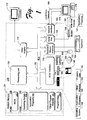
- Fig. 1 is a schematic diagram that constitutes but one example of a computing device that is suitable for use in connection with the described embodiments. It is to be understood that portions of the illustrated computing device can be incorporated in one or more of the computing devices (e.g. palm PCs, wireless telephones, etc.) with which particular embodiments are envisioned for use.
- the computing devices e.g. palm PCs, wireless telephones, etc.
- Computer 130 includes one or more processors or processing units 132, a system memory 134, and a bus 136 that couples various system components including the system memory 134 to processors 132.
- the bus 136 represents one or more of any of several types of bus structures, including a memory bus or memory controller, a peripheral bus, an accelerated graphics port, and a processor or local bus using any of a variety of bus architectures.
- the system memory 134 includes read only memory (ROM) 138 and random access memory (RAM) 140.
- ROM read only memory
- RAM random access memory
- a basic input/output system (BIOS) 142 containing the basic routines that help to transfer information between elements within computer 130, such as during start-up, is stored in ROM 138.
- Computer 130 further includes a hard disk drive 144 for reading from and writing to a hard disk (not shown), a magnetic disk drive 146 for reading from and writing to a removable magnetic disk 148, and an optical disk drive 150 for reading from or writing to a removable optical disk 152 such as a CD ROM or other optical media.
- the hard disk drive 144, magnetic disk drive 146, and optical disk drive 150 are connected to the bus 136 by an SCSI interface 154 or some other appropriate interface.
- the drives and their associated computer-readable media provide nonvolatile storage of computer-readable instructions, data structures, program modules and other data for computer 130.
- a number of program modules may be stored on the hard disk 144, magnetic disk 148, optical disk 152, ROM 138, or RAM 140, including an operating system 158, one or more application programs 160, other program modules 162, and program data 164.
- a user may enter commands and information into computer 130 through input devices such as a keyboard 166 and a pointing device 168.
- Other input devices may include a microphone, joystick, game pad, satellite dish, scanner, or the like.
- These and other input devices are connected to the processing unit 132 through an interface 170 that is coupled to the bus 136.
- a monitor 172 or other type of display device is also connected to the bus 136 via an interface, such as a video adapter 174.
- personal computers typically include other peripheral output devices (not shown) such as speakers and printers.
- Computer 130 commonly operates in a networked environment using logical connections to one or more remote computers, such as a remote computer 176.
- the remote computer 176 may be another personal computer, a server, a router, a network PC, a peer device or other common network node, and typically includes many or all of the elements described above relative to computer 130, although only a memory storage device 178 has been illustrated in Fig. 1 .
- the logical connections depicted in Fig. 1 include a local area network (LAN) 180 and a wide area network (WAN) 182.
- LAN local area network
- WAN wide area network
- computer 130 When used in a LAN networking environment, computer 130 is connected to the local network 180 through a network interface or adapter 184. When used in a WAN networking environment, computer 130 typically includes a modem 186 or other means for establishing communications over the wide area network 182, such as the Internet.
- the modem 186 which may be internal or external, is connected to the bus 136 via a serial port interface 156.
- program modules depicted relative to the personal computer 130, or portions thereof may be stored in the remote memory storage device. It will be appreciated that the network connections shown are exemplary and other means of establishing a communications link between the computers may be used.
- the data processors of computer 130 are programmed by means of instructions stored at different times in the various computer-readable storage media of the computer.
- Programs and operating systems are typically distributed, for example, on floppy disks or CD-ROMs. From there, they are installed or loaded into the secondary memory of a computer. At execution, they are loaded at least partially into the computer's primary electronic memory.
- the invention described herein includes these and other various types of computer-readable storage media when such media contain instructions or programs for implementing the steps described below in conjunction with a microprocessor or other data processor.
- the invention also includes the computer itself when programmed according to the methods and techniques described below.
- programs and other executable program components such as the operating system are illustrated herein as discrete blocks, although it is recognized that such programs and components reside at various times in different storage components of the computer, and are executed by the data processor(s) of the computer.
- a Master World is defined as a politically correct and publicly accepted hierarchical tree structure that catalogs physical location or geographic divisions of the Earth.
- the Master World is defined in such a way that many different classes of political, administrative and geographic entities across the entire Earth are included. Areas of political contention are accounted for by presenting a view of the world based on the language/locale of the computing device.
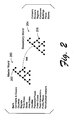
- Fig. 2 shows an exemplary hierarchical tree structure 200 that represents a portion of the Master World.
- the Master World contains multiple nodes 202, with each node representing some type of geographic division (e.g. political or natural entity) of the Earth.
- the nodes of the Master World are arranged in the following groups: (1) political or natural entities (e.g. continents, countries, oceans, states, counties, cities and the like); (2) infrastructure entities (e.g. postal codes, area codes, time zones and the like); (3) public place entities (e.g. parks, malls, airports, stadiums, and the like); and (4) non-physical entities (military postal code regions, vacation regions, affiliate coverage areas of television networks that can be geographically discontinuous, and the like).
- political or natural entities e.g. continents, countries, oceans, states, counties, cities and the like
- infrastructure entities e.g. postal codes, area codes, time zones and the like
- public place entities e.g. parks, malls, airports, stadiums, and the
- the top node of the tree structure represents the Earth.
- Each node underneath the top node represents a geographical division of the Earth.
- none of the nodes have an association with any businesses or services. That is, there is a distinction between node entities that are part of the Master World and non-geographic places where activities take place.
- the Master World includes nodes for public places (i.e. airports, malls, etc), it does not include individual listings of businesses or service providers.
- Each node is uniquely identified by an ID (EID or entity ID).
- EID entity ID
- a URL is associated with the tree structure and provides a context for the tree structure as will become apparent below.
- Seattle-Tacoma International Airport (SeaTac) will be included in the Master World, but references to individual airline business locations at SeaTac might be "leaves" on the tree that are tagged by the SeaTac Airport EID (see “Secondary World” section and the Table below).
- the Seattle Center might be a node on the Master World, while the Seattle Arts Festival, Bumpershoot, the Seattle Sonics NBA Team, and the Seattle Center Starbucks Coffee Shop might be tagged with the Seattle Center EID.
- the Master World also contains nodes for all Interstate (motorway) exits.
- the I-90, Exit 109, Washington is a node in the Master World. The Best Western Inn located at 1700 Canyon Road in Ellensburg, Washington might be tagged with the EID of this Exit.
- the Master World provides a uniform way of defining locations.
- the uniform location definitions can then be universally used to assign attributes to goods or services.
- a computing device determines its location to correspond to a particular uniform location definition, it can take advantage of the location-dependent goods or services that share the uniform location definition.
- the Master World is useful because it is a standardized view of the world. Its accurate standardized geographic dimension attribution can be easily accessed by both providers and consumers. Services and product providers (or third parties such as search engines, network and yellow-page database directories) can use the nodes of the Master World by assigning a standardized persistent geographic reference to all commerce locations or points of interest. These commerce locations or points of interest can be considered as "leaves" on the tree structure.
- the nodes of the Master World have one or more attributes that facilitate its use. Exemplary attributes are described in the table immediately below: Attribute Description Entity ID (EID)
- EID Attribute Description Entity ID
- NGT neutral ground truth
- GEC Geographical Entity Class
- the GEC is a geographical classification of each node. An exemplary GEC is discussed below in the "Geozone" section. Latitude The horizontal coordinate position on the globe (i.e.
- Entity ID 24948 Name Pacific Ocean, Pazifischer Ozean, Oceano Pacifico, etc.
- GEC Geographical Entity Class
- EID Active Entity ID
- EID Active Entity ID
- GEC 78/non-capital town Latitude 47.6768303 (+047° 40' 36
- Longitude -122.1099625 Relative Importance 107 Contextual Parent(s) 1. King, second level [Washington, United States] 2.
- Puget Sound-Seattle, travel region [Washington, United States]
- the Master World also serves as a repository of common denominator links between itself and various "Secondary Worlds" and as a conduit that connects Secondary Worlds to other Secondary Worlds.
- Content, service and device providers can use the Master World to associate their publicly available offerings with a geographic location and the corresponding multiple branch hierarchical structure. This location will be associated with a single entity within the tree structure thereby allowing geographic and time/distance calculations and the necessary parent/child relationship navigation.
- the Master World provides a hierarchical structure of entities (nodes) that cover the entire globe. Upward navigation within the hierarchy is quite natural. Efficient navigation downward requires geographic proximity awareness. Additionally, there are possible scenarios that will require jumping from branch to branch in order to successfully return values in a query, or for more accurate calculations of distances to close "leaves" attached to nodes other than the original source node.
- the Master World makes use of an index scheme that can identify peer level nodes by virtue of the geographical proximity. This indexing scheme makes use of a quad tree algorithm to define so-called "geozones.”
- a quadtree is essentially a spatial index that breaks coverage into homogeneous cells of regularly decreasing size. Each quadrant of the tree has up to four children. The quadtree segmentation process can continue until the entire map is partitioned based on many different end result criteria including the density of the number of items (e.g. points of interest) in each quad.
- the approach provides a form of spatial index that accelerates spatial selection and content identification.
- a quadtree algorithm is applied to the nodes and can be based upon a desired density of, for example, points of interest that are to occur in any one zone. Once all of the zones have been defined, each zone is given a unique ID (e.g. top/left and bottom/right Latitude and Longitude pairs). Each of the nodes of the Master World is then assigned a zone in which it is located. Quadtree algorithms are known and will be appreciated by those of skill in the art.
- having a uniform standardized representation of the world in the form of a hierarchical traversable tree structure can greatly facilitate the manner to which context-dependent, and more specifically, location-dependent goods and services can be linked.
- a computing device has access to at least a portion of the Master World.
- the computing device can have the Master World saved in an internal storage device, it can comprise part of the computing device's operating system, or the device might access the Master World via a network medium such as the Internet.
- each device With the Master World tree structure being accessible to each computing device, each device has the power to determine its own context or node-referenced location. That is, the computing device can determine, through software it is executing, its particular location, i.e. node. Once the computing device determines an associated node, it can simply traverse the tree to ascertain its complete location.
- a computing device determines that it is currently located at a node that corresponds to the City of Redmond, it can traverse the Master World tree structure to ascertain that it is in the State of Washington, Country of The United States, on the continent of North America. By ascertaining its precise location, the computing device (or its user) is now in a position to take advantage of location-dependent services that might be offered.
- This particular model is a tremendous improvement over current models that utilize a central server to ascertain location for a number of different devices. In that model, each device (or user) provides information about its location (e.g. perhaps the user enters the zip code or city that the device is currently in) and might enter a query to find, for example, a McDonald's restaurant in his zip code.
- the server then takes this information and might, for example, tell the user about the location of all of the McDonald's restaurants within that zip code or city. If the servers fails in this model, then none of the computing devices can take advantage of its services. In the present model, each computing device is self-sustaining. Each can determine its own location, and accordingly, each device can take advantage of location-dependent services. For example, if the computing device understands that it is located on a particular node of the Master World, then it can execute queries to find a McDonald's that has an EID that corresponds to the particular node in which the computing device is located. Particular robustness is provided through the use of the above-described geo-zones. The geo-zones enable proximate geographic divisions to be quickly searched in an efficient manner. For example, if an individual is looking for the nearest Kinko's to make copies and none are located in the geo-zone that corresponds to the node in which the computing device is located, then adjacent geo-zones can be quickly searched.
- a secondary world might be defined by a third party organization or company and contains nodes that comprise physical and/or logical entities that are unique to that organization.
- the nodes of the Secondary World may or may not have much context outside of the particular organization that defined the Secondary World, since a secondary world could be made either public or private.
- the Secondary Worlds do not duplicate the Master World, but rather supplement it in a unique, organization specific manner. While the Master World is defined to be a widely accepted standard, each Secondary World can be a widely variant representation of an organization's proprietary view of the world.
- each Secondary World has at least one node that is linked with a node of the Master World. This gives the Secondary World a context or location in the Master World. Also note that in some context applications, several secondary worlds may be accessed, each providing additional context specific pieces of location data.
- Fig. 2 shows an exemplary Secondary World 204 that comprises a plurality of nodes 206.
- Each of the nodes 206 constitutes a physical or logical entity.
- the nodes can constitute a company, its divisions, regions campuses, buildings, floors in various buildings and rooms on various floors.
- At least one of the nodes is linked with a node of the Master World.
- the nodes of the Secondary World can have the same attributes as the nodes of the Master World.
- a Secondary World that includes a list of entities that are important to its employees.
- the root entity would be "Boeing Corp.” and its children might be company divisions (St. Louis Military Division, Everett Plant, Corporate HQ, etc.).
- individual nodes might be defined to represent individual buildings (Hanger 12), offices within this building (Office 1001), building areas (Southwestern quadrant of hanger 12), etc.
- Each entity or node has a unique identifier (Local Unique ID or "LUID”) and a URL that is associated with the tree on which the node occurs.
- the URL uniquely identifies the Secondary World tree structure so that a user within that world can determine how to interact with the world. This aspect is discussed below in more detail.
- Boeing can then use the LUIDs to associate equipment, services, departments or even personnel to a physical or logical location.
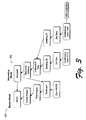
- Fig. 3 shows an exemplary portion of the Master World 300 and a Secondary World 302.
- the exemplary Secondary World 302 is a hierarchical tree structure that has been defined by Microsoft Corporation and includes the following nodes: Microsoft, Redmond Campus, 1 Microsoft Way, Building 26, 3 rd floor, Conference Room 3173, Building 24, 2 nd floor, Conference Room 1342.
- the Secondary World 302 "touch points" into the Master World from the Redmond node.
- a video projector is shown as being associated with the node "Conference room 1342".
- the video projector is not a node in the secondary world.
- the video projector is an item in some other resource discovery service (e.g. the active directory) and includes a location attribute that is a pointer to "Conference room 1342."
- resource discovery service e.g. the active directory
- the location attribute is a pointer to "Conference room 1342.”
- the Secondary World is advantageously accessible to a user's computing device. It could, for example, be downloaded ⁇ completely or partially--and stored on a storage device and accessed when needed. It might be downloaded for a one time use only.
- the Secondary World enables the computing device to ascertain its context within the Secondary World.
- the computing device would, by using the Secondary World, compute its location within the Secondary World. The computing device can do this by traversing the tree structure from the node in which it is currently located to the root node. This would, for example, give the computing device (and hence the user) a complete Secondary World context.
- the Secondary World location Once the Secondary World location is known, the user is in a position to take advantage of goods or services that are associated with the nodes of the Secondary World. That is, once the computing device determines its Secondary World context, it is ready to become an active participant in the Secondary World.
- Tremendous value can be achieved by associating goods or services with the individual nodes of the Secondary World.
- Conference Room 1342 has a video projector associated with it. That is, the location of the video projector is in Conference Room 1342.
- an individual in Conference Room 3173 has a presentation that requires the use of the video projector such as the one located in Conference Room 1342.
- an individual would have no way of ascertaining the location of the video projector other than perhaps physically calling over to the building to check whether there is a video projector available.
- the user's computing device is able to ascertain its location within the Secondary World, it is able to locate the video projector in Conference Room 1342. It would do this by simply executing software that traverses the Secondary World tree structure to find the resource of interest.
- the computing device is able to derive it context (location) within both worlds. This enables the computing device, and hence the user, to take advantage of goods and services that are associated with the Secondary World, as well as participate in location-dependent services that are consumable based upon the user's location in the Master World.
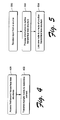
- Fig. 4 is a flow diagram that describes steps in a method in accordance with the described embodiment. The steps described just below are implemented by a computing device which, in the illustrated example, is a hand-held mobile computing device.
- Step 400 accesses first and second hierarchical tree structures that are resident on a computer-readable media.
- the tree structures might be stored on the device or might be accessible via a network such as the Internet.
- An exemplary first tree structure is the Master World and an exemplary second tree structure is a Secondary World. Alternately, the tree structures could both be Secondary Worlds.
- step 402 traverses multiple nodes of the tree structures to derive the context of the computing device.
- the computing device receives information that informs it as to its location at a node of one of the trees. This information can come to the computing device in any suitable way, e.g.
- a user can enter the information through a User Interface (UI) or the location might be broadcast to the computing device by another computing device (e.g. through the use of Bluetooth technology or Universal Plug and Play (UpnP). Specific examples of how this information can be conveyed to the computing device are given below in more detail. Regardless of how this information is conveyed to the computing device, once the computing device has the information, it executes software that traverses one or both of the tree structures to derive its context which, in this example, is the device's location.
- UI User Interface
- UpnP Universal Plug and Play
- one particularly valuable aspect of the described embodiment is that individual organizations can define their own Secondary Worlds. This gives the organization a great deal of flexibility in providing goods and services and, more broadly, increasing the efficiency of their organization.
- a software tool is provided that enables individual organizations to define and maintain their own Secondary Worlds.
- each secondary world can be uniquely identified as a name space (e.g. an XML namespace). This ensures that any overlap in names between the Secondary World and the Master World will not result in a collision.
- the Master World might contain an entity identified as "Chicago” referring the city.
- a Secondary World that is established by the National Basketball Association (NBA) and a different Secondary World that is established by the Caterpillar Corporation might also have entities named "Chicago” that refer to completely different entities than the Master World's "Chicago.”
- NBA National Basketball Association
- Caterpillar's “Chicago” might refer to a sales district.
- Having the namespace separation between the Master and Secondary Worlds can ensure that there not a collision between identically named entities because each name space is uniquely different from every other namespace.
- Fig. 5 is a flow diagram that describes steps in a method of building a context-aware data structure. These steps are implemented by a software tool that is executing on a computing device.
- Step 500 receives input from a source that specifies information that pertains to physical and/or logical entities.
- a system administrator might physically enter information about the structure of the Secondary World that they desire to define. This information can include information about buildings, divisions, conference rooms and the like.
- Step 502 then processes the information to define a hierarchical tree structure that has a context. In this example, the context is location. It will be appreciated, however, that other contexts could be employed.
- Each of the nodes in the hierarchical tree structure represents a separate physical or logical entity.
- Step 504 then links at least one of the nodes of the hierarchical tree structure with another tree structure having a context. In this example, this other tree structure can comprise the Master World. Once the tree structures have been built and linked, they are ready for traversal in a manner that enables context to be derived from one or more of the nodes.
- the computing device is able to determine its own location. In the embodiment about to be described, the computing device determines its location by using location information that is provided to it from a number of different sources of information. The device is able to take the information that is provided to it and process the information to determine a particular node on one or more hierarchical trees. Once the device has done this, it can determine its complete location which is a useful thing to know particularly when there are location-dependent services that can be consumed by the device's user.
- Fig. 6 shows a high level diagram of an exemplary computing device 600 that comprises, among other components, a context service module 602 and one or more context providers 604.
- the context service module 602 can be implemented in any suitable hardware, software, firmware or combination thereof.
- the context service module is implemented in software that is executed by one or more device processors.
- the context service module 602 receives context information from one or more context providers 604 and processes the information to determine a current device context.
- the device context is the device's location.
- the context providers are location providers that provide location information, in various forms, to the context service module 602 for processing.
- the location providers 604 receive information from various sources of context information (location information) 606.
- a context provider comprises a software component that can either be implemented on the device or off the device.
- the context provider can also include any suitable hardware, firmware or combination thereof.
- the role of the context providers are to receive information from sources 606 and convey the information to the context service module 602 so that the context service module can use the information to determine a current device context.
- sources 606 provide various information to the location providers 604 that pertains to the device's current location.
- the sources of the information can include various information transmitters such as a GPS system, cell phone or cell ID, wireless transmitters that transmit location information, location beacons, 802.11 transmitters and various other sources of information.
- the sources of information can also include other computing devices that might, for example, provide location information through Bluetooth technology.
- a source of information 606 might include a person who, for example, physically enters location information into the device 600 so that the device can process the information to determine its location.
- the device 600 When the device 600 receives the location information from the sources 606, it processes the information with the location providers 604 and provides the information to the location service module 602.
- the location service module 602 processes the location information and determines a particular node on one or more of the hierarchical tree structures to which it has access which corresponds to its current location. The location service module 602 can then traverse the tree structures to determine a complete location for the device. Once the complete location is determined, the device 600 can begin to interact with one or more applications 608 that can query the device about its particular location so that one or more locaffon-dependent services can be rendered to the device.
- the applications 608 are illustrated as being separate from the device. It is to be understood, however, that the applications could be executing on the device, e.g. a browser application.
- the applications 608 can make calls to the device to ask the device where it is located.
- the device is configured to receive the calls and respond in an appropriate manner to the application. Once the application has the device's location information, it can then render location specific services to the device.
- SeaTac International Airport has designed its Secondary World to have the following nodes: "Arrivals”, “Departures”, “Concourses”, “Airlines”, “Gates assigned to Airlines”, and "Gate Location”.
- SeaTac International has bank of servers that are executing applications to assist you while you are in the airport. There are applications that can help you find services, locate facilities (e.g.
- the search engine application first determines your current location in the Master World as indicated by the EID of the Master World node that corresponds to your location. Executing a search, the search engine application looks for a Double Tree hotel that has an attribute that includes an EID that matches your EID. If it finds one, it simply indicates for you the result. If it does not find one with the corresponding EID, it can use an adjacent geozone to search for a Double Tree hotel. It may also provide driving directions to the hotel. The search engine application was able to do this because it was able to ascertain your location in the Master World. It did this quickly and automatically with little or no effort from you.
- the Master World provides a mechanism to daisy chain two or more Secondary Worlds together. This is possible because the Secondary Worlds have at least one reference or link into the Master World.
- Fig. 7 shows computing device 600 in somewhat more detail.
- device 600 comprises an architecture that includes the following components: a location service module 602, a location provider interface 700, an application program interface (API)/Events module 702, a privacy manager 704 a location conversion module 706, one or more applications 608 and one or more location providers 606. Also included in the architecture is an active directory 708, Web service 710, location database 712, and personal places 714.
- the architecture can be implemented in any suitable hardware, software, firmware or combination thereof. The architecture mentioned above is advantageous in that it enables each computing device to determine its own context or location.
- One particularly advantageous aspect of the described embodiment is that it employs a common interface 700 that provides a standard interface through which the location providers 606 communicate.
- the location providers are extensible (to support future providers) in that they can be dynamically added or removed from the collection of location providers. All that is required of a particular location provider 606 is that it be written to support the common interface.
- location providers 606 there are several location providers 606. These location providers provide location information in different forms. For example, a GPS location provider might provide location information that is GPS specific. Similarly, an IP/Subnet location provider might provide information that is specific to an Internet Protocol. A mobile phone location provider might provide location information in the form of a cell ID. In addition, a location User Interface (UI) might provide location information in the form of a user entry that specifies a city, street or building. All of the location information that is provided by the various location providers is processed by the location service module 602 so that a current device location can be determined. To determine the current device location, the location service module 602 may have to consult with an active directory 708, a Web service 710, or a location database 712.
- the active directory 708 might, for example, maintain a secondary world and other networking metadata such as subnet and "site" information that can help determine location based on networking connectivity.
- Web service 710 can hold the master or secondary worlds, the attributes of which can be used to find location. For example, if a cell phone knows its cell tower ID, then the location provider can query the secondary world to ascertain the nodes that match that cell tower ID.
- Location database 712 is basically a version of the web service that is hosted or cached locally.
- the architecture contemplates multiple different location providers that can provide location information to the location service module 602. This information can come in many different forms and quality levels.
- the information is then processed by the location service module 602 to determine a current device location. To do this, the service module 602 ascertains from the location information a particular node ID (EID and/or LUID) and a URL that is associated with the tree structure with which the node is associated. Once the location service module ascertains a node ID, it can then query the tree structure (or more accurately a server that manages the tree structure) using the URL to ascertain more information about the tree structure.
- EID and/or LUID a particular node ID
- URL that is associated with the tree structure with which the node is associated.
- the location service module 602 ascertains a LUID from a particular Secondary World, it might then query an active directory 708 (or an Intranet server ⁇ which is another location database) to discover the parents and the children of the node. This would then enable the location service module to build the Secondary World.
- an active directory 708 or an Intranet server ⁇ which is another location database
- the location providers 606 can provide the location information to the location service module 602 in many different ways. For example, some location providers 606 may continuously provide information (e.g. the GPS provider may continuously provide GPS coordinates). Alternately, the location providers can periodically provide location information such as at specific times or on the occurrence of definable events. For example, a user may define specific times when the location information should be updated. Alternately, the location information might be updated only when a device's location changes (i.e. a location change event). Additionally, the location providers might provide location information when polled by the location service module 602. For example, the location service module 602 can call the location provider interface 700 and request location information from one or more of the location providers.
- the location service module 602 can call the location provider interface 700 and request location information from one or more of the location providers.
- One specific location provider 606 is shown as a cache.
- the cache provider essentially maintains a current device context or location. That is, once the location service module 602 has ascertained its current location, it writes this location to a cache. This enables the device 600 to ascertain its location with a degree of confidence in the event all of the other location providers are not able to provide location information (e.g. the GPS provider may not receive GPS information because the GPS transmitter that supplies it with the information is unable to contact a requisite number of satellites).
- One important and useful feature of the described embodiment is that one or more of the location providers are configured to assign confidence parameters and/or accuracy parameters to the information that they provide to the location service module 602.
- Confidence parameters provide a measure of a provider's confidence in the information that it provides to the location service module 602. For example, assume that a GPS transmitter must receive information from five or more satellites in order to provide highly confident information. Assume that only three satellites are available at the time. The GPS transmitter would then transmit its information based only on the three satellites. The GPS provider would then know that the information it receives from the GPS transmitter was based only on three satellites rather than the desired five or more.
- the GPS provider can set a confidence parameter on the location information that indicates that it has a lower confidence level than if the information were based on the desired five or more satellites.
- the location service module 602 can take the confidence parameters for all of the location providers into account when determining the location of the device. This is discussed in more detail below.
- the location information that is received from the location providers is accurate to varying degrees. Some information may be accurate to within one mile, while other information may be accurate to within 100 feet.
- the location providers are desirably configured to assign accuracy parameters to the location information that they provide to the location service module 602.
- the accuracy parameters give the location service module an indication of the accuracy of the information.
- the module can make decisions on how to use the location information it receives from each provider. For example, the location service module 602 might disregard completely any information that has a low confidence parameter. It might, on the other hand, strike a balance between the accuracy of the information and its confidence. For example, the module 602 might be programmed to use information with lower levels of accuracy only when there is a high level of confidence in the information. The module 602 might utilize the parameters to assign weights to the information so that the location is calculated as a weighted function of the confidence and accuracy of the information.
- the location service module has determined a device location and has written that location to a cache. At the time when the location is written to a cache, it is assigned perhaps a high confidence level. Assume further that all of the other location providers are unavailable to provide location information. For a period of time, the location service module 602 can use the cache location as a current location and be fairly confident that its information is generally accurate. In this case, the location service module might assign a linearly decreasing confidence level to the information over time so that at some point, it ceases to use the information or informs the user that the information cannot be guaranteed.
- the information can include, in addition to the confidence and accuracy parameters, the actual location information in a known format, a trust parameter and a timestamp.
- the trust parameter is a metric that is assigned by the location service module 602 to one or more of the location providers and defines the trust that the location service module has for the particular location provider.
- the timestamp is a metric that defines the time when the location information was provided by the location provider. This assists the location service module 602 in ascertaining whether information is stale and might need refreshed.
- the location service module 602 can then set about determining the location of the device.
- Fig. 8 is a flow diagram that describes steps in a method of determining a device context which, in this example, is the device location. These steps are implemented by the location service module 602.
- Step 800 gets the current device context.
- the current context can be the last calculated device context that is stored in the cache.
- Step 802 determines whether any of a number of context providers are available to provide context information. The location service module might do this by polling the context providers to ascertain which of the providers are active and valid.
- Step 804 determines whether all of the providers are inactive. If all of the providers are inactive, step 806 decreases the confidence in the current context over time and uses the current context as the device context. Step 802 then continues to monitor for current active and valid providers. If step 804 determines that one or more of the context providers are active, then step 808 orders the active and valid context providers.
- Step 810 checks to ascertain whether the context information appears to be correct. For example, where the context is the location of the device, the location service module 602 might know that five seconds ago the current location was Redmond, Washington. Accordingly, location information that indicates that the current location is Beijing, China would be incorrect.
- Step 812 determines whether any of the context information conflicts with either the device's current context or the context information from other providers. For example, the location service module 602 can compare the context information from each of the context providers with the information in the cache.
- step 814 can select the context providers having a predefined level of trust and perhaps use just their information (Step 816). If there are no conflicts, then step 816 determines the current context based upon the information that is provided by all of the context providers. In the described embodiment, this step is implemented by using the information to map to a particular node in one or more of the hierarchical tree structures mentioned above. For example, the location of the device can be ascertained by mapping the information to a particular node, and then completely traversing the tree structure until the root node is reached. Step 818 then updates the current context by perhaps writing it to the cache and returns to step 802 to determine the active and valid context providers.
- the method described above provides a way for the location service module to receive location information and use only the location information that appears mostly likely to represent a current location. Conflicting information can be discounted or disregarded thereby assuring that only the most trusted, accurate and confident information is utilized to determine the device's current location.
- one or more of the location providers are advantageously programmed to self monitor their own operation for various irregularities that can occur.
- the location providers are configured to notify the location service module 602.
- the source from which the location provider receives its information may go off line for a period of time so that the location provider is unable to receive any additional information.
- the location provider might generate a "provider out” message and send it to the location service module 602.
- the location service module 602 receives the "provider out” message, it can then take steps to exclude the location information from that provider from any location calculations that it performs.
- the location provider's source When the location provider's source comes back on line, it can generate a "provider on" message that informs the location service module 602 that it is able to transmit location information to the module.
- the location service module can be notified by the location providers on the occurrence of other operational irregularities, with the above example constituting but one specific case.
- the location service module 602 can receive queries from one or more applications 608.
- the applications include a web site application, an Outlook application, and a service discovery application.
- the web site application can be any web site application that is capable of rendering location-specific services.
- the user of the device 602 might access Amazon.com's web site to buy a favorite book. When the user purchases their book, Amazon.com must now compute the taxes that the user must pay.
- a script executing on Amazon.com's web site might query device 602 to learn of the user's location.
- the device might respond to the query by returning the state in which the user is making the purchase. Amazon.com can then assess the tax automatically.
- Amazon.com might also desire to know where the individual is located so that they can select an optimal shipping method (UPS or Express Mail). Depending on where the individual is located, one method may be preferred over the other.
- the Outlook application might query the location service module to ascertain the location because it (or the operating system, e.g. Windows) may change device settings based on the location of the computing device. For example, the user may print on one particular printer while at work, and another particular printer when at home.
- the Outlook application determines that the user has gone home for the day, it can automatically change the device settings for the printer at the user's home. It might acquire the print settings from a personal places data store 714. Thus, the device is automatically configured for use depending on the user's location.
- the service discovery application might query the device to determine its location so that it can render a particular service depending on where the device is located. For example, if the user asks the application to locate the nearest color printer, the service discovery application might query the location service module to ascertain the device's current location so that it can use this information and find the nearest color printer.
- the Outlook application could configure itself email to a work location (when an individual is at work) or to a home location (when an individual is at home).
- the Outlook calendar can become location aware, e.g. when you change time zones, your appointments would show up in the proper time slots.
- the applications 608 communicate with the location service module 602 through one or more application program interfaces (APIs) and/or events.
- APIs application program interfaces
- the applications can make function calls on the API to query the location service module as to its current location.
- the applications can register for location notifications by using an events registration process. For example, an application may register for a notification when the user changes their location.
- an application requests to be notified when the user arrives at work or at home so that the application can change the device's configuration (such as printer configuration).
- Fig. 9 is a flow diagram that describes steps in a method in accordance with the described embodiment.
- the steps that are described are implemented by device 600.
- Step 900 receives information that pertains to the current context of the device. In this particular example, a portion of the information is received from one or more context providers which, in this case, are location providers.
- Step 902 processes the information on and with the device to ascertain the current context of the device.
- the device maintains (or has access to) one or more of the Master World and one or more Secondary Worlds.
- the device receives all of the location information, it maps the information to a particular node in the hierarchical tree structure that defines the Worlds. It then traverses the tree structures to ascertain the complete context (i.e. location) of the device.
- Step 904 receives calls from one or more applications that request information that pertains to the device's current context or location.
- the applications can call one or more APIs to request the information or the applications can register for event notifications.
- Step 906 then supplies the applications with at least some information that pertains to the current device location.
- a security policy or privacy policy can be applied to the information before it is returned to the applications.
- a privacy manager 704 ( Fig. 7 ) is provided.
- the privacy manager is illustrated as being incorporated on the device, it could be implemented by a trusted entity such as a trusted server that is not part of the mobile computing device.
- the privacy manager can be implemented in any suitable hardware, software, firmware or combination thereof.
- the privacy manager comprises a software module that is incorporated in the mobile computing device.
- the privacy manager 704 addresses privacy concerns that are associated with the information that is collected by the computing device.
- the location service module can calculate detailed information regarding the location of the computing device. It may be desirable, in some instances, to filter the information that is provided to various applications. That is, it is entirely likely that a user may not want their specific location information provided to untrusted applications. In these instances a user might just desire for location service module 602 to inform such applications that the user is in the State of Washington.
- Fig. 10 shows a flow diagram that describes steps in a privacy protection method in accordance with the described embodiment. These steps can be implemented by the privacy manager 704.
- Step 1000 defines a plurality of privacy levels.
- Exemplary privacy levels are set forth in the table immediately below: Privacy Level Approximate Scale Level of Revelation 0 - No location information is returned 10 100,000 Km Planet/Continent 20 1,000 Km Country 30 100 Km State 40 10-100 Km City & County or Region 50 10 Km Postal Code & Phone Area Code 60 1 Km Full Postal Code (Zip + 4) & Area Code and Exchange 70 100 m Phone Number & Building/Floor 80 10m Room # 90 1m Exact Coordinates
- a privacy level of 0 means that no location information is returned.
- a privacy level of 90 means that very detailed location information is returned.
- Step 1002 assigns various privacy levels to the individual nodes in one or more hierarchical tree structures. For example, each node of the Master World and the Secondary Worlds can have a privacy level associated with it.
- the root node of the Master World tree structure might have a privacy level of 10
- the node that represents a current location in a Secondary World might have a privacy level of 90.
- Step 1004 determines the context of the computing device. In the present example, the context is the device location and examples of how this is done are given above.
- Individual applications that call the location service module can have privacy levels associated with them. These privacy levels can be assigned by individual users. For example, a trusted application might have a privacy level of 90, while an untrusted application might have a privacy level of 30.
- Step 1006 receives context queries from one or more applications.
- an application calls the location service module 602 ( Fig. 7 ) to ascertain the location of the device.
- Step 1008 determines the privacy level associated with the application or applications. For example, if a untrusted application calls to request location information, the privacy manager 704 would determine that the application has a privacy level of 30.
- the privacy manager then traverses (step 1010) one or more hierarchical tree structures to find a node with a corresponding privacy level so that it can select the information that is associated with that node. In this example, the traversal might involve jumping from the Secondary World to the Master World to find the node that corresponds to the state in which the user is located.
- step 1012 returns the context information (e.g. location information) associated with the node. In this case, the location service module would inform the application that the user's location is the State of Washington.
- the computing device is able to determine the source (i.e. application) of its queries and modulate the information that is returned to the application as a function of the application's identity.
- the computing device is able to do this because it has access to the Master World and one or more Secondary Worlds.
- the above description constitutes but one exemplary way of accomplishing this feat.
- one of the location providers comprises a location beacon that beacons or transmits information to enable a computing device to actively participate in its current context.
- Location beacons can comprise standalone devices that can be retrofitted onto existing infrastructures, e.g. a smoke detector or wall outlet in order for the device to have a power source.
- Fig. 11 shows an exemplary beacon 1100 that is mounted on a structure 1102.
- Structure 1102 can be any suitable structure such as a wall in a conference room or public place, a smoke detector, an electrical socket and the like.
- the location beacons are small inexpensive devices that can be permanently mounted in special locations such as conference rooms, building lobbies, airport gates, public places and the like.
- the beacons announce the physical location in the form of an EID and/or LUID to all mobile devices that are within range, such as laptops, tablet PCs, hand held computers, mobile phones, wearable computers and the like.
- the location beacon can identify the particular locations by beaconing standard information that will be understood by the mobile computing devices.
- the beacons can transmit one or two location identifier pairs comprising an EID/URL pair and a LUID/URL pair.
- the beacon might also transmit multiple LUIDs.
- the EID and LUID give the present node location in the Master World and Secondary World respectively.
- the URLs provide a reachable location for the Master and Secondary Worlds.
- the URL associated with the Secondary World can give a service location that the device can use to query information about the Secondary World so that it can derive its context and take advantage of resources or services that are associated with the nodes in the Secondary World.
- the beacons can also transmit a digital signature that can be used by the device to ascertain that the beacon is valid and legitimate. Any suitable signature or verification method could be used.
- the beacon can be programmed to transmit code download pointers to devices within range.
- the code download pointers can enable the computing device to access software code that permits them to interact with their environment.
- the beacon also transmits a code download pointer that points to software code that enables you to operate the video projector in the conference room using your hand-held cellular phone.
- the beacon serves as more than just a location beacon ⁇ it permits you, through your computing device, to actively participate in your surroundings.
- the beacons can transmit the information in any suitable way, e.g. wireless methods including infrared and radio frequencies.
- wireless methods including infrared and radio frequencies.
- Bluetooth short range radio frequency communication can be used to provide a low cost, low power alternative.
- cell phones have become a very important communication device. Their prevalence has helped people communicate with one another from seemingly anywhere and at anytime.
- cell phone functionality permits one to check and send e-mail, browse the Web, send/receive short messages (SMS), leave voice messages and, of course, talk.
- SMS send/receive short messages
- Fig. 12 shows an exemplary cell phone 1200 that includes a display area 1202, various buttons 1204 that permit a user to interact with the cell phone, and an antenna 1206 for facilitating communication between the cell phone and the outside world.
- Fig. 13 shows a block diagram of exemplary electronic circuitry of a typical cell phone.
- the circuitry includes control circuitry 1300 that can include one or more microprocessors, storage or memory 1302 (e.g., ROM, RAM etc.), an antenna 1304, transmit/receive circuitry 1306, a speaker 1308, a microphone 1310, and a ringer/vibrator 1312.
- the control circuitry 1300 controls transmission and reception of call and voice signals.
- control circuitry 1300 provides a voice signal from microphone 1310 to the transmit/receive circuitry 1306.
- the transmit/receive circuitry 1306 transmits the voice signal to a remote station (e.g., a fixed station, operator, other cellular phones, etc.) for communication through the antenna 1304.
- a remote station e.g., a fixed station, operator, other cellular phones, etc.
- the ringer/vibrator 1312 is coupled to the control circuitry 1300, and is used to signal an incoming call to the user.
- the ringer/vibrator 1312 can emit a ringing or buzzing sound and/or tactile vibrations to indicate an incoming call.
- the transmit/receive circuitry 1306 receives a voice signal from a remote station (e.g., a fixed station, operator, other cellular phones, etc.) through the antenna 1304.
- the control circuitry 1300 then provides the received voice signal from the transmit/receive circuitry 1306 to the speaker 1308, which provides audible signals for the user's hearing.
- cell phone 1200 ( Fig. 12 ) is a context/location-aware cell phone that is embodied with the capabilities described above. These capabilities permit the cell phone to ascertain its current context or location, and then adapt its behavior to the current context or location.
- the movie theater can put a location beacon in place that advertises itself as a specific location or location class.
- the cell phone being aware of its location by virtue of the location beacon, can automatically turn its ringer off or reconfigure to vibrate mode.
- a user has their cell phone at home and has indicated a preference to have their cell calls forwarded to their home telephone because that phone has much better reception.
- the cell phone detects, through the inventive location service described above, that it is now located at home. Accordingly, whenever it receives a telephone call, it automatically forwards the call to the user's home telephone.
- Fig. 14 shows an exemplary cell phone architecture 1400 that can be used to implement the context/location aware cell phone described above and below. It is to be understood and appreciated that the described architecture constitutes but one exemplary architecture that is capable of implementing a context/location aware cell phone. Accordingly, other architectures can be used without departing from the spirit and scope of the claimed subject matter.
- Architecture 1400 includes a number of components that are similar to or the same as components that are discussed above. Accordingly, these components are not discussed in much detail here. These components include location service module 1406 (which can also be considered as a context service module), location provider interface 1410, location providers 1412, privacy manager 1408.
- location service module 1406 which can also be considered as a context service module
- location provider interface 1410 location providers 1412
- privacy manager 1408 privacy manager
- a cell phone settings engine 1404 is provided and is communicatively linked to location service module 1406 and application program interface/cell phone setting module 1402.
- the cell phones setting engine 1404 is responsible for receiving context or location information from the location service module 1406 and responsive thereto, adjusting or otherwise manipulating a cell phone's settings so that the cell phone behaves in a manner that is consistent with acceptable behaviors for a given location. That is, cell phones exhibit behaviors that in some locations might be appropriate and in others would not be.
- These behaviors include, without limitation, such things as (1) being on or off, (2) having a ringer turned on or off, (3) being in vibration mode as opposed to having a ringer turned on, (4) having low, medium and high pitch volumes, (5) forwarding calls to certain phone numbers, (6) functioning in a pager mode in which voice information is converted into text information, and the like.
- cell phone settings and associated location information can be stored on the cell phone itself.
- the cell phone is configured to receive cell phone setting information via application program interface/cell phone settings module 1402.
- a number of different settings enforcement entities 1418 can be provided that are responsible for transmitting cell phone settings information to cell phones that are in their vicinity.
- such entities can include, without limitation, Blue Tooth entities, location beacons (as described above), diffused IR entities and the like. These entities transmit cell phone settings information that is received by the cell phone via interface 1402. This information is passed to the cell phone setting engine 1404 which then ensures that the cell phones is set to the proper setting.
- Location-based settings can come from any suitable source.
- the settings can come from the settings enforcement entities mentioned above.
- the location-based settings can be stored on the cell phone. Examples of this are given below.
- the well-defined locations 1416 can come from any suitable source either on or off the device.
- Fig. 15 is a flow diagram that describes steps in a method in accordance with the described embodiment.
- the method can be implemented in any suitable hardware, software, firmware, or combination thereof.
- the method is implemented in software that is executing on a cell phone.
- One exemplary software architecture that is capable of implementing this method is described above in connection with Fig. 14 .
- Other architectures can, of course, be used.
- Step 1500 receives context information that pertains to the current context of a cell phone. Any suitable methods, techniques, or cell phone components can be used to receive this information.
- the context information can come from any type and/or number of context providers.
- the context information can comprise any suitable type of context information. For example, location and user constitute two examples of specific context.
- the cell phone processes this information and step 1502 modifies the behavior of the cell phone responsive to the context information.
- Fig. 16 shows an exemplary system 1600 in which a context-aware cell phone is employed.
- the cell phone determines its location and then modifies its behavior in accordance with behaviors that are acceptable for that location.
- the cell phone can simply receive information that is then used to adjust the cell phone's settings.
- the different locations include a theater 1602, restaurant 1604, work 1606, home 1608, and a sports arena 1610.
- location beacons (not specifically designated) that can provide not only location information, but other information such as, but not limited to, cell phone settings.
- location beacons for each illustrated cell phone, there are a number of associated behaviors that can be modified given a particular location.
- the cell phone exhibits a different behavior or set of behaviors that are appropriate for that location.
- the cell phone ringer is OFF so that other movie patrons are not disturbed.
- the ringer is ON but the volume is low so as not to disturb fellow diners.
- the cell phone is OFF but is in a mode to forward calls to a work number.
- the cell phone ringer is ON, but it is in a mode to forward calls to the home number.
- the ringer is ON and its volume is VERY HIGH.
- the phone is in vibration mode. This ensures that the user is most likely to receive their calls in the noisy arena.
- the association of location and behaviors is simplified through the use of multiple class types and various attributes that are associated with the class types.
- the class types define certain high level locations types. Each class type's attributes define the behavior of the cell phone when it is in the vicinity of an instance of that class. As an example consider theater 1602 which is an instance of a class type 1. The attributes associated with a class type 1 are that the cell phone ringer is OFF. No other attributes are associated with this class type.
- Restaurant 1604 is an instance of a class type 2. The attributes associated with this class type are that the cell phone ringer is ON and the volume is LOW.
- Work 1606 is an instance of a class type 3. Attributes associated with this class type are that the ringer is OFF and calls are automatically forwarded to an office phone.
- Home 1608 is an instance of a class type 4 whose attributes are that the ringer is ON and calls are automatically forwarded to a home telephone number.
- Sports arena 1610 is an instance of a class type 5 whose attributes include that the ringer is ON, the volume is VERY HIGH, and vibration mode is ON.
- Fig. 17 is a flow diagram that describes steps in a method in accordance with the described embodiment.
- the method can be implemented in any suitable hardware, software, firmware, or combination thereof.
- the method is implemented in software.
- the flow chart comprises two separate but related portions.
- the portion on the left designated “Location Service” comprises steps that can be implemented by a location service that is not onboard a cell phone.
- the flow chart portion on the right designated “Cell Phone” comprises steps that can be implemented by a context- or location-aware cell phone.
- Step 1700 defines one or more class types and step 1702 associates attributes with the class types.
- the class types are intended to describe certain types of locations where, for example, certain cell phone behaviors are desired.
- the attributes that are associated with the class types define the cell phone behavior that is desired for that class type. Various examples of this are given in Fig. 16 . For example, for a class type 1, attributes are that the ringer is turned off, and so on.
- Step 1704 associates class types with multiple different locations. Each location is associated with a class type. Accordingly, at these locations, cell phone behavior of location-aware cell phones can be governed by the attributes that are associated with that class type. This provides a simple infrastructure for implementing context-aware phones.
- Step 1706 provides information to one or more cell phones regarding a particular class type for a given location.
- This information can be provided in any suitable manner and is typically provided when the cell phone enters the vicinity of the location.
- Fig. 14 described three settings enforcement entities in the form of Blue Tooth, location beacon, and diffused IR entities. These entities can wirelessly transmit the class type information to cell phones that are in their vicinity.
- Step 1708 provides information to one or more cell phones regarding attributes associated with the particular class type. This step informs the cell phones of the desired settings for that particular location.
- Step 1710 receives information regarding a particular class type associated with a current cell phone location and step 1712 receives information regarding one or more attributes associated with that class type.
- the cell phone can maintain in its storage the various settings that are associated with the class types (i.e. such as in a location-based settings store 1414 ( Fig. 14 )).
- the cell phone can simply process the attribute information and adjust its settings accordingly.
- Step 1714 modifies the behavior of the cell phone based on the attributes that it receives. Accordingly, the cell phone's behavior is modified in accordance with behaviors that are determined to be appropriate for the cell phone's location.
- Step 1716 determines if the cell phone has left the current location. This step can be implemented in any suitable way. For example, there may be a separate location beacon near location exits that inform the cell phones that they are leaving the premises. Alternately, the strength of a beacon signal that signals the location may grow weak to a predetermined threshold so that the cell phone knows that it is no longer at the previous location. If step 1716 determines that the cell phone has left its current location, step 1718 reverts the cell phone to its default or previous settings. If, on the other hand, step 1716 determines that the cell phone has not left its current location, the current settings are maintained (step 1720).
- context-aware or location-aware cell phones are provided. These phones can determine their particular context or location and then automatically configure themselves as by adjusting their settings. Doing so ensures that a cell phone's behavior is consistent with behaviors that have been determined to be appropriate for a given location.
- the embodiments described above provide a uniform, standardized way to enhance the world of context aware computing.
- the embodiments provide a way for individuals to uniquely experience the world around them by ascertaining their location in the world in a standard way.
- the embodiments also provide a way for service providers to uniquely position their goods and services in a manner that is sensitive to and appreciates the contexts, e.g. locations, of various consumers of the goods and services.
- Unique and useful architectures and data structures are employed to facilitate the user's computing experience and provide for an individual-centric experience.
Landscapes
- Engineering & Computer Science (AREA)
- Computer Networks & Wireless Communication (AREA)
- Signal Processing (AREA)
- Computer Security & Cryptography (AREA)
- Human Computer Interaction (AREA)
- Environmental & Geological Engineering (AREA)
- Mobile Radio Communication Systems (AREA)
- Information Transfer Between Computers (AREA)
Applications Claiming Priority (2)
| Application Number | Priority Date | Filing Date | Title |
|---|---|---|---|
| US09/746,918 US7076255B2 (en) | 2000-04-05 | 2000-12-22 | Context-aware and location-aware cellular phones and methods |
| US746918 | 2000-12-22 |
Publications (2)
| Publication Number | Publication Date |
|---|---|
| EP1217792A1 EP1217792A1 (en) | 2002-06-26 |
| EP1217792B1 true EP1217792B1 (en) | 2008-10-15 |
Family
ID=25002905
Family Applications (1)
| Application Number | Title | Priority Date | Filing Date |
|---|---|---|---|
| EP01130110A Expired - Lifetime EP1217792B1 (en) | 2000-12-22 | 2001-12-18 | Context-aware and location-aware cellular phones and methods |
Country Status (4)
| Country | Link |
|---|---|
| US (2) | US7076255B2 (enExample) |
| EP (1) | EP1217792B1 (enExample) |
| JP (1) | JP4138308B2 (enExample) |
| DE (1) | DE60136152D1 (enExample) |
Cited By (17)
| Publication number | Priority date | Publication date | Assignee | Title |
|---|---|---|---|---|
| US7555287B1 (en) | 2001-11-01 | 2009-06-30 | Nokia Corporation | Customized messaging between wireless access point and services |
| US7589726B2 (en) | 2002-03-21 | 2009-09-15 | Nokia Corporation | Service/device indication with graphical interface |
| US8581721B2 (en) | 2007-03-08 | 2013-11-12 | Cfph, Llc | Game access device with privileges |
| US8616967B2 (en) | 2004-02-25 | 2013-12-31 | Cfph, Llc | System and method for convenience gaming |
| US8645709B2 (en) | 2006-11-14 | 2014-02-04 | Cfph, Llc | Biometric access data encryption |
| US8690679B2 (en) | 2005-08-09 | 2014-04-08 | Cfph, Llc | System and method for providing wireless gaming as a service application |
| US8695876B2 (en) | 2006-05-05 | 2014-04-15 | Cfph, Llc | Systems and methods for providing access to wireless gaming devices |
| US8708805B2 (en) | 2005-07-08 | 2014-04-29 | Cfph, Llc | Gaming system with identity verification |
| US8784197B2 (en) | 2006-11-15 | 2014-07-22 | Cfph, Llc | Biometric access sensitivity |
| US8840018B2 (en) | 2006-05-05 | 2014-09-23 | Cfph, Llc | Device with time varying signal |
| US8956231B2 (en) | 2010-08-13 | 2015-02-17 | Cfph, Llc | Multi-process communication regarding gaming information |
| US8974302B2 (en) | 2010-08-13 | 2015-03-10 | Cfph, Llc | Multi-process communication regarding gaming information |
| US9071939B2 (en) | 2010-09-23 | 2015-06-30 | Nokia Technologies Oy | Methods and apparatuses for context determination |
| US9183693B2 (en) | 2007-03-08 | 2015-11-10 | Cfph, Llc | Game access device |
| US9280648B2 (en) | 2006-11-14 | 2016-03-08 | Cfph, Llc | Conditional biometric access in a gaming environment |
| US9430901B2 (en) | 2004-02-25 | 2016-08-30 | Interactive Games Llc | System and method for wireless gaming with location determination |
| EP3462758B1 (en) * | 2003-02-14 | 2022-09-28 | Qualcomm Incorporated | Enhanced user privacy for mobile station location services |
Families Citing this family (346)
| Publication number | Priority date | Publication date | Assignee | Title |
|---|---|---|---|---|
| JPH07112U (ja) * | 1991-10-14 | 1995-01-06 | 株式会社ザノン | 時計バンドの留め金具 |
| US7853254B2 (en) * | 1993-08-31 | 2010-12-14 | Broadcom Corp. | Modular, portable data processing terminal for use in a radio frequency communication network |
| US7712053B2 (en) * | 1998-12-04 | 2010-05-04 | Tegic Communications, Inc. | Explicit character filtering of ambiguous text entry |
| US7679534B2 (en) * | 1998-12-04 | 2010-03-16 | Tegic Communications, Inc. | Contextual prediction of user words and user actions |
| US8938688B2 (en) * | 1998-12-04 | 2015-01-20 | Nuance Communications, Inc. | Contextual prediction of user words and user actions |
| US7881936B2 (en) | 1998-12-04 | 2011-02-01 | Tegic Communications, Inc. | Multimodal disambiguation of speech recognition |
| US20100122164A1 (en) * | 1999-12-03 | 2010-05-13 | Tegic Communications, Inc. | Contextual prediction of user words and user actions |
| US7076255B2 (en) | 2000-04-05 | 2006-07-11 | Microsoft Corporation | Context-aware and location-aware cellular phones and methods |
| US7096029B1 (en) | 2000-04-05 | 2006-08-22 | Microsoft Corporation | Context aware computing devices having a common interface and related methods |
| US7213048B1 (en) * | 2000-04-05 | 2007-05-01 | Microsoft Corporation | Context aware computing devices and methods |
| US7743074B1 (en) * | 2000-04-05 | 2010-06-22 | Microsoft Corporation | Context aware systems and methods utilizing hierarchical tree structures |
| US7421486B1 (en) | 2000-04-05 | 2008-09-02 | Microsoft Corporation | Context translation methods and systems |
| JP2001296985A (ja) * | 2000-04-17 | 2001-10-26 | Fuji Xerox Co Ltd | 情報出力システム |
| US8060389B2 (en) | 2000-06-07 | 2011-11-15 | Apple Inc. | System and method for anonymous location based services |
| US6456234B1 (en) | 2000-06-07 | 2002-09-24 | William J. Johnson | System and method for proactive content delivery by situation location |
| US8073565B2 (en) | 2000-06-07 | 2011-12-06 | Apple Inc. | System and method for alerting a first mobile data processing system nearby a second mobile data processing system |
| NO323907B1 (no) * | 2000-07-07 | 2007-07-16 | Ericsson Telefon Ab L M | Personlig mobilt Internett |
| GB0017460D0 (en) * | 2000-07-18 | 2000-08-30 | Hewlett Packard Co | Message passing to a known location |
| US6690940B1 (en) | 2000-09-22 | 2004-02-10 | James W. Brown | System for selective prevention of non-emergency use of an electronic device |
| CN1322773C (zh) * | 2000-10-09 | 2007-06-20 | 诺基亚公司 | 通信网络连接建立方法、系统和信道授权请求及执行方法 |
| US11204729B2 (en) | 2000-11-01 | 2021-12-21 | Flexiworld Technologies, Inc. | Internet based digital content services for pervasively providing protected digital content to smart devices based on having subscribed to the digital content service |
| US10915296B2 (en) | 2000-11-01 | 2021-02-09 | Flexiworld Technologies, Inc. | Information apparatus that includes a touch sensitive screen interface for managing or replying to e-mails |
| US20020059415A1 (en) | 2000-11-01 | 2002-05-16 | Chang William Ho | Manager for device-to-device pervasive digital output |
| US10860290B2 (en) | 2000-11-01 | 2020-12-08 | Flexiworld Technologies, Inc. | Mobile information apparatuses that include a digital camera, a touch sensitive screen interface, support for voice activated commands, and a wireless communication chip or chipset supporting IEEE 802.11 |
| US20020062398A1 (en) | 2000-11-20 | 2002-05-23 | William Ho Chang | Controller for mobile and pervasive output |
| US7072956B2 (en) * | 2000-12-22 | 2006-07-04 | Microsoft Corporation | Methods and systems for context-aware policy determination and enforcement |
| US7493565B2 (en) * | 2000-12-22 | 2009-02-17 | Microsoft Corporation | Environment-interactive context-aware devices and methods |
| US6944679B2 (en) * | 2000-12-22 | 2005-09-13 | Microsoft Corp. | Context-aware systems and methods, location-aware systems and methods, context-aware vehicles and methods of operating the same, and location-aware vehicles and methods of operating the same |
| US7058358B2 (en) * | 2001-01-16 | 2006-06-06 | Agere Systems Inc. | Enhanced wireless network security using GPS |
| US6885860B2 (en) * | 2001-01-19 | 2005-04-26 | Microsoft Corporation | Information management and processing in a wireless network |
| US20020097408A1 (en) | 2001-01-19 | 2002-07-25 | Chang William Ho | Output device for universal data output |
| US7027820B2 (en) * | 2001-01-31 | 2006-04-11 | Hewlett-Packard Development Company, L.P. | Location data validation by static entities receiving location data items by short-range communication |
| US8738024B1 (en) | 2008-03-29 | 2014-05-27 | Nexrf, Corp. | Delivering content within a boundary with beacons |
| US9373116B1 (en) | 2001-07-05 | 2016-06-21 | NexRf Corporation | Player tracking using a wireless device for a casino property |
| US9507494B1 (en) | 2006-11-30 | 2016-11-29 | Nexrf, Corp. | Merchant controlled platform system and method |
| US20020142844A1 (en) | 2001-02-06 | 2002-10-03 | Kerr Michael A. | Biometric broadband gaming system and method |
| US9615347B1 (en) | 2006-11-30 | 2017-04-04 | NEXRF Corp. | Location positioning engine system and method |
| US9396487B1 (en) | 2006-11-30 | 2016-07-19 | NexRf Corporation | System and method for weighting content items |
| US10430492B1 (en) | 2006-11-30 | 2019-10-01 | Nexrf, Corp. | System and method for handset positioning with dynamically updated RF fingerprinting |
| US8942995B1 (en) | 2001-02-06 | 2015-01-27 | Nexrf, Corp. | Mobile autonomous dynamic graphical user interface |
| US9408032B1 (en) | 2006-11-30 | 2016-08-02 | NexRf Corporation | Content delivery system, device and method |
| US7340389B2 (en) * | 2001-02-16 | 2008-03-04 | Microsoft Corporation | Multilanguage UI with localized resources |
| GB0108041D0 (en) * | 2001-03-30 | 2001-05-23 | Nokia Networks Oy | Presence service in IP multimedia |
| US7149529B2 (en) * | 2001-05-07 | 2006-12-12 | Hewlett-Packard Development Company, L.P. | Method and system for controlling selective wireless communication access |
| US7340438B2 (en) * | 2001-05-21 | 2008-03-04 | Nokia Corporation | Method and apparatus for managing and enforcing user privacy |
| US9773020B2 (en) | 2001-07-05 | 2017-09-26 | NEXRF Corp. | System and method for map based exploration |
| US9349128B1 (en) | 2006-11-30 | 2016-05-24 | Nevrf Corporation | Targeted content delivery |
| US20030054866A1 (en) * | 2001-09-20 | 2003-03-20 | Byers Charles Calvin | Method for automatically selecting the alert type for a mobile electronic device |
| US7127271B1 (en) | 2001-10-18 | 2006-10-24 | Iwao Fujisaki | Communication device |
| US20030108003A1 (en) * | 2001-10-18 | 2003-06-12 | International Business Machines Corporation | Universal personal electronic device power-off or other operating mode change enforcement |
| US7107081B1 (en) | 2001-10-18 | 2006-09-12 | Iwao Fujisaki | Communication device |
| US7466992B1 (en) | 2001-10-18 | 2008-12-16 | Iwao Fujisaki | Communication device |
| US7151764B1 (en) | 2001-11-01 | 2006-12-19 | Nokia Corporation | Service notification on a low bluetooth layer |
| US8000724B1 (en) * | 2001-11-14 | 2011-08-16 | Sprint Spectrum L.P. | Method and system for subnet-based transmission of mobile station location |
| JP3851554B2 (ja) * | 2001-12-11 | 2006-11-29 | 株式会社日立製作所 | 携帯電話装置を制御する制御方法 |
| EP1328108A1 (de) * | 2002-01-14 | 2003-07-16 | Alcatel | Verfahren, Endgerät, Server und Programmmodule zur Nutzung von Diensten an einem Endgerät |
| US7308356B2 (en) * | 2002-01-30 | 2007-12-11 | Comverse, Inc. | Wireless personalized self-service network |
| US7340214B1 (en) | 2002-02-13 | 2008-03-04 | Nokia Corporation | Short-range wireless system and method for multimedia tags |
| FI112999B (fi) * | 2002-03-04 | 2004-02-13 | Nokia Corp | Menetelmä kannettavan elektronisen laitteen kontekstin määrittämiseen ja kannettava elektroninen laite |
| US7551930B2 (en) * | 2002-05-06 | 2009-06-23 | Nokia Corporation | Location-based services for mobile stations using short range wireless technology |
| CN1625887A (zh) * | 2002-05-08 | 2005-06-08 | 诺基亚有限公司 | 一种远程改变通信设备的操作特性的方法 |
| US7103313B2 (en) | 2002-06-05 | 2006-09-05 | Nokia Corporation | Automatic determination of access point content and services for short-range wireless terminals |
| US8583440B2 (en) | 2002-06-20 | 2013-11-12 | Tegic Communications, Inc. | Apparatus and method for providing visual indication of character ambiguity during text entry |
| US7221939B2 (en) * | 2002-08-16 | 2007-05-22 | Nokia Corporation | System, method, and apparatus for automatically selecting mobile device profiles |
| CN1295917C (zh) * | 2002-08-23 | 2007-01-17 | 国际商业机器公司 | 可以感知用户周围环境的消息传递系统和方法 |
| US7215978B2 (en) * | 2002-10-09 | 2007-05-08 | Nec Corporation | Mobile terminal apparatus, mobile terminal settings changing system, method used therefor, and program thereof |
| US7170881B2 (en) * | 2002-10-29 | 2007-01-30 | Nokia Corporation | Method and apparatus providing user programmable, personalized location-aware services |
| US7126639B2 (en) * | 2002-10-29 | 2006-10-24 | Hewlett-Packard Development Company, L.P. | Digital camera printing user interface responsive to location |
| US20040120506A1 (en) * | 2002-12-20 | 2004-06-24 | Boyd David W. | Method and apparatus for inconspicuous audio notification |
| JP4263473B2 (ja) * | 2002-12-26 | 2009-05-13 | Kddi株式会社 | サービス情報提供システム |
| KR100493170B1 (ko) * | 2003-02-06 | 2005-06-02 | 삼성전자주식회사 | 콘텍스트 기반 통신방법 및 이를 위한 콘텍스트 기반이동통신시스템 |
| US8229512B1 (en) | 2003-02-08 | 2012-07-24 | Iwao Fujisaki | Communication device |
| US20040181517A1 (en) * | 2003-03-13 | 2004-09-16 | Younghee Jung | System and method for social interaction |
| US20040192269A1 (en) * | 2003-03-26 | 2004-09-30 | Hill Thomas Casey | System and method for assignment of context classifications to mobile stations |
| CN104486479B (zh) * | 2003-04-03 | 2017-08-25 | 诺基亚技术有限公司 | 用于管理语境相关信息的系统、移动站和方法 |
| US8241128B1 (en) | 2003-04-03 | 2012-08-14 | Iwao Fujisaki | Communication device |
| US20040259536A1 (en) * | 2003-06-20 | 2004-12-23 | Keskar Dhananjay V. | Method, apparatus and system for enabling context aware notification in mobile devices |
| BRPI0411962A8 (pt) | 2003-06-27 | 2017-12-26 | Nokia Corp | Dispositivo de comunicação móvel para a comunicação em uma rede, meio de rede de comunicação, sistema de comunicações, dispositivo eletrônico, método de personalização, estrutura de dados, produto de programa de computador, e, programa de computador |
| GB0413683D0 (en) | 2004-06-18 | 2004-07-21 | Nokia Corp | Customisation of an electronic device |
| US7496355B2 (en) * | 2003-06-27 | 2009-02-24 | Nokia Corporation | Customisation of an electronic device |
| KR100754704B1 (ko) * | 2003-08-29 | 2007-09-03 | 삼성전자주식회사 | 위치에 따라 설정 변경이 가능한 이동통신 단말기 및 방법 |
| EP1513329A1 (de) * | 2003-09-02 | 2005-03-09 | Siemens Aktiengesellschaft | Mobiles Endgerät mit orts- und/oder zeitabhängiger Menüstruktur |
| AU2003267051A1 (en) * | 2003-09-05 | 2005-03-29 | Docomo Communications Laboratories Europe Gmbh | Mobility management in mobile networks based on context information |
| GB2406469B (en) * | 2003-09-25 | 2007-07-11 | Motorola Inc | A module for use with a mobile station and a method of operation |
| US8090402B1 (en) | 2003-09-26 | 2012-01-03 | Iwao Fujisaki | Communication device |
| US7454608B2 (en) | 2003-10-31 | 2008-11-18 | International Business Machines Corporation | Resource configuration in multi-modal distributed computing systems |
| US7187950B2 (en) * | 2003-11-14 | 2007-03-06 | Intel Corporation | Command station for mobile radio networks |
| US20050108558A1 (en) * | 2003-11-19 | 2005-05-19 | Intel Corporation | Method and apparatus for managing localized emergency splash screens |
| US8121635B1 (en) | 2003-11-22 | 2012-02-21 | Iwao Fujisaki | Communication device |
| US20050138571A1 (en) * | 2003-12-18 | 2005-06-23 | Keskar Dhananjay V. | Dynamic detection of device characteristics |
| US20050136903A1 (en) * | 2003-12-18 | 2005-06-23 | Nokia Corporation | Context dependent alert in a portable electronic device |
| US20050136837A1 (en) * | 2003-12-22 | 2005-06-23 | Nurminen Jukka K. | Method and system for detecting and using context in wireless networks |
| US7228141B2 (en) * | 2003-12-23 | 2007-06-05 | Cisco Technology, Inc. | Providing location-specific services to a mobile node |
| US7685134B2 (en) | 2003-12-31 | 2010-03-23 | Nokia Corporation | Media file sharing, correlation of metadata related to shared media files and assembling shared media file collections |
| JP2007522719A (ja) * | 2004-01-21 | 2007-08-09 | コーニンクレッカ フィリップス エレクトロニクス エヌ ヴィ | Rf通信システムおよび方法 |
| US8092303B2 (en) | 2004-02-25 | 2012-01-10 | Cfph, Llc | System and method for convenience gaming |
| US7496352B2 (en) * | 2004-03-02 | 2009-02-24 | International Business Machines Corporation | Environmentally driven phone behavior |
| US8041348B1 (en) | 2004-03-23 | 2011-10-18 | Iwao Fujisaki | Communication device |
| US7797001B2 (en) * | 2004-04-01 | 2010-09-14 | Avaya Inc. | Location-based command execution for mobile telecommunications terminals |
| US20050245273A1 (en) * | 2004-04-30 | 2005-11-03 | Samsung Electronics Co., Ltd. | Method and system for managing provider service availability in a wireless network |
| CN1771670B (zh) * | 2004-05-21 | 2011-08-31 | 松下电器产业株式会社 | 无线通信终端、通信协议切换方法、通信协议切换程序以及无线通信终端的集成电路 |
| US8095364B2 (en) * | 2004-06-02 | 2012-01-10 | Tegic Communications, Inc. | Multimodal disambiguation of speech recognition |
| US20050282557A1 (en) * | 2004-06-17 | 2005-12-22 | Nokia Corporation | System and method for implementing a remote location acquisition application program interface |
| US8571541B2 (en) * | 2004-07-15 | 2013-10-29 | Avaya Inc. | Proximity-based authorization |
| US20060030339A1 (en) * | 2004-08-04 | 2006-02-09 | Igor Zhovnirovsky | Implementation of serverless applications over wireless networks |
| US8185427B2 (en) * | 2004-09-22 | 2012-05-22 | Samsung Electronics Co., Ltd. | Method and system for presenting user tasks for the control of electronic devices |
| US8099313B2 (en) * | 2004-09-22 | 2012-01-17 | Samsung Electronics Co., Ltd. | Method and system for the orchestration of tasks on consumer electronics |
| US8412554B2 (en) * | 2004-09-24 | 2013-04-02 | Samsung Electronics Co., Ltd. | Method and system for describing consumer electronics using separate task and device descriptions |
| US20060075015A1 (en) * | 2004-10-01 | 2006-04-06 | Nokia Corporation | Control point filtering |
| US7627425B2 (en) * | 2004-11-26 | 2009-12-01 | Microsoft Corporation | Location aware mobile-device software development |
| US20060148465A1 (en) * | 2004-12-30 | 2006-07-06 | Perdomo Jorge L | System and method for providing an adaptive disablement zone |
| US8510737B2 (en) * | 2005-01-07 | 2013-08-13 | Samsung Electronics Co., Ltd. | Method and system for prioritizing tasks made available by devices in a network |
| US8069422B2 (en) * | 2005-01-10 | 2011-11-29 | Samsung Electronics, Co., Ltd. | Contextual task recommendation system and method for determining user's context and suggesting tasks |
| US8055250B2 (en) * | 2005-02-21 | 2011-11-08 | Samsung Electronics Co., Ltd. | Apparatus and method for function setting event in mobile terminal according to user position information |
| JP2008529751A (ja) * | 2005-02-21 | 2008-08-07 | シーエフピーエイチ, エル.エル.シー. | コンビニエンス・ゲーム用のシステム及び方法 |
| US7522915B2 (en) * | 2005-02-22 | 2009-04-21 | Motorola, Inc. | Method and apparatus to facilitate alternative modes of operation for a portable communication device |
| US7574530B2 (en) * | 2005-03-10 | 2009-08-11 | Microsoft Corporation | Method and system for web resource location classification and detection |
| US20060205394A1 (en) * | 2005-03-10 | 2006-09-14 | Vesterinen Matti I | Mobile device, a network element and a method of adjusting a setting associated with a mobile device |
| US7353034B2 (en) | 2005-04-04 | 2008-04-01 | X One, Inc. | Location sharing and tracking using mobile phones or other wireless devices |
| US8208954B1 (en) | 2005-04-08 | 2012-06-26 | Iwao Fujisaki | Communication device |
| US8015064B2 (en) * | 2005-04-20 | 2011-09-06 | At&T Intellectual Property I, Lp | System and method of providing advertisements to cellular devices |
| US8027877B2 (en) * | 2005-04-20 | 2011-09-27 | At&T Intellectual Property I, L.P. | System and method of providing advertisements to mobile devices |
| US8205013B2 (en) * | 2005-05-02 | 2012-06-19 | Samsung Electronics Co., Ltd. | Method and system for aggregating the control of middleware control points |
| GB2426667A (en) * | 2005-05-26 | 2006-11-29 | Symbian Software Ltd | Location based push presence and profile on a wireless communications device |
| US10510214B2 (en) | 2005-07-08 | 2019-12-17 | Cfph, Llc | System and method for peer-to-peer wireless gaming |
| EP1763260B1 (en) | 2005-09-12 | 2009-06-17 | Hewlett-Packard Development Company, L.P. | Context-based event processing |
| US8489132B2 (en) * | 2005-09-21 | 2013-07-16 | Buckyball Mobile Inc. | Context-enriched microblog posting |
| US9042921B2 (en) * | 2005-09-21 | 2015-05-26 | Buckyball Mobile Inc. | Association of context data with a voice-message component |
| US8275399B2 (en) * | 2005-09-21 | 2012-09-25 | Buckyball Mobile Inc. | Dynamic context-data tag cloud |
| US9166823B2 (en) | 2005-09-21 | 2015-10-20 | U Owe Me, Inc. | Generation of a context-enriched message including a message component and a contextual attribute |
| US8509826B2 (en) * | 2005-09-21 | 2013-08-13 | Buckyball Mobile Inc | Biosensor measurements included in the association of context data with a text message |
| US8509827B2 (en) * | 2005-09-21 | 2013-08-13 | Buckyball Mobile Inc. | Methods and apparatus of context-data acquisition and ranking |
| US20070101438A1 (en) * | 2005-10-28 | 2007-05-03 | Gunasekaran Govindarajan | Location-based authentication |
| US7565157B1 (en) | 2005-11-18 | 2009-07-21 | A9.Com, Inc. | System and method for providing search results based on location |
| DE102005057101A1 (de) * | 2005-11-30 | 2007-06-06 | Siemens Ag | Verfahren und zentrale Einrichtung für Zugangskontrollen zu gesicherten Bereichen oder Einrichtungen |
| US7716682B2 (en) * | 2006-01-04 | 2010-05-11 | Oracle International Corporation | Multimodal or multi-device configuration |
| US7333464B2 (en) * | 2006-02-01 | 2008-02-19 | Microsoft Corporation | Automated service discovery and wireless network set-up |
| US20070185980A1 (en) * | 2006-02-03 | 2007-08-09 | International Business Machines Corporation | Environmentally aware computing devices with automatic policy adjustment features |
| GB2435114A (en) * | 2006-02-08 | 2007-08-15 | Rapid Mobile Media Ltd | Providing targeted additional content |
| WO2007097673A1 (en) * | 2006-02-21 | 2007-08-30 | Telefonaktiebolaget Lm Ericsson (Publ) | Method and apparatus for providing access for a limited set of mobile stations to a restricted local access point |
| US8028283B2 (en) * | 2006-03-20 | 2011-09-27 | Samsung Electronics Co., Ltd. | Method and system for automated invocation of device functionalities in a network |
| US7606875B2 (en) * | 2006-03-28 | 2009-10-20 | Microsoft Corporation | Detecting serving area of a web resource |
| US8045976B2 (en) * | 2006-04-04 | 2011-10-25 | Aegis Mobility, Inc. | Mobility call management |
| US8548452B2 (en) * | 2006-04-13 | 2013-10-01 | Blackberry Limited | System and method for controlling device usage |
| US7644861B2 (en) | 2006-04-18 | 2010-01-12 | Bgc Partners, Inc. | Systems and methods for providing access to wireless gaming devices |
| CN101064882A (zh) * | 2006-04-30 | 2007-10-31 | 法国电信公司 | 自动改变在一定范围内的移动终端的设置的系统及其方法 |
| US12136314B2 (en) | 2006-05-05 | 2024-11-05 | Cfph, Llc | Game access device with time varying signal |
| US9251521B2 (en) * | 2006-05-12 | 2016-02-02 | At&T Intellectual Property I, L.P. | Location-based alerting |
| US8122491B2 (en) * | 2006-05-18 | 2012-02-21 | Microsoft Corporation | Techniques for physical presence detection for a communications device |
| US7873610B2 (en) | 2006-05-26 | 2011-01-18 | Andrew S Poulsen | Meta-configuration of profiles |
| US20080040281A1 (en) * | 2006-07-11 | 2008-02-14 | Dipanjan Chakraborty | User-vendor matching based on request from mobile wireless device |
| US9060071B1 (en) * | 2006-08-01 | 2015-06-16 | Oracle America, Inc. | Bluetooth location identifier and general information broadcaster |
| US9418367B2 (en) * | 2006-08-21 | 2016-08-16 | International Business Machines Corporation | Context-aware code provisioning for mobile devices |
| US7650431B2 (en) * | 2006-08-28 | 2010-01-19 | Microsoft Corporation | Serving locally relevant advertisements |
| US8666821B2 (en) * | 2006-08-28 | 2014-03-04 | Microsoft Corporation | Selecting advertisements based on serving area and map area |
| US9306952B2 (en) | 2006-10-26 | 2016-04-05 | Cfph, Llc | System and method for wireless gaming with location determination |
| US8126128B1 (en) * | 2006-11-01 | 2012-02-28 | At&T Intellectual Property I, Lp | Life cycle management of user-selected applications on wireless communications devices |
| JP5089140B2 (ja) * | 2006-11-14 | 2012-12-05 | 三菱電機株式会社 | 情報処理装置及び情報処理方法及びプログラム |
| US20080113657A1 (en) * | 2006-11-15 | 2008-05-15 | Marwan Hassan Abu-Amara | Method of non-intrusive control of mobile device |
| US9406079B1 (en) | 2006-11-30 | 2016-08-02 | NexRf Corporation | Content relevance weighting system |
| US9043222B1 (en) | 2006-11-30 | 2015-05-26 | NexRf Corporation | User interface for geofence associated content |
| US9501786B1 (en) | 2006-11-30 | 2016-11-22 | Nexrf, Corp. | Interactive display system |
| US7860516B2 (en) * | 2006-12-05 | 2010-12-28 | Microsoft Corporation | Automatic localization of devices |
| US7791455B1 (en) | 2006-12-29 | 2010-09-07 | Onasset Intelligence, Inc. | Method and apparatus for autonomous detection of a given location or situation |
| US8000689B2 (en) * | 2007-03-02 | 2011-08-16 | Aegis Mobility, Inc. | System and methods for monitoring the context associated with a mobile communication device |
| US7958104B2 (en) * | 2007-03-08 | 2011-06-07 | O'donnell Shawn C | Context based data searching |
| US8319601B2 (en) | 2007-03-14 | 2012-11-27 | Cfph, Llc | Game account access device |
| US8849267B2 (en) * | 2007-03-20 | 2014-09-30 | Microsoft Corporation | Location-based call control |
| US8565779B2 (en) | 2007-04-20 | 2013-10-22 | Novatel Wireless, Inc. | Position-based automatic configuration of portable device |
| JP2010531479A (ja) * | 2007-05-03 | 2010-09-24 | 3ディーラブス インク., エルティーディー. | 携帯機器のユーザインターフェースを離れた場所から構成する方法 |
| US8559983B1 (en) | 2007-05-03 | 2013-10-15 | Iwao Fujisaki | Communication device |
| US7890089B1 (en) | 2007-05-03 | 2011-02-15 | Iwao Fujisaki | Communication device |
| US8166031B2 (en) * | 2007-05-04 | 2012-04-24 | Redknee Inc. | System and method for providing context based services |
| US20090100260A1 (en) * | 2007-05-09 | 2009-04-16 | Gunasekaran Govindarajan | Location source authentication |
| CN101779214A (zh) * | 2007-05-21 | 2010-07-14 | 霍尼韦尔国际公司 | 用于对建筑物资源进行建模的系统和方法 |
| US8175802B2 (en) | 2007-06-28 | 2012-05-08 | Apple Inc. | Adaptive route guidance based on preferences |
| US8180379B2 (en) | 2007-06-28 | 2012-05-15 | Apple Inc. | Synchronizing mobile and vehicle devices |
| US8332402B2 (en) | 2007-06-28 | 2012-12-11 | Apple Inc. | Location based media items |
| US8108144B2 (en) | 2007-06-28 | 2012-01-31 | Apple Inc. | Location based tracking |
| US8774825B2 (en) | 2007-06-28 | 2014-07-08 | Apple Inc. | Integration of map services with user applications in a mobile device |
| US8290513B2 (en) | 2007-06-28 | 2012-10-16 | Apple Inc. | Location-based services |
| US8762056B2 (en) | 2007-06-28 | 2014-06-24 | Apple Inc. | Route reference |
| US9109904B2 (en) | 2007-06-28 | 2015-08-18 | Apple Inc. | Integration of map services and user applications in a mobile device |
| US8275352B2 (en) | 2007-06-28 | 2012-09-25 | Apple Inc. | Location-based emergency information |
| US8385946B2 (en) | 2007-06-28 | 2013-02-26 | Apple Inc. | Disfavored route progressions or locations |
| US8204684B2 (en) | 2007-06-28 | 2012-06-19 | Apple Inc. | Adaptive mobile device navigation |
| US8311526B2 (en) | 2007-06-28 | 2012-11-13 | Apple Inc. | Location-based categorical information services |
| US9066199B2 (en) | 2007-06-28 | 2015-06-23 | Apple Inc. | Location-aware mobile device |
| US20100024045A1 (en) * | 2007-06-30 | 2010-01-28 | Sastry Manoj R | Methods and apparatuses for privacy in location-aware systems |
| US8675680B2 (en) | 2007-07-16 | 2014-03-18 | Sige Semiconductor, Inc. | Jurisdiction based parameter setting for wireless transceivers |
| US9167070B2 (en) * | 2007-07-31 | 2015-10-20 | Qualcomm Incorporated | Widget discovery in computing devices |
| KR101504763B1 (ko) * | 2007-08-07 | 2015-03-23 | 삼성전자주식회사 | 근거리 네트워크에서 물품 정보를 제공하는 시스템 및 방법 |
| US8676273B1 (en) | 2007-08-24 | 2014-03-18 | Iwao Fujisaki | Communication device |
| US20090083768A1 (en) * | 2007-09-20 | 2009-03-26 | Hatalkar Atul N | Context platform framework for aggregation, analysis and use of contextual information |
| US8224353B2 (en) * | 2007-09-20 | 2012-07-17 | Aegis Mobility, Inc. | Disseminating targeted location-based content to mobile device users |
| US7769767B2 (en) * | 2007-09-27 | 2010-08-03 | Domingo Enterprises, Llc | System and method for filtering content on a mobile device based on contextual tagging |
| US8036679B1 (en) * | 2007-10-03 | 2011-10-11 | University of South Floirda | Optimizing performance of location-aware applications using state machines |
| US7917456B2 (en) | 2007-10-08 | 2011-03-29 | Hewlett-Packard Development Company, L.P. | Profile configuration for a data processing apparatus |
| US8639214B1 (en) | 2007-10-26 | 2014-01-28 | Iwao Fujisaki | Communication device |
| US8472935B1 (en) | 2007-10-29 | 2013-06-25 | Iwao Fujisaki | Communication device |
| US20090111422A1 (en) * | 2007-10-31 | 2009-04-30 | Gordon Bremer | Control Systems and Methods for a Personal Communication Device (PCD) |
| US8805337B2 (en) | 2007-11-01 | 2014-08-12 | Omnitracs, Llc | Context aware message presentation system |
| US20090138478A1 (en) * | 2007-11-27 | 2009-05-28 | Motorola, Inc. | Method and Apparatus to Facilitate Participation in a Networked Activity |
| US8161299B2 (en) * | 2007-12-20 | 2012-04-17 | Intel Corporation | Location based policy system and method for changing computing environments |
| US20090163226A1 (en) * | 2007-12-20 | 2009-06-25 | Burges Karkaria | Device, system, and method of power saving using location sensing modules |
| US8744720B1 (en) | 2007-12-27 | 2014-06-03 | Iwao Fujisaki | Inter-vehicle middle point maintaining implementer |
| WO2009088823A2 (en) * | 2007-12-31 | 2009-07-16 | Symantec Corporation | Methods and systems for policy and setting administration |
| US8365096B2 (en) * | 2007-12-31 | 2013-01-29 | Motorola Mobility Llc | Method and apparatus for transparently mapping personalized alert preferences onto thin client devices with differing capabilities |
| US8112785B1 (en) | 2007-12-31 | 2012-02-07 | Symantec Corporation | Systems and methods for administering policies for physical locations |
| US8355862B2 (en) | 2008-01-06 | 2013-01-15 | Apple Inc. | Graphical user interface for presenting location information |
| US8744478B2 (en) * | 2008-02-20 | 2014-06-03 | Qualcomm Incorporated | Method and apparatus for executing location dependent application in a mobile handset |
| US8587402B2 (en) * | 2008-03-07 | 2013-11-19 | Palm, Inc. | Context aware data processing in mobile computing device |
| US11729576B2 (en) * | 2008-03-29 | 2023-08-15 | NEXRF Corp. | Targeted content delivery |
| US11706733B1 (en) | 2008-03-29 | 2023-07-18 | NEXRF Corp. | Location positioning engine system and method |
| US8543157B1 (en) | 2008-05-09 | 2013-09-24 | Iwao Fujisaki | Communication device which notifies its pin-point location or geographic area in accordance with user selection |
| US9250092B2 (en) | 2008-05-12 | 2016-02-02 | Apple Inc. | Map service with network-based query for search |
| US8219115B1 (en) | 2008-05-12 | 2012-07-10 | Google Inc. | Location based reminders |
| US8644843B2 (en) | 2008-05-16 | 2014-02-04 | Apple Inc. | Location determination |
| US8886211B2 (en) * | 2008-05-27 | 2014-11-11 | Qualcomm Incorporated | Notification adjustment for computing devices |
| US8762210B2 (en) | 2008-06-03 | 2014-06-24 | Cardinalcommerce Corporation | Alternative payment implementation for electronic retailers |
| US10157375B2 (en) * | 2008-06-03 | 2018-12-18 | Cardinalcommerce Corporation | Alternative payment implementation for electronic retailers |
| US20090303449A1 (en) * | 2008-06-04 | 2009-12-10 | Motorola, Inc. | Projector and method for operating a projector |
| ITTO20080458A1 (it) * | 2008-06-12 | 2009-12-13 | Consorzio Gal Pmi S C R L | Dispositivo mobile di comunicazione e di localizzazione |
| US8965394B2 (en) * | 2008-06-19 | 2015-02-24 | John L. Rogitz | Disabling wireless telephone use while in vehicle |
| US8369867B2 (en) | 2008-06-30 | 2013-02-05 | Apple Inc. | Location sharing |
| US8340726B1 (en) | 2008-06-30 | 2012-12-25 | Iwao Fujisaki | Communication device |
| US8452307B1 (en) | 2008-07-02 | 2013-05-28 | Iwao Fujisaki | Communication device |
| US9398443B2 (en) | 2008-09-04 | 2016-07-19 | Qualcomm Incorporated | System and method of providing mode changes to wireless devices |
| US8725171B2 (en) * | 2008-09-04 | 2014-05-13 | Qualcomm Incorporated | System and method of providing mode changes to wireless devices |
| CN102217380A (zh) | 2008-09-05 | 2011-10-12 | 伊吉斯移动公司 | 旁路增强型服务 |
| US7949305B2 (en) * | 2008-09-16 | 2011-05-24 | At&T Intellectual Property I, L.P. | Method and system of modifying configuration settings of a device based on an estimated change in transmission traffic |
| US8359643B2 (en) | 2008-09-18 | 2013-01-22 | Apple Inc. | Group formation using anonymous broadcast information |
| US20100075648A1 (en) * | 2008-09-24 | 2010-03-25 | Palm, Inc. | System and method to localize applications on a mobile computing device |
| US9037513B2 (en) * | 2008-09-30 | 2015-05-19 | Apple Inc. | System and method for providing electronic event tickets |
| US8260320B2 (en) | 2008-11-13 | 2012-09-04 | Apple Inc. | Location specific content |
| US8126449B2 (en) | 2008-11-13 | 2012-02-28 | American Express Travel Related Services Company, Inc. | Servicing attributes on a mobile device |
| CN101738946B (zh) * | 2008-11-19 | 2014-01-22 | 鸿富锦精密工业(深圳)有限公司 | 电子装置及其控制方法 |
| US10311446B2 (en) * | 2008-12-05 | 2019-06-04 | Nokia Technologies Oy | Method and apparatus for obfuscating context information |
| US20100145991A1 (en) * | 2008-12-09 | 2010-06-10 | Motorola, Inc. | Method and Apparatus to Facilitate Selecting a Particular Rendering Method |
| US8948787B2 (en) * | 2008-12-23 | 2015-02-03 | At&T Intellectual Property I, L.P. | Configuration of telephony services for phone based on user location |
| US8433343B2 (en) | 2008-12-30 | 2013-04-30 | Centurylink Intellectual Property Llc | Wireless handset vehicle safety interlock database |
| US20100205305A1 (en) * | 2009-01-20 | 2010-08-12 | Nokia Corporation | Method and apparatus for service localization |
| SG175138A1 (en) * | 2009-04-09 | 2011-11-28 | Aegis Mobility Inc | Context based data mediation |
| US9760573B2 (en) | 2009-04-28 | 2017-09-12 | Whp Workflow Solutions, Llc | Situational awareness |
| US10565065B2 (en) | 2009-04-28 | 2020-02-18 | Getac Technology Corporation | Data backup and transfer across multiple cloud computing providers |
| US10419722B2 (en) * | 2009-04-28 | 2019-09-17 | Whp Workflow Solutions, Inc. | Correlated media source management and response control |
| US8311983B2 (en) * | 2009-04-28 | 2012-11-13 | Whp Workflow Solutions, Llc | Correlated media for distributed sources |
| US8670748B2 (en) | 2009-05-01 | 2014-03-11 | Apple Inc. | Remotely locating and commanding a mobile device |
| US8660530B2 (en) | 2009-05-01 | 2014-02-25 | Apple Inc. | Remotely receiving and communicating commands to a mobile device for execution by the mobile device |
| US8666367B2 (en) | 2009-05-01 | 2014-03-04 | Apple Inc. | Remotely locating and commanding a mobile device |
| US9736675B2 (en) * | 2009-05-12 | 2017-08-15 | Avaya Inc. | Virtual machine implementation of multiple use context executing on a communication device |
| US20100317371A1 (en) * | 2009-06-12 | 2010-12-16 | Westerinen William J | Context-based interaction model for mobile devices |
| US8446398B2 (en) * | 2009-06-16 | 2013-05-21 | Intel Corporation | Power conservation for mobile device displays |
| CN102447836A (zh) | 2009-06-16 | 2012-05-09 | 英特尔公司 | 手持装置中的摄像机应用 |
| US20100318656A1 (en) * | 2009-06-16 | 2010-12-16 | Intel Corporation | Multiple-channel, short-range networking between wireless devices |
| US8254957B2 (en) * | 2009-06-16 | 2012-08-28 | Intel Corporation | Context-based limitation of mobile device operation |
| US9092069B2 (en) * | 2009-06-16 | 2015-07-28 | Intel Corporation | Customizable and predictive dictionary |
| US8776177B2 (en) * | 2009-06-16 | 2014-07-08 | Intel Corporation | Dynamic content preference and behavior sharing between computing devices |
| US8231233B2 (en) * | 2009-06-17 | 2012-07-31 | Motorola Mobility, Inc. | Portable electronic device and method of power management for same to accommodate projector operation |
| US9615213B2 (en) | 2009-07-21 | 2017-04-04 | Katasi Llc | Method and system for controlling and modifying driving behaviors |
| US8787936B2 (en) | 2009-07-21 | 2014-07-22 | Katasi Llc | Method and system for controlling a mobile communication device in a moving vehicle |
| US9386447B2 (en) | 2009-07-21 | 2016-07-05 | Scott Ferrill Tibbitts | Method and system for controlling a mobile communication device |
| US8552859B2 (en) | 2009-09-30 | 2013-10-08 | Apple Inc. | Self adapting alert device |
| AU2015203007B2 (en) * | 2009-09-30 | 2017-07-20 | Apple Inc. | Electronic Device with Orientation-based Alert Adjustment |
| KR101709227B1 (ko) | 2009-11-03 | 2017-02-22 | 삼성전자주식회사 | 휴대용 단말기에서 상황 정보 추론을 이용한 지능형 서비스 제공 방법 및 장치 |
| US8423508B2 (en) * | 2009-12-04 | 2013-04-16 | Qualcomm Incorporated | Apparatus and method of creating and utilizing a context |
| US8489131B2 (en) * | 2009-12-21 | 2013-07-16 | Buckyball Mobile Inc. | Smart device configured to determine higher-order context data |
| US9134427B2 (en) * | 2010-01-07 | 2015-09-15 | Qualcomm Incorporated | Determination of time zone and DST participation |
| US8750850B2 (en) * | 2010-01-18 | 2014-06-10 | Qualcomm Incorporated | Context-aware mobile incorporating presence of other mobiles into context |
| US8369841B2 (en) * | 2010-02-16 | 2013-02-05 | Thaddeus John Kobylarz | Invoke facility service and its applications to compound wireless mobile communication services |
| US8554217B2 (en) * | 2010-02-23 | 2013-10-08 | Electronics And Telecommunications Research Institute | System and method for automatically setting environment of user terminal |
| KR101830619B1 (ko) * | 2010-02-23 | 2018-02-21 | 한국전자통신연구원 | 사용자 단말의 자동 환경 설정 시스템 및 그 방법 |
| US9183560B2 (en) | 2010-05-28 | 2015-11-10 | Daniel H. Abelow | Reality alternate |
| US10721705B1 (en) | 2010-06-04 | 2020-07-21 | NEXRF Corp. | Content Relevance Weighting System |
| US8874129B2 (en) | 2010-06-10 | 2014-10-28 | Qualcomm Incorporated | Pre-fetching information based on gesture and/or location |
| US9692259B2 (en) * | 2010-06-29 | 2017-06-27 | International Business Machines Corporation | Power management and priority charging assignments |
| US8538760B2 (en) | 2010-07-13 | 2013-09-17 | Qualcomm Incorporated | Methods and apparatuses for identifying audible samples for use in a speech recognition capability of a mobile device |
| CN102202276B (zh) * | 2010-07-30 | 2013-05-15 | 惠州Tcl移动通信有限公司 | 运用基站信号设置呼叫转移的方法及移动通信终端 |
| US20220296999A1 (en) | 2010-08-13 | 2022-09-22 | Cfph, Llc | Multi-process communication regarding gaming information |
| US8068011B1 (en) | 2010-08-27 | 2011-11-29 | Q Street, LLC | System and method for interactive user-directed interfacing between handheld devices and RFID media |
| KR101318013B1 (ko) * | 2010-08-30 | 2013-10-14 | 주식회사 팬택 | 간편 전송 모드를 가지는 단말기 및 이를 이용한 네트워크 연결 방법 |
| US20120084243A1 (en) * | 2010-09-30 | 2012-04-05 | Certicom Corp. | Malleable Access Decision Processing And Ordering |
| US8174931B2 (en) | 2010-10-08 | 2012-05-08 | HJ Laboratories, LLC | Apparatus and method for providing indoor location, position, or tracking of a mobile computer using building information |
| US8478306B2 (en) * | 2010-11-10 | 2013-07-02 | Google Inc. | Self-aware profile switching on a mobile computing device |
| US8738355B2 (en) | 2011-01-06 | 2014-05-27 | Qualcomm Incorporated | Methods and apparatuses for providing predictive translation information services to mobile stations |
| US20120290336A1 (en) * | 2011-05-09 | 2012-11-15 | Apple Inc. | System and method for providing event-related incentives |
| US20120309430A1 (en) | 2011-05-31 | 2012-12-06 | Motorola Mobility, Inc. | method for improving discovery of preferred mobile computing locations |
| US9026814B2 (en) * | 2011-06-17 | 2015-05-05 | Microsoft Technology Licensing, Llc | Power and load management based on contextual information |
| US9503550B2 (en) | 2011-09-28 | 2016-11-22 | Elwha Llc | Multi-modality communication modification |
| US9477943B2 (en) * | 2011-09-28 | 2016-10-25 | Elwha Llc | Multi-modality communication |
| US9002937B2 (en) | 2011-09-28 | 2015-04-07 | Elwha Llc | Multi-party multi-modality communication |
| US9788349B2 (en) | 2011-09-28 | 2017-10-10 | Elwha Llc | Multi-modality communication auto-activation |
| US9794209B2 (en) * | 2011-09-28 | 2017-10-17 | Elwha Llc | User interface for multi-modality communication |
| US9699632B2 (en) * | 2011-09-28 | 2017-07-04 | Elwha Llc | Multi-modality communication with interceptive conversion |
| US9906927B2 (en) | 2011-09-28 | 2018-02-27 | Elwha Llc | Multi-modality communication initiation |
| US9299110B2 (en) * | 2011-10-19 | 2016-03-29 | Facebook, Inc. | Periodic ambient waveform analysis for dynamic device configuration |
| US8635023B2 (en) | 2011-11-22 | 2014-01-21 | Google Inc. | Position indication controls for device locations |
| KR20130077417A (ko) * | 2011-12-29 | 2013-07-09 | 삼성전자주식회사 | 위치 정보에 기초한 사용자 인터페이스 제공 시스템 및 방법 |
| JP5882087B2 (ja) * | 2012-03-07 | 2016-03-09 | 船井電機株式会社 | 端末装置、操作キーの表示順変更方法 |
| US10229610B2 (en) | 2012-03-30 | 2019-03-12 | Qualcomm Incorporated | Contextual awareness using relative positions of mobile devices |
| EP2845402B1 (en) | 2012-04-30 | 2016-06-08 | Hewlett-Packard Development Company, L.P. | Controlling behavior of mobile devices |
| US20130326209A1 (en) * | 2012-06-05 | 2013-12-05 | Kalyan Chakravarthy Dommalapati | Automatic Alert Mode Selection |
| US8886576B1 (en) | 2012-06-22 | 2014-11-11 | Google Inc. | Automatic label suggestions for albums based on machine learning |
| US8510238B1 (en) | 2012-06-22 | 2013-08-13 | Google, Inc. | Method to predict session duration on mobile devices using native machine learning |
| US8429103B1 (en) | 2012-06-22 | 2013-04-23 | Google Inc. | Native machine learning service for user adaptation on a mobile platform |
| US20140032323A1 (en) * | 2012-07-30 | 2014-01-30 | Sanjaykumar Harish Joshi | System is described for providing targeted business messages (announcement, promotion, etc.) to potential customers near the business location |
| JP5903015B2 (ja) * | 2012-08-17 | 2016-04-13 | 日本電信電話株式会社 | 情報収集システム |
| US8954860B1 (en) | 2012-08-27 | 2015-02-10 | Google Inc. | Method and apparatus for generating and displaying tourist maps |
| US9196139B2 (en) | 2012-09-12 | 2015-11-24 | ACCO Brands Corporation | Proximity tag for object tracking |
| US8823507B1 (en) * | 2012-09-19 | 2014-09-02 | Amazon Technologies, Inc. | Variable notification alerts |
| US20140136451A1 (en) * | 2012-11-09 | 2014-05-15 | Apple Inc. | Determining Preferential Device Behavior |
| US8880051B2 (en) | 2012-11-16 | 2014-11-04 | Intel Corporation | Automatic seamless context sharing across multiple devices |
| US9881143B2 (en) | 2012-12-06 | 2018-01-30 | Qualcomm Incorporated | Methods and apparatus for providing private expression protection against impersonation risks |
| US10075814B2 (en) * | 2012-12-24 | 2018-09-11 | Intel Corporation | Location-based selection of wireless peripheral devices |
| FR3000632A1 (fr) | 2012-12-28 | 2014-07-04 | Thomson Licensing | Procede d'affichage de donnees dans un reseau et dispositif mobile associe |
| US9137049B2 (en) * | 2013-02-28 | 2015-09-15 | Apple Inc. | Dynamically overriding alert suppressions based on prior actions |
| US9063782B2 (en) * | 2013-04-04 | 2015-06-23 | Harris Corporation | Changing resource allocation among a plurality of concurrently executing applications in a portable multimode communication device in response to a change in usage scenario |
| US10243786B2 (en) | 2013-05-20 | 2019-03-26 | Citrix Systems, Inc. | Proximity and context aware mobile workspaces in enterprise systems |
| CA3004063A1 (en) * | 2013-12-02 | 2015-06-02 | Innacloud Technologies Llc. | Forwarding incoming calls received by mobile phone to hospitality establishment unless incoming call is being forwarded to the mobile phone by by a call twinning feature at the hospitality establishment |
| US9405600B2 (en) * | 2013-12-27 | 2016-08-02 | Intel Corporation | Electronic device to provide notification of event |
| US9740882B2 (en) * | 2014-02-28 | 2017-08-22 | Intel Corporation | Sensor privacy mode |
| US10013675B2 (en) * | 2014-04-17 | 2018-07-03 | Xiaomi Inc. | Method and device for reminding user |
| WO2015170473A1 (ja) * | 2014-05-09 | 2015-11-12 | 日本電気株式会社 | アプリケーション自動制御システム、アプリケーション自動制御方法およびプログラム記録媒体 |
| JP6271730B2 (ja) * | 2014-06-30 | 2018-01-31 | 株式会社東芝 | 通知情報をフィルタリングするための電子機器および方法 |
| US10503912B1 (en) | 2014-08-12 | 2019-12-10 | NEXRF Corp. | Multi-channel communication of data files |
| TWI551173B (zh) * | 2014-09-12 | 2016-09-21 | Space Micro - positioning Mobile Device Management System and Its Management Method | |
| US20160170808A1 (en) * | 2014-12-16 | 2016-06-16 | International Business Machines Corporation | Contextual utilization management of applications in a pervasive device |
| WO2016149069A1 (en) * | 2015-03-13 | 2016-09-22 | Pcms Holdings, Inc. | Systems and methods for measuring mobile advertisement effectiveness |
| US9788155B1 (en) | 2015-04-22 | 2017-10-10 | Michael A. Kerr | User interface for geofence associated content |
| US9585119B2 (en) | 2015-05-08 | 2017-02-28 | International Business Machines Corporation | Multichannel preferred device notification |
| US9699301B1 (en) | 2015-05-31 | 2017-07-04 | Emma Michaela Siritzky | Methods, devices and systems supporting driving and studying without distraction |
| US10205731B2 (en) * | 2015-09-25 | 2019-02-12 | Microsoft Technology Licensing, Llc | Contextually-aware location sharing services |
| US10547498B1 (en) | 2015-11-19 | 2020-01-28 | Wells Fargo Bank, N.A. | Hierarchical, multifactor alert routing system and method |
| US9591465B1 (en) | 2015-12-07 | 2017-03-07 | Sprint Spectrum L.P. | Automatic distribution of communication to user having common subject-matter interest and served by same or adjacent base station |
| US10872369B1 (en) | 2015-12-28 | 2020-12-22 | Wells Fargo Bank, N.A. | Systems and methods for providing intelligent electronic communications |
| US10228775B2 (en) * | 2016-01-22 | 2019-03-12 | Microsoft Technology Licensing, Llc | Cross application digital ink repository |
| US10838582B2 (en) | 2016-06-15 | 2020-11-17 | NEXRF Corp. | Mobile autonomous dynamic graphical user interface |
| US10187512B2 (en) | 2016-09-27 | 2019-01-22 | Apple Inc. | Voice-to text mode based on ambient noise measurement |
| KR102434459B1 (ko) * | 2017-08-09 | 2022-08-22 | 엘지전자 주식회사 | 이동 단말기 |
| CA3073224A1 (en) * | 2017-09-01 | 2019-03-07 | Automobility Distribution Inc. | Device control app with advertising |
| JP7037426B2 (ja) * | 2018-04-25 | 2022-03-16 | 京セラ株式会社 | 電子機器及び処理システム |
| US11269652B2 (en) * | 2019-05-24 | 2022-03-08 | Ford Global Technologies, Llc | Opportunistic vehicle controller restart scheduling |
| US11166142B1 (en) * | 2020-07-14 | 2021-11-02 | DeCurtis Corporation | Proximity privacy engine |
| EP4068738A1 (en) * | 2021-03-29 | 2022-10-05 | Sony Group Corporation | Wireless communication control based on shared data |
| US11930441B2 (en) | 2021-06-14 | 2024-03-12 | Capital One Services, Llc | Event-based modification of personal device settings |
| US11641422B2 (en) | 2021-06-14 | 2023-05-02 | Capital One Services, Llc | Systems and methods for integrated third-party callbacks |
Family Cites Families (154)
| Publication number | Priority date | Publication date | Assignee | Title |
|---|---|---|---|---|
| US4466060A (en) | 1982-02-11 | 1984-08-14 | At&T Bell Telephone Laboratories, Incorporated | Message routing in a computer network |
| US4613946A (en) | 1984-06-07 | 1986-09-23 | Forman Ernest H | Method and apparatus for generating hierarchical displays |
| US5230048A (en) | 1986-09-03 | 1993-07-20 | Wang Laboratories, Inc. | Data processing system with tree and list data structure |
| US4845744A (en) | 1986-10-16 | 1989-07-04 | American Telephone And Telegraph Company, At&T Bell Laboratories | Method of overlaying virtual tree networks onto a message passing parallel processing network |
| JP2659742B2 (ja) | 1988-03-02 | 1997-09-30 | アイシン・エィ・ダブリュ株式会社 | ナビゲーション装置 |
| WO1989009963A1 (en) | 1988-04-15 | 1989-10-19 | Digital Equipment Corporation | System for managing hierarchical information in a digital data processing system |
| US5442805A (en) * | 1988-10-05 | 1995-08-15 | Motorola, Inc. | Location-based adaptive radio control |
| EP0423053B1 (en) | 1989-10-13 | 1996-03-13 | International Business Machines Corporation | Method of using cached partial trees in computing a path in a data communication network |
| US5717387A (en) | 1990-01-19 | 1998-02-10 | Prince Corporation | Remote vehicle programming system |
| US5241648A (en) | 1990-02-13 | 1993-08-31 | International Business Machines Corporation | Hybrid technique for joining tables |
| US5224150A (en) * | 1990-07-06 | 1993-06-29 | Simon Neustein | Paging system |
| US5295261A (en) | 1990-07-27 | 1994-03-15 | Pacific Bell Corporation | Hybrid database structure linking navigational fields having a hierarchial database structure to informational fields having a relational database structure |
| JPH05347540A (ja) | 1990-12-28 | 1993-12-27 | Nissan Shatai Co Ltd | ラジオ選局自動プリセット装置 |
| US5568403A (en) | 1994-08-19 | 1996-10-22 | Thomson Consumer Electronics, Inc. | Audio/video/data component system bus |
| US5224100A (en) | 1991-05-09 | 1993-06-29 | David Sarnoff Research Center, Inc. | Routing technique for a hierarchical interprocessor-communication network between massively-parallel processors |
| US5319775A (en) | 1991-07-22 | 1994-06-07 | Ncr Corporation | Centralized diagnostic system for loosely coupled processors |
| US5499032A (en) | 1992-12-22 | 1996-03-12 | Terrapin Corporation | Navigation and positioning system and method using uncoordinated beacon signals |
| US5539922A (en) | 1992-01-03 | 1996-07-23 | Motorola, Inc. | Multiple tree hierarchical portable communication system and method |
| US5285261A (en) | 1992-07-06 | 1994-02-08 | General Electric Company | Dual interferometer spectroscopic imaging system |
| US5945985A (en) | 1992-10-27 | 1999-08-31 | Technology International, Inc. | Information system for interactive access to geographic information |
| JPH06176081A (ja) | 1992-12-02 | 1994-06-24 | Hitachi Ltd | 階層構造ブラウジング方法およびその装置 |
| FI92782C (fi) * | 1993-02-09 | 1994-12-27 | Nokia Mobile Phones Ltd | Matkapuhelimien asetusten ryhmittely |
| US5815411A (en) | 1993-09-10 | 1998-09-29 | Criticom Corporation | Electro-optic vision system which exploits position and attitude |
| CA2117846C (en) | 1993-10-20 | 2001-02-20 | Allen Reiter | Computer method and storage structure for storing and accessing multidimensional data |
| US5555376A (en) | 1993-12-03 | 1996-09-10 | Xerox Corporation | Method for granting a user request having locational and contextual attributes consistent with user policies for devices having locational attributes consistent with the user request |
| US5635940A (en) | 1994-02-02 | 1997-06-03 | Hickman; Paul L. | Communication configurator and method for implementing same |
| JPH07271813A (ja) | 1994-03-31 | 1995-10-20 | Toshiba Corp | 情報分類整理システム |
| US5602596A (en) | 1994-04-08 | 1997-02-11 | U S West Technologies, Inc. | Method for navigating a complex multimedia structure at an interactive user station |
| US5644686A (en) | 1994-04-29 | 1997-07-01 | International Business Machines Corporation | Expert system and method employing hierarchical knowledge base, and interactive multimedia/hypermedia applications |
| US5948040A (en) | 1994-06-24 | 1999-09-07 | Delorme Publishing Co. | Travel reservation information and planning system |
| US6571279B1 (en) | 1997-12-05 | 2003-05-27 | Pinpoint Incorporated | Location enhanced information delivery system |
| US6028551A (en) | 1994-12-13 | 2000-02-22 | Schoen; Neil Charles | Micro-miniature beacon transmit-only geo-location emergency system for personal security |
| US5682525A (en) | 1995-01-11 | 1997-10-28 | Civix Corporation | System and methods for remotely accessing a selected group of items of interest from a database |
| US5642303A (en) * | 1995-05-05 | 1997-06-24 | Apple Computer, Inc. | Time and location based computing |
| GB2302420A (en) | 1995-06-19 | 1997-01-15 | Ibm | Semantic network |
| US5794006A (en) | 1995-08-18 | 1998-08-11 | Microsoft Corporation | System and method for editing content in an on-line network |
| US5671225A (en) | 1995-09-01 | 1997-09-23 | Digital Equipment Corporation | Distributed interactive multimedia service system |
| US5774540A (en) * | 1995-11-15 | 1998-06-30 | Lucent Technologies Inc. | Hierarchical menu screen interface for displaying and accessing telephone terminal features |
| US5937164A (en) | 1995-12-07 | 1999-08-10 | Hyperlock Technologies, Inc. | Method and apparatus of secure server control of local media via a trigger through a network for instant local access of encrypted data on local media within a platform independent networking system |
| US6300936B1 (en) | 1997-11-14 | 2001-10-09 | Immersion Corporation | Force feedback system including multi-tasking graphical host environment and interface device |
| US5794142A (en) * | 1996-01-29 | 1998-08-11 | Nokia Mobile Phones Limited | Mobile terminal having network services activation through the use of point-to-point short message service |
| US5862325A (en) | 1996-02-29 | 1999-01-19 | Intermind Corporation | Computer-based communication system and method using metadata defining a control structure |
| AUPN955096A0 (en) | 1996-04-29 | 1996-05-23 | Telefonaktiebolaget Lm Ericsson (Publ) | Telecommunications information dissemination system |
| JP3159055B2 (ja) | 1996-05-16 | 2001-04-23 | ヤマハ株式会社 | 通信システム |
| US6154777A (en) | 1996-07-01 | 2000-11-28 | Sun Microsystems, Inc. | System for context-dependent name resolution |
| US5737731A (en) * | 1996-08-05 | 1998-04-07 | Motorola, Inc. | Method for rapid determination of an assigned region associated with a location on the earth |
| US5806017A (en) | 1996-08-19 | 1998-09-08 | Board Of Regents The University Of Texas System | Electronic autorouting navigation system for visually impaired persons |
| US5839088A (en) | 1996-08-22 | 1998-11-17 | Go2 Software, Inc. | Geographic location referencing system and method |
| US6249252B1 (en) | 1996-09-09 | 2001-06-19 | Tracbeam Llc | Wireless location using multiple location estimators |
| US6411899B2 (en) | 1996-10-24 | 2002-06-25 | Trimble Navigation Ltd. | Position based personal digital assistant |
| US5953722A (en) | 1996-10-25 | 1999-09-14 | Navigation Technologies Corporation | Method and system for forming and using geographic data |
| EP1767406A1 (en) | 1996-11-13 | 2007-03-28 | Toyota Jidosha Kabushiki Kaisha | Vehicle information communication device and vehicle communication system |
| US6011973A (en) * | 1996-12-05 | 2000-01-04 | Ericsson Inc. | Method and apparatus for restricting operation of cellular telephones to well delineated geographical areas |
| US7054271B2 (en) | 1996-12-06 | 2006-05-30 | Ipco, Llc | Wireless network system and method for providing same |
| US6359656B1 (en) | 1996-12-20 | 2002-03-19 | Intel Corporation | In-band synchronization of data streams with audio/video streams |
| US5917911A (en) | 1997-01-23 | 1999-06-29 | Motorola, Inc. | Method and system for hierarchical key access and recovery |
| JP3744102B2 (ja) | 1997-02-21 | 2006-02-08 | 株式会社デンソー | 車両の運行処理装置 |
| JPH10276473A (ja) * | 1997-03-28 | 1998-10-13 | Nec Corp | 移動体通信システムおよび移動体通信装置 |
| US6018570A (en) | 1997-05-12 | 2000-01-25 | Nynex Science And Technology Inc. | Methods and apparatus for regulating the remote ordering, authorization, access and control of services and service features associated with a terminal |
| US6091956A (en) | 1997-06-12 | 2000-07-18 | Hollenberg; Dennis D. | Situation information system |
| US6148261A (en) | 1997-06-20 | 2000-11-14 | American Calcar, Inc. | Personal communication system to send and receive voice data positioning information |
| JP3857388B2 (ja) * | 1997-06-27 | 2006-12-13 | 富士通株式会社 | 移動通信端末 |
| US6278991B1 (en) | 1997-08-22 | 2001-08-21 | Sap Aktiengesellschaft | Browser for hierarchical structures |
| US6125446A (en) | 1997-08-29 | 2000-09-26 | Compaq Computer Corporation | Computer architecture with automatic disabling of hardware/software features using satellite positioning data |
| US6418533B2 (en) | 1997-08-29 | 2002-07-09 | Compaq Information Technologies Group, L.P. | “J” system for securing a portable computer which optionally requires an entry of an invalid power on password (POP), by forcing an entry of a valid POP |
| DE19742124C2 (de) | 1997-09-24 | 2001-10-18 | Siemens Ag | Verfahren und Basisstationssystem zur Sprachübertragung über eine Funkschnittstelle in einem digitalen Funk-Kommunikationssystem |
| US6044434A (en) | 1997-09-24 | 2000-03-28 | Sony Corporation | Circular buffer for processing audio samples |
| US5999906A (en) | 1997-09-24 | 1999-12-07 | Sony Corporation | Sample accurate audio state update |
| JP3893696B2 (ja) * | 1997-10-24 | 2007-03-14 | カシオ計算機株式会社 | 通信端末装置 |
| US5991756A (en) | 1997-11-03 | 1999-11-23 | Yahoo, Inc. | Information retrieval from hierarchical compound documents |
| DE19748424C2 (de) | 1997-11-03 | 2003-04-17 | Daimler Chrysler Ag | Verfahren zur fahrverhaltensadaptiven Steuerung eines variabel einstellbaren Kraftfahrzeugaggregates |
| US6359892B1 (en) | 1997-11-04 | 2002-03-19 | Inventions, Inc. | Remote access, emulation, and control of office equipment, devices and services |
| US6151601A (en) | 1997-11-12 | 2000-11-21 | Ncr Corporation | Computer architecture and method for collecting, analyzing and/or transforming internet and/or electronic commerce data for storage into a data storage area |
| US6057845A (en) | 1997-11-14 | 2000-05-02 | Sensiva, Inc. | System, method, and apparatus for generation and recognizing universal commands |
| DE19750366C2 (de) | 1997-11-14 | 2000-01-13 | Bosch Gmbh Robert | Verfahren zur Nutzung von einer Zentrale angebotener Dienste durch ein Endgerät und Endgerät |
| US6092040A (en) | 1997-11-21 | 2000-07-18 | Voran; Stephen | Audio signal time offset estimation algorithm and measuring normalizing block algorithms for the perceptually-consistent comparison of speech signals |
| US6128759A (en) | 1998-03-20 | 2000-10-03 | Teradyne, Inc. | Flexible test environment for automatic test equipment |
| US6281896B1 (en) | 1998-03-31 | 2001-08-28 | International Business Machines Corporation | Data processor controlled interface with multiple tree of elements views expandable into individual detail views |
| JPH11284532A (ja) | 1998-03-31 | 1999-10-15 | Toshiba Corp | 移動無線端末装置 |
| US6430488B1 (en) | 1998-04-10 | 2002-08-06 | International Business Machines Corporation | Vehicle customization, restriction, and data logging |
| JP3548459B2 (ja) | 1998-11-20 | 2004-07-28 | 富士通株式会社 | 案内情報提示装置,案内情報提示処理方法,案内情報提示プログラムを記録した記録媒体,案内用スクリプト生成装置,案内情報提供装置,案内情報提供方法および案内情報提供プログラム記録媒体 |
| EP1074156A4 (en) | 1998-04-22 | 2004-08-25 | Netline Comm Technologies Nct | METHOD AND SYSTEM FOR SUPPLYING CELLULAR COMMUNICATION SERVICES |
| US6078826A (en) * | 1998-05-29 | 2000-06-20 | Ericsson Inc. | Mobile telephone power savings method and apparatus responsive to mobile telephone location |
| US6563769B1 (en) | 1998-06-11 | 2003-05-13 | Koninklijke Philips Electronics N.V. | Virtual jukebox |
| US6308273B1 (en) | 1998-06-12 | 2001-10-23 | Microsoft Corporation | Method and system of security location discrimination |
| US6185569B1 (en) | 1998-06-29 | 2001-02-06 | Microsoft Corporation | Linked data structure integrity verification system which verifies actual node information with expected node information stored in a table |
| US6292833B1 (en) | 1998-07-17 | 2001-09-18 | Openwave Systems Inc. | Method and apparatus for providing access control to local services of mobile devices |
| US6233448B1 (en) * | 1998-07-22 | 2001-05-15 | Ericsson Inc. | System, method and apparatus for automatic feature activation/deactivation based upon positioning |
| US6442620B1 (en) | 1998-08-17 | 2002-08-27 | Microsoft Corporation | Environment extensibility and automatic services for component applications using contexts, policies and activators |
| US6166738A (en) | 1998-09-14 | 2000-12-26 | Microsoft Corporation | Methods, apparatus and data structures for providing a user interface, which exploits spatial memory in three-dimensions, to objects |
| US6160553A (en) | 1998-09-14 | 2000-12-12 | Microsoft Corporation | Methods, apparatus and data structures for providing a user interface, which exploits spatial memory in three-dimensions, to objects and in which object occlusion is avoided |
| US6188405B1 (en) | 1998-09-14 | 2001-02-13 | Microsoft Corporation | Methods, apparatus and data structures for providing a user interface, which exploits spatial memory, to objects |
| US6243093B1 (en) | 1998-09-14 | 2001-06-05 | Microsoft Corporation | Methods, apparatus and data structures for providing a user interface, which exploits spatial memory in three-dimensions, to objects and which visually groups matching objects |
| US6054989A (en) | 1998-09-14 | 2000-04-25 | Microsoft Corporation | Methods, apparatus and data structures for providing a user interface, which exploits spatial memory in three-dimensions, to objects and which provides spatialized audio |
| DE19842836A1 (de) | 1998-09-18 | 2000-04-20 | Nokia Mobile Phones Ltd | Verfahren zur Bestimmung der Position einer Kommunikationseinrichtung und Kommunikationseinrichtung zur Durchführung des Verfahrens |
| GB2342196A (en) | 1998-09-30 | 2000-04-05 | Xerox Corp | System for generating context-sensitive hierarchically-ordered document service menus |
| JP2002528948A (ja) | 1998-10-21 | 2002-09-03 | アメリカン カルカー インコーポレイティド | 位置カメラおよびgpsデータ交換デバイス |
| US6768979B1 (en) | 1998-10-22 | 2004-07-27 | Sony Corporation | Apparatus and method for noise attenuation in a speech recognition system |
| US6321092B1 (en) | 1998-11-03 | 2001-11-20 | Signal Soft Corporation | Multiple input data management for wireless location-based applications |
| US6522875B1 (en) | 1998-11-17 | 2003-02-18 | Eric Morgan Dowling | Geographical web browser, methods, apparatus and systems |
| US6279007B1 (en) | 1998-11-30 | 2001-08-21 | Microsoft Corporation | Architecture for managing query friendly hierarchical values |
| JP2000165952A (ja) | 1998-11-30 | 2000-06-16 | Sanyo Electric Co Ltd | 携帯移動電話機及びその使用規制方法 |
| US6104344A (en) * | 1999-03-24 | 2000-08-15 | Us Wireless Corporation | Efficient storage and fast matching of wireless spatial signatures |
| US6198996B1 (en) | 1999-01-28 | 2001-03-06 | International Business Machines Corporation | Method and apparatus for setting automotive performance tuned preferences set differently by a driver |
| US6343291B1 (en) | 1999-02-26 | 2002-01-29 | Hewlett-Packard Company | Method and apparatus for using an information model to create a location tree in a hierarchy of information |
| US6496893B1 (en) | 1999-02-26 | 2002-12-17 | Phoenix Technologies Ltd. | Apparatus and method for swapping devices while a computer is running |
| DE19910760C2 (de) | 1999-03-11 | 2001-04-05 | Mannesmann Vdo Ag | Audio-/Navigationssystem mit automatischer Einstellung benutzerabhängiger Systemparameter |
| JP2000308130A (ja) | 1999-04-16 | 2000-11-02 | Casio Comput Co Ltd | 通信システム |
| US6401051B1 (en) | 1999-04-20 | 2002-06-04 | Sun Microsystems, Inc. | Method and apparatus for locating buried objects |
| US6470332B1 (en) | 1999-05-19 | 2002-10-22 | Sun Microsystems, Inc. | System, method and computer program product for searching for, and retrieving, profile attributes based on other target profile attributes and associated profiles |
| US6313791B1 (en) | 1999-05-27 | 2001-11-06 | Michael Dean Klanke | Automotive GPS control system |
| US6470344B1 (en) | 1999-05-29 | 2002-10-22 | Oracle Corporation | Buffering a hierarchical index of multi-dimensional data |
| US6421072B1 (en) | 1999-06-03 | 2002-07-16 | International Business Machines Corporation | Displaying a complex tree structure among multiple windows |
| US6507810B2 (en) | 1999-06-14 | 2003-01-14 | Sun Microsystems, Inc. | Integrated sub-network for a vehicle |
| US6307573B1 (en) | 1999-07-22 | 2001-10-23 | Barbara L. Barros | Graphic-information flow method and system for visually analyzing patterns and relationships |
| US6470354B1 (en) * | 1999-08-05 | 2002-10-22 | International Business Machines Corporation | Implementing persistent object services (POS) on top of a relational database |
| US6575361B1 (en) | 1999-08-19 | 2003-06-10 | E-2 Interactive, Inc. | System and method for managing stored-value card data |
| US6829475B1 (en) | 1999-09-22 | 2004-12-07 | Motorola, Inc. | Method and apparatus for saving enhanced information contained in content sent to a wireless communication device |
| US6374177B1 (en) | 2000-09-20 | 2002-04-16 | Motorola, Inc. | Method and apparatus for providing navigational services in a wireless communication device |
| US6665677B1 (en) | 1999-10-01 | 2003-12-16 | Infoglide Corporation | System and method for transforming a relational database to a hierarchical database |
| US20020046084A1 (en) | 1999-10-08 | 2002-04-18 | Scott A. Steele | Remotely configurable multimedia entertainment and information system with location based advertising |
| JP2001125908A (ja) | 1999-10-26 | 2001-05-11 | Sony Corp | 入力装置および方法 |
| US6466918B1 (en) | 1999-11-18 | 2002-10-15 | Amazon. Com, Inc. | System and method for exposing popular nodes within a browse tree |
| US6216087B1 (en) | 1999-11-23 | 2001-04-10 | Xerox Corporation | Infrared beacon positioning system |
| US6684219B1 (en) | 1999-11-24 | 2004-01-27 | The United States Of America As Represented By The Secretary Of The Navy | Method and apparatus for building and maintaining an object-oriented geospatial database |
| US6411220B1 (en) | 1999-12-07 | 2002-06-25 | Cue Corporation | Traffic paging system |
| US6628928B1 (en) | 1999-12-10 | 2003-09-30 | Ecarmerce Incorporated | Internet-based interactive radio system for use with broadcast radio stations |
| US6744764B1 (en) | 1999-12-16 | 2004-06-01 | Mapletree Networks, Inc. | System for and method of recovering temporal alignment of digitally encoded audio data transmitted over digital data networks |
| US6748225B1 (en) | 2000-02-29 | 2004-06-08 | Metro One Telecommunications, Inc. | Method and system for the determination of location by retail signage and other readily recognizable landmarks |
| US6581062B1 (en) | 2000-03-02 | 2003-06-17 | Nimble Technology, Inc. | Method and apparatus for storing semi-structured data in a structured manner |
| US7213048B1 (en) | 2000-04-05 | 2007-05-01 | Microsoft Corporation | Context aware computing devices and methods |
| US6327535B1 (en) * | 2000-04-05 | 2001-12-04 | Microsoft Corporation | Location beaconing methods and systems |
| US7076255B2 (en) | 2000-04-05 | 2006-07-11 | Microsoft Corporation | Context-aware and location-aware cellular phones and methods |
| US6750883B1 (en) | 2000-04-05 | 2004-06-15 | Microsoft Corporation | Identity-based context aware computing systems and methods |
| US6654956B1 (en) | 2000-04-10 | 2003-11-25 | Sigma Designs, Inc. | Method, apparatus and computer program product for synchronizing presentation of digital video data with serving of digital video data |
| US6519557B1 (en) | 2000-06-06 | 2003-02-11 | International Business Machines Corporation | Software and method for recognizing similarity of documents written in different languages based on a quantitative measure of similarity |
| US8037152B2 (en) | 2000-06-20 | 2011-10-11 | At&T Intellectual Property Ii, L.P. | Active requesting of information for psuedo-live performance |
| JP4481444B2 (ja) | 2000-06-30 | 2010-06-16 | 株式会社東芝 | 画像符号化装置 |
| US6879652B1 (en) | 2000-07-14 | 2005-04-12 | Nielsen Media Research, Inc. | Method for encoding an input signal |
| US6513059B1 (en) | 2000-08-24 | 2003-01-28 | Cambira Corporation | Adaptive collaborative intelligent network system |
| US6674876B1 (en) | 2000-09-14 | 2004-01-06 | Digimarc Corporation | Watermarking in the time-frequency domain |
| US6594666B1 (en) | 2000-09-25 | 2003-07-15 | Oracle International Corp. | Location aware application development framework |
| US6748195B1 (en) * | 2000-09-29 | 2004-06-08 | Motorola, Inc. | Wireless device having context-based operational behavior |
| US6385542B1 (en) | 2000-10-18 | 2002-05-07 | Magellan Dis, Inc. | Multiple configurations for a vehicle navigation system |
| US20020156870A1 (en) | 2000-11-08 | 2002-10-24 | Equate Systems, Inc. | Method and apparatus for dynamically directing an application to a pre-defined target multimedia resource |
| US6553310B1 (en) | 2000-11-14 | 2003-04-22 | Hewlett-Packard Company | Method of and apparatus for topologically based retrieval of information |
| US6708086B2 (en) | 2000-12-11 | 2004-03-16 | Sue M. Richard | Vehicle computer |
| US6625615B2 (en) | 2000-12-19 | 2003-09-23 | International Business Machines Corporation | Data processing system and method for multi-level directory searches |
| US7493565B2 (en) * | 2000-12-22 | 2009-02-17 | Microsoft Corporation | Environment-interactive context-aware devices and methods |
| US6944679B2 (en) | 2000-12-22 | 2005-09-13 | Microsoft Corp. | Context-aware systems and methods, location-aware systems and methods, context-aware vehicles and methods of operating the same, and location-aware vehicles and methods of operating the same |
| US20020081984A1 (en) | 2000-12-27 | 2002-06-27 | Constance Liu | System that customizes favorite radio stations for multiple users |
| US6885860B2 (en) | 2001-01-19 | 2005-04-26 | Microsoft Corporation | Information management and processing in a wireless network |
| US7439982B2 (en) | 2002-05-31 | 2008-10-21 | Envivio, Inc. | Optimized scene graph change-based mixed media rendering |
| US6789979B1 (en) * | 2003-05-15 | 2004-09-14 | Herbert R. Jones | Highway safety net |
-
2000
- 2000-12-22 US US09/746,918 patent/US7076255B2/en not_active Expired - Lifetime
-
2001
- 2001-12-18 EP EP01130110A patent/EP1217792B1/en not_active Expired - Lifetime
- 2001-12-18 DE DE60136152T patent/DE60136152D1/de not_active Expired - Lifetime
- 2001-12-25 JP JP2001392866A patent/JP4138308B2/ja not_active Expired - Fee Related
-
2006
- 2006-02-28 US US11/276,438 patent/US7359714B2/en not_active Expired - Fee Related
Cited By (23)
| Publication number | Priority date | Publication date | Assignee | Title |
|---|---|---|---|---|
| US7555287B1 (en) | 2001-11-01 | 2009-06-30 | Nokia Corporation | Customized messaging between wireless access point and services |
| US7589726B2 (en) | 2002-03-21 | 2009-09-15 | Nokia Corporation | Service/device indication with graphical interface |
| EP3462758B1 (en) * | 2003-02-14 | 2022-09-28 | Qualcomm Incorporated | Enhanced user privacy for mobile station location services |
| US8616967B2 (en) | 2004-02-25 | 2013-12-31 | Cfph, Llc | System and method for convenience gaming |
| US9355518B2 (en) | 2004-02-25 | 2016-05-31 | Interactive Games Llc | Gaming system with location determination |
| US8696443B2 (en) | 2004-02-25 | 2014-04-15 | Cfph, Llc | System and method for convenience gaming |
| US9430901B2 (en) | 2004-02-25 | 2016-08-30 | Interactive Games Llc | System and method for wireless gaming with location determination |
| US8708805B2 (en) | 2005-07-08 | 2014-04-29 | Cfph, Llc | Gaming system with identity verification |
| US8690679B2 (en) | 2005-08-09 | 2014-04-08 | Cfph, Llc | System and method for providing wireless gaming as a service application |
| US8899477B2 (en) | 2006-05-05 | 2014-12-02 | Cfph, Llc | Device detection |
| US8740065B2 (en) | 2006-05-05 | 2014-06-03 | Cfph, Llc | Systems and methods for providing access to wireless gaming devices |
| US8840018B2 (en) | 2006-05-05 | 2014-09-23 | Cfph, Llc | Device with time varying signal |
| US8939359B2 (en) | 2006-05-05 | 2015-01-27 | Cfph, Llc | Game access device with time varying signal |
| US8695876B2 (en) | 2006-05-05 | 2014-04-15 | Cfph, Llc | Systems and methods for providing access to wireless gaming devices |
| US9280648B2 (en) | 2006-11-14 | 2016-03-08 | Cfph, Llc | Conditional biometric access in a gaming environment |
| US8645709B2 (en) | 2006-11-14 | 2014-02-04 | Cfph, Llc | Biometric access data encryption |
| US8784197B2 (en) | 2006-11-15 | 2014-07-22 | Cfph, Llc | Biometric access sensitivity |
| US9411944B2 (en) | 2006-11-15 | 2016-08-09 | Cfph, Llc | Biometric access sensitivity |
| US9183693B2 (en) | 2007-03-08 | 2015-11-10 | Cfph, Llc | Game access device |
| US8581721B2 (en) | 2007-03-08 | 2013-11-12 | Cfph, Llc | Game access device with privileges |
| US8974302B2 (en) | 2010-08-13 | 2015-03-10 | Cfph, Llc | Multi-process communication regarding gaming information |
| US8956231B2 (en) | 2010-08-13 | 2015-02-17 | Cfph, Llc | Multi-process communication regarding gaming information |
| US9071939B2 (en) | 2010-09-23 | 2015-06-30 | Nokia Technologies Oy | Methods and apparatuses for context determination |
Also Published As
| Publication number | Publication date |
|---|---|
| EP1217792A1 (en) | 2002-06-26 |
| US7076255B2 (en) | 2006-07-11 |
| JP4138308B2 (ja) | 2008-08-27 |
| JP2002271866A (ja) | 2002-09-20 |
| US20060234758A1 (en) | 2006-10-19 |
| US7359714B2 (en) | 2008-04-15 |
| US20020119788A1 (en) | 2002-08-29 |
| DE60136152D1 (de) | 2008-11-27 |
Similar Documents
| Publication | Publication Date | Title |
|---|---|---|
| EP1217792B1 (en) | Context-aware and location-aware cellular phones and methods | |
| EP1269711B1 (en) | Context aware computing devices and methods | |
| US6327535B1 (en) | Location beaconing methods and systems | |
| US6750883B1 (en) | Identity-based context aware computing systems and methods | |
| US7493565B2 (en) | Environment-interactive context-aware devices and methods | |
| US7743074B1 (en) | Context aware systems and methods utilizing hierarchical tree structures | |
| US7096029B1 (en) | Context aware computing devices having a common interface and related methods | |
| US7421486B1 (en) | Context translation methods and systems | |
| US6944679B2 (en) | Context-aware systems and methods, location-aware systems and methods, context-aware vehicles and methods of operating the same, and location-aware vehicles and methods of operating the same | |
| US7072956B2 (en) | Methods and systems for context-aware policy determination and enforcement |
Legal Events
| Date | Code | Title | Description |
|---|---|---|---|
| PUAI | Public reference made under article 153(3) epc to a published international application that has entered the european phase |
Free format text: ORIGINAL CODE: 0009012 |
|
| AK | Designated contracting states |
Kind code of ref document: A1 Designated state(s): AT BE CH CY DE DK ES FI FR GB GR IE IT LI LU MC NL PT SE TR |
|
| AX | Request for extension of the european patent |
Free format text: AL;LT;LV;MK;RO;SI |
|
| 17P | Request for examination filed |
Effective date: 20021129 |
|
| AKX | Designation fees paid |
Designated state(s): DE FR GB IT |
|
| 17Q | First examination report despatched |
Effective date: 20060518 |
|
| GRAP | Despatch of communication of intention to grant a patent |
Free format text: ORIGINAL CODE: EPIDOSNIGR1 |
|
| GRAS | Grant fee paid |
Free format text: ORIGINAL CODE: EPIDOSNIGR3 |
|
| GRAA | (expected) grant |
Free format text: ORIGINAL CODE: 0009210 |
|
| AK | Designated contracting states |
Kind code of ref document: B1 Designated state(s): DE FR GB IT |
|
| REG | Reference to a national code |
Ref country code: GB Ref legal event code: FG4D |
|
| REF | Corresponds to: |
Ref document number: 60136152 Country of ref document: DE Date of ref document: 20081127 Kind code of ref document: P |
|
| PLBE | No opposition filed within time limit |
Free format text: ORIGINAL CODE: 0009261 |
|
| STAA | Information on the status of an ep patent application or granted ep patent |
Free format text: STATUS: NO OPPOSITION FILED WITHIN TIME LIMIT |
|
| 26N | No opposition filed |
Effective date: 20090716 |
|
| REG | Reference to a national code |
Ref country code: DE Ref legal event code: R082 Ref document number: 60136152 Country of ref document: DE Representative=s name: GRUENECKER, KINKELDEY, STOCKMAIR & SCHWANHAEUS, DE Ref country code: DE Ref legal event code: R079 Ref document number: 60136152 Country of ref document: DE Free format text: PREVIOUS MAIN CLASS: H04L0012560000 Ipc: H04L0012700000 |
|
| REG | Reference to a national code |
Ref country code: GB Ref legal event code: 732E Free format text: REGISTERED BETWEEN 20150108 AND 20150114 |
|
| REG | Reference to a national code |
Ref country code: DE Ref legal event code: R081 Ref document number: 60136152 Country of ref document: DE Owner name: MICROSOFT TECHNOLOGY LICENSING, LLC, REDMOND, US Free format text: FORMER OWNER: MICROSOFT CORP., REDMOND, WASH., US Effective date: 20150126 Ref country code: DE Ref legal event code: R082 Ref document number: 60136152 Country of ref document: DE Representative=s name: GRUENECKER PATENT- UND RECHTSANWAELTE PARTG MB, DE Effective date: 20150126 Ref country code: DE Ref legal event code: R079 Ref document number: 60136152 Country of ref document: DE Free format text: PREVIOUS MAIN CLASS: H04L0012560000 Ipc: H04L0012700000 Effective date: 20150126 |
|
| REG | Reference to a national code |
Ref country code: FR Ref legal event code: TP Owner name: MICROSOFT TECHNOLOGY LICENSING, LLC, US Effective date: 20150724 |
|
| REG | Reference to a national code |
Ref country code: FR Ref legal event code: PLFP Year of fee payment: 15 |
|
| REG | Reference to a national code |
Ref country code: FR Ref legal event code: PLFP Year of fee payment: 16 |
|
| REG | Reference to a national code |
Ref country code: FR Ref legal event code: PLFP Year of fee payment: 17 |
|
| PGFP | Annual fee paid to national office [announced via postgrant information from national office to epo] |
Ref country code: FR Payment date: 20171113 Year of fee payment: 17 Ref country code: DE Payment date: 20171212 Year of fee payment: 17 |
|
| PGFP | Annual fee paid to national office [announced via postgrant information from national office to epo] |
Ref country code: GB Payment date: 20171213 Year of fee payment: 17 |
|
| PGFP | Annual fee paid to national office [announced via postgrant information from national office to epo] |
Ref country code: IT Payment date: 20171221 Year of fee payment: 17 |
|
| REG | Reference to a national code |
Ref country code: DE Ref legal event code: R119 Ref document number: 60136152 Country of ref document: DE |
|
| GBPC | Gb: european patent ceased through non-payment of renewal fee |
Effective date: 20181218 |
|
| PG25 | Lapsed in a contracting state [announced via postgrant information from national office to epo] |
Ref country code: FR Free format text: LAPSE BECAUSE OF NON-PAYMENT OF DUE FEES Effective date: 20181231 Ref country code: IT Free format text: LAPSE BECAUSE OF NON-PAYMENT OF DUE FEES Effective date: 20181218 Ref country code: DE Free format text: LAPSE BECAUSE OF NON-PAYMENT OF DUE FEES Effective date: 20190702 |
|
| PG25 | Lapsed in a contracting state [announced via postgrant information from national office to epo] |
Ref country code: GB Free format text: LAPSE BECAUSE OF NON-PAYMENT OF DUE FEES Effective date: 20181218 |