EP1206501B1 - Stretch releasing adhesive tape with segmented release liner - Google Patents
Stretch releasing adhesive tape with segmented release liner Download PDFInfo
- Publication number
- EP1206501B1 EP1206501B1 EP00957318A EP00957318A EP1206501B1 EP 1206501 B1 EP1206501 B1 EP 1206501B1 EP 00957318 A EP00957318 A EP 00957318A EP 00957318 A EP00957318 A EP 00957318A EP 1206501 B1 EP1206501 B1 EP 1206501B1
- Authority
- EP
- European Patent Office
- Prior art keywords
- adhesive
- liner
- tape
- adhesive tape
- pull tab
- Prior art date
- Legal status (The legal status is an assumption and is not a legal conclusion. Google has not performed a legal analysis and makes no representation as to the accuracy of the status listed.)
- Expired - Lifetime
Links
- 239000002390 adhesive tape Substances 0.000 title claims abstract description 86
- 239000000853 adhesive Substances 0.000 claims abstract description 107
- 230000001070 adhesive effect Effects 0.000 claims abstract description 107
- 239000000758 substrate Substances 0.000 claims abstract description 18
- 239000010410 layer Substances 0.000 description 8
- 239000004820 Pressure-sensitive adhesive Substances 0.000 description 6
- 238000005520 cutting process Methods 0.000 description 4
- 239000006260 foam Substances 0.000 description 4
- XUIMIQQOPSSXEZ-UHFFFAOYSA-N Silicon Chemical compound [Si] XUIMIQQOPSSXEZ-UHFFFAOYSA-N 0.000 description 3
- 229910052710 silicon Inorganic materials 0.000 description 3
- 239000010703 silicon Substances 0.000 description 3
- 239000002313 adhesive film Substances 0.000 description 2
- 230000015572 biosynthetic process Effects 0.000 description 2
- 239000003795 chemical substances by application Substances 0.000 description 2
- 239000011248 coating agent Substances 0.000 description 2
- 238000000576 coating method Methods 0.000 description 2
- 238000004519 manufacturing process Methods 0.000 description 2
- 238000000034 method Methods 0.000 description 2
- 238000005065 mining Methods 0.000 description 2
- -1 polyethylene Polymers 0.000 description 2
- 229920001296 polysiloxane Polymers 0.000 description 2
- 239000004698 Polyethylene Substances 0.000 description 1
- 239000004743 Polypropylene Substances 0.000 description 1
- 239000012790 adhesive layer Substances 0.000 description 1
- 239000010408 film Substances 0.000 description 1
- 239000000976 ink Substances 0.000 description 1
- 238000005304 joining Methods 0.000 description 1
- 239000000463 material Substances 0.000 description 1
- 239000000203 mixture Substances 0.000 description 1
- 239000000123 paper Substances 0.000 description 1
- 229920000728 polyester Polymers 0.000 description 1
- 229920000573 polyethylene Polymers 0.000 description 1
- 229920001155 polypropylene Polymers 0.000 description 1
- 239000000843 powder Substances 0.000 description 1
- 238000003825 pressing Methods 0.000 description 1
- 238000004080 punching Methods 0.000 description 1
- 238000011084 recovery Methods 0.000 description 1
- 229920005989 resin Polymers 0.000 description 1
- 239000011347 resin Substances 0.000 description 1
- 238000000926 separation method Methods 0.000 description 1
- 239000007787 solid Substances 0.000 description 1
- 229920002725 thermoplastic elastomer Polymers 0.000 description 1
Images


Classifications
-
- C—CHEMISTRY; METALLURGY
- C09—DYES; PAINTS; POLISHES; NATURAL RESINS; ADHESIVES; COMPOSITIONS NOT OTHERWISE PROVIDED FOR; APPLICATIONS OF MATERIALS NOT OTHERWISE PROVIDED FOR
- C09J—ADHESIVES; NON-MECHANICAL ASPECTS OF ADHESIVE PROCESSES IN GENERAL; ADHESIVE PROCESSES NOT PROVIDED FOR ELSEWHERE; USE OF MATERIALS AS ADHESIVES
- C09J7/00—Adhesives in the form of films or foils
- C09J7/40—Adhesives in the form of films or foils characterised by release liners
- C09J7/403—Adhesives in the form of films or foils characterised by release liners characterised by the structure of the release feature
-
- C—CHEMISTRY; METALLURGY
- C09—DYES; PAINTS; POLISHES; NATURAL RESINS; ADHESIVES; COMPOSITIONS NOT OTHERWISE PROVIDED FOR; APPLICATIONS OF MATERIALS NOT OTHERWISE PROVIDED FOR
- C09J—ADHESIVES; NON-MECHANICAL ASPECTS OF ADHESIVE PROCESSES IN GENERAL; ADHESIVE PROCESSES NOT PROVIDED FOR ELSEWHERE; USE OF MATERIALS AS ADHESIVES
- C09J7/00—Adhesives in the form of films or foils
- C09J7/20—Adhesives in the form of films or foils characterised by their carriers
-
- C—CHEMISTRY; METALLURGY
- C09—DYES; PAINTS; POLISHES; NATURAL RESINS; ADHESIVES; COMPOSITIONS NOT OTHERWISE PROVIDED FOR; APPLICATIONS OF MATERIALS NOT OTHERWISE PROVIDED FOR
- C09J—ADHESIVES; NON-MECHANICAL ASPECTS OF ADHESIVE PROCESSES IN GENERAL; ADHESIVE PROCESSES NOT PROVIDED FOR ELSEWHERE; USE OF MATERIALS AS ADHESIVES
- C09J2301/00—Additional features of adhesives in the form of films or foils
- C09J2301/10—Additional features of adhesives in the form of films or foils characterized by the structural features of the adhesive tape or sheet
- C09J2301/12—Additional features of adhesives in the form of films or foils characterized by the structural features of the adhesive tape or sheet by the arrangement of layers
- C09J2301/124—Additional features of adhesives in the form of films or foils characterized by the structural features of the adhesive tape or sheet by the arrangement of layers the adhesive layer being present on both sides of the carrier, e.g. double-sided adhesive tape
-
- C—CHEMISTRY; METALLURGY
- C09—DYES; PAINTS; POLISHES; NATURAL RESINS; ADHESIVES; COMPOSITIONS NOT OTHERWISE PROVIDED FOR; APPLICATIONS OF MATERIALS NOT OTHERWISE PROVIDED FOR
- C09J—ADHESIVES; NON-MECHANICAL ASPECTS OF ADHESIVE PROCESSES IN GENERAL; ADHESIVE PROCESSES NOT PROVIDED FOR ELSEWHERE; USE OF MATERIALS AS ADHESIVES
- C09J2301/00—Additional features of adhesives in the form of films or foils
- C09J2301/30—Additional features of adhesives in the form of films or foils characterized by the chemical, physicochemical or physical properties of the adhesive or the carrier
- C09J2301/308—Additional features of adhesives in the form of films or foils characterized by the chemical, physicochemical or physical properties of the adhesive or the carrier the adhesive tape or sheet losing adhesive strength when being stretched, e.g. stretch adhesive
-
- Y—GENERAL TAGGING OF NEW TECHNOLOGICAL DEVELOPMENTS; GENERAL TAGGING OF CROSS-SECTIONAL TECHNOLOGIES SPANNING OVER SEVERAL SECTIONS OF THE IPC; TECHNICAL SUBJECTS COVERED BY FORMER USPC CROSS-REFERENCE ART COLLECTIONS [XRACs] AND DIGESTS
- Y10—TECHNICAL SUBJECTS COVERED BY FORMER USPC
- Y10S—TECHNICAL SUBJECTS COVERED BY FORMER USPC CROSS-REFERENCE ART COLLECTIONS [XRACs] AND DIGESTS
- Y10S428/00—Stock material or miscellaneous articles
- Y10S428/906—Roll or coil
-
- Y—GENERAL TAGGING OF NEW TECHNOLOGICAL DEVELOPMENTS; GENERAL TAGGING OF CROSS-SECTIONAL TECHNOLOGIES SPANNING OVER SEVERAL SECTIONS OF THE IPC; TECHNICAL SUBJECTS COVERED BY FORMER USPC CROSS-REFERENCE ART COLLECTIONS [XRACs] AND DIGESTS
- Y10—TECHNICAL SUBJECTS COVERED BY FORMER USPC
- Y10T—TECHNICAL SUBJECTS COVERED BY FORMER US CLASSIFICATION
- Y10T428/00—Stock material or miscellaneous articles
- Y10T428/14—Layer or component removable to expose adhesive
-
- Y—GENERAL TAGGING OF NEW TECHNOLOGICAL DEVELOPMENTS; GENERAL TAGGING OF CROSS-SECTIONAL TECHNOLOGIES SPANNING OVER SEVERAL SECTIONS OF THE IPC; TECHNICAL SUBJECTS COVERED BY FORMER USPC CROSS-REFERENCE ART COLLECTIONS [XRACs] AND DIGESTS
- Y10—TECHNICAL SUBJECTS COVERED BY FORMER USPC
- Y10T—TECHNICAL SUBJECTS COVERED BY FORMER US CLASSIFICATION
- Y10T428/00—Stock material or miscellaneous articles
- Y10T428/18—Longitudinally sectional layer of three or more sections
- Y10T428/183—Next to unitary sheet of equal or greater extent
- Y10T428/187—Continuous sectional layer
-
- Y—GENERAL TAGGING OF NEW TECHNOLOGICAL DEVELOPMENTS; GENERAL TAGGING OF CROSS-SECTIONAL TECHNOLOGIES SPANNING OVER SEVERAL SECTIONS OF THE IPC; TECHNICAL SUBJECTS COVERED BY FORMER USPC CROSS-REFERENCE ART COLLECTIONS [XRACs] AND DIGESTS
- Y10—TECHNICAL SUBJECTS COVERED BY FORMER USPC
- Y10T—TECHNICAL SUBJECTS COVERED BY FORMER US CLASSIFICATION
- Y10T428/00—Stock material or miscellaneous articles
- Y10T428/19—Sheets or webs edge spliced or joined
- Y10T428/192—Sheets or webs coplanar
-
- Y—GENERAL TAGGING OF NEW TECHNOLOGICAL DEVELOPMENTS; GENERAL TAGGING OF CROSS-SECTIONAL TECHNOLOGIES SPANNING OVER SEVERAL SECTIONS OF THE IPC; TECHNICAL SUBJECTS COVERED BY FORMER USPC CROSS-REFERENCE ART COLLECTIONS [XRACs] AND DIGESTS
- Y10—TECHNICAL SUBJECTS COVERED BY FORMER USPC
- Y10T—TECHNICAL SUBJECTS COVERED BY FORMER US CLASSIFICATION
- Y10T428/00—Stock material or miscellaneous articles
- Y10T428/24—Structurally defined web or sheet [e.g., overall dimension, etc.]
- Y10T428/2419—Fold at edge
-
- Y—GENERAL TAGGING OF NEW TECHNOLOGICAL DEVELOPMENTS; GENERAL TAGGING OF CROSS-SECTIONAL TECHNOLOGIES SPANNING OVER SEVERAL SECTIONS OF THE IPC; TECHNICAL SUBJECTS COVERED BY FORMER USPC CROSS-REFERENCE ART COLLECTIONS [XRACs] AND DIGESTS
- Y10—TECHNICAL SUBJECTS COVERED BY FORMER USPC
- Y10T—TECHNICAL SUBJECTS COVERED BY FORMER US CLASSIFICATION
- Y10T428/00—Stock material or miscellaneous articles
- Y10T428/24—Structurally defined web or sheet [e.g., overall dimension, etc.]
- Y10T428/2419—Fold at edge
- Y10T428/24215—Acute or reverse fold of exterior component
-
- Y—GENERAL TAGGING OF NEW TECHNOLOGICAL DEVELOPMENTS; GENERAL TAGGING OF CROSS-SECTIONAL TECHNOLOGIES SPANNING OVER SEVERAL SECTIONS OF THE IPC; TECHNICAL SUBJECTS COVERED BY FORMER USPC CROSS-REFERENCE ART COLLECTIONS [XRACs] AND DIGESTS
- Y10—TECHNICAL SUBJECTS COVERED BY FORMER USPC
- Y10T—TECHNICAL SUBJECTS COVERED BY FORMER US CLASSIFICATION
- Y10T428/00—Stock material or miscellaneous articles
- Y10T428/24—Structurally defined web or sheet [e.g., overall dimension, etc.]
- Y10T428/2419—Fold at edge
- Y10T428/24215—Acute or reverse fold of exterior component
- Y10T428/24231—At opposed marginal edges
-
- Y—GENERAL TAGGING OF NEW TECHNOLOGICAL DEVELOPMENTS; GENERAL TAGGING OF CROSS-SECTIONAL TECHNOLOGIES SPANNING OVER SEVERAL SECTIONS OF THE IPC; TECHNICAL SUBJECTS COVERED BY FORMER USPC CROSS-REFERENCE ART COLLECTIONS [XRACs] AND DIGESTS
- Y10—TECHNICAL SUBJECTS COVERED BY FORMER USPC
- Y10T—TECHNICAL SUBJECTS COVERED BY FORMER US CLASSIFICATION
- Y10T428/00—Stock material or miscellaneous articles
- Y10T428/24—Structurally defined web or sheet [e.g., overall dimension, etc.]
- Y10T428/24777—Edge feature
-
- Y—GENERAL TAGGING OF NEW TECHNOLOGICAL DEVELOPMENTS; GENERAL TAGGING OF CROSS-SECTIONAL TECHNOLOGIES SPANNING OVER SEVERAL SECTIONS OF THE IPC; TECHNICAL SUBJECTS COVERED BY FORMER USPC CROSS-REFERENCE ART COLLECTIONS [XRACs] AND DIGESTS
- Y10—TECHNICAL SUBJECTS COVERED BY FORMER USPC
- Y10T—TECHNICAL SUBJECTS COVERED BY FORMER US CLASSIFICATION
- Y10T428/00—Stock material or miscellaneous articles
- Y10T428/28—Web or sheet containing structurally defined element or component and having an adhesive outermost layer
Definitions
- the present invention relates generally to stretch releasing adhesive tapes for removably adhesively bonding an object to a surface. More particularly, the present invention relates to a single or double-sided stretch releasing adhesive tape article that can be made in an elongated strip of indefinite length which can be cut to a selected length depending on the end use application for the tape, and a pull tab for stretch removing the tape can be formed at any location along the tape using a segmented liner.
- Stretch releasing adhesive tapes represent an emerging class of high performance pressure-sensitive adhesives combining strong holding power with clean removal and no surface damage. Such stretch releasing adhesive tapes are useful in a wide variety of assembling, joining, attaching, and mounting applications.
- Adhesive tape strips which can be cleanly removed from a surface by stretching the tape strip are known in the patented prior art.
- the Korpman U.S. Patent No. 4,024,312 discloses a highly conformable adhesive tape including a highly extensible and elastic backing film laminated with an adhesive layer.
- the backing film possesses a lengthwise elongation at break of at least about 200%.
- the tape is easily stretchable and may be removed from a surface by stretching the tape lengthwise in a direction substantially parallel to the surface.
- German Patent No. 33 31 016 discloses a high elasticity, low plasticity adhesive film based on a thermoplastic rubber and tackifying resins, wherein the adhesive bond can be broken by stretching the adhesive film in the direction of the plane of the adhesive bond.
- the Kreckel et al. U.S. Patent No. 5,516,581 assigned to the same assignee as the present invention, discloses a removable adhesive tape having a highly extensible and substantially inelastic backing coated with a layer of pressure sensitive adhesive.
- the adhesive tape can be removed from a substrate without damaging the substrate by stretching the tape in a direction substantially parallel to the surface of the substrate.
- the tape backing has a lengthwise elongation at break of from about 150% to about 1200%, a Young's modulus of at least about 2,500 psi to about 72,500 psi, and an elastic recovery of less than about 50% after being stretched and removed.
- WO 95/06691 discloses removable foam adhesive tape comprising a backing including a layer of polymeric foam, and a layer of pressure-sensitive adhesive coated on at least one surface of the backing.
- the foam layer of the backing has a thickness of about 30 to about 1000 mils, and the backing has a lengthwise elongation at break of from about 50% to about 1200%, and a Young's modulus of less than about 2,400 psi.
- Desirable for certain applications is a strip having a discrete length from which multiple strips of various length can be cut, or an elongated strip of indefinite length or roll of stretch releasing adhesive tape from which strips of variable length can be cut depending on the end use application.
- the difficulty with providing a long length of stretch releasing tape which can be cut to a selected length is the ability to provide a non-adhesive pull tab at a specific location on the cut strip, usually at the end of the cut strip, to serve as a grasping area for stretching the strip from a substrate at the time of removal.
- PCT International Publication No. WO 98/06652 discloses a length cutting fixture which can be used to form a non-adhesive pull tab or "gripper" at the end of a long length of a conventional single-sided adhesive tape.
- the length cutting fixture also serves to cut the long length of tape, now including the gripper, to any desired length.
- the gripper is formed by folding the end of the tape back onto itself Such a length cutting fixture, however, cannot be used to form a non-adhesive pull tab on a double-sided adhesive tape.
- the present invention provides a stretch releasing adhesive tape article including an elongate length of stretch releasing adhesive tape and a segmented liner arranged on the adhesive that can be used to form a manually engageable pull tab at a selected location on a discrete strip of tape cut from the long length of tape.
- the adhesive tape article can be a flat strip or can be wound upon itself to form a roll.
- the segmented liner allows the adhesive tape to be made in a long length which can be wound into a roll, allows a user to cut a discrete strip from the long length depending on the end use application for the strip, and allows the user to form a non-adhesive pull tab at any location on the strip which can be grasped and pulled by the user to stretch remove the tape from an associated substrate.
- the pull tab is preferably formed adjacent an end of the adhesive strip.
- the stretch releasing adhesive tape article includes an elongate length of stretch releasing tape having first and second oppositely facing major surfaces and first and second ends with at least one of the first and second major surfaces being adhesive, and at least a first segmented liner arranged on an adhesive surface.
- a preferred stretch releasing adhesive tape is available under the COMMAND trade designation from Minnesota Mining and Manufacturing Company, St. Paul, Minnesota.
- the liner can be a silicon coated paper.
- the segmented liner is formed from separate, individually removable, aligned segments arranged along the adhesive surface or surfaces of the adhesive tape.
- the segmented liner is a single liner including at least one frangible connection dividing the liner into segments that can be readily separated.
- the frangible connection can be formed by cutting slits into the liner, thereby leaving a connecting portion between adjacent segments that can be easily broken, by punching holes in the liner to form perforations, or by other known techniques.
- the frangible connection can be formed without creating a physical discontinuity in the liner by providing a line of weakness in the liner by, for example, scoring, notching, or creasing the liner, thereby allowing a user to easily tear the liner along the line of weakness.
- segmented liner By forming the segmented liner from a plurality of individual liners each of which define a segment, or from a single liner including one or more frangible connections or lines of weakness which define individual segments, selected liner segments can be separated from the rest and left on the adhesive tape to form the pull tab while the remaining liner segments can be removed from the tape to expose an associated adhesive surface.
- segmented liner is formed with frangible connections or lines of weakness thereby forming a liner with a series of interconnected segments, a series of connected liner segments to be removed from the adhesive tape can be removed simultaneously.
- segmented liners can be provided on both surfaces.
- one release liner having a width approximately twice that of the tape can be used.
- the liner can include a longitudinally extending lower adhesion surface portion normally in contact with the tape adhesive surface, and a higher adhesion surface portion normally extending beyond the tape which can be folded back onto the tape and form a strong adhesive bond therewith to form a pull tab that will not readily debond from the adhesive tape.
- the liner surface opposite the surface with the lower and higher adhesion surface portions can include a releasable surface portion and a high friction surface portion with a rubber-like or textured surface to aid in gripping the liner portion which has been formed into the pull tab.
- the liner includes transversely extending wing portions and a longitudinally extending connecting portion forming the frangible connection between adjacent wing portions.
- the longitudinally extending connecting portion defines a center portion of the liner, whereby pairs of aligned wing portions extend outwardly in opposite directions from the connecting center portion which can be folded back onto the tape to form the pull tab.
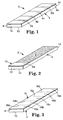
- a stretch releasing adhesive tape article 2 including an elongate stretch releasing adhesive tape 4 and a plurality of individual liners 6a-e arranged to cover an adhesive first major surface 8 of the stretch releasing adhesive tape 4. While shown as a discrete strip, the stretch releasing tape article 2 can be formed as an elongated strip having an indefinite length from which multiple strips of selected length can then be cut depending on the end use application. The adhesive tape article 2 can also be wound upon itself to form a roll.
- the stretch releasing adhesive tape 4 includes adhesive first major surface 8, an opposite non-adhesive second major surface 10, and first 12 and second 14 ends.
- the stretch releasing adhesive tape 4 can be any pressure-sensitive adhesive tape that can be adhered firmly to a substrate and thereafter removed therefrom by stretching.
- Such pressure sensitive adhesive tapes can include an elastic backing, a highly extensible and substantially inelastic backing, or can be a tape formed of a solid, elastic pressure sensitive adhesive.
- Suitable stretch releasing tapes are described in U.S. Patent No. 4,024,312 (Korpman), German Patent No. 33 31 016, U.S. Patent No. 5,516,581 (Kreckel et al.), and PCT International Publication No. WO 95/06691 (Bries et al).
- the stretch releasing adhesive tape can include a splittable layer such as the layers described in PCT International Publication No. WO 98/21285, or a re-fastenable layer such as the layers described in PCT International Publication No. WO 99/31193.
- the liners 6a-e can be any conventional readily removable liner.
- Typical liners include a backing formed of, for example, paper or a polymeric film such as polyethylene, polypropylene, or polyester, which is coated with a release agent such as silicone, a fluorochemical, or other low surface energy based release material.
- a preferred liner is silicone coated paper.
- the liners can be printed with lines, brand indicia, or other information.
- second surface 10 can be rendered non-adhesive using a conventional treatment such as by coating it with a suitable film, paper, powder, foam, or ink. If, on the other hand, the tape is formed with a non-adhesive backing that is then coated with adhesive, second surface can be made non-adhesive by simply not coating the surface with adhesive.
- each liner 6a-e can be individually removed from adhesive first major surface 8.
- selected liners can be removed to expose a corresponding portion of an adhesive surface, while one or more selected liners can be left on the adhesive tape to form a pull tab. As shown in Fig.
- liners 6b-e are removed to expose a selected portion of adhesive first major surface 8 to allow the tape 4 to be affixed to an object, substrate, surface, or the like (not shown), while liner segment 6a remains on adhesive surface 8 adjacent the liner first end 12 to form a non-adhesive pull tab 15 which can be grasped by a user to stretch the tape during the removal process, thereby to remove the tape from the object or substrate to which it has been affixed.
- Fig. 3 shows an alternate embodiment of the invention in which a single perforated liner 16 has replaced the plurality of liners 16a-e of Fig. 1.
- the liner 16 includes a plurality of frangible or easily broken connections formed by registered perforations 18a-d dividing the liner 16 into segments 16a-e each of which can be easily separated from an adjacent segment along a perforation line and individually removed from adhesive surface 8.
- liner segments 16b-e are removed from the adhesive tape 4 by first peeling interconnected liner segments 16b-e from adhesive surface 8 and then separating liner segment 16a from liner segment 16b along perforation 18a, a tape strip having a pull tab 15 as shown in Fig. 2 is produced.
- a single perforated liner simplifies the use of the adhesive tape article by allowing a series of connected liners to be removed simultaneously in a single step after it is determined which liner segments are to be removed from the tape and which liner or liners are to remain on the tape and serve as a pull tab.
- the frangible connections can be formed by scoring, notching, creasing, or otherwise forming a line of weakness in the liner to provide for easy separation of the liner at selected intervals.
- liner segments 16b-e are first peeled away from adhesive surface 8 starting at the second end 14 to expose adhesive surface 8. Connected liner segments 16b-e are then separated from liner segment 16a by tearing along perforation 18a, whereby connected liner segments 16b-e can be completely removed from the adhesive surface 8. Segment 16a is left in place on the adhesive surface 8 adjacent the first end 12 to serve as a non-adhesive pull tab 15. The adhesive strip can then be adhered to an object or substrate by applying firm pressure to the non-adhesive second surface 10 of the tape.
- Figs. 4 and 5 show a stretch releasing adhesive tape article 2 similar to the article in Fig. 2 except second surface 10 is adhesive and is provided with a second perforated release liner 20 including liner segments 20a-e covering second surface 10.
- liner segments 16a-16e are aligned with liner segments 20a-20e.
- the adhesive tape article of Figs. 4 and 5 is used in the same manner as the article of Figs 1 and 3 except liner segments 20b-d are removed from adhesive second surface 10 after the tape has been bonded to a substrate.
- Fig. 4 shows the adhesive tape article prior to use with perforated liners 16 and 20 in place on surfaces 8 and 10, respectively, and Fig.
- FIG. 5 shows the adhesive article 2 after selected liner segments 16b-e and 20b-d have been removed to expose the adhesive surfaces 8 and 10. Aligned liner segments 16a and 20a meanwhile remain adhered to opposite surfaces of the adhesive tape 4 adjacent the first end 12 to form the pull tab 15. In addition, liner segment 20e is left adhered to second adhesive surface 10 adjacent the second end 14 so that the first and second adhesive surfaces will debond from their respective surfaces at different times. Controlling the timing of debonding of the first and second adhesive surfaces from their respective surfaces serves to minimize snap back and catapulting as described in PCT International Publication No. WO 97/07172.
- Figs. 6a-e show a stretch releasing tape article 102 wound into a roll 122 in accordance with another embodiment of the invention.
- the adhesive tape article 102 includes a first adhesive surface 108 and a second adhesive surface 110 covered by a liner 124.
- Liner 124 is preferably stretchable or extensible to prevent the adhesive tape article from binding when wound upon itself, thereby facilitating the formation of a roll.
- liner 124 includes a plurality of liner segments 124a-c defined by transverse slits 128a-c cut into the liner 124.
- liner segments 124a-c could also be defined by perforations or other frangible connections, or each liner segment could be a separate liner as described in reference to Fig. 1.
- the slits 128a-c extend from a first side edge 130 of the liner 124, toward a second side edge 132 of the liner 124.
- the slits are spaced from the second side edge 132, thereby defining a continuous longitudinally extending frangible connecting portion 124f extending along and defining the second side edge 132 of the liner 124.
- the liner 124 is approximately twice as wide as the width of the adhesive tape 104 to allow one or more liner segments 126a-c to be folded back onto the first adhesive surface 108 of the adhesive tape to form a pull tab.
- the liner 124 can also be folded back onto itself to protect the segments 124a-c and prevent them from being damaged prior to being folded onto the first adhesive surface 108 to form the pull tab.
- a discrete length 126 is first cut from the roll 122 preferably along a frangible connection as shown in Fig. 6b.
- the frangible connection 136 between adjacent liner segments 124a and 124b is then broken so that liner segment 124a adjacent the first end 112 of the tape can be folded back onto the first adhesive surface 108 of the tape to form the pull tab 115 as shown in Fig. 6c.
- the first adhesive surface 108 can then be affixed to an object or substrate by applying pressure to the connected liner segments 124b, 124c remaining adhered to the second surface 110. Once firmly bonded, the remaining interconnected liner segments can be removed to expose the second adhesive surface 110 as shown in Fig. 6d so an object can be affixed thereto.
- the embodiment of Fig. 6a-e requires only a single release liner arranged on one side of the adhesive tape 104 to form the pull tab 115.
- the liner 124 also serves to prevent the adhesive tape from bonding to itself when the tape is wound into a roll since when wound into a roll, first adhesive surface 108 is arranged adjacent the liner 124 and is therefore separated from the second adhesive surface 110 by the liner 124. Thus, the first adhesive surface 108 and second adhesive surface 110 do not come into contact and cannot adhere to one another. As the roll 122 is unwound, the liner 124 releases from the first adhesive surface 108 and remains adhered to the second adhesive surface 110.
- Figs. 7a-e show a roll of tape 222 including a stretch releasing tape 204 and a liner 224.
- the liner 224 is arranged centrally on the tape 204 so that opposite side portions 224x, 224y of the liner extend outwardly beyond each side of the tape 204.
- Liner 224 is preferably stretchable or extensible to prevent the adhesive tape article from binding when wound upon itself, thereby facilitating the formation of a roll. As shown most clearly in Fig.
- liner 224 includes a plurality of segments 224a, 224b, 224c defined by a plurality of transverse slits 228a, 228b, 228c, and a pair of continuous connecting portions 224f, 224g extending longitudinally along each side of the liner 224 between the ends of the slits 228a, 228b, 228c and the first 230 and second 232 side edges of the liner 224.
- the connecting portions 224f, 224g serve as frangible connections between adjacent liner segments.
- a strip 226 of tape having a discrete length is first cut from the roll 222 preferably along a frangible connection, as shown in Fig. 7b.
- liner segment 224a adjacent the first end 212 of the strip 226, which normally extend outwardly beyond the adhesive tape 204, are then folded back onto the tape 204 to form a pull tab 215 as shown in Fig. 7c.
- the exposed first adhesive surface 208 is then affixed to a substrate and firm pressure is applied to the liner 224 to create a more complete and effective bond between the tape and the substrate to which the tape has been applied.
- the remaining liner segments 224b, 224c are then removed to expose the second adhesive surface 210 as shown in Fig. 7d, so that an object or the like can be bonded thereto.
- Figs. 8a-c show an adhesive tape article 302 including an adhesive tape 304 and an alternate liner 324.
- the liner includes spaced pairs of aligned transverse slits 328a,328b; 328c,328d; 328e,328f extending inwardly from opposite outer side edges of the tape, thereby defining a longitudinally extending continuous connecting center portion 324h, and a plurality of liner segments 324a, 324b, 324c each having wing portions 324a', 324a", 324b', 324b", 324c', 324c" extending outwardly in opposite directions from the connecting portion 324h.
- the connecting portion 324h can be easily broken between adjacent liner segments to allow a selected portion of the liner to be removed and thereby expose an associated adhesive surface. With the liner of Fig. 8, however, only one frangible connection must be broken to separate adjacent liner segments whereas the liner of Fig. 7 requires two frangible connections to be broken.
- Figs. 9a and 9b show an adhesive tape article 302 similar to the adhesive tape article shown in Figs. 8a-c except the adhesive tape article of Fig. 9a and 9b includes a liner 324 having a first longitudinally extending lower adhesion surface portion 340 located along the center of the liner 324, and a pair of longitudinally extending higher adhesion surface portions 342, 344 extending outwardly in opposite directions from the lower adhesion surface portion 340 to provide differential adhesion levels with the adhesive tape 304.
- the lower adhesion center surface portion 340 is normally in contact with the first adhesive surface 308 and forms a lower level bond therewith so that selected liner segments can be readily removed from the first adhesive surface 308 to expose the adhesive.
- the lower adhesion surface portion can be, for example, silicon treated release paper which serves to prevent the liner 324 from forming a strong adhesive bond with adhesive tape 304.
- the higher adhesion surface portions 342, 344 normally extend beyond the side edges of the tape as shown in Fig: 9a, and serve to form a pull tab when folded back onto the adhesive tape second adhesive surface 310.
- the higher adhesion surface portions 342, 344 are capable of forming an adhesive bond with the tape second adhesive surface 310 which is stronger than the adhesive bond formed between the lower adhesion surface portion 340 and the adhesive tape 304.
- the higher level of adhesion between the folded portions and the tape is desirable since after forming the pull tab, the folded liner portions will have a tendency to debond from the tape.
- the stronger adhesive bond formed between the folded higher adhesion surface of the liner and the tape prevents this debonding from occurring.
- the higher adhesion surface can be, for example, paper that has not been treated with silicon.
- the surface opposite the lower adhesion surface portion 340 and higher adhesion surface portions 342, 344 can include a release portion generally opposite lower adhesion surface portion 340 which contacts the second adhesive surface 310 when the tape is wound into a roll, and a high friction surface generally opposite higher adhesion surface portions 342, 344 to aid in gripping the pull tab during stretch removal.
- the high friction surface can be a rubber-like surface, a textured surface, or other conventionally known high friction surfaces.
Landscapes
- Chemical & Material Sciences (AREA)
- Organic Chemistry (AREA)
- Adhesive Tapes (AREA)
- Adhesives Or Adhesive Processes (AREA)
Applications Claiming Priority (3)
| Application Number | Priority Date | Filing Date | Title |
|---|---|---|---|
| US382177 | 1999-08-24 | ||
| US09/382,177 US6641910B1 (en) | 1999-08-24 | 1999-08-24 | Stretch releasing adhesive tape with segmented release liner |
| PCT/US2000/021590 WO2001014489A1 (en) | 1999-08-24 | 2000-08-08 | Stretch releasing adhesive tape with segmented release liner |
Publications (2)
| Publication Number | Publication Date |
|---|---|
| EP1206501A1 EP1206501A1 (en) | 2002-05-22 |
| EP1206501B1 true EP1206501B1 (en) | 2004-04-14 |
Family
ID=23507845
Family Applications (1)
| Application Number | Title | Priority Date | Filing Date |
|---|---|---|---|
| EP00957318A Expired - Lifetime EP1206501B1 (en) | 1999-08-24 | 2000-08-08 | Stretch releasing adhesive tape with segmented release liner |
Country Status (11)
| Country | Link |
|---|---|
| US (1) | US6641910B1 (https=) |
| EP (1) | EP1206501B1 (https=) |
| JP (1) | JP2003507563A (https=) |
| KR (1) | KR20020034180A (https=) |
| CN (1) | CN1183216C (https=) |
| AU (1) | AU6895500A (https=) |
| BR (1) | BR0013525A (https=) |
| CA (1) | CA2381242A1 (https=) |
| DE (1) | DE60009922T2 (https=) |
| MX (1) | MXPA02001848A (https=) |
| WO (1) | WO2001014489A1 (https=) |
Families Citing this family (66)
| Publication number | Priority date | Publication date | Assignee | Title |
|---|---|---|---|---|
| DE19649728A1 (de) * | 1996-11-30 | 1998-06-18 | Beiersdorf Ag | Klebeband |
| DE10160323B4 (de) * | 2001-12-08 | 2021-02-11 | Wolf-Dietrich Zander | Parallel gewickelte Rolle aus bahnförmigen ein- oder beidseitig klebenden Materialien |
| US7063887B2 (en) | 2002-02-04 | 2006-06-20 | 3M Innovative Properties Company | Stretch releasable foams, articles including same and methods for the manufacture thereof |
| AU2003207936A1 (en) * | 2002-03-19 | 2003-09-29 | Koninklijke Philips Electronics N.V. | Cleaning method for a disc-shaped data carrier |
| US6866928B2 (en) | 2002-04-08 | 2005-03-15 | 3M Innovative Properties Company | Cleanly removable tapes and methods for the manufacture thereof |
| FR2839494B1 (fr) * | 2002-05-07 | 2004-06-18 | Rehau Sa | Procede automatise de pose et de confection de languettes de prehension, pellicule de protection et profile extrude comportant des languettes de ce type |
| US20030232210A1 (en) * | 2002-06-18 | 2003-12-18 | 3M Innovative Properties Company | Ink-receptive foam article |
| US7055914B1 (en) * | 2002-07-15 | 2006-06-06 | Hennessy Industries, Inc. | Vehicle wheel balance weights |
| AU2003268502A1 (en) | 2002-09-12 | 2004-04-30 | Goody Products, Inc. | Method and device for using styling tape for body and hair accessorizing |
| US8302806B1 (en) * | 2002-09-23 | 2012-11-06 | Gibbar James M | Drink vessel holder |
| US7028958B2 (en) | 2002-11-01 | 2006-04-18 | 3M Innovative Properties Company | Stretch releasing adhesive article with shape retaining member |
| US6925765B2 (en) * | 2002-12-27 | 2005-08-09 | Johns Manville | Facing and faced insulation assembly |
| EP1548691A4 (en) | 2003-04-02 | 2009-04-22 | Panasonic Corp | METHOD FOR PRODUCING A PLASMA DISPLAY DEVICE |
| US7655296B2 (en) | 2003-04-10 | 2010-02-02 | 3M Innovative Properties Company | Ink-receptive foam article |
| US7820282B2 (en) * | 2003-04-10 | 2010-10-26 | 3M Innovative Properties Company | Foam security substrate |
| SG110108A1 (en) * | 2003-09-24 | 2005-04-28 | Nitto Denko Corp | Method and apparatus for joining adhesive tape |
| US7599420B2 (en) * | 2004-07-30 | 2009-10-06 | Rearden, Llc | System and method for distributed input distributed output wireless communications |
| US20060275573A1 (en) * | 2005-06-07 | 2006-12-07 | Stickysheets Unlimited, Llc | Pet hair remover |
| JP4994663B2 (ja) * | 2005-12-28 | 2012-08-08 | 大豊工業株式会社 | ホイールバランスウェイト |
| CN101062542A (zh) * | 2006-04-28 | 2007-10-31 | 匹喜产品国际有限公司 | 铁基合金夹式车轮配重的制造方法和过程 |
| US7506450B2 (en) | 2006-06-30 | 2009-03-24 | The Stanley Works | Adhesive mount for a leveling device and a leveling device |
| JP5586226B2 (ja) * | 2006-09-06 | 2014-09-10 | スリーエム イノベイティブ プロパティズ カンパニー | 水平に装着される棚組立体及びその棚組立体用のアクセサリ |
| CN101511233B (zh) * | 2006-09-06 | 2011-01-26 | 3M创新有限公司 | 具有矩形框架和可拆卸式托盘的壁挂式搁架系统 |
| US7931160B2 (en) * | 2006-09-06 | 2011-04-26 | 3M Innovative Properties Company | Vertically mounted shelf assembly and accessories therefor |
| WO2008030816A1 (en) * | 2006-09-06 | 2008-03-13 | 3M Innovative Properties Company | Wall mountable wire grid organizer system with removable accessories |
| US7824753B2 (en) * | 2007-06-28 | 2010-11-02 | 3M Innovative Properties Company | Removable adhesive tape with foldable pull tab |
| US7892384B2 (en) * | 2007-06-28 | 2011-02-22 | 3M Innovative Properties Company | Removable adhesive tape and pull tab, and method of forming |
| US7857130B2 (en) * | 2007-06-28 | 2010-12-28 | 3M Innovative Properties Company | Removable adhesive tape and pull tab film, and kits |
| US20090047460A1 (en) * | 2007-08-14 | 2009-02-19 | 3L-Ludvigsen A/S | Adhesive dispensing product |
| JP5199641B2 (ja) * | 2007-10-19 | 2013-05-15 | 日昌株式会社 | エンブレム用粘着体、その製造方法、エンブレム貼付治具および貼付用エンブレム |
| US7980286B2 (en) * | 2007-12-18 | 2011-07-19 | 3M Innovative Properties Company | Device for applying a protruding tab to double-sided adhesive tape, and method of using |
| TW200844342A (en) * | 2008-03-07 | 2008-11-16 | Huang Meng Feng | Hook configuration |
| US20090243370A1 (en) * | 2008-03-31 | 2009-10-01 | Hennessy Industries, Inc. | Wheel weight |
| JP2010202843A (ja) * | 2009-03-06 | 2010-09-16 | Nitto Denko Corp | 両面粘着テープおよびその貼付方法、剥離ライナー |
| CN101880511B (zh) * | 2009-05-08 | 2015-08-26 | 尼托母斯股份有限公司 | 可剥离的粘接带 |
| KR101039337B1 (ko) | 2009-10-27 | 2011-06-08 | 삼성전기주식회사 | 인쇄회로기판 제조용 양면 접착부재 및 이를 이용한 인쇄회로기판 제조방법 |
| BR112012026795A2 (pt) | 2010-04-14 | 2019-09-24 | 3M Innovative Properties Co | dutos removíveis com adesivo no verso para cabeamento e um método de remoção. |
| US8722166B2 (en) * | 2010-04-19 | 2014-05-13 | Protecto Wrap Company | Emergency extrication tape |
| CH703299A1 (de) * | 2010-06-07 | 2011-12-15 | Pataco Ag Ind Und Unterhaltungselektronik | Sicherungsvorrichtung für Objekte. |
| US20120261048A1 (en) * | 2011-04-18 | 2012-10-18 | Jason Carolla | Vinyl graphics installation |
| AU2012202196B2 (en) * | 2011-04-26 | 2016-08-18 | Nitto Denko Corporation | Stretch Adhesive Bandage |
| EP2599845B1 (en) * | 2011-12-02 | 2014-08-20 | Oticon A/S | Double sides adhesive foil |
| FR2983770B1 (fr) * | 2011-12-12 | 2016-04-01 | Gergonne Sas | Article adhesif, ruban et ensemble comprenant un tel article adhesif et procede de demontage d'un objet fixe sur un substrat par l'intermediaire d'un tel article adhesif |
| ES2668197T3 (es) | 2012-11-05 | 2018-05-17 | Kathe A. Sackler | Cinta enmascaradora de pintor perforada |
| US8889240B2 (en) | 2012-12-28 | 2014-11-18 | 3M Innovative Properties Company | Stretch release article |
| US8915045B2 (en) * | 2013-02-21 | 2014-12-23 | EML Products Inc. | Sleeves for sign posts |
| US9574312B2 (en) * | 2013-02-21 | 2017-02-21 | EML Products Inc. | Sleeves for sign posts |
| CN105451586A (zh) * | 2013-08-07 | 2016-03-30 | 3M创新有限公司 | 服装带及其使用方法 |
| US9333706B2 (en) * | 2013-09-04 | 2016-05-10 | Apple Inc. | Pull tab design for stretch release adhesive |
| USD783840S1 (en) * | 2014-05-09 | 2017-04-11 | Cenorin, Llc | Moisture shield with release liner |
| CN109152654B (zh) * | 2016-03-11 | 2021-02-26 | 科洛普拉斯特公司 | 造口术器具 |
| GB2553096B (en) * | 2016-08-18 | 2022-02-16 | Welland Medical Ltd | Flange extender having removal tab |
| DE102016119520A1 (de) * | 2016-10-13 | 2018-04-19 | Aytec Automation Gmbh | Verfahren zur Herrichtung von Strangmaterial für die Verarbeitung von Dichtungen |
| US10221883B2 (en) | 2017-04-07 | 2019-03-05 | Artskills, Inc. | Apparatus for supporting articles |
| WO2018220555A1 (en) * | 2017-06-02 | 2018-12-06 | 3M Innovative Properties Company | Adhesive seal |
| KR102669080B1 (ko) * | 2019-02-12 | 2024-05-24 | 삼성디스플레이 주식회사 | 라이너 및 그를 포함하는 표시 장치 |
| GB201909356D0 (en) * | 2019-06-28 | 2019-08-14 | Preston Technical Ltd | Adhesive tape roll |
| US11718459B1 (en) * | 2019-09-03 | 2023-08-08 | TredWear LLC | Flat interlocking wrap for complex shapes |
| US12351418B2 (en) | 2019-10-07 | 2025-07-08 | H.B. Fuller Company | Spindle free tape article and method |
| JP2022074877A (ja) * | 2020-11-05 | 2022-05-18 | レノボ・シンガポール・プライベート・リミテッド | 携帯用情報機器及び両面粘着テープ |
| JP6938750B1 (ja) | 2020-12-14 | 2021-09-22 | 照子 坂口 | 鼻腔拡張具 |
| ES2943207A1 (es) * | 2021-12-09 | 2023-06-09 | Diaz Gamez Valeriano | Cinta adhesiva de facil desprendimiento |
| JP7383100B1 (ja) * | 2022-10-04 | 2023-11-17 | レノボ・シンガポール・プライベート・リミテッド | テープ部材及び電子機器 |
| CN115584215B (zh) * | 2022-10-31 | 2023-08-04 | 江阴通利光电科技有限公司 | 一种返工双面泡棉胶带、返工方法和制备方法 |
| USD1069902S1 (en) | 2023-04-24 | 2025-04-08 | Dominic DeFrank | Tape tag |
| US12417718B1 (en) | 2023-05-29 | 2025-09-16 | Dominic DeFrank | Tape adhesive tag with tab system |
Family Cites Families (19)
| Publication number | Priority date | Publication date | Assignee | Title |
|---|---|---|---|---|
| US3663343A (en) * | 1970-05-11 | 1972-05-16 | By Buk Co | Composite pressure sensitive adhesive sheet structure and process of making the same |
| GB1422364A (en) | 1973-06-11 | 1976-01-28 | Shu Lien Liou | Adhesive tape |
| US4024312A (en) * | 1976-06-23 | 1977-05-17 | Johnson & Johnson | Pressure-sensitive adhesive tape having extensible and elastic backing composed of a block copolymer |
| DE2909276A1 (de) | 1979-03-09 | 1980-09-18 | Cohausz Helge B | Selbstklebeband |
| DE3331016A1 (de) | 1983-04-06 | 1984-10-11 | Beiersdorf Ag, 2000 Hamburg | Klebfolie fuer wiederloesbare klebbindungen |
| US5044776A (en) * | 1990-04-27 | 1991-09-03 | Morgan Adhesives Company | Resealable closure system |
| US5516581A (en) | 1990-12-20 | 1996-05-14 | Minnesota Mining And Manufacturing Company | Removable adhesive tape |
| DE4222849C2 (de) | 1992-07-11 | 2000-02-10 | Beiersdorf Ag | Verwendung eines Streifens einer Klebefolie für wiederlösbare Verklebung |
| US5747131A (en) | 1993-01-19 | 1998-05-05 | Minnesota Mining And Manufacturing Company | Process for bundling and/or fixing articles by use of an extensible plastic tape |
| US5318658A (en) * | 1993-04-30 | 1994-06-07 | Prototype Equipment Corporation | Taping machine |
| EP0716672B1 (en) | 1993-08-31 | 2002-04-10 | Minnesota Mining And Manufacturing Company | Removable foam adhesive tape |
| US5580413A (en) * | 1993-10-01 | 1996-12-03 | J. R. Automation Technologies, Inc. | Taping apparatus and method and article manufacturing therewith |
| US5509694A (en) * | 1994-09-16 | 1996-04-23 | The Standard Register Company | Tri-fold label or business form |
| WO1997007172A1 (en) | 1995-08-11 | 1997-02-27 | Minnesota Mining And Manufacturing Company | Removable adhesive tape with controlled sequential release |
| DE19631964A1 (de) | 1996-08-08 | 1998-02-12 | Beiersdorf Ag | Ablängvorrichtung |
| US6004642A (en) | 1996-11-08 | 1999-12-21 | 3M Innovative Properties Company | Internally separable tape laminate |
| DE19721169A1 (de) | 1997-05-21 | 1998-11-26 | Stefan Singer | Klebestreifen |
| US6972141B1 (en) | 1997-12-12 | 2005-12-06 | 3M Innovative Properties Company | Removable adhesive tape laminate and separable fastener |
| US6238760B1 (en) * | 1999-02-24 | 2001-05-29 | The Goodyear Tire & Rubber Company | Pull tab labels for match mounting a tire with a rim |
-
1999
- 1999-08-24 US US09/382,177 patent/US6641910B1/en not_active Expired - Lifetime
-
2000
- 2000-08-08 DE DE60009922T patent/DE60009922T2/de not_active Expired - Lifetime
- 2000-08-08 CA CA002381242A patent/CA2381242A1/en not_active Abandoned
- 2000-08-08 WO PCT/US2000/021590 patent/WO2001014489A1/en not_active Ceased
- 2000-08-08 BR BR0013525-9A patent/BR0013525A/pt not_active Application Discontinuation
- 2000-08-08 AU AU68955/00A patent/AU6895500A/en not_active Abandoned
- 2000-08-08 KR KR1020027002352A patent/KR20020034180A/ko not_active Withdrawn
- 2000-08-08 EP EP00957318A patent/EP1206501B1/en not_active Expired - Lifetime
- 2000-08-08 JP JP2001518808A patent/JP2003507563A/ja not_active Withdrawn
- 2000-08-08 MX MXPA02001848A patent/MXPA02001848A/es not_active Application Discontinuation
- 2000-08-08 CN CNB008119120A patent/CN1183216C/zh not_active Expired - Fee Related
Also Published As
| Publication number | Publication date |
|---|---|
| KR20020034180A (ko) | 2002-05-08 |
| BR0013525A (pt) | 2002-04-30 |
| EP1206501A1 (en) | 2002-05-22 |
| CN1370210A (zh) | 2002-09-18 |
| DE60009922T2 (de) | 2005-04-07 |
| AU6895500A (en) | 2001-03-19 |
| US6641910B1 (en) | 2003-11-04 |
| CA2381242A1 (en) | 2001-03-01 |
| DE60009922D1 (de) | 2004-05-19 |
| CN1183216C (zh) | 2005-01-05 |
| MXPA02001848A (es) | 2002-10-23 |
| JP2003507563A (ja) | 2003-02-25 |
| WO2001014489A1 (en) | 2001-03-01 |
Similar Documents
| Publication | Publication Date | Title |
|---|---|---|
| EP1206501B1 (en) | Stretch releasing adhesive tape with segmented release liner | |
| US6541089B1 (en) | Stretch releasing adhesive tape with integral pull tab | |
| JP5386054B2 (ja) | 異なる接着特性を有する延伸剥離式接着テープ | |
| AU2008270965B2 (en) | Removable adhesive tape with foldable pull tab | |
| JP3878988B2 (ja) | 調節された連続剥離を含む剥離可能接着テープ | |
| JP2521412B2 (ja) | シ―ト組 | |
| JPH05117607A (ja) | ロール状にエンドレスに巻かれた複合積層接着テープ及びその積層接着テープロールの製造方法 | |
| EP1112332A1 (en) | Stretch release adhesive article with secondary release member | |
| JPH0881659A (ja) | 接着用フイルム片 | |
| JP4387794B2 (ja) | テープシートパッドおよびディスペンサ | |
| JP2000096007A (ja) | 接着テ―プストリップ | |
| EP2164913B1 (en) | Removable adhesive tape and pull tab, and method of forming | |
| JP2002220572A (ja) | 再剥離用粘着シートおよびこれを使用した生理用品 |
Legal Events
| Date | Code | Title | Description |
|---|---|---|---|
| PUAI | Public reference made under article 153(3) epc to a published international application that has entered the european phase |
Free format text: ORIGINAL CODE: 0009012 |
|
| 17P | Request for examination filed |
Effective date: 20020226 |
|
| AX | Request for extension of the european patent |
Free format text: AL;LT;LV;MK;RO;SI |
|
| GRAP | Despatch of communication of intention to grant a patent |
Free format text: ORIGINAL CODE: EPIDOSNIGR1 |
|
| GRAS | Grant fee paid |
Free format text: ORIGINAL CODE: EPIDOSNIGR3 |
|
| GRAA | (expected) grant |
Free format text: ORIGINAL CODE: 0009210 |
|
| AK | Designated contracting states |
Kind code of ref document: B1 Designated state(s): DE FR GB IT |
|
| REG | Reference to a national code |
Ref country code: GB Ref legal event code: FG4D |
|
| REF | Corresponds to: |
Ref document number: 60009922 Country of ref document: DE Date of ref document: 20040519 Kind code of ref document: P |
|
| REG | Reference to a national code |
Ref country code: IE Ref legal event code: FG4D |
|
| LTIE | Lt: invalidation of european patent or patent extension |
Effective date: 20040414 |
|
| ET | Fr: translation filed | ||
| PLBE | No opposition filed within time limit |
Free format text: ORIGINAL CODE: 0009261 |
|
| STAA | Information on the status of an ep patent application or granted ep patent |
Free format text: STATUS: NO OPPOSITION FILED WITHIN TIME LIMIT |
|
| 26N | No opposition filed |
Effective date: 20050117 |
|
| REG | Reference to a national code |
Ref country code: IE Ref legal event code: MM4A |
|
| PGFP | Annual fee paid to national office [announced via postgrant information from national office to epo] |
Ref country code: GB Payment date: 20070830 Year of fee payment: 8 |
|
| PGFP | Annual fee paid to national office [announced via postgrant information from national office to epo] |
Ref country code: IT Payment date: 20070828 Year of fee payment: 8 |
|
| PGFP | Annual fee paid to national office [announced via postgrant information from national office to epo] |
Ref country code: FR Payment date: 20070817 Year of fee payment: 8 |
|
| GBPC | Gb: european patent ceased through non-payment of renewal fee |
Effective date: 20080808 |
|
| REG | Reference to a national code |
Ref country code: FR Ref legal event code: ST Effective date: 20090430 |
|
| PG25 | Lapsed in a contracting state [announced via postgrant information from national office to epo] |
Ref country code: FR Free format text: LAPSE BECAUSE OF NON-PAYMENT OF DUE FEES Effective date: 20080901 Ref country code: IT Free format text: LAPSE BECAUSE OF NON-PAYMENT OF DUE FEES Effective date: 20080808 |
|
| PG25 | Lapsed in a contracting state [announced via postgrant information from national office to epo] |
Ref country code: GB Free format text: LAPSE BECAUSE OF NON-PAYMENT OF DUE FEES Effective date: 20080808 |
|
| PGFP | Annual fee paid to national office [announced via postgrant information from national office to epo] |
Ref country code: DE Payment date: 20170801 Year of fee payment: 18 |
|
| REG | Reference to a national code |
Ref country code: DE Ref legal event code: R079 Ref document number: 60009922 Country of ref document: DE Free format text: PREVIOUS MAIN CLASS: C09J0007020000 Ipc: C09J0007200000 |
|
| REG | Reference to a national code |
Ref country code: DE Ref legal event code: R119 Ref document number: 60009922 Country of ref document: DE |
|
| PG25 | Lapsed in a contracting state [announced via postgrant information from national office to epo] |
Ref country code: DE Free format text: LAPSE BECAUSE OF NON-PAYMENT OF DUE FEES Effective date: 20190301 |