EP1201699B1 - Herstellung von aminofunktionellen Siloxanen - Google Patents
Herstellung von aminofunktionellen Siloxanen Download PDFInfo
- Publication number
- EP1201699B1 EP1201699B1 EP01118780A EP01118780A EP1201699B1 EP 1201699 B1 EP1201699 B1 EP 1201699B1 EP 01118780 A EP01118780 A EP 01118780A EP 01118780 A EP01118780 A EP 01118780A EP 1201699 B1 EP1201699 B1 EP 1201699B1
- Authority
- EP
- European Patent Office
- Prior art keywords
- sio
- formula
- general formula
- organosiloxane
- sir
- Prior art date
- Legal status (The legal status is an assumption and is not a legal conclusion. Google has not performed a legal analysis and makes no representation as to the accuracy of the status listed.)
- Expired - Lifetime
Links
- 238000004519 manufacturing process Methods 0.000 title claims description 4
- -1 siloxanes Chemical class 0.000 title description 37
- 125000005375 organosiloxane group Chemical group 0.000 claims description 26
- 125000004122 cyclic group Chemical group 0.000 claims description 14
- 238000000034 method Methods 0.000 claims description 14
- 239000004215 Carbon black (E152) Substances 0.000 claims description 8
- 229920005989 resin Polymers 0.000 claims description 8
- 239000011347 resin Substances 0.000 claims description 8
- 238000006243 chemical reaction Methods 0.000 claims description 7
- 229910052736 halogen Chemical group 0.000 claims description 7
- 125000002496 methyl group Chemical group [H]C([H])([H])* 0.000 claims description 6
- 125000000391 vinyl group Chemical group [H]C([*])=C([H])[H] 0.000 claims description 5
- 229920002554 vinyl polymer Chemical group 0.000 claims description 5
- 229910008051 Si-OH Inorganic materials 0.000 claims description 4
- 229910006358 Si—OH Inorganic materials 0.000 claims description 4
- 150000002367 halogens Chemical group 0.000 claims description 4
- 239000001257 hydrogen Substances 0.000 claims description 4
- 229910052739 hydrogen Inorganic materials 0.000 claims description 4
- 125000004435 hydrogen atom Chemical group [H]* 0.000 claims description 4
- 125000000725 trifluoropropyl group Chemical group [H]C([H])(*)C([H])([H])C(F)(F)F 0.000 claims description 4
- 239000004593 Epoxy Substances 0.000 claims description 3
- UFHFLCQGNIYNRP-UHFFFAOYSA-N Hydrogen Chemical compound [H][H] UFHFLCQGNIYNRP-UHFFFAOYSA-N 0.000 claims description 3
- 125000003178 carboxy group Chemical group [H]OC(*)=O 0.000 claims description 3
- 125000001495 ethyl group Chemical group [H]C([H])([H])C([H])([H])* 0.000 claims description 3
- 125000001997 phenyl group Chemical group [H]C1=C([H])C([H])=C(*)C([H])=C1[H] 0.000 claims description 3
- 229910020175 SiOH Inorganic materials 0.000 claims description 2
- 125000001434 methanylylidene group Chemical group [H]C#[*] 0.000 claims description 2
- 229910020388 SiO1/2 Inorganic materials 0.000 claims 3
- 229910020447 SiO2/2 Inorganic materials 0.000 claims 3
- 229910020487 SiO3/2 Inorganic materials 0.000 claims 3
- 229910020485 SiO4/2 Inorganic materials 0.000 claims 3
- 230000007812 deficiency Effects 0.000 claims 1
- 125000000325 methylidene group Chemical group [H]C([H])=* 0.000 claims 1
- 150000001412 amines Chemical class 0.000 description 10
- 125000002887 hydroxy group Chemical group [H]O* 0.000 description 10
- 150000003254 radicals Chemical class 0.000 description 10
- 238000005160 1H NMR spectroscopy Methods 0.000 description 8
- IELVEAVYQVBGNX-UHFFFAOYSA-N 3-[(2,2-dimethylazasilolidin-1-yl)-dimethylsilyl]propan-1-amine Chemical compound NCCC[Si](C)(C)N1CCC[Si]1(C)C IELVEAVYQVBGNX-UHFFFAOYSA-N 0.000 description 8
- 238000005481 NMR spectroscopy Methods 0.000 description 8
- 150000001875 compounds Chemical class 0.000 description 7
- 229920002545 silicone oil Polymers 0.000 description 7
- 239000002904 solvent Substances 0.000 description 5
- 229920013822 aminosilicone Polymers 0.000 description 4
- 229910052801 chlorine Inorganic materials 0.000 description 4
- 239000000460 chlorine Substances 0.000 description 4
- 239000004205 dimethyl polysiloxane Substances 0.000 description 4
- 238000007306 functionalization reaction Methods 0.000 description 4
- 229930195733 hydrocarbon Natural products 0.000 description 4
- 239000000203 mixture Substances 0.000 description 4
- 229920000435 poly(dimethylsiloxane) Polymers 0.000 description 4
- QGZKDVFQNNGYKY-UHFFFAOYSA-N Ammonia Chemical compound N QGZKDVFQNNGYKY-UHFFFAOYSA-N 0.000 description 3
- RTZKZFJDLAIYFH-UHFFFAOYSA-N Diethyl ether Chemical compound CCOCC RTZKZFJDLAIYFH-UHFFFAOYSA-N 0.000 description 3
- 229910004298 SiO 2 Inorganic materials 0.000 description 3
- 229910004283 SiO 4 Inorganic materials 0.000 description 3
- YXFVVABEGXRONW-UHFFFAOYSA-N Toluene Chemical compound CC1=CC=CC=C1 YXFVVABEGXRONW-UHFFFAOYSA-N 0.000 description 3
- 125000004429 atom Chemical group 0.000 description 3
- 239000006227 byproduct Substances 0.000 description 3
- 125000004432 carbon atom Chemical group C* 0.000 description 3
- 238000009833 condensation Methods 0.000 description 3
- 230000005494 condensation Effects 0.000 description 3
- 229910052731 fluorine Inorganic materials 0.000 description 3
- 238000002360 preparation method Methods 0.000 description 3
- 239000000047 product Substances 0.000 description 3
- VVJKKWFAADXIJK-UHFFFAOYSA-N Allylamine Chemical compound NCC=C VVJKKWFAADXIJK-UHFFFAOYSA-N 0.000 description 2
- IJGRMHOSHXDMSA-UHFFFAOYSA-N Atomic nitrogen Chemical compound N#N IJGRMHOSHXDMSA-UHFFFAOYSA-N 0.000 description 2
- ZAMOUSCENKQFHK-UHFFFAOYSA-N Chlorine atom Chemical compound [Cl] ZAMOUSCENKQFHK-UHFFFAOYSA-N 0.000 description 2
- IMNFDUFMRHMDMM-UHFFFAOYSA-N N-Heptane Chemical compound CCCCCCC IMNFDUFMRHMDMM-UHFFFAOYSA-N 0.000 description 2
- XUIMIQQOPSSXEZ-UHFFFAOYSA-N Silicon Chemical compound [Si] XUIMIQQOPSSXEZ-UHFFFAOYSA-N 0.000 description 2
- WYURNTSHIVDZCO-UHFFFAOYSA-N Tetrahydrofuran Chemical compound C1CCOC1 WYURNTSHIVDZCO-UHFFFAOYSA-N 0.000 description 2
- 230000015572 biosynthetic process Effects 0.000 description 2
- 238000009835 boiling Methods 0.000 description 2
- 229910052794 bromium Inorganic materials 0.000 description 2
- 239000003054 catalyst Substances 0.000 description 2
- DIOQZVSQGTUSAI-UHFFFAOYSA-N decane Chemical compound CCCCCCCCCC DIOQZVSQGTUSAI-UHFFFAOYSA-N 0.000 description 2
- 238000011067 equilibration Methods 0.000 description 2
- 229910052757 nitrogen Inorganic materials 0.000 description 2
- 229920001296 polysiloxane Polymers 0.000 description 2
- 125000002924 primary amino group Chemical group [H]N([H])* 0.000 description 2
- 125000001436 propyl group Chemical group [H]C([*])([H])C([H])([H])C([H])([H])[H] 0.000 description 2
- QQONPFPTGQHPMA-UHFFFAOYSA-N propylene Natural products CC=C QQONPFPTGQHPMA-UHFFFAOYSA-N 0.000 description 2
- 150000004819 silanols Chemical class 0.000 description 2
- 229910052710 silicon Inorganic materials 0.000 description 2
- OKTJSMMVPCPJKN-UHFFFAOYSA-N Carbon Chemical group [C] OKTJSMMVPCPJKN-UHFFFAOYSA-N 0.000 description 1
- PXGOKWXKJXAPGV-UHFFFAOYSA-N Fluorine Chemical compound FF PXGOKWXKJXAPGV-UHFFFAOYSA-N 0.000 description 1
- BZLVMXJERCGZMT-UHFFFAOYSA-N Methyl tert-butyl ether Chemical compound COC(C)(C)C BZLVMXJERCGZMT-UHFFFAOYSA-N 0.000 description 1
- CTQNGGLPUBDAKN-UHFFFAOYSA-N O-Xylene Chemical compound CC1=CC=CC=C1C CTQNGGLPUBDAKN-UHFFFAOYSA-N 0.000 description 1
- 239000004642 Polyimide Substances 0.000 description 1
- 229910018540 Si C Inorganic materials 0.000 description 1
- 150000001338 aliphatic hydrocarbons Chemical class 0.000 description 1
- 229910021529 ammonia Inorganic materials 0.000 description 1
- 239000000010 aprotic solvent Substances 0.000 description 1
- 150000004945 aromatic hydrocarbons Chemical class 0.000 description 1
- 125000003118 aryl group Chemical group 0.000 description 1
- 239000007795 chemical reaction product Substances 0.000 description 1
- 150000004759 cyclic silanes Chemical class 0.000 description 1
- 150000002170 ethers Chemical class 0.000 description 1
- 239000012467 final product Substances 0.000 description 1
- 239000011737 fluorine Substances 0.000 description 1
- 125000005843 halogen group Chemical group 0.000 description 1
- 238000000265 homogenisation Methods 0.000 description 1
- 239000000463 material Substances 0.000 description 1
- WCYWZMWISLQXQU-UHFFFAOYSA-N methyl Chemical compound [CH3] WCYWZMWISLQXQU-UHFFFAOYSA-N 0.000 description 1
- 125000001570 methylene group Chemical group [H]C([H])([*:1])[*:2] 0.000 description 1
- 125000004433 nitrogen atom Chemical group N* 0.000 description 1
- HMMGMWAXVFQUOA-UHFFFAOYSA-N octamethylcyclotetrasiloxane Chemical compound C[Si]1(C)O[Si](C)(C)O[Si](C)(C)O[Si](C)(C)O1 HMMGMWAXVFQUOA-UHFFFAOYSA-N 0.000 description 1
- 229920001601 polyetherimide Polymers 0.000 description 1
- 229920001721 polyimide Polymers 0.000 description 1
- 238000006116 polymerization reaction Methods 0.000 description 1
- 239000011541 reaction mixture Substances 0.000 description 1
- 230000035484 reaction time Effects 0.000 description 1
- 229920006395 saturated elastomer Polymers 0.000 description 1
- 125000005372 silanol group Chemical group 0.000 description 1
- 239000010703 silicon Substances 0.000 description 1
- 229910010271 silicon carbide Inorganic materials 0.000 description 1
- 239000011877 solvent mixture Substances 0.000 description 1
- 239000007858 starting material Substances 0.000 description 1
- 238000003786 synthesis reaction Methods 0.000 description 1
- 231100000925 very toxic Toxicity 0.000 description 1
- XLYOFNOQVPJJNP-UHFFFAOYSA-N water Substances O XLYOFNOQVPJJNP-UHFFFAOYSA-N 0.000 description 1
- 239000008096 xylene Substances 0.000 description 1
Classifications
-
- C—CHEMISTRY; METALLURGY
- C07—ORGANIC CHEMISTRY
- C07F—ACYCLIC, CARBOCYCLIC OR HETEROCYCLIC COMPOUNDS CONTAINING ELEMENTS OTHER THAN CARBON, HYDROGEN, HALOGEN, OXYGEN, NITROGEN, SULFUR, SELENIUM OR TELLURIUM
- C07F7/00—Compounds containing elements of Groups 4 or 14 of the Periodic Table
- C07F7/02—Silicon compounds
- C07F7/08—Compounds having one or more C—Si linkages
- C07F7/0834—Compounds having one or more O-Si linkage
- C07F7/0838—Compounds with one or more Si-O-Si sequences
- C07F7/0872—Preparation and treatment thereof
- C07F7/0874—Reactions involving a bond of the Si-O-Si linkage
Definitions
- the invention relates to a process for the preparation of amino-functional siloxanes using cyclic Silazanes.
- Aminoalkylpolysiloxanes and aminoalkylsilicone resins are in useful in many applications, including manufacturing of polyimides and polyetherimides. The commercial However, use of these compounds on a larger scale will prevented by a relatively expensive manufacturing process.
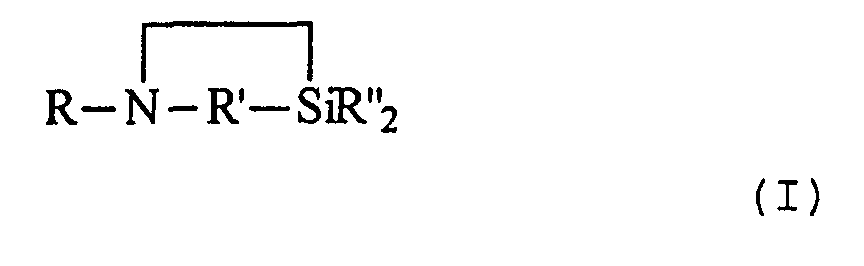
- R ' is a carbon chain having at least 3 and at most 6 carbon atoms
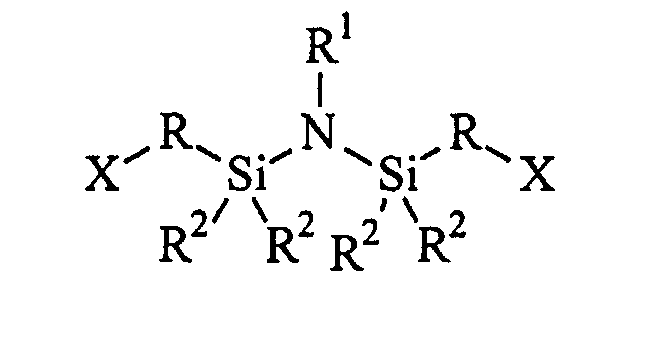
- the radical R on the nitrogen is either hydrogen, a hydrocarbon radical or an organosilyl radical of the general formula (halo-R 1 -) Y 2 Si-, wherein Y and R 1 are hydrocarbon radicals.
- the radical R is hydrogen
- the product is an unsubstituted cyclic silazane, which can be used for the functionalization of hydroxyl-terminated silanols.
- the disadvantage of these unsubstituted cyclic silazanes is that these only in very poor yields or It is often synthesized by the very toxic allylamine, the use of which is subject to particularly stringent safety conditions.
- Y and X are z.
- B. is methyl and R is propyl, Hal is halogen and is z.
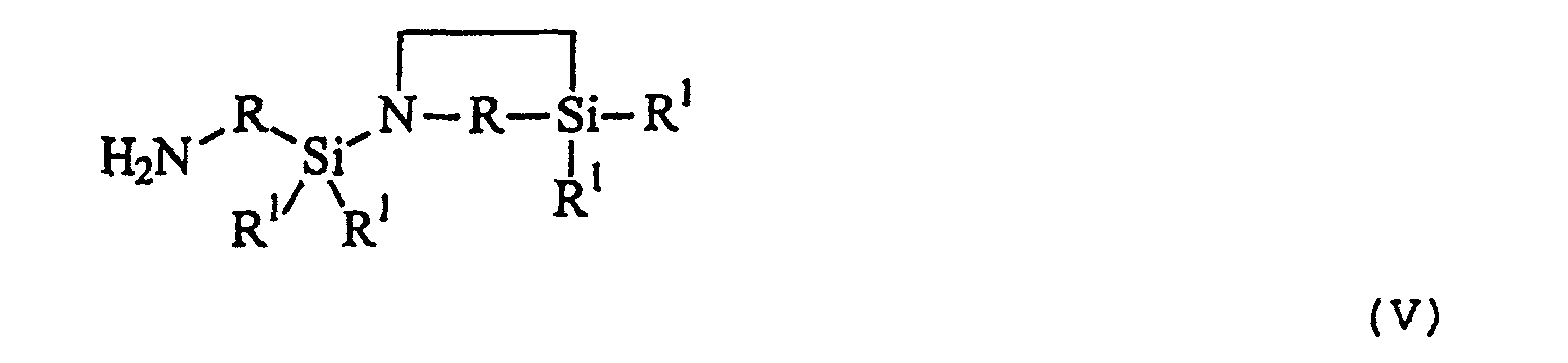
- the cyclic siloxanes of the general formula V used can be produced easily and in high yields. she also react without the formation of by-products hydroxy-functional siloxanes of the general formula IV without the use of special catalysts.
- R may be substituted by halogen atoms, in particular fluorine and chlorine.
- halogen atoms in particular fluorine and chlorine.
- 3 atoms are arranged between silicon atom and nitrogen atom of the ring.
- the C 1 -C 20 -hydrocarbon radicals and C 1 -C 20 -hydrocarbonoxy radicals R 1 may be aliphatically saturated or unsaturated, aromatic, straight-chain or branched.
- R 1 preferably has 1 to 12 atoms, in particular 1 to 6 atoms, preferably only carbon atoms or an alkoxy oxygen atom and otherwise only carbon atoms.
- R 1 is a straight-chain or branched C 1 -C 6 -alkyl radical.
- the radicals methyl, ethyl, phenyl, vinyl and trifluoropropyl are particularly preferred.
- the compounds of general formula III are preferably prepared in which R is a propylene radical and R 1 is methyl, ethyl, phenyl, vinyl or trifluoropropyl.
- the amino-functional organosiloxane of the general formula III may be linear, cyclic or branched.
- the sum of k, m, p, q, s and t is preferably a number from 2 to 20000, especially 8 to 1000.
- organosilicone resin A preferred variant for a branched organosiloxane of general formula III is organosilicone resin. This can be off consist of several units, as in the general formula III is indicated, wherein the mole percent of the units contained by the indices k, m, p, q, r, s and t. Preference is given to a value of 0.1 to 20% of units r to the sum of k, m, p, q and r. But at the same time, too k + m> 0. In the organosiloxane resin of the general formula III must be s> 0 and s + t equal to r.
- the radical R is a propylene radical and R 1 is a methyl radical.
- u has the value 0.
- n preferably has values of 1 to 20000, in particular 8 to 2000.
- the value of n denotes the average of the degrees of polymerization of the silanols of the general formula VII present.
- the compounds of the general formula VI have the further advantage that, when u > 0, they can condense either with themselves or with compounds of the general formula VII, if appropriate with the aid of a catalyst in order likewise to prepare compounds of the general formula VI, which, however, have a higher molecular weight, ie the numerical value of the number n increases.
- n is a number from 15 to 50 before the condensation and 50 to 2000 after the condensation.
- silazanes of general formula V In the process for the preparation of amino functional Organosiloxane of the general formula III is the amount of used silazanes of general formula V depending on the Amount of silanol groups to be functionalized. Will you however, a complete functionalization of the OH groups reach, so the silazane is in at least equimolar amounts admit. If one uses the cyclic silazane in excess, so The unreacted silazane may be present either be distilled off or hydrolyzed and then, optionally, deducted.
- the process is at 0 ° C to 100 ° C, especially preferably carried out at at least 10 ° C to at least 40 ° C.
- the process can be both involving Solvents are carried out, or even without the Use of solvents in suitable reactors. there is optionally under vacuum or under pressure or at Normal pressure (0.1 Mpa) worked.
- solvents are inert, in particular aprotic solvents such as aliphatic hydrocarbons, such as Heptane or decane and aromatic hydrocarbons such as As toluene or xylene preferred.
- aprotic solvents such as aliphatic hydrocarbons, such as Heptane or decane and aromatic hydrocarbons such as As toluene or xylene preferred.
- ethers such as THF, diethyl ether or MTBE are used.
- the amount of Solvent should be sufficient to provide adequate To ensure homogenization of the reaction mixture. Solvents or solvent mixtures with a boiling point or boiling range of up to 120 ° C at 0.1 MPa are preferred.
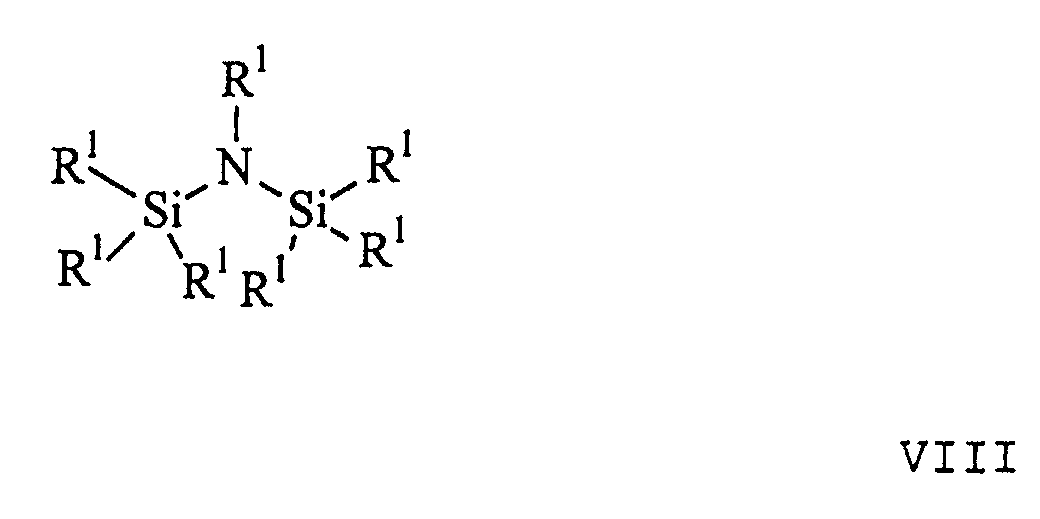
- silazane of general formula VI is added to the organosiloxane of general formula IV in excess, residual unreacted Si-OH groups may remain in the amino-functional organosiloxane of general formula III or be reacted with other silazanes of general formula VIII below:
- R, R 1 , k, m, p, q and s are as defined above.
- t is greater than or equal to 0
- w is greater than 0
- s + t + w r, where r is defined in general formula IV above.
- Silazanes of the general formula VIII can be used simultaneously with cyclic silazane of the general formula V or according to the Implementation of the silazane of the general formula V used become.
- Aminofunctional organosiloxanes of general formula IX which have been prepared by using silazanes of the general Formula VIII and with cyclic silazane of the general Formula V can z.
- B can be used to increase the amine number in high-viscosity aminosilicones.
- One achieves thereby that one with these mixtures of aminosilicones and aminosilicone resins Mixtures containing a high amine number with a high Combine viscosity. This is a combination with pure difunctional aminosilicones can not be achieved in this way.
- This secondary termination may also be appropriate is omitted, but it offers in terms of stability of the Materials at elevated temperatures have significant advantages since Si-OH groups tend to condensation at higher temperatures and thus increase the viscosity of the solutions obtained.
- Me-siloxane bishydroxy-terminated polydimethylsiloxane having an average molecular weight of 3000 g / mol
- 1 H-NMR and 29 Si-NMR showed that after 3 hours all OH groups were converted into aminopropyl units and still residual N - ((3-aminopropyl) -dimethylsilyl) -2,2-dimethyl-1-aza 2-silacyclopentane was present.
- 2 ml of water were added to the reaction solution to react the remaining silazane and distilled briefly in vacuo (20 mbar) at 60 ° C.
- Me-siloxane bishydroxy-terminated polydimethylsiloxane having an average molecular weight of 3000 g / mol
- 1 H-NMR and 29 Si-NMR showed that after 2 hours all OH groups were converted to aminopropyl units and no residual N - ((3-aminopropyl) -dimethylsilyl) -2,2-dimethyl-1-aza- 2-silacyclopentane was more detectable.
- silicone oil bishydroxy-terminated polydimethylsiloxane having an average molecular weight of 13000 g / mol
- 1 H-NMR and 29 Si-NMR showed that after 2 hours all OH groups were converted to aminopropyl units and no residual N - ((3-aminopropyl) -dimethylsilyl) -2,2-dimethyl-1-aza- 2-silacyclopentane was more detectable.
- silicone oil bishydroxy-terminated polydimethylsiloxane having an average molecular weight of 28,000 g / mol
- silicone oil bishydroxy-terminated polydimethylsiloxane having an average molecular weight of 28,000 g / mol
- 1 H-NMR and 29 Si-NMR showed that after 2 hours all OH groups were converted to aminopropyl units and no residual N - ((3-aminopropyl) -dimethylsilyl) -2,2-dimethyl-1-aza- 2-silacyclopentane was more detectable.
- silicone oil bishydroxy-terminated polydiphenylsiloxane having an average molecular weight of 1000 g / mol
- silicone oil bishydroxy-terminated polydiphenylsiloxane having an average molecular weight of 1000 g / mol
- 1 H-NMR and 29 Si-NMR showed that after 2 hours all OH groups were converted to aminopropyl units and no residual N - ((3-aminopropyl) -dimethylsilyl) -2,2-dimethyl-1-aza- 2-silacyclopentane was more detectable.
- silicone oil bishydroxy-terminated polymethylvinylsiloxane having a vinyl: methyl ratio of 1: 12 and an average molecular weight of 2600 g / mol were treated at room temperature with 88.9 g of N - ((3-aminopropyl) -dimethylsilyl) -2, 1 H-NMR and 29 Si-NMR showed that after 3 hours all OH groups had been converted into aminopropyl units and no residual N- ((3-aminopropyl) -butyryl-2-methyl-1-aza-2-silacyclopentane. dimethylsilyl) -2,2-dimethyl-1-aza-2-silacyclopentane was more detectable.
- silicone oil bis-hydroxy-terminated polymethyltrifluoropropylsiloxane having a trifluoropropyl: methyl ratio of 1: 1 and having an average molecular weight of 900 g / mol
- N- ((3-aminopropyl) dimethylsilyl) 25.8 g
- -2,2-dimethyl-1-aza-2-silacyclopentane reacted.
Landscapes
- Chemical & Material Sciences (AREA)
- Organic Chemistry (AREA)
- Chemical Kinetics & Catalysis (AREA)
- Silicon Polymers (AREA)
Description
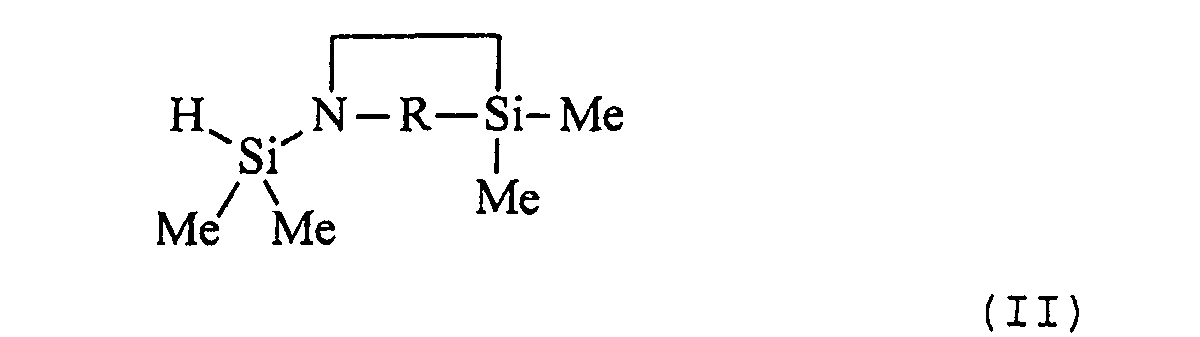
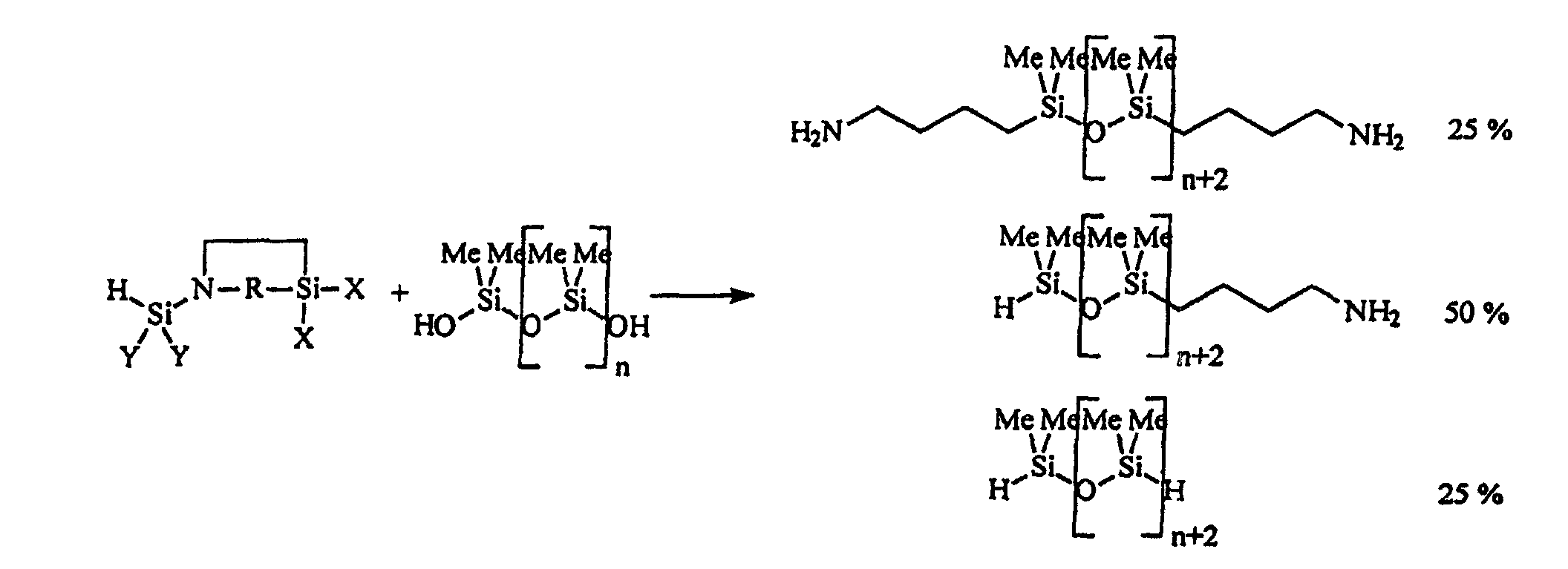
Interessanter ist die Synthese von N-substituierten Silazanen, welche sich häufig mit besseren Ausbeuten herstellen lassen. Setzt man jedoch das in US-A-3146250 beschriebene N-Silyl substituierte Silazan ein, so erhält man bei der Reaktion mit hydroxyterminierten Siloxanen unerwünschte Nebenprodukte wie in folgendem Formelschema aufgeführt:

[O1/2SiR1 2-R-NH2]s[O1/2H]t
- R
- einen gegebenenfalls halogensubstituierten unverzweigten C3-C6-Alkylenrest,
- Rx
- Wasserstoff oder einen gegebenenfalls mit -CN oder Halogen substituierten C1-C10-Kohlenwasserstoffrest,
- R1
- ein Wasserstoffatom oder einen monovalenten gegebenenfalls mit -CN, -NCO, -NRx 2, -COOH, -COORx , -Halogen, -Acryl,-Epoxy, -SH, -OH oder -CONRx 2 substituierten Si-C gebundenen C1-C20-Kohlenwasserstoffrest oder C1-C15-Kohlenwasserstoffoxyrest in denen jeweils eine oder mehrere, einander nicht benachbarte Methyleneinheiten durch Gruppen -O-, -CO-,-COO-, -OCO-, oder -OCOO-, -S-, oder -NRx - ersetzt sein können und in denen eine oder mehrere, einander nicht benachbarte Methineinheiten durch Gruppen, -N=, -N=N-, oder - P= ersetzt sein können,
- s
- Werte von mindestens 1,
- r
- Werte von mindestens 1,
- s + t
- den Wert von r und
- k + m + p + q
- Werte von mindestens 2 bedeuten.
Vorzugsweise ist R1 ein geradkettiger oder verzweigter C1-C6-Alkylrest. Besonders bevorzugt sind die Reste Methyl, Ethyl, Phenyl, Vinyl und Trifluorpropyl.
- u
- die Werte 0 oder 1,
- v
- die Werte 1 - u und
- n
- eine Zahl von 1 bis 20000 bedeuten.
n weist vorzugsweise Werte von 1 bis 20000, insbesondere 8 bis 2000 auf.
Wenn ein Gemisch von Ausgangsverbindungen der allgemeinen Formel VII eingesetzt wird, bezeichnet der Wert von n den Durchschnitt der Polymerisationsgrade der vorhandenen Silanole der allgemeinen Formel VII.
- Viskosität (bzw. Molekulargewicht)
- Amingehalt
- Grad der Aminofunktionalität der Endgruppen
[O1/2SiR1 2-R-NH2]s[O1/2H]t(O1/2SiR1 3)w

Claims (8)
- Verfahren zur Herstellung von aminofunktionellem Organosiloxan der allgemeinen Formel III,
[O1/2SiR1 2-R-NH2]s[O1/2H]tumgesetzt wird, wobei
- R
- einen gegebenenfalls halogensubstituierten unverzweigten C3-C6-Alkylenrest,
- Rx
- Wasserstoff oder einen, gegebenenfalls mit -CN oder Halogen substituierten C1-C10-Kohlenwasserstoffrest,
- R1
- ein Wasserstoffatom oder einen monovalenten, gegebenenfalls mit -CN, -NCO, -NRx 2, -COOH, -COORx , -Halogen, -Acryl,-Epoxy, -SH, -OH oder -CONRx 2 substituierten Si-C gebundenen C1-C20-Kohlenwasserstoffrest oder C1-C15-Kohlenwasserstoffoxyrest in denen jeweils eine oder mehrere, einander nicht benachbarte Methyleneinheiten durch Gruppen -O-, -CO-,-COO-, -OCO-, oder -OCOO-, -S-, oder -NRx - ersetzt sein können und in denen eine oder mehrere, einander nicht benachbarte Methineinheiten durch Gruppen, -N=, -N=N-, oder - P= ersetzt sein können,
- s
- Werte von mindestens 1,
- r
- Werte von mindestens 1,
- s + t
- den Wert von r und
- k + m + p + q
- Werte von mindestens 2 bedeuten.
- Verfahren nach Anspruch 1, bei dem R1 Methyl, Ethyl, Phenyl, Vinyl oder Trifluorpropyl bedeutet.
- Verfahren nach Anspruch 1 oder 2, bei dem die Summe von k, m, p, q, s und t eine Zahl von 2 bis 20000 ist.
- Verfahren nach Anspruch 1 bis 3, bei dem Harze hergestellt werden, bei denen 5 % < k + m < 90 %, bezogen auf die Summe von k, m, p, q, r, s und t ist.
- Verfahren nach Anspruch 1 bis 4 bei dem lineares Organosiloxan der allgemeinen Formel VI,
- u
- die Werte 0 oder 1,
- v
- die Werte 1 - u und
- n
- eine Zahl von 1 bis 20000 bedeuten.
- Verfahren nach Anspruch 1 bis 5, wobei das Verfahren bei 0°C bis 100°C durchgeführt wird.
- Verfahren nach Anspruch 1 bis 6, bei dem aminofunktionelles Oganosiloxan der allgemeinen Formel IX
[O1/2SiR1 2-R-NH2]s[O1/2H]t(O1/2SiR1 3)wumgesetzt werden, wobei
- R, R1, k, m, p, q und s
- wie in Anspruch 1 definiert sind,
- t
- größer oder gleich 0 ist,
- w
- größer 0 ist und
s + t + w = r gilt.
- Verfahren nach Anspruch 7, bei dem Silazane der allgemeinen Formel VIII nach der Umsetzung des Silazans der allgemeinen Formel V eingesetzt werden.
Applications Claiming Priority (2)
| Application Number | Priority Date | Filing Date | Title |
|---|---|---|---|
| DE10051886 | 2000-10-19 | ||
| DE10051886A DE10051886C1 (de) | 2000-10-19 | 2000-10-19 | Herstellung von aminofunktionellen Siloxanen |
Publications (2)
| Publication Number | Publication Date |
|---|---|
| EP1201699A1 EP1201699A1 (de) | 2002-05-02 |
| EP1201699B1 true EP1201699B1 (de) | 2003-04-09 |
Family
ID=7660357
Family Applications (1)
| Application Number | Title | Priority Date | Filing Date |
|---|---|---|---|
| EP01118780A Expired - Lifetime EP1201699B1 (de) | 2000-10-19 | 2001-08-09 | Herstellung von aminofunktionellen Siloxanen |
Country Status (6)
| Country | Link |
|---|---|
| US (1) | US6534615B2 (de) |
| EP (1) | EP1201699B1 (de) |
| JP (1) | JP3813486B2 (de) |
| CN (1) | CN1164597C (de) |
| DE (2) | DE10051886C1 (de) |
| PL (1) | PL350177A1 (de) |
Families Citing this family (33)
| Publication number | Priority date | Publication date | Assignee | Title |
|---|---|---|---|---|
| DE10134634A1 (de) * | 2001-07-17 | 2003-02-06 | Consortium Elektrochem Ind | Über Alkoxygruppen vernetzende RTV-1-Siliconkautschuk-Mischungen |
| US7074488B2 (en) * | 2001-07-18 | 2006-07-11 | Eastman Kodak Company | Monofunctional branched polysiloxanes, compositions and processes of preparing the same |
| DE10137855A1 (de) * | 2001-08-02 | 2003-02-27 | Consortium Elektrochem Ind | Organopolysiloxan/Polyharnstoff/ Polyurethan-Blockcopolymere |
| DE10303693A1 (de) * | 2003-01-30 | 2004-08-12 | Consortium für elektrochemische Industrie GmbH | Aminomethylenfunktionelle Siloxane |
| EP1496079B1 (de) | 2003-07-10 | 2005-07-06 | Wacker-Chemie GmbH | Vernetzbare Siloxan-Harnstoff-Copolymere |
| US7531125B2 (en) * | 2003-08-25 | 2009-05-12 | Ring Container Technologies | Blow molded wide mouth pet container and method of manufacture |
| DE10359704A1 (de) | 2003-12-18 | 2005-07-14 | Wacker-Chemie Gmbh | Dispersionen enthaltend Organopolysiloxan-Polyharnstoff-Copolymere |
| DE102004011992A1 (de) | 2004-03-11 | 2005-09-22 | Consortium für elektrochemische Industrie GmbH | Kontinuierliche Herstellung von aminofunktionellen Siloxanen |
| DE102004014217A1 (de) * | 2004-03-23 | 2005-10-13 | Wacker-Chemie Gmbh | Vernetzbare Massen auf der Basis von Organosiliciumverbindungen |
| DE102004040264A1 (de) * | 2004-08-19 | 2006-02-23 | Consortium für elektrochemische Industrie GmbH | Partikel mit geschützten Isocyanatgruppen |
| DE102005022856A1 (de) | 2005-05-18 | 2006-11-23 | Wacker Chemie Ag | Verfahren zur Herstellung von Diorganopolysiloxanen |
| DE102005051579A1 (de) * | 2005-10-27 | 2007-05-03 | Wacker Chemie Ag | Polyester-Polysiloxan-Copolymere und Verfahren zu deren Herstellung |
| DE102006031104A1 (de) * | 2006-07-05 | 2008-01-10 | Wacker Chemie Ag | Verfahren zur Herstellung aminofunktioneller Siloxane |
| US7507849B2 (en) * | 2007-06-22 | 2009-03-24 | 3M Innovative Properties Company | Cyclic silazanes containing an oxamido ester group and methods of making these compounds |
| US8063166B2 (en) | 2007-06-22 | 2011-11-22 | 3M Innovative Properties Company | Polydiorganosiloxane polyamide copolymers having organic soft segments |
| US7705103B2 (en) * | 2007-06-22 | 2010-04-27 | 3M Innovative Properties Company | Polydiorganosiloxane polyoxamide copolymers |
| US7705101B2 (en) * | 2007-06-22 | 2010-04-27 | 3M Innovative Properties Company | Branched polydiorganosiloxane polyamide copolymers |
| US20080318065A1 (en) * | 2007-06-22 | 2008-12-25 | Sherman Audrey A | Mixtures of polydiorganosiloxane polyamide-containing components and organic polymers |
| US8431671B2 (en) | 2008-03-26 | 2013-04-30 | 3M Innovative Properties Company | Structured polydiorganosiloxane polyamide containing devices and methods |
| DE102008055039A1 (de) * | 2008-12-19 | 2010-07-01 | Wacker Chemie Ag | Verfahren zur Herstellung von Aminogruppen aufweisenden Organosiliciumverbindungen |
| CN102272218B (zh) | 2009-01-08 | 2014-07-16 | 纳克公司 | 聚硅氧烷聚合物与无机纳米颗粒的复合物 |
| EP2820068B1 (de) * | 2012-03-01 | 2021-06-30 | Dow Silicones Corporation | Verfahren zur formung von partikeln aus einer öl-in-wasser-emulsion |
| EP3154502B1 (de) | 2014-06-13 | 2024-08-21 | Solventum Intellectual Properties Company | Härtbare zusammensetzungen zur herstellung eines dentalisolierungsmaterials |
| WO2016105986A1 (en) | 2014-12-22 | 2016-06-30 | 3M Innovative Properties Company | Free radically polymerizable siloxanes and siloxane polymers |
| DE102015207673A1 (de) * | 2015-04-27 | 2016-10-27 | Wacker Chemie Ag | Verfahren zur Herstellung von Aminogruppen aufweisenden Organosiliciumverbindungen |
| DE102016201633A1 (de) | 2016-02-03 | 2017-08-03 | Wacker Chemie Ag | Verfahren zur Herstellung von Aminogruppen aufweisenden Organopolysiloxanen |
| JP6961693B2 (ja) | 2016-11-16 | 2021-11-05 | ワッカー ケミー アクチエンゲゼルシャフトWacker Chemie AG | β−ケトカルボニル官能性有機シリコン化合物の分散 |
| EP3541986B1 (de) | 2016-11-16 | 2020-06-17 | Wacker Chemie AG | Zusammensetzung enthaltend beta-ketocarbonyl-funktionelle organosiliciumverbindungen |
| WO2019043491A1 (en) | 2017-08-28 | 2019-03-07 | 3M Innovative Properties Company | SOLID POLYMERS OF SILOXANE AS DISTRIBUTION AGENTS FOR SILOXANE COLLANT RESINS |
| WO2019043490A1 (en) | 2017-08-31 | 2019-03-07 | 3M Innovative Properties Company | POLYDIORGANOSILOXANE-POLYOXAMIDE HYPERBRANCHED POLYMERS |
| JP7009631B2 (ja) | 2017-12-06 | 2022-01-25 | ワッカー ケミー アクチエンゲゼルシャフト | ベータ-ケトカルボニル官能性有機ケイ素化合物のエマルジョン |
| CN110092910B (zh) * | 2018-01-31 | 2021-09-10 | 天津大学 | 一种提升聚硅氧烷材料回弹性能的方法 |
| CN110506046B (zh) * | 2018-02-06 | 2023-02-17 | 瓦克化学股份公司 | 制备氨基丙基烷氧基硅烷的方法 |
Family Cites Families (8)
| Publication number | Priority date | Publication date | Assignee | Title |
|---|---|---|---|---|
| US3146250A (en) * | 1961-10-11 | 1964-08-25 | Dow Corning | Nitrogen-containing cyclic silanes, their preparation and hydrolysis |
| US4499234A (en) * | 1983-10-14 | 1985-02-12 | General Electric Company | Non-corrosive silicone RTV compositions |
| US4584393A (en) * | 1985-01-14 | 1986-04-22 | General Electric Company | Bis(aminoalkyl)disiloxanes and method and intermediates for their preparation |
| US5512650A (en) * | 1986-06-20 | 1996-04-30 | Minnesota Mining And Manufacturing Company | Block copolymer, method of making the same, diamine precursors of the same, method of making such diamines and end products comprising the block copolymer |
| JPH07110897B2 (ja) * | 1988-01-29 | 1995-11-29 | 信越化学工業株式会社 | 片末端アミノアルキル停止オルガノシロキサン化合物 |
| JP2843620B2 (ja) * | 1989-11-29 | 1999-01-06 | 東レ・ダウコーニング・シリコーン株式会社 | 片末端分岐状アミノアルキル基封鎖オルガノポリシロキサン及びその製造方法 |
| US5162560A (en) * | 1991-02-15 | 1992-11-10 | Dow Corning Corporation | Olefinic and acetylenic azasilacyclopentanes |
| DE4234846A1 (de) * | 1992-10-15 | 1994-04-21 | Wacker Chemie Gmbh | Organo(poly)siloxane und Verfahren zu deren Herstellung |
-
2000
- 2000-10-19 DE DE10051886A patent/DE10051886C1/de not_active Expired - Fee Related
-
2001
- 2001-08-09 DE DE50100160T patent/DE50100160D1/de not_active Expired - Lifetime
- 2001-08-09 EP EP01118780A patent/EP1201699B1/de not_active Expired - Lifetime
- 2001-10-05 US US09/971,437 patent/US6534615B2/en not_active Expired - Lifetime
- 2001-10-17 PL PL01350177A patent/PL350177A1/xx not_active Application Discontinuation
- 2001-10-17 JP JP2001319816A patent/JP3813486B2/ja not_active Expired - Fee Related
- 2001-10-19 CN CNB011364920A patent/CN1164597C/zh not_active Expired - Lifetime
Also Published As
| Publication number | Publication date |
|---|---|
| CN1349993A (zh) | 2002-05-22 |
| EP1201699A1 (de) | 2002-05-02 |
| US6534615B2 (en) | 2003-03-18 |
| DE50100160D1 (de) | 2003-05-15 |
| JP2002128896A (ja) | 2002-05-09 |
| DE10051886C1 (de) | 2002-01-10 |
| US20020049296A1 (en) | 2002-04-25 |
| PL350177A1 (en) | 2002-04-22 |
| CN1164597C (zh) | 2004-09-01 |
| JP3813486B2 (ja) | 2006-08-23 |
Similar Documents
| Publication | Publication Date | Title |
|---|---|---|
| DE10051886C1 (de) | Herstellung von aminofunktionellen Siloxanen | |
| EP2176319B1 (de) | Verfahren zur herstellung verzweigter sih-funktioneller polysiloxane | |
| DE4344082C1 (de) | Verfahren zur Herstellung von Organopolysiloxanen mit über Kohlenstoff an Silicium gebundenen sekundären Aminoalkylgruppen | |
| EP0927733A1 (de) | Verfahren zur Herstellung von Polyorganosiloxanharzen, die mono- und tetrafunktionelle Einheiten enthalten | |
| DE2849092A1 (de) | Silylphosphate und verfahren zu deren herstellung | |
| DE69401996T2 (de) | Verfahren zur Herstellung von Organopolysiloxanen | |
| DE1745342A1 (de) | Neue lineare Organopolysiloxane | |
| EP2493962A1 (de) | Verfahren zur herstellung von (hydroxymethyl)polysiloxanen | |
| DE2724194C2 (de) | ||
| DE1720496A1 (de) | Verfahren zur Herstellung von Organopolysiloxanen | |
| EP3191542B1 (de) | Verfahren zur herstellung von aminogruppen aufweisenden organosiliciumverbindungen | |
| EP1587856B1 (de) | Aminomethylenfunktionelle siloxane | |
| DE3725377A1 (de) | Verfahren zum kondensieren und/oder aequilibrieren von organo(poly)siloxanen | |
| EP1876198B1 (de) | Verfahren zur Herstellung aminofunktioneller Siloxane | |
| EP1474465A1 (de) | Aminomethylenfunktionelle siloxane | |
| DE102004011992A1 (de) | Kontinuierliche Herstellung von aminofunktionellen Siloxanen | |
| EP0927735A1 (de) | Verfahren zur Herstellung von nichtreaktiven Aminosiliconölen | |
| DE10219734A1 (de) | Herstellung von (meth)acrylfunktionellen Siloxanen | |
| DE1745320C3 (de) | Verfahren zur Herstellung von linearen oder vernetzten Organopolysiloxanen | |
| EP0686670A1 (de) | Unter Abspaltung von Alkoholen zu Elastomeren vernetzbare Organopolysiloxanmassen | |
| EP0538868B1 (de) | Buntesalzgruppen aufweisende Organosiliciumverbindungen, Verfahren zu ihrer Herstellung sowie ihre Verwendung | |
| DE102009045849B4 (de) | Verfahren zur Herstellung von Oligo- und Polysiloxanen | |
| DE1093095B (de) | Verfahren zur Herstellung eines Mischpolymerisates auf Grundlage von Organopolysiloxanen und Oxylalkylenpolymeren | |
| DE2400039B2 (de) | Ammonium-platin-addukte enthaltende organosiliciumverbindungen, ihre herstellung und verwendung |
Legal Events
| Date | Code | Title | Description |
|---|---|---|---|
| PUAI | Public reference made under article 153(3) epc to a published international application that has entered the european phase |
Free format text: ORIGINAL CODE: 0009012 |
|
| GRAG | Despatch of communication of intention to grant |
Free format text: ORIGINAL CODE: EPIDOS AGRA |
|
| 17P | Request for examination filed |
Effective date: 20010809 |
|
| AK | Designated contracting states |
Kind code of ref document: A1 Designated state(s): AT BE CH CY DE DK ES FI FR GB GR IE IT LI LU MC NL PT SE TR Kind code of ref document: A1 Designated state(s): DE FR GB IT NL |
|
| AX | Request for extension of the european patent |
Free format text: AL;LT;LV;MK;RO;SI |
|
| 17Q | First examination report despatched |
Effective date: 20020326 |
|
| GRAG | Despatch of communication of intention to grant |
Free format text: ORIGINAL CODE: EPIDOS AGRA |
|
| GRAG | Despatch of communication of intention to grant |
Free format text: ORIGINAL CODE: EPIDOS AGRA |
|
| GRAH | Despatch of communication of intention to grant a patent |
Free format text: ORIGINAL CODE: EPIDOS IGRA |
|
| AKX | Designation fees paid |
Free format text: DE FR GB IT NL |
|
| GRAH | Despatch of communication of intention to grant a patent |
Free format text: ORIGINAL CODE: EPIDOS IGRA |
|
| GRAA | (expected) grant |
Free format text: ORIGINAL CODE: 0009210 |
|
| RIN1 | Information on inventor provided before grant (corrected) |
Inventor name: FREY, VOLKER DR. Inventor name: PACHALY, BERND DR. Inventor name: SCHAEFER, OLIVER DR. Inventor name: BAUER, ANDREAS DR. |
|
| AK | Designated contracting states |
Designated state(s): DE FR GB IT NL |
|
| REG | Reference to a national code |
Ref country code: GB Ref legal event code: FG4D Free format text: NOT ENGLISH |
|
| REG | Reference to a national code |
Ref country code: IE Ref legal event code: FG4D Free format text: GERMAN |
|
| GBT | Gb: translation of ep patent filed (gb section 77(6)(a)/1977) |
Effective date: 20030714 |
|
| ET | Fr: translation filed | ||
| REG | Reference to a national code |
Ref country code: IE Ref legal event code: FD4D Ref document number: 1201699E Country of ref document: IE |
|
| PLBE | No opposition filed within time limit |
Free format text: ORIGINAL CODE: 0009261 |
|
| STAA | Information on the status of an ep patent application or granted ep patent |
Free format text: STATUS: NO OPPOSITION FILED WITHIN TIME LIMIT |
|
| 26N | No opposition filed |
Effective date: 20040112 |
|
| REG | Reference to a national code |
Ref country code: GB Ref legal event code: 732E |
|
| NLS | Nl: assignments of ep-patents |
Owner name: WACKER CHEMIE AG Effective date: 20070516 |
|
| REG | Reference to a national code |
Ref country code: FR Ref legal event code: TP |
|
| PGFP | Annual fee paid to national office [announced via postgrant information from national office to epo] |
Ref country code: NL Payment date: 20130815 Year of fee payment: 13 |
|
| PGFP | Annual fee paid to national office [announced via postgrant information from national office to epo] |
Ref country code: IT Payment date: 20130826 Year of fee payment: 13 |
|
| REG | Reference to a national code |
Ref country code: NL Ref legal event code: V1 Effective date: 20150301 |
|
| PG25 | Lapsed in a contracting state [announced via postgrant information from national office to epo] |
Ref country code: IT Free format text: LAPSE BECAUSE OF NON-PAYMENT OF DUE FEES Effective date: 20140809 Ref country code: NL Free format text: LAPSE BECAUSE OF NON-PAYMENT OF DUE FEES Effective date: 20150301 |
|
| REG | Reference to a national code |
Ref country code: FR Ref legal event code: PLFP Year of fee payment: 15 |
|
| REG | Reference to a national code |
Ref country code: FR Ref legal event code: PLFP Year of fee payment: 16 |
|
| REG | Reference to a national code |
Ref country code: FR Ref legal event code: PLFP Year of fee payment: 17 |
|
| REG | Reference to a national code |
Ref country code: FR Ref legal event code: PLFP Year of fee payment: 18 |
|
| PGFP | Annual fee paid to national office [announced via postgrant information from national office to epo] |
Ref country code: GB Payment date: 20200826 Year of fee payment: 20 Ref country code: DE Payment date: 20200819 Year of fee payment: 20 Ref country code: FR Payment date: 20200821 Year of fee payment: 20 |
|
| REG | Reference to a national code |
Ref country code: DE Ref legal event code: R071 Ref document number: 50100160 Country of ref document: DE |
|
| REG | Reference to a national code |
Ref country code: GB Ref legal event code: PE20 Expiry date: 20210808 |
|
| PG25 | Lapsed in a contracting state [announced via postgrant information from national office to epo] |
Ref country code: GB Free format text: LAPSE BECAUSE OF EXPIRATION OF PROTECTION Effective date: 20210808 |