EP1200539B1 - Verwendung hydroxylgruppenhaltiger copolymere zur herstellung von brennstoffölen mit verbesserter schmierwirkung - Google Patents
Verwendung hydroxylgruppenhaltiger copolymere zur herstellung von brennstoffölen mit verbesserter schmierwirkung Download PDFInfo
- Publication number
- EP1200539B1 EP1200539B1 EP00943791A EP00943791A EP1200539B1 EP 1200539 B1 EP1200539 B1 EP 1200539B1 EP 00943791 A EP00943791 A EP 00943791A EP 00943791 A EP00943791 A EP 00943791A EP 1200539 B1 EP1200539 B1 EP 1200539B1
- Authority
- EP
- European Patent Office
- Prior art keywords
- mol
- copolymers
- structural units
- vinyl
- weight
- Prior art date
- Legal status (The legal status is an assumption and is not a legal conclusion. Google has not performed a legal analysis and makes no representation as to the accuracy of the status listed.)
- Expired - Lifetime
Links
Classifications
-
- C—CHEMISTRY; METALLURGY
- C10—PETROLEUM, GAS OR COKE INDUSTRIES; TECHNICAL GASES CONTAINING CARBON MONOXIDE; FUELS; LUBRICANTS; PEAT
- C10L—FUELS NOT OTHERWISE PROVIDED FOR; NATURAL GAS; SYNTHETIC NATURAL GAS OBTAINED BY PROCESSES NOT COVERED BY SUBCLASSES C10G OR C10K; LIQUIFIED PETROLEUM GAS; USE OF ADDITIVES TO FUELS OR FIRES; FIRE-LIGHTERS
- C10L10/00—Use of additives to fuels or fires for particular purposes
- C10L10/08—Use of additives to fuels or fires for particular purposes for improving lubricity; for reducing wear
-
- C—CHEMISTRY; METALLURGY
- C10—PETROLEUM, GAS OR COKE INDUSTRIES; TECHNICAL GASES CONTAINING CARBON MONOXIDE; FUELS; LUBRICANTS; PEAT
- C10L—FUELS NOT OTHERWISE PROVIDED FOR; NATURAL GAS; SYNTHETIC NATURAL GAS OBTAINED BY PROCESSES NOT COVERED BY SUBCLASSES C10G OR C10K; LIQUIFIED PETROLEUM GAS; USE OF ADDITIVES TO FUELS OR FIRES; FIRE-LIGHTERS
- C10L1/00—Liquid carbonaceous fuels
- C10L1/10—Liquid carbonaceous fuels containing additives
- C10L1/14—Organic compounds
- C10L1/18—Organic compounds containing oxygen
- C10L1/192—Macromolecular compounds
- C10L1/195—Macromolecular compounds obtained by reactions involving only carbon-to-carbon unsaturated bonds
-
- C—CHEMISTRY; METALLURGY
- C10—PETROLEUM, GAS OR COKE INDUSTRIES; TECHNICAL GASES CONTAINING CARBON MONOXIDE; FUELS; LUBRICANTS; PEAT
- C10L—FUELS NOT OTHERWISE PROVIDED FOR; NATURAL GAS; SYNTHETIC NATURAL GAS OBTAINED BY PROCESSES NOT COVERED BY SUBCLASSES C10G OR C10K; LIQUIFIED PETROLEUM GAS; USE OF ADDITIVES TO FUELS OR FIRES; FIRE-LIGHTERS
- C10L1/00—Liquid carbonaceous fuels
- C10L1/10—Liquid carbonaceous fuels containing additives
- C10L1/14—Organic compounds
- C10L1/18—Organic compounds containing oxygen
- C10L1/192—Macromolecular compounds
- C10L1/195—Macromolecular compounds obtained by reactions involving only carbon-to-carbon unsaturated bonds
- C10L1/1955—Macromolecular compounds obtained by reactions involving only carbon-to-carbon unsaturated bonds homo- or copolymers of compounds having one or more unsaturated aliphatic radicals each having one carbon bond to carbon double bond, and at least one being terminated by an alcohol, ether, aldehyde, ketonic, ketal, acetal radical
-
- C—CHEMISTRY; METALLURGY
- C10—PETROLEUM, GAS OR COKE INDUSTRIES; TECHNICAL GASES CONTAINING CARBON MONOXIDE; FUELS; LUBRICANTS; PEAT
- C10L—FUELS NOT OTHERWISE PROVIDED FOR; NATURAL GAS; SYNTHETIC NATURAL GAS OBTAINED BY PROCESSES NOT COVERED BY SUBCLASSES C10G OR C10K; LIQUIFIED PETROLEUM GAS; USE OF ADDITIVES TO FUELS OR FIRES; FIRE-LIGHTERS
- C10L1/00—Liquid carbonaceous fuels
- C10L1/10—Liquid carbonaceous fuels containing additives
- C10L1/14—Organic compounds
- C10L1/18—Organic compounds containing oxygen
- C10L1/192—Macromolecular compounds
- C10L1/195—Macromolecular compounds obtained by reactions involving only carbon-to-carbon unsaturated bonds
- C10L1/196—Macromolecular compounds obtained by reactions involving only carbon-to-carbon unsaturated bonds derived from monomers containing a carbon-to-carbon unsaturated bond and a carboxyl group or salts, anhydrides or esters thereof homo- or copolymers of compounds having one or more unsaturated aliphatic radicals each having one carbon bond to carbon double bond, and at least one being terminated by a carboxyl radical or of salts, anhydrides or esters thereof
- C10L1/1963—Macromolecular compounds obtained by reactions involving only carbon-to-carbon unsaturated bonds derived from monomers containing a carbon-to-carbon unsaturated bond and a carboxyl group or salts, anhydrides or esters thereof homo- or copolymers of compounds having one or more unsaturated aliphatic radicals each having one carbon bond to carbon double bond, and at least one being terminated by a carboxyl radical or of salts, anhydrides or esters thereof mono-carboxylic
-
- C—CHEMISTRY; METALLURGY
- C10—PETROLEUM, GAS OR COKE INDUSTRIES; TECHNICAL GASES CONTAINING CARBON MONOXIDE; FUELS; LUBRICANTS; PEAT
- C10L—FUELS NOT OTHERWISE PROVIDED FOR; NATURAL GAS; SYNTHETIC NATURAL GAS OBTAINED BY PROCESSES NOT COVERED BY SUBCLASSES C10G OR C10K; LIQUIFIED PETROLEUM GAS; USE OF ADDITIVES TO FUELS OR FIRES; FIRE-LIGHTERS
- C10L1/00—Liquid carbonaceous fuels
- C10L1/10—Liquid carbonaceous fuels containing additives
- C10L1/14—Organic compounds
- C10L1/18—Organic compounds containing oxygen
- C10L1/192—Macromolecular compounds
- C10L1/195—Macromolecular compounds obtained by reactions involving only carbon-to-carbon unsaturated bonds
- C10L1/197—Macromolecular compounds obtained by reactions involving only carbon-to-carbon unsaturated bonds derived from monomers containing a carbon-to-carbon unsaturated bond and an acyloxy group of a saturated carboxylic or carbonic acid
- C10L1/1973—Macromolecular compounds obtained by reactions involving only carbon-to-carbon unsaturated bonds derived from monomers containing a carbon-to-carbon unsaturated bond and an acyloxy group of a saturated carboxylic or carbonic acid mono-carboxylic
-
- C—CHEMISTRY; METALLURGY
- C10—PETROLEUM, GAS OR COKE INDUSTRIES; TECHNICAL GASES CONTAINING CARBON MONOXIDE; FUELS; LUBRICANTS; PEAT
- C10L—FUELS NOT OTHERWISE PROVIDED FOR; NATURAL GAS; SYNTHETIC NATURAL GAS OBTAINED BY PROCESSES NOT COVERED BY SUBCLASSES C10G OR C10K; LIQUIFIED PETROLEUM GAS; USE OF ADDITIVES TO FUELS OR FIRES; FIRE-LIGHTERS
- C10L1/00—Liquid carbonaceous fuels
- C10L1/10—Liquid carbonaceous fuels containing additives
- C10L1/14—Organic compounds
- C10L1/22—Organic compounds containing nitrogen
- C10L1/234—Macromolecular compounds
- C10L1/236—Macromolecular compounds obtained by reactions involving only carbon-to-carbon unsaturated bonds derivatives thereof
Definitions
- the present invention relates to the use of copolymers with Structural units of olefinically unsaturated hydroxyl-containing Compounds and other olefinically unsaturated compounds with alkyl radicals to improve the lubricating effect of middle distillates, and such additive middle distillate fuel oils.
- Mineral oils and mineral oil distillates used as fuel oils generally contain 0.5 wt .-% and more sulfur, which in the Burning causes the formation of sulfur dioxide. To the result to reduce the resulting environmental pollution, the sulfur content of Fuel oils always lowered. Standard relating to diesel fuels EN 590 currently writes a maximum sulfur content of 500 in Germany ppm before. Fuel oils with less than 200 ppm are already coming in Scandinavia and in exceptional cases with less than 50 ppm sulfur. This Fuel oils are usually made by the fact that from the Petroleum fractions obtained by distillation hydrogenated refined. In the Desulphurization also removes other substances that Give fuel oils a natural lubricating effect. About these substances include polyaromatic and polar compounds.
- EP-A-0 680 506 discloses esters from carboxylic acids with 2 to 50 Carbon atoms as additives to improve the lubricating effect of low-sulfur middle distillates with less than 0.5% by weight S.
- DD-126 090 discloses lubricant-improving additives from copolymers of Ethylene and unsaturated carboxylic acid esters, preferably vinyl acetate, which the Fuels in amounts of 0.01 to 0.5 wt .-% are added.
- EP-A-0 764 198 discloses additives which improve the lubricating effect of fuel oils improve, and the polar nitrogen compounds based on alkylamines or alkylammonium salts with alkyl radicals of 8 to 40 carbon atoms contain.
- DE-A-15 94 417 discloses additives for improving the lubricating effect of oleophilic liquids, the esters of glycols and dicarboxylic acids with at least Contain 11 carbon atoms.
- EP-A-0 635 558 discloses diesel oils with sulfur contents below 0.2% by weight and aromatics contents below 30% by weight. These diesel oils are additized with 100 to 10,000 ppm C 1 -C 5 alkyl esters of unsaturated straight-chain C 12 -C 22 fatty acids derived from oilseeds.
- EP-A-0 074 208 discloses middle and heavy distillates which are additized with copolymers of ethylene and oxalkylated acrylates or ethylene and vinyl esters of saturated and unsaturated carboxylic acids.
- EP-A-0 856 533 discloses copolymers based on vinyl esters of carboxylic acids, vinylaromatic hydrocarbons, hydroxy-functional unsaturated monomers and other polymerizable monomers. The polymers have OH numbers of 110-170 mg KOH / g, and have molecular weights of 1500 - 8000 g / mol. However, according to the disclosure of the document, the polymers are used for the production of coating compositions for paints. Use in connection with fuel oils is not disclosed.
- US 3,915,668 discloses terpolymers of ethylene, 10-25% by weight of C 1 -C 8 alkyl vinyl esters and 10-30% by weight of dialkylvinylcarbinol and their use to improve the cold flow properties of crude and residual oils. The suitability of such terpolymers for improving the lubricating effect of distillate fuels is not disclosed.
- the object of the present invention was to find additives which are largely in Middle distillates freed from sulfur and aromatic compounds into one Improve the lubrication effect. At the same time, these additives should also favorably affect the cold flow properties of these middle distillates.
- oil-soluble copolymers consist of ethylenically unsaturated compounds containing one or more hydroxyl groups wear as well as ethylenically unsaturated compounds Hydrocarbon groups of at least 6 carbon atoms, with them Additized fuel oils with the required properties.
- Another object of the invention are middle distillate fuel oils with a Sulfur content of less than 0.5% by weight, which copolymers of those defined above Kind included.
- the copolymer has a OH number from 20 to 250, in particular 25 to 200 mg KOH / g. In a another preferred embodiment, the copolymer has a medium Molecular weight Mw from 700 to 10,000 g / mol. In another preferred In one embodiment, the proportion of structural units (A) is between 10 and 70 mol%, in particular between 15 and 60 mol%.
- the olefinically unsaturated compounds which the comonomers (A) make up it is preferably vinyl esters, acrylic esters, mono- and Diesters of ethylenically unsaturated carboxylic acids, methacrylic esters, alkyl vinyl ethers and / or alkenes which are hydroxyalkyl, hydroxyalkenyl, hydroxycycloalkyl or Wear hydroxyaryl residues. These residues contain at least one hydroxyl group, which can be anywhere on the rest, but preferably on Chain end ( ⁇ position) or in para position for ring systems.
- Suitable vinyl esters include 2-hydroxyethyl vinyl esters, ⁇ -hydroxypropyl vinyl esters, 3-hydroxypropyl vinyl esters and 4-hydroxybutyl vinyl esters as well as diethylene glycol monovinyl esters.
- Suitable acrylic esters include hydroxyethyl acrylate, hydroxyethyl methacrylate, 2-hydroxypropyl acrylate, 3-hydroxypropyl acrylate, 3-hydroxypropyl methacrylate, hydroxyisopropyl acrylate, 4-hydroxybutyl acrylate and glycerol monoacrylate.
- the corresponding esters of methacrylic acid and also esters of ethylenically unsaturated dicarboxylic acids such as maleic acid, fumaric acid or itaconic acid with diols are equally suitable.
- Suitable alkyl vinyl ethers include 2-hydroxyethyl vinyl ether, hydroxypropyl vinyl ether, hexanediol monovinyl ether, 4-hydroxybutyl vinyl ether, diethylene glycol monovinyl ether and cyclohexanedimethanol monovinyl ether.
- the alkenes are preferably monounsaturated Hydroxy hydrocarbons with 3 to 30 carbon atoms, especially 4 to 16 carbon atoms and especially 5 to 12 carbon atoms.
- Both individual comonomers B and mixtures of different ones can be used Comonomers of the individual and / or different monomers B1) to B4) be used.
- Particularly preferred comonomers (B) are those above mentioned olefinically unsaturated compounds of groups B1) to B4) with Hydrocarbon residues that contain at least 8 carbon atoms. Wear preferably at least 10 mol%, preferably at least 25 mol%, in particular more than 50 mol% of the monomers (B) linear hydrocarbon residues.
- Additives preferably contain up to 20 mol%, in particular up to 10 mol% the comonomers B) and optionally C) branched alkyl chains.
- oligomers and polymers of lower olefins such as e.g. Poly (propylene), Poly (butene) and poly (isobutylene) are suitable, such oligomers having high Proportion of terminal double bonds (> 50 mol%, preferably> 70 mol%, in particular> 75 mol%) are preferred.
- the melt viscosities of the copolymers at 140 ° C. are preferably below 10,000 mPas, especially between 10 and 2000 mPas and specifically between 15 and 1000 mPas.
- Oil-soluble in the sense of the invention means that at least 10% by weight, preferably at least 1% by weight, in particular at least 0.1% by weight of the additive is clear in the middle distillate to be additized becomes soluble.
- the copolymerization of the comonomers is carried out according to known ones discontinuous or continuous polymerization processes (cf. e.g. Ullmann's Encyclopedia of Technical Chemistry, 5th edition, Vol. A21, Pages 305 to 413). Polymerization in solution, in suspension, in the gas phase and precipitation and bulk polymerization. Are preferred Bulk and solution polymerization.
- the reaction of the comonomers is determined by Radical initiators (radical chain initiators) initiated. To this Substance classes belong e.g.
- Oxygen, hydroperoxides, peroxides and Azo compounds such as cumene hydroperoxide, t-butyl hydroperoxide, dilauroyl peroxide, Dibenzoyl peroxide, bis (2-ethylhexyl) peroxidicarbonate, t-butyl permaleinate, t-butyl perpivalate, t-butyl perbenzoate, dicumyl peroxide, t-butylcumyl peroxide, di- (t-butyl) peroxide, 2,2'-azobis (2-methylpropanonitrile), 2,2'-azobis (2-methylbutyronitrile).
- the Initiators are used individually or as a mixture of two or more substances Amounts of 0.01 to 20 wt .-%, preferably 0.05 to 10 wt .-%, based on the comonomer mixture used.
- the polymerization usually takes place at temperatures of 40 - 300 ° C, preferably at 80-250 ° C, with the use of monomers and / or Solvents with boiling temperatures below the polymerization temperature is expediently worked under pressure.
- the polymerization becomes expedient in the absence of air, e.g. carried out under nitrogen, since the oxygen Polymerization interferes.
- the initiator or the initiator system it is It is advisable to ensure that the half-life of the initiator or Initiator system at the chosen polymerization temperature less than 3 Hours. It is preferably between 0.5 minutes and one hour.
- the desired molecular weight of the copolymers is given for a given Composition of the comonomer mixture by varying the Reaction parameters concentration and temperature.
- Suitable molecular weight regulators are, for example Aldehydes, ketones, alcohols and organic sulfur compounds such as Mercaptoethanol, mercaptopropanol, mercaptoacetic acid, Mercaptopropionic acid, tert-butyl mercaptan, n-butyl mercaptan, n-octyl mercaptan, tert-dodecyl mercaptan and n-dodecyl mercaptan.
- the moderators in quantities up to 20 wt .-%, preferably 0.05 to 10 wt .-%, based on the Comonomer mixture used.
- Equipment suitable for the polymerization is e.g. usual stirred kettle with for example armature, blade, impeller or multi-stage impulse countercurrent stirrers and for the continuous production of stirred tank cascades, Stirred reactors or static mixers.
- the preferred method for producing the copolymers according to the invention is in addition to solvent-free bulk polymerization, solution polymerization. She is carried out in solvents in which the monomers and those formed Copolymers are soluble. All solvents suitable for this purpose are suitable Meet the requirement and that with the monomers and the copolymers formed do not respond. For example, these are organic, preferred aromatic solvents, such as cumene, toluene, xylene, ethylbenzene or else commercial solvent mixtures, such as ®Solvent Naphtha, ®Shellsol AB or ® Solvesso 150, 200.
- the solvent and optionally a part is expediently used of the monomers (e.g. approx. 5 - 20%) and the rest of the Monomer mixture with the initiator and optionally co-initiator and regulator added.
- the concentration of the monomers to be polymerized is between 20 and 95% by weight, preferably 50 and 90% by weight.
- the solid terpolymer can be obtained by precipitation with suitable non-solvents, such as acetone or methanol or isolated by evaporation of the solvent become. However, it is advisable to add a solvent for the polymerization choose in which the polymer can be used directly according to the invention.
- the lubricating effect of oils can be improved in the manner according to the invention by adding copolymers which are obtained by copolymers containing acid groups by oxalkylation.
- Suitable copolymers are, for example, those of acrylic acid, methacrylic acid, itaconic acid, fumaric acid, maleic acid or maleic anhydride with the comonomers B and optionally C.
- these copolymers containing acid groups are added to the acid groups with C 1 - to C 10 - Alkylene oxides oxalkylated.
- Preferred alkylene oxides are ethylene oxide, propylene oxide and butylene oxide.
- the oxyalkylation is preferably carried out using 0.5 to 10 mol, in particular 1 to 5 mol and especially 1 to 2 mol of alkylene oxide per mol of acid group.
- the copolymers according to the invention are mineral oils or Mineral oil distillates in the form of solutions or dispersions the 10 to 90% by weight, preferably 20-80% by weight, of the copolymers added.
- Suitable solvents or dispersing agents are aliphatic and / or aromatic hydrocarbons or hydrocarbon mixtures, e.g. Gasoline fractions, kerosene, decane, pentadecane, toluene, xylene, ethylbenzene or commercial solvent mixtures such as Solvent Naphtha, ®Shellsol AB, ®Solvesso 150, ®Solvesso 200, ®Exxsol, ®ISOPAR and ®Shellsol D types.
- suitable solvents are oil-soluble esters of native origin, such as e.g. Triglycerides of fatty acids and fatty acid methyl esters such as rapeseed oil and Sojaölklaremethylester.
- oil-soluble esters of native origin such as e.g. Triglycerides of fatty acids and fatty acid methyl esters such as rapeseed oil and Sojaölklaremethylester.
- the copolymers in their lubricating and / or Cold flow properties contain improved mineral oils or mineral oil distillates 0.001 to 2, preferably 0.005 to 0.5 wt .-% copolymer, based on the Distillate.
- the copolymers according to the invention can also be in the form of Mixtures are used which consist of copolymers of the claimed type, however different qualitative and / or quantitative composition and / or different (measured at 140 ° C) viscosity exist.
- the Mixing ratio (in parts by weight) of the copolymers can be wide Range can be varied and e.g. 20: 1 to 1:20, preferably 10: 1 to 1:10 be. In this way, the additives can be individually tailored Adjust requirements.
- copolymers according to the invention also together with one or more oil-soluble co-additives can be used, which alone Cold flow properties and / or lubricating effect of crude oils, lubricating oils or Improve fuel oils.
- oil-soluble co-additives are those containing vinyl acetate Copolymers or terpolymers of ethylene, polar compounds that effect a paraffin dispersion (paraffin dispersants), comb polymers, Alkylphenol aldehyde resins and oil-soluble amphiphiles.
- the Terpolymers prepared according to the invention in a mixture with Ethylene / vinyl acetate / neononanoic acid vinyl ester terpolymers or ethylene / vinyl acetate / Neodecanoic acid vinyl ester terpolymers to improve the Flowability of mineral oils or mineral oil distillates.
- the terpolymers the neononanoic acid vinyl ester or the neodecanoic acid vinyl ester contain except Ethylene 10 to 35% by weight of vinyl acetate and 1 to 25% by weight of the respective Neo compound.
- further preferred copolymers contain up to 35% by weight of vinyl esters still 0.5 to 20% by weight of olefin such as diisobutylene, 4-methylpentene or norbomen.
- the copolymers according to the invention also in a mixture with paraffin dispersants be used. These additives reduce the size of the wax crystals and cause the paraffin particles not to settle, but to colloidally significantly reduced sedimentation efforts, remain dispersed. Farther they increase the lubricating effect of the copolymers according to the invention.
- Paraffin dispersants have become oil-soluble polar compounds with ionic ones or polar groups, e.g.
- Amine salts and / or amides proven by Reaction of aliphatic or aromatic amines, preferably long-chain ones aliphatic amines, with aliphatic or aromatic mono-, di-, tri- or Tetracarboxylic acids or their anhydrides are obtained (cf. US 4 211 534).
- Other paraffin dispersants are copolymers of maleic anhydride and ⁇ , ⁇ -unsaturated compounds, optionally with primary Monoalkylamines and / or aliphatic alcohols can be implemented (cf. EP 0 154 177), the reaction products of alkenylspirobislactones with Amines (cf.
- EP 0 413 279 B1 and reaction products according to EP 0 606 055 A2 of terpolymers based on ⁇ , ⁇ -unsaturated dicarboxylic anhydrides, ⁇ , ⁇ -unsaturated Compounds and polyoxyalkylene ethers of lower unsaturated Alcohols.
- Alkylphenol-aldehyde resins are also suitable as paraffin dispersants.
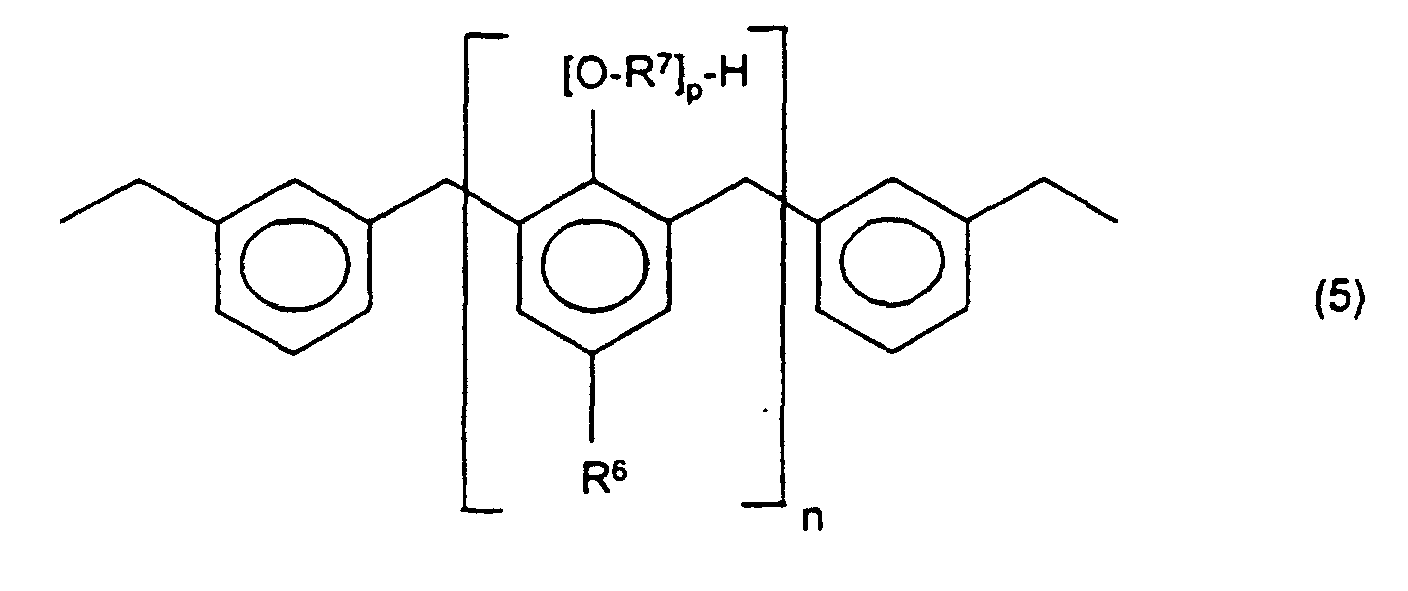
- the copolymers according to the invention can be used in a mixture with alkylphenol-formaldehyde resins.
- these alkylphenol-formaldehyde resins are those of the formula 5 wherein R 6 is C 4 -C 50 alkyl or alkenyl, R 7 is ethoxy and / or propoxy, n is a number from 5 to 100 and p is a number from 0 to 50.
- the copolymers according to the invention are used together with comb polymers.
- This is understood to mean polymers in which hydrocarbon radicals having at least 8, in particular at least 10, carbon atoms are bonded to a polymer backbone. They are preferably homopolymers whose alkyl side chains contain at least 8 and in particular at least 10 carbon atoms. In copolymers, at least 20%, preferably at least 30%, of the monomers have side chains (cf. Comblike Polymers-Structure and Properties; NA Platé and VP Shibaev, J. Polym. Sci. Macromolecular Revs. 1974, 8, 117 ff).
- Suitable comb polymers are, for example, fumarate / vinyl acetate copolymers (cf. EP 0 153 176 A1), copolymers of a C 6 to C 24 ⁇ -olefin and an NC 6 to C 22 alkylmaleimide (cf. EP 0 320 766), also esterified olefin / maleic anhydride copolymers, polymers and copolymers of ⁇ -olefins and esterified copolymers of styrene and maleic anhydride.
- fumarate / vinyl acetate copolymers cf. EP 0 153 176 A1
- copolymers of a C 6 to C 24 ⁇ -olefin and an NC 6 to C 22 alkylmaleimide cf. EP 0 320 766
- esterified olefin / maleic anhydride copolymers polymers and copolymers of ⁇ -olefins and ester
- the mixing ratio (in parts by weight) of those produced according to the invention Copolymers with paraffin dispersants, resins or comb polymers each 1:10 to 20: 1, preferably 1: 1 to 10: 1.
- the inventive Copolymers can be used in a mixture with other lubricity additives.
- Lubricity additives are preferably fatty alcohols, fatty acids and Dimer fatty acids and their esters and partial esters with glycols (according to DE-A-15 94 417), polyols such as glycerol (according to EP-A-0 680 506, EP-A-0 739 970) or Hydroxyamines (according to EP-A-0 802 961) have proven successful.
- the copolymers according to the invention are suitable, the lubricating properties and cold properties of animal, vegetable or mineral oils improve. They are particularly good for use in middle distillates suitable.
- Middle distillates are mineral oils that can be obtained by distillation of crude oil and in the range of 120 to 450 ° C boil, for example kerosene, jet fuel, diesel and heating oil.
- the copolymers according to the invention used in such middle distillates that 0.5% by weight of sulfur and less, particularly preferably less than 500 ppm Sulfur, especially less than 200 ppm sulfur and in special cases contain less than 50 ppm sulfur.
- the polymers can be used alone or together with other additives be used, e.g. with other pour point depressors or Dewaxing agents, with corrosion inhibitors, antioxidants, Mud inhibitors, dehazem and additives to lower the cloud point.
- additives e.g. with other pour point depressors or Dewaxing agents, with corrosion inhibitors, antioxidants, Mud inhibitors, dehazem and additives to lower the cloud point.
- Tallow fatty alcohol and behenyl alcohol are mixtures of fatty alcohols of natural origin and mainly consist of C 16/18 -OH and C 18/20/22 -OH. All additives are used to improve handling as 50% solutions in solvent naphtha or kerosene.
- Test oil 1 Test oil 2 Initial boiling point [° C] 182 173 20% [° C] 202 221 30% [° C] 208 234 90% [° C] 286 329 95% [° C] 302 353 Cloud Point [° C] -29 -8.4 CFPP [° C] -32 -12 S content [ppm] 3 267 Density [g / cm 3 ] 0.819 0,836 Wearscar [ ⁇ m] 609 576
- the lubricating effect of the additives was carried out using an HFRR device from PCS Instruments on additive oils at 60 ° C.
- the High Frequency Reciprocating Rig Test (HFRR) is described in D. Wei, H. Spikes, Wear, Vol. 111, No.2, p.217, 1986. The results are given as the coefficient of friction and wear scar. A low coefficient of friction and a low wear scar show a good lubricating effect.
- Wear Scar in Test Oil 1 example additive Wear scar Movie Friction B1 250 ppm A1 309 ⁇ m 87% 0.16 B2 250 ppm A2 312 ⁇ m 80% 0.17 B3 500 ppm A3 242 ⁇ m 89% 0.15 B4 500 ppm A4 438 ⁇ m 57% 0.23 B5 250 ppm A5 260 ⁇ m 89% 0.16 B6 200 ppm A6 236 ⁇ m 88% 0.15 B7 150 ppm A6 431 ⁇ m 49% 0.22 B8 200 ppm A7 334 ⁇ m 76% 0.17 B9 250 ppm A8 298 ⁇ m 87% 0.16 B10 400 ppm A9 321 ⁇ m 78% 0.19 B11 200 ppm A10 275 ⁇ m 90% 0.15 B12 400 ppm A11 340 ⁇ m 74% 0.19 B13 250 ppm A12 263 ⁇ m 90% 0.15 B14 400 ppm A13 361 ⁇ m 70% 0.16
- test oil 2 A German winter diesel fuel (test oil 2) was used for the following tests used.
- the middle distillate became one at room temperature with 200 ppm 57% dispersion of a commercially available flow improver (ethylene-vinyl acetate copolymer with 31 wt .-% vinyl acetate and one at 140 ° C. measured melt viscosity of 170 mPas) and those in Table 4 specified amounts of the additives heated to 60 ° C, 15 minutes heated to 40 ° C with occasional shaking and then on Cooled to room temperature.
- the middle distillate so additized was according to EN 116 determines the CFPP value.
- the additized samples were cooled in 200 ml measuring cylinders in a refrigerator at -2 ° C./hour to -13 ° C. and stored at this temperature for 16 hours.
- the volume and appearance of both the sediment (paraffin phase) and the oil phase above it were then determined and assessed visually.
- a small amount of sediment and a cloudy oil phase show good paraffin dispersion.
- the lower 20% by volume were isolated and the cloud point determined.
- a slight deviation of the cloud point of the lower phase (CP KS ) from the blank value of the oil shows good paraffin dispersion.
Landscapes
- Chemical & Material Sciences (AREA)
- Oil, Petroleum & Natural Gas (AREA)
- Engineering & Computer Science (AREA)
- Organic Chemistry (AREA)
- Chemical Kinetics & Catalysis (AREA)
- General Chemical & Material Sciences (AREA)
- Health & Medical Sciences (AREA)
- Emergency Medicine (AREA)
- Combustion & Propulsion (AREA)
- Liquid Carbonaceous Fuels (AREA)
- Addition Polymer Or Copolymer, Post-Treatments, Or Chemical Modifications (AREA)
- Lubricants (AREA)
Description
11 Kohlenstoffatomen enthalten.
EP-A-0 856 533 offenbart Copolymere auf Basis von Vinylestem von Carbonsäuren, vinylaromatischen Kohlenwasserstoffen, hydroxyfunktionellen ungesättigten Monomeren und weiteren polymerisierbaren Monomeren. Die Polymere weisen OH-Zahlen von 110-170 mg KOH/g auf, und haben Molekulargewichte von 1500 - 8000 g/mol. Die Polymere werden jedoch gemäß Offenbarung des Dokuments für die Herstellung von Überzugsmitteln für Lacke verwendet. Eine Verwendung im Zusammenhang mit Brennstoffölen wird nicht offenbart.

- A
- R', COOR', OCOR', R"-COOR' oder OR';
- D
- H, CH3, A oder R;
- E
- H oder A;
- G
- H, R", R"-COOR', einen Arylrest oder einen heterocyclischen Rest;
- M
- H, COOR", OCOR", OR" oder COOH;
- N
- H, R", COOR", OCOR, COOH oder einen Arylrest;
- R'
- eine Kohlenwasserstoffkette mit 8-150 Kohlenstoffatomen;
- R"
- eine Kohlenwasserstoffkette mit 1 bis 10 Kohlenstoffatomen;
- m
- eine Zahl zwischen 0,4 und 1,0; und
- n
- eine Zahl zwischen 0 und 0,6.
Die Bestimmung der hydroxyfunktionellen Comonomere erfolgt durch Bestimmung der OH-Zahl durch Umsetzung des Polymers mit überschüssigem Acetanhydrid und anschließender Titration der gebildeten Essigsäure mit KOH.
Die Bestimmung der Viskosität erfolgt gemäß ISO 3219 (B) mit einem Rotationsviskosimeter (Haake RV 20) mit Platte-Kegel-Meßsystem bei 140° C. Bei der Charakterisierung der eingesetzten Additive beziehen sich die Prozentangaben auf Mol-%. Talgfettalkohol und Behenylalkohol sind Fettalkoholmischungen natürlichen Ursprungs und bestehen hauptsächlich aus C16/18-OH bzw. C18/20/22-OH. Alle Additive werden zur Verbesserung der Handhabbarkeit als 50%ige Lösungen in Solvent Naphtha bzw. Kerosin eingesetzt.
| Charakterisierung der eingesetzten Additive A | ||||
| Additiv | Monomer A | Monomer(e) B | V140 [mPas] | OH-Zahl |
| A1 | 24 % Hydroxyethylmethacrylat | 39 % Octadecen 37% Neodecansäurevinylester | 54 | 67 |
| A2 | 23 % Hydroxyethylmethacrylat | 41 % Octadecen 36 % Neodecansäurevinylester | 37 | 62 |
| A3 | 33 % Hydroxyethylmethacrylat | 67 % Octadecylacrylat | 47 | 71 |
| A4 | 19 % Hydroxyethylmethacrylat | 81 % Neodecansäurevinylester | 35 | 58 |
| A5 | 48 % Hydroxyethylmethacrylat | 52 % Octadecylacrylat | 43 | 116 |
| A6 | 55 % Hydroxyethylmethacrylat | 45 % Octadecen | 75 | 198 |
| A7 | 38 % Hydroxyethylmethacrylat | 62 % Oleylacrylat | 70 | 86 |
| A8 | 28 % Allyloxypropandiol | 72 % Octadecylacrylat | 24 | 116 |
| A9 | 12 % Ethylenglykol monovinylether | 73 % Octadecylacrylat 15 % Vinylacetat | 82 | 25 |
| A10 | 25 % Hydroxybutylmonovinylether | 75 % Octadecylvinylether | 54 | 70 |
| A11 | 37 % Hydroxypropylacrylat | 63 % Talgfettalkylacrylat | 37 | 82 |
| A12 | 41 % Hydroxyethylmethacrylat | 59 % Behenylacrylat | 115 | 90 |
| A13 | 20% Dimethylinylcarbinol | 71 % Hexadecen 9 % Poly(isobutylen) mit Mw 1000 | 69 | 42 |
| Charakterisierung der Testöle: Die Bestimmung der Siedekenndaten erfolgt gemäß ASTM D-86, die Bestimmung des CFPP-Werts gemäß EN 116 und die Bestimmung des Cloud Points gemäß ISO 3015. | ||
| Testöl 1 | Testöl 2 | |
| Siedebeginn [°C] | 182 | 173 |
| 20 % [°C] | 202 | 221 |
| 30 % [°C] | 208 | 234 |
| 90 % [°C] | 286 | 329 |
| 95 % [°C] | 302 | 353 |
| Cloud Point [°C] | -29 | -8,4 |
| CFPP [°C] | -32 | -12 |
| S-Gehalt [ppm] | 3 | 267 |
| Dichte [g/cm3] | 0,819 | 0,836 |
| Wearscar [µm] | 609 | 576 |
| Wear Scar in Testöl 1 | ||||
| Beispiel | Additiv | Wear Scar | Film | Friction |
| B1 | 250 ppm A1 | 309 µm | 87 % | 0,16 |
| B2 | 250 ppm A2 | 312 µm | 80 % | 0,17 |
| B3 | 500 ppm A3 | 242 µm | 89 % | 0,15 |
| B4 | 500 ppm A4 | 438 µm | 57 % | 0,23 |
| B5 | 250 ppm A5 | 260 µm | 89 % | 0,16 |
| B6 | 200 ppm A6 | 236 µm | 88 % | 0,15 |
| B7 | 150 ppm A6 | 431 µm | 49 % | 0,22 |
| B8 | 200 ppm A7 | 334 µm | 76 % | 0,17 |
| B9 | 250 ppm A8 | 298 µm | 87 % | 0,16 |
| B10 | 400 ppm A9 | 321 µm | 78 % | 0,19 |
| B11 | 200 ppm A10 | 275 µm | 90 % | 0,15 |
| B12 | 400 ppm A11 | 340 µm | 74 % | 0,19 |
| B13 | 250 ppm A12 | 263 µm | 90 % | 0,15 |
| B14 | 400 ppm A13 | 361 µm | 70 % | 0,16 |
Zusätzlich wurden die unteren 20 Vol.-% isoliert und der Cloud Point bestimmt. Eine nur geringe Abweichung des Cloud Points der unteren Phase (CPKS) vom Blindwert des Öls zeigt eine gute Paraffindispergierung.
| Dispergierwirkung in Testöl 2 | ||||
| Additiv | CFPP | CPKS | ΔCP | optische Beurteilung |
| ― | -22 | +3,8 | 12,2 | klar; 12 % Sediment |
| 150 ppm A3 | -27 | -6,5 | 1,9 | trüb, kein Sediment |
| 100 ppm A5 | -28 | -4,8 | 3,6 | trüb, 25 % Sediment |
- Solvent Naphtha ®Shellsol AB
- aromatische Lösemittelgemische mit Siedebereich 180 bis 210°C
- ®Solvesso 150 ®Solvesso 200
- aromatisches Lösemittelgemisch mit Siedebereich 230 bis 287°C
- ®Exxsol
- Dearomatisierte Lösemittel in verschiedenen Siedebereichen, beispielsweise ®Exxsol D60: 187 bis 215°C
- ®ISOPAR (Exxon)
- isoparaffinische Lösemittelgemische in verschiedenen Siedebereichen, beispielsweise ®ISOPAR L: 190 bis 210°C
- ®Shellsol D
- hauptsächlich aliphatische Lösemittelgemische in verschiedenen Siedebereichen
Claims (8)
- Verwendung von öllöslichen Copolymeren welcheund eine mittlere Molekülmasse Mw von 500 bis 100.000 g/mol und eine OH-Zahl zwischen 10 und 300 mg KOH/g aufweisen, zur Verbesserung der Schmierwirkung und Kaltfließeigenschaften von Mitteldestillaten mit weniger als 0,5 Gew.-% Schwefelgehalt.A) 5 bis 80 mol-% Struktureinheiten, die sich von olefinisch ungesättigten Verbindungen ableiten, welche mindestens eine freie Hydroxylgruppe aufweisen,B) 5 bis 95 mol-% Struktureinheiten, die sich von olefinisch ungesättigten Verbindungen ableiten, welche einen Kohlenwasserstoffrest mit mindestens 6 Kohlenstoffatomen tragen, sowie gegebenenfallsC) 0 bis 40 mol-% weiterer Struktureinheiten ausgewählt aus der Gruppe bestehend aus Acrylsäure, Acrylaten, Vinylestern, Vinylethan und Alkenen mit der Maßgabe, daß die unter C) genannten Struktureinheiten von den unter A) und B) genannten Struktureinheiten verschieden sind,
- Verwendung gemäß Anspruch 1, wobei das Copolymer eine OH-Zahl von 20 bis 250 mg KOH/g aufweist.
- Verwendung gemäß Anspruch 1 und/oder 2, wobei das Copolymer ein mittleres Molekulargewicht Mw von 700 bis 10.000 g/mol aufweist.
- Verwendung gemäß einem oder mehreren der Ansprüche 1 bis 3, wobei der Anteil der Struktureinheiten (A) zwischen 10 und 70 mol-%, insbesondere zwischen 15 und 60 mol-% liegt.
- Verwendung gemäß einem oder mehreren der Ansprüche 1 bis 4, wobei der Anteil der Comonomeren (B) an den erfindungsgemäßen Polymeren zwischen 30 und 90 mol-%, insbesondere zwischen 40 und 80 mol-% liegt.
- Verwendung gemäß einem oder mehreren der Ansprüche 1 bis 5, wobei bis zu 20 mol-%, insbesondere bis zu 10 mol-% der Comonomere B) und gegebenenfalls C) verzweigte Alkylketten enthalten.
- Verwendung gemäß einem oder mehreren der Ansprüche 1 bis 6, wobei die Schmelzviskositäten der Copolymere bei 140°C zwischen 10 und 1000 mPas liegen.
- Mitteldestillat-Brennstofföle mit einem Schwefelgehalt von unter 0,5 Gew.-%, welche Copolymere der in einem oder mehreren der Ansprüche 1 bis 7 definierten Art enthalten.
Applications Claiming Priority (3)
| Application Number | Priority Date | Filing Date | Title |
|---|---|---|---|
| DE19927561 | 1999-06-17 | ||
| DE19927561A DE19927561C1 (de) | 1999-06-17 | 1999-06-17 | Verwendung hydroxylgruppenhaltiger Copolymere zur Herstellung von Brennstoffölen mit verbesserter Schmierwirkung |
| PCT/EP2000/005354 WO2000078897A1 (de) | 1999-06-17 | 2000-06-09 | Verwendung hydroxylgruppenhaltiger copolymere zur herstellung von brennstoffölen mit verbesserter schmierwirkung |
Publications (2)
| Publication Number | Publication Date |
|---|---|
| EP1200539A1 EP1200539A1 (de) | 2002-05-02 |
| EP1200539B1 true EP1200539B1 (de) | 2004-10-27 |
Family
ID=7911488
Family Applications (1)
| Application Number | Title | Priority Date | Filing Date |
|---|---|---|---|
| EP00943791A Expired - Lifetime EP1200539B1 (de) | 1999-06-17 | 2000-06-09 | Verwendung hydroxylgruppenhaltiger copolymere zur herstellung von brennstoffölen mit verbesserter schmierwirkung |
Country Status (6)
| Country | Link |
|---|---|
| US (1) | US6391071B1 (de) |
| EP (1) | EP1200539B1 (de) |
| JP (1) | JP2003503541A (de) |
| AU (1) | AU5813400A (de) |
| DE (2) | DE19927561C1 (de) |
| WO (1) | WO2000078897A1 (de) |
Families Citing this family (12)
| Publication number | Priority date | Publication date | Assignee | Title |
|---|---|---|---|---|
| EP1116780B1 (de) * | 2000-01-11 | 2005-08-31 | Clariant GmbH | Mehrfunktionelles Additiv für Brennstofföle |
| DE10012947A1 (de) | 2000-03-16 | 2001-09-27 | Clariant Gmbh | Mischungen aus Carbonsäuren, deren Derivate und hydroxylgruppenhaltigen Polymeren, sowie deren Verwendung zur Verbesserung der Schmierwirkung von Ölen |
| AU2002353872B2 (en) | 2001-10-25 | 2007-05-17 | IFP Energies Nouvelles | Components for blending of transportation fuels |
| DE10245737C5 (de) * | 2002-10-01 | 2011-12-08 | Clariant Produkte (Deutschland) Gmbh | Verfahren zur Herstellung von Additivmischungen für Mineralöle und Mineralöldestillate |
| DE10247795A1 (de) * | 2002-10-14 | 2004-04-22 | Basf Ag | Verwendung von Hydrocarbylvinyletherhomopolymeren zur Verbesserung der Wirkung von Kaltfliessverbesserern |
| DE10319028B4 (de) * | 2003-04-28 | 2006-12-07 | Clariant Produkte (Deutschland) Gmbh | Demulgatoren für Mischungen aus Mitteldestillaten mit Brennstoffölen pflanzlichen oder tierischen Ursprungs |
| KR101143114B1 (ko) * | 2003-11-13 | 2012-05-08 | 인피늄 인터내셔날 리미티드 | 고온에서 제트연료에서의 침적물 형성을 억제하는 방법 |
| US20050138859A1 (en) * | 2003-12-16 | 2005-06-30 | Graham Jackson | Cold flow improver compositions for fuels |
| DE102004024532B4 (de) * | 2004-05-18 | 2006-05-04 | Clariant Gmbh | Demulgatoren für Mischungen aus Mitteldestillaten mit Brennstoffölen pflanzlichen oder tierischen Ursprungs und Wasser |
| JP5936184B2 (ja) * | 2012-02-14 | 2016-06-15 | 国立大学法人福井大学 | ヒドロキシル基含有ビニルエーテルのホモポリマー又はランダム共重合体の製造方法 |
| WO2014067749A1 (en) | 2012-11-02 | 2014-05-08 | Evonik Industries Ag | Process for preparing low sulfur dispersant polymers |
| WO2014067748A1 (en) * | 2012-11-02 | 2014-05-08 | Evonik Industries Ag | Middle distillate formulations containing sulphur-free, dispersant alkylmethacrylate copolymers |
Family Cites Families (24)
| Publication number | Priority date | Publication date | Assignee | Title |
|---|---|---|---|---|
| DE196556C (de) * | ||||
| GB1001475A (en) | 1960-12-30 | 1965-08-18 | Monsanto Co | Compositions containing oil-soluble polymeric materials |
| GB1047493A (de) | 1963-01-30 | |||
| US3915668A (en) | 1974-11-11 | 1975-10-28 | Standard Oil Co | Crude oils and residual fuel oils containing a terpolymer of ethylene, vinyl ester, and dialkylvinyl carbinol |
| DD126090A1 (de) | 1976-05-06 | 1977-06-22 | ||
| US4211534A (en) | 1978-05-25 | 1980-07-08 | Exxon Research & Engineering Co. | Combination of ethylene polymer, polymer having alkyl side chains, and nitrogen containing compound to improve cold flow properties of distillate fuel oils |
| JPS5840391A (ja) | 1981-09-03 | 1983-03-09 | Sumitomo Chem Co Ltd | 燃料油の低温流動性改良方法 |
| DE3405843A1 (de) | 1984-02-17 | 1985-08-29 | Bayer Ag, 5090 Leverkusen | Copolymere auf basis von maleinsaeureanhydrid und (alpha), (beta)-ungesaettigten verbindungen, ein verfahren zu ihrer herstellung und ihre verwendung als paraffininhibitoren |
| CA1282240C (en) | 1984-02-21 | 1991-04-02 | Albert Rossi | Fuel oil with added polymer of alkyl ester |
| DE3742630A1 (de) | 1987-12-16 | 1989-06-29 | Hoechst Ag | Polymermischungen fuer die verbesserung der fliessfaehigkeit von mineraloeldestillaten in der kaelte |
| DE3926992A1 (de) | 1989-08-16 | 1991-02-21 | Hoechst Ag | Verwendung von umsetzungsprodukten von alkenylspirobislactonen und aminen als paraffindispergatoren |
| DE3930142A1 (de) * | 1989-09-09 | 1991-03-21 | Roehm Gmbh | Dispergierwirksame viskositaets-index-verbesserer |
| ATE143983T1 (de) | 1991-07-18 | 1996-10-15 | Hoechst Ag | Copolymere aus ethylenisch ungesättigten carbonsäureestern mit polyoxyalkylenethern von niederen, ungesättigten alkoholen als fliessverbesserer für paraffinhaltige öle |
| ATE158314T1 (de) | 1993-01-06 | 1997-10-15 | Hoechst Ag | Terpolymere auf basis von alpha,beta- ungesättigten dicarbonsäureanhydriden, alpha,beta-ungesättigten verbindungen und polyoxyalkylenethern von niederen, ungesättigten alkoholen |
| GB9301119D0 (en) | 1993-01-21 | 1993-03-10 | Exxon Chemical Patents Inc | Fuel composition |
| IT1270954B (it) | 1993-07-21 | 1997-05-26 | Euron Spa | Composizione di gasolio |
| GB9411614D0 (en) | 1994-06-09 | 1994-08-03 | Exxon Chemical Patents Inc | Fuel oil compositions |
| GB9424565D0 (en) * | 1994-12-06 | 1995-01-25 | Exxon Chemical Patents Inc | Fuel oil compositions |
| GB9500460D0 (en) | 1995-01-10 | 1995-03-01 | Exxon Chemical Patents Inc | Fuel compositions |
| JP3379866B2 (ja) | 1995-04-24 | 2003-02-24 | 花王株式会社 | 軽油添加剤および軽油組成物 |
| GB2307246B (en) * | 1995-11-13 | 2000-04-12 | Ethyl Petroleum Additives Ltd | Fuel additive |
| DE19704020A1 (de) | 1997-02-04 | 1998-08-06 | Herberts Gmbh | Hydroxylgruppenhaltige Copolymerisate und Verfahren zu ihrer Herstellung |
| US6409778B1 (en) | 1997-11-21 | 2002-06-25 | Rohmax Additives Gmbh | Additive for biodiesel and biofuel oils |
| DE19823565A1 (de) * | 1998-05-27 | 1999-12-02 | Clariant Gmbh | Mischungen von Copolymeren mit verbesserter Schmierwirkung |
-
1999
- 1999-06-17 DE DE19927561A patent/DE19927561C1/de not_active Expired - Fee Related
-
2000
- 2000-06-09 WO PCT/EP2000/005354 patent/WO2000078897A1/de not_active Ceased
- 2000-06-09 EP EP00943791A patent/EP1200539B1/de not_active Expired - Lifetime
- 2000-06-09 JP JP2001505646A patent/JP2003503541A/ja not_active Withdrawn
- 2000-06-09 US US09/591,236 patent/US6391071B1/en not_active Expired - Fee Related
- 2000-06-09 AU AU58134/00A patent/AU5813400A/en not_active Abandoned
- 2000-06-09 DE DE50008434T patent/DE50008434D1/de not_active Expired - Fee Related
Also Published As
| Publication number | Publication date |
|---|---|
| AU5813400A (en) | 2001-01-09 |
| DE19927561C1 (de) | 2000-12-14 |
| JP2003503541A (ja) | 2003-01-28 |
| WO2000078897A1 (de) | 2000-12-28 |
| US6391071B1 (en) | 2002-05-21 |
| EP1200539A1 (de) | 2002-05-02 |
| DE50008434D1 (de) | 2004-12-02 |
Similar Documents
| Publication | Publication Date | Title |
|---|---|---|
| DE19757830C2 (de) | Brennstofföle mit verbesserter Schmierwirkung | |
| EP0922716B1 (de) | Verfahren zur Herstellung von Ethylen-Terpolymeren und deren Verwendung als Zusatz zu Mineralöl und Mineralöldestillaten | |
| EP0807642B1 (de) | Terpolymerisate des Ethylens, ihre Herstellung und ihre Verwendung als Additive für Mineralöldestillate | |
| EP4095217B1 (de) | Copolymerisat und seine verwendung zur verminderung der kristallisation von paraffinkristallen in kraftstoffen | |
| EP1433836A1 (de) | Brennstofföle mit verbesserten Kälteeigenschaften | |
| DE10012946B4 (de) | Verwendung von öllöslichen Amphiphilen als Lösemittel für hydroxyfunktionelle Copolymere | |
| EP1022293B1 (de) | Copolymere und ihre Verwendung als Additiv zur Verbesserung der Kaltfliesseigenschaften von Mitteldestillaten | |
| DE19927561C1 (de) | Verwendung hydroxylgruppenhaltiger Copolymere zur Herstellung von Brennstoffölen mit verbesserter Schmierwirkung | |
| EP0997517B1 (de) | Polymermischungen zur Verbesserung der Schmierwirkung von Mitteldestillaten | |
| EP0890589B1 (de) | Lösungen oder Dispersionen auf Basis von Copolymere von Olefinen und ungesättigten Carbonsäureestern und ihre Verwendung als Mineralöladditive | |
| EP0960908B1 (de) | Mischungen von Copolymeren mit verbesserter Schmierwirkung | |
| EP1134274B1 (de) | Verwendung von Carbonsäuren und deren Derivaten als Lösemittel für hydroxylgruppenhaltige polymere | |
| EP1194456B1 (de) | Hydroxylgruppenhaltige copolymere und ihre verwendung zur herstellung von brennstoffölen mit verbesserter schmierwirkung | |
| EP0890633B1 (de) | Verwendung von Copolymeren aus Ethylen und ungesättigten Carbonsäureestern in Mitteldestillaten zur Verbesserung der Kaltfliesseigenschaften | |
| EP0892012B1 (de) | Fliessverbesserer für Mineralöle | |
| EP0964052B1 (de) | Verwendung von stickstoffhaltigen Ethylencopolymeren zur Herstellung von Brennstoffölen mit verbesserter Schmierwirkung |
Legal Events
| Date | Code | Title | Description |
|---|---|---|---|
| PUAI | Public reference made under article 153(3) epc to a published international application that has entered the european phase |
Free format text: ORIGINAL CODE: 0009012 |
|
| 17P | Request for examination filed |
Effective date: 20020117 |
|
| AK | Designated contracting states |
Kind code of ref document: A1 Designated state(s): AT BE CH CY DE DK ES FI FR GB GR IE IT LI LU MC NL PT SE |
|
| 17Q | First examination report despatched |
Effective date: 20020820 |
|
| GRAP | Despatch of communication of intention to grant a patent |
Free format text: ORIGINAL CODE: EPIDOSNIGR1 |
|
| GRAS | Grant fee paid |
Free format text: ORIGINAL CODE: EPIDOSNIGR3 |
|
| GRAA | (expected) grant |
Free format text: ORIGINAL CODE: 0009210 |
|
| AK | Designated contracting states |
Kind code of ref document: B1 Designated state(s): BE DE FR GB NL |
|
| REG | Reference to a national code |
Ref country code: GB Ref legal event code: FG4D Free format text: NOT ENGLISH |
|
| REG | Reference to a national code |
Ref country code: IE Ref legal event code: FG4D Free format text: GERMAN |
|
| REF | Corresponds to: |
Ref document number: 50008434 Country of ref document: DE Date of ref document: 20041202 Kind code of ref document: P |
|
| GBT | Gb: translation of ep patent filed (gb section 77(6)(a)/1977) |
Effective date: 20050207 |
|
| REG | Reference to a national code |
Ref country code: IE Ref legal event code: FD4D |
|
| PLBE | No opposition filed within time limit |
Free format text: ORIGINAL CODE: 0009261 |
|
| STAA | Information on the status of an ep patent application or granted ep patent |
Free format text: STATUS: NO OPPOSITION FILED WITHIN TIME LIMIT |
|
| ET | Fr: translation filed | ||
| 26N | No opposition filed |
Effective date: 20050728 |
|
| PGFP | Annual fee paid to national office [announced via postgrant information from national office to epo] |
Ref country code: DE Payment date: 20060407 Year of fee payment: 7 |
|
| PGFP | Annual fee paid to national office [announced via postgrant information from national office to epo] |
Ref country code: GB Payment date: 20060413 Year of fee payment: 7 Ref country code: NL Payment date: 20060413 Year of fee payment: 7 |
|
| PGFP | Annual fee paid to national office [announced via postgrant information from national office to epo] |
Ref country code: FR Payment date: 20060414 Year of fee payment: 7 |
|
| PGFP | Annual fee paid to national office [announced via postgrant information from national office to epo] |
Ref country code: BE Payment date: 20060515 Year of fee payment: 7 |
|
| REG | Reference to a national code |
Ref country code: FR Ref legal event code: CD |
|
| BERE | Be: lapsed |
Owner name: *CLARIANT PRODUKTE DEUTSCHLAND G.M.B.H. Effective date: 20070630 |
|
| GBPC | Gb: european patent ceased through non-payment of renewal fee |
Effective date: 20070609 |
|
| NLV4 | Nl: lapsed or anulled due to non-payment of the annual fee |
Effective date: 20080101 |
|
| PG25 | Lapsed in a contracting state [announced via postgrant information from national office to epo] |
Ref country code: BE Free format text: LAPSE BECAUSE OF NON-PAYMENT OF DUE FEES Effective date: 20070630 |
|
| REG | Reference to a national code |
Ref country code: FR Ref legal event code: ST Effective date: 20080229 |
|
| PG25 | Lapsed in a contracting state [announced via postgrant information from national office to epo] |
Ref country code: NL Free format text: LAPSE BECAUSE OF NON-PAYMENT OF DUE FEES Effective date: 20080101 Ref country code: DE Free format text: LAPSE BECAUSE OF NON-PAYMENT OF DUE FEES Effective date: 20080101 |
|
| PG25 | Lapsed in a contracting state [announced via postgrant information from national office to epo] |
Ref country code: GB Free format text: LAPSE BECAUSE OF NON-PAYMENT OF DUE FEES Effective date: 20070609 |
|
| PG25 | Lapsed in a contracting state [announced via postgrant information from national office to epo] |
Ref country code: FR Free format text: LAPSE BECAUSE OF NON-PAYMENT OF DUE FEES Effective date: 20070702 |