EP1199320A1 - Elektroisolierlackbindemittel mit Harnstoff- und/oder Hydantoinstruktur - Google Patents

Elektroisolierlackbindemittel mit Harnstoff- und/oder Hydantoinstruktur Download PDF

Info

Publication number
EP1199320A1
EP1199320A1 EP01123284A EP01123284A EP1199320A1 EP 1199320 A1 EP1199320 A1 EP 1199320A1 EP 01123284 A EP01123284 A EP 01123284A EP 01123284 A EP01123284 A EP 01123284A EP 1199320 A1 EP1199320 A1 EP 1199320A1
Authority
EP
European Patent Office
Prior art keywords
electrical insulating
binder
groups
amino
hydroxy
Prior art date
Legal status (The legal status is an assumption and is not a legal conclusion. Google has not performed a legal analysis and makes no representation as to the accuracy of the status listed.)
Withdrawn
Application number
EP01123284A
Other languages
English (en)
French (fr)
Inventor
Rolf Dr. Gertzmann
Lutz Dr. Schmalstieg
Jan Dr. Mazanek
Bernd Hausstätter
Current Assignee (The listed assignees may be inaccurate. Google has not performed a legal analysis and makes no representation or warranty as to the accuracy of the list.)
Bayer AG
Original Assignee
Bayer AG
Priority date (The priority date is an assumption and is not a legal conclusion. Google has not performed a legal analysis and makes no representation as to the accuracy of the date listed.)
Filing date
Publication date
Application filed by Bayer AG filed Critical Bayer AG
Publication of EP1199320A1 publication Critical patent/EP1199320A1/de
Withdrawn legal-status Critical Current

Links

Classifications

    • CCHEMISTRY; METALLURGY
    • C08ORGANIC MACROMOLECULAR COMPOUNDS; THEIR PREPARATION OR CHEMICAL WORKING-UP; COMPOSITIONS BASED THEREON
    • C08GMACROMOLECULAR COMPOUNDS OBTAINED OTHERWISE THAN BY REACTIONS ONLY INVOLVING UNSATURATED CARBON-TO-CARBON BONDS
    • C08G18/00Polymeric products of isocyanates or isothiocyanates
    • C08G18/06Polymeric products of isocyanates or isothiocyanates with compounds having active hydrogen
    • C08G18/70Polymeric products of isocyanates or isothiocyanates with compounds having active hydrogen characterised by the isocyanates or isothiocyanates used
    • C08G18/72Polyisocyanates or polyisothiocyanates
    • C08G18/80Masked polyisocyanates
    • C08G18/8061Masked polyisocyanates masked with compounds having only one group containing active hydrogen
    • C08G18/8064Masked polyisocyanates masked with compounds having only one group containing active hydrogen with monohydroxy compounds
    • CCHEMISTRY; METALLURGY
    • C08ORGANIC MACROMOLECULAR COMPOUNDS; THEIR PREPARATION OR CHEMICAL WORKING-UP; COMPOSITIONS BASED THEREON
    • C08GMACROMOLECULAR COMPOUNDS OBTAINED OTHERWISE THAN BY REACTIONS ONLY INVOLVING UNSATURATED CARBON-TO-CARBON BONDS
    • C08G18/00Polymeric products of isocyanates or isothiocyanates
    • C08G18/06Polymeric products of isocyanates or isothiocyanates with compounds having active hydrogen
    • C08G18/28Polymeric products of isocyanates or isothiocyanates with compounds having active hydrogen characterised by the compounds used containing active hydrogen
    • C08G18/30Low-molecular-weight compounds
    • C08G18/38Low-molecular-weight compounds having heteroatoms other than oxygen
    • C08G18/3819Low-molecular-weight compounds having heteroatoms other than oxygen having nitrogen
    • C08G18/3821Carboxylic acids; Esters thereof with monohydroxyl compounds
    • CCHEMISTRY; METALLURGY
    • C08ORGANIC MACROMOLECULAR COMPOUNDS; THEIR PREPARATION OR CHEMICAL WORKING-UP; COMPOSITIONS BASED THEREON
    • C08GMACROMOLECULAR COMPOUNDS OBTAINED OTHERWISE THAN BY REACTIONS ONLY INVOLVING UNSATURATED CARBON-TO-CARBON BONDS
    • C08G18/00Polymeric products of isocyanates or isothiocyanates
    • C08G18/06Polymeric products of isocyanates or isothiocyanates with compounds having active hydrogen
    • C08G18/70Polymeric products of isocyanates or isothiocyanates with compounds having active hydrogen characterised by the isocyanates or isothiocyanates used
    • C08G18/72Polyisocyanates or polyisothiocyanates
    • C08G18/80Masked polyisocyanates
    • C08G18/8003Masked polyisocyanates masked with compounds having at least two groups containing active hydrogen
    • C08G18/8006Masked polyisocyanates masked with compounds having at least two groups containing active hydrogen with compounds of C08G18/32
    • C08G18/8009Masked polyisocyanates masked with compounds having at least two groups containing active hydrogen with compounds of C08G18/32 with compounds of C08G18/3203
    • CCHEMISTRY; METALLURGY
    • C08ORGANIC MACROMOLECULAR COMPOUNDS; THEIR PREPARATION OR CHEMICAL WORKING-UP; COMPOSITIONS BASED THEREON
    • C08GMACROMOLECULAR COMPOUNDS OBTAINED OTHERWISE THAN BY REACTIONS ONLY INVOLVING UNSATURATED CARBON-TO-CARBON BONDS
    • C08G18/00Polymeric products of isocyanates or isothiocyanates
    • C08G18/06Polymeric products of isocyanates or isothiocyanates with compounds having active hydrogen
    • C08G18/70Polymeric products of isocyanates or isothiocyanates with compounds having active hydrogen characterised by the isocyanates or isothiocyanates used
    • C08G18/72Polyisocyanates or polyisothiocyanates
    • C08G18/80Masked polyisocyanates
    • C08G18/8061Masked polyisocyanates masked with compounds having only one group containing active hydrogen
    • C08G18/8064Masked polyisocyanates masked with compounds having only one group containing active hydrogen with monohydroxy compounds
    • C08G18/8067Masked polyisocyanates masked with compounds having only one group containing active hydrogen with monohydroxy compounds phenolic compounds
    • CCHEMISTRY; METALLURGY
    • C09DYES; PAINTS; POLISHES; NATURAL RESINS; ADHESIVES; COMPOSITIONS NOT OTHERWISE PROVIDED FOR; APPLICATIONS OF MATERIALS NOT OTHERWISE PROVIDED FOR
    • C09DCOATING COMPOSITIONS, e.g. PAINTS, VARNISHES OR LACQUERS; FILLING PASTES; CHEMICAL PAINT OR INK REMOVERS; INKS; CORRECTING FLUIDS; WOODSTAINS; PASTES OR SOLIDS FOR COLOURING OR PRINTING; USE OF MATERIALS THEREFOR
    • C09D175/00Coating compositions based on polyureas or polyurethanes; Coating compositions based on derivatives of such polymers
    • C09D175/02Polyureas

Definitions

  • the present invention relates to novel binders for electrical insulating lacquers, the paints obtained are characterized by high temperature resistance and good Characterize solderability or tinnability.
  • the electrical insulating lacquer coating compositions commonly used today include the conventional high temperature resistant coatings in which polyhydantoins (e.g. FR-A 1 484 694, DE-A 246020), polyimides, polyamideimides (e.g. DE-A 3 544 548, DE-A 3 714 033, DE-A 3 817 614) or polyester amide imides (e.g. US-A 3 652 471, US-A 4 997 891, DE-A 3 249 497) the essential binder component form. Wires coated with these products are below a temperature of 400 - 450 ° C cannot be tinned.
  • polyhydantoins e.g. FR-A 1 484 694, DE-A 246020
  • polyimides e.g. DE-A 3 544 548, DE-A 3 714 033, DE-A 3 817 61
  • polyester amide imides e.g. US-A 3 652 471, US-A 4 997
  • electrical insulating lacquers based on polyurethane enable quick tinnability at comparatively low temperatures.
  • the binders The wire enamels used here are based on combinations from polyester polyols and phenol or alkanol-blocked polyisocyanates (DE-A 1 170 096 or DE-A 2 626 175). An improvement in tinnability can be achieved by Combination of blocked polyisocyanates with hydroxy-functional oligourethanes can be reached e.g. (DE-A-1 644 794).
  • Polyesterimides with a high hydroxyl group content, in combination with heat-resistant blocked polyisocyanates can be tinned at 370 ° C, show the usual polyesterimides but strongly decreasing properties with respect to tan ⁇ Break point and softening temperature.
  • Amidimide-polyurethane combinations also have similar disadvantages on, which are described in EP-A 365 877.
  • EP-A 752 434 describes the increase in the softening temperature of solderable wires Introduction of blocked polyisocyanates containing amide / imide groups. Compared to US Pat. No. 4,997,891, this results in significantly improved solderability achieved, but the softening temperature is not improved.
  • EP-A 231 509 contains carbodiimide and / or uretonimine groups Polyisocyante and their use for wire coating known. This polyisocyanate are suitable, depending on the reactant, for the production of tinnable (Ex. 1 der EP-A 231 509) or heat-resistant enamelled wires (Example 3 of EP-A 231 509).
  • EP-A 287 947 heat-resistant electrical insulating lacquers are used Use of unsaturated carboxylic acids in combination with carbodiimide and / or Obtained polyisocyanates containing uretonimine groups. Will be in the making of the wire enamel having hydantoin structures is an isocyanurate-containing compound (EP-A 287 947 Ex. 3) is used, one obtains a tin-tinnable one at 420.degree Wire enamel with a softening temperature of 250 ° C; contains the Mixture in addition to the OH-containing blocking agent, no further OH components, so you get non-tinnable products with softening temperatures > 300 ° C (EP-A 287 947 Ex. 2).
  • N, N ', N "-Tris (2-hydroxyethyl) isocyanurate likewise leads to heat-resistant enamelled wires as an additive for wire enamels based on polyurethane (DE-A 3 133 571).
  • US-A 5,254,659 describes the production of heat-resistant, solderable wire enamels made of polyimides and imide-modified polyurethanes. Because of the low solids content the binder and the one that is unusual for the wire enamel industry and in addition, comparatively expensive solvents come into use such products certainly only in exceptional cases and for coating thinner Wires for use.
  • Hydantoin or urea structure are included Hydantoin or urea structure, as they also in the wire enamel binders according to the invention are to be used in principle as component A). According to In this teaching, these compounds are characterized by an improved thermal Stability and are particularly suitable as binders for coating Steel sheets.
  • US Pat. No. 3,549,599 describes the production of polyhydantoins Aspartic acid esters and the high temperature resistance of the resulting Products described. The can also be used in conjunction with other publications Specialist of this teaching, neither a reference to the manufacture of solderable, high temperature resistant Take out wire enamels, the use of them Substances for the production of solderable wire enamel binders.
  • Polyurethanes A) are suitable as starting polyisocyanates a) aromatic, aliphatic or cycloaliphatic polyisocyanates, preferably polyisocyanates of a uniform or average molecular weight of 140 - 500 with an average statistical NCO functionality of maximum 2.6.
  • Such polyisocyanates are, for example, 1,4-phenylene diisocyanate, 2,4- and 2,6-diisocyanatotoluene (TDI) and any mixtures of these isomers, 4,4'-, 2,4'- and 2,2'-diisocyanatodiphenylmethane (MDI) or any mixture of these isomers or mixtures of these isomers with their higher homologs, as they are known per se Obtained by phosgenation of aniline / formaldehyde condensates 1,5-naphthylene diisocyanate, 1,4-butane diisocyanate, 2-methylpentane-1,5-diisocyanate, 1,5-hexane diisocyanate, 1,6-hexane diisocyanate (HDI), 1,3- and 1,4-cyclohexane diisocyanate as well as any mixtures of these isomers, 2,4- and 2,6-diisocyana
  • Preferred starting polyisocyanates a) are those with aromatically bound Isocyanate groups with a statistical average NCO functionality from 2 to 2.2 and an average, if necessary, on average Molecular weight of 174-300.
  • Diisocyanates to be used with particular preference are 2,4-diisocyanatotoluene and 2,6-diisocyanatotoluene, the technical mixtures consisting of these isomers and 4,4'-, 2,4'- and 2,2'-diisocyanatodiphenylmethane or any mixtures of these isomers or mixtures of these isomers with their higher homologues, as they are known per se by phosgenation of aniline / formaldehyde condensates can be obtained or any mixtures of here mentioned aromatic polyisocyanates.
  • R 1 and R 2 are organic radicals having 1 to 9 carbon atoms are suitable as fumaric or maleic acid diesters of the formula (ii).
  • R 1 and R 2 with 1 to 4 carbon atoms are preferred, it being possible for R 1 and R 2 to represent the same radicals.
  • Particularly preferred are mixtures in which the equivalence ratio of difunctional to trifunctional Amines 1: 1.5 to 3: 1.
  • difunctional amines are ethylenediamine, 1,2-diaminopropane, 1,4-diaminobutane, 2,5-diamino-2,5-dimethylhexane, 1,5-diamino-2-methylpentane (Dytek® A or DuPont), 1,6-diaminohexane, 2,2,4- and / or 2,4,4-trimethyl-1,6-diaminohexane, 1,11-diaminoundecane, 1,12-diaminododecane 1-amino-3 , 3,5-trimethyl-5-aminomethylcyclohexane (IPDA), 2,4- and / or 2,6-hexahydrotoluenediamine (H 6 TDA), isopropyl-2,4- and / or 2,6-diaminocyclohexane, 1,3 -Bis (aminomethyl) cyclohexane,
  • trifunctional and higher functional amines are 4-aminomethyl-1,8-octanediamine; 2,2 ', 2 "triaminotriethylamine, 1,3,5-tris (aminomethyl) -2,4,6-triethylbenzene, Tris-1,1,1-aminoethylethane, 1,2,3-triamionpropane, tris (3-aminopropyl) amine and N, N, N ', N'-tetrakis (2-aminoethyl) ethylenediamine.
  • Suitable hydroxy-functional amines are 2-aminoethanol, Aminopropanols, 3-amino-1,2-propanediol, aminobutanols and 1,3-diamino-2-propanol.
  • low molecular weight polyether polyamines with aliphatic can also be used bound, primary amino groups, such as those known for example Jeffamin® are sold by Huntsman.
  • the aspartic acid esters b) can be prepared both in solution and without solvents be performed. In both cases, an equimolar is preferred Implementation of the amine with the fumaric or maleic acid diester.
  • Varying application properties of the wire coatings can do that Equivalence ratio of maleic or fumaric acid ester to amine i) from 1.2: 1 to 1: 2, can be varied. In the event that mixtures of aspartic acid esters are used be, the preparation of the aspartic acid esters separately or in one Reaction vessel take place.
  • Polyurethanes A) are suitable as polyhydroxy compounds c) any araliphatic, aliphatic or cycloaliphatic polyhydroxy compounds, preferred Polyhydroxy compounds of a uniform or average Molecular weight of 62 - 3000 with a statistical average OH functionality of maximum 3.
  • polyhydroxy compounds c) come preferably diols and / or triols of the molecular weight range 62-350, but less preferably also with polyhydroxy compounds Molecular weights between 350 and 3,000 into consideration.
  • Suitable polyhydroxy compounds c) the molecular weight range 62-350 are, for example Ethylene glycol, propanediols, butanediols, hexanediols, di-, tri- or tetraethylene glycol, Di-, tri- or tetrapropylene glycol, neopentyl glycol, 2-ethyl-1,3-hexanediol, 2,2,4-trimethyl-1,3-pentanediol, 1,4-bis (hydroxymethyl) cyclohexane, 2,2-bis (4-hydroxycyclo- hexyl) propane, glycerol, hexanetriol and N, N ', N "-Tris- (2-hydroxyethyl) isocyanurate (THEIC).
  • Ethylene glycol propanediols, butanediols, hexanediols, di-, tri- or tetra
  • High molecular weight polyhydroxy compounds c) are, for example, the known polyhydroxy polyesters, such as those obtained from dicarboxylic acids such as phthalic acid, isophthalic acid, terephthalic acid or adipic acid with excess Polyols of the type mentioned above can be obtained.
  • Polyols c) can also be known polyhydroxy polyethers, as described by Alkoxylation of low molecular weight starter molecules are used become.
  • Solvents d) are the solvents customary in wire coating used to adjust the viscosity of the products to a level necessary for processing Adjust level. Phenols, cresols, Xylenols and their technical isomer mixtures, benzyl alcohol, 2-methoxypropyl acetate, Butyl acetate, N-methylpyrrolidone, hydrocarbons liquid at room temperature or hydrocarbon mixtures and mixtures of the above Solvent. Solvent mixtures of the solvents mentioned are preferred.
  • the isocyanate-reactive components b) and c) are in a weight ratio of 1:10 to 4: 1, preferably from 1: 2 to 2: 1 with each other mixed and with the solvent or solvent mixture d) in a weight ratio of 1:10 to 2: 1, preferably 1: 1.5 to 1.5: 1 diluted.
  • the mixture containing isocyanate-reactive components b) and c) is reduced to a Temperature set between 10 - 150 ° C, preferably 20 - 80 ° C. That mix the solution containing component a) is added.
  • the reaction mixture is as long as at a temperature between 10 and 150 ° C, preferably 20 - 80 ° C, until no more free isocyanate groups can be detected.
  • reaction mixture is then preferably stirred at 80-120 ° C. to achieve a Initiate or complete hydantoin formation and the split off If necessary, distill off alcohol under reduced pressure, or in the Leave reaction mixture.
  • Polyurethane A) becomes the polyisocyanate a) with the solvent or the solvent mixture d) in a weight ratio of 3: 1 to 1: 3, preferred diluted from 1.5: 1 to 1: 1.5.
  • the isocyanate-reactive components b) and c) are in a weight ratio of 1:10 to 4: 1, preferably from 1: 2 to 2: 1 with each other mixed and with the solvent or solvent gemsich d) in a weight ratio of 1:10 to 2: 1, preferably 1: 1.5 to 1.5: 1 diluted.
  • the Mixture containing isocyanate-reactive components b) and c) is added to a Temperature set between 10-150 ° C, preferably 20-100 ° C. This mix is added to the solution containing component a).
  • the reaction mixture is stirred at a temperature between 10 and 150 ° C., preferably 20-100 ° C., until no more free isocyanate groups can be detected.
  • the entire solvent can also be used for dilution only individual components can be used.
  • Another embodiment for the production of the hydroxy- and / or amino-functional polyurethanes A) can, for example, consist of a two-part reaction, in which initially the polyisocyanate a), with the aspartic acid ester or aspartic acid ester mixture b) is reacted before the polyhydroxy compounds c) with the remaining one Polyisocyanate a) are reacted.
  • Another embodiment can be that initially only the polyhydroxy functional Compounds c) are added to the polyisocyanate a) and only after this are reacted, the aspartic acid ester or the aspartic acid ester mixture b) added to the isocyanate.
  • reactive compounds can be those known in polyurethane chemistry and in Kunststoffoff Handbuch (ed. Becker / Braun), Vol. 7, Polyurethane, p. 92 ff, Carl Hanser Verlag, Kunststoff Vienna 1983) catalysts used as examples become.
  • the catalysts are optionally used in an amount of 0.01 to 5.0% based on the polyisocyanate a) used.
  • the binders for wire enamels according to the invention are produced by mixing the hydroxy- and / or amino-functional polyurethanes A) in the Wire enamel coating technology in known, blocked enamel polyisocyanates B) organic solvents C) and optionally auxiliaries and additives D) at room temperature, the reactive towards isocyanates Component A) is used in such amounts that an equivalent ratio of hydroxy and / or amino functional groups of component A) blocked isocyanate groups of component B) from 1: 2 to 1.5: 1 preferably 1: 1.5 to 1.3: 1 is observed.
  • Blocked lacquer polyisocyanates B) which can be used are those from wire enamel technology resins known per se with blocked isocyanate end groups Ester and / or amide and / or imide and / or urethane structures.
  • are particularly preferably used as component B) are blocked NCO groups terminated polyurethanes with a urethane group content of 2 - 20% by weight and in particular with a urethane group content of 4 - 15% by weight.
  • Solvent component C) includes all those customary in coating technology organic solvents that are inert to isocyanate groups, such as e.g. Ethyl acetate, butyl acetate, ethylene glycol monomethyl or ethyl acetate, 1-methoxypropyl-2-acetate, 2-butanone, 4-methyl-2-pentanone, cyclohexanone, toluene, Xylene, solvent naphtha or mixtures thereof. Also usable, but less plasticizers such as e.g. those based on phosphoric acid, sulfonic acid or phthalic acid esters.
  • organic solvents that are inert to isocyanate groups, such as e.g. Ethyl acetate, butyl acetate, ethylene glycol monomethyl or ethyl acetate, 1-methoxypropyl-2-acetate, 2-butanone, 4-methyl-2-pentanone, cyclohexanone, toluene
  • phenols such as e.g. isopropanol, n-butanol, n-octanol, 2-methoxyethanol, 2-ethoxyethanol, diethylene glycol monomethyl ether, Diethylene glycol monoethyl ether, 1-methoxy-2-propanol, cycloalkonols such as benzyl alcohol, or phenols such as cresol, xylen
  • Auxiliaries and additives D) can be used in electrical insulation technology known catalysts, pigments and / or flow agents are used according to the invention become.
  • the electrical insulating lacquer binders according to the invention are at room temperature or moderately elevated temperature (up to approx. 50 ° C) are stable in storage and react when heated to temperatures above 60 ° C, preferably from 100 - 500 ° C and in particular from 180 - 400 ° C with simultaneous evaporation of any present volatile components to form cross-linked plastics.
  • the application the lacquers are made according to the known immersion, roller application, nozzles or Suction felt process, whereby the drying, i.e. the curing of the paint layers in the usual drying ovens within a temperature range of 100 - 500 ° C, and in particular from 180 - 400 ° C.
  • the properties of the electrical insulating lacquer binders according to the invention are: the good solderability, the high softening and high heat shock temperature of the products obtained compared to conventional known products to highlight the state of the art. Because of the excellent electrical and mechanical properties of the binders according to the invention are suitable Products also for the production of insulating fabrics or for the impregnation of Electric motors.
  • Component B 1 was obtained by adding 2500 g of 4,4'-MDI (Desmodur® 44 M der Bayer AG) at 80 ° C a mixture of 375.2 g trimethylolpropane, 1026.0 g cresol, 155.4 g of n-butanol, 0.4 g of diazabicyclooctane and 8.1 g of dibutyltin dilaurate were added dropwise was blocked (NCO content is 9.8%).
  • 4,4'-MDI Desmodur® 44 M der Bayer AG
  • a commercially available blocked polyisocyanate was used as component B 2 (Desmodur® VP LS 2018) from Bayer (blocked NCO content is 9.5%).
  • a wire coated with this varnish can be tinned within 5 seconds at 390 ° C, the tan ⁇ break point is 180 ° C, the softening temperature according to IEC 851, Part 6, 4.1.2 is 280 ° C.
  • the paint film shows great flexibility: after 15% pre-stretching the wire can be wrapped around a cylindrical mandrel of 0.5 mm without that the paint film has cracks. The heat shock is on with 5% pre-stretch a 0.5 mm mandrel fine after 30 min at 200 ° C.
  • a wire coated with this varnish can be tinned within 5 seconds at 390 ° C, the tan ⁇ break point is 173 ° C, the softening temperature according to IEC 851, Part 6, 4.1.2 is 280 ° C.
  • the paint film shows great flexibility: after 15% pre-stretching the wire can be wrapped around a cylindrical mandrel of 0.5 mm without that the paint film has cracks. The heat shock is on one without pre-stretching 0.5 mm mandrel fine after 30 min at 200 ° C.
  • a wire coated with this lacquer can be tinned within 8 seconds at 390 ° C, the tan ⁇ break point is 179 ° C, the softening temperature according to IEC 851, part 6, 4.1.2 is 290 ° C.
  • the paint film shows great flexibility: after 15%
  • the wire can be pre-stretched around a cylindrical mandrel of 0.5 mm, without the lacquer film showing cracks.
  • the heat shock is on with 5% pre-stretch a 0.5 mm mandrel fine after 30 min at 200 ° C.
  • a wire coated with this varnish can be tinned at 390 ° C within 6 seconds, the tan ⁇ break point is 179 ° C, the softening temperature according to IEC 851, Part 6, 4.1.2 is 290 ° C.
  • the paint film shows great flexibility: after 10% pre-stretching the wire can be wrapped around a cylindrical mandrel of 0.5 mm without that the paint film has cracks. The heat shock is on with 5% pre-stretch a 0.5 mm mandrel fine after 30 min at 200 ° C.
  • a wire coated with this varnish can be tinned within 9 seconds at 390 ° C, the tan ⁇ break point is 184 ° C, the softening temperature according to IEC 851, Part 6, 4.1.2 is 290 ° C.
  • the paint film shows great flexibility: after 5% pre-stretching the wire can be wrapped around a cylindrical mandrel of 0.5 mm without that the paint film has cracks. The heat shock is on with 5% pre-stretch a 0.5 mm mandrel fine after 30 min at 200 ° C.
  • a wire coated with this varnish can be tinned at 390 ° C within 6 seconds, the tan ⁇ break point is 191 ° C, the softening temperature according to IEC 851, Part 6, 4.1.2 is 300 ° C.
  • the paint film shows great flexibility: after 5% pre-stretching the wire can be wrapped around a cylindrical mandrel of 0.5 mm without that the paint film has cracks. The heat shock is on with 5% pre-stretch a 0.5 mm mandrel fine after 30 min at 200 ° C.
  • a wire coated with this varnish can be tinned within 9 seconds at 390 ° C, the tan ⁇ break point is 190 ° C, the softening temperature according to IEC 851, Part 6, 4.1.2 is 290 ° C.
  • the paint film shows great flexibility: after 5% pre-stretching the wire can be wrapped around a cylindrical mandrel of 0.5 mm without that the paint film has cracks. The heat shock is on with 5% pre-stretch a 0.5 mm mandrel fine after 30 min at 200 ° C.

Landscapes

  • Chemical & Material Sciences (AREA)
  • Organic Chemistry (AREA)
  • Health & Medical Sciences (AREA)
  • Chemical Kinetics & Catalysis (AREA)
  • Medicinal Chemistry (AREA)
  • Polymers & Plastics (AREA)
  • Life Sciences & Earth Sciences (AREA)
  • Engineering & Computer Science (AREA)
  • Materials Engineering (AREA)
  • Wood Science & Technology (AREA)
  • Polyurethanes Or Polyureas (AREA)
  • Paints Or Removers (AREA)
  • Organic Insulating Materials (AREA)
  • Insulated Conductors (AREA)

Abstract

Die vorliegende Erfindung betrifft neuartige Bindemittel für Elektroisolierlacke, wobei sich die erhaltenen Lacke durch eine hohe Temperaturbeständigkeit und gute Löt-bzw. Verzinnbarkeit auszeichnen.

Description

Die vorliegende Erfindung betrifft neuartige Bindemittel für Elektroisolierlacke, wobei sich die erhaltenen Lacke durch eine hohe Temperaturbeständigkeit und gute Löt- bzw. Verzinnbarkeit auszeichnen.
Die heutige Elektro- und Elektronikindustrie benötigt große Mengen beschichteter Drähte zur Herstellung von Motoren, Transformatoren, Bildröhren und anderen Produkten. Da das Design moderner Maschinen mehr und mehr nach kleineren Motoren, Spulen, Transformatoren usw. verlangt, und diese bei höherer Temperatur arbeiten als ihr größeres Äquivalent, werden erhöhte Anforderungen an die Temperaturbeständigkeit der Drahtbeschichtungen gestellt. In der vorliegenden Anmeldung wird die Temperaturbeständigkeit über die Erweichungstemperatur der Beschichtung definiert. Eine weitere Anforderung an die Produkte ist in vielen Anwendungen eine zügige Lötbarkeit der Produkte, um die Enden der beschichteten Drähte schnell und auf einfache Weise elektrisch leitend mit anderen Komponenten zu verbinden.
Die heute üblicherweise eingesetzten Elektroisolierlackbeschichtungsmittel umfassen die konventionellen hochtemperaturbeständigen Beschichtungen in denen Polyhydantoine (z.B. FR-A 1 484 694, DE-A 246020), Polyimide, Polyamidimide (z.B. DE-A 3 544 548, DE-A 3 714 033, DE-A 3 817 614) oder Polyesteramidimide (z.B. US-A 3 652 471, US-A 4 997 891, DE-A 3 249 497) die wesentliche Bindemittelkomponente bilden. Drähte, die mit diesen Produkten beschichtet sind, sind unterhalb einer Temperatur von 400 - 450°C nicht verzinnbar.
Im Unterschied dazu ermöglichen Elektroisolierlacke auf Polyurethanbasis eine schnelle Verzinnbarkeit bei vergleichsweise niedrigen Temperaturen. Die Bindemittel der hierbei zum Einsatz gelangenden Drahtlacke basieren auf Kombinationen aus Polyesterpolyolen und Phenol oder Alkanol-blockierten Polyisocyanaten (DE-A 1 170 096 oder DE-A 2 626 175). Eine Verbesserung der Verzinnbarkeit kann durch Kombination von blockierten Polyisocyanaten mit hydroxy-funktionellen Oligourethanen erreicht werden z.B. (DE-A-1 644 794).
In S. Darling, "International Wire Standards-Progress Towards Harmonization" in Proceedings 19th EEI Conference, Chicago 25. Bis 28 Sept. 1989, S. 56 werden zwar Polyesterimide mit einem Temperaturindex von 180°C als "solderable" (lötbar, verzinnbar) bezeichnet, allerdings ist die Verzinnbarkeit ebenfalls erst bei Temperaturen oberhalb von 400°C gegeben.
Polyesterimide mit hohem Hydroxylgruppengehalt, in Kombination mit wärmebeständigen blockierten Polyisocyanaten sind bei 370°C verzinnbar, zeigen gegenüber den üblichen Polyesterimiden aber stark abfallende Eigenschaften bezüglich tan δ Knickpunkt und Erweichungstemperatur. Ähnliche Nachteile weisen auch Amidimid-Polyurethankombinationen auf, die in EP-A 365 877 beschrieben sind. In der EP-A 752 434 wird die Erhöhung der Erweichungstemperatur lötbarer Drähte durch Einführung von Amid-/Imidgruppenhaltigen blockierten Polyisocyanten beschrieben. Im Vergleich zur US-A 4 997 891 wird dadurch zwar eine deutlich verbesserte Lötbarkeit erzielt, doch ist die Erweichungstemperatur nicht verbessert.
Aus EP-A 231 509 sind Carbodiimid- und/oder Uretonimingruppen enthaltende Polyisocyante sowie ihre Verwendung zur Drahtlackierung bekannt. Diese Polyisocyante eignen sich je nach Reaktionspartner zur Herstellung verzinnbarer (Bsp. 1 der EP-A 231 509) oder aber hitzebeständiger Lackdrähte (Bsp. 3 der EP-A 231 509).
Nach der Lehre der EP-A 287 947 werden hitzebeständige Elektroisolierlacke durch Verwendung ungesättigter Carbonsäuren in Kombination mit Carbodiimid- und/oder Uretonimingruppen enthaltenden Polyisocyanaten erhalten. Wird bei der Herstellung des Hydantoinstrukturen aufwiesenden Drahtlacks eine isocyanurathaltige Verbindungen (EP-A 287 947 Bsp. 3) verwendet, so erhält man einen bei 420°C verzinnbaren Drahtlacklack mit einer Erweichungstemperatur von 250°C; enthält die Mischung neben den OH-haltigen Blockierungsmittel keine weiteren OH-Komponenten, so erhält man nicht verzinnbare Produkte mit Erweichungstemperaturen >300°C (EP-A 287 947 Bsp. 2).
Ebenfalls zu hitzebeständigen Lackdrähten führt die Verwendung von N,N',N"-Tris-(2-hydroxyethyl)-isocyanurat als Zusatzmittel für Drahtlacke auf Polyurethanbasis (DE-A 3 133 571).
Die US-A 5,254,659 beschreibt die Herstellung hitzebeständiger, lötbare Drahtlacke aus Polyimiden und imidmodifizierten Polyurethanen. Aufgrund der niedrigen Festkörpergehalte der Bindemittel und den für die Drahtlackindustrie ungewöhnlichen und darüber hinaus vergleichsweise teuren Lösungsmitteln kommt die Verwendung solcher Produkte sicherlich nur in Ausnahmefällen und zur Beschichtung dünner Drähte zum Einsatz.
Zusammenfassend kann festgestellt werden, dass die Lehre des vorbekannten Standes der Technik sich darin erschöpft, Elektroisolierlacke mit hohem Wärmestand (>270°C) herzustellen, die bei 390°C nicht oder nur sehr langsam verzinnbar sind, oder aber solche herzustellen, die bei 390°C schnell verzinnbar sind aber nur einen Wärmestand von ≤ 270°C aufweisen.
Es war daher die Aufgabe der Erfindung, ein Beschichtungsmittel für hitzeresistente Substrate, insbesondere zur Drahtlackierung von Drähten zur Verfügung zu stellen, welches beide Vorteile - Hitzebeständigkeit >270°C einerseits und verbesserte Verzinnbarkeit bei einer Temperatur von 390°C andererseits - in sich vereint.
Diese Aufgabe konnte mit Hilfe der nachstehend näher beschriebenen erfindungsgemäßen Elektroisolierlackbindemittel gelöst werden. Der Erfindung liegt die überraschende Erkenntnis zugrunde, dass durch Verwendung bestimmter Harnstoff- und/oder Hydantoin-Gruppen aufweisender hydroxyfunktioneller Verbindungen Elektroisolierlacke hergestellt werden können, die trotz ihrer exzellenten Temperaturbeständigkeit bei Temperaturen von < 400°C lötbar sind.
Gegenstand der Erfindung sind daher Bindemittel für Elektroisolierlacke aus:
  • A) mindestens einem Harnstoff- und/oder Hydantoin-Gruppen aufweisenden, hydroxy- und/oder aminofunktionellen Polyurethan
  • B) mindestens einer Ester- und/oder Imid- und/oder Amid- und/oder Urethangruppen aufweisenden blockierten Isocyanatkomponente
  • C) organischen Lösemitteln sowie
  • D) gegebenenfalls weiteren Hilfs- und Zusatzstoffen
  • dadurch gekennzeichnet, dass die Polyurethankomponente A) hergestellt wird durch Umsetzung von
    • a) 15 - 40 Gew. % eines organischen Polyisocyanats oder eines Gemisches organischer Polyisocyanate mit
    • b) 5 - 20 Gew % mindestens eines Asparginsäureesters und
    • c) 5 - 50 Gew % einer Polyhydroxyverbindung mit einem Molgewicht zwischen 62 und 3000 g/mol in
    • d) 25 - 50 Gew % eines Lösungsmittels oder eines Lösungsmittelgemisches.
    Aus der EP-A 743 333 sind hydroxyfunktionelle Polyurethanprepolymere mit Hydantoin- bzw. Harnstoffstruktur, wie sie auch in den erfindungsgemäßen Drahtlackbindemitteln prinzipiell als Komponente A) einzusetzen sind, bekannt. Gemäß dieser Lehre zeichnen sich diese Verbindungen durch eine verbesserte thermische Stabilität aus und eignen sich besonders als Bindemitteln zur Beschichtung von Stahlblechen. In der US-A 3,549,599 wird die Herstellung von Polyhydantoinen aus Asparaginsäureestern sowie die hohe Temperaturbeständigkeit der damit erhaltenen Produkte beschrieben. Auch in Verbindung mit anderen Veröffentlichungen kann der Fachmann dieser Lehre weder einen Hinweis bzgl. der Herstellung lötbarer, hochtemperaturbeständiger Drahtlackbindemittel entnehmen, noch die Verwendung dieser Substanzen zur Herstellung lötbarer Drahtlackbindemittel.
    Zur Herstellung der erfindungsgemäß einzusetzenden hydroxy- und/oder aminofunktionellen Polyurethane A) eignen sich als Ausgangspolyisocyanate a) aromatische, aliphatische oder cycloaliphatische Polyisocyanate, bevorzugt Polyisocyanate eines einheitlichen oder im Mittel durchschnittlichen Molekulargewichts von 140 - 500 mit einer im statistischen Mittel durchschnittlichen NCO-Funktionalität von maximal 2,6.
    Solche Polyisocyanate sind beispielsweise 1,4-Phenylendiisocyanat, 2,4- und 2,6-Diisocyanatotoluol (TDI) sowie beliebige Gemische dieser Isomeren, 4,4'-, 2,4'- und 2,2'-Diisocyanatodiphenylmethan (MDI) oder beliebige Gemische dieser Isomeren oder Gemische dieser Isomeren mit ihren höheren Homologen, wie sie in an sich bekannter Weise durch Phosgenierung von Anilin/ Formaldehyd-Kondensaten erhalten werden, 1,5-Naphthylendiisocyanat, 1,4-Butandiisocyanat, 2- Methylpentan-1,5-diisocyanat, 1,5-Hexandiisocyanat, 1,6-Hexandiisocyanat (HDI), 1,3- und 1,4-Cyclohexandiisocyanat sowie beliebige Gemische dieser Isomeren, 2,4- und 2,6-Diisocyanato-1-methylcylohexan sowie beliebige Gemische dieser Isomeren, 3,5,5-Trimethyl-3-isocyanatomethylcylohexanisocyanat (IPDI) und Dicyclohexylmethan-2,4'- und -4,4'diisocyanat und beliebige Gemische dieser Diisocyanate.
    Bevorzugt werden als Ausgangspolyisocyanate a) solche mit aromatisch gebundenen Isocyanatgruppen mit einer im statistischen Mittel durchschnittlichen NCO-Funktionalität von 2 bis 2,2 und eines gegebenenfalls im statistischen Mittel durchschnittlichen Molekulargewichts von 174 - 300.
    Ganz besonders bevorzugt einzusetzende Diisocyanate sind 2,4-Diisocyanatotoluol und 2,6-Diisocyanatotoluol, die aus diesen Isomeren bestehenden technischen Gemische und 4,4'-, 2,4'- und 2,2'-Diisocyanatodiphenylmethan oder beliebige Gemische dieser Isomeren oder Gemische dieser Isomeren mit ihren höheren Homologen, wie sie in an sich bekannter Weise durch Phosgenierung von Anilin/Formaldehyd-Kondensaten erhalten werden oder auch beliebige Gemische der hier genannten aromatischen Polyisocyanate.
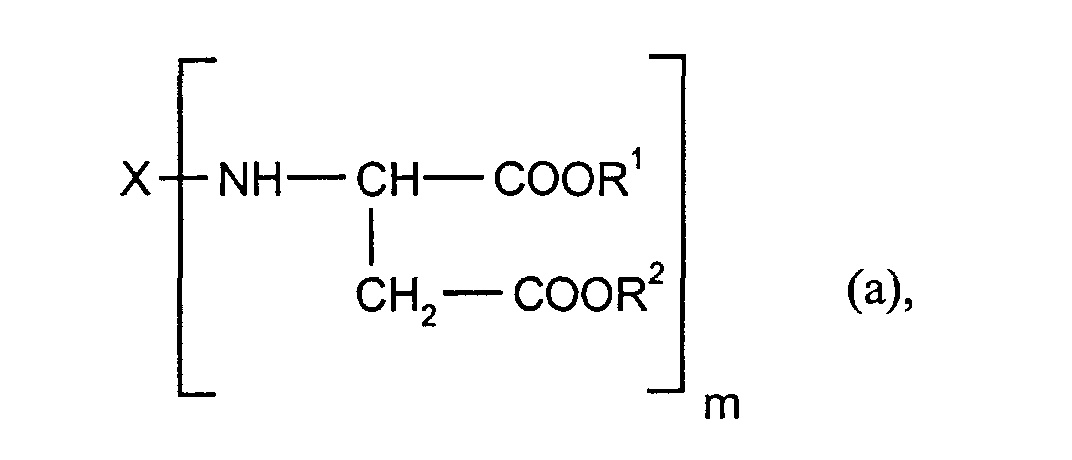
    Zur Herstellung der erfmdungsgemäß einzusetzenden hydroxy- und/oder aminofunktionellen Polyurethane A) eignen sich als Komponente b) Asparaginsäureester der allgemeinen Strukturformel (a)
    Figure 00060001
    die gemäß der Lehre der EP-A 403 921, DE-A 1 670 812 und DE-A 2 158 945 in bekannter Weise durch Reaktion einer primäre Amingruppen enthaltenden Komponente der Formel (i)
    Figure 00060002
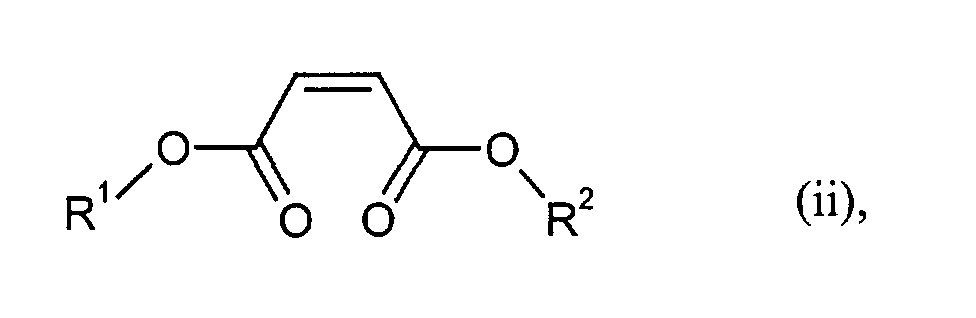
    mit Fumarsäureestern und/oder Maleinsäureestern der Formel (ii) erhalten werden,
    Figure 00060003
    wobei
    X
    für einen m-Valenten, gegebenenfalls ein oder mehrere Heteroatome enthaltenden organischen Rest steht, wie er durch Entfernung der primären Aminogruppe bzw. -gruppen aus einem entsprechenden, (cyclo)aliphatisch bzw. araliphatisch gebundene primäre Aminogruppen aufweisenden Mono- oder Polyamin des Molekulargewichtsbereichs 60 bis 6000 erhalten werden kann, und der weitere, gegenüber Isocyanatgruppen reaktive und/oder bei Temperaturen bis 100 ° C inerte funktionelle Gruppen enthalten kann steht.
    Als Fumar- bzw. Maleinsäurediester der Formel (ii) eignen sich Verbindungen in den R1 und R2 für organische Reste mit 1 bis 9 Kohlenstoffatom stehen. Bevorzugt sind Reste R1 und R2 mit 1 bis 4 Kohlenstoffatomen, wobei R1 und R2 auch für gleiche Reste stehen können.
    Als Amine (i) werden difunktionelle Amine (m = 2) oder Mischungen aus di- und höherfunktionellen Aminen (m = 2 und m > 2) eingesetzt, so dass die mittlere Funktionalität der Asparaginsäureester ≥ 2 ist. Bevorzugt geeignet sind Mischungen aus di- (m = 2) und trifunktionellen (m = 3) Aminen, wobei das Äquivalenzverhältnis von di- zu trifunktionellen Aminen 1:2 bis 5:1 beträgt. Besonders bevorzugt geeignet sind Mischungen, bei denen das Äquivalenzverhältnis von di- zu trifunktionellen Aminen 1:1,5 bis 3:1 beträgt.
    Als Beispiele für geeignete difunktionelle Amine (i) stehen Ethylendiamin, 1,2-Diaminopropan, 1,4-Diaminobutan, 2,5-Diamino-2,5-dimethylhexan, 1,5-Diamino-2-methylpentan (Dytek® A der Fa. DuPont), 1,6-Diaminohexan, 2,2,4- und/oder 2,4,4-Trimethyl-1,6-diaminohexan, 1,11-Diaminoundecan, 1,12-Diaminododecan 1-Amino-3,3,5-trimethyl-5-aminomethylcyclohexan (IPDA), 2,4- und/oder 2,6-Hexahydrotoluylendiamin (H6TDA), Isopropyl-2,4-und/oder 2,6-diaminocyclohexan, 1,3-Bis-(aminomethyl)-cyclohexan, 2,4'- und/oder 4,4'-Diamino-dicyclohexylmethan, 3,3'-Dimethyl-4,4'-diamino-dicyclohexylmethan (Laromin® C 260 der Fa. BASF), die Isomeren, eine Methylgruppe als Kernsubstituenten aufweisenden Diaminodicyclohexylmethane (= C-Monomethyl-diaminodicyclohexylmethane), 3(4)-Aminomethyl-1-methylcyclohexylamin (AMCA) und 1,3-Bis-(aminomethyl)-benzol.
    Als Beispiele für Tri- und höherfunktionelle Amine stehen 4-Aminomethyl-1,8-octandiamin; 2,2',2"-Triaminotriethylamin, 1,3,5-Tris-(aminomethyl)-2,4,6-triethylbenzol, Tris-1,1,1-aminoethylethan, 1,2,3-Triamionpropan, Tris-(3-aminopropyl)-amin und N,N,N',N'-Tetrakis-(2-aminoethyl)-ethylendiamin.
    Als Amine (i) eignen sich prinzipiell auch Mischungen aus Mono- (m = 1) bzw. Diaminen (m= 2), die weitere bei 20 - 200°C gegenüber Isocyanaten reaktive Gruppen enthalten mit höherfunktionellen Aminen (m > 2), so dass die mittlere Funktionalität der Asparaginsäureester unter Berücksichtigung aller im Temperaturbereich von 20 - 200°C gegenüber Isocyanaten reaktiven Gruppen ≥2 und <3,5 ist.
    Als Beispiele für geeignete hydroxyfunktionelle Amine (i) stehen 2-Amino-ethanol, Aminopropanole, 3-Amino-1,2-propandiol, Aminobutanole und 1,3- Diamino-2-propanol.
    Prinzipiell einsetzbar sind auch niedermolekulare Polyetherpolyamine mit aliphatisch gebundenen, primären Aminogruppen, wie sie beispielsweise unter der Bezeichnung Jeffamin® von der Firma Huntsman vertrieben werden.
    Die Herstellung der Asparaginsäureester b) kann sowohl in Lösung als auch lösemittelfrei durchgeführt werden. In beiden Fällen erfolgt bevorzugt eine äquimolare Umsetzung des Amins mit dem Fumar- bzw. Maleinsäurediester. Zur gezielten Variation anwendungstechnischer Eigenschaften der Drahtüberzüge kann das Äquivalenzverhältnis von Malein- bzw. Fumarsäureester zu Amin i) von 1,2:1 bis 1:2, variiert werden. Für den Fall, dass Mischungen der Asparaginsäureester eingesetzt werden, kann die Herstellung der Asparaginsäureester getrennt oder in einem Reaktionsgefäß erfolgen.
    Zur Herstellung der erfindungsgemäß einzusetzenden hydroxy- und/oder aminofunktionellen Polyurethane A) eignen sich als Polyhydroxyverbindugen c) beliebige araliphatische, aliphatische oder cycloaliphatische Polyhydroxyverbindungen, bevorzugt Polyhydroxyverbindungen eines einheitlichen oder im Mittel durchschnittlichen Molekulargewichts von 62 - 3000 mit einer im statistischen Mittel durchschnittlichen OH-Funktionalität von maximal 3. Als niedermolekularere Polyhydroxyverbindugen c) kommen vorzugsweise Diole und/oder Triole des Molekulargewichtsbereichs 62 - 350, weniger bevorzugt jedoch auch Polyhydroxyverbindungen mit Molekulargewichten zwischen 350 und 3.000 in Betracht. Geeignete Polyhydroxyverbindungen c) des Molekulargewichtsbereiches 62 - 350 sind beispielsweise Ethylenglykol, Propandiole, Butandiole, Hexandiole, Di-, Tri- oder Tetraethylenglykol, Di-, Tri- oder Tetrapropylenglykol, Neopentylglykol, 2-Ethyl-1,3-hexandiol, 2,2,4-Trimethyl-1,3-pentandiol, 1,4-Bis(hydroxymethyl)-cyclohexan, 2,2-Bis(4-hydroxycyclo- hexyl)-propan, Glycerin, Hexantriol und N,N',N"-Tris-(2-hydroxyethyl)-isocyanurat (THEIC). Höhermolekulare Polyhydroxyverbindungen c) sind beispielsweise die bekannten Polyhydroxypolyester, wie sie aus Dicarbonsäuren wie Phthalsäure, Isophthalsäure, Terephthalsäure oder Adipinsäure mit überschüssigen Polyolen der obengenannten Art erhalten werden. Als höhermolekulare Polyole c) können ebenfalls an sich bekannte Polyhydroxypolyether, wie sie durch Alkoxylierung von niedermolekularen Startermolekülen zugänglich sind, eingesetzt werden.
    Als Polyhydroxyverbindung c) können auch Gemische der vorstehend genannten hydroxyfunktionellen Verbindugen eingesetzt werden.
    Als Lösungsmittel d) werden die in der Drahtlackierung üblichen Lösungsmittel benutzt, um die Viskosität der Produkte auf ein für die Verarbeitung notwendiges Niveau einzustellen. Besonders geeignet als Lösungsmittel sind Phenole, Kresole, Xylenole sowie deren technische Isomerengemische, Benzylalkohol, 2-Methoxypropylacetat, Butylacetat, N-Methylpyrrolidon, bei Raumtemperatur flüssige Kohlenwasserstoffe oder Kohlenwasserstoffgemische sowie Gemische der genannten Lösungsmittel. Bevorzugt sind Lösungsmittelgemische der genannten Lösungsmitteln.
    Gemäß einer bevorzugten Ausführungsform zur Herstellung der hydroxy- und/oder aminofunktionellen Polyurethane A) wird das Polyisocyanat a) mit dem Lösungsmittel bzw. dem Lösungsmittelgemisch d) im Gewichtsverhältnis von 3:1 bis 1:3, bevorzugt von 1,5: 1 bis 1:1,5 verdünnt. Die isocyanatreaktiven Komponenten b) und c) werden in einem Gewichtsverhältnis von 1:10 bis 4:1, bevorzugt von 1:2 bis 2:1 miteinander vermischt und mit dem Lösungsmittel bzw. Lösungsmittelgemisch d) in einem Gewichtsverhältnis von 1:10 bis 2:1, bevorzugt 1:1,5 bis 1,5:1 verdünnt. Die die isocyanatreaktiven Komponenten b) und c) enthaltende Mischung wird auf eine Temperatur zwischen 10 - 150°C, bevorzugt 20 - 80°C eingestellt. Dieser Mischung wird die Komponente a) enthaltende Lösung zugesetzt. Das Reaktionsgemisch wird solange bei einer Temperatur zwischen 10 und 150°C bevorzugt 20 - 80°C gerührt, bis keine freien Isocyanatgruppen mehr nachweisbar sind.
    Vorzugsweise wird die Reaktionsmischung dann bei 80 - 120°C gerührt, um eine Hydantoinbildung einzuleiten oder zu vervollständigen und den dabei abgespaltenen Alkohol gegebenenfalls unter reduziertem Druck abzudestillieren, oder ihn im Reaktionsgemisch zu belassen.
    In einer weiteren Ausführungsform zur Herstellung der hydroxy- und/oder aminofunktionellen Polyurethane A) wird das Polyisocyanat a) mit dem Lösungsmittel bzw. dem Lösungsmittelgemisch d) im Gewichtsverhältnis von 3:1 bis 1:3, bevorzugt von 1,5:1 bis 1:1,5 verdünnt. Die isocyanatreaktiven Komponenten b) und c) werden in einem Gewichtsverhältnis von 1:10 bis 4:1, bevorzugt von 1:2 bis 2:1 miteinander vermischt und mit dem Lösungsmittel bzw. Lösungsmittelgemsich d) in einem Gewichtsverhältnis von 1:10 bis 2:1, bevorzugt 1:1,5 bis 1,5:1 verdünnt. Die isocyanatreaktive Komponenten b) und c) enthaltende Mischung wird auf eine Temperatur zwischen 10 - 150°C, bevorzugt 20 - 100 °C eingestellt. Diese Mischung wird der die Komponente a) enthaltende Lösung zugesetzt. Das Reaktionsgemisch wird solange bei einer Temperatur zwischen 10 und 150°C bevorzugt 20 - 100°C gerührt, bis keine freien Isocyanatgruppen mehr nachweisbar sind.
    In weiteren Ausführungsformen kann das gesamte Lösungsmittel auch zum Verdünnen nur einzelner Komponenten verwendet werden. Eine weitere Ausführungsform zur Herstellung der hydroxy- und/oder aminofunktionellen Polyurethane A) kann beispielsweise in einer zweigeteilten Reaktionsführung bestehen, bei der zunächst das Polyisocyanat a), mit dem Asparaginsäureester bzw. Asparaginsäureestergemisch b) umgesetzt wird, bevor dann die Polyhydroxyverbindugen c) mit dem verbleibendem Polyisocyanat a) zur Reaktion gebracht werden. Eine weitere Ausführungsform kann darin bestehen, dass zunächst nur die polyhydroxyfunktionellen Verbindungen c) zu dem Polyisocyanat a) gegeben werden und erst nachdem diese abreagiert sind, wird der Asparaginsäureester bzw. das Asparaginsäureestergemisch b) zum Isocyanat gegeben.
    Zur Beschleunigung der Reaktion der NCO Gruppen mit gegenüber NCO-Gruppen reaktiven Verbindungen können die in der Polyurethanchemie bekannten und im Kunstoffhandbuch (Hrsg. Becker/Braun), Bd. 7, Polyurethane, S. 92 ff, Carl Hanser Verlag, München Wien 1983) beispielhaft beschriebenen Katalysatoren verwendet werden. Die Katalysatoren werden gegebenenfalls in einer Menge von 0,01 bis 5,0 % bezogen auf die Polyisocyante a) eingesetzt.
    Die erfindungsgemäßen Bindemittel für Drahtlacke werden hergestellt durch Abmischung der hydroxy- und/oder aminofunktionellen Polyurethane A) mit in der Drahtlackbeschichtungstechnologie an sich bekannten, blockierten Lackpolyisocyanaten B) organischen Lösungsmitteln C) und gegebenenfalls Hilfs- und Zusatzstoffen D) bei Raumtemperatur, wobei die gegenüber Isocyanaten reaktive Komponente A) in solchen Mengen eingesetzt wird, dass ein Äquivalentverhältnis von hydroxy- und/oder aminofunktionellen Gruppen der Komponente A) zu blockierten Isocyanatgruppen der Komponente B) von 1:2 bis 1,5:1 vorzugsweise 1:1,5 bis 1,3:1 eingehalten wird.
    Als blockierte Lackpolyisocyanate B) einsetzbar sind die aus der Drahtlacktechnologie an sich bekannten blockierte Isocyantendgruppen aufweisenden Harze mit Ester- und/oder Amid- und/oder Imid- und/oder Urethanstrukturen. Bevorzugt einsetzbar als Komponente B) sind Polyamidimide und/oder Polyimide mit einem Amid- und/oder Imidstrukturanteil von 0,5 - 10 Gew.% (berechnet als -CO-N<, MG = 42). Besonders bevorzugt einsetzbar als Komponente B) sind mit blockierten NCO-Gruppen terminierte Polyurethane mit einem Urethangruppengehalt von 2 - 20 Gew.% und insbesondere mit einem Urethangruppengehalt von 4 - 15 Gew.%.
    Als Lösemittelkomponente C) kommen alle in der Lacktechnologie üblichen organischen Lösemittel in Betracht, die gegenüber Isocyantgruppen inert sind, wie z.B. Ethylacetat, Butylacetat, Ethylenglykolmonomethyl- oder -ethylacetat, 1-Methoxypropyl-2-acetat, 2-Butanon, 4-Methyl-2-pentanon, Cyclohexanon, Toluol, Xylol, Solventnaphtha oder deren Gemische. Ebenfalls verwendbar, jedoch weniger bevorzugt sind Weichmacher wie z.B. solche auf Basis von Phosphorsäure-, Sulfonsäure- oder Phthalsäureester. Außer den gegenüber NCO-Gruppen inerten Lacklösemitteln ist es aber auch möglich, anteilig gegenüber NCO-Gruppen reaktive Lösungsmittel mitzuverwenden. Geeignet sind bevorzugt monofunktionelle, aliphatische, cycloaliphatische, araliphatische Alkohole oder auch Phenole wie z.B. Isopropanol, n-Butanol, n-Octanol, 2-Methoxyethanol, 2-Ethoxyethanol, Diethylenglykolmonomethylether, Diethylenglycolmonoethylether, 1-Methoxy-2-propanol, Cycloalkonole wie Benzylalkohol, oder Phenole wie Kresol, Xylenol sowie deren technische Isomerengemische.
    Als Hilfs- und Zusatzstoffe D) können die aus der Elektroisolierlacktechnologie an sich bekannten Katalysatoren, Pigmente und/oder Fließmittel erfindungsgemäß eingesetzt werden.
    Die erfindungsgemäßen Elektroisolierlackbindemittel sind bei Raumtemperatur oder mäßig erhöhter Temperatur (bis ca. 50°C) lagerbeständig und reagieren beim Erhitzen auf Temperaturen oberhalb 60°C, vorzugsweise von 100 - 500°C und insbesondere von 180 - 400°C unter gleichzeitigem Verdampfen der gegebenenfalls vorliegenden flüchtigen Bestandteile zu vernetzten Kunststoffen aus. Die Applikation der Lacke erfolgt nach den an sich bekannten Tauch-, Rollenauftrags-, Düsen oder Saugfilzverfahren, wobei sich die Trocknung, d.h. die Aushärtung der Lackschichten in den üblichen Trockenöfen innerhalb eines Temperaturbereiches von 100 - 500°C, und insbesondere von 180 - 400°C anschließt.
    Bei den Eigenschaften der erfindungsgemäßen Elektroisolierlackbindemittel sind insbesondere die gute Lötbarkeit, die hohe Erweichungs- und hohe Hitzeschocktemperatur der erhaltenen Produkte im Vergleich zu herkömmlichen bekannten Produkten des Standes der Technik hervorzuheben. Wegen der ausgezeichneten elektrischen und mechanischen Eigenschaften der erfindungsgemäßen Bindemittel eignen sich die Produkte auch zur Herstellung von Isoliergeweben oder zur Imprägnierung von Elektromotoren.
    Beispiele Beispiel 1 Herstellung eines Asparaginsäureesters
    53,6 g 4-Aminomethyl-1,8-octandiamin und 109,3 g 2-Mehtyl-1,5-pentandiamin werden vorgelegt und unter Rühren mit 406,2 g Maleinsäuredimethylester versetzt, so dass eine Temperatur von 50°C in der Reaktionsmischung nicht überschritten wird. Anschließend lässt man 20 h bei 60°C nachrühren.
    Beispiel 2 Herstellung eines Lackpolyisocyanates A)
    68,3 g des Asparaginsäureesters aus Beispiel 1 werden mit 75,7 g Trimethylolpropan, 31,3 g 1,3-Butandiol, 36,9 g Diethylenglycol und 227,1 g Kresol homogenisiert und zu einer auf 80 °C erwärmten Mischung aus 242,0 g 4,4'-MDI (Desmodur 44 M® der Bayer AG) gelöst in 227,1 g MPA getropft. Die Reaktionstemperatur wird unter Berücksichtigung der Exothermie bei max. 120°C belassen, bis der freie NCO-Gehalt weniger als 0,5 % beträgt. Der berechnete OH-Gehalt beträgt 2,9 %
    Beispiel 3 Herstellung eines Lackpolyisocyanates A)
    63,8 g des Asparaginsäureesters aus Beispiel 1 werden mit 54,9 g Trimethylolpropan, 25,3 g 1,3-Butandiol, 29,8 g Diethylenglycol und 200,0 g Kresol homogenisiert und zu einer auf 80°C erwärmten Mischung aus 226,1 g 4,4'-MDI (Desmodur 44 M® der Bayer AG) gelöst in 200,0 g MPA getropft. Die Reaktionstemperatur wird unter Berücksichtigung der Exothermie bei max. 120 °C belassen, bis der freie NCO-Gehalt weniger als 0,5 % beträgt. Der berechnete OH-Gehalt beträgt 2,9 %
    In den folgenden Beispielen zur Beschichtung von Kupferdrähten wurde eine horizontale Drahtlackieranlage der Fa. Aumann, Espelkamp, BRD, Typ FLK 240 mit einer Ofenlänge von 2,4 m (leicht modifiziert für mittelstarke Drahtdurchmesser) verwendet. Der Kupferdraht von 0,5 mm Durchmesser wurde mittels Düsenapplikation in 7 Durchzügen bei einer Ofentemperatur von 450°C / 500°C mit einer Geschwindigkeit von 12 - 18 m/min lackiert.
    Als Reaktionskomponenten für die erfindungsgemäßen, Zerewitinoff Atome enthaltenden Verbindungen (A) wurden Kresol-blockierte Polyisocyanate (B 1 bzw. B 2) verwendet.
    Komponente B 1 wurde erhalten indem zu 2500 g 4,4'-MDI (Desmodur® 44 M der Bayer AG) bei 80°C ein Gemisch aus 375,2 g Trimethylolpropan, 1026,0 g Kresol, 155,4 g n-Butanol, 0.4 g Diazabicyclooctan und 8,1 g Dibutylzinndilaurat zugetropft wurde (blockierter NCO-Gehalt beträgt 9,8 %).
    Als Komponente B 2 wurde ein handelsübliches blockiertes Polyisocyanat (Desmodur® VP LS 2018) der Fa Bayer verwendet (blockierter NCO-Gehalt beträgt 9,5 %).
    Beispiel 4 Herstellung eines erfindungsgemäßen Elektroisolierlacks
    Zu 131,5 g des gemäß Beispiel 1 hergestellten OH funktionellen Lackharzes werden 94,2 g Polyisocyanat C welches in 87,2 g Kresol und 87,1 g Xylol gelöst wurde, zugesetzt.
    Ein mit diesem Lack beschichteter Draht ist bei 390°C innerhalb von 5 sec verzinnbar, der tan δ Knickpunkt liegt bei 180°C, die Erweichungstemperatur nach IEC 851, Teil 6, 4.1.2 beträgt 280°C. Der Lackfilm zeigt hohe Flexibilität: nach 15 % Vordehnung lässt sich der Draht um einen zylindrischen Dorn von 0,5 mm wickeln, ohne dass der Lackfilm Risse aufweist. Der Hitzeschock ist mit 5 % Vordehnung auf einem 0,5 mm Dorn nach 30 min bei 200°C in Ordnung.
    Beispiel 5 Herstellung eines erfindungsgemäßen Elektroisolierlacks
    Zu 163,8 g des gemäß Beispiel 2 hergestellten OH fünktionellen Lackharzes werden 78,1 g Polyisocyanat B 2 welches in 79,1 g Kresol und 79,0 g Xylol gelöst wurde, zugesetzt.
    Ein mit diesem Lack beschichteter Draht ist bei 390°C innerhalb von 5 sec verzinnbar, der tan δ Knickpunkt liegt bei 173°C, die Erweichungstemperatur nach IEC 851, Teil 6, 4.1.2 beträgt 280°C. Der Lackfilm zeigt hohe Flexibilität: nach 15 % Vordehnung lässt sich der Draht um einen zylindrischen Dorn von 0,5 mm wickeln, ohne dass der Lackfilm Risse aufweist. Der Hitzeschock ist ohne Vordehnung auf einem 0,5 mm Dorn nach 30 min bei 200°C in Ordnung.
    Beispiel 6 Herstellung eines erfindungsgemäßen Elektroisolierlacks
    Zu 155,4 g des gemäß Beispiel 2 hergestellten OH funktionellem Lackharz werden 82,3 g des Polyisocyanates B 1 welches in 81,2 g Kresol und 81,1 g Xylol gelöst wurde, zugesetzt.
    Ein mit diesem Lack beschichteter Draht ist bei 390°C innerhalb von 8 sec verzinnbar, der tan δ Knickpunkt liegt bei 179°C, die Erweichungstemperatur nach IEC 851, Teil 6, 4.1.2 beträgt 290°C. Der Lackfilm zeigt hohe Flexibilität: nach 15 % Vordehnung lässt sich der Draht um einen zylindrischen Dorn von 0,5 mm wickeln, ohne dass der Lackfilm Risse aufweist. Der Hitzeschock ist mit 5 % Vordehnung auf einem 0,5 mm Dorn nach 30 min bei 200°C in Ordnung.
    Beispiel 7 Herstellung eines erfindungsgemäßen Elektroisolierlacks
    Zu 137,7 g des gemäß Beispiel 2 hergestellten OH funktionellem Lackharz werden 91,2 g des Polyisocyanates B 1 welches in 85,6 g Kresol und 85,6 g Xylol gelöst wurde zugesetzt.
    Ein mit diesem Lack beschichteter Draht ist bei 390°C innerhalb von 6 sec verzinnbar, der tan δ Knickpunkt liegt bei 179°C, die Erweichungstemperatur nach IEC 851, Teil 6, 4.1.2 beträgt 290°C. Der Lackfilm zeigt hohe Flexibilität: nach 10 % Vordehnung lässt sich der Draht um einen zylindrischen Dorn von 0,5 mm wickeln, ohne dass der Lackfilm Risse aufweist. Der Hitzeschock ist mit 5 % Vordehnung auf einem 0,5 mm Dorn nach 30 min bei 200°C in Ordnung.
    Beispiel 8 Herstellung eines erfindungsgemäßen Elektroisolierlacks
    Zu 123,4 g des gemäß Beispiel 1 hergestellten OH funktionellen Lackharz werden 98,3 g Polyisocyanat B 1, welches in 89,2 g Kresol und 89,1 g Xylol gelöst wurde, zugesetzt.
    Ein mit diesem Lack beschichteter Draht ist bei 390°C innerhalb von 9 sec verzinnbar, der tan δ Knickpunkt liegt bei 184°C, die Erweichungstemperatur nach IEC 851, Teil 6, 4.1.2 beträgt 290°C. Der Lackfilm zeigt hohe Flexibilität: nach 5 % Vordehnung lässt sich der Draht um einen zylindrischen Dorn von 0,5 mm wickeln, ohne dass der Lackfilm Risse aufweist. Der Hitzeschock ist mit 5 % Vordehnung auf einem 0,5 mm Dorn nach 30 min bei 200°C in Ordnung.
    Beispiel 9 Herstellung eines erfindungsgemäßen Elektroisolierlacks
    Zu 107 g des gemäß Beispiel 1 hergestellten OH funktionellen Lackharz werden 106,5 g Polyisocyanat B 1, welches in 93,3 g Kresol und 93,1 g Xylol gelöst wurde, zugesetzt.
    Ein mit diesem Lack beschichteter Draht ist bei 390°C innerhalb von 6 sec verzinnbar, der tan δ Knickpunkt liegt bei 191°C, die Erweichungstemperatur nach IEC 851, Teil 6, 4.1.2 beträgt 300°C. Der Lackfilm zeigt hohe Flexibilität: nach 5 % Vordehnung lässt sich der Draht um einen zylindrischen Dorn von 0,5 mm wickeln, ohne dass der Lackfilm Risse aufweist. Der Hitzeschock ist mit 5 % Vordehnung auf einem 0,5 mm Dorn nach 30 min bei 200°C in Ordnung.
    Beispiel 10 Herstellung eines erfindungsgemäßen Elektroisolierlacks
    Zu 94,4 g des gemäß Beispiel 1 hergestellten OH funktionellen Lackharz werden 112,8 g Polyisocyanat B 1, welches in 96,2 g Kresol und 96,2 g Xylol gelöst wurde, zugesetzt.
    Ein mit diesem Lack beschichteter Draht ist bei 390°C innerhalb von 9 sec verzinnbar, der tan δ Knickpunkt liegt bei 190°C, die Erweichungstemperatur nach IEC 851, Teil 6, 4.1.2 beträgt 290°C. Der Lackfilm zeigt hohe Flexibilität: nach 5 % Vordehnung lässt sich der Draht um einen zylindrischen Dorn von 0,5 mm wickeln, ohne dass der Lackfilm Risse aufweist. Der Hitzeschock ist mit 5 % Vordehnung auf einem 0,5 mm Dorn nach 30 min bei 200°C in Ordnung.

    Claims (12)

    1. Bindemittel für Elektroisolierlacke, bestehend im wesentlichen aus
      A) mindestens einem Harnstoff- und/oder Hydantoin-Gruppen aufweisenden, hydroxy- und/oder aminofunktionellen Polyurethan
      B) mindestens einer Ester- und/oder Imid- und/oder Amid- und/oder Urethangruppen aufweisenden blockierten Isocyanatkomponente
      C) organischen Lösemitteln sowie
      D) gegeenenfalls weiteren Hilfs- und Zusatzstoffen
      dadurch gekennzeichnet, dass die Polyurethankomponente A) hergestellt wird durch Umsetzung von
      a) 15 - 40 Gew. % eines organischen Polyisocyanats oder eines Gemisches organischer Polyisocyanate mit
      b) 5 - 20 Gew % mindestens eines Asparaginsäureesters und
      c) 5 - 50 Gew % einer Polyhydroxyverbindung mit einem Molgewicht zwischen 62 und 3000 g/mol in
      d) 25 - 50 Gew % eines Lösungsmittels oder eines Lösungsmittelgemisches.
    2. Bindemittel für Elektroisolierlacke gemäß Anspruch 1, dadurch gekennzeichnet, dass das zur Herstellung der Harnstoff und/oder Hydantoingruppen aufweisenden hydroxy- und/oder aminofunktionellen Polyurethankomponente A) eingesetzte Polyisocyanat/-gemisch a) aromatisch gebundene Isocyanatgruppen einer im statistischen Mittel durchschnittlichen NCO-Funktionalität von 2 - 2,2 und eines, gegebenenfalls im statistischen Mittel durchschnittlichen, Molekulargewichts von 174 - 300 enthält.
    3. Bindemittel für Elektroisolierlacke gemäß Anspruch 1 und 2, dadurch gekennzeichnet, dass der zur Herstellung der hydroxy- und/oder aminofunktionellen Polyurethankomponente A) eingesetzte Asparaginsäureester b) di- und höherfunktionelle Amine in einem Verhältnis von 1:2 bis 5:1 aufweist.
    4. Bindemittel für Elektroisolierlacke gemäß den Ansprüchen 1 bis 3, dadurch gekennzeichnet, dass der eingesetzte Asparaginsäureester b) di- und trifunktionelle Amine in einem Verhältnis von 1:1,5 bis 3:1 aufweist.
    5. Bindemittel für Elektroisolierlacke gemäß den Ansprüchen 1 bis 4, dadurch gekennzeichnet, dass der zur Herstellung der hydroxy- und/oder aminofunktionellen Polyurethankomponente A) eingesetzte Asparaginsäureester b) neben den sekundären Amingruppen keine weiteren, im Bereich von 10 - 150°C gegenüber Isocyanaten reaktive Gruppen aufweist.
    6. Bindemittel für Elektroisolierlacke gemäß den Ansprüchen 1 bis 5, dadurch gekennzeichnet, dass die zur Herstellung der hydroxy- und/oder aminofunktionellen Polyurethankomponente A) eingesetzten, gegenüber Isocyanatgruppen reaktiven Asparaginsäureester b) und Polyhydroxyverbindungen c) in einem Gewichtsverhältnis von 1:10 bis 4:1 eingesetzt werden.
    7. Bindemittel für Elektroisolierlacke gemäß den Ansprüchen 1 bis 6, dadurch gekennzeichnet, dass die zur Herstellung der hydroxy- und/oder aminofunktionellen Polyurethankomponente A) eingesetzten, gegenüber Isocyanatgruppen reaktiven Asparaginsäureester b) und Polyhydroxyverbindungen c) in einem Gewichtsverhältnis von 1:2 bis 2:1 eingesetzt werden.
    8. Bindemittel für Elektroisolierlacke gemäß den Ansprüchen 1 bis 7, dadurch gekennzeichnet, dass die zur Herstellung der hydroxy- und/oder aminofunktionellen Polyurethankomponente A) eingesetzten Polyhydroxyverbindungen c) Molgewichte zwischen 62 und 350 aufweisen.
    9. Bindemittel für Elektroisolierlacke gemäß den Ansprüchen 1 bis 8, dadurch gekennzeichnet, dass als Komponente B) urethangruppenhaltige, blockierte Isocyanate eingesetzt werden.
    10. Verwendung von Harnstoff und/oder Hydantoingruppen aufweisenden hydroxy- und/oder aminofunktionellen Polyurethanen gemäss Anspruch 1 zur Herstellung von Elektroisolierlacken.
    11. Verwendung von Harnstoff und/oder Hydantoingruppen aufweisenden hydroxy- und/oder aminofunktionellen Polyurethanen gemäss Anspruch 10 in Kombination mit blockierten Isocyanatgruppen aufweisenden Polyurethanen zur Herstellung von Elektroisolierlacken.
    12. Lacke hergestellt aus Bindemittelgemischen gemäß Ansprüchen 1 bis 9.
    EP01123284A 2000-10-17 2001-10-05 Elektroisolierlackbindemittel mit Harnstoff- und/oder Hydantoinstruktur Withdrawn EP1199320A1 (de)

    Applications Claiming Priority (2)

    Application Number Priority Date Filing Date Title
    DE10051392A DE10051392A1 (de) 2000-10-17 2000-10-17 Elektroisolierlackbindemittel mit Harnstoff- und/oder Hydantoinstruktur
    DE10051392 2000-10-17

    Publications (1)

    Publication Number Publication Date
    EP1199320A1 true EP1199320A1 (de) 2002-04-24

    Family

    ID=7660065

    Family Applications (1)

    Application Number Title Priority Date Filing Date
    EP01123284A Withdrawn EP1199320A1 (de) 2000-10-17 2001-10-05 Elektroisolierlackbindemittel mit Harnstoff- und/oder Hydantoinstruktur

    Country Status (8)

    Country Link
    US (1) US6512073B2 (de)
    EP (1) EP1199320A1 (de)
    JP (1) JP2002184237A (de)
    AU (1) AU7938801A (de)
    BR (1) BR0104609A (de)
    CA (1) CA2359171A1 (de)
    DE (1) DE10051392A1 (de)
    MX (1) MXPA01010474A (de)

    Cited By (1)

    * Cited by examiner, † Cited by third party
    Publication number Priority date Publication date Assignee Title
    WO2010112157A1 (de) 2009-04-03 2010-10-07 Bayer Materialscience Ag Schutzlack

    Families Citing this family (13)

    * Cited by examiner, † Cited by third party
    Publication number Priority date Publication date Assignee Title
    GB0222522D0 (en) 2002-09-27 2002-11-06 Controlled Therapeutics Sct Water-swellable polymers
    GB0417401D0 (en) 2004-08-05 2004-09-08 Controlled Therapeutics Sct Stabilised prostaglandin composition
    JP2008016266A (ja) * 2006-07-04 2008-01-24 Sumitomo Electric Ind Ltd 絶縁電線
    GB0613333D0 (en) 2006-07-05 2006-08-16 Controlled Therapeutics Sct Hydrophilic polyurethane compositions
    GB0613638D0 (en) 2006-07-08 2006-08-16 Controlled Therapeutics Sct Polyurethane elastomers
    GB0620685D0 (en) * 2006-10-18 2006-11-29 Controlled Therapeutics Sct Bioresorbable polymers
    US7968212B2 (en) 2006-12-18 2011-06-28 Ppg Industries Ohio, Inc. Triamine/aspartate curative and coatings comprising the same
    US7960495B2 (en) 2006-12-18 2011-06-14 Ppg Industries Ohio, Inc. (Meth)acrylate/aspartate amine curatives and coatings and articles comprising the same
    DE102007047492A1 (de) 2007-10-04 2009-04-16 Elantas Gmbh Drahtlacke mit guter Haftung auf elektrischen Leitern
    DE102008004926A1 (de) 2008-01-18 2009-07-23 Elantas Gmbh Hochtemperaturbeständiger Elektroisolierlack
    DE102009003512A1 (de) 2009-02-20 2010-09-02 Elantas Gmbh Umweltfreundlicher lötbarer Drahtlack
    US10683424B2 (en) * 2013-02-05 2020-06-16 Evonik Operations Gmbh Low gloss, high solids polyurea coatings
    KR102744521B1 (ko) * 2018-04-30 2024-12-20 에보니크 오퍼레이션즈 게엠베하 폴리아스파르트산 에스테르 및 2급 헤테로시클릭 아민 유래된 아스파르트산 에스테르로부터의 폴리우레아 조성물

    Citations (3)

    * Cited by examiner, † Cited by third party
    Publication number Priority date Publication date Assignee Title
    US4444845A (en) * 1981-08-25 1984-04-24 Bayer Aktiengesellschaft Process for the production of coatings and the use of N,N',N"-tris-(2-hydroxyethyl)-isocyanurate as additives for polyurethane based wire lacquers
    US4587322A (en) * 1984-02-18 1986-05-06 Bayer Aktiengesellschaft Process for the production of urethane-modified polyisocyanate compositions using a hydantoin having two hydroxyl alkyl substituents
    EP0743333A1 (de) * 1995-05-18 1996-11-20 Bayer Corporation Hydroxyfunktionelle Polyhydantoin-Prepolymere sowie deren Verwendung in Beschichtungszusammensetzungen

    Family Cites Families (17)

    * Cited by examiner, † Cited by third party
    Publication number Priority date Publication date Assignee Title
    DE246020C (de)
    DE1170096B (de) 1962-04-21 1964-05-14 Beck & Co G M B H Dr Drahtlacke fuer loetbare lackierte Draehte
    DE1644794C3 (de) 1966-07-02 1973-10-11 Bayer Ag, 5090 Leverkusen Lackmischung fur Einbrennlacke
    DE1670812A1 (de) 1967-03-01 1971-03-11 Bayer Ag Polycarbonsaeureester
    US3549599A (en) 1967-03-01 1970-12-22 Bayer Ag Carboxylic acid ester substituted polyhydantions
    DE2158945A1 (de) 1971-11-27 1973-05-30 Horst Holfort Stickstoffhaltige harze
    DE2626175C3 (de) 1976-06-11 1979-04-05 Bayer Ag, 5090 Leverkusen Verfahreit zur Herstellung von Oligourethanen und deren Verwendung zur Herstellung von Polyurethankunststoffen
    DE3600766A1 (de) 1986-01-14 1987-07-16 Bayer Ag Verfahren zur herstellung von carbodiimidgruppen enthaltenden, blockierten polyisocyanaten, die nach diesem verfahren erhaeltlichen polyisocyanate und deren verwendung zur herstellung von polyurethankunststoffen
    DE3713670A1 (de) 1987-04-24 1988-11-17 Bayer Ag Verfahren zur herstellung von ueberzuegen mit hydantoin-strukturen durch umsetzung carbodiimidgruppen enthaltender verbindungen mit ungesaettigten carbonsaeuren
    US5219657A (en) 1988-10-04 1993-06-15 Sumitomo Electric Industries Ltd. Polyamideimide insulated wire
    CA2018803C (en) 1989-06-23 2001-05-15 Christian Zwiener A process for the production of polyurethane coatings
    US5236741A (en) 1989-06-23 1993-08-17 Bayer Aktiengesellschaft Process for the production of polyurethane coatings
    US5254659A (en) 1990-03-27 1993-10-19 Hitachi, Ltd. Insulating coating composition, solderable insulated wires, production process of the insulated wires and flyback transformers using the insulated wires
    US5506327A (en) 1995-05-23 1996-04-09 Bayer Corporation Blocked polyisocyanates with improved thermal stability
    US5561200A (en) 1995-05-23 1996-10-01 Bayer Corporation Blocked polyisocyanates with improved thermal stability
    US5561211A (en) 1995-05-23 1996-10-01 Bayer Corporation Blocked polyisocyanates with improved thermal stability
    DE19524437A1 (de) 1995-07-05 1997-01-09 Bayer Ag Amid-/Imidgruppen-haltige blockierte Polyisocyanate für Drahtlacke

    Patent Citations (3)

    * Cited by examiner, † Cited by third party
    Publication number Priority date Publication date Assignee Title
    US4444845A (en) * 1981-08-25 1984-04-24 Bayer Aktiengesellschaft Process for the production of coatings and the use of N,N',N"-tris-(2-hydroxyethyl)-isocyanurate as additives for polyurethane based wire lacquers
    US4587322A (en) * 1984-02-18 1986-05-06 Bayer Aktiengesellschaft Process for the production of urethane-modified polyisocyanate compositions using a hydantoin having two hydroxyl alkyl substituents
    EP0743333A1 (de) * 1995-05-18 1996-11-20 Bayer Corporation Hydroxyfunktionelle Polyhydantoin-Prepolymere sowie deren Verwendung in Beschichtungszusammensetzungen

    Cited By (2)

    * Cited by examiner, † Cited by third party
    Publication number Priority date Publication date Assignee Title
    WO2010112157A1 (de) 2009-04-03 2010-10-07 Bayer Materialscience Ag Schutzlack
    DE102009016173A1 (de) 2009-04-03 2010-10-14 Bayer Materialscience Ag Schutzlack

    Also Published As

    Publication number Publication date
    JP2002184237A (ja) 2002-06-28
    US6512073B2 (en) 2003-01-28
    US20020077442A1 (en) 2002-06-20
    AU7938801A (en) 2002-04-18
    BR0104609A (pt) 2002-05-28
    MXPA01010474A (es) 2004-11-10
    CA2359171A1 (en) 2002-04-17
    DE10051392A1 (de) 2002-04-18

    Similar Documents

    Publication Publication Date Title
    EP2398837B1 (de) Umweltfreundlicher lötbarer drahtlack
    EP1199320A1 (de) Elektroisolierlackbindemittel mit Harnstoff- und/oder Hydantoinstruktur
    EP3122829A1 (de) Neues lösemittel für polyamidimide und polyimide
    EP1311588B1 (de) Polyamidimidharzlösung und ihre verwendung zur herstellung von drahtlacken
    EP0918829B1 (de) Drahtlacke, enthaltend polyesterimide und/oder polyamidimide mit polyoxyalkylendiaminen als molekulare bausteine
    DE19507942A1 (de) Drahtbeschichtungsmittel sowie Verfahren zu dessen Herstellung
    EP0502858B1 (de) Drahtlacke sowie verfahren zum kontinuierlichen beschichten von drähten
    EP0012379B1 (de) Lackmischung und Beschichtungsmittel enthaltend Polyamidhydantione
    EP0941273B1 (de) Verfahren zur herstellung carboxyl- und hydroxylgruppenhaltiger polyesterimide und deren verwendung in drahtlacken
    DE3905287A1 (de) Verfahren zum kontinuierlichen beschichten von draehten sowie die verwendung der so hergestellten draehte
    EP1199321A1 (de) Lackbindemittel mit Harnstoff- und/oder Hydantoinstrukturen, ein Verfahren zu ihrer Herstellung und deren Verwendung
    EP0823120A1 (de) Drahtlackformulierung mit internem gleitmittel
    EP0688460B1 (de) Verzinnbare drahtbeschichtungsmittel sowie verfahren zum kontinuierlichen beschichten von drähten
    DE19600150A1 (de) Verfahren zum Beschichten von Wickel- und Profildrähten
    EP0752434A1 (de) Amid-/Imidgruppen-haltige blockierte Polyisocyanate für Drahtlacke
    EP0461500A2 (de) Beschichtungsmittel und seine Verwendung zur Beschichtung hitzeresistenter Substrate
    DE102008004926A1 (de) Hochtemperaturbeständiger Elektroisolierlack
    DE60125684T2 (de) Bindemittel für eine Beschichtungszusammensetzung für elektrische Leiter
    DE3817614A1 (de) Lagerstabile elastische polyamidimidlacke, verfahren zu deren herstellung und deren verwendung zum ueberziehen elektrischer leiter
    DE2443576C3 (de) Verwendung von Imid-Gruppen enthaltenden Polykondensaten zur Lackierung

    Legal Events

    Date Code Title Description
    PUAI Public reference made under article 153(3) epc to a published international application that has entered the european phase

    Free format text: ORIGINAL CODE: 0009012

    AK Designated contracting states

    Kind code of ref document: A1

    Designated state(s): AT BE CH CY DE DK ES FI FR GB GR IE IT LI LU MC NL PT SE TR

    AX Request for extension of the european patent

    Free format text: AL;LT;LV;MK;RO;SI

    17P Request for examination filed

    Effective date: 20021024

    AKX Designation fees paid

    Free format text: AT BE CH CY DE DK ES FI FR GB GR IE IT LI LU MC NL PT SE TR

    17Q First examination report despatched

    Effective date: 20041026

    STAA Information on the status of an ep patent application or granted ep patent

    Free format text: STATUS: THE APPLICATION IS DEEMED TO BE WITHDRAWN

    18D Application deemed to be withdrawn

    Effective date: 20050308