EP1193780A2 - Ni/Metallhydrid-Sekundärelement für Sekundärbatterie - Google Patents
Ni/Metallhydrid-Sekundärelement für Sekundärbatterie Download PDFInfo
- Publication number
- EP1193780A2 EP1193780A2 EP01116462A EP01116462A EP1193780A2 EP 1193780 A2 EP1193780 A2 EP 1193780A2 EP 01116462 A EP01116462 A EP 01116462A EP 01116462 A EP01116462 A EP 01116462A EP 1193780 A2 EP1193780 A2 EP 1193780A2
- Authority
- EP
- European Patent Office
- Prior art keywords
- nickel hydroxide
- copper
- mass
- htsc
- metal hydride
- Prior art date
- Legal status (The legal status is an assumption and is not a legal conclusion. Google has not performed a legal analysis and makes no representation as to the accuracy of the status listed.)
- Withdrawn
Links
Images


Classifications
-
- H—ELECTRICITY
- H01—ELECTRIC ELEMENTS
- H01M—PROCESSES OR MEANS, e.g. BATTERIES, FOR THE DIRECT CONVERSION OF CHEMICAL ENERGY INTO ELECTRICAL ENERGY
- H01M4/00—Electrodes
- H01M4/02—Electrodes composed of, or comprising, active material
- H01M4/62—Selection of inactive substances as ingredients for active masses, e.g. binders, fillers
- H01M4/624—Electric conductive fillers
- H01M4/626—Metals
-
- C—CHEMISTRY; METALLURGY
- C01—INORGANIC CHEMISTRY
- C01B—NON-METALLIC ELEMENTS; COMPOUNDS THEREOF; METALLOIDS OR COMPOUNDS THEREOF NOT COVERED BY SUBCLASS C01C
- C01B3/00—Hydrogen; Gaseous mixtures containing hydrogen; Separation of hydrogen from mixtures containing it; Purification of hydrogen; Reversible storage of hydrogen
- C01B3/0005—Reversible storage of hydrogen, e.g. by hydrogen getters or electrodes
- C01B3/001—Reversible storage of hydrogen, e.g. by hydrogen getters or electrodes characterised by the uptaking media; Treatment thereof
- C01B3/0018—Inorganic elements or compounds, e.g. oxides, nitrides, borohydrides or zeolites; Solutions thereof
- C01B3/0031—Intermetallic compounds; Metal alloys
- C01B3/0047—Intermetallic compounds; Metal alloys containing a rare earth metal
- C01B3/0057—Intermetallic compounds; Metal alloys containing a rare earth metal and nickel
-
- H—ELECTRICITY
- H01—ELECTRIC ELEMENTS
- H01M—PROCESSES OR MEANS, e.g. BATTERIES, FOR THE DIRECT CONVERSION OF CHEMICAL ENERGY INTO ELECTRICAL ENERGY
- H01M4/00—Electrodes
- H01M4/02—Electrodes composed of, or comprising, active material
- H01M4/04—Processes of manufacture in general
- H01M4/049—Manufacturing of an active layer by chemical means
- H01M4/0497—Chemical precipitation
-
- H—ELECTRICITY
- H01—ELECTRIC ELEMENTS
- H01M—PROCESSES OR MEANS, e.g. BATTERIES, FOR THE DIRECT CONVERSION OF CHEMICAL ENERGY INTO ELECTRICAL ENERGY
- H01M4/00—Electrodes
- H01M4/02—Electrodes composed of, or comprising, active material
- H01M4/24—Electrodes for alkaline accumulators
- H01M4/32—Nickel oxide or hydroxide electrodes
-
- H—ELECTRICITY
- H01—ELECTRIC ELEMENTS
- H01M—PROCESSES OR MEANS, e.g. BATTERIES, FOR THE DIRECT CONVERSION OF CHEMICAL ENERGY INTO ELECTRICAL ENERGY
- H01M4/00—Electrodes
- H01M4/02—Electrodes composed of, or comprising, active material
- H01M4/36—Selection of substances as active materials, active masses, active liquids
- H01M4/362—Composites
- H01M4/366—Composites as layered products
-
- H—ELECTRICITY
- H01—ELECTRIC ELEMENTS
- H01M—PROCESSES OR MEANS, e.g. BATTERIES, FOR THE DIRECT CONVERSION OF CHEMICAL ENERGY INTO ELECTRICAL ENERGY
- H01M4/00—Electrodes
- H01M4/02—Electrodes composed of, or comprising, active material
- H01M4/36—Selection of substances as active materials, active masses, active liquids
- H01M4/48—Selection of substances as active materials, active masses, active liquids of inorganic oxides or hydroxides
- H01M4/52—Selection of substances as active materials, active masses, active liquids of inorganic oxides or hydroxides of nickel, cobalt or iron
-
- H—ELECTRICITY
- H01—ELECTRIC ELEMENTS
- H01M—PROCESSES OR MEANS, e.g. BATTERIES, FOR THE DIRECT CONVERSION OF CHEMICAL ENERGY INTO ELECTRICAL ENERGY
- H01M4/00—Electrodes
- H01M4/02—Electrodes composed of, or comprising, active material
- H01M4/62—Selection of inactive substances as ingredients for active masses, e.g. binders, fillers
- H01M4/624—Electric conductive fillers
-
- H—ELECTRICITY
- H01—ELECTRIC ELEMENTS
- H01M—PROCESSES OR MEANS, e.g. BATTERIES, FOR THE DIRECT CONVERSION OF CHEMICAL ENERGY INTO ELECTRICAL ENERGY
- H01M10/00—Secondary cells; Manufacture thereof
- H01M10/34—Gastight accumulators
- H01M10/345—Gastight metal hydride accumulators
-
- H—ELECTRICITY
- H01—ELECTRIC ELEMENTS
- H01M—PROCESSES OR MEANS, e.g. BATTERIES, FOR THE DIRECT CONVERSION OF CHEMICAL ENERGY INTO ELECTRICAL ENERGY
- H01M4/00—Electrodes
- H01M4/02—Electrodes composed of, or comprising, active material
- H01M2004/026—Electrodes composed of, or comprising, active material characterised by the polarity
- H01M2004/028—Positive electrodes
-
- Y—GENERAL TAGGING OF NEW TECHNOLOGICAL DEVELOPMENTS; GENERAL TAGGING OF CROSS-SECTIONAL TECHNOLOGIES SPANNING OVER SEVERAL SECTIONS OF THE IPC; TECHNICAL SUBJECTS COVERED BY FORMER USPC CROSS-REFERENCE ART COLLECTIONS [XRACs] AND DIGESTS
- Y02—TECHNOLOGIES OR APPLICATIONS FOR MITIGATION OR ADAPTATION AGAINST CLIMATE CHANGE
- Y02E—REDUCTION OF GREENHOUSE GAS [GHG] EMISSIONS, RELATED TO ENERGY GENERATION, TRANSMISSION OR DISTRIBUTION
- Y02E60/00—Enabling technologies; Technologies with a potential or indirect contribution to GHG emissions mitigation
- Y02E60/10—Energy storage using batteries
-
- Y—GENERAL TAGGING OF NEW TECHNOLOGICAL DEVELOPMENTS; GENERAL TAGGING OF CROSS-SECTIONAL TECHNOLOGIES SPANNING OVER SEVERAL SECTIONS OF THE IPC; TECHNICAL SUBJECTS COVERED BY FORMER USPC CROSS-REFERENCE ART COLLECTIONS [XRACs] AND DIGESTS
- Y02—TECHNOLOGIES OR APPLICATIONS FOR MITIGATION OR ADAPTATION AGAINST CLIMATE CHANGE
- Y02E—REDUCTION OF GREENHOUSE GAS [GHG] EMISSIONS, RELATED TO ENERGY GENERATION, TRANSMISSION OR DISTRIBUTION
- Y02E60/00—Enabling technologies; Technologies with a potential or indirect contribution to GHG emissions mitigation
- Y02E60/30—Hydrogen technology
- Y02E60/32—Hydrogen storage
Definitions
- the invention relates to a Ni / metal hydride secondary element with a positive nickel hydroxide electrode, a negative electrode containing a hydrogen storage alloy and one alkaline electrolytes and process for the production of positive electrodes for them Secondary elements.
- Nickel hydroxide (Ni (OH) 2 ) is the electrochemically active material of the positive electrode of nickel-cadmium and nickel-metal hydride batteries. Since divalent nickel hydroxide has no electronic conductivity, conductive agents in powder form are generally added. When the mass mixture is compacted, a three-dimensional guide frame is formed that electronically binds the nickel hydroxide particles. With ground electrodes, such as those used in button cells, fine nickel powder is mixed into the nickel hydroxide in order to obtain a conductive mass. In the past, graphite was used as a conductive agent in Ni / Cd cells, but it was susceptible to oxidative destruction. In the case of electrodes with a metal foam frame, the nickel foam serves as a guide frame, in the pores of which an aqueous suspension which contains nickel hydroxide is filled.
- an efficient guide structure can be built up by adding cobalt compounds such as CoO, Co (OH) 2 or Co-metal.
- the Co compounds used are converted into electrically conductive CoOOH in the cell, which electrically binds the Ni (OH) 2 particles.
- the mass utilization of a positive ground electrode can thus be increased from approximately 200 mAh / g Ni (OH) 2 to 250 mAh / g Ni (OH) 2 .
- the guide frame erected by CoOOH is stable under "normal" operating conditions, ie as long as the positive electrode is in the potential range above +350 mV vs. Hg / HgO is located.
- the invention has for its object the loss of capacity of a Ni / metal hydride battery diminish after deep discharge.
- the inventive method of electroless deposition of copper on the surface of the nickel hydroxide grains produces conductive copper particles on the surface of the Ni (OH) 2 particles. This avoids a random statistical distribution of the copper in the positive electrode mass, as described in DE 44 37 787-A1. Because the surface of the Ni (OH) 2 particles is covered with a large number of copper particles and not with an impermeable Cu layer, the electrochemical reactions which take place during charging and discharging cannot be inhibited.
- the copper coating according to the invention or the application of Cu particles significantly reduce the loss of capacity after deep discharge.
- the electrically conductive copper layer formed from discrete particles on the nickel hydroxide grain takes place in particular by electroless deposition of copper from an alkaline, Solution containing complexed copper ions by means of a chemical reducing agent.
- the mass of the copper coating is 0.2 to 15% by weight, preferably 5 to 10% by weight of the mass of the nickel hydroxide.
- the alkaline deposition bath used according to the invention contains Cu 2+ ions complexed by tartration.
- the complexation prevents copper hydroxide from precipitating at the pH of the deposition.
- Formaldehyde which is oxidized to formate, serves as a reducing agent.
- the deposition is generally carried out at room temperature until all Cu 2+ ions have been completely reduced.
- a nickel hydroxide coated with metallic copper particles and produced according to this method is advantageously used as an active material in a positive electrode of a Ni / metal hydride secondary element, since it ensures that important requirements such as the location of the copper used as deep discharge protection at the site of action, ie on the surface of the Grain optimal distribution of the copper and a high porosity of the layer can be met.
- part of the metallic copper is oxidized to copper (II) oxide or hydroxide when the cell is charged, which is soluble in the form of a hydroxo complex in the electrolyte.
- the addition of copper through the solution / deposition mechanism can thus be used to build up a conductive, three-dimensional network made of metallic copper, which is particularly useful in the case of low Potential of the positive electrode is stable, but is reduced at higher potential and under normal operating conditions.
- This is an ideal addition to the CoOOH scaffolding, which is also built up by a dissolution / deposition mechanism (dissolution of Co, or CoO, deposition of CoOOH when the cell is loaded), in contrast to the Cu scaffolding, however, under normal operating conditions is stable, but is degraded under deep discharge conditions.
- a nickel hydroxide coated with copper according to the invention is produced as follows:
- the spherical nickel hydroxide pretreated in this way is suspended in 100 ml of water
- the suspension is then mixed with a solution of 250 mg (1.74 mmol) palladium (II) chloride and 100 ⁇ l conc. Hydrochloric acid (32%) in 400 ml of water. Stir for two minutes Room temperature and then suction, giving a colorless filtrate, which indicates the complete adsorption of palladium on nickel hydroxide can be concluded. You wash afterwards three times with 100 ml of water and sucks dry.
- the supernatant, colorless solution is decanted off, the precipitate obtained is slurried in 200 ml of water and then suction filtered.
- the coated Ni (OH) 2 is washed six times with 100 ml of water before drying over NaOH in a vacuum desiccator. 105 g (105% with respect to Ni (OH) 2 's) of a powder which is now black after drying are obtained.
- the chemical analysis of the resulting material shows a copper content of approx. 9%.
- at 2 ⁇ 29.7 °, 36.5 ° and 61.3 ° there are signals which can be assigned to Cu 2 O.
- SEM images show Ni (OH) 2 spheres on which copper particles have grown in the form of spherical agglomerates.
- the resistance of the material is determined on a compact at a pressure of 20 kN / cm 2 after five minutes of pressing at a frequency of 1000 Hz.
- the specific resistance of the coated nickel hydroxide p is 5.9 ⁇ cm, which is 8x10 6 times lower than that of an untreated nickel hydroxide.
- the improved deep discharge properties by using the copper-coated nickel hydroxide according to the invention can be demonstrated, for example, in button cells with ground electrodes.
- the positive electrode contains either the nickel hydroxide according to the invention or other nickel hydroxides for comparison purposes.
- the negative electrode consists of a hydrogen storage alloy with the composition LmNi 3.6 Co 0.7 Al 0.4 Mn 0.3 , as well as 2% carbon black and 1% PTFE, the mass is 2.20 g. 6.5 n KOH + 0.5n LiOH serves as the electrolyte. After the cells have been assembled, they are initially stored at 45 ° C. for three days. They are then charged with C / 10 for 15 h before they are discharged with C / 5 up to a final discharge voltage of 1.0 V.
- the positive electrode consists of 60% Cu-coated nickel hydroxide according to the invention, 10% CoO and 30% Ni powder. The total mass is 1.80 g.
- the positive electrode consists of 60% untreated nickel hydroxide, 10% CoO and 30% Ni powder. The total mass is 1.80 g.
- the positive electrode consists of 63% nickel hydroxide, 3% CoO, 1% Co, 30% Ni powder and 3% Cu 2 O, according to DE 44 37 787-A1.
- the total mass is 1.80 g.
- the positive electrode consists in each case of 65% of a nickel hydroxide coated with a mixed hydroxide of cobalt and copper (Co 0.97 Cu 0.03 (OH) 2 ), 5% CoO and 30% Ni powder, according to EP 0 896 376.
- the total mass is 1.80 g ,
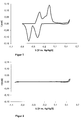
- a cyclic voltamogram is measured on press electrodes, each with 30% Ni powder included as a guide. Press electrodes according to Example 1 (with Cu) or according to Comparative Example 1 (without Cu).
- the positive press electrode serves as working electrode, counter electrodes are two Ni sheets, one comes as reference electrode Hg / HgO electrode used.
- the feed rate is 0.1 mV / s.
- the second scan is shown in the figures (FIG. 1 with Cu, FIG. 2 without Cu).
- Cu 2+ compounds are generated on the positive electrode, the reduction and subsequent oxidation of which can be observed in the second scan.
- Cells with the nickel hydroxide coated according to the invention reach after HTSC storage 104% of the capacity before storage, so they are compared to the comparative examples mentioned the highest capacity after the HTSC test because during HTSC storage a copper guide frame is being built.
Landscapes
- Chemical & Material Sciences (AREA)
- General Chemical & Material Sciences (AREA)
- Chemical Kinetics & Catalysis (AREA)
- Electrochemistry (AREA)
- Engineering & Computer Science (AREA)
- Composite Materials (AREA)
- Inorganic Chemistry (AREA)
- Organic Chemistry (AREA)
- Life Sciences & Earth Sciences (AREA)
- Environmental & Geological Engineering (AREA)
- General Life Sciences & Earth Sciences (AREA)
- Geology (AREA)
- Combustion & Propulsion (AREA)
- Manufacturing & Machinery (AREA)
- Battery Electrode And Active Subsutance (AREA)
Abstract
Description
| Nickelhydroxid | C1 [%] | C2 [%] | C3 [%] | ΔCHTSC [%] | ΔCirrev. [%] |
| Beispiel 1 (B1) | 100 | 93 | 104 | -7 | +4 |
| Vergleich 1 (V1) | 100 | 89 | 91 | -11 | -9 |
| Vergleich 2 (V2) | 100 | 88 | 99 | -12 | -1 |
| Vergleich 3 (V3) | 100 | 92 | 95 | -8 | -5 |
- C1:
- Kapazität vor HTSC-Lagerung entsprechend 100%
- C2:
- Kapazität unmittelbar nach HTSC-Lagerung
- C3:
- regenerierte Kapazität 3 Zyklen nach HTSC-Lagerung
- ΔCHTSC.:
- gesamte Kapazitätsänderung während HTSC-Lagerung
- ΔCirrev.:
- nach HTSC-Lagerung bleibende, irreversible Kapazitätsänderung
Claims (6)
- Ni/Metallhydrid-Sekundärelement mit einer positiven Nickelhydroxidelektrode, einer negativen Elektrode, die eine Wasserstoffspeicherlegierung enthält, und einem alkalischen Elektrolyten, dadurch gekennzeichnet, dass die mit einem dreidimensionalen metallischen Leitgerüst versehene positive Elektrode ein Nickelhydroxid enthält, dessen Körner mit diskreten Partikeln aus metallischem Kupfer beschichtet sind.
- Ni/Metallhydrid-Sekundärelement nach Anspruch 1, dadurch gekennzeichnet dass die Masse der Beschichtung aus Kupfer 0.2 bis 15 Gew% der Masse des Nickelhydroxids beträgt.
- Ni/Metallhydrid-Sekundärelement nach Anspruch 2, dadurch gekennzeichnet dass die Masse der Beschichtung aus Kupfer 5 bis 10 Gew% der Masse des Nickelhydroxids beträgt.
- Ni/Metallhydrid-Sekundärelement nach einem der Ansprüche 1 bis 3, dadurch gekennzeichnet dass die Beschichtung mit Kupferpartikeln mittels eines chemischen Abscheideverfahrens erzeugt ist.
- Verfahren zur Herstellung einer Nickelhydroxidelektrode für ein Mi/Metallhydrid Sekundärelement gemäß einem der Ansprüche 1 bis 3, dadurch gekennzeichnet, dass auf das Nickelhydroxidmaterial durch stromlose chemische Abscheidung in alkalischem Milieu Cu-Partikel aufgebracht werden.
- Verfahren nach Anspruch 5, dadurch gekennzeichnet, dass die Abscheidung von Kupfer aus einer alkalischen, komplexierte Kupferionen enthaltenden Lösung mittels eines chemischen Reduktionsmittels erfolgt.
Applications Claiming Priority (2)
| Application Number | Priority Date | Filing Date | Title |
|---|---|---|---|
| DE10038789 | 2000-08-09 | ||
| DE10038789A DE10038789A1 (de) | 2000-08-09 | 2000-08-09 | Ni/Metallhydrid-Sekundärelement |
Publications (2)
| Publication Number | Publication Date |
|---|---|
| EP1193780A2 true EP1193780A2 (de) | 2002-04-03 |
| EP1193780A3 EP1193780A3 (de) | 2004-04-28 |
Family
ID=7651802
Family Applications (1)
| Application Number | Title | Priority Date | Filing Date |
|---|---|---|---|
| EP01116462A Withdrawn EP1193780A3 (de) | 2000-08-09 | 2001-07-07 | Ni/Metallhydrid-Sekundärelement für Sekundärbatterie |
Country Status (3)
| Country | Link |
|---|---|
| US (1) | US20020042000A1 (de) |
| EP (1) | EP1193780A3 (de) |
| DE (1) | DE10038789A1 (de) |
Families Citing this family (3)
| Publication number | Priority date | Publication date | Assignee | Title |
|---|---|---|---|---|
| NO325620B1 (no) * | 2003-10-21 | 2008-06-30 | Revolt Technology Ltd | Elektrode, fremgangsmate for fremstilling derav, metall/luft-brenselcelle og metallhydrid-battericelle |
| CN103531734B (zh) * | 2013-09-22 | 2016-04-13 | 佛山市金辉高科光电材料有限公司 | 一种锂离子电池隔膜及制备方法 |
| CN103606682B (zh) * | 2013-11-26 | 2016-10-26 | 中国有色桂林矿产地质研究院有限公司 | 用于制作镍氢电池负极的负极浆料、镍氢电池负极和镍氢电池 |
Family Cites Families (2)
| Publication number | Priority date | Publication date | Assignee | Title |
|---|---|---|---|---|
| US5523182A (en) * | 1992-11-12 | 1996-06-04 | Ovonic Battery Company, Inc. | Enhanced nickel hydroxide positive electrode materials for alkaline rechargeable electrochemical cells |
| US5508121A (en) * | 1994-02-25 | 1996-04-16 | Furukawa Denchi Kabushiki Kaisha | Nickel hydroxide electrode for use in an alkaline secondary battery |
-
2000
- 2000-08-09 DE DE10038789A patent/DE10038789A1/de not_active Withdrawn
-
2001
- 2001-07-07 EP EP01116462A patent/EP1193780A3/de not_active Withdrawn
- 2001-07-19 US US09/908,866 patent/US20020042000A1/en not_active Abandoned
Also Published As
| Publication number | Publication date |
|---|---|
| EP1193780A3 (de) | 2004-04-28 |
| DE10038789A1 (de) | 2002-02-21 |
| US20020042000A1 (en) | 2002-04-11 |
Similar Documents
| Publication | Publication Date | Title |
|---|---|---|
| DE69117068T2 (de) | Wasserstoff-speicherelektrode, nickelelektrode und nickel-wasserstoffbatterie | |
| DE69309822T2 (de) | In alkalischer Speicherbatterie verwendete positive Nickelelektrode und diese Elektrode verwendende Nickel-Wasserstoff Speicherbatterie | |
| DE69721136T2 (de) | Nicht gesinterte Nickelelektrode für alkalische Speicherbatterie, diese enthaltende alkalische Speicherbatterie und Herstellungsverfahren für solch eine Elektrode. | |
| DE69432820T2 (de) | Aus gestapelten Plattenzellen bestehende bipolare elektrochemische Batterie | |
| DE69418492T2 (de) | Geschlossene wiederaufladbare zellen die quecksilberfreie zinkanoden enthalten und vefahren zur herstellung | |
| DE69203229T2 (de) | Verfahren zur herstellung von wiederaufladbarem abgeändertem mangandioxid-material und ähnliche verbindungen sowie elektrodenmaterial. | |
| DE69534897T2 (de) | Alkalische Sammlerbatterie und Verfahren zur Herstellung von Ni/Co-Hydroxid Aktivmasse für positive Elektrode | |
| DE69838862T2 (de) | Alkalische Speicherbatterie und Verfahren zur Oberflächenbehandlung von positivem aktiven Material | |
| DE2837729B2 (de) | Wiederaufladbare galvanische Zelle und Verfahren zu ihrer Herstellung | |
| DE69303117T2 (de) | Herstellung von Zink-alkalischen Batterien | |
| DE3520108A1 (de) | Positive sammlerelektrode fuer akkumulatoren mit alkalischem elektrolyten | |
| DE69607808T2 (de) | Nickel-Positivelektrode und alkalische Speicherbatterie diese verwendend | |
| DE69803501T2 (de) | Positives aktives Material für eine Nickelelektrode von alkalischer Batterie | |
| DE19939025A1 (de) | Nickel-Mischydroxid, Verfahren zu dessen Herstellung und dessen Verwendung als Kathodenmaterial in alkalischen Batterien | |
| DE69317173T2 (de) | Pastöse Nickelelektrode für alkalische Sammlerbatterie und alkalische Sammlerbatterie | |
| DE69835938T2 (de) | Positives aktives Material für alkalische Speicherbatterie | |
| DE3486180T2 (de) | Alkalische Sammlerbatterie. | |
| DE1909669A1 (de) | Sekundaerbatterie | |
| DE69837739T2 (de) | Nickelhydroxid aktives Material für alkalische Speicherzelle und Herstellungsverfahren | |
| DE4343321A1 (de) | Elektrischer Akkumulator | |
| DE102016112559A1 (de) | Elektrolyt für metall-luft-batterien und metall-luft-batterie | |
| EP1166377B1 (de) | Mit kobalthydroxid beschichtetes nickelhydroxid | |
| EP1193780A2 (de) | Ni/Metallhydrid-Sekundärelement für Sekundärbatterie | |
| DE69936761T2 (de) | Nichtgesinterte Nickelelektrode für Sekundärbatterie mit alkalischem Elektrolyt | |
| DE60133245T2 (de) | Leitfähiges Material für Sekundärbatterie-Elektrode mit alkalischem Elektrolyt |
Legal Events
| Date | Code | Title | Description |
|---|---|---|---|
| PUAI | Public reference made under article 153(3) epc to a published international application that has entered the european phase |
Free format text: ORIGINAL CODE: 0009012 |
|
| AK | Designated contracting states |
Kind code of ref document: A2 Designated state(s): AT BE CH CY DE DK ES FI FR GB GR IE IT LI LU MC NL PT SE TR |
|
| AX | Request for extension of the european patent |
Free format text: AL;LT;LV;MK;RO;SI |
|
| RAP1 | Party data changed (applicant data changed or rights of an application transferred) |
Owner name: VARTA AUTOMOTIVE SYSTEMS GMBH |
|
| PUAL | Search report despatched |
Free format text: ORIGINAL CODE: 0009013 |
|
| AK | Designated contracting states |
Kind code of ref document: A3 Designated state(s): AT BE CH CY DE DK ES FI FR GB GR IE IT LI LU MC NL PT SE TR |
|
| AX | Request for extension of the european patent |
Extension state: AL LT LV MK RO SI |
|
| STAA | Information on the status of an ep patent application or granted ep patent |
Free format text: STATUS: THE APPLICATION IS DEEMED TO BE WITHDRAWN |
|
| 18D | Application deemed to be withdrawn |
Effective date: 20040203 |