EP1184522B1 - Flexible Brandschutzplatte und deren Verwendung zum Brandschutz von Mauer-, Boden- oder Deckendurchbrüchen - Google Patents
Flexible Brandschutzplatte und deren Verwendung zum Brandschutz von Mauer-, Boden- oder Deckendurchbrüchen Download PDFInfo
- Publication number
- EP1184522B1 EP1184522B1 EP01810797A EP01810797A EP1184522B1 EP 1184522 B1 EP1184522 B1 EP 1184522B1 EP 01810797 A EP01810797 A EP 01810797A EP 01810797 A EP01810797 A EP 01810797A EP 1184522 B1 EP1184522 B1 EP 1184522B1
- Authority
- EP
- European Patent Office
- Prior art keywords
- panel according
- fireproof panel
- phosphate
- weight
- inorganic filler
- Prior art date
- Legal status (The legal status is an assumption and is not a legal conclusion. Google has not performed a legal analysis and makes no representation as to the accuracy of the status listed.)
- Expired - Lifetime
Links
- 238000004079 fireproofing Methods 0.000 title claims 2
- 239000011230 binding agent Substances 0.000 claims abstract description 33
- 239000011256 inorganic filler Substances 0.000 claims abstract description 30
- 229910003475 inorganic filler Inorganic materials 0.000 claims abstract description 30
- 239000011159 matrix material Substances 0.000 claims abstract description 11
- 229920003023 plastic Polymers 0.000 claims abstract description 7
- 239000004033 plastic Substances 0.000 claims abstract description 7
- 239000000203 mixture Substances 0.000 claims description 29
- 239000000654 additive Substances 0.000 claims description 28
- 230000000996 additive effect Effects 0.000 claims description 25
- 239000000463 material Substances 0.000 claims description 15
- 229910052751 metal Inorganic materials 0.000 claims description 15
- 239000002184 metal Substances 0.000 claims description 15
- 239000002245 particle Substances 0.000 claims description 15
- 229920005830 Polyurethane Foam Polymers 0.000 claims description 11
- 150000001875 compounds Chemical class 0.000 claims description 11
- 239000011496 polyurethane foam Substances 0.000 claims description 11
- 239000003063 flame retardant Substances 0.000 claims description 9
- NBIIXXVUZAFLBC-UHFFFAOYSA-N Phosphoric acid Chemical compound OP(O)(O)=O NBIIXXVUZAFLBC-UHFFFAOYSA-N 0.000 claims description 8
- 150000002148 esters Chemical class 0.000 claims description 8
- 239000006260 foam Substances 0.000 claims description 8
- 239000010451 perlite Substances 0.000 claims description 8
- 235000019362 perlite Nutrition 0.000 claims description 8
- 239000000843 powder Substances 0.000 claims description 8
- 239000002253 acid Substances 0.000 claims description 7
- 229920001276 ammonium polyphosphate Polymers 0.000 claims description 7
- 229920001228 polyisocyanate Polymers 0.000 claims description 7
- 229920000642 polymer Polymers 0.000 claims description 7
- YYQRGCZGSFRBAM-UHFFFAOYSA-N Triclofos Chemical compound OP(O)(=O)OCC(Cl)(Cl)Cl YYQRGCZGSFRBAM-UHFFFAOYSA-N 0.000 claims description 6
- XAGFODPZIPBFFR-UHFFFAOYSA-N aluminium Chemical compound [Al] XAGFODPZIPBFFR-UHFFFAOYSA-N 0.000 claims description 6
- 230000035515 penetration Effects 0.000 claims description 6
- WXZMFSXDPGVJKK-UHFFFAOYSA-N pentaerythritol Chemical compound OCC(CO)(CO)CO WXZMFSXDPGVJKK-UHFFFAOYSA-N 0.000 claims description 6
- 239000005056 polyisocyanate Substances 0.000 claims description 6
- 229920005862 polyol Polymers 0.000 claims description 6
- 150000003077 polyols Chemical class 0.000 claims description 6
- 229920002635 polyurethane Polymers 0.000 claims description 6
- 239000004814 polyurethane Substances 0.000 claims description 6
- 229960001147 triclofos Drugs 0.000 claims description 6
- XLYOFNOQVPJJNP-UHFFFAOYSA-N water Substances O XLYOFNOQVPJJNP-UHFFFAOYSA-N 0.000 claims description 6
- RNFJDJUURJAICM-UHFFFAOYSA-N 2,2,4,4,6,6-hexaphenoxy-1,3,5-triaza-2$l^{5},4$l^{5},6$l^{5}-triphosphacyclohexa-1,3,5-triene Chemical compound N=1P(OC=2C=CC=CC=2)(OC=2C=CC=CC=2)=NP(OC=2C=CC=CC=2)(OC=2C=CC=CC=2)=NP=1(OC=1C=CC=CC=1)OC1=CC=CC=C1 RNFJDJUURJAICM-UHFFFAOYSA-N 0.000 claims description 5
- 239000004114 Ammonium polyphosphate Substances 0.000 claims description 5
- OKTJSMMVPCPJKN-UHFFFAOYSA-N Carbon Chemical compound [C] OKTJSMMVPCPJKN-UHFFFAOYSA-N 0.000 claims description 5
- 235000019826 ammonium polyphosphate Nutrition 0.000 claims description 5
- 229910052799 carbon Inorganic materials 0.000 claims description 5
- MNNHAPBLZZVQHP-UHFFFAOYSA-N diammonium hydrogen phosphate Chemical compound [NH4+].[NH4+].OP([O-])([O-])=O MNNHAPBLZZVQHP-UHFFFAOYSA-N 0.000 claims description 5
- 239000006185 dispersion Substances 0.000 claims description 5
- -1 pentaerythrite Chemical class 0.000 claims description 5
- PNEYBMLMFCGWSK-UHFFFAOYSA-N Alumina Chemical compound [O-2].[O-2].[O-2].[Al+3].[Al+3] PNEYBMLMFCGWSK-UHFFFAOYSA-N 0.000 claims description 4
- 239000004254 Ammonium phosphate Substances 0.000 claims description 4
- XEEYBQQBJWHFJM-UHFFFAOYSA-N Iron Chemical compound [Fe] XEEYBQQBJWHFJM-UHFFFAOYSA-N 0.000 claims description 4
- UQSXHKLRYXJYBZ-UHFFFAOYSA-N Iron oxide Chemical compound [Fe]=O UQSXHKLRYXJYBZ-UHFFFAOYSA-N 0.000 claims description 4
- VYPSYNLAJGMNEJ-UHFFFAOYSA-N Silicium dioxide Chemical compound O=[Si]=O VYPSYNLAJGMNEJ-UHFFFAOYSA-N 0.000 claims description 4
- GWEVSGVZZGPLCZ-UHFFFAOYSA-N Titan oxide Chemical compound O=[Ti]=O GWEVSGVZZGPLCZ-UHFFFAOYSA-N 0.000 claims description 4
- 229910000147 aluminium phosphate Inorganic materials 0.000 claims description 4
- 235000019289 ammonium phosphates Nutrition 0.000 claims description 4
- KGBXLFKZBHKPEV-UHFFFAOYSA-N boric acid Chemical compound OB(O)O KGBXLFKZBHKPEV-UHFFFAOYSA-N 0.000 claims description 4
- 239000011521 glass Substances 0.000 claims description 4
- 229910052500 inorganic mineral Inorganic materials 0.000 claims description 4
- 229910044991 metal oxide Inorganic materials 0.000 claims description 4
- 150000004706 metal oxides Chemical class 0.000 claims description 4
- 239000011707 mineral Substances 0.000 claims description 4
- 150000003014 phosphoric acid esters Chemical class 0.000 claims description 4
- XFZRQAZGUOTJCS-UHFFFAOYSA-N phosphoric acid;1,3,5-triazine-2,4,6-triamine Chemical compound OP(O)(O)=O.NC1=NC(N)=NC(N)=N1 XFZRQAZGUOTJCS-UHFFFAOYSA-N 0.000 claims description 4
- 229920002689 polyvinyl acetate Polymers 0.000 claims description 4
- 239000011118 polyvinyl acetate Substances 0.000 claims description 4
- XZZNDPSIHUTMOC-UHFFFAOYSA-N triphenyl phosphate Chemical compound C=1C=CC=CC=1OP(OC=1C=CC=CC=1)(=O)OC1=CC=CC=C1 XZZNDPSIHUTMOC-UHFFFAOYSA-N 0.000 claims description 4
- KVMPUXDNESXNOH-UHFFFAOYSA-N tris(1-chloropropan-2-yl) phosphate Chemical compound ClCC(C)OP(=O)(OC(C)CCl)OC(C)CCl KVMPUXDNESXNOH-UHFFFAOYSA-N 0.000 claims description 4
- HQUQLFOMPYWACS-UHFFFAOYSA-N tris(2-chloroethyl) phosphate Chemical compound ClCCOP(=O)(OCCCl)OCCCl HQUQLFOMPYWACS-UHFFFAOYSA-N 0.000 claims description 4
- 239000010455 vermiculite Substances 0.000 claims description 4
- 229910052902 vermiculite Inorganic materials 0.000 claims description 4
- 235000019354 vermiculite Nutrition 0.000 claims description 4
- BPQQTUXANYXVAA-UHFFFAOYSA-N Orthosilicate Chemical compound [O-][Si]([O-])([O-])[O-] BPQQTUXANYXVAA-UHFFFAOYSA-N 0.000 claims description 3
- QAOWNCQODCNURD-UHFFFAOYSA-N Sulfuric acid Chemical compound OS(O)(=O)=O QAOWNCQODCNURD-UHFFFAOYSA-N 0.000 claims description 3
- 229910052782 aluminium Inorganic materials 0.000 claims description 3
- 229910000148 ammonium phosphate Inorganic materials 0.000 claims description 3
- 239000004927 clay Substances 0.000 claims description 3
- 229920001971 elastomer Polymers 0.000 claims description 3
- 239000010881 fly ash Substances 0.000 claims description 3
- 229920000876 geopolymer Polymers 0.000 claims description 3
- 239000010440 gypsum Substances 0.000 claims description 3
- 229910052602 gypsum Inorganic materials 0.000 claims description 3
- NBIIXXVUZAFLBC-UHFFFAOYSA-K phosphate Chemical compound [O-]P([O-])([O-])=O NBIIXXVUZAFLBC-UHFFFAOYSA-K 0.000 claims description 3
- 235000019353 potassium silicate Nutrition 0.000 claims description 3
- 239000008262 pumice Substances 0.000 claims description 3
- 239000005060 rubber Substances 0.000 claims description 3
- NTHWMYGWWRZVTN-UHFFFAOYSA-N sodium silicate Chemical compound [Na+].[Na+].[O-][Si]([O-])=O NTHWMYGWWRZVTN-UHFFFAOYSA-N 0.000 claims description 3
- BIKXLKXABVUSMH-UHFFFAOYSA-N trizinc;diborate Chemical compound [Zn+2].[Zn+2].[Zn+2].[O-]B([O-])[O-].[O-]B([O-])[O-] BIKXLKXABVUSMH-UHFFFAOYSA-N 0.000 claims description 3
- 239000004636 vulcanized rubber Substances 0.000 claims description 3
- KXGFMDJXCMQABM-UHFFFAOYSA-N 2-methoxy-6-methylphenol Chemical compound [CH]OC1=CC=CC([CH])=C1O KXGFMDJXCMQABM-UHFFFAOYSA-N 0.000 claims description 2
- 239000005995 Aluminium silicate Substances 0.000 claims description 2
- FYYHWMGAXLPEAU-UHFFFAOYSA-N Magnesium Chemical compound [Mg] FYYHWMGAXLPEAU-UHFFFAOYSA-N 0.000 claims description 2
- 229920000877 Melamine resin Polymers 0.000 claims description 2
- OAICVXFJPJFONN-UHFFFAOYSA-N Phosphorus Chemical compound [P] OAICVXFJPJFONN-UHFFFAOYSA-N 0.000 claims description 2
- 229920000388 Polyphosphate Polymers 0.000 claims description 2
- 239000004372 Polyvinyl alcohol Substances 0.000 claims description 2
- 239000004113 Sepiolite Substances 0.000 claims description 2
- 229920002472 Starch Polymers 0.000 claims description 2
- 229920001807 Urea-formaldehyde Polymers 0.000 claims description 2
- HCHKCACWOHOZIP-UHFFFAOYSA-N Zinc Chemical compound [Zn] HCHKCACWOHOZIP-UHFFFAOYSA-N 0.000 claims description 2
- NIXOWILDQLNWCW-UHFFFAOYSA-N acrylic acid group Chemical group C(C=C)(=O)O NIXOWILDQLNWCW-UHFFFAOYSA-N 0.000 claims description 2
- 150000001298 alcohols Chemical class 0.000 claims description 2
- 229910052910 alkali metal silicate Inorganic materials 0.000 claims description 2
- WNROFYMDJYEPJX-UHFFFAOYSA-K aluminium hydroxide Chemical compound [OH-].[OH-].[OH-].[Al+3] WNROFYMDJYEPJX-UHFFFAOYSA-K 0.000 claims description 2
- 235000012211 aluminium silicate Nutrition 0.000 claims description 2
- 229910000410 antimony oxide Inorganic materials 0.000 claims description 2
- TZCXTZWJZNENPQ-UHFFFAOYSA-L barium sulfate Chemical compound [Ba+2].[O-]S([O-])(=O)=O TZCXTZWJZNENPQ-UHFFFAOYSA-L 0.000 claims description 2
- 239000004327 boric acid Substances 0.000 claims description 2
- IUTYMBRQELGIRS-UHFFFAOYSA-N boric acid;1,3,5-triazine-2,4,6-triamine Chemical compound OB(O)O.NC1=NC(N)=NC(N)=N1 IUTYMBRQELGIRS-UHFFFAOYSA-N 0.000 claims description 2
- 150000001642 boronic acid derivatives Chemical class 0.000 claims description 2
- 235000014633 carbohydrates Nutrition 0.000 claims description 2
- 150000001720 carbohydrates Chemical class 0.000 claims description 2
- 150000004649 carbonic acid derivatives Chemical class 0.000 claims description 2
- 229910052742 iron Inorganic materials 0.000 claims description 2
- NLYAJNPCOHFWQQ-UHFFFAOYSA-N kaolin Chemical compound O.O.O=[Al]O[Si](=O)O[Si](=O)O[Al]=O NLYAJNPCOHFWQQ-UHFFFAOYSA-N 0.000 claims description 2
- 239000011777 magnesium Substances 0.000 claims description 2
- 229910052749 magnesium Inorganic materials 0.000 claims description 2
- VTHJTEIRLNZDEV-UHFFFAOYSA-L magnesium dihydroxide Chemical compound [OH-].[OH-].[Mg+2] VTHJTEIRLNZDEV-UHFFFAOYSA-L 0.000 claims description 2
- JDSHMPZPIAZGSV-UHFFFAOYSA-N melamine Chemical compound NC1=NC(N)=NC(N)=N1 JDSHMPZPIAZGSV-UHFFFAOYSA-N 0.000 claims description 2
- 229910000000 metal hydroxide Inorganic materials 0.000 claims description 2
- 150000004692 metal hydroxides Chemical class 0.000 claims description 2
- 239000010445 mica Substances 0.000 claims description 2
- 229910052618 mica group Inorganic materials 0.000 claims description 2
- VTRUBDSFZJNXHI-UHFFFAOYSA-N oxoantimony Chemical compound [Sb]=O VTRUBDSFZJNXHI-UHFFFAOYSA-N 0.000 claims description 2
- 229920001568 phenolic resin Polymers 0.000 claims description 2
- 239000005011 phenolic resin Substances 0.000 claims description 2
- CZQYVJUCYIRDFR-UHFFFAOYSA-N phosphono dihydrogen phosphate;1,3,5-triazine-2,4,6-triamine Chemical compound NC1=NC(N)=NC(N)=N1.NC1=NC(N)=NC(N)=N1.OP(O)(=O)OP(O)(O)=O CZQYVJUCYIRDFR-UHFFFAOYSA-N 0.000 claims description 2
- 229920000193 polymethacrylate Polymers 0.000 claims description 2
- 239000001205 polyphosphate Substances 0.000 claims description 2
- 235000011176 polyphosphates Nutrition 0.000 claims description 2
- 229920002451 polyvinyl alcohol Polymers 0.000 claims description 2
- 229920000915 polyvinyl chloride Polymers 0.000 claims description 2
- 239000004800 polyvinyl chloride Substances 0.000 claims description 2
- 239000003380 propellant Substances 0.000 claims description 2
- 150000003839 salts Chemical class 0.000 claims description 2
- 235000019355 sepiolite Nutrition 0.000 claims description 2
- 229910052624 sepiolite Inorganic materials 0.000 claims description 2
- 150000004760 silicates Chemical class 0.000 claims description 2
- 239000000377 silicon dioxide Substances 0.000 claims description 2
- 229920002050 silicone resin Polymers 0.000 claims description 2
- 235000019698 starch Nutrition 0.000 claims description 2
- 239000008107 starch Substances 0.000 claims description 2
- 150000005846 sugar alcohols Polymers 0.000 claims description 2
- 239000000454 talc Substances 0.000 claims description 2
- 229910052623 talc Inorganic materials 0.000 claims description 2
- 229920001169 thermoplastic Polymers 0.000 claims description 2
- 229920001187 thermosetting polymer Polymers 0.000 claims description 2
- 239000004416 thermosoftening plastic Substances 0.000 claims description 2
- 239000004408 titanium dioxide Substances 0.000 claims description 2
- 239000010456 wollastonite Substances 0.000 claims description 2
- 229910052882 wollastonite Inorganic materials 0.000 claims description 2
- 229910052725 zinc Inorganic materials 0.000 claims description 2
- 239000011701 zinc Substances 0.000 claims description 2
- 239000002535 acidifier Substances 0.000 claims 4
- 229910019142 PO4 Inorganic materials 0.000 claims 1
- 239000004411 aluminium Substances 0.000 claims 1
- 229910021502 aluminium hydroxide Inorganic materials 0.000 claims 1
- 239000011324 bead Substances 0.000 claims 1
- 239000011381 foam concrete Substances 0.000 claims 1
- 229910052736 halogen Inorganic materials 0.000 claims 1
- 150000002367 halogens Chemical class 0.000 claims 1
- 239000000347 magnesium hydroxide Substances 0.000 claims 1
- 229910001862 magnesium hydroxide Inorganic materials 0.000 claims 1
- 239000010452 phosphate Substances 0.000 claims 1
- 229910052698 phosphorus Inorganic materials 0.000 claims 1
- 239000011574 phosphorus Substances 0.000 claims 1
- 229920005989 resin Polymers 0.000 claims 1
- 239000011347 resin Substances 0.000 claims 1
- 235000012239 silicon dioxide Nutrition 0.000 claims 1
- 239000001117 sulphuric acid Substances 0.000 claims 1
- 235000011149 sulphuric acid Nutrition 0.000 claims 1
- 235000012222 talc Nutrition 0.000 claims 1
- 239000004634 thermosetting polymer Substances 0.000 claims 1
- 238000004519 manufacturing process Methods 0.000 description 7
- 238000000034 method Methods 0.000 description 7
- 239000000945 filler Substances 0.000 description 6
- 230000008569 process Effects 0.000 description 6
- 239000003054 catalyst Substances 0.000 description 5
- 229920005906 polyester polyol Polymers 0.000 description 5
- KFZMGEQAYNKOFK-UHFFFAOYSA-N Isopropanol Chemical compound CC(C)O KFZMGEQAYNKOFK-UHFFFAOYSA-N 0.000 description 4
- 229920013701 VORANOL™ Polymers 0.000 description 4
- UKLDJPRMSDWDSL-UHFFFAOYSA-L [dibutyl(dodecanoyloxy)stannyl] dodecanoate Chemical compound CCCCCCCCCCCC(=O)O[Sn](CCCC)(CCCC)OC(=O)CCCCCCCCCCC UKLDJPRMSDWDSL-UHFFFAOYSA-L 0.000 description 4
- 238000005520 cutting process Methods 0.000 description 4
- 239000012975 dibutyltin dilaurate Substances 0.000 description 4
- 239000012948 isocyanate Substances 0.000 description 4
- 150000002513 isocyanates Chemical class 0.000 description 4
- 239000002557 mineral fiber Substances 0.000 description 4
- IMNIMPAHZVJRPE-UHFFFAOYSA-N triethylenediamine Chemical compound C1CN2CCN1CC2 IMNIMPAHZVJRPE-UHFFFAOYSA-N 0.000 description 4
- XKCQNWLQCXDVOP-UHFFFAOYSA-N tris(2-chloropropan-2-yl) phosphate Chemical compound CC(C)(Cl)OP(=O)(OC(C)(C)Cl)OC(C)(C)Cl XKCQNWLQCXDVOP-UHFFFAOYSA-N 0.000 description 4
- TXBCBTDQIULDIA-UHFFFAOYSA-N 2-[[3-hydroxy-2,2-bis(hydroxymethyl)propoxy]methyl]-2-(hydroxymethyl)propane-1,3-diol Chemical compound OCC(CO)(CO)COCC(CO)(CO)CO TXBCBTDQIULDIA-UHFFFAOYSA-N 0.000 description 3
- 229910000831 Steel Inorganic materials 0.000 description 3
- 230000009970 fire resistant effect Effects 0.000 description 3
- 239000008187 granular material Substances 0.000 description 3
- 235000010755 mineral Nutrition 0.000 description 3
- 239000002984 plastic foam Substances 0.000 description 3
- 239000004014 plasticizer Substances 0.000 description 3
- 229920002857 polybutadiene Polymers 0.000 description 3
- 239000010959 steel Substances 0.000 description 3
- 239000004604 Blowing Agent Substances 0.000 description 2
- 241000447394 Desmos Species 0.000 description 2
- MQIUGAXCHLFZKX-UHFFFAOYSA-N Di-n-octyl phthalate Natural products CCCCCCCCOC(=O)C1=CC=CC=C1C(=O)OCCCCCCCC MQIUGAXCHLFZKX-UHFFFAOYSA-N 0.000 description 2
- 230000009471 action Effects 0.000 description 2
- 150000001412 amines Chemical class 0.000 description 2
- BJQHLKABXJIVAM-UHFFFAOYSA-N bis(2-ethylhexyl) phthalate Chemical compound CCCCC(CC)COC(=O)C1=CC=CC=C1C(=O)OCC(CC)CCCC BJQHLKABXJIVAM-UHFFFAOYSA-N 0.000 description 2
- 230000008859 change Effects 0.000 description 2
- 239000013256 coordination polymer Substances 0.000 description 2
- 239000012973 diazabicyclooctane Substances 0.000 description 2
- HBGGXOJOCNVPFY-UHFFFAOYSA-N diisononyl phthalate Chemical compound CC(C)CCCCCCOC(=O)C1=CC=CC=C1C(=O)OCCCCCCC(C)C HBGGXOJOCNVPFY-UHFFFAOYSA-N 0.000 description 2
- 239000000835 fiber Substances 0.000 description 2
- 239000008240 homogeneous mixture Substances 0.000 description 2
- 238000009413 insulation Methods 0.000 description 2
- GUSFEBGYPWJUSS-UHFFFAOYSA-N pentaazanium;[oxido(phosphonatooxy)phosphoryl] phosphate Chemical compound [NH4+].[NH4+].[NH4+].[NH4+].[NH4+].[O-]P([O-])(=O)OP([O-])(=O)OP([O-])([O-])=O GUSFEBGYPWJUSS-UHFFFAOYSA-N 0.000 description 2
- 125000005498 phthalate group Chemical class 0.000 description 2
- 229920005903 polyol mixture Polymers 0.000 description 2
- 238000010107 reaction injection moulding Methods 0.000 description 2
- 239000007858 starting material Substances 0.000 description 2
- 150000003871 sulfonates Chemical class 0.000 description 2
- 229920003002 synthetic resin Polymers 0.000 description 2
- NIXOWILDQLNWCW-UHFFFAOYSA-M Acrylate Chemical compound [O-]C(=O)C=C NIXOWILDQLNWCW-UHFFFAOYSA-M 0.000 description 1
- CJKRXEBLWJVYJD-UHFFFAOYSA-N N,N'-diethylethylenediamine Chemical compound CCNCCNCC CJKRXEBLWJVYJD-UHFFFAOYSA-N 0.000 description 1
- 239000005062 Polybutadiene Substances 0.000 description 1
- NINIDFKCEFEMDL-UHFFFAOYSA-N Sulfur Chemical compound [S] NINIDFKCEFEMDL-UHFFFAOYSA-N 0.000 description 1
- OHRVBDRGLIWLPA-UHFFFAOYSA-N [3-hydroxy-2,2-bis(hydroxymethyl)propyl] dihydrogen phosphate Chemical compound OCC(CO)(CO)COP(O)(O)=O OHRVBDRGLIWLPA-UHFFFAOYSA-N 0.000 description 1
- 150000007513 acids Chemical class 0.000 description 1
- 150000001252 acrylic acid derivatives Chemical class 0.000 description 1
- ZRIUUUJAJJNDSS-UHFFFAOYSA-N ammonium phosphates Chemical class [NH4+].[NH4+].[NH4+].[O-]P([O-])([O-])=O ZRIUUUJAJJNDSS-UHFFFAOYSA-N 0.000 description 1
- 239000010426 asphalt Substances 0.000 description 1
- 230000004888 barrier function Effects 0.000 description 1
- 239000010428 baryte Substances 0.000 description 1
- 229910052601 baryte Inorganic materials 0.000 description 1
- 230000015572 biosynthetic process Effects 0.000 description 1
- 238000009835 boiling Methods 0.000 description 1
- 239000004566 building material Substances 0.000 description 1
- CQEYYJKEWSMYFG-UHFFFAOYSA-N butyl acrylate Chemical compound CCCCOC(=O)C=C CQEYYJKEWSMYFG-UHFFFAOYSA-N 0.000 description 1
- NDWWLJQHOLSEHX-UHFFFAOYSA-L calcium;octanoate Chemical compound [Ca+2].CCCCCCCC([O-])=O.CCCCCCCC([O-])=O NDWWLJQHOLSEHX-UHFFFAOYSA-L 0.000 description 1
- 239000006229 carbon black Substances 0.000 description 1
- 239000004568 cement Substances 0.000 description 1
- 239000003795 chemical substances by application Substances 0.000 description 1
- 239000011248 coating agent Substances 0.000 description 1
- 238000000576 coating method Methods 0.000 description 1
- 239000002131 composite material Substances 0.000 description 1
- 239000004567 concrete Substances 0.000 description 1
- 238000001816 cooling Methods 0.000 description 1
- 229920001577 copolymer Polymers 0.000 description 1
- 229910052593 corundum Inorganic materials 0.000 description 1
- 239000010431 corundum Substances 0.000 description 1
- 238000005553 drilling Methods 0.000 description 1
- 238000001035 drying Methods 0.000 description 1
- 230000000694 effects Effects 0.000 description 1
- 125000001495 ethyl group Chemical group [H]C([H])([H])C([H])([H])* 0.000 description 1
- 239000011494 foam glass Substances 0.000 description 1
- 239000011888 foil Substances 0.000 description 1
- 238000010438 heat treatment Methods 0.000 description 1
- 230000006872 improvement Effects 0.000 description 1
- 229910010272 inorganic material Inorganic materials 0.000 description 1
- 239000011147 inorganic material Substances 0.000 description 1
- 239000010954 inorganic particle Substances 0.000 description 1
- 238000009434 installation Methods 0.000 description 1
- 239000011810 insulating material Substances 0.000 description 1
- DSSXKBBEJCDMBT-UHFFFAOYSA-M lead(2+);octanoate Chemical compound [Pb+2].CCCCCCCC([O-])=O DSSXKBBEJCDMBT-UHFFFAOYSA-M 0.000 description 1
- 235000012254 magnesium hydroxide Nutrition 0.000 description 1
- 239000012764 mineral filler Substances 0.000 description 1
- 238000002156 mixing Methods 0.000 description 1
- 239000011368 organic material Substances 0.000 description 1
- 150000002902 organometallic compounds Chemical class 0.000 description 1
- 229910001562 pearlite Inorganic materials 0.000 description 1
- 150000002978 peroxides Chemical class 0.000 description 1
- UDKSLGIUCGAZTK-UHFFFAOYSA-N phenyl pentadecane-1-sulfonate Chemical compound CCCCCCCCCCCCCCCS(=O)(=O)OC1=CC=CC=C1 UDKSLGIUCGAZTK-UHFFFAOYSA-N 0.000 description 1
- 150000003018 phosphorus compounds Chemical class 0.000 description 1
- 229920000058 polyacrylate Polymers 0.000 description 1
- 229920001083 polybutene Polymers 0.000 description 1
- 239000002952 polymeric resin Substances 0.000 description 1
- 229920005749 polyurethane resin Polymers 0.000 description 1
- 239000011148 porous material Substances 0.000 description 1
- 238000002360 preparation method Methods 0.000 description 1
- 239000000565 sealant Substances 0.000 description 1
- 238000007789 sealing Methods 0.000 description 1
- 229910002028 silica xerogel Inorganic materials 0.000 description 1
- 239000000126 substance Substances 0.000 description 1
- 239000011593 sulfur Substances 0.000 description 1
- 229910052717 sulfur Inorganic materials 0.000 description 1
- 150000003464 sulfur compounds Chemical class 0.000 description 1
- 229920003051 synthetic elastomer Polymers 0.000 description 1
- 239000000057 synthetic resin Substances 0.000 description 1
- 239000005061 synthetic rubber Substances 0.000 description 1
- 238000004073 vulcanization Methods 0.000 description 1
- 239000002699 waste material Substances 0.000 description 1
Images

Classifications
-
- H—ELECTRICITY
- H02—GENERATION; CONVERSION OR DISTRIBUTION OF ELECTRIC POWER
- H02G—INSTALLATION OF ELECTRIC CABLES OR LINES, OR OF COMBINED OPTICAL AND ELECTRIC CABLES OR LINES
- H02G3/00—Installations of electric cables or lines or protective tubing therefor in or on buildings, equivalent structures or vehicles
- H02G3/02—Details
- H02G3/04—Protective tubing or conduits, e.g. cable ladders or cable troughs
- H02G3/0406—Details thereof
- H02G3/0412—Heat or fire protective means
-
- C—CHEMISTRY; METALLURGY
- C04—CEMENTS; CONCRETE; ARTIFICIAL STONE; CERAMICS; REFRACTORIES
- C04B—LIME, MAGNESIA; SLAG; CEMENTS; COMPOSITIONS THEREOF, e.g. MORTARS, CONCRETE OR LIKE BUILDING MATERIALS; ARTIFICIAL STONE; CERAMICS; REFRACTORIES; TREATMENT OF NATURAL STONE
- C04B26/00—Compositions of mortars, concrete or artificial stone, containing only organic binders, e.g. polymer or resin concrete
- C04B26/02—Macromolecular compounds
-
- C—CHEMISTRY; METALLURGY
- C04—CEMENTS; CONCRETE; ARTIFICIAL STONE; CERAMICS; REFRACTORIES
- C04B—LIME, MAGNESIA; SLAG; CEMENTS; COMPOSITIONS THEREOF, e.g. MORTARS, CONCRETE OR LIKE BUILDING MATERIALS; ARTIFICIAL STONE; CERAMICS; REFRACTORIES; TREATMENT OF NATURAL STONE
- C04B26/00—Compositions of mortars, concrete or artificial stone, containing only organic binders, e.g. polymer or resin concrete
- C04B26/02—Macromolecular compounds
- C04B26/10—Macromolecular compounds obtained otherwise than by reactions only involving carbon-to-carbon unsaturated bonds
- C04B26/16—Polyurethanes
-
- E—FIXED CONSTRUCTIONS
- E04—BUILDING
- E04B—GENERAL BUILDING CONSTRUCTIONS; WALLS, e.g. PARTITIONS; ROOFS; FLOORS; CEILINGS; INSULATION OR OTHER PROTECTION OF BUILDINGS
- E04B1/00—Constructions in general; Structures which are not restricted either to walls, e.g. partitions, or floors or ceilings or roofs
- E04B1/62—Insulation or other protection; Elements or use of specified material therefor
- E04B1/92—Protection against other undesired influences or dangers
- E04B1/94—Protection against other undesired influences or dangers against fire
- E04B1/941—Building elements specially adapted therefor
- E04B1/942—Building elements specially adapted therefor slab-shaped
-
- F—MECHANICAL ENGINEERING; LIGHTING; HEATING; WEAPONS; BLASTING
- F16—ENGINEERING ELEMENTS AND UNITS; GENERAL MEASURES FOR PRODUCING AND MAINTAINING EFFECTIVE FUNCTIONING OF MACHINES OR INSTALLATIONS; THERMAL INSULATION IN GENERAL
- F16L—PIPES; JOINTS OR FITTINGS FOR PIPES; SUPPORTS FOR PIPES, CABLES OR PROTECTIVE TUBING; MEANS FOR THERMAL INSULATION IN GENERAL
- F16L5/00—Devices for use where pipes, cables or protective tubing pass through walls or partitions
- F16L5/02—Sealing
- F16L5/04—Sealing to form a firebreak device
-
- C—CHEMISTRY; METALLURGY
- C04—CEMENTS; CONCRETE; ARTIFICIAL STONE; CERAMICS; REFRACTORIES
- C04B—LIME, MAGNESIA; SLAG; CEMENTS; COMPOSITIONS THEREOF, e.g. MORTARS, CONCRETE OR LIKE BUILDING MATERIALS; ARTIFICIAL STONE; CERAMICS; REFRACTORIES; TREATMENT OF NATURAL STONE
- C04B2111/00—Mortars, concrete or artificial stone or mixtures to prepare them, characterised by specific function, property or use
- C04B2111/00474—Uses not provided for elsewhere in C04B2111/00
- C04B2111/00663—Uses not provided for elsewhere in C04B2111/00 as filling material for cavities or the like
- C04B2111/00706—Uses not provided for elsewhere in C04B2111/00 as filling material for cavities or the like around pipelines or the like
-
- C—CHEMISTRY; METALLURGY
- C04—CEMENTS; CONCRETE; ARTIFICIAL STONE; CERAMICS; REFRACTORIES
- C04B—LIME, MAGNESIA; SLAG; CEMENTS; COMPOSITIONS THEREOF, e.g. MORTARS, CONCRETE OR LIKE BUILDING MATERIALS; ARTIFICIAL STONE; CERAMICS; REFRACTORIES; TREATMENT OF NATURAL STONE
- C04B2111/00—Mortars, concrete or artificial stone or mixtures to prepare them, characterised by specific function, property or use
- C04B2111/20—Resistance against chemical, physical or biological attack
- C04B2111/28—Fire resistance, i.e. materials resistant to accidental fires or high temperatures
-
- C—CHEMISTRY; METALLURGY
- C04—CEMENTS; CONCRETE; ARTIFICIAL STONE; CERAMICS; REFRACTORIES
- C04B—LIME, MAGNESIA; SLAG; CEMENTS; COMPOSITIONS THEREOF, e.g. MORTARS, CONCRETE OR LIKE BUILDING MATERIALS; ARTIFICIAL STONE; CERAMICS; REFRACTORIES; TREATMENT OF NATURAL STONE
- C04B2111/00—Mortars, concrete or artificial stone or mixtures to prepare them, characterised by specific function, property or use
- C04B2111/50—Flexible or elastic materials
Definitions
- the present invention is a flexible fire protection board with a plastic matrix and inorganic filler, and their use for fire protection of masonry, floor or ceiling openings, in particular of pipe and cable ducts.
- sandwich panels that is, multi-layer sheets of sheet steel, a 1 cm thick layer of a rubber-elastic, intumescent mass with a wire mesh and a wire mesh Cover made of aluminum foil, which adapted and mounted over the component opening. Subsequently, all joints, gaps, gussets and the like are closed with an intumescent mass.
- sandwich panels are very time-consuming and costly to work with, since the required cutting in view of the sheet steel layer is very difficult.
- the approval according to DIN 4102, Part 9 in which not only the fire penetration, but especially a temperature exceeding should be prevented, not or only very expensive to achieve.
- plastic building materials in the form of a plastic foam with closed pores, which contains as a filler expanded clay particles, such as foam glass, pumice, expanded vermiculite or expanded perlite.
- Flame-resistant heat-insulating materials which contain porous inorganic particles as a filler in a synthetic resin which is a polyurethane resin which is cured to a flame-retardant heat-insulating plate.
- Subject of the GB-A-2 340 125 A is a material in the form of a substantially homogeneous mixture of particles and an organic material serving as a matrix and a binder for the particles, the particles having a diameter of less than 5 mm.
- the matrix material may be an organic or inorganic binder during which the particles present in the matrix are preferably particles of vermiculite or perlite and bitumen is preferred as the matrix material.
- Subject of the US-A-4,863,519 is a process for producing blocks, building elements, etc., which can be sawed and nailed and which comprise coarse-grained inorganic fillers embedded in a fast-setting binder, leaving still free outer Cavities result, which are filled with a plastic foam.
- a fast-curing binder an inorganic binder is provided, such as cement, gypsum or mixtures thereof, while polyurethane can be used as an expandable plastic material for producing the plastic foam.
- the US-A-3,627,706 describes a mineral filler-containing foam product based on a polyurethane foam and a granular filler.
- Subject of the DE 44 04 701 A1 are composite foams which comprise silica xerogel particles in a polyurethane foam and which can be used for the purpose of thermal insulation.
- the object of the present invention is therefore to provide a fire protection plate that can be very easily manufactured and applied, a high mechanical strength not only during assembly but also in case of fire shows and the required requirements of fire protection according to the above-mentioned DIN standard without allows to fulfill more.
- a flexible fire protection plate which contains a coarse-grained inorganic filler embedded in a plastic matrix of a soft elastic organic binder.
- the subject of the invention is therefore the flexible fire protection panel according to claim 1.
- the subclaims relate to preferred embodiments of this fire protection board and their use for fire protection of masonry, floor or ceiling openings, in particular of pipe and cable penetrations.
- the fire protection board according to the invention with a plastic matrix and inorganic filler, with a plate of a soft elastic organic binder, in which a coarse inorganic filler is embedded is characterized in that the soft elastic organic binder 10 to 60 wt .-% of an additive to increase the dimensional stability the crust formed in the event of fire, wherein the additive comprises an additive mixture containing at least one acid generator, at least one carbon-providing compound and at least one telichenförmigen metal.
- the fire-resistant board contains, as a soft-elastic binder, a vulcanized rubber composition, a dispersion acrylate, a polyvinyl acetate, and in particular a flexible polyurethane polymer, preferably a flexible polyurethane foam, which can preferably be produced from a polyisocyanate, a polyol and water, or an isocyanate prepolymer.
- a liquified gas blowing agent preferably liquified gas blowing agent.
- vulcanizable rubber compounds can be used according to the invention as preferred materials, that is, mixtures of low molecular weight synthetic rubber with crosslinkable double bonds, wherein the vulcanization is usually carried out with sulfur (or sulfur compounds) at temperatures of 150 ° C to 180 ° C.
- Propellants for example, baking powder, etc.
- dispersion acrylates are polymer dispersions of polyacrylates, usually copolymers of acrylic esters, such as ethyl and butyl acrylate. These polymer dispersions contain between 30 and 60% of the polymer. The hardening takes place by drying out.
- the fire protection panel of the present invention preferably contains 30 to 80% by weight, more preferably 65 to 75% by weight of the soft elastic binder, and correspondingly 70 to 20% by weight, more preferably 35 to 25% by weight of the coarse inorganic filler.
- the coarse inorganic filler preferably comprises grains having a particle size of 1 to 25 mm, preferably 3 to 15 mm.
- Particularly preferred as a coarse inorganic filler are grains of a foamed mineral material, for example grains of pumice, aerated concrete, water glass foam, geopolymers, sepiolite, fly ash, gypsum, foamed expanded clay, perlite and / or vermiculite, or even hollow spheres of silicate material or glass.
- the geopolymers used as inorganic filler are synthetically produced silicate foams, for example of water glass with fly ash or corundum and peroxides or metal powder as blowing agent. These foams are nonflammable and have good insulation properties. Waste from the production can be used according to the invention as an inorganic filler.
- the coarse-grained inorganic filler in the form of mixtures of grains of different particle size and / or in the form of mixtures of granules of different inorganic materials.
- the presence of the coarse-grained inorganic filler not only achieves high mechanical strength, stability and compressive strength of the fire protection board, but also, in the case of grains of foamed mineral material, easy and simple workability, for example by cutting or sawing, and furthermore high strength in case of fire.
- the specified additive mixture in an amount of 10 to 60 wt .-%, preferably 25 to 40 wt .-%, based on the weight of the binder added, a significant Improvement of the dimensional stability of the fire protection board in case of fire can be achieved.
- the addition of this additive mixture transforms the soft elastic organic binder in case of fire without significant change in the geometric dimensions of the fire protection board in an inorganic, hard, stone-like, fire-resistant mass to. In this way, it is readily possible to successfully pass the above-mentioned Hose Stream Test with the fire protection board according to the invention.
- the additive mixture incorporated into the soft-elastic organic binder comprises 10 to 90% by weight, preferably 40 to 70% by weight of the acid generator, 5 to 45% by weight, preferably 15 to 30% by weight of the carbon and 2 to 30% by weight, preferably 5 to 15% by weight of the particulate metal.
- the additive mixture contains, as the acid generator, ammonium phosphate, ammonium polyphosphate, a diamine phosphate, a phosphoric acid ester with monohydric or polyhydric alcohols, in particular polyols, such as pentaerythritol, namely pentaerythritol phosphate, trichloroethyl phosphate, tris (2-chloroisopropyl) phosphate, triphenyl phosphate, tris (2 -chloroethyl) -phosphate, a phosphoric acid partial ester or mixed ester with monohydric and / or polyhydric low molecular weight alcohols, a melamine phosphate, in particular monomelamine orthophosphate, dimelamine orthophosphate, dimelamine pyrophosphate, mel
- the additive mixture preferably contains as carbon-providing compound a polyhydroxy compound and / or a thermoplastic or thermosetting polymeric resin binder, in particular a carbohydrate, such as sugar or starch, pentaerythritol, dipentaerythritol, a phenolic resin, a urea resin, a polyurethane, polyvinyl chloride, poly (meth) acrylate, Polyvinyl acetate, polyvinyl alcohol, a silicone resin and / or a rubber.
- a carbohydrate such as sugar or starch
- pentaerythritol dipentaerythritol
- a phenolic resin a urea resin
- polyurethane polyvinyl chloride
- poly (meth) acrylate Polyvinyl acetate
- polyvinyl alcohol polyvinyl alcohol
- silicone resin / or a rubber
- the particulate metal used in the additive mixture used according to the invention is preferably a metal selected from the group comprising aluminum, magnesium, iron and zinc.
- the particulate metal may be in the form of a powder, platelets, flakes, fibers, filaments and / or whiskers.
- the particulate metal in the form of powder, platelets or flakes preferably has a particle size of ⁇ 50 ⁇ m, preferably from 0.5 to 10 ⁇ m, while the fibers, filaments and / or whiskers of the particulate metal have a thickness of from 0.5 to 10 ⁇ m and have a length of 10 to 50 microns.
- a particularly preferred additive mixture comprises a mixture of 30 parts by weight of ammonium polyphosphate, 10 parts by weight of dipentaerythritol and 10 parts by weight of aluminum powder having a particle size of 5 ⁇ m.
- the soft elastic organic binder in addition to the coarse inorganic filler at least one inorganic filler selected from metal oxides, especially iron oxide, titanium dioxide, silica and alumina, barite, borates, in particular zinc borate, carbonates, preferably chalk, silicates, preferably alkali metal silicates , Talc, mica, wollastonite, kaolin and / or glass powder.
- metal oxides especially iron oxide, titanium dioxide, silica and alumina, barite, borates, in particular zinc borate, carbonates, preferably chalk, silicates, preferably alkali metal silicates , Talc, mica, wollastonite, kaolin and / or glass powder.
- the fire protection effect of the fire protection board according to the invention can be increased by additionally incorporating one or more flame retardants in the soft elastic organic binder according to a preferred embodiment, for example halogenated flame retardants, ammonium phosphates, metal hydroxides, especially aluminum hydroxides or magnesium hydroxides, metal oxides, especially antimony oxide, red phosphorus and / or phosphorus compounds, in particular halogenated phosphoric esters, such as trichloroethyl phosphate, tris (2-chloroisopropyl) phosphate, triphenyl phosphate and / or tris (2-chloroethyl) phosphate.
- halogenated flame retardants ammonium phosphates
- metal hydroxides especially aluminum hydroxides or magnesium hydroxides
- metal oxides especially antimony oxide
- red phosphorus and / or phosphorus compounds in particular halogenated phosphoric esters, such as trichloroethyl phosphate, tris (2-ch
- the soft elastic organic binder decomposes under the action of the high temperatures of the fire and forms, together with the additives, an inorganic, ceramic-like matrix into which the coarse-grained inorganic filler remains bound, and which has surprisingly high mechanical strength.
- polyester polyols and OH-terminated polybutadienes polymers, polyisocyanates (MDI or TDI), catalysts and plasticizers (polybutenes, phthalates, sulfonates, phosphoric acid esters), all materials which are suitable for the production of flexible polyurethane foams are common.
- MDI or TDI polyisocyanates
- plasticizers polybutenes, phthalates, sulfonates, phosphoric acid esters
- the preparation of the fire protection board according to the invention is carried out by mixing the soft elastic organic binder or its starting materials, which optionally contains the additives and auxiliaries mentioned above, with the coarse-grained inorganic filler, introduces the mixture into a mold having the desired dimensions and solidifies, for example, by cooling or curing.
- Particularly preferred production processes are the RIM process (Reaction Injection Molding), in which the reaction components for the production of a polyurethane foam together with the coarse inorganic filler and optionally the additive mixture, further fillers, flame retardants, etc. in the form of a homogeneous mixture injected into a mold and be reacted there in such a way that the foam product formed completely fills the mold at the end of the reaction.
- RIM process Reaction Injection Molding
- a further preferred method consists in introducing into the mold an isocyanate prepolymer formed from a polyol component and a polyisocyanate together with the coarse-grained inorganic filler and, if appropriate, the additives mentioned above, and curing them with heating with steam.
- the starting materials required for the production of soft-elastic polyurethane foams such as polyols, polyisocyanates, catalysts, plasticizers, etc., as well as the conditions to be used are known to the person skilled in the art.
- the catalysts to be used for this purpose especially those which accelerate the isocyanate reaction (PIR), are amines and organometallic compounds, such as dibutyltin dilaurate (DBTL), calcium octoate or lead octoate.
- plasticizers are high-boiling, low molecular weight polybutadienes, phthalates (for example diisononyl phthalate (DINP), dioctyl phthalate (DOP)), sulfonates (for example Mesamoll from Bayer AG) and phosphoric esters, such as tris (chloroisopropyl) phosphate (TCPP) and trichloroethyl phosphate (TEP). ,
- phthalates for example diisononyl phthalate (DINP), dioctyl phthalate (DOP)
- sulfonates for example Mesamoll from Bayer AG
- phosphoric esters such as tris (chloroisopropyl) phosphate (TCPP) and trichloroethyl phosphate (TEP).
- the molds used for the production of the fire protection board according to the invention are designed according to the desired dimensions. However, it is possible, especially when using a soft elastic polyurethane foam as an organic binder and a coarse inorganic filler in the form of granules of a foamed mineral material easily, with the aid of the above-mentioned RIM process to produce a large block, which then in the usual way sliced into fire protection panels of the desired dimensions.
- the invention further provides for the use of the above-defined fire protection board for fire protection of masonry, floor or ceiling openings, in particular of pipe and cable penetrations.
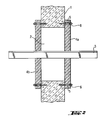
- a breakthrough (2) is provided in a wall (1) through which a cable tray (3) is passed.
- a cable tray (3) is passed.
- the fire protection plates (4a) and (4b) according to the invention are not flush introduced into the wall opening, but mounted over the component opening and secured by means of the bolt (5) and the nuts (6) on the wall. Gaps, cracks, bumps and gussets must be sealed with fire-resistant sealants.
- any other embodiments for sealing the respective apertures and penetrations may be employed depending on the geometrical dimensions of the aperture, on the one hand, and the component passed therethrough, on the other hand.
- These panels can also be used to encapsulate cable trays and channels, as well as to clad steel beams and columns.
- the present example illustrates the production of the fire protection board according to the invention by the RIM process (Reaction Injection Molding).
- the fire protection panels made according to the above examples have high mechanical strength, namely compressive strength, impact resistance and intrinsic stability, but are very easy to machine by sawing, cutting, drilling and the like since the binder coats and stabilizes the coarse-grained inorganic, preferably foamed, filler and at the same time reduces resistance to cutting and sawing.
- This example illustrates the behavior of the fire protection panel prepared according to Example 1 in case of fire.
- the organic binder If exposed to the flame-retardant plate with a thickness of 2.5 cm from the action of a flame, the organic binder turns after 30 minutes at 1000 ° C completely in an inorganic, ceramic-like matrix in which the pearlite granules are embedded and undergoes during the next 2 hours at 1200 ° C no further change.
Landscapes
- Engineering & Computer Science (AREA)
- Chemical & Material Sciences (AREA)
- Structural Engineering (AREA)
- Ceramic Engineering (AREA)
- Architecture (AREA)
- Organic Chemistry (AREA)
- Civil Engineering (AREA)
- General Engineering & Computer Science (AREA)
- Materials Engineering (AREA)
- Physics & Mathematics (AREA)
- Electromagnetism (AREA)
- Mechanical Engineering (AREA)
- Chemical Kinetics & Catalysis (AREA)
- Building Environments (AREA)
- Compositions Of Macromolecular Compounds (AREA)
- Fireproofing Substances (AREA)
- Laminated Bodies (AREA)
- Adhesives Or Adhesive Processes (AREA)
Description
- Gegenstand der vorliegenden Erfindung ist eine flexible Brandschutzplatte mit einer Kunststoffmatrix und anorganischem Füllstoff, sowie deren Verwendung zum Brandschutz von Mauer-, Boden- oder Deckendurchbrüchen, insbesondere von Rohr- und Kabeldurchführungen.
- Es ist bekannt, daß Durchbrüche durch Wände, Böden und Decken einander abgrenzender Räume im Brandfall problematisch sind, weil sich das Feuer durch solche Durchbrüche hindurch ausbreiten kann. Da im allgemeinen Mauer- oder Deckendurchführungen, insbesondere Rohr- und Kabeldurchführungen nicht konstruktiv vermieden werden können, ist es üblich, zum Brandschutz derartige Durchbrüche und die Ringspalte zwischen den hindurchgeführten Rohren und Kabeln, etwaigen Flanschen und dem Wand-, Boden- und Deckenmaterial abzudichten. Hierzu werden üblicherweise sogenannte Weichschotts beziehungsweise Plattenschotts aus nichtbrennbarem Material eingesetzt.
- Eine Möglichkeit zur Erzeugung eines solchen Brandschotts besteht in der Verwendung beschichteter Mineralfaserplatten, mit denen die Bauteilöffnungen verschlossen werden, wonach sämtliche Spalten, Fugen, Zwickel und auch die Oberfläche der Brandschutzplatten mit einer ablativen oder intumeszierenden Beschichtung rauchgasdicht versiegelt werden. Solche Mineralfaserplatten sind aber nachteilig, weil sie sehr arbeitsintensiv und unangenehm zu verarbeiten sind und nur eine geringe mechanische Stabilität im Brandfall ergeben. Insbesondere überstehen solche Mineralfaserplatten im Brandfall den Löschwassertest (Hose Stream Test) nicht, das bedeutet, daß beim Auftreffen des Wasserstrahls eines Feuerwehrmanns im Brandfall die Rückstände einer solchen Mineralfaserplatte sehr leicht zerstört werden.
- Eine weitere Möglichkeit, die üblicherweise in den Vereinigten Staaten von Amerika angewandt wird, ist der Einsatz von Sandwich-Platten, das heißt mehrschichtigen Platten aus einer Lage Stahlblech, einer 1 cm dicken Lage aus einer gummielastischen, intumeszierenden Masse mit einer Armierung aus Maschendraht und einer Abdeckung aus Aluminiumfolie, welche angepaßt und über der Bauteilöffnung montiert wird. Im Anschluß daran werden sämtliche Fugen, Spalten, Zwickel und dergleichen mit einer intumeszierenden Masse verschlossen. Auch diese Sandwich-Platten sind sehr zeit- und kostenaufwendig in der Verarbeitung, da das erforderliche Zuschneiden angesichts der Stahlblechlage sich sehr schwierig gestaltet. Im übrigen sind mit solchen Sandwichplatten die Zulassung gemäß DIN 4102, Teil 9, bei denen nicht nur der Feuerdurchtritt, sondern vor allem eine Temperaturüberschreitung verhindert werden soll, nicht oder nur sehr aufwendig zu erreichen.
- Aus der
US-A-3,243,388 sind Kunststoff-Baumaterialien in Form eines Kunststoffschaums mit geschlossenen Poren bekannt, welcher als Füllstoff expandierte Tonteilchen enthält, beispielsweise Schaumglas, Bimsstein, expandierter Vermiculit oder expandierter Perlit. - Aus Chemical Abstracts Bd. 95, Nr. 6 (1981), 47990z, sind flammbeständige, hitzeisolierende Materialien bekannt, die poröse anorganische Teilchen als Füllstoff in einem synthetischen Harz enthalten, bei dem es sich um ein Polyurethanharz handelt, welches zu einer flammbeständigen, hitzeisolierenden Platte ausgehärtet wird.
- Gegenstand der
GB-A-2 340 125 A - Gegenstand der
US-A-4,863,519 ist ein Verfahren zur Herstellung von Blöcken, Bauelementen, etc., die gesägt und genagelt werden können und welche grobkörnige anorganische Füllstoffe umfassen, die in ein schnell abbindendes Bindemittel eingebettet sind, wobei sich noch freie äußere Hohlräume ergeben, die mit einem Kunststoffschaum ausgefüllt sind. Als schnell härtendes Bindemittel ist ein anorganisches Bindemittel vorgesehen, wie Zement, Gips oder Mischungen davon, während als expandierbares Kunststoffmaterial zur Erzeugung des Kunststoffschaums auch Polyurethan eingesetzt werden kann. - Die
US-A-3,627,706 beschreibt ein mineralische Füllstoffe enthaltendes Schaumprodukt auf der Grundlage eines Polyurethanschaums und eines körnigen Füllstoffs. - Gegenstand der
DE 44 04 701 A1 sind Verbundschaumsstoffe, welche Siliciumdioxid-Xerogel-Teilchen in einem Polyurethanschaum umfassen und die zum Zwecke der Wärmedämmung verwendet werden können. - Aus den Druckschriften
EP-A-0 512 629 A2 undDE 38 01 456 A1 ist es bereits bekannt, dass man Säurebildner, wie Ammoniumpolyphosphat und Kohlenstoff liefernde Verbindungen, wie Pentaerythritol als Flammschutzmittel einsetzen kann. - Schließlich offenbart die
DE 36 29 390 A1 die Verwendung von Ruß und/oder Aluminiumpulver als Füllstoff. - Die Aufgabe der vorliegenden Erfindung besteht somit darin, eine Brandschutzplatte anzugeben, die sehr einfach hergestellt und angewandt werden kann, eine hohe mechanische Festigkeit nicht nur bei der Montage sondern auch im Brandfall zeigt und die erforderlichen Anforderungen des Brandschutzes gemäß der oben angesprochenen DIN-Norm ohne weiteres zu erfüllen ermöglicht.
- Diese Aufgabe wird gelöst durch eine flexible Brandschutzplatte, die in einer Kunststoffmatrix aus einem weichelastischen organischen Bindemittel einen grobkörnigen anorganischen Füllstoff eingebettet enthält. Gegenstand der Erfindung ist daher die flexible Brandschutzplatte nach Anspruch 1.
- Die Unteransprüche betreffen bevorzugte Ausführungsformen dieser Brandschutzplatte sowie deren Verwendung zum Brandschutz von Mauer-, Boden- oder Deckendurchbrüchen, insbesondere von Rohr- und Kabeldurchführungen.
- Die erfindungsgemäße Brandschutzplatte mit einer Kunststoffmatrix und anorganischem Füllstoff, mit einer Platte aus einem weichelastischen organischen Bindemittel, in welches ein grobkörniger anorganischer Füllstoff eingebettet ist, ist dadurch gekennzeichnet, dass das weichelastische organische Bindemittel 10 bis 60 Gew.-% eines Additivs zur Erhöhung der Formbeständigkeit der im Brandfall gebildeten Kruste enthält, wobei das Additiv eine Additivmischung mit einem Gehalt an mindestens einem Säurebildner, mindestens einer Kohlenstoff liefernden Verbindung und mindestens einem telichenförmigen Metall umfaßt.
- Vorzugsweise enthält die Brandschutzplatte als weichelastisches Bindemittel eine vulkanisierte Kautschukmasse, ein Dispersionsacrylat, ein Polyvinylacetat und insbesondere ein weichelastisches Polyurethanpolymer, vorzugsweise einen weichelastischen Polyurethanschaum, der bevorzugt aus einem Polyisocyanat, einem Polyol und Wasser, oder einem Isocyanatprepolymer hergestellt werden kann. Vorzugsweise kann man die Bildung des Polyurethanschaums durch die Verwendung eines Treibmittels auf der Grundlage eines verflüssigten Gases begünstigen.
- Als vulkanisierte Kautschukmassen können erfindungsgemäß als bevorzugte Materialien vulkanisierbare Gummicompounds eingesetzt werden, das heißt Mischungen aus niedermolekularem Synthesekautschuk mit vernetzbaren Doppelbindungen, wobei die Vulkanisation meist mit Schwefel (oder Schwefelverbindungen) bei Temperaturen von 150°C bis 180°C erfolgt. Den Mischungen können Treibmittel (beispielsweise Backpulver etc.) zugesetzt werden, so daß gummielastische Schäume erhalten werden. Beispiele für Dispersionsacrylate sind Polymerdispersionen von Polyacrylaten, meist Copolymere von Acrylsäureestern, wie Ethyl- und Butylacrylat. Diese Polymerdispersionen enthalten zwischen 30 und 60 % des Polymeren. Die Erhärtung erfolgt durch Austrocknen.
- Die erfindungsgemäße Brandschutzplatte enthält vorzugsweise 30 bis 80 Gew.-%, bevorzugter 65 bis 75 Gew.-% des weichelastischen Bindemittels und entsprechend 70 bis 20 Gew.-%, bevorzugter 35 bis 25 Gew.-% des grobkörnigen anorganischen Füllstoffs.
- Der grobkörnige anorganische Füllstoff umfaßt vorzugsweise Körner mit einer Teilchengröße von 1 bis 25 mm, vorzugsweise 3 bis 15 mm. Besonders bevorzugt als grobkörniger anorganischer Füllstoff sind Körner aus einem geschäumten mineralischen Material, beispielsweise Körner aus Bimsstein, Gasbeton, Wasserglasschaum, Geopolymeren, Sepiolith, Flugasche, Gips, geschäumtem Blähton, Perlite und/oder Vermiculit, oder aber auch Hohlkügelchen aus silikatischem Material oder Glas. Bei den als anorganischen Füllstoff eingesetzten Geopolymeren handelt es sich um synthetisch hergestellte Silikatschäume, beispielsweise aus Wasserglas mit Flugasche oder Korund und Peroxiden oder Metallpulver als Treibmittel. Diese Schäume sind nicht brennbar und besitzen gute Isolationseigenschaften. Abfälle aus der Herstellung können erfindungsgemäß auch als anorganischer Füllstoff eingesetzt werden.
- In Abhängigkeit von den angestrebten Festigkeitseigenschaften der Brandschutzplatte ist es möglich, den grobkörnigen anorganischen Füllstoff in Form von Mischungen von Körnern unterschiedlicher Teilchengröße einzusetzen und/oder in Form von Mischungen von Körnchen aus unterschiedlichen anorganischen Materialien anzuwenden.
- Durch die Anwesenheit des grobkörnigen anorganischen Füllstoffs wird nicht nur eine hohe mechanische Festigkeit, Stabilität und Druckfestigkeit der Brandschutzplatte erreicht, sondern namentlich im Falle von Körnern aus geschäumtem mineralischem Material auch eine leichte und einfache Bearbeitbarkeit, beispielsweise durch Schneiden oder Sägen und darüber hinaus eine hohe Festigkeit im Brandfall.
- Es hat sich gezeigt, daß wenn man dem weichelastischen organischen Bindemittel der erfindungsgemäßen Brandschutzplatte die angegebene Additivmischung in einer Menge von 10 bis 60 Gew.-%, vorzugsweise 25 bis 40 Gew.-%, bezogen auf das Gewicht des Bindemittels, zusetzt, eine deutliche Verbesserung der Formbeständigkeit der Brandschutzplatte im Brandfall erreicht werden kann. Durch den Zusatz dieser Additivmischung verwandelt sich das weichelastische organische Bindemittel im Brandfall ohne wesentliche Änderung der geometrischen Abmessungen der Brandschutzplatte in eine anorganische, harte, steinartige, feuerbeständige Masse um. In dieser Weise wird es ohne weiteres möglich, mit der erfindungsgemäßen Brandschutzplatte den oben angesprochenen Hose Stream Test erfolgreich zu bestehen.
- Gemäß einer bevorzugten Ausführungsform umfaßt die in das weichelastische organische Bindemittel eingearbeitete Additivmischung 10 bis 90 Gew.-%, vorzugsweise 40 bis 70 Gew.-% des Säurebildners, 5 bis 45 Gew.-%, vorzugsweise 15 bis 30 Gew.-% der Kohlenstoff liefernden Verbindung und 2 bis 30 Gew.-%, vorzugsweise 5 bis 15 Gew.-% des teilchenförmigen Metalls.
- Als Säurebildner sind Salze oder Ester anorganischer, nichtflüchtiger Säuren, ausgewählt aus Schwefelsäure, Phosphorsäure und Borsäure, bevorzugt. Gemäß einer besonders bevorzugten Ausführungsform enthält die Additivmischung als Säurebildner Ammoniumphosphat, Ammoniumpolyphosphat, ein Diaminphosphat, einen Phosphorsäureester mit einwertigen oder mehrwertigen Alkoholen, insbesondere Polyolen, wie Pentaerythrit, namentlich Pentaerythritphosphat, Trichlorethylphosphat, Tris(2-chlorisopropyl)-phosphat, Triphenylphosphat, Tris(2-chlorethyl)-phosphat, ein einen Phosphorsäure-Teilester oder -Mischester mit einwertigen und/oder mehrwertigen niedrigmolekularen Alkoholen, ein Melaminphosphat, insbesondere Monomelaminorthophosphat, Dimelaminorthophosphat, Dimelaminpyrophosphat, Melaminpolyphosphat und/oder ein Borsäuresalz, insbesondere Melaminborat.
- Die Additivmischung enthält vorzugsweise als kohlenstoffliefernde Verbindung eine Polyhydroxyverbindung und/oder ein thermoplastisches oder duroplastisches polymeres Harzbindemittel, wie insbesondere ein Kohlenhydrat, wie Zucker oder Stärke, Pentaerythrit, Dipentaerythrit, ein Phenolharz, ein Harnstoffharz, ein Polyurethan, Polyvinylchlorid, Poly(meth)acrylat, Polyvinylacetat, Polyvinylalkohol, ein Siliconharz und/oder einen Kautschuk.
- Als teilchenförmiges Metall ist in der erfindungsgemäß eingesetzten Additivmischung vorzugsweise ein Metall ausgewählt aus der Aluminium, Magnesium, Eisen und Zink umfassenden Gruppe enthalten. Dabei kann das teilchenförmige Metall in Form eines Pulvers, von Plättchen, Schuppen, Fasern, Fäden und/oder Whiskers vorliegen. Das teilchenförmige Metall in Form von Pulver, Plättchen oder Schuppen besitzt vorzugsweise eine Teilchengröße von ≤ 50 µm, vorzugsweise von 0,5 bis 10 µm, während die Fasern, Fäden und/oder Whiskers des teilchenförmigen Metalls eine Dicke von 0,5 bis 10 µm und eine Länge von 10 bis 50 µm aufweisen.
- Eine besonders bevorzugte Additivmischung umfaßt ein Gemisch aus 30 Gewichtsteilen Ammoniumpolyphosphat, 10 Gewichtsteilen Dipentaerythrit und 10 Gewichtsteilen Aluminiumpulver mit einer Teilchengröße von 5 µm. Durch die Zugabe dieser Additivmischung in einer Menge von 25 bis 40 Gew.-% zu dem weichelastischen organischen Bindemittel läßt sich eine besonders deutliche Steigerung der mechanischen Festigkeit der Brandschutzplatte im Brandfall erreichen.
- Es ist erfindungsgemäß weiterhin möglich, dem weichelastischen organischen Bindemittel zusätzlich zu dem grobkörnigen anorganischen Füllstoff mindestens einen anorganischen Füllstoff, ausgewählt aus Metalloxiden, insbesondere Eisenoxid, Titandioxid, Siliciumdioxid und Aluminiumoxid, Schwerspat, Boraten, insbesondere Zinkborat, Carbonaten, vorzugsweise Kreide, Silikaten, vorzugsweise Alkalisilikaten, Talkum, Glimmer, Wollastonit, Kaolin und/oder Glaspulver zuzusetzen.
- Darüber hinaus kann die Brandschutzwirkung der erfindungsgemäßen Brandschutzplatte dadurch gesteigert werden, daß gemäß einer bevorzugten Ausführungform zusätzlich ein oder mehrere Flammschutzmittel in das weichelastische organische Bindemittel eingearbeitet werden, beispielsweise halogenhaltige Flammschutzmittel, Ammoniumphosphate, Metallhydroxide, insbesondere Aluminiumhydroxide oder Magnesiumhydroxide, Metalloxide, insbesondere Antimonoxid, roter Phosphor und/oder Phosphorverbindungen, insbesondere halogenierte Phosphorsäureester, wie Trichlorethylphosphat, Tris(2-chlorisopropyl)-phosphat, Triphenylphosphat und/oder Tris(2-chlorethyl)-phosphat.
- Im Brandfall zersetzt sich das weichelastische organische Bindemittel unter Einwirkung der hohen Temperaturen des Feuers und bildet zusammen mit den Additiven eine anorganische, keramikartige Matrix, in die der grobkörnige anorganische Füllstoff eingebunden bleibt, und die überraschend hohe mechanische Festigkeit besitzt.
- Zur Herstellung des weichelastischen Polyurethanschaums kann man vorzugsweise Polyesterpolyole und OH-terminierte Polybutadiene, Polymere, Polyisocyanate (MDI oder TDI), Katalysatoren sowie Weichmacher (Polybutene, Phthalate, Sulfonate, Phosphorsäureester) einsetzen, sämtlich Materialien, die dem Fachmann für die Herstellung von weichelastischen Polyurethanschäumen geläufig sind.
- Die Herstellung der erfindungsgemäßen Brandschutzplatte erfolgt in der Weise, daß man das weichelastische organische Bindemittel oder dessen Ausgangsprodukte, welches gegebenenfalls die oben angegebenen Zusätze und Hilfsstoffe enthält, mit dem grobkörnigen anorganischen Füllstoff vermischt, die Mischung in eine Form mit den gewünschten Abmessungen einbringt und verfestigt, beispielsweise durch Abkühlung oder Aushärtung. Besonders bevorzugte Herstellungsverfahren sind das RIM-Verfahren (Reaction Injection Moulding), bei dem die Reaktionskomponenten für die Herstellung eines Polyurethanschaums zusammen mit dem grobkörnigen anorganischen Füllstoff und gegebenenfalls der Additivmischung, weiterer Füllstoffe, Flammschutzmittel etc. in Form einer homogenen Mischung in eine Form eingespritzt und dort derart zur Reaktion gebracht werden, daß das gebildete Schaumprodukt die Form am Ende der Reaktion vollständig ausfüllt. Ein weiter bevorzugtes Verfahren besteht darin, ein aus einer Polyolkomponente und einem Polyisocyanat gebildetes Isocyanatprepolymer zusammen mit dem grobkörnigen anorganischen Füllstoff und gegebenenfalls der oben angesprochenen Zusätze in die Form einzubringen und dort unter Erhitzen mit Wasserdampf auszuhärten.
- Die für die Erzeugung weichelastischer Polyurethanschäume erforderlichen Ausgangsmaterialien, wie Polyole, Polyisocyanate, Katalysatoren, Weichmacher etc. sowie die anzuwendenden Bedingungen sind dem Fachmann bekannt. Beispiele für die hierzu zu verwendenden Katalysatoren, insbesondere für jene, die die Isocyanatreaktion beschleunigen (PIR), sind Amine und metallorganische Verbindungen, wie Dibutylzinndilaurat (DBTL), Calziumoctoat oder Bleioctoat. Beispiele für Weichmacher sind hochsiedende, niedermolekulare Polybutadiene, Phthalate (beispielsweise Diisononylphthalat (DINP), Dioctylphthalat (DOP)), Sulfonate (beispielsweise Mesamoll von der Firma Bayer AG) und Phosphorsäureester, wie Tris(chlorisopropyl)phosphat (TCPP) und Trichlorethylphosphat (TEP).
- Die für die Herstellung der erfindungsgemäßen Brandschutzplatte eingesetzten Formen werden in Abhängigkeit von den angestrebten Dimensionen entsprechend ausgelegt. Allerdings ist es möglich, namentlich bei Verwendung eines weichelastischen Polyurethanschaums als organischem Bindemittel und eines grobkörnigen anorganischen Füllstoff in Form von Körner aus einem geschäumten mineralischen Material ohne weiteres möglich, mit Hilfe des oben angesprochenen RIM-Verfahrens einen großen Block herzustellen, der anschließend in üblicher Weise durch Sägen in Brandschutzplatten der gewünschten Abmessungen zerlegt wird.
- Gegenstand der Erfindung ist weiterhin die Verwendung der oben definierten Brandschutzplatte zum Brandschutz von Mauer-, Boden- oder Deckendurchbrüchen, inbesondere von Rohr- und Kabeldurchführungen. Die Erfindung sei im folgenden näher anhand der beigefügten Zeichnungen und der Beispiele erläutert.
- In den Zeichnungen zeigen:
-
Figur 1 eine erste Ausführungsform der Anwendung der erfindungsgemäßen Brandschutzplatte durch Einbau in die Bauteilöffnung, und -
Figur 2 eine zweite Ausführungsform der Anwendung durch Anordnung der erfindungsgemäßen Brandschutzplatte über der Bauteilöffnung. - Wie mit der in der
Figur 1 dargestellten Ausführungsform gezeigt ist, ist in einer Mauer (1) ein Durchbruch (2) vorgesehen, durch den eine Kabeltrasse (3) hindurchgeführt ist. Zur Abdichtung sind zwischen der mauerseitigen Begrenzung des Durchbruches und der Außenseite der hindurchgeführten Kabeltrasse zwei an die Konturen des Mauerdurchbruches und der Kabeltrasse angepaßte erfindungsgemäße Brandschutzplatten (4a) und (4b) vorgesehen und zwar derart, daß sie bündig in die Bauteilöffnung eingebaut sind. - Bei der in der
Figur 2 dargestellten Ausführungsform sind die erfindungsgemäßen Brandschutzplatten (4a) und (4b) nicht bündig in den Mauerdurchbruch eingeführt, sondern über die Bauteilöffnung montiert und mit Hilfe der Bolzen (5) und der Muttern (6) an der Mauer befestigt. Spalten, Risse, Stöße und Zwickel sind mit feuerbeständigen Dichtmitteln zu verschließen. - Es ist ersichtlich, daß beliebige andere Ausführungsformen zur Abdichtung der jeweiligen Durchbrüche und Durchführungen angewandt werden können in Abhängigkeit von den geometrischen Abmessungen des Durchbruchs einerseits und des hindurchgeführten Bauteils andererseits. Diese Platten können auch zur Kapselung von Kabeltrassen und -kanälen, sowie zur Bekleidung von Stahlträgern und -stützen eingesetzt werden.
- Die folgenden Beispiele dienen der weiteren Erläuterung der Erfindung.
- Das vorliegende Beispiel verdeutlicht die Herstellung der erfindungsgemäßen Brandschutzplatte nach dem RIM-Verfahren (Reaction Injection Moulding).
- Man vermischt zur Herstellung der Platte
- 1000 g
- der nachfolgend angegebenen Polyolmischung (die 25 % der nachfolgend angegebenen Additivmi- schung enthält)
- 300 g
- Polyisocyanat (z.B. Desmodur VL) und
- 500 g
- Perlite mit einer Teilchengröße von 2 bis 7 mm als grobkörnigem anorgischem Füllstoff
- Die eingesetzte Additivmischung besteht aus:
- 71 %
- Ammoniumpolyphosphat (Exolit AP 422)
- 11 %
- Dipentaerythrit
- 8 %
- Zinkborat
- 10 %
- Aluminiumpulver (STAPA* PA Reflexal X/80)
- Die eingesetzte Polyolmischung besteht aus:
- 40 Teilen eines difunktionellen Polyesterpolyols OH Zahl ca. 28 (Voranol EP 1900, DOW)
- 30 Teilen eines trifunktionellen Polyesterpolyols OH Zahl ca. 28 (Voranol CP 6055, DOW)
- 15 Teilen eines OH-terminierten Polybutadiens OH Zahl ca. 47 (Poly bd, Elf Atochem)
- 10 Teilen Tris(chlorisopropyl)phosphat
- 3 Teilen Isopropanol
- 2 Teilen Wasser
- 0,01 Teilen Katalysator (DBTL)
- 0,02 Teilen Aminkatalysator (Triethylendiamin DABCO LV 33, Air Products)
- Zur Herstellung einer Brandschutzplatte nach dem Prepolymerverfahren vermischt man
- 1200 g
- eines Isocyanatprepolymers (beispielsweise Desmo dur E14) vermischt mit 30 % der oben definierten Additivmischung
- mit 500 g
- Perlite mit einer Teilchengröße von 2 bis 7 mm als grobkörnigem anorganischem Füllstoff
- Die nach den obigen Beispielen hergestellten Brandschutzplatten besitzen eine hohe mechanische Festigkeit, namentlich Druckfestigkeit, Stoßfestigkeit und Eigenstabilität, lassen sich aber sehr leicht durch Sägen, Schneiden, Bohren und dergleichen bearbeiten, da das Bindemittel den gröbkörnigen anorganischen, vorzugsweisen geschäumten Füllstoff umhüllt und stabilisiert und gleichzeitig den Widerstand gegen das Schneiden und Sägen verringert.
- Dieses Beispiel verdeutlicht das Verhalten der nach dem Beispiel 1 hergestellten Brandschutzplatte im Brandfall.
- Wenn man die Brandschutzplatte mit einer Dicke von 2,5 cm der Einwirkung einer Flamme aussetzt, so wandelt sich das organische Bindemittel nach 30 Minuten bei 1000°C vollständig um in eine anorganische, keramikartige Matrix um, in welche die Perlitekörnchen eingebettet sind und erfährt während der folgenden 2 Stunden bei 1200°C keine weitere Veränderung. Der für eine Zulassung für 2 Stunden Feuerwiderstandsdauer in den USA nach ASTM 814 notwendige Wasserstrahltest wird bei einem Öffnungsquerschnitt von 30 x 30 cm ohne Probleme bestanden.
Claims (21)
- Flexible Brandschutzplatte mit einer Kunststoffmatrix und anorganischem Füllstoff, mit einer Platte aus einem weichelastischen organischen Bindemittel, in welches ein grobkörniger anorganischer Füllstoff eingebettet ist, dadurch gekennzeichnet, daß das weichelastische organische Bindemittel 10 bis 60 Gew.-% eines Additivs zur Erhöhung der Formbeständigkeit der im Brandfall gebildeten Kruste enthält, wobei das Additiv eine Additivmischung mit einem Gehalt an mindestens einem Säurebildner, mindestes einer Kohlenstoff liefernden Verbindung und mindestens einem teilchenförmigen Metall umfaßt.
- Brandschutzplatte nach Anspruch 1, dadurch gekennzeichnet, daß sie als weichelastisches Bindemittel einen weichelastisches Polyurethanpoylmer, eine vulkanisierte Kautschukmasse, ein Dispersionsacrylat und/oder Polyvinylacetat umfaßt.
- Brandschutzplatte nach Anspruch 2, dadurch gekennzeichnet, daß das weichelastische Polyurethanpolymer ein Polyurethanschaum aus einem Polyisocyanat, einem Polyol und Wasser oder einem Treibmittel auf der Grundlage eines verflüssigten Gases gebildeter Polyurethanschaum ist.
- Brandschutzplatte nach den Ansprüchen 1 bis 3, dadurch gekennzeichnet, daß sie 30 bis 80 Gew.-%, vorzugsweise 65 bis 75 Gew.-% des weichelastischen Bindemittels und 70 bis 20 Gew.-%, vorzugsweise 35 bis 25 Gew.-% des grobkörnigen anorganischen Füllstoffs umfaßt.
- Brandschutzplatte nach den Ansprüchen 1 bis 4, dadurch gekennzeichnet, daß sie als grobkörnigen anorganischen Füllstoff Körner mit einer Teilchengröße von 1 bis 25 mm, vorzugsweise 3 bis 15 mm umfaßt.
- Brandschutzplatte nach Anspruch 5, dadurch gekennzeichnet, daß sie als grobkörnigen anorganischen Füllstoff Körner aus einem geschäumten mineralischen Material umfaßt.
- Brandschutzplatte nach den Ansprüchen 1 bis 6, dadurch gekennzeichnet, daß sie als grobkörnigen anorganischen Füllstoff Körner aus Bimsstein, Gasbeton, Wasserglasschaum, Geopolymeren, Sepiolith, Flugasche, Gips, geschäumtem Blähton, Perlite und/oder Vermiculit, oder in Form von Hohlkügelchen aus silikatischem Material oder Glas umfaßt.
- Brandschutzplatte nach den Ansprüchen 1 bis 7, dadurch gekennzeichnet, daß das weichelastische organische Bindemittel 25 bis 40 Gew.-% der Additivmischung enthält.
- Brandschutzplatte nach Anspruch 8, dadurch gekennzeichnet, daß die Additivmischung 10 bis 90 Gew.-%, vorzugsweise 40 bis 70 Gew.-% des Säurebildners, 5 bis 45 Gew.-%, vorzugsweise 15 bis 30 Gew.-% der Kohlenstoff liefernden Verbindung und 2 bis 30 Gew.-%, vorzugsweise 5 bis 15 Gew.-% des teilchenförmigen Metalls enthält.
- Brandschutzplatte nach Anspruch 9, dadurch gekennzeichnet, daß die Additivmischung als Säurebildner ein Salz oder einen Ester einer anorganischen, nichtflüchtigen Säure ausgewählt aus Schwefelsäure, Phosphorsäure und Borsäure enthält.
- Brandschutzplatte nach Anspruch 10, dadurch gekennzeichnet, daß die Additivmischung als Säurebildner Ammoniumphosphat, Ammoniumpolyphosphat, ein Diaminphosphat, einen Phosphorsäureester mit einwertigen oder mehrwertigen Alkoholen, insbesondere Polyolen, wie Pentaerythrit, namentlich Pentaerythritphosphat, Trichlorethylphosphat, Tris(2-chlorisopropyl)-phosphat, Triphenylphosphat, Tris(2-chlorethyl)-phosphat, ein einen Phosphorsäure-Teilester oder -Mischester mit einwertigen und/oder mehrwertigen niedrigmolekularen Alkoholen, ein Melaminphosphat, insbesondere Monomelaminorthophosphat, Dimelaminorthophosphat, Dimelaminpyrophosphat, Melaminpolyphosphat und/ oder ein Borsäuresalz, insbesondere Melaminborat, enthält.
- Brandschutzplatte nach mindestens einem der Ansprüche 1 bis 11, dadurch gekennzeichnet, daß die Additivmischung als Kohlenstoff liefernde Verbindung eine Polyhydroxyverbindung und/oder ein thermoplastisches oder duroplastisches polymeres Harzbindemittel enthält.
- Brandschutzplatte nach Anspruch 12, dadurch gekennzeichnet, daß die Additivmischung als Kohlenstoff liefernde Verbindung ein Kohlenhydrat, wie Zucker oder Stärke, Pentaerythrit, Dipentaerythrit, ein Phenolharz, ein Harnstoffharz, ein Polyurethan, Polyvinylchlorid, Poly(meth)acrylat, Polyvinylacetat, Polyvinylalkohol, ein Siliconharz und/ oder einen Kautschuk enthält.
- Brandschutzplatte nach mindestens einem der Ansprüche 1 bis 13, dadurch gekennzeichnet, daß sie als teilchenförmiges Metall ein Metall ausgewählt aus der Aluminium, Magnesium, Eisen und Zink umfassenden Gruppe enthält.
- Brandschutzplatte nach Anspruch 14, dadurch gekennzeichnet, daß die Additivmischung das teilchenförmige Metall in Form eines Pulvers, von Plättchen, Schuppen, Fasern, Fäden und/oder Whiskers enthält.
- Brandschutzplatte nach Anspruch 15, dadurch gekennzeichnet, daß das teilchenförmige Metall in Form von Pulver, Plättchen oder Schuppen eine Teilchengröße von ≤ 50 µm, vorzugsweise von 0,5 bis 10 µm aufweist.
- Brandschutzplatte nach Anspruch 16, dadurch gekennzeichnet, daß die Fasern, Fäden und/oder Whiskers des teilchenförmige Metalls eine Dicke von 0,5 bis 10 µm und eine Länge von 10 bis 50 µm aufweisen.
- Brandschutzplatte nach mindestens einem der vorhergehenden Ansprüche, dadurch gekennzeichnet, daß das weichelastische organische Bindemittel zusätzlich mindestens einen anorganischen Füllstoff ausgewählt aus Metalloxiden, insbesondere Eisenoxid, Titandioxid, Siliciumdioxid und Aluminiumoxid, Schwerspat, Boraten, insbesondere Zinkborat, Carbonaten, vorzugsweise Kreide, Silikaten, vorzugsweise Alkalisilikaten, Talkum, Glimmer, Wollastonit, Kaolin und/oder Glaspulver enthält.
- Brandschutzplatte nach mindestens einem der vorhergehenden Ansprüche, dadurch gekennzeichnet, daß die das weichelastische organische Bindemittel zusätzlich ein oder mehrere Flammschutzmittel enthält.
- Brandschutzplatte nach Anspruch 19, dadurch gekennzeichnet, daß das weichelastische organische Bindemittel zusätzlich als zusätzliches Flammschutzmittel ein halogenhaltiges Flammschutzmittel, Ammoniumphosphat, ein Metallhydroxid, insbesondere Aluminiumhydroxid oder Magnesiumhydroxid, ein Metalloxid, insbesondere Antimonoxid, roten Phosphor und/oder eine Phosphorverbindung, insbesondere einen halogenierten Phosphorsäureester, wie Trichlorethylphosphat, Tris(2-chlorisopropyl)-phosphat, Triphenylphosphat und/oder Tris(2-chlorethyl)-phosphat, enthält.
- Verwendung der Brandschutzplatte nach mindestens einem der vorhergehenden Ansprüche zum Brandschutz von Mauer-, Boden- oder Deckendurchbrüchen, insbesondere von Rohr- und Kabeldurchführungen.
Applications Claiming Priority (2)
| Application Number | Priority Date | Filing Date | Title |
|---|---|---|---|
| DE10042580 | 2000-08-30 | ||
| DE10042580A DE10042580A1 (de) | 2000-08-30 | 2000-08-30 | Flexible Brandschutzplatte und deren Verwendung zum Brandschutz von Mauer-, Boden- oder Deckendurchbrüchen |
Publications (3)
| Publication Number | Publication Date |
|---|---|
| EP1184522A2 EP1184522A2 (de) | 2002-03-06 |
| EP1184522A3 EP1184522A3 (de) | 2005-01-05 |
| EP1184522B1 true EP1184522B1 (de) | 2010-07-28 |
Family
ID=7654306
Family Applications (1)
| Application Number | Title | Priority Date | Filing Date |
|---|---|---|---|
| EP01810797A Expired - Lifetime EP1184522B1 (de) | 2000-08-30 | 2001-08-17 | Flexible Brandschutzplatte und deren Verwendung zum Brandschutz von Mauer-, Boden- oder Deckendurchbrüchen |
Country Status (8)
| Country | Link |
|---|---|
| US (1) | US6831118B2 (de) |
| EP (1) | EP1184522B1 (de) |
| CN (1) | CN1186373C (de) |
| AT (1) | ATE475754T1 (de) |
| AU (1) | AU779376C (de) |
| CZ (1) | CZ302473B6 (de) |
| DE (2) | DE10042580A1 (de) |
| PL (1) | PL349384A1 (de) |
Cited By (2)
| Publication number | Priority date | Publication date | Assignee | Title |
|---|---|---|---|---|
| EP4653740A1 (de) | 2024-05-22 | 2025-11-26 | Flamro Brandschutz-Systeme GmbH | Vorrichtung und anordnung zum brandschutz von kabel- oder leitungsdurchführungen |
| DE102024114309A1 (de) * | 2024-05-22 | 2025-11-27 | Flamro Brandschutz-Systeme Gmbh | Vorrichtung und Anordnung zum Brandschutz von Kabel- oder Leitungsdurchführungen |
Families Citing this family (46)
| Publication number | Priority date | Publication date | Assignee | Title |
|---|---|---|---|---|
| DE10240522A1 (de) * | 2002-09-03 | 2004-03-11 | Hilti Ag | Verfahren zur Herstellung einer Brandschutzplatte |
| CA2447928C (en) * | 2003-11-04 | 2007-09-04 | Global Synfrac Inc. | Proppants and their manufacture |
| US20060019568A1 (en) | 2004-07-26 | 2006-01-26 | Toas Murray S | Insulation board with air/rain barrier covering and water-repellent covering |
| CN101189292B (zh) * | 2005-03-29 | 2011-12-07 | 创新塑料有限责任公司 | 飞灰和炉渣增强的热塑性塑料 |
| USRE44070E1 (en) | 2005-06-09 | 2013-03-12 | United States Gypsum Company | Composite light weight gypsum wallboard |
| DE102006037944A1 (de) * | 2005-09-01 | 2007-03-15 | Protechna S.A. | Transport- und Lagerbehälter aus Kunststoff |
| DE102005049788B4 (de) * | 2005-10-18 | 2010-05-20 | Karl Zimmermann Gmbh | Intumeszierende Brandschutzplatte |
| US8574358B2 (en) | 2005-12-06 | 2013-11-05 | James Hardie Technology Limited | Geopolymeric particles, fibers, shaped articles and methods of manufacture |
| US8547002B2 (en) | 2006-05-02 | 2013-10-01 | Switch Bulb Company, Inc. | Heat removal design for LED bulbs |
| EP2013919A2 (de) | 2006-05-02 | 2009-01-14 | Superbulbs, Inc. | Verfahren für lichtdispersion und bevorzugte streuung bestimmter wellenlängen von licht für leuchtdioden und daraus hergestellte glühbirnen |
| US8702257B2 (en) * | 2006-05-02 | 2014-04-22 | Switch Bulb Company, Inc. | Plastic LED bulb |
| CN200958737Y (zh) * | 2006-09-22 | 2007-10-10 | 武良举 | 筒形防火灯具 |
| US8439528B2 (en) | 2007-10-03 | 2013-05-14 | Switch Bulb Company, Inc. | Glass LED light bulbs |
| US8415695B2 (en) | 2007-10-24 | 2013-04-09 | Switch Bulb Company, Inc. | Diffuser for LED light sources |
| US20100056660A1 (en) * | 2008-08-29 | 2010-03-04 | Bayer Materialscience Llc | Decorative molded foams with good fire retardant properties |
| US8887458B2 (en) | 2009-10-22 | 2014-11-18 | Specified Technologies Inc. | Self-adjusting firestopping sleeve apparatus with flexibly resilient supplemental constriction means |
| IT1403576B1 (it) * | 2011-02-01 | 2013-10-31 | Marinoni S P A | Sistema di sbarramento delle aperture per il passaggio di tubazioni, condutture, blindosbarre e cavi elettrici attraverso divisioni navali |
| US8323785B2 (en) | 2011-02-25 | 2012-12-04 | United States Gypsum Company | Lightweight, reduced density fire rated gypsum panels |
| DE102011018301A1 (de) * | 2011-04-20 | 2012-10-25 | KNAUF INSULATION, sprl | Holzwolle-Leichtbauelement |
| CA2874322A1 (en) | 2011-05-27 | 2012-12-06 | Revolutionary Plastics, Llc | Method to heuristically control formation and properties of a composition |
| CN102226027B (zh) * | 2011-06-17 | 2013-03-20 | 江苏瑞阳化工股份有限公司 | 一种基于三季戊四醇的聚丙烯无卤阻燃剂及其制备方法 |
| CN102250418B (zh) * | 2011-06-17 | 2012-10-03 | 北京理工大学 | 一种基于双季戊四醇的聚丙烯无卤阻燃剂及其制备方法 |
| DE102011082911A1 (de) * | 2011-09-19 | 2013-03-21 | Hilti Aktiengesellschaft | Brandschutzelement |
| US8591069B2 (en) | 2011-09-21 | 2013-11-26 | Switch Bulb Company, Inc. | LED light bulb with controlled color distribution using quantum dots |
| US9745224B2 (en) | 2011-10-07 | 2017-08-29 | Boral Ip Holdings (Australia) Pty Limited | Inorganic polymer/organic polymer composites and methods of making same |
| US8864901B2 (en) | 2011-11-30 | 2014-10-21 | Boral Ip Holdings (Australia) Pty Limited | Calcium sulfoaluminate cement-containing inorganic polymer compositions and methods of making same |
| EP2814786A1 (de) | 2012-02-17 | 2014-12-24 | United States Gypsum Company | Gipsprodukte mit kühlkörperadditiven mit hohem wirkungsgrad |
| US20150079367A1 (en) * | 2012-03-30 | 2015-03-19 | Dow Global Technologies Llc | Fire resistant composite structure |
| GB201223312D0 (en) | 2012-12-21 | 2013-02-06 | Bpb United Kingdom Ltd | Calcium sulphate-based products |
| CN103062511A (zh) * | 2012-12-30 | 2013-04-24 | 河北建设集团天辰建筑工程有限公司 | 一种pvc管材与混凝土楼板接触处的防漏水处理方法 |
| CN103337263B (zh) * | 2013-06-19 | 2016-01-20 | 浙江川科防保材料发展有限公司 | 一种核电用电缆组合式防火封堵模块及其制备方法 |
| DE102013214499A1 (de) * | 2013-07-24 | 2014-07-17 | E.G.O. Elektro-Gerätebau GmbH | Gehäusevorrichtung, Anordnung einer Gehäusevorrichtung und Verfahren zur Montage einer Gehäusevorrichtung |
| CN103951370B (zh) * | 2014-03-28 | 2016-01-20 | 安徽颐鑫节能材料有限公司 | 一种反射远红外线保温防火板及其制备方法 |
| FR3026899B1 (fr) | 2014-10-03 | 2016-10-28 | Nexans | Connexion de cables resistante au feu |
| FR3030100B1 (fr) | 2014-12-10 | 2018-03-02 | Nexans | Cable ou accessoire pour cable comportant une couche resistante au feu |
| DE102014019352B3 (de) * | 2014-12-22 | 2016-05-19 | Fermacell Gmbh | Brandschutzplatte, Verfahren zu deren Herstellung und deren Verwendung |
| US11040513B2 (en) | 2015-06-24 | 2021-06-22 | United States Gypsum Company | Composite gypsum board and methods related thereto |
| CN105860569A (zh) * | 2016-06-01 | 2016-08-17 | 巢湖市兰天大诚门窗幕墙有限公司 | 一种木包铝门窗防火填料及其制备方法 |
| CN106182276B (zh) * | 2016-08-05 | 2018-12-18 | 东莞市道尔新材料科技有限公司 | 木材防火阻燃剂及其制备方法 |
| US11225046B2 (en) | 2016-09-08 | 2022-01-18 | United States Gypsum Company | Gypsum board with perforated cover sheet and system and method for manufacturing same |
| JP6853776B2 (ja) * | 2017-12-21 | 2021-03-31 | 住友林業株式会社 | 貫通部の耐火被覆構造 |
| CN110500472B (zh) * | 2019-09-02 | 2021-04-30 | 福建亚通新材料科技股份有限公司 | 一种家装复合管 |
| CN115215582B (zh) * | 2021-04-15 | 2023-07-21 | 湘潭鑫弘泰汽车销售有限公司 | 一种外墙防火保温板的一体骨架及其制作方法 |
| CN114804729B (zh) * | 2022-05-17 | 2023-03-14 | 石家庄易辰防火保温材料有限公司 | 一种含二氧化硅气凝胶的钢结构防火保护板 |
| CN114907090B (zh) * | 2022-05-17 | 2023-08-08 | 石家庄易辰防火保温材料有限公司 | 一种钢结构防火保护板 |
| GB2625635A (en) * | 2023-11-07 | 2024-06-26 | Taylor Hart Ltd | Prefabricated structure |
Family Cites Families (14)
| Publication number | Priority date | Publication date | Assignee | Title |
|---|---|---|---|---|
| SE227673C1 (sv) * | 1961-07-24 | 1970-07-07 | Siporex Int Ab | Plastbetong innhallande korn av poröst mineraliskt material |
| GB1217103A (en) * | 1969-03-20 | 1970-12-31 | Shell Int Research | Preparing a polyurethane foam containing granular filler |
| JPS5165461A (en) * | 1974-12-04 | 1976-06-07 | Ig Gijutsu Kenkyusho Kk | Taika tainetsuseigoseijushidannetsuzai |
| JPS604235B2 (ja) * | 1975-06-24 | 1985-02-02 | 石川 尭 | 防火剤 |
| US4503869A (en) * | 1983-06-10 | 1985-03-12 | Brown & Williamson Tobacco Corporation | Cigarette mouthpiece |
| AT389301B (de) * | 1984-03-21 | 1989-11-27 | Holm Harry | Verfahren zum herstellen eines leichten bauelementes |
| DE3629390A1 (de) * | 1986-07-04 | 1988-02-18 | Bayer Ag | Polyolkomposition und ihre verwendung zur herstellung von flammwidrigen polyurethanschaumstoffen |
| DE3801456A1 (de) * | 1987-01-27 | 1988-08-04 | Wolman Gmbh Dr | Verfahren zur herstellung von flammwidrig ausgeruesteten polyurethan-massen |
| EP0512629A3 (en) * | 1991-05-07 | 1992-12-09 | Akzo N.V. | Non-halogen containing flame retardant system for thermoplastic polymers |
| DE4404701A1 (de) * | 1994-02-15 | 1995-08-17 | Hoechst Ag | Verbundschaumstoffe, Verfahren zu ihrer Herstellung und ihre Verwendung |
| DE19603424A1 (de) | 1996-01-31 | 1997-08-07 | Friedhelm Schneider | Formteile aus intumeszierenden Mischungen und Verfahren zur Herstellung derselben |
| DE19806012A1 (de) * | 1998-02-16 | 1999-08-19 | Hilti Ag | Vorrichtung zur Erstellung einer feuerhemmenden Mauerdurchführung für Rohre, Kabel und dergleichen |
| DE19905153A1 (de) | 1998-02-26 | 1999-09-02 | Henkel Kgaa | Faserfreie Formteile |
| GB2340125B (en) * | 1998-07-07 | 2003-04-02 | Branko Richard Babic | Low density materials |
-
2000
- 2000-08-30 DE DE10042580A patent/DE10042580A1/de not_active Withdrawn
-
2001
- 2001-07-20 CZ CZ20012652A patent/CZ302473B6/cs not_active IP Right Cessation
- 2001-08-14 AU AU58010/01A patent/AU779376C/en not_active Ceased
- 2001-08-17 DE DE50115567T patent/DE50115567D1/de not_active Expired - Lifetime
- 2001-08-17 AT AT01810797T patent/ATE475754T1/de not_active IP Right Cessation
- 2001-08-17 EP EP01810797A patent/EP1184522B1/de not_active Expired - Lifetime
- 2001-08-23 CN CN01125723.7A patent/CN1186373C/zh not_active Expired - Fee Related
- 2001-08-28 US US09/941,115 patent/US6831118B2/en not_active Expired - Lifetime
- 2001-08-29 PL PL01349384A patent/PL349384A1/xx not_active Application Discontinuation
Cited By (2)
| Publication number | Priority date | Publication date | Assignee | Title |
|---|---|---|---|---|
| EP4653740A1 (de) | 2024-05-22 | 2025-11-26 | Flamro Brandschutz-Systeme GmbH | Vorrichtung und anordnung zum brandschutz von kabel- oder leitungsdurchführungen |
| DE102024114309A1 (de) * | 2024-05-22 | 2025-11-27 | Flamro Brandschutz-Systeme Gmbh | Vorrichtung und Anordnung zum Brandschutz von Kabel- oder Leitungsdurchführungen |
Also Published As
| Publication number | Publication date |
|---|---|
| AU779376C (en) | 2006-02-09 |
| PL349384A1 (en) | 2002-03-11 |
| AU5801001A (en) | 2002-03-07 |
| CZ302473B6 (cs) | 2011-06-08 |
| DE10042580A1 (de) | 2002-03-28 |
| AU779376B2 (en) | 2005-01-20 |
| CN1340557A (zh) | 2002-03-20 |
| DE50115567D1 (de) | 2010-09-09 |
| CN1186373C (zh) | 2005-01-26 |
| ATE475754T1 (de) | 2010-08-15 |
| EP1184522A2 (de) | 2002-03-06 |
| US6831118B2 (en) | 2004-12-14 |
| US20020068775A1 (en) | 2002-06-06 |
| EP1184522A3 (de) | 2005-01-05 |
| CZ20012652A3 (cs) | 2002-04-17 |
Similar Documents
| Publication | Publication Date | Title |
|---|---|---|
| EP1184522B1 (de) | Flexible Brandschutzplatte und deren Verwendung zum Brandschutz von Mauer-, Boden- oder Deckendurchbrüchen | |
| EP0400402B1 (de) | Brandschutzelemente | |
| EP1641895B1 (de) | Feuerhemmendes brandschutzelement | |
| EP1127908B1 (de) | Zweikomponenten-Ortschaumsystem und dessen Verwendung zum Ausschäumen von Öffnungen zum Zwecke des Brandschutzes | |
| DE10007977B4 (de) | Additivmischung zur Erhöhung der Brandfestigkeit von Kunststoff-Formkörpern, Kunststoff-Formkörper und Zweikomponentensystem zu ihrer Herstellung | |
| DE3609696C1 (de) | Formmasse | |
| DE3625080C2 (de) | Thermisch expandierbare Masse, Verfahren zu ihrer Herstellung und Verwendung | |
| DE3540524A1 (de) | Fuellstoffhaltige intumeszenzmassen auf epoxidharzbasis | |
| EP1739120B1 (de) | Polyurethan-Graphitoxid-Verbundmaterial, Verfahren zu seiner Herstellung und seine Verwendung als Flammschutz-Material und zur Brandschutzabdichtung | |
| DE3702667A1 (de) | Formmasse | |
| EP0051106A1 (de) | Gegebenenfalls geschäumte Intumeszenzmassen und ihre Verwendung | |
| DE3411327A1 (de) | Gegebenenfalls poeroese intumeszenzmassen und ihre verwendung | |
| EP3060612A1 (de) | Elastomerer körper zur schwingungsdämpfung | |
| EP2457976B1 (de) | Intumeszierender Brandschutzartikel | |
| WO2011023321A1 (de) | Verfahren zur herstellung flammgeschützter pur-sprüh(hart)schäume | |
| EP0153564A2 (de) | Anordnung zur im Brandfall wirksamen Abdichtung von Öffnungen in Bauteilen | |
| WO2004083291A1 (de) | Halogenfreier, flammhemmender polyurethanhartschaum für brandschutztechnische anwendungen | |
| EP2060602A1 (de) | Flammwidrige Intumeszenzmasse sowie deren Verwendung | |
| DE102011007654B4 (de) | Komprimierbares Weichschott, Verfahren zu seiner Herstellung und seine Verwendung | |
| EP4424754A1 (de) | Reaktionsgemisch zur herstellung eines brandschutzelements, daraus hergestelltes brandschutzelement und verfahren zur herstellung eines brandschutzelements |
Legal Events
| Date | Code | Title | Description |
|---|---|---|---|
| PUAI | Public reference made under article 153(3) epc to a published international application that has entered the european phase |
Free format text: ORIGINAL CODE: 0009012 |
|
| AK | Designated contracting states |
Kind code of ref document: A2 Designated state(s): AT BE CH CY DE DK ES FI FR GB GR IE IT LI LU MC NL PT SE TR |
|
| AX | Request for extension of the european patent |
Free format text: AL;LT;LV;MK;RO;SI |
|
| PUAL | Search report despatched |
Free format text: ORIGINAL CODE: 0009013 |
|
| AK | Designated contracting states |
Kind code of ref document: A3 Designated state(s): AT BE CH CY DE DK ES FI FR GB GR IE IT LI LU MC NL PT SE TR |
|
| AX | Request for extension of the european patent |
Extension state: AL LT LV MK RO SI |
|
| 17P | Request for examination filed |
Effective date: 20050705 |
|
| AKX | Designation fees paid |
Designated state(s): AT BE CH CY DE DK ES FI FR GB GR IE IT LI LU MC NL PT SE TR |
|
| GRAP | Despatch of communication of intention to grant a patent |
Free format text: ORIGINAL CODE: EPIDOSNIGR1 |
|
| RIC1 | Information provided on ipc code assigned before grant |
Ipc: F16L 5/04 20060101ALI20100114BHEP Ipc: C04B 26/02 20060101ALI20100114BHEP Ipc: E04B 1/94 20060101AFI20100114BHEP |
|
| GRAS | Grant fee paid |
Free format text: ORIGINAL CODE: EPIDOSNIGR3 |
|
| GRAA | (expected) grant |
Free format text: ORIGINAL CODE: 0009210 |
|
| AK | Designated contracting states |
Kind code of ref document: B1 Designated state(s): AT BE CH CY DE DK ES FI FR GB GR IE IT LI LU MC NL PT SE TR |
|
| REG | Reference to a national code |
Ref country code: GB Ref legal event code: FG4D Free format text: NOT ENGLISH |
|
| REG | Reference to a national code |
Ref country code: CH Ref legal event code: EP |
|
| REG | Reference to a national code |
Ref country code: IE Ref legal event code: FG4D Free format text: LANGUAGE OF EP DOCUMENT: GERMAN |
|
| REF | Corresponds to: |
Ref document number: 50115567 Country of ref document: DE Date of ref document: 20100909 Kind code of ref document: P |
|
| REG | Reference to a national code |
Ref country code: NL Ref legal event code: VDEP Effective date: 20100728 |
|
| PG25 | Lapsed in a contracting state [announced via postgrant information from national office to epo] |
Ref country code: FI Free format text: LAPSE BECAUSE OF FAILURE TO SUBMIT A TRANSLATION OF THE DESCRIPTION OR TO PAY THE FEE WITHIN THE PRESCRIBED TIME-LIMIT Effective date: 20100728 Ref country code: NL Free format text: LAPSE BECAUSE OF FAILURE TO SUBMIT A TRANSLATION OF THE DESCRIPTION OR TO PAY THE FEE WITHIN THE PRESCRIBED TIME-LIMIT Effective date: 20100728 |
|
| BERE | Be: lapsed |
Owner name: HILTI AKTIENGESELLSCHAFT Effective date: 20100831 |
|
| PG25 | Lapsed in a contracting state [announced via postgrant information from national office to epo] |
Ref country code: CY Free format text: LAPSE BECAUSE OF FAILURE TO SUBMIT A TRANSLATION OF THE DESCRIPTION OR TO PAY THE FEE WITHIN THE PRESCRIBED TIME-LIMIT Effective date: 20100728 Ref country code: PT Free format text: LAPSE BECAUSE OF FAILURE TO SUBMIT A TRANSLATION OF THE DESCRIPTION OR TO PAY THE FEE WITHIN THE PRESCRIBED TIME-LIMIT Effective date: 20101129 |
|
| REG | Reference to a national code |
Ref country code: IE Ref legal event code: FD4D |
|
| PG25 | Lapsed in a contracting state [announced via postgrant information from national office to epo] |
Ref country code: MC Free format text: LAPSE BECAUSE OF NON-PAYMENT OF DUE FEES Effective date: 20100831 Ref country code: SE Free format text: LAPSE BECAUSE OF FAILURE TO SUBMIT A TRANSLATION OF THE DESCRIPTION OR TO PAY THE FEE WITHIN THE PRESCRIBED TIME-LIMIT Effective date: 20100728 Ref country code: GR Free format text: LAPSE BECAUSE OF FAILURE TO SUBMIT A TRANSLATION OF THE DESCRIPTION OR TO PAY THE FEE WITHIN THE PRESCRIBED TIME-LIMIT Effective date: 20101029 |
|
| REG | Reference to a national code |
Ref country code: CH Ref legal event code: PL |
|
| PG25 | Lapsed in a contracting state [announced via postgrant information from national office to epo] |
Ref country code: DK Free format text: LAPSE BECAUSE OF FAILURE TO SUBMIT A TRANSLATION OF THE DESCRIPTION OR TO PAY THE FEE WITHIN THE PRESCRIBED TIME-LIMIT Effective date: 20100728 Ref country code: LI Free format text: LAPSE BECAUSE OF NON-PAYMENT OF DUE FEES Effective date: 20100831 Ref country code: CH Free format text: LAPSE BECAUSE OF NON-PAYMENT OF DUE FEES Effective date: 20100831 Ref country code: IE Free format text: LAPSE BECAUSE OF FAILURE TO SUBMIT A TRANSLATION OF THE DESCRIPTION OR TO PAY THE FEE WITHIN THE PRESCRIBED TIME-LIMIT Effective date: 20100728 |
|
| PG25 | Lapsed in a contracting state [announced via postgrant information from national office to epo] |
Ref country code: IT Free format text: LAPSE BECAUSE OF FAILURE TO SUBMIT A TRANSLATION OF THE DESCRIPTION OR TO PAY THE FEE WITHIN THE PRESCRIBED TIME-LIMIT Effective date: 20100728 |
|
| PLBE | No opposition filed within time limit |
Free format text: ORIGINAL CODE: 0009261 |
|
| STAA | Information on the status of an ep patent application or granted ep patent |
Free format text: STATUS: NO OPPOSITION FILED WITHIN TIME LIMIT |
|
| PG25 | Lapsed in a contracting state [announced via postgrant information from national office to epo] |
Ref country code: ES Free format text: LAPSE BECAUSE OF FAILURE TO SUBMIT A TRANSLATION OF THE DESCRIPTION OR TO PAY THE FEE WITHIN THE PRESCRIBED TIME-LIMIT Effective date: 20101108 |
|
| 26N | No opposition filed |
Effective date: 20110429 |
|
| PG25 | Lapsed in a contracting state [announced via postgrant information from national office to epo] |
Ref country code: FR Free format text: LAPSE BECAUSE OF NON-PAYMENT OF DUE FEES Effective date: 20100928 Ref country code: BE Free format text: LAPSE BECAUSE OF NON-PAYMENT OF DUE FEES Effective date: 20100831 |
|
| REG | Reference to a national code |
Ref country code: FR Ref legal event code: ST Effective date: 20110630 |
|
| REG | Reference to a national code |
Ref country code: DE Ref legal event code: R097 Ref document number: 50115567 Country of ref document: DE Effective date: 20110429 |
|
| PG25 | Lapsed in a contracting state [announced via postgrant information from national office to epo] |
Ref country code: AT Free format text: LAPSE BECAUSE OF NON-PAYMENT OF DUE FEES Effective date: 20100817 |
|
| PG25 | Lapsed in a contracting state [announced via postgrant information from national office to epo] |
Ref country code: LU Free format text: LAPSE BECAUSE OF NON-PAYMENT OF DUE FEES Effective date: 20100817 |
|
| PG25 | Lapsed in a contracting state [announced via postgrant information from national office to epo] |
Ref country code: TR Free format text: LAPSE BECAUSE OF FAILURE TO SUBMIT A TRANSLATION OF THE DESCRIPTION OR TO PAY THE FEE WITHIN THE PRESCRIBED TIME-LIMIT Effective date: 20100728 |
|
| PGFP | Annual fee paid to national office [announced via postgrant information from national office to epo] |
Ref country code: DE Payment date: 20150811 Year of fee payment: 15 Ref country code: GB Payment date: 20150812 Year of fee payment: 15 |
|
| REG | Reference to a national code |
Ref country code: DE Ref legal event code: R119 Ref document number: 50115567 Country of ref document: DE |
|
| GBPC | Gb: european patent ceased through non-payment of renewal fee |
Effective date: 20160817 |
|
| PG25 | Lapsed in a contracting state [announced via postgrant information from national office to epo] |
Ref country code: GB Free format text: LAPSE BECAUSE OF NON-PAYMENT OF DUE FEES Effective date: 20160817 Ref country code: DE Free format text: LAPSE BECAUSE OF NON-PAYMENT OF DUE FEES Effective date: 20170301 |