EP1180554A2 - Verfahren zum Abscheiden Organosilikat-Schichten - Google Patents
Verfahren zum Abscheiden Organosilikat-Schichten Download PDFInfo
- Publication number
- EP1180554A2 EP1180554A2 EP01118984A EP01118984A EP1180554A2 EP 1180554 A2 EP1180554 A2 EP 1180554A2 EP 01118984 A EP01118984 A EP 01118984A EP 01118984 A EP01118984 A EP 01118984A EP 1180554 A2 EP1180554 A2 EP 1180554A2
- Authority
- EP
- European Patent Office
- Prior art keywords
- layer
- organosilicate
- sic
- organosilicate layer
- substrate
- Prior art date
- Legal status (The legal status is an assumption and is not a legal conclusion. Google has not performed a legal analysis and makes no representation as to the accuracy of the status listed.)
- Withdrawn
Links
Images


Classifications
-
- C—CHEMISTRY; METALLURGY
- C23—COATING METALLIC MATERIAL; COATING MATERIAL WITH METALLIC MATERIAL; CHEMICAL SURFACE TREATMENT; DIFFUSION TREATMENT OF METALLIC MATERIAL; COATING BY VACUUM EVAPORATION, BY SPUTTERING, BY ION IMPLANTATION OR BY CHEMICAL VAPOUR DEPOSITION, IN GENERAL; INHIBITING CORROSION OF METALLIC MATERIAL OR INCRUSTATION IN GENERAL
- C23C—COATING METALLIC MATERIAL; COATING MATERIAL WITH METALLIC MATERIAL; SURFACE TREATMENT OF METALLIC MATERIAL BY DIFFUSION INTO THE SURFACE, BY CHEMICAL CONVERSION OR SUBSTITUTION; COATING BY VACUUM EVAPORATION, BY SPUTTERING, BY ION IMPLANTATION OR BY CHEMICAL VAPOUR DEPOSITION, IN GENERAL
- C23C16/00—Chemical coating by decomposition of gaseous compounds, without leaving reaction products of surface material in the coating, i.e. chemical vapour deposition [CVD] processes
- C23C16/22—Chemical coating by decomposition of gaseous compounds, without leaving reaction products of surface material in the coating, i.e. chemical vapour deposition [CVD] processes characterised by the deposition of inorganic material, other than metallic material
- C23C16/30—Deposition of compounds, mixtures or solid solutions, e.g. borides, carbides, nitrides
-
- G—PHYSICS
- G03—PHOTOGRAPHY; CINEMATOGRAPHY; ANALOGOUS TECHNIQUES USING WAVES OTHER THAN OPTICAL WAVES; ELECTROGRAPHY; HOLOGRAPHY
- G03F—PHOTOMECHANICAL PRODUCTION OF TEXTURED OR PATTERNED SURFACES, e.g. FOR PRINTING, FOR PROCESSING OF SEMICONDUCTOR DEVICES; MATERIALS THEREFOR; ORIGINALS THEREFOR; APPARATUS SPECIALLY ADAPTED THEREFOR
- G03F7/00—Photomechanical, e.g. photolithographic, production of textured or patterned surfaces, e.g. printing surfaces; Materials therefor, e.g. comprising photoresists; Apparatus specially adapted therefor
- G03F7/004—Photosensitive materials
- G03F7/09—Photosensitive materials characterised by structural details, e.g. supports, auxiliary layers
- G03F7/091—Photosensitive materials characterised by structural details, e.g. supports, auxiliary layers characterised by antireflection means or light filtering or absorbing means, e.g. anti-halation, contrast enhancement
-
- H10P50/73—
-
- H10W20/071—
-
- H10W20/086—
-
- B—PERFORMING OPERATIONS; TRANSPORTING
- B05—SPRAYING OR ATOMISING IN GENERAL; APPLYING FLUENT MATERIALS TO SURFACES, IN GENERAL
- B05D—PROCESSES FOR APPLYING FLUENT MATERIALS TO SURFACES, IN GENERAL
- B05D1/00—Processes for applying liquids or other fluent materials
- B05D1/62—Plasma-deposition of organic layers
-
- H10P14/6336—
-
- H10P14/6682—
-
- H10P14/6686—
-
- H10P14/69215—
-
- H10P14/6922—
-
- H10P14/6923—
-
- H10P76/2043—
-
- H10W20/084—
Definitions
- the present invention relates to organosilicate layers, their use in integrated circuit fabrication, and a method for forming an organosilicate layer.
- Integrated circuits have evolved into complex devices that can include millions of components (e. g., transistors, capacitors and resistors) on a single chip.
- components e. g., transistors, capacitors and resistors
- the evolution of chip designs continually requires faster circuitry and greater circuit density.
- the demands for greater circuit density necessitate a reduction in the dimensions of the integrated circuit components.
- low resistivity metal interconnects e. g., copper and aluminum
- the metal interconnects are electrically isolated from each other by an insulating material.
- capacitive coupling potentially occurs between such interconnects. Capacitive coupling between adjacent metal interconnects may cause cross talk and/or resistance-capacitance (RC) delay which degrades the overall performance of the integrated circuit.
- low dielectric constant (low k) insulating materials e. g., dielectric constants less than about 4.5
- a layer of energy sensitive resist is formed over a stack of material layers on a substrate. Many of these underlying material layers are reflective to ultraviolet light. Such reflections can distort the dimensions of features such as lines and vias that are formed in the energy sensitive resist material.
- ARC anti-reflective coating
- the organosilicate layer is formed by applying an electric field to a gas mixture comprising a phenyl-based silane compound.
- the gas mixture may optionally include an oxidizing gas.
- the organosilicate layer is compatible with integrated circuit fabrication processes.
- the organosilicate layer is used as an antireflective coating (ARC) for DUV lithography.
- a preferred process sequence includes forming the organosilicate layer on a substrate.
- the organosilicate layer has a refractive index (n) in a range of about 1.20 to about 1.70 and an absorption coefficient ( ⁇ ) in a range of about 0.1 to about 0.7 at wavelengths less than about 250 nm.
- the refractive index (n) and the absorption coefficient ( ⁇ ) for the organosilicate layer are tunable, in that they can be varied in the desired range as a function of the deposition temperature as well as the gas composition used during layer formation.
- a layer of energy sensitive resist material is formed thereon.
- a pattern is defined in the energy sensitive resist at a wavelength less than about 250 nm.
- the pattern defined in the energy sensitive resist material is transferred into the organosilicate layer.
- such pattern is optionally transferred into the substrate using the organosilicate ARC layer as a hardmask.
- the organosilicate layer is incorporated into a damascene structure.
- a preferred process sequence includes depositing a first dielectric layer on a substrate. An organosilicate layer is then formed on the first dielectric layer.
- the organosilicate layer is patterned and etched to define contacts/vias therethrough.
- a second dielectric layer is deposited thereover.
- the second dielectric layer is then patterned and etched to define interconnects therethrough.
- the interconnects formed in the second dielectric layer are positioned over the contacts/vias formed in the organosilicate layer.
- the contacts/vias defined in the organosilicate layer are etched through the first dielectric layer to the substrate surface.
- the damascene structure is completed by filling the interconnects and contacts/vias with a conductive material.
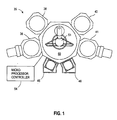
- FIG. 1 is a schematic representation of a wafer processing system 35 that can be used to perform integrated circuit fabrication in accordance with embodiments described.
- This apparatus typically comprises process chambers 36, 38, 40, 41, load-lock chambers 46, a transfer chamber 50, a microprocessor controller 54, along with other hardware components such as power supplies (not shown) and vacuum pumps (not shown).
- An example of such a wafer processing system 35 is a CENTURA® System, commercially available from Applied Materials, Inc., Santa Clara, California. The salient features of this system 35 are briefly described below.
- the wafer processing system 35 includes a transfer chamber 50, containing a transfer robot 51.
- the transfer chamber 50 is coupled to load-lock chambers 46 as well as a cluster of process chambers 36, 38, 40, 41.
- Substrates (not shown) are loaded into the wafer processing system 35 through load-lock chambers 46. Thereafter, transfer robot 51 moves the substrates between one or more of the process chambers 36, 38, 40, 41.
- process chambers 36, 38, 40, 41 are used to perform various integrated circuit fabrication sequences.
- process chambers 36, 38, 40, 41 may include physical vapor deposition (PVD) chambers, ionized metal plasma physical vapor deposition (IMP PVD) chambers, chemical vapor deposition (CVD) chambers, rapid thermal process (RTP) chambers, and anti-reflective coating (ARC) chambers, among others.
- PVD physical vapor deposition
- IMP PVD ionized metal plasma physical vapor deposition
- CVD chemical vapor deposition
- RTP rapid thermal process
- ARC anti-reflective coating
- FIG. 2 depicts a schematic cross-sectional view of a chemical vapor deposition (CVD) process chamber 36 of wafer processing system 35.
- CVD process chamber 36 may be used to deposit organosilicate layers in accordance with embodiments described herein.
- An example of such a CVD process chamber 36 is a DXZTM chamber, commercially available from Applied Materials, Inc., Santa Clara, California.
- CVD process chamber 36 typically comprises a gas panel 130, a control unit 110, along with other hardware components such as power supplies and vacuum pumps. Details of the CVD process chamber 36 are described in commonly assigned U. S. pa. The salient features of the CVD process chamber 36 are briefly described below.
- the CVD process chamber 36 generally houses a support pedestal 150, which is used to support a substrate such as a semiconductor wafer 190.
- This pedestal 150 can typically be moved in a vertical direction inside the chamber 36 using a displacement mechanism (not shown).
- the wafer 190 can be heated to some desired temperature prior to layer deposition.
- the wafer support pedestal 150 is heated by an embedded heater element 170.
- the pedestal 150 may be resistively heated by applying an electric current from an AC supply 106 to the heater element 170.
- the wafer 190 is, in turn, heated by the pedestal 150.
- a temperature sensor 172 such as a thermocouple, is also embedded in the wafer support pedestal 150 to monitor the temperature of the pedestal 150 in a conventional manner.
- the measured temperature is used in a feedback loop to control the power supply 16 for the heating element 170, such that the wafer temperature can be maintained or controlled at a desired temperature which is suitable for the particular process application.
- the pedestal 150 is optionally heated using a plasma or by radiant heat (not shown).
- a vacuum pump 102 is used to evacuate the process chamber 36 and to maintain the proper gas flows and pressure inside the chamber 36.
- a showerhead 120 through which process gases are introduced into the chamber 36, is located above the wafer support pedestal 150.
- the showerhead 120 is connected to a gas panel 130, which controls and supplies various gases used in different steps of the process sequence.
- the showerhead 120 and wafer support pedestal 150 also form a pair of spaced apart electrodes. When an electric field is generated between these electrodes, the process gases introduced into the chamber 36 are ignited into a plasma. Typically, the electric field is generated by connecting the wafer support pedestal 150 to a source of RF power (not shown) through a matching network (not shown). Alternatively, the RF power source and matching network may be coupled to the showerhead 120, or coupled to both the showerhead 120 and the wafer support pedestal 150.
- Plasma enhanced chemical vapor deposition (PECVD) techniques promote excitation and/or disassociation of the reactant gases by the application of the electric field to the reaction zone near the substrate surface, creating a plasma of reactive species.
- the reactivity of the species in the plasma reduces the energy required for a chemical reaction to take place, in effect lowering the required temperature for such PECVD processes.
- organosilicate layer deposition is accomplished by plasma enhanced oxidation of a phenyl-based silane compound such as phenylmethyl silane.
- the phenyl-based silane compound is introduced into the process chamber 36 under the control of gas panel 130 as a gas with a regulated flow.
- the showerhead 120 allows process gases from the gas panel 130 to be uniformly introduced and distributed in the process chamber 100.
- the CVD process chamber 36 is controlled by a microprocessor controller 54.
- the microprocessor controller 54 may be one of any form of general purpose computer processor (CPU) that can be used in an industrial setting for controlling various chambers and sub-processors.
- the computer may use any suitable memory, such as random access memory, read only memory, floppy disk drive, hard disk, or any other form of digital storage, local or remote.
- Various support circuits may be coupled to the CPU for supporting the processor in a conventional manner.
- Software routines as required may be stored in the memory or executed by a second CPU that is remotely located.
- the software routines are executed after the substrate is positioned on the pedestal.
- the software routine when executed, transforms the general purpose computer into a specific process computer that controls the chamber operation so that a chamber process is performed.
- the process of the present invention may be performed in hardware, as an application specific integrated circuit or other type of hardware implementation, or a combination of software or hardware.
- the organosilicate layer is formed by applying an electric field to a gas mixture comprising a phenyl-based silane compound.
- the phenyl-based silane compound has the general formula SiC a O b H c , where a has a range between 6 and 30, b has a range between 0 and 3, and c has a range between 9 and 30.
- phenylsilane SiC 6 H 9
- phenylmethyl silane SiC 7 H 11
- phenylethyl silane SiC 8 H 13
- phenylmethylethylsilane SiC 9 H 15
- phenylmethoxy silane SiC 7 OH 11
- phenylethoxy silane SiC 8 OH 13
- phenylmethylethoxy silane SiC 9 OH 13
- phenylmethoxyethoxysilane SiC 9 O 2 H 13
- the gas mixture may optionally include an oxidizing gas.
- Oxygen (O 2 ), ozone (O 3 ), nitrous oxide (N 2 O), carbon monoxide (CO), carbon dioxide (CO 2 ), nitrogen (N 2 ) or combinations thereof, among others, may be used as the oxidizing gas.
- the following deposition process parameters can be used to form the organosilicate layer using a CVD process chamber similar to that shown in FIG. 2.
- the process parameters range from a wafer temperature of about 100 °C to about 400 °C, a chamber pressure of about 1 torr to about 10 torr, a phenyl-based silane compound gas flow rate of about 400 mgm to about 1000 mgm, an oxidizing gas flow rate of about 1 sccm to about 500 sccm, and an RF power of between about 50 watts to about 500 watts.
- the above process parameters provide a deposition rate for the organosilicate layer in the range of about 1000 ⁇ /min to about 4000 ⁇ /min when implemented on a 200 mm (millimeter) substrate in a deposition chamber available from Applied Materials, Inc.
- deposition chambers are within the scope of the invention, and the parameters listed above may vary according to the particular deposition chamber used to form the organosilicate layer.
- other deposition chambers may have a larger or smaller volume, requiring gas flow rates that are larger or smaller than those recited for deposition chambers available from Applied Materials, Inc. and may be configured to accommodate 300 mm substrates.
- the as-deposited organosilicate layer has a dielectric constant that is less than about 3.0, making it suitable for use as an insulating material in integrated circuits.
- the dielectric constant of the organosilicate layer is tunable, in that it can be varied in a range between about 2.0 to about 3.0 as a function of the reaction temperature. In particular, as the temperature increases the dielectric constant of the as-deposited layer decreases.
- the dielectric constant of the organosilicate layer can also be tuned as a function of the composition of the gas mixture during layer formation. As the carbon (C) concentration in the gas mixture increases, the C content of the as-deposited organosilicate layer increases, decreasing its dielectric constant.
- the organosilicate layer also has an absorption coefficient that is tunable in a range of about 0.1 to about 0.7 at wavelengths less than about 250 nm.
- the absorption coefficient is tunable as a function of the reaction temperature. In particular, as the temperature increases the absorption coefficient of the as-deposited layer increases.
- FIGS. 3a-3e illustrate schematic cross-sectional views of a substrate 200 at different stages of an integrated circuit fabrication sequence incorporating a fluoro-organosilicate layer as a hard mask.
- the substrate 200 refers to any workpiece on which processing is performed, and a substrate structure 250 is used to generally denote the substrate together with other material layers formed on the substrate 200.
- the substrate 200 may correspond to a silicon substrate, or other material layer that has been formed on the substrate.
- FIG. 3a illustrates a cross-sectional view of a substrate structure 250, having a material layer 202 that has been conventionally formed thereon.
- the material layer 202 may be an oxide (e. g., silicon dioxide).
- the substrate 200 may include a layer of silicon, silicides, metals, or other materials.
- FIG. 3a illustrates one embodiment in which the substrate 200 is silicon having a silicon dioxide layer formed thereon.
- FIG. 3b depicts an organosilicate layer 204 formed on the substrate structure 250 of FIG. 3a.
- the organosilicate layer 204 is formed on the substrate structure 250 according to the process parameters described above.
- the thickness of the organosilicate layer is variable depending on the specific stage of processing. Typically, the organosilicate layer is deposited to a thickness of about 400 ⁇ to about 700 ⁇ .
- a layer of energy sensitive resist material 208 is formed on the organosilicate layer 204.
- the layer of energy sensitive resist material 208 can be spin coated on the substrate to a thickness within a range of about 4,000 ⁇ to about 10,000 ⁇ .
- Most energy sensitive resist materials are sensitive to ultraviolet (UV) radiation having a wavelength less than about 450 nm (nanometers).
- Deep ultraviolet (DUV) resist materials are sensitive to UV radiation having wavelengths less than about 245 nm.
- an intermediate layer 206 is formed on the organosilicate layer 204 prior to the layer of energy sensitive resist material 208.
- the intermediate layer 206 functions as a mask for the organosilicate layer 204.
- the intermediate layer 206 is conventionally formed on the organosilicate layer 204.
- the intermediate layer 206 may be an oxide, nitride, silicon oxynitride, amorphous silicon, or other suitable material.
- An image of a pattern is introduced into the layer of energy sensitive resist material 208 by exposing such energy sensitive resist material 208 to DUV radiation via mask 210.
- the image of the pattern introduced in the layer of energy sensitive resist material 208 is developed in an appropriate developer to define the pattern therethrough, as shown in FIG. 3c.
- the pattern defined in the energy sensitive resist material 208 is transferred through the organosilicate layer 204.
- the pattern is transferred through the organosilicate layer 204 using the energy sensitive resist material 208 as a mask.
- the pattern is transferred through the organosilicate layer 204 using an appropriate chemical etchant.
- fluorocarbon compounds such as fluoromethane (CF 4 ), fluoroethane (C 2 F 6 ), and fluorobutene (C 4 F 8 ) may be used to chemically etch the organosilicate layer 204.
- the pattern defined in the energy sensitive resist material 208 is first transferred through the intermediate layer 206 using the energy sensitive resist material 208 as a mask. Thereafter, the pattern is transferred through the organosilicate layer 204 using the intermediate layer 206 as a mask. The pattern is transferred through both the intermediate layer 206 as well as the organosilicate layer 204 using appropriate chemical etchants.
- FIG. 3e illustrates the completion of the integrated circuit fabrication sequence by the transfer of the pattern defined in the organosilicate layer 204 through the silicon dioxide layer 202 using the organosilicate layer as a hardmask.
- the organosilicate layer 204 can optionally be stripped from the substrate 200 by etching it in a suitable chemical etchant.
- FIGS. 4a-4d illustrate schematic cross-sectional views of a substrate 300 at different stages of a damascene structure fabrication sequence incorporating an organosilicate layer therein. Damascene structures are typically used to form metal interconnects on integrated circuits.
- substrate 300 may correspond to a silicon substrate, or other material layer that has been formed on the substrate 300.
- FIG. 4a illustrates a cross-sectional view of a substrate 300 having a first dielectric layer 302 formed thereon.
- the first dielectric layer 302 may be an oxide (e. g., silicon dioxide, fluorosilicate glass).
- the substrate 300 may include a layer of silicon, silicides, metals, or other materials.
- FIG. 4a illustrates one embodiment in which the substrate 300 is silicon having a fluorosilicate glass layer formed thereon.
- the first dielectric layer 302 has a thickness of about 5,000 ⁇ to about 10,000 ⁇ , depending on the size of the structure to be fabricated.
- An organosilicate layer 304 is formed on the first dielectric layer 302.
- the organosilicate layer 304 is formed on the first dielectric layer 302 according to the process parameters described above.
- the organosilicate layer 304 has a dielectric constant less than about 3.0, so as to prevent or minimize capacitive coupling between the metal interconnects to be formed in the damascene structure.
- the dielectric constant for the organosilicate layer is tunable, in that it can be varied in the desired range as a function of the reaction temperature as well as the composition of the gas mixture during layer formation.
- the thickness of the organosilicate layer 304 is variable depending on the specific stage of processing. Typically, the organosilicate layer 304 has a thickness of about 200 ⁇ to about 1000 ⁇ .
- the organosilicate layer 304 is patterned and etched to define contact/via openings 306 and to expose the first dielectric layer 302, in areas where the contacts/vias are to be formed.
- the organosilicate layer 304 is patterned using conventional lithography and etched using fluorocarbon compounds such as fluoromethane (CF 4 ), fluoroethane (C 2 F 6 ), and fluorobutene (C 4 F 8 ).
- CF 4 fluoromethane
- C 2 F 6 fluoroethane
- C 4 F 8 fluorobutene
- a second dielectric layer 308 is deposited over the organosilicate layer 304.
- the second dielectric layer 308 may be an oxide (e. g., silicon dioxide, fluorosilicate glass).
- the second dielectric layer 308 has a thickness of about 5,000 ⁇ to about 10,000 ⁇ .
- the second dielectric layer 308 is then patterned to define interconnect lines 310, as illustrated in FIG. 4c, preferably using conventional lithography processes.
- the interconnects 310 formed in the second dielectric layer 308 are positioned over the contact/via openings 306 in the organosilicate layer 304. Thereafter, both the interconnects 310 and contacts/vias 306 are etched using reactive ion etching or other anisotropic etching techniques.
- the interconnects 310 and contacts/vias 306 are filled with a conductive material 314 such as aluminum, copper, tungsten, or combinations thereof.
- a conductive material 314 such as aluminum, copper, tungsten, or combinations thereof.
- copper is used to fill the interconnects 310 and contacts/vias 306 due to its low resistivity (resistivity about 1.7 ⁇ -cm).
- the conductive material 314 is deposited using chemical vapor deposition, physical vapor deposition, electroplating, or combinations thereof, to form the damascene structure.
- a barrier layer 316 such as tantalum, tantalum nitride, or other suitable barrier material is first deposited conformably on the sidewalls of the interconnects 310 and contacts/vias 306 to prevent metal migration into the surrounding dielectric layers 302, 308 as well as the organosilicate layer 304.
Landscapes
- Chemical & Material Sciences (AREA)
- Engineering & Computer Science (AREA)
- Chemical Kinetics & Catalysis (AREA)
- Materials Engineering (AREA)
- General Physics & Mathematics (AREA)
- Structural Engineering (AREA)
- Inorganic Chemistry (AREA)
- General Chemical & Material Sciences (AREA)
- Architecture (AREA)
- Physics & Mathematics (AREA)
- Mechanical Engineering (AREA)
- Metallurgy (AREA)
- Organic Chemistry (AREA)
- Internal Circuitry In Semiconductor Integrated Circuit Devices (AREA)
- Formation Of Insulating Films (AREA)
- Materials For Photolithography (AREA)
Applications Claiming Priority (2)
| Application Number | Priority Date | Filing Date | Title |
|---|---|---|---|
| US09/638,803 US6573196B1 (en) | 2000-08-12 | 2000-08-12 | Method of depositing organosilicate layers |
| US638803 | 2000-08-12 |
Publications (2)
| Publication Number | Publication Date |
|---|---|
| EP1180554A2 true EP1180554A2 (de) | 2002-02-20 |
| EP1180554A3 EP1180554A3 (de) | 2005-02-02 |
Family
ID=24561503
Family Applications (1)
| Application Number | Title | Priority Date | Filing Date |
|---|---|---|---|
| EP01118984A Withdrawn EP1180554A3 (de) | 2000-08-12 | 2001-08-06 | Verfahren zum Abscheiden Organosilikat-Schichten |
Country Status (5)
| Country | Link |
|---|---|
| US (1) | US6573196B1 (de) |
| EP (1) | EP1180554A3 (de) |
| JP (1) | JP5075310B2 (de) |
| KR (1) | KR100857664B1 (de) |
| TW (1) | TW593739B (de) |
Families Citing this family (20)
| Publication number | Priority date | Publication date | Assignee | Title |
|---|---|---|---|---|
| JP4381526B2 (ja) * | 1999-10-26 | 2009-12-09 | 東京エレクトロン株式会社 | プラズマエッチング方法 |
| US6759327B2 (en) * | 2001-10-09 | 2004-07-06 | Applied Materials Inc. | Method of depositing low k barrier layers |
| US7091137B2 (en) * | 2001-12-14 | 2006-08-15 | Applied Materials | Bi-layer approach for a hermetic low dielectric constant layer for barrier applications |
| US6699784B2 (en) | 2001-12-14 | 2004-03-02 | Applied Materials Inc. | Method for depositing a low k dielectric film (K>3.5) for hard mask application |
| US6838393B2 (en) * | 2001-12-14 | 2005-01-04 | Applied Materials, Inc. | Method for producing semiconductor including forming a layer containing at least silicon carbide and forming a second layer containing at least silicon oxygen carbide |
| US6890850B2 (en) * | 2001-12-14 | 2005-05-10 | Applied Materials, Inc. | Method of depositing dielectric materials in damascene applications |
| US6790788B2 (en) * | 2003-01-13 | 2004-09-14 | Applied Materials Inc. | Method of improving stability in low k barrier layers |
| US7270931B2 (en) | 2003-10-06 | 2007-09-18 | International Business Machines Corporation | Silicon-containing compositions for spin-on ARC/hardmask materials |
| US7030041B2 (en) | 2004-03-15 | 2006-04-18 | Applied Materials Inc. | Adhesion improvement for low k dielectrics |
| US20050233555A1 (en) * | 2004-04-19 | 2005-10-20 | Nagarajan Rajagopalan | Adhesion improvement for low k dielectrics to conductive materials |
| US7229911B2 (en) * | 2004-04-19 | 2007-06-12 | Applied Materials, Inc. | Adhesion improvement for low k dielectrics to conductive materials |
| US7504727B2 (en) * | 2004-05-14 | 2009-03-17 | International Business Machines Corporation | Semiconductor interconnect structure utilizing a porous dielectric material as an etch stop layer between adjacent non-porous dielectric materials |
| US7271093B2 (en) | 2004-05-24 | 2007-09-18 | Asm Japan K.K. | Low-carbon-doped silicon oxide film and damascene structure using same |
| US20050277302A1 (en) * | 2004-05-28 | 2005-12-15 | Nguyen Son V | Advanced low dielectric constant barrier layers |
| US7229041B2 (en) * | 2004-06-30 | 2007-06-12 | Ohio Central Steel Company | Lifting lid crusher |
| US7288205B2 (en) | 2004-07-09 | 2007-10-30 | Applied Materials, Inc. | Hermetic low dielectric constant layer for barrier applications |
| KR100713231B1 (ko) * | 2005-12-26 | 2007-05-02 | 제일모직주식회사 | 레지스트 하층막용 하드마스크 조성물 및 이를 이용한반도체 집적회로 디바이스의 제조방법 |
| KR100817933B1 (ko) * | 2006-09-28 | 2008-04-15 | 광주과학기술원 | 플루오로알킬렌옥시기가 치환된 페닐에틸실란 화합물 및 이를 중합한 고분자 |
| US11679412B2 (en) | 2016-06-13 | 2023-06-20 | Gvd Corporation | Methods for plasma depositing polymers comprising cyclic siloxanes and related compositions and articles |
| WO2017218561A1 (en) | 2016-06-13 | 2017-12-21 | Gvd Coproraton | Methods for plasma depositing polymers comprising cyclic siloxanes and related compositions and articles |
Family Cites Families (25)
| Publication number | Priority date | Publication date | Assignee | Title |
|---|---|---|---|---|
| US3962004A (en) * | 1974-11-29 | 1976-06-08 | Rca Corporation | Pattern definition in an organic layer |
| JPH07111957B2 (ja) | 1984-03-28 | 1995-11-29 | 圭弘 浜川 | 半導体の製法 |
| JPS62138529A (ja) * | 1985-12-10 | 1987-06-22 | Mitsubishi Electric Corp | 有機シリコ−ン薄膜の形成方法 |
| US4894352A (en) | 1988-10-26 | 1990-01-16 | Texas Instruments Inc. | Deposition of silicon-containing films using organosilicon compounds and nitrogen trifluoride |
| US5186718A (en) * | 1989-05-19 | 1993-02-16 | Applied Materials, Inc. | Staged-vacuum wafer processing system and method |
| JP2899600B2 (ja) * | 1994-01-25 | 1999-06-02 | キヤノン販売 株式会社 | 成膜方法 |
| US5989998A (en) * | 1996-08-29 | 1999-11-23 | Matsushita Electric Industrial Co., Ltd. | Method of forming interlayer insulating film |
| KR100463858B1 (ko) * | 1996-08-29 | 2005-02-28 | 마츠시타 덴끼 산교 가부시키가이샤 | 층간절연막의형성방법 |
| TW353775B (en) * | 1996-11-27 | 1999-03-01 | Tokyo Electron Ltd | Production of semiconductor device |
| JP3173426B2 (ja) * | 1997-06-09 | 2001-06-04 | 日本電気株式会社 | シリカ絶縁膜の製造方法及び半導体装置の製造方法 |
| WO1999004911A1 (en) * | 1997-07-28 | 1999-02-04 | Massachusetts Institute Of Technology | Pyrolytic chemical vapor deposition of silicone films |
| US6051321A (en) | 1997-10-24 | 2000-04-18 | Quester Technology, Inc. | Low dielectric constant materials and method |
| US6383955B1 (en) | 1998-02-05 | 2002-05-07 | Asm Japan K.K. | Silicone polymer insulation film on semiconductor substrate and method for forming the film |
| JP3726226B2 (ja) * | 1998-02-05 | 2005-12-14 | 日本エー・エス・エム株式会社 | 絶縁膜及びその製造方法 |
| US6514880B2 (en) | 1998-02-05 | 2003-02-04 | Asm Japan K.K. | Siloxan polymer film on semiconductor substrate and method for forming same |
| US6432846B1 (en) | 1999-02-02 | 2002-08-13 | Asm Japan K.K. | Silicone polymer insulation film on semiconductor substrate and method for forming the film |
| TW437017B (en) | 1998-02-05 | 2001-05-28 | Asm Japan Kk | Silicone polymer insulation film on semiconductor substrate and method for formation thereof |
| US6054379A (en) | 1998-02-11 | 2000-04-25 | Applied Materials, Inc. | Method of depositing a low k dielectric with organo silane |
| US6303523B2 (en) | 1998-02-11 | 2001-10-16 | Applied Materials, Inc. | Plasma processes for depositing low dielectric constant films |
| JP3305251B2 (ja) * | 1998-02-26 | 2002-07-22 | 松下電器産業株式会社 | 配線構造体の形成方法 |
| US6068884A (en) | 1998-04-28 | 2000-05-30 | Silcon Valley Group Thermal Systems, Llc | Method of making low κ dielectric inorganic/organic hybrid films |
| US6060132A (en) | 1998-06-15 | 2000-05-09 | Siemens Aktiengesellschaft | High density plasma CVD process for making dielectric anti-reflective coatings |
| US6103456A (en) * | 1998-07-22 | 2000-08-15 | Siemens Aktiengesellschaft | Prevention of photoresist poisoning from dielectric antireflective coating in semiconductor fabrication |
| JP3353743B2 (ja) * | 1999-05-18 | 2002-12-03 | 日本電気株式会社 | 半導体装置とその製造方法 |
| US6436824B1 (en) * | 1999-07-02 | 2002-08-20 | Chartered Semiconductor Manufacturing Ltd. | Low dielectric constant materials for copper damascene |
-
2000
- 2000-08-12 US US09/638,803 patent/US6573196B1/en not_active Expired - Fee Related
-
2001
- 2001-08-06 EP EP01118984A patent/EP1180554A3/de not_active Withdrawn
- 2001-08-06 TW TW090119185A patent/TW593739B/zh not_active IP Right Cessation
- 2001-08-10 KR KR1020010048231A patent/KR100857664B1/ko not_active Expired - Fee Related
- 2001-08-13 JP JP2001245703A patent/JP5075310B2/ja not_active Expired - Fee Related
Also Published As
| Publication number | Publication date |
|---|---|
| EP1180554A3 (de) | 2005-02-02 |
| KR20020013771A (ko) | 2002-02-21 |
| TW593739B (en) | 2004-06-21 |
| US6573196B1 (en) | 2003-06-03 |
| KR100857664B1 (ko) | 2008-09-08 |
| JP5075310B2 (ja) | 2012-11-21 |
| JP2002164347A (ja) | 2002-06-07 |
Similar Documents
| Publication | Publication Date | Title |
|---|---|---|
| US6465366B1 (en) | Dual frequency plasma enhanced chemical vapor deposition of silicon carbide layers | |
| US6500773B1 (en) | Method of depositing organosilicate layers | |
| US7117064B2 (en) | Method of depositing dielectric films | |
| US6537733B2 (en) | Method of depositing low dielectric constant silicon carbide layers | |
| US6573196B1 (en) | Method of depositing organosilicate layers | |
| US6777171B2 (en) | Fluorine-containing layers for damascene structures | |
| US6841341B2 (en) | Method of depositing an amorphous carbon layer | |
| US6531398B1 (en) | Method of depositing organosillicate layers | |
| US6632735B2 (en) | Method of depositing low dielectric constant carbon doped silicon oxide | |
| US6521546B1 (en) | Method of making a fluoro-organosilicate layer | |
| EP1174911A2 (de) | Antireflexionsschicht aus Silizium-Nitrid |
Legal Events
| Date | Code | Title | Description |
|---|---|---|---|
| PUAI | Public reference made under article 153(3) epc to a published international application that has entered the european phase |
Free format text: ORIGINAL CODE: 0009012 |
|
| AK | Designated contracting states |
Kind code of ref document: A2 Designated state(s): AT BE CH CY DE DK ES FI FR GB GR IE IT LI LU MC NL PT SE TR |
|
| AX | Request for extension of the european patent |
Free format text: AL;LT;LV;MK;RO;SI |
|
| RIC1 | Information provided on ipc code assigned before grant |
Ipc: 7G 03F 7/09 B Ipc: 7H 01L 21/311 B Ipc: 7C 23C 16/01 B Ipc: 7C 23C 16/04 B Ipc: 7H 01L 21/316 B Ipc: 7C 23C 16/30 B Ipc: 7C 23C 16/50 A |
|
| PUAL | Search report despatched |
Free format text: ORIGINAL CODE: 0009013 |
|
| AK | Designated contracting states |
Kind code of ref document: A3 Designated state(s): AT BE CH CY DE DK ES FI FR GB GR IE IT LI LU MC NL PT SE TR |
|
| AX | Request for extension of the european patent |
Extension state: AL LT LV MK RO SI |
|
| 17P | Request for examination filed |
Effective date: 20050728 |
|
| AKX | Designation fees paid |
Designated state(s): BE DE GB NL |
|
| 17Q | First examination report despatched |
Effective date: 20050823 |
|
| STAA | Information on the status of an ep patent application or granted ep patent |
Free format text: STATUS: THE APPLICATION IS DEEMED TO BE WITHDRAWN |
|
| 18D | Application deemed to be withdrawn |
Effective date: 20061201 |