EP1164026B1 - Carriage velocity control to improve print quality and extend printhead life in ink-jet printer - Google Patents
Carriage velocity control to improve print quality and extend printhead life in ink-jet printer Download PDFInfo
- Publication number
- EP1164026B1 EP1164026B1 EP01304524A EP01304524A EP1164026B1 EP 1164026 B1 EP1164026 B1 EP 1164026B1 EP 01304524 A EP01304524 A EP 01304524A EP 01304524 A EP01304524 A EP 01304524A EP 1164026 B1 EP1164026 B1 EP 1164026B1
- Authority
- EP
- European Patent Office
- Prior art keywords
- swath
- printhead
- dot density
- max
- maximum permissible
- Prior art date
- Legal status (The legal status is an assumption and is not a legal conclusion. Google has not performed a legal analysis and makes no representation as to the accuracy of the status listed.)
- Expired - Lifetime
Links
- 238000000034 method Methods 0.000 claims description 31
- 238000004364 calculation method Methods 0.000 claims description 11
- 238000013016 damping Methods 0.000 claims description 11
- 230000004044 response Effects 0.000 claims description 10
- 238000010304 firing Methods 0.000 claims description 9
- 238000012544 monitoring process Methods 0.000 claims description 6
- 238000009529 body temperature measurement Methods 0.000 claims description 2
- GZPBVLUEICLBOA-UHFFFAOYSA-N 4-(dimethylamino)-3,5-dimethylphenol Chemical compound CN(C)C1=C(C)C=C(O)C=C1C GZPBVLUEICLBOA-UHFFFAOYSA-N 0.000 description 45
- FVFVNNKYKYZTJU-UHFFFAOYSA-N 6-chloro-1,3,5-triazine-2,4-diamine Chemical compound NC1=NC(N)=NC(Cl)=N1 FVFVNNKYKYZTJU-UHFFFAOYSA-N 0.000 description 17
- 238000007639 printing Methods 0.000 description 9
- 230000006870 function Effects 0.000 description 5
- 238000013021 overheating Methods 0.000 description 4
- 230000009467 reduction Effects 0.000 description 4
- 230000006399 behavior Effects 0.000 description 3
- 238000001914 filtration Methods 0.000 description 3
- 238000012545 processing Methods 0.000 description 3
- 230000008901 benefit Effects 0.000 description 2
- 230000008859 change Effects 0.000 description 2
- 239000003086 colorant Substances 0.000 description 2
- 238000007781 pre-processing Methods 0.000 description 2
- 238000013459 approach Methods 0.000 description 1
- 238000012512 characterization method Methods 0.000 description 1
- 238000004891 communication Methods 0.000 description 1
- 238000001816 cooling Methods 0.000 description 1
- 230000007423 decrease Effects 0.000 description 1
- 230000001627 detrimental effect Effects 0.000 description 1
- 238000010586 diagram Methods 0.000 description 1
- 230000000694 effects Effects 0.000 description 1
- 238000010438 heat treatment Methods 0.000 description 1
- 230000003993 interaction Effects 0.000 description 1
- 230000014759 maintenance of location Effects 0.000 description 1
- 238000013178 mathematical model Methods 0.000 description 1
- 238000005259 measurement Methods 0.000 description 1
- 230000007246 mechanism Effects 0.000 description 1
- 230000008569 process Effects 0.000 description 1
- 238000010408 sweeping Methods 0.000 description 1
- 230000002277 temperature effect Effects 0.000 description 1
- 238000010792 warming Methods 0.000 description 1
Images

Classifications
-
- B—PERFORMING OPERATIONS; TRANSPORTING
- B41—PRINTING; LINING MACHINES; TYPEWRITERS; STAMPS
- B41J—TYPEWRITERS; SELECTIVE PRINTING MECHANISMS, i.e. MECHANISMS PRINTING OTHERWISE THAN FROM A FORME; CORRECTION OF TYPOGRAPHICAL ERRORS
- B41J2/00—Typewriters or selective printing mechanisms characterised by the printing or marking process for which they are designed
- B41J2/485—Typewriters or selective printing mechanisms characterised by the printing or marking process for which they are designed characterised by the process of building-up characters or image elements applicable to two or more kinds of printing or marking processes
- B41J2/505—Typewriters or selective printing mechanisms characterised by the printing or marking process for which they are designed characterised by the process of building-up characters or image elements applicable to two or more kinds of printing or marking processes from an assembly of identical printing elements
- B41J2/5056—Typewriters or selective printing mechanisms characterised by the printing or marking process for which they are designed characterised by the process of building-up characters or image elements applicable to two or more kinds of printing or marking processes from an assembly of identical printing elements using dot arrays providing selective dot disposition modes, e.g. different dot densities for high speed and high-quality printing, array line selections for multi-pass printing, or dot shifts for character inclination
- B41J2/5058—Typewriters or selective printing mechanisms characterised by the printing or marking process for which they are designed characterised by the process of building-up characters or image elements applicable to two or more kinds of printing or marking processes from an assembly of identical printing elements using dot arrays providing selective dot disposition modes, e.g. different dot densities for high speed and high-quality printing, array line selections for multi-pass printing, or dot shifts for character inclination locally, i.e. for single dots or for small areas of a character
-
- B—PERFORMING OPERATIONS; TRANSPORTING
- B41—PRINTING; LINING MACHINES; TYPEWRITERS; STAMPS
- B41J—TYPEWRITERS; SELECTIVE PRINTING MECHANISMS, i.e. MECHANISMS PRINTING OTHERWISE THAN FROM A FORME; CORRECTION OF TYPOGRAPHICAL ERRORS
- B41J2/00—Typewriters or selective printing mechanisms characterised by the printing or marking process for which they are designed
- B41J2/005—Typewriters or selective printing mechanisms characterised by the printing or marking process for which they are designed characterised by bringing liquid or particles selectively into contact with a printing material
- B41J2/01—Ink jet
- B41J2/015—Ink jet characterised by the jet generation process
- B41J2/04—Ink jet characterised by the jet generation process generating single droplets or particles on demand
- B41J2/045—Ink jet characterised by the jet generation process generating single droplets or particles on demand by pressure, e.g. electromechanical transducers
- B41J2/04501—Control methods or devices therefor, e.g. driver circuits, control circuits
- B41J2/04515—Control methods or devices therefor, e.g. driver circuits, control circuits preventing overheating
-
- B—PERFORMING OPERATIONS; TRANSPORTING
- B41—PRINTING; LINING MACHINES; TYPEWRITERS; STAMPS
- B41J—TYPEWRITERS; SELECTIVE PRINTING MECHANISMS, i.e. MECHANISMS PRINTING OTHERWISE THAN FROM A FORME; CORRECTION OF TYPOGRAPHICAL ERRORS
- B41J2/00—Typewriters or selective printing mechanisms characterised by the printing or marking process for which they are designed
- B41J2/005—Typewriters or selective printing mechanisms characterised by the printing or marking process for which they are designed characterised by bringing liquid or particles selectively into contact with a printing material
- B41J2/01—Ink jet
- B41J2/015—Ink jet characterised by the jet generation process
- B41J2/04—Ink jet characterised by the jet generation process generating single droplets or particles on demand
- B41J2/045—Ink jet characterised by the jet generation process generating single droplets or particles on demand by pressure, e.g. electromechanical transducers
- B41J2/04501—Control methods or devices therefor, e.g. driver circuits, control circuits
- B41J2/04528—Control methods or devices therefor, e.g. driver circuits, control circuits aiming at warming up the head
-
- B—PERFORMING OPERATIONS; TRANSPORTING
- B41—PRINTING; LINING MACHINES; TYPEWRITERS; STAMPS
- B41J—TYPEWRITERS; SELECTIVE PRINTING MECHANISMS, i.e. MECHANISMS PRINTING OTHERWISE THAN FROM A FORME; CORRECTION OF TYPOGRAPHICAL ERRORS
- B41J2/00—Typewriters or selective printing mechanisms characterised by the printing or marking process for which they are designed
- B41J2/005—Typewriters or selective printing mechanisms characterised by the printing or marking process for which they are designed characterised by bringing liquid or particles selectively into contact with a printing material
- B41J2/01—Ink jet
- B41J2/015—Ink jet characterised by the jet generation process
- B41J2/04—Ink jet characterised by the jet generation process generating single droplets or particles on demand
- B41J2/045—Ink jet characterised by the jet generation process generating single droplets or particles on demand by pressure, e.g. electromechanical transducers
- B41J2/04501—Control methods or devices therefor, e.g. driver circuits, control circuits
- B41J2/0454—Control methods or devices therefor, e.g. driver circuits, control circuits involving calculation of temperature
-
- B—PERFORMING OPERATIONS; TRANSPORTING
- B41—PRINTING; LINING MACHINES; TYPEWRITERS; STAMPS
- B41J—TYPEWRITERS; SELECTIVE PRINTING MECHANISMS, i.e. MECHANISMS PRINTING OTHERWISE THAN FROM A FORME; CORRECTION OF TYPOGRAPHICAL ERRORS
- B41J2/00—Typewriters or selective printing mechanisms characterised by the printing or marking process for which they are designed
- B41J2/005—Typewriters or selective printing mechanisms characterised by the printing or marking process for which they are designed characterised by bringing liquid or particles selectively into contact with a printing material
- B41J2/01—Ink jet
- B41J2/015—Ink jet characterised by the jet generation process
- B41J2/04—Ink jet characterised by the jet generation process generating single droplets or particles on demand
- B41J2/045—Ink jet characterised by the jet generation process generating single droplets or particles on demand by pressure, e.g. electromechanical transducers
- B41J2/04501—Control methods or devices therefor, e.g. driver circuits, control circuits
- B41J2/04563—Control methods or devices therefor, e.g. driver circuits, control circuits detecting head temperature; Ink temperature
-
- B—PERFORMING OPERATIONS; TRANSPORTING
- B41—PRINTING; LINING MACHINES; TYPEWRITERS; STAMPS
- B41J—TYPEWRITERS; SELECTIVE PRINTING MECHANISMS, i.e. MECHANISMS PRINTING OTHERWISE THAN FROM A FORME; CORRECTION OF TYPOGRAPHICAL ERRORS
- B41J2/00—Typewriters or selective printing mechanisms characterised by the printing or marking process for which they are designed
- B41J2/005—Typewriters or selective printing mechanisms characterised by the printing or marking process for which they are designed characterised by bringing liquid or particles selectively into contact with a printing material
- B41J2/01—Ink jet
- B41J2/015—Ink jet characterised by the jet generation process
- B41J2/04—Ink jet characterised by the jet generation process generating single droplets or particles on demand
- B41J2/045—Ink jet characterised by the jet generation process generating single droplets or particles on demand by pressure, e.g. electromechanical transducers
- B41J2/04501—Control methods or devices therefor, e.g. driver circuits, control circuits
- B41J2/0458—Control methods or devices therefor, e.g. driver circuits, control circuits controlling heads based on heating elements forming bubbles
-
- B—PERFORMING OPERATIONS; TRANSPORTING
- B41—PRINTING; LINING MACHINES; TYPEWRITERS; STAMPS
- B41J—TYPEWRITERS; SELECTIVE PRINTING MECHANISMS, i.e. MECHANISMS PRINTING OTHERWISE THAN FROM A FORME; CORRECTION OF TYPOGRAPHICAL ERRORS
- B41J2/00—Typewriters or selective printing mechanisms characterised by the printing or marking process for which they are designed
- B41J2/005—Typewriters or selective printing mechanisms characterised by the printing or marking process for which they are designed characterised by bringing liquid or particles selectively into contact with a printing material
- B41J2/01—Ink jet
- B41J2/015—Ink jet characterised by the jet generation process
- B41J2/04—Ink jet characterised by the jet generation process generating single droplets or particles on demand
- B41J2/045—Ink jet characterised by the jet generation process generating single droplets or particles on demand by pressure, e.g. electromechanical transducers
- B41J2/04501—Control methods or devices therefor, e.g. driver circuits, control circuits
- B41J2/04586—Control methods or devices therefor, e.g. driver circuits, control circuits controlling heads of a type not covered by groups B41J2/04575 - B41J2/04585, or of an undefined type
-
- B—PERFORMING OPERATIONS; TRANSPORTING
- B41—PRINTING; LINING MACHINES; TYPEWRITERS; STAMPS
- B41J—TYPEWRITERS; SELECTIVE PRINTING MECHANISMS, i.e. MECHANISMS PRINTING OTHERWISE THAN FROM A FORME; CORRECTION OF TYPOGRAPHICAL ERRORS
- B41J2/00—Typewriters or selective printing mechanisms characterised by the printing or marking process for which they are designed
- B41J2/485—Typewriters or selective printing mechanisms characterised by the printing or marking process for which they are designed characterised by the process of building-up characters or image elements applicable to two or more kinds of printing or marking processes
- B41J2/505—Typewriters or selective printing mechanisms characterised by the printing or marking process for which they are designed characterised by the process of building-up characters or image elements applicable to two or more kinds of printing or marking processes from an assembly of identical printing elements
- B41J2/5056—Typewriters or selective printing mechanisms characterised by the printing or marking process for which they are designed characterised by the process of building-up characters or image elements applicable to two or more kinds of printing or marking processes from an assembly of identical printing elements using dot arrays providing selective dot disposition modes, e.g. different dot densities for high speed and high-quality printing, array line selections for multi-pass printing, or dot shifts for character inclination
Definitions
- This invention relates to printers, and more particularly to techniques for improving print quality and for extending printhead life in ink-jet printers.
- Ink-jet printers operate by sweeping a printhead with one or more ink-jet nozzles above a print medium and applying a precise quantity of ink from specified nozzles as they pass over specified pixel locations on the print medium.
- One type of ink-jet nozzle utilizes a small resistor to produce heat within an associated ink chamber. To fire a nozzle, a voltage is applied to the resistor. The resulting heat causes ink within the chamber to quickly expand, thereby forcing one or more droplets from the associated nozzle. Resistors are controlled individually for each nozzle to produce a desired pixel pattern as the printhead passes over the print medium.
- printheads have been designed with large numbers of nozzles. This has created the potential for printhead overheating. Each nozzle firing produces residual heat. If too many nozzles are fired within a short period of time, the printhead can reach undesirably high temperatures. Such temperatures can damage and shorten the life of a printhead. Furthermore, widely varying printhead temperatures during printing can change the size of droplets ejected from the nozzles. This has a detrimental effect on print quality.
- Printhead overheating is often the result of a high "dot density" during a single swath of the printhead.
- the printhead passes over a known number of available pixels, some of which will receive ink and others of which will not receive ink.
- the pixels that receive ink are referred to as dots.
- the "dot density” is the percentage of pixels in a swath that receives ink and thereby become dots.
- Another problem caused by printing high-density images is that there might be insufficient ink in the nozzle area of the printhead for printing the next swath. Over time, firing a nozzle when it has an insufficient supply of ink will destroy the nozzle.
- SWATH DENSITY CONTROL TO IMPROVE PRINT QUALITY AND EXTEND LIFE IN INK-JET PRINTER describes techniques which address these problems, including disabling nozzles in the printhead, and providing reduced-height swaths to reduce throughput. This application provides additional techniques for addressing these problems.
- EP 0 925 938 A2 discloses swath density control to improve print quality and extend printhead life in inkjet printers.
- an inkjet printer having a printhead that passes repeatedly across a print medium in individual swaths.
- the printhead has individual nozzles that are fired repeatedly during each printhead swath to apply an ink pattern to the print medium.
- the printer monitors print density and printhead temperature during each swath and uses these values to calculate a maximum permissible print density. If a reduction in print density is required the printer temporarily disables selected nozzles to produce a reduced height swath rather than pausing between swaths or reducing the printhead velocity relative to the page.
- EP-A-0 720 917 discloses that printing an image by a thermal ink jet printer is controlled central processing unit based on an internal temperature sensed by temperature sensor of the printer adjacent the printhead and the density of the printed image determined by density determiner in the central processing unit. Prior to printing, the temperature of the printhead is estimated, and the density of the image is determined from stored print data in memory in the central processing unit. Based on the temperature and density, either a single-pass 100% coverage print mode or a double-pass checkerboard print mode is selected. Also, based on the temperature and density, the printhead droplet ejection rate is set. Such control provides a printed image with high quality and prevents misfiring of the ink jets when temperatures and density are high.
- a method for controlling the number of dots fired per time interval in an inkjet printer having a printhead with a plurality of nozzles, the printhead mounted in a scanning carriage for producing a print swath across a print medium.
- the method includes:
- the carriage velocity reduction can occur as a result of one of several occurrences.
- the step for reducing the carriage velocity can be performed in response to high print densities that are predicted to raise the printhead temperature to unacceptably high levels.
- an inkjet printer that applies an ink pattern to a print medium as claimed in claims 10 to 13 hereinafter is described, and includes control logic, a printhead, and a carriage for mounting the printhead.
- the carriage is responsive to the control logic to pass the printhead repeatedly across the print medium in individual swaths, the printhead having individual nozzles that are fired repeatedly during each printhead swath to apply an ink pattern to the print medium.
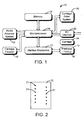
- Fig. 1 shows pertinent components of a printer 10 in accordance with the invention.
- Printer 10 is an ink-jet printer having a printhead 12.
- the printhead has multiple nozzles (not shown in Fig. 1).
- Interface electronics 13 are associated with printer 10 to interface between the control logic components and the electro-mechanical components of the printer.
- Interface electronics 13 include, for example, circuits for moving the printhead and paper, and for firing individual nozzles.
- Printer 10 includes control logic in the form of a microprocessor and associated memory 15.
- Microprocessor 14 is programmable in that it reads and serially executes program instructions from memory. Generally, these instructions carry out various control steps and functions that are typical of inkjet printers. In addition, the microprocessor monitors and controls inkjet peak temperatures as explained in more detail below. Alternatively an ASIC or hard-wired logic could be employed in place of the microprocessor.
- Memory 15 is preferably some combination of ROM, dynamic RAM, and possibly some type of non-volatile and writable memory such as battery-backed memory or flash memory.
- a temperature sensor 16 is associated with the printhead. It is operably connected to supply a printhead temperature measurement to the control logic through interface electronics 13.
- the temperature sensor in the described embodiment is a thermal sense resistor. It produces an analog signal that is digitized within interface electronics 13 so that it can be read by microprocessor 14. More details regarding the temperature sensor, its calibration, and its use are given in US 6196651, entitled “Method and Apparatus for Detecting the End of Life of a Print Cartridge For a Thermal Ink Jet Printer,".
- Microprocessor 14 is connected to receive instructions and data from a host computer (not shown) through one or more I/O channels or ports 20.
- I/O channel 20 is a parallel or serial communications port such as used by many printers.
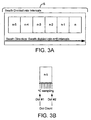
- Fig. 2 shows an exemplary layout of nozzles 21 in one example of a printhead 12.
- Printhead 12 has one or more laterally spaced nozzle or dot columns.
- Each nozzle 21 is positioned at a different vertical position (where the direction of printhead travel, at a right angle to the direction of printhead travel), and corresponds to a respective pixel row on the underlying print medium.
- all nozzles are used resulting in what is referred to herein as a full-height swath.
- the printhead has nozzles corresponding to 288 pixel rows.
- some printheads utilize redundant columns of nozzles for various purposes.
- color printers typically have three or more sets of nozzles positioned to apply ink droplets of different colors on the same pixel rows. The sets of nozzles might be contained within a single printhead, or incorporated in three different printheads. The principles of the invention described herein apply in either case.
- printhead 12 is responsive to the control logic implemented by microprocessor 14 and memory 15 to pass repeatedly across a print medium in individual, horizontal swaths.
- the printhead 12 is mounted in a carriage 24, which is mounted for sliding movement along a swath axis to print a swath.
- the carriage is coupled to a carriage drive system 30, which is controlled by the control logic to drive the carriage in a controlled manner.
- an encoder system 32 provides position information to the control logic so that the control logic can monitor the position and hence the velocity of the carriage as it is moved by the drive system 30 in response to commands from the control logic.
- a media advance system 40 is also controlled by the control logic to drive and position the print media along a media path which is generally transverse to the swath axis.
- the individual nozzles of the printhead are fired repeatedly during each printhead swath to apply an ink pattern to the print medium.
- the swaths overlap each other so that the printhead passes over each pixel row two or more times.
- the techniques described in the above-referenced application may not be available, e.g. because the data pipeline may not be able to accommodate swath height reductions.
- One such pipeline is implemented using the printer command language (PCL) protocol.
- PCL printer command language
- the techniques in accordance with this invention can be employed to address the above described problems.
- the carriage movement rate is slowed down for selected swaths to reduce print density.
- the carriage rate reduction can be employed in response to any one of the following factors or conditions: (a) a high print density for the swath, which is predicted to raise the printhead temperature to an unacceptably high level; and (b) a high print density for the swath that is predicted to lower nozzle ink supplies to unacceptably low levels.
- control logic is configured to perform a learning algorithm, which in an exemplary implementation uses some known values for a complete swath: the actual density, D ACT , the maximum allowed printhead temperature, T MAX , the printhead temperature at the beginning of the swath, T START , and the actual peak printhead temperature during the swath, T PEAK .
- the invention is not limited to basing calculations solely on values from the complete swath, and can be employed when the swath is divided into discrete swath intervals, and the values are determined for each swath interval.
- the actual density, D ACT is found by reading registers in the printer hardware, i.e. the controller memory in which the actual ink drop counts for each printhead are stored.
- This learning equation yields the effective firing density which is a function of carriage velocity.
- the printer swath manager builds a swath and then estimates the expected average density D AVG for that swath or interval. Once the expected average density is known, the following swath-pre-processing equation, calculated prior to releasing the swath, is applied to determine the maximum allowed carriage velocity (CVEL MAX ) for that swath. The highest possible carriage velocity is the maximum velocity (MECH_CVEL MAX ) allowed for the print mode, and is limited to the actual carriage mechanism.
- CVEL MAX MIN[((MECH_CVEL MAX )*(D MAX )/(D AVG )), (MECH_CVEL MAX )]
- CVEL MAX the velocity will typically be floored to the next closest allowable carriage velocity based on the frequency response of the printhead.
- the printing system can employ these equations to provide on the basis of complete swath parameters, e.g. the maximum print density and printhead temperatures measured or predicted over the entire print swath, i.e., a whole or full swath mode. While a whole swath mode can be satisfactory for many applications, there can be a possible disadvantage, in that drastically different swaths can end up with similar average densities and peak temperatures. When this occurs, the algorithm can require heavy filtering to dampen the noise of the calculated maximum allowed density, and this would likely occur for the calculation of CVEL MAX if intra-swath techniques are not employed. For example, consider a worst-case type example, wherein the swath has four intervals.
- the print density is 100% for the first two swath intervals, and 0% for the last two swath intervals.
- D ACT will be 50%, which may not adequately address the disparate density values and resulting printhead temperature effects.
- the invention can be applied in an intra-swath mode.
- Dividing the swath into discrete intervals for the intra-swath mode allows a better estimation of the printhead thermal response than if the algorithm makes decisions based solely on the average density and peak temperature for an entire swath.
- the algorithm mode using discrete swath interval calculations will be very similar to the whole swath implementation described above. However, when in an intra-swath mode, the D MAX and CVEL MAX parameters will be calculated at discrete intervals across the swath and then the results will be statistically combined for the complete swath.
- the only disadvantage to this intra-swath mode is the increase in CPU cycles required for the extra calculations.
- the parameter D AVG is estimated for each interval.
- the average value for D AVG over the intervals is then calculated. The density cannot be greater than 100 or less than 0. If the average value calculated is greater than 100 or less than 0, the parameter value is set to the boundary limit. Now the process to determine whether the swath can be allowed to be printed at the maximum carriage velocity is the same as for the full swath technique. After the swath is completed, the learning equation is applied to each interval and the D MAX values for each interval are averaged together to obtain the D MAX parameter value to be used for the next swath.
- FIG. 3B shows an exemplary swath interval (n-5).
- the control logic 14 samples the printhead temperature at some frequency C, and averages the temperature values over the interval.
- the printer records in memory the dot count as DOT, from the control logic.
- the control logic again records the dot counts (for each color) as DOT 2 .
- This dot count information is enough information to calculate the number of dots fired in that interval per color, as well as calculate the average firing frequency with the known carriage velocity.
- the dot counts for each color are tracked, and the average firing density D AVG for each color is calculated. Typically the pen with the minimum D MAX will take precedence.
- the algorithms are not limited to the case in which the peak temperature is used in the calculations, and other values can alternatively be employed, such as average temperature and various time/temperature values or combinations thereof.
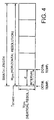
- FIG. 4 illustrates an alternate intra-swath technique in accordance with aspects of the invention.
- FIG. 4 illustrates a swath having a swath length indicated by H dpi , the total number of possible dots over the horizontal extent of the swath, and a swath height indicated by V dpi , the total number of possible dots over the vertical extent of the swath.
- D ACT_EFF D ACT (C VEL_MAX /MECH_CVEL MAX )
- the equation can be updated with the results just learned on the preceding swath print.
- FIG. 5 illustrates a method 100 for controlling a printer in accordance with aspects of the present invention. The steps of FIG. 5 are performed by the control logic of the printer 10, and are repeated prior to every printhead swath for the full swath mode, and for each swath interval for the intra-swath mode.
- a first step 102 involves checking whether enough data has been received from the host computer to print an entire swath. Once enough data has been received to print a swath, execution proceeds with step 106.
- Step 104 comprises calculating the average swath density D AVG for the upcoming swath. This is done by the printer swath manager building the upcoming swath, and estimating the expected average density D AVG .
- a next step 106 is to determine whether the carriage velocity is to be slowed to reduce the effective print density. This step comprises comparing D AVG to D MAX , where D MAX is calculated using the learning equation set out above upon completion of the prior swath.
- step 106 can include determining whether the carriage should be slowed because the ink flow rate to the printhead is nearing or exceeding a threshold. For many applications, the limiting factor is the thermal limitation, and so ink flow to the printhead need not be employed in the algorithm.
- step 106 also includes comparing D AVG to D INKMAX . If D AVG > D MAX or if D AVG > D INKMAX , a step 108 is performed of slowing the printer carriage.
- Step 110 comprises printing the swath using the carriage velocity calculated according to the swath pre-processing equation set out above.
- the control logic monitors the printhead temperature during this step, and records the temperature parameters, e.g. T PEAK and T START , for later use.
- D MAX is a potentially changing value that is maintained by the control logic based on known and measured characteristics of the printhead.
- the maximum possible ink flow rate establishes the upper limit of D MAX .
- the upper limit of D MAX is established at a value that produces an average ink flow rate of less than or equal to the maximum possible ink flow rate.
- D MAX is updated during printer operation based on recorded start and peak temperatures for the printhead during previous swaths having known print densities.
- the printer control logic calculates D MAX by monitoring actual swath dot density, the printhead start temperature T START and the peak printhead temperature T PEAK during each printhead swath and repeatedly (after each swath) calculates D MAX as a function of the actual swath dot density D ACT , the start temperature T START , peak temperature T PEAK and the carriage velocity ratio A.
- D MAX is calculated by multiplying the actual swath dot density D ACT of a particular printhead swath by a factor that is based at least in part on the peak temperature T PEAK of the printhead during the swath and upon a specified maximum permissible temperature T MAX of the printhead.
- the factor is equal to A*(T MAX - T START )/(T PEAK - T START ); where T START is equal to the temperature of the printhead prior to the printhead swath.
- T START is a constant that approximates the printhead temperature at the beginning of each swath.
- printhead control logic within printer 10 heats or cools the printhead to a target temperature before each printhead swath.
- T START is equal to this target temperature.
- Printhead cooling is achieved by imposing a brief delay before an upcoming swath.
- Printhead heating is achieved by a technique known as "pulse warming,” in which nozzles are repeatedly pulsed with electrical pulses of such short duration that they produce heat without ejecting ink.
- D MAX D ACT *A*((T MAX - T START )/(T PEAK - T START ))
- Actual changes to D MAX can be filtered to reduce fluctuations produced by measurement anomalies.
- One method of filtering is to clip each new value of D MAX at upper and lower limits. In this exemplary embodiment, such clipping is performed only if the printhead temperature T PEAK is outside a defined temperature range, wherein the range includes those temperatures that have been determined to be associated with a linear density/temperature relationship.
- Another method of filtering is to damp any changes in the calculated D MAX .
- this is done by multiplying changes to D MAX by a predetermined damping factor.
- upward changes in the calculated D MAX are damped by a first damping factor, and downward changes are damped by a second, different damping factor.
- Fig. 4 illustrates the steps 112-120 involved in calculating D MAX . The illustrated steps are performed repeatedly, after each printhead swath. D ACT and T PEAK are recorded during the preceding swath, and are utilized in the calculations of Fig. 4.
- a step 112 comprises calculating D MAX as a function of D ACT and T PEAK , in accordance with equation (6) above.
- Subsequent decision step 114 comprises determined whether T PEAK is within a temperature range that exhibits a linear relationship to printhead density. This step comprises comparing T PEAK - T START with a predefined constant that represents the upper temperature limit of linear printhead behavior. If T PEAK - T START is less than or equal to the constant, execution proceeds to step 118. If T PEAK is greater than the constant, a step 116 is performed of clipping D MAX at predefined upper and lower limits. As an example, the upper and lower limits might be set to 95 % and 80%, respectively. Step 116 clips or limits D MAX to these values. Any value of D MAX above the upper limit is set equal to the upper limit.
- step 118 comprises damping changes in D MAX from one printhead pass to another.
- the change ⁇ D MAX is calculated as the D MAX - D MAXOLD , where D MAXOLD is the value of D MAX calculated during the previous iteration of the steps 112-120.
- F DAMP is a predetermined damping factor.
- two different damping factors are used: one when ⁇ D MAX is positive, and another when ⁇ D MAX is negative.
- the use of an intra-swath mode in accordance with an aspect of the invention decreases the need for dampening and increases the accuracy of the calculations.
- Step 120 comprises storing D MAX in non-volatile storage, for retention when the printer is turned off. This value of D MAX is used in step 102, prior to the next printhead swath.
- the method described above of reducing printhead density can be adapted to various different print methodologies. For example, many printers utilize swath overlapping to reduce banding. The principles explained above can be easily incorporated in such printers.
Landscapes
- Engineering & Computer Science (AREA)
- Quality & Reliability (AREA)
- Ink Jet (AREA)
Applications Claiming Priority (2)
| Application Number | Priority Date | Filing Date | Title |
|---|---|---|---|
| US594889 | 1996-02-09 | ||
| US09/594,889 US6452618B1 (en) | 1997-12-22 | 2000-06-14 | Carriage velocity control to improve print quality and extend printhead life in ink-jet printer |
Publications (2)
| Publication Number | Publication Date |
|---|---|
| EP1164026A1 EP1164026A1 (en) | 2001-12-19 |
| EP1164026B1 true EP1164026B1 (en) | 2004-10-13 |
Family
ID=24380837
Family Applications (1)
| Application Number | Title | Priority Date | Filing Date |
|---|---|---|---|
| EP01304524A Expired - Lifetime EP1164026B1 (en) | 2000-06-14 | 2001-05-23 | Carriage velocity control to improve print quality and extend printhead life in ink-jet printer |
Country Status (4)
| Country | Link |
|---|---|
| US (1) | US6452618B1 (https=) |
| EP (1) | EP1164026B1 (https=) |
| JP (1) | JP2002019089A (https=) |
| DE (1) | DE60106331T2 (https=) |
Cited By (2)
| Publication number | Priority date | Publication date | Assignee | Title |
|---|---|---|---|---|
| EP1683639A3 (en) * | 2004-12-17 | 2007-02-14 | Hewlett-Packard Development Company, L.P. | Printing system and method of printing an image in a fixed head printing system |
| WO2024191458A1 (en) * | 2023-03-15 | 2024-09-19 | Hewlett-Packard Development Company, L.P. | Printhead carriage speed determination |
Families Citing this family (9)
| Publication number | Priority date | Publication date | Assignee | Title |
|---|---|---|---|---|
| US6805422B2 (en) * | 2000-06-27 | 2004-10-19 | Canon Kabushiki Kaisha | Ink jet recording method, recording apparatus and data processing method |
| US6868229B2 (en) * | 2001-09-20 | 2005-03-15 | Intel Corporation | Interfering with illicit recording activity by emitting non-visible radiation |
| US7040731B2 (en) * | 2004-01-26 | 2006-05-09 | Benq Corporation | Method of adjusting the velocity of a printhead carriage according to the temperature of the printhead |
| JP4579557B2 (ja) * | 2004-03-01 | 2010-11-10 | キヤノン株式会社 | 記録装置及びその制御方法、プログラム |
| US20060055720A1 (en) * | 2004-09-10 | 2006-03-16 | Olson Stephen T | Method for intra-swath banding compensation |
| GB2429093B (en) * | 2005-08-08 | 2011-04-13 | Inca Digital Printers Ltd | Inkjet printer control |
| CN107073952B (zh) * | 2014-10-31 | 2019-10-11 | 惠普发展公司,有限责任合伙企业 | 基于环境温度的流率 |
| US9757955B2 (en) * | 2015-12-09 | 2017-09-12 | Funai Electric Co., Ltd. | Imaging apparatus and method of using colorant density for reducing printing defects |
| JP7185180B2 (ja) * | 2018-09-26 | 2022-12-07 | ブラザー工業株式会社 | 画像処理装置、および、コンピュータプログラム |
Family Cites Families (11)
| Publication number | Priority date | Publication date | Assignee | Title |
|---|---|---|---|---|
| US4855752A (en) | 1987-06-01 | 1989-08-08 | Hewlett-Packard Company | Method of improving dot-on-dot graphics area-fill using an ink-jet device |
| US4910528A (en) * | 1989-01-10 | 1990-03-20 | Hewlett-Packard Company | Ink jet printer thermal control system |
| US5166699A (en) * | 1990-04-11 | 1992-11-24 | Canon Kabushiki Kaisha | Recording apparatus |
| JPH0671875A (ja) | 1992-06-30 | 1994-03-15 | Fuji Xerox Co Ltd | インクジェット記録装置 |
| JPH0789099A (ja) | 1993-09-24 | 1995-04-04 | Canon Inc | インクジェット記録装置及び記録方法 |
| US5524993A (en) * | 1993-10-06 | 1996-06-11 | Monarch Marking Systems, Inc. | Automatic print speed control for a barcode printer |
| US5610638A (en) | 1995-01-03 | 1997-03-11 | Xerox Corporation | Temperature sensitive print mode selection |
| US5644683A (en) | 1995-03-03 | 1997-07-01 | Hewlett-Packard Company | Print mode and system to alleviate wait-banding |
| US5757400A (en) | 1996-02-01 | 1998-05-26 | Spectra, Inc. | High resolution matrix ink jet arrangement |
| US6012792A (en) * | 1997-07-28 | 2000-01-11 | Hewlett-Packard Company | Copier having full color high speed inkjet printer with two intra page printing speeds for controlling ink drying time for images having densely inked areas |
| US6145959A (en) * | 1997-12-22 | 2000-11-14 | Hewlett-Packard Company | Swath density control to improve print quality and extend printhead life in inkjet printers |
-
2000
- 2000-06-14 US US09/594,889 patent/US6452618B1/en not_active Expired - Fee Related
-
2001
- 2001-05-17 JP JP2001147774A patent/JP2002019089A/ja not_active Withdrawn
- 2001-05-23 EP EP01304524A patent/EP1164026B1/en not_active Expired - Lifetime
- 2001-05-23 DE DE60106331T patent/DE60106331T2/de not_active Expired - Lifetime
Cited By (3)
| Publication number | Priority date | Publication date | Assignee | Title |
|---|---|---|---|---|
| EP1683639A3 (en) * | 2004-12-17 | 2007-02-14 | Hewlett-Packard Development Company, L.P. | Printing system and method of printing an image in a fixed head printing system |
| US7350892B2 (en) | 2004-12-17 | 2008-04-01 | Hewlett-Packard Development Company, L.P. | Printing system and method of printing an image in a fixed head printing system |
| WO2024191458A1 (en) * | 2023-03-15 | 2024-09-19 | Hewlett-Packard Development Company, L.P. | Printhead carriage speed determination |
Also Published As
| Publication number | Publication date |
|---|---|
| US6452618B1 (en) | 2002-09-17 |
| DE60106331T2 (de) | 2005-11-17 |
| DE60106331D1 (de) | 2004-11-18 |
| EP1164026A1 (en) | 2001-12-19 |
| JP2002019089A (ja) | 2002-01-22 |
Similar Documents
| Publication | Publication Date | Title |
|---|---|---|
| EP0925938B1 (en) | Swath density control to improve print quality and extend printhead life in inkjet printers | |
| US5581281A (en) | Ink-jet recording apparatus having drive pulse width control dependent on printhead temperature | |
| US5610638A (en) | Temperature sensitive print mode selection | |
| JP5106074B2 (ja) | 記録装置、記録システム及び記録ヘッドの温度制御方法 | |
| EP1164026B1 (en) | Carriage velocity control to improve print quality and extend printhead life in ink-jet printer | |
| JP3117849B2 (ja) | 記録濃度むら補正機能を有する記録装置および記録濃度むら補正方法 | |
| US9844935B2 (en) | Warming printheads during print passes | |
| JPH06210873A (ja) | インクジェットプリンタ制御方法 | |
| JP2003039693A (ja) | インクジェット記録装置及びインクジェット記録方法 | |
| US7025432B2 (en) | Print control based on print head temperature | |
| US20050146543A1 (en) | Image processing to mask low drop volume defects in inkjet printers | |
| US20060214961A1 (en) | Ink jet printer and preliminary-ejection control method | |
| JPH06246931A (ja) | インクジェット装置 | |
| US6390585B1 (en) | Selectively warming a printhead for optimized performance | |
| WO2002006054A1 (en) | Method and apparatus for predicting and limiting maximum printhead chip temperature in an ink jet printer | |
| JP2002019089A5 (https=) | ||
| US7101010B2 (en) | Printhead swath temperature control | |
| EP1917143B1 (en) | Ink short detection | |
| US7040731B2 (en) | Method of adjusting the velocity of a printhead carriage according to the temperature of the printhead | |
| JPH08216455A (ja) | ドットデータシフト方法、及び記録方法、該記録方法が用いられる記録装置 | |
| US6739684B1 (en) | Burst mode printing to compensate for colorant migration | |
| JP2003089196A (ja) | インクジェット記録装置及び該装置におけるインクの温度制御方法 | |
| JP2006168105A (ja) | インクジェットプリントヘッド制御装置 | |
| JPH07137283A (ja) | インクジェット記録装置 | |
| JP2011062997A (ja) | 画像記録装置及びその画像記録方法 |
Legal Events
| Date | Code | Title | Description |
|---|---|---|---|
| PUAI | Public reference made under article 153(3) epc to a published international application that has entered the european phase |
Free format text: ORIGINAL CODE: 0009012 |
|
| AK | Designated contracting states |
Kind code of ref document: A1 Designated state(s): DE FR GB Kind code of ref document: A1 Designated state(s): AT BE CH CY DE DK ES FI FR GB GR IE IT LI LU MC NL PT SE TR |
|
| AX | Request for extension of the european patent |
Free format text: AL;LT;LV;MK;RO;SI |
|
| 17P | Request for examination filed |
Effective date: 20020502 |
|
| AKX | Designation fees paid |
Free format text: DE FR GB |
|
| 17Q | First examination report despatched |
Effective date: 20020801 |
|
| GRAP | Despatch of communication of intention to grant a patent |
Free format text: ORIGINAL CODE: EPIDOSNIGR1 |
|
| GRAS | Grant fee paid |
Free format text: ORIGINAL CODE: EPIDOSNIGR3 |
|
| GRAA | (expected) grant |
Free format text: ORIGINAL CODE: 0009210 |
|
| AK | Designated contracting states |
Kind code of ref document: B1 Designated state(s): DE FR GB |
|
| REG | Reference to a national code |
Ref country code: GB Ref legal event code: FG4D |
|
| REG | Reference to a national code |
Ref country code: IE Ref legal event code: FG4D |
|
| REF | Corresponds to: |
Ref document number: 60106331 Country of ref document: DE Date of ref document: 20041118 Kind code of ref document: P |
|
| ET | Fr: translation filed | ||
| PLBE | No opposition filed within time limit |
Free format text: ORIGINAL CODE: 0009261 |
|
| STAA | Information on the status of an ep patent application or granted ep patent |
Free format text: STATUS: NO OPPOSITION FILED WITHIN TIME LIMIT |
|
| 26N | No opposition filed |
Effective date: 20050714 |
|
| PGFP | Annual fee paid to national office [announced via postgrant information from national office to epo] |
Ref country code: FR Payment date: 20070517 Year of fee payment: 7 |
|
| REG | Reference to a national code |
Ref country code: FR Ref legal event code: ST Effective date: 20090119 |
|
| PG25 | Lapsed in a contracting state [announced via postgrant information from national office to epo] |
Ref country code: FR Free format text: LAPSE BECAUSE OF NON-PAYMENT OF DUE FEES Effective date: 20080602 |
|
| REG | Reference to a national code |
Ref country code: GB Ref legal event code: 732E Free format text: REGISTERED BETWEEN 20120329 AND 20120404 |
|
| PGFP | Annual fee paid to national office [announced via postgrant information from national office to epo] |
Ref country code: GB Payment date: 20130424 Year of fee payment: 13 Ref country code: DE Payment date: 20130423 Year of fee payment: 13 |
|
| REG | Reference to a national code |
Ref country code: DE Ref legal event code: R119 Ref document number: 60106331 Country of ref document: DE |
|
| GBPC | Gb: european patent ceased through non-payment of renewal fee |
Effective date: 20140523 |
|
| REG | Reference to a national code |
Ref country code: DE Ref legal event code: R119 Ref document number: 60106331 Country of ref document: DE Effective date: 20141202 |
|
| PG25 | Lapsed in a contracting state [announced via postgrant information from national office to epo] |
Ref country code: DE Free format text: LAPSE BECAUSE OF NON-PAYMENT OF DUE FEES Effective date: 20141202 |
|
| PG25 | Lapsed in a contracting state [announced via postgrant information from national office to epo] |
Ref country code: GB Free format text: LAPSE BECAUSE OF NON-PAYMENT OF DUE FEES Effective date: 20140523 |