EP1155586B1 - Verfahren zum testen der funktion einer funkvorrichtung sowie eine mobilstation - Google Patents
Verfahren zum testen der funktion einer funkvorrichtung sowie eine mobilstation Download PDFInfo
- Publication number
- EP1155586B1 EP1155586B1 EP00905105.3A EP00905105A EP1155586B1 EP 1155586 B1 EP1155586 B1 EP 1155586B1 EP 00905105 A EP00905105 A EP 00905105A EP 1155586 B1 EP1155586 B1 EP 1155586B1
- Authority
- EP
- European Patent Office
- Prior art keywords
- mobile station
- data
- testing apparatus
- message
- testing
- Prior art date
- Legal status (The legal status is an assumption and is not a legal conclusion. Google has not performed a legal analysis and makes no representation as to the accuracy of the status listed.)
- Expired - Lifetime
Links
- 238000012360 testing method Methods 0.000 title claims description 171
- 238000000034 method Methods 0.000 title claims description 27
- 230000005540 biological transmission Effects 0.000 claims description 77
- 238000004891 communication Methods 0.000 claims description 42
- 230000004044 response Effects 0.000 claims description 14
- 238000010998 test method Methods 0.000 claims description 11
- 230000001413 cellular effect Effects 0.000 claims description 10
- 238000012545 processing Methods 0.000 claims description 5
- 230000008569 process Effects 0.000 claims description 3
- 230000006870 function Effects 0.000 description 39
- 230000011664 signaling Effects 0.000 description 6
- 230000008901 benefit Effects 0.000 description 5
- 238000010295 mobile communication Methods 0.000 description 4
- 230000035945 sensitivity Effects 0.000 description 4
- 230000004913 activation Effects 0.000 description 3
- 238000004519 manufacturing process Methods 0.000 description 3
- 238000013468 resource allocation Methods 0.000 description 3
- 238000012956 testing procedure Methods 0.000 description 3
- 238000012546 transfer Methods 0.000 description 3
- 238000007726 management method Methods 0.000 description 2
- 238000013459 approach Methods 0.000 description 1
- 230000015572 biosynthetic process Effects 0.000 description 1
- 238000006243 chemical reaction Methods 0.000 description 1
- 238000007796 conventional method Methods 0.000 description 1
- 238000012937 correction Methods 0.000 description 1
- 230000009849 deactivation Effects 0.000 description 1
- 230000001934 delay Effects 0.000 description 1
- 230000001419 dependent effect Effects 0.000 description 1
- 238000005516 engineering process Methods 0.000 description 1
- 238000011835 investigation Methods 0.000 description 1
- 230000007246 mechanism Effects 0.000 description 1
- 230000010355 oscillation Effects 0.000 description 1
- 230000006798 recombination Effects 0.000 description 1
- 238000005215 recombination Methods 0.000 description 1
- 230000011218 segmentation Effects 0.000 description 1
- 238000004088 simulation Methods 0.000 description 1
Images


Classifications
-
- H—ELECTRICITY
- H04—ELECTRIC COMMUNICATION TECHNIQUE
- H04W—WIRELESS COMMUNICATION NETWORKS
- H04W24/00—Supervisory, monitoring or testing arrangements
Definitions
- the present invention relates to a method for testing the function of a mobile station.
- the invention relates to a mobile station.
- radio apparatuses such as mobile stations
- the information to be transmitted has been primarily digitized speech.
- a traffic channel For speech transmission in communication between a mobile station and a base transceiver station, a so-called traffic channel has been defined, whose properties are optimized according to features characteristic to speech communication.
- the use of mobile stations is becoming more versatile with expansions in the systems of the second generation and particularly with the introduction of digital cellular radio systems of the third generation.
- HSCSD High Speed Circuit Switched Data
- GPRS General Packet Radio System
- EDGE Enhanced Data rates for GSM Evolution
- the GSM system refers generally to its different versions at operational frequencies of 900 Mhz, 1800 Mhz and 1900 Mhz, although the latter ones have also been called DCS1800 and DCS1900 (Digital Communications System at 1800 / 1900 Mhz).
- a mobile phone MS mobile station
- DTE data terminal equipment
- TA terminal adapter
- the cellular radio system is simulated during the test by a system called SS (simulation system).
- SS simulation system
- the testing of traffic channels has required that a functioning data transmission connection is set up between the SS and the DTE via the MS, to serve a simultaneously functioning application requiring data transmission.
- the application in question must be active in the DTE and it must be simulated in the SS, which causes extra complication in the test. This may also extend the time duration of the test.
- testing of the functioning of a traffic channel by a conventional method involves largely the testing of the functioning of the terminal adapter and data terminal connected with the mobile phone and not the functioning of the mobile phone itself. This is inappropriate particularly for tests related to the type approval (TA) of mobile phones.
- TA type approval
- the communication protocol controlling the test situation has been modified in a way that for the test mode, only a required connection of a lower protocol level is opened between the mobile station to be tested and the testing apparatus simulating the cellular radio system.
- the mobile station does not need to be connected with any external data terminal device at all, nor does an actual data call need to be set up in view of the upper protocol layers being aware of the connection set up.
- the fact that the upper protocol layers are unaware prevents an untimely termination of the connection by a function involved with them.
- the test data is conveyed downlink from the testing apparatus to the mobile station which circulates applicable parts of the test data back downlink.
- the test loop is a logical connection to a certain point in a chain of components and functions intended for downlink data processing.
- the method is modified in several embodiments which differ from each other in the "depth" in which the circulation of the test data of the mobile station takes place uplink.
- the depth refers to the number of components and/or functions through which the downlink test data proceeds in the mobile station before its circulation back uplink.
- Preferred embodiments include e.g. the circulation of the test data to encryption, modulation and transmission, as well as after reception, demodulation, decryption, and channel decoding to channel coding, encryption, modulation, and transmission.
- test loop is activated in the mobile station by sending the mobile station a command to turn on the test loop.
- information bits contained in each burst received by the mobile station on a downlink traffic channel are circulated back to a certain downlink burst.
- each burst contains 114 data bits to be circulated, when so-called stealing flag bits are excluded.
- the mobile station circulates the data received in a certain downlink time slot to a time slot of an uplink channel, which in the GPRS is the uplink PACCH time slot.
- the mobile station circulates the content of as many received downlink time slots as possible uplink according to certain rules in the GPRS system.
- the physical layer (Layer 1) of a circuit-switched GSM system has been tested by forming a data transmission connection. Testing has also been possible by forming the test loop in the physical layer, wherein the mobile station reports the received data to the testing apparatus and it has thus been possible to measure e.g. the sensitivity of the mobile station.
- the packet switched GPRS system General Packet Radio Service
- the packet switched GPRS system boosts data transmission, because the same logical radio channel can be used by several different mobile subscribers.
- Data transmission between the mobile station and the base station takes place only when needed, and the logical radio channel is not reserved for communication between only one mobile station and base station.
- the GPRS system typically contains different MAC modes in uplink resource allocation, of which the use of USF values in received downlink data blocks (dynamic allocation) can be mentioned.
- the USF value is used to refer to those uplink time slots, in which the mobile station transmits information.
- the USF value is transmitted continuously in connection with downlink data transmission.
- the mobile station Upon measuring the USF sensitivity, the mobile station needs said USF value as well as the capability to report the received USF value to the test apparatus.
- other variables are known which cannot be measured by known test loops.
- test loops of prior art cannot be used to test the operation of a mobile station in different MAC modes, which include the so-called dynamic allocation mode, the extended dynamic allocation mode, and the fixed allocation mode.
- dynamic allocation mode the so-called dynamic allocation mode
- extended dynamic allocation mode the extended dynamic allocation mode
- fixed allocation mode the so-called fixed allocation mode
- data originates from an application of the uppermost layer in the communication protocol (application layer 306), and data transmission (reference 308) is not possible so that the function of the lowest layer, i.e. the physical layer, were predictable. For example, it is very difficult to achieve uninterrupted, continuous data transmission. Furthermore, the control of the precise timing of the RLC/MAC functions is thus not possible, although it would be needed in type approval testing.
- the terms LLC, RLC and MAC refer to layers (protocol layer) of the protocol structure in the communication protocol used in the mobile station MS.
- the communication protocol and the different layers constitute the protocol means required in the mobile station for processing and generating data received or to be transmitted.
- the functions of the known RLC/MAC (Radio Link Control/Medium Access Control) layer 301 are needed between the LLC layer (Logical Link Control) 302 and the physical layer 303 of the wireless communication device MS.
- the LLC layer 302 is subordinate to the known GPRS mobility management functions (GMM/SM) 305, SNDCP (Subnetwork Dependent Convergency Protocol) functions 304 and also short message service functions.
- GSM GPRS mobility management functions
- SNDCP Subnetwork Dependent Convergency Protocol
- the MAC is used for allocating radio channels between wireless communication devices as well as for allocating the physical radio channel to a wireless communication device for receiving and transmission according to the need, as well as for the allocation of LLC frames into the physical GSM radio channel.
- the RLC block takes care of e.g. requesting for resource allocation for packets to be transmitted to the mobile communication network and to be retransmitted over the radio channel.
- the SNDCP acts as an interface for the PDP (Packet Data Protocol).
- the SNDCP block compresses the NPDU (Network Protocol Data Units) received and segments them into one or several LLC frames whose length may vary. These LLC frames are segmented further into RLC data blocks.
- the GMM protocol supports the functions of mobility management of the mobile station, such as logging in and out (GPRS attach, GPRS detach) and activation (PDP Context Activation, PDP Context Deactivation).
- the lowermost level i.e. the physical layer 303 takes care of the physical modulation of radio waves and data transmission between the mobile station and the network.
- the presence of all the layers of the protocol structure is not always preferred solely to make it possible to test the physical layer.
- the DTE should be connected with the mobile station during the testing. Such arrangements are not possible during tests carried out at the state of manufacturing (production testing).
- Another problem is, as already mentioned above, the involvement of the upper protocol layers in the testing, wherein the testing and results of the physical layer or the RLC/MAC layer are also affected by the function of an upper layer.
- the publication WO 99/63764 discloses a method for testing the function of a mobile station.
- the above mentioned publication relates to an application having the priority date earlier and the publication date later than the priority date of the present application.
- the method of the invention is characterized in claim 1.
- the mobile station of the invention is characterized in claim 8.
- the mobile station is provided with a test mode which can be activated by means of a received message.
- the test mode is used to control the transmission of data generated in the mobile station, particularly uplink data transmission.
- the testing of the function of the mobile station and the channels can be directed to particularly those components of the mobile station whose functioning is to be confirmed e.g. in connection with type approval of the mobile station. Furthermore, the testing apparatuses can be constructed to be simpler than before, and difficulties caused by the function of a data terminal are avoided in the tests. Moreover, the connection between the testing apparatus and the mobile station to be tested is a typical situation for the functioning of the system. As an additional advantage, it can be mentioned that testing methods used by different manufacturers will be unified, which improves the reliability of the testing.
- the testing method makes it possible to have independent tests for the physical layer of the mobile station uplink and downlink separately.
- a particular advantage is that for uplink data transmission, the generation of resource requests can be controlled and activated from the testing apparatus, which is needed particularly for setting up different tests related to type approval.
- the testing method has also the advantage that it makes it possible to control the timing of the RLC/MAC layer in testing, which is also needed for setting up different tests related to type approval.
- testing method By means of the testing method, the use of the uppermost protocol layers and applications is avoided in testing, wherein the tests can be applied already at the early stages of manufacture of mobile stations to test the functions of the RLC/MAC functions and the physical layer.
- FIG. 2 shows an arrangement, in which a testing apparatus 201 is coupled to a mobile station 202 in a way known as such.
- the mobile station 202 is equipped with a SIM (Subscriber Identity Module) 203 which is designed particularly for testing purposes and which can be an smart card similar to the SIM card generally used in mobile stations or a particular SIM simulator for setting up the necessary connections between the SIM connection in the mobile station and a particular apparatus for simulating the function of the SIM.
- SIM Subscriber Identity Module
- the combination of the SIM simulator and the equipment simulating the function of the SIM cannot be paralleled with connecting an external data terminal device to the mobile station to be tested.
- the forementioned combination is a part of the testing apparatus, determined precisely in the specification of each cellular radio system, and its use involves none of the problems presented in the description of the prior art for connecting an external data terminal device to a mobile station for the purpose of testing traffic channels.
- the system consists in a known way of several mobile stations (MS) using the system, such as mobile phones, and a fixed base station subsystem (BSS).
- This base station subsystem comprises usually several base transceiver stations (BTS) distributed on a geographical area, each base transceiver station serving a cell covering at least part of this geographical area.
- BTS base transceiver stations
- the basic idea of the GPRS system is to use packed switched resource allocation, wherein resources, e.g . a logical radio channel for data transmission, are allocated when there is a need to transmit and receive data and information.
- resources e.g . a logical radio channel for data transmission
- channel allocation is flexible; for example, 1 to 8 logical channels can be allocated on the channel for each wireless communication device.
- the same resources can be allocated for several active wireless communication devices, and both uplink ( i.e. data transmission from the base station to the mobile station) and downlink ( i.e. data transmission from the mobile station to the base station) communication can be allocated separately for the users.
- the channels are used primarily as control channels and traffic channels. Traffic channels are used for the transmission of speech and data, and control channels are used for signalling between the base transceiver station BTS and wireless communication devices MS.
- the radio channels are not reserved for one wireless communication device.
- the resources are the radio channels used for data transmission (PDCH, Packet Data Channel).
- PDCH Packet Data Channel
- Signalling used for general controlling takes place on a PCCCH control channel (Packet Common Control Channel) reserved for that purpose.
- PCCCH control channel Packet Common Control Channel
- the physical PDCH channels are divided into logical radio channels by means of a multiframe structure comprising continually transmitted 52 TDMA (Time Division Multiple Access) frames which are further divided into 12 blocks (Radio Block), each divided into 4 frames, and 4 idle frames.
- TDMA Time Division Multiple Access
- these are used for data transmission and signalling, in uplink communication for data and signalling.
- the USF value is used to refer to these time slots, when e.g. a mobile station can transmit information.
- the blocks are further divided into at least the following elements.
- MAC header Medium Access Control Header
- RLC data block Radio Link Control Data Block
- RLC/MAC control block and BSC block Block Check Sequence
- all wireless communication devices which are waiting for data to be transmitted on a channel jointly allocated for them, also receive all the blocks of the frame structure, including the RLC block, interpret the received information and thereby the TFI identifier (Temporary Flow Identifier), and first after this, they filter out the blocks with an incorrect TFI.
- TFI identifier Temporal Flow Identifier
- the basic idea of multiple access in the GPRS network is that the mobile station is capable of receiving all the information transmitted by the serving base transceiver station. From the received RLC blocks, the mobile station finds out the data addressed to it.
- FIG. 2 An arrangement according to Fig. 2 is set up, whereby the mobile station 202 to be tested is connected to a testing apparatus 201 and to a testing SIM 203 in a way known as such. Next, the mobile station MS is turned on.
- the mobile station MS performs the login.
- the wireless communication device performs first the login in the network (GPRS attach), whereby the wireless communication device reports that it is ready for packet data transmission.
- the login forms a logical link, making it possible to inform the wireless communication device of entering packet data.
- the packet data protocol (PDP) is usually activated, whereby the wireless communication device is given a packet data address to be used in packet data communication, as well as e.g. the protocol (e.g. X.25 or IP) defined for the connection, a connection address (e.g. X.121 address), quality of service, and a network service access point identifier (NSAPI).
- the mobile station can activate a packet data connection by an activation request message (Activate PDP Context Request).
- Fig. 4 illustrates messages transmitted in communication between the protocol layers 301-306 of a mobile station MS and the communication network, in this case a testing apparatus 201.
- a paging request 401 is transmitted to the mobile station MS which responds by a packet channel request 402 and asks for resources e.g. on a PRACH channel (Packet Random Access Channel).
- the network in this case the testing apparatus, transmits a PIA message (Packet Immediate Assignment) 403 indicating the resources allocated for the mobile station for uplink communication, such as a list of the PDCH channels available and the value of the USF field to be used.
- the USF value points to the next block in uplink communication, and the USF value is transmitted continuously in connection with downlink communication.
- the MS transmits a response to the paging request (Packet Paging Response) 404 (by sending an LLC_TRIGGER_IND message, wherein the LLC generates the desired LLC_PDU).
- the mobile station is still transmitted a PDA message 410 (Packet Downlink Assignment) to indicate the resources available.
- PDA message 410 Packet Downlink Assignment
- RLC data blocks 405-407 are transmitted to the mobile station for the transmission of bit information.
- the purpose of the RLC layer is to take care of the segmentation of LLC PDU's into RLC data blocks and the recombination of RLC data blocks into LLC PDU's 408.
- the LLC PDU's are transmitted via different levels to the SNDCP layer 409.
- the testing apparatus can receive information on the data received by the mobile station depending on the kind of ACK/UNACK mode used in the RLC layer. This mode can be set upon allocation of resources to the mobile station MS.
- This testing procedure which can be used to test the function of the physical layer and the RLC/MAC layer according to the normal function, has the particular advantage of simplicity, wherein the test requires no special arrangements in view of messages.
- it should be checked (e.g. by setting a UI parameter) that upon login the mobile station MS shifts from the GPRS idle mode and performs login according to the data in the PSI message (Packet System Information) which is transmitted in the GPRS system on a control channel, such as the PBCCH channel.
- PSI message Packet System Information
- the first step is to set up an arrangement according to Fig. 2 , in which the mobile station 202 to be tested is coupled to a testing apparatus and a testing SIM 203 in a way known as such.
- the mobile station 202 is turned on, and the mobile station performs login.
- the mobile station MS shifts from the GPRS idle mode to the GPRS ready state, which must also be checked in the manner presented above.
- the mobile station is e.g. not in connection with the MM functions of the GPRS system.
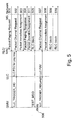
- the testing function is presented in more detail in Fig. 5 which shows the messages passed in communication between the protocol layers 301-305 of the mobile station MS and the communication network, in this case the testing apparatus 201.
- the packet paging request 501, packet channel request 502, packet immediate assignment 503, and packet paging response 504 are transmitted as described above.
- a PDA message (packet downlink assignment) 511 is transmitted to the mobile station, to indicate the resources available.
- the testing apparatus 201 starts downlink data transmission and testing by sending a special test message 505 in the RLC data block.
- This special test message 505 includes also information on what kind of uplink data transmission should be started by the mobile station MS.
- This special test message 505 indicates at least the length of the LLC PDU to be transmitted, which means the length of the PDU formed by the mobile station MS.
- the operation of the mobile station depends on the instructions given by the testing apparatus for performing the testing.
- communication is interrupted and the mobile station MS shifts to the GPRS standby state, in which the mobile station is connected to the MM functions of the GPRS system.
- the GMM layer of the mobile station processes the special test message, and after a determined delay 506 which in this case lasts for the time of two RLC data blocks, the LLC starts the transmission of the PDU (by sending an LLC_TRIGGER_IND message, wherein the LLC forms the desired PDU (LLC_PDU) and transmits it to the RLC layer).
- the GMM layer is capable of interpreting the special test message, and on the basis of the message, it commands the LLC layer to generate data.
- Uplink data transmission is started normally by transmitting a packet channel request 507 and a packet immediate assignment 508, after which the transmission of the required RLC data blocks, such as data blocks 509, 510, is started.
- the above-mentioned generated data can be in random format or bit sequences having e.g, the form "00000", "111111 --, “01010101", "110011001100" or "111000111000".
- the special test message may also contain information on the kind of resource request the MS will make. Also, the special test message may contain information on whether test data is to be transmitted continuously or only in a certain quantity, or information on what kind of ACK/UNACK mode is to be used in the RLC layer.
- the arrangement is used to test RLC/MAC functions, MAC states, timings and connection set-ups without the influence of an application of an upper layer, particularly the uppermost layer, or data transmitted by the DTE, in which case the testing of timings or the accurate control of the data transmission is not even possible.
- a particular advantage of the method is the testing of collision situations in data transmission (TBF, Temporary Block Flow) when uplink data transmission is started at the same moment when downlink data transmission is being started, downlink data transfer is going on or downlink data transmission is at end.
- the testing procedure it is also possible to control directly the desired protocol layer, e.g. the RLC/MAC layer.
- the desired protocol layer e.g. the RLC/MAC layer.
- the parameters to be transmitted it is possible to define the parameters to be transmitted to be e.g, information on the length of data to be generated in the mobile station, the delay used, and the test procedure used, wherein it is possible in a simple and precise manner to control the testing or the more precise subject of the testing.
- the testing apparatus can transmit such various commands to the mobile station which do not require the participation of the upper protocol levels, unaware of the connection, in the traffic.
- the testing apparatus may generate test data, i.e. test bursts whose information bits contain such desired bit combinations whose error-free reception is the particular subject of investigation.
- the transmission and reception of data take place in the physical protocol layer.
- the testing would not need to involve any upper protocol level in the mobile station.
- the physical layer does not make commands involved in the control of the mobile station possible, but some upper layers are involved in the mobile station for their reception and interpretation. Nevertheless, it is normal operation of the mobile station to transmit the information through all the protocol layers up to the application level whose operation the data to be transmitted relate to.
- the special test message (TST_MSG) 505 is normally transmitted on the PDTCH traffic channel (Packet Data Traffic CHannel). Testing and the transmission of RLC data blocks can also be started again by transmitting the special test message on the PACCH traffic channel (Packet Associated Control Channel).
- the GMM layer of the mobile station processes the special test message (TST_MSG), and after a determined delay 506, which in one example lasts for the time of the transmission of two RLC data blocks, it starts the transmission of the defined LLC PDU. It is also feasible that the special test message is used to set the mobile station in a state in which data transmission takes place in the presented way for a certain time, for example repeatedly. It is also feasible that another special test message is used to reset the mobile station from the test state.
- the mobile station comprises an antenna connection, through which downlink data is directed to the mobile station; next, there are radio and intermediate frequency parts, through which the received radio-frequency signal is converted to baseband frequency.
- the information contained in the baseband signal is reconstructed in a demodulator, after which the processing of the received signal may differ depending on whether it is signalling or data.
- the information is transferred to a channel decoder and via that to a control block, which is a microprocessor and controls the operation of the mobile station.
- Information contained in uplink data is generated in the control block, and it is channel coded.
- the data is added by modulation to baseband oscillation and mixed to radio frequency by means of the radio frequency parts of a transmitter part, after which it can be transmitted via the antenna connection.
- Channel coding and decoding can be implemented with one circuit which is programmed to operate in different ways. It is easy for anyone skilled in the art to define the test procedures according to the invention in the above-described manner and to implement the definition in practice, because the mobile station is fully controlled by its control block.
- the control block is a microprocessor which runs a program stored in the memory means available to it and which is used to implement also the protocol means mentioned earlier. When this program is written in such a way that the response to the downlink message of a certain protocol layer received from the testing apparatus is to start the transmission of uplink data to the testing apparatus in a way defined by the protocol means, the mobile station can be made to operate in a desired way according to the invention.
- the present invention is not limited solely to the embodiments presented above.
- the invention can also be applied e.g. in the UMTS system (Universal Mobile Telecommunication System).
- UMTS Universal Mobile Telecommunication System
- the terms and specifications presented in this patent application, referring to a certain system or apparatus, are given as examples for all those mobile communication systems in which the mobile station can operate.
Landscapes
- Engineering & Computer Science (AREA)
- Computer Networks & Wireless Communication (AREA)
- Signal Processing (AREA)
- Mobile Radio Communication Systems (AREA)
- Maintenance And Management Of Digital Transmission (AREA)
- Monitoring And Testing Of Transmission In General (AREA)
Claims (13)
- Verfahren zum Testen der Funktion einer Mobilstation, wobei die Mobilstation dafür vorgesehen ist, in einem paketvermittelten Kommunikationsnetz, das auf einem Mobilfunknetz basiert, zu arbeiten, und wobei die Mobilstation ein Mittel zum Empfangen von Downlink-Daten aus einer Testvorrichtung, ein Mittel zum Senden von Uplink-Daten zu der Testvorrichtung und ein Protokollmittel (301-306), das sich in der Mobilstation befindet, zum Generieren und Verarbeiten von Daten umfasst, wobei das Verfahren Folgendes umfasst:- Generieren und Übertragen von Uplink-Daten zu der Testvorrichtung in Reaktion auf eine Downlink-Meldung (310, 505) einer bestimmten Protokollschicht (301-306), die von der Testvorrichtung kommend empfangen wird, und- Steuern der Übertragung durch ein Testverfahren (307), das für die Protokollschicht (301-306) festgelegt wurde, in der Mobilstation, wobei das Testverfahren (307) mittels der Meldung (310, 505) aktiviert wird,dadurch gekennzeichnet, dass die Downlink-Meldung (310, 505), die von der Testvorrichtung kommend empfangen wird, Parameterdaten zur Menge der Daten umfasst, die als Antwort zu senden sind.
- Verfahren nach Anspruch 1, gekennzeichnet durch:- Versetzen der Mobilstation, in Reaktion auf die Meldung (310, 505), die von der Testvorrichtung kommend empfangen wird, in einen Modus, in dem eine Bestätigung der Übertragung von Daten zwischen der Testvorrichtung und der Mobilstation nicht an Protokollschichten (301-306) oberhalb einer festgelegten Protokollschicht (301-306) gesendet wird.
- Verfahren nach Anspruch 1 oder 2, gekennzeichnet durch:- Starten einer Datenübertragung von der Mobilstation zu der Testvorrichtung erst nach einer vorgegebenen Verzögerung (506) ab der Ankunft der Meldung (310, 505).
- Verfahren nach einem der vorangehenden Ansprüche, gekennzeichnet durch:- Generieren der zu sendenden Uplink-Daten ausschließlich in der Mobilstation.
- Verfahren nach einem der vorangehenden Ansprüche, gekennzeichnet durch:- zeitliches Einrichten der Datenübertragung von der Mobilstation zu der Testvorrichtung derart, dass sie gleichzeitig mit der Ankunft, gleichzeitig mit der Übertragung oder gleichzeitig mit der Beendigung der Übertragung anderer Downlink-Daten von der Testvorrichtung beginnt.
- Verfahren nach einem der vorangehenden Ansprüche, dadurch gekennzeichnet, dass die Meldung (310, 505), die von der Testvorrichtung kommend empfangen wird, Parameterdaten zur Qualität der Daten umfasst, die als Antwort zu senden sind.
- Verfahren nach einem der vorangehenden Ansprüche, dadurch gekennzeichnet, dass, in Reaktion auf die Downlink-Meldung (310, 505) einer bestimmten Protokollschicht (301-306), die von der Testvorrichtung kommend empfangen wird, die Protokollschicht (301-306) die Meldung (310, 505) interpretiert und eine niedrigere Protokollschicht (301-306) anweist, Uplink-Daten zu der Testvorrichtung zu senden.
- Mobilstation, die dafür vorgesehen ist, in einem paketvermittelten Kommunikationsnetz, das auf einem Mobilfunknetz basiert, zu arbeiten, und wobei die Mobilstation Folgendes umfasst:- ein Mittel zum Empfangen von Downlink-Daten von einer Testvorrichtung,- ein Mittel zum Senden von Uplink-Daten zu der Testvorrichtung, und- ein Protokollmittel (301-306), das sich in der Mobilstation befindet, zum Generieren und Verarbeiten von Daten,- ein Testverfahren (307), das für eine bestimmte Protokollschicht (301-306) in der Mobilstation definiert ist, wobei das Testverfahren (307) mittels einer Downlink-Meldung (310, 505) der Protokollschicht (301-306) aktiviert werden kann, die von der Testvorrichtung kommend empfangen wird, und wobei das Testverfahren (307) dafür verwendet wird, das Generieren und Übertragen von Uplink-Daten zu der Testvorrichtung, das in Reaktion auf die Meldung (310, 505) zu beginnen ist, zu steuern,dadurch gekennzeichnet, dass die Downlink-Meldung (310, 505), die von der Testvorrichtung kommend empfangen wird, Parameterdaten zur Menge der Daten umfasst, die als Antwort zu senden sind.
- Mobilstation nach Anspruch 8, dadurch gekennzeichnet, dass die Mobilstation dafür eingerichtet ist, in Reaktion auf die Meldung (310, 505), die von der Testvorrichtung kommend empfangen wird, in einen Modus versetzt zu werden, in dem keine Bestätigung einer Datenübertragung zwischen der Testvorrichtung und der Mobilstation zu den Protokollschichten (301-306) oberhalb einer festgelegten Protokollschicht (301-306) gesendet wird.
- Mobilstation nach Anspruch 8 oder 9, dadurch gekennzeichnet, dass eine Datenübertragung von der Mobilstation zu der Testvorrichtung so ausgestaltet ist, dass sie erst nach einer vorgegebenen Verzögerung (506) ab der Ankunft der Meldung (310, 505) beginnt.
- Mobilstation nach einem der vorangehenden Ansprüche, dadurch gekennzeichnet, dass die zu sendenden Uplink-Daten so ausgestaltet sind, dass sie unabhängig ausschließlich in der Mobilstation generiert werden.
- Mobilstation nach einem der vorangehenden Ansprüche, dadurch gekennzeichnet, dass die Protokollschicht (301-306) dafür ausgestaltet ist, in Reaktion auf die Downlink-Meldung (310, 505) einer bestimmten Protokollschicht (301-306), die von der Testvorrichtung kommend empfangen wird, die Meldung (310, 505) zu interpretieren und Anweisungen an eine niedrigere Protokollschicht (301-306) zu geben, um Uplink-Daten zu der Testvorrichtung zu übertragen.
- Mobilstation nach einem der vorangehenden Ansprüche, dadurch gekennzeichnet, dass die Mobilstation dafür ausgestaltet ist, in dem GPRS-System zu arbeiten.
Applications Claiming Priority (3)
| Application Number | Priority Date | Filing Date | Title |
|---|---|---|---|
| FI990390A FI107862B (fi) | 1999-02-23 | 1999-02-23 | Menetelmä radiolaitteen toimivuuden testaamiseksi ja matkaviestin |
| FI990390 | 1999-02-23 | ||
| PCT/FI2000/000125 WO2000051380A1 (en) | 1999-02-23 | 2000-02-18 | Method for testing the functioning of a radio apparatus, and a mobile station |
Publications (2)
| Publication Number | Publication Date |
|---|---|
| EP1155586A1 EP1155586A1 (de) | 2001-11-21 |
| EP1155586B1 true EP1155586B1 (de) | 2013-07-24 |
Family
ID=8553919
Family Applications (1)
| Application Number | Title | Priority Date | Filing Date |
|---|---|---|---|
| EP00905105.3A Expired - Lifetime EP1155586B1 (de) | 1999-02-23 | 2000-02-18 | Verfahren zum testen der funktion einer funkvorrichtung sowie eine mobilstation |
Country Status (11)
| Country | Link |
|---|---|
| US (1) | US6697604B1 (de) |
| EP (1) | EP1155586B1 (de) |
| JP (1) | JP4523173B2 (de) |
| CN (1) | CN1232151C (de) |
| AU (1) | AU2675500A (de) |
| DK (1) | DK1155586T3 (de) |
| ES (1) | ES2430794T3 (de) |
| FI (1) | FI107862B (de) |
| HK (1) | HK1044441B (de) |
| PT (1) | PT1155586E (de) |
| WO (1) | WO2000051380A1 (de) |
Families Citing this family (44)
| Publication number | Priority date | Publication date | Assignee | Title |
|---|---|---|---|---|
| FI108203B (fi) * | 1998-11-27 | 2001-11-30 | Nokia Mobile Phones Ltd | Menetelmä ja järjestely tiedon siirtämiseksi pakettiradiopalvelussa |
| EP1128600A1 (de) * | 2000-02-23 | 2001-08-29 | Tektronix, Inc. | Verfahren zum Erstellen eines Kommunikationsablaufs zwischen mindestens zwei Instanzen und Protokolltester hierfür |
| DE10054473A1 (de) * | 2000-11-03 | 2002-05-08 | Siemens Ag | Verfahren zum Austausch von Datenpaketen zwischen zwei Diensteerbringern eines Funkübertragungssystems |
| GB2370189B (en) * | 2000-12-13 | 2002-11-27 | Ericsson Telefon Ab L M | Radio link monitoring in a telecommunications network |
| DE10063243A1 (de) * | 2000-12-19 | 2002-06-27 | Siemens Ag | Verfahren zum Ermitteln der Übertragungsqualität in einem Übertragungssytem sowie entsprechendes Übertragungssystem |
| JP3607208B2 (ja) * | 2001-02-26 | 2005-01-05 | 株式会社東芝 | 無線端末の認定試験システム |
| JP3881196B2 (ja) * | 2001-06-27 | 2007-02-14 | 富士通株式会社 | 無線基地局装置 |
| KR100443171B1 (ko) * | 2001-09-19 | 2004-08-04 | 주식회사 팬택앤큐리텔 | 이동 전화기의 패킷 호 처리 검증 시스템 및 그 방법 |
| US7151776B1 (en) | 2002-02-28 | 2006-12-19 | Cisco Technology, Inc. | System and method for providing quality of service transport at an air interface of a telecommunications network |
| GB2386295B (en) * | 2002-03-06 | 2005-11-02 | Ifr Ltd | Testing mobile telephone terminals |
| JP4596728B2 (ja) | 2002-08-13 | 2010-12-15 | ルネサスエレクトロニクス株式会社 | 外部モジュール及び移動体通信端末 |
| JP3651605B2 (ja) * | 2002-09-06 | 2005-05-25 | 株式会社東芝 | 認定試験方法、認定試験システム、無線端末及び認定装置 |
| US20040082297A1 (en) * | 2002-10-28 | 2004-04-29 | Stambaugh Mark A. | Test protocols for wireless test |
| FI20022028A0 (fi) * | 2002-11-14 | 2002-11-14 | Nokia Corp | Parannettu RF-lähetinvastaanotinjärjestely, järjestelyä hyödyntävä päätelaite sekä menetelmä järjestelyn mukaisen päätelaitteen valmistamiseksi |
| EP1420545B1 (de) * | 2002-11-15 | 2011-10-05 | Tektronix International Sales GmbH | Verfahren zur Erstellung eines Kommunikations-Ablaufs zwischen mindestens zwei Instanzen und Protokolltester dafür |
| GB2396087B (en) * | 2002-12-06 | 2006-03-29 | Qualcomm | A method of and apparatus for adaptive control of data buffering in a data transmitter |
| JP2004228762A (ja) | 2003-01-21 | 2004-08-12 | Matsushita Electric Ind Co Ltd | 試験装置、移動端末装置及び試験方法 |
| DE10324745A1 (de) * | 2003-05-30 | 2004-12-30 | Rohde & Schwarz Gmbh & Co. Kg | Verfahren und Testgerät zum Ermitteln einer Fehlerrate |
| US7444136B1 (en) * | 2003-06-26 | 2008-10-28 | At&T Mobility Ii Llc | System and method for providing information services to subscribers in a GPRS network |
| EP1639732A2 (de) * | 2003-06-30 | 2006-03-29 | Nokia Corporation | Vorrichtung und assoziiertes verfahren zum prüfen eines mobilen endgeräts in testbedingungen, die eine betriebsumgebung emulieren |
| GB0315931D0 (en) * | 2003-07-08 | 2003-08-13 | Koninkl Philips Electronics Nv | Radio device testing system |
| CN100469170C (zh) * | 2003-07-22 | 2009-03-11 | 诺基亚有限公司 | 测试移动装置的数据传送功能 |
| US20060040654A1 (en) * | 2004-08-17 | 2006-02-23 | Moore George S | Method of system for testing a wireless device |
| CA2579662C (en) * | 2004-09-07 | 2017-03-07 | Research In Motion Limited | Testing systems and methods for a resource constrained device |
| DE102004062963A1 (de) * | 2004-12-28 | 2006-07-06 | Sigos Systemintegration Gmbh | Testgerät zum Einsatz in einem Testsystem zur Überprüfung von Übertragungsvorgängen innerhalb eines Mobilfunknetzes |
| GB2422068A (en) * | 2005-01-11 | 2006-07-12 | Agilent Technologies Inc | Testing mobile communication devices |
| KR100759990B1 (ko) * | 2006-01-02 | 2007-09-19 | 노키아 코포레이션 | 이동 장치의 데이터 전송 기능 테스팅 |
| CN100441017C (zh) * | 2006-01-17 | 2008-12-03 | 中国科学院上海微系统与信息技术研究所 | 基于业务模拟的宽带移动通信网络性能测试装置及方法 |
| US8538413B2 (en) * | 2006-03-02 | 2013-09-17 | Telefonaktiebolaget L M Ericsson (Publ) | Network layer test module for testing control channels and unidirectional radio bearers |
| US7702054B2 (en) * | 2006-05-05 | 2010-04-20 | Seiko Epson Corporation | Detecting errors in transmitted data |
| CN101277473B (zh) * | 2007-03-31 | 2012-08-08 | 华为技术有限公司 | 改变分组交换域的状态的方法、终端、网络设备 |
| DE102007038337A1 (de) * | 2007-08-14 | 2009-02-19 | Rohde & Schwarz Gmbh & Co. Kg | Verfahren zum Testen von Geräten für ein Mobilfunksystem, Signalgenerator, Gerät für ein Mobilfunksystem und Messsystem |
| US7797132B1 (en) | 2007-08-24 | 2010-09-14 | Nextel Communications Inc. | Benchmarking and testing GPS performance on communication devices |
| CN101203005B (zh) * | 2007-12-13 | 2010-12-08 | 展讯通信(上海)有限公司 | 一种解决单芯片双卡双待手机主副卡载波冲突的方法 |
| DK2117266T3 (da) * | 2008-05-07 | 2012-08-27 | Ericsson Telefon Ab L M | Fremgangsmåder, testsystemer og indretninger til kontrol af overholdelse af kravspecifikationer |
| CN102244537B (zh) * | 2010-05-13 | 2014-07-16 | 中兴通讯股份有限公司 | 终端上行模拟数据加载的方法和终端 |
| US8811194B2 (en) * | 2010-09-01 | 2014-08-19 | Litepoint Corporation | Method for testing wireless devices using predefined test segments initiated by over-the-air signal characteristics |
| DE102010046095A1 (de) * | 2010-09-21 | 2012-03-22 | Rohde & Schwarz Gmbh & Co. Kg | Messeinheit und Verfahren zur Übertragungsparametermessung eines Messobjekts |
| US8693351B2 (en) * | 2011-07-26 | 2014-04-08 | Litepoint Corporation | System and method for deterministic testing of packet error rate in electronic devices |
| DE102011084143B4 (de) | 2011-10-07 | 2024-07-04 | Rohde & Schwarz GmbH & Co. Kommanditgesellschaft | Messsoftware unterstütztes Messsystem und Messverfahren |
| JP2014179705A (ja) * | 2013-03-13 | 2014-09-25 | Hitachi Ltd | プロトコル試験方法及びシステム |
| US9274912B2 (en) * | 2014-05-16 | 2016-03-01 | Verizon Patent And Licensing Inc. | Simulating burst errors in mobile data communication network system level simulations |
| CN105991625B (zh) * | 2015-03-06 | 2020-11-06 | 电信科学技术研究院 | 一种进行数据传输的方法和设备 |
| CN110858171A (zh) * | 2018-08-23 | 2020-03-03 | 中移(杭州)信息技术有限公司 | 一种应用测试的系统、方法、装置、终端设备和介质 |
Family Cites Families (16)
| Publication number | Priority date | Publication date | Assignee | Title |
|---|---|---|---|---|
| JPS53115103A (en) * | 1977-03-17 | 1978-10-07 | Nec Corp | Test method for mobile radio apparatus |
| DE2724991B2 (de) * | 1977-06-02 | 1979-08-09 | Siemens Ag, 1000 Berlin Und 8000 Muenchen | Meßverfahren und Schaltungsanordnung zur Ermittlung der Dämpfungsverzerrung und der Gruppenlaufzeitverzerrung eines Meßobjekts |
| DE2829076A1 (de) * | 1978-07-01 | 1980-01-10 | Tekade Felten & Guilleaume | Testanordnung fuer datenuebertragungsstrecken |
| JPS5880947A (ja) * | 1981-11-09 | 1983-05-16 | Hitachi Denshi Ltd | 移動局動作テスト方式 |
| JPS59196633A (ja) * | 1983-04-21 | 1984-11-08 | Nec Corp | 自動車電話用移動機の遠隔試験方式 |
| JPH04369146A (ja) * | 1991-06-17 | 1992-12-21 | Hitachi Ltd | 回線テスト方式 |
| FI89223C (fi) | 1991-10-03 | 1993-08-25 | Nokia Mobile Phones Ltd | Digitalt audiointerface i gsm-anordning |
| US5381444A (en) * | 1991-10-31 | 1995-01-10 | Fujitsu Limited | Radio environment measuring system |
| JP3080530B2 (ja) * | 1994-03-11 | 2000-08-28 | アンリツ株式会社 | 無線端末試験装置 |
| JPH07273746A (ja) * | 1994-03-31 | 1995-10-20 | Anritsu Corp | 端末機試験装置 |
| EP0734192A3 (de) * | 1995-03-22 | 1998-04-08 | Siemens Aktiengesellschaft | Einrichtung zum Funktionstest von Mobilstationen |
| US5982760A (en) * | 1997-06-20 | 1999-11-09 | Qualcomm Inc. | Method and apparatus for power adaptation control in closed-loop communications |
| SE512115C2 (sv) * | 1997-09-08 | 2000-01-24 | Ericsson Telefon Ab L M | Testsändare samt förfarande för tillverkning av en mobil testsändare för ett mobiltelekommunikationssystem |
| FI106834B (fi) | 1998-06-03 | 2001-04-12 | Nokia Mobile Phones Ltd | Menetelmä ja järjestelmä datakanavien toimivuuden testaamiseksi radiolaitteessa |
| US6434364B1 (en) * | 1998-12-24 | 2002-08-13 | Telefonaktiebolaget Lm Ericsson (Publ) | Wireless communication system that supports mobile test software agents |
| US6445916B1 (en) * | 1999-01-07 | 2002-09-03 | Lucent Technologies Inc. | Wireless system and method for evaluating quality of service |
-
1999
- 1999-02-23 FI FI990390A patent/FI107862B/fi not_active IP Right Cessation
-
2000
- 2000-02-18 PT PT905105T patent/PT1155586E/pt unknown
- 2000-02-18 WO PCT/FI2000/000125 patent/WO2000051380A1/en not_active Ceased
- 2000-02-18 JP JP2000601868A patent/JP4523173B2/ja not_active Expired - Lifetime
- 2000-02-18 CN CNB00804208XA patent/CN1232151C/zh not_active Expired - Lifetime
- 2000-02-18 DK DK00905105.3T patent/DK1155586T3/da active
- 2000-02-18 EP EP00905105.3A patent/EP1155586B1/de not_active Expired - Lifetime
- 2000-02-18 HK HK02105846.3A patent/HK1044441B/zh not_active IP Right Cessation
- 2000-02-18 AU AU26755/00A patent/AU2675500A/en not_active Abandoned
- 2000-02-18 US US09/506,993 patent/US6697604B1/en not_active Expired - Lifetime
- 2000-02-18 ES ES00905105T patent/ES2430794T3/es not_active Expired - Lifetime
Also Published As
| Publication number | Publication date |
|---|---|
| FI990390A0 (fi) | 1999-02-23 |
| FI107862B (fi) | 2001-10-15 |
| AU2675500A (en) | 2000-09-14 |
| HK1044441A1 (en) | 2002-10-18 |
| FI990390L (fi) | 2000-08-24 |
| PT1155586E (pt) | 2013-09-06 |
| EP1155586A1 (de) | 2001-11-21 |
| CN1232151C (zh) | 2005-12-14 |
| CN1341335A (zh) | 2002-03-20 |
| JP2002538694A (ja) | 2002-11-12 |
| HK1044441B (zh) | 2006-08-25 |
| DK1155586T3 (da) | 2013-10-28 |
| ES2430794T3 (es) | 2013-11-21 |
| JP4523173B2 (ja) | 2010-08-11 |
| WO2000051380A1 (en) | 2000-08-31 |
| US6697604B1 (en) | 2004-02-24 |
Similar Documents
| Publication | Publication Date | Title |
|---|---|---|
| US6697604B1 (en) | Method for testing the functioning of a radio apparatus, and a mobile station | |
| US8305970B2 (en) | Method of transmitting a measurement report in a wireless mobile communications system | |
| EP1082866B1 (de) | Verfahren und system zum testen der datenkanalfunktionalität in einem radiogerät | |
| USRE46602E1 (en) | Method of transmitting and receiving radio access information in a wireless mobile communications system | |
| AU2006323560B2 (en) | Method of transmitting and receiving radio access information in a wireless mobile communications system | |
| EP1240800A2 (de) | Dynamische zuweisung von zugriffskapazität in gprs netzwerken | |
| US7043212B1 (en) | System and method for transmitting signals in a random access channel of a radio communication system | |
| US7526307B1 (en) | Stochastic transmission power level adjustment in a random access channel in a radio communications system and method | |
| KR100736571B1 (ko) | 이동통신시스템의 시스템 동기화 방법 및 사용자 단말의시스템 동기화 방법 | |
| HK40014446A (en) | Method of transmitting and receiving radio access information in a wireless mobile communications system | |
| HK40014446B (en) | Method of transmitting and receiving radio access information in a wireless mobile communications system | |
| HK1237180B (en) | Method of transmitting and receiving radio access information in a wireless mobile communications system | |
| HK1237180A1 (en) | Method of transmitting and receiving radio access information in a wireless mobile communications system |
Legal Events
| Date | Code | Title | Description |
|---|---|---|---|
| PUAI | Public reference made under article 153(3) epc to a published international application that has entered the european phase |
Free format text: ORIGINAL CODE: 0009012 |
|
| 17P | Request for examination filed |
Effective date: 20010816 |
|
| AK | Designated contracting states |
Kind code of ref document: A1 Designated state(s): AT BE CH CY DE DK ES FI FR GB GR IE IT LI LU MC NL PT SE |
|
| AX | Request for extension of the european patent |
Free format text: AL;LT;LV;MK;RO;SI |
|
| RAP1 | Party data changed (applicant data changed or rights of an application transferred) |
Owner name: NOKIA CORPORATION |
|
| 17Q | First examination report despatched |
Effective date: 20071213 |
|
| RAP1 | Party data changed (applicant data changed or rights of an application transferred) |
Owner name: SISVEL INTERNATIONAL S.A. |
|
| REG | Reference to a national code |
Ref country code: DE Ref legal event code: R079 Ref document number: 60048143 Country of ref document: DE Free format text: PREVIOUS MAIN CLASS: H04Q0007340000 Ipc: H04W0024000000 |
|
| RIC1 | Information provided on ipc code assigned before grant |
Ipc: H04W 24/00 20090101AFI20121218BHEP |
|
| GRAP | Despatch of communication of intention to grant a patent |
Free format text: ORIGINAL CODE: EPIDOSNIGR1 |
|
| GRAS | Grant fee paid |
Free format text: ORIGINAL CODE: EPIDOSNIGR3 |
|
| GRAA | (expected) grant |
Free format text: ORIGINAL CODE: 0009210 |
|
| AK | Designated contracting states |
Kind code of ref document: B1 Designated state(s): AT BE CH CY DE DK ES FI FR GB GR IE IT LI LU MC NL PT SE |
|
| REG | Reference to a national code |
Ref country code: GB Ref legal event code: FG4D |
|
| REG | Reference to a national code |
Ref country code: CH Ref legal event code: EP |
|
| REG | Reference to a national code |
Ref country code: AT Ref legal event code: REF Ref document number: 624016 Country of ref document: AT Kind code of ref document: T Effective date: 20130815 |
|
| REG | Reference to a national code |
Ref country code: IE Ref legal event code: FG4D |
|
| REG | Reference to a national code |
Ref country code: PT Ref legal event code: SC4A Free format text: AVAILABILITY OF NATIONAL TRANSLATION Effective date: 20130830 |
|
| REG | Reference to a national code |
Ref country code: DE Ref legal event code: R096 Ref document number: 60048143 Country of ref document: DE Effective date: 20130912 |
|
| REG | Reference to a national code |
Ref country code: CH Ref legal event code: NV Representative=s name: OFFICE ERNEST T. FREYLINGER S.A., CH |
|
| REG | Reference to a national code |
Ref country code: DK Ref legal event code: T3 Effective date: 20131021 |
|
| REG | Reference to a national code |
Ref country code: SE Ref legal event code: TRGR |
|
| REG | Reference to a national code |
Ref country code: ES Ref legal event code: FG2A Ref document number: 2430794 Country of ref document: ES Kind code of ref document: T3 Effective date: 20131121 |
|
| REG | Reference to a national code |
Ref country code: NL Ref legal event code: T3 |
|
| REG | Reference to a national code |
Ref country code: GR Ref legal event code: EP Ref document number: 20130402172 Country of ref document: GR Effective date: 20131118 |
|
| PG25 | Lapsed in a contracting state [announced via postgrant information from national office to epo] |
Ref country code: CY Free format text: LAPSE BECAUSE OF NON-PAYMENT OF DUE FEES Effective date: 20130404 |
|
| PG25 | Lapsed in a contracting state [announced via postgrant information from national office to epo] |
Ref country code: CY Free format text: LAPSE BECAUSE OF NON-PAYMENT OF DUE FEES Effective date: 20130724 |
|
| PLBE | No opposition filed within time limit |
Free format text: ORIGINAL CODE: 0009261 |
|
| STAA | Information on the status of an ep patent application or granted ep patent |
Free format text: STATUS: NO OPPOSITION FILED WITHIN TIME LIMIT |
|
| 26N | No opposition filed |
Effective date: 20140425 |
|
| REG | Reference to a national code |
Ref country code: DE Ref legal event code: R097 Ref document number: 60048143 Country of ref document: DE Effective date: 20140425 |
|
| PG25 | Lapsed in a contracting state [announced via postgrant information from national office to epo] |
Ref country code: MC Free format text: LAPSE BECAUSE OF FAILURE TO SUBMIT A TRANSLATION OF THE DESCRIPTION OR TO PAY THE FEE WITHIN THE PRESCRIBED TIME-LIMIT Effective date: 20130724 |
|
| REG | Reference to a national code |
Ref country code: FR Ref legal event code: PLFP Year of fee payment: 17 |
|
| REG | Reference to a national code |
Ref country code: FR Ref legal event code: PLFP Year of fee payment: 18 |
|
| REG | Reference to a national code |
Ref country code: FR Ref legal event code: PLFP Year of fee payment: 19 |
|
| PGFP | Annual fee paid to national office [announced via postgrant information from national office to epo] |
Ref country code: NL Payment date: 20190224 Year of fee payment: 20 Ref country code: LU Payment date: 20190221 Year of fee payment: 20 |
|
| PGFP | Annual fee paid to national office [announced via postgrant information from national office to epo] |
Ref country code: IE Payment date: 20190222 Year of fee payment: 20 Ref country code: IT Payment date: 20190228 Year of fee payment: 20 Ref country code: FI Payment date: 20190226 Year of fee payment: 20 Ref country code: DE Payment date: 20190304 Year of fee payment: 20 Ref country code: CH Payment date: 20190222 Year of fee payment: 20 Ref country code: ES Payment date: 20190315 Year of fee payment: 20 Ref country code: GB Payment date: 20190225 Year of fee payment: 20 |
|
| PGFP | Annual fee paid to national office [announced via postgrant information from national office to epo] |
Ref country code: BE Payment date: 20190222 Year of fee payment: 20 Ref country code: AT Payment date: 20190222 Year of fee payment: 20 Ref country code: DK Payment date: 20190222 Year of fee payment: 20 Ref country code: FR Payment date: 20190224 Year of fee payment: 20 Ref country code: GR Payment date: 20190226 Year of fee payment: 20 Ref country code: SE Payment date: 20190222 Year of fee payment: 20 |
|
| PGFP | Annual fee paid to national office [announced via postgrant information from national office to epo] |
Ref country code: PT Payment date: 20190125 Year of fee payment: 20 |
|
| REG | Reference to a national code |
Ref country code: DE Ref legal event code: R071 Ref document number: 60048143 Country of ref document: DE |
|
| REG | Reference to a national code |
Ref country code: NL Ref legal event code: MK Effective date: 20200217 |
|
| REG | Reference to a national code |
Ref country code: DK Ref legal event code: EUP Expiry date: 20200218 |
|
| REG | Reference to a national code |
Ref country code: CH Ref legal event code: PL |
|
| REG | Reference to a national code |
Ref country code: GB Ref legal event code: PE20 Expiry date: 20200217 |
|
| REG | Reference to a national code |
Ref country code: FI Ref legal event code: MAE |
|
| REG | Reference to a national code |
Ref country code: IE Ref legal event code: MK9A |
|
| REG | Reference to a national code |
Ref country code: BE Ref legal event code: MK Effective date: 20200218 |
|
| REG | Reference to a national code |
Ref country code: AT Ref legal event code: MK07 Ref document number: 624016 Country of ref document: AT Kind code of ref document: T Effective date: 20200218 |
|
| REG | Reference to a national code |
Ref country code: SE Ref legal event code: EUG |
|
| PG25 | Lapsed in a contracting state [announced via postgrant information from national office to epo] |
Ref country code: IE Free format text: LAPSE BECAUSE OF EXPIRATION OF PROTECTION Effective date: 20200218 Ref country code: PT Free format text: LAPSE BECAUSE OF EXPIRATION OF PROTECTION Effective date: 20200228 Ref country code: GB Free format text: LAPSE BECAUSE OF EXPIRATION OF PROTECTION Effective date: 20200217 |
|
| REG | Reference to a national code |
Ref country code: ES Ref legal event code: FD2A Effective date: 20200803 |
|
| PG25 | Lapsed in a contracting state [announced via postgrant information from national office to epo] |
Ref country code: ES Free format text: LAPSE BECAUSE OF EXPIRATION OF PROTECTION Effective date: 20200219 |