EP1154170A1 - Système de freinage d'un rotor par rapport à un stator - Google Patents
Système de freinage d'un rotor par rapport à un stator Download PDFInfo
- Publication number
- EP1154170A1 EP1154170A1 EP01401069A EP01401069A EP1154170A1 EP 1154170 A1 EP1154170 A1 EP 1154170A1 EP 01401069 A EP01401069 A EP 01401069A EP 01401069 A EP01401069 A EP 01401069A EP 1154170 A1 EP1154170 A1 EP 1154170A1
- Authority
- EP
- European Patent Office
- Prior art keywords
- braking
- brake
- fluid
- chamber
- brake release
- Prior art date
- Legal status (The legal status is an assumption and is not a legal conclusion. Google has not performed a legal analysis and makes no representation as to the accuracy of the status listed.)
- Granted
Links
- 239000012530 fluid Substances 0.000 claims abstract description 102
- 230000007935 neutral effect Effects 0.000 claims description 3
- 230000000694 effects Effects 0.000 description 5
- 230000002035 prolonged effect Effects 0.000 description 4
- 230000007423 decrease Effects 0.000 description 3
- 238000010438 heat treatment Methods 0.000 description 2
- 230000003042 antagnostic effect Effects 0.000 description 1
- 238000003475 lamination Methods 0.000 description 1
- 238000000034 method Methods 0.000 description 1
- 230000002688 persistence Effects 0.000 description 1
- 238000007789 sealing Methods 0.000 description 1
Images


Classifications
-
- B—PERFORMING OPERATIONS; TRANSPORTING
- B60—VEHICLES IN GENERAL
- B60T—VEHICLE BRAKE CONTROL SYSTEMS OR PARTS THEREOF; BRAKE CONTROL SYSTEMS OR PARTS THEREOF, IN GENERAL; ARRANGEMENT OF BRAKING ELEMENTS ON VEHICLES IN GENERAL; PORTABLE DEVICES FOR PREVENTING UNWANTED MOVEMENT OF VEHICLES; VEHICLE MODIFICATIONS TO FACILITATE COOLING OF BRAKES
- B60T13/00—Transmitting braking action from initiating means to ultimate brake actuator with power assistance or drive; Brake systems incorporating such transmitting means, e.g. air-pressure brake systems
- B60T13/10—Transmitting braking action from initiating means to ultimate brake actuator with power assistance or drive; Brake systems incorporating such transmitting means, e.g. air-pressure brake systems with fluid assistance, drive, or release
- B60T13/12—Transmitting braking action from initiating means to ultimate brake actuator with power assistance or drive; Brake systems incorporating such transmitting means, e.g. air-pressure brake systems with fluid assistance, drive, or release the fluid being liquid
- B60T13/22—Brakes applied by springs or weights and released hydraulically
-
- B—PERFORMING OPERATIONS; TRANSPORTING
- B60—VEHICLES IN GENERAL
- B60T—VEHICLE BRAKE CONTROL SYSTEMS OR PARTS THEREOF; BRAKE CONTROL SYSTEMS OR PARTS THEREOF, IN GENERAL; ARRANGEMENT OF BRAKING ELEMENTS ON VEHICLES IN GENERAL; PORTABLE DEVICES FOR PREVENTING UNWANTED MOVEMENT OF VEHICLES; VEHICLE MODIFICATIONS TO FACILITATE COOLING OF BRAKES
- B60T1/00—Arrangements of braking elements, i.e. of those parts where braking effect occurs specially for vehicles
- B60T1/02—Arrangements of braking elements, i.e. of those parts where braking effect occurs specially for vehicles acting by retarding wheels
- B60T1/06—Arrangements of braking elements, i.e. of those parts where braking effect occurs specially for vehicles acting by retarding wheels acting otherwise than on tread, e.g. employing rim, drum, disc, or transmission or on double wheels
- B60T1/065—Arrangements of braking elements, i.e. of those parts where braking effect occurs specially for vehicles acting by retarding wheels acting otherwise than on tread, e.g. employing rim, drum, disc, or transmission or on double wheels employing disc
-
- F—MECHANICAL ENGINEERING; LIGHTING; HEATING; WEAPONS; BLASTING
- F16—ENGINEERING ELEMENTS AND UNITS; GENERAL MEASURES FOR PRODUCING AND MAINTAINING EFFECTIVE FUNCTIONING OF MACHINES OR INSTALLATIONS; THERMAL INSULATION IN GENERAL
- F16D—COUPLINGS FOR TRANSMITTING ROTATION; CLUTCHES; BRAKES
- F16D55/00—Brakes with substantially-radial braking surfaces pressed together in axial direction, e.g. disc brakes
- F16D55/24—Brakes with substantially-radial braking surfaces pressed together in axial direction, e.g. disc brakes with a plurality of axially-movable discs, lamellae, or pads, pressed from one side towards an axially-located member
- F16D55/26—Brakes with substantially-radial braking surfaces pressed together in axial direction, e.g. disc brakes with a plurality of axially-movable discs, lamellae, or pads, pressed from one side towards an axially-located member without self-tightening action
- F16D55/36—Brakes with a plurality of rotating discs all lying side by side
- F16D55/40—Brakes with a plurality of rotating discs all lying side by side actuated by a fluid-pressure device arranged in or one the brake
-
- F—MECHANICAL ENGINEERING; LIGHTING; HEATING; WEAPONS; BLASTING
- F16—ENGINEERING ELEMENTS AND UNITS; GENERAL MEASURES FOR PRODUCING AND MAINTAINING EFFECTIVE FUNCTIONING OF MACHINES OR INSTALLATIONS; THERMAL INSULATION IN GENERAL
- F16D—COUPLINGS FOR TRANSMITTING ROTATION; CLUTCHES; BRAKES
- F16D59/00—Self-acting brakes, e.g. coming into operation at a predetermined speed
- F16D59/02—Self-acting brakes, e.g. coming into operation at a predetermined speed spring-loaded and adapted to be released by mechanical, fluid, or electromagnetic means
-
- F—MECHANICAL ENGINEERING; LIGHTING; HEATING; WEAPONS; BLASTING
- F16—ENGINEERING ELEMENTS AND UNITS; GENERAL MEASURES FOR PRODUCING AND MAINTAINING EFFECTIVE FUNCTIONING OF MACHINES OR INSTALLATIONS; THERMAL INSULATION IN GENERAL
- F16D—COUPLINGS FOR TRANSMITTING ROTATION; CLUTCHES; BRAKES
- F16D65/00—Parts or details
- F16D65/14—Actuating mechanisms for brakes; Means for initiating operation at a predetermined position
- F16D65/16—Actuating mechanisms for brakes; Means for initiating operation at a predetermined position arranged in or on the brake
- F16D65/18—Actuating mechanisms for brakes; Means for initiating operation at a predetermined position arranged in or on the brake adapted for drawing members together, e.g. for disc brakes
- F16D65/186—Actuating mechanisms for brakes; Means for initiating operation at a predetermined position arranged in or on the brake adapted for drawing members together, e.g. for disc brakes with full-face force-applying member, e.g. annular
-
- F—MECHANICAL ENGINEERING; LIGHTING; HEATING; WEAPONS; BLASTING
- F16—ENGINEERING ELEMENTS AND UNITS; GENERAL MEASURES FOR PRODUCING AND MAINTAINING EFFECTIVE FUNCTIONING OF MACHINES OR INSTALLATIONS; THERMAL INSULATION IN GENERAL
- F16D—COUPLINGS FOR TRANSMITTING ROTATION; CLUTCHES; BRAKES
- F16D55/00—Brakes with substantially-radial braking surfaces pressed together in axial direction, e.g. disc brakes
- F16D2055/0004—Parts or details of disc brakes
- F16D2055/0058—Fully lined, i.e. braking surface extending over the entire disc circumference
-
- F—MECHANICAL ENGINEERING; LIGHTING; HEATING; WEAPONS; BLASTING
- F16—ENGINEERING ELEMENTS AND UNITS; GENERAL MEASURES FOR PRODUCING AND MAINTAINING EFFECTIVE FUNCTIONING OF MACHINES OR INSTALLATIONS; THERMAL INSULATION IN GENERAL
- F16D—COUPLINGS FOR TRANSMITTING ROTATION; CLUTCHES; BRAKES
- F16D2121/00—Type of actuator operation force
- F16D2121/02—Fluid pressure
-
- F—MECHANICAL ENGINEERING; LIGHTING; HEATING; WEAPONS; BLASTING
- F16—ENGINEERING ELEMENTS AND UNITS; GENERAL MEASURES FOR PRODUCING AND MAINTAINING EFFECTIVE FUNCTIONING OF MACHINES OR INSTALLATIONS; THERMAL INSULATION IN GENERAL
- F16D—COUPLINGS FOR TRANSMITTING ROTATION; CLUTCHES; BRAKES
- F16D2121/00—Type of actuator operation force
- F16D2121/02—Fluid pressure
- F16D2121/12—Fluid pressure for releasing a normally applied brake, the type of actuator being irrelevant or not provided for in groups F16D2121/04 - F16D2121/10
-
- F—MECHANICAL ENGINEERING; LIGHTING; HEATING; WEAPONS; BLASTING
- F16—ENGINEERING ELEMENTS AND UNITS; GENERAL MEASURES FOR PRODUCING AND MAINTAINING EFFECTIVE FUNCTIONING OF MACHINES OR INSTALLATIONS; THERMAL INSULATION IN GENERAL
- F16D—COUPLINGS FOR TRANSMITTING ROTATION; CLUTCHES; BRAKES
- F16D2123/00—Multiple operation forces
-
- F—MECHANICAL ENGINEERING; LIGHTING; HEATING; WEAPONS; BLASTING
- F16—ENGINEERING ELEMENTS AND UNITS; GENERAL MEASURES FOR PRODUCING AND MAINTAINING EFFECTIVE FUNCTIONING OF MACHINES OR INSTALLATIONS; THERMAL INSULATION IN GENERAL
- F16H—GEARING
- F16H63/00—Control outputs from the control unit to change-speed- or reversing-gearings for conveying rotary motion or to other devices than the final output mechanism
- F16H63/02—Final output mechanisms therefor; Actuating means for the final output mechanisms
- F16H63/30—Constructional features of the final output mechanisms
- F16H63/3023—Constructional features of the final output mechanisms the final output mechanisms comprising elements moved by fluid pressure
- F16H63/3026—Constructional features of the final output mechanisms the final output mechanisms comprising elements moved by fluid pressure comprising friction clutches or brakes
- F16H2063/3033—Constructional features of the final output mechanisms the final output mechanisms comprising elements moved by fluid pressure comprising friction clutches or brakes the brake is actuated by springs and released by a fluid pressure
Definitions
- the present invention relates to a braking system of a rotor relative to a stator, comprising first means of braking integral with the rotor, second braking means integral of the stator, a brake piston capable of occupying a position of brake release and a braking position in which it solicits the first and second braking means in braking cooperation, the system further comprising elastic return means urging permanently the brake piston to its braking position, a brake chamber capable of being supplied with pressurized fluid to urge the brake piston towards its braking position, a chamber brake release capable of being supplied with pressurized fluid for apply the brake piston to its release position and the means for controlling the supply of fluid to said chambers.
- the braking system is for example that of a motor hydraulic, the rotor can be constituted by the cylinder block or by the crankcase, depending on whether the engine is a rotating cylinder block or rotating cam.
- This is for example a radial piston engine, type described in documents EP 0 869 279 or EP 0 887 548.
- the braking means are for example constituted by brake pads, respectively integral in rotation with the stator and the rotor and interleaved with each other.
- the fluid supply to the brake chamber can be used as brake assist, to reinforce the braking effect obtained by the return means elastic.
- Document US 4,557,109 shows, for its part, a system in which a chamber containing the elastic return means communicates with the brake release chamber by a restriction which is formed in the brake piston so that when the latter reaches its brake release position, this restriction is closed. This allows drain the brake release chamber, without using a drain or specific shuttle valve.
- the parking braking is used, under the sole effect of the means of elastic reminder.
- we operate a brake release by supplying pressurized fluid to the brake release, so as to move the brake piston against the force of the elastic return means.
- the invention aims to remedy this drawback by allowing fast and reliable braking, even shortly after application rotation of the rotor following a prolonged stop.
- the connecting duct is designed so that during the assisted braking phase, the forces exerted on the piston due to elastic return means and fluid pressure in the chamber braking, are greater than any opposing forces due to the persistence of fluid pressure in the brake release chamber.
- the viscous fluid is evacuated hardly from the brake release chamber, but it also circulates relatively difficult between the brake chamber and the release, so that we finally take advantage of the high viscosity of the fluid to achieve the assisted braking effect.
- connection duct the circulation of the fluid in the connection duct is limited in the direction from the brake release chamber to the chamber braking, so a classic brake release situation is all even obtained.
- the means for limiting the circulation of the fluid include a non-return valve allowing only the fluid flow in the direction from the brake chamber to the brake release chamber.
- the system has a restriction disposed in the connecting duct between the brake chamber and the brake release chamber.
- This restriction limits the circulation of fluid according to its section. It is advantageously arranged in series in the conduit of connection with the non-return valve. In this case, the valve prevents the circulation of fluid in the connecting pipe in the direction from the brake release chamber to the brake chamber. In the other direction, this circulation is limited by the restriction section, which allows ensure that sufficient fluid pressure prevails in the braking when the latter is supplied with pressurized fluid.
- the means of control of the fluid supply to the brake chambers and brake release are likely to command a brake configuration assisted in which the brake chamber communicates with the fluid supply line, while the brake release chamber communicates with the fluid return line, a configuration of brake release in which the brake release chamber communicates with the fluid supply line and simple braking configuration in which the brake release chamber communicates with a return of fluid, while the brake chamber is isolated from the pipe fluid supply.
- the system advantageously includes means to detect a parameter related to the viscosity of the fluid in the brake release chamber and means for controlling the braking in the assisted braking configuration when the parameter detected is indicative of a viscosity greater than a given viscosity and to control braking in the single braking configuration when said parameter reveals a viscosity lower than said given viscosity.
- this parameter is chosen from the temperature of the fluid, a pressure drop and the temperature of a part of the system in contact with the fluid.
- the braking means are located in the brake release chamber.
- the fluid which is in contact with them is thus more quickly warmed up.
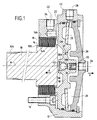
- the rotor is constituted by a shaft 10, by example a shaft of a hydraulic motor capable, by splines 10A, to be rotated by the cylinder block of this engine.
- the stator is in turn constituted by a part 12 of the brake housing, by example secured to the motor housing by screws 13.
- the first braking means comprise a first series of blades brake annulars 14 which are integral in rotation with the rotor 10 by their inner ends 14A and which cooperates with grooves or analogs 10B equipping the rotor.
- the second braking means comprise a second series of annular brake laminations 16 which, by their outer periphery 16A, are integral in rotation with the stator 12, for example using a 12B spline system. So classic, the slats of the first and second series are nested between each other.
- the braking system comprises a braking piston 18 capable to cooperate with the slats.
- the blades are held in abutment (by an abutment member not shown). So, when the piston is moved towards the blades, in direction F, it pushes these slats against each other to achieve braking.
- the piston is moved in the opposite direction G, the blades can move away from each other and allow the rotor to rotate.
- the piston 18 is continuously biased towards its position of braking by a return spring 20 such as an elastic washer of the type Belleville, which pushes it back in direction F.
- a return spring 20 such as an elastic washer of the type Belleville, which pushes it back in direction F.
- a brake release chamber 22 is provided on the side of the piston facing the brake slats. By a brake release pipe 24, it can be supplied with pressurized fluid to stress the piston in the meaning G.
- the brake plates 14 and 16 are arranged in this chamber 22.
- the system On the side of the piston opposite to chamber 22, the system includes a braking chamber 26 which can be supplied by a brake line 28 for, in addition to the spring 20, bias said piston in direction F.
- Chamber 26 is delimited between the face of the brake piston 18 which is opposite to the lamellae 14 and 16 and a brake cover 30 in flaccid shape. Sealing devices are provided between the room 12 of the brake housing and the piston 18 on the one hand, and between the part 12 and the cover 30 on the other hand.
- the spring 20 operates a parking brake.
- emergency brake release for example example for towing a vehicle equipped with an engine including a brake system according to the invention.
- the brake piston 18 has a thread 32.
- the cover 30 has a hole which, in operating situation, is closed by a plug 34.
- the plug 34 can be removed and a screw emergency brake release, the head of which rests on the cover 30, can cooperate with the internal thread 32 to recall the brake piston in the meaning G.
- a part 36 whose function will be specified in the which was originally placed in the internal thread 32, has been removed by unscrewing.
- the brake chamber 26 and the brake release chamber 22 are connected by a connecting pipe 38.
- this fluid can flow from the brake chamber 26 in the brake release chamber 22 via the conduit 38.
- this the latter comprises a first part 38A, in which is disposed a movable member such as a ball 40 allowing, by cooperating with a seat 38B, to form a non-return valve opposing the circulation of fluid in the direction from the brake release chamber 22 to the brake chamber braking 26.
- the second part of this connecting conduit is constituted by the thread 32 previously mentioned, and Exhibit 36 constitutes a restriction which defines a section of given passage, for example having a diameter of the order of 2 mm.
- the connecting conduit 38 is made in a simple manner by taking advantage of the internal thread 32 necessary for emergency brake release. In in this case, this duct is centered on the axis of rotation A of the rotor.
- the spring 20 is arranged in the braking 26.
- a reverse passage 37 provided with a restriction may authorize the circulation of fluid from the brake release chamber 22, in the chamber brake 26. It can be fitted with a non-return valve reversed by compared to valve 40 or, as in FIG. 1, authorize circulation fluid in both directions between chambers 22 and 26.
- the section of the passage 37 is very weak and preferably less than that of the restriction 36. It has for example a diameter of the order of 0.5 mm.
- This passage 37 generates a leak between the chamber 22 and the chamber 26. As in US patent 4,557,109, it facilitates the emptying of the brake release chamber 22. It can be equipped with means allowing its obturation in a stabilized brake release situation (for example in depending on the position of the piston 18), to prevent leakage from the chamber 22 is not permanent.
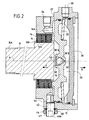
- FIG. 2 shows a system similar to that of FIG. 1, wherein the connecting duct 38 'also includes a first part 38'A, in which is disposed a movable member 40 forming a valve non-return by cooperating with a 38'B seat, as well as a 36 'restriction constituted by a portion of the conduit 38 'of appropriate section.
- This connecting conduit 38 ′ is also formed in the piston 18, being centered on axis A.
- the brake release means of relief are different from those in Figure 1. Indeed, the flange forming the brake cover 30 is full, but the brake release means emergency are accessible from an axial face of the system, made on an axial side of the casing 12.
- a radial bore 42 is provided in the axial wall of the casing so that over part of its length located towards the inside of the system, it has an opening on the brake release chamber 22 which faces the brake release piston 18.
- a cam-shaped stud 44 being able to be turned from the outside by a control rod 46, which is threaded and which cooperates with a tapped portion of the bore 42.
- the pin 44 is stopped in rotation by a lock nut 47, a seal being produced by a seal 48.
- the rod 46 has an actuation head 46A. Using a tool, it can be rotated for example a quarter of turn to place a large diameter region of the cam opposite the piston 18 and thus push the latter in direction G. In a situation of normal operation, it is a small diameter portion of the cam which is located opposite the piston.
- the connecting duct 38 is formed by a hole, which is produced in the brake piston 18 and which has a tapped part 38 "A.
- One piece 37 "with a 36” hole which forms the restriction is screwed into this tapped part.
- Room 37 has a wall 37" A, facing the brake release chamber 22, which forms a seat for the ball 40 of the valve anti-return.
- the part 37 " On the side of the plug 34, the part 37 "has a surface 37" B of engagement for a rotating drive tool. To achieve the emergency brake release, remove the plug 34 and rotate the part 37 “so that it advances in direction F. The ball 40 comes to rest on the shaft 10 so that by continuing the rotation of the part 37 ", we moves the brake piston 18 in direction G.
- the parking brake can be obtained by the only recall effect spring 20.
- the brake release allowing the rotation of the rotor is meanwhile obtained by supplying fluid to chamber 22, via conduit 24.
- assisted braking can be obtained by connecting the conduit 24 to a fluid return, to allow the evacuation of the chamber 22, and by connecting the conduit 28 to a supply, to allow the supply of fluid to the braking 26.
- the fluid introduced into the chamber 26 circulates by the connecting conduit 38, 38 ′ or 38 "in the brake release chamber 22, to evacuate through the conduit 24. This generates a circulation of fluid which promotes the heating of the latter and the reduction of its viscosity.
- the diameter of the restriction 36 or 36 ' makes it possible to ensure that, in this assisted braking situation, the fluid pressure is sufficient in the brake chamber to move the piston in the direction F even if the fluid is difficult to evacuate through the conduit 24 due high viscosity.
- FIG. 4 shows a control circuit for a braking according to the invention.
- This system is used to brake a hydraulic motor M.
- the rotor 10 constituting the shaft of brake and the stator 12 which constitutes a part of the motor casing.
- the fluid supply circuit includes a pump P, by example the booster pump of a hydraulic circuit whose pump main (not shown) would power the engine M.
- Valve 50 of brake system control for example a solenoid valve, is capable of occupying three positions.
- the valve 50 has four channels, respectively a braking 50A which is permanently connected to the braking chamber 26 by the brake line 28, a brake release path 50B which is permanently connected to the brake release chamber 22 by the pipe 24, a supply channel 50C permanently connected to the pipe supply 52 connected to the discharge port of the pump P and a return channel 50D permanently connected to return line 54.
- the fluid return 54 is connected to a pressureless tank 56.
- the pipe 54 connects the return path 50D at the suction of pump P. This gives a shorter circuit, which promotes the rise in temperature of the fluid and of the control circuit.
- the pipe 54 is both connected to the suction of the pump and tank 56.
- channels 50A and 50C are connected between them by being isolated from channels 50B and 50D which are themselves connected together, so that the valve 50 connects the braking 28 to the fluid supply 52, while it connects the conduit brake release 24 with the fluid return 54.
- This position P1 corresponds to a braking configuration assisted.
- the valve 50 has a second position P2, in which channels 50A and 50D are connected together, while being isolated from tracks 50B and 50C which are themselves connected together, so that the lines 28 and 24 are respectively connected to the line of fluid return 54 and to the fluid supply line 52.
- This second position therefore corresponds to the brake release configuration, in which the brake release chamber is supplied with fluid.
- the valve 50 also has a third position P3, in which channels 50A and 50C are isolated, while channels 50B and 50D are connected together, so that the pipe 28 is isolated, while line 24 is connected to the fluid return line 54. This corresponds to a simple braking configuration.
- the conduct of braking 28 is isolated from any other pipe in the configuration of simple braking. It should be noted that the fluid contained in the braking 26 was able to drain into the brake release chamber 22 by the connecting pipe, during the brake release situation that preceded this simple braking configuration. We can rather choose, in the simple braking configuration, connect the brake line 28 directly to a fluid return line, or even to the reservoir without pressure 56, in which case in position P3, channel 50A can be connected at return 54, for example by being connected to channel 50D.
- FIG. 5 shows a variant of the control circuit of the same braking system.
- This circuit includes two valves, respectively 60 and 70, which each have two positions allowing control the braking system between its braking configurations assisted, simple braking and brake release.
- the first valve 60 comprises four channels, namely one channel brake 60A permanently connected to the brake chamber 26, a brake release track 60B permanently connected to the brake release 22, a feed channel 60C permanently connected to the supply line 52 connected to the discharge of the pump P, and a return channel 60D permanently connected to a fluid return, by example the pressureless tank 56.
- the second two-position valve 70 has a braking bypass 70A which is permanently connected to the chamber brake 26, a supply bypass track 70C which is permanently connected to the supply line 52, and a return line 70D which is permanently connected to the return of fluid such as the reservoir 56.
- the valve 60 is shown in a first position P'1, in which it connects the brake release lines 60B and return 60D, isolating the 60A braking and 60C supply tracks.
- This position P'1 is called the braking position.
- This valve 60 can also adopt a brake release position P'2, in which its braking tracks 60A and return 60D are connected, while its brake release lines 60B and 60C power supply are connected to each other, while being isolated from other routes.
- the second valve 70 is shown in a position P'3, said neutral position, in which its braking bypass channels 70A and return line 70D are connected by being isolated from channel 70C. It can occupy a second position P'4, called the assistance position at braking, in which the braking bypass track 70A is connected to the power bypass path 70C being isolated from path 70D.
- the control system of valves 60 and 70 consisting of the species by solenoid valves, includes a first switch I1 which controls the valve 60 between its positions P'1 and P'2. He understands also a second switch I2 which controls the valve 70 between its positions P'3 and P'4, P'4 being controlled only if P'2 does not is not.
- the I1 switch is activated by the user of the braking, for example the driver of a vehicle equipped with this system.
- the switch I2 is preferably actuated automatically, by example depending on a parameter detected by a detector 80. When this parameter indicates a viscosity lower than a viscosity given, then the I2 switch is automatically closed to control position P'4 of valve 70.
- the braking configuration will be an assisted braking configuration is mandatory.
- the I2 switch can be automatically opened to control the position P'3 of the valve 70, so that, depending on the position of switch I1, we will go from a brake release configuration to a simple braking configuration.
- valve 50 is controlled between its three positions by electrical systems managed by a unit of CPU control according to a parameter, detected by an 80 'detector, revealing the viscosity of the fluid.
- valve 50 will be controlled from its position P2 to its position P3 to achieve simple braking, while, as long as the viscosity remains higher than a given viscosity, it will be controlled from its position P2 at its position P1 to perform assisted braking.
- the detected parameter can be the temperature of the fluid in the vicinity of the suction port of the pump P, as indicate the positions of the detectors 80 and 80 'in solid lines.
- viscosity will be deemed insufficient as long as this temperature will remain below 50 ° F, or about 10 ° C.
- the temperature sensor can be arranged in other places, for example at the entrance to the brake chamber 28.
- FIG. 1 different possible positions of the sensor, which can for example be placed on the stator body (position C1), or in line 24 (position C2).
- the detected parameter can be the temperature, but it can also be a pressure drop through a given restriction, for example a filter placed on the suction of the pump, or the temperature of a part in contact with the fluid, like the stator temperature.
- the 80 and 80 'sensors shown in solid lines are temperature sensors.
- the sensor 80 "shown in broken lines in FIG. 3 is a pressure.
- the data prerecorded according to charts will allow, to from the value of this parameter, determine the viscosity. Well of course, the viscosity will be considered appropriate based on different parameters specific to the envisaged system, and in particular depending on the pipe diameter 24.
- braking means 14 and 16 in the brake release chamber allows, in operating situation of the rotor, to heat the brake release fluid against relative movement, so that its viscosity decreases more quickly.
- starting the rotor is preceded by starting a heat engine intended to operate the pump to generate the circulation of fluid in the circuit.
- circuits shown in Figures 4 and 5 can allow to simultaneously control the brakes of several motors of a same machine or same machine.
Landscapes
- Engineering & Computer Science (AREA)
- General Engineering & Computer Science (AREA)
- Mechanical Engineering (AREA)
- Transportation (AREA)
- Physics & Mathematics (AREA)
- Electromagnetism (AREA)
- Braking Arrangements (AREA)
- Valves And Accessory Devices For Braking Systems (AREA)
Abstract
Description
- les figures 1, 2 et 3 sont des vues en coupe axiale, selon deux variantes, d'un système de freinage conforme à l'invention ; et
- les figures 4 et 5 illustrent, selon deux variantes, les circuits de commande d'un tel système de freinage.
Claims (13)
- Système de freinage d'un rotor (10) par rapport à un stator (12), comprenant des premiers moyens de freinage (14) solidaires du rotor, des deuxièmes moyens de freinage (16) solidaires du stator, un piston de frein (18) susceptible d'occuper une position de défreinage (G) et une position de freinage (F) dans laquelle il sollicite les premiers et deuxièmes moyens de freinage en coopération de freinage, le système comprenant, en outre, des moyens de rappel élastique (20) sollicitant en permanence le piston de frein (18) vers sa position de freinage (F), une chambre de freinage (26) susceptible d'être alimentée en fluide sous pression pour solliciter le piston de frein vers sa position de freinage (F), une chambre de défreinage (22) susceptible d'être alimentée en fluide sous pression pour solliciter le piston de frein vers sa position de défreinage (G) et des moyens de commande de l'alimentation en fluide desdites chambres,
caractérisé en ce que la chambre de freinage (26) et la chambre de défreinage (22) sont raccordées par un conduit de liaison (38, 38', 38") servant à générer une circulation de fluide dans une situation de freinage assisté (P1 ; P'1, P'4) dans laquelle la chambre de freinage (26) est raccordée à un conduit d'alimentation en fluide, tandis que la chambre de défreinage (22) est raccordée à un conduit de retour de fluide et en ce que le conduit de liaison est équipé de moyens (40, 36, 36', 36") pour limiter la circulation du fluide dans ledit conduit au moins dans le sens allant de la chambre de défreinage vers la chambre de freinage. - Système selon la revendication 1, caractérisé en ce que lesdits moyens pour limiter la circulation du fluide comprennent un clapet anti-retour (40, 38B, 38'B, 37"A) permettant seulement la circulation du fluide dans le sens allant de la chambre de freinage (26) vers la chambre de défreinage (22).
- Système selon la revendication 1 ou 2, caractérisé en ce qu'il comporte une restriction (36, 36', 36") disposée dans le conduit de liaison (38, 38', 38") entre la chambre de freinage et la chambre de défreinage.
- Système selon les revendications 2 et 3, caractérisé en ce que la restriction (36, 36', 36") et le clapet (40, 38B, 38'B, 37"A) sont disposés en série dans le conduit de liaison (38, 38', 38").
- Système selon l'une quelconque des revendications 1 à 4, caractérisé en ce que le conduit de liaison (38, 38', 38") est disposé dans le piston de frein (18).
- Système selon l'une quelconque des revendications 1 à 5, caractérisé en ce que les moyens de rappel élastique (20) sont disposés dans la chambre de freinage (26).
- Système selon l'une quelconque des revendications 1 à 6, caractérisé en ce que les moyens de commande (50) de l'alimentation en fluide des chambres de freinage (26) et de défreinage (22) sont susceptibles de commander une configuration de freinage assisté (P1 ; P'1, P'4) dans laquelle la chambre de freinage (26) communique (28) avec la conduite d'alimentation (52) en fluide, tandis que la chambre de défreinage (22) communique (24) avec la conduite de retour de fluide (54), une configuration de défreinage (P2 ; P'2, P'3) dans laquelle la chambre de défreinage (22) communique avec la conduite d'alimentation en fluide (52) et une configuration de freinage simple (P3 ; P'1, P'3) dans laquelle la chambre de défreinage (22) communique avec un retour de fluide (54), tandis que la chambre de freinage (26) est isolée de la conduite d'alimentation en fluide.
- Système selon la revendication 7, caractérisé en ce qu'il comporte des moyens (80, 80') pour détecter un paramètre ayant une relation avec la viscosité du fluide dans la chambre de défreinage (22) et des moyens pour commander le freinage dans la configuration de freinage assisté (P1 ; P'1, P'4) lorsque le paramètre détecté est révélateur d'une viscosité supérieure à une viscosité donnée et pour commander le freinage dans la configuration de freinage simple (P3 ; P'1, P'3) lorsque ledit paramètre est révélateur d'une viscosité inférieure à ladite viscosité donnée.
- Système selon la revendication 8, caractérisé en ce qu'il comporte des moyens (80, 80') pour détecter un paramètre choisi parmi la température du fluide, une perte de charge et la température d'une pièce du système en contact avec le fluide.
- Système selon l'une quelconque des revendications 7 à 9, caractérisé en ce que les moyens de commande de l'alimentation en fluide des chambres de freinage (26) et de défreinage (22) comprennent une valve (50) à trois positions qui présente une voie de freinage (50A) raccordée en permanence à la chambre de freinage (26), une voie de défreinage (50B) raccordée en permanence à la chambre de défreinage (22), une voie d'alimentation (50C) raccordée en permanence à la conduite d'alimentation en fluide (52) et une voie de retour (50D) raccordée en permanence à la conduite de retour de fluide (54), et en ce que cette valve est susceptible d'occuper une position (P1) de freinage assisté dans laquelle la voie de freinage (50A) est raccordée à la voie d'alimentation (50C), tandis que la voie de défreinage (50B) est raccordée à la voie de retour (50D), une position de défreinage (P2) dans laquelle la voie de défreinage (50B) est raccordée à la voie d'alimentation (50C), tandis que la voie de freinage (50A) est raccordée à la voie de retour (50D) et une position de freinage simple (P3), dans laquelle la voie de défreinage (50B) est raccordée à la voie de retour (50D), tandis que la voie d'alimentation (50C) est isolée.
- Système selon l'une quelconque des revendications 7 à 9, caractérisé en ce que les moyens de commande de l'alimentation en fluide des chambres de freinage (26) et de défreinage (22) comprennent une première valve (60) qui présente une voie de freinage (60A) raccordée en permanence à la chambre de freinage (26), une voie de défreinage (60B) raccordée en permanence à la chambre de défreinage (22), une voie d'alimentation (60C) raccordée en permanence à la conduite d'alimentation en fluide (52) et une voie de retour (60D) raccordée en permanence à un retour de fluide (56), ainsi qu'une deuxième valve (70) qui présente une voie de dérivation de freinage (70A) raccordée en permanence à la chambre de freinage (26), une voie de dérivation d'alimentation (70C) raccordée en permanence à la conduite d'alimentation (52) et une voie de conduite de retour (70D) raccordée à un retour de fluide (56), et en ce que la première valve (60) est susceptible d'occuper une position de freinage (P'1) dans laquelle elle relie ses voies de défreinage (60B) et de retour (60D) tout en isolant les voies de freinage (60A) et d'alimentation (60C) et une position de défreinage (P'2) dans laquelle elle relie ses voies de freinage (60A) et de retour (60D) et elle relie ses voies de défreinage (60B) et d'alimentation (60C), tandis que la deuxième valve (70) est susceptible d'occuper une position d'assistance au freinage (P'4) dans laquelle elle raccorde ses voies de dérivation de freinage (70A) et d'alimentation (70C) et une position neutre (P'3) dans laquelle elle raccorde ses voies de dérivation de freinage (70A) et de conduite de retour (70D).
- Système selon l'une quelconque des revendications 1 à 11, caractérisé en ce que la conduite d'alimentation en fluide (52) est reliée à un orifice de refoulement d'une pompe (P) et en ce que la conduite de retour de fluide (54) est reliée à un orifice d'aspiration de ladite pompe (P).
- Système selon l'une quelconque des revendications 1 à 12, caractérisé en ce que les premier et deuxième moyens de freinage (14, 16) sont disposés dans la chambre de défreinage.
Applications Claiming Priority (3)
| Application Number | Priority Date | Filing Date | Title |
|---|---|---|---|
| US09/567,596 US6585088B1 (en) | 2000-05-10 | 2000-05-10 | Braking system for braking a rotor relative to a stator |
| FR0005926A FR2808853B1 (fr) | 2000-05-10 | 2000-05-10 | Systeme de freinage d'un rotor par rapport a un stator |
| FR0005926 | 2000-05-10 |
Publications (2)
| Publication Number | Publication Date |
|---|---|
| EP1154170A1 true EP1154170A1 (fr) | 2001-11-14 |
| EP1154170B1 EP1154170B1 (fr) | 2006-09-27 |
Family
ID=28043350
Family Applications (1)
| Application Number | Title | Priority Date | Filing Date |
|---|---|---|---|
| EP01401069A Expired - Lifetime EP1154170B1 (fr) | 2000-05-10 | 2001-04-26 | Système de freinage d'un rotor par rapport à un stator |
Country Status (3)
| Country | Link |
|---|---|
| US (1) | US6585088B1 (fr) |
| EP (1) | EP1154170B1 (fr) |
| FR (1) | FR2808853B1 (fr) |
Cited By (3)
| Publication number | Priority date | Publication date | Assignee | Title |
|---|---|---|---|---|
| FR3048042A1 (fr) * | 2016-02-24 | 2017-08-25 | Poclain Hydraulics Ind | Systeme de frein avec mesure d'usure |
| FR3073015A1 (fr) * | 2017-11-02 | 2019-05-03 | Poclain Hydraulics Industrie | Machine hydraulique comprenant un systeme de freinage ameliore |
| WO2021191562A1 (fr) * | 2020-03-27 | 2021-09-30 | Poclain Hydraulics Industrie | Machine hydraulique comprenant un empilement de disques sollicités par un poussoir |
Families Citing this family (20)
| Publication number | Priority date | Publication date | Assignee | Title |
|---|---|---|---|---|
| US6743002B1 (en) * | 2003-02-03 | 2004-06-01 | Eaton Corporation | Rotary fluid pressure device and improved integral brake assembly |
| DE102004025296A1 (de) * | 2004-05-19 | 2005-12-08 | Ortlinghaus-Werke Gmbh | Sicherheitsbremse |
| DE102007010398A1 (de) * | 2007-03-01 | 2008-09-04 | Ortlinghaus-Werke Gmbh | Sicherheitsbremse |
| US8250862B1 (en) | 2007-09-21 | 2012-08-28 | Kanzaki Kokyukoki Mfg. Co., Ltd. | Vehicle |
| US7971689B2 (en) * | 2008-03-28 | 2011-07-05 | Wayne-Ian Moore | Hydraulic caliper brake assembly for a bicycle |
| US8453819B2 (en) * | 2010-02-22 | 2013-06-04 | Twin Disc, Inc. | Balanced clutch system |
| JP5384718B2 (ja) * | 2010-02-22 | 2014-01-08 | 日立建機株式会社 | 建設機械の旋回装置 |
| US20110278914A1 (en) * | 2010-05-17 | 2011-11-17 | Jacob Kobelt | Brake actuator, method of operating same, and system including same |
| EP2500598A1 (fr) * | 2011-03-18 | 2012-09-19 | Svendborg Brakes A/S | Système de frein ou de couplage et procédé de fonctionnement d'un tel système |
| US8662277B2 (en) | 2011-12-22 | 2014-03-04 | Fairfield Manufacturing Company, Inc. | Planetary gearbox with integral service brake |
| WO2014071519A1 (fr) | 2012-11-06 | 2014-05-15 | Evolution Engineering Inc. | Générateur d'impulsions de pression de fluide pour mesure en cours de forage |
| US9429227B2 (en) | 2014-02-19 | 2016-08-30 | Fairfield Manufacturing Company, Inc. | Planetary gearbox with integral service brake |
| DE102014206461A1 (de) * | 2014-04-03 | 2015-10-08 | Thyssen Krupp Elevator Ag | Aufzug mit einer Bremsvorrichtung |
| JP6382869B2 (ja) * | 2016-02-19 | 2018-08-29 | ファナック株式会社 | 回転テーブル装置 |
| US10781816B2 (en) | 2017-04-13 | 2020-09-22 | Eaton Intelligent Power Limited | Hydraulic motor brake |
| JP7049222B2 (ja) * | 2018-09-10 | 2022-04-06 | Kyb株式会社 | ブレーキシステム及びこれを備える液圧モータ |
| PL4313831T3 (pl) * | 2021-03-31 | 2025-06-23 | Inventio Ag | Układ hamulcowy windy |
| FR3121960B1 (fr) * | 2021-05-19 | 2023-04-14 | Poclain Hydraulics Ind | Circuit de balayage amélioré pour machine hydraulique. |
| DE102021213894B3 (de) * | 2021-12-07 | 2023-04-20 | Zf Friedrichshafen Ag | Lamellenbremse für ein Kraftfahrzeug |
| JP2024087253A (ja) * | 2022-12-19 | 2024-07-01 | ナブテスコ株式会社 | ブレーキ装置 |
Citations (8)
| Publication number | Priority date | Publication date | Assignee | Title |
|---|---|---|---|---|
| US3547234A (en) | 1969-02-14 | 1970-12-15 | Caterpillar Tractor Co | Dual range brake system for vehicles |
| US3680666A (en) | 1970-01-08 | 1972-08-01 | Sommer Co | Motor brake unit |
| US3999634A (en) * | 1974-01-14 | 1976-12-28 | Howell Industries, Inc. | Pneumatic actuation for disc brake assemblies |
| US4057297A (en) | 1976-06-28 | 1977-11-08 | Beck Henry E | Brake mechanism with spring applied fluid pressure released assembly |
| US4557109A (en) | 1983-07-22 | 1985-12-10 | Kabushiki Kaisha Komatsu Seisakusho | Brake for a hydraulic motor |
| US5595214A (en) * | 1993-02-10 | 1997-01-21 | Asha Corporation | Hydraulic coupling for vehicle drivetrain |
| EP0869279A1 (fr) | 1997-03-27 | 1998-10-07 | Poclain Hydraulics | Frein à ressort avec dispositif de défreinage mécanique |
| EP0887548A1 (fr) | 1997-06-23 | 1998-12-30 | Poclain Hydraulics | Moteur hydraulique |
Family Cites Families (30)
| Publication number | Priority date | Publication date | Assignee | Title |
|---|---|---|---|---|
| US2740512A (en) * | 1952-01-25 | 1956-04-03 | Gen Motors Corp | Hydraulic clutch and relief valve therefor |
| US3362481A (en) * | 1966-01-13 | 1968-01-09 | Twin Disc Inc | Hydraulically operated friction clutch having a dump valve |
| US3602347A (en) * | 1967-10-21 | 1971-08-31 | Aisin Seiki | Clutch engaging motor with automatic exhaust valve |
| US3647037A (en) * | 1969-05-28 | 1972-03-07 | Nissan Motor | Clutch with centrifugal dump valve |
| GB1273859A (en) * | 1970-09-22 | 1972-05-10 | Borg Warner Ltd | Fluid actuator |
| US3927737A (en) * | 1974-11-11 | 1975-12-23 | Caterpillar Tractor Co | Annular dual piston brake arrangement |
| US3974896A (en) * | 1975-07-21 | 1976-08-17 | J. I. Case Company | Fail-safe brake for a vehicle |
| DE2902290C2 (de) * | 1978-02-01 | 1983-10-06 | Honda Giken Kogyo K.K., Tokyo | Rückschlagventileinrichtung in einer druckmittelbetätigten Reibscheibenkupplung |
| US4261455A (en) * | 1978-12-26 | 1981-04-14 | Allis-Chalmers Corporation | Centrifugal pressure relief valve for a hydraulic clutch |
| JPS56501004A (fr) * | 1979-08-13 | 1981-07-23 | ||
| JPS57180284A (en) * | 1981-04-30 | 1982-11-06 | Nippon Telegr & Teleph Corp <Ntt> | Picture communication system |
| FR2529978A1 (fr) * | 1982-07-12 | 1984-01-13 | Poclain Hydraulics Sa | Dispositif de freinage a disques muni d'une commande de defreinage par fluide sous pression |
| FI72782C (fi) * | 1985-03-20 | 1987-07-10 | Valmet Oy | Hydraulisk motor. |
| FR2585653B1 (fr) * | 1985-08-05 | 1991-06-21 | Poclain Hydraulics Sa | Dispositif de freinage a effets multiples |
| JPS633536A (ja) * | 1986-06-23 | 1988-01-08 | Nec Eng Ltd | ル−プ伝送路誤り訂正方式 |
| JPH01172636A (ja) * | 1987-12-26 | 1989-07-07 | Daihatsu Motor Co Ltd | クラッチピストン装置のチェックバルブ機構 |
| JPH0231073A (ja) * | 1988-07-19 | 1990-02-01 | Aisin Aw Co Ltd | 自動変速機における油圧制御装置 |
| FR2655091B1 (fr) * | 1989-11-29 | 1994-06-03 | Poclain Hydraulics Sa | Ensemble d'un mecanisme a fluide sous pression et d'un frein a disques qui y est attele. |
| DE4104712C2 (de) * | 1991-02-15 | 1995-11-16 | Rexroth Mannesmann Gmbh | Radialkolbenmaschine mit mechanischer Bremseinrichtung |
| JP2876354B2 (ja) * | 1991-05-27 | 1999-03-31 | トヨタ自動車株式会社 | 自動変速機の油圧制御装置 |
| US5186284A (en) * | 1991-05-31 | 1993-02-16 | Case Corporation | Fail safe self-adjusting disc brake |
| FR2683882B1 (fr) * | 1991-11-20 | 1994-02-25 | Poclain Hydraulics | Ensemble d'un moteur hydraulique et d'un frein. |
| FR2695695B1 (fr) * | 1992-09-14 | 1994-12-23 | Poclain Hydraulics Sa | Freins à disques multiples et appareillage permettant la suppression mécanique du freinage. |
| DE4311997C2 (de) * | 1993-04-13 | 2001-07-12 | Sauer Sundstrand Gmbh & Co | Hydraulikmotor |
| JP3111768B2 (ja) * | 1993-08-24 | 2000-11-27 | トヨタ自動車株式会社 | 自動変速機の摩擦係合装置 |
| JP3042280B2 (ja) * | 1993-10-28 | 2000-05-15 | トヨタ自動車株式会社 | ショックアブソーバ油温推定装置およびそれを用いた減衰力制御装置 |
| DE19520447C1 (de) * | 1995-06-03 | 1996-10-31 | Ford Werke Ag | Hydraulische Betätigungsvorrichtung mit Wegausgleich, für Reibungsbremsen mit Bremsband zum Schalten eines automatischen Getriebes von Kraftfahrzeugen |
| US5895099A (en) * | 1997-10-17 | 1999-04-20 | Deere & Company | Hydraulic structure for a brake system |
| DE10020262B4 (de) * | 1999-04-28 | 2012-04-12 | Schaeffler Technologies Gmbh & Co. Kg | Lamellenkupplung |
| US6206163B1 (en) * | 1999-11-13 | 2001-03-27 | Borgwarner Inc. | Flow control capsule for clutch lubrication and cooling |
-
2000
- 2000-05-10 FR FR0005926A patent/FR2808853B1/fr not_active Expired - Fee Related
- 2000-05-10 US US09/567,596 patent/US6585088B1/en not_active Expired - Fee Related
-
2001
- 2001-04-26 EP EP01401069A patent/EP1154170B1/fr not_active Expired - Lifetime
Patent Citations (8)
| Publication number | Priority date | Publication date | Assignee | Title |
|---|---|---|---|---|
| US3547234A (en) | 1969-02-14 | 1970-12-15 | Caterpillar Tractor Co | Dual range brake system for vehicles |
| US3680666A (en) | 1970-01-08 | 1972-08-01 | Sommer Co | Motor brake unit |
| US3999634A (en) * | 1974-01-14 | 1976-12-28 | Howell Industries, Inc. | Pneumatic actuation for disc brake assemblies |
| US4057297A (en) | 1976-06-28 | 1977-11-08 | Beck Henry E | Brake mechanism with spring applied fluid pressure released assembly |
| US4557109A (en) | 1983-07-22 | 1985-12-10 | Kabushiki Kaisha Komatsu Seisakusho | Brake for a hydraulic motor |
| US5595214A (en) * | 1993-02-10 | 1997-01-21 | Asha Corporation | Hydraulic coupling for vehicle drivetrain |
| EP0869279A1 (fr) | 1997-03-27 | 1998-10-07 | Poclain Hydraulics | Frein à ressort avec dispositif de défreinage mécanique |
| EP0887548A1 (fr) | 1997-06-23 | 1998-12-30 | Poclain Hydraulics | Moteur hydraulique |
Cited By (8)
| Publication number | Priority date | Publication date | Assignee | Title |
|---|---|---|---|---|
| FR3048042A1 (fr) * | 2016-02-24 | 2017-08-25 | Poclain Hydraulics Ind | Systeme de frein avec mesure d'usure |
| FR3073015A1 (fr) * | 2017-11-02 | 2019-05-03 | Poclain Hydraulics Industrie | Machine hydraulique comprenant un systeme de freinage ameliore |
| EP3480458A1 (fr) * | 2017-11-02 | 2019-05-08 | Poclain Hydraulics Industrie | Machine hydraulique comprenant un système de freinage amélioré |
| US11136976B2 (en) | 2017-11-02 | 2021-10-05 | Poclain Hydraulics Industrie | Hydraulic machine including an improved braking system |
| WO2021191562A1 (fr) * | 2020-03-27 | 2021-09-30 | Poclain Hydraulics Industrie | Machine hydraulique comprenant un empilement de disques sollicités par un poussoir |
| FR3108693A1 (fr) * | 2020-03-27 | 2021-10-01 | Poclain Hydraulics Industrie | Machine hydraulique comprenant un empilement de disques sollicités par un poussoir |
| CN115667751A (zh) * | 2020-03-27 | 2023-01-31 | 波克兰液压工业设备公司 | 包括由推杆作用的盘件的叠堆的液压机器 |
| CN115667751B (zh) * | 2020-03-27 | 2026-02-13 | 波克兰液压工业设备公司 | 包括由推杆作用的盘件的叠堆的液压机器 |
Also Published As
| Publication number | Publication date |
|---|---|
| FR2808853A1 (fr) | 2001-11-16 |
| EP1154170B1 (fr) | 2006-09-27 |
| FR2808853B1 (fr) | 2002-08-02 |
| US6585088B1 (en) | 2003-07-01 |
Similar Documents
| Publication | Publication Date | Title |
|---|---|---|
| EP1154170B1 (fr) | Système de freinage d'un rotor par rapport à un stator | |
| EP3480458B1 (fr) | Machine hydraulique comprenant un système de freinage amélioré | |
| EP1750967A1 (fr) | Element de transmission a embrayages humides pour chaine de traction hybride de vehicule automobile, et vehicule automobile equipe d'un tel element | |
| FR2741556A1 (fr) | Dispositif de serrage a systeme integre de passage tournant d'un fluide | |
| FR3054010A1 (fr) | Systeme de freinage ameliore pour machine hydraulique | |
| EP1643139B1 (fr) | Dispositif de valve d'échange | |
| FR2823707A1 (fr) | Circuit hydraulique ayant un moteur hydraulique equipe d'un frein pour un vehicule apte a etre remorque | |
| EP3087285B1 (fr) | Frein à disque perfectionné comportant un frein de stationnement à actionnement hydraulique et un groupe de rattrapage d'usure | |
| EP3239544A1 (fr) | Unité de propulsion pour véhicule aquatique comprenant un module de conditionnement de fluide hydraulique et procédé de contrôle du conditionnement | |
| FR2551139A1 (fr) | Demarreur a commande par air comprime, notamment pour moteurs a combustion interne | |
| EP1072791A2 (fr) | Moteur hydraulique a pistons radiaux et a selecteur de debrayage unique | |
| WO2015096970A2 (fr) | Frein à disque comportant un frein de stationnement à actionnement hydraulique | |
| EP0869279A1 (fr) | Frein à ressort avec dispositif de défreinage mécanique | |
| FR2672940A1 (fr) | Machine ou moteur a pistons radiaux, comportant un dispositif de freinage mecanique. | |
| FR2931768A1 (fr) | Systeme de freinage pour le controle de stabilite et de traj ectoire d'un vehicule automobile et procedes d'utilisation d 'un tel systeme | |
| FR2819024A1 (fr) | Dispositif de moteur hydraulique ayant un selecteur de cylindree et un systeme de freinage | |
| EP3087288B1 (fr) | Frein à disque à commande hydraulique comportant un frein de stationnement à actionnement hydraulique | |
| EP0725226B1 (fr) | Frein à disque à absorption réduite | |
| FR3002991A1 (fr) | Circuit hydraulique comprenant une commande de freinage statique temporisee | |
| FR2931767A1 (fr) | Systeme de freinage pour le controle de stabilite et de traj ectoire d'un vehicule automobile et procedes d'utilisation d 'un tel systeme | |
| FR2931764A1 (fr) | Systeme de freinage avec controle de stabilite et de trajectoire a au moins un element de frein motorise muni d'un dispositif de stockage d'energie ainsi qu'une pompe externe. | |
| EP3087287B1 (fr) | Frein à disque comportant un frein de stationnement à actionnement hydraulique et un groupe de rattrapage d'usure | |
| EP3087289B1 (fr) | Frein à disque perfectionné comportant un frein de stationnement à actionnement hydraulique | |
| FR2892486A1 (fr) | Valve a ouverture amortie | |
| FR2710698A3 (fr) | Dispositif pour faciliter le démarrage d'un moteur électrique destiné à l'entraînement d'une pompe hydraulique. |
Legal Events
| Date | Code | Title | Description |
|---|---|---|---|
| PUAI | Public reference made under article 153(3) epc to a published international application that has entered the european phase |
Free format text: ORIGINAL CODE: 0009012 |
|
| AK | Designated contracting states |
Kind code of ref document: A1 Designated state(s): DE GB SE Kind code of ref document: A1 Designated state(s): AT BE CH CY DE DK ES FI FR GB GR IE IT LI LU MC NL PT SE TR |
|
| AX | Request for extension of the european patent |
Free format text: AL;LT;LV;MK;RO;SI |
|
| 17P | Request for examination filed |
Effective date: 20020506 |
|
| AKX | Designation fees paid |
Free format text: DE GB SE |
|
| GRAP | Despatch of communication of intention to grant a patent |
Free format text: ORIGINAL CODE: EPIDOSNIGR1 |
|
| GRAS | Grant fee paid |
Free format text: ORIGINAL CODE: EPIDOSNIGR3 |
|
| GRAA | (expected) grant |
Free format text: ORIGINAL CODE: 0009210 |
|
| AK | Designated contracting states |
Kind code of ref document: B1 Designated state(s): DE GB SE |
|
| REG | Reference to a national code |
Ref country code: GB Ref legal event code: FG4D Free format text: NOT ENGLISH |
|
| REF | Corresponds to: |
Ref document number: 60123320 Country of ref document: DE Date of ref document: 20061109 Kind code of ref document: P |
|
| REG | Reference to a national code |
Ref country code: SE Ref legal event code: TRGR |
|
| GBT | Gb: translation of ep patent filed (gb section 77(6)(a)/1977) |
Effective date: 20070104 |
|
| PLBE | No opposition filed within time limit |
Free format text: ORIGINAL CODE: 0009261 |
|
| STAA | Information on the status of an ep patent application or granted ep patent |
Free format text: STATUS: NO OPPOSITION FILED WITHIN TIME LIMIT |
|
| 26N | No opposition filed |
Effective date: 20070628 |
|
| PGFP | Annual fee paid to national office [announced via postgrant information from national office to epo] |
Ref country code: SE Payment date: 20080318 Year of fee payment: 8 |
|
| PGFP | Annual fee paid to national office [announced via postgrant information from national office to epo] |
Ref country code: DE Payment date: 20080411 Year of fee payment: 8 |
|
| PGFP | Annual fee paid to national office [announced via postgrant information from national office to epo] |
Ref country code: GB Payment date: 20080408 Year of fee payment: 8 |
|
| EUG | Se: european patent has lapsed | ||
| GBPC | Gb: european patent ceased through non-payment of renewal fee |
Effective date: 20090426 |
|
| PG25 | Lapsed in a contracting state [announced via postgrant information from national office to epo] |
Ref country code: DE Free format text: LAPSE BECAUSE OF NON-PAYMENT OF DUE FEES Effective date: 20091103 |
|
| PG25 | Lapsed in a contracting state [announced via postgrant information from national office to epo] |
Ref country code: GB Free format text: LAPSE BECAUSE OF NON-PAYMENT OF DUE FEES Effective date: 20090426 |
|
| PG25 | Lapsed in a contracting state [announced via postgrant information from national office to epo] |
Ref country code: SE Free format text: LAPSE BECAUSE OF NON-PAYMENT OF DUE FEES Effective date: 20090427 |